THE HIDDEN ROOM.
Reading edition
'Dreaming again, Millicent, and your hands folded in your lap! Your father would have to go without shirts if it were left to you!'
Millicent Basset started up from the pleasant rose-covered wall where she had been sitting, and her fair face flushed at her aunt's sharp words.
'Indeed, Aunt Deborah, I am very sorry; but the news from Newbury has driven all other thoughts from my mind. I was wishing I could have been with Antony and Father, instead of being left at home doing nothing while they are fighting.'
'There is no call for you to do nothing,' replied Aunt Deborah dryly, 'while work lies ready to your hand. Take your seam indoors to your chamber, and stir not from it till supper-time. I am going to the village to see the smith's son; I hear he was sore hurt in the fight.'
Millicent rose with a sigh, and carried her work to her room as she was bidden. She turned her back resolutely to the window, and set to work to make up for lost time. A quaint picture she made in the low oak-panelled room, in her grey dress and white kerchief—for her father, Sir James Basset, was a staunch Roundhead, and so was Dame Deborah, his sister, who had ruled his household since the death of his wife.
These were stirring times. The civil war between the Roundheads and Charles I. was at its height, and two days before, the sound of guns had been distinctly heard at Wootton Basset, for a battle had been fought at Newbury, and night had fallen before either side could claim the victory. Sir James Basset and his son had both been fighting, but had escaped unhurt, and had gone on with the Parliamentary army to London, finding means, however, to send a message home about their safety.
Aunt Deborah, with the calmness of a strong nature, after assembling the family to return thanks for the good news, went quietly on with her usual duties, expecting every one else to do the same; but to Millicent this seemed impossible. How could she be expected to sit and stitch wristbands, when, only six miles away, the sun, shining so quietly in at the window, was looking down on the battlefield? 'Oh, if I had only been a man,' she cried, 'to ride forth instead of being left here!'
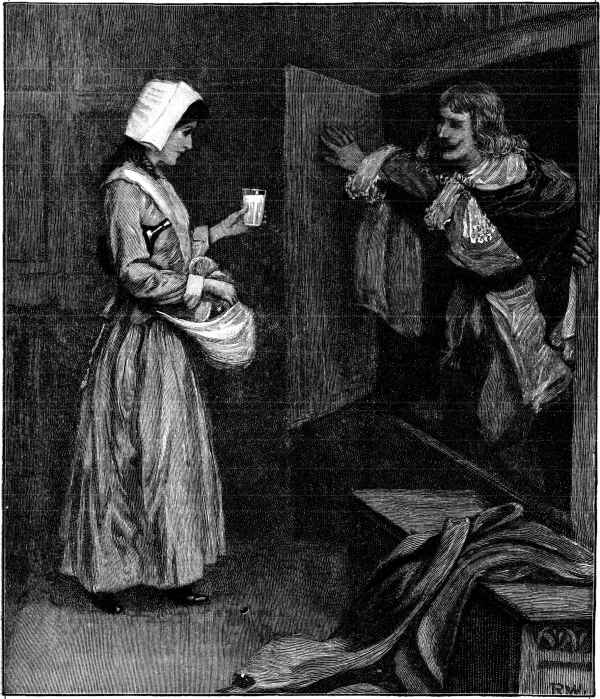
Hardly had the words crossed her lips before one of the panels in a dark corner of the room flew back, revealing to her startled eyes a tall youth, whose long curls and the dainty lace ruffles on his torn and stained shirt proved him to be one of those young Cavaliers whom Millicent had often wished to know, but who to Aunt Deborah represented all that was lawless and wicked. She started to her feet in terror. At that moment the presence of her aunt, or even of one of the babies, as she called her nine-year-old twin sisters, would have been a comfort; but the stranger's voice reassured her.
'Am I speaking to Mistress Millicent Basset?' he asked with a low bow, which brought the colour to Millicent's face, for few people spoke to her as if she were grown up.
'Yes, I am Millicent Basset, at your service,' she answered. Then, plucking up her courage, she added, 'How did you come here, and what right have you to take the panel out of the wall?'
A smile passed across the young soldier's face. 'Bravely asked,' he said, 'and easily answered had I time; but I must show you something first. Do you recognise that?' and, stepping forward, he laid something on the table beside her.
At that moment hurrying feet and shrill voices were heard in the passage. It was the twins. Happily in their eagerness they paused for a moment, disputing which should open the door. Then a strange thing happened. Millicent had turned from the stranger for a moment as the children fumbled at the lock; and when she turned her head again he had vanished, and the panelled wall looked exactly as it had always done. All that remained to prove that she had not been dreaming was the little packet he had placed on the table.
Millicent quickly placed her sewing on the packet and swept it into her lap before she listened to what the excited little girls had to say.
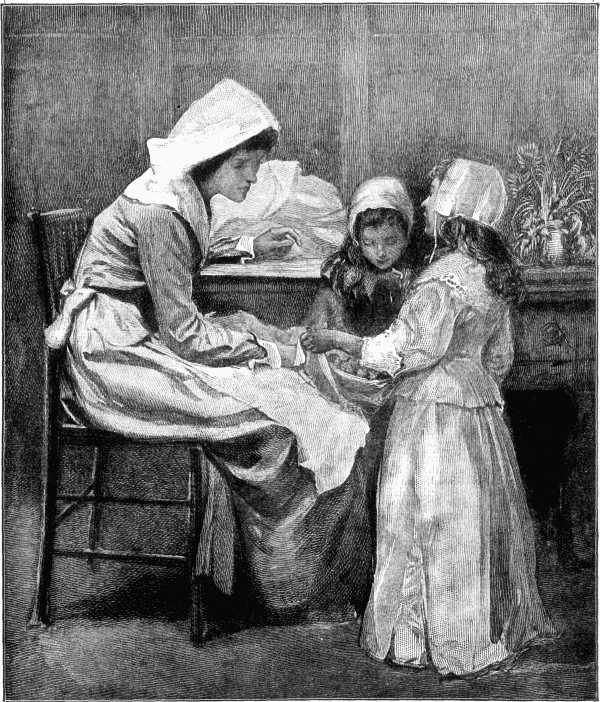
'See, sister,' cried Alison, holding out her apron to show six little fluffy chickens, 'what my speckled hen has hatched, all unknown to any one. We do not know where to put them. Will you come out and choose a place for them?'
'Nay, children, that I cannot do, for I promised Aunt Deborah to stay here and sew; but I can show you a place from the window. The old dog-kennel yonder would be a good house for the hen and her brood, and you can watch for Aunt Deborah and let her see them when she returns. Run away now, like good little maidens; the chicks will soon grow cold without their mother, and I have this long seam to stitch before supper.'
The children ran off well pleased, and Millicent was left alone, feeling safe from interruption, for she knew she would be warned of Aunt Deborah's approach by their excited voices. When the door closed behind them, she went softly to it and drew the bolt. Then she took up the mysterious little parcel, and was greatly surprised to find it was a little Testament which belonged to her brother Antony, which he always carried in his pocket. To make sure she opened it, and there on the fly-leaf was his name, 'Antony, from Millicent,' and beneath was written as if in haste: 'I send this by the hand of Ralph de Foulkes; help him as he helped me.'
(Continued on page 330.)
"'See what my speckled hen has hatched.'"
"'I got these easily from the cellar.'"