INSECT WAYS AND MEANS.
Reading edition
XI.—CATERPILLARS AND THEIR ENEMIES.
(Concluded from page 357.)
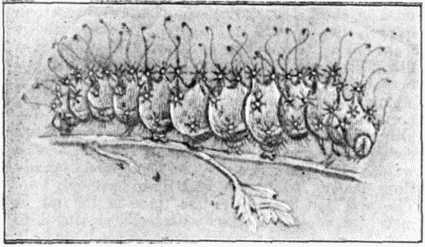
The caterpillar of the North American Great Peacock moth (fig. 4) is armed with numerous tufts of prickles ending in minute black points which pierce the hand if touched, and cause severe pain. These spines, as shown in the illustration (fig. 2, a b, on page 357) are hollow, and filled with liquid poison. 'a' is the portion which breaks off; 'b' the hollow base which contains the poison.
In some few caterpillars the poison spines take the form of balls armed with short prickles and one large spike; hence they are known as caltrop spines (fig. 2, c), from their likeness to the cruel weapons, known as caltrops, which used to be scattered over the ground in time of war to repel the attacks of cavalry; the spikes forced their way into the horses' feet when trampled on, and so disabled them.
The spines of the caterpillar of our Oak Eggar moth are very brittle, and in handling these insects, great care must be taken, as cases are known of blindness having been caused by the spines being carried into the eyes by the fingers.
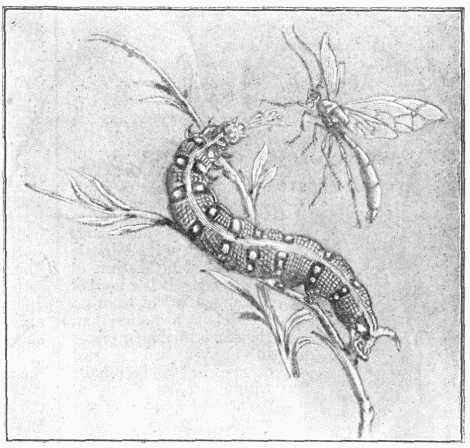
Let us now turn to the liquid squirts with which some caterpillars are provided. Our Spurge-hawk caterpillar, for example, when threatened, squirts from the mouth a spray of poison. In our illustration (fig. 5) it is shown repelling the attack of the dreaded ichneumon fly by means of this spray. The quaint Puss moth, which many Chatterbox readers must have seen, can squirt out an irritant fluid, generally supposed to be formic acid, from the mouth, when alarmed, and this, if it enters the eye, causes acute pain.
Fig. 4.—North American Great Peacock.
The caterpillars of the Swallow-tailed moths, when irritated, give out an offensive smell, but they are unable to 'spray.'
Many beetles have the power of forcing drops of blood from a minute hole in one of the legs. This blood is saturated either with a fluid which causes a burning sensation on everything it touches, or with an intolerable odour; in either case the result is the same—they are given a wide berth by all who have discovered their power. The little lady-bird beetle, for example, sends out, when frightened, a tiny drop of a yellow fluid from the 'knee-joint,' which has a smell like opium. The Javanese 'violin-beetle' gives off a fluid which is said to paralyse the fingers for twenty-four hours.
Fig. 5.—Caterpillar of Spurge-hawk Moth fighting Ichneumon Fly.
W. P. Pycraft, F.Z.S., A.L.S.