HOW HETAIS WORE HIS MEDAL.
Reading edition
A True Story.
Hetais was a French sailor, a carpenter of the Ville de Paris, and he and his ship-mates took part with our soldiers in the siege of Sebastopol in 1854, where Hetais, having shown great gallantry during one of the sorties, was adjudged that coveted decoration, the médaille militaire—a medal that is only given to privates and non-commissioned officers.
The presentation of this medal was to be made on a certain evening, and on the morning, as he and his mates were on duty in the trenches, the chief subject of conversation was the honour that had befallen Hetais.
He was a modest, brave-hearted fellow, and though much pleased at the prospect of his medal, was pleased, too, to think of the treat he meant to give his comrades to celebrate the event.
'Look here,' he said to his particular chum, 'I have just drawn out all the money owing to me, and I mean you fellows to have a good, hot supper to-night at the canteen, and I foot the bill!' and as he spoke he pulled out a handful of silver from his pocket and showed it with a laugh to his friend.
Hot suppers were a rarity in that camp, and the very thought of such a treat was cheering to the half-starved men.
'You are a good fellow, Hetais,' said one of the men, 'and you deserve your luck.'
'Hold your tongue, you silly fellow,' said Hetais, with a good-natured thump on the speaker's back. 'Get on with your coffee-making, and do not talk nonsense!'
'All right,' said the man, cautiously lifting his head above the shelter of the trench, so as to see what the Russians were about. 'The "Moscos"' (so the French termed the enemy) 'seem keeping quiet to-day, and we shall be able to enjoy our coffee in peace,' he continued.
A fire was lighted, and the water put on to boil in a saucepan, the men all sitting round in eagerness, for it was bitterly cold in the trenches, and a hot cup, or rather tin, of coffee seemed to warm and cheer them better than anything else.
'Now then,' at last said the coffee-maker, 'hold out your mess-tins, and we will divide fairly.'
Every man held out his mess-tin—but not one drop of coffee was to be drunk by any of them, for at that very moment a bomb from the Russian battery landed in their midst, upsetting the saucepan of coffee and exploding in the midst of the little crowd of men.
It seemed as if none could escape! Yet, strange to say—for this is a true story—of all that group, no one was hurt, except the brave Hetais, whose head had been all but blown away by the bursting of the bomb.
It is impossible to describe the grief and consternation of his comrades, who felt, one and all, that each could have been better spared than the man who lay dead at their feet.
Just then the officer in charge of the party came up, and the senior man told him how Hetais had met his death. The officer was no less sorry than the men, for Hetais was popular with all ranks.
'Poor fellow! he was a brave man if there ever was one,' said the officer. 'Carry his body back to camp, my lads; he shall be honoured in death, if he has just missed it in life,' for the officer was thinking of the medal and the ceremony of presentation which was to have taken place that evening.
The men extemporised a sort of bier out of a litter on which the dead man was lying and their muskets, and thus they reverently carried him back to camp, the relief party presenting arms as the funeral procession passed by them.
When the General in command was informed of the death of Hetais, he issued the following order to the troops:
'I was to have presented Hetais, of the Ville de Paris, with the médaille militaire, and his untimely death must not deprive him of this honour. I shall fasten the medal on him at his burial.'
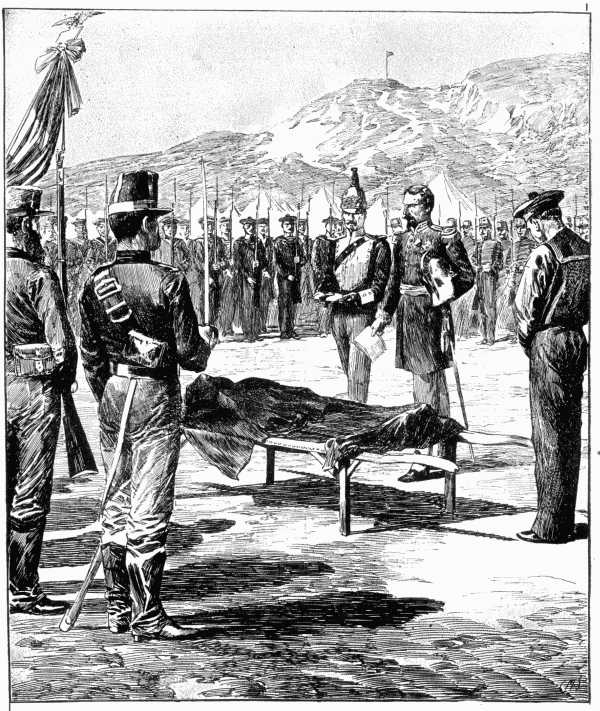
A few hours later, all the sailors and soldiers who could be spared from the trenches were drawn up in a hollow square outside the camp around the body of Hetais, who, wrapped in his cloak, slept his last calm sleep on the rough litter in which he had been carried from the trenches.
The deep silence was at last broken by the loud voice of the commanding officer: 'Present arms!' Then he took off his helmet, and followed by another officer, who carried the medal, he advanced towards the bier, and read out the brief account of the gallant action which had gained Hetais his medal.
Then, taking the medal from the hand of the subaltern, he fastened it on to the cloak of the sailor, and, turning to the assembled soldiers and sailors, he thus addressed them:
'A glorious death has ended a noble life,' he said, in a loud, clear voice, which could be heard by all; 'but death, though it has robbed us of a brave comrade, shall not rob him of the honour due to his services. In the name of the General commanding the forces in the East, I confer on our dead comrade the médaille militaire!'
Then all ranks passed in turn, bare-headed, past the still figure of Hetais, lying all unconscious of the honour done to him; and thus were the last honours paid to a brave man.
"The commanding officer advanced towards the bier."
"'How would you like to earn twenty pounds reward?'"