THE APPLE.—ITS VARIETIES.
Reading edition
1. ACKLAM’S RUSSET.—Fors.
Identification.—Fors. Treat. 92. Lind. Guide, 85. Hort. Soc. Cat. ed. 3, n. 733.
Synonyme.—Aclemy Russet, Gibs. Fr. Gard. 359.
Fruit, below the medium size, two inches and a quarter wide, and two inches high; round and somewhat flattened. Skin, pale yellow tinged with green, and covered with thin grey russet, particularly on the side exposed to the sun. Eye, small and closed, set in a smooth, round, and shallow basin. Stalk, short, inserted in a moderately deep cavity. Flesh, white with a greenish tinge, firm, crisp, juicy, and highly flavoured.
An excellent dessert apple of first-rate quality; ripe in November, and will keep under favourable circumstances till March.
The tree is very hardy, and an excellent bearer. It succeeds best in a dry soil, and is well adapted for espalier training.
This variety is supposed to have originated at the village of Acklam, in Yorkshire.
2. ADAMS’S PEARMAIN.—Lind.
Identification.—Lind. Guide, 60. Hort. Soc. Cat. ed. 3, n. 529.
Synonyme.—Norfolk Pippin, Hort. Soc. Cat. ed. 1, 685.
Figure.—Pom. Mag. t. 133.
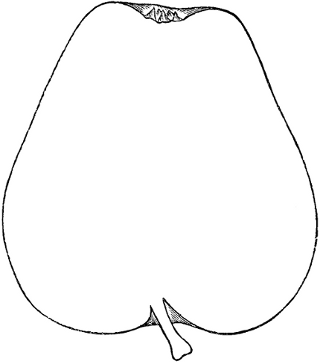
Fruit, large, varying from two inches and a half to three inches high and about the same in breadth at the widest part; pearmain-shaped, very even, and regularly formed. Skin, pale yellow tinged with green, and covered with delicate russet on the shaded side; but deep yellow tinged with red, and delicately streaked with livelier red on the side next the sun. Eye, small and open, with acute erect segments, set in a narrow, round, and plaited basin. Stalk, varying from half an inch to an inch long, obliquely inserted in a shallow cavity, and generally with a fleshy protuberance on one side of it. Flesh, yellowish, crisp, juicy, rich, and sugary, with an agreeable and pleasantly perfumed flavor.
A dessert apple of first-rate quality; in use from December to February. It is a large and very handsome variety, and worthy of general cultivation.
The tree is a free and healthy grower, producing long slender shoots, by which, and its cucullated ovate leaves, it is easily distinguished. It is an excellent bearer even in a young state, particularly on the paradise or doucin stock, and succeeds well as an espalier.
3. ALFRISTON.—Hort.
Identification.—Hort. Soc. Cat. ed. 3, n. 8. Lind. Guide, 26. Down. Fr. Amer. 97.
Synonymes.—Lord Gwydyr’s Newtown Pippin, Acc. Hort. Soc. Cat. ed. 3. Oldaker’s New, Ibid. Shepherd’s Pippin, in Sussex. Shepherd’s Seedling, Ibid.
Figure.—Ron. Pyr. Mal. pl. xxxv. f. 1.
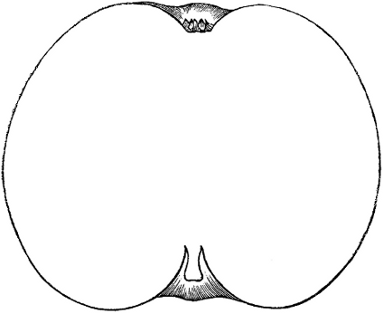
Fruit, of the largest size, generally about three inches and a half wide, and from two and three quarters to three inches high; roundish, and angular on the sides. Skin, greenish yellow on the shaded side, and tinged with orange next the sun, covered all over with veins, or reticulations of russet. Eye, open, set in a deep and uneven basin. Stalk, short, inserted in a deep cavity. Flesh, yellowish white, crisp, juicy, sugary, and briskly flavoured.
This is one of the largest and best culinary apples. It comes into use in the beginning of November and continues till April.
The tree is a strong and vigorous grower, very hardy, and an abundant bearer.
This variety is supposed to have been raised by a person of the name of Shepherd, at Uckfield, in Sussex, and has for many years been extensively cultivated in that county, under the names of Shepherd’s Seedling, and Shepherd’s Pippin, two names by which it is there most generally known. Some years ago a Mr. Brooker, of Alfriston, near Hailsham, in Sussex, sent specimens of the fruit to the London Horticultural Society, by whom, being unknown, it was called the Alfriston, a name by which it is now generally known, except in its native county. By some it is erroneously called the Baltimore and Newtown Pippin.
4. AMERICAN FALL PIPIN.—H.
Synonyme.—Fall Pippin, Coxe. View, 109, Down. Fr. Amer. 84.
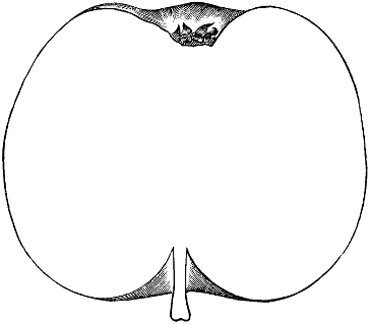
Fruit, large, three inches and a quarter wide, and two inches and three quarters high; roundish, ribbed on the sides, and almost the same width at the apex as the base. Skin, yellow tinged with green, and strewed with brown dots on the shaded side; but with a tinge of brown, and numerous embedded pearly specks on the side next the sun. Eye, large and open, with broad, flat segments, set in a wide, deep, and rather angular basin. Stalk, three quarters of an inch long, inserted in a rather shallow cavity, which is slightly marked with russet. Flesh, yellowish, slightly tinged with green at the margin, tender, juicy, sugary, slightly perfumed, and pleasantly flavoured.
Unlike the majority of American Apples, this comes to great perfection in this country, and is a valuable and first-rate culinary apple. It is ripe in October and will last till Christmas.
This is the true Fall Pippin of the American orchards, and a very different variety from the Fall Pippin of this country, which is known by the names of Cobbett’s Fall Pippin, and Reinette Blanche d’Espagne.
5. AMERICAN SUMMER PEARMAIN.—Ken.
Identification.—Ken. Amer. Or. 1. Hort Soc. Cat. ed. 3. Down. Fr. Amer. 70.
Synonyme.—Early Summer Pearmain, Coxe. View, 104.
Fruit, medium sized; oblong, regularly and handsomely shaped. Skin, yellow, covered with patches and streaks of light red, on the shaded side; and streaked with fine bright red, interspersed with markings of yellow on the side next the sun. Eye, set in a wide and deep basin. Stalk, slender, inserted in a round and deep cavity. Flesh, yellow, very tender, rich, and pleasantly flavored.
An excellent early apple, either for dessert or kitchen use. It is ripe in the end of August, and will keep till the end of September.
The tree is a healthy grower, a prolific bearer, and succeeds well on light soils.
6. API.—Duh.
Identification.—Duh. Arb. Fr. I. 309. Quint. Traité, 1, 202.
Synonymes.—Lady Apple, Coxe. View, 117. Down. Fr. Amer. 115. Pomme d’Apict, Inst. Arb. Fr. 154. Pomme Appease, Worl. Vin. 165. L’Api, Bret. Ecole. II. 478. Pomme d’Apis, Knoop. Pom. 68, t. xii. Api Rouge, Poit. Pom. Franç. t. 113. Pomme d’Api, Fors. Treat. 121. Petit Api Rouge, Nois. Jard. Fr. ed. 2, pl. 105. Api Petit, Hort. Soc. Cat. ed. 3, n. 11. Pomme Rose, Acc. Hort. Soc. Cat.erroneously. Pomme Dieu and Long Bois, in some provinces of France. Kleine Api Apfel, Christ. Handb. ed. 2, n. 145. Der Jungfernapfel, Christ Handworter, 17. Der Einfache, der Welsche Api, Ibid. Bollen oder Traubenapfel, Ibid. Api Roesje, Ibid. Appius Claudius, Evelyn. Fr. Gard. 124. Malus Apiosa, Hort. Par.
Figures.—Duh. Arb. Fr. I. pl. ix. Brook. Pom. Brit. pl. lxxxvii. f. 1. Jard. fruit, ed. 2, pl. 105. Ron. Pyr. Mal. pl. xxxii. f. 1.
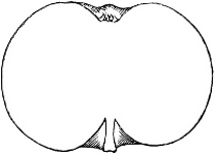
Fruit, small; oblate. Skin, thick, smooth, and shining, yellowish green in the shade, changing to pale yellow as it attains maturity; and deep glossy red, approaching to crimson, on the side next the sun. Eye, small, set in a rather deep and plaited basin. Stalk, short, and deeply inserted. Flesh, white, crisp, tender, sweet, very juicy, and slightly perfumed.
A beautiful little dessert apple in use from October to April.
It should be eaten with the skin on, as it is there that the perfume is contained. The skin is very sensitive of shade, and any device may be formed upon it, by causing pieces of paper, in the form of the design required, to adhere on the side exposed to the sun, before it has attained its deep red color.
The tree is of a pyramidal habit of growth, healthy, and an abundant bearer. It succeeds well in almost any situation, provided the soil is rich, loamy, and not too light or dry; and may be grown with equal success either on the doucin, or crab stock. When worked on the French paradise it is well adapted for pot culture. The fruit is firmly attached to the spurs and forcibly resists the effects of high winds.
It has been asserted, that this apple was brought from Peloponessus to Rome, by Appius Claudius. Whether this be true or not, there can be no doubt it is of great antiquity, as all the oldest authors regard it as the production of an age prior to their own. Dalechamp and Harduin are of opinion that it is the Petisia of Pliny; but J. Baptista Porta considers it to be the Appiana of that author, who thus describes it, “Odor est his cotoneorum magnitudo quæ Claudianis, color rubens.”[I] From this description it is evident that two varieties are referred to, the Appiana and Claudiana. Such being the case, J. Baptista Porta says, “duo sunt apud nos mala, magnitudine, et colore paria, et preciosa, quorum unum odorem servat cotoneorum, alterum minimè. Quod odore caret, vulgo dictum Melo rosa. Id roseo colore perfusum est, mira teneritudine et sapore, minimè fugax, pomum magnitudine media, ut facile cum ceteris de principatu certet, nec indignum Claudii nomine. Hoc Claudianum dicerem.”[J] This Melo Rosa may possibly be the Pomme Rose or Gros Api; and if so, we may infer that the Api is the Appiana, and the Gros Api the Claudiana of Pliny. This, however, may be mere conjecture, but as the authority referred to, was a native of Naples, and may be supposed to know something of the traditionary associations of the Roman fruits, I have deemed it advisable to record his opinion on the subject. According to Merlet, the Api was first discovered as a wilding in the Forest of Api, in Brittany.
Although mentioned by most of the early continental writers, the Api does not appear to have been known in this country, till towards the end of the 17th century. It is first mentioned by Worlidge, who calls it “Pomme Appease, a curious apple, lately propagated; the fruit is small and pleasant, which the Madams of France carry in their pockets, by reason they yield no unpleasant scent.” Lister, in his “Journey to Paris, 1698,” speaking of this as being one of the apples served up in the dessert, says, “Also the Pome d’Apis, which is served here more for show than for use; being a small flat apple, very beautiful, and very red on one side, and pale or white on the other, and may serve the ladies at their toilets as a pattern to paint by.” De Quintinye calls it “Une Pomme des Damoiselles et de bonne compagnie.”
Under the name of Lady Apple, large quantities of the Api are annually imported to this country from the United States, where it is grown to a great extent, and produces a considerable return to the growers, as it always commands the highest price of any other fancy apple in the market. In the winter months, they may be seen encircled with various coloured tissue papers, adorning the windows of the fruiterers in Covent Garden Market.
There are other varieties mentioned by J. B. Porta as belonging to the Api family; one which ripened in August, in size like the Claudiana already mentioned, and commonly called Melo Appio Rosso, because it retained the scent of the Api; this is probably the Rother Sommer-api of Diel. There is another, of which he says, “Assererem tuto esse Melapium Plinii,” and which was held in such estimation as to give rise to the proverb—
“Omme malum malum præter appium malum.”
7. API GROS.—Duh.
Identification.—Duh. Arb. Fr. 1, 312. Hort. Soc. Cat. ed. 3.
Synonymes.—Pomme Rose, Quint. Traité, I. 203, but not of Knoop. Pomme d’Api Gros. Ron. Pyr. Mal. 39. Passe-rose, Chart. Cat. 55. Grosser Api, Rosenapi, Diel Kernobst. iv., 228. Api Rose. Doppelter Api, Acc. Christ Handworter. Rubenapfel, Ibid. Api Grand, Ibid.
Figure.—Ron. Pyr. Mal. pl. xx. f. 1.
Fruit, below medium size, two inches and three quarters wide, and two inches high; oblate. Skin, pale green, changing as it ripens to pale yellow on the shaded side, and pale red, mottled with green, where exposed to the sun. Eye, small and closed, set in a shallow and plaited basin. Stalk, short, inserted in a wide, rather deep, and russety cavity. Flesh, greenish, tender, crisp, very juicy, and briskly flavored.
Suitable either for the dessert, or for culinary purposes; it is inferior to the Api and not a first-rate apple. In use from December to March. The tree has much similarity to the Api in its growth, and is a good bearer.
This is a variety of the preceding, and closely resembles it in all its parts, except that it is much larger. “La Pomme Rose resemble extremement partout son exterieur a la Pomme d’Apis, mais à mon goût elle ne la vaut pas quoy que puissent dire les curieux du Rhône, qui la veulent autant élever aussi au dessus des autres, qu’ils élevent la Poire Chat au dessus des autres Poires.”—De Quintinye.
8. API ETOILLE.—Diel.
Identification.—Diel. Kernobst. B. iv. 31.
Synonymes.—Pomme Etoillée, Duh. Arb. Fr. I. 312. Pomme d’Etoille, Ibid. Gelber Sternförmiger Api, Diel Kernobst. B. iv. 31. Sternapfel, Christ Handworter, 106. Hort. Soc. Cat. ed. 3, n. 797.
This is a variety of the Api, from which it is distinguished by being very much flattened, and furnished with five very prominent angles on the sides, which give it the appearance of a star, hence its name. It is of a deep yellow on the shaded side, and redish orange next the sun. It is a well-flavored apple, but only of second-rate quality. It ripens about the middle or end of September.
The variety received under this name by the London Horticultural Society must have been incorrect, as in the last edition of their catalogue it is made synonymous with Api Petit.
9. API NOIR.—Duh.
Identification.—Duh. Arb. Fr. I. 311. Hort. Soc. Cat. ed. 3.
Synonyme.—Schwarzer Api, Diel Kernobst. ix. 214.
Figure.—Poit et. Turp. pl. 137.
Fruit, small, but a little larger and somewhat flatter than the Api, to which it bears a close resemblance. Skin, tender, smooth, and shining as if varnished, and almost entirely covered, where exposed to the sun, with very dark crimson, almost approaching to black, like the Pomme Violette, but becoming paler towards the shaded side, where there is generally a patch of light yellow; it is strewed with fawn-colored dots, and some markings of russet. Eye, very small, set in a pretty deep and plaited basin. Stalk, slender, about three quarters of an inch long, inserted in a rather deep, wide, and funnel-shaped cavity, which is slightly marked with russet. Flesh, pure white, firm and juicy, tinged with red under the skin, and with a pleasant, vinous, and slightly perfumed flavor.
A dessert apple, inferior to the Api, and cultivated merely for curiosity. It is in use from November to April, but is very apt to become meally.
The habit of the tree is similar to that of the Api, but it is rather a larger grower.
10. AROMATIC RUSSET.—Lind.
Identification.—Lind. Guide, 86. Rog. Fr. Cult. 105.
Figure.—Ron. Pyr. Mal. pl. viii.
Fruit, medium sized, two inches and a half wide, and about two inches and a quarter high; roundish-ovate, and flattened at both ends. Skin, greenish yellow, almost entirely covered with brownish grey russet, strewed with brownish scales on the shaded side, and slightly tinged with brownish red, strewed with silvery scales on the side exposed to the sun. Eye, small and open, with broad recurved segments, and set in a rather shallow basin. Stalk, short, inserted in a deep and round cavity. Flesh, greenish yellow, firm, crisp, brisk, sugary, and richly aromatic.
A dessert apple of the first quality, in use from December to February.
The tree is very hardy and an abundant bearer.
11. ASHMEAD’S KERNEL.—Lind.
Identification.—Lind. Guide, 86. Ron. Pyr. Mal. 63, but not of Hort. Soc. Cat. ed. 2.
Synonyme.—Dr. Ashmead’s Kernel, in Gloucestershire.
Figure.—Ron. Pyr. Mal. pl. xxxii. f. 5.
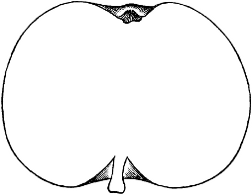
Fruit, below medium size; round and flattened, but sometimes considerably elongated; the general character, however, is shown in the accompanying figure. Skin, light greenish yellow, covered with yellowish brown russet, and a tinge of brown next the sun. Eye, small and partially open, placed in a moderately deep basin. Stalk, short, inserted in a round and deep cavity. Flesh, yellowish, firm, crisp, juicy, sugary, rich, and highly aromatic.
A dessert apple of the very first quality, possessing all the richness of the Nonpareil, but with a more sugary juice. It comes into use in November, but is in greatest perfection from Christmas till May.
The tree is very hardy, an excellent bearer, and will succeed in situations unfavorable to the Nonpareil, to which its leaves and shoots bear such a similarity, as to justify Mr. Lindley in believing it to be a seedling from that variety.
This delightful apple was raised at Gloucester, about the beginning of last century, by Dr. Ashmead, an eminent physician of that city. The original tree existed within the last few years, in what had originally been Dr. Ashmead’s garden, but was destroyed in consequence of the ground being required for building. It stood on the spot now occupied by Clarence Street. It is difficult to ascertain the exact period when it was raised; but the late Mr. Hignell, an eminent orchardist at Tewkesbury, in Gloucestershire, informed me, that the first time he ever saw the fruit of Ashmead’s Kernel, was from a tree in the nursery of Mr. Wheeler, of Gloucester, in the year 1796, and that the tree in question had been worked from the original, and was at that time upwards of thirty years old. From this it may be inferred that the original tree had attained some celebrity by the middle of last century. The Ashmead’s Kernel has long been a favorite apple in all the gardens of West Gloucestershire, but it does not seem to have been known in other parts of the country. Like the Ribston Pippin it seems to have remained long in obscurity, before its value was generally appreciated; it is not even enumerated in the catalogue of the extensive collection which was cultivated by Miller and Sweet, of Bristol, in 1790. I find it was cultivated in the Brompton Park Nursery, in 1780, at which time it was received from Mr. Wheeler, nurseryman, of Gloucester, who was author of “The Botanist’s and Gardener’s Dictionary,” published in 1763, and grandfather of Mr. J. Cheslin Wheeler, the present proprietor of the nursery, to whom I am indebted for specimens of the fruit, and much valuable information connected with the varieties cultivated in that district.
12. AUGUSTUS PEARMAIN—Hort.
Identification.—Hort. Soc. Cat. ed. 3. p. 30.
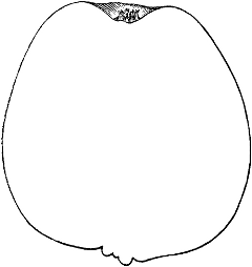
Fruit, below medium size; pearmain-shaped, regular and handsome. Skin, thick and membranous, yellow in the shade, and marked with a few broken stripes of red; but red, streaked all over with deeper red on the side next the sun; it is dotted with grey dots, and sometimes marked with patches of grey-colored russet, which is strewed with scales of a darker color. Eye, small and closed, with long segments, set in a narrow and even basin. Stalk, very short, not protruding beyond the base, and having the appearance of a knob obliquely attached. Flesh, tender, juicy, brisk, and vinous, with a pleasant aromatic flavor.
A dessert apple, generally of only second-rate quality; but in some seasons it is of a rich flavor and of first-rate quality.
It is in use from November to Christmas.
13. BACHELOR’S GLORY.—H.
Fruit, large, three inches wide, and two and three quarters high; roundish and irregularly ribbed, generally higher on one side of the eye than the other. Skin, smooth and shining, striped with deep golden yellow, and crimson stripes. Eye, closed, with broad flat segments, and set in a plaited, irregular, and angular basin. Stalk, about half an inch long, deeply inserted in a funnel-shaped cavity, which is lined with rough scaly russet. Flesh, yellow, tender, juicy, and pleasantly flavored.
A second-rate fruit, suitable either for the dessert or culinary purposes; in use from October to November.
This is a variety grown in the neighbourhood of Lancaster, where it is much esteemed, but in the southern districts, where the more choice varieties can be brought to perfection, it can only rank as a second-rate fruit.
14. BADDOW PIPPIN.—H.
Synonyme.—Spring Ribston, Riv. Cat. 1848.
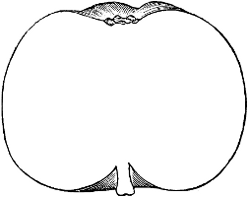
Fruit, medium sized; roundish or rather oblate, with prominent ribs on the sides, which terminate in four, and sometimes five considerable ridges at the crown, very much in the character of the London Pippin. It is sometimes of an ovate shape, caused by the stalk being prominent instead of depressed, in which case the ribs on the sides, and ridges round the eye, are less apparent. Skin, deep lively green, changing as it ripens to yellowish green, on the shaded side; but covered on the side next the sun with dull red, which changes to orange where it blends with the yellow ground; the whole considerably marked with thin brown russet, and russety dots. Eye, rather large and open, with short segments, and set in an angular basin. Stalk, very short, not more than a quarter of an inch long, and inserted in a shallow cavity. Flesh, greenish white, firm, crisp, juicy, sugary, and with a particularly rich and vinous flavor, partaking somewhat of the Nonpareil and Ribston, but particularly the latter.
This is a first-rate dessert apple, in use in November, and possessing the desirable property of keeping till April or May.
This variety originated in the garden of Mr. John Harris, of Broomfield, near Chelmsford, and was first introduced to public notice in the autumn of 1848.
15. BALDWIN.—Ken.
Identification.—Ken. Amer. Or. 41. Hort. Soc. Cat. ed. 3, n. 22. Down. Fr. Amer. 98.
Synonymes.—Red Baldwin, Acc. Hort. Soc. Cat. ed. 2. Butter’s, Ibid. Woodpecker, Ibid.
Fruit, large, three inches and a half wide, and about three inches high; ovato-conical. Skin, smooth, yellow on the shaded side; and on the side next the sun, deep orange, covered with stripes of bright red, which sometimes extend over the whole surface to the shaded side, and marked with large russety dots. Eye, closed, set in a deep, narrow, and plaited basin. Stalk, about an inch long, slender, and inserted in a deep cavity, from which issue ramifying patches of russet. Flesh, yellowish, crisp, juicy, and pleasantly acid, with a rich and agreeable flavor.
A culinary apple, in season from November to March. The tree is vigorous, and an abundant bearer; but like the generality of the American sorts, it does not attain the size, or flavor in this country, which it does in its native soil.
This is considered one of the finest apples in the Northern States of America, and is extensively grown in Massachussets, for the supply of the Boston Market.
16. BANK APPLE.—H.
Fruit, medium sized, two inches and three quarters wide, and about two inches and a half high; roundish-ovate, regularly and handsomely formed. Skin, greenish yellow, with a blush and faint streaks of red next the sun, dotted all over with minute dots, and marked with several large spots of rough russet; the base is covered with a coating of russet, strewed with silvery scales. Eye, large and open, set in a shallow and plaited basin. Stalk, half an inch long, obliquely inserted by the side of a fleshy prominence. Flesh, firm, crisp, brisk, juicy, and pleasantly acid, resembling the Winter Greening in flavor.
It is an excellent culinary apple, in use from November to February; but as it has nothing to recommend it, in preference to other varieties already in cultivation, it need only be grown in large collections.
The original tree was produced from a pip, accidentally sown in the home nursery of Messrs. Ronalds, of Brentford, and from growing on a bank by the side of a ditch, it was called the Bank Apple.
17. BARCELONA PEARMAIN.—Hort.
Identification.—Hort. Soc. Cat. ed. 3, n. 532. Lind. Guide, 62. Rog. Fr. Cult. 74.
Synonymes.—Speckled Golden Reinette, Hort. Soc. Cat. ed. 1, n. 933. Speckled Pearmain, Ibid. ed. 2. Polinia Pearmain, Acc. Rog. Fr. Cult. Reinette Rousse, Duh. Arb. Fr. I. 302. Reinette des Carmes, Acc. Chart. Cat. 51. Glace Rouge, Hort. Soc. Cat. ed. 1, n. 365. Kleine Casseler Reinette, Diel Kernobst. I. 182. Cassel Reinette, Christ. Handb. No. 58.
Figures.—Pom. Mag. t. 85, Ron. Pyr. Mal. pl. xxi., f. 4.
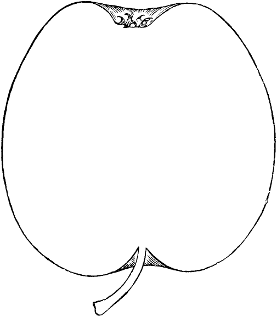
Fruit, of medium size; oval. Skin, clear pale yellow, mottled with red in the shade; but dark red next the sun, the whole covered with numerous star-like russety specks, those on the shaded side being brownish, and those next the sun yellow. Eye, small and open, with erect acuminate segments, and set in a round, even, and pretty deep basin. Stalk, about an inch long, slender, inserted in a rather shallow cavity, which is lined with russet. Flesh, yellowish white, firm, crisp, very juicy, and with a rich, vinous, and highly aromatic flavor.
One of the best dessert apples, and equally valuable for culinary purposes. It comes to perfection about the end of November, and continues in use till March.
The tree is a free grower, but does not attain the largest size. It is very hardy, an abundant bearer, and succeeds well either as a standard or an espalier.
In the third edition of the Horticultural Society’s Catalogue, this is said to be the same as Reinette Rouge. I do not think that it is the Reinette Rouge of the French, which Duhamel describes as being white, or clear yellow in the shade, having often prominent ribs round the eye, which extend down the sides, so as to render the shape angular; a character at variance with that of the Barcelona Pearmain. But I have no doubt of it being the Reinette Rousse of the same author, which is described at page 302, vol. 1, as a variety of Reinette Franche, and which he says is of an elongated shape, skin marked with a great number of russety spots, the most part of which are of a longish figure, so much so, when it is ripe, it appears as if variegated with yellow and red; a character in every way applicable to the Barcelona Pearmain.
18. BARTON’S INCOMPARABLE.—Hort.
Identification.—Hort. Soc. Cat. ed. 3, n. 352?
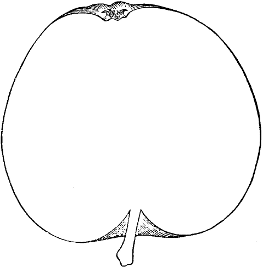
Fruit, below medium size; in shape somewhat like a Golden Knob, ovate or conical, with prominent ribs on the sides, which terminate in five ridges round the eye. Skin, yellowish green, covered with patches of pale brown russet, thickly strewed with large russety freckles, like the Barcelona Pearmain, and tinged with orange next the sun. Eye, small, partially open, with reflexed segments, set in a narrow and angular basin. Stalk, nearly three quarters of an inch long, inserted in a narrow and round cavity. Flesh, yellowish white, tender, crisp, brittle, very juicy, and when eaten is quite a mouthful of lively, vinous juice.
A dessert apple of the highest excellence, in use from October to February.
The tree is a good and healthy grower, attains a considerable size, and is an excellent bearer.
This variety seems to be but little known, and considering its excellence rarely cultivated. I am not aware that it exists in any of the nurseries, or that it was at any period extensively propagated. The only place where I ever met with it was, in the private garden of the late Mr. Lee, of Hammersmith, whence I procured grafts from a tree in the last stage of decay.
19. BAXTER’S PEARMAIN.—Lind.
Identification.—G. Lind. in Hort. Trans. vol. iv., p. 67. Lind. Guide, 62. Hort. Soc. Cat. ed. 3, n. 533.
Fruit, large, three inches and a quarter wide, and three inches high; roundish-ovate, and slightly angular. Skin, pale green, but tinged with red, and marked with a few indistinct streaks of darker red, on the side exposed to the sun. Eye, open, with long spreading segments, and placed in a moderately deep basin. Stalk, short and thick, not deeply inserted. Flesh, yellowish, firm, brisk, and sugary, and with an abundance of pleasantly acid juice.
An excellent apple, suitable either for culinary purposes, or the dessert; in use from November to March.
The tree is hardy, vigorous, a most abundant bearer, and even in seasons when other varieties fail, this is almost safe to ensure a plentiful crop. It is extensively cultivated in Norfolk, and deserves to be more generally known in other districts of the country.
20. BEACHAMWELL.—Hort.
Identification—Lind. Guide, 35. Hort. Soc. Cat. ed. 3, n. 13.
Synonymes.—Beachamwell Seedling, Hort. Soc. Cat. ed. 1, 42. Motteux’s Seedling, Acc. Hort. Soc. Cat.
Figures.—Pom. Mag. t. 82. Ron. Pyr. Mal. pl. xxvii. f. 6.
Fruit, small, about two inches wide, and the same in height; ovate, handsomely and regularly formed. Skin, greenish yellow, covered with patches and dots of russet, particularly round the eye. Eye, small and open, set in a shallow, narrow, and even basin. Stalk, about half an inch long, almost embedded in a round cavity. Flesh, yellowish white, tender, crisp, and very juicy, with a rich, brisk, and sugary flavor.
A rich and deliciously flavored dessert apple, of the highest excellence; in use from December to March.
The tree is perfectly hardy, a healthy and vigorous grower, but does not attain a large size; it is an excellent bearer.
This variety was raised by John Motteux, Esq., of Beachamwell, in Norfolk, where, according to Mr. George Lindley, the original tree still existed in 1831. It is not very generally cultivated, but ought to form one even in the smallest collections.
21. BEAUTY OF KENT.—Fors.
Identification.—Fors. Treat. 93. Lind. Guide, 27. Hort. Soc. Cat. ed. 3, n. 37. Down. Fr. Amer. 81.
Synonyme.—Kentish Pippin, of some, Acc. Hort. Soc. Cat.
Figures.—Brook. Pom. Brit. pl. xc. f. 6. Ron. Pyr. Mal. pl. xv. f. 1.
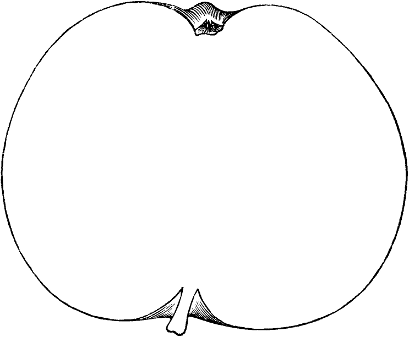
Fruit, large; roundish-ovate, broad and flattened at the base, and narrowing towards the apex, where it is terminated by several prominent angles. Skin, deep yellow slightly tinged with green, and marked with faint patches of red, on the shaded side; but entirely covered with deep red, except where there are a few patches of deep yellow, on the side next the sun. Eye, small and closed, with short segments, and set in a narrow and angular basin. Stalk, short, inserted in a wide and deep cavity, which, with the base, is entirely covered with rough brown russet. Flesh, yellowish, tender, and juicy, with a pleasant sub-acid flavor.
A valuable and now well-known culinary apple, in use from October to February. When well grown the Beauty of Kent is perhaps the most magnificent apple in cultivation. Its great size, the beauty of its coloring, the tenderness of the flesh, and profusion of delicate sub-acid juice, constitute it one of our most popular winter apples, for culinary purposes, and one of the most desirable and useful, either for a small garden, or for more extended cultivation.
The tree is a strong and vigorous grower, attains a large size, and is a good bearer; but I have always found it subject to canker when grown on the paradise stock, and in soils which are moist and heavy.
I have not been able to ascertain the time when, or the place where this variety originated. It is first noticed by Forsyth in his Treatise on Fruit Trees, but is not enumerated in any of the nurserymen’s catalogues, either of the last, or the early part of the present, century. It was introduced to the Brompton Park Nursery, about the year 1820, and is now as extensively cultivated as most other leading varieties. In America, Downing says, “the fruit in this climate is one of the most magnificent of all apples, frequently measuring sixteen or eighteen inches in circumference.”
22. BEDFORDSHIRE FOUNDLING.—Hort.
Identification.—Hort. Soc. Cat. ed. 3, n. 42. Lind. Guide, 63. Down. Fr. Amer. 107.
Synonyme.—Cambridge Pippin, Acc. Hort. Soc. Cat.
Figure.—Ron. Pyr. Mal. pl. xxviii. f. 2.
Fruit, large, three inches and a quarter wide, and three inches and a half high; roundish-ovate, inclining to oblong, with irregular and prominent angles on the sides, which extend to the apex, and form ridges round the eye. Skin, dark green at first, and changing, as it attains maturity, to pale greenish yellow on the shaded side; but tinged with orange on the side next the sun, and strewed with a few fawn-colored dots. Eye, open, set in a deep, narrow, and angular basin. Stalk, short, inserted in a deep cavity. Flesh, yellowish, tender, pleasantly sub-acid, and with a somewhat sugary flavor.
An excellent culinary apple of first-rate quality, in use from November to March.
23. BELLE BONNE.—Lind.
Identification.—Lind. Guide, 63. Hort. Soc. Cat. ed. 3, n. 43.
Synonymes.—Winter Belle boon, Park. Par. 587. Winter Belle and Bonne, Raii Hist. II. 1448. Winter Belle and Bon, Worl. Vin. 156. Rolland, Acc. Lind. Guide.
Fruit, above medium size, three inches wide, and three and a quarter high; ovato-conical. Skin, thick, pale greenish yellow, and marked with a few redish streaks on the side next the sun. Eye, small and closed. Stalk, half-an-inch long, obliquely inserted under a fleshy lip. Flesh, firm, juicy, and well-flavored.
A valuable culinary apple, in use from October to January. The tree is very hardy, a strong, vigorous, and healthy grower, and a good bearer.
This is a very old English variety. It was known to Parkinson so early as 1629, and also to Worlidge and Ray. But it is not noticed by any subsequent author, or enumerated in any of the nursery catalogues of the last century, until discovered by George Lindley, growing in a garden at Gatton, near Norwich, and published by him in the Transactions of the London Horticultural Society, vol. iv., p. 58. He seems to be uncertain whether it is the Summer, or Winter Belle Bonne of these early authors, but Worlidge’s description leaves no doubt as to its identity. He says “The Summer Belle et Bonne is a good bearer, but the fruit is not long lasting. The Winter Belle and Bon is much to be preferred to the Summer in every respect.” I have no doubt, therefore, that the latter is the Belle Bonne of Lindley. Parkinson says “they are both fair fruit to look on, being yellow, and of a meane (medium) bignesse.”
24. BELLEDGE PIPPIN.—Hort.
Identification.—Hort. Soc. Cat. ed. 3, n. 49.
Synonymes.—Belledge, Lind. Guide, 36. Belledge Pippin, Hort. Soc. Cat. ed. 1, 65.
Figure.—Ron. Pyr. Mal. pl. xvi., f. 4.
Fruit, below medium size, two inches and a half wide, and two inches high; roundish, narrowing a little towards the apex, regularly and handsomely formed. Skin, pale green, changing to yellow as it ripens, with a tinge of brown where exposed to the sun, and strewed with grey, russety dots. Eye, small, partially closed with short segments, and placed in a round, narrow, and rather shallow basin. Stalk, half-an-inch long, inserted in a round and deep cavity. Flesh, greenish yellow, tender, soft, brisk, sugary, and aromatic.
An excellent, but not first-rate apple, suitable either for the dessert or culinary purposes. It is in use from November to March.
25. BELLE GRIDELINE.—Lind.
Identification.—Lind. Plan Or. 1796. Lind. Guide, 36.
Synonyme.—Belle Grisdeline, Fors. Treat. 93.
Fruit, medium sized; round, and regularly formed. Skin, clear yellow, marbled and washed with clear red, and intermixed with thin grey russet next the sun. Eye, set in a deep, round basin. Stalk, slender, deeply inserted in a round cavity. Flesh, white, firm, crisp, and briskly flavored.
An excellent dessert apple, in season from December to March. The tree is healthy and vigorous, of the middle size, and an excellent bearer.
This beautiful variety was first brought into notice by Mr. George Lindley, who found it growing in a small garden near Surrey Street Gates, Norwich, where it had originated about the year 1770. Mr. Lindley first propagated it in 1793, and the original tree died about seven years afterwards.
26. BENNET APPLE.—Knight.
Identification and Figure.—Pom. Heref. t. 21. Lind Guide, 101.
Fruit, somewhat long, irregularly shaped, broad at the base, and narrow at the apex, but sometimes broader at the middle than either of the extremities. A few obtuse angles terminate at the eye, which is small and nearly closed, with very short segments. Stalk, half-an-inch long, and very slender. Skin, dingy colored russety grey in the shade; and shaded on the sunny side with numerous streaks and patches of orange color and muddy red.
The specific gravity of the juice is 1073.
This is a good cider apple, and produces liquor of great excellence when mixed with other varieties. It is chiefly grown in the deep strong soils of the south-west part of Herefordshire, and is common in the district known as the Golden Vale. Knight says it was a very old variety, and was known previous to the 17th century, but I have not been able to find any record of it in the early works on Pomology.
27. BENWELL’S PEARMAIN.—Hort.
Identification.—Hort Soc. Cat. ed. 3, n. 534. Lind. Guide, 64.
Fruit, medium sized; pearmain-shaped. Skin, dull green with broken stripes of dull red, on the side next the sun. Eye, small, set in a shallow and slightly plaited basin. Stalk, deeply inserted in a round cavity, scarcely protruding beyond the base. Flesh, yellowish white, crisp, juicy, brisk, and aromatic.
A dessert apple, in use from December to January.
It received its name from a gentleman of the name of Benwell, of Henley-on-Thames, from whom it was received, and brought into cultivation by Kirke, a nurseryman at Brompton.
28. BERE COURT PIPPIN.—Hort.
Identification.—Hort. Trans. vol. v. p. 400. Hort. Soc. Cat. ed. 3, n. 55. Lind. Guide, 10.
Fruit, medium sized; round, and slightly flattened. Skin, pale green, and changing to yellow as it ripens, with stripes of red next the sun. Eye, open, placed in a wide and shallow basin. Stalk, inserted in a deep cavity. Flesh, crisp, juicy, and briskly acid.
An excellent culinary apple, in use during September and October.
This variety was raised by the Rev. S. Breedon, D.D., of Bere Court, near Pangbourne, in Berkshire.
29. BESS POOL.—Ron.
Identification.—Ron. Pyr. Mal. 46.
Synonyme.—Best Pool, Fors. Treat. 94.
Figure.—Ron. Pyr. Mal. pl. xxiii. f. 8.
Fruit, above medium size, two inches and three quarters wide, and nearly three inches high; conical, and handsomely shaped. Skin, yellow, with a few markings of red on the shaded side; but where exposed to the sun it is almost entirely washed and striped with fine clear red. Eye, small, and partially open, set in a rather deep and plaited basin, which is surrounded with five prominent knobs or ridges. Stalk, short and thick, inserted in a rather shallow cavity, with generally a fleshy protuberance on one side of it, and surrounded with yellowish brown russet, which extends over a considerable portion of the base. Flesh, white, tender, and juicy, with a fine, sugary, and vinous flavor.
An excellent apple either for culinary or dessert use. It is in season from November to March.
The tree is hardy, a vigorous grower, and an abundant bearer. The flowers are very late in expanding, and are, therefore, not liable to be injured by spring frosts.
30. BEST BACHE.—Knight.
Identification.—Pom. Heref. t. 16. Lind. Guide, 194.
Synonyme.—Bache’s Kernel, Acc. Pom. Heref.
Fruit, medium sized; oblong, with obtuse angles on the sides, which extend to the apex. Skin, yellow, shaded with pale red, and streaked with darker red, interspersed with a few black specks. Eye, small, segments short and flat. Stalk, short and stout.
Specific gravity of the juice 1073.
A cider apple, grown in the south-east part of Herefordshire.
31. BETSEY.—Hort.
Identification.—Hort. Soc. Cat. ed. 3, n. 57.
Fruit, small, about two inches wide, and an inch and three quarters high; roundish, inclining to conical and flattened. Skin, dark green at first, and considerably covered with ashy grey russet; but changing to pale yellow, and with a brownish tinge on the side next the sun. Eye, open, with short reflexed segments, and set in a very shallow depression. Stalk, short, about a quarter of an inch long, with a fleshy protuberance on one side of it, and inserted in a shallow and narrow cavity. Flesh, greenish yellow, tender, juicy, rich, and sugary.
A dessert apple of first-rate quality, in use from November to January.
32. BIGGS’S NONESUCH.—Hort.
Identification.—Hort. Trans. vol. I. p. 70. Lind. Guide, 88. Rog. Fr. Cult. 40.
Synonyme.—Bigg’s Nonsuch, Fors. Treat. 116.
Figure.—Brook. Pom. Brit. pl. lxxxviii., f. 3.
Fruit, medium sized; round, and broadest at the base. Skin, yellow, striped with bright crimson next the sun. Eye, open, with long reflexed segments, set in a wide and deep basin. Stalk, short, and deeply inserted. Flesh, yellowish, tender, and juicy.
An excellent culinary apple, in use from October to December. It is fit for use immediately it is gathered off the tree, and has a strong resemblance to the old Nonesuch, but keeps much longer.
The tree is hardy and an excellent bearer; attains to the medium size, and is less liable to the attacks of the Woolly Aphis than the old Nonesuch.
This variety was raised by Mr. Arthur Biggs, the intelligent and scientific gardener to Isaac Swainson, Esq., of Twickenham, Middlesex.
33. BIRMINGHAM PIPPIN.—Hort.
Identification.—Lind. Guide, 38. Hort. Soc. Cat. ed. 3, n. 59.
Synonymes.—Grumas’s Pippin, Fors. Treat. 105. Brummage Pippin, and Grummage Pippin, Acc. Hort. Soc. Cat. Stone Pippin of the Nursery Catalogues.
Fruit, small, two inches and a quarter wide, and an inch and three quarters high; round, and slightly flattened. Skin, pale dingy yellow, mottled and veined with very thin grey russet, and russety round the base. Eye, small, quite open, frequently without any segments, and placed in a very slight depression. Stalk, short, scarcely at all depressed. Flesh, greenish, very firm, crisp, and juicy, briskly and pleasantly flavored.
A very good dessert apple; in use from January to June.
It is remarkable for the firmness and density of its flesh, and Mr. Lindley says, its specific gravity is greater than that of any other apple with which he was acquainted.
The tree is of diminutive size, with short but very stout shoots. It is a good bearer.
This variety is supposed to be a native of Warwickshire. It is what is generally known in the nurseries, under the name of Stone Pippin, but the Gogar Pippin is also known by that name.
34. BLAND’S JUBILEE.—H.
Synonymes.—Jubilee Pippin, Hort. Trans. vol. v., 400. Bland’s Jubilee Rose Pip, Nursery Catalogues.
Fruit, large, three inches and a quarter wide, and two inches and three quarters high; round, narrowing a little towards the eye, and obscurely ribbed. Skin, dull yellow tinged with green, but changing to clear yellow as it ripens; marked with russet in the basin of the eye, and strewed over its surface with large russety dots. Eye, small and closed, with long acuminate segments, set in a narrow, deep, and even basin. Stalk, short, inserted in a moderately deep cavity. Flesh, yellowish, tender, crisp, juicy, sugary, and perfumed.
An excellent apple, either for culinary purposes, or the dessert. It is in use from October to January.
This was raised by Michael Bland, Esq., of Norwich. The seed was sown, on the day of the jubilee which celebrated the 50th year of the reign of George III., in 1809, and the tree first produced fruit in 1818. It is not a variety which is met with in general cultivation, but deserves to be more extensively known.
35. BLENHEIM PIPPIN.—Hort.
Identification.—Hort. Soc. Cat. ed. 3, n. 70. Lind. Guide, 38. Down Fr. Amer. 81.
Synonymes.—Blenheim, Acc. Hort. Soc. Cat. Blenheim Orange, Ibid. Woodstock Pippin, Ibid. Northwick Pippin, Ibid. Kempster’s Pippin.
Figure.—Pom. Mag. t. 28. Ron. Pyr. Mal. pl. xxxi. f. 2.
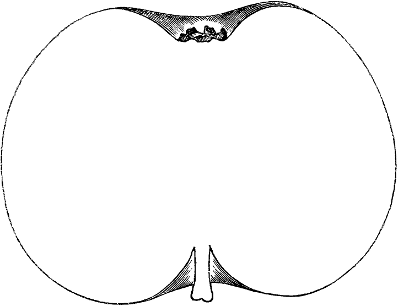
Fruit, large, the average size smaller than represented in the accompanying figure, being generally three inches wide, and two and a half high; globular, and somewhat flattened, broader at the base than the apex, regularly and handsomely shaped. Skin, yellow, with a tinge of dull red next the sun, and streaked with deeper red. Eye, large and open, with short stunted segments, placed in a round and rather deep basin. Stalk, short and stout, rather deeply inserted, and scarcely extending beyond the base. Flesh, yellow, crisp, juicy, sweet, and pleasantly acid.
A very valuable and highly esteemed apple, either for the dessert or culinary purposes, but, strictly speaking, more suitable for the latter. It is in use from November to February.
The common complaint against the Blenheim Pippin is, that the tree is a bad bearer. This is undoubtedly the case when it is young, being of a strong and vigorous habit of growth, and forming a large and very beautiful standard; but when it becomes a little aged, it bears regular and abundant crops. It may be made to produce much earlier, if grafted on the paradise stock, and grown either as an open dwarf, or an espalier.
This valuable apple was first discovered at Woodstock, in Oxfordshire, and received its name from Blenheim, the seat of the Duke of Marlborough, which is in the immediate neighbourhood. It is not noticed in any of the nursery catalogues of the last century, nor was it cultivated in the London nurseries till about the year 1818.
The following interesting account of this favorite variety was recently communicated to the Gardener’s Chronicle. “In a somewhat delapidated corner of the decaying borough of ancient Woodstock, within ten yards of the wall of Blenheim Park, stands all that remains of the original stump of that beautiful and justly celebrated apple, the Blenheim Orange. It is now entirely dead, and rapidly falling to decay, being a mere shell about ten feet high, loose in the ground, and having a large hole in the centre; till within the last three years, it occasionally sent up long, thin, wiry twigs, but this last sign of vitality has ceased, and what remains will soon be the portion of the woodlouse and the worm. Old Grimmett, the basket-maker, against the corner of whose garden-wall the venerable relict is supported, has sat looking on it from his workshop window, and while he wove the pliant osier, has meditated, for more than fifty successive summers, on the mutability of all sublunary substances, on juice, and core, and vegetable, as well as animal, and flesh, and blood. He can remember the time when, fifty years ago, he was a boy, and the tree a fine, full-bearing stem, full of bud, and blossom, and fruit, and thousands thronged from all parts to gaze on its ruddy, ripening, orange burden; then gardeners came in the spring-tide to select the much coveted scions, and to hear the tale of his horticultural child and sapling, from the lips of the son of the white-haired Kempster. But nearly a century has elapsed since Kempster fell, like a ripened fruit, and was gathered to his fathers. He lived in a narrow cottage garden in Old Woodstock, a plain, practical, laboring man; and in the midst of his bees and flowers around him, and in his “glorious pride,” in the midst of his little garden, he realized Virgil’s dream of the old Corycian:—“Et regum equabat opes animis.”
The provincial name for this apple is still “Kempster’s Pippin,” a lasting monumental tribute, and inscription, to him who first planted the kernel from whence it sprang.”
36. BOROVITSKY.—Hort.
Identification.—Hort Soc. Cat. ed. 3, n. 74. Lind Guide, 3. Down. Fr. Amer. 70.
Figure.—Pom. Mag. t. 10.
Fruit, medium sized, two inches high, and about the same in width; roundish and slightly angular. Skin, pale green strewed with silvery russet scales on the shaded side; and colored with bright red, which is striped with deeper red on the side next the sun. Eye, set in a wide and plaited basin. Stalk, an inch long, deeply inserted in a rather wide cavity. Flesh, white, firm, brisk, juicy, and sugary.
An excellent early dessert apple, ripe in the middle of August.
This was sent from the Taurida Gardens, near St. Petersburg, to the London Horticultural Society in 1824.
37. BORSDORFFER.—Knoop.
Identification—Knoop. Pom. t. x. Hort. Soc. Cat. ed. 3, n. 73. Down. Fr Amer. 99.
Synonymes.—Porstorffer, Cord. Hist. Reinette Batarde, Riv. et Moul. Meth. 192. Borstorf, Knoop. Pom. 56. Borstorff Hative, Ibid. 129. Borstorff à long queue, Ibid. 129. Bursdoff, or Queen’s Apple, Fors. Treat. ed. 3, 15, Red Borsdorffer, Willich Dom. Encyc. Borsdorff, Lind. Guide, 39. Postophe d’Hiver, Bon Jard. 1843. p. 512. Pomme de prochain, Acc. Diel. Kernobst. Reinette d’Allemagne, Ibid. Blanche de Leipsic, Acc. Knoop. Pom. Reinette de Misnie, Acc. Hort. Soc. Cat. Grand Bohemian Borsdorffer, Ibid. Edler Winterborstorffer, Diel. Kernobst. II. 80. Edel Winterborsdorfer, Ditt. Handb. I. 372. Witte Leipziger, Acc. Knoop. Pom. Maschanzker, Acc. Diel Kernobst. Weiner Maschanzkerl, Baum. Cat. 1850. Winter Borsdorffer, Acc. Hort. Soc. Cat. Garret Pippin, Ibid. King, Ibid. King George, Ibid. King George the Third, Ron. Pyr. Mal. 26.
Figures.—Knoop. Pom. t. x. Ron. Pyr. Mal. pl. xiii. f. 8.
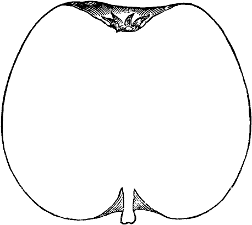
Fruit, below medium size; roundish oblate, rather narrower at the apex than the base, handsomely and regularly formed, without ribs or other inequalities. Skin, shining, pale waxen yellow in the shade, and bright deep red next the sun; it is strewed with dots, which are yellowish on the sunny side, and brownish in the shade, and marked with veins and slight traces of delicate, yellowish-grey russet. Eye, large and open, with long reflexed segments, placed in a rather deep, round, and pretty even basin. Stalk, short and slender, inserted in a narrow, even, and shallow cavity, which is lined with thin russet. Flesh, white with a yellowish tinge, crisp and delicate, brisk, juicy, and sugary, and with a rich, vinous, and aromatic flavor.
A dessert apple of the first quality, in use from November to January.
The tree is a free grower and very hardy, not subject to canker, and attains the largest size. It is very prolific when it has acquired its full growth, which, in good soil, it will do in fifteen or twenty years; and even in a young state it is a good bearer. If grafted on the paradise stock it may be grown as an open dwarf, or an espalier. The bloom is very hardy, and withstands the night frosts of spring better than most other varieties.
This, above all other apples, is the most highly esteemed in Germany. Diel calls it the Pride of the Germans. It is believed to have originated either at a village of Misnia, called Borsdorf, or at a place of the same name near Leipsic. According to Forsyth, it was such a favorite with Queen Charlotte, that she had a considerable quantity of them annually imported from Germany, for her own private use. It is one of the earliest recorded varieties of the continental authors, but does not seem to have been known in this country before the close of the last century. It was first grown in the Brompton Park Nursery in 1785. It is mentioned by Cordus, in 1561, as being cultivated in Misnia; which circumstance has no doubt given rise to the synonyme “Reinette de Misnie;” he also informs us it is highly esteemed for its sweet and generous flavor, and the pleasant perfume which it exhales. Wittichius, in his “Methodus Simplicium,” attributes to it the power of dispelling epidemic fevers and madness!
38. BOSSOM.—Hort.
Identification.—Hort. Trans. vol. iv., 528. Hort. Soc. Cat. ed. 3, n. 75. Lind. Guide, 64.
Fruit, large and conical; handsomely and regularly formed. Skin, pale greenish yellow, considerably covered with russet, and occasionally marked with bright red next the sun. Eye, set in a shallow and plaited basin. Stalk, an inch long, inserted in a rather deep cavity. Flesh, yellowish white, tender, crisp, juicy, and sugary, and with a pleasant sub-acid flavor.
An excellent culinary apple, though not of the first quality, in use during December and January. The flesh is said to assume a fine color when baked.
39. BOSTON RUSSET.—Hort.
Identification.—Hort. Soc. Cat. ed. 3, n. 736. Down. Fr. Amer. 133.
Synonymes.—Roxbury Russeting, Ken. Amer. Or. 53. Shippen’s Russet, Acc. Hort. Soc. Cat. Putman’s Russet.
Fruit, medium sized, three inches and a quarter wide, and two inches and a half high; roundish, somewhat flattened, narrowing towards the apex, and slightly angular. Skin, covered entirely with brownish yellow russet intermixed with green, and sometimes with a faint tinge of redish brown next the sun. Eye, closed, set in a round and rather shallow basin. Stalk, long, slender, and inserted in a moderately deep cavity. Flesh, yellowish white, juicy, sugary, briskly, and richly flavored.
A very valuable dessert apple, of the first quality, in season from January to April, and will even keep till June. It partakes much of the flavor of the Ribston Pippin, and, as a late winter dessert apple, is not to be surpassed.
The tree is not large, but healthy, very hardy, and an immense bearer, and, when grafted on the paradise stock, is well suited for being grown either as a dwarf, or an espalier.
This is an old American variety, and one of the few introduced to this country which attains perfection in our climate. It is extensively grown in the neighbourhood of Boston, U.S., both for home consumption and exportation, and realizes a considerable, and profitable return to the growers.
40. BOWYER’S RUSSET.—Hort.
Identification.—Hort. Soc. Cat. ed. 3, p. 38. Lind. Guide, 87.
Synonyme.—Bowyer’s Golden Pippin, Acc. Hort. Soc. Cat.
Figure.—Pom. Mag. t. 121.
Fruit, small, two inches high, and about two and a half broad at the base; roundish-ovate. Skin, entirely covered with fine yellow colored russet. Eye, small and closed, set in a small and slightly plaited basin. Stalk, short, inserted in a round cavity. Flesh, greenish white tinged with yellow, crisp, brisk, and aromatic.
A dessert apple of the first quality, in use during September and October.
The tree attains a good size, is an abundant bearer, very healthy, and not subject to canker.
41. BRABANT BELLEFLEUR.—Hort.
Identification.—Hort. Soc. Cat. ed. 3, n. 45. Down. Fr. Amer. 102.
Synonymes.—Brabansche Bellefleur, Hort. Soc. Cat. ed. 1, 55. Brabant, or Glory of Flanders, Rog. Fr. Cult. 46. Iron Apple, Acc. Ron. Pyr. Mal. Kleine Brabänter Bellefleur, Diel Kernobst. viii. 133.
Figure.—Ron. Pyr. Mal. tab. xxxi. f. 3.
Fruit, large, three inches and a half wide, and three and a quarter high; roundish-ovate, inclining to oblong, or conical, ribbed on the sides, and narrowing towards the eye. Skin, greenish yellow, changing to lemon yellow as it attains maturity, and striped with red next the sun. Eye, large and open, with long broad segments, set in a wide and angular basin. Stalk, short, inserted in a deep and wide cavity, which is lined with brown russet. Flesh, yellowish white, firm, crisp, and juicy, with a sugary, aromatic, and pleasantly sub-acid flavor.
An excellent culinary apple of the finest quality, in use from November to April.
The tree is hardy, and though not strong, is a healthy grower, attaining the middle size, and an excellent bearer.
This variety was forwarded to the gardens of the London Horticultural Society by Messrs. Booth, of Hamburgh.
42. BRADDICK’S NONPAREIL.—Hort.
Identification.—Hort. Trans. vol. iii. 268. Lind. Guide, 87. Fors. Treat. 118. Hort. Soc. Cat. ed. 3, n. 465.
Synonyme.—Ditton Nonpareil, Acc. Hort. Soc. Cat. ed. 3.
Figure.—Ron. Pyr. Mal. t. xxiv. f. 3. Hort. Trans. vol. iii. t. 10, f. 3.
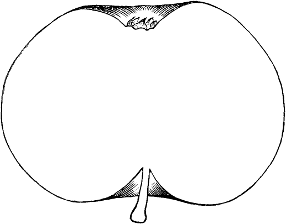
Fruit, medium sized; roundish and flattened, inclining to oblate. Skin, smooth, greenish yellow in the shade, and brownish red next the sun, russety round the eye, and partially covered, on the other portions of the surface, with patches of brown russet. Eye, set in a deep, round, and even basin. Stalk, half an inch long, inserted in a round and rather shallow cavity. Flesh, yellowish, rich, sugary, and aromatic.
One of the best winter dessert apples, in use from November to April, and by many considered more sweet, and tender, than the old Nonpareil.
The tree is quite hardy, a slender grower, and never attains to a large size, but is a very excellent bearer. It succeeds well on the paradise stock, and is well adapted for dwarfs, or for being grown as an espalier.
This excellent variety was raised by John Braddick, Esq., of Thames Ditton.
43. BREEDON PIPPIN.—Hort.
Identification.—Hort. Trans. vol. iii. p. 268. Hort. Soc. Cat. ed. 3, n. 85. Lind. Guide, 64. Rog. Fr. Cult. 82.
Figure.—Hort. Trans. vol. iii. pl. 10, f. 1.
Fruit, small, two inches and a half wide, and two inches and a quarter high; roundish, and somewhat oblate, broader at the base than the apex, where it assumes somewhat of a four-sided shape. Skin, deep dull yellow tinged with redish orange; inclining to red on the side exposed to the sun, and marked with a few traces of delicate brown russet. Eye, open, with short ovate reflexed segments, which are frequently four in number, set in a broad, shallow, and plaited basin. Stalk, half an inch to three quarters long, inserted in a round and shallow cavity. Flesh, yellowish, firm, and with a rich, vinous, and brisk flavor, resembling that of a pine-apple.
This is one of the best dessert apples; it is in use during October and November. It bears some resemblance to the Court of Wick, but is considerably richer in flavor than that variety.
The tree is hardy; a slender grower, and does not attain a large size; it is, however, an excellent bearer. It is well adapted for dwarf training, and succeeds well on the paradise stock.
This esteemed variety was raised by the Rev. Dr. Symonds Breedon, at Bere Court, near Pangbourne, Berkshire.
44. BRICKLEY SEEDLING.—Hort.
Identification.—Hort. Soc. Cat. ed. 3, n. 86. Lind. Guide, 39. Rog. Fr. Cult. 62.
Figure.—Pom. Mag. t. 124.
Fruit, small, two inches and a half broad, and two inches high; roundish, and narrowing towards the apex. Skin, greenish yellow in the shade, and red where exposed to the sun, with a few streaks of red where the two colors blend. Eye, small and open, set in a smooth, and rather shallow basin. Stalk, short, inserted in a wide cavity. Flesh, yellowish, firm, rich, sugary, and highly flavored.
A very desirable winter dessert apple, of first-rate quality; it is in use from January to April.
The tree is hardy and an abundant bearer.
45. BRIDGEWATER PIPPIN.—Rea.
Identification.—Rea. Pom. 210. Worl. Vin. 158. Hort. Soc. Cat. ed. 3, n. 87.
Fruit, large; roundish, and somewhat flattened, with prominent ribs on the sides, which extend to the basin of the eye. Skin, deep yellow, strewed with russety dots, and with a blush of red which sometimes assumes a lilac hue near the stalk. Eye, large and open, set in a deep and angular basin. Stalk, rather short, inserted in a deep, wide, irregular, and angular cavity. Flesh, yellowish, briskly, and pleasantly flavored.
A good culinary apple of second-rate quality, in use from October to December.
This is a very old English variety, being mentioned by Rea, in 1665, and of which, he says, “it is beautiful to the eye, and pleasant to the palat.”
46. BRINGEWOOD PIPPIN.—Hort.
Identification.—Hort. Soc. Cat. ed. 3, n. 88. Lind. Guide, 40. Rog. Fr. Cult. 88.
Fruit, small, two inches and a half wide, and an inch and three quarters high; almost round, a good deal like a flattened Golden Pippin. Skin, of a fine rich yellow color, covered with greyish dots, russety round the eye, and marked with a few russety dots on the side next the sun. Eye, small and open, with reflexed segments, and placed in a shallow basin. Stalk, short and slender, inserted in a moderately deep cavity, which is lined with greenish grey russet. Flesh, yellowish, firm, crisp, and sugary, with a rich and perfumed flavor.
An excellent, though not a first-rate dessert apple, in use from January to March. Its only fault is the flesh being too dry.
The tree is hardy, but a weak and slender grower, and never attains a great size. It succeeds well on the paradise stock.
This is one of the varieties raised by Thomas Andrew Knight, Esq., of Downton Castle, Herefordshire, and which he obtained by impregnating the Golden Pippin, with the pollen of the Golden Harvey.
47. BRISTOL PEARMAIN.—H.
Fruit, small, about two inches and a quarter wide, and the same in height; oblong, slightly angular on the side, and ridged round the eye. Skin, dull yellowish green, with a few pale stripes of crimson, and considerably covered with patches and dots of thin grey russet on the shaded side; but marked with thin dull red, striped with deeper and brighter red, on the side exposed to the sun, and covered with numerous dark russety dots. Eye, small and closed, with erect, acute segments, set in a deep, round, and plaited basin. Stalk, short, inserted in a shallow cavity, which is lined with thin brown russet, strewed with silvery scales. Flesh, yellow, firm, not very juicy, but briskly flavored.
An apple of little merit, in use from October to February.
The only place where I have ever met with this variety, is in the neighbourhood of Odiham, in Hampshire.
48. BROAD-END.—Hort.
Identification.—Hort. Soc. Cat. ed. 3, n. 89.
Synonymes.—Winter Broading, Hort. Trans. vol. iv., p. 66. Lind. Guide, 57. Kentish Broading, Ron. Pyr. Mal. 47. Broading, Acc. Hort. Soc. Cat.
Figure.—Ron. Pyr. Mal. pl. xxiv. f. 1.
Fruit, large, three inches and three quarters broad, and three inches high; roundish, broadest at the base, and considerably flattened at the ends, somewhat oblate. Skin, yellowish green in the shade, but tinged with red next the sun, interspersed with a few streaks of red, and covered in some places with patches of fine russet. Eye, large and open, set in a rather deep and angular basin. Stalk, short, inserted in a deep cavity. Flesh, yellowish white, firm, crisp, rich, juicy, and with a pleasant sub-acid flavor. An excellent culinary apple of the first quality, in use from November to Christmas.
The tree is a strong, healthy, and vigorous grower, and an excellent bearer.
49. BROAD-EYED PIPPIN.—Fors.
Identification.—Fors. Treat. 95. Hort. Soc. Cat. ed. 3, n. 90.
Fruit, large and oblate. Skin, greenish yellow in the shade, and slightly tinged with red on the side exposed to the sun. Eye, large and open, set in a wide and shallow basin. Flesh, yellowish white, firm, crisp, brisk, and juicy.
An excellent culinary apple, of the first size and quality, in use from September to January, but said by Forsyth to keep till May.
This is a very old English variety; it is mentioned by Ray, who makes it synonymous with Kirton or Holland Pippin.
50. BROOKES’S.—Hort.
Identification.—Hort. Soc. Cat. ed. 3, n. 91. Ron. Pyr. Mal. 45.
Figure.—Ron. Pyr. Mal. pl. xxiii. f. 2.
Fruit, small, two inches wide, and the same in height; conical. Skin, yellow in the shade, but orange, thinly mottled with red next the sun, and considerably covered with thin, brown russet. Eye, open and prominent, with reflexed segments, and placed in a very shallow basin. Stalk, short, inserted in a small, round, and shallow cavity, which is lined with rough russet. Flesh, yellowish, firm, not very juicy, but with a rich, sweet, and highly aromatic flavor.
A dessert apple of the first quality, in use from September to February. The tree is a slender grower, and never attains a great size, but is a good bearer.
51. BROUGHTON.—Hort.
Identification.—Hort. Soc. Cat. ed. 3, n. 92.
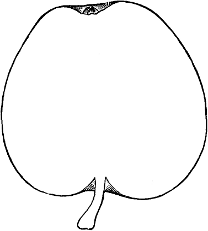
Fruit, small, conical, and regularly formed. Skin, pale greenish yellow in the shade, but covered with fine, delicate, lively red, which is marked with a few streaks of deeper red on the side next the sun, and strewed with minute russety dots. Eye, small and closed, set in a shallow, and plaited basin. Stalk, half an inch long, inserted in a round, and shallow cavity. Flesh, greenish yellow, tender, delicate, brisk, sugary, and richly flavored.
A valuable dessert apple of first-rate quality, in use from October to December.
52. BROWN KENTING.—Hort.
Fruit, above medium size, two inches and three quarters wide, and two inches and a half high; roundish, and slightly ribbed on the sides. Skin, greenish yellow, marked with distinct and well defined figures, and reticulations of russet, like the Fenouillet Jaune, on the shaded side, and over the base; but green, which is almost entirely covered with a coating of smooth, thin, pale brown russet, on the side next the sun. Eye, small and closed, set in a narrow, and shallow basin. Stalk, an inch long, slender and woody, inserted in a funnel-shaped cavity, which is of a green color, and very slightly marked with russet. Flesh, yellowish, crisp, and tender, with a brisk, somewhat sugary, and pleasant aromatic flavor.
An excellent dessert apple, of first-rate quality, in use from October to Christmas, after which it becomes meally.
53. BURN’S SEEDLING.—Hort.
Identification.—Hort. Soc. Cat. ed. 3, n. 102.
Fruit, medium sized, two inches and three quarters wide, and two inches and a quarter high; roundish, flattened at the base, and narrowing towards the apex, sometimes inclining to conical. Skin, yellow, but with a blush and a few streaks of red next the sun, marked with a few patches of russet, and sprinkled with russety dots, which are thickest round the eye. Eye, large and open, set in a shallow and irregular basin. Stalk, short, thick and fleshy, generally obliquely inserted by the side of a fleshy swelling, and surrounded with a patch of rough russet. Flesh, yellowish, tender, juicy, and sub-acid.
An excellent culinary apple of the first quality, in use from October to Christmas.
This variety was raised by Mr. Henry Burn, gardener to the Marquis of Aylesbury, at Tottenham Park, near Marlborough.
54. BYSON WOOD RUSSET.
Synonyme.—Byson Wood, Hort. Soc. Cat. ed. 3, n. 104.
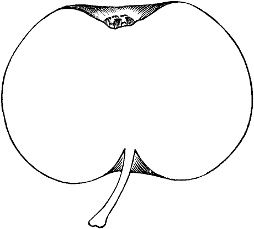
Fruit, below medium size; oblato-ovate, regularly and handsomely shaped. Skin, green, entirely covered with ashy grey russet, and strewed with greyish white freckles. Eye, small, and slightly closed, set in a round and even basin. Stalk, an inch long, slender, inserted in a rather shallow and angular cavity. Flesh, greenish, firm, crisp, and juicy, with a brisk, sugary, and aromatic flavor.
A dessert apple of the first quality, in use from December to February.
55. CALVILLE BLANCHE D’ÉTÉ.—Knoop.
Identification.—Knoop Pom. 13. Chart. Cat. 56. Diel Kernobst. B. II. 7. Hort. Soc. Cat. ed. 3, n. 109.
Synonymes.—White Calville, Acc. Hort. Soc. Cat. Calville Blanc, Jard. Franç. 106. Wahrer Weiszer Sommer Calville, Diel Kernobst. B. II. 7. Weisser Sommerkalwil, Baum. Cat. 1850.
Figure.—Knoop Pom. t. 1.
Fruit, medium sized, about three inches broad, and two inches high; roundish and flattened at the ends, with prominent ribs on the sides, which extend to the eye and form ridges round the apex—the true character of the Calvilles. Skin, tender and delicate; when ripe, of a very pale straw color, and without the least tinge of red on the side exposed to the sun, but sometimes marked with a few traces of delicate russet, but no dots. Eye, large, and closed with long, broad, acuminate segments, and set in a pretty deep and very angular basin. Stalk, three quarters of an inch long, stout, inserted in a wide and rather shallow cavity, which is lined with thin russet. Flesh, white, tender, and delicate, with a sweet and pleasant flavor.
A very good early culinary apple, but not of the finest quality, being too soft and tender; it is ripe during August, and lasts till the middle of September.
The tree is a very strong and vigorous grower, with a large round head, and is an excellent bearer. It is distinguished by its very large foliage, the leaves being 4½ inches long by 3¼ broad.
This is an old continental variety, but has been very little noticed by writers on Pomology. It is mentioned in the Jardinier Français, of 1653, and by De Quintinye, but the first work in which it is either figured or described, is Knoop’s Pomologie. Duhamel does not notice it, although it is enumerated in the catalogue of the Chartreuse, from whose garden he received the materials for producing his work on fruits.
56. CALVILLE BLANCHE D’HIVER.—Knoop.
Identification.—Knoop Pom. 66. Duh. Arb. Fruit, I. 279. Hort. Soc. Cat. ed. 3, n. 110.
Synonymes.—Calville Blanche à Côtes, Merlet Abregé, 134. Calville Acoute, Lang. Pom. 134, t. lxxviii. f. 1. Calleville Blanc, Schab. Prat. II. 88. Calville Blanc, Bret. Ecole, II. 472. Calville Blanche, Chart. Cat. 51. Calville Tardive, Acc. Christ Handb. ed. 1, 381. Pomme de Framboise, Ibid. Pomme de Coin, Ibid. Pome de Fraise, Ibid. Rambour à Côtes Gros, Acc. Hort. Soc. Cat. Bonnet Carré, Acc. Bon. Jard. Pomme Glace, Ibid. 1810, but erroneously. White Calville, Switz. Fr. Gard. 135. Coxe View. 136. White Autumn Calville, Aber. Dict. Winter White Calville, Fors. Treat. 96. Lind. Guide, 59. White Winter Calville, Down. Fr. Amer. 103. Französischer Quittenapfel, Zink. Pom. n. 89. Weiszer Himbeerapfel, Meyen Baumsch. 300. Weiszer Erdbeerenapfel, Henne Anweis, 130. Weiszer Wintercalville, Diel Kernobst. II. 12. Parisapfel, Acc. Christ Handb. Eckapfel, or Ekkeling, in Lower Saxony, Acc. Christ. Weisser Winterkalwil, Baum. Cat. 1850.
Figure.—Knoop Pom. Tab. xi. Duh. Arb. Fr. vol. i., pl. ii. Jard. Fruit, ed. 2, pl. 103.
Fruit, large, three inches and a half wide, and three inches and a quarter high; roundish and flattened, with broad uneven and unequal ribs, extending the whole length of the fruit, and terminating at the apex in prominent unequal ridges. Skin, delicate pale yellow tinged with green, becoming bright golden yellow at maturity, washed with deep red on the side next the sun, and strewed with brown dots, and a few markings of greyish white russet. Eye, small and closed with stout and pointed segments, set in a deep, irregular, five-ribbed basin, which is surrounded with knobs. Stalk, three quarters of an inch long, slender, and inserted the whole of its length in a deep and angular cavity, which is lined with russet. Flesh, yellowish white, delicate, and juicy, with a rich, lively, and agreeable aromatic flavor.
A valuable winter apple, admirably adapted for all culinary purposes, and excellent also for the dessert. It is in use from January to April.
The tree is a strong and vigorous grower, and a good bearer, but does not attain more than the middle size. It is rather liable to canker in damp situations, and is better suited for a dwarf than a standard; if grown on the paradise stock the appearance of the fruit is very much improved.
This variety is sometimes called Pomme Glace, which is, however, a distinct variety, known by the names of Rouge des Chartreux, and Pomme de Concombre; it is a variety of Calville Blanche d’Hiver, the fruit is about the size of an egg, but twice as long.
57. CALVILLE MALINGRE.—Hort.
Identification.—Hort. Soc. Cat. ed. 3, n. 114.
Synonymes.—Pomme de Malengre, Chart. Cat. 50. Cal. Traité, iii. 40. Calville Normande, acc. Calvel. Malengre d’Angleterre, Merlet Abregé, 137. Calville Rouge de la Normandie, acc. Poit et Turp. Malus Aegra, Ibid. Normännische rothe Wintercalville, Ditt. Handb. iii. 3.
Figure.—Poit et Turp, pl. 41.
Fruit, very large, elongated, and prominently ribbed like the Calville Blanche d’Hiver, but not so much flattened as that variety. Skin, a little yellow on the shaded side, and of a beautiful deep red next the sun, which is marked with stripes of darker red, strewed all over with minute dots. Eye, small, set in a broad, deep, and angular basin, which is surrounded with prominent knobs. Stalk, slender, deeply inserted in an angular cavity. Flesh, white, delicate, very juicy, and charged with an agreeable acid.
A culinary apple of the first quality; in use from January to April, and “keeps well.” According to the Chartreux Catalogue, “est bonne cuite pour les malades.”
The tree is a very vigorous grower, much more so than the generality of the Calvilles; it is very hardy and an abundant bearer, and is better adapted for being cultivated as a dwarf than an espalier; but it does not succeed well on the paradise stock.
According to the French pomologists, this variety seems to have some connection with this country, but there is no evidence that it was at any period grown to any extent in England, or that it was ever known to any of our early pomologists. It is said by some that the name malingre is applied to this variety from the fruit becoming meally or unsound, but from the observation in the Chartreux Catalogue, it is more probable that it is so called from being useful to invalids.
58. CALVILLE ROUGE D’AUTOMNE.—Knoop.
Identification.—Knoop Pom. 24. Bret. Ecole, ii. 471. Hort. Soc. Cat. ed. 3, p. 9. Bon. Jard. 1843, 512.
Synonymes.—Calville d’Automne, Quint. Traité, i. 201. Mill. Dict. No. 6. Calleville d’Automne, Merlet Abregé. Pomme Grelot, acc. Couver. Traité. Pomme Sonnette, Ibid. Herfst-Present, acc. Knoop. Gelder’s Present, Ibid. Rode Herfst-Calville, Knoop Pom. tab. iii. Autumn Calville, Mill. Dict. No. 6. Autumn Red Calville, Fors. Treat. 96. Red Autumn Calville, Ken. Amer. Or. 38. Rothe Herbstcalville, Diel Kernobst. iii. 8. Rother Herbstkalwil, Baum. Cat. 1850.
Figure.—Knoop Pom. tab. iii. Mayer. Pom. Franc. tab. xi. Sickler Obstgärt. ix. 205. t. 8.
Fruit, large, three inches and a half wide, and three and a quarter high; not so much flattened as the other Calvilles. Skin, pale red, with a trace of yellow on the shaded side, but of a beautiful deep crimson next the sun, and marked with yellowish dots on the shaded side. Eye, half open, set in a rather shallow, and ribbed basin, which is lined with fine down. Stalk, rather short, inserted in a wide and deep cavity, which is lined with russet. Flesh, white, tinged with red under the skin, and very much so on the side which is exposed to the sun; it is tender, delicate, and juicy, with a pleasant, vinous, and violet scented flavor.
A culinary apple of inferior quality in this country, but highly esteemed on the Continent, both as a culinary and a dessert fruit. It is in season during October and November.
The tree is a strong and vigorous grower, and attains the largest size. It is also an abundant bearer. To have the fruit in perfection it ought to be grown on the paradise stock as an open dwarf, in a fine sandy loam, and not too closely pruned.
59. CALVILLE ROUGE D’ÉTÉ.—Quint.
Identification.—Quint. Traité. i. 201. Knoop Pom. 12. Hort. Soc. Cat. ed. 3, n. 117. Henne Anweis. 101.
Synonymes.—Calville d’Eté, Bret. Ecole, ii. 470. Calleville d’Eté, Schab. Prat. ii. 89. Calleville d’Esté, Merlet Abregé, 132. Madeleine, acc. Hort. Soc. Cat. but not of Calvel. Calville, Bon Jard. 1810, 113. Passe-Pomme, acc. Bon Jard. 1810. Grosse Pomme Magdeleine, Ibid. Calville Plané Rouge d’Eté, acc. Christ Handb. Calville Royale d’Eté, Ibid. Cousinotte ou Calville d’Eté, in Normandy, Ibid. Grosse Rouge de Septembre, Ibid. Red Calville, Lind. Guide, 9. Rother Sommercalville, Diel Kernobst. iv. 6. Sommer Erdbeerenapfel, Henne Anweis. 101. Rother Rosmarinapfel, acc. Mayer. Rother Stricherdbeerapfel, Ibid. Rothe Sommer-Erdbeer-Apfel, Sickler Obstgärt. ii. 20, t. 3. Rode Zomer-Calville, Knoop Pom. tab. i.
Figure.—Knoop Pom. tab. i. Sickler. Obstgärt. ii. t. 3. Mayer Pom. Franc, tab. iv.
Fruit, medium sized, two inches and a half wide, and about the same high; roundish, narrowing towards the apex, and with prominent ribs on the sides like the other Calvilles. Skin, yellowish white, streaked and veined with red on the shaded side; but covered with beautiful deep shining crimson, on the side next the sun, and strewed with numerous white dots. Eye, small and prominent, set in a narrow and wrinkled basin. Stalk, from an inch to an inch and a half long, inserted in a deep and narrow cavity, which is lined with thin russet. Flesh, white tinged with red, crisp and tender, agreeably and pleasantly flavored.
A culinary apple of second-rate quality, ripe during July and August. The flesh is stained with red, particularly on the side next the sun, and partakes somewhat of the flavor of the strawberry. It is valued only for its earliness.
The tree is of small habit of growth, but an excellent bearer. There is great confusion subsisting between this variety and the Passe-pomme Rouge, which Duhamel has described under the name of Calville d’Eté.
60. CALVILLE ROUGE D’HIVER.—Knoop.
Identification.—Knoop Pom. 62. Christ Handb. ed. 1, n. 17. Hort. Soc. Cat. ed. 3, n. 118.
Synonymes.—Calville Rouge, Duh. Arb. Fruit. i. 280. Calleville Rouge, Schab. Prat. ii. 88. Calville dit Sanguinole, Merlet Abregé. Calville Rouge Longue d’Hyver, Zink. Pom. n. 66. Calville Longue d’Hiver, acc. Christ. Handb. Calville Royale d’Hiver, Ibid. Rother Ekapfel, Ibid. Caillot Rosat, Ibid. Calville Rouge Couronnée, acc. Hort. Soc. Cat. Calville Sanguinole, acc. Knoop. Calville Rouge Dedans et Dehors, Ibid. Calville Musquée, Ibid. Sanguinole, Ibid. Red Calville, Lang. Pom. 134, tab. lxxv. f. 3. Winter Red Calville, Lind. Guide, 85. Rode Wintercalville, Knoop. Pom. Tab. ix. Aechter rother Wintercalville, Diel Kernobst. iii. 1. Rothe Wintercalville, Sickler Obstgärt. viii. 95, t. 6. Rother Winterquittenapfel, Walter, acc. Diel. Rother Winterkalwil, Baum. Cat. 1850.
Figure.—Knoop Pom. Tab. ix. Duh. Arb. Fr. i. Tab. iii. Poit. et Turp. pl. 87.
Fruit, large, about three inches high, and the same in width; oblong, but not nearly so much ribbed on the sides as the other Calvilles already described. Skin, covered with a bluish bloom, deep shining crimson on the side next the sun, but paler red on the shaded side, and strewed with numerous yellowish dots. Eye, large and closed, with long segments set in a deep warted and wrinkled basin. Stalk, slender, three quarters of an inch long, inserted in a deep cavity, which is lined with thin brown russet. Flesh, greenish white stained with red, not very juicy, tender, vinous, and with a pleasant perfumed flavor.
A culinary apple of second-rate quality, ripe during November and December. The tree attains about the middle size, is vigorous and healthy in its young state, and is a good bearer. It is well adapted for growing as dwarfs on the paradise stock, and requires a rich and warm soil.
61. CALVILLE ROUGE DE MICOUD.—Hort.
Identification.—Hort. Trans. vol. v., p. 242. Hort. Soc. Cat. ed. 3, n. 119.
Fruit, below medium size; oblate, and ribbed on the sides. Skin, tough, and bitter tasted, red all over; but of a deeper and darker color on the side next the sun, and streaked and spotted with paler red on the shaded side. Eye open, placed in a wide and deep basin. Stalk, long, inserted in a round cavity. Flesh, yellowish white, tender and delicate, crisp, sweet, and perfumed.
This curious apple has the extraordinary property of producing three crops of fruit in one season. The first flowers appear at the usual time in April, the second in June, and then for a time it ceases to produce any more till the month of August, when it again blooms during the whole of that month, September, October, and November, until it is checked by the severity of the frosts. The first fruit is generally ripe during August; the second in October, which are about the size of a pigeon’s egg, and quite as good as the first. And so on it continues until retarded by the frosts; but those last produced are rarely fit for use.
This variety was first brought into notice by M. Thouin, of Paris, who says the tree originated on the farm of the Baroness de Micoud, near La Charité sur Loire, in the department of Nièvre.
62. CARLISLE CODLIN.—Hort.
Identification.—Hort. Soc. Cat. ed. 3, n. 154.
Figure.—Ron. Pyr. Mal. pl. iii. f. 2.
Fruit, above medium size; ovate flat at the base, irregular and angular on the sides. Skin, smooth and unctuous, pale yellow and strewed with a few russety specks. Eye, closed, set in a narrow, rather deep, and plaited basin. Stalk, very short, embedded in the cavity, which is lined with russet, a few lines of which extend over the base. Flesh, white, tender, crisp, and juicy, with a fine, brisk, and sugary flavor.
A culinary apple of the first quality, in use from August to December. It is one of the most useful as well as one of the best culinary apples we have, being fit for use when no larger than a walnut, and after perfecting their growth continuing in perfection as late as Christmas. If blanched in warm water, when used small, the outer rind slips off, and they may be baked whole; their color is then a transparent green; and their flavor is exquisite, resembling that of a green apricot. When it is about the size of a large nutmeg, it may be made into apple marmalade, or a dried sweetmeat, which rivals the finest Portugal plum.—M.C.H.S.
The tree is very hardy, a free grower, and an abundant bearer. As it does not attain a great size, it may be grown more closely together than most other sorts. It is a dwarf variety of the old English Codlin.
63. CAROLINE.—Lind.
Identification.—Lind. Guide, 41. Hort. Trans. vol. iv., p. 66. Hort. Soc. Cat. ed. 3, n. 128.
Fruit, medium sized; roundish. Skin, fine rich deep yellow, streaked with broad patches of red. Eye, small, set in a narrow and plaited basin. Stalk, short, inserted in a shallow cavity, which is lined with russet. Flesh, firm, brisk, juicy, and highly flavored.
A culinary apple of first-rate quality, in use from November to February.
This variety was named in honor of Lady Caroline Suffield, the wife of Lord Suffield, of Blickling and Gunton Hall, Norfolk.—Lindley.
64. CATSHEAD.—Ray.
Identification.—Raii Hist.ii. 1447, n. 8. Lind. Guide, 65. Down. Fr. Amer. 103. Hort. Soc. Cat. ed. 3, n. 130.
Synonyme.—Cat’s Head, Fors. Treat. 97.
Fruit, large, three inches and a quarter broad, and the same in height; oblong, nearly as broad at the apex as at the base, with prominent ribs on the sides, which extend into the basin of the eye, and terminate in several knobs. Skin, smooth and unctuous, pale green; but with a brownish tinge next the sun, and strewed with minute russety dots. Eye, large and open, set in a large, angular, and rather deep basin. Stalk, short, and slender for the size of the fruit, inserted in a shallow and angular cavity. Flesh, tender, juicy, and sweet, with a pleasant, acid, and slightly perfumed flavor.
One of our oldest and best culinary apples; it is in use from October to January.
The tree is a strong and vigorous grower, and attains the largest size, and though not an abundant bearer during the early period of its growth, it is much more productive as it becomes aged.
In the Horticultural Society’s Catalogue of Fruits, and also in Lindley’s “Guide to the Orchard.” This is made synonymous with the Costard of Ray, which is undoubtedly an error, the Costard being a distinct variety.
The Catshead is one of our oldest varieties, and was always highly esteemed for its great size. Phillips, in his poem on Cyder, says—
“———— Why should we sing the Thrift, Codling or Pomroy, or of pimpled coat The Russet, or the Cat’s-Head’s weighty orb, Enormous in its growth, for various use Tho’ these are meet, tho’ after full repast, Are oft requir’d, and crown the rich dessert.”
In Ellis’s “Modern Husbandman,” he says the Catshead is, “a very useful apple to the farmer, because one of them pared and wrapped up in dough, serves with little trouble for making an apple-dumpling, so much in request with the Kentish farmer, for being part of a ready meal, that in the cheapest manner satiates the keen appetite of the hungry plowman, both at home and in the field, and, therefore, has now got into such reputation in Hertfordshire, and some other counties, that it is become the most common food with a piece of bacon or pickle-pork for families.”
65. CELLINI.—Hort.
Identification.—Hort. Soc. Cat. ed. 3, n. 132.
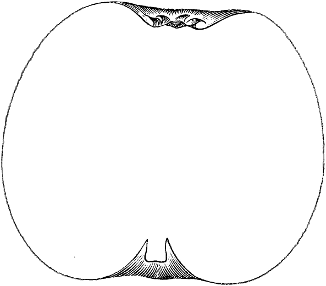
Fruit, rather above medium size; roundish and flattened at both ends. Skin, rich deep yellow, with spots and patches of lively red on the shaded side; and bright red streaked and mottled with dark crimson next the sun, with here and there a tinge of yellow breaking through. Eye, large and open, with short, acute, and reflexed segments, and set in a shallow and slightly plaited basin. Stalk, very short, inserted in a funnel-shaped cavity. Flesh, white, tender, juicy, brisk, and pleasantly flavored.
A culinary apple of the first quality; in use during October and November. It is a fine, showy, and handsome apple, bearing a strong resemblance to the Nonesuch, from which in all probability it was raised. It originated with Mr. Leonard Phillips, of Vauxhall.
66. CHERRY APPLE.—H.
Synonymes.—Siberian Crab of some. Kirschapfel, Pomme Cerise, Diel Kernobst. ix. 238.
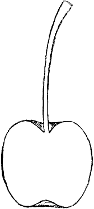
Fruit, very small, about three quarters of an inch broad, and the same in height; oblato-oblong. Skin, thin, and shining, of a beautiful lemon color on the shaded side, but entirely covered with dark blood-red on the side exposed to the sun, and which extends towards the shaded side of a fine crimson. Stalk, very slender, an inch and a half long, inserted in a small round cavity. Eye, small, without any segments, and placed in a shallow basin. Flesh, yellow, firm, crisp, and juicy, with a very pleasant and lively sub-acid flavor.
A beautiful little apple, more resembling a cherry in its general appearance than an apple. It is ripe in October.
The tree, when full grown, is from fifteen to twenty feet high, and produces an abundance of its beautiful fruit. It is perfectly hardy, and may be grown in almost any description of soil. It forms a beautiful object when grown as an ornamental tree on a lawn or in a shrubbery.
67. CHESTER PEARMAIN.—Hort.
Identification.—Hort. Soc. Cat. ed. 3, p. 30. Lind. Guide, 65. Rog. Fr. Cult. 73. Diel Kernobst, iv. B. 43.
Fruit, medium sized, three inches broad, and two inches and a half high; oblate, narrowing from the base to the crown. Skin, pale yellow, but pale red striped with crimson where exposed to the sun, and covered with large russety spots. Eye, small, and partially closed with broad segments, and set in a pretty deep basin. Stalk, three quarters of an inch long, slender, inserted in a deep, funnel-shaped, and russety cavity. Flesh, yellowish white, tender, soft, and juicy, with a pleasant, sugary, and perfumed flavor.
A dessert apple of second-rate quality; in use from October to Christmas.
The tree is hardy, a free grower, a good bearer, and attains a considerable size. It is said to be extensively cultivated in the neighbourhood of Chester.
68. CHRISTIE’S PIPPIN.—Hort.
Identification.—Hort. Soc. Cat. ed. 3, n. 10. Lind. Guide, 12. Rog. Fr. Cult. 84.
Figure.—Ron. Pyr. Mal. pl. xli. f. 3.
Fruit, medium sized, two inches and a half wide, and two inches high; oblate, without angles, and handsomely shaped. Skin, yellow, tinged with green on the shaded side; but streaked and mottled with red next the sun, and speckled all over with large russety dots. Eye, partially closed, set in a round, even, and rather shallow basin. Stalk, short and slender, not protruding beyond the margin, inserted in a deep cavity, which is lined with russet. Flesh, yellowish white, tender, brisk, juicy, sugary, and pleasantly flavored.
A dessert apple of the first quality; in use from December to February.
The tree is an abundant bearer, but constitutionally weak, a delicate grower, and subject to canker and mildew. On the paradise stock it forms a beautiful, compact, and handsome little pyramid.
It was raised by a Mr. Christie, at Kingston-on-Thames.
69. CLAYGATE PEARMAIN.—Hort.
Identification.—Hort. Trans. vol. v. p. 402. Lind. Guide, 65. Hort. Soc. Cat. ed. 3, n. 538. Down. Fr. Amer. 122.
Fruit, medium sized; pearmain-shaped. Skin, dull yellow mixed with green, and a thin coating of russet and numerous dots on the shaded side; but marked with broken stripes of dark red, on the side exposed to the sun. Eye, large and open, with long segments set in a deep basin. Stalk, an inch long, inserted in a smooth and rather deep cavity. Flesh, yellowish, crisp, juicy, rich, and sugary, partaking of the flavor of the Ribston Pippin.
A valuable and highly esteemed dessert apple of the first quality; it comes into use in November, and will continue till March.
The tree, though not a strong or vigorous grower, is hardy and healthy, attains the middle size, and is an abundant bearer. It succeeds well grafted on the paradise stock, and grown as an espalier or an open dwarf. Its shoots are slender and drooping.
This excellent variety was discovered by John Braddick, Esq., growing in a hedge near his residence at Claygate, a hamlet in the parish of Thames Ditton, in Surry, and by him widely and freely distributed.
70. CLARA PIPPIN.—Thomp.
Identification.—Thomp. in Gard. Chron. 1848, p. 300.
Fruit, small; roundish-ovate. Skin, thick and membranous, orange in the shade, and brownish red next the sun. Eye, small and closed, placed almost even with the surface, or set in a slight depression. Stalk, half an inch long, inserted in a shallow cavity. Flesh, orange, firm, rich, brisk, and sugary.
A very valuable dessert apple of the first quality, remarkable for the deep orange color of its flesh. It is in use about December and will keep till May. It was raised by F. J. Graham, Esq., of Cranford, and first noticed in the Gardeners Chronicle, April, 1848.
71. CLUSTER GOLDEN PIPPIN.—Hort.
Identification.—Hort. Soc. Cat. ed. 3, n. 282. Diel Kernobst. xi. 103.
Synonymes.—Cluster Pippin, acc. Hort. Soc. Cat. Twin Cluster Pippin, Ibid. Thickset, Ibid. Cluster Apple, Diel Kernobst. xi. 103. Englische Büschelreinette, Ibid.
Fruit, small, two inches and a quarter wide, and two inches high; round, and slightly flattened at the apex. Skin, smooth, yellowish green at first, but changing to yellow on the shaded side; with an orange tinge next the sun, marked all over with veins and reticulations of pale, brownish grey russet, with large patches round the stalk and the eye. Eye, large and open, placed in a very shallow depression. Stalk, short, inserted in a shallow cavity. Flesh, yellowish, firm, crisp, and tender, with a brisk, sugary, and perfumed flavor.
A very good dessert apple, but not of first-rate quality; in use from November to March. The fruit is produced in clusters, and it not unfrequently happens that two are found joined together.
The tree is hardy, a small grower, and a good bearer.
72. COBHAM.—Hort.
Identification.—Hort. Soc. Cat. ed. 3, n. 148. Lind. Guide, 13.
Fruit, large, three inches and a quarter wide, and over two inches and three quarters high; roundish and angular. Skin, lemon yellow tinged with green; but with a few patches and pencilings of red next the sun, and covered with specks and patches of russet. Eye, open, with short segments, set in a wide and angular basin. Stalk, short and slender, inserted in a wide, deep, and russety cavity. Flesh, yellowish, crisp, firm, delicate, and juicy, with a brisk and sugary flavor.
An excellent culinary apple, and not unworthy of the dessert; it is in use from November to Christmas, and partakes of the Ribston Pippin flavor.
The tree is hardy, vigorous, and an excellent bearer.
The Cobham is so like a variety which is cultivated near Faversham, in Kent, under the name of Pope’s apple, that there is some difficulty in distinguishing the one from the other. Further observation may prove them to be synonymous.—See Pope’s Apple.
73. COCCAGEE.—Hort.
Identification.—Hort. Soc. Cat. ed. 3, n. 150. Lind. Guide, 102.
Synonymes.—Cockagee, Fors. Treat. 97. Cocko Gee.
Fruit, medium sized; ovate, and slightly angular. Skin, smooth, pale yellow, interspersed with green specks. Eye, small and closed, set in a deep, uneven, and irregular basin. Stalk, short, inserted in a narrow and shallow cavity. Flesh, yellowish white, soft, sharply acid, and austere.
One of the oldest and best cider apples. Although it is perhaps the most harsh and austere apple known, and generally considered only fit for cider, still it is one of the best for all culinary purposes, especially for baking, as it possesses a particularly rich flavor when cooked.
The name is said to be derived from Cocko-Gee signifying Goose-dung. In Langley’s “Pomona,” it is said, “This fruit is originally from Ireland, and the cyder much valued in that country. About sixteen or eighteen years since [1727] it was first brought over, and promoted about Minehead, in Somersetshire. Some gentlemen of that county have got enough of it now to make five, six, or eight hogsheads a year of the cyder; and such as have to spare from their own tables, sell, I am told, from four to eight pounds a hogshead. The cyder is of the color of sherry (or rather of French white wine), and every whit as fine and clear. I have tasted of it from several orchards in Somersetshire. It hath a more vinous taste than any cyder I ever drank, and as the sight might deceive a curious eye for wine, so I believe the taste might pass an incurious palate for the same liquor.”
74. COCKLE PIPPIN.—Hort.
Identification.—Hort. Soc. Cat. ed. 3, n. 151. Lind. Guide, 66. Rog. Fr. Cult. 96.
Synonymes.—Cockle’s Pippin, Fors. Treat. 98. Nutmeg Pippin, acc. Hort. Soc. Cat. Nutmeg Cockle Pippin, Ibid. White Cockle Pippin, Ibid. Brown Cockle Pippin, acc. Gard. Chron. 1846, 148.
Figure.—Ron. Pyr. Mal. pl. xxiii. f. 9.
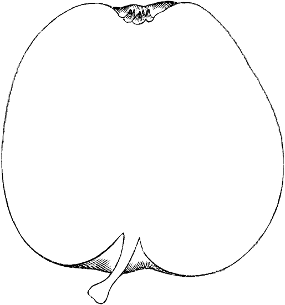
Fruit, medium sized; conical, and slightly angular on the sides. Skin, greenish yellow, changing as it ripens to deeper yellow, dotted with small grey dots, and covered all over the base with delicate pale brown russet. Eye, small and slightly closed, set in an irregular, and somewhat angular basin. Stalk, an inch long, rather slender, and obliquely inserted in a round and deep cavity, which is lined with russet. Flesh, yellowish, firm, tender, crisp, juicy, and sugary, with a pleasant aromatic flavor.
An excellent dessert apple of the finest quality, in use from January to April. Tree healthy, hardy, and an excellent bearer. This variety is extensively grown in Surry and Sussex.
75. COE’S GOLDEN DROP.—Hort.
Identification.—Hort. Soc. Cat. ed. 3, n. 274.
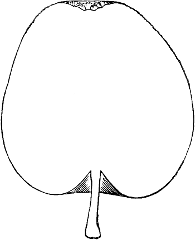
Fruit, small, conical, even, and regularly shaped. Skin, green at first, but changing as it ripens to yellow, with a few large crimson spots, on the side exposed to the sun, and marked with small patches of thin delicate russet. Eye, small and open, even with the surface, and surrounded with a few shallow plaits. Stalk, three quarters of an inch long, inserted in a small, and shallow depression, which, together with the base, is entirely covered with russet. Flesh, greenish-yellow, firm, crisp, and very juicy, brisk, sugary, and vinous.
A delicious little dessert apple of the first quality, in use from November to May.
The tree is hardy, a free upright grower, and a good bearer. It attains about the middle size. If grafted on the paradise stock it is well suited for espaliers, or growing as an open dwarf.
This excellent variety was introduced to notice by Gervase Coe, of Bury St. Edmonds, who raised the Golden Drop Plum. It has been said that it is a very old variety, which has existed for many years in some Essex orchards, but was propagated by Coe as a seedling of his own.
76. COLE.—Hort.
Identification.—Hort. Soc. Cat. ed. 3, n. 172. Lind. Guide, 13. Down. Fr. Amer. 71.
Synonyme.—Scarlet Perfume, acc. Hort. Soc. Cat.
Figure.—Pom. Mag. t. 104. Ron. Pyr. Mal. pl. xxxvii. f. 3.
Fruit, large, three inches and a quarter broad, and two and a half high; roundish, considerably flattened, almost oblate, and angular on the sides. Skin, yellowish, almost entirely covered with deep crimson, and slightly marked with russet. Eye, large and closed, set in a wide and open basin. Stalk, long, covered with down, and inserted in a close narrow cavity, with a fleshy prominence on one side of it. Flesh, white, firm, juicy, and sweet, with a rich, brisk, and pleasant flavor.