THE APPLE.—ITS VARIETIES. (continued 3)
Reading edition
149. GOLDEN REINETTE.—Hort.
Identification.—Hort. Soc. Cat. ed. 3, n. 661. Lind. Guide, 50. Down. Fr. Amer. 129. Rog. Fr. Cult. 101.
Synonymes.—Aurore, Hort. Soc. Cat. ed. 1, 26. Dundee, Ibid. 289. Megginch Favorite, Ibid. 600. Princesse Noble, Ibid. 814. Reinette d’Aix, Ibid. 860. Reinette Gielen, Ibid. 888. Yellow German Reinette, acc. Hort. Soc. Cat. ed. 3. Elizabeth, Ibid. Englise Pippin, Ibid. Wygers, Ibid. Court-pendu dorée, Hort. Soc. Cat. ed. 1, 206. Kirke’s Golden Reinette, Rog. Fr. Cult. 102. Golden Renet. Raii Hist. ii. 1448. Golden Rennet, Lang. Pom. 134, t. lxxvi. f. 6. Fors. Treat. 103. Pomme Madame, Knoop Pom. 65, t. xi. Wyker Pipping, Ibid. 132.
Figures.—Pom. Mag. t. 69. Ron. Pyr. Mal. pl. xii. f. 6.
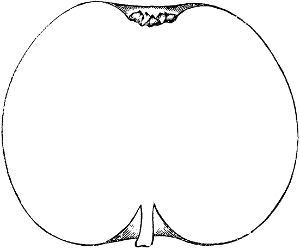
Fruit, medium sized; roundish, and a little flattened. Skin, a fine deep yellow, which towards the sun is tinged with red, streaked with deeper and livelier red, and dotted all over with russety dots. Eye, large and open, with short dry segments, and set in a wide and even basin. Stalk, half-an-inch long, deeply inserted in a round and even cavity. Flesh, yellow, crisp, brisk, juicy, rich, and sugary.
A fine old dessert apple of first-rate quality; it is in use from November to April.
The tree is healthy, vigorous, and an abundant bearer. It requires a light and warm soil, and is well adapted for dwarf training when worked on the paradise stock. Large quantities of this fruit are grown in the counties round London for the supply of the different markets, where they always command a high price.
This variety has been long known in this country and esteemed as one of the finest apples. Worlidge, in 1676, says, “It is to be preferred in our plantations for all occasions.” Ellis, in his “Modern Husbandman,” 1744, says, “The Golden Rennet, when of the largest sort, may be truly said to be the farmer’s greatest favorite apple, because when all others miss bearing, this generally stands his friend, and bears him large quantities on one tree.”
150. GOLDEN RUSSET.—Ray.
Identification.—Raii Hist. ii. 1447. Hort. Soc. Cat. ed. 3, n. 740. Lind. Guide, 89. Fors. Treat. 103. Rog. Fr. Cult. 105. Down. Fr. Amer. 132.
Synonyme.—Aromatick, or Golden Russeting, Worl. Vin. 156.
Figure.—Ron. Pyr. Mal. pl. xxix. f. 2.
Fruit, medium sized, two inches and three quarters wide, and two inches and a quarter high; ovate. Skin, thick, covered with dingy yellow russet, which is rough and thick on the shaded side, and round the base; and sometimes with a little bright red on the side next the sun. Eye, small and closed, set in a prominently plaited basin. Stalk, very short, inserted in an uneven cavity, and not protruding beyond the base. Flesh, pale yellow, firm, crisp, sugary, and aromatic; but not abounding in juice.
An excellent dessert apple of first-rate quality; in use from December to March.
The tree is healthy and an excellent bearer, but requires a warm situation to bring the fruit to perfection.
This is another of our old English apples. Worlidge calls it the Aromatick, or Golden Russeting, “it hath no compear, it being of a gold-color coat, under a russet hair, with some warts on it. It lives over the winter, and is, without dispute, the most pleasant apple that grows; having a most delicate aromatick hautgust, and melting in the mouth.”
151. GOLDEN STREAK.—H.
Fruit, medium sized, two inches and three quarters wide, and two inches and a quarter high; ovate. Skin, fine clear yellow, marked all over with broken streaks of fine bright crimson. Eye, large and open, considerably depressed. Stalk, short and slender, inserted in a russety basin. Flesh, yellow, brisk, and pleasantly flavored.
A Somersetshire cider apple.
152. GOLDEN WINTER PEARMAIN.—Diel.
Identification.—Diel Kernobst. x. 174.
Synonymes.—King of the Pippins, Hort. Soc. Cat. ed. 3, n. 383. Fors. Treat. 110. Lind. Guide, 31. Down. Fr. Amer. 88. Hampshire Yellow, Hort. Soc. Cat. ed. 1, 431. Hampshire Yellow Golden Pippin, Rog. Fr. Cult. 86. Jones’s Southampton Pippin, acc. Rogers.
Figures.—Pom. Mag. t. 117. Ron. Pyr. Mal. pl. xxxviii. f. 4.
Fruit, medium sized; abrupt pearmain-shaped, broadest at the base. Skin, smooth, of a deep, rich, golden yellow, which is paler on the shaded side than on that exposed to the sun, where it is of a deep orange, marked with streaks and mottles of crimson, and strewed with russety dots. Eye, large and open, with long, acuminate, and reflexed segments; and placed in a round, even, and rather deep basin. Stalk, three quarters of an inch long, stout, and inserted in a rather shallow cavity, which is lined with thin pale brown russet mixed with a tinge of green. Flesh, yellowish-white, firm, breaking, juicy, and sweet; with a pleasant and somewhat aromatic flavor.
A beautiful and very handsome apple of first-rate quality, and suitable either for the dessert or for culinary purposes; it is in use from the end of October to January.
The tree is a strong and vigorous grower, a most abundant bearer, and attains a considerable size. It is perfectly hardy, and will grow in almost any situation.
This variety was first brought into notice by Mr. Kirke, a nurseryman, at Brompton, under the name of King of the Pippins. I have, however, thought it advisable to discontinue that name in connection with this variety, because Diel previously possessed and described it under the name of Golden Winter Pearmain, which is much more appropriate; and the name of King of the Pippins belongs to another and very distinct variety.—See No. 199.
153. GOOSEBERRY.—Hort.
Identification.—Hort. Soc. Cat. ed. 3, n. 293.
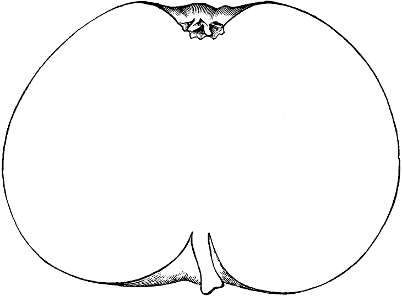
Fruit, very large; roundish-ovate. Skin, smooth, deep lively green, with a brownish tinge where exposed to the sun; strewed all over with minute russety dots, which are large and redish next the sun. Eye, open, with broad, flat, ovate segments, set in a deep and plaited basin. Stalk, three quarters of an inch long, inserted in a deep, round, and slightly russety cavity. Flesh, greenish-white, very tender, delicate, and marrowy, juicy, brisk, and pleasantly flavored.
A culinary apple of the finest quality, and surpassed by none for the purpose to which it is applicable; it is in use from October to January.
This is a valuable apple to the market gardener, and is now extensively cultivated in the Kentish orchards, particularly about Faversham, and Sittingbourne, for the supply of the London Markets. This is a very different apple from the Gooseberry Pippin of Ronald’s Pyrus Malus Brentfordensis.
154. GRANGE.—Knight.
Identification.—Pom. Heref. t. 7. Hort. Soc. Cat. ed. 3, n. 295. Lind. Guide, 106.
Figure.—Ron. Pyr. Mal. pl. xxxii. f. 6.
Fruit, below medium size; roundish, regularly and handsomely shaped. Skin, smooth, of a rich golden yellow, assuming a slight orange tinge next the sun, and strewed with minute russety dots. Eye, large and open, with broad, flat, and reflexed segments; and scarcely at all depressed. Stalk, very short and fleshy, inserted in a wide and shallow cavity, which is tinged with green color and slightly russety. Flesh, yellow, firm, crisp, sugary, and briskly flavored.
A very excellent apple either for the dessert or for the manufacture of cider; it is in use from October to January.
The specific gravity of its juice is 1079.
The tree is perfectly hardy and an excellent bearer.
This is one of the excellent productions of T. A. Knight, Esq. It was raised in 1791, from the seed of the Orange Pippin, impregnated with the pollen of the Golden Pippin, and introduced in 1802. The original tree is at Wormsley Grange, in Herefordshire.
155. GRANGE’S PEARMAIN.—Hort.
Identification.—Hort. Soc. Cat. ed. 3.
Synonyme.—Grange’s Pippin, acc. Hort. Soc. Cat.
Fruit, large, three inches wide, and the same in height; pearmain-shaped, as large, and very much the shape of the Royal Pearmain. Skin, yellow, with a tinge of green, and studded with embedded pearly specks, on some of which are minute russety points, on the shaded side; but marked with broken stripes and spots of crimson, interspersed with large russety dots on the side exposed to the sun. Eye, partially closed with broad flat segments, set in a round, deep, and plaited basin. Stalk, half-an-inch long, stout, and rather fleshy, inserted in a deep and russety cavity. Flesh, yellowish-white, crisp, tender, juicy, and sugary, with a brisk and pleasant flavor.
A fine large apple of first-rate quality as a culinary fruit, and also very good for the dessert. It bakes beautifully, and has a fine and pleasant acid; it is in use from November to February.
The tree is hardy and an excellent bearer.
156. GRAVENSTEIN.—Hort.
Identification—Hort. Soc. Cat. ed. 3, n. 297. Lind. Guide, 71. Hort. Trans. vol. iv. p. 216. Fors. Treat. 104. Down. Fr. Amer. 85.
Synonymes.—Grave Slije, acc. Hort. Soc. Cat. Sabine, of the Flemings, Ibid. Gräfensteiner, Diel Kernobst. viii. 8. Sickler Obstgärt. xxi. 116.
Figures.—Hort. Trans. vol. iv. t. 21. Pom. Mag. t. 98. Ron. Pyr. Mal. pl. x. f. 1.
Fruit, above the medium size, three inches wide, and two inches and three quarters high; roundish, irregular, and angular on the sides, the ribs of which extend from the base even to the eye. Skin, smooth, clear pale waxen-yellow, streaked and dotted with lively crimson, intermixed with orange, on the side next the sun. Eye, large and open, with long segments, which are a little reflexed, and set in an irregular, angular, and knobbed basin, which is sometimes lined with fine delicate russet, and dotted round the margin with minute russety dots. Stalk, very short, but sometimes three quarters of an inch long, set in a deep and angular cavity. Flesh, white, crisp, very juicy, with a rich, vinous, and powerful aromatic flavor; and if held up between the eye and the light, with the hand placed on the margin of the basin of the eye, it exhibits a transparency like porcelain.
This is a very valuable apple of the first quality, and is equally desirable either for the dessert or culinary purposes; it is in use from October to December.
The tree is hardy, a vigorous and healthy grower, and generally a good bearer. It has somewhat of a pyramidal habit of growth, and attains a considerable size.
Though not of recent introduction, this beautiful and excellent apple is comparatively but little known, otherwise it would be more generally cultivated. It is one of the favorite apples of Germany, particularly about Hamburgh, and in Holstein, where it is said to have originated in the garden of the Duke of Augustenberg, at the Castle of Grafenstein. The original tree is said to have been in existence about the middle of the last century. According to Diel some suppose it to be of Italian origin.
157. GREEN TIFFING.—H.
Synonyme.—Mage’s Johnny, in Lancashire.
Fruit, medium sized, two inches and a half high, and about the same in width; conical, rounded at the base, and somewhat angular and ribbed on the sides and round the eye. Skin, smooth, green at first, but changing as it ripens to yellowish-green; next the sun it is quite yellow, strewed with minute russety dots, and a few dots of red. Eye, small and closed, set in a shallow basin, and surrounded with prominent plaits. Stalk, short, inserted in a rather deep cavity. Flesh, white, crisp, tender, very juicy, and pleasantly acid.
A most excellent culinary apple; in use from September to December.
This is an esteemed variety in Lancashire, where it is extensively cultivated.
The tree is a free grower and an excellent bearer.
158. GREEN WOODCOCK.
Fruit, medium sized, three inches wide, and two inches and a half high; round, and somewhat flattened. Skin, green, changing to yellow on the shaded side, and dotted with a few grey dots; but red, mottled with broad broken stripes of darker red on the side next the sun, which become paler as they extend to the shaded side. Eye, open, with long acuminate segments, deeply set in an angular basin. Stalk, short, inserted in a shallow cavity, lined with rough russet, which extends over the base. Flesh, white, deeply tinged with green, tender, juicy, and briskly flavored.
A culinary apple; in use from October to Christmas.
This variety is grown in some parts of Sussex particularly about Hailsham and Heathfield.
159. GREENUP’S PIPPIN.—H.
Synonyme.—Greenus’s Pippin, of some Catalogues.
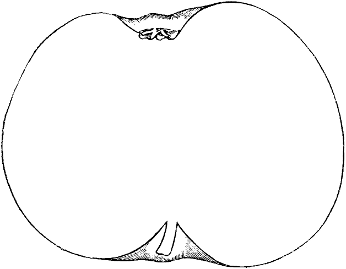
Fruit, above medium size, three inches wide, and two and a half high; roundish, broadest at the base, and with a prominent rib on one side, extending from the base to the crown. Skin, smooth, pale straw colored tinged with green, on the shaded side; but covered with beautiful bright red on the side next the sun, and marked with several patches of thin delicate russet. Eye, closed, with long flat segments, placed in a round, rather deep, and plaited basin. Stalk, very short, inserted in a wide cavity. Flesh, pale yellowish-white, tender, juicy, sweet, and briskly flavored.
An excellent apple, either for culinary or dessert use.
In the northern counties it is a popular and highly esteemed variety, and ranks as a first-rate fruit. It is in use from October to December.
The tree is hardy and healthy; it does not attain a large size, but is an abundant bearer. When grown against a wall, as it is sometimes in the North of England, and border counties, the fruit attains a large size, and is particularly handsome and beautiful.
This variety was first discovered growing in the garden of a shoemaker, at Keswick, named Greenup, and was first cultivated and made public by Clarke and Atkinson, nurserymen at that place about fifty years ago. It is now much cultivated throughout the border counties, and is a valuable apple where the more choice varieties do not attain perfection.
160. GREY LEADINGTON.—Gibs.
Identification.—Gibs. Fr. Gard. 354. Nicol. Villa. Gard. 31. Fors. Treat. 111. Hort. Soc. Cat. ed. 3, n. 401.
Synonymes.—Leadington’s Grauer Pipping, Diel Kernobst. x. 144. Gray Leadington Pippin, Ibid.
Fruit, medium sized, two inches and a half wide, and the same in height; oblong or conical, and slightly angular on the sides. Skin, greenish-yellow, covered with cinnamon-colored russet, on the shaded side, and pale red when exposed to the sun; the whole covered with whitish-grey dots. Eye, large and open, with long acuminate segments, and set in a rather deep basin. Stalk, short and stout, inserted in a pretty deep cavity. Flesh, white, firm, tender, very juicy, and of a rich, vinous, sugary, and aromatic flavor.
An excellent apple of first-rate quality, desirable either for the dessert or for culinary purposes; it is in use from September to January.
The tree is a strong grower, vigorous, hardy, and an excellent bearer. It succeeds well as a dwarf on the paradise stock.
This is a favorite apple in Scotland, where it ranks among the best dessert fruits.
161. GROS FAROS.—Duh.
Identification.—Duh. Arb. Fruit. i. 385. Schab. Prat. ii. 90. Hort. Soc. Cat. ed. 3, n. 244.
Synonyme.—Faros, acc. Hort. Soc. Cat.
Fruit, medium sized, two inches and a half wide, and two inches high; roundish and flattened, broadest at the base, and narrowing towards the eye, sometimes slightly angled. Skin, smooth, pale greenish-yellow, with a few streaks of red where shaded; and entirely covered with red, which is striated with deeper red where exposed to the sun. Eye, small and open, set in a narrow, round, and rather deep basin. Stalk, half-an-inch long, inserted in a wide and deep cavity, which is lined with dark brown russet. Flesh, greenish-white, crisp, firm, juicy, sweet, slightly acid, and perfumed.
A dessert apple of good but not first-rate quality; in use from December to March.
The tree is healthy and vigorous, and a good bearer.
162. HAGLOE CRAB.—Knight.
Identification.—Pom. Heref. t. 5. Fors. Treat. 106. Lind. Guide, 107.
Fruit, small, two inches wide, and the same in height; ovate, flattened, and irregularly shaped. Skin, pale yellow, streaked with red next the sun, and covered with a few patches of grey russet. Eye, open, with flat, reflexed segments. Stalk, short. Flesh, soft and woolly, but not dry.
Specific gravity of its juice 1081.
This is a most excellent cider apple; the liquor it produces being remarkable for its strength, richness, and high flavor. It requires, however, to be grown in certain situations; a dry soil with a calcareous subsoil, being considered the best adapted for producing its cider in perfection. Marshall says, “It was raised from seed by Mr. Bellamy, of Hagloe, in Gloucestershire, grandfather of the present Mr. Bellamy, near Ross, in Herefordshire, who draws from it (that is, from trees grafted with scions from this parent stock) a liquor, which for richness, flavor, and pure on the spot, exceeds perhaps every other fruit liquor which nature and art have produced. He has been offered sixty guineas for a hogshead (about 110 gallons) of this liquor. He has likewise been offered bottle for bottle of wine, or spirituous liquors, the best to be produced; and this without freight, duty, or even a mile of carriage to enhance its original price.”
163. HALL DOOR.—Fors.
Identification.—Fors. Treat. 106. Hort. Soc. Cat. ed. 3, n. 313. Rog. Fr. Cult. 57.
Figure.—Ron. Pyr. Mal. pl. xxxiii. f. 1.
Fruit, large, three inches and a half wide, and two inches and three quarters high; oblate, puckered round the eye. Skin, pale green at first, but changing to dull yellow, streaked with red. Eye, set in a wide and irregular basin. Stalk, short and thick, inserted in a moderately deep cavity. Flesh, white, firm, but coarse, juicy, and pleasantly flavored.
A dessert apple of ordinary merit; in use from December to March.
164. HAMBLEDON DEUX ANS.—Hort.
Identification.—Hort. Soc. Cat. ed. 3, n. 202. Ron. Pyr. Mal. 83.
Figure.—Ron Pyr. Mal. pl. xlii. f. 4.
Fruit, large, three inches wide, and two inches and a half high; roundish, rather broadest at the base. Skin, greenish-yellow in the shade; and dull red, streaked with broad stripes of deeper and brighter red, on the side next the sun. Eye, small and closed, set in a rather shallow basin. Stalk, short, inserted in a shallow cavity. Flesh, greenish-white, firm, crisp, not very juicy, but richly and briskly flavored.
One of the most valuable culinary apples, and not unworthy of the dessert; it is in use from January to May, and is an excellent keeper.
This variety originated at Hambledon, a village in Hampshire, where there are several trees of a great age now in existence.
165. HANWELL SOURING.—Hort.
Identification.—Hort. Trans. vol. iv. p. 219. Hort. Soc. Cat. ed. 3, n. 319. Lind. Guide, 71.
Figure.—Ron. Pyr. Mal. pl. xxx. f. 4.
Fruit, above medium size, three inches wide, and two inches and three quarters high; roundish-ovate, angular, or somewhat five-sided, and narrowing towards the eye. Skin, greenish-yellow, sprinkled with large russety dots, which are largest about the base; and with a faint blush of red next the sun. Eye, closed, set in a deep, narrow, and angular basin, which is lined with russet. Stalk, very short, inserted in an even funnel-shaped cavity, from which issue ramifications of russet. Flesh, white, firm, crisp, with a brisk and poignant acid flavor.
An excellent culinary apple of first-rate quality; in use in December and keeps till March, when it possesses more acidity than any other variety which keeps to so late a period.
It is said to have been raised at Hanwell, a place near Banbury, in Oxfordshire.
166. HARGREAVE’S GREEN-SWEET.—H.
Fruit, medium sized, two inches and three quarters wide, and two inches and a half high; oblato-cylindrical, angular on the sides, with prominent ridges round the eye. Skin, yellow, tinged with green, on the shaded side; but deeper yellow tinged with green, and marked with a few faint streaks of red next the sun, and strewed all over with small russety dots. Eye, half open, with linear segments, placed in a deep and angular basin, which is surrounded with ridges formed by the termination of the costal angles. Stalk, three quarters of an inch long, slender, and inserted in a deep, round cavity, which is lined with rough russet. Flesh, yellowish, tender, juicy, sweet, and perfumed.
A good dessert apple but lacks acidity; it is in use during September and October.
About Lancaster this is a well-known apple. The original tree, which is of great age, is still standing in the nursery of John Hargreave and Sons, hence it is called Hargreave’s Green-Sweet.
167. HARVEY APPLE.—Park.
Identification.—Park. Par. 587. Aust. Orch. 54. Worl. Vin. 159. Raii Hist. ii. 1448. Switz. Fr. Gard. 138. Lind. Guide, 72.
Synonyme.—Doctor Harvey, Hort. Soc. Cat. ed. 3, n. 208.
Fruit, large, three inches wide, and about the same high; ovate, and somewhat angular. Skin, greenish-yellow, dotted with green and white specks, and marked with ramifications of russet about the apex. Eye, small, very slightly depressed, and surrounded with several prominent plaits. Stalk, short and slender, inserted in an uneven and deep cavity. Flesh, white, firm, crisp, juicy, pleasantly acid, and perfumed.
A culinary apple of first-rate quality, well-known and extensively cultivated in Norfolk; it is in use from October to January.
The tree is large, hardy, and a great bearer.
In the Guide to the Orchard, it is said, “When baked in an oven which is not too hot, these apples are most excellent; they become sugary, and will keep a week or ten days, furnishing for the dessert a highly flavored sweetmeat.”
This is one of the oldest English apples. It is first mentioned by Parkinson as “a faire, greate, goodly apple; and very well rellished.” Ralph Austen calls it “a very choice fruit, and the trees beare well.” Indeed it is noticed by almost all the early authors. According to Ray it is named in honor of Dr. Gabriel Harvey, of Cambridge, “Pomum Harveianum ab inventore Gabriele Harveio Doctore nomen sortitum Cantabrigiæ suæ deliciæ.”
168. HARVEY’S PIPPIN.—Hort.
Identification.—Hort. Soc. Cat. ed. 3, p. 19.
Synonyme.—Dredge’s Beauty of Wilts, acc. Hort. Soc. Cat. Rog. Fr. Cult. 53.
Fruit, medium sized; roundish. Skin, yellow on the shaded side, but washed with fine red on the side next the sun, and marked with crimson dots. Flesh, firm, crisp, juicy, and richly flavored.
An excellent and useful apple either for culinary purposes or dessert use; it is in season from December to February.
The tree is a free grower and an excellent bearer; it attains above the middle size, and may be grown either as an open dwarf, or an espalier, when grafted on the paradise stock.
169. HARVEY’S WILTSHIRE DEFIANCE.—H.
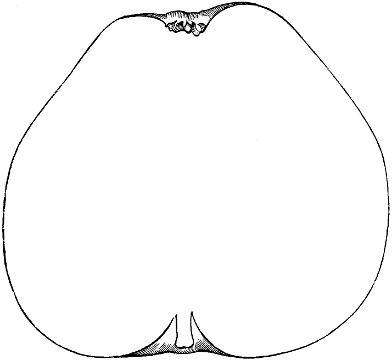
Fruit, of the largest size; conical, and very handsomely shaped, distinctly five-sided, having five prominent and acute angles descending from the apex, till they are lost in the base. Skin, fine deep sulphur yellow; of a deeper shade on the side which is exposed to the sun, and covered all over with minute russety dots, with here and there ramifying patches of russet. Eye, pretty large and open, with short ragged segments, and set in a rather shallow and angular basin. Stalk, very short, about half-an-inch long, and not extending beyond the base, inserted in a round and deep cavity, lined with rough scaly russet, which branches out over a portion of the base. Flesh, yellowish, firm, crisp, and juicy, sugary, vinous, and richly flavored. Core, very small for the size of the apple.
A very handsome and most desirable apple, being of first-rate quality, either as a dessert or culinary fruit; it is in use from the end of October to the beginning of January.
This variety seems to be comparatively little known; but it is well deserving the notice either of the fruit gardener, or the orchardist; to the latter particularly so, as its size, fine appearance, and handsome shape make it attractive at market; and its solid and weighty flesh give it an advantage over many apples of its size.
170. HAUTE BONTÉ.—Duh.
Identification.—Duh. Arb. Fruit. i. 315. Quint. Inst. i. 203. Hort. Soc. Cat. ed. 3, n. 323.
Synonymes.—Reinette grise, haute bonté, Bon Jard. 1843, 514. Blandilalie, in Poitou, acc. Quint.
Figures.—Nois. Jard. Fr. ed. 2, pl. 106. Duh. Arb. Fruit. i. pl. xii. f. 1.
Fruit, medium sized; roundish, somewhat ribbed on the sides, and flattened at both ends; broadest at the base, and narrowing towards the apex, which is terminated by prominent ridges. Skin, smooth and shining, green at first, but changing to yellow as it ripens, and with a faint tinge of red on the side exposed to the sun. Eye, half open, with long acuminate segments, set in a deep and angular basin. Stalk, half-an-inch long, inserted in a deep and irregular cavity. Flesh, greenish-white, tender, juicy, sugary, rich, brisk, and aromatic.
An excellent dessert apple of first-rate quality when grown to perfection; it is in use from January to May.
This is a variety of the Reinette Grise, and a very old French apple.
171. HAWTHORNDEN.—Hort.
Identification.—Hort. Soc. Cat. ed. 3, n. 324. Lind. Guide, 17. Down. Fr. Amer. 86. Rog. Fr. Cult. 26.
Synonymes.—Hawthorndean, Fors. Treat. 107. White Hawthorndean, Nicol Gard. Kal. 256. Red Hawthorndean, acc. Hort. Soc. Cat. White Apple, acc. Nicol. Villa Gard. 30.
Figure.—Hook Pom. Lond. t. 44. Pom. Mag. t. 34. Ron. Pyr. Mal. pl. iv. f. 1.
Fruit, varying very much in size, according to the situation and condition of the tree; sometimes it is very large, and again scarcely attaining the middle size; generally, however, it is above the medium size; roundish and depressed, with occasionally a prominent rib on one side, which gives it an irregularity in its appearance. Skin, smooth, covered with a delicate bloom; greenish-yellow, with a blush of red on one side, which varies in extent and depth of color according as it has been more or less exposed to the sun. Eye, small and closed, with broad and flat segments, placed in a pretty deep and irregular basin. Stalk, short, stout, and sometimes fleshy, inserted in a deep and irregular cavity. Flesh, white, crisp, and tender, very juicy, with an agreeable and pleasant flavor.
One of the most valuable and popular apples in cultivation. It is suitable only for kitchen use, and is in season from October to December.
The tree is very healthy and vigorous, and as an early and abundant bearer is unrivalled by any other variety. It succeeds well in almost every description of soil and situation where it is possible for apples to grow.
This variety was raised at Hawthornden, a romantic spot near Edinburgh, celebrated as the birthplace and residence of Drummond the poet, who was born there in 1585. I have never learnt at what period the Hawthornden was first discovered. The first mention of it is in the catalogue of Leslie and Anderson, of Edinburgh; but I do not think it was known about London till 1790, when it was introduced to the Brompton Park nursery.
172. HERMANN’S PIPPIN.—H.
Synonyme.—Grosser Gestreifter Hermannsapfel, Diel Kernobst. vii. 99?
Fruit, above medium size, three inches broad, and the same in height; roundish, and irregularly formed. Skin, yellow, tinged with green on the shaded side; but striped and mottled with dark crimson on the side next the sun, and thickly strewed with russety dots round the eye. Eye, open, with long green acuminate segments, which are recurved at the tips, and set in a deep and slightly plaited basin. Stalk, short and stout, inserted in a round, deep, and even cavity, which is lined with rough grey russet, extending over almost the whole of the base. Flesh, yellowish-white, very tender and juicy, but with little flavor.
An apple of very ordinary quality, which seems only suitable for culinary purposes; it is in use from October to January.
I received this variety from Mr. James Lake, of Bridgewater, and it seems to be so like the description of Diel’s Grosser Gestreifter Hermannsapfel, that I have adopted it as a synonyme.
173. HOARY MORNING.—Hort.
Identification.—Hort. Soc. Cat. ed. 3, n. 336. Lind. Guide, 18. Down. Fr. Amer. 113.
Synonymes.—Dainty Apple, Hort. Soc. Cat. ed. 1, 234. Downy, Ibid. 275. Sam Rawlings, acc. Hort. Soc. Cat. ed. 3.
Figures.—Pom. Mag. t. 53. Ron. Pyr. Mal. pl. xxviii. f. 1.
Fruit, large, three inches and a half wide, and two inches and three quarters high; roundish, somewhat flattened and angular. Skin, yellowish, marked with broad pale red stripes on the shaded side; and broad broken stripes of bright crimson on the side next the sun; the whole surface entirely covered with a thick bloom, like thin hoar frost. Eye, very small, set in a shallow and plaited basin. Stalk, short, inserted in a wide and round cavity. Flesh, yellowish-white, tinged with red at the surface under the skin, brisk, juicy, rich, and slightly acid.
A beautiful and very good culinary apple, of second-rate quality; it is in use from October to December.
174. HOLLANDBURY.—Hort.
Identification.—Hort. Soc. Cat. ed. 3, n. 338.
Synonymes.—Hollingbury, Fors. Treat. 107. Hawberry Pippin, acc. Hort. Soc Cat. ed. 3. Horsley Pippin, Ibid. Beau Rouge, Ibid. Bonne Rouge, Ibid. Howbury Pippin, Hort. Soc. Cat. ed. 1, 467. Kirke’s Scarlet Admirable, Rog. Fr. Cult. 38. Kirke’s Schöner Rambour, Diel. Kernobst. v. B. 52.
Figures.—Brook. Pom. Brit. pl. xciii. f. 5. Ron. Pyr. Mal. pl xl. f. 2.
Fruit, very large, three inches and three quarters wide, and three inches high; roundish and flattened, with irregular and prominent angles or ribs extending from the base to the apex. Skin, deep yellow, tinged with green on the shaded side; but bright deep scarlet where exposed to the sun, generally extending over the whole surface. Eye, closed, with long acuminate segments, and set in a wide and deep basin. Stalk, short and slender, inserted in a deep funnel-shaped cavity, which is generally lined with russet. Flesh, white, with a slight tinge of green, delicate, tender and juicy, with a brisk and pleasant flavor.
A beautiful and showy apple for culinary purposes, but not of first-rate quality; it is in use from October to Christmas.
The tree is a strong and vigorous grower, but not a very abundant bearer. It succeeds well on the paradise stock.
175. HOLLAND PIPPIN.—Langley.
Identification.—Lang. Pom. 134, t. lxxix. f. 1. Mill. Dict. Hort. Soc. Cat. ed. 3, n. 339. Lind. Guide, 51. Down. Fr. Amer. 86.
Synonymes.—Summer Pippin, acc. Down. Pie Pippin, Ibid.
Fruit, large, three inches wide, and two inches and a half high; roundish and flattened, with ribs on the sides. Skin, greenish-yellow, with a slight tinge of pale brown where exposed to the sun, and strewed with large green dots. Eye, small and closed, set in a round, narrow, and plaited basin. Stalk, very short, embedded in a wide and deep cavity. Flesh, yellowish-white, firm, tender, juicy, sugary, and briskly acid.
A valuable apple, of first-rate quality for culinary purposes; it is in use from November to March.
The tree is a strong grower, vigorous, healthy, and a good bearer.
This is the Holland Pippin of Langley and Miller, but not of Ray or Ralph Austen, who make it synonymous with the Kirton Pippin, which Ray describes as being small and oblate, and the same as is called Broad-eye in Sussex. The Holland Pippin is a native of the Holland district of Lincolnshire, hence its name.
176. HOLLOW CORE.—H.
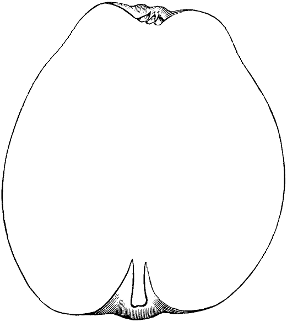
Fruit, medium sized, two inches and a half wide, and three inches high; conical, irregular in its outline, ribbed, and distinctly four-sided; at about four-fifths of its length towards the crown it is very much contracted and swells out again towards the eye, altogether very much resembling a codlin in shape. Skin, smooth and shining, pale grass green on the shaded side, and covered with a cloud of pale red next the sun, thinly strewed with dots, which are red on the exposed, and dark green on the shaded side. Eye, small and closed, set in a narrow, contracted, and plaited basin, which is surrounded with several small knobs. Stalk, green and downy, half-an-inch long, inserted in a narrow, close, and deep basin, which is quite smooth. Flesh, white, very tender and delicate, with a brisk, mild, and pleasant flavor. Core, very large, with open cells.
An excellent culinary apple, with a fine perfume; ripe in September.
This variety is extensively grown in Berkshire, particularly about Newbury and Reading, whence large quantities are sent to London for the supply of Covent Garden Market.
177. HOLLOW CROWNED PIPPIN.—Hort.
Identification.—Hort. Soc. Cat. ed. 3, n. 341. Lind. Guide, 72.
Synonyme.—Hollow-eyed Pippin, Fors. Treat. 107.
Fruit, medium sized; oblato-oblong, the same width at the apex as the base, and slightly angular on the sides. Skin, pale green, becoming yellow at maturity, with a faint blush of red where it is exposed to the sun. Eye, large, and set in a wide and deep basin. Stalk, short, thick, and curved, inserted in a rather deep cavity. Flesh, firm, juicy, sugary, and briskly acid.
An excellent culinary apple; in use from November to February.
178. HOOD’S SEEDLING.—Ronalds.
Identification and Figure.—Ron. Pyr. Mal. pl. xxiii. f. 5.
This appears to me to be identical with the Scarlet Pearmain. The fruit is exactly the same, and not distinguishable from it. The only difference I can detect is, that the young trees are more strong and vigorous than that variety; but the distinction is altogether so slight, that if not really identical, they are so similar as not to require separate descriptions.
179. HORMEAD PEARMAIN.—Hort.
Identification.—Hort. Soc. Cat. ed. 3, n. 545.
Synonymes.—Arundel Pearmain, Hort. Soc. Cat. ed. 1, 744. Hormead Pippin Ibid. 462.
Fruit, medium sized, two inches and a half wide, and the same in height; of the true pearmain-shape, regular and handsome. Skin, of an uniform clear yellow, strewed with brown russety dots. Eye, large and closed, with long segments, and set in a shallow and uneven basin. Stalk, very short and stout, deeply inserted. Flesh, white, tender, very juicy, and pleasantly acid.
An excellent apple, of first-rate quality for culinary use, and suitable also for the dessert; it is in season from October to March.
180. HORSHAM RUSSET.—Lind.
Identification.—Lind. in Hort. Trans. vol. iv. p. 69. Lind. Guide, 89.
Fruit, about the size of the Nonpareil, but not so regular in its outline, generally about two inches and a quarter in diameter, and two inches deep. Eye, small and closed, in a small depression without angles. Stalk, short, rather thick, rather deeply inserted in a wide, uneven cavity. Skin, pale green, covered with a thin, yellowish-grey russet round its upper part, with a pale salmon-colored tinge on the sunny side. Flesh, greenish-white, firm, crisp. Juice, plentiful, of a high aromatic Nonpareil flavor.
A dessert apple; in season from November till March.
Raised from the seed of a Nonpareil about thirty years ago (1821), by Mrs. Goose, of Horsham St. Faith’s, near Norwich. It is a very hardy tree, and a good bearer.
180. HOSKREIGER.—Hort.
Identification.—Hort. Soc. Cat. ed. 3, n. 343.
Synonyme.—Heidelocher, acc. Hort. Soc. Cat.
Figure.—Maund. Fruit. pl. 51.
Fruit, large, three inches and a half wide, and two inches and three quarters high; roundish and considerably flattened, almost oblate. Skin, of a fine grass-green, which changes as it ripens to yellowish-green, and marked with broad streaks of pale red, on the side next the sun, which is strewed with rather large russety freckles. Eye, small and open, with erect, acute segments, and placed in a rather deep, narrow, and undulating basin. Stalk, short, inserted in a round, funnel-shaped cavity, which is lined with pale brown russet. Flesh, white, tender, crisp, and juicy, with a brisk and pleasant flavor.
A first-rate culinary apple; in use from November till March.
The tree is a vigorous and healthy grower, and an abundant bearer.
181. HUBBARD’S PEARMAIN.—Lind.
Identification.—Lind. in Hort. Trans. vol. iv. p. 68. Hort. Soc. Cat. ed. 3, n. 546.
Synonymes.—Hubbard’s, Fors. Treat. 108. Russet Pearmain, acc. Fors. Treat. Golden Vining, acc. Pom. Mag. Hammon’s Pearmain, acc. Riv. Cat.
Figure.—Pom. Mag. t. 27.
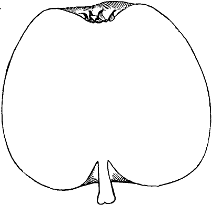
Fruit, small; ovate, and regularly formed. Skin, covered with pale brown russet, and where any portion of the ground color is exposed, it is yellowish-green on the shaded side, and brownish-red next the sun; but sometimes it is almost free from russet, particularly in hot seasons, being then of an uniform yellowish-green, mottled with orange or pale red next the sun. Eye, small and closed, with short segments, and set in a shallow basin. Stalk, short, about half-an-inch long, inserted in a round and even cavity. Flesh, yellow, firm, not juicy, but very rich, sugary, and highly aromatic.
This is one of the richest flavored dessert apples; it is in use from November to April.
The tree is a small grower, but healthy, hardy, and an abundant bearer.
Hubbard’s Pearmain was first introduced to public notice by Mr. George Lindley, at a meeting of the London Horticultural Society in 1820. “This,” says Mr. Lindley, “is a real Norfolk apple, well known in the Norwich market; and although it may be found elsewhere, its great excellence may have caused its removal hence. The merits of Hubbard’s Pearmain as a table apple are unrivalled, and its superior, from the commencement of its season to the end, does not, I am of opinion, exist in this country.”
182. HUGHES’S GOLDEN PIPPIN.—Hooker.
Identification.—Hook. Pom. Lond. t. 26. Hort. Soc. Cat. ed. 3, n. 284. Lind. Guide, 18. Rog. Fr. Cult. 85.
Synonyme.—Hughes’s New Golden Pippin, Fors. Treat. 108. Diel Kernobst. x. 97.
Figures.—Pom. Mag. t. 132. Ron. Pyr. Mal. pl. xviii. f. 4.
Fruit, below medium size, two inches and a half wide, and two inches high; round, and flattened at both extremities. Skin, rich yellow, covered with large, green, and russety dots, which are thickest round the eye. Eye, open, with short, flat, acuminate segments, which are generally reflexed at the tips, and set in a wide, shallow, and plaited basin. Stalk, very short, and not at all depressed, being sometimes like a small knob on the flattened base. Flesh, yellowish-white, firm, rich, brisk, juicy, sugary, and aromatic.
A dessert apple of first-rate quality; in use from December to February.
The tree is hardy, and healthy, though not a strong grower, the shoots being long and slender. It is also an excellent bearer.
183. HUNT’S DEUX ANS.—Hort.
Identification.—Hort. Soc. Cat. ed. 3, n. 201.
Fruit, medium sized, two inches and three quarters wide, by two inches and a half high; somewhat conical, irregularly formed, and angular. Skin, greenish, and covered with grey russet on the shaded side; but redish-brown covered with grey russet, and large russety dots, on the side exposed to the sun. Eye, large, and open, with long, spreading, acuminate segments, placed in a deep, angular, and irregular basin. Stalk, half-an-inch long, inserted in a deep, oblique cavity, and not extending beyond the base. Flesh, yellowish-white tinged with green, firm and leathery, juicy and sugary, with a rich and highly aromatic flavor, very similar to, and little inferior to the Ribston Pippin.
A dessert apple of the first quality, whether as regards its long duration, or the peculiar richness of its flavor: it is in use from December to March; but according to Mr. Thompson—no mean authority—it will keep for two years. It may, however, be a question whether or not this is identical with the Hunt’s Deux Ans of the Horticultural Society, which Mr. Thompson regards as only a second-rate fruit. If it is the same, the climate of Somersetshire, whence I had both trees and specimens of the fruit, is more adapted for bringing it to perfection than that of Chiswick.
184. HUNT’S DUKE OF GLOUCESTER—Hort.
Identification.—Hort. Trans. vol. iv. p. 525. Lind. Guide, 90. Hort. Soc. Cat. ed. 3, n. 222.
Fruit, below medium size; roundish ovate. Skin, almost entirely covered with thin russet, except a spot on the shaded side, where it is green; and where exposed to the sun it is of a redish-brown. Flesh, white tinged with green, crisp, juicy, and highly flavored.
A dessert apple of first-rate quality; in use from December to February.
This variety was raised from a seed of the old Nonpareil, to which it bears a strong resemblance, by Dr. Fry of Gloucester, and received the name it now bears, from being sent to the Horticultural Society of London, by Thomas Hunt Esq., of Stratford-on-Avon, in 1820. Mr. Lindley gives Hunt’s Nonpariel as a synonyme of Duke of Gloucester; but it is a very distinct variety; it was, however, a seedling raised by Mr. Hunt from the Duke of Gloucester, and is a very first-rate variety.
185. HUNTHOUSE.—Hort.
Identification.—Hort. Soc. Cat. ed. 3, n. 347. Rog. Fr. Cult. 57.
Fruit, of medium size, two inches and three quarters wide, by two inches and a half high; conical, ribbed on the sides, and terminated at the apex, with rather prominent knobs. Skin, at first grass-green, but changing as it ripens to greenish-yellow; where exposed to the sun it is tinged with red, and marked with small crimson dots and a few short broken streaks of the same color; but where shaded it is veined with thin brown russet, particularly about the eye, and very thinly strewed with russety dots. Eye, large, half open, with broad flat segments, set in a narrow, and deeply furrowed basin. Stalk, an inch long, straight, inserted in a very shallow cavity, sometimes between two fleshy lips, but generally with a fleshy protuberance on one side of it. Flesh, greenish-white, firm, tender, and with a brisk, but rather coarse and rough acid flavor.
A useful culinary apple; in use from December to March.
Its chief recommendation is, the immense productiveness of the tree, which is rather small, with pendulous shoots, and extremely hardy; it succeeds in exposed situations where many other varieties could not grow. Rogers says, “it is a tree of the third class in the orchard, and will answer well in exposed situations, trained as dwarfs or half-standards, it being equal in hardihood, and very fit to be planted along with the Grey Leadington.”
This variety was discovered at Whitby, in Yorkshire, where it is extensively cultivated.
186. HUTTON SQUARE.—H.
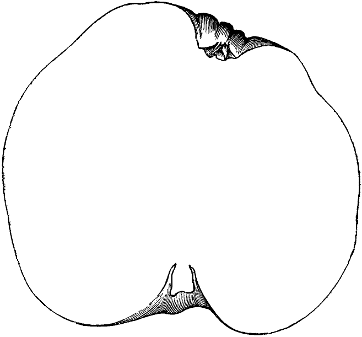
Fruit, large; roundish-ovate, and irregular in its outline, being much bossed on the sides, and knobbed about the eye and the stalk. Skin, smooth, dull greenish-yellow where shaded, and strewed with minute russety dots; but washed with dull red next the sun, and dotted with black dots. Eye, small and closed, placed in an angular and plaited basin. Stalk, short, deeply embedded in an angular cavity. Flesh, white, firm, crisp, sweet, briskly and pleasantly flavored.
A valuable culinary apple of first-rate quality, and not unsuitable for the dessert, where a brisk and poignant flavored apple is preferred; it is in use from November to March.
This variety is extensively grown about Lancaster; and is said to have originated at the village of Hutton, in that vicinity.
The tree is an excellent bearer.
187. IRISH PEACH.—Hort.
Identification.—Hort. Soc. Cat. ed. 3, n. 527. Lind. Guide, 4. Down. Fr. Amer. 74.
Synonymes.—Early Crofton, Hort. Trans. vol. viii. p. 321. Ron. Pyr. Mal. 15.
Figures.—Pom. Mag. t. 100. Ron. Pyr. Mal. pl. viii. f. 1.
Fruit, medium sized, two inches and three quarters wide, by two inches and a quarter high; roundish, somewhat flattened, and slightly angular. Skin, smooth, pale yellowish-green, tinged with dull redish-brown, and thickly dotted with green dots on the shaded side; but fine lively red, mottled and speckled with yellow spots on the side exposed to the sun. Eye, small and closed, set in a rather deep, and knobbed basin, which is lined with thick tomentum. Stalk, short, thick, and fleshy, inserted in a pretty deep cavity. Flesh, greenish-white, tender, and crisp, abounding in a rich, brisk, vinous, and aromatic juice, which, at this season, is particularly refreshing.
An early dessert apple of the finest quality. It is ripe during the first week in August, and lasts all through that month. It is a most beautiful, and certainly one of the most excellent summer apples, possessing all the rich flavor of some of the winter varieties, with the abundant and refreshing juice of the summer fruits. Like most of the summer apples it is in greatest perfection when eaten from the tree, which is hardy, vigorous, and an abundant bearer.
188. IRISH REINETTE.—H.
Fruit, medium sized, two inches and three quarters wide, by two inches and a half high; oblong, somewhat five-sided, with five ribs which extend from the base to the apex, where they run into the eye, forming five prominent ridges. Skin, yellowish-green, strewed with minute russety dots on the shaded side; but dull brownish-red, almost entirely covered with large patches of dull leaden colored russet, on the side exposed to the sun. Eye, small and closed, placed in a ribbed and plaited basin. Stalk, short, inserted in a round, deep, and even cavity. Flesh, greenish-yellow, firm, crisp, and very juicy, with a brisk, and poignant acid juice.
A valuable culinary apple; in use from November to February.
This variety is much cultivated about Lancaster, and in the county of Westmoreland, where it is highly esteemed.
189. ISLE OF WIGHT PIPPIN.—Hort.
Identification.—Hort. Soc. Cat. ed. 3, n. 360. Lind. Guide, 108. Rog. Fr. Cult, 82. Fors. Treat. 109.
Synonymes.—Isle of Wight Orange, Hort. Soc. Cat. ed. 1, 484. Orange Pippin, Pom. Heref. t. 8. Pomme d’Orange, Knoop Pom. 47, t. viii. Engelse Oranje Appel, Ibid. 171.
Figures.—Ron. Pyr. Mal. pl. xxxii. f. 4. Pom. Heref. t. 8.
Fruit, small, two inches wide, by an inch and a half deep; globular. Eye, slightly sunk, with broad acute segments of the calyx. Stalk, very short. Skin, yellowish-golden grey, with a russety epidermis, highly colored with orange and red next the sun. Flesh, firm and juicy, with a rich and aromatic flavor.
A dessert apple of first-rate quality, and also valuable as a cider fruit; it is in use from September to January.
The specific gravity of its juice is 1074.
This is a very old variety, and is no doubt the “Orange Apple” of Ray and Worlidge. According to Mr. Knight, it is by some supposed to have been introduced from Normandy to the Isle of Wight, where it was first planted in the garden at Wrexall Cottage, near the Undercliff, where it was growing in 1817. There are several other varieties of apples known by the name of “Orange” and “Orange Pippin,” but they are all very inferior to this.
The tree does not attain a large size, but is hardy, healthy, and an excellent bearer. It succeeds well when grafted on the paradise stock, and grown as an open dwarf, or an espalier.
190. ISLEWORTH CRAB.—Hort.
Synonyme.—Brentford Crab, acc. Hort. Soc. Cat. ed. 3, p. 21.
Fruit, medium sized, two inches and three quarters wide, by the same in height; conical. Skin, smooth, of a pale yellow color, with a deeper tinge where exposed to the sun, and covered with small redish-brown dots. Eye, small and open, with reflexed segments, set in a round and narrow basin. Stalk, slender, inserted in a deep, round, and even cavity. Flesh, yellowish-white, crisp, sweet, juicy, and pleasantly flavored.
A pretty good culinary apple of second-rate quality; in use during October; but scarcely worth cultivation.
191. JOANNETING.—H.
Synonymes.—Jennetting, Coles’ Adam in Eden, 257. Juniting, Rea Pom. 209. Jeniting, Worl. Vin. 161. Ginetting or Juneting, Raii Hist. ii. 1447, 1. Juneting, or Jenneting, Switz. Fr. Gard. 134. Genneting, Lang. Pom. t. lxxiv. f. 2. Juneting, Fors. Treat. 109. Early Jenneting, or June-eating, Aber. Dict. White Juneating, Hort. Soc. Cat. ed. 3, n. 374. Down. Fr. Amer. 78. Juneating, Lind. Guide, 4. Rog. Fr. Cult. 27. Owen’s Golden Beauty, Hort. Soc. Cat. ed. 1, 717. Primiting, in Kent and Sussex.
Figure.—Ron. Pyr. Mal. pl. i. f. 3.
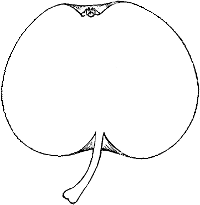
Fruit, small; round, and a little flattened. Skin, smooth and shining, pale yellowish-green in the shade; but clear yellow, with sometimes a faint tinge of red or orange next the sun. Eye, small and closed, surrounded with a few small plaits, and set in a very shallow basin. Stalk, an inch long, slender, and inserted in a shallow cavity, which is lined with delicate russet. Flesh, white, crisp, brisk, and juicy, with a vinous and slightly perfumed flavor, but becoming meally and tasteless, if kept only a few days after being gathered.
This is the earliest apple of the year, the first of Pomona’s autumnal offerings; it is in greatest perfection when gathered off the tree, or immediately afterwards, as it very soon becomes dry and meally.
The tree does not attain a large size, but is hardy and healthy. It is not a great bearer, which may, in a great measure, account for it not being so generally cultivated, as its earliness would recommend it to be. If worked on the paradise stock it may be grown in pots, when the fruit will not only be produced earlier, but in greater abundance than on the crab, or free stock.
This is one of our oldest apples, and although generally known and popular, seems to have escaped the notice of Miller, who does not even mention it in any of the editions of his dictionary. As I have doubts of this being the Geneting of Parkinson—his figure being evidently intended for the Margaret, which in some districts is called Joanneting—the first mention we have of this variety is by Rea, in 1665, who describes it as “a small, yellow, red-sided apple, upon a wall, ripe in the end of June.”
The orthography which I have adopted in the nomenclature of this apple may, to some, at first sight, seem strange; but I am nevertheless persuaded it is the correct one. The different forms in which it has been written will be found in the synonymes given above, none of which afford any assistance as to the derivation or signification of the name. Abercrombie was the first who wrote it June-eating, as if in allusion to the period of its maturity, which is, however, not till the end of July. Dr. Johnson, in his Dictionary, writes it Gineting, and says it is a corruption of Janeton (Fr.) signifying Jane or Janet, having been so called from a person of that name. Ray[K] says, “Pomum Ginettinum, quod unde dictum sit me latet.” Indeed there does not seem ever to have been a correct definition given of it.
In the middle ages, it was customary to make the festivals of the church, or saint’s days, periods on which occurrences were to take place, or from which events were dated. Even in the present day, we hear the country people talking of some crop to be sown, or some other to be planted at Michaelmas, St. Martin’s, or Saint Andrew’s-tide. It was also the practice, during the reign of Popery in this country, as is still the case in all Roman Catholic countries, for parents to dedicate their children to some particular saint, as Jean Baptiste, on the recurrence of whose festival, all who are so named keep it as a holiday. So it was also in regard to fruits, which were named after the day about which they came to maturity. Thus, we have the Margaret Apple, so called from being ripe about St. Margaret’s day—the 20th of July. The Magdalene, or Maudlin, from St. Magdalene’s day—the 22nd of July. And in Curtius[L] we find the Joannina, so called, “Quod circa divi Joannis Baptistæ nativitatem esui sint.” These are also noticed by J. B. Porta; he says, “Est genus alterum quod quia circa festum Divi Joannis maturiscit, vulgus Melo de San Giovanni dicitur.” And according to Tragus,[M] “Quæ apud nos prima maturantur, Sanct Johans Öpffel, Latine, Præcocia mala dicuntur.”
We see, therefore, that they were called Joannina, because they ripened about St. John’s Day. We have also among the old French pears Amiré Joannet—the Admired, or Wonderful Little John, which Merlet informs us was so called, because it ripened about St. John’s Day. If then we add to Joannet the termination ing, so general among our names of apples, we have Joanneting. There can be no doubt that this is the correct derivation, and signification of the name of this apple, and although the orthography may for a time appear singular, it will in the course of usage become as familiar as the other forms in which it has been written.
192. KEEPING RED-STREAK.—Hort.
Identification.—Hort. Soc. Cat. ed. 3, n. 627.
Fruit, medium sized; roundish, flattened, angular on the sides. Skin, green at first, changing to greenish-yellow, and striped with red on the shaded side; but entirely covered with dark red on the side next the sun, marked with russet, and numerous grey dots. Eye, open, set in a shallow and undulating basin. Stalk, very short, imbedded in a narrow and shallow cavity. Flesh, greenish-yellow, firm, brisk, and pleasantly flavored.
A culinary apple; in use from December to April.
193. KEEPING RUSSET.—H.
Fruit, medium sized, two inches and five eighths wide, and two inches and a quarter high; roundish. Skin, entirely covered with thin, pale yellowish-brown russet, like the Golden Russet, and occasionally with a bright, varnished, fiery-red cheek on the side next the sun, which is sometimes more distinct than at others. Eye, open, set in a round and plaited basin. Stalk, very short, imbedded in a rather shallow cavity. Flesh, yellow, firm, juicy, and sugary, with a particularly rich, mellow flavor, equal to, and even surpassing that of the Ribston Pippin.
A delicious dessert apple, of first-rate quality: in use from October to January, and, under favorable circumstances, will even keep till March.
This is an apple which is very little known, and does not seem at all to be in general cultivation. I obtained it from the private garden of the late Mr. James Lee, at Hammersmith. It certainly deserves greater publicity.
194. KENTISH FILL-BASKET.—Hort.
Identification.—Hort. Soc. Cat. ed. 3, n. 377. Down. Fr. Amer. 114.
Synonymes.—Lady de Grey’s, Hort. Soc. Cat. ed. 1. 532. Kentish Pippin, of same.
Figure.—Ron. Pyr. Mal. pl. ix. f. 1.
Fruit, very large, four inches wide, and three inches and a quarter high; roundish, irregular, and slightly ribbed. Skin, smooth, yellowish-green in the shade, and pale yellow with a redish-brown blush, which is streaked with deeper red, on the side next the sun. Eye, large, set in a wide and irregular basin. Flesh, tender and juicy, with a brisk and pleasant flavor.
This is an excellent culinary apple, of first-rate quality, in use from November to January.
The tree is a strong and vigorous grower, attaining a large size, and is an abundant bearer.
This is not the Kentish Fill-basket of Miller and Forsyth, nor yet of Rogers; the variety described under this name by these writers being evidently the Kentish Codlin.
195. KENTISH PIPPIN.—Ray.
Identification.—Raii. Hist. ii. 1448. Hort. Soc. Cat. ed. 3, n. 378. Lind. Guide, 73. Rog. Fr. Cult. 92.
Synonymes.—Red Kentish Pippin, Diel Kernobst. viii. 121. Rother Kentischer Pepping, Ibid. Vaun’s Pippin, acc. Riv. Cat.
Fruit, medium sized, two inches and three quarters broad, and two inches and a half high; conical and slightly angular. Skin, pale yellow, with brownish-red next the sun, studded with specks, which are greenish on the shaded side, but yellowish next the sun. Eye, small, and partially open, set in a wide, shallow, and plaited basin. Stalk, very short and fleshy, almost imbedded in a deep and wide cavity, which is smooth or rarely marked with russet. Flesh, yellowish-white, delicate, very juicy, with a sweet, and briskly acid flavor.
A culinary apple of first-rate quality; in use from October to January.
The tree attains a pretty good size, is hardy, vigorous, and a good bearer.
This is a very old and favorite apple, first mentioned by Ray, and enumerated in the list of Leonard Meager, as one of the varieties then cultivated in the London nurseries, in 1670. Mortimer made a sad lamentation on the fancied degeneration of the Kentish Pippin, which I have quoted in treating of the Golden Pippin.
196. KERRY PIPPIN.—Hort.
Identification.—Hort. Trans. vol. iii. p. 454. Hort. Soc. Cat. ed. 3, n. 380. Lind. Guide, 19. Down. Fr. Amer. 88. Rog. Fr. Cult. 79.
Synonyme.—Edmonton’s Aromatic Pippin, acc. Hort. Soc. Cat.
Figures.—Hook. Pom. Lond. t. 20. Pom. Mag. t. 107. Ron. Pyr. Mal. pl. iv. f. 3.
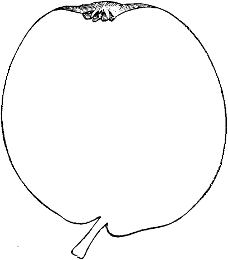
Fruit, below medium size; oval, sometimes roundish-oval. Skin, smooth and shining, greenish-yellow at first, but changing as it ripens to a fine clear pale yellow color, tinged and streaked with red, on the side next the sun; but sometimes when fully exposed, one half of the surface is covered with bright shining crimson, streaked with deeper crimson; it is marked on the shaded side with some traces of delicate russet. Eye, small and closed, with broad, erect, and acuminate segments, set in a shallow basin, which is generally surrounded with five prominent plaits. Stalk, slender, three quarters of an inch long, obliquely inserted in a small cavity, by the side of a fleshy protuberance. Flesh, yellowish-white, firm, crisp, and very juicy, with a rich, sugary, brisk, and aromatic flavor.
An early dessert apple of the highest excellence; It is in use during September and October.
The tree is a free grower, hardy, and a good bearer, attaining about the middle size. It is well adapted for grafting on the paradise stock, and being grown either as a dwarf, or espalier.
This variety was introduced chiefly through the instrumentality of Mr. Robertson, the nurseryman of Kilkenny, in Ireland.
197. KESWICK CODLIN.—Hort.
Identification.—Hort. Soc. Cat. ed. 3, n. 158. Lind. Guide. 31. Down. Fr. Amer. 87. Rog. Fr. Cult. 65.
Figure.—Ron. Pyr. Mal. pl. iii. f. 3.
Fruit, large; conical and angular. Skin, pale yellow, with a blush on the side exposed to the sun. Eye, large, set in a deep and angular basin. Stalk, short, inserted in a deep cavity. Flesh, pale yellow, very juicy, and briskly flavored.
One of the earliest, and most valuable of our culinary apples. It may be used for tarts so early as the end of June; but its greatest perfection is during August and September.
The tree is healthy, vigorous, and an immense bearer, attaining to the middle size. It succeeds well in almost every soil and situation, and when grown on the paradise stock, is well suited for espalier training.
This excellent apple was first discovered, growing among a quantity of rubbish, behind a wall at Gleaston Castle, near Ulverstone, and was first brought into notice by one John Sander, a nurseryman at Keswick, who having propagated it, sent it out under the name of Keswick Codlin.
In the Memoirs of the Caledonian Horticultural Society, Sir John Sinclair says, “the Keswick Codlin tree has never failed to bear a crop since it was planted in the Episcopal garden at Rose Castle, Carlisle, twenty years ago (1813). It is an apple of fine tartness and flavor, and may be used early in autumn. The tree is a very copious bearer, and the fruit is of good size, considerably larger than the Carlisle Codlin. It flourishes best in a strong soil.”
198. KILKENNY PEARMAIN.—Hort.
Identification.—Hort. Soc. Cat. ed. 3, n. 547.
Fruit, below medium size, two inches and a half wide, and the same in height; roundish, inclining to conical. Skin, yellow, sprinkled with russety dots, and sometimes covered with slight reticulations of russet; tinged with orange, and a few streaks of red, on the side exposed to the sun. Eye, small, and rather open, set in a narrow basin. Stalk, short, inserted in a shallow cavity, and surrounded with a large patch of russet. Flesh, yellowish, crisp, tender, juicy, and sweet; but of dry texture, and lacking acidity.
A dessert apple of no great merit; in use from October to Christmas.
199. KING OF THE PIPPINS.—H.
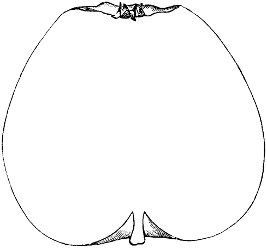
Fruit, medium sized; ovate or conical, regularly and handsomely shaped. Skin, greenish yellow, with a blush of red next the sun, and marked with a little rough brown russet. Eye, large, and partially open, with long and broad segments, which are connivent, but reflexed at the tips, set in a shallow and undulating basin. Stalk, a quarter of an inch long, just extending beyond the base. Flesh, white with a yellowish tinge, firm, crisp, very juicy and sugary, with a rich vinous flavor.
This is one of the richest flavored early dessert apples, and unequalled by any other variety of the same season; it is ripe in the end of August, and beginning of September.
This is the original, and true King of the Pippins, and a very different apple from that generally known by the same name. See Golden Winter Pearmain. I suspect this is the King Apple of Rea.
200. KINGSTON BLACK.—Hort.
Identification.—Hort. Soc. Cat. ed. 3.
Fruit, small, two inches and a quarter wide, and one and three quarters high; roundish. Skin, pale yellow, striped with red on the shaded side; and very dark red, striped with dark purple, or almost black stripes, on the side next the sun; thickly strewed all over with light-grey russety dots, and with a large patch of russet over the base. Eye, open, with broad reflexed segments, and set in a deep basin. Stalk, very short, inserted in a shallow cavity. Flesh, white, stained with red under the skin, on the side next the sun, tender, juicy, sweet, and pleasantly flavored.
This is a beautiful little apple, extensively grown in Somersetshire, where in the present day it is considered the most valuable cider apple. It keeps till Christmas.
201. KIRKE’S LORD NELSON.—Hort.
Identification.—Hort. Soc. Cat. ed. 3, n. 414.
Figure.—Ron. Pyr. Mal. pl. xiv.
Fruit, large, three inches and a quarter wide, and two inches and three quarters high; roundish, and narrowing a little towards the apex. Skin, smooth, pale yellow, streaked all over with red. Eye, open, with short reflexed segments, and set in a plaited basin. Stalk, short and slender. Flesh, yellowish-white, firm, juicy and aromatic, but wants acidity.
An inferior variety, neither a good dessert apple, nor at all suitable for culinary purposes; It is in use from November to February.
202. KNOBBED RUSSET.—H.
Synonymes.—Knobby Russet, Hort. Soc. Cat. ed. 3, n. 741. Hort. Trans. vol. iv. p. 219. Lind. Guide, 90. Winter Apple, Hort. Soc. Cat. ed. 1, 1167. Old Maid’s, acc. Hort. Soc. Cat.
Fruit, medium sized; roundish-oval, and very uneven on its surface; being covered with numerous knobs, or large warts, some of which are the size of peas. Skin, greenish-yellow, and covered with thick scaly russet. Eye, set in a deep basin. Stalk, inserted in a deep cavity. Flesh, yellowish, crisp, sweet, and highly flavored; but not very juicy.
A singular looking dessert apple, of first-rate quality. It is in use from December to March.
This variety was introduced to the notice of the London Horticultural Society in 1819, by Mr. Haslar Capron, of Midhurst, in Sussex.
203. LADY’S DELIGHT.—H.
Fruit, medium sized, three inches wide, and two inches and a quarter high; oblate, and ribbed on the sides. Skin, smooth and shining, greenish-yellow, marked with a number of imbedded dark-green specks; washed with red on the side next the sun, and with a circle of red rays round the base. Eye, partially closed, with broad and flat segments; set in an angular and plaited basin. Stalk, short and slender, inserted in a round and rather deep cavity. Flesh, white, tender, crisp, very juicy, sweet, brisk, and pleasantly aromatic.
An excellent culinary or dessert apple, highly esteemed about Lancaster, where it is much grown; it is in use from October to Christmas.
The habit of the tree is drooping, like that of the Weeping Willow.
204. LADY’S FINGER.—Fors.
Identification.—Fors. Treat. 111.
Fruit, below medium size, two inches and a quarter wide, and two inches and three quarters high; pyramidal, rounded at the base, distinctly five sided, flattened at the apex, where it is terminated in five prominent knobs, with a smaller one between each. Skin, smooth, dull greenish-yellow, strewed with minute, grey russety dots; tinged on the side next the sun with a dull blush, which is interspersed with spots of deep lively red. Eye, small and partially closed, set in a small and regularly notched basin. Stalk, slender, short, and obliquely inserted under a fleshy protuberance. Flesh, yellow, tender, juicy, and pleasantly acid.
A culinary apple much grown about Lancaster; it is in use from November, to March or April.
This is a very different apple from the White Paradise, which is sometimes called “The Lady’s Finger.”
205. LAMB ABBEY PEARMAIN.—Hort.
Identification.—Hort. Trans. vol. v. p. 269. Hort. Soc. Cat. ed. 2, 549. Lind. Guide, 74. Diel Kernobst. vi. B. 84.
Synonyme.—Laneb Abbey Pearmain, McInt. Orch. 24.
Figures.—Hort. Trans. vol. v. t. 10, f. 2. Ron. Pyr. Mal. pl. xxi. f. 2.
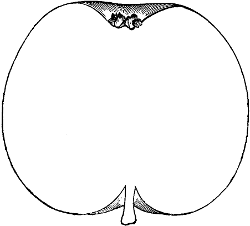
Fruit, small; roundish or oblato-oblong, regularly and handsomely shaped. Skin, smooth greenish-yellow on the shaded side, but becoming clear yellow when at maturity; on the side next the sun it is dull orange, streaked and striped with red, which becomes more faint as it extends to the shaded side, and dotted all over with minute, punctured, russety dots. Eye, rather large, and open, with long, broad segments, reflexed at the tips, and set in a wide, deep and plaited basin. Stalk, from a quarter to half-an-inch long, slender, deeply inserted in a russety cavity. Flesh, yellowish-white, firm, crisp, very juicy and sugary, with a brisk, and rich vinous flavor.
A dessert apple of first-rate quality, and very valuable, both as regards the richness of its flavor, and the long period to which it remains in perfection; it is in use from January, and keeps till April without shrivelling.
The tree is healthy, a free grower, and good bearer.
This variety was raised in the year 1804, by the wife of Neil Malcolm Esq. of Lamb Abbey, near Dartford in Kent, from the pip of an imported fruit of the Newtown Pippin.
206. LARGE YELLOW BOUGH.—Down.
Identification.—Down. Fr. Amer. 74.
Synonymes.—Large Early Yellow Bough, Hort. Soc. Cat. ed. 3. Sweet Bough, acc. Kenrick. Early Bough, Ken. Amer. Or. 26. Bough, Coxe, View, 101. Sweet Harvest, acc. Down.
Fruit, above medium size; oblong oval, handsomely and regularly formed. Skin, smooth, pale greenish-yellow. Eye, set in a narrow and deep basin. Stalk, rather long. Flesh, white, very tender, crisp, and very juicy, with a rich, sweet, sprightly flavor.
A dessert apple of first-rate quality. Ripe in the beginning of August. The tree is a vigorous and luxuriant grower, and a good bearer.
207. LEMON PIPPIN.—Fors.
Identification.—Fors. Treat. 112. Hort. Soc. Cat. ed. 3, n. 406. Lind. Guide, 75. Down. Fr. Amer. 115. Rog. Fr. Cult, 81.
Synonymes.—Kirke’s Lemon Pippin, Hort. Soc. Cat. ed. 1, 551. Quince, Rog. Fr. Cult. 66. Englischer Winterquittenapfel, Diel Kernobst. ii. B. 21.
Figures.—Pom. Mag. t. 37. Ron. Pyr. Mal. pl. ix. f. 4.
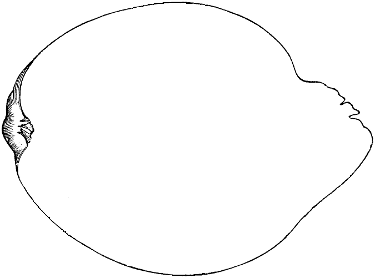
Fruit, medium sized; oval, with a large fleshy elongation covering the stalk, which gives it the form of a lemon. Skin, pale yellow tinged with green, changing to a lemon yellow as it attains maturity, strewed with russety freckles, and patches of thin delicate russet. Eye, small, and partially open, with short segments, and set in an irregular basin, which is frequently higher on one side than the other. Stalk, short, entirely covered with a fleshy elongation of the fruit. Flesh, firm, crisp, and briskly flavored.
A very good apple, either for culinary or dessert use; it is in season from October to April, and is perhaps the most characteristic apple we have, being sometimes so much like a lemon, as at first sight to be taken for that fruit. Forsyth says it is excellent for drying.
The tree does not attain a large size; but is healthy, hardy, and a good bearer.
It is uncertain at what period the Lemon Pippin was first brought into notice. Rogers calls it the “Quince Apple,” and, if it is what has always been known under that name, it must be of considerable antiquity, being mentioned by Rea, Worlidge, Ray, and almost all the early writers; but the first instance wherein we find it called Lemon Pippin, is in Ellis’s “Modern Husbandman” 1744, where he says it is “esteemed so good an apple for all uses, that many plant this tree preferable to all others.”
208. LEWIS’S INCOMPARABLE.—Hort.
Identification.—Hort. Soc. Cat. ed. 3, n. 356. Ron. Pyr. Mal. 59.
Figure.—Ron. Pyr. Mal. pl. xxx. f 2.
Fruit, large, three inches wide and two inches and three quarters high; conical, broad at the base and narrow at the apex, which is generally higher on one side than the other. Skin, deep lively red, streaked with crimson on the side next the sun; but yellow, faintly streaked with light red on the shaded side, and strewed with numerous minute russety dots. Eye, small and open, with broad, and slightly connivent segments, set in a rather narrow, and somewhat angular basin. Stalk, very short, inserted in a wide, and deep cavity, which is lined with thin grey russet. Flesh, yellowish, firm, crisp, and juicy, with a brisk and slightly perfumed flavor.
A useful apple either for culinary purposes or the dessert but only of second-rate quality; it is in use from December to February.
The tree attains the largest size, is strong, vigorous, and an abundant bearer.
209. LINCOLNSHIRE HOLLAND PIPPIN.—Hort.
Identification.—Hort. Soc. Cat. ed. 3, 409.
Synonyme.—Striped Holland Pippin. Hort. Soc. Cat. ed. 1. 1075. Lind. Guide, 23.
Figures.—Brook. Pom. Brit. pl. xc. f. 1. Ron. Pyr. Mal. pl. xiv. f. 4.
Fruit, above medium size, three inches and a half wide, and three inches and a quarter high; roundish, inclining to ovate, and somewhat angular on the sides. Skin, yellow on the shaded side; but orange, streaked with crimson, on the side next the sun, and studded all over with numerous imbedded green specks. Eye, small, set in a rather deep basin. Stalk short, inserted in a rather shallow cavity. Flesh, white and pleasantly sub-acid.
A very pretty, but very useless apple, fit only for kitchen use, and then only of second-rate quality; it is in season from November to February.
210. LOAN’S PEARMAIN.—Ray.
Identification.—Raii. Hist. ii. 1448. Lang. Pom. 134. t. lxxvi. f. 2. Switz. Fr. Gard. 138. Mill. Dict. Hort. Soc. Cat. ed. 3, n. 550.
Figure.—Ron. Pyr. Mal. pl. xxii. f. 3.
Fruit, medium sized, two inches and a half wide, and two inches and a quarter high; abrupt pearmain-shaped. Skin, greenish-yellow, with a few faint streaks of red, and strewed with numerous large russety dots on the shaded side; but deep orange mottled and streaked with crimson, and covered with patches of thin grey russet, on the side next the sun. Eye, open, with reflexed segments, set in a wide, even, and plaited basin. Stalk, half-an-inch long, inserted in a rather shallow cavity, with a fleshy protuberance on one side of it. Flesh, greenish-white, tender, crisp, and very juicy, with a sugary and pleasant flavor.
An excellent old dessert apple; in use from November to February.
This is a very old variety. It is first mentioned by Ray, but is not enumerated in Meager’s list.
211. LONDON PIPPIN.—Lind.
Identification.—Lind. in Hort. Trans. vol. iv. p. 67. Fors. Treat. ed. 7, 112. Hort. Soc. Cat. ed. 3, n. 410. Rog. Fr. Cult. 93.
Synonymes.—Five-Crowned Pippin, Fors. Treat. ed. 3. 99. Royal Somerset, Hort. Soc. Cat. ed. 1. 971. New London Pippin, Ibid. 562.
Figure.—Ron. Pyr. Mal. pl. xiv. f. 2.
Fruit, medium sized, two inches and three quarters broad, and two inches and a quarter high; roundish, and flattened, with a few ribs on the sides which increase in size towards the crown where they terminate in five prominent and equal ridges, from which circumstance it has been called the Five-Crowned Pippin. Skin, at first pale yellowish-green, changing to pale yellow or lemon color, with brownish-red on the side next the sun. Eye, small and closed, set in a rather shallow basin. Stalk, half an inch long, slender, and deeply inserted. Flesh, yellowish-white, firm, crisp, tender, and juicy, with a brisk and pleasant flavor.
An excellent culinary apple, and serviceable also for the dessert; it is in use from November to April, when it is perfectly sound and shows no symptoms of shrivelling.
The tree attains about the middle size, is not a strong grower, but quite hardy, and an excellent bearer.
Although there is no record of this variety in the writings of any pomological author before Mr. Lindley, it is nevertheless a very old English apple. In an ancient note-book of an ancestor of Sir John Trevelyan, Bart., of Nettlecombe, in Somersetshire, so early as 1580, the “Lounden Peppen” is mentioned among the “names of Apelles which I had their graffes from Brentmarch, from one Mr. Pace.” From this we may learn, that we are not to take for granted the non-existence of any variety, simply because there is no notice of it, previous to the period when it may have been first recorded, in works on pomology.
212. LONG NOSE.—H.
Fruit, rather below medium size, two inches and a half high, and about the same in width at the base; conical, with prominent angles on the sides. Skin, smooth and shining, grass green, changing to greenish yellow, with a cloud of bright red on the side exposed to the sun. Eye, closed, set in a shallow basin. Stalk, a quarter of an inch long, fleshy at the insertion, sometimes with a fleshy protuberance on one side of it, and inserted in a narrow, shallow, and russety cavity. Flesh, yellowish-white, crisp, and tender, with a slightly sweet but rather indifferent flavor.
An apple of little merit, being of no value either for culinary purposes or the dessert; it is in season from October to December, and is met with in the Berkshire Orchards.
213. LONGSTART. H.
Synonyme.—Westmoreland Longstart.
Fruit, medium sized; roundish, narrowing towards the eye, somewhat like the old Nonpareil in shape. Skin, almost entirely covered with red, which is streaked with deeper red; except on the shaded side where there is a patch of greenish-yellow, tinged with thin red. Eye, partially open, with broad, flat segments, and set in a shallow and plaited basin. Stalk, about an inch long, inserted in a wide cavity, which is lined with russet. Flesh, white, crisp, tender, juicy, with a pleasant sub-acid flavor.
A very excellent culinary apple; comes into use during October, and lasts till Christmas.
This variety is much grown about Lancaster, and some parts of Westmoreland, where it is a great favorite among the cottagers.
214. LONGVILLE’S KERNEL.—Hort.
Identification.—Hort. Soc. Cat. ed. 3, n. 411. Lind. Guide, 32. Down. Fr. Amer. 90.
Synonyme.—Sam’s Crab, Hort. Soc. Cat. ed. 1, 1021.
Figure.—Pom Mag. t. 63.
Fruit, below medium size, two inches and a half wide, and two inches and a quarter high; ovate, slightly angular, but handsomely shaped. Skin, greenish-yellow, tinged with red, and streaked with dark red on the side next the sun. Eye, small and open, with short erect segments, set in a deep and plaited basin. Stalk, short, and deeply inserted. Flesh, yellow, firm, sweet, slightly acid, and with a perfumed flavor.
A dessert apple, of good, but only second-rate quality; in use during August and September.
According to Mr. Lindley “It is said that this apple was originated in Herefordshire, where it is at present but little known: it is very handsome, and of considerable merit.”
215. LUCOMBE’S PINE-APPLE.—Hort.
Identification.—Hort. Soc. Cat. ed. 3, n. 585.
Synonymes—Pine Apple, Hort. Soc. Cat. ed. 1. 789. Pine Apple Pippin, Ibid. 790.
Figure.—Maund. Fruit, 49.
Fruit, rather below medium size; ovate or conical, slightly and obscurely ribbed about the eye. Skin, of an uniform, clear, pale, yellow, but with an orange tinge on the side next the sun, the whole surface thinly strewed with pale-brown russety dots. Eye, small and closed, with somewhat ovate segments, set in a narrow, shallow, and plaited basin. Stalk, stout, about a quarter of an inch long, inserted in a narrow, and shallow cavity. Flesh, yellowish-white, tender and delicate, juicy and sugary, with a rich aromatic flavor, resembling that of a pine apple.
A dessert apple of first-rate quality; it is in use from the beginning of October to Christmas.
This desirable apple was raised in the nursery of Messrs. Lucombe, Pince, & Co., of Exeter, and is well worthy of general cultivation.
216. LUCOMBE’S SEEDLING.—Hort.
Identification.—Hort. Soc. Cat. ed. 3, n. 416. Lind. Guide, 52. Rog. Fr. Cult. 49.
Figures.—Pom. Mag. t. 109. Ron. Pyr. Mal. pl. xiv. f. 3.
Fruit, large, three inches and a half wide, and two inches and three quarters high; roundish, and angular. Skin, pale greenish-yellow, strewed with dark dots, and imbedded green specks on the shaded side; but bright red, which is streaked with crimson, on the side next the sun. Eye, small and open, set in an angular and plaited basin. Stalk, short and thick, inserted in a rather deep cavity. Flesh, white, firm, juicy, and pleasantly flavored.
A culinary apple of first-rate quality; in use from October to February.
The tree is a strong and vigorous grower, attains a large size, and is an excellent and early bearer.
This variety as well as the preceeding was raised in the Exeter nursery.
217. MADELEINE.—Calvel.
Identification.—Calvel. Traité. iii. 24.
Synonymes.—Margaret, Mill. Dict. Summer Pippin, acc. Hort. Soc. Cat. ed. 3.
Fruit, rather below medium size; roundish. Skin, yellowish-white, with numerous imbedded pearly specks, with an orange tinge next the sun, and sometimes marked with faint streaks of red. Eye, small and closed, set in a narrow basin, and surrounded with several unequal plaits. Stalk, short and slender, not extending beyond the base, and inserted in a funnel-shaped cavity. Flesh, white, very crisp and tender, juicy, sugary, and highly flavored.
An early dessert apple, of good, but only second-rate quality; ripe in the middle and end of August.
The tree is a free grower, and is readily distinguished by the excessive pubescence of its leaves and shoots.
Mr. Lindley in the “Guide to the Orchard” considers this variety as identical with the Margaret of Ray, which is a mistake. It is no doubt the Margaret of Miller, but certainly not of any English author either preceeding, or subsequent to him. It is to be observed that the lists of fruits given by Miller in his Dictionary are chiefly taken from the works of the French pomologists, while the fruits of his own country are almost wholly neglected; and the only reason I can assign for him describing this variety for the Margaret is, because our own Margaret being by some authors called the Magdalene, he might have thought the two synonymous.—See Margaret.
218. MAIDEN’S BLUSH.—Coxe.
Identification.—Coxe, View, 106. Hort. Soc. Cat. ed. 3, n. 420. Fors. Treat. 213. Down. Fr. Amer. 90.
Fruit, large, three inches and a quarter wide, and two inches and a half high; roundish and flattened. Skin, of a fine, rich, pale-yellow color, tinged with a blush of beautiful red on the side exposed to the sun. Eye, pretty large and closed, set in a round, even, and rather deep basin, Stalk, short, inserted in a deep, and round cavity. Flesh, white, tender, brisk, and pleasantly acid.
A very beautiful culinary apple, but not of first-rate quality. It is in use during September and October.
The tree is a vigorous grower, and an abundant bearer.
This variety is of American origin. It is highly esteemed in the neighbourhood of Philadelphia, and considered one of the best culinary apples in America; it is also much used for drying, for which purpose it is considered the best. It is not however held in great repute in this country, its size and color being its chief recommendation.
219. MANKS CODLIN.—Hort.
Identification.—Hort. Soc. Cat. 161. Lind. Guide, 32. Rog. Fr. Cult. 66.
Synonymes.—Irish Pitcher, acc. Hort. Soc. Cat. ed. 3. Irish Codlin, Hort. Soc. Cat. ed. 1, 178. Eve, in Scotland. Frith Pippin, acc. Lind. Guide.
Figure.—Ron. Pyr. Mal. pl. iii. f. 1.
Fruit, large; conical, and slightly angular. Skin, smooth, greenish-yellow at first, but changing as it ripens to clear pale-yellow, tinged with rich orange-red on the side next the sun; but sometimes, when fully exposed, assuming a clear bright-red cheek. Eye, small and closed, set in a small, plaited, and pretty deep basin. Stalk, three quarters of an inch long, more or less fleshy, sometimes straight, but generally obliquely inserted, and occasionally united to the fruit by a fleshy protuberance on one side of it. Flesh, yellowish-white, firm, brisk, juicy and slightly perfumed.
A very valuable early culinary apple, of first-rate quality. It is ripe in the beginning of August, and continues in use till November.
The tree is very hardy, and healthy, but not a large grower. It is a very early and abundant bearer, young trees in the nursery quarters generally producing a considerable quantity of fruit, when only two years old from the grafts. It is well suited for planting in exposed situations, and succeeds well in shallow soils. It forms a beautiful little tree when grafted on the paradise stock, and is well adapted for espalier training.
220. MANNINGTON’S PEARMAIN.—H.
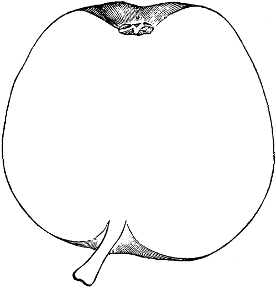
Fruit, medium sized; abrupt pearmain-shaped. Skin, of a rich golden-yellow color, covered with thin brown russet, on the shaded side; but covered with dull brownish-red, on the side next the sun. Eye, partially closed, with broad flat segments, set in a shallow and plaited basin. Stalk, three quarters of an inch long, obliquely inserted in a moderately deep cavity, with generally a fleshy protuberance on one side of it. Flesh, yellow, firm, crisp, juicy, and very sugary; with a brisk and particularly rich flavor.
This is one of the best and richest flavored of our dessert apples. It is only of recent introduction; but will no doubt, ere long, prove one of the most popular, as it is one of the most valuable varieties in its class; not only on account of its excellence, but for the long period during which it is in perfection; it comes into use in October and November, and continues in good condition till March.
A communication of some importance has been forwarded to me by Mr. Cameron of Uckfield, by whom this variety was first propagated. He says the fruit should be allowed to hang late on the tree before it is gathered, so as to secure its peculiar richness of flavor, and long period of duration; for if gathered too soon, it looses much of its fine richness and is very apt to shrivel.
The tree does not attain a large size, but is perfectly hardy, and an early and excellent bearer; young trees, only two or three years from the graft, producing a considerable crop of handsome, well-grown fruit.
This esteemed variety originated about the year 1770, in a garden now in the possession of Mr. Mannington, a respectable butcher at Uckfield in Sussex. At the time it was raised the garden belonged to Mr. Turley, a blacksmith, and grandfather of Mr. Mannington. The original tree grew up at the root of a hedge, where the refuse from a cider press had been thrown; it never attained any great size, but continued to preserve a stunted, and diminutive habit of growth, till it died about the year 1820. Previous to this, however, grafts had been freely distributed to persons in the neighbourhood, many of whom were anxious to possess such a desideratum; but it does not seem to have been known beyond its own locality, till the autumn of 1847, when Mr. Mannington caused specimens of the fruit to be forwarded to the London Horticultural Society, and by whom it was pronounced to be a dessert fruit of the highest excellence. It was designated by Mr. Thompson “Mannington’s Pearmain.”
221. MARGARET.—Rea.
Identification.—Rea. Pom. 209. Raii. Hist. ii. 1447. Lang. Pom. 134, t. lxxiv. fig. 1. Rog. Fr. Cult. 30. Fors. Treat. 114.
Synonymes.—Early Red Margaret, Hort. Soc. Cat. ed. 3, n. 425. Lind. Guide, 8. Down. Fr. Amer. 73. Early Red Juneating, Hort. Soc. Cat. ed. 1, 504. Red Juneating, acc. Hort. Soc. Cat. Striped Juneating, Ibid. ed. 1, 506. Early Striped Juneating, Ibid. Striped Quarrenden, Ibid, ed. 1, 823. Summer Traveller, Ibid, 1083. Eve Apple, In Ireland, acc. Robertson in Hort. Trans. iii. 452. Early Margaret, acc. Hort. Soc. Cat. Marget-Apple, Meager. Eng. Gard. Maudlin, Switz. Fr. Gard. 135. Magdalene, Gibs. Fr. Gard. 352. Marguerite, acc. Hort. Soc. Cat. Lammas, acc. Fors. Treat.
Figures.—Pom. Mag. t. 46. Ron. Pyr. Mal. pl. vi. f. 1.
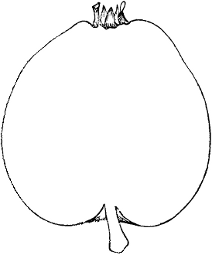
Fruit, medium sized; roundish-ovate, and narrowing towards the eye, where it is angular. Skin, greenish-yellow on the shaded side; but bright-red next the sun, striped all over with darker red, and strewed with grey russety dots. Eye, half open, and prominent; with long, broad, erect segments, surrounded with a number of puckered knobs. Stalk, short and thick, about half-an-inch long, inserted in a small, and shallow cavity. Flesh, greenish-white, brisk, juicy, and vinous, with a pleasant and very refreshing flavor.
A first-rate early dessert apple; it is ripe in the beginning of August, but does not keep long, being very liable to become meally. To have it in perfection, it is well to gather it a few days before it ripens on the tree, and thereby secure its juicy, and vinous flavor.
The tree does not attain a large size, being rather a small grower. It is a good bearer, more so than the Joanneting, and is quite hardy, except in light soils, when it is liable to canker. It is well adapted for growing as dwarfs, either for potting or being trained as an espalier, when grafted on the paradise, or pomme paradis stock.
This is a very old English apple. It is without doubt the Margaret of Rea, Worldige, Ray, and all our early pomologists except Miller; Mr. Lindley, however, is of a different opinion, for he believes the Margaret of Miller to be identical with that of Ray. That this variety is the Margaret of Rea, his description is sufficient evidence. “The Margaret or Magdelen Apple is a fair and beautiful fruit, yellow, and thick striped with red, early ripe, of a delicate taste, sweet flavor, and best eaten off the tree.” Ray gives no description of it, but it is only reasonable to suppose, that it is this variety he refers to, seeing it is the Margaret of all authors both immediately preceeding, and subsequent to him. And indeed in no instance is that of Miller noticed by any English author, but himself, anterior to Mr. Lindley.
222. MARGIL.—Hook.
Identification.—Hook. Pom. Lond. Hort. Soc. Cat. ed. 3, n. 428. Lind. Guide, 53. Down. Fr. Amer. 117. Thomp. in Gard. Chron. 1847, p. 116.
Synonymes.—Margill. Fors. Treat. 114. Rog. Fr. Cult. 48. Never Fail, Hort. Soc. Cat. ed. 1, 629. Munches Pippin, Ibid. 623. Small Ribston, M.C.H.S.
Figures.—Hook. Pom. Lond. t. 33. Pom. Mag. t. 36. Ron. Pyr. Mal. pl. xii. f. 4.
Fruit, small, two inches and an eighth wide, and the same in height; conical, distinctly five sided, with acute angles on the side, which terminate at the crown in five prominent ridges. Skin, orange, streaked with deep red, and covered on one side with patches of russet. Eye, small and closed, compressed as it were between the angles of the basin. Stalk, half-an-inch long, slender, and rather deeply inserted in a round, and russety cavity. Flesh, yellow, firm, juicy, rich, and sugary, with a powerful, and delicious aromatic flavor.
One of the finest dessert apples, a rival of the Ribston Pippin, excelling it in juiciness, and being of a better size for the dessert; it is in use from November to February.
The tree is quite hardy, and generally an abundant bearer, except in seasons when the bloom is injured by frosts, to which it is liable. It is of a small, and slender habit of growth, and is well adapted for growing as dwarfs, or espaliers, when grafted on the paradise stock.
There seems to be no record of this variety before the publication of the Pomona Londonensis, although it was known for many years previously. Rogers says, he saw a tree of it growing as an espalier in the garden at Sheen, which was planted by Sir William Temple. I find it was cultivated to a considerable extent in the Brompton Park nursery, so early as 1750; it must therefore have been well known at that period; but I cannot discover any trace of its origin. It may have been introduced from the continent by George London who was for some years in the gardens at Versailles under De Quintinye, and afterwards in partnership with Henry Wise as proprietor of the Brompton Park nursery, as the name seems to indicate more of French than English origin.
223. MARMALADE PIPPIN.—Hort.
Identification.—Hort. Soc. Cat. ed. 3, n. 429. Diel Kernobst. i. B. 23.
Synonymes.—Althorp Pippin, Hort. Soc. Cat. ed. 1, 8. Welsh Pippin, acc. Ron. Pyr. Mal.
Figure.—Ron. Pyr. Mal. pl. xxviii. f. 3.
Fruit, medium sized, two inches and a half wide, and two inches and three quarters high; oblong, with a prominent rib on one side, and flattened at the apex, where it terminates in several prominences. Skin, very thick, hard, and membranous; deep yellow, with a brownish tinge next the sun, and strewed with numerous imbedded pearly specks. Eye, small and open, with long acuminate and reflexed segments, set in a deep, and angular basin. Stalk, half-an-inch long, inserted in a deep, and smooth cavity. Flesh, yellowish-white, firm and tender, sweet, juicy, and pleasantly flavored.
A culinary apple, but only of second-rate quality; it is in use from October to January.
The tree is hardy and an abundant bearer.
This variety was introduced in 1818—the year in which the original tree first produced fruit—by a Mr. Stevens of Stanton Grange, in Derbyshire, by whom it was raised from a seed of the Keswick Codling. The Marmalade Pippin of Diel which is described in the 22 vol. and which he says is an English apple, is not the same as the above, for he describes it as “a true streaked apple, and ripe in August”.
224. MARTIN NONPAREIL.—Hort.
Identification.—Hort. Trans. vol. iii. p. 456. Hort. Soc. Cat. ed. 3, n. 475. Lind. Guide, 91. Rog. Fr. Cult. 68.
Figure.—Pom. Mag. t. 79.
Fruit, below medium size; ovate, and angular on the sides. Skin, pale yellow, sprinkled with yellowish-brown russet. Eye, large and open, set in an angular basin. Stalk, short and thick. Flesh, yellow, firm, rich, juicy and sugary.
An excellent dessert apple, but equal to the old Nonpareil; consequently can only be regarded as a second-rate variety; it is in use from December to March.
The tree is a vigorous grower, hardy and a good bearer.
This apple was received from a nursery, as a crab stock, by the Rev. George Williams of Martin-Hussingtree, near Worcester, and after producing fruit, was communicated by him to the London Horticultural Society.
225. MELA CARLA.—Gallesio.
Identification.—Gallesio Pom, Ital. vol. i. p. 1.
Synonymes.—Male Carle, Hort. Soc. Cat. ed. 3, n. 424. Down. Fr. Amer. 116. Malcarle, Lind. Guide, 52. Pomme Malecarle, Cal. Traité. iii. 63. Mela di Carlo, acc. Hort. Soc. Cat. Pomme de Charles, Ibid. Pomme Carl, Ibid. Pomme Finale, Ibid. Charles Apple, acc. Hort. Trans. vol. vii. p. 259. Der Malacarle, Diel Kernobst. xxi. 35.
Figures.—Galles. Pom. Ital. vol. i. t. 1. Hort. Trans. vol. vii. t. 7.
Fruit, medium sized, two inches and three quarters wide, and the same in height; roundish, inclining to ovate, narrowing a little towards the eye, but generally of an ovate shape. Skin, thin and tender, pale green at first, changing as it ripens to fine delicate waxen-yellow, on the shaded side; but covered with fine dark crimson, on the side next the sun. Eye, small and closed, with long acuminate segments, and set in a pretty wide, and deep basin, which is sometimes a little ribbed. Stalk, three quarters of an inch long, inserted in a small, and smooth cavity. Flesh, white with a greenish tinge, very delicate, juicy, and tender, with a sweet and vinous flavor, and a perfume like that of roses.
A dessert apple, which, when in perfection, is of the most exquisite flavor, but being indigenous to a warmer climate, it does not attain its full maturity in this country. By the aid of a south wall, in a warm and sheltered situation, it may however be brought to some degree of perfection. At Elvaston Castle, Mr. Barron has successfully cultivated it upon earthen mounds, with an inclination to the sun, of 45°. When in perfection, its flesh is said to be as melting as that of the Beurré, and Doyenné pears; it is in use from December to March.
The tree is a strong, and vigorous grower, and an abundant bearer.
This apple is of Italian origin, and is extensively cultivated about Turin. Its name is by some supposed to have been given in honor of Charlemagne, who is said to have held this fruit in high estimation.
226. MELROSE.—H.
Synonyme.—White Melrose, Hort. Soc. Cat. ed. 3, p. 25.
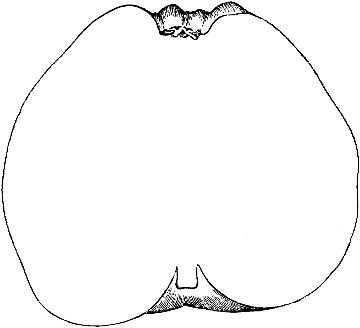
Fruit, large; roundish-ovate, inclining to conical, and broad at the base; it has an irregularity in its outline, caused by prominent ribs, which extend from about the middle, to the basin of the eye, where they form large and unequal ridges; and also by several flattened parts on the sides, giving it the appearance as if indented by a blow. Skin, smooth and shining, pale yellow tinged with green, on the shaded side; but yellow tinged with orange, and marked with crimson spots and dots, on the side exposed to the sun. Eye, large and closed, with broad flat segments, and deeply set in a plaited, and prominently ribbed basin. Stalk, very short, not more than a quarter of an inch long, inserted in a deep, irregular cavity, in which are a few streaks and patches of rough russet. Flesh, yellowish-white, firm, but tender and marrow-like, with a sweet, and pleasantly sub-acid flavor.
A very valuable and fine looking apple, of first-rate quality, suitable either for culinary purposes or the dessert; it is in use from October to January.
The tree is a strong, healthy, and vigorous grower, and forms a large round head. It is also an abundant and free bearer.
This is an old Scotch apple, the cultivation of which is confined exclusively to the Border counties, where it was probably first introduced by the monks of Melrose Abbey. Though it is one of the most popular apples of the Tweedside orchards, it does not seem to have been ever known beyond its own district. It is without doubt the largest, and one of the most useful apples of which Scotland can boast, and requires only to be more generally known, to be cultivated throughout the length and breadth of that country. Even in the south it is not to be disregarded, as both in size, and quality, it is one of the most attractive market apples. I have known them sold at two shillings a dozen. The figure given above is only from a medium-sized specimen of the fruit.
227. MERE DE MENAGE.—Hort.
Identification.—Hort. Soc. Cat. ed. 3, n. 436.
Fruit, very large; conical. Skin, red, streaked with darker red all over, except a little on the shaded side where it is yellow. Eye, set in an angular basin. Stalk, very stout, inserted in a deep cavity, so much so as to be scarcely visible. Flesh, firm, crisp, brisk and juicy.
A valuable and very beautiful culinary apple of first-rate quality; in use from October to January.
228. MINCHALL CRAB.—Fors.
Identification.—Fors. Treat. 115. Hort. Soc. Cat. ed. 3, n. 440. Lind. Guide, 54. Rog. Fr. Cult. 58.
Synonymes.—Minshul Crab, Hort. Soc. Cat. ed. 1. 609. Mincham’s Crab, Brook. Pom. Brit. Lancashire Crab, Ibid. 536. Lancaster Crab, Ibid. 539.