THE APPLE.—ITS VARIETIES. (continued 4)
Reading edition
Figures.—Brook. Pom. Brit. pl. xciii. f. 2. Ron. Pyr. Mal. pl. xxxiii. f. 4.
Fruit, above medium size, three inches wide, and two inches and a half high; roundish, and considerably flattened, almost oblate. Skin, yellow, covered with dark dots, and a few veins of russet; russety over the base, and marked with a few broken stripes and mottles of pale crimson on the side next the sun. Eye, large and open, with short, and ragged segments, set in a wide, shallow, and plaited basin. Stalk, half-an-inch long, inserted in a rather shallow cavity. Flesh, white, firm, crisp, and juicy, with a rough, and sharp acid flavor.
A culinary apple, but only of second-rate quality; it is in use from November to March.
The tree is very hardy, and is not subject to canker, or the attacks of insects. It is an abundant bearer.
This apple is extensively grown in the southern parts of Lancashire, and is a great favorite in the Manchester market, and all the other manufacturing towns of that district. It receives its name from the village of Minchall in Cheshire, where, according to Rogers, the original tree existed in 1777.
229. MINIER’S DUMPLING.—Hort.
Identification.—Hort. Trans. vol. i. 70. Fors. Treat. 114. Lind. Guide, 54.
Fruit, large, from three to three inches and a half wide, and nearly the same in height; roundish, somewhat flattened and angular on the sides. Skin, dark green, striped with darker green on the shaded side; but covered with dark red where exposed to the sun. Stalk, an inch long, rather thick, inserted in a rather deep cavity. Flesh, firm, juicy, sub-acid and pleasantly flavored.
An excellent culinary apple, of first-rate quality; in use from November to May.
The tree is a strong grower, hardy, and an excellent bearer.
230. MITCHELSON’S SEEDLING.—H.
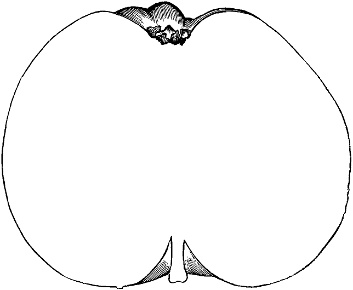
Fruit, above the medium size; somewhat ovate. Skin, of a fine deep yellow, thinly strewed with minute brown dots, interspersed with slight patches of very delicate russet; but faintly mottled with clear red, on the side exposed to the sun. Eye, large and open, with short stunted segments, and set in a rather deep, and plaited basin. Stalk, very short, inserted in a round, and even cavity, which is tinged with green, and lined with fine delicate grey russet. Flesh, yellowish, firm, crisp, brisk, very juicy and vinous, abounding in a rich and agreeable perfume.
A very excellent apple, suitable either for culinary purposes, or the dessert; it is in use from December to February.
This beautiful apple, was raised by Mr. Mitchelson, a market gardener at Kingston-on-Thames.
231. MONKLAND PIPPIN.—Hort.
Identification.—Hort. Soc. Cat. ed. 3, n. 442.
Fruit, small, two inches wide, and the same in height; oval, even, and regularly formed, with five obscure ribs round the eye. Skin, green, becoming yellow as it attains maturity, marked with imbedded green specks, and numerous very minute dots. Eye, half open, set in a round, and plaited basin. Stalk, three quarters of an inch long, slender, and inserted in a round, narrow cavity, which is lined with rough russet. Flesh, greenish-white, soft and juicy, but with little or no flavor.
An apple of which it is difficult to say to what use it is applicable, having nothing whatever to recommend it; it is ripe in November.
232. MONKTON.—H.
Fruit, below medium size, two inches and three quarters wide, and two inches high; oblate, slightly ribbed on the sides, and ridged round the eye. Skin, entirely covered with beautiful red, which is marked with spots, and broken stripes of deep crimson; the color on the shaded side is paler than on the side exposed to the sun; it is strewed all over with russety dots, and round the stalk, and in the basin of the eye it is of a clear waxen-yellow. Eye, small and open, with broad, erect segments, set in a moderately deep basin. Stalk, short and thick, inserted in a rather shallow cavity, which is lined with thick grey russet. Flesh, yellowish, tender, juicy, and brisk.
A beautiful cider apple, raised at Monkton, near Taunton, in Somersetshire.
233. MOORE’S SEEDLING.—H.
Fruit, large, three inches and a quarter wide, and three inches high; conical and angular, flattened at the base. Skin, greenish-yellow on the shaded side; and marked with broken streaks of red where exposed to the sun, interspersed with numerous large dark spots. Eye, small and open, set in a plaited basin. Stalk, very short, imbedded in a small, narrow cavity, and surrounded with a patch of russet. Flesh, yellow, tender, rather sweet and pleasantly flavored.
A good culinary apple; ripe in October, and keeps till December.
234. MORRIS’S COURT OF WICK.—H.
Fruit, small, two inches and a quarter broad, and an inch and three quarters high; roundish-oblate, regularly and handsomely shaped, very closely resembling its parent, the old Court of Wick. Skin, pale green on the shaded side; but washed with light red next the sun, which is covered with darker red spots, and marked with thin grey russet, round the eye. Eye, open, with reflexed segments, equally as characteristic as that of the old Court of Wick, and placed in a wide, shallow basin. Stalk, half-an-inch long, inserted in a round cavity. Flesh, firm but tender, with a profusion of rich, vinous, and highly flavored juice.
A delicious dessert apple, excelling even the old Court of Wick; it is in use from October to February.
This variety was raised some years ago, by Mr. Morris, a market gardener at Brentford, near London.
235. MORRIS’S NONPAREIL RUSSET.—Hort.
Identification.—Hort. Soc. Cat. ed. 3, n. 743?
Synonyme and Figure.—Nonpareil Russet, Ron. Pyr. Mal. 25, pl. xiii. f. 3.
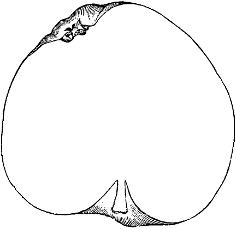
Fruit, small; conical and irregularly formed, being generally larger on one side than the other, and having the eye placed laterally. Skin, green, covered with large patches of thin grey russet, strewed with silvery scales, and marked with green dots. Eye, small and open, with segments reflexed at the tips, and set in a plaited basin. Stalk, short, and deeply inserted in an oblique cavity. Flesh, greenish, firm, crisp, juicy, sugary, briskly flavored, and charged with a pleasant aroma.
An excellent dessert apple, of the first quality; in use from October to March, and will keep even as long as May and June.
Can this be the same as the Morris’s Nonpareil Russet, of the London Horticultural Society’s catalogue, which is said to be oblate? I know that the variety described above is the true one, the friend from whom I received it having procured it from Mr. Morris himself.
This variety was raised by Mr. Morris of Brentford.
236. MORRIS’S RUSSET.—H.
Fruit below medium size, two inches and a half wide, and two inches and a quarter high; round, regularly and handsomely shaped. Skin, covered with a coat of smooth, thin, brown russet, with occasionally a bright, fiery-crimson flame breaking out on the side next the sun, sometimes so large as to form a fine, smooth, and varnished crimson cheek. Eye, large and open, set in a small and shallow basin. Stalk, very short, inserted in a rather small cavity. Flesh, firm, but tender, juicy, brisk and sugary, charged with a very rich, and powerful aromatic flavor.
This is a dessert apple, of the highest excellence, and ought certainly to form one in every collection, however small; it is in season from October to February.
This, like the two preceeding varieties, was raised by Mr. Morris of Brentford.
237. NANNY.—Hort.
Identification.—Hort. Soc. Cat. ed. 3, n. 452.
Fruit, medium sized, two inches and three quarters wide, and two inches and a half high; roundish, narrowing towards the apex, and somewhat angular on the sides. Skin, smooth, greenish-yellow with broken streaks of red, on the shaded side; but bright red, streaked with dark crimson, on the side next the sun; the whole strewed with russety dots. Eye, open, with flat segments, placed in an angular basin, which is marked with linear marks of russet. Stalk, short, inserted in a rather deep, round cavity, thickly lined with rough russet, which extends in ramifications over the base. Flesh, yellow, rather soft and tender, juicy, sugary, and highly flavored.
A dessert apple of excellent quality, and when in perfection, a first-rate fruit; it is in use during October, but soon becomes meally.
The tree attains the middle size and is a good bearer, much more so than the Ribston Pippin, to which the fruit bears some resemblance in flavor.
238. DE NEIGE.—Hort.
Identification.—Hort. Soc. Cat. ed. 3, n. 454. Lind. Guide, 22. Down. Fr. Amer. 91.
Synonymes.—Fameuse, Fors. Treat. 101. Rog. Fr. Cult. 38. Sanguineus, acc. Hort. Soc. Cat. ed. 3. La Fameuse, Ron. Pyr. Mal. 1.
Figure.—Ron. Pyr. Mal. pl. i. f. 2.
Fruit, about the medium size, two inches and a half broad, and two inches high; roundish, sometimes oblate. Skin, tender, smooth and shining, of a beautiful pale waxen-yellow color, tinged with pale red, on the shaded side; but covered with deeper red, on the side next the sun. Eye, small, half open, and set in a shallow and plaited basin. Stalk, half-an-inch long, inserted in a round, and pretty deep cavity. Flesh, pure white, very tender and delicate, sweet and pleasantly flavored.
A very beautiful and handsome apple, but not of great merit. It is suitable for dessert use, and is in perfection from November to January.
The tree is of a small habit of growth, hardy, and bears well; but in some soils it is liable to canker.
This variety is supposed to be of Canadian origin, and was introduced to this country by a Mr. Barclay, of Brompton near London. This is not the Pomme de Neige of Diel.
239. NELSON CODLIN.—Hort.
Identification.—Hort Soc. Cat. ed. 3, n. 162.
Synonymes.—Nelson’s Codlin, Lind. Guide, 32. Backhouse’s Lord Nelson, Ron. Pyr. Mal. 49. Nelson. acc. Hort. Soc. Cat. ed. 3.
Figure.—Ron. Pyr. Mal. pl. xxv. f. 3.
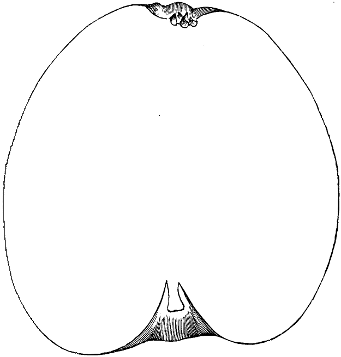
Fruit, large and handsome; conical or oblong. Skin, greenish-yellow strewed with russety specks, on the shaded side; but where exposed to the sun of a fine deep yellow, covered with rather large dark spots, which are encircled with a dark crimson ring. Eye, open, with short segments, set in a deep, plaited, and irregular basin. Stalk, about a quarter of an inch long, inserted in a very deep, and angular cavity. Flesh, yellowish-white, delicate, tender, juicy and sugary.
A very excellent apple, of first-rate quality as a culinary fruit, and also valuable for the dessert; it is in use from September to January.
This variety was discovered many years ago, in the West Riding of Yorkshire, where it is now cultivated to a large extent. It was first brought into notice by John Nelson, a noted Wesleyan preacher in that part of the country, who, during his professional visits distributed grafts of it among his friends. From this circumstance it became generally known by the name of the Nelson Apple. It was called Backhouse’s Lord Nelson by Mr. Ronalds in the Pyrus Malus Brentfordiensis, from having been received from the York nursery; but Mr. Backhouse, to whom it refers, disclaims having any merit either in the origin or introduction of it, and prefers retaining simply the name of “Nelson”, as a tribute to the memory of the excellent man after whom it was named.
The tree is a strong, vigorous, and healthy grower, and a most abundant bearer.
240. NEW ROCK PIPPIN.—Hort.
Identification.—Hort. Trans. vol. v. p. 269. Hort. Soc. Cat. ed. 3, n. 460. Lind. Guide, 75.
Fruit, of medium size; round. Skin, dull green on the shaded side, and brownish-red where exposed to the sun, entirely covered with brown russet. Eye, deeply set in a round basin. Stalk, short. Flesh, yellow, firm, sweet, rich, and perfumed with the flavor of anise.
A dessert apple of first-rate quality; in use from January to May.
This variety was raised by Mr. William Pleasance, a nurseryman at Barnwell, near Cambridge, and was communicated by him to the London Horticultural Society, in 1821. It belongs to the Nonpareil family, and is valuable as a late winter apple.
241. NEWTOWN PIPPIN.—Hort.
Identification.—Hort. Soc. Cat. ed. 3. 458. Lind. Guide, 54. Down. Fr. Amer. 118. Fors. Treat. 115. Rog. Fr. Cult. 95.
Synonymes.—Large Yellow Newton Pippin, Coxe View, 142. American Newtown Pippin, acc. Hort. Soc. Cat. Green Newtown Pippin, Hort. Soc. Cat. ed. 1, 636. Large Newtown Pippin, Ibid. 638. Petersburgh Pippin, Ibid. 780. Green Winter Pippin, acc. Down. Fr. Amer. Newton Pippin, Aber. Dict. Neujorker Reinette, Diel. Kernobst. v. 152.
Figures.—Brook. Pom. Brit. pl. xciii. f. 6. Ron. Pyr. Mal. pl. xvii. f. 1.
Fruit, medium sized; roundish, broadest at the base, with broad obscure ribs extending to the apex, which give it an irregularity in its outline. Skin, at first dull green, but changing as it ripens to a fine olive-green, or greenish-yellow, with a redish-brown tinge next the sun, and dotted all over with small grey russety dots. Eye, small and closed, set in a small and rather shallow basin. Stalk, half-an-inch long, slender, and inserted all its length, in a deep, round cavity lined with delicate russet, which extends over a portion of the base. Flesh, yellowish-white tinged with green, firm, crisp, very juicy, with a rich, and highly aromatic flavor.
A dessert apple, which, when in perfection, is not to be surpassed. It is in use from December to April. This description being taken from an imported specimen, it must not be expected that fruit grown in this country, will attain the same degree of perfection; for like most of the best American apples, it does not succeed in this climate. Even with the protection of a wall, and in the most favorable situation, it does not possess that peculiarly rich aroma, which characterizes the imported fruit.
The tree is a slender, and slow grower, and is always distinguished, even in its young state, by the roughness of its bark. It prefers a strong, rich, and genial soil, and, according to Coxe, does not arrive at maturity till 20 or 25 years old.
This is an old American apple. It originated at Newtown, on Long Island, U. S., and was introduced to this country about the middle of the last century. I find it was cultivated in the Brompton Park nursery so early as 1768, under the name of “Newtown Pippin from New York.” Forsyth remarks that it is said to have been originally from Devonshire, but if it were so, there would still have been some trace of it left in that county. It is extensively cultivated in New York, and all the middle states, and particularly on the Hudson, where the finest American orchards are. There are immense quantities produced which are packed in barrels and exported to Britain and other parts. The month of January, is generally the season they arrive in this country, and then they are the most attractive of all dessert apples in Covent Garden market; the name serving in many instances, as a decoy for the sale of many other and inferior varieties. The Alfriston, in many collections, is erroneously cultivated under the name of Newtown Pippin.
242. NEWTOWN SPITZENBERG.—Coxe.
Identification.—Coxe. View. 126. Hort. Soc. Cat. ed. 3, n. 791. Lind. Guide, 55. Down. Fr. Amer. 139.
Synonymes.—Matchless, Hort. Soc. Cat. ed. 1. 397. Burlington Spitzenberg, acc. Coxe Cult 126. English Spitzemberg, Ibid.
Figures.—Pom. Mag. t. 144. Ron. Pyr. Mal. pl. x. f. 3.
Fruit, above medium size, three inches and a quarter wide, and two inches and a quarter deep; roundish, regularly and handsomely formed, a little flattened, somewhat resembling a Nonesuch. Skin, smooth, at first pale-yellow tinged with green, but changing to a beautiful clear yellow, on the shaded side; but of a beautiful clear red streaked with deeper red, on the side next the sun, and strewed with numerous small, russety dots. Eye, open, set in a wide, and even basin. Stalk, short and stout, inserted in a deep cavity. Flesh, yellowish, firm, rich and pleasantly flavored.
An American dessert apple, very pretty, and handsome; of good quality, but only second-rate; it is in use from November to February.
This variety originated at Newtown on Long Island U. S. It received the name of Matchless, from the late William Cobbett, who sold it under that name.
243. NEW YORK PIPPIN.—Lind.
Identification.—Lind, Plan. Or. Lind. Guide, 76.
Fruit, rather large, of an oblong figure, somewhat pyramidal, rather irregular in its outline, and slightly pentangular on its sides, three of which are generally much shorter than the other, forming a kind of lip at the crown; from two inches and a half to three inches deep, and the same in diameter at the base. Eye, closed, rather deeply sunk in a very uneven irregular basin. Stalk, half-an-inch long, slender, rather deeply inserted in a wide uneven cavity. Skin, dull greenish-yellow, with a few green specks, intermixed with a little skin, (thin?) grey russet, and tinged with brown on the sunny side. Flesh, firm, crisp, tender. Juice, plentiful, saccharine, with a slight aromatic flavor.
A dessert apple; in use from November to April.
An American variety of excellence. The tree grows large, and bears well. It sometimes happens with this as it does with Hubbard’s Pearmain, that smooth fruit grow upon one branch and russety ones upon another; and in cold seasons the fruit are for the most part russety.
It was named the New York Pippin by Mr. Mackie, and first propagated in his nursery, at Norwich, about forty years ago. (1831.)
Never having seen or met with this apple, I have here given Mr. Lindley’s descriptions verbatim, for the benefit of those who may meet with it; as it is no doubt still in existence in the county of Norfolk.
244. NONESUCH.—Hort.
Identification.—Hort. Soc. Cat. ed. 3, n. 489. Lind. Guide, 20.
Synonymes.—Nonsuch, Fors. Treat. 116. Rog. Fr. Cult. 36. Down. Fr. Amer. 91. Langton Nonsuch, Hanb. Pl.
Figure.—Ron. Pyr. Mal. pl. xxxvii. f. 2.
Fruit, medium sized, two inches and a half wide, and two inches and a quarter high; roundish-oblate, regularly and handsomely shaped. Skin, smooth, pale yellow, mottled with thin pale red, on the shaded side; and striped with broad, broken stripes of red next the sun. Eye, small and closed, set in a wide, shallow, and even basin. Stalk, short and slender, inserted in a shallow cavity. Flesh, white, tender, juicy, sugary and slightly perfumed.
An excellent culinary apple, of first-rate quality, and, according to Mr. Thompson, excellent for apple jelly; it is ripe in September, and continues during October.
The tree is a free grower, attaining about the middle size, and is an abundant, and early bearer, young trees three years old from the graft producing an abundance of beautiful fruit.
Although an old variety, I do not think this is the Nonesuch, of Rea, Worlidge, or Ray, as all these authors mention it as being a long keeper, for which circumstance, it might otherwise have been considered the same. Rea says “it is a middle sized, round, and red striped apple, of a delicate taste, and long lasting.” Worlidge’s variety is probably the same as Rea’s he says “The Non-such is a long lasting fruit, good at the table, and well marked for cider.” And Ray also includes his Non-such among the Winter Apples.
245. NONPAREIL.—Duh.
Identification.—Duh. Arb. Fruit. i. 113, t. xii. f. 2. Switz. Fr. Gard. 136. Lang. Pom. 134. t. lxxix. f. 4. Mill. Dict. Fors. Treat. 117.
Synonymes.—Old Nonpariel, Hort. Soc. Cat. ed. 3. n. 476. Lind. Guide, 91. Down. Fr. Amer. 120. Old or Original Nonpareil, Rog. Fr. Cult. 70. English Nonpareil, acc. Hort. Soc. Cat. Hunt’s Nonpareil, Hort Soc. Cat. ed. 1, 659. Lovedon’s Pippin, Ibid. 573. Reinette Nonpareil. Knoop. Pom. 51, t. ix. Nonpareil d’Angleterre, Hort. Soc. Cat. ed. 1, 647. Duc d’Arsel, Ibid. 283. Grüne Reinette, Sickler. Obstgärt. iii. 177, t. 10. Diel Kernobst. v. 95. Nompareil, Chart. Cat. 54. Pomme-poire, acc. Hort. Soc. Cat. ed. 3.
Figures.—Pom. Mag. t. 86. Ron. Pyr. Mal. pl. xxxiv. f. 5.
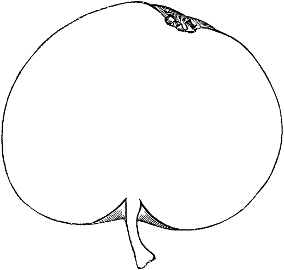
Fruit, medium sized; roundish, broad at the base and narrowing towards the apex. Skin, yellowish-green, covered with large patches of thin grey russet, and dotted with small brown russety dots, with occasionally a tinge of dull red, on the side next the sun. Eye, rather prominent, very slightly if at all depressed, half open, with broad segments which are reflexed at the tips. Stalk, an inch long, set in a round and pretty deep cavity which is lined with russet. Flesh, greenish, delicate, crisp, rich, and juicy, abounding in a particularly rich, vinous, and aromatic flavor.
One of the most highly esteemed and popular of all our dessert apples. It is in use from January till May.
The tree is a free grower, and healthy, scarcely attaining the middle size, and an excellent bearer. It prefers a light and warm soil, succeeds well on the paradise stock, and is well adapted for growing in pots, when grafted on the pomme paradis of the French. Bradley in one of his tracts records an instance of it being so cultivated. “Mr. Fairchild (of Hoxton) has now (February) one of the Nonpareile apples upon a small tree, in a pot, which seems capable of holding good till the blossoms of this year have ripened their fruit.” In the northern counties and in Scotland, it does not succeed as a standard as it does in the south, and even when grown against a wall, there is a marked contrast in the flavor when compared with the standard grown fruit of the south.
It is generally allowed that the Nonpareil is originally from France. Switzer says “It is no stranger in England; though it might have its original from France, yet there are trees of them about the Ashtons in Oxfordshire, of about a hundred years old, which (as they have it by tradition) was first brought out of France and planted by a Jesuit in Queen Mary or Queen Elizabeth’s time.” It is strange, however, that an apple of such excellence, and held in such estimation as the Nonpareil has always been, should have received so little notice from almost all the early continental pomologists. It is not mentioned in the long list of the Jardinier François of 1653, nor even by De Quintinye, or the Jardinier Solitaire. Schabol enumerates it, but it is not noticed by Bretonnerie. It is first described by Duhamel and subsequently by Knoop. In the Chartreux catalogue it is said “elle est forte estimée en Angleterre”, but, among the writers of our own country, Switzer is the first to notice it. It is not mentioned by Rea, Worlidge or Ray, neither is it enumerated in the list of Leonard Meager. In America it is little esteemed.
246. NORFOLK BEEFING.—H.
Synonymes.—Norfolk Beaufin, Hort. Soc. Cat. ed. 3, n. 34. Lind. Guide, 55. Down. Fr. Amer. 120. Norfolk Beau-fin, Rog. Fr. Cult. 59. Norfolk Beefin, Fors. Treat. ed. 3, 124. Reeds Baker, Hort. Soc. Cat. ed. 1, 858. Catshead Beaufin, acc. Hort. Soc. Cat.
Figures.—Brook. Pom. Brit. pl. xcii. f. 3. Ron. Pyr. Mal. pl. xxxiii. f. 3.
Fruit, medium sized, three inches wide, and two inches and three quarters high; oblate, irregular in its outline, caused by several obtuse angles or ribs, which extend from the base to the basin of the eye, where they form prominent knobs or ridges. Skin, smooth, green at first, but changing to yellow, and almost entirely covered with dull brownish-red, which is thickest and darkest next the sun; sometimes it is marked with a few broken stripes of dark crimson, and in specimens where the color extends over the whole surface, the shaded side is mottled with yellow spots. Eye, open, set in a rather deep and angular basin. Stalk short, inserted in a deep and russety cavity. Flesh, firm and crisp, with a brisk and pleasant flavor.
A well known and first-rate culinary apple; it is in use from January to June. It is extensively cultivated in Norfolk, where, besides being applied to general culinary purposes, they are baked in ovens, and form the dried fruits met with among confectioners and fruiterers, called “Norfolk Biffins.”
The tree is vigorous in its young state, but unless grown in a rich soil, and a favorable situation, it is apt to canker, particularly if it is too moist.
The name of this apple has hitherto been written Beaufin, as if of French origin; but it is more correctly Beefing, from the similarity the dried fruit presents to raw beef.
247. NORFOLK PARADISE.—Fors.
Identification.—Fors. Treat. 117. Lind. Guide, 77. Hort. Soc. Cat. ed. 3.
Figure.—Brook. Pom. Brit. pl. xcii. f. 4.
Fruit, medium sized; oblong, irregularly formed. Eye, very large, deeply sunk in an uneven, oblique hollow. Stalk, rather short, not deeply inserted. Skin, greenish-yellow; on the sunny side of a brownish-red, streaked with a darker color. Flesh, white, very firm. Juice, abundant and of a very excellent flavor.
A dessert apple; in use from October till March.
Its name seems to indicate a Norfolk origin; but I never could find it in any part of the county.—Lindley.
248. NORFOLK STONE PIPPIN.—Hort.
Identification.—Hort. Soc. Cat. ed. 3, n. 804.
Synonymes.—Stone Pippin, Lind. in Hort. Trans. vol. iv. p. 69. Lind. Guide, 82. Diel Kernobst. xi. 119. White Stone Pippin, Hort. Soc. Cat. ed. 1, 1071. White Pippin, in Norfolk. Englischer Kleiner Steinpepping, Diel Kernobst. xi. 119.
Fruit, below medium size, two inches broad, and the same in height; oblong, slightly angular on the sides, and narrowing a little towards the apex. Skin, smooth and very thin, pale green at first, but changing by keeping to pale yellow with a mixture of green; sometimes it has a slight tinge of red next the sun. Eye, small, half open, with acuminate segments, set in a rather shallow and wide basin. Stalk, slender, half-an-inch long, inserted in a shallow cavity with a fleshy protuberance on one side of it. Flesh, white, firm and breaking, brisk, sweet, and perfumed.
An excellent long-keeping culinary apple, and useful also in the dessert; it is in use from November to July. In the “Guide to the Orchard,” Mr. Lindley says “This is a valuable Norfolk Apple known in the Norwich market by the name of White Pippin. The fruit when peeled, sliced, and boiled in sugar, becomes transparent, affording for many months a most delicious sweetmeat for tarts.”
The tree is a free and vigorous grower, and attains the middle size. It is a regular and abundant bearer.
249. NORTHERN GREENING.—Hort.
Identification.—Hort. Soc. Cat. ed. 3, n. 497. Fors. Treat. 117. Lind. Guide, 77. Diel Kernobst. xi. 83.
Synonymes.—Walmer Court, Hort. Soc. Cat. ed. 1. 1134. Cowarne Queening, Ron. Pyr. Mal. 49. John, of some, acc. Hort. Soc. Cat.
Figure.—Ron. Pyr. Mal. pl. xxv. f. 4.
Fruit, medium sized, two inches and three quarters broad, and about three inches high; roundish, inclining to ovate, being narrowed towards the eye. Skin, smooth and tender, of a beautiful grassy green in the shade, and dull brownish-red marked with a few broken stripes of a darker color, on the side exposed to the sun. Eye, small and closed, with long segments, set in a narrow, round, deep, and even basin. Stalk, three quarters of an inch long, inserted in a narrow and deep cavity. Flesh, greenish-white, tender, crisp, and very juicy, with a brisk and somewhat vinous flavor.
An excellent culinary apple of first-rate quality; in use from November to April.
The tree is a very strong and vigorous grower, attaining the largest size, and is an abundant bearer.
This is sometimes called Cowarne Queening, but that is a very different variety, and is a cider apple.
250. NOTTINGHAM PIPPIN.—H.
Fruit, medium sized, two inches and three quarters broad, and two inches and a half high; ovate. Skin, smooth, pale yellow at first, but changing by keeping to lemon yellow, without any trace of red, but with slight markings of russet. Eye, closed, with long green segments, set in a wide and rather deeply plaited basin. Stalk, three quarters of an inch long, inserted in a deep, funnel-shaped, and russety cavity. Flesh, white, fine and marrowy, juicy, sugary, and vinous.
A second-rate dessert apple; in use from November till February.
The tree is a strong and vigorous grower, and an excellent bearer.
251. ORD’S APPLE.—Hort.
Identification.—Hort. Trans. vol. ii. p. 285. Hort. Soc. Cat. ed. 3, n. 507. Lind. Guide, 77.
Synonyme.—Simpson’s Pippin, acc. Hort. Trans.
Figure.—Hort. Trans. vol. ii. t. 19.
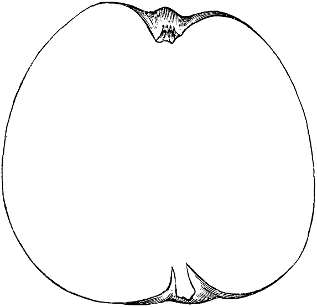
Fruit, medium sized; conical or oblong, very irregular in its outline, caused by prominent and unequal ribs on the sides, which extend to and terminate in ridges round the eye. Skin, smooth and shining, deep grassy green, strewed with imbedded grey specks, and dotted with brown russety dots on the shaded side; but washed with thin brownish-red, which is marked with spots or patches of darker and livelier red, and strewed with star-like freckles of russet on the side exposed to the sun. Eye, small and closed, placed in a rather deep and angular basin, which is lined with linear marks of rough russet. Stalk, about half-an-inch long, somewhat obliquely inserted by the side of a fleshy swelling, which is more or less prominent. Flesh, greenish-white, tender, crisp, and brittle, abounding in a profusion of rich, brisk, sugary, and vinous juice, with a finely perfumed and refreshing flavor.
An excellent apple, of first-rate quality, and well deserving of more general cultivation; It is in use from January to May, and keeps well.
Some thirty years ago, Ord’s apple was brought into public notice as a variety which was worthy of universal cultivation; and was considered of such importance as to form the subject of a paper in the Horticultural Society’s Transactions, by A. Salisbury Esq. At that time it was received into all the collections in the London nurseries, and was very generally grown; but in the course of years it was again lost sight of, and I believe there are now very few places where it is to be met with. I shall be glad, however, if this notice should direct the attention of some lover of a good apple, to rescue this excellent variety from the oblivion into which it is likely to fall, and to restore it to the position it once occupied as one of our finest dessert apples.
This excellent variety originated at Purser’s Cross, near Fulham, Middlesex. It was raised in the garden of John Ord, Esq. by his sister-in-law, Mrs. Anne Simpson, from seed of a Newtown Pippin imported in 1777. There is another variety called Simpson’s Seedling, raised from the seed of Ord’s apple, to which it is very similar; but being much inferior in quality, its cultivation has been in a great measure discontinued.
252. OSLIN.—Hort.
Identification.—Hort. Soc. Cat. ed. 3, n. 511. Fors. Treat. 119. Lind. Guide, 5. Down. Fr. Amer, 75. Gard. Chron. 1845, 784. Rog. Fr. Cult. 33.
Synonymes.—White Oslin, acc. Hort. Soc. Cat.ed, 2. Scotch Oslin. Orglon, Gibs. Fr. Gard. 353. Orgeline or Orjeline, Fors. Treat. ed. 5, 119. Arbroath Pippin, acc. Fors. Treat. ed. 7. Original Pippin, Nicol Villa Gard. 28. Mother Apple, acc. Caled. Hort. Mem. i. 237. Golden Apple, Ibid. 238. Bur-Knot, Ibid. Summer Oslin, Ron. Pyr. Mal. 11.
Figures.—Pom. Mag. t. 5. Ron. Pyr. Mal. pl. vi. f. 2.
Fruit, medium sized, two inches and a half wide, and two inches high; roundish-oblate, evenly and regularly formed. Skin, thick and membranous, of a fine pale yellow color, and thickly strewed with brown dots; very frequently cracked, forming large and deep sinuosities on the fruit. Eye, scarcely at all depressed. Stalk, short and thick, inserted in a very shallow cavity. Flesh, yellowish, firm, crisp and juicy, rich and sugary, with a highly aromatic flavor, which is peculiar to this apple only.
A dessert apple of the highest excellence; ripe in the end of August, and continues during September, but does not last long. Nicol says “this is an excellent apple, as to flavor it is outdone by none but the Nonpareil, over which it has this advantage, that it will ripen in a worse climate and a worse aspect.”
The tree is a free grower, of an upright habit, and an excellent bearer; but is subject to canker as it grows old. The branches are generally covered with a number of knobs or burrs; and when planted in the ground these burrs throw out numerous fibres which take root and produce a perfect tree.
This is a very old Scotch apple, supposed to have originated at Arbroath; or to have been introduced from France by the monks of the Abbey which formerly existed at that place. The latter opinion is, in all probability, the correct one, although the name, or any of the synonymes quoted above are not now to be met with in any modern French lists. But in the “Jardinier François” which was published in 1651, I find an apple mentioned under the name of Orgeran, which is so similar in pronounciation to Orgeline, I think it not unlikely it may be the same name with a change of orthography, especially as our ancestors were not over particular, in preserving unaltered the names of foreign introductions.
253. OSTERLEY PIPPIN.—H.
Synonyme and Figure.—Osterley Apple, Ron. Pyr. Mal. 59, pl. xxx. f. 1.
Fruit, rather below medium size, two inches and a half wide, and two inches and a quarter high; orbicular, flattened at the base and apex. Skin, yellowish-green, strewed with thin russet and russety dots on the shaded side; but washed with thin red, and strewed with russety specks on the side next the sun. Eye, large and open, with short stunted segments, set in a wide and shallow basin. Stalk, half-an-inch long, inserted in a wide, and rather shallow cavity, which is lined with thin russet. Flesh, greenish-yellow, firm, crisp, rich, juicy and sugary, with a brisk and aromatic flavor, somewhat resembling, and little inferior to the Ribston Pippin.
A handsome and very excellent dessert apple; it is in use from October to February, and is not subject to be attacked with the grub, as the Ribston Pippin is.
This variety was raised from the seed of the Ribston Pippin, at Osterley Park, the seat of the Earl of Jersey, near Isleworth, Middlesex, where the original tree is still in existence.
254. OXNEAD PEARMAIN.—Lind.
Identification.—Lind. Guide, 78.
Synonyme.—Earl of Yarmouth’s Pearmain, Lind. Pl. Or. 1796.
Fruit, small and conical. Skin, entirely grass green, always covered with a thin russet; sometimes when highly ripened it is tinged with a very pale brown on the sunny side. Eye, very small, surrounded with a few obscure plaits. Stalk, very slender, three quarters of an inch long. Flesh, pale green, very firm and crisp, not juicy, but very rich and highly flavored.
A dessert apple; in use from November to April.
I have never seen this apple. It was first noticed by Mr. George Lindley whose description of it I have given above. He says “it is supposed to have originated at Oxnead, near Norwich, the seat of the Earl of Yarmouth. It has been known many years in Norfolk, no doubt prior to the extinction of that Peerage in 1733, and I have never seen it out of the county. The tree is a very small grower; its branches are small and wiry and of a grass green color; it is very hardy and an excellent bearer.”
255. PADLEY’S PIPPIN.—Fors.
Identification.—Fors. Treat. 119. Hort. Soc. Cat. ed. 3, n. 516. Lind. Guide, 21. Gard. Chron. 1847, 36. Rog. Fr. Cult. 83.
Synonymes.—Compôte, acc. Hort. Soc. Cat. ed. 3. Padley’s Royal George Pippin, Ron. Pyr. Mal. 32.
Figures.—Pom. Mag. t. 151. Ron. Pyr. Mal. pl. xvi. f. 5.
Fruit, small, two inches wide, and an inch and a half high; roundish-oblate. Skin, pale greenish-yellow rather thickly covered with thin grey russet, and faintly tinged with orange next the sun. Eye, small and closed, set in a shallow and rather angular basin. Stalk, three quarters of an inch long, slender, and inserted in a rather shallow cavity. Flesh, yellow, juicy, sugary, brisk and richly aromatic.
A dessert apple of first-rate quality; in use during December and January.
The tree is of small dimensions, but healthy, and a prolific bearer. It is well adapted for dwarf training, when grown on the paradise or doucin stock.
This variety was raised by Mr. Padley, gardener to his Majesty George III., at Hampton Court. According to Rogers, Mr. Padley was a native of Yorkshire, and after coming to London and filling a situation of respectability, he was appointed foreman in the kitchen garden at Kew. “On the death of the celebrated ‘Capability Brown’ Mr. G. Haverfield was removed from Kew to Hampton Court, and took Mr. Padley with him as foreman. On the death of Haverfield, Padley’s interest with his sovereign out-weighed all the interests of other candidates, though urged by the most influential persons about Court. ‘No, no, no,’ said his Majesty, ‘it is Padley’s birthright.’”
256. PARRY’S PEARMAIN.—Hort.
Identification.—Hort. Soc. Cat. ed. 3, n. 554. Ron. Pyr. Mal. 41.
Figure.—Ron. Pyr. Mal. pl. xxi. f. 3.
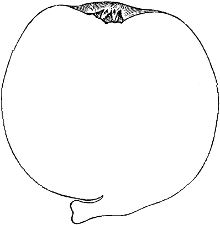
Fruit, small; oval, and regular in its shape. Skin, almost entirely covered with dark dull red, and striped with brighter red, except a portion on the shaded side, which is green; the whole surface is thickly strewed with small russety dots, which give it a speckled appearance. Eye, small and open, set in a shallow basin. Stalk, sometimes short and fleshy as represented in the accompanying figure; and at other times, about half-an-inch long, and woody, but still retaining the swollen boss at its union with the fruit. Flesh, firm in texture, crisp, very juicy and pleasantly acid, with a sweet, brisk, and poignant flavor.
A nice sharp-flavored dessert apple; but considered only of second-rate quality; it is in use from December to March.
257. PATCH’S RUSSET—Hort.
Identification.—Hort. Soc. Cat. ed. 3, n. 747. Lind. Guide, 92.
Fruit, below medium size, two inches and a half wide, and two inches and a quarter high; oval, and slightly angular on its sides. Skin, greenish-yellow, entirely covered with thin grey russet. Eye, small, with long acuminate segments, set in a narrow and irregular basin. Stalk, an inch long, very slender, inserted in a round, even, and deep cavity. Flesh, yellowish-white, crisp, brisk and aromatic.
A good dessert apple of second-rate quality; in use during November and December.
258. PASSE POMME D’AUTOMNE.—Duh.
Identification.—Duh. Arb. Fr. i. 278. Dahuron. Traité. 115. Chart. Cat. 50. Rog. Fr. Cult. 39.
Synonymes.—Passe Pomme Rouge d’Automne, Diel. Kernobst. ii. 50. Générale, acc. Duhamel. Pomme d’Outre passe, Ibid. Passe Pomme Cotellée, Merlet. Abregé. Herbststrich Apfel, Mayer. Pom. Franc. Tab. iii. f. 3. Rother Herbststrichapfel, Diel Kernobst. ii. 50.
Figures.—Mayer. Pom. Franc. t. iii. f. 3. Sickler Obstgärt. xv. t. 7.
Fruit, medium sized, two inches and a half wide, and two inches and a quarter high; round and slightly flattened, with prominent ribs on the sides, which extend into the basin of the eye. Skin, pale straw-colored, almost white, with a few stripes of red on the shaded side; but entirely covered with beautiful crimson, which is striped with darker crimson, and strewed with small grey dots where exposed to the sun. Eye, large and closed, set in a rather shallow and ribbed basin. Stalk, fleshy, set in a wide and deep cavity. Flesh, very white, tinged with red, more so than the Passe Pomme Rouge, tender, juicy, rich, sugary and vinous.
An excellent autumn culinary apple; ripe in September.
The tree is vigorous and healthy, but does not attain a large size. It is a very abundant bearer, and well suited for dwarf training when grown on the paradise or doucin stock.
Dahuron says of this apple “on la nomme en Hollande Pomme de Jerusalem;” but according to Knoop, the Dutch pomologist, it is the Pigeon, which is known under that name.
259. PASSE POMME ROUGE.—Duh.
Identification.—Duh. Arb. Fruit, i. 277. Dahuron Traité. 114. Bret. Ecole, ii. 470. Bon. Jard. Chart. Cat. 49. Rog. Fr. Cult. 32.
Synonymes.—Rother August-Apfel, Henne Anweis, 150. Rothe Sommerpasspomm, Christ Handworter, 68. Rothe Kurzdauerende Apfel, Ibid.
Figure.—Nois. Jard. Fruit, ed. 2, pl. 92.
Fruit, small; roundish-oblate, even and regularly formed. Skin, thick, red all over, pale on the shaded side, but of a deep and bright color next the sun; and so sensitive of shade, if any portion of it is covered with a leaf or twig, a corresponding yellow mark will be found on the fruit. Eye, small, set in a narrow, even, and rather deep basin. Stalk, half-an-inch long, slender, set in a wide, deep, and even cavity. Flesh, white, tinged with red under the skin on the side exposed to the sun, crisp, juicy, and richly flavored when first gathered, but soon becomes dry and woolly.
An excellent early apple, suitable either for culinary purposes or dessert use; it is ripe in the beginning of August, but may be used in pies before then. Bretonnerie says it may be used “en compôte” in the beginning of July, and is preferable to the Calville Rouge d’Eté.
The tree is rather a delicate grower, never attaining a large size, but healthy and hardy, and an excellent bearer. It succeeds well as a dwarf on the paradise or doucin stock.
260. PAWSAN.—Knight.
Identification.—Pom. Heref. t. 15. Lind. Guide, 109.
Fruit, above the middle size, two inches and three quarters wide, and two inches and a quarter high; pretty round, without angles, but sometimes it is oval. Crown, but little hollow. Eye, small, with short reflexed segments of the calyx. Skin, dull muddy olive-green, a good deal reticulated with fine network. Stalk, three quarters of an inch long, slender, causing the fruit to be pendant.
Specific gravity of the juice, 1076.
Many trees of the Pawsan are found in the south-east, or Ryland district of Herefordshire, which have apparently stood more than a century. Its pulp is exceedingly rich and yellow, and in some seasons it affords cider of the finest quality. Its name cannot be traced to any probable source.
261. PEARSON’S PLATE.—Hort.
Identification.—Hort. Soc. Cat. ed. 3, n. 565. Down. Fr. Amer. 126.
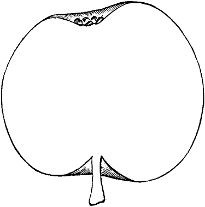
Fruit, small; roundish, inclining to oblate, regularly and handsomely formed. Skin, smooth, greenish-yellow in the shade; but washed with red, and streaked with deeper red on the side next the sun. Eye, open, with short segments, set in a shallow and plaited basin. Stalk, half-an-inch long, inserted in a round and rather shallow cavity. Flesh, greenish-yellow, firm, crisp, and juicy, with a rich, and brisk sugary flavor, somewhat resembling the Nonpareil.
A most delicious little dessert apple of the first quality; it is in use from December to March.
In some specimens of the fruit there is no red color, but altogether green, and covered with thin brown russet.
262. PENNINGTON’S SEEDLING.—Hort.
Identification.—Hort. Soc. Cat. ed. 3, n. 571. Lind. Guide, 93. Down. Fr. Amer. 127.
Fruit, medium sized, three inches wide, and two inches and three quarters deep; oblato-ovate. Skin, green at first, changing to yellowish-green, and covered with large russety spots on the shaded side; but with rough brown russet and a tinge of brown on the side next the sun. Eye, closed, with long and narrow segments, set in a round, shallow, and undulating basin. Stalk, an inch long, stout, and straight, inserted in a wide and shallow cavity. Flesh, yellowish, firm, crisp, juicy, sugary and brisk; with an excellent aromatic flavor.
A dessert apple of the highest excellence, either as a dessert or a culinary fruit; it is in use from November to March.
263. PETIT JEAN.—Hort.
Identification.—Hort. Soc. Cat. ed. 3, n. 581. Lind. Guide, 79. Hort. Trans. vol. iv. p. 525.
Fruit, small; oval, and flattened at the ends. Skin, almost entirely covered with brilliant red; but where shaded, it is pale yellow marked with a few stripes of red. Eye, small, set in a narrow basin. Stalk, very short, and inserted in a deep cavity. Flesh, very white and tender, with a mild and agreeable flavor.
By some considered as a dessert apple; but of inferior quality. Mr. Thompson thinks it may, perhaps, do for cider; it is in use from November to March.
The tree is a very abundant bearer.
This is a Jersey apple, and has for a long period been cultivated in the orchards of that Island. It was transmitted to the gardens of the London Horticultural Society, by Major General Le Couteur, of Jersey, in the year 1822.
264. PETWORTH NONPAREIL.—Hort.
Identification.—Hort. Soc. Cat. ed. 3, n. 477. Salisb. Orch. 134.
Synonyme and Figure.—Green Nonpareil, Ron. Pyr. Mal. 67, pl. xxxiv. f. 4.
This variety very closely resembles the old Nonpareil; but is rather larger; and though it possesses the flavor of the old variety, it is not nearly so rich. The tree is hardy and an excellent bearer. It was raised at Petworth, in Sussex, at the seat of Lord Egremont.
265. PIGEON.—Knoop.
Identification.—Knoop. Pom. 62, tab. xi. Duh. Arb. Fruit, i. 306, t. xii. f. 3. Hort. Soc. Cat. ed. 3, n. 582.
SYNONYMES.—Jerusalem, Quint. Inst. i. 201. Lang. Pom. 134. t. lxxvi. f. 4. Cœur de Pigeon, acc Duhamel. Pigeon Rouge, Diel. Kernobst. iii. 58. Gros Cœur de Pigeon, Filass. Tab. Passe-Pomme, acc. Knoop. Duif Apfel, Knoop. Rother Taubenapfel, Mayer. Pom. Franc. No. 28, tab. xviii. Rothe Taubenapfel, Sickler. Obstgärt. v. 323. t. 16. Arabian Apple, acc. Hort. Soc. Cat. ed. 3.
Figures.—Jard. Fruit, ed. 2. pl. 98. Ron. Pyr. Mal. pl. xxiii. f. 1.
Fruit, medium sized, two inches and a half wide, and two inches and three quarters high; conical and angular. Skin, membranous, shining, pale yellow with a greenish tinge, which it loses as it attains maturity; but covered with fine clear red on the side next the sun, and strewed all over with minute russety dots and imbedded white specks; the whole surface is covered with a bluish bloom, from which circumstance it receives the name of Pigeon, being considered similar to the plumage of a dove. Eye, open, with erect segments, prominently set in a narrow and plaited basin. Stalk, very short, inserted in a deep and russety cavity. Flesh, white, tender, soft and juicy, pleasantly flavored, but not at all rich.
A dessert apple of second-rate quality; but excellent for all culinary purposes; it is in use from November to January. It is necessary in storing this apple that care should be taken to prevent fermentation, by which its pleasant acidity is destroyed.
The tree, though vigorous in its young state, never attains a great size. Its shoots are long, slender and downy. It is an abundant and regular bearer.
This apple is called Pomme de Jerusalem, from, as some fancy, the core having four cells, which are disposed in the form of a cross, but this is not a permanent character, as they vary from three to five.
Diel erred in applying the synonymes of Knoop’s Pigeon bigarré to this variety, which is very distinct from the Pigeonnet.
266. PIGEONNET.—Duh.
Identification.—Duh. Arb. Fruit. i. 305. Calvel. Traité, iii. 32. Hort. Soc. Cat. ed. 3, n. 583.
Synonymes.—Pigeon Bigarré, Knoop. Pom. 62. Passe-pomme Panachée, Ibid. 132. Pigeonnet Blanc, Hort. Soc. Cat.ed 1, 786. Pigeonnet Blanc d’Eté, acc. Hort. Soc. Cat. ed. 3. Pigeonnet Gros de Rouen, Hort. Soc. Cat. ed. 1, 787. Museau de Lièvre. Bon. Jard. American Peach, of some, acc. Hort. Soc. Cat. Taubenartige, Taubenfarbige Apfel, Christ Handworter, 110.
Figures.—Jard. Fruit. ed. 2, pl. 98. Poit. et. Turpin. t. 80.
Fruit, below medium size, two inches and a quarter wide, and the same in height; oblato-ovate. Skin, pale greenish-yellow on the shaded side; but entirely covered with red on the side next the sun, and striped and rayed with darker red, some of the stripes extending to the shaded side. Eye, small and open, with erect segments, set in a slightly depressed basin. Stalk, short and thick, inserted in a rather shallow cavity. Flesh, white and delicate, of an agreeable acidulated and perfumed flavor.
A dessert fruit of second-rate quality; in use during August and September.
267. PILE’S RUSSET.—Miller.
Identification.—Mill. Dict. Fors. Treat. 120. Lind. Guide, 93. Rog. Fr. Cult. 107. Diel. Kernobst. iii. B. 8.
Synonyme.—Pyle’s Russet, Brad. Fam. Dict.
Fruit, medium sized, two inches and three quarters wide, and two inches and a quarter high; roundish-oblate and obscurely ribbed on the sides. Skin, dull green, thickly covered with pale brown russet, which is strewed with greyish-white dots, and pale green stelloid freckles on the shaded side; but dull olive mixed with orange, with a tinge of brown, and strewed with scales of silvery russet, intermixed with rough dots of dark russet, on the side next the sun. Eye, closed, with long broad segments, set in a deep and plaited basin. Stalk, short, inserted in a deep and oblique cavity, which is lined with scales of rough russet. Flesh, greenish, tender, crisp, breaking, very juicy and sugary, with a brisk and very poignant juice.
A very superior old English apple, particularly for culinary purposes; it is in use from October to March.
The tree is very healthy and vigorous, and attains the largest size. It is also an excellent bearer.
268. PINE APPLE RUSSET.—Lind.
Identification.—Lind. Plan. Or. Lind. Guide, 94.
Synonyme—Hardingham’s Russet, in Norfolk.
Fruit, medium sized, two inches and three quarters wide, and two inches and a half high; roundish-ovate, with broad obtuse angles on its sides. Skin, pale greenish-yellow, almost covered with white specks on one part, and rough thick yellow russet on the other, which extends round the stalk. Eye, small, with short connivent segments, placed in a shallow, plaited basin. Stalk, an inch long, inserted half its length in an uneven cavity.
Flesh, very pale yellow, tender, crisp, very juicy, sugary, brisk and richly aromatic.
A very valuable dessert apple; in use during September and October. Mr. Lindley says the juice of this apple is more abundant than in any he had ever met with. The oldest tree remembered in Norwich was growing a century ago (1830) in a garden belonging to a Mr. Hardingham.
269. PITMASTON NONPAREIL.—Hort.
Identification.—Hort. Trans. vol. iii. p. 265. Hort. Soc. Cat. ed. 3, n. 478. Fors. Treat. 117. Lind. Guide, 95. Rog. Fr. Cult. 67.
Synonymes.—St. John’s Nonpareil, Hort. Soc. Cat. ed. 1, 669. Pitmaston Russet Nonpareil, acc. Hort. Trans.
Figure.—Hort. Trans. vol. iii. t. 10. f. 4.
Fruit, above medium size, three inches wide, and two inches and a half high; roundish and flattened. Skin, pale green, almost entirely covered with russet, and with a faint tinge of red on the side next the sun. Eye, open, set in a broad, shallow, and plaited basin. Stalk, short, inserted in a shallow cavity. Flesh, greenish-yellow, firm, rich, and highly aromatic.
A dessert apple of the greatest excellence. It is in use from December to February.
This variety was raised by John Williams, Esq., of Pitmaston, St. John’s, near Worcester, and was first communicated to the London Horticultural Society in 1820.
270. PITMASTON GOLDEN WREATH.—M.
Identification and Figure.—Maund. Fruit, pl. 16.
Fruit, very small, half-an-inch wide by half-an-inch high; conical and undulating round the eye. Skin, of a fine deep rich yellow, strewed with russety dots. Eye, large and open, with long, spreading, acuminate segments, set in a shallow and plaited basin. Stalk, an inch long, very slender, inserted in a narrow and shallow cavity. Flesh, rich yellow, crisp, juicy and sugary.
A pretty little apple; in use from September to Christmas.
This beautiful variety was raised by J. Williams, Esq., of Pitmaston, from the Golden Pippin, impregnated with the pollen of the Cherry apple, or what is usually called the Siberian Crab.
271. PINNER SEEDLING.—Hort.
Identification.—Hort. Trans. vol. iv. p. 530. Hort. Soc. Cat. ed. 3, n. 587. Lind. Guide, 79.
Synonyme.—Carel’s Seedling, Hort. Soc. Cat. ed. 1, 791.
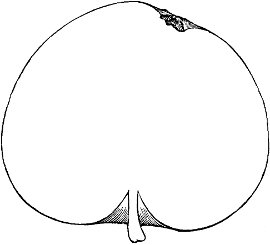
Fruit, medium sized, roundish-ovate, and slightly angular on the sides. Skin, greenish-yellow, nearly covered with clear yellowish-brown russet, so much so, that only spots of the ground color are visible; it has also a varnished redish-brown cheek next the sun which is more or less visible according to the quantity of russet which covers it. Stalk, half-an-inch long, inserted in a narrow and deep cavity. Flesh, yellowish, tinged with green tender, crisp, juicy, sugary and briskly flavored.
A dessert apple of first-rate quality; it is in use from December to April.
This excellent apple was raised by James Carel, a nurseryman at Pinner, Middlesex, in 1810. The tree first produced fruit in 1818, and was introduced to the notice of the London Horticultural Society, in 1820.
272. POMME GRISE.—Fors.
Identification.—Fors. Treat. 120. Down. Fr. Amer. 124.
Synonymes.—Grise, Hort. Soc. Cat. ed. 3, n. 305. Gray Apple, acc. Downing.
Figure.—Ron. Pyr. Mal. pl. xvi. f. 6.
Fruit, small, two inches wide, and an inch and three quarters high; roundish and inclining to ovate. Skin, rough, with thick scaly russet, green in the shade, and deep orange on the side next the sun. Eye, small and open, set in a narrow and shallow basin. Stalk, about half-an-inch long, inserted in a shallow and small cavity. Flesh, yellowish, crisp, very juicy and sugary, with a brisk and highly aromatic flavor.
A dessert apple of first-rate quality; in use from October to February.
The tree is rather a weak grower, but an abundant bearer.
This apple, according to Forsyth, was first introduced to this country from Canada, by Alexander Barclay, Esq., of Brompton, near London.
273, 274. POMEROY.
There are two very distinct varieties of apples, which, in different parts of the country, are known by the same name of Pomeroy. The one is that which is cultivated in Somersetshire and the West of England, and the other is peculiar to Lancashire and the Northern counties.
The Pomeroy of Somerset, is medium sized, two inches and three quarters wide, and the same in height; conical. Skin, greenish-yellow, covered with thin grey russet, on the shaded side; but orange, covered with stripes of deep red, and marked with patches and spots of russet on the side exposed to the sun, and strewed all over with numerous large, dark russety dots. Eye, open, set in a round and even basin. Stalk, short, not extending beyond the base, inserted in a round, even, and russety cavity. Flesh, yellow, firm, crisp, juicy, sugary, and highly flavored.
An excellent dessert apple; in use from October till December.
The Pomeroy of Lancashire, is medium sized, two inches and three quarters wide, and two inches and a half high; roundish, slightly ribbed at the apex. Skin, smooth, pale yellow on the shaded side, but clear pale red next the sun, which blends with the yellow towards the shaded side, so as to form orange; the whole covered with russety dots. Eye, small and closed, placed in a small and shallow basin. Stalk, short, imbedded in an angular cavity with a swelling on one side of it, and from which issue a few ramifications of russet. Flesh, whitish, tender, crisp, juicy, and with a brisk flavor, a good deal like that of the Manks Codlin.
An excellent culinary apple; in use during September and October.
The tree is healthy, hardy, and an excellent bearer, well adapted for orchard planting, and succeeds well in almost all situations.
There are several other varieties which are cultivated under this appellation, to which local specific names are attached; but as I have not seen any of these, they will be found among the “additional varieties” at the end of that portion of this work which treats on the apple.
275. POMEWATER.—Gerard.
Identification.—Ger. Herb. Park. Par. 587. Raii. Hist. ii. 1447.
Fruit, medium sized, two inches and three quarters wide, and two inches and a half high; roundish, and narrowing a little towards the apex, distinctly five-sided, and terminating at the crown in five prominent ridges. Skin smooth, yellowish-green, tinged with thin brownish-red in the shade; but covered with dark dull red on the side next the sun. Eye, closed, placed in a rather deep and angular basin. Stalk, stout, an inch long, inserted in a round and even cavity. Flesh, greenish-white, firm, crisp, and pleasantly flavored.
A culinary apple; in use from December to January.
I think there is little doubt that this is the Pome Water of Gerard. It is still grown in Lancashire, and on the borders of Cheshire, of which county Gerard was a native, and with the fruits of which, he was, in all probability, best acquainted.
276. PONTO PIPPIN.—Hort.
Identification.—Hort. Soc. Cat. ed. 3, n. 594.
Fruit, medium sized, two inches and a half wide, and the same in height; conical, narrow at the eye. Skin, pale greenish-yellow in the shade; but red on the side next the sun, and strewed all over with spots and dots of dark russet. Eye, small and closed, set in a narrow and irregular basin. Stalk, short, set in a wide and shallow cavity. Flesh, greenish-white, crisp, tender, juicy, sugary, with a brisk and rich flavor.
A dessert apple, of good, though not of first-rate quality; it is in use from November to February.
277. POPE’S APPLE.—H.
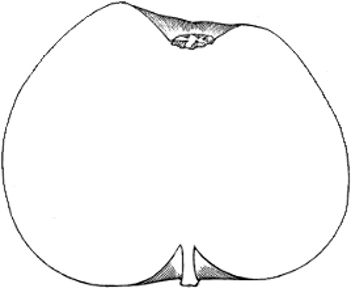
Fruit, large; ovate, handsomely and regularly formed. Skin, clear yellow, tinged with greenish patches, and strewed with dark dots; on the side next the sun it is marked with a few faint streaks of crimson. Eye, large and open, like that of the Blenheim Pippin, and set in a wide and plaited basin. Stalk, short, deeply inserted in a round cavity, which is lined with rough russet, and with an incipient protuberance on one side of it. Flesh, yellowish, tender, crisp, sugary and juicy, with a rich and excellent flavor.
A very valuable apple either for the dessert or culinary purposes; it is in use from November to March.
This variety has all the properties of the Blenheim Pippin, and is much superior to it, keeps longer, and has the great advantage of being an early and abundant bearer.
This excellent apple is as yet but little known. I met with it in the neighbourhood of Sittingbourne, in Kent, where it is greatly esteemed and now extensively cultivated for the supply of the London markets. The account I received of it was, that the original tree grew in the garden of a cottager of the name of Pope, at Cellar Hill, in the parish of Linstead, near Sittingbourne. It was highly prized by its owner, to whom the crop afforded a little income, and many were the unsuccessful applications of his neighbours for grafts of what became generally known as Pope’s Apple. The proprietor of this cottage built a row of other dwellings adjoining it, in the gardens of which there were no fruit trees; for the sake of uniformity, and in spite of Pope’s importunities and the offer of twenty shillings annual increase in the rental, the tree was condemned, and cut down in 1846, at which period it was between 50 and 60 years old. A few days after it was destroyed, Mr. Fairbeard, a nurseryman at Green Street, procured a number of the grafts which he was successful in propagating, and it is to him I am indebted for this variety.
278. POWELL’S RUSSET.—Hort.
Identification.—Hort. Soc. Cat. ed. 3, n. 748. Lind. Guide, 95. Rog. Fr. Cult. 74,
Figure—Ron. Pyr. Mal. pl. xiii. f. 9.
Fruit, small, two inches wide, and an inch and three quarters high; roundish, and regularly formed, broad and flattened at the base, and narrowing a little towards the eye. Skin, almost entirely covered with pale brown russet; but where any portion of the ground color is visible, it is greenish-yellow on the shaded side, and tinged with brown where exposed to the sun. Eye, open, placed in a round, even, and shallow basin. Stalk, about half-an-inch long, inserted in a rather wide, and shallow cavity. Flesh, yellow, firm, very juicy and sugary, with a rich and highly aromatic flavor.
A dessert apple of the very first quality; it is in use from November to February.
279. PROLIFEROUS REINETTE.—H.
Fruit, medium sized, two inches and three quarters wide, and the same in height; oval, with ten obscure ribs, extending from the base to the apex, where they form five small crowns. Skin, of a dull yellow ground color, marked with small broken stripes or streaks of crimson, and thickly covered with small russety specks. Eye, closed, placed in a shallow, plaited, and knobbed basin. Stalk, from half-an-inch to three quarters long, deeply inserted the whole of its length in a round and smooth cavity. Flesh, yellowish-white, very juicy and sugary, with a rich and brisk flavor.
A very fine, briskly flavored dessert apple; in use from October to December.
I received this variety from the garden at Hammersmith, formerly in the possession of the late Mr. James Lee.
280. QUEEN OF SAUCE.—H.
Fruit, large, three inches and a quarter broad, and two inches and a half high; obtuse-ovate, broad and flat at the base, narrowing towards the crown, and angular on the sides. Skin, greenish-yellow on the shaded side; but on the side exposed to the sun it is flushed with red, which is marked with broken streaks of deeper red; it is strewed all over with patches of thin delicate russet, and large russety specks, those round the eye being linear. Eye, open, set in a deep and angular basin, which is russety at the base. Stalk, about a quarter of an inch long, deeply inserted in a round cavity, which is lined with coarse russet. Flesh, yellowish, firm, crisp, juicy and sugary, with a brisk and pleasant flavor.
A culinary apple of first-rate quality, and not unworthy of the dessert; it is in use from November to January.
281. RABINE.—Hort.
Fruit, above medium size, three inches and a quarter wide, and two inches and a quarter high; roundish, and much flattened, ribbed on the sides, and undulated round the margin of the basin of the eye. Skin, greenish-yellow, marked with a few faint, broken streaks and freckles of red, and strewed with grey russety dots on the shaded side; but dark dull red, marked and mottled with stripes of deeper red, on the side next the sun. Eye, partially open, with broad flat segments, and placed in an angular basin. Stalk, short, inserted in a deep and uneven cavity, from which issue a few linear markings of russet. Flesh, yellowish, tender, crisp, very juicy and sugary, with a brisk and pleasant flavor.
An excellent apple, suitable either for culinary purposes or for the dessert, but more properly for the former; it is in use from October to Christmas.
282. RAMBO.—Coxe.
Identification.—Coxe View. 116. Hort. Soc. Cat. ed. 3. Down. Fr. Amer. 93.
Synonyme—Romanite, acc. Hort. Soc. Cat. ed. 3. American Seek-no-farther, Ibid. Bread and Cheese Apple, acc. Down. Fr. Amer.
Fruit, above medium size, three inches wide, and two inches and a quarter high; roundish oblate. Skin, smooth, pale yellow on the shaded side; but yellow, streaked with red, on the side next the sun, and strewed with large russety dots. Eye, closed, set in a wide, rather shallow, and plaited basin. Stalk, an inch long, and slender, inserted more than half its length in a deep, round, and even cavity. Flesh, greenish-white, tender and delicate, with a brisk and pleasant flavor.
An American apple, suitable either for the dessert or for culinary purposes; and esteemed in its native country as a variety of first-rate excellence; but with us of inferior quality, even as a kitchen apple; it is in use from December to January.
283. RAMBOUR FRANC.—Duh.
Identification.—Duh. Arb. Fruit. i. 307, pl. x. Mill. Dict. Hort. Soc. Cat. ed. 3, n. 615. Down. Fr. Amer. 94.
Synonymes.—Frank Rambour, Switz. Fr. Gard. 135. Lind. Guide, 15. Rambour Gros, Hort. Soc. Cat. ed. 1, 844. Rambour Blanc, Merlet. Abrégé. Rambour, Quint. Inst. i. 202. Dahur. Traité. 115. Le Rambour, Bret. Ecole, ii. 470. Rambourg, Riv. et Moul. Meth. 190. Rambourge, Gibs. Fr. Gard. 353. Pome de Rambures, Rea Pom. 210. Rambour d’été, Poit. et Turp. Rambour d’été or Summer Rambour, Coxe View. Cambour, Bauh. Hist. i. 21. Charmant Blanc, Zink Pom. No. 10. t. 2. Pomme de Nôtre Dame, acc. Dahuron. Früher Rambourger, Mayer Pom. Franc. No. 18, t. 13. Weisse Sommerrambour, Sickler Obstgärt. ix. 25. Lothinger, Saltz. Pom. No. 5. Lothinger Rambour, Diel Kernobst. i. 93.
Figures.—Jard. Fruit. ed. 2, pl. 94. Sickler Obstgärt. ix. t. 3.
Fruit, very large, four inches broad, and three inches high; roundish and flattened, with five ribs on the sides which extend to the eye, forming prominent ridges round the apex. Skin, yellow, marked with thin pale russet on the shaded side; but streaked and mottled with red on the side next the sun. Eye, closed, and deeply set in an angular basin. Stalk, short, deeply inserted in a round, even, and regular cavity, which is lined with russet. Flesh, yellow, firm, and of a leathery texture, brisk and sugary, with a high flavor.
A good culinary apple; in use during September and October.
This is an old French apple which must have been long cultivated in this country; as it is mentioned by Rea so early as 1665. It is supposed to take its name from the village of Rembures, in Picardy, where it is said to have been first discovered.
The tree is a strong and vigorous grower, and an abundant bearer.
284. RAVELSTON PIPPIN.—Hort.
Identification.—Hort. Trans. vol. iv. p. 522. Hort. Soc. Cat. ed. 3, n. 622. Lind. Guide, 9.
Fruit, medium sized, two inches and three quarters wide, and two inches and a half high; roundish, irregular in its shape, caused by several obtuse ribs which extend into the basin of the eye, round which they form prominent ridges. Skin, greenish-yellow, nearly covered with red streaks, and strewed with russety dots. Eye, closed, and set in an angular basin. Stalk, short and thick, inserted in a round cavity. Flesh, yellow, firm, sweet, and pleasantly flavored.
A dessert apple, of such merit in Scotland as to be generally grown against a wall; but in the south, where it has to compete with the productions of a warmer climate, it is found to be only of second-rate quality. Ripe in August.
285. RED ASTRACHAN.—Hort.
Identification.—Hort. Trans. vol. iv. p. 522. Hort. Soc. Cat. ed. 3, n. 17. Lind. Guide, 6. Down. Fr. Amer. 75. Rog. Fr. Cult. 33.
Figures.—Pom. Mag. t. 123. Ron. Pyr. Mal. pl. v. f. 2.
Fruit, above the medium size, three inches and a quarter wide, and three inches high; roundish, and obscurely angular on its sides. Skin, greenish-yellow where shaded, and almost entirely covered with deep crimson on the side exposed to the sun, the whole surface covered with a fine delicate bloom. Eye, closed, set in a moderately deep and somewhat irregular basin. Stalk, short, deeply inserted in a russety cavity. Flesh, white, crisp, very juicy, sugary, briskly and pleasantly flavored.
An early dessert apple, but only of second-rate quality. It is ripe in August, and requires to be eaten when gathered from the tree, as it soon becomes meally.
This variety was imported from Sweden, by William Atkinson, Esq., of Grove End, Paddington, in 1816.
The tree does not attain a large size, but is healthy and vigorous, and an abundant bearer.
286. RED INGESTRIE.—Hort.
Identification.—Hort. Trans. vol. i. 227. Hort. Soc. Cat. ed. 3, n. 358. Lind. Guide, 23. Down. Fr. Amer, 95. Rog. Fr. Cult. 81.
Figures.—Pom. Mag. t. 17. Ron. Pyr. Mal. pl. i. f. 6.
Fruit, small, two inches and a half wide, and two inches and a quarter high; ovate, regularly and handsomely shaped. Skin, clear bright yellow, tinged and mottled with red on the side exposed to the sun, and strewed with numerous pearly specks. Eye, small, set in a wide and even basin. Stalk, short and slender, inserted in a small and shallow cavity. Flesh, yellowish, firm, juicy, and highly flavored.
A dessert apple of first-rate quality; in use during October and November.
This excellent little apple was raised by Thomas Andrew Knight, Esq., from the seed of the Orange Pippin impregnated with the Golden Pippin, about the year 1800. It, and the Yellow Ingestrie, were the produce of two pips taken from the same cell of the core. The original trees are still in existence at Wormsley Grange, in Herefordshire.
287. RED-MUST.—Evelyn.
Identification.—Evelyn Pom. Worl. Vin. 162. Pom. Heref. Lind. Guide, 109.
Figure.—Pom. Heref. t. 4.
Fruit, nearly, if not quite, the largest cider apple cultivated in Herefordshire. It is rather broad and flattened, a little irregular at its base, which is hollow. Stalk, slender. Crown, sunk. Eye, deep, with a stout erect calyx. Skin, greenish-yellow on the shaded side, with a deep rosy color where exposed to the sun, and shaded with a darker red.—Lindley.
The Red Must has at all periods been esteemed a good cider apple, though the ciders lately made with it, unmixed with other apples, have been light, and thin; and I have never found the specific gravity of its expressed juice to exceed 1064.—Knight.
288. RED-STREAK.—Evelyn.
Identification.—Evelyn Pom. Worl. Vin. 164. Nourse Camp. Fel. 143. Fors. Treat. 123. Lind. Guide, 110. Pom. Heref. t. 1. Down. Fr. Amer. 146.
Synonymes.—Herefordshire Red-Streak, Hort. Soc. Cat. ed. 3, n. 625. Scudamore’s Crab.
Figures.—Pom. Heref. t. 1. Brook. Pom. Brit. pl. xciii. f. 4.
Fruit, medium sized, two inches and three quarters wide, and two inches and a quarter high; roundish, narrowing towards the apex. Skin, deep clear yellow, streaked with red on the shaded side; but red, streaked with deeper red on the side next the sun. Eye, small, with convergent segments, set in a rather deep basin. Stalk, short and slender. Flesh, yellow, firm, crisp, and rather dry.
Specific gravity of the juice, 1079.
A cider apple, which at one period was unsurpassed, but now comparatively but little cultivated.
Perhaps there is no apple which at any period created such a sensation, and of which so much was said and written during the 17th century, as of the Red Streak. Prose and verse were both enlisted in its favor. It was chiefly by the writings of Evelyn it attained its greatest celebrity. Philips, in his poem—Cyder, says
“Let every tree in every garden own The Red Streak as supreme, whose pulpous fruit, With gold irradiate, and vermilion, shines Tempting, not fatal, as the birth of that Primæval, interdicted plant, that won Fond Eve, in hapless hour to taste, and die. This, of more bounteous influence, inspires Poetic raptures, and the lowly muse Kindles to loftier strains; even I, perceive Her sacred virtue. See! the numbers flow Easy, whilst, cheer’d with her nectareous juice, Her’s, and my country’s praises, I exalt.”
but its reputation began to decline about the beginning of the last century, for we find Nourse saying, “As for the liquor which it yields, it is highly esteemed for its noble colour and smell; ’tis likewise fat and oily in the taste, but withal very windy, luscious and fulsome, and will sooner clog the stomach than any other cider whatsoever, leaving a waterish, raw humour upon it; so that with meals it is no way helpful, and they who drink it, if I may judge of them by my own palate, will find their stomachs pall’d sooner by it, than warm’d and enliven’d.”
The Red Streak seems to have originated about the beginning of the 17th century, for Evelyn says “it was within the memory of some now living, surnamed the Scudamore’s Crab, and then not much known save in the neighbourhood.” It was called Scudamore’s Crab, from being extensively planted by the first Lord Scudamore, who was son of Sir James Scudamore, from whom Spencer is said to have taken the character of Sir Scudamore in his “Fairie Queen.” He was born in 1600, and created by Charles I. Baron Dromore and Viscount Scudamore. He was attending the Duke of Buckingham when he was stabbed at Portsmouth, and was so affected at the event that he retired into private life, and devoted his attention to planting orchards, of which the Red-Streak formed the principal variety. In 1634 he was sent as ambassador to France, in which capacity he continued for four years. He was a zealous royalist during the civil wars, and was taken prisoner by the parliament party, while his property was destroyed, and his estate sequestered. He died in 1671.
289. RED STREAKED RAWLING.—H.
Synonyme and Figure.—Rawling’s Fine Redstreak. Ron. Pyr. Mal. pl. x. f. 2.
Fruit, large, three inches wide by two and a quarter deep; roundish, and slightly angular. Skin, yellow, streaked with red on the shaded side; but entirely covered with clear dark red, and striped with still darker red on the side exposed to the sun. Eye, small and closed, set in a narrow and plaited basin. Stalk, long and slender, inserted in a wide and deep cavity, which is lined with russet. Flesh, yellowish, tender, sweet, juicy and well flavored, abounding in a sweet and pleasant juice.
A culinary apple, well adapted for sauce; it is in use from October to Christmas.
This is an old Devonshire apple, and no doubt the Sweet Rawling referred to in a communication to one of Bradley’s “Monthly Treatises,” from which the following is an extract. “We have an apple in this country called a Rawling, of which there is a sweet and a sour; the sour when ripe (which is very early) is a very fair large fruit, and of a pleasant taste, inclined to a golden color, full of narrow red streaks; the Sweet Rawling, has the same colours but not quite so large, and if boiled grows hard; whereas the sour becomes soft. Now what I have to inform you of is, viz.: I have a tree which bears both sorts in one apple; one side of the apple is altogether sweet, the other side sour; one side bigger than the other; and when boiled the one side is soft, the other hard, as all sweet and sour apples are.”
290. REINETTE DE BREDA.—Diel.
Identification.—Diel Kernobst. i. 110. Sickler Obstgärt. ix. 212.
Figure.—Sickler Obstgärt. ix. t. 9.
Fruit, medium sized, two inches and three quarters wide, and two and a quarter high; roundish and compressed. Skin, at first pale yellow, but changing as it ripens to fine deep golden yellow, and covered with numerous russety streaks and dots, and with a tinge of red and fine crimson dots, on the side exposed to the sun. Eye, set in a wide and plaited basin. Stalk, half-an-inch long, inserted in a russety cavity. Flesh, yellowish-white, firm and crisp, but tender and juicy, with a rich vinous and aromatic flavor.
A dessert apple of first-rate quality; in use from December to March.
This is the Reinette d’Aizerna of the Horticultural Society’s Catalogue, and may be the Nelguin of Knoop, but it is certainly not the Reinette d’Aizema of Knoop.
291. REINETTE BLANCHE D’ESPAGNE.—Hort.
Identification.—Hort. Soc, Cat. ed. 3, n. 636. Diel Kernobst. v. B. 80. Mayer Pom. Franc. Down. Fr. Amer. 130.
Synonymes.—Reinette d’Espagne, Bret. Ecole, ii. 477. Reinette Tendre. Blanc d’Espagne, Bon. Jard. 1843, 514. D’Espagne, acc. Hort. Soc. Cat. De Rateau, acc. Pom. Mag. Concombre Ancien, Ibid. Fall Pippin, Rog. Fr. Cult. 95. Cobbett’s Fall Pippin, acc. Hort. Soc. Cat. Large Fall Pippin, Hort. Soc. Cat. ed. 1, 315 Camuesar, in Spain. White Spanish Reinette, Pom. Mag. Lind Guide, 83.
Figure.—Pom. Mag. t. 110.
Fruit, very large, three inches and a half wide, and three inches and three quarters high; oblato-oblong, angular on the sides and uneven at the crown, where it is nearly as broad as at the base. Skin, smooth and unctuous to the feel, yellowish-green in the shade, but orange tinged with brownish-red next the sun, and strewed with dark dots. Eye, large and open, set in a deep, angular, and irregular basin. Stalk, half-an-inch long, inserted in a narrow, and even cavity. Flesh, yellowish-white, tender, juicy and sugary.
An apple of first-rate quality, suitable for the dessert, but particularly so for all culinary purposes. It is in use from December to April.
The tree is healthy and vigorous, and an excellent bearer. It requires a dry, warm, and loamy soil.
292. REINETTE DE CANADA.—Bret.
Identification.—Bret. Ecole, ii. 476. Hort. Soc. Cat. ed. 3. 868. Bon. Jard.
Synonymes.—Reinette du Canada, Cal. Traité. iii. 51. Hort. Soc. Cat. ed. 3, n. 640. Grosse Reinette d’Angleterre, Duh. Arb. Fruit, i. 299, t. xii. f. 5. Reinette de Canada Blanche, Hort. Soc. Cat. ed. 1, 868. Reinette de Canada à Côtes, Hort. Soc. Cat. ed. 1, 869. Reinette de Caen, Ibid. 867. De Canada, Ibid. 139. De Bretagne, Ibid. 104. Portugal, Ibid. 803. Janurea, Ibid. 489. Reinette Grosse de Canada, acc. Hort. Soc. Cat. St. Helena Russet, Ibid. Wahre Reinette, Ibid. Grosse Englische Reinette, Diel Kernobst. i. 106. Canadian Reinette, Lind. Guide, 40. Pom. Mag. Canada Reinette, Down. Fr. Amer. 129. Grosse d’Angleterre, Mala Janurea, of the Ionian Islands.
Figures.—Pom. Mag. t. 77. Jard. Fruit, ed. 2. pl. 96. Ron. Pyr. Mal. pl. xi. f. 1. Poit. et Turp. pl. 32.
Fruit, large, three inches and a half wide, and three inches deep; oblato-conical, with prominent ribs originating at the eye, and diminishing as they extend downwards towards the stalk. Skin, greenish-yellow, with a tinge of brown on the side next the sun, covered with numerous brown russety dots, and reticulations of russet. Eye, large, partially closed, with short segments, and set in a rather deep and plaited basin. Stalk, about an inch long, slender, inserted in a deep, wide, and generally smooth cavity. Flesh, yellowish-white, firm, juicy, brisk, and highly flavored.
An apple of first-rate quality, either for culinary or dessert use; it is in season from November to April.
The tree is a strong and vigorous grower, and attains a large size. It is also an excellent bearer; the finest fruit are produced from dwarf trees.
293. REINETTE CARPENTIN.—Hort.
Identification.—Hort. Soc. Cat. ed. 3, p. 35.
Synonyme.—Kleine Graue Reinette, Sickler Obstgärt. ix. 413. Der Carpentin, Diel Kernobst. i. 174.
Figure.—Sickler Obstgärt. ix. t. 18.
Fruit, small, two inches and a quarter wide, and two inches high; roundish or rather oblato-oblong. Skin, yellowish-green on the shaded side; but striped, and washed with dark glossy red, on the side next the sun, and so much covered with a thick cinnamon-colored russet that the ground colors are sometimes only partially visible. Eye, set in a wide saucer-like basin, which is considerably depressed. Stalk, an inch long, thin, and inserted in a round and deep cavity. Flesh, yellowish-white, delicate, tender and juicy, with a brisk, vinous, and peculiar aromatic flavor, slightly resembling anise.
A first-rate dessert apple; in use from December to April.
The tree is a free grower, with long slender shoots, and when a little aged, is a very abundant bearer.
294. REINETTE DIEL.—Van Mons.
Identification.—Diel Kernobst. i. B. 78. Hort. Soc. Cat. ed. 3, n. 647.
Fruit, below medium size, two inches wide, and two and a quarter high; oblate, even, and handsomely shaped. Skin, at first yellowish-white, but changes by keeping to a fine yellow color; on the side next the sun it is marked with several crimson spots and dots, strewed all over with russety dots, which are large and brownish on the shaded side, but small and greyish on the other. Eye, open, with short segments, set in a wide and rather shallow basin. Stalk, half-an-inch long, inserted in a deep and russety cavity, with sometimes a fleshy boss at its base. Flesh, white, firm, crisp, delicate and juicy, with a rich, sugary, and spicy flavor.
A beautiful and excellent dessert apple of the first quality; it is in use from December to March.
The tree is a strong, healthy, and vigorous grower, and an abundant bearer.
This variety was raised by Dr. Van Mons, and named in honor of his friend Dr. Aug. Friedr. Adr. Diel.
295. REINETTE FRANCHE.—Duh.
Identification.—Duh. Arb. Fruit, i. 300. Bret. Ecole, ii. 474. Knoop Pom. 53, t. ix. Lind. Guide, 56.
Synonymes.—Reinette Blanche, Quint. Inst. i. 201. Reinette Blanche dite Prime, Merlet Abrégé. Reinette Blanche or Franche, Mill. Dict. French Reinette, Rog. Fr. Cult. 104. Franz Renette, Mayer Pom. Franc. 3, No. 46. Reinette de Normandie, Christ Handb. No, 92. Weisse Reinette, Salz. Pom. No. 22. Französische Edelreinette, Diel Kernobst. i. 120.
Figure.—Nois. Jard. Fruit, ed. 2, pl. 93.
Fruit, above medium size, three inches and a quarter wide, and two inches and a half high; roundish-oblate, slightly angular on its sides, and uneven round the eye. Skin, smooth, thickly covered with brown russety spots; greenish-yellow, changing as it ripens to pale-yellow; and sometimes tinged with red when fully exposed to the sun. Eye, partially open, with long green segments, set in a wide, rather deep, and, prominently plaited basin. Stalk, short, and thick, deeply inserted in a round cavity, which is lined with greenish-grey russet. Flesh, yellowish-white, tender, delicate, crisp and juicy, with a rich, sugary, and musky flavor.
A dessert apple of first-rate quality; in use from November to April. Roger Schabol says, it has been kept two years, in a cupboard excluded from the air.
The tree is a free grower, and an abundant bearer; but subject to canker, unless grown in light soil, and a dry and warm situation.
This is a very old French apple, varying very much in quality according to the soil in which it is grown; but so highly esteemed in France as to take as much precedence of all other varieties, as the Ribston and Golden Pippin does in this country.
296. REINETTE GRISE.—Quint.
Identification.—Quint. Inst. i. 201. Duh. Arb. Fruit, i. 302. Knoop Pom. 50. t. ix. Mill. Dict. Fors. Treat. 123. Rog. Fr. Cult. 103.
Synonymes.—Reinette Grise Extra, acc. Hort. Soc. Cat. ed. 1, 895. Belle Fille, Ibid. 53. Prager, acc. Hort. Soc. Cat. ed. 2. Grauwe Franse Renett, Knoop Pom. 132. Aechte Graue Französische Reinette. Reinette Grise Française Diel Kernobst. i. 168. Reinette Grise d’Hiver, Riv. et. Moul. Meth. 191.
Figures.—Ron. Pyr. Mal. pl. xxxii. f. 8. Brook. Pom. Brit. lxxxviii. f. 1.
Fruit, medium sized, three inches broad, and two and a half high; roundish, flattened on both sides, rather broadest at the base, and generally with five obscure angles on the sides. Skin, dull yellowish-green in the shade, and with a patch of thin, dull, brownish-red on the side next the sun, which is so entirely covered with brown russet that little color is visible; the shaded side is marked with large linear patches of rough brown russet. Eye, closed, with broad flat segments, and set in a deep and angular basin. Stalk, very short, imbedded in a deep and angular cavity. Flesh, yellow, firm, crisp, juicy, rich, and sugary, with a brisk and excellent flavor.
A very fine dessert apple of first-rate quality; in use from November to May.
The tree is a healthy and vigorous grower, and an excellent bearer.
This is one of the finest old French apples; but considered inferior to the Reinette Franche.
297. REINETTE JAUNE SUCRÉE.—Hort.
Identification.—Hort. Soc. Cat. ed. 3, n. 673. Diel Kernobst. v. 112.
Synonymes.—Citron, Hort. Soc. Cat. ed. 1, 159. D’Angloise, Ibid. 13. Chance, acc. Hort. Soc. Cat. ed. 3. Gelbe Zuckerreinette, Diel Kernobst. v. 112.
Fruit, rather above medium size, three inches broad, and two and a half high; roundish, and very much flattened at the base. Skin, thin and tender, pale green at first, but changing as it attains maturity to a fine deep yellow, with a deeper and somewhat of an orange tinge on the side exposed to the sun; and covered all over with numerous large russety dots, and a few traces of delicate russet. Eye, open, with long acuminate, green segments, set in a wide, rather deep, and plaited basin. Stalk, an inch long, inserted in a deep round cavity, which is lined with thin russet. Flesh, yellowish, delicate, tender and very juicy, with a rich sugary flavor and without much acidity.
Either as a dessert or culinary apple, this variety is of first-rate excellence; it is in use from November to February.
The tree is a free and vigorous grower, and a good bearer, but it is very subject to canker unless grown in a light and warm soil.
298. REINETTE VAN MONS.
Fruit, rather below medium size, two inches and a half wide, and two inches and a quarter high; inclining to conical in shape. Skin, yellow on the shaded side, but redish-brown, shading off to orange-yellow, where exposed to the sun; the whole strewed with numerous russety dots. Eye, closed, and placed in a small, round basin. Stalk, short, inserted in a shallow cavity, which is lined with russet. Flesh, yellow, tender, crisp, rich, and sugary.
A dessert apple of first-rate quality; in use from December till April or May.
299. REINETTE VERTE.—Merlet.
Identification.—Merlet Abrégé. Riv. et Moul. Meth. 192. Knoop Pom. 49, t. 8. Hort. Soc. Cat.ed, 3, n. 699.
Synonymes.—Groene Franse Renette, acc. Knoop Pom. 132. Groene Renet, Ibid. t. 8. Grüne Reinette, Sickler Obstgärt. iii. 177. Diel Kernobst. v. 95.
Figure.—Mayer Pom. Franc. t. xxvi. Sickler Obstgärt. iii. t. 10.
Fruit, medium sized, two inches and three quarters wide, and two and a quarter high; roundish, considerably flattened at the base, and slightly ribbed at the eye, handsome, and regularly shaped. Skin, thin, smooth and shining, pale green at first, but becoming yellowish-green as it attains maturity, with sometimes a redish tinge, and marked with large grey russety dots and lines of russet. Eye, partially closed, with long acuminate segments, set in a pretty deep and plaited basin. Stalk, about an inch long, inserted in a deep and round cavity, lined with russet, which extends in ramifications over the whole of the base. Flesh, yellowish-white, tender and juicy, with a sweet, vinous, and highly aromatic flavor, “partaking of the flavors of the Golden Pippin and Nonpareil”.
A dessert apple of first-rate quality; in use from December to May.
The tree is vigorous and healthy, and a good bearer; but does not become of a large size.
300. RHODE ISLAND GREENING.—Hort.
Identification.—Coxe View, 129. Hort. Soc. Cat. ed. 3, n. 37. Down. Fr. Amer. 128.
Synonymes.—Green Newtown Pippin, Lind. Guide, 50. Jersey Greening, Coxe View, 129. Burlington Greening, acc. Coxe.
Fruit, large, three inches and a quarter wide, and two inches and a half high; roundish and slightly depressed, with obscure ribs on the sides. Skin, smooth and unctuous to the touch, dark green at first, becoming pale as it ripens, and sometimes with a faint blush near the stalk. Eye, small and closed, set in a slightly depressed basin. Stalk, three quarters of an inch long, curved, thickest at the insertion, and placed in a narrow and rather deep cavity. Flesh, yellowish, tinged with green, tender, crisp, juicy, sugary, with a rich, brisk, and aromatic flavor.
An apple of first-rate quality for all culinary purposes, and excellent also for the dessert; it is in use from November to April.
The tree is a strong and vigorous grower, hardy, and an excellent bearer; succeeds well in almost any situation.
This variety is of American origin, and was introduced to this country by the London Horticultural Society, who received it from David Hosack, Esq., M.D., of New York. It is extensively grown in the middle states of America, where the Newtown Pippin does not attain perfection, and for which it forms a good substitute.
301. RIBSTON PIPPIN.—Fors.
Identification.—Fors. Treat. ed. 7, 124. Hort. Soc Cat. ed. 3, n. 704. Lind. Guide, 80. Diel Kernobst. xi. 93. Down. Fr. Amer. 131. Rog. Fr. Cult. 88.
Synonymes.—Glory of York, Hort. Soc. Cat. ed. 1, 946. Formosa Pippin, Ibid. 341. Traver’s Pippin, Ibid. 1117. Diel Kernobst. vi. B. 108.
Figures.—Pom. Mag. t. 141. Ron. Pyr. Mal. pl. xxvii. f. 5. Pom. Lond. Brook. Pom. Brit. pl. lxxxviii. f. 6.
Fruit, medium sized; roundish, and irregular in its outline, caused by several obtuse and unequal angles on its sides. Skin, greenish-yellow, changing as it ripens to dull yellow, and marked with broken streaks of pale red on the shaded side; but dull red changing to clear faint crimson, marked with streaks of deeper crimson, on the side next the sun, and generally russety over the base. Eye, small and closed, set in an irregular basin, which is generally netted with russet. Stalk, half-an-inch long, slender, and generally inserted its whole length in a round cavity, which is surrounded with russet. Flesh, yellow, firm, crisp, rich and sugary, charged with a powerful aromatic flavor.
An apple so well known, as to require neither description nor encomium. It is in greatest perfection during November and December; but with good management will keep till March.
The tree is in general hardy, a vigorous grower, and a good bearer, provided it is grown in a dry soil; but if otherwise it is almost sure to canker. In all the southern and middle counties of England it succeeds well as an open standard; but in the north, and in Scotland, it requires the protection of a wall to bring it to perfection. Nicol calls it “a universal apple for these kingdoms; it will thrive at John O’Groat’s, while it deserves a place at Exeter or at Cork.”
There is no apple which has ever been introduced to this country, or indigenous to it, which is more generally cultivated, more familiarly known, or held in higher popular estimation, than the Ribston Pippin. It has long been in existence in this country, but did not become generally known till the end of the last century. It is not mentioned in any of the editions of Miller’s Dictionary, or by any other author of that period; neither was it grown in the Brompton Park nursery in 1770. In 1785 I find it was grown to the extent of a quarter of a row, or about 25 plants; and as this supply seems to have sufficed for three years’ demand, its merits must have been but little known. In 1788, it extended to one row, or about one hundred plants, and three years later to two rows; from 1791, it increased one row annually, till 1794, when it reached five rows. From these facts we may pretty well learn the rise and progress of its popularity. It is now in the same nursery cultivated to the extent of about 25 rows, or 2500 plants annually.
The original tree was first discovered growing in the garden at Ribston Hall, near Knaresborough, but how, when, or by what means it came there, has not been satisfactorily ascertained. One account states that about the year 1688, some apple pips were brought from Rouen and sown at Ribston Hall, near Knaresborough; the trees then produced from them were planted in the park, and one turned out to be the variety in question. The original tree stood till 1810, when it was blown down by a violent gale of wind. It was afterwards supported by stakes in a horizontal position, and continued to produce fruit till it lingered and died in 1835. Since then, a young shoot has been produced about four inches below the surface of the ground, which, with proper care, may become a tree, and thereby preserve the original of this favorite old dessert apple. The gardener at Ribston Hall, by whom this apple was raised, was the father of Lowe, who during the last century was the fruit tree nurseryman at Hampton Wick.
302. ROBINSON’S PIPPIN.—Forsyth.
Identification.—Fors. Treat. 124. Lind. Guide, 56. Hort. Soc. Cat. ed. 3, n. 711. Rog. Fr. Cult. 97.
Figures.—Hook. Pom. Lond. t. 42. Ron. Pyr. Mal. pl. xxxii. f. 3. Brook. Pom. Brit. pl. xci. f. 1.
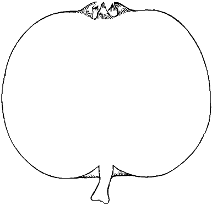
Fruit, small; roundish, narrowing towards the apex, where it is quite flat, and covered with thin russet. Skin, greenish-yellow on the shaded side; but brownish-red where exposed to the sun, and strewed all over with minute russety dots. Eye, prominent, not at all depressed, and closed with broad flat segments. Stalk, half-an-inch long, stout, and inserted in a slight depression. Flesh, greenish, tender, crisp, sweet, and very juicy; with a fine, brisk, poignant, and slightly perfumed flavor, much resembling that of the Golden Pippin and Nonpareil.
A very excellent dessert apple of first-rate quality; it is in use from December to February. The fruit is produced in clusters of sometimes eight and ten, at the ends of the branches.
The tree is of small size and slender growth, and not a free bearer. It is well adapted for dwarf and espalier training when grafted on the doucin or paradise stock, in which case it also bears better than on the crab stock.
According to Mr. Lindley this variety was grown for many years in the old kitchen garden at Kew; and Rogers thinks it first originated in the Turnham Green nursery, which was during a portion of the last century, occupied by a person of the name of Robinson.
303. ROSE DE CHINA.—Hort.
Identification.—Hort. Soc. Cat. ed. 3, n. 718.
Fruit, medium sized, or rather below medium size; roundish and flattened, almost oblate, regularly formed, and without angles. Skin, smooth and delicate, pale greenish-yellow, with a few broken streaks of pale red, intermixed with crimson, on the side exposed to the sun, and strewed with minute dark colored dots. Eye, partially closed, set in a shallow and slightly plaited basin. Stalk, an inch long, very slender, inserted in a round, deep, smooth, and funnel-shaped cavity. Flesh, yellowish-white tinged with green, firm, crisp, and juicy, with a sweet and pleasant flavor.
A very good, but not first-rate, dessert apple; it is in use from November to February. This does not appear to be the “Rose Apple of China” of Coxe, which he imported from England, and which he says is a large oblong fruit with a short thick stalk.
304. ROSEMARY RUSSET.—Ronalds.
Identification and Figure.—Ron. Pyr. Mal. 31, pl. xvi. f. 1.
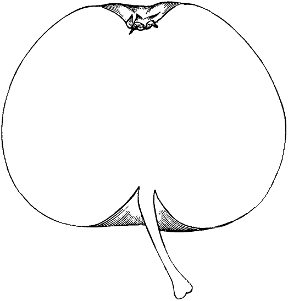
Fruit, below medium size; ovate, broadest at the base and narrowing obtusely towards the apex, a good deal of the shape of a Scarlet Nonpareil. Skin, yellow, tinged with green on the shaded side; but flushed with faint red on the side exposed to the sun, and covered with thin pale brown russet, particularly round the eye and the stalk. Eye, small and open, with erect segments, set in a narrow, round, and even basin. Stalk, very long, inserted in a round and wide cavity. Flesh, yellowish, crisp, tender, very juicy, brisk, and sugary, and charged with a peculiarly rich and highly aromatic flavor.
A most delicious and valuable dessert apple of the very first quality; it is in use from December till February.
305. ROSS NONPAREIL.—Hort.
Identification.—Hort. Trans. vol. iii. p. 454. Hort. Soc. Cat. ed. 3, n. 480. Lind. Guide, 96. Down. Fr. Amer. 95.
Figures.—Pom. Mag. t. 90. Ron. Pyr. Mal. pl. xxxiv. f. 7.
Fruit, medium sized, two inches high, and two inches and a half broad; roundish, even, and regularly formed, narrowing a little towards the eye. Skin, entirely covered with thin russet, and faintly tinged with red on the side next the sun. Eye, small and open, set in a shallow and even basin. Stalk, an inch long, slender, inserted half its length in a round and even cavity. Flesh, greenish-white, firm, crisp, brisk and sugary, charged with a rich and aromatic flavor, which partakes very much of that of the varieties known by the name of Fenouillet, or Fennel-flavored apples.
This is one of the best dessert apples; it is in use from November to February.
The tree is an excellent bearer, hardy, and a free grower, and succeeds well on almost any description of soil.
This variety is of Irish origin.