THE APPLE.—ITS VARIETIES. (continued 5)
Reading edition
306. ROUND WINTER NONESUCH.—Hort.
Identification.—Hort. Soc. Cat. ed. 3, n. 491.
Fruit, large, over three inches wide, and two and a half high; roundish and very considerably flattened, or somewhat oblate; uneven in its outline, caused by several obtuse and unequal, though not prominent ribs on the sides. Skin, thick and membranous, smooth, pale yellow slightly tinged with green on the shaded side; but on the side exposed to the sun, it is marked with broken stripes and spots of beautiful deep crimson, thinly sprinkled all over with a few russety dots. Eye, large and closed, so prominently set and raised above the surface as to appear puffed up, and set on bosses. Stalk, very short, inserted in a round funnel-shaped cavity, and not protruding beyond the base. Flesh, greenish-white, tender, sweet, juicy, and pleasantly flavored.
A culinary apple of first-rate quality; it is in use from November to March.
The tree is an excellent bearer, and the fruit being large and beautiful, this variety is worthy the notice of the market gardener and orchardist.
307. ROYAL PEARMAIN.—Rea.
Identification.—Rea Pom. 210. Lind. Guide, 81. Gibs. Fr. Gard. 357. Rog. Fr. Cult. 73. Diel Kernobst. xii. 132. Meag. Eng. Gard.
Synonymes—Herefordshire Pearmain, Hort. Soc. Cat. ed. 3, 544. Switz. Fr. Gard. 137. Down. Fr. Amer. 112. Hertfordshire Pearmain, Mill. Dict. Pearmain Royal, Knoop Pom. 71, tab. xii. Pearmain Royal De Longue Durée, Ibid. 131. Engelsche Konings of Kings Pepping, Ibid. Merveille Pearmain, Ibid. Pearmain Double, Ibid. Englische Königsparmäne, Diel Kernobst. xii. 132.
Figure.—Ron. Pyr. Mal. pl. xxii. f. 4.
Fruit, large, three inches wide, and the same in height; pearmain-shaped and slightly angular, having generally a prominent rib on one side of it. Skin, smooth, dark dull green at first on the shaded side, but changing during winter to clear greenish-yellow, and marked with traces of russet; on the side next the sun it is covered with brownish-red and streaks of deeper red, all of which change during winter to clear crimson strewed with many russety specks. Eye, small and open, with broad segments which are reflexed at the tips, and set in a wide, pretty deep, and plaited basin. Stalk, from half-an-inch to three quarters long, inserted in a deep cavity which is lined with russet. Flesh, yellowish, tinged with green, tender, crisp, juicy, sugary and perfumed, with a brisk and pleasant flavor.
A fine old English apple, suitable chiefly for culinary purposes, and useful also in the dessert. It comes into use in November and December, and continues till March.
The tree attains the middle size, is a free and vigorous grower, very hardy, and an excellent bearer.
In the Horticultural Society’s Catalogue this is called the old Pearmain, but this name is applicable to the Winter Pearmain. Rea is the first who notices the Royal Pearmain, and he says “it is a much bigger and better tasted apple than the common kind.” The Royal Pearmain of some nurseries is a very different variety from this, and will be found described under Summer Pearmain.
308. ROYAL REINETTE.—Hort.
Identification.—Hort. Trans. vol. iv. p. 529. Hort, Soc. Cat. ed. 3, n. 692. Lind. Guide, 82.
Fruit, large; conical. Skin, yellow, smooth and glossy, strewed all over with russety spots; stained and striped with brilliant red on the side next the sun. Eye, large and open, set in an even and shallow basin. Stalk, very short, inserted in a very narrow and shallow cavity. Flesh, pale yellow, firm and tender, juicy and sugary, with a brisk and pleasant flavor.
A very good apple for culinary purposes, and second-rate for the dessert; it is in use from December to April.
The tree is an abundant bearer, and is extensively grown in the western parts of Sussex, where it is esteemed a first-rate fruit.
309. ROYAL RUSSET.—Miller.
Identification.—Mill. Dict. Hort. Soc. Cat. ed. 3, n. 749. Fors. Treat. 125. Rog. Fr. Cult. 108. Lind. Guide, 96.
Synonyme.—Passe Pomme de Canada, acc. Hort. Soc. Cat. Reinette de Canada Grise, Hort. Soc. Cat. ed. 1, 870. Reinette de Canada Platte, Ibid. 871. Leather Coat, Laws. Orch. 65. Raii. Hist. 1448.
Figure.—Ron. Pyr. Mal. pl. xix. f. 1.
Fruit, large, three inches and a half wide, and two inches and three quarters high; roundish, somewhat flattened and angular. Skin, covered with rough brown russet, which has a brownish tinge on the side next the sun; some portions only of the ground color are visible, which is yellowish-green. Eye, small and closed, set in a narrow and rather shallow basin. Stalk, half-an-inch long, inserted in a wide and deep cavity. Flesh, greenish-yellow, tender, crisp, brisk, juicy and sugary.
A most excellent culinary apple of first-rate quality; it is in use from November to May, but is very apt to shrink and become dry, unless, as Mr. Thompson recommends, it is kept in dry sand.
The tree is of a very vigorous habit, and attains the largest size. It is perfectly hardy and an excellent bearer.
This has always been a favorite old English variety, being mentioned by Lawson so early as 1597, and much esteemed by almost every subsequent writer.
310. ROYAL SHEPHERD.—H.
Fruit, above medium size, three inches wide, and two and three quarters high; roundish, inclining to ovate, slightly ribbed, and narrowing towards the eye. Skin, greenish-yellow in the shade; but covered with dull red next the sun, and strewed all over with minute russety dots. Eye, partially closed, set in a round and rather deep basin. Stalk short, inserted in a deep funnel-shaped cavity, which is lined with ramifications of russet. Flesh, greenish-white, firm, crisp, brisk and pleasantly flavored.
A very good culinary apple, grown in the neighbourhood of Lancaster. It is in use during November and December and will keep till March or April.
311. RUSSET TABLE PEARMAIN.—Hort.
Identification.—Hort. Soc. Cat. ed. 3, n. 557. Ron. Pyr. Mal. 41.
Figure.—Ron. Pyr. Mal. pl. xxi. f. 1.
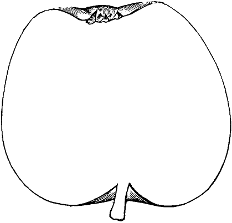
Fruit, below medium size; oblong-ovate. Skin, very much covered with brown russet; except on the shaded side, where there is a little yellowish-green visible, and on the side next the sun, where it is orange, with a flame of deep bright crimson, breaking through the russet. Eye, open, with erect, rigid segments, and set in a wide, shallow, saucer-like, and plaited basin. Stalk, half-an-inch long, slender, and extending beyond the base. Flesh, yellow, firm, very rich, juicy, and sugary, with a fine aromatic, and perfumed flavor.
A beautiful and handsome little apple of first-rate excellence. It is in use from November to February.
312. RUSHOCK PEARMAIN.—M.
Identification and Figure.—Maund. Fruit, 70
Fruit, rather below medium size, two inches and a half wide, and the same in height; conical, even and handsomely formed. Skin, of a fine deep yellow color, almost entirely covered with cinnamon-colored russet, with a brownish tinge on the side next the sun. Eye, large and open, with broad, flat segments, which generally fall off as the fruit ripens. Stalk, a quarter of an inch long, stout, and inserted in a pretty deep cavity. Flesh, yellowish, firm, crisp, and juicy, with a brisk, sub-acid, and sugary flavor.
An excellent dessert apple of first-rate quality; it is in use from Christmas to April. It is frequently met with in the Birmingham markets. This variety was, according to Mr. Maund, raised by a blacksmith of the name of Charles Taylor, at Rushock in Worcestershire, about the year 1821, and is sometimes known by the name of Charles’s Pearmain.
313. RYMER.—Hort.
Identification.—Hort. Trans. vol. iii. p. 329. Hort. Soc. Cat. ed. 3, n. 358. Lind. Guide, 33.
Synonymes.—Caldwell, Hort. Soc. Cat.ed i. 124. Green Cossings, Ibid. 411. Newbold’s Duke of York, Ibid. 286. Cordwall
Figure.—Ron. Pyr. Mal. pl. xli. f. 2.
Fruit, large, three inches and a quarter wide, and two inches and three quarters high; roundish, and flattened, with five obscure ribs, on the sides, extending into the basin of the eye. Skin, smooth, thinly strewed with redish-brown dots, and a few faint streaks of pale red on the shaded side; and of a beautiful deep red, covered with yellowish-grey dots, on the side next the sun. Eye, open, with broad reflexed segments, set in a round and moderately deep basin. Stalk, short, inserted in a round and deep cavity, lined with rough russet, which extends in ramifications over the base. Flesh, yellowish, tender, and pleasantly sub-acid.
A good culinary apple, in use from October to Christmas.
314. SACK AND SUGAR.—Hort.
Identification.—Hort. Soc. Cat. ed. 3, n. 761. Rog. Fr. Cult. 41.
Figure.—Ron. Pyr. Mal. pl. i. f. 1.
Fruit, below medium size, two inches and a quarter wide, and an inch and three quarters high; roundish, inclining to oval, with prominent ridges round the eye. Skin, pale yellow. Eye, large, and open with erect segments, and rather deeply placed in a round, wide, and angular basin. Flesh, white, soft, tender, very juicy, sugary, and pleasantly flavored.
A good early apple, either for culinary purposes or the dessert; ripe in the end of July and beginning of August, and continuing during September.
The tree is a free and vigorous grower, and an immense bearer, so much so, as to be injurious to the crop of the following year.
This apple was raised nearly half a century ago, by Mr. Morris, a market gardener, at Brentford, and is sometimes met with under the name of Morris’s Sack and Sugar.
315. SAINT JULIEN.—Calvel.
Identification.—Cal. Traité, iii. 27. Hort. Soc. Cat. ed. 3, n. 764. Pom. Mag. iii. 165.
Synonymes.—Seigneur d’Orsay, acc. Hort. Soc. Cat. Concombre des Chartreux. Heilige Julians apfel.
Fruit, large, three inches and a quarter wide, and two inches and three quarters high; roundish, narrowing towards the eye, and angular on its sides. Skin, yellowish-green, covered with large patches of ashy colored russet, and in dry warm seasons, sometimes tinged with red. Eye, open, set in a rather shallow and plaited basin. Stalk, an inch long, slender, inserted in a shallow cavity. Flesh, yellowish-white, firm, juicy, sugary, and richly flavored.
A dessert apple of first-rate quality; it is in use from December to March.
The tree is a strong and vigorous grower, and an excellent bearer.
316. SAM YOUNG.—Hort.
Identification.—Hort. Trans. vol. iii. p. 324. Hort. Soc. Cat. ed. 3, n. 768. Lind. Guide, 97. Down. Fr. Amer. 134.
Synonyme.—Irish Russet, Hort. Soc. Cat. ed. i. 985.
Figure.—Pom. Mag. t. 130
Fruit, small, an inch and three quarters high, and about two inches and a half wide; roundish-oblate. Skin, light greenish-yellow, almost entirely covered with grey russet, and strewed with minute russety dots on the yellow part, but tinged with brownish-red on the side next the sun. Eye, large and open, set in a wide, shallow, and plaited basin. Stalk, short, not deeply inserted. Flesh, yellow, tinged with green, firm, crisp, tender, juicy, sugary, and highly flavored.
A delicious little dessert apple, of the first quality; in use from November to February.
This variety is of Irish origin, and was first introduced to public notice by Mr. Robertson, the nurseryman of Kilkenny.
317. SCARLET CROFTON.—Hort.
Identification.—Hort. Trans. vol. iii. p. 453. Hort. Soc. Cat. ed. 3, n. 192.
Synonyme.—Red Crofton, acc. Hort. Soc. Cat.
Fruit, medium sized; oblate, slightly angular on the sides. Skin, covered with yellowish russet, except on the side next the sun, where it is bright red, with a mixture of russet. Eye, set in a wide and shallow basin. Stalk, short, inserted in a moderately deep cavity. Flesh, firm, crisp, juicy, sugary, and richly flavored.
A most delicious dessert apple, of first-rate quality; in use from October to December, and does not become meally.
The Scarlet Crofton is of Irish origin.
318. SCARLET LEADINGTON.—Hort.
Identification.—Hort. Soc. Cat. ed. 3, n. 404.
Fruit, above medium size; oval, angular, broadest at the base and narrowing towards the eye, where it is distinctly four-sided. Skin, striped with yellow, and bright red or scarlet streaks, and thickly covered with russety specks. Eye, large and closed, with long broad segments, and set in a shallow basin. Stalk, short, inserted in a wide and shallow cavity, which is lined with russet. Flesh, yellowish, streaked and veined with pink or lilac-red veins, firm, crisp, juicy, and sugary, with a brisk and pleasant flavor.
An apple much esteemed in Scotland, as a first-rate variety, both for the dessert and culinary purposes; but it does not rank so high in the south; it is in use from November to February.
319. SCARLET NONPAREIL.—Hort.
Identification.—Hort. Soc. Cat. ed. 3, n. 482. Lind. Guide, 98. Fors. Treat. 118. Down. Fr. Amer. 120. Rog. Fr. Cult. 69.
Synonyme.—New Scarlet Nonpariel, acc. Hort. Soc. Cat.
Figures.—Pom. Mag. t. 87. Ron. Pyr. Mal. pl. xxxiv. f. 1.
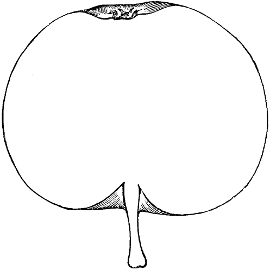
Fruit, medium sized; globular, narrowing towards the apex, regularly and handsomely shaped. Skin, yellowish on the shaded side; but covered with red, which is streaked with deeper red, on the side next the sun; and covered with patches of russet and large russety specks. Eye, open, set in a shallow and even basin. Stalk, an inch or more in length, inserted in a small round cavity, which is lined with scales of silvery grey russet. Flesh, yellowish-white, firm, juicy, rich, and sugary.
A very excellent dessert apple, of first-rate quality; it is in use from January to March.
The tree is hardy, a good grower, though slender in its habit; and an excellent bearer.
The Scarlet Nonpareil, was first discovered growing in the garden of a publican, at Esher, in Surrey, and was first cultivated by Grimwood, of the Kensington nursery.
320. SCARLET PEARMAIN.—Hitt.
Identification.—Hitt Treat. 296. Fors. Treat. 93. Hort. Soc. Cat. ed. 3, n. 558. Lind. Guide, 33. Down. Fr. Amer. 96. Rog. Fr. Cult. 72.
Synonymes.—Bell’s Scarlet Pearmain, Ron. Pyr. Mal. 15. Bell’s Scarlet, Hort. Soc. Cat. ed. i. 767. Oxford Peach Apple, Ibid. 741. Englische Scharlachrothe Parmäne. Diel Kernobst. x. 111.
Figures.—Pom. Mag. t. 62. Ron. Pyr. Mal. pl. viii. f. 2.
Fruit, medium sized, two inches and a half wide, and two inches and a quarter high; conical, regularly and handsomely shaped. Skin, smooth, tender and shining, of a rich, deep, bright crimson, on the side next the sun; but of a paler color, intermixed with a tinge of yellow, on the shaded side; and the whole surface sprinkled with russety dots. Eye, half open, with long broad segments, set in a round, even, and rather deep basin. Stalk, from three quarters to an inch long, deeply inserted in a round, even, and funnel-shaped cavity, which is generally russety at the insertion of the stalk. Flesh, yellowish, with a tinge of red under the skin; tender, juicy, sugary, and vinous.
A beautiful, and handsome dessert apple, of first-rate quality; in use from October to January.
The tree is a free and vigorous grower, attaining about the middle size; and is an excellent bearer. It succeeds well on the paradise stock, on which it forms a good dwarf or espalier tree. The variety called Hood’s Seedling, seems to me to be identical with the Scarlet Pearmain.
321. SCARLET TIFFING.—H.
Fruit, above medium size, three inches wide, and two inches and a quarter high; roundish, inclining to oblate, and irregularly angular. Skin, pale yellow, tinged with green on the shaded side, and round the eye; but deep scarlet where exposed to the sun, extending in general over the greater portion of the fruit. Eye, small and closed, set in an irregular, ribbed, and warted basin. Stalk, fleshy, about half an inch long, inserted in a shallow cavity. Flesh, pure white, very tender, crisp, juicy, and pleasantly acid.
A valuable and excellent culinary apple, much grown in the orchard districts about Lancaster. It is in use during November and December.
322. SCOTCH BRIDGET—H.
Fruit, medium sized, two inches and three quarters wide, and two inches and a quarter high; roundish, broadest at the base, and narrowing towards the apex, where it is rather knobbed, caused by the terminations of the angles on the sides. Skin, smooth, greenish-yellow, on the shaded side, and almost entirely covered with bright deep red on the side next the sun. Eye, closed, set in an angular and warted basin. Stalk, three quarters of an inch long, straight, thick, and stout, inserted in a very narrow and shallow cavity. Flesh, white, tender, soft, juicy, and briskly flavored.
An excellent culinary apple, much grown in the neighbourhood of Lancaster; in use from October to January.
323. SCREVETON GOLDEN PIPPIN.—Hort.
Identification.—Hort. Trans. iv. 218. Hort. Soc. Cat. ed. 3, n. 288.
Fruit, larger than the old Golden Pippin, and little, if at all, inferior to it in flavor. Skin, yellowish, considerably marked with russet. Flesh, yellow, and more tender than the old Golden Pippin.
A dessert apple of first-rate quality; raised in the garden of Sir John Thoroton, Bart., at Screveton, in Nottinghamshire, about the year 1808. It is in use from December to April.
324. SEEK-NO-FARTHER.—Ronalds.
Identification & Figure.—Ron. Pyr. Mal. 45, pl. xxiii. f. 3.
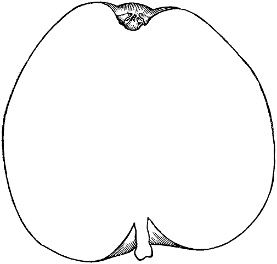
Fruit, medium sized; conical, or pearmain-shaped. Skin, yellowish-green, streaked with broken patches of crimson, on the shaded side; and strewed with grey russety dots; but covered with light red, which is marked with crimson streaks, and covered with patches of fine delicate russet, and numerous large, square, and stelloid russety specks like scales, on the side exposed to the sun. Eye, small and closed, with broad, flat, segments, the edges of which fit neatly to each other, set in a rather deep and plaited basin. Stalk, about half-an-inch long, stout, and inserted in a deep, round, and regular cavity. Flesh, greenish-yellow, crisp, juicy, rich, sugary, and vinous, charged with a pleasant aromatic flavor.
An excellent dessert apple of first-rate quality. It is in use from November to January.
This is the true old Seek-no-farther.
325. SELWOOD’S REINETTE.—Rog.
Identification.—Rog. Fr. Cult. 103.
Fruit, large, three inches wide, and about two inches and a half high; round and flattened, angular on the sides, and with five prominent plaits round the eye, which is small, open, and not at all depressed, but rather elevated on the surface. Skin, pale green, almost entirely covered with red, which is marked with broken stripes of darker red, those on the shaded side being paler, and not so numerous as on the side exposed to the sun. Stalk, about half-an-inch long, very stout, and inserted the whole of its length in a russety cavity. Flesh, greenish-white, tender, brisk, and pleasantly flavored.
A culinary apple, of good, but not first-rate, quality. It is in use from December to March.
The tree is a strong and healthy grower, and an abundant bearer.
This is certainly a different variety from the Selwood’s Reinette of the Horticultural Society’s Catalogue, which is described as being small, pearmain-shaped, greenish-yellow, and a dessert apple. It is however, identical with the Selwood’s Reinette of Rogers, who, as we are informed, in his “Fruit Cultivator,” received it upwards of sixty years ago from Messrs. Hewitt and Co., of Brompton. The tree now in my possession, I procured as a graft from the private garden of the late Mr. Lee, of Hammersmith; and as it has proved to be the same as Rogers’s variety, I am induced to think that it is correct, while that of the Horticultural Society is wrong. It was raised by a person of the name of Selwood, of Lancaster.
326. SHAKESPERE.—M.
Identification & Figure.—Maund Fruit. pl. 71.
Fruit, medium sized, two inches and three quarters wide, and two inches and a half high; roundish, narrowing a little towards the eye. Skin, dark green on the shaded side, and brownish-red on the side next the sun, which is marked with a few broken stripes of darker red; the whole strewed with russety dots. Eye, small, and partially open, set in a narrow and irregular basin, which is ridged round the margin. Stalk, short and slender, inserted in a rather deep cavity. Flesh, greenish-yellow, firm, crisp, and juicy, with a brisk vinous flavor.
An excellent dessert apple, of first-rate quality. In use from Christmas to April.
This variety was raised by Thomas Hunt, Esq., of Stratford-on-Avon, from the seed of Hunt’s Duke of Gloucester, and named in honor of the poet Shakespere.
327. SHEEP’S NOSE.—Hort.
Synonymes.—Bullock’s Pippin, Coxe View, 125. Long Tom, Ibid.
Fruit, large, about three inches and a half long, and about three inches wide; conical, narrowing gradually to the crown, which is considerably higher on one side than the other; generally with ten ribs on the sides. Skin, smooth, yellow, and strewed with a few russety dots. Eye, small, set in a deep, plaited basin. Stalk, short, inserted in a deep round, and russety cavity. Flesh, yellowish-white, tender, very juicy, and sweet.
A very good variety for culinary purposes; but chiefly used as a cider apple in Somersetshire, where it is much grown for that purpose.
328. SHEPHERD’S FAME.—Hort.
Fruit, large, three inches and a quarter wide, and two inches and a half high; obtuse-ovate, broad and flattened at the base, narrowing towards the eye, with five prominent ribs on the sides, and in every respect, very much resembling a small specimen of Emperor Alexander. Skin, smooth, pale straw-yellow, marked with faint broken patches of crimson, on the shaded side; but streaked with yellow and bright crimson, on the side next the sun. Eye, open, with short, stunted segments, placed in a deep, angular, and plaited basin. Stalk, short, imbedded in a round, funnel-shaped cavity. Flesh, yellowish, soft, and tender, transparent, sweet, and briskly flavored, but rather dry.
An apple of very ordinary quality, in use from October to March.
329. SIBERIAN BITTER SWEET.—Knight.
Identification.—Pom. Heref. t. 23. Lind. Guide, 111. Down. Fr. Amer. 146.
Fruit, small, and nearly globular. Eye, small, with short connivent segments of the calyx. Stalk, short. Skin, of a bright gold color, tinged with faint and deeper red on the sunny side. The fruit grows a good deal in clusters, on slender wing branches.
Specific gravity of the juice, 1091.
This remarkable apple was raised by Mr. Knight from the seed of the Yellow Siberian Crab, impregnated with the pollen of the Golden Harvey. I cannot do better than transcribe from the Transactions of the London Horticultural Society, Mr. Knight’s own account of this apple. “The fruit contains much saccharine matter, with scarcely any perceptible acid; and it in consequence affords a cider, which is perfectly free from the harshness which in that liquid offends the palate of many, and the constitution of more; and I believe that there is not any county in England in which it might not be made to afford, at a moderate price, a very wholesome and very palatable cider. This fruit differs from all others of its species with which I am acquainted, in being always sweet, and without acidity, even when it is more than half grown.
“When the juice is pressed from ripe, and somewhat mellow fruit, it contains a very large portion of saccharine matter; and if a part of the water it contains be made to evaporate in a moderately low temperature, it affords a large quantity of a jelly of intense sweetness, which to my palate is extremely agreeable; and which may be employed for purposes similiar to those to which the inspissated juice of the grape is applied in France. The jelly of the apple prepared in the manner above described, is, I believe, capable of being kept unchanged during a very long period in any climate; the mucilage being preserved by the antiseptic powers of the saccharine matter, and that being incapable of acquiring, as sugar does, a state of crystallization. If the juice be properly filtered, the jelly will be perfectly transparent.”
The tree is a strong and vigorous grower; a most abundant bearer, and a perfect dreadnought to the woolly aphis.
330. SIBERIAN HARVEY.—Knight.
Identification.—Pom. Heref. t. 23. Lind. Guide, 111. Hort. Soc. Cat. ed. 3, n. 777.
Fruit, produced in clusters, small; nearly globular. Eye, small, with short connivent segments of the calyx. Stalk, short. Skin, of a bright gold color, tinged with faint and deeper red on the sunny side. Juice very sweet. Ripe in October.
Specific gravity of the juice, 1091.
A cider apple raised by T. A. Knight, Esq., and, along with the Foxley, considered by him superior to any other varieties in cultivation. It was produced from a seed of the Yellow Siberian Crab, fertilized with the pollen of the Golden Harvey, the juice of this variety is most intensely sweet, and is probably, very nearly what that of the Golden Harvey would be in a southern climate, the original tree produced its blossoms in the year 1807, when it first obtained the annual premium of the Herefordshire Agricultural Society.
331. SIELY’S MIGNONNE.—Lind.
Identification.—Lind. Guide, 98.
Synonyme.—Pride of the Ditches, acc. Lind. Guide.
Fruit, rather small, about one inch and three quarters deep, and the same in diameter; almost globular, but occasionally flattened on one side. Eye, small, with a closed calyx, placed somewhat deeply in a rather irregularly formed narrow basin, surrounded by a few small plaits. Stalk, half-an-inch long, slender, about one half within the base, in a narrow cavity, and occasionally pressed towards one side by a protuberance on the opposite one. Skin, when clear, of a bright yellow, but mostly covered with a grey netted russet, rendering the skin scabrous. Flesh, greenish-yellow, firm, crisp, and tender. Juice, saccharine, highly aromatic, and of a most excellent flavor.
A dessert apple, in use from November to February.
This neat and very valuable little apple, was introduced to notice about the beginning of the present century, by the late Mr. Andrew Siely, of Norwich, who had it growing in his garden on the Castle Ditches, and being a favorite with him he always called it the “Pride of the Ditches.” The tree is a weak grower and somewhat tender. It is therefore advisable to graft it on the doucin stock, and train it either as a dwarf or as an espalier in a garden.—Lindley.
332. SIR WILLIAM GIBBON’S.—Hort.
Fruit, very large, three inches and three quarters wide, and three inches high; calville-shaped, being roundish-oblate, with several prominent angles, which extend from the base to the apex, where they terminate in five or six large unequal knobs. Skin, deep yellow, tinged with green, and strewed with minute russety dots on the shaded side; but deep crimson, streaked with dark red, on the side exposed to the sun. Eye, open, with short ragged segments, set in a deep, wide, and irregular basin. Stalk, very short, imbedded in a deep and angular cavity, which is lined with russet. Flesh, yellowish-white, crisp, juicy, and slightly acid, with a pleasant vinous flavor.
A very showy and excellent culinary apple, in use from November to January.
333. SLEEPING BEAUTY.—H.
Synonymes.—Winter Sleeping Beauty. Sleeper.
Fruit, medium sized; roundish, and somewhat flattened, slightly angular on the sides, and undulating round the eye; in some specimens there is an inclination to an ovate, or conical shape, in which case the apex is narrow and even. Skin, pale straw-colored, smooth and shining, occasionally washed on one side with delicate lively red, very thinly sprinkled with minute russety dots. Eye, large, somewhat resembling that of Trumpington, with broad, flat, and incurved segments, which dove-tail, as it were, to each other, and set in a shallow, uneven, and plaited basin. Stalk, from a quarter to half-an-inch long, slightly fleshy, inserted in a narrow, round, and rather shallow cavity, which is tinged with green, and lined with delicate pale brown russet. Flesh, yellowish-white, crisp, tender, and juicy, with a fine poignant and agreeably acid flavor.
A most excellent, and very valuable apple for all culinary purposes; and particularly for sauce. It is in use from November till the end of February.
The tree is a most excellent bearer, and succeeds well in almost every situation.
This excellent apple bears such a close resemblance to Dumelow’s Seedling, that at first sight it may be taken for that variety; from which however, it is perfectly distinct, and may be distinguished by the want of the characteristic russet dots on the fruit, and the spots on the young wood of the tree. It is extensively cultivated in Lincolnshire, for the supply of the Boston markets.
334. SMALL STALK.—H.
Fruit, medium sized, two inches and a half wide, and two inches high; roundish, slightly angular on the sides, and knobbed at the apex. Skin, dull greenish-yellow, with a tinge of orange on the side next the sun, and thickly covered with redish brown dots. Eye, small, and closed with long flat segments, and placed in an angular basin. Stalk, about an inch long, slender, inserted in a wide and rather shallow cavity. Flesh, white, tender, juicy, and well flavored.
A good apple for ordinary purposes, much grown about Lancaster. It is in use during September and October.
335. SOMERSET LASTING.—Hort.
Identification.—Hort. Soc. Cat. ed. 2, n. 782.
Figure—Ron. Pyr. Mal. pl. xvii. f. 2.
Fruit, large, three inches and a quarter wide, and two inches and a quarter high; oblate, irregular on the sides, and with undulating ridges round the eye. Skin, pale yellow, streaked, and dotted with a little bright crimson, next the sun. Eye, large and open, with short stunted segments, placed in a wide and deep basin. Stalk, short, inserted in a wide and deep cavity, which is lined with russet. Flesh, yellowish, tender, crisp, very juicy, with a poignant, and somewhat harsh flavor.
A culinary apple, in use from October to February.
336. SOPS IN WINE.—Park.
Identification.—Park. Par. 588. Raii. Hist. ii. 1447.
Synonymes.—Sops of Wine, Hort. Soc. Cat. ed. 3, n. 874. Lind. Guide, 34. Down. Fr. Amer. 77. Sapson, Ken. Amer. Or. 28. Sapsonvine, acc. Kenrick.
Figure.—Ron. Pyr. Mal. pl. ii. f. 4.
Fruit, rather above medium size, two inches and three quarters broad, and the same in height; roundish, but narrowing a little towards the eye, and slightly ribbed on the sides. Skin, covered with a delicate white bloom, which when rubbed off exhibits a smooth, shining, and varnished rich deep chestnut, almost approaching to black, on the side exposed to the sun; but on the shaded side, it is of a light orange red, and where very much shaded quite yellow, the whole strewed with minute dots. Eye, small, half open, with long, broad, and reflexed segments, placed in a round and slightly angular basin. Stalk, half-an-inch long, inserted in a deep funnel-shaped cavity. Flesh, red, as if sopped in wine, tender, sweet, juicy, and pleasantly flavored.
A very ancient English culinary and cider apple; but perhaps more singular than useful. It is in use from October to February.
The tree is vigorous and spreading, very hardy, an excellent bearer, and not subject to canker.
337. SPICE APPLE.—Diel.
Identification—Diel Kernobst. x. 34.
Fruit, medium sized, two inches and a half broad, and two and a quarter high; roundish, but narrowing towards the eye. Skin, deep yellow, but marked with broad streaks of crimson on the side next the sun. Eye, open, with long, broad, reflexed, downy segments, set in a narrow, shallow, and plaited basin. Stalk, short, inserted in a round cavity, which is lined with russet. Flesh, yellow, firm, crisp, brisk, and perfumed.
A good second-rate dessert apple, in use from November to February.
This is not the Spice Apple of the Horticultural Society’s Catalogue, but one which was cultivated by Kirke, of Brompton, under that name, and so described by Diel.—See Aromatic Russet.
338. SPITZEMBERG.—Booth Cat.
Identification and Figure.—Ron. Pyr. Mal. pl. i. f. 5.
Synonyme.—Pomegranate Pippin, acc. Ron. Pyr. Mal.
Fruit, medium sized, two inches and a half broad, and two inches high; roundish, flattened at the base, and narrowing a little towards the eye. Skin, deep yellow, with an orange tinge on the side exposed to the sun, and strewed with large stelloid russety specks. Eye, partially open, with long, broad, and erect segments, set in a narrow and shallow basin. Stalk, short and stout, inserted in a small narrow cavity. Flesh, tender, juicy, sweet, and pleasantly flavored.
An apple of second-rate quality, in use from November to Christmas.
This is the Spitzemberg of the German nurseries.
339. SPRINGROVE CODLIN.—Hort.
Identification.—Hort. Trans. vol. i. p. 197. t. 11. Lind. Guide, 7. Rog. Fr. Cult. 65.
Figure.—Ron. Pyr. Mal. pl. iii. f. 4. Hort. Trans.
Fruit, above medium size, three inches wide at the base, and two inches and three quarters high; conical, and slightly angular on the sides. Skin, pale greenish-yellow, tinged with orange on the side exposed to the sun. Eye, closed, with broad segments, and set in a narrow, plaited basin. Stalk, short, inserted in a rather deep cavity. Flesh, greenish-yellow, tender, juicy, sugary, brisk, and slightly perfumed.
A first-rate culinary apple. It may be used for tarts, as soon as the fruit are the size of a walnut, and continues in use up to the beginning of October. It received the name of Springrove Codlin, from being first introduced by Sir Joseph Banks, Bart., who resided at Springrove, near Hounslow, Middlesex.
340. SQUIRE’S GREENING.—H.
Fruit, about medium size; roundish and flattened, irregular in its outline, having sometimes very prominent, unequal, and obtuse angles, on the sides, which terminate in undulations round the eye. Skin, of a fine clear grass-green color, which it retains till the spring, covered with dull brownish-red where exposed to the sun, thinly strewed all over with minute dots. Eye, small and closed, inserted in a narrow, irregular, and plaited basin. Stalk, short and slender, inserted in a round, narrow, and deep cavity, which is lined with rough scaly russet. Flesh, yellowish-white, firm and crisp, with a brisk, somewhat sugary and pleasant flavor.
A good culinary apple, and useful also as a dessert variety. It is in use from Christmas till April or May.
This variety was raised on the property of Mrs. Squires, of Nigtoft, near Sleaford.
341. STEAD’S KERNEL.—Knight.
Identification.—Pom. Heref. t. 25. Lind. Guide, 112.
Fruit, a little turbinate, or top-shaped, somewhat resembling a quince. Eye, small, flat, with a short truncate or covered calyx. Stalk, short. Skin, yellow, a little reticulated with a slight greyish russet, and a few small specks intermixed.
Specific gravity of the juice, 1074.
As a cider apple, this appears to possess great merit, combining a slight degree of astringency, with much sweetness. It ripens in October, and is also a good culinary apple during its season. It was raised from seed by Daniel Stead, Esq., Brierly, near Leominster, Herefordshire.—Knight & Lindley.
342. STIRZAKER’S EARLY SQUARE.—H.
Fruit, below medium size; roundish, with prominent ribs which run into the eye, forming sharp ridges at the crown. Skin, of an uniform pale yellow, freckled and mottled, with very thin dingy brown russet on the shaded side, and, completely covered with the same on the side next the sun. Eye, small, half open, set in an irregular and angular basin. Stalk, very short, imbedded in a deep cavity. Flesh, white, tender, juicy, and pleasantly flavored.
An early apple, grown in the neighbourhood of Lancaster. It is ripe in August, and continues in use during September.
343. STRIPED BEEFING.—H.
Synonymes.—Striped Beaufin. Lind. Guide, 57.
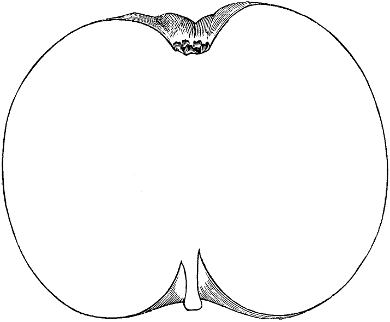
Fruit, of the largest size; beautiful and handsome, roundish, and somewhat depressed. Skin, bright lively green, almost entirely covered with broken streaks, and patches of fine deep red, and thickly strewed with russety dots; in some specimens the color extends almost entirely round the fruit. Eye, like that of the Blenheim Pippin, large and open, with short erect ragged segments, set in a deep, irregular, and angular basin. Flesh, yellowish, firm, crisp, juicy, and pleasantly acid.
One of the handsomest and best culinary apples in cultivation; for baking it is unrivalled. It is in use from October till May.
The tree is very hardy, and an excellent bearer.
This noble apple was introduced by Mr. George Lindley, who found it growing in 1794, in the garden of William Crowe, Esq., at Lakenham near Norwich. He measured a specimen of the fruit, and found it twelve inches and a half in circumference, and weighing twelve ounces and a half, avoirdupoise. It does not seem ever to have been in general cultivation, as it is not mentioned in any of the nursery catalogues; nor is it enumerated in that of the London Horticultural Society. Through the kindness of George Jefferies, Esq., of Marlborough Terrace, Kensington, who procured it from his residence in Norfolk, I had the good fortune in 1847, to obtain grafts, which when propagated, I distributed through several of the principal nurseries of the country, and by this means I trust, it will become more generally known, and universally cultivated.
344. STRIPED MONSTROUS REINETTE.—Hort.
Identification.—Hort. Soc. Cat. ed. 3, p. 37. Ron. Pyr. Mal. pl. xxxvi. f. 1.
Fruit, large, three inches and a half broad, and three inches high; roundish, and a little flattened, irregular in its outline, having prominent angles on the sides, which extend from the base to the apex. Skin, smooth, of a deep yellow-ground color, which is almost entirely covered with pale red, and streaked with broad stripes of dark crimson. Eye, closed, with long acuminate segments, set in a narrow, angular basin. Stalk, an inch long, slender, deeply inserted in a round, and russety cavity. Flesh, white, tender, juicy, and pleasantly flavored.
A culinary apple of second-rate quality. It is in use during November and December.
345. STURMER PIPPIN.—Hort.
Identification.—Hort. Soc. Cat. ed. 3, n. 808. Down. Fr. Amer, 135. Gard. Chron. 1847, 135.
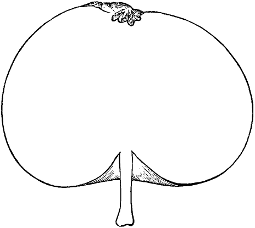
Fruit, below medium size, two inches and a quarter broad, by one inch and three quarters high; roundish, and somewhat flattened, and narrowing towards the apex, a good deal resembling the old Nonpariel. Skin, of a lively green color, changing to yellowish-green, as it attains maturity, and almost entirely covered with brown russet, with a tinge of dull red, on the side next the sun. Eye, small, and closed, set in a shallow, irregular, and angular basin. Stalk, three quarters of an inch long, straight, inserted in a round, even, and russety cavity. Flesh, yellow, firm, crisp, very juicy, with a brisk and rich sugary flavor.
This is perhaps the most valuable dessert apple of its season, it is of first-rate excellence; and exceedingly desirable both on account of its delicious flavor, and arriving at perfection, at a period when the other favorite varieties are past. It is not fit for use till the Ribston Pippin is nearly gone, and continues long after the Nonpariel. The period of its perfection may be fixed from February to June.
The Sturmer Pippin, was raised by Mr. Dillistone, a nurseryman at Sturmer, near Haverhill, in Suffolk, and was obtained by impregnating the Ribston Pippin, with the pollen of the Nonpareil.
The tree is hardy and an excellent bearer, and attains about the middle size.
346. SUGAR AND BRANDY.—H.
Fruit, medium sized, two inches and three quarters broad at the bulge, and the same in height; conical, and angular, with a very prominent rib on one side, forming a high ridge at the apex, terminated at the apex, by a number of knobs which are the continuations of the costal angles. Skin, deep dull yellow, freckled with pale red on the shaded side, the remaining portion entirely covered with bright orange-red. Eye, small and closed, set in a deep and furrowed basin. Stalk, very short, inserted in a round and shallow cavity, which is lined with rough russet. Flesh, deep yellow, spongy, juicy, very sweet, so much so, as to be sickly.
An apple grown about Lancashire, in use during the end of August and September.
347. SUGAR-LOAF PIPPIN.—Hort.
Identification.—Hort. Soc. Cat. ed. 3, n. 811. Lind. Guide, 10. Down. Fr. Amer. 76.
Synonymes.—Hutching’s Seedling, acc. Pom. Mag. Dolgoi Squoznoi, in Russia, acc. Pom. Mag.
Figure.—Pom. Mag. t. 3.
Fruit, above medium size, two inches and three quarters wide, and three inches high; oblong. Skin, clear pale yellow, becoming nearly white, when fully ripe. Eye, set in a rather deep and plaited basin. Stalk, an inch long, inserted in a deep and regular cavity. Flesh, white, firm, crisp, juicy, brisk, and pleasantly flavored.
An excellent early culinary apple of first-rate quality; ripe in the beginning of August, but in a few days becomes mealy.
This variety was introduced from St. Petersburg, by the London Horticultural Society.
348. SUMMER BROAD-END.—H.
Synonymes.—Summer Broadend, Lind. Guide, 24. Summer Colman, Lind. Plan. Or. 1796.
Fruit, above the middle size, about two inches and three quarters in diameter, and two inches and a quarter deep; slightly angular on the sides. Eye, small, with a closed calyx, in a rather narrow basin, surrounded by some angular plaits. Stalk, short, slender, deeply inserted, not protruding beyond the base. Skin, dull yellowish-green, tinged on the sunny side, with pale dull brown. Flesh, greenish-white, not crisp. Juice, sub-acid, with a pretty good flavor.
A culinary apple in use in October and November. This is an useful Norfolk apple, and known in the markets by the above name. The trees are rather small growers, but great bearers.—Lindley.
I have never seen the Summer Broad-End, and have therefore here introduced the description of Mr. Lindley, for the benefit of those under whose observation it may fall.
349. SUMMER GOLDEN PIPPIN.—Hort.
Identification.—Hort. Soc. Cat. ed. 3, n. 290. Lind. Guide, 7. Down. Fr. Amer, 77. Rog. Fr. Cult. 78.
Synonymes.—Summer Pippin, acc. Hort. Soc. Cat. White Summer Pippin, Ron. Pyr. Mal. 11.
Figures.—Pom. Mag. t. 50. Ron. Pyr. Mal. pl. vi. f. 4.
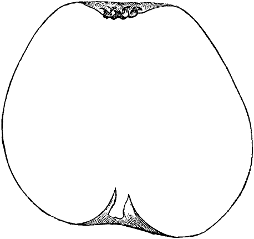
Fruit, below medium size, two inches and a quarter broad at the base, and two inches and a quarter high; ovate, flattened at the ends. Skin, smooth and shining, pale yellow, on the shaded side; but tinged with orange and brownish-red on the side next the sun, and strewed over with minute russety dots. Eye, open, set in a wide, shallow, and slightly plaited basin. Stalk, thick, a quarter of an inch long, completely imbedded in a moderately deep cavity, which is lined with russet. Flesh, yellowish, firm, very juicy, with a rich, vinous, and sugary flavor.
This is one of the most delicious summer apples, and ought to form one of every collection, however small. It is ripe in the end of August, and keeps about a fortnight.
The tree is a small grower, and attains about the third size. It is an early and abundant bearer, and succeeds well when grafted on the doucin or paradise stock. When grown on the pomme paradis of the French, it forms a beautiful little tree, which can be successfully cultivated in pots.
350. SUMMER PEARMAIN.—Park.
Identification.—Park. Par. 587. Aust. Or. 54. Raii. Hist. ii. 1447. Mill. Dict. Fors. Treat. ed. 7, 126. Lind. Guide, 34. Rog. Fr. Cult. 72.
Synonymes.—Autumn Pearmain, Hort. Soc. Cat. ed. 3, n. 531. American Pearmain, acc. Hort. Soc. Cat. Gestreifte Sommerparmäne. Drue Summer Pearmain. Diel Kernobst. vi.129.
Figures.—Pom. Mag., t. 116. Ron. Pyr. Mal. pl. xxii. f. 1.
Fruit, medium sized, two inches and three quarters wide at the base, and the same high; conical, or abrupt pearmain-shaped, round at the base, and tapering towards the apex. Skin, yellow, streaked all over with large patches, and broken streaks of red, mixed with silvery russet, strewed with numerous russety dots, and covered with large patches of rough russet on the base. Eye, closed, half open, with long acuminate segments, placed in a wide, shallow, and plaited basin. Stalk, half-an-inch long, obliquely inserted under a fleshy protuberance on one side of it, which is a permanent and distinguishing character of this apple. Flesh, deep yellow, firm, crisp, juicy, richly, and highly perfumed.
An excellent apple, long cultivated, and generally regarded as one of the popular varieties of this country, it is suitable either for culinary purposes, or the dessert, and is in use during September and October.
The tree is a good grower, and healthy; of an upright habit of growth, and forms a fine standard tree of the largest size. It succeeds well grafted on the paradise stock, when it forms handsome espaliers, and open dwarfs.
This is what in many nurseries is cultivated as the Royal Pearmain, but erroneously. It is one of the oldest English varieties, being mentioned by Parkinson, in 1629.
351. SUMMER STRAWBERRY.
Fruit, rather below medium size, two and a half inches broad, and an inch and three quarters high; oblate, even and regularly formed. Skin, smooth and shining, striped all over with yellow, and blood-red stripes, except on any portion that is shaded, and there it is red. Eye, prominent, not at all depressed, closed with long flat segments, and surrounded with prominent plaits. Stalk, three quarters of an inch long, inserted in a round, narrow cavity, which is lined with russet. Flesh, white, tinged with yellow, soft, tender, juicy, brisk and pleasantly flavored.
A dessert apple, ripe in September, but when kept long becomes dry and mealy. It is much cultivated in all the Lancashire and northern orchards of England.
352. SURREY FLAT-CAP.—H.
Fruit, above medium size, three inches wide, and two inches and a quarter high; oblate, even and regularly formed. Skin, of a pale bluish-green, or verdigris color, changing as it ripens to a yellowish tinge, and marked with dots and flakes of rough veiny russet, on the shaded side; but deep red, which is almost obscured with rough veiny russet on the side next the sun. Eye, open, with broad segments, reflexed at the tips, set in a wide, shallow, and plaited basin. Stalk, half-an-inch long, inserted in a round and deep cavity. Flesh, yellow, firm, not very juicy, but rich and sugary.
A very excellent dessert apple, remarkable for its singular color, but is rather void of acidity. It is in use from October to January.
353. SWEENY NONPAREIL.—Hort.
Identification.—Hort. Trans. vol. iv. 526. Lind. Guide, 99. Hort. Soc. Cat. ed. 3, n. 484.
Fruit, above medium size, two inches and three quarters broad, and two inches high; very similar in form to the old Nonpariel. Skin, of a fine lively green color, which is glossy and shining, but almost entirely covered with patches, and reticulations of thick greyish-brown russet, which in some parts is rough and cracked; sometimes tinged with brown where exposed to the sun. Eye, very small, half open, with short, flat, ovate segments, and set in a small, narrow, and rather shallow basin. Stalk, three quarters of an inch long, inserted in a rather shallow and russety cavity. Flesh, greenish-white, firm, crisp, sugary, and with a very powerful yet pleasant sub-acid flavor.
An excellent culinary apple admirably adapted for sauce; but too acid for the dessert. It is in use from January to April.
The tree is a vigorous grower, and an excellent bearer.
This variety was raised in 1807, by Thomas Netherton Parker, Esq., of Sweeny, in Shropshire, and twenty specimens of the fruit, were exhibited at the London Horticultural Society, in 1820, the aggregate weight of which, was seven pounds thirteen ounces.
354. SYKE HOUSE RUSSET.—Hooker.
Identification.—Hook. Pom. Lond. Hort. Soc. Cat. ed. 3, n. 752. Lind. Guide, 100. Fors. Treat. 126. Rog. Fr. Cult. 106.
Synonymes.—Sykehouse, acc. Hort. Soc. Cat. Englische Spitalsreinette, Diel Kernobst. x. 139.
Figures.—Hook. Pom. Lond. t. 40. Pom. Mag. t. 81. Ron. Pyr. Mal. pl. xxxviii. f. 1.
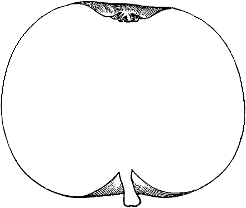
Fruit, below medium size, two inches and a quarter broad, by one inch and three quarters high; roundish-oblate. Skin, yellowish-green, but entirely covered with brown russet, strewed with silvery grey scales; sometimes it has a brownish tinge on the side which is exposed to the sun. Eye, small and open, set in a shallow basin. Stalk, half-an-inch long, inserted in a shallow cavity. Flesh, yellowish, firm, crisp, and juicy, with a rich, sugary, and very high flavor.
One of the most excellent dessert apples; it is in use from October to February.
The tree is a free grower, hardy, and an excellent bearer; it attains about the middle size, and is well adapted for growing as an espalier, when grafted on the paradise stock.
This variety originated at the village of Syke House, in Yorkshire, whence its name.
Diel’s nomenclature of the Syke House Russet, affords a good example of the transformations the names of fruits are subject to, when translated from one language to another; he writes it Englische Spitalsreinette, which he translates Sik-House Apple, because as he supposed it received this appellation, either from the briskness of its flavor being agreeable to invalids, or from its having originated in the garden of an hospital, He says he finds it only in Kirke’s Fruit Tree Catalogue, where it is erroneously printed Syke-House!
355. TARVEY CODLIN.—Hort.
Identification.—Hort. Trans. vol. vii. p. 383. Hort. Soc. Cat. ed. 3, n. 167. Lind. Guide, 83.
Fruit, large and conical. Skin, dull olive-green, with an imperfect mixture of yellow on the shaded side, and yellowish-red, much spotted with broken rows of large blood-red dots, next the sun. Flesh, white and juicy, somewhat resembling the English Codlin.
A good culinary apple for a northern climate, in use during November and December.
This variety was raised from seed of the Manks Codlin, impregnated with the Nonpariel, by Sir. G. S. Mackenzie, Bart., of Coul, in Rosshire.
356. TAUNTON GOLDEN PIPPIN.—Hort.
Identification.—Hort. Soc. Cat. ed. 3, p. 18.
Figure.—Maund. Fruit. pl. 21.
Fruit, below medium size, two inches and a quarter wide, and the same in height; oblato-cylindrical, regularly and handsomely shaped. Skin, deep rich yellow, strewed with markings and freckles of russet on the shaded side, but covered with a cloud of red, which is marked with deeper red streaks, on the side next the sun. Eye, open, set in a wide, rather deep, and plaited basin. Stalk, short, inserted in a narrow, and rather shallow cavity. Flesh, yellow, firm, crisp, and delicate, with a brisk, sugary, and particularly rich vinous flavor.
A dessert apple of first-rate quality; in use from December to March.
The tree is hardy, healthy, and an abundant bearer, attaining about the middle size. It is well adapted for growing on the paradise stock.
357. TEN SHILLINGS—Hort.
Identification.—Hort. Soc. Cat. ed. 3, n. 824.
Fruit, medium sized, two inches and a half broad, and two inches high; roundish-oblate, with obtuse angles on the sides. Skin, greenish-yellow, almost entirely covered with pale brown russet; but with orange, streaked with red, on the side next the sun. Eye, large, with long narrow segments, which are not convergent, set in an angular basin. Stalk, half-an-inch long, inserted in a moderately deep cavity. Flesh, yellowish-white, tender, sweet, and slightly acid.
A second-rate dessert apple; ripe in November.
358. TENTERDEN PARK.—Hort.
Identification.—Hort. Soc. Cat. ed. 3, n. 825.
Fruit, about medium size, two inches and a half broad, by two inches high; roundish, inclining to ovate. Skin, smooth and glossy, as if varnished, yellowish-green where shaded, and entirely covered with deep red, which is marked with streaks of still deeper red, where exposed to the sun. Eye, large, half open, with broad, flat segments, set in a rather shallow, round, and saucer-like basin. Stalk, very short, inserted in a round and shallow cavity, which is slightly marked with russet. Flesh, greenish-white, tender, crisp, brisk, and juicy, but with no particular richness of flavor.
A second-rate dessert apple, of neat and handsome appearance; in use from October to February.
359. TEUCHAT’S EGG.—Gibs.
Identification.—Gibs. Fr. Gard. 351.
Synonymes.—Chucket Egg, Hort. Soc. Cat. ed. 3, p. 10. Summer Teuchat Egg, Leslie & Anders. Cat.
Fruit, below medium size, varying in shape from ovate to conical, and irregularly ribbed on the sides. Skin, pale yellow, washed with pale red, and streaked with deep and lively red. Eye, partially closed, with long, broad segments, placed in a narrow and angular basin. Stalk, very short, imbedded in a close shallow cavity, with a fleshy protuberance on one side of it, and surrounded with rough russet. Flesh, tender, juicy, and pleasantly flavored.
A second-rate dessert apple, peculiar to the Scotch orchards of Clydesdale and Ayrshire; ripe in September.
Teuchat signifies, the Pee-wit or Lapwing.
360. TOKER’S INCOMPARABLE.
Fruit, very large, three inches and three quarters broad, and two inches and three quarters high, in shape, very much resembling the Gooseberry Apple; ovate, broad and flattened at the base, and with five prominent ribs on the sides which render it distinctly five-sided. Skin, smooth and shining, of a beautiful dark green, which assumes a yellowish tinge as it ripens; and with a slight trace of red, marked with a few crimson streaks, where exposed to the sun. Eye, large, and nearly closed, with broad flat segments, set in a saucer-like basin, which is surrounded with knobs, formed by the termination of the ribs. Stalk, a quarter of an inch long, inserted in a wide cavity, which is lined with a little rough russet. Flesh, yellowish, firm, crisp, tender, juicy, and marrow-like, with a brisk and pleasant acid.
A first-rate culinary apple, grown in the Kentish orchards, about Sittingbourne and Faversham; in use from November to Christmas.
361. TOWER OF GLAMMIS.—Hort.
Identification.—Hort. Soc. Cat. ed. 3, n. 835. Leslie & Anders. Cat. 43. Caled Hort. Soc. Mem. vol. iv. 474.
Synonymes.—Glammis Castle, acc. Hort. Soc. Cat. Late Carse of Gowrie, Ibid. Carse of Gowrie, Caled. Hort. Soc. Mem, vol. i. 325. The Gowrie, in Clydesdale Orchards.
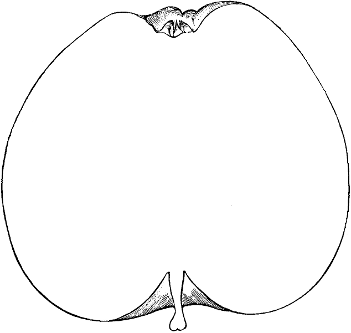
Fruit, large; conical, and distinctly four-sided, with four prominent angles, extending from the base to the apex, where they terminate in four corresponding ridges. Skin, deep sulphur-yellow, tinged in some spots with green, and thinly strewed with brown russety dots. Eye, closed, with broad ragged segments, set in a deep and angular basin. Stalk, an inch long, inserted in a deep, funnel-shaped cavity, and only just protruding beyond the base. Flesh, greenish-white, very juicy, crisp, brisk, and perfumed.
A first-rate culinary apple, peculiar to the orchards of Clydesdale, and the Carse of Gowrie; it is in use from November to February.
The tree is an excellent bearer.
362. TRANSPARENT CODLIN.—Lind.
Identification.—Lind. Guide, 35. Hort. Soc. Cat. ed. 3, n. 169.
Fruit, large and conical. Skin, smooth, clear yellow, tinged with pale crimson, on the side exposed to the sun. Eye, small and closed, with short segments, placed in a deep and angular basin. Stalk, short and slender, inserted in a deep, round, and wide cavity. Flesh, tender, almost transparent, juicy, sugary, and well flavored.
A culinary apple, in use from September to November.
363. TRUMPETER.—H.
Synonyme.—Treadle-Hole, in Lancaster.
Fruit, large, two inches and three quarters wide, and three inches high; oblong, irregularly shaped, angular on the sides, and prominently ribbed round the eye. Skin, pale green, with a tinge of yellow on the side exposed to the sun. Eye, small, closed, and set in a deep and angular basin, surrounded with four or five prominent knobs. Stalk, about five-eights of an inch long, slender for the size of the fruit, and inserted in a deep irregular cavity, which is lined with rough cracked russet. Flesh, greenish-white, crisp, very juicy, and sweet, with a brisk and pleasant sub-acid flavor.
A very excellent apple either for the dessert or culinary purposes, much esteemed in the orchards about Lancaster; it is in use from October to January.
364. TRUMPINGTON.—Hort.
Identification.—Hort. Soc. Cat. ed. 3, p. 44.
Synonymes.—Delware, Ron. Pyr. Mal. 75. Eve, acc. Hort. Soc. Cat.
Figure.—Ron. Pyr. Mal. pl. xxxviii. f. 2.
Fruit, small, two inches and three-eights wide, and one inch and five-eights high; oblate, even and handsomely shaped. Skin, of a fine deep golden-yellow, tinged and mottled with pale red on the shaded side; but of a fine bright red, which extends over the greater part, where exposed to the sun. Eye, large and closed, with broad, flat, ovate segments, set in a wide and somewhat undulating basin. Stalk, a quarter of an inch long, inserted in a wide, and deep cavity, which is tinged with green, and lined with russet. Flesh, white, firm, and pleasantly flavored.
A pretty dessert apple of second-rate quality; in use from September to Christmas.
365. TULIP.—Hort.
Identification.—Hort. Soc. Cat. ed. 3, n. 841.
Synonymes.—Tulp, acc. Hort. Soc. Cat. Tulpen, Ibid. Dutch Tulip, Ron. Cat.
Fruit, rather below medium size, two inches and a half at the widest part, and two inches and a half high; ovato-conical, regularly and handsomely shaped, ridged round the eye. Skin, fine deep purple, extending over the whole surface of the fruit, except on any part which may be shaded, and then it is yellow. Eye, open, with short, ovate segments, set in a furrowed and plaited basin. Stalk, about half-an-inch long, straight and slender, inserted in a deep, and rather angular cavity. Flesh, greenish-yellow, crisp, juicy, sweet, and slightly sub-acid.
A beautiful and handsome dessert apple, but only of second-rate quality; in use from November to April.
366. TURK’S CAP.—Hort.
Fruit, large, three inches and a half wide, by two inches and a half high; roundish, and very much flattened, or oblate; irregularly and prominently ribbed. Skin, smooth, fine deep golden-yellow, covered with grey dots, and a few ramifications of russet, and with a brownish-red tinge on the side next the sun. Eye, large and open, placed in a deep, wide, and angular basin. Stalk, an inch long, deeply inserted in an angular cavity, which is lined with thick scaly russet, extending over the margin. Flesh, yellow, firm, crisp, and juicy, with a pleasant sub-acid, but slightly astringent flavor.
An excellent apple for culinary purposes, and also for the manufacture of cider; it is in use from November to Christmas.
367. UELLNER’S GOLD REINETTE.—Diel.
Identification.—Diel. Kernobst. ii. B. 122. Hort. Soc. Cat.ed 3, n. 696.
Fruit, below medium size, two inches and a quarter broad, and two inches and an eighth high; oval. Skin, of a fine clear lemon-yellow, sprinkled with a little russet on the shaded side; but entirely covered on the side next the sun, with beautiful vermilion, which is strewed with cinnamon-colored russet. Eye, open, with short segments, set in a rather wide, round, even, and moderately deep basin. Stalk, slender, half-an-inch long, inserted in a deep cavity, which is lined with russet. Flesh, yellowish-white, firm, very juicy, rich and sugary, and with a fine aromatic flavor.
A most delicious dessert apple, of the very first quality; “small, but handsome and rich.” It is in use from January till May.
The tree is a free and excellent grower, and a great bearer.
368. VALE MASCAL PEARMAIN.—Hort.
Identification.—Hort. Soc. Cat. ed. 3, n. 561.
Fruit, below medium size, two inches broad, by two inches high; ovate, regularly and handsomely shaped. Skin, greenish-yellow on the shaded side; but bright red next the sun, and covered with spots of russet. Eye, closed, with broad flat segments, and set in a round, shallow, and plaited basin. Stalk, half-an-inch long, inserted in a narrow and shallow cavity. Flesh, yellow, crisp, sugary, and richly flavored.
369. VEINY PIPPIN.—Hort.
Identification.—Hort. Soc. Cat. ed. 3, p. 44.
Fruit, small, two inches and a quarter broad, and an inch and three quarters high; roundish-oblate. Skin, greenish-yellow, covered with veins, and reticulations of russet. Eye, open, set in a round and deep basin. Stalk, short, inserted in a round, and slightly russety cavity. Flesh, yellowish, tender, crisp, juicy, but wanting both sugar and acidity.
An indifferent and worthless apple, in use from December to February.
The tree is a great bearer.
370. VIOLETTE.—Duh.
Identification.—Duh. Arb. Fruit, i. 284. Mill. Dict. Fors. Treat. 121. Hort. Soc. Cat. ed. 3, n. 849.
Synonymes.—Grosse Pomme Noire d’Amerique, Cal. Traité. iii. 44. Violette de Quatres Goûts, Cours. Comp. d’Agric. xii. 220. Violet Apple, West. Bot. iv. 39. Red Calville, of some, acc. Hort. Soc. Cat. but erroneously. Black Apple, acc. Ron. Pyr. Mal.
Figure.—Ron. Pyr. Mal. pl. xx. f. 2.
Fruit, above medium size; roundish-ovate, or conical, even and regularly formed. Skin, smooth and shining, covered with a fine violet-colored bloom, and yellow, striped with red, on the shaded side; but of a dark red, approaching to black, on the side exposed to the sun. Eye, closed, set in a rather deep and plaited basin. Stalk, three quarters of an inch long, stout, and inserted in a deep cavity. Flesh, yellowish-white, tinged with red under the skin, which is filled with red juice, leaving a stain on the knife with which it is cut; firm, juicy, and sugary, with a vinous and pleasant flavor.
A culinary apple of good, but not first-rate quality; in use from October to March.
Duhamel, and following him, almost all the French writers on pomology, attribute the name of this apple to the perfume of violets being found in the flavor of the fruit; a peculiarity I could never detect. It is more probable it originated from the fruit being covered with a beautiful blue violet bloom, a characteristic which was observed by Rivinius and Moulin, a hundred and fifty years ago.
371. WADHURST PIPPIN.—Hort.
Identification.—Hort. Soc. Cat. ed. 3, p. 44.
Fruit, above medium size, sometimes very large, but generally averaging three inches wide, and two inches and three quarters high; conical, or pearmain-shaped, and angular on the sides. Skin, yellow, tinged with green on the shaded side; and more or less mottled with brownish-red, on the side next the sun, and strewed with minute grey dots. Eye, closed, set in a wide, deep, and angular basin. Stalk, a quarter of an inch long, stout, placed in a shallow cavity. Flesh, yellowish, crisp, juicy, and briskly flavored.
A culinary apple of excellent quality; in use from October to February. It originated at Wadhurst in Sussex.
372. WALTHAM ABBEY SEEDLING.—Hort.
Identification.—Hort. Trans. vol. v. p. 269. Hort. Soc. Cat. ed. 3, n. 853. Lind. Guide, 24.
Fruit, large; roundish. Skin, pale yellow, assuming a deeper tinge as it attains maturity, with a faint blush of red where exposed to the sun, and strewed all over with minute russety dots. Eye, large and open, set in a shallow and even basin. Stalk, short, deeply inserted, and surrounded with rough russet. Flesh, yellowish, tender, juicy, sweet, and pleasantly flavored, and when cooked assumes a clear pale amber.
A culinary apple of first-rate quality; in use from September to Christmas.
This apple was raised about the year 1810, by Mr. John Barnard, of Waltham Abbey, in Essex, and was introduced by him at a meeting of the London Horticultural Society, in 1821.
373. WANSTALL.—H.
Synonyme.—Green-street Apple.
Fruit, medium sized, two inches and a half wide, and two inches and a quarter high; roundish, but narrowing a little towards the eye, with five prominent angles on the sides, which terminate in ridges round the apex, rendering the shape distinctly five-sided. Skin, deep golden-yellow on the shaded side; but red, which is striped and mottled with darker red, on the side next the sun; marked with patches and veins of thin grey russet, and strewed all over with russety dots. Eye, half open, with broad, flat segments, set in an angular and plaited basin. Stalk, half-an-inch long, deeply inserted in a round cavity. Flesh, yellow, firm, crisp, juicy, rich, sugary, and highly flavored.
A dessert apple of the very first quality; equal in flavor to the Ribston Pippin, and will keep till May and June.
This variety was raised at Green-street, near Sittingbourne, in Kent, by a tailor of the name of Wanstall, about 40 years ago.
374. WARNER’S KING.—M.
Identification and Figure.—Maund. Fruit, pl. 59.
Fruit, very large, four inches wide, and three inches and a half high; ovate. Skin, of an uniform clear deep yellow, strewed with russety dots and patches of pale brown russet. Eye, small and closed, with long acuminate segments, and set in a narrow, deep, and slightly angular basin. Stalk, about half-an-inch long, deeply inserted in a round, funnel-shaped cavity, which is lined with thin yellowish-brown russet. Flesh, white, tender, crisp, and juicy, with a fine, brisk, and sub-acid flavor.
A culinary apple of first-rate quality; in use from November to March.
The tree is a free and vigorous grower, and a good bearer; very hardy, and not subject to disease.
375. WATSON’S DUMPLING.—Hort.
Identification.—Hort. Soc. Cat. ed. 3, n. 856. Down. Fr. Amer. 142.
Fruit, large; roundish, and regularly formed. Skin, smooth, yellowish-green, and striped with dull red. Eye, large, not deeply sunk. Stalk, short, inserted in a round, and rather deep cavity. Flesh, tender, juicy, and sugary, with a pleasant sub-acid flavor.
A culinary apple of first-rate quality; in use from October to February.
376. WEST GRINSTEAD PIPPIN.—Hort.
Identification.—Hort. Soc. Cat. ed. 3, n. 858.
Synonyme & Figure.—East Grinstead, Ron. Pyr. Mal. 53, pl. xxvii. f. 1.
Fruit, medium sized; two inches and three quarters broad, by two inches and a half high; roundish, and slightly ribbed about the eye. Skin, light green, striped and mottled with light red on the side next the sun; and strewed all over with greyish-white dots, on the exposed, and brown dots on the shaded side. Eye, open, set in a plaited basin. Stalk, a quarter of an inch long, inserted in a shallow cavity. Flesh, greenish-white, soft, tender, juicy, and briskly acid.
A good second-rate apple for the dessert: in use from November to April, and keeps well without shrivelling.
377. WHEELER’S RUSSET.—Langley.
Identification.—Lang. Pom. 134. Mill. Dict. Fors. Treat. 129. Lind. Guide, 100. Hort. Soc. Cat. ed. 3, n. 753. Diel Kernobst. xi. 109. Rog. Fr. Cult. 107.
Fruit, medium sized, two inches and three quarters broad, and two inches and a quarter high; roundish-oblate, and somewhat irregular in its outline. Skin, entirely covered with pale yellowish-grey russet; with redish-brown where exposed to the sun, strewed with russety freckles. Eye, small and closed, with short segments, set in a wide, and undulated basin. Stalk, from a quarter to half-an-inch long, inserted in a round, narrow, and deep cavity. Flesh, greenish-white, firm, juicy, brisk, and sugary, with a rich, vinous, and aromatic flavor.
A valuable, and highly flavored dessert apple of the first quality; it is in use from November to April; and as Mr. Lindley says, when ripened, and begins to shrivel, it is one of the best russets of its season.
The tree is a free grower, healthy, and hardy, but does not attain above the middle size. It is generally a good bearer, and succeeds well in almost any soil, provided it be not too moist.
This apple was raised by James Wheeler, the founder of the Gloucester nursery, now in the occupation of his grandson, Mr. J. Cheslin Wheeler. He was an intelligent and assiduous man in his profession, and published in 1763, “The Botanist’s and Gardener’s New Dictionary.” He died about the beginning of the present century, having attained over ninety years of age.
378. WHEELER’S EXTREME.—Forsyth.
Identification.—Fors. Treat. 129.
Fruit, small, nearly two inches wide, and one inch and a quarter high; oblate, much resembling the Api in shape. Skin, pale greenish-yellow, considerably marked with russet, particularly round the eye; and covered with fine clear red, which is mottled with deeper red, on the side next the sun. Eye, small and closed, set in a shallow basin. Stalk, very short, inserted in a small, shallow cavity. Flesh, yellowish-white, crisp, tender, sweet, and delicately perfumed.
A pretty little dessert apple, but not of first-rate quality; it is in use from November to February.
This, as well as the preceding, was raised by James Wheeler, of Gloucester. The original tree is still existing in the nursery of his grandson, to whom I am much indebted for several pomological favors. The name of “Extreme,” is supposed to have been applied to this variety, from the circumstance of producing its fruit on the extremities of the last year’s shoots.
379. WHITE ASTRACHAN.—Hort.
Identification.—Hort. Soc. Cat. ed. 3, n. 18. Lind. Guide, 7. Down. Fr. Amer, 78.
Synonymes.—Pyrus Astracanica, Dec. Prod. ii. 635. Pomme d’Astrachan, Schab. Prat. ii. 90. Pomme de Glace, Duh. Arb. Fruit, i. 307. Transparent Apple, Mill. Dict. Fors. Treat. 128. Russian Transparent, Ron. Pyr. Mal. 75. Russian Ice Apple, Will. Dom. Encyc. iv. p. 179. Muscovite Transparent Apple, West. Bot. iv. 141. Glace de Zélande, Hort. Soc. Cat. ed. 1. 366. Astracanischer Sommerapfel, Diel. Kernobst, vi.77.
Figures.—Pom. Mag. t. 96. Ron. Pyr. Mal. pl. i. f. 8, & pl. xxxviii. f. 3.
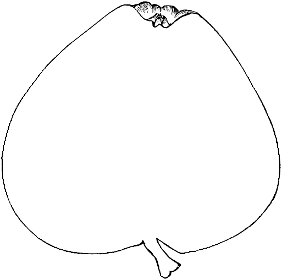
Fruit, medium sized, two inches and a half wide, and nearly the same in height; roundish-ovate, or rather conical, flattened at the base, with obtuse angles on the sides, which extend and become more prominent and rib-like round the eye. Skin, smooth, pale yellow, with a few faint streaks of red next the sun, and covered with a delicate white bloom. Eye, closed, set in a narrow and plaited basin. Stalk, thick and short, inserted in a small and very shallow cavity. Flesh, pure white, semi-transparent, with somewhat gelatinous-like blotches, tender, juicy, with a pleasant and refreshing flavor.
A dessert apple but not of first-rate quality; ripe in August, and the early part of September.
The tree is a strong and vigorous grower, and an excellent bearer.
The Transparent Apple of Rogers, and the Muscovy Apple of Mortimer, cannot be identical with this variety, for they are described by both as winter apples; may they not be the Russischer Glasapfel, or Astracanischer Winterapfel of Diel?
Respecting this apple, a correspondent in the Gardener’s Chronicle, for 1845, has the following remark, “When at Reval many years ago, I made particular inquiries as to the mode of cultivation of the Transparent Apple; I learned that the soil of the apple orchards there, is almost a pure sand, but that it is customary to add to it so much stable manure, that half the bulk of ground may be said to consist of manure. The friend with whom I was staying, had some of these apples at dessert; they were transparent, not in blotches, but throughout, so that held to the light, the pips may be seen from every part; these apples were juicy as a peach, about the size of a large one, and of a very agreeable flavor and texture.”
380. WHITE PARADISE.—Hort.
Identification.—Hort. Soc. Cat. ed. 3, n. 520.
Synonymes.—Lady’s Finger, Hort. Soc. Cat. ed. 1. 533. Long May, Ibid. 565. May, acc. Ibid. Egg, Ron. Cat. Eve, Ron. Pyr. Mal. 4. Paradise Pippin, acc. Hort. Soc. Cat. ed. 3.
Figure.—Ron. Pyr. Mal. pl. ii. f. 5.
Fruit, medium sized, two inches and a half wide, and three inches high; oblong, broader at the base than the apex. Skin, smooth, thick and tough, of a fine rich yellow, thinly and faintly freckled with red on the shaded side, but covered with broken streaks and dots of darker red, interspersed with dark brown russety dots, on the side exposed to the sun. Eye, open, set in a shallow basin. Stalk, an inch long, fleshy at the insertion; and inserted in an even, round, cavity. Flesh, yellowish, tender, crisp, juicy, sugary, and pleasantly flavored.
A second-rate, but beautiful and handsome dessert apple; in perfection the beginning of October, but towards the end of the month, becomes dry and mealy. It is, I believe, a Scotch apple, and much grown in some districts, particularly in Clydesdale, where it is known by the name of Egg Apple, and where the fruit lasts longer, than when grown in the warmer climate of the South.
The Lady’s Finger of Dittrich, vol. i. p. 505, is a flat apple of a Calville shape, and must be incorrect.
381. WHITE VIRGIN.—H.
Synonyme.—Scotch Virgin.
Fruit, medium sized, two inches and three quarters wide, and two inches high; oblate. Skin, smooth and shining, pale yellow, on the shaded size; but thin orange red, streaked with deep red, on the side next the sun, and strewed with dark dots and a few veins of russet. Eye, large and closed, with broad ovate segments, set in a wide, shallow, and plaited basin. Stalk, a quarter of an inch long, inserted in a narrow, and shallow cavity. Flesh, white, soft, tender, juicy, and briskly acid.
An excellent culinary apple; in use from October to February.
382. WHITE WESTLING.—H.
Fruit, rather below medium size, two inches and a half broad at the middle, and two inches and a half high; roundish, inclining to oval, towards the eye; angular on the sides, and ribbed round the apex. Skin, yellow, tinged with green, and strewed with redish-brown dots on the shaded side; but deep yellow, with large dark-crimson spots, on the side next the sun, and covered with russet over the base. Eye, small and closed, set in a narrow and angular basin. Stalk, half-an-inch long, very slender, inserted in a deep, narrow, and russety cavity. Flesh, white, tender, sweet, and briskly flavored.
An apple of hardly second-rate quality, grown about the north-eastern parts of Sussex; it is in use from October to Christmas.
383. WHITE WINE.—H.
Fruit, about medium size, two inches and a half broad in the middle, and two inches and a half high; narrowing towards the apex, conical, slightly angular on the sides, and ribbed round the eye. Skin, greenish-yellow, strewed with russety dots on the shaded side; but deep yellow, reticulated with fine russet, and dotted with small russety specks on the side exposed to the sun, and with a ray of fine lilac-purple on the base encircling the stalk. Eye, open, with long acute segments, set in a deep and ribbed basin. Stalk, five-eights of an inch long, downy, thick and fleshy, inserted in a round cavity, which is lined with delicate russet. Flesh, white, firm, crisp, and pleasantly acid.
A culinary apple much grown in the Tweedside orchards, where it is known by the name of the Wine Apple; it is in use from October to Christmas.
384. WHITMORE PIPPIN.—Forsyth.
Identification.—Fors. Treat. 129. Hort. Soc. Cat. ed. 3, n. 861. Lind. Guide, 84.
Fruit, below medium size, two inches and a quarter wide at the base, and the same in height, but narrowing towards the apex; conical, and obtusely angled on the sides. Skin, pale greenish-yellow in the shade; but with a beautiful red cheek next the sun, and very sparingly strewed with a few minute dots. Eye, closed, set in a narrow and shallow basin. Stalk, about half-an-inch long, inserted in a wide, round, and even cavity. Flesh, white, tinged with green, tender, juicy, sub-acid, and slightly sweet.
A dessert apple of second-rate quality; in use from November to April.
385. WHORLE PIPPIN.—H.
Synonymes.—Summer Thorle, Hort. Soc. Cat. ed. 3, n. 830. Watson’s New Nonesuch, acc. Ibid. Thorle Pippin, Leslie & Anders, Cat. Thoral Pippin, acc. Ron. Pyr. Mal.
Figure.—Ron. Pyr. Mal. pl. ii. f. 3.
Fruit, below medium size, two inches and a quarter wide at the middle, and an inch and three quarters high; oblate, handsome, and regularly formed. Skin, smooth, shining, and glossy, almost entirely covered with fine bright crimson, which is marked with broken streaks of darker crimson; but on any portion which is shaded, it is of a fine clear yellow, a little streaked with pale crimson. Eye, scarcely at all depressed, large, half open, with broad, flat segments, which frequently appear as if rent from each other by an over-swelling of the fruit; and set in a very shallow basin, which is often very russety, and deeply and coarsely cracked. Stalk, a quarter of an inch long, inserted in a wide cavity. Flesh, yellowish-white, firm, crisp, and very juicy, with a brisk, refreshing, and pleasant flavor.
A beautiful little summer dessert apple, of first-rate quality; ripe in August. In the south it is but little known, but in Scotland it is to be met with in almost every garden and orchard.
In all probability the word Thorle is a corruption of Whorle, which is no doubt the correct name of this apple. The name is supposed to be derived from its resemblance to the whorle, which was the propelling power, or rather impetus of the spindle, when the distaff and spindle was so much in use.
386. WICKHAM’S PEARMAIN.—H.
Synonymes.—Wick Pearmain, Hort. Soc. Cat. ed. 3, p. 31.
Fruit, small, two inches wide, and about two inches high; pearmain-shaped, and quite flat at the base. Skin, yellow, tinged and dotted with red on the shaded side; but bright red on the side next the sun, and marked with patches and specks of russet round the eye. Eye, large and open, with long acuminate segments, reflexed, and set in a round, even, and plaited basin. Stalk, half-an-inch long, fleshy, inserted without any depression. Flesh, greenish-yellow, tender, crisp, juicy, sugary, and highly flavored.
An excellent dessert apple; in use from October to December. It was raised by a Mr. Wickham, of Wick, near Winchester. In the catalogue of the London Horticultural Society, it is called “Wick Pearmain,” but as the name I have adopted is that by which it is best known in Hampshire, I prefer retaining it.
387. WINTER CODLIN.—Hort.
Identification.—Hort. Soc. Cat. ed. 3, n. 170.
Fruit, very large, three inches and an eighth wide at the middle, and three inches and a half high; conical, generally five-sided, with prominent ribs on the sides, which extend to the apex, forming considerable ridges round the eye. Skin, smooth, yellowish-green, and marked with dark dots. Eye, large and open, set in a deep and very angular basin. Stalk, half-an-inch long, inserted in a deep, smooth, and angular cavity. Flesh, greenish-white, tender, juicy, sweet, and sub-acid.
A fine old culinary apple of first-rate quality; in use from September to February.
The tree is a strong, vigorous, and healthy grower, and an excellent bearer.
388. WINTER COLMAN.—Lind.
Identification.—Lind. in Hort. Trans. vol. iv. p. 66. Hort. Soc. Cat. ed. 3, n. 875 Rog. Fr. Cult. 58.
Synonymes.—Norfolk Colman, Hort. Soc. Cat. ed. i. 683. Norfolk Storing, Fors. Treat. 117.
Figures.—Brook. Pom. Brit. pl. xcii. f. 5. Ron. Pyr. Mal. pl. xxxiii.
Fruit, above medium size; roundish and flattened. Skin, pale yellow, mottled with red on the shaded side, but deep red on the side next the sun. Eye, open, set in a rather shallow and plaited basin. Stalk, short, thick, and deeply inserted. Flesh, firm, crisp, and briskly acid.
A culinary apple of first-rate quality; in use from November to April.
The tree is a very strong and vigorous grower, so much so, that in its young state, it is not a great bearer; but when grafted on the paradise stock, it produces abundantly.
389. WINTER GREENING.—Aber.
Identification.—Aber. Gard. Dict.
Synonymes.—French Crab, Fors. Treat. 102. Easter Pippin, Lind. Guide, 45. Hort. Soc. Cat. ed. 3, n. 233. Down. Fr. Amer. 109. Claremont Pippin, acc. Hort. Soc. Cat. Ironstone Pippin, Ibid. Young’s Long Keeping, Ibid. John Apple, Rog. Fr. Cult.
Figures.—Brook. Pom. Brit., pl. xciii. f. 1. Ron. Pyr. Mal. pl. xlii. f. 3.
Fruit, medium sized, two inches and three quarters wide, and two inches and a quarter high; roundish, widest at the middle, and narrowing towards the crown, round which are a few small ridges. Skin, smooth and shining, of a dark lively green, strewed with minute russety dots; and with a blush of dull red where exposed to the sun. Eye, small and closed, set in a shallow and plaited basin. Stalk, half-an-inch long, inserted in a round cavity, which is lined with russet. Flesh, greenish, very close in texture, brittle and juicy, with a very poignant and pleasant acid.
A culinary apple of first-rate quality, which comes into use in November, and has been known to last under favorable circumstances, for two years. Dry sand is a good article to preserve it in.
The tree is very hardy, a free and good grower, and an abundant bearer.
I have not adopted here, the nomenclature of the Horticultural Society’s Catalogue, for two reasons. First, because Winter Greening is the previous name, and, so far as I can find, the original one. It is also very applicable, and not subject to the same objection which Mr. Lindley has to French Crab. Second, because there is already in the Horticultural Society’s Catalogue, the “White Easter”—the “Paasch Appel,” of Knoop—and the two names being so similar, may tend to confusion, a result of already too frequent occurrence, and most desirable to be avoided. The name Winter Greening is also more descriptive.
390. WINTER LADING.—H.
Fruit, medium sized, two inches and three quarters wide, at the middle, and two inches and a half high; roundish, and narrowing towards the crown, irregularly formed, sometimes with one prominent angle on one side. Skin, bright green, marked with patches and dots of thin russet. Eye, closed, set in an angular basin. Stalk three quarters of an inch long, curved, inserted in a deep, round cavity. Flesh, greenish-white, juicy, sweet, very tender, and delicate, with a pleasant acid.
An excellent sauce apple; in use from October to Christmas. It is grown in the north-eastern parts of Sussex, about Heathfield.
391. WINTER MAJETIN.—Lind.
Identification.—Lind. in Hort. Trans. vol. iv. 68. Hort. Soc. Cat. ed. 3, n. 876. Lind. Guide, 58.
Fruit, medium sized; roundish-ovate, with ribs round the crown. Skin, smooth, dark green, covered with thin dull brownish-red on the side next the sun. Eye, small and open, set in a deep basin, which is much furrowed and plaited. Stalk, three quarters of an inch long, slender, inserted in a deep and narrow cavity, which is lined with russet. Flesh, greenish-white, firm, crisp, brisk, and pleasantly flavored.
A first-rate culinary apple, bearing a considerable resemblance to the London Pippin, but does not change to yellow color by keeping as that variety does. It is in use from January to May.
This variety is, strictly speaking, a Norfolk apple, where it is much grown for the local markets. It was first made public by Mr. George Lindley, who introduced it to the notice of the London Horticultural Society. In the “Guide to the Orchard,” it is stated that the Aphis Lanigera or “Meally Bug,” so destructive to most of our old orchard trees, seems to be set at defiance by the Majetin. “An old tree now growing in a garden belonging to Mr. William Youngman, of Norwich, which had been grafted about three feet high in the stem, has been for many years attacked by this insect below the grafted part, but never above it; the limbs and branches being to this day perfectly free, although all the other trees in the same garden have been infested more or less with it.”
The tree is a most abundant bearer.
392. WINTER PEARMAIN.—Ger.
Identification.—Ger. Herb. Aust. Treat. 54. Raii. Hist. ii. 1448. Lang Pom. 134. t. lxxviii. f. 4. Gibs. Fr. Gard. 356. Fors. Treat. 130. Lind. Guide, 84. Hort. Soc. Cat. ed. 3, n. 563. Rog. Fr. Cult. 76.
Synonymes.—Great Pearmaine, Park. Par. 587. Pearmain. Evelyn Pom. 65. Peare-maine, Husb. Fr. Orch. Old Pearmain, Pom. Heref. t. 29. Parmain d’Hiver, Knoop. Pom. 64. t. xi. Pèpin Parmain d’Hiver, Ibid. 131. Pepin Parmain d’Angleterre, Ibid. Grauwe of Blanke Pepping Van Der Laan, Ibid. Peremenes Ibid. Zeeuwsche Pepping, Ibid. Duck’s Bill, in some parts of Sussex. Druë Permein d’Angleterre, Quint. Inst. 202.
Figures.—Pom. Heref. t. 29. Ron. Pyr. Mal. pl. xxii. f. 2.
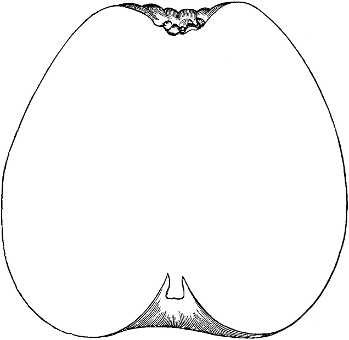
Fruit, large, three inches and a quarter wide, and about the same in height; of a true pearmain shape, somewhat five sided towards the crown. Skin, smooth and shining, at first of a greenish-yellow, marked with faint streaks of dull red on the shaded side, and entirely covered with deep red on the side next the sun; but changes by keeping to fine deep yellow, streaked with flesh color on the shaded side; but of a beautiful, clear, deep red or crimson, on the side next the sun, and strewed all over with small russety dots. Eye, large and open, with short segments, set in a pretty deep, and prominently plaited basin. Stalk, very short, not exceeding a quarter of an inch long, inserted in a deep, funnel-shaped cavity, which is lined with russet. Flesh, yellowish, firm, crisp, juicy, and sugary, with a brisk, poignant, and very pleasant flavor.
A highly esteemed old English apple, suitable principally for culinary purposes, but also valuable for the dessert; it is in use from December to the end of April.
The tree attains about the middle size, is a free and healthy grower, and an excellent bearer.
This is, I believe, the oldest existing English apple on record. It is noticed as being cultivated in Norfolk, as early as the year 1200,—what evidence against Mr. Knight’s theory! In Blomefield’s History of Norfolk, there is mention of a tenure in that county by petty serjeanty, and the payment of two hundred pearmains, and four hogsheads of cider of pearmains into the Exchequer, at the feast of St. Michael, yearly. It is the original of all the Pearmains, a name now applied to a great variety of apples. Much doubt has existed as to the origin of this word, and in a communication to the Gardener’s Chronicle for 1848, I there stated what I conceived to be its meaning. The early forms in which it was written, will be seen from the synonymes above, they were Pearemaine and Peare-maine. In some early historical works of the same period, I have seen Charlemagne written Charlemaine, the last portion of the word having the same termination as Pearemaine. Now, Charlemagne being derived from Carolus magnus there is every probability that Pearemaine is derived from Pyrus magnus. The signification therefore of Pearmain is the Great Pear Apple, in allusion no doubt, to the varieties known by that name, bearing a resemblance to the form of a pear.
393. WINTER QUOINING.
Synonymes.—Winter Queening, Rea. Pom. 212. Raii. Hist. ii. 1448. Fors. Treat. 100. Hort. Soc. Cat. ed. 3, n. 610. Winter Quinin, Nourse Camp. Fel. 146. Calville d’Angleterre. Langer Rother Himbeerapfel, Diel Kernobst. v. 15.
Fruit, medium sized, two inches and a quarter wide, and rather more than two inches and a half high; conical, distinctly five-sided, with five acute angles, extending the whole length of the fruit, and terminating at the crown in five equal, and prominent crowns. Skin, pale-green, almost entirely covered with red, which is striped and mottled with deeper red, and marked on the shaded side with a thin coat of russet. Eye, small, and closed, set in a narrow and angular cavity. Stalk, about half-an-inch long and slender, deeply inserted in a narrow and angular cavity. Flesh, greenish-yellow, tender, soft, not very juicy, sugary, rich, and perfumed.
A good old English apple, suitable either for the dessert or culinary purposes; it is in use from November to May.
The Winter Quoining, is a very old English apple. I have here adopted an orthography, different from that usually employed, because I conceive it to be the most correct. The name is derived from the word Coin or Quoin, the corner stones of a building, because of the angles or corners on the sides of the fruit. Thus Rea in his Pomona says, when speaking of this apple, “it succeeds incomparably on the paradise apple, as the Colviele, (Calville) and all other sorts of Queenings do,” regarding the Calville also as a Queening from the angularity of its shape.
394. WOODCOCK.—Evelyn.
Identification.—Evelyn Pom. 102. Pom. Heref. t. 10. Lind. Guide, 112. Rog. Fr. Cult. 112.
Fruit, medium sized; of an oval shape, tapering a little towards the crown, which is narrow. Eye, flat, with broad segments of the calyx. Stalk, three quarters of an inch long, thick, and fleshy, and curved inwards towards the fruit. Skin, yellow, nearly covered with a soft red, and much deeper color on the sunny side.
Specific gravity of the juice, 1073.—Lindley.
This is one of the oldest cider apples, and is highly commended by the writers of the seventeenth century; but according to Mr. Knight it has long ceased to deserve the attention of the planter. It is said that the name of this apple, is derived from an imagined resemblance in the form of the fruit, and fruit-stalk, in some instances, to the head and beak of a woodcock; but Mr. Knight thinks it probable that it was raised by a person of that name.
395. WOOLMAN’S LONG.—Coxe.
Identification—Coxe View, 169. Hort. Soc. Cat. ed. 3, n. 884.
Synonymes.—Ortley, Hort. Trans. vol. vi. p. 415. Lind. Guide, 78. Van Dyne, Hort. Soc. Cat. ed. 1, 1128.
Fruit, medium sized; oblong. Skin, clear deep yellow, on the shaded side; but bright scarlet, on the side next the sun, sprinkled with imbedded pearly specks, and russety dots. Eye, large, set in a moderately deep and plaited basin. Stalk, slender, inserted in a rather deep and even cavity. Flesh, yellowish, crisp, brittle, juicy, with a rich, brisk, and perfumed flavor.
An excellent apple of first-rate quality, suitable either for culinary or dessert use; it is in season from December to April.
This is an American apple, and originated in the state of New Jersey, U. S.
396. WORMSLEY PIPPIN.—Hort.
Identification.—Hort. Soc. Cat. ed. 3, n. 885. Down. Fr. Amer. 97. Gard. Chron. 1846, 853. Rog. Fr. Cult. 80.
Synonyme.—Knight’s Codlin, acc. Hort. Soc. Cat. ed. 3.
Figure.—Ron. Pyr. Mal. pl. iv. f. 2.
Fruit, large, three inches and a half broad in the middle, and three inches high; ovate, widest at the middle, and narrowing both towards the base and the apex, with obtuse angles on the sides, which terminate at the crown in several prominent ridges. Skin, smooth, deep clear yellow, with a rich golden or orange tinge, on the side next the sun, and covered with numerous dark spots. Eye, large and open, with long acuminate segments, placed in a deep, furrowed, and angular basin. Stalk, short, inserted in a deep and round cavity, which is thickly lined with russet. Flesh, yellow, tender, crisp, rich, sugary, brisk, and aromatic.
A most valuable apple either for the dessert or culinary purposes; it is in season during September and October.
This admirable apple was raised by T. A. Knight, Esq., and first brought into notice in 1811. As a culinary apple it is not to be surpassed; and even in the dessert, when well ripened, Mr. Knight considered it closely resembled the Newtown Pippin. The tree is hardy, healthy, a free and abundant bearer. It has been found to succeed in every latitude of these kingdoms. Even in Rosshire, the late Sir. G. S. McKenzie, found it to succeed well as an espalier. It ought to be cultivated in every garden, however small.
397. WYKEN PIPPIN.—Hort.
Identification.—Hort. Soc. Cat. ed. 3, n. 886. Lind. Guide, 25. Rog. Fr. Cult. 93.
Synonymes.—Warwickshire Pippin, Hort. Soc. Cat. ed. 1, 39. Arley, Ibid. 18. Girkin Pippin, acc. Hort. Soc. Cat. ed. 3.
Figure.—Ron. Pyr. Mal. pl. xli. f. 1.
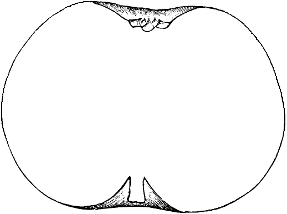
Fruit, below medium size, two inches and a half broad, and two inches high; oblate, even and handsomely shaped. Skin, smooth, pale greenish-yellow in the shade; but with a dull orange blush next the sun, and sprinkled all over with russety dots and patches of delicate russet, particularly on the base. Eye, large and open, set in a wide, shallow, and plaited basin. Stalk, very short, imbedded in a shallow cavity. Flesh, yellow, tinged with green, tender, very juicy, sweet, and richly flavored.
A valuable and delicious dessert apple of first-rate quality; in use from December to April.
The tree is a healthy and good grower, and an excellent bearer.
This variety is said to have originated from seed saved from an apple which Lord Craven had eaten while on his travels from France to Holland, and which was planted at Wyken, about two miles from Coventry. According to Mr. Lindley, the original tree, then very old, was in existence in 1827, and presented the appearance of an old trunk, with a strong sucker growing from its roots.
398. YELLOW ELLIOT.—Knight.
Identification.—Pom. Heref. t 17. Lind. Guide, 113.
Synonymes.—Eleot, Worl. Vin. 163. Eliot, Philips Cid. Yellow Eyelet, Hort. Soc. Cat. ed. 3, p. 15.?.
Fruit, of a good size, rather more flat than long, having a few obtuse angles terminating in the crown. Eye, small, with short diverging segment of the calyx. Stalk, short. Skin, pale yellow, slightly shaded with orange on the sunny side.
Specific gravity of the juice, 1076.
The cider of this apple in a new state, is harsh and astringent, but grows soft and mellow with age, and was much esteemed by the writers of the seventeenth century.
399. YELLOW INGESTRIE.—Hort.
Identification.—Hort. Trans. vol. 1, p. 227. Hort. Soc. Cat.ed 3, n. 359. Lind. Guide, 26. Diel Kernobst. iii. B. 43. Rog. Fr. Cult. 81.
Figure.—Ron. Pyr. Mal. pl. i. f. 4.
Fruit, small, an inch and three quarters wide, and an inch and five-eights high; of a handsome cylindrical shape, flattened at both ends. Skin, smooth, of a fine clear yellow, tinged with a deeper yellow on the side next the sun, and marked with small pinky spots. Eye, small, and partially closed, set almost even with the surface; but sometimes in a wide, and shallow basin. Stalk, from half-an-inch to three quarters long, set in a rather shallow, and smooth cavity. Flesh, yellow, firm, crisp, and delicate, with a profusion of brisk, and highly flavored vinous juice.
A beautiful and delightful little dessert apple, of first-rate quality, bearing a considerable resemblance to the Golden Pippin; it is in use during September and October.
The tree is large, spreading, and an excellent bearer.
This and the Red Ingestrie, were raised by T. A. Knight, Esq.
400. YELLOW NEWTOWN PIPPIN.—Hort.
Identification.—Hort. Soc. Cat. ed. 3, n. 595.
Synonyme.—Large Yellow Newtown Pippin, Coxe View. 142.
Fruit, large, three inches and a half wide, and two inches and three quarters high; roundish, irregular in its outline, and prominently angled on the sides. Skin, of an uniform deep straw-color, which is rather deeper and richer on the side next the sun, than on the other; and thinly covered with delicate reticulations of fine grey russet, interspersed with several large dark spots. Eye, large and closed, with long linear segments, set in a wide and irregular basin, from which issue several deep russety furrows. Stalk, short, deeply inserted in an uneven and angular cavity, which is partially lined with russet. Flesh, yellowish, crisp, juicy, and slightly sub-acid, but with an agreeable flavor.
A first-rate dessert apple; in use from December to March, and ripens better in this climate than the Newtown Pippin.
401. YORKSHIRE GREENING.—Fors.
Identification.—Fors. Treat. 131. Hort. Soc. Cat. ed. 3, n. 889. Lind. Guide, 60. Rog. Fr. Cult. 60.
Synonymes.—Coates’s, Hort. Soc. Cat. ed. 1, 165. Seek-no-farther, Ibid. 1032. Yorkshire Goose Sauce, acc. Hort. Soc. Cat. ed. 3.
Figure.—Ron. Pyr. Mal. pl. xi. f. 2.
Fruit, large, three inches and a half wide, and two inches and a half high; oblate and slightly angular on the sides. Skin, very dark green; but where exposed to the sun, tinged with dull red, which is striped with broken stripes of deeper red, very much speckled all over with rather bold grey russet specks, and over the base with traces of greyish brown russet. Eye, closed, set in a shallow, irregular, and plaited basin. Stalk, short, stout, and fleshy, covered with grey tomentum, inserted in a wide and rather shallow cavity. Flesh, greenish-white, firm, crisp, and very juicy, with a brisk, but pleasant acidity.
A first-rate culinary apple; in use from October to January.