THE APPLE.—ITS VARIETIES. (continued 2)
Reading edition
A first-rate early kitchen apple, and second-rate for the dessert. It is in use during August and September, and will even keep as long as Christmas, if well preserved.
The tree is hardy, vigorous, and a good bearer, and on account of the size of the fruit should be grown rather as a dwarf than a standard.
77. COLONEL HARBORD’S PIPPIN.—Lind.
Identification.—G. Lind. in Hort. Trans. vol. iv., p. 65. Lind. Guide, 66. Hort Soc. Cat. ed. 3, n. 174.
Fruit, large, about three inches and a half wide, and the same in height; conical, and angular on the sides. Skin, pale yellowish-green, partially russeted on one side. Eye, large, set in a rather shallow basin, surrounded with plaits and wrinkles. Stalk, half an inch long. Flesh, white, tinged with green, soft, and very juicy, with a brisk tart flavor.
An excellent culinary apple of the first quality; in use from November to March. It originated at Blickling Hall, in Norfolk.
78. COLONEL VAUGHAN’S.—H.
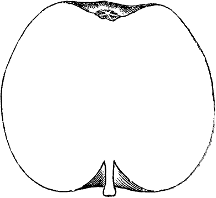
Fruit, below medium size, one and three quarter inches high, and two inches broad; oblato-conical, or conical. Skin, smooth and shining, the side next the sun entirely covered with bright crimson, streaked with very dark crimson, and thinly strewed with greyish white dots; but of a fine waxen yellow, streaked and dotted with broken streaks of crimson on the shaded side. Eye, small and closed, set in a wide, rather shallow, and plaited basin. Stalk, about a quarter of an inch long, inserted in a round, deep, and even cavity, which is lined with thin pale brown russet. Flesh, white, slightly tinged with red under the skin on the side next the sun, firm, crisp, and brittle, very juicy, with a sweet, brisk, and fine strawberry flavor.
A very excellent dessert apple; ripe in the end of September and during October, at which season it is very common in Covent Garden Market.
In some parts of Kent this excellent little apple is produced in large quantities for the supply of the London markets, but it is one which is not met with in general cultivation.
79. CONTIN REINETTE.—Hort.
Identification.—Hort. Trans. vol. vii., p. 339. Hort. Soc. Cat. ed. 3, n. 645.
Fruit, medium sized; roundish, somewhat resembling the old Nonpareil. Skin, deep dull yellow on the shaded side, and fine red where exposed to the sun. Flesh, yellowish, firm, highly flavored, and pleasantly acid.
A dessert apple of first-rate quality, peculiarly adapted for cultivation in the northern districts of Scotland. It is in use during October and November.
The tree is very hardy, an excellent and sure bearer, but a slender grower.
It was raised by Sir George Stuart Mackenzie, Bart., of Coul, in Rosshire, a gentleman who for a long series of years devoted his time and talents to the advancement of horticulture.
80. CORNISH AROMATIC.—Hort.
Identification.—Hort. Soc. Cat. ed. 3, n. 181. Lind. Guide, 42. Down. Fr. Amer. 81.
Synonyme.—Aromatic Pippin. Rog. Fr. Cult. 87.
Figures.—Pom. Mag. t. 58. Ron. Pyr. Mal. pl. xix, f. 3.
Fruit, above medium size, three inches wide, and two inches and three quarters high; roundish, angular, slightly flattened, and narrowing towards the eye. Skin, yellow on the shaded side, and covered with large patches of pale brown russet, which extend all over the base, and sprinkled with green and russety dots; but of a beautiful bright red, which is streaked with deeper red, and strewed with patches and dots of russet on the side exposed to the sun. Eye small and closed, with long flat segments, which are reflexed at the tips and set in an irregular basin. Stalk short, inserted in a deep and narrow cavity which is lined with russet. Flesh, yellowish, firm, crisp, juicy, rich, and highly aromatic.
A valuable dessert apple of first-rate quality, in use from October to Christmas.
The tree is a free grower and an excellent bearer.
81. CORNISH GILLIFLOWER.—Hort.
Identification.—Hort. Soc. Cat. ed. 3, n. 267. Lind. Guide, 67. Down. Fr. Amer. 102.
Synonymes.—July-flower, Hort. Trans. vol. ii., p. 74. Cornish July-flower, Ibid. vol. iii., p. 323. Calville d’Angleterre, Baum. Cat. Pomme Regelans, acc. Hort. Soc. Cat.
Figures.—Pom. Mag. t. 140. Ron. Pyr. Mal. pl. xix, f. 4.
Fruit, large, three inches and a quarter wide, and the same in height; ovate, angular on the sides, and ribbed round the eye, somewhat like a Quoining. Skin, dull green on the shaded side, and brownish red streaked with brighter red on the side next the sun; some parts of the surface marked with thin russet. Eye, large and closed, set in a narrow and angular basin. Stalk, three quarters of an inch long, inserted in a rather shallow cavity. Flesh, yellowish, firm, rich, and aromatic.
This is one of our best dessert apples, remarkable for its rich and aromatic flavor; it is in use from December to May.
The tree is hardy, and a free grower, attaining the middle size, but not an abundant bearer; it produces its fruit at the extremities of the last year’s wood, and great care should, therefore, be taken to preserve the bearing shoots. It succeeds well, grafted on the paradise stock, and grown as an espalier or an open dwarf.
This valuable apple was brought into notice by Sir Christopher Hawkins, who sent it to the London Horticultural Society, in 1813. It was discovered about the beginning of the present century, growing in a cottager’s garden, near Truro, in Cornwall.
The name July-flower is very often applied to this and some other varieties of apples, and also to flowers, but it is only a corruption of the more correct name Gilliflower, which is derived from the French Girofle, signifying a clove, and hence the flower which has the scent of that spice, is called Giroflier, which has been transformed to Gilliflower. In Chaucer’s “Romaunt of the Rose,” he writes it Gylofre.
“There was eke wexyng many a spice, As Clowe Gylofre and liquorice.”
Turner writes it Gelower and Gelyfloure. The proper name, therefore, is Gilliflower, and not July-flower, as if it had some reference to the month of July.
82. COSTARD.—Ray.
Identification.—Raii Hist. ii. 1447. Laws. New. Orch. 32. Worl. Vin. 167.
Synonymes.—Coulthard, in Lancashire. Prussian Pippin, Ibid.
Fruit, above medium size, two inches and three quarters, or three inches wide, and three inches and a quarter high; oblong, but narrowing a little towards the eye, distinctly five-sided, having five prominent ribs on the sides, which extend into the basin of the eye, and form ridges round the crown. Skin, smooth, dull yellowish green, strewed all over with embedded grey specks. Eye, partially closed with long acuminate segments, and set in a rather deep and angular basin. Stalk, about a quarter of an inch long, inserted in a round, rather shallow, and narrow cavity. Flesh, greenish-white, tender, juicy, and with a brisk, and pleasant sub-acid flavor.
An excellent culinary apple of first-rate quality. It is in season from October to Christmas.
The tree is hardy, a strong and vigorous grower, with strong downy shoots, and an abundant bearer.
The Costard is one of our oldest English apples. It is mentioned under the name of “Poma Costard,” in the fruiterers’ bills of Edward the First, in 1292, at which time it was sold for a shilling a hundred. The true Costard is now rarely to be met with, but at an early period it must have been very extensively grown, for the retailers of it were called Costardmongers, an appellation now transformed into Costermongers. It is mentioned by William Lawson, in 1597, who, in his quaint style, says, “Of your apple-trees you shall finde difference in growth. A good Pipping will grow large, and a Costard-tree: stead them on the north side of your other apples, thus being placed, the least will give sunne to the rest, and the greatest will shroud their fellowes.”
Modern authors make the Costard synonymous with the Catshead, chiefly, I think, on the authority of Mr. George Lindley, who has it so in the “Guide to the Orchard;” but this is evidently an error. All the early authors who mention both varieties regard them as distinct. Parkinson describes two varieties of Costard—the “Gray,” and the “Greene.” Of the former, he says, “it is a good great apple, somewhat whitish on the outside, and abideth the winter. The Green Costard is like the other, but greener on the outside continually.” Ray describes both the Catshead and Costard as distinct, and Leonard Meager enumerates three varieties of Costard in his list—the white, grey, and red; but which of these is identical with that described above, it is difficult now to determine.
Some etymologists, and Dr. Johnson among the number, consider this name to be derived from Cost, a head; but what connection there is between either the shape or other appearance of this apple, and a head, more than any other variety, must puzzle any one to discover. Is it not more probable that it is derived from Costatus (Anglice, costate, or ribbed), on account of the prominent ribs or angles on its sides? I think this a much more likely derivation.
83. COUL BLUSH.—Hort.
Identification.—Hort. Trans. vol. vii., p. 340. Hort. Soc. Cat. ed. 3, n. 184 Mem. Cal. Hort. Soc. iv. 556.
Fruit, medium sized; roundish, and angular on the sides. A good deal resembling the Hawthornden. Skin, pale yellow, marked with dull red next the sun, and streaked and dotted with deeper red. Stalk, slender. Flesh, yellowish, crisp, juicy, brisk, and well-flavored.
An excellent culinary apple, in use from October to February. It is said to be of finer flavor than the Hawthornden, and to be even a good dessert apple.
The tree is hardy, a strong, vigorous, and upright grower, and an abundant bearer. It is well suited for all northern and exposed situations.
This is one of the varieties raised by Sir G. S. Mackenzie, Bart., of Coul, Rosshire.
84. COURT OF WICK.—Hort.
Identification.—Hort. Soc. Cat. ed. 3, n. 187. Lind. Guide, 42. Down. Fr. Amer. 105. Rog. Fr. Cult. 87.
Synonymes.—Court of Wick Pippin, Fors. Treat. 98. Court de Wick, Hook. Pom. Lond. Rival Golden Pippin, acc. Ron. Pyr. Mal. Fry’s Pippin, acc. Hort. Soc. Cat. Golden Drop, Ibid. Wick’s Pippin, Ibid. Wood’s Huntingdon, Ibid. Wood’s Transparent, Ibid. Kingswick Pippin, Ibid. Phillip’s Reinette, Ibid.
Figure.—Hook. Pom. Lond. t. 32. Pom. Mag. t. 32. Ron. Pyr. Mal. pl. xii f. 23.
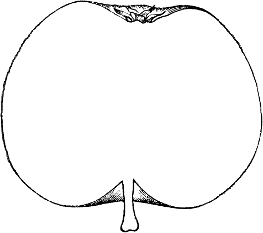
Fruit, below medium size; oblato-ovate, regular and handsome. Skin, when fully ripe, of a fine clear yellow, with bright orange, which sometimes breaks out in a faint red next the sun, and covered all over with russety freckles. Eye, large and open, with long, acuminate, and reflexed segments, set in a wide, shallow, and even basin. Stalk, short and slender, inserted in a smooth and even cavity, which is lined with thin russet. Flesh, yellow, tender, crisp, very juicy, rich, and highly flavored.
One of the best and most valuable dessert apples, both as regards the hardiness of the tree, and the rich and delicious flavor of the fruit, which is not inferior to that of the Golden Pippin. It is in use from October to March.
The tree attains the middle size, is healthy, hardy, and an abundant bearer. There is scarcely any description of soil or exposure where it does not succeed, nor is it subject to the attacks of blight and canker. It grows well on the paradise stock, producing fruit much larger than on the crab, but not of so long duration.
This variety is said to have originated at Court of Wick, in Somersetshire, and to have been raised from a pip of the Golden Pippin. It is first mentioned by Forsyth, but I have not been able to discover any facts relative to its history.
85. COURT-PENDU PLAT.—Hort.
Identification.—Hort. Soc. Cat. ed. 3, n. 185. Down. Fr. Amer. 105. Gard. Chron. 1846, 100.
Synonymes.—Courtpendû, Lind. Guide. 43. Court-pendû plat Rougeâtre, Ron. Pyr. Mal. pl. xii. Hort. Soc. Cat. ed. 1, 212. Court-pendû rond gros, Hort. Soc. Cat. ed. 1, n. 216. Court-pendû rond très gros, Ibid. n. 218. Court-pendu rond rougeâtre. Ibid. n. 317. Court-pendu rosat, Diel Kernobst. xii. 171. Court-pendû musqué, Hort. Soc. Cat. ed. 1, n. 209. Court-pendû rouge musqué, acc. Hort. Soc. Cat. Court-pendû rouge, Rog. Fr. Cult. 41. Courpendû vermeil, Inst. Arb. Fr. 154. Corianda Rose, Hort. Soc. Cat. ed. 1, n. 200. Rosenfarbiger, Kurtzstiel, Diel Kernobst. xii. 171. Courtpendû Rouge, Knoop Pom. 60, t. x. Courtpendû Rosaar, Ibid. 129. Reinette Courtpendû Rouge, Ibid. 129. Der Rothe Kurzstiel, acc. Thomp. Rode Korpendu, Ibid. Pomme de Berlin, acc. Hort. Soc. Cat. Princesse Noble Zoete, Ibid. Garnons, Ibid. Woolaton Pippin, Ibid. Wise Apple, acc. Thomp.
Figure.—Knoop Pom. t. x. Pom. Mag. t. 66. Ron. Pyr. Mal. pl. xii.
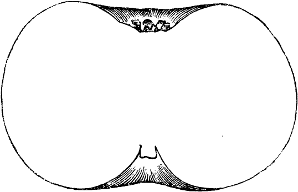
Fruit, medium sized; oblate, regularly and handsomely shaped. Skin, bright green at first on the shaded side, but changing as it ripens to clear yellow, marked with traces of russet, and russety dots; but entirely covered with deep crimson, which is also marked with traces of russet on the side next the sun, extending even to some portion of the shaded side. Eye, open, with short segments, which are reflexed at the tips, and set in a wide, even, and deep basin. Stalk, very short, inserted in a wide and deep cavity, lined with russet, which extends over a portion of the base. Flesh, yellowish-white, firm, crisp, brisk, rich, and sugary, with an abundance of vinous and perfumed juice.
A valuable dessert apple of the first quality; in use from December to May.
The tree is of small habit of growth, but very hardy and an abundant bearer. It is well adapted for espalier training when worked on the paradise stock; and if grafted on the Pomme Paradis of the French, it may be grown in pots, in which it forms a beautiful and interesting object when laden with its beautiful fruit.
The bloom expands later than that of any other variety, and on that account is less liable to be injured by spring frosts, hence, according to Thompson, it has been called the Wise Apple.
This is not the Capendu of Duhamel, as quoted by Lindley and Downing; neither is it the Court-pendu of Forsyth and De Quintinye, that variety being the Fenouillet Rouge of Duhamel, see No. 123. The Courpendu of Miller is also a different apple from any of those just mentioned, and is distinguished by having a long and slender stalk, “so that the fruit is always hanging downwards.” The name of this variety is derived from Corps pendu translated by some Hanging Body, whereas that of the variety above described, is from Court pendu, signifying suspended short, the stalk being so short, that the fruit, sits, as it were, upon the branch. The name Capendu or Capendua, is mentioned by the earliest authors, but applied to different varieties of apples. It is met with in Ruellius, Tragus, Curtius, and Dalechamp, the latter considering it the Cestiana of Pliny. Curtius applies the name to a yellow apple, and so also does Ruellius; but Tragus considers it one of the varieties of Passe-pomme, he says, “Capendua magna sunt alba et dulcia, in quorum utero semina per maturitatem sonant, Ruellio Passipoma apellantur.” They are also mentioned by J. Bauhin, “Celeberrimum hoc pomi genus est totius Europæ, sic dicta, quòd ex curto admodum pendeant pediculo.”
86. COWARNE RED.—Knight.
Identification and Figure.—Knight, Pom. Heref. t. 28.
Fruit, of a pretty good size, a little more long than broad, but narrow at the crown, in which appear a few obtuse and undefined plaits. Eye, small, with very short converging segments of the calyx. Stalk, hardly half an inch long, very stiff and straight. Skin, a small part of it pale gold on the shaded side, and round the base, but of a bright red over a great part, and where fully exposed to the sun, of an intense, deep, purplish crimson; there are numerous short streaks, which mark the shady part of the fruit.
Specific gravity of its juice 1069.
A cider apple, which takes its name from the parish of Cowarne, near Broomyard, in Herefordshire, where it was raised about the beginning of the last century.—Lindley.
87. CRAY PIPPIN.—Hort.
Identification.—Hort. Trans. vol. v., p. 401. Lind. Guide, 27.
Fruit, below medium size; conical, and angular on the sides. Skin, pale yellow with a tinge of red next the sun. Eye, small and closed, set in an even basin. Stalk, short, and deeply inserted. Flesh, yellow, crisp, sweet, and highly flavored.
An excellent dessert apple, ripe in October.
This variety was raised at St. Mary’s Cray, in Kent, by Richard Waring, Esq., and was exhibited at the London Horticultural Society, on the 15th of October, 1822.
88. CREED’S MARIGOLD.—H.
Fruit, medium sized, two inches and three quarters wide, and two inches and a quarter high; roundish. Skin, fine deep rich yellow on the shaded side; but deep orange next the sun, and covered with beautiful red, which is striped with darker red, the whole marked with patches of thin and delicate brown russet, and thickly strewed with dark russety dots. Eye, open, with broad flat segments, and set in a narrow, shallow, and regularly plaited basin. Stalk, short, set in a deep cavity, which is lined with russet. Flesh, yellow, tender, crisp, juicy, sugary, and richly flavored.
An excellent dessert apple, in use during October and November, after which it becomes dry and meally but does not shrivel.
This variety was raised from a seed of the Scarlet Nonpareil, by Mr. Creed, gardener, at Norton Court, near Faversham, in Kent.
89. CREEPER.—H.
Fruit, rather below medium size, two inches and a quarter high, and about the same in width; somewhat conical or roundish-ovate. Skin, smooth and shining, at first of a fine dark green on the shaded side, and entirely covered with red, which is thickly marked with broken streaks of darker red on the side next the sun; but as it ripens, the shaded side changes to yellowish-green, and the exposed to crimson. Eye, open, set in a pretty deep basin. Stalk, very short, embedded in a shallow cavity. Flesh, white, tender, juicy, sweet, and pleasantly flavored, with a slight aroma.
A very good second-rate summer dessert apple; ripe in September.
This variety is very common in the Berkshire orchards.
90. DARLING PIPPIN.—Lind.
Identification.—Lind. Plan. Or. 1796. Lind. Guide, 68.
Synonymes.—Darling, Rea Pom. 210. Raii Hist. ii. 1448.
Fruit, of medium size; oblato-conical. Skin, bright lemon yellow, thickly set with small embedded pearly specks. Eye, small, and placed in a shallow basin, surrounded with prominent plaits. Stalk, short and slender, not deeply inserted. Flesh, yellowish, firm, crisp, juicy, and sugary, with a pleasant sub-acid flavor.
A dessert apple of good quality; in use from November to January.
This is one of our old English varieties. It is mentioned by Rea, in 1665, who calls it “a large gold yellow apple, of an excellent, quick, something sharp taste, and bears well.” It is also noticed by Ray as “Pomum delicatulum Cestriæ.”
91. DEVONSHIRE BUCKLAND.—Hort.
Identification.—Hort. Soc. Cat. ed. 3, n. 97.
Synonymes.—Dredge’s White Lily, Fors. Treat. 99. White Lily, acc. Hort. Soc. Cat. ed. 3. Lily Buckland, Ibid.
Fruit, above medium size, three inches wide, and two inches and a half high; roundish and flattened, with irregular and prominent angles on the sides. Skin, dull waxen yellow, strewed all over with minute russety dots, which are larger on the side exposed to the sun. Eye, open, set in a plaited basin. Stalk, rather deeply inserted in a round cavity, from which issue ramifications of russet. Flesh, yellow, crisp, very juicy, brisk, sugary, and perfumed.
A very excellent apple; of first-rate quality as a culinary fruit, and suitable also for the dessert. It is in use from October to February.
The tree is quite hardy, and an excellent bearer.
92. DEVONSHIRE QUARRENDEN.—Hort.
Identification.—Fors. Treat. 122. Hort. Soc. Cat. ed. 3, n. 603. Down. Fr. Amer. 71.
Synonymes.—Quarrington, Raii. Hist. ii. 1448. Devonshire Quarrington, Mort-Art. ii. 290. Red Quarentine, Miller and Sweet, Cat. 1790. Red Quarenden, Hook. Pom. Lond. t. 13, Lind. Guide, 6. Sack Apple, Hort. Soc. Cat. ed. 1, n. 1012. Quarentine, in Devonshire.
Figures.—Hook. Pom. Lond. t. 13. Pom. Mag. t. 94. Ron. Pyr. Mal. pl. i. f. 7.
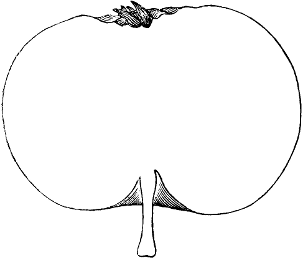
Fruit, rather below medium size; oblate, and sometimes a little angular in its outline. Skin, smooth and shining, entirely covered with deep purplish red, except where it is shaded by a leaf or twig, and then it is of a delicate pale green, presenting a clear and well-defined outline of the object which shades it. Eye, quite closed, with very long tomentose segments, and placed in an undulating and shallow basin, which is sometimes knobbed, and generally lined with thick tomentum. Stalk, about three quarters of an inch long, fleshy at the insertion, deeply set in a round and funnel-shaped cavity. Flesh, white tinged with green, crisp, brisk, and very juicy, with a rich vinous, and refreshing flavor.
A very valuable and first-rate dessert apple. It ripens on the tree the first week in August, and lasts till the end of September. It is one of the earliest summer dessert apples, and at that season, is particularly relished, for its fine, cooling, and refreshing, vinous juice.
The tree attains a considerable size, it is particularly hardy, and a most prolific bearer. It succeeds well in almost every soil and situation, and is admirably adapted for orchard planting. In almost every latitude of Great Britain, from Devonshire to the Moray Frith, I have observed it in perfect health and luxuriance, producing an abundance of well ripened fruit, which, though not so large, nor so early in the northern parts, still possessing the same richness of flavor as in the south.
This is supposed to be a very old variety, but there is no record of it previous to 1693, when it is mentioned by Ray; and except by Mortimer, it is not noticed by any subsequent writer till within a very recent period. It seems to have been unknown to Switzer, Langley, and Miller; nor do I find that it was grown in any of the London nurseries before the beginning of the present century. The only early catalogue in which I find it is that of Miller and Sweet, of Bristol, in 1790.
93. DR. HELSHAM’S PIPPIN.—Lind.
Identification.—Lind. Guide, 8.
Fruit, medium sized; conical, more long than broad, eight or nine inches in circumference, a little angular on the sides. Eye, small, in a rather wide and oblique basin. Stalk, half an inch long, deeply inserted. Skin, yellowish-green, with several redish spots; on the sunny side of a fine clear red. Flesh, white. Juice sweet, with a slight aromatic flavor.
Ripe in August and beginning of September.
The branches of this tree droop in the manner of a Jargonelle Pear. It is an abundant bearer and deserves cultivation.
The original tree which is a large one, was raised by the late Dr. Helsham, and is now growing in the garden of Mr. Etheredge, of Stoke Ferry, in Norfolk.—Lindley.
I have never met with this variety, but as Mr. Lindley recommends it as worthy of cultivation, and as it may be better known in Norfolk than elsewhere, I am induced to insert here with Mr. Lindley’s own description.
94. DOWELL’S PIPPIN.—Hort.
Identification.—Hort. Trans. vol. v. p. 268. Lind. Guide, 27. Hort Soc. Cat. ed. 3, p. 13.
Fruit, medium sized; roundish, narrowing towards the apex. Skin, green, almost entirely covered with thin delicate russet, tinged with brownish red next the sun. Eye, small and closed, set in a narrow and rather deep basin. Stalk, short, and deeply inserted. Flesh, yellow, tender, crisp, juicy, sugary, and finely flavored.
A dessert apple in use from October to January.
This variety was raised by Stephen Dowell, Esq., of Braygrove, Berkshire, from a pip of the Ribston Pippin, to which it bears a close resemblance both in shape and flavor.
95. DOWNTON PIPPIN.—Knight.
Identification.—Pom. Heref. Hort. Trans. vol. i., p. 145. Lind. Guide, 28. Hort. Soc. Cat. ed. 3, n. 217. Down. Fr. Amer. 82.
Synonymes.—Elton Pippin, Fors. Treat. 135. Elton Golden Pippin, Salisb. Or. 130. Knight’s Pippin, acc. Hort. Soc. Cat. ed. 3. Knight’s Golden Pippin, Ibid. St. Mary’s Pippin, Ibid. Downton’s Pepping, Diel Kernobst. v. B. 37.
Figures.—Pom. Heref. t. 9. Pom. Mag. t. 113.
Fruit, small, two inches broad, and an inch and three quarters high; somewhat cylindrical, and flattened at the ends, bearing a resemblance to the Golden Pippin. Skin, smooth, of a fine lemon yellow color, and with a slight tinge of red next the sun, marked with a few traces of delicate russet, and strewed with numerous pale brown dots. Eye, large and quite open, with long, flat, acuminate segments, set in a wide, flat, and shallow basin. Stalk, slender, half-an-inch long, and inserted in a shallow cavity which is lined with delicate russet. Flesh, yellowish white, delicate, firm, crisp, and juicy, with a rich, brisk, vinous and somewhat aromatic flavor.
A dessert apple of first-rate quality, resembling the Golden Pippin both in size, shape, and color, as well as flavor. It is in use from November to January.
The tree is a strong, healthy, and vigorous grower, a most abundant bearer, and attains about the middle size. It may be grown as an open dwarf, and is well suited for espaliers. The fruit is also valuable for the cider it produces, the specific gravity of the juice being 1080.
This excellent variety was raised by Thomas Andrew Knight, Esq., of Downton Castle, from the seed of the Isle of Wight Orange Pippin, impregnated with the pollen of the Golden Pippin, and the original tree is still in existence at Wormsley Grange, Herefordshire.
96. DRAP D’OR.—Duh.
Identification.—Duh. Arb. Fruit, i. 290. Hort. Soc. Cat. ed. 3, n. 219. Down. Fr. Amer. 71.
Synonymes.—Vrai Drap d’Or, Duh. Arb. Fruit, i. 290. Drap d’Or Vrai, Poin. Ami. Jard. i. 192. Bay Apple, acc. Hort. Soc. Cat. Bonne de Mai, Ibid. Goldzaugapfel, Diel. Kernobst. iii. p. 115.
Figures.—Duh. Arb. Fruit, t. i. xii. 4. Ron. Pyr. Mal. pl. xxvi. f. 2.
Fruit, large, three inches and a quarter broad, and two inches and three quarters high; roundish, sometimes inclining to cylindrical, or rather oblato-cylindrical. Skin, smooth and shining, of a fine pale yellow color intermixed with a greenish tinge, which is disposed in faint stripes extending from the base to the apex, on the shaded side; but of a clearer, and deeper yellow on the side next the sun, the whole marked with patches of delicate, dark brown russet, and strewed with numerous russety dots; sometimes there is a faint tinge of red on the side next the sun. Eye, small and closed, with acuminate segments, which are covered with white tomentum, and set in a wide, deep, irregular and plaited basin. Stalk, very short, and somewhat fleshy, inserted in a wide, rather shallow, and smooth cavity. Flesh, yellowish-white, tender, crisp, and juicy, with a brisk, vinous, and sugary flavor.
A pretty good apple of second-rate quality, more suitable for culinary purposes than the dessert. It is in use from October to Christmas.
The tree is a healthy and free grower, attaining about the middle size, and is a free and early bearer, being generally well set with fruit buds. It requires a rich soil and warm situation.
There is another apple totally different from this to which the name of Drap d’Or is applied.—See Fenouillet Jaune.
97. DREDGE’S FAIR MAID OF WISHFORD.—Fors.
Identification.—Fors. Treat. 99. Rog. Fr. Cult. 55.
Fruit, medium sized, two inches and three quarters wide, and two inches and a quarter high; oblato-cylindrical, with obtuse angles on the sides. Skin, yellow, covered with large patches and reticulations of thin brown russet, which is strewed with rougher russety freckles, and tinged with orange and a few streaks of red next the sun. Eye, rather large, with long acuminate segments, which almost close it; and set in a wide, angular, and pretty deep basin. Stalk, short, inserted in a narrow, angular and smooth cavity, which is tinged with green. Flesh, yellowish, firm, brisk, juicy, sugary, and richly flavored.
An excellent apple for culinary purposes, and even worthy of the dessert. It is in use from December to March.
This, with the following variety, was either raised or first brought into notice, by a Mr. William Dredge, of Wishford, near Salisbury. In a letter dated November, 1802, which is in my possession, he writes to the late Mr. Forsyth with specimens of these varieties, and of this he says, “not in eating till Easter, great bearer, most excellent flavor.”
The tree is a free grower, attaining about the middle size, and is an excellent bearer.
98. DREDGE’S FAME.—Fors.
Identification.—Fors. Treat. 100. Rog. Fr. Cult. 51.
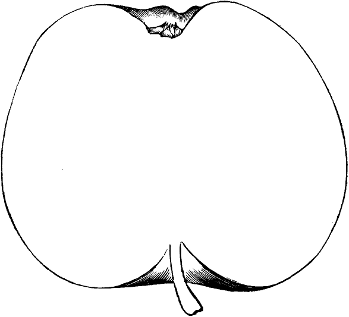
Fruit, above medium size; roundish, inclining to ovate, and furrowed round the eye. Skin, dull dingy yellow, with a tinge of green, covered with patches of thin russet, and large russety dots, particularly over the base; and mottled with pale red on the side exposed to the sun. Eye, closed, set in a deep and angular basin. Stalk, about three quarters of an inch long, inserted in a deep cavity which is lined with russet. Flesh, greenish-yellow, firm, crisp, juicy, brisk, and sugary, with a rich aromatic flavor.
This is a valuable and very excellent apple, suitable either for dessert use, or culinary purposes. It is in use from December to March. In his letter to Mr. Forsyth, referred to above, Mr. Dredge says, “This is the best apple yet known; in eating from Easter till Midsummer—most excellent.”
The tree is hardy, a vigorous grower, an early and abundant bearer, but according to Rogers, liable to be attacked by the woolly aphis; still I have never found it more susceptible of that disease than most other varieties.
There are several other varieties mentioned by Forsyth as seedlings of Dredge’s, which I have not met with, as Dredge’s Queen Charlotte, Dredge’s Russet, and Dredge’s Seedling. I have also in my collection, Dredge’s Emperor and Lord Nelson, both of which are grown in the West of England, but I have not yet had an opportunity of seeing the fruit. It is, however, a question whether these are really seedlings of Dredge’s or not; there are several varieties to which he affixed his name, which have been ascertained to be identical with others that existed before him, such as Dredge’s White Lily, which is synonymous with Devonshire Buckland, and Dredge’s Beauty of Wilts, which is the same as Harvey’s Pippin. Such instances tend to weaken our faith in the high encomium passed upon him, by Rogers, of Southampton, in the “Fruit Cultivator,” and induce us to class him with those who not only change the name of some varieties, and append their own to others under the pretence of their being new, and seedlings of their own, but dispose of them at greater prices than they could have procured, had they been sold under their correct names. We have but to glance over the Horticultural Society’s Catalogue, or the Index to this work, to find numerous instances confirmatory of this statement.
99. DUCHESS OF OLDENBURGH.—Hort.
Identification.—Hort. Soc. Cat. ed. 3, n. 221. Down. Fr. Amer. 82. Ron. Pyr. Mal. 12.
Figure.—Ron. Pyr. Mal. pl. vi. f. 6.
Fruit, large, about three inches and a quarter wide, and two inches and a half high; round, and sometimes prominently ribbed on the sides and round the eye. Skin, smooth, greenish-yellow on the shaded side, and streaked with broken patches of fine bright red, on the side next the sun, sometimes assuming a beautiful dark crimson cheek; it is covered all over with numerous russety dots, particularly round the eye, where they are large, dark, and rough. Eye, large and closed, with long broad segments, placed in a deep and angular basin. Stalk, long and slender, deeply inserted in a narrow and angular cavity. Flesh, yellowish-white, firm, crisp, and very juicy, with a pleasant, brisk, and refreshing flavor.
An excellent early dessert apple of the first quality; ripe in the middle of August, and continues in use till the end of September.
The tree is hardy, a free grower, and an excellent bearer.
This variety is of Russian origin.
100. DUKE OF BEAUFORT’S PIPPIN.—Hort.
Identification.—Hort. Soc. Cat. ed. 3, p. 14. Lind. Guide, 28.
Fruit, medium sized; conical, and angular on the sides. Skin, green, strewed with freckles of russet; and streaked with red on the side exposed to the sun. Eye, set in a deep and angular basin. Stalk, short, inserted in a deep cavity. Flesh, greenish-white, crisp, and tender, very juicy, and sub-acid.
A culinary apple of second-rate quality; in use from October to Christmas.
101. DUMELOW’S SEEDLING.—Hort.
Identification.—Hort. Trans. vol. iv. 529. Hort. Soc. Cat. ed. 3, n. 224. Lind. Guide, 44.
Synonymes.—Dumelow’s Crab, acc. Hort. Trans. Duke of Wellington, Ron. Pyr. Mal. 37. Normanton Wonder, acc. Hort. Soc. Cat. Winter Hawthornden, acc. Riv. Cat. Wellington’s, Diel Kernobst. v. B. 55. Wellington’s Reinette, Ibid.
Figure.—Ron. Pyr. Mal. pl. xix. pl. 1.
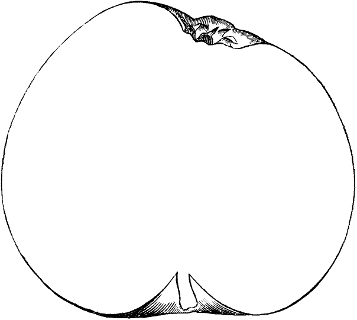
Fruit, large; roundish and flattened. Skin, pale yellow, strewed with minute russety dots, and greenish embedded specks under the surface and with a tinge of pale red on the side next the sun, which is sometimes almost entirely covered with a bright red cheek. Eye, large and open, with broad, reflexed, acuminate segments, set in an irregular, uneven, and pretty deep basin. Stalk, half-an-inch long, deeply inserted in a narrow, and funnel-shaped cavity, which is lined with russet. Flesh, yellowish-white, firm, crisp, brisk, and very juicy, with a slight aromatic flavor.
One of the most valuable culinary apples; it is in use from November to March.
The tree is one of the strongest, and most vigorous growers, very hardy, and an excellent bearer. The young shoots which are long and stout, are thickly covered with large greyish white dots, which readily distinguish this variety from almost every other.
This excellent apple was raised by a person of the name of Dumeller, (pronounced Dumelow), a farmer at Shakerstone, a village in Leicestershire, six miles from Ashby-de-la-Zouch, and is extensively cultivated in that, and the adjoining counties under the names of Dumelow’s Crab. It was first introduced to the neighbourhood of London, by Mr. Richard Williams, of the Turnham Green Nursery, who received it from Gopsal Hall, the seat of Earl Howe, and presented specimens of the fruit to the Horticultural Society in 1820. It was with him that the name of Wellington Apple originated, and by which only it is now known in the London markets.
102. DUNCAN.—Hort.
Identification.—Hort. Soc. Cat. ed. 3, p. 14?
Fruit, medium sized, two inches and three quarters broad, and two inches and a half high; conical, with ribs on the sides which terminate in irregular and unequal knobs round the eye. Skin, pale yellow in the shade; but deep orange finely veined with rich deep crimson next the sun. Eye, partially closed with short, broad segments, and set in a deep, irregular, and prominently angular basin. Stalk, very short, set in a round cavity. Flesh, yellowish-white, crisp, juicy, and pleasantly acid.
A handsome, showy, and very good culinary apple; in use from November to January.
103. DUTCH CODLIN.—Hort.
Identification.—Hort. Soc. Cat. ed. 3, n. 155. Lind. Guide, 29. Down. Fr Amer. 83.
Synonymes.—Chalmers’s Large, acc. Hort. Soc. Cat. White Codlin of the Scotch Nurseries. Glory of the West, acc. Lind.
Figure.—Ron. Pyr. Mal. pl. xxxvii.
Fruit, very large, four inches wide, and three inches and a half high; roundish, inclining to oblong, irregularly and prominently ribbed. Skin, pale green at first, but changing to pale yellow, with a faint tinge of red next the sun. Eye, small, and deeply inserted in a narrow and angular basin. Stalk, short and thick, inserted in a deep cavity. Flesh, white, firm, somewhat sugary, and pleasantly sub-acid.
An excellent culinary apple of first-rate quality; in use during August and September.
The tree is healthy and vigorous, and a good bearer.
According to Lindley this variety is sometimes called Glory of the West, but that is quite a different apple, see No. 141.
104. DUTCH MIGNONNE.—Hort.
Identification.—Hort. Trans. vol. iv., p. 70. Hort. Soc. Cat. ed. 3, n. 225. Lind. Guide, 44. Down. Fr. Amer. 107.
Synonymes.—Christ’s Golden Reinette, Lipp. Taschenb. p. 405. Reinette Dorée, Mayer. Pom. Franc. t. xxx. but not of Knoop or Duhamel. Grosze oder doppelte Casseler Reinette, Diel Kernobst. iv. 140. Paternoster Apfel, Audibert. Cat. Pomme de Laak, acc. Pom. Mag. Stettin Pippin, acc. Hort. Soc. Cat. Dutch Minion, Ron. Pyr. Mal. Holländische Goldreinette, acc. Ditt. Handb.
Figure.—Pom. Mag. t. 84. Ron. Pyr. Mal. t. xxvi. f. 1.
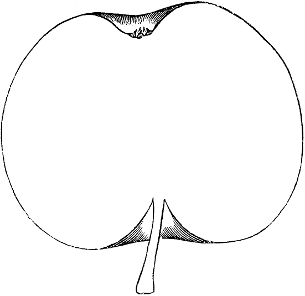
Fruit, medium sized; roundish, even and handsomely shaped, narrowing a little towards the apex, where it is sometimes slightly ribbed. Skin, dull greenish-yellow, marked all over with broken streaks of pale red and crimson, with traces of russet, and numerous russety dots, which are thickest round the eye. Eye, small and closed, with short and pointed segments, placed in a deep and narrow basin. Stalk, an inch long, inserted in a round and deep cavity, which, with a portion of the base, is lined with rough russet. Flesh, yellow, firm, crisp, very juicy, rich, sugary, and aromatic.
A very valuable and delicious dessert apple; in use from December to April.
The tree is hardy, a vigorous grower, and a very abundant bearer. It attains about the middle size when fully grown. The shoots are thickly set with fruit spurs. It is well adapted for dwarf or espalier training, and for these purposes succeeds well on the paradise stock.
105. EARLY HARVEST.—Hort.
Identification.—Hort. Soc. Cat. ed. 3, n. 228. Down. Fr. Amer. 72. Gard. Chron. 1845, p. 800.
Synonymes.—Early French Reinette, Coxe. View. 101. July Pippin, Floy Lind. Prince’s Harvest, acc. Coxe. Prince’s Early Harvest, Prince Cat. Large Early, acc. Hort. Soc. Cat. July Early Pippin, Ibid. Yellow Harvest, Ibid. Large White Juneating, acc. Down. Tart Bough, Ibid. Prince’s Yellow Harvest, acc. Gard. Chron. July Early Pippin, Ibid. Pomme d’Eté, of Canada, Ibid.
Fruit, of medium size, two inches and three quarters wide, and two inches and a quarter high; round. Skin, smooth, pale yellowish-green at first, but changing to clear pale yellow as it ripens, and set with embedded white specks, particularly round the eye. Eye, small and closed, set in a round and shallow basin. Stalk, half an inch long, inserted in a rather shallow cavity. Flesh, white, tender, crisp, and juicy, with a quick and pleasantly sub-acid flavor, and as is justly remarked by Mr. Thompson, “closely approximates that of the Newtown Pippin, of perfect American growth.”
An estimable and refreshing early dessert apple, of the first quality; ripe in the end of July and the beginning of August.
The tree is a healthy, and free, though not a vigorous grower, and an abundant bearer. It is well adapted for dwarf or espalier training when grown on the paradise stock, and ought to find a place in every collection however small.
Though of American origin this variety succeeds to perfection in this country; a qualification which few of the American apples possess.
106. EARLY JULIEN.—Hort.
Identification.—Hort. Trans. vol. v. p. 267. Lind. Guide, 4. Rog. Fr. Cult. 32.
Fruit, of medium size, two inches and three quarters wide, and two inches and a quarter high; roundish, slightly flattened, and prominently ribbed from the eye downwards to the base. Skin, smooth, pale yellow, with an orange tinge next the sun, strewed all over with minute dots and a few whitish specks. Eye, closed with broad segments, and set in a deep, irregular, and angular basin. Stalk, short, not extending beyond the base, and inserted in a deep and angular cavity. Flesh, yellowish-white, crisp, very juicy, and with a brisk, pleasant, and refreshing flavor.
An excellent early culinary apple, of first-rate quality, ripe in the second week of August. It might with propriety be called the Summer Hawthornden, as it equals that esteemed old variety in all its properties.
The tree is healthy and hardy, but not a large grower. It is, however, a good bearer, though not so much so as the Hawthornden, and is well adapted for growing as a dwarf.
This variety is said to be of Scotch origin, but I cannot ascertain where, or when it was first discovered. It is not mentioned by Gibson, neither is it enumerated in the catalogue of Leslie and Anderson, of Edinburgh, or any of the Scotch nurserymen of the last century. It was first introduced to the south by the late Mr. Hugh Ronalds, of Brentford, who exhibited it at the London Horticultural Society.
107. EARLY NONPAREIL.—Lind.
Identification.—Lind. Plan. Or. 1796. Hort. Soc. Cat. ed. 3, n. 467. Lind. Guide, 88. Rog Fr. Cult. 67.
Synonymes.—Stagg’s Nonpareil, acc. Hort. Soc. Cat. New Nonpareil, Ibid. Summer Nonpareil, Ron. Cat. Hicks’s Fancy, Ron. Pyr. Mal. 4. Lacy’s Nonpareil, acc. Rogers.
Figure.—Ron. Pyr. Mal. pl. ii. f. 6.
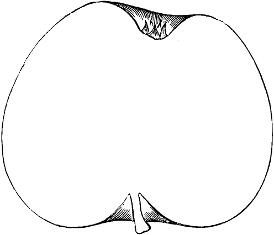
Fruit, medium sized; somewhat oblato-ovate. Skin, dull yellow, covered with thin brownish grey russet, and marked with large russety dots. Eye, open, placed in a small, round, and rather shallow basin. Stalk, half-an-inch long, inserted in a narrow, deep, and russety cavity. Flesh, yellowish-white, tender, crisp, juicy, and sugary, with a brisk and rich aromatic flavor, resembling the old Nonpareil.
A delicious apple for the dessert, and of the first quality; it is in use during October and November, after which it becomes dry and meally.
The tree is a free and upright grower, perfectly hardy, an early and abundant bearer; even in the nursery quarters it produces freely when only two years from the graft. It is well adapted for dwarf and espalier training, when grown on the paradise stock.
This esteemed variety was raised about the year 1780, by a nurseryman of the name of Stagg, at Caister, near Yarmouth, in Norfolk. The name of Hicks’s Fancy was given to it by Kirke, formerly a nurseryman at Brompton, near London, from the circumstance of a person of the name of Hicks, giving it the preference to the other varieties which were fruited in the nursery. An instance of the absurd system by which the names of fruits have been multiplied.
108. EARLY SPICE.—Hort.
Identification.—Hort. Soc. Cat. ed. 3, n. 786.
Fruit, of medium size, two inches and three quarters wide, and two inches and a quarter high; roundish, and somewhat angular. Skin, smooth, of an uniform pale yellow or straw color, and thinly strewed with greenish dots. Eye, small and open, with long, reflexed segments, and set in a small basin. Stalk, three quarters of an inch long, deeply inserted in a rather angular cavity, which is thickly lined with russet. Flesh, white, tender, marrowy and very juicy; with a pleasant, refreshing and sub-acid flavor.
An excellent early culinary apple, which is well suited for baking, and is also good as an eating apple. It is ripe in the first week of August, but soon becomes woolly after being gathered.
109. EARLY WAX.—Hort.
Identification.—Hort. Soc. Cat. ed. 2, p. 14.
Synonyme.—Wax Apple, Ron. Pyr. Mal. 3.
Figure.—Ron. Pyr. Mal. pl. ii. f. 1.
Fruit, below medium size, two inches wide, and two inches and a half high; oblong, and somewhat ribbed, particularly at the base. Skin, thick and membranous, of an uniform waxen yellow color. Eye, partially open, with long reflexed segments, and set in a moderately deep basin. Stalk, long and slender, inserted in a deep and angular cavity, from which issue prominent ribs. Flesh, yellowish-white, tender and soft, with a sweet and abundant juice.
A dessert apple of ordinary merit, valuable only for its earliness, as it ripens in the first week of August, but does not keep any time.
110. ELFORD PIPPIN.—M.
Identification and Figure.—Maund. Fruit, pl. 45.
Fruit, of medium size, two inches and three quarters wide, and the same in height; roundish, inclining to ovate, and ribbed round the eye. Skin, yellowish-green, with markings of russet on the shaded side, but covered with red, which is striped with darker red on the side next the sun. Eye, large, and somewhat closed, with broad flat segments like those of Trumpington, placed in a rather deep and somewhat undulating basin. Stalk, short, inserted in a rather shallow cavity, which is lined with delicate yellowish-brown russet. Flesh, yellowish, crisp, and tender, with a fine, brisk, sugary, and vinous flavor.
An excellent dessert apple of first-rate quality, in use from October to Christmas. The tree is a healthy and vigorous grower, and a good bearer.
The Elford Pippin is supposed to have been raised at Elford, near Lichfield, where it is a very popular variety, and to which locality it is at present chiefly confined.
111. EMPEROR ALEXANDER.—Hort.
Identification.—Hort. Trans. vol. ii., p. 407. Lind. Guide, 14.
Synonymes.—Alexander, Hort. Soc. Cat. ed. 1, 6, and ed. 3, n. 7. Phœnix Apple, Brook. Pom. Brit. Aporta, acc. Hort. Soc. Cat. Russian Emperor, Ibid. Kaiser Alexander von Russland, Diel Kernobst. 2 B. 65. Aporta Nalivia, acc. Diel Kernobst.
Figures.—Hort. Trans. vol. ii. t. 28. Ron. Pyr. Mal. pl. xxxv. f. 2.
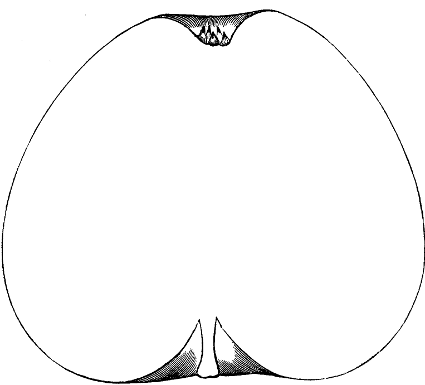
Fruit, of the largest size; ovate. Skin, smooth, greenish-yellow, with a few streaks of red on the shaded side; and orange covered with streaks and patches of bright crimson on the side exposed to the sun, the whole strewed with numerous russety dots. Eye, large, and half open, with broad, erect, and acuminate segments, set in deep, even, and slightly ribbed basin. Stalk, an inch or more in length, inserted in a deep, round, and even cavity, which is lined with russet. Flesh, yellowish-white, tender, crisp, juicy, and sugary, with a pleasant and slightly aromatic flavor.
A beautiful and valuable apple, both as regards its size and quality. It is more adapted for culinary than dessert use, but is also desirable for the latter were it only on account of its noble appearance at the table. It is in use from September to December.
The tree is a strong and vigorous grower, producing long stout shoots, is perfectly hardy and a good bearer.
This apple was introduced to this country by Mr. Lee, nurseryman of Hammersmith, in 1817, and was exhibited by him at the London Horticultural Society; the specimen produced being five inches and a half in diameter, four inches deep, sixteen inches in circumference, and weighed nineteen ounces. It is generally supposed that this was its first appearance in England; but there can be little doubt that it is the Phœnix Apple figured by Brookshaw, whose account of it in 1808, is as follows:—“It was much grown fifty years back in the neighbourhood of Twickenham, but was rather lost. The late Mr. Ash, nurseryman at Strawberry Hill, near Twickenham, preserved it from his father, who had an old tree of it. This specimen came from that tree. This apple was seen in Russia by an English nobleman, who thought it so excellent an apple, that he was induced to send some trees of it to England, and what will appear extraordinary to English gardeners, they were taken up in the summer with their leaves on, when they could not be less than twelve years old by their appearance, and when they arrived, after being six months before they came to hand, they were planted and produced fruit, and are now fine trees. The apple has a bloom on it like a red plum when on the tree, and is a very excellent beautiful apple, ripens in October, and will keep through December. It is to be had at the late Mr. Ash’s nursery, at Strawberry Hill, near Twickenham, under the name of Phœnix Apple, from its being lost and revived.”
112. ENGLISH CODLIN.—Hort.
Identification.—Hort. Soc. Cat. ed. 1, n. 176. Lind. Guide, 29. Rog. Fr. Cult. 63.
Synonymes.—Quodling Aust. Treat. 66. Codling. Raii Hist. ii. 1447. Old English Codlin, Hort. Soc. Cat. ed. 3, n. 163. Common Codlin, Aber. Bot. Arr. ii. 312.
Figure.—Lang. Pom. t. lxxiv. f. 3.
Fruit, above medium size; conical, irregular in its shape. Skin, pale yellow with a faint blush on the side exposed to the sun. Eye, closed, set in a moderately deep basin. Stalk, short, stout, and rather deeply inserted. Flesh, white, tender, and agreeably acid.
A culinary apple of first-rate quality; ripe in August and continues in use till October.
The trees are excellent bearers, but in most orchards they are generally found unhealthy, cankered, and full of the woolly aphis, a state produced, according to Mr. Lindley, by their being raised from suckers, and truncheons stuck into the ground. In the “Guide to the Orchard,” he says, “Healthy, robust, and substantial trees are only to be obtained by grafting on stocks of the real Sour Hedge Crab; they then grow freely, erect, and form very handsome heads, yielding fruit as superior to those of our old orchards, as the old, and at present deteriorated Codlin is to the Crab itself.” This circumstance was noticed by Worlidge nearly two hundred years ago—“You may graft them on stocks as you do other fruit, which will accelerate and augment their bearing; but you may save that labor and trouble, if you plant the Cions, Slips, or Cuttings of them in the spring-time, a little before their budding; by which means they will prosper very well, and soon become Trees; but these are more subject to the canker than those that are grafted.”
This is one of our oldest English apples, and still deserving of more general cultivation than is at present given to it. Formerly it constituted one of the principal dishes in English cookery, in the shape of “Codlings and Cream.” Ray says, “Crudum vix editur ob duritiem et aciditatem, sed coctum vel cum cremore lactis, vel cum aqua rosacea et saccharo comestum inter laudatissima fercula habetur.” The name is derived from coddle, to parboil.
113. ESOPUS SPITZENBURGH.—Coxe.
Identification.—Coxe. View. 127. Down. Fr. Amer. 138.
Synonymes.—Æsopus Spitzenberg, Hort. Soc. Cat. ed. 3, 790. Æsopus Spitzenburg, Ken. Amer. Or. 40. True Spitzenburgh, acc. Down.
Figure.—Down. Fr. Amer. 138.
Fruit, large, three inches and a quarter wide, and three inches high; ovate, and regularly formed. Skin, almost entirely covered with clear bright red, and marked with fawn-colored russety dots, except on a portion of the shaded side, where it is yellow tinged and streaked with red. Eye, small and closed, set in a moderately deep and undulating basin. Stalk, slender, about an inch long, inserted in a wide, round, and deep cavity. Flesh, yellow, crisp, juicy, richly, and briskly flavored.
A most excellent dessert apple; in use from November to February.
This is a native of the United States, and is there considered one of the best dessert apples. Along with the Newtown Pippin it ranks as one of the most productive and profitable orchard fruits, but like many, and indeed almost all the best American varieties, it does not attain to that degree of perfection in this country that it does in its native soil. The tree is tender and subject to canker, and the fruit lacks that high flavor, and peculiar richness which characterizes the imported specimens. It was raised at Esopus, on the Hudson, where it is still grown to a large extent.
114. ESSEX PIPPIN.—Hort.
Identification.—Hort. Soc. Cat. ed. 3, n. 239.
Fruit, small; round and flattened, somewhat oblate. Skin, smooth, green at first, but becoming of a yellowish-green as it ripens, and with a faint tinge of thin red where exposed to the sun. Eye, open, with long, reflexed, acuminate segments, placed in a shallow basin. Stalk, three quarters of an inch long, slender, inserted in a round and even cavity. Flesh, yellowish, firm, and crisp, with a brisk, sugary, and rich flavor.
A dessert apple of first-rate quality, nearly allied to the Golden Pippin; it is in use from October to February.
115. FAIR MAID OF TAUNTON.—Hort.
Identification.—Hort. Soc. Cat. ed. 3, p. 15
Fruit, small, two inches and a quarter wide, and an inch and three quarters high; ovato-oblate, and rather irregularly formed. Skin, smooth and shining, thick and membranous, of a pale straw color, and with a faint of red on the side exposed to the sun; thickly strewed all over with small russety dots. Eye, somewhat closed, with broad, flat segments, which are reflexed at the tips, and set in a shallow and plaited basin. Stalk, very short, inserted in a wide cavity, which is lined with rough brown russet. Flesh, yellowish-white, tender, very juicy, sweet, and though not richly yet pleasantly flavored.
A dessert apple, but not of the first quality; in use from November to February.
116. FAIR’S NONPAREIL.—Hort.
Identification.—Hort. Soc. Cat. ed. 3, n. 469.
Fruit, small, two inches and a quarter broad, and two inches high; ovate, even, and regularly shaped. Skin, tender, of a bright green color at first, but changing as it attains maturity, to a fine clear yellow without any tinge of red. Eye, closed, set in a shallow, and finely plaited basin. Stalk, inserted in a pretty deep cavity, which has sometimes a fleshy protuberance on one side of it. Flesh, fine, firm, crisp, and juicy, with a rich, refreshing, sugary, and vinous flavor.
A dessert apple of first-rate quality, in use from November to February.
117. FAMAGUSTA.—Hort.
Identification.—Hort Soc. Cat. ed. 3, p. 15.
Fruit, medium sized, about two inches and three quarters wide, and two inches and a half high; roundish-ovate, somewhat ribbed towards the eye. Skin, smooth, clear deep yellow, thinly strewed with large brownish russety dots, on the shaded side, and marked with patches and veins of thin, delicate, pale brown russet, and a faint tinge of red on the side exposed to the sun. Eye, closed, set in a narrow and even basin. Stalk, half-an-inch long, inserted in a narrow and shallow cavity, which is lined with russet. Flesh, yellowish, tender, sweet, aqueous, and slightly perfumed.
A culinary apple, in use from December to February.
The Famagusta of the Horticultural Society’s Catalogue cannot be the original Famagusta mentioned by Rea, Worlidge, and Ray, because Rea says it is “a fair large early apple,” which is confirmed by Worlidge placing it “in the number of the best early apples.” The name is, therefore, now given to a variety different from that to which it was originally applied, but which may still be in existence in some parts of the country.
118. FARLEIGH PIPPIN.—Lind.
Identification.—Hort. Soc. Cat. ed. 3, n. 243. Lind. Guide, 68. Rog. Fr. Cult. 97.
Synonyme.—Farley Pippin, Hort. Soc. Cat. ed. 1, n. 319.
Fruit, medium sized; oblong-ovate, and with prominent ribs on the sides, which terminate at the crown in bold ridges. Skin, yellowish-green on the shaded side; and brownish-red where exposed to the sun. Eye, deeply set in an angular basin. Flesh, greenish, firm, rich, and sugary.
A dessert apple of first-rate quality; in use from January to April.
The tree is a strong, vigorous, and upright grower, very hardy, and an abundant bearer.
This variety originated at Farleigh, in Kent.
119. FEARN’S PIPPIN.—Hooker.
Identification.—Hort. Soc. Cat. ed. 2, n. 245. Lind. Guide, 47. Fors. Treat. 102. Rog. Fr. Cult. 85.
Synonymes.—Clifton Nonesuch, acc. Hort. Soc. Cat. Ferris Pippin, Ibid. Florence Pippin, in Covent Garden Market.
Figure.—Hook. Pom. Lond. t. 43. Pom. Mag. t. 67. Ron. Pyr. Mal. t. xii. f. 2.
Fruit, medium sized; roundish, and flattened at both ends. Skin, pale greenish-yellow, streaked with dull red on the shaded side; and bright dark crimson, strewed with grey dots, and small patches of russet on the side next the sun, and extending almost over the whole surface. Eye, large, partially open, with broad connivent segments, which are reflexed at the tips, and set in a shallow and plaited basin. Stalk, a quarter of an inch long, inserted in a wide and shallow cavity. Flesh, yellowish-white, firm, crisp, brisk, sugary, and pleasantly flavored.
An excellent apple, either for the dessert or culinary purposes; it is in use from November to February.
The tree is very hardy and a great bearer. It is only of late years that it has been brought into general cultivation, and now it is grown very extensively by the London market gardeners, for the supply of Covent Garden Market.
120. FEDERAL PEARMAIN.—Hort.
Identification.—Hort. Soc. Cat. ed. 3, n. 540.
Fruit, below medium size; pearmain-shaped. Skin, yellowish on the shaded side; with a little red, and a few dark red streaks on the side next the sun; the whole thickly covered with large russety dots, and a few patches of russet. Eye, set in a pretty deep and ribbed basin. Stalk, about half-an-inch long, inserted in a funnel-shaped and russety cavity. Flesh, fine and delicate, very juicy, with a rich, sugary, and vinous flavor.
A dessert apple of first-rate quality; ripe in December, and continues till March.
121. FENOUILLET GRIS.—Duh.
Identification.—Duh. Arb. Fruit. i. 287. t. 5. Hort. Soc. Cat. ed. 3, n. 246. Lind. Guide, 88. Down. Fr. Amer. 110. Diel Kernobst. iv. 117. Quint. Inst. i. 202.
Synonymes.—Fenouillet, Knoop Pom. 52. t. ix. Fenellet, Lang. Pom. 134, t. lxxv. f. 1. Fenouillet, d’Or Gros, acc. Hort. Soc. Cat. Gros Fenouillet acc. Calvel. Petit Fenouillet, Ibid. Pomme d’Anis, acc. Merlet. Anis, Duh. Arb. Fruit. i. 287. George de Pigeon, acc. Knoop. 130. Graue Fenchelapfel, Diel Kernobst. iv. 117. Grauer Fenchelapfel. Anisapfel, Mayer Pom. Franc. t. xxxii. f. 55. Winter Anisreinette, Christ Handb. No. 116.
Figure.—Nois. Jard. Fr. ed. 2, pl. 99. Poit. et Turp. 151.
Fruit, small, about two inches and a quarter broad, and the same in height; roundish-ovate, and broadest at the base. Skin, of a fine deep yellow color, like a Golden Pippin, but almost entirely covered with russet, which is brown on the shaded side, and grey where exposed to the sun, mixed with a tinge of redish brown. Eye, small and open, set in a round, wide, and rather deep basin. Stalk, half-an-inch long, inserted in a rather shallow cavity. Flesh, yellowish-white, tender, crisp, rich, sugary, and aromatic, partaking much of the flavor of Anise—hence the origin of one of the synonymes.
An excellent dessert apple, and when well ripened is considered of first-rate quality by those who are partial to its peculiar flavor. It is in season from December to March, and at an advanced period becomes woolly.
The tree is a small and slender grower; but an abundant bearer. It requires a rich soil and warm situation, and succeeds well as a dwarf on the paradise stock.
122. FENOUILLET JAUNE.—Duh.
Identification.—Duh. Arb. Fruit. i. 290. Down. Fr. Amer. 109. Bon. Jard.
Synonymes.—Drap d’Or, Knoop Pom. 59. Caracter Appel, Ibid. t. x. Pomme de Caractère, Ibid. 130. Reinette Drap d’Or, Ibid. 130. Embroidered Pippin, Lind Guide, 46.
Figure.—Jard. Fruit. ed. 2, pl. 105.
Fruit, small, two inches and a quarter broad, and an inch and three quarters high; roundish, flattened, and broadest at the base; even and regularly formed. Skin, fine bright yellow, marked with reticulations of pale brown russet. Eye, small and closed, set in a wide and pretty deep basin. Stalk, short and stout, inserted in a deep and funnel-shaped cavity. Flesh, white, firm, sugary, and richly perfumed.
A delicious little dessert apple; in use from December to April.
The tree is a free grower, quite hardy, and an excellent bearer; but requires a light and warm soil.
According to Knoop, this apple is called Pomme de Caractère, from the linear tracings of russet with which it is covered, being so disposed as to give it the appearance of being marked with letters or characters.
123. FENOUILLET ROUGE.—Duh.
Identification—Duh. Arb. Fruit, i. 289. Hort. Soc. Cat. ed. 3, n. 247. Lind. Guide, 47. Down. Fr. Amer. 109. Diel Kernobst. iii. 199.
Synonymes.—Courtpendû, Quint. Inst. i. 202. Reinette Courtpendû, Knoop Pom. 129. Courtpendû Gris, Ibid. 60. Reinette de Goslinga, Ibid. 129. Carpendy, Gibs. Fr. Gard. 355. Petit Courtpendu Gris, Inst. Arb. Fr. 154. Bardin, Schab. Prat. ii. 88. Pomme de Bardin, Riv. et Moul. Meth. 191. Curtipendula Minora, Bauh. Hist. i. 23. Rothe Fenchelapfel, Diel Kernobst. iii. 199. Reinette Grise de Champagne, acc. Bret. Ecole.
Figure.—Jard. Fruit. ed. 2, pl. 99. Mayer Pom. Franc. tab. xxxiii. Poit. et Turp. pl. 67.
Fruit, small, two inches broad and about the same in height; roundish, and a little flattened. Skin, pale greenish-yellow, but so entirely covered with dark grey russet as to leave none of the ground color visible, except that portion exposed to the sun, which is dark redish brown. Eye, large and closed, set in a wide and rather shallow basin. Stalk, about an inch long, sometimes obliquely inserted, by the side of a fleshy prominence, in a wide and shallow cavity. Flesh, greenish-white, firm, rich, sugary, and highly perfumed with the flavor of anise or fennel.
An excellent dessert apple; in use from November to January.
The tree is a small grower, but an abundant bearer, and requires a warm and rich soil to have the fruit in perfection.
124. FILL-BASKET.—H.
Fruit, medium sized, two inches and a half wide, and the same in height; conical, round at the base, flattened at the apex, and distinctly angular on the sides. Skin, pale dull greenish-yellow on the shaded side, and streaked with broken patches and pencilings of pale red, where exposed to the sun, the whole covered with russety dots. Eye, closed, as if drawn together or puckered, placed level with the flat crown, and with a small knob or wart at the base of each segment. Stalk, three quarters of an inch long, thickest at the insertion, and placed in a small, round, and shallow cavity, which is surrounded with dark brown russet. Flesh, greenish-white, tender, juicy, and acid, with a brisk and pleasant flavor.
An excellent culinary apple, extensively grown in the neighbourhood of Lancaster, where it is highly esteemed; it is in use from October to January.
This, which may be called the Lancashire Fill-basket, is very different from the Kentish variety of that name.
125. FLANDERS PIPPIN.—H.
Fruit, medium sized, three inches wide, and two and a quarter high; oblate, and marked on the sides with ten distinct angles, five of which are more prominent than the others. Skin, pale green, changing to pale greenish-yellow as it ripens, and occasionally tinged with a cloud of thin dull red on the side exposed to the sun, and thinly strewed with a few dots. Eye, closed, with long and downy segments, set in a narrow and ribbed basin. Stalk, from half-an-inch to an inch in length, slender, and inserted in a deep funnel-shaped cavity, which is lined with russet. Flesh, white, tender, and marrowy, juicy, and briskly flavored.
A culinary apple of second-rate quality; in use during October and November.
It is much grown in the Berkshire orchards.
126. FLOWER OF KENT.—Park.
Identification.—Park. Par. 587. Raii Hist. ii. 1448. Fors. Treat. 101. Lind Guide, 14. Hort. Soc. Cat. ed. 3, n. 254. Down. Fr. Amer. 83. Rog. Fr. Cult. 37.
Figure.—Ron. Pyr. Mal. pl. xv. f. 2.
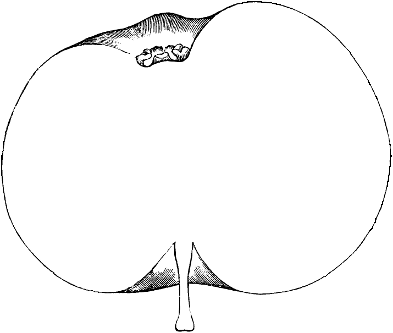
Fruit, large; roundish, and considerably flattened, with obtuse angles on the sides, which extend into the basin of the eye, where they form prominent knobs on the apex. Skin, greenish-yellow, thickly strewed with green dots on the shaded side; but next the sun, dull red marked with patches and streaks of livelier red, and dotted with light grey dots. Eye, large and open, with broad reflexed segments, and placed in a large angular basin, which is marked with russet. Stalk, an inch long, thick and strong, deeply set in an angular cavity. Flesh, greenish-white, firm, crisp, and juicy, with a pleasant and briskly acid flavor.
A culinary apple of first-rate quality; in use from November to January.
The tree is a pretty good bearer, one of the strongest and most vigorous growers, and consequently more suitable for the orchard than the fruit garden.
This is a very old variety, being mentioned by Parkinson, Leonard Meager, and Ray, but there is no notice of it in the works of any subsequent writer till the publication of Forsyth’s Treatise.
127. FLUSHING SPITZENBURGH.—Down.
Identification.—Down. Fr. Amer. 139.
Fruit, medium sized; roundish, narrowing towards the eye. Skin, entirely covered with deep red, which is streaked with deeper red, except on any small portion where it has been shaded, and there it is green, marked with broken streaks and mottles of red, the whole surface strewed with light grey russety dots. Eye, small and closed, very slightly depressed, and surrounded with plaits. Stalk, nearly an inch long, inserted in a deep and russety cavity. Flesh, greenish, tender, sweet, juicy, and without any predominance of acid.
An American dessert apple of little value; in use from October to January.
In the Horticultural Society’s Catalogue this is made synonymous with Esopus Spitzenburgh, but it is quite a different variety.
128. FOREST STYRE.—Knight.
Identification.—Pom. Heref. pl. xii.
Synonymes.—Stire, Marsh. Gloucest. ii. 251. Hort. Soc. Cat. ed. 3, n. 799. Forest Styre, Lind. Guide, 104.
Figure.—Pom. Heref. pl. xii.
Fruit, below medium size; roundish, inclining to oblate, regularly and handsomely shaped. Skin, pale yellow, with a blush of red on the side which is exposed to the sun. Eye, small and closed, with short obtuse segments, set in a shallow and plaited basin. Stalk, very short, inserted in a shallow cavity. Flesh, firm.
Specific gravity of the juice from 1076 to 1081.
This is a fine old Gloucestershire cider apple, which is extensively cultivated on the thin limestone soils of the Forest of Dean. The cider that it produces is strong bodied, rich, and highly flavored.
The tree produces numerous straight, luxuriant, upward shoots, like a pollard willow; it runs much to wood, and in deep soils attains a considerable size before it becomes fruitful.
129. FORGE.—H.
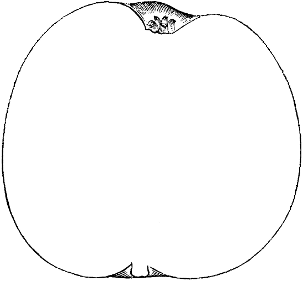
Fruit, medium sized; roundish, obscurely ribbed, and sometimes narrowing towards the eye, where it is angular. Skin, smooth and shining, of a fine golden yellow color, strewed with mottles of crimson on the shaded side; and dark red marked with patches of deep crimson on the side exposed to the sun; sometimes when much exposed to the sun the yellow assumes a deep orange tinge. Eye, small and closed, set in an angular basin. Stalk, very short, not a quarter of an inch long, inserted in a small, round, and shallow cavity, surrounded with thick russet. Flesh, yellowish-white, tender, mellow, juicy, sweet, and finely perfumed.
A beautiful and valuable apple, suitable either for the dessert, culinary use, or for the manufacture of cider. It is in use from October to January.
The tree attains about the middle size, is perfectly hardy and healthy, and quite free from canker and disease. It is a most abundant and regular bearer.
I am surprised that this beautiful apple has hitherto escaped the notice of pomologists, it being so universally grown, and generally popular, in the district to which it belongs. In the north-eastern parts of Sussex, and the adjoining county of Surrey, it is extensively cultivated, and I believe there is scarcely a cottager’s garden where it is not to be met with, nor is there a cottager to whom its name is not as familiar as his own, it being considered to supply all the qualifications that a valuable apple is supposed to possess; and although this judgment is formed in contrast with the other varieties grown in the district, nevertheless, the Forge is a useful and valuable apple, particularly to a cottager, whether we consider its great productiveness, its uses as a dessert and excellent cooking apple, or the excellent cider which it produces. It is said to have originated at a blacksmith’s forge near East Grinstead.
130. FORMAN’S CREW.—Hort.
Identification.—Hort. Soc. Cat. ed. 3, n. 256. Lind. Guide, 69. Rog. Fr. Cult. 60.
Figure.—Pom. Mag. t. 89.
Fruit, below medium size, two inches and a half high, and two inches wide; conical, and flattened at both ends. Skin, pale yellowish-green, with redish-brown on the side exposed to the sun, covered with pale, thin, yellowish-brown russet. Eye, small and open, set in a shallow and plaited basin. Stalk, short, not deeply inserted. Flesh, greenish-yellow, juicy, rich, and highly flavored, with much of the flavor of the Nonpareil and Golden Pippin.
An excellent dessert apple of first-rate quality; it comes into use in November, and keeps till April.
The tree is a great bearer, but tender and subject to canker.
It is well adapted for dwarf training when worked on the paradise stock.
This variety was raised by Thomas Seton Forman, Esq., Pennydarron Place, near Merthyr Tydvil, Glamorganshire.
131. FOULDEN PEARMAIN.—Lind.
Identification.—Lind. in Hort. Trans. vol. iv. p. 69. Lind. Guide, 69. Hort. Soc. Cat. ed. 3, n. 541.
Synonyme.—Horrex’s Pearmain, acc. Lind. in Hort. Trans.
Fruit, below medium size, two inches and a half high, and about the same broad; ovate. Skin, yellow in the shade, and clear thin red on the side exposed to the sun, strewed all over with small russety dots. Eye, small and open, set in a narrow and shallow basin. Stalk, three quarters of an inch long, inserted in a round and moderately deep cavity. Flesh, yellowish, tender, very juicy, and briskly acid.
An excellent culinary apple, and suitable also for the dessert; in use from November to March.
This variety originated in the garden of Mrs. Horrex, of Foulden, in Norfolk, and was first brought into notice by Mr. George Lindley, who communicated it to the Horticultural Society, March 7, 1820.
132. FOXLEY.—Knight.
Identification.—Pom. Heref. t. 14. Hort. Soc. Cat. ed. 3, n. 258. Lind. Guide, 104.
Figure.—Pom. Heref. t. 14.
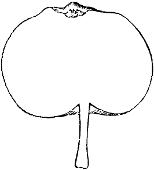
Fruit, growing in clusters of two or three together, very small, not much larger than a good sized cherry; roundish, and sometimes a little flattened, and narrowing towards the crown. Skin, deep, rich, golden yellow on the shaded side; and bright redish-orange on the side exposed to the sun. Eye, small and closed, not depressed, and surrounded with a few knobs. Stalk, about an inch long, inserted in a shallow cavity, which is lined with russet. Flesh, yellow.
Specific gravity of the juice 1080.
A valuable cider apple.
This variety was raised by Thomas Andrew Knight, Esq., from the Cherry Apple, impregnated with the pollen of the Golden Pippin. It was named Foxley from the seat of the late Uvedale Price, Esq., in whose garden, where it had been grafted, it first attained maturity. Mr. Knight says, “there is no situation where the common Wild Crab will produce fruit, in which the Foxley will not produce a fine cider.”
133. FOX-WHELP.—Evelyn.
Identification.—Evelyn Pom. Lind. Guide, 105. Fors. Treat. 101. Down. Fr. Amer. 146. Rog. Fr. Cult. 112. Worl. Vin. 162.
Figure.—Pom. Heref. t. 3.
Fruit, medium sized; ovate, and irregularly shaped, with prominent angles on the sides. Skin, yellow and red, mixed with a good deal of deeper red streaked all over the fruit.
Specific gravity of the juice 1076 when the fruit is healthy; and when small and shrivelled it is 1080.
The juice of this variety is extremely rich and saccharine, and enters in a greater or less proportion into the composition of many of the finest ciders in Herefordshire, to which it communicates both strength and flavor.
This is one of the oldest of our cider apples, and is enumerated by Evelyn; but is not so highly extolled as the Redstreak, and some other varieties. In Evelyn’s “Advertisements concerning Cider,” a “person of great experience,” says “Cider for strength and a long lasting drink is best made of the Fox-Whelp of the Forest of Dean, but which comes not to be drunk till two or three years old.” By Worlidge it was “esteemed among the choice cider fruits.”
134. FRANKLIN’S GOLDEN PIPPIN.—Hort.
Identification.—Hort. Soc. Cat. ed. 3, n. 283. Fors. Treat. 101. Lind. Guide, 15. Down. Fr. Amer. 83. Diel Kernobst. x. 92.
Synonyme.—Sudlow’s Fall Pippin, Hort. Trans. vol. iv. p. 217.
Figure.—Pom. Mag. t. 137. Ron. Pyr. Mal. pl. xviii. f. 3.
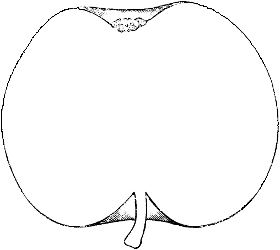
Fruit, medium sized; oblato-ovate, even and regularly formed. Skin, of an uniform deep yellow, covered all over with dark spots interspersed with fine russet, particularly round the apex. Eye, small, with long narrow segments overlapping each other, partially open, and set in a wide and deep basin. Stalk, short and slender, about half-an-inch long, inserted in a round, narrow, and smooth cavity. Flesh, yellow, tender, and crisp, very juicy, vinous, and aromatic.
A dessert apple of first-rate quality; in use from October to December.
The tree does not attain a large size, but is vigorous, healthy, and hardy, and an excellent bearer. It is well suited for a dwarf or espalier, and succeeds well on the paradise stock.
This is of American origin, and was introduced to this country by John Sudlow, Esq., of Thames Ditton, and first exhibited at the London Horticultural Society in 1819.
135. FRIAR.—Knight.
Identification.—Pom. Heref. t. 30. Lind. Guide, 105. Salisb. Or. 126.
Figure.—Pom. Heref. t. 30.
Fruit, of good size; somewhat conical, being broad at the base, and narrow at the crown. Skin, dark grass-green on the shaded side; and dark muddy livid red where exposed to the sun. Eye, sunk, and surrounded by four or five obtuse but prominent ridges. Stalk, short and stiff, notwithstanding which the fruit is generally pendant.
Specific gravity of its juice 1073.
This is a cider apple cultivated in the north-west parts of Herefordshire, where the climate is cold, and the soil unfavourable, and where proper attention is never paid by the farmer to the management of his cider, which in consequence is generally fit only for the ordinary purposes of a farm-house.—Knight.
The trees are vigorous and productive.
Mr. Knight says, “The Friar probably derived its name from some imagined resemblance between its color and that of the countenance of a well-fed ecclesiastic.”
136. FULWOOD.—Hort.
Identification.—Hort. Soc. Cat. ed. 3, n. 261. Lind. Guide, 48.
Synonyme.—Green Fulwood, acc. Hort. Soc. Cat.
Fruit, large, three inches and a half wide, and two inches and a half high; roundish, with broad irregular ribs on the sides. Skin, green, covered with broken stripes of dark dull red on the side next the sun. Eye, large and closed, moderately depressed, and surrounded with broad plaits. Stalk, short and slender, deeply inserted in a narrow and uneven cavity. Flesh, greenish-white, firm, crisp, very juicy, briskly acid, and slightly perfumed.
A culinary apple of first-rate quality; in use from November to March.
137. GANGES.—Lind.
Identification.—Lind. Guide, 69. Hort. Soc. Cat. ed. 3, n. 262.
Fruit, large; oblong and irregular. Skin, green, with a few specks of darker green interspersed; and dashed with red on the sunny side. Eye, hollow. Stalk, half-an-inch long, deeply inserted, quite within the base. Flesh, pale yellowish-green, sub-acid, and of good flavor.
A culinary apple; in use from October to January.—Lindley.
138. GARTER.—Knight.
Identification.—Pom. Heref. t. 26. Lind. Guide, 105. Salisb. Or. 125.
Figure.—Pom. Heref. t. 26.
Fruit, medium sized; oblong, tapering from the base to the crown, perfectly round in its circumference, and free from angles. Skin, pale yellow on the shaded side; but when exposed to the sun of a bright lively red, shaded with darker streaks and patches quite into the crown.
Specific gravity of its juice 1066.
Though this contains but a small portion of saccharine matter, it contributes to afford excellent cider when mixed with some of the older varieties.
139. GLORIA MUNDI.—Hort.
Identification.—Hort. Soc. Cat. ed. 3, n. 271. Down. Fr. Amer. 110.
Synonymes.—Monstrous Pippin, Coxe View, 117. Baltimore, Hort. Trans. iii. 120. Lind. Guide, 61. Glazenwood Gloria Mundi, acc. Hort. Soc. Cat. New York Gloria Mundi, Ibid. American Gloria Mundi, Ibid. American Mammoth, Ibid. Mammoth, Ron. Pyr. Mal. 13. Ox Apple, acc. Downing. Pomme Josephine, Poit et Turp. v. tab. 423. Pomme Melon, Ibid. Belle Josephine, Lelieur. Belle Dubois, acc. Dubrieul. Paternoster, Ibid. Rhode Island, Ibid. Hausmütterchen, Teutsche G. Mag. ii. 453, t. 29. Menagère, Ibid.
Figures.—Hort. Trans. vol. iii. t. 4. Ron. Pyr. Mal. pl. xxiv. f. 2. Poit. et Turp. tab. 423.
Fruit, immensely large, sometimes measuring four inches and a half in diameter; of a roundish shape, angular on the sides, and flattened both at the base and the apex. Skin, smooth, pale yellowish-green, interspersed with white dots and patches of thin delicate russet, and tinged with a faint blush of red next the sun. Eye, large, open, and deeply set in a wide and slightly furrowed basin. Stalk, short and stout, inserted in a deep and open cavity, which is lined with rough russet. Flesh, white, tender, juicy, and though not highly flavored, is an excellent culinary apple.
It is in use from October to Christmas.
This variety is of American origin, but some doubts exist as to where it was first raised, that honor being claimed by several different localities. The general opinion, however, is, that it originated in the garden of a Mr. Smith, in the neighbourhood of Baltimore, and was first brought over to this country by Captain George Hudson, of the ship Belvedere, of Baltimore, in 1817. It was introduced from America into France by Comte Lelieur, in 1804. But from the account given in the Allgemeines Teutsches Gärtenmagazin, it is doubtful whether it is a native of America, for in the volume of that work for 1805, it is said to have been raised by Herr Künstgartner Maszman, of Hanover. If that account is correct, its existence in America is in all probability owing to its having been taken thither by some Hanoverian emigrants. At page 41, vol. iii., Dittrich has confounded the synonymes of the Gloria Mundi with Golden Mundi, which he has described under the name of Monstow’s Pepping.
140. GLORY OF ENGLAND.—H.
Fruit, large, three inches and a half wide, and over two inches and three quarters high; ovate, somewhat of the shape of Emperor Alexander, ribbed on the sides, and terminated round the eye by a number of puckered-like knobs. Skin, dull greenish-yellow, with numerous embedded whitish specks, particularly round the eye, and covered with large dark russety dots, and linear marks of russet; but on the side exposed to the sun it is of a deeper yellow, with a few broken streaks and dots of crimson. Eye, small and slightly closed, set in a shallow and puckered basin. Stalk, short and fleshy, inserted in a wide, deep, and russety cavity. Flesh, greenish-yellow, tender, soft, juicy, sprightly, and slightly perfumed.
An excellent culinary apple; in use from October to January.
141. GLORY OF THE WEST.—Diel.
Identification.—Diel Kernobst. xii. 83.
Fruit, large, three inches and a quarter broad, and two inches and three quarters high; oblate, ridged and angular about the eye, and ribbed on the sides. Skin, smooth and shining, yellow, mixed in some parts with a tinge of green, and washed with thin clear red on the side next the sun; the whole surface is strewed with minute russety dots, and several large dark spots, such as are often met with on the Hawthornden. Eye, large, with long segments, and set in an angular basin. Stalk, three quarters of an inch long, inserted in a deep cavity, which is surrounded with a large patch of rough grey russet. Flesh, yellowish-white, firm but tender, very juicy, with a pleasant, brisk, and slightly perfumed flavor.
A culinary apple of first quality; it is in use the end of October and continues till Christmas.
The tree is a strong and vigorous grower, attaining a great size, and is an excellent bearer.
I had this variety from Mr. James Lake, of Bridgewater, and it is evidently identical with the Glory of the West of Diel, a name which, according to Lindley, is sometimes applied to the Dutch Codlin. The variety here described bears a considerable resemblance to that known by the name of Turk’s Cap.
142. GOGAR PIPPIN.—Fors.
Identification.—Fors. Treat. 126. Hort. Soc. Cat. ed. 3, n. 273. Lind. Guide, 48. Nicol. Villa. Gard. 31.
Synonyme.—Stone Pippin, of some, acc. Hort. Soc. Cat.
Fruit, medium sized; roundish, obscurely angled, and slightly flattened. Skin, thick and membranous, pale green, strewed all over with small russety dots, and faintly mottled with a tinge of brownish-red next the sun. Eye, small and closed, set in a narrow, shallow, and plaited basin. Stalk, short, inserted in a very shallow cavity. Flesh, greenish-white, tender, juicy, sugary, and brisk.
A dessert apple of second-rate quality; in use from January to March.
This variety is of Scotch origin, and is said to have originated at Gogar, near Edinburgh.
143. GOLDEN HARVEY.—Knight.
Identification.—Pom. Heref. Hort. Soc. Cat. ed. 3, n. 275. Lind. Guide, 49. Down. Fr. Amer. 111. Rog Fr. Cult. 61.
Synonymes.—Brandy, Fors. Treat. 95. Ron. Pyr. Mal. 45. Round Russet Harvey, Rea Pom. 210. Worl. Vin. 159?
Figures.—Pom. Heref. t. 22. Pom. Mag. t. 39. Ron. Pyr. Mal. pl. xxiii. f. 4.
Fruit, small; oblato-cylindrical, even and free from angles. Skin, entirely covered with rough scaly russet, with sometimes a patch of the yellow ground color exposed on the shaded side, and covered with brownish-red on the side next the sun. Eye, small and open, with very short, reflexed segments, set in a wide, shallow, and slightly plaited basin. Stalk, half-an-inch long, inserted in a shallow cavity. Flesh, yellow, firm, crisp, juicy, sugary, with an exceedingly rich and powerful aromatic flavor.
This is one of the richest and most excellent dessert apples; it is in use from December to May; but is very apt to shrivel if exposed to light and air as most russety apples are.
The tree is a free grower, and perfectly hardy. It attains about the middle size and is an excellent bearer. When grown on the paradise stock it is well adapted for dwarf training, and forms a good espalier.
Independently of being one of the best dessert apples, it is also one of the best for cider; and from the great strength of its juice, the specific gravity of which is 1085, it has been called the Brandy Apple.
144. GOLDEN KNOB.—Fors.
Identification.—Fors. Treat. 104. Hort. Soc. Cat. ed. 3, n. 279. Rog. Fr. Cult. 54.
Synonyme.—Kentish Golden Knob, Nursery Catalogues.
Figure.—Ron. Pyr. Mal. pl. xxxii. f. 9.
Fruit, below medium size, two inches and a quarter wide, and the same in height; ovate, sometimes a little flattened, which gives it a roundish shape. Skin, pale green, becoming yellowish-green as it attains maturity; much covered with russet round the base and on the shaded side; but yellow, marked with streaks of a redish tinge, with crimson dots next the sun, and thickly strewed all over with large freckles of russet. Eye, open, generally with long segments, but in the roundish specimens they are short and stunted, and placed in a shallow basin. Stalk, very short, and quite embedded in the cavity. Flesh, greenish-white, firm, crisp, and very juicy, of a brisk, sweet flavor.
A good dessert apple, of second-rate quality; in use from December to March.
The tree is hardy and a vigorous grower, producing enormous crops, and on that account extensively cultivated, particularly in Kent, for the supply of the London markets. Though a good apple it is one more deserving the attention of the orchardist than the fruit gardener.
145. GOLDEN MONDAY.—Switz.
Synonyme.—Monstow’s Pepping, Ditt. Handb. iii. 41.
Fruit, small, about two inches and a half wide, and two inches high; roundish, inclining to oblate. Skin, smooth, pale grass green on the shaded side; but fine clear golden yellow dotted with crimson dots, on the side exposed to the sun, and in some parts marked with ramifications of very thin delicate brown russet, which generally issue from the basin of the eye. Eye, small, and rather open, with narrow, acute, and stiff segments, set in a narrow and plaited basin. Stalk, very short, not a quarter of an inch long, quite embedded in a narrow, round, and rather deep cavity, which, with the base, is covered with very thick and rough scaly russet. Flesh, yellowish-white, crisp, not very juicy, sugary, brisk, and perfumed, not unlike the flavor of the Golden Pippin.
A very excellent dessert apple of first-rate quality; in use from October to Christmas.
I do not know what the Golden Mundi of Forsyth is, which he describes as a fine handsome apple, beautifully streaked with red; but that now described is the Golden Monday of the Berkshire orchards, and the same as has been cultivated in the Brompton Park nursery for upwards of a hundred years.
The Golden Russet is sometimes called by the name of Golden Monday, but it is a very distinct variety from this.
146. GOLDEN NOBLE.—Hort.
Identification.—Hort. Trans. vol. iv., p. 524. Hort. Soc. Cat. ed. 3, n. 280. Lind. Guide, 49.
Fruit, large; round, and narrowing towards the eye, handsome. Skin, smooth, clear bright yellow, without any blush of red, but a few small redish spots and small patches of russet. Eye, small, set in a round and deep basin, surrounded with plaits. Stalk, short, with a fleshy growth on one side of it, which connects it with the fruit. Flesh, yellow, tender, with a pleasant acid juice, and baking of a clear amber color, perfectly melting, with a rich acidity.
A valuable culinary apple; in use from September to December.
This was first brought into notice by Sir Thomas Harr, of Stowe Hall, Norfolk, whose gardener procured it from a tree supposed to be the original, in an old orchard at Downham, and communicated it to the Horticultural Society of London, in 1820.
147. GOLDEN PEARMAIN.—Fors.
Identification.—Fors. Treat. 103. Hort. Soc. Cat. ed. 3, n. 542. Lind. Guide, 70
Synonyme.—Ruckman’s Pearmain, Hort. Soc. Cat. ed. 1, 755.
Figure.—Ron. Pyr. Mal. pl. xxiii. f. 6.
Fruit, medium sized, about two inches and a half in diameter, and the same in height; abrupt pearmain-shaped, irregularly ribbed on the sides, and uneven at the apex. Skin, pale yellow, strewed with patches of russet, and covered with minute russety dots on the shaded side; but deep redish orange, streaked with deeper color, and strewed with minute russety dots on the side exposed to the sun. Eye, large and open, with reflexed segments, and set in a wide, deep, and angular basin. Stalk, slender, three quarters of an inch long, and obliquely inserted, with frequently a fleshy protuberance on one side of it, in a rather shallow cavity, which is lined with green russet. Flesh, yellowish, firm, crisp, very juicy, sweet, and lacking acidity, which gives it a sickly flavor.
An apple of second-rate quality, suitable either for culinary purposes or the dessert; in use from November to March.
The tree is an upright grower and a free bearer, but requires to be grown in good soil.
In America this is esteemed as a cider apple.
148. GOLDEN PIPPIN.—Evelyn.
Identification.—Evelyn Pom. Raii Hist. ii. 1447. Switz. Fr. Gard. 135. Pom. Heref. Lind. Guide, 16. Hort. Soc. Cat. ed. 3, n. 281. Down. Fr. Amer. 112.
Synonymes.—Small Golding Pippin, or Bayford, Meag. Eng. Gard. 85. Barford Pippin, acc. Raii Hist. Russet Golden Pippin, Lang. Pom. 130, t. lxxix. f. 5. Balgown Pippin, Leslie and Anders. Cat. English Reinette, acc. West. Univ. Bot. iv. 139. Old Golden Pippin, Rog. Fr. Cult. 98. English Golden Pippin, Hort. Soc. Cat. ed. 1, n. 382. London Golden Pippin, Ibid. 387. Herefordshire Golden Pippin, Ibid. 384. Milton Golden Pippin, Ibid. 388. Warter’s Golden Pippin, Ibid. 394. Balgone Pippin, Ibid. 35. Balgone Golden Pippin, acc. Ibid. ed. 3. Bayfordbury, acc. Ibid. ed. 3. American Plate, Ron. Pyr. Mal. 63, pl. xxxii. f. 2. Guolden Peppins, Quint. Inst. i. 202. Reinette d’Angleterre, Schab. Prat. ii. 88 Pepin d’Or, Knoop Pom. 54, tab. ix. Pomme d’Or, Duh. Arb. Fruit. i. 292, t. 7. Gelbe Englische Pipe, Meyen Baumsch. No. 14. Gold Pepping, Diel Kernobst. ii. 69. Peppin d’Or, Knoop. Pom. tab. ix. Goud Pepping, Ibid. 131. Goudeling’s Pepping, Ibid. Gulden Pipping, Ibid. Engelsche Goud Pepping, Ibid. Litle Pepping, Ibid. Kœnings Peppeling, Hort. Soc. Cat. ed. 1, n. 527.
Figures.—Pom. Heref. t. 2. Hook. Pom. Lond. Ron. Pyr. Mal. pl. xviii. f. 5. Jard. Fruit, ed. 2, pl. 108.
Fruit, small; roundish, inclining to oblong, regularly and handsomely shaped, without inequalities or angles on the sides. Skin, rich yellow, assuming a deep golden tinge when perfectly ripe, with a deeper tinge where it has been exposed to the sun; the whole surface is strewed with russety dots, which are largest on the sunny side, and intermixed with these are numerous embedded pearly specks. Eye, small and open, with long segments, placed in a shallow, smooth, and even basin. Stalk, from half-an-inch to an inch in length, inserted in a pretty deep cavity. Flesh, yellow, firm, crisp, very juicy and sugary, with a brisk, vinous, and particularly fine flavor.
One of the oldest and by far the most highly esteemed of our dessert apples, and neither the Borsdorffer of the Germans, the Reinette of the French, nor the Newtown Pippin of the Americans, will ever occupy in the estimation of the English the place now accorded to the Golden Pippin. It is also an excellent cider apple. The specific gravity of its juice is 1078.
It is in season from November to April.
The tree is a free and vigorous grower, but does not attain a great size. It is also an excellent bearer.
When and where the Golden Pippin was first discovered, are now matters of uncertainty; but all writers agree in ascribing to it an English origin, some supposing it to have originated at Parham Park, near Arundel, in Sussex. Although it is not recorded at so early a period as some others, there is no doubt it is a very old variety. It is not, however, the “Golding Pippin” of Parkinson, for he says “it is the greatest and best of all sorts of Pippins.” It was perhaps this circumstance that led Mr. Knight to remark, that from the description Parkinson has given of the apples cultivated in his time, it is evident that those now known by the same names, are different, and probably new varieties. But this is no evidence of such being the case, for I find there were two sorts of Golden Pippin, the “Great Golding,” and the “Small Golding, or Bayford,” both of which are mentioned by Leonard Meager, and there is no doubt the “Golding Pippin,” of Parkinson, was the “Great Golding.” Whether it was because it was little known, or its qualities were unappreciated, that the writers of the 17th century were so restrictive in their praises of the Golden Pippin, it is difficult to say; but true it is whilst Pearmains, Red Streaks, Codlings, and Catsheads, are set forth as the desiderata of an orchard, the Golden Pippin is but rarely noticed. Ralph Austin calls it “a very speciall apple and great bearer.” Evelyn certainly states that Lord Clarendon cultivated it, but it was only as a cider apple: for he says “at Lord Clarendon’s seat at Swallowfield, Berks, there is an orchard of 1000 Golden and other cider Pippins.” In his Treatise on Cider he frequently notices it as a cider apple; but never in any place that I can recollect of as a dessert fruit. In the Pomona, he says, “About London and the southern tracts, the Pippin, and especially the Golden, is esteemed for making the most delicious cider, most wholesome, and most restorative.” Worlidge merely notices it as “smaller than the Orange Apple, else much like it in color, taste, and long keeping.” Ray seems the first who fully appreciated it, for after minutely and correctly describing it, he says, “Ad omnes culinæ usus præstantissimum habetur, et Pomaceo conficiendo egregium.” De Quintinye’s remarks are not at all complimentary. He says it has altogether the character of the paradise or some other wild apple, it is extremely yellow and round, little juice, which is pretty rich, and without bad flavor. But the Jardinier Solitaire, more impartial, or with better judgment, says, “son eau est tres sucrée; elle a le goût plus relevé que la Reynette; c’est ce que luy donne le mérite d’être reconnuë pour une tres excellente pomme.” The opinion of Angran de Rueneuve is also worth recording.
“La Pomme d’Or est venuë d’Angleterre; on l’y apelle Goule-Pepin. J’estime qu’elle doit être la Reyne des Pommes, et que la Reynette ne doit marche qu’aprés elle; car elle est d’un plus fin relief que toutes les autres Pommes.” Switzer calls it “the most antient, as well as most excellent apple that is.” But it is not my intention to record all that has been written in praise of the Golden Pippin, for that of itself would occupy too much space, my object in making these extracts being simply to show the gradual progress of its popularity.
The late President of the London Horticultural Society, T. A. Knight, Esq., considered that the Golden Pippin, and all the old varieties of English apples, were in the last stage of decay, and that a few years would witness their total extinction. This belief he founded upon the degenerate state of these varieties in the Herefordshire orchards, and also upon his theory that no variety of apple will continue to exist more than 200 years. But that illustrious man never fell into a greater error. It would be needless to enter into any further discussion upon a subject concerning which so much has already been said and written, as there is sufficient evidence to confute that theory. The Pearmain, which is the oldest English apple on record, shows no symptoms of decay, neither does the Catshead, London Pippin, Winter Quoining, or any other variety; those only having been allowed to disappear from our orchards, which were not worth perpetuating, and their places supplied by others infinitely superior.
It is now considerably upwards of half a century since this doctrine was first promulgated, and though the old, exhausted, and diseased trees of the Herefordshire orchards, of which Mr. Knight spoke, together with their diseased progeny—now that they have performed their part, and fulfilled the end of their existence—may ere this have passed away, we have the Golden Pippin still, in all the luxuriance of early youth, where it is found in a soil congenial to its growth; and exhibiting as little symptoms of decay as any of the varieties which Mr. Knight raised to supply the vacancy he expected it to create.
In the Brompton Park Nursery, where the same Golden Pippin has been cultivated for nearly two centuries, and continued from year to year by grafts taken from young trees in the nursery quarters, I never saw the least disposition to disease, canker, or decay of any kind; but, on the contrary, a free, vigorous, and healthy growth.
But this alarm of Mr. Knight for the safety of the Golden Pippin, and his fear of its extinction, were based upon no new doctrine, for we find Mortimer a hundred years before, equally lamenting the Kentish Pippin. After speaking of manures, &c., for the regeneration of fruit trees, he says, “I shall be glad if this account may put any upon the trial of raising that excellent fruit the Kentish Pippin, which else, I fear, will be lost. For I find in several orchards, both in Kent, Essex, and Hertfordshire, old trees of that sort, but I can find no young ones to prosper. A friend of mine tried a great many experiments in Hertfordshire, about raising them, and could never get them to thrive, though he had old trees in the same orchard that grew and bore very well. I likewise tried several experiments myself, and have had young trees thrive so well, as to make many shoots of a yard long in a year, but these young shoots were always blasted the next year, or cankered; which makes me think that the ancients had some particular way of raising them, that we have lost the knowledge of.” Although this was written a hundred and fifty years ago, we have the Kentish Pippin still, which though not so much cultivated, or so well known now as then, is nevertheless where it does exist as vigorous and healthy as ever it was.