The AMAZONAS Section
Reading edition
AMAZON STATE IS THE LARGEST ONE IN BRAZIL
Area in square kilometers, 1,894,724.
Population, 600,000 inhabitants.
Capital, Manáos; 60,000 inhabitants, 32ᵐ, 40ᵐ height from sea-level.
It exports rubber and woods for construction and for other works, Pará nuts, Guaraná and some other products.
Beans, corn, rice and almost every kind of cereals grow there beautifully.
It is put in communication with Europe by one English and two German Steamship Companies, and by cable and wireless telegraphy. These companies have improved their steamers, which go to Europe. To the United States it is served only by the English company, every ten days. They are cargo boats.
Principal cities: Stacoatiara, Manicoré, Humaythé, Teffé, Parintins and Labrea.
Medium temperature, 27° 2′ centigrade.
Rains—Evaporation in mm., 1592,0. Height, 1525,3 (in 202 days).
Wind—Velocity in one second, 1ᵐ, 60. Direction, east.
EXPORTS OF RUBBER FROM STATE OF AMAZONAS SINCE 1827 UP TO 1907
Years. Kilograms.
1837 802,410
1847 4,286,570
1857 7,134,195
1867 2,969,070
1877 17,403,574
1887 43,454,671
1897 106,424,423
1907 120,434,947
From 1827 to 1852 the exports belong to Pará and Amazonas together.
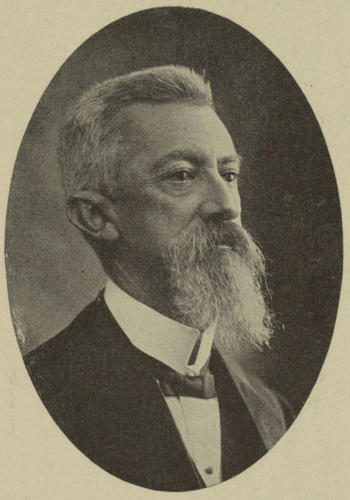
COLONEL ANTONIO CLEMENTE RIBEIRO BITTENCOURT Governor of the State of the Amazonas, Brazil
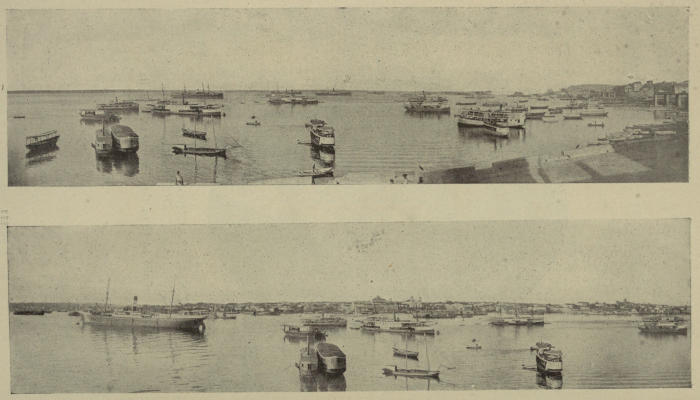
PORT OF MANÁOS
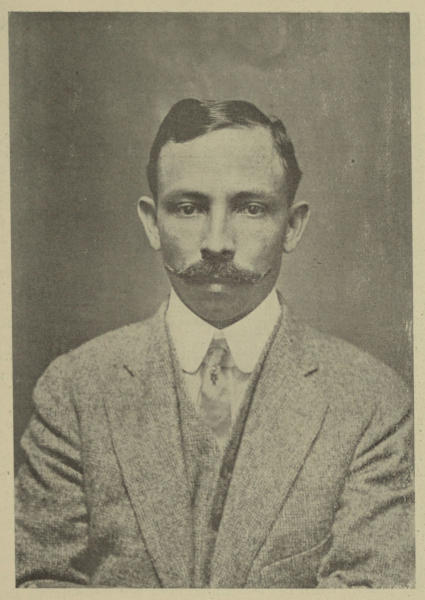
DR. MANOEL LOBATO Commissioner for the State of the Amazonas, Brazil, also of Matto Grosso and the Federal Territory of Acre
RUBBER IN THE STATE OF AMAZONAS
General Ideas about the State. Progress in the Means of Transportation. Climatological Conditions.
The State of the Amazonas is the largest one in the Brazilian Republic. Notwithstanding its well-known natural resources that are not limited, according to many persons, to the precious milk of the rubber tree—that wonderful tree of fortune—which is disputed by various producing centers, its vast territory is yet far from being completely and properly populated.
The emigration currents towards that section have started lately, so that the population of hardly over two hundred thousand souls a few years ago, to-day is over six hundred thousand inhabitants, without any exaggeration.
As such changes are taking place the conditions of life are being altered every day. It is true that there still prevails in the books of gay tourists who consider humbug as a condition of inexhaustible success, the impression that the native indians travel about half nude and armed with arches and arrows, chasing the lost Europeans through such outlandish regions of the world.
The remark, however, is not based on real facts. The native Indians are not now to be found in very accessible places. The foreigner who lands in the Amazonas capital, for instance, may be sure that his habits and his civilization will not cause any fright.
It is difficult to find among the natives who possess some education and means one who has not been through several European countries, especially France; so that as soon as the visitor lands he notices an atmosphere of modern improvements and all the novelty and gay spirit of Parisian life; the latest fashions are found at once in Manáos.
The progress of that beautiful princess of the Rio Negro (Black River) is most remarkable, because it is at the most only twenty years. Until the proclamation of the Republic in Brazil, Manáos amounted to almost nothing. From 1889 to this date began its stupendous development, counting already over 60,000 inhabitants.
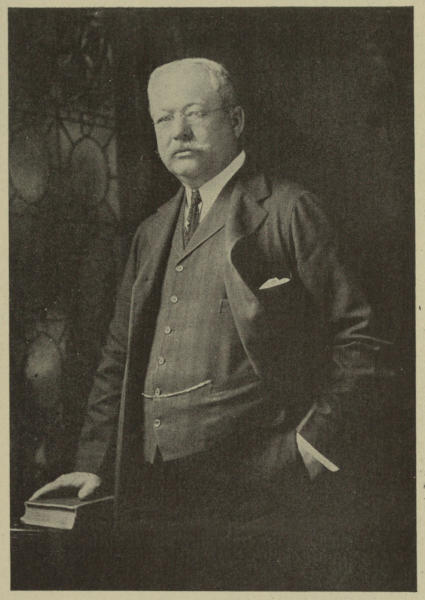
A. W. STEDMAN, ESQ. Commissioner for the Commercial Association of the State of Manáos, Matto Grosso, and the Federal Territory of Acre, Brazil
To-day it has comfortable homes, good and solid buildings of artistic architecture. Its port is perfectly fitted to receive the visits of the large transatlantic steamers, which places it in communication with the leading European ports. The navigation line for the United States, served by an English company, is not yet of the required progress to insure all the necessary comfort to the passengers who venture to undertake the long trip. Furthermore, it is served by steamers that do not possess the modern requirements of speed, which at present is of first interest not only for the passengers who look for a pleasure resort as well as for the intercourse of commercial relations with the world’s markets. That is the reason why the interchange between Amazonas and New York has been rather slow, which interchange could be of greater magnitude than it is to-day if there was a more intimate knowledge between the parties.
I would not want to end this information about the capital of the State of Amazonas without quoting some paragraphs from the excellent work, “The Rubber Country of the Amazon,” written by Mr. Henry C. Pearson, Editor of the “India Rubber World”:
“When one considers that this city is a thousand miles from the seacoast, in the heart of a vast tropical jungle, with wild Indians within a hundred miles of it, its presence seems incredible. In a way, it is as modern as New York or Chicago. The latest Parisian fashions are there, and almost anything that civilized man desires is obtainable. Prices are high, to be sure, because both luxuries and necessities are imported and subject to a duty of 100 per cent. But when something besides rubber is produced by the magnificently fertile lands that surround it, Manáos will be one of the great and beautiful cities of the world and living as reasonable as anywhere.”
That progress, although it has been made principally in Manáos, in some form is also affecting the interior of the State. The river navigation is made quicker than before and on elegant and up-to-date steamers, which navigate throughout all the tributaries of the Amazon River.
Furthermore, the Madeira-Mamoré railroad has produced a great improvement in the transportation facilities adopted in the State for the quick delivery of merchandise in the interior.
The most distant points of the territory are now connected by wireless telegraphy. The news of the world can be transmitted daily to the capital of the State by means of double river cable and by wireless telegraphy of the Marconi system.
The climatic conditions are not so terrible as pictured in the minds of the outside people, who do not know the real facts and the true geographic situation of the State.
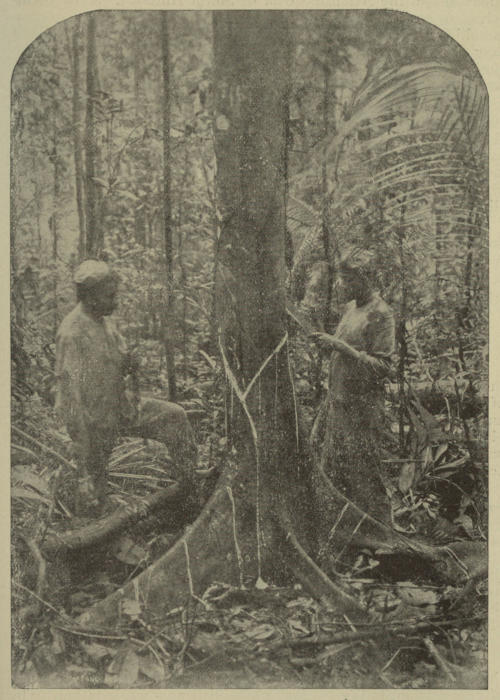
CAOUTCHOUC PROCESS No. 1.
The Men Set to Work Bleeding the Base of the Castillôa.
Mr. A. R. Wallace, in his “Narrative of Travels on the Amazon and Rio Negro,” and Captain Maury, in his book “The Amazon and the Atlantic Coast of South America,” show themselves so enthusiastic over the climate of Amazonas and recommend it “as one of the healthiest and mildest in the world.” That easy enthusiasm is not so good for us as the competent French engineer, Mr. Paul Le Cointe’s opinion, after many years in the northern part of Brazil. Thus he expresses himself:
“The Amazonia, an immense tableland slightly concave, situated entirely in the tropics, crossed by rivers of colossal dimensions, with lakes and swamps, the remains of the original water basin, badly separated by modern alluvium land, covered with impenetrable forests from which emerge here and there some plains, ought to have a specially hot, damp and unhealthy climate.
“That is the reputation which it has enjoyed for a long time and which has frightened away the European immigration; but it is not deserved in such an absolute manner; as a hot country is perhaps on the contrary the less deadly for the settler as well as for the traveler.”
THE AMAZON AS RUBBER PRODUCER
It is indeed very difficult if not absolutely impossible to limit the rubber producing region of Amazonas. In almost the whole of the vast territory of that State there are found rubber trees and where they do not grow, they certainly can be successfully planted. Over large tracts of lands on the banks of rivers not navigable, there are extensive rubber forests not explored on account of lack of population.
That exuberance of the Amazonian flora, that arrangement of nature to furnish resources to the rubber extractor for many years, kept him away from any other occupation except that of raising the arm and wounding the tree of fortune in order to obtain prosperity. There was no necessity of planting that which the open road of the forest presents at each step; also why worry with a view to obtaining any other process of securing the “hevea brasiliensis” when its milk in the primitive state is obtained at the lowest price of exploitation and cultivation, preserving all the excellent qualities of the rubber?
The presence of competitors in the world’s market, more than the damage caused to the health by the smoking process of coagulation, is the reason to establish new exploitation. The rubber plantation is now being conducted perhaps without obeying the scientific criterion, but more in the shape of facilitating the gathering of the latex.
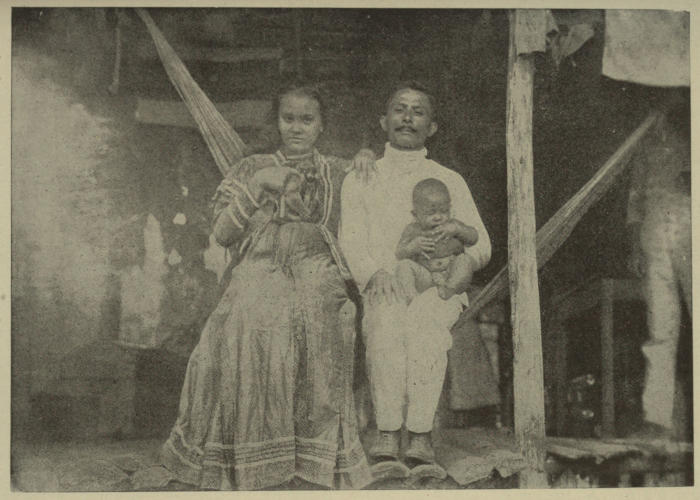
RUBBER-WORKER PERREIRA AND WIFE IN THEIR SUNDAY CLOTHES.
One hears a good deal about high prices in the Amazonas, and careless observers state in opposition to that the cheapness of life in the Asiatic Islands and other points of the world. I do not think that a thoughtful person without any interest in connection with enterprises and plantations elsewhere in the world, would be able to use such an assertion, which is so unjust.
The French engineer, Mr. Paul Le Cointe, who is an expert in the matter, writes the following:
“For the work to be executed, the number of workmen required is much less where the production of those men is high, hence to calculate the price of hand work, the individual production is the factor that may become more important than the pay to the men who work by the day.
“In the Far East, the workmen are paid from Fr. 75 to Fr. 1.25, equal to 14 cents to 23 cents, approximately, including feeding. In the Amazonas, the pay per day amounts to Frs. 4.75, or that is, almost 91 cents for all the work, which is three to four times more.”
Let us examine the cost in Asia and in the Amazonas for the different work required by the cultivation of the rubber trees.
According to Mr. Stanley Arden, it is about 38 cents for each kilogram of rubber in the plantation (the data that I am presenting in connection with this matter is from the book of Mr. Le Cointe, entitled “Le Caoutchouc Amazonien et son Concurrent Asiatique”).
Mr. Lamy Torrilhon speaks about the Kuala Lampur Rubber Company (Malay), which had in 1909, 404,012 rubber trees from one to six years old. Calculating the price of cultivation of that rubber at Fr. 4 per kilogram or approximately 76 cents, Mr. Stanley Arden also calculated that the cost of a hectar of plantation before reaching the period of exploitation (the sixth year, according to him) was only Fr. 816, or more or less $157, including the salaries and establishment of European employees, and Mr. M. G. Vernet, of the Pasteur Institute of Nha-Trang, calculated Fr. 3,000, about $580.
Mr. Le Cointe further states that Mr. Stanley Arden in his calculations of expense seems to presume the plantation in lands not thickly wooded, because he counts for the burning and clearing of the land, hardly one-third the cost of felling the trees, when in the forest it is about the same. Of course, lands not properly protected and in the virgin state in the tropical countries, are less fertile than those covered with thick forests, furthermore the lands that have been devoted to a prolonged cultivation of plants, like coffee, tea, etc., are to a large extent exhausted, and if rubber trees were attempted to be planted there, the result would be that it would largely lose the advantages by having to fell new trees.
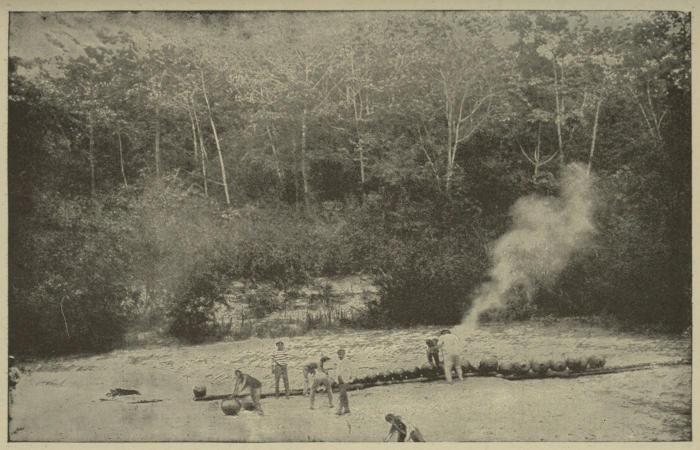
BRANDING RUBBER ON THE SAND-BAR.
Mr. Le Cointe also speaks of about 225 trees per kilogram, when practically that number can be doubled; besides this the calculation made by the same author of about $18 for the clearing of the hectar, at the rate of $14 per day for each workman shows that the price for that work in almost clean land will take sixty-two days, whereas in the Amazonas we only count on twenty-six days for each clearing of a hectar in a virgin forest.
This argument, it seems to me, shows that there is a purpose to bring up a cheapness which is more apparent than real, with the determination of recommending the Asiatic plantations to the detriment of the Amazonas rubber plantations.
This plan of attack is not the most correct one. We have the advantage of having workmen who easily adapt themselves to the producing land, and with the measures of protection that the Government is going to guarantee to the rubber planters, the life of the contractor is going to become easier.
The tree which is planted in its own region, is less subject to ravages, being less persecuted by the destroying parasites, is not violently fell by hard winds.
As every day increases the number of industries which requires rubber as a raw material, it is therefore necessary to exploit it in different centers, counting even with possible disaster, but nowhere in the world, in accordance with the most reliable statistics, is there more favorable land for the planting of rubber trees than in the various territories of the Amazonas. That territory has been placed by nature to be the emporium of that industry, and counts with all the means to preserve that privilege, and for the guarantee of the planter as soon as the rubber tree develops itself, it has other resinous trees suitable for construction, and excellent fibres which can be sold at a profit. The Brazilian walnut is so abundant there that it is a second source of income in the State of Amazonas.
THE PRODUCTION OF RUBBER
Only during the first six months of this year, notwithstanding that the time for the full crop was not as yet due, from Manáos there were exported to the United States 2,328,389 kilograms of fine rubber, 602,180 medium quality, sernamby 991,088, caucho 798,024; to Europe, first quality 2,449,776, medium quality 407,278, sernamby 507,860, caucho 1,368,489; from Itacoatiara, first quality 37,240, medium 3,858, sernamby 26,237, caucho 11,405, that is for the Amazonas a total of 9,531,824 kilograms, almost half of the export of 22,902,401 kilograms made in that period for that State, besides that of Pará and Iquitos. The production of Amazonas in 1910 was 10,466,231 kilograms; in 1911, 10,122,242; this year, it is expected that there will be an increase of more than 15 per cent of the production of last year.
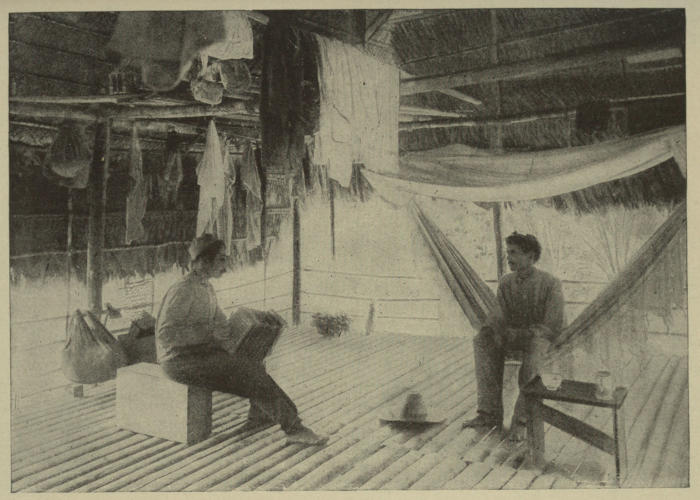
THE INTERIOR OF A RUBBER-WORKER’S HUT.
There Were Always Two or Three Hammocks.
This is due only to the active work of a few thousand workmen. What would be the colossal production of that territory, when the work of the men will be facilitated by a rational distribution of rubber trees!
Reflecting upon that, I am reminded of the words of Dr. T. Huber:
“A regular planting industry will have a marked and salutary influence upon the extraction of wild rubber and the management of wild rubber forests.”
Furthermore, I have the full conviction that the future of that industry competently managed will offer in Amazonas, and in order to be more exact, in Brazil, more guarantees of success than in any other region in the world.
M. LOBATO.
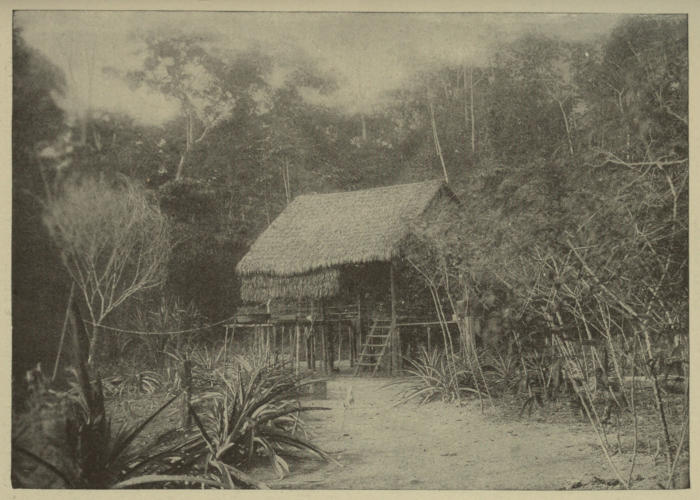
RUBBER-WORKERS’ HOME NEAR LAKE INNOCENCE.