A MONOGRAPH UPON PARÁ RUBBER
Reading edition
HISTORICAL NOTES ABOUT PARÁ RUBBER
It is in our diaries of the voyage of the Genovese Columbus, that among the important occurrences of that notable crossing of the ocean, which gave him immortality, appeared the first references, made by Herrera, to the quality of a certain gum utilized by the aborigines.
In 1536 Gonçalvo Fernandes d’Oviedo in his “Universal History of the Indies,” published in Madrid, also mentioned the uses which the indigenous tribes of North America made of rubber skins in their amusements.
The Jesuit Charlevoix also refers to it and more fully yet does John Torquemada who in his “Indian Monarchy,” expresses himself thus: “There is a tree in this country (Mexico) known to the natives as ulequahuitl, to whom it is of the greatest value. This tree grows in the warm or torrid zone; and presents itself of a medium height with rounded leaves of an ashy color. It furnishes in abundance a species of glutinous white liquid like milk, which makes it of great utility to them.
“The milk of the ulequahuitl is obtained by beating the tree with a small hatchet. The liquid is then seen to ooze out from the incision made like blood from a wound. The natives gather it into dry hollow gourds of various sizes. It gradually takes consistency in these receptacles, until it turns into a gummy mass, from which it is easy to adapt it to any form which may be required.
“Those who have no gourds, besmear their bodies with the liquid substance, as it flows out from the tree; which in drying forms itself into a species of membrane, which is easily taken off and whose thickness varies according to the coating spread over the skin. Skins very much appreciated for their elasticity are made with this ulli. The ulli solidified serves for shields, which thus are proof against the sharpest-pointed arrows, owing without doubt to the pliability of the material, which does not affect its tenacity.
“Kings and nobles habitually use shoes made of ulli. The Spaniards of Mexico, moreover, impregnate their capes with ulli, so as to make them water-proof, because it is proved that such substance resists water in a marvelous manner, but melts before the action of the sun.”
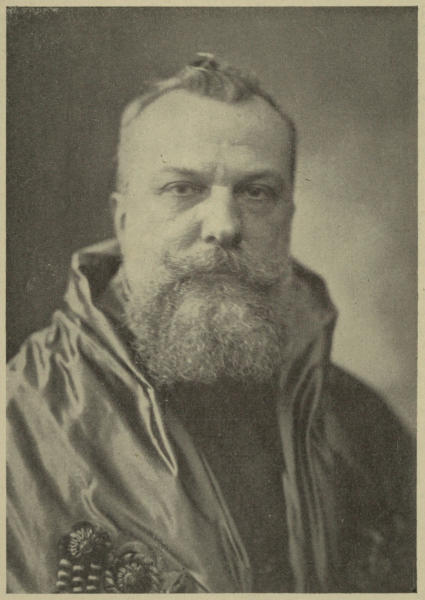
COUNT CANDIDO MENDES DE ALMEIDA, President of the Federal Government of Brazil Commission.
In Mexico and Central America, the name of Ule still denotes even to-day one of the rubber trees known as the elastic Castille.
After the Spaniards, the French in 1736 occupied themselves with that substance, whose interesting properties had not up to that date come to deserve the attention of the Europeans.
De la Condamine sent by the French Government to Perú, in order to measure a degree of the terrestrial meridian, was the first to refer to the Hevea of the Guyana. In a note that accompanied a small sample of resinous gum of a heavy dark color, almost black, he said to the Academy of Sciences: “There grows in the forests of the province of the Esmeraldas a tree known to the natives by the name of Hevé; a white resinous liquid something like milk runs out from it after making an incision; this substance is collected in a leaf that is laid close to the foot of the tree and afterwards is exposed to the sun, when it gets black at first upon its surface and afterwards by continuous exposure to the sun becomes black in all its mass. Torches, which burn admirably well, are made from it. It is known in Quito, that that tree grows also upon the banks of the Amazon and that the Mainas call it cautchú. They make earthen moulds in the form of bottles and cover them with that material. Afterwards when the resin gets hard, they break the mould and thereby obtain unbreakable water-jars much lighter than glass bottles.”
Later on he wrote: “many are the uses which the Omaguas make of that resin in the central parts of South America, especially among the Indians of Pará where the Portuguese gave to the tree that produces it, the name of Pauseringa, because from it ‘seringas,’ much in vogue among the Omaguas, are manufactured; these being little hollow balloons in the shape of a pear, into which a tube is inserted.
“In Pará it is moulded in still many different manners, they make borracha, faces of animals, hollow or solid balls and also apply it in the manufacture of boots which become quite water-proof and when smoked acquire the appearance of leather.”
Fresneau, a collaborator of de la Condamine, sought to study the vegetable plants which produced that gum, obtaining as a result that Aublet, a French botanist, proceeded to interest himself in the question and completed de la Condamine’s studies, and then classifying the hevé under the domination of Hevea Guyanensis.
It was only in 1798 that the Ficus elastica, the first Asiatic plant producer of rubber became known, and up till 1860 South America, English India and Java were the only rubber-producing countries in the world.
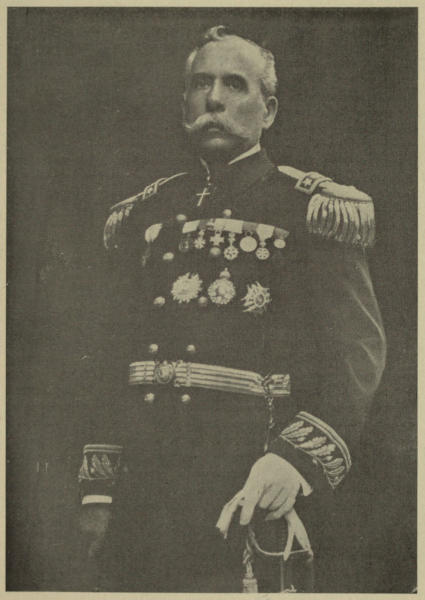
ADMIRAL JOSÉ CARLOS DE CARVALHO, Vice-President of the Federal Government of Brazil Commission.
Much later than this—in 1885, Africa commenced to export this article, an industry which reached its apogee after the creation by Leopold II of the Independent State of the Congo.
In the meantime, in spite of the fact of some of the qualities of rubber and even its applications being known in Europe ever since the Sixteenth Century, it was only during the Nineteenth Century, that this product conquered that position as an article very much in evidence which it now occupies as an indispensable material in modern industry or even still yet for the necessities which civilization created.
Hérissant and Macquer, in 1768, discovered the first dissolving processes; in 1770, Priestley vulgarized the property of the “borracha” in wiping out lead-pencil tracings from which the English name Rubber is derived; Berniard, Fourcroy, Berthollet, Grossart and others occupied themselves about this commodity, with more or less success. Madier, in 1820, found out a mechanical means of cutting the rubber-blocks in order to obtain elastic threads and three years afterwards, MacIntosh discovered that naphtha dissolved rubber and thus made cloth impervious to the action of water.
The adaption of rubber to industrial purposes such as the manufacture of shoes, physical and surgical appliances, elastic cloths, railway-buffers, machine-springs, etc., was fairly in full swing when the discovery of the vulcanizing of rubber by Goodyear sprung up, an occurrence which came to revolutionize the incipient industry and enormously enlarge the scope of the commercial application of that product, which thence forward came to assume exceptional importance. The vulcanizing method consists in the mixing of a certain quantity of rubber with sulphur and in the exposure of that mixture to an elevated temperature and to a high pressure during a certain space of time. The rubber transforms itself considerably; the property of indefinite hardness is lost, but presents greater resistency to the forces of compression and lengthening-out, supports excessively low temperature and becomes less sensible to the action of ordinary dissolving ingredients.
In Brazil already existed up to 1840, a rudimentary industry of shoe manufacturing and in the water-proofing of various objects. The great demand for rubber caused by the development of the industry in foreign countries and consequently the very high profits that the extraction of rubber in the Brazilian “seringaes” or native rubber-forests presented, destroyed all that initiative and Brazil passed into the position of a mere producer of the raw material. In order to appreciate with what devotion the country lent itself to this occupation, sufficient is it to contrast the 31 tons exported in 1827 with the 36,547 exported in 1911.
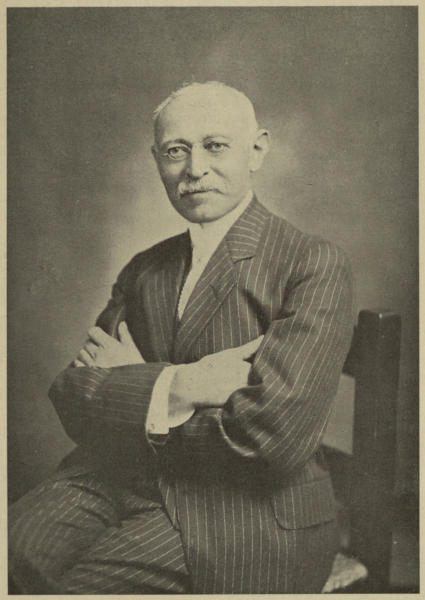
DR. EUGENIO DAHNE, General Secretary of the Federal Government of Brazil Commission.
RUBBER-PRODUCING PLANTS—BOTANICAL DESCRIPTION—PRODUCTIVENESS—REGIONS IN WHICH THEY EXIST
At the present moment, more than 300 species of rubber-producing plants are known to exist, these being distributed among the tropical regions of the world. Trees of large size, climbing plants and flexible creepers containing the precious latex in their branches, trunk and roots, those vegetable growths from the double point view of quantity and quality of rubber produce have not an equal importance. The species worthy of mention belong to four great families:
1.—Euphorbiacan, Hevea, Micrandra, Manioh. 2.—Ulmacean, Castillôa and Ficus. 3.—Apocynacean, Landolphia, Hancornia, Kickxia, Carpodium and Clitandra. 4.—Asclepiadaceas, Callotropia, Cynanchum.
The production of rubber in America is principally furnished by the heveas, micandra, manioh, castillôa and hancornia; that of Asia by the ficus; and that of Africa by the landolphia, clitandra and kickxia.
In the Amazonian region of Brazil, there exist about 21 species of heveas; of these the principal is the hevea braziliensis, which under the name of “the Pará rubber-tree” deserves to be classed in the front rank of all the other lactiferous plants in the world. The hevea braziliensis furnishes the most highly esteemed quality of rubber, and it is the value of that product which determines the prices of all the other species of rubber brought on to the market.
The heveas are powerful trees of from 20 to 30 metres high, the trunk which is cylindric in form and of a light ashy color, generally attains a diameter of from 0ᵐ80 to 1ᵐ20; the branches only commence to grow at about 15 metres from the ground. The leaves fall in June, but are speedily substituted by others; it is during this period that the trees break into flower.
They grow in the valley of the Amazon, which within Brazil embraces the State of the Amazonas, the federal territory of Acre, almost all the State of Pará, the North of Matto Grosso and of Goyaz and a part of the South of Maranhão, or say about 5,000,000 of square kilometres.
Their habitat as a general rule is a low and warm region whose temperature varies between 25° and 30°; without sudden changes during the course of the year and they favor by preference the watery soils, just swampy, damp and even marshy; however, at the head-waters of some rivers, they also live and develop themselves perfectly well in dry and elevated land. In the Amazonic forests, the average proportion is of one hevea-tree for 80 trees of other species.
The milky latex circulates from the root to the leaves, existing, however, in greater abundancy in the trunk, up to a height of about 2 metres from the ground. The heveas in Brazil are generally known by the term “seringueiras” and the forests in which they are found are denominated “seringaes.”
The average production of a “seringueira” during the harvest season, which extends over the space of 6 months, is of 5 kilos of fine rubber and 750 grs. of sernamby.
The species most appreciated besides the hevea braziliensis, are the hevea de terra firme, of which Dr. E. Ule treats in his recent studies, and which are found on the frontiers of Matto Grosso, the hevea do Rio Negro, called “seringa verdadeira” (the real seringa), the hevea benthamiana and the hevea dukei, Hub, from the region of the Japurá, all of them furnishing excellent products.
In the valley of the Amazon exist the micandras, belonging to the same family and producing a rubber of a superior quality, since it is sold under the name of Fine-Pará. The production of these trees goes to the market included in the category of hevea, owing to its similarity to this latter. The micandra syshenoide which is the most known species, is found on the Lower Amazon, in the innumerable islands at the estuary of the great Amazon River, in the valleys of the Madeira, the Solimões, the Japurá and the Purús; the natives give it the names of tapurú, curupita, murupita and seringarana. They are leafy trees whose trunk is of from 0ᵐ80 to 1ᵐ in diametre and from 20 to 25 metres high. They grow as well in the low lying marshy soil as in the elevated lands, whence comes their denomination of tapurú da vargem and tapurú de terra firme. The tapurú is as lactescent or milky as the hevea and the latex which it renders is equally rich, seeing that it gives 50 per cent of fine rubber.
The trees whose product, the caucho, occupies the second place in the general exportation of rubber from Brazil although as a matter of fact it only commenced to come into the Brazilian markets in the year 1896, belong to the family of the Ulmaceas. These are the Castillas which up till a short time ago have been classed as of the same species as that which grows in Mexico and Central America—the Castilla elastica, but studies made by professor O. Warburg show that they are distinct species which was thence forward denominated Castilla Ulei, Warb.
The “castillôa” is a tree of large proportions, reaching to a height of from 12 to 18 metres; its trunk with a diametre of from 0ᵐ60 to 0ᵐ90, is of an ashy gray color, smooth and sparingly branched. The leaves are large, greater, indeed, on the new plants than on the full grown trees and its fruit is of an oily nature.
These trees grow in considerable quantities at the sources or head-waters of the affluents of the Amazon on the latter’s right bank, such as the Juruá, the Purús, the Madeira, the Tapajóz and the Xingú, and on its left bank in the valleys of the Japurá, the Iça, the Rio Negro and the Trombetas Rivers. Abundant “cauchaes” or forests of cautchou trees exist also in the region of the River Tocantins and of the Araguaya.
The “castillôa” is found therefore in the same regions as those in which the “seringueiras” flourish; it exacts a warm climate, a clayey or clayey-silicious soil, but does not thrive in swampy ground or such as is easily inundated during the rainy season.
The latex is found as much in the bark as in the alburno and each tree felled produces on an average about 50 litres of latex or say from 18 to 20 kilos of rubber.
“Ceará” is the mundial denomination of another quality of Brazilian rubber, the rubber of the Maniçoba tree. The maniçoba manihot glaziovii is a handsome tree 10 to 15 metres high, and a native of the Northeastern region of Brazil. Its trunk presents a diametre of from 20 to 50 centimetres and it possesses few branches; its wood-fibres are weak and light. The cortex, which possesses lactiferous vessels in abundance, is protected by a silicose layer, easily removable. It is a plant of rapid growth.
According to a classification made by Dr. Ule, there are four species of manioh, the m. glaziovii, the m. piauhyensis, the m. dichotoma and the m. heptaphylla, the which exist almost throughout all Central Brazil, being specially abundant in Ceará, Piauhy and Bahia.
Little exigent, it thrives in regions where the temperature oscillates between 22° and 36°, on low-lying ground and it develops itself well in lands of great altitude, in which the thermometric average temperature is about 15°, resisting even the hoar-frost.
It is indifferent to this tree whether the climate be damp or dry, as long as the soil is dry.
The species most appreciated are those from Piauhy and the Jequié (“sertão” or back-woods of Bahia). Those of Piauhy present two varieties: the white and the black species, the white being the most renowned. They are of small size, with abundant foliage and thick bark and darkish stem and give plenty of the milky latex, the average being 1,200 grammes per tree. Those of the Jequié, which grow between the rivers Paraguassú to the north and of the Contas to the south, are a shrub-tree whose trunk does not exceed 30 centimetres in diametre. The bark is fine and of light clear color; it produces about 500 grammes of rubber.
The mangabeira (Hancornia speciosa) is a slender and crooked shrub-tree, 3 to 4 metres high, and abounds on the high-lying table-lands or plateaux in the interior of Brazil. The trunk has a diameter of from 0ᵐ30 to 0ᵐ35; is scantily leaved; the fruit is eatable and has a very agreeable taste.
A plant of an extraordinary resisting power, it defies the inclemency of the climate, the absence of rains, the scarcity of humidity and of nourishment from the soil. It predominates in the catingas of the Northern States, in the carrascaes of Goyaz and in the cerrados of S. Paulo, which means to say, that it is found from Maranhão to S. Paulo, now in the Interior, as in the mountain-range of the Mangabeiras between Maranhão and Goyaz, in the central Chapada of Minas, in the Parecis of Matto Grosso and in S. Paulo in the zone comprised between the Paranápanema River and the Rio Grande, tributaries of the Paraná River, and again on the littoral, which is the case from Bahia northwards as far as Ceará.
There are several different varieties of this plant, there being no indications, however, tending to point out any one of these preferable to another with regard to the question of its yield. The latex is of a bluish tint, its richness in rubber varying greatly. Each mangabeira supplies on an average one kilogram of rubber.
Besides the plants mentioned, there are still many others in Brazil which furnish rubber, but which continue to grow without being taken advantage of, on account of the little profit they give.
To speak only of those which exploited on a small scale have yet supplied the Brazilian markets with an appreciable product, we may yet mention the Massaranduba, Mimosups elata, and Frei-Allem, gigantic trees found from the Amazon and Pará to Rio de Janeiro and Minas, abundant in the milky latex, which being coagulated produces a rubber very similar to gutta-percha, to which it serves as a substitute in all the latter’s most important applications; and the Sorva, Couma utilis, Muell. Arg., which grow in Pará and in the Amazon valley, the latex of which, the leite de sorva, enters, with a small coefficient into the production of rubber in these two States.
EXTRACTION OF RUBBER, METHODS AND PROCESSES
The great organic and biologic differences which exist between rubber-trees, exact divers processes of preparation in order to obtain a complete utilization of the productive capacity of each.
It is, however, interesting before entering into a description of the different processes adopted in Brazil, to here state what the chemists think as to what rubber really is.
Rubber is a carburate of hydrogen which in the shape of white globules more or less elongated, are found suspended in the milky latex. The composition of those globules, although even yet, badly defined, is represented by the formula (C¹⁰ H¹⁶)ⁿ. Rubber is generally considered as a derivative of the Isoprina, into which it transforms itself when submitted to the action of dry heat, as Bouchardat demonstrated by his experiments in 1879. Treating the isoprina in a strong solution of chloridic acid, an interesting body is obtained, which reminds one of rubber on account of its elastic properties. Wallach, Tilden, Weber, Harries and others gave themselves up to accurate studies upon the composition of rubber; nevertheless, up till to-day, however, no definite result has as yet been arrived at.
The latex, a thick liquid which has the appearance of animal milk, circulates in special vessels, distributed diversely in the organism of certain plants.
The following are the results of the analysis obtained from the latex of the hevea braziliensis by Seelingmann, Scott and Bamber:
Seelingmann Scott Bamber
Water 55 a 56% 22 - 32% 55¹⁵ - 55⁵⁶%
Rubber 32% 37 - 13% 41²⁹ - 32 %
Proteine 2% to 3% 2⁷¹% 2¹⁸ - 2⁰³%
Resin traces 3⁴⁴% - 2⁰³%
Ash 0²³% - 0⁴¹%
Sugar 4¹⁷% - 0³⁶%
Oily substances 9⁷% traces -
Specific weight: Seelingmann, 1.019. Bamber: 1.018.
It is advisable to note, that the proportion of water may vary a great deal, influenced sometimes by the season being either wet or dry, and at other times by the weakness or vigor of the tree at the occasion of its being tapped.
The quantities of proteine, resin and ash are dependent on the chemical composition of the soil, those quantities affect the quality of the rubber, which is the more elastic, resistent and durable the smaller the proportion of those elements.
In the coagulation of the latex, the resin incorporates itself in the rubber, it becoming difficult to separate it, which, however, is necessary; the proteine or albuminous matter is the cause of the developing of the bacteria which occasion the putrefaction of the manufactured article.
The method employed in Brazil in the extraction of the latex and in the preparation of rubber from the heveas trees, is the same as that which was taught by the natives and it is a remarkable thing, that due to the excellency of the product resulting therefrom, it is considered even to-day as the best system.
The great production of rubber in Brazil, is due to the exploitation of the natural seringaes. A “seringal” or, better said “seringaes” in the plural sense, are the forests where the hevea trees flourish among other numerous specimens of luxuriant vegetation, and in those regions everybody, i.e., all the able-bodied men, occupy themselves with the extraction of rubber and are known as “seringueiros.”
In order to exploit the “seringal,” operations are commenced by the construction on the bank of the river, at a place easy of access for navigation, of a large rustic edifice with out-buildings and various sheds. The general edifice serves as a dwelling-place for the owner or his representative and includes a general store or shop with a tavern which does business in selling all the necessary articles required in or connected with the life of exploiting the “seringal,” a store-house for depositing the rubber and an office or counting-house. The sheds are the rudimentary habitation-huts of the “seringueiros” and are sometimes constructed in the interior of the forests, so as to facilitate to a greater degree the work which they have in hand.
As soon as the forest is explored and the seringueiras discovered, estrades are opened, these being winding roads cut in the undergrowth and brush-wood with the “facão” (a species of large pruning-knife) and these roads connect a 100 or 150 rubber trees and they lead back to their original starting point. At sunrise, that is to say, at 6 o’clock in the morning, the seringueiro armed with a “terçado” a sort of spear, a fowling-piece or sporting-gun, a small axe or hatchet, a pail and a large number of “tigelinhas,” commences his work. The hatchet is the instrument employed for tapping the trees; it takes the form of a common pole-axe, being, however, generally of cast iron and with the edge of the blade blunt rather than sharp, and from 3 to 4 centimetres broad. The tigelinhas are small vessels or cups of tin-plate with a capacity of about one hundred grammes and of a conical shape cut off at the top.
The seringueiro commences by striking the trees with the hatchet, whose handle is about a metre long, which permits of his making incisions at about from 3 to 3½ metres from the ground. That operation has for its object to make the latex ascend from the roots; the milk that oozes out is utilized as “sernamby.” Two days afterwards, the regular extraction commences, a hatchet with a shorter handle being then used.
To bring this extraction about, “seringueiro” makes the first incision at two metres from the ground, but those incisions must not pierce the cambium and the wood and are as a general rule made at an inclination of 25°. At the lower part of the incisions made by the blows, the “tigelinhas” are fixed, whose sharp and cutting corner penetrates easily into the bark of the tree. The seringueiro operates thus upon all the trees of his road, and this work which occupies him about from 2 to 3 hours being completed, he takes the pail capable of holding 10 litres and recommences his round, gathering into that receptacle the milk contained in the tapping cups, which now empty are boxed one into the other and deposited close to the trunk of each tree.
After that second round and in order that the milk shall not become deteriorated, commences the most delicate operation, that of the smoking process.
For that operation, the seringueiro is supplied with a “boião,” a kind of earthen funnel-shaped chimney, a form made like a spatula or putty-knife and a kind of basin “cuia,” like a dry gourd, made from the half of the fruit of the cabaceiro (crescencia cuyeté).
The fire made with blocks of urucury (Ataléa speciosa Martius) or with fire-wood of massaranduba, rich in oily substances, being kindled, the seringueiro places the “boião” upon it, the function of this latter being to canalize the smoke so that it escapes at the top, which is open.
Through the loop of a cord hanging near to the “boião” the form is passed and sustained by the “seringueiro” who gives it a gyratory movement; with the “cuya” or gourd, he pours the latex into the part scooped out of the spatula, which he carries off immediately to the smoke. The latex thickens and forming a thin skin upon the which another coating of latex is poured out, which is also passed to the smoke. Those successive and alternate operations form the skins, large balls of rubber, weighing from 20 to 60 kilos, which are the type exported from Brazil. The smoke acting as a solidifyer and at the same time a disinfectant by the presence of creosote, acetic acid, etc., kills all the bacteria that produce putrefaction and hastens by its heat the evaporation of the water.
The rubber thus formed is of a superior quality, but when, however, the curds still deposited in the basin, are incorporated with it, the quality becomes damaged, being then quoted as medium fine. The portion of milk which remains adhering to the receptacle or which surrounds the boião and which thickens freely, is reunited into one single skin, and constitutes the “sernamby.”
On the following day the work recommences, the seringueiro making new incisions about 7 centimetres below the first, and continuing thus until he reaches the ground.
To that series of blows in the vertical sense, 35 on the average, is given the name arreação. In each seringueira 2 of these arreações can be made per year.
That process which with small variations is employed in all Amazonia, produces, as is known, the best rubber in the world. A seringal may contain in accordance with its size from 40 to 800 roads. Each seringueiro exploits 2 roads; in which he works alternatively. The daily gathering varies between 2 and 8 litres of milk, but an average of 5 litres can be taken for a road which contains 120 seringueiras of 35 centimetres diametre. As each arreação has 35 incisions and the seringueiras supporting 2 “arreações,” we have thus for each road 70 days or 140 days for the 2 roads; 700 litres of milk produce 400 kilos or in other words 1.666 grammes per tree.
There are “seringaes,” however, in which that average is considerably greater, a medium of 3 kilos per tree not being an exaggeration in some rivers.
Contrary to the almost sedentary life of the seringueiros, the extractors of the caucho (known as caucheiros) are of nomadic habits, and this is so by reason of the barbarous process employed in the exploitation of those trees which is a ruinous one.
The extraction of the latex of the “castillôa” can be done in the same way as that of the latex of the heveas; the caucheiros allege, however, that the cupim introducing itself into the wounds made by the incisions soon causes the death of the plant. Thus they argue that if the tree is condemned, the best way is to cut it down so as to obtain the greatest benefit possible out of it, by the complete utilization of the latex which each tree contains. That reasoning, however, has no foundation in fact.
The exploitation of the castillôa is done in the following manner: the “caucheiro” penetrates into the forest and marks each castillôa tree that he finds, with a cut from his knife, which incisions correspond to a sign of possession for extraction later on. Once he has discovered a certain number of these trees, he constructs a temporary wooden hut for himself and then begins his work. In the first place he clears the brush-wood around each tree and cleans away the undergrowth from the ground, he then opens small cavities in the lower part of the trunk into which he fixes the “porringers,” small vessels made of tin, which are to receive the latex. This done he strikes the tree with oblique “entalhas” of from 1 to 1½ metres in length, canalizing the latex which commences to run from the extensive wounds, by means of mud gutters. At the end of 24 hours the little tin vessels are full and their contents are then all poured into a pail, the “caucheiro” commencing thereafter to cut down the tree, so as to get the full benefit of the latex, existing in the superior part of its trunk. The tree as a general rule is cut at a point above that where the incisions were made, the tree thus remaining suspended above the ground at one end by the lower part of the trunk, where it remains fixed and at the other by its own branches. Along the whole length of the trunk at about a distance of an arm’s length from each other, new circular incisions are made and in corresponding cavities on the ground are placed the receiving cups. The latex thus gathered is collected into a pail.
The thickening is done with a solution of common soap about 125 grammes to a pail of water, two pailfuls of that solution being necessary to thicken 30 litres of latex. They also employ the juice of a liane called vetilla which by the description given seems to belong to the convolvulas family—the Ipomea patatas.
The thickening process takes place in rectangular holes of 1 metre long and half a metre broad, whose clayey sides are well paved and into them the latex is poured, care being taken that it is then covered up with palm leaves to prevent the entry of rain water. They thus obtain the caucho planks (rubber in cakes), which arrive in the market full of impurities, that depreciate its value very much and it is not at all a rare thing that water exists in cavities in the interior of it, thereby increasing the weight and making the transport dearer.
The portions of the latex which flow out along the length of the trunk or fall into the cavities after that the cups have been taken away, thicken itself freely and form the “sernamby” of caucho, to-day much appreciated in the rubber markets, because of its being purer and not offering errors in weight.
Each adult tree furnishes on the average from 50 to 56 litres of latex or in other words nearly 30 kilos of rubber. Each cake of the size above mentioned weighs nearly 60 kilos; it is thus necessary to cut down three trees so as to obtain one cake.
The trees cut down sprout and commence to grow again, but eight years are necessary to elapse before they can be exploited anew.
No accord has so far been established as to the best methods of extraction to be employed for the different species of maniçoba, nor as to the period most appropriate, the duration of the tapping or the yield of the wild trees or planted trees of different ages.
The system adopted for the natural maniçoba, consisting in the tapping of the subterranean organs, has been applied to cultivated maniçoba; the incisions are made in a transversal sense and have the form of a V with the angle more or less rounded.
The latex is gathered in the ground, at the bottom of a small cavity, opened up on the occasion of the discovery of the parts destined to be tapped; as a rule the worker covers the bottom of the cavity with a coat of clay in powder, in order to prevent the penetration of the latex and its mixing with the sandy soil; the employment of tigelinhas is desirable or of pots of glazed clay, refractory to rust.
The latex thickens during the day, forming a sort of flat ball or biscuit of rubber, which goes on augmenting as the tapping process is multiplied. At the end of a week the rubber which has been obtained, is gathered together and washed in cold water, with a view of eliminating the remains of the serum and other impurities. This method, although primitive, permits of the production of pure rubber. The trunks and branches of the maniçoba are also cut; however, such system occasions great inconvenience. The extensive flaws heal up with difficulty, as the bark of the tree is relatively thin the lactiferous vessels are located in the deep layers; it is not a rare thing that the death of the tree is caused thereby or that the attack of rodent insects or mushrooms is thereby facilitated. It may be of importance to note, that the incisions made simultaneously on the trunk, the branches and the underground parts, speedily exhaust the maniçobeiras; and so the system of an alternate cutting is preferable.
The tappings are practiced during the first six months of the year and extend themselves over a period of from 50 to 60 days. Owing to the lack of data, the average yield of production, which varies according to the age of the trees, cannot be determined, however, the average production of the planted maniçobas may under reserve, be calculated to reach during the space of 60 days 120, 180, 240, and 300 grammes per tree of 2, 3, 4 and 5 years respectively, in accordance with a calculation made by Dr. L. Zehnter.
The actual cost price in the plantations does not exceed 1$500 per kilo, and might be reduced through an improvement in the systems employed; the cost price of rubber from the native maniçoba is higher, due to the dearness of labor and of freights.
There is so far no process which may be called the best for extracting rubber from the mangabeira; the process in use varies with the region, all of them, however, leading to the complete extinction of the plant.
Under the pretext of the cupim destroying the plant, attacking the incisions that have been made, the latex is usually extracted at a small height from the ground. In the “sertões” or wild woodlands of Bahia, Pernambuco and Parahyba, the extraction is done by making a spiral cutting from the thickest branches to the ground, where the cavity is made for receiving the latex.
Nevertheless, the incisions with the cup attached is now being employed, in the same manner as is customary with the seringueira; for that purpose, the exploiters make horizontal incisions or in shape of a V, with a small instrument called an alegre, penetrating the entire coating of the bark, in the full length of the trunk, from the thickest branches down to the base, about 45 centimetres distance one from another.
The latex is thickened, sometimes simply with water in the proportion of 3 to 1, and at other times with chlorate of sodium alone, or with a mixture of alum, as is customary in Bahia and in S. Paulo, or now again by the action of alum-stone, double sulphate of aluminium and of potassium as is done in Pernambuco, Parahyba, and Rio Grande do Norte. All those processes present serious inconveniences, such as the entry of water augmenting the weight, the baneful effects and dampness arising from the use of a large proportion of salt, or the loss of elasticity due to the last mentioned process, which turns the rubber cracky and resinous. The smoking process seems in every way to be advisable whenever the richness of the milky-latex in rubber is perfectly comparable to that of the hevea.
Whilst it is affirmed that the production per tree is from 3 to 5 kilogrammes it is more prudent to calculate the average capacity of each tree as at 1 kilogramme.
THE ECONOMIC ORGANIZATION OF RUBBER EXPLOITATION
The economic organization of the exploitation of rubber in the Amazonic valley still remains in its rudimentary condition, continuing almost exactly on the same lines as those adopted when the production of this article—one of the principal sources of the wealth of Brazil—first began to open up.
This unaltered condition of affairs in the modifying of the economical processes, is the consequence of the continuance of certain conditions such as the existence of vast regions still entirely unexplored, the progressive penetration of the seringueiros guided by the course of the rivers into far away regions where rapid means of communication are completely lacking, the scarcity of labor, and the necessity of capital being embarked in the extraction of rubber.
The régime of private property is still limited, and does not extend beyond a few kilometres into the Interior, starting from the banks of the rivers, since the greater part of the lands still continue to be the property of the States either of Amazonas or of Pará, and—in the territory of the Acre—of the Federal Government.
With the object of peopling the rubber-producing regions endeavors are being made to facilitate the acquiring of properties by furnishing their owners with adequate guarantees of protection, special Public Departments having already been created in the State of Amazonas and Pará devoted to the fiscalization of the régime of lands; and the régime of lands in the Acre Territory is about to be regulated at once by the Federal Government in accordance with the determinations set forth in the new economic measure known as the Rubber Defense Act.
The proprietory question originated itself in the concession of lands granted under certain conditions such as that of its effective exploitation and cultivation, colonization, etc., and by the legitimation of the possession. These last were established in the following manner:
The explorer who penetrated into the forest in search of seringaes, examined the banks of the river by which he went up and when he verified the existence of a favorable zone, he landed and after a careful exploration under the direction of specialist-workmen called “matteiros” (foresters) he settled down and gave himself up to the exploitation of the “seringal” he selected.
That occupation of virgin ground and its being made use of constituted the act of possession, the first step towards acquiring the property. In order to definitely assure the dominion of the lands selected, it became necessary to obtain a title of ownership from the Government of the State in which these lands were located, this being drawn up only after that the respective marking out and survey by an authorized engineer or surveyor, the depositing of the respective plans, the verification that no anterior rights or claims existed on the part of third parties, as also the payment of the respective taxes being satisfied, which last averaged about 5$000 per hectare.
Only after that all these formalities had been complied with, was the concession granted definitely, and the possession considered as complete. The title deeds of the property with the respective specifications is registered in special blocks, which will serve as proof in case of future dispute and will furnish authentic documents in place of the property-titles that may have been mislaid or lost. Once the concession is legalized and the possession marked out, the property rights are considered irrefutable.
The dominion of the lands being assured, their usefulness will depend upon the co-existence of two essential factors—labor and capital.
In the regions of the Amazonian valley, sparingly peopled by the want of direct immigration, the work is done by the natives and principally by Cearenses, people from Ceará.
Under the general designation of Cearenses are comprised the populations of the northeast of the country from Bahia to Piauhy, a strong race endowed with rare energy. Having immigrated from their native state fleeing from privations to which the periodical dry seasons reduce them, they arrive completely without the means of subsistence, it being necessary for the owners of the “seringas” who contract their services to take measures for their transport, alimentation and maintenance in the seringaes until with the delivery of the rubber collected, they find themselves in a position to liquidate the debts that they have contracted and the expenses that have been occasioned.
On the other hand in their turn the owners of seringaes not disposing of capital are placed under the necessity of raising loans with which to defray the exploitation of their lands. These resources are furnished them by the traders, part in money and part in merchandise, these traders being known as aviadores whilst the proprietors are called patrons or aviados.
The extensive credits opened by the traders constitute acts of confidence, being guaranteed more by the activity and initiative of the proprietors of the seringaes, than by their respective properties; the heavy burdens with which these loanings or advances of money are weighed down, have their origin in the risk which is run by advancing such capital, due to the difficulties of collecting the debts contracted and the far distant nature of the lands given in guarantee. It frequently happens that the traders do not dispose of sufficient means for carrying out all these lending operations in which case they fall back upon the exporting houses, who advance them the necessary money, against a contract to hand over the rubber at a certain date and at prices previously fixed.
Thus is established a successive dependency of the seringueiro on the owner of the property, this latter in his turn on the merchant-trader and finally of the merchant-trader upon the exporting house.
Thereafter it is seen how grievously the system of want of capital acts on the whole system on the exportation of rubber and the long series of intermediaries.
Let us see now what is the capital which the owner of the seringal requires to possess for an exploitation of say 200 roads.
A seringal with 200 roads exacts altogether the work of 100 men, whose engagements in the region where they reside and their transport as far as the “seringal” costs on an average 40:000$000 and to each one of them is supplied a sum of 350$000 destined to defray the costs of purchase of the indispensable material for making a commencement with the work of exploitation; out of an initial sum estimated at from 75:000$000 to 80:000$000 including casual expenses.
Arrived at their destination, the seringueiros, as they find themselves completely without means, continue to be a burden on the budget of their contractors during the period of the clearing the forests of brush-wood and undergrowth, and the cutting of roads, which are the preliminaries to the gathering in of the rubber. Up till the date of the final delivery, which takes place from 6 to 7 months afterwards, the proprietor expends nearly 100:000$000 with the feeding and maintenance of the seringueiros, which is but the preface to a total sum of 180:000$000 inscribed on the books of the aviador or merchant-trader as being the indebtedness of the owner of the seringal.
This latter in order to meet the charges of the up-keep of the seringueiros, establishes “vendas” or selling-stores, by means of which he supplies not only the goods of first necessity for consumption, but also the tools, utensils and, indeed, everything that is required for the proper exploitation of the “seringal.”
These “vendas” or supply-stores are stocked by the merchant-trader of Belém and Manáos, who send them periodically in steamers or steam launches, the necessary merchandise. According to the season of the year, the rainy or the dry season, the greater or less the distance to be navigated, in short, in accordance with the condition of navigability of the rivers, the trips are made fortnightly, quarterly or perhaps only twice a year.
The merchandise dispatched is debited to the owner of the “seringal” at the invoice price, augmented by the high expenses for insurance, freight and a commission which varies from 20 to 30 per cent according to the time-term stipulated for the payment in cash or the delivery of the rubber.
The owner of the “seringal” in his turn re-sells in retail the merchandise received, putting on a high profit to its original price; the seringueiros who already pay interest at the rate of 20 per cent upon the advance of the 350$000 which is made to them at the time of their being contracted, are obliged to supply their needs exclusively in the store of the proprietor of the “seringal” and to hand him the rubber which they may have gathered in payment thereof.
The initial supplying of the utensils amounting to 200$000 added to the cost of the journey which runs for account of the seringueiro himself, absorb the 350$000 of the advance; and his expenses, whilst the extraction of the rubber is proceeding—which lasts for 6 or 7 months—totals up to about 1:000$000, so that when he comes to hand over the rubber, he is already responsible to the proprietor of the “seringal” for an amount of about 350$000 including the payment for the renting of the road explored.
His production being on an average of about 400 kilos (in certain regions it is much greater), the worker finishes his enterprise with a very small profit and it is not a rare case that he is not able to satisfy all his indebtedness, a circumstance, this latter, which keeps him continually dependent upon the owner of the “seringal.”
On handing over the rubber, the conditions of payment are adjusted and these are generally made in one of the two following ways: either the seringueiro sells the rubber directly to the proprietor of the “seringal” at a reduction of one-third upon the prices ruling in the markets of Belém or Manáos; or he encharges him to sell it in the referred-to market with a discount of 35 kilos of rubber or with a discount of from 10 to 15 per cent of the net price of such sale, given in payment of the renting of the road exploited.
This defective economic organization of the exploitation of rubber has, as its consequence, the high costs of production which to-day oscillate between 3$000 to 3$500 per kilo. This disadvantageous situation, however, is not a permanent one and may be remedied.
We shall leave for a special chapter the explanation of the means recently adopted for bettering the condition of the seringueiros, augmenting their productive capacity and recompensing them more justly for their work.
TRANSPORTS AND FREIGHTS
The problem of transports and freight continues to be one of the most palpitating questions in Brazil, notwithstanding the great progress in this particular made during the last 10 years.
The considerable increase in the mercantile marine and the incessant construction of the numerous railroads of penetration, have not been able to keep pace with the extraordinary development of the country and its notable economic expansion, the national commerce continuing to feel the want of further means of transport and to suffer from the very high rates of freights.
In Amazonia, the difficulty of communication has become still more felt because of the vast region and territories embraced in this great State, sparingly peopled and whose centres of production are located so far distant from the exporting markets of Manáos and Belém de Pará.
Watered in every direction by innumerable great rivers, tributaries of the great river—the Amazon—the greatest in the world, the Amazonic region still remains to a very great part unexplored, inestimable riches susceptible of being extracted, lying unutilized, in virtue of the deficiency in navigation; in fact, if the principal rivers are navigated regularly to some extent, even though sparingly, others leading to immensely rich regions are very rarely navigated by either ship or boats, which might assure the transport of the products gathered.
Many and divers are the circumstances which concur towards bringing about this state of affairs, but the most important in resumé is that of the want of capital for the construction of ships and the establishment of regular lines of fluvial navigation as also the obstacles offered either by the irregular courses of some rivers obstructed by waterfalls, shoots and rapids, or simply obstructed by the trunks of trees and other materials or by the diminutive volume of water during the dry seasons which makes impossible navigation of even ordinary draught.
One of the most interesting phases of the Amazonian problem is, however, in the regulating and increasing of the navigation of the rivers, with the object of assuring ample transport facilities and the approximation to the centres of production with the consuming markets. The opening up of the ways of fluvial communication is an essential condition to the progress of the Amazonic region, by the lesser expenditure required by transport upon water in comparison with land transportation which in those regions would be particularly difficult and costly.
The steamers and boats which set out from Manáos or Belém for the Interior, make the passage generally, over-charged with merchandise which by reason of accumulation and its defective packing suffers not rarely serious damages which has the result of bringing about a notable increment in prices. As a general rule the cargo being greater than the space requisite to its accommodation, makes the navigation extremely difficult, the steamers thus not being able to make head-way against the current, which flows at the rate of from 3 to 5 miles an hour, or desiring to diminish the expense in the consumption of coal, seek out the waters the less agitated and approach as much as possible the banks of the river.
The want of minute hydrographic charts and the imprudence of the captains, as also of the masters of steam launches and other floating material, have, as a consequence, the bringing about of frequent strandings, which even though they may not cause damage to the cargo involve interruptions in the trip sufficiently prejudicial.
The unloadings are made frequently on the banks of the rivers under little favorable conditions, by reason of the want of wharves; are very slow and occasion besides lamentable delays, very heavy expenses principally for the packages of great weight.
One of the causes which most determine the dearness of transport in Amazonia, is the supply of combustibles to the steamers, these latter taking in coal only at the port of departure in Belém or Manáos, and this being consumed, purchase wood fuel along the route just as they require it, and for a high price, subjecting themselves thus to the delays incident to loading, at times very great. Coal mines in the basin of the Caquetá have been discovered, but so far it has not been possible to derive any benefit from them, owing to the want of the necessary studies and analysis, which only now the Federal Government is beginning to have made.
For the betterment of this state of things the Federal Government also pretends to contract with a large public company for the establishment of coal depots and combustible oil, at the most appropriate points of the rivers on which the greatest movement takes place in the valley of the Amazon, so that the steamers may be supplied for prices according to a tabular statement previously approved for each year.
The descent of the floating material by the rivers is much less onerous, as the consumption of combustibles is thereby considerably diminished, thanks to the current which gives an easy impulsion to the floating material; the trips are notwithstanding slow, much time being lost in picking up cargo, almost exclusively rubber, on the banks of the rivers.
The irregularity in the navigation either due to the deficiency of the floating material or by the natural obstacles that the flooding of the rivers bring about, cause extensive prejudice, as it obliges the large cargoes of merchandise upon whose price high interest is collected and occasions them considerable loss of goods deteriorated by their remaining for a long time in sheds and by the damaging effect of heat and dampness.
From thence arises the lamentable dearness of life and the bad alimentation, with their evil results on the health of the inhabitants of those far-away-regions.
The retention in the seringaes of large stocks of rubber deprived of the means of transport must also not be forgotten and its coming simultaneously on to the market at certain times, being taken advantage of by speculators is an important cause of the fall in prices which affects the interests of producers to an appreciable degree.
Regularity and frequency in navigation, permitting successive and regular supplies of rubber would diminish in notable proportions the cost of production, since it would cheapen the cost of labor and avoid the great oscillations usual in the prices.
In order to obtain that desideratum it is not sufficient to create new lines of navigation nor to augment the number of floating material or better their conditions, but it is necessary to adopt certain complementary measures. Thus in the impossibility of preparing from the outset minute hydrographic charts, a measure which would require great expenditure; it were advisable in order to make navigation more secure to indicate by means of small light houses and illuminated buoys of acetyline, the dangerous points which it is desirable to avoid.
In order to obviate the difficulties created by the formation of sand banks, by the accumulation of trunks of trees, and of obstacles of all kinds, it is necessary that attention be paid constantly to the cleansing of the rivers and dragging them, in cases where the obstructions cannot be removed by other means and the construction of railways and wagon roads connecting the navigable points.
It would be of the greatest utility to bring about the extension and opening up of telegraphic lines joining the producing centres with the central markets, such measures would have the most beneficient results as much for the owners of seringaes as for the shipowners, these latter being once aware of such facilities would cause their ships to be directed to the points where they were required to discharge merchandise or take in rubber or vice-versa and thus avoid all uncertainty upon the advantages to be reaped from those trips, because of the want of knowledge of the cargoes that are being reserved for them, and those who are in contact with them in the markets where the product is sold may be advised as to the quotations and the market prices of the merchandise so that they may take advantage of the most favorable times for effecting their transactions.
The message presented by His Excellency Marchal Hermes da Fonseca, President of the Republic of the United States of Brazil on the third of May of this current year, made special reference to the services of the radio-telegraph in the territory of the Acre, expressing himself in the following terms:
“The three radio-telegraphic stations that have been contracted for in December of 1910, are now in full working order, those of the Rio Branco and Senna Madueira having been inaugurated in September of 1911 and in February of this year that of Cruzeiro de Sul, which besides speaking with those two and therefore with Manáos, communicates also with Iquitos in the Republic of Perú.”
In order to complete this very useful improvement ordered to be done in such a happy hour, there were also contracted for two other stations, one of these being in Xapury and the other in Tarauacá, places having a great future before them and already containing an appreciable population as well as a notable material development.
With the installation of those two stations, the territory will be perfectly well equipped in regard to the question of telegraphic communications.
As a consequence of the dearness and the difficulties in the means of transport we get the excessive rises in freight, which at times are equal to and are often greater than the value of the merchandise transported; the truth is that the crisis in rubber made them suffer a certain fall and we no longer see such a thing happen as that the shipowner pays for the price of his steamers in two round trips.
The dominating principle is that of liberty of commerce. In order to assure regular services on the principal rivers, the Federal Government as well as the Governments of the States of Amazonas and Pará subsidize certain companies whose tables of freight charges are approved by the Public Powers. That these are still very high is shown by the fact of competition which in certain lines takes place between the subsidized companies and private shipowners; the latter, however, not being able to go beyond the tariff tables of the former, they nevertheless obtain freights and passengers which proportion them high profits, demonstrating thus that the tables of freight tariffs of the subsidized companies are still a long way from the maximum of reduction.
The Commercial, Industrial and Agricultural Congress which took place in Manáos from the 22nd to 27th of February of 1910, considering this position, resolved to recommend to the Public Powers the remodelling of the actual freight tariffs principally in that part of them which relate to alimentary goods, necessary to the sustaining of the extractors of rubber and in the sense of their being substantially cheapened.
Even to-day one of the best businesses in the Amazonic regions consists in chartering steamers for trafficking on the rivers.
If the freight rates on the sections served by the subsidized lines are high, greater still are these on the less favored sections where the rapids of the rivers flowing among the seringaes, make navigation difficult, because in these latter there being no freight tables, they make the price according to their judgment, such prices of transport being contracted directly according to the circumstances of the occasion with the shipper, who has to pay the price as the masters of the steamers are pleased or resolved to charge.
The owners of seringaes subject themselves to the heavy burdens which they are bound to put up with, in the hope of escaping the damage that the retention of their produce for want of transport would cause them.
It is not only the fluvial navigation freights that are much too burdensome, for the freights for ocean navigation are also burdened with this grave defect and thus it is that despite the fact of the distance which separate Brazil from New York and from London, is only half that between the consuming markets and the east, the freights for the latter are incomparably less. It behooves the Governments of countries producing rubber in South America to come to an arrangement so as to confer adequate premiums on the navigation companies to Europe and to the United States, who cheapen their freights and cut down in a satisfactory manner the duration of the voyage.
INTERNAL MARKETS FOR RUBBER—ORGANIZATION AND WORKING—TYPES AND QUOTATIONS
Located in the centre of the most important rubber producing region of the world, Belém and Manáos, the capitals of the two great states of the north, are, in Brazil, the principal markets of that product. Nearly 90 per cent of the Brazilian exportation proceeds from there, the 16,000 tons of rubber which each of these markets export annually gives place to a considerable mass of business.
If it be true that the commercial transactions gyrate around equal quantities of rubber, Belém has the advantage over Manáos, because it is the seat of a great part of the large exporting houses that operate in the two capitals. Its geographical situation which permits of more rapid communication with the markets of the south, and with foreign ports, contributes also towards its greater commercial importance.
The uses and customs are identical in the two markets. Commerce obeys a rule above all unfavorable to the sellers who cannot put a value on their merchandise but are forced before all things to accept the price imposed by the buyers. That disadvantageous condition of dependency is the natural outcome of the deficient economic organization in the exploitation of the rubber industry in the valley of the Amazon. Reference has already been made in another place to the burdensome commercial relations between the seringueiros and the patrons or proprietors of seringaes and between the same patrons and the commercial traders. The same vices and defects are to be found in the relations between the commercial traders and the great exporting houses. Those latter, possessors of large capital and united together in the common interests, dominate the market, which, weakened by successive crises and always in a precarious state cannot oppose them an efficacious resistance.
That situation can only be modified in the case of the actual economic and commercial methods, which place in the hands of the merchant-trader all the responsibility of the conduction of business in the place, without at the same time arming them with the means of defence against unrestricted speculations.
The merchant-trader’s houses are the intermediaries between the seringueiros and the exporting houses. But, their principal function is that of furnishing the seringueiro during the year all the goods necessary to sustain him and his employes as well as supplying him with tools, utensils, wearing apparel and in fact, everything that may be necessary to his life in the seringaes.
This supplying is done on credit, that is to say, against the remittance of rubber produced by the borrower and which is sold on its arrival by the merchant-trader to the exporting houses.
The merchant-trader thus requires large capital so as to meet the engagements that he assumes in the market with the great and numerous supplies, which he is obliged to make.
It is incumbent on him also to transport the same for which he nearly always employs steamers of his own, in order to bring the merchandise to its destination in far-away regions, bringing back on the return trip the rubber collected by his aviados, i.e., his borrowers of the seringaes.
The responsibilities assumed become due on the occasion of the arrival of the cargoes of rubber. In fact, it is exactly at this moment that the merchant-trader is most in need of money, because besides the imperious duty of paying the amount of his debts and the immediate necessity which he has of furnishing new supplies to his clients the aviados, he has still yet expenses to disburse with the repair and fitting out of the steamers, which owing to the bad conditions in the navigation of the rivers return nearly always in a damaged condition; balances to pay to the seringueiros whose debts were relatively small or advances to make to those whose production was inferior in value to the supply sent, but who required a new resource under the danger of otherwise not being able ever to liquidate their debt.
Thus it is that the aviador or merchant-trader has no other remedy, but to sell without delay the rubber which has been consigned to him and that is the psychological moment for the decided action of the buyers.
Reduced as to number, well informed about the business and in the possession of daily and direct notices from the consuming markets, perfectly bound up to them by a question of mutual interest, they decide to make the price for the merchandise that is offered to them. It is not always that that price corresponds in reality to those of the foreign market, but the apprehension that seizes the merchant-trader that moved by their interests the buyers may resolve to retire the offer, does not permit him either to hesitate or resist. He hands over the merchandise with a small profit and not uncommonly with a loss.
Treating of an article which up till to-day has been produced in a quantity inferior to the necessity of the industry, whose price was kept up high, much above that which might be called a remunerative price, that inversion of the law of economics is a very curious one, because, in this case, it is not the producer who imposes the price, but the buyer who does so.
The difficulties which the merchant-trader had to fight against, have been increased lately with the advent of the “regatões,” a species of barter-commission travelers on the rivers. This trade is exercised by individuals acting for their own account or as agents of the merchants and who go up the rivers with merchandise, doing business at sight in exchange for money or rubber, diverting in this way a large part of the transactions until now exercised through the inter-medium of the merchant-traders.
The principal causes of the precarious position of the “aviadores” or merchant-traders are the lack of adequate capital and the want of banking facilities and other establishments of credit which might come to their aid.
The export houses, however, operate with the greatest firmness. They discount the drafts for the rubber bought, in the agencies of the English banks, and with the product of this operation pay the merchant-traders, and as these drafts are at 90 days sight, it is only after the rubber is sold in New York or in Liverpool that they satisfy their indebtedness, thus trafficking almost covered from any risk whatsoever.
The aviador or merchant-trader receives the rubber by the weight which it shows at the moment of being unloaded; if the trip is a long one the shortage in weight of the rubber may be as much as 15 per cent; if, on the other hand, there has been no time, owing to the shortness of the trip, for such a thing to happen, it is certain that on its being magazined or stored-up, it will continue to quebrar, i.e., diminish in weight. Thus, therefore, it is to the interest of all parties concerned to sell it and export it as soon after its arrival as possible, which, however, does not mean to say that the question of shortage is not an element which comes into play in making the estimate of its value.
The classifying of the rubber is done upon the occasion of its sale, this being an operation which necessitates a long experience and practice in the knowledge of the article.
Two workmen with iron instruments which they call “gatos,” take hold of the skin (smoke-cured roll or ball) by the orifice which is left in its shape on its being made, at the same time that a third workman cuts it down the middle with a sharp instrument called a “traçado.” By this means it is easy to ascertain if the manufacture of the internal coatings or layers has been done with the necessary care, and if the weight has been affected by water, or by any other extraneous body.
If the rubber presents itself with an uniform aspect, perfectly smoked and sufficiently elastic, it is classed “fina.” If, however, any points present spongy parts proceeding from coagulation of the latex anterior to the smoking process, it is styled “entre-fina.” To the agglomeration of residue which congeals freely, the name of “sernamby” is given.
There is still the “borracha fraca” little elastic, whose mercantile value is put in the same category as “sernamby” and which does not come from the latex of the hevea.
This work being finished, the rubber is bought in accordance with the quotations of the day, based upon prices coming from England and from the United States, but as has already been explained, this quotation is not always respected.
There is another anomaly to which it is advisable to refer: whilst the “entre-fina” and the sernamby are quoted abroad at least at 200 réis and 1$800 réis less than the “fina” the markets of Belém and Manáos show a difference of 800 réis and 2$000.
There are other abuses which also take place in the classifying of the rubber, which gives as a result that the buyers prefer to do business upon inferior qualities, because these offer a larger margin for profits.
The rubber is exported in American pineboxes which can hold nearly 150 Kilos. The dearness of manual labor in the Amazon territory makes it difficult to take advantage of the innumerable species of timber-woods in which the valley of the great river is so abundantly rich.
In the remaining markets of the country where the rubber is negotiated, the price is regulated by the quotations in Pará. These local markets are of little importance and in nothing do they distinguish themselves as to the relative transactions in rubber, from the general mass of business. The class of aviadores or merchant-trader does not exist. Each producer sends his stock to his agent or representative or sells it to the first buyer. The rubber is collected from either maniçoba or mangabeira.
In the commerce of those products, the markets of Bahia and Fortaleza stand out the most prominently, to which places a certain appreciable portion of cultivated plantation rubber converges every year besides a great quantity of native rubber.
ECONOMIC AND FINANCIAL IMPORTANCE—FEDERAL AND STATE REVENUE—EXPORTATION TAX
The most superficial examination of the actual economic position of Brazil demonstrates at once and in an incisive manner how important the rubber industry is to the national life of the country.
Possessor of the innumerable riches distributed by the three Kingdoms of Nature, it is almost exclusively due to the cultivation of coffee and to the extraction of rubber that Brazil owes its extraordinary commercial development in these last twenty years.
The great fortunes which the plantations of the famous red-bean of the coffee-tree created in the South and the considerable profits which the exploitation of the precious gum have produced in the North, were certainly the causes which most influenced the development of the production to such an extraordinary degree, relegating to a much lower schedule in the general tabular statement of Brazilian exportation, all the products, whose commerce although certainly remunerative, does not show such certain and speedy results.
The general exportation of Brazilian merchandise was £63,724,440 in 1909, £63,091,547 in 1910 and £66,838,982 in 1911. To these totals, coffee and rubber contributed during each of the same three years £52,401,276, £51,342,278 and £55,458,221 respectively—totals these, sufficient by themselves, to guarantee with advantage the Brazilian international commercial equilibrium, when it is seen that in those said same years, the general importation of merchandise amounted to £37,139,354, £47,871,974 and £52,798,016.
Rubber contributed to the general total of exportation with 29.70 per cent in 1909, 39.06 per cent in 1910 and 22.53 per cent in 1911, or in other words an average of 30.43 per cent per annum. It is worthy of note, that the great difference which took place in the above-mentioned percentages is explained in the fluctuations in the prices of rubber, since the production not only did not decrease, but, as a matter of fact, increased from year to year. Therefore it is seen that nearly one-third of Brazil’s export trade is supplied by rubber, and it is nearly twenty millions of pounds sterling that Brazil receives every year, and which goes far to provide for the sustentation, not only of the population of the Brazilian Northwest, comprised in the great States of Pará, Amazons and Matto-Grosso and the Federal Territory of the Acre, but for the prosperity of the North-east States, which get the benefit of a good part of that sum through the intermedium of their sons, who live by the exploitation of the rubber; the Southern States benefit in their turn by the abundance of money in the North, that most secure guarantee of their prosperity, since that being producers of cereals, xarque, coffee, sugar, textile goods, hats and shoes, for a long time already they have constituted themselves the principal furnishers of food-stuffs and wearing apparel to that region. Finally there is still to be considered the benefit to be brought indirectly to the whole country because that sum goes to increase the commerce of importation, thus powerfully augmenting the Federal Customs Revenue.
The sum obtained by the States of the Amazons and Pará and by the Federal Territory of the Acre, is also considerable every year by the tribute paid on the rubber going out.
This last Territory of the Acre, since its incorporation with Brazil by the Treaty of Petropolis concluded with Bolivia in 1903, cost the Union (including the expenses incident to the acquisition of the Territory and other resulting compromises of the said treaty, such as the arbitral Tribunal, loans to Bolivia, marking out of the frontier, construction of the Madeira-Mamoré Railroad and expenses for the mobilization of troops, etc.), up till 1909 the sum of Rs. 62,595:562$038; the revenue brought in during the same period attained the sum of Rs. 58,052:757$012, in 1910 moreover the tax upon the rubber produced was Rs. 19,867:529$159 and in 1911 Rs. 9,671:711$068, or in other words Rs. 29,539:240$227 more, which should be carried to the credit of that very rich region. The rubber of the Acre is exported through the intermedium of the markets of Belém and Manáos, the impost-tax of 20 per cent ad valorem being collected on the occasion of its shipment.
The States of Amazonas and Pará cannot dispense quickly without very serious economic disturbance with the revenue receivable from the tribute paid on the exportation of rubber. As a matter of fact, the State of Amazonas collected the sum of Rs. 16,845:585$063 in 1909, Rs. 18,069:162$372 in 1910 and Rs. 12,901:477$379 in 1911; the impost-tax upon rubber brought in those same years respectively Rs. 13,316:487$569, Rs. 14,836:235$238 and Rs. 9,999:031$526, which can also be reckoned by 79.04 per cent, 82.11 per cent and 77.50 per cent.
The State of Amazonas taxes rubber produced in the State itself, in 18 per cent ad valorem, and that coming from the Javary, the boundary river with Perú, in 7 per cent.
In its turn Pará has had in the form of revenue collected in those years, the amounts of Rs. 19,039:709$531, Rs. 20,255:070$604 and Rs. 14,480:716$176, the import-tax on rubber rendering Rs. 14,602:759$269, Rs. 14,701:894$955 and Rs. 9,518:716$267, or 76.69 per cent, 72.58 per cent and 65.73 per cent.
The taxes charged by Pará are 22 per cent ad valorem for Rubber “fina,” “entre-fina” and “sernamby,” and 15 per cent for whatever other kind. Besides those there is an additional tax of 2.5 per cent in benefit of the Santa Casa de Misericordia charged on the exportation taxes.
These figures seem to show the importance for those States of questions concerning the production and consumption of the world’s rubber, and with greater reason still for Brazil as a whole. The ruin of one of the most promising regions on the face of the globe, the profound depreciation of Brazilian finances and the dreaded commercial crisis with which the country would have to fight, would be the disastrous effect of the indifference of the Federal and States Governments on such a matter. But that, however, is not the attitude of those Governments; they are decreeing various measures now in course of being carried out and which after minute studies were judged necessary, so that Brazil might continue to maintain her proud position of importance for the precious “black gold” (rubber) in the world’s market.
RUBBER-CONSUMING MARKETS—COMPETITION OF OTHER RUBBER-PRODUCING COUNTRIES
New York, Liverpool, London, Hamburg, Antwerp and Havre are at the present time, by their order of importance, the principal world’s markets for rubber.
New York, by virtue of the extraordinary development of North American industries, which in a steadily increasing scale, are consuming constantly greater quantities of raw material, receives almost half of the rubber produced in all the world. Nearly 60 per cent of the rubber negotiated in New York is Brazilian. After this follow Central America and Mexico; but as rubber proceeding from all parts appears in the New York market it is evident that there is no specialty in this business.
Liverpool, perhaps due to the fact of its being the port to which the lines of navigation that run to and from the Amazon are directed, has become the European emporium for Brazilian rubber. In fact, 40 per cent of the Brazilian production is directed towards that city. Liverpool also receives rubber of various qualities proceeding from the English and other European possessions in equatorial Africa.
The increasing production of the Oriental plantations finds in London one of its principal markets for the precious gum. Although rubber proceeding from different parts appears in the market, it may be affirmed without hesitation, that London is the special centre for cultivated refined rubber (plantation) which is easily explained by the fact that the owners of the extensive plantations in the Malay States are nearly all of them London companies.
Occidental and Oriental Africa, principally German Colonies, send to Hamburg the greater part of the rubber which is negotiated on that market. Brazil enters with about 20 per cent of the total amount of the business.
Antwerp owes its rubber trade to the creation of the Congo Free State, whose production, now in decline, is practically all directed to this city. It also receives rubber from Brazil, and seeing that Belgian capital is employed in the Oriental plantations its future is promising.
Havre, on the other hand, is of greater importance to Brazil; where 75 per cent of the transactions are in Brazilian rubber. It also imports the Congo species, as also those of some of the French Colonies in Africa. However, the great bulk of the production of these latter colonies is directed to Bordeaux.
The methods of sale adopted in these markets, vary very much. From the slow old-fashioned process of sale by private treaty, to sales on time terms, passing through auctions and underwritings, in short all the commonly known modes of negotiating are in use.
The most important market, that of New York, adheres to the old-fashioned method of personal contracts for immediate delivery, which certainly serves better the interests of buyers, than those of sellers; the agitation that was created round this question with a view to reform the market, gave no result whatsoever.
Liverpool presents us the polymorphic type. Private sales, and sales on a fixed day for delivery, or sales by auctions, all take place, consulting thereby the preferences of both sellers and buyers, and establishing the free course of the values. The same happens in London, where, however, the Plantation companies have initiated more advanced transactions, such as sales of crops in anticipation.
Hamburg and Antwerp also practice sales by auction and on delivery. However, in this latter the method of underwriting is that most in vogue and which among all the processes is the one that consults most the interest of the seller. This is carried out in the following manner: A broker advertises a certain quantity of rubber for sale, the particulars of which he supplies (name of seller, weight, quality, estimated price, etc.), about twenty days beforehand. On the day appointed, he receives the offers of purchase closed and sealed; these are then opened in a public place and the prices are inscribed on a schedule divided into columns, each one headed with the name of the house offering. Once this operation has finished, the rubber falls to the highest bidder. The seller has, however, the right to withdraw the goods in case the price that results does not satisfy him.
The Antwerp market adopted this system with the view to competing against cognate markets. As the reducing of the expenses on the product, which corresponded to frs. 2.60 per 100 Kilos, the same being frs. 4.93 and frs. 7.30 in Hamburg and Liverpool respectively, did not suffice, it endeavored to attract the seller by offering the most advantageous prices, and it seems that it has succeeded in its desideratum.
Havre followed its example and it is greatly to be desired that all the rubber markets adopt the same system, not only for the reasons set forth, but also because it is a safe precaution against the manipulations of speculators.
Brazil has always maintained its predominating position in the world’s market for rubber, not only as the greatest producer, but also as the producer of the best quality.
In 1827, the first year about which statistical data exist, Brazil exported 31 tons of rubber; in 1837, 289 tons, or say an increase of 932 per cent; in 1847, 624 tons, or 216 per cent more; in 1857, 1,800 tons, which corresponds to an increase of 290 per cent; in 1867, 5,826 tons, or 322 per cent more; 1877, 9,215 tons, thus augmenting by 158 per cent; in 1887, 13,290 tons, or 144 per cent increase; in 1897, 21,256 tons, representing about 160 per cent more; and, finally, in 1907, 36,490 tons, or approximately an increase of 172 per cent.
Within the last decade, that is to say, from 1902 to 1911 (vide statistical statements in fine), the exportation rose gradually to 28,631 tons in 1902 and to 39,026 tons in 1909, the maximum ever reached so far, to descend immediately to 38,546 tons in 1910 and 36,547 tons in 1911.
Brazil has so far not had any serious competition to fear. It is true that the other producing countries in Central America, South Africa and Asia, send a considerable quantity of rubber on to the market, but this does not affect the Brazilian trade, because, besides being practically all of it of an inferior quality, such extra supply is not sufficient to occasion the harmful effects of an overproduction. It is curious to observe, that even within the last decade, the production of those regions which in 1901 was 21,547 tons increased even so far as to surpass the production of Brazil in the year of 1905, reaching then 35,428 tons; but it diminished as rapidly as it had increased and in 1911 we see it reduced to 23,747 tons. This decrease cannot be attributed to the effects of competition, for instance to the plantations of the Orient, whose production commenced to accentuate itself exactly in the year of 1905 and henceforward. As a matter of fact, competition should bring forth a fall in prices, but however, on the contrary, such did not happen, the quotations reaching in the years of 1909 and 1910 such extremes as had never been seen in the rubber market. It will be sufficient to point out, that the refined rubber of Pará, which is the Standard regulating type of the market and whose average annual price has been 3, 4 and even 5 shillings, went up in those years to 12s/6 per pound.
However, a new competitor did appear, which had to be taken into consideration, and which induced the Government of Brazil to adopt some measures tending to protect its great article of export. The considerable and methodical plantations of the hevea brasiliensis made in the peninsula of Malacca in Malasia and on the island of Ceylon, commenced to produce rubber, which it was predicted would within a few years, due to the enormous quantity produced at a low figure, get the mastery of the market.
These plantations, the initial experiments of which date from the year of 1876, with 70,000 seeds sent from the Tapajóz river, an affluent of the Amazon, by Wickham to the Royal Botanical Garden of Kew, have taken an enormous increment since the year 1896, till to-day, due to the results obtained which indicated beyond possible doubt the advantages of the cultivation of hevea, this in view of the constantly increasing price of the product and the new applications which day after day the rubber industry has opened up.
The cultivated-plantation rubber, which appeared on the market with 5 tons in 1901, was represented by 646 tons five years later and at the end of another equal period, by 12,000 tons. It is estimated that if nothing unforeseen happens to the contrary, its production in 1916 will be 70,000 tons, thus reaching the quantity which is at the present moment consumed each year by the necessities of the industry.
It is believed that by that time the inferior qualities furnished by Africa, Central America and even by Brazil, will gradually have disappeared from the market. In order to meet the consumption which, if progression that hitherto has taken place, continues, will then be of 98,603 tons, the production of Brazil and of the Orient together will surely render a quantity much superior to that demand.
The average cost per Kilo of fine Pará rubber in the valley of the Amazon is from 3$000 to 3$500; in India of 2$650; however, this difference should disappear under the operation of the Rubber Defence Act, which is inserted further on, and the possible augmentation of the price in the Orient, where manual labor will become dearer later on when all its plantations are in full exploitation, and by the consequent scarcity of labor, against which agriculturists are already commencing to struggle.
The industrial element still continues to give preference to the Brazilian rubber, this being better in quality, nerve and in elasticity—properties these which may probably be attributed to the process of curing, which is not employed in the Orient, or possibly to the meteorologic and climate conditions, the geological composition of the soil, etc. It is true that the quotation for planted rubber has been superior to that of wild rubber, but it is advisable not to forget, that while the former shrinks only 3 per cent, and has a much better appearance, the latter loses 18 per cent of its weight. The price difference is thus amply explained and when accounts are made up it is still the fine quality from Pará that is the better quoted.
THE INDIA RUBBER PROBLEM—MEANS SUGGESTED AND RESOLVED BY THE STATES
Threatened with losing the predominant position it has always occupied in the rubber market of the world, Brazil could not, without committing an economical suicide, remain inactive.
The time having come when native rubber would enter into competition with planted rubber, Brazil had to defend its interests by becoming equipped for the struggle, making the cost of its product cheaper in order to ensure its occupying an advantageous position in the market.
Many are the causes which at present contribute to the high cost of Brazilian rubber, but they may be united into three groups, as follows: 1st, expensive labour; 2nd, heavy transport tariffs; and 3rd, excessive export taxes.
The expensive labour is due to the scantiness of population in the Amazon valley, the want of foreign immigration to compensate it, and the high cost of food supplies.
The rubber-producing trees (seringaes) of the Amazon are exploited by the natives, whose number is but small, and by the immigrants from the eastern States who, fleeing from the droughts which periodically befall those States and attracted by the liberal profits offered by the extraction of rubber, go there in thousands every year. This current of immigration is, however, insufficient; a proper remedy for such a state of things would perhaps be foreign labour which still keeps back from the North because it only knows it through garbled information. The bad food and the indifference for all that concerns health conditions, contribute every year to the invaliding of a considerable number of men.
The extraction of India rubber being the occupation which pays best in the Amazon Valley, the pastoral industry, cattle-breeding and farming are altogether despised, so that all the articles of subsistence needed by the population, either come from the South of Brazil, burdened by cost of a long transport, or from abroad overloaded with high Brazilian Customs duties.
The heavy transport tariffs are due to the numerous difficulties of all sorts that thwart navigation in the affluents and sub-affluents of the Amazon river and to the greediness of ship-owners, encouraged by the absence of competition. On the other hand, the existence of a complete river system has made the Brazilian Governments disregard the necessity of establishing railways which, by shortening distances, might bind the different affluents of the great river to each other.
Finally, the excessive taxation imposed by the States of Amazonas and Pará on its almost only product of exportation is a consequence of the special conditions of life in that Brazilian region, which conditions we have just described. The Governmental and administrative system requires large sums for its maintenance, is unable to avail itself of any other sources of income because they hardly exist. The legislator has had to go on taxing the great product more and more.
In order to cheapen the product, besides removing the causes which have just been shown, two other far-reaching measures have been suggested; the adoption of a process for coagulation of the latex which might decrease the production of inferior rubbers, and planting on a big scale.
At the present moment the exportation of rubber from the Amazon is composed of 50 per cent of rubber “fina,” 10 per cent of “entre-fina,” 25 per cent of “sernamby,” and 15 per cent of “caucho.” Now, any process that can do away with or might at least diminish the percentage of entrefina and sernamby would be a means of cheapening the rubber of finer quality (fina). To apply the same activity to produce 70 or 75 Kilos of “fina” instead of 50 fina, 10 entrefina and 15 sernamby, is the same in reality as obtaining the first quality at a very much lower price. Such is the desideratum of the process of Dr. Carlos de Cerqueira Pinto, a Brazilian doctor who has lived for a great number of years among the rubber districts where he has made a most accurate study of the subject. The results hitherto attained are very satisfactory, the Government of Brazil having aided the inventor with a view to spreading his invention once its advantages have been definitely proven.
At the same time, the process of extracting the rubber from trees disseminated in the interior of the forests at a considerable distance one tree from the other, is against all principles of economy. The planting on a large scale, on the margin of the Amazon river, or of its big affluents, but in places of easy access, is an essential measure, especially seeing that the Government aims at maintaining for Brazil in future, the prominent position it now occupies in the trade. Therefore, whilst considering all the complex elements of the question thoroughly, a study had to be made of all the solutions presented. We shall now see what procedure was followed:
In August, 1909, a Congress of seringueiros (rubber gatherers), assembled in Acre with a view to studying and discussing the situation of the rubber trade. In a message addressed to the President of the Republic at the closing of the proceedings, the members of the Congress suggested, as chief measures, easy communications, roads, railway lines, subventioned lines of steamers, colonization promoted by the Government and a reduction in the export duty.
Later on, in the same year, the Pará Government enacted Laws Nos. 1,100 and 1,109 of the 5th and 6th of November, both of which have great bearing on the solution of this most important problem.
The first of said laws gives authority, in article 1st, to the State Government, to enter into agreements with one or more native or foreign companies, in regard to the plantation and exploitation of the seringueira (hevea brasiliensis) against the concession of the following favors:
a. The concession of vacant lands up to twenty thousand hectares with proper demarkations for the Company’s plantings.
b. Reduction in the export duty of planted rubber to the extent of 50 per cent in the first 10 years as from the date of the first exportation; of 40 per cent in the second decade; of 30 per cent thenceforward until completion of twenty years.
c. Reduction of 30 per cent in the tariffs of the Bragança railway and in the freights of the line of steamers subventioned by the State, during a term of twenty years, for planted rubber produced by the Company.
d. Transport free of charge by the Bragança railway and steamers under the States’ subsidy of all machinery and plant belonging to the Company and intended for the installation of its establishments; and of whatever colonists the Company may place in its premises as well as of seeds, manure plants and cattle.
e. An advance, by way of guaranteed interest, of 5 per cent per annum on the capital issued by the company holding the concession to the extent of one-half of the paid up capital.
Special paragraph.—This guarantee, whatsoever be the Company’s capital, shall not be paid on a sum exceeding £400,000 Sterling over and above £800,000 Sterling, or its equivalent in paper money.
The advances, by way of guaranteed interest, thus conceded, will be discontinued once the Company’s profits attain 6 per cent, and on exceeding 7 per cent the Company will start amortizing the sums loaned by the State to the extent of 5 per cent on the total sum advanced.
The concession of lands available will be made by way of emphyteusis for 99 years.
The Statutes will have to be approved by the Government, who will name one of the Company’s Directors and retain certain rights with a view to the due enforcement of the contract.
Article Second of the Law describes the Company’s obligations, which are as follows:
First. To plant at least twenty thousand rubber trees per year.
Second. To carry out instructions from the Agriculture Department of the State in the planting.
Third. To maintain a rural elementary school, with accommodation for the shelter of at least twenty destitute children, and a field of practical tuition of mechanical agriculture, experimental cultivation of tropical plants, experiments in manure, etc.
Fourth. Accessory planting of rice, maize, haricot beans, etc., improving the quality of same by mechanical means.
Fifth. Furnish accurate yearly statistics of the number of plantations made, their state and the general production of rubber and other articles.
Sixth. Use on the bags, boxes and other receptacles containing the goods produced, a trade-mark duly registered at the Board of Trade as prescribed by law.
Seventh. Allow the Government to control all the work carried out by the Company in such manner as the Government may think fit.
Complementary to the former, the Law of November 6th concedes prizes and other favors to the agriculturists of the State, who, by themselves or associations formed by them, should fulfil the conditions set forth in same.
The prizes are of five hundred mil réis for each plot of five hundred rubber trees properly planted; the favors consist of the distribution free of charge of chemical manure, seeds, plants, instructions and agricultural monographs, gratuitous tuition to all the laborer-planters, transport free by the Bragança Railway and steamers subsidized by the State, reduction of export duties, etc.
Lastly, Law No. 1,115, of the 8th November, 1909, affords protection to the rubber trees that are actually yielding, with a view to improving their production.
Article First authorizes the Government of the State to further the defence of the rubber industry as regards the latex and preparation of rubber, in order to prevent the destruction of the trees existing in the State, punishment being dealt to whomsoever manufactures the product by subversive means.