ACT OF CONGRESS
Reading edition
Decree No. 2542A of January 5, 1912
Establishing measures destined to facilitate and develop the culture of rubber, Caucho, Maniçoba and Mangabeira, and the gathering and treatment of the rubber extracted from these trees, and authorizing the executive power not only to open the credits necessary to carry out these measures, but also to contract such loans as may be necessary for that purpose.
The President of the Republic of the United States of Brazil:
Hereby makes known that the National Congress decreed and I hereby sanction the following resolution:
Art. 1.—All utensils and materials destined for the culture of rubber (seringueira), Caucho, Maniçoba and Mangabeira and for the collecting or treatment of rubber extracted from these trees, whether for the purpose of extracting or experimenting, shall be admitted free of all custom house duties, including fees.
Only Section.—This exemption will have to be requisitioned of the inspectors at custom houses, who will grant it without delay after verifying the right of those seeking this favor.
Art. 2.—Premiums will be granted to those who start regular and entirely new plantations of Seringueira, Caucho, Maniçoba or Mangabeira, or replant old forests of Seringueira, Caucho, Maniçoba or Mangabeira, as soon as the plantation has taken place, and will be paid on the following conditions:
(a) For groups of 12 hectares (about 30 acres) of new culture, 2,500 milreis if seringueira; 1,500 milreis if caucho or maniçoba; 900 milreis if mangabeira.
(b) For groups of 25 hectares, the replanting of native seringueira, caucho, maniçoba or mangabeira, 2,000 milreis; for the first, 1,000 milreis; for the second and third, and 720 milreis for the fourth kind.
Section 1. These premiums will be payable one year before the first gathering, when it is shown that the ground is entirely cultivated and the trees well cared for.
Sec. 2. An increase of 5 per cent will be given annually in addition to the premium offered planters of seringa rubber (to count from the beginning of the planting), who prove that they have cultivated between the rows in all the ground planted, plants of alimentation or of industrial use.
Art. 3. The Government will establish, at a selected convenient point, an experimental station, or field for demonstrating the culture of seringueira in the Territory of Acre, in each of the States of Matto Grosso, Amazonas, Pará, Maranhão, Piauhy and Bahia, and for the culture of maniçoba jointly with mangabeira, in each of the States of Piauhy, Ceará, Rio Grande do Norte, or Pernambuco, Bahia, Minas Geraes, São Paulo, Goyaz, Paraná and Matto Grosso.
These stations will furnish gratuitously, selected seed to all those interested, also instructions as to the most practical and economic methods of culture and will supply information concerning general results, which will be verified at the end of each year.
Art. 4.—In addition to the indirect favors which are mentioned in Art. 1 and others which may seem reasonable and necessary, the Government will grant the right of premiums of encouragement, up to the sum of 400,000 milreis to the first plant established for refining the seringa rubber, that reduces the different qualities to a uniform type and superior to that exported and which may be established in each of the cities of Belém (Pará), and Manáos; up to 100,000 milreis to the first refining plant of maniçoba and mangabeira rubber, that accomplishes the same purpose and is established in each of the States of Piauhy, Ceará, Rio Grande do Norte, Pernambuco, Bahia, Minas Geraes and São Paulo; and up to 500,000 milreis to the first factory of rubber articles which shall be established in Manáos, Belém (Pará), Recife (Pernambuco), Bahia and Rio de Janeiro.
Only Section.—In order to have the right to the benefit of the above article it is necessary for the factory to have actually employed a capital four times as great as the value of the premium.
Art. 5.—The Government will put up three buildings to house immigrants, to be of sufficient capacity and internally arranged, the same as those on Flores Island. In Belém, Manáos, at an appropriate place in the Territory of Acre, and also at places in the Valley of the Amazon, where they are considered to be the most necessary, hospitals are to be erected, surrounded by small agricultural colonies where the sick can be received for treatment, be vaccinated gratuitously, and where medicines of the first quality are kept for sale, especially sulphate of quinine. Pamphlets containing suggestions about hygiene, prevention of the diseases of that region and the practical remedies to use in the absence of a physician, will be distributed freely.
The superintendence of these stations will be maintained by the Federal Government, but the hospitals will be entrusted to professionals of recognized ability, under a subvention or other favors, which the Government considers reasonable and rules will be enforced which will secure their proper regulation.
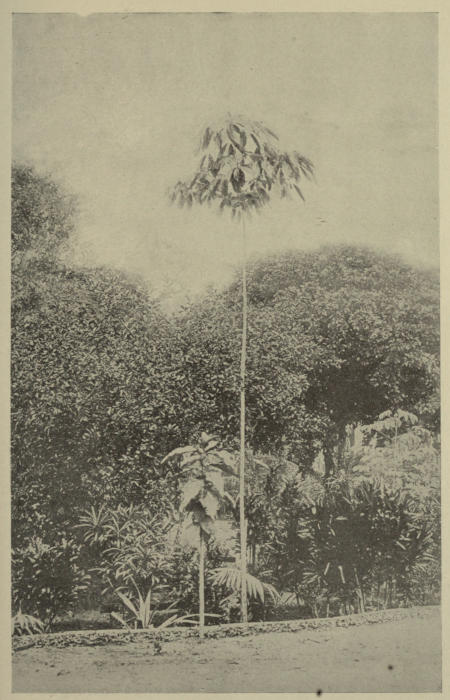
“SERINGUEIRA” HEVEA BRASILIENSIS. MULL, ARG. (11).
Art. 6.—For the purpose of facilitating transportation and reducing its cost in the valley of the Amazon, the Government will cause to be made, as soon as possible, the following improvements:
1. The construction by the Government of narrow gauge railroads along the Rivers Xingú, Tapajos and others in Pará, Matto Grosso, and of the Rio Negro and Rio Branco and others in Amazonas, through the valleys through which they flow, in accordance with the authorization of Congress, Law No. 1,126, December 13, 1903, at the price fixed per kilometer, according to the difficulties of the region, at the discretion of the Government.
In case the State of Pará and Amazonas should contract for the construction of some of these railroads, the Federal Government for the more rapid completion of the work will concede an increase of 15 contos per kilometer.
2. The construction of a railroad, which, parting at a convenient point of the Madeira-Mamoré Railroad, near the mouth of the River Abunã, passes by the village Rio Branco, and at a point between Senna Madureira and Caty, and terminates in the village Thaumaturgo, with a branch to the frontier of Perú, by the valley of the Purús River.
The construction of this road shall be in accordance with the provisions of Law No. 1,126, of December 13, 1903. As soon as the first section of the trunk line is inaugurated to the village of Rio Branco, the Government will install a custom house at Porto Velho on the Madeira River and announce this port open to commerce with friendly nations.
3. Construction of a railroad starting at the port of Belém of Pará and joining the net work of railroads of Central Brazil at Pirapóra, in the State of Minas Geraes, and of Northern Brazil at Coroatá, in the State of Maranhão, with the necessary branch lines to join the initial points or terminals of navigation on the Rivers Araguaya, Tocantins, Parahyba and S. Francisco. The railroad shall be built according to the provisions of Law No. 1,126, December 13, 1903, and shall be leased by public competition.
4. The execution of the works necessary for the effective navigation, at any season of the year, of steamers drawing three feet of water; on the Rio Negro, between Santa Isabel and Cucuhy; on the Rio Branco, from its mouth to Fort S. Joaquim; on the River Purús, from Hyutanahan to Senna Madureira; on the River Acre from its mouth to Riosinho das Pedras.
The Government may contract for the execution of these works by public competition, or independent of competition, with one or more individuals or firms offering sufficient guaranty, applying the provisions established by the decree, No. 6,368, February 14, 1907, or others, which will not impose greater burdens, and which may be more economic.
Art. 7.—For the same purpose as mentioned in the previous article, all vessels of any kind destined for river navigation, are declared exempt from all custom house duties, including fees, revision, rates.
Art. 8.—The Government will grant the same exemption in addition to the indirect favors found convenient, to the contractor who will bind himself at a public competition, to establish coal depots at points in the valley of the Amazon previously indicated, and to supply steamers and launches with fuel at prices approved by the Government.
Art. 9.—The Government will promote and aid the production of food stuffs in the valley of the Amazon through the following measures, or others which may be found convenient and promise satisfactory results.
1. The leasing of two of the National Reservations on the Rio Branco, at a public auction or private competition to a reliable concern, which binds itself to develop on a large scale, the breeding of cattle of improved types, the production of cereals, and other foodstuffs, to establish packing houses, dairies, rice-shelling mills, flour and mandiok mills, etc.
2. Direct colonization, through the Federal Government, on lands still belonging to the Union, on the S. Marcos Reservation, situated between the Rivers Mahú, Takutú, Surumú and Cotingo, with native families of farmers and stock-farmers, with a view of developing and increasing the production of foodstuffs, as well as horses and mules.
3. Concession to concerns which propose to establish large plantations or colonies under the above mentioned conditions, one in the Territory of Acre (between the Rio Branco and Xapury), one in the State of Amazonas (in the region of the Autaz River), and one in the State of Pará (on the island of Marajó or other point more convenient on the lower Amazon), granting them the following favors:
(a) Exemption from all import duties, including fees, for all material imported, necessary for establishing the plantation, including buildings, corrals, pastures, fences, watering places, agricultural implements and machines for the cultivation, harvesting and treatment of cereals, the installation of factories treating dairy produce and packing houses, as well as cattle and seed which may be imported during the first five years after the plantation is started.
(b) Premiums of 30,000 milreis for lots of 1,000 hectares of cultivated pasture, planted and conveniently fenced, and of 100,000 milreis for lots of 1,000 hectares of improved land for farming and actually planted with rice, beans, corn or mandioca.
(c) A premium of 100,000 milreis for lots of 500 tons of products made from milk, packed meats and dried beef, which were produced within five years.
4. Exemption from all import duties, including that of fees, for the vessels, instruments, machinery, drugs and ingredients necessary for the installation and working, for a period of 15 years, of a fishing enterprise, including the salting and preserving of fish, that may be established on the Amazon rivers, and the concession of a premium of 10:000$ for five consecutive years, when the production of salted and preserved fish shall be above 100 tons annually.
Art. 10.—The Government shall proceed to the discrimination, and consequent acknowledgment of the owners of the lands in the Territory of Acre, for the confirmation of their respective property titles.
Section 1.—In the verification the following should be considered as much as possible:
(a) The titles granted by the Governors of the States of the Amazon, of Bolivia and the former independent State of Acre before the treaty of Petropolis.
(b) The mild and pacific possessions acquired by first occupation, or from the first occupant, which shall be found in active exploration, or with its beginnings and habitual residence of the possessor, or his representatives.
Sec. 2.—The maximum area of each lot shall be 10 kilometers square.
Sec. 3.—The Government will review the arrangements of Law, No. 601, September 18, 1850, and Decree No. 1,318, January 30, 1854, expediting a new regulation of lands, with the modifications of the present law and those which appear more convenient to the actual situation of the Federal territories.
Art. 11.—Every three years, the Government shall promote the realization, in Rio de Janeiro, of an exposition embracing all that pertains to the national rubber industry, and on these occasions it will grant premiums of encouragement, totaling an amount equal to that which shall be authorized by law of the budget in force, for the best processes of culture and treatment, and to the producers of the best manufactured articles.
Art. 12.—The Executive Power is authorized to enter into an agreement with the States of Pará, Amazonas and Matto Grosso, for the purpose of obtaining an annual reduction of 10 per cent until the maximum limit of 50 per cent of the actual value of the export duties placed by the States upon the seringa rubber produced in their territories, and the exemption from any export duty, for the space of 25 years, to begin from the date of this law, upon rubber of the same quality and derivation which may be gathered from cultivated seringaes.
At the time the agreement is effected, the executive power shall issue a decree making such reduction which the States may make in the export duty collected on the rubber of the Federal Territory of Acre and conceding an equal exemption upon cultivated rubber.
Art. 13.—In addition the Government is authorized to enter into an agreement with the above mentioned States for the purpose of establishing, in relation to the rubber of the Territory of Acre, the measures of protection and defense, which they have adopted in relation to the production, or other measures which may be thought better, and having the power to issue the decrees necessary for this purpose.
Art. 14.—For the entire execution of this law and the realization of the measures decreed, the executive power shall issue, as quickly as possible, the necessary regulations; it shall open each year the credits that may be necessary, rendering an account to the Legislative power the year following, of the amounts expended, of the work done, of the results obtained and making the operations of credit which such services and measures demand.
Art. 15.—All laws contrary to this are revoked.
Rio de Janeiro, January 5, 1912, 91st year of Independence and the 24th year of the Republic.
HERMES R. da FONSECA, PEDRO de TOLEDO.