BOYS OF THE LIGHT BRIGADE
Reading edition
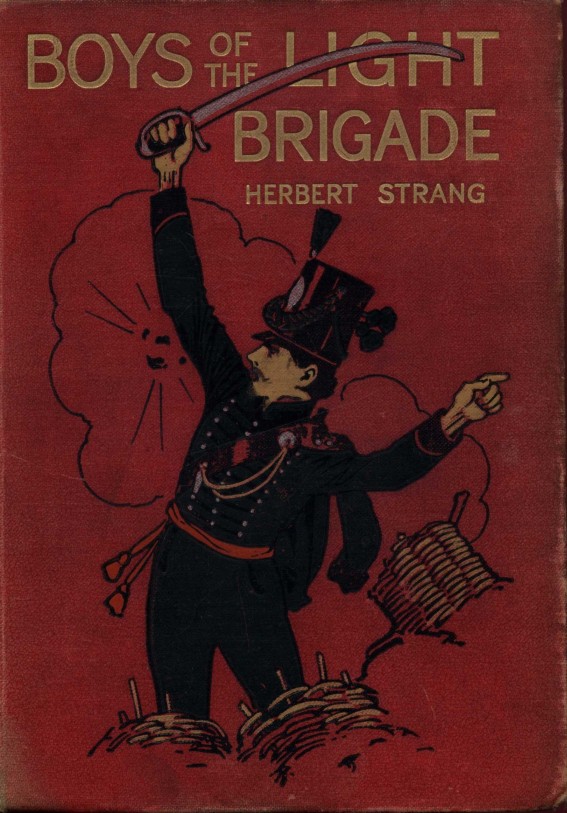
Cover art
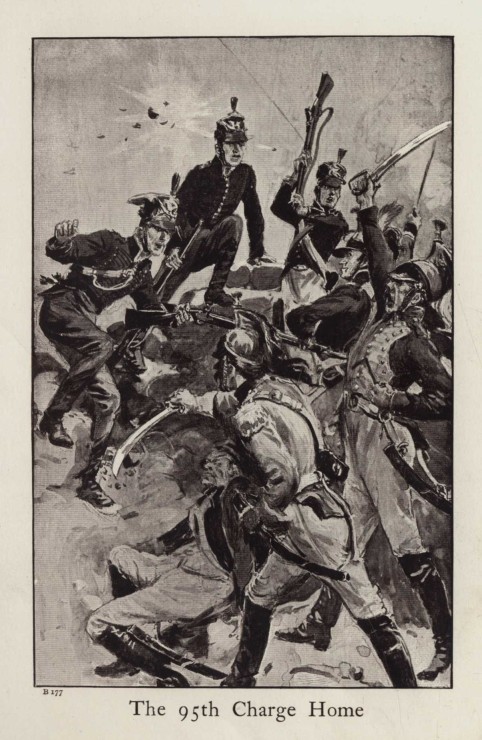
The 95th Charge Home
Boys of the Light Brigade
A Story of Spain and the Peninsular War
BY
HERBERT STRANG
AUTHOR OF "TOM BURNABY"
With a Preface by Colonel WILLOUGHBY VERNER late Rifle Brigade
Illustrated by William Rainey, R.I.
BLACKIE AND SON LIMITED LONDON GLASGOW AND BOMBAY 1905
To Spain they sent The Rifle Corps
To teach the French the Art of War!
—Old Rifleman's Song.
DEDICATED BY PERMISSION TO FIELD-MARSHAL HIS ROYAL HIGHNESS
THE DUKE OF CONNAUGHT AND STRATHEARN K.G., K.T., K.P., G.C.B., G.C.S.I., G.C.I.E, G.C.V.O.,
COLONEL-IN-CHIEF
AND TO THE OFFICERS OF
THE RIFLE BRIGADE (Formerly 95th Rifles)
Preface
Mr. Herbert Strang has asked me to write a few words explanatory of the title he has chosen for this book.
"The Light Brigade" was the name given to the first British Brigade of Light Infantry, consisting of the 43rd Light Infantry, 52nd Light Infantry, and the 95th Rifles, which were trained together as a war-brigade at Shorncliffe Camp in the years 1803-1805, just a century ago, by General Sir John Moore, the Hero of Corunna.
These regiments subsequently saw much service together in various quarters of the globe; they were engaged in the Expedition to Denmark in 1807, the Campaign in Portugal in 1808 under Sir Arthur Wellesley, including the Battle of Vimeiro, and the famous Corunna Campaign under Sir John Moore.
In July, 1809, The Light Brigade, consisting of the same three corps, was re-formed under the gallant Brigadier-General Robert Craufurd (afterwards slain at their head at the storming of Ciudad Rodrigo in 1812), at Vallada, in Portugal, and it was in the same month that it made the forced march, famous in all history as "the March of the Light Division", of some fifty miles in twenty-four hours to the battle-field of Talavera. In June, 1810, when at Almeida, in Spain, "The Light Brigade" was expanded into "The Light Division" by the addition of Ross's "Chestnut Troop" of Horse Artillery,[#] the 14th Light Dragoons,[#] the 1st King's German Hussars, and two regiments of Portuguese Caçadores.
[#] The present "A" Battery, R.H.A., which bears its proud title of "The Chestnut Troop" in the army lists to this day.
[#] The present 14th (King's) Hussars. Charles Lever, the novelist, recounts some of their gallant deeds in Charles O'Malley, the Irish Dragoon.
It was as "The Light Division", throughout the long and bloody struggle in the Peninsula, and up to the Battle of Toulouse, fought in April, 1814, that the regiments of the old "Light Brigade" maintained their proud position, so well described by Sir John Kincaid (who was adjutant of the 1st Battalion at the Battle of Waterloo) in his delightful book, Adventures in the Rifle Brigade. He writes of the 95th Rifles in the Peninsula as follows:—
"We were the Light Regiment of the Light Division, and fired the first and last shot in almost every battle, siege, and skirmish in which the army was engaged during the war.
"In stating the foregoing, however, with regard to regiments, I beg to be understood as identifying our old and gallant associates, the Forty-third and Fifty-second, as a part of ourselves, for they bore their share in everything, and I love them as I hope to do my better half (when I come to be divided); wherever we were, they were; and although the nature of our arm[#] generally gave us more employment in the way of skirmishing, yet, whenever it came to a pinch, independent of a suitable mixture of them among us, we had only to look behind to see a line, in which we might place a degree of confidence almost equal to our hopes in heaven; nor were we ever disappointed. There never was a corps of Riflemen in the hands of such supporters!"
[#] The Baker rifle, a short weapon with a flat-bladed sword-bayonet known as a "sword", very like the present so-called "bayonet", only longer. Hence the Rifleman's command, "Fix swords!" The three battalions of the 95th were (with the exception of the 5th battalion of the 60th Regiment) the only corps in the British army armed with rifles at the period of the Peninsular War, all others carrying long smooth-bore muskets, known as "Brown Bess", with long three-sided bayonets. The Baker rifle fired with precision up to 300 yards, whereas "Brown Bess" could not be depended upon to hit a mark at one-third that range.
Such was the "Light Brigade" which gives its title to this book.
The story deals with a period full of interest to Englishmen. Napoleon, having overrun Spain with some 250,000 men, swept away and defeated all the Spanish armies, and occupied Madrid, had set his hosts in motion to re-occupy Portugal and complete the subjugation of Andalusia. At this critical moment in the history of Spain, Sir John Moore, who had landed in the Peninsula with a small British army only about 30,000 strong, conceived the bold project of marching on Salamanca, and thus threatening Napoleon's "line of communications" with France—whence he drew all his supplies and ammunition. The effect was almost magical. Napoleon was compelled instantly to stay the march of his immense armies, whilst at the head of over 80,000 of his finest troops he hurled himself on the intrepid Moore. The latter, thus assailed by overwhelming numbers, was forced to order a retreat on his base at Corunna, a movement which he conducted successfully, despite the terrible privations of a rapid march in mid-winter through a desolate and mountainous country, with insufficient transport and inadequate staff arrangements. Thrice he turned to bay and thrice did he severely handle his pursuers. Finally, at Corunna, after embarking his sick and wounded, he fought the memorable battle of that name, and inflicted on the French such heavy losses that his army was enabled to re-embark and sail for England with but little further molestation. The gallant Moore himself was mortally wounded, and died the same night. The effects of the Corunna campaign were to paralyse all the Emperor's plans for nigh three months, during which time the Spaniards rallied and regained confidence, and the war took a wholly different turn, although it was only after five years' constant fighting that the French invaders were finally driven out of the country.
The Spaniards, on the other hand, animated by the presence of their English allies, once again took up arms in all directions and made a desperate resistance. No struggle was of more appalling or sustained a nature than was their second defence of Saragossa, which, in the words of the French soldiers engaged in the siege, was defended not by soldiers but by "an army of madmen".
The following story has thus a double interest. In its account of Moore's great Retreat it illustrates what we did for Spain in her dark days of 1808-1809; while in the pages dealing with the heroic Defence of Saragossa it illustrates what Spain did for herself.
Contents
Chapter I
CORPORAL WILKES WANTS TO KNOW
Chapter II
SOME INTRODUCTIONS
Chapter III
PALAFOX THE MAN, PALAFOX THE NAME
Chapter IV
A DELICATE MISSION
Chapter V
A ROADSIDE ADVENTURE
Chapter VI
MONSIEUR TABERNE
Chapter VII
PEPITO INTERVENES
Chapter VIII
DON MIGUEL PRIEGO
Chapter IX
SOME SURPRISES
Chapter X
THE EMPEROR'S DESPATCH
Chapter XI
NAPOLEON IN PURSUIT
Chapter XII
CORPORAL WILKES ON GUARD
Chapter XIII
DON MIGUEL'S MAN
Chapter XIV
AN INCIDENT AT CACABELLOS
Chapter XV
THE GREAT RETREAT
Chapter XVI
THE BATTLE OF CORUNNA
Chapter XVII
IN THE GUADALQUIVIR
Chapter XVIII
A SQUIRE OF DAMES
Chapter XIX
PALAFOX THE MAN
Chapter XX
A DAY WITH TIO JORGE
Chapter XXI
NIGHT ON THE RAMPARTS
Chapter XXII
JUANITA
Chapter XXIII
THE FIGHT IN THE RUINS
Chapter XXIV
"A BON CHAT, BON RAT"
Chapter XXV
PEPITO FINDS A CLUE
Chapter XXVI
WANTED: DON MIGUEL PRIEGO
Chapter XXVII
THE ELEVENTH HOUR
Chapter XXVIII
THE LAST FIGHT IN SARAGOSSA
Chapter XXIX
FRENCH LEAVE
Chapter XXX
THE WHIP HAND
Chapter XXXI
DOCTOR GRAMPUS AND A FRENCH COOK
Chapter XXXII
THE PRISONER AT BAYONNE
Chapter XXXIII
PALAFOX THE NAME
Chapter XXXIV
DEAD MEN TELL NO TALES
Chapter XXXV
DOOM
Chapter XXXVI
SERGEANT WILKES WANTS TO KNOW
*Glossary of Spanish Words*
List of Illustrations
Plate I
THE 95TH CHARGE HOME . . . . . . . . . Frontispiece
Plate II
A QUESTION OF SUPPLY
Plate III
JACK CAPTURES A DRAGOON
Plate IV
JACK MAKES AN OPPORTUNE APPEARANCE
Plate V
FRANCISCO FALLS FROM THE PLANK
Plate VI
JACK HAS A NARROW ESCAPE
Plate VII
JACK LEADS A FORLORN HOPE
Plate VIII
MIGUEL ESCAPES FROM THE GARDEN
Maps and Plans
1. Map of Spain and Portugal, showing the positions of the French, Spanish, and British forces at the commencement of Moore's retreat from Sahagun
2. Plan of the Battle of Corunna
3. Plan of the City of Saragossa
4. Plan of the Plaza Alvarez District
The plans of Corunna and Saragossa are copied, by kind permission of Professor Oman and the Delegates of the Clarendon Press, from the former's "History of the Peninsular War", Vols. I and II.
CHAPTER I
Corporal Wilkes wants to know
An International Question—Discipline—An Onlooker—Lumsden of the 95th—Dogged—A Six Days' Ride—Puzzlement
"What I want to know," said Corporal Wilkes, banging his fist on the table in front of him—"what I want to know is, what you Dons are doing for all the coin we've spent on you."
He was seated with a few other stalwarts of the 95th under the eastern colonnade of the Plaza Mayor, in Salamanca; a nondescript group of Spaniards, stolidly curious, blocked up the footway, and stood lounging against the balustrade. Getting no answer to his question, and probably expecting none, the corporal jerked his chin-strap under his nose, glared comprehensively around, and continued:
"I asked before, and I ask again, what has become of the ship-loads of honest British guineas you Dons have been pocketing for I don't know how long? Tell me that! What have you got to show for 'em, eh?—that's what I want to know. Here are we, without a stiver to our name, no pay for weeks, and no chance of seeing any. And look at this: here's a boot for you; that's what your Spanish mud makes o' good Bermondsey leather; and rain—well, of all the rain I ever see, blest if it ain't the wettest!"
He paused; the knot of Riflemen grunted approval. The Spaniards, who had by this time become aware that his remarks were aimed directly at them, turned enquiringly to one of their number, who shrugged, and gave them in Spanish the heads of the speaker's argument. Perceiving that he had made some impression, the corporal proceeded to follow up his advantage.
"What I want to know is, what 'ave we come here for? They did say as we were sent for to help you Dons fight the French. That's what they said. Well, the French are all right; but what are you doing? We showed you the way at Vimeiro; that's a long time ago now—what have you done since? Where are all the armies and the generals you talked so much about? What's become of them? Tell me that! Here we've been in Salamanky a matter of fourteen days, but we ain't seen none of them. There's plenty of you Dons about, sure enough, but you don't look to me like fighting-men. Where are you hiding 'em?—that's what I want to know."
There was no mistaking the glance of withering contempt with which the speaker pointed his questions; a movement of resentment was already visible among his mixed audience. The interpreter, whose dress proclaimed him a seaman from one of the Biscayan ports, was now volubly rendering the gist of the Englishman's taunts, to an accompaniment of strange oaths and ominous murmurs from the crowd. Warming with their sympathy, he became more and more excited, passed from explanation to denunciation, and then, turning suddenly from his compatriots, clenched his fist and poured out a torrent of abuse in a lurid mixture of Basque and Billingsgate. The corporal, recognizing phrases that could only have been picked up at Deptford or Wapping, smiled appreciatively, and, with a wink at his companions, said:
"Ain't it like home? He ought to be a drill-sergeant—eh, boys?"
A shout of laughter greeted this sally. The Spaniard, his complexion changing from olive to purple, strode forward and shook his fist within an inch of the corporal's nose. Wilkes, greatly tolerant of foreign eccentricity, preserved an unwinking front; but his bland smile was too much for the Spaniard's fast-ebbing self-control. With a snarl of rage he plucked a knife from his sash and aimed a blow at the Rifleman, which, had it taken effect, would assuredly have put an end to his interrogative career. But the corporal's left-hand neighbour, who had been lolling against a post, flung out his arm and arrested the stroke; almost at the same instant Wilkes himself got home a deft right-hander beneath his assailant's chin that hurled him senseless across the table. In a moment a score of Spaniards with drawn knives were surging around the little group. Being without arms the Riflemen had slipped off their belts and closed up to meet the attack. The colonnade now rang with fierce shouts, and from all quarters of the large square there was a hurry-scurry of idlers attracted by the noise of the fray. Cheerfully confident, the half-dozen British soldiers, their backs against the wall, kept the throng at arm's-length with the practised swing of their long belts. But the odds against them were heavy. It could only be a few moments before the Spaniards must get in with their knives, and then the 95th would be six men short on parade. One or two of the Spaniards had been hard hit; but the rest were drawing together for a rush, when suddenly, above the din of the mêlée, rang out the clear authoritative word of command:
"Attention!"
The habit of discipline was so strong that the British soldiers on the instant dropped their belts and stood rigid as statues. On the Spaniards the effect of the interruption was equally remarkable. Surprised at the sudden change of attitude, they looked round with a startled air to seek the cause of the Englishmen's strange quiescence. A horseman had reined up opposite the scene of the scuffle—a tall youthful figure, wearing the headgear of the 95th and a heavy cavalry cloak.
"Stand easy!" he cried to the Riflemen, over the heads of the crowd, "and don't move an eyelash."
With a dozen Spanish knives flashing before their eyes, the command was a severe test of discipline; but in the British army a hundred years ago rigid training had made instant unquestioning obedience an instinct. While the Spaniards were still fingering their weapons, and hesitating whether to finish off their work, the officer began to address them in pure Castilian.
"Pardon me, Señores," he said, "for interrupting what I am sure was a pastime. I am an English officer, as you see, and I fear that my men, ignorant of your customs and traditions, might have taken seriously what was no doubt begun in sport. There is no need for me to say a word, Señores about your valour; is not that known to all the world? and I am sure you would be the last to do anything to endanger the friendly alliance between your country and mine. The French are your enemies, Señores; they are ours too. We are fighting shoulder to shoulder in a noble cause. Confusion to the invader, say I! Hurrah for the independence of Spain! Cry Viva la España with me!"
Then turning suddenly to the Riflemen, he cried:
"Now, men, give three rousing cheers."
Wilkes and his friends cheered half-heartedly and with an air of endurance; but the Spaniards were not discriminating, and responded with shrill vivas.
"Thank you, my friends!" said the officer, when the tumult had subsided. "And now, as I have a few words to say to my men before I ride off, I will bid you good-day."
In a few moments the pacified crowd dispersed in small knots, discussing with interested curiosity the young officer whose courteous firmness and fluent Spanish had produced so remarkable an effect. When, last of all, the interpreter, having recovered from the blow, had made his way across the square, the horseman called up Corporal Wilkes, who advanced with a somewhat guilty air and saluted.
"Now, Corporal Wilkes, what do you mean by this? Have you forgotten the general's orders about brawling with the Spaniards?"
The corporal shifted his feet uneasily, and began to mumble an explanation in his slow ponderous way.
"That'll do," said the officer, cutting him short. "You're always in hot water. Get off to your quarters, and report yourself to me in the morning."
"Very good, sir."
With a look of injured innocence he saluted and slouched off with his companions, while the officer, touching his horse's flanks with the spur, cantered away. At the angle of the colonnade the crestfallen Riflemen were confronted by a tall stately figure in cocked hat and long military cloak, who had for some time been quietly watching the scene from an inconspicuous post of observation.
"Who's your officer, my man?"
The Riflemen halted in a line, struck their heels together, and brought their hands to the salute like automata.
"Mr. Lumsden, your honour," replied Wilkes, looking as though he would have liked to be elsewhere.
"Oh indeed! Thank you!"
The commander-in-chief acknowledged their salute and turned on his heel. The men stared after him for a few moments in silence; then Wilkes turned to his comrades, and said with a rueful look:
"By gum! How much of that 'ere rumpus did Johnny see?—that's what I'd like to know."
Meanwhile Lumsden of the 95th had trotted off, across the great square, past the church of San Martin, towards the University and the Tormes bridge. He was bound for a farmhouse some five miles south-east of the city, where it had been reported that a considerable quantity of flour could be purchased for the troops. Since the arrival of his regiment in Salamanca a fortnight before, he had been employed continuously on commissariat business, and was the object of envy to his fellow-subalterns, who would gladly have found some special work of the kind to vary the monotony of life.
It was the 28th November in the year 1808. Salamanca was full of British soldiers, who had marched in on the 13th amid a drenching rain-storm and the cheers of the inhabitants. They comprised six infantry brigades and one battery of artillery, among the former being the famous 95th Rifles under Colonel Beckwith, in which Jack Lumsden was a second lieutenant. The main artillery force, with its escort, was near the Escurial, a few miles from Madrid, under Sir John Hope, who was intending to march northwards to join his chief; while Sir David Baird lay at Astorga, with three batteries, four infantry brigades, and a force of cavalry under Lord Paget. The infantry had marched from Lisbon under Sir John Moore, who had succeeded to the chief command of the British forces in the Peninsula recently vacated by Sir Hew Dalrymple. At Salamanca Sir John expected to receive news of the approach of a Spanish force under the Marquis of La Romana, to co-operate with him in offensive movements against the French. The march had been particularly arduous and uncomfortable; rain had fallen in torrents for the greater part of the way, and owing to lack of supplies the men were in a sorry state as regards clothes and equipment. But they nourished high hopes of soon inflicting a heavy blow on the French invaders; and though the delay, due to want of definite information about the movements of the Spaniards and the position of the French, was telling somewhat on the spirits of the force, Sir John Moore was so popular with all ranks, and enjoyed their confidence so thoroughly, that discontent had only shown itself in half-humorous protests like that of Corporal Wilkes.
Jack Lumsden rode easily through the darkening streets, passed the sentry at the bridge head, and cantered along the sodden road leading to Alba de Tormes. Three miles out of Salamanca he struck off to the left, and, carefully picking his way among the ruts and depressions, reached his destination just as the black darkness of a November evening fell. His errand with the farmer occupied some little time. He then accepted the refreshments pressed upon him with true Castilian hospitality; and at length, towards seven o'clock, set off on the return journey.
The moon was rising behind him, throwing a dim misty radiance over the bare fields to right and left. As he reached the cross-roads, and wheeled round into the highway towards Salamanca, he saw, some hundred yards ahead, several dark forms on both sides of the road, creeping along with stealthy movements in the same direction. Carrying his gaze beyond them, he descried a man leading a horse, who, he instantly concluded, was being followed by a gang of foot-pads, or of the brigands who notoriously infested every part of Spain. Almost involuntarily Jack pricked his horse forward; he saw that the furtive band were rapidly lessening the distance between them and the walking horseman, who every now and then half-turned to look at them, and then resumed his slow progress.
The road was so soft, and the men were so intent upon their expected prey, that they did not hear the sound of Jack's approach until he was within a few yards of them. Then a sudden splash in a large puddle caused them to stop and look round; Jack galloped up, and as he passed them, ostentatiously held his pistol so that a glint of moonlight fell on the barrel. At the same moment the dismounted rider heard the pad of his horse's hoofs; he paused, still holding the bridle, and turned towards Jack, who pulled his horse across the road and glanced back at the brigands. They had now formed a group, and stood in the middle of the road. Jack clicked the lock of his pistol. After an instant's hesitation the men turned in a body and vanished into the darkness.
"Many thanks!" said the pedestrian. "I was never more glad to see a British officer. Those bandits have been following me up for some minutes. My horse is lame, as you see, and though I've a couple of pistols handy I'm afraid I'd be no match for eight big fellows with their knives. And I've a particular reason for avoiding risks."
"They've had the discretion to sheer off," said Jack, turning again towards Salamanca. "It's unlucky your horse is lamed. Have you been riding far, sir?"
"About five hundred miles," was the reply.
Jack stared.
"No wonder your horse is lame—though you didn't ride the whole distance on the same beast, I suppose."
"No indeed; but I've scarcely been out of the saddle for six days—"
"Six days! Hard riding that, sir."
"True. The fact is, I've most important despatches for Sir John Moore, and haven't wasted a minute more than I could help."
Jack was off his horse in a moment.
"In that case, sir, pray take my horse and finish your ride with equal speed. If you bring news for the general, no one will be more delighted to see you. It's only about three miles, and the road's straight ahead; I'll follow with your horse."
"That's very good of you. I didn't like the idea of trudging in in this lame fashion. You're sure you don't mind? Those brigands, eh?"
"Not a bit. They won't show their noses again."
By this time the stranger had mounted Jack's horse, and was preparing to ride off.
"By the way," he said, "to what address shall I return the horse?—a pretty animal, begad!"
"I'm quartered at a worthy alderman's in the Calle de Moros—El Regidor Don Perez Gerrion; my name's Lumsden."
"Lumsden!" repeated the stranger with a start, letting the reins fall on the horse's neck.
"Yes," said Jack, looking up in surprise. "Why?"
"Oh! Excuse me now. I have my despatches to deliver, and then I will call on you at the regidor's. I have a communication, probably, to make to you. Au revoir!"
With a wave of the hand he galloped off, leaving Jack to tramp along behind him, in some wonderment as to what communication a despatch-rider could have to make to a subaltern of the 95th.
CHAPTER II
Some Introductions
The Grampus—A Turn with the Foils—An Interruption—Enter a Regidor—Flour and Water—A Soft Answer—Pepito—Biographical—Captain O'Hare—Mr. Vaughan is announced
It began to rain when Jack was still two miles out of Salamanca, and he was wet and chilled when, having put up the stranger's horse, he entered the regidor's house and sought the general room, where, as he knew from the sounds of laughter proceeding from it, his friends and comrades were assembled. There was a universal shout as Jack pushed open the door.
"Here's the commissary-general!" cried a tall, fair-headed subaltern of seventeen years. "Look here, Jack, if this corn-chandler business of yours gets you promotion before me, I'll—I'll punch your head."
"Thanks! Pommy, my dear, unless you're careful, respectful, you know, you'll find your next billet will be a stable or a pig-stye; you can take your choice. A pig-stye would be the easier got, perhaps—this country teems with porkers; but there are plenty of mules too, and one more won't matter."
"All the same, Lumsden," said Harry Smith, a lieutenant of twenty-one, "I don't wonder Pomeroy's jealous. We didn't all have the luck to be babies in Spain! But let me introduce a friend of mine—an old school-chum. Lumsden—Dugdale, Percy Dugdale, otherwise the Grampus."
Jack found his right hand engulfed in a huge fist, and shaken almost to a jelly. It belonged to a tall young man in civilian dress, stout, massive, broad-shouldered, with a rubicund, open, ingenuous face, and a smile that bespoke friendliness at once.
"Heard of you," said Dugdale cordially. "Heard of your little bet. Reminds me of my wager with Blinks of Merton when I was a freshman. Bet me a pound to a polony I wouldn't screw up a proctor; loser to eat the polony. I won—and bought a champion polony in St. Aldate's. Blinks stood us a supper to be let off. Ha! ha!"
The Honourable Percy Dugdale's chuckle had a quality of its own. While it seldom resulted from what others would have regarded as wit or humour, it never failed to breed sympathetic laughter, and the room rang with appreciative merriment.
"What's this bet of yours, Lumsden?" asked Bob Shirley, lieutenant in Jack's company.
"Oh, a little affair with Pomeroy! He's so desperately cocksure of everything, and what is worse, he will talk, you know. Said he'd hold me at boxing, at wrestling, at swimming, at every mortal thing, including fencing, so I bet him before we left Alcantara that I'd give him points at them all, and we're going to begin with the foils."
"What are the stakes?" asked Shirley. "Why didn't I hear of this?"
"It's a guinea to a Bath bun. Pomeroy's amazing fond of Bath buns; and as at present I haven't a guinea, at least to spare, and he hasn't a bun, we're going to settle up when we get back to London, and you fellows can come to Gunter's and see Pommy shell out twopence, if you like."
"No time like the present," said Smith. "We've half an hour before supper, and nothing to do. If you fellows are game we'll make a ring now."
"I'm ready," said Pomeroy, pulling off his jacket, "if the corn-dealer is."
"By all means," retorted Jack, laughing; "but I hope, for the sake of the company, your riposte is better than your repartee."
"No more cackle!" cried Smith. "Let's get to business. Where are the foils?"
At a word from Jack, a tall, strapping Rifleman, who had followed him into the room, disappeared for half a minute, and returned with a couple of foils in his hands. He handed one to his master, who had meanwhile peeled, and the other to Reginald Pomeroy. The two faced one another; they were of equal height, but otherwise presented a strong contrast. Both were tall, but Jack was slight and lissom, with dark hair, brown eyes, and clear-cut features, while Reginald Pomeroy was heavier in build, fresh-complexioned, with blue eyes and light curly hair. In brief, if Jack was Norman, Pomeroy was as clearly Saxon, and as they stood there, they were worthy representatives of the two fine strains of our present English race. They were always sparring, always girding at each other, but at bottom they were the best of friends, and had indeed been inseparable chums ever since they entered the Charterhouse together.
"Gad, reminds me of the mill between Jones of Jesus and De Crespigny of the House, in Merton meadow," said Dugdale with his capacious chuckle.
"'His eyebrow dark, and eye of fire,
Shows spirit proud, and prompt to ire,'"
quoted Shirley, amid a chorus of groans.
"Shut up, Shirley!" cried Jack; "if you begin spouting poetry you'll shatter my nerve."
"Yes, by George," said Smith, "we had enough of Marmion on the way out. Shirley's a long way too fond of poetry. Now, you two, are you ready? Buttons on the foils? That's right. Now then!"
"Charge, Chester, charge; on, Stanley, on!'"
shouted Shirley, who was irrepressible, and who, indeed, was said to have got Marmion by heart a week after it was issued, in February of this year.
The duel began. The combatants were pretty evenly matched, and as the spectators watched thrust and parry, lunge and riposte, now cheering one, now the other, the air became charged with electric excitement. Right foot well forward, left arm well behind his head, Jack watched his opponent with the keenness of a hawk, and for a time seemed to content himself with standing on the defensive. He knew his man, and held himself in with the confident expectation that Pomeroy would by and by become reckless.
"Two to one on Pomeroy!" shouted Dugdale, who was growing excited.
"Done!" said Smith. "Name your stakes."
"Anything you like; I'm not particular. I want a new pair of breeches. Yours won't fit me, but mine'll fit you with a little trimming'. Gad, Lumsden was nearly pinked that time. Make it two pairs!"
"D'you mind moving aside?" said Shirley, who, being head and shoulders shorter than Dugdale, found his view obstructed by six feet two and a back broad in proportion.
"Sorry; get on my back if you like," said Dugdale. "Won a bet by running a race with young Jukes of Pembroke on my back. I don't mind."
But Shirley contented himself with edging in to a place beside the big sportsman.
The foils clashed; Pomeroy made a rapid lunge at Jack, who instantly straightened himself, and before his opponent could recover his guard, Jack's foil was out, and slid along the other, and with a dexterous turn of the wrist he sent the weapon flying out of Pomeroy's hand, over the ring of onlookers, to the other end of the room, where it clattered against the wall and fell with a clash to the floor.
"Oh, come now! I never lose my wagers. I make a point of it," said Dugdale with a rueful look.
"End of the first round; that's Lumsden's," said Smith quietly. "Five minutes' rest, then to it again. Give you six to one next round."
"No, thanks! I'll wait a bit. Can't afford to part with all my pants. What's that?"
Above the voices of the officers discussing the details of the match rose the clamour of a repeated battering on the door.
"Oh, I say!" cried Dugdale, "we can't have this interrupted. Is the door locked?"
"Fast," replied Shirley, adding:
"'And neither bolt nor bar shall keep
My own true—love—from—'"
The quotation remained unfinished, for Jack laid Shirley on his back and sat on him. The knock was repeated again and again, with increasing loudness; the door was rattled with ever-growing vehemence.
"Set your back against the door, Giles," said Jack. "It'll take some force to move your fourteen stone of muscle."
The big Rifleman set his straight back against the door, planted his feet firmly on the floor so that his body formed an obtuse angle, and crossed his arms on his breast. The knocking continued.
"Can't come in," shouted a shrill-voiced ensign. "We're busy."
From outside an angry voice bawled in reply.
"Be quiet, you fellows," cried Smith. "Let us hear who it is."
The noise inside the room was hushed, and through the door came muffled tones of angry and excited remonstrance.
"It's very bad language, but I can't understand it," said Smith, who now had his ear against the oak. "Here, Jack, you're the only fellow who knows the lingo; leave that drain-pipe and see if you can make anything of it."
Jack rose from his wriggling seat, and, going to the door, shouted "Who are you?" in Spanish. A moment later he turned to the company and said: "By George! it's the regidor himself. We'd better let him in."
"Not till I've licked you," said Pomeroy. "Let the old boy wait."
"That's Pommy all over," said Smith; "I'm Reginald Pomeroy, and hang civility! The regidor's our host, and we owe him a little consideration."
"Exactly," put in Jack. "Heave over, Giles, and let me open the door."
He turned the key, threw the door open, and gave admittance to the oddest figure imaginable.
"Pommy's Bath bun—underbaked!" said Shirley under his breath. The rest of the company were too much surprised for speech or laughter. The intruder was presumably a man, but he was so completely covered with an envelope of paste that form and feature were undiscoverable. Two unmistakable arms, however, were wildly gesticulating; an equally obvious fist was being shaken towards the group; and a human voice was certainly pouring out a stream of violent language, of which no one there, not even Jack, could make out a word.
"Come, Señor Regidor," said Jack in Spanish, "what is the matter? Really, you talk so fast that I cannot understand you."
He laid his hand on the regidor's arm, but drew it back hastily; it was covered with wet flour.
"Shut the door, Giles," he said, wiping his hand; "this needs an explanation. In fact" (he gave a quizzical glance from the floor to the company) "it needs clearing up!"
Taking the fuming regidor gingerly by the hand, he led him to the middle of the room, where, with Pomeroy's assistance, he set to work to scrape away the clinging paste that swathed the poor man from head to foot. The first shock of surprise being over, the rest of the officers were now fairly bubbling with merriment, for the regidor was too angry to keep still, and never ceased from objurgating some person unknown. Dugdale had stuffed a handkerchief into his mouth to stifle his laughter, and Smith was thumping Shirley vigorously on the back. After some minutes' scraping with the foils, the new-comer was revealed standing in a circle of clammy flour—a little, round, pompous individual, with a very red and wrathful face, made ludicrous by the stiff moustache, to which a coating of flour obstinately adhered.
"Now, Señor Regidor," said Jack soothingly, "tell us all about it. I hope the mischief has gone no deeper than your clothes."
And then the little alderman unfolded his pitiful story. It appeared that he had gone round his premises in the rain, to see that all was safely locked up for the night, when he found that his barn at the back of the house had been left open—not only the lower door, but also the upper door, through which sacks of flour entered the loft. It was very dark, and he had been unable in the rain and wind to obtain a light. Feeling his way into the barn, he had crept up the ladder leading to the loft, stumbling as he did so over an empty sack that covered the last two or three steps. Then, arrived at the top, he had lifted the trap-door, and raised head and shoulders above the opening, when without warning he was smothered by an avalanche of flour, which took him so entirely by surprise that he had fallen backward, and only saved himself from a headlong descent to the foot of the ladder by clutching at a rope that dangled a few inches in front of him. It was no accident, he declared, for he had heard the scurry of some living creature moving in the loft. On recovering from his shock he had mounted again and searched the place as thoroughly as he could in the darkness, but without success. He had then locked up the barn securely, and being convinced that he was the victim of a practical joke on the part of one of the subalterns billeted upon him, he had come to demand satisfaction for the insult, and compensation for the irreparable damage done to his clothes.
Such was his story, told at much greater length, and punctuated with many violent gestures and still more violent expletives. Jack listened to him patiently, while the rest of the company stood in a ring about them, striving with ill success to hide their merriment. When lack of breath at length brought the little man to a stop, Jack spoke to him consolingly, assuring him that he was mistaken, and that no British officer would so far have forgotten the courtesy due to their obliging host. The regidor was not appeased; he was on the point of recommencing his denunciation of the culprit, when Jack stopped him, and said that he would question his brother officers and convince the regidor that he was mistaken. He then briefly told his companions the outlines of the story he had heard. Just as he came to the point where the shower of flour had descended on the unfortunate regidor, he was annoyed at hearing a loud chuckle.
"Pomeroy, that's too bad," he exclaimed. "How can I persuade our host that we have had nothing to do with his plight if you disgrace yourself like that?"
"Look here, Lumsden," said Pomeroy, "I'm not going to be lectured. As a matter of fact, I didn't make a cheep."
"Sorry, Pommy," said Jack, with a glance at Dugdale. "Well now, I can assure the regidor, on your honour, that none of you had a hand in this?"
Every officer present gave his word. Then Jack put on his coat, and, slipping his arm within the regidor's, led him off with a promise to investigate the matter, and see whether any of the officers' servants had been in fault. The moment their backs were turned, the same loud chuckle was heard, followed by an unmistakable guffaw. Giles Ogbourne, Jack's big servant, while maintaining a rigid position against the wall, was putting his broad face through the oddest contortions of amusement.
"What are you grinning at?" cried Pomeroy angrily. "Was it you who gave that oily chuckle just now?"
"Beg pardon, sir," said Ogbourne, endeavouring to look grave. "I really couldn't help it. 'Tis a trick of that young varmint Pepito; I be sure 'tis."
"That imp of a gipsy! I told Lumsden he'd be sorry he ever set eyes on the creature. Why do you think he is at the bottom of it?"
"Why, sir, I seed the boy bummelled out of the kitchen, and prowling around by the barn, and, sakes alive, 'tis he and no one else."
"Who's Pepito?" asked Dugdale.
"A young sprat of a gipsy Jack picked up outside Queluz soon after we left Lisbon. Here, Ogbourne, you know more about him than I do. Speak up."
"'Tis just as you say, sir. Mr. Lumsden found the critter on the roadside, a'most dead, and took'm up and fed him, sir. A thoroughbred gipsy, sir. His band had been cut up by the French after the fight by Vimeiro; every man of 'em was killed dead except this mortal boy, and a' got a cut in th' arm from a sabre. Mr. Lumsden gave him a good square meal, sir, and next day a' hitched hisself on to us, followed us all along, went a-fetching and a-carrying for Mr. Lumsden, for all the world like a little dog. Mr. Lumsden says to me: 'Giles,' says he, 'there's enough women and childer along of us without this young shaver; what'll we do with him?' I couldn't think of anything, so Mr. Lumsden he takes him to a Portuguese barber and hands him over some money for the boy's keep, and tells him to make a barber of him. Bless you, next day the varmint turns up again, and we can't shake him off nohow. If a' goes away for a day, back a' comes the next, as perky as a Jack-in-the-box."
"A sort of millstone round Lumsden's neck," said Shirley.
"Not but what he's useful," added Ogbourne. "He's first-rate at shining buttons and cleaning swords, and all sorts of little odd jobs. Only he's so full of monkey tricks, you can't believe. One night a' put two live toads in my bed, a' did; another night a' mixed some dubbin wi' my soup. I tanned him, I did, but though a' blubbered hard enough, next minute his wicked little black eyes were as mischievous as ever. Mr. Lumsden's got a handful, sir, and that's gospel truth."
"If that's his character, depend upon it he's responsible for the regidor's whitening," said Smith. "We'll have to abolish the boy; don't you think so?"
"Oh, I say!" struck in Dugdale, "never mind about a scrubby gipsy. I wish Lumsden would hurry up. I want to see Pomeroy lick him."
"You'll lose this time," said Smith.
Dugdale made a wry face. "Didn't know he was such a paragon. Speaks Spanish as well as the Don. Learnt it for a bet, I suppose."
"No," said Pomeroy, laughing. "He lived at Barcelona till he was eleven."
"Where on earth's Barcelona? Is it where the nuts grow?"
"Yes—in the big square!" said Smith with a smile.
Dugdale grunted. "But what was Lumsden doing there?" he asked.
"Eating, and growing, and learning the lingo, of course," said Pomeroy. "His father's a partner in some Spanish firm whose head-quarters are at Barcelona, and lived there, as I say, until Jack was eleven. Then, as the kid was more or less running wild, I suppose, Mr. Lumsden returned to London as head of the branch there, and sent Jack to the Charterhouse, and that's where I licked him first—"
"Now, Pommy, at it again!" said Jack's voice.
Dugdale chuckled, and Pomeroy looked aggressive; but immediately behind Jack, as he re-entered the room, came a figure at the sight of which the whole group broke out in exclamations of welcome.
"Peter!" said Smith to Dugdale in a stage whisper.
The new-comer was a tall man of some thirty-six years, wearing a big greatcoat and a peaked cap drawn over his brow. His face was particularly ugly, but redeemed by a pair of bright good-tempered-looking eyes. He stood for a moment quizzing the company, while the water streamed from his coat and made a pool on the floor.
"Bedad," he said, observing the pasty mixture there, "sure if it's roast beef that it is, it's myself that's thankful; but the flure's a queer place to mix the Yorkshire."
"No such luck," said Pomeroy. "No chance of that this side of Portsmouth; it's only a toad-in-the-hole this time."
Captain Peter O'Hare laughed when they told him of the regidor's plight.
"And who was the blackguard that did it?" he asked, suddenly looking serious. "Such conduct is terribly unbecoming an officer and a gentleman."
"It was Pepito," exclaimed Jack; "that little scamp of a gipsy who's been shadowing me since we left Lisbon. I found him crouching in the regidor's stable, smothered in flour from head to foot. It appears he had made for the loft as the only dry place, and emptied a bag of flour on the regidor in sheer self-defence, being afraid of a walloping if he was caught. He jumped out of the upper door and slid down a gutter-pipe. I'm afraid that young man will prove a thorn in my side."
Captain O'Hare having by this time removed his dripping garments, Smith took the opportunity to introduce his friend Dugdale.
"He's just escaped from Oxford, O'Hare; heard the bugles sounding and couldn't sit still."
"What regiment, sir?" said the captain, shaking hands. "I knew a Dugdale in the 85th."
Dugdale chuckled.
"My brother Tom, no doubt. Laid him a poodle to a pork-pie that I'd be at the front first, and here I am."
"Ah! an amachure, I preshume," said Captain O'Hare, glancing at his civilian costume. "Sure, an' I hope you'll like it, for 'tis not all beer and skittles. And that reminds me; 'tis time we cleared the decks for supper. You'll stay and take pot-luck, Mr. Dugdale?"
"Thank you, sir! but, you see—well, we had a little wager—in short, thank you, sir!"
O'Hare looked puzzled, and still more as he noticed a smile on the faces of the rest of the company.
"Never mind, Grampus," said Smith with a nudge, "they can fight it out another time, and meanwhile you've saved your breeches."
At this moment Rifleman Giles Ogbourne entered the room.
"Please, sir," he said to Jack, "there's a Mr. Vaughan at the door as would like to see you. I was to say 'twas he that borrowed your horse a while ago."
"Show him in," said Jack.
"Beg pardon, sir, but he says as he would like to see you alone."
"Oh, very well!" said Jack, rising, and he followed Giles from the room.
CHAPTER III
Palafox the Man, Palafox the Name
A Letter from Saragossa—An Invitation—Bad News—Spanish Apathy—Bonaparte—Jockeying a Nation—A Message from Head-quarters—More Puzzlement
The visitor was awaiting Jack beneath a dim lamp in the vestibule.
"You won't mind coming into my bedroom?" said Jack, after an interchange of greetings. "It's the only place where we can be alone."
He led the way, struck a light, and noticed that the stranger was bespattered with mud from head to foot.
"I'm scarcely fit to come into a house at all," said the latter apologetically; "but as things are, no doubt you'll excuse me. I had better introduce myself. My name is Vaughan, and I am acting as private secretary to Mr. Stuart, our minister at Madrid. As I told you, I have ridden in with important despatches for Sir John Moore; I happened to be with Castaños' army, and as I came through Saragossa on my way to Madrid I was entrusted by General Palafox with a letter to you, which I promised to deliver to you in person if I should come across your regiment. Here is the letter."
He handed the paper to Jack, who looked at it in surprise.
"General Palafox!" he said. "I don't know him. He is the Spanish general who defended Saragossa recently, isn't he?"
"Yes. I assure you it was he who gave me the letter."
"Will you sit down while I look at it?"
Jack hastily broke the seal.
"I should add," said Vaughan, who had thrown himself wearily into a chair, "that if I failed to find you, I was to carry the letter to your father in London, whither I am proceeding at once."
Meanwhile, Jack had opened the letter, which was written in a crabbed and shaky handwriting. "My dear friend Jack," it began; and then Jack turned to the signature, and read "Fernan Alvarez". A light dawned upon him; his look of bewilderment vanished, and he turned back to the beginning with eager curiosity. The letter ran as follows:—
MY DEAR FRIEND JACK,
My brave friend Captain-General Palafox tells me that Mr. Carlos Vawn, who has of late arrived at this city, is on the point of leaving for Madrid, and will then, it is possible, return to England by way of Portugal, in which case he will, without doubt, visit the camp of the great general, Sir Moore. By his courtesy I trust that this letter may come to your hands all safe, and then I beg you will advise my agents in Madrid, Señores Caldos and Gonzalez, inasmuch as I may be quite altogether beyond the touch of your reply. The last letter I received from my dear friend your father tells me that you sail instantly with Sir Moore's army, and I already hear that your general landed soon after the blessed victory at Vimeiro.
You will have heard of our glorious defence against the usurper. We shall not grudge our sufferings if the example of Saragossa do give heart to the other great cities of my poor country so distracted. For she will need indeed all her strength, all her courage, all her heroism, in the storm which is now to burst upon her. Alas! I can no longer hope to be of any service; my strength fails fast; I am old; I die. For myself, I do not repine, but I am full of fear and trouble for the safety of my poor Juanita, the little playmate whom I am sure you will not have forgotten quite. I have done my all to provide for her, but who can see through the clouds of war? We know not what may come in a day. And the danger is not to be feared only from the outside. In a letter to your father I have told him of what I have done. One thing is needed to finish the things I tell him, and that is in the six words—mark you—Palafox the Man, Palafox the Name. I beg you commit these words to memory, and burn this letter the moment after you have read it.
I hope I may yet see you again before I die, but if it is not so be, I say God bless you, and write myself for the last time
Your old friend,
FERNAN ALVAREZ.
P.S.—Remember always: Palafox the Man, Palafox the Name.
"Palafox the man, Palafox the name!" said Jack half aloud. "What does he mean? Did General Palafox send a message with this, sir?"
"No. I understood that the writer was a friend of his and yours."
"He is a friend of mine. He is my father's partner. But I don't understand the letter. It appears to hint at something which he does not care to express clearly. And he speaks of a letter to my father. Have you that too?"
"No; I know nothing about that."
"Then it is probably with Don Fernan's agents in Madrid. But I am forgetting to thank you. Really, sir, it was very good of you to undertake this private errand when you must have been engrossed in public affairs. We were just going to have supper; will you honour us by joining our mess?"
"I am very tired, and not at all in company trim; in fact, I had just declined a similar invitation from Sir John; but—"
"You will, then? I am very glad. We will not keep you late."
"I must first go and give a coin to the boy who showed me the way here—a little gipsy fellow who said he knew you."
"Pepito! Let me deal with him, Mr. Vaughan; he has an extraordinary knack of turning up just when he can make himself useful. You'll find a towel there; I'll go and settle with Pepito, and you will follow me, won't you? Our fellows will be delighted to meet you."
And Jack left his visitor to his ablutions.
There was much curiosity among the subalterns as to the identity of Jack's visitor and the subject of their private interview; but Jack volunteered no information, merely telling them, as he passed through the room on his way to find Pepito, that Mr. Vaughan would join them at supper.
"So you boys will have to mind your p's and q's," said Captain O'Hare. "No antics now. Some of these politicals are very starchy."
Consequently it was a quiet group to whom, in a few minutes, Mr. Vaughan was introduced. They were all hungry, and Jack apologized for the plainness of the fare.
"You see, sir," he said, "Sataro, our Portuguese contractor, has failed, and we all have to get what food we can."
"You won't find me fastidious," replied Vaughan. "I could almost eat my boots, I think."
"Mr. Vaughan has just ridden five hundred miles on end," explained Jack.
"By George!" exclaimed Dugdale.
"Five hundred, bedad!" said Captain O'Hare. "If they were like the miles round Salamanca, sure you must have come through a power of mud!"
"How long did it take you, sir?" asked Shirley.
"Six days."
There was a cry of astonishment.
"Gad, that beats Bagster of Trinity!" said Dugdale. "Backed himself to ride sixty miles and eat sixty oysters in a hundred and sixty minutes; lost by six oysters, and always vowed he could ha' done that if the vinegar hadn't run short!"
There was a general laugh.
"I could have done with the oysters—even the six," said Vaughan, who was tickled by Dugdale's whole-hearted enjoyment of his recollection.
"And why did you pelt along so terrible hard, may I ask, Mr. Vaughan?" said the captain.
"It'll be common property to-morrow, so I may as well tell you. I have been for some time with the staff of General Palafox in Aragon. Six days ago General Castaños was totally defeated at Tudela."
"Good heavens!" cried Pomeroy; "another defeat! It was quite time we turned up to help the Dons."
"What a cowardly crew!" added Smith. "They run at the sound of their own guns. Bang! whizz! and Vamos, they cry, which Lumsden will tell you means: 'Let us skedaddle'."
"We mustn't be too hard on them," said Mr. Vaughan quietly. "They used to fight well, by all accounts. There were good men in Alva's time—not to go back any further. All they want is proper leading. Their generals happen to be no match for the French marshals, and unlucky to boot. A little British discipline would work wonders. Well, as I happened to be with the Spanish army, I rode off to Madrid at once with the news, and our minister there sent me off with despatches to Sir John."
"Lucky you were on the spot, sir," said Smith, "or we might have waited till doomsday. The villainous way we are served with intelligence is the common talk of the army."
"I judged as much. The fact is, the Spaniards think they can do the whole thing unaided; you gentlemen are mere interlopers. They'd like to have the French all to themselves."
"Well, they've had a lesson at Tudela," said Pomeroy. "Who had the presumption to beat them there? Was it Marshal Ney?"
"No, a Marshal Lannes. It's rather curious how he managed to take the command, seeing that as he rode across the mountains a fortnight ago his horse fell with him over a precipice, and every bone in his body appeared to be broken. But a clever surgeon named Larrey mended him in some ten days—how do you think? He stitched him up in the skin of a newly-flayed sheep!"
"A wolf," said Shirley, "a wolf in sheep's clothing; and the British dogs of war'll soon be at him."
"How does this defeat affect us, sir?" asked Jack.
"That depends on how the French follow it up. Bonaparte may—"
"Oh, I say, sir," cried Dugdale excitedly, "is old Boney himself in Spain?"
"Didn't you know? He crossed the border three weeks ago. He may swoop down on Madrid, for, except Heredia and San Juan, there seems to be nobody to bar his way."
"Bedad, sir, but there's a certain General Sir John Moore, to say nothing of the 95th," said Captain O'Hare with a laugh; "though, to be sure, 'twas Soult we were to tackle first."
"Won't this defeat bring the French on our flank?" asked Smith, already showing the strategical perception that distinguished the victor of Aliwal.
"It certainly seems likely. I found Sir John terribly distressed at his imperfect knowledge of the French position, and at the sluggishness of the Spaniards. The proud Dons seem to have no plans, and to be perfectly content to drift along. But that won't do against soldiers like Bonaparte and his marshals."
"Do you know how many the French number, all told?" asked Jack.
"I don't, and I'm sure no Spaniard does. I heard 80,000 given as one estimate, but I shall be much surprised if the total is not much larger than that."
"Whew!" exclaimed Dugdale. "And we've only a few thousand here at any rate. What's the odds! an Englishman was always worth ten Frenchmen, and I don't care if Boney comes with a million."
"I admire your confidence and spirit, Mr. Dugdale," said Vaughan dryly.
"Though I'm hanged if I know what we're fighting Boney in Spain for," added Dugdale. "Not that that matters."
"Indeed, but it matters a terrible deal," said Captain O'Hare earnestly. "We've crossed the mighty ocean—and mighty unpleasant it was, bedad!—to help a disthressed and downtrodden people; and sure 'tis we Irishmen can feel for the like o' them."
Dugdale, feeling out of his depth, was silent for a time while the conversation took a more serious tone, and turned on the chain of events which had led to the presence of the British army in Spain.
It was fifteen years since a little Corsican officer of artillery, named Napoleon Bonaparte, had first drawn attention to himself by his clever work at the siege of Toulon. In that time he had made himself Emperor of the French and dictator of Europe, and become one of the greatest figures in universal history. His ambition was insatiable and hitherto his success had been stupendous. Within a few years he had subdued Austria, humbled Prussia, hoaxed Russia, and plundered Italy. Alone of the nations, England had checked his series of triumphs by her victories at the Nile and Trafalgar; but even in England his name was held by the more timorous in awe, and caricatures represented him as a voracious ogre who made his meals of little children. He longed to have England also at his feet—a longing only intensified by the success with which she had hitherto defied his efforts cripple her trade.
Before he could subdue England, however, Bonaparte saw the necessity of adding Spain and Portugal to his tale of victims. Portugal was our ally, and he gave her the choice between breaking with us and fighting France. She held to her alliance, and was promptly overrun with French troops. Having crippled Portugal, he turned his attention to Spain. In that country the old King Charles had allowed the government to fall into the hands of his unscrupulous minister Godoy, who was universally detested. The greater part of the nation wished the king to abdicate in favour of his son Ferdinand, with whom he was constantly quarrelling. Taking advantage of these dissensions, Napoleon sent a French force to Madrid, with the intention, as the Spaniards believed, of supporting Ferdinand. But both Charles and Ferdinand were summoned to meet Napoleon at Bayonne; there they were in turn tricked into resigning the sovereignty, which the emperor at once bestowed on his brother Joseph. This was the signal for a great national rising, the first which Napoleon had yet encountered. The Spaniards were proud, high-spirited, and independent, and refused tamely to submit to this arbitrary interference with their affairs. In all parts of the country they proclaimed Ferdinand king, and when Napoleon poured his troops in an endless stream across the Pyrenees, their eyes turned to England as their only stand-by, and to England they sent for help. A British army under Sir Arthur Wellesley landed in Portugal, and defeated Marshal Junot at the battle of Vimeiro; but, ere the victory could be completed and followed up, the chief command was assumed in succession by Sir Harry Burrard and Sir Hew Dalrymple, who came out within a few days of one another. To Wellesley's disgust, they allowed the French, by the Convention of Cintra, to withdraw from Portugal with the honours of war. But their action aroused intense indignation at home; they were recalled, with Wellesley, to appear before a court of enquiry, and Sir John Moore was unexpectedly placed in command.
Meanwhile the French forces in the Peninsula had been continually increasing; the regular armies of Spain had been beaten on all sides; and instead of meeting, as he had expected, large forces, well equipped at English expense, ready to co-operate with him, Sir John found that he had to defend the Portuguese frontier and undertake offensive operations almost single-handed against a victorious enemy many times outnumbering his own army. Immense sums of money and stores of all kinds had been given to Spain by the British Government, but owing to the corruption of the Spanish officials, and the want of any real governing authority, the gift was virtually wasted. The Juntas, or committees, which had undertaken the government of the various provinces, were all acting, or rather talking of acting, independently, and were strangely blind to their deadly peril. They appeared to regard England as an unfailing source of money and arms, and in some cases actually resented the arrival of British troops, in a sort of blind confidence that they were able unaided to withstand the invader.
Mr. Vaughan had seen something of this during his stay with General Castaños, and his account of what had come under his own eyes kept his hosts interested to a late hour. At length he rose.
"I am very tired," he said, "and as I expect to have to ride again to-morrow, I know you gentlemen will excuse me for leaving you. Many thanks for your hospitality, and may we meet again!"
"I will see you to your quarters," said Jack. "Where are you staying?"
"At an inn in the Plaza Santo Tomé. I shall be glad of your company, if the hour is not too late."
When Jack returned, half an hour afterwards, his man Giles handed him a note which had been left at the house by an orderly during his absence.
"The commander-in-chief", it ran, "presents his compliments to Mr. Lumsden, and will be glad to see him at his quarters at nine o'clock to-morrow morning."
"Another letter," said Jack to himself; "and almost as mysterious as the first. I wonder what it can mean!"
He read the note again, but finding himself unable to make any inference from the few simple words, he wisely resolved to allow the morning to bring its own solution. In the few moments that elapsed between his laying his head on the pillow and falling asleep, his mind see-sawed between the two letters. Now it was Sir John Moore's that was uppermost, now Don Fernan's; breaking the darkness of his room he seemed to see the phrases, one above the other, in letters of fire: "At nine o'clock to-morrow morning"—"Palafox the Man, Palafox the Name".
CHAPTER IV
A Delicate Mission
Sir John Moore—In the Dark—A Roving Commission—Maps and Plans—Camp Critics—An Hidalgo—Mystification—Exasperation—Pepito again—A Bargain—Force majeure
At nine o'clock next day Jack made his way through a crowd of officers congregated about the door of the archbishop's palace, where Sir John Moore was quartered. It seemed to be nobody's business to show him up, so he discovered for himself the room in which the commander-in-chief was, as he supposed, awaiting him. Entering at the door, and lifting a heavy velvet curtain that hung within, he found himself in a large chamber, at the other end of which stood a group of officers engaged in what was evidently a very animated discussion. He noticed the tall, handsome figure of General Sir Edward Paget, the commander of the reserve; near him was General Anstruther, a rugged, untiring Scot; in the centre of the group was Sydney Beckwith, Jack's own colonel, rough of tongue and unsparing in his demands on his men, but withal kind of heart and true as steel. He was at this moment eagerly pointing to a map which lay outspread on a table, over which bent several other officers, among them the commander-in-chief himself. Fine men as were all the soldiers gathered there, Sir John Moore was easily first among them. At this time forty-seven years of age, his tall graceful figure, crowned by a head nobly fashioned, with classic features, large lustrous eyes, and bright close-clustering hair, would have marked him out in any crowd as one above the generality of men. He was listening intently to what Colonel Beckwith said. His lips were firmly compressed; every now and then the fingers of his right hand restlessly tattooed upon the table. Suddenly he straightened himself and moved backward a pace; the hubbub of conversation ceased, and in the silence Jack heard, in Moore's clear and measured tones, the following words:
"Excuse me, gentlemen, I take the whole responsibility of my decision; and I only expect my officers to prepare to carry it into effect."
There was sternness, even a touch of irritation, in his accent. "There's something wrong," thought Jack; "I've no business here; I'd better make myself scarce."
He withdrew into the corridor, and began to walk up and down, with that curious feeling of excitement which takes hold of a boy when waiting for an interview on some unknown matter with his head-master. In a few minutes the officers left the room in a body, still talking with animation, and passed down the corridor, away from Jack, towards the street. Judging that Sir John was now alone, Jack returned to the room. The general was pacing the floor with long steps, his hands clasped behind him, his head bent forward in anxious thought. Jack hesitated a moment; then stepped forward. Sir John looked up, and stood with legs apart, evidently not for the moment recognizing his visitor. Then his brow cleared; his features softened in the kindly smile for which he was celebrated.
"Ah! Mr. Lumsden, I think," he said; "I am glad to see you. I fear I have kept you waiting. Yes, I see it is twenty minutes past the hour. Let me waste no time, then. Sit down at the table there."
Sir John seated himself at the opposite side of the table, gave the lad one quick glance, and said:
"Without beating about the bush, are you willing, Mr. Lumsden, to undertake an important and possibly dangerous mission?"
"Certainly, sir."
The answer came without a moment's hesitation, and the general seemed pleased. Then, observing a look of surprise on Jack's face, he went on:
"You wonder at my selecting you? I happened to overhear yesterday an eloquent address in Spanish by an officer of the 95th, and when I came to enquire of Colonel Beckwith, he told me that Mr. Lumsden's knowledge of Spanish had already proved useful. That is how it happened, Mr. Lumsden."
He gave the young officer a friendly smile, and Jack's cheeks flushed with pleasure as the general continued:
"You are the man I've been looking for. What I want you to do is out of your regular duty, but then a knowledge of Spanish is out of the usual officer's acquirements, more's the pity. Do you know French also?"
"A little, sir; just well enough to understand what is said and to make a shift to reply."
"That's well. Now I suppose you have some sort of notion of what my intentions were in marching from Lisbon, eh?"
"We've talked it over at mess, sir," said Jack with a smile.
"Naturally. Well, if you're to be of use to me, and I think you will be, I must take you into my confidence. What I want, Mr. Lumsden, is information—information that I can rely on." At this point he rose from his chair and resumed his restless pacing to and fro. "I started to join forces with the Spaniards, but they haven't put themselves into communication with me. I don't know their plans; I don't know what their Government is aiming at. I am in entire ignorance of the numbers or the situation of the enemy. The Spaniards seem to be living in a fools' paradise; talk very big about their own armies, and very small about the enemy; keep us short of supplies, and shorter still of news. I do know that a fortnight ago General Blake's Spanish army in the north was beaten, and now a Mr. Vaughan has brought me news that General Castaños has been routed at Tudela; which means that his co-operation with me is out of the question. Do you see what I am driving at?"
"You mean, I think, sir, that as the Spaniards are beaten, the French are free to attack you."
"Precisely. Now follow the positions on the map here and you will see more clearly what I want of you. Here am I at Salamanca; Sir John Hope, with the cavalry and guns, is marching to join me by Talavera and the Escurial—a roundabout route, you see, and a long march that might have been avoided if I could have been sure the mountain roads were passable for wheeled transport. All the guns might have come by Guarda and saved a hundred miles; but the Portuguese engineers assured me the road was too difficult. Farther north there is another division under Sir David Baird, who landed recently at Corunna, and is now at Astorga. You see the positions?"
"Yes, sir; of course your idea was to join."
"Exactly. But now you see that I dare not attempt a junction with Sir David. As long as General Castaños' army remained, there was a hope, but now that all the Spanish armies are beaten, the French are free to march against us. Their numbers, I believe, very much exceed my own, so that if they get between me and Sir David we shall be in an awkward hole. And therefore I have determined to retreat."
Jack opened his eyes. A retreat had never entered into his imagination. He understood now what had been the subject of discussion at nine o'clock, and suspected from the general attitude of the officers, and from the few words he had heard, that the decision to withdraw without firing a shot did not meet with the approval of the staff.
"I have already sent orders to Sir John Hope," Moore went on, "to retire by way of Peñaranda and Ciudad Rodrigo, and Mr. Vaughan has been good enough to offer to carry a letter to Sir David Baird ordering him to re-embark at Corunna, and land his division at Lisbon. God knows I would have run great risks to help the Spanish cause, but the Spaniards have shown so little ability to do anything for themselves that I should only sacrifice my army, and do no good to Spain, if I attempted the impossible."
The look of anxiety and worry had returned to Sir John's face. It cleared, however, in a moment, and he continued brightly: "Now, Mr. Lumsden, you see the position. The questions are: Where is the enemy? and What is he going to do? The French were, a fortnight ago, at Valladolid; if they go north-west in force they will come across Sir David's division; if they come south, and are reinforced by the French from Tudela, they will threaten Sir John Hope's flank, and I must then do something to relieve the pressure. But any movement on my part would disclose my position and strength to the enemy, who, I hope and believe, at present know nothing about me. What I want then, Mr. Lumsden, is exact information of the enemy's whereabouts and numbers, and I think that you, with your mastery of Spanish, are the most likely officer to obtain it."
"I am ready to start at once, sir," said Jack.
"That's right. If you're the fellow I take you for, you won't want any further instructions from me. What means you use I must leave to your own discretion. I'll supply you with anything you require; money in moderation. I am terribly hard up; our Government showers gold on the Spaniards, but can't afford to pay my army. Now, before we settle the matter, it is only fair to warn you of the danger you run. If you are caught by the French within what they claim to be their lines, you'll be shot, as sure as eggs is eggs. Think of it then; you have free choice. Will you go?"
"I'll take the risk, sir," replied Jack instantly.
"It is confidential, of course," added the general. "You will report direct to me what information you obtain, or, in my absence, to one of my aides-de-camp or to General Paget."
"I am at liberty to employ messengers?"
"Certainly, but you will satisfy yourself that they are trustworthy."
"And may I have a map?"
"Of course. We haven't too many, and they are not particularly good, but send your man, and I will have one looked out within an hour. How long will it take you to make your preparations?"
"Not a minute longer than is necessary to get a Spanish dress and requisition a mule," answered Jack with a smile.
"You'll make a presentable Spaniard," said Moore, smiling back. "But wouldn't a horse serve you better than a mule? You were riding a good mount yesterday."
"A horse would attract too much attention, I think, sir. And I was used to riding mules when I was young."
Sir John laughed.
"You're not a very ancient Pistol even now, Mr. Lumsden," he said. "But that's the right spirit; regard yourself as a man and you'll do a man's work. Well, that is settled, then. I'll send you some money, and I hope you will do me valuable service and come back with a whole skin. Stay; you want a Spanish outfit. I know the very man who can be useful to you—a Spanish gentleman, one of the old school. I will write you a line of introduction. Let me see." Sir John hastily rummaged among a heap of papers. "I mustn't forget one of the names; that would be an unpardonable slight. Here it is."
He scribbled a note, copying the address with some care. Jack read: "El Señor Don Pedro Benito Aguilar Quadrato Garrapinillos de Sarrion de Gracioso," and caught a twinkle in Sir John's eye.
"I am sure he will do all he can for you," added the commander-in-chief. "He is a good patriot, not a painted one. Now good-bye, and good luck to you!"
He shook hands with Jack, who, feeling as though he trod on air, so much elated was he at the confidence placed in him, went back to his quarters. At the door he found a small group of his fellow-officers, evidently in a high state of excitement.
"Hi, Jack," cried Smith, as he came up to them, "what do you think of this? The army's going to retreat."
"You don't say so?" said Jack with well-feigned surprise.
"I do, though. Did you ever hear of such an order from a British commander-in-chief! We haven't even had a glimpse of the enemy, and by all we can hear their cavalry vedettes are at least four marches away. I can't for the life of me make out what Johnny Moore can be thinking of. How did he get his reputation, I wonder?"
"Depend upon it, he's good reason if he has ordered a retreat."
"'He that fights and runs away,'" began Shirley; but Jack had already gone into the house, where he found his man Giles Ogbourne in the kitchen, polishing his boots and hissing like a kettle with the exertion.
"Giles," said Jack, "cut off and find me a strong, steady mule somewhere. Then go to Sir John Moore's quarters; say you have come from me; you'll get some money and a paper packet; take them, with the mule, out of the town as quickly as you can, and wait for me some two miles along the Valladolid road. Don't say a word to anyone about me, mind."
"Very good, sir!"
Giles dropped the boots and departed on his errand. Then Jack found his way to the palace of the much-baptized hidalgo. After the usual salutations, made on both sides with more than ordinary regard to punctilio, Jack presented his note. Don Pedro, an old and stately cavalier, with thin pointed features and wearing a crimson skull-cap, looked up after reading it, and said:
"General Sir Moore's wishes are to a good Spaniard commands. If you will acquaint me, Señor, with the manner in which I may serve you, I shall feel myself indeed honoured."
Jack, bowing his acknowledgments of the hidalgo's courtesy, went straight to the point.
"My general, Señor, has entrusted me with a somewhat delicate mission towards Olmedo. As you may imagine, it would not be politic for me to make such a journey as a British officer. Relying on a certain familiarity with your noble language"—here the courtly hidalgo waved his hand in graceful acknowledgment—"I propose to pass for the time as one of your countrymen. I shall need in the first place a dress, and secondly one or two willing helpers."
"Ah! as to the dress," said the hidalgo musingly. "Let me see. You will do best to wear a quiet costume, such as might become a well-to-do tradesman—say a snuff-coloured cloak, a pointed hat, velvet breeches, and high gaiters. Well, give me half an hour, and I will have the costume ready for you. As to the helpers, that is a little more difficult. I have no intimate acquaintance in the neighbourhood of Olmedo. If you had asked me but a few short months ago, I should have said that any of my countrymen might have been trusted, but, alas! too many now have betrayed their country to the usurper. But now I bethink me, an old servant of mine keeps a small inn, the Posada de Oriente, at Medina del Campo, some twelve miles on this side of Olmedo. He is an excellent worthy fellow, and staunch, and if you so please, Señor, I will write a note to him, asking him to serve you as he would serve me."
Jack eagerly accepted the hidalgo's offer. Don Pedro opened a heavily-chased escritoire, selected a sheet of paper, then cut a new quill, and proceeded with as much formal deliberation as though he were penning a document of state. The letter finished, he carefully sprinkled it with sand from a silver pounce-box, delicately shook the paper clean when the ink was dry, and after folding it, impressed upon it a seal some two inches in diameter. The whole operation had occupied nearly half an hour, which Jack had utilized in thinking out his plans.
"I much regret to hear, Señor," said the hidalgo, as he handed him the note, "that my dear friend General Castaños has suffered a check, and that this may cause some change in General Sir Moore's plans. But I hope your excellent countrymen will not be discouraged by this temporary mischance. 'Tis but the fortune of war, or perhaps a warning, a summons to us to cast off our lethargy; and Spain will hear, and when she awakes, let her foes beware."
Jack took his leave, thanking the hidalgo in flowing Castilian, and requesting him to send the promised costume to his quarters. Half an hour afterwards the clothes arrived. Meanwhile Jack had procured a little saffron, by whose aid he had given his complexion a sallow tinge, and this, with the large-brimmed pointed hat, the cloak, and other details of the costume, effected a complete transformation in his appearance. Armed with the note to Don Pedro's old servant, he walked boldly out by the front door into the street. As luck would have it, the first person he met was Captain O'Hare himself.
"Vaya usted con Dios!" said Jack, with a slight bow, giving the usual Spanish salutation.
"Buenos dias, Señor!" returned the captain, with so vile a pronunciation that Jack could scarcely repress a smile. He passed on unrecognized, and chuckled at having so completely deceived the worthy captain.
Rather more than half an hour later he came to a spot on the road to Medina del Campo where Giles was patiently waiting with the mule. The big private was sitting on a heap of stones, holding the reins with one hand while with the other he flung pebbles across the road in idle preoccupation. Jack went up to him.
"You Inglese soldier?" he said, in a foreign accent.
"Yes, mister."
"Inglaterra a fine region," said Jack. "You go a viaje?"
"See then, what's a viaje?"
"A voyage, a march, on the mule back."
"No, I'm not goin' a march on the mule back."
"The mule is to you?"
"The mule bean't nowt to me."
"Where you go then?"
"What's that to you, mister?"
"What for you—?"
"Now look here, mister, doan't ye be too inquisitive. Axing me forty questions indeed. See then, I'll punch your head, iss a wull, if ye—"
Jack burst out laughing.
"Well, Giles," he said, "that's a compliment to my disguise at any rate. Have you got the packet for me?"
"Yes, sir," said Ogbourne, springing to his feet with a sheepish grin. "Beg pardon, sir, but I took you for a Don."
"I know you did. Well now, get back to quarters, and don't say a word to anybody about where I have gone. If you are asked about me—and no doubt you will be—just say that I have been sent on an errand by the general."
"Very good, sir. Mumchanced as a scarecrow, sir."
"That's right. Good-day!"
He sprang on to the mule, took a switch and the packet containing the map from his man's hands, and rode off in the direction of Medina del Campo. It was fortunate that he had previous experience of such steeds when a young boy in Barcelona, for the animal began at once to play pranks. It got up first of all on its hind-legs, and then gave a lurch forward, a movement for which Jack was prepared, and which he defeated by a sudden violent strain upon the reins that brought the animal to reason. The mule requires wholly different treatment from a horse. Prick him with the spur, he stops dead; strike him with a whip, he lies down; draw rein, and he begins to gallop. Sometimes he will halt in the middle of the road, lift his head, stretch his neck, draw back his chops till he shows his gums and long teeth, and then give vent to sobs, sighs, gurgles, squeals like a pig's; and thrash him as you please, he will not budge a step until his vocal exercises are finished. Jack knew all this of old, and after trying a few experiments the mule appeared to recognize that he had no raw hand to deal with, and settled down into a steady trot, making the bells upon his neck tinkle merrily.
Jack had not ridden more than a quarter of a mile when, as he was passing by a small clump of trees, the mule stopped short, and not all his rider's coaxing sufficed to make him move. Springing off his back, Jack went to his head, to see if leading would prove more effectual than driving. As he stood there a pebble fell at his feet, then another, and another, coming, apparently, from the sky. He looked up, and there, ensconced in a fork of one of the trees, crouched a small human figure.
"Well I'm hanged!" exclaimed Jack. "Come down, Pepito."
The figure swung itself over the bough, clambered down the trunk with the nimbleness of a squirrel, dropped lightly from the lowest branch, and stood before Jack, looking up into his face with a broad smile. It was a curious figure indeed: a boy about four feet six in height, with tanned skin some shades darker than the Spaniard's olive hue, thick red lips now open and showing strong white teeth, narrow brow, arched nose, and long raven-black hair that hung in a tangled mass over his eyes. He was not pretty, but there was something strangely attractive in his smile, and his brilliant black eyes, with their indescribable touch of mystery, were dancing with fun as they met the surprised gaze of the young Englishman.
"And what does this mean, Pepito?" said Jack in Spanish.
"Go with Señor," replied the boy briefly. He shivered; it was a cold day, and the raw air cut through the tatters which left his flesh here and there exposed.
"No, that's impossible," said Jack decisively. "I couldn't be bothered with you."
"Want to go with Señor," persisted the boy. "Know the roads—Medina, Valladolid, Segovia, all the places; the Gitanos know everything."
"That's all very well, but I don't want you. You'd be in the way. Besides, I'm riding. You couldn't keep up with me."
"Can run fast. No mule can beat me."
"Nonsense! I shall be riding all day, and you'd be dead before night."
"I can get a mule, then."
"Where, may I ask?"
"From the Busne."
Jack knew that Busne was the gipsies' name for the Spaniards.
"That means that you would steal it, eh? Didn't I tell you that if you were caught stealing you'd be hanged, or at any rate soundly flogged?"
"Yes. Hanged!" He shrugged his shoulders. "Flogged!" He pulled aside his rags and showed the marks left by old thrashings on his skin.
"Incorrigible little imp!" muttered Jack in English. "Look here," he went on in Spanish, "you can't go with me; that's settled. You must go back to Salamanca. I'll give you a note to Ogbourne—"
"He'll flog me."
"No. I'll tell him to get you some clothes and see that you are fed, and to keep his eye on you till I get back. Now, will you promise me to keep out of mischief?"
"No."
"Impudent little beggar! I suppose you know no better. You know at any rate that my man will lay on pretty heavily if you plague him. Look, here's a silver peseta. I'll give you this if you promise to go back to Salamanca."
He held up the coin between finger and thumb.
"Give it me," said Pepito.
"Promise."
"I'll go with you, Señor," said the boy obstinately.
"Don't you understand? It's impossible. I can't be clogged with you. Come now, here's the money. Cut away, and when I see you next take care that you've decent clothes on your back."
Jack rapidly scribbled a note, and gave it with the coin into the brown lean little paw, eagerly outstretched to receive it. Pepito stowed them both into a pocket he discovered somewhere among his rags, then grinned, and said:
"Now I run with Señor's mule."
"Confound you!" cried Jack, losing patience at last. "I won't have you with me."
He raised the switch which he had laid across the saddle and made to strike at the gipsy. Pepito looked in his face with an inscrutable expression in his dark eyes, shrank back from the expected blow, then slowly turned on his heel and slunk away in the direction of Salamanca.
"The obstinate little mule!" said Jack to himself as he watched him go. "I don't wonder that Giles has given him many a tanning. I'd sooner be haunted by a ghost."
As soon as Pepito was out of sight Jack remounted, and set the mule at a canter to make up for lost time.
CHAPTER V
A Roadside Adventure
A Spanish By-Road—Negotiations—A Rupture—A Village Inn—Family History—Antonio the Brave—A Near Thing—The Other Cheek—Explanations—Recruits—Quits
For a few miles Jack followed the highroad, meeting no one but an old wizened woman staggering along under a basket-load of onions. Then, thinking it well, as he approached the district in which there was a possibility of encountering the enemy's vedettes, to avoid the main thoroughfare, he struck off to the right along what was little better than a cart track, discovering from his map that this would lead him to his destination by way of Pedroso, Cantalapiedra, and Carpio, villages which were scarcely likely to be selected as billeting-places by any considerable force. It was a dreary ride. The road was heavy with the recent rains. It passed through a country consisting partly of bare heath, partly of grain-fields, now black and desolate. He had started from Salamanca shortly after eleven o'clock, and, owing to interruptions and the state of the roads, it was nearly three in the afternoon before he arrived at Cantalapiedra, little more than half-way to Medina. By that time he was hungry, and his steed was both hungry and tired. Dismounting before a posada at the entrance to the town, he sent the mule to be fed and rubbed down, and went into the house to seek refreshment himself.
There was no other guest in the place, and the landlord, slow and stolid like a genuine Spaniard, showed neither pleasure nor displeasure at the appearance of a traveller. In reply to Jack's request for food, he brought, after some delay, a basin of very greasy soup of a reddish tinge, due to the saffron with which it had been liberally sprinkled, and a dirty carafe of violet-coloured wine, which Jack found, when he poured it out, almost thick enough to cut with a knife. The bread, however, was eatable, if a trifle salt, and Jack munched away with an appetite that evoked a gleam of interest in the landlord's solemn eyes. He began to ask questions, and indeed to show himself inquisitive, remarking on the strange fact of a young man travelling alone through disturbed country at such a time. Jack good-humouredly parried enquiries that seemed too direct, merely explaining that he had been on a visit to Salamanca, and was riding across country because, having heard rumours that the French were in possession of Valladolid, he had no wish to fall into their hands. The landlord dryly told him that travelling anywhere in Spain was rather dangerous for a man with good clothes on his back and money in his pocket, for if he escaped the French he might fall in with bandits, and there was little to choose between them when plunder was in question. In answer to this Jack opened his coat and showed the man the butt of a big Spanish pistol.
"Even a peaceful merchant," he said with a laugh, "may prove an awkward customer to tackle."
The landlord shrugged.
"One against a troop of French cavalry, or a gang of bandits, would fare rather badly," he said. "I suppose you will want a bed to-night, Señor?"
"Not I. I'm going to push on to Medina."
"The saints help you to find your way in the dark, then!"
"Oh! I shall find it. The road is direct, you know, and my mule will not wander."
He set off after an hour's rest and rode on in increasing darkness. What the landlord had said about brigands gave him little concern. For one thing, the mule trod almost silently on the sodden road, and he had removed the bell from its neck; for another, he had avoided the highway, and did not suppose that much booty was ever to be obtained on the by-roads; and lastly, he trusted to his wits, his mule, and his pistol. As he rode on, the air grew colder and the sky darker; there was no moon, and a thickening haze lay over the fields to right and left of the road. It was impossible to proceed at more than a walking pace, except at risk of breaking the mule's knees in a rut or ditch. To divert his thoughts from the cold and the unpleasantness of his journey, he ran over in his mind the events of the last few days. He dwelt particularly on the strange message he had received from Don Fernan Alvarez. "Palafox the man, Palafox the name!"—what could it mean? How did it concern his old playmate Juanita, whom he remembered, a little black-eyed child, clambering on his father's knee, and listening with her finger in her mouth to the stories told her by Mr. Lumsden, so merry and frank compared with her stiff, stately, solemn father. Palafox!—he was a young general, with a brilliant reputation; Jack had heard Colonel Beckwith give high praise to his strenuous defence of Saragossa against Verdier; but what likelihood was there that the chances of the campaign would give Jack an opportunity of meeting him! Suppose he did meet him, what—
"Buenas noches, caballero!" said a thick guttural voice at his mule's head, breaking into his meditation, and giving him a momentary shock.
"Buenas noches, hombre!" he replied.
The mule had stopped short. Jack saw dimly, right in front of him, a thick-set figure clad in a heavy cloak, his head covered with a pointed large-brimmed hat, reminding the rider of pictures he had seen of Italian brigands.
"O Señor caballero," said the man, "will you have the charity to tell a poor wayfarer the time?"
Jack was on the point of pulling out his big hunting-watch, but it struck him suddenly that it was advisable to be on his guard until he was sure of his man.
"Somewhere about seven o'clock, I fancy," he said courteously. "You are right in my way, my friend."
"Sí, caballero, but it is my way as well as yours."
"It is wide enough for both of us," rejoined Jack with a smile; "and as I have some miles to ride, I shall be obliged to you if you'll stand away and let me get on."
The man did not budge, but brought his left hand from beneath his cloak and seized the off rein.
"Come, my friend, don't delay me. 'Tis a cold night, and the sooner I reach my journey's end the better I shall be pleased."
Jack spoke quietly and politely as before, but he was watching the fellow with the wariness of a hawk.
"'Tis cold for me also, caballero; a fire and warm drink await me yonder. I am going to fight the accursed French, and it strikes me a mule like yours will serve me well. I will trouble you, therefore, to dismount, caballero. I perceive you are a tradesman from the town, and you will admit the fighter is more useful to Spain than the shopkeeper. If you will do me the honour to descend, I will mount in your place."
"Not so fast, my man," said Jack. "I don't want to hurt you, but if you continue to stand there you may come to grief when I whip up my mule."
Realizing from Jack's firm tone that his object was not to be gained without a struggle, the man suddenly threw off the fold of the cloak enveloping his right arm, and with a guttural oath lifted a huge mallet he carried in his hand, springing slightly aside to give his arm free play. The movement was fatal to him. With a sharp dig in the groin Jack swung the mule round in the same direction, and launched him full at his assailant. Before the ponderous mallet had time to complete its swing, the mule had struck the man square in the chest, and as he reeled and fell under the blow Jack brought down his switch smartly across his brow.