BOYS OF THE LIGHT BRIGADE (continued 4)
Reading edition
Lord Paget was fighting one of those brilliant little rear-guard actions that stamped him in an age of great soldiers as one of the finest cavalry leaders of his time. At Benavente he had to deal, not with the ruck of Napoleon's cavalry, who, be it said to their credit, were never wanting in dash, but with the flower of the emperor's troops, the famous Cavalry of the Guard, led in person by Lefebvre-Desnouettes, his favourite general, who had been until now the spoiled child of fortune. When Lefebvre-Desnouettes discovered that the bridge across the Esla was broken beyond possibility of immediate repair, he rode fuming up and down the river, vainly seeking a practicable ford for the large body of infantry that had now gathered on the banks. On the farther side was a thin chain of British vedettes; beyond these, as far as the eye could reach across the great plain, there was no sign of Sir John Moore's army except a few belated camp-followers hurrying into Benavente. The French general, chafing with impatience, at last flung prudence to the winds and decided to follow up the pursuit with his cavalry alone, leaving the infantry to follow as soon as the bridge could be patched up. Fording the swollen river with 600 chasseurs of the Guard at a spot some distance above the ruined arches, he drove back the vedettes in his front and pushed rapidly across the plain in the direction of Benavente. Meanwhile the news of the crossing had brought the British vedettes at full gallop from their posts opposite the fords below and above the bridge; and when a few score had collected they made a plucky charge at the head of the French column, and in spite of their small numbers threw it into disorder. The discomfited chasseurs, supported by the succeeding squadrons, rallied and pursued the audacious little band; but they were again broken by a second charge, led in person by General Stewart, who had come up with a few reinforcements. The British troopers broke clean through the first line, and although they narrowly escaped being cut off by the main body, they hewed their way out again and retired in good order towards Benavente. They were only two hundred, the French were three times their number, and Lefebvre-Desnouettes, irritated by these checks, incautiously pressed them into the outskirts of the town. There Lord Paget, with the 10th Hussars, lay grimly in waiting. Forming up his men under cover of some buildings, he held them, straining at the leash, until the chasseurs were well within striking distance, then he let them loose, and the hussars, instantly joined by Stewart's pickets, rode at the enemy at a headlong, irresistible gallop. The leading squadrons of chasseurs went down like ninepins; the rest wheeled about, galloped back to the Esla, and did not draw rein until they were safe on the French side of the stream. Lefebvre-Desnouettes himself rode his horse at the river, but the animal had received a wound and refused to face the water. While still floundering at the brink, it was seized by an enterprising British trooper; the general was captured with seventy of his men, and Napoleon was left chafing at the first decisive check he had personally met with in Spain.
Meanwhile there was growing dissatisfaction in the ranks of the British infantry, and even among the officers. It had been stated, with some show of authority, that Moore intended to make a stand at Astorga, but no one believed it; a similar statement had been made so many times before, always to be falsified. Some of the more clear-headed among the rank and file endeavoured to prove to their discontented comrades that the retreat was inevitable; Moore was no coward, and only the knowledge that he was overwhelmingly outmatched would have induced him to retire without giving battle. He had nothing personally to gain by running away; his military reputation was at stake, and he had further the duty of showing that Britain honourably stood by her pledges to Spain. It was a bitter disappointment to him, and nothing but a strong sense of responsibility had actuated his decision to march to the sea.
Unhappily a retreating army is always prone to get out of hand. Already marauding had taken place at various stages of the march, and the sullen incivility of the Spaniards provoked ill-tempered words and deeds on the part of the British. The road was encumbered with stragglers, as well as with numbers of women and children, who suffered from the inevitable hardships of a march through wild country in mid-winter. The confusion and disorder were only increased when the troops reached Astorga. There they met the ragged Spanish regiments of the Marquis of La Romana, who, in spite of Moore's repeated requests that he would retreat northwards into the Asturias, had marched westward into Galicia, giving as his reason that the only available pass into the former province was blocked with snow. In retreating before Soult his rear-guard had been cut to pieces by Franceschi's dragoons at the bridge of Mansilla, where there had been every opportunity of making a stubborn resistance. They arrived at Astorga in a state of panic, more like a crowd of peasants driven from their homes than a regular army. They were half-naked, and half-starved; many were suffering from a malignant fever, and they were maddened by cold, disease, and want. Learning that large supplies of food lay at Astorga, as well as stores of shoes, blankets, and muskets, they prowled through the town, seizing whatever they could lay hands on, setting an example which too many of the British soldiers showed themselves ready to follow.
When, on the evening of December 30th, Jack's company marched into Astorga, they found disorder reigning everywhere within its ancient turreted walls. Several houses were on fire, men were plundering on every side, all kinds of objects were littering the streets. Three divisions of Moore's army had already left the town on the way to Villafranca, and the only British troops now quartered there were the Reserve under General Paget and the two light brigades. These had kept better discipline than most of the regiments which had preceded them, and the signs of havoc provoked a great burst of indignation from the rear companies of the 95th as they swung round into the great square. Corporal Wilkes was especially voluble in denunciation of the bad discipline among the Spaniards. He was expressing himself warmly to Bates as they kept step together, when the sight of a tall Spanish soldier in somewhat better trim than the tatterdemalion rank and file of La Romana's forces added fuel to his wrath. The men were standing near the lighted door of the Town Hall, where Jack's company was to be quartered, and the Spaniard looked with a cynical smile at the Riflemen defiling past. He had a villainous countenance, its forbidding aspect enhanced by the fact that he had only one eye, which was gazing at the men with a fixed, stony, unwinking stare.
"What's that one-eyed villain of a Don doing there?" growled Wilkes, staring into the solitary eye as he passed. "Why ain't he keeping his men in order, instead of loafing about like a London whitewasher out o' work?"
Jack heard the remark, and turned to look at the one-eyed man; but a scuffle between a man of the 28th and a squalid Spaniard drew off his attention for a moment, and when the quarrel was ended by the Englishman's fist, the man had disappeared.
After the men had been safely got to quarters Jack was sitting in the room he was to share with Pomeroy and Shirley when he was summoned to the Casa Morena. He there found Colonel Beckwith vigorously haranguing a Spanish officer, and was called on to act as interpreter. Beckwith was insisting in no measured terms that the officer should make some attempt to check the disorder among his men, and Jack did his best to soften the colonel's language without depriving it of its authority. At the close of the interview, about eight o'clock at night, he was returning to his quarters when he fancied he heard a cry proceeding from a large house that stood alone, and by its size seemed to belong to a person of some importance. He stopped and listened; the cry was not repeated; he was passing on, when out of the darkness a little boy ran up, seized his hand, and began to pull him towards the house.
"Señor! Señor!" he cried in a terrified wail, "my father—he is being murdered. He is an old man; he cannot fight. Come, Señor, and save him!"
Jack had broken from the boy's clutch and was already making with long strides to the front door. It was firmly barred and unyielding to his pressure.
"Not that way, not that way, Señor!" cried the boy, and seizing Jack's hand again, he led him to the back, through a narrow enclosure, to a flight of stone steps, at the head of which was a French window with one of its halves open inwards, and a dim light shining through. Running with the boy up the steps, Jack found himself in what was evidently the sala of the house. It was in darkness, but a door at the far end giving on to a corridor was open, and a dim light filtered into the room from a lamp, consisting of a shallow bowl in which a wick was floating on oil. Treading very warily, the two crossed the room to the corridor beyond; at the end of the passage a brighter light was streaming from a half-open door, and Jack, alert to catch the slightest sound, heard a rasping voice say in Spanish:
"Now, you old dotard, I will give you one minute by yonder clock. After that the knife, and I will search for myself."
Pushing the boy behind him, and signing to him to be quiet, Jack crept cautiously to the door and peeped into the room. Tied to a chair, with a rope cut from the bell-pull, was an old gentleman, very frail and thin, with sparse gray hair and beard. On the table before him a long knife, driven into the wood, rocked to and fro with diminishing oscillation; an angular man in Spanish uniform, his back half-turned to the door, occupied a chair within a couple of feet of the victim, and, leaning forward, elbows upon his knees, gazed with a vengeful smile into the old man's face. At the side of the room a large escritoire lay open, its contents thrown pell-mell upon the floor.
The old Spaniard, bound and helpless as he was, looked steadily with unflinching gaze into the face of his enemy.
"Do you think for a moment, wretch that you are," he said with quiet scorn, his tone strangely contrasting with the fury of the other, "do you think for a moment that you will cajole me with empty promises, or scare me with insolent threats? I expect no mercy from you—you were always a villain,—but I can at least baulk your greed. I am an old man, do your worst; your knife has no terrors for me."
The man, springing to his feet, snatched the knife from the table, and lifted his hand to strike; but Jack had already sprung into the room. The sound of Jack's step arrested the villain's movement; he half-turned to meet the intruder, disclosing as he did so the distorted features of a man with one eye. Even at that tense moment Jack connected him vaguely in thought with some previous experience, but there was no pause in his action. Before the man had time to wheel completely round, Jack struck him a blow on the chin that felled him to the floor, where he lay stunned and motionless. The boy threw himself on the fallen man with a cry of triumph, snatched up the knife that had dropped from his grasp, and with two quick strokes severed the cords that bound the old man. Then in a paroxysm of fury he turned to drive the weapon into the would-be assassin's heart. Jack stayed his hand, and at the same moment heard the sound of trampling feet, and a familiar voice exclaiming:
"This way, my men; we shall find the English bandit here."
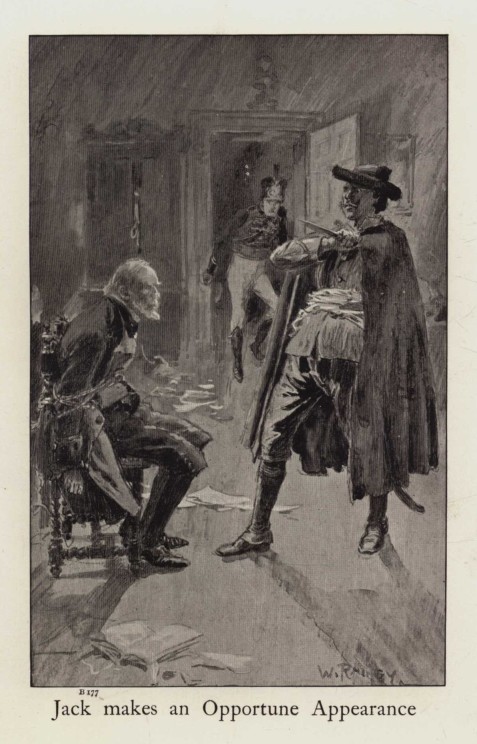
Jack makes an Opportune Appearance
"Miguel!" said Jack under his breath, remembering in a flash the one-eyed servant he had seen following him in Salamanca. Turning quickly to the old gentleman, who now stood in seeming uncertainty what the new interruption might portend, he pointed to the prostrate man and said:
"It is this man's master."
Then, as there was obviously no time to parley, he rushed to the door and slammed it, intending to turn the key. The key was not in the lock. Pressing his knee against the door, Jack looked round and saw the missing key on the table. He called to the boy to bring it, but he was too late. The door was pressed inwards in spite of Jack's exertions; there was greater force on the other side. Feeling it opening inch by inch Jack turned on his shoulder, set his back against the oak, and drew his sword, preparing to give way suddenly and attack the enemy before they could recover from their sudden inrush. But the boy, with a quick wit that did him credit, had rushed into the corner of the room, where there was a space of some two feet between the jamb and the wall, and there, crouching on the floor, he jabbed with the knife through the slowly widening aperture at the legs of the nearest figure. There was a yell of pain; the pressure on the door instantly relaxed; and Jack, putting forth all his strength, had almost succeeded in closing it when a musket was thrust into the gap. Jack's muscles were strained to the utmost. From the clamour in the corridor he knew that the enemy were preparing for a concerted rush. He called to the old Spaniard to push the table against the door, but before that could be done he felt overpowering pressure on the other side. Hastily forming his resolution, he sprang back suddenly; the door flew open, and three of La Romana's ragged ruffians fell sprawling upon the floor. Others came behind, and one of them, with his heavy flintlock, struck out of Jack's hand the sword he had drawn, dropping his weapon immediately with a yell as he felt the boy's knife in his leg. Jack saw that the old Spaniard had taken down one of two rapiers that hung on the wall beneath the portrait of an ancient caballero. Exerting all his strength, he dragged the table round so that it stood obliquely across the room, cutting off a triangular corner. Then he seized the second rapier, and stood side by side with the Spaniard, behind the table, facing their foes just as several of them were preparing to leap across it.
Among them Jack now recognized Miguel Priego, his face lit up with savage excitement, flourishing his sword and goading on his desperadoes. The boy had crawled beneath the table, prepared to use his terrible knife on all who came within reach. The one-eyed man had recovered from the blow dealt him by Jack, and had snatched a musket from one of his fellows. Fortunately none of the firearms were loaded, and the Spaniards, mad with rage, grudged the delay necessary to charge their cumbrous weapons.
"I think, Miguel, you had better call off your followers," said Jack, in a momentary lull that preceded the rush.
There was no reply; in point of fact Jack scarcely expected one. Miguel was at the moment out of sight behind a burly mountaineer, and Jack felt rather by instinct than by any reasoned process of thought that the Spaniard would scarcely let slip this opportunity of taking him at a disadvantage. Behind the table Jack measured the forces opposed to him. Six men were gathering themselves for the onslaught—lean, half-starved wretches for the most part, but ugly customers in the bulk. A raw-boned mountaineer, armed with a long musket and a rusty bayonet, was the most formidable among the gang, and Jack marked him out for special attention when the critical moment came. It was not long in coming. At the cry from Miguel: "Down with the English dog!" the six made a simultaneous rush, and if they had not impeded one another's movements they must have made short work of the little garrison. The lanky Asturian lunged viciously at Jack, who dodged the point by a hair's-breadth, narrowly escaping, as he did so, the clubbed musket of another Spaniard on the right. Before the mountaineer could recover, Jack's long rapier, stretching far across the table, had ploughed a gash in his arm from wrist to elbow, and at the same moment the second assailant, howling with pain, had dropped his musket and fallen to the ground a victim to the terrible knife of the little Spaniard, who had been forgotten by the enemy in the excitement of the fight.
The old man, however, had been less successful; one of his opponents had felt the point of his rapier, but, attacked simultaneously by another, his weapon had been dashed from his grasp, and he now stood defenceless against the foe, who were beginning to push the table into the corner of the room. Miguel, having left the brunt of the action to his allies, now advanced resolutely to the attack; and Jack's rapier had crossed with the long sword carried by his opponent, when through the open door sounded the heavy tramp of feet; and a loud voice was heard shouting: "What I want to know—" The sentence was never completed, for Corporal Wilkes sprang into the room, cleaving a way through the maddened Spaniards with his fist. Before they realized the meaning of this unlooked-for interruption, the corporal flung himself on Miguel, caught him by the collar, and hurled him upon two of his men, who fell under him with a resounding thud. Immediately behind Wilkes, Bates and two other men of the 95th had dashed in, and the rear of the unexpected reinforcement was brought up by Pepito, who at once engaged in a tussle with the Spanish boy, now upon his feet, for the possession of the knife.
Wilkes stood with clenched fists over Miguel, while his companions of the 95th threw themselves on the other Spaniards and speedily disarmed them.
"You hound of a Don!" cried Wilkes, preparing to knock Miguel down if he should attempt to rise; "what I want to—"
"Wilkes, let him get up," said Jack quietly, coming round the table, the rapier still in his hand.
Miguel rose stiffly, his face expressing the purest amazement.
"Verdaderamente!" he exclaimed. "If it is not my dear friend Jack! There is some strange mistake. And I did not recognize you in your uniform, Jackino! Last time I saw you, you remember, you were dressed as one of ourselves. Truly, dress makes a world of difference, amigo mio."
His tone had all the oily suavity that Jack knew so well, and so cordially detested. Wilkes was looking from one to the other with concentrated interrogation in his eye, ready at a word from Jack to lay the Spaniard low again.
"Shut the door, Bates," said Jack, as he saw the one-eyed man slinking in that direction. "That's your man, I think?" he added, addressing Miguel.
"My servant, who accompanied me from Saragossa," replied Miguel. "And I am at a loss to understand—"
"So am I," interrupted Jack. "I am at a loss to understand why a man in your position should countenance violence, robbery, almost actual murder."
"Robbery! Murder! Really, my dear friend, these are strange words to me. I was in the street, and one of these men—soldiers in the army of the Marquis of La Romana—told me that an English ruffian—it was a mistake, yes, but he said an English ruffian—had forced himself into this house: for what purpose? It could only be, as you say, to rob or murder. You know what sad excesses your troops, usually so excellently disciplined, have been guilty of; and having but a short time ago heard that your colonel—Beckwith, is that his name?—had sternly ordered his men to refrain from acts of pillage, why, my dear friend, was it not natural for me to come in and do what little I could to prevent such admirable orders from being disobeyed? That explains—"
"Oh!" said Jack. "And your man—was that his errand too?"
"Perez? Oh no! He obtained my permission to visit his old master, the faithful fellow. It was inconvenient, for we should now be on the road; but could I—would you?—hesitate in such a case? I was touched by the poor fellow's devotion."
Perez' solitary eye gleamed with a baleful light singularly out of keeping with the sentimental character thrust upon him by his master. He wriggled venomously in Bates's grasp. The burly Rifleman checked his contortions by impressing his knuckles into the nape of his neck.
Jack turned to the old man, who had watched the scene in dignified silence.
"I think, Señor, you can throw some light on this man's devotion."
The Spaniard, in a few quiet words, told Jack that the man had, in fact, been his servant, but had been dismissed two years before for attempted robbery. He had suddenly made his appearance that evening, taken his old master unawares, and when he had bound him had broken open the bureau containing, as he supposed, the valuables he coveted, and, failing to find them, had demanded the secret of their hiding-place under threat of assassination.
"I owe my life," he concluded, "the little that remains of it, to my son here, who providentially overheard from his bedroom above the threats of this wretch, and to you, Señor, whose chivalrous intervention came at a moment when I regarded my case as hopeless. I thank you!"
"This, Señor," said Miguel, turning to the old man, "is to me a most extraordinary, a most painful, discovery. The man was recommended to me by Señor Alvarez, my father's partner"—Miguel's fluency in his present predicament recalled to Jack's memory many of his youthful essays in mendacity. "It only shows, Señor, how sadly one may be deceived by a specious exterior."
As he spoke he regarded his one-eyed follower with a look of mournful disappointment.
If Perez' exterior at this moment was any index to his quality, he was scarcely a man in whom the most credulous would have placed confidence. In Bates's iron grip his body was quiescent; but the malignant glitter of his single eye told of raging fires within.
"It will be my duty," continued Miguel with increasing sternness, "to bring this wretch to justice. Men, seize him, and see that he does not escape. He shall be dealt with by the marquis himself."
The Spanish soldiers advanced to carry out Miguel's order, but Bates merely tightened his grip and looked enquiringly at Jack for instructions. Jack could not but admire Miguel's astuteness. He was perfectly well aware that the man would be released as soon as he was out of reach; but while loth to let him escape scot-free, he saw how powerless he was in the face of Miguel's declaration. It was a matter for the Spanish authorities, in which, except as a witness, he himself had no concern; and it was nothing to the point that the Spanish authorities were hiding in cellars, lofts, and even, as he had heard, in pig-styes. He turned to the old man, and said:
"I fear, Señor, that, as things are, we have no choice but to return this man to the care of his present—master. Bates," he added in English, "let him go."
In apparent abstraction, Bates gave a farewell twist to the Spaniard's neck-band, shot him among the knot of tattered soldiery in the doorway, drew himself up, and saluted. With a ceremonious bow Miguel followed his men from the room, several of them carrying with them painful mementoes of the affray. Wilkes shadowed them to the end of the corridor. Meanwhile the venerable Spaniard had taken a decanter and several glasses from a press in the corner of the room.
"You will permit me, Señor," he said to Jack, "my servant having deserted me, to offer you and your worthy soldiers a little refreshment. It is a poor expression of my gratitude to you and them, but it comes, believe me, from a full heart."
The men willingly tossed off their bumpers, and soon afterwards escorted Jack to his quarters. He there learnt from them that while at supper they had been summoned by Pepito, who announced in broken English, eked out by gestures, that el Señor Lumsden was in urgent need of help. He had apparently been shadowing Jack as usual, had seen him enter the house, and a moment after heard Miguel hounding on his willing dupes to kill the English bandit.
"The little rascal is always putting me in his debt," said Jack to himself as the squad saluted and marched off. "He is quite a guardian angel."
No one but Jack had cause to regard Pepito in this gracious light.
"What I want to know," asked Corporal Wilkes wrathfully, when he returned to his billet "—what I want to know is, what's become of my supper?"
Only Pepito knew.
CHAPTER XIV
An Incident at Cacabellos
Stragglers—Oblique Oration—The Massacre at Bembibre—Moore's Appeal—A Shot in the Dark—A Souvenir
There was no rest for Jack or his friends that night. On returning to his quarters he found that Colonel Beckwith had called the officers of the regiment together, and was already addressing them with more than usual seriousness. He told them that their hope of making a stand at Astorga was fated to be disappointed. Sir John Moore had decided to continue the retreat with all speed, either towards Vigo or towards Corunna.
"It is useless to pretend I am pleased," said the colonel. "None of us are that. Some of the youngsters among us may think that things would be ordered differently if they were in command. That's not our business. The general is satisfied that his reasons are good, and all we have to do is to obey orders. And that brings me to the point. A retreating army is always apt to get out of hand, and a British army perhaps more than any other. Take any man in the regiment and he'll ask you why he should retreat, and what the dickens is the good of running away from a Frenchman. We've seen already what disorder and ruffianliness have disgraced some of the regiments. And I tell you, gentlemen, I won't have that in the 95th. We shall from this time form a part of the actual rear-guard. The second battalion leaves, with other regiments, direct for Vigo to cover our left flank. The safety of the whole army will therefore depend much on us. The French won't let us off lightly. We shall often be in touch with them, and if there's any want of steadiness they'll get through us, and then it's all up. I ask you then, gentlemen, every one of you, to keep a tight hand on the men. There must be no slackness, no relaxation of discipline. The honour of the regiment is in your keeping, and, by heaven! I'll never lift my head again if the 95th fails me."
The colonel's vehement words sent a thrill through the group, and Jack Lumsden was not the only officer among them who vowed inwardly not to disappoint "old Sidney". Beckwith went on to prescribe their immediate duties. He alluded to the confusion and disorder in which they had found the town, in great part due to the unexpected presence of La Romana's ragged regiments. The place had been crammed with stores, consisting of shoes, blankets, tools, muskets, ammunition, from which many of the preceding regiments had been partially re-equipped. But in the haste and muddle the distribution had been mismanaged. Many of the stores had been left behind, and the town was full of British and Spanish stragglers eager to plunder where they could. The colonel instructed his officers to see that pillaging was checked as much as possible. What stores could not be removed were to be destroyed.
During the night, therefore, Jack and his chums were busy in carrying out the colonel's orders. It was found next day that there were not sufficient draught animals to serve for the transport of all the remaining stores, and the 95th were employed for many hours in burning and blowing up valuable stuff to prevent it from falling into the hands of the French.
The regiments of the Reserve were to march in the evening for Cambarros, a village some nine miles in the direction of Villafranca. Before they started, Captain O'Hare paraded his company and repeated to them the substance of what Colonel Beckwith had said to the officers.
"I've heard a deal of grumbling at times," he said. "You don't want to retreat. No more do I, but our chance'll come, please the pigs; and then I know who'll be at the front—not the grumblers and skulkers, but the men who know how to obey. Now, my boys, I trust ye. I don't want the general to send for me by and by and say: 'O'Hare, ye've the most blackguardly company in the whole army.' We'll do better than the best, and sure I'll be proud of ye. And if there should be a man among ye with a deal o' power over the company—a good soldier let us say, but with a long tongue and a way of speaking that—well, a way of speaking"—the captain studiously kept his eyes from Corporal Wilkes: "if there's such a man, to him I'd say, with all my solemn seriousness: Ye've a deal of persuasion; then use it for the glory o' the regiment; and bedad, I believe he'd know what I meant."
Corporal Wilkes, looking straight in front of him, had turned a brick-red, and was unusually silent as the company marched off. To Sergeant Jones, the little Welshman, toddling along by his side, he remarked presently:
"I hope you'll mind what Peter said, Sergeant. As for me, 'tis a good thing for the glory o' the regiment that the second battalion's off another way, for all my good resolutions would be turned into sour milk by the long fiddle-face of Corp'ril MacWhirter."
After their sleepless night, and hard work during the day, both officers and men were glad to fling themselves down on rough beds of hay and straw when they reached Cambarros at dusk. But they had hardly settled to rest when some dragoons came riding in with news that the enemy were advancing in force. The order was immediately given to get under arms, and the march was continued through the night.
The Reserve reached Bembibre, a dirty village of mud and slate, at daybreak on January 1st, expecting now at least to enjoy the rest so much desired. But again they were disappointed. On entering the village they were at once ordered to pile arms and clear the place. It presented the appearance of a town that had recently been stormed and put to the sack. It happened to be a depôt for the wine produced in the neighbouring vineyards, and large quantities were stored in the vaults and cellars of the houses. The inhabitants had shown themselves unfriendly to the regiments of the main body of Moore's army, and had provided food and drink for them only with the greatest reluctance. The result was that the men of the least-disciplined regiments broke all bounds, and set furiously to work to get for themselves what the Spaniards had denied them. Doors were wrenched off, windows smashed, property of all kinds destroyed; and the unfortunate discovery of so large a stock of wine had the worst consequences. Those were the days when hard drinking was the rule in all classes of society. It was little to be expected, then, that rough soldiers, suffering the hardships of exhausting marches on short rations, and feeling bitter shame and humiliation at having to retreat continually before a despised enemy, should prove able to withstand the temptation to excess. Ready to fight like bull-dogs if the call came, they lost all sense of responsibility at the sight of means to enjoyment, and set their officers at defiance.
The Reserve spent that day and part of the next in chasing the stragglers from the houses and driving them along the streets towards the mountains; but the task had been only partly accomplished when cavalry pickets came in and reported that French dragoons were pushing rapidly down the Manzanal pass in their rear.
"We must leave the ruffians to their fate," cried General Paget furiously, ordering the Reserve to march out towards Cacabellos. Not until late in the day did the 95th learn from the last of the hussar pickets what had happened when they left Bembibre. Lahoussaye's dragoons had come galloping into the village, riding through the groups of stragglers who flocked staggeringly along the road when they heard the noise of the pursuing horse, and slashing at them as a schoolboy does at thistles. The French made no distinction of age or sex. They hewed their way indiscriminately through drunken redcoats, women, and children. Even mothers who held up their babies, pleading for mercy on them, were struck down as ruthlessly as soldiers with arms in their hands. Few escaped. Those who did bore terrible signs, in sabre-cuts on head and shoulders, of the revenge the French horse had wreaked for their defeat at Benavente.
The road from Bembibre led over the crests of the Galician hills, with ravines and gorges and precipitous crags on both sides. Then it made a rapid and crooked descent, ending in a valley through which dashed a thundering river, white with foam, bearing huge stones and logs along with it in its tempestuous rush from the Asturian mountains to the ocean. Here the hill-slopes were covered with gaunt trees, which, though now bare of foliage, threw a mysterious gloom over the narrow road. Marching rapidly down this road against a beating storm of sleet, and whipping up innumerable stragglers on the way, the 95th at length arrived at Cacabellos.
Here, just as they halted, Sir John Moore met them, having ridden back with his staff the five or six miles from Villafranca, where the main body had bivouacked. The regiments of the Reserve were at once formed up in columns in the fields by the roadside. Sir John, his fine face lined with care and sorrow, took up a position in their midst, and then, in his clear penetrating voice, amid a silence broken only by the distant thunder of the torrent, he spoke in stern biting phrases of the disorder and want of discipline he had lately witnessed. With a pungent irony that made many ears tingle, the commander-in-chief concluded his address thus:
"And if the enemy are now in possession of Bembibre, as I believe they are, they have got a rare prize! They have taken or cut to pieces many hundreds of drunken British cowards—for none but unprincipled cowards would get drunk in presence, nay in the very sight, of the enemies of their country; and sooner than survive the disgrace of such infamous misconduct, I hope that the first cannon-ball fired by the enemy may take me in the head."
After a few words, addressed specially to the 28th, which had done glorious service with him in Egypt, Sir John turned rein and rode back to Villafranca. His words made a deep impression on both officers and men. Previous appeals had not been in vain. The reserve regiments had kept much better discipline and committed fewer excesses than the main body, and the general's stern speech deepened the resolve of all good soldiers to abstain from disorder, and merit Sir John's approbation.
Alas! all were not animated by the same spirit. General Paget bade the men encamp some distance away from the town, and gave orders that no one was to enter the streets unless accompanied by a non-commissioned officer, who was to be held responsible for the orderly return of those committed to his charge. But no sooner had darkness fallen over the camp than many of the soldiers, forgetting the reproof of Sir John Moore, forgetting the subsequent appeals of the company officers, escaped from their lines, and, entering the town, resumed the old work of plundering. During the night many were arrested by the patrols, and two men were seized in the act of committing a serious crime, of which few had yet been guilty. They were maltreating and robbing a poor old Spaniard, who, paralysed with fright, was piteously beseeching them to take all that he had, but to do him no harm.
"This means a drumhead court-martial!" said Captain O'Hare when the matter was reported. "Keep the men in irons; Lumsden, take a note to the general from me."
Jack had delivered his note, and was returning to his quarters, when, as he passed along a broad road shadowed by trees on one side and a high wall on the other, he felt that someone was dogging him. He had heard no pursuing footsteps; he was at a loss to account for his strange uneasiness; but, obeying an impulse of which he was only half-conscious, he turned suddenly round, moving as he did so a little towards the wall on his right. At the same moment there was a report and a flash. A bullet whizzed past him; he could feel the rush of air on his cheek, there was a dull thud as the missile flattened itself on the stone wall. Springing forward in the direction of the report, he could just discern in the murk a tall figure scuttling for cover among the trees.
The man had a dozen yards' start, but Jack, always a good sprinter, had reduced the gap by half when his quarry disappeared into the trees. It was a narrow belt of chestnuts about three or four deep, and, following the sound of the footsteps in front, Jack dashed through, heedless of obstacles. A moment's scramble among roots and brambles brought him to the far side; his assailant had turned sharp to the right and was scampering towards a high wall running parallel with the belt on the opposite side of the road. With a fine spurt Jack reduced the gap to an arm's-length; his outstretched hand was within a few inches of the man's collar, when, to his utter amazement, the pursued disappeared into the wall. Jack shot past an open door, and before he could check his progress there was a violent bang and the sound of falling bolts. Jack pushed against the door, then threw himself upon it with all his force; it did not even creak. The wall was too high to clamber over; it was too long to go round; he had perforce to relinquish the thought of further pursuit.
"Some poor demented Spaniard who has lost his all, perhaps," he thought, and was about to resume his walk when he noticed a small triangle of cloth projecting between the door and the jamb. The would-be assassin's cloak had caught, and, but that the door was rather clumsily fitted, would have prevented its being closed. Without any definite motive, Jack drew his sword and cut off the strip, which he put into his pocket, where it lay for many days forgotten. He said nothing about the adventure to his fellow-officers, and it did not keep him awake for an instant when, at a late hour that night, he threw himself, worn out, upon his uncomfortable bed.
CHAPTER XV
The Great Retreat
Reprieve—A Fight in prospect—Trapped—Napoleon leaves Spain—Salvage—The Tragedy of War—In Motley—A Breathing Space—The Slough of Despond—Motherless—Thalatta!—A Batman's Battle
The growing spirit of indiscipline and lawlessness among the Reserve determined General Paget to make a signal example of the culprits. Early on the following morning he marched all the five regiments under his command towards the crown of a low hill overhanging Cacabellos, in the direction of Bembibre. After sending pickets to the summit, to keep the enemy under observation, he ordered the whole division to form a hollow square, the men facing inwards. Some distance to the rear of each regiment, the officers sat in drumhead court-martial. The men caught in the act of plundering were brought before them, tried, and sentenced, and then taken into the square, where, lashed to the triangles, they received the punishment awarded.
During this scene the general sat stern and impassive on his horse. At one moment a cavalry vedette galloped up with news that the French were in sight. "Very well," replied the general, and the punishment went on. Soon another trooper appeared, to report that the enemy were rapidly advancing. "Very well," said the general, without movement or further word.
So many were the offenders that the work of flogging continued for several hours. At length came the turn of the two soldiers taken in the act of assaulting and robbing the Spaniard. They were summarily tried, and condemned to be hanged. At one corner of the square stood a tree with accessible branches. The unhappy men were conveyed thither, with halters round their necks. They were hoisted on the shoulders of two strong Riflemen, and the ropes were fastened to the lower boughs.
It was just twelve o'clock. One movement of the supporting men would leave the criminals dangling in the air. The whole division awaited in breathless stillness the dread signal for execution. General Paget looked grimly down from his horse upon the wretched men, and in his set face they saw no hope of mercy. At this tense moment a captain of dragoons galloped through a gap opened for him in one side of the square. Halting before the general, he excitedly reported that the pickets on the hill were being driven in.
"I am sorry for it, sir," said the general coldly; "and I should rather have expected the information from a trooper than from you. Go back to your fighting pickets, sir," he added sternly, "and animate your men to a full discharge of their duties."
The officer retired. General Paget was again silent. His lips twitched, his eyes flamed. Then suddenly he burst out: "My God! is it not lamentable to think, that when I might be preparing my troops to receive the enemies of their country, I am preparing to hang two robbers! But if at this moment the French horse should penetrate that angle of the square, I will still execute these villains at this angle."
Again he was silent, and now shots were heard from the direction of the hill. The awed soldiers looked with consternation at their general's face. How long was this suspense to continue? A brief pause; then, swinging round in the saddle, Paget cried:
"If I spare the lives of these two men, will you promise to reform?"
A quiver passed along the ranks; the men held their breath; there came not a murmur from their parted lips.
"If I spare the lives of these men," again said the general, "will you give me your word of honour as soldiers that you will reform?"
Still the same awful silence reigned—and the ominous sound of firing came nearer and nearer.
"Say 'yes' for God's sake!" whispered an officer to the man next him.
"Yes," murmured the man. His neighbours repeated the word in firmer tones, and then, as though a match had been laid to a train of powder, shouts of "Yes! yes!" rang along the faces of the square.
"Cut the ropes!" cried the general. The prisoners were instantly released, the triangles removed. The men cheered, and as the square was reduced, and formed into columns, the British pickets came slowly over the brow of the hill, steadily retreating before the advance-guard of the enemy. Paget's orders were rapidly given. The men started at the double towards the River Cua behind them. Three battalions crossed the bridge and took up their position behind a line of vineyards and stone walls parallel to the stream. A battery of horse-artillery, escorted by the 28th, was placed so as to command the road in its ascent towards Cacabellos from the bridge, and a squadron of the 15th Hussars, together with half the 95th Rifles, was left on the Bembibre side of the river to keep observation on the French.
"At last, my boys!" said Captain O'Hare. The men of his company were flushed with excitement. At last! The weary waiting of two months was at an end; the enemy were upon them; and now every man tingled with the joy of the fight to come, and greedily watched for the foe. The officers, looking along their ranks, could not but be struck with the wonderful change. Gone the blank despair, gone the sullen discontent, gone the hang-dog look; every man's face was lit up, every man's eyes flashed, every man stood erect with an air of high-hearted staunchness that had not been seen for many a day.
"There they are!" cried Pomeroy, whose keen eyes had descried Colbert's hussars advancing cautiously over the hill-top.
At this moment the bugle sounded for the last companies of the 95th to retire across the bridge and occupy the defensive positions allotted to them. The men marched with alacrity; it was certain there must be a fight now. Jack's was the rearmost company but one. It had only reached the middle of the bridge when the 15th Hussars came riding behind in hot haste, and the infantry were in imminent danger of being trampled down. The French were pressing on in such force that the hussars, wholly outnumbered, had been hurriedly withdrawn. Unsupported, the 95th were too weak to withstand a charge of cavalry; they must retire, and there was no time to lose.
"Hurry your stumps!" shouted a trooper as he passed Wilkes.
"No hurry!" said the corporal coolly, looking over his shoulder.
But behind them Colbert's hussars and chasseurs had swept down on to the bridge and ridden into the rear-most company. Some of the latter were cut down, half were captured, the rest succeeded in gaining the farther bank, and joined their comrades behind the vineyard walls.
"A close shave, mates!" said Wilkes. "But let 'em come on; we're ready."
General Colbert, a young and gallant officer, and reputed the handsomest man in the French army, had reached the bridge, and saw that the slopes on the other side were held by artillery and what appeared to be a small infantry escort. All the regiments but the 28th were by this time concealed from view. Burning to distinguish himself, and anxious to emulate the successful charge of Franceschi's dragoons at Mansilla a few days before, Colbert did not wait to reconnoitre the position and discover the actual strength of his enemy, but ranged his leading regiment four abreast, and led them straight for the bridge. Paget's guns played briskly on the French horse until, with the dip in the road, they sank below the line of fire; then the hidden infantry followed up with steady volleys from the walls and hedges. But the French were barely within range. The majority of the troopers escaped injury, cleared the bridge, and dashed up the hill, to carry, as they thought, all before them. Then the men of Paget's Reserve showed their mettle. The 28th were drawn across the road; the 52nd and the 95th were out of sight behind the vineyard walls; and the French horsemen fell into the fatal trap. They suddenly found themselves in the midst of a hail of bullets from left, and right, and front. For a brief moment they struggled on; then Tom Plunket, leaping the wall and flinging himself flat on the slope, fired two marvellous shots which killed Colbert and his aide-de-camp in succession, whereupon the whole brigade wheeled about and fled madly back to the bridge, leaving the road strewed with their killed and wounded.
Cheer after cheer broke from the ranks of the exultant British infantry. Many of the men wished to leap the walls and pursue the baffled enemy, and had to be pulled back like hounds straining at the leash. Not a man had been lost since they left the bridge, and Paget's "Well done, Riflemen!" was like wine to their hearts.
But the fray was not yet over. Lahoussaye's dragoons swept down to the river, avoided the fatal bridge, forded the stream at several points, and tried to make their way over the rocky ground and through the vineyards. Finding this impossible, they dismounted and advanced on foot in skirmishing order, meeting with a spirited response from the 52nd and 95th, whom they first encountered. Then, as the afternoon wore on, Merle's light regiments of the line came into sight, and in column formation marched forward with loud cries to cross the bridge. For a few moments the 52nd were in danger of being swept upon and overwhelmed, but the six guns from the battery above opened a raking fire on the massed columns of French, and drove them back pell-mell to the other side. For an hour longer the French sharpshooters kept up a skirmish with the 95th and 52nd; then, as darkness fell, they recognized the hopelessness of their attack, gave up the contest, and hastened down the slopes to the eastern bank of the Cua.
"By George, this is a change of scene!" said Smith, standing with his fellow-subalterns around a hastily lit fire. "Won't the Grampus be green when he hears what he has missed? I wonder what the fellow is doing?"
"Offering Napoleon long odds on something or other," said Jack with a laugh.
He had hardly spoken when the command came to form up in marching order. Sir John Moore had ridden back from Villafranca on hearing Paget's cannon, and was delighted to hear of his old friend's success. The French having suffered so decisive a check, he saw that the Reserve could be safely withdrawn under cover of night. The troops set out in better spirits than they had known for many a day, tramping cheerily over the snow-covered road with the comfortable assurance that at last they had won the general's approbation and proved themselves men. Their gaiety was doubled when they learnt from a wounded prisoner on the way that Napoleon was no longer behind them. He had withdrawn part of his army, leaving Soult and Ney to continue the pursuit. The thought that they had baffled the great emperor was delightful to the British troops: they never doubted that Napoleon had seen he was beaten by Johnny Moore, and had run away in sheer petulance and chagrin.
Four miles after leaving the scene of their brilliant rear-guard action, the Reserve arrived at the outskirts of Villafranca. Long before, they had noticed a red glow in the sky, which as they approached threw a rosy light upon the banks of dazzling driven snow. As they drew still nearer, the whole town seemed to be on fire. In every street great heaps of stores and provisions were burning, and so thoroughly was the work of destruction being carried out that guards had been placed even round the doomed boxes of biscuit and salt meat. But the temptation was irresistible to hungry soldiers; many men, as they passed, stuck their bayonets or pikes into junks of salt pork that were actually on fire, and bore them off in great glee. The men had been marching so steadily that the officers for the most part winked at this rescue from the flames, Jack remarking to Pomeroy that they'd all be precious glad to get a slice or two of the meat by the time the march was ended.
After leaving Villafranca they passed through the defile of Piedrafita into still wilder country. Climbing Monte Cebrero and emerging on to the barren plain of Lugo, the troops reached Herrerias shortly before daybreak. They were suffering intensely from fatigue and cold, but their halt for food and rest was of the shortest; as soon as day dawned they had to set off again. Now that daylight illumined the scene, they saw terrible signs of the misery and disorder into which the constant forced marching had thrown the main body. The road was strewn with wreckage of all kinds—horses were lying dead, wagons lay shattered and abandoned; here was a rusty musket, there a broken sword; worn-out boots, horse-shoes, pots, articles of apparel, dotted the white and rugged causeway for miles. Worse than that, human bodies were mingled with these evidences of woe. At one spot Jack saw a group of redcoats stretched on the snow. Thinking they were stragglers asleep, he went to rouse them. They made no response to voice or touch; in their sleep they had been frozen to death.
As the day wore on, other incidents added to the general misery. The horses of Lord Paget's cavalry were constantly foundering through losing their shoes on the stony road. When this happened, the dragoons dismounted, and led their chargers till the poor beasts could go no farther. Then, by Lord Paget's orders, they were shot, so that they might not fall into the hands of the French. Many a rough trooper shed tears as he raised his pistol to the head of the faithful animal whose friend he was, and as the cracking of the pistols reverberated from the rocks, the sounds sent a painful shudder through the ranks of the trudging infantry.
Hundreds of stragglers from the leading divisions loitered along the road, causing an exasperating delay to the march of the disciplined Reserve. Among the laggards were not merely the marauders and ne'er-do-wells who had cast off all obedience, but veterans who were overcome by the rigours of the winter cold and the heavy marching on diminished rations. Every mile brought new horrors. Many sick and wounded were being conveyed in baggage-wagons, which, as the beasts failed, were abandoned, leaving their human occupants to perish in the snow. Women and children panted along beside their husbands and fathers, or rode in the few wagons that were left; but many dropped on the road and died of cold and fatigue. Looking back from a spur of the mountain chain, Jack saw the white road behind covered with dead and dying, a black spot here, a red spot there, showing where a woman or a soldier lay sleeping the last sleep. The groans of women, the wails of little children, were torture to the ears of the more sympathetic. Sometimes a soldier whose wife had given up the struggle, would fling himself down beside her, and, cursing the general whose object he so grievously misunderstood, remain to die.
Long after dark the Reserve reached Nogales, where they remained for the rest of the night. Before dawn, however, news came that the enemy were pursuing close upon them, and as they marched out, the rear companies became hotly engaged with French cavalry. The force hurried on, across a many-spanned bridge, up a zigzag road, skirmishing all the way, and halting at favourable points to tempt the enemy to attack. At one spot the mountain rose up a sheer wall on the right of the road, and on the left a deep precipice fell steeply to a valley. Here General Paget ordered the men to face round. The position could not be gained by a frontal assault, and the enemy, waiting for their heavy columns to come up, sent voltigeurs and some squadrons of cavalry into the valley to attempt a flank attack. But deep drifts of snow having hidden the inequalities in the ground, men and horses tumbled head over heels as they advanced, and, amid grim cheers from the British troops above, the French withdrew discomfited.
Fighting almost every yard of ground, the Reserve continued their rigorous march towards Lugo. Near Constantino they were amazed to meet a train of fifty bullock-carts crammed with stores and clothing for La Romana's army. Someone had blundered. The Spaniards were dispersed far and wide, and, but for its being intercepted by the British, the convoy must inevitably have fallen into the hands of the French. Astounded at this piece of Spanish folly, but rejoiced at the luck which had brought clothes at such an opportune moment, the soldiers soon stripped the wagons, many a man carrying off several pairs of trousers, and enough shoes to last a lifetime. Thus, when they were halted for action at the bridge of Constantino, they presented a remarkable appearance. Some wore gray trousers, some blue, some white; they were new shod, but with no regard for pairs. Corporal Wilkes, in his haste to replace his own worn-out boots, had put a black shoe on his right foot and a white one on his left. But there was no time to attend to niceties of costume, for the enemy kept up an incessant fire all the afternoon, and it was only at nightfall that the tired regiments could withdraw from the eastern end of the bridge and resume their march.
At dawn on January 6th they reached the main body, drawn up in battle order three miles in front of Lugo. The brigade of Guards were in their shirts and trousers, cooking their breakfast, having hung their tunics and belts to the branches of trees. As Captain O'Hare's company passed through them, one of the officers asked him if he had seen anything of the French.
"Bedad, now," exclaimed O'Hare, "you'd better take down your pipe-clayed belts from those trees, my dear, and put them on, and eat your murphies, if you've got any, as quick as you can, or by the powers those same French will finish 'em before they're cold."
The Guards laughed mockingly; they themselves had not fired a shot during the whole retreat. But as the 95th marched on they heard Paget's guns open on the advancing enemy behind, and, turning, they gave the incredulous Guards a derisive cheer.
No sooner had the Reserve reached Lugo than General Paget ordered the men to clean their weapons and polish their accoutrements as thoroughly as if they were going on parade in the barrack-ground at Colchester. Corporal Wilkes had scarcely uttered a murmur for three days, but this command was too much for him.
"Discipline be hanged!" he growled. "We ain't out for a picnic, nor goin' for a walk in the park, and what's polishin' paste to do with lickin' the French?—that's what I want to know."
But when he had recovered from the first feeling of hardship he recognized that the general's motive was to maintain the excellent discipline which had hitherto prevailed in his division; and Wilkes was too good a soldier not to do his best, even with the polishing leather.
For three days the army lay at Lugo—three days of incessant rain, which turned to slush the snow on the hills, and proved more trying to the spirits and tempers of the men than the frost had been. There were large stores at Lugo, and Sir John Moore judged it wise, after the exhausting forced marches of the past weeks, to allow the men a good spell of rest and plentiful supplies of fresh food. His position was very strong, and he hoped to tempt Soult to a fight, being assured that the troops would pull themselves together and give a good account of the enemy. But Soult was too wary to attack until he had overwhelming numbers at his disposal. His own force had suffered almost as severely as Moore's, and some of his divisions were still toiling on far in his rear. After a few attempts to feel the British position he made no further movement, and Moore waited and fretted in vain. He would not risk an offensive movement himself. He had no hospitals, few wagons, no reserve of food or ammunition; delay would weaken him and strengthen Soult. There was no alternative but to continue the retreat. The route to Vigo was definitively abandoned; orders were issued for the whole army to slip out of its lines on the night of the 8th, leaving the camp-fires burning so as to deceive the enemy, and to make for the direct road to Corunna, to which harbour the transports had already been commanded to sail round the coast. As soon as darkness fell all the foundered horses were shot, and such provisions, stores, and ammunition as were not required were destroyed. At half-past nine the first companies moved off, and by midnight the whole position was evacuated.
This was the beginning of the last stage of the army's demoralization. The frost of the previous week had quite broken up; a pelting storm of sleet and rain assailed the troops as they marched. In the inky darkness many of the guides missed their way amid the labyrinth of vineyards, orchards, and intersecting paths. Regiment after regiment went hopelessly astray, and when General Paget's reserve division reached the appointed spot on the Corunna road, it proved to be not in the rear but actually in advance of the main body. In these circumstances Paget moved his troops slowly, knowing that if the enemy overtook the less trustworthy regiments behind him the whole force would run the risk of being annihilated.
Through the black and rainy night, then, the men marched, halting at intervals. No man was allowed to leave the ranks; all were filled with apprehension of what might befall. On the morning of next day the belated divisions of the main body began to appear, and the Reserve thankfully resumed its proper position of rear-guard.
A terrible lack of discipline prevailed in all but a few of the regiments of the main body. Drenched by the incessant rain, the men sought shelter in cottages and outlying hovels whenever they were halted, with the result that when the order for marching was given vast numbers could not be found and had to be left behind. All day and all night the Reserve was harassed by the necessity of beating up these loiterers, until officers and men alike were almost overwhelmed with despair.
The experiences of that fearful 9th of January haunted the memories of Jack and his friends for years afterwards. From cheerless dawn to cheerless eve their eyes were shocked, their hearts were riven, by misery almost passing belief. For mile after mile of that bleak desolate country, a land of bluff and spur, torrent and ravine, men fell down upon the road, groaning, weeping, dying of weariness and disease aggravated by the bitterness of shame and despair. Mules and oxen lay as they fell, and in the wagons they had drawn, husbandless women and fatherless children wailed and moaned, a prey to hunger and exhaustion. Many a time Jack stuffed his fingers into his ears to keep out the intolerable sounds, until the very frequency of them made him almost callous, and he tramped along with haggard face and the same sense of dreary hopelessness. Smith was bent almost double with illness, Pomeroy and Shirley were so utterly weary and dispirited that they dragged their feet like old peasants racked with the ague of the fields. Even Pepito's vivacity had vanished; for the greater part of every day he rode on a gun-carriage, a silent image of depression.
As the 95th halted for a brief spell at a hamlet, Corporal Wilkes, his tanned, weather-beaten cheeks drawn and pinched, came up to his captain and said:
"Sir, Sergeant Jones's wife is dead."
"God help the poor fellow!" said Captain O'Hare; "what'll he do now with those two little children? How are they?"
"Well, sir, and cosy; that good woman gave her life for them. The sergeant's crazy, sir, and the wagon's come to grief that they were riding in. I thought, sir—"
"Well?"
"I wouldn't like to leave 'em behind, sir, and the sergeant's as weak as a rat and can hardly trail his pike. Couldn't I carry one, sir?"
"Sure an' you can. Take turns with another man. And the other one—the poor little colleen—"
"Pomeroy and I will look after her," said Jack. "It'll give us something to think about. We'll either carry her by turns or get some of our best men to do it."
And so it happened that for the rest of the retreat two little children, a boy and a girl, rode along in the rain on the shoulders of tender-hearted Riflemen, who talked to them and cheered them, so that the small things, all unconscious of their irreparable loss, prattled and laughed and felt exceedingly proud of their unusual altitude.
It is the morning of January 10th; the regiments are climbing the face of a range of hills, the last, they have been told, that intervene between them and the harbour of Corunna. The rain has ceased, the sky clears, and as the drenched and footsore warriors top the crest the sun bursts through a lingering cloud and throws its low beams from behind them.
"The sea! the sea!"
A great shout reverberates over the rugged hills. Below lies the little town of Betanzos, and beyond it the blue white-crested waters of the Atlantic. Corunna is only a few miles distant; the end of the long agony is in sight; and the sudden coming of weather springlike in its mildness after the severity of winter, fills all hearts with unutterable gladness. Colonel Beckwith roars at his men with a gruffness which nobody mistakes, and the fierce tension of General Paget's face is relaxed for the first time for many days.
"The finest retreat that was ever retreated," cries Captain O'Hare, who, though he looks only the shadow of his former self, has suddenly recovered his usual cheerfulness. "But what's afoot down yonder, begorra?"
All eyes follow his gaze downhill. They light on a curious spectacle. In the distance the road is dark with French cavalry, their helmets and accoutrements flashing in the unwonted sunlight. Between them and the heights there marches a nondescript horde of stragglers, in all uniforms, from all regiments. But they are no longer straggling. Formed in a solid mass across the road, they are retiring by alternate companies, one company remaining to face the French, another marching along the road until they reach a position whence they can cover the first's subsequent retreat. Time after time Franceschi's horsemen charge; but every charge is beaten back by the rolling fire of the British, who fight and retire, retire and fight, with equal steadiness.
"Bedad, now, that's fine!" cries Captain O'Hare enthusiastically. "That's the greatness of the British Arrmy! Three cheers for the fighting stragglers, my boys!"
Cheer upon cheer roll down towards the baulked and angry French. Stage by stage the army of stragglers retire up the slope until they are safe within the protecting lines of the Reserve. There the curious incident is explained. Dr. Dacres of the 28th had entrusted his instruments and baggage to the care of a batman, who had loaded his mule's panniers so heavily that the animal had fallen far behind the regiment. During the night the man slept in a cottage by the roadside, and, rising before dawn, was astounded to find that the French were almost within arm's-length. Shouting to the numerous stragglers in the vicinity, the batman, relishing a little brief authority, got them into some sort of order and began to fight a rear-guard action on his own account. A sergeant of the 43rd, seeing what was in the wind, hurried up and assumed command of the growing companies. It was by the skilful handling of this man, William Newman by name, that the impromptu rear-guard had held their own against the enemy's cavalry and been brought safely out of danger.
The army remained for a whole day at Betanzos. On the 11th they marched out towards Corunna, the Reserve being hotly engaged with the enemy's cavalry, and disputing the last ten miles yard by yard, under the approving eye of Sir John Moore himself. Two bridges were blown up. On the 13th Franceschi's dragoons discovered a ford, and Sir John, seeing that his main body was now secure, ordered the Reserve to fall back on Corunna. The regiments had hardly left their bivouac when shots from the French artillery came with a crash on to the roofs of the houses they had occupied near the bridge.
It was with this thundering adieu reverberating in their ears that the gallant 95th, along with their equally gallant comrades in arms, marched into their new quarters at Eiris, above Corunna, and attained, after much travail, their long-desired haven.
CHAPTER XVI
The Battle of Corunna
The Eve of Battle—Moore's Position—Wilkes is Himself Again—The First Shot—Advance 95th!—Hand to Hand—Wilkes in Action—A Message to Moore—The Commander-in-Chief—A Hero's Death—"Alone with his Glory"
The great retreat was ended. Sir John Moore's army, after its terrible forced marches over 250 miles of wild country in the worst of weather, had reached the sea. Five thousand men were left behind in sick, dead, wounded, stragglers, and prisoners—a small proportion considering the awful experiences they had come through. The honours of the retreat belonged to Sir Edward Paget and his regiments of the Reserve, who had fought dogged and successful rear-guard actions wherever opportunity offered, and had come through the whole campaign with little loss.
But the crowning achievement of the retreat was yet to be accomplished. Sir John's purpose had been to embark his army at Corunna on the transports he expected to find awaiting him there, and to sail at once for home. If this had been effected the history of the British army would have lacked one of its most glorious pages. When Moore arrived at Corunna, the expected vessels were still beating about under stress of weather in the Atlantic. The embarkation was perforce delayed. Meanwhile the French were straining every nerve to catch their enemy; it was more than likely that Soult would arrive in sufficient force to compel Moore to fight, and the long-wished-for opportunity of a great battle with the French would come at last.
Corunna was packed with military stores. In readiness for anything that might befall, Moore gave his men new muskets and rifles to replace the rusty weapons they had brought with them across the hills. He blew up a large amount of superfluous ammunition, and then sat down in security to await the arrival of the belated transports.
When, on the evening of the 13th, the Reserve fell back upon the main army at Corunna, there was still no sign of the ships. The British army was in position on a range of heights a short distance to the south of the city, and Paget's hard-wrought troops were ordered to occupy the little village of Oza, in the rear of the British line. There they formed, for the first time since the retreat began, the real Reserve of the army.
During the next two days Jack had more than one opportunity of visiting Corunna, where the Spaniards were making vigorous preparations for defence. For he was selected as usual by the general to arrange with the native contractors for the supply of provisions to the division. In his journeys to and fro he supplemented the company mess with small luxuries to which it had long been a stranger.
"I could almost forgive you your good luck, Jack," said Pomeroy at breakfast on the 15th. "But you should have been in the commissariat; you are wasted as a fighting-man. Eggs, butter, cream, and coffee—why, the 52nd across the way are as green as our coats with envy."
"If we stay here much longer we shall be back again on the old rations," replied Jack. "We shall soon eat up the native produce; only our own regulation hard-tack will be left."
"How are they getting on down at the harbour?" enquired Shirley.
"Slowly, as far as I could see. They don't seem to have done much since the transports arrived yesterday. It is ticklish work embarking the guns. But they expect to be ready to-morrow; and I hear that the Reserve are to be the first to embark."
"I don't like that," remarked Smith indignantly; "after we have borne the brunt of the retreat, they might at least have let us see it through to the end."
"Oh! as for that, we may take it as a compliment," said Jack with a smile. "It's a reward of good conduct. Our baggage is to be sent down to-night, we are to follow to-morrow at mid-day, and by the time the other divisions are ready we shall be snug and comfortable."
"It seems to me," said Pomeroy, pointing out of the window of the cura's house in which they were quartered, "that by this time to-morrow some of us will be a little too snug."
Jack and the rest, after a hasty glance at the heights to which Pomeroy was pointing, could not help feeling that the prospect of an unmolested embarkation was indeed becoming remote. They were now black with the masses of Soult's infantry.
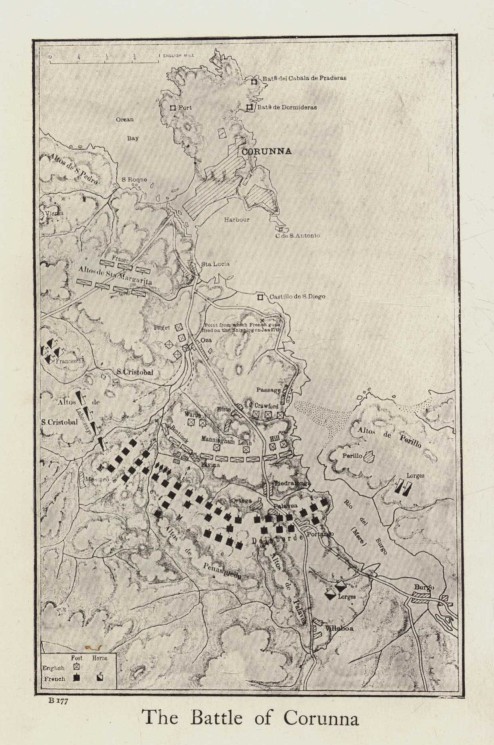
Soult's progress during the previous two days had been very slow. He found the British strongly posted; and his experiences during the pursuit were calculated to inspire him with a wholesome caution when tackling, not as during the past fortnight an isolated rear-guard, but the whole of Moore's army in battle array. There were three ranges of hills, on any of which an army defending Corunna might be assured of a strong position. But two of these ranges were of too great an extent to be held by Moore's little force of 15,000 men, and the British general had been obliged to content himself with occupying the innermost of the three, extending over about a mile and a half of country to the south of the city. It would have been an entirely admirable position had it not been commanded at the right extremity by a hill of considerably greater height, and within easy cannon-shot, while beyond this exposed flank was a stretch of open country extending to the gates of Corunna, and offering the enemy a good opportunity of turning the whole position. But Moore had no choice; he knew the risk he ran, and relied on the valour and steadiness of his men, who, now that their troubles were over, had become cheerful, confident, and well-behaved British soldiers. And with the instinct of a great general he ultimately turned his very weakness into a source of strength.
Throughout the day French troops continued to stream westward along the hills, and when night fell Soult had driven in the British outposts and was in full occupation of the whole line of heights. There were sounds of incessant activity during the night, and at dawn on the following morning the British found that the enemy had dragged guns up the steep rocky eminence dominating their right wing.
For several hours after daybreak, on that 16th of January, the two armies stood fronting one another. Moore had sent all his cavalry, and most of his guns, on board the transports, retaining only the infantry to fight Soult if he attempted to interfere with the embarkation. Hope's division, consisting of Hill's and Leith's brigades, occupied the extreme left of the British line, its flank resting on the river. Next came Baird's division, comprising Manningham's and Bentinck's brigades, the latter facing the little village of Elvina that lay at the bottom of the slope held by the British, but almost under the frowning heights occupied by the French batteries. On the Corunna side of the British position, and protected by the crest of the hills, Catlin Crawford's brigade lay in support of Hope's division, while Warde's two fine battalions of Guards were posted a little farther to the right, ready to reinforce Baird.
Almost out of sight of the French, in front of the village of Oza, lay Paget's Reserve, ready to be hurled upon any force attempting a turning movement against Baird. It was so well concealed by the formation of the ground that the French were not likely to discover its presence until their movement was well developed. Some distance in Paget's rear General Fraser's division occupied a low eminence outside Corunna, ready either to support Paget or to hold in check the large body of French horse that was found to be threatening the right rear of the British position.
Dinner-time came, and there was still no forward movement among the enemy. Moore concluded that Soult had made up his mind not to risk an attack, and consequently made preparations for completing his embarkation. The reserve division, with orders to embark as soon as the mid-day meal was over, grumbled while they ate their plentiful rations, even those from whom no murmur of complaint had been heard during the lean days of the retreat. Corporal Wilkes, whose courage and cheerfulness during the black fortnight had more than once earned him a word of praise from his officers, now made no attempt to disguise his feelings.
"I call it a shame," he remarked, gazing moodily up the valley to the dark masses on the heights, "that we should scuttle away without even the chance of a slap at 'em. Of course they'll come on as soon as they see our backs, and of course there'll be another fight. Of course there will. But where shall we be?—shut up with rats and cockroaches and shellbacks, and wishing we was at the bottom o' the sea. We've been doin' the worst of the work—there ain't no arguin' as to that—why couldn't they let us see it out?—that's what I want to know."
The Battle of Corunna
At this moment the order is given to march; the men shoulder their rifles and sullenly tramp down the valley in the direction of the harbour. For weeks they have been straining all their energies to reach the coast; now, when a few minutes' march will place them beyond the reach of their enemies, and ensure complete immunity from the insufferable horrors that have dogged their footsteps during the retreat, their bearing is that of savage resentment.
Suddenly the dull boom of artillery is heard far up the valley; the division, as if at the word of command, comes to an instant halt, and the men's faces clear as if by magic. Surely this must mean a fight after all; they are to have their long-wished-for chance of coming to grips with the enemy. While they are thus waiting, anxious expectancy on every face, an aide-de-camp from the commander-in-chief dashes up at full speed.
"There is a general movement, sir," he says, addressing General Paget, "all along the enemy's line. An engagement appears to be imminent. The commander-in-chief desires that you will return to the position you have just left."
Never a general's voice rang out more thrillingly than when Paget gave the order to countermarch. Never was an order received with more joy by officers and men. In a few minutes the Reserve had regained its old position around the little village of Oza. There the eager troops awaited, with what patience they might, the lurid moment that was to compensate them for all their past sufferings and humiliations. This moment was some time in coming, but it came at last.
The brunt of the attack fell, as Moore had expected, upon Baird's division. The guns from the opposite heights, completely outranging the British artillery, played upon Baird's front, and from the vantage-ground of the rocky eminence on his flank raked it from right to left. Under cover of this artillery fire a great French column, preceded by a swarm of skirmishers, swept down the hill, drove in the British pickets, cleared the village of Elvina of a company of the 50th, and advanced up the slope held by Bentinck's brigade. A portion of the column at the same time detached itself from the main body and moved round the right of the British position with the object of taking it in flank. Moore instantly seized the opportunity. Hurling the 42nd and 50th regiments of Bentinck's brigade at the French front attack, and driving home the charge with the help of Warde's two battalions of Guards, he swung round the 4th Regiment on Bentinck's right to meet the flanking column, and ordered up Paget from behind the hill to take this force in its turn in flank.
The hour has struck at last! With a cheer the 95th, who are in the van of the Reserve, dash forward in extended order across the valley, where they come into immediate contact with Lahoussaye's dragoons, who have been pushed forward on the French left to assist the turning movement.
The country, however, was far better suited for infantry than cavalry tactics; low walls and ditches broke up the formation of the horsemen and prevented them from charging with effect, while giving excellent cover to the Riflemen. The Frenchmen made a good fight, and there were several fierce combats between knots of Riflemen and small isolated bodies of horse; but the 95th pressed steadily forward, sweeping the enemy before them until the dragoons were driven back upon the slopes of San Cristobal, a low hill on the extreme left of Soult's position. There Lahoussaye dismounted his men and made a desperate effort to hold the Riflemen at bay, while the infantry that had hoped to turn Bentinck's flank were fighting a losing battle with the other regiments of the Reserve. It was here that many who had come unscathed through the perils of the retreat fell under the withering fire of the troopers. A dismantled farmhouse, with some ruined out-buildings, stood facing Corunna some distance up the slope. Encircling it was a low stone wall; other stone walls, taking the place of the hedges in an English landscape, radiated from it, dividing the surrounding fields, and the ground on all sides was cut up by ditches and ravines. It was an ideal position for defensive tactics, and Lahoussaye's men, sheltered behind the walls, made an obstinate stand against the advancing Rifles.
The task of clearing the farm fell to O'Hare's company. A rough cart-track led to a gap in the wall that had once been the gateway, now blocked up by the French with heavy wooden beams.
"Now, Riflemen," cried Captain O'Hare, "you have your chance at last. Remember Bembibre!" and with a cheer he led the company straight at the gap. When the Rifles were within twenty yards of the walls they were met with a murderous volley from the defenders, and there were many gaps in the line before the wall was reached. Then began a fierce hand-to-hand fight, in which every advantage was on the side of the defenders. Again and again the Riflemen mounted the wall and swarmed up the barricade, only to be thrust back by the sabres and clubbed carbines of the troopers. Sergeant Jones, whom the loss of his wife had made a dangerous foe for a Frenchman to meet, succeeded in forcing his way across, accounting for two of the troopers in his passage, but the man behind fell to the pistol of a French officer, and before the sergeant could be supported he was surrounded by the enemy and sank under a dozen wounds. Captain O'Hare, at the first assault, was stunned for a few moments by a blow from a clubbed carbine, Pomeroy received a cut over the brow from a sabre, and others lay either dead or badly wounded within a few yards of the gateway.
Jack, on the right extremity of the line, had attacked the wall some fifty yards from the gateway, but the ground falling away steeply at this point, the obstruction was even more difficult to scale than in the centre. Three times he and Wilkes, although gallantly supported by their men, were thrust back after laboriously climbing the steep bank that carried the wall. He was about to make a fourth attempt when he observed that a few yards to the right, near an angle in the wall, the stones showed signs of approaching collapse. The bank had given way at this point, several huge stones had already fallen out of the wall, others were loose, and the mortar was crumbling.
"Corporal Wilkes, order six men to load and fire at any head that appears above the wall. The rest go at them again. Bates, and you, Plunket, follow me."
Jack led the way to the weak spot in the wall, and directing the men to work as quietly as possible, began to remove the loose stones. As he did so the surrounding blocks came away without difficulty, and in the course of a couple of minutes a hole some two yards wide and about a yard and a half high, extending half-way through the wall, was made just above the bank. In the meanwhile Wilkes had led another assault up the bank, and sounds of fierce fighting still farther to the left proved that a renewed effort was being made to carry the barricade. A glance to his left showed Jack that the other companies were busily engaged with a large body of Lahoussaye's horse, who had taken advantage of some open ground to remount and threaten the regiment's flank.
Seizing a rifle dropped by one of his men, Jack ordered Bates and Plunket to make a simultaneous attack with him on the spot where they had broken half through the wall. Running up the bank, they put their shoulders to the tottering masonry. The wall shook, then cracked, and falling, fortunately for Jack and his men, inwards, left a gap a couple of yards wide. There was a cloud of dust, through which Jack, followed by Bates and Plunket, dashed with a rousing cheer. The three men were at once surrounded by twice their number of dragoons; but with their rifles they kept the Frenchmen at bay, while Wilkes and the others, profiting by the temporary diversion, scaled the wall. "Come on, my boys!" shouted Wilkes. "What I"—crack on a Frenchman's head—"want to know"—a second crack, and the big fellow burst through the French troopers, followed by several men of Jack's company. Thus reinforced, Jack led a vigorous charge; nothing could withstand it. The French troopers broke, and made a dash for their horses, tethered in the rear of the ruined farm, but in their flight they impeded one another's movements, and only a few got away.
Meanwhile Smith, who in O'Hare's temporary absence was in command of the company, formed up his men on the far side of the farm, and continued the forward movement that had been for the moment arrested. Within a few yards of the farm they were overtaken by General Paget, who galloped up and said:
"Well done, Number One Company!" Then, after a careful examination of the ground in front, and of the retreating enemy, he turned to Captain O'Hare, who had recovered from his blow and came up eagerly. "I think, sir, we hold them safe in this quarter. I shall be glad if you can spare me one of your officers. I have a message for the commander-in-chief."
O'Hare, who, chafing at being knocked over, had remarked Jack's share in carrying the farm wall, beckoned him forward.
"Take one of the Frenchmen's horses yonder," continued General Paget, when Jack came up and saluted, "and tell the commander-in-chief that the enemy on this side are in full retreat. We shall continue to push them through the valley, and ought shortly to threaten their great battery."
He pointed, as he spoke, to the rugged slopes, now covered with a thick pall of smoke, on which Soult had massed his heaviest guns. A continuous dull roar came from the battery, from which the French gunners were pouring shot after shot at the British infantry.
With a parting hint to Jack that the commander-in-chief would probably be found with Baird's division, General Paget wheeled his horse round and returned down the slope. In a few seconds Jack was in the saddle, jumping walls and ditches, and floundering through ravines towards the village of Elvina. The retreating French infantry, broken but not yet dispersed, barred his direct progress. He ploughed across the valley, finding terrible evidence of the bitterness of the struggle in the scores of dead and wounded dotting the fields from which the tide of battle had now ebbed, and spurred his horse to a hand-gallop up the gentle acclivity beyond. When he reached the crest, the whole battle was spread like a panorama before him.
Far to the left General Hope's division was slowly pushing the French back through the village of Palavea, from which they had driven the British outposts at the beginning of the battle. In the centre a severe struggle was being waged for the possession of Elvina, where Bentinck's brigade, after hurling back the frontal attack and driving the enemy up the opposite slopes, was now with difficulty holding its own doggedly against superior numbers. On the right the French flanking columns were being driven steadily through the valley by Paget's division, and Franceschi's dragoons were already retiring behind the great battery, where eleven guns at almost point-blank range were now tearing huge gaps in Bentinck's slender columns.
Jack had halted for a moment to get his bearings; he was beginning to make his way down the slope towards Elvina when he caught sight of three officers on his left, galloping towards him on the crest of the hill. In the leading horseman, mounted on a cream-coloured charger with black tail and mane, he instantly recognized Sir John Moore; the others were officers of the staff. Jack had eyes only for the general as the well-known figure swept up at headlong speed to within a few yards of the spot where he had halted, then suddenly drew rein, throwing the gallant charger upon its haunches, with quivering nostrils and heaving flanks. Jack never forgot the picture of horse and rider at this moment: the charger snorting with excitement, its eyes dilated, its ears cocked forward, its hoofs ploughing deep furrows in the soft earth; the rider, with eyes fixed searchingly upon the enemy, seeming to keep his seat without conscious effort, his whole being concentrated in the lightning glance with which he took in every detail of the fight.
He was about to move away when Jack trotted up, saluted, and delivered his message. Sir John seemed too much preoccupied to notice who his informant was. After an instant's reflection he said: "Follow me, sir; I shall probably have a message for General Paget in the course of a few minutes." Then, setting spurs to his horse, he galloped down the hill towards Elvina.
As they approached the village the 50th Regiment, commanded by Major Charles Napier, was making a desperate effort to retake the place. They drove the enemy at the point of the bayonet through the village street and beyond some stone walls on the outskirts; but there the French rallied, and, being reinforced from the slopes above, again advanced, capturing Major Napier, who was desperately wounded, and pressing hard upon the 50th regiment and the Black Watch, both of which were running short of ammunition. The 42nd, mistaking an order, began to retire. Then the commander-in-chief rode up, and addressing them said: "Men of the 42nd, you have still your bayonets. Remember Egypt! Remember Scotland! Come on, my gallant countrymen!"
With a cheer the Black Watch returned to the attack. Moore followed the brilliant charge with kindling eyes. "Splendid fellows!" he exclaimed. He was just turning to give Jack the promised message when a cannon-shot from the battery above struck him to the ground. For one brief moment it might almost have been thought that the hurt was a trivial one, for the general, raising himself upon his right arm, continued to gaze eagerly and with a look of noble pride upon the struggle beneath. It was not until the success of his troops was assured that he sank back and allowed himself to be removed from the field. Four soldiers carried him tenderly in a blanket to the rear. No doctor was needed to tell the grief-stricken bearers that the wound was mortal. The injured man knew that there was no hope. They would have removed his sword; its hilt was pressing against the wound. "It is as well as it is," he said. "I had rather it should go out of the field with me." As they carried him towards Corunna he more than once bade them turn to learn how the fight was going. They bore him to a house in the town; as he lay dying his mind was filled with his country and the commanders who had served him and England so well during the bitter days of the retreat. "I hope the people of England will be satisfied. I hope my country will do me justice." He spoke of Paget, asking to be remembered to him. "General Paget, I mean; he is a fine fellow." He left messages for all his friends, and in the midst of his agony mentioned for promotion several officers whose gallantry in the field he had noticed. He bore his dreadful sufferings without a murmur. Only when he dictated a last message to his aged mother did he show signs of breaking down. And thus, nobly as he had lived, when night had stilled the sounds of war and the stars blinked over the awful field, the great soldier passed away.
Jack had accompanied the bearers to the little room whither the general was carried, and remained for some time doing such small services as Moore's aides-de-camp required of him. When it was seen beyond all doubt that death was very near, he was sent back to the battle-field with the sad news. During his absence the fight had been raging with undiminished fury. The enemy were retiring; the British were pressing forward on all sides; and but for the lamentable event that had just occurred it is possible that Soult's army would have been utterly destroyed, for his ammunition was failing, and behind him his retreat was barred by an impetuous torrent, spanned by only one narrow bridge. It was not to be. Sir David Baird, who would naturally have succeeded to Moore's command, had himself been wounded. Sir John Hope, to whom the command now fell, ordered the advance to be checked as the shades of evening were falling. His decision was doubtless wise. He was not in a position to follow up a successful action, for the cavalry and guns were all on board ship. The advantage already gained secured the immediate object for which the battle had been fought—the safe embarkation of the army.
When Jack, sad at heart, regained his regiment, below the great French battery, he brought no message from the commander-in-chief. What the message would have been he could only guess. But he felt that had Moore lived, the 95th would have had stern work to do upon the rugged hills above. Sadly the army retired into its lines at Corunna; and as the last shot from the French guns boomed across the valley, and the watch-fires of the British pickets broke into flame on the heights, the body of the noble Moore was laid to rest in the citadel, simply, peacefully, without pomp, amid a reverent silence.