BOYS OF THE LIGHT BRIGADE (continued 3)
Reading edition
As he rode along towards Rueda he could not help feeling a glow of satisfaction at his continued good luck. But he did not indulge in idle dreams. It was now too dark to see, but his ears were keenly alert to catch any sound that betokened danger, and he told Pomeroy afterwards that he felt as sensitive as a cat's whiskers. His enterprise was obviously full of peril, for he had no knowledge of the number of troops in Rueda, or of that town itself, and it behoved him to go warily. If the French force was large, there would certainly be outposts at some distance from the town, and every now and then he pulled up his horse and waited, straining eyes and ears for a sound or a light.
At length, when he had been riding for about three-quarters of an hour, he saw, at the bottom of a slight hollow more than half a mile in his front, a twinkle of light which he inferred came from a house by the roadside. Dismounting at once he led his horse off the road to the left, and found that he was in a vineyard where many of the poles used for supporting the vines were still standing in the soil. He led his horse well out of sight from the road, tied him to one of these poles, patted his neck, and then set off to walk through the field, keeping a distance of about fifty yards from the highway. The light shone more clearly now, and as he approached it he went ever more and more cautiously, stopping at one point to remove the spurs that, in spite of his careful tread, made a slight clanking on the frozen ground. At thirty yards distance from the light he saw that it proceeded from the window of a small cabin not unlike the muleteer's behind him. Now every step he took was as stealthy as a cat's. His pulse beat a little faster as he came within a few feet of the cabin, though he was barely conscious of this, so intent was he on the task in hand.
He crept at first behind the hut and waited for a moment. Voices reached him from within. Pressing his ear against the wooden wall, he distinguished a few exclamations in French, and then a burst of laughter.
"They're having a high old time!" he said to himself with a chuckle. "Evidently well occupied. I'll chance it."
Stealing round the hut he fell down on hands and knees and crawled till he came beneath the window; he then removed his helmet, took a breath, and raised himself inch by inch until he could just peer over the lower sill. For a moment his eyes were dazzled by the light. As they became more accustomed to it he saw four French troopers, in the same uniform as the one he now wore, seated at a round table playing cards. An empty bottle stood in the centre, and some glasses were half-full of red wine. Jack inferred at once that the cabin was a sort of impromptu guard-room, from which sentries were posted at the entrance to the village.
"Pretty sentries!" he said to himself. "I wouldn't give much for their skins if Boney caught them! They're making enough row to drown the sound of an army. So much for that."
Lowering himself with equal care, he crept away, rose to his feet, and set off at a sharp walk towards Rueda. Before long he descried a number of scattered lights ahead. Then he found himself in a lane that appeared to lead towards the town. "Here goes," he thought, and without hesitation struck up the lane in the direction of the lights.
It led straight into the principal street. Jack walked boldly on, thinking that boldness would attract less attention than stealth. He noticed that nearly all the houses at this end of the place were lit up. Sounds of merriment floated upon the air—a laugh, a cheer, an exclamation of anger, the clink of glasses, the rattle of dice. There was a small inn; twenty yards away Jack smelt fried onions, and longed for his supper. The street was empty, and as he went forward he observed that the houses were almost all dark, and guessed that the French were billeted at the end he had passed. By and by he came to the Plaza, a narrow open space in the centre of the town, and saw what was evidently the town-house looming before him, a large building in the middle of the square. He halted in the shadow of a church porch.
"There'll be a sentry posted here," he thought. "I wonder which side of the building he is on!" He hesitated for a moment whether to proceed or to return at once, seeing no prospect of obtaining definite information of the number of the French. "In for a penny in for a pound," he said to himself; "I'll try another few yards."
He chose the street passing by the left-hand face of the town-house, and stole along on tiptoe. A narrow beam of light fell obliquely across the street from an upper window on his left, throwing a luminous circle on the townhouse wall just above the level of his head. He skirted the wall, and had reached the mid-point of that face of the square, when a voice suddenly arrested his steps.
"Señor, charity for a poor prisoner. A copper, Señor, for the love of God!"
The voice appeared to come from just above his head. There was something in the tone that seemed familiar, and with a quickening pulse he resolved to test the surmise which had flashed upon him. Retracing his steps for a couple of yards, he looked up, and there, full in the shaft of light from the house opposite, he saw the barred grating of a dungeon, and, pressed against the bars—yes, it was the small elfin face of the gipsy boy Pepito. "Here's luck again!" he thought. Being below the level of the beam of light, Jack himself was out of sight, and he knew that Pepito could only have caught the sound of his footsteps, and must have addressed him without knowing who he was. Putting his hand into the pocket of his breeches—forgetting they were not his own—he took out a few copper coins, and stretched his arm up towards the grating.
"Here you are, poor prisoner!" he said softly in Spanish.
A low exclamation answered him. The coins were taken, and a small lean hand pressed his gently.
"Muchas gracias," said Pepito; then turning to speak to someone behind him in the cell: "A Christian gives alms to the poor, and four noble Spaniards and a gipsy boy will not go supperless to bed."
"Four noble Spaniards!" echoed Jack. "Let me speak with one of them."
Pepito disappeared instantly, and his place was taken by a large, heavy-jawed Spaniard, whom Jack recognized at once as the stableman who had led the pursuit of him from Olmedo. The man looked suspiciously at the French uniform.
"Hist! I may help you," began Jack, but at this moment he heard the clamp-clamp of ammunition boots approaching from round the corner behind him. "The sentry!" he thought. "Silence! I will come back," he whispered.
He crept along the wall on tiptoe, in the direction away from the approaching footsteps. At the same time he heard from within the cell Pepito's shrill voice in song:
"Kosko gry! Romany gry!
Muk man kistur tuté knaw!"
"Clever little imp!" he thought. "He didn't give me away to his companions there, and now he's trying to smother the sound of my footsteps."
He turned the corner and waited. The sentry was still approaching with measured tread, and when he arrived beneath the grating he cried angrily:
"Tais-toi, maraud! Il faut te taire, ou je vais te brûler la cervelle."
The singing ceased, and the sentry with a grunt resumed his march.
"He's going to make the round of the building," thought Jack. "So will I; but I hope to goodness no one will be passing on the other side."
He tiptoed along and turned the other corner. Not a soul was to be seen. He waited. On this face of the building was the door, over which a feeble light flickered, and Jack wondered whether it was open, and if he would be seen from within. But there was no time for hesitation. The tramping sentry was coming behind him. Taking his courage in both hands, Jack slipped along, passed the door safely, turned the farther corner, and in another half-minute was back under the grating, breathless with excitement.
For a moment he stood listening. The sentry had halted in front of the building.
"Hist! Are you there?" he whispered towards the grating.
"Sí, Señor," said the man.
"Now, answer quickly. How many French are in the town?"
"About a hundred, Señor."
"Foot or horse?"
"Half one, half the other."
"And they come from—"
"From Segovia, Señor."
"That'll do. Where's that gipsy boy?"
"But, Señor—"
"Hush! Where's the gipsy?"
"Here, Señor," said Pepito, pulling the Spaniard away.
"Here's a few pesetas. Buy them all a supper from the jailer. All being well, I'll have you out to-night."
Then he thought for an instant. He must make sure his escape from the town. What if the sentry were again moving round the square? Stepping softly into the road, he picked up a large loose cobble and flung it with all his force towards the corner farthest away from the road he meant to take. The stone struck the road several yards beyond the building, and made a clatter as it ricochetted along. He heard an exclamation from the sentry, who set off at a quick step in the direction of the sound. Without more delay Jack hastened in the opposite direction, hearing behind him, more and more faintly, the quaint refrain of the gipsy's wild song:
"Kosko gry! Romany gry!
Muk man kistur tuté knaw!"
He arrived safely at the end of the street. The mirth of the French was even more uproarious, their fancied security clearly still more confident. Out of the town, into the lane, Jack hurried at full speed; past the guard-house, along over the field, among the bare vine-poles until he reached his horse again. A whinny greeted him. He sprang on to the animal's back, and cantered back rapidly in the direction of the Valladolid road.
"We'll make a clean swoop of them or I'm a Dutchman," he said to himself gleefully. "Was there ever such luck—and such bad management! Won't Charley Stewart be delighted!"
On he rode, keeping his ears open for the slightest sound. He had come, as he judged, within a mile of the scene of his afternoon's adventure when he heard the sound of horses trotting. Turning off the road, he walked his horse for some distance across the field and waited. The riders were approaching him. He tried to determine from the sound of the hoofs how many they were. Then he heard voices—they carried far in the silence of the frosty night,—and as they came opposite him he heard an English voice say with a growl:
"'Pon my soul, the madcap deserves to be nabbed!"
"Charley himself!" chuckled Jack. "Who goes there?" he called.
The horses stopped, and a voice called sharply:
"Who are you?"
"Lumsden of the 95th."
"Gad, it's the fellow himself. Come and show yourself, you daredevil! Where in the world have you been?"
"Into Rueda and back, sir," said Jack, saluting.
"And what the blazes have you been doing there?"
"Taking stock, sir. There are a hundred French in the town, cavalry and infantry mixed, and they're all hard at it with drink and cards."
"The deuce they are! No sentries, eh?"
"A few in a cabin this side of the town, sir, but they're busy at the same game."
"Are they, begad? Seymour, we'll collar this little lot. We were coming to rescue your dead body, young man, and you've disappointed us. Ride back, there, and tell the squadron to hurry. We'll draw first blood to-night."
Ten minutes later the whole squadron of 250 men of the 18th Light Dragoons, General Stewart himself in command, were on their way to Rueda. Jack rode ahead by the general's side—no longer in French uniform, for when the squadron arrived on the scene Kelly came forward and said:
"Brought these, sir; thought you might want 'em."
He handed Jack his head-dress and cloak, receiving the Frenchman's cloak and helmet in exchange.
"I didn't bring the breeches, sir," added Kelly, "thinking it might be a cold change to-night."
"Right, Kelly! and that reminds me that I've borrowed some of the Frenchman's money; all fair in war, eh?"
General Stewart enquired of Jack as they rode how he had contrived to pick up his information.
"Famous, famous!" he exclaimed when the tale had been briefly told. "We mustn't let a man escape if we can help it. If Franceschi doesn't hear of this we may scoop up his whole division. How are we going to escape the sentries? They can't fail to hear us on this hard road, and we can't muffle the horses' hoofs."
"If you like, sir," suggested Jack, "I'll go ahead with a few men across the fields and collar them first."
"You want to do it all, eh? Very well; we'll halt when you tell us. If anything goes wrong, give us a hail and we'll be on your tracks like the wind."
When he judged that the squadron had arrived at a safe distance Jack gave the word, the general halted, and Jack went forward across the fields with four men to make a detour and come upon the sentries' cabin from the direction of Rueda, thereby to deceive the Frenchmen into the belief that the approaching riders were a party coming out to relieve guard. Jack's men had ridden two hundred yards beyond the cabin, and were just turning to the left to regain the road, when one of the men declared that he heard the sound of trotting horses from the town.
"That's a relief patrol," said Jack. "Ride back to the general, Kelly; tell him we can hardly hope to surprise the town now, and ask him to pick up the men in the cabin as he passes. Now, dragoons, forward with me into Rueda."
They set spurs to their horses, and made for the road. Secrecy was no longer possible; the approaching chasseurs heard them, stopped short, hesitated a moment, then turned tail and made at full speed back towards the town, with Jack and his men close at their heels.
"Who's in first, my boys!" cried Jack, rising in his stirrups and urging his flying steed. On they went, heedless of the road, sparks flying from the hoofs, the horses snorting with the joy of the chase. Into the town with a clash and a clatter!
"Sauve qui peut! Les Anglais! Les Anglais!" shouted the sergeant of the flying patrol. Instantly the little town was filled with noise, the inns belched forth their scared revellers, from every house streamed soldiers, drunk and sober, some in full uniform, some half-dressed, some without swords, some without muskets, the chasseurs clamouring for their horses, the officers of Lefebvre's infantry shouting to their men to form up and stand firm in the square. Jack dashed on. A pistol flashed at him; he heeded nothing, keeping his eye on the form of the sergeant who headed the patrol, and who had now distanced his companions, and was clearly making in a panic for safety. By this time about sixty of the infantry had formed up in some sort of order in the square. Giving rein to his horse, the sergeant of chasseurs, yelling incoherent exclamations, dashed into their midst, cleft a way through them, and pelted on towards the other end of the town. At his heels flew Jack, whom in the confusion and the semi-darkness the Frenchmen appeared to take for one of themselves. Behind him he heard the clatter of hoofs and the shouts of Stewart's dragoons as they dashed into the town, the crack of pistols, the dull thud of infantry muskets, then the clash of sabres and the yells of wounded men. Still he rode on. "Not a man must escape," the general had said, and not a man should, if Jack could help it.
He was now out of the town, and the Frenchman was apparently losing ground. Jack spurred his panting horse, and knew by the louder clicks of the hoofs before him that he was gaining on the enemy. But it was only for a moment. The chasseur shouted to his horse, flung a mocking cry behind, and tore on at increased speed. On went Jack, his mouth set, determined to run his quarry down if only his horse would hold out. Mile after mile the chase continued; each horseman could hear the pants of the other's steed, each rode headlong, careless of ruts or stones, Jack hoping now against hope that something would happen to check the Frenchman's career. His own horse was almost done; he remembered that it had had scarcely any rest for half a day, while the chasseur's was probably fresh; and it occurred to him at length that the Frenchman could easily have outstripped him if he pleased, and must be holding him now for his own malicious amusement, or perhaps to lure him on till he reached a larger body of Franceschi's men. Just as he was wondering whether it might not be the more discreet part to relinquish the chase, he caught sight of lights ahead. The Frenchman was quickening his pace; evidently then he did not expect to find friends in the village or town to which they were coming. Jack endeavoured to get still more out of his own breathless steed. On went the chasseur at full gallop into the town. At the door of an inn a group of men was gathered, some of their number holding flaring torches above their heads. The crowd parted to make way for the flying horseman, and he dashed pell-mell through their midst.
"The game's up!" thought Jack with a sigh of disappointment. "Poor old horse! You're done up." He rode into the crowd. "After him!" he cried in Spanish, pointing after the Frenchman. "After him, hombres! The English are at Rueda. Don't let him escape. My horse is foundered; somebody mount and catch the dog!"
But not a man moved in response to his cry. Jack dismounted, trembling in every limb, and furious with the Spaniards for their apathy. As he led his quivering horse towards the inn, and the throng gathered around him, he stopped suddenly, for there, in front of the inn door, stretched on his back, lay a soldier, his eyes closed, his cheeks pale in the ghastly torchlight, a dark stain marking the frosty road.
"What is it? Who is he?" asked Jack. He looked round, and saw at the inn door a man with a reeking knife in his hand. As Jack passed, the man came forward.
"I did it! One of the accursed French. I killed him!"
He went on to explain that he was the posting-master of the place. The French horseman had ridden up half an hour before and demanded refreshment; he had behaved with such insolence and brutality that human nature could not endure it.
"He was an enemy of my country, and I killed him!" the man concluded.
Jack shuddered involuntarily, and stepped round the corpse to enter the inn.
CHAPTER X
The Emperor's Despatch
Spoils of War—Hard Cash—A Good Bargain—"To Command the World"—A Wigging—"Missing"—Through the Night—Dead Beat—Grumbling—A Late Breakfast—Mixed Metaphors—A Change of Route
Jack threw himself wearily into a chair. He was tired, famished, disappointed—above all, disappointed,—for he had set his heart on capturing the Frenchman as a crowning achievement for this crowded day. For a few moments he sat staring with downcast eyes at the floor; then he pulled himself together.
"It can't be helped," he thought. "I did my best.—Landlord, give me some food."
The landlord put down on the table, between two smoking candles, the knife which he had retained up to this moment.
"Some food for the caballero," he said to one of his men. "And you, Perez, go outside and bury that carrion Frenchman."
Some minutes passed. Jack found that he had no appetite for the crude dishes set before him, and heard dully, with inattentive ears, the slow monotone of the landlord, who seemed to be anxious to justify to himself the act of murder he had committed. Presently two of the inn servants entered.
"We have buried him, master," said the first. "And his clothes are rich; we thought maybe you would wish to have them."
His companion came forward, and laid before the inn-keeper a heap of garments.
"He was a handsome man," added the first.
"Fine feathers, fine feathers!" muttered the landlord. He took the garments up one by one, turning them over and commenting on them. There was a black cloth pelisse, a white dolman with gold braid and fur, and a shako of scarlet cloth, surmounted by an aigrette of white heron's plumes. The uniform was ornate with gold braid, cord, and buttons; and a rich sash of black and gold silk, a small cartridge-pouch, a sabretache, and a long Damascene sabre completed the brilliant appointments. As Jack watched the landlord fingering the articles, he recognized vaguely that they could only have belonged to a soldier of high rank or position, and for the first time he wondered what had brought the Frenchman to this out-of-the-way village of Valdestillos. The landlord stroked the fur of the dolman caressingly.
"Worth some dollars, this," he said, shaking it out to see its full extent. As he did so, a folded paper fell to the floor. Jack was up in an instant.
"I want that," he said, fatigue, hunger, disappointment forgotten at once. He stepped forward, but the landlord put his foot on the paper.
"No, no, Señor," he said quickly. "He was my prisoner; I killed him; all his things are mine."
"But don't you see," said Jack, now hardly able to control his excitement; "don't you see, the man was a despatch-rider! That explains his rich uniform. Perhaps he was one of Napoleon's own aides-de-camp, and the fate of all Spain may lie in that simple paper. You must give it to me, landlord; I must take it to my general."
Jack was too much agitated at the moment to perceive that his urgent manner was likely to defeat his ends. The probability that the paper had value had aroused the cupidity of the landlord, who stooped cautiously, picked up the despatch, and thrust it into his pocket.
"It is mine—mine," he said gloatingly. The man's attitude served to quiet Jack's nerves.
"Very well," he said. "Keep it. I wouldn't be in your shoes for something. Your servants have seen the despatch. Look, there's a crowd of peasants gaping at the door there. You can't keep it quiet, even if anything happens to me; and when General Stewart finds out what a patriot you are, he'll send you to the Marquis of La Romana, and then—"
Jack shrugged expressively. The servants cast uneasy glances at their master, who at first frowned at them, then himself looked uncomfortable.
"What does the Señor offer for it?" he said at length with a covetous leer.
"You sell your patriotism, eh? Well, I'll give you five dollars."
The landlord shook his head.
"I have lost many dollars of late through the war. It is worth more than five dollars."
"Well, I won't stick at a few dollars. Say ten."
"No, no. The Marquis of La Romana would give more than ten."
"I won't haggle with you," cried Jack. "I make you a last offer. If you accept it, you are so much to the good; if you refuse it, you not only won't get a maravedi, but you'll come pretty badly off when the authorities hear of it. I'll give you twenty dollars, and not a peseta more."
The landlord looked at him enquiringly, as though questioning whether he might not squeeze a few more dollars from the young officer. Jack eyed him firmly.
"That's final," he said. "Twenty dollars, or nothing, plus your country's curse."
"A paltry sum!" said the innkeeper. "In cash?" he asked cunningly.
"In cash. I have the money here."
"Let me see it."
Chafing at the man's suspicion, Jack unbuckled his belt, and counted out from the pockets on the inside twenty small golden dollars of the old coinage of Spain. The landlord's eye gleamed. He took out the despatch from his pocket, and held it doubtingly in his hand.
"Give me ten dollars first," he said.
Angrier than ever, but outwardly calm, Jack handed over ten of the coins. The man bit each one between his teeth, and dropped them into his pouch.
"Take it, Señor," he said.
It was the most exciting moment Jack remembered in his life when he took the folded paper in his hand, and paid the balance of the price. He turned it over; there was no writing on it; the flap was fastened with a great red seal; what if it was no despatch after all? Instantly he broke the seal, and, unfolding the stiff paper, read at the top:
"To the Marshal Duke of Dalmatia, commanding the Second Army Corps at Saldana, the Vice-Constable Major-General".
His eyes swam, and he felt a rush of blood to his cheeks. The landlord was droning on to his servants, and Jack remembered afterwards, with infinite amusement, that, at this tense moment, he had heard as in a dream the land-lord directing his servant to put out one of the candles; one was enough: "'Tis a waste of good pork fat, and we have no pigs left in Spain—bar the French."
He read on by the light of one guttering dip, running his eye rapidly down the closely-written page. Moment by moment his joy increased. The despatch was written from Chamartin by Marshal Berthier, Prince of Neufchatel, and Jack saw that it contained Napoleon's plan of campaign, and gave information of the position of his armies which would be beyond price to Moore. Having read it hastily, he went through it again with more care, fixing the details in his mind in case by any mishap he should lose it before reaching head-quarters. What he read was as follows:—
"I read to the Emperor your letter of the 4th of December, which was brought by one of your officers. His Majesty approves of all you have done. The brigades of Generals Debelle and Franceschi are under your orders, and you can manoeuvre them as you think proper. The Emperor is of opinion that with the division of Merle and the division of Mouton, together with the four regiments of cavalry, nothing can resist you.
"What are you to do? Take possession of Leon, drive back the enemy into Galicia, make yourself master of Benavente and Zamora. You can have no English in your front, for some of their regiments came to the Escurial and Salamanca, and everything shows that they are in full retreat. Our advance-guard is this day at Talavera de la Reyna, upon the road to Badajos, which it will reach soon. It will be clear to you that this movement must compel the English to hasten immediately to Lisbon, if they have not gone there already. The moment you are sure that the English have retreated (of which there is every presumption), move forward with rapidity. There are no Spaniards who can resist your two divisions. Order shoes and greatcoats to be made at Leon, Santander, and Palencia. His Majesty grants every demand for improving your equipment. You may also require mules for your artillery, and horses to remount your cavalry; but let it all be done according to the regular forms of administration.
"It is possible that as soon as the dragoons of General Millet arrive in Spain, the Emperor will send them on to you. But his cannot happen for a fortnight. At the distance at which you are you must be guided by what you think best, and look upon all I write as only general instructions. His Majesty conceives that you will take measures to reduce the country between the Douro, Galicia, and the Asturias, always most carefully guarding Santander. The 5th Corps, commanded by the Marshal Duke of Treviso, has been ordered to advance on Saragossa; the 8th Corps, under the Duke of Abrantes, whose 1st Division arrived at Vittoria on the 12th, will probably receive orders to concentrate at Burgos. Gunboats and armoured vessels of any kind have orders to sail for Santander. Load them with confiscated English merchandise, cotton, wool, artillery, and send all to France.
"Five divisions of Castaños' best troops have been routed with even less difficulty than you found in beating the Estremaduran army at Burgos. The wreck of Castaños' army is being pursued by Marshal Bessières, who has cut them off the road to Estremadura, and is pursuing them towards Valencia, several marches beyond the Tagus. The Emperor's headquarters are at Chamartin, a little country seat a league and a half from Madrid. His Majesty enjoys an excellent state of health.
"The city of Madrid is quite tranquil. The shops are all open, the public amusements are resumed, and there is not the least appearance of our first proposals having been emphasized by 4000 cannon balls.
"THE PRINCE OF NEUFCHATEL,
"Major-General.
"I will send you to-morrow a proclamation and some decrees of the Emperor, in which you will recognize the style of him who was born to command the world."
Every word was impressed on Jack's memory as though burnt in with fire. He had been disappointed of catching a Frenchman! He almost laughed aloud, for here, surely, was a find worth a king's ransom.
"Landlord, I ride back to Rueda." His voice had the ring of authority. "My own horse is tired. I will ride the Frenchman's horse. You will keep mine here until it is sent for, and a fair price shall be paid you for the other if mine is returned to me safe and sound. At once, if you please!"
It was not the Spaniard's way to move with alacrity, and it took fifteen minutes to saddle the horse and bring it round from the stables. Then Jack mounted, his whole body tingling with joy; and, the despatch carefully buttoned up inside his tunic, he set off on the fine Arab gray for Rueda.
The horse was not too fresh, and went all too slowly for Jack's eager haste. It was near midnight when he cantered into the open street of Rueda, and dismounted at the door of the posada. There was a light in this as in many other houses, and he guessed that here he would be most likely to find General Stewart. The sound of his horse's hoofs had drawn an orderly to the door.
"Ah, Benson, catch hold of this nag, there's a good fellow! Is the general up?"
"Yes, you'll find him in the first room, sir."
Jack waited to hear no more. He almost ran into the room, and found himself in the presence of General Stewart and a few other officers.
"Oh, it's you!" said Stewart, turning on his chair to face the intruder. "Now, look here, Lumsden, this is all very well, but things may go too far, you know. 'Twas a mere fool's trick to bolt off after a runaway vedette when, for all you knew, a whole army-corps was within a mile of us."
"Sorry, sir," said Jack, "but I understood that you wished to secure the whole party, and I went after the only one that had escaped.... There are no Frenchmen on the road; in fact, to the best of my belief there's only one Frenchman between here and Valladolid, and he's dead."
"You got him after all, then?" said Stewart with a gleam of interest.
"Unluckily no, sir; he got off. It was another fellow, and he carried this despatch."
The general took the paper without a word. He opened it, and began to read.
"Gad, what a find!" he exclaimed. "Look here, Seymour. 'Born to command the world', begad!"
The other officers got up and looked over his shoulder. Jack watched their faces, and noticed how their expression changed from an ordinary interest and amusement to an excitement rivalling his own.
"By George, Lumsden," cried the general as he finished the document, "you've found a treasure here!"
"It cost me twenty dollars, sir."
"Dirt cheap at twenty thousand! How did it happen?"
Jack briefly told the story.
"Boney was always too careless about his aides-de-camp," said Seymour. "The idea of sending the poor chap off without an escort!"
"Spare your pity!" laughed Stewart. "This must go off to the commander-in-chief at once." He looked at Jack, and added dryly: "I suppose you are too tired to take it yourself?"
"If you'll give me a fresh horse I'll start at once, sir."
"Very well, though you look dog-tired. Have you got a flask you can give him, Seymour? That's right. There's a fellow half an hour ahead of you, with a despatch reporting our capture here—and I've put you down as missing, my boy. You're sure you can do it? It's a ride of nearly twenty miles."
"I'll go, sir," said Jack simply. "May I mention two things? I left my horse at the posting inn at Valdestillos, and promised to send for it and buy the Frenchman's gray. Will you look at it, sir, and offer a price? And there was a little gipsy boy with a few Spaniards in the watch-house here. The boy has been rather useful to me; will you order him and the rest to be released and looked after a bit?"
"Done to both. I'll buy the horse myself if he's fit; and as for the boy and those Spanish louts, they were released long ago, and the gipsy has kept the men in fits with his monkey antics. Now wait just a moment while I scribble a note to Sir John, and then be off, and think yourself a lucky young dog."
When Jack, fortified with Captain Seymour's flask, went to the door to mount his horse, he became for the first time thoroughly aware how tired he was. He had been in the saddle almost without intermission for more than twelve hours, and as he lifted his foot to the stirrup, he felt as though his thigh was weighted with lead, and on the point of snapping. But he would never have confessed his fatigue, much less have abnegated his right to carry the important despatch to the commander-in-chief; so, aching but cheerful, he cantered off into the night.
He had a ride of eighteen or twenty miles before him, and it was now past midnight. "Thank heaven!" he said to himself, "in three hours or so I shall be between the sheets." Soon after he started, snow began to fall in scattered flakes, giving cold and gentle dabs to his face. The horse answered to his spur, and trotted rapidly along the solitary road, which grew whiter and whiter as he proceeded, past the cabin where the French outpost had been surprised, past the cross-road where the little tussle of the afternoon had taken place, over the bridge, up the hill, and thus on and on until he was within a couple of miles of the town of Alaejos.
At this point he overtook suddenly another horseman, whom the snow, driving now thick and fast, had hidden from his sight, while the carpeted road had deadened the sound of his own horse's hoofs. Guessing at once that this must be the courier bearing General's Stewart's earlier despatch, the recollection that he had been reported missing made him chuckle. Throwing a word of salutation to the rider as he passed him, he urged his horse to a gallop, soon came to the advanced pickets of the British force, and in a few minutes arrived at the door of the house in which Sir John Moore had fixed his quarters. The general had not long arrived, and was still up, engaged in arranging with a few of his staff the details of the next day's march. Jack was ushered to his room at once. Staggering in, white from head to heel, he drew Stewart's letter and the intercepted despatch from his breast pocket, and, holding them out towards the general, he said:
"A despatch, sir, from General Stewart."
"Ah, indeed!" said Sir John, rising in his chair. "I hardly expected—why, Colborne, the boy's done up! See to him."
Jack's face had turned the colour of his snow-laden cloak, and he would have fallen had not Major Colborne, Moore's secretary, hastily caught him and placed him on a seat, asking one of the aides-de-camp present to give him some cordial. Meanwhile Sir John had hurriedly run his eye over Stewart's covering note, and was now eagerly perusing Berthier's despatch.
"Gad, we have him at last!" he exclaimed, as he came to the end. The assembled officers looked expectant of an explanation, but at this moment the courier whom Jack had passed on the road entered, bearing the despatch announcing the capture of the French garrison at Rueda.
"Another despatch!" exclaimed the general; "Stewart appears to have been busy."
Tearing it open, he said, with a jubilant note in his voice:
"First blood, gentlemen! The campaign has opened at last. General Stewart has captured fifty of Franceschi's chasseurs and seventy of Lefebvre's infantry at Rueda, and—why, what's this? Lieutenant Lumsden missing!"
He looked across the room at Jack, who had now recovered, and was sitting, half-asleep, with his back to the wall.
"You're Mr. Lumsden, surely?" he said.
"Yes, sir."
"I thought I could not be mistaken. How is it you are reported missing in the second despatch?"
"I was missing when the courier left, sir. I overtook him on the road."
"I see. You're dead beat, I'm afraid, but I should be glad to hear how you came by this despatch of yours, if you can manage to keep awake for a few minutes."
Jack briefly gave an account of the circumstances.
"You did very well, uncommonly well, Mr. Lumsden," said Sir John when he had concluded. "Colborne, be good enough to send someone to see Mr. Lumsden safely to the quarters of the 95th. Mr. Lumsden, you will hear from me to-morrow."
Jack rose stiffly and saluted; then, accompanied by one of the aides-de-camp, he walked off to the quarters of his battalion. The officers had all gone to bed. Learning from Jack the name of his servant, the aide-de-camp roused the servants' quarters, and, just as the church clock was striking three, Jack was put to bed in a cosy little room on the ground floor of the house by his man Giles Ogbourne.
"What I want to know is, when are we agoing to have a slap at the French? Here we've been tramping and camping for two months or more, and nothing to show for it—not a shot fired. And you call that sojering!"
The words and the grunt that followed came on Jack's ears as it were out of a mist, along with the pungent fumes of strong tobacco. He had just awoke from a heavy sleep; the window of his room was open, and he could see the deep-blue sky of a fine December day.
"My friend Corporal Wilkes holding forth!" he said to himself with a smile, and, turning on his back, he listened for more.
"What are we here for?" went on the grumbler. "What's the good of cleaning your rifle day after day when it's had no chance of getting fouled? It's nothing but walking, walking, walking; 'ang me if we ain't out on a bloomin' walking-match."
"There's been a bit of a scrum somewhere for'ard, so I heard," put in another voice. "P'raps things is waking up, corp'ril."
"Shut up, Bates! What's the good o' that to us? It was those long-legged dragoons, by all accounts. Why should they have it all? Where does the 95th come in?—that's what I want to know. What's the good o' pickin' out the Rifles from the whole army and then giving them cavalry chaps the only job that's going? Besides, nothing'll come of it. We shall only have a longer walk than ever, you see. A flick in the ear to the French, so to say, and then we skedaddles!"
"That ain't fair, corp'ril. Who says we're a-going to sheer off?"
"Nobody says we're going to sheer off, but anyone with half an eye could see those blessed grub-carts over there cutting up the roads this morning, and anyone with an ounce of gumption would know what that means. That ain't the road to Valladolid! What I want to know is, do the general mean to fight, or don't he? If he do, let's step off on shanks his mare and get to business; if he don't—why, he's only spoiling good sojers, that's all I've got to say."
"Not so much noise, corp'ril," said Giles Ogbourne; "you'll wake Mr. Lumsden."
"Spoil his beauty sleep, eh? Where's he been, getting so dead tired that he ain't up to take his rations? I don't hold with such late hours. Not but what he's a good plucked 'un mostly, and I don't grudge him the—"
At this point Jack got out of bed, wincing as his aching muscles reminded him of the previous day's hard work.
"You there, Giles?" he said, putting his head out of the window. "Get me some hot water, and then see about my breakfast while I dress."
A guffaw broke from the soldiers below, and was instantly suppressed.
"Yes, sir," said Giles, adding: "Beg pardon, sir, but it's not breakfast, it's dinner."
Jack laughed.
"What! Have I been asleep so long? What's the time?"
"Gone four, sir, and mess is at a quarter past."
"Hurry up, then! There's just time."
"Mr. Pomeroy's been twice to see if you was up, sir, but he wouldn't let me disturb you. And he said I was on no account to say a word about—"
He caught himself up, with a blush that gave his honest round face a very boyish air.
"About what?"
"I wasn't to say, sir."
"Oh well, cut off and fetch the water! Been fighting any Spaniards lately, Wilkes?"
"No such luck, sir. Spaniards or French, it's all one to me, and what I want to know is—"
Jack smiled and shut the window.
When he entered the mess-room he found the officers of his regiment already seated, Colonel Beckwith being at the head of the table.
"Hullo!" exclaimed Smith, who was opposite the door. His exclamation drew all eyes towards Jack, and as he passed down the table to take the place made for him beside Pomeroy, the subalterns rapped knives and glasses on the unstained deal, and gave a rousing welcome to the wanderer.
"Of all the lucky beggars!" said Pomeroy in Jack's ear, when the general greetings had subsided. "And I can't even punch your head!"
"You're welcome to try," retorted Jack, "but allow me to get some dinner first. I've had nothing but pucheros and gaspachos for days past, and there are heavy arrears to make up."
"Well, I don't want to take advantage of you, though you have played me rather a mean trick."
"What do you mean?"
"Wine with you, Mr. Lumsden," interjected Colonel Beckwith from the far end of the table; "a good ride, begad!"
"Thank you, sir! most happy," said Jack, with a look of mingled pleasure and surprise. After the interchange of compliments, Jack, turning again to Pomeroy, said quietly: "What's Sidney driving at? I've never been honoured in this way since I first joined."
"Oh, he's anxious!" returned Pomeroy carelessly.
"Anxious! About what?"
"About his job."
"How? What?"
"'Fraid he'll be superseded, you know."
Jack was so much puzzled by the apparent inconsequence of the reply that he failed to remark the wide grin of amusement which all the subalterns within hearing were vainly endeavouring to dissemble.
"He's trying to carry it off," added Pomeroy.
"I say, Smith, what does this lunatic mean?"
"What! Haven't you heard the rumour?" answered Smith.
"'What great ones do the less will prattle of,'" quoted Shirley sotto voce.
"What rumour?" asked Jack, more mystified than ever.
"Well, there may be nothing in it, but for my own part I think it's a shame to promote a raw sub like you over the heads of men like Colonel Beckwith and Captain O'Hare, to say nothing of Pomeroy."
Jack, looking somewhat startled, appealed to Captain O'Hare, who was bubbling with amusement.
"Are they all mad, sir?"
"'S mad's hatters!" replied O'Hare with a chuckle. "'Tis a shame to keep ye in suspense. The fact is, my boy, as you'd have learnt if you'd only kept dacent hours, you've been growing in your sleep. You're like the mushroom that blooms in the dark. You went to bed a second lieutenant and woke up a full-blown one. 'Tis most unusual, this promotion, and bedad, 'tis Peter O'Hare himself that's glad, so he is, and so's all the rest of us."
"Except me," said Pomeroy in a tone of regret; "for as my superior officer I can't punch his head."
There was a laugh, under which Jack was glad to hide his pleasure and embarrassment.
"And the worst is," added Pomeroy, "that it's another bet won for the Grampus."
"By the way," asked Jack, "what's become of the Grampus?"
"Oh!" said Smith, "he went off a week ago. Said he came out to be at the front; bet me Baird would open the ball with Soult, and went to lend a hand."
"He'll be lucky if he isn't made mincemeat of by the French, or else by Spanish bandits," said O'Hare. "These amachures would be safer at home."
At this moment an orderly entered and handed a note to Colonel Beckwith, who, having read it, crumpled it up and rapped on the table.
"Gentlemen, I may as well inform you, although of course it must go no further to-night, that a change has been made in our route. We march for Toro to-morrow."
There was a dead silence, broken only by a half-audible growl from Captain O'Hare. The shadow of a smile flickered across the colonel's face as he noticed the glum looks of his officers.
"This change, I may add, is due to some news lately received." Here he glanced quizzingly at Jack. "It's not so bad as it looks, and you may take my word for it that before the week's out we shall be in the thick of it."
"Thanks be!" said Captain O'Hare.
CHAPTER XI
Napoleon in Pursuit
To the Douro—Pepito Turns Up—Four Noble Spaniards—At Sahagun—In Suspense—News from La Romana—On the Trail—War with the Elements—Word from O'Hare—A Cavalry Skirmish—A Break-down
Sir John Moore had instantly recognized the immense importance of the despatch so opportunely discovered by Jack at Valdestillos. It informed him of the exact positions of the various components of the Imperial army; it assured him also that up to the present Napoleon's ignorance of his enemy's whereabouts was profound. But Moore knew that after Stewart's brilliant little affair at Rueda it was only a matter of days before this ignorance would be dispelled, and then Napoleon would without doubt launch every Frenchman within striking distance upon his track. If, therefore, he pursued his original intention of moving on Valladolid he would come into the direct line of the emperor's advance, whereas, with his new information about Soult's position, it was just possible that he would have time to strike a blow at that marshal before the huge masses converging on Madrid could be wheeled round and hurried over the passes of the Guadarrama in direct pursuit, or pushed forward from Burgos upon his flank. That Napoleon would interrupt all other operations to crush him he had no doubt, and if he was to strike at all it must be at once.
His own force numbered some 25,000 men, and he was assured from several sources that he might hope for the co-operation of La Romana, who was said to be at the head of a continually increasing army of Spaniards at Leon. Thus reinforced, he would be more than a match for Soult, if Soult, with some 16,000 men, were ill-advised enough to risk an action. On the other hand, if Soult, probably the ablest of Napoleon's marshals, resisted the temptation to close with Moore before the other French armies came up, the British general would have, as he himself said, "to run for it", with one army on his flank and three others at his heels. The risks were great; the boldest general might well shrink from the ordeal with which Sir John was now confronted. But Moore's courage and promptitude increased with the magnitude of the peril; he fully counted the cost, and, feeling bound in honour to take this one chance of saving Spain, he quickly formed his resolution and set to work with energy to carry it out.
Within a few hours of receiving the intercepted despatch, Moore countermanded the advance to Valladolid, and ordered his infantry to cross the Douro at Zamora and Toro, throwing out cavalry as a screen for both columns. When the news spread through the ranks that a rapid move was to be made against Soult, their enthusiasm knew no bounds. The dissatisfaction which all had felt, the murmurs which had not been confined to the men, gave place to jubilation, and it was with laughter and singing that the advance-guard marched out of Alaejos northward to the Douro.
Jack's regiment was brigaded with others to form the Reserve, and the men had to curb their impatience for some hours before their turn to march arrived. It was a bitterly cold day, that 15th of December, and, having performed all their immediate duties, Jack and his fellow subalterns were stamping up and down before their quarters, wrapped in long cloaks, and doing their best to warm their blood. They had been so busy since Jack's arrival that there had been no time to get from him a full account of his recent adventures, but now, in their enforced idleness, they kept up a fire of questions as to where he had been and what he had seen, and how it was that he had had, as they put it, all the luck. Jack found that the simplest means to escape the bombardment was to give a consecutive account of the events at Rueda and Valdestillos, to which his chums listened with interest, scarcely remarking the modesty with which the narrator minimized his own share in the bustling incidents.
"That boy Pepito, you see," he said at one point in his narrative, "is not quite the thorn in the flesh we all supposed he was going to be. In fact, he has the strangest knack of turning up at odd moments when he can be of use—"
"A regular god in the machine!" said Shirley.
"A familiar spirit, I'd call him," said Pomeroy. "I never had much faith in witchcraft, but upon my word I shall soon begin to believe that you're in league with the powers of darkness, and no wonder you have such confounded luck!"
"Talk of the—" cried Smith suddenly. "Look at that!"
The subalterns, looking in the direction pointed out by Smith's stretched forefinger, saw, at the other end of the street, a strange cavalcade approaching. Between two stalwart troopers of the 18th Light Dragoons rode a picturesque little figure on a gaily-caparisoned mule, the rider cocking his head aloft with a consequential air that was irresistibly comic. Behind tramped a crowd of foot-soldiers, and the rear was brought up by a troop of dragoons.
"By George!" cried Pomeroy, "it's Pepito himself, riding in like a conqueror.
"And the French prisoners of Rueda behind him," added Jack. "I'm glad to see the boy. Giles, go and see where they halt, and bring the little beggar to me."
In a few minutes Giles returned, bringing not only Pepito but a group of four rather dilapidated-looking Spaniards.
"My friends of the Olmedo inn," thought Jack, recognizing them with a chuckle. "Well, Pepito, so you've turned up again, eh?"
"Sí, Señor," answered the gipsy with his captivating smile. "And with me the four noble Spaniards, Señor."
"So I see. You seem in high feather. You'd better tell me what has happened since I saw you last on the way to Medina."
Pepito stood in the centre of the group of officers, while the four stablemen hung on the outskirts, Giles keeping a watchful eye on them. The boy, speaking in rapid Spanish, with an occasional Romany word when he found his emotions too much for him, told how, after being provided with clothes by Giles Ogbourne, he had started to track the Señor, in spite of orders to the contrary. Being hungry, and having no money, he had, on arriving at the farmhouse where Jack had met him, offered to clip the farmer's mules, such clipping being the traditional occupation of the gipsies in Spain. There he had seen Jack's plight, caught sight of the pursuers, and instantly determined the course of action he adopted. When overtaken by the panting stablemen, he had sent them off on the wrong track; but they carried him along with them and threatened him with a lingering death if he proved to have played them false. He was cudgelling his wits for a plan of escape when, as luck would have it, they fell suddenly in with a troop of French chasseurs, who captured the whole party, chose to assume that they were spies, and bundled them into the watch-house at Rueda to await punishment.
"Ay, ay, that cell!" said Pepito. "It was dark and damp and foul, and Señor knows how the Romany love the fresh air and the open sky. But still, there were the Busne, the four noble Busne, Señor, and when I felt sad I would laugh at them, and tell them what fools they were, who the Señor really was, and how it was all their own fault if they were shot. Oh, it was good, Señor!" The gipsy's black eyes twinkled at the recollection.
"I'm afraid you're a mischievous young scamp," said Jack. "You'd better come along with me—that is, if you'll behave yourself."
"Ta ra, ta ra! Viva!" cried Pepito, flinging his knife in the air and catching it as it fell. "'The Romany chal to his horse did cry'"—and singing his merry song he skipped up to Giles, and dug the stolid Devonian in the ribs.
Meanwhile, Jack beckoned to the Spaniards, and they slouched towards him with shamefaced sullenness. Addressing the biggest of them, he said with a smile:
"Well, hombre, you will be wiser next time. It might have been awkward for you. You'd better go home by way of Salamanca, or you might happen to meet some more Frenchmen. Here, you may find this useful."
He gave the man a few pesetas, and the four dejected fellows, muttering their thanks, shambled away.
Half an hour later the order came for the regiment to march, and soon the men were swinging along on the way to Toro. It was a fine frosty day, and the cold, though keen, was exhilarating. The road, which in wet weather would have been a mere slough of mud, was now frozen hard, and walking was easy and pleasant. Many women walked with the regiment; others, with their children, were perched on the baggage- and ammunition-wagons. There was joking and laughter; the prospect of soon meeting the enemy whom they had been so long hoping to fight gave brightness to the men's eyes and elasticity to their gait. Colonel Beckwith rode up and down the column, throwing a word to this man and that, encouraging the laggards and chaffing the boasters. A little snow fell at times, causing the women to snuggle under their cloaks and the men to growl about wet boots; but during this day's march, and the four succeeding days', the high spirits of the regiment were well maintained, and it was with surprisingly little loss by sick or stragglers that the infantry arrived, on December 20th, at Mayorga, where a junction was effected with the column under Sir David Baird. They moved forward again the following morning, and their enthusiasm was raised to the highest pitch by the news that Lord Paget, with the 10th and 15th Hussars, had surprised a large body of French cavalry in Sahagun, killing or capturing over 200 officers and men.
When they arrived at this place in the evening, the main army found that it had outstripped its supplies. Wagons were short, and neither food nor clothing was to be had. It was therefore imperative that a breathing-space should be allowed, that time should be given for recruiting their strength and repairing their equipment. Eager as they were to fight, they were not sorry when they learnt that at least a day's rest was to be given them.
But when the whole of December 22nd passed without the expected order to advance, the men again began to chafe at the delay. Corporal Wilkes and some of his cronies were sitting round their camp-fire on the evening of that day discussing the situation.
"What I want to know," said Wilkes in a tone suggesting that he would rather have resented the information—"what I want to know is, why we don't up and at them Frenchmen at once. What are we waiting for? True, we ain't had much grub, and our toggery ain't exactly what the general would specially admire on parade, but over yonder, where that Marshal Salt, or whatever they call him, is, there's plenty of tommy and fine clothes too, and if we could only make a move we'd very soon be able to fill our insides and polish up our outsides. Here we are, three days off Christmas, and where's the roast-beef and plum-pudding to come from? We'll have to sing for it, by what I can see."
"Sing for it!" interposed Bates with a grunt. "No, thank'ee; we've had enough of the waits. Ha! ha!"
There was a general guffaw at Bates's little witticism.
"I don't see nothing to laugh at," growled Wilkes, resenting the interruption. The others looked reproachfully at Bates, who relapsed into abashed silence.
It was not until the morning of the 23rd that the general of the Reserve, Sir Edward Paget, a younger brother of Lord Paget, received marching orders. On the evening of that day he was to move his division forward from Grajal del Campo along the road to Carrion, join the main body, and halt until head-quarters should arrive from Sahagun. At this news the younger and less experienced men found it almost impossible to keep still.
"Lie down and rest, you silly fellows," said Jack to a group of men whom he saw fidgeting about in sheer nervousness and anxiety. "Look at Wilkes yonder; he knows what war is, and he's snoring away, getting a good sleep before the march to-night. Here, Pepito, just come and show these fellows some of your tricks, and keep them amused, or they'll be dead-beat before they start."
Pepito, who had followed Jack like a shadow ever since he had left Alaejos, obediently went among the men, and soon had them laughing merrily at his absurd antics and extraordinary gibberish. The bleak winter day passed, and at four o'clock, under a gray and leaden sky, the Reserve at last set out towards what they hoped was to be a brilliant victory. The whole country was covered deep with snow. The men had been ordered to refrain from talking or singing while on the march; and thus, in cold and silence, the column trudged along in the gathering night.
After some hours' tramping a halt was called, and the men stood and shivered and wondered.
"What are we waiting for now?" growled Corporal Wilkes, shaking the snow from his shako.
"To let the guns come up, shouldn't wonder," returned his friend Bates. "This blessed snow makes it slow work to bring 'em along."
"I expect it's old Romana not up to the scratch," suggested Tom Plunket, the best shot in the regiment. "Very likely he's lost his way, or forgotten the date, or frizzing his moustache, or something, and that's keeping our general waiting."
"Humph!" growled Wilkes, "another case of to-morrer, to-morrer. Tell you what, boys, these Dons will say 'manaña' once too often. When the last roll-call comes they'll say 'manaña' as sure as fate, and then where'll they be?—that's what I want to know."
"Hush! what's that?" said Sergeant Jones, a little man known familiarly as "The Weasel".
A bugle-call was sounding. Every man started to his feet. Surely the two hours' halt was over and the battle was at hand. But no; there was no sound of movement among the troops, no cheer from the men near the general's quarters. While the men stood in a tense attitude of expectancy, Jack came up out of the darkness.
"Men," he said quietly, "we are ordered back to Grajal. Fall in!"
Not a word broke from them. Back to Grajal? But the French were not there. Was the battle postponed again? No one appeared to know the meaning of this new order. They collected their kits, strapped on their heavy knapsacks, and trudged despondently back over the frozen roads.
At six o'clock that evening a note had been brought to Sir John Moore from the Marquis of La Romana. It read:
LEON, Dec. 22.
SIR,
The confidential person whom I had placed on the River Douro has written to me on the 18th inst. that he is assured that the enemy's troops posted at the Escurial are moving in this direction.
He adds that if the person who gave him this intelligence should not arrive the same day he would go himself to Villacastin, twelve leagues from Madrid, to watch the two roads, the one of which leads to Zamora, and the other to Segovia.
I hasten to give this information to your Excellency that you may judge what measures are requisite to be taken.
LA ROMANA.
What Moore had expected and hoped for had come to pass. It was clear that Napoleon had learnt the British position at last, and was hastening from Madrid northward across the mountains with his whole army to crush the little force.
"We must cut and run for it," said Moore to his staff with a hard smile. "And by Jove we'll give them a race!"
When Moore suddenly, ten days before, altered his line of march from the Valladolid to the Toro road, Napoleon had not had time to learn of the affair at Rueda. He had made up his mind that the British were retreating on Lisbon, and had already despatched Lefebvre and Lasalle in pursuit by way of Badajos, preparing himself to back them up with an overwhelming army of 40,000 men and 150 guns. The news of Stewart's exploit at Rueda reached him on the 19th. It had the effect of an electric shock. Where before had been activity, there was now feverish energy. Couriers were sent on the instant to all parts of Spain, ordering all the scattered units of his immense force to converge on Valladolid, which he persisted in believing to be Moore's objective. Mere skeleton corps were left to hold in check the shattered Spanish armies. The rest followed Napoleon over the Guadarrama mountains, or pushed along the Burgos road to join hands with Soult.
On the 21st, the same day on which Moore marched for Sahagun, an immense French army, comprising the flower of Napoleon's troops, left Madrid. Marshal Ney, "le plus brave des braves", led the van, and he was lucky in bringing his troops across the Guadarrama in comparatively fine weather. But no sooner had he crossed than a terrific snow-storm burst over the mountains. When Napoleon himself arrived from Madrid he found the passes blocked with snow, guns, wagons, all kinds of impedimenta; and the advance, on which so much depended, to all appearance indefinitely delayed.
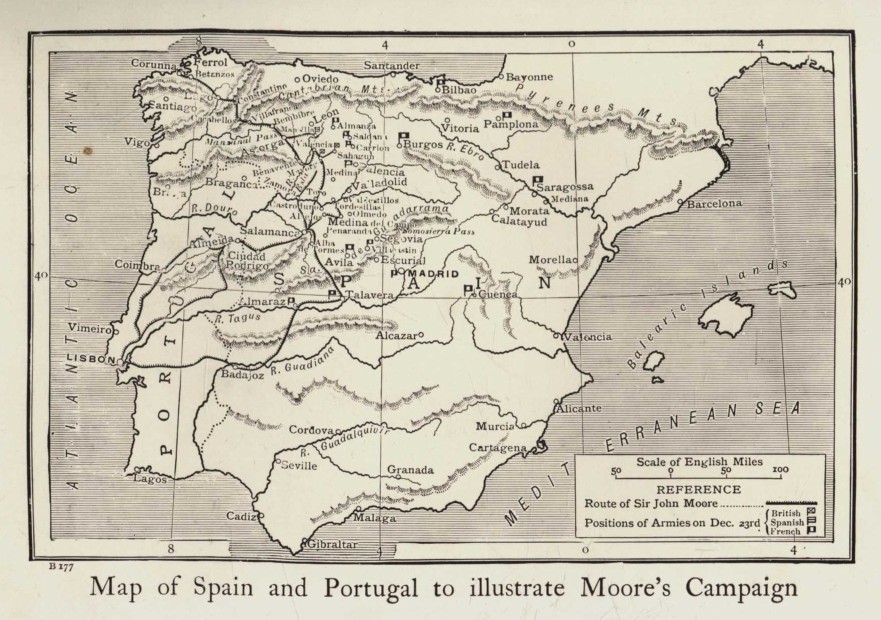
Map of Spain and Portugal to illustrate Moore's Campaign
But opposition, even on the part of the elements, only roused the emperor's indomitable energy. The gale was raging its fiercest, men and horses were being hurled over precipices by the force of the wind. The leading battalions had actually turned back and were making confusion worse confounded, when Napoleon appeared. Addressing the soldiers, he announced that he meant to overtake the British at all costs. He set thousands of men to clear the drifts, others to beat down the snow into a hard road, over which the artillery, harnessed with double teams, crawled painfully northward. He ordered the members of each infantry section to link arms and thus help each other along the perilous mountain way. He dismounted the cavalry, and used their horses to haul the guns. Then, gathering his staff about him, he bade them lock their arms, and himself led the way, walking arm in arm with Lannes and Duroc. Thus, in the teeth of wind, snow, and ice they pushed up the wild mountain steeps. Half-way up, the marshals and generals, who wore jack-boots, were too much exhausted to move another step. Nothing daunted, Napoleon had himself hoisted on a gun, and sat there astride. He called to his marshals to do the same; and thus, after four hours battling with the elements, the grotesque cavalcade reached the convent on the summit, where, with food and wine, the rigours of the march were forgotten.
It was in this spirit of fierce determination that the great emperor, sparing himself as little as his troops, strained every nerve to accomplish the end he had in view—the destruction of Moore's gallant little army. If La Romana's confidential agents had been napping, Moore might indeed have beaten Soult, but only to find himself enveloped by a force triple his own in numbers, commanded by the most brilliant soldier of the age. Fortunately, information had reached La Romana, and through him Moore, in time. At the moment when Napoleon arrived at Villacastin, only some three marches distant, Moore was countermanding the advance on Sahagun.
That moment marked the ebb of Napoleon's fortunes. Hitherto he had pursued his wonderful career with scarcely a check; but the decision of Moore on that December evening was the signal for the break-up of Napoleon's power; it was the step that saved Europe. It diverted the emperor from his immediate purpose of conquest, and engaged his huge armies in a fruitless and exhausting chase; it gave Spain time to bethink herself and rise as a nation. Her rising set an example to Europe, by which Austria and Prussia slowly profited, and which led Russia, three years later, to that spirited defiance which burnt Moscow and brought destruction upon the finest army in the world.
The British retreated in two columns, one, under General Baird, by the northern road to Valencia, the other, under General Hope, by Mayorga towards Benavente. General Paget's reserve division, including the two light brigades under Generals Anstruther and Disney, and five cavalry regiments, remained for twenty-four hours behind the main body. It was on Christmas-day that Jack's regiment received orders to march. The men were formed up in readiness for starting. Every face was gloomy, every heart bitter with rage. It was only vaguely known in the ranks why the advance had been so suddenly countermanded, and the general opinion was that it was due to the cowardice and incompetence of the Spaniards. The officers remarked this spirit of sullen discontent, and Captain O'Hare determined to make a personal appeal. Calling his company to attention, he stood in pouring rain and addressed them.
"Now, my boys," he said cheerily, "we must put a good face on it. The froggies are too many for us now, and the general don't want every mother's son of you to be clapped into a French prison. We're off to Astorga, and bedad, if Marshal Soult comes within reach of our heels, we'll give him a good parting kick before Boney arrives. But remember, we form part of the rear-guard; 'tis the post of honour because 'tis the place of danger. If there is to be any fighting, 'twill fall to us, and every man Jack of you must keep himself as fit as a fiddle, or he won't be able to do what's wanted. I trust to you, my boys; and sure we'll show that every Englishman, whether Scotch or Irish, is worth ten Frenchmen yet. Shoulder arms! Left turn! Quick march!"
"All very well," grumbled Charley Bates, as he swung along beside Corporal Wilkes; "there's to be fighting at Astorga, he says. The general means to march us to death first, and expects us to fight after!"
"You shut up, Bates," said the corporal sullenly. He was just as much irritated as his friends, but, being disputatious by nature, he was ready to contradict anyone. "I've fought under Johnny Moore before, and he ain't one to run for nothing. And you and me, Charley Bates, has got to show a good example to them young orficers—Mr. Lumsden an' the rest,—didn't you hear Peter say so? So step out, my boy, and don't argue."
"Hear that, Pommy?" said Jack, who was nearer the corporal than that worthy believed.
"I heard it," growled Pomeroy, "and I hope you'll profit by Wilkes's example."
They needed all their strength of will to preserve their cheerfulness. A thaw had set in, and the road, running between fields of soft rich loam, was knee-deep in slushy clay. All that day they tramped heavily through the rain. They halted at Mayorga for the night, and pushed on next day to Valderas, their clothes like sponges, their limbs racked with pain. At the halting-places they saw the first signs of failing discipline. Some of the men in the regiments which had preceded them had broken out and vented their rage on the houses of the Spaniards. Food was scarce; means of carriage were lacking; and the men were so incensed against the inhabitants of the villages through which they passed that they seized food for themselves, and, the country being for the most part treeless, tore down doors and sheds to provide wood for their camp-fires. But this marauding spirit had been as yet confined to a few regiments; the men of the light brigades were held well in hand by their officers, and refrained from the ill conduct of their less-disciplined comrades.
As they marched on the 26th and 27th it became known that Lord Paget's cavalry were having a warm time behind them. Soult had sent Lorge's dragoons in pursuit of Baird's column, and the advance-guard of the emperor's army at this time began to appear, until the five British cavalry regiments were closely pressed by no fewer than thirteen French. But Paget was a consummate cavalry leader; spreading his 2400 men as a screen to the whole army, he showed ceaseless activity in fending off the assaults of the French dragoons, beating them time after time, and capturing many prisoners. Every effort of the French to break through and attack the infantry was baffled and checked. So admirably, indeed, did he handle his men, that Napoleon imagined they were twice as numerous as they actually were.
On the afternoon of the 27th, Jack was marching with his regiment, the first battalion of the 95th, along the road from Valderas to Castro Gonzalo, where the river Esla was to be crossed. Behind came the second battalion, with other regiments, and the rear was brought up by Lord Paget's cavalry. The pace had been forced for some hours, for the French were continually pressing closer, and Sir John Moore was anxious to get his whole army across the river without delay. He had given orders that when the passage had been completed the bridge was to be destroyed, and Jack and his fellow-subalterns were disappointed that this task, and the chance of a brush with the enemy, would fall to the second battalion and not the first.
About half a mile before they reached the village of Castro Gonzalo there was a momentary stoppage of the column, caused, as was learnt in a few minutes, by the breaking down of the last of the baggage-wagons. Jack's company happened to be the nearest to the scene of the accident, and as they halted, Captain O'Hare came up and said:
"Lumsden, I'll leave you with a squad of men to repair this confounded cart. It's got our whole wardrobe in it, and we can't afford to lose that. Choose your men, and don't be longer about it than you can help. You'll probably have the job done before the second battalion come up, but if not, there'll be the hussars behind to see you safe in."
CHAPTER XII
Corporal Wilkes on Guard
Amateur Wheel-wrights—Wilkes Disappears—Dodging Dragoons—Night with a Picket—A Roman Bridge—Benevente—Wilkes enters a Protest—One MacWhirter
Jack was glad to have the chance of doing something that was not merely trudging through slush. He selected four men to assist him with the wagon—Wilkes, Bates, Tom Plunket, and his own man, Giles Ogbourne, who had some experience of smith's work. An inspection of the vehicle showed that the tyre of one of the wheels had broken, and with it one of the spokes. It was evident that, unless the tyre were repaired, the felloe would soon fall to pieces if the wagon were hauled farther over the heavy road. The first thing to be done was to take off the wheel. Luckily the Portuguese driver had a spanner in the cart, and with this the axle-cap was screwed off and the pin knocked out.
"Now, Wilkes," said Jack, "you and Bates will look after the cart while the others come with me to find a smithy. The second battalion will be up in a minute or two. If anyone asks, you can explain what has happened."
Jack started off with the other two men, who carried the heavy wheel between them. Reaching the village of Castro Gonzalo, they went along the streets in search of a smithy. Every house was deserted; the inhabitants had fled in terror at the news that the French were advancing. Nowhere was a smith's shop to be seen, nowhere a person of whom to make enquiry.
"There must be a smithy somewhere," said Jack, "even if the smith has taken to his heels."
"Maybe 'tis along the road to the left, sir," said Giles. "The smithy sometimes lies a bit out of the village at home."
"Perhaps. Let us try it."
The three proceeded down the road towards Villapando, in the teeth of a blinding storm of sleet. At a distance of nearly half a mile from the village they came to a small stone house at the left of the road.
"Here we are!" said Jack, noticing a horse-shoe nailed on the wall, and some broken bits of iron by the doorway. "The door's open; the smith seems to have bolted."
He led the way in, and found himself in a dark smithy. The forge was black and cold; evidently no fire had been lighted there for some time.
"Now, Giles, kindle a fire. You'll find some wood and charcoal about, no doubt. We must be quick about this, for we don't want to be left in the lurch."
It took some time to get a good fire alight. The wood was damp, and Giles's tinder-box had not altogether escaped a wetting. But the fire was ablaze at last, and then Jack set to work with the creaking bellows to blow it to a heat sufficient to weld the broken ends of the tyre. The third man, Plunket, held the iron in the glowing charcoal with the smith's huge tongs, while Giles stood ready with the hammer to beat it on the anvil.
"I'm afeard it won't be big enough to go round the felly without a bit more iron," said Giles; "and there don't seem to be a bit of the right kind here."
"Try it first. The whole tyre may expand enough with the heat."
But when Giles had welded the broken ends, and tried to fit the tyre on the wheel, he found that it was too short, as he had feared.
"We can't give it up," said Jack. "Look round the place and see if you can find a scrap of thin iron that will serve the purpose."
After searching in the smithy and the surrounding yard for several minutes, a strip of iron was discovered which Giles thought might weld with the rest. The tyre had to be heated again and cut at the cleavage. The small piece had to be beaten until it was of the same thickness as the tyre, and only after a good deal of patient manipulation did Giles succeed in forming a tyre of the required circumference. It was finished, however, at last. It fitted on the scorching felloe, and after cold water had been thrown on it from the blacksmith's tank, filling the air with vapour and the characteristic smell of the smithy, Giles declared that the wheel was good enough for another campaign.
"That's right, then," said Jack. "Now we must get back to the cart. By George! it has taken us a long time. It's past five o'clock, and getting dark. Raining as hard as ever too!"
They trudged up the road and through the village, expecting to meet the rear-guard of the British infantry, or at any rate the cavalry. But there was nobody to be seen. They hurried along out of the village towards the spot where, in the gathering darkness, they saw the wagon still standing in the middle of the road.
"But where are the bullocks?" cried Jack, noticing that the shafts and rope traces were empty.
Hastening in advance of the men, burdened as they were with the heavy wheel, he came to the cart.
"Wilkes, where are you?"
There was no answer; nor was there any sign of the men he had left on guard.
"This is awkward, my men," he said, as the two came up. "The wheel's right, but those two fellows and the driver have gone off, and the bullocks with them. We can't move the thing without animals."
"The corp'ril wouldn't budge without he were sent, sir," said Plunket.
"Maybe the French have come up in the dark and captured 'em, sir," added Giles.
"Nonsense! the French were not so close as all that. I don't fancy our cavalry have gone by yet. You two fellows fix the wheel on. I am going back to the village to find a team. I sha'n't be long."
Jack went back to the village in the darkness, going in and out among the houses and the gardens, expecting every moment to come upon some traces of the men and animals. The night was silent, save for the steady downpour of rain and the dull roar of the flooded river, he knew not how far beyond. Presently he heard splashing footsteps, then two men rushed towards him breathless—first Giles, then Plunket.
"The French dragoons!" panted Giles.
"Not our own men?" said Jack quickly.
"No, sir. We heard hoofs, and ran up to the first house and waited; and then two vedettes came up and stopped at the wagon, and we heard the French lingo, sir."
"Then we must make ourselves scarce. Have we time to reach the bridge?"
But even as he spoke, the sound of galloping horses and rumbling wagons came from the other end of the village.
"We must cut, my men. Follow me!" cried Jack.
Running at full speed along the Villapando road, he did not draw breath until he reached the smithy where the tyre had been repaired.
"We must wait here till we know what is happening," he said.
As they stood by the dark forge, they heard the clash of steel and the shouts of officers from the village.
"Soult's men for a certainty," said Jack. "I wonder if our fellows are across the bridge."
Soon after came a clatter and rumble as of wagons driven furiously, and then the thunder of horses' hoofs. Crack! That was a musket-shot. Another, another, then a rapid succession of reports, muffled by distance, struck their ears.
"They're trying to drive our pickets in," said Jack. "Come, men, we must try to find our own lines, or we shall stand a poor chance of escaping with whole skins in the morning. All we can do is to cut across the country over there; no one will hear us through this noise. Come along!"
Leaving the shelter of the smithy, he ran across the road into the field opposite. Great clods of earth clave to his boots, and it was heavy running; but, followed closely by the two men, he pounded on, listening for shots on his right, and moving obliquely to the left to avoid the skirmishers who, he guessed, had been thrown out by the French. As he ran he found the ground rising in a gradual ascent. The firing still continued in a desultory way, and Jack rejoiced that the night was so murky that he and his men would not, as they ascended the slope, present a mark to the enemy. They had run for nearly twenty minutes, and were panting for breath, when they were suddenly brought to a stop by hearing the click of a firelock directly in front of them, and, as they ducked their heads, a shot rang out, followed by the cry:
"Who goes there?"
"A friend—an officer of the 95th!" shouted Jack in answer.
There was a murmur of astonishment. In the darkness several forms were heard rather than seen to advance, and in a few moments Jack and his men were hauled over a rough, semicircular embankment, where they found themselves among a picket of the 43rd.
"Where the deuce do you come from?" asked the sergeant in charge, letting go his hold of Jack's collar.
"Look here, my man, I'm Lieutenant Lumsden of the 95th, and—
"Beg pardon, sir," said the sergeant hastily. "No offence. 'Twould need cat's eyes to tell a dook from a dustman in a night like this."
"What's going on, sergeant? I want to get to the bridge with my men. Can you put us in the road?"
"Heavens above, sir, you'd be shot in a winking. The bridge is half a mile up-stream, and we're holding these heights while t'other half of the brigade knocks a hole in it. We're the last picket this way, and as, judging by the sound of it, the Frenchmen are dismounted and a-trying to pass us, and we expect 'em here direckly minute, I'm afeard you'll have to stay here till morning light, sir."
"Oh, all right! I'll take a hand if there's any fighting. What has been going on this afternoon, then?"
"Troops all crossed, sir, except our half-brigade."
"Are the cavalry over?"
"Yes, sir. They came up rather late; and directly they and the guns was got over, the general had a hole knocked in one of the arches—cut completely through, sir—so that the rest of us will have to swim across, I expect, if we get through the night. And we'll all be drownded, sure as fate. Hark to the water a-rushing and raving behind us!"
His voice, indeed, was almost smothered by the roar of the swollen river. Getting what shelter was possible, Jack and his men passed a miserable night with the picket of the 43rd, and were glad when the darkness cleared, and they saw once more the grim dawn of another wintry day.
It brought little comfort. The wind had risen to a furious gale, beating sheets of snow and sleet in their faces. Jack and his men were shivering with cold and ravenous with hunger, though the men of the 43rd shared with them the scanty rations they had. During the whole of that day, and far into the night, they had to hold their position, ever on the alert to repel a flanking attack of the French cavalry, who several times galloped close up to the bridge, always retiring more quickly than they came before the volleys of the British infantry who lined the heights. More than once Jack thought of making his way along the embankment and rejoining his regiment, but the picket of the 43rd was always outnumbered; it had lost several men, and he decided, every time the opportunity of leaving occurred, that he would stay, thinking that, after all, he could probably do more good in the fighting line than in security on the other side of the bridge.
At the bridge General Craufurd kept his men unremittingly at the task of mining the arches. There had been no time to send an engineer forward to make the necessary preparations; the men lacked the proper tools; and the material of the bridge was so strong, and the construction of the Roman engineers centuries before so solid, that the task of penetrating the massive masonry was of unusual difficulty.
Towards night the spasmodic attacks of the French ceased altogether, and they withdrew out of range. After several more hours of cheerless waiting, word was passed quietly along the entrenchments that the work at the bridge was finished and that the troops were now to retire. The wet and weary men needed no urging; in dead silence they crept along and down the heights towards the end of the bridge, where General Craufurd, commanding the rear-guard, was in person superintending the crossing. The middle arch had been cut completely through, but the men had not to swim for it, as the sergeant of the 43rd had anticipated, for planks had been laid across the gap. Jack was among the last to cross, and as he passed over the narrow, shaking strip of boarding, the impetuous and roaring torrent dashed over it, threatening at every moment to carry away planks and men together. But the last man safely reached the other side, and Jack, as General Craufurd passed him, heard that fine soldier mutter with a grim chuckle:
"There! We've dished the fools!"
A few minutes afterwards there was a terrific roar, that for the moment drowned the fury of the torrent; then a blinding glare that flashed along the gray masonry and shot through the falling rain; and then, with a great crash, two arches and their supporting buttresses fell to the bottom of the river, where they lie to this day. The mine so laboriously excavated had exploded with complete success, and between the French and the English raged the boiling torrent, which effectually forbade present pursuit. Mocking cheers broke from the throats of the tired, drenched soldiers; then they turned their backs on the river and marched on, half-asleep, towards Benavente. Jack looked at his watch; it was just midnight.
When he awoke, at daylight next morning, some minutes passed before he realized where he was. He had no recollection of going to bed; in fact, on arriving in the town he had been so fatigued that he could have slept in his wet clothes on the road. But his man had been anxiously on the look-out, and it was to him that Jack owed his bed in the convent where his fellow-officers had found lodgment.
His dazed senses were fully recalled to him by the sound of Pepito's voice humming one of his gipsy songs outside the door.
"Pepito!" he called.
The boy bounded lightly into the room with an eagerness that bespoke, as clearly as words could have done, the affection he now bore towards the young Englishman.
"Find Giles for me, my boy," said Jack, "and tell him to get me something to eat—something substantial—for I'm ravenous."
When the boy returned, Jack had dressed.
"Find him? That's right. So you got here safely yesterday! You've not been up to any mischief, I hope?"
"No, Señor," replied Pepito gravely. "But I can, now that you are here."
Jack smiled, and then sprang up as Giles entered with a dish that filled the room with a very savoury odour.
"What's this?" said Jack, sniffing. "Roast hare, by all that's glorious! Giles, you're a wonder."
"'Twas Pepito, sir," said Giles. "The young varmint went out before 'twas light this morning and snared the beast for your breakfast, sir. I allow he makes himself useful sometimes."
Pepito was grinning with pleasure, and Jack without ado devoted himself to his meal.
"By the way," he said presently, "have you seen anything of those two fellows I left with the wagon?"
A broad smile broke over Giles's ruddy face.
"They was brought in yesterday, sir, under guard, and locked up in the guard-room. They was mad, sir, both on 'em, but Corporal Wilkes the worst. He made a few remarks, sir—" and here Giles gave vent to his loud guffaw, and instantly straightened his face to its usual stolid impassivity.
"Are they still locked up?" asked Jack.
"No, sir. Captain Stovin ordered 'em to be released when they'd had about two hours of it."
"Go and fetch them."
In ten minutes Corporal Wilkes entered, followed by Bates, each man wearing a look of sullen discontent.
"Now, Wilkes, what have you got to say for yourself?" said Jack sternly.
"Say, sir? I ain't got nothing to say, nor I didn't get a chance o' saying nothing. It ain't common fairness, let alone justice, that it ain't, begging your pardon, sir. It ain't for the likes o' me to question what an orficer says, sir, to say nothing of an orficer like Bobby—beg pardon, like General Craufurd. But," continued the corporal, his eloquence increasing with his indignation, "but, Mr. Lumsden, sir, what I want to know is, what call the general 'ad to miscall me a straggler, to say nothing o' Bates, and send us in under guard of a bloomin' corp'ril of the second battalion—why, we're the laughing-stock o' the regiment."
"There now," said Jack with due gravity, suspecting what must have occurred, "I suppose there was some little mistake. Tell me all about it."
Wilkes proceeded to explain that a few minutes after Jack left with the broken wheel a heavy shower of sleet had come on, and he and Bates had taken shelter beneath the wagon. From this point of vantage they had seen the passage of the greater part of the second battalion, which was whipping in all stragglers from the various other regiments that had gone by earlier in the day. In the rear of the battalion rode General Craufurd with Colonel Wade and other officers, and Craufurd's eagle eye had at once remarked the abandoned wagon. Riding up to it, he descried the two figures crouching underneath, and sternly demanded what they were doing there.
"I was beginning to explain, sir," said Wilkes, "but before I could crawl out into the open, 'Enough of that', says he. 'Come out of that, you skulkers!' Me a skulker! And without sayin' another word he marches us off to the bridge, where he hands us over to Corp'ril MacWhirter, a feller I've the greatest dislike of. 'Here,' says the general, 'see these two stragglers safe into Benawenty, and hand 'em over to Colonel Beckwith with my compliments'. MacWhirter he sniffed, and it was hard work to keep my hands off him, sir, for blest if he didn't pass foolish and opperobious remarks all the way to Benawenty, just a grunt here and there, like as if we was pigs, and his two Riflemen like to bust 'emselves with laughing. Now, sir, what I—"
At this point Captain O'Hare came into the room. Jack, who had had some difficulty in keeping his countenance, said hurriedly:
"Well, well, it was very unfortunate, but I'll see that it is put right."
As Wilkes turned away, Jack heard him mutter under his breath:
"Yes, and I'll put it right with MacWhirter."
CHAPTER XIII
Don Miguel's Man
Fine Feathers—A Fight by the River—Lax Discipline—Scenes at Astorga—A Cry for Help—The One-eyed Man—At Bay—A Warm Corner—Wilkes to the Rescue—Miguel Explains—Righteous Indignation—Wilkes's Supper
Captain O'Hare's eyes were twinkling as he watched the aggrieved exit of the two soldiers, and when they had gone he joined in Jack's shout of laughter.
"Ah! 'tis all very well for you to laugh at Corporal Wilkes; but faith, my boy, we'll have to court-martial you for deserting his Majesty's stores, to say nothing of my best pair of galligaskins. Begorra, let's hope they won't fit the spalpeen of a Frenchman who gets them. The whole mess is rejuced to one suit."
Then, changing his tone, the captain proceeded to inform Jack of what had happened since his arrival at Benavente. The inhabitants of the town had received the British army with an attitude of sullen dislike and even animosity. Relying for their rations on what could be obtained during the march, the troops had come into the place tired and hungry, to find the doors barred and food withheld. The shops were all closed, the magistrates had taken flight, and although the British were prepared to pay for supplies, neither bread nor wine was to be had. The men were already embittered by the hardships of their long march, and disappointed of their hopes of meeting the French in fair fight, and it was small wonder that coldness where they might well have looked for warmth, and aversion where they might have claimed active friendship, provoked resentment and reprisal. They were received as enemies; they could scarcely be expected to act as friends.
"Indade, the whole army's going to the dogs," said Captain O'Hare dejectedly; "all except the Gyards and the Reserve. Things are as bad as they can be, and there's worse to come. The main body's looting, and behaving worse than Pagans and Turks. They should be at Astorga by now, and we're to follow them in an hour or so. The company's falling in, and you'd better hurry up, or you run a risk of finding an escort like our friend Wilkes. And bedad," he added, as the dull sound of firing was heard in the direction of the river, "there's the music again."
Jack had by this time finished his breakfast, and, hurrying out with the captain, he found the 95th preparing to move off.
"Hullo!" cried Smith, "you've turned up, then! What have you done with the wagon?"
"Where are my boots?" asked Pomeroy.
"And my best frilled shirt, the one with the ruffles?" continued Smith.
"And my new highlows, the ones with the silver buckles?" added Pomeroy.
"They are coming after us," returned Jack. "If you care to wait they'll probably be here in half an hour—and Colbert's dragoons inside them."
As the regiment moved off, the firing behind them became more and more distinct and continuous. Bodies of mounted troops could be seen on the horizon; a smart cavalry action was apparently being fought, and the men of the 95th were again jealous of what they considered the better luck of the cavalry. But Jack's company, marching away at the quick step, was soon beyond sight of the combatants, though for an hour afterwards the boom of guns could be plainly heard.