BOYS OF THE LIGHT BRIGADE (continued 8)
Reading edition
He had only 200 men now with him, and many of these were on their last legs. But when the rumour spread through the quarter that the French were preparing to make a serious attack, some fifty poor wretches, scarcely able to crawl, staggered from their squalid lodgings, and begged to be allowed to take part in the defence. They were a pitiful sight, gaunt and haggard, with ague-stricken limbs and fever-lit eyes. They were incapable of hand-to-hand fighting; many of them were too weak even to lift their muskets to their shoulders; but they could fire muskets rested on window-sills and through loopholes, and Jack, gladly as he would have spared them, was too hard-pressed to reject any aid, however slight. A score of women came forward, offering to load muskets for the men, and thus save time. Among them Jack recognized the lady he had seen as he came with Tio Jorge to take over his command. He remembered her attitude of frenzied grief; he recalled the fierce command she had laid upon her little boy. The child was no longer with her; the little fellow had died of fever a few days before. The poor creature had now lost father, brothers, husband, and son, and had come with the wild fury of a mad woman to wreak vengeance on the enemy.
About ten o'clock in the morning the French opened fire with all their guns upon the Casa Vallejo and the barricades. Jack made what reply he could from the roofs and windows, but the batteries were so well screened that the fire of his men was almost wholly ineffectual. Great gaps were soon made in the wall of the house and in the barricades, and seeing that the attempt to hold the latter in the face of the bombardment would entail a useless loss of life, Jack withdrew his men behind the Casas Vega and Tobar, and held them in readiness to rush into the houses when his mines had exploded. After two hours' bombardment the four guns ceased fire. Immediately afterwards three parties of French dashed forward in headlong charge. The Spaniards, who, on the cessation of the bombardment, had sped back to their posts, met the enemy with dauntless front. The Frenchmen in the streets fell rapidly under a hot fire from the roof and windows of the Casa Tobar and from the advanced barricades, but, seeing the hopelessness of continued resistance to the overwhelming numbers opposed to him, Jack withdrew his forces again, and sent word to the men stationed at the mines to light their matches in readiness for firing the trains. With exultant shouts the enemy, for the most part Poles and voltigeurs, swarmed into the houses. Jack gave the word first at Vallejo. The fougasse exploded with a terrific crash. It was this explosion which had interrupted Tio Jorge's conversation in the café. But though not a Frenchman was left alive in the house, the places of the dead were instantly filled by their furious comrades, who were only kept from rushing across the street towards the Casa Alvarez by the concentrated fire of the Spaniards there posted.
A few minutes later the French in Tobar and Vega met with a like fate. Jack had exploded in each case one of the arms of his Y-shaped mines, and for the time both houses were cleared of the enemy.
But Jack had long since seen that, unless he could deal them a harder blow than any he had recently been able to strike, he must inevitably be swamped by superior numbers. Even though the explosions should slay a hundred of the French to every ten of his own men, the former could be continually replaced, while a loss to him was irreparable. He could hold the enemy in check for the moment, but a time must come when his gallant little force must be overwhelmed and annihilated—unless he could effect some diversion.
His greatest danger came from these formidable batteries, to which he could make no effective reply. Under cover of their fire the French could at any time repeat the rush across the street by which they had carried Tobar. Was there no way by which the guns could be silenced?
During the two hours' bombardment Jack had spent many anxious minutes in thinking out this problem. What were the chances? The explosion of the fougasse, followed by that of the Y mines, would not only deal immense destruction, but would also, he hoped, have a tremendous moral effect. Could he not make a rush for the guns while the French were demoralized and at sixes and sevens? Would there be time to spike them? Ought he to diminish his little force even by the minimum number of men necessary to perform the feat? He now had no more than 180 men all told. The French, he computed, had numbered nearly 700 at the beginning of the day. Could he, with, say, 50 men, hope to penetrate their ranks and return in safety?
"It must be tried," he said to himself, and from that moment bent all his energies to ensure the success of his daring scheme. Before firing the Y mines he collected his whole disposable force, and, amid a breathless silence, addressed them.
"Hombres," he said, "there is one thing for us to do. The French guns must be spiked. I will lead the way. I want fifty men to follow me. It will be dangerous, perhaps fatal work. Who will volunteer, for Saragossa and Spain?"
Every man held out his hand. Jack felt proud of the unswerving patriotism and courage of his troops. The trouble was, not to accept, but to refuse their offers. He quickly selected fifty of the strongest. Ten of these he sent to find long nails and hammers, and they soon returned, bearing tools of all sizes and shapes. The rest were armed with muskets and bayonets. Jack gave as many as he could pistols in addition.
"Now, hombres," he said, "when the mines explode, the French in the houses will be destroyed, and those behind them dismayed. We must seize that very moment to rush into the Casa Vega. I shall go first. You must follow close upon me as rapidly as you can. I intend to make for the guns. We shall spike them. We shall then rush back through the ruins and the houses beyond the Casa Vallejo and take the French there in the rear. Don Cristobal will still defend his barricade. Antonio here will hold the rest of you in readiness to sweep upon the French in Vallejo and the street. If I am overcome, and you cannot hold the second barricades, retreat to the Casa Alvarez and fight to the death."
The Spaniards were eager to start, and almost too impatient to wait for the explosion. When that occurred, the larger débris hurled into the air had scarcely reached the ground before Jack, followed by his devoted fifty, dashed through the dust that was swirling in vast eddies from the ruins. Entering the Casa Vega by a low side doorway, almost suffocated by the pungent fumes and the clouds of dust, they scrambled through the ruins, springing over stones and beams, broken furniture, burning draperies, every man taking his own course and trying to avoid impeding his comrades. A few seconds brought them to what had been the party-wall of the house. Bearing to the left, Jack dashed into the charred ruins of the adjoining house, through the midst of a few Frenchmen who, injured but not killed by the explosion, were crawling painfully away. A glance to the right!—he saw that the next clearing was still held by the force supporting those who had rushed the houses; but they were in no sort of order, having scattered to seek shelter from the beams and stones that had descended upon them as from the crater of a volcano. A glance in front!—across the narrow street, in the wrecked house nearest the gun, Jack saw in an instant that he had a more formidable foe to reckon with. The French there, some 150 in number, had not been affected materially by the explosion; but it had taken them by surprise, and for the moment they were at a loss what they should do. Before they could realize what was happening, a band of fifty fierce yelling Spaniards, led by a young officer with sword in one hand and pistol in the other, was among them. A score fell at the first onset; the rest scattered to right and left of the Spaniards, and by the time they had collected their wits, and perceived how small was the party engaged in this desperate sortie, Jack and the first of his men were already engaged with the gunners. The onslaught was so sudden, and Jack was so intent on the work in hand, that he was scarcely conscious of what happened until afterwards. One of the gunners, in the urgency of the moment, picked up a linstock and raised it as a kind of club. Jack sprang straight at him, toppled him over by the mere force of his impact, and came upon another gunner, whose smoking musket showed that he had just fired. Him Jack cut down; the others meanwhile fell to the bayonets of the Spaniards. The gun was reached. Jack sped past, while a burly Catalan, with two strokes of his huge mallet, drove a nail into the vent. Then the whole party, diminished by half a dozen who had fallen, swept on across the street towards the spot where stood the two guns that commanded the Casa Vallejo.
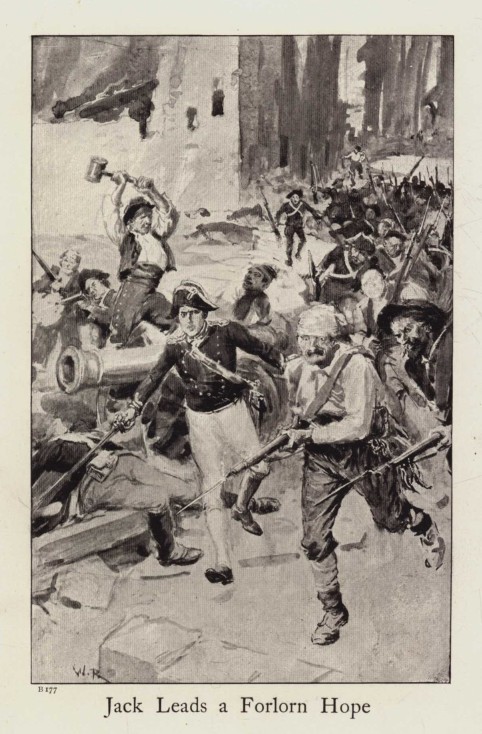
Jack Leads a Forlorn Hope
The few seconds occupied by the tussle about the first gun had given the gunners at the other two time to form up. At the same time the French behind Jack had recovered from their surprise and were swarming upon his track. Would he have time to complete his work? A few bullets pattered on the jagged remnants of walls still standing; but the French were too much afraid of hitting their own men to fire volleys, and those who did shoot were too flustered to take good aim. Amid a din of shouting, Jack dashed into the ruins on the far side of the street. Some two-score men were there drawn up ready to receive him. Fortunately they were on the French side of the epaulement that had been thrown across the ruins. Had they occupied the other side they could have held their assailants at bay long enough for the reserves to come up from the direction of Santa Engracia and take them in the rear.
In a moment the two bands met. The French were outnumbered, but for a few seconds they held their own around the guns. Then the Spaniards closed about them, and with their backs to the epaulement the valiant gunners fell, to the last man.
The first gun was quickly spiked. At the other a gallant pair of Frenchmen caused a momentary delay by their desperate defence. But they were in turn overpowered, and fell covered with wounds. A nail was driven home, and the hazardous exploit was complete.
But the peril was only just beginning. The sortie had been so sudden and impetuous that even if the French had been thrice as numerous the chances were on the side of the assailants. But they had now had time to rally. Sixty yards of ruins lay between the breathless Spaniards and the Casa Vallejo, which was strongly held by the French. Jack hoped that the diversion from the Casa Alvarez would keep these sufficiently employed; it was a race between him and the French who were now coming up from the rear of their position. For an instant he thought of retaining a few of his men and attempting to check the pursuit while the remainder ran on and stormed the French in Vallejo. But he saw in a flash that this exposed him to the danger of being headed off by the enemy, who would make greater speed along the comparatively clear street than he could make through the ruins. Without a moment's hesitation he bade his men run for their lives. That he was right was proved at once. Stalwart Poles and little voltigeurs were swarming along the roadway; Jack could see them through the gaps in the ruined walls, and hear them as they dashed along out of sight parallel with his own men. Would they outrun him? Would they succeed in joining hands with their countrymen in Vallejo, and meet him in such force that his own gallant band, now diminished by half, would fall a helpless prey to them?
There broke out at this instant, ahead of him, a pandemonium of cries, which seemed too great to proceed even from the mingled horde of French and Spanish in Vallejo. The foremost of his men were now at grips there with the enemy. He dashed into the house, and found a desperate combat in progress there, but was surprised to see no Frenchmen upon his flank. He had expected to find those who had rushed along the road now pouring into the house through the gap in the walls. But the French in the house were engaged on two sides; on one side by Jack's own party, on the other by the second sortie-party, under Antonio's command. That was not all. Amid the din Jack heard the stentorian voice of Jorge Arcos shouting words of encouragement to his men and of obloquy to the French; immediately afterwards the bellow of Tio Jorge echoed through the ruins. Jack understood now what had so suddenly checked the French in the street. How the great mob-leaders had come upon the scene he knew not; it was sufficient that they had come in the nick of time. They had evidently manned the nearest barricade, and, battered as that had been, it was good enough yet to afford a strong defence. With a sense of relief Jack threw himself into the midst of the fray; in a few moments the French in Vallejo were accounted for. Emerging into the street, Jack saw his bulky friend chasing the French back towards the spiked gun. The sudden sally over the barricade, when they least expected it, and when their ranks were in the disorder of pursuit, had been too much for the enemy. They gave way before Tio Jorge's impetuous rush; then, as Jack, with a feeling of elation that once more the enemy were foiled, arrived at the barricade, he heard Jorge Arcos shout to his men to retire, and they came pelting back, followed by a few wild shots from the discomfited French.
"Viva la España! Viva Saragossa! Viva el Señor Ingles! Viva Tio Jorge!"
The air rang with the jubilant shouts of the Spaniards, panting, dishevelled, many of them utterly exhausted. A strange calm succeeded the turmoil. Scarcely a live Frenchman was now to be seen; the ground was strewn with dead, and with wounded whom Jack did not dare to remove. He knew that the lull could only be temporary; the French would undoubtedly send for reinforcements. After their successive checks they would not be content until they could bring absolutely crushing force to bear upon the obstinate defenders. The crisis was still to come, and Jack, after warmly congratulating Tio Jorge and Jorge Arcos, as well as Antonio, on the brilliant success they had done so much to bring about, returned to the Casa Alvarez to concert means of meeting the most formidable attack of all.
Before he reached the house he saw a girl flying towards him, her mantilla streaming behind.
"Oh, Jack, Jack," she cried, "I thought you would be killed!"
"Juanita!" he exclaimed. "But you should not be here. It is no place for you. You ought not to have run into danger. Come back with me at once."
"I came to help. I will help! Tia Teresa died last night; I have no one now. I can do something. And you—you are hurt! Oh, Jack, you are covered with blood! Come, come, at once, let me do something for you."
"I didn't know it," said Jack simply. He brushed his hand across his brow; it was smeared with blood. Looking at his coat he saw blood trickling through a rent in the sleeve. "It's nothing," he said. "I don't feel a scratch. If you must help, Juanita—and it is brave of you,—why, there are many others who need attention more than I."
"You first, Jack. Come at once; I insist! How can you lead your men if you are blinded with blood? Jack, you are doing grandly; it is splendid!"
"You are right, Señorita," put in Tio Jorge, who had come up with them. "All the men say the English Señor is a hero, and, por Dios! the French will never get the better of him."
By this time they had reached the house, where Juanita insisted on bathing and binding up Jack's wounds before she attended to any of the others. Jorge Arcos had been slightly wounded in the dash across the barricade, and afterwards Jack remembered, with a strange glow, the roughly-expressed gratitude of the savage innkeeper as Juanita tenderly assisted him.
While she went about on her errand of mercy, Jack consulted with his lieutenants. The new-comers recognized him unhesitatingly as their leader, and declared that they would remain with him and support him to the utmost of their power. None doubted that the next fight would be the most terrible of all; it was only a question how long an interval would elapse before it came. The Spaniards had lost some forty men since the morning; they were all on the verge of collapse; only Don Cristobal's men, who had been unmolested at the Vega barricade, were for the moment fit for active work.
To ascertain the movements of the French, Jack went with Tio Jorge and Jorge Arcos to the roof of the Casa Hontanon, that adjoined the empty shell of Vallejo. From that coign of vantage they could overlook the whole district. After a time they saw in the distance a compact body of some 200 men approaching through the ruins from the direction of the Franciscan convent. With great difficulty they were dragging a gun over the heaps of obstacles. It must have been taken from one of the batteries now mounted near the Coso. Slowly they approached; nearly an hour elapsed between their first appearance and the placing of the gun at the end of the street facing the Tobar barricade, on the same spot whence the spiked gun had been withdrawn.
As soon as the gun was fairly in position, a renewal of the bombardment of the barricade was commenced, and the sound of heavy shots showed that an attack was being simultaneously made on the Vega barricade.
"We can't hold Vallejo any longer," said Jack. "We shall be cut off from support."
"Not so, Señor," said Arcos at once. "I will hold it with twenty men. If the French capture it, our flank will be at their mercy."
"But if the French attack in force you cannot escape."
"Caramba, Señor! What does that matter? A man must die, and I vow I'd rather die fighting for Saragossa than of fever in the cellars—or of rage in a French prison."
"You are a true son of Spain, hombre," exclaimed Jack, and the gleam in Arcos's eyes showed that he wished for no higher praise. "The barricades, now—it is useless to attempt to repair them?"
"Sí, Señor," replied Tio Jorge, "but we can fill up the breaches with sacks and baskets of earth, if we push them out from the sides of the street."
"Very well. Will you see that that is done?"
Tio Jorge instantly departed on his errand. Arcos had already gone to select his twenty men for the perilous post in the ruins of Vallejo.
At half-past three in the afternoon the French cannonade suddenly ceased. Jack had placed his men in position, but as he saw that nearly a thousand men were being launched against scarcely more than two hundred, he felt that even the desperate valour of his patriotic troops could not prevail against such odds. But it never occurred to him, or to a single member of his gallant force, that there was any alternative to the one simple course—to hold on to the end. Palafox had entrusted him with the defence of that quarter; he would defend it to the last gasp, and he knew that no British officer in the same situation would have come to any other conclusion.
The attack had begun. In the two streets the French were rushing ten abreast at the barricades. In the ruins approaching Vega and Vallejo their formation was necessarily broken, but they swept forward with a dash and a courage which Jack, remembering their former failures, could not but regard as magnificent. The front ranks seemed to melt away under the fire of the defenders, who, well disciplined by their long experience, fired calmly and with deadly accuracy, wasting no powder, and watching the French advance in seeming unconcern. But though the enemy fell by scores, there was no halting now. They swarmed up to and through the breached barricades, and ran a race with death towards the grim skeletons of the shattered houses. For a few seconds there was a tense silence; the majority of the defenders had discharged their pieces and were either reloading or preparing to repel with the bayonet. Then the opposing forces met; there was a sudden babel of noise, steel clashing against steel, pistols cracking, men shouting fiercely in their several tongues, and some crying out in the agony of death. The street was narrow; for a time the French could make but little impression on the unbroken front opposed to them, but Jack, from his post on the roof of Hontanon, saw that it was now a question of the most desperate close fighting. As soon as the head of the attacking column was lost to view beneath him, he hurried down to take his part in the tremendous struggle.
It was as he had feared. As soon as the French swarmed over the Vallejo barricade, the Casa Vallejo and its garrison became completely isolated. At the moment of his arrival a furious fight was proceeding at the inner barricade. The French charge, led by a gigantic Polish officer, had driven the Spaniards behind their last defence and threatened to dislodge them from that. Jack at once summoned twenty men from the reserve stationed at the Casa Alvarez, and with them threw himself into the breach, where, amid fragments of beams, displaced sacks and baskets of earth, and the débris of part of the wall of Vallejo thrown down by the explosion of the fougasse, a stern hand-to-hand fight was being waged. It was almost impossible, in the turmoil and rush, to distinguish friends from foes, but in the centre of the human whirlpool the huge form of the Polish officer was conspicuous. He was wielding a large bar of iron, which he had picked up among the ruins, and even at that moment Jack marvelled at the man's immense strength. Disdaining the blows aimed at him by men who looked mere pigmies beside him, he was step by step forcing a way through the barricade towards the open space fronting the Casa Alvarez. Jack, with his reinforcements, had arrived not a moment too soon. As he pushed through towards the spot where the deadly iron, wielded with as much ease as though it had been a malacca cane, rose and fell with fatal regularity, the onward rush of the French was stayed for a moment. Another second would have brought the two leaders together; but Jack was not yet to cross weapons with the Pole. At the very instant when they came within striking distance there was a terrible crash; Pole and Englishman started instinctively. A huge mass of masonry had fallen from Vallejo upon the outer barricade, into the midst of the crowded ranks of the Frenchmen, of whom a score at least were buried beneath the ruins. Even above the clash of weapons, the shouts of the combatants, and the groans of the wounded, a shrill mocking voice could be heard exulting in the deadly effect of the avalanche, and raining frantic curses upon the French. In the moment of surprise the enemy gave way. Glancing up, Jack saw the figure of the madwoman, the demented Doña Mercedes Ortega, giddily poised upon a jagged corner of masonry that threatened every instant to follow the rest into the street below. The poor creature had seen from the Casa Alvarez that the outer wall of Vallejo had been so breached that a push would precipitate it into the street upon the barricade. Escaping from Juanita's detaining hand, as Jack afterwards learnt, she had crept from the roof of the Casa Hontanon on to the wall of Vallejo; had leapt from point to point of the uneven summit, reached the corner overlooking the street, and with the strength of frenzy had pushed the masonry down, working more havoc among the enemy than had been wrought by many an elaborately-prepared mine.
While she stood on her precarious eminence, wildly gesticulating in her insane triumph, there was the report of a musket from down the street. She swayed for a brief moment upon the crumbling wall, uttered one heart-rending shriek of "Juanino!" and fell lifeless upon the ruins below.
The interruption was but momentary. At the instant when the hapless Doña Mercedes fell, Jorge Arcos, desperately wounded, struggled from the ruins of Vallejo, followed by half a dozen of his men, all showing terrible signs of the struggle they had made to hold the position. While a portion of Jack's force continued their gallant attempt to repel the French from the barricade, the rest swarmed into the house, only to be driven out again with heavy loss by the enemy, who, backed by a large force in the ruins, had now an overwhelming superiority in numbers. In the street the gigantic Pole, swept away from before Jack, returned to the attack at the head of a compact band of his compatriots, and the Spaniards, still fighting furiously, were driven back inch by inch through the gap in the barricade, their retirement being hastened by shots from the walls of the Casa Tobar, which, together with its neighbour, the ruined Casa Vega, had fallen into French hands. Save for the Casa Alvarez and the surrounding streets, the whole of the quarter towards Santa Engracia had now been captured, and Jack, extricating himself from the mêlée, saw that it was time to play his last card.
"Señor," said Antonio, running up at this moment, "Don Cristobal sends me to say that he still holds his barricade, but that he will not be able to do so for more than a few minutes longer."
"You are the man I want, Antonio," replied Jack. "Run to the Casa Alvarez, send every man of the reserve to me, and go into the cellars and fire the last of our mines. Don't wait; do it at once."
Antonio, who was almost unrecognizable from his wounds, at once returned to the house. Immediately afterwards the remnant of the reserve dashed out, and threw themselves into the fray with a vigour which for a moment checked the enemy's advance. A few seconds later there came the deafening crash which Jack expected. Huge fragments of the walls of the houses were projected into the street, injuring a few of the Spaniards who were still tenaciously defending the extremities of the inner Vallejo barricade, but working fearful havoc among the French between the two barricades and in the street beyond. Volumes of blinding smoke poured from the shattered houses, into which, at Jack's order, Antonio rushed with a party of men. He himself, calling on the rest of his troops to follow him, sprang through the barricade, leading an impetuous charge against the distraught enemy. Even as he did so he heard the strident voice of Santiago Sass behind him, urging on the men, and shouting Latin words of denunciation and triumph. Dismayed by their repeated failures, appalled at the apparent inexhaustibility of the defenders' resources, the French were now giving way like sheep, in spite of all the exertions, example, and admonition of their officers. The big Pole, carried away in the rush towards the outer barricade, there turned and lifted his iron bar to deliver a crushing blow at Jack, who was just behind him. The fraction of a second occupied by his wheeling round cost him his life. Before the blow could fall, Jack closed with him and ran him through the body.
Meanwhile the French in Vallejo, some of whom had been hurt by portions of the flying masonry, had caught the infection of panic, evacuated the position, and fled helter-skelter across the ruins. Jack saw the danger of allowing his men to become widely scattered in pursuit. Stopping at the outer barricade, he ordered his men to withdraw, in spite of the frenzied imprecations of Santiago Sass, who would have thrown himself single-handed against a host. The Spaniards retired slowly; they were clearly indisposed to relinquish the pursuit, though all were well-nigh spent, and some, indeed, when the excitement had subsided, dropped their weapons and fell beside them on the ground. At length the whole of the force was withdrawn behind the inner barricade.
Jack stood there panting, wondering how long respite he would have before the French came on again, when he heard his name called from behind, and, turning, saw Juanita running towards him.
"Go back!" he cried; "for God's sake, go back, Juanita! This is no place for you."
"A white flag, Jack! a white flag!"
"What do you mean?"
"A man is coming round the corner of the street with a white flag. I saw him from a window."
"What! Another regiment coming to attack us!"
"No, it is not a regiment. It is one man carrying a small white flag, and another, an officer, walking by his side. Oh, it must be a flag of truce, Jack! See, there he is, turning the corner of the street."
It was as she said. Above the epaulement protecting the French gun at the end of the street a white flag was held aloft. A moment afterwards the Frenchman bearing it stepped into the street, and, accompanied by an officer, began to approach Jack's position, picking his way among the débris and the bodies of the slain.
"I must go to meet him," said Jack. "Have you anything to match his flag, Juanita? I've nothing fit to be seen."
Juanita handed him her handkerchief. Tying this to a musket, Jack gave his extemporized flag to one of his men, and walked down the street to meet the Frenchman.
CHAPTER XXIX
French Leave
Overtures—Capitulation—Prisoners of War—Colonel de Ferrusat—In Tudela—Personally Conducted—Adding Insult to Injury—Quos ego—Before a Fall—Out of Bondage
Meeting midway down the street, the officers courteously saluted each other.
"I come with a flag of truce, Señor," said the Frenchman in very bad Spanish.
"I understand French, monsieur," replied Jack with a slight smile, which the other returned. The Frenchman continued, speaking now in French:
"Marshal Lannes has given the order to cease fire, and has sent an aide-de-camp into the town to discuss terms of capitulation."
It was impossible not to feel an unutterable sense of relief. But Jack gave no sign of it to the Frenchman.
"Can you give me any particulars?" he said.
"Yes, monsieur, certainly. Last night General Palafox sent his aide-de-camp to ask our marshal for a three days' truce, and asking impossible terms. These, of course, were refused, and the fighting was resumed. But your people seem now to be more amenable to reason, and, to tell you the truth, monsieur, I have great hopes that this very afternoon the end of this most lamentable siege will come. It is, of course, impossible and useless for your people to continue the struggle."
"That, monsieur, is a matter for our general to determine."
"Allons, allons, monsieur! You have made a brave defence, but you are being driven in at all points, and it can only be a matter of a few hours before we capture your whole city."
"I can only speak for myself, monsieur," said Jack quietly; "but it is now nearly three weeks since I had the honour to be appointed to this quarter. I am now, monsieur, where I was then."
The French officer smiled, and bowing, half-ceremoniously, half-humorously, said:
"Pardon my oversight. Permit me, monsieur, to offer my congratulations to a so gallant foe."
After an exchange of courtesies, Jack returned to his men, who had watched the scene with mingled excitement and distrust.
"Hombres," he said, "a truce is proclaimed. There will be no more fighting for the present."
"Thank God!" exclaimed Juanita. "That means that we shall capitulate at last."
"Capitulate!" cried Santiago Sass. "Never, hombres! To the Aljafferia palace with me! Never will we surrender—never! never!"
But none followed him save Tio Jorge. No sooner had he gone than a tremendous explosion occurred near the University. Some French engineer officers, who had not heard of the cessation of hostilities, exploded a mine, and the jet of stones ascended to such a height that it was visible to the whole town. Crowds of people rushed towards the Aljafferia palace, crying for vengeance on the treacherous French, and demanding that the French envoy, at that moment in consultation with the Junta, should be instantly put to death. He was only saved from being torn in pieces, by the intervention of some Spanish officers with drawn swords, and by a message from the French marshal expressing regret for the unfortunate accident. Marshal Lannes' message to the Junta was peremptory. He allowed two hours for deputies to be sent him with full powers to arrange a capitulation. The news was brought to Jack by Tio Jorge, whose weather-beaten face was expressive of the deepest dejection.
The interval was spent in anxious suspense. Juanita went from one to another of Jack's wounded men, doing all that was possible to ease their sufferings. It was her tender ministry that soothed the last moments of big Jorge Arcos, who was past recovery, and who died breathing words of thankfulness.
Later in the evening Jack learnt the result of the negotiations. The Spanish deputies had again tried to extort impossible terms from Marshal Lannes, but his most effective reply was to unroll before them a plan of his mines, from which they saw that the centre of the city was in imminent danger of being blown to atoms. After this the discussion was short. Jack had to inform his gallant but exhausted men that the garrison was to march out next morning and deliver up their arms. All who would not take the oath of allegiance to King Joseph were to be sent as prisoners to France. He pointed out that the terms were on the whole lenient. The French knew how to respect a brave enemy. And he did not fail to impress upon the men that, so far as they personally were concerned, they could always remember that nowhere else throughout the city had the defence been more stoutly maintained or more successful. This recollection would sweeten whatever was bitter in the surrender.
When the men had accepted the inevitable, and the quarter had settled down, Jack found time for a serious consultation with Juanita. Now that her aunt was dead, there was nothing to fetter her movements. Jack had found a number of respectable farming people who would return, after the capitulation, to their homes in the direction of Calatayud, and had arranged that Juanita should accompany them. He explained to Pepito what was required of him—that he should go with the Señorita, and never leave her except at her own command. Once more he assured Juanita that within a week, by hook or by crook, he would rejoin her. Then, late at night, he accompanied her back to her lodging, and took leave of her in a spirit of unbounded hopefulness.
Next morning the last scene of this great siege was enacted. At daybreak all the posts around the city were occupied by the French. At noon the French troops were drawn up in order of battle on the Aragon road, holding lighted matches in readiness to prevent any attempt of the Spaniards to break loose. Then the garrison marched out. Jack never forgot the sad and touching spectacle. With Don Cristobal and other officers he stood, under guard of a detachment of the 5th Léger regiment, near the Portillo Gate, and witnessed the whole scene as the mixed column, soldiers and peasants, defiled past. It was a motley crowd. There were young and old, some in uniform, others in peasant rags. Even the most ragged had tried to smarten up their appearance by tying bright-coloured sashes round their waists. Their large round hats, surmounted with feathers, and their brown ponchos flung over their shoulders, made their very tatters picturesque. Their pale emaciated features were scorched, and scarred with wounds. Many had long black matted beards. All had been so much weakened by disease and privation that they could scarcely stagger along under the weight of their weapons. Some were smoking cigarillos, and affecting an air of proud indifference to their fate; others took no pains to conceal their rage, but ground their teeth and glared out of their gleaming haggard eyes at the enemy they had withstood so long. Women and children were mingled with them, and these wept bitterly, and, flinging themselves on their knees before the effigy of Our Lady in the gate, prayed for solace in their affliction. The whole population numbered but 15,000 souls; nearly four times that number had perished during the two months of the siege.
The scene was closed by the warriors delivering up their arms and flags, many of them then being unable to refrain from tears and violent cries of rage and despair. Within the city the victorious French had now begun to plunder the houses and churches of all the valuables left in them. At the Aljafferia Castle, Palafox, ill as he was, had been brutally treated by a French colonel, appointed temporary governor of Saragossa. Jack learnt long afterwards that even before the brave captain-general had recovered from his illness he was carried off to France, where Napoleon, instead of treating him as a prisoner of war, with the generosity due to a chivalrous foe, chose to regard him as a traitor, and kept him for several years a captive in the gloomy keep of the Chateau of Vincennes.
Jack himself was more fortunate. Along with Don Cristobal and other officers he fell at first into the more kindly hands of the captain who had brought him the flag of truce. He remained in the French camp for two days after the capitulation, and was able to assure himself that Juanita had got safely away. Meanwhile the main body of the garrison had already been put in motion for France. On the 23rd Jack's own turn came. He took a friendly farewell of the French captain who had been responsible for him, and who was in entire ignorance that he had an Englishman, not a Spaniard, to deal with. His last sight of Saragossa was made terrible by a scene he witnessed as he set out among a large company of officers and men, defenceless prisoners. They passed a spot where two Spaniards in priests' robes stood upright against a wall, opposite a firing-party of French. As the volley rang out, Jack recognized the victims of this act of cold-blooded murder; they were Don Basilio Bogiero and Santiago Sass.
Monsieur le Colonel Hilaire Maxime Lucien de Ferussat, of the 121st regiment of the line, felt pardonably annoyed when he found that his corps, or what remained of it, had been selected, with another of Morlot's regiments, to escort the Spanish prisoners to Bayonne. The duty involved hard marching, and brought no glory, and Glory, as he was never tired of declaiming at his mess-table, was the sole object for which every true Frenchman should live and die. He had not distinguished himself very greatly in the operations of the siege; indeed it was whispered among his fellow-officers, who did not love him, that his selection for the escort duty was by no means a mark of Marshal Lannes' favour. He himself, however, seemed quite unconscious of everything except that he had a grievance in being thus shunted for some weeks off the highroad to fame, and, as was only to be expected, the wretched prisoners in his charge bore the brunt of his displeasure. They were physically incapable of prolonged marches, but that was nothing to monsieur le colonel. He was determined to reach Bayonne as soon as possible. He played the drover with the unfortunate Spaniards, and many of them succumbed to fatigue and illness on the road. The men of his escort, adopting his attitude, and themselves resenting the rapidity of the march after all their hardships, were in no mood to spare the wretches committed to their charge, and many a prod with the butt-end of a musket, or the more lethal bayonet, quickened the steps of laggards until they could endure no longer, but dropped and died.
Mounted on a fine Andalusian charger, Colonel de Ferussat rode up and down the line, roundly abusing the non-commissioned officers of his party whenever he saw any tendency to straggling among the prisoners.
"Peste!" he said to one sergeant, in charge of a herd of some 200 miserable skeletons; "if you value your chevrons you will step out more briskly. No more of this lagging, or, saprelotte! I'll reduce you." A moment or two later he turned to the captain of a company: "How long, monsieur le capitaine," he cried, "how long do you propose to spend in herding these pigs of Spaniards? Your men are dawdling as if they were sweethearting in the Bois."
Such remarks caused a quickening all along the column until the lost ground was made up. With such a commander it was not surprising that the men took short measures to save themselves trouble. Many a prisoner who found the pace too fast, and sank down with a groan, was spared further suffering. One bullet was usually enough.
Late in the afternoon of the second day after leaving Saragossa, Colonel de Ferussat's column wound its way into Tudela, a place held in bitter memory by those of the prisoners who had formed part of Castaños' army on the fatal 23rd of November. The scared inhabitants sullenly submitted to having the prisoners, with their guards, quartered upon them. Every building of any pretensions was occupied; but the smaller houses were left, for monsieur le colonel had a wholesome dread of scattering his men too widely.
Colonel de Ferussat took up his quarters in the Plaza de Toros. His chagrin was somewhat mollified when he found that under the same roof was lodged no less a personage than General Chabot, who was on his way southward to rejoin his division, operating under General Gouvion de Saint-Cyr in Catalonia. The colonel thought a good deal of generals, for did he not expect to be a general himself some day? When, therefore, on entering the house, he found General Chabot himself lolling at ease, his coat thrown open and his jack-boots unlaced, he saluted with an air of unction, and prepared to make himself amiable.
"Bonsoir, monsieur le général!" he said, sweeping his plumed hat at a radius of a yard.
"Bonsoir, colonel!" responded the general. "En route for France, I presume?"
"Yes, monsieur le general, and with the most paltry set of prisoners a French officer ever had. As scarecrows they'd disgrace any farmer's field in La Beauce."
"Ah! I had heard from some of your predecessors on the road about the end of the siege. I wonder at such a rabble being able to hold out so long."
"Rabble indeed, monsieur le général. But there! what are Spaniards but rabble! If you had only seen them three months ago, when the marshal whipped them at this very spot!"
"You were at the battle, colonel?"
"Ma foi!" ejaculated the colonel, "I was indeed present on that amusing day."
"I shall be glad to hear something of the fight—if you can spare time, colonel."
"You honour me by the request. Would you care to ride over the field with me? We have time before it is dark."
"Certainly; I shall understand the details so much the more clearly if I see the actual site."
In a few minutes the two officers were riding side by side over the battle-field, on which many grim tokens of the struggle lay scattered. Striking into the road that led from the village in a south-westerly direction, between olive groves and stone fences, they passed the hill of Santa Quiteria, where the Spanish centre, under San March and O'Neill, had been so cleverly outflanked by Maurice Mathieu, and arrived at length at Cascante, the extreme left of the Spanish position, where La Pena, with characteristic stupidity, had remained inactive throughout the fight. Then, retracing their course, they turned to the left, and rode past the spot where Colbert had held his cavalry until the pursuit began. Leaving Tudela on their right, they came within sight of the Cerro de Santa Barbara, where Roca had been so brilliantly outmanoeuvred by General Morlot.
General Chabot had been so eager to obtain a comprehensive view of the whole scene of action that he had set a quick pace, which the colonel found rather discommoding to his rotundity. But he bore it all without a murmur, for he was deeply imbued with the importance of paying becoming deference to the higher powers. He was, however, somewhat blown and heated when he pulled up at a large house near the Ebro, commanding an excellent view of the Cerro de Santa Barbara and the country whence Morlot had delivered his attack. Round two sides of the house ran a veranda, the roof being supported by light pillars resting on a low balustrade. Beneath the veranda stood a group of Spanish officers. They had just marched in, and were awaiting the preparation of the interior of the building, which was being got ready for them. A sentry with fixed bayonet was stationed at the corner of the veranda, and a squad of some twenty men had piled arms in the open plaza beyond. An equal number of Frenchmen were inside the house.
"A capital horse of yours, colonel!" said the general admiringly, as they reined up just outside the balustrade. "Mine is wheezing a little, you observe, while yours is hardly breathed."
"It is an excellent beast indeed," panted De Ferussat, with a gratified smile. "I got it from a ridiculous old Spanish nobleman at Pamplona, months ago—at a low figure, I assure you; hi! hi! But look, monsieur le général, it was out there"—he pointed towards the Ebro—"that we first came in touch with these cowardly curs of Spaniards."
He made no attempt to moderate his voice. Every word was clearly audible to the gaunt group in the veranda, and some of them looked with a glare of impotent rage at the ill-mannered officer. As if to obtain a clearer view of the field he edged his horse up to the balustrade, and continued his narrative.
"There were about 50,000 of them, but we had at least half that number, so that there was not much doubt of the issue. The more Spaniards in the field, monsieur le général, the more there are to run away. Hi! hi!"
He laughed, a harsh grating cackle of satisfaction that made several of the Spaniards behind him turn livid with wrath. General Chabot, to whom his remarks were ostensibly addressed, seemed ill at ease. Like most of Napoleon's lieutenants, he was a rough-and-ready soldier, but he at any rate had a genuine Frenchman's respect for a gallant foe, and he was reluctant to connive, even tacitly, at De Ferussat's gross insult to helpless prisoners. But, all unconscious of the contempt with which his superior officer was beginning to regard him, the colonel continued:
"Our division, you observe, was posted behind the Cerro de Santa Barbara yonder. There were thousands of Spaniards on the summit. Behold how steep the slope! Imagine their marvellous bravery! Ma foi, monsieur, but courage is indeed magnificent at the top of a hill! Hi! hi! They plumed themselves that we could not get at them. But mark, monsieur le général, that was a mistake—oh! trifling, but a mistake all the same. Why? There were French at the bottom. I was there, monsieur. To me turns General Morlot, and says: 'De Ferussat, mon ami, your battalion will take that hill.' A word—parbleu! and at a word the thing is done. Do you see, monsieur le general, that narrow cleft on the hillside? Voila! That is where we climbed up, I and my men." The general glanced somewhat incredulously at the protuberant figure beside him. "It was unguarded, and before the Spaniards knew what was happening, behold! we are upon them. A few minutes, then pouf!—General Roca's division is pouring past the spot where we are now standing, squeezing through the streets of the city on to the Saragossa road. Farther to the left yonder, General Lefebvre-Desnouettes—alas that he is now a prisoner!—broke the enemy's centre with his cavalry; and presto! the other Spanish generals were kissing the heels of Roca's braves, off to Saragossa. Tredame! how these Spaniards can run when there is a French bayonet behind them! It was laughable, truly a comedy, a farce. I laugh always when I think of it. Hi! hi!"
Colonel de Ferussat's recollections had once more overcome his gravity; but the first strident notes of his cackle had barely had time to lacerate the ears of the prisoners when there was a slight commotion behind him. Even while his mouth was agape he felt a powerful grip upon his collar, and in a twinkling he was turning a complete somersault from the saddle to the balustrade, and thence to the floor of the veranda. While he had been delivering himself of his double-edged reminiscences a young Spanish officer, unobtrusively detaching himself from the group, had moved quietly to within striking distance of the sentry on guard, who was listening with open-mouthed appreciation. Disposing of him with a single knock-down blow, the officer had leapt upon the balustrade and hurled the fat colonel from his seat.
As De Ferussat rebounded from the balustrade, his steed, naturally nervous at this unusual experience, started aside, and the reins were jerked from the Frenchman's grip. In an instant the young officer threw himself into the vacant saddle, and as the horse, now thoroughly alarmed, dashed madly forward, its new rider just succeeded in grasping the reins short at the neck, and clung to his seat by the sheer muscular grip of his knees.
The whole incident had passed rapidly, but General Chabot, with the readiness of an old campaigner, bent forward to clutch the near rein of the maddened horse. His own horse swerving at the critical moment, he missed his grip and himself almost overbalanced, and though he at once spurred his charger into a gallop, endeavouring to unbutton the holsters containing his pistols, the fugitive had gained at least twenty yards before the pursuer's horse settled into its stride.
Jack almost shouted with glee as he lay forward on his horse's neck and got his feet into the stirrups, expecting every moment that a hail of bullets would come flying after him. But, hearing the clatter of the general's horse behind, he lifted himself and laughed, and began to hum a song he remembered Shirley was fond of:
"Oh, who will o'er the downs so free,
Oh, who will with me ride,
Oh, who will up and follow me—"
The general was up and following him, but he cared nothing for that. Not a shade of misgiving crossed his exultation. While the general pursued him he was safe. The group of French soldiers in the square had rushed to their arms, but were unable to fire, for General Chabot was between them and the fugitive. Colonel de Ferussat, purple to the verge of apoplexy, was spluttering with rage and pain, intensified by the evident delight of the Spanish officers, who, forgetting that they were in the man's power, were openly laughing at him. In the street, meanwhile, soldiers and civilians alike cleared out of the way of the dashing horsemen, not realizing at first what had happened. When they did understand, Jack was beyond their reach. He could not stop to choose his course. He urged his steed straight along the road, out at the north gate of the town, into the country of vineyard and olive grove, gaining on his pursuer, even steadying his horse somewhat when he found that the beautiful and spirited animal had the heels of the general's charger. Chabot must have recognized this, but with dogged pertinacity he held on for nearly two miles, only desisting from the chase when he found that his horse was failing. Then he discharged his pistol; the shot flew wide. Jack turned on the saddle and swept off his sombrero in ironical salutation; and as the Frenchman drew rein, Jack jogged the heaving flanks of his steed with his spurless boots, and cantered gaily off into the dusk.
CHAPTER XXX
The Whip Hand
No Thoroughfare—A Mountain Inn—A Night with Guerrilleros—The Parting Guest—A Little Dinner—Antonio in Command—A Night Surprise—On the Latch—Mars and Bacchus—The Festive Board—Monsieur Taberne off Duty—A Toast—The Score—Crowded Moments—A Fight in the Glade—Quietus
Nothing ever gave Jack more pleasure to remember than that ride from Tudela. The scent of spring was in the air, birds were twittering ere they tucked themselves up for the night, and under him was a beautiful horse, whose easy swinging motion was a double joy after so many weeks of hardship and confinement.
"It is good to be alive," he thought, as he rode on, humming gaily. "And now what am I to do?"
He had only the vaguest idea of the country. He was riding north-west from Tudela. The red glow of sunset was fading on his left hand. Calatayud, where he hoped to find Juanita, was far to the south-west. Now that he was quite clear of pursuit, his best plan, he thought, would be to double on his track, and, while avoiding Tudela, and any other place likely to hold a French garrison, to make his way back again towards Saragossa, keeping somewhat west of the highway until he struck the road between that city and Calatayud.
"But it will not do to go too far west," he thought, "or I shall get among the mountains, and then goodness knows when I'll find my way out again."
Cautiously enquiring his way at cottages along the road, he arrived in about three hours at the outskirts of the township of Agreda. It was necessary to pass through the place. He thought it more than likely that the French would have a garrison there, for the mountain ranges beyond were the haunt of several guerrilla bands which the enemy were making spirited but ineffectual efforts to keep in check. He therefore rode in, with one pistol cocked in his right hand, and the holster of the other unbuttoned, in readiness for any emergency.
The moon was rising, and Jack, as he passed through the principal street, noticed that narrow lanes led out from it on both sides, presumably towards the vineyards with which the surrounding valley was covered. His horse trod silently on the roadway, owing to a thick bed of last year's leaves placed upon it by the people, for the purpose of making manure. There was no light in any of the houses; everybody appeared to have retired to rest, and Jack was congratulating himself on having reached the last house, when he came suddenly upon five mounted French carabineers, with drawn swords, blocking the street. They had apparently just come into the town from the other end, on a reconnoitring expedition. They saw him at the same moment, and with a shout dashed forward. With only his two pistols to rely on, Jack chose the discreet part, and instantly wheeled his horse round to the right into one of the lanes, in which there was no more than space for one rider to pass. It was a steep ascent, and his horse, gallantly breasting the hill, showed signs of fatigue natural after the long distance already travelled. Something must be done to check the pursuit, for if the Frenchmen had fresh horses they were bound to run him down as soon as they drew out of the lane Springing from his horse where the path opened into the vineyards, he fired at the leading man, who was within a few yards of him, and then, with some compunction, discharged his second pistol at the trooper's horse. It fell. There was a cry, followed by confused shouts. Jack quietly remounted, and threaded his way through the vineyards, bearing to the left until he struck a road that appeared to lead in the direction he wished to go. He looked cautiously about, in case his recent assailants had belonged to a scattered party. Finding no trace of an enemy, he sped on his way.
The road was rocky and uneven, winding among the hills, which showed bare and ghostly in the increasing moonlight. After riding on for some six or seven miles, wondering where he was going and how long his horse would hold out, he was passing by the brink of a ravine overhung by a dark wall of rock, when in a narrow cleft to the right he fancied he saw a glimmer of artificial light. At once dismounting, he led his horse towards it, carefully picking his way over the rough ground. At the end of the narrow defile he came to a venta of rough-hewn stone, with large casements, all of which were closed with wooden shutters. The light he had seen proceeded from a round knot-hole in the shutter of one of the rooms on the ground-floor. The hole was higher than his head. Remounting, he drew his horse sideways to the house, and, stooping, put his eye to the peep-hole. He saw a spacious room, part kitchen, part dining-room, and part dormitory, to judge from the dirty mattresses spread here and there on the floor. In the centre of the wall to the right was an immense chimney-piece, where a pile of pine-logs were crackling and blazing merrily. Over the fire two huge black kettles were suspended, and in front a long iron spit, garnished with fowls and goats'-flesh, was turned by a miserable-looking dog, which, perched against the wall in a wooden barrel, must have suffered both from the heat and from the tread-mill work it was forced to do.
Opposite the fire, at a more comfortable distance, Jack saw a large table, around which, seated on benches, crippled chairs, and upturned casks, a score or more of men were beguiling the time, till supper should be ready, by frequent applications to the wine-jug. A glance at their dress was sufficient to inform Jack of their condition. They wore short tight-fitting jackets, low-crowned black hats with the brim looped up on one side, breeches fastened at the knee with coloured ribbons, and long leather gaiters. From pegs on the wall hung long brown cloaks, and in the corners lay heaps of sabres, pistols, and long carbines.
"Guerrilleros, for a ducat!" said Jack to himself, "and a desperate set. They have not even troubled to post a sentry. I'm afraid they'll have to be my bed-fellows to-night, at any rate."
Without hesitation he rapped smartly on the door with the butt of a pistol. There was a sound of movement within, heavy steps approached the door, and a gruff voice demanded:
"Quien vive?"
"España!" said Jack, giving the usual countersign, then by a happy inspiration adding: "Amigo de Antonio el valiente guerrillero."
With an exclamation of delight the man inside drew the bolts and threw open the door. The light from a lamp streamed out, and Jack, bending his head, asked whether he could be put up at the inn for the night.
"Verdaderamente, Señor," replied the guerrillero, recognizing from Jack's tone that he had a caballero to deal with. In a few minutes the horse was stabled, and Jack was seated at the table, partaking of the savoury stew poured bubbling from the chaldron, and answering the men's eager questions about the end of the siege of Saragossa. They belonged to the band of which Pablo Quintanar and Antonio had been the leaders, and were burning with anxiety as to the fate of those sturdy guerrilleros. Many a deep growl of rage and indignation burst from them when they learnt of Quintanar's treason, many a sigh of satisfaction when they heard of his fate; and when they knew that Antonio had come safely through the siege, they were all confident that somehow or other he would escape from the French, and hasten to rejoin them in their mountain fastnesses.
Jack in his turn asked for information, which the men were not very ready to give. All that he learnt of their movements was that they had recently left Soria and were going southward by easy stages, hoping to meet members of their band escaping from Saragossa. He spent a comfortless night in the dirty inn, and departed next morning early, glad to have got off from such rough companions without the loss of his horse, on which they had cast longing eyes.
All that day he travelled by devious paths among the mountains, asking his way of the few people he met, putting up at night in a ruined cabin, and arriving late on the following evening in the neighbourhood of Morata. Remembering that the Alvarez country house was near at hand, he found on enquiry that it lay a few miles to the north, and was at present in charge of one old man, who had been a gardener on the estate. Suspecting that Morata itself might be garrisoned by the French, he decided to turn off before reaching the town, and to seek shelter for the night at the Alvarez villa.
Spring had set in unusually early this year, and as Jack rode through the lanes he rejoiced in the bright sunshine and the scent of lavender and rosemary, violets and narcissus, that filled the warm air. He reached the villa at dusk. It stood half-way up a hill, in a walled garden, amid luxuriant foliage of laurels. On three sides the garden wall was approached by the young growth of olive plantations. The house itself was a long low building of white stone, mellowed by age and weather. A broad oak balcony ran round, sheltering the ground-floor rooms from the sun's rays; and amid its massive columns creeping plants, already in full leaf, pushed their way towards the roof. As Jack rode up, the odours of honeysuckle and clematis greeted his nostrils, and he noted the small white stars of the jessamine glittering among their narrow dark-green leaves.
The caretaker, a bent old man, received Jack somewhat mistrustfully, but thawed when he was assured of his friendship for the Alvarez family, and volubly deplored the ruin which had fallen upon it. He conducted the visitor over the house and round the immense garden, shaking his head at the wildness of its untended state; all the rose-trees wanted trimming, the fruit-trees pruning, and the strawberries, already ripe, were rotting in their beds. He did what he could, but what was one gardener for such an immense garden? He made up a bed for Jack in one of the upper rooms, and promised to provide as good a breakfast as possible in the morning.
Shortly after six Jack was urgently aroused by the old man.
"Señor, Señor," he said, "there are cavalry approaching up the hill. They are French—I am sure they are; it is not safe to stay longer."
Jack was up in a trice. Hurrying to the stable he quickly saddled his horse, stuffed some bread into his pocket, and made off by a side gate leading out of the garden just as the horsemen drew rein in front of the house. Fortunately the wall hid him from too curious eyes as he led his horse rapidly away. Gaining an olive plantation a quarter of a mile up the hill, he decided to wait there for a while, in the hope of discovering something about the horsemen whose advent had broken his sleep. After about half an hour, peeping over a stone fence, he saw them leave the casa, and strike off in a north-easterly direction among the foot-hills. Only the tops of their helmets were visible as they trotted past, a shoulder of the hillside hiding the rest of them from view. He counted forty-two. As soon as they had disappeared he returned on foot to the house, taking his chance of any Frenchman remaining there. He found the old gardener in a frenzy of rage and agitation.
"The cursed Frenchmen!" he cried. "Gone—yes, they are all gone, but they are coming back—this evening. They are foraging, and among them is a dastardly Spaniard, an afrancesado, Señor. He asked me questions; he wanted to know where José Pinzon, old Don Fernan's servant, is. As if I would answer him, even it I knew!—a traitor, who knows the country and is guiding the French to spoil his countrymen. He told them that the casa would give them good lodging when their work is done, and ordered me—yes, the dog of an afrancesado ordered me—to have ready a good dinner for them—for him and three officers, and nearly forty men—by the time they return. They come from Calatayud; would to God they'd break their necks in the hills and never return alive!"
Jack was sympathetic with the old man, but after all much less concerned with his troubles than with the possibilities of a scheme that had flashed upon him. The guerrilleros he had lately left were marching in that direction from a point somewhat to the west of the line taken by the French. There was little chance of their falling in with the foraging-party, but it was at least possible that, if they could be found, they might be able to arrange a little surprise for the French when they returned. Were they still in the neighbourhood? Jack thought it worth while to spend a few hours in discovering this, and decided to return to the plantation where he had left his horse, and ride off. Before going he asked the old Spaniard to leave unbolted a door he had noticed at the back of the house; it was evidently little used, and now almost hidden by tangled masses of creepers.
"I may want to get in to-night," he said.
His horse, refreshed by a good night's rest, covered the ground at a rapid pace. Jack eagerly scanned the bare hills for signs whether of friend or foe; it was always possible that the French had turned off in his direction after visiting this or that farm or country house. But he saw nothing for nearly two hours, when, having ridden, as he estimated, some twenty miles, he suddenly heard a voice, from a rocky ridge at his left hand, calling him to halt He reined up instantly, and shouted back in Spanish:
"Who are you? I am a friend."
"Get off your horse and put down your pistol then."
It was a peremptory order, which Jack at any other moment might have resented; but there was no time to spare, and he decided immediately to risk compliance. The speaker then emerged from behind his rock, and stood revealed in the rough yet gaudy costume of a guerrillero.
"Hombre, take me to your captain," said Jack, stepping towards him. "I must speak with him instantly."
The man pointed out a narrow path between the rocks, just wide enough to admit a horse, and a few minutes later Jack was led into the presence of his stalwart friend Antonio. Explanations were soon exchanged. Antonio, having become an inoffensive civilian on the fall of Saragossa, had had no difficulty in making his way to the mountains. Falling in with a portion of his old band that had been raiding French convoys along the Saragossa-Tudela road, he had, only a short time before Jack's arrival, effected a junction with the smaller band whom Jack had met in the inn. He was now the leader of a total force of over a hundred men, among whom Jack recognized with pleasure several of his sturdiest fighters during the siege.
When Antonio had explained to the others who Jack was, their enthusiasm knew no bounds. The Saragossa veterans had already told them what their English leader had accomplished during the siege; how theirs had been the only quarter in the city in which the French had made no progress during the last three weeks. Antonio now waxed eloquent on the same theme, and wound up by commanding his men to serve the Señor as they would their own captain.
If anything had been wanting to complete his welcome it would have been supplied by the news he brought. Antonio no sooner heard that a French foraging-party was in the neighbourhood than he decided to cut it off. He was anxious to start immediately and ambush it on its way back to the house, but Jack suggested a better plan. The country around the house, being, though hilly, fairly open, presented little opportunity for a successful ambuscade, and in the event of the guerrilla troop being discovered, there would be great likelihood of the majority of the enemy escaping. It would be better, Jack suggested, to surround the house at night; not a Frenchman should then escape. Antonio at once agreed. He said that he would leave the planning entirely to the Señor, which, Jack thought, was as it should be; for Antonio, though a brave and dashing leader of a storming-party, had little claim but that of bull-dog courage to his position as captain.
At four o'clock the band, well-mounted and eager, set out on their march. The road followed led by a circuitous course to the foot of the hill on which the Casa Alvarez stood. It was past seven when, as they wheeled round to the left, they saw the twinkling lights of the house more than a mile above them.
"They are very bold," remarked Jack to Antonio. "There must be a considerable force of French in Calatayud, perhaps at Morata also, or these foragers would have made some attempt to conceal their movements."
"Few or many, Señor," declared Antonio, "we'll capture these dogs and hang them up in a string."
"No, no; but we needn't talk about what we'll do with them till we have them. I've been thinking out a plan of attack as we rode along. It will be best to leave our horses some distance from the house. If one of them began to neigh it would at once put the French on the alert. We must attack on foot in any case. There is a hollow a little farther on where we can leave the horses under guard."
"Very well, Señor."
"Now we don't want to lose any lives if we can help it, so I think it will be best for us to get an idea of the enemy's arrangements. I know the house, and I propose to go forward alone and see what I can find out. The old gardener will have left the back-door unlocked on the chance of my returning. If when I get there I see a good chance of your succeeding in a rush over the walls up to the house, I'll give you a signal—a shrill whistle, say; one of your men can cut me a reed."
"No need, Señor; I have a whistle here."
He produced a big steel whistle, which he handed to Jack.
"That's well. If you don't hear anything from me in the course of an hour after I leave you, you may conclude that I am captured. You had better then rush the sentries, who will no doubt be posted at the front gate. At the same time your men will scale the wall. One body should be sent to cut off egress from the stables, and another to enter by the back-door. I leave the rest to you."
Half a mile farther on they came to the wooded hollow of which Jack had spoken. The horses were left there as arranged, and the guerrilleros, headed by Jack and Antonio, advanced cautiously up the hill to within three hundred yards of the house. By the light of the rising moon two sentinels could be seen standing at the front gate, between which and the house lay fifty feet of flower-garden. Jack wondered whether sentries had been placed on the other sides, but judged from the evident carelessness of the French that that precaution had not improbably been neglected. There was no cover for the attacking force beyond about two hundred and fifty yards from the gates, but at both sides the plantations would conceal them. The guerrilleros stole into the shade of the trees; the main body remained at the corner of the wall ready to attack in front; smaller parties worked round the sides, until the whole enclosure was practically surrounded.
Jack accompanied the party which had gone to the wall facing the rear of the house. Under cover of the overhanging branches of a chestnut he climbed over the wall, which was about eight feet high. No sentry was posted at the back of the house. In a few minutes Jack had run up the garden and come to the back-door. Already he had heard sounds of merriment proceeding from the house. He placed his ear against the door, listening for footsteps within. Hearing nothing in the vicinity, he lifted the latch and slipped inside, finding himself in a large square stone-floored room, which had evidently been used as a storehouse for the gardener's tools. At the far side of the room was a door leading, as he knew, to the corridor surrounding the patio. As he cautiously opened this door his ears were saluted by a deafening babel from a room on the right, opening on to the corridor. To judge by the sounds, a large party of French troopers were there enjoying their evening meal. Shouts of laughter were mingled with bursts of song and the clatter of knives and crockery. The patio was pitch dark save where a beam of light fell across it from a window of the room on the right, and another from the kitchen on the opposite side. Hugging the rear wall of the patio, Jack made his way cautiously across its tiled floor to the window of the kitchen. A door opened into the kitchen from the corridor, opposite to the middle one of the three arches in the colonnade of the patio. Keeping well in the shadow, Jack saw several Frenchmen leave the kitchen carrying dishes and flagons, and cross the patio to the room whence the boisterous sounds were proceeding. He saw also another man, a tall fellow, whom in the half-light he seemed to recognize, carry a dish into a room at the farther end of the corridor, and close the door behind him. While the door was open Jack heard a burst of song from within. Evidently some of the Frenchmen were also regaling themselves there.
Peeping in at the kitchen window, he saw the gardener, now alone. He tapped. The Spaniard looked startled for a moment. Then a light of recollection came into his eyes. He made hurriedly for the door, and in another moment was with Jack.
"I've a hundred men outside," whispered the latter. "Where are the officers?"
"In the room at the end, Señor."
At this moment the door of that very room opened again, and the tall servant came out, and turned down the corridor at the farther end of the patio.
"He is going to the cellar under the stairs for wine," whispered the old man. "Curse them! They are drinking my old master's store of Valdepenas."
The man had left the door open, and from within the room came the sound of a mellow baritone voice trolling out a sentimental ditty:
"J'ai fait un bouquet pour ma mie,
Un bouquet blanc;
J'ai mis mon coeur dedans,
Dedans mon bouquet blanc.
Comm' nous partions, v'là qu'elle cri-i-e:
'Oh! reviens t'en.'
'Marche!' dit mon lieutenant.
Je lui laiss' mon bouquet blanc.
J'ai mis mon coeur, j'ai mis mon coeur dedans,
Dedans mon bouquet blanc."
Shouts of applause followed the last words. Immediately afterwards the tall servant returned with a huge flagon, re-entered the room, and shut the door.
"Hombre," said Jack in a whisper, "you must go into that room."
"But, Señor, I'm afraid for my life. There's a big hound of a Frenchman there whose very voice makes me shiver."
"You must go in. I caught sight of a screen as that man entered just now. All I want you to do is to go in and show yourself—ask if they are fully supplied—and give me time to slip in behind you; then wait outside the door till I call."
The old man hesitated for a moment, then plucked up his courage and walked along the corridor, Jack following. The Spaniard opened the door, and was instantly ordered to go about his business. He moved back at once, but meanwhile Jack had slipped inside the room, and found that in an angle of the four-leaved screen he could conceal himself, not only from the persons in the room, but from anyone passing through the door. He quietly slit a hole in the screen with his penknife, and peeped through.
Around a ponderous old table of black oak, illuminated by a dozen wax candles and covered with dishes and flagons and glasses, sat four men. At the head, with his braided scarlet coat open from the neck, sat a fat, red-faced, big-moustachioed officer, whom Jack recognized at once as the blusterous commissary from whom he had coaxed such valuable information at Olmedo. At the foot sat a French captain, who was already half-drunk; on the other side was a young lieutenant, with pink cheeks. With his back to the door there was a man in Spanish dress, who at that moment beckoned forward the tall servant to fill the captain's empty glass. As the man moved round the table, Jack caught the glitter of Perez' one eye, and at the same instant recognized the seated Spaniard as Miguel Priego himself.
Listening, Jack was amused to find that Commissary Gustave Taberne had lost nothing of his braggadocio.
"Parbleu, Señor Don What-do-you-call-yourself, this is wine of the right sort. Nothing in this world is so soul-satisfying as good Valdepenas after a hard day's work. Mind you, I say 'after'. I'm not like Captain Horace Marie Etienne d'Echaubroignes yonder, who'll drink in bed, on horseback, or in a pig-stye—it's all one to him. No; the emperor would call me a pig if I got drunk before my work was over. I can drink a gallon without staggering, and have a bottle at my hand without touching it; but when my duty is done—ah ça! then I can fill my skin in comfort, and sing a song with any man."
The long-named captain scowled at the reference to himself, bent forward over the table, and stuttered:
"Monsieur l'inten—l'intendant, do you mean that for a—a reflection?"
"Not at all, not at all, monsieur le capitaine. It was a compliment—to your versatility and your—h'm!—capacity."
"Eh bien!" rejoined the captain, lifting his glass unsteadily, "if you mean it that way—"
The commissary winked at Miguel.
"J'ai fait un bouquet pour ma mie,
Un bouquet blanc,"
he hummed. "Tiens! Songs like that suit a gay young bachelor like you better than a man of my age, with a wife and family. Come, Señor Don Something-or-other, sing us one of your Spanish songs—a serenade such as your gallants sing by night under their lady's window. Tol-lol-di-rol! Come now—sing up."
"Really, monsieur, after hearing your excellent voice, I do not feel able to enter into competition with you," said Miguel stiffly.
"Ah bah! Allons! you are still in our debt. You did us a good service to-day, in truth; but remember, we found your lady-love for you yesterday. Ohé! her eyes, her cheeks, parbleu! I envy you the lovely—how does she call herself—la belle Juanita? Tol-lol-di-rol! Chantez, mon ami."
"We Spaniards are not accustomed to discuss such matters in mixed company," said Miguel, still more irritably.
"We Spaniards! Par exemple! I'm not a Spaniard; nor are you, my friend, to judge by your reception in the Spaniards' houses to-day."
His tone was decidedly nettled, and the young lieutenant looked uncomfortable, and seemed about to hazard a remark. The captain was solemnly drinking.
"Eh bien!" said the commissary, changing his tone. "There's no need for us to quarrel. The lovely Juanita is to be your bride; that is settled. We'll see what we can do with King Joseph to hasten matters. And so, without more words, let us drink a health to her!"
"Perez, another bottle," said Miguel.
The one-eyed servant came across the room, and Jack slipped out of sight between two leaves of the screen. The commissary sang on:—
"J'ai mis mon coeur dedans,
Dedans mon bouquet blanc.
Comm' nous pardons, v'là qu'elle crie:
'Oh! reviens t'en.'
Voila qu'il en revient!" (as Perez re-entered).
"You can go and get your own supper," said Miguel when the cork was drawn.
Perez left the room. As soon as he had gone, Jack, relying on the commissary being engrossed with the bottle, opened the door an inch, and beckoned the old Spaniard in.
"Now, Señor Don What's-your-name," said the commissary, "we Frenchmen will drink a bumper to the fair Spaniard, the black-eyed beauty. Messieurs, aux beaux yeux de la belle Ju—an—i—"
He had lifted his brimming glass half-way to his lips, and turned with a fat smile towards Miguel, when he paused, his hand stayed in mid-air, and he broke off in the middle of Juanita's name. Advancing towards him from behind the screen he saw a young Spaniard, with a drawn sword in his right hand, and in his left a pistol, cocked and pointed.
"You will excuse me, messieurs," said Jack quietly, "intruding upon you thus unceremoniously—pray keep your seats," he added, as the lieutenant pushed back his chair, and the fuddled captain half rose. "In fact, I shall take it so ill if you move but a hair's breadth that I cannot answer for my nerves!"
For all its banter, Jack's tone had in it so much of deadly earnestness that the officers sank limply back into their seats, the instinctive movement towards sword and pistol arrested as if by a sudden palsy. Miguel had remained on his chair without moving a muscle. With him the French were four to one, for as a combatant the old man did not count; but each of the four knew that the first among them to take up the gage would fall instantly to Jack's pistol, and the knowledge dulled the edge of their courage.
"Hombre," continued Jack, addressing the old gardener, "bolt the door."
The man was trembling in every limb, but hastened to obey the order.
"That is right. Now, feel in my left-hand pocket. You will find a whistle. You have it? Then open yonder window and blow three times."
The man went to the window behind the commissary, opened one of its leaves, and blew three shrill blasts. While this was going on, the four sat helplessly in the same position in which Jack had surprised them. The lieutenant's pink cheeks had paled; the commissary's rubicund features had become like mottled soap; the captain was red with sottish indignation; Miguel had never moved. Jack could only see his back.
"With your permission, messieurs," Jack went on, "this good man will make a little collection. Hombre, relieve that gentleman at the head of the table of his sword and pistol. No, no; not this side of him. You may get hurt if you come between us, and we cannot spare a good Spaniard—can we, Don Miguel? Go round him. That's right. Now bring the weapons and put them on the floor behind me. So. Now, go round in the same way and get the next gentleman's arms."
Before the man reached the lieutenant, a confused hubbub came into the room from the front of the house through the open window—the clash of steel, the report of firearms. Almost at the same moment loud sounds of the same kind came from the direction of the patio. The old servant hesitated, stood still, his fingers working nervously.
"Go on, hombre," said Jack sternly, his pistol still pointed.
While the uproar on both sides gathered strength, the Spaniard tottered towards the lieutenant, and with shaking hands disengaged his sword and pistol, which he placed alongside of the commissary's on the floor behind Jack. He was just repeating the process of disarmament with the captain when loud shouts were heard at the door, followed by heavy blows from the butts of muskets. Apparently the French troopers had been driven across the patio, and were seeking their officers in the inner room. Jack did not move a muscle, but he devoutly hoped that the door would stand the strain; otherwise the window was his only chance, though in any case he could not desert the old man.
The noise outside provided a strange contrast to the quietness within. Almost silently the Spaniard had disarmed three of the four feasters. It was now Miguel's turn. In advancing towards him the old man, alarmed by the tremendous thunderings on the door behind him, and by a bullet that crashed through one of the panels, incautiously stepped between Miguel and Jack. In an instant, with an extraordinary muscular effort for so slightly built a man—an effort nerved doubtless by the knowledge of what his fate would be if he fell into the hands of his countrymen,—Miguel seized the man by the middle, and, swinging him round so as to make of him a screen between himself and Jack, dashed towards a curtain of arras that apparently overhung a doorway on the opposite side of the room. At the same moment a number of Spaniards, headed by Antonio, came headlong through the open window.
"Secure the Frenchmen!" shouted Jack, springing after Miguel. He could not fire. When he reached the curtain he stumbled over the old Spaniard, whom Miguel flung back at his pursuer as he dashed through the door into the dark anteroom beyond. Jack recovered himself in an instant, but Miguel had disappeared, and when Jack had followed him into the darkness he heard him stumbling over furniture on the other side of the room. Then began a desperate chase. As is common in Spanish houses, room opened into room, and Jack pursued the traitor through door after door, occasionally catching a fleeting glimpse of him by the moonlight filtering through the windows of rooms on the outer wall, but losing him again in the darkness before there was time to fire. At last Miguel, gaining a slight lead, was able to open a window at the back of the house, and sprang out into the garden, flinging the leaf of the window back almost in Jack's face. Outside he fell sprawling on the ground, but was up in an instant, and rushed madly down the path cutting the garden in two.
Jack leapt through the window after him, stumbled, recovered himself, and was off after the fugitive. Tearing through the bushes that had overspread the path, he flew along, saving his breath, setting his lips, fiercely determined to bring the wretched man to book at last. Miguel had reached the wall; with the agility of despair he sprang at it, and was over. Jack was a better runner; he made as little difficulty of the wall; pursuer and pursued were now in full career through the olive plantation. Miguel's breath was failing; he knew that he could not escape. Stopping suddenly in an open glade, he turned round, and a bullet whistled past Jack's head as he closed with his quarry. The headlong rush had spoiled Miguel's aim.
Disdaining to use his pistol, Jack at once engaged Miguel with his sword. The Spaniard stood fiercely at bay, panting with his exertions, his face showing livid with fear in the pale moonlight. There were a few rapid passes; then with a groan he dropped his sword, his forearm gashed from wrist to elbow.
"Hold!" he gasped. "I am at your mercy. Spare me!"
Jack dropped the point of his sword.
"What—are—you—going—to—do—with—me?" panted Miguel.
"Do with you? There is only one thing for me to do: deliver you to your fellow-countrymen. They shall judge you."
"Not that, for the love of God!" was the agonized reply, whispered rather than spoken. "You know what that means! Spare me that! Rather finish what you have begun. For old time's sake you would not throw me to those wolves. Ah! their fiendish tortures! See! have done with it; strike here!"
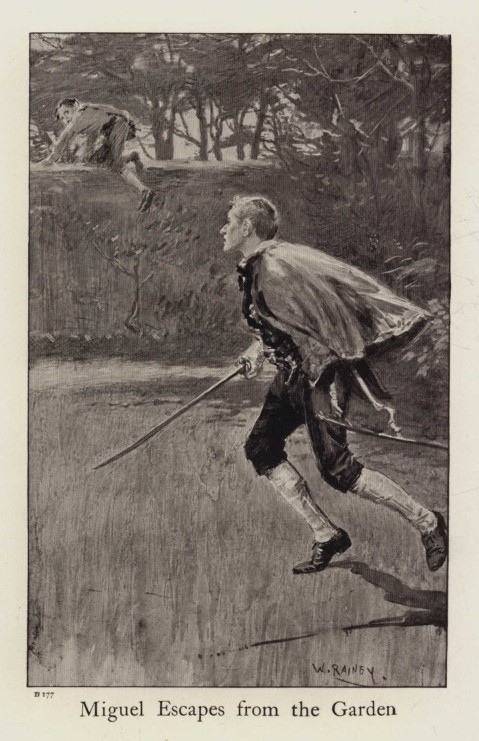
Miguel Escapes from the Garden
He tore open his shirt and bared his bosom to the sword. It was well acted, but Jack was not for a moment deceived. Miguel, he knew, had not the slightest expectation of being taken at his word. Yet the alternative! When once the guerrilleros had him in their power there would be no torture too horrible for the renegade and traitor. Jack remembered with a shudder the tales he had heard—even those told him by Miguel himself in Salamanca. Could he deliver the wretch, vile though he was, to so awful a fate? Could he allow the traitor to go free? It was a painful dilemma.
So they stood while a man might count ten.
There was a crackle in the undergrowth, the sound of a light footfall, and, lifting his sword, Jack half-turned. As he did so a heavy form struck against him. He felt a scorching pain between the shoulders, and pitching heavily forward sank unconscious to the ground. The dilemma had solved itself.
CHAPTER XXXI
Doctor Grampus and a French Cook
An Amateur—Pantomime—At Cross Purposes—Miguel's Pocket-book—Links—In Cipher—Potatoes—Monsieur Taberne on Duty—The Compelling Onion
When Jack came to himself it seemed to him that he was in a shaded room by an open window, for the air gently fanned his temples, and he saw a wide stretch of blue sky. He turned his aching head.
"Hullo!" said a voice in English.
"Hullo!" murmured Jack in reply, automatically, not knowing what he said. He looked with puzzlement at the speaker, a tall, stout young fellow in guerrilla costume.
"There, I wagered you wouldn't know me in this rig. Don't you remember Dugdale, at Salamanca—Percy Dugdale, don't you know?"
"The Grampus!" whispered Jack.
"The very same. I might have bet you'd know Grampus better than my good old respectable honoured ugly name. Here, drink this."
He held a cup to Jack's lips. After drinking, Jack closed his eyes and fell asleep.
"Where am I?" he asked, waking an hour later.
"Feel better? That's grand. Where are you? High up among the hills, in a sort of cave, lying on a pile of blankets, with a splendid outlook over—well, nowhere in particular."
"In the hills!" repeated Jack feebly. "How did I get there? I can't remember. Is anything wrong with me? I don't seem to be able to move. I don't feel right."
"There's gratitude! Why, you're as right as a trivet. You're really doing splendidly! Now, you're not to talk. Doctor's orders."
"Oh!"
Jack was silent for a moment, and dozed away again.
When he woke, Dugdale came towards him from the entrance of the cave.
"What's the matter with me? How do you come here? I can't remember anything."
"I said you were not to talk. Doctor's orders."
"Tell the doctor I want to see him."
Dugdale chuckled.
"Bet it'd be no go. Truth is, I'm the doctor. I've pulled you through, and when I get home I'm going to demand a diploma from the doctors' college or whatever it is gives a man a licence to be a sawbones."
"I must know all about it. I can't remember. How long have I been ill?"
"Nearly three weeks. Now, if you'll promise not to get excited, I'll tell you what happened. You know a man named Antonio?"
"Yes, of course; he helped me in Saragossa."
"Well, if he weren't a friend of yours I'd punch his head. He is the leader of this band of ruffians that scooped me up, two months ago, when I was riding over the hills to see the fun at Saragossa. Antonio wasn't with them then. I couldn't understand a word they said. They couldn't understand a word I said. I roared 'Inglese! Inglese!' till I was sick. No good. They kept me with them and made me get into this outrageous toggery, and with them I've been ever since, like a canary in a cage."
"But—"
"You mustn't talk. Doctor's orders. Lucky for you I was here, or they'd have sent you to kingdom come. With their nasty messes!—ugh!"
"Where did you get your medicines, then?"
"Silence! Don't believe in medicine. Bet Antonio three to one in Frenchmen—only he couldn't understand—that I'd pull you through on cold water; and I've done it,—thank God!"
The sudden change to earnestness in Dugdale's tone was almost comic.
"And you were pretty bad, I can tell you. Raved like one o'clock. All about Pomeroy and Pepito, and some chap whose name rhymed with ass, and Mig Prig—most about Mig Prig,—and you laughed and shouted 'Fire the mine!' and 'Pommy, I'll punch your head,' and all sorts of funny things."
"But what made me ill?"
"A villainous stab in the back. By gum! if I had the beast here I'd trounce him, I bet I would. You and Antonio had captured a foraging-party of French at a country-house down there; you tackled the officers single-handed; dashed plucky of you, begad! and you sprang out after a scoundrelly Spaniard who escaped, a fellow in French pay; and afterwards you were found among the olives with a hole in your back and your sword covered with blood."
"I remember now," cried Jack. "I must get up. I must save Juanita."
He tried to rise, but found that he had no power.
"Juanita be hanged, whoever he may be. Lie still, and don't talk. I haven't finished yet. Wish I'd been with you, but these confounded brigands won't let me stir from head-quarters. I've had the most disgusting luck. I came out to see the fun, and hanged if I've seen any at all. Well, they found you with a hole in your back and brought you here, and they were in a deuce of a way about you. They had a score or more of French prisoners with them, including officers, one of them a fat, red-faced fellow—"