BOYS OF THE LIGHT BRIGADE (continued 5)
Reading edition
CHAPTER XVII
In the Guadalquivir
In the Dumps—Messages—A Fellow Passenger—A Match—Marcamiento—The Despatch Disappears—A Quick Recovery—Pepito Expostulates—Perez Plunges—Returned with Thanks—Mr. Frere—An Opportunity—A Volunteer—Pepito's Present—Before the Gale
The sadness which overshadowed the whole army was partly alleviated by the bustle of embarkation. The battle had been won; the object of the great retreat had been achieved. There was nothing to be gained by postponing the return of the victorious but battered army to England. Delay would have enabled reinforcements to reach Soult, which might place him in a position to renew his attack with better hope of success; while the state of the British army was such that it was impossible to follow up their success by a pursuit of the French. Sir John Hope, therefore, upon whom the command had fallen through Moore's death, gave orders that the embarkation of the troops should be hastened, and within twenty-four hours the men were aboard the transports, ready to set sail for home.
Jack was resting in the afternoon with the officers of his company. Illness and fatigue had worn them all to shadows. Pomeroy was wounded, Smith was so haggard as to be hardly recognizable, while Shirley's spirits had forsaken him, and his chums were too much depressed even to object to the melancholy dirges which he quoted, on the homoeopathic principle, for his own solace. Jack alone retained something of his old cheerfulness, and he was doing his best to hearten his companions, before their turn came to embark, when a messenger entered, saying that Sir John Hope desired to see Mr. Lumsden at once. He hurried off, and returned half an hour later with even greater cheerfulness in his eyes and gait.
"What do you think, you fellows?" he cried. "I am not going to sail with you after all!"
"Thank heaven!" said Pomeroy, with his head bandaged.
Jack smiled at his old chum's petulance.
"I'm not so thankful, Pommy," he said. "But for one thing I'd much rather go home with you. As it is—"
"Well, what's your one thing?" said Smith, as he paused.
"I'll tell you some day. I don't want to leave Spain just now, that's all."
"What are you going to do, then?" asked Pomeroy.
"Hope is sending me with a despatch to Seville, to Mr. Frere, our minister there. I'm to put myself at his orders. The general thinks that people at home will be so mad at this retreat that they'll howl for leaving Spain to its fate; so it's very probable that I shall not be long behind you. And you'll be as fit as fiddles when I see you again."
"My own mother wouldn't know me now," said Smith. "You always have had all the luck. Ten chances to one you'll be promoted again, while we, what with our wretched condition and that awful Bay of Biscay, shall either be thrown to the fishes on the way home or drop into our graves as soon as we get there."
"'Call for the robin redbreast and the wren,'" quoted Shirley dolefully.
"Now, Shirley, cheer up!" said Jack. "Don't give all the fellows the blues."
"Faith, no," said the voice of Captain O'Hare, who had heard the last words as he entered. "I'm so weak myself I could hardly kill a fly, but I'm captain o' this company, and I won't have my men driven into the dumps. There's that Wilkes, now. I left him outside, smoking some unmentionable stuff with his mates, singing 'Down among the dead men', in a voice that would scare an undertaker. 'Faith,' says I, 'it's delighted ye ought to be, seeing ye're a sergeant before your time.' 'Sir,' says he, 'I'm only promoted cos poor Sergeant Jones is down among the dead men, and what I want to know is, whether it ain't my dooty to have the nat'ral feelings of a man and a brother.' But what's this I hear, Lumsden?—we leave you behind, eh?"
"Yes, though I hope you'll soon be out again. Surely our government won't throw up the sponge!"
"Bedad, not if they ask my advice. No Englishman, let alone an Irishman, ever turned his back for good on a Frenchman yet; and as the war secretary's an Irishman, why, I prophesy we'll be wid ye in six months, my boy."
"Oh! but I'll be home long before then. There's one thing I'd like to stay in Spain for, but I see little chance of doing anything in it till the war's over, and then it'll be too late, so no doubt Mr. Frere will send me home at once."
"Ah! And your one thing?"
"A precious secret," interposed Pomeroy. "Lumsden's a mystery-man ever since he picked up that brat Pepito, who's the owner of the evil eye if ever gipsy was. Some cock-and-bull story of a hidden treasure, or a beautiful heiress, or something of that kind, if the truth was known; but Jack's as mum as a mile-stone."
A bugle sounded outside the house.
"That's our call, my boys," said the captain. "Come now, out and get the men into order, and march 'em off with as much decency as their rags admit. God bless ye, my boy! please the powers we'll have you back in the mess yet."
"'Fare thee well, but not for ever!'" said Shirley, giving Jack a hearty grip.
"Good luck, old chap!" added Smith. "Give my love to the heiress Pepito finds for you, and if you should happen to come across the Grampus, take my advice—don't gamble."
Pomeroy shook hands silently.
"You'll give my love to the old people, Pommy?" said Jack. "I haven't had time to write to them since we left Salamanca. You can give them all the news."
Then they went among the men. Sergeant Wilkes looked astonished as he filed past and saw that Jack was not among his company, and Jack felt sure that he "wanted to know" more emphatically than ever, especially when, on turning suddenly, he found that Pepito was making farewell grimaces at all his friends in the regiment.
"Now, Pepito," said Jack sternly, "if you're to come with me, you must learn to behave yourself. Cut away and get my things ready; our ship leaves at nine to-night."
Jack's departure, however, had to be deferred until the following morning, the wind being unfavourable. Early on the 18th of January, then, he went on board a bergantin of some 300 tons, carrying his despatch for Mr. Frere in a waterproof bag, and followed by Pepito bearing the few articles he had been able to save out of his well-stocked kit of a few months before. Sir John Hope, when taking leave of him, had asked him to put in, if possible, at Vigo, and report to General Craufurd, if he were still there, the recent happenings at Corunna.
His errand fortunately fitted in with the instructions of the master of the brig. Jack had to spend the night at Vigo, where he learned that Craufurd had embarked his brigade some days before, and had already sailed for home. Next morning he was standing on deck, watching the last bales of a miscellaneous cargo as they were lowered into the hold, when, looking along the quay, he saw hurrying towards him two figures which he recognized with no little astonishment. The one was a tall Spaniard in military uniform; the other, still taller, was covered with a ragged brown cloak, and staggered along under the weight of a large valise. Perceiving Jack's eyes fixed on him, the foremost figure waved his hand with easy condescension, and smiled, and when he was still several yards away, began to speak:
"Ah, amigo mio, you look surprised! As for me, I am both surprised and delighted. I had not hoped for the pleasure of an old comrade's company on this voyage. We will talk over old times, Jackino, and help each other to face the perils of the sea."
"You anticipate a storm, then?" said Jack, with a meaning look.
"Not anticipate, my friend; but one must be prepared. And there is one peril that, storm or no storm, every traveller has to endure."
"That is?"
"Mareamiento, amigo mio! The motion of a ship produces an unpleasant perturbation of the internal organs, resulting in—"
Jack laughed.
"That's your peril! Well, it's one that everyone has to face for himself. If I were you, when you feel the perturbation beginning, I should lie on my back."
"But then I should have to turn over," said Miguel seriously. "However, you do not ask why I am prepared to endure this disagreeable accident of travel; you show no curiosity, my dear friend."
"About other people's business—no. But I see that your man appears none the worse for the punishment which, no doubt, the Marquis of La Romana awarded him for his outrage at Astorga—you remember?—the occasion when you were so much shocked at the man's heartless treachery."
"I remember well, dear friend. Perez was the victim of a sudden temptation, poor fellow. You see, he has only one eye. He is not all there. Oh, he was punished! He was made to take off his uniform—it had gold lace, you remember?—and to dress as a servant, and that, to a man of Perez' illustrious connections and personal pride, was a great, an overpowering humiliation. He felt the disgrace so keenly that he assured me he could not live unless I took him back into my service. What could I do? I could not be responsible for the miserable wretch's self-destruction. I did what every man of heart would have done, and— But we are moving, my friend; the ship is oscillating like a child's cradle; the wind catches the sails. Yes, the voyage has begun. I think I will—ah!—descend."
As Miguel, leaning on the arm of his follower, disappeared down the companion-way, Jack noticed a large rent in the man's cloak, into which another material, by no means a good match, had been clumsily darned. He started, and drew out of his pocket a jagged remnant of cloth, the sole memento of his narrow escape at Cacabellos. In general appearance it closely resembled the material worn by the Spaniard; but as both were brown, and Spanish cloaks were usually of this colour, it would not be easy, without close examination, to establish their identity.
"It may be merely a coincidence," thought Jack, "but it's queer, anyway. I have no doubt he owes me a grudge; I hit him rather hard. And Miguel, who doesn't love me either, would not be above reminding him of it."
With a careless resolve to be on his guard, Jack dismissed the matter for the moment. For two days he saw nothing more of Miguel. The wind was fresh, and while Jack revelled in the rapid progress, and felt himself braced by the keen salt air, Miguel, his man, and Pepito all passed through various stages of misery and despair. Pepito was the first to recover, and from him Jack learnt that Miguel had intended to attempt the journey southwards overland, but that, having accidentally caught sight of Jack in Vigo, he had made enquiries, and determined to risk the sea-passage in his company. This information Pepito had picked up from one of the seamen, who had been accosted and questioned by Perez before they left the harbour.
"Two villains, Señor!" said Pepito, as he concluded his story. "They do not love the Señor," he added, significantly fingering the small knife that protruded from his sash. The action, like the weapon itself, was two-edged. It was a warning to Jack and a menace to the two Spaniards, who had just crawled for the first time from below, and, unwashed and unshorn, presented anything but a formidable appearance. Nevertheless, whenever he moved, Jack felt that Perez was watching him. He never succeeded in catching him in the act; he felt rather than saw the glare of the man's forlorn eye.
Miguel volunteered the information that he was carrying despatches from La Romana to the Supreme Junta at Seville, and asked Jack what errand had brought him southwards. Jack, however, evaded the question, enquiring into the present circumstances of La Romana's rabble, and its prospects of escaping destruction. The Spaniard was evidently annoyed at Jack's want of communicativeness. He gave the shortest answers to his questions, and then, with a malicious gleam in his eyes, turned the conversation into another channel.
"And when my errand at Seville is accomplished," he said in his blandest tones, "I shall make my best speed to Saragossa, where I shall find my pearl, my rose, querida mia, the lovely Juanita. Pity, Jackino, I cannot invite you to my wedding. It would give you so much pleasure to see the two friends of your childhood united in the holy bonds of wedlock; and when—"
But Jack had moved away; he walked forward and watched the prow cutting its white furrow, thinking of the old days when Juanita and he had both detested Miguel Priego, and wondering how the girl could have been persuaded to plight her troth to such a man.
The skipper told him that he hoped to make the mouth of the Guadalquivir on the evening of the fourth day after leaving Vigo. He proposed to anchor there for the night, and sail up to Seville next day. Jack was so eager to reach his destination and deliver his despatch that he half-resolved to have himself put ashore at San Lucar, and finish the journey overland. With this intention, when one evening the lights of San Lucar were sighted, he went to his cabin for his despatch-bag, telling Pepito to carry his few belongings on deck. Lifting the bag, he was struck by the appearance of fine scratches on the hasp of the lock. He held it close to the flame of his lamp to examine it more thoroughly, and found in a moment that the lock had been forced and the despatch abstracted.
"Pepito," he said quickly to the boy, "do you know anything about this?"
"Nothing, Señor."
"The truth?"
"Fear makes lies, Señor; I know no fear."
"We shall not go ashore to-night. Have you seen anyone in my cabin?"
"No, Señor."
"Very well. Say nothing about this."
Jack sat down to reflect. Neither captain nor crew could have any interest in stealing a despatch. The bag had contained nothing else. Miguel and his man were the only other passengers beside himself and Pepito. What would it profit either of them to tamper with the bag? The possession of the despatch would be of real advantage to neither of them; its loss would be merely an annoyance to himself. Anyhow, the despatch was gone; it remained to be discovered whether it had been taken by Miguel or Perez.
Pepito had been watching Jack's face. He seemed to divine what his master was thinking, for he came up to him and said quickly:
"Señor, I know the Busne. The paper is gone, and I will find out where."
Jack looked back at him for a moment without speaking, then he nodded, and Pepito hastened away with the light footstep of a cat.
Two hours afterwards he returned, with a grin of glee upon his elfin face, and a paper in his right hand.
"Señor's paper," he said. Then, bringing his left hand from behind his back, he produced a second paper, saying:
"The Busno's paper too. Both were together in the Busno's bag, beneath the Busno's pillow."
Jack frowned. He looked at the address on the second paper; it ran: "The Marquis of La Romana to their excellencies the Supreme Junta at Seville."
"You must take this back, Pepito," he said.
"No, no," said the boy, his eyes gleaming. "The Busno and the one-eyed man are asleep; I should wake them if I took the paper back. The Busno took Señor's paper. Very well, I, Pepito, take the Busno's; and I will tear it in pieces, and throw it into the sea."
"No," replied Jack. "You are a clever boy, but you must learn to do things in my way, not your own. I will give back the paper myself."
Pepito shrugged, as though expressing his inability to understand an Englishman's mad way of doing things. An idea had come to Jack; he would not restore the despatch at present, but would wait until the morning. Placing them both inside his tunic, and buttoning it up, he lay down and settled himself to sleep.
Soon after daylight Jack heard angry, excited voices in Miguel's cabin. It was evident that the master had discovered his loss, and that the man was bearing the first brunt of his vexation. Gradually the voices dropped to a whisper, then there was silence, and Jack detected a soft footfall in the passage. The catch of the little cabin-door was slowly raised; Jack coughed gently, the catch dropped noiselessly, and the visitor disappeared without a sound.
At breakfast Miguel, evidently preoccupied and ill at ease, made no reference to the subject. As Jack had anticipated, he was not sure enough of his ground to report his loss to the captain. But his look became more and more anxious, even agitated, as the vessel worked its way in long reaches up the river. Perez, lounging against the bulwarks, was keenly watching Pepito, in whose somewhat provocative bearing he seemed to find cause for suspicion. The gipsy was even more monkey-like than usual, swarming up and down the yards, flitting around and above his scowling enemy with a disconcerting assumption that Perez was non-existent.
Suddenly, while Jack was watching the play of sunlight on the mountain ranges in the east, he heard a cry, followed instantly by a splash on the port side. He sprang across the deck, noticing as he did so the half-recumbent form of Perez lolling unconcernedly at the spot he had occupied for the past hour. There was nothing to be seen in the sluggish river below, and for a moment Jack was inclined to think that his ears had deceived him; but even as the thought passed through his mind he caught sight of a small dark object rising above the surface some yards in the wake of the vessel. With a loud cry "Man overboard!" he threw off his cloak, sprang on the bulwark, and dived into the river. The water was icy cold, but fortunately in these lower reaches the current ran slowly, and when he came to the surface, with the rapidity of a practised swimmer, he saw the small black head much nearer than he had expected. In another second the reason was clear; the owner of the head was swimming towards him with slow leisurely strokes, and Jack began to regret his precipitancy.
"The Señor will get wet," cried Pepito as he approached. His tone was that of aggrieved expostulation. "He will spoil his fine clothes. Ay de mí! Why will the Señor be so rash? And he has only one uniform. Now he will have to travel as a Busno. Ay de mí!"
Jack had now turned, and was swimming hard against the current. He heard Pepito remonstrating in his wake, but although he treasured the remembrance afterwards, he was in no mood at the time to be amused with his follower's untimely zeal. His heavy boots and water-logged clothes, to say nothing of the numbing cold of the water, made swimming anything but an agreeable exercise, and he was heartily glad when he clambered into a boat that had been promptly lowered from the ship. Pepito followed him a few seconds later, looking not unlike a water rat as he emerged dripping from the river, in which he seemed perfectly at home. In the boat the boy showed him, with an expressive grin, a piece of rope about five feet long. He had dragged it with him out of the river. "What are you doing with that?" enquired Jack sharply.
"It belongs to the ship," was the reply. "Pepito is not a thief; he must give it back."
"How came you to fall in?"
"I was swinging on the rope."
"And it got untied?"
"No; it was cut."
Jack started and looked closely at the end of the rope, which Pepito handed to him with a chuckle of enjoyment. It had evidently been severed with a knife.
"Perez?" enquired Jack.
"Yes, Señor," said Pepito.
They had by this time come under the ship's quarter, and a rope-ladder was let down for their benefit.
"Stay where you are for a moment," said Jack to the bos'un; "I am sending another passenger."
As he clambered over the bulwarks Miguel met him with assumed solicitude.
"You English are such sea-dogs, there is no keeping you out of the water. I trust, my friend, you will not suffer a chill. At this time of the year—"
He was warming to his theme when Jack stepped quietly through the little knot of seamen gathered on the deck, and went straight towards Perez, who was still lolling against the bulwarks, with a gleam of malicious enjoyment in his solitary eye. Before the man was aware of what was coming, Jack had seized him by the waistband, and, using the bulwark as a fulcrum, had tilted him over into the river.
Then Jack went below and changed his dripping garments for the Spanish dress which he carried with him in case of emergency. He noticed as he did so that in his absence his effects had been thoroughly ransacked.
When he came on deck he found that Perez, by no means a favourite with the sailors, had been hauled out with extreme deliberation, after swallowing some quarts of the turbid waters of the Guadalquivir. He glared at Jack with concentrated malignity, but was physically incapable of reprisal, even if his morale had not been impaired by the knowledge that he had only got his deserts.
The captain listened gravely to Jack's explanation, and examined the severed rope with a judicial air. Jack did not consider it necessary to make any reference to the incident of the despatches.
"I suppose," said the captain, "that the Señor will wish to lodge an information? A friend of mine is well acquainted with a man of law in the Calle del Amor de Dios, a very able man—he has one case of assault that has lasted thirteen years."
"Thank you!" said Jack with a smile; "but as I only propose to stay in Seville for a few days, I fear I shall have to forgo your friend's friend's assistance."
The captain looked disappointed.
At length the vessel passed the Torre del Oro, a crenelated octagonal tower near the landing-stage. The brig was moored, Miguel and his man, who had been below since the incident, came on deck at the last moment, and ostentatiously ignoring Jack's presence, stepped across the gangway on to the quay. As Miguel passed him, however, Jack quietly touched him on the shoulder.
"Allow me, Don Miguel," he said, "to hand you this packet. It was found—you can perhaps guess where—with some property of mine. I have no occasion for the one; you will perhaps permit me to retain the other?"
A dull flush mounted to Miguel's cheeks. He took the despatch without a word, gave Jack a glance in which humiliation, chagrin, and undisguised hatred were strangely mingled, and prepared to move off.
"A word," continued Jack, "before we part. Your Polyphemus is doubtless a very devoted servant, but if we meet again, and I find him still at your elbow, you will pardon me if I betray a little suspicion."
Jack turned abruptly away, leaving Miguel for once at a loss for an adequate answer. By the time he had recovered himself, Jack, followed by Pepito, was half-way across the quay.
Jack had never been in Seville before. He was struck by the forest of masts from ships lining the river bank, by the whitewashed houses built in Moorish fashion, with barricaded windows, and the narrow, busy, cobbled streets. It was a fine clear day, and for almost the first time since he landed, four months before, at Mondego Bay, he felt the dry warmth of a southern climate. He found his way with Pepito along the river bank, past the bull ring, to a comfortable inn in the Plaza Nueva, and having there made himself as presentable as his worn and faded garments allowed, he set off for the Alcazar, where he had learnt that the British minister was then in conference with the Junta.
He had some curiosity to meet Mr. Hookham Frere. It had been common talk in the army that Sir John Moore had received a number of almost insolent epistles from the minister, who had gone quite beyond his province in dictating the course of action which he thought the commander-in-chief should follow. Mr. Frere, indeed, was not cut out for the delicate work of an ambassador, and he was perhaps as little surprised as anybody when, two months later, he was recalled by the dissatisfied Government at home. He was no doubt worried by the mingled vacillation, braggadocio, and incompetence of the Spanish authorities with whom he had to deal, and in truth their behaviour was such as would have tried the temper of a more patient and self-assured man than Mr. Frere.
He received Jack in a private room, and read the despatch in silence, save when the news of Sir John Moore's death provoked an exclamation. He folded the paper and laid it down on the table before him.
"Poor fellow!" he said. "He always said he hoped to die after a great victory. You knew him, sir?"
"Yes, sir," said Jack. "I had the honour to serve under him through the campaign, and he was very kind to me."
"Ah! I am afraid our relations were a little clouded of late. I acted for the best. I did some things I now regret; they were due partly to my lack of trustworthy information. And now, though we have won a victory, we have had to leave the country. The army might perhaps have sailed to Lisbon instead of returning home."
"I beg pardon, sir, but if you saw the horrible state of our men you would be the last to say that. They're worn out with illness and hard work, eaten with vermin, and have nothing but rags to cover themselves with. I came off better than most, and you see what a condition my uniform is in."
"Terrible!—I had hoped so much from this expedition. The Spaniards have indeed been given a breathing-space, but they will make little of it. And they are so untrustworthy, so untrustworthy, Mr. Lumsden. At this time, of course, it is of the utmost importance that the real state of things should be known to all the Spanish generals in all parts of the country; but I cannot depend on the Junta here telling the truth. There is General Palafox, for instance, in Saragossa, a young man for whose talents I have the highest admiration; he is, as you may perhaps know, besieged by the French, and the Junta has encouraged him with the news that great battles are being won for Spain, and that armies will shortly march to his relief. All humbug, humbug! Buoyed up by false hopes, he will resist to the bitter end, and the poor people of Saragossa may endure all the nameless horrors of a protracted siege only to find themselves disappointed and deceived. And then they will blame us, accuse us of deserting them in their extremity. It would be difficult now for any messenger to reach him; but in any case I cannot depend on the Junta's telling him the truth. I am weary of it all."
Jack had listened to this speech with growing eagerness. It suggested a means by which he might fulfil what had been his dearest wish ever since he met Miguel in Salamanca—to see Juanita Alvarez, and learn for himself that she had really of her own free-will consented to trust her life and happiness to Miguel Priego. Until now it had seemed idle to hope for such an opportunity, but why should he not offer his services to Mr. Frere and volunteer to convey to Palafox a true account of the progress of events elsewhere? And Palafox!—he had a private reason for seeing him. "Palafox the man, Palafox the name!"—the phrase in Don Fernan's letter had never left his memory. At odd moments, when free from his duties, he had found himself conning the words over and over again; and lately he had begun to wonder whether the mysterious message were not connected in some way with Juanita—whether there were not some strange link binding Palafox and Juanita and himself together. His regiment had gone home; he was now under the orders of the British minister; he had been in dangerous places and circumstances of peril before; why not combine the public service with his private ends, and start for Saragossa? His mind was made up.
"Let me convey a message to General Palafox," he said.
"You! It is preposterous. You would go to your death. How could you, an Englishman, and an English officer, hope to penetrate the French lines? You would be caught and shot."
And then Jack gave the minister a brief account of himself, his early years in Spain, his recent work for Sir John Moore done in the guise of a Spaniard.
"And so you see, sir," he concluded, "you could hardly find anyone, not actually a Spaniard, with better chances of success than I have. I have been in Saragossa before, and I have some command of Spanish—and I am not afraid, sir."
Mr. Frere was evidently taken with the suggestion. He had listened with growing interest to Jack's modest story, and smiled at his account of his conversation with the boastful commissary and his subsequent adventure with the Spanish stablemen.
"And this gipsy boy of yours—would you propose to take him with you?"
"Yes, sir; my chums regard him as my familiar spirit, and I myself have begun to cherish a sort of belief that I sha'n't come to much harm if he is near at hand."
"Well, Mr. Lumsden, I am much interested in your story; I think, if I may say so, that you have shown great capacity and resourcefulness, and fully justified poor Sir John's confidence, and I confess, after seeing and hearing you, that I have every hope of your succeeding in this, perhaps the most difficult, certainly the most hazardous, of all your enterprises. And now, as that is settled, we must lose no time. When will you be ready to start?"
"When the first ship sails, sir."
"You will go by ship, then?"
"It will perhaps be quicker, and safer on the whole."
"What about French frigates?"
"I must take my chance of them. Luckily I kept the Spanish dress given me by Don Pedro de Gracioso; Pepito has it in my bundle. I shall, of course, go as a Spaniard."
"I wish I had your youthful confidence!" Mr. Frere sighed. "Very well; find out when the boat sails northward, and I will have my despatch for General Palafox ready at any time."
"You will answer for me to the military authorities, sir?"
"Certainly. You may assume that you have six months' leave; and for my part, I do not suppose that your regiment will require your services any more in Spain."
At the conclusion of the interview Jack stepped into the street with a light-heartedness he had not known for many a day. The winter, with all its fatigues and disappointments, was passing away; he felt a strange assurance that with the coming spring the tide of his affairs would turn towards achievement and happiness; and he returned to his inn with a buoyancy and eagerness in his gait that caused many a head to turn and many a face to smile.
With Pepito he hastened at once to the quay by the Torre del Oro, only to learn that no vessel would sail for the northern ports for some days. "We can't wait for that," he said to himself, and immediately sought out the owner of a large fishing-smack he saw in the offing. After some bargaining he arranged to hire the craft with its crew, to sail, wind and weather being favourable, next morning.
On the way back to their inn he set a seal to the hold he had unwittingly obtained on the gipsy's affections. Coming to a clockmaker's, he stopped, looked in at the window, then entered, and soon returned carrying a huge silver watch, which he handed with its chain to Pepito.
"There, youngster," he said, "that's a little reward for the services you have done me. Take care you don't lose it."
The boy beamed his delight, and pranced along the street in unfeigned ecstasy.
The sun shone brightly next morning, and the wind blew fresh. Accompanied by Pepito, Jack, in his Spanish dress, went down to the quay, where, however, he found that the master of the smack was not disposed to sail. He foretold a strong gale from the south-west, and wished to postpone his departure till the next day; but Jack was so eager to arrive at Saragossa that he would brook no delay. After an hour's arguing and coaxing, and the promise of double pay, he induced the mariner to attempt the voyage, and at nine o'clock the smack cast off and sailed slowly down the river. The wind increased in force as she approached the mouth. On reaching the open sea she encountered the full force of the blast, and, swinging round, scudded before the wind at a speed that promised a fast passage.
CHAPTER XVIII
A Squire of Dames
In the Casa Ximenez—Cut Off—Ways and Means—A Race with Time—The Bridge Perilous—Into the Abyss—A Deserted House—Through the Streets—Adios—Señor
Near the convent of San Agustin, at the south-eastern end of Saragossa, there stood, in the year 1809, an old, large, gloomy house known as the Casa Ximenez. It was not in the best part of the city, but it had an air of high respectability, and in truth had been for many years the town residence of a prosperous burgher family, whose name stood for all that was solid and dignified in civic and commercial life.
On February 1st in the aforesaid year the spacious rooms of the mansion were empty—all but one. In the gilded sala on the first floor, a chamber large enough to contain fifty or sixty persons as well as its massive antique furniture, sat two ladies, one old, the other in the heyday of youth. Though it was early morning, the room would have been in pitch darkness but for two candles which, set in the cups of a silver candelabra on the table, threw a glimmering illumination upon the panelled walls. The sulphurous fumes of gunpowder hung heavily in the air. The deep, square windows were shuttered on the outside; there was no crack or aperture through which the light of day could enter save a hole in one of the shutters, and that at this moment was blocked by a long Spanish musket, behind which stood a middle-aged man in the sober costume of an upper servant.
Within the house all was silent, but from without, penetrating the thick walls and the iron-clamped shutters, came dull, heavy, thunderous sounds that shook the air, set the candle flames quivering, and caused the elder of the two ladies to start and shudder and moan as if in pain. At intervals the man at the window withdrew the musket, letting in for a few moments a streak of daylight that lay white across the yellow glimmer from the candles. With silent deliberation he charged his weapon, passed it through the aperture with a downward slant, and pulled the trigger, going through the same series of movements time after time with clock-work regularity.
The old lady watched him as if fascinated. She was small and thin; the hair beneath her elaborate cap was white. With the long bony fingers of one hand she clasped her mantilla closely about her shrunken frame; the other was held in the strong, warm hands of the younger lady, who sat on the floor by the elder's chair and spoke to her alternately in soothing and in urgent tones.
"You really must come, Auntie," she was saying. "It is not safe here. Hark! there is another gun! They will break in before long, and then—oh! come, come now; you can walk if you only try."
The old lady, still with her eyes fixed on the servant, shook her head and clutched her mantilla convulsively.
"Does he kill—every time?" she said in a thin quavering voice.
"How can we tell? And if he does kill, it only makes our position worse, for they will find out where the shots come from, and they will burst in, and you—we—oh! Auntie, it is our only chance. See, I will support you; if you lean on my arm you will walk quite well, and I will never leave you. Come!"
"I will not go," said her companion. "I will not, will not. The French may kill me, I have not long to live; but you, Juanita, you can escape. Francisco will shoot and kill until the very end; he and I will remain in the old house, in the old house—"
"They are coming nearer, Señorita," said Francisco, his respectful tone as quiet and unperturbed as though he were announcing a visitor.
"You hear that? You must come, Auntie. I will not leave you here!"
Springing suddenly to her feet, she stooped, threw her arms around her aunt's body, and lifted her from her chair.
"Francisco," she said, turning to the servant, "go on firing. If I do not return, come after me in ten minutes."
Then, straightening her back, she went to the open door, bearing easily the wasted form of her aunt, who did not resist, but moaned and muttered in helpless impotence. Out into the corridor, down the broad staircase, the strong girl carried the feeble woman. She reached the patio; then, instead of turning towards the great iron-studded gate at the front of the house, she made her way to the smaller but still strong gate at the back. In the open patio the sounds of musket shots were tenfold louder than they had been in the house above; they were mingled with the shouts of men afar off, the sudden shocks of explosions, and the crackle of flames. A pungent smell of smoke filled the air. The girl hastened her steps towards the rear of the house, where the noises came less distinctly to the ear. Arriving at the gate, she set her burden down gently upon a bench, quickly drew the bolts, and, promising to return in a few moments, slipped out, closing the gate behind her.
She found herself in a narrow irregular street. On the other side was a row of smaller houses, the upper stories of which projected over the roadway. At each end the street opened to wider thoroughfares, and the Casa Ximenez was nearer the northern extremity. Juanita gave a quick glance each way. The house at the end of the street on her left was in flames. Nobody was to be seen, but she heard fierce shouts, apparently in all directions, growing ever louder. She paused but for an instant, then ran across the street to a door opposite and hammered with her fists upon the wood. She waited; there was no answer, no sound of movement within. She knocked again with greater force, bruising her knuckles until they bled. Still no response. She stepped back a pace and looked up at the windows; all were shuttered. She struck the door with repeated blows, and cried to any who might be within to open it. A shout to her left caused her to start and look round with apprehension in her eyes. A French soldier, armed with a pike, had just turned the corner, and behind him were others, some armed with muskets. At sight of them the girl turned to run back to the gate of the Casa Ximenez. Glancing in the other direction, she saw a figure hastening from the nearer end of the street—a figure in the long cloak and low hat of a Spaniard. He caught sight of the French and stopped short.
"Señor," she cried, "help us for the love of God! My poor aunt!"
"What is it, Señorita?" he said, running towards her. "What can I do for you?"
She pushed open the gate and sprang through the narrow entrance. The stranger followed her, slammed the gate behind him, and shot the two stout bolts into their sockets.
"My aunt," said the girl, "is an invalid; I was trying to save her. The French are at the front; what are we to do?"
She spoke with decision, in rapid tones that conveyed no impression of fear, but rather of courage and determination. The young Señor looked at the huddled, helpless figure of the old lady on the bench.
"Señora," he said quickly to her, "we leave you for a little. Take me into the house, Señorita."
As she led the way the youth threw quick glances to right and left, taking his bearings.
"Is anyone in the house?" he asked.
"Francisco; all the other servants have fled."
"Where is he?"
"In the sala."
"Take me to him."
Afterwards he remembered the peremptoriness of his speech; at the moment neither noticed it.
Entering the room, he saw the servant loading and firing as imperturbably as before his mistress departed.
"That's right; go on firing," said the stranger. "Now upstairs, Señorita."
She led him to the top of the house. The windows at the back overlooked the tiled roofs of the lower houses opposite, slightly above the level of the parapet. The street below was filling with French soldiers, who were battering and firing at the doors, without for the moment doing much damage. From the barricaded and loopholed windows on the other side shots flashed at intervals; the houses were evidently defended in some force, and the throng below were taken aback by the deadly cross-fires from above. The stranger measured with his eye the distance across the street from house to house.
"Have you any boards, tables, anything, about fifteen feet long?" he asked.
"I do not know. Francisco will know."
They ran downstairs.
"Can you bring the Señora up?" asked the youth.
"Yes, I carried her down."
"Please do."
Juanita hastened to the patio below; Jack went into the sala.
"Stop firing now, hombre," he said to the servant. "There is one chance of escape, from window to roof. Are there any planks?"
Francisco put down his musket, and glanced keenly at the speaker, with a touch of surprise at his urgent manner.
"None, Señor, but the boards of the floor."
"No time to tear those up."
He glanced round the room. He saw that the heavy curtains were enclosed at the top within an ornamental wooden framework, square-cut, massive, and ugly.
"Steps? A ladder?" he said.
"In the press at the head of the stairs, Señor."
"Quick! bring them here; and a hammer."
In a few moments Jack was standing on a short ladder, hammering the planks of the framework apart. Extending over both windows and the wall between, they were about sixteen feet in length. A few hard blows wrenched the fastenings, and two planks an inch thick lay on the floor. Side by side they measured three feet across.
"Now, ropes, cords!" cried Jack.
A long, stout bell-pull hanging from the ceiling caught his eye. Tearing it down, by the time Francisco returned with a length of rope Jack had lashed the planks together at one end. Soon the other ends were bound as firmly together.
"Help me upstairs with it."
They reached the topmost room, whither the girl had already carried her feeble, whimpering aunt. The extemporized bridge was long enough to rest on the ledge of the opposite parapet, with a foot each way to spare. But it could not be thrown across without a support at the other end; its weight would more than counterbalance any pressure that could be exerted on the end in the room.
"Another rope!" cried Jack.
He had noticed a strong staple in the attic roof above the window. Francisco came back in two minutes with a long rope. Jack lashed it round the end of the planks, sprang on the window-sill, and pulled the rope through the staple.
"Now let it out steadily as I push the bridge across."
Juanita stood with shining eyes, watching the young stranger as he pushed the planks across the street, while Francisco stolidly paid out the rope. The bridge rested on the parapet.
"Hold this end firmly against the sill," said Jack to Francisco.
Juanita held her breath as the young fellow mounted a chair, stepped out of the window, and walked cautiously to the middle of the bending bridge. In a moment he was back again in the room.
"It will bear," he cried. "I go first with the Señora."
He lifted the old lady carefully; she was too much dazed to have any consciousness of what was before her, and lay inert in Jack's arms, moaning "Ay de mí! Ay de mí!" incessantly.
"Wait till I return," he said to Juanita, who stood, her cheeks flushed with excitement and hope, within the room.
Step by step he slowly bore the old lady across the creaking, swaying planks, till he reached the other side; then he laid her gently down behind the parapet at the foot of the gable. Then he sped back.
"Now it is your turn, Señorita," he said, preparing to lift the girl.
"I can go alone," she said without hesitation. "I can," she repeated resolutely as Jack sought to detain her.
Springing lightly on to the planks, she paused for an instant, caught her skirt in one hand, bit her lips, and then ran across as lightly as a hare, Jack watching her with a tense feeling of anxiety mingled with admiration. He gave a gasp of relief.
"Now, hombre," he said, turning to the old servant, who had held the planks steady without uttering a word.
"Not so, Señor," he said; "I go last."
"Nonsense! I am responsible for this. Get on at once."
There were loud shouts from below.
"I am old, Señor. The Frenchmen in the street have seen us now; they will shoot; it matters little if I die."
"No more. You must go. The ladies require you."
From the parapet opposite Juanita was looking at them. Her cheeks were very pale.
"Come, Francisco," she said in a tone of authority that brooked no denial.
The man hesitated no longer. He mounted the bridge, and walked with slow, firm step towards his mistress. An upward shower of shots pelted all around him. One struck him in the leg; he stumbled, nearly wrenching the planks from Jack's grasp, and Juanita uttered a cry as the poor man fell headlong into the street.
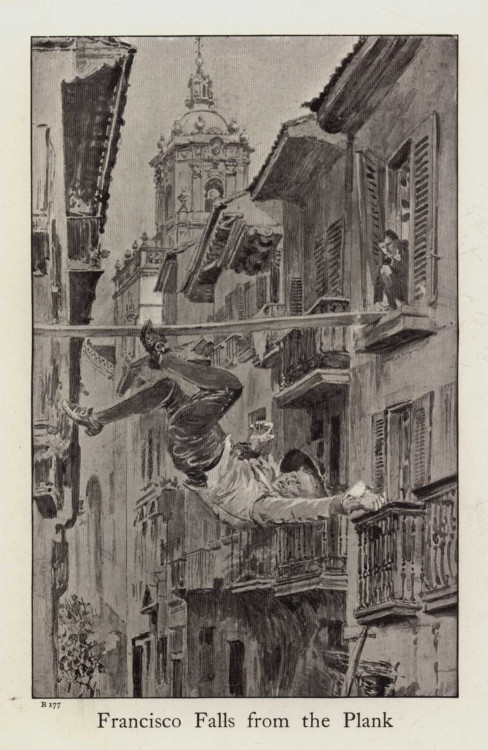
Francisco Falls from the Plank
Jack saw that there was no time to be lost. A few dexterous shots from below might destroy the bridge. He must run the gauntlet. He mounted at his end. At the same moment Juanita, with great presence of mind, seized the other end, and held it firmly against the parapet. Three bounds, amid flying shots, and Jack reached the parapet in safety. Then, catching up the planks, he hurled them down upon the crowd.
"You are not hurt, Señorita?" he said.
"Poor Francisco!" was her reply. There was a tremor in her voice, not from fear, as her next words showed. "I am ready, Señor; tell me what we are to do now."
There was a trap-door a yard away, opening inwards. Jack tried this with his foot; it was bolted, but the bolt rattled, and could evidently be forced with little exertion. Without hesitating he sprang heavily on to the wood; it gave and fell in with a crash. Jack's body had almost disappeared into the opening, when as he fell he caught the ledge with both hands, and though the sudden stoppage gave his muscles a severe wrench, he managed to maintain his grip, and hung on with legs dangling.
"Señorita," he said, "come and look down and tell me what the drop is. I cannot see, myself."
Juanita went down on hands and knees, and peered into the darkness. For a moment her eyes could discern nothing; then, as they became accustomed to the obscurity, she said that the trap-door opened into an attic room, and that the floor was not far below. Jack instantly let go, and dropped. The distance was but ten feet. Regaining an erect posture, he found, after a little groping, a short ladder in a corner of the attic. He placed this in the opening, and went up into the light again. It was the work of only a few minutes to carry the old lady down the ladder. Juanita followed, and instantly busied herself with her half-fainting aunt.
"Wait here, Señorita," said Jack, "while I go down into the house and see if the way is open for escape."
The attic door was not locked. Jack went out, down the stairs, through the house from top to bottom, and found every room empty, every window barricaded, and the outer doors locked. Unlike the occupants of the other houses on this side of the street, the inhabitants of this had clearly not stayed to defend it. The front door was bolted on the inside; at the door of a yard at the back the bolts were drawn, showing that escape had been made that way. Jack pulled at the door; the lock held firmly; it was impossible to force it; the only means of exit was over the wall. Hastening upstairs again, he explained the position to Juanita, who looked at him with the same quiet self-possession.
"Do you know any house in the centre of the city, Señorita," asked Jack, "where you can take refuge? Your own house is now, without doubt, in the hands of the French."
"Yes, Señor, we have friends in the Calle del Coso with whom we can stay."
"Then, if you will allow me I will escort you thither. I do not know the town very well, but I know the Calle del Coso."
"Yes, we will go. But how can we take my aunt, Señor?" asked the girl. "Helpless as she was half an hour ago, she is prostrate now. You could not carry her all the way."
"I think I know of a plan. The first thing is to take her downstairs, and I am strong enough for that."
In a few minutes all three were at the yard door. Jack returned to the attic for the ladder, and having placed that against the wall, he carefully carried the old lady to the top, where he sat with her until Juanita had also mounted, drawn up the ladder, and let it down on the other side. They were now in a narrow lane, in which nobody was to be seen, though they knew by the shouts and the gunshots that fighting was going on at no great distance. Leaving the old lady in Juanita's charge, Jack went back into the house, and soon returned with a large chair and two short props he had found in the patio. Placing the old lady in the chair, he passed the props through the legs on each side.
"If you will hold them at the back, Señorita," he said, "I will take them in front, and then we shall be able to carry the Señora between us."
Thus burdened, they walked slowly down the lane, turned to the right, and found themselves in a street filled with soldiers and citizens, among whom were many women and priests. Almost all, even the priests, were armed, and many were hastening in the direction of the Augustine convent, where the French, after a desperate struggle, had just succeeded in forcing an entrance to the town. Barricades had been erected at various parts of the street. No one showed any surprise at the sight of an old lady carried on a chair. Strange incidents of the siege were happening every day. Every hour some new family was obliged to quit its dwelling and seek safety in flight. Unnoticed and unmolested, Jack and his companions in a few minutes reached the house in the Calle del Coso to which Juanita had referred. They were admitted immediately to the patio. There Juanita found her friends eating a meal the frugality of which spoke only too plainly of the straits to which the city was now reduced. The exhausted condition of the old lady demanded instant attention, and while the group of friends gathered about her solicitously, Jack took a hurried farewell of her niece.
"Now that you are in safety, Señorita, I can leave you and go to fulfil an errand I have. I trust the Señora will soon recover from her weakness and terror, and that you will not suffer from the strain of this frightful morning."
"Señor, you have the heart-felt thanks of my aunt and myself. But for your timely help—I dare not think of it. And poor Francisco! To think of him dead, killed by those horrible French! ... We can never thank you enough."
Jack was conscious of some constraint in the young lady's manner, which he ascribed to the reaction from her excitement and the peril recently gone through.
"I am only too glad that I happened to be passing at that moment, Señorita," he said. "And now, farewell!"
He bowed. The young lady looked at him with a curiously scrutinizing expression in her eyes; then, returning his bow with somewhat more formality, Jack thought, than the occasion required, she said:
"Adios—Señor!"
CHAPTER XIX
Palafox the Man
Night on the Ebro—Across the Boom—Heroines of the Siege—The Captain-General—An Interview—A Missing Letter—War to the Knife—An Interruption—Santiago Sass—First Impressions
So exciting an incident immediately on his entrance into Saragossa had engrossed Jack's attention so thoroughly as to drive from his mind the matter which, until he turned the corner of the Casa Ximenez, had been giving him much concern. Where was Pepito? That mischievous but useful elf had been the life and soul of the sailors during their rapid voyage from Seville to the mouth of the Ebro. When they disembarked at Tortosa he had managed with great cleverness the hiring of horses on which to continue the journey overland, and had ridden with Jack across country until they reached the village of Mediana, some fifteen miles from Saragossa. There Jack learnt that Saragossa was closely invested on all sides by the French, and in particular that the Monte Torrero, an eminence on the south-west of the city, was in the hands of the enemy, who had made it the base of most vigorous and sustained operations.
It was clearly impossible to penetrate the French lines and enter the city on foot or horseback; the only other means was the river. Jack made anxious enquiry as to the chances of finding the waterway open. He learnt that in the early days of the siege several boats had eluded the vigilance of the French and come down the river, and that, only a fortnight before, Francisco Palafox, the brother of the captain-general in command, had escaped under cover of night and was now at large, endeavouring to raise a relief force. But the peasants of Mediana knew of no case of a boat going up-stream and passing the French batteries since Colonel Doyle had sent a number of new muskets into the city the day before the strict investment began. Further, in addition to a bridge of boats near the confluence of the tributary Huerba with the main stream, a boom had been thrown across the river a few hundred yards below this point, and it seemed most unlikely that now, in the seventh week of the siege, the French sentries would have so far relaxed their watchfulness as to allow the boom to be crossed or broken.
This was bad news, and Jack, for the moment, felt baffled. He discovered, however, that at this time of year Saragossa and the neighbouring district were covered at early morning with a thick mist from the river and the low-lying banks, and he felt that if he could take advantage of this fact he might slip into the city despite all the enemy's vigilance. At any rate he determined to make the attempt. A bargain was soon struck at a riverside village for the loan of a boat. The oars were carefully muffled, and after dark, on the night of January 31st, Jack started with high hope on the last stage of his long journey.
All went well. It was a pitch-dark night, and the strain of rowing a heavy craft against the stream necessitated frequent pulls-in to the bank for rest. But steady progress was made mile by mile, until, about five o'clock in the morning, sounds ahead indicated that the boat was drawing very near to the French encampments.
Every stroke of the oars was now made with infinite precaution, and the boat crawled along at a snail's pace. Pepito, in the bow, leant over to watch for the boom which blocked the waterway, and many times dipped his hands into the icy-cold water so that touch might not fail where sight was impossible. The air was raw and chilly, and Jack was delighted to learn, from his sensations in throat and eyes, that the mist of which his informant had spoken was an actuality.
It was drawing towards dawn. The darkness was yielding to a faint luminance that was not yet light, when suddenly, a few moments after Pepito had withdrawn his numbed hand from the water, the boat was pulled up with a jolt, and a harsh prolonged creak testified that its nose had come at last into contact with the boom—a heavy chain drawn across the river from bank to bank. Instantly there was a cry from the bank on their right: "Qui va la?" At that same moment, without the least hesitation, Pepito slipped noiselessly over the side of the boat into the water, caught the chain with one hand, and endeavoured to pull it down, whispering to his master to row over. But his puny strength was, of course, unavailing, and he crept back shivering into the bows. Jack, however, had at once divined the only possible solution of the problem. So heavy a chain must undoubtedly sag towards the middle of the stream. Was the middle to his right hand or his left? He pulled the boat sideways against the obstruction, and told Pepito to slip overboard and walk along the chain while he himself gently paddled. At a guess he moved to the right, and was soon gratified by Pepito's whispered announcement that the chain seemed to be sinking. When the water reached the boy's middle, Jack gently brought the boat's head to the stream, and with two vigorous strokes drove the unwieldy vessel across the boom. The boat's bottom scraped the massive links as it crossed; Pepito clambered in rather too hastily and slipped; the sounds caught the ears of the sentry on the bank, and another cry of "Qui va la?" penetrated the mist, followed by a shot. More voices were heard; more shots; and then from a point behind came the sound of a boat being run down the bank. Jack now plied his oars with might and main; cries, followed by shots, rang out from the other bank, and then, ahead and approaching him, he heard the straining of oars against rowlocks. There was no time for hesitation. Pulling hard on the left oar he headed for the bank, taking his chance, and in a few seconds grounded with a shock. In an instant he was out of the boat, and, followed closely by Pepito, started at a quick walk through the clinging fog in what he guessed must be the direction of the city.
They had not walked fifty yards when a terrific explosion rent the air, deafening their ears and almost knocking them backward. Immediately afterwards the thunder of heavy artillery broke out to their right, and the mist beyond them was fitfully illuminated by lurid flashes. Brought to a momentary stop, Jack again went forward, with eyes and ears painfully strained, every fantastic eddy of the mist presenting itself as a possible enemy. Suddenly he looked round to see that Pepito was with him. The boy was gone! Retracing his steps, he peered through the gloom, calling the gipsy's name softly. There was no answer, no sign of him. Five minutes were spent in fruitless search; then, within a few yards of him, Jack heard the tramp of men marching rapidly in file. With a mixed feeling of annoyance and anxiety he turned and made off in the opposite direction, crossed the district known as the Tanneries, and after wandering about for nearly an hour, dodging footsteps, and seeing with concern the mist clearing, arrived at the turning of the Casa Ximenez just in time to assist the young lady then so urgently needing assistance.
Still anxious about the safety of the gipsy boy, Jack felt, after leaving the house in the Coso, that he could do nothing at the moment, and his first duty was to present his despatch to General Palafox. The sounds of combat hurtled in the air; behind him clouds of smoke and flame bore witness to the success of the French bombardment. The street was full of men, women, citizens, soldiers, priests, hastening from point to point, all armed, all with fury and grim determination printed on their worn features. Stopping a boy who was hauling along a barrow filled with powder, Jack asked him where General Palafox could be found.
"In the Palace of the Inquisition, by the Portillo Gate," replied the boy in surprise, scarcely stopping to answer the question, and hurrying on again with his fatal load. Before he had gone fifty yards a bomb fell into the barrow, and, unknown to Jack, this little defender of Saragossa was blown into eternity.
Jack hastened along the street, climbing the barricades, shuddering as he saw the unburied corpses of the slain lying before every church door, wincing in spite of himself as the thunders of the cannonade resounded in his rear, and admiring the courage of the black-robed noble ladies, who went about the streets swiftly but quietly, some carrying aid to the wounded, others almost staggering beneath the weight of great bags of powder and ammunition tied to their waists. He hurried along the Coso, crossed the Calle del Hospital, pursued his way to the Portillo Gate, and at length, passing through a long covered approach, reached the Palace of the Inquisition—the Castle of Aljafferia, at the extreme north of the city, outside the walls. At the gate of the castle many people were going in and coming out. Jack joined the ingoing stream, and found himself within the stately halls of the old palace of the kings of Aragon, crowded with soldiers and people of all classes. Learning with some difficulty that the captain-general was in one of the smaller salons, he at length reached the room, and stood in presence of the man whom for months past he had been more than eager to see.
José Palafox was barely thirty years of age, a tall man with dark complexion, heavy brown moustache and whiskers, and kindling eyes—kindling now, alas! with the flame of disease as well as of patriotic ardour. He was seated at a table on which papers were outspread. Every now and then his frame was racked with coughing. At his right hand stood a grim-visaged priest, Don Basilio Bogiero, his chaplain, whose fiery zeal in the defence of the city was equal to his own. Around were others of the notable men of the place, whom Jack came to know before many days had passed—the parish priest Santiago Sass, the burly peasants known to the whole populace as Uncle George and Uncle Marin, who had already proved their valour at the first siege of Saragossa, six months before. Making his way through the throng, he came to the table, and, bowing to the general, presented him with the despatch he had run such risks to deliver.
"From the British minister, Señor?" said Palafox in surprise, looking keenly at Jack.
He broke the seal, and showed the handwriting to Don Basilio, who nodded in answer to his mute enquiry. The general then rapidly cast his eyes over the despatch; Jack, watching him, saw his features twitch as he read. Collecting himself, he folded it up and placed it in his pocket.
"My brothers," he said aloud, "this is good news."
A shout interrupted him.
"Good news! good news!" rang from lip to lip. Santiago Sass crossed himself and cried: "Praise to our Lady of the Pillar!" Don Basilio watched everything with his fierce eyes.
"Yes, my brothers, good news!" continued Palafox. "The great English general, Sir Moore, has smitten the hosts of the accursed French; an army three times his own he has smitten and scattered to the winds of heaven. The traitor, the regicide, Bonaparte, has fled to France, and our brethren in all parts of Spain are massing to march to our assistance. Praise to the noble English! Praise to our noble allies! Praise to the great and noble Moore!"
"Praise to Our Lady of the Pillar!" shouted Santiago Sass.
The room rang with exultant cries, some in praise of Moore and the English, others in adoring gratitude towards the patron saint of the city. The fervour of religious enthusiasm was all the intenser because of the general belief that the extraordinary failure of the first siege, six months before, had been due to the miraculous interposition of Our Lady.
While the exultation was at its height, Palafox whispered a few words in the ear of Don Basilio, rose from his chair, and beckoned Jack to follow him into a small inner room. There, having shut the door, he asked:
"Do you know the contents of the British minister's despatch, Señor?"
"Not in precise terms, Señor Capitan, but I know the facts. I was myself with Sir John Moore's army. I—"
"Pardon me, Señor. You see what I am compelled to do? The patriotic ardour of the Saragossans is so furious that I dare not as yet let them know all the truth. And, indeed, I do not yet give up hope. Though Mr. Frere tells me that I can no longer expect assistance from without, I do not know—I do not know. My brother is raising levies to the south; others are gathering forces. In any case, our brave countrymen will form guerrilla bands, and we shall give the accursed French no respite until they are all driven back across the mountains. And—but tell me; I do not understand why I have received so long and full a despatch from Mr. Frere and none from our own Junta. I should have expected that the Marquis del Villel would have given you a despatch that would have been of equal importance with the British minister's."
"That is easily explained, Señor Capitan. I carry Mr. Frere's despatch because I am myself an Englishman. My name is Lumsden—Lieutenant Lumsden of the Rifles." Jack watched the general's face for a sign of recognition of the name.
"Indeed! you amaze me. You speak our tongue so—Lumsden! I remember; I had almost forgotten it; a friend of my old friend Don Fernan Alvarez—is it not so? Alas! Don Fernan could not survive the humiliation of his unhappy country. Are you the Señor Lumsden who was Don Fernan's friend?"
"My father was his partner, Señor," replied Jack.
"Yes, and I had a letter for you, addressed to you by Don Fernan, and left in my charge ere he died. As I understood, it was a duplicate of a letter sent to Mr. Lumsden in London—your father, no doubt, Señor—and Don Fernan asked me to retain it until I heard either from your father or yourself, and if I heard from neither within six months, I was to send it to an address in London that he gave me."
Palafox was here overtaken by a fit of coughing, which shook his fever-worn frame. When the coughing ceased, and the general lay back panting, Jack said quietly:
"And the letter, Señor?"
"That is what troubles me, Señor. I regret to tell you—"
He was seized again with coughing; Jack waited anxiously for the paroxysm to cease.
"I regret to tell you the letter is gone."
"Gone!" echoed Jack blankly.
"Gone, Señor."
"But how—why—can it have been lost, mislaid?"
"It was locked in my cabinet. A fortnight ago my cabinet was rifled, and a box of papers was taken away, among them the letter addressed to your father."
"But still I do not understand, Señor. Why should anyone wish to steal a letter addressed to an unknown Englishman?"
"No one wished that, I suspect," said Palafox with a faint smile. "The box in which the letter was placed was exactly similar to another box containing papers of public importance, including plans for the defence of the city. That, as I surmise, was the box which the thief wished to secure. Luckily for Spain, unluckily for you, he stole the wrong box, and apart from your letter obtained nothing of any great importance."
"I am glad of that," said Jack instantly. "Of course I am disappointed and vexed about the letter, but a private loss like that does not matter half so much as the loss of your plans would have done; it's no good crying over spilt milk, as we say, and I must put up with it."
"It is good of you to take the matter with such noble resignation," said the courtly Spaniard. "Believe me, I regret the circumstance exceedingly. I can only hope that the French spy who stole the box—he must have been a French spy; we have no afrancesados in Saragossa—I can only hope that there was nothing in the letter that will seriously affect your fortunes, and after all, it was a duplicate, and the original is probably safe with your father in London. And now tell me, Señor, how you succeeded in the daring and marvellous feat of entering our sorely invested city."
Jack gave a brief account of his adventures, to which Palafox listened with an air of the keenest interest.
"It will be more difficult to get out than in," he said at the conclusion of the story. "And yet to remain in the city will be to court death or disease. It cuts me to the heart to think of the thousands who are dying here week by week, not for want of food—we have provisions of a sort in plenty—but for want of air and space. We had too large a population, Señor, when the siege began. I should have sent away the townsfolk; I see it now. And yet no, for the townsfolk are our most ardent and staunch defenders; even when the courage of the soldiers flags, the brave citizens cry "Guerra al cuchillo",[#] and "Hasta la ultima tapia",[#] and when fell disease overtakes them in the fetid cellars where they now mostly live, still with pious resignation they cry: "Lo que ha de ser no puede faltar".[#] Such is their spirit, Señor, and hoping against hope I maintain my defences, and, if God wills, shall yet win the day."
[#] "War to the knife."
[#] "To the last wall."
[#] "That which is to be cannot fail."
During this speech Palafox had worked himself up into a frenzy that brought on another fit of coughing; and Jack, observing his unnaturally bright eyes, could not but wonder whether the labours and responsibilities of the defence were not affecting his mind. In a moment Jack said quietly:
"My position need not give you concern at present, Señor Capitan. I must stay in Saragossa for at any rate a day, for I have to make enquiries after my old friend Don Fernan's family. His daughter, Señor—is she well?"
"I believe so; I hope so. It is long since I saw her. I wished her to leave the city before the siege, but, like a true maiden of Spain, she preferred to remain and do what she could to help the noble Countess of Bureta and the thrice noble Maria Agustin, our heroic maid of Saragossa, in serving the soldiers and tending the sick and wounded. The Señorita is under the guardianship of her aunt, the Doña Teresa, and if you will seek the Padre Consolacion, he will give you all particulars of their welfare; he undertook to watch over their interests at my special request. If you stay with us for a time, then, Señor, you will want a residence. There is little choice; we are at the mercy of the French guns; no house is safe, but—"
"I have been thinking, Señor," interposed Jack, as the general paused: "Will you accept me as a volunteer? I have some months' leave. I not only have personal interests in your city, but I feel that the struggle in which you are engaged is one that I can throw myself into with a whole heart. The cause of Spain is the cause of England, and if I can do anything—"
"Señor, I thank you; I welcome you with eagerness. You are an officer; your experience with Sir Moore's army will be of value to me. Many of my best officers are dead; many more have no experience. If you please, I will assign you a definite command on our defences; will you come to me to-morrow at this hour?"
Jack was on the point of replying when loud vociferations came through the door from the large room. "Palafox! Where is Palafox? The captain-general! Come! Help! Tio Jorge! Palafox!" The cries grew louder and louder; heavy fists, muskets, pikes battered on the door; Don Basilio's powerful voice was heard endeavouring to quell the tumult. Gathering himself together, and bravely repressing the signs of weakness he had previously shown, Palafox walked to the door, opened it, and stood in the doorway.
"What is it, my children?" he said.
The noise was hushed; the crowd turned as one man and seemed to be looking for someone. Then a passage opened up among them, and a huge brawny figure, with capless, dishevelled head, torn clothes, and face and hands black with the smoke of battle, elbowed his way through till he came to the general.
"Viva Arcos! Viva el valiente Arcos!" cried several in the throng.
"Silencio!" in the stern, authoritative tone of Don Basilio.
"Señor Capitan," said the big man, "the French are making towards the Coso! The Casa Ximenez block is in their hands. They are burning, butchering; they are beating down our men at the barricades! I come for the reserve, Señor; for Tio Jorge and Tio Marin, and all their men! At once, Señor; send them at once; for if time is lost, the accursed foe will swarm into the centre of the town, and all is lost."
Before Palafox could say a word, the priest Santiago Sass seized a musket, and, raising his piercing voice, cried:
"Follow me! follow me! In the name of God and Our Lady of the Pillar! To the convent of San Agustin! Tio Jorge, Tio Marin, Jorge Arcos, follow me!"
He rushed out into the corridor, and the mob, in a frenzy of enthusiasm, poured pell-mell after him, carrying their heroes with them. The room was left almost empty. Don Basilio turned to Palafox and said quietly:
"They will recover any ground that is lost. Spare yourself, my son José."
"But the madness of Santiago leading them to the convent! The walls were breached by the explosion this morning, and the French must now be in full possession of it."
"If the Augustine convent is where the explosion took place," cried Jack eagerly, "that is near where I came in this morning. I found out by accident something of the position there, Señor. I think I could help. Have I your leave?"
Palafox looked kindly into the boy's shining eyes.
"Yes," he said, "go, and bring me word of what befalls."
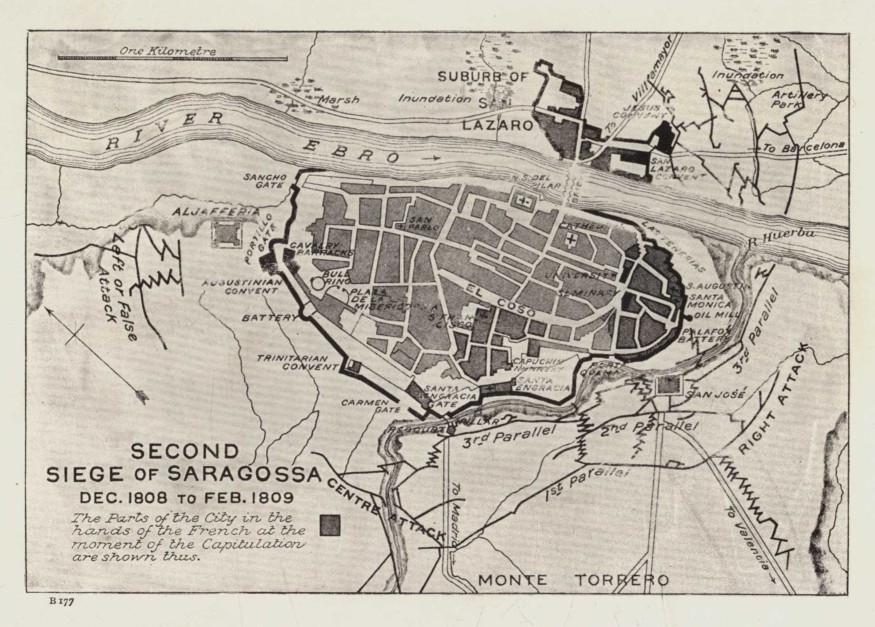
Second Siege of Saragossa
Jack sprang instantly towards the door. As he passed out, Don Basilio turned with an enquiring look towards Palafox.
"An English youth, Padre," said the general, in answer to his mute question.
"A leader of men," said the priest, and sat down to write a proclamation.
CHAPTER XX
A Day with Tio Jorge
A Barricade—Battering-Rams—A Lull—A Way In—On the Stairs—The Day's Work—A Triumph—Pepito's Watch
At the end of the covered way leading to the Portillo Gate Jack found Tio Jorge giving instructions to a group of armed citizens, who went off one by one on various errands. Seizing a favourable opportunity, Jack went up to the big Spaniard, and in a few rapid words acquainted him with his own position and intentions. Jorge scanned him for a moment with quick, penetrating glance, then said:
"Señor will want a musket. There is a stand of arms at the corner yonder."
In two minutes Jack, armed with a musket of British make—one of those opportunely thrown into the town by Colonel Doyle the day before the siege opened,—was hastening along by the side of Tio Jorge into the city. On entering the streets, the Spaniard summoned to join him small bodies of citizens who were gathered at certain points to act as reinforcements and reserves. Soon he was at the head of a considerable troop, all of the artisan class, for in these days of stress every able-bodied man in the city was transformed into a fighter.
As they ran, their ears were deafened by a loud explosion on the right. The air was darkened with dust; broken slates and stones came hurtling down upon their heads; but the eager citizens pressed on with an indifference that showed how much accustomed they were to such incidents.
"A block of houses blown up between here and the Santa Engracia convent," said Tio Jorge in answer to a question of Jack's. "But that is not our business. The French will hold the ruins, but they'll get no farther. Our men will beat them back. 'Tis more dangerous towards San Agustin. The French have gained more there in this one day than in weeks on the Santa Engracia side. Hombres," he cried to the men with him, "hasten, hasten! The French are over the barricades, and we must drive them out at all costs."
They ran on. Even in the rush and excitement Jack was struck by the scenes of horror in the streets. At one point two corpses swung slowly on gibbets erected by the door of a church. Tio Jorge pointed to one of them, a look of grim exultation on his face.
"He was my school-fellow," he said, "and my friend; but I hanged him. So perish all who falter and counsel surrender!"
Wounded men were being carried to the hospitals by women; some were limping or crawling with shattered limbs and ghastly faces. Women and children ran hither and thither, some carrying goods from houses threatened by the enemy, others food and ammunition for the fighters. Though many of them bore only too manifest signs of sickness and privation, they all seemed animated by the same spirit of fierce determination, and a gleam lit up their worn features whenever Tio Jorge, as he passed, threw them a word of encouragement.
All the way along the Coso the sounds of firing in the eastern quarter of the city came more and more distinctly on the ear. Dense clouds of smoke rolled towards them, and Jack heard the crackle of flames, still invisible. A messenger with blackened face came towards Tio Jorge, and announced that the French had captured three blocks of buildings beyond the Casa Ximenez, and were slowly but surely gaining ground. The Spaniard, bellowing out fierce maledictions on the enemy, hastened his stride, and in a few minutes reached a street leading to the university. Here the Spaniards had entrenched themselves behind a barricade, where they endeavoured to find cover from the musket-shots fired from houses on both sides of the streets. The French, borrowing the tactics of the besieged, had occupied these houses, and were shooting from windows and loopholes bored in the walls.
The lean figure of the frenzied Santiago Sass was conspicuous among the defenders of the barricade. Disdaining all artifice, he stood erect, a mark for every bullet, yet unhurt, uttering derisive shouts, and mingling his battle-cry with quotations from the Psalms. Seeing Tio Jorge approach at the head of his men, the priest hailed him with loud acclaim.
"Twice," he cried, "twice, Tio Jorge, have we already beaten back the men of Belial. The hand of the Lord is heavy upon them!"
"And shall be heavier!" cried Tio Jorge. "We must over the barricade, hombres."
Instantly Santiago Sass mounted the entrenchment, and was first on the other side, his long cassock flying loose as he led the charge, musket in hand. Tio Jorge and Jack were but a yard behind him, and with a great shout the Spaniards swarmed over and dashed furiously at the French advancing to the attack. Nothing could withstand their rush. The French gave way, but instead of retreating down the street they disappeared into the houses on either side, bolted the doors behind them, and went to swell the numbers of those who already occupied posts of vantage within. In vain the frenzied Spaniards beat on the doors with their clubbed muskets; the massive panels were unyielding, and a rain of bullets fell from above, thinning the Spanish ranks moment by moment.
"Poles, bring poles!" shouted Tio Jorge.
Instantly men ran off, some of them only to drop on the way. The survivors returned by and by with poles and beams, with which as battering-rams they drove at the fast-closed doors. They were shot down almost to a man; but the places of those that fell were at once taken. A door here and there was burst in, and the heroic Spaniards sprang into the gardens and patios, only to be killed or wounded before ever they came to close quarters with the French.
From the first Tio Jorge had selected as the special object of his attack a large house on the right of the barricade. It was evidently held by a considerable force of the enemy. But all assaults upon its thick door had proved ineffectual. Even when a heavy beam was brought up as a battering-ram it could not be used with effect, for the door was at such an angle to the barricade that it could only be struck obliquely unless the bearers of the beam advanced for several yards into the open, where so many of their comrades had already been struck down. Tio Jorge ordered his men to make an attempt to drive in the door from the angle of the barricade. Before the beam could be thrown across, one of the men carrying it was shot. The rest persevered, hauled it over, and made for the door. A sheet of flame burst from the windows above; six of the men were hit. The weight of the beam being now unequally distributed, the other men were dragged down, or tripped over the bodies of the slain.
Jack had accompanied them. Feeling a sharp pain in his left arm, and seeing that nothing could be done at the moment, he ran back to the barricade, narrowly escaping being hit by flying bullets. Behind the barricade he found Tio Jorge with a few others, the only survivors of the band which had come up with such ardour and enthusiasm. The leader was furious, railing at fate and at the failure of the men to back up their comrades, and shouting for more men to come to his assistance. Meanwhile, as Jack stood by endeavouring to bind up what proved to be a slight flesh wound, a lady came from the corner of the street, bearing food and wine. Seeing what Jack was about, she placed her baskets on the ground, calling upon the men to help themselves, and then with quick deft hands completed the bandaging which Jack had clumsily begun.
"You look tired," she said. "Take some food, Señor."
Jack was only too glad to eat and drink. It was the first food that had passed his lips since he left the boat. Tio Jorge, too, ate like a famished man.
"Gracias, Contessa," he said in a softer voice than was usual with him.
When all had eaten and drunk, the lady picked up her baskets and moved away without hurry towards another part of the city.
"Who is she, hombre?" asked Jack.
"The noble Contessa de Bureta, Señor; a delicate, frail lady, as you see, but as fearless as—as I myself."
There was a breathing-space, during which the men rested, awaiting reinforcements, and rejoiced that the French were contenting themselves with their work from the houses, and made no further attempt at present to storm the barricade. Jack took stock of the situation. The house on the right could not be taken by assault; it was occupied in too great force by skilled marksmen. To ram the door by a direct blow was impossible, as experience had proved; the fire from the houses was so deadly that no bearers could live through it. While Jack was pondering, the little band had been reinforced by other citizens, and Tio Jorge was on the point of ordering another attack. But he had uttered only a few words of vehement encouragement when Jack interposed.
"Give me ten men, and I think in a few minutes we could drive the French from yonder house without great loss."
Tio Jorge looked doubtingly at Jack's eager face. They were crouching behind the barricade, and there was a temporary lull in the firing.
"How will you do that?" asked the Spaniard.
"Attack them from above."
"Impossible! impossible! If you got to the roofs you could not get into the houses, for the trap-doors are all towards the street. You would be seen from the houses on the opposite side, and shot down at once."
"Still, I think it is possible. I have a plan."
"Well, then, go, Señor, in the name of Our Lady of the Pillar, and I will remain here and fire on the French to cover your movements."
Accompanied by ten men hastily selected by Tio Jorge, Jack made his way to the rear, and came to a house which had not yet fallen into the hands of the French. Gaining admittance, he led his men upstairs to the attic floor, clambered out by the trap-door, and, before the enemy had caught sight of him, succeeded in crawling over the sloping roof to the opposite side. Two or three men had followed him safely. Then the move was seen, and bullets began to patter on the roof, so that the other men had to follow Jack at great risk. All but one managed to crawl over and join him without hurt, and the nine stood with him on the farther side of the roof, sheltered by the low parapet from any shots that might come from that direction.
Then he led them quickly on to the roof of the adjoining house, which was occupied by the French. Immediately over an attic window he cautiously started to loosen the tiles, the Spaniards eagerly following his example as they perceived his intentions. After the first two or three tiles had been gently prised out, the rest came away easily. Half the men were employed in lifting the tiles, while the others took them from their hands, and laid them quietly in heaps at the foot of the parapet. Under the tiles were the joists, and as these were not connected by matchboard, it was an easier matter than Jack had expected to break an opening into the room below. It was empty. Such little noise as had been made on the roof had evidently been drowned by the continuous firing in the houses and streets. Jack handed his musket to the man next him, and, catching hold of one of the joists, swung lightly down into the room. The man handed him his musket, then followed him, to be followed in turn by all his comrades. In little more than ten minutes after their arrival on the roof the ten stood together in the attic.
"Now, hombres," said Jack, "we have to clear them out room by room."
Followed by the Spaniards, he dashed from the attic down the stairs into the first room on the floor below. At the window were three men, so intent on firing at the barricade that they were not aware of their danger until the invaders were upon them. When they turned and saw their enemies they had no thought of surrender. In this bitter war surrender to a Spaniard was only another name for death. But before they could bring their muskets to the shoulder the Spaniards were at their throats. They fell. Instantly the victors rushed to another room. In a few minutes all the occupants of that floor were disposed off.
By this time the rest of the garrison had taken the alarm. Many of the French had left their posts, and were crowding downstairs in a panic, believing that a large force of Spaniards had gained a lodgment in the house. Tio Jorge below inferred from the slackening of the enemy's fire that the bold attempt had been successful. Without losing an instant he ordered some of his men to make another onslaught with the beam on the door, and sent others round to the back of the house, where a narrow lane was at present clear of the French, to intercept any who should endeavour to escape there. Panic had now seized the French in the house. Fearing to be taken in front and rear, most rushed downstairs towards the back entrance, a few obstinately refusing to stir, and calling on their comrades to stand firm. But Jack and his men poured in pursuit, shouting, to keep up the illusion of their being a numerous body. Below, the door at last fell in with a crash before the strokes of the ram. Tio Jorge burst in, and found only a small knot of French between himself and Jack's men. The execution was swift and sure. Of all the French who had used that house as their fortress only those escaped who, fleeing out by the back door, cut their way through the Spaniards sent by Tio Jorge to intercept them.
This brilliant success, won by citizens without the help of the soldiery, wrought the spirits of the people to a high pitch of exultation. Santiago Sass, who had escaped in all his wild peregrinations without a scratch, rejoined Tio Jorge's band, and rolled out sonorous sentences in jubilant frenzy. But the Spaniards were not satisfied with the first triumph of the day. There were other blocks of houses in possession of the French. After a brief respite, during which reinforcements of soldiers and citizens came up in considerable numbers, the defenders set to work systematically to dislodge the French from the positions so hardly won. The housetop device was put in practice wherever access could be obtained. For hours the struggle continued, and Jack, who worked as hard as any man, was struck with admiration of the untiring enthusiasm of the Spaniards. Fighting from barricade to barricade, and from house to house, they retook position after position, until, as early dusk fell, the French had been cleared out of all the houses and forced back to their impregnable position in the Santa Monica and San Agustin convents.
The din of combat died down. Jack had arrived at the Casa Ximenez, the scene of his adventure in the morning. Entering the house, he found many signs of its temporary occupation by the French, but the fighting had been so intense and so persistent that they had had no time to perpetrate the wanton mischief and destruction which usually marked their progress. Jack went through the house to make sure that none of the French were left, and, entering one of the rooms, he guessed by the character of its furniture and appointments that it belonged to the young lady whom he had assisted earlier in the day. The French had been so much occupied in the lower rooms that they had left this room untouched. There were a few trinkets on the dressing-table. Jack put these into his pocket, knowing that the Señorita would be glad to receive anything of value that could be rescued. Then, descending into the patio, he found that Tio Jorge had already told off a company of his men to occupy the house during the night, in preparation for the renewed attack which was undoubtedly to be expected in the morning.
"Come, Señor," shouted the big fellow, "we will now go to the captain-general and tell him what we have done for Saragossa this day. And your part, por Dios! is one that no Saragossan will forget. Come!"
They left the house. The sounds of bombardment and musketry had ceased; parties of the citizens were moving about collecting the dead and wounded; women and children were emerging for a breath of air from the close cellars in which they had sheltered during the day. As Tio Jorge and Jack passed into the street, they became aware, from the attitude of a group of soldiers and citizens all looking in one direction, that something unusual was attracting their attention. Looking up the street, towards the same end at which he had entered it nearly twelve hours before, Jack saw, by the light of the torches carried by search-parties, a small figure advancing—the figure of a boy, with a Frenchman's képi many sizes too large for him almost obliterating his head, a Frenchman's sword dangling from his belt, its point trailing a yard behind him along the cobbles, and a Frenchman's musket weighing down his shoulder. The boy was staggering along under his burdens, yet contrived to maintain an air of jauntiness and assurance that held the Spaniards spell-bound with surprise and curiosity.
"The imp again!" ejaculated Jack with a smile.
The boy caught sight of him, and, endeavouring to hasten his step, tripped over his sword and fell headlong, rising a moment after without musket or képi, and revealing the swarthy face and unkempt hair of Pepito.
"Here I am, Señor," he said with his enigmatical smile. "Not lost, Señor."
"So I see. And what have you been doing? What do you mean by giving me the slip like that, and making me think the French had got you?"
Pepito looked aggrieved. He took out of his vest the silver watch Jack had given him at Seville, and held it dangling by its chain.