BOYS OF THE LIGHT BRIGADE (continued 2)
Reading edition
"That's well saved, anyhow," said Jack grimly to himself as he cantered on, and smiled as he heard the man's curses pursuing him. The mule seemed to share in his rider's feelings, for as he trotted steadily on he lifted his head high in the air, curled up his lip, and showed his long yellow teeth, as though laughing at the man's ignominious overthrow. Jack let him have his way, and the animal kept up the same pace unfalteringly, with never a slip or stumble, until he reached the squalid streets of Medina del Campo. The curfew had just ceased ringing, and the great market-square was quite deserted; but Jack knocked at a house in which he saw a light, enquired the way to the Posada de Oriente, and in a few minutes was standing within the doorway of that hostelry. To judge by the various voices issuing from its interior, it was entertaining a numerous company.
He presented to the landlord the letter he had brought from the man's former master, Don Pedro, and was led with some hesitation into the inn, while his mule was handed over to an ostler. The inn consisted of one large apartment with a fireplace at each end, a timber roof blackened and varnished by smoke, stalls at each side for horses and mules, and for travellers a few small lateral chambers each containing a bed made of planks laid across trestles, and covered with sheets of coarse sacking. "Rough lying," thought Jack, as he looked in at the open door of one of these. The floor was of brick, strewn with rushes. A large fire burnt in one of the grates, strings of onions hung from nails on the walls, and the place was pervaded by an odour of scalded oil and grilled tomatos. Jack gave a comprehensive greeting to the company as he entered. A deep silence had fallen upon the room, and he was conscious of the curious scrutiny of several pairs of eyes; but knowing that the Spaniard is always reserved with a stranger until assured that he is not, let us say, a pedlar, or a rope-dancer, or a dealer in hair-oil, he paid the company for the moment no further attention, but sat down on a back seat pointed out by the patron, and ordered food. The landlord regretted that at short notice he could supply him with nothing but a simple gaspacho. Jack laughed inwardly at the thought of how his friend Pomeroy would turn up his fastidious nose at such fare, but assured his host that in his present state of hunger he could eat anything, and the gaspacho was accordingly prepared. Some water was poured into a soup-tureen, to this was added a little vinegar, a few pods of garlic, some onions cut into four, a slice or two of cucumber, a little spice, a pinch of salt, and a few slices of bread; with this the detestable mixture was complete. As Jack began his meagre meal the landlord opened the hidalgo's note, and Jack threw a glance round the company.
Nearest the fire sat a lean, cadaverous old gentleman closely wrapped in a chestnut-coloured cloak, and sipping at a glass of dry Malaga. Next him reclined the village priest, a rotund figure clad in a black cassock, with cloak of the same colour; he nursed on his knee an immense hat, at least three feet long, with a turned-in brim, which when upon his head must have formed a sort of horizontal roof. Then came a couple of arrieros, or carriers, in rough fustian, with big leather gaiters and broad sashes of red silk; and a loutish Maragato with shaven head, clad in a long tight jacket secured at the waist by a broad girdle, loose trousers terminating at the knees, and long boots and gaiters. A few young villagers completed the circle. By this time the landlord had spread out his old master's note, and was scrutinizing it with a puzzled expression, his head screwed aside and his lips pursed up. After a few moments he appeared to come to the conclusion that he would never decipher the crabbed handwriting unaided, and handed it to the priest, a broad grease mark showing where his thumb had pressed it.
"Here, Señor cura," he said, "be so good as to read it to me; Don Pedro's hand is growing paralysed, surely."
The priest took it, giving Jack a humorous smile.
"Don Pedro merely introduces the caballero as a friend of his," he said, "and asks you, for his sake and the sake of Spain, to serve him in every possible way."
"To be sure," returned the landlord; "I have done it without asking. I have given the caballero a gaspacho, and if he will wait till Antonio arrives he shall have a puchero in addition, and a grilled tomato."
"Thanks, landlord! I shall do very well," said Jack. "But I fear I am a kill-joy, Señores. Pray don't let me interrupt your conversation."
"The caballero, being a friend of Don Pedro, may be trusted," said the lean gentleman by the fire, taking a sip. "He is welcome, particularly if he joins us in giving God-speed to Antonio as he goes on his way to join the brave guerrilleros."
"I shall be happy," said Jack. "Antonio, I presume, is a soldier of this neighbourhood?"
"Nay, Señor, all our soldiers are already with General Castaños or the Marquis of La Romana or brave San Juan, doing deeds of valour against the accursed French, every man of them worth three of the enemy. Were I not old and worn, I myself would have led them, and drawn the sword of my ancestors in defence of my country. I am a hidalgo of noble line, Señor, tracing my descent back to a paladin who slew ten Englishmen with his own sword, when, in the days of Great Philip, we landed in England and held London to ransom." (Jack opened his eyes at this new light on English history!) "His blood still flows in my withered veins, and my neighbours here know well that only my great age keeps me from driving the French back across the mountains at the head of my troop."
Most of the company applauded this patriotic speech, but Jack observed a whimsical look on the priest's face.
"I rejoice to know," continued the hidalgo, "that the old valour is still alive in the breasts of my countrymen; they are flocking in their thousands to join the bands of guerrilleros who dog the French at every step, and our friend Antonio, whom we expect to-night, and who leaves to-morrow for Saragossa, is one in whom the Spanish valour most brightly shines."
"Antonio is a journeyman cooper, Señor," said the priest confidentially, "a dare-devil by report, a contrabandista too at times, and a great favourite in these parts. He is expected from Cantalapiedra to-night."
"And here he is," cried one of the younger men, who had gone to the door. "Late, but welcome. Viva Antonio!"
All the company but Jack rose to their feet to greet the hero. He came hastily into the room, flung the door to behind him, bolted it, and heaved a sigh. Jack saw at a glance that he was no other than the man who had sought to borrow his mule, and had found the apparently inoffensive rider tougher than he expected.
"Señores, Señores," cried the man, "only by a miracle and by my own courage have I escaped this night! Blessed be the saints that I have a stout heart and a strong arm, or I should have been but a dead man to-night!"
He spread himself with an air of bravado upon a low bench, and as he removed his hat, disclosed a deep-red wale across his brow. His friends gathered about him in consternation, and the old hidalgo rose painfully from his chair, and, tottering across the room, handed a bumper of Malaga to the panting new-comer, who quaffed it gratefully.
"Yes, Señores," he continued, "but for the merciful protection of Santiago and Santa Maria, and the fact that I know no fear, I should have been lost to Spain, a cold corpse even now. Four miles back, as I trudged wearily along the miry road, thinking of the kind friends and the warm food awaiting me here—"
"Manuel," cried the landlord to a strapping youth who stood with sleeves tucked up near the fireplace, "grill a tomato for our brave Antonio."
"As I trudged along," Antonio resumed, "all at once I heard a great splashing and clanking behind me, and before I could stand aside, three horsemen were upon me. They reined up when they saw me, and one of them called me dog, and asked the way to Valladolid. I knew by his tongue that he was one of the thrice-cursed French, and, commending myself to Santiago in a breath, I raised my mallet and struck him upon the head, and he fell. His comrades drew their swords and made at me over their horses' necks. I defended myself as best I could with my good mallet, but it was an unequal fight, Señores, and I was at my wits' end, when I bethought me that all the French are craven curs, and I shouted aloud, as though summoning a hidden band to the rescue. The Frenchmen started back, looked fearfully around, and then, unmindful of their dead comrade on the ground, set spurs to their horses and galloped away, one of them, as he passed, striking me—with the flat of his sword, praised be Santiago!—across the brow, and—"
"What was he like, hombre?" asked Jack quietly, bending forward on his chair and looking the man full in the face.
Antonio's jaw dropped. He gave a scared look at the speaker, and spilt the remainder of his wine upon his boots.
"The brave fellow is overcome," said the hidalgo. "Fill his glass, Manuel."
Antonio gulped down a second glass, and looked with apprehension at Jack, who was now sitting back again in his chair, keeping his eyes fixed on the abashed Spaniard.
"A lucky escape, Antonio," said the cura with a twinkling eye. "In the morning, no doubt, some passing arriero will see the dead Frenchman on the road, and bring him here for dog's burial."
"No doubt, no doubt, Padre," said Antonio hurriedly. "But I am faint, Señores, and as my nose tells me the tomato is now well grilled, I would fain stay the pangs of hunger."
As he devoted himself to the succulent fruit, the hidalgo entered upon a long oration on the iniquities of the French and the heroism of the Spaniards, with particular reference to the guerrilla band in the Virgen mountains, whom Antonio was on his way to join. He concluded by calling upon the company to drink the health of the brave Antonio, and confusion to the French. When the ringing vivas had ceased, Jack rose from his chair. Approaching the hero, who looked far from comfortable, he held out his right hand, and, laying his left on Antonio's shoulder, said:
"I am glad that, as a chance traveller, I am here in time to add my good wishes to so staunch a patriot. With a spirit like yours, we shall soon succeed in driving the enemy headlong through the passes of the Pyrenees. I myself hope to do something in my small way for Spain, but nothing I can do will match the valiant deeds of the brave guerrilleros, who face the rigours of winter cold on the barren mountains, and leave all the comforts of home in their noble enthusiasm. I call upon the sons of Spain here present to drink once more a health to Antonio the guerrillero, and confusion to the French! Viva Antonio! Viva la España!"
He grasped the hand of the astonished Antonio, and shook it heartily, amid the applause of the company. Antonio's look of amazement gave way gradually to one of smug content, and when, after another flowery speech from the hidalgo, the guests rose to take leave, the cooper had quite recovered his wonted air of assurance.
After the departure of his guests, the landlord was proceeding to bolt the door for the night, when Jack stopped him.
"Don't fasten up yet, landlord," he said. "I am going farther presently."
"To-night, Señor?"
"Yes; the moon is rising, and I shall ride as far as Olmedo."
"But, Señor, you may be set upon by French horsemen, like Antonio here."
"I don't think so," replied Jack with a smile. "Remember, Don Pedro sent me here to claim your assistance. He assured me you are a good patriot, and I don't suppose you love the French any better than the Señor hidalgo, or than Antonio, eh?"
"The French, Señor! I hate them. Every good Spaniard hates them. We are all caballeros, Señor, and we're not going to have any masters over us but our own hidalgos and the king—our own king."
"Have you seen anything of the French yourself?"
"The saints forbid! They spare neither man nor beast. If they came this way I'd have never a pig in my stye nor a copa of wine in my cellar. Antonio has seen some of them to-night, and my son Manuel told me that a squadron of dragoons passed through Olmedo and went south yesterday, and all last week parties of French horse were scouring the district north of Olmedo, playing the very devil with the people."
"They came from Valladolid, I suppose?"
"No doubt, Señor; Valladolid has been occupied by them for at least a fortnight past. We're hoping every day that the Marquis of La Romana or General Palafox will swoop down on them and slit their weasands. Or maybe the English general Sir Moore, now at Salamanca, will come and trounce them."
"You know the English are at Salamanca, then? Do the French know it?"
"Not from us, Señor. Not a man of us will give them any information."
"Well, landlord, I'm an Englishman—"
The man threw up his hands in amazement, and Antonio gasped. Jack watched the effect of his announcement; he had come rapidly to the conclusion that as Antonio was clearly regarded by his friends as a staunch patriot, there would be no danger in disclosing his own nationality.
"And I've come this way to find out all I can about the French. I want two active young fellows to help me, and I've been looking at these two fine lads—sons of yours, I take it?"
"Yes, Señor, they are my sons. Manuel is nineteen, and his brother Juan a year younger, and 'tis ten years yesterday since their poor mother went to heaven."
The two young men, with square-set faces and ragged shocks of black hair, stood listening with interest. Jack had watched them narrowly during the evening. They had something less than the usual stolidity of expression, looked fairly intelligent, and appeared likely to serve him well as special messengers.
"They would have to be prepared for hard work," he said, "at any hour of the day or night. They would be well paid, of course—"
"Señor," interrupted the landlord, "a good patriot doesn't require pay for working against the French."
Jack thought he had heard a different account about some of his host's countrymen, but he went on:
"Well then, you will not object to your sons entering my service as messengers between me and my general?"
"But, Señor, I shall then be single-handed. Who will there be then to attend to my guests—to mix the puchero, and stir the gaspacho, and rub down the mules? The lads could not leave their poor old father alone."
"Caramba!" struck in Antonio, who was now devoting himself to a fried onion, "what is that? Here am I leaving my wife and three children, to fight the French."
"You've left them before," said the landlord dryly.
"And there's Don Pedro's letter, you know," suggested Jack.
The landlord glanced at the letter, which lay on the table, and shrugged his shoulders.
"Well," he said, "I would do much for Don Pedro. He was a good master to me; he gave me the money to buy this inn; and since he asks me to serve you and my country at the same time, I can't refuse, Señor—if the lads are willing to go."
They at once professed their readiness to serve the Señor in any way, and assured him that they were well acquainted with the country for miles around.
"That's settled, then," said Jack. "Now, Manuel, you won't mind being employed at once? Have you any mules on the premises?"
"Two, Señor."
"Just the number required. You will saddle up and ride off at once to Salamanca. I will give you a note to take to Sir John Moore, the English general there. If you can't find him, ask for General Paget. You can say Paget?"
After two or three attempts, Manuel succeeded in pronouncing a passable imitation of the sound.
"When you have delivered the note, you will return to Carpio, and wait there for further orders. Both in going and coming you will take care to attract as little attention as possible, and of course you will not say a word to anyone, not even to your dearest friend, about your business. You understand?"
"Yes, Señor. And I have a friend near Carpio, a farmer, who lives about a league out of the town, so that I can stay with him if need be."
"Very well. Go and get your mule saddled, and return here for the note."
Jack wrote a few lines to Sir John, giving him the news of the passing squadron of French horse he had just learnt from the landlord, and ten minutes later Manuel left the inn with the note and a little money to serve for his immediate needs.
"Now, Juan," said Jack, when the elder brother had gone, "go to bed and get what sleep you can till three o'clock. At that hour I shall want you to start with me for Olmedo. I'm pretty tired, so I shall turn in myself, landlord, for a brief rest, and I shall take care that your assistance is brought to the notice of my general and also of your own juntas. Good-night!"
At three o'clock, beneath a pale half-moon, Jack stood at the door of the inn, waiting as Juan brought up his mule. He was about to mount, when he was surprised to see Antonio issue from the door and approach him.
"I'm a rough common man, Señor," he said; "you're a caballero. My big tongue will not say what I have in my heart, but I know what I owe you for your kindness to-night. Yes, Señor, it was like a true caballero not to remember what had happened on the road; and I say, Señor, that if ever there comes a chance to do you a good turn, por Dios! Antonio will not forget."
"Thanks, Antonio!" replied Jack, holding out his hand. "We'll cry quits and part friends."
"Vaya usted con Dios!" returned the man; and then Jack, followed by Juan, cantered up the quiet street.
CHAPTER VI
Monsieur Taberne
Westphalian Light Horse—Mine Host—Two Menus—Feeding a Commissary—Practice in French—Another Bottle—A Sum in Arithmetic—Inferences—A Cold Prospect
Daylight was just breaking as the riders came to the dreary outskirts of Olmedo, passing by one or two desolate-looking vineyards, untidy brick-fields, gloomy convents, and neglected kitchen-gardens, the walled town itself rising before them on an eminence in the midst of a wide sandy plain.
Jack had already learnt from Juan on the way that, nearly a mile from the town, a small clump of pine-trees grew, the only trees to be seen on all the barren heath. This, Jack thought, would be a convenient spot at which to leave the youth with the mules while he himself went into the town and reconnoitred. Accordingly, he sent Juan into the wood with the animals and sufficient food to last them the day, telling him to wrap his cloak well about him to keep off the cold, and on no account to allow himself to be seen from the road. Then he proceeded alone into the town, the narrow dirty streets of which he found in a great bustle. There appeared to be a horse at the door of every one of the six hundred houses of which the place consisted, and at the side of every horse there was a French trooper, who was either brushing his mount, or fastening its saddle-straps, or feeding it, or watching his comrades engaged in one or other of those operations. In short, three squadrons of French dragoons, which had been quartered on the town, were saddling up in preparation for marching, and the streets resounded with the clank of metal, the pawing of horses' hoofs, and the cries of the soldiers.
Jack made his way to the first inn, where he found the landlord endeavouring to reconcile his Castilian dignity with the obsequiousness demanded by the troopers he was serving. Ordering some chocolate, Jack sat down quietly on a bench, prepared to pick up any scraps of information he could gather from the half-dozen troopers who were loudly conversing over their drink. But a few moments later a sergeant entered, in a rage at finding the men away from their horses. They left in a body, and Jack seized the occasion to make a few discreet enquiries of the aggrieved and perspiring innkeeper. The troopers, he learnt, were the Westphalian light horse, belonging to General Maupetit's brigade, which formed the cavalry division of the fourth army corps under Marshal Lefebvre, Duke of Dantzig. They had arrived in the town on the previous afternoon, and the landlord, like all the inhabitants, was anxious to see the last of them; for the town had been visited by numerous smaller parties of horse during the previous week, and the French always took what they wanted, and were not very scrupulous about paying for it.
While Jack was condoling with the landlord, he heard the bugle ring out the "boot and saddle". A few minutes later the whole force moved out along the main road to the south, leading to Villacastin and Madrid. Jack stood just within the door, watching them defile past, and he could not but admire the excellent condition of the horses and the soldierly smartness of the men.
"I wonder where they are bound for?" he said to himself. He knew, from a careful examination he had already made of his map, that if the cavalry kept to the main road it would bring them, within about thirty miles, in contact with Hope's outposts, with the result that their general, Lefebvre, would not remain much longer in ignorance of the proximity of the British forces.
"I must see what they are after," thought Jack. Hastening to the plantation outside the town, where he had left Juan and the mules, he mounted and rode alone after the dragoons, being careful to maintain a discreet distance between himself and their rear. After riding for some three miles, he observed that they were leaving the main road and bearing to the left. Taking out his map, he found that they were evidently making for Segovia by the shortest cut, and the obvious inference was that they were as yet quite unsuspicious of the proximity of the British army, and had no intention of marching towards the Portuguese frontier. Riding another mile, to make sure that this supposition was correct, Jack then returned to the plantation, scribbled a note to Moore giving this important news, and ordered Juan to set off with it, going round Medina to Carpio, where he would meet his brother, whom he was to instruct to carry the message to Salamanca.
Having thus despatched his second messenger, Jack made his way back to Olmedo, with the intention of obtaining a more substantial meal than he had yet had time for. He sought, this time, the principal inn of the place, and found that with the departure of the dragoons the inhabitants of the town, previously invisible, had now formed little knots at the street corners, and were condoling with one another on the indignities they had suffered at the hands of the enemy. The landlord was at first too much occupied with the gossips at the door of his posada to attend to a stranger, but Jack at last boldly took him by the arm and declared that he must have food of some sort.
"Food! All very well for a stranger to ask for food," he replied bitterly, "but these cursed Frenchmen have stripped us bare, and are verily capable of eating our children."
"Come, landlord," said Jack, "I heard an old cock crowing lustily as I came up the street. At least you have an egg or two. I don't love the French any more than you; and I'll pay, which is more than they do, by all accounts."
"Well, Señor, perhaps I can find you an egg, but you must wait till I can send for it and borrow a frying-pan, for a Frenchman knocked a hole in mine last night."
Jack sat down on a bench within the bar-room, and listened to the conversation, or rather the declamation, of the men at the door. While he sat there waiting with scant patience, for he was very hungry, the sound of horses' hoofs was heard approaching, mingled with the clank of steel. The knot at the door melted away as by magic, and a few moments later a small party of horsemen clattered into the courtyard, and loud voices were heard calling to the inn servants. In a minute or two a portly French officer clanked into the room, now empty save for Jack. He was clad in a uniform of some brilliance, with a heavy shako and an embroidered white cloak, and the stone floor resounded to the tread of his heavy spurred riding-boots. Giving a casual glance at Jack, who was staying his hunger with a crust of dry bread until the egg should appear, the officer strode up to the low counter, smote it heavily with his riding-whip, and bellowed for the landlord, in execrable Spanish, freely interlarded with French expletives.
"Ohé, landlord!" he shouted. "Palsambleu! Where has the hog hidden himself? Ohé! Come out of your pig-stye, canaille that you are, and bring me some food."
He continued shouting and belabouring the counter, setting the crockery rattling on the big dresser behind.
"Nice manners!" said Jack to himself, closely watching the new-comer. "I wonder who he is!"
At this moment the landlord entered with a fried egg, which he brought to Jack without giving more than one sullen glance to the boisterous officer. This neglect wounded the gentleman's dignity; he strode across the room and, lifting his whip, spluttered:
"Insolent dog! Don't you hear? I order you to bring me food, and, palsambleu! you had better hurry. What do you mean by keeping an officer of the emperor waiting while you serve a beggarly tradesman?"
"In a moment, Señor," said the landlord, setting the dish before Jack.
"Would the noble marquis like my egg?" said Jack meekly in bad French.
"Egg!" The officer snorted his contempt for such frugal fare. "Look you, landlord, I want soup to begin with, and then a mayonnaise—sweet olive-oil, mind you—and a capon well basted to follow, and—"
"Señor, Señor," interrupted the landlord, "I've not any such things on the premises. Your dragoons have eaten me up already. I can give you an omelet—"
"An omelet! Morbleu, landlord! If you don't hurry with something more substantial than an omelet I'll slice your fat cheeks into collops."
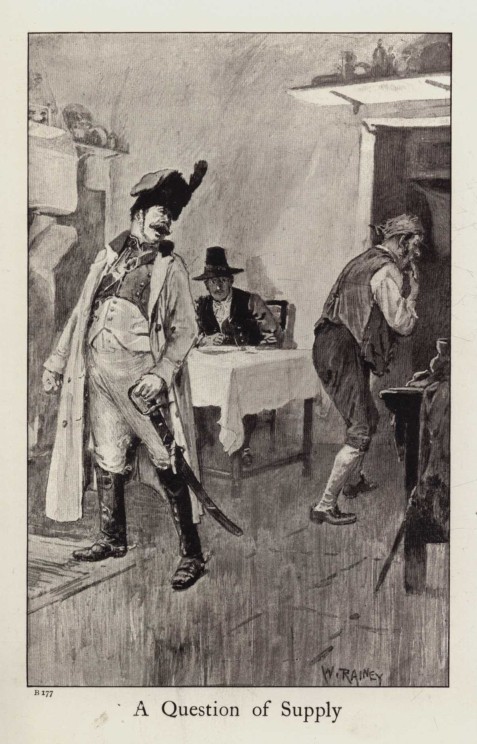
A Question of Supply
He glared at the Spaniard and laid his hand on his sword; and the landlord, giving up all attempt to preserve his dignity further, scuttled through the door leading to his kitchen.
"Holà!" cried the officer, calling him back; "before you go give me a stoup of wine; none of your tarred vinegar of Toro, pardi, but good wine of Valdepenas, something with a tang. Ventrebleu! it's a poor thing if an officer of the emperor, who has to feed an army, can't get good food for himself."
("Ah!" thought Jack, "we have a commissary here. He ought to be worth something.")
The trembling landlord set a goat-skin and a cup before the blusterous commissary, and hurried off to ransack his larder for something wherewith to appease his Gargantuan appetite.
After two or three draughts of wine the big man appeared to be somewhat mollified. He threw more than one glance at Jack, as he strode up and down the room, objurgating the landlord's sluggishness. To Jack's amusement and surprise, the Spaniard returned in a very few minutes, bearing a steaming tureen of soup.
"Would the Señor like his meal served in a private room?" he asked. "There is only my own sitting-room, with no fire at present, but if his excellency pleases a fire shall be lit, and—"
"Tenez, tenez!" said the officer; "let me fill my stomach, in the public room here by the fire. I may want the private room by and by," he added pompously; "but meanwhile I have no objection to your guest being present."
He glanced at Jack, who at once said, in his politest tones:
"I shall be happy to retire if I am in the noble marquis's way. Personal convenience must, of course, give way to the public service, and anyone can see that the noble marquis is a very high functionary."
The deferential tone and the barefaced flattery conciliated the big man. Puffing himself out he said:
"Not marquis yet, young man, not yet, though it may come—yes, it may come in time. Lefebvre is Duke of Dantzig: he rose from the ranks, and there's no reason in the world why I, Gustave Taberne, shouldn't be a marquis before long. Personal business, you say? Well, my business is wholly personal at present, since it consists in lining my not inconsiderable person, hein! But I don't regard your company as an intrusion, monsieur; far from it; I welcome you heartily."
Jack bowed his acknowledgments. Meanwhile the officer had begun to gulp his soup with no little noise, gobbling like a turkey-cock, as Jack described him afterwards. As his meal progressed he unbent still further.
"You are almost the first of your cursed countrymen I've met who can speak tolerable French," he said. "Where did you learn it, young man?"
"I picked up a little in Barcelona, your excellency," replied Jack, "but not till now have I had the opportunity of improving myself by conversation with an officer used to high society."
"Ah! you know a galant homme when you see him. You have some sense, young man. Yes, I'm commissary-general to the Duke of Dantzig's forces, and, parbleu! in the emperor's service I spare no one, neither myself nor others. Ohé, landlord, bring the next course."
The landlord brought in a number of dishes.
"Señor likes the puchero?" he said.
"Puchero, you call it? Well, if this is puchero, I do like it. Now, par le sambleu, you wanted to put me off with an omelet! He! he!"
He lay back in his chair and roared. Jack himself was not a little amused, for he saw on the table a quarter of veal, a neck of mutton, a chicken, the end of a sausage called chorizo, slices of bacon and ham, a jug of sauce made of tomatos and saffron and strong spices, a dish of cabbage soaking in oil, and a platter filled with a vegetable rather like haricot beans, called garbanzo. All these the landlord mixed in one big vessel so as to make a mayonnaise, which Jack hoped did not taste as strong as it smelt. The commissary fell to with avidity, but he was evidently fond of hearing his own voice, and his tongue being loosened by the unexpected good cheer, and by Jack's respectful admiration, he condescended to converse between the mouthfuls.
"Pity your countrymen are not all as civil and sensible as yourself," he said. "If they'd only put a good face on it, and pay willing obedience to King Joseph—though, to tell the truth, he's only a proxy for the emperor,—they'd live a quieter life and make the duties of the commissary less of a torture. I tell you, young man—moi qui vous parle—there isn't a more harassed man in the army than the commissary-general. Hang me if he is not every way as important as the commander-in-chief!"
Jack looked at him sympathetically.
"A general gets all the credit of a victory, but, parbleu! 'tis the commissary that deserves it. Who won the battle of Austerlitz three years ago? Folks say it was the emperor, but between you and me, mon ami, it was I myself, Gustave Taberne. Soult, Masséna, Lannes, the emperor himself—all very well, but could the men fight if they weren't well fed?—tell me that. And I feed the army. Skill, that is good; courage, that is better; devotion, that is excellent; but a good meal has won more victories than the cleverest tactics."
"The world knows nothing of its greatest men," said Jack.
The commissary gleamed approval, but at this point the conversation was interrupted by the entrance of a corporal.
"Well, Antoine," said the officer, "where is the alcalde?"
"He cannot be found, mon colonel," replied the man.
"Cannot be found! Cannot! Who dares use such words to the emperor's commissary-general? The alcalde must be found, or, parbleu! I'll burn every house and pig-stye in the place. Let him be here in half an hour—not a moment sooner, for I must finish my dejeuner; not a moment later, for he will fare ill if he keeps me waiting. Away with you, Antoine."
The corporal vanished.
"Ohé, landlord!" shouted the commissary. "Another bottle of wine. No, don't take out the stopper. Set it on the table there in front of me."
The commissary gloated at the rotund wine-skin, but made no sign of opening it. Catching an enquiring glance from Jack, he said loftily:
"I drink no more till my work is done, young man. If I drank more now, I should get drunk; and if I got drunk the emperor would call me a pig, and I should deserve it. Duty first, young man, always remember that."
"It astonishes me," said Jack, "—forgive my ignorance, Colonel,—how you officers can make the calculations necessary for feeding an immense army. In our little villages, for instance, if we keep the festival of a saint or a guild, when there are only some hundreds of mouths to feed, we either run short or have so much left that bushels of good stuff have to be thrown to the pigs."
Jack spoke from recollections of the autumn bean-feast in his little Surrey village at home. The commissary rose to the bait, and spoke, always with a thirsty eye fixed on the wine-skin.
"Oh! as to that," he said, "we do everything by system. Nothing is easier when you have a system. We allow a pound of biscuit a day to each man, and half a pound of meat, and as much wine as is good for him and can be got. For myself, as you see, I can drink a gallon without staggering, and hold a fresh bottle always at arm's-length without touching it."
"Matchless strength of will!" exclaimed Jack. "But even so, the responsibility of obtaining just the right quantity for so many thousands of men would make a weaker man quaver. The biscuit, for instance—what a huge quantity you must consume!"
"Huge indeed!" said the commissary. "Why, in Valladolid, where I have come from, we use nine tons a day." (Jack made a rapid mental calculation: one pound of biscuit to each man; nine tons a day. "So there are about twenty thousand men in Valladolid!" he concluded.) "And in the present temper of your confounded countrymen," continued the commissary, "such a man as I is not to be envied. I have had great difficulty in procuring supplies in some places. Like your landlord here, they offer an egg, and we have to curse them before they bring out the chicken. But we stand no nonsense, I can tell you. Your alcaldes have bad memories, but 'tis amazing how refreshing is a yard or two of hempen rope or the touch of a cold pistol-barrel. We had trouble in Valladolid, and 'tis rumoured we are to have trouble in Segovia; but let 'em beware, let 'em beware."
"Ah! I'm afraid our poor people have small chance against the hosts of your emperor—the finest soldier the world has seen since Alexander the Great."
"You say true, monsieur; you are a sensible fellow—for a Spaniard. The Little Corporal is indeed a new Alexander, destined to conquer the whole world, and, parbleu! those upstart meddling shopkeepers of English into the bargain. Why, the emperor is at this moment marching south, and my bag here is stuffed with bulletins of his victories."
He pulled out a handful of papers, and spread them on the table. At this moment the corporal re-entered, followed by the trembling alcalde of the village, whose bemired dress showed that he had been hiding in no very sanitary spot.
"Ohé, Don Long-chops," said the commissary, "you thought to escape me, did you? Now you and I will have a reckoning."
As the alcalde was brought round the table until he faced the commissary, Jack rose.
"I will bid you good-day, monsieur," he said politely. "I have a long way to go, and be sure that in whatever village I pass through I shall warn them that so capable an officer is not to be trifled with."
"That is sound sense, pardi," said the commissary. "You will do well to prepare them for my coming, and, look you, if we meet again, you and I will drink as much Valdepenas as our skins will hold—provided my duty is done. Au revoir!"
Jack bowed and took his leave. The information he had obtained from the self-sufficient commissary was clearly of the highest importance. There were twenty thousand men in Valladolid: they were about to march for Segovia; and the emperor himself was coming southward at the head of an army. It was evident that the French were as yet in ignorance of the proximity of Moore's army. They were probably intending a blow at Madrid; and Jack saw in a flash that this might have a direct bearing on the movements contemplated by Sir John.
"Why shouldn't we march eastward and cut their communications?" he thought.
The question was, how was this information to be conveyed to head-quarters? At the earliest Juan could not be back before dark, even if he met his brother the instant he arrived at Carpio.
"There's nothing for it but to go myself," said Jack to himself, "and that's a pity. I should have liked to get a little more out of my budding marquis when he is in one of his expansive moods. Well, I've a cold ride before me."
CHAPTER VII
Pepito intervenes
Precautions—Gone to Earth—Foundered—In the Nick of Time—The Allied Army—At the Marchesa's Palace—Social Salamanca—Light Refreshments—Messengers—A Recognition
The stable-yard lay to the rear of the inn. Snow had been falling lightly during Jack's conversation with the commissary, and one of the servants was busily sweeping the slush into a corner. The stable doors were open, and several lads and men were attending to the horses of the commissary's escort, the universal hiss of men employed in that occupation being mingled with curses which it was lucky the Frenchmen could not hear or understand. Jack went up to one of the men and asked him to bring out his mule. The ostler turned from the horse he was grooming and looked at Jack with an air of incivility, if not downright insolence. He made no movement to carry out the order, and, glancing round, Jack became aware that all the other stable-helps had left their work and were gazing at him with the same distrustful, lowering scowl.
"What's the matter?" he thought.
The men had been all civility when he gave his mule into their hands on his arrival. What could be the cause of this unpleasant change of attitude? Jack was puzzled. Meanwhile he wanted his mule unhaltered and saddled, and though he was tempted to do it himself, and not trouble the reluctant servants, he saw that such a course would not improve his position with them. He knew the Spanish character too well to bluster or dictate. After a pause of only a few moments he addressed the same man quietly and politely, but with a firmness that admitted no refusal; and the servant, dropping his eyes, turned sullenly to do his bidding.
A few minutes later, as he rode out of the courtyard, he met the alcalde, looking very angry and much perturbed. He was coming, evidently, from his interview with the commissary. He looked up at Jack as he passed, and half-stopped, as though hesitating whether to address him. Jack was surprised to note the same quick glance of suspicion in the alcalde's eyes as he had seen in those of the stablemen. The official seemed to be on the point of speaking, but he gave a hurried and anxious glance towards the window of the commissary's room, flushed hotly, and with a final dark look at Jack turned away. Jack rode on, feeling that the eyes of the whole inn were upon him, and possessed by an unaccountable sense of insecurity.
The meaning of it all flashed upon him quite suddenly. The alcalde had seen him in close and apparently friendly conversation with the commissary. Their interview had lasted for a considerable time, and must have been talked about among the people of the inn. Every Spaniard must feel that no true patriot would hold amicable intercourse with a Frenchman, an enemy of his country, except under compulsion, and it was now evident to Jack that he was regarded as a traitor, perhaps a spy, selling the interests of his compatriots to the invader. The thought made him smile.
"Shall I go back and tell them?" he said to himself. "They'd be surprised to find how the boot is on the other leg."
But a moment's reflection convinced him that to reveal his secret would not be politic, even if he were believed. There were too many Frenchmen about the inn to make it safe for him to enter into long explanations. Then another thought came which promised a spice of adventure.
"I shouldn't wonder if they follow me, and perhaps try to do for me. They will if they think I'm a French spy. I'll take the Valladolid road first, and cut off to the left when I'm well out of sight from the town."
Careful not to look behind, he rode slowly on until a bend in the road concealed him from the inn; then he jogged the sides of his mule and quickened its pace from a walk to a trot.
The snow had ceased to fall, and the afternoon sun promised to thaw the light glistening mantle that covered the bare country. There was enough snow yet on the ground to show clear tracks of his course to any pursuers. Being anxious to get a good start, he soon urged his mule to a gallop, hoping that, if he was indeed followed, the hoof-marks might have been thawed away from the high-road before he turned off to Medina del Campo.
After riding hard for some three miles he came to a river. On either side of the bridge the bank sloped down to the water's edge, and Jack, feeling that his mule needed a rest, saw here an excellent opportunity of learning, without risk to himself, whether a pursuit had been commenced. Dismounting, he led the animal carefully down the shelving miry bank, and found that underneath the first arch of the bridge there was ample room to conceal both himself and the mule from the eyes of any but careful searchers. The snow had by this time been converted to a washy sludge, and the ground having been trampled by many animals before his own, he had no fear of his tracks being sufficiently marked to attract special attention.
He had remained in his place of concealment but a few minutes when he heard in the distance, in the direction from which he had come, the dull thud of hoofs. As they approached, the sounds were mingled with the subdued hum of voices. Jack waited with no little curiosity, keeping a hand on his mule's reins to prevent the animal from emerging into view. The sounds grew louder. Several riders galloped their steeds up to the end of the bridge, and halted them for a moment as though in indecision. Then they resumed their progress and rode on to the bridge, the clatter of hoofs awaking an echo from the arches below. When they had gained the other side Jack crept carefully up the bank until he could safely peep over the parapet, and saw four riders pelting rapidly towards Valladolid. He gave a chuckle as he recognized the men who had behaved so churlishly in the stable-yard.
"A lucky miss!" he thought. "They're after me."
They were riding horses, and it was clear that but for his little stratagem he must soon have been overtaken. What should be his course now? He could not reckon on their riding much farther along the main road, for they would naturally enquire of anyone they might meet if a tradesman had been seen riding a mule that way, and in the course of a few miles, allowing for their greater speed, they must suspect that their quarry had turned to one side or the other. Obviously he must lose no time. Retracing his steps, he led the mule from the muddy river-bed, remounted, and rode along the tow-path in the hope of soon discovering a road that would lead in the direction of Medina. In a few minutes he came to a rough and narrow cart-track between two fields on his left hand. It must lead somewhere, and, being anxious at any rate to put as much ground as possible between himself and his pursuers, Jack wheeled his mule to the left and rode along the rough track at a canter.
He found that it led into a somewhat wider road, crossing it at an obtuse angle. The ground was much cut up by cart-wheels, and the mule laboured heavily on the soft swampy ground. Jack eased the pace, hoping that the start he had obtained would enable him to keep well ahead of his pursuers, even if they soon discovered their mistake and had the luck to track him. By and by he came to a considerable ascent, up which he was fain to allow the animal to walk, and on reaching the summit he found the poor beast so breathless that he dismounted and walked slowly on, leading the mule. Turning after a while in the direction from which he had come, he caught a glimpse, in the far distance, of a group of riders coming towards him. It was impossible to distinguish their figures, much less their features. Delay was dangerous; so without hesitation Jack sprang again on the mule's back and set off once more towards Medina. For a time he was hidden from the riders by rows of stunted trees that lined the road. Then the road took a sharp curve to the right, and before him he saw a long hill, sloping gradually down for nearly a mile towards what appeared to be a plantation. He urged the mule now to its top speed, noting with some anxiety that the animal was breathing with difficulty, and showing other only too manifest signs of fatigue. Before he had reached the foot of the hill it was patently flagging, and when, having passed that point, another upward ascent began, the mule staggered once or twice, recovered itself, staggered again, and, finally, just as Jack came abreast of a low farmhouse that lay back some sixty yards from the road, it dropped on its knees, its rider barely escaping being thrown on his head upon the road.
"Whew! This is awkward," he said to himself. He looked up the hill he had just descended. "By George! there they are," he exclaimed under his breath. Four riders had just topped the crest, and were coming towards him, at no great speed, for their horses were evidently tired; but clearly they must overtake him in less than five minutes. Jack looked around for some means of escape. He might stand his ground and fight them, but the odds were against him, and a single crack in the head would prevent him from reaching Salamanca, and render useless the information he had obtained for his general. "I must run for it, but how and where?" he thought.
At this moment he heard a sound behind him. Turning hastily, he was amazed to see a little dark figure clad in a zamarra of sheepskin, a high-peaked, narrow-brimmed hat, a red plush waistcoat with many buttons and clasps, and a brilliant crimson-silk girdle about the waist. In one hand the dwarfish creature carried a large pair of shears, in the other the reins of a half-clipped mule, which walked meekly behind him.
"Pepito!" Jack gasped in amazement.
Pepito grinned.
"No time to waste, Señor," he said. "I saw you come down the hill, and the Busne behind you. Your mule has foundered. Here is a fresh mule I was clipping; mount him and ride on."
Clearly there was no time for explanations. In a moment Jack was on the mule's back.
"Thanks, Pepito!" he said. "But what will you do? Those fellows will kill you."
Pepito smiled.
"Never fear, Señor. The Gitano is more than a match for the Busne. Ride, Señor, ride. They have not seen you yet. Quick!"
He led the mule a few yards beyond the spot at which Jack had halted, and pointed to a road that went off the main-road to right and left.
"The left road leads to Medina," he said. Then he struck the mule sharply on the flank, and waved his hand gaily to Jack, who set off at full speed, rounded a curve, and was soon lost to sight. As he disappeared, he heard behind him the shrill notes of a song that was ever and anon on Pepito's lips:
"The Romany chal to his horse did cry,
As he placed the bit in his horse's jaw,
Kosko gry! Romany gry!
Muk man kistur tuté knaw."
He smiled as he heard the uncouth words, and rode on, wondering by what cunning device the little gipsy would throw the pursuers off the scent, as he evidently intended to do.
Jack had intended to make his way back to the Posada de Oriente at Medina, and there obtain a rest and a change of mules. But having got a fresh steed by Pepito's fortunate intervention, he changed his plan, and decided to make straight for Salamanca by Carpio and Cantalapiedra. He had still fifty miles to ride, and after his experience with the foundered mule he doubted whether one animal would carry him the whole way. But there was an off chance that another mount might be procurable in case of need, and his mission was urgent. He therefore pushed on, avoiding Medina, and taking a short cut for Carpio. It was four o'clock when he reached that town. He halted for half an hour to bait his mule and snatch a meal, then he resumed his journey, and an hour and a half after dark he entered the wretched streets of Pedroso. He had ridden but a few yards into the town when a figure on horseback moved silently out from the shadow of a church and stood full across his path. He pulled up, and then a guttural and husky voice addressed him roughly:
"Who go zere? Qui va la? Quien vive?"
Jack laughed quietly.
"Is the caballero himself the allied army?" he said in his best Castilian.
"Donnerwetter noch einmal!" growled the horseman, adding in bad Spanish: "Give the word, and quickly."
"You have the advantage of me, my good friend," responded Jack in English, "so you had better take me to your captain."
Jack had now recognized the man by his uniform as a trooper in the 3rd Light Dragoons of the King's German Legion. The dragoon grunted in surprise on hearing English, and, wheeling his horse beside Jack's mule, he laid one hand on his rein, and with the other held his carbine close to the new-comer's head, and so escorted him to the inn where the cavalry patrol was quartered.
The officer there seated at ease, a burly moustachioed Hessian, looked up as the trooper clanked into the room, holding Jack by the sleeve.
"A stranger, Herr Rittmeister," he said in German, "who cannot or will not give the countersign."
"Not such a terrible stranger, Captain Werder," said Jack in English, recognizing the German as the officer through whom he had obtained his horse in Salamanca. A few words sufficed to explain his presence in such guise, and half an hour afterwards, mounted on a spare horse luckily at hand, he set off on the last eighteen miles that lay between him and his destination.
It was seven o'clock when he reached Salamanca, and, tired as he was, bespattered with mud from head to foot, he proceeded at once to the general's quarters. There he learnt that Sir John was attending a reception given by the Marchesa de Almaran, one of the grandes dames of the city. Leaving the horse at a neighbouring inn, Jack made his way to the Marchesa's palace, hoping that the commander-in-chief's explicit instructions would excuse any want of ceremony there might be in his action. He pulled the broad brim of his hat well over his eyes, and turned up the high collar of his coat, passed the English guard of honour outside the palace, and, entering at the open door, asked for the major-domo.
"General Sir Moore is within?" he said to that functionary when he appeared.
"He is."
"Will you tell him that a señor waits below with important news, and begs an instant audience?"
The major-domo looked somewhat suspiciously at the dirty, travel-stained Spaniard before him.
"The general is in the sala, and there is dancing. I do not know that I can interrupt him now."
"If you will kindly give my message, the general will see me," persisted Jack.
"What name shall I tell him?"
"I do not give my name. Merely say that it is a señor whom he knows."
The functionary shrugged, and led Jack within the vestibule—a vaulted apartment not unlike the porch of a church, illumined by a single small lamp. Two or three servants were gathered about a fire.
"Wait here," said the major-domo, and left the visitor. The servants eyed him for a moment, then resumed their conversation, of which Jack caught a few words here and there. A messenger from General Castaños—a long ride from Saragossa—brave fellow—yes, a true caballero, no other would have faced the perils of so long a ride through country infested by the French—yes, such courage was worthy of a true son of Spain, and far exceeded anything of which the English were capable. Such were some of the remarks Jack overheard, and he smiled as he remembered that Mr. Vaughan had ridden double the distance, and come through equal perils, arriving earlier after all.
Some minutes passed, and every now and then, as the sound of guitars floated down the broad staircase, Jack envied the good fortune of the officers who, he did not doubt, were footing it gaily above. Then the major-domo returned and silently beckoned the visitor to follow him. He led him upstairs, through a narrow corridor where, on benches of carved wood or plaited straw, lay a variety of cloaks, hats, and silken scarves. Pushing open a door, the major-domo preceded him into a wide dimly-lighted room. "Remain here; I will fetch the general," he said, and was gone.
Jack saw that the room was connected by folding-doors, which were now thrown open, with a large salon lighted by numerous candles. It was crowded with a brilliant assembly. Along the walls sat many ladies in elegant mantillas, each gracefully wielding the indispensable fan. Among them was a sprinkling of priests and sad-eyed students of the university. The centre of the room was occupied by the younger society of the city—Spanish officers and lawyers, with young ladies in festal array, engaged in dancing the javaneja to the music of a band of guitarists stationed at the farther end of the room. It was the first time that Jack had seen this characteristically Spanish dance since he had left Barcelona six years before, and his feet itched to join in it. He watched the couples as they made their graceful rhythmic movements, each holding a coloured kerchief in one hand, the other curved over the head. It formed an interesting spectacle against the bright background formed by the red coats of British officers of all ranks, who stood silent spectators, each no doubt privately wishing that the unfamiliar dance would come to an end, and that an opportunity might be given them of teaching the señoritas the quadrilles which were then all the rage in England, or country-dances, in which they were still more at home. Nearly all the men, except those who were dancing, were smoking cigarettes. Every lady, young or old, had a flower in her hair.
The javaneja at length ceased, and the Spaniards gave place with evident reluctance to the British officers, who immediately set partners for a quadrille, and began their task of tuition, to the great hilarity of the ladies. Jack was becoming impatient. He had not caught sight of Sir John Moore, and wondered how long he was to be kept waiting in this dim ante-chamber. He looked around. There were two or three tables set with refreshments; but there was no tea, no ices, no punch; nothing but urns of chocolate, small glasses of sugared water, and a plate of azucarillos.
Jack wondered how the English section of the company, among whom he had now recognized his friends Pomeroy and Smith and several other of his acquaintance, would be satisfied with this plain and simple fare, so different from that provided at the luxurious entertainments at home. Two or three solemn servants moved quickly about between the rooms, carrying glasses of sugared water to the ladies. As they passed Jack they eyed him curiously, but with Spanish stolidity made no remarks. Keeping in the shadow, he looked on at the animated throng with ever-increasing impatience, wondering whether the major-domo had forgotten him altogether. By and by he saw Pomeroy lead his partner to a seat, and come towards the ante-room with the manifest intention of seeking refreshment for her himself. Jack stepped back as Pomeroy crossed from room to room, and the subaltern, throwing a curious glance at the strange cloaked figure that stood there in the shadow, looked for a moment as though he would like to question his right to be there. But the moment passed, and almost immediately afterwards Sir John Moore emerged from a curtained doorway behind the band, and crossed rapidly to where Jack stood awaiting him.
"I am sorry to have kept you waiting, Señor," he said in Spanish, with his unvarying courtesy, "but I have had to listen for half an hour to a countryman of yours who brought me news which, after all, happened to be a trifle stale. You have an important message for me, I understand?"
"I am Lumsden of the 95th," said Jack in English, in a low tone which none but the general's ear could catch. Sir John started, and glanced keenly at Jack; then a smile passed over his face.
"Capital! capital!" he said. "I shouldn't have known you from Adam. Come into the farther corner, away from these noisy dancers, and tell me your news. You'd rather be kicking your heels among them, eh?" he added with a twinkle.
"Not till you have done with me, sir," replied Jack as he accompanied the general out of earshot. There, in a dim corner of the room, he gave Sir John a succinct account of his movements, assuring him that the French were beyond doubt making for Madrid, ignorant of, and not even suspecting, the proximity of the British column at Salamanca.
"You have come very pat to the occasion," said Moore, who had listened to Jack's story without interrupting it. "You confirm what I already suspected from a previous messenger. No, not the messenger who came just now from General Castaños, and whom the good people here have already elevated into a hero; his news was three days behind time. But to-day the Spanish generals Bueno and Escalente reached me from the Junta at Madrid, and made a strong, and, I must say, insolent, protest against my intended retreat, assuring me that General San Juan, with 20,000 men, has fortified the pass of Somosierra and effectually blocked the way to Madrid, and urging me to march towards him. They would have talked a cow's hind-leg off, Mr. Lumsden, but I effectually shut the mouths of my informants by confronting them with Colonel Graham, who has just come in from Talavera, where San Juan is the prisoner of the villainous runagates from Castaños' beaten army. If the Spaniards depend on him to defend the Somosierra pass their hope is a poor one. However, what you tell me proves that the French are not coming towards me, and for the present at any rate I am perfectly safe here. Now, you have been so successful that I am going to tax you still further. You are very tired, no doubt?"
"A good supper and a night's rest will cure that, sir."
"Then you'll be prepared to set off again to-morrow?"
"Certainly. I am very glad to be of use."
"You have been of the greatest use; I shall act upon your information, and at once. And, by the bye, I must congratulate you on your messengers. Your two Spanish lads brought me your messages, and gave me great hopes that I had not misjudged you—hopes amply justified. I have despatches to write, so I will take leave of my hostess and accompany you to the door."
In a few minutes Sir John Moore, cloaked and hatted, was striding down the corridor with Jack by his side. They came to the outer door, where by the light of a huge torch a tall Spanish officer in brilliant uniform was taking leave of two ladies with what struck Jack as somewhat affected gallantry. He glanced up as the Englishmen passed, saluted Sir John Moore with much condescension, and then, as his eye fell on Jack, started with an air of bewilderment. He looked again with still keener scrutiny at the shorter of the two figures, whom he followed slowly. At the porch Sir John bade Jack a cordial good-bye. The latter turned to the left, towards Don Pedro's house, but had only walked a few yards when he felt a touch on his arm. Glancing over his shoulder without checking his pace, he saw that he had been followed by the tall Spaniard whom he had passed at the door. The next moment a voice that was oddly familiar addressed him in smooth suave tones that struck him with a curious sense of discomfort.
"Surely the Señor will spare a minute to an old friend."
CHAPTER VIII
Don Miguel Priego
Memories—A Self-confessed Patriot—Confidences—Plain Speaking—Reflections—A Public Departure
Jack stopped now, and faced round at the speaker, who still had a hand on his arm.
"I recognized you at once," the man continued, "though your disguise is good, very good. I have not seen you for a good many years, Jackino, but I never forget any face I have once seen, still less one that I have lived with in the days of childhood. Don't you remember your old friend—"
"Why, you're Miguel Priego," interrupted Jack, with no great cordiality of tone. "How you've grown! Who would have thought you would have topped me by a couple of inches! And what a swell, too!"
"Yes, I have changed more than you, amigo," said Don Miguel with a complacency that irritated Jack, already annoyed that his disguise had been penetrated. "Ah! and there have been other changes, great changes, since I last saw you, Jackino. You are an English officer, and I might perhaps not have recognized you so easily if you had been dressed in your uniform like your friends; but the hat and cloak—oh! Miguel Priego would have been a fool indeed if he had not known the dear companion of his boyhood."
"You're rather more affectionate than you were when we parted, Miguel," said Jack bluntly.
"Don't say that. We were always good friends, Jackino; is it not true? You and I and Juanita—ah! what fun we had in the old house at Barcelona. Do you remember the times when Don Fernan came from Saragossa and brought Juanita on a visit to your father and mine, and how we shared the presents he gave us?"
"Your share usually happened to be the biggest, if my memory doesn't play me false."
"Well, I was the eldest of the three; I am three years older than you, amigo mio, and four years older than Juanita."
"How is Juanita?" asked Jack.
"In fair health, but paler than I should like to see her. But her grief will wear away in time, and when she becomes my—"
"Her grief! What do you mean, Miguel?"
"You do not know, then? I am forgetting; of course you do not get news very well here. I myself rode in only to-day from Saragossa, at the risk of my neck, Jackino, with tidings of the unfortunate misadventure at Tudela, and—"
"Come, Miguel," said Jack, "we can't stand here. Where are you staying? While I'm in this rig-out it will be better for me to go with you than for you to come with me."
"That is true. Come, then; I am staying at the Fonda de Suizo in the Calle de Zamora. We can talk there at ease, and I shall be glad on my part to hear again of my old friends your father and mother, and to tell you of the sad changes that have taken place, and the bright changes also, dear friend."
Jack was very tired, and in no mood to make himself amiable to a man for whom he had an intense aversion. But he was so anxious to learn the meaning of Miguel's hints and half-statements that he put his feelings in his pocket and trudged along. Ever since he could remember, he had disliked Miguel, the only son of his father's second partner, Don Esteban Priego. They had grown up together in Barcelona, and almost his earliest recollections were connected with the petty meannesses and cruelties of Miguel. Three years older than Jack, Miguel had played the bully with the younger boy until he grew strong enough to defend himself; and then, not daring to molest him openly, he had shown great ingenuity in devising petty annoyances which were even harder to bear than his former brutalities. He was cruel to children and animals smaller than himself. Jack remembered how Miguel had once lamed a spaniel of his in wanton mischief, and how, whenever Juanita, the only daughter of Don Fernan the senior partner, had been brought to Barcelona on a visit, she had often run to Jack's house in tears to seek protection from the boy's bullying and domineering. The tone in which Miguel had referred to Don Fernan and Juanita gave Jack vague uneasiness, and he paid scant heed to Miguel's talk by the way, and scarcely answered him.
Don Miguel, however, was quite content to do all the talking. He was a patriot, he said, and high in favour with General Palafox. He had early volunteered in defence of his country, and had won rapid promotion, being now indeed, though but twenty years of age, a major in Palafox's Hussars. When the news of Castaños' defeat arrived in Saragossa, Palafox had sent him off with the news to General Moore, and he boasted largely of his readiness to undertake, with only one servant, so perilous a ride. Not, he thought, that his servant would have been of much use had they come across the French; he would have had to trust to his own skill and courage, for the poor man had unfortunately lost an eye; still, he was a faithful fellow and a good forager.
Jack caught himself wondering what service the man could have rendered the master. It was scarcely in Miguel's character to allow a mere question of sentiment to outweigh the loss of an eye. Jack recalled his passion for display; he could not imagine him willingly accepting a one-eyed follower. This thought passed like a flash through Jack's mind while Miguel was proceeding to dilate complacently on the scenes of butchery and torture he had witnessed as he came through the country of the guerrilleros, who had no mercy on the stray Frenchmen they succeeded in ambushing. Jack at last gave utterance to an exclamation of disgust.
"Ah!" sneered Miguel, "that is your English squeamishness. You English have no nerves. What is the good of your coming out here? We will show you how to deal with these accursed Frenchmen, and if your stomach turns against it, well, go home to your nurses in little England, and play with your tin soldiers and toy guns, for you are no good in Spain."
Their arrival at the inn checked the reply that rose to Jack's lips. Don Miguel, in the same oily, languid tone that was causing Jack more and more irritation, ordered the landlord to make himself scarce, as he had important business to discuss with his friend, and in a few moments the two were left alone in the room. The Spaniard flung off his cloak, revealing the resplendent uniform of Palafox's Hussars, and as he removed his hat Jack noticed a long, livid scar running from his brow to his left eye, disfiguring what was otherwise a well-looking countenance so far as features were concerned.
"And how is your excellent father?" asked Miguel as he lolled in the only easy-chair in the room. "He is lucky, truly, for the stock in London is a good one, and he will do a good business, whereas with us these troubles have brought trade to a stand-still, and we are obliged to suspend all operations. But things will improve. Don Fernan, with his shrewd head for business, foresaw what would happen, and took steps to realize what he could on the stock before the outbreak of war, which was a very lucky thing for my father and myself and Juanita. And he could not have chosen a more convenient moment for dying, for—"
"For dying! Is Don Fernan dead?" cried Jack.
"Dead as a door-post, poor man! I thought you would be surprised to hear it. He had been ailing ever since his exertions in the siege of Saragossa last summer—there was something wrong with his heart, I think,—and when the news came that General Castaños had met with a mishap at Tudela, he held up his hands and cried: 'Oh my country! my poor country!' then fell forward and died. He was an old man, of course, and must have died soon, and I have only come a little sooner into the inheritance that was bound to come to me."
"Did Don Fernan appoint you his heir, then?" asked Jack with a keen look. "What about Juanita?"
"Does it not come to the same thing, my friend? Juanita, of course, is Don Fernan's heiress, but since in a little while, when the mourning is over, she will marry me—"
"Marry you!"
There was contempt as well as surprise in Jack's tone, and Miguel evidently felt this, for he replied with flashing eyes, though with no change in his bland manner:
"Yes, marry me—that was what I think I said. Of course if my good friend Jackino has any objection—"
"Good heavens! Juanita is a thousand times too good for you!" Jack blurted out.
"Quite so; she is a thousand times too good for any man. But since she does me the honour to become my wife, you will surely not have the impudence to question her choice, dear friend."
He hissed out the last sentence, and bent a little forward. Jack shrugged.
"She wasn't always so fond of you," he said bluntly.
"That is not the point, is it?" returned Miguel with an exasperating smile. "The match has long been talked of; Don Fernan and my father were agreed that it was an excellent arrangement for uniting the business interests of the two families. And now that Don Fernan is dead I shall marry Juanita as soon as possible, my father will retire, and I shall be the sole partner of your excellent father, for you, of course, have a soul much above business, and will no doubt ere long be a field-marshal. Perhaps, however, you have no ambition to earn fame in the open and heroic way? Your costume would suggest, my friend, that you are satisfied with a more modest and retiring part—but still, no doubt, profitable—"
"It seems to me, Miguel," said Jack, interrupting him very quietly, "that you have forgotten the last thrashing I gave you. Remember, I am always at your service. But I should not advise you to risk another scar like the one you have already. How," he added quickly, "did you come by that?"
Miguel's sullen face assumed a dusky hue, and the scar showed all the more livid. He flinched, as bullies will, before Jack's menacing attitude.
"Hot-tempered as ever," he said with an attempt to smile. "Why will you take offence so easily? What have I said? Here I find you, an Englishman, in Spanish dress, and I conclude, naturally enough, that you are fulfilling an office of very great importance and usefulness, and when I—"
"Now look here, Miguel, I don't want to quarrel with you, but you'd better understand at once that I'm not a child, and that your oily tongue won't do you any good with me. I don't suppose we shall see much more of each other; when—if—you marry Juanita you will settle down, I suppose, in Saragossa, and our paths won't cross. I tell you frankly I'm astonished that Juanita will have you; but she's old enough to know her own mind—though our girls in England don't marry so early—and I hope with all my heart she'll be happy. And now I think I'd better say good-night!"
"And good-bye!" said Miguel sweetly. "I will carry your good wishes to Juanita, be sure of that."
"Where is she, by the way?" asked Jack.
"In Saragossa, with her aunt the Doña Teresa."
"And you are returning immediately?"
"Oh no! I go on to-morrow towards Leon, with despatches for the Marquis of La Romana. The Spanish generals will have to strike a blow without the assistance of your General Moore, it appears."
Jack ignored the sneer.
"Well, good-bye!" he said. "There's no need to suggest that you should take care the French don't catch you."
"True, true, Jackino. Give my respects, when you see him, to your excellent father, to whom I hope to have before long the honour of sending the documents relative to the changes in the business. Adios, amigo mio!"
He accompanied Jack to the door, and looked after him with a mocking smile. Jack, pulling his cloak more closely around him, and his sombrero lower over his eyes, walked rapidly to his quarters, where, proceeding directly to his room, he threw himself upon his bed with a sigh of weariness and contentment.
But it was long before the much-needed sleep came to him. He lay awake, unable to keep his thoughts from running round the circle of his adventures and dwelling on his unexpected meeting with Miguel. The more he thought of his conversation with that gentleman the more puzzled he felt. As a child, Juanita had shrunk from the boy and had never willingly gone into his presence. It was very odd that she should have overcome her dislike and now be ready to marry him. Perhaps she still disliked him, and had agreed to the match merely because it was desired by Don Fernan and Miguel's father, Don Esteban. But even then it was extraordinary, for Don Fernan himself had never shown any liking for Miguel, and had indeed on many occasions taken him severely to task and punished him for acts of deceit and dishonesty. Miguel did not appear to Jack to have changed: what had altered Don Fernan's opinion of him? Then, too, there was Don Fernan's letter, in which he had spoken of his anxiety on behalf of his daughter. Why, if he were satisfied with the proposed match, should he be anxious about her future? And what had General Palafox to do with all this? Miguel was the general's trusted messenger; could Palafox have influenced Don Fernan's judgment? Jack wished he could go to Saragossa, and enquire for himself into all the circumstances—see Juanita, and discover whether she were in truth a willing bride. And then he thought of the phrase Don Fernan had so carefully impressed upon his memory: "Palafox the man, Palafox the name," and with this repeating itself to the hundredth time in his weary brain he at length fell asleep, and slept on until he was awakened about ten o'clock next morning by loud cries in the street.
Springing from bed, he ran to the window. Men were waving their hats, women their fans and handkerchiefs. At every window there was a fluttering scarf. Loud vivas rose into the air as an officer in full uniform, followed by a gorgeously-dressed orderly, clattered by.
The officer smiled with gratification at the warmth of the cheers, and kissed his hand gallantly to the ladies who peeped at him out of their mantillas. Jack smiled satirically.
"Pooh! It's only Don Miguel Priego! Confound the sneak!"
He was about to withdraw, when the orderly turned his head to the left, as though seeking a share of the admiration so lavishly bestowed on his superior. Jack noticed that one eye-socket was closed; the man's remaining eye had a curiously malign glitter that gave the beholder a strange sense of uneasiness.
"Is this how people feel when they talk of the evil eye?" he said to himself with an unmirthful laugh. Then he donned his own clothes and went gloomily downstairs to find his brother officers.
CHAPTER IX
Some Surprises
At the Cross-Roads—A Mêlée—Bagged—Franceschi's Chasseurs—Under Guard—A Hard Case—Moore's Plans—Reconnoitring—Within the Gates—Caged—Blind Man's Buff—A Strategic Move—A Dash on Rueda—An Alarm—A Chase in the Dark—A Tragedy
About two o'clock on a frosty December afternoon, some ten days after Jack Lumsden's return to Salamanca, four riders were walking their horses up a slight incline about three miles out of Alaejos towards Valladolid. Three of them were troopers in the 18th Light Dragoons, the fourth, riding slightly in advance of the rest, was Jack himself, now wearing his own uniform, and mounted on a fine black charger borrowed from the regiment to which his companions belonged. A few yards from the crest of the hill, lying back from the road, was a mean-looking hovel at the door of which stood a little black-eyed girl, who watched the advancing riders with her finger in her mouth.
"Hullo, little girl," said Jack in Spanish, pulling up as he came abreast of her, "are we on the right road for Tordesillas?"
The child gave a scared look at the troopers and fled into the hut without replying.
"You've sent the timid little beggar into her burrow," said Jack with a smile. At the same moment a heavy-browed man appeared at the door, in the rough coat and thick gaiters of a muleteer.
"Ha, my friend," said Jack in a genial tone, "your little daughter needn't have been afraid of us! Are we going right for Tordesillas?"
"Straight on, Señor," replied the man, with stolid countenance. "Over the river; you can't miss your way."
"Thanks! Any sign of the French hereabout?"
"Never a man—the saints forbid!" said the man with a scowl. "They carried off my last pig six months ago. Gr-r-r! I hate them!"
"Well, they won't trouble you much longer if we can help it. Buenas tardes!"
"Vaya usted con Dios, Señor!" replied the muleteer, doffing his hat; and as the Englishman rode off, his little daughter came to his side and watched with him their retreating figures.
A mile farther on they had just crossed the stream of which the man had spoken, when Jack suddenly reined up his horse and in a low tone ordered his men to halt.
"Do you hear anything, Kelly?" he asked of one of the troopers.
The man turned his head aside, and his companions sat motionless, an expectant look upon their faces.
"Riders, sir!" said Kelly in a moment.
"I thought so," returned Jack. "To our right, eh?"
"Yes, sir."
There was a moment's silence. Behind them came a slight murmur from the full river, but more distinctly, from some distant point beyond a wall-enclosed orchard on their right, sounded the unmistakable clatter of horses' hoofs on the hard road.
"Wait here," said Jack, springing from his horse. "Don't make a sound. I'm going forward to reconnoitre. Hold my horse's rein, Kelly, and don't let him champ his bit."
He ran forward, round a slight bend in the road. In two minutes he was back.
"Men," he said in a low voice, "there's a road to the right, and half a dozen Frenchmen riding down towards us. I think they're French—by their helmets. We four are a match for the six, eh?"
The men grinned.
Jack rapidly took stock of the situation. The wind was almost due east; he and his men were riding north-east, and as they were the smaller party, and had been travelling only at walking pace, it was not likely that the enemy had heard them coming. The idea of dismounting his men and forming an ambuscade at first suggested itself. Jack glanced round for a convenient tree or post to which they might tether the horses; but though there were plenty of trees beyond the orchard wall, the only way in was a quarter of a mile to their rear. This meant that even if the ambuscade were successful two at least of the enemy would be almost certain to escape, for Jack and his men, with three carbines and a pistol, could at the best only account for four at the first volley, and the remaining two would have a start of half a mile before they could be pursued. On the other hand, if Jack told off a man to hold the horses, his striking force would be reduced to three, and there was always the risk that two of the horses—young Spanish chargers purchased at Salamanca and only half-trained—would break away at the sound of the firing. For these reasons Jack preferred to trust to cold steel.
Giving his commands almost in a whisper, he drew up his men in line under cover of the wall, about thirty yards from the cross-road, ordering them to be in readiness to charge at the word. Each man silently drew his sabre and Jack uncovered his sword, still fresh as when he received it from the makers in Pall Mall. It was not perhaps quite so suitable for the purpose in hand as the weapons carried by the troopers, but Jack knew that it was of the highest temper, and felt confident that it would not fail him.
In little more than a minute the increasing clatter showed that the unsuspecting Frenchmen were approaching the cross-roads. There was no slackening of pace as they neared the junction, and Jack inferred from this that their route lay straight across the main road towards Castroduno or Toro. Every second seemed like a minute to him as he waited for the horsemen to arrive, but after what seemed an interminable delay two helmets at last appeared beyond the angle of the wall. Jack drove his spurs into his horse, giving the word "Charge!" and, with their leader a pace or two in advance, the three troopers dashed forward. In a few seconds the two bodies met with a terrific shock. The French dragoons, unable to check their progress, had just had time to draw their sabres; the leading files had half-wheeled their horses to meet the storm, but the two succeeding troopers were taken square on the flank, and all the advantage of momentum being on the side of the attacking force, the whole four went down like a ship struck by a squall. Almost before Jack could realize what had happened he was reining in his horse on the far side of the cross-road; three of the Frenchmen were lying motionless on the road, a fourth, dismounted, was defending himself with spirit against one of Jack's troopers, and three horses were scampering wildly towards Toro. He was wheeling his horse round, when, almost at the same moment, two bullets whizzed past his head. The two remaining Frenchmen had halted before reaching the cross-road, rapidly fired their carbines, and, turning round in the direction from which they had come, were now galloping wildly away.
"After them, Kelly!" shouted Jack to the corporal, who was just beside him; and, leaving the other two troopers to secure the dismounted Frenchmen, the two dashed off at a mad gallop. They were a hundred yards behind at the start; the Frenchmen were down upon their horses' necks, shouting to the beasts in a fever of haste. But as luck would have it, they were heavy men; Jack was a light-weight, and before the chase had proceeded for two hundred yards he began to gain, and the interval between himself and Kelly was increasing. Foot by foot he made up on his quarry; in little more than a mile he was at the heels of the rearmost Frenchman. The man, feeling that he was at a disadvantage, suddenly swerved towards the near side of the road, bending low as he did so to avoid Jack's blow, and then, as Jack darted past, pulled his horse on his haunches and wheeled round to meet Kelly. Thinking he could safely leave this man to the heavy trooper, Jack rode on after the Frenchman in front, and within a couple of minutes had him at his mercy. The dragoon had no time to turn and meet his pursuer; with a horse of superior speed, Jack, coming up behind him, had a terrible advantage over the fugitive, who was painfully twisting himself round in the saddle to meet the expected blow. Choosing his opportunity, Jack, dropping his own sword, wrested the Frenchman's sabre from his grasp, and next moment drove him into the hedge.
"Je me rends! je me rends!" cried the Frenchman, panting.
"Comme de juste!" gasped Jack, who then turned to see how Kelly was faring. He had ridden down and over the luckless dragoon, who, rising painfully to his feet, called for quarter. Being a strapping fellow, the trooper had been unable to do more than maintain his distance from the second Frenchman, who, however, seeing Jack now standing full in his path, recognized that the game was up, checked his horse, and quietly surrendered his sword just as Kelly came bustling to his side.
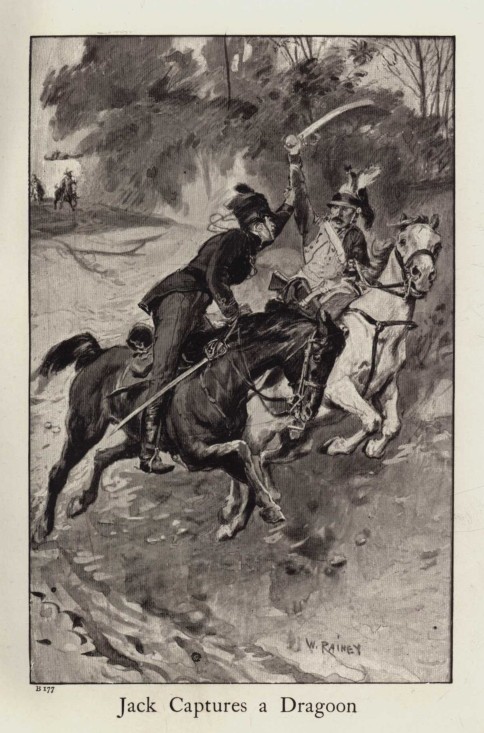
Jack Captures a Dragoon
"Jolly good chase, sir!" said Kelly, as Jack and his prisoner came up. "The froggies showed the cleanest pair of heels I ever did see."
"You stuck to it like a Briton," said Jack. "Now we'll get back to the others and see what damage is done."
With the two Frenchmen disarmed between them, they retraced their steps, the Frenchmen sitting limp and careless, with a resigned expression of countenance that tickled Kelly's sense of humour.
"Where do you come from, mon brave?" asked Jack of the man next to him.
"From Rueda, monsieur le capitaine," answered the trooper with a smile. Jack chuckled inwardly at his sudden promotion, and went on:
"And what is your regiment?"
"Mais, monsieur, the 22nd Chasseurs of General Franceschi's cavalry. And little did we think, monsieur, that we should meet Englishmen to-day. Eh bien! it is all the fortune of war, and monsieur le capitaine rides a good horse."
"No better than your own, mon brave," said Jack, not to be outdone in politeness. "Well now, how many of your regiment may happen to be in Rueda, if I may ask?"
The trooper looked at him with twinkling eyes.
"Non, non, monsieur le capitaine," he said. "You have captured our patrol: c'est égal! but you want to know too much. I tell you how many? Non, non; but we are enough to capture all Sir Moore's army before it ends its retreat to Lisbon. Monsieur wants to spoil the joke."
"Very well," said Jack with a laugh. "I won't press you; but there are more ways than one of killing a cat, as we say in English."
He kept up an amicable conversation with the Frenchman until they arrived at the cross-roads. There he found his two troopers mounting guard over the four wounded chasseurs, and Jack was sufficiently new to warfare to feel relieved and glad that no life had been lost. The dragoons had made clumsy attempts to bind up their prisoners' wounds, and had allowed the least injured of them to fetch water in his helmet from the stream.
"That's right," said Jack as he came up. "We've had an unexpected piece of luck, my men, and our capture may be important. But we have no time to lose. We made noise enough along the road to bring up the whole French army if it's hereabouts. Lucky the regiment isn't far behind us. Now help these fellows on to their horses; we'll take them back to the hut we left a while ago, and I'll leave them in your charge while I go on alone and pick up a little information."
"May I come, sir?" asked Kelly. "'Tisn't safe to go alone."
"Safer for one than two. But come along; there's no time to waste, and it's getting dark."
In a few minutes the cavalcade had reached the hut on the hillside. The muleteer glowered viciously at the prisoners as they were led up to his door, and handled his knife as though he would have liked there and then to take vengeance upon them for the loss of his favourite pig. But Jack allowed no mistake about his intentions; he told the man that the prisoners would remain with him, in charge of the dragoons, until the British advance-guard under General Stewart arrived.
"I'm going on to Rueda," he added. "How far is it from here?"
"A league and a half, Señor," said the man.
"That's about seven miles as your Spanish league goes. Kelly, if General Stewart arrives before I get back, tell him that there are some of General Franceschi's chasseurs at Rueda on our right flank, and I've gone to find out how many. If all goes well I'll be back within two hours."
"Very good, sir!" said Kelly, and then looked as though he would have said more.
"Well, what is it?" asked Jack.
"Beg pardon, sir, but you'll be nabbed as sure as a gun. Your uniform—"
"Don't worry, Kelly. I'm going to borrow an outfit from one of our French friends here. Come, mon ami," he said, turning to the sergeant whom he had captured, "I must trouble you to take off some of your things—your helmet, say, and your cloak, your breeches, and your boots; I think they'll be enough."
"Pardon, monsieur le capitaine, but I'm a soldier of the emperor, and the emperor would shoot me as a traitor if I parted with my uniform to an Englishman."
"That would be unfortunate. But we can't stand on ceremony now; make haste, if you please."
"But, monsieur," said the man, "the breeches won't fit you."
"They will be a trifle baggy, but no one will be critical in the dark. Come now, hurry up!"
"But, monsieur, I shall be cold, I shall freeze. If monsieur will lend me his things in exchange, perhaps—"
"No, thanks! If you're cold you'd better ask the muleteer to lend you some things, or, better still, go to bed. Kelly, come and help the sergeant off with his things."
But as Kelly approached him with a grin, the Frenchman unclasped his cloak and proceeded to divest himself of the garments Jack required. Soon Jack was cantering off on his reconnoitring expedition to Rueda.
By this time it was almost dark, and Jack rode gently, partly in order to avoid mishap, and partly to spare his horse in case hard work were required of him later. His blood tingled with the excitement of his recent adventure and with anticipation of the unknown adventures before him. Like his brother officers, and indeed every member of the army, from the chief of staff to the smallest drummer-boy, he rejoiced in the sudden change of plan which Sir John Moore had announced about a week before. The news he himself had brought to the general, reinforced by further news obtained through Manuel and Juan, and by information that the Spanish armies were concentrating, had determined Sir John, on December 5th, to countermand his order to retreat. The French, he had learnt, were not marching in his direction, but towards Madrid, which, he was assured, was defended by large forces at the difficult Somosierra Pass, and would resist to the utmost. He put little faith in the Spaniards' power of resistance, but he saw a possibility of creating a diversion in their favour, and of cutting in between Soult and Napoleon and striking a blow at the former. If Madrid had not yet fallen, his movement might draw off Napoleon and save the capital, or at any rate he might make matters so unpleasant, by seizing Valladolid and Burgos, that time would be gained for the re-equipment of the Spanish armies. If, on the other hand, Madrid fell, he could still make a run for it. He therefore ordered Baird on his left and Hope on his right to move forward towards Valladolid, while he himself prepared to advance on the same town by way of Alaejos and Tordesillas, acquainting the Marquis of La Romana, who was at Leon, some 120 miles due north of Salamanca, with his intentions.
A few days after Moore had arrived at this decision he received the news that Madrid had capitulated to Napoleon. It was a severe blow. He had hoped against hope that the Spanish promises would at last be fulfilled, that their boasts would at last justify themselves. Once more the Spaniards had shown their instability. But Moore was not disposed to alter his plans; there seemed every probability of his striking a successful blow at the French communications. On December 11th, then, the infantry moved out from Salamanca, General Paget marching with the reserve for Toro, where his brother, Lord Paget, had already arrived with Baird's cavalry, while Hope left Alba de Tormes next day to join the main body on the Valladolid road. The advance along this road was led by General Charles Stewart's cavalry brigade, consisting of Hussars and Light Dragoons. It happened that during the previous week Jack had more than once been sent backwards and forwards between Salamanca and Alba de Tormes with despatches and reports, and he had come under the notice of General Stewart. When the advance was ordered, Stewart, thinking that Jack would be useful in gathering news from the Spaniards, and acting as interpreter in matters connected with commissariat and billeting, asked that he might be temporarily attached to him as extra aide-de-camp, and it was while riding ahead to enquire about billets in Tordesillas that Jack met with the adventure just related.