MAMMALIA. (continued 3)
Reading edition
Its food is different from that of the hedgehog, for whereas the hedgehog lives entirely on animal food, as has been already mentioned, the Porcupine is as exclusively a vegetable eater, feeding chiefly on roots and bark.
It is quite as common in Palestine as the hedgehog, a fact which increases the probability that the two animals may have been mentioned under a common title. Being a nocturnal animal, it retires during the day-time to some crevice in a rock or burrow in the ground, and there lies sleeping until the sunset awakens it and calls it to action. And as the hedgehog is also a nocturnal animal, the similarity of habit serves to strengthen the mutual resemblance.
The Porcupine is peculiarly fitted for living in dry and unwatered spots, as, like many other animals, of which our common rabbit is a familiar example, it can exist without water, obtaining the needful moisture from the succulent roots on which it feeds.
The sharply pointed quills with which its body is covered are solid, and strengthened in a most beautiful manner by internal ribs, that run longitudinally along its length, exactly like those of the hollow iron masts, which are now coming so much into use. As they are, in fact, greatly developed hairs, they are continually shed and replaced, and when they are about to fall are so loosely attached that they fall off if pulled slightly, or even if the animal shakes itself. Consequently the shed quills that lie about the localities inhabited by the Porcupine indicate its whereabouts, and so plentiful are these quills in some places that quite a bundle can be collected in a short time.
There are many species of Porcupines which inhabit different parts of the world, but that which has been mentioned is the common Porcupine of Europe, Asia, and Africa (Hystrix cristata).
THE MOLE.
The two Hebrew words which are translated as Mole—Obscurity of the former name—A parallel case in our own language—The second name—The Moles and the Bats, why associated together—The real Mole of Scripture, its different names, and its place in zoology—Description of the Mole-rat and its general habits—Curious superstition—Discovery of the species by Mr. Tristram—Scripture and science—How the Mole-rat finds its food—Distinction between the Mole and the present animal.
There are two words which are translated as Mole in our authorized version of the Bible. One of them is so obscure that there seems no possibility of deciding the creature that is represented by it. We cannot even tell to what class of the animal kingdom it refers, because in more than one place it is mentioned as one of the unclean birds that might not be eaten (translated as swan in our version), whereas, in another place, it is enumerated among the unclean creeping things.
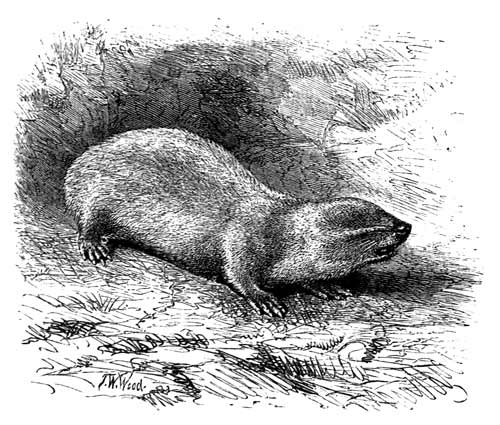
THE MOLE-RAT.
"These also shall be unclean unto you among the creeping things that creep upon the earth ... the lizard, the snail, and the mole."—Lev. xi. 29, 30.
We may conjecture that the same word might be used to designate two distinct animals, though we have no clue to their identification. It is rather a strange coincidence, in corroboration of this theory, that our word Mole signifies three distinct objects—firstly, an animal; secondly, a cutaneous growth; and thirdly, a bank of earth. Now, supposing English to be a dead language, like the Hebrew, it may well be imagined that a translator of an English book would feel extremely perplexed when he saw the word Mole used in such widely different senses.
The best Hebraists can do no more than offer a conjecture founded on the structure of the word Tinshemeth, which is thought by some to be the chameleon. Some think that it is the Mole, some the ibis, some the salamander, while others consider it to be the centipede; and in neither case have any decisive arguments been adduced.
We will therefore leave the former of these two names, and proceed to the second, Chephor-peroth.
This word occurs in that passage of Isaiah which has already been quoted when treating of the bat. "In that day a man shall cast his idols of silver and his idols of gold, which they made each one to himself to worship, to the moles and to the bats; to go into the clefts of the rocks and into the tops of the ragged rocks, for fear of the Lord and for the glory of his majesty, when he ariseth to shake terribly the earth."
It is highly probable that the animal in question is the Mole of Palestine, which is not the same as our European species, but is much larger in size, and belongs to a different order of mammalia. The true Mole is one of the insectivorous and carnivorous animals, and is allied to the shrews and the hedgehogs; whereas the Mole of Palestine (Spalax typhlus) is one of the rodents, and allied to the rabbits, mice, marmots, and jerboas. A better term for it is the Mole-rat, by which name it is familiar to zoologists. It is also known by the names of Slepez and Nenni.
In length it is about eight inches, and its colour is a pale slate. As is the case with the true Moles, the eyes are of very minute dimensions, and are not visible through the thick soft fur with which the whole head and body are covered. Neither are there any visible external ears, although the ear is really very large, and extremely sensitive to sound. This apparent privation of both ears and eyes gives to the animal a most singular and featureless appearance, its head being hardly recognisable as such but for the mouth, and the enormous projecting teeth, which not only look formidable, but really are so. There is a curious superstition in the Ukraine, that if a man will dare to grasp a Mole-rat in his bare hand, allow it to bite him, and then squeeze it to death, the hand that did the deed will ever afterwards possess the virtue of healing goitre or scrofula.
This animal is spread over a very large tract of country, and is very common in Palestine. Mr. Tristram gives an interesting account of its discovery. "We had long tried in vain to capture the Mole of Palestine. Its mines and its mounds we had seen everywhere, and reproached ourselves with having omitted the mole-trap among the items of our outfit. From the size of the mounds and the shallowness of the subterranean passages, we felt satisfied it could not be the European species, and our hopes of solving the question were raised when we found that one of them had taken up its quarters close to our camp. After several vain attempts to trap it, an Arab one night brought a live Mole in a jar to the tent. It was no Mole properly so called, but the Mole-rat, which takes its place throughout Western Asia. The man, having observed our anxiety to possess a specimen, refused to part with it for less than a hundred piastres, and scornfully rejected the twenty piastres I offered. Ultimately, Dr. Chaplin purchased it for five piastres after our departure, and I kept it alive for some time in a box, feeding it on sliced onions."
The same gentleman afterwards caught many of the Mole-rats, and kept them in earthen vessels, as they soon gnawed their way through wood. They fed chiefly on bulbs, but also ate sopped bread. Like many other animals, they reposed during the day, and were active throughout the night.
The author then proceeds to remark on the peculiarly appropriate character of the prophecy that the idols should be cast to the Moles and the bats. Had the European Mole been the animal to which reference was made, there would have been comparatively little significance in the connexion of the two names, because, although both animals are lovers of darkness, they do not inhabit similar localities. But the Mole-rat is fond of frequenting deserted ruins and burial-places, so that the Moles and the bats are really companions, and as such are associated together in the sacred narrative. Here, as in many other instances, we find that closer study of the Scriptures united to more extended knowledge are by no means the enemies of religion, as some well-meaning, but narrow-minded persons think. On the contrary, the Scriptures were never so well understood, and their truth and force so well recognised, as at the present day; and science has proved to be, not the destroyer of the Bible, but its interpreter. We shall soon cease to hear of "Science versus the Bible," and shall substitute "Science and the Bible versus Ignorance and Prejudice."
The Mole-rat needs not to dig such deep tunnels as the true Moles, because its food does not lie so deep. The Moles live chiefly upon earthworms, and are obliged to procure them in the varying depths to which they burrow. But the Mole-rat lives mostly upon roots, preferring those of a bulbous nature. Now bulbous roots are, as a rule, situated near the surface of the ground, and, therefore, any animal which feeds upon them must be careful not to burrow too deeply, lest it should pass beneath them. The shallowness of the burrows is thus accounted for. Gardens are often damaged by this animal, the root-crops, such as carrots and onions, affording plenty of food without needing much exertion.
The Mole-rat does not keep itself quite so jealously secluded as does our common Mole, but occasionally will come out of the burrow and lie on the ground, enjoying the warm sunshine. Still it is not easily to be approached; for though its eyes are almost useless, the ears are so sharp, and the animal is so wary, that at the sound of a footstep it instantly seeks the protection of its burrow, where it may bid defiance to its foes.
How it obtains its food is a mystery. There seems to be absolutely no method of guiding itself to the precise spot where a bulb may be growing. It is not difficult to conjecture the method by which the Mole discovers its prey. Its sensitive ears may direct it to the spot where a worm is driving its way through the earth, and should it come upon its prey, the very touch of the worm, writhing in terror at the approach of its enemy, would be sufficient to act as a guide. I have kept several Moles, and always noticed that, though they would pass close to a worm without seeming to detect its presence, either by sight or scent, at the slightest touch they would spring round, dart on the worm, and in a moment seize it between their jaws. But with the Mole-rat the case is different. The root can utter no sound, and can make no movement, nor is it likely that the odour of the bulb should penetrate through the earth to a very great distance.
THE MOUSE.
Conjectures as to the right translation of the Hebrew word Akbar—Signification of the word—The Mice which marred the land—Miracles, and their economy of power—The Field-mouse—Its destructive habits and prolific nature—The insidious nature of its attacks, and its power of escaping observation—The Hamster, and its habits—Its custom of storing up provisions for the winter—Its fertility and unsociable nature—The Jerboa, its activity and destructiveness—Jerboas and Hamsters eaten by Arabs and Syrians—Various species of Dormice and Sand-rats.
That the Mouse mentioned in the Old Testament was some species of rodent animal is tolerably clear, though it is impossible to state any particular species as being signified by the Hebrew word Akbar. The probable derivation of this name is from two words which signify "destruction of corn," and it is therefore evident that allusion is made to some animal which devours the produce of the fields, and which exists in sufficient numbers to make its voracity formidable.
Some commentators on the Old Testament translate the word Akbar as jerboa. Now, although the jerboa is common in Syria, it is not nearly so plentiful as other rodent animals, and would scarcely be selected as the means by which a terrible disaster is made to befall a whole country. The student of Scripture is well aware that, in those exceptional occurrences which are called miracles, a needless development of the wonder-working power is never employed. We are not to suppose, for example, that the clouds of locusts that devoured the harvests of the Egyptians were created for this express purpose, but that their already existing hosts were concentrated upon a limited area, instead of being spread over a large surface. Nor need we fancy that the frogs which rendered their habitations unclean, and contaminated their food, were brought into existence simply to inflict a severe punishment on the fastidious and superstitious Egyptians.
Of course, had such an exercise of creative power been needed, it would have been used, but we can all see that a needless miracle is never worked. He who would not suffer even a crumb of the miraculously multiplied bread to be wasted, is not likely to waste that power by which the miracle was wrought.
If we refer to the early history of the Israelitish nation, as told in 1 Sam. iv.—vi., we shall find that the Israelites made an unwarrantable use of the ark, by taking it into battle, and that it was captured and carried off into the country of the Philistines. Then various signs were sent to warn the captors to send the ark back to its rightful possessors. Dagon, the great fish-god, was prostrated before it, painful diseases attacked them, so that many died, and scarcely any seem to have escaped, while their harvests were ravaged by numbers of "mice that marred the land."
The question is now simple enough. If the ordinary translation is accepted, and the word Akbar rendered as Mouse, would the necessary conditions be fulfilled, i.e. would the creature be destructive, and would it exist in very great numbers? Now we shall find that both these conditions are fulfilled by the common Field-mouse (Arvicola arvalis).
This little creature is, in proportion to its size, one of the most destructive animals in the world. Let its numbers be increased from any cause whatever, and it will most effectually "mar the land." It will devour every cereal that is sown, and kill almost any sapling that is planted. It does not even wait for the corn to spring up, but will burrow beneath the surface, and dig out the seed before it has had time to sprout. In the early part of the year, it will eat the green blade as soon as it springs out of the ground, and is an adept at climbing the stalks of corn, and plundering the ripe ears in the autumn.
When stacked or laid up in barns, the harvest is by no means safe, for the Mice will penetrate into any ordinary barn, and find their way into any carelessly-built stack, from which they can scarcely be ejected. The rat itself is not so dire a foe to the farmer, as the less obtrusive, but equally mischievous Field-mouse. The ferret will drive the rats out of their holes, and if they have taken possession of a wheat-stack they can be ejected by depriving them of access to water. But the burrows of the Field-mouse are so small that a ferret cannot make its way through them, and the nightly dew that falls on the stack affords an ample supply of water.
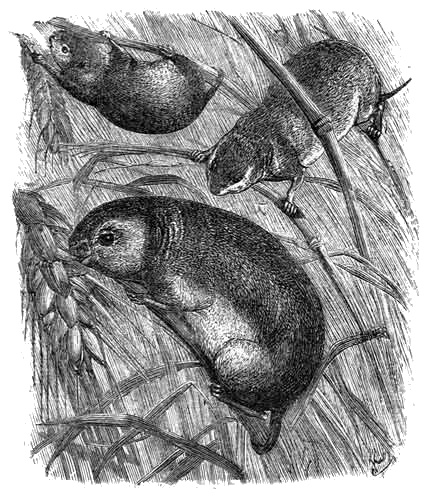
THE FIELD-MOUSE.
"Wherefore ye shall make images of your mice that mar the land."—1 Sam. vi. 5.
When the Field-mouse is deprived of the food which it loves best, it finds a subsistence among the trees. Whenever mice can discover a newly-planted sapling, they hold great revel upon it, eating away the tender young bark as high as they can reach, and consequently destroying the tree as effectually as if it were cut down. Even when the young trees fail them, and no tender bark is to be had, the Field-mice can still exert their destructive powers. They will then betake themselves to the earth, burrow beneath its surface, and devour the young rootlets of the forest trees. All botanists know that a healthy tree is continually pushing forward fresh roots below the ground, in order to gain sufficient nourishment to supply the increasing growth above. If, therefore, these young roots are destroyed, the least harm that can happen to the tree is that its further growth is arrested; while, in many cases, the tree, which cannot repair the injuries it has received, droops gradually, and finally dies. Even in this country, the Field-mouse has proved itself a terrible enemy to the agriculturist, and has devastated considerable tracts of land.
So much for the destructive powers of the Field-mouse, and the next point to be considered is its abundance.
Nearly all the rats and mice are singularly prolific animals, producing a considerable number at a brood, and having several broods in a season. The Field-mouse is by no means an exception to the general rule, but produces as many young in a season as any of the Mice.
Not only is it formidable from its numbers, but from the insidious nature of its attacks. Any one can see a rabbit, a hare, or even a rat; but to see a Field-mouse is not easy, even when the little creatures are present in thousands. A Field-mouse never shows itself except from necessity, its instinct teaching it to escape the observation of its many furred and feathered enemies. Short-legged and soft-furred, it threads its noiseless way among the herbage with such gentle suppleness that scarcely a grass-blade is stirred, while, if it should be forced to pass over a spot of bare ground, the red-brown hue of its fur prevents it from being detected by an inexperienced eye. Generally the Field-mouse is safe from human foes, and has only to dread the piercing eye and swift wings of the hawk, or the silent flight and sharp talons of the owl.
Although there can be no doubt that the Field-mouse is one of the animals to which the name of Akbar is given, it is probable that many species were grouped under this one name. Small rodents of various kinds are very plentiful in Palestine, and there are several species closely allied to the Field-mouse itself.
Among them is the Hamster (Cricetus frumentarius), so widely known for the ravages which it makes among the crops. This terribly destructive animal not only steals the crops for immediate subsistence, but lays up a large stock of provisions for the winter, seeming to be actuated by a sort of miserly passion for collecting and storing away. There seems to be no bounds to the quantity of food which a Hamster will carry into its subterranean store-house, from seventy to one hundred pounds' weight being sometimes taken out of the burrow of a single animal. The fact of the existence of these large stores shows that the animal must need them, and accordingly we find that the Hamster is only a partial hibernator, as it is awake during a considerable portion of the winter months, and is consequently obliged to live on the stores which it has collected.
It is an exceedingly prolific animal, each pair producing on an average twenty-five young in the course of a year. The families are unsociable, and, as soon as they are strong enough to feed themselves, the young Hamsters leave their home, and make separate burrows for themselves. Thus we see that the Hamster, as well as the Field-mouse, fulfils the conditions which are needed in order to class it under the general title of Akbar.
I have already stated that some translators of the Bible use the word Jerboa as a rendering of the Hebrew Akbar. As the Jerboa certainly is found in Palestine, there is some foundation for this idea, and we may safely conjecture that it also is one of the smaller rodents which are grouped together under the appellation of Mouse.
The Common Jerboa (Dipus Ægyptiacus) is plentiful in Palestine, and several other species inhabit the same country, known at once by their long and slender legs, which give them so curious a resemblance to the kangaroos of Australia. The Jerboas pass over the ground with astonishing rapidity. Instead of creeping stealthily among the grass-blades, like the short-limbed field-mouse, the Jerboa flies along with a succession of wonderful leaps, darting here and there with such rapidity that the eye can scarcely follow its wayward movements. When quiet and undisturbed, it hops along gently enough, but as soon as it takes alarm, it darts off in its peculiar manner, which is to the ordinary walk of quadrupeds what the devious course of a frightened snipe is to the steady flight of birds in general.
It prefers hot and dry situations, its feet being defended by a thick coating of stiff hairs, which serve the double purpose of protecting it from the heat, and giving it a firm hold on the ground. It is rather a destructive animal, its sharp and powerful teeth enabling it to bite its way through obstacles which would effectually stop an ordinary Mouse. That the Jerboa may be one of the Akbarim is rendered likely by the prohibition in Lev. xi. 29, forbidding the Mouse to be eaten. It would be scarcely probable that such a command need have been issued against eating the common Mouse, whereas the Jerboa, a much larger and palatable animal, is always eaten by the Arabs. The Hamster is at the present day eaten in Northern Syria.
Beside these creatures there are the Dormice, several species of which animal inhabit Palestine at the present day. There are also the Sand-rats, one species of which is larger than our ordinary rats. The Sand-rats live more in the deserts than the cultivated lands, making their burrows at the foot of hills, and among the roots of bushes.
THE HARE.
The prohibitions of the Mosaic law—The chewing of the cud, and division of the hoof—Identity of the Hare of Scripture—Rumination described—The Hare a rodent and not a ruminant—Cowper and his Hares—Structure of the rodent tooth—The Mosaic law accommodated to its recipients—The Hares of Palestine and their habits.
Among the many provisions of the Mosaic law are several which refer to the diet of the Israelites, and which prohibit certain kinds of food. Special stress is laid upon the flesh of animals, and the list of those which may be lawfully eaten is a singularly restricted one, all being excluded except those which "divide the hoof and chew the cud." And, lest there should be any mistake about the matter, examples are given both of those animals which may and those which may not be eaten.
The ox, sheep, goat, and antelopes generally are permitted as lawful food, because they fulfil both conditions; whereas there is a special prohibition of the swine, because it divides the hoof but does not chew the cud, and of the camel, coney, and hare because they chew the cud, but do not divide the hoof. Our business at present is with the last of these animals.
Considerable discussion has been raised concerning this animal, because, as is well known to naturalists, the Hare is not one of the ruminant animals, but belongs to the same order as the rat, rabbit, beaver, and other rodents. Neither its teeth nor its stomach are constructed for the purpose of enabling it to ruminate, i.e. to return into the mouth the partially-digested food, and then to masticate it afresh; and therefore it has been thought that either there is some mistake in the sacred narrative, or that the Hebrew word has been mistranslated.
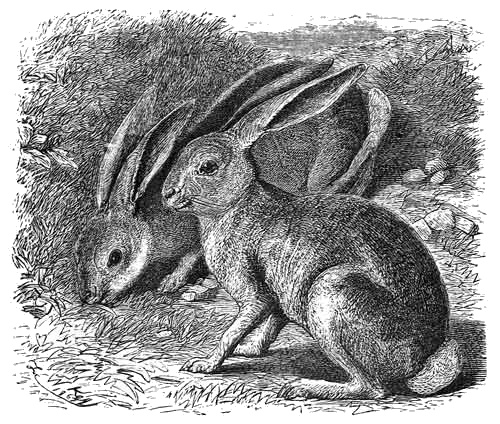
THE SYRIAN HARE.
"Nevertheless, these ye shall not eat of them that chew the cud, or of them that divide the cloven hoof: as the camel, and the hare, and the coney."—Deut. xiv. 7.
Taking the latter point first, as being the simplest of the two, we find that the Hebrew word which is rendered as Hare is Arnebeth, and that it is rendered in the Septuagint as Dasypus, or the Hare,—a rendering which the Jewish Bible adopts. That the Arnebeth is really the Hare may also be conjectured from the fact that the Arabic name for that animal is Arneb. In consequence of the rather wide sense to which the Greek word Dasypus (i.e. hairy-foot) is used, some commentators have suggested that the rabbit may have been included in the same title. This, however, is not at all likely, inasmuch as the Hare is very plentiful in Palestine, and the rabbit is believed not to be indigenous to that part of the world. And, even if the two animals had been classed under the same title, the physiological difficulty would not be removed.
Before proceeding further, it will be as well to give a brief description of the curious act called rumination, or "chewing the cud."
There are certain animals, such as the oxen, antelopes, deer, sheep, goats, camels, &c. which have teeth unfitted for the rapid mastication of food, and which therefore are supplied with a remarkable apparatus by which the food can be returned into the mouth when the animal has leisure, and be re-masticated before it passes into the true digestive organs.
For this purpose they are furnished with four stomachs, which are arranged in the following order. First comes the paunch or "rumen" (whence the word "ruminating"), into which passes the food in a very rough state, just as it is torn, rather than bitten, from the herbage, and which is analogous to the crop in birds. It thence passes into the second stomach, or "honeycomb," the walls of which are covered with small angular cells. Into those cells the food is received from the first stomach, and compressed into little balls, which can be voluntarily returned into the mouth for mastication.
After the second mastication has been completed, the food passes at once into the third stomach, and thence into the fourth, which is the true digesting cavity. By a peculiar structure of these organs, the animal is able to convey its food either into the first or third stomach, at will, i.e. into the first when the grass is eaten, and into the third after rumination. Thus it will be seen that an animal which chews the cud must have teeth of a certain character, and be possessed of the fourfold stomach which has just been described.
Two points are conceded which seem to be utterly irreconcilable with each other. The first is that the Mosaic law distinctly states that the Hare chews the cud; the second is, that in point of fact the Hare is not, and cannot be, a ruminating animal, possessing neither the teeth nor the digestive organs which are indispensable for that process. Yet, totally opposed as these statements appear to be, they are in fact, not so irreconcilable as they seem.
Why the flesh of certain animals was prohibited, we do not at the present time know. That the flesh of swine should be forbidden food is likely enough, considering the effects which the habitual eating of swine's flesh is said to produce in hot countries. But it does seem very strange that the Israelites should have been forbidden to eat the flesh of the camel, the coney (or hyrax), and the Hare, and that these animals should have been specified is a proof that the eating or refraining from their flesh was not a mere sanitary regulation, but was a matter of importance. The flesh of all these three animals is quite as good and nutritious as that of the oxen, or goats, which are eaten in Palestine, and that of the Hare is far superior to them. Therefore, the people of Israel, who were always apt to take liberties with the restrictive laws, and were crafty enough to evade them on so many occasions, would have been likely to pronounce that the flesh of the Hare was lawful meat, because the animal chewed the cud, or appeared to do so, and they would discreetly have omitted the passage which alluded to the division of the hoof.
To a non-scientific observer the Hare really does appear to chew the cud. When it is reposing at its ease, it continually moves its jaws about as if eating something, an action which may readily be mistaken for true rumination. Even Cowper, the poet, who kept some hares for several years, and had them always before his eyes, was deceived by this mumbling movement of the jaws. Speaking of his favourite hare, "Puss," he proceeds as follows: "Finding him exceedingly tractable, I made it my custom to carry him always after breakfast into the garden, where he hid himself generally under the leaves of a cucumber vine, sleeping, or chewing the cud, till evening."
The real object of this continual grinding or mumbling movement is simple enough. The chisel-like incisor teeth of the rodent animals need to be rubbed against each other, in order to preserve their edge and shape, and if perchance such friction should be wanting to a tooth, as, for example, by the breaking of the opposite tooth, it becomes greatly elongated, and sometimes grows to such a length as to prevent the animal from eating. Instinctively, therefore, the Hare, as well as the rabbit and other rodents, always likes to be nibbling at something, as any one knows who has kept rabbits in wooden hutches, the object of this nibbling not being to eat the wood, but to keep the teeth in order.
But we may naturally ask ourselves, why the Mosaic law, an emanation from heaven, should mention an animal as being a ruminant, when its very structure shows that such an act was utterly impossible? The answer is clear enough. The law was suited to the capacity of those for whom it was intended, and was never meant to be a handbook of science, as well as a code of religious duties and maxims. The Jews, like other Orientals, were indifferent to that branch of knowledge which we designate by the name of physical science, and it was necessary that the language in which the law was conveyed to them should be accommodated to their capabilities of receiving it.
It would have been worse than useless to have interrupted the solemn revelation of Divine will with a lesson in comparative anatomy; the object of the passage in question being, not to teach the Jews the distinctive characteristics of a rodent and a ruminant, but to guard against their mistaking the Hare for one of the ruminants which were permitted as food. That they would in all probability have fallen into that mistake is evident from the fact that the Arabs are exceedingly fond of the flesh of the Hare, and accept it, as well as the camel, as lawful food, because it chews the cud, the division of the hoof not being considered by them as an essential.
Hares are very plentiful in Palestine, and at least two species are found in that country. One of them, which inhabits the more northern and hilly portion of Palestine, closely resembles our own species, but has not ears quite so long in proportion, while the head is broader. The second species, which lives in the south, and in the valley of the Jordan, is very small, is of a light dun colour, and has very long ears. In their general habits, these Hares resemble the Hare of England.
CATTLE.
The cattle of Palestine, and their decadence at the present day—Ox-flesh not used for food in modern times—Oxen of the stall, and oxen of the pasture—The use of the ox in agriculture—The yoke and its structure—The plough and the goad—The latter capable of being used as a weapon—Treading out the corn—The cart and its wheels—The ox used as a beast of burden—Cattle turned loose to graze—The bulls of Bashan—Curiosity of the ox-tribe—A season of drought—Branding the cattle—An Egyptian field scene—Cattle-keeping an honourable post—The ox as used for sacrifice—Ox-worship—The bull Apis, and his history—Persistency of the bull-worship—Jeroboam's sin—Various names of cattle—The Indian buffalo.
Under this head we shall treat of the domesticated oxen of Scripture, whether mentioned as Bull, Cow, Ox, Calf, Heifer, &c.
Two distinct species of cattle are found in Palestine, namely, the ordinary domesticated ox, and the Indian buffalo, which lives in the low-lying and marshy valley of the Jordan. Of this species we shall treat presently.
The domesticated cattle are very much like our own, but there is not among them that diversity of breed for which this country is famous; nor is there even any distinction of long and short horned cattle. There are some places where the animals are larger than in others, but this difference is occasioned simply by the better quality and greater quantity of the food.
As is the case in most parts of the world where civilization has made any progress, Domesticated Cattle were, and still are, plentiful in Palestine. Even at the present time the cattle are in common use, though it is evident, from many passages of Holy Writ, that in the days of Judæa's prosperity cattle were far more numerous than they are now, and were treated in a better fashion.
To take their most sacred use first, a constant supply of cattle was needed for the sacrifices, and, as it was necessary that every animal which was brought to the altar should be absolutely perfect, it is evident that great care was required in order that the breed should not deteriorate, a skill which has long been rendered useless by the abandonment of the sacrifices.
Another reason for their better nurture in the times of old is that in those days the ox was largely fed and fatted for the table, just as is done with ourselves. At the present day, the flesh of the cattle is practically unused as food, that of the sheep or goat being always employed, even when a man gives a feast to his friends. But, in the old times, stalled oxen, i.e. oxen kept asunder from those which were used for agricultural purposes, and expressly fatted for the table, were in constant use. See for example the well-known passage in the Prov. xv. 17, "Better is a dinner of herbs where love is, than a stalled ox and hatred therewith." Again, the Prophet Jeremiah makes use of a curious simile, "Egypt is like a very fair heifer, but destruction cometh; it cometh out of the north. Also her hired men are in the midst of her like fatted bullocks [or, bullocks of the stall], for they also are turned back, and are fled away together." (Jer. xlvi. 20.) And in 1 Kings iv. 22, 23, when describing the glories of Solomon's household, the sacred writer draws a distinction between the oxen which were especially fattened for the table of the king and the superior officers, and those which were consumed by the lower orders of his household: "And Solomon's provision for one day was thirty measures of fine flour, and threescore measures of meal, ten fat oxen, and twenty oxen out of the pastures, and an hundred sheep, beside harts, and roebucks, and fallow-deer, and fatted fowl." Again, in the well-known parable of the king's marriage, there is an allusion to fatted animals, and a distinction is made between the oxen of the pasture and those of the stall. "Again, he sent forth other servants, saying, Tell them which are bidden, Behold, I have prepared my dinner, my oxen and my fatlings are killed, and all things are ready."
Calves—mostly, if not always, bull-calves—were largely used for food in Palestine, and in the households of the wealthy were fatted for the table. See, for example, the familiar parable of the prodigal son, in which the rejoicing father is mentioned as preparing a great feast in honour of his son's return, and ordering the fatted calf to be killed—the calf in question being evidently one of the animals that were kept in good condition against any festive occasion. And, even in the earliest history of the Bible, the custom of keeping a fatted calf evidently prevailed, as is shown by the conduct of Abraham, who, when he was visited by the three heavenly guests, "ran unto the herd, and fetched a calf, tender and good," and had it killed and dressed at once, after the still existing fashion of the East.
But, even in the times of Israel's greatest prosperity, the chief use of the ox was as an agricultural labourer, thus reversing the custom of this country, where the horse has taken the place of the ox as a beast of draught, and where cattle are principally fed for food. Ploughing was, and is, always performed by oxen, and allusions to this office are scattered plentifully through the Old and New Testaments.
When understood in this sense, oxen are almost always spoken of in connexion with the word "yoke," and as each yoke comprised two oxen, it is evident that the word is used as we employ the term "brace," or pair. The yoke, which is the chief part of the harness, is a very simple affair. A tolerably stout beam of wood is cut of a sufficient length to rest upon the necks of the oxen standing side by side, and a couple of hollows are scooped out to receive the crest of the neck. In order to hold it in its place, two flexible sticks are bent under their necks, and the ends fixed into the beam of the yoke. In the middle of this yoke is fastened the pole of the plough or cart, and this is all the harness that is used, not even traces being required.
It will be seen that so rude an implement as this would be very likely to gall the necks of the animals, unless the hollows were carefully smoothed, and the heavy beam adapted to the necks of the animals. This galling nature of the yoke, so familiar to the Israelites, is used repeatedly as a metaphor in many passages of the Old and New Testaments. These passages are too numerous to be quoted, but I will give one or two of the most conspicuous among them. The earliest mention of the yoke in the Scriptures is a metaphor.
After Jacob had deceived his father, in procuring for himself the blessing which was intended for his elder brother, Isaac comforts Esau by the prophecy that, although he must serve his brother, yet "it shall come to pass when thou shalt have the dominion, that thou shalt break his yoke from off thy neck." Again, in the next passage where the yoke is mentioned, namely, Lev. xxvi. 13, the word is employed in the metaphorical sense: "I am the Lord your God, which brought you forth out of the land of Egypt, that ye should not be their bondmen, and I have broken the bands of your yoke, and made you go upright."
"It is good for a man to bear the yoke in his youth."—Lam. iii. 27.
"He maketh them also to skip like a calf."—Psalm 6.
Then, in Deut. xxviii. 48, the word yoke is not only used metaphorically, but with an addition that forcibly expresses its weight and galling character: "Therefore shalt thou serve thine enemies, which the Lord shall send against thee, in hunger, and in thirst, and in nakedness, and in want of all things, and He shall put a yoke of iron upon thy neck, until He have destroyed thee."
The word yoke is also used as a metaphor for servitude, even of a domestic character, as we may see in 1 Tim. vi. 1: "Let as many servants as are under the yoke count their own masters worthy of all honour." In the Acts of the Apostles, we find St. Peter using the same metaphor: "Why tempt ye God, to put a yoke on the neck of the disciples, which neither our fathers nor we were able to bear?" And the Lord Himself uses the same metaphor in the well-known passage, "Take my yoke upon you, for my yoke is easy and my burden light."
The plough was equally simple, and consisted essentially of a bent branch, one end of which was armed with an iron point by way of a share, while the other formed the pole or beam, and was fastened to the middle of the yoke. It was guided by a handle, which was usually a smaller branch that grew from the principal one. A nearly similar instrument is used in Asia Minor to the present day, and is a curious relic of the most ancient times of history, for we find on the Egyptian monuments figures of the various agricultural processes, in which the plough is made after this simple manner.
Of course such an instrument is a very ineffective one, and can but scratch, rather than plough the ground, the warmth of the climate and fertility of the land rendering needless the deep ploughing of our own country, where the object is to turn up the earth to the greatest possible depth. One yoke of oxen was generally sufficient to draw a plough, but occasionally a much greater number were required. We read, for example, of Elisha, who, when he received his call from Elijah, was ploughing with twelve yoke of oxen, i.e. twenty-four. It has been suggested, that the twelve yoke of oxen were not all attached to the same plough, but that there were twelve ploughs, each with its single yoke of oxen. This, however, was scarcely likely to be the case, as it is definitely stated that Elisha "was ploughing with twelve yoke of oxen before him, and he with the twelfth," and it is much more probable that the land was heavy, and that, therefore, the plough could not be properly worked without the additional force.
The instrument with which the cattle were driven was not a whip, but a goad. This goad was a long and stout stick, armed with a spike at one end, and having a kind of spud at the other, with which the earth could be scraped off the share when it became clogged. Such an instrument might readily be used as a weapon, and, in the hands of a powerful man, might be made even more formidable than a spear. As a weapon, it often was used, as we see from many passages of the Scriptures. For example, it is said in Judges iii. 31, "that Shamgar the son of Anath killed six hundred Philistines with an ox-goad."
Afterwards, in the beginning of Saul's reign, when the Israelites fairly measured themselves against the Philistines, it was found that only Saul and Jonathan were even tolerably armed. Fearful of the numbers and spirit of the Israelites, the Philistines had disarmed them, and were so cautious that they did not even allow them to possess forges wherewith to make or sharpen the various agricultural instruments which they possessed, lest they should surreptitiously provide themselves with weapons. The only smith's tool which they were allowed to retain was a file with which each man might trim the edges of the ploughshares, mattocks, axes, and sharpen the points of the goad. The only weapons which they could muster were made of their agricultural implements, and among the most formidable of them was the goad.
How the goad came into use in Palestine may easily be seen. The Egyptians, from among whom the people of Israel passed into the Promised Land, did not use the goad in ploughing, but the whip, which, from the representations on the Egyptian monuments, was identical with the koorbash, or "cow-hide" whip, which is now in use in the same country. But this terrible whip, which is capable, when wielded by a skilful hand, of cutting deep grooves through the tough hide of the ox, could not be obtained by the Jews, because the hippopotamus, of whose hide it was made, did not live in or near Palestine. They therefore were forced to use some other instrument wherewith to urge on the oxen, and the goad was clearly the simplest and most effective implement for this purpose.
After the land was ploughed and sown, and the harvest was ripened, the labours of the oxen were again called into requisition, first for threshing out the corn, and next for carrying or drawing the grain to the storehouses.
In the earlier days, the process of threshing was very simple. A circular piece of ground was levelled, and beaten very hard and flat, its diameter being from fifty to a hundred feet. On this ground the corn was thrown, and a number of oxen were driven here and there on it, so that the constant trampling of their feet shook the ripe grain out of the ears. The corn was gathered together in the middle of the floor, and as fast as it was scattered by the feet of the oxen, it was thrown back towards the centre.
Afterwards, an improvement was introduced in the form of a rough sledge, called "moreg," to which the oxen were harnessed by a yoke, and on which the driver stood as he guided his team round the threshing-floor. This instrument is mentioned in Isa. xli. 15: "Behold, I will make thee anew and sharp threshing instrument having teeth [or mouths]: thou shalt thresh the mountains, and beat them small, and shalt make the hills as chaff." Mention is also made of the same implement in 2 Sam. xxiv. 22, where it is related that Araunah the Jebusite offered to give David the oxen for a burnt-sacrifice, and the moregs and other implements as wood with which they could be burned.
The work of treading out the corn was a hard and trying one for the oxen, and it was probably on this account that the kindly edict was made, that the oxen who trod out the corn should not be muzzled. As a rule, the cattle were not fed nearly as carefully as is done with us, and so the labours of the threshing-floor would find a compensation in the temporary abundance of which the animals might take their fill.
After the corn was threshed, or rather trodden out, the oxen had to draw it home in carts. These were but slight improvements on the threshing-sledge, and were simply trays or shallow boxes on a pair of wheels. As the wheels were merely slices cut from the trunk of a tree, and were not furnished with iron tires, they were not remarkable for roundness, and indeed, after a little time, were worn into rather irregular ovals, so that the task of dragging a cart over the rough roads was by no means an easy one. And, as the axle was simply a stout pole fastened to the bottom of the cart, and having its rounded ends thrust through holes in the middle of the wheels, the friction was enormous. As, moreover, oil and grease were far too precious luxuries to be wasted in lubricating the axles, the creaking and groaning of the wheels was a singularly disagreeable and ear-piercing sound.
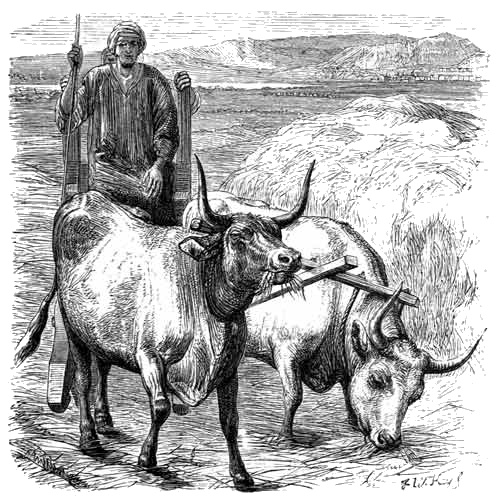
TREADING OUT CORN.
"Thou shalt not muzzle the ox when he treadeth out the corn."—(Deut. xxv. 4.)
The common hackery of India is a good example of the carts mentioned in the Scriptures. As with the plough, the cart was drawn by a couple of oxen, connected by the yoke. The two kinds of cart, namely, the tray and the box, are clearly indicated in the Scriptures. The new cart on which the Ark was placed when it was sent back by the Philistines (see 1 Sam. vi. 7) was evidently one of the former kind, and so was that which was made twenty years afterwards, for the purpose of conveying the Ark to Jerusalem.
The second kind of cart is mentioned by the Prophet Amos (ch. ii. 13), "Behold, I am pressed under you, as a cart is pressed that is full of sheaves," reference being evidently made to heaping up of the sheaves in the cart, and pressing them down, as is done at the present day.
That oxen were also employed as beasts of burden is shown by the passage in 1 Chron. xii. 40, "Moreover, they that were nigh them, even unto Issachar, and Zebulun, and Napthali, brought bread on asses, and on camels, and on mules, and on oxen."
Although the cattle were evidently better tended in the olden times than at present, those animals which were used for agriculture seem to have passed rather a rough life, especially in the winter time. It is rather curious that the Jews should have had no idea of preserving the grass by making it into hay, as is done in Europe. Consequently the chief food of the cattle was the straw and chaff which remained on the threshing-floor after the grain had been separated. See Isa. xxx. 23: "In that day shall thy cattle feed in large pastures. The oxen likewise, and the young asses that ear the ground shall eat clean provender, which hath been winnowed with the shovel and with the fan."
This, indeed, was the only use to which the straw could be put, for it was so crushed and broken by the feet of the oxen and the threshing-sledge that it was rendered useless. Allusion is made to the crushing of the straw in many passages of Scripture. See, for example, Isa. xxv. 10, "Moab shall be trodden down [or threshed] under him, even as straw is trodden down for the dunghill."
The want of winter forage is the chief reason why cattle are so irregularly disposed over Palestine, many parts of that country being entirely without them, and only those districts containing them in which fresh forage may be found throughout the year.
Except a few yoke of oxen, which are kept in order to draw carts, and act as beasts of burden, the cattle are turned loose for a considerable portion of the year, and run about in herds from one pasturage to another. Thus they regain many of the characteristics of wild animals, and it is to this habit of theirs that many of the Scriptural allusions can be traced.
For example, see Ps. xxii. 12, "Many bulls have compassed me, strong bulls of Bashan have beset me round. They gaped on me with their mouths [or, their mouths opened against me] as a ravening and a roaring lion." This passage alludes to the curiosity inherent in cattle, which have a habit of following objects which they do not understand or dislike, and surrounding it with looks of grave wonderment. Even in their domesticated state this habit prevails. When I was a boy, I sometimes amused myself with going into a field where a number of cows and oxen were grazing, and lying down in the middle of it. The cattle would soon become uneasy, toss their heads about, and gradually draw near on every side, until at last they would be pressed together closely in a circle, with their heads just above the object of their astonishment. Their curious, earnest looks have always been present to my mind when reading the above quoted passage.
The Psalmist does not necessarily mean that the bulls in question were dangerous animals. On the contrary, the bulls of Palestine are gentle in comparison with our own animals, which are too often made savage by confinement and the harsh treatment to which they are subjected by rough and ignorant labourers. In Palestine a pair of bulls may constantly be seen attached to the same yoke, a thing that never would be seen in this country.
The custom of turning the herds of cattle loose to find pasture for themselves is alluded to in Joel i. 18, "How do the beasts groan! the herds of cattle are perplexed because they have no pasture." We can easily imagine to ourselves the terrible time to which the prophet refers, "when the rivers of waters are dried up, and the fire hath devoured the pastures of the wilderness," as it is wont to do when a spark falls upon grass dried up and withered, by reason of the sun's heat and the lack of water. Over such a country, first withered by drought, and then desolated by fire, would the cattle wander, vainly searching on the dusty and blackened surface for the tender young blades which always spring up on a burnt pasture as soon as the first rains fall. Moaning and bellowing with thirst and disappointment, they would vainly seek for food or water in places where the seed lies still under the clods where it was sown (v. 17), where the vines are dried up, and the fig, the pomegranate and the palm (v. 12) are all withered for want of moisture.
Such scenes are still to be witnessed in several parts of the world. Southern Africa is sometimes sadly conspicuous for them, an exceptional season of drought keeping back the fresh grass after the old pastures have been burned (the ordinary mode of cultivating pasture land). Then the vast herds of cattle, whose milk forms the staff of life to the inhabitants, wander to and fro, gathering in masses round any spot where a spring still yields a little water, and bellowing and moaning with thirst as they press their way towards the spot where their owners are doling out to each a small measure of the priceless fluid.
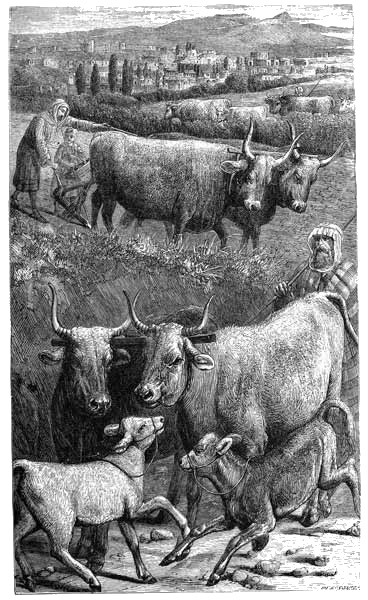
The cattle are branded with the mark of their owners, so that in these large herds there might be no difficulty in distinguishing them when they were re-captured for the plough and the cart. On one of the Egyptian monuments there is a very interesting group, which has furnished the idea for the plate which illustrates this article. It occurs in the tombs of the kings at Thebes, and represents a ploughing scene. The simple two-handled plough is being dragged by a pair of cows, who have the yoke fastened across the horns instead of lying on the neck, and a sower is following behind, scattering the grain out of a basket into the newly-made furrows. In front of the cows is a young calf, which has run to meet its mother, and is leaping for joy before her as she steadily plods along her course.
The action of both animals is admirably represented; the steady and firm gait of the mother contrasting with the light, gambolling step and arched tail of her offspring. Both are branded with the same mark, namely, three equal-armed crosses, one on the haunch, another on the side, and a third on the neck. The driver carries the whip, or koorbash, which has been already mentioned, and which is familiar to travellers in Southern Africa under the title of "sjambok."
In the olden times of the Israelitish race, herd-keeping was considered as an honourable occupation, in which men of the highest rank might engage without any derogation to their dignity. We find, for instance, that Saul himself, even after he had been appointed king, was acting as herdsman when the people saw the mistake they had made in rejecting him as their monarch, and came to fetch their divinely-appointed leader from his retirement. (See 1 Sam. xi. 5.) Doeg, too, the faithful companion of Saul, was made the chief herdsman of his master's cattle, so that for Saul to confer such an office, and Doeg to accept it, shows that the post was one of much honour. And afterwards, when David was in the zenith of his power, he completed the organization of his kingdom, portioning out not only his army into battalions, and assigning a commanding officer to each battalion, but also appointing a ruler to each tribe, and setting officers over his treasury, over the vineyards, over the olive-trees, over the storehouses, and over the cattle. And these offices were so important that the names of their holders are given at length in 1 Chron. xxvii. those of the various herdsmen being thought as worthy of mention as those of the treasurers, the military commanders, or the headmen of the tribes.
Before concluding this necessarily short account of the domesticated oxen of Palestine, it will be needful to give a few lines to the animal viewed in a religious aspect. Here we have, in bold contrast to each other, the divine appointment of certain cattle to be slain as sacrifices, and the reprobation of worship paid to those very cattle as living emblems of divinity. This false worship was learned by the Israelites during their long residence in Egypt, and so deeply had the customs of the Egyptian religion sunk into their hearts, that they were not eradicated after the lapse of centuries. It may easily be imagined that such a superstition, surrounded as it was with every external circumstance which could make it more imposing, would take a powerful hold of the Jewish mind.
Chief among the multitude of idols or symbols was the god Apis, represented by a bull. Many other animals, specially the cat and the ibis, were deeply honoured among the ancient Egyptians, as we learn from their own monuments and from the works of the old historians. All these creatures were symbols as well as idols, symbols to the educated and idols to the ignorant.
None of them was held in such universal honour as the bull Apis. The particular animal which represented the deity, and which was lodged with great state and honour in his temple at Memphis, was thought to be divinely selected for the purpose, and to be impressed with certain marks. His colour must be black, except a square spot on the forehead, a crescent-shaped white spot on the right side, and the figure of an eagle on his back. Under the tongue must be a knob shaped like the sacred scarabæus, and the hairs of his tail must be double.
This representative animal was only allowed to live for a certain time, and when he had reached this allotted period, he was taken in solemn procession to the Nile, and drowned in its sacred waters. His body was then embalmed, and placed with great state in the tombs at Memphis.
After his death, whether natural or not, the whole nation went into mourning, and exhibited all the conventional signs of sorrow, until the priests found another bull which possessed the distinctive marks. The people then threw off their mourning robes, and appeared in their best attire, and the sacred bull was exhibited in state for forty days before he was taken to his temple at Memphis. The reader will here remember the analogous case of the Indian cattle, some of which are held to be little less than incarnations of divinity.
Even at the very beginning of the exodus, when their minds must have been filled with the many miracles that had been wrought in their behalf, and with the cloud and fire of Sinai actually before their eyes, Aaron himself made an image of a calf in gold, and set it up as a symbol of the Lord. That the idol in question was intended as a symbol by Aaron is evident from the words which he used when summoning the people to worship, "To-morrow is a feast of the Lord" (Gen. xxxii. 5). The people, however, clearly lacked the power of discriminating between the symbol and that which it represented, and worshipped the image just as any other idol might be worshipped. And, in spite of the terrible and swift punishment that followed, and which showed the profanity of the act, the idea of ox-worship still remained among the people.
Five hundred years afterwards we find a familiar example of it in the conduct of Jeroboam, "who made Israel to sin," the peculiar crime being the open resuscitation of ox-worship. "The king made two calves of gold and said unto them, It is too much for you to go up to Jerusalem: behold thy gods, O Israel, which brought thee up out of the land of Egypt. And he set the one in Bethel, and the other put he in Dan.... And he made an house of high places, and made priests of the lowest of the people, which were not of the tribe of Levi. And Jeroboam ordained a feast ... like unto the feast in Judah, and he offered upon the altar. So did he in Bethel, sacrificing unto the calves that he had made."
Here we have a singular instance of a king of Israel repeating, after a lapse of five hundred years, the very acts which had drawn down on the people so severe a punishment, and which were so contrary to the law that they had incited Moses to fling down and break the sacred tables on which the commandments had been divinely inscribed. Nothing is omitted: the shape of the idol, the material of which it is composed, the offerings, and the very words in which Aaron had so deeply sinned, "Behold thy gods, O Israel, which brought thee up out of the land of Egypt." Successive monarchs followed his example, and, according to the graphic words of Scripture, they "departed not from the ways of Jeroboam the son of Nebat, who made Israel to sin."
As was likely to be the case in a land where cattle were of such importance, and often formed the principal wealth of the inhabitants, many words were in use to distinguish the cattle according to sex, age, and number. Thus, Bakar signifies the adult animal of either sex, the test of full growth being fitness for the plough. Consequently, Ben-Baka, or son of the herd, signifies a male calf, and Aiglah-Bakar, a female calf. The term Bakar is derived from a Hebrew word signifying to cleave or plough, and hence it is used as to signify those animals which are old enough to be put to the plough.
Then there is the word Shor, or Tor, to signify a single head of cattle, of any age, or of either sex. The second form of this word is familiar to us in the Latin word "taurus," and the English "steer." There are several other words, such as Par, a young bull, and Parah, a heifer, which do not need explanation.
Another species of the ox-tribe now inhabits Palestine, though commentators rather doubt whether it is not a comparatively late importation. This is the true Buffalo (Bubalus buffelus, Gray), which is spread over a very large portion of the earth, and is very plentiful in India. In that country there are two distinct breeds of the Buffalo, namely, the Arnee, a wild variety, and the Bhainsa, a tamed variety. The former animal is much larger than the latter, being sometimes more than ten feet in length from the nose to the root of the tail, and measuring between six and seven feet in height at the shoulder. Its horns are of enormous length, the tail is very short, and tufts of hair grow on the forehead and horns. The tamed variety is at least one-third smaller, and, unlike the Arnee, never seems to get into high condition. It is an ugly, ungainly kind of beast, and is rendered very unprepossessing to the eye by the bald patches which are mostly found upon its hide.
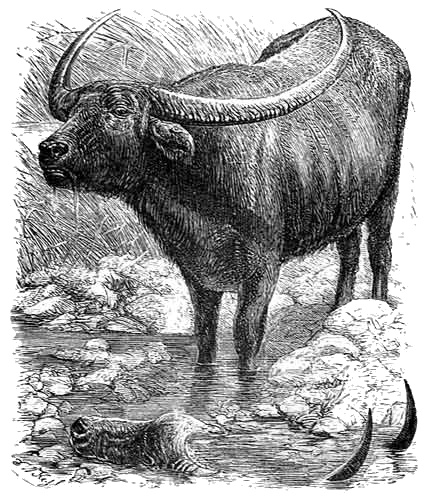
THE BUFFALO.
Being a water-loving animal, the Buffalo always inhabits the low-lying districts, and is fond of wallowing in the oozy marshes in which it remains for hours, submerged all but its head, and tranquilly chewing the cud while enjoying its mud-bath. While thus engaged the animal depresses its horns so that they are scarcely visible, barely allowing more than its eyes, ears, and nostrils to remain above the surface, so that the motionless heads are scarcely distinguishable from the grass and reed tufts which stud the marshes. Nothing is more startling to an inexperienced traveller than to pass by a silent and tranquil pool where the muddy surface is unbroken except by a number of black lumps and rushy tufts, and then to see these tufts suddenly transformed into twenty or thirty huge beasts rising out of the still water as if by magic. Generally, the disturber of their peace had better make the best of his way out of their reach, as the Buffalo, whether wild or tame, is of a tetchy and irritable nature, and resents being startled out of its state of dreamy repose.
In the Jordan valley the Buffalo is found, and is used for agriculture, being of the Bhainsa, or domesticated variety. Being much larger and stronger than the ordinary cattle, it is useful in drawing the plough, but its temper is too uncertain to render it a pleasant animal to manage. As is the case with all half-wild cattle, its milk is very scanty, but compensates by the richness of the quality for the lack of quantity.
THE WILD BULL.
The Tô, Wild Bull of the Old Testament—Passages in which it is mentioned—The Wild Bull in the net—Hunting with nets in the East—The Oryx supposed to be the Tô of Scripture—Description of the Oryx, its locality, appearance, and habits—The points in which the Oryx agrees with the Tô—The "snare" in which the foot is taken, as distinguished from the net.
In two passages of the Old Testament an animal is mentioned, respecting which the translators and commentators have been somewhat perplexed, in one passage being translated as the "Wild Ox," and in the other as the "Wild Bull." In the Jewish Bible the same rendering is preserved, but the sign of doubt is added to the word in both cases, showing that the translation is an uncertain one.
The first of these passages occurs in Deut. xiv. 5, where it is classed together with the ox, sheep, goats, and other ruminants, as one of the beasts which were lawful for food. Now, although we cannot identify it by this passage, we can at all events ascertain two important points—the first, that it was a true ruminant, and the second, that it was not the ox, the sheep, or the goat. It was, therefore, some wild ruminant, and we now have to ask how we are to find out the species.
If we turn to Isa. li. 20, we shall find a passage which will help us considerably. Addressing Jerusalem, the prophet uses these words, "By whom shall I comfort thee? Thy sons have fainted, they lie at the head of all the streets, as a wild bull in a net; they are full of the fury of the Lord, the rebuke of thy God." We now see that the Tô or Teô must be an animal which is captured by means of nets, and therefore must inhabit spots wherein the toils can be used. Moreover, it is evidently a powerful animal, or the force of the simile would be lost. The prophet evidently refers to some large and strong beast which has been entangled in the hunter's nets, and which lies helplessly struggling in them. We are, therefore, almost perforce driven to recognise it as some large antelope.
The expression used by the prophet is so characteristic that it needs a short explanation. In this country, and at the present day, the use of the net is almost entirely restricted to fishing and bird-catching; but in the East nets are still employed in the capture of very large game.
A brief allusion to the hunting-net is made at page 27, but, as the passage in Isaiah li. requires a more detailed account of this mode of catching large animals, it will be as well to describe the sport as at present practised in the East.
When a king or some wealthy man determines to hunt game without taking much trouble himself, he gives orders to his men to prepare their nets, which vary in size or strength according to the particular animal for which they are intended. If, for example, only the wild boar and similar animals are to be hunted, the nets need not be of very great width; but for agile creatures, such as the antelope, they must be exceedingly wide, or the intended prey will leap over them. As the net is much used in India for the purpose of catching game, Captain Williamson's description of it will explain many of the passages of Scripture wherein it is mentioned.
The material of the net is hemp, twisted loosely into a kind of rope, and the mode in which it is formed is rather peculiar. The meshes are not knotted together, but only twisted round each other, much after the fashion of the South American hammocks, so as to obtain considerable elasticity, and to prevent a powerful animal from snapping the cord in its struggles. Some of these nets are thirteen feet or more in width, and even such a net as this has been overleaped by a herd of antelopes. Their length is variable, but, as they can be joined in any number when set end to end, the length is not so important as the width.
The mode of setting the nets is singularly ingenious. When a suitable spot has been selected, the first care of the hunters is to stretch a rope as tightly as possible along the ground. For this purpose stout wooden stakes or truncheons are sunk crosswise in the earth, and between these the rope is carefully strained. The favourite locality of the net is a ravine, through which the animals can be driven so as to run against the net in their efforts to escape, and across the ravine a whole row of these stakes is sunk. The net is now brought to the spot, and its lower edge fastened strongly to the ground rope.
The strength of this mode of fastening is astonishing, and, although the stakes are buried scarcely a foot below the surface, they cannot be torn up by any force which can be applied to them; and, however strong the rope may be, it would be broken before the stakes could be dragged out of the ground.
A smaller rope is now attached to the upper edge of the net, which is raised upon a series of slight poles. It is not stretched quite tightly, but droops between each pair of poles, so that a net which is some thirteen feet in width will only give nine or ten feet of clear height when the upper edge is supported on the poles. These latter are not fixed in the ground, but merely held in their places by the weight of the net resting upon them.
When the nets have been properly set, the beaters make a wide circuit through the country, gradually advancing towards the fatal spot, and driving before them all the wild animals that inhabit the neighbourhood. As soon as any large beast, such, for example, as an antelope, strikes against the net, the supporting pole falls, and the net collapses upon the unfortunate animal, whose struggles—especially if he be one of the horned animals—only entangle him more and more in the toils.
As soon as the hunters see a portion of the net fall, they run to the spot, kill the helpless creature that lies enveloped in the elastic meshes, drag away the body, and set up the net again in readiness for the next comer. Sometimes the line of nets will extend for half a mile or more, and give employment to a large staff of hunters, in killing the entangled animals, and raising afresh those portions of the net which had fallen.
Allusions to this mode of hunting are plentiful in the Old Testament. Take, for example, Job xviii. 7: "The steps of his strength shall be straitened, and his own counsel shall cast him down; for he is cast into a net by his own feet, and he walketh upon a snare." And again in the next chapter, ver. 6, "Know now that God hath overthrown me, and hath compassed me with His net," in which is depicted forcibly the helpless state of one on whom the net has fallen, and who is lying on the ground vainly struggling in the meshes.
See also Ps. lvii. 6, "They have prepared a net for my steps, my soul is bowed down;" and Ps. lxvi. 11, "Thou broughtest us into the net, thou laidest affliction upon our loins." In the prophet Ezekiel are several passages which refer to the hunting net, and make especial mention of the manner in which it falls over its victim. One of these occurs in chap. xii. 13, "My net also will I spread upon him, and he shall be taken in my snare." Again in chap. xix. 8, "Then the nations set against him on every side from the provinces, and spread their net over him" In this passage a forcible allusion is made to the manner in which the wild animal is surrounded by the hunters, who surround and gradually close in upon them, as they drive their victims into the toils. The same combination of the hunters is also referred to by the prophet Micah, vii. 2, "There is none upright among men: they all lie in wait for blood; they hunt every man his brother with a net."
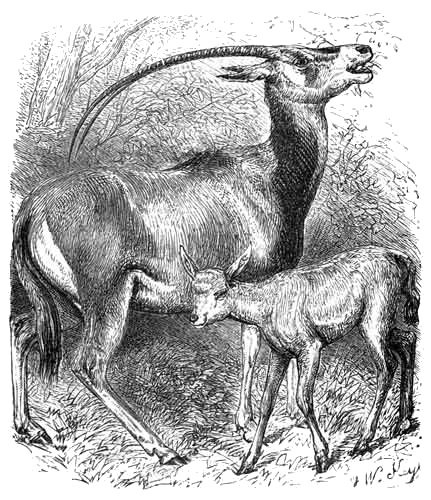
WILD BULL, OR ORYX.
"They lie at the head of all the streets, like a wild bull in a net."—Isaiah li. 21.
Accepting the theory that the Tô is one of the large antelopes that inhabit, or used to inhabit, the Holy Land and its neighbourhood, we may safely conjecture that it may signify the beautiful animal known as the Oryx (Oryx leucoryx), an animal which has a tolerably wide range, and is even now found on the borders of the Holy Land. It is a large and powerful antelope, and is remarkable for its beautiful horns, which sometimes exceed a yard in length, and sweep in a most graceful curve over the back.
Sharp as they are, and evidently formidable weapons, the manner in which they are set on the head renders them apparently unserviceable for combat. When, however, the Oryx is brought to bay, or wishes to fight, it stoops its head until the nose is close to the ground, the points of the horns being thus brought to the front. As the head is swung from side to side, the curved horns sweep through a considerable space, and are so formidable that even the lion is chary of attacking their owner. Indeed, instances are known where the lion has been transfixed and killed by the horns of the Oryx. Sometimes the animal is not content with merely standing to repel the attacks of its adversaries, but suddenly charges forward with astonishing rapidity, and strikes upwards with its horns as it makes the leap.
But these horns, which can be used with such terrible effect in battle, are worse than useless when the animal is hampered in the net. In vain does the Oryx attempt its usual defence: the curved horns get more and more entangled in the elastic meshes, and become a source of weakness rather than strength. We see now how singularly appropriate is the passage, "Thy sons lie at the heads of all the streets, as a wild bull (or Oryx) in a net," and how completely the force of the metaphor is lost without a knowledge of the precise mode of fixing the nets, of driving the animals into them, and of the manner in which they render even the large and powerful animals helpless.
The height of the Oryx at the shoulder is between three and four feet, and its colour is greyish white, mottled profusely with black and brown in bold patches. It is plentiful in Northern Africa, and, like many other antelopes, lives in herds, so that it is peculiarly suited to that mode of hunting which consists in surrounding a number of animals, and driving them into a trap of some kind, whether a fenced enclosure, a pitfall, or a net.
There is, by the way, the term "snare," which is specially used with especial reference to catching the foot as distinguished from the net which enveloped the whole body. For example, in Job xviii. 8, "He is cast into a net, he walketh on a snare," where a bold distinction is drawn between the two and their mode of action. And in ver. 10, "The snare is laid for him in the ground." Though I would not state definitely that such is the case, I believe that the snare which is here mentioned is one which is still used in several parts of the world.
It is simply a hoop, to the inner edge of which are fastened a number of elastic spikes, the points being directed towards the centre. This is merely laid in the path which the animal will take, and is tied by a short cord to a log of wood. As the deer or antelope treads on the snare, the foot passes easily through the elastic spikes, but, when the foot is raised, the spikes run into the joint and hold the hoop upon the limb. Terrified by the check and the sudden pang, the animal tries to run away, but, by the united influence of sharp spikes and the heavy log, it is soon forced to halt, and so becomes an easy prey to its pursuers.
THE REÊM, OR "UNICORN" OF SCRIPTURE.
The Reêm evidently known to the Jews—Various theories concerning the Unicorn—Supposed identity with the Indian Rhinoceros—Passages of Scripture alluding to the strength, violent and intractable temper of the Reêm—The Reêm a two-horned animal—Its evident connection with the Ox tribe—Its presumed identity with the now extinct Urus—Mr. Dawkins' treatise on the Urus—Enormous size and dangerous character of the Urus—Rabbinical legend of the Reêm—Identity of the Urus with the modern varieties of cattle—The Bull hunts of Nineveh.
There are many animals mentioned in the Scriptures which cannot be identified with any certainty, partly because their names occur only once or twice in the sacred writings, and partly because, when they are mentioned, the context affords no clue to their identity by giving any hint as to their appearance or habits. In such cases, although the translators would have done better if they had simply given the Hebrew word without endeavouring to identify it with any known animal, they may be excused for committing errors in their nomenclature. There is one animal, however, for which no such excuse can be found, and this is the Reêm of Scripture, translated as Unicorn in the authorized version.
Now the word Reêm is mentioned seven times in the Old Testament, and is found, not in one, but several books, showing that it was an animal perfectly well known to those for whom the sacred books were written. It is twice mentioned in the Pentateuch, several times in the Psalms, once in the book of Job, once by Isaiah, and reference is once made to it in the historical books. In these various passages, abundant details are given of its aspect and habits, so that there is very little doubt as to the identity of the animal.
The Septuagint translates Reêm by the word Monoceros, or the One-horned, which has been transferred to the Vulgate by the term Unicornis, a word having the same signification.
In an age when scientific investigation was utterly neglected, such a translation would readily be accepted without cavil, and there is no doubt that the generality of those who read the passages in question accepted them as referring to the Unicorn of heraldry with which we, as Englishmen, are so familiar. I may perhaps mention briefly that such an animal is a physiological impossibility, and that the Unicorn of the fables was a mere compound of an antelope, a horse, and a narwhal. The tusks or teeth of the narwhal were in former days exhibited as horns of the Unicorn, and so precious were they that one of them was laid up in the cathedral of St. Denis, and two in the treasury of St. Mark's at Venice, all of which were exhibited in the year 1658 as veritable Unicorns' horns.
The physiological difficulty above mentioned seems to have troubled the minds of the old writers, who saw that an ivory horn had no business to grow upon the junction of the two bones of the skull, and yet felt themselves bound to acknowledge that such an animal did really exist. They therefore put themselves to vast trouble in accounting for such a phenomenon, and, in their determination to believe in the animal, invented theories nearly as wonderful as the existence of the Unicorn itself.
One of these theories, arguing that the two horns may be as easily fused together as the hoofs, is stated as follows. "Because the middle is equally distant from both the extremes; and the hoof of this beast may be well said to be cloven and whole, because the horn is of the substance of the hoof, and the hoof of the substance of the horn, and therefore the horn is whole and the hoof cloven; for the cleaving either of the horn or of the hoof cometh from the defect of nature, and therefore God hath given to horses and asses whole hoofs, because there is greatest use of their legs, but unto Unicorns a whole and entire horn, that, as the ease of man is procured by the help of horses, so the health of them is procured by the horn of the Unicorn."
This last sentence refers to the then universal belief, that the horn of the Unicorn was a panacea for all illness and an antidote to all poisons. It was thought to be so sensitive, that if a poisoned cup were but brought near it a thick moisture would exude from its surface, and if fragments were thrown into the cup they would cause the liquid to swell and bubble, and at last to boil over. This supposed virtue forms the basis of an argument used by one of the writers on the subject, and, as the passage affords a good example of theological argument in 1658, it will be given entire.
After enumerating various animals (and, by the way, once actually hitting upon the "fish called Monoceros," i.e. the narwhal), the writer proceeds as follows, in the quaint and nervous English of his time: "Now our discourse of the Unicorn is of none of these beasts, for there is not any virtue attributed to their horns, and therefore the vulgar sort of infidel people, which scarcely believe any herb but such as they see in their own gardens, or any beast but such as is in their own flocks, or any knowledge but such as is bred in their own brains, or any birds which are not hatched in their own nests, have never made question of these; but of the true Unicorn, whereof there were more proofs in the world, because of the nobleness of his horn, they have ever been in doubt. By which distinction it appeareth unto me that there is some secret enemy in the inward degenerate nature of man, which continually blindeth the eyes of God His people, from beholding and believing the greatness of God His works.
"But to the purpose: that there is such a beast, the Scripture itself witnesseth, for David thus speaketh in the 92d Psalm, Et erigetur cornu meus tanquam Monocerotis. That is, 'My horn shall be lifted up like the horn of a Unicorn.' Whereupon all divines that ever wrote have not only collected that there is a Unicorn, but also affirm the similitude to be betwixt the kingdom of David and the horn of the Unicorn, that as the horn of the Unicorn is wholesome to all beasts and creatures, so should be the kingdom of David to the generation of Christ.
"And do we think that David would compare the vertue of his kingdom and the powerful redemption of the world, unto a thing that is not, or is uncertain, or is fantastical? God forbid that ever any man should so do despight to the Holy Ghost. For this cause we read also in Suidas, that good men who worship God and follow His laws are compared to Unicorns, whose greater parts, as their whole bodies, are unprofitable and untameable, yet their horn maketh them excellent; so in good men, although their fleshy parts be good for nothing, and fall down to the earth, yet their grace and piety exalteth their souls to the heavens."
In late years, after the true origin of the Unicorn's horn was discovered, and the belief in its many virtues abandoned, the Reêm, or Monoceros, was almost unhesitatingly identified with the rhinoceros of India, and for a long time this theory was the accepted one. It is now, however, certain that the Reêm was not the rhinoceros, and that it can be almost certainly identified with an animal which, at the time when the passages in question were written, was plentiful in Palestine, although, like the lion, it is now extinct.
We will now take in their order the seven passages in which the animal is mentioned, substituting the word Reêm for Unicorn.
The first of these passages occurs in Numbers xxiii., where the remarkable prophecies of Balaam are recorded. "The Lord his God is with them, and the shout of a king is among them. God brought them out of Egypt, he hath as it were the strength of Reêm:" (ver. 21, 22). From this passage we gain one piece of information, namely, that the Reêm was an exceptionally powerful animal. Indeed, it was evidently the strongest animal that was known to the prophet and his hearers, or it would not have been mentioned as a visible type of Divine power.
Next we come to Deut. xxxiii., wherein another prophecy is revealed, namely, that of Moses, just before his death and mysterious burial. Speaking of Joseph and his tribe, the aged prophet uses these words, "Let the blessing come upon the head of Joseph, and upon the top of the head of him that was separated from his brethren. His glory is like the firstling of his bullock, and his horns are like the horns of Reêm: with them he shall push the people together to the ends of the earth; and they are the ten thousands of Ephraim, and they are the thousands of Manasseh" (ver. 16, 17).
In this passage we gather more information. In the first place it is to be noticed that the Reêm is mentioned in connexion with the domestic cattle, and that the name is used as one that is familiar to the hearers. Next, as the marginal reading gives the word, Reêm is used in the singular and not in the plural number, so that the passage may be read, "his horns are like the horns of a Unicorn." Thus we come to the important point that the Reêm was not a one-horned, but a two-horned animal.
It may here be remarked that the Reêm horns were the emblem of the two tribes that sprung from Joseph, Ephraim and Manasseh, himself being typified by the Reêm, and his two powerful sons by the horns.
Next, in the Psalms, we find that the powerful, two-horned Reêm was also a dangerous and violent animal. (See Psa. xxii. 19, 21.)
"Be not Thou far from me, O Lord: O my strength, haste Thee to help me.
"Deliver my soul from the sword, my darling from the power (or the hand) of the dog.
"Save me from the lion's mouth: for Thou hast heard me from the horns of Reêm."
In Ps. xcii. there is another allusion to the powerful horns of the Reêm. "For lo, Thine enemies, O Lord, for lo, Thine enemies shall perish; all the workers of iniquity shall be scattered. But my horn shalt Thou exalt like the horn of Reêm."
From these passages we gather the following important points. First, the Reêm was an animal familiar to the people of Palestine, as is evident from the manner in which its name is introduced into the sacred writings; secondly, it was the most powerful animal known to the Israelites; thirdly, it was a two-horned animal; fourthly, it was a savage and dangerous beast; and fifthly, it had some connexion with the domesticated cattle.
This last-mentioned point is brought out more strongly in the remaining passages of Scripture. In Job, for example, a parallel is drawn between the wild and untameable Reêm and the beasts of draught and burden.
In that magnificent series of passages in which the Lord answers Job out of the whirlwind, and which indeed are a worthy sequel to Elihu's impassioned discourse on the text that "God is greater than man," the wild animals are mentioned in evident contrast to the tame. First come the wild goats of the rock; then the wild ass, who "scorneth the multitude of the city, neither regardeth the crying of the driver;" and then the Reêm, which is clearly contrasted with the tamed ox.
"Will Reêm be willing to serve thee, or abide by thy crib? Canst thou bind Reêm with his band in the furrow? or will he harrow the valleys after thee? Wilt thou trust him, because his strength is great? or wilt thou leave thy labour to him? Wilt thou believe him that he will bring home thy seed, and gather it in thy barn?" See chap. xxxix. 9-12.
Now in these passages, the principal duties of the domesticated cattle are described—the ploughing the furrow, the drawing of the harrow, and the carrying home of the ripened corn, for all which purposes the tameless spirit of Reêm renders him useless, in spite of his vast strength. The prophet Isaiah has a passage in which the Reêm is evidently classed with the ox tribe. See chap. xxxiv. 6, 7.
"The sword of the Lord is filled with blood; it is made fat with fatness, and with the blood of lambs and goats, with the fat of the kidneys of rams: for the Lord hath a sacrifice in Bozrah, and a great slaughter in the land of Idumea. And Reêm shall come down with them, and the bullocks with the bulls; and their land shall be soaked with blood, and their dust made fat with fatness."
The last passage in which reference is made to this animal is in Ps. xxix. 5, 6.
"The voice of the Lord breaketh the cedars; yea, the Lord breaketh the cedars of Lebanon. He maketh them also to skip like a calf; Lebanon and Sirion like a young Reêm."
On turning to the Jewish Bible we find that the word Reêm is translated as buffalo, and there is no doubt that this rendering is nearly the correct one, and at the present day naturalists are nearly all agreed that the Reêm of the Old Testament must have been the now extinct Urus. A smaller animal, the Bonassus or Bison, also existed in Palestine, and even to the present day continues to maintain itself in one or two spots, though it will probably be as soon completely erased from the surface of the earth as its gigantic congener.
That the Reêm was one of the two animals is certain, and that it was the larger is nearly as certain. The reason for deciding upon the Urus is, that its horns were of great size and strength, and therefore agree with the description of the Reêm; whereas those of the Bonassus, although powerful, are short, and not conspicuous enough to deserve the notice which is taken of them by the sacred writers.
Of the extinct variety we know but little. We do know, however, that it was a huge and most formidable animal, as is evident from the skulls and other bones which have been discovered.
Hitherto there has been considerable difficulty in treating of the ancient Urus, on account of the great confusion which existed in the various synonyms that were given to the animal. The tangled skein has, however, been carefully unravelled by Mr. W. Boyd Dawkins, M.A., F.R.S., who has published an exceedingly valuable paper on the subject in the Quarterly Journal of the Geological Society, March 21, 1866.
After describing the general character of the Urus, he proceeds to remark: "The synonyms of the Bos Urus are in a state of very great confusion, arising from the fact that the two words denoting two distinct species, the Urox and the Aurochs, are derived from the same Sanscrit root, Ur, Aur, or Or, that signifies a forest, or sandy waste. The root can be traced through many languages, and still survives in the Greek ορος (a mountain), the Norwegian Ore, the Icelandic Ure (the stony desert surrounding the base of the mountains); and is preserved without change in the old German Ur (a forest), and in Ur of the Chaldees. It appears also in the Ural Mountains, and also in the canton of Uri, the crest of which is an ox-head." It is worthy of mention that, in the last-mentioned place, when new magistrates are elected, two ancient and gigantic horns, remarkable for their double curvature, are carried in solemn procession.
The presence of these horns affords a remarkable confirmation to a well-known passage in Julius Cæsars familiar "Commentaries." "The Uri are little inferior to elephants in size" ("magnitudine paullo infra elephantos"); "but are bulls in their nature, colour, and figure. Great is their strength, and great their swiftness; nor do they spare man or beast when they have caught sight of them. These, when trapped in pitfalls, the hunters diligently kill. The youths, exercising themselves by this sort of hunting, are hardened by the toil; and those among them who have killed most, bringing with them the horns as testimonials, acquire great praise. But these Uri cannot be habituated to man or made tractable, not even when young. The great size of the horns, as well as the form and quality of them, differ much from the horns of our oxen. These, when carefully selected, they ring round the edge with silver, and use them for drinking cups at their ample feasts."
The enormous size of the horns of an ox which was in all probability the Urus is mentioned by another writer, who also alludes to their use as drinking vessels. He states that some of these horns were so large as to hold about four gallons, and then proceeds to remark that their primitive use as drinking-cups was the reason why Bacchus was represented as wearing horns, and was sometimes worshipped under the form of a bull.
It is worthy of notice, that the Sanscrit root Ur is retained in the name of the enormous Indian ox, the Gaur, a term which is formed from two words, namely, Gau, or Ghoo, a cow, and Ur, so that the name signifies Wild Cow.
As to the size of the animal Urus, it is evident, by measurement of certain remains, that it must have well deserved Cæsar's comparison with the elephant. A skull that is described by Cuvier gave the following measurements. Width of skull between the bases of the horn-cores (i.e. the bony projections on which the hollow horns are set), rather more than twelve inches and an half. Circumference of the cores at the base, twelve inches and nine-tenths. Length of the cores, twenty-seven inches and nine-tenths; and distances between their tips, thirty-two inches and a half.