THE CAMEL. CHAPTER II.
Reading edition
The Camel and its master—Occasional fury of the animal—A boy killed by a Camel—Another instance of an infuriated Camel—Theory respecting the Arab and his Camel—Apparent stupidity of the Camel—Its hatred of a load, and mode of expressing its disapprobation—Riding a Camel through the streets—A narrow escape—Ceremony of weaning a young Camel—The Camel's favourite food—Structure of the foot and adaptation to locality—Difficulty in provisioning—Camel's hair and skin—Sal ammoniac and Desert fuel—The Camel and the needle's eye—Straining at a gnat and swallowing a Camel.
We now come to the general characteristics of the Camel.
The Camels know their master well, some of them being much more affectionate than others. But they are liable to fits of strange fury, in which case even their own masters are not safe from them. They are also of a revengeful nature, and have an unpleasant faculty of treasuring up an injury until they can find a time of repaying it. Signor Pierotti gives a curious example of this trait of character. As he was going to the Jordan, he found a dead Camel lying on the roadside, the head nearly separated from the body. On inquiry he found that the animal had a master who ill-treated it, and had several times tried to bite him. One evening, after the Camels had been unloaded, the drivers lay down to sleep as usual.
The Camel made its way to its master, and stamped on him as he slept. The man uttered one startled cry, but had no time for another. The infuriated Camel followed up its attack by grasping his throat in its powerful jaws, and shaking him to death. The whole scene passed so rapidly, that before the other drivers could come to the man's assistance he was hanging dead from the jaws of the Camel, who was shaking him as a dog shakes a rat, and would not release its victim until its head had been nearly severed from its body by sword-cuts.
A similar anecdote is told by Mr. Palgrave, in his "Central and Eastern Arabia:"—
"One passion alone he possesses, namely, revenge, of which he gives many a hideous example; while, in carrying it out, he shows an unexpected degree of forethoughted malice, united meanwhile with all the cold stupidity of his usual character. One instance of this I well remember—it occurred hard by a small town in the plain of Baalbec, where I was at the time residing.
"A lad of about fourteen had conducted a large camel, laden with wood, from that very village to another at half an hour's distance or so. As the animal loitered or turned out of the way, its conductor struck it repeatedly, and harder than it seems to have thought he had a right to do. But, not finding the occasion favourable for taking immediate quits, it 'bided its time,' nor was that time long in coming.
"A few days later, the same lad had to re-conduct the beast, but unladen, to his own village. When they were about half way on the road, and at some distance from any habitation, the camel suddenly stopped, looked deliberately round in every direction to assure itself that no one was in sight, and, finding the road clear of passers-by, made a step forward, seized the unlucky boy's head in its monstrous mouth, and, lifting him up in the air, flung him down again on the earth, with the upper part of his head completely torn off, and his brains scattered on the ground. Having thus satisfied its revenge, the brute quietly resumed its pace towards the village, as though nothing were the matter, till some men, who had observed the whole, though unfortunately at too great a distance to be able to afford timely help, came up and killed it.
"Indeed, so marked is this unamiable propensity, that some philosophers have ascribed the revengeful character of the Arabs to the great share which the flesh and milk of the camel have in their sustenance, and which are supposed to communicate, to those who partake of them over-largely, the moral or immoral qualities of the animal to which they belonged. I do not feel myself capable of pronouncing an opinion on so intricate a question, but thus much I can say, that the camel and its Bedouin master do afford so many and such divers points of resemblance, that I do not think our Arab of Shomer far in the wrong, when I once on a time heard him say, 'God created the Bedouin for the camel, and the camel for the Bedouin.'"
The reader will observe that Mr. Palgrave in this anecdote makes reference to the stupidity of the Camel. There is no doubt that the Camel is by no means an intellectual animal; but it is very possible that its stupidity may in a great measure be owing to the fact that no one has tried to cultivate its intellectual powers. The preceding anecdotes show clearly that the Camel must possess a strong memory, and be capable of exercising considerable ingenuity.
Still it is not a clever animal. If its master should fall off its back, it never dreams of stopping, as a well-trained horse would do, but proceeds at the same plodding pace, leaving his master to catch it if he can. Should it turn out of the way to crop some green thorn-bush, it will go on in the same direction, never thinking of turning back into the right road unless directed by its rider. Should the Camel stray, "it is a thousand to one that he will never find his way back to his accustomed home or pasture, and the first man who picks him up will have no particular shyness to get over; ... and the losing of his old master and of his former cameline companions gives him no regret, and occasions no endeavour to find them again."
He has the strongest objection to being laden at all, no matter how light may be the burden, and expresses his disapprobation by growling and groaning, and attempting to bite. So habitual is this conduct that if a kneeling Camel be only approached, and a stone as large as a walnut laid on its back, it begins to remonstrate in its usual manner, groaning as if it were crushed to the earth with its load.
The Camel never makes way for any one, its instinct leading it to plod onward in its direct course. What may have been its habits in a state of nature no one can tell, for such a phenomenon as a wild Camel has never been known in the memory of man. There are wild oxen, wild goats, wild sheep, wild horses, and wild asses, but there is no spot on the face of the earth where the Camel is found except as the servant of man. Through innate stupidity, according to Mr. Palgrave, it goes straight forwards in the direction to which its head happens to be pointed, and is too foolish even to think of stopping unless it hears the signal for halt.
As it passes through the narrow streets of an Oriental city, laden with goods that project on either side, and nearly fill up the thoroughfare, it causes singular inconvenience, forcing every one who is in front of it to press himself closely to the wall, and to make way for the enormous beast as it plods along. The driver or rider generally gives notice by continually calling to the pedestrians to get out of the way, but a laden Camel rarely passes through a long street without having knocked down a man or two, or driven before it a few riders on asses who cannot pass between the Camel and the wall.
One source of danger to its rider is to be found in the low archways which span so many of the streets. They are just high enough to permit a laden Camel to pass under them, but are so low that they leave no room for a rider. The natives, who are accustomed to this style of architecture, are always ready for an archway, and, when the rider sees an archway which will not allow him to retain his seat, he slips to the ground, and remounts on the other side of the obstacle.
Mr. Kennard had a very narrow escape with one of these archways. "I had passed beneath one or two in perfect safety, without being obliged to do more than just bend my head forward, and was in the act of conversing with one of my companions behind, and was therefore in a happy state of ignorance as to what was immediately before me, when the shouting and running together of the people in the street on either side made me turn my head quickly, but only just in time to feel my breath thrown back on my face against the keystone of a gateway, beneath which my camel, with too much way on him to be stopped immediately, had already commenced to pass.
"With a sort of feeling that it was all over with me, I threw myself back as far as I could, and was carried through in an almost breathless state, my shirt-studs actually scraping along against the stonework. On emerging again into the open street, I could hardly realize my escape, for if there had been a single projecting stone to stop my progress, the camel would have struggled to get free, and my chest must have been crushed in."
It will be seen from these instances that the charge of stupidity is not an undeserved one. Still the animal has enough intellect to receive all the education which it needs for the service of man, and which it receives at a very early age. The ordinary Camel of burden is merely taught to follow its conductor, to obey the various words and gestures of command, and to endure a load. The Deloul, however, is more carefully trained. It is allowed to follow its mother for a whole year in perfect liberty. Towards the expiration of that time the young animal is gradually stinted in its supply of milk, and forced to browse for its nourishment. On the anniversary of its birth, the young Deloul is turned with its head towards Canopus, and its ears solemnly boxed, its master saying at the same time, "Henceforth drinkest thou no drop of milk." For this reason the newly-weaned Camel is called Lathim, or the "ear-boxed." It is then prevented from sucking by a simple though cruel experiment. A wooden peg is sharpened at both ends, and one end thrust into the young animal's nose. When it tries to suck, it pricks its mother with the projecting end, and at the same time forces the other end more deeply into the wound, so that the mother drives away her offspring, and the young soon ceases to make the attempt.
The food of the Camel is very simple, being, in fact, anything that it can get. As it proceeds on its journey, it manages to browse as it goes along, bending its long neck to the ground, and cropping the scanty herbage without a pause. Camels have been known to travel for twenty successive days, passing over some eight hundred miles of ground, without receiving any food except that which they gathered for themselves by the way. The favourite food of the Camel is a shrub called the ghada, growing to six feet or so in height, and forming a feathery tuft of innumerable little green twigs, very slender and flexible. It is so fond of this shrub that a Camel can scarcely ever pass a bush without turning aside to crop it; and even though it be beaten severely for its misconduct, it will repeat the process at the next shrub that comes in sight.
It also feeds abundantly on the thorn-bushes which grow so plentifully in that part of the world; and though the thorns are an inch or two in length, very strong, and as sharp as needles, the hard, horny palate of the animal enables it to devour them with perfect ease.
There are several species of these thorn-shrubs, which are scattered profusely over the ground, and are, in fact, the commonest growth of the place. After they die, being under the fierce sun of that climate, they dry up so completely, that if a light be set to them they blaze up in a moment, with a sharp cracking sound and a roar of flame, and in a moment or two are nothing but a heap of light ashes. No wonder was it that when Moses saw the thorn-bush burning without being consumed he was struck with awe at the miracle. These withered bushes are the common fuel of the desert, giving out a fierce but brief heat, and then suddenly sinking into ashes. "For as the crackling of thorns under a pot, so is the laughter of the fool" (Eccl. vii. 6).
The dried and withered twigs of these bushes are also eaten by the Camel, which seems to have a power of extracting nutriment from every sort of vegetable substance. It has been fed on charcoal, and, as has been happily remarked, could thrive on the shavings of a carpenter's workshop.
Still, when food is plentiful, it is fed as regularly as can be managed, and generally after a rather peculiar manner. "Our guide," writes Mr. Hamilton, in the work which has already been mentioned, "is an elderly man, the least uncouth of our camel-drivers. He has three camels in the caravan, and it was amusing to see his preparations for their evening's entertainment. The table-cloth, a circular piece of leather, was duly spread on the ground; on this he poured the quantity of dourrah destined for their meal, and calling his camels, they came and took each its place at the feast. It is quaint to see how each in his turn eats, so gravely and so quietly, stretching his long neck into the middle of the heap, then raising his head to masticate each mouthful; all so slowly and with such gusto, that we could swear it was a party of epicures sitting in judgment on one of Vachette's chefs d'œuvre ."
The foregoing passages will show the reader how wonderfully adapted is the constitution of the Camel for the country in which it lives, and how indispensable it is to the inhabitants. It has been called "the ship of the desert," for without the Camel the desert would be as impassable as the sea without ships. No water being found for several days' journey together, the animal is able to carry within itself a supply of water which will last it for several days, and, as no green thing grows far from the presence of water, the Camel is able to feed upon the brief-lived thorn-shrubs which have sprung up and died, and which, from their hard and sharp prickles, are safe from every animal except the hard-mouthed Camel.
But these advantages would be useless without another—i.e. the foot. The mixed stones and sand of the desert would ruin the feet of almost any animal, and it is necessary that the Camel should be furnished with a foot that cannot be split by heat like the hoof of a horse, that is broad enough to prevent the creature from sinking into the sand, and is tough enough to withstand the action of the rough and burning soil.
Such a foot does the Camel possess. It consists of two long toes resting upon a hard elastic cushion with a tough and horny sole. This cushion is so soft that the tread of the huge animal is as noiseless as that of a cat, and, owing to the division of the toes, it spreads as the weight comes upon it, and thus gives a firm footing on loose ground. The foot of the moose-deer has a similar property, in order to enable the animal to walk upon the snow.
In consequence of this structure, the Camel sinks less deeply into the ground than any other animal; but yet it does sink in it, and dislikes a deep and loose sand, groaning at every step, and being wearied by the exertion of dragging its hard foot out of the holes into which they sink. It is popularly thought that hills are impracticable to the Camel; but it is able to climb even rocky ground from which a horse would recoil. Mr. Marsh, an American traveller, was much surprised by seeing a caravan of fifty camels pass over a long ascent in Arabia Petræa. The rock was as smooth as polished marble, and the angle was on an average fifteen degrees; but the whole caravan passed over it without an accident.
The soil that a Camel most hates is a wet and muddy ground, on which it is nearly sure to slip. If the reader will look at a Camel from behind, he will see that the hinder legs are close together until the ankle-joint, when they separate so widely that the feet are set on the ground at a considerable distance from each other. On dry ground this structure increases the stability of the animal by increasing its base; but on wet ground the effect is singularly unpleasant. The soft, padded feet have no hold, and slip sideways at every step, often with such violence as to dislocate a joint and cause the death of the animal. When such ground has to be traversed, the driver generally passes a bandage round the hind legs just below the ankle-joint, so as to prevent them from diverging too far.
It must be remarked, however, that the country in which the animal lives is essentially a dry one, and that moist and muddy ground is so exceptional that the generality of Camels never see it in their lives. Camels do not object to mud an inch or two deep, provided that there is firm ground below; and they have been seen to walk with confident safety over pavements covered with mud and half-frozen snow.
The animals can ford rivers well enough, provided that the bed be stony or gravelly; but they are bad swimmers, their round bodies and long necks being scarcely balanced by their legs, so that they are apt to roll over on their sides, and in such a case they are sure to be drowned. When swimming is a necessity, the head is generally tied to the stern of a boat, or guided by the driver swimming in front, while another often clings to the tail, so as to depress the rump and elevate the head. It is rather curious that the Camels of the Sahara cannot be safely entrusted to the water. They will swim the river readily enough; but they are apt to be seized with illness afterwards, and to die in a few hours.
We now come to some other uses of the Camel.
Its hair is of the greatest importance, as it is used for many purposes. In this country, all that we know practically of the Camel's hair is that it is employed in making brushes for painters; but in its own land the hair plays a really important part. At the proper season it is removed from the animal, usually by being pulled away in tufts, but sometimes by being shorn like the wool of sheep, and it is then spun by the women into strong thread.
From this thread are made sundry fabrics where strength is required and coarseness is not an objection. The "black tents" of the Bedouin Arabs, similar to those in which Abraham lived, are made of Camel's hair, and so are the rugs, carpets, and cordage used by the nomad tribes. Even mantles for rainy or cold weather are made of Camel's hair, and it was in a dress of this coarse and rough material that St. John the Baptist was clad. The best part of the Camel's hair is that which grows in tufts on the back and about the hump, the fibre being much longer than that which covers the body. There is also a little very fine under-wool which is carefully gathered, and, when a sufficient quantity is procured, it is spun and woven into garments. Shawls of this material are even now as valuable as those which are made from the Cachmire goat.
The skin of the Camel is made into a sort of leather. It is simply tanned by being pegged out in the sun and rubbed with salt.
Sandals and leggings are made of this leather, and in some places water-bottles are manufactured from it, the leather being thicker and less porous than that of the goat, and therefore wasting less of the water by evaporation. The bones are utilized, being made into various articles of commerce.
So universally valuable is the Camel that even its dung is important to its owners. Owing to the substances on which the animal feeds, it consists of little but macerated fragments of aromatic shrubs. It is much used as poultices in case of bruises or rheumatic pains, and is even applied with some success to simple fractures. It is largely employed for fuel, and the desert couriers use nothing else, their Camels being furnished with a net, so that none of this useful substance shall be lost. For this purpose it is carefully collected, mixed with bits of straw, and made into little rolls, which are dried in the sun, and can then be laid by for any time until they are needed.
Mixed with clay and straw, it is most valuable as a kind of mortar or cement with which the walls of huts are rendered weather-proof, and the same material is used in the better-class houses to make a sort of terrace on the flat roof. This must be waterproof in order to withstand the wet of the rainy season, and no material answers the purpose so well as that which has been mentioned. So strangely hard and firm is this composition, that stoves are made of it. These stoves are made like jars, and have the faculty of resisting the power of the inclosed fire. Even after it is burned it has its uses, the ashes being employed in the manufacture of sal-ammoniac.
There are two passages in the New Testament which mention the Camel in an allegorical sense. The first of these is the proverbial saying of our Lord, "A rich man shall hardly enter into the kingdom of heaven. Again I say unto you, It is easier for a camel to go through the eye of a needle, than for a rich man to enter into the kingdom of God" (Matt. xix. 23, 24).
Now, this well-known but scarcely understood passage requires some little dissection. If the reader will refer to the context, he will see that this saying was spoken in allusion to the young and wealthy man who desired to be one of the disciples, but clung too tightly to his wealth to accept the only conditions on which he could be received. His possessions were a snare to him, as was proved by his refusal to part with them at Christ's command. On his retiring, the expression was used, "that a rich man shall hardly (or, with difficulty) enter the kingdom of heaven," followed by the simile of the Camel and the needle's eye.
Now, if we are to take this passage literally, we can but draw one conclusion from it, that a rich man can no more enter heaven than a camel pass through the eye of a needle, i.e. that it is impossible for him to do so. Whereas, in the previous sentence, Christ says not that it is impossible, but difficult (δυσκόλως) for him to do so. It is difficult for a man to use his money for the service of God, the only purpose for which it was given him, and the difficulty increases in proportion to its amount. But wealth in itself is no more a bar to heaven than intellect, health, strength, or any other gift, and, if it be rightly used, is one of the most powerful tools that can be used in the service of God. Our Lord did not condemn all wealthy men alike. He knew many; but there was only one whom He advised to sell his possessions and give them to the poor as the condition of being admitted among the disciples.
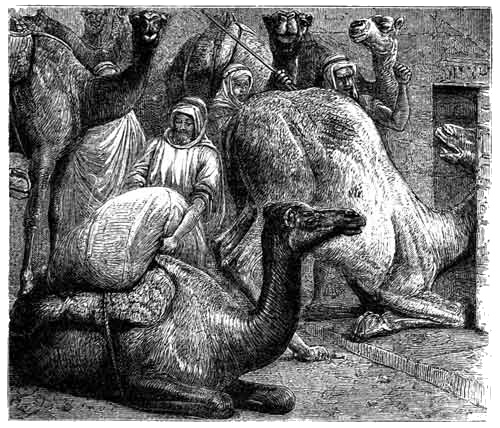
CAMEL GOING THROUGH A "NEEDLE'S EYE."
"It is easier for a camel to go through the eye of a needle, than for a rich man to enter into the kingdom of God."—Matt. xix. 24.
We will now turn to the metaphor of the Camel and the needle's eye. Of course it can be taken merely as a very bold metaphor, but it may also be understood in a simpler sense, the sense in which it was probably understood by those who heard it. In Oriental cities, there are in the large gates small and very low apertures called metaphorically "needle's-eyes," just as we talk of certain windows as "bull's-eyes." These entrances are too narrow for a Camel to pass through them in the ordinary manner, or even if loaded. When a laden Camel has to pass through one of these entrances, it kneels down, its load is removed, and then it shuffles through on its knees. "Yesterday," writes Lady Duff-Gordon from Cairo, "I saw a camel go through the eye of a needle, i.e. the low-arched door of an enclosure. He must kneel, and bow his head to creep through; and thus the rich man must humble himself."
There is another passage in which the Camel is used by our Lord in a metaphorical sense. This is the well-known sentence: "Ye blind guides, which strain at a gnat, and swallow a camel" (Matt. xxiii. 24). It is remarkable that an accidental misprint has robbed this passage of its true force. The real translation is: "which strain out the gnat, and swallow the camel." The Greek word is διυλίζω, which signifies to filter thoroughly; and the allusion is made the pharisaical custom of filtering liquids before drinking them, lest by chance a gnat or some such insect which was forbidden as food might be accidentally swallowed.
THE BACTRIAN CAMEL.
General description of the animal—Its use in mountain roads—Peculiar formation of the foot—Uses of a mixed breed—Its power of enduring cold—Used chiefly as a beast of draught—Unfitness for the plough—The cart and mode of harnessing—The load which it can draw—Camel-skin ropes—A Rabbinical legend.
The second kind of Camel—namely, the Bactrian species—was probably unknown to the Jews until a comparatively late portion of their history. This species was employed by the Assyrians, as we find by the sculptures upon the ruins, and if in no other way the Jews would become acquainted with them through the nation by whom they were conquered, and in whose land they abode for so long.
The Bactrian Camel is at once to be distinguished from that which has already been described by the two humps and the clumsier and sturdier form. Still the skeletons of the Bactrian and Arabian species are so similar that none but a very skilful anatomist can distinguish between them, and several learned zoologists have expressed an opinion, in which I entirely coincide, that the Bactrian and Arabian Camels are but simple varieties of one and the same species, not nearly so dissimilar as the greyhound and the bulldog.
Unlike the one-humped Camel, the Bactrian species is quite at home in a cold climate, and walks over ice as easily as its congener does over smooth stone. It is an admirable rock-climber, and is said even to surpass the mule in the sureness of its tread. This quality is probably occasioned by the peculiar structure of the foot, which has an elongated toe projecting beyond the soft pad, and forming a sort of claw. In the winter time the riders much prefer them to horses, because their long legs enable them to walk easily through snow, in which a horse could only plunge helplessly, and would in all probability sink and perish.
A mixed breed of the one-humped and the Bactrian animals is thought to be the best for hill work in winter time, and General Harlan actually took two thousand of these animals in winter time for a distance of three hundred and sixty miles over the snowy tops of the Indian Caucasus; and though the campaign lasted for seven months, he only lost one Camel, and that was accidentally killed. Owing to its use among the hills, the Bactrian species is sometimes called the Mountain Camel.
It very much dislikes the commencement of spring, because the warm mid-day sun slightly melts the surface of the snow, and the frost of night converts it into a thin plate of ice. When the Camel walks upon this semi-frozen snow, its feet plunge into the soft substratum through the icy crust, against which its legs are severely cut. The beginning of the winter is liable to the same objection.
The mixed breed which has just been mentioned must be procured from a male Bactrian and a female Arabian Camel. If the parentage be reversed, the offspring is useless, being weak, ill-tempered, and disobedient.
The Bactrian Camel is, as has been mentioned, tolerant of cold, and is indeed so hardy an animal that it bears the severest winters without seeming to suffer distress, and has been seen quietly feeding when the thermometer has reached a temperature several degrees below zero. Sometimes, when the cold is more than usually sharp, the owners sew a thick cloth round its body, but even in such extreme cases the animal is left to find its own food as it best can. And, however severe the weather may be, the Bactrian Camel never sleeps under a roof.
This Camel is sometimes employed as a beast of burden, but its general use is for draught. It is not used for the plough, because it has an uncertain and jerking mode of pulling, and does not possess the steady dragging movement which is obtained by the use of the horse or ox.
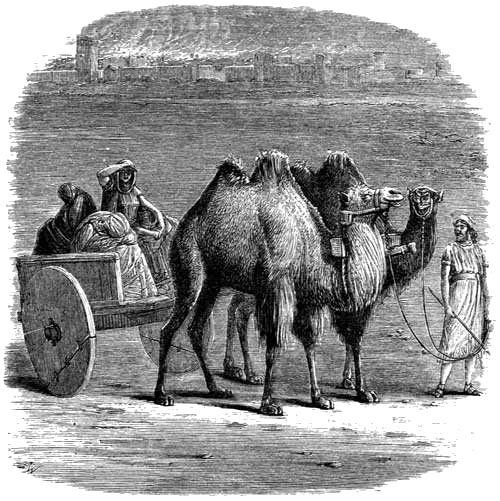
BACTRIAN CAMEL.
"He saw a chariot of camels."—Isaiah xxi. 7.
It is almost invariably harnessed to carts, and always in pairs. The mode of yoking the animals is as simple as can well be conceived. A pole runs between them from the front of the vehicle, and the Camels are attached to it by means of a pole which passes over their necks. Oxen were harnessed in a similar manner. It was probably one of these cars or chariots that was mentioned by Isaiah in his prophecy respecting Assyria:—"And he saw a chariot with a couple of horsemen, a chariot of asses, and a chariot of camels" (Isa. xxi. 7). The cars themselves are as simple as the mode of harnessing them, being almost exactly like the ox carts which have already been described.
The weight which can be drawn by a pair of these Camels is really considerable. On a tolerably made road a good pair of Camels are expected to draw from twenty-six to twenty-eight hundred weight, and to continue their labours for twenty or thirty successive days, traversing each day an average of thirty miles. It is much slower than the Arabian Camel, seldom going at more than two and a half miles per hour. If, however, the vehicle to which a pair of Bactrians are harnessed were well made, the wheels truly circular, and the axles kept greased so as to diminish the friction, there is no doubt that the animals could draw a still greater load to longer distances, and with less trouble to themselves. As it is, the wheels are wretchedly fitted, and their ungreased axles keep up a continual creaking that is most painful to an unaccustomed ear, and totally unheeded by the drivers.
The hair of the Bactrian Camel is long, coarse, and strong; and, like that of the Arabian animal, is made into rough cloth. It is plucked off by hand in the summer time, when it naturally becomes loose in readiness for its annual renewal, and the weight of the entire crop of hair ought to be about ten pounds. The skin is not much valued, and is seldom used for any purpose except for making ropes, straps, and thongs, and is not thought worth the trouble of tanning. The milk, like that of the Arabian animal, is much used for food, but the quantity is very trifling, barely two quarts per diem being procured from each Camel.
There is but little that is generally interesting in the Rabbinical writers on the Camel. They have one proverbial saying upon the shortness of its ears. When any one makes a request that is likely to be refused, they quote the instance of the Camel, who, it seems, was dissatisfied with its appearance, and asked for horns to match its long ears. The result of the request was, that it was deprived of its ears, and got no horns.
THE HORSE.
The Hebrew words which signify the Horse—The Horse introduced into Palestine from Egypt—Similarity of the war-horse of Scripture and the Arab horse of the present day—Characteristics of the Horse—Courage and endurance of the Horse—Hardness of its unshod hoofs—Love of the Arab for his Horse—Difficulty of purchasing the animal—The Horse prohibited to the Israelites—Solomon's disregard of the edict—The war-chariot, its form and use—Probable construction of the iron chariot—The cavalry Horse—Lack of personal interest in the animal.
Several Hebrew words are used by the various Scriptural writers to signify the Horse, and, like our own terms of horse, mare, pony, charger, &c., are used to express the different qualities of the animal. The chief distinction of the Horse seemed to lie in its use for riding or driving, the larger and heavier animals being naturally required for drawing the weighty springless chariots. The chariot horse was represented by the word Sus, and the cavalry horse by the word Parash, and in several passages both these words occur in bold contrast to each other. See, for example, 1 Kings iv. 26, &c.
Among the many passages of Scripture in which the Horse is mentioned, there are few which do not treat of it as an adjunct of war, and therefore it is chiefly in that light that we must regard it.
The Horse of the Scriptures was evidently a similar animal to the Arab Horse of the present day, as we find not only from internal evidence, but from the sculptures and paintings which still remain to tell us of the vanished glories of Egypt and Assyria. It is remarkable, by the way, that the first mention of the Horse in the Scriptures alludes to it as an Egyptian animal. During the terrible famine which Joseph had foretold, the Egyptians and the inhabitants of neighbouring countries were unable to find food for themselves or fodder for their cattle, and, accordingly, they sold all their beasts for bread. "And they brought their cattle unto Joseph, and Joseph gave them bread in exchange for horses and the flocks, and for the cattle of herds, and for the asses, and he fed them with bread for all their cattle for that year."
This particular breed of Horses is peculiarly fitted for the purposes of war, and is much less apt for peaceful duties than the heavier and more powerful breeds, which are found in different parts of the world. It is remarkable for the flexible agility of its movements, which enable it to adapt itself to every movement of the rider, whose intentions it seems to divine by a sort of instinct, and who guides it not so much by the bridle as by the pressure of the knees and the voice. Examples of a similar mode of guidance may be seen on the well-known frieze of the Parthenon, where, in the Procession of Horsemen, the riders may be seen directing their steeds by touching the side of the neck with one finger, thus showing their own skill and the well-trained quality of the animals which they ride.
Its endurance is really wonderful, and a horse of the Kochlani breed will go through an amount of work which is almost incredible. Even the trial by which a Horse is tested is so severe, that any other animal would be either killed on the spot or ruined for life. When a young mare is tried for the first time, her owner rides her for some fifty or sixty miles at full speed, always finishing by swimming her through a river. After this trial she is expected to feed freely; and should she refuse her food, she is rejected as an animal unworthy of the name of Kochlani.
Partly from native qualities, and partly from constant association with mankind, the Arab Horse is a singularly intelligent animal. In Europe we scarcely give the Horse credit for the sensitive intelligence with which it is endowed, and look upon it rather as a machine for draught and carriage than a companion to man. The Arab, however, lives with his horse, and finds in it the docility and intelligence which we are accustomed to associate with the dog rather than the Horse. It will follow him about and come at his call. It will stand for any length of time and await its rider without moving. Should he fall from its back, it will stop and stand patiently by him until he can remount; and there is a well-authenticated instance of an Arab Horse whose master had been wounded in battle, taking him up by his clothes and carrying him away to a place of safety.
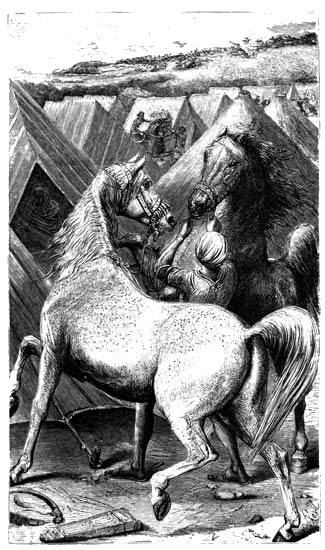
WAR HORSE.
"He saith among the trumpets, Ha, Ha; and he smelleth the battle afar off, the thunder of the captains and the shouting."—Job xxxix. 25.
Even in the very heat and turmoil of the combat, the true Arab Horse seems to be in his true element, and fully deserves the splendid eulogium in the Book of Job (xxxix. 19-25): "Hast thou given the horse strength? hast thou clothed his neck with thunder?
"Canst thou make him afraid as a grasshopper? the glory of his nostrils is terror.
"He paweth in the valley, and rejoiceth in his strength: he goeth on to meet the armed men.
"He mocketh at fear, and is not affrighted; neither turneth he back from the sword.
"The quiver rattleth against him, the glittering spear and the shield.
"He walketh the ground with fierceness and rage: neither believeth he that it is the sound of the trumpet.
"He saith among the trumpets, Ha, ha; and he smelleth the battle afar off, the thunder of the captains, and the shouting."
In another passage an allusion is made to the courage of the Horse, and its love for the battle. "I hearkened and heard, but they spake not aright: no man repented him of his wickedness, saying, What have I done? Every one turned to his course, as the horse rusheth into the battle." (Jer. viii. 6.) Even in the mimic battle of the djereed the Horse seems to exult in the conflict as much as his rider, and wheels or halts almost without the slightest intimation.
The hoofs of the Arab Horses are never shod, their owners thinking that that act is not likely to improve nature, and even among the burning sands and hard rocks the Horse treads with unbroken hoof. In such a climate, indeed, an iron shoe would be worse than useless, as it would only scorch the hoof by day, and in consequence of the rapid change of temperature by day or night, the continual expansion and contraction of the metal would soon work the nails loose, and cause the shoe to fall off.
A tender-footed Horse would be of little value, and so we often find in the Scriptures that the hardness of the hoof is reckoned among one of the best qualities of a Horse. See, for example, Isa. v. 28: "Whose arrows are sharp, and all their bows bent, their horses' hoofs shall be counted like flint, and their wheels like a whirlwind." Again, in Micah iv. 13: "Arise and thresh, O daughter of Zion: for I will make thine horn iron, and I will make thy hoofs brass: and thou shalt beat in pieces many people." Allusion is here made to one mode of threshing, in which a number of Horses were turned into the threshing-floor, and driven about at random among the wheat, instead of walking steadily like the oxen.
In Judges v. 22 there is a curious allusion to the hoofs of the Horse. It occurs in the Psalm of Thanksgiving sung by Deborah and Barak after the death of Sisera: "Then were the horse-hoofs broken by the means of the prancings, the prancings of their mighty ones." It is easy now to see that these words infer a scornful allusion to the inferiority of the enemy's Horses, inasmuch as the hoofs of the best Horses would be "counted as flint," and would not be broken by the prancings.
Horses possessed of the qualities of courage, endurance, and sureness of foot are naturally invaluable; and even at the present day the Arab warrior esteems above all things a Horse of the purest breed, and, whether he buys or sells one, takes care to have its genealogy made out and hung on the animal's neck.
As to the mare, scarcely any inducement is strong enough to make an Arab part with it, even to a countryman, and the sale of the animal is hindered by a number of impediments which in point of fact are almost prohibitory. Signor Pierotti, whose long residence in Palestine has given him a deep insight into the character of the people, speaks in the most glowing terms of the pure Arab Horse, and of its inestimable value to its owner. Of the difficulties with which the sale of the animal is surrounded, he gives a very amusing account:—
"After this enumeration of the merits of the horse, I will describe the manner in which a sale is conducted, choosing the case of the mare, as that is the more valuable animal. The price varies with the purity of blood of the steed, and the fortunes of its owner. When he is requested to fix a value, his first reply is, 'It is yours, and belongs to you, I am your servant;' because, perhaps, he does not think that the question is asked with any real design of purchasing; when the demand is repeated, he either makes no answer or puts the question by; at the third demand he generally responds rudely with a sardonic smile, which is not a pleasant thing to see, as it is a sign of anger; and then says that he would sooner sell his family than his mare. This remark is not meant as a mere jest; for it is no uncommon thing for a Bedawy to give his parents as hostages rather than separate himself from his friend.
"If, however, owing to some misfortune, he determines on selling his mare, it is very doubtful whether he or his parents will allow her to leave their country without taking the precaution to render her unfit for breeding.
"There are many methods of arranging the sale, all of which I should like to describe particularly; however, I will confine myself to a general statement. Before the purchaser enters upon the question of the price to be paid, he must ascertain that the parents, friends, and allies of the owners give their consent to the sale, without which some difficulty or other may arise, or perhaps the mare may be stolen from her new master. He must also obtain an unquestionable warranty that she is fit for breeding purposes, and that no other has a prior claim to any part of her body. This last precaution may seem rather strange, but it arises from the following custom. It sometimes happens that, when a Bedawy is greatly in want of money, he raises it most easily by selling a member of his horse; so that very frequently a horse belongs to a number of owners, one of whom has purchased the right fore-leg, another the left, another the hind-leg, or the tail, or an ear, or the like; and the proprietors have each a proportionate interest in the profits of its labour or sale.
"So also the offspring are sold in a similar manner; sometimes only the first-born, sometimes the first three; and then it occasionally happens that two or three members of the foal are, as it were, mortgaged. Consequently, any one who is ignorant of this custom may find that, after he has paid the price of the mare to her supposed owner, a third person arises who demands to be paid the value of his part; and, if the purchaser refuse to comply, he may find himself in a very unpleasant situation, without any possibility of obtaining help from the local government. Whoever sells his mare entirely, without reserving to himself one or two parts, must be on good terms with the confederate chiefs in the neighbourhood, and must have obtained their formal sanction, otherwise they would universally despise him, and perhaps lie in wait to kill him, so that his only hope of escape would be a disgraceful flight, just as if he had committed some great crime. It is an easier matter to purchase a stallion; but even in this case the above formalities must be observed.
"These remarks only apply to buying horses of the purest blood; those of inferior race are obtained without difficulty, and at fair prices."
For some reason, perhaps the total severance of the Israelites from the people among whom they had lived so long in captivity, the use of the Horse, or, at all events, the breeding of it, was forbidden to the Israelites; see Deut. xvi. 16. After prophesying that the Israelites, when they had settled themselves in the Promised Land, would want a king, the inspired writer next ordains that the new king must be chosen by Divine command, and must belong to one of the twelve tribes. He then proceeds as follows:—"But he shall not multiply horses to himself, nor cause the people to return to Egypt, to the end that he should multiply horses: forasmuch as the Lord hath said unto you, Ye shall henceforth return no more that way."
The foresight of this prophetical writer was afterwards shown by the fact that many kings of Israel did send to Egypt for Horses, Egypt being the chief source from which these animals were obtained. And, judging from the monuments to which reference has been made, the Horse of Egypt was precisely the same animal as the Arab Horse of the present day, and was probably obtained from nomad breeders.
In spite of the prohibitory edict, both David and Solomon used Horses in battle, and the latter supplied himself largely from Egypt, disregarding as utterly the interdict against plurality of Horses as that against plurality of wives, which immediately follows.
David seems to have been the first king who established a force of chariots, and this he evidently did for the purpose of action on the flat grounds of Palestine, where infantry were at a great disadvantage when attacked by the dreaded chariots; yet he did not controvert the law by multiplying to himself Horses, or even by importing them from Egypt; and when he had an opportunity of adding to his army an enormous force of chariots, he only employed as many as he thought were sufficient for his purpose. After he defeated Hadadezer, and had taken from him a thousand chariots with their Horses together with seven hundred cavalry, he houghed all the Horses except those which were needed for one hundred chariots.
Solomon, however, was more lax, and systematically broke the ancient law by multiplying Horses exceedingly, and sending to Egypt for them. We learn from 1 Kings iv. 26 of the enormous establishment which he kept up both for chariots and cavalry. Besides those which were given to him as tribute, he purchased both chariots and their Horses from Egypt and Syria, the chariots being delivered at the rate of six hundred shekels of silver, and the Horses for an hundred and fifty shekels.
Chariots were far more valued in battle than horsemen, probably because their weight made their onset irresistible against infantry, who had no better weapons than bows and spears. The slingers themselves could make little impression on the chariots; and even if the driver, or the warrior who fought in the chariot, or his attendant, happened to be killed, the weighty machine, with its two Horses, still went on its destructive way.
Of their use in battle we find very early mention. For example, in Exod. xiv. 6 it is mentioned that Pharaoh made ready his chariot to pursue the Israelites; and in a subsequent part of the same chapter we find that six hundred of the Egyptian chariot force accompanied their master in the pursuit, and that the whole army was delayed because the loss of the chariot wheels made them drive heavily.
Then in the familiar story of Sisera and Jael the vanquished general is mentioned as alighting from his chariot, in which he would be conspicuous, and taking flight on foot; and, after his death, his mother is represented as awaiting his arrival, and saying to the women of the household, "Why is his chariot so long in coming? Why tarry the wheels of his chariot?"
During the war of conquest which Joshua led, the chariot plays a somewhat important part. As long as the war was carried on in the rugged mountainous parts of the land, no mention of the chariot is made; but when the battles had to be fought on level ground, the enemy brought the dreaded chariots to bear upon the Israelites. In spite of these adjuncts, Joshua won the battles, and, unlike David, destroyed the whole of the Horses and burned the chariots.
Many years afterwards, a still more dreadful weapon, the iron chariot, was used against the Israelites by Jabin. This new instrument of war seems to have cowed the people completely; for we find that by means of his nine hundred chariots of iron Jabin "mightily oppressed the children of Israel" for twenty years. It has been well suggested that the possession of the war chariot gave rise to the saying of Benhadad's councillors, that the gods of Israel were gods of the hills, and so their army had been defeated; but that if the battle were fought in the plain, where the chariots and Horses could act, they would be victorious.
So dreaded were these weapons, even by those who were familiar with them and were accustomed to use them, that when the Syrians had besieged Samaria, and had nearly reduced it by starvation, the fancied sound of a host of chariots and Horses that they heard in the night caused them all to flee and evacuate the camp, leaving their booty and all their property in the hands of the Israelites.
Whether the Jews ever employed the terrible scythe chariots is not quite certain, though it is probable that they may have done so; and this conjecture is strengthened by the fact that they were employed against the Jews by Antiochus, who had "footmen an hundred and ten thousand, and horsemen five thousand and three hundred, and elephants two and twenty, and three hundred chariots armed with hooks" (2 Macc. xiii. 2). Some commentators think that by the iron chariots mentioned above were signified ordinary chariots armed with iron scythes projecting from the sides.
By degrees the chariot came to be one of the recognised forces in war, and we find it mentioned throughout the books of the Scriptures, not only in its literal sense, but as a metaphor which every one could understand. In the Psalms, for example, are several allusions to the war-chariot. "He maketh wars to cease unto the end of the earth; He breaketh the bow, and cutteth the spear in sunder; He burneth the chariot in the fire" (Ps. xlvi. 9). Again: "At Thy rebuke, O God of Jacob, both the chariot and horse are cast into a dead sleep" (Ps. lxxvi. 6). And: "Some trust in chariots, and some in horses: but we will remember the name of the Lord our God" (Ps. xx. 7). Now, the force of these passages cannot be properly appreciated unless we realize to ourselves the dread in which the war-chariot was held by the foot-soldiers. Even cavalry were much feared; but the chariots were objects of almost superstitious fear, and the rushing sound of their wheels, the noise of the Horses' hoofs, and the shaking of the ground as the "prancing horses and jumping chariots" (Nab. iii. 2) thundered along, are repeatedly mentioned.
See, for example, Ezek. xxvi. 10: "By reason of the abundance of his horses their dust shall cover thee: thy walls shall shake at the noise of the horsemen, and of the wheels, and of the chariots." Also, Jer. xlvii. 3: "At the noise of the stamping of the hoofs of his strong horses, at the rushing of his chariots, and at the rumbling of his wheels, the fathers shall not look back to their children for feebleness of hands." See also Joel ii. 4, 5: "The appearance of them is as the appearance of horses; and as horsemen, so shall they run.
"Like the noise of chariots on the tops of mountains shall they leap, like the noise of a flame of fire that devoureth the stubble, as a strong people set in battle array."
In several passages the chariot and Horse are used in bold imagery as expressions of Divine power: "The chariots of God are twenty thousand, even thousands of angels: the Lord is among them, as in Sinai, in the holy place" (Ps. lxviii. 17). A similar image is employed in Ps. civ. 3: "Who maketh the clouds His chariot: who walketh upon the wings of the wind." In connexion with these passages, we cannot but call to mind that wonderful day when the unseen power of the Almighty was made manifest to the servant of Elisha, whose eyes were suddenly opened, and he saw that the mountain was full of Horses and chariots of fire round about Elisha.
The chariot and horses of fire by which Elijah was taken from earth are also familiar to us, and in connexion with the passage which describes that wonderful event, we may mention one which occurs in the splendid prayer of Habakkuk (iii. 8): "Was the Lord displeased against the rivers? was Thine anger against the rivers? was Thy wrath against the sea, that Thou didst ride upon Thine horses and Thy chariots of salvation?"
By degrees the chariot came to be used for peaceful purposes, and was employed as our carriages of the present day, in carrying persons of wealth. That this was the case in Egypt from very early times is evident from Gen. xli. 43, in which we are told that after Pharaoh had taken Joseph out of prison and raised him to be next in rank to himself, the king caused him to ride in the second chariot which he had, and so to be proclaimed ruler over Egypt. Many years afterwards we find him travelling in his chariot to the land of Goshen, whither he went to meet Jacob and to conduct him to the presence of Pharaoh.
At first the chariot seems to have been too valuable to the Israelites to have been used for any purpose except war, and it is not until a comparatively late time that we find it employed as a carriage, and even then it is only used by the noble and wealthy. Absalom had such chariots, but it is evident that he used them for purposes of state, and as appendages of his regal rank. Chariots or carriages were, however, afterwards employed by the Israelites as freely as by the Egyptians, from whom they were originally procured; and accordingly we find Rehoboam mounting his chariot and fleeing to Jerusalem, Ahab riding in his chariot from Samaria to Jezreel, with Elijah running before him; and in the New Testament we read of the chariot in which sat the chief eunuch of Ethiopia whom Philip baptized (Acts viii. 28).
As to the precise form and character of these chariots, they are made familiar to us by the sculptures and paintings of Egypt and Assyria, from both of which countries the Jews procured the vehicles. Differing very slightly in shape, the principle of the chariot was the same; and it strikes us with some surprise that the Assyrians, the Egyptians, and the Jews, the three wealthiest and most powerful nations of the world, should not have invented a better carriage. They lavished the costliest materials and the most artistic skill in decorating the chariots, but had no idea of making them comfortable for the occupants.
They were nothing but semicircular boxes on wheels, and of very small size. They were hung very low, so that the occupants could step in and out without trouble, though they do not seem to have had the sloping floor of the Greek or Roman chariot. They had no springs, but, in order to render the jolting of the carriage less disagreeable, the floor was made of a sort of network of leathern ropes, very tightly stretched so as to be elastic. The wheels were always two in number, and generally had six spokes.
To the side of the chariot was attached the case which contained the bow and quiver of arrows, and in the case of a rich man these bow-cases were covered with gold and silver, and adorned with figures of lions and other animals. Should the chariot be intended for two persons, two bow-cases were fastened to it, the one crossing the other. The spear had also its tubular case, in which it was kept upright, like the whip of a modern carriage.
Two Horses were generally used with each chariot, though three were sometimes employed. They were harnessed very simply, having no traces, and being attached to the central pole by a breast-band, a very slight saddle, and a loose girth. On their heads were generally fixed ornaments, such as tufts of feathers, and similar decorations, and tassels hung to the harness served to drive away the flies. Round the neck of each Horse passed a strap, to the end of which was attached a bell. This ornament is mentioned in Zech. xiv. 20: "In that day shall there be upon the bells of the horses, Holiness unto the Lord"—i.e. the greeting of peace shall be on the bells of the animals once used in war.
Sometimes the owner drove his own chariot, even when going into battle, but the usual plan was to have a driver, who managed the Horses while the owner or occupant could fight with both his hands at liberty. In case he drove his own Horse, the reins passed round his waist, and the whip was fastened to the wrist by a thong, so that when the charioteer used the bow, his principal weapon, he could do so without danger of losing his whip.
Thus much for the use of the chariot in war; we have now the Horse as the animal ridden by the cavalry.
As was the case with the chariot, the war-horse was not employed by the Jews until a comparatively late period of their history. They had been familiarized with cavalry during their long sojourn in Egypt, and in the course of their war of conquest had often suffered defeat from the horsemen of the enemy. But we do not find any mention of a mounted force as forming part of the Jewish army until the days of David, although after that time the successive kings possessed large forces of cavalry.
Many references to mounted soldiers are made by the prophets, sometimes allegorically, sometimes metaphorically. See, for example, Jer. vi. 23: "They shall lay hold on bow and spear; they are cruel, and have no mercy; their voice roareth like the sea; and they ride upon horses, set in array as men for war against thee, O daughter of Zion." The same prophet has a similar passage in chap. l. 42, couched in almost precisely the same words. And in chap. xlvi. 4, there is a further reference to the cavalry, which is specially valuable as mentioning the weapons used by them. The first call of the prophet is to the infantry: "Order ye the buckler and shield, and draw near to battle" (verse 3); and then follows the command to the cavalry, "Harness the horses; and get up, ye horsemen, and stand forth with your helmets; furbish the spears, and put on the brigandines." The chief arms of the Jewish soldier were therefore the cuirass, the helmet, and the lance, the weapons which in all ages, and in all countries, have been found to be peculiarly suitable to the horse-soldier.
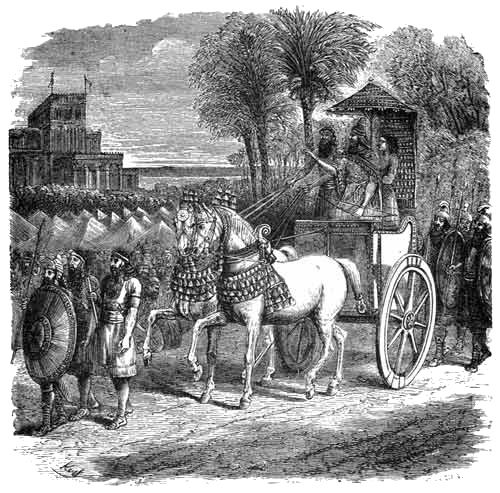
Being desirous of affording the reader a pictorial representation of the war and state chariots, I have selected Egypt as the typical country of the former, and Assyria of the latter. Both drawings have been executed with the greatest care in details, every one of which, even to the harness of the Horses, the mode of holding the reins, the form of the whip, and the offensive and defensive armour, has been copied from the ancient records of Egypt and Nineveh.
We will first take the war-chariot of Egypt.
This form has been selected as the type of the war-chariot, because the earliest account of such a force mentions the war-chariots of Egypt, and because, after the Israelites had adopted chariots as an acknowledged part of their army, the vehicles, as well as the trained Horses, and probably their occupants, were procured from Egypt.
The scene represents a battle between the imperial forces and a revolted province, so that the reader may have the opportunity of seeing the various kinds of weapons and armour which were in use in Egypt at the time of Joseph. In the foreground is the chariot of the general, driven at headlong speed, the Horses at full gallop, and the springless chariot leaping off the ground as the Horses bound along. The royal rank of the general in question is shown by the feather fan which denotes his high birth, and which is fixed in a socket at the back of his chariot, much as a coachman fixes his whip. The rank of the rider is further shown by the feather plumes on the heads of his Horses.
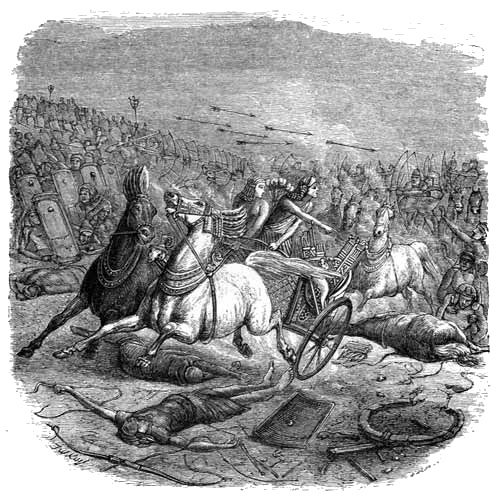
EGYPTIAN WAR-CHARIOTS.
"Come up, ye horses; and rage, ye chariots; and let the mighty men come forth."—Jer. xlvi. 9.
"The noise of a whip, and the noise of the rattling of the wheels, and of the prancing horses, and of the jumping chariots."—Nahum iii. 2.
"Like the noise of chariots ... shall they leap."—Joel ii. 5.
By the side of the chariot are seen the quiver and bow-case, the former being covered with decorations, and having the figure of a recumbent lion along its sides. The simple but effective harness of the Horses is especially worthy of notice, as showing how the ancients knew, better than the moderns, that to cover a Horse with a complicated apparatus of straps and metal only deteriorates from the powers of the animal, and that a Horse is more likely to behave well if he can see freely on all sides, than if all lateral vision be cut off by the use of blinkers.
Just behind the general is the chariot of another officer, one of whose Horses has been struck, and is lying struggling on the ground. The general is hastily giving his orders as he dashes past the fallen animal. On the ground are lying the bodies of some slain enemies, and the Horses are snorting and shaking their heads, significative of their unwillingness to trample on a human being. By the side of the dead man are his shield, bow, and quiver, and it is worthy of notice that the form of these weapons, as depicted upon the ancient Egyptian monuments, is identical with that which is still found among several half-savage tribes of Africa.
In the background is seen the fight raging round the standards. One chief has been killed, and while the infantry are pressing round the body of the rebel leader and his banner on one side, on the other the imperial chariots are thundering along to support the attack, and are driving their enemies before them. In the distance are seen the clouds of dust whirled into the air by the hoofs and wheels, and circling in clouds by the eddies caused by the fierce rush of the vehicles, thus illustrating the passage in Jer. iv. 13: "Behold, he shall come up as clouds, and his chariots shall be as a whirlwind: his horses are swifter than eagles. Woe unto us! for we are spoiled." The reader will see, by reference to the illustration, how wonderfully true and forcible is this statement, the writer evidently having been an eye-witness of the scene which he so powerfully depicts.
The second scene is intentionally chosen as affording a strong contrast to the former. Here, instead of the furious rush, the galloping Horses, the chariots leaping off the ground, the archers bending their bows, and all imbued with the fierce ardour of battle, we have a scene of quiet grandeur, the Assyrian king making a solemn progress in his chariot after a victory, accompanied by his attendants, and surrounded by his troops, in all the placid splendour of Eastern state.
Chief object in the illustration stands the great king in his chariot, wearing the regal crown, or mitre, and sheltered from the sun by the umbrella, which in ancient Nineveh, as in more modern times, was the emblem of royalty. By his side is his charioteer, evidently a man of high rank, holding the reins in a business-like manner; and in front marches the shield-bearer. In one of the sculptures from which this Illustration was composed, the shield-bearer was clearly a man of rank, fat, fussy, full of importance, and evidently a portrait of some well-known individual.
ASSYRIAN CHARIOT OF STATE.
"Then shall there enter into the gates of this city kings and princes sitting upon the throne of David, riding in chariots."—Jer. xvii. 25.
The Horses are harnessed with remarkable lightness, but they bear the gorgeous trappings which befit the rank of the rider, their heads being decorated with the curious successive plumes with which the Assyrian princes distinguished their chariot Horses, and the breast-straps being adorned with tassels, repeated in successive rows like the plumes of the head.
The reader will probably notice the peculiar high action of the Horses. This accomplishment seems to have been even more valued among the ancients than by ourselves, and some of the sculptures show the Horses with their knees almost touching their noses. Of course the artist exaggerated the effect that he wanted to produce; but the very fact of the exaggeration shows the value that was set on a high and showy action in a Horse that was attached to a chariot of state. The old Assyrian sculptors knew the Horse well, and delineated it in a most spirited and graphic style, though they treated it rather conventionally. The variety of attitude is really wonderful, considering that all the figures are profile views, as indeed seemed to have been a law of the historical sculptures.
Before closing this account of the Horse, it may be as well to remark the singular absence of detail in the Scriptural accounts. Of the other domesticated animals many such details are given, but of the Horse we hear but little, except in connexion with war. There are few exceptions to this rule, and even the oft-quoted passage in Job, which goes deeper into the character of the Horse than any other portion of the Scriptures, only considers the Horse as an auxiliary in battle. We miss the personal interest in the animal which distinguishes the many references to the ox, the sheep, and the goat; and it is remarkable that even in the Book of Proverbs, which is so rich in references to various animals, very little is said of the Horse.
THE ASS.
Importance of the Ass in the East—Its general use for the saddle—Riding the Ass not a mark of humility—The triumphal entry—White Asses—Character of the Scriptural Ass—Saddling the Ass—The Ass used in agriculture—The Ass's millstone—The water-wheel and the plough—Reminiscences of the Ass in the Scriptural narrative—Its value as property—The flesh of the Ass—The siege of Samaria and its horrors—Various legends respecting the Ass—The impostor and his fate—Samson and Balaam.
In the Scriptures we read of two breeds of Ass, namely, the Domesticated and the Wild Ass. As the former is the more important of the two, we will give it precedence.
In the East, the Ass has always played a much more important part than among us Westerns, and on that account we find it so frequently mentioned in the Bible. In the first place, it is the universal saddle-animal of the East. Among us the Ass has ceased to be regularly used for the purposes of the saddle, and is only casually employed by holiday-makers and the like. Some persons certainly ride it habitually, but they almost invariably belong to the lower orders, and are content to ride without a saddle, balancing themselves in some extraordinary manner just over the animal's tail. In the East, however, it is ridden by persons of the highest rank, and is decorated with saddle and harness as rich as those of the horse.
In England we should be very much surprised to see a royal prince, a judge, or a bishop travelling habitually on a donkey, but in Palestine it is just the animal which would be considered most appropriate for the purpose. For example, we find that Abraham, an exceptionally wealthy man, and a chief of high position, made use of the Ass for the saddle. It was on an Ass that he travelled when he made his three days' journey from Beersheba to Moriah, when he was called to prove his faith by sacrificing Isaac (see Gen. xxii. 3).
Then in Judges x. 3, 4, we find that riding upon the Ass is actually mentioned as a mark of high rank.
"And after him arose Jair, a Gileadite, and judged Israel twenty and two years.
"And he had thirty sons that rode on thirty ass colts, and they had thirty cities, which are called Havoth-jair unto this day, which are in the land of Gilead." So here we have the curious fact, that the sacred historian thinks it worth while to mention that great men, the sons of the chief man of Israel, each of them being ruler over a city, rode upon Ass colts. In the same book, xii. 13, 14, we have a similar record of Abdon, the judge who preceded Samson.
"After him Abdon the son of Hillel, a Pirathonite, judged Israel.
"And he had forty sons and thirty nephews" (or grandsons according to some translators) "that rode on threescore and ten ass colts: and he judged Israel eight years."
Thus we see that, so far from the use of the Ass as a saddle-animal being a mark of humility, it ought to be viewed in precisely the opposite light. In consequence of the very natural habit of reading, according to Western ideas, the Scriptures, which are books essentially Oriental in all their allusions and tone of thought, many persons have entirely perverted the sense of one very familiar passage, the prophecy of Zechariah concerning the future Messiah. "Rejoice greatly, O daughter of Zion; shout, O daughter of Jerusalem: behold, thy King cometh unto thee: He is just, and having salvation; lowly, and riding upon an ass, and upon a colt the foal of an ass" (Zech. ix. 9).
Now this passage, as well as the one which describes its fulfilment so many years afterwards, has often been seized upon as a proof of the meekness and lowliness of our Saviour, in riding upon so humble an animal when He made His entry into Jerusalem. The fact is, that there was no humility in the case, neither was the act so understood by the people. He rode upon an Ass as any prince or ruler would have done who was engaged on a peaceful journey, the horse being reserved for war purposes. He rode on the Ass, and not on the horse, because He was the Prince of Peace and not of war, as indeed is shown very clearly in the context. For, after writing the words which have just been quoted, Zechariah proceeds as follows (ver. 10): "And I will cut off the chariot from Ephraim, and the horse from Jerusalem, and the battle bow shall be cut off: and He shall speak peace unto the heathen: and His dominion shall be from sea even to sea, and from the river even to the ends of the earth."
Meek and lowly was He, as became the new character, hitherto unknown to the warlike and restless Jews, a Prince, not of war, as had been all other celebrated kings, but of peace. Had He come as the Jews expected—despite so many prophecies—their Messiah to come, as a great king and conqueror, He might have ridden the war-horse, and been surrounded with countless legions of armed men. But He came as the herald of peace, and not of war; and, though meek and lowly, yet a Prince, riding as became a prince, on an Ass colt which had borne no inferior burden.
That the act was not considered as one of lowliness is evident from the manner in which it was received by the people, accepting Him as the Son of David, coming in the name of the Highest, and greeting Him with the cry of "Hosanna!" ("Save us now,") quoted from verses 25, 26 of Ps. cxviii.: "Save now, I beseech Thee, O Lord: O Lord, I beseech Thee, send now prosperity."
"Blessed be He that cometh in the name of the Lord."
The palm-branches which they strewed upon the road were not chosen by the attendant crowd merely as a means of doing honour to Him whom they acknowledged as the Son of David. They were necessarily connected with the cry of "Hosanna!" At the Feast of Tabernacles, it was customary for the people to assemble with branches of palms and willows in their hands, and for one of the priests to recite the Great Hallel, i.e. Ps. cxiii. and cxviii. At certain intervals, the people responded with the cry of "Hosanna!" waving at the same time their palm-branches. For the whole of the seven days through which the feast lasted they repeated their Hosannas, always accompanying the shout with the waving of palm-branches, and setting them towards the altar as they went in procession round it.
Every child who could hold a palm-branch was expected to take part in the solemnity, just as did the children on the occasion of the triumphal entry. By degrees, the name of Hosanna was transferred to the palm-branches themselves, as well as to the feast, the last day being called the Great Hosanna.
The reader will now see the importance of this carrying of palm-branches, accompanied with Hosannas, and that those who used them in honour of Him whom they followed into Jerusalem had no idea that He was acting any lowly part.
Again, the action of the disciples in putting their mantles on the Ass, and setting their Master upon them, was one that signified their acknowledgment of Him as their Prince; and the same idea was typified by the laying of the clothes upon the road, together with the palm-branches. Compare also the passage in 2 Kings ix. 13. When Elisha sent the young prophet to call Jehu from among the council, and to anoint him King of Israel, the act of anointing was performed in a private chamber. Jehu, scarcely realizing the import of the act, seemed to think it a trick played upon him by some of his companions, the commanding officers of the army. When, however, they heard his account of the interview with the prophet, they at once accepted him as their king, and, as token thereof, "they hasted, and took every man his garment, and put it under him at the top of the stairs, and blew with trumpets, saying, Jehu is king."
White Asses were selected for persons of high rank, especially for those who exercised the office of judges. See Judges v. 10: "Speak, ye that ride on white asses, ye that sit in judgment, and walk by the way." Such Asses are still in use for similar purposes, and are bred expressly for the use of persons of rank. They are larger, and are thought to be swifter, than the ordinary breeds; but they are by no means hardy animals, and are said to be unsuitable for places near the sea-coast.
Both sexes used the Ass for riding, as they do now in the East. See for example Judges i. 14, where we find that Achsah, the daughter of Caleb, rode on an Ass when she went to ask her father to give her some springs of water, in addition to the land which he had previously given her as a dowry. Later in the Scriptural history we read that Abigail, the wife of the wealthy churl Nabal, rode to meet David on an Ass, when she went to deprecate his anger against her husband (1 Sam. xxv. 23). And, still later, the woman of Shunem, who acted so hospitably towards Elisha, rode on an Ass to meet him when her child had died from sunstroke in the field (see 2 Kings iv. 24).
Now all these women were of high rank, and certainly neither of them would have considered that riding on an Ass was an act of humility. We will cite them in succession, and begin with Achsah. She was the daughter of one of the most illustrious of the Israelites, a man of whom we read as being almost the equal of Joshua, one of the illustrious two who were included in the special exemption from the punishment of rebellion. Moreover, Caleb was a man of enormous territorial possessions, as we find from several passages in the Old Testament; a man who was able to give to his daughter not only a large amount of land as a dowry, but also the wells or springs which multiplied its value tenfold.
Next we come to the case of Abigail, the wife of Nabal, who himself belonged to the family of Caleb, and probably owed his wealth simply to the accident of his birth. It is related of Nabal, that his "possessions were in Carmel, and the man was very great, and he had three thousand sheep, and a thousand goats." Yet his wife, who undoubtedly ruled her household as a housewife should do, and who was thought worthy of becoming David's wife after the death of her cowardly husband, rode on an Ass when she went on a mission in which life and death were involved.
And lastly, the woman of Shunem, who rode on an Ass to meet Elisha, engaged in a mission in which the life of her only child was involved, was a woman of great wealth (2 Kings iv. 8), who was able not only to receive the prophet, but to build a chamber, and furnish it for him.
Not to multiply examples, we see from these passages that the Ass of the East was held in comparatively high estimation, being used for the purposes of the saddle, just as would a high-bred horse among ourselves.
Consequently, the Ass is really a different animal. In this country he is repressed, and seldom has an opportunity for displaying the intellectual powers which he possesses, and which are of a much higher order than is generally imagined. It is rather remarkable, that when we wish to speak slightingly of intellect we liken the individual to an Ass or a goose, not knowing that we have selected just the quadruped and the bird which are least worthy of such a distinction.
Putting aside the bird, as being at present out of place, we shall find that the Ass is one of the cleverest of our domesticated animals. We are apt to speak of the horse with a sort of reverence, and of the Ass with contemptuous pity, not knowing that, of the two animals, the Ass is by far the superior in point of intellect. It has been well remarked by a keen observer of nature, that if four or five horses are in a field, together with one Ass, and there be an assailable point in the fence, the Ass is sure to be the animal that discovers it, and leads the way through it.
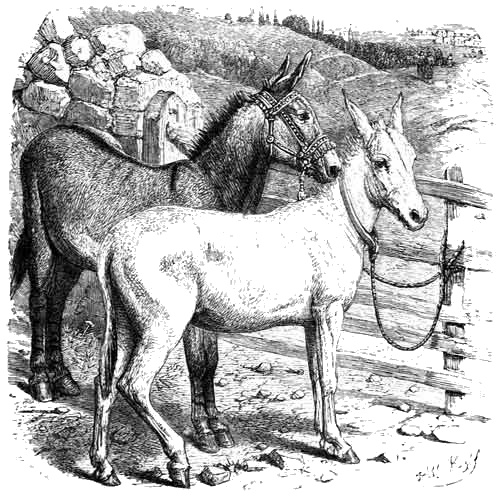
SYRIAN ASSES.
"A bridle for the ass."—Prov. xxvi.
Take even one of our own toil-worn animals, turned out in a common to graze, and see the ingenuity which it displays when persecuted by the idle boys who generally frequent such places, and who try to ride every beast that is within their reach. It seems to divine at once the object of the boy as he steals up to it, and he takes a pleasure in baffling him just as he fancies that he has succeeded in his attempt.
Should the Ass be kindly treated, there is not an animal that proves more docile, or even affectionate. Stripes and kicks it resents, and sets itself distinctly against them; and, being nothing but a slave, it follows the slavish principle of doing no work that it can possibly avoid.
Now, in the East the Ass takes so much higher rank than our own animal, that its whole demeanour and gait are different from those displayed by the generality of its brethren in England. "Why, the very slave of slaves," writes Mr. Lowth, in his "Wanderer in Arabia," "the crushed and grief-stricken, is so no more in Egypt: the battered drudge has become the willing servant. Is that active little fellow, who, with race-horse coat and full flanks, moves under his rider with the light step and the action of a pony—is he the same animal as that starved and head-bowed object of the North, subject for all pity and cruelty, and clothed with rags and insult?
"Look at him now. On he goes, rapid and free, with his small head well up, and as gay as a crimson saddle and a bridle of light chains and red leather can make him. It was a gladdening sight to see the unfortunate as a new animal in Egypt."
Hardy animal as is the Ass, it is not well adapted for tolerance of cold, and seems to degenerate in size, strength, speed, and spirit in proportion as the climate becomes colder. Whether it might equal the horse in its endurance of cold provided that it were as carefully treated, is perhaps a doubtful point; but it is a well-known fact that the horse does not necessarily degenerate by moving towards a colder climate, though the Ass has always been found to do so.
There is, of course, a variety in the treatment which the Ass receives even in the East. Signor Pierotti, whose work on the customs and traditions of Palestine has already been mentioned, writes in very glowing terms of the animal. He states that he formed a very high opinion of the Ass while he was in Egypt, not only from its spirited aspect and its speed, but because it was employed even by the Viceroy and the great Court officers, who may be said to use Asses of more or less intelligence for every occasion. He even goes so far as to say that, if all the Asses were taken away from Egypt, not a man would be left.
The same traveller gives an admirable summary of the character of the Ass, as it exists in Egypt and Palestine. "What, then, are the characteristics of the ass? Much the same as those which adorn it in other parts of the East—namely, it is useful for riding and for carrying burdens; it is sensible of kindness, and shows gratitude; it is very steady, and is larger, stronger, and more tractable than its European congener; its pace is easy and pleasant; and it will shrink from no labour, if only its poor daily feed of straw and barley is fairly given.
"If well and liberally supplied, it is capable of any enterprise, and wears an altered and dignified mien, apparently forgetful of its extraction, except when undeservedly beaten by its masters, who, however, are not so much to be blamed, because, having learned to live among sticks, thongs, and rods, they follow the same system of education with their miserable dependants.
"The wealthy feed him well, deck him with fine harness and silver trappings, and cover him, when his work is done, with rich Persian carpets. The poor do the best they can for him, steal for his benefit, give him a corner at their fireside, and in cold weather sleep with him for more warmth. In Palestine, all the rich men, whether monarchs or chiefs of villages, possess a number of asses, keeping them with their flocks, like the patriarchs of old. No one can travel in that country, and observe how the ass is employed for all purposes, without being struck with the exactness with which the Arabs retain the Hebrew customs."
The result of this treatment is, that the Eastern Ass is an enduring and tolerably swift animal, vying with the camel itself in its powers of long-continued travel, its usual pace being a sort of easy canter. On rough ground, or up an ascent, it is said even to gain on the horse, probably because its little sharp hoofs give it a firm footing where the larger hoof of the horse is liable to slip.
The familiar term "saddling the Ass" requires some little explanation.
The saddle is not in the least like the article which we know by that name, but is very large and complicated in structure. Over the animal's back is first spread a cloth, made of thick woollen stuff, and folded several times. The saddle itself is a very thick pad of straw, covered with carpet, and flat at the top, instead of being rounded as is the case with our saddles. The pommel is very high, and when the rider is seated on it, he is perched high above the back of the animal. Over the saddle is thrown a cloth or carpet, always of bright colours, and varying in costliness of material and ornament according to the wealth of the possessor. It is mostly edged with a fringe and tassels.
The bridle is decorated, like that of the horse, with bells, embroidery, tassels, shells, and other ornaments. An example of the headstall worn by an Ass belonging to a wealthy man may be seen in the illustration.
As we may see from 2 Kings iv. 24, the Ass was generally guided by a driver who ran behind it, just as is the custom with the hired Asses in this country. Owing to the unchanging character of the East, there is no doubt that the "riders on asses" of the Scriptures rode exactly after the mode which is adopted at the present day. What that mode is, we may learn from Mr. Bayard Taylor's amusing and vivid description of a ride through the streets of Cairo:—
"To see Cairo thoroughly, one must first accustom himself to the ways of these long-eared cabs, without the use of which I would advise no one to trust himself in the bazaars. Donkey-riding is universal, and no one thinks of going beyond the Frank quarters on foot. If he does, he must submit to be followed by not less than six donkeys with their drivers. A friend of mine who was attended by such a cavalcade for two hours, was obliged to yield at last, and made no second attempt. When we first appeared in the gateway of an hotel, equipped for an excursion, the rush of men and animals was so great that we were forced to retreat until our servant and the porter whipped us a path through the yelling and braying mob. After one or two trials I found an intelligent Arab boy named Kish, who for five piastres a day furnished strong and ambitious donkeys, which he kept ready at the door from morning till night. The other drivers respected Kish's privilege, and henceforth I had no trouble.
"The donkeys are so small that my feet nearly touched the ground, but there is no end to their strength and endurance. Their gait, whether in pace or in gallop, is so easy and light that fatigue is impossible. The drivers take great pride in having high-cushioned red saddles, and in hanging bits of jingling brass to the bridles. They keep their donkeys close shorn, and frequently beautify them by painting them various colours. The first animal I rode had legs barred like a zebra's, and my friend's rejoiced in purple flanks and a yellow belly. The drivers ran behind them with a short stick, punching them from time to time, or giving them a sharp pinch on the rump. Very few of them own their donkeys, and I understood their pertinacity when I learned that they frequently received a beating on returning home empty-handed.
"The passage of the bazaars seems at first quite as hazardous on donkey-back as on foot; but it is the difference between knocking somebody down and being knocked down yourself, and one certainly prefers the former alternative. There is no use in attempting to guide the donkey, for he won't be guided. The driver shouts behind, and you are dashed at full speed into a confusion of other donkeys, camels, horses, carts, water-carriers, and footmen. In vain you cry out 'Bess' (enough), 'Piacco,' and other desperate adjurations; the driver's only reply is: 'Let the bridle hang loose!' You dodge your head under a camel-load of planks; your leg brushes the wheel of a dust-cart; you strike a fat Turk plump in the back; you miraculously escape upsetting a fruit-stand; you scatter a company of spectral, white-masked women; and at last reach some more quiet street, with the sensations of a man who has stormed a battery.
"At first this sort of riding made me very nervous, but presently I let the donkey go his own way, and took a curious interest in seeing how near a chance I ran of striking or being struck. Sometimes there seemed no hope of avoiding a violent collision; but, by a series of the most remarkable dodges, he generally carried you through in safety. The cries of the driver running behind gave me no little amusement. 'The hawadji comes! Take care on the right hand! Take care on the left hand! O man, take care! O maiden, take care! O boy, get out of the way! The hawadji comes!' Kish had strong lungs, and his donkey would let nothing pass him; and so wherever we went we contributed our full share to the universal noise and confusion."
This description explains several allusions which are made in the Scriptures to treading down the enemies in the streets, and to the chariots raging and jostling against each other in the ways.
The Ass was used in the olden time for carrying burdens, as it is at present, and, in all probability, carried them in the same way. Sacks and bundles are tied firmly to the pack-saddle; but poles, planks, and objects of similar shape are tied in a sloping direction on the side of the saddle, the longer ends trailing on the ground, and the shorter projecting at either side of the animal's head. The North American Indians carry the poles of their huts, or wigwams, in precisely the same way, tying them on either side of their horses, and making them into rude sledges, upon which are fastened the skins that form the walls of their huts. The same system of carriage is also found among the Esquimaux, and the hunters of the extreme North, who harness their dogs in precisely the same manner. The Ass, thus laden, becomes a very unpleasant passenger through the narrow and crowded streets of an Oriental city; and many an unwary traveller has found reason to remember the description of Issachar as the strong Ass between two burdens.
The Ass was also used for agriculture, and was employed in the plough, as we find from many passages. See for example, "Blessed are ye that sow beside all waters, that send forth thither the feet of the ox and the ass" (Isa. xxxii. 20). Sowing beside the waters is a custom that still prevails in all hot countries, the margins of rivers being tilled, while outside this cultivated belt there is nothing but desert ground.
The ox and the Ass were used in the first place for irrigation, turning the machines by which water was lifted from the river, and poured into the trenches which conveyed it to all parts of the tilled land. If, as is nearly certain, the rude machinery of the East is at the present day identical with those which were used in the old Scriptural times, they were yoked to the machine in rather an ingenious manner. The machine consists of an upright pivot, and to it is attached the horizontal pole to which the ox or Ass is harnessed. A machine exactly similar in principle may be seen in almost any brick-field in England; but the ingenious part of the Eastern water-machine is the mode in which the animal is made to believe that it is being driven by its keeper, whereas the man in question might be at a distance, or fast asleep.
The animal is first blindfolded, and then yoked to the end of the horizontal bar. Fixed to the pivot, and rather in front of the bar, is one end of a slight and elastic strip of wood. The projecting end, being drawn forward and tied to the bridle of the animal, keeps up a continual pull, and makes the blinded animal believe that it is being drawn forward by the hand of a driver. Some ingenious but lazy attendants have even invented a sort of self-acting whip, i.e. a stick which is lifted and allowed to fall on the animal's back by the action of the wheel once every round.
The field being properly supplied with water, the Ass is used for ploughing it. It is worthy of mention that at the present day the prohibition against yoking an ox and an Ass together is often disregarded. The practice, however, is not a judicious one, as the slow and heavy ox does not act well with the lighter and more active animal, and, moreover, is apt to butt at its companion with its horns in order to stimulate it to do more than its fair proportion of the work.