BIRDS. (continued 2)
Reading edition
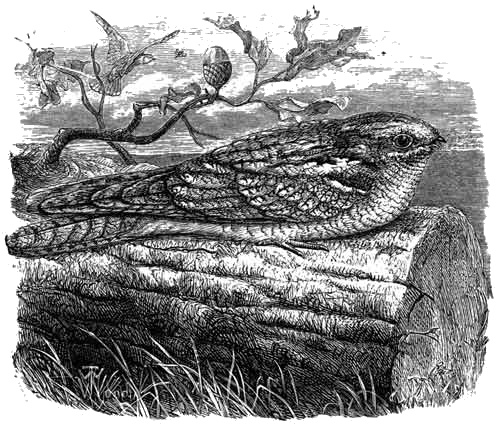
THE NIGHT-HAWK.
"The owl, and the night-hawk, and the cuckoo."—Deut. xiv. 15.
Still, many commentators think that the Night-hawk or Nightjar is the bird which is signified by the word tachmâs; and, as we have already treated of the owls, we will accept the rendering of the Authorized Version. Moreover, the Jewish Bible follows the same translation, and renders tachmâs as Night-hawk, but affixes the mark of doubt.
It is not unlikely that the Jews may have reckoned this bird among the owls, just as is the case with the uneducated among ourselves, who popularly speak of the Nightjar as the Fern Owl, Churn Owl, or Jar Owl, the two last names being given to it on account of its peculiar cry. There are few birds, indeed, which have received a greater variety of popular names, for, besides the Goatsucker and the five which have already been mentioned, there are the Wheel-bird and Dor-hawk, the former of these names having been given to the bird on account of its wheeling round the trees while seeking for prey, and the latter on account of the dor-beetles on which it largely feeds.
This curious variety of names is probably due to the very conspicuous character of the Nightjar, its strange, jarring, weird-like cry forcing itself on the ear of the least attentive, as it breaks the silence of night. It hardly seems like the cry of a bird, but rather resembles the sound of a pallet falling on the cogs of a rapidly-working wheel. It begins in the dusk of evening, the long, jarring note being rolled out almost interminably, until the hearer wonders how the bird can have breath enough for such a prolonged sound. The hearer may hold his breath as long as he can, take a full inspiration, hold his breath afresh, and repeat this process over and over again, and yet the Nightjar continues to trill out its rapid notes without a moment's cessation for breath, the sound now rising shrill and clear, and now sinking as if the bird were far off, but never ceasing for an instant.
This remarkable cry has caused the uneducated rustics to look upon the bird with superstitious dread, every one knowing its cry full well, though to many the bird is unknown except by its voice. It is probable that, in the days when Moses wrote the Law, so conspicuous a bird was well known to the Jews, and we may therefore conjecture that it was one of those birds which he would specially mention by name.
The general habits of the Nightjar are quite as remarkable as its note. It feeds on the wing, chasing and capturing the various moths, beetles, and other insects that fly abroad by night. It may be seen wheeling round the branches of some tree, the oak being a special favourite, sometimes circling round it, and sometimes rising high in the air, and the next moment skimming along the ground. Suddenly it will disappear, and next moment its long trilling cry is heard from among the branches of the tree round which it has been flying. To see it while singing is almost impossible, for it has a habit of sitting longitudinally on the branch, and not across it, like most birds, so that the outline of its body cannot be distinguished from that of the bough on which it is seated. As suddenly as it began, the sound ceases, and simultaneously the bird may be seen wheeling again through the air with its noiseless flight.
Being a very bold bird, and not much afraid of man, it allows a careful observer to watch its movements clearly. I have often stood close to the tree round which several Nightjars were circling, and seen them chase their prey to the ground within a yard or two of the spot on which I was standing. The flight of the Nightjar is singularly graceful. Swift as the swallow itself, it presents a command of wing that is really wonderful, gliding through the air with consummate ease, wheeling and doubling in pursuit of some active moth, whose white wings glitter against the dark background, while the sober plumage of its pursuer is scarcely visible, passing often within a few feet of the spectator, and yet not a sound or a rustle will reach his ears. Sometimes the bird is said to strike its wings together over its back, so as to produce a sharp snapping sound, intended to express anger at the presence of the intruder. I never, however, heard this sound, though I have watched the bird so often.
Owing to the soft plumage with which it is clad, this bird, like the owls, looks larger than really is the case. It is between ten and eleven inches in length, with an expanse of wing of twenty inches, and yet weighs rather less than three ounces. Its large mouth, like that of the swallow tribe, opens as far as the eyes, and is furnished with a set of vibrissæ or bristles, which remind the observer of the "whale-bone" which is set on the jaw of the Greenland whale. The scientific name of the bird is Caprimulgus Europæus.
THE SWALLOW.
Identification of the smaller birds—Oriental indifference to natural history—Use of collective terms—The Swallow—Signification of the word Deror—The Bird of Liberty—Swallows and Swifts—The Sunbirds and Bee-eaters—Variety of small birds found in Palestine—The Swallows of Palestine—Swallows protected by man in various countries—Nesting of the Swallow—The Rufous Swallow and Martin—The Sis or Swift—Various species of Swift inhabiting the Holy Land—Talmudical notions of the Swift or Swallow—The leper and his offering—The cooking pot and the sacrificial vessel—Signification of the word Tzippor-deror.
Difficult as is the identification of the mammalia mentioned in the Bible, that of the birds is much more intricate.
Some of the larger birds can be identified with tolerable certainty, but when we come to the smaller and less conspicuous species, we are at once lost in uncertainty, and at the best can only offer conjectures. The fact is, the Jews of old had no idea of discriminating between the smaller birds, unless they happened to be tolerably conspicuous by plumage or by voice. We need not be much surprised at this. The Orientals of the present day do precisely the same thing, and not only fail to discriminate between the smaller birds, but absolutely have no names for them.
By them, the shrikes, the swallows, the starlings, the thrushes, the larks, the warblers, and all the smaller birds, are called by a common title, derived from the twittering sound of their voices, only one or two of them having any distinctive titles. They look upon the birds much as persons ignorant of entomology look at a collection of moths. There is not much difficulty in discriminating between the great hawk-moths, and perhaps in giving a name to one or two of them which are specially noticeable for any peculiarity of form or colour; but when they come to the "Rustics," the "Carpets," the "Wainscots," and similar groups, they are utterly lost; and, though they may be able to see the characteristic marks when the moths are placed side by side, they are incapable of distinguishing them separately, and, to their uneducated eyes, twenty or thirty species appear absolutely alike.
I believe that there is no country where a knowledge of practical natural history is so widely extended as in England, and yet how few educated persons are there who, if taken along a country lane, can name the commonest weed or insect, or distinguish between a sparrow, a linnet, a hedge-sparrow, and a chaffinch. Nay, how many are there who, if challenged even to repeat the names of twelve little birds, would be unable to do so without some consideration, much less to know them if the birds were placed before them.
Such being the case in this country, where the capability of observation is more or less cultivated in every educated person, we may well expect that a profound ignorance on the subject should exist in countries where that faculty is absolutely neglected as a matter of education. Moreover, in England we have a comparatively limited list of birds, whereas in Palestine are found nearly all those which are reckoned among British birds, and many other species besides. Those which reside in England reside also for the most part in Palestine, while the greater part of the migratory birds pass, as we might expect, into the Holy Land and the neighbouring countries.
If then we put together the two facts of an unobservant people and a vastly extended fauna, we shall not wonder that so many collective terms are used in the Scriptures, one word often doing duty for twenty or thirty species. The only plan, therefore, which can be adopted, is to mention generally the birds which were probably grouped under one name, and to describe briefly one or two of the most prominent.
It is, however, rather remarkable that the song of birds does not appear to be noticed by the sacred writers. We might expect that several of the prophets, especially Isaiah, the great sacred poet, who drew so many of his images from natural objects, would have found in the song of birds some metaphor expressive of sweetness or joy. We might expect that in the Book of Job, in which so many creatures are mentioned, the singing of birds would be brought as prominently forward as the neck clothed with thunder of the horse, the tameless freedom of the wild ass, the voracity of the vulture, and the swiftness of the ostrich. We might expect the song of birds to be mentioned by Amos, the herdman of Tekoa, who introduces into his rugged poem the rear of the old lion and the wail of the cub, the venom of the serpent hidden in the wattled wall of the herdman's hut, and the ravages of the palmer-worm among the olives. Above all, we might expect that in the Psalms there would be many allusions to the notes of the various birds which have formed such fruitful themes for the poets of later times. There are, however, in the whole of the Scriptures but two passages in which the song of birds is mentioned, and even in these only a passing allusion is made.
One of them occurs in Psalm civ. 12: "By them (i.e. the springs of water) shall the fowls of the heaven have their habitation, which sing among the branches." This passage is perhaps rendered more closely in the Jewish Bible: "Over them dwell the fowls of the heaven; they let their voices resound (or give their voice) from between the foliage."
The other occurs in Eccles. xii. 4: "And the doors shall be shut in the streets, when the sound of the grinding is low, and he shall rise up at the voice of the bird, and all the daughters of music shall be brought low." The word which is here translated as "bird," is that which is rendered in some places as "sparrow," in others as "fowl," and in others as "bird." Even in these passages, as the reader will have noticed, no marks of appreciation are employed, and we hear nothing of the sweetness, joyousness, or mournfulness of the bird's song.
We will now proceed to the words which have been translated as Swallow in the Authorized Version.
These are two in number, namely, derôr and agar. Hebraists are, however, agreed that the latter word has been wrongly applied, the translators having interchanged the signification of two contiguous words.
We will therefore first take the word deror. This word signifies liberty, and is well applied to the Swallow, the bird of freedom. It is remarkable, by the way, how some of the old commentators have contrived to perplex themselves about a very simple matter. One of them comments upon the bird as being "so called, because it has the liberty of building in the houses of mankind." Another takes a somewhat similar view of the case, but puts it in a catechetical form: "Why is the swallow called the bird of liberty? Because it lives both in the house and in the field." It is scarcely necessary to point out to the reader that the "liberty" to which allusion is made is the liberty of flight, the bird coming and going at its appointed times, and not being capable of domestication.
Several kinds of Swallow are known in Palestine, including the true Swallows, the martins, and the swifts, and, as we shall presently see, it is likely that one of these groups was distinguished by a separate name. Whether of not the word deror included other birds beside the Swallows is rather doubtful, though not at all unlikely; and if so, it is probable that any swift-winged insectivorous bird would be called by the name of Deror, irrespective of its size or colour.
The bee-eaters, for example, are probably among the number of the birds grouped together under the word deror, and we may conjecture that the same is the case with the sunbirds, those bright-plumed little beings that take in the Old World the place occupied by the humming-birds in the New, and often mistaken for them by travellers who are not acquainted with ornithology. One of these birds, the Nectarinia Oseæ, is described by Mr. Tristram as "a tiny little creature of gorgeous plumage, rivalling the humming-birds of America in the metallic lustre of its feathers—green and purple, with brilliant red and orange plumes under its shoulders."
In order to account for the singular variety of animal life which is to be found in Palestine, and especially the exceeding diversity of species among the birds, we must remember that Palestine is a sort of microcosm in itself, comprising within its narrow boundaries the most opposite conditions of temperature, climate, and soil. Some parts are rocky, barren, and mountainous, chilly and cold at the top, and acting as channels through which the winds blow almost continuously. The cliffs are full of holes, rifts, and caverns, some natural, some artificial, and some of a mixed kind, the original caverns having been enlarged and improved by the hand of man.
As a contrast to this rough and ragged region, there lie close at hand large fertile plains, affording pasturage for unnumbered cattle, and of a tolerably equable temperature, so that the animals which are pastured in it can find food throughout the year. Through the centre of Palestine runs the Jordan, fertilizing its banks with perpetual verdure, and ending its course in the sulphurous and bituminous waters of the Dead Sea, under whose waves the ruins of the wicked cities are supposed to lie. Westward we have the shore of the Mediterranean with its tideless waves of the salt sea, and on the eastward of the mountain range that runs nearly parallel to the sea is the great Lake of Tiberias, so large as to have earned the name of the Sea of Galilee.
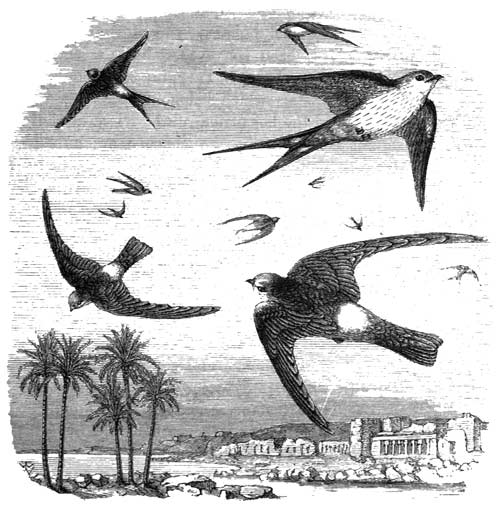
THE RUFOUS SWALLOW AND GALILEAN SWIFT.
"The turtle, and the crane, and the swallow observe the time of their coming."—Jer. viii. 7.
Under these favourable conditions, therefore, the number of species which are found in Palestine is perhaps greater than can be seen in any other part of the earth of the same dimensions, and it seems probable that for this reason, among many others, Palestine was selected to be the Holy Land. If, for example, the Christian Church had been originated under the tropics, those who lived in a cold climate could scarcely have understood the language in which the Scriptures must necessarily have been couched. Had it, on the contrary, taken its rise in the Arctic regions, the inhabitants of the tropics and temperate regions could not have comprehended the imagery in which the teachings of Scripture must have been conveyed. But the small and geographically insignificant Land of Palestine combines in itself many of the characteristics which belong respectively to the cold, the temperate, and the hot regions of the world, so that the terms in which the sacred writings are couched are intelligible to a very great proportion of the world's inhabitants.
This being the case, we naturally expect to find that several species of the Swallow are inhabitants of Palestine, if indeed so migratory a bird can be rightly said to be an inhabitant of any one country.
The chief characteristic of the Swallow, the "bird of freedom," is that it cannot endure captivity, but is forced by instinct to pass from one country to another for the purpose of preserving itself in a tolerably equable temperature, moving northwards as the spring ripens into summer, and southwards as autumn begins to sink into winter. By some marvellous instinct it traces its way over vast distances, passing over hundreds of miles where nothing but the sea is beneath it, and yet at the appointed season returning with unerring certainty to the spot where it was hatched. How it is guided no one knows, but the fact is certain, that Swallows, remarkable for some peculiarity by which they could be at once identified, have been observed to leave the country on their migration, and to return in the following year to the identical nest whence they started.
The habits of the Swallow are much the same in Palestine as they are in England. Its habit of making its nest among the habitations of mankind is mentioned in a well-known passage of the Psalms: "The sparrow hath found an house, and the swallow a nest for herself, where she may lay her young, even Thine altars, O Lord of Hosts, my King and my God" (Ps. lxxxiv. 3). The Swallow seems in all countries to have enjoyed the protection of man, and to have been suffered to build in peace under his roof. We find the same idea prevalent in the New World as well as the Old, and it is rather curious that the presence of the bird should so generally he thought to bring luck to a house.
In some parts of our country, a farmer would not dare to kill a Swallow or break down its nest, simply because he thinks that if he did so his cows would fail to give their due supply of milk. The connexion between the milking of a cow in the field and the destruction of a Swallow's nest in the house is not very easy to see, but nevertheless such is the belief. This idea ranks with that which asserts the robin and the wren to be the male and female of the same species, and to be under some special divine protection.
Whatever may be the origin of this superstition, whether it be derived from some forgotten source, or whether it be the natural result of the confiding nature of the bird, the Swallow enjoys at the present day the protection of man, and builds freely in his houses, and even his places of worship. The heathen temples, the Mahometan mosques, and the Christian churches are alike inhabited by the Swallow, who seems to know her security, and often places her nest where a child might reach it.
The bird does not, however, restrict itself to the habitations of man, though it prefers them; and in those places where no houses are to be found, and yet where insects are plentiful, it takes possession of the clefts of rocks, and therein makes its nest. Many instances are known where the Swallow has chosen the most extraordinary places for its nest. It has been known to build year after year on the frame of a picture, between the handles of a pair of shears hung on the wall, on a lamp-bracket, in a table-drawer, on a door-knocker, and similar strange localities.
The swiftness of flight for which this bird is remarkable is noticed by the sacred writers. "As the bird by wandering, as the swallow by flying, so the curse causeless shall not come" (Prov. xxvi. 2). This passage is given rather differently in the Jewish Bible, though the general sense remains the same: "As the bird is ready to flee, as the swallow to fly away; so a causeless execration, it shall not come." It is possible, however, that this passage may allude rather to the migration than the swiftness of the bird.
Several species of Swallow inhabit the Holy Land. There is, for example, our common Swallow, which is one of the migratory species, while another, the Oriental Swallow (Hirundo cahirica), often remains in the warmer parts of the country throughout the year. This bird may be distinguished by the chestnut hue of the under parts.
Perhaps the most characteristic species is the Rufous or Russet Swallow (Hirundo rufula), a bird which is exceedingly rare even in the warmer parts of Europe, but is plentiful in Palestine. It may be easily known by the chestnut red of the back just above the tail, in the spot where the white patch occurs in our house martin. The under parts are differently coloured from those of the common Swallow, being pink instead of white.
Several Martins inhabit Palestine, among which are the two species with which we are so familiar in England, namely, the House Martin (Chelidon urbica) and the Sand Martin (Cotyle riparia). At least two other species of Martin are known to inhabit the Holy Land, but they do not call for any special notice.
Besides the word deror, which is acknowledged to signify the Swallow, there is another word which, by a curious transposition, has been translated as "crane," whereas there is little doubt that it signifies one of the Swallow tribe, and most probably represents the Swift. The word is sis, and occurs in two passages. The first occurs in Isa. xxxviii. 13, 14, in the well-known prayer of Hezekiah during his sickness: "From day even to night wilt thou make an end of me. Like a crane [sis], or a swallow, so did I chatter: I did mourn as a dove: mine eyes fail with looking upward." The Jewish Bible reads the words, "Like a chattering swallow," affixing the mark of doubt; while the Septuagint translates the word sis as "Chelidon," or Swallow, and this is probably the correct rendering of the word.
Accepting this as the true interpretation, we find that the word sis is very expressive of the perpetual chattering of the Swift, whose sharp, shrill cries often betray its presence while it is sailing in the air almost beyond the ken of human eyes. There is a wailing, melancholy sound about the bird's cry which makes Hezekiah's image exceedingly appropriate, and he could hardly have selected a more forcible metaphor.
The second passage occurs in Jer. viii. 7: "Yea, the stork in the heaven knoweth her appointed times; and the turtle, and the crane [sis], and the swallow observe the time of their coming; but my people know not the judgment of the Lord." With regard to this passage, the Jewish Bible renders the word sis as Swallow, though with the mark of doubt.
Allusion is here made to the migratory habits of the Swift. There is, perhaps, no bird more conspicuous in this respect; for whereas the other migratory birds seem to straggle, as it were, into the country, the Swifts arrive almost simultaneously, so that on one day not a Swift will be seen, and on the next the air is full of their dark, glancing forms.
Like the Swallow, the Swift haunts the neighbourhood of man, and loves to build its simple nest in the roofs of houses. Almost any hole will do for a Swift to build in, provided that it be tolerably deep; for the bird loves darkness for its nest, though it is essentially in its habits a bird of light.
Perhaps the word "build" is scarcely the right one, inasmuch as the nest is even more simple than that of the sand-martin. This latter bird does indeed arrange with some regularity the feathers which compose its nest, as may be seen by a beautiful specimen obtained by Mr. Gould; whereas the Swift merely places together a quantity of hay, straw, hair, feathers, and similar materials, all of which are probably obtained from the ruins of a sparrow's nest which had occupied the hole before the Swift took possession of it.
Several species of Swift inhabit Palestine. The common Swift (Cypselus apus), with which we are so familiar, is very plentiful, and so is the Alpine Swift (Cypselus melba), a bird which is rare in England, though it occasionally visits our shores. It is much larger than the common Swift, and is brown above and white below, instead of being dusky black, like the common species.
The most characteristic species is, however, the Galilean Swift (Cypselus affinis). Of this kind, Mr. Tristram remarks that it is "very like the house-martin in general appearance and size. It resides all the year in the Jordan valley, where alone it is found, living in large communities, and has a pleasing note, a gentle and melodious wail, very different from the harsh scream of the other swifts. Its nests are very peculiar, being composed generally of straw and feathers, agglutinated together by the bird's saliva, like those of the edible swallow of Eastern Asia. They are without any lining, attached to the under side of an overhanging rock. It also sometimes takes possession of the nest of the rufus swallow for its purposes. The Galilean swift has a wide range, being found in India and Abyssinia."
It is possible that this may be the Sis mentioned by Hezekiah, its soft wailing cry being used as the metaphor to express his own complaining.
As might be expected, the Talmudical writers have much to say on this bird.
For example, the offering which a leper made at the cleansing of his infirmity might be the Tzippor-deror, the rather quaint reason being that it was a bird with sharp scratching claws, and was therefore very appropriately offered in connexion with a disease of the skin. Here we have rather a complication of terms, the word tzippor being used, as we shall presently see, to signify the sparrow in particular, or any little bird in general. The particular species, therefore, which is signified by the combination of the two words tzippor-deror is rather obscure, and the Talmudists themselves are rather uncertain about it. The interpretation of this compound word seems, however, to have been a difficulty, and the various renderings which have been suggested seem at last to have varied between the wild pigeon, or rock-dove, and the Swallow. An account of the various arguments is given by Lewysohn in his "Zoologie des Talmuds," page 206, and may be briefly epitomized, as follows, in favour of the Swallow, or, as we shall soon see, the Swift.
The reader may perhaps be acquainted with the legend respecting the death of Titus, how a gnat made its way through his nostril into his brain, and there grew and kept him in constant torture until he died, when, according to some writers, it had reached the size of a Tzippor-deror, and weighed two selaim. Others enlarged upon this story, and said that it grew as large as a wild pigeon, and weighed two pounds. Now, as twenty-five selaim are equal to one pound, it follows that the Tzippor-deror must have been very much less than the wild pigeon, and that therefore the two birds could not have been identical.
Another reason for believing the Tzippor-deror to be a much smaller bird than the pigeon is found in a curious rule respecting the eating of certain meats. The Jews were forbidden to eat date-shells with the heathen, unless they were cooked in a vessel with an opening so small that a Tzippor-deror could not have been introduced into the pot. The reason of this curious proviso was, that if any unclean flesh, such as that of the swine, or of any animal which had been offered to idols, had been cooked in that vessel, even the date-shells would become unclean. But, if the mouth of the pot were too small for a Tzippor-deror to be passed through it, such a vessel could not have been used in cooking meat, and might therefore be assumed to be clean. Here, then, we have another proof of the small size of the bird. With regard to this argument, I find myself perplexed as to the "date-shells." Dates have no shells, and need no cooking, while the stones are too hard and woody to be rendered edible by any amount of cooking. Still, the word employed by Lewysohn is "dattelschalen."
The leper's offering was not laid on the altar, but was submitted to a peculiar manipulation on the part of the priest. Among other points of ritual, the blood had to be mixed with a certain quantity of water, which it barely discoloured, staining it of a very pale red. As the amount of water was the fourth part of a "log," and is defined to be equal to the contents of six hen's eggs, it was evident that the bird whose blood would only discolour so small a volume of water must be a little one.
After giving all these details, the learned writer sums up his arguments by saying that he believes the Tzippor-deror to be the White Swallow, which is small, and has claws so sharp that by means of them it can cling to the wall. Now this action is one of the characteristics of the Swifts, who often cling to walls for a time, and then resume their flight. They do so in preference to sitting on the ground after the fashion of the Swallow, because the great length of the wings causes the Swift to find some little difficulty in rising from a level surface. After weighing all the various arguments that have been urged on the subject, we may conclude that the Tzippor-deror was the White, or Alpine Swift, which has been already described on page 389.
THE HOOPOE, OR LAPWING OF SCRIPTURE.
The "Dukiphath" of Scripture—Various interpretations of the word—The Hoopoe—Its beauty and ill reputation—The unpleasant odour of its nest—Food of the Hoopoe—Its beautiful nest, and remarkable gestures—A curious legend of Solomon and the Hoopoe.
In the two parallel chapters, Lev. xi. and Deut. xiv., there occurs the name of a bird which is translated in the Authorized Version, Lapwing: "And the stork, the heron after her kind, the lapwing, and the bat."
The Hebrew word is dukiphath, and various interpretations have been proposed for it, some taking it to be the common domestic fowl, others the cock-of-the-woods, or capercailzie, while others have preferred to translate it as Hoopoe. The Jewish Bible retains the word lapwing, but adds the mark of doubt. Commentators are, however, agreed that of all these interpretations, that which renders the word as Hoopoe (Upupa epops) is the best.
There would be no particular object in the prohibition of such a bird as the lapwing, or any of its kin, while there would be very good reasons for the same injunction with regard to the Hoopoe.
In spite of the beauty of the bird, it has always had rather an ill reputation, and, whether in Europe or Asia, its presence seems to be regarded by the ignorant with a kind of superstitious aversion. This universal distaste for the Hoopoe is probably occasioned by an exceedingly pungent and disagreeable odour which fills the nest of the bird, and which infects for a considerable time the hand which is employed to take the eggs.
The nest is, moreover, well calculated for retaining any unpleasant smell, being generally made in the hollow of a tree, and having therefore but little of that thorough ventilation which is found in nearly all nests which are built on boughs and sprays. The odour in question proceeds from a substance secreted from the tail-glands of the Hoopoe, and is not due, as was long supposed, to the food which was brought to the nest.
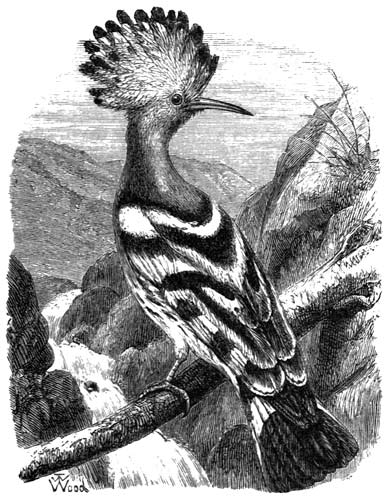
THE HOOPOE.
There was good reason for supposing that this evil odour was caused by the food, inasmuch as the Hoopoe is in the habit of raking about in very unsavoury places in search of insects. But it does not therefore follow that the insects which it finds are possessed of an evil smell. On the contrary, some of the worst-smelling insects—notably the lace-wing fly and many of the flower-haunting hemiptera—are invariably found upon the leaves of trees and the petals of flowers; while others which, like many of the scarab beetles, haunt the most repulsive substances, are in themselves bright, and clean, and sweet.
The food of the Hoopoe consists almost entirely of insects. They have been said to feed on earth-worms; but this notion seems to be a mistaken one, as in captivity they will not touch an earth-worm so long as they can procure an insect. Beetles of various kinds seem to be their favourite food, and when the beetles are tolerably large—say, for example, as large as the common cockchafer and dor-beetle—the bird beats them into a soft mass before it attempts to eat them. Smaller beetles are swallowed without any ceremony. The various boring insects which make their home in decaying wood are favourite articles of diet with the Hoopoe, which digs them out of the soft wood with its long curved beak.
It has already been mentioned that the nest is usually made in the hollow of a tree. In many parts of the country however, hollow trees cannot be found, and in that case the Hoopoe resorts to clefts in the rock, or even to holes in old ruins.
The bird is a peculiarly conspicuous one, not only on account of its boldly-barred plumage and its beautiful crest, but by its cry and its gestures. It has a way of elevating and depressing its crest, and bobbing its head up and down, in a manner which could not fail to attract the attention even of the most incurious, the whole aspect and expression of the bird varying with the raising and depressing of the crest.
Respecting this crest there is a curious old legend. As is the case with most of the Oriental legends, it introduces the name of King Solomon, who, according to Oriental notions, was a mighty wizard rather than a wise king, and by means of his seal, on which was engraven the mystic symbol of Divinity, held sway over the birds, the beasts, the elements, and even over the Jinns and Afreets, i.e. the good and evil spirits, which are too ethereal for the material world and too gross for the spiritual, and therefore hold the middle place between them.
On one of his journeys across the desert, Solomon was perishing from the heat of the sun, when the Hoopoes came to his aid, and flew in a dense mass over his head, thus forming a shelter from the fiery sunbeams. Grateful for this assistance, the monarch told the Hoopoes to ask for a boon, and it should be granted to them. The birds, after consulting together, agreed to ask that from that time every Hoopoe should wear a crown of gold like Solomon himself. The request was immediately granted, and each Hoopoe found itself adorned with a royal crown. At first, while their honours were new, great was the joy of the birds, who paused at every little puddle of water to contemplate themselves, bowing their heads over the watery mirror so as to display the crown to the best advantage.
Soon, however, they found cause to repent of their ambition. The golden crown became heavy and wearisome to them, and, besides, the wealth bestowed on the birds rendered them the prey of every fowler. The unfortunate Hoopoes were persecuted in all directions for the sake of their golden crowns, which they could neither take off nor conceal.
At last, the few survivors presented themselves before Solomon, and begged him to rescind his fatal gift, which he did by substituting a crest of feathers for the crown of gold. The Hoopoe, however, never forgets its former grandeur, and is always bowing and bending itself as it used to do when contemplating its golden crown in the water.
THE SPARROW.
Signification of the word Tzippor—The bird used for the leper's sacrifice—The Sparrow upon the house-top—Architecture of the East—Proclamation from the house-tops—The Blue Thrush, its appearance and habits—Little birds exposed for sale in the market—The two Sparrows sold for a farthing—Bird-catching—The net, the snare, and the trap—The Sparrow that builds her nest in the Temple—The Tree-Sparrow—Various Sparrows that inhabit Palestine—Birds kept in cages.
We have already discussed the signification of the compound word tzippor-deror, and will now take the word tzippor alone.
Like many other Hebrew terms, the word is evidently used in a collective sense, signifying any small bird that is not specially designated. In several portions of Scripture it is translated as Sparrow, and to that word we will at present restrict ourselves.
Much difficulty has been found in identifying the bird which is signified by this word, the various allusions not agreeing with each other. For example, in the marginal reading in Lev. xiv. 4 it is employed as a bird of sacrifice. When a leper had found that his disease had passed away, he was ordered to present himself before the priest, who would examine him, and decide whether the leprosy had really passed away or not. If he found that the man was right, a series of symbolic ceremonies had to be performed before the former leper could be restored to his place in the congregation.
These ceremonies lasted for eight days, and the first of them was the sacrificing of the Sparrow. "Then shall the priest command to take for him that shall be cleansed two birds [tzipporim or sparrows] alive and clean, and cedar-wood, and scarlet, and hyssop." One of these birds was to be sacrificed over running water, and the other to be set free, this sacrifice being analogous to that of the scape-goat.
We see in this passage that the bird in question, whatever it might be, must be one of those birds which were considered as clean and fit for food. Indeed, the very use of the word "clean" shows that the leper was not restricted to any particular species. Had this been the case, there would have been no necessity for stipulating that the Tzipporim must belong to the list of clean birds—i.e. those which were permitted as food to the Israelites. Had any definite species been intended, there would have been no necessity for mentioning the word "clean" in connexion with the bird.
In the remaining ceremonies no such word is needed. There is no stipulation that the lamb to be sacrificed should be clean, or, in case the leper should be a poor man, that the doves which he offers should be clean. That the lamb should be without blemish is especially mentioned, because it would not be right to offer a maimed or diseased animal—he who presented himself before the Lord might not offer a sacrifice which cost him nothing, and therefore was no true sacrifice. But the lamb and the dove were known to be "clean" animals, so it was useless to use the word in connexion with them. If, therefore, the words "clean birds" (tzipporim) be mentioned, it is evident that the leper might select any of the Tzipporim, provided that it be one of the species that was acknowledged to be dean.
Here, then, we have an example that the Sparrow might be a bird of sacrifice. We will now pass to Ps. cii. 5-7, in which we find that the word is used as an emblem of solitude and misery: "By reason of the voice of my groaning, my bones cleave to my skin.
"I am like a pelican of the wilderness: I am like an owl of the desert.
"I watch, and am as a sparrow alone upon the house-top."
The word which is here translated as "Sparrow" is tzippor, the same which is rendered as "bird" in Lev. xiv. 4. The Hebrew Bible more consistently uses the collective term "bird" in both instances, and renders the passage as, "I watch, and am as a lonely bird upon a roof."
Now, any one who knows the habits of the Sparrow is perfectly aware that it is a peculiarly sociable bird. It is quarrelsome enough with its fellows, and always ready to fight for a stray grain or morsel of food; but it is exceedingly gregarious, assembling together in little parties, enlivening the air with its merry though unmusical twitterings.
This cosmopolitan bird is plentiful in the coast towns of Palestine, where it haunts the habitations of men with the same dauntless confidence which it displays in England. It is often seen upon roofs or house-tops, but is no more apt to sit alone in Palestine than it is in England. On the contrary, the Sparrows collect in great numbers on the house-tops, attracted by the abundant supply of food which it finds there. This requires some little explanation.
The house-tops of the East, instead of being gabled and tiled as among ourselves, to allow the rain to run off, are quite flat, and serve as terraces or promenades in the evening, or even for sleeping-places; and from the house-tops proclamations were made. See, for example, 1 Sam. ix. 25: "And when they were come down from the high place into the city, Samuel communed with Saul upon the top of the house"—this being the ordinary place which would be chosen for a conversation. In order to keep out the heat of the mid-day sun, tents were sometimes pitched upon these flat house-tops. (See 2 Sam. xvi. 22.) Reference to the use of the house-tops as places for conversation are made in the New Testament. See, for example, Matt. x. 27: "What I tell you in darkness, that speak ye in light; and what ye hear in the ear, that preach ye upon the house-tops." Another passage of a similar nature occurs in Luke xii. 3: "Therefore whatsoever ye have spoken in darkness shall be heard in the light, and that which ye have spoken in the ear in closets shall be proclaimed on the house-tops."
These roofs, instead of being built with sloping rafters like those to which we are accustomed in this country, are made with great beams of wood laid horizontally, and crossed by planks, poles, and brushwood packed tightly together. As this roof would not keep out the rain, it is covered with a thick layer of clay mixed with straw, and beaten down as hard as possible. This covering has constantly to be renewed, as, even in the best made roofs, the heavy rains are sure to wash away some portion of the clay covering, which has to be patched up with a fresh supply of earth. A stone roller is generally kept on the roof of each house for the purpose of making a flat and even surface.
The earth which is used for this purpose is brought from the uncultivated ground, and is full of various seeds. As soon as the rains fall, these seeds spring up, and afford food to the Sparrows and other little birds, who assemble in thousands on the house-tops, and then peck away just as they do in our own streets and farm-yards.
It is now evident that the "sparrow alone and melancholy upon the house-tops" cannot be the lively, gregarious Sparrow which assembles in such numbers on these favourite feeding-places. We must therefore look for some other bird, and naturalists are now agreed that we may accept the Blue Thrush (Petrocossyphus cyaneus) as the particular Tzippor, or small bird, which sits alone on the house-tops. The colour of this bird is a dark blue, whence it derives its popular name. Its habits exactly correspond with the idea of solitude and melancholy. The Blue Thrushes never assemble in flocks, and it is very rare to see more than a pair together. It is fond of sitting on the tops of houses, uttering its note, which, however agreeable to itself, is monotonous and melancholy to a human ear.
In connexion with the passage already quoted, "What ye hear in the ear, that preach ye upon the house-tops," I will take the opportunity of explaining the passage itself, which scarcely seems relevant to the occasion unless we understand its bearings. The context shows that our Lord was speaking of the new doctrines which He had come to teach, and the duty of spreading them, and alludes to a mode of religious teaching which was then in vogue.
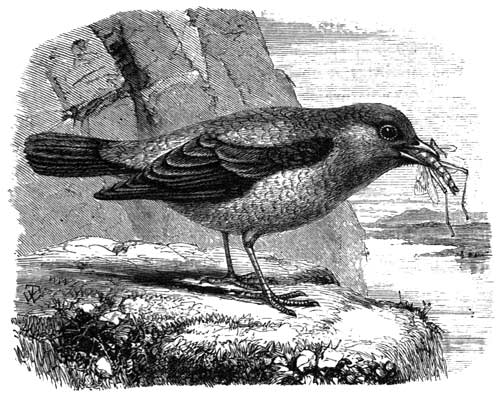
THE BLUE THRUSH, OR SPARROW OF SCRIPTURE.
"I am as a sparrow alone upon the house-tops."—Ps. cii. 7.
The long captivity of the Jews in Babylon had caused the Hebrew language to be disused among the common people, who had learned the Chaldaic language from their captors. After their return to Palestine, the custom of publicly reading the Scriptures was found to be positively useless, the generality of the people being ignorant of the Hebrew language.
Accordingly, the following modification was adopted. The roll of the Scriptures was brought out as usual, and the sacred words read, or rather chanted. After each passage was read, a doctor of the law whispered its meaning into the ear of a Targumista or interpreter, who repeated to the people in the Chaldaic language the explanation which the doctor had whispered in Hebrew. The reader will now see how appropriate is the metaphor, the whispering in the ear and subsequent proclamation being the customary mode of imparting religious instruction.
If the reader will now turn to Matt. x. 29, he will find that the word "sparrow" is used in a passage which has become very familiar to us. "Are not two sparrows sold for a farthing? and one of them shall not fall on the ground without your Father.
"But the very hairs of your head are all numbered.
"Fear ye not therefore, ye are of more value than many sparrows." The same sentences are given by St. Luke (xii. 6), in almost the same words.
Now the word which is translated as "Sparrow" is strouthion, a collective word, signifying a bird of any kind. Without the addition of some epithet, it was generally used to signify any kind of small bird, though it is occasionally employed to signify even so large a creature as an eagle, provided that the bird had been mentioned beforehand. Conjoined with the word "great," it signifies the ostrich; and when used in connexion with a word significative of running, it is employed as a general term for all cursorial birds.
In the passages above quoted it is used alone, and evidently signifies any kind of little bird, whether it be a sparrow or not. Allusion is made by our Lord to a custom, which has survived to the present day, of exposing for sale in the markets the bodies of little birds. They are stripped of their feathers, and spitted together in rows, just as are larks in this country, and always have a large sale. Various birds are sold in this manner, little if any distinction being made between them, save perhaps in respect of size, the larger species commanding a higher price than the small birds. In fact, they are arranged exactly after the manner in which the Orientals sell their "kabobs," i.e. little pieces of meat pierced by wooden skewers.
It is evident that to supply such a market it is necessary that the birds should be of a tolerably gregarious nature, so that a considerable number can be caught at a time. Nets were employed for this purpose, and we may safely infer that the forms of the nets and the methods of using them were identical with those which are employed in the same country at the present day.
It is rather curious that the mode of bird-catching which is familiar to us under the name of bat-fowling is employed in the East. The fowlers supply themselves with a large net supported on two sticks, and, taking a lantern with them fastened to the top of a pole, they sally out at night to the places where the small birds sleep.
Raising the net on its sticks, they lift it to the requisite height, and hold the lantern exactly opposite to it, so as to place the net between the birds and the lantern. The roosting-places are then beaten with sticks or pelted with stones, so as to awaken the sleeping birds. Startled by the sudden noise, they dash from their roosts, instinctively make towards the light, and so fall into the net. Bird-catching with nets is several times mentioned in the Old Testament, but in the New the net is only alluded to as used for taking fish.
Beside the net, several other modes of bird-catching were used by the ancient Jews, just as is the case at the present day. Boys, for example, who catch birds for their own consumption, and not for the market, can do so by means of various traps, most of which are made on the principle of the noose, or snare. Sometimes a great number of hair-nooses are set in places to which the birds are decoyed, so that in hopping about many of them are sure to become entangled in the snares. Sometimes the noose is ingeniously suspended in a narrow passage which the birds are likely to traverse, and sometimes a simple fall-trap is employed.
To these nooses many allusions are made in the Scriptures. See, for example, Ps. cxxiv. 7: "Our soul is escaped as a bird (tzippor) out of the snare of the fowlers: the snare is broken, and we are escaped." Also Prov. vii. 23: "He goeth after her straightway, as an ox goeth to the slaughter ... as a bird hasteneth to the snare, and knoweth not that it is for his life." There is one passage in Ecclesiastes, where both the fishing-net and the snare are mentioned in connexion with each other: "For man knoweth not his time: as the fishes that are taken in an evil net, and as the birds that are caught in the snare; so are the sons of men snared in an evil time, when it falleth suddenly upon them" (ix. 12).
Allusion is also made to the snare by the prophet Amos in one of the passages where his rough, homely diction rises by successive steps into sublimity: "Can a bird fall in a snare upon the earth, where no gin is for him? shall one take up a snare from the earth, and have taken nothing at all?" (iii. 5.)
So common was the use of the snare that it was frequently used as a familiar image by the sacred writers. "How long shall this man be a snare to us?" said Pharaoh's servants of Moses, through whom the waters of the sacred river had been polluted, and various other plagues had come upon the Egyptians. Idols are called snares in many parts of the Scriptures, and so is the society of the wicked. A forcible use of this image was made by Saul when he found that his daughter Michal loved David: "And Saul said, I will give him her, that she may be a snare to him, and that the hand of the Philistines may be against him" (1 Sam. xviii. 21). His device, or snare, not only failed, but, as we learn in the succeeding chapter, verses 11-16, David was "delivered from the snare of the fowler," by the very means which had been employed for entrapping him.
We now pass to another division of the subject. In Ps. lxxxiv. 1-3, we come upon a passage in which the Sparrow is again mentioned: "How amiable are Thy tabernacles, O Lord of hosts!
"My soul longeth, yea, even fainteth for the courts of the Lord; my heart and my flesh crieth out for the living God.
"Yea, the sparrow hath found an house, and the swallow a nest for herself, where she may lay her young, even Thine altars, O Lord of hosts, my King, and my God."
It is evident that we have in this passage a different bird from the Sparrow that sitteth alone upon the house-tops; and though the same word, tzippor, is used in both cases, it is clear that whereas the former bird was mentioned as an emblem of sorrow, solitude, and sadness, the latter is brought forward as an image of joy and happiness. "Blessed are they," proceeds the Psalmist, "that dwell in Thy house: they will be still praising Thee.... For a day in Thy courts is better than a thousand. I had rather be a doorkeeper in the house of my God, than to dwell in the tents of wickedness."
According to Mr. Tristram, this is probably one of the species to which allusion is made by the Psalmist. While inspecting the ruins in the neighbourhood of the Temple, he came upon an old wall. "Near this gate I climbed on to the top of the wall, and walked along for some time, enjoying the fine view at the gorge of the Kedron, with its harvest crop of little white tombs. In a chink I discovered a sparrow's nest (Passer cisalpinus, var.) of a species so closely allied to our own that it is difficult to distinguish it, one of the very kind of which the Psalmist sung.... The swallows had departed for the winter, but the sparrow has remained pertinaciously through all the sieges and changes of Jerusalem."
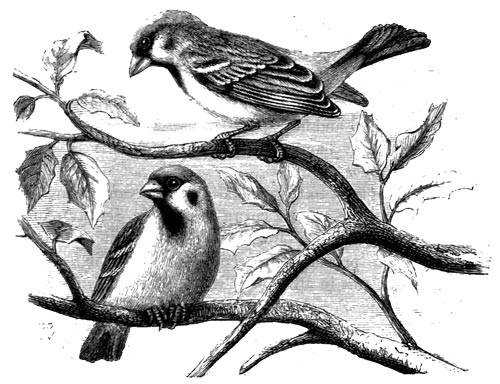
THE TREE-SPARROW, OR SPARROW OF SCRIPTURE.
"Yea, the sparrow hath found an house, where she may lay her young."—Ps. lxxxiv. 3.
The same traveller thinks that the Tree Sparrow (Passer montanus) may be the species to which the sacred writer refers, as it is even now very plentiful about the neighbourhood of the Temple. In all probability we may accept both these birds as representatives of the Sparrow which found a home in the Temple. The swallow is separately mentioned, possibly because its migratory habits rendered it a peculiarly conspicuous bird; but it is probable that many species of birds might make their nests in a place where they felt themselves secure from disturbance, and that all these birds would be mentioned under the collective and convenient term of Tzipporim.
As we are engaged upon the word Sparrow, it may be mentioned that several species of Sparrow inhabit Palestine. There is, for example, the common House Sparrow, with which we are so familiar. Then, as has just been described, there is the Tree Sparrow—a bird which is very common in some parts of England, and never seen in others.
Beside these, there is the Marsh Sparrow, or Spanish Sparrow (Passer salicarius), which haunts the banks of the Jordan, and is found there in countless myriads. Mr. Tristram mentions that it builds so plentifully in the thorn-bushes of the Jordan valley, that he has seen the branches borne down by the weight of the nests. The same writer, in remarking upon the difficulty, not to say impossibility, of defining the precise bird which was signified by a Hebrew word, says that, exclusive of the crow tribe, the swifts, cuckoos, rollers, kingfishers, &c., nearly one hundred and fifty species of passerine birds are known to inhabit the Holy Land, any or all of which may be signified by the word tzippor.
In curious contrast to the generally unobservant nature of the Oriental, and to the almost entire absence in Scripture of any allusion to the song of birds, we find that not only do the Orientals of the present day keep singing-birds in cages, but that the custom was in all probability prevalent during the days when the various Scriptural books were written. Any of my readers who are familiar—as they ought to be—with that store-house of Oriental manners, the "Arabian Nights," will remember several allusions to birds kept in cages, some for their song, some for their beauty of plumage, and some for their powers of talking. The same custom is continued at the present day; and not only in Palestine, but in other Eastern countries, birds may be seen in cages hung outside the houses.
In two passages of the Scriptures the word "cage" is mentioned, but in one case the word evidently has another meaning, and in the other the signification is open to doubt.
The first of these passages occurs in Jer. v. 27: "For among my people are found wicked men: they lay wait, as he that setteth snares; they set a trap, they catch men.
"As a cage is full of birds, so are their houses full of deceit."
There is but little doubt that the word which is rendered here as "cage" really signifies a trap, probably one of the basket-traps which are still employed in the East in bird-catching. One marginal reading gives the word as "coop." The whole of the context, however, shows that reference is made, not to keeping birds in cages, but to capturing them in traps, to which the houses of the wicked are compared.
The second mention of the word "cage" occurs in the Revelation, where the sacred writer compares Babylon with "a cage of every unclean bird." The word in this case signifies "prison," and we cannot definitely say that it represents a cage such as we understand by the word. There is, however, a passage in the Book of Job (xli. 5) which unmistakeably alludes to the custom of domesticating birds. Speaking of the leviathan and its strength, the sacred writer uses the following metaphor:—"Wilt thou play with him as with a bird, or wilt thou bind him for thy maidens?"
THE CUCKOO.
The Cuckoo only twice mentioned in Scripture—Difficulty of identifying the Shachaph—The common species, and the Great Spotted Cuckoo—Depositing the egg—Conjectures respecting the Shachaph—Etymology of the word—The various gulls, and other sea-birds.
Only in two instances is the word Cuckoo found in the Authorized Version of the Bible, and as they occur in parallel passages they are practically reduced to one. In Lev. xi. 16 we find it mentioned among the birds that might not be eaten, and the same prohibition is repeated in Deut. xiv. 15, the Jews being ordered to hold the bird in abomination.
The Hebrew word is shachaph (the vowels to be pronounced as in "mat"), but as to the precise bird which is signified we can but conjecture. The etymology of the word gives us but little assistance. Shachaph is derived from a root that signifies leanness or slenderness; but it is not very easy to base an interpretation on such grounds. In the Jewish Bible the word is rendered as "Cuckoo," but with the addition of the doubtful mark.
It is possible that the bird may be the Shachaph of the Pentateuch, for several species of Cuckoo are known to inhabit the Holy Land. One of them is the species with which we are so familiar in this country by sound, if not by sight, and which possesses in Palestine the same habits as in England. It is rather remarkable, by the way, that the Arabic name for the bird is exactly the same as ours, the peculiar cry having supplied the name. Its habit of laying its eggs in the nests of other birds is well known, together with the curious fact, that although so large a bird, measuring more than a foot in length, its egg is not larger than that of the little birds, such as the hedge-sparrow, robin, or redstart.
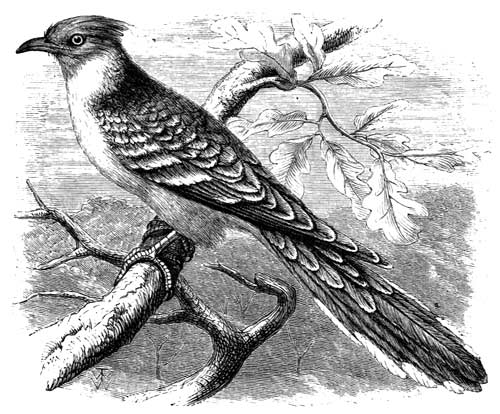
THE GREAT SPOTTED CUCKOO.
"And the owl, and the night-hawk, and the cuckoo, and the hawk after his kind."—Lev. xi. 16; Deut. xiv. 15.
Besides this species, another Cuckoo inhabits Palestine, and is much more common. This is the Great Spotted Cuckoo (Oxylophus glandarius). The birds belonging to this genus have been separated from the other Cuckoos because the feathers on the head are formed into a bold crest, in some species, such as Le Vaillant's Cuckoo, reminding the observer of the crest of the cockatoo. This fine bird measures nearly sixteen inches in length, and can be distinguished, not only by the crested head, but by the reddish grey of the throat and chest, and the white tips of the wing and tail feathers.
This species lays its eggs in the nests of comparatively large birds, such as the rooks, crows, and magpies; and it is a remarkable fact, that just as the egg of the English Cuckoo is very small, so as to suit the nests of the little birds in which it is placed, that of the Great Spotted Cuckoo is as large as the average rook's egg, so as to be in proportion to the nests of the larger birds.
Many commentators believe that by the word shachaph was signified some species of sea-gull, or at all events some marine bird. As such birds live on fish, they would necessarily come into the class of unclean birds, and there is on that account some probability that the suggestion is a correct one.
Dr. Lewysohn has a very elaborate disquisition on the subject, in which he decides that the creature was one of the sea-birds, and derives its name of Shachaph, or "attenuated," from the meagreness of its proportions. Of the various sea-birds, he selects the petrel as the species which he thinks to have been signified by the word. This bird, as he says, is a very lean one, having many feathers, but very little flesh, so that its limbs are no larger than olives, and no one could make a meal of it. This last remark, however, tends to diminish rather than to establish his theory, as, if the bird could not be eaten, there would have been no object in prohibiting the Jews from eating it.
He further proceeds to observe that the bird is unable to scratch, and may therefore be given to a child as a playfellow, and that it is capable of being domesticated and living in a cage. There is, however, no argument here, and the theory is not a tenable one.
Mr. Tristram, with far more probability, suggests that if the bird be not one of the Cuckoos, and be really a sea-bird, it may be one of the shearwaters which live in such numbers on the sea-shore of Palestine. He mentions especially two species, the Great Shearwater (Puffinus cinereus) and the Manx Shearwater (Puffinus anglorum), both of which are extremely plentiful on the coast, skimming continually over the water, and being at the present day regarded by the Mahometans with superstitious awe, being thought to be the ever-restless souls of the condemned, who are doomed to fly backwards and forwards continually until the end of the world, clad in sombre plumage, and never permitted to rest.
Besides the shearwater, many species of gull inhabit the same coast, and it is not at all unlikely that the word shachaph was used in a collective sense, as we have seen to be the case with tzippor, and signified any of the marine birds, without aiming at distinction of species.
THE DOVE.
Parallel between the lamb and the Dove—Derivation of the Hebrew word Yonâh—The Dove and the olive branch—Abram's sacrifice, and its acceptance—The sacrifice according to the law of Moses—The Dove-sellers of the Temple—Talmudical zoology—The story of Ilisch—The Dove and the raven—The Dove a type of Israel—The Beni-yonâh, or Sons of Pigeons—Home-finding instinct of the pigeon—The Oriental Dove-cotes—Voice of the Dove—Its strength of wing—The Dove's dung of Samaria—Various pigeons of Palestine—The Rock-Dove and its multitudes—The Dove and the Griffon—The Turtle-Doves of Palestine, and their appearance and habits.
In giving the Scriptural history of the Doves and Pigeons, we shall find ourselves rather perplexed in compressing the needful information into a reasonable space. There is no bird which plays a more important part, both in the Old and the New Testaments, or which is employed so largely in metaphor and symbol.
The Doves and Pigeons were to the birds what were the sheep and lambs to the animals, and, like them, derived their chief interest from their use in sacrifice. Both the lamb and the young pigeon being emblems of innocence, both were used on similar occasions, the latter being in many instances permitted when the former were too expensive for the means of the offerer. As to the rendering of the Hebrew words which have been translated as Pigeon, Dove, and Turtle Dove, there has never been any discussion. The Hebrew word yonâh has always been acknowledged to signify the Dove or Pigeon, and the word tôr to signify the Turtle Dove. Generally, the two words are used in combination, so that tor-yonâh signifies the Turtle Dove.
Though the interpretation of the word yonâh is universally accepted, there is a little difficulty about its derivation, and its signification apart from the bird. Some have thought that it is derived from a root signifying warmth, in allusion to the warmth of its affection, the Dove having from time immemorial been selected as the type of conjugal love. Others, among whom is Buxtorf, derive it from a word which signifies oppression, because the gentle nature of the Dove, together with its inability to defend itself, cause it to be oppressed, not only by man, but by many rapacious birds.
The first passage in which we hear of the Dove occurs in the earlier part of Genesis. Indeed, the Dove and the raven are the first two creatures that are mentioned by any definite names, the word nachosh, which is translated as "serpent" in Gen. iii. 1, being a collective word signifying any kind of serpent, whether venomous or otherwise, and not used for the purpose of designating any particular species.
Turning to Gen. viii. 8, we come to the first mention of the Dove. The whole passage is too familiar to need quoting, and it is only needful to say that the Dove was sent out of the ark in order that Noah might learn whether the floods had subsided, and that, after she had returned once, he sent her out again seven days afterwards, and that she returned, bearing an olive-branch (or leaf, in the Jewish Bible). Seven days afterwards he sent the Dove for the third time, but she had found rest on the earth, and returned no more.
It is not within the province of this work to treat, except in the most superficial manner, of the metaphorical signification of the Scriptures. I shall, therefore, allude but very slightly to the metaphorical sense of the passages which record the exit from the ark and the sacrifice of Noah. Suffice it to say that, putting entirely aside all metaphor, the characters of the raven and the Dove are well contrasted. The one went out, and, though the trees were at that time submerged, it trusted in its strong wings, and hovered above the watery expanse until the flood had subsided. The Dove, on the contrary, fond of the society of man, and having none of the wild, predatorial habits which distinguish the raven, twice returned to its place of refuge, before it was finally able to find a resting-place for its foot.
After this, we hear nothing of the Dove until the time of Abraham, some four hundred years afterwards, when the covenant was made between the Lord and Abram, when "he believed in the Lord, and it was counted to him for righteousness." In order to ratify this covenant he was ordered to offer a sacrifice, which consisted of a young heifer, a she-goat, a ram, a turtle-dove, and a young dove or pigeon. The larger animals were severed in two, but the birds were not divided, and between the portions of the sacrifice there passed a lamp of fire as a symbol of the Divine presence.
In after days, when the promise that the seed of Abram should be as the stars of heaven for multitude had been amply fulfilled, together with the prophecy that they should be "strangers in a land that was not theirs," and should be in slavery and under oppression for many years, the Dove was specially mentioned in the new law as one of the creatures that were to be sacrificed on certain defined occasions.
Even the particular mode of offering the Dove was strictly defined. See Lev. i. 14-17: "If the burnt sacrifice for his offering to the Lord be of fowls, then he shall bring his offering of turtle-doves, or of young pigeons.
"And the priest shall bring it unto the altar, and wring off his head, and burn it on the altar; and the blood thereof shall be wrung out at the side of the altar.
"And he shall pluck away his crop with his feathers, and cast it beside the altar, on the east part, by the place of the ashes.
"And he shall cleave it with the wings thereof, but shall not divide it asunder: and the priest shall burn it upon the altar, upon the wood that is upon the fire."
Here we have a repetition not only of the sacrifice of Abram, but of the mode in which it was offered, care being taken that the body of the bird should not be divided. There is a slight, though not very important variation in one or two portions of this passage. For example, the wringing off the head of the bird is, literally, pinching off, and had to be done with the thumb nail; and the passage which is by some translators rendered as the crop and the feathers, is by others translated as the crop and its contents—a reading which seems to be more consonant with the usual ceremonial of sacrifice than the other.
As a general rule, the pigeon was only sanctioned as a sacrificial animal in case one of more value could not be afforded; and so much care was taken in this respect, that with the exception of the two "sparrows" (tzipporim) that were enjoined as part of the sacrifice by which the cleansed leper was received back among the people (Lev. xiv. 4), no bird might be offered in sacrifice unless it belonged to the tribe of pigeons.
It was in consequence of the poverty of the family that the Virgin Mary brought two young pigeons when she came to present her new-born Son in the Temple. For those who were able to afford it, the required sacrifice was a lamb of the first year for a burnt-offering, and a young pigeon or Turtle Dove for a sin-offering. But "if she be not able to bring a lamb, then she shall bring two turtles, or two young pigeons, the one for the burnt-offering and the other for a sin-offering." The extraordinary value which all Israelites set upon the first-born son is well known, both parents even changing their own names, and being called respectively the father and mother of Elias, or Joseph, as the case may be. If the parents who had thus attained the summit of their wishes possessed a lamb, or could have obtained one, they would most certainly have offered it in the fulness of their joy, particularly when, as in the case of Mary, there was such cause for rejoicing; and the fact that they were forced to substitute a second pigeon for the lamb is a proof of their extreme poverty.
While the Israelites were comparatively a small and compact nation, dwelling around their tabernacle, the worshippers could easily offer their sacrifices, bringing them from their homes to the altar. But in process of time, when the nation had become a large and scattered one, its members residing at great distances, and only coming to the Temple once or twice in the year to offer their sacrifices, they would have found that for even the poor to carry their pigeons with them would have greatly increased the trouble, and in many cases have been almost impossible.
For the sake of convenience, therefore, a number of dealers established themselves in the outer courts of the Temple, for the purpose of selling Doves to those who came to sacrifice. Sheep and oxen were also sold for the same purpose, and, as offerings of money could only be made in the Jewish coinage, money-changers established themselves for the purpose of exchanging foreign money brought from a distance for the legal Jewish shekel. That these people exceeded their object, and endeavoured to overreach the foreign Jews who were ignorant of the comparative value of money and goods, is evident from the fact of their expulsion by our Lord, and the epithets which were applied to them.
As the Dove played so important a part in the Jewish worship, the Talmudical writers have investigated the subject with a curious minuteness.
In the first place, they discuss the reasons for its selection as the bird of sacrifice, and always endeavour to represent it as contrasted with the raven—all birds of the raven kind, i.e. the rooks, crows, magpies, and the like, being set down as cunning, deceptive, and thieving; while all the pigeon kind are mild, true, and loving. There is a curious story which illustrates this idea. A certain man named Ilisch, who understood the language of birds, was "once upon a time" in captivity, when he heard the cry of a raven, which called out to him, "Ilisch! Ilisch! flee! flee!" But Ilisch said within himself, "I believe not this lying bird." But next came a Dove, which said the same words. Then said Ilisch, "I believe this bird, because Israel is compared to a dove."
Here this Ilisch, whoever he may be, referred to the Talmudical writers on the subject of the Dove, which they delighted to compare with Israel in a variety of ways, some of them being very obscure and rather far-fetched. For example, of all birds the Dove is the most persecuted, being gentle, meek, and unable to resist. She cannot fight with her beak or her claws, and has only her wings, with which she will flee away if she is able, or if not, will fight with them. Now, as the wings are to the Dove, so is the law to Israel.
The wings are the strength of the Dove. Upheld by them she can fly for many hours, so that the birds of prey which are pursuing her cannot take her. Then comes a strange notion of the Dove's flight. When other birds are tired, they sit down and fold their wings to rest. But the tired Dove never ceases her flight; but when one wing is fatigued, she allows it to rest, and continues her flight with the other. So is it with Israel, who, though persecuted by the Gentiles, and deprived of half her strength, cannot be entirely crushed, but still survives and asserts herself.
One reason that is given for the gentle disposition of the Dove is that the bird has no gall, the gall being considered by the naturalists of old as the source and fountain of contention, the bitterness of the gall being supposed to infuse itself into the spirit. Probably on account of this anatomical peculiarity, the Dove was considered as the very pattern for married people, and the emblem of chastity, as it lives in the strictest monogamy, never desiring another mate. Unfortunately for these writers, the Raven, which is always mentioned by them in strong contrast with the Dove, is quite as remarkable for its attachment to its mate and young, and for the strictness of its monogamy, the same pair, when once mated, residing together for the whole of their lives.
Even the age of the Dove was made a matter of consideration by the Talmudists, so that in great measure the original benevolence of the Law was cramped by the restrictions which were laid upon it. As we are told by St. Paul, in Heb. ix., even under the old dispensation, without shedding of blood there was no remission of sins, and he who desired to obtain that remission was obliged to shed the blood of the sacrifice. Now, in order that poverty should be no restriction to the attainment of the greatest spiritual privileges, it was ordained that young pigeons or Turtle Doves might be substituted for the more costly animals.
These birds cost but very little. The peasant might take them from the dove-cote, which was the appendage of most households, and he who was too poor even to have a dove-cote of his own might go to the rocky side of the ravines, and take as many young as he pleased from the myriad nests which are placed in the clefts. Thus, at any time of the year, the poorest man or woman could obtain the means of sacrifice.
But the restrictive genius which was so sternly rebuked by our Lord soon made itself felt. All these birds, in order to be fit for sacrifice, must be Beni-yonâh, i.e. Sons of Doves. The definition of this term is rather interesting, as it affords an excellent example of the hair-splitting character of these interpreters of the Law. According to them, a pigeon could only be ranked among the Beni-yonâh for a short period of its life, and, if it were too young or too old, it might not be offered as a sacrifice.
The test of proper age lay in the feathers. If the bird were so young that the feathers could be pulled out without drawing blood, it was considered as being below age. If, on the contrary, blood followed the feathers, but the plumage of the neck exhibited a metallic lustre, it was reckoned as having passed the age of Beni-yonâh. It might be a father, and not the son, of pigeons. When these feathers are visible, the bird changes its name, and is called Tôr—a word which will be presently explained.
According to some of these old writers, the Dove was considered as having a superiority over other birds in the instinctive certainty with which it finds its way from one place to another. At the present time, our familiarity with the variety of pigeon known as the Carrier has taught us that the eye is the real means employed by the pigeon for the direction of its flight. Those who fly pigeons for long distances always take them several times over the same ground, carrying them to an increasing distance at every journey, so that the birds shall be able to note certain objects which serve them as landmarks.
Bees and wasps have recourse to a similar plan. When a young wasp leaves its nest for the first time, it does not fly away at once, but hovers in front of the entrance for some time, getting farther and farther away from the nest until it has learned the aspect of surrounding objects. The pigeon acts in precisely the same manner, and so completely does it depend upon eyesight that, if a heavy fog should come on, the best-trained pigeon will lose its way.
The old writers, however, made up their minds that the pigeon found its way by scent, which sense alone, according to their ideas, could guide it across the sea. They were not aware of the power possessed by birds of making their eyes telescopic at will, or of the enormous increase of range which the sight obtains by elevation. A pigeon at the elevation of several hundred yards can see to an astonishing distance, and there is no need of imagining one sense to receive a peculiar development when the ordinary powers of another are sufficient to obtain the object.
That dove-cotes were in use among the earlier Jews is well known. An allusion to the custom of keeping pigeons in cotes is seen in Isa. lx. 8: "Who are these that fly as a cloud, and as the doves to their windows?" or, as the Jewish Bible translates the passage, "as the doves to their apertures?" In this passage the sacred writer utters a prophecy concerning the coming of the world to the Messiah, the Gentiles flocking to Him as the clouds of pigeons fly homeward to their cotes.
The practice of pigeon-keeping has survived to the present day, the houses of wealthy men being furnished with separate pigeon-houses, built up of a number of earthen jars, and roofed over. Each jar is the habitation of a pair of pigeons, and the whole principle of this dove-cote is exactly the same as that which was employed by the late Mr. Waterton in erecting the starling-houses in his garden and grounds. Poorer people, who cannot afford to build a separate house for the pigeons, set up jars for them in their own houses, the pigeons gaining access to their nests through the door.
The Talmudical writers have even their regulations respecting the keeping of tame pigeons. No one was allowed to do so who had not a sufficiency of ground around his house to supply food for them. According to their regulations, the pigeon-house must not be within fifty paces of cultivated ground belonging to any one except the owner of the pigeons. The reason for this prohibition was, that as the pigeon was known to be an exceedingly voracious bird, it should not feed at the expense of a neighbour. It was conventionally supposed to feed by choice in the immediate vicinity of the house, and, when it had filled its crop, to be unwilling to fly farther than was absolutely necessary.
Being so familiar with this bird, it was to be expected that the writers of the Scriptures would make many references to it. The plaintive, monotonous cooing of the pigeon is several times mentioned. For example: "And Huzzab shall be led away captive, she shall be brought up, and her maids shall lead her as with the voice of doves, taboring upon their breasts" (Nah. ii. 7). The Jewish Bible gives this passage in another and certainly a more forcible manner: "And Huzzab shall be uncovered and brought up, and her maids shall sigh as the voice of doves, drumming upon their breasts." Here the prophet alludes to the ancient custom of beating the breast as a sign of sorrow (a custom that survived even in this country until a very recent date), accompanied with the moanings of distress.
The prophet Isaiah makes use of a similar metaphor: "I did mourn as a dove: mine eyes fail with looking upward" (xxxviii. 14). Also in chap. lix. 11: "We roar all like bears, and mourn sore like doves."
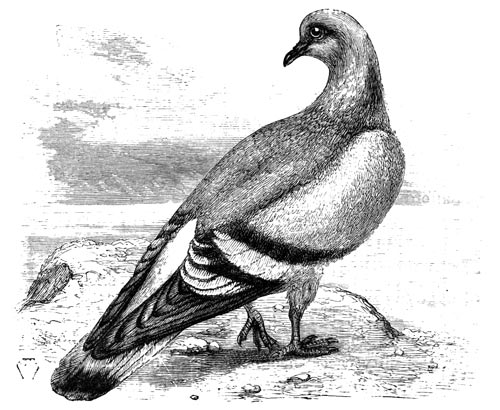
THE ROCK DOVE.
"O my dove, that art in the clefts of the rocks."—Cant. ii. 14.
The beauty of the bird is mentioned in many passages, several of which occur in the Song of Solomon. "Behold, thou art fair, my love; behold, thou art fair; thou hast dove's eyes" (i. 15). "His eyes are the eyes of doves by the rivers of waters, washed with milk, and fitly set" (v. 12). And in several other places the beloved is spoken of as a Dove, as in the following passage: "My dove, my undefiled, is but one; she is the only one of her mother, she is the choice one of her that bare her" (vi. 9).
Allusion is made to the peculiar metallic gleam of the Dove's plumage in a well-known passage of the Psalms: "Though ye have lien among the pots, yet shall ye be as the wings of a dove covered with silver, and her feathers with yellow gold" (Ps. lxviii. 13).
The strong flight of the Dove is also mentioned by the Psalmist in an equally familiar passage: "And I said, Oh that I had wings like a dove! for then would I fly away, and be at rest. Lo, then would I wander far off, and remain in the wilderness" (Ps. lv. 6, 7). It is scarcely necessary to advert to the well-known passages in which reference is made to the gentleness of the Dove.
That the pigeons which are not domesticated live in the rocks was known to the Scripture writers, who make several references to the fact.
See, for example: "O ye that dwell in Moab, leave the cities, and dwell in the rock, and be like the dove that maketh her nest in the sides of the hole's mouth" (Jer. xlviii. 28). See also Ezek. vii. 16: "But they that escape of them shall escape, and shall be on the mountains like doves of the valleys, all of them mourning, every one for his iniquity."
This is an especially graphic image. The deep valleys that run between the mountain ranges are literally crowded with pigeons who have made their nests in the cavities. Several of these are so well known that they go by the name of "Valleys of Pigeons."
In the Song of Solomon (ii. 14) is another reference to the rock-loving propensities of the Dove: "O my dove, that art in the clefts of the rock, in the secret places of the stairs, let me see thy countenance, let me hear thy voice." The Jewish Bible gives a slightly different rendering, translating the word which is given as "stairs" in the Authorized Version as "cliffs."
That the Doves were caught in nets is evident from a passage in Hosea (vii. 11, 12): "Ephraim also is like a silly dove without heart: they call to Egypt, they go to Assyria.
"When they shall go, I will spread my net upon them; I will bring them down as the fowls of the heaven; I will chastise them, as their congregation hath heard."
There is one passage in the Old Testament about which great controversy has taken place. It occurs in 2 Kings vi. 25. When Ben-hadad besieged Samaria, and tried to reduce it by starvation, the famine was so great in the city that "an ass's head was sold for fourscore pieces of silver, and the fourth part of a cab of dove's dung for five pieces of silver."
Objection has been taken to this passage on the score of the exceeding repulsiveness of the food. This objection, however, cannot hold good; for, although such diet must have been most repulsive, it could not have been more so than the flesh of the ass, an animal which was strictly forbidden as food, and held as unclean. Moreover, as we see in verse 29 that parents actually ate the flesh of their own children, it is evident that the mere repulsiveness of the food cannot be taken as an objection.
A far stronger objection is to be found in the fact that even all the dove-cotes of Samaria could not furnish a sufficient quantity for food, especially as the Doves themselves must have been killed and eaten long before the people were driven to such an extremity as to eat the flesh of their own children. It is far more probable that the "dove's-dung" was the name of a vegetable of some kind. We find a similar nomenclature in the popular names of many of our own plants, such as oxlip, cowslip, horse-tail, hart's-tongue, mouse-ear, maidenhair, and the like.
We now come to the various species of Pigeons which inhabit Palestine.
In the Holy Land are found all the species of Pigeons which inhabit England, together with one or two others. First, there is the Rock Pigeon, or Blue Rock Dove (Columba livia), which is acknowledged to be the origin of our domestic breeds of Pigeons, with all their infinite variety of colour and plumage. This species, though plentiful in Palestine, is not spread over the whole of the land, but lives chiefly on the coast and in the higher parts of the country. In these places it multiplies in amazing numbers, its increase being almost wholly unchecked by man, on account of the inaccessible cliffs in which it lays its eggs and nurtures its young, its only enemies being a few of the birds and beasts of prey, which can exercise but a trifling influence on these prolific birds.
In other parts of the country the Egyptian Rock Dove (Columba Schimperi) takes the place of the more northern species. It is a little smaller than our own Rock Dove, and has not the whitish plumage on the lower part of the back. This species is quite as numerous as the other, and builds in similar places. Mr. Tristram, while visiting the Wady (or Valley) Seimûn, which lies near the Lake of Gennesaret, witnessed an amusing example of the vast number of these Pigeons.
"No description can give an adequate idea of the myriads of rock pigeons. In absolute clouds they dashed to and fro in the ravine, whirling round with a rush and a whirr that could be felt like a gust of wind. It was amusing to watch them upset the dignity and the equilibrium of the majestic griffon as they swept past him. This enormous bird, quietly sailing along, was quite turned on his back by the sudden rush of wings and wind."
The writer of this description has been too modest. It is impossible to convey a better idea of the vast multitude of birds than has been given by this anecdote. We are all familiar with the clatter of Pigeons' wings as they dart from their resting-place, and can well imagine how great must have been the multitude of birds that would fairly turn the powerful griffon-vulture on its back. This description may be advantageously compared with the passage in Isa. lx. 8: "Who are these that fly as a cloud?" the sacred writer well knowing the force of his image when addressed to those who were familiar with the habits of the bird, whether it was the semi-domesticated House Pigeon or the wild Rock Dove. The Ring Dove (Columba palumbus) and the Stock Dove (Columba ænas) are also found in Palestine.
These birds are taken in nets, into which they are decoyed by a very effective though cruel device.
When one of these birds is trapped or snared, it is seized by its capturers, who spare its life for the sake of using it as a decoy. They blind it by sewing its eyelids together, and then fasten it to a perch among trees. The miserable bird utters plaintive cries, and continually flaps its wings, thus attracting others of its kind, who settle on the surrounding branches and are easily taken, their whole attention being occupied by the cries of their distressed companion.
We now come to the Turtle Doves, several of which inhabit the Holy Land; but, as they are similar in habits, we will confine ourselves to the common species (Turtur auritus), with which we are so familiar in this country. The Hebrew word which is translated as Turtle, is tôr, a term which is usually employed in connexion with the word yônâh, or Dove, thus, tôr-yônâh. The name is evidently derived from the note of the bird.
The reader may remember that on page 414, a curious tradition has been mentioned respecting the word tôr; namely, that it represented the age, and not the species of a Dove. There is but little doubt, however, that the word really does represent a species, and that the Turtle Dove is the bird signified by the word tôr. For example, its migratory habits are noticed in the sacred writings. See the following passage in the Song of Solomon.
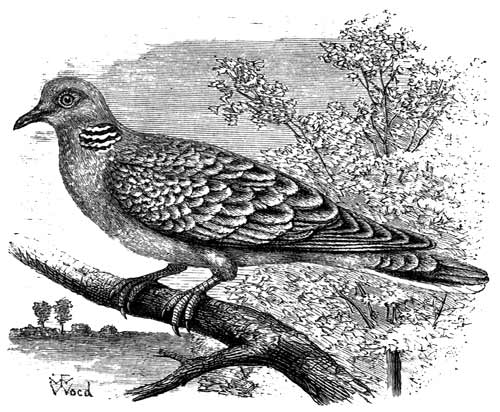
THE TURTLE DOVE.
"The voice of the turtle is heard in our land."—Cant. ii. 12.
"Lo, the winter is past, the rain is over and gone; the flowers appear on the earth; the time of the singing of birds is come, and the voice of the turtle is heard in our land" (Cant. ii. 11, 12). The prophet Jeremiah also refers to the migration of this bird: "Yea, the stork in the heaven knoweth her appointed times; and the turtle, and the crane, and the swallow observe the time of their coming: but my people know not the judgment of the Lord" (viii. 7).
Beside this species, there is the Collared Turtle Dove (Turtur risorius), one variety of which is known in England as the Barbary Dove. It is a large species, measuring more than a foot in length. Another species is the Palm Turtle (Turtur Senegalensis), so called from its habit of nesting on palm-trees, when it is obliged to build at a distance from the habitations of man. It is a gregarious bird, several nests being generally found on one tree, and even, when it cannot find a palm, it will build among the thorns in multitudes. Like the common Dove, it is fond of the society of man, and is sure to make its nest among human habitations, secure in its knowledge that it will not be disturbed.
It is rather a small bird, being barely ten inches in length, and having no "collar" on the neck, like the two preceding species.
POULTRY.
Poultry plentiful in Palestine at the present day—The Domestic Fowl unknown in the early times of Israel—The eating and gathering of eggs—References to Poultry in the New Testament—The egg and the scorpion—The fatted fowl of Solomon—The hen brooding over her eggs—Poultry prohibited within Jerusalem—The cock-crowing.
At the present day, poultry are plentiful both in Palestine and Syria, and that they were bred in the time of the Apostles is evident from one or two references which are made by our Lord. How long the Domestic Fowl had been known to the Jews is extremely uncertain, and we have very little to guide us in our search.
That it was unknown to the Jews during the earlier period of their history is evident from the utter silence of the Old Testament on the subject. A bird so conspicuous and so plentiful would certainly have been mentioned in the Law of Moses had it been known to the Israelites; but, in all its minute and detailed provisions, the Law is silent on the subject.
Neither the bird itself nor its eggs are mentioned, although there are a few references to eggs, without signifying the bird which laid them. The humane provision in Deut. xxii. 6, 7, refers not to a domesticated, but to a wild bird: "If a bird's nest chance to be before thee in any tree, or on the ground, whether they be young ones, or eggs, and the dams sitting upon the young, or upon the eggs, thou shalt not take the dam with the young: but thou shalt in any wise let the dam go, and take the young to thee; that it may be well with thee, that thou mayest prolong thy days."
That eggs were used for food, is seen from Job vi. 6: "Can that which is unsavoury be eaten without salt? or is there any taste in the white of an egg?" So in Isa. lix. 5: "They hatch cockatrice' eggs, and weave the spider's web: he that eateth of their eggs dieth."
There is another passage in the same book which refers to the gathering of eggs as mentioned in Deut. xxii. "And my hand hath found as a nest the riches of the people: and as one gathereth eggs that are left, have I gathered all the earth" (Isa. x. 14). The well-known passage in Luke xi. 11, 12, however, evidently refers to the ordinary hen's egg, which was used then for food just as is the case at the present day: "If a son shall ask bread of any of you that is a father, will he give him a stone? or if he ask a fish, will he for a fish give him a serpent?