BIRDS.
Reading edition
THE LÄMMERGEIER, OR OSSIFRAGE OF SCRIPTURE.
Difficulty of identifying the various birds mentioned in Scripture—The vultures of Palestine—The Lämmergeier, or Ossifrage of Scripture—The Hebrew word Peres, and its signification—The Ossifrage, or Bone-breaker—Appearance of the Lämmergeier—Its flight and mode of feeding—How the Lämmergeier kills snakes and tortoises, and breaks marrow-bones—Mode of destroying the chamois and mountain sheep—Nest of the Lämmergeier.
It has already been mentioned that even the best Biblical scholars have found very great difficulties in identifying several of the animals which are named in Scripture. This difficulty is greatly increased when we come to the Birds, and in many instances it is absolutely impossible to identify the Hebrew word with any precise species. In all probability, however, the nomenclature of the birds is a very loose one, several species being classed under the same title.
Even at the present day, the English language presents many similar instances of poverty, as is well known to all zoologists. Taking the birds as our first examples, how often do we not find the same word used to signify many distinct species, and, again, one species designated by several dissimilar words? The word Vulture, for example, is used to signify a great number of birds, including the Lämmergeier, the Condors, the Griffons, the Caracaras, and others; while the term Eagle has scarcely a less wide signification. Sometimes the name is applied in such a manner as to mislead those who are not scientific ornithologists, and we find such inappropriate titles as night-hawk, fern-owl, hedge-sparrow, reed-wren, &c., the birds in question being neither hawks, owls, sparrows, nor wrens.
Keeping this difficulty in mind, I shall mention all the species which are likely to have been classed under a single title, giving a general description of the whole, and a detailed account of the particular species which seems to answer most closely to the Hebrew word.
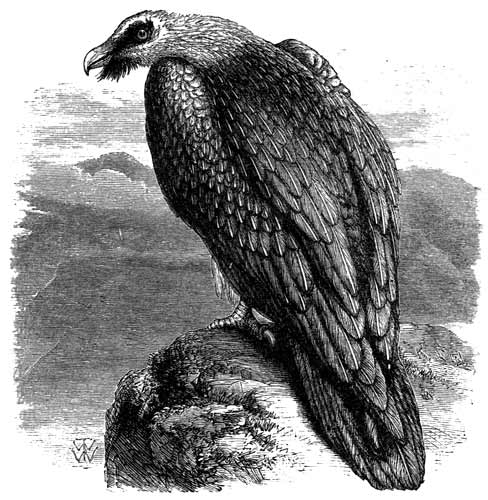
THE LÄMMERGEIER, OR OSSIFRAGE OF SCRIPTURE.
"These are they of which ye shall not eat: the eagle, and the ossifrage, and the ospray."—Deut. xiv. 12.
Following the arrangement which has been employed in this work, I shall begin with the bird which has been placed by zoologists at the head of its class, namely, the Lämmergeier, the bird which may be safely identified with the Ossifrage of Scripture. The Hebrew word is "Peres," a term which only occurs twice when signifying a species of bird; namely, in Lev. xi. 13, and the parallel passage in Deut. xiv. 12. The first of these passages runs as follows: "These ye shall have in abomination among the fowls; they shall not be eaten, they are an abomination: the eagle, and the ossifrage, and the ospray." The corresponding passage in Deuteronomy has precisely the same signification, though rather differently worded: "These are they of which ye shall not eat: the eagle, and the ossifrage, and the ospray."
The reader will here notice that the sacred narrative gives no account of the appearance or habits of the bird, but merely classed it with the remainder of the predacious birds, all of which are declared to be unfit for food. We must therefore look for some assistance in the etymology of the word peres, which signifies one who breaks anything. The same word occurs in several other passages of Scripture.
For example, the word was much used by David in commemorating any remarkable event. When David sent Uzzah and Ahio to fetch the ark from Kirjath-jearim, the oxen which drew the cart stumbled and shook the ark, so that it seemed likely to fall. Uzzah, who walked by the side of the cart, while his brother marched in front of the oxen, instinctively put out his hand to uphold it, and fell dead by the side of the ark which he had touched without authority. In order to commemorate this event, David called the spot whereon it occurred Perez-Uzzah, or the Breaking of Uzzah, "because the Lord had made a breach upon Uzzah." (See 2 Sam. vi. 8.)
Reference to this event was afterwards made by David when he brought the ark into Jerusalem. Having taken warning by the solemn event which he had witnessed, he called together the priests and Levites, to whom he gave the commission to bring the ark with due honour, and "said unto them, Ye are the chief of the fathers of the Levites: sanctify yourselves, both ye and your brethren, that ye may bring up the ark of the Lord God of Israel unto the place that I have prepared for it.
"For, because ye did it not at the first, the Lord our God made a breach (peres) upon us, for that we sought Him not in due order" (1 Chron. xv. 12, 13). David again employed the word to signify the breaking up or destruction of the Philistines. "David smote them there, and said, The Lord hath broken forth upon mine enemies before me, as the breach of waters. Therefore he called the name of that place Baal-perazim"—i.e.
the Place of Breakings. The same word occurs again in that dread message to Belshazzar, written by the hand upon the wall, "Mene, mene, tekel, upharsin," or peres, the last word signifying that the kingdom was broken up, and would be given to other rulers.
The word peres, then, signifies a breaker; and the Latin term Ossifraga, or Bone-breaker, is a very good translation of the word. How it applies to the Lämmergeier we shall presently see.
The Lämmergeier belongs to the vultures, but has much more the appearance of an eagle than a vulture, the neck being clothed with feathers, instead of being naked or only covered with down. It may at once be known by the tuft of long, hair-like feathers which depends from the beak, and which has gained for the bird the title of Bearded Vulture. The colour of the plumage is a mixture of different browns and greys, tawny below and beautifully pencilled above, a line of pure white running along the middle of each feather. When young it is nearly black, and indeed has been treated as a separate species under the name of Black Vulture.
It is one of the largest of the flying birds, its length often exceeding four feet, and the expanse of its wings being rather more than ten feet. In consequence of this great spread of wing, it looks when flying like a much larger bird than it really is, and its size has often been variously misstated. Its flight, as may be imagined from the possession of such wings, is equally grand and graceful, and it sweeps through the air with great force, apparently unaccompanied by effort.
The Lämmergeier extends through a very large range of country, and is found throughout many parts of Europe and Asia. It is spread over the Holy Land, never congregating in numbers, like ordinary vultures, but living in pairs, and scarcely any ravine being uninhabited by at least one pair of Lämmergeiers.
The food of the Lämmergeier is, like that of other vultures, the flesh of dead animals, though it does not feed quite in the same manner that they do. When the ordinary vultures have found a carcase they tear it to pieces, and soon remove all the flesh. This having been done, the Lämmergeier comes to the half-picked bones, eats the remaining flesh from them, and finishes by breaking them and eating the marrow. That a bird should be able to break a bone as thick and hard as the thigh-bone of a horse or ox seems rather problematical, but the bird achieves the feat in a simple and effectual manner.
Seizing the bone in its claws, it rises to an immense height in the air, and then, balancing itself over some piece of rock, it lets the bone fall, and sweeps after it with scarce less rapidity than the bone falls. Should the bone be broken by the fall, the bird picks the marrow out of the fragments; and should it have escaped fracture by reason of falling on a soft piece of ground instead of a hard rock, the bird picks it up, and renews the process until it has attained its object. It will be seen, therefore, that the name of Ossifrage, or Bone-breaker, may very properly be given to this bird.
Not only does it extract the marrow from bones in this peculiar manner, but it procures other articles of food by employing precisely the same system. If it sees a tortoise, many of which reptiles are found in the countries which it inhabits, it does not waste time and trouble by trying to peck the shell open, but carries its prey high in the air, drops it on the ground, and so breaks its shell to pieces. Tortoises are often very hard-shelled creatures, and the Lämmergeier has been observed to raise one of them and drop it six or seven times before the stubborn armour would yield. Snakes, too, are killed in a similar manner, being seized by the neck, and then dropped from a height upon rocks or hard ground. The reader may perhaps be aware that the Hooded Crow of England breaks bones and the shells of bivalve molluscs in a similar manner.
Mr. Tristram suggests, with much probability, that the "eagle" which mistook the bald head of the poet Æschylus for a white stone, and killed him by dropping a tortoise upon it, was in all likelihood a Lämmergeier, the bird being a denizen of the same country, and the act of tortoise-dropping being its usual mode of killing those reptiles.
We now see why the Lämmergeier is furnished with such enormous wings, and so great a power of flight, these attributes being needful in order to enable it to lift its prey to a sufficient height. The air, as we all know, becomes more and more attenuated in exact proportion to the height above the earth; and did not the bird possess such great powers of flight, it would not be able to carry a heavy tortoise into the thinner strata of air which are found at the height to which it soars.
The instinct of killing its prey by a fall is employed against other animals besides snakes and tortoises, though exerted in a somewhat different manner. The bird, as has already been mentioned, lives among mountain ranges, and it may be seen floating about them for hours together, watching each inch of ground in search of prey. Should it see a goat or other inhabitant of the rocks standing near a precipice, the Lämmergeier sweeps rapidly upon it, and with a blow of its wing knocks the animal off the rock into the valley beneath, where it lies helplessly maimed, even if not killed by the fall.
Even hares and lambs are killed in this manner, and it is from the havoc which the Lämmergeier makes among the sheep that it has obtained the name of Lämmergeier, or Lamb-Vulture. So swift and noiseless is the rush of the bird, that an animal which has once been marked by its blood-red eye seldom escapes from the swoop; and even the Alpine hunters, who spend their lives in pursuit of the chamois, have occasionally been put in great jeopardy by the sudden attack of a Lämmergeier, the bird having mistaken their crouching forms for the chamois, and only turned aside at the last moment.
The reason for employing so remarkable a mode of attack is to be found in the structure of the feet, which, although belonging to so large and powerful a bird, are comparatively feeble, and are unable, like those of the eagle, to grasp the living animal in a deadly hold, and to drive the sharp talons into its vitals. They are not well adapted for holding prey, the talons not possessing the hook-like form or the sharp points which characterise those of the eagle. The feet, by the way, are feathered down to the toes. The beak, too, is weak when compared with the rest of the body, and could not perform its work were not the object which it tears previously shattered by the fall from a height.
The nest of the Lämmergeier is made of sticks and sods, and is of enormous dimensions. It is almost always placed upon a lofty cliff, and contains about a wagon-load or so of sticks rudely interwoven, and supporting a nearly equal amount of sods and moss.
An allied species lives in Northern Africa, where it is called by a name which signifies Father Longbeard, in allusion to the beard-like tufts of the bill.
THE EGYPTIAN VULTURE OR GIER-EAGLE.
The Râchâm or Gier-Eagle identified with the Egyptian Vulture—Its appearance on the Egyptian monuments—Signification of the word Râchâm—Various translations of the word—The shape, size, and colour of the bird—Its value as a scavenger, and its general habits—The Egyptian Vultures and the griffons—Its fondness for the society of man—Nest of the Egyptian Vulture.
In the same list of unclean birds which has already been given, we find the name of a bird which we can identify without much difficulty, although there has been some little controversy about it. This is the so-called Gier-Eagle, which is named with the cormorant and the pelican as one of the birds which the Jews are forbidden to eat. The word which is translated as Gier-Eagle is Râchâm, a name which is almost identical with the Arabic name of the Egyptian Vulture, sometimes called Pharaoh's Chicken, because it is so often sculptured on the ancient monuments of Egypt. It is called by the Turks by a name which signifies White Father, in allusion to the colour of its plumage.
Before proceeding to a description of the bird, we will examine the other interpretations which have been given to the word râchâm.
In the first place, the word signifies "love," and is used in that sense in many passages of Scripture. According to Buxtorf, the bird in question is the merops or bee-eater, "a bird so called from the love and pity which is shown to its parents, because it nurtures them when hidden in the most lofty caves." Some of the Talmudists take it to be the woodpecker.
Another rendering of the word which has received much favour is, that the Râchâm is the hyacinthine gallinule, or sultana hen (Pophyrio veterum). This bird is allied to the rails, and is remarkable for the great length of its toes, by means of which it can walk on floating herbage as it lies on the surface of the water. The colour of the bird is a rich and variable blue, darker on the back and lighter on the throat and breast. It is on account of this purple hue that the bird has received the name of Porphyrio, or Purple Bird. It is spread over many parts of Asia, Africa, and Europe.
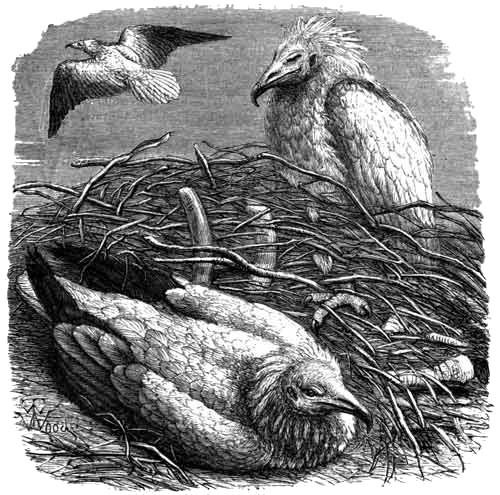
EGYPTIAN VULTURE, OR GIER-EAGLE.
"And the pelican, and the gier-eagle, and the cormorant."—Deut. xiv. 17.
The reading of râchâm as porphyrio is followed in the Septuagint, and the reading has been defended on the ground that the bird must belong to the aquatic group, being placed between the pelican and cormorant. The Jewish Bible follows our version, but affixes the mark of doubt to the word.
Although some of the Talmudists render the word as woodpecker, others identify it with the Egyptian Vulture. In Lewysohn's "Zoologie des Talmuds," there is a curious speculation on this subject. This bird, according to the authors whom he quotes, is the Schirkrek, and derives its name from its peculiar cry, which begins with a hiss (Schirk) and ends with a shriek (Rek). The bird utters its cry when the rising of the Nile is expected, and so has earned the name of Râchâm, or Love, this word being frequently used in the Scriptures as a metaphor for rain, dew, or any water that nourishes plants.
Without adopting the process of reasoning employed in this case, we may safely accept the conclusion, and consider the Râchâm as identical with the Egyptian Vulture (Neophron perenopterus).
This bird is not a very large one, being about equal to a raven in size, though its enormously long wings give it an appearance of much greater size. Its colour is white, with the exception of the quill feathers of the wings, which are dark-brown. The bill and the naked face and legs are bright ochreous yellow. It does not attain this white plumage until its third year, its colour before reaching adult age being brown, with a grey neck and dull yellow legs and face.
The Egyptian Vulture, although not large, is a really handsome bird, the bold contrast of pure white and dark brown being very conspicuous when it is on the wing. In this plumage it has never been seen in England, but one or two examples are known of the Egyptian Vulture being killed in England while still in its dark-brown clothing.
It inhabits a very wide range of country, being found throughout all the warmer parts of the Old World. Although it is tolerably plentiful, it is never seen in great numbers, as is the case with several of the vultures, but is always to be found in pairs, the male and female never separating, and invariably being seen close together. In fact, in places where it is common it is hardly possible to travel more than a mile or two without seeing a pair of Egyptian Vultures. Should more than two of these birds be seen together, the spectator may be sure that they have congregated over some food. It has been well suggested that its Hebrew name of Râchâm, or Love, has been given to it in consequence of this constant association of the male and female.
The Egyptian Vulture is one of the best of scavengers, not only devouring the carcases of dead animals, but feeding on every kind of offal or garbage. Indeed, its teeth and claws are much too feeble to enable it to cope with the true vultures in tearing up a large carcase, and in consequence it never really associates with them, although it may be seen hovering near them, and it never ventures to feed in their company, keeping at a respectful distance while they feed, and, when they retire, humbly making a meal on the scraps which they have left.
Mr. Tristram narrates an amusing instance of this trait of character. "On a subsequent occasion, on the north side of Hermon, we observed the griffons teaching a lesson of patience to the inferior scavengers. A long row of Egyptian vultures were sitting on some rocks, so intently watching a spot in a corn-field that they took no notice of our approach. Creeping cautiously near, we watched a score of griffons busily engaged in turning over a dead horse, one side of which they had already reduced to a skeleton.
"Their united efforts had just effected this, when we showed ourselves, and they quickly retired. The inferior birds, who dreaded us much less than them, at once darted to the repast, and, utterly regardless of our presence within ten yards of them, began to gorge. We had hardly retired two hundred yards, when the griffons came down with a swoop, and the Egyptian vultures and a pair or two of eagles hurriedly resumed their post of observation; while some black kites remained, and contrived by their superior agility to filch a few morsels from their lordly superiors."
So useful is this bird as a scavenger, that it is protected in all parts of the East by the most stringent laws, so that a naturalist who wishes for specimens has some difficulty in procuring the bird, or even its egg. It wanders about the streets of the villages, and may generally be found investigating the heaps of refuse which are left to be cleared away by the animals and birds which constitute the scavengers of the East.
It not only eats dead animal substances, but kills and devours great quantities of rats, mice, lizards, and other pests that swarm in hot countries. So tame is it, that it may even be observed, like the gull and the rook of our own country, following the ploughman as he turns up the ground, and examining the furrow for the purpose of picking up the worms, grubs, and similar creatures that are disturbed by the share.
Being thus protected and encouraged by man, there is good reason why it should have learned in course of time to fear him far less than its own kind. Indeed, it is so utterly fearless with regard to human beings, that it habitually follows the caravans as they pass from one town to another, for the sake of feeding on the refuse food and other offal which is thrown aside on the road.
Two articles of diet which certainly do not seem to fall within the ordinary range of vulture's food are said to be consumed by this bird. The first is the egg of the ostrich, the shell of which is too hard to be broken by the feeble beak of the Egyptian Vulture. The bird cannot, like the lämmergeier, carry the egg into the air and drop it on the ground, because its feet are not large enough to grasp it, and only slip off its round and polished surface. Therefore, instead of raising the egg into the air and dropping it upon a stone, it carries a stone into the air and drops it upon the egg. So at least say the natives of the country which it inhabits, and there is no reason why we should doubt the truth of the statement.
The other article of food is a sort of melon, very full of juice. This melon is called "nara," and is devoured by various creatures, such as lions, leopards, mice, ostriches, &c. and seems to serve them instead of drink.
The nest of the Egyptian Vulture is made in some rocky ledge, and the bird does not trouble itself about selecting a spot inaccessible to man, knowing well that it will not be disturbed. The nest is, like that of other vultures, a large and rude mass of sticks, sods, bones, and similar materials, to which are added any bits of rag, rope, skin, and other village refuse which it can pick up as it traverses the streets. There are two, and occasionally three, eggs, rather variously mottled with red. In its breeding, as in its general life, it is not a gregarious bird, never breeding in colonies, and, indeed, very seldom choosing a spot for its nest near one which has already been selected by another pair.
The illustration on page 340 represents part of the nest of the Egyptian Vulture, in which the curious mixture of bones and sticks is well shown. The parent birds are drawn in two characteristic attitudes taken from life, and well exhibit the feeble beak, the peculiar and intelligent, almost cunning expression of the head, and the ruff of feathers which surrounds the upper part of the neck. In the distance another bird is drawn as it appears on the wing, in order to show the contrast between the white plumage and the dark quill feathers of the wings, the bird presenting a general appearance very similar to that of the common English sea-gull.
THE GRIFFON VULTURE, OR EAGLE OF SCRIPTURE.
The Griffon Vulture identified with the Eagle of Scripture—The word Nesher and its signification—Geographical range of the Griffon—Its mode of flight and sociable habits—The featherless head and neck of the bird—The Vulture used as an image of strength, swiftness, and rapacity—Its powers of sight—How Vultures assemble round a carcase—Nesting-places of the Griffon—Mr. Tristram's description of the Griffon—Rock-caves of the Wady Hamâm—Care of the young, and teaching them to fly—Strength of the Griffon—Its emblematical use in Egypt and Assyria—The god Nisroch—Noble aspect of the Griffon—Its longevity—Various attitudes assumed by the bird.
We now come to another word which will give us but little trouble in identification. This is the word Nesher, which is invariably translated in the Authorized Version of the Bible as Eagle, but which was undoubtedly a different bird, and has satisfactorily been identified with the Griffon Vulture, or Great Vulture (Gyps fulvus). The reasons for this conclusion are so inextricably interwoven with the various passages in which the bird is mentioned, that I shall not give them separately, but simply allude to them in the course of the article.
In the first place, the name Nesher is derived, according to many Hebraists, from a word which signifies the power of sight, and is given to the bird in consequence of its piercing vision. The Talmudical writers mention a curious proverb concerning the sight of the Vulture, namely, that a Vulture in Babylon can see a carcase in Palestine. Other scholars derive it from a word which signifies its longevity, while others again believe that the true derivation is to be found in a word which signifies ripping up or tearing with the beak.
The Griffon Vulture is found throughout a large portion of the Old World, inhabiting nearly all the warmer portions of this hemisphere. The colour of the adult bird is a sort of yellowish brown, diversified by the black quill feathers and the ruff of white down that surrounds the neck. The head and neck are without feathers, but are sparingly covered with very short down of a similar character to that of the ruff.
It is really a large bird, being little short of five feet in total length, and the expanse of wing measuring about eight feet.
The Griffon Vulture is very plentiful in Palestine, and, unlike the lesser though equally useful Egyptian Vulture, congregates together in great numbers, feeding, flying, and herding in company. Large flocks of them may be seen daily, soaring high in the air, and sweeping their graceful way in the grand curves which distinguish the flight of the large birds of prey. They are best to be seen in the early morning, being in the habit of quitting their rocky homes at daybreak, and indulging in a flight for two or three hours, after which they mostly return to the rocks, and wait until evening, when they take another short flight before retiring to rest.
Allusion is made in the Scriptures to the gregarious habits of the Vultures: "Wheresoever the carcase is, there will the eagles be gathered together" (Matt xxiv. 28). That the Vulture, and not the eagle, is here signified, is evident from the fact that the eagles do not congregate like the Vultures, never being seen in greater numbers than two or three together, while the Vultures assemble in hundreds.
The featherless head of the Vulture is mentioned in the Book of Micah, chap. i. ver. 16: "Make thee bald, and poll thee for thy delicate children; enlarge thy baldness as the eagle; for they are gone into captivity from thee." It is evident that in this passage reference is made, not to the eagle, whose head is thickly covered with feathers, but to the Vulture, whose head and neck are but scantily sprinkled with white down. Some commentators, not aware that the word nesher should have been rendered as "vulture," have explained the passage by saying that the prophet referred to the moulting-time of the eagle; but the reader will see that such an explanation is at the best a forced one, whereas the reference to the bald head of the Vulture is both simple and natural.
The voracity of the Vulture, and its capacity for discovering food, are both mentioned in Job xxxix. 27-30: "Doth the eagle (nesher) mount up at thy command, and make her nest on high?
"She dwelleth and abideth on the rock, upon the crag of the rock, and the strong place.
"From thence she seeketh the prey, and her eyes behold afar off.
"Her young ones also suck up blood: and where the slain are, there is she."
See also Hab. i. 6-8, in which the prophet speaks of the Chaldeans, "that bitter and hasty nation, which shall march through the breadth of the land, to possess the dwelling-places that are not theirs.
"They are terrible and dreadful: ... and their horsemen shall spread themselves, and their horsemen shall come from far; they shall fly as the eagle that hasteth to eat."
There is also a curious passage in the Book of Proverbs, chap. xxx. ver. 17, which alludes to the carnivorous nature of the bird: "The eye that mocketh at his father, and despiseth to obey his mother, the ravens of the valley shall pick it out, and the young eagles shall eat it."
Allusion is made in several passages to the swiftness of the Vulture, as well as its voracity. See, for example, a portion of David's lamentation over the bodies of Saul and Jonathan, who, according to the poet's metaphor, "were lovely and pleasant in their lives, and in their death they were not divided; they were swifter than eagles, they were stronger than lions."
The "bitter" people—namely, the Chaldeans—are again mentioned in a very similar manner by the prophet Jeremiah: "Our persecutors are swifter than the eagles of the heavens; they pursued us upon the mountains, they laid wait for us in the wilderness" (Lam. iv. 19).
There is something peculiarly appropriate in employing the Vulture as an image of strength and swiftness when applied to warriors, the bird being an invariable attendant on the battle, and flying to the field of death with marvellous swiftness. All who had ever witnessed a battle were familiar with the presence of the Vulture—the scene of carnage, and the image which is employed, would be one which commended itself at once to those for whom it was intended. And, as the earlier history of the Jewish nation is essentially of a warlike character, we cannot wonder that so powerful and familiar an image should have been repeatedly introduced into the sacred writings.
The wonderful powers of sight possessed by this bird are mentioned in the passage from Job xxxix. which has already been quoted.
Here it may be as well to say that, piercing as is the vision of the Vulture, its visual powers have been much exaggerated. It certainly does possess a vision of no ordinary capacity, which is able to assume either a telescopic or a microscopic character, by means of a complex and marvellous structure, which can alter the whole shape of the organ at the will of the bird.
Not only can the eye be thus altered, but it changes instantaneously, so as to accommodate itself to the task which it is to perform. A Vulture, for example, sees from a vast height the body of a dead animal, and instantly swoops down upon it like an arrow from a bow. In order to enable the bird to see so distant an object, the eye has been exercising its telescopic powers, and yet, in a second or two, when the Vulture is close to its prey, the whole form of the eye must be changed, or the bird would mistake its distance, and dash itself to pieces on the ground.
To describe this beautiful piece of mechanism would be outside the scope of the present work; but the reader can find it in every good work on comparative anatomy, and is strongly advised to make himself master of the means by which a result so apparently impossible is secured.
By means of its powerful eyes, the Vulture can see to an enormous distance, and with great clearness, but neither so far nor so clearly as is popularly supposed. It is true that, as soon as a carcase is discovered, it will be covered with Vultures, who arrive from every side, looking at first like tiny specks in the air, scarcely perceptible even to practised eyes, and all directing their flight to the same point. "Where the carcase is, there will the vultures be gathered together." But, although they all fly towards the same spot, it does not follow that they have all seen the same object. The fact is, they see and understand each other's movements.
A single Vulture, for example, sees a dead or dying sheep, and swoops down upon it. The other Vultures which are flying about in search of food, and from which the animal in question may be concealed, know perfectly well that a Vulture soars high in the air when searching for food, and only darts to the earth when it has found a suitable prey. They immediately follow its example, and in their turn are followed by other Vultures, which can see their fellows from a distance, and know perfectly well why they are all converging to one spot.
In this way all the Vultures of a neighbourhood will understand, by a very intelligible telegraph, that a dead body of some animal has been found, and, aided by their wonderful powers of flight, will assemble over its body in an almost incredibly short space of time.
The resting-place of the Griffon Vulture is always on some lofty spot. The Arabian Vulture will build within easy reach, the eagle prefers lofty situations, but nothing but the highest and most inaccessible spots will satisfy the Vulture. To reach the nest of this bird is therefore a very difficult task, only to be attempted by experienced and intrepid cragsmen; and, in consequence, both the eggs and young of the Griffon Vulture cannot be obtained except for a very high price. The birds are fond of building in the rock-caves which are found in so many parts of Palestine, and in some places they fill these places as thickly as rooks fill a rookery.
The fondness of the Vulture for such localities is more than once mentioned in Holy Writ. One of these passages, which occurs in Job xxxix. 29, has already been quoted, and another, and equally forcible one, is to be found in the Book of the Prophet Jeremiah: "Thy terribleness hath deceived thee, and the pride of thine heart, O thou that dwellest in the clefts of the rock, that holdest the height of the hill: though thou shouldest make thy nest as high as the eagle (nesher), I will bring thee down from thence, saith the Lord" (Jer. xlix. 16).
In Mr. Tristram's "Land of Israel," there is a very graphic description of the Griffon's nests, and of the difficulty experienced in reaching them. "A narrow gorge, with limestone cliffs from five hundred to six hundred feet high, into which the sun never penetrates, walls the rapid brook on each side so closely that we often had to ride in the bed of the stream. The cliffs are perforated with caves at all heights, wholly inaccessible to man, the secure resting-place of hundreds of noble griffons, some lämmergeiers, lanner falcons, and several species of eagle.... One day in the ravine well repaid us, though so terrific were the precipices, that it was quite impossible to reach any of the nests with which it swarmed.
"We were more successful in the Wady Hamâm, the southwest end of the plain, the entrance from Hattin and the Buttauf, where we spent three days in exploration. The cliffs, though reaching the height of fifteen hundred feet, rise like terraces, with enormous masses of débris, and the wood is half a mile wide. By the aid of Giacomo, who proved himself an expert rope-climber, we reaped a good harvest of griffons' eggs, some of the party being let down by ropes, while those above were guided in working them by signals from others below in the valley. It required the aid of a party of a dozen to capture these nests. The idea of scaling the cliff with ropes was quite new to some Arabs who were herding cattle above, and who could not, excepting one little girl, be induced to render any assistance. She proved herself most sensible and efficient in telegraphing.
"While capturing the griffons' nests, we were re-enacting a celebrated siege in Jewish history. Close to us, at the head of the cliffs which form the limits of the celebrated Plain of Hattin, were the ruins of Irbid, the ancient Arbela, marked principally by the remains of a synagogue, of which some marble shafts and fragments of entablature, like those of Tell Hûm, are still to be seen, and were afterwards visited by us.
"Hosea mentions the place apparently as a strong fortress: 'All thy fortresses shall be spoiled, as Shalman spoiled Beth-arbel in the day of battle' (Hos. x. 14). Perhaps the prophet here refers to the refuges in the rocks below.
"The long series of chambers and galleries in the face of the precipice are called by the Arabs Kulat Ibn Maân, and are very fully described by Josephus. These cliffs were the homes of a set of bandits, who resided here with their families, and for years set the power of Herod the Great at defiance. At length, when all other attempts at scaling the fortress had failed, he let down soldiers at this very spot in boxes, by chains, who attacked the robbers with long hooks, and succeeded in rooting them all out. The exploit was familiar to us by an engraving of the Penny Magazine of old, and little did we dream that we should one day storm those very caves in a similar way ourselves. We could not but regret that Herod had neglected to leave his chains and grappling-irons for our use.
"The rock galleries, though now only tenanted by griffons, are very complete and perfect, and beautifully built. Long galleries wind backwards and forwards in the cliff side, their walls being built with dressed stone, flush with the precipice, and often opening into spacious chambers. Tier after tier rise one after another with projecting windows, connected by narrow staircases, carried sometimes upon arches, and in the upper portions rarely broken away. In many of the upper chambers to which we were let down, the dust of ages had accumulated, undisturbed by any foot save that of the birds of the air; and here we rested during the heat of the day, with the plains and lake set as in a frame before us. We obtained a full zoological harvest, as in three days we captured fourteen nests of griffons."
Although these caverns and rocky passages are much more accessible than most of the places whereon the Griffons build, the natives never venture to enter them, being deterred not so much by their height, as by their superstitious fears. The Griffons instinctively found out that man never entered these caverns, and so took possession of them.
As the young Griffons are brought up in these lofty and precipitous places, it is evident that their first flight must be a dangerous experiment, requiring the aid of the parent birds. At first the young are rather nervous at the task which lies before them, and shrink from trusting themselves to the air. The parents, however, encourage them to use their wings, take short flights in order to set them an example, and, when they at last venture from the nest, accompany and encourage them in their first journey.
Even this habit has been noted by the sacred writers, and been forcibly employed as an image of divine protection. See the Song of Moses, in which the aged leader, whose forty years' work was at last finished, recapitulates the mercies vouchsafed to the people of Israel, and exhorts them against the sin of ingratitude: "For the Lord's portion is His people; Jacob is the lot of His inheritance.
"He found him in a desert land, and in the waste howling wilderness; He led him about, He instructed him, He kept him as the apple of His eye.
"As an eagle stirreth up her nest, fluttereth over her young, spreadeth abroad her wings, taketh them, beareth them on her wings;
"So the Lord alone did lead him, and there was no strange god with him" (Deut. xxxii. 9-12).
The strength of flight of the Vulture is also noticed by the sacred writers. See, for example, Exod. xix. 4: "Ye have seen what I did to the Egyptians, and how I bare you on eagles' (nesherim) wings, and brought you unto myself."
This passage had a peculiar force when addressed to the Hebrews, the Vulture being one of the chief emblems of Egyptian power, and its outspread wings continually recurring on the grand monuments and temples with which they must have been so familiar.
Strangely enough, in their second captivity, the Jews met with the same emblem among the Assyrians. For example, their god Nisroch, whom we find mentioned as specially worshipped by Sennacherib, was a vulture-headed deity, bearing not only the head of the bird, but also its wings. The vast wings of the Vulture were by the Assyrians used as types of Divine power, and were therefore added, not only to human figures, but to those of beasts. The human-headed and vulture-winged bulls of Nineveh, with which we are now so familiar, are good examples of this peculiar imagery.
The name Nisroch, by the way, is evidently the same word as nesher, and bears even closer resemblance to the Arabic niss'r. This bird was also the war standard of Assyria, just as the eagle is that of France, and the metaphors used by Habbakuk and Jeremiah had therefore a doubly forcible sense.
We find the same bird employed as a visible emblem of Divine omnipresence and omniscience in the visions seen by Ezekiel and St. John: "And every one had four faces; the first face was the face of a cherub, and the second face was the face of a man, and the third the face of a lion, and the fourth the face of an eagle" (Ezek. x. 14). Then, in the Revelation, chap. iv. ver. 6, 7, is the account of a vision of very similar character: "In the midst of the throne, and round about the throne, were four beasts full of eyes before and behind.
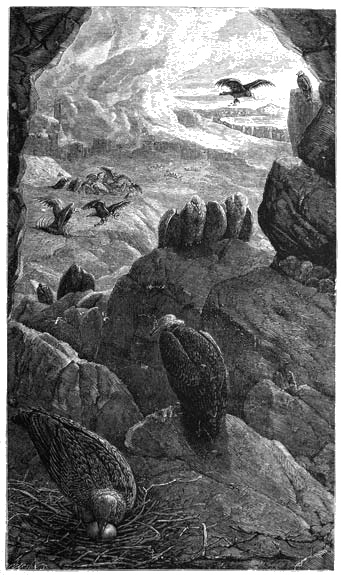
THE VULTURE, OR EAGLE OF SCRIPTURE.
"Wheresoever the carcase is, there will the eagles be gathered together."—Matt. xxiv 28.
"And the first beast was like a lion, and the second was like a calf, and the third beast had a face as a man, and the fourth beast was like a flying eagle."
From these passages we shall see that the Griffon Vulture was not held by the Scriptural writers in the contempt with which we are apt to regard it. Not having any Vultures resident in our country, for the simple reason that there is not enough carrion in the whole of England to feed a single Vulture for a month, we have no practical knowledge of them, and are apt to confound, under the common title of Vulture, birds of most dissimilar aspect. Some of them, especially those which inhabit the West Indies, are mean-looking, slouching, sneaking, obscene birds, which, even when brought to this country, and nourished on fresh meat, cannot be regarded without inspiring a feeling of disgust.
But there are others which are really grand and noble birds, which excite admiration instead of disgust, and one of the chief among these is the Griffon Vulture. Scavenger though it be, it is not disgusting in its habits, and may even be called a cleanly bird. It is intelligent, after its way, and is quite as susceptible of human teaching as the falcon or the cormorant. It is not quarrelsome, and, even when feeding, does not try to drive away its neighbour, but feeds alongside of him with perfect amity and quiet.
In common with other birds of its order, the Griffon Vulture is a very long-lived bird, and even this characteristic is noticed in the well-known passage, "Bless the Lord, O my soul, and forget not all His benefits: ... who satisfieth thy mouth with good things; so that thy youth is renewed like the eagle's" (Ps. ciii. 1, 5).
This passage has often been absurdly misinterpreted by commentators who have not appreciated the metaphorical style of all Oriental poetry. Taking the passage in its exact literal sense, and not knowing that reference is made to the Vulture and not to the eagle, they have taken for granted that the eagle had some mode of renewing its youth, and, in fact, after becoming old, went through some process by which it shook off the decrepitude of old age, and became young again. Others, seeing that such an interpretation was both strained and far-fetched, have thought that reference was made to the annual moult of the eagle, which they fancied to be of a very severe character, the whole of the feathers being shed at once, so as to leave the bird naked and helpless, and then being restored with added strength and beauty.
It is evident, however, that no such interpretation is needed, and that the Psalmist, when using the expression "renewing the youth like an eagle's," only employed a metaphorical expression significative of longevity.
If we recapitulate the various passages in which the Nesher is mentioned in the Scriptures, we shall find that the sacred writers were thoroughly acquainted with the bird, and that they wrote of it with an occasional fulness and an invariable precision which shows how familiar they were with a bird at once so plentiful and so conspicuous.
The illustration represents one of the rocky gorges so plentiful in Palestine, inhabited by a number of Griffon Vultures. Some of them are feeding upon the carcase of a dead animal, another is upon her nest, and several Vultures, who have gorged themselves with food after their fashion, are sitting listlessly on the rock, in some of the singular positions which this bird affects. There is, perhaps, no bird which has a more curious set of attitudes than the Griffon Vulture, or which exhibits so different an aspect at various times.
In flight it is one of the most magnificent birds that can be seen, and even when perched it often retains a certain look of majesty and grandeur. Sometimes, however, especially when basking in the sun, it assumes a series of attitudes which are absolutely grotesque, and convert the noble-looking bird into a positively ludicrous object. At one moment it will sit all hunched up, its head sunk between its shoulders, and one wing trailing behind it as if broken. At another it will bend its legs and sit down on the ankle-joint, pushing its feet out in front, and supporting itself by the stiff feathers of its tail. Often it will crouch nearly flat on the ground, partly spread its wings, and allow their tips to rest on the earth, and sometimes it will support nearly all the weight of its body on the wings, which rest, in a half doubled state, on the ground. I have before me a great number of sketches, taken in a single day, of the attitudes assumed by one of these birds, every one of which is strikingly different from the others, and transforms the whole shape of the bird so much that it is scarcely recognisable as the same individual.
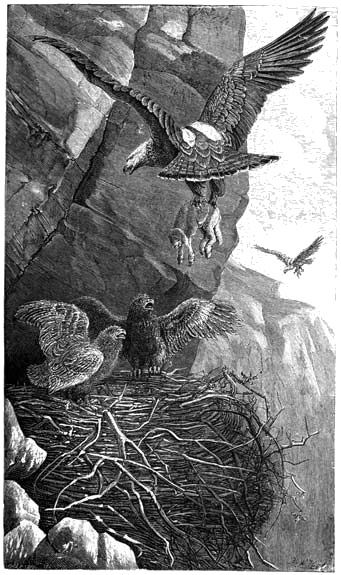
THE EAGLE.
"Though thou shouldest make thy nest as high as the eagle."—Jer. xlix. 16.
THE EAGLE.
Signification of the word Asniyeh—The Golden Eagle and its habits—The Imperial Eagle—Its solitary mode of life—The Short-toed Eagle—Its domestic habits and fondness for the society of man—The Osprey, or Fishing Eagle—Its mode of catching fish—Its distribution in Palestine.
As to the Eagle, rightly so called, there is little doubt that it is one of the many birds of prey that seem to have been classed under the general title of Asniyeh—the word which in the Authorized Version of the Bible is rendered as Osprey. A similar confusion is observable in the modern Arabic, one word, ogab, being applied indiscriminately to all the Eagles and the large falconidæ.
The chief of the true Eagles, namely, the Golden Eagle (Aquila chrysaëtos), is one of the inhabitants of Palestine, and is seen frequently, though never in great numbers. Indeed, its predacious habits unfit it for associating with its kind. Any animal which lives chiefly, if not wholly, by the chase, requires a large district in order to enable it to live, and thus twenty or thirty eagles will be scattered over a district of twice the number of miles. Like the lion among the mammalia, the Eagle leads an almost solitary life, scarcely ever associating with any of its kind except its mate and its young.
Although it lives principally by the chase, it has no objection to carrion, and, as has already been mentioned on page 342, may be seen feeding on a dead animal in company with the lesser vultures, though it retires before the lordly griffon. Being so thinly scattered, it would not be so conspicuous a bird as the griffon, which is not only very much larger, but associates in great numbers, and probably on that account no definite species of Eagle seems to be mentioned in Holy Writ.
Four or five species of Eagle are known to inhabit Palestine. There is, for example, the Imperial Eagle (Aquila mogilnik), which may be distinguished from the Golden Eagle by a white patch on the shoulders, and the long, lancet-shaped feathers of the head and neck. These feathers are of a fawn colour, and contrast beautifully with the deep black-brown of the back and wings. It is not very often seen, being a bird that loves the forest, and that does not care to leave the shelter of the trees. It is tolerably common in Palestine.
Then there are several of the allied species, of which the best example is perhaps the Short-toed Eagle (Circaëtus gallicus), a bird which is extremely plentiful in the Holy Land—so plentiful indeed that, as Mr. Tristram remarks, there are probably twice as many of the Short-toed Eagles in Palestine as of all the other species put together. The genus to which this bird belongs does not take rank with the true Eagles, but is supposed by systematic naturalists to hold an intermediate place between the true Eagles and the ospreys.
The Short-toed Eagle is seldom a carrion-eater, preferring to kill its prey for itself. It feeds mostly on serpents and other reptiles, and is especially fond of frogs. It is a large and somewhat heavily built bird, lightness and swiftness being far less necessary than strength in taking the animals on which it feeds. It is rather more than two feet in length, and is a decidedly handsome bird, the back being dark brown, and the under parts white, covered with crescent-shaped black spots.
THE OSPREY.
The Osprey, or Fishing Eagle—Its geographical range—Mode of securing prey—Structure of its feet—Its power of balancing itself in the air.
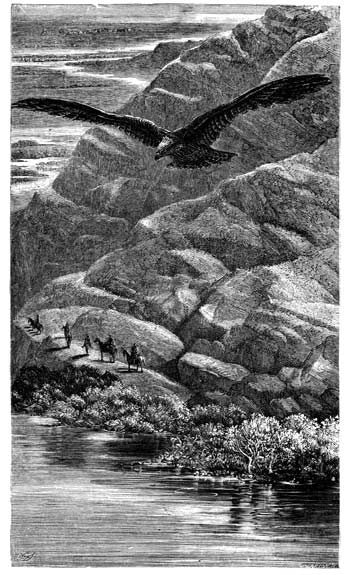
THE OSPREY.
"These are they of which ye shall not eat; the eagle, and the ossifrage, and the osprey."
Deut. xiv. 12.
We now come to the Osprey itself (Pandion haliaëtus), which was undoubtedly one of the birds grouped together under the collective term Asniyeh. This word occurs only in the two passages in Deut. xiv. and Lev. xi. which have been several times quoted already, and need not be mentioned again.
This fine bird is spread over a very large range of country, and is found in the New World as well as the Old. In consequence of its peculiar habits, it is often called the Fishing Eagle.
The Osprey is essentially a fish-eater. It seems very strange that a predacious bird allied to the eagles, none of which birds can swim, much less dive, should obtain its living from the water. That the cormorant and other diving birds should do so is no matter of surprise, inasmuch as they are able to pursue the fish in their own element, and catch them by superior speed. But any bird which cannot dive, and which yet lives on fish, is forced to content itself with those fish that come to the surface of the water, a mode of obtaining a livelihood which does not appear to have much chance of success. Yet the Osprey does on a large scale what the kingfisher does on a small one, and contrives to find abundant food in the water.
Its method of taking prey is almost exactly like that which is employed by the kingfisher. When it goes out in search of food, it soars into the air, and floats in circles over the water, watching every inch of it as narrowly as a kestrel watches a stubble-field. No sooner does a fish rise toward the surface to take a fly, or to leap into the air for sport, than the Osprey darts downwards, grasps the fish in its talons, drags the struggling prey from the water, and with a scream of joy and triumph bears it away to shore, where it can be devoured at leisure.
The bird never dives, neither does it seize the fish with its beak like the kingfisher. It plunges but slightly into the water, as otherwise it would not be able to use its strong wings and carry off its prey. In order to enable the bird to seize the hard and slippery body of the fish, it is furnished with long, very sharp, and boldly-hooked talons, which force themselves into the sides of the fish, and hold it as with grappling irons.
In order to enable it to hover over the water, and to watch the surface carefully, it is possessed of wonderful powers of flight, being able to balance itself in one spot without seeming to move a wing, and having the singular facility of doing so even when a tolerably strong breeze is blowing. It has even been observed to maintain its place unmoved when a sharp squall swept over the spot.
Although not very plentiful in Palestine, nor indeed in any other country, it is seen throughout the whole of that country where it can find a sufficiency of water. It prefers the sea-shore and the rivers of the coast, and is said to avoid the Sea of Galilee.
THE KITE, OR VULTURE OF SCRIPTURE.
The word Dayah and its signification—Dayah a collective term for different species of Kites—The Common or Red Kite plentiful in Palestine—Its piercing sight and habit of soaring—The Black Kite of Palestine and its habits—The Egyptian Kite—The Raah or Glede of Scripture—The Buzzards and their habits—The Peregrine Falcon an inhabitant of Central Palestine, and the Lanner of the eastern parts of the country.
In Lev. xi. 14 and Deut. xiv. 13, we find the Vulture among the list of birds which the Jews were not permitted to eat. The word which is translated as Vulture is dayah, and we find it occurring again in Isaiah xxxiv. 15, "There shall the vultures also be gathered, every one with her mate." There is no doubt, however, that this translation of the word is an incorrect one, and that it ought to be rendered as Kite. In Job xxviii. 7, there is a similar word, ayah, which is also translated as Vulture, and which is acknowledged to be not a Vulture, but one of the Kites: "There is a path which no fowl knoweth, and which the vulture's eye hath not seen." Both these words are nearly identical with modern Arabic terms which are employed rather loosely to signify several species of Kite. Buxtorf, in his Hebrew Lexicon, gives the correct rendering, translating dayah as Milvus, and the Vulgate in one or two places gives the same translation, though in others it renders the word as Vulture.
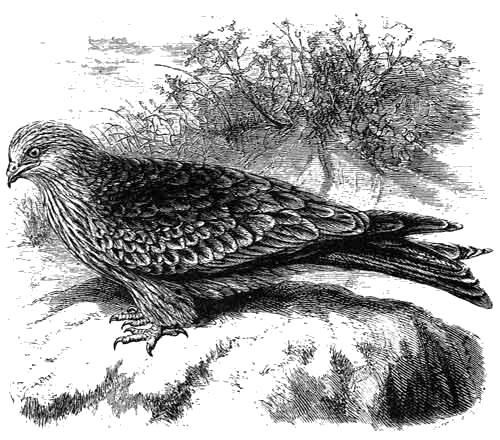
THE KITE, OR VULTURE OF SCRIPTURE.
"There is a path which no fowl knoweth, and which the vulture's eye hath not seen."
Job xxviii. 7.
Mr. Tristram, who has given much attention to this subject, is inclined to refer the word ayah to the Common Kite (Milvus regalis), which was once so plentiful in this country, and is now nearly extinct; and dayah to the Black Kite (Milvus atra). He founds this distinction on the different habits of the two species, the Common or Red Kite being thinly scattered, and being in the habit of soaring into the air at very great heights, and the latter being very plentiful and gregarious.
We will first take the Red Kite.
This bird is scattered all over Palestine, feeding chiefly on the smaller birds, mice, reptiles, and fish. In the capture of fish the Kite is almost as expert as the osprey, darting from a great height into the water, and bearing off the fish in its claws. The wings of this bird are very long and powerful, and bear it through the air in a peculiarly graceful flight. It is indeed in consequence of this flight that it has been called the Glede, the word being derived from its gliding movements.
The sight of this bird is remarkably keen and piercing, and, from the vast elevation to which it soars when in search of food, it is able to survey the face of the country beneath, and to detect the partridge, quail, chicken, or other creature that will serve it for food. This piercing sight and habit of soaring render the passage in Job peculiarly appropriate to this species of Kite, though it does not express the habits of the other. Should the Kite suspect danger when forced to leave its nest, it escapes by darting rapidly into the air, and soaring at a vast height above the trees among which its home is made. From that elevation it can act as a sentinel, and will not come down again until it is assured of safety.
Of the habits of the Black Kite (Milvus atra), Mr. Tristram gives an admirable description. "The habits of the bird bear out the allusion in Isa. xxxiv. 15, for it is, excepting during the winter three months, so numerous everywhere in Palestine as to be almost gregarious. It returns about the beginning of March, and scatters itself over the whole country, preferring especially the neighbourhood of valleys, where it is a welcome and unmolested guest. It does not appear to attack the poultry, among whom it may often be seen feeding on garbage. It is very sociable, and the slaughter of a sheep at one of the tents will soon attract a large party of black kites, which swoop down regardless of man and guns, and enjoy a noisy scramble for the refuse, chasing each other in a laughable fashion, and sometimes enabling the wily raven to steal off with the coveted morsel during their contentions. It is the butt of all the smaller scavengers, and is evidently most unpopular with the crows and daws, and even rollers, who enjoy the amusement of teasing it in their tumbling flight, which is a manœuvre most perplexing to the kite."
The same writer proceeds to mention that the Black Kite, unlike the red species, is very careless about the position of its nest, and never even attempts to conceal it, sometimes building it in a tree, sometimes on a rock-ledge, and sometimes in a bush growing on the rocks. It seems indeed desirous of making the nest as conspicuous as possible, and hangs it all over with bits of cloth, strips of bark, wings of birds, and even the cast skins of serpents.
Another species (Milvus Ægyptiacus) is sometimes called the Black Kite from the dark hue of its plumage, but ought rather to retain the title of Egyptian Kite. Unlike the black kite, this bird is a great thief, and makes as much havoc among poultry as the red kite. It is also a robber of other birds, and if it should happen to see a weaker bird with food, it is sure to attack and rob it. Like the black kite, it is fond of the society of man, and haunts the villages in great numbers, for the purpose of eating the offal, which in Oriental towns is simply flung into the streets to be devoured by the dogs, vultures, kites, and other scavengers, without whom no village would be habitable for a month.
Whether the word raah, which is translated as Glede in Deut. xiv. 13, among the list of birds which may not be eaten, is one of these species of Kite, or a bird of a different group, is a very doubtful point. This is the only passage in which the word occurs, and we have but small grounds for definitely identifying it with any one species. The Hebrew Bible retains the word Glede, but affixes a mark of doubt to it, and several commentators are of opinion that the word is a wrong reading of dayah, which occurs in the parallel passage in Lev. xi. 14. The reading of the Septuagint follows this interpretation, and renders it as Vulture in both cases. Buxtorf translates the word raah as Rook, but suggests that dayah is the correct reading.
Accepting, however, the word raah, we shall find that it is derived from a root which signifies sight or vision, especially of some particular object, so that a piercing sight would therefore be the chief characteristic of the bird, which, as we know, is one of the attributes of the Kites, together with other birds of prey, so that it evidently must be classed among the group with which we are now concerned. It has been suggested that, granting the raah to be a species distinct from the dayah, it is a collective term for the larger falcons and buzzards, several species of which inhabit Palestine, and are not distinctly mentioned in the Bible.
Several species of buzzard inhabit the Holy Land, and there is no particular reason why they should be mentioned except by a collective name. Some of the buzzards are very large birds, and though their wings are short when compared with those of the vultures and eagles, the flight of the bird is both powerful and graceful. It is not, however, remarkable for swiftness, and never was employed, like the falcon, in catching other birds, being reckoned as one of the useless and cowardly birds of prey. In consonance with this opinion, to compare a man to a buzzard was thought a most cutting insult.
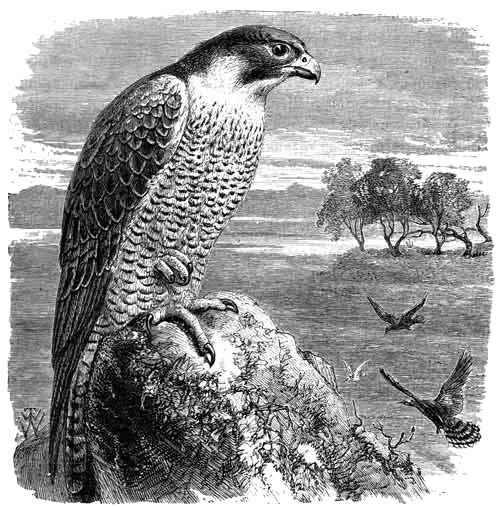
THE PEREGRINE FALCON, OR GLEDE OF SCRIPTURE.
"And the Glede, and the kite, and the vulture after his kind."—Deut. xiv. 13.
As a general rule, it does not chase its prey like the eagles or the large-winged falcons, but perches on a rock or tree, watches for some animal on which it can feed, pounces on it, and returns to its post, the whole movements being very like those of the flycatcher. This sluggishness of disposition, and the soft and almost owl-like plumage, have been the means of bringing the bird into contempt among falconers.
As to the large falcons, which seem to be included in the term raah, the chief of them is the Peregrine Falcon (Falco peregrinus), which is tolerably common in the Holy Land. In his "Land of Israel," Mr. Tristram gives several notices of this bird, from which we may take the following picture from a description of a scene at Endor. "Dreary and desolate looked the plain, though of exuberant fertility. Here and there might be seen a small flock of sheep or herd of cattle, tended by three or four mounted villagers, armed with their long firelocks, and pistols and swords, on the watch against any small party of marauding cattle-lifters.
"Griffon vultures were wheeling in circles far over the rounded top of Tabor; and here and there an eagle was soaring beneath them in search of food, but at a most inconvenient distance from our guns. Hariers were sweeping more rapidly and closely over the ground, where lambs appeared to be their only prey; and a noble peregrine falcon, which in Central Palestine does not give place to the more eastern lanner, was perched on an isolated rock, calmly surveying the scene, and permitting us to approach and scrutinize him at our leisure."
The habit of perching on the rock, as mentioned above, is very characteristic of the Peregrine Falcon, who loves the loftiest and most craggy cliffs, and makes its nest in spots which can only be reached by a bold and experienced climber. The nests of this bird are never built in close proximity, the Peregrine preferring to have its home at least a mile from the nest of any other of its kinsfolk. Sometimes it makes a nest in lofty trees, taking possession of the deserted home of some other bird; but it loves the cliff better than the tree, and seldom builds in the latter when the former is attainable.
In the passage from the "Land of Israel" is mentioned the Lanner Falcon (Falco lanarius), another of the larger falcons to which the term raah may have been applied.
This bird is much larger than the Peregrine Falcon, and, indeed, is very little less than the great gerfalcon itself. It is one of the birds that were reckoned among the noble falcons; and the female, which is much larger and stronger than the male, was employed for the purpose of chasing the kite, whose long and powerful wings could not always save it from such a foe.
Although the Lanner has been frequently mentioned among the British birds, and the name is therefore familiar to us, it is not even a visitor of our island. The mistake has occurred by an error in nomenclature, the young female Peregrine Falcon, which is much larger and darker than the male bird, having been erroneously called by the name of Lanner.
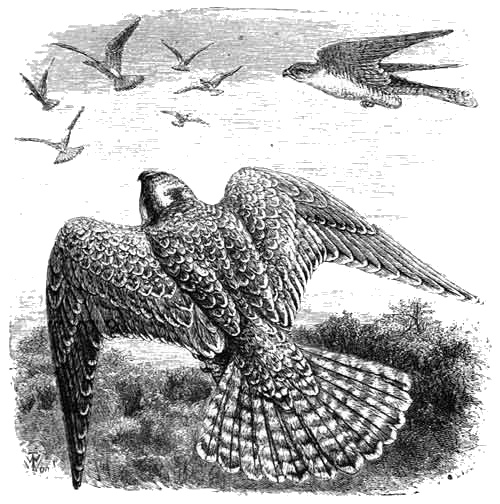
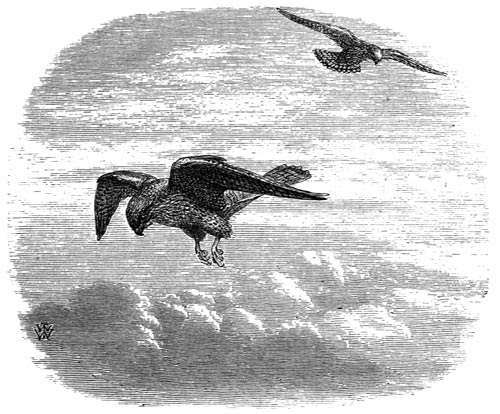
THE LANNER FALCON.
In the illustration, a pair of Lanner Falcons are depicted as pursuing some of the rock-pigeons which abound in Palestine, the attitudes of both birds being taken from life.
THE HAWK.
The Netz or Hawk—Number of species probably grouped under that name—Rare occurrence of the word—The Sparrow-Hawk and its general habits—Its place of nesting—The Kestrel, or Wind-hover—Various names by which it is known in England—Its mode of feeding and curious flight—The Hariers—Probable derivation of the name—Species of Harier known to inhabit Palestine—Falconry apparently unknown to the ancient Jews.
There is no doubt that a considerable number of species are grouped together under the single title Netz, or Hawk, a word which is rightly enough translated. That a great number of birds should have been thus confounded together is not surprising, seeing that even in this country and at the present time, the single word Hawk may signify any one of at least twelve different species. The various falcons, the hariers, the kestrel, the sparrow-hawk, and the hobbies, are one and all called popularly by the name of Hawk, and it is therefore likely that the Hebrew word Netz would signify as many species as the English word Hawk. From them we will select one or two of the principal species.
In the first place, the word is of very rare occurrence. We only find it three times. It first occurs in Lev. xi. 16, in which it is named, together with the eagle, the ossifrage, and many other birds, as among the unclean creatures, to eat which was an abomination. It is next found in the parallel passage in Deut. xiv. 15, neither of which portions of Scripture need be quoted at length.
That the word netz was used in its collective sense is very evident from the addition which is made to it in both cases. The Hawk, "after its kind," is forbidden, showing therefore that several kinds or species of Hawk were meant. Indeed, any specific detail would be quite needless, as the collective term was quite a sufficient indication, and, having named the vultures, eagles, and larger birds of prey, the simple word netz was considered by the sacred writer as expressing the rest of the birds of prey.
We find the word once more in that part of the Bible to which we usually look for any reference to natural history. In Job xxxix. 26, we have the words, "Doth the hawk fly by thy wisdom, and turn [or stretch] her wings toward the south?" The precise signification of this passage is rather doubtful, but it is generally considered to refer to the migration of several of the Hawk tribe. That the bird in question was distinguished for its power of flight is evident from the fact that the sacred poet has selected that one attribute as the most characteristic of the Netz.
Taking first the typical example of the Hawks, we find that the Sparrow-Hawk (Accipiter nisus) is plentiful in Palestine, finding abundant food in the smaller birds of the country. It selects for its nest just the spots which are so plentiful in the Holy Land, i.e. the crannies of rocks, and the tops of tall trees. Sometimes it builds in deserted ruins, but its favourite spot seems to be the lofty tree-top, and, in default of that, the rock-crevice. It seldom builds a nest of its own, but takes possession of that which has been made by some other bird. Some ornithologists think that it looks out for a convenient nest, say of the crow or magpie, and then ejects the rightful owner. I am inclined to think, however, that it mostly takes possession of a nest that is already deserted, without running the risk of fighting such enemies as a pair of angry magpies. This opinion is strengthened by the fact that the bird resorts to the same nest year after year.
It is a bold and dashing bird, though of no great size, and when wild and free displays a courage which it seems to lose in captivity. As is the case with so many of the birds, the female is much larger than her mate, the latter weighing about six ounces, and measuring about a foot in length, and the former weighing above nine ounces, and measuring about fifteen inches in length.
The most plentiful of the smaller Hawks of Palestine is the Common Kestrel (Tinnunculus alaudarius). This is the same species with which we are so familiar in England under the names of Kestrel, Wind-hover, and Stannel Hawk.
KESTREL.
"Doth the Hawk fly by thy wisdom?"—Job xxxix. 26.
It derives its name of Wind-hover from its remarkable habit of hovering, head to windward, over some spot for many minutes together. This action is always performed at a moderate distance from the ground; some naturalists saying that the Hawk in question never hovers at an elevation exceeding forty feet, while others, myself included, have seen the bird hovering at a height of twice as many yards. Generally, however, it prefers a lower distance, and is able by employing this manœuvre to survey a tolerably large space beneath. As its food consists in a very great measure of field-mice, the Kestrel is thus able by means of its telescopic eyesight to see if a mouse rises from its hole; and if it should do so, the bird drops on it and secures it in its claws.
Unlike the sparrow-hawk, the Kestrel is undoubtedly gregarious, and will build its nest in close proximity to the habitations of other birds, a number of nests being often found within a few yards of each other. Mr. Tristram remarks that he has found its nest in the recesses of the caverns occupied by the griffon vultures, and that the Kestrel also builds close to the eagles, and is the only bird which is permitted to do so. It also builds in company with the jackdaw.
Several species of Kestrel are known, and of them at least two inhabit the Holy Land, the second being a much smaller bird than the Common Kestrel, and feeding almost entirely on insects, which it catches with its claws, the common chafers forming its usual prey. Great numbers of these birds live together, and as they rather affect the society of mankind, they are fond of building their nests in convenient crannies in the mosques or churches. Independently of its smaller size, it may be distinguished from the Common Kestrel by the whiteness of its claws.
The illustration is drawn from a sketch taken from life. The bird hovered so near a house, and remained so long in one place, that the artist fixed a telescope and secured an exact sketch of the bird in the peculiar attitude which it is so fond of assuming. After a while, the Kestrel ascended to a higher elevation, and then resumed its hovering, in the attitude which is shown in the upper figure. In consequence of the great abundance of this species in Palestine, and the peculiarly conspicuous mode of balancing itself in the air while in search of prey, we may feel sure that the sacred writers had it specially in their minds when they used the collective term Netz.
The Kestrel has a very large geographical range, being plentiful not only in England and Palestine, but in Northern and Southern Europe, throughout the greater part of Asia, in Siberia, and in portions of Africa. The bird, therefore, is capable of enduring both heat and cold, and, as is often the case with those creatures that are useful to man, is a perfect cosmopolitan.
It is easily trained, and, although in the old hawking days it was considered a bird which a noble could not carry, it can be trained to chase the smaller birds as successfully as the falcons can be taught to pursue the heron. The name Tinnunculus is supposed by some to have been given to the bird in allusion to its peculiar cry, which is clear, shrill, and consists of a single note several times repeated.
On page 361 the reader may see a representation of a pair of Harier Hawks flying below the rock on which the peregrine falcon has perched, and engaged in pursuing one of the smaller birds.
They have been introduced because several species of Harier are to be found in Palestine, where they take, among the plains and lowlands, the place which is occupied by the other hawks and falcons among the rocks.
The name of Harier appears to be given to these birds on account of their habit of regularly quartering the ground over which they fly when in search of prey, just like hounds when searching for hares. This bird is essentially a haunter of flat and marshy lands, where it finds frogs, mice, lizards, on which it usually feeds. It does not, however, confine itself to such food, but will chase and kill most of the smaller birds, and occasionally will catch even the leveret, the rabbit, the partridge, and the curlew.
When it chases winged prey, it seldom seizes the bird in the air, but almost invariably keeps above it, and gradually drives it to the ground. It will be seen, therefore, that its flight is mostly low, as suits the localities in which it lives, and it seldom soars to any great height, except when it amuses itself by rising and wheeling in circles together with its mate. This proceeding generally takes place before nest-building. The usual flight is a mixture of that of the kestrel and the falcon, the Harier sometimes poising itself over some particular spot, and at others shooting forwards through the air with motionless wings.
Unlike the falcons and most of the hawks, the Harier does not as a rule perch on rocks, but prefers to sit very upright on the ground, perching generally on a mole-hill, stone, or some similar elevation. Even its nest is made on the ground, and is composed of reeds, sedges, sticks, and similar matter, materials that can be procured from marshy land. The nest is always elevated a foot or so from the ground, and has occasionally been found on the top of a mound more than a yard in height. It is, however, conjectured that in such cases the mound is made by one nest being built upon the remains of another. The object of the elevated nest is probably to preserve the eggs in case of a flood.
At least five species of Hariers are known to exist in the Holy Land, two of which are among the British birds, namely, the Marsh Harier (Circus æruginosus), sometimes called the Duck Hawk and the Moor Buzzard, and the Hen Harier (Circus cyaneus), sometimes called the White Hawk, Dove Hawk, or Blue Hawk, on account of the plumage of the male, which differs greatly according to age; and the Ring-tailed Hawk, on account of the dark bars which appear on the tail of the female. All the Hariers are remarkable for the Circlet of feathers that surrounds the eyes, and which resembles in a lesser degree the bold feather-circle around the eye of the owl tribe.
Before taking leave of the Hawks, it is as well to notice the entire absence in the Scriptures of any reference to falconry. Now, seeing that the art of catching birds and animals by means of Hawks is a favourite amusement among Orientals, as has already been mentioned when treating of the gazelle (page 139), and knowing the unchanging character of the East, we cannot but think it remarkable that no reference should be made to this sport in the Scriptures.
It is true that in Palestine itself there would be but little scope for falconry, the rough hilly ground and abundance of cultivated soil rendering such an amusement almost impossible. Besides, the use of the falcon implies that of the horse, and, as we have already seen, the horse was scarcely ever used except for military purposes.
Had, therefore, the experience of the Israelites been confined to Palestine, there would have been good reason for the silence of the sacred writers on this subject. But when we remember that the surrounding country is well adapted for falconry, that the amusement is practised there at the present day, and that the Israelites passed so many years as captives in other countries, we can but wonder that the Hawks should never be mentioned as aids to bird-catching. We find that other bird-catching implements are freely mentioned and employed as familiar symbols, such as the gin, the net, the snare, the trap, and so forth; but that there is not a single passage in which the Hawks are mentioned as employed in falconry.
THE OWL.
The words which have been translated as Owl—The Côs, or Little Owl—Use made of the Little Owl in bird-catching—Habits of the bird—The Barn, Screech, or White Owl a native of Palestine—The Yanshûph, or Egyptian Eagle Owl—Its food and nest—The Lilith, or Night Monster—Various interpretations of the word—The Kippoz probably identical with the Scops Owl, or Marouf.
In various parts of the Old Testament there occur several words which are translated as Owl in the Authorized Version, and in most cases the rendering is acknowledged to be the correct one, while in one or two instances there is a difference of opinion on the subject.
In Lev. xi. 16, 17, we find the following birds reckoned among those which are an abomination, and which might not be eaten by the Israelites: "The owl, and the night-hawk, and the cuckoo, and the hawk after his kind;
"And the little owl, and the cormorant, and the great owl."
Here, then, we have in close proximity the word Owl repeated three times, and the same repetition occurs in the parallel passage in Deut. xiv. Now the words which are here translated as Owl are totally different words in the Hebrew, so that if we leave them untranslated, the passages will run as follow: "And the Bath-haya'anah, and the night-hawk, and the cuckoo, and the hawk after his kind;
"And the Côs, and the cormorant, and the Yanshûph."
Taking these words in order, we find in the first place that the Jewish Bible accepts the translation of the words côs and yanshûph, merely affixing to them the mark of doubt. But it translates the word bath-haya'anah as Ostrich, without adding the doubtful mark. Now the same word occurs in several other passages of Scripture, the first being in Job xxx. 29: "I am a brother to dragons, and a companion to owls." In the marginal reading of the Authorized Version, which, as the reader must bear in mind, is of equal value with the text, the rendering is the same as that of the Jewish Bible, and in several other passages the same reading is followed. We therefore accept the word bath-haya'anah as the ostrich, and dismiss it from among the owls.
Coming now to the other words, we find in the passages already quoted the words côs and yanshûph. Both those words occur in other parts of Scripture, and evidently are the names of nocturnal birds that haunt ruins and lonely places. Taking them in order, we find the word côs to occur again in Ps. cii. 6: "I am like a pelican of the wilderness: I am like an owl of the desert." The Psalm in which this passage occurs is a penitential prayer, in which the writer uses many of the metaphors employed by Job when lamenting his afflictions, and describes himself as left alone among men.
The simile is equally just and feasible in this case, the Owl being essentially a bird of night, and associated with solitude and gloom. The particular species which is signified by the word côs bears but very slightly on the subject, inasmuch as in general habits all the true Owls are very similar in hiding by day in their nests, and coming out at night to hunt for prey, their melancholy hoot, or startling shriek, breaking the silence of the night.
Still it is necessary to identify, if we can, some species with the word côs, and it is very likely that the Little Owl, or Boomah of the Arabs (Athene Persica), is the bird which is signified by the word côs. This species is probably identical with the Little Night Owl of England (Athene noctua). Though rare in England, it is very common in many parts of the Continent where it is much valued by bird-catchers, who employ it as a means of attracting small birds to their traps. They place it on the top of a long pole, and carry it into the fields, where they plant the pole in the ground. This Owl has a curious habit of swaying its body backwards and forwards, and is sure to attract the notice of all the small birds in the neighbourhood. It is well known that the smaller birds have a peculiar hatred to the Owl, and never can pass it without mobbing it, assembling in great numbers, and so intent on their occupation that they seem to be incapable of perceiving anything but the object of their hatred. Even rooks, magpies, and hawks are taken by this simple device.
Whether or not the Little Owl was used for this object by the ancient inhabitants of Palestine is rather doubtful; but as they certainly did so employ decoy birds for the purpose of attracting game, it is not unlikely that the Little Owl was found to serve as a decoy. We shall learn more about the system of decoy-birds when we come to the partridge.
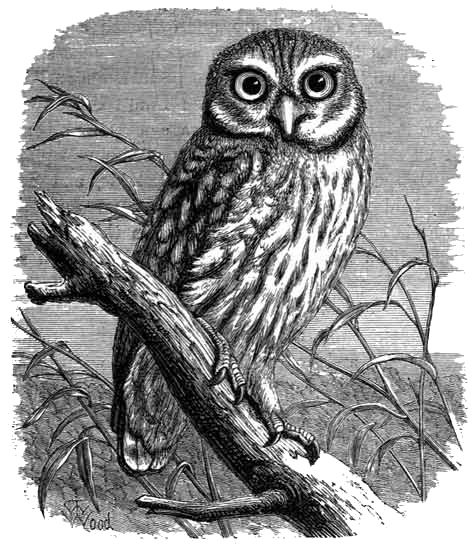
THE LITTLE OWL.
"I am like an owl of the desert."—Ps. cii. 6.
The Little Owl is to be found in almost every locality, caring little whether it takes up its residence in cultivated grounds, in villages, among deserted ruins, or in places where man has never lived. As, however, it is protected by the natives, it prefers the neighbourhood of villages, and may be seen quietly perched in some favourite spot, not taking the trouble to move unless it be approached closely. And to detect a perched Owl is not at all an easy matter, as the bird has a way of selecting some spot where the colours of its plumage harmonize so well with the surrounding objects that the large eyes are often the first indication of its presence. Many a time I have gone to search after Owls, and only been made aware of them by the sharp angry snap that they make when startled.
The name Athene, by the way, has been given to this Owl because it is the species selected by the Greeks as the emblem of wisdom.
The common Barn Owl of England (Strix flammea) also inhabits Palestine, and if, as is likely to be the case, the word côs is a collective term under which several species are grouped together, the Barn or White Owl is likely to be one of them.
Like the Little Owl, it affects the neighbourhood of man, though it may be found in ruins and similar localities. An old ruined castle is sure to be tenanted by the Barn Owl, whose nightly shrieks have so often terrified the belated wanderer, and made him fancy that the place was haunted by disturbed spirits. Such being the case in England, it is likely that in the East, where popular superstition has peopled every well with its jinn and every ruin with its spirit, the nocturnal cry of this bird, which is often called the Screech Owl from its note, should be exceedingly terrifying, and would impress itself on the minds of sacred writers as a fit image of solitude, terror, and desolation.
The Screech Owl is scarcely less plentiful in Palestine than the Little Owl, and, whether or not it be mentioned under a separate name, is sure to be one of the birds to which allusion is made in the Scriptures.
Another name now rises before us: this is the Yanshûph, translated as the Great Owl, a word which occurs not only in the prohibitory passages of Leviticus and Deuteronomy, but in the Book of Isaiah. In that book, ch. xxxiv. ver. 10, 11, we find the following passage: "From generation to generation it shall lie waste; none shall pass through it for ever and ever.
"But the cormorant and the bittern shall possess it; the owl (yanshûph) also and the raven shall dwell in it: and He shall stretch out upon it the line of confusion, and the stones of emptiness." The Jewish Bible follows the same reading.
It is most probable that the Great Owl or Yanshûph is the Egyptian Eagle Owl (Bubo ascalaphus), a bird which is closely allied to the great Eagle Owl of Europe (Bubo maximus), and the Virginian Eared Owl (Bubo Virginianus) of America. This fine bird measures some two feet in length, and looks much larger than its real size, owing to the thick coating of feathers which it wears in common with all true Owls, and the ear-like feather tufts on the top of its head, which it can raise or depress at pleasure. Its plumage is light tawny.
This bird has a special predilection for deserted places and ruins, and may at the present time be seen on the very spots of which the prophet spoke in his prediction. It is very plentiful in Egypt, where the vast ruins are the only relics of a creed long passed away or modified into other forms of religion, and its presence only intensifies rather than diminishes the feeling of loneliness that oppresses the traveller as he passes among the ruins.
The European Eagle Owl has all the habits of its Asiatic congener. It dwells in places far from the neighbourhood of man, and during the day is hidden in some deep and dark recess, its enormous eyes not being able to endure the light of day. In the evening it issues from its retreat, and begins its search after prey, which consists of various birds, quadrupeds, reptiles, fish, and even insects when it can find nothing better.
On account of its comparatively large dimensions, it is able to overcome even the full-grown hare and rabbit, while the lamb and the young fawn occasionally fall victims to its voracity. It seems never to chase any creature on the wing, but floats silently through the air, its soft and downy plumage deadening the sound of its progress, and suddenly drops on the unsuspecting prey while it is on the ground.
The nest of this Owl is made in the crevices of rocks, or in ruins, and is a very large one, composed of sticks and twigs, lined with a tolerably large heap of dried herbage, the parent Owls returning to the same spot year after year. Should it not be able to find either a rock or a ruin, it contents itself with a hollow in the ground, and there lays its eggs, which are generally two in number, though occasionally a third egg is found. The Egyptian Eagle Owl does much the same thing, burrowing in sand-banks, and retreating, if it fears danger, into the hollow where its nest has been made.
In the large illustration the two last-mentioned species are given. The Egyptian Eagle Owl is seen with its back towards the spectator, grasping in its talons a dead hare, and with ear-tufts erect is looking towards the Barn Owl, which is contemplating in mingled anger and fear the proceedings of the larger bird. Near them is perched a raven, in order to carry out more fully the prophetic words, "the owl also and the raven shall dwell in it."
Two more passages yet remain in which the word Owl is mentioned, and, curiously enough, both of them are found in the Book of Isaiah, the poet-prophet, who seized with a poet's intuition on the natural objects around him, and converted the simplest and most familiar incidents into glowing imagery and powerful metaphor.
If the reader will refer to Isaiah xxxiv. 13-15, he will find the following passages, which are, in fact, a continuation of the prophecy against Idumea, which has already been quoted. "And thorns shall come up in her palaces, nettles and brambles in the fortresses thereof: and it shall be an habitation of dragons, and a court for owls.
"The wild beasts of the desert shall also meet with the wild beasts of the island, and the satyr shall cry to his fellow; the screech owl also shall rest there, and find for herself a place of rest.
"There shall the great owl make her nest, and lay, and hatch, and gather under her shadow."
It has been already mentioned that the word which is translated as Owl, in the first of these passages, is bath-haya'anah, which is generally considered to signify the ostrich. In verse 14 we come to a new word, namely, lilith. In the marginal reading of the Authorized Version, this word is rendered as "night monster," and the Jewish Bible takes nearly the same view of the word by translating it as "a nocturnal one," evidently basing this interpretation upon the derivation of the word. Several Hebraists have thought that the word lilith merely represents some mythological being, like the dread Lamia of the ancients, a mixture of the material and spiritual—too ethereal to be seen by daylight, and too gross to be above the requirements of human food. The blood of mankind was the food of these fearful beings, and, according to old ideas, they could only live among ruins and desert places, where they concealed themselves during the day at the bottoms of wells or the recesses of rock-caverns, and stole out at night to seize on some unlucky wanderer, and suck his blood as he slept.
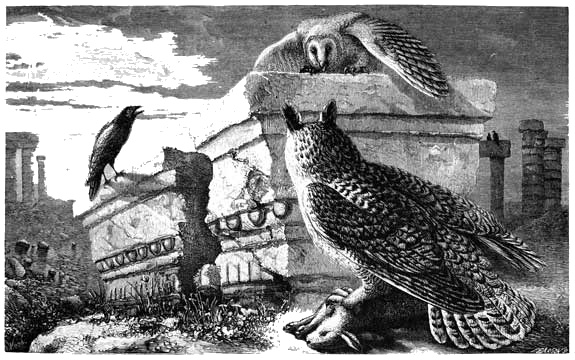
THE OWL.
"I am a companion to owls."—Job. xxx. 29.
The reader may remember that even our very imperfect version of the "Arabian Nights" repeatedly alludes to this belief, the evil spirit being almost invariably represented as dwelling in ruins, rocky places, and the interiors of wells.
Although it is very possible that the prophet may have referred to some of the mythological beings which were so universally supposed to inhabit deserted spots, and thus to have employed the word lilith as a term which he did not intend to be taken otherwise than metaphorically, it is equally possible that some nocturnal bird may have been meant, and in that case the bird in question must almost certainly have been an Owl of some kind. As to the particular species of Owl, that is a question which cannot be satisfactorily answered, especially as so many scholars find reason to doubt whether the word lilith represents an Owl, or indeed any ordinary inhabitant of earth. As, therefore, we have no data whereon to found a positive opinion, the question will be allowed to remain an open one.
The last word which is translated as Owl is kippoz, and occurs in ch. xxxiv. 15: "There shall the great owl make her nest."
Many Hebraists think that in this case the word kippoz is a mere clerical error for kippod, or hedgehog, and have translated the passage accordingly. The Septuagint and the Vulgate follow this reading; Buxtorf, in his Hebrew Lexicon, translates kippoz as Thrush, deriving the name from the dipping character of its flight. The Jewish Bible, following several other authorities, renders the word as "arrow-snake," while several scholars translate it as "darting serpent." This interpretation, however, is scarcely tenable, as the description of the Kippoz as making its nest, laying its eggs, and gathering them under its shadow, clearly points to a bird, and not a reptile. It is very true that the boa or python snake has been seen to coil itself round a heap of its eggs, but the sacred writer could hardly have had many opportunities of seeing such an act, while the custom of a bird gathering her young under the shadow of her wings must have been perfectly familiar to him. There is, moreover, the fact that the context speaks of the vultures, so that a bird of some kind was evidently in the mind of the writer. Mr. Tristram suggests that the Kippoz might be intended for the Scops Owl, called Marouf by the Arabs, and which is very common about ruins, caves, and the old walls of towns. Its note is well represented by the word kippoz.
"It is a migrant, returning to Palestine in spring. It is the smallest owl in the country, being little more than seven inches in length, with long ear-tufts, and its whole plumage most delicately mottled and speckled with grey and light brown."
This species is very plentiful on the continent of Europe, though it is rare in the British Isles. It feeds, as might be presumed from its diminutive size, on mice, small reptiles, and insects. Its scientific name, according to the nomenclature of the British Museum, is Ephialtes Scops.
THE NIGHT-HAWK.
Different interpretations of the word Tachmâs—Probability that it signifies the Nightjar—Various names of the bird—Its remarkable jarring cry, and wheeling flight—Mode of feeding—Boldness of the bird—Deceptive appearance of its size.
We next come to the vexed question of the word Tachmâs, which is rendered in the Authorized Version as Night-hawk.
This word only occurs among the list of prohibited birds (see Lev. xi. 16, and Deut. xiv. 15), and has caused great controversies among commentators. Some Hebraists have thought that the male ostrich was signified by tachmâs, the word bath-haya'anah being supposed by them to signify the female ostrich. It is hardly probable, however, that the sacred writer should have mentioned separately the sexes of the same species, and we must therefore look for some other interpretation.
Going to the opposite extreme of size, some scholars have translated tachmâs as Swallow. This again is not a very probable rendering, as the swallow would be too small a bird to be specially named in the prohibitory list. The balance of probability seems to lie between two interpretations,—namely, that which considers the word tachmâs to signify the Night-hawk, and that which translates it as Owl. For both of these interpretations much is to be said, and it cannot be denied that of the two the latter is perhaps the preferable. If so, the White or Barn Owl is probably the particular species to which reference is made.