BIRDS. (continued 3)
Reading edition
"Or if he shall ask an egg, will he offer him a scorpion?"
There is but one passage in the Old Testament which has ever been conjectured to refer to the Domestic Fowl. It occurs in 1 Kings iv. 22, 23, among the list of the daily provision of Solomon's household: "And Solomon's provision for one day was thirty measures of fine flour, and threescore measures of meal,
"Ten fat oxen, and twenty oxen out of the pastures, and an hundred sheep, beside harts, and roebucks, and fallow-deer, and fatted fowl."
Now the word which is here rendered as "fatted fowl" is in the Hebrew, barberim. Judging by the etymology of the word, which is derived from a root that signifies whiteness, or purity, it has been thought that the correct rendering would be "fattened white" (birds). Some Hebraists have conjectured that the white birds in question were geese, this term including various white birds, swans among the number.
Many persons think that the fatted fowl mentioned in the above-quoted passage were really Domestic Fowl, which Solomon had introduced into Palestine, together with various other birds and animals, by means of his fleet. There may be truth in this conjecture, but, as there can be no certainty, we will pass from the Old Testament to the New.
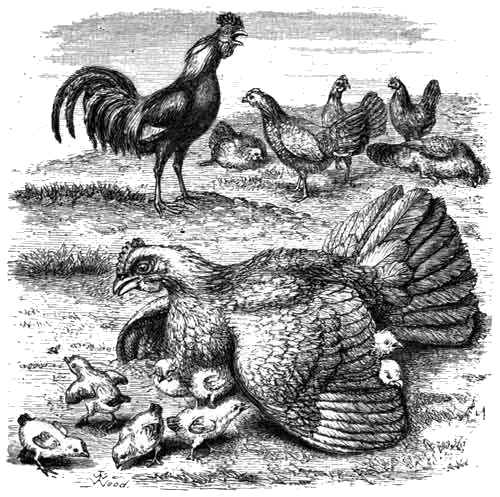
THE DOMESTIC FOWL.
"As a hen doth gather her brood under her wings."—Luke xiii. 34.
We are all familiar with the passages in which the Domestic Fowl is mentioned in the New Testament. There is, for example, that touching image employed by our Lord when lamenting over Jerusalem: "O Jerusalem, Jerusalem, thou that killest the prophets, and stonest them that are sent unto thee; how often would I have gathered thy children together, as a hen doth gather her brood under her wings, and ye would not!" The reference is evidently made to the Domesticated Fowl, which in the time of our Lord was largely bred in the Holy Land.
Some writers have taken objection to this statement in consequence of a Rabbinical law which prohibited poultry from being kept within the walls of Jerusalem, lest in their search for food they should scratch up any impurity which had been buried, and so defile the holy city. But it must be remembered that in the time of Christ Jerusalem belonged practically to the Romans, who held it with a garrison, and who, together with other foreigners, would not trouble themselves about any such prohibition, which would seem to them, as it does to us, exceedingly puerile, not to say unjustifiable. Whether the Jews obeyed or disregarded the prohibition, it is evident that it would have been binding on the Jews alone, and that all Gentiles were exempt from it. Some commentators have even thought that the Domestic Fowl was not known in Palestine until imported by the Romans.
That the bird was common in the days of our Lord is evident from the reference to the "cock-crowing" as a measure of time.
Even on this subject there has been much controversy, some persons thinking that the words are to be understood in their literal sense, and others that they are merely metaphorical, and refer to the divisions of time under the Romans, which were marked by the blowing of trumpets, conventionally termed cock-crowings. There is, however, no necessity to search for a metaphorical meaning when the literal interpretation is clear and intelligible. At the present day, as in all probability in the time of our Lord, the crowing of the cocks is employed as a means of reckoning time during the night, the birds crowing at certain hours with almost mechanical regularity.
THE PEACOCK.
The foreign curiosities imported by Solomon—The word Tucciyim and its various interpretations—Identity of the word with the Cingalese name of the Peacock—Reasons why the Peacock should have been brought to Solomon—Its subsequent neglect and extirpation.
Among the many foreign objects which were imported by Solomon into Palestine, we find that the Peacock is specially mentioned. (See a passage which has already been mentioned in connexion with ivory and apes.) The sacred historian, after mentioning the ivory throne, the golden shields and targets, that all the vessels in Solomon's house were of gold, and that silver was so common as to be of no account, proceeds to give the reason for this profuse magnificence. "For the king had at sea a navy of Tharshish with the navy of Hiram: once in three years came the navy of Tharshish, bringing gold, and silver, ivory, and apes, and peacocks" (1 Kings x. 22).
The word which is here translated as Peacock is in the Hebrew tucciyim, and has been rendered in various modes. The Jewish Bible accepts the same translation as our own, and does not even affix the mark of doubt. Some Hebraists have rendered the word as "parrots," while others have tried to identify the Tucciyim with guinea-fowls.
In the identification of any animal, much must necessarily depend on the country in which it is found. Now, if the reader will refer to page 2 of this work, he will see that India and Ceylon are identified as the land visited by Solomon's ships. In the latter island are found all the three valuables which are mentioned in the above-quoted passage, and it is remarkable that the Cingalese name for the Peacock is so similar to the Hebrew word, that we have every reason to believe that the word tucciyim or tuyeyim is in reality a Hebraic form of the Cingalese tokei. A similar resemblance of name occurs in the Hebrew and Cingalese terms for ape and elephant.
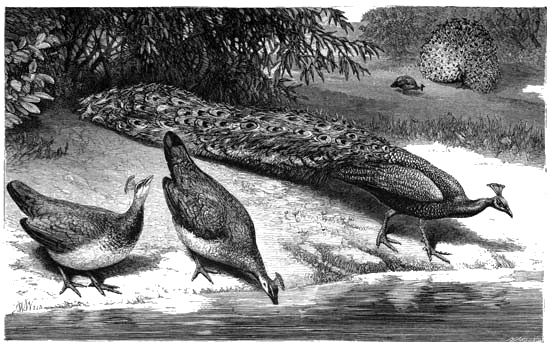
THE PEACOCK.
"Once in three years came the navy of Tharshish, bringing gold, and silver, ivory, and apes, and peacocks." 1 Kings x. 22.
That this magnificent bird should have been one of those creatures that were imported by Solomon is almost certain. It would be imported for the same reason as the apes; namely, for the purpose of adding to the glories of Solomon's house, and no bird could have been selected which would have a more magnificent effect than the Peacock. Moreover, although unknown in Palestine, it is extremely plentiful in its native land, inhabiting the jungle by thousands, and, by a curious coincidence, being invariably most plentiful in those spots which are most frequented by tigers. In many parts of the country, great numbers of Peacocks frequent the temples, and live amicably with the sacred monkeys, passing their lives in absolute security, protected by the sanctity of the place.
Their numbers, therefore, would render them easily accessible to Solomon's envoys, who would purchase them at a cheap rate from the native dealers, while their surpassing beauty would render them sure of a sale on their arrival in Jerusalem. Indeed, their beauty made so great an impression that they are separately mentioned by the sacred chronicler, the Peacock and the ape being the only two animals that are thought worthy of enumeration.
It seems that after Solomon's death the breed of Peafowl was not kept up, owing in all probability to the troubles which beset the throne after that magnificent monarch died.
THE PARTRIDGE.
The word Kore and its signification—The Partridge upon the mountains—David's simile—The Desert Partridge and its habits—Hunting the Partridge with sticks—Eggs of the Partridge—A disputed reading, and probable signification of the passage—Egg-hunting in Palestine—The various species of Partridge—The Francolin and the Sand-grouse.
There is a bird mentioned in the Old Testament, which, although its name is only given twice, is a very interesting bird to all students of the Scriptures, both passages giving an insight into the manners and customs of the scarcely changing East. This is the bird called in the Hebrew Kore, a word which has been generally accepted as signifying some kind of Partridge. There is no doubt that, like most other Hebrew names of animated beings, the word is a collective one, signifying a considerable number of species.
The first passage occurs in 1 Sam. xxvi. 20. When David was being pursued by Saul, and had been forced to escape from the city and hide himself in the rocky valleys, he compared himself to the Partridge, which frequented exactly the same places: "The king of Israel is come out to seek a flea, as when one doth hunt a partridge upon the mountains."
The appositeness of this simile is perfect. The bird to which David alluded was in all probability the Desert Partridge (Ammoperdix Heyii), a species which especially haunts rocky and desert places, and even at the present day is exceedingly plentiful about the Cave of Adullam. The males, when they think themselves unobserved, are fond of challenging, or calling to each other in a loud ringing note, a peculiarity that has earned for the bird the Hebrew name of Kore, or "the caller."
It is a very active bird, not taking to flight if it can escape by means of its legs, and, when pursued or disturbed, running with great swiftness to some rocky cleft in which it may hide itself, taking care to interpose, as it runs, stones or other obstacles between itself and the object of its alarm. Thus, then, it will be seen how close was the parallel between this bird and David, who was forced, like the Partridge, to seek for refuge in the rocky caves.
But the parallel becomes even closer when we come to examine the full meaning of the passage. The Partridge is at the present day hunted on the mountains exactly as was the case in the time of David. The usual hunters are boys, who provide themselves with a supply of stout sticks about eighteen inches in length, and, armed with these, they chase the birds, hurling the sticks one after the other along the ground, so as to strike the Partridge as it runs. Generally, several hunters chase the same bird, some of them throwing the sticks along the ground, while others hurl them just above the bird, so that if it should take to flight, it maybe struck as it rises into the air. By pertinaciously chasing an individual bird, the hunters tire it, and contrive to come so close that they are certain to strike it.
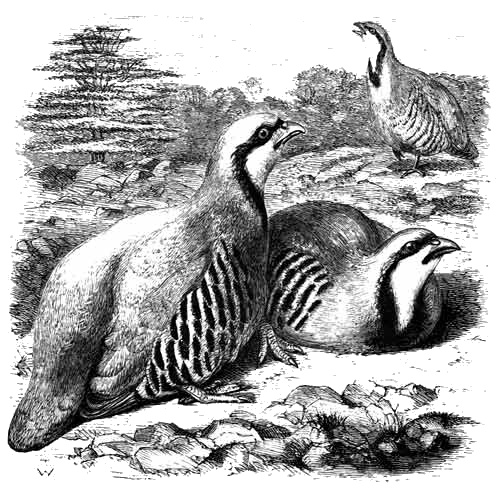
THE GREEK PARTRIDGE.
"A partridge upon the mountains."—1 Sam. xxvi. 20.
Rude as this mode of bird-hunting may seem, it is still employed in some parts of England, and is effective even against birds far more active on the wing than the Partridge. I have seen snipe killed in the New Forest by being hunted down with sticks. Squirrels are chased and killed in a similar manner, except that the "bolts," or the sticks for squirrel-hunting, are weighted with lead at one end.
The reader will now see how perfect is the image. Driven from the city, David was forced to wander, together with the Desert Partridge, upon the hill-sides, and, like that bird, his final refuge is the rock. Then came the hunters and pursued him, driving him from place to place, as the boys hunt the Partridge, until he was weary of his life, and exclaimed in his despair, "I shall now perish one day by the hand of Saul."
The second passage in which the word kore is found occurs in Jer. xvii. 11: "As the partridge sitteth on eggs, and hatcheth them not; so he that getteth riches, and not by right, shall leave them in the midst of his days, and at his end shall be a fool." The marginal reading of this passage gives the sense in a slightly different form, and commences the verse as follows: "As the partridge gathereth (young) which she hath not brought forth, so he," &c. The Jewish Bible gives the whole passage rather differently from both these readings: "A partridge hatching what it hath not laid (or borne), is he that getteth (or maketh) riches, and not by right (or judgment): he shall leave them in the midst (or half) of his days, and at his end shall be base."
Taking all these readings, and comparing them with the original, with each other, and with the context, we can have but little doubt that reference is made by the prophet to the number of unborn, i.e. unhatched, eggs on which the Partridge sits, but which are so often taken from her before they can be hatched. Just as hunting the Partridge is an acknowledged sport among the inhabitants of the uncultivated parts of Palestine, so is searching for the eggs of the bird a regular business at the proper time of year.
The Partridges of Palestine are, like those of our own land, exceedingly prolific birds, laying a wonderful number of eggs, more than twenty being sometimes found in a single nest. These eggs are used for food, and the consumption of them is very great, so that many a Partridge has been deprived of her expected family: she has sat upon eggs, and hatched them not.
Of these birds several species inhabit Palestine. There is, for example, the Desert Partridge, which has already been mentioned. It is beautifully, though not brilliantly, coloured, and may be known by the white spot behind the eye, the purple and chestnut streaks on the sides, and the orange bill and legs. These, however, soon lose their colour after death.
Then there is the Greek Partridge (Caccabis saxatilis), which is even more plentiful than the preceding species, and is more widely spread. It is a large bird of its kind, being much larger than our English species, and may be known by its size, the dark red legs and beak, and the bold bars on the sides.
Mr. Tristram suggests, with much probability, that the Francolin, or Black Partridge of India, and the Sand-Grouse, may be included among the number of the birds which are included under the common name of Kore. The latter bird is extremely plentiful in Palestine, and, in all probability, was classed by the unobservant Jews with the true Partridge.
THE QUAIL.
Signification of the word Selâv—Various passages in which the word is mentioned—The locust, the stork, and the sand-grouse—Spreading the birds around the camp—Migration of the Quail—Drying the Quails for food—Modes of catching the Quail in the East—The Quail-hunters of Northern Africa—Quarrelsome nature of the bird—Quail-fighting in the East—How the Quails were brought to the Israelites.
In one or two parts of the Old Testament is found a word which has been translated in the Authorized Version of the Bible as Quail.
The word is selâv, and in every case where it is mentioned it is used with reference to the same occurrence; namely, the providing of flesh-meat in the wilderness, where the people could find no food. As the passages remarkably bear upon each other, it will be advisable to quote them in the order in which they come.
The first mention of the Selâv occurs in Exod. xvi. Only a few days after the Israelites had passed the Red Sea, they began to complain of the desert land into which Moses had led them, and openly said that they wished they had never left the land of their slavery, where they had plenty to eat. According to His custom, pitying their narrow-minded and short-sighted folly, the natural result of the long servitude to which they had been subject, the Lord promised to send both bread and flesh-meat.
"And the Lord spake unto Moses, saying,
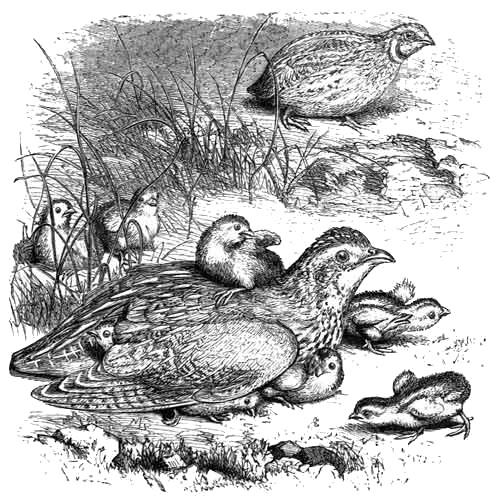
THE QUAIL.
"The people asked, and He brought quails."—Psalm cv. 40.
"I have heard the murmurings of the children of Israel: speak unto them, saying, At even ye shall eat flesh, and in the morning ye shall be filled with bread; and ye shall know that I am the Lord your God.
"And it came to pass, that at even the quails came up, and covered the camp" (ver. 11-13).
The next passage records a similar circumstance, which occurred about a year afterwards, when the Israelites were tired of eating nothing but the manna, and again wished themselves back in Egypt. "And there went forth a wind from the Lord, and brought quails from the sea, and let them fall by the camp, as it were a day's journey on this side, and as it were a day's journey on the other side, round about the camp, and as it were two cubits high upon the face of the earth.
"And the people stood up all that day, and all that night, and all the next day, and they gathered the quails: he that gathered least gathered ten homers; and they spread them all abroad for themselves round about the camp" (Numb. xi. 31, 32).
The last passage in which Quails are mentioned occurs in the Psalms. In Ps. cv. are enumerated the various wonders done on behalf of the Israelites, and among them is specially mentioned this gift of the Quails and manna. "The people asked, and He brought quails, and satisfied them with the bread of heaven" (ver. 40).
We now have to ask ourselves what the word selâv really means. Some commentators have thought that it signified a species of locust, insects which travel in vast multitudes, and are always carried with the wind, thus agreeing with the statement that the Selavim were brought by the wind. Others have imagined that the Selavim were flying-fish, blown on shore as they rose from the sea after their fashion. Putting aside other reasons against these interpretations, the Psalms contain a passage which effectually contradicts them, and proves that the Selâv was a bird of some kind.
"He had commanded the clouds from above, and opened the doors of heaven,
"And had rained down manna upon them to eat, and had given them of the corn of heaven.
"Man did eat angels' food: He sent them meat to the full.
"He caused an east wind to blow in the heaven; and by His power He brought in the south wind.
"He rained flesh also upon them as dust, and feathered fowls like as the sand of the sea" (Ps. lxxviii. 23-27).
From this passage it is evident that the Selavim which were sent together with the manna were birds of some kind—"fowls of wing," according to the literal sense of the Hebrew; so that the theory that they were insects or fish must be dismissed as untenable. The question now remains, with what species of bird are we to identify the Selâv?
Respecting this question, there has been great discussion, chiefly arising from the fact that the various commentators endeavoured to show that the Selâv was not the Quail, but some other bird. Some, for example, take it to be the white stork, which is very plentiful in Palestine, and sometimes flies in such numbers that the sky is darkened as the winged host passes by. They base this supposition on the stature of the bird, which is so tall that it stands about "two cubits high upon the face of the earth." So it does, but this is a very insufficient reason for translating the word selâv as "stork."
In the first place, the words "as it were two cubits high upon the face of the earth" certainly do not refer to the stature of the individual birds. They are popularly taken to signify that the earth was covered with the bodies of the Selavim to the depth of three feet.
This, however, can hardly have been the fact, as in that case they would have utterly overwhelmed the whole camp, and crushed the tents by their weight. Moreover, there would have been no need of gathering them up, as they would have lain so thickly on the ground that the only trouble would have been to make a passage through them. It is not very easy to force a passage through snow a yard in depth, while to do so through the same depth of birds would have been almost impossible.
Neither could the Israelites have "spread them all abroad for themselves round about the camp." If the Selavim lay to the depth of a yard "as it were a day's journey on this side, and a day's journey on the other side of the camp," i.e. some eight or ten miles all round it, there would have been no space whereon the birds could have been spread. The sentence in question has a totally different signification, and refers to the height from the ground at which the birds fly. Taken in this sense, the whole passage falls into harmony, whereas in any other it involves a difficulty.
If the ordinary interpretation of selâv by "Quail" be accepted, the description is exactly correct. The Quails fly in vast flocks, and, being weak-winged birds, never fly against the direction of the wind. They will wait for days until the wind blows in the required direction, and will then take wing in countless multitudes; so that in an hour or two a spot on which not a Quail could be seen is covered with them.
On account of their short wings, they never rise to any great height, even when crossing the sea, while on land they fly at a very low elevation, merely skimming over the ground, barely a yard or "two cubits high upon the face of the earth." We may now see how needless it is to attribute the two cubits to the stature of the bird, or to the depth at which they lay on the ground.
There are other reasons why the Selâv could not be any species of stork. In the first place, all the stork tribe are included among the list of unclean birds, and it is not likely that the Almighty would have neutralized His own edicts by providing food which the Israelites were forbidden to eat. In the next place, even had the flesh of the stork been lawful, it is of so unpleasant a nature that the people could not have eaten it. For similar reasons we may dismiss the theories which consider the Selâv to be a goose or water-fowl of any kind.
Some persons have thought that the sand-grouse is the Selâv. In the first place, the flesh of this bird is hard, tasteless, and disliked by those who have tried it; so that the Israelites would not have been tempted to eat it. In the next, it is a strong-winged and swift-footed bird, and would not have satisfied the required conditions. It flies high in the air, instead of merely skimming over the ground, and when it alights is fresh and active, and cannot easily be caught. The Quail, on the contrary, after it has flown for any distance, is so completely tired out that when it alights it crouches to the earth, and will allow itself to be picked up by hand. It has even been trodden to death under a horse's feet.
Moreover, the flesh of the Quail is peculiarly excellent, and would be a great temptation to men who had passed so long a time without eating animal food. Another corroboration of the identity of the Quail and the Selâv is to be found in the mode in which the flesh is prepared at the present day. As soon as the birds have arrived, they are captured in vast multitudes, on account of their weariness. Many are consumed at once, but great numbers are preserved for future use by being split and laid out to dry in the sun, precisely as the Israelites are said to have spread out the Selavim "all abroad for themselves round about the camp."
It is rather remarkable that the Arabs of the present day use a word almost exactly resembling selâv to represent the Quail. The word is salwa, given by one of the older writers on the subject as selaw.
Accepting, therefore, the Selâv and Quail to be identical, we may proceed to the description of the bird.
It is small, plump, and round-bodied, with the head set closely on the shoulders. Owing to this peculiarity of form, it has its Arab name, which signifies plumpness or fatness. The wings are pressed closely to the body, and the tail is pointed, very short, and directed downwards, so that it almost appears to be absent, and the bird seems to be even more plump than really is the case.
Several modes of capturing these birds are still practised in the East, and were probably employed, not only on the two occasions mentioned in Exodus and Numbers, but on many others of which the Scriptural narrative takes no notice. One very simple plan is, for the hunters to select a spot on which the birds are assembled, and to ride or walk round them in a large circle, or rather in a constantly diminishing spiral. The birds are by this process driven closer and closer together, until at the last they are packed in such masses that a net can be thrown over them, and a great number captured in it.
Sometimes a party of hunters unite to take the Quails, and employ a similar manœuvre, except that, instead of merely walking round the Quails, they approach simultaneously from opposite points, and then circle round them until the birds are supposed to be sufficiently packed. At a given signal they all converge upon the terrified birds, and take them by thousands at a time.
In Northern Africa these birds are captured in a very similar fashion. As soon as notice is given that a flight of Quails has settled, all the men of the village turn out with their great burnouses or cloaks. Making choice of some spot as a centre, where a quantity of brushwood grows or is laid down, the men surround it on all sides, and move slowly towards it, spreading their cloaks in their outstretched hands, and flapping them like the wings of huge birds. Indeed, when a man is seen from a little distance performing this act, he looks more like a huge bat than a human being.
As the men gradually converge upon the brushwood, the Quails naturally run towards it for shelter, and at last they all creep under the treacherous shade. Still holding their outspread cloaks in their extended hands, the hunters suddenly run to the brushwood, fling their cloaks over it, and so enclose the birds in a trap from which they cannot escape. Much care is required in this method of hunting, lest the birds should take to flight, and so escape. The circle is therefore made of very great size, and the men who compose it advance so slowly that the Quails prefer to use their legs rather than their wings, and do not think of flight until their enemies are so close upon them that their safest course appears to be to take refuge in the brushwood.
Boys catch the Quails in various traps and springes, the most ingenious of which is a kind of trap, the door of which overbalances itself by the weight of the bird.
By reason of the colour of the Quail, and its inveterate habit of keeping close to the ground, it easily escapes observation, and even the most practised eye can scarcely distinguish a single bird, though there may be hundreds within a very small compass. Fortunately for the hunters, and unfortunately for itself, it betrays itself by its shrill whistling note, which it frequently emits, and which is so peculiar that it will at once direct the hunter to his prey.
This note is at the same time the call of the male to the female and a challenge to its own sex. Like all the birds of its group, the Quail is very combative, and generally fights a battle for the possession of each of its many mates. It is not gifted with such weapons of offence as some of its kinsfolk, but it is none the less quarrelsome, and fights in its own way as desperately as the game-cock of our own country.
Indeed, in the East, it is used for exactly the same purpose as the game-cock. Battles between birds and beasts, not to say men, are the common amusement with Oriental potentates, and, when they are tired of watching the combats of the larger animals, they have Quail-fights in their own chambers. The birds are selected for this purpose, and are intentionally furnished with stimulating food, so as to render them even more quarrelsome than they would be by nature. Partridges are employed for the same cruel purpose; and as both these birds are easily obtained, and are very pugnacious, they are especially suited for the sport.
Two passages occur in the Scriptures which exactly explain the mode in which the Quails were sent to the Israelites. The first is in Ps. lxxviii. 26. The Psalmist mentions that the Lord "caused an east wind to blow in the heaven, and by His power He brought in the south wind." Here, on examining the geographical position of the Israelites, we see exactly how the south-east wind would bring the Quails.
The Israelites had just passed the Red Sea, and had begun to experience a foretaste of the privations which they were to expect in the desert through which they had to pass. Passing northwards in their usual migrations, the birds would come to the coast of the Red Sea, and there would wait until a favourable wind enabled them to cross the water. The south-east wind afforded them just the very assistance which they needed, and they would naturally take advantage of it.
It is remarkable how closely the Scriptural narrative agrees with the habits of the Quail, the various passages, when compared together, precisely coinciding with the character of the bird. In Exod. xvi. 13 it is mentioned that "at even the quails came up and covered the camp." Nocturnal flight is one of the characteristics of the Quail. When possible, they invariably fly by night, and in this manner escape many of the foes which would make great havoc among their helpless columns if they were to fly by day.
The identity of the Selâv with the common Quail is now seen to be established. In the first place, we have the name still surviving in the Arabic language. Next, the various details of the Scriptural narrative point so conclusively to the bird, that even if we were to put aside the etymological corroboration, we could have but little doubt on the subject. There is not a detail which is not correct. The gregarious instinct of the bird, which induces it to congregate in vast numbers; its habit of migration; its inability to fly against the wind, and the necessity for it to await a favourable breeze; its practice of flying by night, and its custom of merely skimming over the surface of the ground; the ease with which it is captured; the mode of preserving by drying in the sun, and the proverbial delicacy of its flesh, are characteristics which all unite in the Quail.
Before closing our account of the Quail, it will be as well to devote a short space to the nature of the mode by which the Israelites were twice fed. Commentators who were unacquainted with the natural history of the bird have represented the whole occurrence as a miraculous one, and have classed it with the division of the Red Sea and of the Jordan, with the various plagues by which Pharaoh was induced to release the Israelites, and with many other events which we are accustomed to call miracles.
In reality, there is scarcely anything of a miraculous character about the event, and none seems to have been claimed for it. The Quails were not created at the moment expressly for the purpose of supplying the people with food, nor were they even brought from any great distance. They were merely assisted in the business on which they were engaged, namely, their migration or customary travel from south to north, and waiting on the opposite side of the narrow sea for a south-east wind. That such a wind should blow was no miracle. The Quails expected it to blow, and without it they could not have crossed the sea. That it was made to blow earlier than might have been the case is likely enough, but that is the extent of the miraculous character of the event. Taking the word in its ordinary sense, no miracle was wrought, simply because none was wanted. Granting to the fullest extent that He who arranged the course of the world can alter His arrangements as easily as He made them, we cannot but see that in this case no alteration was needed, and that, in consequence, none was made.
THE RAVEN.
Signification of the word Oreb—The Raven tribe plentiful in Palestine—The Raven and the Dove—Elijah and the Ravens—Various explanations of the circumstance—Feeding the young Ravens—Luis of Grenada's sermon—The white Raven of ancient times—An old legend—Reference to the blackness of the Raven's plumage—Desert-loving habits of the Raven—Its mode of attacking the eye—Notions of the old commentators—Ceremonial use of the Raven—Return of the Ravens—Cunning of the bird—Nesting-places of the Raven—The magpie and its character—The starling—Its introduction into Palestine—The Rabbi perplexed—Solution of the difficulty.
It is more than probable that, while the Hebrew word oreb primarily signifies the bird which is so familiar to us under the name of Raven, it was also used by the Jews in a much looser sense, and served to designate any of the Corvidæ, or Crow tribe, such as the raven itself, the crow, the rook, the jackdaw, and the like. We will first take the word in its restricted sense, and then devote a brief space to its more extended signification.
As might be expected from the cosmopolitan nature of the Raven, it is very plentiful in Palestine, and even at the present time is apparently as firmly established as it was in the days when the various Scriptural books were written.
There are few birds which are more distinctly mentioned in the Holy Scriptures than the Raven, though the passages in which its name occurs are comparatively few. It is the first bird which is mentioned in the Scriptures, its name occurring in Gen. viii. 7: "And it came to pass at the end of forty days, that Noah opened the window of the ark which he had made;
"And he sent forth a raven, which went forth to and fro, until the waters were dried up from off the earth."
Here we have, at the very outset, a characteristic account of the bird. It left the ark, and flew to and fro, evidently for the purpose of seeking food. The dove, which immediately followed the Raven, acted in a different manner. She flew from the ark in search of food, and, finding none, was forced to return again. The Raven, on the contrary, would find plenty of food in the bodies of the various animals that had been drowned, and were floating on the surface of the waters, and, therefore, needed not to enter again into the ark. The context shows that it made the ark a resting-place, and that it "went forth to and fro," or, as the Hebrew Bible renders the passage, "in going and returning," until the waters had subsided. Here, then, is boldly drawn the distinction between the two birds, the carrion-eater and the feeder on vegetable substances—a distinction to which allusion has already been made in the history of the dove.
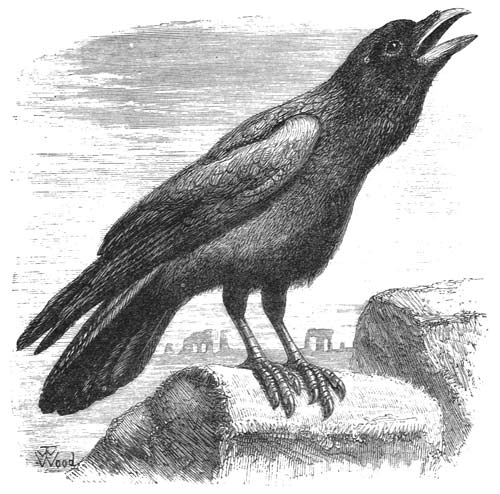
THE RAVEN.
"Who provideth for the raven his food?"—Job xxxviii. 41.
Passing over the declaration in Lev. xi. 15 and Deut. xiv. 14, that every Raven (i.e. the Raven and all its tribe) is unclean, we come to the next historical mention of the bird. This occurs in 1 Kings xvii. When Elijah had excited the anger of Ahab by prophesying three years of drought, he was divinely ordered to take refuge by the brook Cherith, one of the tributaries of the Jordan. "And it shall be, that thou shalt drink of the brook; and I have commanded the ravens [orebim] to feed thee there.
"So he went and did according unto the word of the Lord: for he went and dwelt by the brook Cherith, that is before Jordan.
"And the ravens brought him bread and flesh in the morning, and bread and flesh in the evening, and he drank of the brook."
In this passage we have a history of a purely miraculous character. It is not one that can be explained away. Some have tried to do so by saying that the banished prophet found the nests of the Ravens, and took from them daily a supply of food for his sustenance. The repetition of the words "bread and flesh" shows that the sacred writer had no intention of signifying a mere casual finding of food which the Ravens brought for their young, but that the prophet was furnished with a constant and regular supply of bread and meat twice in the day. It is a statement which, if it be not accepted as the account of a miracle, must be rejected altogether.
I may here mention that an explanation of the passage has been offered by some commentators, who render the word orebim as "Arabs," and so arrive at the conclusion that the prophet was fed in his retirement by the Arab tribes which came to the brook for water. Others have thought that the Orebim were the inhabitants of a village called Orbo, near the Cherith. There is, however, no need of any such explanations. The account of the prophet's flight to the Cherith and of the daily supply of food which he received has been accepted as a simple statement of facts by all Jewish writers, and there is no alternative but either to accept it in the same sense or to reject it.
This part of the subject naturally leads to certain passages in which the feeding of the young Ravens is mentioned. See, for example, Job xxxviii. 41: "Who provideth for the raven his food? when his young ones cry unto God, they wander for lack of meat." This passage is rendered rather differently and more forcibly in the Jewish Bible. "Who provideth for the raven his food, when his young ones cry unto God, and wander for lack of meat?" A passage of similar import occurs in Ps. cxlvii. 9: "He giveth to the beast his food, and to the young ravens which cry." An evident reference is made to these passages in Luke xii. 24: "Consider the ravens: for they neither sow nor reap; which neither have storehouse nor barn; and God feedeth them: how much more are ye better than the fowls?"
In all these cases reference is made to a curious idea which prevailed respecting the Raven. It was thought that the Raven was a cruel parent, and that after the eggs were hatched it cared nothing for the young until they were full fledged. As, moreover, the bird was thought to be peculiarly late in attaining its plumage, the young Ravens must all die of hunger, were they not fed in some remarkable manner. This subject is treated at some length by Luis of Grenada in his Sermons. As the passage in question is a very curious one, I give both the original and a translation. For the latter I am indebted to the Rev. C. J. Smith, author of "Synonyms and Antonyms," who has preserved, with much success, the quaint structure of the language.
"Dominica XIV. post Pent. Concio 1:
"Nisi hæc enim omnia magnam nobis admirationis materiam divinæque providentiæ notitiam præberent, nequaquam Dominus inter cetera sapientiæ et providentiæ suæ argumenta hoc etiam commemoraret, cum ad Job ait: 'Quis præparat corvo escam suam, quando pulli ejus clamant ad Deum vagantes eò quòd non habeant cibos?'[1] Et in Psal.: 'Qui dat jumentis escam ipsorum et pullis corvorum invocantibus eum.'[2]
"Cur autem hoc in loco pullorum corvi præcipuè meminerit, in causa est, quod in his miro modo singularis providentiæ cura elucet. Ait enim interpres quidam corvorum pullos eum implumes adhuc sunt, candorem præ se ferre: ideoque a parentibus ut nothos negligi, quod eorum non referant colorem. Quo tempore divina providentia, quæ nusquam dormit, eos ad se clamantes alit. Vermiculos enim quosdam in nidulo nasci constituit, quorum esu sustentantur donec nono tandem die nascentibus plumis parentum colorem referant, atque ita demum ab illis nutriantur.
"Cum igitur divina providentia nulla in re neque animalculis istis etiam si a patribus deserantur desit, quanta ilia diffidentia est, quæ solis hominibus eam deesse profitetur? Si homo inter omnes inferioris hujus mundi creaturas nobilissimum et pulcherrimum animal est, si solus ipse Dei imagine insignitus, si ipse hujus magnæ familiæ princeps ac dominus est, si ejus obsequio cuncta militant, si omnia rerum conditor subiecit pedibus ejus oves et boves universas, insuper et pecora campi, &c. qui fieri potest ut cum hujus mundi moderator Dñs nullum neque animalculum neque vermiculum a providentiæ suæ cura excludat, sed omnibus abunde omnia suppeditat, pium hominem (cujus obsequio cuncta destinavit) fame et inedia confici patiatur. Si pater aliquis filii sui familiam, servos, ancillas, et jumenta diligenter curaret, illisque necessaria abunde provideret, quomodo filium fame perire sineret, cujus familiam tanta cura fovet et alit? Quis enim hoc in animum inducere possit? Hæc ijitur altera ratio est qua celestis Magister diffidentiam nostram curare, et spem alere atque fulcire studet."
"Fourteenth Sunday after Pentecost, Sermon 1:
"For if it were not that all these things afford to us great matter of admiration and demonstration of the providence of God, it were in vain that the Lord, among other tokens of His wisdom and providence, had selected this also, when He saith in Job: 'Who provideth for the raven his food? when his young ones cry unto God, wandering for lack of meat.' And in the Psalms: 'Who giveth their own food to the cattle, and to the young ravens that call upon Him.'
"Now that in this place He hath been mainly mindful of the ravens' young, is partly for this cause, that marvellously in them the singular care of Providence doth show forth. For a certain annotator saith, that the young ravens while as yet they are unfledged do appear of whiteness, and therefore are neglected of their parents as if they were bastards, seeing that they resemble not their colour. At which time Divine Providence, who nowhere sleepeth, doth feed them who call upon Himself. For He causeth certain vermicles (small worms) to be bred in the little nest, by eating of which they are sustained, until at length on the ninth day, the feathers beginning to grow, they resemble the colour of their parents, and so come to be nourished by them.
"Seeing then that Divine Providence is never wanting in any matter, not even to these little creatures, though they be deserted of their parents, how great is that distrust which averreth that it is wanting unto men alone! If man be among all the creatures of this lower world the noblest and the fairest of things; if he alone be made illustrious by God's image; if he himself be of this great family the leader and lord; if in obedience to him all things serve; if the Constructor of all things hath put under his feet 'all sheep and oxen, yea, and the beasts of the field;' how shall it be that when the Lord, the Ruler of this world, shutteth out none, neither insect nor worm, from the care of His providence, but supplieth abundantly all things for all, He should suffer the righteous man, for whose service He hath appointed all things, to perish of hunger and lack of food?
"If it be that every father would diligently care for his son's household, and men-servants, and maid-servants, and cattle, and provide them abundantly with all things needful, how should He suffer His sons to perish whose families He cherisheth and feedeth with so great care? Who, indeed, could harbour such a thought? This then is another consideration whereby the heavenly Master seeks to cure our distrust, and to feed and stay our hope."
Some of the old writers improved on this legend by saying that the worms crawled into the mouths of the young Ravens, so that the birds had not even the trouble of picking them up.
Some of the ancient Jewish writers had an idea that the Raven was originally a white bird, and that its colour was changed by way of punishment for its evil disposition and deceitful conduct. A similar idea was held by the old mythological writers. They said that the Raven was formerly the favourite bird of Apollo, and that it was celebrated for its sweet song and snowy white plumage. Part of its duty was to bring water for its master from the fountain Hippocrene.
One day, instead of doing its duty, the bird amused itself in the garden, and at last fell asleep. Fearful when it awoke that it should be punished for its carelessness, the cunning Raven snatched up a snake, killed it, and brought it to Apollo, saying that the serpent had disputed the passage to the fountain, and that, after a long fight, it had just been killed. Apollo, angry with the bird for having told a lie, drove it from his presence, and as it fled its musical voice turned into a harsh croak, and its white plumage became black.
"'Liar!' exclaimed the god, The Python-killer, as from his keen eye The lightning darted, 'Me wouldst thou deceive With such a wretched tale! Hence, hence! begone! Black as thy falsehood fly through shuddering air, A bird of lonely night! Dumb be thy voice Of sweetest melody: henceforth thy cry Tell but of woes and horrors, a wild shriek Of darkness and dismay.'" Knight's Quarterly Magazine
Reference to the blackness of the Raven's plumage is made in the Song of Solomon. "My beloved is white and ruddy, the chiefest among ten thousand.
"His beard is as the most fine gold, his locks are bushy and black as a Raven." (Cant. v. 10, 11.) A similar expression is common among ourselves.
On account of its mode of life, the Raven cannot exist in a wild state in cultivated ground. Hence it has disappeared from the greater part of England, and is seldom to be seen except on wide moors or in large forests. Cultivated ground affords it scarcely any food, and it is therefore a bird of the wilderness rather than of the towns.
Like all feeders on carrion, it is wonderfully quick in detecting a dead or dying animal, and rivals the vulture itself in the sharpness of its vision. If any one who is passing over a part of the country where Ravens still survive, should wish to see one of the birds, he has only to lie flat on the ground, and keep his eyes nearly shut, so as only to see through the lashes. Should there be a Raven within many miles, it is sure to discover the apparently dead body, and to alight at no great distance, walking round and round, with its peculiar sidelong gait, and, if it be not checked in time, will make a dash at the eye of the prostrate individual, and probably blind him for life.
This habit of pecking at the eye is inherent in all the crow tribe, probably because they know instinctively that if the animal will allow its eye to be pecked out it must be dead; and if it should still possess life, it would be blinded for the moment, so as to allow its assailant to escape. The Scriptures note this custom of the Raven, as we see in Prov. xxx. 17: "The eye that mocketh at his father and despiseth to obey his mother, the ravens of the valley shall pick it out, and the young eagles shall eat it."
The desert-loving habit of the Raven is noticed in Isa. xxxiv. 11: "The cormorant and the bittern shall possess it; the owl also and the raven shall dwell in it: and He shall stretch out upon it the line of confusion, and the stones of emptiness."
We will now pass to the notices of the Raven as given by the writers and commentators of the Talmud.
Being an unclean bird, and one of ill omen, it was not permitted to perch on the roof of the Temple. According to some writers, it was kept off by means of scarecrows, and according to others, by long and sharp iron spikes set so closely together that there was no room for the bird to pass between them. The latter is by far the more probable account, as the Raven is much too cunning a bird to be deceived by a scarecrow for any length of time. It might be alarmed at the first sight of a strange object, but in a very short time it would hold all scarecrows in supreme contempt.
Its carrion-eating propensities were well known to the ancient writers, who must have had many opportunities of seeing the Raven unite with the vultures in consuming the bodies, not only of dead animals, but of warriors killed in battle. So fond was the Raven of this food that, according to those writers, the very smell of human blood attracted the bird; and, if a man accidentally cut himself, or if he were bled for some illness, the odour of the blood would bring round the spot all the Ravens of the place.
The punctuality with which the Raven, in common with all its kin, returns to its roosting-place, was also familiar to the Talmudists, who made rather an ingenious use of this habit. The ceremonial law of the Jews required the greatest care in observing certain hours, and it was especially necessary to know the precise time which marked the separation of one day from another. This was ascertained easily enough as long as the day was clear, but in case of a dull, murky day, when the course of the sun could not be traced, some other plan was needed.
In the olden times, no artificial means of measuring time were known, and the devout Jew was consequently fearful lest he might unwittingly break the law by doing on one day an act which ought to have been done on another. A convenient method for ascertaining the time was, however, employed, and, as soon as the Ravens, rooks, and similar birds were seen returning to their homes, the sun was supposed to be setting.
This habit of returning regularly at the same time is mentioned by Mr. Tristram in his "Land of Israel:"—
"Of all the birds of Jerusalem, the raven is decidedly the most characteristic and conspicuous. It is present everywhere to eye and ear, and the odours that float around remind us of its use. On the evening of our arrival we were perplexed by a call-note, quite new to us, mingling with the old familiar croak, and soon ascertained that there must be a second species of raven along with the common Corvus corax. This was the African species (Corvus umbrinus, Hed.), the ashy-necked raven, a little smaller than the world-wide raven, and here more abundant in individuals.
"Beside these, the rook (Corvus agricola, Trist.), the common grey, or hooded crow (Corvus cornix, L.), and the jackdaw (Corvus monedula, L.), roost by hundreds in the sanctuary. We used to watch them in long lines passing over our tents every morning at daybreak, and returning in the evening, the rooks in solid phalanx leading the way, and the ravens in loose order bringing up the rear, generally far out of shot. Before retiring for the night, popular assemblies of the most uproarious character were held together in the trees of the Kedron and Mount Olivet, and not until sunset did they withdraw in silence, mingled indiscriminately, to their roosting-places on the walls.
"My companions were very anxious to obtain specimens of these Jerusalem birds, which could only be approached as they settled for the night; but we were warned by the Consul that shooting them so close to the mosque might be deemed a sacrilege by the Moslems, and provoke an attack by the guardians of the Haram and the boys of the neighbourhood. They finally determined, nevertheless, to run the risk; and stationing themselves just before sunset in convenient hiding-places near the walls, at a given signal they fired simultaneously, and, hastily gathering up the spoils, had retreated out of reach, and were hurrying to the tents before an alarm could be raised. The discharge of ten barrels had obtained fourteen specimens, comprising five species.
"The same manœuvre was repeated with equal success on another evening; but on the third occasion the ravens had learned wisdom by experience, and, sweeping round Siloam, chose another route to their dormitory."
Those who have tried to come within gunshot of a Raven, even in this country, can appreciate this anecdote, and can understand how the Raven would ever afterwards keep clear of a spot where the flash and smoke of fire-arms had twice appeared.
An anecdote which authenticates this cautious turn of mind in the Raven is given in Mr. Thompson's work on the "Natural History of Ireland." There was a large yard in which the sparrows used to congregate, and it was a custom of the owner to lay a train of corn for the sparrows to eat, and then to rake the whole line with a discharge from a gun concealed in an outhouse. A tame Raven lived about the premises, and as soon as it saw any one carrying a gun towards the fatal outhouse, it became much alarmed, and hurried off to hide itself. As soon as the gun was fired, out came the Raven from its place of concealment, pounced on one of the dead sparrows, carried it off, and ate it in its private haunt.
The nest to which the Raven returns with such punctuality is placed in some spot where it is safe from ordinary intruders. The tops of lofty trees are favoured localities for the nest, and so are old towers, the interior of caves, and clefts in lofty precipices. The nest is large and clumsy, and the bird, trusting in the inaccessible character of the locality, troubles itself very little about concealment. The Raven is a peculiarly domestic bird, and a pattern of conjugal affection. It pairs for life, and both male and female take their share of sitting on the eggs and nurturing the young.
The old writers of whom mention has been made admitted that all the Corvidæ were signified by the word oreb. Sometimes they drew a distinction between them, but, as a rule, the word oreb might mean any of those birds, from a Raven to a starling.
The Magpie is one of those birds which is separately mentioned. Like the Raven, it was thought to be harsh and cruel to its young, so that whenever a man behaved badly to his children, either by neglect or by absolute cruelty, he was called a Magpie-man by way of derision. Similarly, a man of a morose or evil disposition was termed a Raven-hearted man. As, however, the Magpie is not entirely black, but has some white in its plumage, it was held to be rather a better bird than the Raven. Moreover, it is fond of haunting the habitations of men, so that it was held to be of a softer nature than the Raven, which always kept itself as far from mankind as possible.
Lastly, we come to the Starling, which, as I have already mentioned, is considered as one of the Raven tribe, and is ranked under the name of Oreb. The old writers had no very great opinion of this bird, which they considered as exceptionally quarrelsome, probably on account of its shrill, harsh cry. They had a curious proverb, "Two Starlings cannot sleep in one bed," by which they meant that two quarrelsome people ought not to associate together.
There is a rather curious legend respecting the introduction of the Starling into Palestine.
Many years ago, a strange bird appeared in Jerusalem. It was caught, and brought before a celebrated Rabbi for examination, in order that he might decide whether it belonged to the clean or the unclean birds. After examining it, he could not make up his mind to either side of the question, and left the disputed point to be settled in a different way.
He ordered the bird to be placed on the roof of a house, and to be carefully watched, in order that the birds which associated with it might be noticed. For some time no birds of any kind would recognise the stranger, until at last there came a Raven from Egypt, which claimed acquaintance with it. In consequence of this, the Starling was ever afterwards classed with the Raven, and considered as an unclean bird. The Egyptian Raven which is here mentioned is described as being a very small bird, scarcely larger, indeed, than the Starling itself.
THE OSTRICH.
Hebrew words designating the Ostrich—Description of the bird in the Book of Job—Ancient use of Ostrich plumes—Supposed heedlessness of eggs and young—Mode of depositing the eggs—Hatching them in the sand—Natural enemies of the Ostrich—Anecdote of Ostriches and their young—Alleged stupidity of the Ostrich—Methods of hunting and snaring the bird—The Ostrich in domestication—Speed of the Ostrich—The flesh of the bird prohibited to the Jews—Ostrich eggs and their uses—Food of the Ostrich—Mode of drinking—Cry of the Ostrich, and reference made to it in Micah.
There is rather a peculiarity about the manner in which this bird is mentioned in the Authorized Version of the Scriptures, and, unless we go to the original Hebrew, we shall be greatly misled. In that version the Ostrich is mentioned only three times, but in the Hebrew it occurs eight times. If the reader will refer to page 370, he will see that the Hebrew word bath-haya'nah, which is translated in the Authorized Version as "owl," ought really to be rendered as "Ostrich." Taking this to be the case, we find that there are several passages in the Scriptures in which the word has been used in the wrong sense, and that in those places, instead of rendering the word as "owl," we ought to read it as "Ostrich."
The first mention of this bird occurs in Lev. xi. 16, and the parallel passage of Deut. xiv., in which the Ostrich is reckoned among the unclean birds, without any notice being given of its appearance or habits.
In the Book of Job, however, we have the Ostrich mentioned with that preciseness and fulness of description which is so often the case when the writer of that wonderful poem treats of living creatures.
"Gavest thou the goodly wings unto the peacocks? or wings and feathers unto the ostrich?
"Who leaveth her eggs in the earth, and warmeth them in the dust,
"And forgetteth that the foot may crush them, or that the wild beast may break them.
"She is hardened against her young ones, as though they were not hers: her labour is in vain without fear;
"Because God hath deprived her of wisdom, neither hath He imparted to her understanding.
"What time she lifteth up herself on high, she scorneth the horse and his rider." (Job xxxix. 13-19.)
There is rather a peculiarity in the translation of this passage, wherein the word which has been translated as "peacock" is now allowed to be properly rendered as "Ostrich," while the word which is translated as "Ostrich" ought to have been given as "feathers." The marginal translation gives the last words of ver. 13 in a rather different manner, and renders it thus:— "Gavest thou the goodly wings unto the peacocks, or the feathers of the stork and ostrich?" The Hebrew Bible renders the next verses as follows:—
"She would yet leave her eggs on the earth, and warm them in dust; and forget that the foot may crush them, or that the beast of the field may break them.
"She is hardened against her young ones, for those not hers; being careless, her labour is in vain."
In the same Book, chap. xxx., is another passage wherein this bird is mentioned. "I went mourning without the sun: I stood up, and I cried in the congregation.
"I am a brother to dragons, and a companion to owls," or Ostriches, in the marginal and correct reading. The Jewish Bible also translates the word as Ostriches, but the word which the Authorized Version renders as "dragons" it translates as "jackals." Of this point we shall have something to say on a future page. A somewhat similar passage occurs in Isa. xliii. 20: "The beast of the field shall honour me, the dragons and the owls" (Ostriches in marginal reading), "because I give waters in the wilderness, and rivers in the desert, to give drink to My people, My chosen." The Jewish Bible retains the same reading, except that the word "dragons" is given with the mark of doubt.
Accepting, therefore, the rendering of the Hebrew as Ostriches, let us see how far the passages of Scripture agree with the appearance and habits of the bird.
Here I may observe that, although in the Scriptures frequent allusions are made to the habits of animals, we are not to look for scientific exactness to the Scriptures. Among much that is strictly and completely true, there are occasional errors, to which a most needless attention has been drawn by a certain school of critics, who point to them as invalidating the truth of Scripture in general. The real fact is, that they have no bearing whatever on the truth or falsehood of the Scriptural teachings.
The Scriptures were written at various times, for instruction in spiritual and not in temporal matters, and were never intended for scientific treatises on astronomy, mathematics, zoology, or any such branch of knowledge. The references which are made to the last-mentioned subject are in no case of a scientific nature, but are always employed by way of metaphor or simile, as the reader must have seen in the previous pages. No point of doctrine is taught by them, and none depends on them.
The Spirit which conveyed religious instruction to the people could only use the means that existed, and could no more employ the scientific knowledge of the present time than use as metaphors the dress, arms, and inventions of the present day. The Scriptures were written in Eastern lands for Orientals by Orientals, and were consequently adapted to Oriental ideas; and it would be as absurd to look for scientific zoology in the writings of an ancient Oriental, as for descriptions of the printing press, the steam-engine, the photographic camera, or the electric telegraph.
So, when we remember that only a few years ago the real history of the Ostrich was unknown to those who had made zoology the study of their lives, we cannot wonder that it was also unknown to those who lived many centuries ago, and who had not the least idea of zoology, or any kindred science.
Still, even with these drawbacks, it is wonderful how accurate in many instances were the writers of the Scriptures, and the more so when we remember the character of the Oriental mind, with its love of metaphor, its disregard of arithmetical precision, and its poetical style of thought.
We will now take the passage in Job xxxix. In ver. 13 reference is made to the wings and feathers of the Ostrich. If the reader will refer to page 260, he will see that the feathers of the Ostrich were formerly used as the emblem of rank. In this case, they are shown as fastened to the heads of the horses, and also in the form of a plume, fixed to the end of a staff, and appended to a chariot, as emblematical of the princely rank of the occupier. In the ancient Egyptian monuments these Ostrich plumes are repeatedly shown, and in every case denote very high rank. These plumes were therefore held in high estimation at the time in which the Book of Job was written, and it is evidently in allusion to this fact that the sacred writer has mentioned so prominently the white plumes of the Ostrich.
Passing the next portion of the description, we find that the Ostrich is mentioned as a bird that is careless of its eggs, and leaves them "in the earth, and warmeth them in the dust, and forgetteth that the foot may crush them, or that the wild beast may break them."
Now it is true that the Ostrich is often known to take the greatest care of its eggs, the male collecting and sitting on them, and watching them with loving assiduity, and by some persons this fact has been brought forward as a proof that the writer of the Book of Job was mistaken in his statements. A further acquaintance with the habits of the bird tells us, however, that in those parts of the world which were known to the writer of that book the Ostrich does behave in precisely the manner which is described by the sacred writer.
Several females lay their eggs in the same nest, if the title of nest can be rightly applied to a mere hollow scooped in the sand, and, at least during the daytime, when the sun is shining, they simply cover the eggs with sand, so as to conceal them from ordinary enemies, and leave them to be hatched by the warm sunbeams. They are buried to the depth of about a foot, so that they receive the benefit of a tolerably equable warmth. So much, then, for the assertion that the Ostrich leaves her eggs "in the earth, and warmeth them in the dust."
We next come to the statement that she forgets that "the foot may crush them, or that the wild beast may break them." It is evident from the preceding description that eggs which are buried a foot deep in the sand could not be crushed by the foot, even were they of a fragile character, instead of being defended by a shell as thick, and nearly as hard, as an ordinary earthenware plate. Neither would the wild beast be likely to discover much less to break them.
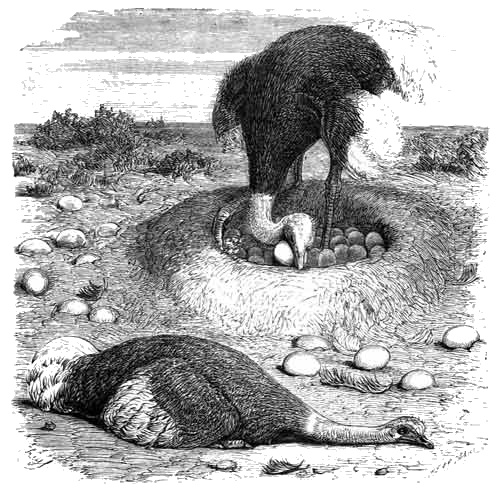
OSTRICH AND NEST.
"Who leaveth her eggs in the earth, and warmeth them in the dust."—Job xxxix. 14.
A more intimate acquaintance with the history of the Ostrich shows that, even in this particular, the sacred writer was perfectly correct. Besides the eggs which are intended to be hatched, and which are hidden beneath the sand to be hatched, a number of supplementary eggs are laid which are not meant to be hatched, and are evidently intended as food for the young until they are able to forage for themselves. These are left carelessly on the surface of the ground, and may easily be crushed by the hoof of a horse, if not by the foot of man. We meet, however, with another statement,—namely, that they may be broken by the wild beasts. Here we have reference to another fact in the history of the Ostrich. The scattered eggs, to which allusion is made, are often eaten, not only by beasts, but also by birds of prey; the former breaking the shells by knocking them against each other, and the latter by picking up large stones in their claws, rising above the eggs, and dropping the stones on them. The bird would like to seize the egg, rise with it in the air, and drop it on a stone, as mentioned on page 337, but the round, smooth surface of the egg defies the grasp of talons, and, instead of dropping the egg upon a stone, it is obliged to drop a stone upon the egg.
Up to the present point, therefore, the writer of the Book of Job is shown to be perfectly correct in his statements. We will now proceed to verse 16: "She is hardened against her young ones, as though they were not hers." Now in the Jewish Bible the passage is rendered rather differently: "She is hardened against her young ones, for those not hers;" and, as we shall presently see, the reading perfectly agrees with the character of the Ostrich.
There has long existed a belief that the Ostrich, contrary to the character of all other birds, is careless of her young, neglects them, and is even cruel to them. That this notion was shared by the writer of the Book of Job is evident from the preceding passage. It also, prevailed for at least a thousand years after the Book of Job was written. See Lam. iv. 3: "Even the sea monsters draw out the breast, they give suck to their young ones: the daughter of my people is become cruel, like the ostriches in the wilderness."
It is probable that this idea respecting the cruelty of the Ostrich towards its young is derived from the fact that if a flock of Ostriches be chased, and among them there be some very young birds, the latter are left behind by their parents, and fall a prey to the hunters. But, in reality, the Ostrich has no choice in the matter. The wide sandy desert affords no place of concealment in which it might hide its young. Nature has not furnished it with weapons by means of which it can fight for them; and consequently it is forced to use the only means of escape by which it can avoid sacrificing its own life, as well as the lives of the young.
It does not, however, leave the young until it has tried, by all means in its power, to save them. For example, it sometimes has recourse to the manœuvre with which we are so familiar in the case of the lapwing, and pretends to be wounded or lamed, in order to draw the attention of its pursuers, while its young escape in another direction. An instance of this practice is given by Mr. Andersson in his "Lake Ngami." "When we had proceeded little more than half the distance, and in a part of the plain entirely destitute of vegetation, we discovered a male and female ostrich, with a brood of young ones, about the size of ordinary barn-door fowls. We forthwith dismounted from our oxen, and gave chase, which proved of no ordinary interest.
"The moment the parent birds became aware of our intention, they set off at full speed—the female leading the way, and the cock, though at some little distance, bringing up the rear of the family party. It was very touching to observe the anxiety the birds evinced for the safety of their progeny. Finding that we were quickly gaining upon them, the male at once slackened his pace and diverged somewhat from his course; but, seeing that we were not to be diverted from our purpose, he again increased his speed, and, with wings drooping so as almost to touch the ground, he hovered round us, now in wide circles, and then decreasing the circumference until he came almost within pistol-shot, when he abruptly threw himself on the ground, and struggled desperately to regain his legs, as it appeared, like a bird that has been badly wounded.
"Having previously fired at him, I really thought he was disabled, and made quickly towards him. But this was only a ruse on his part, for, on my nearer approach, he slowly rose, and began to run in a different direction to that of the female, who by this time was considerably ahead with her charge." Nor is this a solitary instance of the care which the Ostrich will take of her young. Thunberg mentions that on one occasion, when he happened to ride near a place where an Ostrich was sitting on the eggs, the bird jumped up and pursued him, evidently with the object of distracting his attention from the eggs. When he faced her, she retreated; but as soon as he turned his horse, she pursued him afresh.
The care of the mother for the young is perhaps less needed with the Ostrich than with most birds. The young are able to run with such speed that ordinary animals are not able to overtake them, and, besides, they are protected by their colour as long as they are comparatively helpless. Their downy plumage harmonizes completely with the sandy and stony ground, even when they run, and when they crouch to the earth, as is their manner when alarmed, even the most practised eye can scarcely see them. Mr. Andersson, an experienced hunter, states that when the Ostrich chicks were crouching almost under his feet, he had the greatest difficulty in distinguishing their forms.
Owing to the great number of the eggs that are laid, the young are often very numerous, between thirty and forty chicks sometimes belonging to one brood. In the Ostrich chase which has already been described, the brood were eighteen in number, and so great was their speed that, in spite of their youth and diminutive size, Mr. Andersson only succeeded in capturing nine of them after an hour's severe chase.
We find, therefore, that we must acquit the Ostrich of neglecting its young, much more of cruelty towards them; and we will now turn to the next charge against the bird, that of stupidity.
In one sense, the bird certainly may be considered stupid. Like nearly all wild creatures which live on large plains, it always runs against the wind, so as to perceive by scent if any enemies are approaching. Its nostrils are very sensitive, and can detect a human being at a very great distance. So fastidious is it in this respect, that no hunter who knows his business ever attempts to approach the Ostrich except from leeward. If a nest is found, and the discoverer wishes the birds to continue laying in it, he approaches on the leeward side, and rakes out the eggs with a long stick.
The little Bosjesman, who kills so many of these birds with his tiny bow and arrow, makes use of this instinct when he goes to shoot the Ostrich, disguised in a skin of one of the birds. Should an Ostrich attack him, as is sometimes the case, he only shifts his position to windward, so as to allow the birds to catch the scent of a human being, when they instantly make off in terror.
When, therefore, the Ostriches are alarmed, they always run to windward, instinctively knowing that, if an enemy should approach in that direction, their powers of scent will inform them of the danger. Being aware of this habit, the hunters manage so that while one of them goes round by a long detour to frighten the game, the others are in waiting at a considerable distance to windward, but well on one side, so that no indication of their presence may reach the sensitive nostrils of the birds. As soon as the concealed hunters see the Ostriches fairly settled down to their course, they dash off at right angles to the line which the birds are taking, and in this way come near enough to use their weapons. The antelopes of the same country have a similar instinct, and are hunted in precisely the same manner.
Thus, then, in one sense the Ostrich may be considered as open to the charge of stupidity, inasmuch as it pursues a course which can be anticipated by enemies who would otherwise be unable to overtake it. But it must be remembered that instinct cannot be expected to prove a match for reason, and that, although its human enemies are able to overreach it, no others can do so, the instinct of running against the wind serving to guard it from any foe which it is likely to meet in the desert.
When captured alive and tamed, it certainly displays no particular amount of intellect. The Arabs often keep tame Ostriches about their tents, the birds being as much accustomed to their quarters as the horses. In all probability they did so in ancient times, and the author of the Book of Job was likely to be familiar with tame Ostriches, as well as with the wild bird.
Stupidity is probably attributed to the tame bird in consequence of the habit possessed by the Ostrich of picking up and eating substances which cannot be used as food. For example, it will eat knives, bits of bone or metal, and has even been known to swallow bullets hot from the mould. On dissecting the digestive organs of an Ostrich, I have found a large quantity of stones, pieces of brick, and scraps of wood. These articles are, however, not intended to serve as food, but simply to aid digestion, and the bird eats them just as domestic fowls pick up gravel, and smaller birds grains of sand. In swallowing them, therefore, the Ostrich does not display any stupidity, but merely obeys a natural instinct.
Lastly, we come to the speed of the Ostrich: "What time she lifteth up herself on high, she scorneth the horse and his rider."
This statement is literally true. When the Ostrich puts forth its full speed, there is no horse that can catch it in a fair chase. It may be killed by the ruse which has already been described, but an adult Ostrich can run away from the swiftest horse. When it runs at full speed, it moves its long legs with astonishing rapidity, covering at each stride an average of twenty-four feet, a fact from which its rate of speed may be deduced. In consequence of this width of stride, and the small impression made in the sand by the two-toed foot, the track of a running Ostrich is very obscure. Perhaps no better proof of the swiftness of the bird can be given than the extreme value set upon it by the Arabs. Although they are bred to the desert as much as the Ostrich itself, and are mounted on horses whose swiftness and endurance are proverbial, they set a very high value on the Ostrich, and to have captured one of these birds establishes an Arab's fame as a hunter.
Sometimes the Arabs employ the plan of cutting across the course of the bird, but at others they pursue it in fair chase, training their horses and themselves specially for the occasion. They furnish themselves with a supply of water, and then start in pursuit of the first flock of Ostriches they find. They take care not to alarm the birds, lest they should put out their full speed and run away out of sight, but just keep sufficiently near to force the birds to be continually on the move. They will sometimes continue this chase for several days, not allowing their game time to eat or rest, until at last it is so tired that it yields itself an easy prey.
In Southern Africa, snares are used for taking the Ostrich. They are in fact ordinary springes, but of strength suitable to the size of the bird. The cord is made fast to a sapling, which is bent down by main strength, and the other end is then formed into a noose and fastened down with a trigger. Sometimes the bird is enticed towards the snare by means of a bait, and sometimes it is driven over it by the huntsmen. In either case, as soon as the Ostrich puts its foot within the fatal noose, the trigger is loosed, the sapling is released, and, with a violent jerk, the Ostrich is caught by the leg and suspended in the air.
Why the flesh of the Ostrich should have been prohibited to the Jews is rather a mystery. It is much valued by most natives, though some of the Arab tribes still adhere to the Jewish prohibition, and those Europeans who have tried it pronounce it to be excellent when the bird is young and tender, but to be unpleasantly tough when it is old. Mr. Andersson says that its flesh resembles that of the zebra, and mentions that the fat and blood are in great request, being mixed together by cutting the throat of the bird, passing a ligature round the neck just below the incision, and then shaking and dragging the bird about for some time. Nearly twenty pounds of this substance are obtained from a single Ostrich.
The ancient Romans valued exceedingly the flesh of this bird. We are told that Heliogabalus once had a dish served at his table containing six hundred Ostrich brains, and that another emperor ate a whole Ostrich at a meal. As an adult Ostrich weighs some twenty-five stone, we may presume that the bird in question was a young one.
The eggs are most valuable articles of food, both on account of their excellent flavour and their enormous size. It is calculated that one Ostrich egg contains as much as twenty-five ordinary hen's eggs. Cooking the Ostrich egg is easily performed. A hole is made in the upper part of the egg, and the lower end is set on the fire. A forked stick is then introduced into the egg, and twirled between the hands, so as to beat up the whole of the interior. Europeans usually add pepper and salt, and say that this simple mode of cooking produces an excellent omelette.
The ordinary food of the Ostrich consists of the seeds, buds, and tops of various plants. It seems strange, however, that in the deserts, where there is so little vegetation, the bird should be able to procure sufficient food to maintain its enormous body. Each of the specimens which are kept at the Zoological Gardens eats on an average a pint of barley, the same quantity of oats, four pounds' weight of cabbage, and half a gallon of chaff, beside the buns, bread, and other articles of food which are given to them by visitors.
Although the Ostrich, like many other inhabitants of the desert, can live for a long time without water, yet it is forced to drink, and like the camel, which it resembles in so many of its ways, drinks enormously, taking in the water by a succession of gulps. When the weather has been exceptionally hot, the Ostrich visits the water-springs daily, and is so occupied in quenching its thirst that it will allow the hunter to come within a very short distance. It appears, indeed, to be almost intoxicated with its draught, and, even when it does take the alarm, it only retreats step by step, instead of scudding off with its usually rapid strides.
The camel-like appearance of the Ostrich has already been mentioned. In the Arabic language the Ostrich is called by a name which signifies camel-bird, and many of the people have an idea that it was originally a cross between a bird and a camel.
The cry of the Ostrich is a deep bellow, which, according to travellers in Southern Africa, so resembles the roar of the lion that even the practised ears of the natives can scarcely distinguish the roar of the animal from the cry of the bird. The resemblance is increased by the fact that both the lion and Ostrich utter their cry by night. It is evidently to this cry that the prophet Micah alludes: "Therefore I will wail and howl, I will go stripped and naked: I will make a wailing like the dragons, and mourning as the owls" (Ostriches in marginal reading). The cry of the variety of Ostrich which inhabits Northern Africa is said to bear more resemblance to the lowing of an ox than the roar of the lion; but as the bird is smaller than its southern relative, the difference is probably accounted for.
It has been mentioned that the Ostrich has no weapons wherewith to fight for its young; still, though it be destitute of actual weapons, such as the spur of the gamecock or the beak and talons of the eagle, it is not entirely defenceless. Its long and powerful legs can be employed as weapons, and it can kick with such force that a man would go down before the blow, and probably, if struck on the leg or arm, have the limb broken. The blow is never delivered backward, as is the kick of the horse, but forward, like that of the kangaroo. The natives of the countries where it resides say that it is able to kill by its kick the jackal that comes to steal its eggs, and that even the hyæna and the leopard are repelled by the gigantic bird.
THE BITTERN.
Signification of the word Kippod—The Bittern and its general appearance—The bird of solitude—Difficulty of detecting the Bittern in its haunts—Mudie's description of the Bittern and its home—The strange cry of the bird—Superstitions connected with it—The Night-raven—Nest of the Bittern—Scarcity of the bird at the present day—Food of the Bittern—The bird formerly brought to table.
In the account of the hedgehog, page 80, it has been mentioned that the Hebrew word Kippod, which has been rendered in the Authorized Version as "Bittern," is in all probability the Syrian hedgehog, and that the Jewish Bible accepts that rendering without even affixing the mark of doubt to the word. As, however, some writers on the subject still adhere to the more familiar rendering, a short account will be given of the Bittern (Botauris stellaris).
The Bittern belongs to the same family as the herons, the cranes, and the storks, and has many of the habits common to them all. It is, however, essentially a bird of solitude, hating the vicinity of man, and living in the most retired spots of marshy ground. As it sits among the reeds and rushes, though it is a large bird, it is scarcely visible even to a practised eye, its mottled plumage harmonizing with surrounding objects in such a way that the feathers of the bird can scarcely be distinguished from the sticks, stones, and grass tufts among which it sits. The ground colour of the plumage is dark buff, upon which are sprinkled mottlings and streaks of black, chestnut, grey, and brown. These mottled marks harmonize with the stones and tufts of withered grass, while the longitudinal dashes of buff and black on the neck and breast correspond with the sticks and reeds.
In a similar manner the tiger, though so large an animal, can lie in a very small covert of reeds without being detected, its striped fur corresponding with the reeds themselves and the shadows thrown by them; and the leopard can remain hidden among the boughs of a tree, its spotted coat harmonizing with the broken light and shade of the foliage.
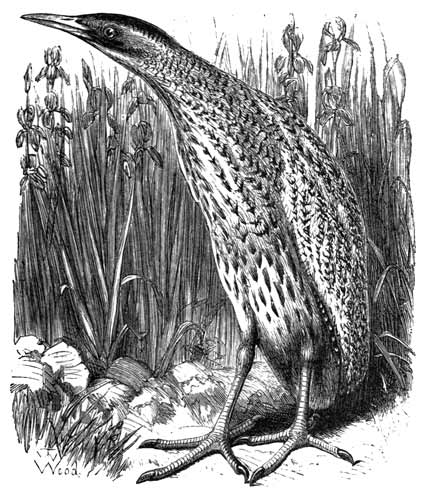
THE BITTERN.
"I will alto make it a possession for the bittern, and pools for water."—Isa. xiv. 23.
The following powerful description of the Bittern's home is given by Mudie: "It is a bird of rude nature, where the land knows no character save that which the untrained working of the elements impresses upon it; so that when any locality is in the course of being won to usefulness, the bittern is the first to depart, and when any one is abandoned, it is the last to return. 'The bittern shall dwell there' is the final curse, and implies that the place is to become uninhabited and uninhabitable, it hears not the whistle of the ploughman, nor the sound of the mattock; and the tinkle of the sheep-bell, or the lowing of the ox (although the latter bears so much resemblance to its own hollow and dismal voice, that it has given foundation to the name), is a signal for it to be gone.
"Extensive and dingy pools—if moderately upland, so much the better—which lie in the hollows, catching, like so many traps, the lighter and more fertile mould which the rains wash and the winds blow from the naked heights around, and converting it into harsh and dingy vegetation, and the pasture of those loathsome things which wriggle in the ooze, or crawl and swim in the putrid and mantling waters, are the habitation of the bittern.
"Places which scatter blight and mildew over every herb which is more delicate than a sedge, a carex, or a rush, and consume every wooded plant that is taller than the sapless and tasteless cranberry or the weeping upland willow; which shed murrain over the quadrupeds, chills which eat the flesh off their bones, and which, if man ventures there, consume him by putrid fever in the hot and dry season, and shake him to pieces with ague when the weather is cold and humid.
"Places from which the heath and the lichen stand aloof, and where even the raven, lover of disease, and battener upon all that expires miserably and exhausted, comes rarely and with more than wonted caution, lest that death which he comes to seal and riot upon in others should unawares come upon himself. The raven loves carrion on the dry and unpoisoning moor, scents it from afar, and hastens to it upon his best and boldest wing; but 'the reek o' the rotten fen' is loathsome to the sense of even the raven, and it is hunger's last pinch ere he come nigh to the chosen habitation, the only loved abode, of the bittern."
Secure in its retreat, the Bittern keeps its place even if a sportsman should pass by the spot on which it crouches. It will not be tempted to leave its retreat by noise, or even by stone throwing, for it knows instinctively that the quaking bogland which it selects as its home is unsafe for the step of man.
The very cry of the Bittern adds to this atmosphere of desolation. By day the bird is silent, but after the sun has gone down it utters its strange wild cry, a sound which exactly suits the localities in which it loves to make its habitation. During part of the year it only emits a sharp, harsh cry as it rises on the wing, but during the breeding season it utters the cry by which it summons its mate, one of the strangest love-calls that can be imagined. It is something between the neighing of a horse, the bellow of a bull, and a shriek of savage laughter. It is very loud and deep, so that it seems to shake the loose and marshy ground. There was formerly an idea that, when the Bittern uttered this booming cry, it thrust its bill into the soft ground, and so caused it to shake. In reality, the cry is uttered on the wing, the bird wheeling in a spiral flight, and modulating its voice in accordance with the curves which it describes in the air. This strange sound is only uttered by the male bird.
In every country inhabited by the Bittern we find that its deep sepulchral cry, booming out through the darkness, and heard at an immense distance, has been dreaded as the prophecy of some evil to come. In some parts both of England and Ireland it is known as the Night-raven, and under that title is held in the greatest fear. Allusion is made to this belief in the well-known passage from Middleton's "Witch":—
"At the Night-raven's dismal voice, When others tremble, we rejoice; And nimbly, nimbly, dance we still To the echoes of a hollow hill."
Under the same title Goldsmith writes of it in his "Animated Nature." "I remember, in the place where I was a boy, with what terror the bird's note affected the whole village,—they considered it as the presage of some sad event, and generally found or made one to succeed it. I do not speak ludicrously, but if any person in the neighbourhood died, they supposed it could not be otherwise, for the night-raven had foretold it; but if nobody happened to die, the death of a cow or a sheep gave completion of the prophecy."
In some parts of England the Bittern is known by the odd title of Butter-bump, a fact which was mentioned in the Zoologist many years ago:—
"There'll either be rain, or else summat waur, When Butter-bump sings upo' Potterie car."
About Fermanagh, in Ireland, the Bittern is called Bog-bluiter, i.e. Bog-bleater, just as the snipe is termed the Heather-bluiter.
Like most of the long-legged wading birds, the Bittern is able to change its shape, and apparently to alter its size, in an astonishing manner. When it is walking over the ground, with head erect and eye glanced vigilantly at surrounding objects, it looks a large, bold, vigorous, and active bird. Next minute it will sink its head in its shoulders, so that the long beak seems to project from them, and the neck totally disappears, the feathers enveloping each other as perfectly and smoothly as if it never had had a neck. In this attitude it will stand for an hour at a time on one leg, with the other drawn close to its body, looking as dull, inert, and sluggish a bird as can well be imagined, and reduced apparently to one half of its former size. The Bittern is represented in one of its extraordinary attitudes on the plate which illustrates the cormorant.
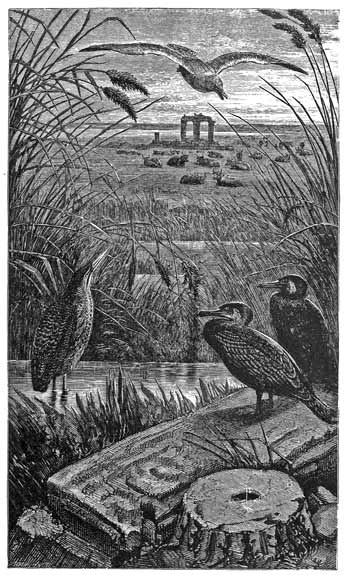
THE CORMORANT.
"But the cormorant and the bittern shall possess it."-Isa. xxxiv. 11.
The nest of the Bittern is placed on the ground, and near the water, though the bird always takes care to build it on an elevated spot which will not be flooded if the water should rise by reason of a severe rain. There is, however, but little reason for the Bittern to fear a flood, as at the time of year which is chosen, for nest-building the floods are generally out, and the water higher than is likely to be the case for the rest of the year. The materials of the nest are found in marshes, and consist of leaves, reeds, and rushes.
It will be seen from the foregoing account, that if the word Kippod be translated as "Bittern," the imagery connected with it holds good, and that no more powerful figure could be imagined for the desolation of Babylon than the prophecy, "I will make it a possession for the bittern, and pools of water" (Isa. xiv. 23).
Though once plentiful in England, the Bittern is now very scarce, and there are few who have seen it in its native haunts. Formerly, when swamps and marshes abounded, the Bittern abounded in proportion, but drainage and cultivation and railways have fairly driven the Bittern out of the country, and in a few years it will be as completely extinct in England as the bustard or the eagle. Even the great marshes of Essex are being reclaimed and rendered unfit for the occupation of the bird; and, from the upper part of the house where this account is written, I can see with the aid of the telescope cornfields, and pasture-lands, and barns, and ricks, and roads, diversifying the wide expanses which were once covered with brackish water at every flow of the tide, and at the ebb only left as quagmires through which the foot of man could not pass, and on which grew the rough and scanty herbage that flourishes under conditions that would kill almost any other vegetation.
No longer can the Bittern find a home there. Deep ditches intersect each other at short intervals, into which the moisture of the really rich soil is drained, and the water that once stood in stagnant pools which the Bittern loved is conducted into them, and discharged into the river at the ebb tide. By the abstraction of the moisture, the whole country has been lowered more than a foot, and, together with the stagnant pools, the Bittern has vanished never more to return. And here it may be mentioned that, although the Bittern inhabits none but desolate places, it only selects those which contain capabilities of cultivation. So, if the boom of the Bittern be heard, it may be accepted as deciding two things—firstly, that the ground is utterly deserted by man, and uncultivated; and secondly, that it ought to be occupied by him, and brought into cultivation.