THE CAMEL. CHAPTER II. (continued 2)
Reading edition
That the Ass was put to a similar use in turning the large millstones may be seen from Matt. xviii. 6. In the Authorized Version, the passage is rendered thus: "But whoso shall offend one of these little ones which believe in Me, it were better for him that a millstone were hanged about his neck, and that he were drowned in the depth of the sea."
Now if we turn to the Greek Testament we find that the passage reads rather differently, a force being giving to it which it does not possess in the translation: "But whosoever shall scandalize [i.e. be a stumbling-block to] one of these little ones that believe in Me, it were better for him that an ass's millstone were hung about his neck, and he were sunk in the depth of the sea." The chief force of this saying lies in the word which is omitted in our translation. Our Lord specially selected the Ass's millstone on account of its size and weight, in contradistinction to the ordinary millstone, which was turned backwards and forwards by the hands of women.
There is a custom now in Palestine which probably existed in the days of the Scriptures, though I have not been able to find any reference to it. Whenever an Ass is disobedient and strays from its master, the man who captures the trespasser on his grounds clips a piece out of its ear before he returns it to its owner. Each time that the animal is caught on forbidden grounds it receives a fresh clip of the ear. By looking at the ears of an Ass, therefore, any one can tell whether it has ever been a straggler; and if so, he knows the number of times that it has strayed, by merely counting the clip-marks, which always begin at the tip of the ear, and extend along the edges. Any Ass, no matter how handsome it may be, that has many of those clips, is always rejected by experienced travellers, as it is sure to be a dull as well as a disobedient beast.
Signor Pierotti remarks that if the owners of the Asses were treated similarly for similar offences, the greater number would be marked as soon as they begin to walk, and of the adults there would be scarcely one who had any ear on his head.
The Ass being so universally useful, we need not be surprised at the prominence which it takes in the Scriptural narrative, and the frequency with which its name occurs. The wealthy personages of the olden time seemed to have esteemed the Ass as highly as the camel, the ox, the sheep, or the goat. Abraham, for example, is described as being a rich man, and possessing "sheep, and oxen, and he-asses, and men-servants, and maid-servants, and she-asses, and camels" (Gen. xii. 16). In a succeeding chapter (xxx. 43) the prosperity of Jacob is mentioned in almost exactly the same terms.
So, before Job's trials came upon him, "his substance was seven thousand sheep, and three thousand camels, and five hundred yoke of oxen [i.e. 1,000], and five hundred she-asses, and a very great household; so that this man was the greatest of all the men of the east" (Job i. 3). And after his trials, when his wealth was restored to him twofold, the thousand she-asses are mentioned as prominently as the thousand yoke of oxen.
That the care of the Asses was an honourable post we learn from several passages. Take for example Gen. xxxvi. 24: "And these are the children of Zibeon; both Ajah, and Anah: this was that Anah that found the mules in the wilderness, as he fed the asses of Zibeon his father." The charge of the Asses was, as the reader must see, a post of sufficient honour and importance to be trusted to the son of the owner. A similar case is recorded in the well-known instance of Saul, whose father had lost his herd of Asses, and who at once sent his son upon the important mission of recovering them. And it was during the fulfilment of this mission that he was anointed the first king of Israel.
Later in the sacred history we find that when David consolidated his power, and organized the affairs of his new kingdom, he divided the people in general, the army, the land, the produce, and the cattle, into departments, and appointed over each department some eminent man whose name is carefully given. After mentioning that the people and the army were divided into "courses," and that certain officers were set over each course, the sacred historian proceeds to state that one officer was appointed as overseer of the treasury, another of the granaries, another of the field-labourers, another over the vineyards, and so forth. He then mentions that even the cattle were divided into their several departments, the care of the hill-cattle being given to one man, and of the cattle of the plain to another, of the camels to a third, and of the Asses to a fourth.
It is scarcely necessary to mention that the flesh of the Ass was forbidden to the Jews, because the animal neither chewed the cud nor divided the hoof. How repulsive to them must have been the flesh of the Ass we may infer from the terrible description of the siege of Samaria by Benhadad. The sacred historian describes with painful fidelity the horrors of the siege, and of the dreadful extremity to which the people were reduced. No circumstance could be more terrible than the quarrel between the two mothers, who had mutually agreed to kill and eat their children, and yet on a par with that dreadful statement is mentioned the fact that even the flesh of the Ass was eaten, and that an Ass's head cost eighty pieces of silver.
Whether the milk of the she Ass were used or not is rather a doubtful point, but, in all probability, the milk was considered as lawful food, though the flesh might not be eaten.
As to the legends respecting the Ass, they are innumerable, and I shall only mention one or two of them.
The first is an old Rabbinical legend respecting the Flood and the admission of the creatures into the ark. It appears that no being could enter the ark unless specially invited to do so by Noah. Now when the Flood came, and overwhelmed the world, the devil, who was at that time wandering upon the earth, saw that he was about to be cut off from contact from mankind, and that his dominion would be for ever gone. The ark being at last completed, and the beasts called to enter it in their proper order, the turn of the Ass came in due course.
Unfortunately for the welfare of mankind, the Ass was taken with a fit of obstinacy, and refused to enter the vessel according to orders. After wasting much time over the obstinate animal, Noah at last lost patience, and struck the Ass sharply, crying at the same time to it, "Enter, thou devil!" Of course the invitation was at once accepted, the devil entered the ark, and on the subsiding of the water issued out to take his place in the newly begun world.
Since the Christian era, many curious legends have sprung up respecting the Ass. One of the most familiar of these legends refers to the black stripe along the spine and the cross-bar over the shoulder. This black cross is really believed by many persons to have been given to the animal in consequence of its connexion with our Lord. I need hardly tell the reader that it is the remnant of the stripes which in the zebra cover the animal from head to foot, which in the quagga cover the head, body, and part of the limbs, and which in one species of Wild Ass are not seen at all in the adult animal.
There is another Christian legend respecting the Ass of Palestine, which is thought to owe its superiority in size, swiftness, and strength to the fact that it helped to warm the infant Saviour in the manger, that it carried Him and His mother into Egypt and back again, and that it was used by the Lord himself and His disciples. Any one who ventures to hint that the Ass of Palestine owes its superiority over its European brother to the warmer climate, is thought to be a heretic by the pious but ignorant men who believe and disseminate such legends.
Signor Pierotti tells a story of a certain Russian monk who happened to visit Palestine, and in the course of his travels found the leg-bone of an Ass, which he took back with him and publicly exhibited as part of the identical animal on which the Virgin Mary and infant Saviour rode. (I need scarcely mention that there is no mention in the Scriptures of the fact that the Holy Family rode upon an Ass; though such a mode of travel was certainly the one which they would adopt.) For some time, this deception drew for the impostor many gifts from the superstitious but pious people, but the affair at last reached the ears of his superiors, and he paid the deserved penalty of his trickery.
There are recorded in the Scriptures two remarkable circumstances connected with the Ass, which, however, need but a few words. The first is the journey of Balaam from Pethor to Moab, in the course of which there occurred that singular incident of the Ass speaking in human language (see Numb. xxii. 21, 35). The second is the well-known episode in the story of Samson, where he is recorded as breaking the cords with which his enemies had bound him, and killing a thousand Philistines with the fresh jaw-bone of an Ass.
THE WILD ASS.
The Arod and Pere of Scripture—Various allusions to the Wild Ass—Its swiftness and wildness—The Wild Ass of Asia and Africa—Knowledge of the animal displayed by the sacred writers—How the Wild Ass is hunted—Excellence of its flesh—Sir R. K. Porter's meeting with a Wild Ass—Origin of the domestic Ass—The Wild Asses of Quito.
There are several passages of Scripture in which the Wild Ass is distinguished from the domesticated animal, and in all of them there is some reference made to its swiftness, its intractable nature, and love of freedom.
In the Hebrew Scriptures there are two words which are given in the Authorized Translation as Wild Ass, namely, Arod and Pere, and it is rather remarkable that both words occur in the same passage. If the reader will refer to Job xxxix. 5, he will see the following passage: "Who hath sent out the wild ass (Pere) free? or who hath loosed the bands of the wild ass (Arod)?" Now there are only two places in the whole Hebrew Scriptures in which the word Arod occurs, and there are many doubts whether the word Arod is rightly translated. The first is that which has just been quoted, and the second occurs in Dan. v. 21: "And he was driven from the sons of men; and his heart was made like the beasts, and his dwelling was with the wild asses."
The Jewish Bible translates the word differently in the two passages. That in Job it renders as follows: "Who hath sent forth the wild ass free? or who hath loosed the bands of the untamed?" In the other passage, however, it follows the rendering of the Authorized Version, and gives the word as "wild asses." It is thought by several scholars that the two words refer to two different species of Wild Ass. It may be so, but as the ancient writers had the loosest possible ideas regarding distinction of species, and as, moreover, it is very doubtful whether there be any real distinction of species at all, we may allow the subject to rest, merely remembering that the rendering of the Jewish Bible, "the untamed," is a correct translation of the word Arod, though the particular animal to which it is applied may be doubtful.
We will now pass to the word about which there is no doubt whatever, namely, the Pere. This animal is clearly the species which is scientifically known as Asinus hemippus. During the summer time it has a distinct reddish tinge on the grey coat, which disappears in the winter, and the cross-streak is black. There are several kinds of Wild Ass known to science, all of which have different names. Some of our best zoologists, however, have come to the conclusion that they all really belong to the same species, differing only in slight points of structure which are insufficient to constitute separate species.
The habits of the Wild Ass are the same, whether it be the Asiatic or the African animal, and a description of one will answer equally well for the other. It is an astonishingly swift animal, so that on the level ground even the best horse has scarcely a chance of overtaking it. It is exceedingly wary, its sight, hearing, and sense of scent being equally keen, so that to approach it by craft is a most difficult task.
Like many other wild animals, it has a custom of ascending hills or rising grounds, and thence surveying the country, and even in the plains it will generally contrive to discover some earth-mound or heap of sand from which it may act as sentinel and give the alarm in case of danger. It is a gregarious animal, always assembling in herds, varying from two or three to several hundred in number, and has a habit of partial migration in search of green food, traversing large tracts of country in its passage.
It has a curiously intractable disposition, and, even when captured very young, can scarcely ever be brought to bear a burden or draw a vehicle. Attempts have been often made to domesticate the young that have been born in captivity, but with very slight success, the wild nature of the animal constantly breaking out, even when it appears to have become moderately tractable.
Although the Wild Ass does not seem to have lived within the limits of the Holy Land, it was common enough in the surrounding country, and, from the frequent references made to it in Scriptures, was well known to the ancient Jews. We will now look at the various passages in which the Wild Ass is mentioned, and begin with the splendid description in Job xxxix. 5-8:
"Who hath sent out the wild ass free? or who hath loosed the bands of the wild ass?
"Whose house I have made the wilderness, and the barren lands (or salt places) his dwellings.
"He scorneth the multitude of the city, neither regardeth he the crying of the driver.
"The range of the mountains is his pasture, and he searcheth after every green thing."
Here we have the animal described with the minuteness and truth of detail that can only be found in personal knowledge; its love of freedom, its avoidance of mankind, and its migration in search of pasture. Another allusion to the pasture-seeking habits of the animal is to be found in chapter vi. of the same book, verse 5: "Doth the wild ass bray when he hath grass?" or, according to the version of the Jewish Bible, "over tender grass?"
The same author has several other allusions to the Wild Ass. See, for example, chap. xi. 12: "For vain man would be wise, though man be born like a wild ass's colt." And in chap. xxiv. 5, in speaking of the wicked and their doings, he uses the following metaphor: "Behold, as wild asses in the desert, go they forth to their work; rising betimes for a prey: the wilderness yieldeth food for them and their children," or for the young, as the passage may be more literally rendered. The same migratory habit is also mentioned by the prophet Jeremiah (chap. xiv. 6): "And the wild asses did stand in the high places, they snuffed up the wind like dragons; their eyes did fail, because there was no grass." There is another allusion to it in Hosea viii. 9: "For they are gone up to Assyria, a wild ass alone by himself."
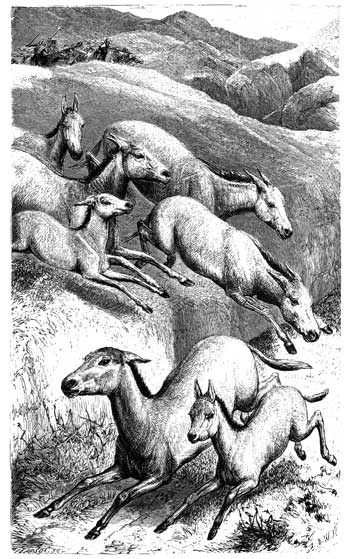
THE WILD ASS.
"As wild asses in the desert go they forth."—Job xxiv. 5.
Even in the earliest times of Jewish history we find a reference to the peculiar nature of this animal. In Gen. xvi. 12 it is prophesied of Ishmael, that "he will be a wild man; his hand will be against every man, and every man's hand against him; and he shall dwell in the presence of all his brethren." Now the real force of this passage is quite missed in the Authorized Version, the correct rendering being given in the Jewish Bible: "And he will be a wild ass (Pere) among men; his hand will be against all, and the hand of all against him, and in the face of all his brethren he shall dwell."
Allusion is made to the speed of the animal in Jer. ii. 24: "A wild ass used to the wilderness, that snuffeth up the wind at her pleasure; in her occasion who can turn her away? all they that seek her will not weary themselves; in her month they shall find her." The fondness of the Wild Ass for the desert is mentioned by the prophet Isaiah. Foretelling the desolation that was to come upon the land, he uses these words: "Because the palaces shall be forsaken, the multitude of the city shall be left; the forts and towers shall be for dens (or caves) for ever, and a joy of wild asses, a pasture of flocks."
These various qualities of speed, wariness, and dread of man cause the animal to be exceedingly prized by hunters, who find their utmost skill taxed in approaching it. Men of the highest rank give whole days to the hunt of the Wild Ass, and vie with each other for the honour of inflicting the first wound on so fleet an animal. With the exception of the Jews, the inhabitants of the countries where the Wild Ass lives eat its flesh, and consider it as the greatest dainty which can be found.
A very vivid account of the appearance of the animal in its wild state is given by Sir R. Kerr Porter, who was allowed by a Wild Ass to approach within a moderate distance, the animal evidently seeing that he was not one of the people to whom it was accustomed, and being curious enough to allow the stranger to approach him.
"The sun was just rising over the summit of the eastern mountains, when my greyhound started off in pursuit of an animal which, my Persians said, from the glimpse they had of it, was an antelope. I instantly put spurs to my horse, and with my attendants gave chase. After an unrelaxed gallop of three miles, we came up with the dog, who was then within a short stretch of the creature he pursued; and to my surprise, and at first vexation, I saw it to be an ass.
"Upon reflection, however, judging from its fleetness that it must be a wild one, a creature little known in Europe, but which the Persians prize above all other animals as an object of chase, I determined to approach as near to it as the very swift Arab I was on could carry me. But the single instant of checking my horse to consider had given our game such a head of us that, notwithstanding our speed, we could not recover our ground on him.
"I, however, happened to be considerably before my companions, when, at a certain distance, the animal in its turn made a pause, and allowed me to approach within pistol-shot of him. He then darted off again with the quickness of thought, capering, kicking, and sporting in his flight, as if he were not blown in the least, and the chase was his pastime. When my followers of the country came up, they regretted that I had not shot the creature when he was within my aim, telling me that his flesh is one of the greatest delicacies in Persia.
"The prodigious swiftness and the peculiar manner in which he fled across the plain coincided exactly with the description that Xenophon gives of the same animal in Arabia. But above all, it reminded me of the striking portrait drawn by the author of the Book of Job. I was informed by the Mehnander, who had been in the desert when making a pilgrimage to the shrine of Ali, that the wild ass of Irak Arabi differs in nothing from the one I had just seen. He had observed them often for a short time in the possession of the Arabs, who told him the creature was perfectly untameable.
"A few days after this discussion, we saw another of these animals, and, pursuing it determinately, had the good fortune to kill it."
It has been suggested by many zoologists that the Wild Ass is the progenitor of the domesticated species. The origin of the domesticated animal, however, is so very ancient, that we have no data whereon even a theory can be built. It is true that the Wild and the Domesticated Ass are exactly similar in appearance, and that an Asinus hemippus, or Wild Ass, looks so like an Asiatic Asinus vulgaris, or Domesticated Ass, that by the eye alone the two are hardly distinguishable from each other. But with their appearance the resemblance ends, the domestic animal being quiet, docile, and fond of man, while the wild animal is savage, intractable, and has an invincible repugnance to human beings.
This diversity of spirit in similar forms is very curious, and is strongly exemplified by the semi-wild Asses of Quito. They are the descendants of the animals that were imported by the Spaniards, and live in herds, just as do the horses. They combine the habits of the Wild Ass with the disposition of the tame animal. They are as swift of foot as the Wild Ass of Syria or Africa, and have the same habit of frequenting lofty situations, leaping about among rocks and ravines, which seem only fitted for the wild goat, and into which no horse can follow them.
Nominally, they are private property, but practically they may be taken by any one who chooses to capture them. The lasso is employed for the purpose, and when the animals are caught they bite, and kick, and plunge, and behave exactly like their wild relations of the Old World, giving their captors infinite trouble in avoiding the teeth and hoofs which they wield so skilfully. But, as soon as a load has once been bound on the back of one of these furious creatures, the wild spirit dies out of it, the head droops, the gait becomes steady, and the animal behaves as if it had led a domesticated life all its days.
THE MULE.
Ancient use of the Mules—Various breeds of Mule—Supposed date of its introduction into Palestine—Mule-breeding forbidden to the Jews—The Mule as a saddle-animal—Its use on occasions of state—The king's Mule—Mules brought from Babylon after the captivity—Obstinacy of the Mule—The Mule as a beast of burden—The "Mule's burden" of earth—Mules imported by the Phœnicians—Legends respecting the Mule.
There are several references to the Mule in the Holy Scriptures, but it is remarkable that the animal is not mentioned at all until the time of David, and that in the New Testament the name does not occur at all.
The origin of the Mule is unknown, but that the mixed breed between the horse and the ass has been employed in many countries from very ancient times is a familiar fact. It is a very strange circumstance that the offspring of these two animals should be, for some purposes, far superior to either of the parents, a well-bred Mule having the lightness, surefootedness, and hardy endurance of the ass, together with the increased size and muscular development of the horse. Thus it is peculiarly adapted either for the saddle or for the conveyance of burdens over a rough or desert country.
The Mules that are most generally serviceable are bred from the male ass and the mare, those which have the horse as the father and the ass as the mother being small, and comparatively valueless. At the present day, Mules are largely employed in Spain and the Spanish dependencies, and there are some breeds which are of very great size and singular beauty, those of Andalusia being especially celebrated. In the Andes, the Mule has actually superseded the llama as a beast of burden.
Its appearance in the sacred narrative is quite sudden. In Gen. xxxvi. 24, there is a passage which seems as if it referred to the Mule: "This was that Anah that found the mules in the wilderness." Now the word which is here rendered as Mules is "Yemim," a word which is not found elsewhere in the Hebrew Scriptures. The best Hebraists are agreed that, whatever interpretation may be put upon the word, it cannot possibly have the signification that is here assigned to it. Some translate the word as "hot springs," while the editors of the Jewish Bible prefer to leave it untranslated, thus signifying that they are not satisfied with any rendering.
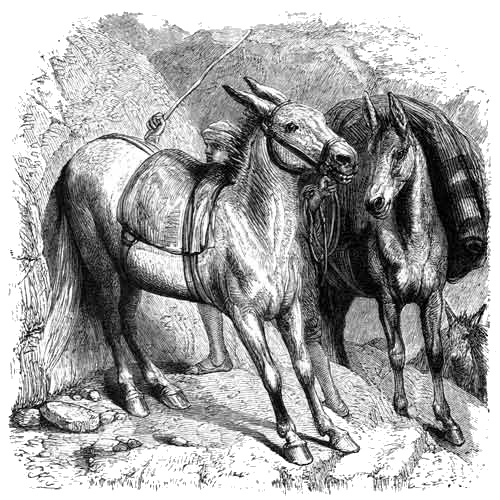
MULES OF THE EAST.
"Be ye not as the horse and mule, which have no under standing."—Psalm xxxii. 9.
The word which is properly translated as Mule is "Pered;" and the first place where it occurs is 2 Sam. xiii. 29. Absalom had taken advantage of a sheep-shearing feast to kill his brother Amnon in revenge for the insult offered to Tamar: "And the servants of Absalom did unto Amnon as Absalom had commanded. Then all the king's sons arose, and every man gat him up upon his mule, and fled." It is evident from this passage that the Mule must have been in use for a considerable time, as the sacred writer mentions, as a matter of course, that the king's sons had each his own riding mule.
Farther on, chap. xviii. 9 records the event which led to the death of Absalom by the hand of Joab. "And Absalom met the servants of David. And Absalom rode upon a mule, and the mule went under the thick boughs of a great oak, and his head caught hold of the oak, and he was taken up between the heaven and the earth; and the mule that was under him went away."
We see by these passages that the Mule was held in such high estimation that it was used by the royal princes for the saddle, and had indeed superseded the ass. In another passage we shall find that the Mule was ridden by the king himself when he travelled in state, and that to ride upon the king's Mule was considered as equivalent to sitting upon the king's throne. See, for example, 1 Kings i. in which there are several passages illustrative of this curious fact. See first, ver. 33, in which David gives to Zadok the priest, Nathan the prophet, and Benaiah the captain of the hosts, instructions for bringing his son Solomon to Gihon, and anointing him king in the stead of his father: "Take with you the servants of your lord, and cause Solomon my son to ride upon mine own mule, and bring him down to Gihon."
Then, in ver. 38, we are told that David's orders were obeyed, that Solomon was set on the king's Mule, was anointed by Zadok, and proclaimed as king to the people. In ver. 44 we are told how Adonijah, who had attempted to usurp the throne, and was at the very time holding a coronation feast, heard the sound of the trumpets and the shouting in honour of Solomon, and on inquiring was told that Solomon had been crowned king by Zadok, recognised by Nathan, accepted by Benaiah, and had ridden on the king's Mule. These tidings alarmed him, and caused him to flee for protection to the altar. Now it is very remarkable that in each of these three passages the fact that Solomon rode upon the king's Mule is brought prominently forward, and it was adduced to Adonijah as a proof that Solomon had been made the new king of Israel.
That the Mule should have become so important an animal seems most remarkable. In Levit. xix. 19 there is an express injunction against the breeding of Mules, and it is unlikely, therefore, that they were bred in Palestine. But, although the Jews were forbidden to breed Mules, they evidently thought that the prohibition did not extend to the use of these animals, and from the time of David we find that they were very largely employed both for the saddle and as beasts of burden. In all probability, the Mules were imported from Egypt and other countries, and that such importation was one of the means for furnishing Palestine with these animals we learn from 1 Kings x. 24, 25, in which the sacred writer enumerates the various tribute which was paid to Solomon: "All the earth sought to Solomon, to hear the wisdom which God had put in his heart.
"And they brought every man his present, vessels of silver, and vessels of gold, and garments, and armour, and spices, horses, and mules, a rate year by year." The same fact is recorded in 2 Chron. ix. 24.
In the time of Isaiah the Mule was evidently in common use as a riding animal for persons of distinction. See chap. lxvi. 20: "And they shall bring all your brethren for an offering unto the Lord, out of all nations, upon horses, and in chariots, and in litters, and upon mules, and upon swift beasts, to My holy mountain Jerusalem." Another allusion to the Mule as one of the recognised domesticated animals is found in Zech. xiv. 15: "So shall be the plague of the horse, of the mule, of the camel, and of the ass, and of all the beasts that shall be in these tents, as this plague."
The value of these animals may be inferred from the anxiety of Ahab to preserve his Mules during the long drought that had destroyed all the pasturage. "Ahab said unto Obadiah, Go into the land, unto all fountains of water, and unto all brooks: peradventure we may find grass to save the horses and mules alive, that we lose not all the beasts."
Now this Obadiah was a very great man. He was governor of the king's palace, an office which has been compared to that of our Lord High Chamberlain. He possessed such influence that, although he was known to be a worshipper of Jehovah, and to have saved a hundred prophets during Jezebel's persecution, he retained his position, either because no one dared to inform against him, or because he was too powerful to be attacked. Yet to Obadiah was assigned the joint office of seeking for pasturage for the Mules, the king himself sharing the task with his chamberlain, thus showing the exceeding value which must have been set on these appanages of royal state.
Their importance may be gathered from a passage in the Book of Ezra, in which, after enumerating with curious minuteness the number of the Jews who returned home from their Babylonish captivity, the sacred chronicler proceeds to remark that "their horses were seven hundred thirty and six; their mules, two hundred forty and five; their camels, four hundred thirty and five; their asses, six thousand seven hundred and twenty" (Ezra ii. 66, 67). There is a parallel passage in Neh. vii. 68, 69.
Seeing that the Mule was in such constant use as a riding animal, it is somewhat remarkable that we never find in the Scripture any mention of the obstinate disposition which is proverbially associated with the animal. There is only one passage which can be thought even to bear upon such a subject, and that is the familiar sentence from Ps. xxxii. 9: "Be ye not as the horse, or as the mule, which have no understanding: whose mouth must be held in with bit and bridle, lest they come near unto thee;" and, as the reader will see, no particular obstinacy or frowardness is attributed to the Mule which is not ascribed to the horse also.
Still, that the Mule was as obstinate and contentious an animal in Palestine as it is in Europe is evident from the fact that the Eastern mules of the present day are quite as troublesome as their European brethren. They are very apt to shy at anything, or nothing at all; they bite fiercely, and every now and then they indulge in a violent kicking fit, flinging out their heels with wonderful force and rapidity, and turning round and round on their fore-feet so quickly that it is hardly possible to approach them. There is scarcely a traveller in the Holy Land who has not some story to tell about the Mule and its perverse disposition; but, as these anecdotes have but very slight bearing on the subject of the Mule as mentioned in the Scriptures, they will not be given in these pages.
That the Mule was employed as a beast of burden as well as for riding, we gather from several passages in the Old Testament. See, for example, 1 Chron. xii. 40: "Moreover they that were nigh them, even unto Issachar and Zebulun and Naphtali, brought bread on asses, and on camels, and on mules, and on oxen." We have also the well-known passage in which is recorded the reply of Naaman to Elisha after the latter had cured him of his leprosy: "And Naaman said, Shall there not then, I pray thee, be given to thy servant two mules' burden of earth?" It does not necessarily follow that two of Naaman's Mules were to be laden with earth, but the probability is, that Naaman used the term "a Mule's burden" to express a certain quantity, just as we talk of a "load" of hay or gravel.
As Mules are animals of such value, we may feel some little surprise that they were employed as beasts of burden. It is possible, however, that a special and costly breed of large and handsome Mules, like those of Andalusia, were reserved for the saddle, and that the smaller and less showy animals were employed in the carriage of burdens.
Before parting entirely with the Mule, it will be well to examine the only remaining passage in which the animal is mentioned. It occurs in Ezek. xxvii. 14: "They of the house of Togarmah traded in thy fairs with horses and horsemen and mules." The chapter in which this passage occurs is a sustained lamentation over Tyre, in which the writer first enumerates the wealth and greatness of the city, and then bewails its downfall. Beginning with the words, "O Tyrus, thou hast said, I am of perfect beauty," the prophet proceeds to mention the various details of its magnificence, the number and beauty of its ships built with firs from Senir, having oars made of the oaks of Bashan, masts of the cedars of Lebanon, benches of ivory, sails of "fine linen with broidered work from Egypt," and coverings of purple and scarlet from the isles of Elishah. The rowers were from Zidon and Arvad, while Tyre itself furnished their pilots or steersmen.
After a passing allusion to the magnificent army of Tyre, the sacred writer proceeds to mention the extent of the merchandise that was brought to this queen of ancient seaports: silver and other metals were from Tarshish, slaves and brass from Meshech, ivory and ebony from Dedan, jewellery and fine linen from Syria; wheat, honey, and oil from Judæa; wine and white wool from Damascus, and so forth. And, among all these riches, are prominently mentioned the horses and Mules from Togarmah. Now, it has been settled by the best bibliographers that the Togarmah of Ezekiel is Armenia, and so we have the fact that the Phœnicians supplied themselves with Mules and horses by importing them from Armenia instead of breeding those animals themselves, just as Palestine imported its horses, and probably its Mules also, from Egypt.
It is rather remarkable that the Arabs of Palestine very seldom breed the Mule for themselves, but, like the ancient Jews, import them from adjacent countries, mostly from the Lebanon district. Those from Cyprus are, however, much valued, as they are very strong, diligent, and steady, their pace being nearly equal to that of the horse. Mules are seldom used for agricultural purposes, though they are extensively employed for riding and for carrying burdens, especially over rocky districts.
The Mule is not without its legend. One of the oddest of these accounts for its obstinacy and its incapacity for breeding.
When the Holy Family was about to travel into Egypt, St. Joseph chose a Mule to carry them. He was in the act of saddling the animal, when it kicked him after the fashion of Mules. Angry with it for such misconduct, St. Joseph substituted an ass for the Mule, thus giving the former the honour of conveying the family into Egypt, and laid a curse upon it that it should never have parents nor descendants of its own kind, and that it should be so disliked as never to be admitted into its master's house, as is the case with the horse and other domesticated animals. This is one of the multitudinous legends which are told to the crowds of pilgrims who come annually to see the miraculous kindling of the holy fire, and to visit the tree on which Judas hanged himself.
SWINE.
The Mosaic prohibition of the pig—Hatred of Swine by Jews and Mahometans—A strange use of bacon—The prodigal son—Resistance to the persecution of Antiochus—Swine hated by the early Egyptians—Supposed connexion between Swine and diseases of the skin—Destruction of the herd of Swine—The locality of the event discovered—Pigs bred for the monasteries—The jewel of gold in a Swine's snout—The wild boar of the woods, and the beast of the reeds—The damage which it does to the vines—General account of the wild boar of Palestine—Excellence of its flesh.
Many are the animals which are specially mentioned in the Mosaic law as unfit for food, beside those that come under the general head of being unclean because they do not divide the hoof and chew the cud. There is none, however, that excited such abhorrence as the hog, or that was more utterly detested.
It is utterly impossible for a European, especially one of the present day, to form even an idea of the utter horror and loathing with which the hog was regarded by the ancient Jews. Even at the present day, a zealous Jew or Mahometan looks upon the hog, or anything that belongs to the hog, with an abhorrence too deep for words. The older and stricter Jews felt so deeply on this subject, that they would never even mention the name of the hog, but always substituted for the objectionable word the term "the abomination."
Several references are made in the Scriptures to the exceeding disgust felt by the Jews towards the Swine. The portion of the Mosaic law on which a Jew would ground his antipathy to the flesh of Swine is that passage which occurs in Lev. xi. 7: "And the swine, though he divide the hoof, and be cloven-footed, yet he cheweth not the cud; he is unclean to you." But the very same paragraph, of which this passage forms the termination, treats of other unclean beasts, such as the coney (or hyrax) and the hare, neither of which animals are held in such abhorrence as the Swine.
This enactment could not therefore have produced the singular feeling with which the Swine were regarded by the Jews, and in all probability the antipathy was of far greater antiquity than the time of Moses.
How hateful to the Jewish mind was the hog we may infer from many passages, several of which occur in the Book of Isaiah. See, for example, lxv. 3, 4: "A people that provoketh me to anger continually to my face; that sacrificeth in gardens, and burneth incense upon altars of brick;
"Which remain among the graves, and lodge in the monuments, which eat swine's flesh, and broth of abominable things is in their vessels." Here we have the people heaping one abomination upon another—the sacrifice to idols in the gardens, the burning of incense upon a forbidden altar and with strange fire, the living among the tombs, where none but madmen and evil spirits were supposed to reside, and, as the culminating point of iniquity, eating Swine's flesh, and drinking the broth in which it was boiled.
In the next chapter, verse 3, we have another reference to the Swine. Speaking of the wickedness of the people, and the uselessness of their sacrifices, the prophet proceeds to say: "He that killeth an ox is as if he slew a man; he that sacrificeth a lamb, as if he had cut off a dog's neck; he that offereth an oblation, as if he offered swine's blood." We see here how the prophet proceeds from one image to another: the murder of a man, the offering of a dog instead of a lamb, and the pouring out of Swine's blood upon the altar instead of wine—the last-mentioned crime being evidently held as the worst of the three. Another reference to the Swine occurs in the same chapter, verse 17: "They that sanctify themselves, and purify themselves in the gardens behind one tree in the midst, eating swine's flesh, and the abomination, and the mouse, shall be consumed together, saith the Lord."
Not only did the Jews refuse to eat the flesh of the hog, but they held in utter abomination everything that belonged to it, and would have thought themselves polluted had they been even touched with a hog's bristle. Even at the present day this feeling has not diminished, and both by Jews and Mahometans the hog is held in utter abhorrence.
Some recent travellers have made great use of this feeling. Signor Pierotti, for example, during his long sojourn in Palestine, found the flesh of the hog extremely beneficial to him. "How often has the flesh of this animal supported me, especially during the earlier part of my stay in Palestine, before I had learned to like the mutton and the goats' flesh! I give the preference to this meat because it has often saved me time by rendering a fire unnecessary, and freed me from importunate, dirty, and unsavoury guests, who used their hands for spoons, knives, and forks.
"A little piece of bacon laid conspicuously upon the cloth that served me for a table was always my best friend. Without this talisman I should never have freed myself from unwelcome company, at least without breaking all the laws of hospitality by not inviting the chiefs of my escort or the guides to share my meal; a thing neither prudent nor safe in the open country. Therefore, on the contrary, when thus provided I pressed them with the utmost earnestness to eat with me, but of course never succeeded in persuading them; and so dined in peace, keeping on good terms with them, although they did call me behind my back a 'dog of a Frank' for eating pork.
"Besides, I had then no fear of my stores failing, as I always took care to carry a stock large enough to supply the real wants of my party. So a piece of bacon was more service to me than a revolver, a rifle, or a sword; and I recommend all travellers in Palestine to carry bacon rather than arms, for the latter are often stolen, the former is never."
Such being the feelings of the Jews, we may conceive the abject degradation to which the Prodigal Son of the parable must have descended, when he was compelled to become a swine-herd for a living, and would have been glad even to have eaten the very husks on which the Swine fed. These husks, by the way, were evidently the pods of the locust-tree, or carob, of which we shall have more to say in a future page. We have in our language no words to express the depths of ignominy into which this young man must have fallen, nor can we conceive any office which in our estimation would be so degrading as would be that of swine-herd to a Jew.
How deeply rooted was the abhorrence of the Swine's flesh we can see from a passage in 2 Maccabees, in which is related a series of insults offered to the religion of the Jews. The temple at Jerusalem was to be called the Temple of Jupiter Olympus, and that on Gerizim was to be dedicated to Jupiter, the defender of strangers. The altars were defiled by forbidden things, and the celebration of the Sabbath, or of any Jewish ceremony, was punishable with death.
Severe as were all these afflictions, there was one which the Jews seem, from the stress laid upon it, to have felt more keenly than any other. This was the compulsory eating of Swine's flesh, an act which was so abhorrent to the Jews that in attempting to enforce it, Antiochus found that he was foiled by the passive resistance offered to him. The Jews had allowed their temples to be dedicated to the worship of heathen deities, they had submitted to the deprivation of their sacred rites, they had even consented to walk in procession on the Feast of Bacchus, carrying ivy like the rest of the worshippers in that most licentious festival. It might be thought that any people who submit to such degradation would suffer any similar indignity. But even their forbearance had reached its limits, and nothing could induce them to eat the flesh of Swine.
Several examples of the resistance offered by them are recorded in the book just mentioned. Eleazar, for example, a man ninety years old, sternly refused to partake of the abominable food. Some of the officials, in compassion for his great age, advised him to take lawful meat with him and to exchange it for the Swine's flesh. This he refused to do, saying that his age was only a reason for particular care on his part, lest the young should be led away by his example. His persecutors then forced the meat into his mouth, but he rejected it, and died under the lash.
Another example of similar, but far greater heroism, is given by the same chronicler. A mother and her seven sons were urged with blows to eat the forbidden food, and refused to do so. Thinking that the mother would not be able to endure the sight of her sons' sufferings, the officers took them in succession, and inflicted a series of horrible tortures upon them, beginning by cutting off their tongues, hands, and feet, and ending by roasting them while still alive. Their mother, far from counselling her sons to yield, even though they were bribed by promises of wealth and rank, only encouraged them to persevere, and, when the last of her sons was dead, passed herself through the same fiery trial.
Even among the ancient Egyptians this repugnance to the Swine prevailed, though there was a sort of Pariah caste among them who bred the animal and ate its flesh.
This we learn from Herodotus ("Euterpe," xlvii.):—"The Egyptians consider the pig to be an impure animal, and if therefore a man in passing near a pig should but touch it with his clothes, he goes at once to the river and plunges into it. In the next place, swine-herds, although they be native Egyptians, are the only men who are not allowed to enter into any of their temples, neither will any man give his daughter in marriage to one of them, nor take a wife from among them, but the swine-herds only marry among themselves.
"The Egyptians therefore do not think it right to sacrifice swine to any other deities, but to the moon and Bacchus they sacrifice them at the same time; that is to say, at the same full moon, and then they eat the flesh.... This sacrifice of pigs to the moon is performed in the following manner. When the sacrificer has killed the victims, he puts the tip of the tail, the spleen, and the caul together, covers them with the fat found in the belly of the animal, and then consumes it with fire. The rest of the flesh they eat during the full moon in which they offer the sacrifices, but on no other day would any man ever taste it. The poor among them, through want of money, make pigs out of dough; and, after baking them, offer them in sacrifice.
"On the eve of the festival of Bacchus, every one slays a pig before his door, and then restores it to the swine-herd that sold it, that he may carry it away. The rest of this festival to Bacchus, except as regards the pigs, the Egyptians celebrate much in the same manner as the Greeks do."
It has been conjectured, and with plausibility, that the pig was prohibited by Moses on account of the unwholesomeness of its flesh in a hot country, and that its almost universal repudiation in such lands is a proof of its unfitness for food. In countries where diseases of the skin are so common, and where the dreaded leprosy still maintains its hold, the flesh of the pig is thought, whether rightly or wrongly, to increase the tendency to such diseases, and on that account alone would be avoided.
It has, however, been shown that the flesh of Swine can be habitually consumed in hot countries without producing any evil results; and, moreover, that the prohibition of Moses was not confined to the Swine, but included many other animals whose flesh is used without scruple by those very persons who reject that of the pig.
Knowing the deep hatred of the Jews towards this animal, we may naturally wonder how we come to hear of herds of Swine kept in Jewish lands.
Of this custom there is a familiar example in the herd of Swine that was drowned in the sea (Matt. viii. 28-34). It is an open question whether those who possessed the Swine were Jews of lax principles, who disregarded the Law for the sake of gain, or whether they were Gentiles, who, of course, were not bound by the Law. The former seems the likelier interpretation, the destruction of the Swine being a fitting punishment for their owners. It must be here remarked, that our Lord did not, as is often said, destroy the Swine, neither did He send the devils into them, so that the death of these animals cannot be reckoned as one of the divine miracles. Ejecting the evil spirits from the maniacs was an exercise of His divine authority; the destruction of the Swine was a manifestation of diabolical anger, permitted, but not dictated.
The scene of so remarkable an event is naturally of great interest, especially as the statements of the Evangelists who mention it do not precisely agree. This subject is so well treated by Mr. Tristram in his "Land of Israel," that it must be given in his own words:—
"The field of the tombs at Gadara presents a vivid illustration of the circumstances connected with the healing of the demoniac in the country of the Gadarenes, or Gergesenes. With one exception, all the concomitant events of the miracle are exactly illustrated. We have beyond the city the field of tombs, these tombs suited for the refuge of demoniac outcasts, occupied as dwellings to the present day. We have a plain suited for the feeding of swine, with its roots and acorns, and we have a steep place hard by, of several hundred feet high, κρημνόν. But then, it does not run down to the sea, but to the little river. This objection is, I think, fatal to the identification of Um Keis with the scene of the miracle.
"St. Mark (v. 2) tells us that our Lord was met immediately on His coming out of the ship. This place is three and a half hours distant from its shores. It is important also to observe that St. Matthew (viii. 28) reads not Gadarenes, but Gergesenes, and St. Luke states that the coast of the Gadarenes was over against Galilee (viii. 26). I should feel thereupon disposed fully to endorse the suggestion of Dr. Thomson, that St. Matthew, writing for those intimately acquainted with the topography of the country in detail, names the obscure and exact locality, Gergesa; while SS. Mark and Luke, writing for those at a distance, simply name the country of Gadara, as being a place of importance, and the acknowledged capital of the district. This is borne out by the statement of Josephus ('Bell. Jud.' 1, viii. 35).
"Dr. Thomson visited, at the mouth of the Wady Semakh, directly opposite Gennesaret, some ruins called by his guide Kerza, or Gerza, which he identifies with the Gergesa of St. Matthew. The discovery is most interesting and important. I visited the place myself from a boat, and observed the remains of a valley and a khan; but, unfortunately, I was not aware at the time of the interest attaching to the place, and did not ascertain, or at least note down, the name given to it by my boatmen.
"The statement of Origen exactly bears out the discovery of Dr. Thomson. After stating that Gadara was not the scene of the miracle, for these was thence no steep place into the sea, he states that Gergesa is an ancient city on the shores of the lake, by which is a steep place which runs down to it. In one important particular my memory corroborates the statement of Dr. Thomson, viz. that while there is here no precipice running sheer to the shore, but a narrow belt of land, the cliff behind is steep, and the sea so narrow, that a herd of swine, rushing frantically down, must certainly have been overwhelmed in the sea before they could recover themselves.
"While the tombs at Gadara are peculiarly interesting and remarkable, yet the whole region is so perforated everywhere by rock-chambers of the dead that we may be quite certain that a home for the demoniac will not be wanting whatever locality be assigned for the events recorded by the Evangelists."
Although that part of the country is well suited for feeding Swine, the animals are no longer kept. In the first place, there is a great want of spirit in matters of commerce; and in the second, the country is so unsettled that the merchants would probably be robbed. The woods, moreover, furnish nowadays but a scanty supply of acorns, and those are eaten by the Arabs instead of being given to pigs.
These animals are at the present day much neglected, because the Mahometans and Jews may not eat the flesh, and the Christians, as a rule, abstain from it, so that they may not hurt the feelings of their neighbours. Pigs are however reared in the various monasteries, and by the Arabs attached to them; the former eating the hog, and the latter only breeding it for sale. Signor Pierotti states that the pigs become as part of the family, who live and grow fat together with them. Though, he remarks, they are not so intelligent as those that listened to St. Anthony preaching in the Thebaid, they play with the children, understand the language of their masters, and do not disdain to play with the fowls, dogs, cats, asses, and horses, and are much more nimble than their European brethren, although they are smaller in size and not so spirited.
Although the pig was so detested by the Jews, they were evidently well acquainted with it. St. Peter, for example, in his Second Epistle, chap. ii. 22, refers to the habit of wallowing in the mire, a custom which is common to all the pachydermatous animals, which, in spite of their thick hide, are very sensitive to the attacks of flies, and cover themselves with mud in order to defend themselves against their tiny but dreaded enemies.
In connexion with the Swine, there is a passage in the Proverbs which requires a slight comment. It occurs in chap. xi. 22: "As a jewel (or pendant) of gold in a swine's snout, so is a fair woman which is without discretion." The sacred writer refers here to the custom adopted by Oriental women of wearing a ring in the nostril—a custom which has existed to the present day, and is familiar to all those who have travelled in the East. The plan which is generally adopted is that of boring a hole through the nostril, passing a ring through it, and, when the wound has healed, hanging various jewels and other ornaments upon the ring, so as to constitute the "pendant of gold" mentioned in the proverb.
The image used by our Lord of casting pearls before Swine needs no explanation.
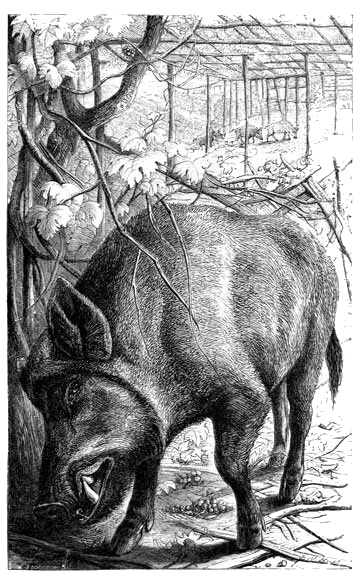
WILD BOAR OF PALESTINE.
"The Boar out of the wood doth waste it."—Ps. lxxx. 13.
We now come to the wild animal. Their is only one passage in the Scriptures in which the Wild Boar is definitely mentioned, and another in which a reference is made to it in a paraphrase.
The former of these is the well-known verse of the Psalms: "Why hast thou broken down her hedges, so that all they which pass by the way do pluck her?
"The boar out of the wood doth waste it, and the wild beast of the field doth devour it" (Ps. lxxx. 12, 13). The second passage is to be found in Ps. lxviii. 30. In the Authorized Version it is thus rendered: "Rebuke the company of spearmen, the multitude of bulls, with the calves of the people." If the reader will refer to the marginal translation (which, it must be remarked, is of equal authority with the text), the passage runs thus: "Rebuke the beasts of the reeds," &c. Now, this is undoubtedly the correct rendering, and is accepted in the Jewish Bible.
Having quoted these two passages, we will proceed to the description and character of the animal.
In the former times, the Wild Boar was necessarily much more plentiful than is the case in these days, owing to the greater abundance of woods, many of which have disappeared by degrees, and others been greatly thinned by the encroachments of mankind. Woods and reed-beds are always the habitations of the Wild Boar, which resides in these fastnesses, and seems always to prefer the reed-bed to the wood, probably because it can find plenty of mud, in which it wallows after the fashion of its kind. There is no doubt whatever that the "beast of the reeds" is simply a poetical phrase for the Wild Boar.
If there should be any cultivated ground in the neighbourhood, the Boar is sure to sally out and do enormous damage to the crops. It is perhaps more dreaded in the vineyards than in any other ground, as it not only devours the grapes, but tears down and destroys the vines, trampling them under foot, and destroying a hundredfold as much as it eats.
If the reader will refer again to Ps. lxxx. he will see that the Jewish nation is described under the image of a vine: "Thou hast brought a vine out of Egypt: Thou hast cast out the heathen and planted it," &c. No image of a destructive enemy could therefore be more appropriate than that which is used. We have read of the little foxes that spoil the vines, but the Wild Boar is a much more destructive enemy, breaking its way through the fences, rooting up the ground, tearing down the vines themselves, and treading them under its feet. A single party of these animals will sometimes destroy an entire vineyard in a single night.
We can well imagine the damage that would be done to a vineyard even by the domesticated Swine, but the Wild Boar is infinitely more destructive. It is of very great size, often resembling a donkey rather than a boar, and is swift and active beyond conception. The Wild Boar is scarcely recognisable as the very near relation of the domestic species. It runs with such speed, that a high-bred horse finds some difficulty in overtaking it, while an indifferent steed would be left hopelessly behind. Even on level ground the hunter has hard work to overtake it; and if it can get upon broken or hilly ground, no horse can catch it. The Wild Boar can leap to a considerable distance, and can wheel and turn when at full speed, with an agility that makes it a singularly dangerous foe. Indeed, the inhabitants of countries where the Wild Boar flourishes would as soon face a lion as one of these animals, the stroke of whose razor-like tusks is made with lightning swiftness, and which is sufficient to rip up a horse, and cut a dog nearly asunder.
Although the Wild Boar is not as plentiful in Palestine as used to be the case, it is still found in considerable numbers. Whenever the inhabitants can contrive to cut off the retreat of marauding parties among the crops, they turn out for a general hunt, and kill as many as they can manage to slay. After one of these hunts, the bodies are mostly exposed for sale, but, as the demand for them is very small, they can be purchased at a very cheap rate. Signor Pierotti bought one in the plains of Jericho for five shillings. For the few who may eat the hog, this is a fortunate circumstance, the flesh being very excellent, and as superior to ordinary pork as is a pheasant to a barn-door fowl, or venison to mutton.
THE ELEPHANT.
The Elephant indirectly mentioned in the Authorized Version—Solomon's ivory throne—Ivory used in Egypt—Horns of ivory—The ivory palaces—Beds of ivory—The Tyrian ships—Ivory mentioned by Homer—Vessels of ivory—The Elephant as an engine of war—Antiochus and his Elephants—Oriental exaggeration—Self-devotion of Eleazar—Attacking the Elephants, and their gradual abandonment in war—The Talmudical writers on the Elephant—A funeral and an omen.
Except indirectly, the Elephant is never mentioned in the Authorized Version of the Canonical Scriptures, although frequent references are made to ivory, the product of that animal.
The earliest mention of ivory in the Scriptures is to be found in 1 Kings x. 18: "Moreover the king (i.e. Solomon) made a great throne of ivory, and overlaid it with the best gold." This passage forms a portion of the description given by the sacred historian of the glories of Solomon's palace, of which this celebrated throne, with the six steps and the twelve lions on the steps, was the central and most magnificent object. It is named together with the three hundred golden shields, the golden vessel of the royal palace, and the wonderful arched viaduct crossing the valley of the Tyropœon, "the ascent by which he went up unto the house of the Lord," all of which glories so overcame the Queen of Sheba that "there was no more spirit in her."
We see, therefore, that in the time of Solomon ivory was so precious an article that it was named among the chief of the wonders to be seen in the palace of Solomon, the wealthiest and most magnificent monarch of sacred or profane history.
That it should not have been previously mentioned is very singular. Five hundred years had elapsed since the Israelites escaped from the power of Egypt, and during the whole of that time, though gold and silver and precious stones and costly raiment are repeatedly mentioned, we do not find a single passage in which any allusion is made to ivory. Had we not known that ivory was largely used among the Egyptians, such an omission would cause no surprise. But the researches of modern travellers have brought to light many articles of ivory that were in actual use in Egypt, and we therefore cannot but wonder that a material so valued and so beautiful does not seem to have been reckoned among the treasures which were brought by the Israelites from the land of their captivity, and which were so abundant that the Tabernacle was entirely formed of them.
In the various collections of Europe are many specimens of ivory used by the ancient Egyptians, among the chief of which may be mentioned an ivory box in the Louvre, having on its lid the name of the dynasty in which it was carved, and the ivory-tipped lynch-pins of the splendid war-chariot in Florence, from which the illustration on page 260 has been drawn.
The ivory used by the Egyptians was, of course, that of the African Elephant; and was obtained chiefly from Ethiopia, as we find in Herodotus ("Thalia," 114):—"Where the meridian declines towards the setting sun, the Ethiopian territory reaches, being the extreme part of the habitable world. It produces much gold, huge elephants, wild trees of all kinds, ebony, and men of large stature, very handsome and long-lived."
Solomon may have procured from the same source part of the ivory which he used so lavishly, but it is evident that he was also supplied from India. In 1 Kings x. 22 we read: "For the king had at sea a navy of Tharshish with the navy of Hiram: once in three years came the navy of Tharshish, bringing gold, and silver, ivory, and apes, and peacocks." The reader will remark that an opinion has already been expressed that the country whence these articles were brought must be India, and this conjecture is strengthened by the Hebrew names given to the apes, the peacocks, and the ivory, which are almost identical with the words employed in the Cingalese language of the present day.
The usual Hebrew word for ivory is shen, i.e. a tooth, the Israelites being perfectly aware that it was the product of a tooth, and not of a horn. It is true that in one passage the word "horn" is used in connexion with the term "ivory," or "tooth," in such a manner that a reader of the English Version might imagine the sacred writers to think that ivory was obtained from the horn of some animal. This passage occurs in the prophet Ezekiel, xxvii. 15. Speaking of Tyre and her greatness, the prophet uses the following terms: "The men of Dedan were thy merchants; many isles were the merchandise of thine hand: they brought thee for a present horns of ivory and ebony."
If we refer to the Hebrew Bible, we shall find that the literal translation of this passage runs as follows: "The men of Dedan were thy traders; many maritime settlements were the merchandise of thine hand: they offered thee as a price horns of teeth and ebony." It is evident that the word kerenoth, or horns, is used to represent the horn-like shape of the Elephant's tusk, as it appears when imported into the country, the use of the term shen, or tooth, showing that the shape and not material is to be implied by the term.
Now if the reader will look at a passage which has already been quoted (1 Kings x. 22), he will see that the marginal reading translates the word "ivory" as "elephants' teeth." This rendering is undoubtedly the correct one. The Hebrew word is shen-habbim, and there is little, if any, doubt that the term habbim is rightly translated as "elephants." A similar word, Habba, is found in the Assyrian inscriptions, and is thought by Sir H. Rawlinson to have the same signification.
It will be as well to mention here a curious version of Gen. 1. 1, in which Joseph is said to have placed the body of his father upon a bier of shin-daphin, or ivory.
After the passage in 1 Kings, ivory is repeatedly mentioned, sometimes in allusion to its smoothness and whiteness, and sometimes to its use as a luxurious appendage of the palace. For its use in the former sense, we may take the well-known passage in the Song of Solomon: "His hands are as gold rings set with the beryl: his belly is as bright ivory overlaid with sapphires" (Cant. v. 14). Also vii. 4, "Thy neck is as a tower of ivory."
For its use in the second of these senses we may take several passages. See, for example, Ps. xlv. 8: "All thy garments smell of myrrh, aloes, and cassia, out of the ivory palaces, whereby they have made thee glad." It has been suggested that the words "ivory palaces" may signify boxes or chests inlaid with ivory, in which were deposited the royal garments, together with perfumes. Whether or not this be the case, it is evident that the ivory is here mentioned as a costly adjunct of royal luxury.
There are, however, passages in which ivory is distinctly mentioned as forming part of the adornment of houses. For example, see 1 Kings xxii. 39: "Now the rest of the acts of Ahab, and all that he did, and the ivory house which he made, are they not written in the book of the chronicles of the kings of Israel?" The "ivory house" could not, of course, be built wholly of ivory, and it is evident that by the term is signified a palace, the rooms of which were inlaid with ivory. Another mention of such houses is made in Amos iii. 15: "And I will smite the winter house with the summer house; and the houses of ivory shall perish, and the great houses shall have an end, saith the Lord."
Chambers thus decorated are to be seen at the present day, and it is remarkable that ivory is still used, together with ebony, in panelling the walls of rooms—a combination which is mentioned in several of the passages which have already been quoted.
The use of ivory as an article of luxury is also mentioned in Amos vi. 4: "Woe to them ... that lie upon beds of ivory, and stretch themselves upon their couches." And in Ezekiel xxvii. 6, the overwhelming wealth and luxury of Tyre are pictured by the costly materials of which the Assyrians built their ships—the planks of Senir fir, the masts of cedar, the oars of Bashan oak, the sails of fine linen, and the very benches on which the rowers sat, inlaid with ivory. How accurate was the prophet in the details of his bodings, is shown by the research of Mr. Layard, who found among the buried ruins of Nineveh great quantities of ivory, some manufactured, and some in its original state as imported—the uncut tusks, or "horns of ivory," to which reference has already been made.
The classical reader need scarcely be reminded of the parallel between passages of Scripture and those of profane authors, in which ivory is mentioned as a costly ornament. See, for example, the Iliad, book v. 484:—
"From his numbed hands the iv'ry studded reins, Dropped in the dust, are trailed along the plains." (Lines 712, 713, Pope's Version.)
In ancient Greece, as well as in Assyria, the beds of the wealthy were adorned with ivory. Ulysses, for example (see Odyssey, book xxi.), king as he was, made his own bridal bed of hide thongs interlaced, and inlaid the posts with gold, ivory, and silver. And, in the beginning of the same book, we find that the key of the royal armoury was made of brass inlaid with ivory.
There is only one passage in the New Testament in which ivory is mentioned: "And the merchants of the earth shall weep and mourn over her, for no man buyeth their merchandise any more; the merchandise of gold, and silver, and precious stones, ... and all manner vessels of ivory." (Rev. xviii. 11, 12.)
Having now examined the passages in which ivory is mentioned, we turn to those in which the Elephant itself is named. These are only to be found in the Apocrypha, and in all of them the Elephant is described as an engine of war. If the reader will refer to the First Book of the Maccabees, he will find that the Elephant is mentioned at the very commencement of the book. "Now when the kingdom was established before Antiochus, he thought to reign over Egypt, that he might have the dominion of two realms.
"Wherefore he entered into Egypt with a great multitude, with chariots, and elephants, and horsemen, and a great navy." (i. 16, 17.)
Here we see that the Elephant was considered as a most potent engine of war, and, as we may perceive by the context, the King of Egypt was so alarmed by the invading force, that he ran away, and allowed Antiochus to take possession of the country.
After this, Antiochus Eupator marched against Jerusalem with a vast army, which is thus described in detail:—"The number of his army was one hundred thousand footmen, and twenty thousand horsemen, and two and thirty elephants exercised in battle.
"And to the end that they might provoke the elephants to fight, they showed them the blood of grapes and mulberries.
"Moreover, they divided the beasts among the armies, and for every elephant they appointed a thousand men, armed with coats of mail, and with helmets of brass on their heads; and, besides this, for every beast were ordained five hundred horsemen of the best.
"These were ready at every occasion wheresoever the beast was; and whithersoever the beast went they went also, neither departed they from him.
"And upon the beasts were there strong towers of wood, which covered every one of them, and were girt fast unto them with devices; there were also upon every one two and thirty strong men that fought upon them, beside the Indian that ruled him.
"As for the remnant of the horsemen, they set them on this side and that side at the two fronts of the host, giving them signs what to do, and being harnessed all over amidst the ranks." (1 Macc. vi. 30, &c.)
It is evident from this description that, in the opinion of the writer, the Elephants formed the principal arms of the opposing force, these animals being prominently mentioned, and the rest of the army being reckoned as merely subsidiaries of the terrible beasts. The thirty-two Elephants appear to have taken such a hold of the narrator's mind, that he evidently looked upon them in the same light that the ancient Jews regarded chariots of war, or as at the present day savages regard artillery. According to his ideas, the thirty-two Elephants constituted the real army, the hundred thousand infantry and twenty thousand cavalry being only in attendance upon these animals.
Taken as a whole, the description of the war Elephant is a good one, though slightly exaggerated, and is evidently written by an eye-witness. The mention of the native mahout, or "Indian that guided him," is characteristic enough, as is the account of the howdah, or wooden carriage on the back of the animal.
The number of warriors, however, is evidently exaggerated, though not to such an extent as the account of Julius Cæsar's Elephants, which are said to have carried on their backs sixty soldiers, beside the wooden tower in which they fought. It is evident that, in the first place, no Elephant could carry a tower large enough to hold so many fighting men, much less one which would afford space for them to use their weapons.
A good account of the fighting Elephant is given by Topsel (p. 157):—"There were certain officers and guides of the Elephants, who were called Elephantarchæ, who were the governors of sixteen Elephants, and they which did institute and teach them martial discipline were called Elephantagogi.
"The Military Elephant did carry four persons on his bare back, one fighting on the right hand, another fighting on the left hand, a third, which stood fighting backwards from the Elephant's head, and a fourth in the middle of these, holding the rains, and guiding the Beast to the discretion of the Souldiers, even as the Pilot in a ship guideth the stem, wherein was required an equall knowledge and dexterity; for when the Indian which ruled them said, Strike here on the right hand, or else on the left, or refrain and stand still, no reasonable man could yield readier obedience."
This description is really a very accurate as well as spirited one, and conveys a good idea of the fighting Elephant as it appeared when brought into action.
Strangely enough, after giving this temperate and really excellent account of the war Elephant, the writer seems to have been unable to resist the fascination of his theme, and proceeds to describe, with great truth and spirit, the mode of fighting adopted by the animal, intermixed with a considerable amount of the exaggeration from which the former part of his account is free.
"They did fasten iron chains, first of all, upon the Elephant that was to bear ten, fifteen, twenty, or thirty men, on either side two panniers of iron bound underneath their belly, and upon them the like panniers of wood, hollow, wherein they placed their men at armes, and covered them over with small boards (for the trunck of the Elephant was covered with a mail for defence, and upon that a broadsword, two cubits long); this (as also the wooden Castle, or pannier aforesaid) were fastened first to the neck and then to the rump of the Elephant.
"Being thus armed, they entered the battel, and they shewed unto the Beasts, to make them more fierce, wine, liquor made of Rice, and white cloth, for at the sight of any of these his courage and rage increaseth above all measure. Then at the sound of the Trumpet, he beginneth with teeth to strike, tear, beat, spoil, take up into the air, cast down again, stamp upon men under feet, overthrow with his trunck, and make way for his riders to pierce with Spear, Shield, and Sword; so that his horrible voice, his wonderful body, his terrible force, his admirable skill, his ready and inestimable obedience, and his strange and seldom-seen shape, produced in a main battel no mean accidents and overturns."
In this account there is a curious mixture of truth and exaggeration. As we have already seen, the number of soldiers which the animal was supposed to carry is greatly exaggerated, and it is rather amusing to note how the "towers" in which they fought are modified into "panniers." Then the method by which the animal is incited to the combat is partly true, and partly false. Of course an Elephant is not angered by seeing a piece of white cloth, or by looking at wine, or a liquor made of rice.
But that the wine, or the "liquor made of rice," i.e. arrack, was administered to the Elephant before it was brought into the battle-field, is likely enough. Elephants are wonderfully fond of strong drink. They can be incited to perform any task within their powers by a provision of arrack, and when stimulated by a plentiful supply of their favourite drink they would be in good fighting condition.
Next we find the writer describing the Elephant as being furnished with a coating of mail armour on its proboscis, the end of which was armed with a sword a yard in length. Now any one who is acquainted with the Elephant will see at once that such offensive and defensive armour would deprive the animal of the full use of the proboscis, and would, therefore, only weaken, and not strengthen, its use in battle. Accordingly we find that the writer, when describing with perfect accuracy the mode in which the Elephant fights, utterly omits all mention of the sword and the mailed proboscis, and describes the animal, not as striking or thrusting with the sword, but as overthrowing with the trunk, taking up into the air, and casting down again—acts which could only be performed when the proboscis was unencumbered by armour. The use of weapons was left to the soldiers that fought upon its back, the principal object of the huge animal being to trample its way through the opposing ranks, and to make a way for the soldiers that followed.
It may be easily imagined that, before soldiers become familiarized with the appearance of the Elephant, they might be pardoned for being panic-struck at the sight of so strange an animal. Not only was it formidable for its vast size, and for the armed men which it carried, but for the obedience which it rendered to its keeper, and the skill with which it wielded the strange but powerful weapon with which Nature had armed it.
At first, the very approach of so terrible a foe struck consternation into the soldiers, who knew of no mode by which they could oppose the gigantic beast, which came on in its swift, swinging pace, crushing its way by sheer weight through the ranks, and striking right and left with its proboscis. No other method of checking the Elephant, except by self-sacrifice, could be found; and in 1 Macc. vi. 43-46, we read how Eleazar, the son of Mattathias, nobly devoted himself for his country.
"Eleazar also, surnamed Savaran, perceiving that one of the beasts, armed with royal harness, was higher than all the rest, and supposing that the king was upon him.
"Put himself in jeopardy, to the end he might deliver his people, and get him a perpetual name.
"Whereupon he ran upon him courageously, through the midst of the battle, slaying on the right hand and on the left, so that they were divided from him on both sides.
"Which done, he crept under the elephant, and thrust him under, and slew him; whereupon the elephant fell down upon him, and he died."
I may here mention that the surname of Savaran, or Avaran, as it ought to be called, signifies one who pierces an animal from behind, and was given to him after his death, in honour of his exploit.
At first, then, Elephants were the most formidable engines of war that could be brought into the battle-field, and the very sight of these huge beasts, towering above even the helmets of the cavalry, disheartened the enemy so much that victory became easy.
After a while, however, when time for reflection had been allowed, the more intellectual among the soldiers began to think that, after all, the Elephant was not a mere engine, but a living animal, and, as such, subject to the infirmities of the lower animals. So they invented scheme after scheme, by which they baffled the attacks of these once dreaded foes, and sometimes even succeeded in driving them back among the ranks of their own soldiery, so maddened with pain and anger, that they dealt destruction among the soldiers for whom they were fighting, and so broke up their order of battle that the foe easily overcame them.
The vulnerable nature of the proboscis was soon discovered, and soldiers were armed with very sharp swords, set on long handles, with which they continually attacked the Elephants' trunks. Others were mounted on swift horses, dashed past the Elephant, and hurled their darts before the animal could strike them. Others, again, were placed in chariots, and armed with very long and sharply-pointed spears. Several of these chariots would be driven simultaneously against an Elephant, and sometimes succeeded in killing the animal. Slingers also were told off for the express purpose of clearing the "castles," or howdahs, of the soldiers who fought on the Elephants' backs, and their especial object was the native mahout, who sat on the animal's neck.
Sometimes they made way for the Elephant as it pressed forward, and then closed round it, so as to make it the central mark, on which converged a hail of javelins, arrows, and stones on every side, until the huge animal sank beneath its many wounds. By degrees, therefore, the Elephant was found to be so uncertain an engine of war, that its use was gradually discontinued, and finally abandoned altogether.
The Elephant which was employed in these wars was the Indian species, Elephas Indicus, which is thought to be more susceptible of education than the African Elephant. The latter, however, has been tamed, and, in the days of Rome's greatest splendour, was taught to perform a series of tricks that seem almost incredible. As, however, the Indian species is that with which we have here to do, I have selected it for the illustration.
It may be at once distinguished from its African relative by the comparatively small ears, those of the African Elephant reaching above the back of the head, and drooping well below the neck. The shape of the head, too, is different. In the Indian species, only the males bear tusks, and even many of them are unarmed. In the African species, however, both sexes bear tusks, those of the male furnishing the best ivory, with its peculiar creamy colour and beautiful graining, and those of the female being smaller in size, and producing ivory of a much inferior quality.
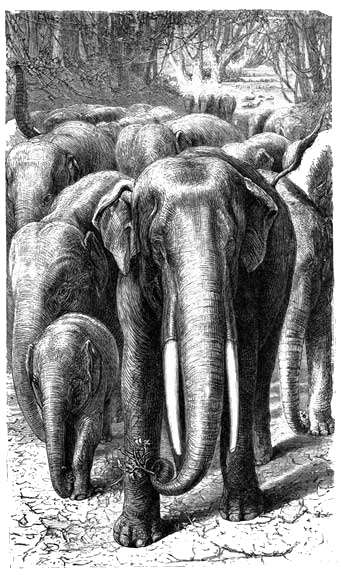
INDIAN ELEPHANT.
"They brought thee for a present horns of Ivory"—Ez. xxvii. 15.
The Talmudical writers have not much to say about the Elephant, and what they do say is rather ludicrous than otherwise. The proboscis, say they, gives the animal a very ugly look, so that to dream of the trunk of an Elephant is a bad omen. Indeed, it is so odd a substitute for a nose, that when people look at it they say, "Praised be He who can thus transform His creatures."
Largest and strongest of earth's inhabitants, the Elephant is yet afraid of the smallest. The gnat attacks him, flies into the open end of the proboscis, and sucks his blood at its ease.
It is rather remarkable that there is an ironical adage respecting the Elephant and the eye of the needle, exactly similar to the familiar proverb of the camel and the needle's eye.
THE CONEY, OR HYRAX.
The Shaphan of Scripture, and the correct meaning of the word—Identification of the Shaphan with the Syrian Hyrax—Description of the animal—Its feet, teeth, and apparent rumination—Passages in which the Coney is mentioned—Habits of the animal—Its activity and wariness—The South African Hyrax, and its mode of life—Difficulty of procuring it—Similarity in appearance and habits of the Syrian species—Three species of Hyrax known to naturalists—The Talmudical writers on the Shaphan—The jerboa and the rabbit—A curious speculation and a judicious compromise.
Among the many animals mentioned in the Bible, there is one which is evidently of some importance in the Jewish code, inasmuch as it is twice named in the Mosaic law.
That it was also familiar to the Jews is evident from other references which are made to its habits. This animal is the Shaphan of the Hebrew language, a word which has very wrongly been translated in the Authorized Version as Coney, i.e. Rabbit, the creature in question not being a rabbit, nor even a rodent. No rabbit has ever been discovered in Palestine, and naturalists have agreed that the true Coney or Rabbit has never inhabited the Holy Land. There is no doubt that the Shaphan of the Hebrew Scripture, and the Coney of the Vulgate, was the Syrian Hyrax (Hyrax Syriacus). This little animal is rather larger than an ordinary rabbit, is not unlike it in appearance, and has many of its habits. It is clothed with brown fur, it is very active, it inhabits holes and clefts in rocks, and it has in the front of its mouth long chisel-shaped teeth, very much like those of the rabbit. Consequently, it was classed by naturalists among the rodents for many years, under the name of Rock Rabbit. Yet, as I have already mentioned, it is not even a rodent, but belongs to the pachydermatous group of animals, and occupies an intermediate place between the rhinoceros and the hippopotamus.
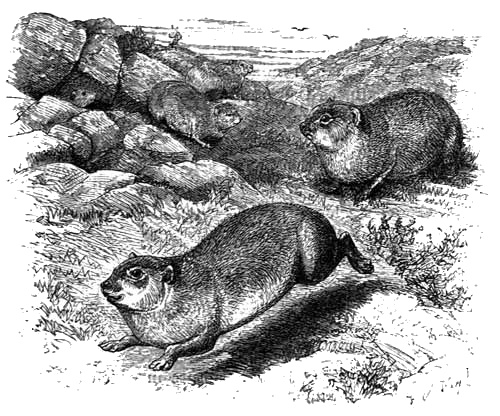
THE HYRAX.
"The Conies are but a feeble folk, yet make they their houses in the rocks."—Prov. xxx. 26.
If it be examined carefully, the rodent-like teeth will be seen to resemble exactly the long curved tusks of the hippopotamus, with their sharp and chisel-edged tips; the little feet, on a close inspection, are seen to be furnished with a set of tiny hoofs just like those of the rhinoceros; and there are many other points in its structure which, to the eye of a naturalist, point out its true place in nature.
In common with the rodents, and other animals which have similarly-shaped teeth, the Hyrax, when at rest, is continually working its jaws from side to side, a movement which it instinctively performs, in order that the chiselled edges of the upper and lower teeth may be preserved sharp by continually rubbing against each other, and that they may not be suffered to grow too long, and so to deprive the animal of the means whereby it gains its food. But for this peculiar movement, which looks very like the action of ruminating, the teeth would grow far beyond the mouth, as they rapidly deposit dental material in their bases in order to supply the waste caused at their tips by the continual friction of the edges against each other.
It may seem strange that an animal which is classed with the elephant, the rhinoceros, and the hippopotamus, all bare-skinned animals, should be clothed with a furry coat. The reader may perhaps remember that the Hyrax does not afford a solitary instance of this structure, and that, although the elephants of our day have only a few bristly hairs thinly scattered over the body, those of former days were clad in a thick and treble coat of fur and hair.
There are four passages of Scripture in which the Coney is mentioned—two in which it is prohibited as food, and two in which allusion is made to its manner of life. In order to understand the subject better, we will take them in their order.
The first mention of the Coney occurs in Leviticus xi. 5, among the list of clean and unclean animals: "The coney, because he cheweth the cud, but divideth not the hoof; he is unclean unto you." The second is of a like nature, and is to be found in Deut. xiv. 7: "These ye shall not eat of them that chew the cud, or of them that divide the cloven hoof; as the camel, and the hare, and the coney: for they chew the cud, but divide not the hoof; therefore they are unclean unto you."
The remaining passages, which describe the habits of the Coney, are as follow. The first alludes to the rock-loving habits of the animal: "The high hills are a refuge for the wild goats, and the rocks for the conies." (Ps. civ. 18.) The second makes a similar mention of the localities which the animal frequents, and in addition speaks of its wariness, including it among the "four things which are little upon the earth, but they are exceedingly wise." The four are the ants, the locusts, the spiders, and the Conies, which "are but a feeble folk, yet make they their houses in the rocks."
We will take these passages in their order.
It has already been mentioned that the Hyrax, a true pachyderm, does not merely chew the cud, but that the peculiar and constant movement of its jaws strongly resembles the act of rumination. The Jews, ignorant as they were of scientific zoology, would naturally set down the Hyrax as a ruminant, and would have been likely to eat it, as its flesh is very good. It must be remembered that two conditions were needful to render an animal fit to be eaten by a Jew, the one that it must be a ruminant, and the second that it should have a divided hoof. Granting, therefore, the presence of the former qualification, Moses points out the absence of the latter, thereby prohibiting the animal as effectually as if he had entered into a question of comparative anatomy, and proved that the Hyrax was incapable of rumination.
We now come to the habits of the animal.
As we may gather from the passages of Scripture which have already been mentioned, the Hyrax inhabits rocky places, and lives in the clefts that are always found in such localities. It is an exceedingly active creature, leaping from rock to rock with wonderful rapidity, its little sharp hoofs giving it a firm hold of the hard and irregular surface of the stony ground. Even in captivity it retains much of its activity, and flies about its cage with a rapidity that seems more suitable to a squirrel than to an animal allied to the rhinoceros and hippopotamus.
There are several species—perhaps only varieties—of the Hyrax, all of them identical in habits, and almost precisely similar in appearance. The best known of these animals is that which inhabits Southern Africa (Hyrax Capensis), and which is familiar to the colonists by its name of Klip-das, or Rock-rabbit. In situations which suit it, the Hyrax is very plentiful, and is much hunted by the natives, who esteem its flesh very highly. Small and insignificant as it appears to be, even Europeans think that to kill the Hyrax is a tolerable test of sportsmanship, the wariness of the animal being so great that much hunter's craft is required to approach it.
The following account of the Hyrax has been furnished to me by Lt.-Col. A. W. Drayson, R.A.:—"In the Cape Colony, and over a great portion of Southern Africa, this little creature is found. It is never, as far as my experience goes, seen in great numbers, as we find rabbits in England, though the caution of the animal is such as to enable it to remain safe in districts from which other animals are soon exterminated.
"As its name implies, it is found among rocks, in the crevices and holes of which it finds a retreat. When a natural cavity is not found, the klip-das scratches a hole in the ground under the rocks, and burrows like a common rabbit. In size it is about equal to a hare, though it is much shorter in the legs, and has ears more like those of a rat than a rabbit. Its skin is covered with fur, thick and woolly, as though intended for a colder climate than that in which it is usually found; and, when seen from a distance, it looks nearly black.
"The rock-rabbit is a very watchful creature, and usually feeds on the summit of any piece of rock near its home, always choosing one from which it can obtain a good view of the surrounding country. When it sees an enemy approaching, it sits rigidly on the rock and watches him without moving, so that at a little distance it is almost impossible to distinguish it from the rock on which it sits. When it does move, it darts quickly out of sight, and disappears into its burrow with a sudden leap.