GIORGIONE
Reading edition
154Although in the following Study of Giorgione I express certain conclusions which seem to me certain, it is nevertheless probable that there will never be absolute agreement about his works. The indubitable facts concerning him are so very few that no two critics can be expected to see the matter eye to eye. I disagree in many points with the pathbreakers Morelli and Berenson, but it should not be forgotten that the knowledge of such men gives an added keenness to the innate powers of perception of those who come after them. Their torch lights ours, and so the path is pursued.
The publication of Justi’s valuable work on Giorgione (Berlin, 1908), in which all the pictures still in existence that have bearing on Giorgione are reproduced, makes full illustration of this Study quite unnecessary.
155
I. PAINTINGS ATTRIBUTED TO GIORGIONE
A great upheaval and destruction of old traditions has taken place of late years in regard to paintings, and while much truth has been brought to light, a great deal of fancy has been given the semblance of veracity. The name of Morelli is familiar to all who take a serious interest in the paintings of the Italian schools, and though he was not the first to practise what not inaptly has been dubbed the ‘toe-nail’ method of criticism, yet his writings are more voluminous than those of other authors, and exemplify this method of criticism more completely, so that he may be taken as the protagonist of the school. It was the development of photography, and the vast increase in the number of pictures of which photographs could be procured, which gave rise to the Morellian school. The writers of earlier days who could not have before them on their tables, or carry with them to the galleries, a large quantity of reproductions of the works of any one master, were in a large measure prevented from studying the comparative likenesses or dissimilarities of such pictures.
But, as was natural, with this intensive study of photographs has come about a microscopic method of looking at pictures which often disregards the larger and more unquestionable qualities, and satisfies itself with tricks of drawing and the painting of details. It is as though instead of considering 156the structure and content of a book, one should measure the lines and number the punctuation points. It is within the realm of possibility that the day has passed for treatises based on such thorough study and acute perception of the qualities expressed by the Italian painters as were written by Crowe and Cavalcaselle, or such magnificently imaginative and poetic interpretations as the enduring verities first enunciated by Ruskin.
Not that these men did not make mistakes. Had they never done so we should not be able to give a true valuation to their work. Stupidity is not demonstrated by the making of blunders but by the spirit that animates the person at the moment of their commission. Ruskin, to illustrate by means of the brightest example, realised that paintings are expressions of thought just as much as are printed books, and that they are to be read and understood not by adding the vowels together in one heap and the consonants in another, but in their entirety.
Morelli and his followers, on the other hand, are obviously in large measure satisfied by an analysis of external forms and if they discover that each of two pictures presents the same number of curved and straight lines, no further proof is needed to satisfy them that the same author is responsible for both works. It is true that details of style must be studied and were often neglected by the earlier critics, but the famous proof of the identity of Moses and Melchisedek—“you take off the -oses and add the -elchisedek”—will never satisfy many people. Morelli forgot that it requires no special perception to discover that Botticelli gave his figures square nails on their toes and fingers, or that the knuckles of Rosselli’s figures 157are apt to be swollen. But it is exactly this kind of observation which copyists possess. By the observation of such points one is able to say only that such and such a work is externally like the works of this or that artist, but that it is by him depends on quite other proofs.
One or two examples will show the fallacy of such a method of argument. There is in the Boston Museum of Fine Arts a picture representing the Virgin and Child with St. John. The name of Botticelli is on the frame. So far as finger nails or shape of nostril or locks of hair or position of fingers go (and all these details are peculiarly treated by Botticelli), the work might be considered to be by him. It is, however, certain that Botticelli was not the painter of the panel. Among several circumstances that demonstrate this, such as the method of painting employed by the artist, there is one that has to do with the spirit of the work, and which in itself is sufficient proof: I refer to the figure of St. John. We have enough works by Botticelli, the authenticity of which is established beyond all question, to know that he could never at any period of his career have represented this character with a simper that reminds one of Francia’s sentimental figures.
The picture is by a feeble imitator of the master. The works of Botticelli and his imitators offer, because of the very marked peculiarities of the master, extremely good examples to show what mistakes arise by relying too exclusively on the Morellian method, and in both public and private collections are many pictures showing the mannerisms of the Florentine but which are certainly not by him.[36] Take another master, 158Leonardo. There has lately gone to America[37] a panel representing the head of a woman. It was left by Morelli when he died to Donna Laura Minghetti. To the followers of Morelli, the picture seemed for a long time genuine enough, but when the style of the headdress, the tone of the colour and character of the painting, and lastly the position of the head on the panel itself, had been studied, it became evident that the painting was a modern forgery, and this was further proved when an attempt was made to clean the panel.
These illustrations are sufficient to show that the final judgment of a picture should be based on more than its technical peculiarities. The observation of these is good to begin with, but it does not suffice. That even Morelli himself instinctively felt the weakness of his method is shown in a most humorous way in his description of his “discovery” of the author of a portrait of a woman in the Borghese Gallery.
He tells us how before he looked at this canvas with kritischem Auge he had first thought it to be by Dosso Dossi and then by Sebastiano Luciani. The rest is too naïve to translate, it must be given verbatim. “Eines Tages jedoch, als ich wieder fragend und entzückt vor dem mysteriösen Bilde stand, begegnete mein eigener Geist dem des Künstlers, welcher aus diesen weiblichen Zügen heraussah und siehe da, in der gegenseitigen Berührung zündete es plötzlich wie ein Funken und ich rief in meiner Freude aus: Nur du, mein Freund, Giorgione kannst es sein, und das Bild antwortete: Ja, ich bin’s”; and then follows analysis and dissection of the portrait.
The still small voice of his soul having interpreted the riddle 159of the picture he then saw that the eye, the expression, the mouth were such as only Giorgione could paint. In a critical case like this Morelli had to look first to something other than anatomical or sartorial shapes. Unfortunately, in this particular case, he has convinced but few students by this sudden and mysterious interpretation of the picture, and only his most ardent apostles see in the ill-drawn portrait anything but a feeble imitation of certain of the less subtle qualities of the great Venetian.
Morelli made, however, other discoveries in regard to Giorgione of greater import than this; but before taking them up in detail it will be worth while to fix clearly in our minds what we know about the Venetian’s work from contemporary or approximately contemporary writers. Vasari and Ridolfi do not, indeed, fail to give the name of Giorgione to many a picture that had never felt the artist’s brush, but they saw many a picture that has since disappeared and what they tell us is the basis of all modern criticism of this most poetic of all the Venetians. I believe it can be shown that much which the earlier writers said of him, and which has since been forgotten or unwisely disregarded, is true.
I will say nothing of the life that Giorgio Barbarelli Giorgione, Zorzone as his comrade Venetians called him, led. That has little to do with us. I wish merely to show which pictures now labelled with his name may in my opinion be confidently accepted as his, and which ones we are justified in taking from him. In his early days he painted, says Vasari, in the second edition of the “Lives”:
1. Many pictures of the Virgin.
2. David, armed and with long hair, holding the head of Goliath.
3. Warrior with a red cap, a fur cloak and a silk jacket.
1604. Child. (2, 3, and 4 were owned by the Patriarch of Aquileia.)
5. Portrait of Giovanni Borgherini and his master.
6. Head of a warrior, owned by Anton de’ Nobili in Florence.
7. Portrait of Consalvo Ferrante.
8. Portrait of the Doge Leonardo Loredano.
9. Many other portraits.
10. Frescoes on the Ca Soranzo in Venice—one representing a figure of Spring.
11. Frescoes on the front of the Fondaco de’ Tedeschi—the scenes were apparently fantastical or allegorical.
12. Christ carrying the cross, in the church of San Rocco.
13. A nude figure to show that by means of reflections painting is able to show all parts of a thing at once.
14. Portrait of Catharine, Queen of Cyprus.
15. Portrait of one of the Fugger family.
This list suffices to show that Vasari’s knowledge of Giorgione’s work was slight—and we can prove furthermore it was also imperfect. This is disheartening enough, but a still greater disappointment comes from the fact that of this list of fifteen numbers (including of course many more than fifteen pictures) there are but five of which either the originals or copies are preserved to-day. These five are Nos. 2, 5 (?), 11, 12, and 15. Numbers 5 and 15 are certainly not by Giorgione. The former is not improbably the picture in Berlin (No. 152) of which a replica is in the Louvre (No. 1156), both pictures attributed merely to the Venetian school, and the latter hangs in the Munich Gallery (No. 1107) under the name of Cariani.[38] No. 2 is usually thought to be the picture in Vienna, but Justi (Georgione, p. 182) shows that it may be a picture in Brunswick.[39]
161Ridolfi gives a much longer list of Giorgione’s works:
16. Madonna enthroned, in the church of San Liberale in Castelfranco. Portraits.
17. The dead Christ held by angels, at Treviso.
18. Frescoes on Giorgione’s own house in Venice. Figures and fantasies.
Frescoes on the Ca Soranzo (same as No. 10). Destroyed all but a woman with flowers in her hand and Vulcan who whips Cupid.
19. Fables from Ovid; among them Apollo and Daphne, and Zeus as a bull with Europa on his back. These showed strong landscape feeling. Gigantomachia. Deucalion and Pyrrha. Apollo and the Python. Apollo and Daphne. Io. Phaethon. Pyrrhus and Phlegon. Eos. Diana and Callisto. Mercury stealing Apollo’s herds. Jove and Europa. Cadmus and serpents’ teeth. Actæon. Venus and Mars caught by Vulcan. Niobe. Jove and Mercury at the house of Baucis. Ariadne. Alcides. Achelous. Deianeira. Loves of Apollo and Hyacinth. Venus and Adonis. Those owned by Sig. Vidman were: birth of Adonis, Adonis and Venus, Adonis’s death.
Portraits (cf. No. 9): Agostino Barbarigo, Catharine Cornaro (perhaps the same as No. 14), Consalvo Ferrante.
20. Frescoes on the Ca Grimani alla Servisa (Nude woman of beautiful form); on a house on the Campo di Santo Stefano, near S. M. Giubenico (Bacchus, Venus and Mars, half figures, grotesques and putti); and on the Fondaco de’ Tedeschi (same as No. 11), trofei, nudes, heads, allegorical figures measuring the world. Man on horseback.
21. A concert (now in the Pitti).
22. Allegory of human life in Casa Cassinelli, Genoa (Nurse holding crying child, and a knight; Youth disputing with Philosophers, and an old man).
23. Celius Plotius attacked by Claudius.
24. Family group—un vecchio in atto di castrare un gatto.
25. Naked woman and shepherd. She smiles at him as he plays his pipe.
26. David, a knight and a soldier, owned by And. Vendramin.
27. Naked Venus “ignuda dormiente,—è in Casa Marcella è a piedi è Cupido con augellino in mano.”
28. Woman dressed as a gipsy, in house of Gio. Batt. Sanuto.
29. Saul holding by the hair the head of Goliath brought to him by David. Owned by the Signori Leoni di San Lorenzo.
30. Judgment of Paris, owned by the Signori Leoni di San Lorenzo.
31. Judgment of Solomon, in Casa Grimana di Santo Ermacora; the figure of the executioner unfinished. (Now at Kingston Lacy, England.)
32. Virgin, St. Jerome and other figures, owned by Signor Gussoni.
16233. Warrior, owned by Signor Ruzzini.
34. Knight with black armour, owned by Signori Contarini da S. Samuello.
35. Half figure of St. Jerome reading, owned by Signori Malipieri.
36. Portraits of Luigi Crasso, seated, with spectacles in his hand. Owned by Nicolo Crasso.
37. Story of Psyche. Twelve pictures.
38. St. Sebastian, in the Chiesa della Annunciata, Cremona.
39. St. Sebastian,—three-quarter length, owned by Prince Aldobrandini.
40. David, owned by Prince Borghese.
41. A youth with a curious fur cloak, owned by Signori Muselli in Verona.
42. Christ led to Calvary, with Mary and the virgin Veronica, figures half life size.
43. Head of Polyphemus.
44. Portraits of women with strange ornaments and feathers in their hair.
David with long hair, dressed in a corselet and with the left hand in the hair of the head of Goliath (same as No. 2). This was a portrait of himself.
45. A general.
46. Youth with soft hair and armed.
Portrait of one of the Fuggers (same as No. 15).
47. A nude figure with a green cloth over his knees and armour beside him, owned by Van Veert in Antwerp.
48. ‘Some say that he began’ the picture of Pope Alexander III and Frederick I in the Sala del Maggior Consiglio in Venice.
This list is disappointing in the same way as the previous one, but, nevertheless, several of the numbers may be added to the list of pictures which are preserved. Besides those already noted in Vasari’s list Nos. 16, 17, 19 (?), 21, 23, 26, 27, 30, 31, 38, 40, exist in one form or another, but Nos. 17, 21, 23, 38 and 40, though still preserved, are not by Giorgione. No. 17 has nothing whatever to do with Giorgione, and is attributed by Crowe and Cavalcaselle to Pordenone. Whether this is by him is more than doubtful; I will speak of it in detail and also of 21 later. No. 23, called The Bravo, is in Vienna and is perhaps by Cariani; 30 is probably by Campagnola and is known by copies.[40] No. 38 is in the Brera and is by Dosso Dossi, who was also the painter of 40, which is still in the Borghese Gallery. No. 48 was probably the same picture as that mentioned in the Venetian archives under date of August 14, 1507, and was probably destroyed in the fire of 1575.[41]
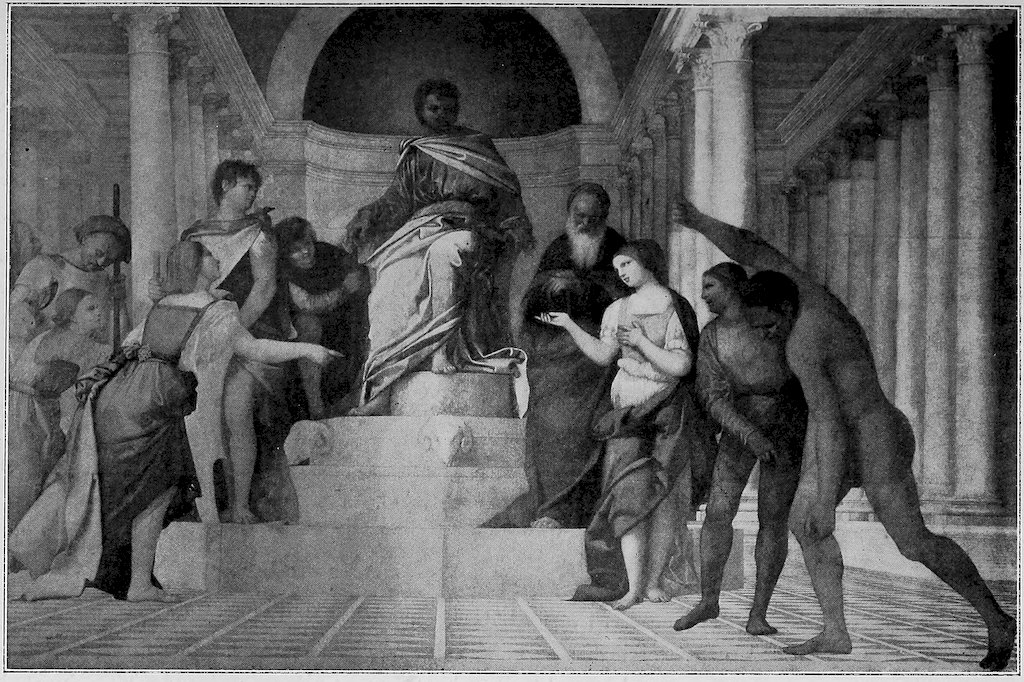
Plate LXII.
163Another author from whom we are able to gather more and important information, is Marc Antonio Michiel, more commonly known as the Anonimo Morelli. Among the pictures which he saw in Venice and neighbouring towns were several attributed to Giorgione:
/# 49. Head of a boy holding an arrow. Owned by Ant. Pasqualino, who obtained it from Zuanne Ram.
50. Head of San Giacomo holding a pilgrim’s staff. Owned by Ant. Pasqualino.
The Anonimo states that this was either by Giorgione or by one of his pupils and that it was copied from the Christ in the Church of San Rocco.
51. St. Jerome, nude, seated in a desert place in the moonlight; “copied from a work by Giorgione.” Owned by And. Odoni.
52. Three Philosophers. Owned by Taddeo Contarino.
53. Hell, with Æneas and Anchises. Owned by Taddeo Contarino.
54. Landscape with the birth of Paris. “One of his early works.”
55. Portrait of Geronimo Marcello, armed,—the body turned away from, and the head towards, the spectator. Owned by Geronimo Marcello.
Nude Venus, sleeping in the open air. “The landscape and the Cupid were finished by Titian.” Owned by Geronimo Marcello (same as No. 27).
58. St. Jerome reading. Half figure (same as No. 35?). Owned by Geronimo Marcello.
59. Soldier armed, but without a helmet. Half figure. Owned by Zuanantonio Venier.
60. Head of a shepherd. In his hand a fruit. Owned by Zuanne Ram.
Head of boy. In his hand an arrow. Owned by Zuanne Ram (same as No. 49).
16461. Stormy landscape with a gipsy and a soldier. Owned by Gabriel Vendramin.
62. Dead Christ and an angel holding him above the tomb. Finished by Titian. Owned by Gabriel Vendramin.
63. Nude figure in a landscape. Pen drawing. Owned by Michiel Contarini.
64. Finished picture of No. 63. Owned by Michiel himself.
65. Portrait of Giorgione’s father. Owned by Piero Servio. #/
Of this list, the particular value of which lies in the fact that it was made by one whose early years were probably contemporary with the close of Giorgione’s life, Nos. 52, 54, 61 and perhaps 62[42] are still (either the originals or copies) in existence. No. 59 suggests a picture in the Colonna Gallery in Rome which has much Giorgionesque feeling, but is in a ruined condition.
Still another writer who mentions several pictures by the master is Giacomo Barri. I quote the passages from the English translation of his book:[43]
Page 106. Castelfranco. “Here is an admirable Picture of the Blessed Virgin with her Son, the work of Giorgione. There are likewise divers Palaces near adjacent where you will find works of the same Giorgone as also of Paulo Veronese.” (Same as No. 16.)
Venice, page 52. “And upon a front of a House near the house of the Pisani, and the Palace of the Flangini, in S. Maria Gibenigo, there are painted by the hand of Giogone, many Freezes in Chiaro Scuro, in Yellow, Red, and Green, with rare fancies of Boys, in the middle of which are four Half-figures, viz., A Bacchus, a Venus, a Mars, and a Mercury, coloured after the usual manner of the Author.” (There is a note added to the words “the usual manner” which reads: “Which was not to paint in above two or three colours.”) (Cf. No. 20.)
Page 56. The ‘Fontico de Todeseti’ is mentioned. (Same as No. 11.)
Page 56. “In the field or place before S. Pauls you plainly see upon the Front of the House of Soranzo several Figures of Giorgone, most beautiful things.” (Same as No. 10.)
Page 67. “The albergo of the said school [School of St. Marks]. As you enter, the first square on your left hand is by Giorgone.”
165Page 84. “The Church of the Hospital of the Incurabili.” “And over a side Door of the Church you may observe a little Square of our Saviour carrying the Cross and an Executioner drawing him along, by the hand of Giorgone.” (Same as No. 12.)
Treviso, page 97. “The Mountain of Piety in the aforesaid City.” “Here they preserve a Christ with a little Angel, a most singular work, by the hand of Giorgone.” (Same as No. 17.)
Cremona, page 114. “Here is a picture of S. Sebastian and two Angels by the hand of Giorgone.” (Same as No. 38.)
67. Parma, page 126. In the Palace of the Fontana. “There is also the picture of Fra Sebastiano del Piombo, a Painter, the work of Giorgone.”
Only two pictures (66, 67) not mentioned by the other authors are given in this list, and one of these, the portrait of Sebastiano del Piombo, has, I believe, been lost sight of. The picture that was in the School of St. Marks now hangs in the Academia in Venice. It represents the story of the calming of a storm by the saints Nicholas, George and Mark. Some students consider this picture to be a work by Giorgione much repainted by Palma or Paris Bordone. Others, with whom I agree, fail to see in this ugly work the slightest suggestion of Giorgione.
These then are the chief early sources for our knowledge of the subjects painted by Giorgione. If the list of his works seems small, it must be remembered that the painter was only some thirty-three years old when he died. The inaccuracy of the attributions made by these writers shows how careful one must be in dealing with the information they give us, and suggests the reflection that probably they were as careless in failing to speak of works that were certainly by the master as they were in mentioning others which unquestionably were not by him. All new attributions must, however, be based on a comparison with the few works which unbroken tradition and common consent give to Giorgione, and not with those 166about which trained opinion differs. Individual judgment as to the likeness one picture bears to another is very different from convincing proof. Before criticising individual works we must consider the basis for discussion that the lists present.
Of the sixty-seven different items mentioned, the following are known to us.[44] 1 (?), 2, 5 (?), 11, 12, 15, 16, 17, 19 (?), 21 (?), 23, 26 (?), 27, 29 (?), 30, 31, 38, 40 (?), 42 (?), 52, 54, 61, 62 (?), 66. Of these only 2, 5 (?), 11, 12, 16, 21 (?), 22 (?), 26 (?), 27, 31, 52, 54, 61, 62 (?) need be considered as being related in any close way to Giorgione. The claims of Cariani, Licinio, Della Vecchia, and the host of other, generally feeble, imitators of Giorgione to the other pictures may be studied in Crowe and Cavalcaselle, or later works. Even some of the works included in the small list just given are not accepted as genuine by all the critics, but a few there are the authenticity of which could only be questioned by bringing much more serious evidence against them than I have ever seen adduced. These rare, choice works are:
2. David, armed, holding the head of Goliath. Now in Vienna. This is not the original, but, as noted by Crowe and Cavalcaselle, a late copy. I own another copy, on panel, which shows the lower part of the picture better than the Vienna copy.
11. Frescoes on the Fondaco dei Tedeschi. Preserved, except a fragment only, in Zanetti’s engravings.
12. Christ carrying the Cross, in the Church of San Rocco, Venice.
16. Madonna enthroned, in the Church of San Liberale in Castelfranco.
27. Naked Venus, asleep, in Dresden. Some critics still hesitate to accept Morelli’s attribution of this canvas to Giorgione, but the greater number have, I believe, given a ready assent.
31. The Judgment of Solomon. Now at Kingston Lacy (Plate LXII). This, the Castelfranco Madonna, and the Three Philosophers, are in certain ways the most important works of the painter now existing.
16752. Three Philosophers. In Vienna (Plate LXVI).
54. Landscape with the Birth of Paris. A fragment of a poor copy of this is preserved in Buda-Pesth. An engraving by T. van Kessel from a copy of the picture by Teniers shows what the whole composition was.
61. Stormy landscape, with a gypsy and a soldier. In the Palazzo Giovanelli, Venice (Plate LXV).
To these nine unquestioned works by Giorgione are to be added others that have no early literary evidence to bear out their claims to a Giorgionesque origin, but which unbroken tradition resisting even the assaults of modern criticism has assigned to this category. Such are:
The Judgment of Solomon, in the Uffizi.
The Fire-test of Moses, in the Uffizi.
Knight of Malta, in the Uffizi.
Head of Christ carrying the Cross, formerly in the Palazzo Loschi Vicenza, and now in Mrs. Gardner’s Collection in Boston (Plate LXVII).
Study for the figure of San Liberale, in the Castelfranco picture, in the National Gallery, London.
So far as the giving of any certain knowledge of Giorgione’s technique is concerned, the first three of these pictures are very disappointing, for all of them have been so thoroughly repainted that the original work is much injured. While most critics follow the tradition and believe Giorgione to have been the painter of these pictures, there are those who do not hold this opinion. For instance, Dr. Bode, one of the keenest judges of pictures, does not think the Judgment of Solomon, and the Trial of Moses, to be by him.[45] Others there are who think that the judgment passed by Crowe and Cavalcaselle on the Knight of Malta is very sound and satisfactory. They 168say: “Giorgione’s work was altered by later retouching, or the painter is a skilful imitator of Giorgione’s manner.” Personally, I believe all these to be by him.
Taking now these fragments of written evidence and of tradition, let us see what the modern writers of most repute have considered to be examples of Giorgione’s work. To begin with Crowe and Cavalcaselle, they give as true Giorgiones the following:
The Fondaco de’ Tedeschi.
The Christ in San Rocco.
The Judgment of Solomon at Kingston Lacy.
The Chaldæan Sages (the Three Philosophers).
The Family of Giorgione (the picture in the Giovanelli Palace).
The Castelfranco Madonna.
The David in Vienna, of which they say “this is a late copy, perhaps after the original noted by Vasari.”
Of the traditional pictures they consider as the master’s work:
The Judgment of Solomon, in the Uffizi.
The Trial of Moses, in the Uffizi.
The Knight of Malta (?), in the Uffizi.
They add:
The Shepherd’s Offering in the Beaumont (now Lord Allandale’s) Collection, London.
The Adoration of the Magi, in the National Gallery, London; formerly owned by Sir William Miles, of Leigh Court.
These last two pictures are much less well known than the others. I shall endeavour to show that the later attributions of them to Catena or others are based on a mistaken idea of Giorgione’s style (not to mention Catena’s), and that Crowe and Cavalcaselle were perfectly right in their estimate of them. Other pictures which are often thought of in connection with Giorgione and which they, quite rightly I believe, refused to acknowledge, are:
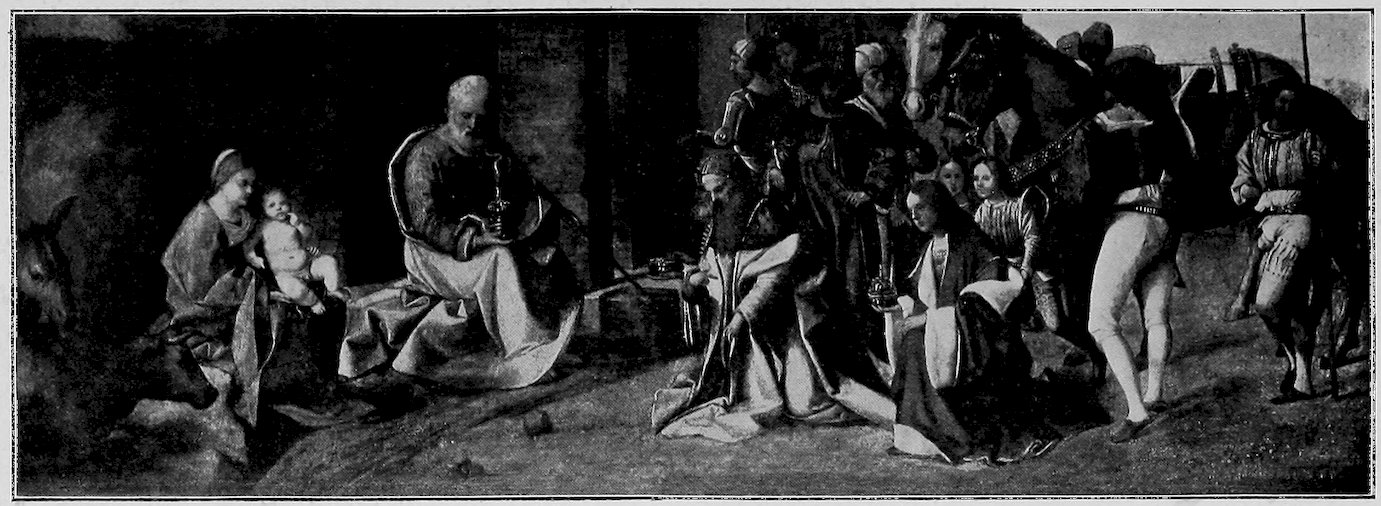
Plate LXIII.
169The Concert, in the Pitti.
The Fête Champêtre, in the Louvre.
Madonna and Saints, in the Louvre.
Nymph and Satyr, in the Pitti.
The Head of a Boy, at Hampton Court.
The Madonna and Child with St. Brigida, in Madrid.
To take more modern writers, we find a very different list of works attributed to Giorgione by Morelli.[46] It consists of the following:
The Trial of Moses.
The Judgment of Solomon.[47]
The Christ bearing the Cross.
The Madonna of Castelfranco.
The Gypsy and the Soldier (Giovanelli Palace).
* The Madonna and Child with Sts. Antony and Roch. (Madrid.)
The Knight of Malta.
† * Daphne and Apollo. This is in the Seminario of Sta Maria della Salute in Venice. Crowe and Cavalcaselle (II. 165) attribute it to Andrea Schiavone, and with their opinion I agree.
* The Three Ages of Man, in the Uffizi, ascribed usually to Lotto.
The Concert, in the Louvre. (Same as Crowe and Cavalcaselle’s Fête Champêtre.)
The Fragment of the Birth of Paris, in the Esterhazy Gallery, Buda-Pesth.
* Portrait of a Man, in the Esterhazy Gallery.
* Portrait of a Woman, in the Borghese Gallery, Rome.
† Nymph and Satyr, in the Pitti.
† Portrait of a Youth, in Berlin.
† Head of a Boy, in Hampton Court.
Three Philosophers, in Vienna.
* Venus in Dresden.
† Allegory, in Dresden. { These Morelli considers copies
† Judith, in St. Petersburg. { of Giorgione’s work.
The pictures I have marked with an asterisk are those which Morelli was the first to claim with insistence for Giorgione, 170and with the exception of the Venus not one of these attributions has been generally accepted. Those marked with a dagger are attributions of older or younger date. About all of them, certain doubts, and about most of them doubts of very serious nature, must be dispelled, before the attribution can be accepted.
The two points most noticeable in Morelli’s list are the differences in the style of the pictures included and the absence of others. It would be difficult to combine works more dissimilar than the Berlin portrait of a youth and the portrait of a woman in the Borghese, and even if one grants that an artist working at the time when Giorgione flourished was subjected to influences so strong and varied that the character of his work altered from time to time, it can only be explained by a miracle that the same man painted the Castelfranco Madonna and the Daphne and Apollo. Even the last dashing works of the century-old Titian differ hardly more from his calmer earlier canvases than do these two pictures, which Morelli would have us believe were painted by a man who died at the age of thirty-two or thirty-three. This curious, one may not unfairly say erratic, combination of Morelli may perhaps be explained by supposing, as is true in other parts of his work, that he was so taken up with the similarity of certain details that he forgot to study the larger and more telling characteristics of the pictures. But what explanation is there of his strange silence regarding the Benson[48] and Beaumont pictures, the Judgment of Solomon at Kingston Lacy, the Vienna David, and the Christ bearing the Cross in San Rocco?
171A later and slightly different form of the Morelli list is given by Berenson.[49] It is as follows:
Berlin, Portrait of a Man.
Buda-Pesth, Portrait of a Man.
Castelfranco, Duomo, Madonna with Sts. Francis and Liberale.
Dresden, Sleeping Venus.
Florence, Uffizi, Trial of Moses; Knight of Malta; Judgment of Solomon.
Hampton Court, Shepherd with Pipe.
Madrid, Madonna with Sts. Roch and Antony of Padua.
Paris, Fête Champêtre.
Rome, Villa Borghese, Portrait of a Lady.
St. Petersburg, Judith (?).
Venice, Academy, Storm calmed by St. Mark. Finished in small part by P. Bordone. (In the edition of 1894, Berenson attributed this to P. Bordone, saying that perhaps it was begun by Giorgione.)
Venice, Seminario, Apollo and Daphne; Giovanelli, Gypsy and Soldier; S. Rocco, Christ bearing Cross.
Vicenza, Casa Loschi, Christ bearing Cross. (Now in the Gardner Collection, Boston.)
Vienna, Evander showing Æneas the Site of Rome. (Often called the Three Philosophers.)
In an article[50] published since the appearance of his book, Berenson has added to the above list several pictures which he considers to be copies of Giorgiones. They are:
Bergamo, Orpheus and Eurydice. The copy made by Cariani.
Buda-Pesth, Two men walking. Fragment. (This is what Morelli calls the Birth of Paris.)
Milan, Portrait of a lady, belonging to Signor Crespi.
St. Petersburg, Judith.
London, Portrait of a man formerly belonging to Mr. Doetsch; now owned by Colonel Kemp.
172
II. THE TRUE GIORGIONE
A superficial study of the lists which have been given suffices to show that the various critics have very different standards by which to judge Giorgione and his works. I much doubt whether entire order can be brought out of the chaos that now rules, but a sounder basis for future study can be derived from a combination of the best points of the work of these very differently endowed critics than any one of them by himself offers.
So far as Crowe and Cavalcaselle go, they are, I believe, entirely right. Among the twelve pictures which they unhesitatingly ascribe to Giorgione, only three have been questioned by any one. These three are, the Judgment of Solomon, at Kingston Lacy, the Epiphany, in the National Gallery, and the Beaumont Shepherd’s Offering. The only possible explanation of the fact that Morelli does not mention the picture at Kingston Lacy is that he did not see it.[51] It is one 173of those works that in every touch show the author. Even if we did not have Ridolfi’s evidence for the existence of such a work, it is difficult to understand how hesitation could arise in the mind of any one undisturbed by theories as to the author of the picture. The figure of the executioner is, as Ridolfi says, unfinished. So, too, is practically the whole picture (Plate LXII).
What strikes one at first sight is the similarity to Bellini’s work at the same time that one realises a development of dramatic power greater than he ever attained. The fine restraint of composition is his, the serious and painstaking technique is his, but the dramatic energy displayed in the action of the several figures is a step beyond anything which Bellini ever accomplished. And the few undoubted works show that Giorgione was great enough to compose with the same grandeur, and work with a similar perfection to Bellini, and yet give more dramatic intensity to his figures. But if any one is blind to the spirit that permeates this wonderful bit of poetry, let him study the details. The head of the youth standing upright on Solomon’s right hand is most closely allied to that of the seated figure in the Three Philosophers. The old man on the left of Solomon is in his turn very similar to the oldest of the Three Philosophers. Compare the hand of the second figure from the right with the left hand of the last-mentioned Philosopher: it is the same.
The tight drawn hair of the women is the same as that of the Castelfranco Madonna and the Gypsy in the Giovanelli Palace picture. The strong, broad, full-toed, carefully drawn feet are what we see in the Three Philosophers, and the St. Francis of the Castelfranco picture. The full-lipped, small, 174quietly closed but expressive mouths of the figures are such as distinguish Giorgione’s other unquestioned works and show a master’s touch. The draperies massed in grand, simple style, broken only by folds that truly show the quality of the stuff or its arrangement—that are not merely put in out of pure fancy—are like those that characterise the Castelfranco Madonna and the Three Philosophers. There is no refuting the judgment passed by Crowe and Cavalcaselle. This is a true Giorgione and in certain ways the finest of them all.
I have refrained from comparing it with the Dresden Venus for the reason that this discovery of Morelli’s has been, though I believe on insufficient grounds, disputed, and some critics question whether the Venus is not a work of Titian. The evidence with which Morelli maintained the Giorgionesque origin of the work is very convincing, but there is a quality of the work upon which he did not lay sufficient stress. I refer to the lack of sensuousness in the figure. It is the lack of this mundane quality, the abstractness of the figure, that renders it ideal, which allies this work with the finest Greek sculpture, with figures of the Periclean epoch. The nude female figure is thought of not from a sexual standpoint, but from that of pure beauty of form. To represent such feeling was unlike Titian even in the most earnestly ideal of his youthful days. His work in almost every case has a glow of passion; Giorgione’s, on the contrary, suggests loveliness that deserves the deepest admiration, but does not suggest actual human life and action. The two ideals are the poles asunder. Titian’s is that of the man, Giorgione’s that of the woman. As Coleridge said, “Man loves the woman, but woman loves the love of the man,” and when one looks at Titian’s Venuses or his other female figures, one is inevitably more vigorously self-conscious and one’s attention is more indissolubly bound to the body than when one’s eyes rest on the statuesque beauties of the Castelfranco painter’s imaginings.
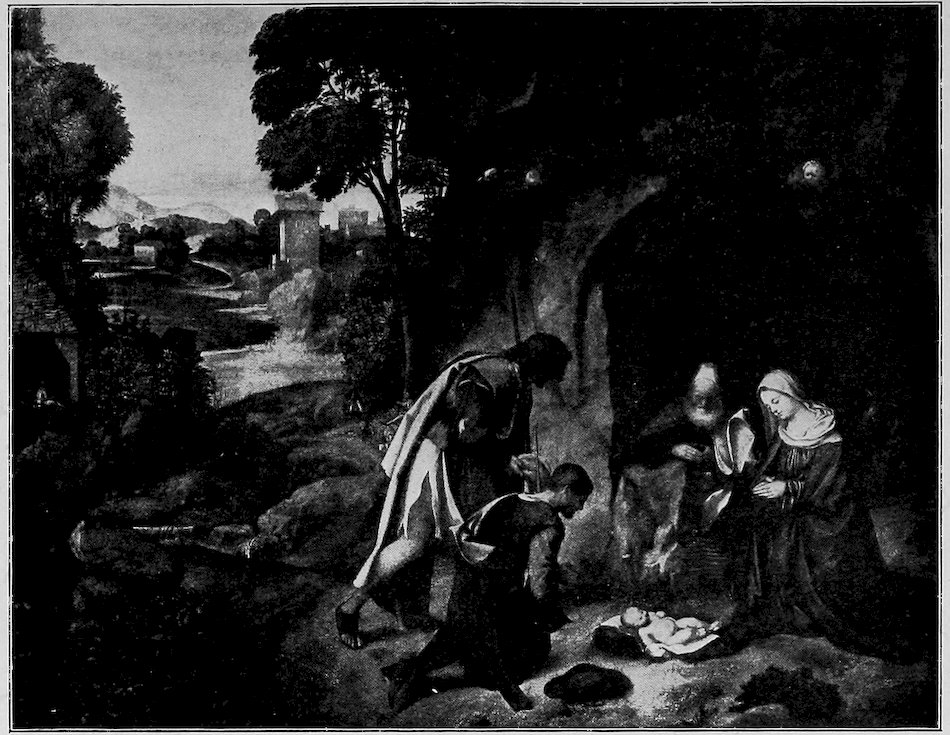
Plate LXIV.
175The method by which these effects are depicted is unmistakable and clear. In Titian’s figures of nude women the glance of the eye is often distinctly and sharply focussed in the eye of the beholder, and the action of the figure is motived by the presence of the beholder. The painted image is the corollary of the being that looks upon her. It is not so in Giorgione’s work. His Venus is self-contained, self-centred and thoughtless of the outer world. The eyes (cf. the Giovanelli picture) do not strongly draw yours to themselves, and the action does not imply a realisation of the presence of any interested gazer. For exactly these reasons, plain simple reasons, but of deepest import, the Venus of Praxiteles is of inestimably greater worth than that later impersonation of female vigour and physical delight, the Venus de’ Medici. And in similar manner Giorgione proves himself a man and an artist who attained to the adequate presentation of an ideal of beauty of the female figure far more elevated and uplifting than that held by his more famous contemporary Titian. The Venus may, as Morelli said, be safely considered as a true Giorgione.
The case is not so clear, though I believe it is not less unquestionable, when we consider the Epiphany[52] of the National Gallery (Plate LXIII). The criticism passed by Crowe and Cavalcaselle on this picture and the Shepherd’s Offering in the Beaumont Collection is, so far as it goes, sound. They 176say of these pictures “that the style coincides with that which historians attribute to Giorgione; that most of the characteristics which predominate recur in canvases registered by the oldest authorities as those of Barbarelli; and that the landscapes in every case resemble each other and recall the country of Castelfranco.” There is much more proof, however, that can be adduced to show that only Giorgione could have painted these works. But first the attribution of them both to Catena[53] must be shown to be groundless.
A word, however, in regard to logical reasoning about pictures, the lack of which constitutes a great weakness in Morelli and some of his followers, may perhaps be deemed not inappropriate here. Circumstantial evidence is at best only partially conclusive. Morelli did some brilliant work by its means in correcting the names under which many pictures had masqueraded. Such work must, it is self-evident, be founded on the signed works of the masters or on works whose authorship is proved by literary evidence of the strongest character. But he and his followers seem to forget that others may refuse adherence to the belief in one or more of these attributions and yet not be utterly foolish. Many minds are convinced by evidence which to other equally capable and well-trained intelligences does not carry the force of conviction, or may even seem to be based on a misapprehension of fundamental facts. Grant, however, that a given attribution of an unsigned work seems reasonable, still there are in most such cases parts of it that are to a certain extent dissimilar to the certified works of the master to whom it is attributed—otherwise it would never have been falsely named.
177Were this not true, how had doubt ever arisen in men’s minds as to who wrote the Rhesus, or when the Apollo Belvedere was made? Suppose now that in studying a picture and attributing it to an artist one finds a second or a third or a fourth picture that seems to be by the same painter. One sees that each has certain points in common with the signed works and others common only to the unsigned work which was the first of our new attributions. To deduce from the similarity which any two of the unsigned works bear to each other in their differences from the signed works of the author to whom it is desired to attribute them, that they must be by this author, is an absolutely illogical and unreasonable method of argument. One can ‘prove’ anything in this way, which could without difficulty enable one to show that the Two Loves of the Borghese Gallery was painted by Perugino. All that is needed is a sufficiently large list of works each differing slightly from Perugino’s true masterpieces. It is but another form of the old game of turning one word into another by adding and subtracting syllables. Thus one turns drama into odious: drama, melodrama, melodious, odious.
Unfortunately Morelli did not realise the weakness of this system. Had he done so, he would never have attributed to Catena the Epiphany of the National Gallery, and his followers would not consider the same artist as the painter of the Benson Holy Family and the Beaumont Shepherd’s Offering.[54] I do not mean to imply that he would have considered 178Giorgione as their author, but, it is only by strained and extravagant reasoning that they can be claimed for Catena. They bear no resemblance in either composition, colour or idea to any of the unquestioned works by this second-rate pupil of Bellini, the imitator, par excellence, of the work of his greater contemporaries.
So far as a careful analysis enables one to make out from the context of the whole passage in which Morelli speaks of these works,[55] he seems to have convinced himself that Catena was the painter of the Epiphany because of the similarities that exist between it and the Knight adoring the Infant Christ and the St. Jerome in his Study in the same Gallery. The first thing to notice is that the likeness which the Epiphany bears to the St. Jerome is almost entirely imaginary. The chief difference between the two works is that the Epiphany is not only painted in a very different manner technically, but it is much less laboured. It shows vastly greater facility of draughtsmanship; the execution is very much more easy; the colour is fuller and purer; the chiaroscuro is more varied, and, finally, it is much more imaginatively conceived. It gives one, in fact, the impression of being by a master, whereas the St. Jerome seems nothing more either in imagination or in technique than the work of a careful, serious, arid-minded student.
The St. Jerome in fact may well be by Catena, for these are the qualities with which we know he was endowed. The similarity between the Epiphany and the Knight adoring the Infant Christ is greater, but still not very great.[56] But here 179too we must remember that the attribution of the Knight to Catena is based not so much even on good circumstantial evidence as on the fairly unanimous belief among those capable of judging what certain phases of Catena’s changing style probably resembled. But the points wherein the Epiphany surpassed the St. Jerome are just those in which it shows greater mastery than is exhibited in the Knight. The same stiffness and awkwardness of drawing mark the Knight as by an artist of much less capacity than him of the Epiphany.
So too does the clumsy, empty composition. The small-featured faces, the lack of appearance of real substance in the bodies, the dull and uninteresting chiaroscuro, the laboured technique are characteristic of Catena, but not one of them shows in the Epiphany. Catena may well have painted the beast like a hobby horse which the Knight’s page holds, but it was an abler hand than his which drew the horses from which the Magi have dismounted. The crinkly, crushed draperies in the Knight are similar to Catena’s work, but there is nothing like them in the Epiphany, where the glowing coloured garments are cast in simpler and grander and at the same time more natural lines. Can any one really imagine that the same man painted the dull, hard, conventional 180head of St. Joseph in the Knight and the much more thoughtful and original face of the same figure in the Epiphany? or how can any one believe that the same artist designed heads of such different shape, eyes and noses and mouths so unlike in the one and the other work; hands in the Knight so like turtles’ feet, and so vigorous and human in the Epiphany? It is surely improbable, and Crowe and Cavalcaselle were right when they recognised a great difference between the two works and saw in the smaller, richer one the hand of Giorgione. The reasoner who is calm and unpolemically minded must agree with them.
The next picture for us to consider is the Beaumont Shepherd’s Offering which Crowe and Cavalcaselle give to Giorgione, but which is by Berenson and others considered a Catena.[57] If the Epiphany were a Catena, then the Shepherd’s Offering would be also, for not only the treatment and colour as a whole, but the details, more particularly the group of the Holy Family, is distinctly alike in both. The same reasons that show that it is impossible that Catena ever painted the Epiphany apply with even greater force to the Shepherd’s Offering. Both pictures are utterly unlike Catena’s work in all essential points, all those, that is to say, which are the expression of character. Certain Giorgionesque qualities show more strongly in the Shepherd’s Offering than in the smaller work. I will not analyse the details of form, substantiality of masses and richness of colour, for every unprejudiced eye will see that they are the same in each of these two works as they are in the unquestioned works by Giorgione. But there is a quality more difficult to analyse and to express in fixed terms, that stamps the Shepherd’s Offering not only as a work by Giorgione, but as a very characteristic expression of his genius. I refer to the impression given by the quietness of the scene, by the slight vagueness of it all, and to the colour and chiaroscuro that remind one of an evening landscape (Plate LXIV). All these points taken together make the scene seem mysterious and dreamlike.
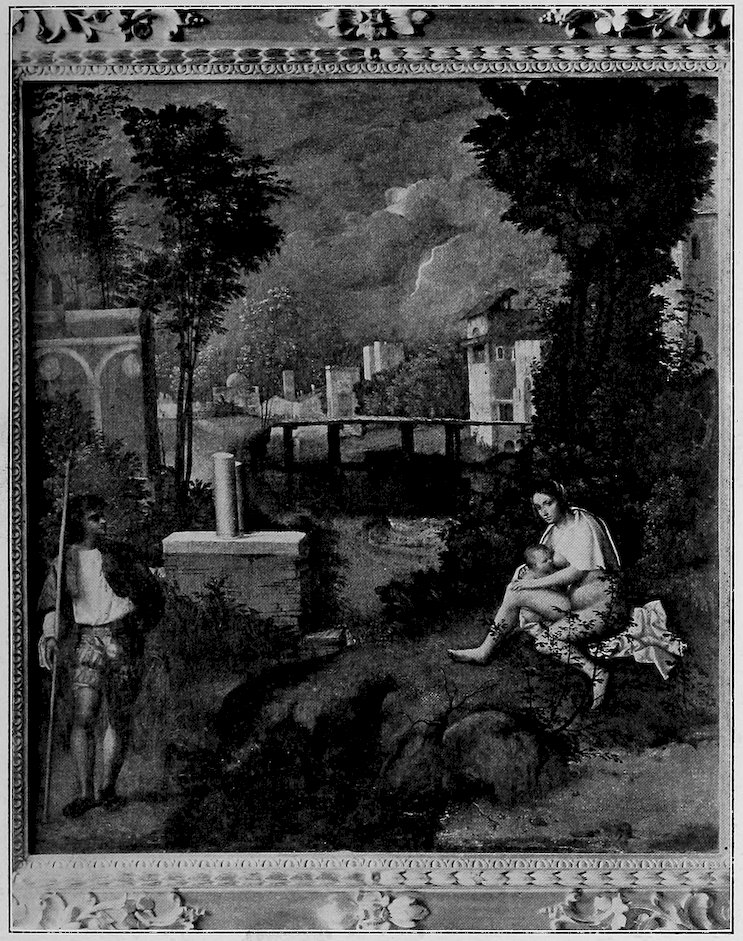
Plate LXV.
181Now, clearly enough, this romantic quality occurs to a greater or less extent in all the unquestioned Giorgiones. It is the deep religious ardour of Bellini turned to a broader field. It is the sharp focussed passion of Titian transmuted into an abiding love for all things beautiful. In the Giovanelli Landscape (Plate LXV) you see it in the strange combination of soldier and nude woman under the lightning-riven skies and the trees heavy and white with the storm. In the Three Philosophers you see it in the contrast of the three men of different ages and the quiet forest where they sit with the city in the distance that seems to be asleep (Plate LXVI). In the Virgin of Castelfranco you see it in the throne placed in the open meadows peopled by visionlike figures, in the deeply impressive silence and contrast of the monk and warrior, and in the still blue sea lapping the templed shores beyond. You see it in the Venus,—not any one woman so much as the presentation of everlasting feminine beauty—sleeping under the open sky across which roll great summer clouds rising from the distant sea. It is present almost invariably in his work and forms the chief richness of the Beaumont picture, in which the strangely silent group under the trees, the empty shepherd’s 182hut beyond and the deep distance of rolling, castelled hills and meadows, golden in the light of the low sun, is like a vision that one sees in those rare moments when one’s eyes pierce the husk of this world and we seem for one treasured instant to have passed the borders and be wandering in El Dorado.
In none of Catena’s authentic works does he attain to such a height of imaginative presentation of daily phenomena. He could appreciate it, as is shown by his attempt in the Knight to paint in the manner of Giorgione, but that picture alone would be sufficient to show his incapacity to attain the goal at which he aimed. Nor is this feeling which we derive from Giorgione’s works imaginary and based on preconceived ideas. It is distinctly due to certain indubitable facts. No one questions the mystery and inexpressible beauty of the light of early dawn or evening, and it is this rather than the full, hard, mid-day glare that is the light of all Giorgione’s pictures. Nor is there doubt of the impressiveness of gloom, be it of forest or of storm, and such mystery as this was dear to the hill-born artist. Nor, further, can one hesitate to admit the visionary, mirage-like appearance of vigorous action that takes place in silence and of which the anatomical details are suppressed. Such is the action of Giorgione’s figures. They are plainly deeply interested in the scene of which they form part, but their faces (even in the Judgment of Solomon at Kingston Lacy) show their interest rather by the eyes than by the lips. They look, but do not speak. Like Greek Gods they act, but with terrible great silence.
And so, too, though the bodies of his figures are full of life and action, yet they rarely show the tense and emphasised muscles appropriate to such action, but appear rather, having acted, 183to be now at rest. A similar peculiarity is to be observed in the draperies which, just as I have tried to show in regard to the figure of the Venus, are of the same nature as the best Greek work. They are completely motived, that is, by the bodies beneath them. They are a positive component part of the figure, not merely an accidental addition, and they rest and move with it. Thus, as the bodies seem to be resting after motion, so the draperies seem to be also. They show none of the little, trifling, momentary folds that express actual motion, but merely those larger, more essential lines and masses that are truly expressive of the vitality and movement of the figures, whose beauty they enhance, so far as such life and activity can be expressed by woven stuffs.
Let us turn now to Catena, his Sta. Caterina, or his Virgin Enthroned, in Venice, and we see draperies that are in large measure as merely studio studies of cloth as any to which Albert Dürer ever attached hands and feet and a head and called it a human being. The folds do not carry out the action of the figure, but crinkle and ripple and break in meaningless profusion from shoulder to ankle. Giorgione was a richly imaginative, deeply thoughtful genius, and such a personality as this is indelibly stamped in the Epiphany, the Shepherd’s Offering, and the Benson Holy Family. Catena was a fashionable plagiarist and moderately successful imitator of the manner of his master Bellini and of his great contemporaries; such a character as his is completely foreign to the spirit of these three pictures.
The Holy Family,[58] one of the many treasures of Mr. 184Benson’s collection, is also given by Berenson, and by others, to Catena. The Virgin and Joseph are, as one sees at first sight, the same figures as in the two preceding works. I will not unfold the argument again. The picture is to be attributed to Giorgione for the same reasons that show the two other pictures to be his. One proof may be added to those adduced before, and this is the pebbly surface of the ground. The same treatment is to be seen in the Judgment of Solomon, and the Trial of Moses, in the Uffizi, in the Three Philosophers, in the Giovanelli Landscape; and in this last picture the painting of the brick work below the column is the same as that of the building beside which the Holy Family are seated in Mr. Benson’s picture. Catena could as easily have painted Bellini’s Loredano as this head of St. Joseph, as fine a head in its grandeur of mould and simple earnestness of expression as was ever given to this too often maligned Saint. It is a Giorgione, and a fine one.
The picture of Christ carrying the Cross in the Church of San Rocco in Venice is by Morelli[59] said to be “gewiss ein ganz frühes Werk” of Titian. Considering that he does not give a single proof of this assertion, we may be forgiven if we fail to see the Gewissheit of the attribution. It is true that Vasari was not sure whether Giorgione or Titian was the author, but tradition, as can be traced by guide books, certainly leads us to consider the former as the author. The condition of the picture is such that it gives one no help in solving the problem, but so far as the drawing of details goes we meet no contradiction of the traditional authorship. The shape of the head of the Christ and the drawing of the eyes and brow 185are met with in the certain works. In believing this ruined picture to be by our master, I am following the opinion held by Crowe and Cavalcaselle, and in more recent days by Berenson.
The difficulties that are met in trying to discover a decisive proof of the origin of the Knight of Malta are similar to those which confuse the argument about the ‘Christ’ of San Rocco. The picture has been so maltreated that there is little left to study but the shadow of the original. A magnificent original it must have been, one of those rare works, commoner in Venice than elsewhere, that truly make the corporal substance conform to the nature of the hidden soul, so that one thinks not so much of the person shown to us as of his manner of thought and life. There is much about the portrait that makes its attribution to any one but Giorgione next to impossible, and nothing, I believe, that throws any doubt in the way of our considering him the author. He was capable of such a portrait, and in its earlier days it was unquestionably worthy of him. This is, of course, the usual opinion, though Crowe and Cavalcaselle felt that the repainting had so altered the work as to destroy its character.
The Head of Christ bearing the Cross, formerly in Vicenza, and now, fortunately for our country, in Boston, is another of the works the authorship of which cannot be absolutely proved, but of which the character is so marked that there is little or no diversity of opinion about it.[60] It is one 186of the pictures that Crowe and Cavalcaselle thought worthy of Giorgione, and which since their day Morelli and others have not hesitated to regard as his. Still strongly tinged with the influence of Bellini, it contains the promise of a freer, broader treatment of religious subjects than even Bellini had attained, and shows us unquestionably the young Giorgione. The hand and eye of Bellini guide him as he works, but his own genius cannot be utterly suppressed, and he adds to his master’s style something that marks the picture, when it leaves his easel, as the true expression of a great genius and not as that of a merely facile and unoriginal pupil (Plate LXVII).
Closely connected with the Madonna of Castelfranco is the study for the figure of San Liberale in the National Gallery. It is true that such studies by the fifteenth-century Italian masters are extremely uncommon, but the differences between this study and the large picture are such as we can hardly imagine being introduced by a copyist, and the painting, considered solely from the technical point of view, is so masterly that we are, I believe, justified in considering the figure as the product of Giorgione’s brush.
Of the six pictures (Pitti, Concert, and Nymph with Satyr; Louvre, Fête Champêtre, and Madonna and Saints; Hampton Court, Shepherd; Madrid, Madonna with Sta. Brigida) which, though traditionally ascribed to Giorgione, Crowe and Cavalcaselle refused to consider as his, the Madonna and Sta. Brigida and the Madonna and Saints in the Louvre are now less often thought of in connection with his name.[61]
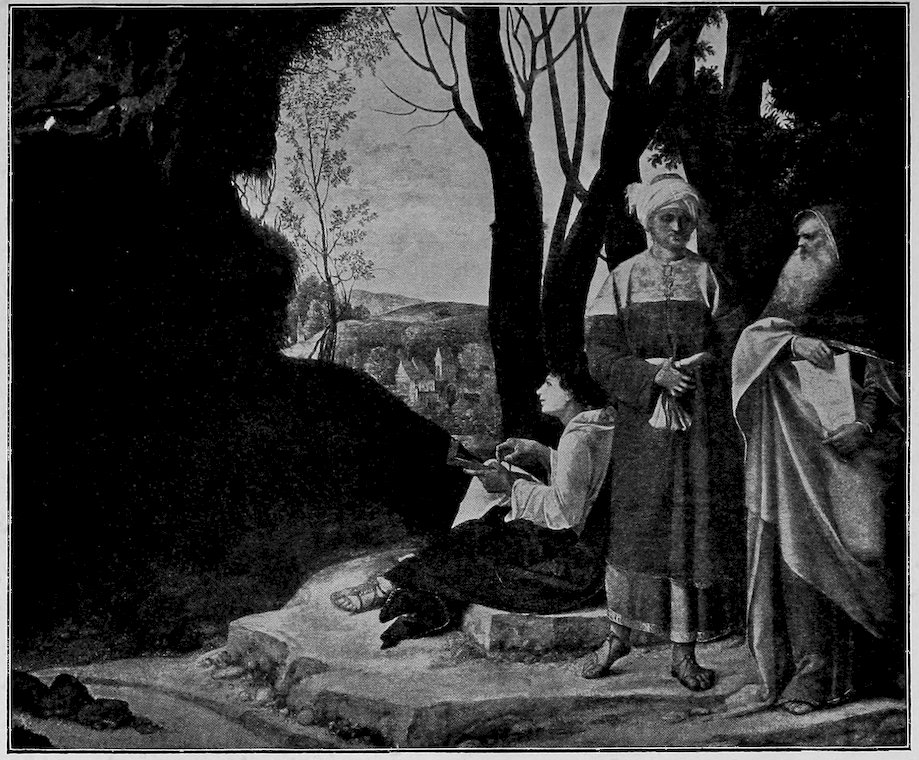
Plate LXVI.
187Of the Madonna and Saints in the Louvre it is interesting to note that even a century ago there were those who judged the work at its true value. It is of this work, I believe, that J. B. P. Lebrun[62] says: (p. 71) “Attribué au Giorgion. Un Concert de figures vues à mi-crops et de grandeur naturelle, très-mauvais ouvrage dans le genre de cette école, d’environ 4 pieds et demi de hauteur, sur 6 de largeur, sur toile. Je tairai ce qu’en dit Lalande. Vient de Milan, bibliothèque Ambrosienne.”
Concerning the four other pictures there is considerable diversity of opinion. The Head of a Boy at Hampton Court is thought by Morelli to be an original Giorgione, but as the light was bad when he saw the work, he is not sure. Berenson, however, does not doubt the genuineness of the picture. Considering the fact that the head is a copy of the Vienna David, we may very seriously question whether it is by Giorgione. One can scarcely suppose that he would have repeated his pictures and made the head of his David answer for a Shepherd. Morelli was right in recognising the Giorgionesque spirit of the work, but it is only a copy of the head of the original David, with certain details altered.
The Nymph and Satyr[63] in the Pitti, which used to be called a Giorgione and which Crowe and Cavalcaselle thought to be by some imitator of him and of Titian, bears now, I believe, the name of Dosso Dossi. Morelli considered it a youthful work of Giorgione, though it certainly shows few signs 188of youth, and the Giorgionesque details which he enumerates are exactly those which an imitator would easily acquire. The idea and the energetic freedom of composition are more like the work of men who came after Giorgione, and the colouring is unlike his. We have no reason to believe that he ever painted subjects embodying just such trivially sensual and commonplace ideas, and as there is no marked and characteristic likeness in the figures to any of his known works, it is safer to consider it the product of a would-be imitator, such as we know Dosso Dossi to have been.
To decide the question of the Concert in the Pitti is by no means easy. Crowe and Cavalcaselle felt sure it could not be by Giorgione, or else that “he did not execute what we are fond of attributing to him,” for it seemed to them more advanced and to surpass his true works. Morelli, too, did not regard Giorgione as the author, but the youthful Titian,[64] and to this Berenson agrees. The interrelation of the complex sensations expressed in the deeply moved but quiet faces is certainly more like the work of the painter of the Two Loves than that of him of the Three Philosophers. The likeness, too, of the middle figure in the Concert to the Man with the Glove in the Louvre—a likeness found not only in the expression of the two heads, but also in the wonderfully wrought modelling of them—is most noticeable. How the same artist can have accomplished so dull and stupid a face as the one to the left is a question only to be answered by the vandals who have repainted and thereby ruined this very splendid work. It certainly does remind one of Giorgione, but so does the Two Loves. Titian we know well was, in his early days, 189much influenced by his fellow-worker, but we know also that he became the more accomplished artist of the two and attained a power of technique and of representation of facial expression beyond that of his too early dead contemporary. As just such an artist is shown us in the Concert, one can but agree with Morelli in regarding it as the work of Titian—as one of his finest, for he rarely reached such mastery of subtle expression as shown in the central figure.
I come now to the discussion of a picture so well known that I feel scarcely justified in doing more than simply express my opinion of it, but the picture is so important that I must be excused for arguing about it in close detail. It is the Fête Champêtre in the Louvre; a picture which almost every one unhesitatingly attributes to Giorgione, but which I cannot believe to be by him and think can have been painted only some years after his death. As in regard to other true or false Giorgiones, the opinion held by Crowe and Cavalcaselle is worthy of more attention than later writers have seen fit to give it. What the former say about the picture is this:
“We cannot say that Giorgione would not have painted such a scene; but, as far as we know, he would have treated it with more nobleness of sentiment, without defects of form or neglect of nature’s finenesses, without the pasty surface and sombre glow of tone which here is all pervading: he would have given more brightness and variety to his landscape.”
They were surely not far wrong when they suggested some imitator of Sebastiano del Piombo as the painter. There is certainly a Giorgionesque quality in the scene, but that only means that the painter puts before our eyes the varied and mingled charms of green fields enlivened with the faint murmur 190of shepherds tending their distant flocks, of woods and rivers, and of strong men and lovely women making music beside a fountain overhung by trees. It used to be the fashion[65] to call every portrait of a dark-eyed man with long abundant locks by Giorgione’s name, and those who believed in such things also thought that he was the only painter of Fêtes Champêtres.
We may freely concede that Giorgione did do much to introduce and skilfully display a class of subjects that had been little cared for until this day. But he was not the only artist to feel the charm of such scenes. Sedate Bellini himself showed in such a picture as the Bacchanal in Alnwick Castle that he too felt them, and rapidly they became more and more common. But in the earlier years of this development such scenes were generally given on a small scale or else were intended to illustrate, even though in many cases the clue is lost to us, some more distinct and concisely expressable idea than mere Arcadian life among the trees. It is not alone the emptiness of thought that forces us to decide upon some later author than Giorgione for this work. Forms of details, manner of design and method of painting, all are different from his certain works.
The first thing that strikes the attention is that the soft, dull drawing of the figures, and the clumsy, baggy modelling of the women, is unlike anything found in any of the undoubted Giorgiones.[66] Compare the delicate shape and clear drawing of the figures in the Uffizi panels, or the Venus or the Gypsy, with these heavy, ill-proportioned, clumsily 191posed figures, and then say if you think Giorgione could have sunk so low. Or, if you will seek proof in fingers and toes, hands and feet, where in Giorgione’s work are such a shapeless leathery ear, so thick-lipped a mouth, so short-toed and thick a foot, or such spidery hands to be found? Nowhere. Look at the landscape. The trees are much more massy and less flat and feathery, their surface is more broken by flickering spots of light, they show, in fact, a more advanced stage in the rendering of the appearance of Nature, than is shown in Giorgione’s work.
It is instructive to notice, too, the way that the grass is painted in the foreground, the thick mat of it, and the long bright blades and tufts. Giorgione never reached such realism as that, as you can see by the primitive way in which he seeks to render the effect in the picture of the Gypsy. Consider further the treatment of the sunlight as it floats over the hillsides and glows among the trees. In the Castelfranco Madonna, in the Three Philosophers, in the Gypsy, in the Beaumont Shepherd’s Offering, large, smooth, unbroken surfaces of light and shade, seeming almost more like some woven stuff than rough earth, are contrasted, but here all is broken, enriched perhaps, but less simple and less telling.
In and out by the river and over the hill, Nature’s wrinkles are embossed by the soft light, and nowhere is there restful certainty of sun or shadow. In among the trees behind the shepherd, the hot, misty light that one sees only in the forest is radiant with summer colour and seems to murmur with the voice of the woods. Such effects were unknown to Giorgione, but they were not unknown to Titian, for he was the first great 192landscapist, and in the Vierge au Lapin and the other Virgin seated under the trees, which used to hang opposite in the Long Gallery of the Louvre, we see exactly these technical peculiarities and these effects of nature done with the sure stroke of the master. Not only has the author of the Fête Champêtre followed Titian in these ways, but his thick pasty colour is taken from him. Not a stroke of this picture displays original talent, there is not one that resembles Giorgione, not one that does not betray the skilful imitator of ideas and manner of other well-known men, chiefly of Titian.
But to make assurance doubly sure, something remains to be pointed out that even if all the rest could be accommodated to what we know of Giorgione, would render it incredible that he should be the author. Morelli and others have noted the curious similarity between the two musicians and certain figures in one of Titian’s frescoes in Padua. One cannot say that Titian would not have taken hints from Giorgione, but he was scarcely the man to need any one’s suggestions, especially if it was in the shape of such commonplace figures as these. There are those, however, who think he did. But now let me add that the two women bear the most striking and unquestionable likeness to the two women in Tintoretto’s (?) Rescue in Dresden, though they have lost the purity of Tintoretto’s figures. Surely no one will maintain that this at best only fanciful and pretty, but in no way striking, Fête Champêtre was the source of inspiration to the two greatest Venetian painters in their days of prime and finished power? It is impossible. The idea must be given up, and though there is no denying the charm of the musicians under the trees, let us cast the scales from our eyes and recognise its complete 193dissimilarity to the work of the Master of Castelfranco, and that it is merely a perfectly charming pasticcio.
I have now discussed the pictures spoken of by Crowe and Cavalcaselle, and there are left for us to consider those to which Morelli first drew marked attention. Such are the Madonna with Sts. Antony and Roch in Madrid, Daphne and Apollo in Venice, Three Ages of Man in the Uffizi, Birth of Paris and Portrait of a Man in Buda-Pesth, Portrait of a Woman in the Borghese Gallery, Portrait of a Youth in Berlin, Allegory in Dresden, and Judith in St. Petersburg. I have already spoken of the Venus, Nymph and Satyr, and the Shepherd at Hampton Court.
The Madonna in Madrid has generally been called by the name of Pordenone, while Crowe and Cavalcaselle thought it by Francesco Vecelli. It is certainly not a Giorgione, but a mere pasticcio like the Fête Champêtre. We cannot be blamed for asking some more decisive evidence of its Giorgionesque origin than Morelli gives before we agree with him. He satisfies himself with saying[67] “Doch ich muss gestehen, dass es für mich keine geringe Freude war, bei meinem Besuche von Madrid dieses Wunderwerk venetianischer Malerkunst sogleich als Schöpfung unsers Giorgione erkannt zu haben.”
This, on the surface, is too rapid and absolute a statement to be admitted without question, and as there are excellent reasons why Giorgione could not have painted the work, we may confidently strike it from the list. The composition in the main is borrowed from the picture at Castelfranco. Giorgione was hardly the man to repeat his own works. The 194heavy, thick, coarse painting is absolutely different from Giorgione’s work. The clumsy draperies show none of his fine feeling. The thick-set figures of the Saints do not exhibit his elegance and refinement of form. The infant, more like a Hercules than a Christ, is quite unlike his poetic and dreamy-looking children. The manner in which the foot of St. Roch is raised is awkward and unmeaning, while the fat hands, thick ears and coarse features bear no resemblance to Giorgione’s work. The work is not only crude, it is unintelligent. The wall behind the Virgin cannot be explained, the chiaroscuro is harsh, the attitude of St. Anthony, turning as he does from the main group, is senseless, and the flowers are scattered about in a childish way. It is based on Giorgione’s work, but must have been painted by an inferior artist many years after his death.
The Daphne and Apollo in Venice has been injured by repainting and by having lost the left-hand end, but one can easily see that it will take much more than a mere assertion by Morelli[68] to convince anyone that Giorgione painted it. Crowe and Cavalcaselle think the painter was probably Andrea Schiavoni. If it was not Schiavoni, it was someone of an almost precisely similar nature and talent. The generally loose drawing and painting remind one of him. The bad drawing and perspective, the proportions and shapes of the figures (note the chunky Apollo drawing his bow and the head of the woman in the middle distance), the clawlike hands and clumsy feet, and the stupid confusion of scale in which the figures are drawn, all show without any possibility of question, that neither Giorgione nor any other artist of the first rank painted the picture.
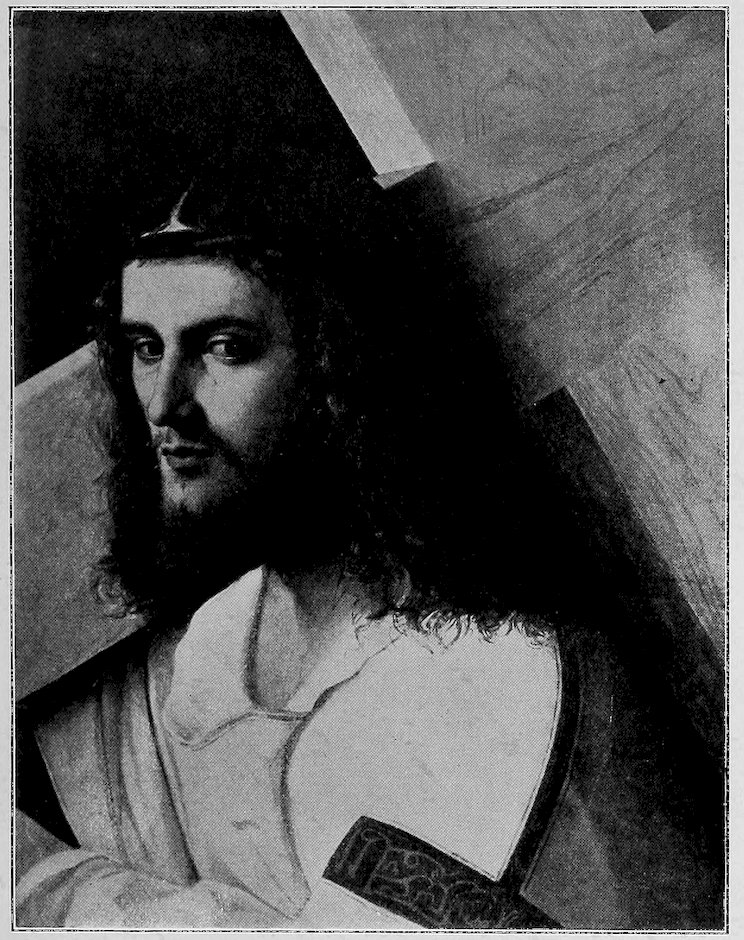
Plate LXVII.
195There are in Padua two other cassone pictures representing the fables of Myrrha and of Erysichthon as told by Ovid in the “Metamorphoses” (VIII fab. 7 and X fab. 9). They are Giorgionesque in feeling, but are plainly derived from the woodcuts in the 1497 Venice edition of Ovid (Cf. Justi, Giorgione p. 191 f). It is possible that these are two of the pictures referred to by Ridolfi (see above, No. 19).
Of the Three Ages it is perhaps sufficient to say that Morelli’s attribution has not found general acceptance.
The Allegory in Dresden in times gone by has been and by some still is considered, as Morelli thought, a copy of a work by Giorgione. There is, I believe, no real evidence in favour of this theory, which seems to me to depend solely on personal feeling.
The Judith in St. Petersburg, where it goes by the name of Moretto, presents a more difficult problem. Morelli, though he seems to have had no doubt that Giorgione was the painter, was not sure whether the picture was a copy or not. That it is a copy is Berenson’s opinion.[69] The lack of modelling and the bad drawing of parts are the reasons why Berenson and others think it a copy, and Berenson finds a trace of copyist’s work in the fact that the head is better done than the rest of the figure. Personally, I do not recognise this superiority of the head, and considering the numerous faults which he points out, I do not understand his last sentence: “En somme, la Judith de l’Ermitage me parait une bonne copie, mais après 196tout, ce n’est qu’une copie.” If one believes these numerous faults to be due to the copyist, I should say that they proved it to be a pretty poor copy. Study of the work itself will, however, convince anyone that it is not a copy, but the original picture, and the artist can be no other than Giorgione. The panel on which it was painted was originally broader on the right side.[70] The uncertain drawing is what one would expect to find in an early work. The drapery is not so simple as usual in its folds, and at first sight the way it is drawn aside, leaving one leg bare, seems affected. But when one thinks of the bleeding head on the ground, this action is seen to be natural and the contrast of nude and draped parts is of the same unexpected and original character as one sees in the woman of the Giovanelli picture.
The fragment in Buda-Pesth which Morelli thought was part of the picture representing the Birth of Paris is, as Berenson points out in the article already referred to, only a copy, and a poor one at that. But even poor copies of lost Giorgiones are works to be carefully cherished.
Morelli also thought he knew of three portraits by Giorgione. Of these three (the Woman in the Borghese, the Man in the Buda-Pesth Gallery, and the Youth in Berlin), the first two may be seriously questioned. To my eye the Borghese portrait is by no means so strikingly Giorgionesque as Morelli considered it. While it is true that a brow here and a mouth there can be found scattered among the figures in the true Giorgiones that resemble the features of this woman, the type of face shows little likeness to Giorgione’s work. Nor does the muddy colour indicate the palette of an artist 197of more than mediocre ability. Who will look at Giorgione’s masterpieces and then say he thinks the same artist produced two such shapeless hands holding such a formless swab of cloth? Have we any reason to think Giorgione had so poor an understanding of perspective as to be unable to draw correctly the line of the parting of the hair? Such sloping shoulders were never natural and the fashion of drawing them so is not characteristic of Giorgione’s work. Could not Giorgione paint better drapery, or would he ever have been satisfied with such a shoelace-like ribbon round the waist? Finally, were such gauze caps known in Giorgione’s day? It is the purest fancy that discovers a shadow of greatness in this dull work. Drawing, colour, design, all proclaim it the product of a commonplace artist. The work is unlike Giorgione’s in every particular except the shape of the brow.
Morelli’s judgment about the portrait in Buda-Pesth is a perfectly sound one. It occurs only in the English translation and not in the original German.[71] “The picture,” he says, “has suffered much, and the master is not to be recognised in the technical qualities of the painting, but the whole feeling ... and the conception seem to point to Giorgione. The impression which it made upon me ten years ago was that of a thoroughly Giorgionesque work, but one executed by a later hand rather than by the master himself. Competent critics who have examined the picture in the meantime insist, however, that it is a true original by Giorgione. I must leave the final decision of the point to others.” Unfortunately it is next to impossible to arrive at final decisions in such matters. For one, I 198believe that Morelli’s idea, that the work was executed by a follower of Giorgione, is borne out by its main characteristics, particularly by the self-conscious pose of the head, and by the gesture of the hand—both much like what is found in portraits by the men of the generation after Giorgione.
Then, too, the cold ashen colour is very unlike Giorgione’s palette, but I would not lay great weight on this fact as the picture has been much repainted. The picture is of further interest because it shows the fallacy of one of Morelli’s most firm statements. In the Introduction[72] to his chapters on the Borghese Gallery he says: “Ich erlaube mir bei dieser Gelegenheit sogar zu bemerken, dass die den grossen Meistern eigenthümliche Grundform der Hand und des Ohres nicht nur auf ihren Bildern, sondern selbst auf den von ihnen nach dem Leben gemalten Porträts sich vorfindet.” With these words in one’s mind one looks at the Buda-Pesth portrait and finds neither hand, ear, eye, nose or mouth exhibiting the Grundform shown in the unquestioned pictures. Morelli was carried away by his theories in this point, for while every one will readily admit that many cases, especially among the works of the primitive and early masters, can be found to fit his rule, yet the numberless exceptions to this rule, particularly among the fully developed masters, make it quite plain that, at best, its application requires to be strictly limited.[73]
The Portrait of a Youth at Berlin is the last of the Morellian 199Giorgiones to be studied. As was too often the case, Morelli speaks off-hand of this work as “ein glänzendes Porträt des Giorgione,” as though it was so manifestly by him that he was absolved from the labour of adducing proof; but the matter is not so simple. It is surely enough Giorgionesque, but do the details bear out the general impression so strongly as to make the attribution beyond all reasonable doubt? Not one of the master’s certain works shows a head like this. It is sharper and harder than anything of his except the Uffizi panels, but between these, sharp and hard as they seem to have been, and the Berlin portrait, there is an important and essential difference. The figures on the panels are not only hard, they are stiff; that is, they show one of the chief characteristics of youthful work.[74] If now the portrait be by Giorgione, it is self-evidently an early work. That is, there are among his undoubted works some that show vastly greater ease than this. But this portrait does not show any stiffness.
The attitude is easy, and the painting, particularly of the drapery, is distinctly free, one might even say sketchy. The work shows, perhaps, not so much the characteristics of a young artist of great power as those of one who has attained some facility but not the complete and all-round ease of the greatest masters. Then what do the letters V. V. mean, painted on the shelf behind which the figure stands? Is it not possible they are the initial letters of the artist’s name? 200Can they stand for an as yet unknown imitator, another Vincentius Venezianus? As Morelli said of the Portrait in Buda-Pesth, “I must leave the final decision of the point to others”—others better qualified than myself. Whoever the artist, the picture is a splendid one, and may well be regarded as showing the Giorgione point of view in portraiture, which, however, is a very different matter from being a work by him.
I have already had occasion to refer to an article by Berenson in the Gazette des Beaux-Arts in which he speaks of pictures he considers as copies of lost Giorgiones. These are:
The David in Vienna.
The Judith in St. Petersburg.
The Birth of Paris in Buda-Pesth.
Orpheus and Eurydice, a cassone at Bergamo.
Portrait of a Man, formerly in the Doetsch collection.
Portrait of a Lady, belonging to Signor Crespi at Milan.
Of the first three I have already spoken. To maintain his thesis about the Orpheus and Eurydice, Berenson mentions only vague sentiments such as “Qui donc, autre que lui, a su traduire, comme nous le voyons ici, un mythe grec dans l’esprit de la Renaissance?” We might reply that Bellini, Titian, Tintoret, to mention merely Venetians, all showed a rather marked ability to do this very thing, so it was not a personal peculiarity of Giorgione. “Qui donc, autre que lui, avait le don de fondre le paysage et les figures dans une aussi charmante harmonie?” Again the ability to do this was possessed by many artists, and so vague a phrase as aussi charmante proves nothing whatever. Continuing, he finds many details which betray very certainly the work of Cariani (an undoubted imitator of Giorgione), and decides that the work is a copy by Cariani of a lost Giorgione. But when 201much is admittedly unlike Giorgione and everything suits Cariani, why not consider Cariani the artist? Apparently because “si nous étions nous-même des artistes très doués, nous pourrions remplacer chaque détail carianesque par un détail giorgionesque, emprunté aux œuvres du maître les plus voisines.” This has no force. We might as well “remplacer chaque détail carianesque par un détail michelangelesque,” and what would be shown thereby? Nothing.
The reasons given for believing the Portrait from the Doetsch collection[75] to be a copy of a Giorgione are quite as vague and undefinable as those for the Orpheus and Eurydice. The consideration of details is no more convincing than the sentiments and fanciful writing that precede. “Si l’auteur de l’original en question n’était pas Giorgione, ce devrait être quelque imitateur servile du maître, comme Licinio ou Beccaruzzi. Mais ces peintres de second ordre ne pouvaient qu’imiter et non créer, et le portrait de la collection Doetsch est bien une création,” and yet he has just said that this portrait “est le même type que celui du jeune homme de Buda-Pesth,”—the picture mentioned by Morelli. Berenson’s definition of ‘création’ must differ from that ordinarily employed; and Licinio at his best was not so uncreative as Berenson would have us believe. He gives one, however, further surprises in asserting that this portrait agrees in all details with the one in Berlin! Not only the same head and brow, but “le même sentiment dans la bouche!”
Even were this all so, and I cannot see that it is in the least, what would be proved? To compare one doubtful work to another of a similar nature does not, as I have said above, 202prove the authorship of either. Furthermore, though one can find strong likenesses to the Berlin head in the true works by Giorgione, in these same works one cannot find any likeness whatever to the Doetsch portrait. To compare this overemphasised portrait, this person who seems half brigand and half Shylock, to the sad, poetical-looking man at Buda-Pesth, or to the clean, vigorous, manly youth in Berlin, is going pretty far, and the limit is plainly over-stepped in the endeavour to attach to the picture a value it does not possess by giving to it the name of one of the greatest artists.
For the painter of the Crespi Portrait of a Lady we shall do better to look in the direction of Titian than Giorgione. The owner, Signor Crespi, believes, according to Berenson, that Titian was the author, and certainly the likeness which the figure bears to other women by Titian, and the initials T. V. make it difficult to admit any other origin. Neither ecstasies nor comparisons serve to show any likeness to Giorgione’s work.
Of all the portraits attributed to Giorgione the finest by far is the one owned by the Hon. Edward Wood of Temple Newsam. Attention was first drawn to this by Cook and his attribution has been accepted by every one. It is a masterpiece of the greatest beauty (Plate LXVIII).
We have now reviewed the most important criticisms that have been passed on Giorgione’s work; and though it is only too evident that as yet there is no really sound common standard by which to govern our judgments, we can come very near to forming one if we accept the more sober part of the work of these criticisms and disregard their more extravagant and hypothetical attributions.[76] The following list, I venture to think, embraces works differing much less among themselves in regard to style than the lists of the critics that I have discussed.
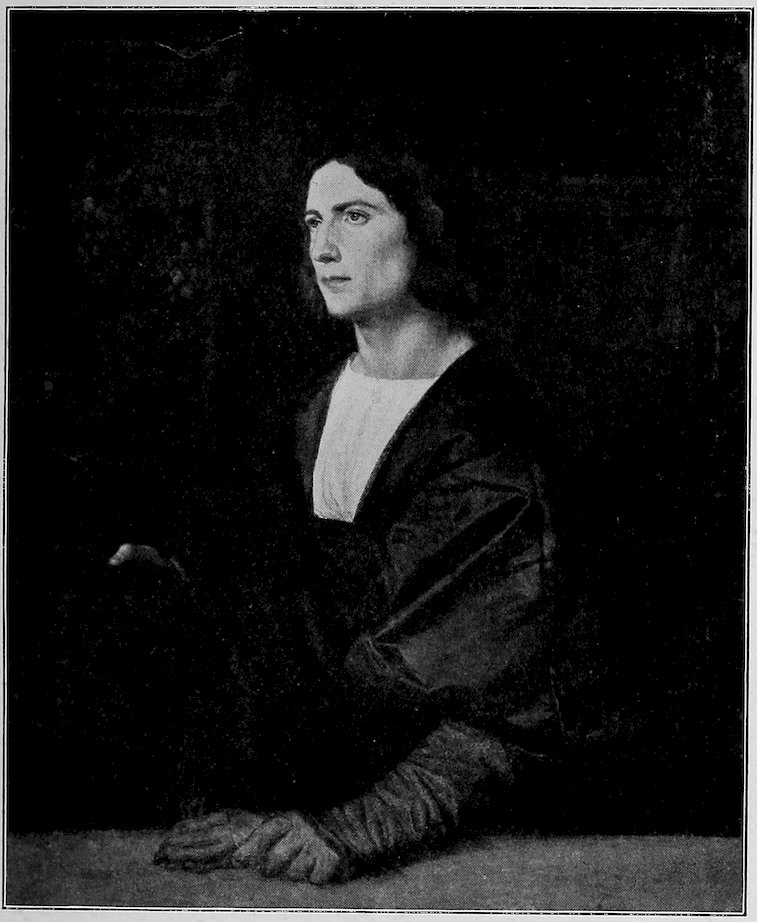
Plate LXVIII.
2031. Vienna—David (copy).
2. Venice—Fondaco dei Tedeschi (fragment still visible, but compare Zanetti’s engraving).
3. Venice—Chiesa di San Rocco, Christ carrying the Cross (much damaged).
4. Venice, Giovanelli Palace, Soldier and Woman, known as The Tempest.
5. Castelfranco, Madonna Enthroned.
6. Dresden, Venus.
7. Kingston Lacy, Judgment of Solomon (unfinished).
8. Vienna, Three Philosophers.
9. Buda-Pesth, Birth of Paris (fragment of a copy).
10. Florence, Uffizi, Judgment of Solomon.
11. Florence, Uffizi, Fire-test of Moses.
12. Florence, Uffizi, Knight of Malta.
13. Boston, Mass., Mrs. Gardner’s Collection (formerly Vicenza), Head of Christ.
14. London, National Gallery, Study for the San Liberale of the Castelfranco picture.
15. London, National Gallery, Epiphany.
16. London, Mr. Benson, Holy Family.
17. London, Lord Allandale, Shepherd’s Offering.
18. Temple Newsam, Hon. Mr. Wood. Portrait of a Man.
19. St. Petersburg, Judith.
20. Berlin, Portrait of a Youth (?).
Excluding the last one as being open to doubt, nineteen pictures, two probably copies, remain as our heritage of this most noble painter’s work. With these nineteen in our mind, it becomes more evident than ever why such works as the Louvre Concert, the Borghese Lady, or the 204Doetsch Man are not to be thought of in connection with Giorgione’s name.
There yet remains something more to be said of Giorgione. I think that there are still some pictures to be added to this list. The first to which I desire to call attention is the so-called Gypsy Madonna in Vienna. This picture is spoken of by every one as a Titian, but the longer I study it the more strong becomes my conviction that Giorgione was the artist; that it is one of his early works; that it is one of the “many pictures of the Virgin” of which Vasari speaks. The Giorgione spirit seems to me to underlie the whole feeling just as the Giorgione technique underlies the completed performance, that is, wherever the repainting allows it to be seen (Plate LXIX).
Evidently, from the lack of decision of the drawing, the coarse modelling of the drapery, and the heavy, undetailed landscape the picture is an early work of the master, be he Titian or Giorgione. To my mind the likeness between this and unquestioned early Titians is a superficial one. This picture shows none of the ease that is a characteristic of even his early works, nor does it exhibit any of the dramatic quality, expressed either by the actions or in the faces of the figures, that is another most noticeable feature of his work. If, on the other hand, one seeks for similarities to Giorgione’s work, they are most readily found. Details and style coincide closely with his pictures. The shape of the Virgin’s head and the manner in which the hair is drawn over the brow are nearly identical with what one sees in the Uffizi panels or the Castelfranco picture. The sharply marked eyelids, the richly modelled mouth and long nose, are strongly resemblant to the same features in the Castelfranco Madonna, the Giovanelli Gypsy, the Uffizi panels, and the Knight of Malta.
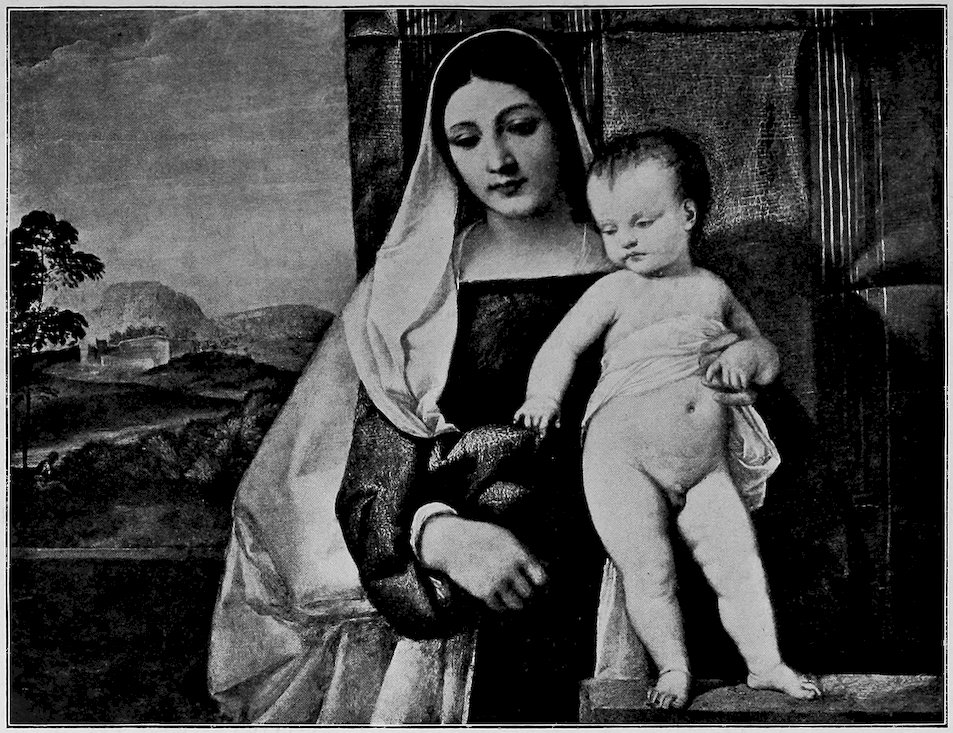
Plate LXIX.
205Notice, too, the large hand, the feet of the child with the strongly developed toes which are just what one finds in Giorgione’s works. So, also, the landscape with its plumelike trees, and the slim figure seated on the grass is such as one finds in many of his works, but not so often in those of Titian. Finally, and of more importance than separate details, is the fact that the peaceful spirit of the group, the undramatic, unTitianesque quality, is exactly what is most characteristic of Giorgione. Titian, when he painted the Christ Child, even in his earliest days, painted a figure more representing the infant Hercules than the Salvator Mundi. Invariably, He leaps about in his Mother’s arms, and though the small chubby face may be keenly intelligent, there is hardly ever a suggestion of the imaginative powers and prophetic instinct of the Reformer. It is here that Giorgione shows his very exceptional genius, for he was able to depict a purely human man child in such wise that were the figures cut from his canvases, no one could mistake them for mere ordinary offspring.
Giorgione used none of the affected graces or sentimentalities of Raphael, nor did he depend upon such weirdness as Leonardo chose; as a result, his figures are as much more satisfying to the inquiring intellect as a living fountain is compared with the mirage of the desert. His means are simple. There is no exaggeration of action, as in the Titian Child, but all is essentially delicate and infantine. There is no exaggeration of expression, but a slightly dreamy, far-away look as of powers still unwakened, and one feels, as before no other representations of the Child, that such as He might 206attain to even Calvary. Taken in connection with the agreement of the details, this spiritual similarity of the work to others that we know are by Giorgione must give him pause who should think to name Titian as the author.[77]
Another picture which, I believe, deserves more attention than has yet been given it hangs, under the name of Giovanni Bellini, in the Museo Correr in Venice. The picture represents the dead Christ, seated on the edge of the tomb, upheld by three angels. In the background is a landscape, with a church on the right. It is painted on a panel about four feet high. The Anonimo Morelli says that in the year 1530 in the house of Gabriel Vendramin: “El Cristo morto sopra el sepolcro, con l’Anzolo che el sostenta, fu de man de Zorzi da Castelfranco, reconzato da Tiziano.” The picture in the Correr Museum represents this same scene, but there are three angels instead of one. This difference between the picture and the description need not make us hesitate to consider the question whether Giorgione was the author of the work, if there are other reasons to render such authorship possible.
Any one, however, who has used early books such as the Anonimo knows how very inaccurate the authors often were and any one who has studied Italian painting knows that to represent the dead Christ held by only one angel is entirely contrary to precedent and practice. The present condition 207of the work is such that it is impossible to say whether it was ever raconzato da Tiziano or not. It is a mere wreck. That there are distinct resemblances to Bellini’s work is not to be denied, but, if I mistake not, there exist even stronger ones to that of Giorgione. A slight stiffness in drawing, a certain archaism in drapery, is just what one would expect to find in the work of Bellini’s pupil. In the modelling and action of the figures, however, there are evidences of an attempt at freedom of design such as are rare in Bellini’s work. Four works of Bellini occur at once as criteria for judging the quality of the one under discussion—the Pietà in the Brera, one in the Mond collection in London, one in Rimini, and one in the Berlin Gallery.[78] None of these show the slender, rather unmodelled hands of the Correr picture; none presents so vivid a picture of Death. In none except the one at Rimini are the secondary figures really supporting the Christ,—the body does not show, as in the Correr picture, the relaxation of death, and in the Rimini picture the angels are much more playfully treated than in the Correr panel. The Bellini pictures are deeply touching, but to me there seems an even nobler and more moving sentiment in the work which I fain would attribute to Giorgione, and it is just such a sentiment as the painter of the Vicenza Christ might have suggested.
The heads of the figures of the dead Christ in the works of Bellini are without exception represented as asleep. In the Correr picture one sees more than sleep in the closed eyes and drawn mouth of the Saviour. There is death—but death, the tragedy, so combined with a yearning, soul-compelling 208sadness, that the face can never be forgotten by whoso once has seen it, and this is spiritual life. Scarcely any other artist ever equalled Giorgione, and none certainly ever surpassed him, in the power of representing the members of the Holy Family. There are many fine presentations of Christ bearing the Cross, but none so imaginative as the Vicenza picture. For there we see in the sensitive face, the direct eye, and steady earnest mouth, the signs of completed power over self, while in the tear drop that sparkles on the cheek is the sign of suffering that broke the body, whose soul it could not quell—for neither brow nor eye are those of one who weeps. The Correr painting contains a similar double suggestion. Two details there are also which bear out the idea that Giorgione is the author. One is the technique which so far as can be seen is of the rich, smooth, carefully shaded kind, peculiar to Giorgione’s work. The other is the landscape in which the low horizon line and the plumy trees correspond closely to his certain works. Wreck though it be, and possibly only a copy of the original, it is worth study by students.[79]
A smaller, but fortunately much more perfectly preserved, work hangs in the London Gallery under the name of School of Giorgione. It represents a bearded man on a throne and other figures in an open landscape. Whoever, unafraid of finding something unexpected, looks at this picture with critical eye, will, I think, realise that it is not a school work, but by the master himself. It is very carefully wrought in design and 209execution, as a youthful work would be likely to be, and as the two Florence panels are. The rich clear colours and the bright sunshine spread over the scene, are such as are found in the Florence panels, the Kingston Lacy picture, those in Vienna, and the Virgin of Castelfranco. The landscape is typically Giorgionesque, closed in as it is in the foreground, and opening into a middle distance of rich meadows, enlivened here and there with tall steep-roofed houses. The rich detail and broad chiaroscuro find their counterpart over and over again in Giorgione’s work; and finally, who but Giorgione ever presented to our delighted eyes a scene so simple, so dreamlike, so poetic, so defined, and yet so difficult to understand? It is a dream picture, rendered with the utmost clearness of vision. It is only the masters who can do this—only Giorgione and Keats and such rare spirits who can put in terms for the ordinary plodding mortal to grasp, the evanescent visions of the mind.
Of very different character is the portrait of a youth in a large hat in the Vienna Gallery. Crowe and Cavalcaselle attribute this to Morto da Feltre. It was impossible for me to see the original when I was in Vienna, but study of an excellent photograph makes me doubt this attribution. If I mistake not, the picture might be a copy of a portrait by Giorgione. The treatment of the landscape is sufficient to show that Giorgione’s hand did not touch the work itself, but scarcely any other than Giorgione can have originated this grave sweet face with the steady eyes.