BERNINI
Reading edition
3
I. AN ESTIMATE OF BERNINI
During the last hundred years there has come a great change in the feeling of most people towards the art of the different epochs of the Renaissance. Whereas our grandfathers and our great-grandfathers held Carracci and Guido and others of the same time in high esteem, we are now taught that these later men are of little value or interest in comparison with the artists of the fifteenth century, and even the most halting and stuttering “Primitive” is held of more worth than the more able masters of the seventeenth century. This change is natural enough, but betokens a lack of true understanding of the purpose and powers of the fine arts.
The altered mental attitude in religious matters which renders most people incapable of feeling the appeal of the mystical fervour of the seventeenth century explains in a measure why the earlier work is preferred; and added to this is the effect of the development of archæological training which has given rise to an interest in the mere search for origins—a search that has done infinite harm in blinding the eyes of students to the fact that, for the world at large, it is far more important to see whither life is carrying us than from what slow, groping, and inexplicable protoplasm and haphazard chance it sprung. The teachers of our universities go on in their dull round, like Dervishes, repeating that the Parthenon 4was the most perfect expression of Greek art, and there are those who cannot see the beauty of the silver vases from Boscoreale because they choose to call them Roman. Without doubt there are many sound reasons for the purely archæological study of classic art, and recently a small but perceptive band of scholars has raised Roman art from the ignorant neglect into which it had fallen and given it the proper position due to any such able expression of great ideas; this justifies the hope that the worth of the later Italian schools will become once more manifest, not again to be forgotten.
The idea that the art of any civilized people rises by a steady and constantly more perfect progression to one glorious peak of perfection and then falls by rapid and recurring blunders to a waste of meaningless effort is, I believe, due to the too frequent mistake of considering the monuments of the arts as separate entities and as self-ordained rather than as indices of vital currents of thought and life. The English dictionary is not synonymous with English literature. Nor does the will-o’-the-wisp phrase “art for art’s sake” mean that each work of art is a unique and inexplicable phenomenon. Its true meaning is that the artist, be he poet or sculptor or musician—no matter what form his art takes—finds the only adequate expression of himself in the forms and under the governance of the laws of the art which he follows. By so far as he follows these laws is his work intelligible to other men; by so far as he finds new combinations for the forms and new adaptations of the laws to meet the new circumstances of ever changing life is he original and great. When Shakespeare or Keats wrote a sonnet the verses were not produced by them merely for the sake of using a certain complicated formula of fourteen lines to make certain statements, nor when Pheidias carved the Athena or Praxiteles the Hermes was it merely with the idea of reproducing the human form in stone.
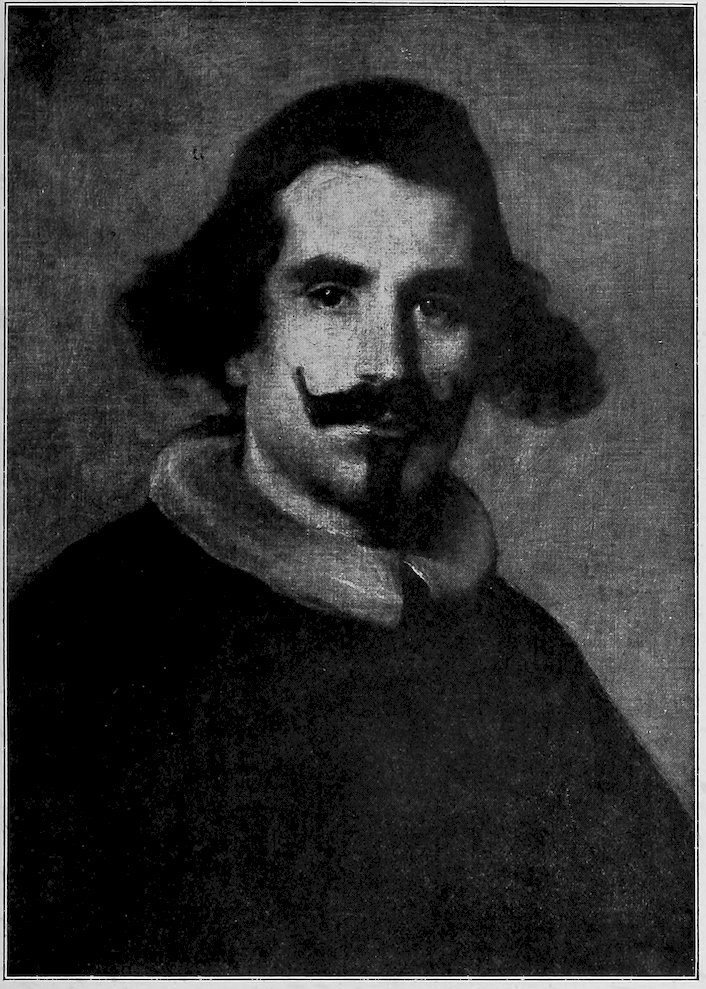
Plate II.
5Had such been the motive of these poets and sculptors their results would have had small value; but each one of them had something to say that he could best express in the form chosen, some feeling towards life he wished to share with others, and in this outgiving he steadily sought to perfect the form that held his idea. The care he lavished on the verse and marble so that the expression of this thought might be the completest possible and truest to his idea, the delight in making his chosen art conform to the laws of language or of gravity, while at the same time it held the thought as a nest holds an egg, that was art for art’s sake, and a very different matter from mere technical dexterity.
All the arts are alike means of conveying ideas from brain to brain and from the past and forgotten generations to those not yet thought of. No one school ever told the whole truth, but only that part of it maybe which local circumstances enable it to see. Each of them, from the earliest which faded away before recorded time, to the latest which looks eagerly forward to to-morrow with the hope of new accomplishment and absorption in new truths discovered, is but as the searchlight casting its sharp-defined ray through the immeasurable dark. The flames of Priam’s pyre crimsoning the night which hung over the “topless towers” were not marked on the Argive hills, but the message was flashed hither and yon over the star-tracked sea, raising now hopes now fears, till at Mycenæ 6no answering flame was lit, but instead the young Phœnix was born.
And as no one school can answer all the questions, so no one single pundit can tell all the truth even of his own school. In each honest, unshamming workman there is something of truth, something others long ago thrilled to or that others yet to come may also feel, something that he knows with a clarity and conviction not to be equalled by any other. In a sense he does express his time, but neither the artist nor any man else is merely the product of his time, and the truly great ones go ahead of it, following the gleam of the divine spark which each man is born with to shelter in his heart as best he may. If it keep alight, by God’s grace, his life becomes in truth art for art’s sake, and he is one of the successful runners in the torch race across the great divide of life that separates the hopeless past from the hopeful future.
Of such there are many to spur on the weary and to guide the strayed back to the beacon path. In every man who has appealed to the masses, whose ears have rung and whose heart has swelled with the loud cries of “well done,” there is, be sure, something of the ultimate divine truth—some no mockery—some sincerity which heated in the fires of his soul and beaten with long pain and trouble on the anvil of his heart, shall be, if we can grasp it, a treasure undiminishing so long as we have breath to live.
Such an one was Giovanni Lorenzo Bernini, whose life was almost coterminous with the seventeenth century (1598–1680). Honoured during life by three courts, and at that time court patronage was a very different thing to what it is now, he has of late been treated with a disregard which is 7unjustified, and has been blamed for faults which were not his. These false judgments can be traced back to the envy of some of his contemporaries, who on the one hand accused him of ignorance of the mechanics of his art and of stupidity of design, and on the other, oftentimes, did their best to copy him. But it gives us pause when we consider that notwithstanding the forces of jealousy backed by powerful influence that were brought to bear on him he remained in the eyes of artistic Italy during his sixty and more working years the “Michael Angelo of the seicento.” And this estimate of him, if we lay aside preconceived notions and formulas handed down to us by our parents, and look at his work with our own eyes and study it in the light of our own knowledge, will turn out to be the right one. Only the rash and heedless dare say of one who acquired such admiration in his own day that his work was poor and unworthy. And yet this is what is said. His style is said to be extravagant and artificial and his violent material effects are said to show that he was unable to express thought. Even the group of Apollo and Daphne is held to exhibit his ignorance of the proper domain of sculpture. It seems to me more likely that the judgment of the artists and critics of the seventeenth century is apt to be the correct one.
What would be artificial in an artist to-day was not so in Bernini, but was, if we could see it and free our hearts from the bonds of tradition, the most honest and simplest expression of a genius who had a new message for those who would take the trouble to understand. Frequently his work is criticised for not conforming to the “severe laws” of good sculpture and in this criticism lies the common fallacy of letting personal taste usurp the place of critical judgment. There are, of 8course, laws of gravity, and of stress or strain to which a sculptor must conform because they are in the nature of the material he uses, just as there are optical laws which the painter should know; but there are no laws to fix what the artist may or may not represent or the forms which he should give to his representations. Personal taste is very well in its place, but it is not criticism; and severe laws are good training for our powers, but dependence on them leads to stagnation and not to discovery. Because the stage-coach follows the old gray road is it artificial of the aeroplane to soar through the trackless ether? Probably most critics, when they speak of severe laws as fixed and irrevocable, have in mind those followed by the Greeks of the fifth century B.C.—surely of no later time, for what of the violent material effects of Pergamon? But suppose portraits of the present-day business kings were carved according to the one-time valid classic laws? Strangely unlike the subject would such portraits be!
There is nothing ultimately right in severity nor ultimately wrong in violence. The money-changers were not led from the temple by a ribbon round their necks. The pioneer and path breaker must be violent. This was Bernini’s work and purpose, and it is no more reasonable to blame him for the insincerity and stupidity of his followers than to blame Columbus for lynch law. As of many another, Bernini’s fame has been dimmed by the follies and shams of his would-be imitators. Many tried to imitate and surpass him, but it was not to be done. He had the quality of genius which is more than the power of taking infinite pains. That his pupils had, but they merely exaggerated the form of the outer husk of his work till it lost all semblance of truth and became nothing but untruth and error. In him was the divine spark, the light of which showed new worlds for sculpture to work in and the heat of which moulded his material into the eternal forms of beauty.
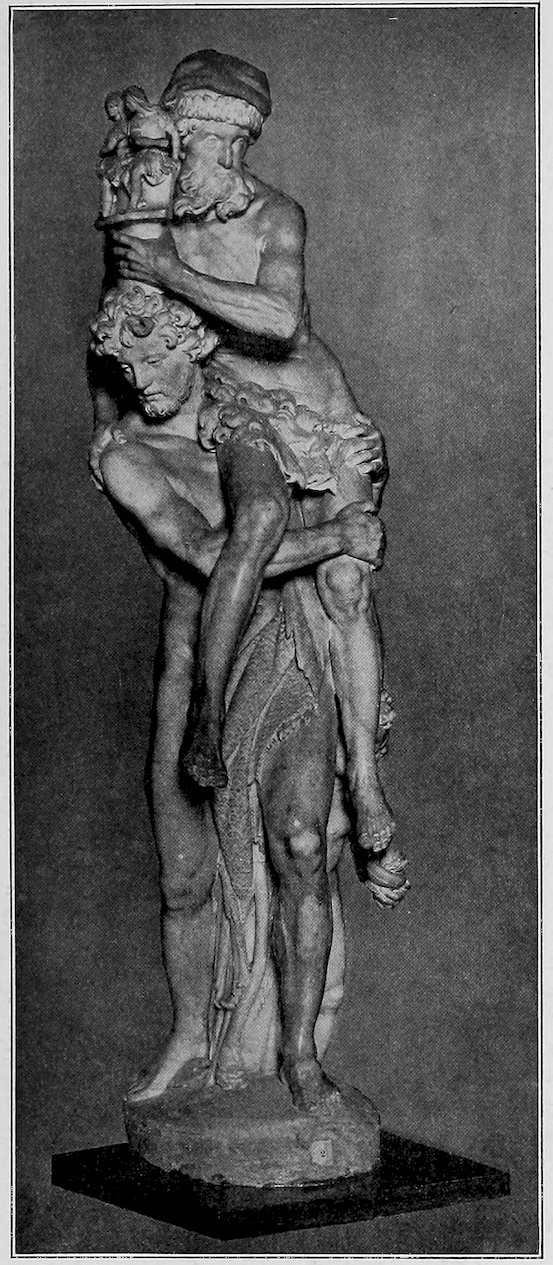
Plate III.
9The study of Bernini is established on very strong foundations, and the misinterpretation of his aims is inexcusable; for we have sure records of every kind concerning him. From his surprising youth to his busy old age we can trace his progress and the development of his powers. Of all his numerous works scarcely one is lost, and such as have disappeared are of no importance whatever in comparison with what remains. The full account of his life was written by two contemporaries, one of them his son, and this is amplified by many letters and other papers—accounts of payments for his work, stories of his doings, plans for work sometimes never undertaken and other times finally accomplished by himself or his pupils, that have been turned up into the light after long sleep in Italian archives.[1] It is all before us, and each chapter of his life can be recalled from the Elysian fields. We grow eager with the same hopes, we feel despondent at the same broken faith and pledges, we grow interested in the same companionships, we rest after the same magnificent accomplishments, and to the end we are keen in search of new worlds to open up.
Even the look of him we know; what the appearance was as he moved among the Popes and Kings, the Cardinals and Princes of Europe. What it was for a man they saw we too can see. What it was of a heart he felt dragging him on with 10engine throbs we can guess when our amazed eyes rest on the Saint Theresa, the bust of Louis XIV, or the throne in St. Peter’s. A strongly built, dark man, his thick hair whitening in old age, but the quick eye never losing its brilliancy and piercing glance. Of simple fashion in dress, as the pictures and drawings by himself and others show him, for all his love of rich stuffs and floating draperies. A ready and pleasant wit made him the best of company, though at times withdrawn into himself by some mystical absorption. For just as the great religious leaders, so the great artists are at times lifted by some ecstasy away from actual surrounding fact and lost in worlds only visible to their inner eye, and though visible never to be told of. At other times his spirits broke forth in irrepressible gaiety which though it might form itself as satire was never malevolent. Generous to a fault, and always ready to lift up a friend, he was implacable towards his enemies, and rightly showed them no mercy. He had the strength to be a good hater,—not feebly excusing hypocrisy and meanness because the hypocrite was weak or knew no better, but hating, not the poor miserable individual, but his qualities, and, to the best of his own power, destroying them. Proud and self-confident, but willing to answer questions or to explain what might seem faults. A lonely man; one with many acquaintances but few friends. Too sincere not to be shocked by the heartless brutishness of the woman he loved, too honest a workman not to be hurt by the attacks of envy, but never losing heart, always following his ideal and seeking to eternize the beautiful visions of his bright soul.
There are many portraits of him, some done with pencil or pen or graver, others more elaborate oil paintings. They 11are the work of his friends, or done by himself, and show him at various periods of life from young manhood to old age. Naturally they vary in many ways, but the variance is for the most part in the details of the outer shell of the man. The thick dark locks of the youth give place to the thin gray hairs of the old man; the full cheeks grow sunken and wrinkles frame the piercing eyes; but in all the portraits certain characteristics remain constant. A pencil drawing in the Galleria Nazionale in Rome is the best of the youthful portraits.[2] It is by himself, done when he was some twenty years old. It shows a finely shaped head with thick, waving hair. The face is strongly modelled, and all the features noticeable; the nose large and slightly bent, the chin square and strong. Lips full and sensitive, but vigorous. Most noticeable of all are the eyes, large and dark, set rather deeply under heavy brows, looking straightly and sadly but imperturbably on the world. A face of power yet of sweetness. A man to ask after and to watch what he will do in this world. Rather older we see him in two drawings in the private collection of Prince Chigi in Rome.[3] Life was testing him severely we know, but the eyes are still steady, are still bright with the inner light that was leading him on, and the mouth is still sweet and undrawn.
Of about the same time, or a little later maybe, is the oil portrait supposed to be by himself (though for this there is little proof), in the Uffizi.[4] No change yet in the character except in a strengthening and making permanent the good qualities of his youth. The man has found himself. Many years go by before we again see him face to face.
12In the Gallery of St. Luke[5] and in the possession of Count Andreozzi in Rome[6] are portraits of him in his last years, and a very fine pencil drawing by himself in the Brandegee Collection (Plate I). All his works were completed, his visits to the courts of Europe were over, he is the “Michael Angelo of the seicento,” and yet he is just as simple in his dress and pose as ever. Obviously a great man whose ideals were so much greater to him than what he had accomplished that no possible flattery could disturb the balance of his mental poise. One change there is in the face more to be remarked than the higher forehead and the fuller chin. The eyes are still bright and level, the mouth still as soft and strong, but the sadness of expression has gone. Had he realized, I wonder, that soon all the sorrows of life would be hidden and lost under the gray church floor? Though the glad light of the sun no longer shone upon his life his face is bright with a mystical light as of the ranging stars which for countless thousands of years have guided the feet of man.[7]
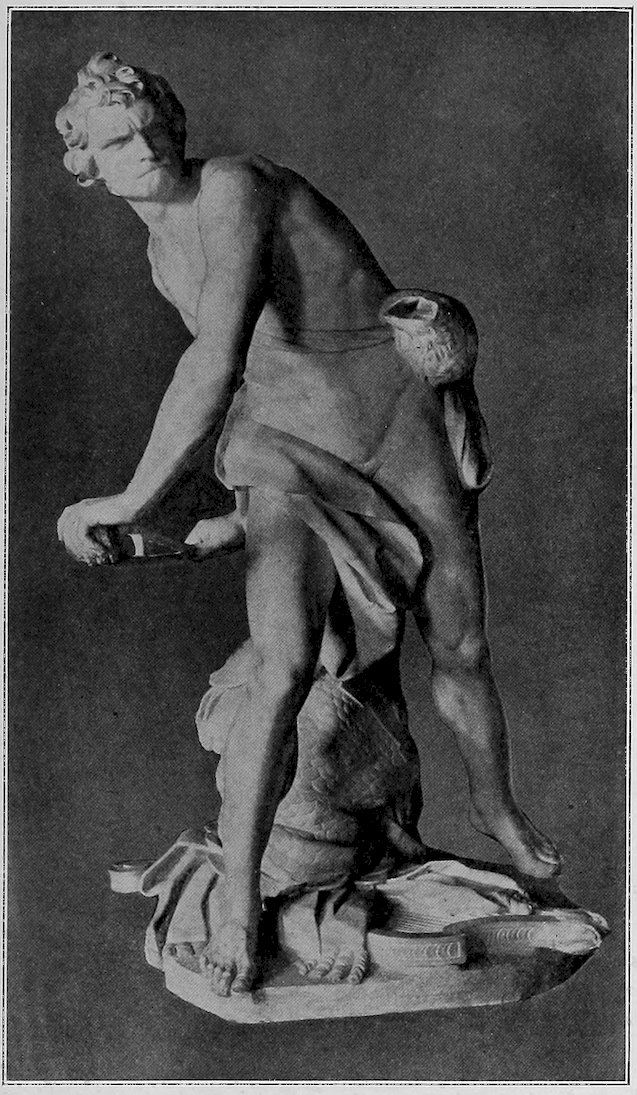
Plate IV.
It may be thought that I have given a fanciful interpretation 13to the change that came in his face from youth to old age, but it can be shown that some such thoughts as I have suggested moved him. About 1650, at a time when his enemies had attacked his work in St. Peter’s and caused him great financial damage and still greater hurt to his natural and proper pride, the idea came to him to carve an allegory that should show the ages what his feeling towards his critics, towards art and towards life truly was. Allegories in painting or sculpture are usually, owing to the fixed limitations of these arts, unintelligible, but no artist ever lived who could have done as well as Bernini in making clear his idea with the material he used. Even if we did not have his own words about this group his thought would be seen, for his amazing command of technique and his knowledge of statics made it possible for him to combine figures with a freedom rarely equalled, and thereby to express himself with an ease and fulness beyond the powers of most sculptors of any time. Only one of the two figures which were to form the group was ever finished, but there is a sepia sketch showing the whole composition.
In it we see the winged figure of Time hovering above a beautiful woman from whose nude body he lifts a mantle. She is Truth; in her hand she holds an image of the Sun darting bright rays in all directions. This group meant much to him; was perhaps the most personal and truly expressive work he ever made, and till his death he kept it by him. In his will he says that not without reason has he kept this statue of Truth unveiled by Time which he wishes to remain for ever in the possession of his descendants who, as they look on it, may remember that the most lovely of the virtues is Truth and that if one works under her guidance Time in the end 14reveals her. Are the “severe laws” of the ancients any more severe than this rule Bernini held before himself and wished his descendants never to forget, and is it sensible because at first sight his work seems strange and unaccountable to damn it with such words as “fantastic” or “baroque”?
The group was never finished, but in a dirty courtyard off the Corso in Rome, neglected as only the Italians know how to neglect such things till some outsider stirs their jaded appreciation to new interest, is the Discovered Truth. Time on hasty wings flies by, but as Bernini knew, Truth stays always, heedless of neglect, the fixed pole for all those who set their aim beyond the bounds within which their earthly eyes would prison them. And knowing this, it came to pass that his old face was lit with a peaceful smile as he came to the evening of life.
Bernini’s work is of unusual variety, but the best of it falls into four classes. There are the wonderful groups illustrating old world myths that he produced in the full joy of life in his youth; there are the amazing religious monuments in which he embodied with unrivalled skill the mystical intensity of the religion whose chief priests he served; there are the superbly joyous settings for fountains which though the waters might dry up and cease to flow will still, so long as the stone lasts, echo their murmuring music; and there are the long series of magnificent busts on which he was employed from his very earliest days to his latest. He was besides author, painter, illustrator, and architect. I have no intention of cataloguing the long series of work his never idle hand produced, but wish merely to point out some of the forgotten beauties that he brought into being. In a measure, it is possible to trace the 15source of his inspiration and in lesser degree to foresee its outcome.
His father, Pietro, a Florentine, was a sculptor of no mean power before him. His mother was of Naples, and in that southern, passionate city Gian Lorenzo was born in 1598 and there he passed his first years. Some day another Mendel may be able to establish what were the forces of Florentine and Neapolitan blood that lay dormant in his young brain, but for us is no such certainty, and we can only guess at the effect of the father’s artistic occupations and the mother’s quick blood. In 1604, when the boy was but six years old, his father moved to Rome, the city his son was destined to impress with his genius as no city but Athens has ever been impressed by a single artist. Working at first for his father, he was only fourteen years old when he drew to himself the attention of all the connoscenti by two busts which, as Annibale Carracci said, any artist after years of work might have been proud to make. The admiration Bernini won for these works, to which I shall return, led, as was the good habit of those days, to the patronage of the Borghese pope, Paul V.
In the Borghese villa, the ruined grandeur of which is still the chief pride of Rome, the young Bernini was surrounded by beautiful antique marbles, some of which he was called upon to restore. This familiarity with ancient sculpture, and this subjection in the task of restoration of his own spirit to that of classic masters, had a very marked effect on him—an effect which in its deepest sense lasted throughout his long life, though its more obvious and visible manifestation soon waned and faded away. That is to say, while his work at all times showed a perfect comprehension of some of the fundamental 16laws of the material out of which sculpture is formed, laws that were first clearly expounded by the Greeks, it is only in a few of his earliest, and for a youth miraculous, works that he shows a tendency to imitate classic form.
Four wonderful works were produced for the Borghese family. The Æneas and Anchises (Plate III), the David (Plate IV), the Rape of Proserpina (Plate V), and the exquisite group of Apollo and Daphne (Plate VI). All these were finished when he was only twenty-seven. Realizing this, the comparison of him with Michael Angelo no longer seems exaggerated, but one sees further that no such comparison can perform the ordinary service of all such juxtapositions, which is to afford a scale of better or worse, for the two masters are supreme, each in his own individual and original way, and incomparable.
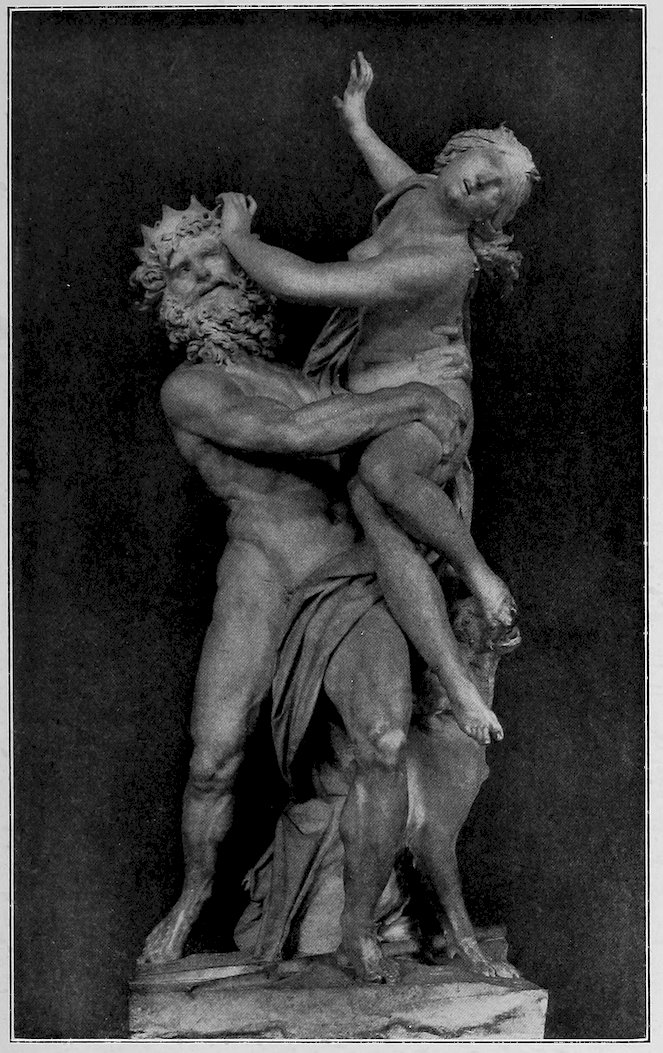
Plate V.
Opinion may easily differ in regard to the first three of the works just mentioned. To me the Æneas is the least pleasing and the David the least successful artistically. The faults of both may be in part due to the fact that in each case Bernini’s imagination was to a certain degree hampered by work of other men which he seems to have set himself to surpass, and even though it may be granted that he did surpass his models, he would have done better, as in the Proserpina and Daphne, to let his own genius lead him whither it would and ignore other suggestion. The models I refer to are, in the case of the Æneas, the Christ by Michael Angelo in Santa Maria sopra Minerva and for the David the Borghese Warrior now in the Louvre, both works of small merit.[8] The reason 17the Æneas seems to me unpleasing is because of the weakness and unheroic look of the faces and figures, but others may not feel this, and the skill of the group is undoubted. The lack of success in the David is due to a slight failure in understanding the Greek motive that Bernini was copying. Whether or not he had in mind the Borghese Warrior as he carved this figure is a matter of slight importance. He was in any case representing a single figure in a position of strongly marked action, a problem that Myron magnificently solved in the Discobolus. The Borghese Warrior is by no means so successful. The David would rival the Discobolus had Bernini not made one mistake. The figure is turned to the wrong side. As he stands, the right arm drawn back, the left hand holding the stone in the sling in front of the body, the sling must fall loose and dead, the body must again be flung forward and the right arm swung upwards before the youth can get the momentum to hurl the stone at his enemy. Had Bernini turned the figure the other way with the left hand behind and the right in front of the body, this sense of ineffectiveness in the pose would not have existed, and the whole body would have been tensely set at the moment of rest between the action of drawing back for the aim and the instantaneously following motion of the cast.[9]
Though such slight criticism may be passed on these two works, the other two, the Proserpina and Daphne are not open to any similar attack. They are magnificent, and compel 18admiration even from those whose training would tend to limit their preferences to work of another type. Never was the spirit of the two stories more fully understood or more adequately rendered. Never was marble managed in more masterful fashion and given such flux and flow of life. One’s breath catches as one looks, for it seems no longer a work of art before one’s eyes, but life itself. There is the dark, passionate rape of Proserpine, her splendid soft body shrinking and twisting in the grasp of the undeniable, compelling God of the underworld. There is the sweet, sad loss of Daphne, her exquisite springtime figure fading and changing into the rustling silver leaves in fright at the too hasty claim of her lover. Her face is still lovely, though the wide eyes and open mouth show her fear, but is there nothing in her fear of loss of her dear pursuer? And what of him? Not to be thought of as Olympian brother to the cruel, forceful Pluto. His face and action betoken the tenderness that would save the woman he loves from the heartless folly she would thoughtlessly commit. In the one group the storm and rush of passion; in the other the tender restraint of love. Both purely Greek and classic, and both carved with such consummate mastery that we forget the marble and see only the dark Tartarean glow and hear only the whispering of the sad leaves.
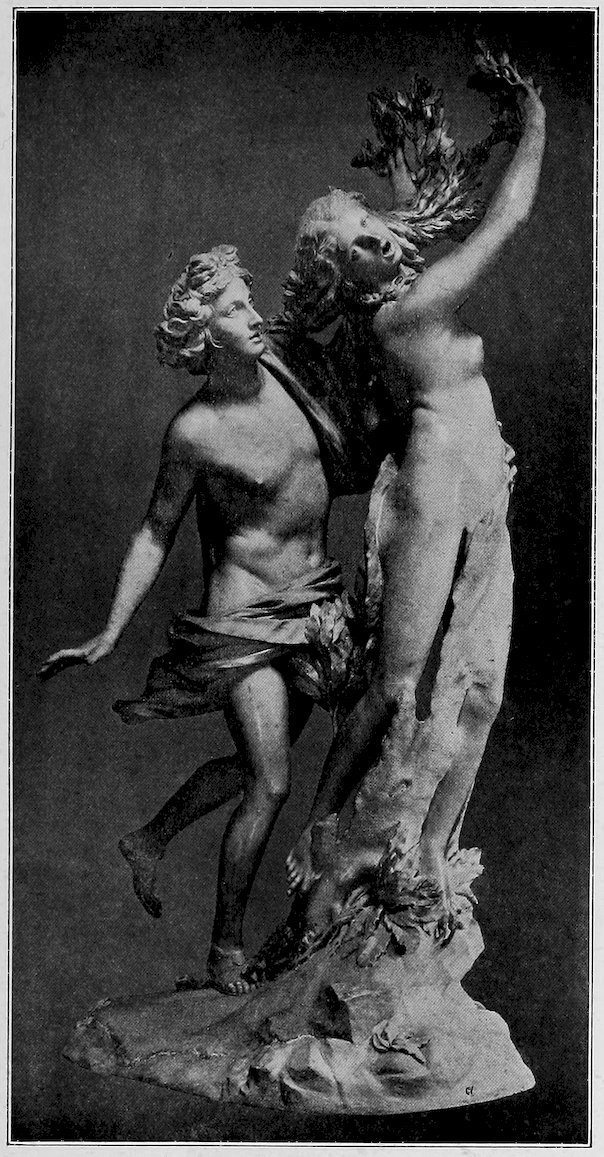
Plate VI.
The perfection of technique displayed in the works of Bernini’s youthful years is obvious to anyone with the slightest knowledge of sculpture. His knowledge of anatomy must have been almost instinctive, while he used the chisel with an ease that few painters could rival with a brush. His understanding, too, of balance and composition and of the forms the marble could be given was a revelation, and infinitely enlarged 19the field of sculpture. As a mere group, the Daphne has never been surpassed, and Bernini himself recognised that, at least from the point of view of technique, none of his later works were any more marvellous. The spirit and character, however, of the later work are very different. It is worth noting that his method of production differs greatly from that of his predecessors. Hundreds of sepia drawings by him still exist which show the fertility of his invention and the labour he spent in getting the best design for his works. There are also many terra cotta models for his statues, and in all of these we see a directness in the way he approached his subject that differentiates him from the forerunners in the art. Among the Greeks, among the painters at least, it was not uncommon to think of the body and the drapery as separate and to draw or model the first entirely nude and then afterwards to put drapery over it. This habit was common enough during the Renaissance, and the studies of such men as Dürer and Leonardo show that it was not confined to the lesser men whose lack of skill and knowledge was helped by such double process.
But among all the hundreds of sketches on paper and models in terra-cotta that are left us of Bernini’s work there is scarcely a trace of this method of procedure. He visualized each work in endless different ways, making rapid but most skilful studies of them all, but he saw the figure each time completed. The figures and drapery and setting were one indivisible whole to him, and his uncommon knowledge of anatomy, and the rare clearness of his mental vision, made it possible for him when the final form of the work was fixed upon to work at it from the outside inwards, and not, as in something built of blocks, from the inside outwards. And while his sketches differ in this 20regard from those of most other artists, the variety of them, especially the very numerous ones for the same monument, show the pitch of excellence to which art had arrived, for these sketches are no longer the record of the artist’s search to learn how, but of his eager search how best. Not that Bernini was unique in this. The fertility of invention of such men as Domenico Tiepolo is as that of a tree putting forth leaves, but no other artist illustrates these qualities and methods more completely and masterfully than our Gian Lorenzo.
I have mentioned above the originality displayed by men such as Michael Angelo and Bernini. Many another name could be added to these two, but it is not of men I wish to speak, but of this quality of originality, this crucible from which the old is drawn forth new, this Spring season of the mind which clothes the old, dry stumps with fresh life. The word is so often misused about the artists of to-day that its real significance is lost and true originality is too often imitated by a cheaper, rottener stuff. Every one of us is original in some degree. No one, unless he be mentally dead, sees or feels or believes as his father or grandfathers did before him. It may be the old belief was more correct and the old eyes were sharper than the new. Only the purblind and myopic think that all the early stages were wrong and that the solitary Present is alone right. Were this so, how hopelessly wrong this same Present would soon be! What a hideous precipice of error would this life’s painful course appear! As in life, so it is in Art, and all artists are original who are genuine and honest, who are spurred on only by their ideals and their love for their work—who give up worshipping the xoana and 21idols of a past day. It may be suggested that there is little difference, or perhaps even none, between one’s own ideal and any other suggested to us by some wrought image, whether in stone or verse is no matter. But there is. There is the difference of life. The light of one is of the dying embers, but the light of the other is of the rising Sun which shows the path we follow till our feet grow slower and slower, till at the last they halt and stop fixed. While the idol remains but the symbol of the ideal it is right. When it becomes the God it is wrong, or when doubt has cut its roots and sapped its strength and we pay it service merely because to do so has become an easy habit. So it is we come to see that the originality of these artists was not mere novelty, but was truthfulness. It represents their beliefs, and what you believe you believe for yourself alone. It shows us what their real, sure-founded and enduring hopes and aims were. Mere novelty cannot be believed in because it is accidental. It has neither root nor promise of flower. It is the mirage of the salt desert, and it is this mere queerness, mere strain, mere novelty which is too often mistaken for originality. It is the paradox masquerading as the True Word. Just as this world whirls like a “fretful midge” through space, ever in the same track, a recurring course, but gradually unperceived moves elsewhither, so do the great artists revolve, and impelled not by their own wilfulness but by the power of the divine spark within them, slowly move forward. And among that splendid company is Bernini.
The terra cotta studies in the Brandegee Collection[10] illustrate clearly Bernini’s originality and the power to which 22I have referred above, of seeing his visions in their completeness without having to painfully build them up. I do not mean to imply that each separate detail of his works was the same in his first vision of them as in their finished form. He worked at them assiduously, and perfected them with the greatest patience and care, but when they came into his mind they rose before him like ghosts from the tomb—vague but entire.
It is noteworthy that most of these models are of angels, and as such represent the religious work by which Bernini is best known, and on which he was most often employed after his youth was past. By the time he was twenty-five years old he had been employed by three Popes, and before his death five others sought his aid and depended largely on his genius in their endeavours to beautify Rome and to render their own fame imperishable. These undertakings were of very various character, but the greater number of them, such as statues of Saints, decoration of chapels, altars and tabernacles, grave monuments of Popes and prelates, were done with religious purpose and may be called his ecclesiastical work. It is superb in its mastery, magnificent in effect, and while utterly different from anything that had been done before, gives the impression of complete and perfect sincerity. Though unlike earlier work and though the religion that inspired and made it possible has changed so that never again will an artist be able to give similar expression to his ideals, still there is no ground for considering it merely curious and the expression of insincerity or passing error. Anything that affected so many thousands of men, which they found beautiful and satisfying to their souls, must be in a measure true, must have in it some portion of ultimate wisdom. Silence or contempt towards it, any feeling but of sympathy with it, shows not a better knowledge but a duller understanding.
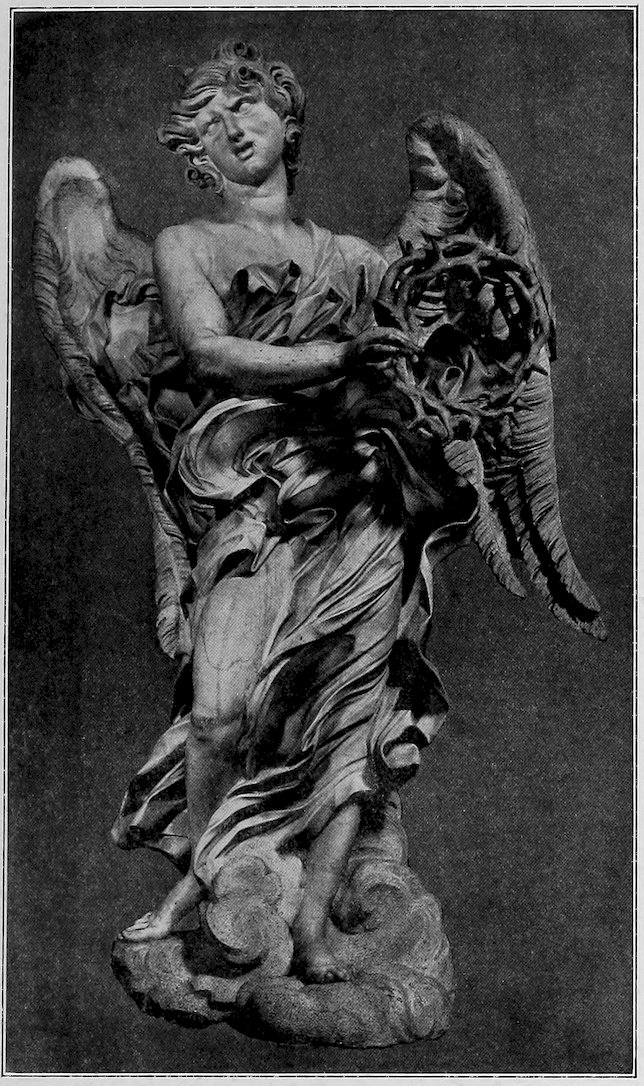
Plate VII.
23During the sixteenth century a great change had come about in the way men looked at life. Discoveries were made of all sorts; on land for men’s feet to follow or in mathematics and philosophy for their souls to reach up to. Old dogmas became untenable and the roofs with which men had sheltered their heads became scaffolding on which they planted their feet. It was a time of revolution—the revolution of the wheel of life which advances as it turns. I have called attention to the fact that the artists in their search for the fullest possible expression of their thought often threw off dozens of designs for a single work before finding the one most adequate. Technique no longer hampered them in the slightest way, and they readily changed their mode in accordance with new views, no longer blindly following the old guides. The work of Titian is one of the most obvious illustrations of this. In his youth he followed, like the Indian, the steps of his leaders, but as he aged, he broke from them more and more, till at the end he arrived in a world his teachers could never have imagined. Bernini had a similar experience.
One of the commonest complaints brought against Bernini is that he introduced the habit of decorating the archivolts or domed roofs of the churches with figures of angels fluttering about like great white birds, and in this complaint no distinction is made between the idea that underlay this scheme of decoration and the inappropriate and exaggerated use of it made often by his imitators. From the earliest times of the Renaissance, this scheme had been used. Bernini did not 24invent it. The Gothic portals and towers of France are crowded with figures of saints and kings, of angels and demons. In orderly ranks they guard the gates or singly spring into mid air from the balconies. In Italy the shepherds of the people stood in pulpits which rested on the strong shoulders of Christ’s soldiers or on the steady wings of the heavenly host, while high o’erhead (as in the Portinari Chapel in S. Eustorgio, Milan), a ring of winged figures, hand holding hand, danced and sang, and down the long aisles and in the dark chapels every sleeper in his stony bed was guarded by the faithful spirits.
Why then find fault with Bernini and think he erred in doing what all the world found good? If Bernini is mistaken in putting marble figures above our heads, why excuse Correggio for the circling swarms with which he covered the church domes, or Michael Angelo for the cataract of figures with which he covered the Sistine Chapel? All such work must be considered for its suggestion, not from the point of view of its actual substance. Why, if the conventional and halting work of the nameless early artists is good, should the masterly work of Bernini be considered bad? Only because the modern world thinks it foolish to believe in anthropomorphic angels and having no belief, has lost the power of understanding symbols. And also the antagonism Bernini’s work arouses is due to the fad for the primitive and incomplete. The very lack of power that every early artist tried to rid himself of is now thought to be his chief value and grace, and as in the daily press a missing word puzzle attracts more attention than a sonnet so the halting early work finds more admirers than the later perfect art.
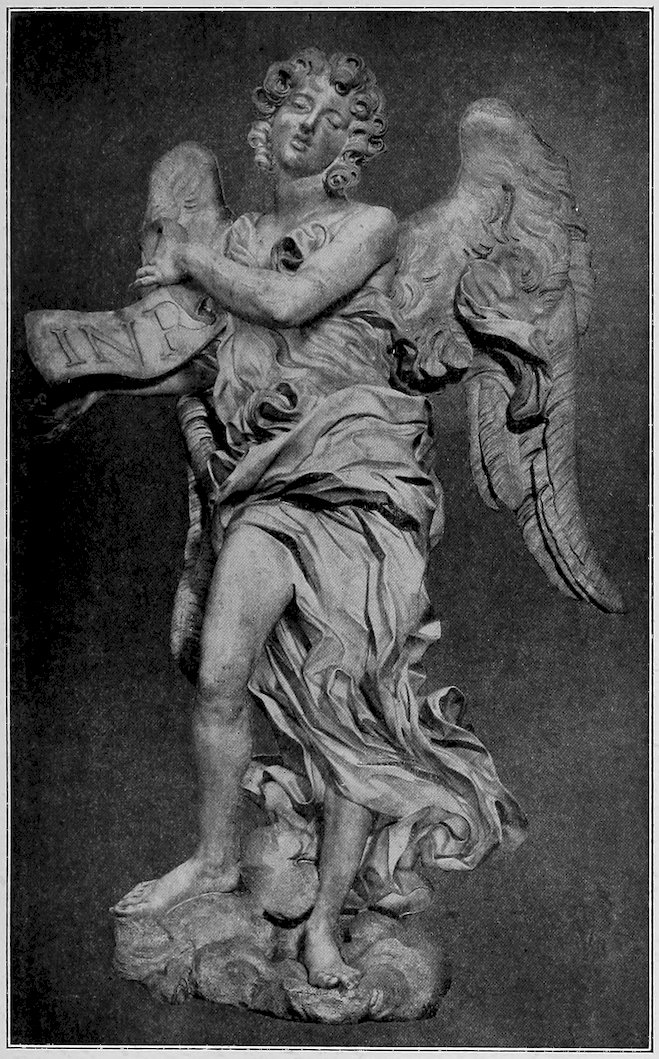
Plate VIII.
25Perfect as they are, there is something more than anthropomorphism in Bernini’s angels. Earlier artists, even the best of the Florentines, when representing these heavenly messengers, almost always make them so solid and human that the wings are utterly inadequate, or else they suggest the body by a thin and shapeless swirl of drapery topped by a perfectly substantial head. In either case the result is unsatisfactory, for though the figures conform to the usual idea of angels as effeminate human forms with wings, the chief impression they make is of inconsistent and impossible anatomical combinations.
They fail just as the archaic Greek centaurs with human feet fail. When one looks at Bernini’s angels, the two done in his youth for the altar of Sant’ Agostino, or the two for instance which he carved in later years for the Ponte Sant’ Angelo, but which were considered too beautiful to be exposed in the open air and are now sheltered in Sant’ Andrea delle Fratte (Plates VII, VIII), or at the one which kneels on the left hand of the Ciborio in the Cappella del Sacramento in Saint Peter’s, one has no sense of unreality. The bodies are human in form, but spiritual in their lightness and grace. The wings are strong and large, and yet so feathery as to seem almost transparent. The drapery falls and clings to and fits the body as a cloud might, and the face and action express a perfect and soul-filling adoration that finds expression in tireless worship and unending song of praise. These are the true “sexless souls, ideal quires.”
This same strong religious feeling is shown with equal certainty in other figures by Bernini which are better known than his angels. These are the figures of saints which he 26made in his middle and later years. The earliest of them, that of Santa Bibiana, done in 1626, when he was still a young man, shows in the arrangement and pose of the figure the influence of the antique. The technique exhibits the same magnificent ease and the same power of reproducing the various qualities of drapery and flesh and hair that we saw before in the Borghese groups, and there is in the face and gesture the expression of self-effacement in religious ecstasy that is the most noticeable quality of the later figures of this kind. As he grows older, these two characteristics of technical differentiation of surface and of ecstatic expression altered. While he lost no atom of technical power he tended to lay less stress on the appearance of the mere surface of his figures and to pay more attention to and show forth more clearly their mental condition. In doing this he brought into being figures as truly representative of the religion of his time as those of Michael Angelo or any other sculptor of any epoch.
Religious emotion must always call forth strong feeling, but the strength is sometimes shown in terms of apparent restraint, at others it shows itself in violent action. Athena Parthenos is as emotional as the Santa Theresa and Savonarola, and Luther is as violent as the Crusaders. The seventeenth century was a time when men thought it no shame to show their feelings. The Puritans showed them as clearly as the Italians, though in a less pleasant form. If to-day it is difficult to realize and sympathize with the sentiment shown in Bernini’s Sant’ Andrea, or Daniel, or Maria di Magdala, it is not because of our superiority, but rather because we have lost a very precious sense and power of spiritual levitation. Look at the Habakkuk. Is it not a splendid presentation of 27the prophet who was burdened with the grievance which he beheld, who saw for so long the righteous compassed about by a “bitter and hasty” race that he felt the Lord would never respond to his cry? But even as he complains the visible answer of the Lord appears, and the Angel with playful tenderness pulls at his hair so that his face is upturned to the light of Heaven, not any longer dark with earth’s despair, as he bids him write the vision of the Lord’s judgment that shall not tarry—write it so that he may run who readeth. And Habakkuk still points to the iniquity that blackens the world and the angel points to the inevitably approaching woe. It is superbly original. It is deeply felt.
The St. Jerome in the Duomo at Siena is another very striking figure; if it seems to most observers unpleasant, this is mainly because it does not conform to the conventional and uncharacteristic way they are accustomed to see Jerome represented. As a subject for artists he has been treated far more often by painters than by sculptors, and in the paintings the mere beauty of colour and of surroundings adds charms which are uncharacteristic of, and distract from, the real interest of the figure. When carved by Bernini, there is nothing but the figure to consider—whether it be suggestive of the real man as we know him by his writings or not. Probably most people if asked what image the name of the saint brought to their minds would recall the print by Dürer or some painting such as that by Catena in the National Gallery. But splendid as the print and the painting are, it is only by a pleasant fiction and by refusing to regard the truth that they can be thought to represent in any way the Saint as he was among men. They show a very gentle old man in the neatest 28and quietest of surroundings, peacefully writing his comments on the scriptures.
It can hardly be supposed that his contemporaries regarded Jerome primarily as a peaceful and abstracted scholar. Surely Bernini did not, but instead shows us the unhappy wanderer and ascetic monk. Scholarship was only one phase, and among the people with whom he lived scarcely the most important phase of St. Jerome’s life. To his contemporaries he showed himself chiefly as an acrid controversialist taking a leading part in the “strife of tongues.” Unhappy in his Pannonian home, he spent a restless youth wandering over Europe, but instead of peace found only momentary forgetfulness in pleasures, the remembrance of which brought deep sorrow in his later years. Then he turned to asceticism and sought by living as an anchorite in the desert to conform himself to the teachings of his Lord. But the degradation of such a life, the unnatural and disgusting view it took of the image of his Maker and the temple of his soul, the morbid introspection and sterility of selfish self-mortification, brought him trouble and pain, not calm, till, at last, an old man, he died in Bethlehem thoroughly disheartened with the iniquity of the world and the horrors resultant on the destruction of Rome by the barbarians.
Such is the man Bernini sets before us. The battered, wayworn feet; the strong, coarse body; the ragged, unkempt hair show the life he led. The face bending with closed eyes dreamily over the figure of the crucified Christ betrays his holy, misdirected zeal. What he was, and what he stood for, could not be shown more clearly than our sculptor has shown it here.
29Equally fine, and in certain ways more beautiful, is the statue of Daniel in the lions’ den, which Bernini made in 1656 for Cardinal Chigi, who placed it with the Habakkuk in Santa Maria del Popolo. The youthful and splendidly built figure rests on one knee, his hands upraised in attitude of prayer, his head bent back with eyes wide open gazing upwards. From one shoulder, beside his body and over his legs, falls in wind-blown folds a single heavy mantle. A great lion crouches behind him, licking his foot. In its perfect physical beauty, in its not over-emphasised anatomy and in its entirely successful composition, by which great movement is given the appearance of completeness and stability, the figure is more closely allied to Bernini’s earlier works than to the mystical passionate figures such as the Jerome or Mary of Magdala or others of this period. It is unnecessary to dwell on the beauty of the figure and the technical skill it displays, for these can be seen by anyone whose eye and hand have been trained at all.
There is one less obvious point, however, to which I wish to draw attention, for it is as good an example as could be of what I have mentioned above. I refer to the way the legs show through the heavy drapery that covers them. The mantle does actually clothe the leg. It is not a mere addition. It takes its shape and movement from the leg beneath it. The one cannot be thought of without the other. Were the statue destroyed, and did only the right hip or left knee remain, one would instantly recognise what parts of the figure these were. But classic though the figure is in general appearance—it might almost be one of the Niobids—the feeling of absolute ecstatic faith is very clearly given in the 30upturned face and the reaching arms.[11] Now there have been times—great and noble times—when men did believe that God would send angels to shut the mouths of lions, and when men felt no fear, but only a carefree trust in His help if true innocency could be found in them.
Such work is not baroque, nor decadent, nor over-emotional, as it is commonly and thoughtlessly said to be, but it is a very adequate and convincing representation of a powerful and uplifting spiritual condition. It is just as fine as the graver and more sombre figures of Greece, or as the sad and ponderous figures of Michael Angelo.
Of all the figures of this period in Bernini’s development the most famous is the Saint Theresa (Plate IX). It is hopeless to express in words the great beauty of this figure. This can no more be done than the full perfection of any great poem can be rendered in a translation. The work is perfect in itself, and what of this kind can be shown in sculpture is here expressed with complete and ultimate adequacy. That most people are startled and shocked when they first see the figure is due to the fact that they do not think of what the scene really means, and they are not accustomed to seeing scenes of divine significance treated with perfect simplicity and pure faith.
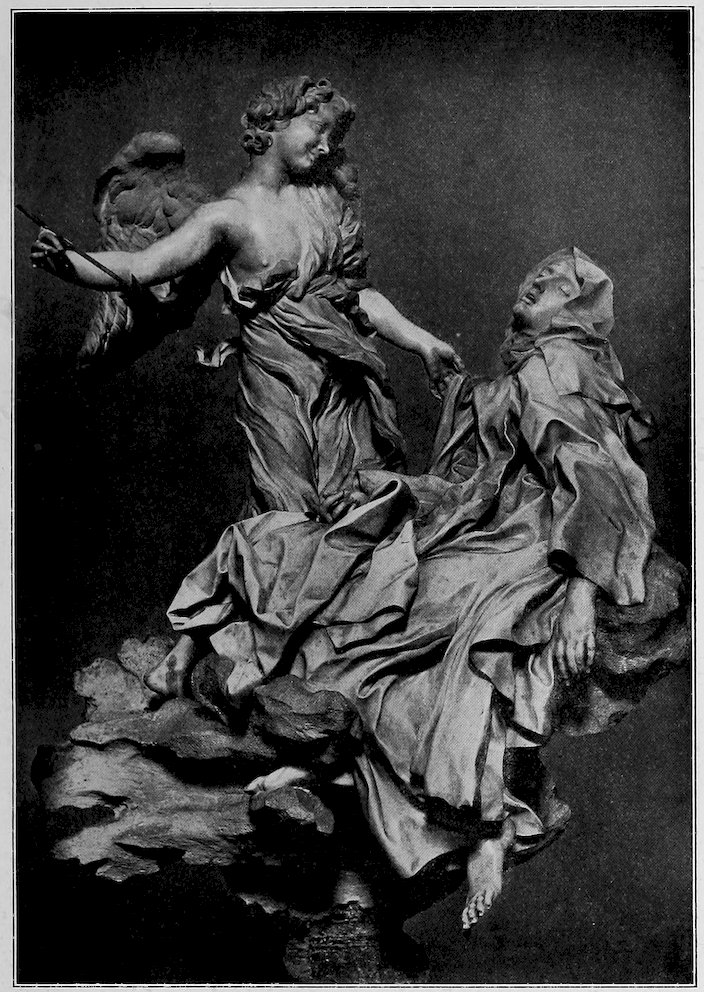
Plate IX.
Not that such scenes ought not to be so treated, but few are the artists who feel deeply enough or whose technique is finished enough to enable them to represent a scene of this sort so clearly and beautifully. As a result, the artist falls back on forms which have been repeated so often that they have become conventional and no longer can give the beholder 31the full impression of their meaning. No one is offended on seeing the Son of God bleeding on the cross around which surges a host of idle spectators, or at seeing Him in the manger before which all the nobles of Florence kneel in various theatric attitudes. But Saint Theresa is a figure new to them, and to have her shown in the crisis of her ecstasy with other figures looking on from the walls of the chapel, offends their “sense of propriety” and seems “paradoxical,” “perfervid” and “inconsequent.”[12]
Were this a fair criticism, a large number of the most beautiful works of Christian art would fall under the same condemnation. Far more paradoxical than Bernini’s figure are the representations of the Marriage of Saint Catharine, and they are quite as unpleasing if thought of in their literal sense. As for the figures looking at the Saint from the “opera boxes” at the sides of the chapel, it must be remembered that at this time most of the drama in Italy was founded on religious subjects, and such dramatic representation made a very deep appeal to men’s minds. The critics who find the Saint Theresa in bad taste do not hesitate to form part of the audience when Christ’s Passion is played among the hills of Oberammergau, and they will no longer be afraid to render Bernini the homage that is his due when they cease lazily to measure his work by conservative standards. The glory of a comet is not measured by the Eddystone Light nor a miracle by the conventions of ordinary society.
One other point concerning this statue remains to be considered. A recent critic[13] says that “there are many ecstasies, 32and Bernini has chosen something that borders closely on the most displeasing.” In this he expresses a common opinion, based, I believe, on a misconception, and on ugly, puritanical prudishness. Possibly there are many ecstasies, but religious ecstasy, the ecstasy of the Saint in joining herself to the spiritual existence of Christ, and the pure and natural ecstasy of love when self is lost in the future of the race, are as nearly as possible identical. The Venus de Medici is far more displeasing than the Saint Theresa.
In one portion of the group Bernini certainly did fail, and in a way that is surprising. Usually his figures of angels are successful, but the one standing over Saint Theresa is assuredly very bad. Its figure is unconvincing, and its face, with tilted nose and silly smile, is more that of a Greek paniskos than of a heavenly messenger. But notwithstanding this blemish, no work by Michael Angelo or any other sculptor ever made the beholder forget so completely the substance out of which it is carved, and think only of the scene represented as Bernini has done here. He has given the softness of life to the snow-white stone. His hand and mind worked in perfect accord and produced a work unrivalled in technique and of very great beauty.
Another statue of similar character is the Beata Albertona. It is a little less delicate in treatment and more emphatic in expression than the Saint Theresa, but is, none the less, of very great beauty and power.
Were a man’s failures as worth study as his successes, I could mention works by Bernini which are distinctly bad. The Maria di Magdala is one. Though full of feeling, the figure of the Saint is coarse and clumsy. But though a man’s 33defeats show, of course, the principles for which he stood, his victories are more worth considering and are the fairest test of him. A very false estimate of Michael Angelo would result if one considered the Rondanini Pietà, the David, or the Christ in Santa Maria sopra Minerva as of equal importance with his other works.
It was not only in works in marble that Bernini showed his power as a sculptor. He handled dark, impressive bronze with the same complete understanding of its qualities and possibilities that he showed in carving the gleaming Carrara marble. Such a work as the Baldacchino in St. Peter’s is beyond any words to praise. It is enormous, but not clumsy, and sumptuous without being ornate. The most stupendous of his bronze works is not, however, the Baldacchino, but the Throne, the Cattedra in the apse of St. Peter’s. It was in 1657, during the pontificate of Alexander VII, that Bernini was ordered to carry out his design for this work, and eight years later it was finished and uncovered to the admiration of all Rome.
This monument is too well known to need detailed description here, but it is well here to recall its purpose, which was not for actual ceremonial use by the Popes, but to serve as a frame, or strong-box, for the ancient chair of carved ivory on which tradition said, and the whole Catholic world then believed, St. Peter had himself sat. There in the heart of the greatest Christian Church, raised above the soiling earth, high in air for the thronging worshippers to behold, was to be the visible and material sign of infallibility. Bernini alone had the feeling that made him capable of such a task. Four magnificent figures of Doctors of the Church support the 34chair—two of the Western church, Saint Augustine and Saint Ambrose, and two of the Eastern, Saint Chrysostom and Saint Athanasius. Stately great figures; on their outstretched hands they hold the Throne with the ease that comes of perfect faith, raising it up even as sixteen hundred years before the Apostles had raised up this earth for the glory of God.
In all these religious works by Bernini there is beside the expression of the faith that begot them the expression of a decorative sense, something dramatic. He delighted in movement and expression for the mere sake of beauty of active form, and this feeling of joy in life, in the spirit of movement, whether in Nature or in Man, Bernini reproduced in a series of works which by themselves would make him unique among all sculptors and which give Rome a distinction and character far more decisive than her ruins or palaces and set her alone and apart from all other cities. These are the fountains.
The list of fountains is of amazing length. The Barcaccia in the Piazza di Spagna, one in the Villa Mattei, one in the Vatican Gardens, another in the Barberini Gardens, the Triton in the Piazza Barberini; the lovely shell which used to be on the corner of the Via Sistina, but has been destroyed to make way for modern improvements so called; in the courtyard of the Palazzo Antamoro, in the Piazza Navona, and the broad pool of the Fountain of Trevi. They have the infinite variety and infinite pleasantness of Nature herself. By the side of the placid pool whence the ciociaras draw the water for their flowers, or where the sparkling stream of the Triton shoots heavenward from the gray pavements like a white crocus from the frosty ground in Spring; where the Nile, the Ganges, the Plata and the Danube pour forth their 35incessant floods, or where Neptune shepherds his foaming steeds over the rocks as they dash down into the pool that if we once drink from our hearts evermore yearn for the Eternal City—by each and all of his fountains our ears are filled with the pleasant voices of the waters and our eyes with the sight of the nymphs and nereids who gambolled among the watercourses when the world was young.
What the secret of their charm? No one ever understood the artistic value of water as Bernini did. No one else ever held in check the full stream and gave it back again the ripples, and spurts and sudden rushes of its upper course and of its source. The angels must have washed his spirit in the fountain of eternal youth to enable him to express the joy which flowed through his veins in the undying music of the waves, moulding and combining them to his intention as a musician makes the rough strings of his instrument sing of the life that lies hidden in them till his knowing touch gives them voice.[14]
I have spoken of the groups representing classic myths, of the innumerable statues motived by religion and of the fountains, but even this huge mass of work does not come near completing the list of Bernini’s output. The numerous portraits remain to be considered. Some, such as the Constantine in St. Peter’s, were ideal, but most were of his patrons and friends and were of very varied types. There were colossal equestrian statues, ordinary busts, full-length figures and groups for tombs, and they show that he possessed just 36as great skill in direct portraiture as in more purely imaginative work.
To carve or paint a successful portrait, two powers are absolutely essential to the artist. On the one hand he must have the sympathy that will enable him to comprehend the sitter’s character, and to see what lines and expressions of the face express that character most clearly; on the other he must have the power of suppressing his own individuality and of lending his hand and eye, as it were, to the sitter to make the portrait himself. If the artist lacks sympathy, he will produce a work which may be correct in all detail of colour, line and modelling, but it will only be a sort of mask; if he lacks the power of self-suppression, the work will be unlike the sitter, even though true in detail, because it will show not his character, but that of the artist. Bernini illustrates these points with perfect precision, and as a result his portraits are unsurpassed by those of any other artist of the Renaissance and are far finer than the quaint efforts of the earlier sculptors which many students of art admire with the enthusiasm of decadence and a fatuous misunderstanding of both the value of art and the aim of the artist.
Just as it was fortunate for Turner that in his early years he was forced to draw with painstaking accuracy, so was Fate kind to the young Bernini in giving him to do, when he was but fourteen or fifteen years old, the portraits of two well-known Prelates. Success in these meant fame and an assured future for the boy. Like every genius he must have felt, with perfect simplicity, with no conceit, his power; but what must have been his feelings of tremulous satisfaction when, the busts unveiled, the crowd of Cardinals and Prelates who were gathered 37to see his work, broke into enthusiastic applause? The cheering words of those long since silent voices echo again in our hearts as we look at these busts of the Bishop Santoni and of Monsignor Montoya, for two more perfect portraits can hardly be found.
A mere child made them; a boy whom one could more easily think of playing at marbles in the sunlit street; but instead his playground is the Temple of the Lord and his toys the souls of men. The mere knowledge of anatomy and the technical skill they show is most unusual for one so young, but what shall be said of the spiritual insight of the artist who carved these two bowed heads with their sweet, strong, grave faces? The excellence of the ancient Greek, in certain forms of sculpture, has given us his name as an adjective to express one kind of superlative merit and these two busts can, with perfect accuracy, be called Greek. They are as like as can be to the bronze bust by some unknown Grecian sculptor which in the Museo dei Conservatori bears the name of Brutus.
As in his other work, so in the making of portraits Bernini soon broke away from traditional methods and gave his own spirit full sway. This is evident in the bust of Costanza Buonavelli, his mistress, which is one of the treasures of the National Museum in Florence. It is not only the technical skill with which he gave the different qualities of the pleated dress, the round soft neck and cheeks and the blown tresses of waving hair that make this portrait so remarkable, but beyond this one sees in it the artist’s own human love for the actual woman and his delight in her as a suggestion of a beautiful work of art. This bust is unique among his works, for the woman who inspired it then, with thoughtless animal selfishness, 38killed the inspiration she had begotten. The bust is the tombstone for the most sensitive part of Bernini’s heart.
Among the other busts of his early years are one of his great patron Paul V (Borghese) and two of his steadfast friend Cardinal Scipio Borghese.[15] They are all of them noteworthy, but the finest is the first one he made of the Cardinal. In this the growth of Bernini’s dramatic feeling is very plain and is shown in a technical way which he repeated many times thereafter. It is this. He carves not alone the head and a small portion of the breast, but he gives the whole upper part of the torso and arms and skilfully suggests by the turn and position of this part the action of the whole body, so that as one looks at this bust of Scipio Borghese, one has the feeling of seeing not his head alone but his whole figure. The wonderful realism with which Bernini has rendered the crinkly silk cape and the rolling flesh of the fat face with the lips just parted as though the burly Cardinal were whistling for breath is obvious to the most casual observation; but realistic though the bust is, Bernini was skilful enough to give chief emphasis to the character of the sitter so that the impression that one takes away with one is not of the external appearance of the figure so much as of his nature and quality as a man. In many ways it closely resembles the portrait of Pope Innocent by Velasquez.
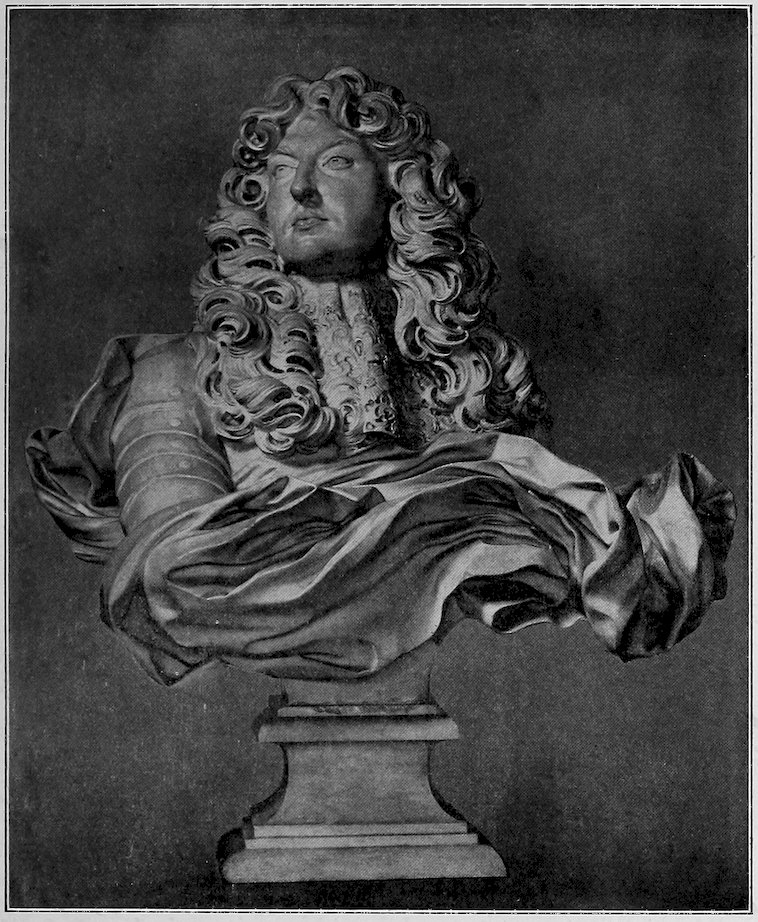
Plate X.
Other portraits are to be seen not only in Rome, but in Modena, at Versailles and even at Windsor; for, as Bernini’s fame spread, the great people all sought him and even Louis XIV and Charles I were delighted to have the artist give them 39that immortality which neither their deeds nor position could assure them. One of the quieter and less dramatic works is the beautiful bust of Monsignor Francesco Barberini. It is realistic like the Cardinal Borghese, but the realism is made subordinate to a higher aim and only used to emphasise the ideal character of the work.
Numerous as are these effigies by Bernini of Popes and lesser men, there are two which stand out above all the rest as unsurpassed in art and as combining and illustrating more fully than any others the character of the time, of the sitter and of the artist which, all together, made them possible. They are of Francis I of Este, now in Modena, and of Louis XIV (Plate X), at Versailles. The first was made in 1651, the second during Bernini’s visit to Paris in 1665. Only Bernini was capable of representing these two proud princes in all their splendour of ornamental wig, and lace and armour. It demanded technique such as his to make anything but a great lump of complex and ugly form out of such settings for the head as these; and he succeeded, to the unquestioned admiration of all time.
That was an epoch when men liked theatrical display of all sorts, when what in these colder days seems exaggerated expression was natural and pleasing to people. Bernini knew and understood this, had often himself been employed in writing plays or arranging stage scenery, and has represented the two rulers just as they delighted to show and think of themselves, adorned with all that was rich and splendid, haughty and disdainful as was the nature of those endowed with the divine right of Kings. Even more than in the case of the portrait of Cardinal Borghese do these two busts seem to 40make us see the whole figure and yet they have an appearance of lightness that is most surprising. Not to be made again such busts—nor such men. Democracy, and a belief in equality as absurd as that in Kingship was overweening, have snuffed out all such pretensions, and have snuffed out the art too. But thanks to Bernini we have the record of them. We see them in their moment of splendid satisfaction and self-confidence, and made beautiful through mere enjoyment of their bubble reputation.
The final value of portraiture is that it should be characteristic of the person depicted. No matter how great the skill shown in giving Napoleon the appearance of a Greek athlete or Washington that of Olympian Zeus, such works are only folly and waste. Bernini made no such mistake, but with deep insight and unrivalled skill proved himself one of the greatest portraitists of all time.
I have spoken of Bernini’s versatility. I have considered in some detail the sculpture by which he is best remembered. Of his painting not much is left, and what remains is naturally not of any great value as art. Still less is left of his work as an organiser of plays and arranger of processions or carnival displays. A few drawings and engravings and some slight accounts by contemporaries give us an idea of this work of his, but it was the occupation of his more idle hours and is of little moment. Of his architectural work a good deal is still to be seen, though in many instances later workmen have added to or altered the original structure, which was almost always skilful and big in conception, though occasionally he made a mistake, as when he put the towers—asses’ ears his contemporaries called them—on the Pantheon.
41The structure by which Bernini is best known is the double colonnade of the Piazza of St. Peter’s. Of this his original sketch book still exists.[16] It is an intensely interesting record of the different schemes and plans which Bernini worked at till in the end he produced the splendid simple and grand design which gives Rome the finest public square in the world.
There are several sheets of drawings in the book, some showing Leonardesque studies of the relations between the proportions of the human figure and those of architecture, others show views down the Borgo from the church or looking up towards St. Peter’s with plans for the rearrangement of the district, and some are views and designs of various types of colonnade showing deep study of their perspective appearance. But of all these sketches, there is one of far greater interest than all the others, for it shows that insight into the deeper meaning of things which made Bernini the supreme genius he was (Plate XXX).
On this sheet are two similar drawings showing St. Peter’s and the colonnade. Over these, as though they formed the head and arms of a cross, is drawn a bearded figure, his head crowned by the dome of the church, his arms outstretched on the colonnades and with his feet crossed slightly one above the other and resting just where, at the beginning of the Borgo, Bernini intended, as another of the sketches makes plain, to put a building. There can be no doubt, after seeing this drawing, that Bernini’s intention was to make the Piazza symbolic of 42Christ and the Crucifixion. Evidently not a mere builder of houses this man Gian Lorenzo Bernini, but somehow, and somewhence, he has got a poet’s vision and he makes his mark in the world not merely by moulded clay and shaped stones, but by shaping men’s hearts and moulding their ideas.
Such was Bernini, one of the great artists of the world. It is true that he was revolutionary, but he destroyed not through ignorance or envy. He destroyed merely that he might then create. The arts in his day were strangled by academic rules and had become cold and lifeless. The intensity with which he felt things gave him strength to break these bonds and to make sculpture once more a means of conveying living thoughts and emotions. He was like the butterfly which tears away the stiff-plated chrysalis before it can spread its wings in the free air. It is useless to try to explain his technical skill; he was born with it, just as others are born with a keen sense of colour or a musical ear, but it is certain that without it he could never have carved such figures as the Saint Theresa or the portrait of Fonseca[17] which show intense emotion brought on by loss of all sense of self in the contemplation of the mystical meaning of the Passion. Such feeling could not be shown by restrained action and quiet faces. Much movement was necessary and the works are successful and beautiful because the feeling shown is perfectly simple and natural and not forced and put on for the sake of effect.
Bernini’s technical power made him, however, a bad master for others to imitate. Not that the work of his followers is any more inane than that of the copiers of Michael Angelo 43or of those of any other great man, but his peculiarities were such as are at least superficially easy to see. Where he quite easily and simply distinguished between the appearance of silk or flesh, his imitators wasted their energies on elaborate arrangements, the only object of which was to show technical dexterity. Where he carved figures that are racked and torn with feeling, the imitators gave forms that are contorted and as unemotional as gymnasts. But he is not to be blamed for their work. By no means was he one of the blind leading the blind. He was the seer, the prophet, by odd chance honoured in his own home, whose visions were so believed by his followers that they vainly tried to see the like. What their eyes strained towards and failed to see, his heart yearned for and gained. To them praise was a prize to win, to him it was a spur to renewed effort and further advance. He had faults, as who has not, but they were due to his being a pathbreaker and having to find out for himself ways to carve and show figures such as no sculptor before him had ever dreamed of; they were not the faults of ignorance or stupidity. If it be well for us that we judge not lest we be judged, so too is it well, should we judge Bernini or other men, to judge not what there is in him of weakness or failure, but what there may be of noble intention and high endeavour. Doing this we shall see that Bernini, working always with bowed heart, but with uplifted spirit, broke down the middle wall of partition between art and life.
44
II. A COLLECTION OF SCULPTOR’S MODELS BY BERNINI
The clay models by Bernini, descriptions of which follow, form one of the most interesting artistic records left us of the sculpture of the Renaissance. Drawings made by the painters of that period to serve as studies for their pictures are not uncommon, but the sketch-models made by the sculptors are rare.
This is because sculptors carved the marble without any previous models, as Michael Angelo frequently did, or else that the models, being cumbrous and of material that was easily destroyed, have, in the course of years, been got rid of either intentionally or by accident. It may seem strange to suggest that the clay of which the sculptors may have made their studies is more liable to destruction than the paper used by the painters, but it must be remembered that while nothing is more durable than baked clay, air-dried clay is extremely perishable. Wax was also used by the sculptors for their preliminary sketches, but this, owing to expense, could never have served for work of any great size or quantity; and even if less apt to complete disintegration than unbaked clay, it is very liable to injury.
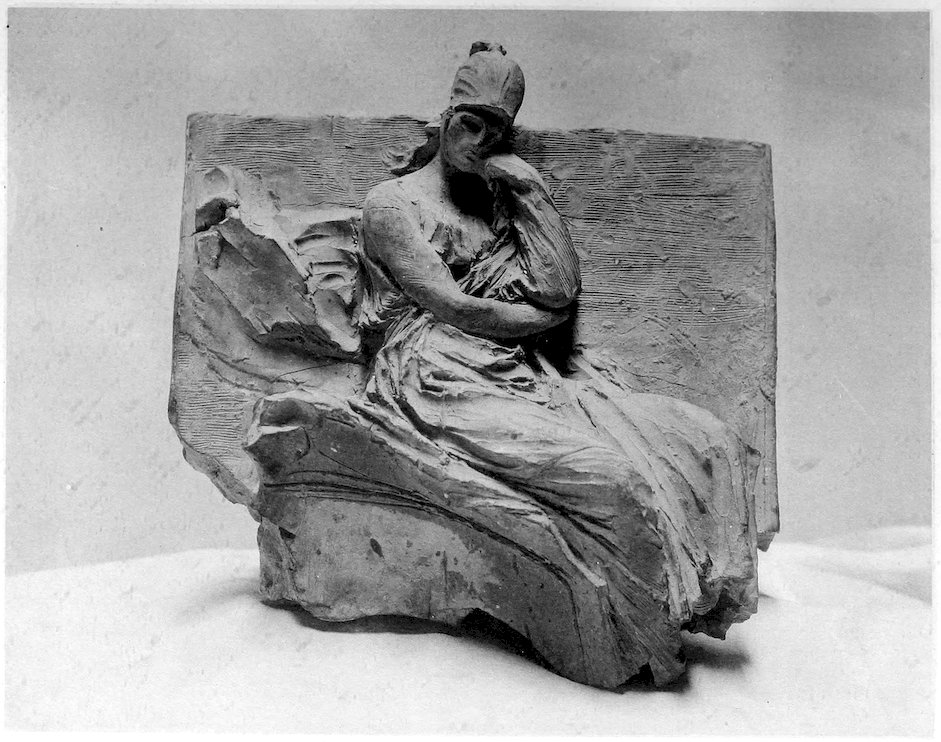
Plate XI.
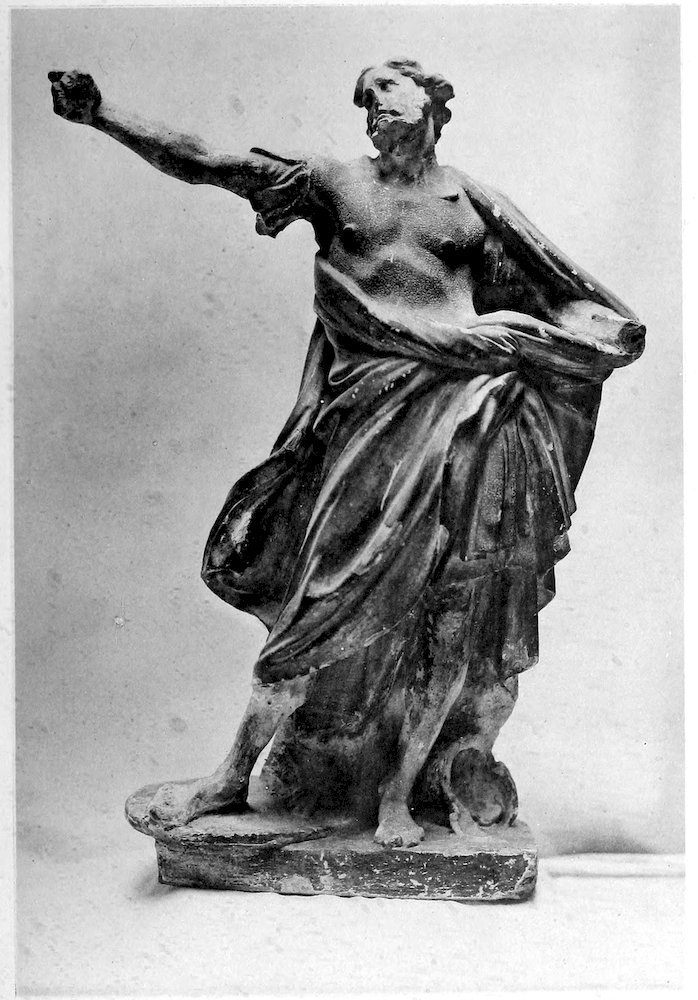
Plate XII.
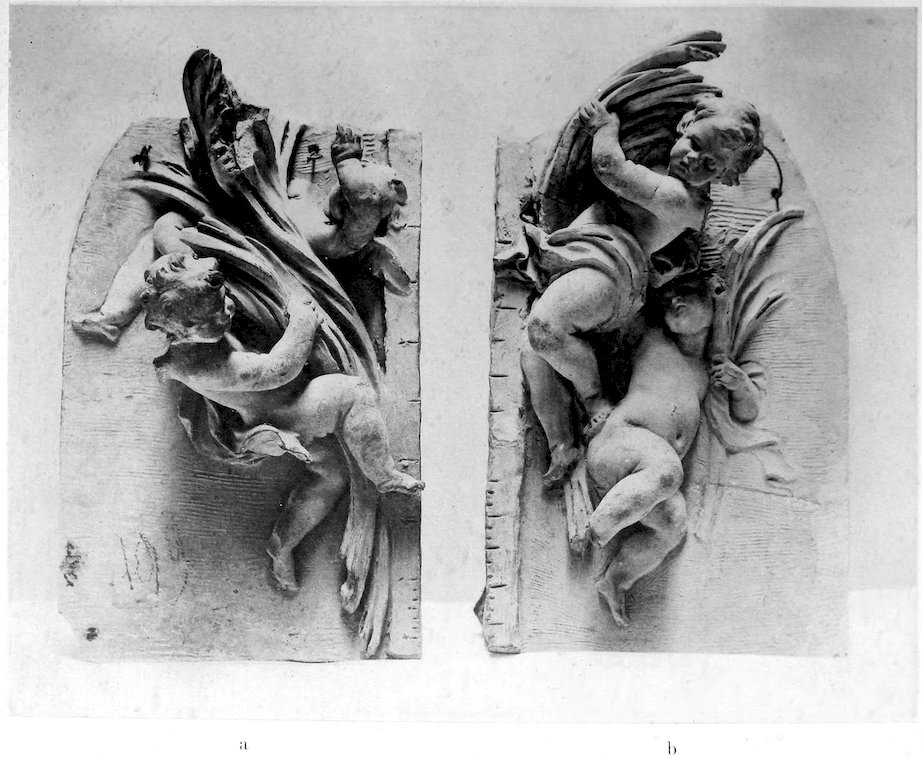
Plate XIII.
What precisely was the origin of this collection of Bernini’s models we cannot tell; but it is our great good fortune that when they were made there was some one, perhaps one of 45Bernini’s pupils, who cared for them and saw to their being properly dried or baked so that they have preserved their pristine freshness. It is also extremely fortunate that their present owner realized their great beauty and extreme interest and added them to the artistic treasures stored in America, where they will serve in the ages to come to show students and sculptors a clear reflection of the mind of one of the world’s greatest artists.
In the Museum at Berlin are other models by Bernini, but there is, so far as I know, no other collection, either public or private, that approaches the Brandegee Collection in number, variety or excellence of these works. In America I know of but one other model purporting to be by Bernini. It is in the Morgan collection and represents Pope Urban VIII, but it does not show a single touch by the master; it is an imitation, copied from the statue in the Campidoglio at Rome. In the collection of the late Mme. Edouard Aynard, sold in Paris, December 1–4, 1913, were two terra-cotta models of angels (lot 307) “attribuées au chevalier Bernin, d’après les originaux du port Sant Ange, à Rome,” and one equestrian statuette in the same material (lot 308), said to be the “esquisse originale de la statue en marbre de Louis XIV, dans le parc de Versailles, par le chevalier Bernin.” The two angels are certainly not by Bernini; the portrait may be.
From the artistic point of view these models are of the highest importance, for they show with startling clearness the great fertility of invention which characterized Bernini and the vivid way in which he visualized the creations of his brain. There is not a trace of effort in them, there is not a sign of rubbing out or doing over, but each group or figure 46was obviously seen by him with the sharpness of a dream and reproduced by his skilful fingers in the fresh clay while the impulse and uplift of the vision was still on him.
The knowledge of the purely technical side of the art of sculpture which the models reveal is magnificent. The way, for instance, in which the various planes are treated in the oval relief of the Virgin and Child (Plate XXVI) is as subtle as, and very similar to, that of the reliefs on the ancient vases from Arezzo, while the relation of draped portions of the figures to the parts left nude, and the manner in which the body beneath gives life and meaning to the covering drapery, is as fine as any work by Pheidias.
But the most fascinating and interesting characteristic of these terra-cotta figures is that one sees in every least portion of them how Bernini’s fingers, trained by long years of hard practice, played over the wet clay like wavering flame and moulded the dead material to enduring forms of beauty. Once more the old mythology comes true, and Pygmalion, taking the rough material offered him by Mother Earth, fondled it, and, warming it with the fires of his brain, gave it back the life that lies asleep till the lover’s kiss wakes it once again.
DESCRIPTION OF THE MODELS
No. 1.—Plate XI
Seated female figure in high relief, wearing helmet, and heavily draped; the left cheek rests on the back of the raised left hand. Feet missing.
For the tablet in memory of Carlo Barberini in Santa Maria d’Aracoeli, Rome.
Width 10 inches.
No. 2.—Plate XII
Figure of Longinus, in St. Peter’s. In the round, and gilded.
Height 20¾ inches.
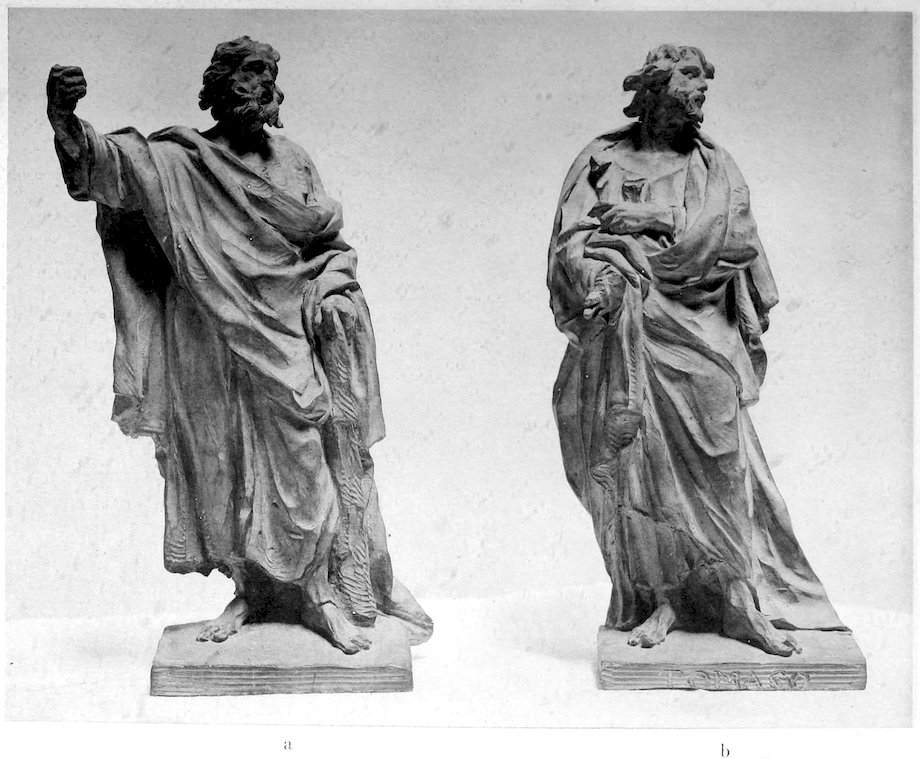
Plate XIV.
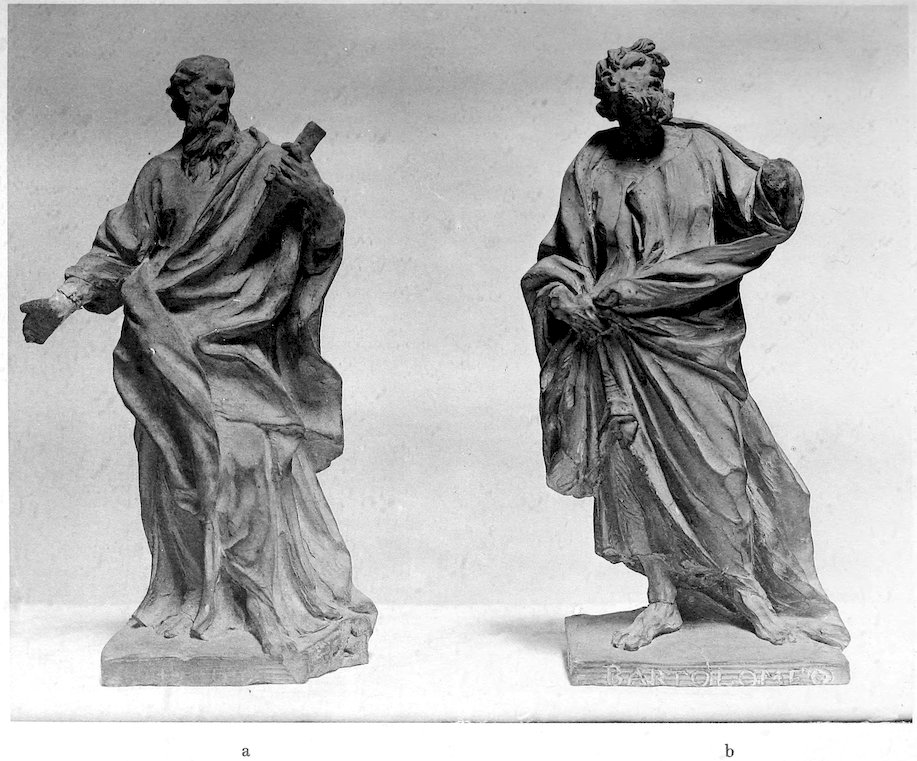
Plate XV.
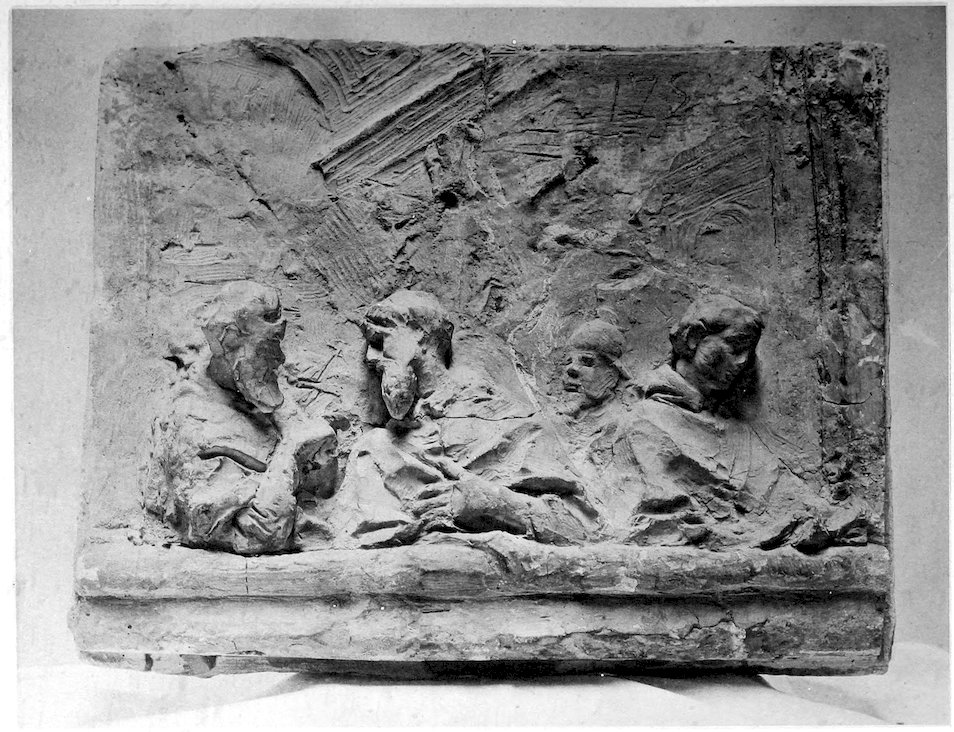
Plate XVI.
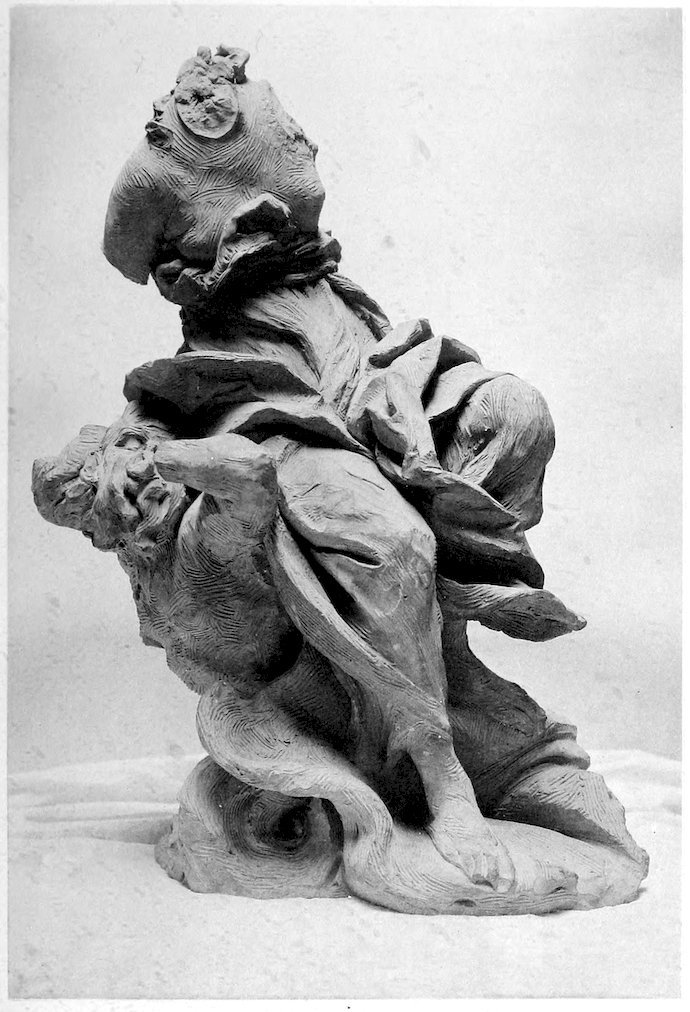
Plate XVII.
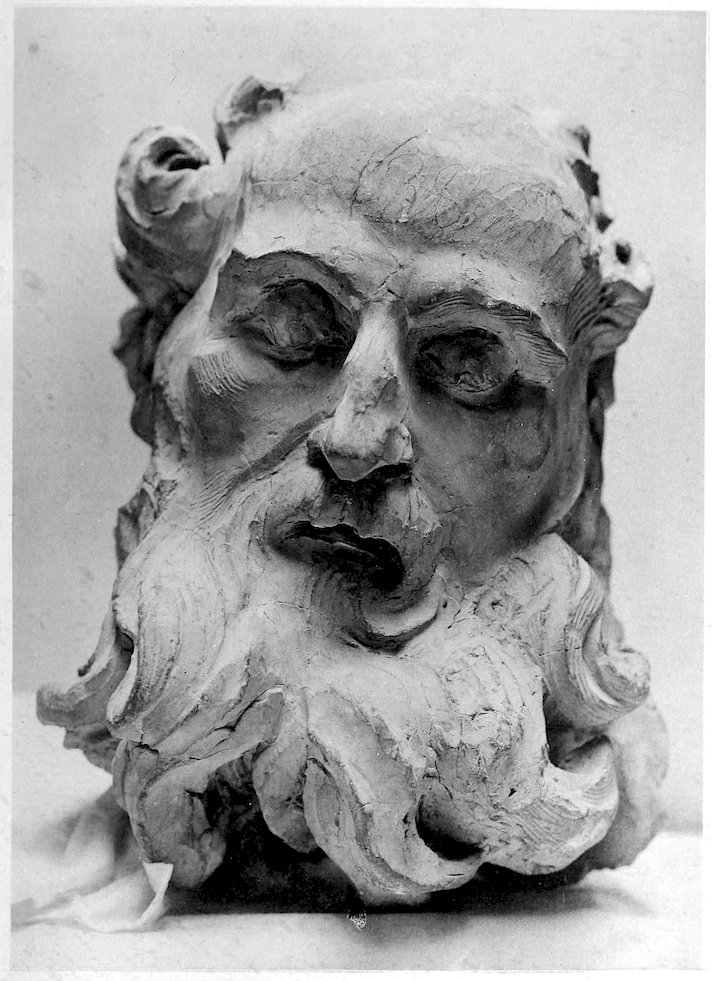
Plate XVIII.
47 No. 3.—Plate XIII, a
Two putti, for the decoration of the piers in St. Peter’s. High relief. The scale of measurement is scratched on the right edge. The wings are broken from the lower figure.
Height 11⅛ inches.
No. 4.—Plate XIII, b
Another two putti, also for St. Peter’s. The scale of measurement is scratched on the left edge. The wings are broken from the upper figure.
Height 11⅜ inches.
Nos. 5, 6, 7, 8.—Plates XIV, XV
Four heavily draped bearded male Saints, for the Ciborio in the Cappella del Sacramento in St. Peter’s.
The figures stand on thin, square plinths, one of which (Height 10⅜ inches; Plate XIV, a) is unmarked, but on the other three are the names Bartolomeo (Height 10¼ inches; Plate XV, b), Tomaso (Height 10⅜ inches; Plate XIV, b), and Filippo (Height 10 inches; Plate XV, a).
The heads of all four are turned to the left, and the figures rest their weight on the right leg. The left arm of the Bartolomeo is gone, but was outstretched; the others all stretch out their right arm.
No. 9.—Plate XVI
Bas-relief with half-figures of four men, and traces of architectural background.
For the side wall of the Cappella Borghese in Santa Maria della Vittoria, Rome.
Width 17¼ inches.
No. 10.—Plate XVII
Half figure of a Triton holding a draped woman on his shoulders.
For a fountain. The head and arms of the woman are gone.
Height 19½ inches.
No. 11.—Plate XVIII
Front part of the head of a bearded man.
For the Saint Jerome in the Cappella Chigi in the Duomo of Siena.
Height 13½ inches.
No. 12.—Plate XIX, a
Model (head missing) for the kneeling Angel on the left of the Ciborio in the Cappella del Sacramento, St. Peter’s.
Height 11 inches.
48 No. 13.—Plate XX, a
Another model for the same figure. Tip of right wing missing.
Height 11¼ inches.
No. 14.—Plate XX, b
Angel on the right of the Ciborio in the Cappella del Sacramento.
Other models for these two Angels are mentioned by Fraschetti (p. 394), who also suggests that this angel on the right is not by Bernini, but “perhaps by Paolo Bernini, touched up by his father.”
I do not feel tempted to agree with this idea of Signor Fraschetti; there is no doubt whatever that this model of the right-hand angel is by Gian Lorenzo himself. Height 13⅛ inches.
No. 15.—Plate XXI
Nude figure of an Angel holding the Crown of Thorns. The head and feet are gone. The weight rests on the right leg.
Sant’ Andrea delle Fratte, Rome.
Height 13¼ inches.
No. 16.—Plate XXII
Angel holding the Crown of Thorns.
This is the final model of the figure in Sant’ Andrea delle Fratte.
The action of the legs is the reverse of that in 15. Height 17½ inches.
No. 17.—Plate XXIII, a
Model for the Angel holding the Scroll. The tips of the wings are missing.
In Sant’ Andrea delle Fratte.
Height 11¾ inches.
No. 18.—Plate XIX, b
Another model for the same figure as No. 17; lacks the right leg, the head and most of the wings.
Height 11⅛ inches.
No. 19.—Plate XXIV, a
Angel, perhaps for the ecstasy of Saint Theresa in Santa Maria della Vittoria, Rome. Right hand missing.
Height 11½ inches.
No. 20.—Plate XXIII, b
Angel, draped, right leg bare, turning to the left. Part of right wing missing.
Height 11½ inches.
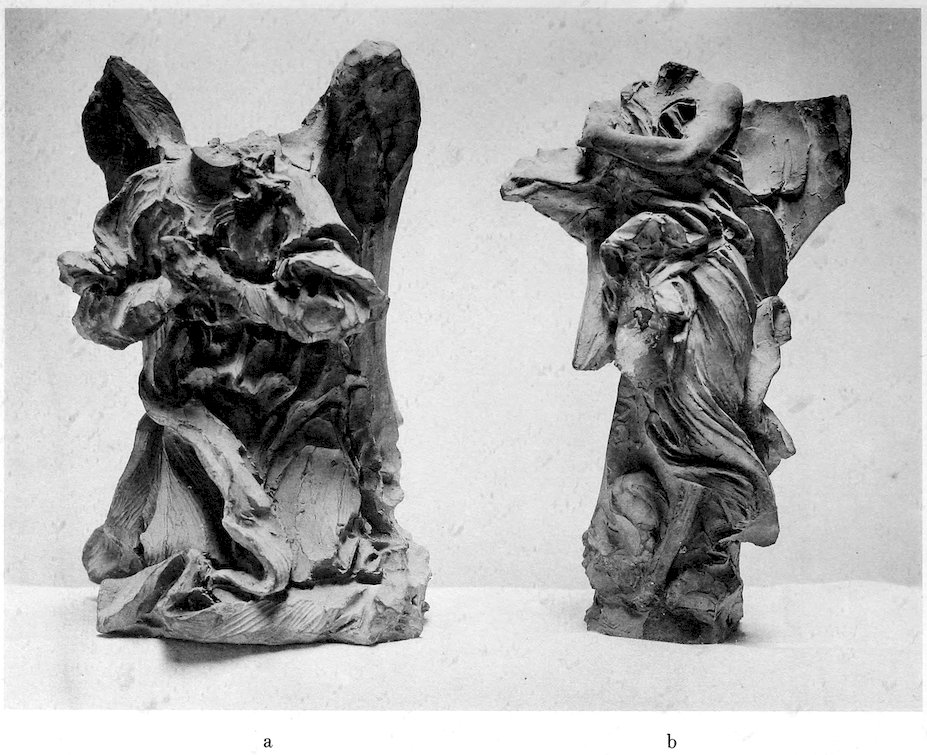
Plate XIX.
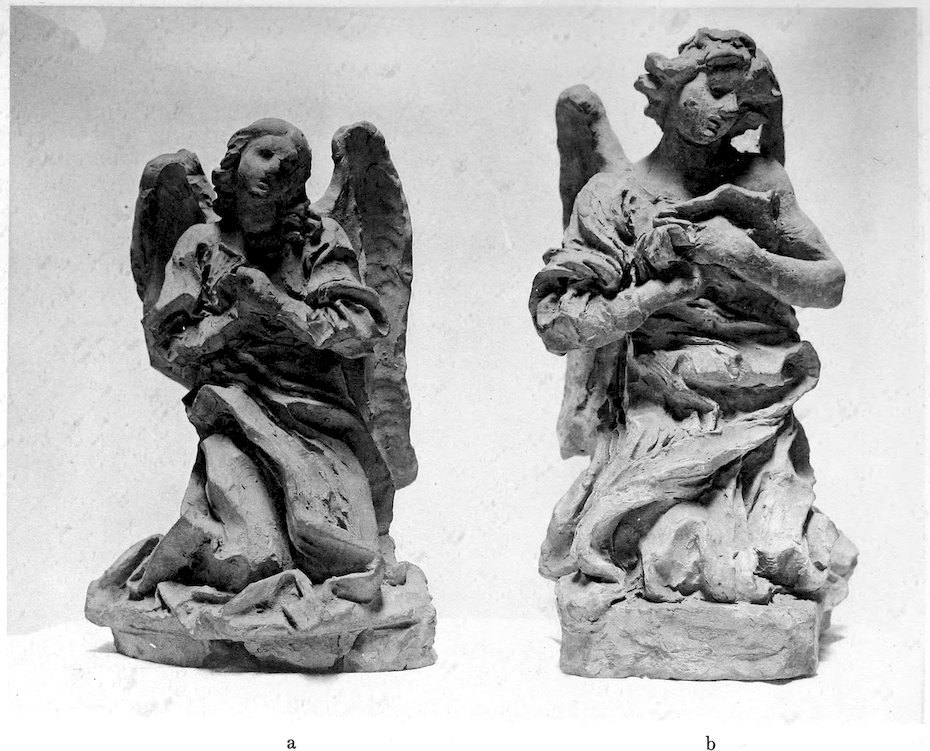
Plate XX.
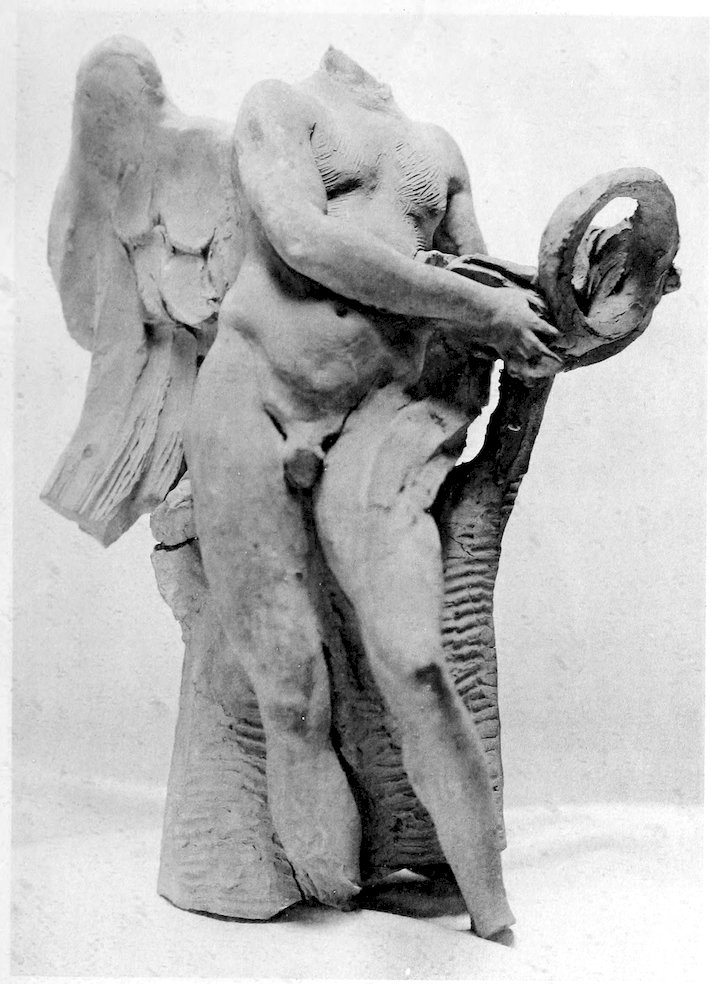
Plate XXI.
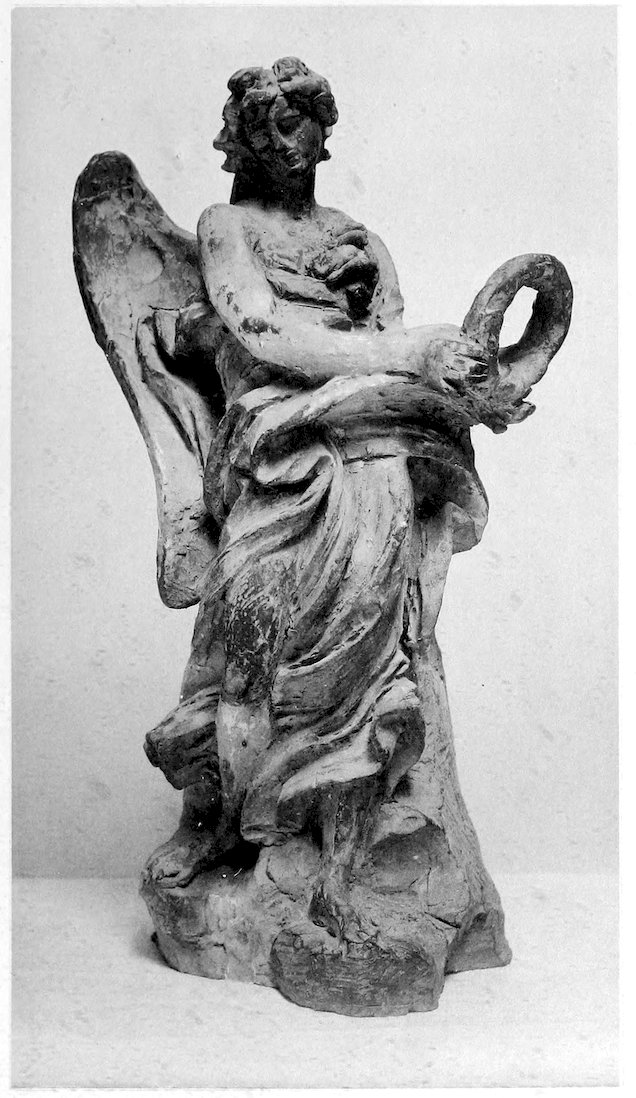
Plate XXII.
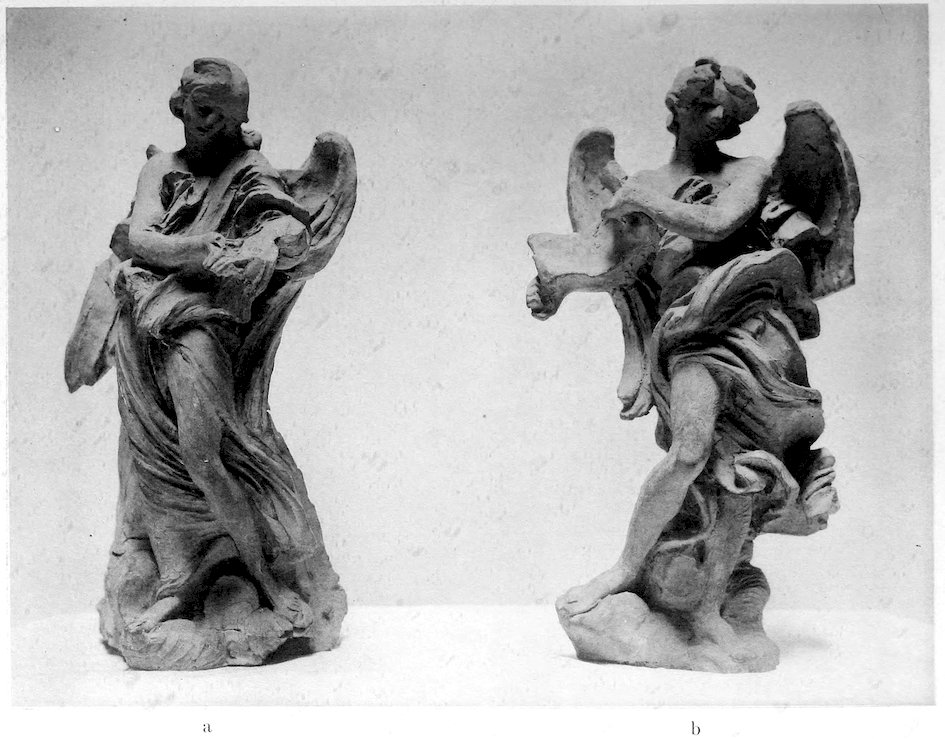
Plate XXIII.
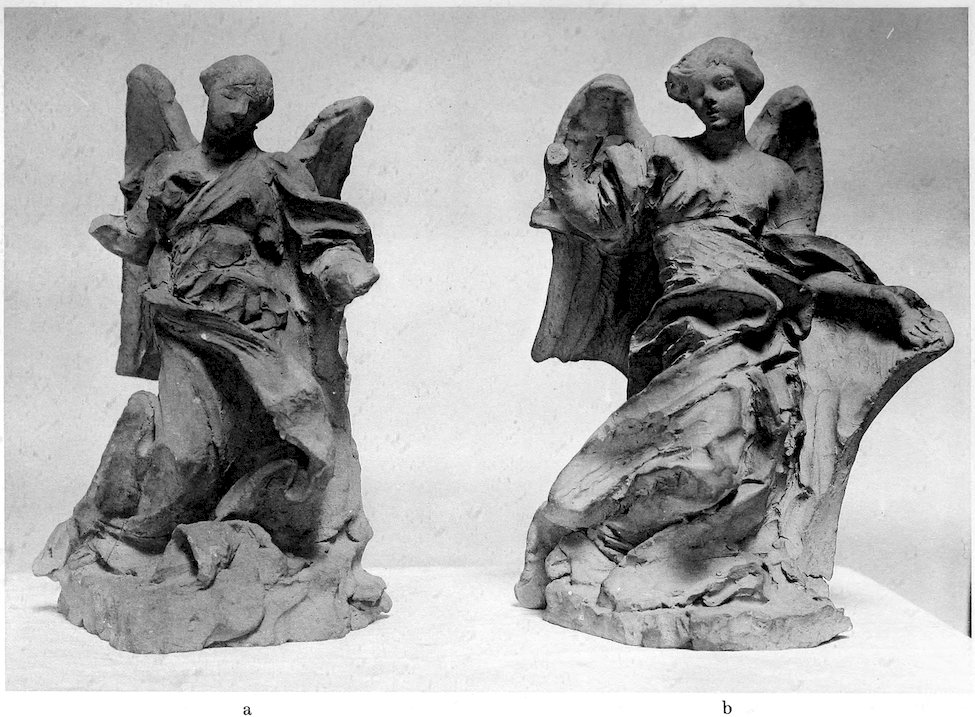
Plate XXIV.
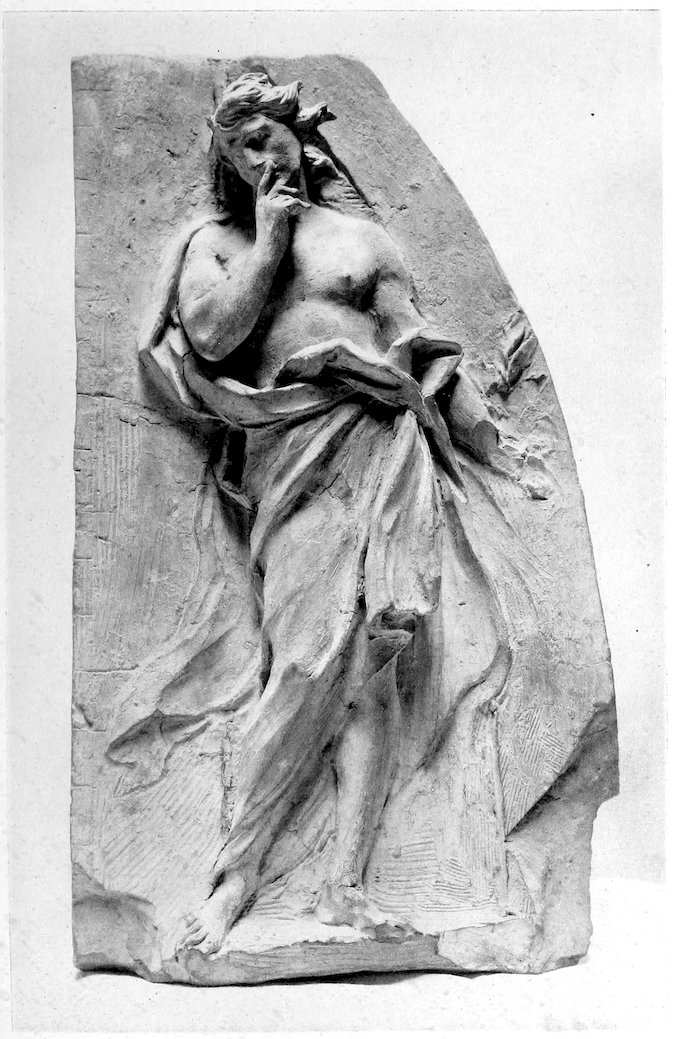
Plate XXV.
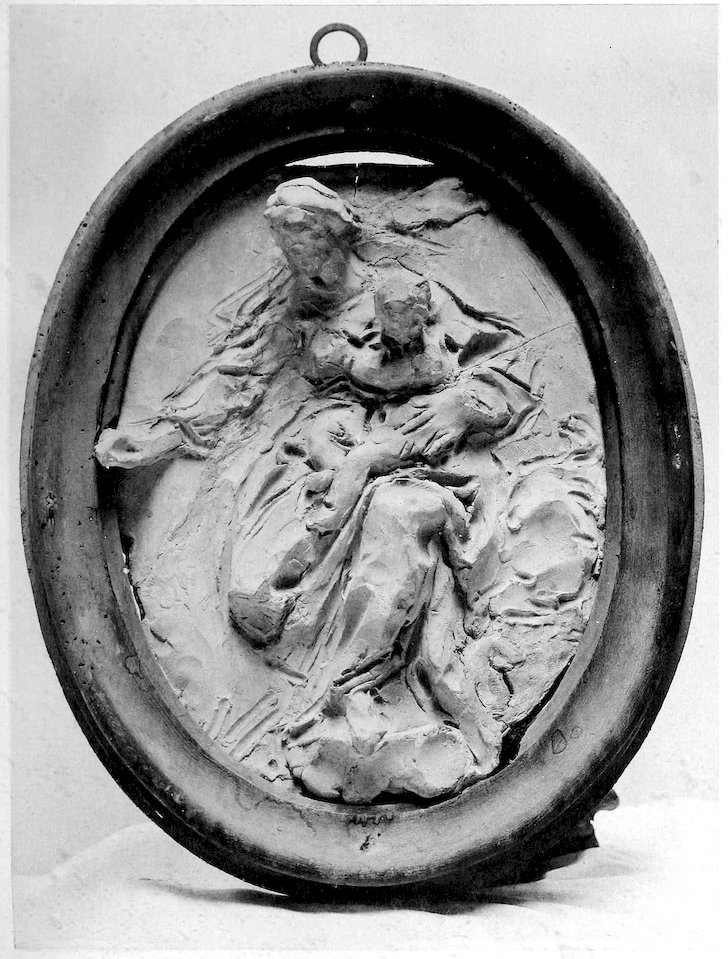
Plate XXVI.
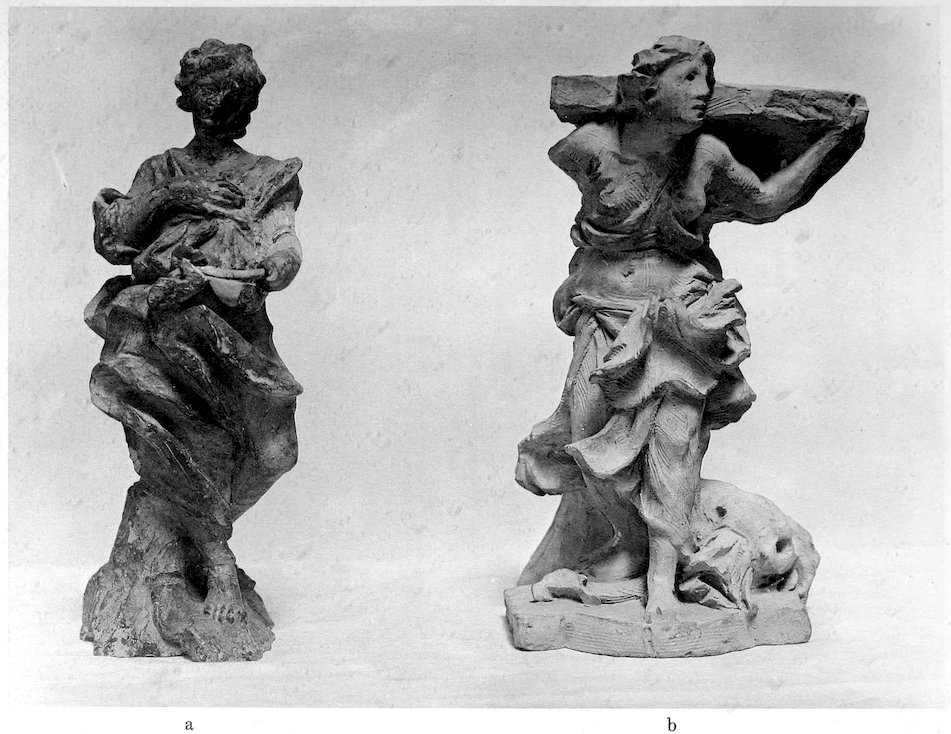
Plate XXVII.
49 No. 21.—Plate XXIV, b
Angel, draped, kneeling, head turned to right, right arm (hand missing) raised, left arm with open hand stretching downwards and outwards.
Height 11¾ inches.
No. 22.—Plate XXV
Standing male figure, in high relief. Drapery hangs from the right shoulder, leaving torso bare but covering the legs with heavy folds. The left arm hangs down, and there was a palm branch in the now missing hand. The right arm is bent up with the hand over the chin. The head bends down and to the right. The figure rests its weight on the left leg.
The right side of the plaque is curved; the left side is straight, and on it is scratched a scale of measurements.
Height 16⅝ inches.
No. 23.—Plate XXVI
Oval bas-relief of the Virgin seated and looking down to right while holding the Child in her lap. High relief.
Very sketchy, but the most masterly of all these models.
Height 11 inches.
No. 24.—Plate XXVII, b
Draped, standing female figure. She bends forward, turning to the left with arms (right arm missing) raised to support a slab that rests across her shoulders. The weight rests on the left leg. At her feet suggestion of a cuirass.
Study for the base of some monument such as the obelisk in the Piazza della Minerva. (Cf. Fraschetti, pp. 300–303.)
Height 8½ inches.
No. 25.—Plate XXVII, a
Standing angel, heavily draped; the left knee is bent sharply backwards. The right arm is bent across the breast, the left arm (forearm missing) bent across the body lower down. The wings are missing.
Height 8⅝ inches.
No. 26
The Magdalen kneeling, and grasping the foot of the Cross.
This figure is not by Bernini, and shows clearly the difference between the work of a master and that of an imitator.
Height 10 inches.
No. 27
Study of a hand.
Length 8 inches.
50
III. BERNINI’S DESIGNS FOR THE PIAZZA OF ST. PETER’S
The pen and ink sketches by Bernini for the construction and adornment of the piazza in front of the Vatican, together with the surrounding buildings, deserve to be more widely known than they are at present.[18] Any details regarding the history and growth of this part of Rome are of the deepest interest to those who study the intellectual development of mankind. Did we possess any record of the reasons why Pericles and his advisers placed the temples and other buildings on the Acropolis of Athens just as they did, we should have a clearer understanding of the character and ideals of Athens than we now have. So a study of these drawings by Bernini will show very distinctly that the present form of the piazza is due to no mere thoughtless and haphazard erection of colonnades and fountains, but is the result of a deeply considered plan and illustrative of a very large idea.
The drawings are carefully done with pen and ink on fourteen sheets of paper which were numbered by some old-time owner. These sheets have had the edges trimmed. Ten are, with slight variations, 14 by 6¾ inches. The others are, as will be noted later, of different sizes. All, however, judging by the paper and method of drawing, belong unquestionably to the same series. The drawings were mounted and bound together by the previous owner.
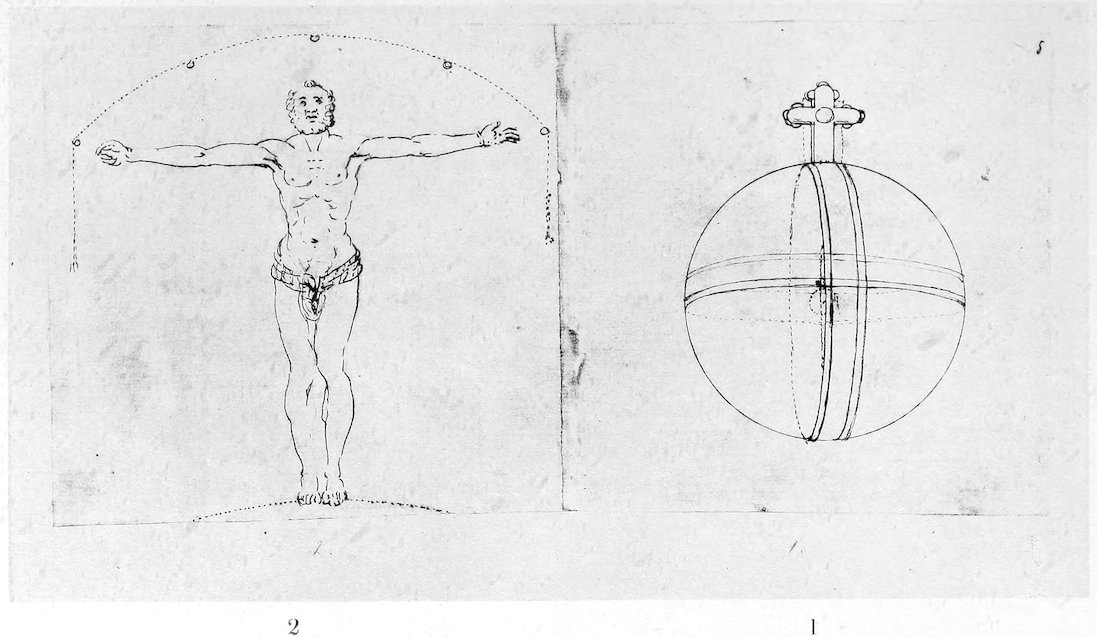
Plate XXVIII.
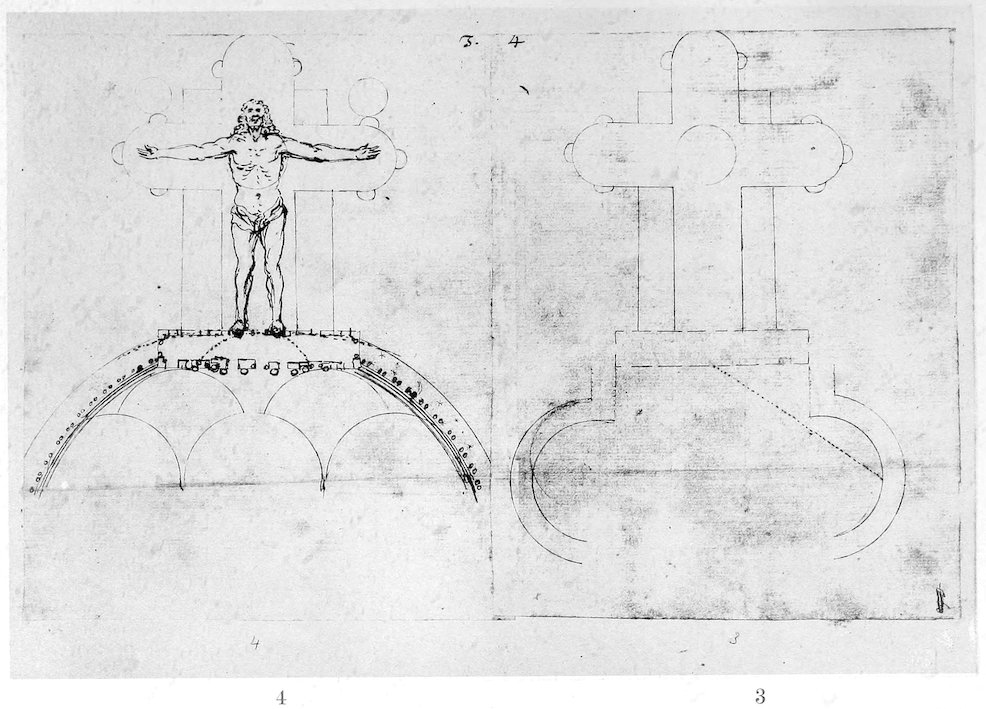
Plate XXIX.
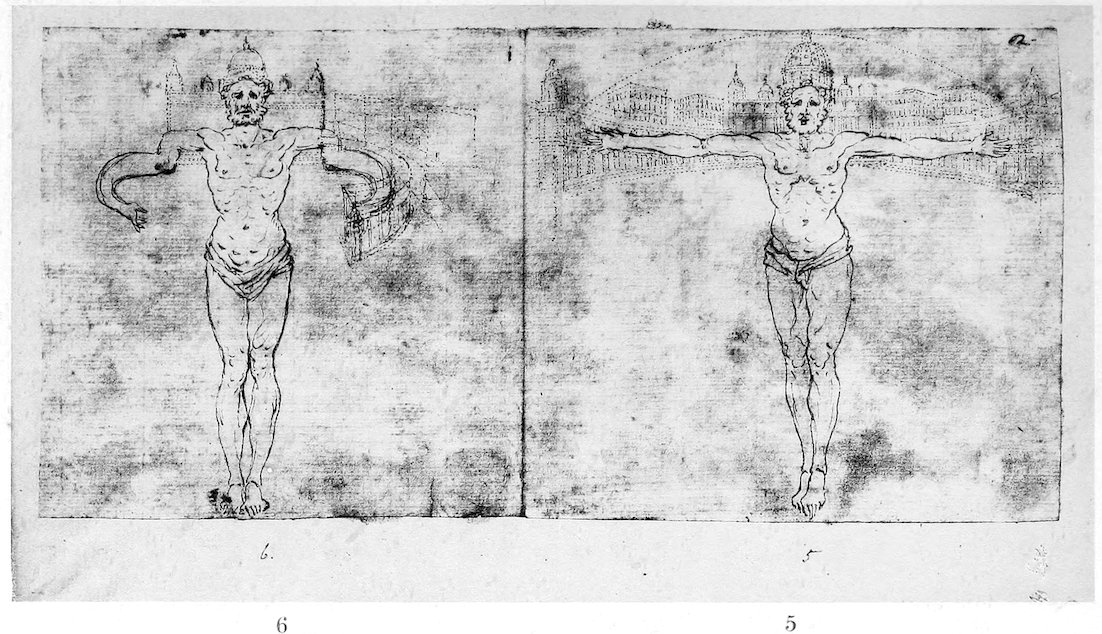
Plate XXX.
51The history of the drawings can only be guessed at. In this connection the following facts are to be noted. Bernini was officially appointed architect of the Fabbrica of St. Peter’s in 1680. After him Luigi Vanvitelli was head architect. With Vanvitelli there worked Andrea-Vici. In 1817 Vici left by his will to his friend the sculptor Canova drawings by Bernini representing the burial of the Countess Matilda, and Louis XIV on horseback. This legacy shows Vici to have owned original drawings by Bernini, and it is not improbable they had been given him by Vanvitelli. By the same will Vici left to his grandson Busiri his name and his studio, with all the original drawings by various masters therein contained. Consequently it is not a rash hypothesis that these drawings of the piazza came from Vanvitelli to Vici, and so to Busiri-Vici. Finally they were sold at auction in Rome in 1903. They are now in the Brandegee Collection.
DESCRIPTION OF THE DRAWINGS
No. 1.—Plate XXVIII
This drawing shows the Orb; the Christian symbol of the world, surmounted by a cross.
The cross with the head and arms ending in curves like apses suggests the plan of a church, and the following drawings show clearly that the Orb and Cross were the fundamental idea in Bernini’s mind when he planned the piazza.
No. 2.—Plate XXVIII
This is on a square piece of paper, similar in size to No. 1, and at present mounted on the same sheet at the left of No. 1. It shows the figure of a bearded man with arms outstretched as though on a cross. A curved dotted line stretches from hand to hand over the head and drops about an inch perpendicularly below each hand. This dotted line is a suggestion of the existing colonnades.
52That the figure is thought of as being on a cross is borne out by sketches that follow and also by the dot in the palm of the left hand which possibly represents a nail.
The sharp, broken lines with which the figure is drawn are characteristic of Bernini.
No. 3.—Plate XXIX
An outline plan of the church with the colonnades in front. It is to be noted the latter start at the corners of the façade of the church and project a short distance parallel to the main axis before curving to each side.
Size 6½ × 8¾ inches.
No. 4.—Plate XXIX
Similar to No. 3, but in greater detail. The figure of a bearded man represented within the plan of the church in the attitude of crucifixion. In the left arm of the colonnade is drawn the sun and in the right arm the moon and stars.
This is pasted in the book at the left of No. 3.
Size 6⅝ × 8¾ inches.
No. 5.—Plate XXX
This shows the same crucified figure as before. Over the head and below each hand is the dotted line seen in No. 2. Behind the head and arms is drawn with dots the elevation of St. Peter’s, the Vatican and the colonnades.
No. 6.—Plate XXX
Similar figure to the preceding, but with the arms contorted so as to follow the straight portion of the colonnade (shown in No. 3) before following the curve. Behind the head the dotted outline of St. Peter’s and behind the figure’s left arm the colonnade and Vatican buildings laid in with dots and a few lines.
No. 5 is at the right of No. 6, and the size of the sheet is 14 × 6¾ inches.
It should be noted that the figure is so placed in these two drawings that the dome of the church suggests a bishop’s mitre.
No. 7.—Plate XXXI
Outline elevation of the north half of the façade of St. Peter’s and the north colonnade, rising behind which is shown the Vatican Palace.
On the left half of the sheet are faint pencil lines showing the south side of the colonnade and façade.
The sky is touched in with bluish white.
Size 14¼ × 6½ inches.
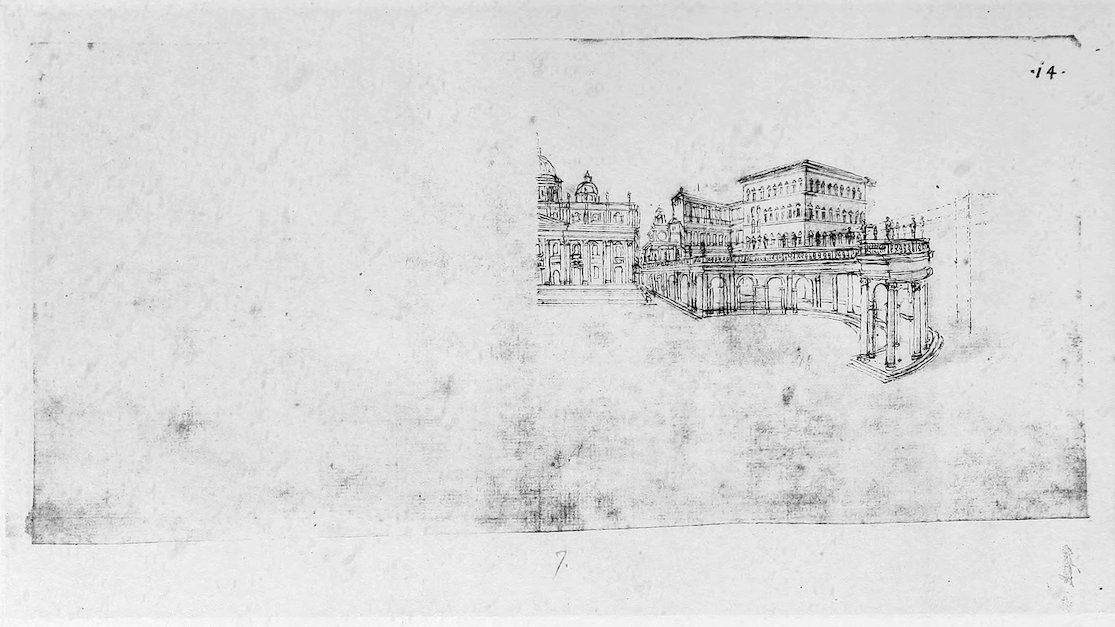
Plate XXXI.
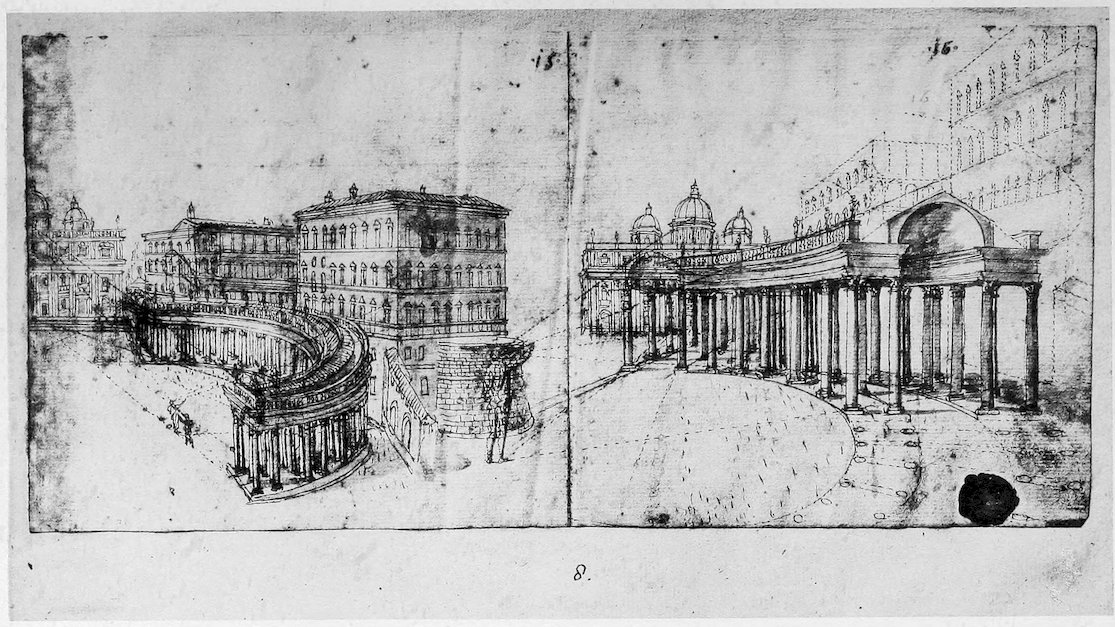
Plate XXXII.
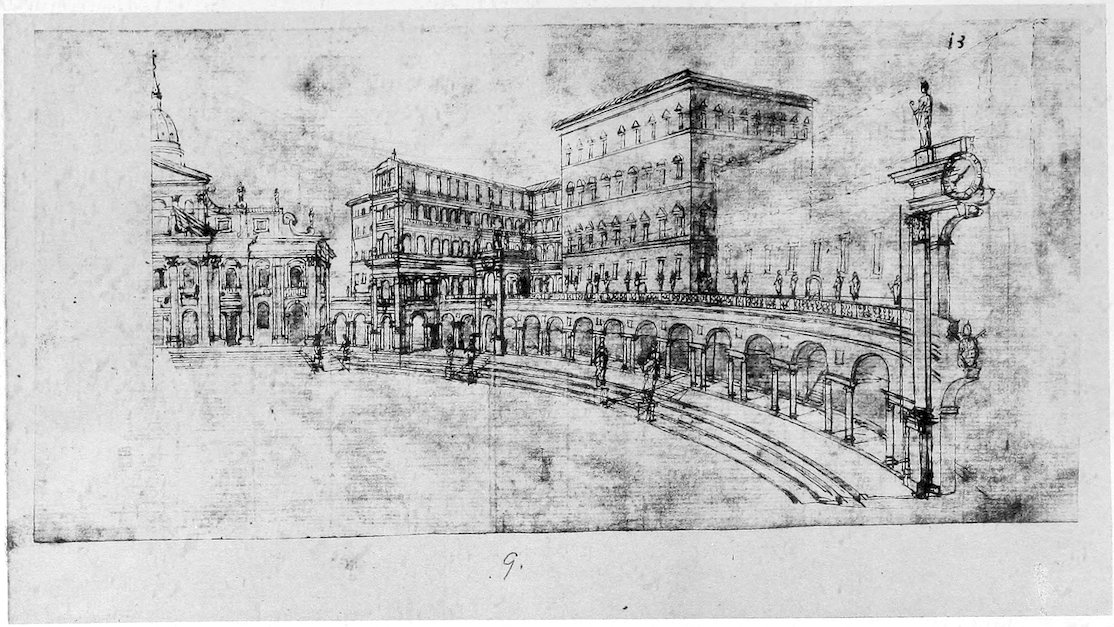
Plate XXXIII.
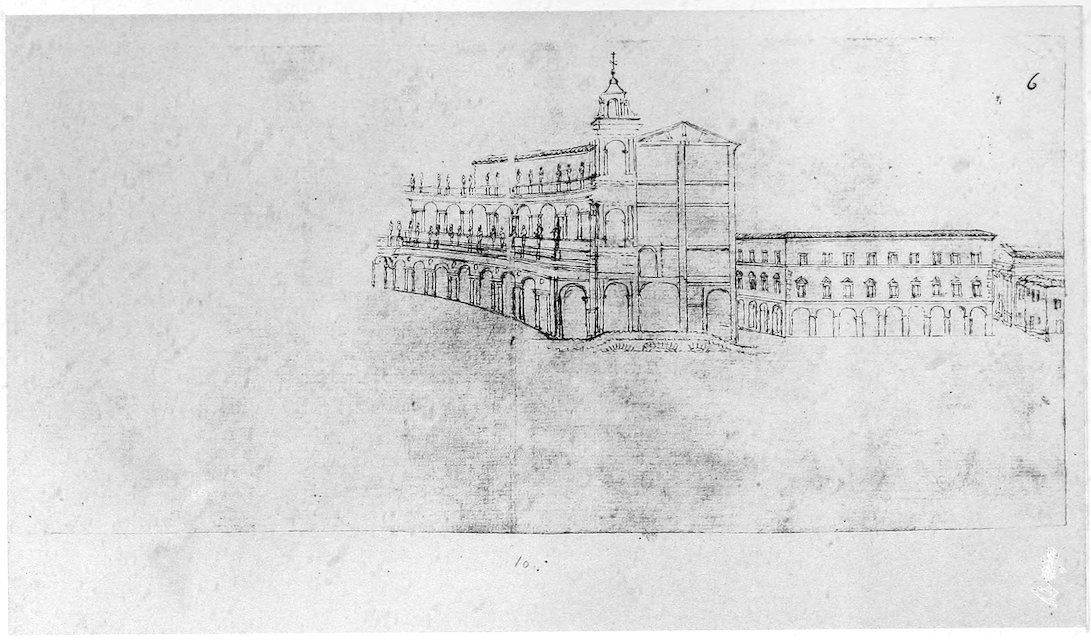
Plate XXXIV.
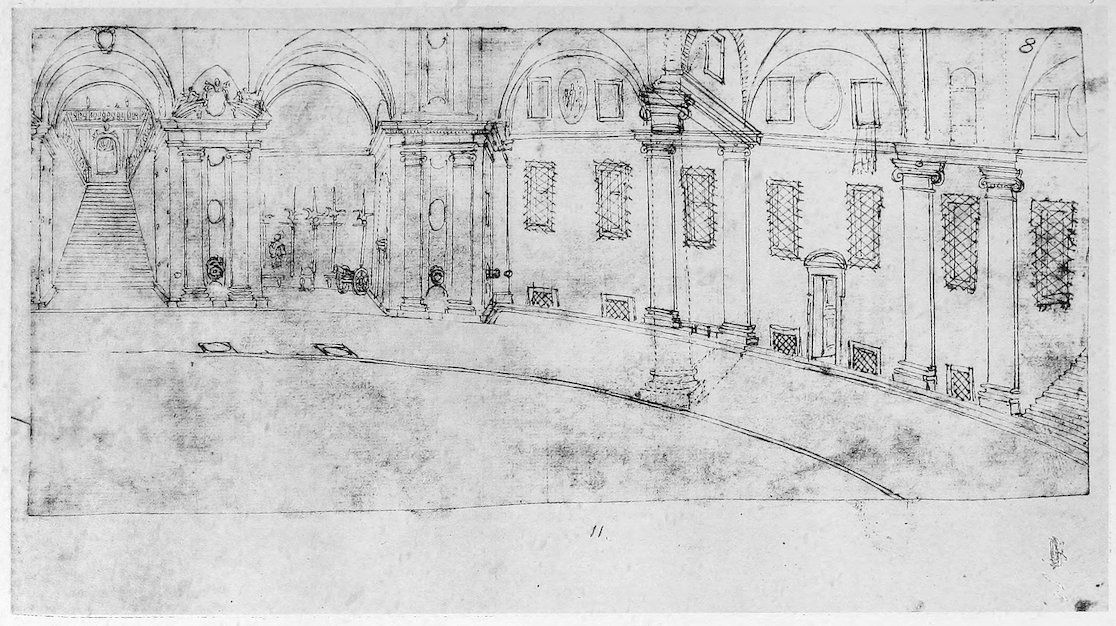
Plate XXXV.
53No. 8.—Plate XXXII
Two drawings of the north colonnade. These are similar to the preceding, but more elaborate (with shadows washed in in gray), as shown by dotted lines drawn to the eyes of outlined figures from various points.
We find here the architect’s intention regarding the view from different positions.
Size 14⅜ × 6¾ inches.
On the back of the sheet is a sketch of the door of St. Peter’s with the balcony where the Pope used to appear. I do not feel sure that this is by Bernini. There is also another sheet with a more detailed drawing of this door.
No. 9.—Plate XXXIII
Similar to No. 8, but still more elaborate and larger; there is only one drawing on the sheet.
In this design Bernini has altered the line of the colonnade. Instead of having, as in the preceding drawing, a straight portion projecting from the church, he has here drawn the colonnade in one large curve from the church outwards, putting an elaborate entrance to the Vatican Palace near the church. This entrance would have led to the Cortile di San Damaso.
Size 14 × 6⅝ inches.
No. 10.—Plate XXXIV
Slight outline sketch of the outer end of the north arm of the colonnade, which is here made two-storied.
Size 13⅝ × 6⅜ inches.
No. 11.—Plate XXXV
Interior of inner end of north arm of colonnade, showing the stairway as it exists at present. Size 14½ × 6⅜ inches.
No. 12.—Plate XXXVI
Two sketches; one showing the plan, the other the elevation, of the Cortile di San Damaso.
Size 13⅝ × 6⅝ inches.
No. 13.—Plate XXXVII
View of the façade of St. Peter’s with both colonnades, which are two-storied. The sky is touched in with bluish white.
The buildings of the Vatican are also shown,—those on the right exist, those on the left are imaginary.
Size 14⅝ × 6¾ inches.
54 No. 14.—Plate XXXVIII
View looking east from the front of St. Peter’s.
On each side are the ends of the colonnades; they are in two stories, that on the right crowned with low clock-towers similar to the “asses’ ears” once placed by Bernini on the Pantheon.
Beyond the piazza is the Borgo much reconstructed and made symmetrical. In the distance the Castel Sant’ Angelo.
Size 14⅜ × 6⅝ inches.
No. 15.—Plate XXXIX
Two sketches in pen, washed with sepia, of the Borgo, looking towards St. Peter’s.
These show different methods of treating the north arm of the colonnade. The one on the right shows the colonnade closing the view up the Borgo, the other shows an opening carrying the eye beyond and between St. Peter’s and the Vatican.
Size 14½ × 6½ inches.
The buildings shown exist in much the same form to-day. Even the fountain still serves.
No. 16.—Plate XL
Plan of the piazza showing how it was intended to symbolize the orb of the world suggested on No. 1.
In this sketch we see the circle within which is a dotted square. Within the square is a figure with arms and legs outstretched along the diagonals. At the top is written over a faint pencil outline of the church (perhaps not original) San Pietro. At the bottom is written twice Piazza Rusticucci and on a piece of paper pasted on is the plan of a building shown in No. 14,—one of the buildings intended for the reconstructed Borgo.
On the right and left of the figure are indicated the Porta Angelica and the Porta Cavalleggieri.
The dotted square within the circle is divided into quarters in which is written Asia, Europa, America, Affrica.
Size 7¾ × 8⅝ inches.
These are the plans showing Bernini’s ideas regarding the Piazza of St. Peter’s. From a study of them we see how the circular piazza itself was intended to represent the world at large, while the colonnade symbolized the arms of the Cross. Crowning all was the great Church, founded by Him whose arms could embrace the whole earth, and from whose doors should stream to every quarter the promise of hope and love for which He died.
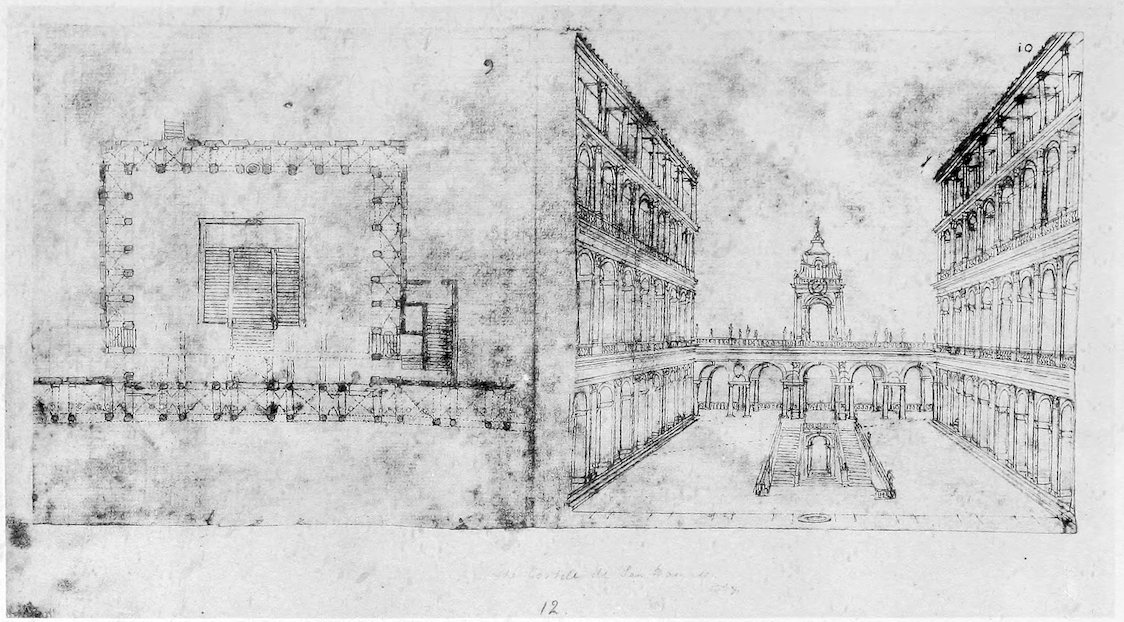
Plate XXXVI.
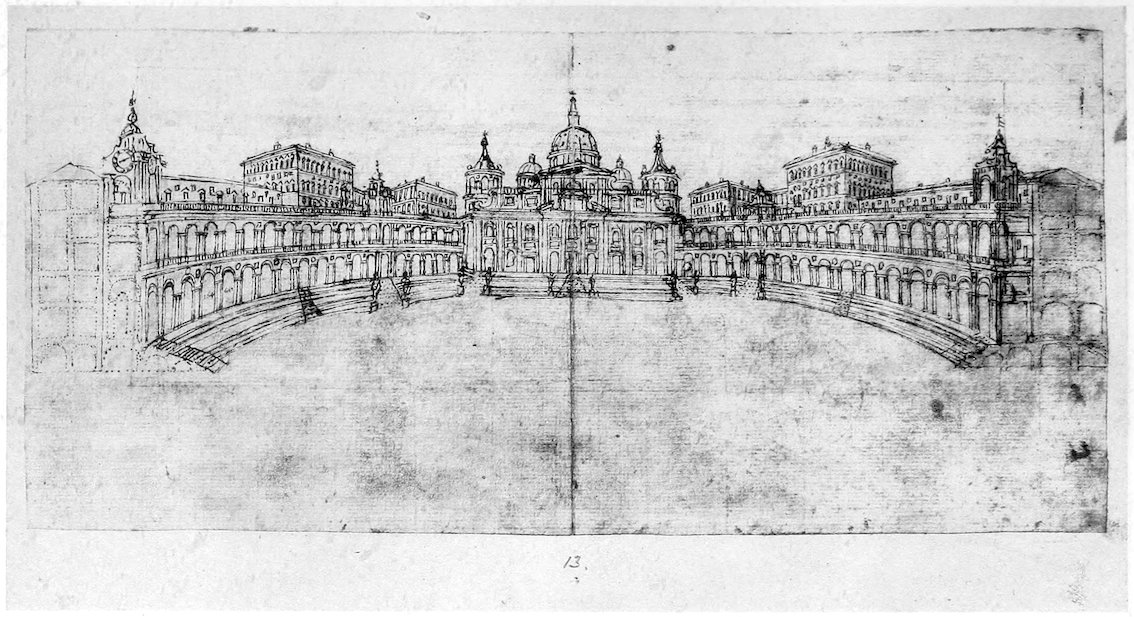
Plate XXXVII.
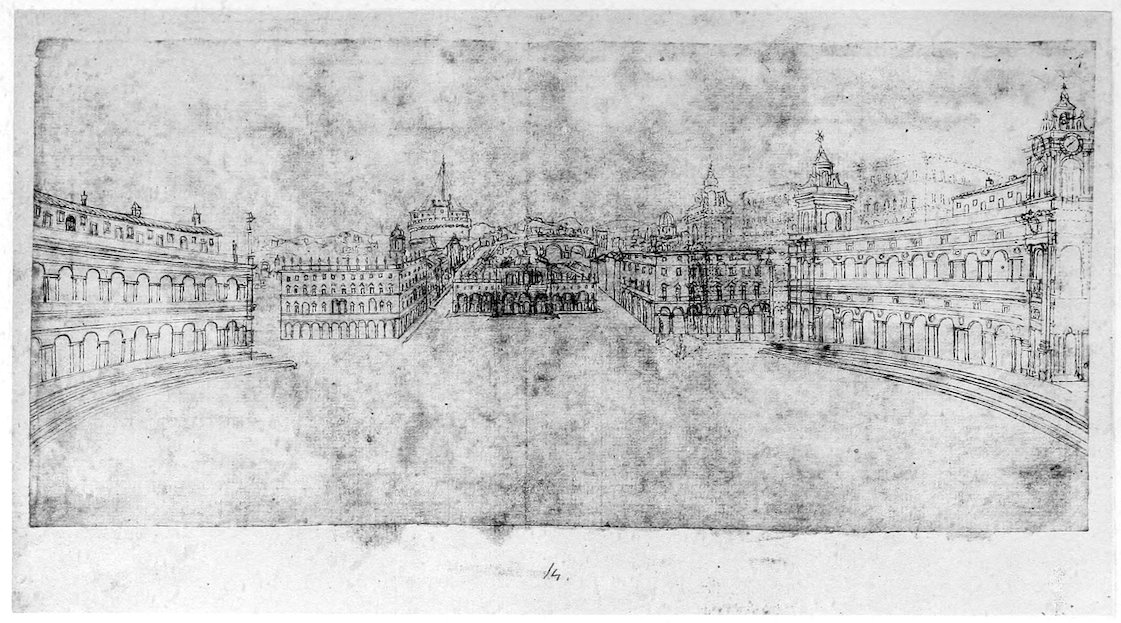
Plate XXXVIII.
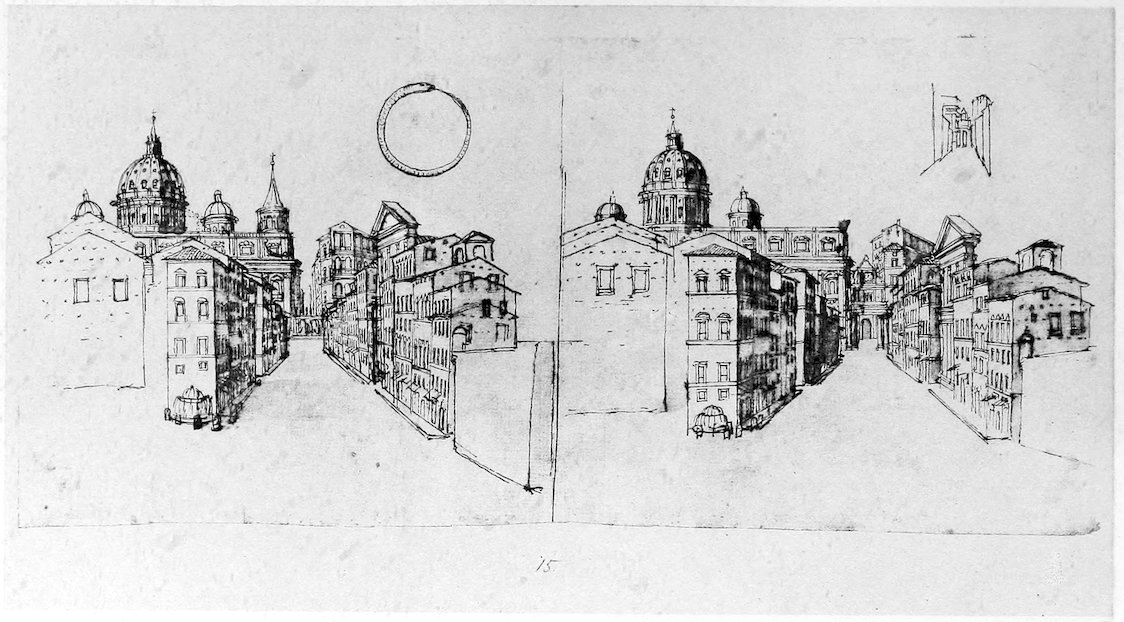
Plate XXXIX.
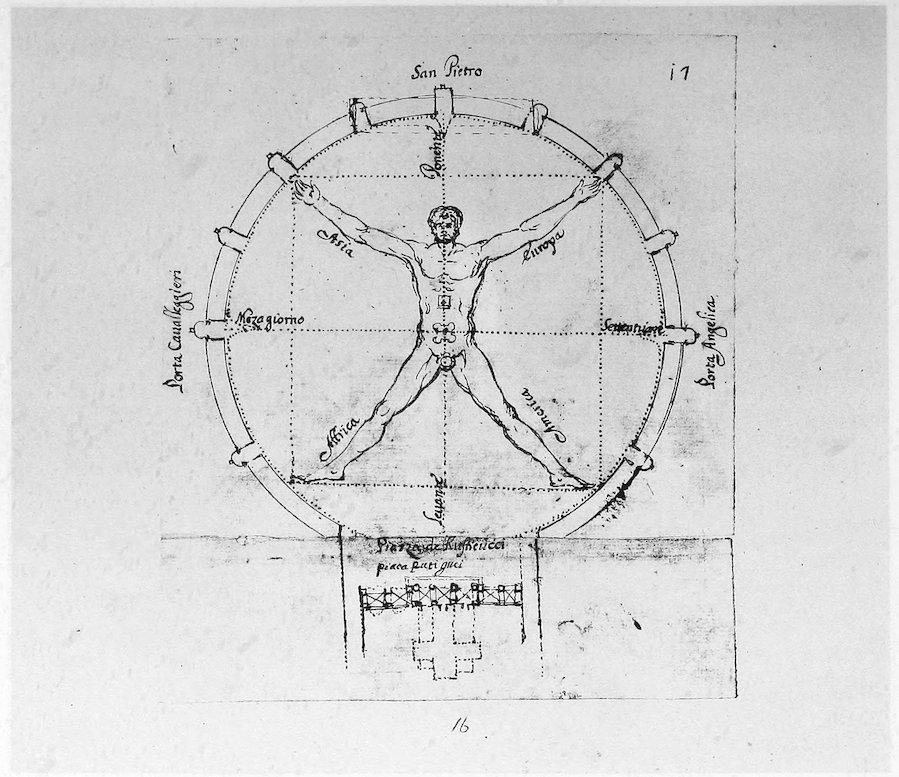
Plate XL.
55