ASPECTS OF THE ART OF SCULPTURE (continued 2)
Reading edition
Look at the statues of youths and maidens, the never-fading ghosts of past days, which the Attic chisel carved and the Attic soil has preserved for us. Look at the young Apollos and their not less glorious brethren, the athletes. Look at the guardians above the temple porches—incarnations of youthful vigour even when the bearded head or matronly form give sign of elder years. Look at the vases “with brede of marble men and maidens overwrought.” Finally look well at the statues of God and Goddess—even these have youth eternal moulded in their full, strong figures.
And it is pleasant to reflect that it is not the sculptor’s art alone which found satisfaction in thus dwelling on the most beautiful forms of human life, but the painters and the poets too immortalise the entrancing splendours of the youthful form. Greek art of this time presents us with the indubitable evidence of a belief, rooted deep as life itself, 112that the everlasting joy of completest beauty was to be found in the well-conditioned body of youth or maiden. What a degradation the ascetic interpretation of the Holy Writ brought in the art of the Renaissance! Many youthful figures do we find there, but they were chosen as much for the sake of the quaintness of extremely youthful forms as for the beauty inherent in vigorous development. The place of the fine-drawn, well-groomed figures of the Greek youths and maidens is taken by jolly, pot-bellied babies. Over the altars and among the graves they scramble, and up the marble columns, to launch themselves, heedless as screaming swallows, over the groined ceiling. From North to South and across Italy from Sea to Sea this breed of fascinating babies spread—their father the Church, their mother the great human heart of the Italian race. And then, dulling the pleasant impression that such figures make upon the mind, we are met on all sides by haggard figures of men and women expressive only of a bitter ardour to seek salvation by pain.
The wanness of Botticelli, the pain and trouble of Michael Angelo, the mere ordinarily healthy look of Ghirlandaio, these are what take the place of the deep-breasted, broad-shouldered, strong-pulsed, magnificent Greeks—some repetition among these latter, ’tis true, but marvellous in their vigour and constancy and impulsiveness. Or what poets can the Medicean time show who sing of ideals and principles in the same full-throated, calm, incisive way as Pindar or Sophocles sang them? We have instead a scornful wrath or playful fancy. The deity is no longer friendly but terrible, and dainty mistresses usurp the place of the God-compelling Aphrodite. The momentary, not the eternal, is the interest of the day.
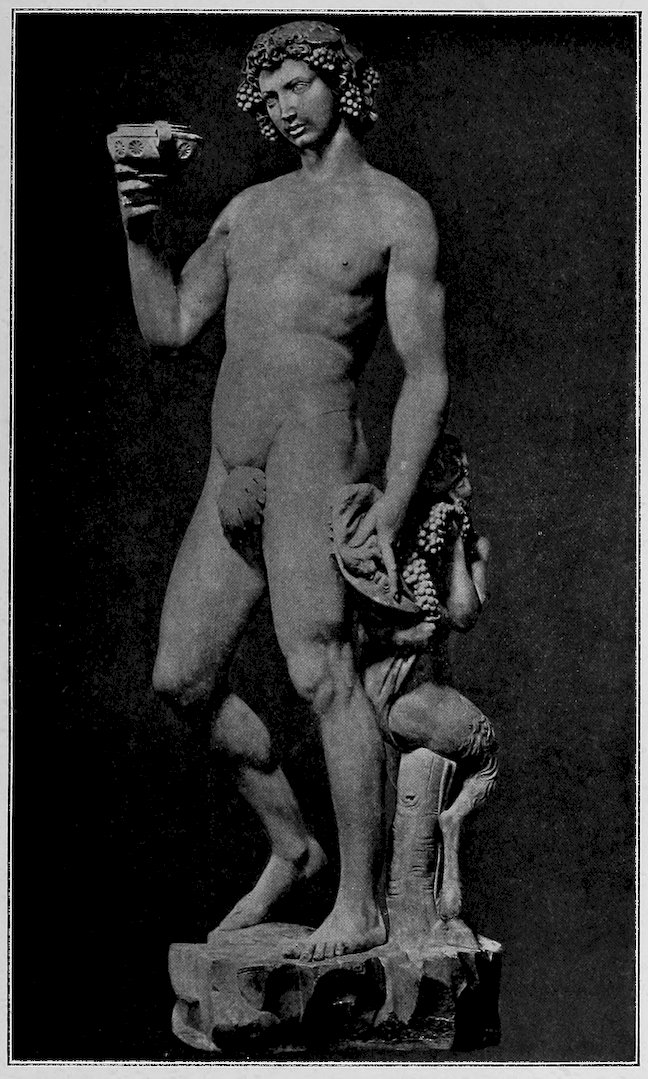
Plate LV.
113Some there were, Greek in spirit and in deed: Dante in part of his later work, so far as a Catholic could be. The Vita Nuova in its heart-broken passion, the Convito in its complexity, are purely Italian, but passages of the Divine Comedy and the Letters might be the work of one of the Attic dramatists, so intense are they, so cool, so assertive of the power of right over wrong. But an artist much more Greek than Dante and one who is often, but very mistakenly, thought to resemble Michael Angelo, was Tintoretto. His was a Greek sense of form, his was a Greek sense of beauty, and his was a completely and absolutely Greek sense of what constituted true portraiture. There were others too of this group, but they are rare and far between; men who seem to have been born two thousand years too late, or else just in time to save the world from a worship of what was mentally warped and physically unsound.
When one considers that the art of sculpture has found its chief employment in the service of religion, it becomes plain why living among a people whose religion led to asceticism, even though the age was largely sceptical, Michael Angelo should impress his work with a feeling quite opposed to that found in the works of Pheidias. Scepticism there was in ancient Greece too, but not strong enough to free Pheidias entirely from the bonds of the religion to which he was from infancy accustomed. Furthermore, a scepticism that found much fuel for its flames in the misconduct of the Vicar of Christ and his less powerful imitators would have a very dissimilar effect on the mind from that which was based on true mental development. The one was the natural sloughing of the skin, the other the amputation of a diseased member.
114The conditions at Rome had more effect on the formation of character in those days than anything else, and they cannot have seemed much less rotten to Michael Angelo than to Hildebrand five hundred years earlier. The feeling that Christ was essentially the man of sorrows, which affected the early artists, had passed from men’s minds, and in regard to his comeliness there was nothing to prevent an artist working in a Greek spirit; but employed though Michael Angelo was by the Popes, they used him by no means always on religious work.
And Michael Angelo also suffered, as Pheidias did not, from having many masters. These were causes to destroy any Pheidian-like unity in Michael Angelo’s work, but causes much more potent to work him injury were the characters of the men for whom he worked, prince as well as Pope. It was, doubtless, in many respects fortunate for a young artist to have the freedom of the court of Lorenzo de’ Medici, but while Lorenzo might help such a man as Michael Angelo at the beginning of his career, he was hardly the man to inspire his more mature years. At any rate he died while Michael Angelo was still young, and thenceforth the latter worked for men with whom he can have had but little sympathy. Men of great energy they were, but with the exception of Alexander VI, in the main corrupt or stupid. To work for such men under any circumstances must have been trying, but when one thinks of their refusal to allow Michael Angelo to work as he saw fit, one does not wonder that at times he was nervously irritable.
Obviously such a life would have been trying to a man of more ordinary clay than Michael Angelo, but to him, endowed, 115as he was, with enormous powers of mental application and sensitive as only poets are, it must at times have been little less than torture. He knew that the golden age of his country had passed. He saw Florence humbled and Rome sacked. The statesmen were men of mean ambition and the clergy men of lax morals. Nothing could stop the degeneration. Political reformers and saintly enthusiasts had matched themselves against the ever-increasing debasement of Italy, and one after another they had all been overcome. From the days of the doubtful reforms of Crescentius or Cola da Rienzi through the period of the passionate recalling of Christ by Francis of Assisi to the time of bitter invective of Savonarola, reformers had given their lives in the attempt to save their beloved Italy from the error of her ways, and all had failed. It was not a time for hope but for sorrow, and it needed a firm belief in the Divine Word to save one from despair—or at least discontent.
It is from his sonnets and letters rather than from his sculpture that we can obtain a view of Michael Angelo’s thoughts and feelings. Not that the latter does not show certain moods of the artist very clearly, but, as in the Pietà, it is more ideal than personal, more the expression of dreams than of his actual experience. In the sonnets, on the other hand, he gives vent to his own innermost feelings. In them we find frequent expression of deep despair, but bitterly as he grieved for the death of Savonarola, there is no evidence that he thereat lost faith in humanity. It may well have been his admiration of Vittoria Colonna that saved him from misanthropy. As his intercourse with her was undoubtedly the purest joy and her death the keenest sorrow of his later years, so there may have 116been some similarly sweetening influence during the summer of his life. The knowledge of his career that we possess is great, but it does not tell us this. It is for our purposes, perhaps for all, better that this should be so. At least it makes it easier to compare him with Pheidias, of whose life we have no such details whatever.
Such were some of the general conditions affecting the point of view of these two men. The effect they had on particular work becomes evident with the study of the separate monuments. One point is, to begin with, very noticeable. It is that of the eight works by Pheidias mentioned distinctly by ancient writers seven are representations of deities, and the eighth of an ideal being. There can be no question that he made other works, but that these alone were preserved by tradition certainly affords safe grounds for the deduction that his genius was most congenially employed and most fully displayed in such work. In the case of Michael Angelo, while we know of work like the statue of Julius or the Battle Cartoon (not to mention his youthful efforts) that have nothing to do with religion, yet his mind also turned to religious subjects and his greatest works are entirely of this character.
Curiously enough it is when employed on subjects drawn from the ancient world that Michael Angelo is most unlike the great Greek. His Pietà, the Madonna of Bruges (Plate LIII) and Victor (Plate LIV) are more Pheidian than his Bacchus (National Museum, Florence; Plate LV) or his Eros (South Kensington Museum; Plate LVI). These are Greek of a kind, but they are Alexandrian rather than Pheidian. They are as foreign to any conceptions of the fifth century as they are to those of the Catholic Church. The drunken, 117tottering Bacchus is as different from the early conception of the God, who was thought of almost more as the sunshine that makes the grape than as the juice itself, as the shrinking and self-conscious Venus of the Capitol is from the Venus of Cnidos. In his sensuality the Bacchus is un-Pheidian and in the humour introduced in the group by the presence of his companion he is equally so. Humour was not lacking to the Athenian, as the drama shows, but the fields of sculpture and painting were not considered the proper place for its display.
In still another point is the statue of Bacchus comparable not to the early but to the late Greek work, and that is in the realism of the modelling and the action of the figure. Such modelling bears no relation to the broad treatment of Pheidias. The latter shows no such morbidezza, nor would he have dwelt on the repulsive unsteadiness of the pose. Whoever it was that carved the famous Borghese Anacreon, and it was some contemporary of Pheidias, shows us how the earlier Greek artist felt towards drunkenness. The figure is under the influence of his much-sung God Dionysos, but he is shown in attitude of mental ecstasy not of physical uncontrol. What stamps the Bacchus and the Eros (and much of his other work) as non-Greek is a lack not exactly of beauty, but of delicacy and refinement, of charm. But each of these characteristics that differentiates Michael Angelo’s work from that of the Greek stamps it as a work of the Renaissance. The pleasure in technical excellence, the realism and the representation of unpleasantness are all qualities that recur over and over again in the work of this vigorous, capable, unflinching, unbelieving period.
118Similar un-Pheidian qualities show in the figure of Eros in London, which if not by Michael Angelo, is at least made entirely in his spirit. The same realism of modelling is seen in the treatment of the head and face, the same choice of an action inexpressive of the deepest meaning of the figure. It is still less Pheidian in the vividness and intentness of the action and expression which are not explained by the figure itself, but the meaning of which is left to the imagination of the beholder to discover. Dramatic quality of this sort is rarely found in Pheidian work. The statues carved in that time were self-explanatory. Single figures were often represented as intent or as full of movement as the Eros, but their action is not motived by something outside themselves. Hence they do not puzzle the beholder. The Anacreon, the Discobolus need no explanation, but Michael Angelo’s Eros needs to be grouped (at least in imagination) with some other figure before it can be understood. It is like Myron’s Marsyas, splendid and suggestive but incomplete.[32] Separate figures of the Parthenon pediments are as dramatic as the Eros, but then they form part of a group and as such their meaning was perfectly clear.
An instance is found in one of the group of Gods on the eastern end of the frieze of the Parthenon (Plate LVII). The figure is commonly called Ares. He is seated forward on his throne, and holds one raised knee between his clasped hands. Such an attitude, so lacking in grandeur, so suggestive of restlessness, is well suited to the fiery God of Battles and shows how free and ungoverned by conventions Pheidias could be. The group as a whole is a perfect expression of the power of the master, to be simple as a child in this treatment of the Olympians and yet never to fail to produce work of supreme beauty.
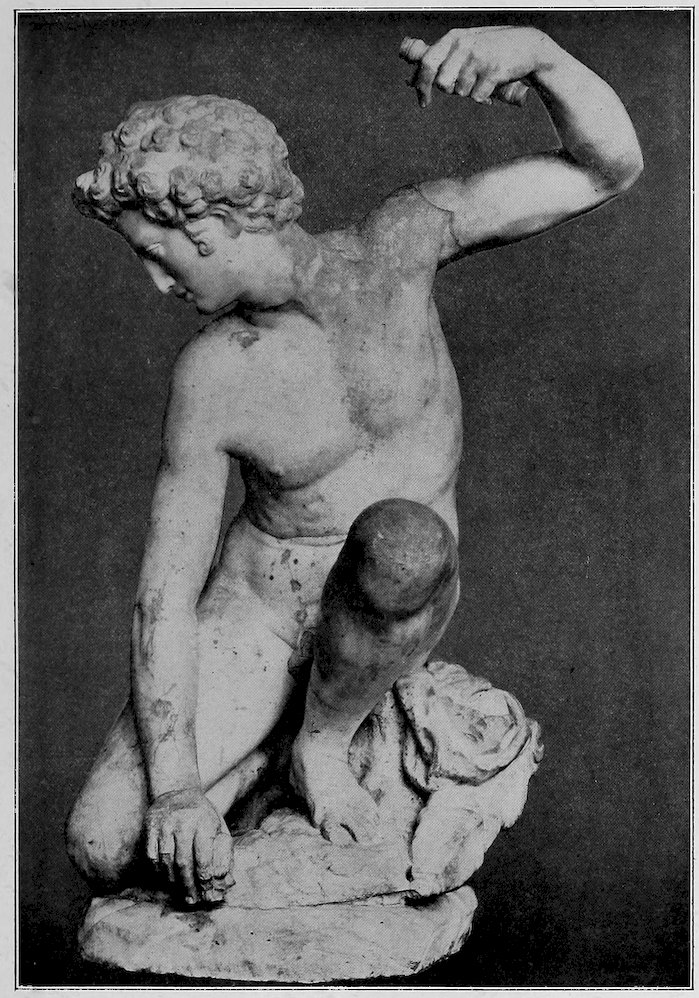
Plate LVI.
119This simplicity one notices in all Pheidian work, separating it sharply from the later work in Greece and from most of the work in Italy, particularly from that of Michael Angelo. Pheidias is not in the least affected, but at the same time he is not actualistic. Of the hundreds of figures in the full round and in relief that decorated the Parthenon there is not one, nor even a group, that does not seem absolutely and utterly simple and real. And yet there is not one of them which close study does not reveal to be a marvellous composite of actions and forms and draperies and expressions which all bear the stamp of idealisation (Plate LVIII). The effect of perfection that the work conveys is due perhaps to Pheidias not having tried to idealise in any vague or artificial way, but to his combining an absolute dependence on Nature for his models with a capacity of seeing, and solely representing, their essential beauties. So while his figures are ideal in the sense that they are more perfect than average mortals, yet they do not seem unapproachable and unaccountable.
Now this, we may freely grant, cannot be said of Michael Angelo’s work. His figures are simple, yet it is not the simplicity of Nature but of Art. A passing glance may find them equal to the Pheidian works, but a more careful study shows that though true to Nature and possible in action, they are, in respect to both body and attitude, improbable. They are composed, and hence in a way untrue. The Pheidian beings seem those of the Golden Age—perfect and unconcerned; 120while the others oftentimes seem interested in their own perfection and desirous that it should be admired. One knows enough of Michael Angelo to know that though self-conscious, such thoughts were far from his mind and if, as I think, they are to be seen in his work, it only shows that the time was stronger than the man, for he lived in a period when affectation was not uncommon. The grandeur of the Greek figures, as manifest in figurines as in colossal works, is due to the beauty dependent on a mental poise; that of the Florentine figures is due to their size and suggestion of physical strength and to their facial and bodily expression that imply the capacity of untold depths of passion—quite as physical a consideration as that of size.
Of course it may be said that the Eros is merely a study of the human frame in a rather complicated position, but even so, my contention that the figure is un-Pheidian still remains true.
The strength of the action exhibited by this figure of Eros, the tremendous play of muscle while at the same time the figure is thought of not as in motion but as at rest, is what one finds in very many figures painted and carved by Michael Angelo and forms one of the most distinctive characteristics of his work. It shows in the Slaves, in the Medici figures, in some of the sacred groups, in lesser measure but yet distinctly in the David and Moses, and as clearly as possible in the paintings of the Sistine Chapel. It is due to this in large degree that these works are so well known, for they strike the eye of the casual and impatient sightseer and they are remembered with much greater vividness than work of a quieter and less excited character. In the hands of a genius like 121Michael Angelo such treatment of the human figure, and the choice of such positions, seem natural and give no sense of exaggeration or restlessness.
It is commonly held that genius is limited by no law, and in so far as is meant thereby to imply that no bounds can be set to the concepts of great minds, this is true; in the attempt to express such concepts to others, however, the genius equally with less endowed mortals must be limited by the laws that govern the material in which he seeks to find expression. The penetration of a Sophocles or a Shakespeare into the mysteries of life can have no measure set to it, but when they tell us their thoughts, their words are bound by the laws of verse. No final explanation can be given for the teeming imagination of Michael Angelo, but some of his works may be criticised for not conforming to the laws of space or material that govern the arts of painting and sculpture. He sometimes shows a lack of taste.
Genius shows in every touch of Michael Angelo’s hand, whether with brush or chisel, but at times his work is unsatisfactory owing to its exaggeration. No admiration is too great for specific qualities in everything he did, but it is clear that the conception of beauty was not held by him as essential. To Pheidias, on the other hand, it was of primal importance.
A comparison of the Parthenon pediments with the ceiling of the Sistine Chapel may make clear my meaning. This is not the place for fine analysis of either composition. Suffice it to say that in each case the space has been filled by the decoration with a perfection and adequacy that has never been again approached, but I think it will be generally admitted 122that the chief impression of the pediments, shattered though they are, is of beauty, while that of the ceiling is of power. Michael Angelo tried at times to express in paint and stone what cannot be clearly expressed in those substances. This was what I have referred to as lack of taste. His Last Judgment is a striking case in point. He attempted in that work to do what Milton or Dante succeeded in doing better with more suitable means. Even the Chief Actor in the scene lacked the quality of grandeur which Michael Angelo seems usually to have found no difficulty in suggesting. It is perhaps because he felt the inadequacy of stone or paint for the full expression of his ideas that he left so many works uncompleted.
Michael Angelo’s figures of Night and Dawn and certain figures in the Sistine Chapel may be criticised for the exaggeration of their pose, though how extraordinarily successful they are can be seen by comparing them with similar figures by Vasari or other imitators of the master, which invariably appear to be insecure and in danger of falling. The difference in the kind of imitators who followed Pheidias, and those who succeeded Michael Angelo, shows well one difference in their genius and the effect on art in general that the two men had.
Both men had numerous pupils and followers, but in the earlier time such men served to keep Greek sculpture at its highest level, in the later they brought on a rapid degradation of the art in Italy. The reason for this different result is plain. Just as most people now see nothing in Michael Angelo’s work but strongly modelled figures and vigorous poses, not knowing enough of his life to comprehend what were the thoughts he desired to express, so the artists in his 123own day thought the magnificence of his work lay in its exterior form. Imitating this they succeeded in producing only figures with unnaturally protuberant muscles placed in uncomfortably contorted positions. Vasari and Bandinelli are two instances in point. The painted figures of the former are as foolish in their assertion of would-be grandeur as is possible to conceive, and there are few things uglier or coarser than the group of Hercules and Cacus by the latter.
In Michael Angelo this insistence on the muscular development of figures is an accident perhaps due to his delight (a pure Greek delight) in mere physical strength, such as he himself possessed, but it is not the most telling characteristic of his work. The truly essential part of his work is the thought which his figures embody. His followers, being men of little originality, as is shown by their trying to assume his peculiarities, naturally succeeded not in making work like his, but work which in reality serves to show their dissimilarity to their master. It was unfortunate, also, that the very qualities which attracted them were of a nature that if misunderstood lead to a more rapid debasement of art and life than almost any other, for a love of mere physical strength is a love of what allies one to the beasts of the field. Their work unites them not so much to Michael Angelo as to the maker of what (with the exception of the Laocoon) is probably the ugliest and most brutal work preserved to us from antiquity—the Farnese Hercules.
All this was very different in the case of Pheidias and his school. In his work there was nothing superficial to catch the eye, no peculiarity except the perfection and beauty that one feels instantly and yet cannot, without much care, 124explain on what it depends. What was there then for other artists to do if they felt his was perfect sculpture and they desired to work towards it? His figures were calm and stately. His greatness lay in his conception of the being he was called upon to represent—in his point of view, that is. This showed itself not in a technical skill superior to that of his fellow-workers, for the artists then as in the Renaissance were in the main equally skilful, but in a mass of infinitesimal details which not so much by themselves separately as by their combination gave his work its everlasting charm. It would not have taken a quick-witted Greek long to realise that to produce Pheidian works he must look at life in a Pheidian way, and the more successful his imitations the more calm, restrained and careful would they be. This Pheidian point of view was such that his followers were turned toward spiritual repose as the source of inspiration for their works rather than toward restless activity.
The complexity of the attitudes of Michael Angelo’s figures is scarcely more noticeable than the multiplicity of the subjects he was called upon to produce. Life was more complicated in his day than in that of Pheidias, and there were more varied demands made upon the artist than in the ancient times. While Pheidias, so far as we know, had to make works solely for the state or for some public purpose, Michael Angelo was forced to gratify the whim of various powerful employers. Oftentimes such work, as for instance the Sistine Chapel, was of public character, but more often it was not, so that in place of striving to embody the ideals of the state whose greatest artist he was, he had to bend and mould his genius to satisfy the personal ambitions of his masters. The story of the Julian tomb illustrates this sad and thwarted part of his career. Not only was he prevented from carrying out work already undertaken in the way which he considered best, but also he was forced to do that for which he felt himself unprepared by previous training and unfitted by lack of interest in the subject.
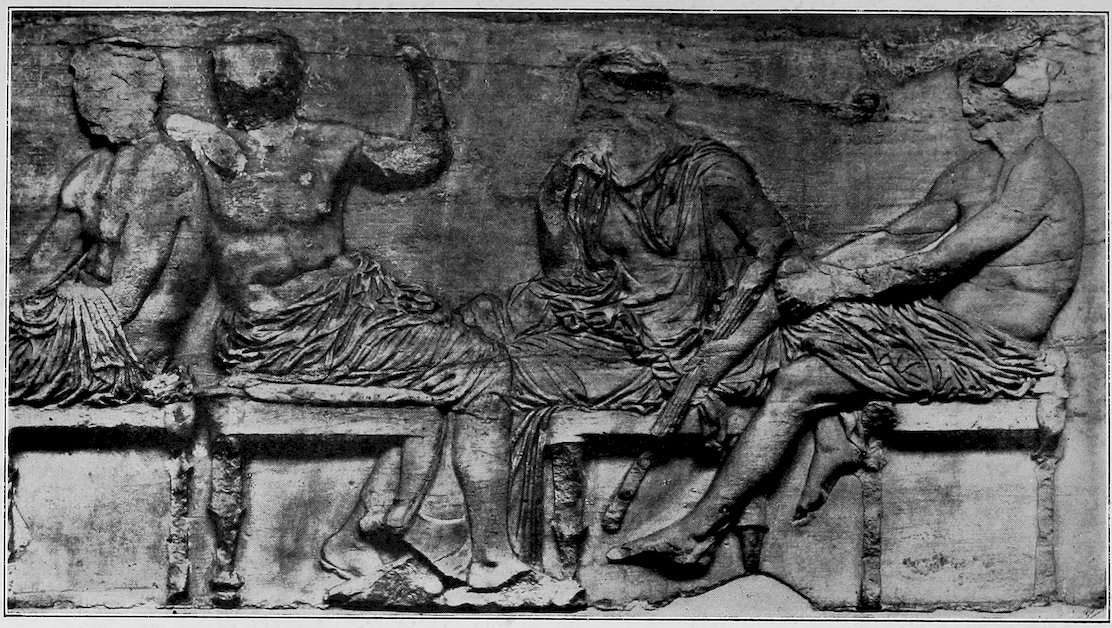
Plate LVII.
125That this was his mood at the time when, notwithstanding his arguments, Pope Julius II compelled him, in 1508, to begin the work in the Sistine Chapel, is known. If, when working against his will, he produced the most wonderful bit of decorative and architectural painting the world knows, one can but wonder what limit his talent would have reached had he ever carried to completion any of his great sculptural undertakings. Just as his capacity for mingling in his figures deep thought and powerful action shows not a greater but rather a more varied genius than that of Pheidias, so his capacities as painter, as architect, as engineer show that circumstances led him to much greater variety of activity than probably any ancient artist ever experienced. Not that this varied activity must needs imply the possession of greater powers. It implies merely the capacity of using an intellect highly trained in one way for the accomplishment of purposes of more than one kind. That is, it implies the possession by the artist of adaptability and of common sense in its finest form, and the possession of these qualities was not a rare characteristic in the Renaissance. Men of all kinds showed it, but it is most marked when it appears as part of the mental outfit of painters and of sculptors, men who too often adopt a pose of what they consider simplicity and lack of knowledge of the world, as though ignorance were the stepping-stone to great 126art. This was not the condition of things in the Renaissance, nor, so far as the little evidence we have allows us to judge, in Greece. It created no surprise when Van Eyck and Rubens were considered as proper persons to be entrusted with affairs of state, nor when the military protection of his city was put into the hands of Michael Angelo, nor when Leonardo laid out the irrigation system of Lombardy. Life is more complicated now and in many lines work has to be more specialised—but this is no reason why artists should be stupid.
The fact that the talents required for painting and sculpture are not incompatible is clearly shown by Michael Angelo’s works. The most common criticism passed on them, and one that is in part true, is that his sculptures are at times too pictorial while at others his paintings are too sculptural. Certain it is that parts of the ceiling in the Sistine Chapel look, at first sight, more like sculptured figures than like painted decorations. Michael Angelo was unquestionably aware of this, and the effect was intentionally sought by him. To state as a rule of art that work on the flat should always look flat is a mistake. There is no law of optics or of architecture which demands this.
The application of the laws of art must depend on the individual practitioner.[33] In treating the figures in the Sistine Chapel in a sculpturesque way Michael Angelo produced a work more like the Parthenon in the perfection with which the decoration is adapted to its position than is elsewhere to be seen. He has used painting, that is to say, in much of his design to suggest sculpture, which is the richer and more suitable adjunct to most parts of architecture,[34] and thereby produced a complex architectural work instead of producing merely a painting which, like many of those in Venice, might equally well be placed anywhere else.
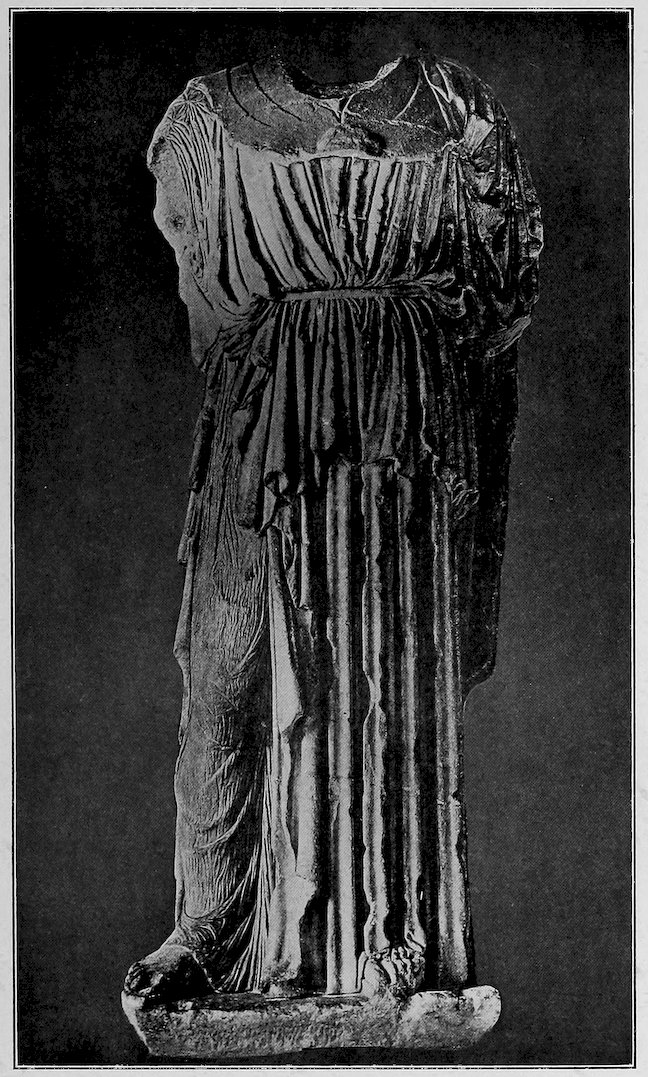
Plate LVIII.
127A comparison will make the point plain. Take most modern decoration of a similar sort and how infinitely feeble and accidental it seems! Look at the decorations of the Pantheon in Paris, of the Boston Public Library, and the difference may be seen. Great painting one may see there, but not great decoration of architectural works; and ceiling or wall paintings are nothing else. Any one of these paintings taken from its present position would look equally well on any other wall large enough to hold it, or in any gallery, and would also have equal meaning there. Not so Michael Angelo’s work. As a whole it could be put nowhere except where it is, and if cut in pieces each bit would cry out in its solitude and demand the juxtaposition of the other parts. The work is as perfect a finishing of the Chapel as though it were some natural growth. This is equally true of the sculptures of the Parthenon. How inconsequent and unmeaning they look when taken from their natural place is shown in the British Museum by the Athenæum Club and Hyde Park Gate in London.
Michael Angelo’s other paintings also have a sculpturesque look. This is partly due to the fact that the foreground, where atmosphere has little effect, is more studied than the background. To him as to Pheidias the human figure was 128of the deepest interest, but its natural surroundings of little or none, so the figures are drawn with a distinctness and illumined with an intensity of light which make them look more solid and material than many a painter’s work. It does not mean that Michael Angelo failed to understand the function of painting as a Fine Art. The true function of art is the presentation of the ideal and this is done by the translation of emotion. This translation of emotion, when accomplished with the motive of giving pleasure by pleasing the senses or elevating the mind, produces the noblest art, for this search for pleasure is in healthy minds but the search for beauty, and beauty is the suggestion of the ideal. This being the general function of Art each one of the Fine Arts follows in ways individual to itself the search after beauty in the translation of emotion. Music is the most subtle and architecture is the most general of the arts, and poetry the most commonly understood, while painting and sculpture, the terms of which are hardest to define, are the most closely related. As an art architecture is an expression of man as a social animal. Painting and sculpture are its proper adjuncts. Painting ought to be merely the representation by colour of three dimensional spaces in two dimensions, while sculpture should attempt nothing but the rendering of forms in full or partial relief. Each art per se has special powers, but when used as a detail of work of another kind, its peculiarities must then be suppressed till it is in accord with the work of which it is a portion or detail.
Now this is exactly what Michael Angelo accomplished. It is natural for painting, since it cannot represent figures in the round, to lay most emphasis on the face, but when it is used 129to ornament the separate parts of an architectural work, it must generalise its own peculiarities and use them to enrich the architectural scheme. For in so far as painting thus used impresses the beholder with its excellence as painting, by just so far has the architecture become a frame for the painting and the painting failed to be a glory added to the architecture. Michael Angelo was a great enough genius to be able to use painting perfectly as an additional splendour to his architecture.
You do not think of the figures or pictures on the Sistine ceiling as separate works—in large measure the composition is such that you cannot—so much as the finishing ornament of the Chapel. This is because the artist did not put the greatest amount of expression into the faces, it permeates equally the whole body. Thus these grand creatures look like sculpture, which is in fact, as more similar in its permanence to architecture, the noblest means of decorating a building. Ceilings cannot, it is true, be covered with carved figures, and great care should be chosen in the scenes depicted on them, for they do not offer a suitable position in which to hang pictures that are primarily conceived as pictures. This was a common mistake of the Venetians, who covered the ceilings of the Ducal Palace, Santa Maria del’ Orto and countless other buildings with elaborate paintings of subjects that have no architectural significance and cannot be thought of as scenes taking place in the heavens. They are in fact large easel pictures and as such would be better seen if hung upright on the wall than in their present position.
In the Sistine Chapel Michael Angelo showed his complete understanding of painting as an ornament and finish to architecture, 130and in his easel paintings he manifests, if not as complex effects as some painters, at least as full a knowledge of what constitutes painting, from its roots of drawing and composition to the full blossom of colour and expression. Perhaps the most marked peculiarity of his paintings is the lack of complex backgrounds of any sort, whether of landscape, or drapery, or architecture. This again allies him to the Greeks, not to those of any one age in especial, but to all, for the most marked difference (leaving the less important matters of medium and technique aside) between their paintings and those of modern times is, that they did not consider backgrounds as a part to be treated with much elaboration or care.
The Greek painter, we know, presented his scene with only enough suggestion of the surroundings in which the figures stood for the beholder to understand the general character of the spot where the action was taking place. He lavished his care on the figures, and did nothing to distract the full attention of the beholder from them. Michael Angelo did the same. In so far as he rivets your whole attention to the figures on the canvas, his painting is sculpturesque, but this word cannot be applied to his work in the sense that he was ignorant of the principles of painting as an art of expression. That in his painting as in his sculpture he tended to overstep what are generally considered the proper limits of the art is true, but this was due rather to great knowledge than to any imperfect understanding. At such times he was striking out into the unknown realms of discovery and searching for new possibilities for the arts of which he was the most accomplished master of the time.
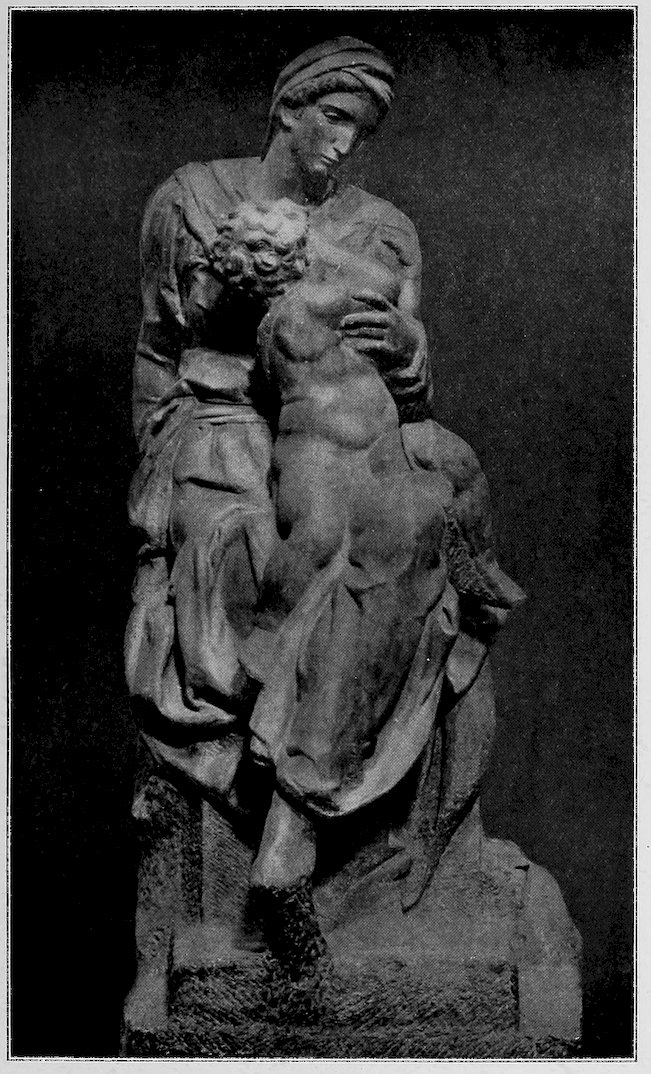
Plate LIX.
131I have tried to show how the general beliefs and ideals of the people among whom they lived would have tended to differentiate these two artists one from the other in certain ways and to ally them in certain others. But different or similar, can it be said of either: this one is the greater? I think not, even though one recognises that Michael Angelo certainly gave more varied expression to his genius. Neither of them shows a more complete understanding of the arts, or embodies a fuller realisation of the ideal in his figures, than the other.
Take for example Pheidias’s statues of Athena and Michael Angelo’s of the Madonna. No artist could express all each of these beings suggests in one figure, but it would be a hard task to find anything that they did not show in one or the other of their several presentations. We know with considerable accuracy what was the grandeur of the Athena Parthenos, the guardian of her chosen people, and we also know the divine rage felt by Athena the warrior Goddess driving Poseidon from the sacred citadel; and finally we know by literary and probably by ocular evidence with what consummate grace Pheidias represented Athena the ideal of Attic maidenhood. There are many other statues of the Goddess by other artists and from other periods but none I believe that add to the realisation these three give us of what Athena was to the Athenians.
In the same way Michael Angelo shows us the feeling of his time towards the Virgin. In the figure at Bruges we see the youthful figure—the Virgin of the Visitation. In the partially finished group in Florence there is more trouble in the face, the feeling expressed in the words “behold, thy father and I have sought thee sorrowing” and “they understood 132not the saying that he spake unto them” (Plate LIX). In the Pietà in St. Peter’s her heart is numb with grief—the flood of sorrow that has whelmed her is
“Such a tide as moving seems asleep,
Too full for sound or foam,
When that which draws from out the boundless deep
Turns again home.”
Her figure as shown us by other lesser men seems trivial or incomplete when these are remembered.
If one considers the larger undertakings of the two men, the Parthenon and the Sistine Chapel, one cannot say that either surpasses the other, though one can say with absolute security that neither has ever been approached. In these works they show themselves the masters of all craftsmen. Note the way in which the composition of the Parthenon groups suits the long, low triangular space in which they are placed, each group, taken as a whole, being made up of numerous lesser groups which are quite perfect by themselves and so interwoven by means of upraised arms or turned bodies or bits of floating drapery, that it is only after careful observation that one sees how the artist made various parts unite into one perfect whole. It is the acme of architectural sculpture. It seems simple, but one searches in vain among the pediment groups that have been made since for one that can approach it even distantly in merit. It is this same intertwining of simple, unforced separate parts into one grand, living completeness that marks out the ceiling of the Sistine Chapel as a thing apart and unequalled.
To compare the more private, perhaps more personal works, of the two men is impossible, for the reason that nothing of 133this sort made by Pheidias has been preserved for us. There are a few such by Michael Angelo, some from his earliest years, as the Battle of the Centaurs, others like the David or perhaps the Eros. From these we get a suggestion regarding the ideas which Michael Angelo thought were to be expressed by sculpture. The bas-relief showing the Battle of the Centaurs can, however, scarcely be taken into consideration, for it is a work of his mere boyhood and shows little except unusual power for a youth and an interest, which apparently did not last, in subjects drawn from ancient art. The man’s unconventional and powerful nature is shown by the fact that in his mature years he did not ever, as most contemporary painters and sculptors did, try to copy the antique in any way. His own mind was too active for him to adopt either the subjects or modes of other men’s work. So, too, in the case of Pheidias, his work does not suggest that of any predecessor, but in later periods of Greek sculpture the figures which hark back in some way to Pheidian originals are innumerable.
In the David, in the figures in the Medici Chapel and those for the Julian tomb one sees the same strained look: physical calm and great strength combined with a marked expression of mental restlessness and trouble, undoubtedly significant of Michael Angelo’s own feeling of weariness and of the ‘powerful trouble’ that beset the world. Pheidias came just at the acme of a great period. Michael Angelo, on the other hand, felt that the light in the sky was that of the waning day, not of the sunrise. His figures are sad; those by Pheidias are quiet and peaceful. Society and the artist were in harmony in the case of the Greek; they were not in accord in the case of the Florentine.
134Every point we study brings us to the same conclusion, that while each of these men was the supreme master of his time and of incomparable capacity, Pheidias had less to struggle against than Michael Angelo; and through being able to carry out his ideas unhampered, he had a better effect on his followers than Michael Angelo, whose works are in the main monuments of thwarted purpose. Each sought unceasingly to embody in his work ideals of beauty beyond the influence of contemporary events. In the one case this was possible, in the other not. To the Greek, contemporaneity was nothing, to the Italian, it was all. Where Pheidias was called on to decorate the chief public building of Athens with scenes of war which were known only by popular tradition and which were instinct with poetry, Michael Angelo had to depict a battle that was a mere incident of border warfare. Each of these men, however, enriched the world with works that are unsurpassed, and similar work will never again be accomplished.
With the passing of the Greek world passed the ideals that inspired Pheidias. Others came and faded away again with Michael Angelo. Their works are immortal in the sense that in their kind they cannot be superseded. But the arts themselves are not immortal, for this would mean that they could not advance and develop. It is in this power of growth and change and adaptation that art is allied to science, and we turn to the most recent exponent of either with the incommensurable hope that he may have found the master key to beautiful new worlds.
135
III. A HEAD OF ATHENA FROM CYRENE
In the first, and, as it was destined to be, the last report on the excavations by the Archæological Institute of America at Cyrene,[35] I published a marble head of Athena which we found a few inches below the surface on the top of the Acropolis.
The spot where it was found afforded no clew to its origin. It came to light in a small room constructed probably in the later Ptolemaic times, and had obviously fallen and been lost to sight, by one of those inexplicable accidents familiar to all excavators, on the spot where our picks discovered it. No temple stood near; no trace of pedestal could be found and no other fragment of marble came from the torn covering of protecting earth to help answer the eager questioning the quiet face aroused. Except for a flake off the hair, the tip of the helmet projecting over the brow, the edge of one ear and the point of the nose, the marble was as fresh as the day the figure was first unveiled to the worshipping multitude. (Plates LX, LXI.)
The perfect head alone is left us to solve the riddles the archæologist and artist may ask. Doubtless when in the oncoming years the Italians have the satisfaction of finishing the work which we inaugurated and made possible, further discoveries will dispel whatever doubts now harass our minds, 136and students, forgetful of the time and circumstances under which we wrought, will wonder why we hesitated, why we did not see, why the closed lips did not speak to us with as clear a note as to them. Doubtless, but still it seems likely that many years must elapse before others will be able to finish our work, and in the meantime it is well to bring this lovely bit of sculptor’s art more adequately to the attention of students than seemed wise before the hope of continuing the excavation was blighted by the careless hand of war.
Before studying the special characteristics of this head of Athena and showing how, notwithstanding the very numerous representations of the warrior Goddess which we possess, it is entirely individual and unlike any other, we may do well to recall certain facts regarding Cyrene as a centre of Greek life and thought, facts that are not open to question, being proved by historical and other positive evidence. The accounts given by the ancient historians and poets of the foundation and rapid rise to wealth of Cyrene were sufficient to make us certain that the archæologist’s spade would find in plenty those beautiful monuments of a long-since vanished spirit which make the work of the excavator on Greek soil so entrancing and satisfying.
Even at inaccessible Cyrene, however, we were not the first. In the early sixties of the last century, Smith and Porcher, two fine examples of men of English breadth of view combined with well-trained and persistent capacity, had brought to light a considerable number of bits of sculpture which showed clearly that Cyrene, like every other Greek city, had once been a kindly nurse to artists. True though it be that these broken fragments now sheltered in the British Museum were, with the exception of a magnificent bronze head, of second-rate quality, still they dispelled all doubt regarding one very important point; that is, they showed that at Cyrene itself there were large numbers of sculptors whose technical skill was of a high order. That there were numerous sculptors was proved by the fact that the works found by Smith and Porcher embraced a long stretch of years.
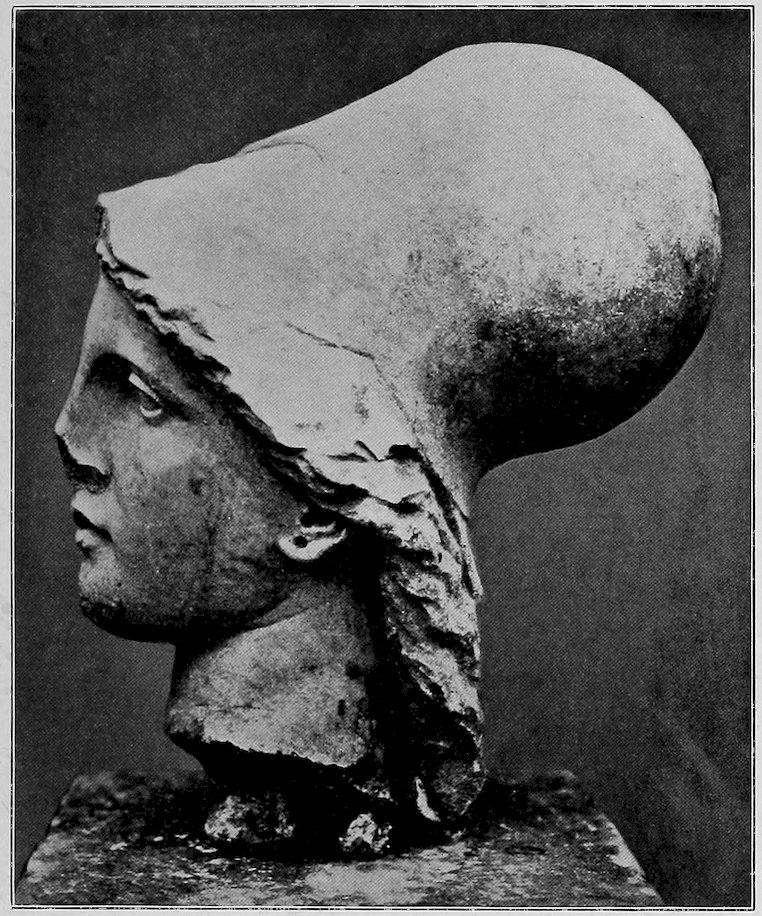
Plate LX.
137At first sight this fact may appear little noteworthy, and its bearing on our Athena head may not be perceived. It takes on a fresh aspect, however, when we realise that there is no marble to be found within hundreds of miles of Cyrene, and, in consequence, the stone must have been imported to the city. It might be suggested that not the marble but the finished carvings were imported, as we know from literary evidence was sometimes done in other parts of the Greek world. Had the English and ourselves found only one or two examples of supreme merit, this theory might be tenable. No one, however, will attempt to uphold it in the face of the numerous busts, statues, bas-reliefs, grave monuments and inscriptions, many of which are of very little importance, which were dug up by the Englishmen and ourselves. Portrait busts alone show that Cyrene had her own sculptors who, even though they lacked the advantage their confrères of many Greek cities had in near-by quarries, managed to overcome the difficulties Nature put in their way and struggled to a mastery of their chosen art. The bearing of this on the Athena will become manifest as we go further into the study of the subject.
If only another Pausanias, one might suggest, had gone sightseeing 138and note-taking along the surprising shores of Libya, our work of interpretation had been far simpler. But though we are not helped by such written evidence, we can still discover the essential qualities and meanings of these sculptures, and the diggers who in years to come drive our trenches deeper into the ground will find nothing more unexpected than the Athena, for she is the drifted seaweed that proves the still invisible land. In fact, I for one am glad we have no Pausanias to dull the edge of our wits with his bald and often erroneous statements. He has helped much in making it possible to draw up chronological tables and schedules of all sorts regarding the development of Greek sculpture, yet had he never written, the true understanding of the art, the comprehension of the forces that moulded it from the days of its early promising effort through its bloom of unchallenged perfection on to its phosphorescent decay, would have been not less full and possibly even more intelligent than it is to-day. Pausanias and others of his kind have handed down many names which mean, in truth, no more to us than the titles “master this” or “master that” of the mediæval German school of painting. Such facts and data are of infinitely little importance. Even without them the razor-sharp critical powers of a Heinrich Brunn or an Adolf Furtwaengler (before he gave up his energy to acrimonious and petty dispute) were not to be denied and without any fictitious aid of names would have interpreted Greek art to us. That there are always blind souls who, when they see the Hermes of Praxiteles, think it Roman, and consider the Maiden of Anzio a work of the time of the Antonines, and who find other blind souls to follow them, does not delay the Brunns and 139Furtwaenglers when they make their rare appearance in the world of scholarship.
Thus with no help or suggestion derived from information given us by ancient travellers we start on our study of the Athena with the knowledge that the technique of the art of sculpture was so well understood, and the practice of it so common, at Cyrene, that we need not, unless forced by internal evidence, look elsewhere for the nameless sculptor who carved this masterpiece. The result will show that all the internal evidence is in favour of its Cyrenean origin.
Since, then, sculpture was at Cyrene, as everywhere else in the Greek world, one of the common modes of expression, it remains for us to study the influences to which it was subjected. We meet here the strange phenomenon that the millennial-old civilisation of Egypt exerted apparently no influence whatever on the young Greek town to the west. That towards the end of the latter’s career, when she had fallen under Ptolemaic control, she should be unaffected by Egyptian thought is not surprising, for Egypt herself had at that time submitted to the spell of Greece, and the true Egyptian art must have seemed to the fellahin who then cultivated the Nile valley almost as strange as it does to us. If, however, the often-expressed theory, supposed to be borne out by certain statues found on the Acropolis of Athens and elsewhere, that the archaic sculptors of the Greek mainland were more or less governed by Egyptian ideals, be true, then it is odd that even the most archaic art of Cyrene, represented by statuettes of the sixth century B.C., does not exhibit a similar tendency. But this belief in the Egyptian influence on the artists of Greece is based, it seems to me, on unsound evidence.
140There are obviously two, and only two, chief points to consider, if one would fully understand a work of art. One is its outer form, the other what it is trying to express; for even the childish and misdirected efforts of the “Futurists” are an endeavour to express something—how futile these efforts are is shown by the fact that were it not for the titles given the works by the Futurists themselves no one, no matter how capable an artist or how mystical a dreamer, could possibly guess what they were intended to represent. The works show an even greater confusion of mind than that of Father Castel who in the early part of the eighteenth century attempted to make instruments which he called clavecin des couleurs and clavecin des odeurs, instruments intended to produce by means of changing colours and perfumes the same effects as music.
Now one thing in very truth Greek art never was, either in poetry, sculpture, painting, or in any other form: it was never confused, but had always perfect lucidity. In sculpture, for instance, the composition of the groups and figures, though often displaying an intricacy almost as great as that of a knot by Leonardo, is never anything but clear to the trained eye. To understand the value of this quality one need only look at the work of Rodin, which, no matter what elements of greatness it may be thought to have, certainly has not one slightest atom of Greek quality. Besides the evil of confusion another failure sculpture may show is the stagnation of formalism. This is one of the most noticeable features of Egyptian art. Notwithstanding the wonderful technical dexterity of the workers in that land, hieratic influences were too strong for them and their natural impulses 141were shackled by the bonds of dogma. This blight, too, the Greeks avoided. What then is the ground for maintaining that their early art was influenced by Egypt? That the early sculptors may have learnt many technical processes from Egyptians I would neither deny nor affirm. They may even have had Egyptian teachers, just as later the Romans had Grecian ones, but that does not mean that Greek art was of necessity moulded in accordance with Egyptian feelings and ideals.
True it is that there are certain Greek statues which resemble in pose and stiffness certain Egyptian statues, but there is a fundamental difference between the two groups. The pose is an accident and can be duplicated in work from other parts of the world. The fundamental difference is that the stiffness of the Greek work does not represent the formalism of Egypt, but it is due to the awkwardness of inexperience. Take, for instance, the “Aunts” found on the Athenian Acropolis. They are by an unpractised, stiff hand and in that sense they are formal; but they are far more, delightfully spontaneous. Such work would have been inconceivable to an Egyptian and would have seemed to him irreligious and indecent. It is not to be thought that Greek art even in its period of fullest bloom was not formal; it was. It was the wonderful talent of the Greek clearly to understand the laws proper to the various arts, but he was always spontaneous and original, and his work exhibits formality but not formalism.
These qualities are seen in the earliest work found at Cyrene, the terra-cottas already mentioned. That they should be so manifested is but another proof of the amazing force and individuality of the Greek mind. Any other race would almost surely have felt the influence of Egypt. Her territory joined 142that of Cyrene on the eastern border and the land between the city and the Nile offered no barriers of mountains or desert to hinder easy and comparatively rapid communication, yet the outer form and inner content of these early Cyrenean figures is completely and unmistakably Greek. That traders passed back and forth from one region to the other cannot be doubted. Caravans plodded their slow way from the sacred fountain to the mysterious river, coastwise boats skirted the inhospitable shore even as they do to-day. The Greek, then as now the costermonger of the Mediterranean, made his money, but he kept his individuality. Throughout the centuries, until at last spiritual aloofness was trampled down by a ruder and more powerful race, at Cyrene as completely as at Athens, the Greek maintained his own standards and beliefs. As the clumsy terra-cottas, wrought not very long after the first settlers were guided to the spring which made a great city possible, show this, so also does the Athena. Individual she is, and unique, but she is pure Greek. The reasons for some part of her individuality will become clear as we study her still further.
We see, then, that the Athena is a work expressing with unveiled distinctness the Greek spirit, and also that there is no reason to suppose that the sculptor was other than Cyrenean; it remains to find out at what date the figure was carved. Often a mere fragment like this exhibits some detail that makes it easy to fix the date of its origin with considerable accuracy. In this case the question is complicated by both technical points and general considerations. Had this head been found in Greece itself or in any part of the Greek portion of Asia Minor, the history of which is well known and the 143art of which has been laid bare by the archæologist, we should have various well-established criteria by which to test and estimate the head. But the definite historical records of Cyrene are very scanty, and though what is probably in general a fairly accurate idea of the development of the city can be built up from the verses of poets, the accounts of historians and other sources of various kinds, still there is little to help us date a single work of art. There is, however, no reason to suppose that the deeper currents which gave the course to the life of Cyrene were very different from those which guided the life of other colonies. Pindar’s odes alone would serve to show that the African city was in pretty constant relation with the mother country. Hence it is safe to assume that the arts developed in Cyrene very much as they did elsewhere in the Greek world.
At the present time surely enough is known of the various parts of that world to make us realise that all advance did not spring from Greece herself. Though the Greek spirit was bound to express itself in similar forms wherever Greeks settled, still sometimes one region, sometimes another, was in the lead. Hence any chronological scale as applied to art must be elastic, and one must not give way to the temptation to judge every new find by the standards set by the artists of Greece herself. Provincialism and archaism often take similar external forms. So, too, it is a general law that colonies develop more rapidly than the country from which they spring. A rapid development may be brought about also by geographical and climatic conditions in places which, at first sight, do not appear to be conducive to the advancement of art.
144In years to come it will be proved beyond a doubt, I believe, that Cyrene was such a place. Her distance from the regions in which we are accustomed to think of the Greeks as working out their destiny saved her from the wastage of those wars which it is hard to regret because they have given us immortal pictures of Greek courage and devotion. What her relations with the native powers were we do not yet know, but had they led to any such struggles as made the pride of Athens and the other cities of the mother country, surely some echo would have reached our ears. So we may think of Cyrene as waxing fat from the moment when the first settlers, after their long wanderings to find a habitable spot, climbed the rocky hillsides and quenched their thirst at the spring which with its bright arms still holds a small settlement. It is for these general considerations of easy colonial growth, and freedom from external distractions, that I think the Athena can be safely dated rather earlier than we should be tempted to date her had she been found, let us say, in Athens or Sparta.
The technical point which I mentioned as making it difficult to date the head, is the helmet. It is of the Corinthian type, but there is nothing in its general shape or details of form by which a date can be fixed. Furthermore, it covers the head so completely that only a few waving locks of hair over each ear and the heavy braid resting on the nape of the neck are visible. This concealment of the hair takes away in large measure one of the most helpful methods of dating statuary.
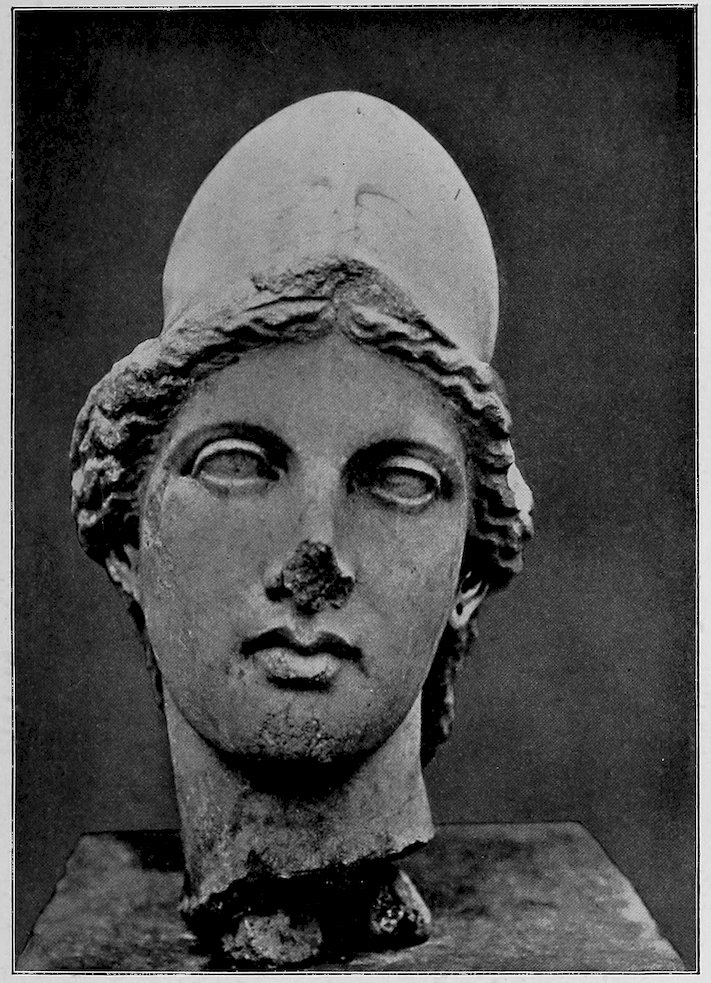
Plate LXI.
In the case of female figures, nevertheless, the treatment of the hair is less helpful, perhaps, than in statues of the rougher sex because in the former the more severe and orderly dressing 145of the bound locks gave less chance for individuality of treatment than did the crisp and wind-tossed curls of youths and men; still, even in the women’s figures the hair very often betrays the date of the sculptor. Few though the tresses are which escape the stern covering of Athena’s helmet, they are sufficient to help us in our elusive pursuit. The general method in which the hair is arranged, parted over the brow and drawn closely back above the ears to a knot or short doubled up braid at the back, is one that suffered but little change during several centuries. In the archaic time the locks fell more loosely behind, while in the fourth century they were more knotted, but these slight variations occur now and again throughout the whole period of great Greek art and were due more to individual fancy of artist or model than to the stifling rules of fashion.
But though we must finally conclude that the mode of wearing the hair does not assist us, as the cut of the dress most certainly would have done had we been fortunate enough to find the body of the statue, still the tresses between the temple and the ear have a quality of their own which points to a definite time. They suggest the loose waving form of life with noteworthy success. The sculptor belonged to a period when the special nature of marble was thoroughly understood. The period had passed when bronze and marble were treated in almost identical fashion, and the time had come when sculptors could manage various materials with complete understanding and were enabled to reproduce surfaces or substances in the way best suited to malleable metal or to friable stone.
The most perfect example of this understanding of substance 146which we possess, and one that has never been surpassed, is the head of Hermes by Praxiteles made in the first half of the fourth century before Christ. The hair of the Athena is handled in much the same way. The locks and strands are not sharply outlined and separated one from another but flow from brow to neck in subtly broken masses among which the light plays in and out as softly as in nature. This naturalistic treatment became common after it had once been arrived at, but the tendency after the end of the fourth century was to try for purer realism. This could not be attained by greater skill in modelling and carving but only by polishing or engraving the surface. The Athena exhibits neither of these signs of decadence but the surface still shows that lovely dusty softness which is characteristic of the best work of the late fifth and early fourth centuries, a softness which would not have been imperceptible and lacking in effect even when the figure was tinted with colour, as, probably, all Greek sculpture was.
It is not only the hair which suggests the date of the early fourth century as the time when the Athena was made. The broad chin, projecting well away from the neck, a chin that would be heavy, were it not for the exquisiteness of its outline, which seems to have the living force of a coiled steel spring, is such as was common in the fifth and early fourth centuries. So, too, are the broad set, wide opened eyes overhung by the long low curve of the brow. Not a sign in these of the sentimentally dreaming eyes with their melting lower lids which we associate with the work of the imitators and followers of Praxiteles; not a trace of the furrowed brow and the eye gleaming, like a live coal, from the deep shadowed 147socket such as we see in the work of Scopas and the superb masters of Pergamon.
In discussing such a fragment as this Athena it cannot be too clearly remembered that the sculptor, like the poet, does but express his own day, and if Praxiteles was delicate and sentimental or Scopas forceful and passionate, it was because these were characteristic qualities of their periods. These are, furthermore, exactly the qualities one would expect at a time when old standards were beginning to be doubted and the future offered nothing so substantial to take their place.
The same phenomenon is seen in the seventeenth century of our era. In both periods thoughtful people either clung to a sentimental repetition of old ideas which no longer had life-giving and creative force, but were loved and dwelt on for the sake of old association, or else they were driven to a passionate striving after new and dimly seen hopes and ideals. Sentimental dreaming took the place of good hope and assurance while mystical passion took that of intelligent piety. In the face of the Athena there is seen no sign of a troubled spirit, she is calm and steadfast with the strength of perfect self-poise, which could hardly be, were she sprung from a later time than the early fourth century.
It has been insisted that there is in this head no trace of sentimentality, and it may be thought that I have failed to notice, or to give due weight to, the curious pose, drooping over slightly to one side. This is one of the most noticeable points about the head, but, to my mind, it expresses a feeling common in the fifth and early fourth centuries and is not motived in the slightest degree by the later sentimentality. In the old man seated on the ground in the Olympia pediment, 148in the Mourning Athena at Athens, in most of the grave steles of the late fifth and early fourth centuries, in the portrait bust of Pericles, is to be seen, in the pose and expression of the figures, the expression of a deep sentiment of combined gravity and tenderness. Again and again this sentiment is expressed by the great dramatists in words that ring down the centuries like distant bells. It is the recognition of suffering and sorrow but also of the self-control that meets them undismayed. When the Greeks lost their faith, at the same time they lost this control. In the Demeter of Cnidos and the portrait of Mausolus there are unmistakable signs of lack of control,—in the former the startled pose, and in the latter the look of distress plainly visible in the fine and vigorous face. The Athena resembles the Pericles and the grave steles in this respect. The head leans over as though bent by the wind (a position which emphasises the exquisite shape of the neck), but in the steady, quiet eyes and in the sensitive closed lips one sees plainly that simple directness that distinguished the Greeks of the period to which I attribute this head, from all the other peoples who have inhabited this earth.
I have just mentioned the mouth of the figure, and this is the feature to which I referred before as showing, possibly, the effect of local circumstance on the sculptor. It is a very noticeable mouth; large with unusually full and richly modelled lips—lips that could send the battle cry echoing across the scarred and rock-strewn hills or could whisper like the brook beneath the rosy-plumed oleanders. In shape it is by no means a typical Greek mouth, but has a trace of the fuller form common to the Libyans with whom the Cyreneans 149were in constant and close intercourse. While it is true that history fails to note a single case of an individual of pure black blood accomplishing anything of note except in a military way, such do often possess great beauty of form and feature, and this fact has been seized upon by the sculptor of the Athena. With great skill he has softened the somewhat savage shape and given it the lines that are consequent upon a higher civilization.
We have come now to the end of our study of this bit of sculpture. It could be compared indefinitely with other heads, and the similarities or differences could be pointed out. Little would result, however, from such comparisons. What is needed is more sculpture from the same region with which to study the Athena. But till this is forthcoming, we are left to the general conclusions derived from this single example. These conclusions are that the Athena was carved by some as yet unknown artist at Cyrene in the first half of the fourth century B.C. and that the work differs from the Greek work we are accustomed to in showing local characteristics both in special features and in method. This may seem to be of small importance and the head to be unworthy so elaborate a discussion; such would be the case were we to think of it merely as an archæological remnant of a forgotten city and time. But this head is more than a mere bit of flotsam. It is not a dead and meaningless fragment, but has still the suggestive and creative power of any true work of art. This vitality and artistic veracity are shown by the extreme clearness with which it illustrates two of the fundamental characteristics of the Greek genius—humanism and directness.
The simplicity and directness of the Greek showed itself 150in all he did or made. He never attributed human emotions to nature and never bound himself with dogmatic conventions. For these reasons he was never sentimental and never dry or false. He saw ugliness, moral as well as material, in the world around him, but recognising that it in no way added to happiness, he did not wallow in it and proclaim himself a “realist.” When he came to consider religion he was straightforward in his treatment of the Gods as he was with himself. They were but a superior race born from the same great mother Earth (Pindar, Nem. VI. 1). Athena, the Goddess, is but a woman and nothing more. He saw beautiful women in the cities where he dwelt and in form of their physical perfection he represented the bright-eyed Goddess. He sought no imaginary qualities, he attempted to express no hazy, mystical dreams but finding beauty in mankind, he was satisfied to reproduce it so well as might be.
Ordinary everyday life was the chief interest of the thoughtful Greek. He had the same circumstances of existence around him as we have to-day, and knew just as much of the origin or the end of it all. Life, death and the passing show of time were his schoolmasters as they are ours, and from them he learnt humanism. He thought of the world not as a blind accident nor as a mystical promise but merely as the setting for man and hence the conduct of life became his chief interest.
The Greek sought for all means whereby he might avoid the pitfalls of youth, secure the comforts of well-rounded growth and minimise the weaknesses and griefs of old age. To attain this ideal certain things were seen to be necessary, and from Solon, who considered that the man was happy who had health, good fortune, good looks and children, to 151Aristotle, who (Rhet. 1360 b, 14) gave the same definition in a more amplified form, the ideal did not alter. Even to-day there is but one part of this that seems strange to us. That is the stress laid on personal beauty. Good fortune, health, wisdom, children and particularly wealth go to form the general ideal of the modern world, but there can be only few who would admit that the desire for physical beauty was part and parcel of their ideal. The Greek on the other hand frankly desired it almost more than anything else and showed his perfectly simple and entirely pleasant belief in its value by his games and by many a story which he told as illustrative of enduring truths. One of these tales has a bearing on the Athena of Cyrene. It is that of Peisistratus, who in order to become ruler of Athens came there accompanied by a beautiful woman in regard to whom he told the credulous citizens that she was the Goddess Athena herself.
Thus we see that it is due to no mere partiality for the pleasing form on the part of the unknown sculptor that this head from Cyrene is beautiful, but because his brain and hand were guided by ideals that were second nature to him. As we grow familiar with the head, the loveliness of every feature, the sharp insistence on sweet feminine beauty make one wish destruction might fall on the vague and dreamy and contorted realisms with which many of the modern artists would attract our attention. The calm and steadfast eyes look at us across the centuries and question our mysticism. The straightforward, immediate, perfect humanity gives us pause in our mad search for novelty, and should we conclude that this is perfect art, though we may lose the sympathy of our contemporaries, we shall win the companionship of those whose laurels are immortal.
153