THE WRITER'S TRIP ON THE YUKON
Reading edition
TANANA—YUKON
June 17. Nenana: This is a small town on the Tanana, mostly railroad buildings, with a hospital; there is one street of stores (three short blocks), most of them now empty. About half a mile off a small Indian settlement about an Episcopalian mission.
Country flat on both sides of the rather large river, except for some hills back of the right shore beyond the railroad bridge, for a short distance. The river flats seem scarcely 3 or 4 feet above water, overgrown with brush and a few scrubby trees, later spruce thickets. Purple flowers (fireweed) strike the eye.
No relics found at Nenana; no information concerning old sites or abandoned villages along the stream.
Physically, the Indians seen at Nenana were submedium brown, good many still full blood, pure Indian type, brachycephalic, faces (nose, etc.), however, of but medium prominence. Moderate to good stature.
They are all fairly "civilized," wear white men's clothing, to which on gala occasions are added bands or collars of beadwork, and speak more or less English. The younger men are evidently good workers.
The distance from Nenana to Tanana is given as about 190 miles by the river.
The government boat Jacobs, on which we shall go down the Tanana, is a moderate-sized, shallow-bottomed stern-wheeler, and, like all such boats on these rivers, will push a heavily laden freight barge before it. There are about a dozen passengers, the boat labor, a trader or two. All kindly, open. A few women—most of both sexes of the Scandinavian type. On barge some horses, a cow, pigs, chickens.
Leave after lunch—very good, generous, and pleasant meal in a local restaurant that would do credit to a large city; only the people are better, more human. Meals $1, the almost universal price in Alaska.
Some quaint expressions: When anyone has been away, especially to the States, they say he was "outside." I am an "outsider;" show it "by my collar." Underdone bacon is "easy." To assent they say "you bet." In a restaurant, to a decent, cheerful girl: "May I have a little hot coffee?" "You bet!" Which bright answer is heard so often that one finishes by being shy to ask.
Dogs, of course, do not pull, but "mush." This is from the Canadian French "marche." Dogs do not understand "go" or "go on," only "mush."
Extensive flats. Below Nenana these flats, plainly recent alluvial, are said to extend up to 60 miles to the left (southwestward) and to 20 miles to the right. As one passes nearer they are seen to range from 3 up to about 8 feet above the level of the river at this stage of water.
Cabins and fishing camps along the river, mostly flimsy structures, with a few tents. Indians in some. The Indians are said by the whites to be pretty lazy, living from day to day; yet they seem industrious enough in their own camps and in their own way.
Storage or caches, little houses on stilts. Dog houses in rows. Curious wheel fish traps, revolving like hay or wheat lifting machines, run by the current. They scoop out the fish and let them fall into a box, from which the fisherman collects them twice a day. It is the laziest fishing that could be devised. The contraption is said to come from the northwest coast, but has become one of the characteristic parts of the scenery along the Tanana and the Yukon. An Indian camp—stacks of cordwood—canoes.
The day is sunny, moderately warm and rather dry—about as a warm, dry, fall day with us. The river shows bars, with caught driftwood; also considerable floating wood. There are seagulls, said to destroy young ducks and geese and water birds' eggs. Shores now wooded, mainly poplar, not large. Farther back and farther down, spruce.
The river averages about 200 to 300 yards but differs much in places and there are numerous side channels (sloughs). It is crooked; many bends. The current is quite marked, stated to run 4 to 6 miles an hour. The water is charged with grayish-brown silt, part from glaciers higher above, part from banks that are being "cut." The banks are entirely silt, no trace of gravel or stone. Indian camps getting very scarce. Boat making good time, but now and then requires careful manipulation, with its big, heavy barge in front. Once driven to shore, but no damage, and after some effort gets away again. No trouble yet from mosquitoes, but there are some horseflies.
Pass a large camp—a Finn married to a squaw, and three or four Indian families—all snug in a clearing of the fresh-looking woods on the bank of the river.
Bend after bend in the stream, and boat has to follow them all, and more, for the current and deeper water are now near this bank and again at the opposite bank.
The water in many places is undermining the bank, exposing frozen strata of silt. The top often falls in without breaking, with trees and all, and it then looks like heavy, ragged mats hanging over the bank, with green trees or bushes dipping into the water, and perhaps a clump of wild roses projecting from the sward. There are many low bushes of wild roses in this country, pink and red kinds, now blooming. Also many small bushes of wild berries—cranberries (low and high), raspberries, dewberries or blueberries.
Meat is imported even to here from Seattle, and carried far down the Yukon. When received they place it in a "cellar" or hole dug down to the frozen ground and place the meat there—a natural and thoroughly efficient refrigerator.
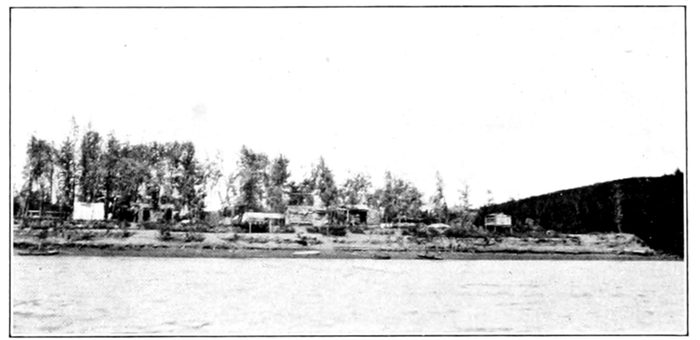
Past Old Minto, a little Indian village, a few little log houses in a row facing the river, with a wheel fish trap in front (pl. 1, a). Later a few Indian houses and a "road house" with a store at Tolovana. Most Indians there (and elsewhere here) died of the "flu" in 1918, the bodies being left and later buried by the Government. A few isolated little Indian camps.
The boat ties to trees along the banks. No docks or anything of that nature. Not many mosquitoes yet, more horseflies, which, however, do not bother man very much.
After reaching Hot Springs (right bank), there is seen a long range of more or less forested, fairly steep-sloped hills along the right bank, coming right down to the water's edge for miles, with bush and forested flats opposite. At the end of one of the ravines with a little stream, right on the bank, remnants of a little glacier melting very slowly in the sun. Strange contrast, ice and green touching. Boat making good time along the hills.
June 18. Hardly any sleep. Sun set after 10 and rose about 2.30, with no more than dusk between. Then heat in the cabin, and above all the noises. The boat stuck five hours on a bar and there were all sorts of jerks and shudders and calls.
Flats again on both sides, but hills beyond, with just one little spot of snow. Will be warm day again.
ANCIENT MAN
Prospects of old remains of man all along the river are slight if any. Old silt flats have doubtless been mostly washed away (as now) and rebuilt. Only on the older parts, now often far from water, could anything remain and there it is all a jungle of forest with undergrowth, with all surface traces absent (no stone, no shell), and no one here to find things accidentally. As to the hills that approach the river, the slopes (shales, overlain by what looks like stratified mud and silt rock) are mostly of recent exposure, and have doubtless been receding slowly through erosion, so that the bank line along them is not old; and their valleys are few, narrow, and were higher formerly as well as more extended toward where the river flowed then. The only hopeful spot is about Hot Springs, where fossil animal remains are said to exist, but here nothing as yet has been noted suggesting ancient man.
June 18, 4 p. m. River getting broader. Some low dunes. In distance a range of bluish hills before us—the hills along the Yukon. Boat meandering from side to side. Every now and then a necessary steam blow-out of mud, or a short whistle, hurry of a man over the top of the barge and of two half-breeds along its side to the prow to test, with long pointed and graduated poles, the depth of the water, calling it out to the captain. The calls range from "no bottom" to "4 feet," at the latter of which the boat begins to touch and back water.
5 p. m. Arrived at Tanana, a cheerful looking town, extending over about half a mile along the right bank of the Yukon, here about 20 feet high; but now, with the gold rush over, rather "slack" on both business and population, as are all other Yukon towns. Somewhat disappointed with the Yukon—not as majestic here as expected. See storekeeper—introduced by captain. Hear good news. The Indians have a big potlatch at the mission, 2 miles above. Tanana Indians expected. And there will be many in attendance. Rumors of this potlatch were heard before, but this was the first definite information. Get on a little motor boat with Indians who were making some purchases, and go to the St. Thomas Episcopal Mission, Mr. Fullerton in charge.
THE INDIANS AT TANANA
The mission above Tanana is beautifully located on the elevated right Yukon bank, facing Nuklukhayet island and point, the latter, according to old reports, an old trading and meeting spot of the Kuchin tribes, and the confluence of the Tanana with the Yukon. The mission house, located on rising ground, the wooden church lower down, the cemetery a bit farther up, and the Indian village a bit farther downstream, with their colors and that of the luxuriant vegetation, form a picturesque cluster.
I am kindly received by Mr. Fullerton and his wife and given accommodation in their house. On the part of the good-sized Indian village everything is life and bustle and we soon are over. Motor launches owned and operated by the Indians in the river; dogs, scores of the big, half-wild, noisy sled dogs tied to stakes along the slope of the bank, fighting stray ones, barking in whole outbursts, feeding on smelly fish, or digging cooling holes into the bank in which they hide most of the body from the warm rays of the sun; and many Indians, about 400 in all, in whole families, in houses, large canvas tents, cooking, eating, visiting—a busy multitude, but with white man's clothes, utensils, etc., not nearly so interesting as a group of more primitive Indians would be.
Walk, visit, talk, and observe. Note many mix-bloods, especially among the younger ones and the children. Among the full bloods, many, about one-half, with features reminding more or less of Eskimoid; but a few typically Indian, i. e., like most of the States Indians.
Medium stature, substantial but not massive build, quite a few of the older women stout. Color of full bloods generally near medium brown, features regular Indian but not exaggerated, noses rather low especially in upper half, eyes and hair Indian. Epicanthus not excessive in children, absent in adults (traces in younger women), eyes not markedly oblique. Behavior, Indian.
The more pronounced Eskimoids have flatter and longer faces, more oblique eyes, and more marked epicanthus. They should come, it would seem, from Eskimo admixture. The Tanana Indians (Nenana) did not, so far as seen, show such physiognomies.
Toward evening, and especially after supper, natives sing and dance. Songs of Indian characteristics, and yet different from those in south; some more expressive. A song "for dead mother," very sad, affects some to crying aloud (a woman, a man). A wash song—a row of women and even some men imitating, standing in a row, the movements in washing, while others sing; humorous. A dance in a line, curving to a circle, of a more typical Indian character. Late at night, a war dance, with much supple contortion. Also other songs and dances up to 2.30 a. m.—heard in bed.
June 19. With dogs barking and whining and Indians singing, got little rest. All Indians sleep until afternoon. No chance of doing anything, so go down to town to get instruments and blanks. Find that storekeeper has an old stone ax—sells it to me for $1. Also tells of a farmer who has one—go there with the boat and obtain it as a gift; told of another one—a Finn—has two, sells them for $1. Come from the gravelly bank of the river or are dug out in gardening. There may well have been old settlements in this favorable location. After return, visit some tents to see sick. Much sickness—eyes, tuberculosis—now and then probably syphilis.
Indians relatively civilized, more than expected, and most speak tolerable English. Have flags, guns, sleep in some cases on iron beds and under mosquito netting, smoke cigarettes and cigars; and even play fiddles. Of course some have also learned the white man's cupidity and vices.
This day I met with something unexpected, due to perversity of mix-breed nature. Seeing so many Indians present, and after a good reception by them the evening preceding, I thought of utilizing the occasion for taking some measurements. I therefore mentioned the thing to some of the head men shortly after my arrival and receiving what seemed assent, went to-day to Tanana to get my instruments. On coming back and finding a few of the old men, who were quite friendly, I invited them into the "kashim" (community house) and began to question them on old sites, etc., when in came, probably somewhat under the influence of liquor, a mix-breed to whom I had been introduced the night before and who at that time acted quite civilly, but now coming forward began rather loudly and offensively to question about what I wanted here and about authority, giving me to understand at last quite plainly that he wanted to "be paid" if I was to take any measurements. He claimed to be one of the "chiefs," and I would not be allowed to do anything without his help. His harangue quite disturbed the other Indians, who evidently were both ashamed and afraid of the fellow. And as I would not be coerced into employing and paying him, and there being no one, as I learned, of supreme authority, the "chief" of these Indians being little more than a figurehead, it was decided to give up the attempt at measurements. The rest of the visit was therefore given to further observations and to the witnessing of the potlatch. Chief Joseph (pl. 14), nominally the head of these Yukon Indians, expressed his sorrow and tried to make amends by offering himself.
The potlatch was evidently in the main a social gathering of the Yukon Indians, with the Tanana natives as visitors. It consisted mainly of eating, singing, and dancing, to be terminated by a big "give-away." This latter was witnessed. It proved a disappointing and rather senseless affair. The whole transaction consists in the buying and gathering, and on this occasion giving away, of all sorts of objects, by some one, or several, who have lost a husband, wife, mother, etc., during the preceding year. The possessions of the deceased are included in this and doubtless often transmit disease. All the color of the observance is now gone. The goods—blankets, clothing, fabrics, guns, and many other objects, even pieces of furniture, trunks, or stoves—are gathered in the open and when the time comes are one after another selected by those dispensing and brought to this or that man or woman of those who have gathered around. No song, no ceremony, no talks, no thanking, no "wake" following. Just a poor shadow of something that formerly may have been a tragic, memorable, and meaning occasion.
Returned to Tanana near 10 p. m. and found lodging with a storekeeper who kept a "hotel." Got a big room, big bed, and when store closed was alone in the house, the storekeeper sleeping elsewhere.
June 20. But, Alaska was evidently not made for sleepers. Had not a wink until after 3 a. m.—daylight, people talking loud and walking on the board walk outside, and heard so clearly in my room—loud-laughing girls, the dogs, and at last another boat with its siren; and every now and then a singing mosquito trying to get at me through even the small opening left under the sheet for breathing—there being no netting. Finally doze off, to wake near 9 a. m., but everything closed, deadlike. However, go to a little frame house for breakfast, and in waiting until it is made find myself with two elderly men who go to-day down the river with their boats. One is a former store clerk, etc., and now an "optician"—peddles eyeglasses down the river; the other was a prospector, miner, and blacksmith, now an itinerant "jeweler" and a reputed "hootch" peddler. As the latter—otherwise a pretty good fellow—has a good-sized though old boat, arrange to go down with him. See the marshal, storekeeper, settle with my hotel man (had to go at 11 to awake him), and ready to start.
The outfit is largely homemade, not imposing, old, unpainted, and unfit for the rough—but it could be worse. It consists of a scow, a low, flat-bottomed boat, partly covered with canvas roof on birch hoops, in which Peake (the owner) carries fresh meat to some one, a stove, dishes, bedding, and many other things; and the motor boat proper, in which there is little room except for the machine and its tender. The latter sits on a soap box; I, on a seat extemporized from a cylindrical piece of firewood with a little board across it, with my two boxes and bedding within easy reach. Sit in front of the scow, except when driven back by spray. But our motor works and so we start quite well at some time after 11. The arrangement is to stop at every white man's camp or settlement down to Ruby. I could have gone on a better boat with its owner, but they charge here $15 a day, with "keep," and twice the amount for the return of the man and the boat, which is beyond my resources.
Tanana—Ruby. The river is clearer than the Tanana, and much broader. It is a great fine stream and its shores, while mostly still low on the left, on the right rise here and there into moderate loess bluffs, far beyond which are seen higher elevations and bluish forested mountains. All covered with poplar and spruce.
2.15 p. m. Wind has so increased that the scow bumps and squeaks and there is danger of opening its seams. Therefore side to the beach and make lunch—a roast of fat pork, over-salted, canned spinach, dry bread, and black coffee. All on a simple, old, but efficient little stove in the boat. Our companion, the oculist, rides not with us but in a nice little green canoe with a plaything of a gasoline motor fastened to the backboard, but we all eat and sleep together.
But a few small Indian camps seen, and no white man's house. Soon after lunch, however, approach "The Old Station," where there are a few Indian houses, and later a white man's place (Burchell's). Stop at the latter. Learn that we are 20 miles from Tanana and on a 5-mile-long channel. There are here 15 to 40 feet high loess-like (silt) bluffs with a flat on the top, which latter was from far back one of the most important sites of the Indians of these regions. Mr. Burchell and his partner kindly take me back, with their better boat, to the main old site. Many old graves there, a few still marked. Traces of dugouts (birch-bark lined), houses, caches, etc., from Burchell's place to old main site. Important place that deserves to be thoroughly excavated, though this will entail no little work. Site was of the choicest, dominant, healthy. Connects by a trail, still traceable, with the Koyukuk region.
There are said to be no traces of pottery in any of these parts. But average to very large stone axes are washed out occasionally from the banks, and other articles are dug out (long ivory spear, bone scraper, etc.). Promise of bones, etc., by Mr. Burchell.
One hundred miles more to Ruby. Near 8 p. m. start again—sun still high, little wind—endeavor to get to the "bone yard," a great bank bearing fossils. Fine clean scenery, flat on left, flat to elevated with grey-blue mountainous beyond on right. Water now calm and we make good progress. Very few camps—dogs on the beach, fish-drying racks a little farther, then a little log cabin and perhaps a tent, with somewhere near by in the river the inevitable fish wheel, turning slowly with the current.
Had supper at Burchell's; white fish, boiled potato, coffee, some canned greens.
Scenery in spots precious, virginal, flat at the river, elevated behind, foreground covered by the lighter green of poplars and birches, with upright, somber, dark spruce behind. Sun on the right, half moon on the left, and river like a big glassy lake, just rippling a little here and there. Cooler—need a coat. On right, getting gradually nearer the mountains.
Near 10 p. m. Sun still above horizon. On left a long (several miles), mostly wooded, but here and there denuded, palisade-like bank, apparently 200-400 feet high—the "graveyard."
Monday, June 21. Just at sunset last night—after 10 o'clock—came to the "bone yard" bank—a long curving line of loess bluffs 100 to 300 feet high, steep right to water's edge, riven by many ravines. Lowest third (approximately) light compact loess; then a thick layer of river sand (stratified more or less) and small gravel, then from one-third to nearly two-fifths of darker loess. In spots quite dark, frozen, but on surface melting, "running," also tumbling in smaller or larger masses. Wherever darker there emanates from it and spreads far out over the river a decided mummy-like smell. Too late to photograph from boat, and no other place available. Also impracticable to explore with any detail—would take several days and be a difficult work. The bluffs become gradually lower downstream. No bones seen from boat, but mostly were not near enough to discern. A remarkable formation, in many ways, and in need of masterly study as well as description.
Night on a low gravelly and pebbly beach. Many mosquitoes. Mosquito netting found bad—sides too short (gave directions, but they were disregarded) and mesh not small enough. In a short time impossible to stay under. Supplemented by old netting of Mr. Peake, who will sleep under his canvas in the boat; but the old dirty net has holes in it and the mosquitoes keep on coming through the two. Fighting them until some time after midnight, then under all my things—netting, blanket, clothes—find some rest, sleeping until 4.30 a. m. After that—full day, of course—sleep impossible. The "optician," who slept well under proper Alaska netting, gets up, wakes my man; we both get up, shake, roll up bedding, have a cat-wash, then breakfast, and at 6.30 off once more along the beautiful but not hospitable river.
Inquiry at a local white man's cabin about fossils and Indian things negative—has paid no attention, and fossil bones that he sometimes comes across generally not in good state of preservation.
Right bank now hilly, with greater hills and then mountains behind. Warm, river smooth, just a light breeze. How puny we are in all this greatness.
A lot of trouble develops with the engine to-day—bad pump. Will not get to Ruby until evening. Meat, on which I must sit occasionally, begins to smell, and there are numerous horseflies, probably attracted by the smell.
Four p. m. Visit Kokrines, on a high bank, native village, cemetery. Photograph some natives, are good natured, talk pidgin English. Clearly considerable old Eskimo admixture, but the substratum and main portion is Indian. All kind and cheerful here, glad to have pictures taken. Only white man is a "road-house" keeper; i. e., storekeeper. Store, however, poorly stocked, probably in all not over $200 worth of goods. "Optician," who is hoggish, has headache, but eats and drinks all he can nevertheless. "Jeweler" repaired his pump, and so we are once more on the way—35 miles more to Ruby. No trace of any relics at Kokrines.
River now a mile wide, with many "slews" (side channels, sloughs), and many low, flat, forested islands. Mountains to right, higher, traces of snow. Smoke wall from forest fire advancing from the west—now also smell. Islands beautiful, fresh colors and clean—light grass on border, then green and grayish poplars, birches, and alder, from among which rise the blackish green spruces. Little native fishing camps a mile or two apart, right bank—on left wilderness of flats, as usual.
A few miles above Ruby conditions change—high bluffs (rocky) now on left, flat on right side. Ruby, from a distance and after the loneliness of the day, looks quite a little town on the left bank, at the base of the higher ground.
Ruby
June 22-23. Our approach to Ruby was very modest. With Mr. Peake paid off, we just sided against and tied to the bank, on which are the lowest houses of the village, and carried out my boxes and bedding on the bank. There two or three men were idly watching our arrival. I asked about the local marshal, to whom I had a note, and had my things carried to the combined post office and hotel. In almost no time I meet Mr. Thomas H. Long, the marshal, become acquainted with the people about, tell my mission, and begin to collect. It does not take long for one properly introduced to be thoroughly and warmly at home in Alaska. The first specimen I get is a fine fossilized mammoth molar. It is brought to me by Albert Verkinik, who was about to depart for some mines, but went back to get the tooth. And he asks no compensation.
The parts of two days spent at Ruby were quite profitable. Visiting, and in the jail, were several Indians who could be noted and photographed. At the old jail there were two skulls of Indians that were donated. The teacher had two of the characteristic Yukon two-grooved axes. The postmaster, Mr. H. E. Clarke, gave a collection of fresh animal skulls. Mr. Louis Pilback donated two mammoth molars, found 2 miles up the Yukon on Little Melozey Creek, about 8 feet deep, in the muck right over the gravel. Mrs. Monica Silas brought me a good old stone knife. Several of the men took me down to the beach to see a damaged fossil elephant skull, also to see some fossiliferous workings above the town. Another party took me a few miles up and across the river to see an Indian camp and near by some old burials. The collections were sent through parcel post; and the evening before departure I gave a lecture to an attentive and respectful audience.
The town itself, however, is now a mere damaged and crumbling shell of what it was in the heyday of its glory, during the gold rush. Many of the frame dwellings and stores are empty; the board sidewalks are rickety and with big holes; and in the air is a general lack of impetus.
June 23. Failing to find another suitable boat, I once more made an arrangement to go farther down the river with Mr. Peake and his friend. Peake's boat and scow were not much to look at, and the troubles with the engine, and with its owner's raw swearing at times, were somewhat trying; but for my purpose the outfit did well enough, and I was treated very well and given all needed opportunity to examine what was of importance on the banks. I was quite sorry when eventually we had to part company, and I know Mr. Peake has not forgotten my quest, for I heard of his talking about it to parties, with whom I was very glad to come in contact, on the Kuskokwim.
June 23. The sunny evening of my second busy day at Ruby, near 10 p. m., Peake unexpectedly comes to the hotel to tell me he will be ready to start to-night, on account of quiet water. His wash "is being ironed" and will be ready soon. The marshal comes in, calls the prisoners to take down my baggage, and at 10.15, after true, hearty good-byes, I am once more in the old scow. Then Peake goes for his wash, with an Indian woman, and does not come until near 11. River peaceful, sun shortly set, sky somewhat cloudy, forest fire on opposite shore below still smoking a great deal. Leaving good people at Ruby, who promise to help in the future. It is getting much cooler after a pretty warm day. Will lie on the hard boxes and try to get a little sleep.
Thursday, June 24. We went long into the night, then stopped at a lone cabin. Up timely, but slow start—it is 10.10 a. m. before we go. The time gained at night lost now—bad habits. Breeze up the river, occasionally strong, but not severe.
The cabin was the "Dutchman's," or Meyer's. He came out at 1 a. m. to meet us, at the bark of his big dogs, a good-hearted, weather-seared prospector, fisherman, and trapper of about 40, alone with his huskies. Asked me into his little log hut, prepared a place for my bedding on a frame, burned powder against the mosquitoes, brought out from cool "cellar" a bottle of root beer he brews, and then we went to sleep. But dogs kept waking us and Meyer went out several times to quiet them. Fall asleep at 3.20 and oblivious until near 7. Meyer forces on me six bottles of root beer, I leave him some prescriptions, and taking my bed roll we go down to the boat. My men still sleeping, as I expected. And then slow awakening, breakfast, and late starting.
Meyer never saw any Indian bones or stones, but promises cheerfully to watch for them hereafter and to make inquiries. Of course, he also, like so many in these lands, tells of a "prospect" of a gold find, and is quite confident he'll "make good." As usual, also, it is a "lead" that was "lost" and he believes he has found it. And all the time the gold is inside, not outside, of these hunters of the yellow star.
Hills on the right again; flat islands, banks, etc., on the left. Meyer's is 18 miles down from Ruby, right bank. About 5 miles farther down on the slopes of the right bank is a pretty little Indian graveyard (pl. 1, b), and a little lower down there are three now empty Indian huts.
Hills and mountains seen also now beyond the wide flats of the left bank. The hills on right, along which we pass, are more or less forested, but often just bushy and grassy. They rise to about 600 to 700 feet and the slopes are seldom steep. Along their base there are many elevated platforms, low swells, and nooks, that could have served of old—as they serve here and there now—for native habitation, though only few could have accommodated larger villages.
Pass an Indian camp—the inevitable staked dogs; a swimming boy—first being seen bathing in the open.
Whiskey Creek next. Sixty-two dogs, all along the bank, and each one-half or more in his own cooling hole; holes they dig down to near the frozen ground. A settler, and two Indians—a photograph. No relics or bones now, but will watch; promise also to save some animal skulls, etc.
Twelve o'clock. Off again. Day better now, less squally, warm.
Hills above and below lower and earthy—loess, at least much of it. The right shore is all along sunnier, higher, more beautiful, and more open to wind (less mosquitoes). These are the reasons, doubtless, why it was of old and is still the favored side for habitations by natives as well as whites.
Just before reaching "Old Lowden," overtaken by a rather crazily driven small motor boat with four young Indians, who hand us a crude message for the storekeeper at Galena, telling him that a baby in the camp is to die to-night. I offer to see the baby. Find a boy infant about one year or a little over, ill evidently with bronchitis. Father and mother, each about 30, sit over it brooding in dumb grief, each on one side. Respond not to my presence, and barely so to my questions. And when I begin to tell to the fellow who interprets and is some relative that the baby need not die, and what to do—I note that he is somewhat under the influence of liquor and a little flushed—to my dismay he begins to rant against me as a doctor and against the Government, and wants me perforce, seemingly, to say that the child is going to die and die to-night. There are two guns around and I almost anticipate his catching hold of one. The gist of the piecemeal talk is that they believe I am a Government doctor, who ought to stay four or five days with them and take over the child's treatment, and yet the fellow insists that the child will die before next morning. I do not know what they would say or do to the doctor if he undertook to stay and the child died—or if it recovered. It is dismal. They have the idea that the "Government" is obliged to do all sorts of things for them, without being clear just what, and that it does not do them. They believe, and try to say so, that I am sent and paid by the Government to treat them. Probably they have heard about the Government medical party that is to examine conditions along the river this summer, and think that I do not want to do or give what is necessary. I give all the possible advice, but there is plainly no inclination to follow it. I offer some medicine; they sneer at medicine. Even the father says he does not understand it or want it. They are all surly and in a dangerous, stupid mood. So there is nothing left but to go away as well as one may.
On way down the bank a woman is seen cleaning and cutting fish—knife steel, with wood or ivory handle, of the Chinese and Eskimo type. A porcupine, bloated, and with flies and maggots on it already about the nose, mouth, and eyes, lies next to the woman, and its turn will probably come next after the fish.
Have modest lunch—canned pears, a bit of cold bacon left from morning, a bit of cheese, and coffee; and start once more onward. So much beauty here, and such human discord.
3.30 p. m. Passing on right bank a line of bluffs, wholly of loess, about 200 feet high and approximately 4 miles long, and as if shaven with knife from top to water's edge. After that flats only on both sides, with but one hill far ahead of us.
Motor trouble again—same old pump; but not for long; in half an hour on again. A steamer upward passes us—like a stranger, and power.
Galena
A little town (village), on a flat promontory. An old consumptive storekeeper—no knowledge of any old implements or skeletal remains. Lowden village moved here due to mine opposite and better site. About 10 Indian houses here; inhabitants now mostly in fishing camps.
From Galena down, low shores and islands as on the Tanana, as far as can be seen, with mountains, grayish blue, in far distance (and only occasional glimpses). River never less than three-fourths of a mile and sometimes together with its sloughs and islands several miles broad. Some geese; occasional rabbit seen on land; otherwise but little life. First gulls.
The Indians at Ruby and Galena show here and there an Eskimoid type, with the younger nearly all mix bloods (with whites). Full bloods of same type as all along the river, brachycephalic, low to moderate high vault of head, moderate to medium (rarely above) stature, medium brown, noses not prominent, concavo-convex, moderately convex or nearly straight, Indian cast of the face, but quite a few more or less Eskimoid. Not very bright.
Sit in the bottom of the scow, in front, before the stove and make notes. When we stop, jump out to tie the boat; when leaving, push it off. Getting sunburnt dark. Forgetting once again that I have a stomach or any other organ. Only sleep, never fully, much less than ought to; but even that is somehow much more bearable here than it would be at home.
6.45 p. m. Suddenly, after a turn, confronted with a steep rocky promontory about 500 feet high—stratified mud rocks. On side, high above, a tall white cross; learn later an Indian murdered a bishop here. A little farther, on a flat below the slope, a small settlement. A remarkable landmark, known as the Bishop's Rock. Afterwards again flats, but some more elevated than before to the left. River like a great looking-glass. Same character of vegetation and colors as farther above, but details varied.
At Ruby had made a genuine, effective, Alaska mosquito netting, and so now feel quite independent of the pest; also have two bottles of mosquito oil, which helps. Fortunately on the water we are not bothered.
Toward night reach Koyukuk River, and later on, Koyukuk village, a pleasant row of houses, white and native, on a high bank. Here, at last, pass one good night, sleeping under good mosquito netting in the house and on the bed of an Italian trader. Also had good supper of salmon, and good breakfast of bacon and eggs, and so feel rested and strong.
Friday, June 25. But in the morning the sky is overcast and every now and then there is a loose shower. Of course my boon companions are not ready again until long after 9 o'clock, and then the engine will not go again, so a longer delay. They were inclined, in fact, to "lay over," but I urged them on. But they are determined if it rains a bit more to "tie to" somewhere. Fortunately there is no wind. About 3 miles below Koyukuk and its flats, the high bluffs with steep more or less shaved-like barren slopes recommence. A gloomy day.
About 7 miles down, after a large rocky promontory, a small graveyard on the side of a hill, with a little native camp about a third of a mile beyond.
10.45 a. m. Beautiful wooded great hills, 400 to 800 feet high, all along the right bank again, with large V-shaped valleys between. A fine, rounded, slightly more than usually elevated island ahead. Left banks flat.
Sun coming out a little; cool, but not unpleasant. No more showers, river smooth, boat making time. Blue hazy mountains far to the left front.
Hills to right rocky, strata horizontal to warped, mud rocks, broad banks of sandy, gravelly or mucky materials, not consolidated, between hard strata.
Now and then a small Indian camp, usually two or three tents, Indians, dogs, boats; some drying fish (not much).
11.00 a. m. Another isolated little graveyard, right slope, near an old camp.
There is no possibility now of excavating any of these graveyards, for the Indians are in unpleasant disposition toward the Government for various reasons. But such a place as that near Burchell's could be excavated as soon as conditions improve. Also that above Ruby and another opposite and just below Ruby. There are no longer any superstructures left at these (or but traces), and the graves, as seen above Ruby, are near (within 2 feet of) the surface.
No trace or indication of anything older than the double-grooved ax culture has thus far been seen anywhere in the valley; and large stretches of present banks are quite barren.
As we approach Nulato the horizon before us becomes hilly and mountainous. The sun is now fully out and its warmth is very pleasant. Pass an Indian woman paddling a canoe; later an Indian family going upstream in a motor boat. Most of these Indians possess a motor boat of some sort, and know how to run it, though it is not in their nature to be overcareful.
Nulato (Pl. 1, b)
Arrive midday. Quite a village, as usual along the water front on a high bank. Large fancy modern surface burial ground with brightly painted boxes and flying flags on a hill to the right. Met by local marshal and doctor; my things are taken to a little hospital. Natives here have poor reputation, but now said to be better. Boys nearly all mix bloods. Several men and women show Eskimo type, but majority are Indian to somewhat Eskimoid. Soon find they are not very well disposed—want pay for everything, and much pay. Have a few specimens, but to obtain anything from them is difficult. Have been spoiled.
A visit with the marshal to the site of old Nulato on the proximate point; nothing there, just a rabbit's skull and a lot of mosquitoes. Photograph old graveyard (that of old Nulato), on the distal point beyond the creek.
Mr. Steinhauser, trader, of Czech descent, helpful and kind. But nothing further to do here. Steamer that was to be here to-night or to-morrow will not arrive, just learned, until Tuesday (this is Friday); and so must engage a little gasoline boat to the next station, Kaltag, 40 miles down the river.
Sleep under my new netting in the hospital. In the morning, after parting with doctor and marshal, start 8.30 a. m. Boat little, shaky, run by a half-breed boy of about 18. My old scow with Peake and his companion will stay a day longer. Partly cloudy, warm.
Pass flats, and come again to similar shaved-off bluffs like yesterday. We are now running close to the shore so that I can see everything. Flowers, but not many or many varieties.
9.50 a. m. Pass (about 8 miles from Nulato) a few burials (old boxes) on right slope. (Pl. 1, c.) Indian camp about one-half mile farther, and a few old abandoned huts and caches.
Everything on and along the river about the same as yesterday, except in little details. Sky clouded; light clouds, however. The boy with me has had good schooling (for a native) and is a good informer. But there is little of archeological or anthropological interest hereabouts. (Pl. 2, a.)
12.10 p. m. Another rounded island ahead of us; far beyond it grayish-blue hills and mountains. Six miles more to Kaltag. But little life here—a few small birds, a lone robin, a lone gull.
Kaltag
1.00 p. m. Kaltag in view—a small modern village on right bank, less than half the size of Nulato; a nearly compact row of log and plank houses. Nothing of any special interest seen from distance, and but little after landing. The old village used to be somewhat higher up the river.
There is an old abandoned site also just opposite the present Kaltag. Another site, "Klenkakaiuh," is, I am told, in the Kaiuh slough south of Kaltag, in a straight line about 10 miles, but no one there; and several other old villages in that region along that slough—same Indians as those of Kaltag. All of Kaltag go there on occasions, but do not live there permanently any more.
BUREAU OF AMERICAN ETHNOLOGY FORTY-SIXTH ANNUAL REPORT PLATE 1
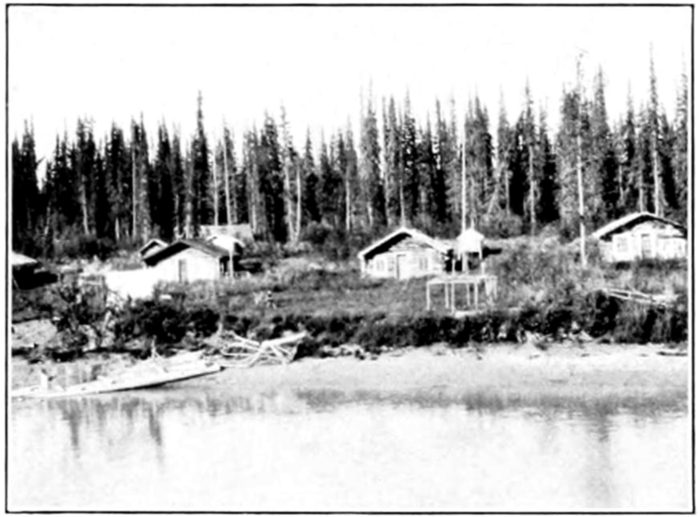
a, "Old Minto" on the Tanana. Indian village. (A. H., 1926)
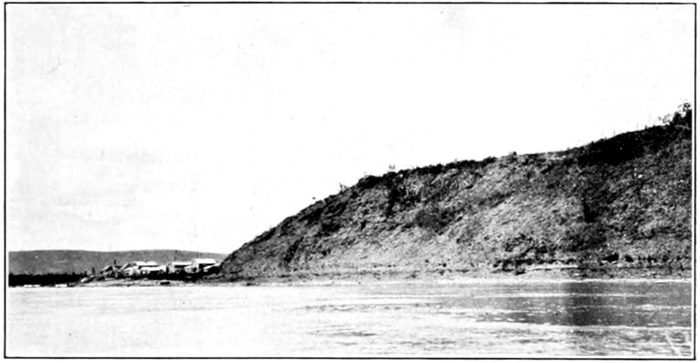
b, Present Nulato and its cemetery (on hill to right of village) from some distance up the river. (A. H., 1926)
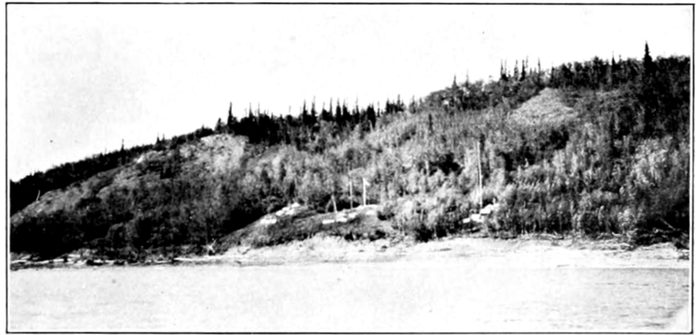
c, The Greyling River site, right bank, 22 miles above Anvik; site and graveyard (male skeleton) from top of knoll. (A. H., 1926)
BUREAU OF AMERICAN ETHNOLOGY FORTY-SIXTH ANNUAL REPORT PLATE 2
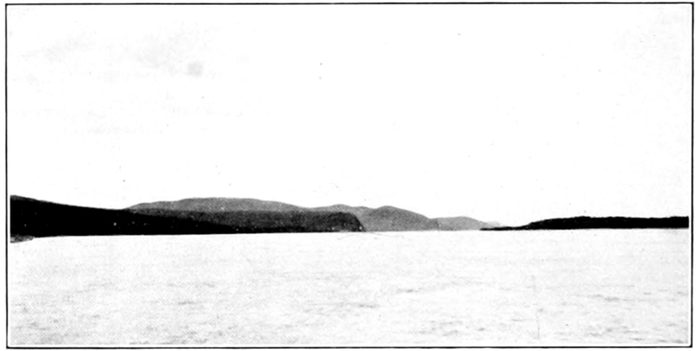
a, View on the Yukon from above Kaltag. (A. H., 1926)
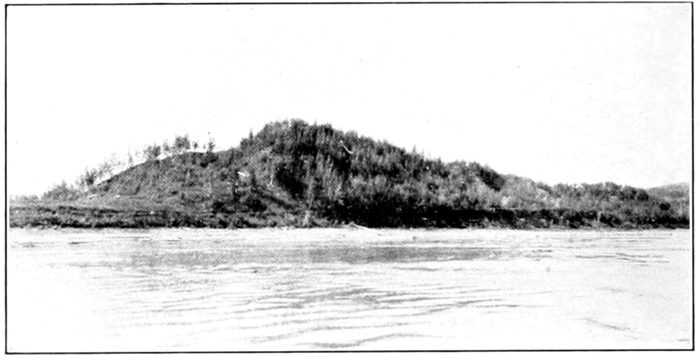
b, Indian burial ground, Middle Yukon. (A. H., 1926)
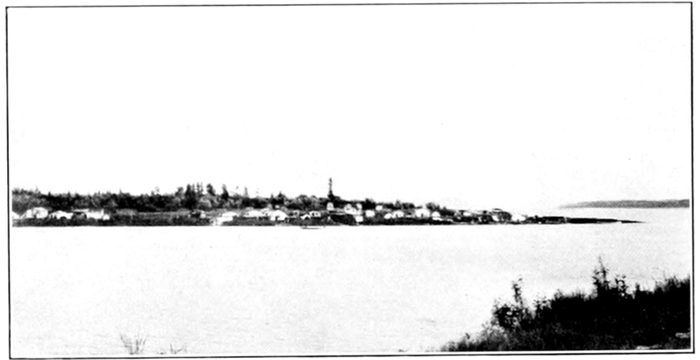
c, Anvik, from the mission. (A. H., 1926)
At Kaltag Eskimoid features already predominate and some of those seen are fully like Eskimo.
There is a tradition of an Asiatic (Chukchee) attempt at Kaltag once.
Later in the afternoon photograph some natives and go with Mr. Müller, the storekeeper, and Mr. McLeod, the intelligent local teacher, on the latter's boat, "hunting" along the banks up the stream. Meet an old Indian (Eskimo type) paddling a birch-bark canoe, said to be the only canoe of that sort now on the Yukon. About three-fourths of a mile above the village see caved bank and find a skull and bones—"split" old burial of a woman.
A canoe coming, so we all go farther up the beach, pretending to examine stones. It is only the boy who brought me, however, going home with some planks, and he grins knowingly.
After that we locate three exposed coffins, two undisturbed and covered with sod. These two, for fear of irritating the natives, are left. But the third is wrapped only in birch bark. It was a powerful woman. With her a bone tool and a white man's spoon. With the burial that had tumbled out of the bank there were large blue and gray beads and three iron bracelets—reserved by the teacher.
I gather all the larger bones and we put them temporarily in a piece of canvas. It is hard to collect all—the men are apprehensive—it might be dangerous for them if detected. Everything smoothed as much as possible, and we go across the river to examine two fish nets belonging to the trader. One of these is found empty; but the other contains five large king salmon, 15 to 20 pounds each, three drowned, two still alive. The latter are hooked, hoisted to the edge of the boat, killed with a club, and, full of blood, thrown into the boat—great, stout, fine fish. To secrete our other findings from the natives the storekeeper gets a large bundle of grass and ties it to my package. We shall be bringing "medicine."
Arrive home, only to learn that against our information the river boat has left Tanana on schedule time, is now above Koyukuk, and is expected to arrive at Kaltag before 8 p. m. Hurriedly pack, a few more photographs, supper, and the smoke of the steamer begins to be visible. In a little while she is at the bank, my boxes are brought down, a greeting with old friends on the boat—the same boat (Jacobs) on which I went from Nenana to Tanana—and we start off for Anvik.
Mr. Müller, the trader at Kaltag, German by birth, has a young, fairly educated Eskimo wife, a good cook, housekeeper, and mother of one child. The child is an interesting white-Eskimo blend.
In his store Mr. Müller showed me a good-sized heavy bowl of red stone with a figure seated in a characteristic way near one end. The specimen was said to have come from an old site on the Kaiuh and is of the same type as that at the museum in Juneau and the two in the east, one at the Museum of the American Indian, New York, and the other at the University Museum, Philadelphia. Regrettably Mr. Müller would not part with the specimen. (See also p. 34.)
The natives of Kaltag, so far as seen, are more Eskimoid than those of any of the other settlements farther up the river.
Fine evening; sit with a passenger going to Nome, until late. Learn that the boat to St. Michael is waiting for this boat and will go right on—not suitable for my work. Also we are to stop but a few minutes at Anvik, where I am to meet Doctor Chapman, the missionary.
Sunday, June 27. About 5 a. m. arrive in the pretty cove of Anvik. Received on the bank by Doctor Chapman, the head of the local Episcopalian mission and school, and also the Anvik postmaster. The doctor for the present is alone, his wife and daughter having gone to Fairbanks, and so he is also the cook and everything. In a few minutes, with the help of some native boys, I am with my boxes in Doctor Chapman's house, and after the boat has left and the necessities connected with what she left attended to we have breakfast. I am soon made to feel as much as possible "at home," and we have a long conversation. Then see a number of chronic patients and incurables; attend a bit lengthy service in Doctor Chapman's near-by little church; have a lunch with the ladies at the school; visit the hill graveyard. They have reburied all the older remains and there is nothing left. Attend an afternoon service and give a talk to the congregation of about half a dozen whites and two dozen more or less Eskimoid Indians on the Indians and our endeavors; and then do some writing, ending the day by going out for about a mile and a half along the banks of the Anvik River, looking in vain for signs of something older, human or animal. (Pl. 2, c.)
There are many and bad gnats here just now—how bad I only learned later, when I found my whole body covered with patches of their bites; and also many mosquitoes, which proved particularly obnoxious during the lunch. As the doctor is alone, the three excellent white ladies of the school, matron and teachers, invited us, as already mentioned, to lunch with them. We had vegetable soup, a bit of cheese, two crackers each, a piece of cake, and tea. But I chose an outlandish chair the seat of which was made of strips of hide with spaces between; and from the beginning of the lunch to its end there was a struggle between the proprieties of the occasion and the mosquitoes that kept on biting me through the spaces in the seat. Chairs of this type, and I finally told that to the ladies to explain my seeming restlessness during the meal, should be outlawed in Alaska.
The Anvik People
The Anvik people, it will be recalled, were the first Yukon natives seen by a white man. They were discovered in 1834 by Glazunof, and since then have occupied the same site, located favorably on a point between the Anvik and the Yukon Rivers. They belonged to the Inkalik tribe, a name given to them, according to Zagoskin, by the coast people and signifying "lousy," from the fact that they never cut their hair, which in consequence, presumably, harbored some parasites. Their village was the lowest larger settlement of the Indians on the Yukon, the Eskimo commencing soon after.
The Anviks to-day are clearly seen to be a hybrid lot. There are unmistakable signs of a prevalent old Eskimo mixture. The men are nearly all more or less Eskimoid, and even the head is not infrequently narrower, fairly long, jaws much developed. The women, however, show the Eskimo type less, and the children in a still smaller measure—they are much more Indian. Yet even some women and an occasional child are Eskimoid—face flat, long, lower jaw high, cheek bones prominent forward (like welts on each side of the nose), whole physiognomy recalling the Eskimo. The more Indianlike types resemble closely those of the upper Yukon. There is perceptible, too, some mixture with whites, particularly in the young.
To bed about 11. Attic warm and window can not be opened because of the insects. Sleep not very good; some mosquitoes in room anyway. Wake up after 3 and just begin to doze off again when the doctor gets up. About 4 he puts his shoes on—one can hear every sound throughout the frame house, even every yawn—and then goes to the kitchen where there soon comes the rattling of pots. At 4.30 comes up to bid me good morning and ask me if I am ready to get up and have breakfast. A man with a boat is to be ready at 6 to take me to some old site. So a little after 5 I get up, shave, dress and go down. Another night to make up for sometime, somewhere.
We finish breakfast and the doctor goes to look for the man, but everything deadlike, no one stirring anywhere. So I pack my stone specimens from the river above and the bones from Kaltag, etc. It is 8 a. m. and then at last Harry Lawrence, our man, appears—having understood to come about that time—and before long we start, in a good-sized boat, up the Yukon.
Day mostly cloudy but fairly good; no wind. Must use mosquito mixture all the time, even after I get on boat, but they quit later. Am standing on the back of the boat against and over the "house" over it—inside things shake too much and I can not see enough.
Passing by fish wheels—heaps of fish in their boxes—some just being caught and dumped in. Picturesque bluffs passed yesterday seen to be of volcanic stone, near basalt, not granite, with indication of minerals. Passing close to vertical cliffs of fissured and fragmented rocks 200 to 500 feet high—dangerous. Consolidated volcanic ashes with inclosure of many bowlders—fine lessons in geology. Slides of soil and vegetation here and there. Large spruces and altogether a richer vegetation since this particular rock region was reached. There was in fact a plain line of demarcation in the vegetation where the rocks changed.
Sleepy. Afraid to doze and fall off, so go inside. But there the motor thumps and shakes too much for a nap to be possible.
About 12 miles upstream from Anvik, on the north bank, the mineralized rocks and tufa suddenly cease, to be superseded by a line, several miles long, of sheared-off loess bluffs about 200 feet high. Here the vegetation changes very perceptibly. Two mammoth jaws obtained from these deposits have a few years ago been given to Mr. Gilmore, of the United States National Museum.
22 to 23 miles up the river, north bank, a fine large platform and an old native site. Many signs still of pit and tunnel houses. A little farther upstream a hill with abandoned burials. Excavate a grave on a promontory over the river—not very old—wet and not much left of soft parts, but succeed in getting the skeleton. Fine middle-aged adult, somewhat Eskimoid, about typical for this region. Carry down in a bag, dry on the beach gravel. Lunch on beach; cheese, bread, coffee. The site is known as that of the Greyling River. (Pl. 2, b.)
Start back a little after 3. Very warm day. River smooth. Sky looks like there might be a storm later.
Hear of pottery—40 years ago it was still made at Anvik. Was black, of poor quality. The women used to put feathers in the clay "to make the pots stronger." When buried it soon rotted and fell to pieces. In shapes and otherwise it was much like the Eskimo pottery. Its decorations consisted of nail or other impressions, in simple geometrical designs, particularly about the rim. It was rather gross, but better pieces did occur, though rarely.
It is becoming plain that there are no known traces of any really old settlements along the present banks of the Yukon; nothing beyond a few hundred years at most. If there was anything older no external signs of it have been noted, and no objects of it have ever been found. It seems certain that the stone implements thus far seen were used and made by the pre-Russian and probably even later Indians. They all belong to the polished-stone variety. No "paleolithic" type of instrument has yet been seen.
It is also evident that the Eskimo admixture and doubtless also cultural influence extended far up the river. The farther down the river, particularly from Ruby, the more the Eskimoid physical characteristics become marked and the Indian diluted, until at Anvik most, or at least much, physical and cultural, is clearly Eskimo.
Have further learned quite definitely that native villages on the Yukon were seldom if ever stable. Have been known (as at Kaltag and elsewhere) to have changed location as much as three times within the last few scores of years, though in general they keep to the same locality in a larger sense of the word. Anvik alone seems to have remained on the old site since the advent of the whites.
Anvik, Tuesday, June 29. Last night gave talk on evolution to white teachers, etc. Quite appreciated, regardless of previous state of mentality.
Caught up with some sleep, even though my attic room was so hot that the gum from the spruce boards was dropping down on me. Good breakfast with the doctor—canned grapefruit, corn flakes with canned milk, bread toasted in the oven, and coffee.
Pack up my Greyling skeleton—much drier to-day—and dispatch by parcel post, through the doctor as postmaster.
Photograph school children and village. Gnats bad and have to wear substantial underclothing (limbs are already full of dark red itching blotches where bitten by them) though it is a hot day again.
The full-blood and especially the slightly mixed children would be fine, not seldom lovely, were they fully healthy; but their lungs are often weak or there is some other tubercular trouble.
The color of the full-bloods, juvenile and others, on the body, is invariably submedium to near medium brown, the exposed parts darker; and the chest test (mine) for full-bloodedness holds true. The young are often good looking; the old rather ugly.
All adults fishing now, the fish running much since a day or two; all busy at the fish camps, not many, in the daytime especially, about the mission.
At noon air fills with haze—soon recognized as smoke from a fire which is located at only about a mile, and that with the wind, from the mission. We all hasten to some of the houses in the brush—find enough clearing about them for safety. The school here burned two years ago and so all are apprehensive. Natives from across the river hasten to their caches. Luckily not much wind.
After lunch children come running in saying they hear thunder; one girl saying in their usual choppy, picturesque way, "Outside is thunder"; another smaller one says, "It hollers above." Before long a sprinkle and then gradually more and more rain until there is a downpour followed by several thunderclaps (as with us) and then some more rain. That, of course, stops the fire from approaching closer and all is safe. Such storms are rare occurrences hereabouts.
My limbs are a sight from the gnats. Must apply Aseptinol. Worse than any mosquitoes; like the worst chiggers. Poisonous—some hemolytic substance, which causes also much itching, especially at night.
Arrange to leave to-morrow. Good people these, unpretentious, but white through and through.
Mr. Lawrence, the local trader, who with his boy was with me yesterday, is going to take me to an old site down the river and then to Holy Cross. Donates a fine old ivory arrow point from the site mentioned. Doctor Chapman gives three old dishes and two stone axes—haft on one of recent manufacture. The natives seem to have nothing of this nature, and no old site is near. The nearest is Bonasila, where we go to-morrow.
This is truly a fish country. Along the placid Anvik River fish smell everywhere—dead fish on shore here and there, or fish eggs, or offal.
Wednesday, June 30. Hazy and cool, 52° F. Take leave with friend, Doctor Chapman, then at school, and leave 8 a. m. for Bonasila.
The gnat pest was bad this morning—could hardly load my baggage; had to apply the smear again, but this helps only where put and for a time only.
Bonasila
Close to 10 a. m. arrive at the Bonasila site. Not much—just a low bank of the big river, not over 4 feet high in front, and a higher rank grass-covered flat with a little stream on the left and a hill on the right. But the flat is full of fossae of old barabras (pit and tunnel dwellings), all wood on surface gone; and there is a cemetery to the right and behind, on a slope.
Examine beach and banks minutely until 12. Modest lunch—two sandwiches, a bit of cake and tea—and then begin to examine the shore again. Soon after arrival finding bones of animals, some partly fossilized; beaver, deer, caribou, bear, fox, dog, etc., all species still living in Alaska, as found later, though no more in the immediate neighborhood.
Mosquitoes and gnats bad—use lot of oil. Begin soon to find remarkably primitive looking stone tools, knockers, scrapers, etc. Crawl through washed-down trees and brush. Many stones on the beach show signs of chipping or use. Very crude—a protolithic industry; but a few pieces better and showing polished edge. Also plenty of fragments of pottery, not seldom decorated (indented). Make quite a collection. And then, to cap it, find parts of human skeleton, doubtless washed out from the bank. Much missing, but a good bit recovered, and that bit is very striking. (See p. 156.) Also a cut bone (clean cut, as if by a sharp knife) in situ in the mud of the bank, and a little birch-bark basket still filled with mud from the bank, with later a larger basket of same nature in situ; could save but a piece. Conditions puzzling. Was there an older site under one more recent?
2 p. m. About 2 p. m. go to the cemetery. About a dozen burials recognizable. A pest of mosquitoes and gnats—Lawrence soon bleeds over face and neck, while I keep them off only by frequent smearing. He soon has to smear, too. Open five graves—placed above ground, wooden (split and no nails) boxes covered with earth and sod. Skeletons all in contracted position, head to the east and lying on right side. Some in poor condition. Three women, one man, one child. Gnats swarm in the moss and the graves, and with the smears, here and there a trickle of blood, the killed pests and the dust, we soon look lovely. But there is enough of interest. With each burial appears something—with the man two large blue Russian beads; first woman—a pottery lamp (or dish), iron knife; with the second two fire sticks, stone objects (sharpeners), partly decayed clay dish; with the third, a Russian bead and a birch-bark snuffbox; with the child a "killed" (?) glass bottle of old form and an iron flask; in the grave of an infant (bones gone) a Russian bead. A grave of a child—bones burned.
6.15 p. m. Rest must be left. Lawrence may be enabled to do some work in the fall. Leave 6.15; carry quite a lot—in sacks, gasoline cans, lard cans. Wonder how I shall be able to send things from Holy Cross, and what next. Cool, sky overcast whole day.
Holy Cross
Thursday, July 1. Slept on the floor of a little store last night at Ghost Creek. The Catholic mission at Holy Cross, with all sorts of room, about 1½ miles down, and where, though late and tired, I visited Father Jules Jetté, a renowned student of the dialects of the Yukon Indians, did not offer to accommodate me, and the trader in their village could only offer me a "bunk" in one little room with three other people. So after 10 p. m. we went down to the "Ghost Creek," where I was gladly given a little corner in the store of Alec Richardson. Of course there were whining dogs outside, right next to the store on both sides, and they sang at times (or howled) like wolves, whose blood they seem to carry. And a cat got closed in with me and was pulling dried fish about, which she chewed, most of the night it seemed. So there was not much sleep until from about 5 a. m. to 8.30, after the cat was chased out and the dogs got weary. Then no breakfast till near 9.30.
Went to mission again to see Father Jetté—he is not of the mission—a fine old Frenchman and scholar. He was not responsible for last night and anyway I was spoiled farther up the river. His meritorious work deserves to be known and published.
After a very simple lunch packed yesterday's collections from the Bonasila site—five boxes. The parcel post here alone will cost $20.40. How odd that the transportation of the collections of a Government institution must be paid for from the little appropriation received for scientific work to another department of the same Government.
It is cloudy, drizzly, cold. Am endeavoring to leave to-morrow, but they want $35 to the next station, and the boat does not leave for St. Michael until the 11th. Fortunately I am able to send away the collections, and there will surely be some way down the river.
Ghost Creek
July 1-2, 10.30 p. m. A night on the Yukon. (Pl. 3, a,) They have lit a powder against the mosquitoes. Smear the many gnat bites with Mentholatum—helps but for a while—and having now my fine meshed netting, my own bedding, and a clean pillow, I feel fine, safe from all the pests, and ready for a quiet night, all alone.
Commenced dozing off when a he-cat, who hid in the store at closing, begins to make all kinds of unnamable noises. Stand it for a while, but he does not stop and one could never sleep—so crawl out from the bed, catch the beast, and throw him out.
In again and settling down, when another cat—did not know there were two here—begins to mew and tries to force its way out under the door, which is about 2½ inches above the floor. Persists until I have to get up the second time. Throw that cat out and in bed once more.
In a minute, however, the dogs outside espied the cats and began a pandemonium of howls and yelps and barks. Try hard, but can not stand it. Moreover, the last cat got on the roof, where I hear him walking, and he seems in no hurry to get off. So finally have to get out, catch the cat on the edge of the roof, throw him back into the store, and to bed for another trial. But soon have to smear the body; the bites itch too much. The sleepiness is now quite gone. A mild amusement as to what next. It must be midnight or later now, and it has grown cold. One blanket is not sufficient. Doze off a little, wake up with cold, readjust blanket and flaps of bag, doze off a little again—the dogs commence to howl, just for a song this time, in two, three, then a unison. The bites itch bitterly, now here, now there. The sun has risen; it is real cold, probably no more than about 40° to 45° F. And so on until 5.30, when at last fall into a deep, dreamless sleep, regardless of light, cats, dogs, and everything and sleep until 8.30.
Wake up, can not believe my watch; but it goes, and so probably is right. But no one anywhere yet stirring.
Dress, wash a bit in the muddy river; head feels as if it had been knocked by something heavy. Make my "roll" of bedding and then work on notes, putting down faithfully what has transpired. About 9.30, at last, the storekeeper comes to say they overslept and that a cup of coffee will be ready before long.
Friday, July 2. "Ghost Creek" was named so because of many burials about the creek. The flat between the hills here is about three-fourths of a mile long by the water front, with rising slopes, and used to extend considerably farther out, but was "cut" or washed away by the river. It has been used for a village site and burial ground by the old Indians of the vicinity. As the banks tumble away, bone arrow points, barbed and not, stone scrapers, and other objects wash out. Graves are found in the ground as well as above it. Russian influence prevalent in the objects buried with the bodies, but site extends to pre-Russian time. Same type graves as at Bonasila, with slight local modifications.
At Bonasila the burials above ground were in boxes of hewn wood, joined somewhat as the logs in a log house, and without any base. The body inside was covered with birch bark (three or four pieces), then covered with the top planks, unfastened, and these in turn covered with about a foot of earth and sod. At Ghost Creek the same, but there is an undressed-stake base or platform on which the sides of the "coffin" rest and with somewhat less earth and sod on the top of the box. But graves differ here from underground and birch bark alone (no trace of wood, if any was ever there; but probably none used) to such aboveground as have iron nails and sawed planks. Here, as at Bonasila, a few simple articles are generally found buried at the head, and for these many of the graves were already despoiled and the skeletal remains scattered or reburied.
There appears to be no line of demarcation between the underground and aboveground graves; possibly the latter were winter burials, but this must be looked into further.
The bodies here, except the latest, are buried flexed. Exceptionally, both at Bonasila and here, the planks surrounding the grave were painted with some mineral pigments which resist decomposition better than the wood, and decorated in a very good native way with series of animals and men, caribou, bear, etc. Too faint to photograph, and too bulky and decayed to take away; but decoration much superior to ordinary Indian pictographs, and apparently connecting with the type of art of the northwest coast. It is of interest that practically the same decorated burials were seen by Dall among the Eskimo of Norton Sound (Unalaklik).[4] In this case it was probably the Indian habit that was adopted by the near-by Eskimo, for none of the more northern Eskimo practiced such burials. The habit was also known in southeastern Alaska. (Pl. 3, b.)
Jim Walker, the helpful local mix-breed trader, has dug out many of these graves (alone or with Harry Lawrence), and a good many of the objects are said to have been taken away by Father O'Hara, formerly of the Holy Cross Mission.
According to all indications the stone culture of Bonasila and of Ghost Creek (1½ miles upstream from Holy Cross) were related, both passing apparently into the Russian period, and that at Ghost Creek continuing down to our times, for there is still living here an old man who belongs to this place which once had a large village. Much could be done yet and saved in both places.
Saturday, July 3. At last slept, notwithstanding everything, and succeeded even in being warm.
Breakfast 8.30, for a wonder. Two soft-boiled Seattle eggs, two bits of toast with canned butter (not bad at all), some over-preserved raspberries, and a faded-looking nearly cold "flapjack" with sirup, also mediocre tea. But all goes here, and the stomach calls for no other attention than to fill it.
Finishing work, getting further information from the old Indian, writing, and waiting to go away with a trader to Paimute, the first all-Eskimo village, 25 miles farther down the river. Rains occasionally, but not very cold. Many gnats when wind moderates.
Lunch—canned sardines (in this land of fresh salmon!), a bit of toast, some canned fruit, and that unsavory tea.
Have utilized this day in a profitable manner. Have learned that there was another burial ground about half a mile farther upstream, behind an elevation. So got a rowboat and with Jim Walker's young boy rowed over. Had to wade through high grass over a wet flat, and then up the rank grass and bush-covered slope, and there found a number of old burials. All rifled, but most of the bones still there. So send boy back, on the quiet—there is above the store the camp of the old man with an old Indian woman and sick girl—for some boxes, and meanwhile collect. It is an unceasing struggle with the mosquitoes and gnats in the tall grass and weeds; but one after another I find what remains of the usual old box burials. The bones are mostly in good condition. The boy arrives with several empty gasoline boxes, we gather drier grass and moss, and pack right on the spot, eventually get to the boat, strike off as far as possible from the shore so none could see what is carried, and proceed to Walker's storehouse. Old Indian and his old crony nevertheless stand on bank and look long at us. In storehouse boxes closed, later delivered by the boy to the mail boat, and so that much is saved; for were it not collected, in a few years the weather, vegetation, and animals, human and other, would destroy everything.
BUREAU OF AMERICAN ETHNOLOGY FORTY-SIXTH ANNUAL REPORT PLATE 3
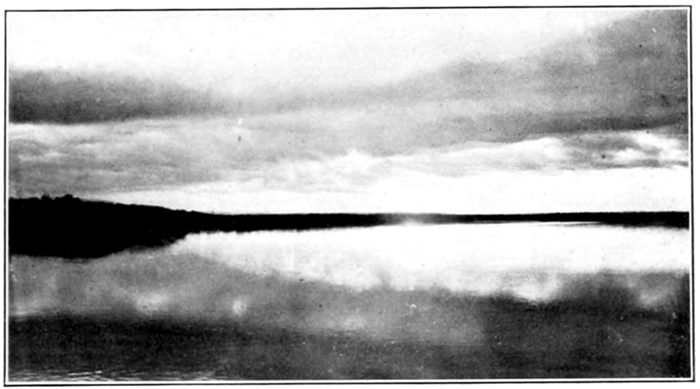
a, Midnight on the Yukon
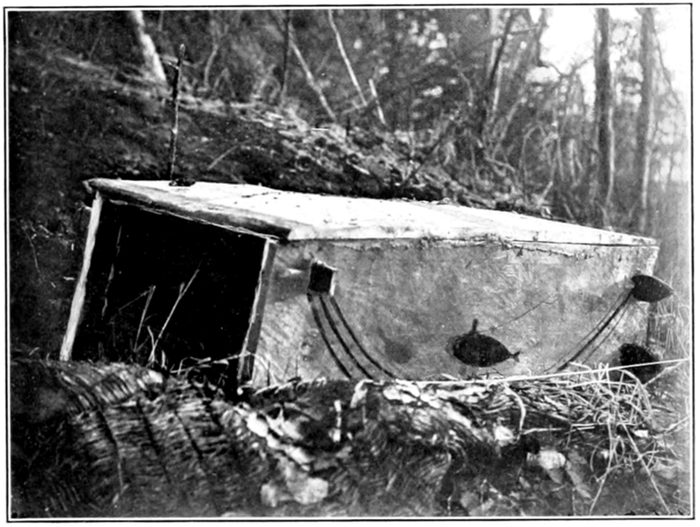
b, Lower middle Yukon: Painted burial box of a Yukon Indian (before 1884) said to have been a hunter of Bielugas (white whales), which used to ascend far up the Yukon
BUREAU OF AMERICAN ETHNOLOGY FORTY-SIXTH ANNUAL REPORT PLATE 4
a, Eskimo camp below Paimute, Yukon River
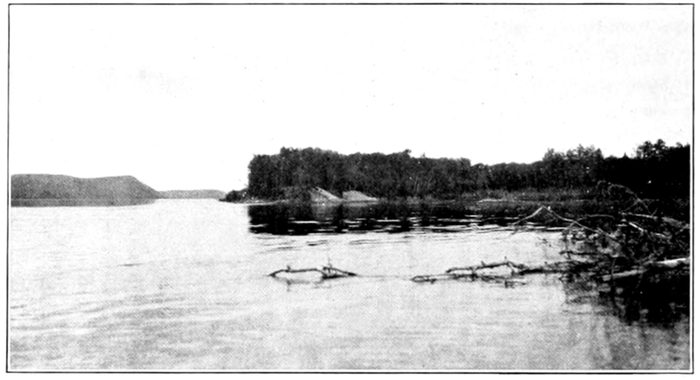
b, Old "protolithic" site 12 miles down from Paimute, right bank, just beyond "12-mile hill." (skull, bones, stones)
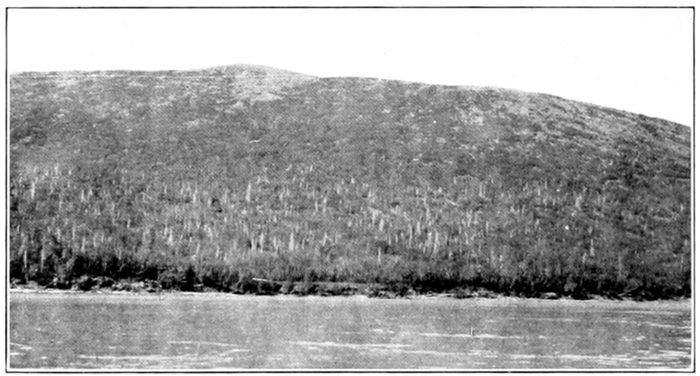
c, "Old" site in bank seen in middle of picture, 12 miles down from Paimute, opposite that shown in preceding figure. (A. H., 1926)
Moreover, the utmost care is taken always to leave everything in as good shape as found; and the remains taken will be treated so well and may give us so much that we need that there is no more hesitation in securing them than there would be on the part of a paleontologist in securing old bones for his purposes.
For supper, though it is still early, am invited by Simel, an elderly Jew mail carrier. Have fine meat-and-potato soup, lettuce-and-cucumber salad (even if the cucumbers from the Holy Cross hothouse are overripe and bitter), fresh (storage) meat, cooked dried apples, and poor but hot coffee—all seasoned with the best will and genuine, simple friendliness.
Max Simel, whose home is at Ophir, has been in this country 29 years, and "never needed to buy a quarter's worth of medicine." Has a wife in Seattle, also a daughter and a son; has not seen them for four years. Wants me to call on them and tell them I met him. With his companion, Paul Keating, of Holikachakat, gives me some interesting information. They tell me independently and then together of an occurrence that shows what may happen along this great river. A well-known white man and woman, prospectors on their mail route, have last year thawed and dug out a shaft, nearly 40 feet deep, through muck and silt, to the gravel, in which they hoped to get gold; and just before they reached the gravel they found a piece of calico, old and in bad condition, but still showing some of its design and color.
7 p. m. It rains, but wind has moderated, and so near 7 p. m. we start on our way farther down the river, stopping just long enough at Holy Cross to attend to my reservation for St. Michael. The agent has no idea when the boat will go—maybe the 11th, maybe not until the 14th or later.
Going on an old leaky scow with an elderly, faded, chewing, not very talkative but for all that very kindly and accommodating man, who with one hand holds the steering wheel and with the other most of the time keeps on bailing. He carries supplies for his store and I my outfit, camera, and umbrella. Sky has here and there cleared, even patches of sun appear on far-away clean-cut hills. Water not very rough; make fair time downstream. Banks flat now, river broad, some hills in distance.
8.00 p. m. Hills nearer ahead of us. Some of the flats look from distance like fine tree nurseries. Getting cool. Cloudy ahead. The banks flat and low, no good site for habitation. Not even fishing camps here—just long "cut-banks" (banks being cut by the river) and low beaches. Here and there new bars and islands that are being built by the river. No birds, no boats, just an occasional floating snag or a rare solitary gull.
FOOTNOTES:
Paimute
Paimute down river, I am told, has nothing but Eskimo; Holy Cross, but a few natives now, mainly Indian; above Holy Cross, Indian, Eskimo only as adapted or in admixture.
July 3, 8.30 p. m. Hills on right now right before us. Behind first a fish camp of the Holy Cross Mission natives. River narrows and bends. Two other fish camps become visible. Stop; damp, cold, smoke, fish smell, a few natives, Eskimo. River now like molten glass, but air damp and cold, and I must sit behind the engine and keep my hands over the hot exhaust pipe to keep somewhat comfortable.
Pass bulging bluffs on right—old stratified shales.
11.00 p. m. Arrive at our destination about 11 p. m. But a few log huts on the right side of the river, with few others and a primitive frame church in the back. A little store and a big storehouse (with skins, etc.), trader's house (log cabin) a few rods away. Open store, only to find that a pup had been forgotten there, made a lot of mess and dirt and ate most of one side of bacon.
12.00 p. m. Got to bed in the cabin at 12. Spread bed roll on two reindeer skins which, with fire in the stove, keep me fairly warm. Rain in night and several earth tremors—common in these parts; feel several light ones every night and a stronger one occasionally even in daytime (a big "fault" in the Alaskan range and a proximity to the Aleutian volcanic zone).
Awake before 8, but as it still rains nothing can be done, while my man within a few feet of me still snores; stay in blanket till 9. Modest breakfast at 10 a. m.
10.00 a. m. A little house cleaning—watch kitten clean windows of the many flies, which it eats; and then my man, a Swede by birth, sailor, self-taught painter (of ships and sea scenes), and musician (accordion), goes to bail out the boat. Still full of bites that itch and need a lot of Aseptinol, which in turn makes underwear look dreadful. And no bath possible.
Last night met some of the local Eskimo, full bloods, mostly from the Kuskokwim River. Strong, kinder than the Yukon Indians. But they differ but little in some cases from the latter. They are medium brown in color, hair exactly like the Indian, beard also—only the rather flat (not prominent) mid parts of the face, with rather long and narrow (upper two-thirds) nose, and the cheek bones protruding more or less forward, with face long (often), due to the vertical development of the jaws, helps to distinguish them as Eskimo. There is no clear line of demarcation between the Indian farther up the river and the Eskimo down here, yet in some here the Eskimo type is unmistakable. They have more epicanthus, flatter, longer, and stronger (more massive) face, stronger frame, rather submedium length of legs, and less brachycephalic (or more oblong) head, but not the characteristic, narrow and high, keel-shaped dome that one is used to associate with the Eskimo.
1 p. m. A little lunch—just a cup of coffee and a few crackers. Photograph two natives.
1.30 p. m. Start toward Russian Mission. Trader carries sugar in bags and tea for camps.
Near 2. Stop at an Eskimo camp, see sick baby, photograph a few individuals. Get an ax for a pocketbook—old man happy as a child at the exchange. Made another one happy this morning in payment for information with one of my steamer caps. (Pl. 4, a.)
Pass along the still continuing bulging hills on the right. They are forested over lower parts, barren, though mostly greenish, above. As usual flats on left, devoid of man. Occasionally a fish camp on right, or a small village, somewhat different, though in essentials like the Indian (more gregariousness noticeable—up river mostly individual or at most two or three families). Every favorable higher flat or low saddle among the hills on the right and facing the river (or a slough) is utilized by the natives, but such places are scarce.
The ax obtained looks as if it had been broken after found, to make of it a single-edge tool. Tumbled out of a bank. Old Eskimo knew not who made it. Found some miles below Paimute by the old man. Others found, but lost. Ivory arrow and spear points also known to natives, but no one now has any.
A mountain ahead of us. Sky clouded mostly, high diffuse vapors and low, heavy but separated cumuli in the east; one would expect soon a heavy rain. Visibility exceptionally good, horizons far away, uncommonly clear. Mountains sharply outlined against the sky.
About 12 miles below Paimute, on left, some higher banks (old silts and dunes). The ax from the old man had been found here. Stop. Find pottery 12 feet, charcoal 15 feet from surface. Also polished and worked stones. But most of bank has already been cut off and what remains shows no signs of man on the top. (Pl. 4, b.)
Cross river obliquely to right bank, just beyond last ("12-mile") hill. Find at once numerous evidences of stone work along the stony beach. In an hour have a fair collection, mainly rejects, but interesting. On top of bank find several mounds and ridges, doubtless dunes, though the one farthest up the river looks very much like a large oval man-made mound. Parts of two much-weathered skulls and one bone lay on the top of this. No definite marks of graves excepting perhaps in one instance. A sign of old clearing farther down, but no "barabras." A spot well worthy of exploration. It was, I learned a little later from Nick Williams, a native who used to act as a pilot on the river, the old mountain village or "Ingrega-miut," and the site is 12 miles downstream from Paimute. (Pl. 4, c.)
Beyond are flats and cut banks, both sides, but with hills (old water front) behind on the right and mountains in front. River here very wide.
Many of the worked stones, and occasionally, according to native information, skulls and bones, are washed out from the banks and deposited (rolling, etc.) lower on the beach in something like strata, and in that way evidence is being perverted. Some day a new bank or even a dune may be formed over these secondary deposits and a great source of possible future error be completed.
All the natives along the river (to here) like to bury on the lower slopes of near-by hills.
To bed on floor of kitchen tent at the fine, clean little place of Tucker's, at 10.30. At 1.30 the 20 dogs start a fine, sustained, unison howl song, and I seem to hear an approaching boat. As the Governor of Alaska is expected, slip on shoes and necktie, brush hair, and run out. There is a little boat at the little "dock" (the only one seen so far on the Yukon). Tucker and his son are already there, and I soon hear that the governor is on the boat, which is that of Mr. Townsend, of the Fish Commission. In a few minutes we meet, both in shirt sleeves. And I learn the Matanuska, the boat that was to take me from the Russian Mission to St. Michael, has broken down and is not coming. In her place, but no telling as to time, will be sent the Agnes, a smaller and slower boat, on which three people have already this season been "gassed" (overcome by the exhaust gases), one of them jumping into the river. She has accommodation for four persons at most, and that of the most primitive, they say. The governor fortunately gives me some hope that I may be picked up and taken down by the same boat which is taking him to Holy Cross. He also tells me of a skull for me at one of the stopping places, Old Hamilton. A frank, good, strong man.
Boat leaves in a few minutes. Back to bed, but now almost full daylight—also cold, and so no more than a doze until 6.15, at which time the boy comes to the kitchen where I was kindly accommodated to start fire and breakfast. So up with a drowsy head. At 7 breakfast—coffee, oatmeal, flapjacks, and good company. Everything about this place is neat, fresh, pleasing—the best individual place on the river. Cloudy, blustery, cool; can not start, so go 1½ miles down to Dogfish village, or I-ka-thloy-gia-miut—probably the same as Zagoskin's I-ka-lig-vig-miut. Only three or four families there now; nearly all the inhabitants died of influenza in 1900. But already before reaching the village, in examining the stones along the beach, I find some chipped ones, and they represent the same industry evidently as those at the two sites yesterday. Later find numerous chipped scrapers, pointed hammers, crude cutters and chisels, and a few axes. Make quite a collection, including a few objects found in possession of natives.
This is a good site, above high water. Must be old. Pottery also encountered occasionally by present occupants, but not one bead; little if any river cutting here for a long period. Worth exploration. Photograph another Indianlike Eskimo. Want to buy an old dish from an Eskimo, border inlaid with six white stones, shaped like an oblong lozenge with rounded corners, but he wants $20. Lunch all together, some Eskimo included, at Tucker's, and then as the wind moderates and the sun comes out, start for the Russian Mission. Mostly still clouds and cool, with some rain in the mountains to the right.
Finds and inquiries made at Dogfish village make it positive that the stone culture there is Eskimo, i. e., of the Eskimo of this region who are probably not a little mixed with Indians. Their head is but moderately oblong, not keel shaped. The majority, however, have Eskimo features.
But the cupid-bow (double-grooved) axes are not known to have been made by these people, and when used after being found or brought down from farther up the river they apparently were broken. One such example was seen already at Ruby—another one at Anvik—secured; and one found yesterday at Mountain village. The axes here are most often oblong, quadrilateral, without groove, or approaching the single-grooved axes of the Indians in the States.
July 6. Proceed down the river toward Russian Mission, examining the banks as closely as possible. Toward evening stop at "Gurtler's," a short distance above the mission.
Mr. Gurtler is a German by birth; his wife is half Indian, of Ruby. She, as well as her 14-year-old daughter, are neat, apt, and very industrious, quiet and nice mannered. With an Eskimo woman, she cleans and cuts up—a whole art of its own—on the average over 200 good-sized salmon a day. Clean place, very good smoking house—much superior to those up the river, except Tucker's.
Sleep in a clean bed of theirs; would much prefer my own and the hard floor, but fear to offend.
Russian Mission
Pack my stones and bones collected between here and Holy Cross, and after lunch go to Russian Mission. Meet Mr. Cris Betsch, the trader, and find him both friendly and anxious to help. Teacher and her mother invite me to supper. Before that Mr. Betsch calls in a number of the older men, and we have a talk about ancient things, but they know nothing worth while beyond a few score of years at most; they give me, however, some data and names of old villages.
A few years ago some human bones and skulls were dug up here and reburied. Eskimo readily agree to help us find them and to let me take them. Moreover, they are quite eager to dig up an old medicine man supposed to be buried under a good-sized (for this country) blue spruce. They get shovels, soon find some of the old bones and a damaged skull, and later on, with the help of information given by an elderly woman, uncover also a female skull. Uncover further the end of two birch-bark-covered coffins, from Russian time, and would readily dig them out did I not restrain them; as also with the medicine man. We shall probably get some such specimens from this locality later, so there is no need of disturbing the burials.
Mrs. Barrick, the teacher, gives us a "civilized" supper, at which I am introduced for the first time to a great and fine Yukon specialty, namely, smoked raw strips of king salmon, and find them excellent. Then a good talk with all, after which pack specimens—still somewhat damp, but it would be difficult to wait—deliver to the post, and am sent to my place around the hill at a little past 10 p. m. with an invitation by Mr. Betsch to go to-morrow to "the slough of the 32 kashims (council or communal house)," about 10 miles down the river. But I have already been promised by Gurtler to take me down to this place, and so I can not accept. Just now I need sleep.
July 7. After breakfast examine banks and beach along Gurtler's place and find two stone implements, two pieces of decorated pottery, and a bone of some animal. Wash, dry, and pack, then a cup of coffee—the Gurtler's have a habit of drinking a second cup at about 10 a. m. each day—and then, after some of the seemingly inevitable trouble with motor, start down the river. It rained yesterday; the clouds show low pressure; it is not warm and the water is somewhat rough.
Stop a bit at the mission to give Mrs. Barrick a fish and get a bag or two from Mr. Betsch, and then proceed. From the river the Russian Mission settlement is seen to be very favorably situated at the foot of the southern slope of a big hill. But the recency of the flat below and in front of the church and schoolhouse is clearly seen again. The site about where the church and school are may—in fact must, it is so favored—be a very old one, and doubtless a thorough excavation of the slope from the back of the houses upward would be both easy and very instructive. The place should by all means receive attention.
Reach and examine the "32 kashim slough," a beautiful side channel about 7 miles long; reach about 1½ miles from its entrance, examine banks and pass through jungle, find tracks of foxes and of a bear, also see one big beautiful red fox trotting ahead of us on the other beach—but not a trace of man. Examine also the "mounds" on Grand Island, but find them to be only dunes.
Lunch on the beach; remarkably few mosquitoes and no gnats; smoked raw salmon strips again, and coffee; and at 5 leave for home, it being impossible so late to go down to the end of the channel.
On return all going nicely until 5. Then, in a slough 3½ miles from the Russian Mission, after an examination of another likely site, breakdown of the motor. Do everything possible to make it go until about 8, but in vain. Then I take the crazy little rowboat that luckily we took with us, bail out the water with our shovel, and row to the mission for help. Get there about 9, send back a launch with some natives, have a little supper with the teacher, and row home around the hill, reaching Gurtler's near 11. In a few minutes the launch is towed in and all is well once more. Mr. Betsch got for us two good native "kantágs" or wooden dishes. Also we fix to go down to the "32 kashims" to-morrow once more with Mr. Betsch and the teacher.
July 8. Up a little after 6; breakfast; and then comes in a native from the mission with two letters and information that the Agnes, the little mail-carrier boat, has arrived during the night and is waiting for me to take me to Marshall and to Old Hamilton, whence another boat will take me in a day or two to St. Michael. So get ready in a minute, put my baggage on a native's boat, pay my bill, leave another lot of good friends, and row to the mission. There is the little dinghy Agnes with its "accommodation" for three passengers already two-thirds filled up, and towing two big logs as a freight. Put my things partly in a "bunk," partly on the roof, give good-byes to Betsch and the teacher, help to push off the boat which is stuck in the mud, and we are off for another Yukon chapter.
We pass by the lower end of the "32 kashim" slough—no sign of any site—all recently made flats. If there is anything left of the old sites it must be at the foot of the hills, or has been covered with silt. The site is so favorable that in all probability there was once there a good-sized settlement, but due to river action and the jungle it could not be located. Mr. Betsch visited the place that day, and again with some old natives on another occasion, without being more fortunate.
Cloudy, slightly drizzly day, no trace of sun, mists over the tops of the hills. Could not stand it in the boat, so sitting on my box on the roof of the boat, wrapped, due to the cold, in a blanket.
A little below the "32 kashim" slough a small stream enters from inland—a place to be examined; but this boat can not stop for such a purpose.
A half mile or so farther down a few graves and crosses, with remnants of a native habitation.
Over 3 miles down, just beyond first bluff, fine site, with low hills stretching far beyond it—now but a few empty, half-ruined native houses. Should be explored.
South of second rocky bluff a live camp, and farther down another.
The left side of the river is still all flats as far as one can see, but about 17 miles below Russian Mission human bones came out of a bank there (on a slough).
Marshall
At 3 p. m. reach Marshall, a little cheerful-looking mining town, high on a bank. See the place, identify the skeleton from the above-mentioned bank as that of a missing white man, see telegraph operator, postmaster, teacher, commissioner. Sun comes out, is warm. Almost no mosquitoes here and no gnats. Hills above and beyond town belong already to the coast range and are barren of trees, even largely bare of shrubs and bushes. Leave 4.30.