PHYSICAL ANTHROPOLOGY
Reading edition
Earlier Data
The previously published data on the western Eskimo are few in number and mostly not as well documented as would be desirable. There are, however, a good number of references to the physical characteristics of the people by explorers. The main of these are given below. These references in general are not of much scientific value, yet in some instances they approach this closely and are of considerable interest collectively.
1784, Cook:[67]
The inlet which we had now quitted, was distinguished by Captain Cook with the name of Prince William's Sound. * * * The natives whom we saw were in general of a middling stature, though many of them were under it. They were square or strong chested, with short thick necks, and large broad visages which were for the most part rather flat. The most disproportioned part of their body appeared to be their heads, which were of great magnitude. Their teeth were of a tolerable whiteness, broad, well set, and equal in size. Their noses had full round points, turned up at the tip; and their eyes, though not small, were scarcely proportioned to the largeness of their faces. They had black hair which was strong, straight, and thick. Their beards were in general thin or deficient, but the hairs growing about the lips, of those who have them, were bristly or stiff and often of a brownish color; and some of the elderly men had large, thick straight beards. * * * The complexion of some of the females, and of the children, is white without any mixture of red. Many of the men, whom we saw naked, had rather a swarthy cast, which was scarcely the effect of any stain, as it is not their custom to paint their bodies.
Vol. 3, page 31: All the Americans we had seen since our arrival on that coast (west coast of Alaska) had round, chubby faces, and high cheek bones, and were rather low of stature.
Ibid., page 72: Norton Sound.—The woman was short and squat and her visage was plump and round. * * * Her husband was well made and about 5 feet 2 inches in height. His hair was black and short, and he had but little beard. His complexion was of a light copper cast. * * * The teeth of both of them were black, and appeared as if they had been filed down level with the gums.
1821, Kotzebue:[68]
Kotzebue Sound.—The Americans [i. e., Eskimo] are of a middle size, robust make, and healthy appearance; their countenances * * * are characterized by small eyes and very high cheek bones.
1832, Beechey:[69]
The western Esquimaux appear to be intimately connected with the tribes inhabiting the northern and northeastern shores of America, in language, features, manners, and customs. They at the same time, in many respects, resemble the Tschutschi, from whom they are probably descended. * * *
They are taller in stature than the eastern Esquimaux, their average height being about 5 feet 7½ inches. They are also a better looking race, if I may judge from the natives I saw in Baffin's Bay, and from the portraits of others that have been published. At a comparatively early age, however, they (the women in particular) soon lose this comeliness, and old age is attended with a haggard and careworn countenance, rendered more unbecoming by sore eyes and by teeth worn to the gums by frequent mastication of hard substances.
1850, Latham:[70]
Physically the Eskimo is a Mongol and Asiatic.
The Eskimos of the Atlantic are not only easily distinguished from the tribes of American aborigines which lie to the south or west of them, and with which they come in contact, but they stand in strong contrast and opposition to them—a contrast and opposition exhibited equally in appearance, manners, language, and one which has had full justice done to it by those who have written on the subject.
It is not so with the Eskimos of Russian-America, and the parts that look upon the Pacific. These are so far from being separated by any broad and trenchant line of demarcation from the proper Indians or the so-called red race, that they pass gradually into it, and that in respect to their habits, manner, and appearance, equally. So far is this the case that he would be a bold man who should venture, in speaking of the southern tribes of Russian-America, to say here the Eskimo area ends and here a different area begins.
1853, Hooper:[71]
Kotzebue Sound Esquimeaux.—The men generally were taller than the average of Europeans, strongly built and well formed; some had well-marked features * * *. The women, were generally short, the visages of the younger ones tolerably good but * * * the very reverse was the case with the dames of more advanced age. Their figures inclined to the squat, their mien and expression promised intelligence and good nature. Although both sexes had in most instances the round flat face of the Mongolian cast, a few individuals possessed well-defined, though petite features, and all had fine eyes.
BUREAU OF AMERICAN ETHNOLOGY FORTY-SIXTH ANNUAL REPORT PLATE 31
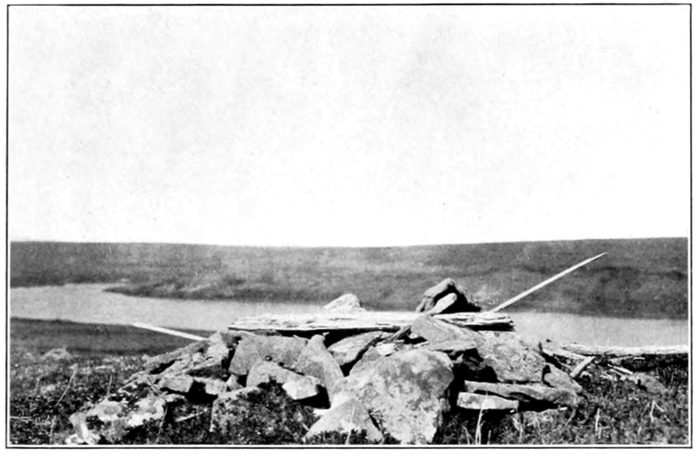
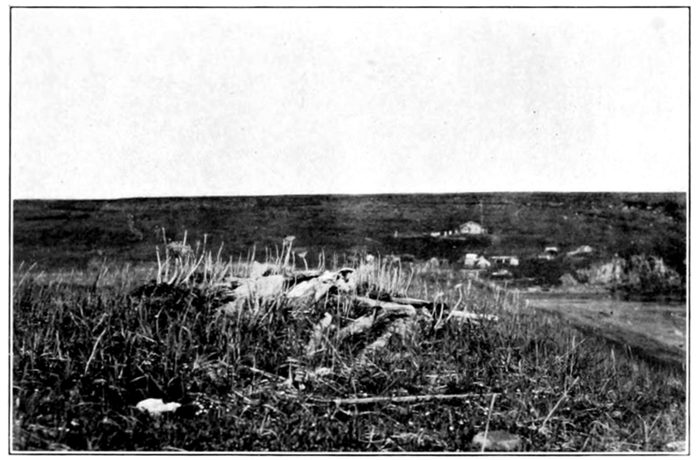
Graves at Nash Harbor, Nunivak Island
(Photos by Collins and Stewart, 1927.)
BUREAU OF AMERICAN ETHNOLOGY FORTY-SIXTH ANNUAL REPORT PLATE 32
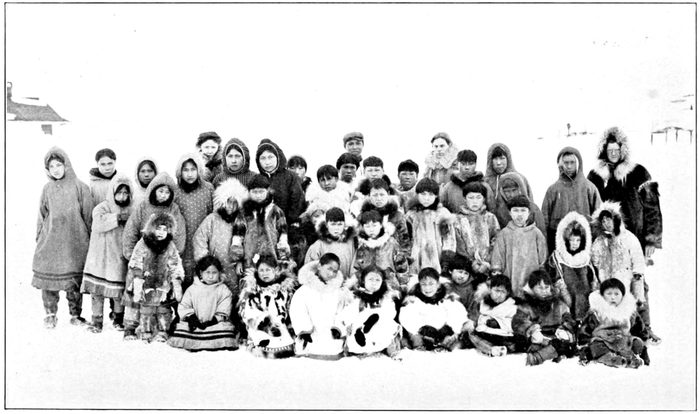
School Children at Wales
BUREAU OF AMERICAN ETHNOLOGY FORTY-SIXTH ANNUAL REPORT PLATE 33
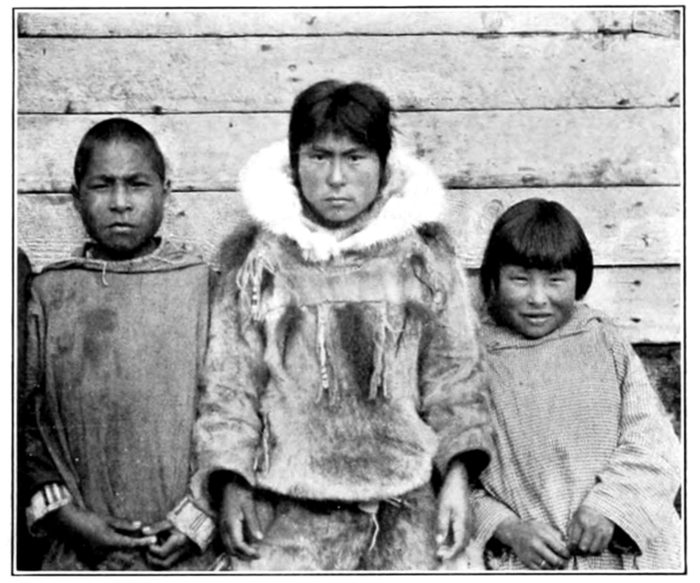
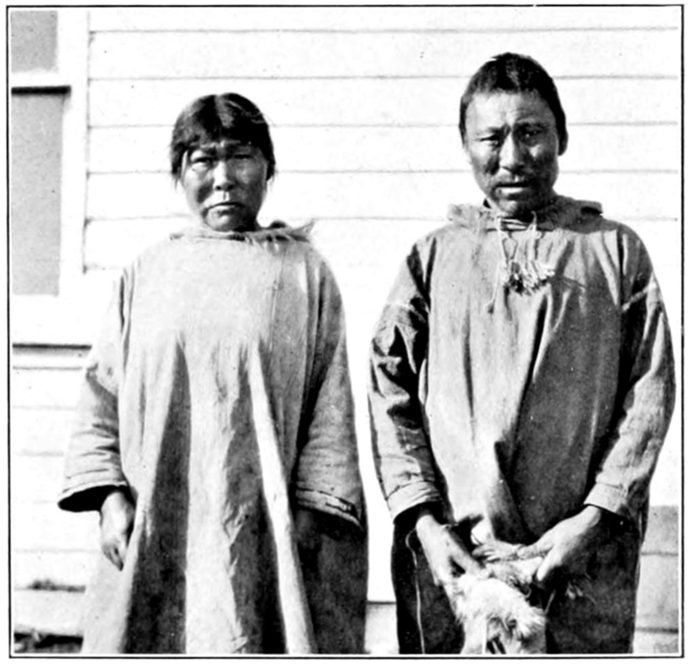
a, Children, Nunivak Island. (Photo by Collins and Stewart, 1927)
b, Adults, Nunivak Island. (Photo by Collins and Stewart, 1927)
BUREAU OF AMERICAN ETHNOLOGY FORTY-SIXTH ANNUAL REPORT PLATE 34
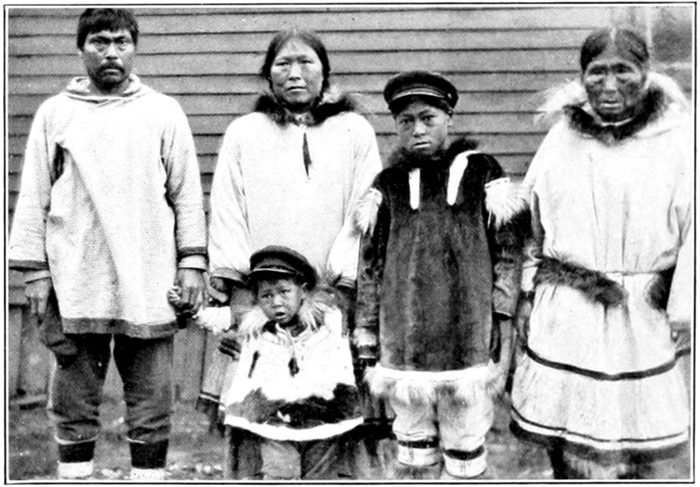
King Island Eskimo: A Family Group
BUREAU OF AMERICAN ETHNOLOGY FORTY-SIXTH ANNUAL REPORT PLATE 35
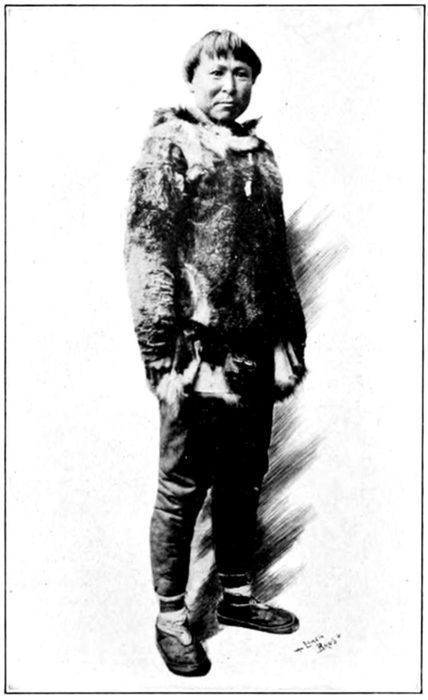
King Island Native
BUREAU OF AMERICAN ETHNOLOGY FORTY-SIXTH ANNUAL REPORT PLATE 36
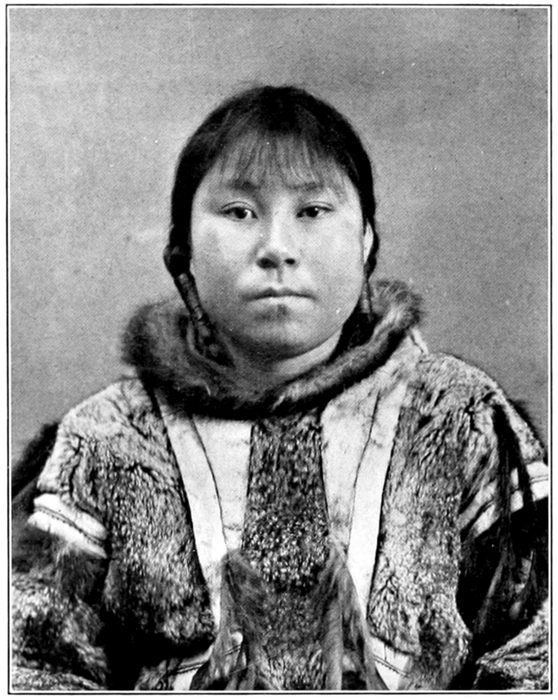
a, Young Eskimo woman, northern Bering Sea region. (Photo by Lomen Bros.)
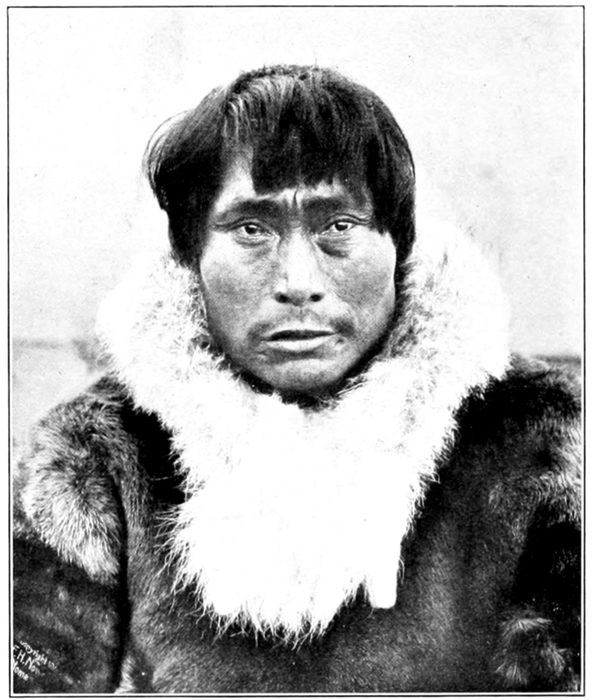
b, Eskimo, northern Bering Sea region. (Photo by F. H. Nowell.)
A Fine Full-blood Eskimo Pair, Northern Bering Sea Region
BUREAU OF AMERICAN ETHNOLOGY FORTY-SIXTH ANNUAL REPORT PLATE 37
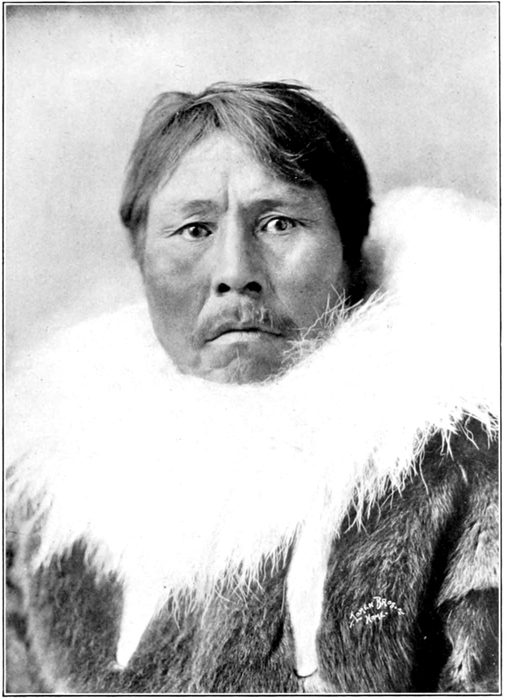
Typical Full-blood Eskimo. Northern Bering Sea Region
(Photo by Lomen Bros.)
BUREAU OF AMERICAN ETHNOLOGY FORTY-SIXTH ANNUAL REPORT PLATE 38
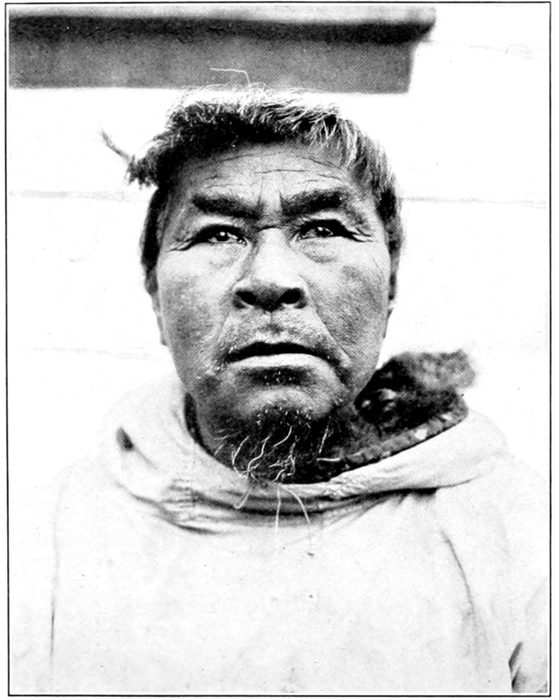
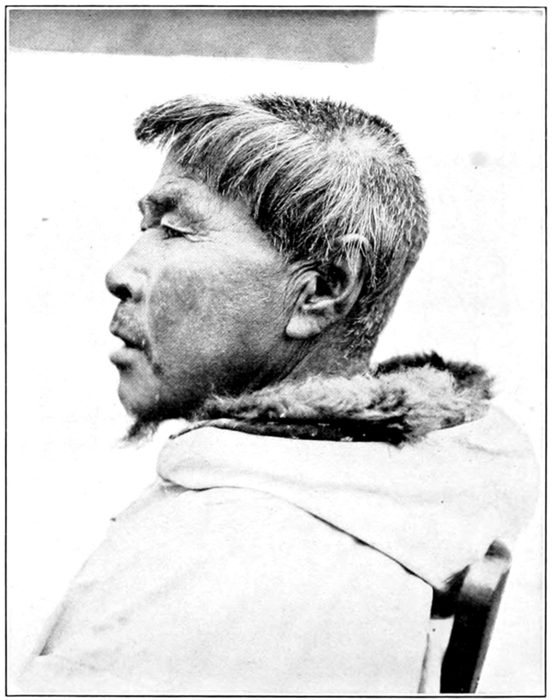
Elderly Man, St. Lawrence Island
(Photos by R. D. Moore, 1912. U.S.N.M.)
1853, Seemann, vol. II, pages 49-51:[72]
The Eskimos.—By comparing the accounts transmitted by different writers we find that the various tribes, however widely separated geographically, differ but slightly from each other in appearance, manners, customs, or language. They are, however, by no means as uniform in size as might have been expected. Those inhabiting the vicinity of Norton and Kotzebue Sounds are by far the finest and tallest, while those living between Cape Lisburne and Point Barrow are, like the tribes of the eastern portions of America, much shorter in stature, and bespeak the inferiority of the districts in which they live.
Both sexes are well proportioned, stout, muscular, and active. The hands and feet are small and beautifully formed, which is ascribed by some writers to their sedentary habits, but this cannot be the case, as probably no people take more exercise or are more constantly employed. Their height varies. In the southern parts some of the men are 6 feet; in the more northern there is a perceptible diminution, though by no means to the extent generally imagined.
Their faces are flat, their cheek bones projecting, and their eyes small, deeply set, and, like the eyebrows, black. Their noses are broad; their ears are large, and generally lengthened by the appendage of weighty ornaments; their mouths are well formed, their lips are thin. * * *
The teeth of the Eskimos are regular, but from the nature of their food and from their practice of preparing hides by chewing, are worn down almost to the gums at an early age. Their hair is straight, black, and coarse; the men have it closely cut on the crown, like that of a Capuchin friar, leaving a band about two inches broad, which gradually increases in length towards the back of the neck; the women merely part their hair in the middle, and, if wealthy, ornament it with strings of beads. The possession of a beard is very rare, but a slight moustache is not infrequent. Their complexion, if divested of its usual covering of dirt, can hardly be called dark; on the contrary, it displays a healthy, rosy tint, and were it not for the custom of tattooing the chin some of the girls might be called pretty, even in the European acceptation of the term.
1861, Richardson:[73]
The Eskimos are remarkably uniform in physical appearance throughout their far-stretching area, there being perhaps no other nation in the world so unmixed in blood. Frobisher's people were struck with their resemblance in features and general aspect to the Samoyeds and their physiognomy has been held by all ethnologists to be of the Mongolian or Tartar type. Doctor Latham calls the Samoyeds Hyperborean Mongolidae, and the Eskimos he ranges among the American Mongolidae, embracing in the latter group all the native races of the New World. The Mongol type of countenance is, however, more strongly reproduced in the Eskimos than in the red Indians—the conterminous Tinné tribes differing greatly in their features, and the more remote Indians still more.
Generally the Eskimos have broadly egg-shaped faces with considerable prominence of the rounded cheeks caused by the arching of the cheek bones, but few or no angular projections even in the old people, whose features are always much weather beaten and furrowed. The greatest breadth of the face is just below the eyes, the forehead tapers upward, ending narrowly, but not acutely, and in like manner the chin is a blunt cone; both the forehead and the chin recede, the egg outline showing in profile, though not so strongly, as in a front view. The nose is broad and depressed, but not in all, some individuals having prominent noses, yet almost all have wider nostrils than Europeans. The eyes have small and oblique apertures like the Chinese, and from frequent attacks of ophthalmia and the effect of lamp smoke in their winter habitations adults of both sexes are disfigured by excoriated or ulcerated eyelids. The sight of these people is, from its constant exercise, extremely keen, and the habit of bringing the eyelids nearly together when looking at distant objects has in all the grown males produced a striking cluster of furrows radiating from the outer corners of each eye over the temples.
The complexions of the Eskimos when relieved from smoke and dirt are nearly white and show little of the copper color of the red Indians. Infants have a good deal of red on the cheeks, and when by chance their faces are tolerably clean are much like European children, the national peculiarities of countenance being slighter at an early age. Many of the young women appear even pretty from the liveliness and good nature that beams in their countenances. The old women are frightfully ugly * * *.
The young men have little beard, but some of the old ones have a tolerable show of long gray hairs on the upper lip and chin. * * * The Eskimo beard, however, is in no instance so dense as a European one.
The hair of the head is black and coarse, the lips thickish, and the teeth of the young people white and regular, but the sand that, through want of cleanliness, mixes with their food, wears the teeth down at an early age almost to the level of the gums, so that the incisors often have broad crowns like the molars.
The average stature of the Eskimos is below the English standard, but they can not be said to be a dwarfish race. The men vary in height from about 5 feet to 5 feet 10 inches or even more. They are a broad-shouldered race, and when seated in their kayaks look tall and muscular, but when standing lose their apparent height by a seemingly disproportionate shortness of the lower extremities. This want of symmetry may arise from the dress, as the proportions of various parts of the body have not been tested by accurate measurements. The hands and feet are delicately small and well formed. Mr. Simpson (Blue Book, 1855) observed an undue shortness of the thumb in the western Eskimos, which, if it exists farther to the east, was not noted by the members of the searching expeditions.
1870, Dall:[74]
Page 136: The Innuit, as they call themselves, belong to the same family as the northern and western Eskimo. I have frequently used the term Eskimo in referring to them, but they are in many respects very different people. * * * It should be thoroughly and definitely understood that they are not Indians nor have they any known relation, physically * * * to the Indian tribes of North America. Their grammar, appearance, habits, and even their anatomy, especially in the form of the skull, separate them widely from the Indian race. On the other hand, it is almost equally questionable whether they are even distinctly [distantly?] related to the Chukchees and other probably Mongolian races, of the eastern part of Siberia.
The Innuit of Norton Sound and the vicinity are of three tribes, each of which, while migrating at certain seasons, has its own peculiar territory. The peninsula between Kotzebue and Norton Sounds is inhabited by the Kaviaks or Kaviagemut Innuit. The neck of this peninsula is occupied by the Mahlemut Innuit. The shore of Norton Sound south of Cape Denbigh to Pastolik is the country of the Unaleets or Unaligmut Innuit. The habits of these tribes are essentially similar. They are in every respect superior to any tribe of Indians with which I am acquainted.
Their complexion I have described as brunet. The effect of the sun and wind, especially in summer, is to darken their hue, and from observing those who lived in the fort, I am inclined to think that a regular course of bathing would do much toward whitening them. They are sometimes very tall; I have often seen both men and women nearly 6 feet in height and have known several instances where men were taller. Their average height equals that of most civilized races. Their strength is often very great. I have seen a Mahlemut take a 100-pound sack of flour under each arm and another in his teeth and walk with them from the storehouse to the boat, a distance of some 20 rods, without inconvenience.
Page 140: The women * * * are often of pleasing appearance, sometimes quite pretty. They preserve their beauty much longer than Indian women. Their clear complexion and high color, with their good humor, make them agreeable companions, and they are often very intelligent. A noticeable feature is their teeth. These are always sound and white, but are almost cylindrical, and in old people are worn down even with the gums, producing a singular appearance. The eyes are not oblique as in the Mongolian races, but are small, black, and almost even with the face. The nose is flat and disproportionately small. Many of the Innuit have heavy beards and mustaches, while some pull out the former.
Page 17: I * * * made the acquaintance of a fine-looking young Mahlemut who * * * introduced me to his wife and child, the latter about 2 years old. The former was not particularly ugly or pretty. * * * The husband was a fine-looking, athletic fellow, standing about 5 feet 5 inches, with a clear brunet complexion, fine color, dark eyes, and finely arched eyebrows. The flat nose, common to all the Eskimo tribes, was not very strongly marked in him, and a pleasant smile, displaying two rows of very white teeth, conquered any objection I might have felt to his large mouth. The baby looked like any other baby. * * *
Page 376: It has been frequently remarked that the Tuski and Innuit tribes have a Mongolian cast of countenance. This, upon an actual comparison, will be found to be much less than is usually supposed. The real points of resemblance are principally in the complexion, which is somewhat similar, and in the eyes. But the eyes of the Innuit are not oblique, as in the Chinese. They have an apparent obliquity, which is due to the peculiar form of the zygomatic arch, but the eyes themselves are perfectly horizontal. The prominent characteristics of the Orarian[75] skull are the strongly developed coronary ridge, the obliquity of the zygoma, and its greater capacity compared with the Indian cranium. The former is essentially pyramidal, while the latter more nearly approaches a cubic shape.
The mean capacity (in cubic centimeters) of three Tuski skulls from Plover Bay, according to Doctor Wyman, was 1,505; that of 20 crania of northern Eskimo, according to Doctor Davis, was 1,475, and that of 4 Innuit crania of Norton Sound was 1,320; thus showing a wide variation. The mean capacity of 20 West American Indian crania was only 1,284.06. The mean height of all the Orarian skulls above referred to was 136.55 millimeters, against a breadth of 134.47 millimeters, while the height of the Indian skulls was 120.14 millimeters, against a breadth of 100.025 millimeters. The zygomatic diameter of the Orarian crania was 134.92 millimeters, while that of 12 Indian skulls was 134.65 millimeters. The Orarian skulls were most dolichocephalic, and the Indian most brachycephalic. The latter averaged 378.71 cubic centimeters less capacity than the former. The average height of the Orarians, except among the stunted tribes of the extreme north, will average as great as that of their Indian neighbors. The strength and activity of the former far exceed that of any northern Indians with whom I am acquainted.
Page 401: The Kaniagmuts are of middle stature and a complexion more reddish than that of the Aleutians or more northern Innuit. They are stoutly built, with large broad faces, and their hair is coarse, black, and straight.
Page 407: The Magemuts * * * are tall, finely formed, and have very fair complexions. Blue eyes are not unknown among them, but their hair is black and their beards are very light.
The Ekogmuts. * * * A noticeable feature in many of them is the extreme hairiness of their persons. Many have very strong black beards and hairy bodies.
Page 410: The Point Barrow tribe are said by Richardson to be called Nuwungmëun. * * * These northern Innuit are very few in number. * * * Simpson mentions that their thumbs appeared to be disproportionately short. The same may be true of the Norton Sound Innuit; at all events, no white man can wear one of their mittens comfortably until the thumb is lengthened.
Doctor Otis, of the United States Army Medical Museum, says that the skulls found in the northern mounds have the same peculiarities which distinguish all Orarian crania, and that both are instantly distinguishable from any Indian skulls.
1874, Bancroft (compilation):[76]
"The physical characteristics of the Eskimos are: A fair complexion,[77] the skin, when free from dirt and paint, being almost white; a medium stature, well proportioned, thickset, muscular, robust, active,[78] with small and beautifully shaped hands and feet;[79] a pyramidal head;[80] a broad egg-shaped face; high rounded cheek bones; flat nose; small oblique eyes; large mouth; teeth regular, but well worn;[81] coarse black hair closely cut upon the crown, leaving a monk-like ring around the edge,[82] and a paucity of beard."[83]
Simpson, 1875:[84]
These people are by no means the dwarfish race they were formerly supposed to be. In stature they are not inferior to many other races and are robust, muscular, and active, inclining rather to spareness than corpulence. The tallest individual was found to be 5 feet 10½ inches, and the shortest 5 feet 1 inch. The heaviest man weighed 195 pounds, and the lightest 125 pounds. The individuals weighed and measured were taken indiscriminately as they visited the ship, and were all supposed to have attained their full stature. Their chief muscular strength is in the back, which is best displayed in their games of wrestling. The shoulders are square, or rather raised, making the neck appear shorter than it really is, and the chest is deep; but in strength of arm they can not compete with our sailors. The hand is small, short, broad, and rather thick, and the thumb appears short, giving an air of clumsiness in handling anything; and the power of grasping is not great. The lower limbs are in good proportion to the body, and the feet, like the hands, are short and broad with a high instep. Considering their frequent occupations as hunters, they do not excel in speed nor in jumping over a height or a level space, but they display great agility in leaping to kick with both feet together an object hanging as high as the chin, or even above the head. In walking, their tread is firm and elastic, the step short and quick; and the toes being turned outward and the knee at each advance inclining in the same direction, give a certain peculiarity to their gait difficult to describe.
The hair is sooty black, without gloss, and coarse, cut in an even line across the forehead, but allowed to grow long at the back of the head and about the ears, whilst the crown is cropped close or shaven. The color of the skin is a light yellowish brown, but variable in shade, and in a few instances was observed to be very dark. In the young, the complexion is comparatively fair, presenting a remarkably healthy sunburnt appearance, through which the rosy hue of the cheeks is visible; before middle life, however, this, from exposure, gives place to a weather-beaten appearance, so that it is difficult to guess their ages.
The face is flat, broad, rounded, and commonly plump, the cheek bones high, the forehead low, but broad across the eyebrows, and narrowing upwards; the whole head becomes somewhat pointed toward the crown. The nose is short and flat, giving an appearance of considerable space between the eyes. The eyes are brown, of different shades, usually dark, seldom if ever altogether black, and generally have a soft expression; some have a peculiar glitter, which we call gipsy-like. They slope slightly upwards from the nose, and have a fold of skin stretching across the inner angle to the upper eyelid, most perceptible in childhood, which gives to some individuals a cast of countenance almost perfectly Chinese. The eyelids seem tumid, opening to only a moderate extent, and the slightly arched eyebrows scarcely project beyond them. The ears are by no means large, but frequently stand out sideways. The mouth is prominent and large, and the lips, especially the lower one, rather thick and protruding. The jawbones are strong, supporting remarkably firm and commonly regular teeth. In the youthful these are in general white, but toward middle age they have lost their enamel and become black or are worn down to the gums. The incisors of the lower jaw do not pass behind those of the upper, but meet edge to edge, so that by the time an individual arrives at maturity, the opposing surfaces of the eye and front teeth are perfectly flat, independently of the wear they are subjected to in every possible way to assist the hands. The expression of the countenance is one of habitual good humor in the great majority of both sexes, but is a good deal marred in the men by wearing heavy lip ornaments. * * *
While young the women are generally well formed and good looking, having good eyes and teeth. To a few, who besides possessed something of the Circassian cast of features, was attributed a certain degree of brunette beauty. Their hands and feet are small, and the former delicate in the young, but soon become rough and coarse when the household cares devolve upon them. Their movements are awkward and ungainly, and though capable of making long journeys on foot, it is almost painful to see many of them walk. Unlike the men, they shuffle along commonly a little sideways, with the toes turned inwards, stooping slightly forward as if carrying a burden, and their general appearance is not enhanced by the coat being made large enough to accommodate a child on the back, whilst the tight-fitting nether garment only serves to display the deformity of their bow legs. * * *
The physical constitution of both sexes is strong, and they bear exposure during the coldest weather for many hours together without appearing inconvenienced, further than occasional frostbites on the cheeks. They also show great endurance of fatigue during their journeys in the summer, particularly that part in which they require to drag the family boat, laden with their summer tent and all their moveables, on a sledge over the ice.
Extreme longevity is probably not unknown among them; but as they take no heed to number the years as they pass, they can form no guess of their own ages, invariably stating "they have many years." Judging altogether from appearance, a man whom we saw in the neighborhood of Kotzebue Sound could not be less than 80 years of age. He had long been confined to his bed and appeared quite in his dotage. There was another at Point Barrow, whose wrinkled face, silvery hair, toothless gums, and shrunk limbs indicated an age nothing short of 75. This man died in the month of April, 1853, and had paid a visit to the ship only a few days before, when his intellect seemed unimpaired, and his vision wonderfully acute for his time of life. There is another still alive, who is said to be a few years older.
1877, Dall:[85]
Page 9: The Orarians are distinguished * * * by a light fresh yellow complexion, fine color, broad build, scaphocephalic head, great cranial capacity, and obliquity of the arch of the zygoma.
Page 17: The Ekogmut inhabit the Yukon delta from about Kipniuk to Pastolik * * *. Their most noticeable personal peculiarity consists in their hairy bodies and strong beards.
1884, Hooper:[86]
About 3,000 Innuits inhabit the northwest coast of America, from the Colville River, on the east, to Bering Strait, including the islands therein, on the west. Many of these came under my observation while cruising in the Arctic Ocean in command of the Corwin.
In appearance they are tall and muscular, many being 6 feet in height, and some were seen that would exceed that even. Their peculiar dress gives them a squat appearance, and their stature seems less than it is in reality. The women are much shorter than the men, but both sexes are strong and active, though not equal in these respects to the Tchuktchis and other reindeer tribes of Siberia.
The face of the Innuit is broad below the eyes, the forehead is narrow and receding, the chin and lower jaw broad and heavy. The nose is usually broad and flattened, but not always; occasionally one is seen whose features are well formed and handsome. In the young children this is the almost invariable rule; many of them are really beautiful. The eyes are small and black, and appear to be slightly oblique, and for this reason, perhaps more than any other, they have been classed with the Mongolidae. They have large mouths, thick, loosely hanging lips, and fine, strong teeth. These, however, from eating raw food, are usually very much worn. The labrets worn in the lips are hideous-looking things, made of bone, glass, stone, ivory, or in fact anything within the reach of the native which can be worked into the requisite shape.
They have rather light skin, very different from the Indians of the plains; and in this also they differ from the Tchuktchis, being much lighter, and when cleansed from the dirt which usually covers them, and freed from the sunburn and tan due to long exposure, they become quite fair. They have small, well-formed hands and feet, much smaller in proportion than white men. This was particularly noticeable when buying boots and mittens from them for our use; only the largest sizes made by them could be used at all. They are generally without beard, but as the men grow old, they sometimes have a thin, straggling mustache and beard, but it is never full and regular. The hair is coarse and black.
1885, Ray:[87]
Pages 37-38: The following table will show that physically the Inyu of North American coast does not conform to the typical idea of the Eskimo. They are robust, healthy people, fairer than the North American Indian, with brown eyes and straight black hair. The men are beardless until they attain the age of from 20 to 25 years, and even then it is very light and scattering, and is always clipped close in the winter; at this season they also cut off their eyebrows and tonsure their crown like a priest, with bangs over their forehead. Their hands and feet are extremely small and symmetrical; they are graceful in their movements when unincumbered by heavy clothing.
Page 46: Physically both sexes are very strong and possess great powers of endurance.
1888, Murdoch:[88]
In stature these people are of a medium height, robust, and muscular, inclining rather to spareness than corpulence, though the fullness of the face and the thick fur clothing often gives the impression of the latter. There is, however, considerable individual variation among them in this respect. The women are as a rule shorter than the men, occasionally almost dwarfish, though some women are taller than many of the men. The tallest man observed measured 5 feet 9½ inches and the shortest 4 feet 11 inches. The tallest woman was 5 feet 3 inches in height and the shortest 4 feet ½ inch. The heaviest man weighed 204 pounds and the lightest 126 pounds. One woman weighed 192 pounds and the shortest woman was also the lightest, weighing only 100 pounds. The hands and feet are small and well shaped, though the former soon become distorted and roughened by work. We did not observe the peculiar breadth of hands noticed by Doctor Simpson, nor is the shortness of the thumb which he mentions sufficient to attract attention. Their feet are so small that only one of our party, who is much below the ordinary size, was able to wear the boots made by the natives for themselves. Small and delicate hands and feet appear to be a universal characteristic of the Eskimo race and have been mentioned by most observers from Greenland to Alaska.
The face is broad, flat, and round, with high cheek bones and rather low forehead, broad across the brow and narrowing above, while the head is somewhat pointed toward the crown. The peculiar shape of the head is somewhat masked by the way of wearing the hair and is best seen in the skull. The nose is short, with little or no bridge—few Eskimo were able to wear our spring eyeglasses—and broad, especially across the alæ nasæ, with a peculiar, rounded, somewhat bulbous tip, and large nostrils. The eyes are horizontal, with rather full lids and are but slightly sunken below the level of the face.
The mouth is large and the lips full, especially the under one. The teeth are naturally large, and in youth are white and generally regular, but by middle age they are generally worn down to flat-crowned stumps, as is usual among the Eskimo. The color of the skin is a light yellowish brown, with often considerable ruddy color on the cheeks and lips. There appears to be much natural variation in the complexion, some women being nearly as fair as Europeans, while other individuals seem to have naturally a coppery color. In most cases the complexion appears darker than it really is from the effects of exposure to the weather. All sunburn very easily, especially in the spring, when there is a strong reflection from the snow.
The old are much wrinkled, and they frequently suffer from watery eyes, with large sacks under them, which begin to form at a comparatively early age. There is considerable variation in features, as well as complexion, among them, even in cases where there seems to be no suspicion of mixed blood. There were several men among them with decided aquiline noses and something of a Hebrew cast of countenance. The eyes are of various shades of dark brown—two pairs of light hazel eyes were observed—and are often handsome. The hair is black, perfectly straight, and very thick. With the men it is generally coarser than with the women, who sometimes have very long and silky hair, though it generally does not reach much below the shoulders. The eyebrows are thin and the beard scanty, growing mostly upon the upper lip and chin and seldom appearing under the age of 20. In this they resemble most Eskimo. Back, however, speaks of the "luxuriant beards and flowing mustaches" of the Eskimo of the Great Fish River. Some of the older men have rather heavy black mustaches, but there is much variation in this respect. The upper part of the body, as much as is commonly exposed in the house, is remarkably free from hair. The general expression is good humored and attractive.
The males, even when very young, are remarkable for their graceful and dignified carriage. The body is held erect, with the shoulders square and chest well thrown out, the knees straight, and the feet firmly planted on the ground. In walking they move with long swinging elastic strides, the toes well turned out and the arms swinging. * * *
I should say that they walked like well-built athletic white men. The women, on the other hand, although possessing good physiques, are singularly ungraceful in their movements. They walk at a sort of shuffling half trot, with the toes turned in, the body leaning forward, and the arms hanging awkwardly.
A noticeable thing about the women is the remarkable flexibility of the body and limbs and the great length of time they can stand in a stooping posture. * * * Both men and women have a very fair share of muscular strength. Some of the women especially showed a power of carrying heavy loads superior to most white men. We were able to make no other comparisons of their strength with ours. Their power of endurance is very great, and both sexes are capable of making long distances on foot. Two men sometimes spend 24 hours tramping through the rough ice in search of seals, and we knew of instances where small parties made journeys of 50 or 75 miles on foot without stopping to sleep.
The women are not prolific. Although all the adults are or have been married, many of them are childless, and few have more than two children. One woman was known to have at least four, but investigations of this sort were rendered extremely difficult by the universal custom of adoption. Doctor Simpson heard of a "rare case" where one woman had borne seven children. We heard of no twins at either village, though we obtained the Eskimo word for twins.
1890, Murdoch:[89]
The people who live on the extreme northwest corner of our continent are far from being an ugly or an ill-made race. Though they are not tall—a man of 5 feet 10 inches is a tall man among them—they are well proportioned, broad shouldered, and deep chested. The men, as a rule, are particularly well "set up," like well-drilled soldiers and walk and stand with a great deal of grace and dignity.
The women do not have such good figures, but are inclined to slouchiness. They are seldom inclined to be fleshy, though their plump, round faces, along with their thick fur clothing, often give them the appearance of being fat. They generally have round, full faces, with rather high cheek bones, small, rounded noses, full lips, and small chins. Still, you now and then see a person with an oval face and aquiline nose. Many of the men are very good looking, and some of the young women are exceedingly pretty. Their complexion is a dark brunet, often with a good deal of bright color on the cheeks and especially on the lips. They sunburn very much, especially in the spring, when the glare of the sun is reflected from the snow. They have black or dark-brown eyes and abundant black hair. The women's hair is often long and silky. When they are young they have white and regular teeth, but these are worn down to stumps before middle life is reached. Cheerful and merry faces are the rule.
1890, Kelly:[90]
Personal appearance.—There are three types observable among the Arctic Eskimos of Alaska. The tall, cadaverous natives of Kangoot, Seelawik, Koovuk, and Kikiktowruk, on Kotzebue Sound, who live on fish, ptarmigans, and marmots. They always have a hungry look and habitually wear a grin of fiendish glee at having circumvented an adverse fate. There is a tendency among these people to migrate north.
Then there is the tall, strongly knit type of the Nooatoks, a gigantic race, of a splendid physique that would be remarkable in any part of the world.
Rugged as the mountains among which they live, vigorous and courageous, they stop at nothing but the impossible to accomplish a desired end. Their food supply is the reindeer, mountain sheep, ptarmigans, and fish. There are many of the coast natives of this type, but they lack the healthy glow and the indomitable will of the Nooatoks.
The third type is the short, stumpy one, probably that of the old Eskimo before the admixture with southern tribes, now found on the Arctic coast. * * *
The Eskimos have coarse, black hair, some with a tinge of brown. Many of the coast people of both sexes are bald from scrofulous eruptions. Males have the crown of the head closely cropped, so that reindeer may not see the waving locks when the hunter creeps behind bunch grass. They have black eyes and high cheek bones. The bones of the face are better protected from the severity of the climate by a thicker covering of flesh than southern races.
Among the coast people the nose is broad and flat, with very little or no ridge between the eyes. The adult males have short mustaches, and some of the elder ones—more noticeable in the interior—have rough, scraggy beards. Generally their beard is very scant, and most of them devote otherwise idle hours to pulling out the hairs.
1900, Nelson:[91]
The Eskimo from Bering Strait to the lower Yukon are fairly well-built people, averaging among the men about 5 feet 2 or 3 inches in height. The Yukon Eskimo and those living southward from that river to the Kuskokwim are, as a rule, shorter and more squarely built. The Kuskokwim people are darker of complexion than those to the northward, and have rounder features. The men commonly have a considerable growth of hair on their faces, becoming at times a thin beard 2 or 3 inches in length, with a well-developed mustache. No such development of beard was seen elsewhere in the territory visited.
The people in the coast region between the mouths of the Kuskokwim and the Yukon have peculiarly high cheek bones and sharp chins, which unite to give their faces a curiously pointed, triangular appearance. At the village of Kaialigamut I was impressed by the strong development of the superciliary ridge. From a point almost directly over the pupil of the eye and extending thence inward to the median line of the forehead is a strong bony ridge causing the brow to stand out sharply. From the outer edge of this the skull appears as though beveled away to the ears, giving the temporal area a considerable enlargement beyond that usually shown. This curious development of the skull is rendered still more striking by the fact that the bridge of the nose is low, as usual among these people, so that the shelf-like projection of the brow stands out in strong relief. It is most strongly marked among the men and appears to be characteristic at this place. Elsewhere in this district it was noted only rarely here and there.
All of the people in the district about Capes Vancouver and Romanzof, and thence to the Yukon mouth, are of unusually light complexion. Some of the women have a pale, slightly yellowish color, with pink cheeks, differing but little in complexion from that of a sallow woman of Caucasian blood. This light complexion is so exceptionally striking that wherever they travel these people are readily distinguished from other Eskimo, and before I visited their territory I had learned to know them by their complexion whenever they came to St. Michael.
The people of the district just mentioned are all very short and squarely built. Inland from Cape Vancouver lies the flat marshy country about Big Lake, which is situated between the Kuskokwim and the Yukon. It is a well-populated district and its inhabitants differ from those near the coast at the capes referred to, in being taller, more slender, and having more squarely cut features. They also differ strikingly from any other Eskimo with whom I came in contact, except those on Kowak River, in having the bridge of the nose well developed and at times sufficiently prominent to suggest the aquiline nose of our southern Indian tribes.
The Eskimo of the Diomede Islands in Bering Strait, as well as those of East Cape and Mechigme and Plover Bays on the Siberian coast, and of St. Lawrence Island are tall, strongly built people and are generally similar in their physical features. These are characterized by the unusual heaviness of the lower part of the face due to the very square and massive lower jaw, which, combined with broad, high cheek bones and flattened nose, produces a wide, flat face. These features are frequently accompanied with a low retreating forehead, producing a decidedly repulsive physiognomy. The bridge of the nose is so low and the cheek bones so heavy that a profile view will frequently show only the tip of the person's nose, the eyes and upper portion of the nose being completely hidden by the prominent outline of the cheek. Their eyes are less oblique than is common among the people living southward from the Yukon mouth. Among the people at the northwestern end of St. Lawrence Island there is a greater range of physiognomy than was noted at any other of the Asiatic localities.
The Point Hope people on the American coast have heavy jaws and well-developed superciliary ridges. At Point Barrow the men are remarkable for the irregularity of their features, amounting to a positive degree of ugliness, which is increased and rendered specially prominent by the expression produced by the short, tightly drawn upper lip, the projecting lower lip, and the small beady eyes. The women and children of this place are in curious contrast, having rather pleasant features of the usual type.
The Eskimo from Upper Kowak and Noatak Rivers who were met at the summer camp on Hotham Inlet are notable for the fact that a considerable number of them have hook noses and nearly all have a cast of countenance very similar to that of the Yukon Tienné. They are a larger and more robustly built people than these Indians, however, and speak the Eskimo language. They wear labrets, practice the tonsure, and claim to be Eskimo. * * * Among them was seen one man having a mop of coarse curly hair, almost negroid in character. The same feature was observed in a number of men and women on the Siberian coast between East Cape and Plover Bay. This latter is undoubtedly the result of the Chukchi-Eskimo mixture, and in the case of the man seen at Hotham Inlet the same result had been brought about by the Eskimo-Indian combination. Among the Eskimo south of Bering Strait on the American coast not a single instance of this kind was observed. The age of the individuals having this curly hair renders it quite improbable that it came from an admixture of blood with foreign voyagers, since some of them must have been born at a time when vessels were extremely rare along these shores. As a further argument against this curly hair having come from white men, I may add that I saw no trace of it among a number of people having partly Caucasian blood. As a general thing, the Eskimo of the region described, have small hands and feet and the features are oval in outline, rather flat and with slightly oblique eyes.
Children and young girls have round faces and often are very pleasant and attractive in feature, the angular race characteristics becoming prominent after the individuals approach manhood. The women age rapidly, and only a very small proportion of the people live to an advanced age.
The Malemut and the people of Kaviak Peninsula, including those of the islands in Bering Strait are tall, active, and remarkably well built. Among them it is common to see men from 5 feet 10 inches to 6 feet tall and of proportionate build. I should judge the average among them to be nearly or quite equal in height to the whites.
Among the coast Eskimos, as a rule, the legs are short and poorly developed, while the body is long with disproportionately developed dorsal and lumbar muscles, due to so much of their life being passed in the kaiak.
The Eskimo of the Big Lake district, south of the Yukon, and from the Kaviak Peninsula, as well as the Malemut about the head of Kotzebue Sound, are on the contrary very finely proportioned and athletic men who can not be equaled among the Indians of the Yukon region. * * * There were a number of half-blood children among the Eskimo, resulting from the intercourse with people from vessels and others, who generally show their Caucasian blood by large, finely shaped, and often remarkably beautiful brown eyes. The number of these mixed bloods was not very great.
1905, Jackson:[92]
The Eskimos of Alaska are a much finer race physically than their kindred of Greenland and Labrador. In the extreme north, at Point Barrow, and along the coast of Bering Sea they are of medium size. At Point Barrow the average height of the males is 5 feet 3 inches and average weight 153 pounds; of the women, 4 feet 11 inches and weight 135 pounds. On the Nushagak River the average weight of the men is from 150 to 167 pounds. From Cape Prince of Wales to Icy Cape along the Arctic Coast and on the great inland rivers emptying into the Arctic Ocean they are a large race, many of them being 6 feet and over in height.[93] They are lighter in color and fairer than the North American Indian, have black and brown eyes, black hair, some with a tinge of brown, high cheek bones, fleshy faces, small hands and feet, and good teeth. The men have thin beards.
1916, Hawkes:[94]
The Alaskan Eskimo are a taller and more symmetrical people than their brethren of the central and eastern districts. They lack that appearance of stoutness and squatness inherent in the eastern stock, and for proportion and development of the various parts of the body they do not compare unfavorably with Indians and whites. It is not unusual to find in an Alaskan Eskimo village several men who are 6 feet tall, with magnificent shoulders and arms and bodily strength in proportion. The usual height, however, is about 168 centimeters for men, which is some 10 centimeters above the height of the eastern Eskimo. * * * The average for women among the western Eskimo is 158 centimeters, which approximates the height of the men in the Hudson Bay region, 158 centimeters (Boas). The female type in Alaska is taller and slimmer than in the east, and the width of the face is considerably less. Eskimo women of large stature are often seen in the northern section of Alaska. The individual variation here is more conspicuous than in Labrador or Hudson Bay.
1923, Jenness:[95]
In his report on the Copper Eskimos, D. Jenness gives excellent descriptive notes on this group with references to others. These notes, too voluminous to be transcribed, may well be consulted in these connections.
FOOTNOTES:
Older Anthropometric Data on the Western Eskimo
STATURE AND OTHER MEASUREMENTS ON THE LIVING
The earliest actual measurements of the living among the western Eskimo are those given in Captain Beechey's Narrative (1832, p. 226), where we read that of the Eskimo of Cape Thompson (north of Kotzebue Sound) "the tallest man was 5 feet 9 inches (175.3 centimeters), the tallest woman 5 feet 4 inches (162.6 centimeters) in height." As seen before, Beechey also stated that the stature of the Eskimo increases from the east to the west.
In 1881-82, Lieutenant Ray collects and in 1885 reports evidently careful measurements of 51 men and 30 women from the villages of Uglaamie, at Cape Smythe, now Barrow, and Nuwuk, on Point Barrow.[96] An abstract of the data shows as follows:
Average height: Male, 5 feet 3½ inches (161.3 centimeters); female, 4 feet 11¾ inches (151.8 centimeters).
Average weight: Male, 153⅗ pounds; female, 135⅔ pounds.
Tallest male: 5 feet 8¾ inches (174.6 centimeters).
Tallest female: 5 feet 3 inches (160 centimeters).
Shortest male: 4 feet 11 inches (149.9 centimeters).
Shortest female: 4 feet ½ inch (123.2 centimeters).
Weight: Male, 126 to 204 pounds; female, 106 to 172 pounds.
In 1892, in connection with the preparation of the anthropological exhibits for the World Exposition at Chicago, an extensive effort was made under the direction of Frederick W. Putnam and Franz Boas to secure, by the help of a group of specially instructed students, physical data on many tribes of the American aborigines, and this included a contingent of the western Eskimo. An abstract of the results was reported by Boas in 1895.[97] The locality where the Eskimo were measured is not given, but it was most likely Nome or St. Michael Island. Thirty-four men gave the high (for the Eskimo) average of 165.8 centimeters, an unstated number of women an equally elevated average of 155.1 centimeters. No details are given. There is also given the mean and distribution of the cephalic index on 114 living western Eskimo of both sexes. (On chart, p. 395, the number is 141.) The mean index was 79.2. There are again, as under Stature, no details as to locality, and none could be obtained from the author.
In 1901 Deniker, in his Races of Man (p. 580), reports the stature of 85 Eskimo of Alaska, doubtless males, as 163 centimeters. There are no details, no references, and I have not been able to trace the source of the measurement.
During the years 1897-1899 A. J. Stone made an extended journey along a portion of the upper Yukon and through parts of northwestern Alaska and the Mackenzie River basin, for the American Museum of Natural History. On this journey he made some measurements of Indian and Eskimo, and these were published in 1901 by Franz Boas.[98] The Eskimo measured were the "Nunatagmiut" (11 males, 5 females), of the Noatak River, Alaska, and the "Koukpagmiut," (12 males, 6 females), east of the mouth of the Mackenzie. The Noataks, who alone interest us more closely here, gave the relatively high (for Eskimo) stature of 167.9 centimeters in the men and 155.6 centimeters in the women. The number of subjects is small and there may possibly have been some unconscious selection; yet it is clear that in this group there are numerous fairly tall individuals.
Stone's Data on the Noatak River Eskimo
Males (11) Females (5)
Stature 167.9 155.6
Stretch of arms 173.0 159.2
Height of shoulder 139.7 128.4
Length of arm 73.9 66.0
Height sitting 86.8 81.8
Width of shoulders 38.0 34.2
Length of head 18.9 18.1
Width of head 15.45 14.26
Width of face 15.57 14.46
Height of face 12.84 11.98
Height of nose 5.63 5.3
Width of nose 3.76 3.34
Index of stretch of arms 103.1 102.4
Index of arm 42.6
Index of height sitting 52.6 52.4
Index of width of shoulders 22.6 22
Cephalic index 81.6 78.8
In addition, Doctor Jenness, in 1913, measured 13 adult male Point Hope Eskimo for stature, head length, and head breadth.[99] He obtained the following records:
Stature Head length Head breadth Cephalic index
160.5 19.7 15.1 76.6
168.5 19.6 14.7 75.0
167.3 19.4 14.5 74.7
162.9 21.0 14.6 69.5
162.4 19.2 14.5 75.5
167.8 19.5 14.9 76.4
170.2 18.8 14.7 78.2
170.4 18.8 14.8 78.7
168.3 19.4 15.3 78.8
174.3 18.6 15.1 81.1
158.3 18.7 15.4 82.3
168.2 19.2 16.3 84.9
167.3 18.7 15.9 85.0
Means[100]
168.2 19.28 15.06 78.1
Doctor Jenness[101] also gives useful data on the stature and cephalic index of living Eskimo from other localities which, with the addition of the sources and a slightly different arrangement, are here reproduced:
Stature
Place Men Women
Cases Stature Cases Stature
Smith Sound (Steensby) 8 157.4 10 145.4
S. W. Greenland (Hansen) 21 157.6 24 151.8
Labrador (Duckworth and Pain) 11 157.7 10 149.7
Smith Sound (Hrdlička)[102] 3 157.7
S. E. Greenland (Hansen) 22 160.4 23 152.9
Point Barrow (Ray) 51 161.5 28 153.6
Hudson Bay (South Island and Aivilik)
(S. I. 35, Tocher; A. 9, Boas) 44 162.0 12 151.8
Mackenzie Delta (Jenness) 4 162.2
N. E. Greenland (Hansen) 31 164.7 15 155.1
Coronation Gulf (Jenness) 82 164.8 42 156.4
Iglulik, Hudson Bay (Parry) 20 166.0 20 153.7
Point Hope (Jenness) 13 166.5
Mackenzie Delta (Stone) 12 167.5 6 151.5
Noatak River (Stone) 11 167.9 5 155.5
Cephalic Index
Place Men Women
Cases Stature Cases Stature
Mackenzie Delta (Stone) 12 73.9
Mackenzie Delta (Jenness) 4 76.1 6 75.2
Southeast Greenland (Hansen) 22 75.7 23 75.0
Labrador (Duckworth and Pain) 11 77.0 10 74.5
Hudson Bay (Tocher and Boas) 35 77.2
Coronation Gulf (Jenness) 82 77.6 42 76.6
Northeast Greenland (Hansen) 31 77.8 15 76.5
Smith Sound (Steensby) 8 78.0 10 77.4
Southwest Greenland (Hansen) 21 78.1 24 76.8
Point Hope (Jenness) 13 [104]78.3
Noatak River (Stone) 11 81.6 5 78.8
FOOTNOTES:
THE SKULL
The first western Eskimo skull collected for scientific purposes was apparently that of a female St. Lawrence Islander. It was taken from the rocks of the island by the Kotzebue party in 1817. It was reported upon phrenologically in 1822 by Gall.[105]
In 1839 Morton, in his "Crania Americana" (p. 248), gives measurements and the illustration of a western Eskimo skull from Icy Cape, collected by Dr. A. Collie, surgeon of H. M. S. Blossom. The principal measurements of this evidently female skull were: Length, 17.02 centimeters; breadth, 12.70; height, 12.70. Cephalic index, 74.6.
In 1862[106] and 1863[107] Daniel Wilson reports briefly on six Tchuktchi skulls, which were probably those of Asiatic Eskimo. He says:
My opportunities for examining Esquimaux crania have been sufficient to furnish me with very satisfactory data for forming an opinion on the true Arctic skull form. In addition to the measurements of 38 skulls, * * * I have recently compared and carefully measured six Tchuktchi [probably Asiatic coast Eskimo] skulls, in the collection of the Smithsonian Institution, exhumed from the burial place of a village called Tergnyune, on the island of Arikamcheche, at Glassnappe Harbor, west of Bering Strait, and during a recent visit to Philadelphia I enjoyed the advantage of examining, in company with Dr. J. Aitken Meigs, a series of 125 [eastern] Esquimaux crania, obtained by Doctor Hayes during his Arctic journey of 1860. The comparison between the Tchuktchi and the true Esquimaux skull is interesting. Without being identical, the correspondence in form is such as their languages and other affinities would suggest. Of the former, moreover, the number is too few, and the derivation of all of them from one cemetery adds to the chances of exceptional family features; but on carefully examining the Hayes collection with a view to this comparison, I found it was quite possible to select an equal number of Esquimaux crania closely corresponding to the Tchuktchi type, which indeed presents the most prominent characteristics of the former, only less strongly marked.
In Prehistoric Man, Volume II, Plate XV, this author gives also the measurements of the Icy Cape skull recorded by Morton.
The principal mean measurements of the six Tchuktchi skulls (both sexes) were: Height, 17.60 centimeters; breadth, 13.59; height, 13.77; cranial index, 77.2.
The next measurements on western Eskimo crania are those given in 1867 by J. Barnard Davis (Thes. cran.). This author measured 6 skulls, 3 of which were from Port Clarence (Seward Peninsula), 2 from Kotzebue Sound, and 1 from Cape Lisburne. The measurements, regrettably, are in inches. They include the greatest glabello-occipital length, greatest breadth, height (plane of for. magn. to vertex), height of face (chin-nasion), and breadth of face (d. bizygom. max.). The cranial index of the 4 specimens identified as male averaged 75.5 (75-76), that of the 2 females 77.5 (77-78). On page 226 the author mentions also an artificially deformed skull of a Koniag; this was in all probability a wrong identification for no such deformations are known from the island (Kodiak).
In 1868 Jeffries Wyman[108] published measurements of 5 skulls of "Tsuktshi," the same as those of Daniel Wilson, and of 5 from the Yukon River, "three of which are Mahlemuts."
The identification of the specimens was partly erroneous. The data with corrected identification are republished by Dall (q. v.) in 1877. And the same skulls figure in all future measurements.
In 1875 Topinard[109] gives the Barnard Davis measurements in metric form without, so far as the western Eskimo are concerned, any additions.
The main measurements of Barnard Davis's western Eskimo skulls, converted to metric values, follow. The sex identification in some of the specimens is doubtful.
Skull length Breadth Height (to vertex) Cranial index
Port Clarence, male 17.8 13.45 -14 75.7
Do 17.8 13.45 14.2 75.7
Port Clarence, female -18 -14 13.45 77.5
Means of the three 17.86 13.64 13.59 76.4
Kotzebue Sound, male 17.55 13.2 13.45 75.4
Kotzebue Sound, female 17.3 13.45 13.7 77.9
Means of the two (probably both females) 17.4 13.35 13.6 76.6
Cape Lisburne, male 18.3 14.2 -14 77.8
The next records are those by George A. Otis, published in 1876 in the Check List of the Specimens in the Section of Anatomy of the United States Army Medical Museum, Washington (pp. 13-15). Aside from those on Greenland crania the author gives here the measurements of 3 presumably Eskimo skulls collected by Dall; of 2 western Eskimo skulls, no locality; and of 3 Mahlemut skulls, probably from Norton Sound (St. Michael Island). In his later (1880) catalogue,[110] page 13, Otis adds to the above three skulls from Prince William Sound, which, however, were more probably Indian; the three Mahlemuts, on the other hand, are given with the Alaskan Indians (p. 35). These data are of but little value. The Eskimo skulls are the same Smithsonian specimens that were reported upon in 1868 by Jeffries Wyman.
In 1878, Rae[111] mentions some measurements or observations on the skulls of Western Eskimo by Flower, but no records of these could be located. Rae says:
I had the privilege of attending the series of admirable lectures so ably given by Professor Flower at the Royal College of Surgeons a few weeks ago on the "Comparative Anatomy of Man," from which I derived much useful information and on one point very considerable food for thought.
I allude to the wonderful difference in form exhibited between the skulls of the Eskimos from the neighborhood of Bering Strait, and of those inhabiting Greenland, the latter being extremely dolichocephalic, whilst the former are the very opposite—brachycephalic, the natives of the intermediate coast, from the Coppermine River eastward, having mesocephalic heads.
In 1879 Lucien Carr, in his "Observations on the Crania from the Santa Barbara Islands, California"[112] (p. 281), gives erroneously Otis's measurements of Aleut skulls as those of "Alaskan Eskimo."
Meanwhile W. H. Dall has published (1877) his monograph on the "Tribes of the Extreme Northwest,"[113] in which he includes Wyman's and also some of Otis's data on the Eskimo (and Aleut) skulls from Alaska and Asia. The Tshuktshi are now classed as Asiatic Eskimo, the Mahlemuts as Eskimo from St. Michael Island. The total number of skulls described in the former series is 11, in the latter series 6 (of Aleuts the number of skulls measured is 27 adults and 7 children). The means of the principal measurements of the Eskimo series, both sexes together, are as follows:
Jeffries Wyman's and Otis's Measurements of Western Eskimo Crania
Crania (both sexes) Length Breadth Height Cranial index
(11) (11) (7) (11)
Asiatic Eskimo 17.8 14.1 13.2 79.3
(6) (6) (6) (6)
Northwest American Eskimo 17.5 13.2 13.1 75.1
There were also taken the weight, capacity, circumference, longitudinal arch, length of the frontal, parietal, and occipital, "zygomatic diameter," and in two specimens of each series the facial angle. To-day these data have but a historical value.
In 1882, Quatrefages and Hamy,[114] in their "Crania ethnica" (p. 440) give the measurements of two male Kaniagmiouts (Kodiak Indian, A. Pinart, collector) and one female Mahlemiout. The principal measurements of these skulls are as follows:
Males (2) Female (1)
Skull:
Length 18.6 17.9
Breadth 14.2 13.9
Height (bas.-bg.) 14.3 13.2
Cranial index 76.34 77.65
Nose:
Length 5.9 5.1
Breadth 2.3 2.3
Nasal index 38.98 45.09
Facial index, total 77.69 70.37
Orbital index 92.68 90.24
In 1883 Dr. Irving C. Rosse, in his "Medical and Anthropological Notes on Alaska,"[115] refers to his examination of a number of Eskimo skulls from the St. Lawrence Island brought to the Army Medical Museum.[116] There are no measurements outside of a reference to the capacity, but there are two excellent chromolithographs showing two female crania, besides a number of outline drawings.
The next data on the western Eskimo skull are in rather unsatisfactory condition. They are those of Boas. In his report on the "Anthropologie der nordamerikanischen Indianer,"[117] Doctor Boas mentions the cranial index of the Alaska Eskimo to average 77; and on page 397 he reports the same index as secured on 37 "Alaska Eskimo" skulls, apparently of both sexes. The only note relating to these figures is found on page 393, where it is stated that these results proceed from measurements that had been made for the author at the Peabody Museum, Cambridge, the American Museum, New York, the Academy of Sciences, Philadelphia, and the United States Army Medical Museum, Washington; and that he utilized also the measurements of Barnard Davis and Otis. On 22 of the above western Eskimo skulls there is also given the length-height index of 76.6. There is no information as to either sex or locality. There are no other measurements.
Deniker (1901) and later Martin (1914) repeat the data given by Boas.
In 1890 Tarenetzky[118] publishes measurements and observations on four Koniag (Kodiak) skulls and one Oglemute (Aglegmute, Alaska Peninsula). The main measurements (pp. 70-71) are:
Koneage[119] Koneage Koneage Koneage Means[120] of the four from Kodiak Island Aglegm-jute (Alaska Peninsula)
Skull:
Length 17.1 16.4 17.2 16.8 16.88 19.0
Breadth 13.8 15.7 15.8 14.4 14.93 13.7
Height 13.1 14.4 14.0 13.2 13.68 14.1
Cranial index 80.7 95.7 91.8 85.7 88.4 72.1
Nose:
Length 4.7 5.3 5.7 5.9 5.40 5.8
Breadth 2.4 2.5 2.6 2.3 2.45 2.3
Nasal index 51.0 47.1 46.6 39.0 45.4 39.6
Orbital index 87.5 97.6 92.7 80.9 89.7 88.1
In 1900 Sergi[121] reports on four Kodiak skulls that he examined in Paris. Two of these are probably Aleut (or Indian). The cranial indices were, respectively, 75.8, 78.3, 88, and 88.2.
In 1916 E. W. Hawkes presented a thesis on the "Skeletal Measurements and Observations on the Point Barrow Eskimo, with Comparisons from other Eskimo Groups."[122] The number of skulls measured was 27, of which 14 were identified as adult males, 5 adult females, 6 adolescents, and 2 infants. In addition there are measurements by Ralph Linton of other skeletal parts than the skull of three skeletons.
The measurements, though the first taken by this author, have evidently been taken in a painstaking manner and according to modern methods, and are therefore of some value. An abstract of those on the adults follows:
Principal Measurements of Point Barrow Crania, by Hawkes
Males (14) Females (5)
Vault:
Length 18.91 17.86
Breadth 13.73 13.58
Basion-bregma height 13.86 13.30
Cranial index 72.65 76.06
Height-length index 73.24 74.45
Height-breadth index 100.68 98.01
Face:
Diam. bizygom. max 14.10 13.40
BF:BH proportion 102.6 98.7
(6) (3)
Chin-nasion height 13.15 11.60
(14) (5)
Alveolar point-nasion 7.42 6.80
Facial index, total 92.13 52.48
Facial index, upper 86.20 54.05
Nose:
Height 5.66 5.24
Breadth 2.30 2.18
Index 40.69 41.62
Orbits:
Height 3.76 3.59
Breadth 4.13 4.05
Index 91.3 88.5
Dental arch:
Length 5.31 6.27
Breadth 4.96 6.06
Index 93.4 96.7
In 1923 Cameron[123] published the following data on six western Eskimo skulls from Port Clarence, collected by the Canadian Arctic Expedition:
Post Clarence (Seward Peninsula) Eskimo Crania
Vault Nose
Length Breadth Height Cranial index Length Breadth Nasal index Orbital index
Males:
18.9 13.9 14.1 73.5 5.9 2.5 42.4 86.4
18.7 14.3 13.7 76.5 5.3 2.5 47.2 85.7
18.8 13.25 14.2 70.2 6.0 2.2 36.7 86.4
17.8 13.0 13.3 73.4 88.9
19.2 13.7 71.4
Mean: 18.68 13.63 13.82 72.97 5.73 2.40 41.9 86.9
Female: 17.85 13.1 12.8 73.1
The last contribution to the craniology of the western Eskimo before the present report are the data embodied in my "Catalogue of Human Crania in the United States National Museum Collections," published in 1924.[124] These data are embodied in those of the present report.
For ready survey the old records on western Eskimo crania are given in the following table. A sex distinction in the earlier reports was mostly impracticable or remained doubtful.
Previous Measurements of Western Eskimo Skulls
Vault Nose
Length Breadth Height Cranial index Length Breadth Nasal index Orbital index
1 Icy Cape, ♀ (Morton, 1839) 17.02 12.70 12.70 74.6
6 Asiatic Eskimo ("Tschuktchi"): mean (Daniel Wilson, 1862) 17.60 13.59 13.77 77.2
3 Port Clarence (Barnard Davis, 1867) 17.86 13.64 13.59 76.4
2 Kotzebue Sound, ♀ (Barnard Davis, 1867) 17.40 13.35 13.60 76.6
11 Asiatic Eskimo (Wyman and Otis, 1868-1876) 17.80 14.10 13.20 79.3
6 N. W. Amer. Eskimo (St. Michael Island) (Wyman and Otis, 1868-1876) 17.50 13.20 13.10 75.1
2 Kodiak Island, ♂ (Quatrefages and Hamy, 1882) 18.60 14.20 14.30 76.35 5.9 2.3 39
1 Kodiak, ♀ (Quatrefages and Hamy, 1882) 17.90 13.90 13.20 77.65 5.1 2.3 45.1
(37 western Eskimo)[125] (Boas, 1895) (77)
4 Kodiak Island, ♀[126] (Tarenetzky, 1900) 16.88 14.93 13.68 88.4 5.4 2.45 45.4 89.7
4 Kodiak Island,[127] (Sergi, 1900) 2:77.1 2:88.1
14 Point Barrow, ♂ (Hawkes, 1916) 18.91 13.73 13.86 72.65 5.66 2.30 40.7 91.3
5 Point Barrow, ♀ (Hawkes, 1916) 17.86 13.58 13.30 76.1 5.24 2.18 41.6 88.5
5 Port Clarence, ♂ (Cameron, 1923) 18.68 13.63 13.82 73 5.73 2.40 41.9 86.9
1 Port Clarence, ♀ (Cameron, 1923) 17.85 13.10 12.80 73.1
FOOTNOTES:
Present Data on the Western Eskimo
THE LIVING
Barring the Aleutian and Pribilof Islands in the south and the Chukchee territory in the west, the Bering Sea is wholly the sea of the Eskimo, the Indians occupying the inland but reaching nowhere to the coast. There is doubtless much of significance in this remarkable distribution. It is now quite certain that the Eskimo has not been pressed out by the Indian; there are as a rule no traces of him farther inland than where he has been within historic times. On the other hand no Indian remnants or remains are known from any part of the coasts or islands within the Eskimo region; though the study of the older sites in these regions has barely as yet begun, besides which (see Narrative) it is a serious question whether really old sites could now be located in these regions at all even if they had once existed. At all events the Eskimo appears from all indications to be the latest comer, and judging from his remains his occupancy here is not geologically ancient; it is one to be counted, apparently, in many hundreds of years rather than in thousands. The Aleuts in the south are, as I have pointed out in the Catalogue (No. 1, 1924, p. 39), not Eskimo but Indians, related to the general Alaska Indian type; and the Pribilof Islands appear never to have been occupied until fairly recently, when a good number of Aleuts, mostly mixed bloods, have been transported and established there in the interest of the seal fisheries.
MEASUREMENTS OF LIVING WESTERN ESKIMO
Thanks to Moore, Collins, and Stewart, all of the National Museum, instructed by me and working with the same instruments, we now have several small to fair series of measurements on the living western Eskimo of both sexes. They are tabulated below. They are the first made on these groups and will be of much interest both in general and in connection with the measurements made on the skulls and bones of most of the same people. The main points shown are as follows:
Stature.—The stature of the males ranges from markedly to moderately submedium. There is a considerable similarity. Only the Yukon group and that of Togiak reach near or slightly above medium, the general human medium for males approaching 165 centimeters. The female stature on the St. Lawrence Island averages 12 centimeters less than that of the males, which is about the difference found in most other peoples. At Hooper Bay, and especially at the Nunivak Island, the difference is less, indicating either that the males are slightly stunted or that the growth of the females is somewhat favored.
Height sitting.—The height-sitting-stature index ranges from slightly to quite notably higher than it is in other races, indicating a tendency toward a relatively long trunk and somewhat short limbs. A study of the long bones shows that this is due especially, if not wholly, to the relative shortness of the tibia; and the subdevelopment of this bone may, it seems, be ascribed to a great deal of squatting both at home during the long winters and in the canoes. The male Eskimo show more difference from other males in this respect than the Eskimo females show from other females.[128]
Arm span.—Relatively to the stature the length of the arms in the Eskimo males is shorter than it is in other racial groups, though there appears to be some inequality in this respect. This shortness would be especially marked if we compared the arm span with the height sitting. It is due essentially to a shortness of the distal half of the upper limbs. The males once more show this disproportion more as compared to other males than the females compared with others of their sex. (See comp. data in Old Americans.) This may be connected in some way with the male Eskimo work and habits; or it may be an expression of a correlative subdevelopment with that of the lower limbs. It is a good point for further study.
The head.—The head, especially when taken in relation to the stature, is of good size, particularly on the Nunivak Island and on the Yukon. This agrees with what is known of the Eskimo head, skull, and brain elsewhere.
The size of the Eskimo head—which is not caused by a thick skull—will best be appreciated by contrasting it with that of civilized whites. In whites in general the mean head diameter or cephalic module ranges in males from approximately 15.70 to 16.40; in the male western Eskimo groups the range is 15.87 to 16.08, and 16.11 in the group at Marshall on the Yukon. The percentage relation of the module to stature in 12 groups of male whites, including the old Americans, averages 9.31 to 10.11; in the male Eskimo groups it is from 9.57 to 9.94. In females, the cephalic module is 15.57 in the old Americans, 15.36 to 15.68 in the Eskimo; the relation of the module to stature in the former being 9.59, in the latter 10.15 to 10.25.
In the western Eskimo woman the head dimensions are particularly favorable. In the old American whites the mean head diameter in the female is to that of the male on the average as 95 to 100; in the two main groups of the western Eskimo it is as 96.1 and 96.7 to 100. Nothing is known as to the cause of this apparently favorable status of the Eskimo woman; it is another interesting point for further inquiry.
In shape, the head of the western Eskimo is highly mesocephalic to moderately brachycephalic and of only fair height, and it seldom approaches the scaphoid or dome-shaped. It is not the narrow, high, keeled skull of the northeastern and often the northern Eskimo. The physiognomy, the characteristics of the body, and the mentality and behavior, are in general typical Eskimo; but the form of the vault is substantially different. It is a form which approaches on one side that of the northwesternmost Indian, and on the other that of the northeastern and Mongoloid Asiatics. More must be said about this when we come to consider the skull.
The forehead.—Anthropometric studies have shown repeatedly[129] that the height of the forehead is not a safe gauge of intelligence, as commonly believed, but is controlled by the variable height of the hair line. Thus the common full-blood American Negro laborer and servant show a slightly higher forehead than the educated old American whites.
Something of a similar nature is found in the Eskimo. As seen in the following table, in the males the western Eskimo forehead is absolutely, and especially relatively to stature, higher than it is in the whites. In the females the absolute height in the two races is identical, but relatively to stature the Eskimo again shows a clear though somewhat lesser advantage. The condition is apparently not due to the size of the head, for this is not greater than in the whites, in the males; while in the females, where the Eskimo shows a slightly larger head than the white in relation to stature, the forehead fails to correspond.
Dimensions of Forehead
Western Eskimo Old Americans
Male Female Male Female
cm. cm. cm. cm.
Height, nasion to hair line 6.86 6.45 6.59 6.45
Percentage relation to stature 4.23 4.23 3.78 3.80
Breadth: Diameter frontal minimum 10.58 10.54 10.59 10.12
Percentage relation of diameter frontal minimum to breadth of face 71.1 73.7 76.4 77.8
Forehead index (H×100) (B) 64.8 61.2 63.7 62.1
With the lower breadth of the forehead, conditions are also interesting. The absolute figures for the two races show a reversal. The height of the forehead is larger in the Eskimo than in the white males, equal in the females; the lower frontal breadth is equal in the males but larger in the Eskimo than in the white female. Proportionately to stature, which is so much lower in the Eskimo, both sexes of the latter show an advantage in the dimension over the white.
The percental relation of the breadth of the forehead to that of the face reflects the excess of the latter in the Eskimo, particularly the male. There is evidently not a full direct correlation between the two dimensions. Yet relatively to its height the face is broader in the females than in the males (see below), which is doubtless not without influence on the lower breadth of the forehead in the former.
To summarize, the western Eskimo forehead exceeds in area that of the American whites, in both sexes, and that particularly in relation to stature. As to the individual measurements, the male Eskimo forehead as contrasted with that of the white is especially high, the female especially broad.
To which should be added that in the Eskimo the spheno-temporal region is often remarkably full, almost bulging, so that, contrary to what may be observed in the Negro, the frontal maximum diameter is also probably larger than in the whites, all of which doubtless has significance, even though this is not yet fully understood.
The face.—The principal measurements and relations are given below. They show a face large and especially broad. Moreover, relatively to its height the face is especially broad in the Eskimo female, in connection doubtless with the well-known excess of the work (in softening leather, etc.) of her jaws, with consequent development of the muscles of mastication, which in turn broaden the zygoma.
Dimensions of the Face
Western Eskimo Old Americans
Male Female Male Female
Height, menton-nasion 12.67 11.64 12.15 11.09
Females to males (M=100) 91.9 91.3
Diameter bizygomatic maximum 14.88 14.30 13.87 12.99
Females to males (M=100) 96.1 93.6
Facial index, anatomic 85.2 81.4 87.6 85.4
Facial module (or mean diameter), anatomic 13.77 12.97 13.01 12.04
Female to male (M=100) 94.2 92.5
Percentage relation of female and male to stature 8.49 8.50 7.46 7.44
The great size of the Eskimo face is especially apparent in the relations of the mean diameter of the face to stature; it is in this respect no less than 12 per cent in excess of that of the whites in the males and 12.5 per cent in the females.[130]
Lower facial breadth.—Due to the great development of the masseter muscles and the consequent frequent lesser or greater eversion of the angles of the lower jaw, the bigonial diameter in the Eskimo is very large, particularly when taken in relation to stature, and in such relation it looms especially large in the females. Compared with the old American whites, the bigonial breadth in its relation to stature is higher in the Eskimo males by 15.5 per cent, in the Eskimo females by 17.7 per cent. And measurements of Eskimo lower jaws in general show that this breadth in the western contingents is not exceptional.
Lower Facial Breadth
Western Eskimo (St. Lawrence Island) Old Americans
Males Females Males Females
Diameter bigonial 11.78 11.18 10.63 9.84
Female vs. male 94.9 92.6
Percentage relation to stature 7.21 7.39 6.09 6.08
Percentage relation to breadth of face 80 79.5 76.7 75.8
The nose.—The nose of the western Eskimo promises to be of much importance in the study of Eskimo origins in general. Nowhere in this region is it like the nose of the northern or northeastern groups. It is decidedly broader. Its breadth is intermediary between that of the Alaska and other Indians and that of the northern and northeastern Eskimo, connecting with both, and these characteristics are so generalized throughout western Alaska and the Bering Sea islands that they can not possibly be attributed to Indian or other admixture. Nor can this relatively broad nose of the western Eskimo be well attributed to environmental effects, i. e., to a broadening of a formerly narrow nose through climatic conditions. There do not appear to be any such conditions. The only rational explanation seems to be that this is the more original condition of the Eskimo nose, and that the northern and northeastern narrowness is a later derivation. More may be said on this point when we come to consider the skeletal remains.
BUREAU OF AMERICAN ETHNOLOGY FORTY-SIXTH ANNUAL REPORT PLATE 39
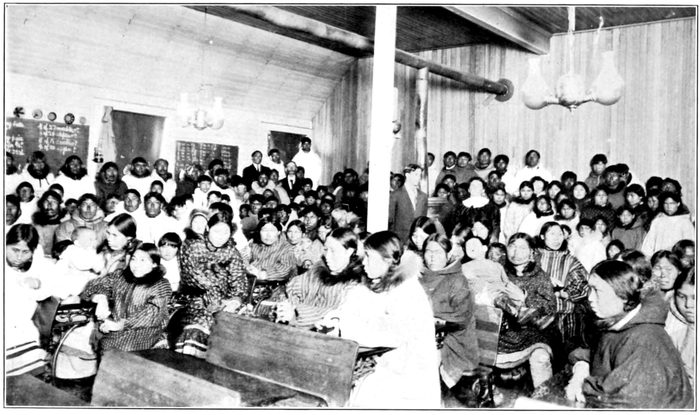
The Wales People
(Photo by Lomen Bros.)
BUREAU OF AMERICAN ETHNOLOGY FORTY-SIXTH ANNUAL REPORT PLATE 40
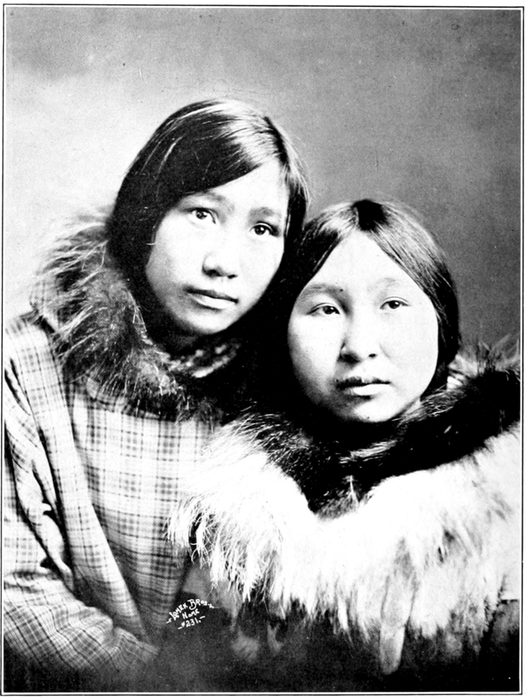
The Long and Broad-faced Types, Wales
(Photo by Lomen Bros.)
BUREAU OF AMERICAN ETHNOLOGY FORTY-SIXTH ANNUAL REPORT PLATE 41
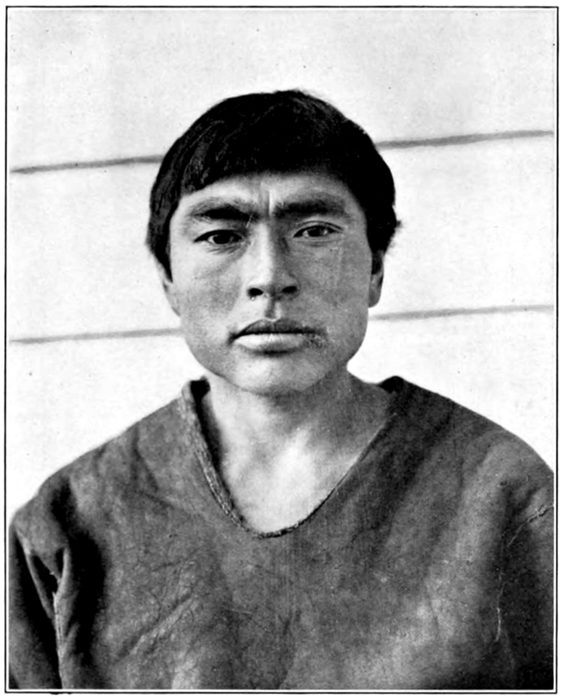
a, Broad-faced and low-vaulted Eskimo, St. Lawrence Island. (Photo by R. D. Moore, 1912. U.S.N.M.)
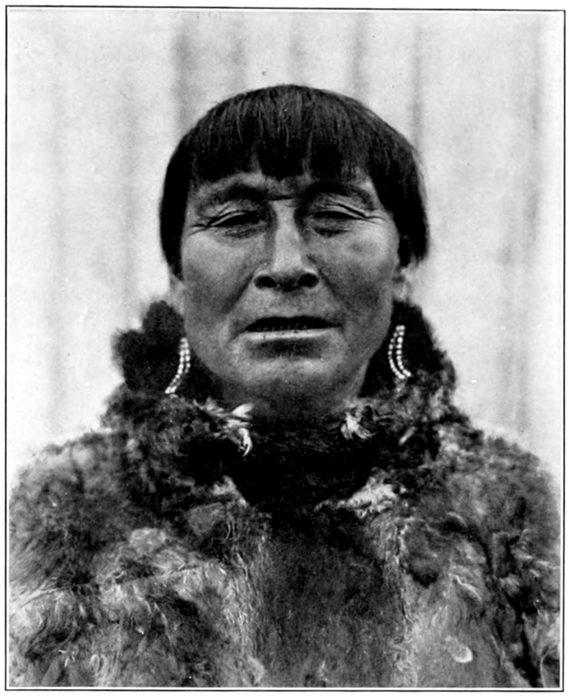
b, Broad-faced type, St. Lawrence Island. (Photo by R. D. Moore, 1912. U.S.N.M.)
BUREAU OF AMERICAN ETHNOLOGY FORTY-SIXTH ANNUAL REPORT PLATE 42
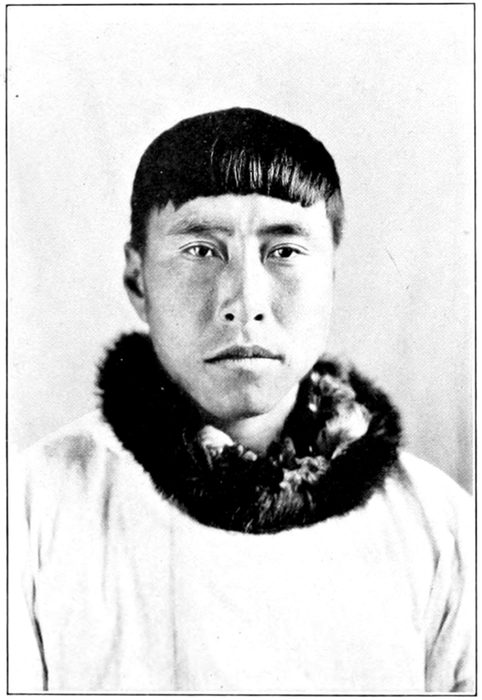
a, A young man from Seward Peninsula.
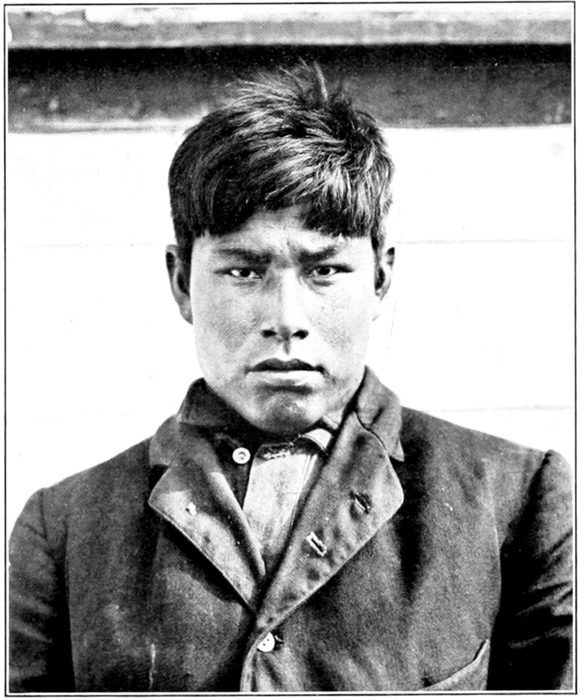
b, A boy from St. Lawrence Island.
The Long-faced Type
BUREAU OF AMERICAN ETHNOLOGY FORTY-SIXTH ANNUAL REPORT PLATE 43
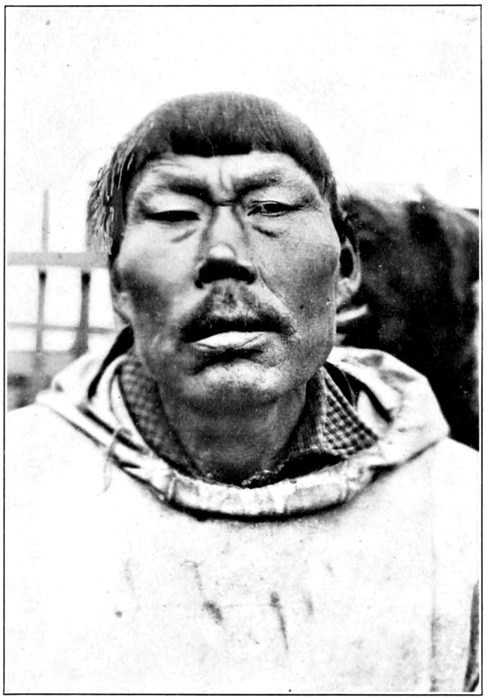
A "Hypereskimo," King Island. Excessively Developed Face
BUREAU OF AMERICAN ETHNOLOGY FORTY-SIXTH ANNUAL REPORT PLATE 44
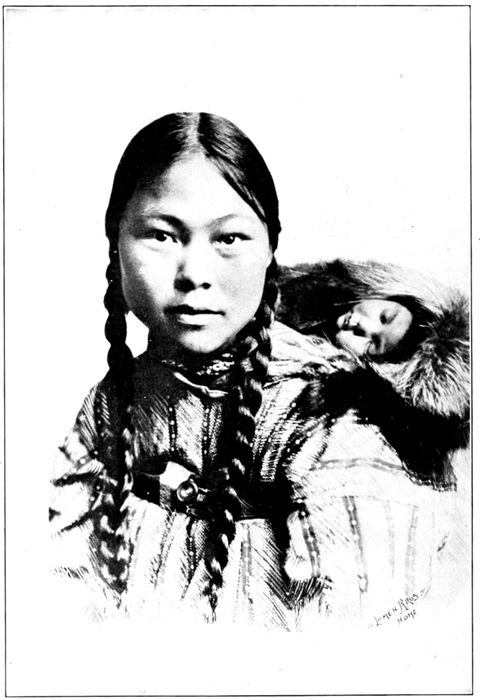
Eskimo "Madonna" and Child, Northern Bering Sea Region
(Photo by Lomen Bros.)
The Eskimo nose is also high, which goes with the height of the whole face; that in turn evidently is attributable to more work and demand—in brief, more mastication. The nose, face, lower jaw, and other parts of the Eskimo anatomy offer rare opportunities for studies in the heredity of acquired characters.
Nose Measurements
American whites Western Eskimo
Old Americans and immigrants Old Americans
Males Females Males Females
(13 groups) (6 groups)
Height 4.95-5.4 4.94 5.47-6.03 5.03
Breadth 3.45-3.6 3.25 3.82-3.93 3.61
Index 62.5-73 66 63.7-71.9 71.9
The mouth.—The western Eskimo mouth is large. It is considerably larger (wider) than in the old American whites, though these are of much higher stature. In relation to stature the width of the western Eskimo mouth exceeds that in the white old Americans by 13 per cent in the males and by nearly 14 per cent in the females, but there is a close relation with that of a large group of Indians. The details follow:
Mouth Width
Western Eskimo (Nunivak and St. Lawrence Islands) 16 tribes of Indians of the Southwest and northern Mexico. Old American whites.
Males Females Males Females Males Females
Width 5.73 5.44 5.85 5.49 5.37 4.95
Females versus males 94.9 93.8 92.3
Percentage relation to stature 3.53 3.57 3.50 3.55 3.07 3.08
The ears.—The ears of the western Eskimo are large. They are especially long. They exceed in both size and relative length those of whites, but are in both respects much more like those of the American Indian. The excess in length, both in the Eskimo and the Indian, is especially marked when this measurement is taken in relation to stature.
Relatively to its length, the ear of the female Eskimo in all our groups is somewhat narrow, giving a lower index. This is not observed in the available whites and Indians.
None of the series below are affected seriously by the age factor; though with an organ so much influenced by age as the ear the ideal way would be to compare only groups of the same age.
Ears
Western Eskimo Miscellaneous North American Indian Old American whites (Labor Ser.)
Males Females Males Females Males Females
Height of left ear 7.05 6.61 7.25 6.95 6.69 6.10
Breadth of left ear 3.82 3.49 3.90 3.70 3.79 3.47
Ear index 54.2 52.8 53.2 53.6 56.7 56.9
Percentage relation of ear length to stature 4.34 4.33 4.25 4.35 3.84 3.68
Western Eskimo groups Whites in general
Height of left ear 6.71- 7.40 6.49-6.73 6.20- 6.69
Breadth of left ear 3.72- 4.04 3.45-3.57 3.58- 3.79
Ear index 53.3 -58.9 52.3 -53.1 56 -58.6
The chest.—The best measurements of the chest, experience has shown, are the antero-posterior and lateral diameters at the nipple height in the males and at the corresponding level of the upper border of the fourth costal cartilages in the females. They give not merely the individual dimensions but also their relation, which is of much ontogenic as well as other interest, and their mean gives the chest module which in relation to the stature is anthropologically as well as individually (medically) important.
The table following gives the chest measurements in the western Eskimo, in a large group of Indians (my older data), and in the old American whites as well as others.
The Eskimo chest is large. In the males, in addition, it is very deep. Compared to that of the white old Americans it is markedly deeper in the males and broader in the females, notwithstanding the fact that the Americans are much taller. It is even larger, besides being relatively deeper in the males and somewhat broader in the females, than it is in many tribes of the Indian. Only tall and bulky Indians such as the Sioux show a chest that is absolutely somewhat larger, but in relation to stature, with which the dimensions of the chest stand in close correlation,[131] the Eskimo prevails even in this instance. This excess in chest development in the Eskimo must be ascribed in the main to his occupations and exertions, particularly again, it would seem, in connection with the canoe.
Chest Measurements
Western Eskimo, Nunivak Island 16 tribes of southwestern and New Mexico Indians Old Americans
Males Females Males Females Males Females
Stature 161.8 153.1 167.3 -155. 174.3 161.8
Breadth 29.97 28.63 29.89 28.21 29.76 26.62
Depth 24.63 -22. 22.77 21.91 21.70 20.03
Index 82.2 76.8 76.15 77.66 72.9 75.3
Module 27.30 25.32 26.33 25.06 25.73 23.32
Module vs. stature 16.87 16.53 15.74 16.17 14.75 14.41
4 other groups of western Eskimo, males 72 Sioux Indians, males 12 other groups of white males
Stature -160.6-166. -174. 163.4-171.6
Breadth -29.6-30. 31.92 -25.9-28.
Depth -23.-24.75 -26. 20.9-22.6
Index 76.7-83.3 81.4 72.9-81.5
Module 26.97 28.96 23.4-25.7
Module vs. stature 16.56 16.64 14.22-14.84
The hand.—The hand of the Eskimo is small, both absolutely and relatively to stature. But it is rather broad relative to its length, giving a high index. The index is higher than that of any of the groups available for comparison, white or Indian, excepting a few groups of immigrant whites, laborers.
Hand
Western Eskimo, (group means) 16 tribes of southwestern and Mexican Indians Old Americans 12 groups of immigrant whites
Males Females Males Females Males Females Males
Left hand:
Length 17.35-18.42 16.60-16.85 18.53 17.20 19.28 17.34
Breadth 8.60-8.90 7.78-8.20 8.51 7.71 9.18 7.87
Percentage relation of hand length to stature 10.96 10.94 11.07 11.13 11.05 10.70 -11.-11.3
Western Eskimo Southwestern and Mexican Indians Sioux Old American whites 12 other groups of whites
Males Females Males Females Males Females Males Females Males Females
Hand index 49.5 47.5 45.9 44.8 47.6 47.6 45.4 47.6-50.3
72 Sioux males: 11.40.
The foot.—The foot of the western Eskimo, like his hand, is both absolutely and relatively to stature rather short, but it is broad, giving a high breadth-length index. Its actual breadth perceptibly exceeds that of the much taller old American whites, though not reaching that of any of the immigrant laborers.
Contrary to what was seen in the case of the hand, the relative proportions of the Eskimo foot, as expressed by the index, are almost identical with those of the southwestern and Mexican Indians. The Sioux foot is relatively longer, and so is that of whites except southern Italians, who, though their foot as a whole is larger, give the same index as the Eskimo.
Foot
Western Eskimo 16 tribes of southwestern and Mexican Indians Old Americans 12 groups of immigrant whites
Males Females Males Females Males Females Males
Left foot:
Length 24.23 22.13 25.42 23.30 26.12 23.33
Breadth 9.72 8.70 10.15 9.07 9.49 8.36
Percentage relation foot length-stature 14.94 14.51 15.19 15.08 14.97 14.42 15.36-15.73
Western Eskimo Southwestern and Mexican Indians Sioux Old American whites 12 other groups of whites
Males Females Males Females Males Females Males Females Males Females
Foot index 40.1 39.3 39.9 38.9 37.1 36.3 35.8 37.9-40.1
72 Sioux males: 15.40.
Girth of the calf.—The western Eskimo, like the American Indians, are characterized by a rather slender calf. The size of the calf correlates in a large measure with stature. Reducing our measurements to calf girth-stature ratios, these are seen to be much alike in the three racial groups used for comparison, namely the Eskimo, the Indian, and the old American white. But this is deceptive. The correlation of size of calf with stature is not uniform (see "Old Americans," p. 348) for all stature groups; as the scale in stature descends the calf is relatively stouter. If we take white Americans of approximately the same stature with the Eskimo here considered, there appears a higher ratio, showing that stature for stature the girth of the calf of the Eskimo is smaller, notwithstanding his generally more ample supply of adipose tissue. Once more his relation is closer with the Indian. The Eskimo and the Indian women are especially much alike, while the white women make a marked exception—their calfs (as well as thighs) have more fat than is found in those of their Eskimo and Indian sisters.
Measurements of the Leg
Western Eskimo Southwestern and Mexican Indians (16 tribes) Old white Americans
Male Female Male Female Male Female
Maximum girth of left calf 33.6 31.4 34.1 32 36.1 35.5
Percentage relation to stature 20.7 20.6 20.52 20.54 20.3 21.95
Percentage relation to stature in those approaching the Eskimo stature 21.6 22.3
Females v. males (M=100) 93.5 93.9 98.3
FOOTNOTES:
Physiological Observations
Due to various difficulties which do not exist to that extent elsewhere, the physiological observations on the Eskimo are neither as numerous or extended as would be desirable; yet there are some data of value. They extend to the pulse, respiration, temperature, and dynamometric tests of hand pressure. They were made mainly on St. Lawrence and Nunivak Islands, by Moore, Collins, and Stewart. They quite agree, especially after elimination of some records that are clearly erroneous or abnormal. The tests should be extended with even more rigid precautions in future work among the Eskimo.
The results are given below. They were all made in the summer season and on healthy subjects, yet there were numerous indications of temporary disorders, pathological or functional. Even after a careful elimination of the obvious cases of such disorders not a few minor irregularities have doubtless remained, so that the data can not be taken for more than fairly close approximations to the normal.
The data show remarkably low pulse, respiration rate and temperature close to those of whites, with a submedium hand pressure. (For comparative data see "Old Americans.") The low pulse is also characteristic in the Indian, as I have repeatedly pointed out before (see especially my "Physiological and Medical Observations among the Indians," etc., Bull. 34, Bur. Amer. Ethn., Washington, 1908).
The dynamometric tests agree also better with those on the Indians than with those on whites; they are valid only as to the hands, and they embody not only the strength of the muscles but also that of the conscious impulse behind them. The age factor, of importance, does not here enter materially into the case.
Pulse, Respiration, Temperature, and Strength
ST. LAWRENCE ISLAND ESKIMO
MALES—ALL
Pressure right hand Pressure left hand
(63) (54) (61) (60) (60)
62.1 20.1 98.64 34.36 28.75
(40-78) (15-25) (97.6-99.4) (19.5-45.5) (19.5-44)
(47) (47) (47) (57) (57)
FEMALES—SUSPICIOUS CASES ELIMINATED
(25) (25) (25) (47) (47)
72.4 20 99.13 20.13 16.81
(54-84) (15-23) (98.4-99.9) (14.5-29) (12-22.5)
NUNIVAK ISLAND ESKIMO
Males
(6) (6) (6)
63.2 18.2 98.05
(52-68) (16-21) (97.8-98.4)
The details of these six records were:
Age (year) Time of day Pulse (p. m.) Respiration Temperature
40 4.40 60 21 98.1
33 2 66 18 97.8
19 2.30 68 18 98.2
45 1.25 68 18 98.4
40 1.30 64 (14) 97.8
In connection with the pressure tests in the two hands, some interesting comparisons are possible between the Eskimo here dealt with and the old white Americans. As all the tests were made with the same instrument and method the results inspire confidence. It is in details of this nature that the anthropologist finds again and again the most striking proofs of the basal unity of the living races and their necessarily common origin somewhere in the past.
Pressure Force in the Hands in the Western Eskimo and Old White Americans
Western Eskimo Old Americans
Male Female Male Female
Pressure: Kg. Kg. Kg. Kg.
Right hand 34.36 20.13 41.8 23.3
Left hand 28.75 16.81 36.1 19.4
Percentage relation of left to right 83.7 83.5 86.4 83.6
Percentage relation of female to male (M=100)
Right hand 55.8 55.5
Left hand 53.7 53.7
FOOTNOTES:
Summary of Observations on the Living Western Eskimo[136]
These Eskimo are generally of submedium stature, occasionally reaching medium. The distal parts of their extremities are relatively short. Walk in adult males somewhat awkward.
In head form they are highly mesocephalic to moderately brachycephalic; the height of the head averages about medium. The head is of good size, especially when taken in relation to stature. The forehead is above medium in both height and breadth.
The face is large in all dimensions, generally full and rather flat. In men it not seldom approaches a square form. The lower jaw region is largely developed, the angles of the lower jaw are broad to protruding.
The nose is of fair breadth, with bridge somewhat narrow above and on the whole only moderately high. The mouth is large, lips medium to somewhat above. The ears are long. Beard spare on sides of face, mostly sparse on chin; mustache sparse and often limited to tufts above the corners of the mouth. Expression generally good-natured, smiling.
The chest is large, in females broad, in males especially deep. There is but a mild lumbar curve and no steatopygy. The lower limbs in females are less stout and shapely than they are in whites. The hands and feet are small, but, particularly the foot, relatively broad.
Temperature and respiration approach those in normal whites, though they appear frequently to be slightly higher; pulse normally is slow.
Dynamometric tests of strength (pressure, both hands) give somewhat lower records than in whites.
FOOTNOTES:
Remarks
The most noteworthy and important result of these studies on the living western Eskimo is the evidence, coming to light again and again, of their fundamental somatic relations to the Indian. These relations are too numerous and weighty to be accidental. Nor can they be ascribed to mixture with the Indian in such far-away groups as the St. Lawrence Islanders, who so long as known have never had any direct or even indirect contact with Indians. These relations in dimensions and relative proportions of the body, and in physiological characteristics such as the slow normal pulse, are supplemented by many phases of behavior, and often by a more or less Indianlike physiognomy. They inevitably lead to the conclusion that the Eskimo and the Indian are in the root members of the same family. They are two digits of the same hand, separate and diverging, yet at base joined to and derived from the same source. And this source, according to many indications, is the paleo-asiatic, "mongoloid," stem of northern Asia. The western Eskimo shows to be nearer this source than his more northern and northeastern relatives, indicating either that he is a later comer, or, which is more probable, that he has changed less in the south than in the north. It may be possible to say something more on this subject after the skeletal remains have been considered.
BUREAU OF AMERICAN ETHNOLOGY FORTY-SIXTH ANNUAL REPORT PLATE 45
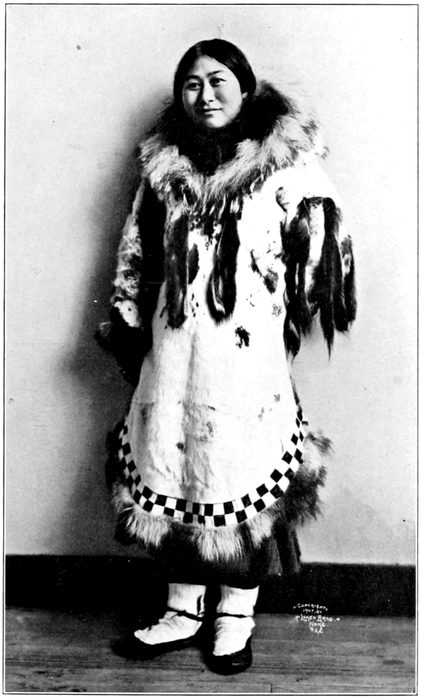
Young Woman, Northern Bering Sea Region
(Photo by Lomen Bros.)
BUREAU OF AMERICAN ETHNOLOGY FORTY-SIXTH ANNUAL REPORT PLATE 46
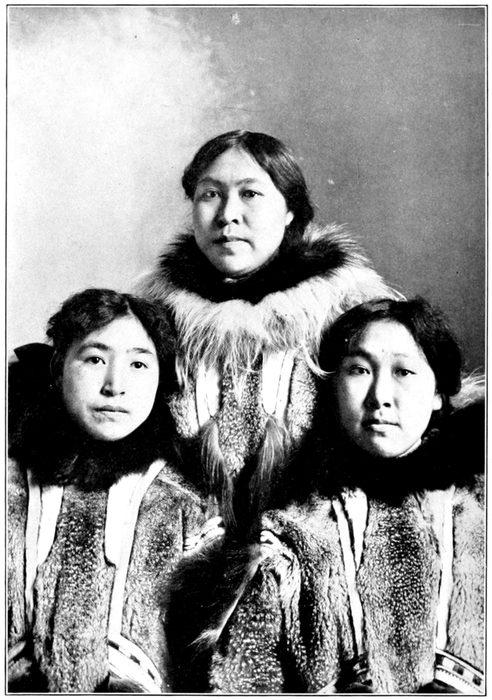
Young Women, Full-blood Eskimos, Seward Peninsula
(Photo by Lomen Bros.)
BUREAU OF AMERICAN ETHNOLOGY FORTY-SIXTH ANNUAL REPORT PLATE 47
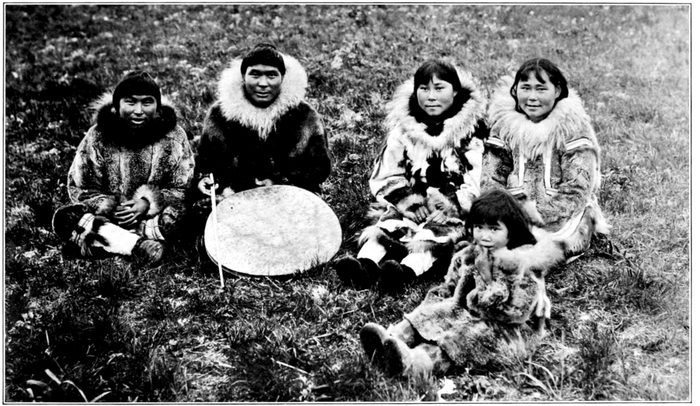
A Point Hope Group
BUREAU OF AMERICAN ETHNOLOGY FORTY-SIXTH ANNUAL REPORT PLATE 48
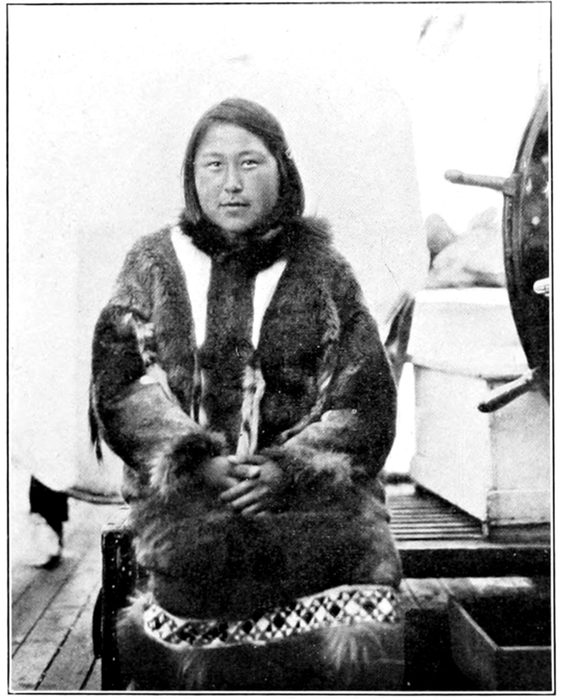
a, Eskimo woman, Kevalina. (Photo on the Bear by A. H., 1926. U.S.N.M.)
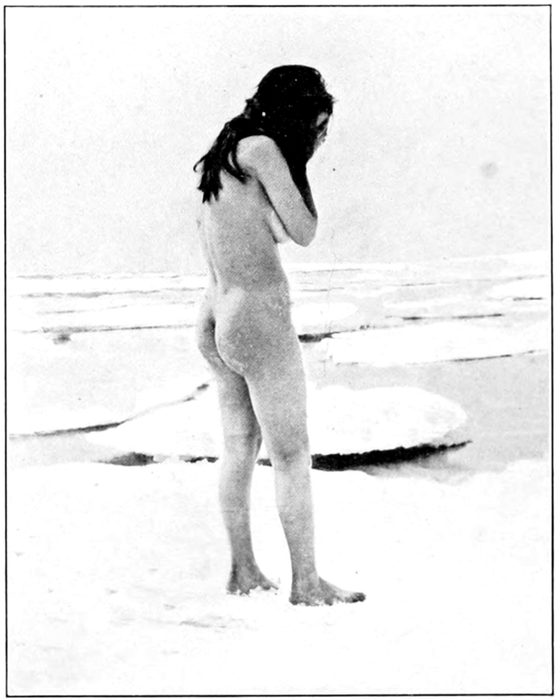
b, The body build of an adult Eskimo woman. Upper Bering Sea
BUREAU OF AMERICAN ETHNOLOGY FORTY-SIXTH ANNUAL REPORT PLATE 49
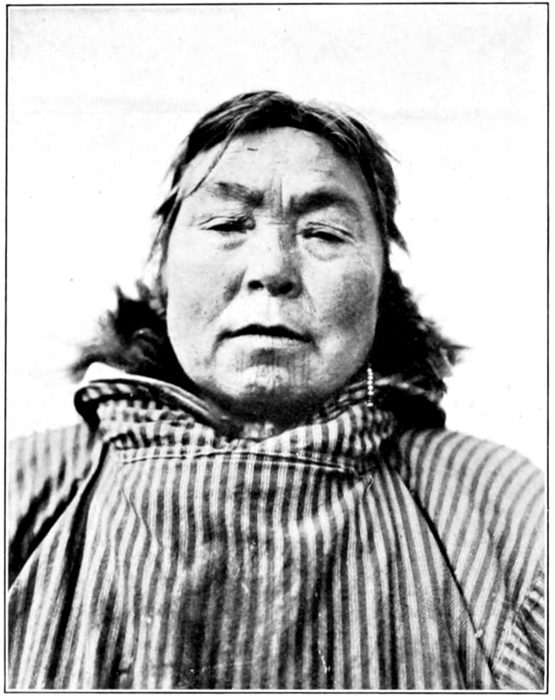
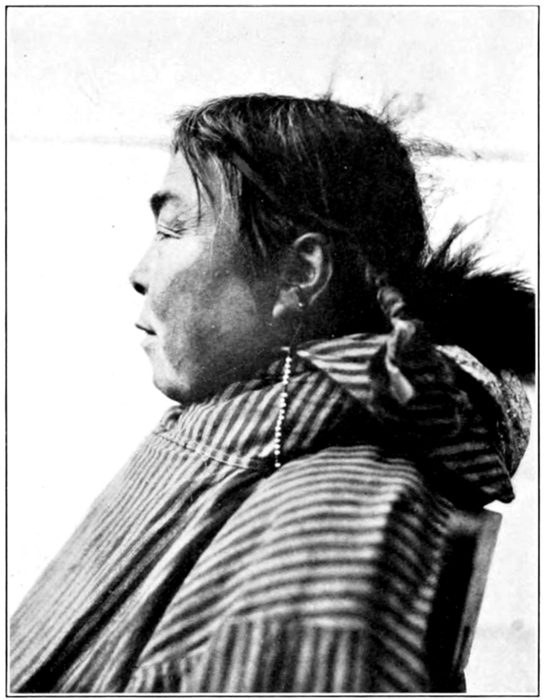
Elderly Woman, St. Lawrence Island
(Photos by R. D. Moore, 1912. U.S.N.M.)
BUREAU OF AMERICAN ETHNOLOGY FORTY-SIXTH ANNUAL REPORT PLATE 50
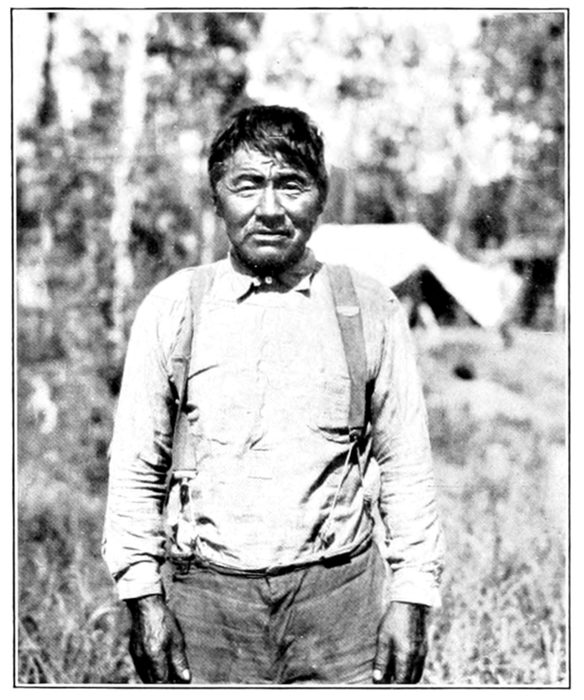
a, Yukon Eskimo, below Paimute. (A. H., 1926)
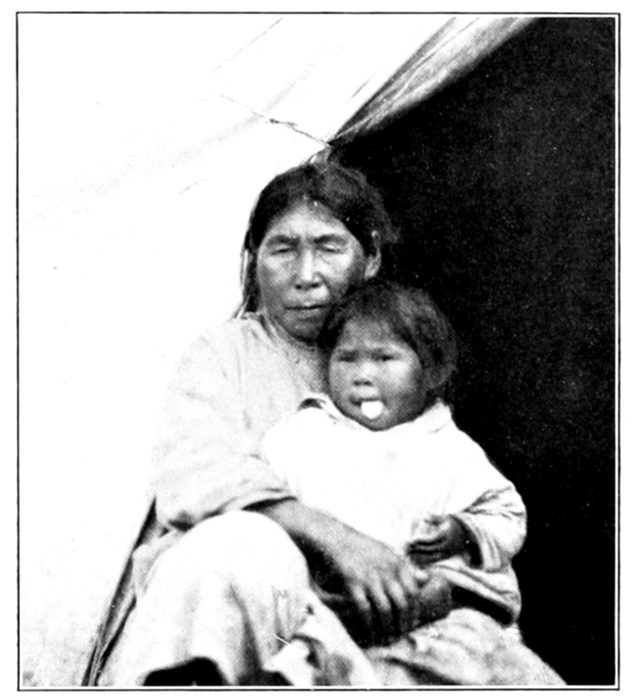
b, Norton Sound Eskimo woman and child. (A. H., 1926)
BUREAU OF AMERICAN ETHNOLOGY FORTY-SIXTH ANNUAL REPORT PLATE 51
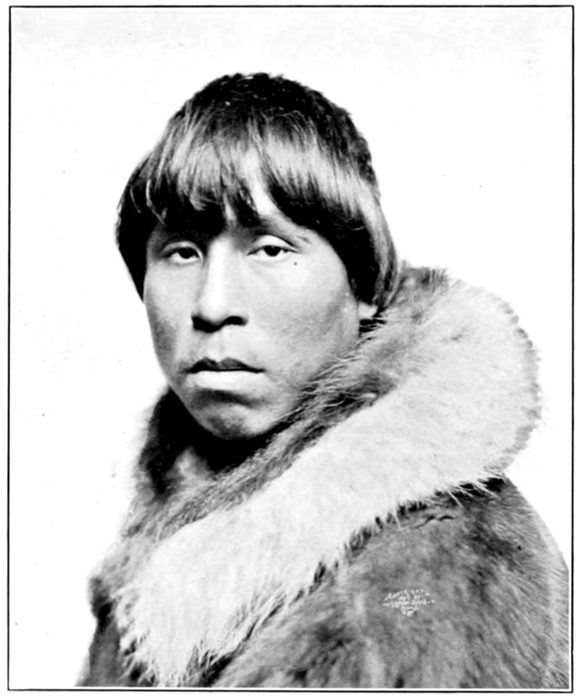
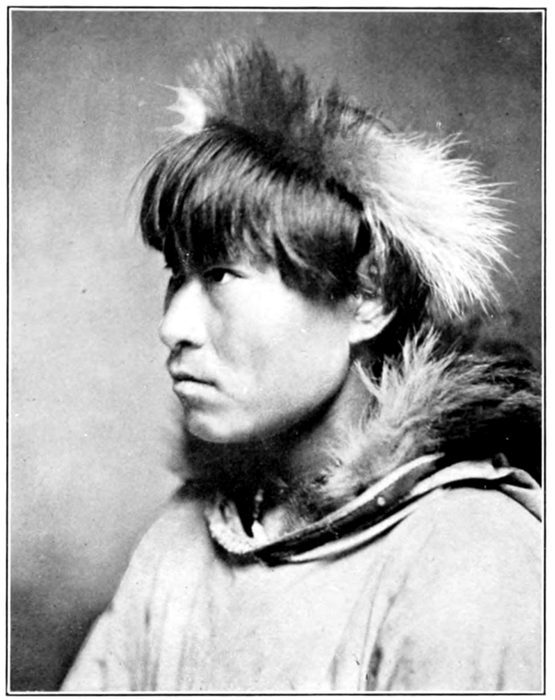
Eskimo, Indianlike; Northern Bering Sea Region
(Photos by Lomen Bros.)
BUREAU OF AMERICAN ETHNOLOGY FORTY-SIXTH ANNUAL REPORT PLATE 52
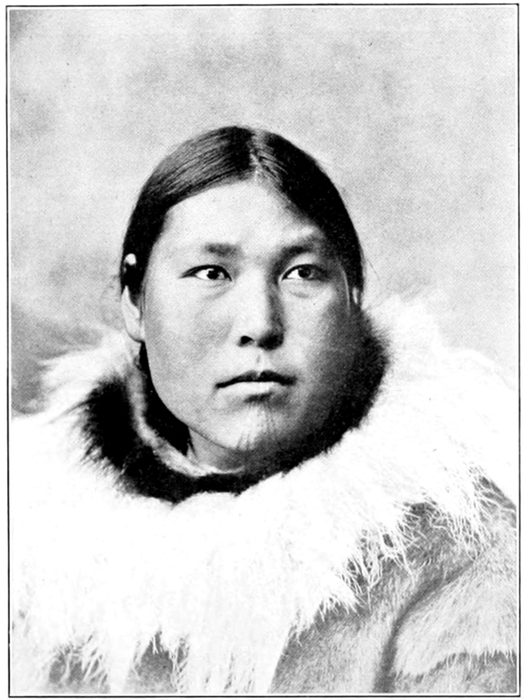
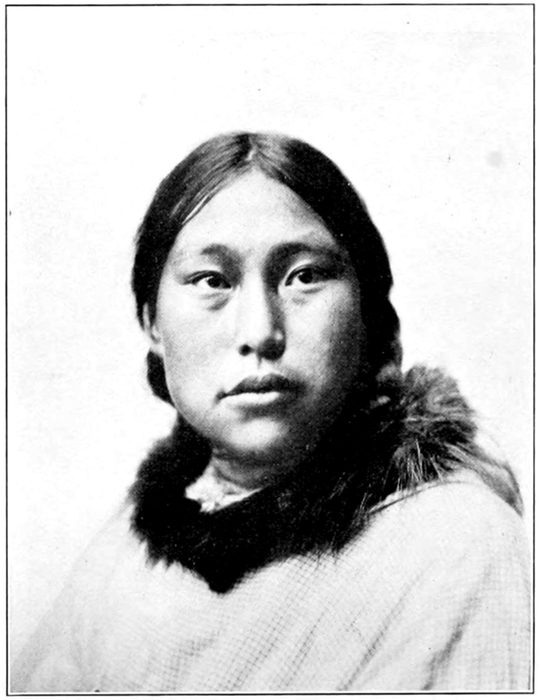
Eskimo, Indianlike; Northern Bering Sea Region
(Photos by Lomen Bros.)
BUREAU OF AMERICAN ETHNOLOGY FORTY-SIXTH ANNUAL REPORT PLATE 53
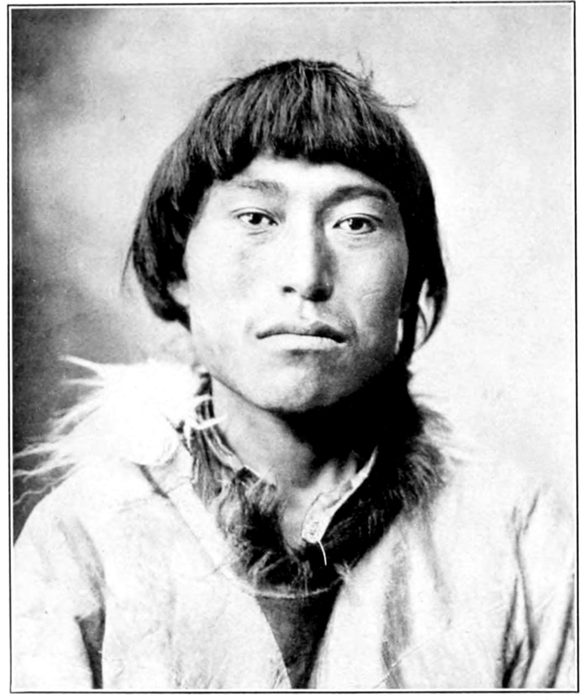
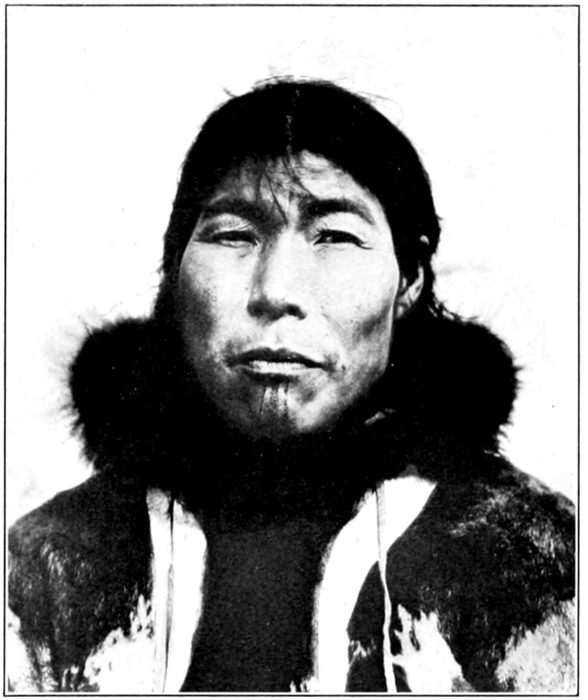
Eskimo, Indianlike; Northern Bering Sea Region
(Photos by Lomen Bros.)
BUREAU OF AMERICAN ETHNOLOGY FORTY-SIXTH ANNUAL REPORT PLATE 54
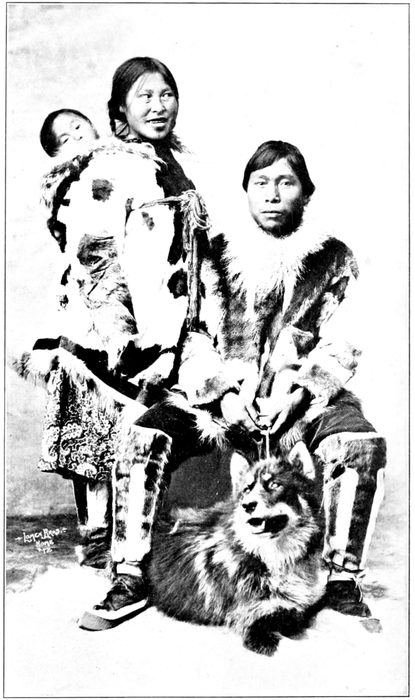
Eskimo, Indianlike; Northern Bering Sea Region
(Photo by Lomen Bros.)
BUREAU OF AMERICAN ETHNOLOGY FORTY-SIXTH ANNUAL REPORT PLATE 55