THE WRITER'S TRIP ON THE YUKON (continued 2)
Reading edition
Soon after Marshall—after passing by an Eskimo village (white man's style of buildings)—leave the hills and enter flats on both sides. This is the beginning of the delta region. River like glass, and it is warm in the sun but very perceptibly cooler when sun is hidden.
The boat has only three bunks, and there are five of us with the two pilots. But on the last trip up, there were, fortunately only for about eight hours, seven, including two women and a child, and that without any privacy or conveniences whatsoever. It is almost criminal, and they charge a very steep fare. However, for me it will soon be over—only about 36 hours. Still it is hard to believe this is yet in the United States and presumably under some sort of supervision.
Which brings me to a realization that the first half of my journey—the preliminary survey of the Yukon—is slowly closing; a little, and it will be the sea and other conditions, which also brings the realization that I have seen much but learned not greatly. What should be done would be to own a suitable fast boat; to locate on each of the more important old sites a party for careful, prolonged excavation; and to try to locate, in the rear of or on the higher places on the present river flats, more ancient sites than are known to date. These steps, together with the enlisting of the interest in these matters of every prospector, miner, and trader, would before many years lead to much substantial knowledge.
Friday, July 9. Must keep up these notes, for they alone keep me posted on the day and date; even then I am not always sure. There are no Sundays in nature.
Slept in my bag on the roof of the Agnes. Her namesake must have been one of these goodly but insufficient and but indifferently clean native women, plodding, doing not a little work, but wanting in many a thing. It was cold and dreary, but I found an additional blanket, and so, with mosquito netting about my head—one or two got in anyway—would have slept quite well had it not been for a dog. At about 1 a. m. we stopped in front of a little place called also "Mountain Village." And almost at once we began to hear a most piteous and insistent wail of a dog who either had colic or thirst or hunger, and he kept it up with but little stops for what seemed like two hours, making my sleep, at least, impossible.
Saturday, July 9. Morning. Cold, cloudy, rough—head almost beginning to feel uncomfortable, the boat is tossing so much. A teacher comes aboard with an inflamed hand which I fix; a few questions, the mail bag, and we are off again. Enter a slough where it is less rough and warmer. Later the sun will probably come out again. This evening we shall be at Old Hamilton and then a new anxiety—how to get to St. Michael.
Just had a little walk over the roof—my roof, for the other two passengers prefer to sleep in the gassy, dingy room below, though how they can stand it is beyond my medical ken. It is four short steps long, or five half steps in an oblique direction.
Every object in distance appears magnified all along the river for many days now. An old snag will look like a boat or a man, hills look higher, a boat looks much more pretentious than she proves to be on meeting.
Firs and spruce have now completely disappeared, also forests of birch, etc., are reduced to brush both on flats and lower parts of hills. Very large portion of the hills in distance just greenish with grass and lichens, not even a brush.
9.45 a. m. Meet the Matanuska bound upward. Looked from distance like an ocean steamer; from near, just a lumbering, moderate-sized river boat with a barge in front. But a whole lot better than ours.
The scenery has become monotonous. The gray river, although only one of the "mouths," is broad, and the country is all low. Nothing but bushy or grassy cut banks on the right, and mud flats, "smoking" under the wind, to low banks on left. It is a little warmer and the warm sun shows itself occasionally, but I still need the wrapping of a double blanket. The wind luckily is with us and the waves not too bad.
Noon. Passing "Fish village"; a few huts and tents.
No "camps" here outside the few villages; just an endless dreary waste and water.
New Hamilton—a few native huts only now—no whites.
Reach Old Hamilton—about a dozen houses with a warehouse, a store of the Northern Commercial Co., and a nice looking but now unoccupied school.
Here the governor told me there was somewhere a skull waiting for me, and the storekeeper would tell me of it. But when we arrive there are only two or three natives to meet us. The storekeeper, who is also postmaster, is said to be sick in bed. He is supposed to have an ulcer or some other bad thing of the stomach. So we go to his house and find him in bed, with a lot of medicine bottles on a table next to him. Is alone; no wife. Shows no enthusiasm in seeing me, though heard of my coming. Reads letters—no attention to me. Gets up—I ask him about his illness—answers like a man carrying a chip on his shoulder. Goes to store to attend to mail, and barely asks me to follow. I wait in store; he finishes mail and goes out—orders the Eskimo present out gruffly, and to me says, "You may stay in the store; I'll be back." But I wait and wait, and finally decide the man for some reason is unwilling to help me. Asked him before he went out about the Matanuska, but he told me she might not be back from Holy Cross in a month, trying doubtless to discourage me to stay. On going toward the Agnes I find him sitting on a log and talking to a couple of men from a tugboat that has arrived—just talk, no business, judging from their laughing. So I go on the boat, write a few words to Mr. Townsend of the Bureau of Fisheries, who makes this place his headquarters, and with some feeling hand this to the man, telling him at the same time that plainly he does not wish to assist me in any way. This, of course, rouses him; he gets red and says a few lame words, ending with, "Do you think I would touch any of them dam things or that I would let any of my men (natives) touch them? Not on your life!" So I leave Old Hamilton, for he is the only white man there now. But the place had other distinctions. Until recently, I am told, they have had a teacher, a young girl, who in her zeal had the natives collect all the burial boxes with their contents and had them all thrown into the river. Not long after she accomplished that she left. The storekeeper told me that "If I want them so bad I could pick them up (skulls and bones) along the river where the water washed them out after the teacher threw them in." Luckily there were not many "Old Hamiltons."
We met here a boat from St. Michael with Mr. Frank P. Williams, the well-known postmaster and trader of St. Michael, who comes for the two men, my fellow passengers. We get acquainted and, to escape the gases of the Agnes, I go with them. The boat is heavier and free from fumes, though without accommodation. At about 7 p. m. we arrive at Kotlik, at the mouth of the river—an abandoned wireless station, a store, and four tents of natives. But the old wireless building, now the storekeeper's house, is the dwelling place of a clean white man, Mr. Backlund, who is now "outside," but with whom Mr. Williams is in some partnership; so we occupy the building. Outside the wind has risen to half a gale and there are squalls of rain and drizzle. The Agnes has to "tie to," as she would be swamped in the open. My boxes and bedding, which were on the roof of the Agnes, are soaked, though the contents will be dry. So both boats are fastened to a little "dock," and we soon have fire in the stove, supper, and then—it is 11 p. m.—a bed, not overclean, somewhat smelly, but a bed and free from mosquitoes, rain, wind, and cold.
July 10. Up at 6.30. Outside a storm and rain—just like one of the three-day northeasters with us, and cool. Both boats were to leave, but are unable to do so. I find that Mr. Williams's tug will come back here and go to St. Michael on the 13th, so arrange with Mr. Williams to take me and leave the Agnes for good. This partly because I learn of two graveyards near, one 1½, the other 4½ miles distant.
After lunch, rain for a while ceasing, I set out for the nearer burial place. This is already a tundra country—treeless and bush-less flats overgrown with a thick coat of moss, into which feet bury themselves as in a cushion, and dotted with innumerable swampy depressions with high swamp grass. Walking over all this is very difficult—lucky I have rubber boots. Even so, it is no easy matter, except where a little native trail is encountered.
The graveyard, belonging to the now abandoned little village above Kotlik, consists of only about half a dozen adult graves. These consist of boxes of heavy lumber laid on a base raised above the ground level, and covered with other heavy boards. Some of the burials are quite recent. Open three older ones. In two the remains are too fresh yet, but from one secure a good female skeleton, which I pack in a practically new heavy pail, thrown out probably on the occasion of the last funeral. Then back, farther out, to avoid notice, through swamps and over moss, and with a recurring wind-driven drizzle against which my umbrella is but a weak protection.
Reach home quite wet and a bit tired. Have to undress and, wrapped in a blanket, dry my clothes and underwear about the stove.
Nothing further this day and evening—just wind and heavy low clouds and rain.
July 11. Up at 4.40. Weather has moderated. The Agnes left at 4 and Mr. Williams's boat, due to favorable tide, must soon go also. Breakfast, and all leave me before 6.
Yesterday we brought up my needs—i. e., collection of skeletal material—to the few natives here, explaining to them everything, and they do not object in the least. One of them, in fact, is to take me to-day to the more distant cemetery in a rowboat and help me in my work.
My man, after being sent for, comes at a little after 7. He is a good-looking and well-behaving Eskimo of about 35. He brings a good-sized tin rowboat—a whaling or navy boat probably; but "he leaks a whole lot." The oarlocks are not fastened to the boat, the plate of one is loose, and the oars are crudely homemade of driftwood and pieces of lumber fastened on with nails; in one the shaft is crooked, while the other is much heavier. But we start, with the sky still leaden and gray but no wind and calm water. I row and he paddles; then he rows and I paddle. We carry but the camera, a little lunch, a heavier coat each, and a box and two bags for the specimens. We pass a number of broods of little ducks, the mother prancing before us until the young are in safety, and there are several species of new kinds (to me) of water birds, some of which fly right above us, examining us. In the distance we see a big abandoned dredge, then a few empty log houses and "barabras" on the bank of a stream and the edge of the tundra. This is Pastolik, our destination. There is no one anywhere near, an ideal condition for work, if work there'll be. And there will be—for almost immediately upon landing I see, beginning at a few rods distance on the tundra, a series (about 50) of old graves, in all grades of mossiness and preservation. A few are, we later find, quite late, but the majority are old—60 years and over according to information given by the natives of Kotlik. They do not, except perhaps the few late ones, seem to belong to anyone still living. Yet "Pashtolik," as they wrote it then, used to be a place of some importance in the Russian times, and even later.
We settle in an empty native house, and I start investigation. The older graves are found widely spread in several clusters, but a few are isolated at a distance.
The graves are all aboveground and resemble in substance those along the lower Yukon (Bonasila and downward). They consist of a base of small logs or splits; a rude box about 3 feet long by about 2 feet wide, of heavy, unpainted, unnailed, split boards; four posts near the four corners; a cover, unjoined, of two to three heavy split boards; two crosspieces over this, at head and base, perforated and sliding over the upright posts, and a few half splits (smaller drift logs split in two) laid over the top of the crosspieces.
On the first cover lies as a rule a stone—generally a piece of a slab or a good-sized pebble—unworked, though now and then showing some trace of use. The pebble is generally broken.
When the grave is opened there is usually over the body, as a canopy on a light frame, a large (probably caribou) skin—rarely birch bark. Neither covers or envelops the body but simply forms a covering over it, with some space between it and the body. The body lies flexed, on left or (rarely) right side, with the head toward (or near) the east (same as at Bonasila). It is often covered with or enveloped in a native matting. There are but few traces of clothing on women; none on men. And very seldom is there anything else in the coffin.
Some of the oldest graves were found tumbled down and could not be examined. The moss and roots envelop the bones, and it is a tough job to get them out; also they eat the bones and destroy them. Even in the older boxes, however, the downward part of the skeleton—generally the left—is, due to moisture, usually in much worse state of preservation than the upper.
Children have been buried in large native wooden dishes and these were in some cases placed on the top of adult graves, but more generally about these, or even apart.
Many household articles, from matches and pails to dishes, alarm clocks, lamps, etc., are placed upon the ground near the more recent dead. Excavation would probably recover here many older objects, though wood decays.
The wind has died down and the flat is as full of mosquitoes as a Jersey salt meadow, and there is an occasional gnat. They bite, and, having been almost free of the pest at Kotlik, I failed to take my "juice" along, so just have to do the best possible. The gnats enter even the eyes, however.
Work as never before. Decide to utilize the rare opportunity to the limit, and to take the whole skeletons, not merely the skulls, leaving only the few fresher ones and those that are badly damaged. A great Sunday; burial after burial; opening the wooden grave—taking out and marking on the spot bone after bone—fighting mosquitoes all the while—and packing temporarily in any convenient receptacle. Fortunately there are quite a few boxes and pails and oil cans on the spot, left by the dredge people and the few natives who evidently sometimes come to the place. At about 2 eat lunch—coffee (the Eskimo put what was for three cups into about two quarts of water, so there is but a suggestion of coffee), raw smoked fish for me and eggs with bacon (left over from breakfast) for my companion, and on again until about 5 p. m. or a little later. Last two or three hours, however, work with some difficulty. A gnat bit me in an eyelid, or got into my eye, and that has now swollen so that I can hardly see with it. My Eskimo, however, is about all I could wish. He just looks at me working in a matter-of-fact way, and carries the filled boxes, or looks around for something I could take with me, and even helps on a few occasions with the bones, finding evidently the whole proceeding quite right and natural. Brings me, among other things, an old copper teakettle, but to his wonder I do not want it and leave it. I find a fine large walrus-ivory doll and a handsome decorated "kantág" (wooden bowl), besides smaller objects, and also a large piece of a poor quality clay pot (no pottery now), with a fragment of a decorated border as on the lower Yukon.
Pack up, we load on the boat—lucky now she is so spacious—get into the shallow river—the tide has run out—push the boat out and start for home.
Thus far we had but slight drizzles. But the clouds now grow heavier, and as we have much farther to row than this morning, due to the low water, we are caught by showers. The last mile or so we have to hurry, see a big rain approaching. My man pushes her with a pole while I row all I can, with both hands, with the heavy oar. Of course the whole population of Kotlik has to see our arrival. And more, too, for in our absence a schooner came in with wood and a number of the natives. They talk, but no one is either angry or excited. We two carry the boxes, pails, etc.—grass covered—into the house; how lucky I am now alone. Inside I remove the wet grass from them—the bones, too, are somewhat wet—then pay my Eskimo $5, which again is taken as a matter-of-fact thing, without thanks, but he well deserved the amount, even if I rowed a full half.
It is 9 p. m. My man comes again, we have a modest supper, he some left-over meat and I again the smoked fish, which I feel is strengthening me as well as agreeing with my stomach, and then to rest, quite earned to-day. Seldom have done as much in a day. Thirty-three graves collected, with over twenty nearly complete skeletons, and all restored so that I had to take considerable care not to go again into some already emptied. But this place should be dug over. The tundra in a few years swallows up everything on the surface. It literally buries or assimilates bones and all other objects, the moss and other vegetation with probably blown dust covering them very effectively. Finding anything below the surface and that even a foot or more, as was actually experienced, means something quite different under these conditions than it might elsewhere.
Monday, July 12. Slept fairly well and feel refreshed, but the eye still badly swollen. The Eskimo believe, I think, I got it from the bones. Yet they are quite sensible—a marked mental difference between them and the Yukon Indians.
Breakfast before 7—cereal, raw smoked fish, and coffee. Then pack. At the store buy empty gasoline boxes, but no nails to be had, and no packing. Lunch at 1—macaroni, raw smoked fish, sauerkraut, coffee; then pack again, fix boxes, break old ones to get nails, even pull a few unnecessary ones from the boards of the house, go see my man's wife, a hopeless consumptive, and at 6 through with all except cleaning. Another fair work-day, 12 tightly packed boxes. Then clean up, burn rubbish, and ready for departure early to-morrow.
Supper—macaroni, raw smoked fish, greengage plums, a little sauerkraut, and coffee. Then a little walk outside, watch Eskimo women and children jump the rope (hilariously, but awkwardly), and go in to catch up with my notes. Nobody scowls at me, so that although they probably fear me as a "medicine man" they are not at all resentful for what I did yesterday. They are grown-up children, much more tractable than the Indians. But otherwise they show so much in common with the Indian that the more one sees of them the more he grows drawn to the belief of the original (and that not so far distant) identity of their parentage. It seems the Eskimo and the Indian are after all no more than two diverging fingers of one and the same hand; or they were so a bit farther back. Mental differences there are, yet these are no more than may be found in different tribes of the Indians or different groups of other races.
Tuesday, July 13. Rise a little after 6. Eye still sore after Sunday's gnat and sweat and dirt; must use boric acid frequently. An Eskimo actually said yesterday it was a sickness from touching the bones. A little breakfast—have no more salmon strips, so just cereal, canned plums, and coffee. And then with the help of two young Eskimo carry my spoils and baggage on to the tug, which has come for me. By about 7 start. Good-by Kotlik, what little there is of it.
At 9 arrive at Mr. Williams's reindeer camp farther up the coast. There are five tents and two small log houses of natives—the herders with their families, dogs, and fish racks; and three whites, Mr. Williams, owner of the boat and of most of the herd of about 8,000 animals; Mr. Palmer, of the United States Biological Survey; and a Dane, Mr. Posielt, here for the Biological Survey of Canada. All are already at the corral some distance over the hill, branding, counting, etc., the great reindeer herd, which belong to several owners.
A short walk along the shore brings me in sight of the herd. The animals can be heard grunting a good distance off. The herd is so large and so compact that it looks like a forest of horns. The animals keep on moving in streams, but remain in the herd. They go to the shore to drink some of the salty water, instead of salt. All is of interest, even though the branding, the cutting off of big slices from the ears, and castration, is rather cruel.
At lunch, for the first time, reindeer meat, a select steak. It is tender and decidedly good. Has no special flavor and is poor in fat, but tender and good.
Afternoon, once more to the corral, and then various things, including a photograph of a little impromptu native group.
Supper once more on reindeer meat. This time prepared as a sort of a stew with onions—again very good. But we were to leave after supper for St. Michael and I see no intention to that effect. Instead they all go once more to the corral to continue the work until about 11 p. m. So I have to settle for the night, with some hope that we may leave in the morning. We sleep four side by side in a tent 10 feet wide. Luckily they had a spare clean blanket or two, and but one of the three snores, and he like a lady; also the weather has cleared and is warmer, so the night is fairly good.
Wednesday, July 14. Morning bright, calm. Breakfast, and all hurry off to corral without even any explanation—just a few casual words, from which I understand that we shall not go. So I write whole forenoon, though feeling none too good about the delay. Had I my own boat, as one should have in this country, all would be different. As it is I am utterly helpless. At lunch speak to Mr. Williams; and though not much willing, he half promises that we may go to St. Michael to-night.
Afternoon. Walk 8 miles along the beach, to a cape and back, looking in vain for traces of human habitation and collecting along the beach what this offers, which outside of some odd, flat, polished stones is but little. Come back near 6—soon after supper—and hear with much satisfaction that, after all, we will go to-night to St. Michael.
RÉSUMÉ
So ends the Yukon and its immediate vicinity. What has been learned?
1. The great and easily navigable river, extending for many hundreds of miles from west to east, could not but have played a material part in the peopling of Alaska, and quite probably in that of the continent, and all human movements along it must have left some material remains. It seems, therefore, a justified inference that the valley of the Yukon harbors human remains of much scientific value.
2. Such remains, judging from the present conditions, were left exclusively along the banks of the river, on the flood-safe elevated platforms of the banks, and especially about the mouths of the tributaries of the Yukon of those times.
3. But the banks and mouths of the past are seldom, if ever, those of to-day. The river, with its currents, storms, and ice pack every spring, is changing from year to year. It is ever cutting and eroding in places, and building bars and islands or covering with flood silts in others. In many stretches no one can be sure where the banks were 500 or 1,000 years ago, not to speak of earlier periods.
4. The banks and islands of to-day, therefore, are for the most part recent formations, in which it would be useless to expect anything very ancient. And there is nothing like the successive ocean beaches at Nome and elsewhere, which would guide exploration.
5. The right hilly side of the river alone seems to offer some hope of locating some more ancient sites and remains; yet it is quite certain that the river ran once far to the left, for all the vast flats on that side are of its construction; so that the more ancient remains of man may lie in that direction. But there everything is, from the point of view of archeology, a practically unexplorable jungle and wilderness, and there is no one there who might make accidental discoveries.
6. It would seem that the best hope for the archeologist along the Yukon, so far as the more ancient remains are concerned, lies along the tributaries of the stream, and that particularly at the old limits of the more recently made lands.
7. Nevertheless the banks of the Yukon as they are now are not wholly barren. Up from Tanana, at the Old Station, probably about Ruby and Nulato, about Kaltag and the Greyling River, at Bonasila, Holy Cross and Ghost Creek, and at the Mountain village, Dog village, Russian Mission, and doubtless a number of other sites, they contain both cultural and skeletal remains that, if recovered, will be invaluable to the anthropological history of these regions.
8. The line of demarcation between the Indians of the Yukon and the Eskimo, outside of language, is indefinite. Traces of old Eskimo admixture are perceptible among the Indians far up the river, and the cultures of the two peoples in many respects merge into each other; while among the Eskimo of the lower river and farther on there are physiognomies that it would be hard to separate from the Indian. Whether all this means simply extensive past mixture, or whether, as would seem, the Alaska Indians as a whole are nearer physically to the Eskimo than are the tribes in the States, remains to be determined. Among the Athapascan Mescalero Apache, who have reached as far south as New Mexico, a somewhat Eskimoid tinge to the face, especially in young women, was by no means very unusual 25 years ago when I studied this tribe. This problem will be touched upon again in this volume.
9. All along the Yukon, from near Tanana (Old Station) to the mouth of the river, in the Indian and in the Eskimo region, there prevailed the same type of winter house, namely, a largely subterranean room with a subterranean tunnel or corridor entrance; and also a similar type of summer dwelling, formerly a skin, now a canvas, tent. The winter dwellings were built within of stout posts and covered with birch bark and sod, looking from outside much like the present-day Navaho hogan; while the pits left by them remind one of the southwestern "pit dwellings," the kashims of the Pueblo kivas. As a hogan, so these largely subterranean dwellings along the Yukon had a smoke-air-and-light hole in the center of the top, a fireplace in the middle of the floor, and benches (of heavy hewn planks in the north) along the sides. Each village, furthermore, had at least one larger structure of similar nature, the "kashim," or communal house. All this may still be traced more or less plainly on the dead sites along the Yukon, and houses as well as a kashim of this type were seen at Kotlik and Pastolik, at the mouth of the river.
10. The native industry of the river presents also much similarity, though there are differences.
Pottery, of much the same type and decoration, was made at least as far as the lower middle Yukon.
Stone implements were made and used all along the river, and were much alike. But the double-grooved, cupid-bow ax of the Yukon Indian, hafted in the center and used for chipping rather than cutting, is lower down replaced by the same ax, in which one end has been broken off (or has not been finished), and which is hafted as an adze; or by oblong quadrilateral flat axes which have not been found up the river.
The peculiar and apparently very primitive stone industry of Bonasila is, it seems, just a development of local conditions—nature of most available stone, and essentially hunting habit of the people that resulted in many skins which called for numerous scrapers. Nevertheless the site deserves a thorough further exploration.
There was apparently not much basketry along the river, the place of the baskets being taken by the birch-bark dishes of the Indian and the kantág or ingeniously made wooden dish of the Eskimo part of the river.
Canoes among the Yukon Indians were mainly of birch bark, while the Eskimo had mainly skin canoes.
11. Neither the Indians nor the Eskimo of the Yukon practiced deformation of the head or of any other part of the body, or dental mutilation. The Indians as well as the Eskimo occasionally pierced the septum of the nose, for nose pieces, while the Eskimo cut on each side a slit in the lower lip for the introduction of labrets. The Eskimo cut their hair short in a characteristic way, reminding strongly of certain monks; the Indians left their hair long. But at Anvik the Indians both cut their hair and wore labrets. They also used the wooden dish.
12. From all the preceding it appears that there must have been long and intensive contacts between the Yukon Eskimo and Indians; that, through war or in peace, they became mutually admixed; and that there were mutual cultural transmissions.
13. No further light for the present could be gained on the origin, antiquity, or early migrations of the Yukon Indian. It was determined, however, that he represents but one main physical type, and that this type is the same as that of the Indians of the Tanana and most other Alaskan Indians of the present time.
14. Exceptional skeletal remains were washed out from the bank at Bonasila. They are of Indians (?), but appear to be not those of the Yukon Indian of to-day. They present a problem which is to be solved by further exploration of the site.
15. The Eskimo of the lower parts of the river are in general better preserved and more coherent than the Indians. They are more tractable people and are taking more readily to work and civilization.
16. These Eskimo show, in the majority of cases, fairly typical Eskimo physiognomies. But their heads are not as those of the northern and eastern members of the race. The head is less narrow, less high, and has but now and then a suggestion of the scaphoid form that is so characteristic of the Greenland, Labrador, or northern Eskimo cranium; also, the angles of the jaws are less bulging and the lower jaws themselves do not appear so heavy.
17. The Yukon Eskimo burials are in all essentials much like those of the Indians up the river. Here again a cultural connection is very evident, in this case there having in all probability been an adaptation of methods by the Eskimo from the Indians.
18. Archeological prospects along the delta flats occupied by the Eskimo appear very limited.
St. Michael
Thursday, July 15. In the morning, after a good trip, reach St. Michael—quite a town from a distance, with many boats on the shore in front of it; but soon find that it is largely a dead city and ships' graveyard, not harbor. With the gold rush over, and the Government railroad from Seward to the Tanana, men and business have departed. Before the summer is over most of the large buildings and the fine large boats are to be demolished, and there will be left but a lonely village.
Unload my collections on the old dock. The postman kindly comes down from his place, which, with Mr. Williams's store, is far up on the hill above the harbor, the boxes are weighed and stamped for the parcel post, and relieved of them I go to the hotel and spend the day in visiting the teacher, the marshal, Mr. Williams's store, where I see a whole lot of recent Eskimo ceremonial masks decorated with colors and feathers, and the wireless station to send a message to the Institution. All native (Eskimo) character is almost gone from the place, what remains being mainly civilized mix bloods; and also little, if anything, remains to be collected, particularly now when all vacant land is thickly overgrown with grass and weeds. An occasional skull appears, one having been seen recently on the beach and one on Whale Island, but there is little besides, though things could be found doubtless by excavation.
Items of interest in Mr. Williams's store, and also in that of the N. C. Co., are various articles cut handsomely by the Eskimo from walrus ivory, both fresh and "fossil" (old and nicely discolored). There are beads, napkin rings, hairpins, cigar and cigarette holders, and other objects, generally exceedingly well made and decorated. It is, of course, well known that the Eskimo are very apt in this work; it is not, however, so well known that every island or village has certain specialties and types of decoration. This is so true that an observer before long can tell in many instances just where a given article has been made.
The fossil ivory industry is, it was soon learned, becoming a serious detriment to archeological work in these regions; of which, however, more later.
During the day I find that a small boat, the Silver Wave, belonging to Lomen Bros., will leave St. Michael for Nome that same evening. As this suits me very well I engage a berth on the boat, help to get my baggage on deck over a broken landing place, and get ready to depart.
At 6 leave St. Michael. The Silver Wave is a tub—too short—am told if it were of proper length they would have to have more help. Result—very unsteady. Fortunately the weather is fair, and the captain gives me a berth in his cabin. I had originally a stateroom, right in the back, with three bunks or beds, so small that one could barely get into the beds; but there came two mix-breed women with a girl and so they turned me out and put me in the "hole"—seven bunks in an ill-ventilated cabin under the deck in the stern of the ship. She is only about 60 feet long by about 15 broad. As it is I have a bunk in what would have been a well-ventilated little cabin, had it not been for rough weather which came on later in the night and which necessitated the closing of the window.
Friday, July 16. The rougher weather came and the boat began to pitch and roll. Luckily I slept for the most part. At about 6.30 the captain called me to breakfast with him. I got up rather groggy from the sea, but managed to wash my face and get to the little messroom, where the cook started to bring eggs, bacon, coffee, etc.—and then I had enough and had all I could do to reach my bunk again without getting seasick. I was kept on the verge of it until after 10, when we arrived off Nome.
This, however, meant no relief. There was no bay, no dock, no shelter for even such a small boat, and so we anchored a few hundred yards off the shore along which stretch the long line of unpainted (mostly), weather-beaten frame dwellings of this northern capital.
By this time I barely keep my feet, but they lowered a heavy rowboat, and several of us—there were four other men passengers—are helped to tumble in. I get back, and to steady myself catch hold of the borders of the boat, only for this the next moment to be dashed against the larger boat with my hand between. It was almost too much, the seasickness and added to it the very painful hurt. Fortunately the fingers were not crushed, just bruised badly—they might easily have been mashed to a pulp.
They row us in and we tumble out on the sand, and there is no one to receive anybody or take any notice. However, after a while there comes accidentally an old two-seated Ford. Three of us crowd in, leave the few bulkier things we brought along on the beach unguarded, and are driven to the other end of the town, to the Golden Gate Hotel.
This is a big old frame building, out of plumb in several directions. There is no one in the spacious lobby. However, after a time some one, not looking much like a proprietor—more like a groom at work—comes out from somewhere and without much ado shows us each to a room. Mine smells musty, old sweat and blankets and mould, and looks out on a dilapidated tin roof—must ask for another. Finally get one "front" for $3—the other was only $2.50. Musty too, but fairly large, and with a double bed with, at last again, clean covers.
Unshaven—in the khaki worse for rain and work—with fingers so sore they can not bear a touch, feverish, and head still dizzy—I go to lunch. On my way stop at Coast Guard building—no one there; at the Roads Commission—office empty; at the Customs—not a soul. But at the courthouse they tell me where Judge Lomen sometimes lunches, and so I go there. It is near by—nothing here is far distant—and so I soon sit at Mrs. Niebeling's, a justly famed Nome's "for everybody," at a clean table and to a big civilized dinner. Order reindeer roast—find it this time, in my condition, not much to boast of—one could hardly tell it from similarly done beef—and begin on the coffee when in comes a young man, asks me if I am the doctor, and introduces himself as Mr. Alfred Lomen, the judge's son; and in a minute or two in comes the judge himself, a kindly man of something over 70. It all makes me feel a lot better, though still weak. Have rest of lunch together and talk, but do not get very far in anything that interests me; but the judge takes me to the Catholic Fathers here, who have an orphanage somewhere near where I want next to go, and leaves me with Father Post. The father is kindly, but himself does not know much, and so makes arrangements for me to meet next day Father Lafortune, who works among the Eskimo.
Then I go once more to the Coast Guard building and meet Captain Ross, in charge. The Bear, I learn, has just arrived here, and is soon going north. She is my godsend, evidently. So Captain Ross sends me over to see Captain Cochran. The meeting is good, and I have a promise to be taken to the cape and some other stations. But the Bear goes first to coal at St. Michael, and then will make a visit to St. Lawrence Island. So I propose to go to Teller first, see what I can of the Chukchee-Eskimo "battle field" near there, and be taken from there by the Bear. The priests give me some hope for getting there over an inland route, but later on tell me one of the boats of the orphanage which is located in that region is away and the other has broken down, so that there will be no possibility of making the trip through the Salt Lake and to Teller. But the Victoria (the Seattle boat to come to-night) will go to Teller. Unfortunately, if weather is rough or there are no passengers she will not stop at Nome, so all is again uncertain. The Silver Wave goes northward next Monday, but I have a dread of her. All of which is put down merely to show slightly what an explorer without a boat of his own may expect in these regions.
Nome, Saturday, July 17. Poor night again—it surely seems to be the fashion in Alaska. The Victoria came at night (or what should be night). The ramshackle big frame hotel, with partitions so thin that they transmit every sound, got about 40 guests, and next room to mine came to be occupied by two women who had visitors, female and male, were taken out for a ride after 12 and returned about 2 a. m. One of them, or their visitor, had a perpetual vocal gush, the others chimed in now and then, and a strong male voice added the bass from time to time, with old Fords noisily coming and going outside, and people going up and down the stairs. So sleep for some hours was out of the question. And there was nothing to do about it.
After breakfast went to meet Father Lafortune, a Catholic missionary priest to the Eskimo, who speaks their language well and who promised to accompany me to their habitations; and together we spent the forenoon on one side of the town, among the natives of the Diomedes, and most of the afternoon on the other end among the people from King Island. It was a good experience, resulting in seeing a good many of the Eskimo and getting some information, a few photographs, and quite a few old specimens. Then we went to the parsonage, where I got a few good photos from Father Lafortune's collection. He is a matter-of-fact, always ready to help, natural he-man, rather than a priest and teacher, and a great practical helper to the natives, who all are his friends.
Also saw Judge Lomen, arranged for lecture to-morrow, saw Captain Ross about the Bear, and various other people; but there is not much to be obtained here about old sites and specimens. Telegraphed Institution, and also to the Russian consul at Montreal for permission to visit the Great Diomede Island. Evening packing. Natives bring walrus ivory, some excellent pieces. Weather whole day cloudy, threatening, occasional showers, cool but not cold.
Sunday, July 18. Heavy sleep 10 p. m. to 7 a. m., regardless of a typewriter going in the next room and the women (now quieter, however) on the other side.
Forenoon spent in talking with people and attending a little service, for the natives mainly, at the Catholic Church of Fathers Post and Lafortune. Poor, simple, but sincere and interesting.
After lunch more consultations, then a visit to bank where they smelt gold dust (even to-day), and then a lecture on "The Peopling of America," at the courthouse. Well attended, and many came to shake hands after. Then a dinner, with examination of a number of interesting and valuable specimens, at Judge Lomen's. Among other objects there is a duplicate, in ivory, of the broken double ax from the Yukon, the two grooves and even the break being well represented. Evening—examination of specimens at Reverend Baldwin's. Cloudy, cool, threatening, but stormy weather abating.
About Nome
Due to the delay with the Bear, the next few days until July 23 were spent at and about Nome. They proved more profitable than was expected. Numbers of interesting specimens were found in the possession of some of the dealers, and more of those of scientific value were secured either through gift or by purchase for the National Museum. These collections consisted of objects of stone—i. e., spear points, knives, axes, etc.—but above all of utensils, spear points, effigies, etc., some of them of remarkable artistry and decoration, were made of walrus ivory that through age has turned "fossil."
Among the stone objects were several axes made of the greenish, hard nephrite which came from the "Jade Mountain" on the Kobuk River. The objects from fossil ivory came principally from the St. Lawrence Island, the Diomede Islands, Cape Wales, unknown parts of the nearer Asiatic coast, and here and there from the Seward Peninsula.
A large majority of these objects are now collected by the natives themselves, who assiduously excavate the old sites, and are sold at so much per pound as "fossil ivory" to crews of visiting boats or to merchants at Nome and elsewhere, to be worked up into beads, pendants, and other objects of semi-jewelry that find ready sale among the whites.
In addition a certain part of these objects is reserved by the natives, especially those of the Diomede Islands, and worked up by themselves. The more striking the coloration of the ivory, the more desirable it is for the beads, etc., and the less chance of the object, regardless of its archeological or artistic value, to be preserved. The most artistic pieces, nevertheless, are usually disposed of separately, bringing higher prices than could be obtained for beads.
In this way hundreds of pounds collectively of ancient implements, statuettes, etc., are recovered each year from the old sites on both the Asiatic and the American side of the Bering Sea, and are cut up, their scientific value being lost. Most of the fossil ivory, fortunately, consists of objects which, though showing man's workmanship, are of relatively little scientific value; nevertheless it was seen repeatedly that specimens of real archeological value and artistic interest would be destroyed if their color and texture made them suitable for some of the higher-priced jewelry.
The Eskimo, as repeatedly found later, have not the slightest hesitation about excavating the old sites, and whatever they can not use, which as a rule includes animal and human bones, and in fact everything else except stone tools and ivory, is left in the excavated soil and lost. The amount of destruction thus accomplished by the women, children, and even men each year is large and promises to grow from year to year as long as the supply lasts. This means that unless scientific exploration of these old sites is hastened there will be little left before long to study.
The fossil ivory trade has become such that many of the officers and the crews even of the visiting vessels, including the revenue cutters, engage in buying the ivory from the natives and cutting it up in their spare time into beads and other ornaments. A captain of a well-known boat who with his crew visited in the summer of 1926 a small island on which there is an extensive frozen refuse heap containing many bones and tools of the natives who once occupied the place, exclaimed, "Gad, there's $50,000 of ivory in sight."
The boat crew took away about "2 bushels" of it, or all that could be removed from the extensive frozen pile. I saw some of this ivory later, all cut up, but with a number of the pieces still showing old human handiwork, and some beads made of other parts of the lot were brought later to my office in Washington.
If American archeology and ethnology are to learn what they need in these regions it is absolutely essential that they take early steps for a proper exploration of the old sites, besides which every effort should be made by the intelligent traders, missionaries, teachers, and officials to save the more artistic and characteristic pieces of human workmanship in the old ivory, and bring them with such data as may be available to the attention of scientific men or institutions. It would in fact be of much value, and the writer has suggested this to the Governor of Alaska, to establish a local museum at Nome, where such objects could be gathered and saved to science.
ABORIGINAL REMAINS
The coast of which Nome is now the human center, up to Cape Wales, together with the nearer islands, was occupied by the Maiglemiut (Zagoskin), or Mahlemut (Dall et al.) subdivision of the Eskimo. They were a strong group, and great traders. During the Russian times the Aziags, from what is now the Sledge Island, with probably others from the coast, visited yearly for trading purposes as far as St. Michael and the Yukon, while the Wales people were known to trade up to fairly recently as far as Kotzebue, both at the same time having trading connections with Asia.
Of these natives, with the exception of those at Wales, there remains but little. On Sledge Island there are only two dead villages, and on the coast from Port Clarence to far east of Nome there is not a single existing native settlement. A few remnants of the people live in Nome, but they have lost all individuality.
Dead sites are known to exist from west to east, at Cape Wooley; at the mouth of the Sonora or Quartz Creek; at the mouth of the Penny River—some natives are said to still go to fish there in summer; at the mouth of a small river 3 miles east of Nome; both west (a larger village) and east (a small site) of Cape Nome; and 18 miles east of Nome (the "Nook" village).
Most of these sites have been peopled within the memory of the oldest inhabitants.
Thanks to the kind aid of the Reverend Doctor Baldwin, I was able to visit several of the sites east of Nome, more particularly the Nook village, and it was still possible to find two skeletons and a skull on these sites.
The Nook site must have been one of considerable importance. It was an especially large village, or rather two near-by villages, in one of which I counted upward of 30 depressions, remnants of the semisubterranean houses with vestibules, such as are elsewhere described from the Yukon.
Here a clear illustration was had of what changes on sites of this nature may be wrought in a short time by the elements.
Fifteen years ago, I was assured, there were still many burials and skeletal remains scattered along the coast near the Nook village. Then in 1913 came a great southwestern storm, which at Nome ripped up the cemetery and carried away some coffins with bodies, scattering them over the plains in the vicinity. Since that storm not a vestige remains of any of the burials or bones near the large Nook village. On prolonged examination I found nothing but sands overgrown with the usual coast vegetation. Everything had been carried away or buried and the pits of the houses were evidently themselves largely filled in.
The burials on this coast west of Golovnin Bay were evidently all of a simpler nature than those on Norton Sound and the Yukon. There is plenty of driftwood, but for some reason this was not hewn into boards with which to make burial boxes. The dead were merely laid upon and covered with the driftwood, though this was done, as later seen on Golovnin Bay, rather ingeniously. One of the two skeletons found near Cape Nome, an adult male, lay simply among the rocks on the lower part of the slope of the hill.
Old sites, though often small, may be confidently looked for along all these coasts in the shelter of every promontory, at the mouth of each stream, and on the spits which separate the ocean from inland lagoons (as in the case of the Nook village).
Nome—Bering Strait—Barrow
Friday, July 23. Received word to be on the Bear, which arrived yesterday, before 10 o'clock this morning. Due to the shallowness of the water the boat, though drawing only 18 feet, stands far out from the shore and makes a pretty sight, looks also quite large in these waters where there is nothing above a few hundred tons.
Am soon at home. The captain's cabin, with three beds, is nicely furnished, but has the disadvantage of being situated at the very rear of the vessel, above and beyond the screw. There is another passenger, a teacher-nurse for Barrow. I take the isolated bunk on the right, and this becomes my corner for the next six weeks. Toward 11 a. m. the wind begins to freshen, soon after which we leave for St. Lawrence Island. After midday the wind increases considerably, waves rise, and the Bear begins to plunge. Before the afternoon is over the wind blows a half gale and we are being tossed about a great deal. Have to take to bed. The boat is being tossed up and down and in all directions. Resist in vain, then at last become ill, and this passes into a long spell of about the worst seasickness I have ever endured. There were a good many sick on the Bear that evening and night.
Saturday, July 24. Wind and water slowly quieting down, and the boat is approaching Cape Chibukak off St. Lawrence Island, where is located the main of the two villages of the island, known as Gambell. The Bear gradually approaches to within about a half mile of the shore, where we anchor. The water here is quieter, and before long a large baidar (native skin boat) is shoved off from the land and approaches our boat. This is the usual procedure when the sea permits. There are no docks, and closer in there is danger from rocks and shallows. There are a number of natives in the boat, together with the local teacher, and each one, including the teacher, carries a smaller or larger bag of fossil ivory, various articles made of fresh ivory, and some other objects, for sale to the officers and crew of the boat. They climb on our deck, where they evidently feel quite at home, and in a few minutes carry on a busy trade and barter with everyone. I succeed in getting a fine fossil ivory pick; but the main supply had evidently been preempted and I only see it later in the possession of the officers, who kindly let me have what is of less value to them and more to science.
Some of the Eskimo bring, in addition to the ivory, other articles for sale—fish, birds, and the meat of the reindeer, which are for the ship's messes and constitute very welcome additions to the diet. Besides all this the natives also frequently bring skins of foxes and even bear, which also find buyers. In return the boats carry off the mail and such supplies as they have obtained by barter or purchase. These visits are mutually enjoyable as well as profitable occasions, and afford one the opportunity of seeing many of the natives, even if prevented, as in this case, from visiting their village.
The Eskimo impress one here as in every further locality as a lively, cheerful, and intelligent lot, good traders, and advancing in many ways in civilization. The latter is perhaps especially true of the St. Lawrence Eskimo, who from what was seen now and later must have had especially good missionaries and teachers as well as a considerable freedom from bad influences from the outside.
Savonga
About 40 miles east-southeast of Gambell is the second and smaller village of the St. Lawrence Island, known as Savonga, which was the object of our next visit. It was here that we were to buy two or three reindeer carcasses, the animals being killed and dressed for us by the natives in an astonishingly short time. The little village is prettily situated on the green flat of the elevated beach. It consists of less than a dozen modern small frame dwellings. One of these, that of the headman, Sapilla (who regrettably died during the following winter), is of two stories—a unique feature for an Eskimo dwelling in these waters. Here we were visited by three boats and the previous scenes were repeated, only, due to the proximity of a rich old site, there were more objects of old ivory.
The captain made me acquainted with Sapilla, whom I found remarkably white-man-like in behavior. Then the ship doctor, not feeling very well after yesterday's storm, filled my pockets with tooth forceps and I was taken to the shore, to see the women and children who would not venture out and to attend to any tooth extraction that might be needed.
We were considerably farther from the shore than even at Gambell, but I was sent on one of our motor boats and so it did not take long to land. Upon landing we came to bright and clean and smiling little groups of women and children, full of color in their cotton dresses, and I was soon in one of their houses. All these dwellings were built by the Eskimo themselves, and it was a most gratifying surprise to find them as clean and wholesome as any similar dwelling of whites could be. Moreover, these houses were furnished with stoves, chairs, tables, crockery and other utensils exactly as if they were those of a good class of whites, with the smell of the seal, which as a rule is so clinging to and characteristic of the Eskimo house, barely perceptible.
It was a busy and interesting hour that I spent at Savonga. I saw probably all the inhabitants that were at home; pulled five teeth—the teeth of these quite civilized people are no more as sound and solid as were those of their fathers and mothers—and found and purchased cheaply many smaller objects of fossil ivory, which they excavate from a near-by old site.
These objects are obtained from an old village located on the coast about 4 miles farther east, on or near the North Cape, visible from our boat. The natives excavate in this site as far as it thaws every summer, and find many objects. They, moreover, make an occasional trip to the two little rocky Punuk islands located about 12 miles south of the East Cape of the St. Lawrence, which, though accurately charted by the Russians as early as 1849, yet until the summer of 1926 remained practically unknown. On one of these islands there is now known to exist an extensive frozen refuse heap, containing large quantities of old ivory implements as well as other objects of scientific interest.
The land visit was a great tonic after the wild and mean preceding night, and I did not relish at all the Bear's whistle calling us away. What a great thing it would be if a revenue cutter could for just one season be given to science!
Sunday, July 25. Left St. Lawrence 9.30 last night, sea quieting. We are now passing, on our right, King Island, isolated rocky mass. Day fair, cool, water getting smooth.
About 50 miles north one can now see plainly Cape Prince of Wales (pl. 5, a), and to the left, hazy, the two Diomedes. We are now 95 miles from St. Lawrence. On really clear days one could see from here even the Asiatic heights. Therefore, from the latter on a clear day one sees the Diomedes, the Cape, the highlands beyond, and King Island, while a little farther south there is on such a day a good view from Asia of the St. Lawrence Island. All this was in good weather easily reached from Asia and must have been utilized from the earliest time in passing onward from one continent to the other.
We can now see also much of the coast in the direction of Teller and the York Mountains behind.
From hour to hour there is growing on one a profound appreciation that the Bering Sea was a most favorable amphitheater of migration, particularly from the less hospitable Asia eastward into America. And practically the whole trend of native movements to this day is from Asia toward America.
Later in the day, now a fine, bright summer day, arrive off Wales. Here again anchor far out. Last year the Bear grounded here and our captain is apprehensive. Wales is a straggly village—or two villages—located on a large, flat sandy spit, dotted with water pools, and projecting from the Seward Peninsula toward Asia. Near by are old sites, probably of much archeological value, and in these for some weeks now excavations have been carried on by Dr. D. Jenness, of the Victoria Memorial Museum of Ottawa. Here also is located an exceptionally educated and observant teacher, Mr. Clark M. Garber.
A big umiak comes to us with many natives bringing the usual trade, and on it, much to my pleasure, are both Doctor Jenness and Mr. Garber. Doctor Jenness asks to go with us to the Little Diomede to do some work there. He has had encouraging experience here, finding evidences of occupation dating many centuries back, and has collected some valuable specimens, including a few with the fine old curved-line decoration. Mr. Garber gives me some valuable information about the skeletal remains of this place and engages to collect for me, who can not leave the boat, a few boxes of these specimens, which promise is fulfilled later.
The natives are a jolly and sturdy lot, even though they bear, and that since their earliest contacts with whites, a rather bad reputation. That this is founded in some fact, at least, is told us in the annals of the Russians, and is also shown by the little structure on the hillside off which we are anchored. This has a tragic and at the same time quaint history. It is the grave of a missionary Doctor Thornton, who was killed, we are told, by two local young fellows. These were apprehended, sentenced to die, and were to be shot by their relatives, which all evidently found quite just. On the appointed day they were taken out to the burial ground, helped to prepare their burials, one asked yet to be allowed to go to the village to get a drink, went and returned, and then both were shot. The executioner of the boy who went to get the drink is said to have been his uncle.
The Diomedes
Late that night we leave slowly for the Diomede Islands, the nearer of which is only about 18 miles distant. The two islands lie, as is well known, just about in the middle of the Bering Strait. One is known as the larger or Russian, the other as the smaller or American Diomede. The boundary line between Russia and the United States passes between the two. Both islands have been occupied since far back by the Eskimo. To-day there is one small village on the American and two small settlements on the Russian island.
July 26. Up at 5.40, breakfast 6, and off in one of our staunch motor boats, with Jenness, for the Little Diomede. Countless birds flying in streams about the island.
The island is just a big rock, with barren flat top and steep sides, covered where inclination permits with great numbers of larger and smaller granite bowlders. There is neither tree nor brush here. The village, if it deserves that name, with a school, occupies an easier slope, facing the larger island across a strait seemingly about a mile broad. There are but a few dwellings, due to local necessities and conditions built above ground and outside of stone. One that was entered showed a dark fore-room, a storage attic, and a cozy somewhat lighted living and sleeping back room, entered through a low and narrow entrance. The houses seem to be built on old débris of habitations, and there are refuse heaps, one of which was eventually worked in by Doctor Jenness, though without much profit.
The bowlder-covered slope above the village was the burial ground of the natives. (Pl. 5, b.) Unfortunately most of the skeletal remains have been collected by a former teacher and then left and lost. With Doctor Jenness and the present teacher, himself an Eskimo, we climb from bowlder to bowlder and collect what remains. The work is both risky to the limbs and difficult in other respects. The large bowlders are piled up many deep; and there being little or no soil, there are all sorts of holes and crevices between and underneath the stones. Deep in these crevices, completely out of sight or reach, nest innumerable birds (the little auk), and their chatter is heard everywhere. But into these impenetrable crevices also have fallen many of the bones and skulls of the bodies that have been "buried" among the bowlders, and also doubtless many of the smaller articles laid by the bodies.
The burials here were made in any suitable space among the rocks. The body was laid in this space, without any coffin and evidently not much clothing. About it and on the rocks above were placed various articles. We found clay lamps, remnants of various wooden objects, the bone end pieces of lances, and finally one or two pieces of driftwood to mark the place. Here the bodies decayed and what was left had either tumbled or was washed by rain into the crevices. It was suggested, however, that much may have been taken by dogs and foxes. Some of the skulls and here and there one of the larger bones remained, to eventually be covered by moss and eroded. With the help of Doctor Jenness and the teacher I was able to find five male and seven female crania in fair condition, which will be of much value in the study of this interesting contingent of the Eskimo.
No evidence in the graveyard among the rocks of any great antiquity, nothing more than perhaps a few scores of years. But traces of older burials would surely be completely lost among the rocks, though they may lie in the deep crevices and holes where they can not be reached.
Upon return am treated to a cup of good hot coffee—never can get a real hot cup of coffee on the boat—and excellent bread, made by the Eskimo wife of the teacher; and see his family of fine chubby children. Can not help but kiss his girl of about 10—she is so fresh and innocent and pretty. Obtain also from the wife of the teacher a good old hafted "jade" ax, though she hesitates much to part with it—it used to belong to her grandmother; and from the teacher himself a number of interesting articles in old ivory. Leave Doctor Jenness. Have learned to like him much, both for his careful work and personally, in our short association; and at 11 a. m. return to the boat.
Cold, but calm and sunny. Sit on boxes at the very end of the good old Bear. See Asia, the two Diomedes, and Seward Peninsula, all in easy reach, all like so many features of a big lake. Pass around Greater Diomede.
There never could have been any large settlement on the Diomede Islands—they are not fit for it. The Great Diomede has just two mediocre sites, which are occupied now each by about half a dozen dwellings. A small old settlement, a few stone houses, has also once existed, I am told, on the elevated top of the larger island opposite the Little Diomede. On the latter only the one visited—everywhere else the steep slopes or walls come right down into the water, and there is even no landing possible (or only a precarious one at best) except where we landed. The old natives of the Little Diomede are said to have believed that another village had once existed farther out from the present site and that it has become submerged. The evidence cited (told by the native teacher) is not conclusive, and no indication of such a settlement could be seen from the beach. But in front and possibly beneath the native houses, in the old refuse, there may be remnants of older dwellings.
Just passed from Monday to Tuesday, and then back to Monday, all in a few hours—the day boundary. We are now just north of the Bering Strait and see all beautifully, in moderate bluish haze.
A grand panorama of utmost anthropological interest. A big lake, scene of one of the main migrational episodes of mankind. Sea just wrinkling some, day calm, mostly sunny, mildly pleasant, with an undertone of cold.
How trivial feel here the contentions about the possibilities of Asiatic migrations into America. There can be no such problem with those who have seen what we now are witnessing. Here is a great open pond which on such days as this could be traversed by anyone having as much as a decent canoe. As a matter of fact it has always been and is still thus traversed. (Pl. 6, a.) The Chukchee carried on a large trade with America, so much so that we find the Russians complaining of their interfering with their trade. (Pl. 6, b, c.) The Diomede people stand in connection on one hand with the northeastern Asiatics and on the other hand with the whites as far as Nome, where most of them go every summer to sell their ivory and its products and bring back all sorts of provisions. And in the same way the King Islanders come every summer to Nome, on the east end of which, as the Diomedes on the west, they have their summer habitations. (Pl. 7, a, b.) Only a year or two ago, the natives tell, an Eskimo woman of St. Lawrence Island set out alone in a canoe with her child to visit a cousin on the Asiatic coast, 50 miles distant, and returned safe and sound after the visit was over.
BUREAU OF AMERICAN ETHNOLOGY FORTY-SIXTH ANNUAL REPORT PLATE 5
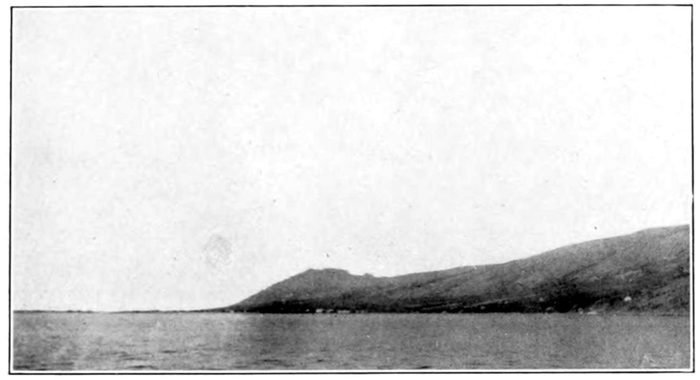
a, Cape Prince of Wales from the southeast. (A.H., 1926)
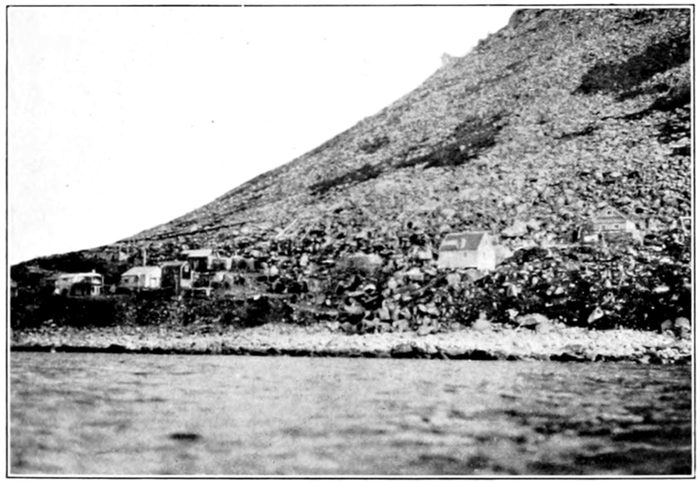
b, Village and cemetery slope, Little Diomede. (A.H., 1926)
BUREAU OF AMERICAN ETHNOLOGY FORTY-SIXTH ANNUAL REPORT PLATE 6
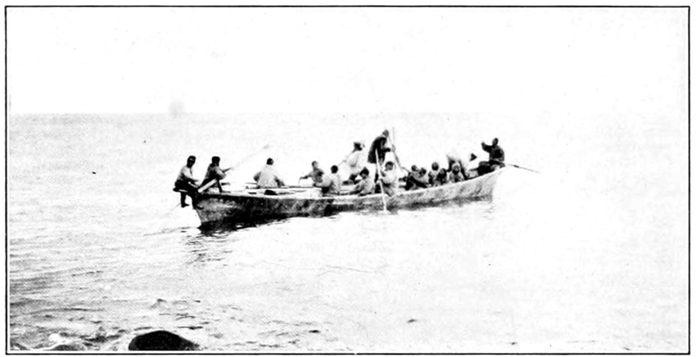
a, Asiatics departing for Siberia from the Little Diomede Island. (Photo by D. Jenness, 1926)
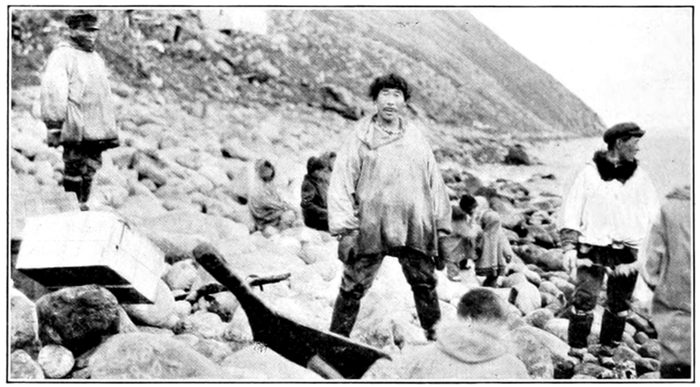
b, "Chukchis" loading their boat with goods on Little Diomede Island, before departure for Siberia. (Photo by D. Jenness, 1926)
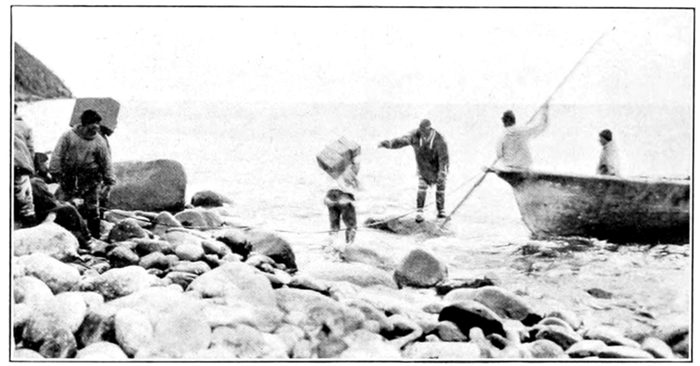
c, "Chukchis" loading their boat with goods on Little Diomede Island, before departure for Siberia. (Photo by D. Jenness, 1926)
BUREAU OF AMERICAN ETHNOLOGY FORTY-SIXTH ANNUAL REPORT PLATE 7
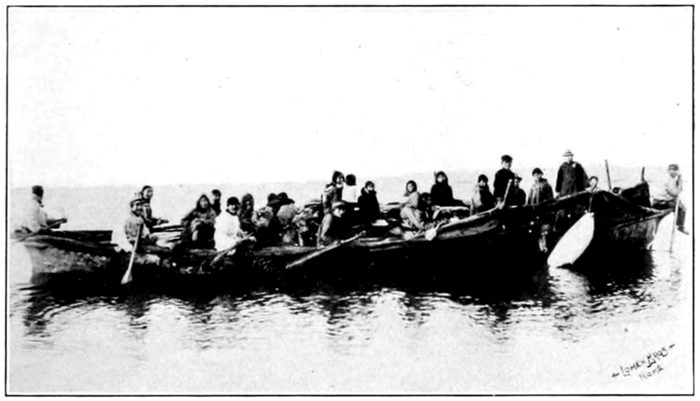
a, Eskimos from East Cape arriving at Nome, Alaska
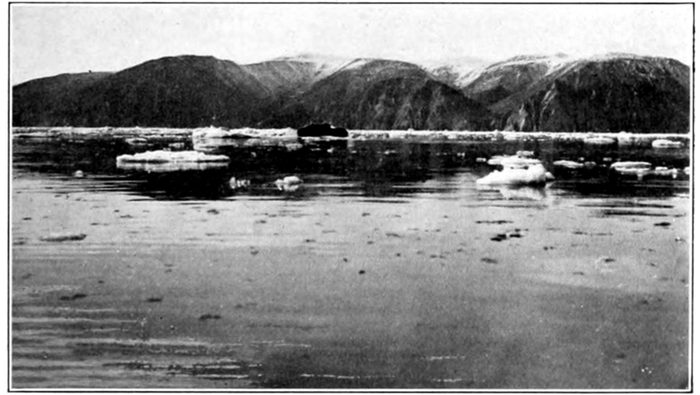
b, East Cape of Asia (to the southward). (Photo by Joe Bernard)
BUREAU OF AMERICAN ETHNOLOGY FORTY-SIXTH ANNUAL REPORT PLATE 8
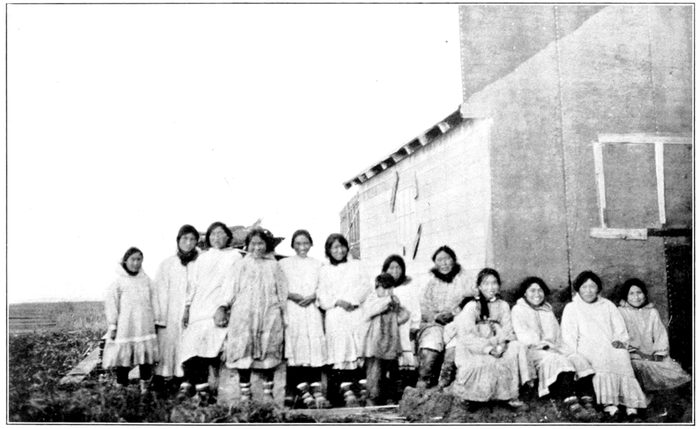
A Group of Women at Shishmaref
(Taken at 2 a. m. by A. H., 1926.)
To bed dressed—the captain tells me we shall soon be at Shishmaref, on the north shore of the Seward Peninsula, and that he will have me called, if I want to visit the village.
Awake 11.30 p. m. At 11.45 word comes that we have arrived and a boat is getting ready. On deck in five minutes. Of course it is still light—there is no real night any more in these regions.
Have a cinnamon roll—the night specialty for the crew on the Bear—and a bowl of coffee. The natives, two boats full, already coming, and a fine full-blooded lot they show themselves to be. They are accompanied by Mr. Wegner, a big, pleasant young teacher.
Leave natives trading and set off in ship's boat. The Bear is anchored about 1⅓ miles off. Fortunately fairly quiet or we should not be able to go ashore. Teacher and a young English-speaking native go with us. We have the launch and the skin whaleboat. Anchor first off shallow beach and transfer into the skin boat for the landing.
Tuesday, July 27. It is about 12.30 a. m. Many native women, youngsters, and some men gather about us at the school. Talk to them—explain what I want, which is mainly skulls and bones—all quite agreed. Take two young natives, some bags, and proceed to where they lead me.
Find, about half a mile from the present village, a big and important old site, which existed up to the white man's time. But dunes on which burials were made and house sites have been largely graded by a fox-farm keeper and trader, Mr. Goshaw. He had gathered many skulls—shows me a photo of two rows, at least 40—will not tell what he did with them. Says he sent "many things to the Smithsonian," but can give no details, "and to the universities," but will not mention which. Also "buried a lot." Bad business.
Gathering what is possible from the débris thrown out by the Eskimo working for the fox farm, we proceed rapidly from mound (dune) to mound. Find burials still on the surface in situ—i. e., nearly buried by the rising carpet of the vegetation—but skulls gone. Many of those on remaining heaps imperfect, but at least something can be saved. Collect all that is worth collecting. See Mr. Goshaw—get but little out of him. Donates a few archeological specimens of no great value—has no more.
We hurry on to the other village and burial ground, almost a mile west of the present settlement. Find only a small pile of bones, with one whole male skeleton of fairly recent date.
Then back, as fast as possible, the Indians carrying the bags with bones, and load on boat. My shoes and feet have long since become thoroughly wet, after which Mr. Wegner loaned me wool socks and native shoes that protected my feet. But now these must be left behind and I have to get into my wet, cold shoes—socks too wet. Officers in a hurry to get back. It is now 3.00 a. m.; the sun rose about 1.30. Pay my men, change shoes, photograph women (pl. 8) and then men—all pleasant and willing. See a few poor articles of archeological nature—not worth getting; and after a hearty handshake with the teacher we take off through the somewhat rougher water to the whaleboat, then on to the motor boat and the ship. Arrive with six bags of specimens, reaching boat just a little after 4. Sleepy captain meets us, but luckily shows no grudge, though this stop and his loss of sleep were essentially for me. Though it would seem they could have readily waited for our going ashore until morning, or have given me a little more time at the Diomedes, which would have brought us here later. Am too much awake now and worked up to sleep. Lie down a while but fully awake. Total sleep last night 2½ hours. But it was worth it, except for the vandalism.
Pack—inadequate boxes—until 3.30 p. m. Whole collection made last night put in order. But back and knees stiff. Weather two-thirds fair (my own estimate), some wind, sea choppy. Lie down but can not sleep.
At 5.30 off Kotzebue. Due to shallowness of water must anchor far out of sight. At 6 go to land in ship's larger launch. Waves rather bad, much tossing about and spray, have to get behind the canvas canopy that is raised over one seat. It is 15 miles from where the Bear is anchored to the Kotzebue village—over two hours of (at times) rather violent tossing up and down and sidewise. Run for a part of the time not far from beach—a number of isolated, orderly fish camps—lots of fish drying. Wonder at not getting seasick again—it must be the open air or difference of movement.
Kotzebue village lies around a point on a not very high, flat bank, facing the bay of three rivers (Selavik, Kobuk, Noatak). As we approach I count over 50 clean tents of Eskimos, about 15 frame houses and stores, and many skin and other boats on beach or in water. Many natives hurry to meet us.
Go ashore. Thomas Berryman, the trader, with the local judge and two or three other whites come also to meet us. After getting acquainted inquire about possibility of exploring the Kobuk and reaching the Koyukuk and Yukon. But all that I learn is uncertain and discouraging. There are but few native villages on the river, all Eskimo; and higher up the water is rapid, necessitating much hauling of the boat by the natives, which is costly; upon which follow three or four days' portage. The trip would cost much, and no loads over 40 pounds to a man could be carried.
Only a few old sites hereabouts are known by those whom I have a chance to ask. Say there is a somewhat important one at Cape Krusenstern. Mr. Berryman has from there a big stone (slate) lance. He also has a huge piece of serpentine, over 80 pounds in weight, with a moderate depression in top and some cutting (old native work), said to have been used as a lamp. Wants to keep this and spearhead, but donates an old rusty tin box full of smaller things and promises to obtain skulls for us; and I get a similar promise from a man (probably one of Mr. Berryman's storekeepers) from farther up the country.
Later meet here Mr. Chance, the school superintendent of these parts; a young and not prepossessing man, but one who steadily improves on closer acquaintance. Learn from him of a skeleton recently dug out from the ground under the schoolhouse.
See many natives, all Eskimo, good looking, clean, and kind. Some mix bloods, but the majority pure. Good to moderate stature, well proportioned though not fat body, medium to somewhat lighter brown color, physiognomies less typical Eskimo than hitherto and often strongly like Indian. Too late and dusky to photograph.
Go to see the teacher and find that the skeleton he dug out was placed by him in an open box, pushed as far as possible under the rafters of the floor of the schoolhouse and covered with gravel and earth. There are four of us—start hurriedly digging for it, remove with shovel, hoe and arms about a ton of the "filling"—and can not reach the box. It is 10 p. m., the wind rising, officer comes and urges me to get back to the boat. So must leave with promise that the box will be gotten out and await me on our return from the north. Have by this time decided the best policy will be to go with the Bear as far as she may go. Load empty boxes, some packing—and one of the young white men who have been digging with us runs up from the distant schoolhouse announcing that they "struck" the box. Urge him to run back as fast as he can and get it. Luckily the postmaster and a good many others who came to see us off delay us; also the transfer of the mail and boxes to the larger boat. Finally, after a good many anxious looks, I see at last the two young men appear, one with a wheelbarrow on which is the box of bones. Bones look not very old, and Eskimoid at first sight, but take box, which contains a good deal of gravel, carry it through the very interested Eskimo to the boat, all get in, hurried good-bys to everybody, and we are off.
A two and a half hours' trip once more, and the last more than half of it very rough. Such tossing and dancing and dipping and twisting, with the spray, fortunately not cold, shooting high up at times, or an angry wave splashing over. But the boat is large and strong and so eventually we reach the Bear, which was completely out of sight until about an hour after we started, and in a few minutes off we go to the north. A little fruit, bed, and know nothing more until near 7 the next morning. It was a long day—over 25 hours in a stretch without a wink. Yet did not feel bad; the work and good nature of people about and those met with, with some success, are good tonics.
Wednesday, July 28. All of us have to consult the calendar to be sure of the day and date.
Sort and wash Berryman's specimens—a nice lot of little things, mainly of stone, slate, flint, etc.
Then go after my bones. Find the spray made the earth and gravel in the box thoroughly wet, so that it is necessary carefully to excavate all the bones. Find a male, rather short-statured, typically Eskimo. May have been a burial of the Russian times. Wire for all details. Must dry bones. Meanwhile try to catch up with notes. Toward evening expect to be in another village. Weather fair. Have passed the Arctic Circle during night, but it is not cold nor in any way strange here. Sunset coloring lasts long and passes into that of sunrise—no real night, no stars; but moon seen late at night and far to the south.
May this weather continue, for in rough weather landing at any of these places—there are no harbors whatever and always shallows and bars and shoals—would be extremely risky or impossible and my work, for which I feel ever more eager, would suffer. If only I could see all worth seeing, and stay a little longer when I find what I am after.
We reach Kevalina. It is just a schoolhouse and about seven sod houses. Only a native school teacher, from whom I do not get much.
No remains or old site very near, but an old village, with "good many things," exists on the Kevalina River within a few hours' distance (by canoe) from Kevalina.
Natives bring old adzes (mounted by them, however), and a harpoon handle from the old site—bought.
Spend rest of day in washing, sorting, and packing specimens.
After supper am invited to the officers' room and given by Lieut. M. C. Anderson a fine selection of old ivory harpoon heads and other things. Many of these are from the old site on the St. Lawrence Island, and especially from little isles off that island named Punuk. All this strengthens the importance of those islands for regular exploration.
Thursday, July 29. In anticipation of being called up again during the night, at Point Hope, which is evidently another important spot for archeological exploration, for the natives are said to bring many old articles for sale each year, I do not undress and go to bed earlier, but have, because of the anticipation, closeness of air, and a cat jumping on my face just as I am dozing off, a very poor night; and no call came after all. In the morning there are cold showers, the sky is much clouded, and the wind keeps on blowing from the north-northwest, threatening, the officers say, to drive the ice toward this shore, which would be bad for us. It is cool and disagreeable. We have anchored to the south of the spit on which stands the village and can not unload or get ashore. Nor can the natives come here to us.
The village consists of a schoolhouse, a little mission (Rev. F. W. Goodman), an accumulation of houses, semi-subterraneans, and tents. A few tents are also seen a good distance to the right—a reindeer camp. Otherwise there is nothing but the long, low, sandy, and grassy spit projecting far out into the ocean.
Later. The north-northwest still blows, and so the ship has to anchor to the south of the long spit on the point of which is the village. Of this but little can be seen, just a few houses, and it seems near and insignificant.
The captain is evidently waiting again for the natives to come out, and I am helpless. Finally, however, a boat is made ready and I am taken to the shore with the mail. This is piled on the beach, and with two officers we start to walk toward the dwellings opposite to us, which are the mission. Heavy walking in the loose sand and gravel of the steep beach, and as we ascend it is seen the buildings which seemed so near to the shore are about a mile or more away.
A man coming toward us—the missionary, Archdeacon Goodman. Tell him my mission; says he has some business on the ship, but will come, and there will be no trouble in helping me to a "good deal of what I want," which sounds fine.
In the absence of the missionary, go to see the teacher. The school is over a mile in the direction toward the point. Find him at home and helpful. In 15 minutes, with his aid, engage two native boys, give two sacks to each, and send them out over the long flats (old beaches) to pick up every skull and jaw they can find. They go cheerfully, and we depart shortly after to see Mr. La Voy, a movie-picture man, who has been staying here for some time making movie pictures of the natives, and at the same time collecting all the antiquities they could bring him. We go to see his collection, but find him not home; has gone for mail. The rare mail in these regions is, of course, the most important of events. So back to the school (a good many rods from the sod house part of the native village to the left), and then—it is now near noon—to the mission, a good mile from the school and more from the village.
Road staked on one side with whale ribs about 2 rods distance. Flats on both sides show many parts of bleached human bones. They are a part of the old extensive burial grounds. Unfortunately, about two years ago the predecessor of the present missionary had most of the skulls and bones collected and put in a hole in the new cemetery, now seen in the distance to the right of the mission. This new burial place is surrounded by a unique whale-rib fence. Reach mission, but no one there. Does not look good. Try one building and door after another—no one—learn later that the missionary has no family. Twenty minutes to 1. Nothing remains but to go back to the school for some lunch. So leave my raincoat, camera, and remaining bags (expecting to do main work on the buried bones) and hurry back to the school, which I reach just after 1, and, thanks to their late clock, just in time for a modest lunch, but with a real hot cup of coffee. Queer that the only genuinely hot cups of coffee I got on this journey were furnished by Eskimo—for Mrs. Moyer, the wife of the teacher, is an Eskimo.
Then comes the mail and Mr. La Voy, and I go to see the latter's collection.
Find a mass of old and modern material, of stone, bone, and wood. All the older things are from an old site on the point. It is an important and large site, as found later (at least 50 houses), which the natives (getting coffee, tea, chewing gum, chocolate, candy, etc., for what they find) are now busy digging over and ruining for scientific exploration. Women dig as well as men, confining themselves to from 2 to 3 uppermost feet that have thawed; but even thus finding a lot of specimens. Bones, of course, and other things are left and no observation whatever on the site is made. It is a pity.
Mr. La Voy donates some stone objects, mainly scrapers, and then I go with a native he employs to the "diggings." Find much already turned over—one woman actually digging—but very much more still remaining. Examine everything—site evidently not ancient but of the richest—and then return with the woman to get some of her "cullings."
On the way am called by a man whose sod house (semisubterranean) we pass. We sit on the top of his house and soon establish a regular trading place, with a big flat stone as a counter. One after another the native women and men bring out a few articles, good, bad, or indifferent, lay them on the stone, I select what I want, lay so much money against the articles, and usually get them. Everybody in the best of humor. The natives surely enjoy the sport, and so do I, if only I was not hurried. Thus trade for at least an hour until my pockets are bulging. Then once more to the school and once more to the mission. In the latter get my things, as nobody is there yet, Doctor Goodman having doubtless been delayed on the boat. I hear that there are prospects of both him and Mr. La Voy going north with us on a little vacation. Send the coat with spare bags to the school by a native I meet, while I go to look at the rib cemetery and photograph it. Find the bones have been interred in its middle and a low mound raised over them, so there is for the moment nothing to do there. Therefore go over the plain a little farther, picking up a few odds and ends, a damaged skull, and finally, from a fairly recent burial box, a fine skull with its lower jaw. Then attempt to pass a pool of water and sink in the mud to above my rubber boots, so that the icy water runs in, wetting me thoroughly, and gurgling henceforth with every step in the shoes. Try to get these off but can not. The feet must be congested. So spill out all I can by raising the feet, and then do some hard walking which takes away the cold.
Evening, though no dusk approaching. Sit on gravel to empty more water from shoes, but can still hardly get one off. And just as I succeed I see, across another long pool, two men, one with a cap of an officer of the ship, waving their arms, evidently signifying to me that the time is up and I am to return. Call to them to wait. Impossible to make them hear me or for me to hear them. All here is elusive—enchanted-like—distances, sounds. Finally they stop. I catch up with them after passing a broad ditch, and learn that the ship is about to sail and they are waiting for me. My coat, however, and collections are still at the school, over a mile away, so once more it is necessary to hurry to the school and then back to the ship. So things go when promises go wrong and one is alone under a constant apprehension.
The boys collected four bags full. Moreover, they undertook to bring them toward the boat, and are bringing the last two just as I approach the beach. There are Eskimos on the beach with dog teams and sledges waiting to cart off what was unloaded from the ship. Photograph one of the teams and then on into the boat and to the Bear with the four bags, a box full, part of another bag, and all pockets full of specimens. Only to learn when we reach the boat that both Doctor Goodman and Mr. La Voy are going with us and that the former after supper is still to go and get his things from the mission. I have no boat to go back with, and so lose several hours.
July 30. Gloomy morning, windy, cool, sea not good. Do not feel easy. But need to pack. One of the officers, Boatswain Berg, lends me his short sheepskin coat, and I pack up to lunch. The sea is getting worse. Have but little lunch and soon after have to take to bed or would again be sick. To avoid the pitching of the end of the boat where my bed is I go to the dispensary and lie until 6. From 6 on the sea moderates somewhat, so that I am able to have a little supper. After that go to officers' wardroom, play two games of checkers with the doctor, get some more specimens from two of the officers, and retire.
When I boarded the Bear it became plain to me that I must earn as much as possible the sympathetic understanding of my work by both the officers and the crew, and so I gave two talks, one to the officers and the other to the men, telling them of our problems in Alaska, of the meaning and value of such collections as I was making, and of other matters that I felt would be useful on this occasion. As a result I had throughout the voyage nothing but the friendliest feelings of all and their cooperation. Sincere thanks to the officers and the crew of the Bear, from the captain downward.
Saturday, July 31. At 4.30 a. m. suddenly a heavy bump forward, followed by several smaller ones. Ship rises and shivers. Have struck ice floes. Going very slowly. Further bumps at longer or shorter intervals and occasionally the ship stops entirely. Sea fortunately much calmer.
Up at 7. We are in a loose field of ice—aquamarine-blue ice covered with hillocks of snow, all shapes and sizes, as after a hard winter on the Hudson, only floes mostly larger and especially deeper.
Soon after breakfast hear walrus and seals had been observed on the ice, and shortly before 9 the captain comes down hurriedly to tell us they have just spied—they now have a man in the crow's nest up on the foremast—a white bear.
Run up—everybody pleasurably excited—to the front of the ship. See a black-looking head of something swimming toward a large ice floe about 500 yards in front of us. As we approach the head reaches the floe, then a big yellowish paw comes out upon the ice, then the shoulders, and finally the whole bear. The officers hurry forward, each with a gun. Soon men all there. Some one fires. Bear stands broadside watching us. The bullet goes way over. Then other shots—still missing—water spouting high in many places. Bear bewildered, does not know what to do, lopes off a little here and there, stops again, looking at us, and now—we are less than 100 yards from him it seems—a bullet strikes him above the loin—we can see him jerk and the red spot following. He runs clumsily, but other shots follow, some seemingly taking effect, and then he drops, first on his belly, then, twisting, turns over on his back. A few more movements with his paws and head, and he lies still, quite dead. Can not but feel sorry for the poor bear, who did not know why he was being killed, and had no chance.