Book 4 — CHAPTER 18
Reading edition
Degraded Condition of the Rājputs.
—The history of the Rana’s family has now been traced through all the vicissitudes of its fortunes, from the second to the nineteenth century, whilst contending for existence, alternately with Parthians, Bhils, Tartars, and Mahrattas, till at length it has become tributary to Britain. The last chapter portrays the degraded condition of their princes, and the utter desolation of their country, in a picture which embodied the entire Rajput race. An era of repose at length dawned upon them. The destruction of that vast predatory system, under the weight of which the prosperity of these regions had so long been repressed, was effected by one short campaign in 1817; which if less brilliant than that of 1803, is inferior to none in political results. The tardy policy of the last-named period, at length accomplished, placed the power of Britain in the East on an expugnable position, and rescued the Rajputs from a progressing destruction.
Alliances with the British.
—To prevent the recurrence of this predatory system it was deemed politic to unite all these settled States, alike interested with ourselves in its overthrow, in one grand confederation. Accordingly the Rajput States were
548
invited to shelter [472] under our protecting alliance; and with one exception (Jaipur), they eagerly embraced the invitation. The ambassadors of the various governments followed each other in quick succession to Delhi, where the treaties were to be negotiated, and in a few weeks all Rajputana was united to Britain by compacts of one uniform character;
insuring to them external protection with internal independence, as the price of acknowledged supremacy, and a portion of revenue to the protecting government. By this comprehensive arrangement, we placed a most powerful barrier between our territories and the strong natural frontier of India; and so long as we shall respect their established usages, and by contributing to the prosperity of the people preserve our motives from distrust, it will be a barrier impenetrable to invasion.
Treaty with Mewār.
—Of all the princes who obtained succour at this momentous crisis in the political history of India, none stood more in need of it than the Rana of Udaipur. On January 16, 1818, the treaty was signed, and in February an envoy was nominated; who immediately proceeded to the Rana’s court, to superintend and maintain the newly formed relations.
The right wing of the grand army
had already preceded him to compel the surrender of such territory as was unjustly held by the lawless partisans of Sindhia, and to reduce to obedience the refractory nobles, to whom anarchy was endeared from long familiarity. The strongholds in the plains as Raepur, Rajnagar, etc., soon surrendered; and the payment of the arrears of the garrison of Kumbhalmer put this important fortress in our possession.
In his passage from Jahazpur, which guards the range on the east to Kumbhalmer on the Aravalli west, a space of 140 miles, the limits of Mewar, only two thinly peopled towns were seen 549which acknowledged the Rana’s authority. All was desolate; even the traces of the footsteps of man were effaced. The babul (mimosa [acacia] Arabica), and gigantic reed, which harboured the boar and the tiger, grew upon the highways; and every rising ground displayed a mass of ruin. Bhilwara, the commercial entrepôt of Rajputana, which ten years before contained six thousand [473] families, showed not a vestige of existence. All was silent in her streets—no living thing was seen except a solitary dog, that fled in dismay from his lurking-place in the temple, scared at the unaccustomed sight of man.[4]
Cession of Kumbhalmer.
—An envoy was dispatched by the Rana to congratulate the Agent, who joined him in the British camp at Nathdwara; and while he returned to arrange the formalities of reception, the Agent obtained the cession of Kumbhalmer; which, with the acquisitions before mentioned, paved the way for a joyful reception. The prince, Javan Singh, with all the State insignia, and a numerous cortège, advanced to receive the mission, and conduct it to the capital. A spot was fixed on in a grove of palmyras, about two miles from the city, where carpets were spread, and where the prince received the Agent and suite in a manner at once courteous and dignified.
Of him it might have been said, in the language applied by Jahangir to the son of Rana Amra—“His countenance carried the impression of his illustrious extraction.”
Arrival of the Author as Agent.
—We entered the city
by the gate of the sun; and through a vista of ruin the mission was inducted into its future residence, once the abode of the fair Rampiyari.
Like all the mansions of Rajputana, it was a quadrangular pile, with an open paved area, the suites of apartments carried round the sides, with latticed or open corridors
550
extending parallel to each suite. Another deputation with the
mehmani
, consisting of a hundred trays of sweetmeats, dried fruits, and a purse of one thousand rupees for distribution amongst the domestics, brought the Rana’s welcome upon our arrival in his capital, and fixed the next day for our introduction at court.
At four in the afternoon, a deputation, consisting of the officiating prime minister, the representative of the Chondawats, with mace-bearers and a numerous escort, came to announce the Rana’s readiness to receive the mission; which, with all the ‘pomp and circumstance’ peculiar to these countries, was marshalled in front of the residency, thronged by crowds of well-dressed [474] inhabitants, silently gazing at the unusual sight.[8] The grand Nakkaras having announced the Rana in court, the mission proceeded through streets which everywhere presented marks of rapine, hailed by the most enthusiastic greetings. “Jai! jai! Farangi ka Raj!” “Victory, victory to the English Government!” resounded from every tongue. The bards were not idle; and the unpoetic name of the Agent was hitched into rhyme. Groups of musicians were posted here and there, who gave a passing specimen of the tappas[9] of Mewar; and not a few of the fair, with brazen ewers of water on their heads, welcomed us with the suhelia, or songs of joy. Into each of these vessels the purse-bearer dropped a piece of silver; for neither the songs of the suhelia, the tappas of the minstrel, nor encomiastic stave of the bard, are to be received without some acknowledgement that you appreciate their merit and talents, however you may doubt the value they put upon your own. As we ascended the main street leading to the Tripolia, or triple portal, which guards the sacred enclosure, dense masses of people obstructed our progress, and even the walls of the temple of Jagannath were crowded. According to etiquette, we dismounted at the Porte, and proceeded on foot across the ample terrace; on which were drawn up a few elephants and horse, exercising for the Rana’s amusement.
The Palace at Udaipur.
—The palace is a most imposing pile,
551
of a regular form, built of granite and marble, rising at least a hundred feet from the ground, and flanked with octagonal towers, crowned with cupolas. Although built at various periods, uniformity of design has been very well preserved; nor is there in the East a more striking or majestic structure. It stands upon the very crest of a ridge running parallel to, but considerably elevated above, the margin of the lake. The terrace, which is at the east and chief front of the palace, extends throughout its length, and is supported by a triple row of arches from the declivity of the ridge. The height of this arcaded wall is fully fifty feet; and although all is hollow beneath, yet so admirably is it constructed, that an entire range of stables is built on the extreme verge of the terrace, on which the whole personal force of the Rana, elephants, horse, and foot, are often assembled. From this terrace the city and the valley lay before the spectator, whose vision is bounded only by the [475] hills shutting out the plains; while from the summit of the palace nothing obstructs its range over lake and mountain.
A band of Sindis guarded the first entrance to the palace; and being Saturday, the Saktawats were on duty in the great hall of assembly. Through lines of Rajputs we proceeded till we came to the marble staircase, the steps of which had taken the form of the segment of an ellipse, from the constant friction of the foot; an image of Ganesha guarded the ascent to the interior of the palace, and the apartment, or landing, is called Ganesha deori, from the Rajput Janus. After proceeding through a suite of saloons, each filled with spectators, the herald’s voice announced to ‘the lord of the world’ that the English envoy was in his presence; on which he arose, and advanced a few paces in front of the throne, the chieftains standing to receive the mission. Everything being ruled by precedent, the seat allotted for the envoy was immediately in front and touching the royal cushion (gaddi): being that assigned to the Peshwa in the height of Mahratta prosperity, the arrangement, which was a subject of regular negotiation, could not be objected to. The apartment chosen for the initiatory visit was the Surya mahall, or ‘hall of the sun,’ so called from a medallion of the orb in basso-rilievo which decorates the wall. Close thereto is placed the Rana’s throne, above which, supported by slender silver columns, rises a velvet canopy. The Gaddi, or throne, in the East is but a huge 552cushion, over which is thrown an embroidered velvet mantle. The chiefs of the higher grade, or ‘the Sixteen,’ were seated, according to their rank, on the right and left of the Rana; next and below these were the princes Amra and Javan Singh; and at right angles (by which the court formed three sides of a square), the chiefs of the second rank. The civil officers of the State were near the Rana in front, and the seneschal, butler, keeper of the wardrobe, and other confidential officers and inferior chieftains, formed a group standing on the extreme edge of the carpet.
The Rana’s congratulations were hearty and sincere: in a few powerful expressions he depicted the miseries he had experienced, the fallen condition of his State, and the gratitude he felt to the British Government which had interposed between him and destruction; and which for the first moment of his existence allowed him to sleep in peace. There was an intense earnestness in every word he uttered, which, delivered with great fluency of speech and dignity of manner, inspired deep respect and sympathy. The Agent said that the Governor-General was no stranger to the [476] history of his illustrious family, or to his own immediate sufferings; and that it was his earnest desire to promote, by every means in his power, the Rana’s personal dignity and the prosperity of his dominions. After conversing a few minutes, the interview was closed with presents to the Agent and suite: to the former a caparisoned elephant and horse, jewelled aigrette, and pearl necklace, with shawls and brocades; and with the customary presentation of essence of rose and the pan leaf the Rana and court rising, the envoy made his salaam and retired. In a short time the Rana, attended by his second son, ministers, and a select number of the chiefs, honoured the envoy with a visit. The latter advanced beyond his residence to meet the prince, who was received with presented arms by the guard, the officers saluting, and conducted to his throne, which had been previously arranged. Conversation was now unrestrained, and questions were demanded regarding everything which appeared unusual. After sitting half an hour, the Agent presented the Rana with an elephant and two horses, caparisoned with silver and gilt ornaments and velvet embroidered housings, with twenty-one shields[10] of shawls, brocades, muslins, and jewels; to prince Amra, unable from sickness to attend his father, a horse and 553eleven shields; and to his brother, the second prince, Javan Singh, a horse and nine shields; to the ministers and chiefs according to rank: the whole entertainment costing about 20,000 rupees, or £2000. Amidst these ceremonials, receiving and returning visits of the Rana, his chiefs, his ministers, and men of influence and information commercial and agricultural, some weeks passed in silent observation, and in the acquisition of materials for action.[11]
Political Divisions of Mewār.
—For the better comprehension of the internal relations, past and present, of Mewar [477], a sketch is presented, showing the political divisions of the tribes and the fiscal domain, from which a better idea may be formed of Rajput feudal economy than from a chapter of dissertation. The princes of Mewar skilfully availed themselves of their natural advantages in the partition of the country. The mountain-barriers east and west were allotted to the chiefs to keep the mountaineers and foresters in subjection, whose leading passes
554
were held by a lord-marcher, and the quotas of his quarter; and while strong forts guarded the exposed northern and southern entrances, the crown-land lay in the centre, the safest and the richest. The exterior, thus guarded by a cordon of feudal levies composed of the quotas of the greater fiefs; the minor and most numerous class of vassals, termed
gol
, literally ‘the mass,’ and consisting of ten thousand horse, each holding directly of the crown independent of the greater chiefs, formed its best security against both external aggression and internal commotions.
Desolation of Mewār.
—Such is a picture of the feudal economy of Mewar in the days of her renown; but so much had it been defaced through time and accident, that with difficulty could the lineaments be traced with a view to their restoration: her institutions a dead letter, the prince’s authority despised, the nobles demoralized and rebellious, internal commerce abandoned, and the peasantry destroyed by the combined operation of war, pestilence, and exile. Expression might be racked for phrases which could adequately delineate the miseries all classes had endured. It is impossible to give more than a sketch of the state of the
das sahas Mewar
, ‘the ten thousand townships’ which once acknowledged her princes, and of which above three thousand still exist. All that remained to them was the valley of the capital; and though Chitor and Mandalgarh were maintained by the fidelity of the Rana’s servants, their precarious revenues scarcely sufficed to maintain their garrisons. The Rana was mainly indebted to Zalim Singh of Kotah for the means of subsistence; for in the struggle for existence his chiefs thought only of themselves, of defending their own estates, or buying off their foes; while those who had succumbed took to horse, scoured the country, and plundered without distinction. Inferior clanships declared themselves independent of their superiors, who in their turn usurped the crown domain, or by bribing the necessities of their prince, obtained his patent for lands, to which, as they yielded him nothing, he became indifferent. The crown-tenants purchased of these chiefs the protection (
rakhwali
) which the [478] Rana could not grant, and made alienations of the crown taxes, besides private rights of the community, which were often extorted at the point of the lance. Feuds multiplied, and the name of each clan became the watchword of alarm or defiance to its neighbour: castles were assaulted, and their inmates, as
555
at Sheogarh and Lawa, put to the sword; the Meras and Bhils descended from their hills, or emerged from their forests, and planted ambuscades for the traveller or merchant, whom they robbed or carried to their retreats, where they languished in durance till ransomed. Marriage processions were thus intercepted, and the honeymoon was passed on a cliff of the Aravalli, or in the forests on the Mahi. The Rajput, whose moral energies were blunted, scrupled not to associate and to divide the spoil with these lawless tribes, of whom it might be said, as of the children of Ishmael, “Their hands were against every man, and every man’s hand against them.” Yet notwithstanding such entire disorganization of society, external commerce was not stagnant; and in the midst of this rapine, the produce of Europe and Kashmir would pass each other in transit through Mewar, loaded it is true by a multiplicity of exactions, but guarded by those who scorned all law but the point of honour, which they were paid for preserving.
The Condition of Udaipur.
—The capital will serve as a specimen of the country. Udaipur, which formerly reckoned fifty thousand houses within the walls, had not now three thousand occupied, the rest were in ruin, the rafters being taken for firewood. The realization of the spring harvest of 1818, from the entire fiscal land, was about £4000! Grain sold for seven sers the rupee, though thrice the quantity was procurable within the distance of eighty miles. Insurance from the capital to Nathdwara (twenty-five miles) was eight per cent. The Kotharia chief, whose ancestors are immortalized for fidelity, had not a horse to conduct him to his prince’s presence, though his estates were of fifty thousand rupees annual value. All were in ruins; and the Rana, the descendant of those patriot Rajputs who opposed Babur, Akbar, and Aurangzeb, in the days of Mogul splendour, had not fifty horse to attend him, and was indebted for all the comforts he possessed to the liberality of Kotah.
Reorganization of the State.
—Such was the chaos from which order was to be evoked. But the elements of prosperity, though scattered, were not extinct; and recollections of the past, deeply engraved in the national mind, became available to reanimate their moral and physical existence. To call these forth demanded only the exertion of moral [479] interference, and every other was rejected. The lawless freebooter, and even the savage Bhil, felt
556
awed at the agency of a power never seen. To him moral opinion (compared with which the strength of armies is nought) was inexplicable, and he substituted in its stead another invisible power—that of magic: and the belief was current throughout the intricate region of the West, that a single individual could carry an army in his pocket, and that our power could animate slips of paper cut into the figures of armed men, from which no precaution could guard their retreats. Accordingly, at the mere name of the British power, rapine ceased, and the inhabitants of the wilds of the West, the ‘forest lords,’ who had hitherto laughed at subjection, to the number of seven hundred villages, put each the sign of the dagger to a treaty, promising abstinence from plunder and a return to industrious life—a single individual of no rank the negotiator. Moreover, the treaty was religiously kept for twelve months; when the peace was broken, not by them, but against them.
To the Rajput, the moral spectacle of a Peshwa marched into exile with all the quietude of a pilgrimage, effected more than twenty thousand bayonets, and no other auxiliary was required than the judicious use of the impressions from this and other passing events, to relay the foundations of order and prosperity—by never doubting the issue, success was insured. The British force, therefore, after the reduction of the plans enumerated, was marched to cantonments; the rest was left for time and reason to accomplish.
Form of Civil Government.
—Before proceeding further, it may be convenient to sketch the form of civil government in Mewar, and the characters of its most conspicuous members: the former we shall describe as it was when the machine was in regular action; it will be found simple, and perfectly suited to its object.
There are four grand officers of the government:
1. The Pardhan, or prime minister.
2. Bakhshi, commander of the forces.
3. Suratnama, keeper of the records.
4. Sahai, keeper of the signet.[12]
The first, the Pardhan, or civil premier, must be of the non-militant 557tribe. The whole of the territorial and financial arrangements are vested in him. He [480] nominates the civil governors of districts, and the collectors of the revenue and custom; and has fourteen thuas, or departments, under him, which embrace all that relates to expenditure.
2. The Bakhshi must also be of a non-militant tribe, and one different from the Pardhan. His duties are mixed civil and military. He takes the musters, and pays mercenaries, or rations, to the feudal tenants when on extra service, and he appoints a deputy to accompany all expeditions, or to head frontier-posts, with the title of Faujdar, or commander. The royal insignia, the standard, and kettle-drums accompany him, and the highest nobles assemble under the general control of this civil officer, never under one of their own body. From the Bakhshi’s bureau all patents are issued, as also all letters of sequestration of feudal land.
The Bakhshi has four secretaries:
1. Draws out deeds.
2. Accountant.
3. Recorder of all patents or grants.
4. Keeps duplicates.
3. The Suratnama[13] is the auditor and recorder of all the household expenditure and establishments, which are paid by his cheques. He has four assistants also, who make a daily report, and give a daily balance of accounts.
4. The Sahai. He is secretary both for home and foreign correspondence. He draws out the royal grants or patents of estates, and superintends the deeds of grant on copper-plate to religious establishments. Since the privilege appertaining to Salumbar, of confirming all royal grants with his signet the lance, has fallen into desuetude, the Sahai executes this military autograph.[14]
To all decrees, from the daily stipend to the patta, or patent of an estate, each minister must append his seal, so that there is a complete system of check. Besides these, the higher officers of government, there are thirty-six karkhanas, or inferior officers, 558appointed directly by the Rana, the most conspicuous of which are the justiciary,[15] the keepers of the register-office, of the mint, of the armoury, of the regalia, of the jewels, of the wardrobe, of the stables, of the kitchen, of the band, of the seneschalsy, and of the seraglio.
There was no want of aspirants to office, here hereditary; but it was vain to look [481] amongst the descendants of the virtuous Pancholi, or the severe Amrachand, and the prediction of the former, “Dust will cover the head of Mewar when virtue wanders in rags,” was strictly fulfilled. There appeared no talent, no influence, no honesty; yet the deficiency was calculated to excite sorrow rather than surprise; to stimulate exertion on their behalf, rather than damp the hope of improvement; though all scope for action, save in the field of intrigue, was lost, and talent was dormant for want of exercise.
Incapacity of the Rāna.
—The Rana’s character was little calculated to supply his minister’s deficiencies. Though perfectly versed in the past history of his country, its resources, and their management; though able, wise, and amiable, his talents were nullified by numerous weak points. Vain shows, frivolous amusements, and an ill-regulated liberality alone occupied him; and so long as he could gratify these propensities, he trusted complacently to the exertions of others for the restoration of order and his proper authority. He had little steadiness of purpose, and was particularly obnoxious to female influence. It is scarcely to be wondered that he coveted repose, and was little desirous to disturb the only moment his existence had presented of enjoying it, by inviting the turmoils of business. No man, however, was more capable of advising: his judgment was good, but he seldom followed its dictates; in short, he was an adept in theory, and a novice in practice. The only man about the court at once of integrity and efficiency was Kishandas, who had long acted as ambassador, and to whose assiduity the sovereign and the country owed much; but his services were soon cut off by death.
Such were the materials with which the work of reform commenced. The aim was to bring back matters to a correspondence with an era of their history, when the rights of the prince, the 559vassal, and the cultivator, were alike well defined—that of Amra Singh.
Relations of the Rāna with his Nobles.
—The first point to effect was the recognition of the prince’s authority by his nobles; the surest sign of which was their presence at the capital, where some had never been, and others only when it suited their convenience or their views. In a few weeks the Rana saw himself surrounded by a court such as had not been known for half a century. It created no small curiosity to learn by what secret power they were brought into each other’s presence. Even the lawless Hamira, who but a short while before had plundered the marriage dower of the Hari queen [482] coming from Kotah, and the chief of the Sangawat clan, who had sworn “he might bend his head to woman, but never to his sovereign,” left their castles of Badesar and Deogarh, and “placing the royal rescript on their heads,” hastened to his presence; and in a few weeks the whole feudal association of Mewar was embodied in the capital.
Return of the Exiles.
—To recall the exiled population was a measure simultaneous with the assembling of the nobles; but this was a work requiring time: they had formed ties, and incurred obligations to the societies which had sheltered them, which could not at once be disengaged or annulled. But wherever a subject of Mewar existed, proclamations penetrated, and satisfactory assurances were obtained, and realized to an extent which belied in the strongest manner the assertion that patriotism is unknown to the natives of Hindustan. The most enthusiastic and cheering proofs were afforded that neither oppression from without, nor tyranny within, could expel the feeling for the
bapota
, the land of their fathers. Even now, though time has chastened the impressions, we should fear to pen but a tithe of the proofs of devotion of the husbandman of Mewar to the
solum natale
: it would be deemed romance by those who never contemplated humanity in its reflux from misery and despair to the ‘sweet influences’ of hope; he alone who had witnessed the day of trouble, and beheld the progress of desolation—the standing corn grazed by Mahratta horse—the rifled towns devoted to the flames—the cattle driven to the camp, and the chief men seized as hostages for money never to be realized—could appreciate their deliverance. To be permitted to see these evils banished, to behold the survivors of oppression congregated from the most
560
distant provinces, many of them strangers to each other, and the aged and the helpless awaiting the lucky day to take possession of their ruined abodes, was a sight which memory will not part with. Thus on the 3rd of Sawan (July),
a favourite day with the husbandman, three hundred of all conditions, with their waggons and implements of labour, and preceded by banners and music, marched into Kapasan;
and Ganesha was once again invoked as they reconsecrated their dwellings, and placed his portrait as the Janus of the portals. On the same day, and within eight months subsequent to the signature of the treaty, above three hundred towns and villages were simultaneously reinhabited; and the land, which for many years had been a stranger to the plough-share, was broken up. Well might [483] the superstitious fancy that miracles were abroad; for even to those who beheld the work in progression it had a magical result, to see the waste covered with habitations, and the verdant corn growing in the fields where lately they had roused the boar from his retreat! It was a day of pride for Britain! By such exertions of her power in these distant lands her sway is hallowed. By Britain alone can this fair picture be defaced; the tranquillity and independence she has conferred, by her alone may be disturbed!
Attraction of Capital.
—To these important preliminary measures, the assembly of the nobles and recall of the population, was added a third, without which the former would have been nugatory. There was no wealth, no capital, to aid their patriotism and industry. Foreign merchants and bankers had abandoned the devoted land; and those who belonged to it partook of her poverty and her shame. Money was scarce, and want of faith and credit had increased the usury on loans to a ruinous extent. The Rana borrowed at thirty-six per cent; besides twenty-five to forty per cent discount for his
barats
, or patents empowering collection on the land; a system pursued for some time even after his restoration to authority. His profusion exceeded even the rapidity of renovation; and the husbandman had scarcely broken up his long-waste fields, when a call was made by the harpies of the State for an advance on their produce, while he himself had been compelled to borrow at a like ruinous rate for
561
seed and the means of support, to be paid by expectations. To have hoped for the revival of prosperity amidst such destitution, moral and pecuniary, would have been visionary. It was as necessary to improve the one as to find the other; for poverty and virtue do not long associate, and certainly not in Mewar. Proclamations were therefore prepared by the Rana, inviting foreign merchants and bankers to establish connexions in the chief towns throughout the country; but as in the days of demoralization little faith was placed in the words of princes, similar ones were prepared by the Agent, guaranteeing the stipulations, and both were distributed to every commercial city in India. The result was as had been foreseen: branch banks were everywhere formed, and mercantile agents fixed in every town in the country, whose operations were only limited by the slow growth of moral improvement. The shackles which bound external commerce were at once removed, and the multifarious posts for the collections of transit duties abolished; in lieu of which chain of stations, all levies on goods in transit were confined to the frontiers. The scale of duties [484] was revised; and by the abolition of intermediate posts, they underwent a reduction of from thirty to fifty per cent. By this system, which could not for some time be comprehended, the transit and custom duties of Mewar made the most certain part of the revenue, and in a few years exceeded in amount what had ever been known.
Trade at Bhīlwāra.
—The chief commercial mart, Bhilwara, which showed not a vestige of humanity, rapidly rose from ruin, and in a few months contained twelve hundred houses, half of which were occupied by foreign merchants. Bales of goods, the produce of the most distant lands, were piled up in the streets lately overgrown with grass, and a weekly fair was established for the home manufactures. A charter of privileges and immunities was issued, exempting them from all taxation for the first year, and graduating the scale for the future; calculated with the same regard to improvement, by giving the mind the full range of enjoying the reward of its exertions. The right of electing their own chief magistrates and the assessors of justice, was above all things indispensable, so as to render them as independent as possible of the needy servants of the court. A guard was provided by the government for their protection, and a competent authority nominated to see that the full extent of
562
their privileges, and the utmost freedom of action, were religiously maintained. The entire success of this plan may at once be recorded to prevent repetition. In 1822, Bhilwara contained nearly three thousand dwellings, which were chiefly inhabited by merchants, bankers, or artisans. An entire new street had been constructed in the centre of the town, from the duties levied, and the shops and houses were rented at a moderate rate; while many were given up to the proprietors of their sites, returning from exile, on their paying the price of construction. But as there is no happiness without alloy, so even this pleasing picture had its dark shades to chasten the too sanguine expectation of imparting happiness to all. Instead of a generous emulation, a jealous competition checked the prosperity of Bhilwara: the base spirit of exclusive monopoly desired a distinction between the native and the stranger-merchant, for which they had a precedent in the latter paying an addition to the town-duty of metage (
mapa
). The unreasonableness of this was discussed, and it was shown to be more consonant to justice that he who came from Jaisalmer, Surat, Benares, or Delhi, should pay less than the merchant whose domicile was on the spot. When at length the parties acquiesced in this opinion, and were intreated and promised to know [485] none other distinction than that of ‘inhabitant of Bhilwara,’ sectarian differences, which there was less hope of reconciling, became the cause of disunion. All the Hindu merchants belong either to the Vaishnava or Jain sects; consequently each had a representative head, and ‘the Five’ for the adjudication of their internal arrangements; and these, the wise men of both parties, formed the general council for the affairs of Bhilwara. But they carried their religious differences to the judgement-seat, where each desired pre-eminence. Whether the point in dispute hinged on the interpretation of law, which with all these sects is of divine origin, or whether the mammon of unrighteousness was the lurking cause of their bickerings, they assuredly did much harm, for their appeals brought into play what of all things was least desired, the intrigues of the profligate dependents of the court. It will be seen hereafter,
in visits to Bhilwara, how these disputes were in some degree calmed. The leaders on both sides were distinctly given to understand they would be made to leave the place. Self-interest prevented this extremity; but from the
563
withdrawing of that active interference (which the state of the alliance did not indeed warrant, but which humanity interposed for their benefit) together with the effect of appeals to the court, it is to be apprehended that Bhilwara may fail to become what it was intended to be, the chief commercial mart of Central India.
Reform of the Nobility.
—Of the three measures simultaneously projected and pursued for the restoration of prosperity, the industrious portion has been described. The feudal interest remains, which was found the most difficult to arrange. The agricultural and commercial classes required only protection and stimulus, and we could repay the benefits their industry conferred by the lowest scale of taxation, which, though in fact equally beneficial to the government, was constructed as a boon. But with the feudal lords there was no such equivalent to offer in return for the sacrifices many had to make for the re-establishment of society. Those who were well inclined, like Kotharia, had everything to gain, and nothing left to surrender; while those who, like Deogarh, Salumbar, or Badnor, had preserved their power by foreign aid, intrigue, or prowess, dreaded the high price they might be called upon to pay [486] for the benefit of security which the new alliance conferred. All dreaded the word ‘restitution,’ and the audit of half a century’s political accounts; yet the adjustment of these was the corner-stone of the edifice, which anarchy and oppression had dismantled. Feuds were to be appeased, a difficult and hazardous task; and usurpations, both on the crown and each other, to be redeemed. ‘To bring the wolf and the goat to drink from the same vessel,’ was a task of less difficulty than to make the Chondawat and Saktawat labour in concert for the welfare of the prince and the country. In fine, a better idea cannot be afforded of what was deemed the hopelessness
564
of success than the opinion of Zorawar Singh, the chief of the latter clan, who had much to relinquish: “Were Parameswara (the Almighty) to descend, he could not reform Mewar.” We judged better of them than they did of each other.
Negotiations with the Chiefs.
—It were superfluous to detail all the preparatory measures for the accomplishment of this grand object; the meetings and adjournments, which only served to keep alive discontent. On the 27th of April, the treaty with the British Government was read, and the consequent change in their relations explained. Meanwhile, a charter, defining the respective rights of the crown and of the chiefs, with their duties to the community, was prepared, and a day named for a general assembly of the chieftains to sanction and ratify this engagement. The 1st of May was fixed: the chiefs assembled; the articles, ten in number, were read and warmly discussed; when with unmeaning expressions of duty, and objections to the least prominent, they obtained through their speaker, Gokuldas of Deogarh, permission to reassemble at his house to consider them, and broke up with the promise to attend next day. The delay, as apprehended, only generated opposition, and the 2nd and 3rd passed in inter-communications of individual hope and fear. It was important to put an end to speculation. At noon, on the 4th of May, the grand hall was again filled, when the Rana, with his sons and ministers, took their seats. Once more the articles were read, objections raised and combated, and midnight had arrived without the object of the meeting being advanced, when an adjournment, proposed by Gokuldas, till the arrival of the Rana’s plenipotentiary from Delhi, met with a firm denial; and the Rana gave him liberty to retire, if he refused his testimony of loyalty. The Begun chief, who had much to gain, at length set the example, followed by the chiefs of Amet and Deogarh, and in succession by all the sixteen nobles, who also signed as the proxies of their [487] relatives, unable from sickness to attend. The most powerful of the second grade also signed for themselves and the absent of their clans, each, as he gave in his adhesion, retiring; and it was three in the morning of the 5th of May ere the ceremony was over. The chief of the Saktawats, determined to be conspicuous, was the last of his own class to sign. During this lengthened and painful discussion of fifteen hours’ continuance, the Rana conducted himself with such judgment and firmness, as to give
565
sanguine hopes of his taking the lead in the settlement of his affairs.
Enforcement of the Treaty.
—This preliminary adjusted, it was important that the stipulations of the treaty
should be rigidly if not rapidly effected. It will not be a matter of surprise, that some months passed away before the complicated arrangements arising out of this settlement were completed; but it may afford just grounds for gratulation, that they were finally accomplished without a shot being fired, or the exhibition of a single British soldier in the country, nor, indeed, within one hundred miles of Udaipur. ‘Opinion’ was the sole and all-sufficient ally effecting this political reform. The Rajputs, in fact, did not require the demonstration of our physical strength; its influence had reached far beyond Mewar. When the few firelocks defeated hundreds of the foes of public tranquillity, they attributed it to ‘the strength of the Company’s salt,’
the moral agency of which was proclaimed the true basis of our power. ‘Sachha Raj’ was the proud epithet applied by our new allies to the British Government in the East; a title which distinguished the immortal Alfred, ‘the upright.’
It will readily be imagined that a reform, which went to touch 566the entire feudal association, could not be accomplished without harassing and painful discussions [488], when the object was the renunciation of lands, to which in some cases the right of inheritance could be pleaded, in others, the cognisance of successful revenge, while to many prescriptive possession could be asserted. It was the more painful, because although the shades which marked the acquisition of such lands were varied, no distinction could be made in the mode of settlement, namely, unconditional surrender. In some cases, the Rana had to revoke his own grants, wrung either from his necessities or his weakness; but in neither predicament could arguments be adduced to soften renunciation, or to meet the powerful and pathetic and often angry appeals to justice or to prejudice. Counter-appeals to their loyalty, and the necessity for the re-establishment of their sovereign’s just weight and influence in the social body, without which their own welfare could not be secured, were adduced; but individual views and passions were too absorbing to bend to the general interest. Weeks thus passed in interchange of visits, in soothing pride, and in flattering vanity by the revival of past recollections, which gradually familiarized the subject to the mind of the chiefs, and brought them to compliance. Time, conciliation, and impartial justice, confirmed the victory thus obtained; and when they were made to see that no interest was overlooked, that party views were unknown, and that the system included every class of society in its beneficial operation, cordiality followed concession. Some of these cessions were alienations from the crown of half a century’s duration. Individual cases of hardship were unavoidable without incurring the imputation of favouritism, and the dreaded revival of ancient feuds, to abolish which was indispensable, but required much circumspection. Castles and lands in this predicament could therefore neither be retained by the possessor nor returned to the ancient proprietor without rekindling the torch of civil war. The sole alternative was for the crown to take the object of contention, and make compensation from its own domain. It would be alike tedious and uninteresting to enter into the details of these arrangements, where one chief had to relinquish the levy of transit duties in the most important outlet of the country, asserted to have been held during seven generations, as in the case of the chief of Deogarh. Of another (the Bhindar chief) who held forty-three towns and villages, in addition to his grant; of Amet, of 567Badesar, of Dabla, of Lawa, and many others who held important fortresses of the crown independent of its will; and other claims, embracing every right [489] and privilege appertaining to feudal society; suffice it, that in six months the whole arrangements were effected.
The Case of Arja.
—In the painful and protracted discussions attendant on these arrangements, powerful traits of national character were developed. The castle and domain of Arja half a century ago belonged to the crown, but had been usurped by the Purawats, from whom it was wrested by storm about fifteen years back by the Saktawats, and a patent sanctioning possession was obtained, on the payment of a fine of £1000 to the Rana. Its surrender was now required from Fateh Singh, the second brother of Bhindar, the head of this clan; but being regarded as the victorious completion of a feud, it was not easy to silence their prejudices and objections. The renunciation of the forty-three towns and villages by the chief of the clan caused not half the excitation, and every Saktawat seemed to forgo his individual losses in the common sentiment expressed by their head: “Arja is the price of blood, and with its cession our honour is surrendered.” To preserve the point of honour, it was stipulated that it should not revert to the Purawats, but be incorporated with the fisc, which granted an equivalent; when letters of surrender were signed by both brothers, whose conduct throughout was manly and confiding.
Badnor and Amet.
—The Badnor and Amet chiefs, both of the superior grade of nobles, were the most formidable obstacles to the operation of the treaty of the 4th of May. The first of these, by name Jeth Singh (
the victorious
[
chief
]
lion
), was of the Mertia clan, the bravest of the brave race of Rathor, whose ancestors had left their native abodes on the plains of Marwar, and accompanied the celebrated Mira Bai on her marriage with Rana Kumbha. His descendants, amongst whom was Jaimall, of immortal memory, enjoyed honour in Mewar equal to their birth and high deserts. It was the more difficult to treat with men like these, whose conduct had been a contrast to the general license of the times, and who had reason to feel offended, when no distinction was observed between them and those who had disgraced the name of Rajput. Instead of the submission expected from the Rathor, so overwhelmed was he from the magnitude
568
of the claims, which amounted to a virtual extinction of his power, that he begged leave to resign his estates and quit the country. In prosecution of this design, he took post in the chief hall of the palace, from which no entreaties could make him move;
until the Rana, to [490] escape his importunities, and even restraint, obtained his promise to abide by the decision of the Agent. The forms of the Rana’s court, from time immemorial, prohibit all personal communication between the sovereign and his chiefs in matters of individual interest, by which indecorous altercation is avoided. But the ministers, whose office it was to obtain every information, did not make a rigid scrutiny into the title-deeds of the various estates previous to advancing the claims of the crown. This brave man had enemies, and he was too proud to have recourse to the common arts either of adulation or bribery to aid his cause. It was a satisfaction to find that the two principal towns demanded of him were embodied in a grant of Sangram Singh’s reign; and the absolute rights of the fisc, of which he had become possessed, were cut down to about fifteen thousand rupees of annual revenue. But there were other points on which he was even more tenacious than the surrender of these. Being the chief noble of the fine district of Badnor, which consisted of three hundred and sixty towns and villages, chiefly of feudal allotments (many of them of his own clan), he had taken advantage of the times to establish his influence over them, to assume the right of wardship of minors, and secure those services which were due to the prince, but which he wanted the power to enforce. The holders of these estates were of the third class of vassals or
gol
(the mass), whose services it was important to reclaim, and who constituted in past times the most efficient force of the Ranas, and were the preponderating balance of their authority when mercenaries were unknown in these patriarchal states. Abundant means towards a just investigation had been previously procured; and after some discussion, in which all admissible claims were recognized, and argument was silenced by incontrovertible facts, this chieftain relinquished all that was demanded, and sent in, as from himself, his written renunciation to his sovereign. However convincing the data by which his proper rights and those of his prince were defined, it was to feeling
569
and prejudice that we were mainly indebted for so satisfactory an adjustment. An appeal to the name of Jaimall, who fell defending Chitor against Akbar,
and the contrast of his ancestor’s loyalty and devotion with his own contumacy, acted as a talisman, and wrung tears from his eyes and the deed from his hand. It will afford some idea of the difficulties encountered, as well as the invidiousness of the task of arbitrating such matters, to give his own comment verbatim: "I remained faithful when his own kin deserted him, and was [491] one of four chiefs who alone of all Mewar fought for him in the rebellion; but the son of Jaimall is forgotten, while the ‘plunderer’ is his boon companion, and though of inferior rank, receives an estate which elevates him above me"; alluding to the chief of Badesar, who plundered the queen’s dower. But while the brave descendant of Jaimall returned to Badnor with the marks of his sovereign’s favour, and the applause of those he esteemed, the ‘runner’ went back to Badesar in disgrace, to which his prince’s injudicious favour further contributed.
Hamīra of Badesar.
—Hamira of Badesar was of the second class of nobles, a Chondawat by birth. He succeeded to his father Sardar Singh, the assassin of the prime minister even in the palace of his sovereign;
into whose presence he had the audacity to pursue the surviving brother, destined to avenge him.
Hamira inherited all the turbulence and disaffection, with the estates, of his father; and this most conspicuous of the many lawless chieftains of the times was known throughout Rajasthan as Hamira ‘the runner’ (
daurayat
). Though not entitled to hold
570
lands beyond thirty thousand annually, he had become possessed to the amount of eighty thousand, chiefly of the fisc or
khalisa
, and nearly all obtained by violence, though since confirmed by the prince’s patent. With the chieftain of Lawa (precisely in the same predicament), who held the fortress of Kheroda and other valuable lands, Hamira resided entirely at the palace, and obtaining the Rana’s ear by professions of obedience, kept possession, while chiefs in every respect his superiors had been compelled to surrender; and when at length the Saktawat of Lawa was forbid the court until Kheroda and all his usurpations were yielded up, the son of Sardar displayed his usual turbulence, ‘curled his moustache’ at the minister, and hinted at the fate of his predecessor. Although none dared to imitate him, his stubbornness was not without admirers, especially among his own clan; and as it was too evident that fear or favour swayed the Rana, it was a case for the Agent’s interference, the opportunity for which was soon afforded. When [492] forced to give letters of surrender, the Rana’s functionaries, who went to take possession, were insulted, refused admittance, and compelled to return. Not a moment could be lost in punishing this contempt of authority; and as the Rana was holding a court when the report arrived, the Agent requested an audience. He found the Rana and his chiefs assembled in ‘the balcony of the sun,’ and amongst them the notorious Hamira. After the usual compliments, the Agent asked the minister if his master had been put in possession of Syana. It was evident from the general constraint, that all were acquainted with the result of the deputation; but to remove responsibility from the minister, the Agent, addressing the Rana as if he were in ignorance of the insult, related the transaction, and observed that his government would hold him culpable if he remained at Udaipur while his highness’s commands were disregarded. Thus supported, the Rana resumed his dignity, and in forcible language signified to all present his anxious desire to do nothing which was harsh or ungracious; but that, thus compelled, he would not recede from what became him as their sovereign. Calling for a
bira
, he looked sternly at Hamira, and commanded him to quit his presence instantly, and the capital in an hour; and, but for the Agent’s interposition, he would have been banished the country. Confiscation of his whole estate was commanded, until renunciation was completed. He departed that night; and,
571
contrary to expectation, not only were all the usurpations surrendered, but, what was scarcely contemplated by the Agent, the Rana’s flag of sequestration was quietly admitted into the fortress of Badesar.
The Case of Āmli.
—One more anecdote may suffice. The lands and fortress of Amli had been in the family of Amet since the year 27, only five years posterior to the date to which these arrangements extended; their possession verged on half a century. The lords of Amet were of the Sixteen, and were chiefs of the clan Jagawat. The present representative enjoyed a fair character: he could, with the chief of Badnor, claim the succession of the loyal; for Partap and Jaimall, their respective ancestors, were rivals and martyrs on that memorable day when the genius of Chitor abandoned the Sesodias. But the heir of Amet had not this alone [493] to support his claims; for his predecessor Partap had lost his life in defending his country against the Mahrattas, and Amli had been his acquisition. Fateh Singh (such was his name) was put forward by the more artful of his immediate kin, the Chondawat interest; but his disposition, blunt and impetuous, was little calculated to promote their views: he was an honest Rajput, who neither could nor cared to conceal his anger, and at a ceremonious visit paid him by the Agent, he had hardly sufficient control over himself to be courteous, and though he said nothing, his eyes, inflamed with opium and disdain, spoke his feelings. He maintained a dogged indifference, and was inaccessible to argument, till at length, following the example of Badnor, he was induced to abide by the Agent’s mediation. He came attended by his vassals, who anxiously awaited the result, which an unpremeditated incident facilitated. After a long and fruitless expostulation, he had taken refuge in an obstinate silence; and seated in a chair opposite to the envoy, with his shield in front, placed perpendicularly on his knees, and his arms and head
572
reclined thereon, he continued vacantly looking on the ground. To interrupt this uncourteous silence in his own house, the envoy took a picture, which with several others was at hand, and placing it before him, remarked, "That chief did not gain his reputation for
swamidharma
(loyalty) by conduct such as yours." His eyes suddenly recovered their animation and his countenance was lighted with a smile, as he rapidly uttered, “How did you come by this—why does this interest you?” A tear started in his eye as he added, "This is my father!"—“Yes,” said the Agent, "it is the loyal Partap on the day he went forth to meet his death; but his name yet lives, and a stranger does homage to his fame."—“Take Amli, take Amli,” he hurriedly repeated, with a suppressed tone of exultation and sorrow, “but forget not the extent of the sacrifice.” To prolong the visit would have been painful to both, but as it might have been trusting too much to humanity to delay the resumption, the Agent availed himself of the moment to indite the
chhorchitthi
of surrender for the lands.
With these instances, characteristic of individuals and the times, this sketch of the introductory measures for improving the condition of Mewar may be closed. To enter more largely in detail is foreign to the purpose of the work; nor is it requisite for the comprehension of the unity of the object, that a more minute dissection of the parts should be afforded. Before, however, we exhibit the [494] general results of these arrangements, we shall revert to the condition of the more humble, but a most important part of the community, the peasantry of Mewar; and embody, in a few remarks, the fruits of observation or inquiry, as to their past and present state, their rights, the establishment of them, their infringement, and restitution. On this subject much has been necessarily introduced in the sketch of the feudal system, where landed tenures were discussed; but it is one on which such a contrariety of opinion exists, that it may be desirable to show the exact state of landed tenures in a country, where Hindu manners should exist in greater purity than in any other part of the vast continent of India.
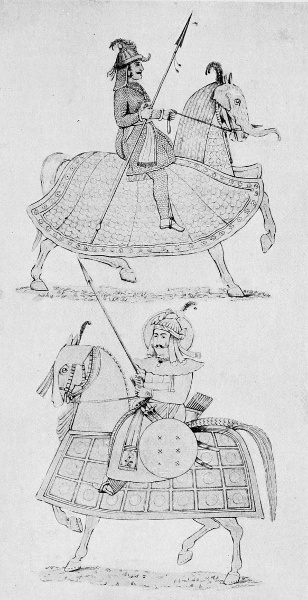
FACSIMILE OF NATIVE DRAWING OF PARTĀB SINGH AND RĀĒMALL. To face page 572.
The Landed System.
—The ryot (cultivator) is the proprietor of the soil in Mewar. He compares his right therein to the
akshay
573
duba
,
which no vicissitudes can destroy. He calls the land his
bapota
, the most emphatic, the most ancient, the most cherished, and the most significant phrase his language commands for patrimonial
inheritance. He has nature and Manu in support of his claim, and can quote the text, alike compulsory on prince and peasant, “cultivated land is the property of him who cut away the wood, or who cleared and tilled it,”
an ordinance binding on the whole Hindu race, and which no international wars, or conquest, could overturn. In accordance with this principle is the ancient adage, not of Mewar only but all Rajputana,
Bhog ra dhanni Raj ho: bhum ra dhanni ma cho
: ‘the government is owner of the rent, but I am the master of the land.’ With the toleration and benevolence of the race the conqueror is commanded “to respect the deities adored by the conquered, also their virtuous priests, and to establish the laws of the conquered nation as declared in their books.”
If it were deemed desirable to recede to the system of pure Hindu agrarian law, there is no deficiency of materials. The customary laws contained in the various reports of able men, superadded to the general ordinances of Manu, would form a code at once simple and efficient: for though innovation from foreign conquest has placed many principles in abeyance, and modified others, yet he has observed to little purpose [495] who does not trace a uniformity of design, which at one time had ramified wherever the
574
name of Hindu prevailed: language has been modified, and terms have been corrupted or changed, but the primary pervading principle is yet perceptible; and whether we examine the systems of Khandesh, the Carnatic, or Rajasthan, we shall discover the elements to be the same.
If we consider the system from the period described by Arrian, Curtius, and Diodorus, we shall see in the government of townships each commune an ‘imperium in imperio’; a little republic, maintaining its municipal legislation independent of the monarchy, on which it relies for general support, and to which it pays the bhog, or tax in kind, as the price of this protection; for though the prescribed duties of kings are as well defined by Manu[33] as by any jurisconsult in Europe, nothing can be more lax than the mutual relations of the governed and governing in Hindu monarchies, which are resolved into unbounded liberty of action. To the artificial regulation of society, which leaves all who depend on manual exertion to an immutable degradation, must be ascribed these multitudinous governments, unknown to the rest of mankind, which, in spite of such dislocation, maintain the bonds of mutual sympathies. Strictly speaking, every State presents the picture of so many hundred or thousand minute republics, without any connexion with each other, giving allegiance (an) and rent (bhog) to a prince, who neither legislates for them, nor even forms a police for their internal protection. It is consequent on this want of paramount interference that, in matters of police, of justice, and of law, the communes act for themselves; and from this want of paternal interference only have arisen those courts of equity, or arbitration, the panchayats.
But to return to the freehold ryot of Mewar, whose bapota is the watan and the miras of the peninsula—words of foreign growth, introduced by the Muhammadan conquerors; the first (Persian) is of more general use in Khandesh; the other (Arabic) 575in the Carnatic. Thus the great Persian moralist Saadi exemplifies its application: "If you desire to succeed to your father’s inheritance (miras), first obtain his wisdom" [496].
While the term bapota thus implies the inheritance or patrimony, its holder, if a military vassal, is called Bhumia, a term equally powerful, meaning one actually identified with the soil (bhum), and for which the Muhammadan has no equivalent but in the possessive compound watandar, or mirasdar. The Caniatchi[34] of Malabar is the Bhumia of Rajasthan.
The emperors of Delhi, in the zenith of their power, bestowed the epithet zamindar upon the Hindu tributary sovereigns: not out of disrespect, but in the true application of their own term Bhumia Raj, expressive of their tenacity to the soil; and this fact affords additional evidence of the proprietary right being in the cultivator (ryot), namely, that he alone can confer the freehold land, which gives the title of Bhumia, and of which both past history and present usage will furnish us with examples. When the tenure of land obtained from the cultivator is held more valid than the grant of the sovereign, it will be deemed a conclusive argument of the proprietary right being vested in the ryot. What should induce a chieftain, when inducted into a perpetual fief, to establish through the ryot a right to a few acres in bhum, but the knowledge that although the vicissitudes of fortune or of favour may deprive him of his aggregate signiorial rights, his claims, derived from the spontaneous favour of the commune, can never be set aside; and when he ceases to be the lord, he becomes a member of the commonwealth, merging his title of Thakur, or Signior, into the more humble one of Bhumia, the allodial tenant of the Rajput feudal system, elsewhere discussed.[35] Thus we have touched on the method by which he acquires this distinction, for protecting the community from violence; and if left destitute by the negligence or inability of the government, he is vested with the rights of the crown, in its share of the bhog or rent. But when their own land is in the predicament called galita, or reversions from lapses to the commune, he is ‘seised’ in 576all the rights of the former proprietor; or, by internal arrangements, they can convey such right by cession of the commune.
The Bhūmia.
—The privilege attached to the
bhum
,
and acquired from the community by the protection afforded to it, is the most powerful argument for the recognition of its original rights. The Bhumia, thus vested, may at pleasure drive his own plough [497], the right to the soil. His
bhum
is exempt from the
jarib
(measuring rod); it is never assessed, and his only sign of allegiance is a quit-rent, in most cases triennial, and the tax of
kharlakar
,
a war imposition, now commuted for money. The State, however, indirectly receives the services of these allodial tenants, the yeomen of Rajasthan, who constitute, as in the districts of Kumbhalmer and Mandalgarh, the landwehr, or local militia. In fact, since the days of universal repose set in, and the townships required no protection, an arrangement was made with the Bhumias of Mewar, in which the crown, foregoing its claim of quit-rent, has obtained their services in the garrisons and frontier stations of police at a very slight pecuniary sacrifice.
Such are the rights and privileges derived from the ryot cultivator alone. The Rana may dispossess the chiefs of Badnor, or Salumbar, of their estates, the grant of the crown—he could not touch the rights emanating from the community; and thus the descendants of a chieftain, who a few years before might have followed his sovereign at the head of one hundred cavaliers, would descend into the humble foot militia of a district. Thousands are in this predicament: the Kanawats, Lunawats, Kumbhawats, and other clans, who, like the Celt, forget not their claims of birth in the distinctions of fortune, but assert their propinquity as “brothers in the nineteenth or thirtieth degree to the prince” on the throne. So sacred was the tenure derived from the ryot, that even monarchs held lands in bhum from their subjects, for an instance of which we are indebted to the great poetic historian of the last Hindu king. Chand relates, that when his sovereign, the Chauhan, had subjugated the kingdom of Anhilwara[38] from the Solanki, he returned to the nephew of the 577conquered prince several districts and seaports, and all the bhum held by the family. In short, the Rajput vaunts his aristocratic distinction derived from the land; and opposes the title of ‘Bhumia Raj,’ or government of the soil, to the ‘Bania Raj,’ or commercial government, which he affixes as an epithet of contempt to Jaipur: where “wealth accumulates and men decay.”
In the great ‘register of patents’ (patta bahi) of Mewar we find a species of [498] bhum held by the greater vassals on particular crown lands; whether this originated from inability of ceding entire townships to complete the estate to the rank of the incumbent, or whether it was merely in confirmation of the grant of the commune, could not be ascertained. The benefit from this bhum is only pecuniary, and the title is ‘bhum rakhwali’[39] or land [in return for] ‘preservation.’ Strange to say, the crown itself holds ‘bhum rakhwali’ on its own fiscal demesnes consisting of small portions in each village, to the amount of ten thousand rupees in a district of thirty or forty townships. This species, however, is so incongruous that we can only state it does exist: we should vainly seek the cause for such apparent absurdity, for since society has been unhinged, the oracles are mute to much of antiquated custom.
Occupiers’ Rights in the Land.
—We shall close these remarks with some illustrative traditions and yet existing customs, to substantiate the ryot’s right in the soil of Mewar. After one of those convulsions described in the annals, the prince had gone to espouse the daughter of the Raja of Mandor, the (then) capital of Marwar. It is customary at the moment of
hathleva
, or the junction of hands, that any request preferred by the bridegroom to the father of the bride should meet compliance, a usage which has yielded many fatal results; and the Rana had been prompted on this occasion to demand a body of ten thousand Jat cultivators to repeople the deserted fisc of Mewar. An assent was given to the unprecedented demand, but when the inhabitants were thus despotically called on to migrate, they denied the power and refused. “Shall we,” said they, "abandon the lands of our inheritance (
bapota
), the property of our children, to accompany a stranger into a foreign land, there to labour for him? Kill us you may, but never shall we relinquish our inalienable rights." The Mandor prince, who had trusted to this reply, deemed himself
578
exonerated from his promise, and secured from the loss of so many subjects: but he was deceived. The Rana held out to them the enjoyment of the proprietary rights escheated to the crown in his country, with the lands left without occupants by the sword, and to all, increase of property. When equal and absolute power was thus conferred, they no longer hesitated to exchange the arid soil of Marwar for the garden of Rajwara; and the descendants of these Jats still occupy the flats watered by the Berach and Banas [499].
In those districts which afforded protection from innovation, the proprietary right of the ryot will be found in full force; of this the populous and extensive district of Jahazpur, consisting of one hundred and six townships, affords a good specimen. There are but two pieces of land throughout the whole of this tract the property of the crown, and these were obtained by force during the occupancy of Zalim Singh of Kotah. The right thus unjustly acquired was, from the conscientiousness of the Rana’s civil governor, on the point of being annulled by sale and reversion, when the court interfered to maintain its proprietary right to the tanks of Loharia and Itaunda, and the lands which they irrigate, now the bhum of the Rana.[40] This will serve as an illustration how bhum may be acquired, and the annals of Kotah will exhibit, unhappily for the ryots of that country, the almost total annihilation of their rights, by the same summary process which originally attached Loharia to the fisc.
The power of alienation being thus proved, it would be superfluous to insist further on the proprietary right of the cultivator of the soil.
Proprietary Rights in Land.
—Besides the ability to alienate as demonstrated, all the overt symbols which mark the proprietary right in other countries are to be found in Mewar; that of entire conveyance by sale, or temporary by mortgage; and numerous instances could be adduced, especially of the latter. The fertile lands of Horla, along the banks of the Khari, are almost all mortgaged, and the registers of these transactions form two
579
considerable volumes, in which great variety of deeds may be discovered: one extended for one hundred and one years;
when redemption was to follow, without regard to interest on the one hand; or the benefits from the land on the other, but merely by repayment of the sum borrowed. To maintain the interest during abeyance, it is generally stipulated that a certain portion of the harvest shall be reserved for the mortgagee—a fourth, a fifth, or
gugri
—a share so small as to be valued only as a mark of proprietary recognition.
The mortgagees were chiefly of the commercial classes of the large frontier towns; in [500] many cases the proprietor continues to cultivate for another the lands his ancestor mortgaged four or five generations ago, nor does he deem his right at all impaired. A plan had been sketched to raise money to redeem these mortgages, from whose complex operation the revenue was sure to suffer. No length of time or absence can affect the claim to the
bapota
, and so sacred is the right of absentees, that land will lay sterile and unproductive from the penalty which Manu denounces on all who interfere with their neighbour’s rights: “for unless there be an especial agreement between the owner of the land and the seed, the fruits belong clearly to the land-owner”; even “if seed conveyed by water or by wind should germinate, the plant belongs to the land-owner, the mere sower takes not the fruit.”
Even crime and the extreme sentence of the law will not alter succession to property, either to the military or cultivating vassal; and the old Kentish adage, probably introduced by the Jats from Scandinavia, who under Hengist established that kingdom of the heptarchy, namely:
The father to the bough,
And the son to the plough
580is practically understood by the Jats and Bhumias[44] of Mewar, whose treason is not deemed hereditary, nor a chain of noble acts destroyed because a false link was thrown out. We speak of the military vassals—the cultivator cannot aspire to so dignified a crime as treason.
Village Officials: the Patel.
—The officers of the townships are the same as have been so often described, and are already too familiar to those interested in the subject to require illustration. From the Patel, the Cromwell of each township, to the village gossip, the ascetic Sannyasi, each deems his office, and the land he holds in virtue thereof in perpetuity, free of rent to the State, except a small triennial quit-rent,
and the liability, like every other branch of the State, to two war taxes.
Opinions are various as to the origin and attributes of the Patel, the most important personage in village sway, whose office is by many deemed foreign to the pure Hindu system, and to which language even his title is deemed alien. But there is no doubt that both office and title are of ancient growth, and even etymological rule proves the Patel to be head (pati) of the community.[47] The office of Patel [501] of Mewar was originally elective: he was ‘primus inter pares,’ the constituted attorney or representative of the commune, and as the medium between the cultivator and the government, enjoyed benefits from both. Besides his bapota, and the serano, or one-fortieth of all produce from the ryot, he had a remission of a third or fourth of the rent from such extra lands as he might cultivate in addition to his patrimony. Such was the Patel, the link connecting the peasant with the government, ere predatory war subverted all order: 581but as rapine increased, so did his authority. He became the plenipotentiary of the community, the security for the contribution imposed, and often the hostage for its payment, remaining in the camp of the predatory hordes till they were paid off. He gladly undertook the liquidation of such contributions as these perpetual invaders imposed. To indemnify himself, a schedule was formed of the share of each ryot, and mortgage of land, and sequestration of personal effects followed till his avarice was satisfied. Who dared complain against a Patel, the intimate of Pathan and Mahratta commanders, his adopted patrons? He thus became the master of his fellow-citizens; and, as power corrupts all men, their tyrant instead of their mediator. It was a system necessarily involving its own decay; for a while glutted with plenty, but failing with the supply, and ending in desolation, exile, and death. Nothing was left to prey on but the despoiled carcase; yet when peace returned, and in its train the exile ryot to reclaim the bapota, the vampire Patel was resuscitated, and evinced the same ardour for supremacy, and the same cupidity which had so materially aided to convert the fertile Mewar to a desert. The Patel accordingly proved one of the chief obstacles to returning prosperity; and the attempt to reduce this corrupted middle-man to his original station in society was both difficult and hazardous, from the support they met in the corrupt officers at court, and other influences ‘behind the curtain.’ A system of renting the crown lands deemed the most expedient to advance prosperity, it was incumbent to find a remedy for this evil. The mere name of some of these petty tyrants inspired such terror as to check all desire of return to the country; but the origin of the institution of the office and its abuses being ascertained, it was imperative, though difficult, to restore the one and banish the other. The original elective right in many townships was therefore returned to the ryot, who nominated new Patels [502], his choice being confirmed by the Rana, in whose presence investiture was performed by binding a turban on the elected, for which he presented his nazar. Traces of the sale of these offices in past times were observable; and it was deemed of primary importance to avoid all such channels for corruption, in order that the ryot’s election should meet with no obstacle. That the plan was beneficial there could be no doubt; that the benefit would be permanent, depended, unfortunately, on circumstances 582which those most anxious had not the means to control: for it must be recollected, that although “personal aid and advice might be given when asked,” all internal interference was by treaty strictly, and most justly, prohibited.
After a few remarks on the mode of levying the crown-rents, we shall conclude the subject of village economy in Mewar, and proceed to close this too extended chapter with the results of four years of peace and the consequent improved prosperity.
Modes of Collecting Rents.
—There are two methods of levying the revenues of the crown on every description of corn—
kankut
and
batai
, for on sugar-cane, poppy, oil, hemp, tobacco, cotton, indigo, and garden stuffs, a money payment is fixed, varying from two to six rupees per bigha. The
kankut
is a conjectural assessment of the standing crop, by the united judgement of the officers of government, the Patel, the Patwari, or registrar, and the owner of the field. The accuracy with which an accustomed eye will determine the quantity of grain on a given surface is surprising: but should the owner deem the estimate overrated, he can insist on
batai
, or division of the corn after it is threshed; the most ancient and only infallible mode by which the dues either of the government or the husbandman can be ascertained. In the
batai
system the share of the government varies from one-third to two-fifths of the spring harvest, as wheat and barley; and sometimes even half, which is the invariable proportion of the autumnal crops. In either case,
kankut
or
batai
, when the shares are appropriated, those of the crown may be commuted to a money payment at the average rate of the market. The
kut
is the most liable to corruption. The ryot bribes the collector, who will underrate the crop; and when he betrays his duty, the
shahnah
, or watchman, is not likely to be honest: and as the
makai
, or Indian corn, the grand autumnal crop of Mewar, is eaten green, the crown may be defrauded of half its dues. The system is one of uncertainty, from which eventually the ryot derives no advantage, though it [503] fosters the cupidity of patels and collectors; but there was a
barar
, or tax, introduced to make up for this deficiency, which was in proportion to the quantity cultivated, and its amount at the mercy of the officers. Thus the ryot went to work with a mill-stone round his neck; instead of the exhilarating reflection that every hour’s additional
583
labour was his own, he saw merely the advantage of these harpies, and contented himself with raising a scanty subsistence in a slovenly and indolent manner, by which he forfeited the ancient reputation of the Jat cultivator of Mewar.
Improvement in the Condition of the People.
—Notwithstanding these and various other drawbacks to the prosperity of the country, in an impoverished court, avaricious and corrupt officers, discontented Patels, and bad seasons, yet the final report in May 1822 could not but be gratifying when contrasted with that of February 1818. In order to ascertain the progressive improvement, a census had been made at the end of 1821, of the three central fiscal districts
watered by the Berach and Banas. As a specimen of the whole, we may take the
tappa
or subdivision of Sahara. Of its twenty-seven villages, six were inhabited in 1818, the number of families being three hundred and sixty-nine, three-fourths of whom belonged to the resumed town of Amli. In 1821 nine hundred and twenty-six families were reported, and every village of the twenty-seven was occupied, so that population had almost trebled. The number of ploughs was more than trebled, and cultivation quadrupled; and though this, from the causes described, was not above one-third of what real industry might have effected, the contrast was abundantly cheering. The same ratio of prosperity applied to the entire crown demesne of Mewar. By the recovery of Kumbhalmer, Raepur, Rajnagar, and Sadri-Kanera from the Mahrattas; of Jahazpur from Kotah; of the usurpations of the nobles; together with the resumption of all the estates of the females of his family, a task at once difficult and delicate;
and by the subjugation of the mountain districts of Merwara, a thousand towns and villages were united to form the fiscal demesne of the Rana, composing twenty-four districts of various magnitudes, divided, as in ancient times, and with the primitive [504] appellations, into portions tantamount to the
584
tithings and hundreds of England, the division from time immemorial amongst the Hindus.
From these and the commercial duties
a revenue was derived sufficient for the comforts, and even the dignities of the prince and his court, and promising an annual increase in the ratio of good government: but profusion scattered all that industry and ingenuity could collect; the artificial wants of the prince perpetuated the real necessities of the peasant, and this, it is to be feared, will continue till the present generation shall sleep with their forefathers.
Abstract of the Fiscal Revenues of Mewar in the years
1818-19-20-21-22.
Spring harvest of 1818 Rs. 40,000
” 1819 451,281
” 1820 659,100
” 1821 1,018,478
” 1822 936,640 { The active superintendence of the British Agent being almost entirely withdrawn.
Abstract of Commercial Duties included in the above.
In 1818 Nominal
1819 Rs. 96,683
1820 165,108
1821 220,000
1822 217,000 { Farmed for three years, from 1822, for 750,000 rupees, which was assigned by the Rana for the liquidation of tribute fallen in arrear.
Mines and Minerals.
—There are sources of wealth in Mewar yet untouched, and to which her princes owe much of their power. The tin mines of Jawara and Dariba alone, little more than half a century ago, yielded above three lakhs annually;
585
besides rich copper mines in various parts. From such, beyond a doubt, much of the wealth of Mewar was extracted, but the miners are now dead, and the mines filled with water. An attempt was made to work them, but it was so unprofitable that the design was soon abandoned.
Nothing will better exemplify the progress of prosperity than the comparative population of some of the chief towns before, and after, four years of peace:
No. of houses in 1818. No. of houses in 1822.
Udaipur 3,500 10,000
Bhilwara not one 2,700
Pur 200 1,200
Mandal 80 400
Gosunda 60 350 [505]
The Feudal Lands.
—The feudal lands, which were then double the fiscal, did not exhibit the like improvement, the merchant and cultivator residing thereon not having the same certainty of reaping the fruits of their industry; still great amelioration took place, and few were so blind as not to see their account in it.
The earnestness with which many requested the Agent to back their expressed intentions with his guarantee to their communities of the same measure of justice and protection as the fiscal tenants enjoyed was proof that they well understood the benefits of reciprocal confidence; but this could not be tendered without danger. Before the Agent left the country he greatly withdrew from active interference, it being his constant, as it was his last impressive lesson, that they should rely upon themselves if they desired to retain a shadow of independence. To give an idea of the improved police, insurance which has been described as amounting to eight per cent in a space of twenty-five miles became almost nominal, or one-fourth of a rupee per cent from one frontier to the other. It would, however, have been quite Utopian to have expected that the lawless tribes would remain in that stupid subordination which the unexampled state
586
of society imposed for a time (as described in the opening of these transactions), when they found that real restraints did not follow imaginary terrors. Had the wild tribes been under the sole influence of British power, nothing would have been so simple as effectually, not only to control, but to conciliate and improve them; for it is a mortifying truth, that the more remote from civilization, the more tractable and easy was the object to manage, more especially the Bhil.
But these children of nature were incorporated in the demesnes of the feudal chiefs, who when they found our system did not extend to perpetual control, returned to their old habits of oppression: this provoked retaliation, which to subdue requires more power than the Rana yet possesses, and, in the anomalous state of our alliances, will always be an embarrassing task to whosoever may exercise political control.
In conclusion, it is to be hoped that the years of oppression that have swept the land will be held in remembrance by the protecting power, and that neither petulance nor indolence will lessen the benevolence which restored life to Mewar, or mar the picture of comparative happiness it created.
587The Sixteen chief Nobles of Mewar, their Titles, Names, Clans, Tribes, Estates,
number of Villages in each, and their Value.
Titles. Names. Clan. Tribe. Estate. Number of Villages. Value, A.D. 1760. Remarks
Raj Chandan Singh Jhala Jhala Sadri 127 100,000 These estates are all diminished one-half in nominal amount; and their revenues still more.

Rao Partap Singh Chauhan Chauhan Bedia 80 100,000
Rao Mohkam Singh Chauhan Chauhan Kotharia 65 80,000
Rawat Padma Singh Chondawat Sesodia Salumbar 85 84,000 Would realize this if cultivated.
Thakur Zorawar Singh Rathor Mertia Ghanerao 100 100,000 This chief ceases to be one of the 16 since the Rana lost the province of Godwar.
Rao Keshodas —— Pramar Bijolia 40 45,000 Would realize this if cultivated.
Rawat Gokuldas Sangawat Sesodia Deogarh 125 80,000 Would realize more if cultivated.
Rawat Maha Singh Meghawat Sesodia Begun 150 200,000 This includes usurpations—now seized by Sindhia. The estate would realize 70,000 if cultivated.
Raj Kalyan Singh Jhala Jhala Delwara 125 100,000 Would realize two-thirds if cultivated.
Rawat Salim Singh Jagawat Jagawat Amet 60 60,000 Do., do.
Raj Chhattar Sal Jhala Jhala Gogunda 50 50,000 Would realize this if cultivated.
Rawat Fateh Singh Sarangdevot Sesodia Kanor 50 95,000 Would realize half if cultivated.
Maharaja Zorawar Singh Saktawat Sesodia Bhindar 64 64,000 Would realize this if cultivated.
Thakur Jeth Singh Mertia Rathor Badnor 80 80,000 Do., do.
Rawat Salim Singh Saktawat Sesodia Bansi 40 40,000 These chiefs have lost all influence and half their their estates.
Rao Surajmall Singh Chauhan Chauhan Parsoli 40 40,000
Rawat Kesari Singh Kishanawat Sesodia Bhainsror 60 60,000 These chiefs have taken rank on the depression of the above—they never appear at court on the same day.

Rawat Jawan Singh Kishanawat Sesodia Kurabar 35 35,000
Note.—The inferior grades possessed estates to a still larger amount, conjointly yielding a revenue of thirty lakhs of rupees; and as each thousand rupees of estate furnished on emergency three horses completely equipped, the feudal interest could supply nine thousand horse besides foot, of which they make little account. [Accounts of the present condition of these nobles will be found in Erskine ii. A. under the headings of their estates.]
588Printed by R. & R. Clark, Limited, Edinburgh.
Transcriber’s Note
There are references in all three volumes to Genealogical Tables in Volume I, which were not reprinted in this Crooke edition.
The spelling of names and places is variable, as noted in the Editor’s introduction to Volume I, as the system of transliteration underwent many changes in the intervening century. The use of macrons was not yet introduced in James Tod’s day. This text, with very few exceptions, follows the text as printed.
Hyphenation of compound words follows the text, with the rare exception of when it occurs on a line break and the preponderance of other instances provides clear guidance.
Errors deemed most likely to be the printer’s have been corrected, and are noted here.
The sole footnote on p. 311 had no reference in the text. Based on the content of the note, the reference has been inserted at the end of the first paragraph on the page.
The correction to note 2 was made in order to close a quotation beginning with ‘cloud of war’, but lacking a closing quote. Earlier editions supplied the resolution.
Errors deemed most likely to be the printer’s have been corrected, and are noted here.
This list contains issues in the main text. References are to the page and line in the original.
x.36 Imperial Gazetteer of India[,] Added.
xlvii.15 Muntakhab[at/u-t]-tawārikh Replaced.
lx.26 the least suspicious kind of historical evidence[.] Added.
9.24 in the respective historical portions[.] Added.
29.5 the burning plains of Ind[.] Added.
32.18 were learned in the Vedas[.] Added.
48.5 other eight generations anterior[.] Added.
48.7 inhabitants had their appellation, we cannot say[.] Added.
55.22 descendants of Rama[.] Added.
104.33 after a lapse of 2250 years[.] Added.
110.1 the power of the Pramaras[.] Added.
110.13 to have been patrons of science[.] Added.
166.4 the principality of the Rana of Mewar[.] Added.
222.23 and most powerful fiefs of Mewar[.] Added.
235.19 Pancholi Raechand a[m/n]d Mehta Mul Das Replaced.
251.36 the contemporary of Vikramaditya, [A/B].C. 56. Replaced.
271.10 1[,] Kanaksen Added.
275.16 ‘the rhymer of Aurangabad.[’] Added.
326.5 by a Bhatti Rajput of Jaisalmer[.] Added.
496.17 Rāna Ar[s]i Singh II. Inserted.
504.25 From S. 1825 to S. 1831 [A.D. 1768-74[)/]] Replaced.
544.9 the foreign chieft[ia/ai]ns Transposed.
The following list contains issues corrected or noted in the footnote text. The reference is to the original page and note, and the line within the note (which may appear on a later page).
lx.1.2 (Smith, EHI, 387, note; IA, i. 269 ff., iii. 17 ff., xxxii. 167 f.[)] Added.
25.3.1 Baghes, ‘the tiger lord.[’] Added.
128.2.6 and said to be built by Puru.[’/”] Replaced.
156.1.11 ‘household.[”/’] Replaced.
166.1.3 smaller units being called Byālisa, 42, or Ch[a]ubīsa, 24 Restored.
166.1.4 Supplemental Glossary, 178 ff.[)] Added.
176.1.13 1i. 319.[)] Added.
184.1.8 Art. ‘Relief,[’] Added.
201.3.7 the fief of his vassal without his consent.[’/”] Replaced.
241.1.7 et les seconds de le régaler quand i[t/l] passait par leur bourg. Replaced.
255.1.3 the name of Min[n]agara was changed Removed.
262.2.6 Mers in Porbandar (Wilberforce-Bell, Hist. of Kathiawad, 53) Added.
265.3.4 (Census Report, Rajputana, 1911, i. 255[)]. Added.
297.1.7 ‘cloud of war rolled from Himachal[’] Added.
333.1.3 Maharana Kumbha: Sovereign, Soldier, Scholar, Ajmer, 1917, p. 2[)]. Added.
381.1.2 calcined shell-li[n/m]e Replaced.
386.2.5 upon [s/t]heir refusal to intermarry Replaced.
398.3.1 A colloqu[ai/ia]l contraction for Partap. Transposed.
435.1.3 J[u/a]dunath Sarkar Replaced.
468.2.11 (Scott’s History of Aurangzeb’s Successors, vol. i. p. 132). Added.
469.3.1 ‘a royal grant[’] Added.
491.1.64 Your favour was received by the Pandit Pardhan[)] Removed.
496.2.2 in 1814, Ranaji Burtia[:/;] in 1813 Replaced.
509.2.2 on the liquidation of the contribution[,/.] Replaced.
563.1.5 since he left De[hl/lh]i Transposed.
573.1.1 [[]Cynodon dactylon] Opening bracket added.
Transcription of the plate on p. 10.
Each feature on the plate is summarized below, including both the original transliteration from Tod’s original text and the version used by Crooke in the text of this edition.
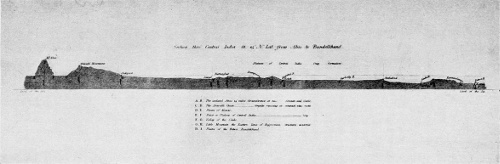
Section thro’ Central India in 25° N. Lat. from Aboo [Abu] to Bundelkhund [Bundelkhand].
Plateau of Central India——Trap formation
Mt. Aboo [Mt. Abu]
Aravalli Mountains
Oodipoor [Udaipur]
Jawud [E]
Ruttunghur
Rampoora [Rampura]
Chumbul R. [Chambal R.]
Kotah
Parbatty R. [Parbati R.]
Shahabad [F]
Sinde R.
Kunneadanna [H]
Betwa R.
Kotra [I]
A. B.The isolated Aboo 24 miles Circumference at base_____Granite and Gneis.
C. D.The Aravalli Chain._______Granite reposing on compact blue slate.
D. E.Plains of Mewar.
E. F.Patar or Plateau of Central India.__________Trap
F. G.Valley of the Sinde.
G. H.Table Mountain the Eastern limit of Rajpootna, structure doubtful.
H. I.Plains of the Betwa, Bundelkhund.
Volume 2 external ref
Volume 3 external ref