Book 4 — CHAPTER 10
Reading edition
Rāna Banbīr Singh, A.D. 1535-37.
—A few hours of sovereignty sufficed to check those ‘compunctious visitings’ which assailed Banbir ere he assumed its trappings, with which he found himself so little encumbered that he was content to wear them for life. Whether this was the intention of the nobles who set aside the unworthy son of Sanga, there is abundant reason to doubt; and as he is subsequently branded with the epithet of ‘usurper’ it was probably limited, though unexpressed, to investing him with the executive authority during the minority of Udai Singh. Banbir, however, only awaited the approach of night to remove with his own hands the obstacle to his ambition.
The Escape of Udai Singh, the Heir.
—Udai Singh was about six years of age. “He had gone to sleep after his rice and milk,” when his nurse was alarmed by screams from the rawala,
and the Bari
coming in to take away the remains of the dinner, informed her of the cause, the assassination of the Rana. Aware that one murder was the precursor of another, the faithful nurse put her
368
charge into a fruit basket and, covering it with leaves, she delivered it to the Bari, enjoining him to escape with it from the fort. Scarcely had she time to substitute her own infant in the room of the prince, when Banbir, entering, inquired for him. Her lips refused their office; she pointed to the cradle, and beheld the murderous steel buried in the heart of her babe [316]. The little victim to fidelity was burnt amidst the tears of the rawala, the inconsolable household of their late sovereign, who supposed that their grief was given to the last pledge of the illustrious Sanga. The nurse (
Dhai
) was a Rajputni of the Khichi tribe, her name Panna, or ‘the Diamond.’ Having consecrated with her tears the ashes of her child, she hastened after that she had preserved. But well had it been for Mewar had the poniard fulfilled its intention, and had the annals never recorded the name of Udai Singh in the catalogue of her princes.
The faithful barber was awaiting the nurse in the bed of the Berach River, some miles west of Chitor, and fortunately the infant had not awoke until he descended the city. They departed for Deolia, and sought refuge with Singh Rao, the successor to Baghji, who fell for Chitor; who dreading the consequence of detection, they proceeded to Dungarpur. Rawal Askaran then ruled this principality, which, as well as Deolia, was not only a branch, but the elder branch, of Chitor. With every wish to afford a shelter, he pleaded the danger which threatened himself and the child in such a feeble sanctuary. Pursuing a circuitous route through Idar, and the intricate valleys of the Aravalli, by the help and with the protection of its wild inmates, the Bhils, she gained Kumbhalmer. The resolution she had formed was bold as it was judicious. She demanded an interview with the governor, Asa Sah his name, of the mercantile tribe of Depra,[3] and a follower of the theistical tenets of the Jains. The interview being granted, she placed the infant in his lap, and bid him “guard the life of his sovereign.” He felt perplexed and alarmed: but his mother, who was present, upbraided him for his scruples. “Fidelity,” said she, “never looks at dangers or difficulties. He is your master, the son of Sanga, and by God’s blessing the result will be glorious.” Having thus fulfilled her trust, the faithful Panna 369withdrew from Kumbhalmer to avoid the suspicion which a Rajputni about a Srawak’s[4] child would have occasioned, as the heir of Chitor was declared to be the nephew of the Depra.
The Boyhood of Udai Singh.
—Suspicions were often excited regarding Asa’s nephew; once, especially, on the anniversary (
samvatsara
) of the governor’s father, when “the Rajput guests being in one rank, and the men of wealth in another, young Udai seized a vessel of curds, which no intreaty could prevail on him to relinquish, deriding their threats” [317]. Seven years elapsed before the secret transpired; at length self-revealed, from the same independent bearing. On occasion of a visit from the Sonigira chief, Udai was sent to receive him, and the dignified manner in which he performed the duty convinced the chief ‘he was no nephew to the Sah.’ Rumour spread the tale, and brought not only the nobles of Mewar, but adjacent chiefs, to hail the son of Sanga Rana. Sahidas of Salumbar, the representative of Chonda, Jaga of Kelwa, Sanga of Bagor, all chiefs of the clans of Chondawat; the Chauhans of Kotharia and Bedla, the Pramar of Bijolia Akhiraj (Sonigira), Prithiraj of Sanchor, and Lunkaran Jethawat, repaired to Kumbhalmer, when all doubt was removed by the testimony of the nurse, and of her coadjutor in the preservation of the child.
Installation of Rāna Udai Singh, A.D. 1537-72.
—A court was formed, when the faithful Asa Sah resigned his trust and placed the prince of Chitor ‘in the lap of the Kotharia Chauhan,’ as the ‘great ancient’
among the nobles of Mewar, who was throughout acquainted with the secret, and who, to dissipate the remaining scruples which attached to the infant’s preservation, ‘ate off the same platter with him.’ The Sonigira Rao did not hesitate to affiance to him his daughter, and it was accepted by his advisers, notwithstanding the interdict of Hamir to any intermarriage with the Sonigira, since the insult of giving the widow to his bed. Udai received the tika of Chitor in the castle of Kumbha, and the homage of nearly all the chiefs of Mewar.
The tidings soon reached the usurper, who had not borne his 370faculties meekly since his advancement; but having seized on the dignity, he wished to ape all the customs of the legitimate monarchs of Chitor, and even had the effrontery to punish as an insult the refusal of one of the proud sons of Chonda to take the dauna from his bastard hand.
The Dauna, a Recognition of Legitimacy.
—The
dauna
, or
daua
, is a portion of the dish of which the prince partakes, sent by his own hand to whomsoever he honours at the banquet. At the rasora, or refectory, the chiefs who are admitted to dine in the presence of their sovereign are seated according to their rank. The repast is one of those occasions when an easy familiarity is permitted, which, though unrestrained, never exceeds the bounds [318] of etiquette, and the habitual reverence due to their father and prince. When he sends, by the steward of the kitchen, a portion of the dish before him, or a little from his own
kansa
, or plate, all eyes are guided to the favoured mortal, whose good fortune is the subject of subsequent conversation. Though, with the diminished lustre of this house, the
dauna
may have lost its former estimation, it is yet received with reverence; but the extent of this feeling, even so late as the reign of Arsi Rana, the father of the reigning prince, the following anecdote will testify. In the rebellion during this prince’s reign, amongst the ancient customs which became relaxed, that of bestowing the
dauna
was included; and the Rana conferring it on the Rathor prince of Kishangarh, the Bijolia chief, one of the sixteen superior nobles of Mewar, rose and left the presence, observing, “Neither the Kachhwaha nor the Rathor has a right to this honour, nor can we, who regard as sanctified even the leavings of your repast, witness this degradation; for the Thakur of Kishangarh is far beneath me.” To such extent is this privilege even yet carried, and such importance is attached from habit to the personal character of the princes of Mewar, that the test of regal legitimacy in Rajasthan is admission to eat from the same plate (
kansa
) with the Rana: and to the refusal of this honour to the great Man Singh of Amber may be indirectly ascribed the ruin of Mewar.
It may therefore be conceived with what contempt the haughty nobility of Chitor received the mockery of honour from the hand of this ‘fifth son of Mewar’; and the Chondawat chief had the boldness to add to his refusal, “that an honour from the 371hand of a true son of Bappa Rawal became a disgrace when proffered by the offspring of the handmaid Sitalseni.” The defection soon became general, and all repaired to the valley of Kumbhalmer to hail the legitimate son of Mewar. A caravan of five hundred horses and ten thousand oxen, laden with merchandise from Cutch, the dower of Banbir’s daughter, guarded by one thousand Gaharwar Rajputs, was plundered in the passes: a signal intimation of the decay of his authority, and a timely supply to the celebration of the nuptials of Udai Rana with the daughter of the Rao of Jalor. Though the interdict of Hamir was not forgotten, it was deemed that the insult given by Banbir Sonigira was amply effaced by his successor’s redemption of the usurpation of Banbir Sesodia. The marriage was solemnized at Bali, within the limits of Jalor, and the [319] customary offerings were sent or given by all the princes of Rajasthan. Two chiefs only, of any consequence, abstained from attending on their lawful prince on this occasion, the Solanki of Maholi and Maloji of Tana. In attacking them, the bastard was brought into conflict; but Maloji was slain and the Solanki surrendered.
Deposition of Rāna Banbīr Singh.
—Deserted by all, Banbir held out in the capital; but his minister admitted, under the garb of a reinforcement with supplies, a thousand resolute adherents of the prince: the keepers of the gates were surprised and slain, and the
an
of Udai Singh was proclaimed. Banbir was even permitted to retire with his family and his wealth. He sought refuge in the Deccan, and the Bhonslas of Nagpur are said to derive their origin from this spurious branch of Chitor.
Rāna Udai Singh, A.D. 1537-72.
—Rana Udai Singh ascended the throne in S. 1597 (
A.D.
1541-2). Great were the rejoicings on the restoration of this prince. ‘The song of joy,’
which was composed on the occasion, is yet a favourite at Udaipur, and on the festival of Isani (the Ceres of Rajasthan), the females still chant in chorus the ‘farewell to Kumbhalmer.’
But the evil days of Mewar which set in with Sanga’s death, and were accelerated by the fiery valour of Ratna and the capricious conduct of Bikramajit, were completed by an anomaly in her annals: a coward succeeding a bastard to guide the destinies of the Sesodias. The
372
vices of Ratna and his brother were virtues compared to this physical defect, the consequences of which destroyed a great national feeling, the opinion of its invincibility.
His Character.
—“Woe to the land where a minor rules or a woman bears sway!” exclaims the last of the great bards
of Rajasthan; but where both were united, as in Mewar, the measure of her griefs was full. Udai Singh had not one quality of a sovereign; and wanting martial virtue, the common heritage of his race, he was destitute of all. Yet he might have slumbered life away in inglorious repose during the reign of Humayun, or the contentions of the Pathan usurpation; but, unhappily for Rajasthan, a prince was then rearing who forged fetters for the Hindu race which enthralled them for ages; and though the corroding hand of time left but their fragments, yet even now, though emancipated, they bear the indelible marks of the manacle; not like the galley slave’s, physical and exterior, but deep mental scars, never to be effaced. Can a nation which has run its long career of glory be [320] regenerated? Can the soul of the Greek or the Rajput be reanimated with the spark divine which defended the kunguras
of Chitor or the pass of Thermopylae? Let history answer the question.
Birth of Akbar.
—In the same year that the song of joy was raised in the cloud-capped
palace of Kumbhalmer for the deliverance of Udai Singh, the note of woe was pealed through the walls of Umarkot, and given to the winds of the desert, to proclaim the birth
of an infant destined to be the greatest monarch who ever swayed the sceptre of Hindustan. In an oasis of the Indian desert, amidst the descendants of the ancient Sogdoi
of Alexander, Akbar first saw the light; his father a fugitive, the diadem torn from his brows, its recovery more improbable than was its acquisition by Babur. The ten years which had elapsed since Humayun’s accession were passed in perpetual strife with his brothers, placed according to custom in subordinate governments. Their selfish ambition met its reward; for with the fall of Humayun their own was ensured, when Sher Shah displaced the dynasty of Chagatai for his own, the Pathan (or Sur).
373
Defeat and Flight of Humāyūn, A.D. 1540.
—From the field of battle at Kanauj, where Humayun left his crown, his energetic opponent gave him no respite, driving him before him from Agra to Lahore. Thence, with his family and a small band of adherents, alternately protected and repelled by Hindu chieftains, he reached the valley of Sind, where he struggled to maintain himself amidst the greatest privations, attempting in succession each stronghold on the Indus, from Multan to the ocean. Foiled in every object, his associates made rebels by distress, he abandoned them for the more dubious shelter of the foes of his race. Vain were his solicitations to Jaisalmer and Jodhpur; and though it cannot be matter of wonder that he found no commiseration from either Bhatti or Rathor, we must reprobate the unnational conduct of Maldeo, who, the Mogul historian says, attempted to make him captive. From such inhospitable treatment the royal exile escaped by again plunging into the desert, where he encountered, along with the tender objects of his solicitude, hardships of the most appalling description, until sheltered by the Sodha prince of Umarkot. The high courage and the virtues of this monarch increase that interest in his sufferings which royalty in distress never fails to awaken by its irresistible influence [321] upon our sympathies; and they form an affecting episode in the history of Ferishta.
Humayun, though more deeply skilled in the
374
mysteries of astrology than any professed seer of his empire, appears never to have enjoyed that prescience which, according to the initiated in the science, is to be obtained from accurate observation:
And coming events cast their shadows before;
for, could he, by any prophetic power, have foreseen that the cloud which then shaded his fortunes, was but the precursor of glory to his race, he would have continued his retreat from the sheltering sand-hills of Umarkot with very different sentiments from those which accompanied his flight into Persia [322].
Early Years of Akbar.
—Humayun educated the young Akbar
375
in the same school of adversity in which he had studied under Babur. Between the Persian court and his ancient patrimony in Transoxiana, Kandahar, and Kashmir, twelve years were passed in every trial of fortune. During this short period, India, always the prize of valour, had witnessed in succession six
kings descended from the Pathan ‘Lion’ (
sher
), of whom the last, Sikandar, was involved in the same civil broils which brought the crown to his family. Humayun, then near Kashmir, no sooner observed the tide of events set counter to his foe, than he crossed the Indus and advanced upon Sirhind, where the Pathan soon appeared with a tumultuous array. The impetuosity of young Akbar brought on a general engagement, which the veterans deemed madness. Not so Humayun, who gave the command to his boy, whose heroism so excited all ranks, that they despised the numbers of the enemy, and gained a glorious victory. This was the presage of his future fame; for Akbar was then but twelve years of age,
the same period of life at which his grandfather, Babur, maintained himself on the throne of Farghana. Humayun, worthy of such a son and such a sire, entered Delhi in triumph; but he did not long enjoy his recovered crown. His death will appear extraordinary, according to the erroneous estimate formed of Eastern princes: its cause was a fall from the terrace of his library;
for, like every individual of his race, he was not merely a patron of literature, but himself a scholar. Were we to contrast the literary acquirements of the Chagatai princes with those of their contemporaries of Europe, the balance of lore would be found on the side of the Asiatics, even though Elizabeth and Henry IV. of France were in the scale. Amongst the princes from the Jaxartes are historians, poets, astronomers, founders of systems of government and religion, warriors, and great captains, who claim our respect and admiration.
Akbar’s Struggle for the Empire.
—Scarcely had Akbar been seated on the throne, when Delhi and Agra were wrested from him, and a nook of the Panjab constituted all his empire: but by the energetic valour of the great Bairam Khan, his lost sovereignty was regained with equal rapidity, and established by the wisdom
376
of this Sully
of Hindustan on a rock. Kalpi, Chanderi, Kalanjar, all Bundelkhand and Malwa, were soon attached to the empire, and at the early age of eighteen Akbar assumed the uncontrolled [323] direction of the State. He soon turned his attention towards the Rajputs; and whether it was to revenge the inhospitality of Maldeo towards his father, he advanced against the Rathors, and stormed and took Merta, the second city in Marwar. Raja Biharimall [or Bahar Mall] of Amber anticipated the king, enrolled himself and son Bhagwandas amongst his vassals, gave the Chagatai a daughter to wife, and held his country as a fief of the empire. But the rebellions of the Usbek nobles, and the attempts of former princes to regain their lost power, checked for a time his designs upon Rajasthan. These matters adjusted, and the petty sovereigns in the East (to whom the present monarch of Oudh is as Alexander) subjected to authority, he readily seized upon the provocation which the sanctuary given to Baz Bahadur of Malwa and the ex-prince of Narwar afforded, to turn his arms against Chitor.
Comparison of Akbar with Rāna Udai Singh.
—Happy the country where the sovereignty is in the laws, and where the monarch is but the chief magistrate of the State, unsubjected to those vicissitudes which make the sceptre in Asia unstable as a pendulum, kept in perpetual oscillation by the individual passions of her princes; where the virtues of one will exalt her to the summit of prosperity, as the vices of a successor will plunge her into the abyss of degradation. Akbar and Udai Singh furnish the corollary to this self-evident truth.
The Rana was old enough to philosophize on ‘the uses of adversity’; and though the best of the ‘great ancients’ had fallen in defence of Chitor, there were not wanting individuals capable of instilling just and noble sentiments into his mind: but it was of that common character which is formed to be 377controlled by others; and an artful and daring concubine stepped in, to govern Udai Singh and Mewar.
Akbar was not older when he came to the throne[21] of Delhi than Udai Singh when he ascended that of Mewar. Nor were his hopes much brighter; but the star which beamed upon his cradle in the desert, conducted to his aid such counsellors as the magnanimous Bairam, and the wise and virtuous Abu-l Fazl. Yet it may be deemed hardly fair to contrast the Rajput with the Mogul: the one disciplined into an accurate knowledge of human nature, by experience of the [324] mutability of fortune; the other cooped up from infancy in a valley of his native hills, his birth concealed, and his education restricted.[22]
Akbar was the real founder of the empire of the Moguls, the first successful conqueror of Rajput independence: to this end his virtues were powerful auxiliaries, as by his skill in the analysis of the mind and its readiest stimulant to action, he was enabled to gild the chains with which he bound them. To these they became familiarized by habit, especially when the throne exerted its power in acts gratifying to national vanity, or even in ministering to the more ignoble passions. But generations of the martial races were cut off by his sword, and lustres rolled away ere his conquests were sufficiently confirmed to permit him to exercise the beneficence of his nature, and obtain by the universal acclaim of the conquered, the proud epithet of Jagad Guru, or ‘guardian of mankind.’ He was long ranked with Shihabu-d-din, Ala, and other instruments of destruction, and with every just claim; and, like these, he constructed a Mimbar[23] for the Koran from the altars of Eklinga. Yet he finally succeeded in healing the wounds his ambition had inflicted, and received from millions that meed of praise which no other of his race ever obtained.
The absence of the kingly virtues in the sovereign of Mewar filled to the brim the bitter cup of her destiny. The guardian goddess of the Sesodias had promised never to abandon the rock of her pride while a descendant of Bappa Rawal devoted himself to her service. In the first assault by Ala, twelve crowned heads 378defended the ‘crimson banner’ to the death. In the second, when conquest led by Bajazet[24] came from the south, the chieftain of Deolia, a noble scion of Mewar, “though severed from her stem,” claimed the crown of glory and of martyrdom. But on this, the third and grandest struggle, no regal victim appeared to appease the Cybele of Chitor, and win her to retain its ‘kunguras’[25] as her coronet. She fell! the charm was broken; the mysterious tie was severed for ever which connected [325] Chitor with perpetuity of sway to the race of Guhilot. With Udai Singh fled the “fair face” which in the dead of night unsealed the eyes of Samarsi, and told him “the glory of the Hindu was departing”:[26] with him, that opinion, which for ages esteemed her walls the sanctuary of the race, which encircled her with a halo of glory, as the palladium of the religion and the liberties of the Rajputs.
To traditions such as these, history is indebted for the noblest deeds recorded in her page; and in Mewar they were the covert impulse to national glory and independence. For this the philosopher will value the relation; and the philanthropist as being the germs or nucleus of resistance against tyrannical domination. Enveloped in a wild fable, we see the springs of their prejudices and their action: batter down these adamantine walls of national opinion, and all others are but glass. The once invincible Chitor is now pronounced indefensible. “The abode of regality, which for a thousand years reared her head above all the cities of Hindustan,” is become the refuge of wild beasts, which seek cover in her temples; and this erst sanctified capital is now desecrated as the dwelling of evil fortune, into which the entrance of her princes is solemnly interdicted.
Akbar besieges Chitor, September, A.D. 1567.
—Ferishta mentions but one enterprise against Chitor, that of its capture; but the annals record another, when Akbar was compelled to relinquish the undertaking.
The successful defence is attributed to the
379
masculine courage of the Rana’s concubine queen, who headed the sallies into the heart of the Mogul camp, and on one occasion to the emperor’s headquarters. The imbecile Rana proclaimed that he owed his deliverance to her; when the chiefs, indignant at this imputation on their courage, conspired and put her to death. Internal discord invited Akbar to reinvest Chitor; he had just attained his twenty-fifth year, and was desirous of the renown of capturing it. The site of the royal Urdu,
or camp, is still pointed out. It extended from the village of Pandauli
along the high road to Basai, a distance of ten miles. The headquarters of Akbar are yet marked by a pyramidal column of marble, to which tradition has assigned the [326] title of Akbar ka diwa, or ‘Akbar’s lamp.’
Scarcely had Akbar sat down before Chitor, when the Rana was compelled (say the annals) to quit it; but the necessity and his wishes were in unison. It lacked not, however, brave defenders. Sahidas, at the head of a numerous band of the descendants of Chonda, was at his post,
380
‘the gate of the sun’; there he fell resisting the entrance of the foe, and there his altar stands, on the brow of the rock which was moistened with his blood. Rawat Duda of Madri led ‘the sons of Sanga.’
The feudatory chiefs of Bedla and Kotharia, descended from Prithiraj of Delhi—the Pramar of Bijolia—the Jhala of Sadri—inspired their contingents with their brave example: these were all home chieftains. Another son of Deolia again combated for Chitor, with the Sonigira Rao of Jalor—Isaridas Rathor, Karamchand Kachhwaha,
with Duda Sadani,
and the Tuar prince of Gwalior, were distinguished amongst the foreign auxiliaries on this occasion.
Jaimall and Patta.
—But the names which shine brightest in this gloomy page of the annals of Mewar, which are still held sacred by the bard and the true Rajput, and immortalized by Akbar’s own pen, are Jaimall of Badnor and Patta of Kelwa, both of the sixteen superior vassals of Mewar. The first was a Rathor of the Mertia house, the bravest of the brave clans of Marwar; the other was head of the Jagawats, another grand shoot from Chonda. The names of Jaimall and Patta are ‘as household words,’ inseparable in Mewar, and will be honoured while the Rajput retains a shred of his inheritance or a spark of his ancient recollections. Though deprived of the stimulus which would have been given had their prince been a witness of their deeds, heroic achievements such as those already recorded were conspicuous on this occasion; and many a fair form threw the buckler over the scarf, and led the most desperate sorties [327].
When Salumbar[34] fell at the gate of the sun, the command devolved on Patta of Kelwa. He was only sixteen:[35] his father had fallen in the last shock, and his mother had survived but to rear this the sole heir of their house. Like the Spartan mother of old, she commanded him to put on the ‘saffron robe,’ and to die for Chitor: but surpassing the Grecian dame, she illustrated 381her precept by example; and lest any soft ‘compunctious visitings’ for one dearer than herself might dim the lustre of Kelwa, she armed the young bride with a lance, with her descended the rock, and the defenders of Chitor saw her fall, fighting by the side of her Amazonian mother. When their wives and daughters performed such deeds, the Rajputs became reckless of life. They had maintained a protracted defence, but had no thoughts of surrender, when a ball struck Jaimall, who took the lead on the fall of the kin of Mewar. His soul revolted at the idea of ingloriously perishing by a distant blow. He saw there was no ultimate hope of salvation, the northern defences being entirely destroyed, and he resolved to signalize the end of his career. The fatal Johar was commanded, while eight thousand Rajputs ate the last ‘bira’[36] together, and put on their saffron robes; the gates were thrown open, the work of destruction commenced, and few survived ‘to stain the yellow mantle’ by inglorious surrender. Akbar entered Chitor, when thirty thousand of its inhabitants became victims to the ambitious thirst of conquest of this ‘guardian of mankind.’ All the heads of clans, both home and foreign, fell, and seventeen hundred of the immediate kin of the prince sealed their duty to their country with their lives. The Tuar chief of Gwalior appears to have been the only one of note who was reserved for another day of glory.[37] Nine queens, five princesses (their daughters), with two infant sons, and the families of all the chieftains not at their estates, perished in the flames or in the assault of this ever memorable day. Their divinity had indeed deserted them; for it was on Adityawar, the day of the sun,[38] he shed for the last time a ray of glory on Chitor. The rock of their strength was despoiled; the temples, the palaces dilapidated: and, to complete her humiliation and his triumph, Akbar bereft her of all the symbols of [328] regality: the nakkaras,[39] whose reverberations proclaimed, for miles 382around, the entrance and exit of her princes; the candelabras from the shrine of the ‘great mother,’ who girt Bappa Rawal with the sword with which he conquered Chitor; and, in mockery of her misery, her portals, to adorn his projected capital, Akbarabad.[40]
Akbar claimed the honour of the death of Jaimall by his own hand: the fact is recorded by Abu-l Fazl, and by the emperor Jahangir, who conferred on the matchlock which aided him to this distinction the title of Sangram.[41] But the conqueror of Chitor evinced a more exalted sense, not only of the value of his conquest, but of the merits of his foes, in erecting statues to the names of Jaimall and Patta at the most conspicuous entrance of his palace at Delhi; and they retained that distinction even when Bernier was in India.[42]
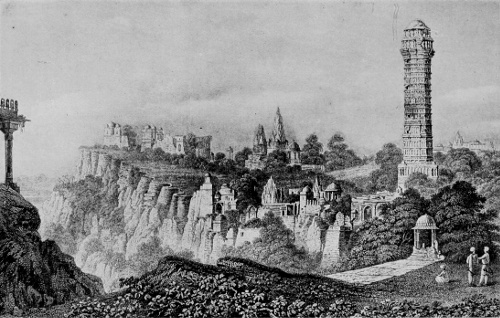
CHITOR. To face page 382.
The Sin of the Capture of Chitor.
—When the Carthaginian gained the battle of Cannae, he measured his success by the bushels of rings taken from the fingers of the equestrian Romans
383
who fell in that memorable field. Akbar estimated his, by the quantity of cordons (
zunnar
) of [329] distinction taken from the necks of the Rajputs, and seventy-four mans and a half
are the recorded amount. To eternize the memory of this disaster, the numerals ‘74½’ are
talak
, or accursed.
Marked on the banker’s letter in Rajasthan it is the strongest of seals, for ‘the sin of the slaughter of Chitor’
is thereby invoked on all who violate a letter under the safeguard of this mysterious number. He would be a fastidious critic who stopped to calculate the weight of these cordons of the Rajput cavaliers, probably as much over-rated as the trophies of the Roman rings, which are stated at three and a half bushels. It is for the moral impression that history deigns to note such anecdotes, in themselves of trivial import. So long as ‘74½’ shall remain recorded, some good will result from the calamity, and may survive when the event which caused it is buried in oblivion.
Escape of Rāna Udai Singh: Foundation of Udaipur.
—When Udai Singh abandoned Chitor, he found refuge with the Gohil in the forests of Rajpipli. Thence he passed to the valley of the
384
Giro in the Aravalli, in the vicinity of the retreat of his great ancestor Bappa, ere he conquered Chitor. At the entrance of this valley, several years previous to this catastrophe, he had formed the lake, still called after him Udai Sagar, and he now raised a dyke between the mountains which dammed up another mountain stream. On the cluster of hills adjoining he raised the small palace called Nauchauki, around which edifices soon arose, and formed a city to which he gave his own name, Udaipur,
henceforth the capital of Mewar.
Death of Rāna Udai Singh.
—Four years had Udai Singh survived the loss of Chitor, when he expired at Gogunda, at the early age of forty-two; yet far too long for his country’s honour and welfare. He left a numerous issue of twenty-five legitimate sons, whose descendants, all styled Ranawat, pushed aside the more ancient stock, and form that extensive clan distinctively termed the Babas, or ‘infants,’ of Mewar, whether Ranawats, Purawats, or Kanawats. His last act was to entail with a barren sceptre contention upon his children; for, setting aside the established laws of primogeniture, he proclaimed his favourite son Jagmall his successor.
Jagmall proclaimed Rāna.
—In Mewar there is no interregnum: even the ceremony of
matam
(mourning) is held at the [330] house of the family priest while the palace is decked out for rejoicing. On the full moon of the spring month of Phalgun, while his brothers and the nobles attended the funeral pyre, Jagmall took possession of the throne in the infant capital, Udaipur: but even while the trumpets sounded, and the heralds called aloud “May the king live for ever!” a cabal was formed round the bier of his father.
Jagmall deposed in favour of Rāna Partāp Singh.
—It will be borne in mind that Udai Singh espoused the Sonigira princess; and the Jalor Rao, desirous to see his sister’s son have his right, demanded of Kistna, the ‘great ancient’ of Mewar and the leader of the Chondawats, how such injustice was sanctioned by him. “When a sick man has reached the last extreme and asks for milk to drink, why refuse it?” was the reply; with the addition: “The Sonigira’s nephew is my choice, and my stand by Partap.” Jagmall had just entered the Rasora, and Partap was saddling
385
for his departure, when Rawat Kistna entered, accompanied by the ex-prince of Gwalior. Each chief took an arm of Jagmall, and with gentle violence removed him to a seat in front of the ‘cushion’ he had occupied; the hereditary premier remarking, “You had made a mistake, Maharaj; that place belongs to your brother”: and girding Partap with the sword (the privilege of this house), thrice touching the ground, hailed him king of Mewar. All followed the example of Salumbar. Scarcely was the ceremony over, when the young prince remarked, it was the festival of the Aheria, nor must ancient customs be forgotten: “Therefore to horse, and slay a boar to Gauri,
and take the omen for the ensuing year.” They slew abundance of game, and in the mimic field of war, the nobles who surrounded the gallant Partap anticipated happier days for Mewar [331].