Book 4 — CHAPTER 13
Reading edition
Rāna Karan Singh II., A.D. 1620-28.
—Karan, or Karna (
the radiant
), succeeded to the last independent king of Mewar, S. 1677,
A.D.
1621. Henceforth we shall have to exhibit these princely ‘children of the sun’ with diminished lustre, moving as satellites round the primary planet; but, unaccustomed to the laws of its attraction, they soon deviated from the orbit prescribed, and in the eccentricity of their movements occasionally displayed their unborrowed effulgence. For fifteen hundred years we have traced each alternation of the fortune of this family, from their establishment in the second, to their expulsion in the fifth century from Saurashtra by the Parthians; the acquisition and loss of Idar; the conquest and surrender of Chitor; the rise of Udaipur
428
and abasement of the red flag to Jahangir; and we shall conclude with not the least striking portion of their history, their unity of interests with Britain.
Karan was deficient neither in courage nor conduct; of both he had given a decided proof, when, to relieve the pecuniary difficulties of his father, with a rapidity unparalleled, he passed through the midst of his foes, surprised and plundered Surat, and carried off a booty which was the means of protracting the evil days of his country. But for the exercise of the chief virtue of the Rajput, he [369] had little scope throughout his reign, and fortunately for his country the powerful esteem and friendship which Jahangir and Prince Khurram evinced for his house, enabled him to put forth the talents he possessed to repair past disasters. He fortified the heights round the capital, which he strengthened with a wall and ditch, partly enlarged the noble dam which retains the waters of the Pichola, and built that entire portion of the palace called the Rawala, still set apart for the ladies of the court.
Terms between Rāna Karan Singh and Jahāngīr.
—When Rana Amra made terms with Jahangir, he stipulated, as a salvo for his dignity and that of his successors, exemption from all personal attendance; and confined the extent of homage to his successors receiving, on each lapse of the crown, the farman or imperial decree in token of subordination, which, more strongly to mark their dependent condition, the Rana was to accept without the walls of his capital; accordingly, though the heirs-apparent of Mewar
attended the court, they never did as Rana. Partly to lessen the weight of this sacrifice to independence, and partly to exalt the higher grade of nobles, the princes of the blood-royal of Mewar were made to rank below the Sixteen, a fictitious diminution of dignity which, with similar acts peculiar to this house, enhanced the self-estimation of the nobles, and made them brave every danger to obtain such sacrifices to the ruling passion of the Rajput, a love of distinction.
It is mentioned by the emperor
429
that he placed the heir-apparent of Mewar immediately on his right hand, over all the princes of Hindustan; consequently the superior nobles of Mewar, who were all men of royal descent, deemed themselves, and had their [370] claims admitted, to rank above their peers at other courts, and to be seated almost on an equality with their princes.
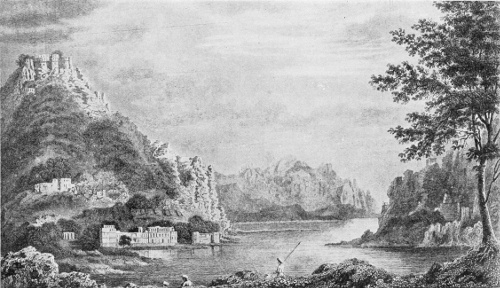
RĀJMAHALL. To face page 428.
Sesodias in the Imperial Service.
—The Sesodia chieftains were soon distinguished amongst the Rajput vassals of the Mogul, and had a full share of power. Of these Bhim, the younger brother of Karan, who headed the quota of Mewar, was conspicuous, and became the chief adviser and friend of Sultan Khurram, who well knew his intrepidity. At his son’s solicitation, the emperor conferred upon him the title of Raja, and assigned a small principality on the Banas for his residence, of which Toda was the capital. Ambitious of perpetuating a name, he erected a new city and palace on the banks of the river, which he called Rajmahall, and which his descendants held till about forty years ago. The ruins of Rajmahall
bear testimony to the architectural taste
430
of this son of Mewar, as do the fallen fortunes of his descendant to the instability of power: the lineal heir of Raja Bhim serves the chief of Shahpura on half a crown a day!
Revolt and Death of Bhīm Singh.
—Jahangir, notwithstanding his favours, soon had a specimen of the insubordinate spirit of Bhim. Being desirous to separate him from Sultan Khurram, who aspired to the crown in prejudice to his elder brother Parvez, he appointed Bhim to the government of Gujarat, which was distinctly refused. Detesting Parvez, who, it will be recollected, invaded Mewar, and was foiled for his cruelty on this occasion, Bhim advised his friend at once to throw off the mask, if he aspired to reign. Parvez was slain,
and Khurram manifested his guilt by flying to arms [371]. He was secretly supported by a strong party of the Rajput interest, at the head of which was Gaj Singh of Marwar, his maternal grandfather, who cautiously desired to remain neutral. Jahangir advanced to crush the incipient revolt; but dubious of the Rathor (Gaj Singh), he gave the van to Jaipur, upon which the prince furled his banners and determined to be a spectator. The armies approached and were joining action, when the impetuous Bhim sent a message to the Rathor either to aid or oppose them. The insult provoked him to the latter course, and Bhim’s party was destroyed, himself slain,
and Khurram and Mahabat Khan compelled to seek refuge
431
in Udaipur. In this asylum he remained undisturbed: apartments in the palace were assigned to him; but his followers little respecting Rajput prejudices, the island became his residence, on which a sumptuous edifice was raised, adorned with a lofty dome crowned with the crescent. The interior was decorated with mosaic, in onyx, cornelian, jaspers, and agates, rich Turkey carpets, etc.; and that nothing of state might be wanting to the royal refugee, a throne was sculptured from a single block of serpentine, supported by quadriform female Caryatidae. In the court a little chapel was erected to the Muhammadan saint Madar,
and here the prince with his court resided, every wish anticipated, till a short time before his father’s death, when he retired into Persia.
Such was Rajput gratitude to a prince who, when the chances of war made him victor over them, had sought unceasingly to mitigate the misery attendant on the loss of independence! It is pleasing to record to the honour of this calumniated race, that these feelings on the part of Karan were not transient; and that so far from expiring with the object,
The debt immense of endless gratitude.
was transmitted as an heirloom to his issue; and though two centuries have fled, during which Mewar had suffered every 432variety of woe, pillaged by Mogul [372], Pathan, and Mahratta, yet the turban of Prince Khurram, the symbol of fraternity,[9] has been preserved, and remains in the same folds as when transferred from the head of the Mogul to that of the Rajput prince. The shield is yet held as the most sacred of relics, nor will the lamp which illumines the chapel of Madar want oil while the princes of Udaipur have wherewithal to supply it.[10]
Death of Rāna Karan Singh.
—Rana Karan had enjoyed eight years of perfect tranquillity when he was gathered to his fathers. The sanctuary he gave Prince Khurram had no apparent effect on Jahangir, who doubtless believed that the Rana did not sanction the conduct of his brother Bhim. He was succeeded by his son Jagat Singh, ‘the lion of the world,’ in S. 1684 (
A.D.
1628).
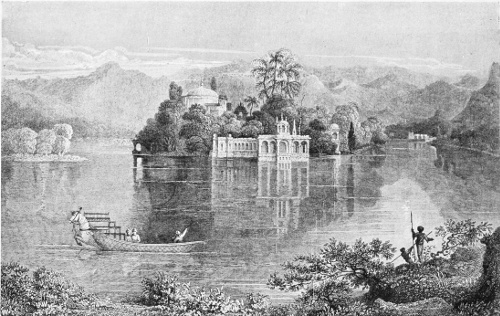
JAGMANDIR PALACE, UDAIPUR. To face page 432.
Rāna Jagat Singh I., A.D. 1628-52.
—The Emperor Jahangir died shortly after his accession [October 28, 1627], and while Khurram was in exile. This event, which gave the throne to the friend of his house, was announced to him by the Rana, who sent his brother and a band of Rajputs to Surat to form the cortege of the emperor, who repaired directly to Udaipur; and it was in the Badal Mahall (‘the cloud saloon’) of his palace that he was first saluted by the title of ‘Shah Jahan,’ by the satraps and tributary princes of the empire.
On taking leave, the new monarch restored five alienated districts, and presented the Rana
433
with a ruby of inestimable value, giving him also permission to reconstruct the fortifications of Chitor.
The twenty-six years during which Jagat Singh occupied the throne passed in uninterrupted tranquillity: a state unfruitful to the bard, who flourishes only amidst agitation and strife. This period was devoted to the cultivation of the peaceful arts, especially architecture; and to Jagat Singh Udaipur is indebted for those magnificent works which bear his name, and excite our astonishment, after all the disasters we have related, at the resources he found to accomplish them [373].
Erection of Buildings at Udaipur.
—The palace on the lake (covering about four acres), called the Jagniwas, is entirely his work, as well as many additions to its sister isle, on which is the Jagmandir.
Nothing but marble enters into their composition; columns, baths, reservoirs, fountains, all are of this material, often inlaid with mosaics, and the uniformity pleasingly diversified by the light passing through glass of every hue. The apartments are decorated with historical paintings in water-colours, almost meriting the term fresco from their deep absorption in the wall, though the darker tints have blended with and in part obscured the more delicate shades, from atmospheric causes. The walls, both here and in the grand palace, contain many medallions, in considerable relief, in gypsum, portraying the principal historical events of the family, from early periods even to the marriage pomp of the present Rana. Parterres of flowers, orange and lemon groves, intervene to dispel the monotony of the buildings, shaded by the wide-spreading tamarind and magnificent evergreen khirni;
while the graceful palmyra and coco wave their plumelike branches over the dark cypress or cooling plantain. Detached colonnaded refectories are placed on the water’s edge for the chiefs, and extensive baths for their use. Here they listened to the tale of the bard, and slept off their noonday opiate amidst
434
the cool breezes of the lake, wafting delicious odours from myriads of the lotus-flower which covered the surface of the waters; and as the fumes of the potion evaporated, they opened their eyes on a landscape to which not even its inspirations could frame an equal: the broad waters of the Pichola, with its indented and well-wooded margin receding to the terminating point of sight, at which the temple of Brahmpuri opened on the pass of the gigantic Aravalli, the field of the exploits of their forefathers. Amid such scenes did the Sesodia princes and chieftains recreate during two generations, exchanging the din of arms for voluptuous inactivity.
Jagat Singh was a highly respected prince, and did much to efface the remembrance of the rude visitations of the Moguls. The dignity of his character, his benevolence of address and personal demeanour, secured the homage of all who had access to him, and are alike attested by the pen of the emperor, the ambassador of England, and the chronicles of Mewar. He had the proud satisfaction [374] of redeeming the ancient capital from ruin; rebuilding the “chaplet bastion,[15] restoring the portals, and replacing the pinnacles on the temples of Chitrakot.” By a princess of Marwar he left two sons, the eldest of whom succeeded.
Rāna Rāj Singh, A.D. 1652-80.
—Raj Singh (the royal lion) mounted the throne in S. 1710 (
A.D.
1654). Various causes over which he had no control combined, together with his personal character, to break the long repose his country had enjoyed. The emperor of the Moguls had reached extreme old age, and the ambition of his sons to usurp his authority involved every Rajput in support of their individual pretensions. The Rana inclined to Dara,
the legitimate heir to the throne, as did nearly the whole Rajput race; but the battle of Fatehabad
silenced every pretension, and gave the lead to Aurangzeb, which he maintained by the sacrifice of whatever opposed his ambition. His father, brothers, nay, his own offspring, were in turn victims to that thirst for power which eventually destroyed the monarchy of the Moguls.
435The policy introduced by their founder, from which Akbar, Jahangir, and Shah Jahan had reaped so many benefits, was unwisely abandoned by the latter, who of all had the most powerful reasons for maintaining those ties which connected the Rajput princes with his house. Historians have neglected to notice the great moral strength derived from this unity of the indigenous races with their conquerors; for during no similar period was the empire so secure, nor the Hindu race so cherished, as during the reigns of Jahangir and Shah Jahan: the former born from a Rajput princess of Amber, and the latter from the house of Marwar. Aurangzeb’s unmixed Tatar blood brought no Rajput sympathies to his aid; on the contrary, every noble family shed their best blood in withstanding his accession, and in the defence of Shah Jahan’s rights, while there was a hope of success. The politic Aurangzeb was not blind to this defect, and he tried to remedy it in his successor; for both his declared heir, Shah Alam, and Azam, as well as his favourite grandson,[18] were the offspring of Rajputnis; but, uninfluenced himself by such predilections, his bigotry outweighed his policy, and he visited the Rajputs with an unrelenting and unwise persecution [375].
We shall pass the twice-told tale of the struggle for power which ended in the destruction of the brothers, competitors with Aurangzeb: this belongs to general history, not to the annals of Mewar; and that history is in every hand,[19] in which the magnanimity of Dara,[20] the impetuosity of Murad, and the activity of Suja met the same tragical end.
Princes contemporary with Aurangzeb.
—It has seldom occurred that so many distinguished princes were contemporary as during the reign of Aurangzeb. Every Rajput principality had a head above mediocrity in conduct as in courage. Jai Singh of Amber,
436
surnamed ‘the Mirza Raja’; Jaswant Singh of Marwar, with the Haras of Bundi and Kotah; the Rathors of Bikaner, and Bundelas of Orchha and Datia, were men whose prejudices, properly consulted, would have rendered the Mogul power indissoluble: but he had but one measure of contumely for all, which inspired Sivaji with designs of freedom to Maharashtra, and withdrew every sentiment of support from the princes of Rajasthan. In subtlety and the most specious hypocrisy, in that concentration of resolve which confides its deep purpose to none, in every qualification of the warrior or scholar,
Aurangzeb had
437
no superior amongst the many distinguished [376] of his race; but that sin by which ‘angels fell’ had steeped him in an ocean of guilt, and not only neutralized his natural capacities, but converted the means for unlimited power into an engine of self-destruction.
438
“This hypocrisy,” says the eloquent Orme,
“encreased with his power, and in order to palliate to his Mahomedan subjects the crimes by which he had become their sovereign, he determined to enforce the conversion of the Hindoos by the severest penalties, and even threatned the sword; as if the blood of his subjects were to wash away the stains, with which he was imbrued by the blood of his family.... Labour left the field and industry the loom, until the decrease of the revenues drew representations from the governors of the provinces; which induced Aurungzebe to substitute a capitation tax
as the ballance of the account between the two religions.” The same historian justly characterizes this enactment as one so contrary to all notions of sound policy, as well as of the feelings of humanity, that “reflection seeks the motive with amazement.” In this amazement we might remain, nor seek to develop the motive, did not the ample page of history in all [377] nations disclose that in the name of religion more blood has been shed, and more atrocity committed, than by the united action of the whole catalogue of the passions. Muhammad’s creed was based on conversion, which, by whatever means effected, was a plenary atonement for every crime. In obedience thereto Aurangzeb acted; but though myriads of victims who clung to their faith were sacrificed by him at the fiat of this gladiatorial prophet, yet nor these, nor the scrupulous fulfilment of fanatic observances, could soothe at the dread hour the perturbations of the ‘still small voice’ which whispered the names of father, brother, son, bereft by him of life. Eloquently does he portray these terrors in his letters to his grandson on his death-bed, wherein he says, "Whichever way I look, I see only the divinity"—and that an offended divinity [378].
439
Rāna Rāj Singh defies Aurangzeb.
—Raj Singh had signalized his accession by the revival of the warlike Tika-daur, and plundered
440
Malpura, which though on the Ajmer frontier, Shah Jahan, when advised to vengeance, replied “it was only a folly of his nephew.”
An appeal to his gallantry made him throw down the gauntlet to Aurangzeb in the plenitude of his power, when the valour of the Sesodias again burst forth in all the splendour of the days of Partap; nor did the contest close till after a series of brilliant victories, and with the narrow escape from captivity of the Xerxes of Hindustan. The Mogul demanded the hand of the princess of Rupnagar, a junior branch of the Marwar house, and sent with the demand (a compliance with which was contemplated
441
as certain) a cortège of two thousand horse to escort the fair to court. But the haughty Rajputni, either indignant at such precipitation or charmed with the gallantry of the Rana, who had evinced his devotion to the fair by measuring his sword with the head of her house, rejected with disdain the proffered alliance, and, justified by brilliant precedents in the romantic history of her nation, she entrusted her cause to the arm of the chief of the Rajput race, offering herself as the reward of protection. The family priest (her preceptor) deemed his office honoured by being the messenger of her wishes, and the billet he conveyed is incorporated in the memorial of this reign. “Is the swan to be the mate of the stork: a Rajputni, pure in blood, to be wife to the monkey-faced barbarian!” concluding with a threat of self-destruction if not saved from dishonour. This appeal, with other powerful motives, was seized on with avidity by the Rana as a pretext to throw away the scabbard, in order to illustrate the opening of a warfare, in which he determined to put all to the hazard in defence of his country and his faith. The issue was an omen of success to his warlike and [379] superstitious vassalage. With a chosen band he rapidly passed the foot of the Aravalli and appeared before Rupnagar, cut up the imperial guards, and bore off the prize to his capital. The daring act was applauded by all who bore the name of Rajput, and his chiefs with joy gathered their retainers around the ‘red standard,’ to protect the queen so gallantly achieved.
The Imposition of the Jizya or Capitation Tax.
—The annalist of Rajputana is but an indifferent chronologist, and leaves us doubtful of the exact succession of events at this period. It was not, however, till the death of those two powerful princes, Jaswant Singh of Marwar and Jai Singh of Amber, both poisoned by command of the tyrant, the one at his distant government of Kabul, the other in the Deccan, that he deemed himself free to put forth the full extent of his long-concealed design, the imposition of the
jizya
or capitation tax on the whole Hindu race. But he miscalculated his measures, and the murder of these princes, far from advancing his aim, recoiled with vengeance on his head. Foiled in his plot to entrap the infant sons of the Rathor by the self-devotion of his vassals,
the compound treachery evinced that
442
their only hope lay in a deadly resistance. The mother of Ajit, the infant heir of Marwar, a woman of the most determined character, was a princess of Mewar, and she threw herself upon the Rana as the natural guardian of his rights, for sanctuary (
saran
) during the dangers of his minority. This was readily yielded, and Kelwa assigned as his residence, where under the immediate safeguard of the brave Durgadas Ajit resided,
while she nursed the spirit of resistance at home. A union of interests was cemented between these the chief States of Rajputana, for which they never before had such motive, and but for repeated instances of an ill-judged humanity, the throne of the Moguls might have been completely overturned [380].
Letter of Remonstrance to Aurangzeb.
—On the promulgation of that barbarous edict, the
jizya
, the Rana remonstrated by letter, in the name of the nation of which he was the head, in a style of such uncompromising dignity, such lofty yet temperate resolve, so much of soul-stirring rebuke mingled with a boundless and tolerating benevolence, such elevated ideas of the Divinity with such pure philanthropy, that it may challenge competition with any epistolary production of any age, clime, or condition.
443
In this are contained the true principles of Christianity, and to the illustrious Gentile, and such as acted as he did, was pointed
444
that golden sentence of toleration, "Those [381] who have not the law, yet do by nature the things contained in the law, shall be a law unto themselves."
Aurangzeb attacks Mewār.
—This letter, the sanctuary afforded Ajit, and (what the historical parasite of the Mogul’s life dared not indite
) the carrying off of his betrothed, made him pour out all the phials of his wrath against the devoted Mewar, and his preparations more resembled those for the conquest of a potent kingdom than the subjugation of a Rajput
zamindar,
a vassal of that colossal empire on whose surface his domain was but a speck. In the very magnitude of these, the Suzerain of Hindustan paid the highest tribute of praise to the tributary Rajput, for he denuded the very extremities of his empire to assemble a host which he deemed must prove irresistible. Akbar was recalled from his province, Bengal; Azam from the distant Kabul; and even Muazzam (the Mogul’s heir) from the war in the Deccan.
445
With this formidable array
the emperor entered Mewar, and soon reduced the low countries, which experience had taught them were indefensible, the inhabitants previously retiring with their effects to the hills.
Chitor, Mandalgarh, Mandasor, Jiran, and many other strongholds were obtained after the usual form of opposition, and garrisoned by the Moguls. Meanwhile the Rana was animating the might of the Aravalli, where he meditated a resistance proportioned to the peril which threatened every cherished prejudice of his race: not the mere defence of dominion or dignity, but a struggle,
pro aris et focis
, around which rallied every Rajput with the most deadly determination. Even the primitive races of the western wilds, “the Palindas
[33]
and Palipats
(
lord of the passes
), with thousands of bows, and hearts devoted in the cause of Hindupat,”
assembled round the red banner of Mewar. The Rana divided his forces into three bodies [382]. His eldest son, Jai Singh, was posted on the crest of the Aravalli, ready to act on the invaders from either side of the mountains. Prince Bhim was to the west, to keep up the communications with the outlets to Gujarat; while the Rana, with the main body, took post in the Nai defile, unassailable by the enemy, and hanging on his left flank, ready to turn it, and cut off all retreat the moment the Imperialists entered the mountains. Aurangzeb advanced to Debari, but instead of entering the valley of which it was the gorge, he halted, and by the advice of Tahawwar Khan
sent on Prince Akbar with fifty thousand men to the capital. This caution of the wily monarch saved him from the ably planned scheme of the Rajput prince, who evinced a thorough knowledge
of the topography of this intricate and
446
romantic portion of his domain. The Girwa, emphatically ‘the Circle,’ from which the valley of the capital is named, has this form to the eye when viewing it from thence as a centre. It is, however, an irregular ellipse of about fourteen miles in length from south to north, and about eleven in breadth from east to west, the capital being situated towards the extremity of the transverse axis, having only the lake Pichola between it and the base of the Aravalli. The mountains of this circular (
girwa
) valley, ranging from eight to twelve hundred feet in height, are of primitive formation, and raise their fantastic pinnacles in every diversity of shape over each other. To the westward the grand chain rises two thousand feet above the plains, and might be termed the chord, of which the Girwa is an irregular segment of a circle, less in height, and far less compound in character. Towards the plains east, it has three practicable passes; one, the more northern, by Delwara; the other (central), by Debari; a third, leading to the intricacies of Chappan, that of Nai. Of these three passes the emperor chose the most practicable, and encamped near the Udaisagar lake, on the left of its entrance.
The Advance of Prince Akbar.
—Prince Akbar advanced. “Not a soul interrupted his progress to the city. Palaces, gardens, lakes, and isles met his eye, but no living thing: all was silence.” Akbar encamped. Accustomed to this desertion from the desire of the people to avoid a licentious soldiery, and lulled into a hardy security, he was surprised [383] by the heir of Mewar. Some were praying, some feasting, some at chess: “they came to steal and yet fell asleep,” says the annalist, and were dispersed with terrific and unrelenting slaughter. Cut off from the possibility of a junction with the emperor by a movement of a part of the Rana’s personal force, Akbar attempted a retreat to the plains of Marwar by the route of Gogunda. It was a choice of evils, and he took the worst. The allodial vassals of the mountains, with the Bhil auxiliaries, outstripped his retreat, and blocked up farther egress in one of those long-extended valleys termed
Nal
, closed by a natural rampart or
Col
, on which they
447
formed
abbatis
of trees, and manning the crests on each side, hurled destruction on the foe; while the prince, in like manner, blocked up the entrance and barred retrogression. Death menaced them in every form. For several days they had only the prospect of surrender to save them from famine and a justly incensed foe, when an ill-judged humanity on the part of Jai Singh saved them from annihilation. He admitted overtures, confided in protestations to renounce the origin of the war, and gave them guides to conduct them by the defile of Jhilwara, nor did they halt till protected by the walls of Chitor.
448Another body of the Imperialists, under the celebrated Dilir Khan,[38] who [384] entered by the Desuri Pass from Marwar (probably with a view of extricating Prince Akbar), were allowed to advance unopposed, and when in the long intricate gorge were assailed by Bikram Solanki[39] and Gopinath Rathor[40] (both nobles of Mewar), and after a desperate conflict entirely destroyed. On each occasion a vast booty fell into the hands of the Rajputs.
So ably concerted was this mountain warfare, that these defeats were the signal for a simultaneous attack by the Rana on Aurangzeb, who, with his son Azam, watched at Debari the result of the operations under Akbar and Dilir. The great home-clans had more than their wonted rivalry to sustain them, for the gallant Durgadas with the Rathor swords (talwār Rāthorān) whetted by an accumulation of wrongs, were to combat with them against their common oppressor; and nobly did they contest the palm of glory. The tyrant could not withstand them: his guns, though manned by Franks, could not protect him against the just cause and avenging steel of the Rajput, and he was beaten and compelled to disgraceful flight, with an immense loss in men and equipment. The Rana had to lament many brave leaders, home and auxiliary; and the imperial standard, elephants, and state equipage fell into his hands, the acquisition of Mohkam and the Saktawats. This glorious encounter occurred in the spring month of Phalgun, S. 1737, March A.D. 1681 [1680].
The discomfited forces formed a junction under the walls of Chitor, whence the emperor dictated the recall of his son, Prince Muazzam, from the Deccan, deeming it of greater moment to regain lost importance in the north than to prevent the independence of Sivaji. Meanwhile the activity of Sawaldas (descended from the illustrious Jaimall) cut off the communication between Chitor and Ajmer, and alarmed the tyrant for his personal safety. Leaving, therefore, this perilous warfare to his sons Azam and Akbar, with instructions how to act till reinforced,—foiled in his 449vengeance and personally disgraced, he abandoned Mewar, and at the head of his guards repaired to Ajmer. Thence he detached[41] Khan Rohilla, with twelve thousand men, against Sawaldas, with supplies and equipments for his sons. The Rathor, joined by the troops of Marwar, gave him the meeting at Pur Mandal, and defeated the Imperialists with great loss, driving them back on Ajmer [385].
Diversion made by the Rājputs.
—While the Rana, his heir and auxiliaries, were thus triumphant in all their operations, Prince Bhim with the left division was not idle, but made a powerful diversion by the invasion of Gujarat, captured Idar, expelling Hasan and his garrison, and proceeding by Birnagar, suddenly appeared before Patan, the residence of the provincial satrap, which he plundered. Siddhpur, Modasa,
and other towns shared the same fate; and he was in full march to Surat, when the benevolence of the Rana, touched at the woes of the fugitives, who came to demand his forbearance, caused him to recall Bhim in the midst of his career.
Contrary to the Rajput character, whose maxim is parcere subjectis, they were compelled by the utter faithlessness of Aurangzeb (chiefly vulnerable through his resources) to retaliate his excesses; and Dayal Sah, the civil minister, a man of high courage and activity, headed another flying force, which ravaged Malwa to the Nerbudda and Betwa. Sarangpur, Dewas, Sironj, Mandu, Ujjain, and Chanderi were plundered, and numerous garrisons put to the sword; and, to use the words of the Chronicle, “husbands abandoned their wives and children, and whatever could not be carried off was given to the flames.” For once they avenged themselves, in imitation of the tyrant, even on the religion of their enemies: “the Kazis were bound and shaved, and the Korans thrown into wells.” The minister was unrelenting and made Malwa a desert, and from the fruits of his incursions repaired the resources of his master. Flushed with success, he formed a junction with the heir of Mewar, and gave battle to Azam near Chitor. On this occasion the flower of Mewar, with the Rathor and Khichi auxiliaries,[43] were engaged, and obtained 450a glorious victory, the Mogul prince being defeated and pursued with great slaughter to Ranthambhor, which he entered. This was a just revenge, for it was Azam who surprised Chitor the year preceding. In Mewar the contest terminated with the expulsion of the Imperialists from the country; when the Rana, in support of the rights of the minor prince of Marwar, united his arms to the forces of that state, and opened the campaign at Ghanerao, the chief town of [386] Godwar. The heroic mother of the infant Rathor prince, a daughter of Mewar, had, since the death of her husband, well supported his rights, having resisted every aggression and regained many lost advantages over their antagonist. Prince Bhim commanded the Sesodias, who formed a junction with the Rathors, and gave battle to the royal forces led by Akbar and Tahawwar Khan, whom they entirely defeated. The victory is chiefly attributed to a stratagem of a Rajput chief, who, having carried off five hundred camels from the Imperialists, conceived the idea of fixing torches to them and letting them loose in the royal camp; and, in the confusion produced by the charge of such a body, the Rajputs assaulted them.
Plan to dethrone Aurangzeb.
—On their continued successes, the Rana and his allies meditated the project of dethroning the tyrant and setting up his son Akbar. The pernicious example of his father towards Shah Jahan was not lost upon Akbar, who favourably received the overture; but he wanted the circumspection which characterized Aurangzeb, whose penetration defeated the scheme when on the eve of execution.
Already had the Rajput armies united with Akbar, and the astrologer had fixed the day which was to exalt him; but the revealer of secrets baffled his own prediction by disclosing it to the emperor. Aurangzeb, attended only by his guards at Ajmer, had recourse to the same artifice which raised him to empire, in order to ward off this danger. Akbar was but one day’s march distant; his elder sons, Muazzam and Azam, yet far off. Not a moment was to be lost: he penned a letter to his son, which by a spy was
451
dropped in the tent of the Rajput leader Durgadas.
In this he applauded a pretended scheme by which Akbar was to fall upon them when they engaged the emperor. The same scheme had saved Sher Shah in this country from Maldeo, and has more recently been put in practice, and with like success, in the war with Sivaji. It succeeded. The Rajputs detached themselves from the prince who had apparently betrayed them. Tahawwar Khan, in despair, lost his life in an attempt to assassinate the emperor,
and before the artifice was discovered, the reinforcements under Muazzam and Azam arrived, and Aurangzeb was saved. The Rajputs still offered
saran
(refuge) to Akbar; but aware of his father’s vigour of character, he deemed himself unsafe in his vicinage, and accepted the escort of five hundred Rajputs led by Durgadas [387], who cut their way through every opposition by the defiles of Mewar and Dungarpur, and across the Nerbudda, to the Mahratta leader Sambhaji, at Palargarh, whence he was shortly after conveyed in an English ship to Persia.
Overtures for Peace.
—“The escape of Acbar” (observes an historian,
who appreciated the importance of the transactions of this period) “to Sambagee, oppressed Aurengzebe with as much anxiety, as formerly the phantom of his brother Sujah amongst the Pitans; and the consequence of their alliance
452
became a nearer care than the continuance of the war against the Rajpoots, whose gallant activity prevented a speedy decision by the sword; but the dignity of the throne forbad any overtures of peace to a resistance which had attempted the deposal, if not the life, of the monarch. A Rajpoot officer, who had long served with distinction under Delire Khan, solved the difficulty: he quitted the army on the pretence of retiring to his own country and visited the Rana as from courtesy on his journey. The conversation turned on the war, which the Rajpoot perhaps really lamented, and he persuaded the Rana that although Aurengzebe would never condescend to make, he might accept overtures of peace: upon which he was empowered by the Rana to tender them.”
The domestic annals confirm this account, and give the name of this mediator, Raja Shyam Singh of Bikaner; but the negotiation was infamously protracted to the rains, the period when operations necessarily cease, and by which time Aurangzeb had recruited his broken forces, and was again enabled to take the field; and it was concluded “without assertion or release of the capitation tax, but with the surrender of the districts taken from Chitor, and the State of Jodhpur was included in the treaty.” How correctly this elegant historian had obtained a knowledge of those events, a translation of the treaty evinces.
But these
453
occurrences belong to the succeeding reign, for the Rana died about this period,
from wounds and vexation.
Cruel Treatment of Rāja of Golkonda.
—Once more we claim the reader’s admiration on behalf of another patriot prince of Mewar, and ask him to contrast the indigenous Rajput with the emperor of the Moguls [388]; though to compare them would be manifestly unjust, since in every moral virtue they were antipodes to each other. Aurangzeb accumulated on his head more crimes than any prince who ever sat on an Asiatic throne. With all the disregard of life which marks his nation, he was never betrayed, even in the fever of success, into a single generous action; and, contrary to the prevailing principle of our nature, the moment of his foe’s submission was that chosen for the malignant completion of his revenge: witness his scourging the prostrate King of Golkonda.
How opposite to the beneficence of the Rajput prince, who, when the most efficient means of self-defence lay in the destruction of the resources of his enemy, feeling for the miseries of the suffering population of his persecutor, recalled his son in the midst of victory! As a skilful general and gallant soldier, in the defence of his country, he is above all [389] praise. As a chivalrous Rajput, his braving all consequences when called upon to save the honour of a noble female of his race, he is without parallel. As an accomplished prince and benevolent man, his dignified letter of remonstrance to Aurangzeb on the promulgation of the capitation edict, places him high in the scale of moral as well as intellectual excellence; and an additional evidence of both, and of his taste for the arts, is furnished by the formation of the inland lake, the Rajsamund, with a slight account of which, and the motives for its execution, we shall conclude the sketch of this glorious epoch in the annals of Mewar.
454
The Rājsamund Lake.
—This great national work is twenty-five miles north of the capital, and is situated on the declivity of the plain about two miles from the base of the Aravalli. A small perennial stream, called the Gomati or ‘serpentine,’
flowing from these mountains, was arrested in its course, and confined by an immense embankment, made to form the lake called after himself, Rajsamund, or ‘royal sea.’ The
band
or dam forms an irregular segment of a circle, embracing an extent of nearly three miles, and encircling the waters on every side except the space between the north-west and north-east points. This barrier, which confines a sheet of water of great depth, and about twelve miles in circumference, is entirely of white marble, with a flight of steps of the same material, throughout this extent, from the summit to the water’s edge; the whole buttressed by an enormous rampart of earth, which, had the projector lived, would have been planted with trees to form a promenade. On the south side are the town and fortress built by the Rana, and bearing his name, Rajnagar; and upon the embankment stands the temple of Kankroli, the shrine of one of the seven forms (
sarup
) of Krishna. The whole is ornamented with sculpture of tolerable execution for the age; and a genealogical sketch of the founder’s family is inscribed in conspicuous characters. One million one hundred and fifty thousand pounds sterling,
contributed by the Rana, his chiefs and opulent subjects, was expended on this work, of which the material was from the adjacent quarries. But, magnificent, costly, and useful as it is, it derives its chief beauty from the benevolent motive to which it owes its birth: to alleviate the miseries of a starving population, and make their employment conducive to national benefit, during one of those awful visitations [390] of providence, famine, and pestilence with which these states are sometimes afflicted.
The Famine of A.D. 1662.
—It was in S. 1717,
only seven years after the accession of Raj Singh, that these combined evils reached Mewar, less subject to them, owing to its natural advantages, than any other State in India;
and on Tuesday the 8th of Pus,
455
Hasti Nakshatra (constellation of the elephant), as fixed by the astrologer, the first stone was laid. "The chief of Mewar, deeply meditating on this extreme distress, determined to raise a monument, by which the wretched might be supported and his own name perpetuated. This was seven years in constructing, and at its commencement and termination all the rites of sacrifice and oblation were observed.
"The Rana went to implore favour at the temple of the ‘four-armed’; for though Asarh[57] was over, not a drop of rain fell from the heavens; and, in like manner, the months of Sawan[57] and Bhadon[57] passed away. For want of water the world was in despair, and people went mad with hunger. Things unknown as food were eaten. The husband abandoned the wife, the wife the husband—parents sold their children—time increased the evil; it spread far and wide: even the insects died: they had nothing to feed on. Thousands of all ages became victims to hunger. Those who procured food to-day, ate twice what nature required. The wind was from the west, a pestilential vapour. The constellations were always visible at night, nor was there a cloud in the sky by day, and thunder and lightning were unknown. Such portents filled mankind with dread. Rivers, lakes, and fountains were dried up. Men of wealth meted out the portions of food. The ministers of religion forgot their duties. There was no longer distinction of caste, and the Sudra and Brahman were undistinguishable. Strength, wisdom, caste, tribe, all were abandoned, and food alone was the object. The Charbaran[58] threw away every symbol of separation; all was lost in hunger. Fruits, flowers, every vegetable thing, even trees were stripped of their bark, to appease the cravings [391] of hunger: nay, man ate man! Cities were depopulated. The seed of families was lost, the fishes were extinct, and the hope of all extinguished."[59]
456Such is the simple yet terrific record of this pestilence, from which Mewar was hardly freed, when Aurangzeb commenced the religious warfare narrated, with all its atrocities, still further to devastate this fair region. But a just retribution resulted from this disregard to the character and prejudices of the Rajputs, which visited the emperor with shame, and his successors with the overthrow of their power.