Book 4 — CHAPTER 9
Reading edition
Rāna Sanga or Sangrām Singh; A.D. 1508-27.—Sangram, better known in the annals of Mewar as Sanga (called Sanka by the Mogul historians),[1] succeeded in S. 1565 (A.D. 1509). With this prince Mewar reached the summit of her prosperity. To use their own metaphor, “he was the kalas[2] on the pinnacle of her glory.” From him we shall witness this glory on the wane; and though many rays of splendour illuminated her declining career, they served but to gild the ruin.
The imperial chair, since occupied by the Tuar descendant of the Pandus, and the first and last of the Chauhans, and which had been filled successively by the dynasties of Ghazni and Ghor, the Khilji and Lodi, was now shivered to pieces, and numerous petty thrones were constructed of its fragments. Mewar little dreaded these imperial puppets, “when Amurath to Amurath succeeded,” and when four kings reigned simultaneously between Delhi and Benares.[3] The kings of Malwa, though leagued with those of Gujarat, conjoined to the rebels, could make no impression on Mewar when Sanga led her heroes. Eighty thousand horse, seven Rajas of the highest rank, nine Raos, and one hundred and four chieftains bearing the titles of Rawal and Rawat, with five hundred war elephants, followed him into the field. The princes of Marwar and Amber[4] did him homage, and the Raos of Gwalior 349Ajmer, Sikri, Raesen,[5] Kalpi, Chanderi [300], Bundi, Gagraun, Rampura, and Abu, served him as tributaries or held of him in chief.
Sanga did not forget those who sheltered him in his reverses. Karamchand of Srinagar had a grant of Ajmer and the title of Rao for his son Jagmall, the reward of his services in the reduction of Chanderi.
The Administration and Wars of Rāna Sanga.
—In a short space of time, Sanga entirely allayed the disorders occasioned by the intestine feuds of his family; and were it permitted to speculate on the cause which prompted a temporary cession of his rights and his dignities to his more impetuous brother, it might be discerned in a spirit of forecast, and of fraternal and patriotic forbearance, a deviation from which would have endangered the country as well as the safety of his family. We may assume this, in order to account for an otherwise pusillanimous surrender of his birthright, and being in contrast to all the subsequent heroism of his life, which, when he resigned, was contained within the wreck of a form. Sanga organized his forces, with which he always kept the field, and ere called to contend with the descendant of Timur, he had gained eighteen pitched battles against the kings of Delhi and Malwa. In two of these he was opposed by Ibrahim Lodi in person, at Bakrol and Ghatoli, in which last battle the imperial forces were defeated with great slaughter, leaving a prisoner of the blood royal to grace the triumph of Chitor. The Pilakhal (yellow rivulet) near Bayana became the northern boundary of Mewar, with the Sind River to the east,—touching Malwa to the south, while his native hills were an impenetrable barrier to the west. Thus swaying, directly or by control, the greater part of Rajasthan, and adored by the Rajputs for the possession of those qualities they hold in estimation, Sanga was ascending to the pinnacle of distinction; and had not fresh hordes of Usbeks and Tatars from the prolific shores of the Oxus and Jaxartes again poured down on the devoted plains
350
of Hindustan, the crown of the Chakravartin
might again have encircled the brow of a Hindu, and the banner of supremacy been transferred from Indraprastha to the battlements of Chitor. But Babur arrived at a critical time to rally the dejected followers of the Koran, and to collect them around his own victorious standard.
Invasions from Central Asia.
—From the earliest recorded periods of her history, India has been the prey of [301] the more hardy population from the central regions of Asia. From this fact we may infer another, namely, that its internal form of government was the same as at the present day, partitioned into numerous petty kingdoms, of tribes and clans, of a feudal federation, a prey to all the jealousies inseparable from such a condition. The historians of Alexander bear ample testimony to such form of government, when the Panjab alone possessed many sovereigns, besides the democracies of cities. The Persians overran it, and Darius the Mede accounted India the richest of his satrapies. The Greeks, the Parthians have left in their medals the best proofs of their power; the Getae or Yuti followed; and from the Ghori Shihabu-d-din to the Chagatai Babur, in less than three centuries, five invasions are recorded, each originating a dynasty. Sanga’s opponent was the last, and will continue so until the rays of knowledge renovate the ancient nursery of the human race,—then may end the anomaly in the history of power, of a handful of Britons holding the succession to the Mede, the Parthian, and the Tatar. But, however surprise may be excited at witnessing such rapidity of change, from the physical superiority of man over man, it is immeasurably heightened at the little moral consequence which in every other region of the world has always attended such concussions. Creeds have changed, races have mingled, and names have been effaced from the page of history; but in this corner of civilization we have no such result, and the Rajput remains the same singular being, concentrated in his prejudices, political and moral, as in the days of Alexander, desiring no change himself, and still less to cause any in others. Whatever be the conservative principle, it merits a philosophic analysis; but more, a proper application and direction, by those to whom the destinies of this portion of the globe are confided;
351
for in this remote spot there is a nucleus of energy, on which may accumulate a mass for our support or our destruction.
To return: a descendant of the Turushka of the Jaxartes, the ancient foe of the children of Surya and Chandra, was destined to fulfil the prophetic Purana which foretold dominion “to the Turushka, the Yavan,” and other foreign races in Hind; and the conquered made a right application of the term Turk, both as regards its ancient and modern signification, when applied to the conquerors from Turkistan. Babur, the opponent of Sanga, was king of Ferghana, and of Turki race. His dominions were on both sides the Jaxartes, a portion of ancient [302] Sakatai, or Sakadwipa (Scythia), where dwelt Tomyris the Getic queen immortalized by Herodotus, and where her opponent erected Cyropolis, as did in after-times the Macedonian his most remote Alexandria. From this region did the same Getae, Jat, or Yuti, issue, to the destruction of Bactria, two centuries before the Christian era, and also five subsequent thereto to found a kingdom in Northern India. Again, one thousand years later, Babur issued with his bands to the final subjugation of India. As affecting India alone, this portion of the globe merits deep attention; but as the officina gentium, whence issued those hordes of Asii, Jats, or Yeuts (of whom the Angles were a branch), who peopled the shores of the Baltic, and the precursors of those Goths who, under Attila and Alaric, altered the condition of Europe, its importance is vastly enhanced.[7] But on this occasion it was not redundant population which made the descendant of Timur and Jenghiz abandon the Jaxartes for the Ganges, but unsuccessful ambition: for Babur quitted the delights of Samarkand as a fugitive, and commenced his enterprise, which gave him the throne of the Pandus, with less than two thousand adherents.
Character of Bābur.
—The Rajput prince had a worthy antagonist in the king of Ferghana. Like Sanga, he was trained in the school of adversity, and like him, though his acts of personal heroism were even romantic, he tempered it with that discretion which looks to its results. In
A.D.
1494, at the tender age of twelve, he succeeded to a kingdom; ere he was sixteen he defeated several confederacies and conquered Samarkand, and in two short years again lost and regained it. His life was a tissue
352
of successes and reverses; at one moment hailed lord of the chief kingdoms of Transoxiana; at another flying, unattended, or putting all to hazard in desperate single combats, in one of which he slew five champions of his enemies. Driven at length from Ferghana, in despair he crossed the Hindu-Kush, and in 1519 the Indus. Between the Panjab and Kabul he lingered seven years, ere he advanced to measure his sword with Ibrahim of Delhi. Fortune returned to his standard; Ibrahim was slain, his army routed and dispersed, and Delhi and Agra opened their gates to the fugitive king of Ferghana. His reflections on success evince it was his due: “Not to me, O God! but to thee, be the victory!” says the chivalrous Babur. A year had elapsed in possession of Delhi, ere he ventured against the most powerful of his antagonists, Rana Sanga of Chitor.
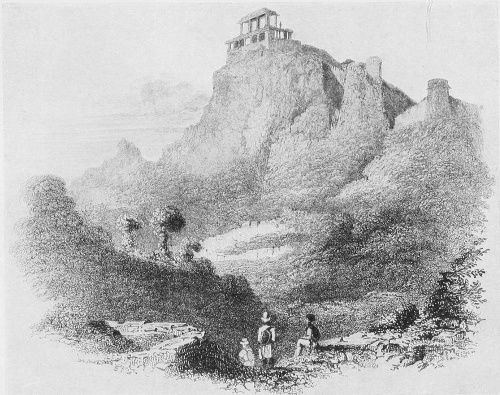
RUINS OF THE FORTRESS OF BAYĀNA. To face page 352.
With all Babur’s qualities as a soldier, supported by the hardy clans of the ‘cloud mountains’ (Belut Tagh) [303] of Karateghin,[8] 353the chances were many that he and they terminated their career on the ‘yellow rivulet’ of Bayana. Neither bravery nor skill saved him from this fate, which he appears to have expected. What better proof can be desired than Babur’s own testimony to the fact, that a horde of invaders from the Jaxartes, without support or retreat, were obliged to entrench themselves to the teeth in the face of their Rajput foe, alike brave and overpowering in numbers? To ancient jealousies he was indebted for not losing his life instead of gaining a crown, and for being extricated from a condition so desperate that even the frenzy of religion, which made death martyrdom in “this holy war,” scarcely availed to expel the despair which so infected his followers, that in the bitterness of his heart he says “there was not a single person who uttered a manly word, nor an individual who delivered a courageous opinion.”
The Battle of Khānua, March 16, 1527.
—Babur advanced from Agra and Sikri to oppose Rana Sanga, in full march to attack him at the head of almost all the princes of Rajasthan. Although the annals state some points which the imperial historian has not recorded, yet both accounts of the conflict correspond in all the essential details. On the 5th of Kartik, S. 1584
(
A.D.
1528), according to the annals, the Rana raised the siege of Bayana, and at Khanua encountered the advanced guard of the Tatars, amounting to fifteen hundred men, which was entirely destroyed; the fugitives carrying to the main body the accounts of the disaster, which paralysed their energies, and made them entrench for security, instead of advancing with the confidence of victory. Reinforcements met the same fate, and were pursued to the camp. Accustomed to reverses, Babur met the check without dismay, and adopted every precaution [304] that a mind fertile in expedients could suggest to reassure the drooping spirits of his troops. He threw up entrenchments, in which he placed his artillery, connecting his guns by chains, and in the more exposed parts
chevaux de frise
, united by leather ropes: a precaution
354
continued in every subsequent change of position. Everything seemed to aid the Hindu cause: even the Tatar astrologer asserted that as Mars was in the west, whoever should engage coming from the opposite quarter should be defeated. In this state of total inactivity, blockaded in his encampment, Babur remained near a fortnight, when he determined to renounce his besetting sin, and merit superior aid to extricate himself from his peril: the
naïveté
of his vow must be given in his own words.
355
But the destruction of the wine flasks would appear only to have added to the existing consternation, and made him, as a last resort, appeal to their faith. Having addressed them in a speech of [305] manly courage, though bordering on despair, he seized the happy moment that his exhortation elicited, to swear them on the Koran to conquer or perish.
Profiting by this excitement, he broke up his camp, to which he had been confined nearly a month, and marched in order of battle to a position two miles in advance, the Rajputs skirmishing up to his guns. Without
356
a regular circumvallation, his movable pallisadoes and guns chained, he felt no security. The inactivity of Sanga can scarcely escape censure, however we may incline to palliate it by supposing that he deemed his enemy in the toils, and that every day’s delay brought with it increased danger to him. Such reasoning would be valid, if the heterogeneous mass by which the prince of Mewar was surrounded had owned the same patriotic sentiments as himself: but he ought to have known his countrymen, nor overlooked the regulating maxim of their ambition,
get land
. Delay was fatal to this last coalition against the foes of his race. Babur is silent on the point to which the annals ascribe their discomfiture, a negotiation pending his blockade at Khanua; but these have preserved it, with the name of the traitor who sold the cause of his country. The negotiation
had reached this point, that on condition of Babur being left Delhi and its dependencies, the Pilakhal at Bayana should be the boundary of their respective dominions, and even an annual tribute was offered to the Rana [306]. We can believe that in the position Babur then was, he would not scruple to promise anything. The chief of Raesen, by name Salehdi, of the Tuar tribe, was the medium of communication, and though the arrangement was negatived, treason had effected the salvation of Babur.
On March 16 the attack commenced by a furious onset on the centre and right wing of the Tatars, and for several hours the conflict was tremendous. Devotion was never more manifest on the side of the Rajput, attested by the long list of noble names amongst the slain as well as the bulletin of their foe, whose artillery made dreadful havoc in the close ranks of the Rajput cavalry, which could not force the entrenchments, nor reach the infantry which defended them. While the battle was still doubtful, the Tuar traitor who led the van (harawal) went over to Babur, and Sanga was obliged to retreat from the field, which in the onset promised a glorious victory, himself severely wounded and the choicest of his chieftains slain: Rawal Udai[13] Singh of 357Dungarpur, with two hundred of his clan; Ratna of Salumbar, with three hundred of his Chondawat kin; Raemall Rathor, son of the prince of Marwar, with the brave Mertia leaders Khetsi and Ratna; Ramdas the Sonigira Rao; Uja the Jhala; Gokuldas Pramara; Manikchand and Chandrbhan, Chauhan chiefs of the first rank in Mewar; besides a host of inferior names.[14] Hasan Khan of Mewat, and a son of the last Lodi king of Delhi, who coalesced with Sanga, were amongst the killed.[15] Triumphal pyramids were raised of the heads of the slain, and on a hillock which overlooked the field of battle a tower of skulls was erected; and the conqueror assumed the title of Ghazi, which has ever since been retained by his descendants.
The Death of Rāna Sanga.
—Sanga retreated towards the hills of Mewat, having announced his fixed determination never to re-enter Chitor but with victory. Had his life been spared to his country, he might have redeemed the pledge; but the year of his defeat was the last of his existence, and he died at Baswa,
on the frontier of Mewat, not without suspicion of poison. It is painful to record the surmise that his ministers prompted the deed, and the cause is one which would fix a deep stain on the country; namely, the purchase by regicide of inglorious ease and stipulated safety, in [307] preference to privations and dangers, and to emulating the manly constancy of their prince, who resolved to make the heavens his canopy till his foe was crushed—a determination which was pursued with the most resolute perseverance by some of his gallant successors.
Evils resulting from Polygamy.
—Polygamy is the fertile source of evil, moral as well as physical, in the East. It is a relic of barbarism and primeval necessity, affording a proof that
358
ancient Asia is still young in knowledge. The desire of each wife,
that her offspring should wear a crown, is natural; but they do not always wait the course of nature for the attainment of their wishes, and the love of power too often furnishes instruments for any deed, however base. When we see, shortly after the death of Sanga, the mother of his second son intriguing with Babur, and bribing him with the surrender of Ranthambhor and the trophy of victory, the crown of the Malwa king, to supplant the lawful heir, we can easily suppose she would not have scrupled to remove any other bar. On this occasion, however, the suspicion rests on the ministers alone. That Babur respected and dreaded his foe we have the best proof in his not risking another battle with him; and the blame which he bestows on himself for the slackness of his pursuit after victory is honourable to Sanga, who is always mentioned with respect in the commentaries of the conqueror: and although he generally styles him the Pagan, and dignifies the contest with the title of “the holy war,” yet he freely acknowledges his merit when he says, “Rana Sanga attained his present high eminence by his own valour and his sword.”
Appearance of Rāna Sanga.
—Sanga Rana was of the middle stature, but of great muscular strength; fair in complexion, with unusually large eyes, which appear to be peculiar to his descendants.
He exhibited at his death but the fragments of a warrior: one eye was lost in the broil with his brother; an arm in an action with the Lodi king of Delhi, and he was a cripple owing to a limb being broken by a cannon-ball in another [308]; while he counted eighty wounds from the sword or the lance on various parts of his body. He was celebrated for energetic
359
enterprise, of which his capture of Muzaffar, king of Malwa, in his own capital, is a celebrated instance; and his successful storm of the almost impregnable Ranthambhor, though ably defended by the imperial general Ali, gained him great renown. He erected a small palace at Khanua, on the line which he determined should be the northern limit of Mewar; and had he been succeeded by a prince possessed of his foresight and judgment, Babur’s descendants might not have retained the sovereignty of India. A cenotaph long marked the spot where the fire consumed the remains of this celebrated prince. Sanga had seven sons, of whom the two elder died in non-age. He was succeeded by the third son,
Rāna Ratan Singh II., A.D. 1527-31.
—Ratna (S. 1586,
A.D.
1530) possessed all the arrogance and martial virtue of his race. Like his father, he determined to make the field his capital, and commanded that the gates of Chitor never should be closed, boasting that “its portals were Delhi and Mandu.” Had he been spared to temper by experience the exuberance of youthful impetuosity, he would have well seconded the resolution of his father, and the league against the enemies of his country and faith. But he was not destined to pass the age always dangerous to the turbulent and impatient Rajput, ever courting strife if it would not find him. He had married by stealth the daughter of Prithiraj of Amber, probably before the death of his elder brothers made him heir to Chitor. His double-edged sword, the proxy of the Rajput cavalier, represented Ratna on this occasion.
Unfortunately it was kept but too secret; for the Hara prince of Bundi,
in ignorance of the fact, demanded and obtained her to wife, and carried her to his capital. The consequences are attributable to the Rana alone, for he ought, on coming to the throne, to have espoused her; but his vanity was flattered at the mysterious transaction, which he deemed would prevent all application for the hand of his ‘affianced’ (
manga
). The bards of Bundi are rather pleased to record the power of their
360
princes, who dared to solicit and obtain the hand of the ‘bride’ of Chitor. The princes of Bundi had long been attached to the Sesodia house: and from the period when their common ancestors fought together on the banks of the Ghaggar against [309] Shihabu-d-din, they had silently grown to power under the wing of Mewar, and often proved a strong plume in her pinion. The Hara inhabited the hilly tract on her eastern frontier, and though not actually incorporated with Mewar, they yet paid homage to her princes, bore her ensigns and titles, and in return often poured forth their blood. But at the tribunal of Ananga,
the Rajput scattered all other homage and allegiance to the winds. The maiden of Amber saw no necessity for disclosing her secret or refusing the brave Hara, of whom fame spoke loudly, when Ratna delayed to redeem his proxy.
Death of Rāna Ratan Singh.
—The unintentional offence sank deep into the heart of the Rana, and though he was closely connected with the Hara, having married his sister, he brooded on the means of revenge, in the attainment of which he sacrificed his own life as well as that of his rival. The festival of the Aheria
(the spring hunt), which has thrice been fatal to the princes of Mewar, gave the occasion, when they fell by each other’s weapons. Though Ratna enjoyed the dignity only five years, he had the satisfaction to see the ex-king of Ferghana, now founder of the Mogul dynasty of India, leave the scene before him, and without the diminution of an acre of land to Mewar since the fatal day of Bayana. Rana Ratna was succeeded by his brother,
Rāna Bikramajīt, A.D. 1531-35.
—Bikramajit,
in S. 1591 (
A.D.
1535). This prince had all the turbulence, without the redeeming qualities of character, which endeared his brother to his subjects; he was insolent, passionate, and vindictive, and utterly regardless of that respect which his proud nobles rigidly exacted. Instead of appearing at their head, he passed his time amongst wrestlers and prize-fighters, on whom and a multitude
361
of ‘paiks,’ or foot soldiers, he lavished those gifts and that approbation, to which the aristocratic Rajput, the equestrian order of Rajasthan, arrogated exclusive right. In this innovation he probably imitated his foes, who had learned the superiority of infantry, despised by the Rajput, who, except in sieges, or when ‘they spread the carpet and hamstrung their steeds,’ held the foot-soldier very cheap. The use of artillery was now becoming general, and the [310] Muslims soon perceived the necessity of foot for their protection: but prejudice operated longer upon the Rajput, who still curses ‘those vile guns,’ which render of comparatively little value the lance of many a gallant soldier; and he still prefers falling with dignity from his steed to descending to an equality with his mercenary antagonist.
An open rupture was the consequence of such innovation, and (to use the figurative expression for misrule) ‘Papa Bai ka Raj’[24] was triumphant; the police were despised; the cattle carried off by the mountaineers from under the walls of Chitor; and when his cavaliers were ordered in pursuit, the Rana was tauntingly told to send his paiks.
The Attack by Bahādur, Sultān of Gujarāt.
—Bahadur, sultan of Gujarat, determined to take advantage of the Rajput divisions, to revenge the disgrace of the defeat and captivity of his predecessor Muzaffar.
Reinforced by the troops of Mandu, he marched against the Rana, then encamped at Loicha, in the Bundi territory. Though the force was overwhelming, yet with the high courage which belonged to his house, Bikramajit did not hesitate to give battle; but he found weak defenders in his mercenary paiks, while his vassals and kin not only kept aloof, but marched off in a body to defend Chitor, and the posthumous son of Sanga Rana, still an infant.
362There is a sanctity in the very name of Chitor, which from the earliest times secured her defenders; and now, when threatened again by ‘the barbarian,’ such the inexplicable character of the Rajput, we find the heir of Surajmall abandoning his new capital of Deolia, to pour out the few drops which yet circulated in his veins in defence of the abode of his fathers.
‘The son of Bundi,’ with a brave band of five hundred Haras, also came; as did the Sonigira and Deora Raos of Jalor and Abu, with many auxiliaries from all parts of Rajwara. This was the most powerful effort hitherto made by the sultans of Central India, and European artillerists[26] are recorded in these [311] annals as brought to the subjugation of Chitor. The engineer is styled ‘Labri Khan of Fringan,’ and to his skill Bahadur was indebted for the successful storm which ensued. He sprung a mine at the ‘Bika rock,’ which blew up forty-five cubits of the rampart, with the bastion where the brave Haras were posted. The Bundi bards dwell on this incident, which destroyed their prince and five hundred of his kin. Rao Durga, with the Chondawat chieftains Sata and Dudu and their vassals, bravely defended the breach and repelled many assaults; and, to set an example of courageous devotion, the queen-mother Jawahir Bai, of Rathor race, clad in armour, headed a sally in which she was slain. Still the besiegers gained ground, and the 363last council convened was to concert means to save the infant son of Sanga from this imminent peril.
Crowning of a New Rāna.
—But Chitor can only be defended by royalty, and again they had recourse to the expedient of crowning a king, as a sacrifice to the dignity of the protecting deity of Chitor. Baghji, prince of Deolia, courted the insignia of destruction; the banner of Mewar floated over him, and the golden sun from its sable field never shone more refulgent than when the
changi
was raised amidst the shouts of her defenders over the head of the son of Surajmall.
The Johar.
—The infant, Udai Singh, was placed in safety with Surthan, prince of Bundi,
the garrison put on their saffron robes, while materials for the
johar
were preparing. There was little time for the pyre. The bravest had fallen in defending the breach, now completely exposed. Combustibles were quickly heaped up in reservoirs and magazines excavated in the rock, under which gunpowder was strewed. Karnavati, mother of the prince, and sister to the gallant Arjun Hara, led the procession of willing victims to their doom, and thirteen thousand females were thus swept at once from the record of life. The gates were thrown open, and the Deolia chief, at the head of the survivors, with a blind and impotent despair, rushed on his fate [312].
Bahadur must have been appalled at the horrid sight on viewing his conquest;[29] the mangled bodies of the slain, with hundreds in the last agonies from the poniard or poison, awaiting death as less dreadful than dishonour and captivity.[30] To use the emphatic 364words of the annalist, “the last day of Chitor had arrived.” Every clan lost its chief, and the choicest of their retainers; during the siege and in the storm thirty-two thousand Rajputs were slain. This is the second sakha of Chitor.
Bahadur had remained but a fortnight, when the tardy advance of Humayun with his succours warned him to retire.[31] According to the annals, he left Bengal at the solicitation of the queen Karnavati; but instead of following up the spoil-encumbered foe, he commenced a pedantic war of words with Bahadur, punning on the word ‘Chitor.’ Had Humayun not been so distant, this catastrophe would have been averted, for he was bound by the laws of chivalry, the claims of which he had acknowledged, to defend the queen’s cause, whose knight he had become. The relation of the peculiarity of a custom analogous to the taste of the chivalrous age of Europe may amuse. When her Amazonian sister the Rathor queen was slain, the mother of the infant prince took a surer method to shield him in demanding the fulfilment of the pledge given by Humayun when she sent the Rakhi to that monarch.
The Rākhi.
—‘The festival of the bracelet’ (
Rakhi
) is in spring, and whatever its origin, it is one of the few when an intercourse of gallantry of the most delicate nature is established between the fair sex and the cavaliers of Rajasthan. Though the bracelet may be sent by maidens, it is only on occasions of urgent necessity or danger. The Rajput dame bestows with the Rakhi the title of adopted brother; and while its acceptance secures to her all the protection of a
cavalière servente
, scandal itself never suggests any other tie to his devotion. He may hazard his life in her cause, and yet never receive a smile in reward, for he cannot even see the fair object who, as brother of her adoption, has constituted him her defender. But there is a charm in the mystery of such connexion, never endangered by close observation, and the loyal to the fair may well attach a value [313] to the public recognition of being the Rakhi-band Bhai, the ‘bracelet-bound brother’ of a princess. The intrinsic value of such pledge is
365
never looked to, nor is it requisite it should be costly, though it varies with the means and rank of the donor, and may be of flock silk and spangles, or gold chains and gems. The acceptance of the pledge and its return is by the
kachhli
, or corset, of simple silk or satin, of gold brocade and pearls. In shape or application there is nothing similar in Europe, and as defending the most delicate part of the structure of the fair, it is peculiarly appropriate as an emblem of devotion. A whole province has often accompanied the Kachhli, and the monarch of India was so pleased with this courteous delicacy in the customs of Rajasthan, on receiving the bracelet of the princess Karnavati, which invested him with the title of her brother, and uncle and protector to her infant Udai Singh, that he pledged himself to her service, “even if the demand were the castle of Ranthambhor.” Humayun proved himself a true knight, and even abandoned his conquests in Bengal when called on to redeem his pledge and succour Chitor, and the widows and minor sons of Sanga Rana.
Humayun had the highest proofs of the worth of those courting his protection; he was with his father Babur in all his wars in India, and at the battle of Bayana his prowess was conspicuous, and is recorded by Babur’s own pen. He amply fulfilled his pledge, expelled the foe from Chitor, took Mandu by assault, and, as some revenge for her king’s aiding the king of Gujarat, he sent for the Rana Bikramajit, whom, following their own notions of
366
investiture, he girt with a sword in the captured citadel of his foe.
The Muhammadan historians, strangers to their customs, or the secret motives which caused the emperor to abandon Bengal, ascribe it to the Rana’s solicitation; but we may credit the annals, which are in unison with the chivalrous notions of the Rajputs, into which succeeding monarchs, the great Akbar, his son [314] Jahangir, and Shah Jahan, entered with delight; and even Aurangzeb, two of whose original letters to the queen-mother of Udaipur are now in the author’s possession, and are remarkable for their elegance and purity of diction, and couched in terms perfectly accordant with Rajput delicacy.[34]
Restoration of Bikramajīt.
—Bikramajit, thus restored to his capital, had gained nothing by adversity; or, to employ the words of the annalist, “experience had yielded no wisdom.” He renewed all his former insolence to his chiefs, and so entirely threw aside his own dignity, and, what is of still greater consequence, the reverence universally shown to old age, as to strike in open court Karamchand of Ajmer, the protector of his father Sanga in his misfortunes. The assembly rose with one accord at this indignity to their order; and as they retired, the Chondawat leader Kanji, the first of the nobles, exclaimed, “Hitherto, brother chiefs, we have had but a smell of the blossom, but now we shall be obliged to eat the fruit”; to which the insulted Pramara added, as he hastily retired, “To-morrow its flavour will be known.”
Though the Rajput looks up to his sovereign as to a divinity, and is enjoined implicit obedience by his religion, which rewards him accordingly hereafter, yet this doctrine has its limits, and precedents are abundant for deposal, when the acts of the prince may endanger the realm. But there is a bond of love as well as of awe which restrains them, and softens its severity in the paternity of sway; for these princes are at once the father and king of their people: not in fiction, but reality—for he is the 367representative of the common ancestor of the aristocracy—the sole lawgiver of Rajasthan.
Death of Rāna Bikramajīt.
—Sick of these minors (and they had now a third in prospect), which in a few years had laid prostrate the throne of Mewar, her nobles on leaving their unworthy prince repaired to Banbir, the natural son of the heroic Prithiraj, and offered “to seat him on the throne of Chitor.” He had the virtue to resist the solicitation; and it was only on painting the dangers which threatened the country, if its chief at such a period had not their confidence, that he gave his consent. The step between the deposal and death of a king is necessarily short [315], and the cries of the females, which announced the end of Bikramajit, were drowned in the acclamations raised on the elevation of the
changi
over the head of the bastard Banbir.