SYSTEMATIC AND DESCRIPTIVE PART. (continued 6)
Reading edition
Salmo.—Body covered with small scales. Cleft of the mouth wide, the maxillary extending to below or beyond the eye. Dentition well developed; conical teeth in the jaw bones, on the vomer and palatines, and on the tongue, none on the pterygoid bones. Anal short, with less than fourteen rays. Pyloric appendages numerous; ova large. Young specimens with dark cross-bands (Parr-marks).
We know of no other group of fishes which offers so many difficulties to the ichthyologist with regard to the distinction of the species as well as to certain points in their life-history, as this genus, although this may be partly due to the unusual attention which has been given to their study, and which has revealed an almost greater amount of unexplained facts than of satisfactory solutions of the questions raised. The almost infinite variations of these fishes are dependent on age, sex and sexual development, food, and the properties of the water. Some of the species interbreed, and the hybrids mix again with one of the parent species, thus producing an offspring more or less similar to the pure breed. The coloration is, first of all, subject to variation; and consequently this character but rarely assists in distinguishing a species, there being not one which would show in all stages of development the same kind of coloration. The young of all the species are barred; and this is so constantly the case that it may be used as a generic or even as a family character, not being peculiar to Salmo alone, but also to Thymallus and probably to Coregonus. The number of bars is not quite constant, but the migratory Trout have two (and even three) more than the River-Trout. In some waters River-trout remain small, and frequently retain the Parr-marks all their lifetime; at certain seasons a new coat of scales overlays the Parr-marks, rendering them invisible for a time; but they reappear in time, or are distinct as soon as the scales are removed. When the Salmones have passed this “Parr” state, the coloration becomes much diversified. The males, especially during and immediately after the spawning time, are more intensely coloured and variegated than the females; specimens which have not attained to maturity retaining a brighter silvery colour, and being more similar to the female fish. Food appears to have less influence on the coloration of the outer parts than on that of the flesh; thus the more variegated specimens are frequently out of condition, whilst well-fed individuals with pinkish flesh are of a more uniform though bright coloration. Chemistry has not supplied us yet with an analysis of the substance which gives the pink colour to the flesh of many Salmonoids; but there is little doubt that it is identical with, and produced by, the red pigments of many salt- and freshwater Crustaceans, which form a favourite food of these fishes. The water has a marked influence on the colours; Trout with intense ocellated spots are generally found in clear rapid rivers, and in small open Alpine pools; in the large lakes with pebbly bottom the fish are bright silvery, and the ocellated spots are mixed with or replaced by X-shaped black spots; in pools or parts of lakes with muddy or peaty bottom, the trout are of a darker colour generally, and when enclosed in caves or holes, they may assume an almost uniform blackish coloration.
The change of scales (that is, the rapid reproduction of the worn part of the scales) coincides in the migratory species with their sojourn in the sea. The renovated scales give them a bright silvery appearance, most of the spots disappearing or being overlaid and hidden by the silvery scales. Now, some of the species, like S. fario, inhabit all the different waters indicated, even brackish water, and, in consequence, we find a great variation of colour in one and the same species; others are more restricted in their habitat, like S. salar, S. ferox, etc., and, therefore, their coloration may be more precisely defined.
With regard to size the various species do not present an equal amount of variation. Size appears to depend on the abundance of food and the extent of the water. Thus, the Salmon and the different kinds of great Lake-trout do not appear to vary considerably in size, because they find the same conditions in all the localities inhabited by them. A widely spread species, however, like S. fario, when it inhabits a small mountain pool with scanty food, may never exceed a weight of eight ounces, whilst in a large lake or river, where it finds an abundance and variety of food, it attains to a weight of fourteen or sixteen pounds. Such large River-trout are frequently named and described as Salmon-trout, Bull-trout, etc. Further, in Salmones, as in the majority of fishes and tailed Batrachians, there is an innate diversity of growth in individuals hatched from the same spawn. Some grow rapidly and normally, others more slowly, and some remain dwarfed and stationary at a certain stage of development.
The proportions of the various parts of the body to one another vary exceedingly in one and the same species. Beside the usual changes from the young to the sexually mature form observed in all fishes, the snout undergoes an extraordinary amount of alteration of shape. In the mature male the intermaxillaries and the mandible are produced in various degrees, and the latter is frequently more or less bent upwards. Hence the males have the snout much more pointed and produced, and the entire head longer, than the females; with the intermaxillary bone the teeth, with which it is armed, are also enlarged, sometimes to four times the size of those of the females. And if this development of the front part of the head happens to be going on while the individual is able to obtain only a scanty supply of food, the usual proportions of the head and trunk are so altered that the species is very difficult to recognise. Barren male fish approach the females in the proportions of the head and body, but hybrid fishes do not differ in this respect from their parents. The abundance or scarcity of food, and the disposition or indisposition of the Salmonoids to feed, are other causes affecting the growth or fulness of the various parts of the body. In well-fed fishes the head is proportionally not only smaller but also shorter, and vice versa.
The fins vary to a certain degree. The variation in the number of the rays is inconsiderable and of no value for specific distinction. The caudal fin undergoes considerable changes of form with age, and dependency upon the sexual development. Young specimens of all species have this fin more or less deeply excised, so that the young of a species which has the caudal emarginate throughout life, is distinguished by a deeper incision of the fin, from the young of a species which has it truncate in the adult state. As the individuals of a species do not all attain to maturity at the same age and at the same size, and as mature individuals generally have the caudal less deeply excised than immature ones of the same age and size, it is evident that the variations in the form of the caudal are considerable and numerous, and that it is a very misleading character if due regard be not paid to the age and sexual development of the fish. Further, species inhabiting rapid streams as well as still waters show considerable variations in the form and length of all the fins; those individuals which live in rapid streams, being in almost constant motion and wearing off the delicate extremities of the fins, have the fin-rays comparatively shorter and stouter, and the fins of a more rounded form, particularly at the corners, than individuals inhabiting ponds or lakes. Moreover, one and the same individual may pass a part of its life in a lake, and enter a river at certain periods, thus changing the form of its fins almost periodically.
Finally, to complete our enumeration of these variable characters, we must mention that in old males, during and after the spawning-season, the skin on the back becomes thickened and spongy, so that the scales are quite invisible, being imbedded in the skin.
After this cursory review of variable characters we pass on to those which are more constant, not subject to ready modification by external circumstances; and which, therefore, ought to be noticed in every description of a species of Salmo.
1. The form of the præoperculum of the adult fish. The præoperculum is composed of a vertical (posterior) and horizontal (lower) part (limb), both meeting at a more or less rounded angle. The development of the lower limb is a very constant character; in some species (as in the Salmon) it is long, in others (S. ferox, S. brachypoma) exceedingly short. The adjoining woodcuts will readily show this difference.
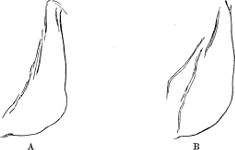
Fig. 287.—Præoperculum of A. Salmo salar; B. Salmo brachypoma.
In young specimens of all Salmonoids the præoperculum has a very short lower limb; but whilst in some species it lengthens with age, its development in a horizontal direction is arrested in others.
2. The width and strength of the maxillary of the adult fish.—To show this character in two distinct species, we have given woodcuts of the maxillaries of females (12 inches long) of S. fario and S. levenensis of the same size.
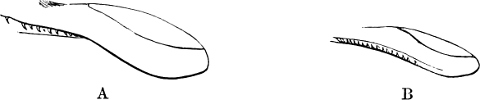
Fig. 288.—Maxillary of A. Salmo fario; B. Salmo levenensis.
In young specimens of all Salmonoids the maxillary is comparatively shorter and broader, somewhat resembling that of Coregonus; yet this bone offers a valuable character for the determination of the young of some species; for instance, in a young S. cambricus it extends scarcely to below the centre of the eye, whilst in S. fario of the same size it reaches to, or even beyond, this point.
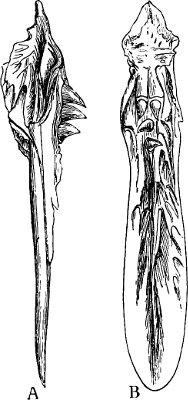
Fig. 289.—Vomerine teeth of Salmo salar (Salmon). A. Side view. B. Lower view.
3. The size of the teeth, those of the intermaxillaries excepted.
4. The arrangement, and the permanence or deciduousness of the vomerine teeth.—In some species the vomer is normally armed with a double or single series throughout life, although, of course, some of the teeth are frequently accidentally lost; in others, these teeth disappear gradually with age, the hinder ones first, so that finally the anterior only remain. In order to ascertain the arrangement of the teeth, it is necessary to remove the gengiva. Frequently the teeth stand in a distinctly double or single series, or they are placed alternately; but frequent irregularities occur which render the character vague, or even unsafe, so that some zoologists have rejected it entirely as unreliable. However, when a greater number of individuals really belonging to the same species are examined, a pretty safe conclusion may be arrived at as regards the arrangement of the teeth.
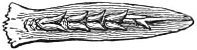
Fig. 290.—Vomerine teeth of Salmo fario, lower view.
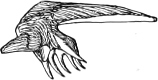
Fig. 291.—Vomerine teeth of a Charr, side view.
5. The form of the caudal fin in specimens of a given size, age, and sexual development.
6. A great development of the pectoral fins, when constant in individuals from the same locality.
7. The size of the scales, as indicated by the number of transverse rows above the lateral line: one of the most constant characters.
8. The number of vertebræ.—Considering the great number of vertebræ in Salmonoids the constancy of this character is truly surprising. An excess or a diminution of the normal number by two, is of rare occurrence, and generally to be explained by the fact that one vertebra has been abnormally divided into two, two such vertebræ being considerably smaller than the others; or, on the other hand, that two have merged into one centrum, which is then unusually large, and provided with two neural spines. We have seen one case only, in which three vertebræ were united. The number of vertebræ can be easily ascertained in specimens destined for preservation in spirits, by an incision made along one side of the fish, a little above the lateral line.
9. The number of pyloric appendages.—There can be no doubt that this character may materially assist in fixing a species. We shall see that in some species it varies from 30 to 50; but in others, as in the Salmon and Charr, it has been found very constant (see Fig. 56, p. 131). If unexpected variations occur, their cause may be found in a partial confluence of the cæca, as we have observed that specimens of S. levenensis (a species normally with from 70 to 90 cæca), had those appendages of unusual width when the normal number was diminished.
We have mentioned above that many points in the life-history of the Salmonoids still remain very obscure:—
1. Johnson, a correspondent of Willughby (“Hist. Pisc.,” p. 194), had already expressed his belief that the different Salmonoids interbreed; and this view has since been shared by many who have observed these fishes in nature. Hybrids between the Sewin (S. cambricus) and the River Trout (S. fario) were numerous in the Rhymney and other rivers of South Wales, before Salmonoids were almost exterminated by the pollutions allowed to pass into those streams, and so variable in their characters that the passage from one species to the other could be demonstrated in an almost unbroken series, which might induce some naturalists to regard both species as identical. Abundant evidence of a similar character has accumulated, showing the frequent occurrence of hybrids between S. fario and S. trutta; hybrids between S. fario and species of Charr have been abundantly bred by continental pisciculturists. In some rivers the conditions appear to be more favourable to hybridism than in others, in which hybrids are of comparatively rare occurrence. Hybrids between the Salmon and some other species are very scarce everywhere. The hybrids are sexually as much developed as the pure breed, but nothing whatever is known of their further propagation and progeny.
2. Siebold has shown that some individuals of every species are not sexually developed, and that such individuals differ also externally from those normally developed. However, he appears to have gone too far when he stated that this state of sterility extends over the whole existence of such individuals, and that, therefore, the external peculiarities also remain permanent throughout life. According to Widegren this sterility is merely a temporary immaturity, and a part of the individuals arrive at a full sexual development at a later or much later period than others. To this we may add that many Salmonoids cease to propagate their species after a certain age, and that all so called overgrown individuals (that is, specimens much exceeding the usual size of the species) are barren. Externally they retain the normal specific characters.
The Salmon offers a most remarkable instance of irregularity as regards the age at which the individuals arrive at maturity. Shaw has demonstrated, in the most conclusive manner, that those small Salmonoids, which are generally called Parr, are the offspring of the Salmon, and that many males, from 7 to 8 inches long, have their sexual organs fully developed, and that their milt has all the impregnating properties of the seminal fluid of a much older and larger fish. That this Parr is not a distinct species—as has been again maintained by Couch—is further proved by the circumstance that these sexually mature Parr are absolutely identical in their zoological characters with the immature Parr, which are undoubtedly young Salmon, and that no Parr has ever been found with mature ova. But whether these Parr produce normal Salmon, impregnating the ova of female salmon, or mingle with the River-trout, or whether they continue to grow and propagate their species as fully developed Salmon, are questions which remain to be answered. We may only add that, as far as we know, barren old Salmon are extremely scarce.
3. The question whether any of the migratory species can be retained by artificial means in fresh water, and finally accommodate themselves to a permanent sojourn therein, must be negatived for the present. Several instances of successful experiments made for this purpose have been brought forward; but all these accounts are open to serious doubts, inasmuch as they do not afford us sufficient proof that the young fish introduced into ponds were really young migratory Salmonoids, or that the full-grown specimens were identical with those introduced, and not hybrids or non-migratory Trout of a somewhat altered appearance in consequence of the change of their locality. We have seen the experiment tried at two places in South Wales, and in both cases the Salmon and the pure Sewin died when not allowed to return to the sea. On the other hand, hybrid fishes from the Sewin and the Trout survived the experiment, and continued to grow in a pond perfectly shut up from communication with the sea. In that locality neither those hybrids nor the trout spawn.
4. Although the majority of the mature individuals of a migratory species ascend a river at a certain fixed time before the commencement of spawning, others enter the freshwater at a much earlier period, either singly or in small troops; and many appear to return to the sea before they reascend at the time of the regular immigration. It is not improbable that one and the same individual may change the salt- or freshwater several times in the year. However, this is the case in certain rivers only, for instance, in those falling into the Moray Firth; in others one immigration only is known to occur. The cause of the irregular ascents previous to the autumnal ascents is unknown. A part, at least, of the hybrid fishes retain the migratory instinct; but it is not known whether sterile individuals accompany the others in their migrations.
5. It is said that the migratory species invariably return to the river in which they are bred. Experiments have shown that this is normally the case; but a small proportion appear to stray so far away from their native place as to be unable to find their way back. Almost every year Salmon and Sea-trout in the Grilse-state make their appearance at the mouth of the Thames (where the migrating Salmonoids have become extinct for many years), ready to reascend and to restock this river as soon as its poisoned water shall be sufficiently purified to allow them a passage.
6. There has been much dispute about the time required for the growth of Salmonoids. The numerous and apparently contradictory observations tend to show that there is a great amount of variation even among individuals of the same origin living under the same circumstances, some of them growing much more quickly than others, and being ready to descend to the sea twelve months before their brethren. The cause of this irregularity is not explained. On the other hand, when we consider the fibrous condition of the Salmonoid skeleton, which is much less solid, and more wanting in calcareous substance, than that of the majority of Teleosteous fishes, we shall be quite prepared to adopt the truth of the observation that the young Salmonoids return to the fresh water, after a few months sojourn in the sea, and after having feasted on nourishing Crustaceans, Sand-eels, etc., with their former weight in ounces increased to pounds.
7. Liability to variation in form indicates that an animal can adapt itself to a variety of circumstances; therefore, such species as show the greatest pliability in this respect, are those which most recommend themselves for domestication and acclimatisation within certain climatic limits. Thus, the River-trout or Sea-trout were very proper subjects for those eminently successful attempts to establish them in similar latitudes of the Southern Hemisphere, whilst the attempt of transferring them into the low hill-streams of India ended (as could be foreseen) in a total failure. Those two species must now be considered to be fully acclimatised in Tasmania and New Zealand, and with but little protection may be expected to hold their own in the freshwaters of those colonies. Whether the acclimatisation of the Salmon will be in the end equally and permanently successful, remains to be seen. The true S. salar is not subject to variation, and is very sensitive to any change of external conditions, and to every kind of interference with its economy. The fourth species, with which attempts of acclimatisation in Southern Australia have been made, is a migratory Salmon from the Sacramento river in California. This experiment is still in progress, and believed to be promising of success. It will be a most curious problem to ascertain, how much the original characters and habits of those species will be affected by their transference to so distant a part of the globe. At present it would be too hazardous to offer an opinion on this point, especially as it is a fact that numerous cross-breeds have been introduced into, and reared in, Tasmania, which must more or less interfere with the characters of the pure breeds.
It is apparent, from the foregoing remarks, that the distinction of the various species of Salmonidæ is a matter of considerable difficulty, and that there is scope for great diversity of opinion. At any rate it is only by a close, long-continued study, and constant comparison of specimens of various ages and from various localities, that one is enabled to find a guide through the labyrinth of confusing variations. However, it is a significant fact that the very same characters by which we are enabled to distinguish European species occur again, though in an exaggerated form, in American Salmonoids (which everybody will admit to be of distinct species), and therefore our faith in them necessarily becomes strengthened. In accordance with acknowledged principles in zoology, forms which differ from their congeners by a combination of two or more of constant characters, are to be distinguished under distinct specific names. Most likely they have been derived, at a not very remote period, from common ancestors, but the question of their specific distinctness is no more affected by this consideration than the question whether Salmo and Coregonus are distinct genera. Whenever the zoologist observes two forms distinguished by peculiarities of organisation, such as cannot be conceived to be the effects of an external or internal cause, disappearing with the disappearance of that cause, and which forms have been propagated and are being propagated uniformly through all the generations within the limits of our observations, and are yet most probably to be propagated during the existence of mankind, he is obliged to describe these forms as distinct, and they will commonly be called species.
The species of the genus Salmo are inhabitants of the temperate and arctic zones of the Northern Hemisphere; the species are most abundant in the northern parts of the temperate zone, becoming scarcer beyond the Arctic circle, and in the warmer parts towards the south. The southernmost points in which Salmones are found, are, on the American continent, the rivers falling into the head of the Californian Gulf, and in the Old World the mountain rivers of the Atlas and Hindu Kush. The Salmones from those localities are migratory Trout in the New World, non-migratory and small in the Old. Those species which range to the highest latitudes (lat. 82°) belong to the division of Charr, a group which generally are more intolerant of a moderate temperature, than real Trout. The genus is subdivided into
a. Salmones—Salmon and Trout—with teeth on the body of the vomer as well as its head (see Figs. 289 and 290).
b. Salvelini—Charr—with teeth on the head of the vomer only (see Fig. 291).
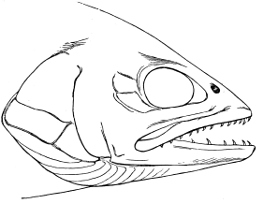
Fig. 292.—Salmo brachypoma.
Of the host of species (the majority of which is unfortunately very insufficiently characterised) we enumerate the following:—[45]
a. Salmones.
1. S. salar (Salmon; Lachs or Salm; Saumon) (Fig. 6, p. 43). The Salmon can generally be readily recognised, but there are instances in which the identification of specimens is doubtful, and in which the following characters (besides others) will be of great assistance. The tail is covered with relatively large scales, there being constantly eleven, or sometimes twelve in a transverse series running from behind the adipose fin forwards to the lateral line, whilst there are from thirteen to fifteen in the different kinds of Sea-trout and River-trout. The number of pyloric appendages (see Fig. 56, p. 131) is great, generally between 60 and 70, more rarely falling to 53 or rising to 77. The body of the vomer is armed with a single series of small teeth, which at an early age are gradually lost from behind towards the front, so that half-grown and old individuals have only a few (1–4) left. The Salmon inhabits temperate Europe southwards to 43° N. lat., and is not found in any of the rivers falling into the Mediterranean. In the New World its southern boundary is 41° N. lat.
2. S. trutta (Sea-trout, Salmon-trout).[46]—Especially numerous in North Britain.
3. S. cambricus (Sewin).—Wales, South of England, Ireland, Norway, and Denmark.
4. S. fario (Common River-trout).
5. S. macrostigma (Algeria).
6. S. lemanus (Lake of Geneva).
7. S. brachypoma.—A migratory species from the rivers Forth, Tweed, and Ouse.
8. S. gallivensis (Galway Sea-trout).
9. S. orcadensis.—A non-migratory trout from Lough Stennis, in the Orkney Islands.
10. S. ferox.—The great Lake-trout of North Britain, Wales, and Ireland.
11. S. stomachicus (the Gillaroo of Ireland).
12. S. nigripinnis from mountain-pools of Wales.
13. S. levenensis (Lochleven Trout).
14. S. oxi from the rivers of the Hindu Kush.
15. S. purpuratus from the Pacific coast of Asia and North America.
16. S. macrostoma.—Japan.
17. S. namaycush.—The great Lake-trout of North America.
b. Salvelini: Charr.
1. S. umbla.—The “Ombre chevalier” of the Swiss lakes.
2. S. salvelinus.—The “Sælbling” of the Alpine lakes of Bavaria and Austria.
3. S. alpinus.—The common Northern Charr, growing to a length of four feet, and migratory.
4. S. killinensis.—The Loch Killin Charr, Inverness-shire.
5. S. willughbii.—The Loch Windermere Charr.
6. S. perisii.—The “Torgoch” of Wales.
7. S. grayi.—The “Freshwater Herring” of Lough Melvin, Ireland.
8. S. colii.—Charr of Loughs Eske and Dan.
9. S. hucho.—The “Huchen” of the Danube, growing to the size of the Salmon.
10. S. alipes from lakes in Boothia Felix and Greenland.
11. S. arcturus.—The most northern species from 82° lat.
12. S. fontinalis.—The common “Brook-trout” of the United States.
13. S. oquassa.—A lake species from the State of Maine.
Oncorhynchus differs from Salmo only in the increased number of anal rays, which are more than fourteen. All the species are migratory, ascending American and Asiatic rivers flowing into the Pacific. The Californian Salmon (O. quinnat?) belongs to this genus.
Other allied genera are Brachymystax and Luciotrutta.
Plecoglossus.—Body covered with very small scales. Cleft of the mouth wide; maxillary long. Dentition feeble; intermaxillaries with a few small, conical, pointed teeth; the teeth of the maxillaries and mandibles are broad, truncated, lamellated and serrated, movable, seated in a fold of the skin. The mandibles terminate each in a small knob, and are not jointed at the symphysis. The mucous membrane in the interior of the mouth—between the terminal halves of the mandibles—forms a peculiar organ, being raised into folds, with a pair of pouches in front and a single one behind. Tongue very small, with minute teeth, its apical part being toothless; palate apparently without teeth.
A small aberrant form of Freshwater-Salmonoids abundantly found in Japan and the Island of Formosa.
Osmerus.—Body covered with scales of moderate size. Cleft of the mouth wide; maxillary long, extending to, or nearly to, the hind margin of the orbit. Dentition strong; intermaxillary and maxillary teeth small, much smaller than those of the mandible. Vomer with a transverse series of teeth, several of which are large, fang-like; a series of conical teeth along the palatine and pterygoid bones. Tongue with very strong fang-like teeth anteriorly, and with several longitudinal series of smaller ones posteriorly. Pectoral fins moderately developed. Pyloric appendages very short, in small number; ova small.
The “Smelt” (O. eperlanus) is common on many places of the coasts of Northern Europe and America. In the sea it grows to a length of eight inches; but, singularly, it frequently migrates from the sea into rivers and lakes, where its growth is very much retarded. That this habit is one of very old date, is evident from the fact that this small freshwater form occurs, and is fully acclimatised in lakes which have now no open communication with the sea. And still more singularly, this same habit, with the same result, has been observed in the Smelt of New Zealand (Retropinna richardsonii). The Smelt is considered a delicacy in Europe, as well as in America, where the same species occurs. Two other allied genera, Hypomesus and Thaleichthys, are found on the Pacific coast of North America, the latter being caught in immense numbers, and known by the name “Eulachon” and “Oulachan;” it is so fat, that it is equally used as food and as candle.
Mallotus.—Body covered with minute scales, which are somewhat larger along the lateral line and along each side of the belly; in mature males these scales become elongate, lanceolate, densely tiled, with free projecting points, forming villous bands. Cleft of the mouth wide; maxillary very thin, lamelliform, extending to below the middle of the eye. Lower jaw the longer, partly received between the maxillaries. Dentition very feeble; the teeth forming single series; only the teeth on the tongue are somewhat larger and disposed in an elliptical patch. Pectoral fins large, horizontal, with broad base. Pyloric appendages very short, in small number; ova small.
The “Capelin” (M. villosus) is found on the Arctic coasts of America and of Kamtschatka. It is caught in immense numbers by the natives, who consume it fresh, or dry it for use in the winter. Its length does not exceed nine inches.
Coregonus.—Body covered with scales of moderate size. Cleft of the mouth small; maxillary broad, short or of moderate length, not extending behind the orbit. Teeth, if present, extremely minute and deciduous. Dorsal fin of moderate length; caudal deeply forked. Ova small.
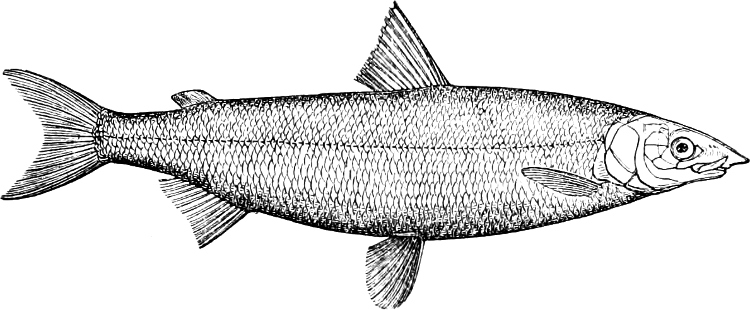
Fig. 293.—Coregonus oxyrhynchus.
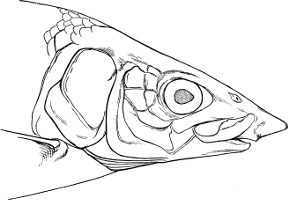
Fig. 294.—Head of Coregonus oxyrhynchus.
The majority of the species, of which more than forty are known, are lacustrine species; and comparatively few are subject to periodical migrations to the sea, like Salmo. They are confined to the northern parts of temperate Europe, Asia, and North America. Their distribution is local, but sometimes three and more species are found in the same lake. They abound in every lake and river of the northern parts of North America, and are known by the name of “White-fish.” They are of vital importance to some tribes of the native population. The European C. oxyrhynchus is as much a marine as a freshwater species. In the British Islands several small species occur, viz. C. clupeoides, the “Gwyniad,” “Schelly,” or “Powen” from the great lakes; C. vandesius, the “Vendace” of Lochmaben; and C. pollan, the “Pollan” of the Irish lakes. The latter is brought in quantities to Belfast market during the season, that is, at the time when it rises from the depths of Lough Neagh to deposit its spawn near the shore. Thomson says that in September 1834 some 17,000 were taken there at three or four draughts of the net. Some of the species of the continent of Europe and America attain to a much larger size than the British species, viz. to a length of two feet.
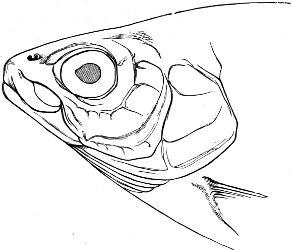
Fig. 295.—Coregonus clupeoides.
Thymallus.—Principally distinguished from Coregonus by its long many-rayed dorsal fin.
“Graylings”—five species, inhabiting clear streams of the north of Europe, Asia, and North America. The best known are the “Poisson bleu” of the Canadian voyageurs (Th. signifer), and the European Grayling (T. vulgaris).
Salanx.—Body elongate, compressed, naked or covered with small, exceedingly fine, deciduous scales. Head elongate and much depressed, terminating in a long, flat, pointed snout. Eye small. Cleft of the mouth wide; jaws and palatine bones with conical teeth, some of the intermaxillaries and mandibles being enlarged; no teeth on the vomer; tongue with a single series of curved teeth. Dorsal fin placed far behind the ventrals, but in front of the anal; anal long; adipose fin small; caudal forked. Pseudobranchiæ well developed; air-bladder none. The entire alimentary canal straight, without bend; pyloric appendages none. Ova small.
This small, transparent, or whitish fish (S. chinensis) is well known at Canton and other places of the coast of China as “White-bait,” and considered a delicacy. It is evidently a fish which lives at a considerable depth in the sea, and approaches the coast only at certain seasons.
Finally, this family is represented in the deep sea by three genera, Argentina, Microstoma, and Bathylagus, of which the two former live at moderate depths, and have been known for a long time, whilst the last was discovered during the “Challenger” expedition in the Atlantic and Antarctic Oceans at depths of 1950 and 2040 fathoms. As Argentina is sometimes found in the North Atlantic, and even near the British coasts, we give its principal characters.
Argentina.—Scales rather large; cleft of the mouth small; intermaxillaries and maxillaries very short, not extending to below the orbit. Eye large. Jaws without teeth; an arched series of minute teeth across the head of the vomer and on the fore part of the palatines; tongue armed with a series of small curved teeth on each side. Dorsal fin short, in advance of the ventrals; caudal deeply forked. Pseudobranchiæ well developed. Pyloric appendages in moderate numbers. Ova small.
Four species are known, of which A. silus and A. hebridica have been found occasionally on the North British, and, more frequently, on the Norwegian coast. The other species are from the Mediterranean. Attaining to a length of 18 inches.
Sixteenth Family—Percopsidæ.
Body covered with ctenoid scales; head naked. Margin of the upper jaw formed by the intermaxillaries only; opercular apparatus complete. Barbels none. Gill-openings wide. Adipose fin present.
One genus and species only (Percopsis guttatus); interesting as having the general characters of Salmonoids, but the mouth and scales of a Percoid. Freshwaters of the northern United States.
Seventeenth Family—Haplochitonidæ.
Body naked or scaly (cycloid). Margin of the upper jaw formed by the intermaxillary; opercular apparatus complete. Barbels none. Gill-opening wide; pseudobranchiæ. Air-bladder simple. Adipose fin present. Ovaries laminated; the eggs fall into the cavity of the abdomen, there being no oviduct. Pyloric appendages none.
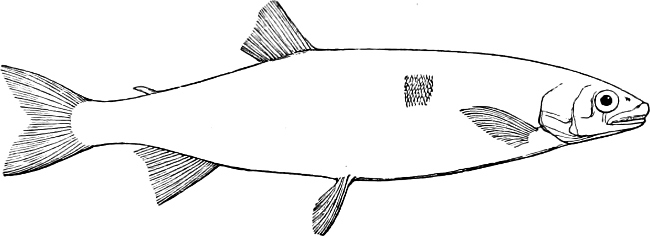
Fig. 296.—Prototroctes oxyrhynchus, New Zealand.
Freshwater-fishes which represent the Salmonoids in the southern hemisphere. Two genera only are known. Haplochiton (Fig. 104, p. 250) abundant in lakes and the streams falling into the Straits of Magelhæn and in the rivers of Chile and the Falkland Islands. It has the general appearance of a Trout, but is naked. Prototroctes, with the habit of a Coregonus, scaly, and provided with minute teeth; one species (P. maræna) is common in South Australia, the other (P. oxyrhynchus) in New Zealand. The settlers in these colonies call them Grayling; the Maori name of the second species is “Upokororo.”
Eighteenth Family—Gonorhynchidæ.
Head and body entirely covered with spiny scales; mouth with barbels. Margin of the upper jaw formed by the intermaxillary, which, although short, is continued downwards as a thick lip, situated in front of the maxillary. Adipose fin none; the dorsal fin is opposite to the ventrals, and short, like the anal. Stomach simple, without blind sac; pyloric appendages in small number. Pseudobranchiæ; air-bladder absent. Gill-openings narrow.
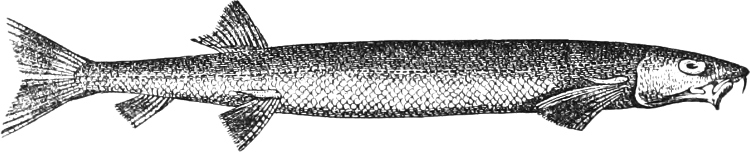
Fig. 297.—Gonorhynchus greyi.
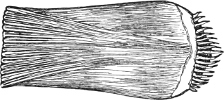
Fig. 298.—Scale of Gonorhynchus greyi.
One genus and species only (Gonorhynchus greyi) is known; it is a semi-pelagic fish, not very rare off the Cape of Good Hope, and in the Australian and Japanese seas. From 12 to 18 inches long. The colonists in New Zealand name it “Sand-eel,” as it frequents bays with sandy bottom. It is eaten.
Nineteenth Family—Hyodontidæ.
Body covered with cycloid scales; head naked; barbels none. Margin of the upper jaw formed by the intermaxillaries mesially, and by the maxillaries laterally, the latter being articulated to the end of the former. Opercular apparatus complete. Adipose fin none; the dorsal fin belongs to the caudal portion of the vertebral column. Stomach horseshoe-shaped, without blind sac; intestine short; one pyloric appendage. Pseudobranchiæ none; air-bladder simple. Gill-openings wide. The ova fall into the abdominal cavity before exclusion.
One genus and species only (Hyodon tergisus) is known, generally called “Moon-eye.” It is abundant in the western streams and great lakes of North America. From 12 to 18 inches long.
Twentieth Family—Pantodontidæ.
Body covered with large cycloid scales; sides of the head osseous. Margin of the upper jaw formed by the single intermaxillary mesially, and by the maxillaries laterally. The dorsal fin belongs to the caudal portion of the vertebral column, is short, opposite and similar to the anal. Gill-openings wide; gill-covers consisting of a præoperculum and operculum only. Branchiostegals numerous. Pseudobranchiæ none; air-bladder simple. Stomach without coecal sac; one pyloric appendage. Sexual organs with a duct.
A small freshwater-fish (Pantodon buchholzi), singularly alike to a Cyprinodont, from the west coast of Africa.
Twenty-first Family—Osteoglossidæ.
Body covered with large hard scales, composed of pieces like mosaic. Head scaleless; its integuments nearly entirely replaced by bone; lateral line composed of wide openings of the mucus-duct. Margin of the upper jaw formed by the intermaxillaries mesially, and by the maxillaries laterally. The dorsal fin belongs to the caudal portion of the vertebral column, is opposite and very similar to the anal fin; both approximate to the rounded caudal (with which they are abnormally confluent). Gill-openings wide; pseudobranchiæ none; air-bladder simple or cellular. Stomach without coecal sac; pyloric appendages two.
Large freshwater-fishes of the tropics, whose singular geographical distribution has been noticed above (p. 223).
Osteoglossum.—Cleft of the mouth very wide, oblique, with the lower jaw prominent. A pair of barbels at the lower jaw. Abdomen trenchant. Bands of rasp-like teeth on the vomer, palatine and pterygoid bones, on the tongue and hyoid. Pectoral fins elongate.
O. bicirrhosum from Brazil and Guyana, O. formosum from Borneo and Sumatra, O. leichardti from Queensland.
Arapaima.—Cleft of the mouth wide, with the lower jaw prominent; barbels none. Abdomen rounded. Jaws with an outer series of small conical teeth; broad bands of rasp-like teeth on the vomer, palatines, pterygoids, sphenoid, os linguale, and hyoid. Pectoral fins of moderate length.

Fig. 299.—Arapaima gigas.
The largest freshwater Teleostean known, exceeding a length of 15 feet and a weight of 400 pounds. It is common in the large rivers of Brazil and the Guyanas, and esteemed as an article of food. When salted it is exported in large quantities from the inland fisheries to the seaports.
Heterotis.—Cleft of the mouth rather small, with the jaws subequal; barbels none. A single series of small teeth in the jaws; pterygoids and hyoid with a patch of small conical teeth; none on the vomer or palatines.
This fish (H. niloticus), which is not uncommon in the Upper Nile and the West African rivers, exhibits several anatomical peculiarities. The fourth branchial arch supports a spiral accessory organ, the function of which is still unexplained. The air-bladder is cellular, and the stomach consists of a membranous and a muscular portion.
Twenty-Second Family—Clupeidæ.
Body covered with scales; head naked; barbels none. Abdomen frequently compressed into a serrated edge. Margin of the upper jaw formed by the intermaxillaries mesially, and by the maxillaries laterally; maxillaries composed of at least three movable pieces. Opercular apparatus complete. Adipose fin none. Dorsal not elongate; anal sometimes very long. Stomach with a blind sac; pyloric appendages numerous. Gill-apparatus much developed, the gill-openings being generally very wide. Pseudobranchiæ generally present. Air-bladder more or less simple.
The family of “Herrings” is probably unsurpassed by any other in the number of individuals, although others comprise a much greater variety of species. The Herrings are principally coast-fishes, or, at least, do not go far from the shore; none belong to the deep-sea fauna; scarcely any have pelagic habits, but many enter or live in fresh waters communicating with the sea. They are spread over all the temperate and tropical zones. Fossil remains of Herrings are numerous, but the pertinence of some of the genera to this family is open to serious doubts, as the remains are too fragmentary to allow of determining whether they belong to Salmonoids or Clupeoids. Therefore, Agassiz comprised both families in one—Halecidæ. Many of the remains belong to recent genera, which are readily recognised, as Clupea, Engraulis and Chanos, principally from the schists of Glaris and Licata, from Monte Bolca and the Lebanon. Others, like Thrissopater, from the Gault at Folkestone, Leptosomus, Opisthopteryx, Spaniodon, from the chalk and tertiary formations, can be readily associated with recent genera. But the majority do not show an apparent affinity to the present fauna. Thus, Halec from the chalk of Bohemia, Platinx and Coelogaster from Monte Bolca, Rhinellus from Monte Bolca and Mount Lebanon, Scombroclupea, with finlets behind the anal, from the Lebanon and Comen, and Crossognathus from tertiary Swiss formations, allied to Megalops, Spathodactylus from the same locality, and Chirocentrites from Mount Lebanon, etc. Finally, a genus recently discovered in tertiary formations of Northern Italy, Hemitrichas, has been classed with the Clupeoids, from which, however, it differs by having two short dorsal fins, so that it must be considered, without doubt, to be the representative of a distinct family.
Engraulis (including Cetengraulis).—Scales large or of moderate size. Snout more or less conical, projecting beyond the lower jaw. Teeth small or rudimentary. Intermaxillaries very small, hidden; maxillary long, attached to the cheek by a scarcely distensible membrane. Anal fin of moderate or great length. Branchiostegals short, from nine to fourteen in number.
Not less than forty-three different species of “Anchovies” are known from temperate and tropical seas. They exhibit marked differences in the length of their maxillary bone, which sometimes does not reach the gill-opening, whilst in other species it extends far beyond it; and in the number of their anal rays, which varies from 20 to 80. Some have the upper pectoral ray prolonged into a filament, thus leading towards the succeeding genus, Coilia. The majority are recognised, besides, by their peculiar structure, by a broad silvery, lateral band, similar to that observed in the Atherines. The most celebrated Anchovy is E. encrasicholus, very plentiful in the Mediterranean, but rarely wandering northwards. It is the species which, preserved in salt, is exported to all parts of the world, although similarly lucrative fisheries of Anchovies might be established in Tasmania where the same species occurs, in Chile, China, Japan, California, at Buenos Ayres, each of which countries possesses Anchovies by no means inferior to the Mediterranean species.
Coilia.—Body terminating in a long tapering tail. Scales of moderate size. Snout and jaws as in Engraulis. Anal fin exceedingly long, confluent with the caudal. The two or three upper pectoral rays are much prolonged, and their branches form four, six, or seven filaments.
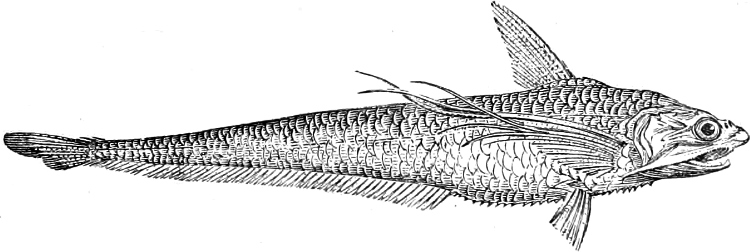
Fig. 300.—Coilia clupeoides.
Ten species from Indian and Chinese seas.
Chatoëssus.—Body compressed; abdomen serrated. Scales of moderate size. Snout obtuse, or obtusely conical, more or less projecting beyond the cleft of the mouth, which is narrow, more or less transverse. Maxillary joined to the ethmoid, its upper portion being behind the intermaxillary. Teeth none. Anal fin rather long; dorsal opposite to the ventrals, or to the space between ventrals and anal. Gill-membranes entirely separate; branchial arches forming two angles, one pointing forward and the other backwards; the fourth branchial arch with an accessory organ; branchiostegals of moderate length, five or six in number.
Ten species from the coasts, brackish and fresh waters of Central America (one species ranges to New York), Australia, the East Indies, and Japan.
Clupea.—Body compressed, with the abdomen serrated, the serrature extending forwards to the thorax. Scales of moderate or large, rarely of small size. Upper jaw not projecting beyond the lower. Cleft of the mouth of moderate width. Teeth, if present, rudimentary and deciduous. Anal fin of moderate extent, with less than thirty rays; dorsal fin opposite to the ventrals. Caudal forked.
This genus comprises more than sixty different species, the geographical distribution of which coincides with that of the family. The majority are of greater or less utility to man, but a few tropical species (C. thrissa, C. venenosa, and others) acquire, probably from their food, highly poisonous properties, so as to endanger the life of persons eating them. The most noteworthy species are—
1. C. harengus (the “Herring”).—It is readily recognised by having an ovate patch of very small teeth on the vomer. D. 17–20. A. 16–18. L. lat. 53–59. Vert. 56. Gill-cover smooth, without radiating ridges. It inhabits, in incredible numbers, the German Ocean, the northern parts of the Atlantic, and the seas north of Asia. The Herring of the Atlantic coasts of North America is identical with that of Europe. A second species has been supposed to exist on the British coast (C. leachii), but it comprises only individuals of a smaller size, the produce of an early or late spawn. Also the so-called “White-bait” is not a distinct species, but consists chiefly of the fry or the young of herrings, and is obtained “in perfection” at localities where these small fishes find an abundance of food, as in the estuary of the Thames.
[Separate accounts on the Herring may be found in Cuvier and Valenciennes, “Hist. nat. des Poissons,” vol. xx.; J. M. Mitchell, “The Herring, its Natural History and National Importance,” Edinb. 1864, 8vo; P. Neucrantz, “De Harengo,” Lübeck, 1654; J. S. Dodd, “Essay towards a Natural History of the Herring,” Lond. 1768, 8vo; Bock, “Versuch einer vollstændigen Natur-und Handels-Geschichte des Hærings,” Königsberg, 1769, 8vo.]
2. C. mirabilis.—The Herring of the North Pacific.
3. C. sprattus.—The “Sprat.” Without vomerine teeth. D. 15–18. A. 17–20. L. lat. 47–48. Vert. 47–49. Gill-cover, smooth, without radiating ridges. Abundant on the Atlantic coasts of Europe.
4. C. thrissa.—One of the most common West Indian fishes, distinguished by the last dorsal ray being prolonged into a filament. Hyrtl has discovered a small accessory branchial organ in this species.
5. C. alosa.—The “Shad” or “Allice Shad,” with very fine and long gill-rakers, from 60 to 80 on the horizontal part of the outer branchial arch, and with one or more black lateral blotches. Coasts of Europe, ascending rivers.
6. C. finta.—The “Shad” or “Twaite Shad,” with stout osseous gill-rakers, from 21 to 27 on the horizontal part of the outer branchial arch, and spotted like the preceding species. Coasts of Europe, ascending rivers, and found in abundance in the Nile.
7. C. menhaden.—The “Mossbanker,” common on the Atlantic coasts of the United States. The economic value of this fish is surpassed in America only by that of the Gadoids, and derived chiefly from its use as bait for other fishes, and from the oil extracted from it, the annual yield of the latter exceeding that of the whale (from American Fisheries). The refuse of the oil factories supplies a material of much value for artificial manures.
[See G. Brown Goode, “The Natural and Economical History of the American Menhaden,” in U.S. Commission of Fish and Fisheries, Part V., Washington, 1879, 8vo.]
8. C. sapidissima.—The American Shad, abundant, and an important food-fish on the Atlantic coasts of North America. Spawns in fresh water.
9. C. mattowocca.—The “Gaspereau” or “Ale-wife,” common on the Atlantic coasts of North America, ascending into freshwater in early spring, and spawning in ponds and lakes.
10. C. pilchardus.—The “Pilchard” or the “Sardine,” equally abundant in the British Channel, on the coast of Portugal, and in the Mediterranean, and readily recognised by radiating ridges on the operculum, descending towards the sub-operculum.
11. C. sagax.—Representing the Pilchard in the Pacific, and found in equally large shoals on the coasts of California, Chile, New Zealand, and Japan.
12. C. toli.—The subject of a very extensive fishery on the coast of Sumatra for the sake of its roes, which are salted and exported to China, the dried fish themselves being sent into the interior of the island. The fish is called “Trubu” by the Malays, about 18 inches long, and it is said that between fourteen and fifteen millions are caught annually.
13. C. scombrina.—The “Oil-Sardine” of the eastern coast of the Indian Peninsula.
Other, but less important genera of Clupeoids with serrated abdomen, are Clupeoides, Pellonula, Clupeichthys, Pellona, Pristigaster, and Chirocentrodon (these three last with very small or without any ventral fins).
Albula.—Body oblong, moderately compressed; abdomen flat. Scales of moderate size, adherent; lateral line distinct. Eyes covered with a broad annular adipose membrane. Snout pointed, the upper jaw projecting beyond the lower. Mouth inferior, of moderate width, with villiform teeth; intermaxillary juxtaposed to the upper anterior edge of the maxillary. Dorsal fin opposite to the ventrals; anal fin shorter than dorsal. Gill-membranes entirely separate, with numerous branchiostegals.
One species only (A. conorhynchus), ranging over all tropical and sub-tropical seas, and very common in many localities near the coasts. It grows to a length of from two to three feet, and is not valued as food.
Elops.—Body rather elongate, moderately compressed; abdomen flat. Scales small, adherent; lateral line distinct. A narrow osseous lamella, attached to the mandibulary symphysis, covers the part between the mandibles. Snout pointed; mouth wide, anterior; intermaxillary short, maxillary forming the lateral part of the mouth. Bands of villiform teeth in the jaws, on the vomer, palatine and pterygoid bones, on the tongue, and on the base of the skull. Dorsal fin opposite to ventrals; anal rather shorter than dorsal. Gill-membranes entirely separate, with very numerous branchiostegals.
Two species, of which one, E. saurus, is, like the preceding fish, spread over all tropical and sub-tropical seas; it exceeds a length of three feet, and is not esteemed as food.
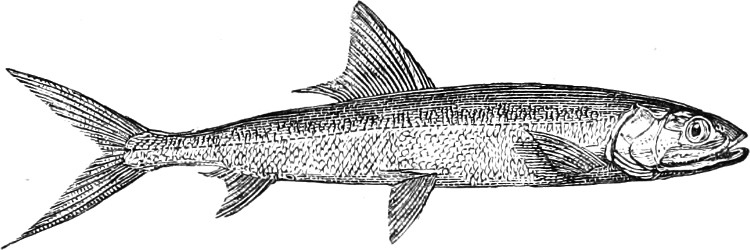
Fig. 301.—Elops saurus.
Megalops.—Body oblong, compressed, abdomen flat. Scales large, adherent; lateral line distinct. A narrow osseous lamella, attached to the mandibulary symphysis, between the mandibles. Snout obtusely conical; mouth anterior, lower jaw prominent; intermaxillary short; maxillary forming the lateral part of the mouth. Bands of villiform teeth in the jaws, on the vomer, palatine and pterygoid bones, on the tongue and on the base of the skull. Dorsal fin opposite to, or immediately behind, the ventrals; anal rather larger than dorsal. Gill-membranes entirely separate, with numerous branchiostegals. Pseudobranchiæ none.
Two species, one belonging to the Indo-Pacific (M. cyprinoides), the other to the Atlantic (M. thrissoides); they are the largest fishes of this family, exceeding a length of five feet, and excellent eating. Young specimens enter freely fresh waters.
Chanos.—Body oblong, compressed; abdomen flat. Scales small, striated, adherent; lateral line distinct. Snout depressed; mouth small, anterior, transverse, the lower jaw with a small symphysial tubercle. Intermaxillary in juxtaposition to the upper anterior edge of maxillary. Teeth none. Dorsal fin opposite to the ventrals; anal small, shorter than dorsal; caudal deeply forked. Gill-membranes entirely united below, and free from the isthmus. Branchiostegals four, long. An accessory branchial organ in a cavity behind the gill-cavity proper. Air-bladder divided by a constriction into an anterior and posterior portion. Mucous membrane of the œsophagus raised in a spiral fold. Intestine with many convolutions.
Two species from the Indo-Pacific, of which Ch. salmoneus is extremely common; it enters fresh waters, and exceeds a length of four feet; its flesh is highly esteemed. The accessory branchial organ and the skeleton have been described by Müller, “Bau und Grenzen der Ganoiden,” p. 75; and by Hyrtl, “Denkschr. Ak. Wiss. Wien.” xxi. 1883, p. 1.
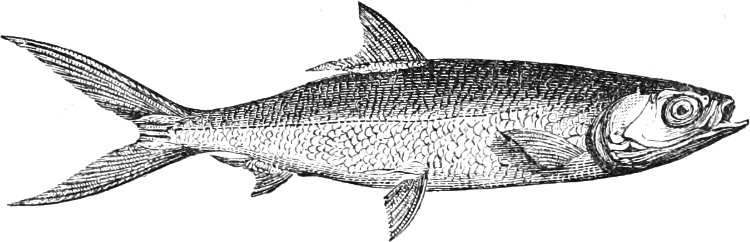
Fig. 302.—Chanos salmoneus.
The remaining genera belonging to this family are Spratelloides, Dussumieria, and Etrumeus, which together form a small group, distinguished by an anterior and lateral mouth, by the upper jaw not overlapping the lower, by a rounded abdomen, and by lacking the gular plate of some of the preceding genera.
Twenty-third Family—Bathythrissidæ.
Body oblong, with rounded abdomen, covered with cycloid scales; head naked; barbels none. Margin of the upper jaw formed by the intermaxillaries mesially, and by the maxillaries laterally. Opercular apparatus complete. Adipose fin none; dorsal fin much elongate, many rayed; anal fin short. Stomach with a blind sac; pyloric appendages numerous. Gill-apparatus well developed; pseudobranchiæ; gill-openings wide; an air-bladder. Ova very small; ovaries without duct.
One genus and species only (Bathythrissa dorsalis) from deep water (350 fathoms) off the coast of Japan. This remarkable fish has the appearance of a Coregonus, and attains to a length of two feet. Nothing is known of its osteology, but possibly a fossil genus from the Gyps of Montmartre; Notæus, which has also a long dorsal fin, may prove to belong to the same family.
Twenty-fourth Family—Chirocentridæ.
Body covered with thin, deciduous scales; barbels none. Margin of the upper jaw formed by the intermaxillaries mesially, and by the maxillaries laterally, both bones being firmly united, in juxtaposition. Opercular apparatus complete. Adipose fin none; the dorsal fin belongs to the caudal portion of the vertebral column. Stomach with a blind sac; intestine short, the mucous membrane forming a spiral fold; pyloric appendages none. Pseudobranchiæ none; air-bladder incompletely divided into cells; gill-opening wide.
One genus and species only (Chirocentrus dorab) is known, which is common in the Indian Ocean, and attains to a length of about three feet; it is not esteemed as food. Remains of fishes similar to Chirocentrus are found in the marl slates of Padang, in Sumatra.
Twenty-fifth Family—Alepocephalidæ.
Body with or without scales; head naked; barbels none. Margin of the upper jaw formed by the intermaxillaries and maxillaries, the former being placed along the upper anterior edge of the latter. Opercular apparatus complete. Adipose fin none; the dorsal fin belongs to the caudal portion of the vertebral column. Stomach curved, without blind sac; pyloric appendages in moderate number. Pseudobranchiæ; air-bladder absent. Gill-openings very wide.
Before the voyage of the “Challenger” one species only of this family was known, Alepocephalus rostratus, a rare fish from the Mediterranean; now, four genera with seven species are known, and there is no doubt that this family is one of the most characteristic, and will prove to be one of the most generally distributed forms, of the deep-sea. Their vertical range varies between 345 (Xenodermichthys) and 2150 (Bathytroctes) fathoms. They approach the Salmonoids, but lack invariably the adipose fin. Their dentition is very feeble; their eye large; bones thin. Coloration black.
Alepocephalus has thin cycloid scales; a mouth of moderate width, and no teeth on the maxillary.
Bathytroctes has cycloid scales, a wide mouth, and teeth on the maxillary as well as intermaxillary.
Platytroctes has small keeled scales and no ventrals.
Xenodermichthys with fine nodules instead of scales.
Twenty-sixth Family—Notopteridæ.
Head and body scaly; barbels none. Margin of the upper jaw formed by the intermaxillaries mesially, and by the maxillaries laterally. Opercular apparatus incomplete. Tail prolonged, tapering. Adipose fin none. Dorsal short, belonging to the caudal portion of the vertebral column; anal very long. Stomach without blind sac; two pyloric appendages. Pseudobranchiae none; air-bladder present, divided in the interior. The ova fall into the cavity of the abdomen before exclusion. On each side a parieto-mastoid cavity leading into the interior of the skull.
One genus only (Notopterus) with five species which inhabit fresh waters of the East Indies and West Africa. Well-preserved remains of this genus occur in the marl slates of Padang, in Sumatra. Their air-bladder is divided into several compartments, and terminates in two horns anteriorly and posteriorly, the anterior horns being in direct connection with the auditory organ.
Twenty-seventh Family—Halosauridæ.
Body covered with cycloid scales; head scaly; barbels none. Margin of the upper jaw formed by the intermaxillaries mesially, and by the maxillaries laterally. Opercular apparatus incomplete. Adipose fin none. The short dorsal belongs to the abdominal part of the vertebral column; anal very long. Stomach with a blind sac; intestine short; pyloric appendages in moderate number. Pseudobranchiæ none. Air-bladder large, simple; gill-openings wide. Ovaries closed.
The only genus belonging to this family was discovered by the Madeiran ichthyologist Johnson, in 1863; but since then the naturalists of the “Challenger” expedition have added four other species, showing that this type is a deep-sea form and widely distributed; the specimens were dredged in depths varying from 560 to 2750 fathoms.
Twenty-eighth Family—Hoplopleuridæ.
Body generally with four series of subtriangular scutes, and with intermediate scale-like smaller ones. One (?) dorsal only; head long, with the jaws produced.
Extinct; developed in the chalk and extending into tertiary formations: Dercetis (with the upper jaw longest), Leptotrachelus, Pelargorhynchus, Plinthophorus, Saurorhamphus (with the lower jaw longest), Eurypholis; Ischyrocephalus (?). The latter genus, from cretaceous formations of Westphalia, is said to have two dorsal fins.
Twenty-ninth Family—Gymnotidæ.
Head scaleless; barbels none. Body elongate, eel-shaped. Margin of the upper jaw formed in the middle by the intermaxillaries, and laterally by the maxillaries. Dorsal fin absent or reduced to an adipose strip; caudal generally absent, the tail terminating in a point. Anal fin exceedingly long. Ventrals none. Extremity of the tapering tail capable of being reproduced. Vent situated at, or at a short distance behind, the throat. Humeral arch attached to the skull. Ribs well developed. Gill-openings rather narrow. Air-bladder present, double. Stomach with a cæcal sac and pyloric appendages. Ovaries with oviducts.
Eel-like freshwater fishes from Tropical America.
Sternarchus.—Tail terminating in a distinct small caudal fin. Teeth small. A rudimentary dorsal fin is indicated by an adipose band fitting into a groove on the back of the tail; it is easily detached, so as to appear as a thong-like appendage fixed in front. Branchiostegals four.
Eight species, some have the snout compressed and of moderate length, like St. Bonapartii from the River Amazons; others have it produced into a long tube, as St. oxyrhynchus from the Essequibo.
Rhamphichthys.—Caudal fin none; teeth none; no trace of a dorsal fin. No free orbital margin.
Six species, of which, again, some have a tubiform snout, whilst in the others it is short.
Sternopygus.—Caudal fin none; no trace of a dorsal fin. Both jaws with small villiform teeth; similar teeth on each side of the palate. Body scaly.
Four species, very common, and growing to a length of 30 inches.
Carapus.—Caudal fin none; no trace of a dorsal fin. A series of conical teeth in each jaw. Anterior nostrils, wide in the upper lip. Body scaly.
One species (C. fasciatus) extremely common, and found all over tropical America, east of the Andes, from 18 to 24 inches long.
Gymnotus.—Caudal and dorsal fins absent; anal extending to the end of the tail. Scales none. Teeth conical, in a single series. Eyes exceedingly small.
The “Electric Eel” is the most powerful of electric fishes, growing to a length of six feet, and extremely abundant in certain localities of Brazil and the Guyanas. The electric organ consists of two pairs of longitudinal bodies, situated immediately below the skin, above the muscles; one pair on the back of the tail, and the other pair along the anal fin. Each fasciculus is composed of flat partitions or septa, with transverse divisions between them. The outer edge of the septa appear in nearly parallel lines in the direction of the longitudinal axis of the body, and consist of thin membranes, which are easily torn; they serve the same purpose as the columns in the analogous organ of the Torpedo, making the walls or abutments for the perpendicular and transverse dissepiments, which are exceedingly numerous, and so closely aggregated as to seem almost in contact. The minute prismatic cells, intercepted between these two sorts of plates, contain a gelatinous matter; the septa are about one-thirtieth of an inch from each other, and one inch in length contains a series of 240 cells, giving an enormous surface to the electric organs. The whole apparatus is supplied with more than 200 nerves, which are the continuations of the rami anteriores of the spinal nerves. In their course they give out branches to the muscles of the back, and to the skin of the animal. In the Gymnotus, as in the Torpedo, the nerves supplying the electric organs are much larger than those bestowed on any part for the purposes of sensation or movement.
The graphic description by Humboldt of the capture of Electric Eels by horses driven into the water, which would receive the electric discharges and thus exhaust the fishes, seems to rest either on the imagination of some person who told it to the great traveller or on some isolated incident. Recent travellers have not been able to verify it even in the same parts of the country where the practice was said to exist.
Thirtieth Family—Symbranchidæ.
Body elongate, naked or covered with minute scales; barbels none. Margin of the upper jaw formed by the intermaxillaries only, the well developed maxillaries lying behind and parallel to them. Paired fins none. Vertical fins rudimentary, reduced to more or less distinct cutaneous folds. Vent situated at a, great distance behind the head. Ribs present. Gill-openings confluent into one slit situated on the ventral surface. Air-bladder none. Stomach without cæcal sac or pyloric appendages. Ovaries with oviducts.
The fishes of this family consist of freshwater-fishes from tropical America and Asia, which, however, enter also brackish water; and of a truly marine genus from Australia.
Amphipnous.—Vent in the posterior half of the body, which is covered with minute scales longitudinally arranged.
A common fish (A. cuchia) in Bengal, remarkable for its singular respiratory apparatus. It has only three branchial arches, with rudimentary branchial laminæ, and with very narrow slits between the arches. To supplement this insufficient respiratory apparatus, a lung-like sac is developed on each side of the body behind the head, opening between the hyoid and first branchial arch. The interior of the sac is abundantly provided with blood-vessels, the arterial coming from the branchial arteries, whilst those issuing from it unite to form the aorta. A. cuchia approaches the Eels in having the humeral arch not attached to the skull.
Monopterus.—Vent in the posterior half of the body, which is naked. Three branchial arches with rudimentary gills, but without breathing sac.
One species (M. javanicus), which is extremely common in the East Indian Archipelago and in the eastern parts of the Continent. Upwards of three feet long.
Symbranchus.—Vent in the posterior half of the body, which is naked. Four branchial arches with well developed gills.
Three species, of which one (S. marmoratus) is extremely common in tropical America, and the other (S. bengalensis) not less so in the East Indies.
Chilobranchus.—Vent in the anterior half of the length of the body, which is naked. Vertical fins reduced to a simple cutaneous fold, without rays.
A small fish (Ch. dorsalis) from North Western Australia and Tasmania.
Thirty-First Family—Murænidæ.
Body elongate, cylindrical or “band-shaped, naked or with rudimentary scales. Vent situated at a great distance from the head. Ventral fins none. Vertical fins, if present, confluent, or separated by the projecting tip of the tail. Sides of the upper jaw formed by the tooth-bearing maxillaries, the fore part by the intermaxillary, which is more or less coalescent with the vomer and ethmoid. Humeral arch not attached to the skull. Stomach with a blind sac; no pyloric appendages. Organs of reproduction without efferent ducts.
The “Eels” are spread over almost all fresh waters and seas of the temperate and tropical zones; some descend to the greatest depths of the oceans. The young of some have a limited pelagic existence. (Leptocephali, see p. 179.) At Monte Bolca fossil remains are very numerous, belonging to recent genera, Anguilla, Sphagebranchus, and Ophichthys; even larval Leptocephales have been preserved. Anguilla has been found also in the chalk of Aix and Oeningen.
In the majority of the species the branchial openings in the pharynx are wide slits (Murænidæ platyschistæ); in others, the true Murænæ, (Murænidæ engyschistæ) they are narrow.
Nemichthys.—Exceedingly elongate, band-shaped; tail tapering into a point. Vent approximate to the pectorals, but the abdominal cavity extending far behind the vent. Jaws produced into a long slender bill, the upper part being formed by the vomer and intermaxillaries. The inner surface of the bill covered with small tooth-like asperities. Eye large. The nostrils of each side are close together, in a hollow before the eye. Gill-openings wide, nearly confluent. Pectoral and vertical fins well developed.
This very singular type is a deep-sea form, occurring at depths of from 500 to 2500 fathoms. The two species known have hitherto been found in the Atlantic only.
Cyema.—This genus combines the form of the snout of Nemichthys, with the soft and shorter body of a Leptocephalus; but the gill-openings are very narrow and close together on the abdominal surface. Vent in about the middle of the length of the body; vertical fins well developed, confined to, and surrounding, the tail. Pectoral fins well developed. Eye very small.
Known from two specimens only, 4½ inches long, dredged in depths of 1500 and 1800 fathoms in the Pacific and Antarctic Oceans.
Saccopharynx.—Deep-sea Congers, with the muscular system very feebly developed, with the bones very thin, soft, and wanting in inorganic matter. Head and gape enormous. Snout very short, pointed, flexible, like an appendage overlapping the gape. Maxillary and mandibulary bones very thin, slender, arched, armed with one or two series of long, slender, curved, widely set teeth, their points being directed inwards; palate toothless. Gill-openings wide, at some distance from the head, at the lower part of the sides; gills very narrow, free, and exposed. Trunk of moderate length. Stomach distensible in an extraordinary degree. Vent at the end of the trunk. Tail band-like, exceedingly long, tapering in a very fine filament. Pectoral small, present. Dorsal and anal fins rudimentary.
This is another extraordinary form of Deep-sea Eels; the muscular system, except on the head, is very feebly developed; the bones are as thin, soft, and wanting in inorganic matter, as in the Trachypteridæ. This fish is known from three specimens only, which have been found floating on the surface of the North Atlantic, with their stomachs much distended, having swallowed some other fish, the weight of which many times exceeded that of their destroyer. It attains to the length of several feet.
Synaphobranchus.—Gill-openings ventral, united into a longitudinal slit between the pectoral fins, separate internally. Pectoral and vertical fins well developed. Nostrils lateral, the anterior subtubular, the posterior round, before the lower half of the eye. Cleft of the mouth very wide; teeth small; body scaly. Stomach very distensible.
Deep-sea Congers, with well-developed muscular system, spread over all oceans, and occurring in depths of from 345 to 2000 fathoms. Four species are known. Probably attaining to the same length as the Conger.
Anguilla.—Small scales imbedded in the skin. Upper jaw not projecting beyond the lower. Teeth small, forming bands. Gill-openings narrow, at the base of the pectoral fins. The dorsal fin commences at a considerable distance from the occiput.
Some twenty-five species of “Eels” are known from the freshwaters and coasts of the temperate and tropical zones; none have been found in South America or the west coast of North America and West Africa. The following are the most noteworthy:—The common European species (A. anguilla) is spread over Europe to 64° 30´ lat. N., and all round the Mediterranean area, but is not found either in the Danube or in the Black and Caspian Seas; it extends across the Atlantic to North America. The form of the snout varies much, and some naturalists have believed that specimens with a broad and obtuse snout were specifically distinct from those with pointed snout. However, every degree of breadth of the snout may be observed; and a much safer way of recognizing this species, and distinguishing it from other European Eels, is the forward position of the dorsal fin; the distance between the commencement of the dorsal and anal fins being as long as, or somewhat longer than, the head. Eels grow generally to a length of about three feet, but the capture of much larger examples is on record. Their mode of propagation is still unknown. So much only is certain that they do not spawn in fresh water, that many full-grown individuals, but not all, descend rivers during the winter months, and that some of them at least must spawn in brackish water or in deep water in the sea; for in the course of the summer young individuals from three to five inches long ascend rivers in incredible numbers, overcoming all obstacles, ascending vertical walls or floodgates, entering every larger and smaller tributary, and making their way even over terra firma to waters shut off from all communication with rivers. Such immigrations have been long known by the name of “Eel-fairs.” The majority of the Eels which migrate to the sea appear to return to fresh water, but not in a body, but irregularly, and throughout the warmer part of the year. No naturalist has ever observed these fishes in the act of spawning, or found mature ova; and the organs of reproduction of individuals caught in fresh water are so little developed and so much alike, that the female organ can be distinguished from the male only with the aid of a microscope.
The second species found in Great Britain, on the coasts of Europe generally, in China, New Zealand, and the West Indies, is (A. latirostris) the “Grig” or “Glut,” which prefers the neighbourhood of the sea to distant inland-waters, and in which the dorsal fin begins farther backwards, the distance between the commencement of the dorsal and anal fins being shorter than the head; its snout seems to be always broad. On the American side of the Atlantic other species, beside A. anguilla are found in abundance: A. bostoniensis, A. texana. The largest Eels occur in lakes of the islands of the Indo-Pacific, and they play a conspicuous part in the mythology of the South-Sea Islanders and Maories; individuals of from eight to ten feet in length have been seen, and referred to several species, as A. mauritiana, fidjiensis, obscura, aneitensis, etc.
Conger.—Scaleless. Cleft of the mouth wide, extending at least to below the middle of the eye. Maxillary and mandibulary teeth arranged in series, one of which contains teeth of equal size, and so closely set as to form a cutting edge. No canine teeth. Vomerine band of teeth short. Pectoral and vertical fins well developed, the dorsal commencing behind the root of the pectoral. Gill-openings large, approximate to the abdomen. The posterior nostril opposite to the upper or middle part of the orbit, the anterior in a tube. Eyes well developed.
The “Congers” are marine Eels; the best known species (C. conger) seems to be almost cosmopolitan, and is plentiful all round Europe, at St. Helena, in Japan, and Tasmania. It attains to a length of eight feet, and thrives and grows rapidly even in confinement, which is not the case with the freshwater Eel. Three other species are known, of which C. marginatus from the Indian Ocean, is the most common. Leptocephalus morrisii is an abnormal larval condition of the Conger.
Genera allied to Conger are Poeciloconger, Congromurcæna, Uroconger, and Heteroconger.
Murænesox.—Scaleless. Snout produced. Jaws with several series of small closely set teeth, anteriorly with canines; vomer with several long series of teeth, the middle of which is formed by large conical or compressed teeth. Gill-openings wide, approximate to the abdomen. Pectoral and vertical fins well developed, the dorsal beginning above the gill-opening. Two pairs of nostrils, the posterior opposite to the upper part or middle of the eye.
Four species from tropical seas, M. cinereus being very common in the Indian Ocean, and attaining to a length of six feet.
Nettastoma.—Scaleless. Snout much produced, depressed. Jaws and vomer with bands of card-like teeth, those along the median line of the vomer being somewhat the larger. Vertical fins well developed; pectorals none. Gill-openings of moderate width, open. Nostrils on the upper surface of the head, valvular; the anterior near to the end of the snout, the posterior above the anterior angle of the eye.
This genus lives at some depth, the Japanese species (N. parviceps) having been obtained at 345 fathoms. N. melanurum from the Mediterranean, seems to inhabit a similar depth. Hyoprorus is its Leptocephalid form.
Genera allied to Murcænesox are Saurenchelys, Oxyconger, Hoplunnis, and Neoconger; in all these the nostrils have a superior or lateral position. In other genera the nostrils perforate the upper lip, as in Myrus, Myrophis, Paramyrus, Chilorhinus, Murænichthys, and Ophichthys, the last genus deserving of particular mention on account of its great range and common occurrence.
Ophichthys.—Nostrils labial; extremity of the tail free, not surrounded by a fin.
More than eighty species are known, many of which are abundant on the coasts of the tropical and sub-tropical zones. They do not attain to a large size, but many must be extremely voracious and destructive to other fishes, if we draw an inference from the formidable dentition with which their jaws and palate is armed. Other species have much more feeble, and some even obtuse teeth, better adapted for seizing Crustaceans than vigorous and slippery fishes. Some have rudimentary pectoral fins or lack them altogether. Many are highly ornamented with bands or spots, the coloration being apparently very constant in the several species.
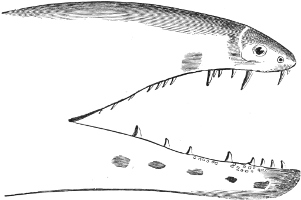
Fig. 303.—Ophichthys crocodilinus, from the Indo-Pacific.
Moringua.—Body scaleless, cylindrical, with the trunk much longer than the tail. Pectorals none or small; vertical fins but little developed, limited to the tail. Posterior nostrils in front of the small eye. Cleft of the mouth narrow; teeth uniserial. Heart placed far behind the branchiæ. Gill-openings rather narrow, inferior.
Six species from freshwaters, brackish water, and the coasts of India to the Fiji Islands.
Muræna.—Scaleless. Teeth well developed. Gill-openings and clefts between the branchial arches narrow. Pectoral fins none; dorsal and anal fins well developed. Two nostrils on each side of the upper surface of the snout; the posterior a narrow round foramen, with or without tube; the anterior in a tube.
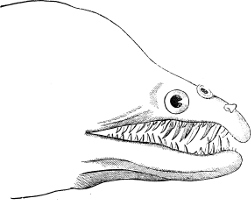
Fig. 304.—Head of a Muræna.
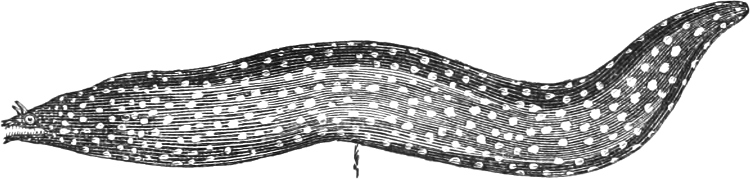
Fig. 305.—Muræna pavonina, from Southern Seas.
The Murænas are as abundantly represented in the tropical and sub-tropical zones, and have nearly the same range, as Ophichthys. The number of species known exceeds eighty. The majority are armed with formidable pointed teeth, well suited for seizing other fish on which they prey. Large specimens thus armed readily attack persons in and out of the water; and as some species attain a length of some six or eight feet, they are justly feared by fishermen. The minority of species have obtuse and molar-like teeth, their food consisting chiefly of Crustaceans and other hard-shelled animals. Most of the Murænas are beautifully coloured and spotted, some in a regular and constant manner, whilst in others the pattern varies in a most irregular fashion: they have quite the appearance of snakes. The Muræna of the Ancient Romans is Muræna helena, which is not confined to the Mediterranean, but also found in the Indian Ocean and on the coast of Australia. Its skin is of a rich brown, beautifully marked with large yellowish spots, each of which contains smaller brown spots.
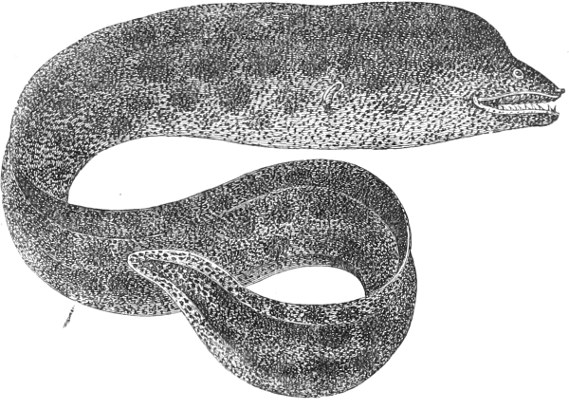
Fig. 306.—Muræna picta, from the Indo-Pacific.
Gymnomuræna differs from Muræna in having the fins reduced to a short rudiment near the end of the tail. Six species are known growing to a length of eight feet.
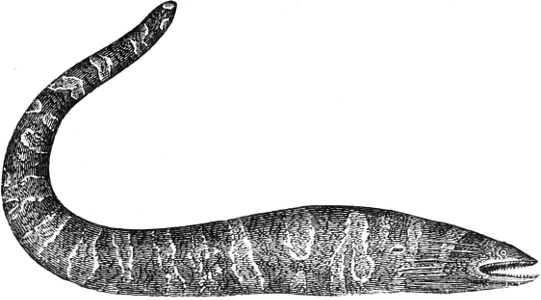
Fig. 307.—Gymnomuræna vittata, from Cuba.
Myroconger and Enchelycore belong to the same sub-family as Muræna, but the former is provided with pectoral fins, and in the latter the posterior nostril is a long slit, and not round as in the other genera.
FIFTH ORDER—LOPHOBRANCHII.
The gills are not laminated, but composed of small rounded lobes attached to the branchial arches. Gill-cover reduced to a large simple plate. Air-bladder simple, without pneumatic duct. A dermal skeleton composed of numerous pieces arranged in segments, replaces more or less soft integuments. Muscular system not much developed. Snout prolonged. Mouth terminal, small, toothless, formed as in Acanthopterygians.
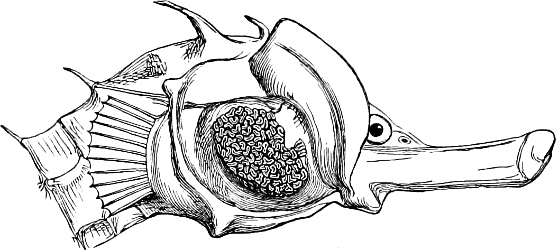
Fig. 308.—Gills of Hippocampus abdominalis.
First Family—Solenostomidæ.
Gill-openings wide. Two dorsal fins, the rays of the anterior not articulated. All the other fins well developed.
One living genus only is known, which was preceded in the tertiary epoch by Solenorhynchus (Monte Postale).
Solenostoma.—Snout produced into a long tube. Body compressed, with very short tail. All parts covered with thin skin, below which there is a dermal skeleton formed by large star-like ossifications. The soft dorsal and anal fins on elevated bases; caudal fin long. Ventral fins inserted opposite to the anterior dorsal, close together, seven-rayed; they are free in the male, but in the female their inner side coalesces with the integuments of the body, a large pouch for the reception of the eggs being formed thereby. Air-bladder and pseudobranchiæ absent. Branchiostegals four, very thin. Intestinal tract very simple, with a stomachic dilatation, without pyloric appendages. Ova very small.
The dermal skeleton of this singular type is formed by star-like ossifications, four in each horizontal and vertical series on the side of the fore part of the trunk; each consists of four or three radiating branches by which it joins the neighbouring bones; on the hind part of the trunk and tail the series are diminished to two. The dorsal and abdominal profiles in front of the fins are protected by similar bones. The vertebral column is composed of eighteen abdominal and fifteen caudal vertebræ, the vertebræ gradually decreasing in length backwards, so that the shortness of the tail is caused not only by the smaller number of vertebræ, but also by their much lesser length. Neural and hæmal spines are developed. The pelvis consists of two pairs of cartilaginous laminæ, the convex margin of the anterior fitting into an angle of a dermal bone which separates the pelvis from the well-ossified humeral arch.
The singular provision for the retention and protection of the eggs has been described above (p. 162, figs. 73 and 74), and we have only to repeat here that it is the female which takes care of the progeny, and not the male as in the following family. Two or three small species are known from the Indian Ocean; they are beautifully marked, especially the male, which also appears to be of smaller size in this genus than the female.
Second Family—Syngnathidæ.
Gill-openings reduced to a very small opening near the upper posterior angle of the gill-cover. One soft dorsal fin; no ventrals, and, sometimes, one or more of the other fins are also absent.
Small marine fishes, which are abundant on such parts of the coasts of the tropical and temperate zones as offer by their vegetation shelter to these defenceless creatures. They are bad swimmers (the dorsal fin being the principal organ of locomotion), and frequently and resistlessly carried by currents into the open ocean or to distant coasts. All enter brackish water, some fresh water. The strata of Monte Bolca and Licata (Sicily) have, yielded evidence of their existence in the tertiary epochs; beside species of Siphonostoma and Syngnathus (Pseudosyngnathus), remains of an extinct genus, Calamostoma, allied to Hippocampus, but with a distinct caudal fin, have been found. On their propagation see p. 163, Fig. 76.
A. Syngnathina.—The tail is not prehensile, and generally provided with a caudal fin.—Pipe-Fishes.
Siphonostoma.—Body with distinct ridges, the upper caudal ridge continuous with the lateral line, but not with the dorsal ridge of the trunk. Pectoral and caudal fins well developed; dorsal fin of moderate length, opposite to the vent. Humeral bones movable, not united into a “breast-ring.” Males with an egg-pouch on the tail, the eggs being covered by cutaneous folds.
Two species, of which S. typhle is common on the British, and generally distributed on the European coasts.
Syngnathus.—Body with the ridges more or less distinct, the dorsal ridge of the trunk not being continuous with that of the tail. Pectoral fins well developed; caudal present. Dorsal fin opposite or near to the vent. Humeral bones firmly united into the breast-ring. Egg-pouch as in Siphonostoma.
The distribution of this genus nearly coincides with that of the family, some fifty species being known. S. acus, the great Pipe-fish (see Fig. 75, p. 163), is one of the most common European fishes, extending across the Atlantic and southwards to the Cape of Good Hope; it attains a length of 18 inches. Another very common species, frequently met at sea, and spread over nearly all the tropical and sub-tropical seas, is S. pelagicus, agreeably marked with alternate brown and silvery cross-bars.
Doryichthys.—Body with the ridges well developed. Pectoral and caudal fins present. Dorsal fin long or of moderate length, opposite to the vent. Humeral bones firmly united. Males with the lower ridges of the abdomen dilated, the dilated parts forming a broad groove for the reception of the ova.
In these Pipe-fishes the ova are not received in a completely closed pouch, but glued on to the surface of the abdomen. Twenty species from tropical seas.
Nerophis.—Body smooth, rounded, with scarcely any of the ridges distinct. Pectoral fin none, caudal absent or rudimentary, the tail tapering into a point. Dorsal fin of moderate length, opposite to the vent. The ova are attached to the soft integument of the abdomen of the male, and are not covered by lateral folds of the skin.
Seven species from the European seas and the Atlantic. N. æquoreus (Ocean Pipe-fish), N. ophidion (Straight-nosed Pipe-fish), and N. lumbriciformis (Little Pipe-fish), are common on the British coasts.
Protocampus.—The whole dermal skeleton is covered with skin. A broad cutaneous fold runs along the back in front and behind the dorsal; a similar fold along the abdomen. Pectoral fin none; caudal very small.
The single species of this remarkable genus, P. hymenolomus, occurs in the Falkland Islands. It may be regarded as an embryonal form of Nerophis, the median skin-folds being evidently remains of the fringe which surrounds the body of the embryo.
The other genera belonging to this group are, Icthyocampus, Nannocampus, Urocampus, Leptoichthys, Coelonotus, and Stigmatophora.
Hippocampina.—The tail is prehensile, and invariably without caudal fin.—Sea-horses.
Gastrotokeus.—Body depressed, the lateral line running along the margin of the abdomen. Shields smooth. Tail shorter than the body. Pectoral fins. No pouch is developed for the ova, which are imbedded in the soft integument of the abdomen of the male.
Gastrotokeus biaculeatus, very common in the Indian Ocean to the coasts of Australia.
Solenognathus.—Body compressed, deeper than broad. Shields hard, rugose, with round or oval interannular plates; and without elongate processes. Tail shorter than the body. Pectoral fins.
Three species, from the Chinese and Australian Seas; they are the largest of Lophobranchs, S. hardwickii, attaining to a length of nearly two feet.
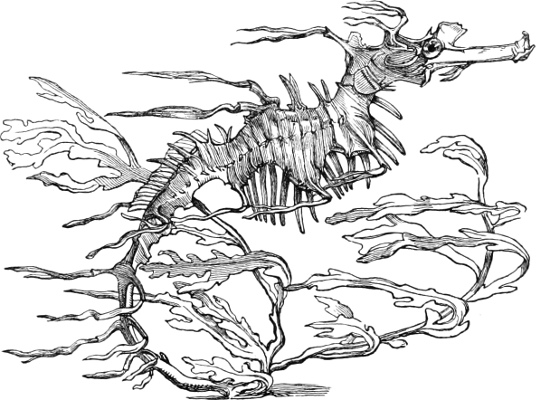
Fig. 309.—Phyllopteryx eques.
Phyllopteryx.—Body compressed, or as broad as deep. Shields smooth, but some or all of them are provided with prominent spines or processes on the edges of the body; some of the processes with cutaneous filaments. A pair of spines on the upper side of the snout and above the orbit. Tail about as long as the body. Pectoral fins. The ova are imbedded in soft membrane on the lower side of the tail, without a pouch being developed.
Three species from the coasts of Australia. The protective resemblances with which many Lophobranchs are furnished, attain to the highest degree of development in the fishes of this genus. Not only their colour closely assimilates that of the particular kind of seaweed which they frequent, but the appendages of their spines seem to be merely part of the fucus to which they are attached. They attain a length of 12 inches.
Hippocampus.—Trunk compressed, more or less elevated. Shields with more or less prominent tubercles or spines. Occiput compressed into a crest, terminating at its supero-posterior corner in a prominent knob (coronet). Pectoral fins. The males carry the eggs in a sac at the base of the tail, opening near the vent.
A singular resemblance of the head and fore part of the body to that of a horse, has given to these fishes the name of “Sea-horses.” They are abundant between and near the tropics, becoming scarcer in higher latitudes. Some twenty species are known, some of which have a wide geographical range, as they are often carried to great distances with floating objects to which they happen to be attached.—Acentronura is a genus closely allied to Hippocampus.
SIXTH ORDER—PLECTOGNATHI.
Teleosteous fishes with rough scales, or with ossifications of the cutis in the form of scutes or spines; skin sometimes entirely naked. Skeleton incompletely ossified, with the vertebræ in small number. Gills pectinate; a narrow gill-opening in front of the pectoral fins. Mouth narrow; the bones of the upper jaw generally firmly united. A soft dorsal fin, belonging to the caudal portion of the vertebral column, opposite to the anal; sometimes elements of a spinous dorsal besides. Ventral fin none, or reduced to spines. Air-bladder without pneumatic duct.
First Family—Sclerodermi.
Snout somewhat produced; jaws armed with distinct teeth in small number. Skin with scutes or rough. The elements of a spinous dorsal and ventral fins generally present.
Marine fishes of moderate or small size, very common in the tropical zone, but scarcer in higher latitudes. They have been found in three localities of tertiary strata, viz., at Monte Bolca, where a species of Ostracion occurs, and in the Schists of Glaris, from which two genera have been described, Acanthoderma and Acanthopleurus, closely allied to Balistes and Triacanthus. Glyptocephalus from the Isle of Sheppey has the skull of a Balistes, but its body is covered with tubercles arranged in regular series. The Scleroderms may be divided into three very natural groups:—
A. Triacanthina.—The skin is covered with small, rough, scale-like scutes. A spinous dorsal fin with from four to six spines. A pair of strong, movable ventral spines, joined to the pelvic bone.
To this group belong the genera Triacanthodes, Hollardia, and Triacanthus, represented by five species, of which Triacanthus brevirostris from the Indian Ocean is the most common.
B. Balistina.—Body compressed, covered with movable scutes or rough. Spinous dorsal reduced to one, two, or three spines. Ventral fins reduced to a single pelvic prominence, or entirely absent.
To this group belong the genera Balistes, Monacanthus, and Anacanthus, the last genus being distinguished by a barbel at the lower jaw.
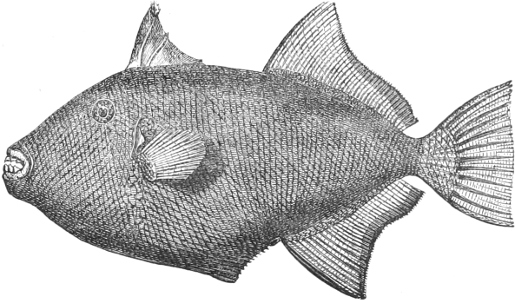
Fig. 310.—Balistes vidua.
Balistes, or the “File-fishes” proper, inhabit the tropical and sub-tropical seas; shoals of young are not rarely met with in mid-ocean. Some thirty species are known, many attaining a length exceeding two feet; but the majority are much smaller, and frequently beautifully and symmetrically marked. Both jaws are armed with eight strong incisor-like and obliquely truncated teeth, by which these fishes are enabled to break off pieces of corals on which they feed, or to chisel a hole into the hard shell of Mollusca, in order to extract the soft parts. They destroy an immense number of Mollusks, thus becoming most injurious to the pearl-fisheries. The first of their three dorsal spines is very strong, roughened in front like a file, and hollowed out behind to receive the second much smaller spine, which, besides, has a projection in front, at its base, fitting into a notch of the first. Thus these two spines can only be raised or depressed simultaneously, and the first cannot be forced down, unless the second has been previously depressed. The latter has been compared to a trigger, hence a second name, “Trigger-fish,” has been given to these fishes. Some species are armed with a series of short spines or tubercles on each side of the tail. Two species (B. maculatus and B. capriscus), common in the Atlantic, sometimes wander to the British coasts.
The Monacanthus are similarly distributed as the Balistes, and still more abundant, some fifty species being known. Their dentition is very similar, but they possess one dorsal spine only, and their rough scales are so small as to give a velvety appearance to the skin (Figs. 17 and 18, p. 48). Adult males of some of the species possess a peculiar armature on each side of the tail, which in females is much less developed or entirely absent. This armature may consist either in simple spines arranged in rows, or in the development of the minute spines of the scales into long stiff bristles, so that the patch on each side of the tail looks like a brush.
C. Ostraciontina.—The integuments of the body form a hard continuous carapace, consisting of hexagonal scutes juxtaposed in mosaic-fashion. A spinous dorsal and ventral fins are absent; but sometimes indicated by protuberances.
The “Coffer-fishes” (Ostracion) are too well known to require a lengthened description. Only the snout, the bases of the fins, and the hind part of the tail are covered with soft skin, so as to admit of free action of the muscles moving these parts. The mouth is small, the maxillary and intermaxillary bones coalescent, each jaw being armed with a single series of small slender teeth. The short dorsal fin is opposite to the equally short anal. The vertebral column consists of fourteen vertebræ only, of which the five last are extremely short, the anterior elongate. Ribs none. The carapaces of some species are three-ridged, of others four- and five-ridged, of some provided with long spines. Twenty-two species from tropical and sub-tropical seas are known.
Second Family—Gymnodontes.
Body more or less shortened. The bones of the upper and lower jaw are confluent, forming a beak with a trenchant edge, without teeth, with or without median suture. A soft dorsal, caudal and anal are developed, approximate. No spinous dorsal. Pectoral fins; no ventrals.
Marine fishes of moderate or small size from tropical and sub-tropical seas. A few species live in fresh water. Fossil remains of Diodon are not scarce at Monte Bolca and Licata; a distinct genus, Enneodon, has been described from Monte Postale. The Gymnodonts may be divided into three groups:
A. Triodontina.—Tail rather long, with a separate caudal fin. Abdomen dilatable into a very large, compressed, pendent sac, the lower part of which is merely a flap of skin, into which the air does not penetrate, the sac being capable of being expanded by the very long pelvic bone. The upper jaw divided by a median suture, the lower simple.
A single genus and species (Triodon bursarius) from the Indian Ocean.
B. Tetrodontina.—Tail and caudal fin distinct. Part of the œsophagus much distensible, and capable of being filled with air. No pelvic bone.
“Globe-fishes” have a short, thick, cylindrical body, with well developed fins. It is covered with thick scaleless skin, in which, however, spines are imbedded of various sizes. The spines are very small, and but partially distributed over the body in some species, whilst in others they are very large, and occupy equally every part of the body. These fishes have the power of inflating their body by filling their distensible œsophagus with air, and thus assume a more or less globular form. The skin is, then, stretched to its utmost extent, and the spines protrude and form a more or less formidable defensive armour, as in a hedgehog; therefore they are frequently called “Sea-hedgehogs.” A fish thus blown out turns over and floats belly upwards, driving before the wind and waves. However, it is probable that the spines are a protection not only when the fish is on the surface and able to take in air, but also when it is under water. Some Diodonts, at any rate, are able to erect the spines about the head by means of cutaneous muscles; and, perhaps, all fill their stomach with water instead of air, for the same purpose and with the same effect. In some Diodonts the spines are fixed, erect, not movable. The Gymnodonts generally, when taken, produce a sound, doubtless by the expulsion of air from the œsophagus. Their vertebral column consists of a small number of vertebræ, from 20 to 29, and their spinal chord is extremely short. All these fishes have a bad reputation, and they are never eaten; indeed, some of them are highly poisonous, and have caused long continued illness and death. Singularly, the poisonous properties of these fishes vary much as regards intensity, only certain individuals of a species, or individuals from a certain locality, or caught at a certain time of the year, being dangerous. Therefore it is probable that they acquire their poisonous quality from their food, which consists in corals and hard-shelled Mollusks and Crustaceans. Their sharp beaks, with broad masticating posterior surface, are admirably adapted for breaking off branchlets of coral-stocks, and for crushing hard substances.
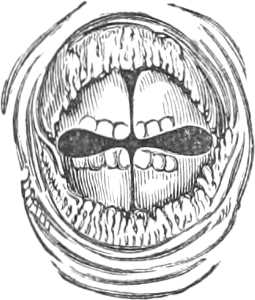
Fig. 311.—Jaws of Tetrodon.
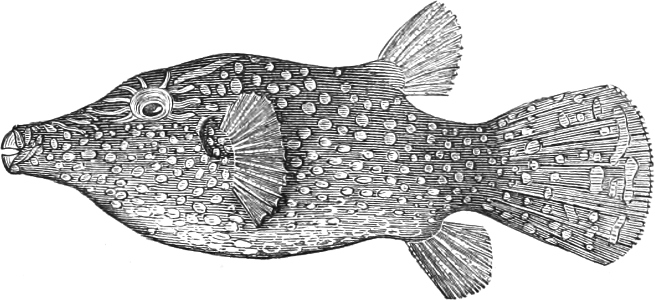
Fig. 312.—Tetrodon margaritatus.
Tetrodon (including Xenopterus).—Both the upper and lower jaws are divided into two by a mesial suture.
Extremely numerous in tropical and sub-tropical zones, more than sixty species being known. In some of the species the dermal spines are extremely small, and may be absent altogether. Many are highly ornamented with spots or bands. A few species live in large rivers—thus T. psittacus from Brazil; T. fahaka, a fish well known to travellers on the Nile, and likewise abundant in West African rivers; T. fluviatilis from brackish water and rivers of the East Indies. The species figured is one of the smallest, about six inches long, and common in the Indo-Pacific.
Diodon.—Jaws without mesial suture, so that there is only one undivided dental plate above and one below.
In these fishes, as well as in some closely allied genera, the dermal spines are much more developed than in the Tetrodonts; in some the spines are erectile, as in Diodon, Atopomycterus, Trichodiodon, and Trichocyclus; in others they are stiff and immovable, as in Chilomycterus and Dicotylichthys. Seventeen species are known, of which Diodon hystrix is the most common as it is the largest, growing to a length of two feet. It is spread over the Tropical Atlantic as well as Indo-Pacific, as is also a smaller, but almost equally common species, Diodon maculatus.
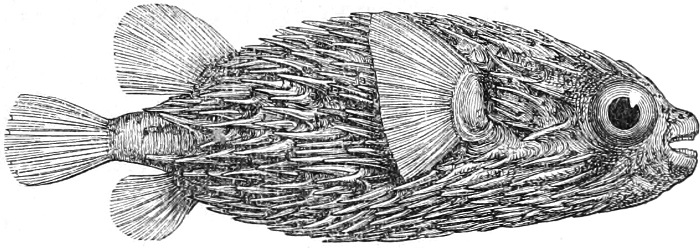
Fig. 313.—Diodon maculatus.
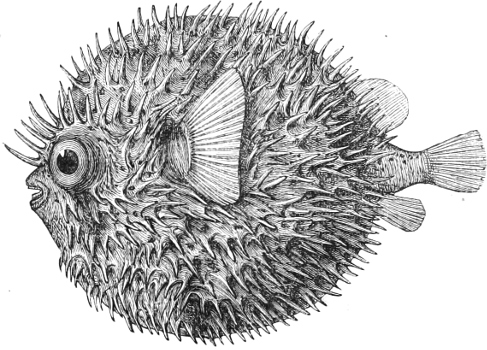
Fig. 314.—Diodon maculatus, inflated.
C. Molina.—Body compressed, very short; tail extremely short, truncate. Vertical fins confluent. No pelvic bone.
The “Sun-fishes” (Orthagoriscus) are pelagic fishes, found in every part of the oceans within the tropical and temperate zones. The singular shape of their body and the remarkable changes which they undergo with age, have been noticed above (p. 175, Figs. 93, 94). Their jaws are undivided in the middle, comparatively feeble, but well adapted for masticating their food, which consists of small pelagic Crustaceans. Two species are known. The common Sun-fish, O. mola, which attains to a very large size, measuring seven or eight feet, and weighing as many hundredweights. It has a rough, minutely granulated skin. It frequently approaches the southern coasts of England and the coasts of Ireland, and is seen basking in calm weather on the surface. The second species, O. truncatus, is distinguished by its smooth, tessellated skin, and one of the scarcest fishes in collections. The shortness of the vertebral column of the Sun-fishes, in which the number of caudal vertebra is reduced to seven, the total number being seventeen, and the still more reduced length of the spinal chord have been noticed above (p. 96).
THIRD SUB-CLASS—CYCLOSTOMATA.
Skeleton cartilaginous and notochordal, without ribs and without real jaws. Skull not separate from the vertebral column. No limbs. Gills in the form of fixed sacs, without branchial arches, six or seven in number on each side. One nasal aperture only. Heart without bulbus arteriosus. Mouth anterior, surrounded by a circular or subcircular lip, suctorial. Alimentary canal straight, simple, without coecal appendages, pancreas or spleen. Generative outlet peritoneal. Vertical fins rayed.
The Cyclostomes are most probably a very ancient type. Unfortunately the organs of these creatures are too soft to be preserved, with the exception of the horny denticles with which the mouth of some of them is armed. And, indeed, dental plates, which are very similar to those of Myxine, are not uncommon in certain strata of Devonian and Silurian age (see p. 193). The fishes belonging to this sub-class may be divided into two families—
First Family—Petromyzontidæ.
Body eel-shaped, naked. Subject to a metamorphosis; in the perfect stage with a suctorial mouth armed with teeth, simple or multicuspid, horny, sitting on a soft papilla. Maxillary, mandibulary, lingual, and suctorial teeth may be distinguished. Eyes present (in mature animals). External nasal aperture in the middle of the upper side of the head. The nasal duct terminates without perforating the palate. Seven branchial sacs and apertures on each side behind the head; the inner branchial ducts terminate in a separate common tube. Intestine with a spiral valve. Eggs small. The larvæ without teeth, and with a single continuous vertical fin.