SYSTEMATIC AND DESCRIPTIVE PART. (continued 3)
Reading edition
Seriola.—Body oblong, slightly compressed, with rounded abdomen, covered with very small scales; lateral line not shielded; præopercular margin entire. Cleft of the mouth of moderate width, or rather wide. The first dorsal continuous, with feeble spines. No detached finlets. Villiform teeth in the jaws, on the vomer and palatine bones.
These fishes are often called “Yellow-tails,” and occur in nearly all the temperate and tropical seas, sometimes at a great distance from land. Twelve species are known, and the majority have a wide geographical range. The larger grow to a length of from four to five feet, and are esteemed as food, especially at St. Helena, the Cape of Good Hope, in Japan, Australia, and New Zealand.
Seriolella and Seriolichthys, the latter from the Indo-Pacific, and distinguished by a finlet behind the dorsal and anal, are allied genera.
Naucrates.—Body oblong, sub-cylindrical, covered with small scales; a keel on each side of the tail. The spinous dorsal consists of a few short free spines; finlets none. Villiform teeth in the jaws, on the vomer and palatine bones.
The “Pilot-fish” (N. ductor) is a truly pelagic fish, known in all tropical and temperate seas. Its name is derived from its habit of keeping company with ships and large fish, especially Sharks. It is the Pompilus of the ancients, who describe it as pointing out the way to dubious or embarrassed sailors, and as announcing the vicinity of land by its sudden disappearance. It was therefore regarded as a sacred fish. The connection between the Shark and the Pilot-fish has received various interpretations, some observers having perhaps added more sentiment than is warranted by the actual facts. It was stated that the Shark never seized the Pilot-fish, that the latter was of great use to its big companion in conducting it and showing it the way to its food. Dr. Meyen in his “Reise um die Erde” states: “The pilot swims constantly in front of the Shark; we ourselves have seen three instances in which the Shark was led by the Pilot. When the Shark neared the ship the Pilot swam close to the snout, or near one of the pectoral fins of the animal. Sometimes he darted rapidly forwards or sidewards as if looking for something, and constantly went back again to the Shark. When we threw overboard a piece of bacon fastened on a great hook, the Shark was about twenty paces from the ship. With the quickness of lightning the Pilot came up, smelt at the dainty, and instantly swam back again to the Shark, swimming many times round his snout and splashing, as if to give him exact information as to the bacon. The Shark now began to put himself in motion, the Pilot showing him the way, and in a moment he was fast upon the hook.[42] Upon a later occasion we observed two Pilots in sedulous attendance on a Blue Shark, which we caught in the Chinese Sea. It seems probable that the Pilot feeds on the Sharks’ excrements, keeps his company for that purpose, and directs his operations solely from this selfish view.” We believe that Dr. Meyen’s opinion, as expressed in his last words, is perfectly correct. The Pilot obtains a great part of his food directly from the Shark, in feeding on the parasitic crustaceans with which Sharks and other large fish are infested, and on the smaller pieces of flesh which are left unnoticed by the Shark when it tears its prey. The Pilot also, being a small fish, obtains greater security when in company of a Shark, which would keep at a distance all other fishes of prey that would be likely to prove dangerous to the Pilot. Therefore, in accompanying the Shark, the Pilot is led by the same instinct which makes it follow a ship. With regard to the statement that the Pilot itself is never attacked by the Shark all observers agree as to its truth; but this may be accounted for in the same way as the impunity of the swallow from the hawk, the Pilot-fish being too nimble for the unwieldy Shark.
The Pilot-fish does not always leave the vessels on their approach to land. In summer, when the temperature of the sea-water is several degrees above the average, Pilots will follow ships to the south coast of England into the harbour, where they are generally speedily caught. Pilot-fish attain a length of 12 inches only. When very young their appearance differs so much from the mature fish that they have been described as a distinct genus, Nauclerus. This fry is exceedingly common in the open ocean, and constantly obtained in the tow-net; therefore the Pilot-fish retains its pelagic habits also during the spawning season, and some of the spawn found by voyagers floating on the surface is, without doubt, derived from this species.
Chorinemus.—Body compressed, oblong; covered with small scales, singularly shaped, lanceolate, and hidden in the skin. The first dorsal is formed by free spines in small numbers; the posterior rays of the second dorsal and anal are detached finlets. Small teeth in the jaws, on the vomer and palatine bones.
Twelve species are known from the Atlantic and Indo-Pacific; some enter brackish water, whilst others are more numerous at some distance from the shore. They attain to a length of from 2 to 4 feet. In the young, which have been described as Porthmeus, the spines and finlets are connected by membrane with the rest of the fin.
Lichia is an allied genus from the Mediterranean, tropical Atlantic, and the coast of Chili; five species.
Temnodon.—Body oblong, compressed, covered with cycloid scales of moderate size. Cleft of the mouth rather wide. Jaws with a series of strong teeth; smaller ones on the vomer and the palatine bones. The first dorsal with eight feeble spines connected by membrane; finlets none. Lateral line not shielded. The second dorsal and anal covered with very small scales.
Temnodon saltator, sometimes called “Skip-jack,” is spread over nearly all the tropical and sub-tropical seas; it frequents principally the coasts, but is also met with in the open sea. On the coasts of the United States it is well known by the name of “Blue-fish,” being highly esteemed as food, and furnishing excellent sport. It is one of the most rapacious fishes, destroying an immense number of other shore-fishes, and killing many more than they can devour. It grows to a length of 5 feet, but the majority of those brought to market are not half that length.
Trachynotus.—Body more or less elevated, compressed, covered with very small scales. Cleft of the mouth rather small, with short convex snout. Opercles entire. The first dorsal composed of free spines in small number. No finlets. Teeth always small, and generally lost with age.
Ten species are known from the tropical Atlantic and Indo-Pacific; they rarely exceed a length of 20 inches. Some of the most common marine fishes belong to this genus, for instance T. ovatus, which ranges over the entire tropical zone.
Pammelas (perciformis) is allied to the preceding genus; from the coast of New York.
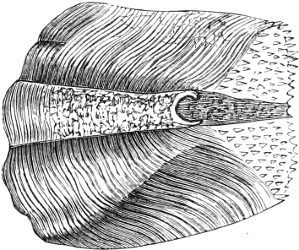
Fig. 198.—Magnified scale of Psettus argenteus.
Psettus.—Body much compressed and elevated; snout rather short. One dorsal, entirely covered with scales, with seven or eight spines; anal fin with three. Ventrals very small, rudimentary. Teeth villiform; no teeth on the palate. Scales small, ctenoid.
Only three species are known; one, P. sebæ, from the west coast of Africa, the two others from the Indo-Pacific. P. argenteus is a very common fish, attaining to a length of about 10 inches.
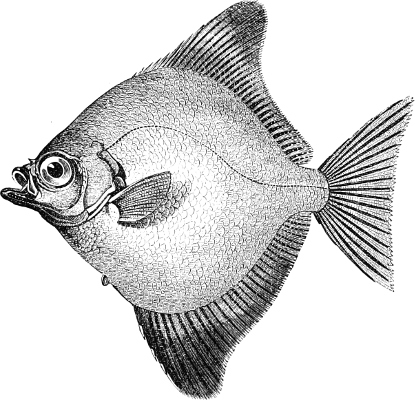
Fig. 199.—Psettus argenteus.
Platax.—Body much compressed and elevated; snout very short. One dorsal, with the spinous portion nearly entirely hidden, and formed by from three to seven spines; anal with three. Ventrals well developed, with one spine and five rays. Teeth setiform, with an outer series of rather larger teeth, notched at the top; palate toothless. Scales of moderate size or rather small.
These fishes are called “Sea-bats,” from the extraordinary length of some portion of their dorsal and anal fins and of their ventrals. These long lobes are generally of a deep black colour. In mature and old individuals the fin-rays are much shorter than in the young, which have been described as distinct species. There are probably not more than seven species of “Sea-bats,” if so many, and they all belong to the Indian Ocean and Western Pacific, where they are very common.
Zanclus.—Body much compressed and elevated. One dorsal, with seven spines, the third of which is very elongate. No teeth on the palate. Scales minute, velvety.
One species (Z. cornutus), which is extremely common in the Indo-Pacific. It is easily recognised by its snout, which is produced like that of Chelmon, and by the broad black bands crossing the yellow ground-colour. It attains to a length of eight inches, and undergoes during growth similar changes as Acanthurus.
Anomalops.—Body oblong, covered with small, rough scales. Snout very short, convex, with wide cleft of the mouth. Eyes very large; below the eye, in a cavity of the infraorbital ring, there is a glandular phosphorescent organ. Villiform teeth in the jaws and on the palatine bones, none on the vomer. First dorsal fin short, with a few feeble spines connected by membrane.
This genus, of which one species only is known (A. palpebratus), represents the family of Horse-Mackerels in the depths of the sea; but we do not know, at present, at what depth it lives. Only six specimens have been obtained hitherto from the vicinity of Amboyna, the Fidji, and Paumotu Islands; the largest was twelve inches long.
Capros.—Body compressed and elevated. Mouth very protractile. Scales rather small, spiny. First dorsal with nine spines, anal with three. Ventral fins well developed. Minute teeth in the jaws and on the vomer; none on the palatine bones.
The “Boar-fish” (C. aper) is common in the Mediterranean, and not rarely found on the south coast of England.
Allied are Antigonia and Diretmus, known from a few individuals obtained at Madeira and Barbadoes; they are probably fishes which but rarely come to the surface.
Equula.—Body more or less compressed, elevated or oblong, covered with small, deciduous, cycloid scales. Mouth very protractile. Minute teeth in the jaws; none on the palate. One dorsal. Formula of the fins: D. 8/1516, A. 3/14, V. 1/5. The lower præopercular margin serrated.
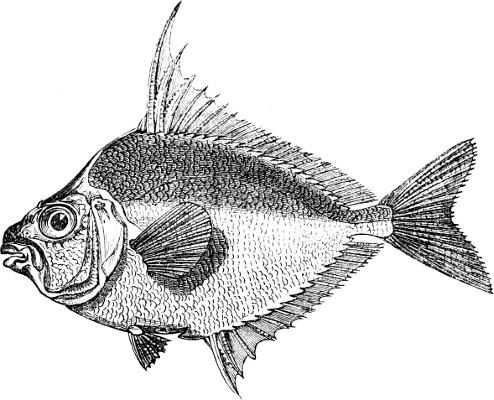
Fig. 200.—Equula edentula.
Small species, abundant in the Indo-Pacific, disappearing on the coasts of Japan and Australia. Some eighteen species have been described.
Gazza is very similar to Equula, but armed with canine teeth in the jaws.
Other genera referred to this family are Lactarius (L. delicatulus, common, and eaten on the East Indian coasts), Seriolella, Paropsis, and Platystethus.
Third Family—Cyttidæ.
Body elevated, compressed, covered with small scales, or with bucklers, or naked; eye lateral. Teeth conical, small. No bony stay for the præoperculum. Dorsal fin composed of two distinct portions. Ventrals thoracic. No prominent papilla near the vent. Gill-opening wide. More than ten abdominal and more than fourteen caudal vertebræ.
The fishes of the “Dory” family are truly marine, and inhabit the temperate zone of the Northern and Southern Hemispheres. Some fossils from tertiary formations (one from Licata) belong to the genus Zeus.
Zeus.—A series of bony plates runs along the base of the dorsal and anal fins; another series on the abdomen. Three or four anal spines.
“John Dorys” are found in the Mediterranean, on the eastern temperate shores of the Atlantic, on the coasts of Japan and Australia. Six species are known, all of which are highly esteemed for the table. The English name given to one of the European species (Zeus faber) seems to be partly a corruption of the Gascon “Jau,” which signifies cock, “Dory” being derived from the French Dorée, so that the entire name means Gilt-Cock. Indeed, in some other localities of Southern Europe it bears the name of Gallo. The same species occurs also on the coasts of South Australia and New Zealand. The fishermen of Roman Catholic countries hold this fish in special respect, as they recognise in a black round spot on its side the mark left by the thumb of St. Peter when he took the piece of money from its mouth.
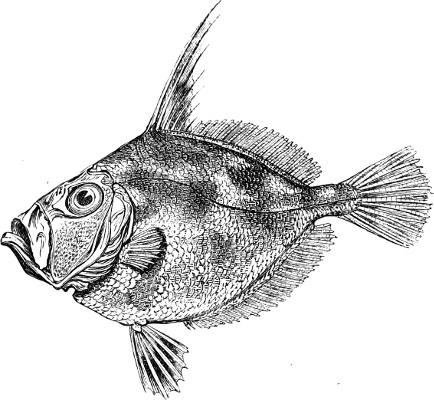
Fig. 201.—Cyttus australis.
Cyttus.—Body covered with very small scales; no osseous bucklers on any part of the body. Two anal spines; ventral fins composed of one spine and six or eight rays.
Three species are known from Madeira, South Australia, and New Zealand.
Fourth Family—Stromateidæ.
Body more or less oblong and compressed, covered with very small scales; eye lateral. Dentition very feeble; œsophagus armed with numerous horny, barbed processes. No bony stay for the præoperculum. Dorsal fin single, long, without distinct spinous division. More than ten abdominal and more than fourteen caudal vertebræ.
This small family consists of strictly marine and partly pelagic species referred to two genera, Stromateus and Centrolophus. The former lacks ventral fins, at least in the adult stage, and is represented by about ten species in almost all the tropical and warmer seas. Centrolophus, hitherto known from two or three European species only (of which one occasionally reaches the south coast of England, where it is named “Black-fish”), has recently been discovered on the coast of Peru, and has probably a much wider range.
Fifth Family—Coryphænidæ.
Body compressed; eye lateral. Teeth small, conical, if present; œsophagus smooth. No bony stay for the præoperculum. Dorsal fin single, long, without distinct spinous division. More than ten abdominal and more than fourteen caudal vertebræ.
All the members of this family have pelagic habits. Representatives of it have been recognized in some fossil remains: thus Goniognathus from the Isle of Sheppey, and the living genus Mene (Gastrocnemus) at Monte Bolca.
Coryphæna.—Body compressed, rather elongate; adult specimens with a high crest on the top of the head; cleft of the mouth wide. A single dorsal extending from the occiput almost to the caudal, which is deeply forked; no distinct dorsal and anal spines. The ventrals are well developed, and can be received in a groove on the abdomen. Scales very small. Rasp-like teeth in the jaws, on the vomer and the palatine bones. Air-bladder absent.
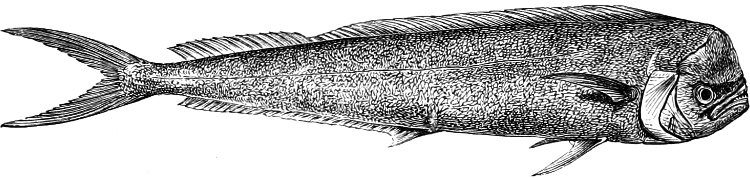
Fig. 202.—Dolphin from the Atlantic.
Generally, though by misapplication of the name, called “Dolphins.” About six species are known, each of which is probably distributed over all the tropical and sub-tropical seas. Strictly pelagic in their habits, they are most powerful swimmers; they congregate in shoals, and pursue unceasingly the Flying-Fish, which try to escape their enemies by long flying leaps. They attain to a length of six feet, and are eagerly caught by sailors on account of their well-flavoured flesh. The beauty of their, unfortunately fugitive, colours has ever been a subject of admiration. As far as the colours are capable of description, those of the common species (C. hippurus), which is often seen in the Mediterranean, are silvery blue above, with markings of a deeper azure, and reflections of pure gold, the lower parts being lemon-yellow, marked with pale blue. The pectoral fins are partly lead colour, partly yellow; the anal is yellow, the iris of the eye golden. These iridescent colours change rapidly whilst the fish is dying, as in the Mackerel. The form of the body, and especially of the head, changes considerably with age. Very young specimens, from one to six inches in length, are abundant in the open sea, and frequently obtained in the tow-net. Their body is cylindrical, their head as broad as high, and the eye relatively very large, much longer than the snout. As the fish grows the body is more compressed, and finally a high crest is developed on the head, and the anterior part of the dorsal fin attains a height equal to that of the body.
Brama.—Body compressed, and more or less elevated, covered with rather small scales; cleft of the mouth very oblique, with the lower jaw longest. Dorsal and anal fins many-rayed, the former with three or four, the latter with two or three, spines; caudal deeply forked. Ventrals thoracic, with one spine and five rays. The jaws with an outer series of stronger teeth.
Pelagic fishes which, like the allied genus Taractes, range over almost all the tropical and temperate seas.
Lampris.—Body compressed and elevated, covered with very small deciduous scales; cleft of the mouth narrow. A single dorsal, without a spinous portion. Ventrals composed of numerous rays. Teeth none.
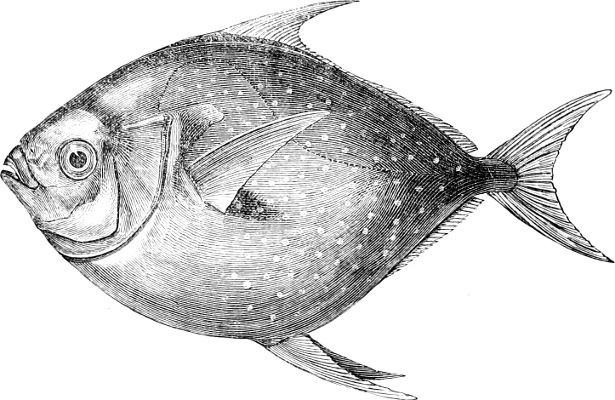
Fig. 203.—Lampris luna.
The “Sun-fish” (L. luna) is one of the most beautiful fishes of the Atlantic. It attains to the large size of four feet in length, is bluish on the back, with round silvery spots, which colour prevails on the lower parts; the fins are of a deep scarlet. It is said to be excellent eating. It is a pelagic fish, not rare about Madeira, but extending far northwards in the Atlantic; it seems to be rarer in the Mediterranean. All the specimens hitherto obtained were full-grown or nearly so. The skeleton exhibits several peculiarities, viz. an extraordinary development and dilatation of the humeral arch, and great strength of the numerous and closely-set ribs.
Other Coryphænoid genera are Pteraclis, Schedophilus, Diana, Ausonia, and Mene; all pelagic forms.
Sixth Family—Nomeidæ.
Body oblong, more or less compressed, covered with cycloid scales of moderate size; eye lateral. No bony stay for the præoperculum. Dorsal fin with a distinct spinous portion separated from the soft; sometimes finlets; caudal forked. More than ten abdominal, and more than fourteen caudal vertebræ.
Marine fishes; pelagic, at least when young.
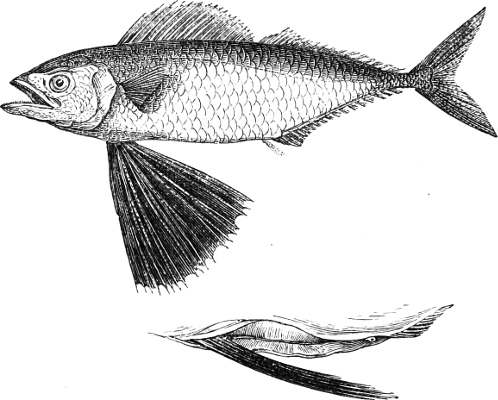
Fig. 204.—Gastrochisma melampus.
Gastrochisma.—Cleft of the mouth wide. Finlets behind the dorsal and anal fins. The ventral fins are exceedingly broad and long, and can be completely concealed in a fold of the abdomen.
G. melampus, from the coast of New Zealand; scarce.
Nomeus.—Cleft of the mouth narrow. No finlets. The ventral fin is long and broad, attached to the abdomen by a membrane, and can be received in a fissure of the abdomen.
N. gronovii is a common pelagic fish in the Atlantic and Indian Oceans; of small size.
Other genera belonging to this family are Psenes and Cubiceps.
Seventh Family—Scombridæ.
Body oblong, scarcely compressed, naked or covered with small scales; eye lateral. Dentition well developed. No bony stay for the præoperculum. Two dorsal fins; generally finlets. Ventrals thoracic, with one spine and five rays. More than ten abdominal, and more than fourteen caudal vertebræ.
The fishes of the “Mackerel” family are pelagic forms, abundant in all the seas of the tropical and temperate zones. They are one of the four families of fishes which are the most useful to man, the others being the Gadoids, Clupeoids, and Salmonoids. They are fishes of prey, and unceasingly active, their power of endurance in swimming being equal to the rapidity of their motions. Their muscles receive a greater supply of blood-vessels and nerves than in other fishes, and are of a red colour, and more like those of birds or mammals. This energy of muscular action causes the temperature of their blood to be several degrees higher than in other fishes. They wander about in shoals, spawn in the open sea, but periodically approach the shore, probably in the pursuit of other fishes on which they feed.[43]
Scombridæ are well represented in tertiary formations: in the Eocene schists of Glaris two extinct genera, Palimphyes and Isurus, have been discovered. In Eocene and Miocene formations Scomber, Thynnus, and Cybium are not uncommon.
Scomber.—The first dorsal continuous, with feeble spines; five or six finlets behind the dorsal and anal. Scales very small, and equally covering the whole body. Teeth small. Two short ridges on each side of the caudal fin.
Mackerels proper are found in almost all temperate and tropical seas, with the exception of the Atlantic shores of temperate South America, where they have not been found hitherto. In Europe, and probably also on the coast of England, three species occur: S. scomber, the common Mackerel, which lacks an air-bladder; S. pneumatophorus, a more southern species, with an air-bladder; and S. colias, like the former, but with a somewhat different coloration, and often called “Spanish” Mackerel. On the Cape of Good Hope, in Japan, on the coast of California, in South Australia, and New Zealand, Mackerels are abundant, which are either identical with, or very closely allied to, the European species. On the coasts of the United States the same species occur which tenant the western parts of the Atlantic. Altogether seven species are known.
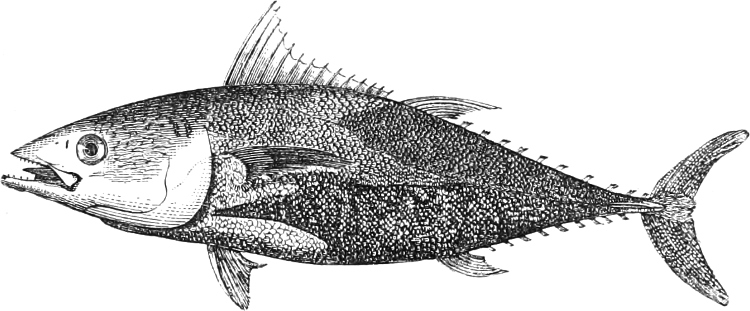
Fig. 205.—Thynnus thynnus.
Thynnus.—The first dorsal continuous, with the spines rather feeble; from six to nine finlets behind the dorsal and anal. Scales of the pectoral region crowded, forming a corslet. Teeth rather small. A longitudinal keel on each side of the tail.
The best-known species of this genus is the “Tunny” (Thynnus thynnus), abundant in the Mediterranean, and ranging to the south coast of England and to Tasmania. It is one of the largest fishes of the ocean, attaining to a length of 10 feet, and to a weight of more than 1000 lbs. The fishery of the Tunny is systematically carried on in the Mediterranean, and dates from the most remote antiquity. Its salted preparation was esteemed by the Romans under the name of Saltamentum sardicum. Its flesh is extensively eaten now, fresh as well as preserved.
Thynnus pelamys, or the “Bonito,” is equally well known, and ranges over all the tropical and temperate seas; it eagerly pursues the Flying-fish, and affords welcome sport and food to the sailor. In its form it resembles the Tunny, but is more slender and rarely above three feet long.
Some of the other species are provided with very long pectoral fins, and generally called by sailors “Albacore.” They are said to grow to a length of six feet; Bennett in his “Whaling Voyage,” vol. ii. p. 278, makes the following observations on Th. germo, from the Pacific: “Ships when cruising slowly in the Pacific Ocean, are usually attended by myriads of this fish for many successive months. A few days’ rapid sailing is, nevertheless, sufficient to get rid of them, however numerous they may be, for they seldom pay more than very transient visits to vessels making a quick passage. When the ship is sailing with a fresh breeze they swim pertinaciously by her side and take the hook greedily, but should she be lying motionless or becalmed they go off to some distance in search of prey, and cannot be prevailed upon to take the most tempting bait the sailor can devise. It is probably as a protection from their chief enemy, the Sword-fish, that they seek the society of a ship. I am not aware that the Shark is also their enemy; but they seemed to have an instinctive dread of this large fish, and when it approached the ship, would follow it in shoals, and annoy it in the same manner as the smaller birds may be seen to annoy those of a larger and predaceous kind, as the hawk or owl. They are very voracious and miscellaneous feeders. Flying-fish, Calmars, and small shoal-fish are their most natural food; though they do not refuse the animal offal from a ship. Amongst the other food contained in their maw, we have found small Ostracions, File-fish, Sucking-fish, Janthina shells, and pelagic crabs; in one instance a small Bonita, and in a second a Dolphin eight inches long, and a Paper-nautilus shell containing its sepia-tenant. It was often amusing to watch an Albacore pursuing a Flying-fish, and to mark the precision with which it swam beneath the feeble æronaut, keeping him steadily in view, and preparing to seize him at the moment of his descent. But this the Flying-fish would often elude by instantaneously renewing his leap, and not unfrequently escape by extreme agility.”
Pelamys.—The first dorsal continuous, with the spines rather feeble; from seven to nine finlets behind the dorsal and anal. Scales of the pectoral region forming a corslet. Teeth moderately strong. A longitudinal keel on each side of the tail.
Five species are known, of which P. sarda is common in the Atlantic and Mediterranean.
Auxis.—Differing from the preceding two genera in having very small teeth in the jaws only, none on the palate.
Auxis rochei common in the Atlantic, Mediterranean, and Indian Ocean.
Cybium.—The first dorsal continuous, with the spines rather feeble; generally more than seven finlets behind the dorsal and anal. Scales rudimentary or absent. Teeth strong; a longitudinal keel on each side of the tail.
Twelve species from the tropical Atlantic and Indian Ocean; frequenting more the coast-region than the open sea; attaining to a length of four or five feet.
Elacate.—Body covered with very small scales; head depressed; cleft of the mouth moderately wide; no keel on the tail. The spinous dorsal is formed by eight small free spines; finlets none. Villiform teeth in the jaws, on the vomer and the palatine bones.
Elacate nigra, a coast fish common in the warmer parts of the Atlantic and the Indian Ocean.
Echeneis.—The spinous dorsal fin is modified into an adhesive disk, occupying the upper side of the head and neck.
This genus is closely allied to the preceding, from which it differs only by the transformation of the spinous dorsal fin into a sucking organ. The spines being composed of two halves, each half is bent down towards the right and the left, forming a support to a double series of transverse lamellæ, rough on their edges, the whole disk being of an oval shape and surrounded by a membranous fringe. Each pair of lamellæ is formed out of one spine, which, as usual, is supported at the base by an interneural spine. By means of this disk the “Sucking-fishes” or “Suckers” are enabled to attach themselves to any flat surface, a series of vacuums being created by the erection of the usually recumbent lamellæ. The adhesion is so strong that the fish can only be dislodged with difficulty, unless it is pushed forward by a sliding motion. The Suckers attach themselves to sharks, turtles, ships, or any other object which serves their purpose. They cannot be regarded as parasites, inasmuch as they obtain their food independently of their host. Being bad swimmers they allow themselves to be carried about by other animals or vessels endowed with a greater power of locomotion. They were as well known to the ancients as they are to the modern navigators. Aristotle and Aelian mention the Sucker under the name of φθεὶρ, or the Louse; “In the sea between Cyrene and Egypt there is a fish about the Dolphin (Delphinus), which they call the Louse; this becomes the fattest of all fishes, because it partakes of the plentiful supply of food captured by the Dolphin.” Later writers, then, repeat a story, the source of which is unknown, viz. that the “Remora” is able to arrest vessels in their course, a story which has been handed down to our own time. It need not be stated that this is an invention, though it cannot be denied that the attachment of one of the larger species may retard the progress of a sailing vessel, especially when, as is sometimes the case, several individuals accompany the same ship. An account of a somewhat ingenious way of catching sleeping turtles by means of a Sucking-fish held by a ring fastened round its tail, appears to have originated rather from an experiment than from regular practice.
Ten different species are known, of which Echeneis remora and Echeneis naucrates are the most common. The former is short and grows to a length of eight inches only, the latter is a slender fish, not rarely found three feet long. The bulkiest is Echeneis scutata, which attains to a length of two feet; individuals of that size weighing about eight lbs.
The number of pairs of lamellæ varies in the various species, from 12 to 27. The caudal fin of some of the species undergoes great changes with age. In young specimens the middle portion of the fin is produced into a long filiform lobe. This lobe becomes gradually shorter, and the fin shows a rounded margin in individuals of middle age. When the fish approaches the mature state, the upper and lower lobes are produced, and the fin becomes subcrescentic or forked.
[See Günther, “On the History of Echeneis.” Ann. and Mag. Nat. Hist., 1860.]
Eighth Family.—Trachinidæ.
Body elongate, low, naked or covered with scales. Teeth small, conical. No bony stay for the præoperculum. One or two dorsal fins, the spinous portion being always shorter and much less developed than the soft; the anal similarly developed as the soft dorsal; no finlets. Ventrals with one spine and five rays. Gill-opening more or less wide. Ten or more than ten abdominal, and more than fourteen caudal vertebræ.
Carnivorous coast-fishes of small size, found in every quarter of the globe, but scarcely represented in the Arctic zone (Trichodon); on the other hand, they are rather numerous towards the Antarctic circle. All are bad swimmers, generally moving along the bottom in small depths. Only one genus (Bathydraco) is known from the deep-sea.
A genus which shows the principal characters of this family (Callipteryx), has been found in the tertiary deposits of Monte Bolca; it is scaleless. A second genus, Trachinopsis, has been recently described by Sauvage from the Upper Tertiary of Lorca in Spain; and a third (Pseudoeleginus) from the Miocene of Licata.
This family may be subdivided into five groups:—
1. In the Uranoscopina the eyes are on the upper surface of the head, directed upwards; the lateral line is continuous.
Uranoscopus.—Head large, broad, thick, partly covered with bony plates; cleft of the mouth vertical. Scales very small. Two dorsal fins, the first with from three to five spines; ventrals jugular; pectoral rays branched. Villiform teeth in the jaws, on the vomer and palatine bones; no canines. Generally a long filament below and before the tongue. Gill-cover armed.
The position of the eyes on the upper surface of the head, which these fishes have in common with many others, is well expressed by the name Uranoscopus (Stare-gazer). Their eyes are very small, and can be raised or depressed at the will of the fish. They are inactive fishes, generally lying hidden at the bottom between stones, watching for their prey. The delicate filament attached to the bottom of their mouth, and playing in front of it in the current of water which passes through the mouth, serves to lure small animals within reach of the fish. Eleven species are known from the Indo-Pacific and Atlantic, and one (U. scaber) from the Mediterranean; they attain rarely a length of twelve inches.
Leptoscopus.—Form of the head as in Uranoscopus, but entirely covered with a thin skin. Scales small, cycloid. One continuous dorsal; ventrals jugular; pectoral rays branched. Villiform teeth in both jaws, on the vomer and palatine bones; canines none. No oral filament. Gill-cover unarmed.
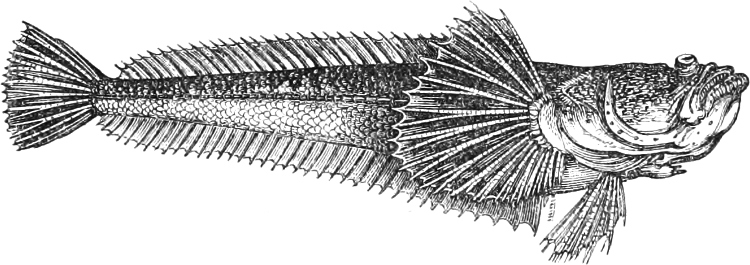
Fig. 206.—Leptoscopus macropygus.
Leptoscopus macropygus, not rare on the coast of New Zealand.
Other genera of Stare-gazers are Agnus from the Atlantic coasts of North America; Anema from the Indian Ocean and New Zealand; and Kathetostoma from Australia and New Zealand.
2. In the Trachinina the eyes are more or less lateral; the lateral line is continuous; and the intermaxillary without a larger tooth on its posterior portion.
Trachinus.—Cleft of the mouth very oblique; eye lateral, but directed upwards. Scales very small, cycloid. Two dorsal fins, the first short, with six or seven spines; ventrals jugular; the lower pectoral rays simple. Villiform teeth in the jaws, on the vomer and palatine bones. Præorbital and præoperculum armed.
The “Weevers” are common fishes on the European coasts, and but too well known to all fishermen; singularly enough they do not extend across the Atlantic to the American coast, but reappear on the coast of Chili! Wounds by their dorsal and opercular spines are much dreaded, being extremely painful, and sometimes causing violent inflammation of the wounded part. No special poison-organ has been found in these fishes, but there is no doubt that the mucous secretion in the vicinity of the spines has poisonous properties. The dorsal spines as well as the opercular spine have a deep double groove in which the poisonous fluid is lodged, and by which it is inoculated in the punctured wound. On the British coasts two species occur, T. draco, the Greater Weever, attaining to a length of twelve inches, and T. vipera, the Lesser Weever, which grows only to half that size.
Champsodon.—Body covered with minute granular scales; lateral lines two, with numerous vertical branches. Cleft of the mouth wide, oblique. Eye lateral, but directed upwards. Two dorsal fins; ventral fins jugular; pectoral rays branched. Teeth in the jaws in a single series, thin, long, of unequal size. Teeth on the vomer, none on the palate. Gill-openings exceedingly wide. Præoperculum with a spine at the angle and a fine serrature on the posterior margin.
Champsodon vorax is not uncommon at small depths off the Philippine Islands, Admiralty Islands, and in the Arafura Sea.
Percis.—Body cylindrical, with small ctenoid scales; cleft of the mouth slightly oblique; eye lateral, but directed upwards. Dorsal fins more or less continuous, the spinous with four or five short stiff spines; ventrals a little before the pectorals. Villiform teeth in the jaws, with the addition of canines; teeth on the vomer, none on the palatines. Opercles feebly armed.
Fifteen species; small, but prettily coloured shore-fishes of the Indo-Pacific.
Sillago.—Body covered with rather small, ctenoid scales. Cleft of the mouth small, with the upper jaw rather longer; eye lateral, large. Two dorsals, the first with from nine to twelve spines; ventrals thoracic. Villiform teeth in the jaws, and on the vomer, none on the palatine bones. Operculum unarmed; præoperculum serrated. The bones of the head with wide muciferous channels.
Eight species; small, plain-coloured shore-fishes, common in the Indian Ocean to the coasts of Australia.
Bovichthys.—Head broad and thick; cleft of the mouth horizontal, with the upper jaw rather longer; eye lateral, more or less directed upwards. Scales none. Two separate dorsal fins, the first with eight spines; ventrals jugular; the lower pectoral rays simple. Villiform teeth in the jaws, on the vomer and the palatine bones; no canines. Operculum with a strong spine; præorbital and præoperculum not armed.
Three species are known from the South Pacific.
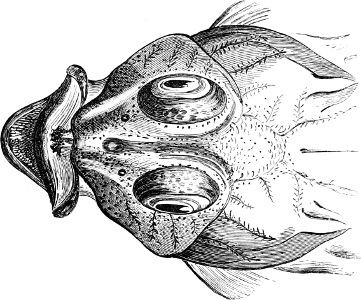
Fig. 207.—Head of Bovichthys variegatus, from New Zealand.
Bathydraco.—Body elongate, sub-cylindrical; head depressed, with the snout much elongate, spatulate; mouth wide, horizontal, with the lower jaw prominent; eyes very large, lateral, close together. Scales very small, imbedded in the skin. Lateral line wide, continuous. One dorsal fin; ventrals jugular; the lower pectoral rays branched. Teeth in the jaws in villiform bands; none on the vomer or the palatine bones. Opercles unarmed; ten branchiostegals; the gill-membranes free from the isthmus, and but slightly united in front. Air-bladder none.
A deep-sea fish, found at a depth of 1260 fathoms in the Antarctic Ocean (south of Heard Island).
Chænichthys.—Head very large, with the snout spatulate, and with the cleft of the mouth very wide. Eye lateral. Scales none; lateral line sometimes with granulated scutes. Two dorsals, the first with seven spines; ventrals jugular. Jaws with rasp-like teeth; palate toothless.
Chænichthys rhinoceratus from Kerguelen’s Land (see Fig. 108, p. 291); and Ch. esox from the Straits of Magelhaen.
Other genera belonging to this group are Aphritis, Acanthaphritis, Eleginus, Chænichthys, and Chimarrhichthys from the South Pacific and Antarctic zone; Cottoperca from the west coast of Patagonia; Percophis from the coast of Southern Brazil; and Trichodon from the coast of Kamtschatka.
3. In the Pinguipedina the body is covered with small scales; the eye lateral; the lateral line continuous; and the intermaxillary is armed with a larger tooth on its posterior portion, as in many Labroids.
Two genera, Pinguipes and Latilus, from various parts of tropical and sub-tropical seas, belong to this group.
4. In the Pseudochromides, the lateral line is interrupted or not continued to the caudal fin; they have one continuous dorsal only.
These fishes are inhabitants of coral reefs or coasts: Opisthognathus, Pseudochromis, Cichlops, and Pseudoplesiops.
5. In the Nototheniina the lateral line is interrupted; and the dorsal fin consists of two separate portions.
They (with others) represent in the Antarctic zone the Cottoids of the Northern Hemisphere: they have the same habits as their northern analogues. In Notothenia, which on the southern extremity of South America, in New Zealand, Kerguelen’s Land, etc., is represented by about twenty species, the body is covered with ctenoid scales, and the bones of the head are unarmed; whilst Harpagifer, a small species with a similar range as Notothenia, has the body naked, and the operculum and sub-operculum armed with long and strong spines.
Ninth Family—Malacanthidæ.
Body elongate, with very small scales; mouth with thick lips; a strong tooth posteriorly on the intermaxillary. Dorsal and anal fins very long, the former with a few simple rays anteriorly; ventrals thoracic, with one spine and five rays. Gill-opening wide, with the gill-membranes united below the throat. Ten abdominal and fourteen caudal vertebræ.
One genus only, Malacanthus, with three species from tropical seas.
Tenth Family—Batrachidæ.
Head broad and thick; body elongate, compressed behind; skin naked or with small scales. No bony stay for the præoperculum. Teeth conical, small or of moderate size. The spinous dorsal consists of two or three spines only; the soft and the anal long. Ventrals jugular, with two soft rays; pectorals not pediculated. Gill-opening a more or less vertical slit before the pectoral, rather narrow.
Carnivorous fishes, of small size, living on the bottom of the sea near the coast in the tropical zone, some species advancing into the warmer parts of the temperate zones.
Batrachus.—The spinous dorsal is formed by three stout spines. Gill-covers armed with spines. Circumference of the mouth and other parts of the head frequently provided with small skinny tentacles.
Some of the fishes of this genus possess a subcutaneous spacious cavity behind the base of the pectoral fin, the inside of which is coated with a reticulated mucous membrane. It opens by a foramen in the upper part of the axil.—This apparatus is the same which is found in many Siluroid fishes, and which has been noticed above, p. 192. There cannot be any doubt that it is a secretory organ, but whether the secretion has any poisonous properties, as in the Siluroids, or as in Thalassophryne, has not been determined. No instance of poisonous wounds having been inflicted by these fishes is on record. Twelve species are known, the distribution of which coincides with that of the family; one very fine species, B. didactylus, occurs in the Mediterranean.
Thalassophryne.—The spinous dorsal is formed by two spines only, each of which is hollow, like the opercular spine, and conveys the contents of a poison-bag situated at its base. Canine teeth none.
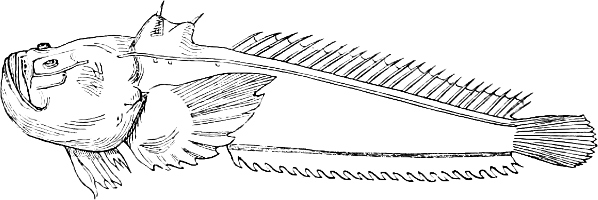
Fig. 208.—Thalassophryne reticulata.
Two species are known from the Atlantic and Pacific coasts of Central America. The poison-apparatus is more perfectly developed than any other known at present in the class of fishes; it has been described above, p. 192. The species figured, Th. reticulata, is not uncommon at Panama, and attains to a length of fifteen inches.
Porichthys.—Two small dorsal spines; a canine tooth on each side of the vomer.
Two species, from the Atlantic and Pacific sides of Central and South America.
Eleventh Family—Psychrolutidæ.
Body rather elongate, naked; head broad. Spinous dorsal separate or absent. Ventral fins close together, thoracic, composed of a few rays. Teeth small. Three gills and a half; pseudobranchiæ well developed; gill-openings of moderate width, the gill-membranes being attached to the isthmus.
Of this family only two representatives are known, viz. Psychrolutes paradoxus, from Vancouver’s Islands, without first dorsal fin; and Neophrynichthys latus, from New Zealand, with two dorsal fins. Both are very scarce marine fishes.
Twelfth Family—Pediculati.
Head and anterior part of the body very large, without scales. No bony stay for the præoperculum. Teeth villiform or rasp-like. The spinous dorsal is advanced forwards, composed of a few more or less isolated spines, often transformed into tentacles; or entirely absent. Ventral fins jugular, with four or five soft rays, sometimes absent. The carpal bones are prolonged, forming a sort of arm, terminating in the pectoral. Gill-opening reduced to a small foramen, situated in or near the axil. Gills two and a half, or three, or three and a half; pseudobranchiæ generally absent.
This family contains a larger number of bizarre forms than any other; and there is, perhaps, none in which the singular organisation of the fish is more distinctly seen to be in consonance with its habits. Pediculates are found in all seas. The habits of all are equally sluggish and inactive; they are very bad swimmers; those found near the coasts lie on the bottom of the sea, holding on with their arm-like pectoral fins by seaweed or stones, between which they are hidden; those of pelagic habits attach themselves to floating seaweed or other objects, and are at the mercy of wind and current. A large proportion of the genera, therefore, have gradually found their way to the greatest depths of the ocean; retaining all the characteristics of their surface-ancestors, but assuming the modifications by which they are enabled to live in abyssal depths.
Lophius.—Head exceedingly large, broad, depressed, with the eyes on its upper surface; cleft of the mouth very wide. Jaws and palate armed with rasp-like depressible teeth of unequal size. Body naked; bones of the head armed with numerous spines. The three anterior dorsal spines are isolated, situated on the head, and modified into long tentacles; the three following spines form a continuous fin; the soft dorsal and anal short. Gills three. Young individuals have the tentacles beset with lappets, and most of the fin-rays prolonged into filaments.
These fishes are well known under the names “Fishing-Frog,” “Frog-fishes,” “Anglers,” or “Sea-devils.” They are coast-fishes, living at very small depths. Four species are known: the British species (L. piscatorius) found all round the coasts of Europe and Western North America, and on the Cape of Good Hope; a second (Mediterranean) species, L. budegassa; L. setigerus from China and Japan; and L. naresii from the Admiralty Islands.
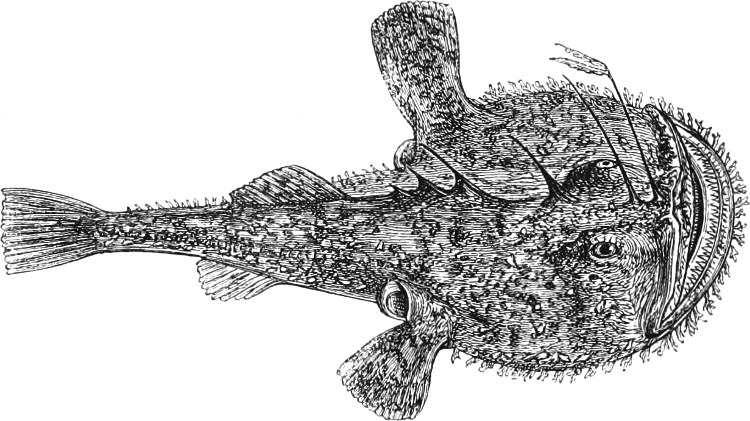
Fig. 209.—Lophius piscatorius.
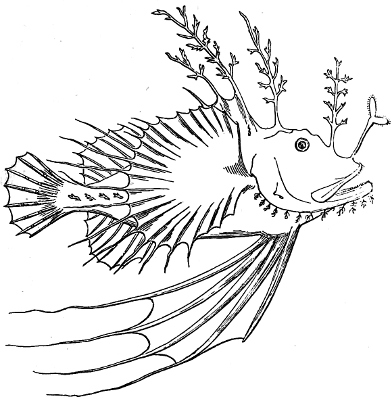
Fig. 210.—A young Fishing-Frog.
The habits of all these species are identical. The wide mouth extends all round the anterior circumference of the head, and both jaws are armed with bands of long pointed teeth, which are inclined inwards, and can be depressed so as to offer no impediment to an object gliding towards the stomach, but prevent its escape from the mouth. The pectoral and ventral fins are so articulated as to perform the functions of teeth, the fish being enabled to move, or rather to walk, on the bottom of the sea, where it generally hides itself in the sand, or amongst seaweed. All round its head, and also along the body, the skin bears fringed appendages, resembling short fronds of seaweed; a structure which, combined with the extraordinary faculty of assimilating the colours of the body to its surroundings, assists this fish greatly in concealing itself in places which it selects on account of the abundance of prey. To render the organisation of these creatures perfect in relation to their wants, they are provided with three long filaments inserted along the middle of the head, which are, in fact, the detached and modified three first spines of the anterior dorsal fin. The filaments most important in the economy of the fishing-frogs is the first, which is the longest, terminates in a lappet, and is movable in every direction. There is no doubt that the Fishing-frog, like many other fish provided with similar appendages, plays with this filament as with a bait, attracting fishes, which, when sufficiently near, are ingulfed by the simple act of the Fishing-frog opening its gape. Its stomach is distensible in an extraordinary degree, and not rarely fishes have been taken out of it quite as large and heavy as their destroyer. The British species grows to a length of more than five feet; specimens of three feet are common. Baird records that the spawn of the same species has been observed as a floating sheet of mucus, of from some 60 to 100 square feet.
Ceratias.—Head and body much compressed and elevated; cleft of the mouth wide, subvertical. Eyes very small. Teeth in the jaws rasp-like, depressible; palate toothless. Skin covered with numerous prickles. The spinous dorsal is reduced to two long isolated spines, the first on the middle of the head, the second on the back. The soft dorsal and anal short; caudal very long. Ventrals none; pectorals very short. Two and a half gills. Skeleton soft and fibrous.
Ceratias holbölli, a deep-sea fish; only a few examples have been found near the coast of Greenland, and from the mid-Atlantic; the latter at a depth of 2400 fathoms. Deep black.
Himantolophus.—Head and body compressed and elevated; cleft of the mouth wide, oblique. Eyes very small. Teeth of the jaws rasp-like, depressible; palate toothless. Skin with scattered conical tubercles. The spinous dorsal is reduced to a single tentacle on the head. The soft dorsal, anal, caudal, and pectoral short. Ventrals none. Three and a half gills. Skeleton soft and fibrous.
This is another deep-sea form, hitherto found in very few examples in the Arctic and Mid-Atlantic Oceans. The single tentacle is beset with many long filaments at its extremity, thus answering the same purpose which is attained by a greater number of tentacles. Deep black.
Melanocetus.—Head and body compressed; head very large; cleft of the mouth exceedingly wide, vertical. Eyes very small. Teeth of the jaws and vomer rasp-like, depressible. Skin smooth. The spinous dorsal is reduced to a single filament placed on the head. The soft dorsal and anal short. Ventrals none.
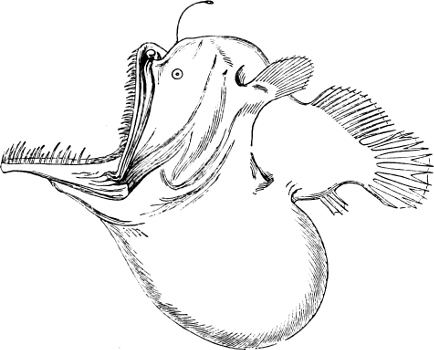
Fig. 211.—Melanocetus johnsonii.
Two species are known from the Atlantic: M. bispinossus and M. johnsonii, obtained at depths of from 360 to 1800 fathoms. The specimen figured was not quite four inches long, and contained in its stomach, rolled up spirally into a ball, a Scopeline fish which measured 7½ inches in length and one inch in depth.
Oneirodes.—A deep-sea fish from the Arctic Ocean, differing from the preceding in possessing a second isolated dorsal ray on the back.
Antennarius.—Head very large, high, compressed; cleft of the mouth vertical or subvertical, of moderate width. Jaws and palate armed with rasp-like teeth. Eye small. Body naked or covered with minute spines; generally with tentacles. The spinous dorsal is reduced to three isolated spines, the anterior of which is modified into a tentacle, situated above the snout. The soft dorsal of moderate length; anal short. Ventrals present.
The fishes of this genus are pelagic, frequently met with in mid-ocean between the tropics, especially in parts of the sea with floating vegetation; not rarely individuals are found far from their native latitudes, carried by currents to the coasts of Norway and New Zealand. Their power of swimming is most imperfect. When near the coast they conceal themselves between corals, stones, or fucus, holding on to the ground by means of their arm-like pectoral fins. Their coloration is so similar to their surroundings that it is hardly possible to distinguish the fish from a stone or coral overgrown with vegetation. Their way of attracting and seizing their prey is evidently the same as in the other fishes of this family. The extraordinary range of some of the species which inhabit the Atlantic as well as the Indo-Pacific Oceans, is the consequence of their habit of attaching themselves to floating objects. Almost all the species are highly coloured, but the pattern of the various colours varies exceedingly. These fishes do not attain to any considerable size, and probably never exceed a length of ten inches. A great number of species have been distinguished by ichthyologists, but probably not more than twenty are known at present. The species figured on p. 295 (A. caudomaculatus) is common in the Red Sea, and probably occurs in other parts of the Indian Ocean.
Brachionichthys and Saccarius are allied genera from South Australia, Tasmania, and New Zealand.
Chaunax.—Head very large, depressed; cleft of the mouth wide, subvertical; eye small; rasp-like teeth in the jaws and palate. Skin covered with minute spines. The spinous dorsal is reduced to a small tentacle above the snout; the soft dorsal of moderate length; anal short; ventrals present.
A deep-sea fish (Ch. pictus), of uniform pink colour; hitherto found near Madeira and the Fidji Islands, at a depth of 215 fathoms.
Malthe.—Anterior portion of the body very broad and depressed. The anterior part of the snout is produced into a more or less prominent process, beneath which there is a tentacle retractile into a cavity. Jaws and palate with villiform teeth. Skin with numerous conical protuberances. Soft dorsal fin and anal very short. Gill-opening superiorly in the axil; gills two and a half.
Although the rostral tentacle is situated at the lower side of the projection of the snout, it must be regarded as the homologue of a dorsal spine. In some of the preceding genera, Oneirodes and Chaunax, the first dorsal spine is so far advanced on the snout as to come into connection with the intermaxillary processes; and the position of the rostral tentacle in Malthe is only a still more advanced step towards the same special purpose for which the first dorsal spine is used in this family, viz. for the purpose of obtaining food. In Malthe it is obviously an organ of touch. This genus belongs to the American shores of the Atlantic; M. vespertilio being a tropical, M. cubifrons a northern species.
Halieutæa.—Head exceedingly large, depressed, nearly circular in its circumference. Cleft of the mouth wide, horizontal. Jaws with small rasp-like teeth; palate smooth. Forehead with a transverse bony bridge, beneath which is a tentacle (rostral spine) retractile into a cavity. Body and head covered with small stellate spines. Soft dorsal and anal very short. Gill-opening superiorly in the axil; gills two and a half.
A coast-fish (H. stellata) from China and Japan. Frequently found dry in Chinese insect-boxes.
This genus appears to be represented in the Atlantic Ocean by Halieutichthys from Cuba, and by Dibranchus, dredged at a depth of 360 fathoms off the coast of West Africa; the latter genus possesses two gills only. Another genus, covered with large scattered tubercles, Aegæonichthys, has recently been described from New Zealand.
Thirteenth Family—Cottidæ.
Form of the body oblong, sub-cylindrical. Cleft of the mouth lateral. Dentition feeble, generally in villiform bands. Some bones of the head are armed; and a bony stay connects the præopercular spine with the infraorbital ring. Two dorsal fins (rarely one), the spinous being less developed than the soft and than the anal. Ventrals thoracic, with five or less soft rays.
The fishes of this family are of small size, bad swimmers, and generally living on the bottom, near the coasts, of almost all the arctic, temperate, and tropical seas. Only a few live in fresh water. They prefer shallow to deep water; and there is only one instance known of a member of this family living at a great depth, viz. Cottus bathybius from the Japanese sea, which is stated to have been dredged in a depth of 565 fathoms. Fossil representatives are few in number: two or three species of Trigla; others, although having a general resemblance to the genus Cottus, were covered with ctenoid scales, and therefore are referred to a distinct genus, Lepidocottus; they are from tertiary formations.
Cottus.—Head broad, depressed, rounded in front; body sub-cylindrical, compressed posteriorly. Scaleless; lateral line present. Pectoral rounded, with some or all the rays simple. Jaws and vomer with villiform teeth; palatine teeth none.
The “Bull-heads” or “Miller’s Thumbs” are small fishes from the shores and fresh waters of the northern temperate zone. Some forty species are known; the greater number live in the northern half of the temperate zone. On the shore, as well as in rivers, they prefer rocky or stony to muddy ground, lying concealed between the stones, and watching for their prey, which consists of small crustaceans and other aquatic animals. The common British Miller’s Thumb (C. gobio) is found in almost all suitable fresh waters of Northern and Central Europe, especially in small streams, and extends into Northern Asia. Other freshwater species abound in North America and Northern Asia. Cottus scorpius and C. bubalis, the common European marine species, range across the Atlantic to the American coasts. The male is said to construct a nest, for the reception of the spawn, of seaweeds and stones, and to anxiously watch and defend his offspring. The spine at the angle of the præoperculum, which is simple in the majority of the freshwater species, is frequently armed with accessory processes, and antler-like, in marine.
Cantridermichthys differs from Cottus in having teeth on the palatine bones.
Eleven species are known, distributed like Cottus, but absent in Europe and North-western Asia.
Icelus.—Head large, armed at the gill-covers and on the neck; body with a dorsal series of bony plates from the neck to the base of the caudal; lateral line with osseous tubercles; scattered scales on the sides and abdomen. Ventrals thoracic, with less than five rays. No pectoral filaments. Villiform teeth in the jaws, on the vomer and palatine bones.
Represents Cottus in the far north; I. hamatus is common in Spitzbergen and Greenland, and has been found in abundance in lat. 81° 44’.
Platycephalus.—Head broad, much depressed, more or less armed with spines; body depressed behind the head, sub-cylindrical towards the tail, covered with ctenoid scales. Two dorsal fins; the first spine isolated from the others. Ventrals thoracic, but rather remote from the base of the pectorals. Villiform teeth in the jaws, on the vomer and palatine bones.
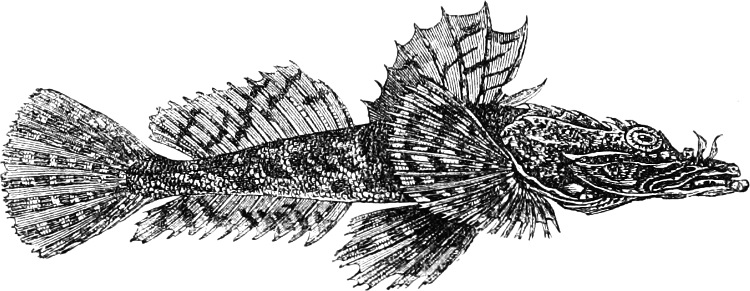
Fig. 212.—Platycephalus cirrhonasus, from Port Jackson.
About forty species are known, of which some attain a length of two feet. This genus represents in the tropical Indian Ocean the Cotti of the Arctic, and the Nototheniæ of the Antarctic zone. Like these, they live on the bottom in shallow water, hidden in the sand, the colours of which are assimilated by those of their body. Therefore, they are very scarce near coral islands which are surrounded by great depths; whilst the number of species is rather considerable on many points of the shelving Australian coasts. Their long and strong ventral fins are of great use to them in locomotion. P. insidiator is one of the most common Indian and Australian fishes, and readily recognised by two oblique black bands on the upper and lower caudal lobes.
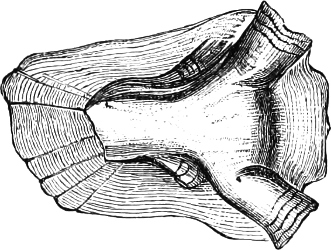
Fig. 213.—Scale from the lateral line of the same fish.
Hoplichthys, similar to Platycephalus, but with the back and sides of the body covered with bony spiny plates. No separate dorsal spine.
One species, H. langsdorffii, is common on the coast of Japan, and frequently placed dry by the Chinese into their insect-boxes.
Trigla.—Head parallelopiped, with the upper surface and the sides entirely bony, the enlarged infraorbital covering the cheek.
Two dorsal fins. Three free pectoral rays. Villiform teeth. Air-bladder generally with lateral muscles, often divided into two lateral halves. The species may be referred to three groups:—
1. Palatine teeth none; scales exceedingly small, except those of the lateral line: Trigla.
2. Palatine teeth none; scales of moderate size: Lepidotrigla.
3. Palatine teeth present: Prionotus.
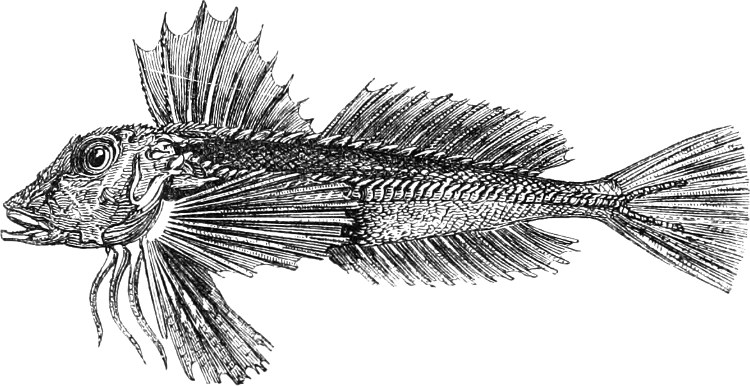
Fig. 214.—Trigla pleuracanthica.
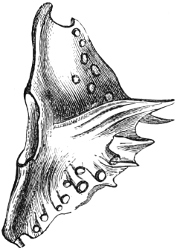
Fig. 215.—Scute of the lateral line of the same fish.
About forty species of “Gurnards” are known from tropical and temperate zones. They are too well known to need detailed description; one of their principal characteristics is the three free finger-like pectoral appendages, which serve as organs of locomotion as well as touch, and which are supplied with strong nerves, as noticed above (pp. 108 and 120). The fins are frequently beautifully ornamented, especially the inner side of the long and broad pectorals, which is most exposed to the light when the fish is floating on the surface of the water, with pectorals spread out like wings. The grunting noise made by Gurnards when taken out of the water is caused by the escape of gas from the air-bladder through the open pneumatic duct. Gurnards are generally used as food; seven species occur on the British coast: the Red Gurnard (T. pini), the Streaked Gurnard (T. lineata), the Sapphirine Gurnard (T. hirundo), the Grey Gurnard (T. gurnardus), Bloch’s Gurnard (T. cuculus), the Piper (T. lyra), and the Long-finned Gurnard (T. obscura or T. lucerna). Singularly, the European species cross the Atlantic but rarely, the American species belonging chiefly to the division Prionotus.
Several other genera belong to this family; for completeness’ sake they are mentioned here, viz. Bunocottus from Cape Horn; Rhamphocottus, Triglops from Arctic North America; Podabrus, Blepsias, Nautichthys, Scorpænichthys, Hemilepidotus, Artedius, from the North Pacific; Ptyonotus, from Lake Ontario; Polycaulus from Indian Seas; Bembras from the Japanese Sea.
Fourteenth Family—Cataphracti.
Form of the body elongate, sub-cylindrical. Dentition feeble. Body completely cuirassed with osseous keeled scales or plates. A bony stay connects the angle of the præoperculum with the infraorbital ring. Ventrals thoracic.
Marine fishes, and partly pelagic. Petalopteryx, from the chalk of Mount Lebanon, is supposed to have a resemblance to Dactylopterus.
Agonus.—Head and body angular, covered with bony plates. Two dorsal fins; no pectoral appendages. Small teeth in the jaws.
Small fishes, from the northern parts of the temperate zone and extending into the Arctic Ocean; the genus reappears in the Southern Hemisphere on the coast of Chile. Of the eleven species known, one (A. cataphractus) is not uncommon on the coast of Great Britain.
Aspidophoroides, from Greenland, has a very similar form of the body, but possesses one short dorsal fin only.
Siphagonus.—With the snout produced into a long tube like a Syngnathus; chin prominent, with a barbel.
From Behring’s Strait and Japan.
Peristethus.—Head parallelopiped, with the upper surface and the sides entirely bony; each præorbital prolonged into a long flat process, projecting beyond the snout. Body cuirassed with large bony plates. One continuous dorsal, or two dorsals, of which the second is the more developed. Two free pectoral appendages. Teeth none; lower jaw with barbels.
Singularly shaped fishes, of rather small size, from the Mediterranean, the warmer parts of the Atlantic, and the Indian Ocean; of the ten species known one species only has been found in the Pacific, near the Sandwich Islands. The European species is P. cataphractum. They are not common, and probably inhabit greater depths than the Gurnards, with which they have much in common as regards their habits.
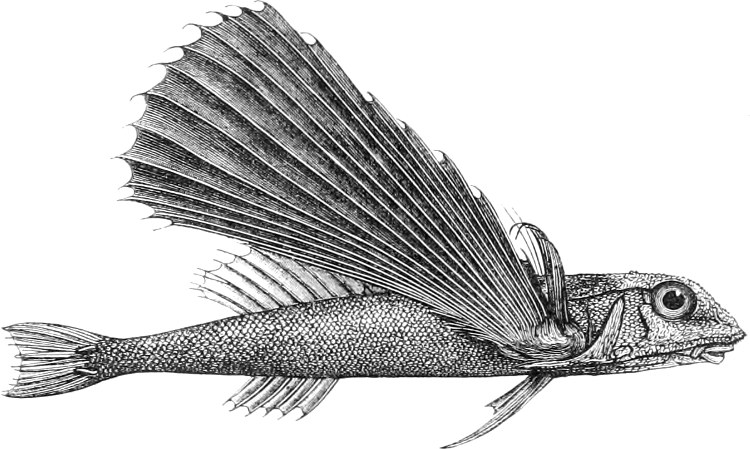
Fig. 216.—Dactylopterus volitans.
Dactylopterus.—Head parallelopiped, with the upper surface and the sides entirely bony; scapula and angle of the præoperculum produced into long spines. Body with strongly keeled scales of moderate size; lateral line none. Two dorsal fins, the second not much longer than the first; pectoral very long, an organ of flying, with the upper portion detached and shorter. Granular teeth in the jaws; none on the palate. Air-bladder divided into two lateral halves, each with a larger muscle.
Of “Flying Gurnards” three species only are known, which are very abundant in the Mediterranean, the tropical Atlantic, and Indo-Pacific. They, and the Flying Herrings (Exocoetus), are the only fishes which are enabled by their long pectoral fins to take flying leaps out of the water, and deserve the name of “Flying-Fishes.” They are much heavier, and attain to a larger size, than the Exocoeti, specimens of eighteen inches in length not being scarce. When young, their pectorals are much shorter, and, consequently, they are unable to raise themselves out of the water (Cephalacanthus).
The vertebral column shows a singular coalescence of the anterior vertebræ, which form a simple tube, as in Fistularia.
We insert here as an appendix to this division the small family of Pegasidæ, the natural affinities of which are not yet clearly understood, but which resembles in some of its characters the Cataphracti.
Fifteenth Family—Pegasidæ.
Body entirely covered with bony plates, anchylosed on the trunk and movable on the tail. Barbels none. The margin of the upper jaw is formed by the intermaxillaries and their cutaneous prolongation, which extends downwards to the extremity of the maxillaries. Gill-cover formed by a large plate, homologous to the operculum, præoperculum, and sub-operculum; interoperculum a long fine bone, hidden below the gill-plate. One rudimentary branchiostegal. The gill-plate is united with the isthmus by a narrow membrane; gill-openings narrow, in front of the base of the pectoral fin. Gills four, lamellated. Pseudobranchiæ and air-bladder absent. One short dorsal and anal fin, opposite to each other. Ventral fin present. Ovarian sacs closed.
One genus only is known, Pegasus. Its pectoral fins are broad, horizontal, long, composed of simple rays, some of which are sometimes spinous. Ventral fins one- or two-rayed. Upper part of the snout produced into a shorter or longer process. Mouth inferior, toothless. Suborbital ring well developed, forming a suture with the gill-cover. Vertebræ in small number, thin; no ribs. Four species are known, two of which are of a shorter, and the two others of a longer form. The former are P. draconis, common in the Indian Ocean, and P. volans, which is frequently stuck by the Chinese into the insect-boxes which they manufacture for sale. The two elongate species, P. natans and P. lancifer, are from the Chinese and Australian coasts. They are all very small fishes, probably living on sandy shoal places near the coast.
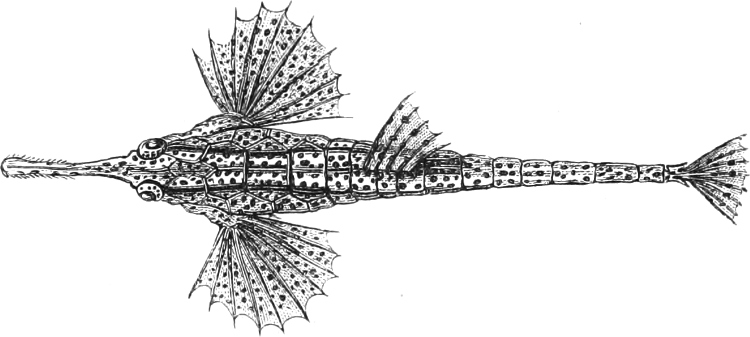
Fig. 217.—Pegasus natans.
Ninth Division—Acanthopterygii Gobiiformes.
The spinous dorsal, or spinous portion of the dorsal is always present, short, either composed of flexible spines, or much less developed than the soft; the soft dorsal and anal of equal extent. No bony stay for the angle of the præoperculum. Ventrals thoracic or jugular, if present, composed of one spine and five, rarely four, soft rays. A prominent anal papilla.
Shore-fishes, mostly exclusively marine, but some entering and living in fresh waters.
First Family—Discoboli.
Body thick or oblong, naked or tubercular. Teeth small. Ventral fins with one spine and five rays, all being rudimentary and forming the osseous support of a round disk, which is surrounded by a cutaneous fringe. Gill-openings narrow, the gill-membranes being attached to the isthmus.
Carnivorous fishes, living at the bottom of the shores of northern seas. By their ventral disk they are enabled to attach themselves very firmly to rocks.
Cyclopterus.—Body thick, short, covered with a viscous, tubercular skin. Head large, snout short. Villiform teeth in the jaws, none on the palate. Skeleton soft, with but little earthy matter.
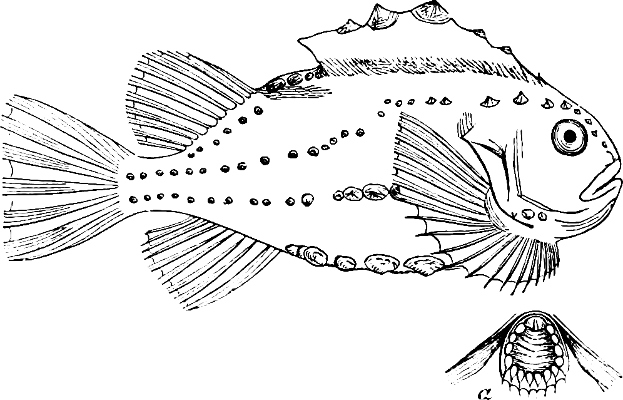
Fig. 218.—Cyclopterus lumpus. a, Ventral disk.
Three species of “Lump-suckers” are known from the northern temperate and the arctic zones. The common North European and North American species, C. lumpus, is known also by the names of “Cock- and Hen-Paddle.” It attains to a length of twenty-four inches, but generally is much smaller. It is difficult to remove it from any object to which it once has attached itself by means of its sucking-disk. Its skin is so thick as to more or less entirely conceal the first dorsal fin; it is covered with rough tubercles, the larger ones being arranged in four series along each side of the body. In young specimens these tubercles are absent. The arctic species, C. spinosus, has large conical plates on the head and body, each plate with a spine in the centre. Also of this species the young are naked, the plates making only gradually their appearance, in the form of groups of tubercles. Their development is irregular, as young specimens of the same size may be entirely naked or tubercular. This species ranges beyond the 81° lat. N.
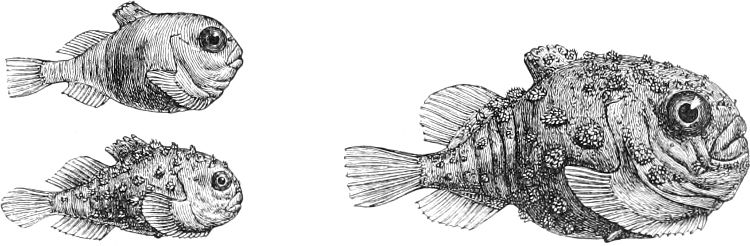
Fig. 219.—Young of Cyclopterus spinosus, from the Arctic Ocean, natural size.
Liparis.—Body sub-cylindrical, enveloped in a more or less loose naked skin; head broad, obtuse. The infraorbital bone is styliform posteriorly, extending backwards to the margin of the præoperculum. One dorsal fin, with feeble flexible rays. Villiform teeth in the jaws, none on the palate.
Small fishes from the northern coasts of the temperate zone, ranging beyond the arctic circle. Eight species are known, of which two (L. lineatus and L. montagui) occur on the British coasts.
Second Family—Gobiidæ.
Body elongate, naked or scaly. Teeth generally small, sometimes with canines. The spinous dorsal fin, or portion of the dorsal fin, is the less developed, and composed of flexible spines; anal similarly developed as the soft dorsal. Sometimes the ventrals are united into a disk. Gill-opening more or less narrow, the gill-membranes being attached to the isthmus.
Small carnivorous littoral fishes, many of which have become acclimatised in fresh water. They are very abundant with regard to species as well as individuals, and found on or near the coasts of all temperate and tropical regions. Geologically they appear first in the chalk.
Gobius.—Body scaly. Two dorsal fins, the anterior generally with six flexible spines. Ventral fins united, forming a disk which is not attached to the abdomen. Gill-opening vertical, moderately wide.
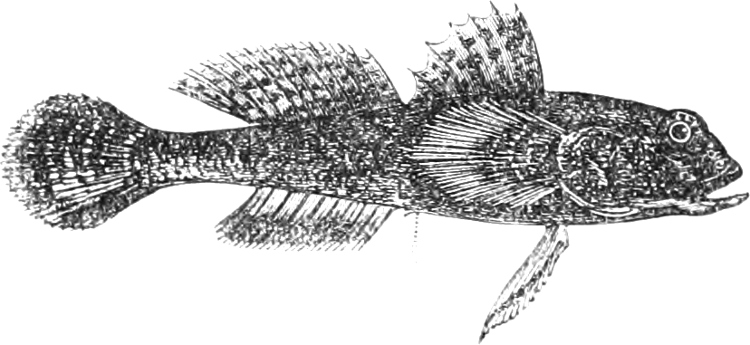
Fig. 220.—Gobius lentiginosus, from New Zealand.
The “Gobies” are distributed over all temperate and tropical coasts, and abundant, especially on the latter. Nearly three hundred species have been described. They live especially on rocky coasts, attaching themselves firmly with their ventrals to a rock in almost any position, and thus withstanding the force of the waves. Many of the species seem to delight in darting from place to place in the rush of water which breaks upon the shore. Others live in quiet brackish water, and not a few have become entirely acclimatised in fresh water, especially lakes. The males of some species construct nests for the eggs, which they jealously watch, and defend even for some time after the young are hatched. Several species are found on the British coast: G. niger, paganellus, auratus, minutus, ruthensparri. Fossil species of this genus have been found at Monte Bolca.
A very small Goby, Latrunculus pellucidus, common in some localities of the British Islands and other parts of Europe, is distinguished by its transparent body, wide mouth, and uniserial dentition. According to R. Collett it offers some very remarkable peculiarities. It lives one year only, being the first instance of an annual vertebrate. It spawns in June and July, the eggs are hatched in August, and the fishes attain their full growth in the months from October to December. In this stage the sexes are quite alike, both having very small teeth and feeble jaws. In April the males lose the small teeth, which are replaced by very long and strong teeth, the jaws themselves becoming stronger. The teeth of the females remain unchanged. In July and August all the adults die off, and in September only the fry are to be found.
There are several other genera, closely allied to Gobius, as Euctenogobius, Lophiogobius, Doliichthys, Apocryptes, Evorthodus, Gobiosoma and Gobiodon (with scaleless body) Triænophorichthys.
Sicydium.—Body covered with ctenoid scales of rather small size. Cleft of the mouth nearly horizontal, with the upper jaw prominent; lips very thick; the lower lip generally with a series of minute horny teeth. A series of numerous small teeth in upper jaw, implanted in the gum, and generally movable; the lower jaw with a series of conical widely-set teeth. Two dorsal fins, the anterior with six flexible spines. Ventral fins united, and forming a short disk, more or less adherent to the abdomen.
Small freshwater fishes inhabiting the rivers and rivulets of the islands of the tropical Indo-Pacific. About twelve species are known; one occurs in the West Indies. Lentipes from the Sandwich Islands is allied to Sicydium.
Periophthalmus.—Body covered with ctenoid scales of small or moderate size. Cleft of the mouth nearly horizontal, with the upper jaw somewhat longer. Eyes very close together, immediately below the upper profile, prominent, but retractile, with a well-developed outer eyelid. Teeth conical, vertical in both jaws. Two dorsal fins, the anterior with flexible spines; caudal fin with the lower margin oblique; base of the pectoral fin free, with strong muscles. Ventral fins more or less coalesced. Gill-openings narrow.
The fishes of this genus, and the closely-allied Boleophthalmus, are exceedingly common on the coasts of the tropical Indo-Pacific, especially on parts covered with mud or fucus. During ebb they leave the water and hunt for small crustaceans, and other small animals disporting themselves on the ground which is left uncovered by the receding water. With the aid of their strong pectoral and ventral fins and their tail, they hop freely over the ground, and escape danger by rapid leaps. The peculiar construction of their eyes, which are very movable, and can be thrust far out of their sockets, enables them to see in the air as well as in the water; when the eyes are retracted they are protected by a membranous eyelid. These fishes are absent in the eastern parts of the Pacific and on the American side of the Atlantic; but singularly enough one species reappears on the West African coast. About seven species are known (including Boleophthalmus), P. koelreuteri being one of the most common fishes of the Indian Ocean.
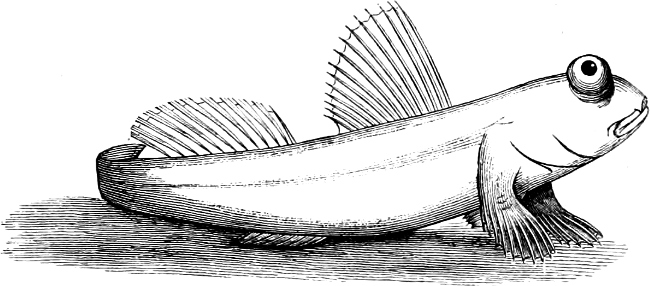
Fig. 221.—Periophthalmus koelreuteri.
Eleotris.—Body scaly; eyes of moderate size, lateral, not prominent. Teeth small. Two dorsal fins, the anterior generally with six spines. Ventrals not united, though close together, with one spine and five rays.
About sixty species are known from the tropics, only a few extending into the temperate zone. As regards form, they repeat almost all the modifications observed among the Gobies, from which they differ only in having the ventral fins non-coalescent. On the whole they are somewhat larger than the Gobies, and rather freshwater than marine species, some of them being abundant in the rivulets of the islands of the Indo-Pacific and Atlantic. Others have even penetrated into the inland-waters of the African continent.
Trypauchen.—Body elongate, covered with minute scales; head compressed, with a deep cavity on each side, above the operculum. Teeth small, in a band. One dorsal, the spinous portion composed of six spines; dorsal and anal fins continuous with the caudal, ventral fins united.
Small fishes of singular aspect, from the East Indian coasts. Three species, of which T. vagina is common.
Callionymus.—Head and anterior part of the body depressed, the rest cylindrical, naked. Snout pointed, with the cleft of the mouth narrow, horizontal, and with the upper jaw very protractile. Eyes rather large, more or less directed upwards. Teeth very small, palate smooth. A strong spine at the angle of the præoperculum. Two dorsal fins, the anterior with three or four flexible spines; ventrals five-rayed, widely apart from each other. Gill-openings very narrow, generally reduced to a foramen on the upper side of the operculum.
The “Dragonets” are small, and generally beautifully coloured marine fishes, inhabitants of the coasts of the temperate zone of the Old World; the minority of species live in tropical parts of the Indo-Pacific; and these seem to descend to somewhat greater depths than the littoral species of the northern hemisphere. Secondary sexual characters are developed in almost all the species, the mature males having the fin-rays prolonged into filaments, and the fin-membranes brightly ornamented. On the British coast one species (C. draco) is very common, and locally called “Skulpin.” About thirty species are known, many of which have the præopercular spine armed with processes or barbs. Vulsus is allied to Callionymus.
Other genera belonging to this family are—Benthophilus from the Caspian Sea; Amblyopus, Orthostomus, Platyptera, Luciogobius, Oxymetopon, and, perhaps, Oxuderces.
Tenth Division—Acanthopterygii Blenniiformes.
Body low, sub-cylindrical or compressed, elongate. Dorsal fin very long; the spinous portion of the dorsal, if distinct, is very long, as well developed, as the soft, or much more; sometimes the entire fin is composed of spines only; anal more or less long; caudal fin subtruncated or rounded, if present. Ventral fins thoracic or jugular, if present.
First Family—Cepolidæ.
Body very elongate, compressed, covered with very small cycloid scales; eyes rather large, lateral. Teeth of moderate size. No bony stay for the angle of the præoperculum. One very long dorsal fin, which, like the anal, is composed of soft rays. Ventrals thoracic, composed of one spine and five rays. Gill-opening wide. Caudal vertebræ exceedingly numerous.
The “Band-fishes” (Cepola) are small marine fishes, belonging principally to the fauna of the northern temperate zone; in the Indian Ocean the genus extends southwards to Pinang. The European species (C. rubescens) is found in isolated examples on the British coast, but is less scarce in some years than in others. These fishes are of a nearly uniform red colour.
Second Family—Trichonotidæ.
Body elongate, sub-cylindrical, covered with cycloid scales of moderate size. Eyes directed upwards. Teeth in villiform bands. No bony stay for the angle of the præoperculum. One long dorsal fin, with simple articulated rays, and without a spinous portion; anal long. Ventrals jugular, with one spine and five rays. Gill-opening very wide. The number of caudal vertebræ much exceeding that of the abdominal.
Small marine fishes, belonging to two genera only, Trichonotus (setigerus) from Indian Seas, with some of the anterior dorsal rays prolonged into filaments; and Hemerocoetes (acanthorhynchus) from New Zealand, and sometimes found far out at sea on the surface.
Third Family—Heterolepidotidæ.
Body oblong, compressed, scaly; eyes lateral; cleft of the mouth lateral; dentition feeble. The angle of the præoperculum connected by a bony stay with the infraorbital ring. Dorsal long, with the spinous and soft portions equally developed; anal elongate. Ventrals thoracic, with one spine and five rays.
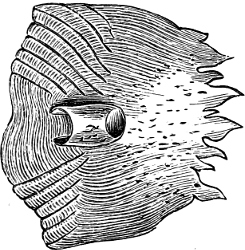
Fig. 222.—Scale from the lateral line of Hemerocœtes acanthorhynchus, with lacerated margin.
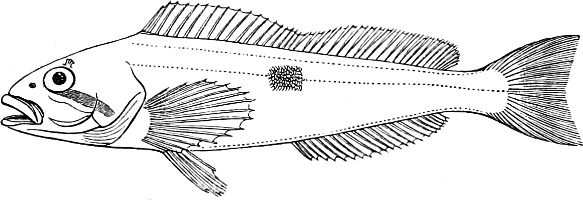
Fig. 223.—Chirus hexagrammus, from Japan.
Small shore-fishes, characteristic of the fauna of the Northern Pacific, some of the species occurring on the American as well as Asiatic side. They have been referred to several genera, as
Chirus, which is distinguished by the presence of several lateral lines;
Ophiodon, with one lateral line only, cycloid scales, and slightly armed præoperculum;
Agrammus, with one lateral line only, ctenoid scales, and unarmed præoperculum; and
Zaniolepis, with one lateral line and minute comb-like scales.
Fourth Family—Blenniidæ.
Body elongate, low, more or less cylindrical, naked or covered with scales, which generally are small. One, two, or three dorsal fins occupying nearly the whole length of the back, the spinous portion, if distinct, being as much developed as the soft, or more; sometimes the entire fin is composed of spines; anal fin long. Ventrals jugular, composed of a few rays, and sometimes rudimentary or entirely absent. Pseudobranchiæ generally present.
Littoral forms of great generic variety, occurring abundantly in all temperate and tropical seas. Some of the species have become acclimatised in fresh water, and many inhabit brackish water. With very few exceptions they are very small, some of the smallest fishes belonging to the family of “Blennies.” One of the principal characteristics of the Blennies is the ventral fin, which is formed by less than five rays, and has a jugular position. The Blennies have this in common with many Gadoids, and it is sometimes difficult to decide to which of these two families a fish should be referred. In such doubtful cases the presence of the pseudobranchiæ (which are absent in Gadoids) may be of assistance.
In many Blennies the ventral fins have ceased to have any function, and become rudimentary, or are even entirely absent. In others the ventral fins, although reduced to cylindrical stylets, possess a distinct function, and are used as organs of locomotion, by the aid of which the fish moves rapidly over the bottom.
The fossil forms are scarcely known; Pterygocephalus from Monte Bolca appears to have been a Blennioid.
Anarrhichas.—Body elongate, with rudimentary scales; snout rather short; cleft of the mouth wide; strong conical teeth in the jaws, those on the sides with several pointed tubercles; a biserial band of large molar teeth on the palate. Dorsal fin long, with flexible spines; caudal separate. Ventrals none. Gill-openings wide.
The “Sea-wolf,” or “Sea-cat” (A. lupus), is a gigantic Blenny, attaining to a length of more than six feet. With its enormously strong tubercular teeth it is able to crush the hardest shells of Crustaceans or Mollusks, on which it feeds voraciously. It is an inhabitant of the northern seas, like two other allied species, all of which are esteemed as food by the inhabitants of Iceland and Greenland. Two other species of Sea-wolves occur in the corresponding latitudes of the North Pacific.
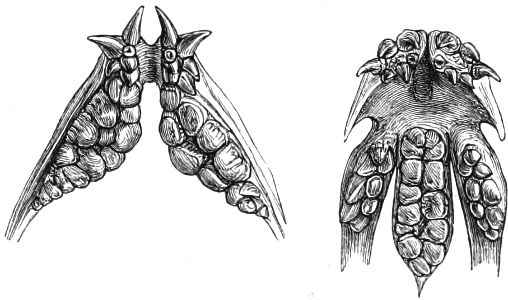
Fig. 224.—Teeth of the Wolf-fish, Anarrhichas lupus.
Blennius.—Body moderately elongate, naked; snout short. A single dorsal, without detached portion; ventrals jugular, formed by a spine and two rays. Cleft of the mouth narrow; a single series of immovable teeth in the jaws; generally a curved tooth behind this series in both jaws, or in the lower only. A more or less developed tentacle above the orbit. Gill-opening wide.
About forty species of Blennius (in the restricted generic sense) are known from the northern temperate zone, the tropical Atlantic, Tasmania, and the Red Sea. But in the tropical Indian Ocean they are almost entirely absent, and replaced by other allied genera. Three species, found near the Sandwich Islands, are immigrants into the Pacific from the American Continent. They generally live on the coast, or attach themselves to floating objects, some species leading a pelagic life, hiding themselves in floating seaweed, in which they even propagate their species. All species readily accustom themselves to fresh water, and some (B. vulgaris) have become entirely acclimatised in inland lakes. British species are B. gattorugine (growing to a length of twelve inches), B. ocellaris, B. galerita, and B. pholis, the common “Shanny.”
Chasmodes is a genus allied to Blennius, from the Atlantic coasts of temperate North America.
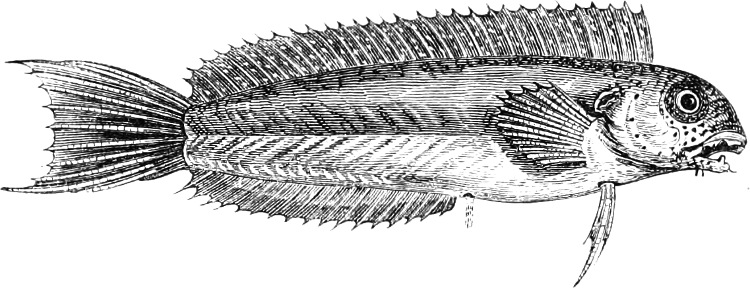
Fig. 225.—Petroscirtes bankieri, from Hong-Kong.
Petroscirtes.—Body moderately elongate, naked. Snout generally short. A single dorsal fin; ventrals composed of two or three rays. Cleft of the mouth narrow; a single series of immovable teeth in the jaws; a strong curved canine tooth behind this series, that of the lower jaw much stronger than that of the upper. Head sometimes with tentacles. Gill-opening reduced to a small fissure above the root of the pectoral.
Thirty species, from the tropical Indo-Pacific, of small size.
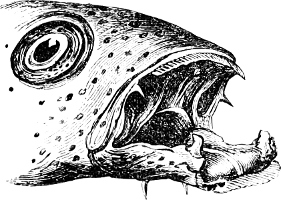
Fig. 226.—Dentition of the same, enlarged.
Salarias.—Body moderately elongate, naked; snout short, with transverse cleft of the mouth; a series of numerous small teeth in the jaws, implanted in the gum and movable; generally a curved canine tooth on each side of the lower jaw, behind the series of small teeth. Dorsal fin continuous, sometimes divided into two portions by a more or less deep notch without a detached anterior part. Ventral fins with two or three rays. A tentacle above the orbit. Gill-openings wide.
Sixty species are known from the tropical zone, extending northwards to Madeira, southwards to Chile and Tasmania. In certain individuals of some of the species a longitudinal cutaneous crest is developed; all young individuals lack it, and in some other species it is invariably absent. Singularly enough this crest is not always a sexual character, as one might have supposed from analogy, but in some species at least it is developed in both sexes. Mature males, however, have generally higher dorsal fins and a more intense and variegated coloration than females and immature males, as is also the case in Blennius.
Clinus.—Body moderately elongate, covered with small scales; snout rather short; a narrow band or series of small teeth in the jaws and on the palate. Dorsal fin formed by numerous spines and a few soft rays, without a detached anterior portion; anal spines two. Ventrals with two or three rays. A tentacle above the orbit. Gill-opening wide.
Thirty species, from the coasts of tropical America and the southern temperate zone. Three other genera are closely allied to Clinus, viz. Cristiceps and Cremnobates, in which the three anterior dorsal spines are detached from the rest of the fin; and Tripterygium, with three distinct dorsal fins, of which the two anterior are spinous. The species of these genera are as numerous as those of Clinus, occurring in many parts of tropical seas, in the Mediterranean, and being especially well represented in South Australia and New Zealand.
Stichæus.—Body elongate, covered with very small scales; lateral line more or less distinct, sometimes several lateral lines. Snout short; very small teeth in the jaws, and generally on the palate. Dorsal fin long, formed by spines only. Ventrals with two or three rays. Caudal fin distinct. Gill-openings rather wide.
Small fishes, peculiar to the coasts near the arctic circle, ranging southwards to the coasts of Japan and Scandinavia. Ten species.
Blenniops.—Body moderately elongate, covered with very small scales; lateral line none. Snout short; small teeth in the jaws, none on the palate. Dorsal fin long, formed by spines only. Ventrals with one spine and three rays. Caudal distinct. Gill-openings of moderate width, the gill-membranes coalescent across the isthmus.
A fine but not common kind of Blenny (B. ascanii), from the British and Scandinavian coasts.
Centronotus.—Body elongate, covered with very small scales; lateral line none. Snout short; very small teeth in the jaws. Dorsal fin long, formed by spines only. Ventrals none or rudimentary; caudal separate. Gill-openings of moderate width, gill-membranes coalescent.
Ten species are known from the northern coasts; southwards the genus extends to the coasts of France, New York, California, and Japan. C. gunellus, or the “Gunnel-fish” or “Butter-fish,” is common on the British coasts. Apodichthys is allied to Centronotus, but the vertical fins are confluent; and a very large, excavated, pen-like spine lies hidden in a pouch in front of the anal fin. This spine is evidently connected in some way with the generative organs, as a furrow leads from the orifice of the oviduct to the groove of the spine. One species from the Pacific coast of North America. Xiphidion is another closely allied genus from the same locality.
Cryptacanthodes.—Body very elongate, naked, with a single lateral line. Head with the muciferous system well developed. Eye rather small. Conical teeth in the jaws, on the vomer and palatine bones. One dorsal formed by spines only; caudal connected with dorsal and anal. Ventrals none. Gill-opening of moderate width, with the gill-membranes joined to the isthmus.
One species (C. maculatus) from the Atlantic coasts of North America.
Patæcus.—Body oblong, elevated anteriorly; snout short, with subvertical anterior profile; minute teeth in the jaws and on the vomer. Dorsal fin with the anterior spines strong and long, continuous with the caudal; ventrals none. Gill-openings wide.
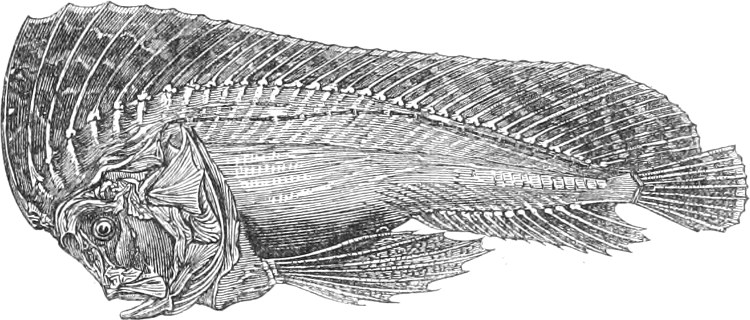
Fig. 227.—Patæcus fronto.
Three species of this singular form are known from South and West Australia.
Zoarces.—Body elongate, with the scales rudimentary; conical teeth in the jaws. Dorsal fin long, with a depression on the tail, which is formed by a series of spines much shorter than the rays. No other fin-spines. No separate caudal fin. Ventrals short, formed by three or four rays. Gill-openings wide.
Two species are known, one from the European, and the other from the North American side of the Atlantic. The former, Z. viviparus, is well known by the name of “Viviparous Blenny;” as is signified by this name it produces its young alive. These are so matured at the time of their birth that on their first exclusion they swim about with the utmost agility. No fewer than from two to three hundred young are sometimes produced by one female, and the abdomen of the mother is so distended before parturition that it is impossible to touch it without causing them to be extruded. Full grown individuals are about twelve inches long, but the American species (Z. anguillaris) attains to a length of two or three feet.
Other genera of the family of Blennoids are:—Blennophis, Nemophis, Plagiotremus, Neoclinus, Cebidichthys, Myxodes, Heterostichus, Dictyosoma, Lepidoblennius, Dactyloscopus, Gunellichthys, Urocentrus, Stichæopsis, Sticharium, Notograptus, Pholidichthys, and Pseudoblennius.
Fifth Family—Acanthoclinidæ.
Body elongate, low, compressed, covered with small scales. One dorsal fin, occupying nearly the whole of the back, and chiefly composed of spines. Anal fin long, with numerous spines. Ventrals jugular, composed of a few rays only.
Of this family one fish only is known (Acanthoclinus littoreus), a small Blenny abundant on the coast of New Zealand.
Sixth Family—Mastacembelidæ.
Body elongate, eel-like, covered with very small scales. Mandible long, but little moveable. Dorsal fin very long, the anterior portion composed of numerous short isolated spines; anal fin with spines anteriorly. Ventrals none. The humeral arch is not suspended from the skull. Gill-openings reduced to a slit at the lower part of the side of the head.
Freshwater-fishes characteristic of and almost confined to the Indian region. The structure of the mouth and of the branchial apparatus, the separation of the humeral arch from the skull, the absence of ventral fins, the anatomy of the abdominal organs, affords ample proof that these fishes are Acanthopterygian eels. Their upper jaw terminates in a pointed moveable appendage, which is concave and transversely striated inferiorly in Rhynchobdella, and without transverse striæ in Mastacembelus: the only two genera of this family. Thirteen species are known, of which Rh. aculeata, M. pancalus and M. armatus are extremely common, the latter attaining to a length of two feet. Outlying species are M. aleppensis from Mesopotamia and Syria, and M. cryptacanthus, M. marchei, and M. niger, from West Africa.

Fig. 228.—Mastacembelus argus, from Siam.
Eleventh Division—Acanthopterygii Mugiliformes.
Two dorsal fins more or less remote from each other; the anterior either short, like the posterior, or composed of feeble spines. Ventral fins with one spine and five rays, abdominal.
First Family—Sphyrænidæ.
Body elongate, sub-cylindrical, covered with small cycloid scales; lateral line continuous. Cleft of the mouth wide, armed with strong teeth. Eye lateral, of moderate size. Vertebræ twenty-four.
This family consists of one genus only, Sphyræna, generally called “Barracudas,” large voracious fishes from the tropical and sub-tropical seas, which prefer the vicinity of the coast to the open sea. They attain to a length of eight feet, and a weight of forty pounds; individuals of this large size are dangerous to bathers. They are generally used as food, but sometimes (especially in the West Indies) their flesh assumes poisonous qualities, from having fed on smaller poisonous fishes. Seventeen species.
The Barracudas existed in the tertiary epoch, their remains being frequently found at Monte Bolca. Some other fossil genera have been associated with them, but as they are known from jaws and teeth or vertebræ only, their position in the system cannot be exactly determined; thus Sphyrænodus and Hypsodon from the chalk of Lewes, and the London clay of Sheppey. The American Portheus is allied to Hypsodon. Another remarkable genus from the chalk, Saurocephalus, has been also referred to this family.[44]
Second Family—Atherinidæ.
Body more or less elongate, sub-cylindrical, covered with scales of moderate size; lateral line indistinct. Cleft of the mouth of moderate width, with the dentition feeble. Eye lateral, large or of moderate size. Gill-openings wide. Vertebræ very numerous.
Small carnivorous fishes inhabiting the seas of the temperate and tropical zones; many enter fresh water, and some have been entirely acclimatised in it. This family seems to have been represented in the Monte Bolca formation by Mesogaster.
Atherina.—Teeth very small; scales cycloid. The first dorsal is short and entirely separated from the second. Snout obtuse, with the cleft of the mouth straight, oblique, extending to or beyond the anterior margin of the eye.
The Atherines are littoral fishes, living in large shoals, which habit has been retained by the species acclimatised in fresh water. They rarely exceed a length of six inches, but are nevertheless esteemed as food. From their general resemblance to the real Smelt they are often thus misnamed, but may always be readily recognised by their small first spinous dorsal fin. The young, for some time after they are hatched, cling together in dense masses, and in numbers almost incredible. The inhabitants of the Mediterranean coast of France call these newly hatched Atherines “Nonnat” (unborn). Some thirty species are known, of which A. presbyter and A. boyeri occur on the British coast.
Atherinichthys, distinguished from Atherina in having the snout more or less produced; and the cleft of the mouth generally does not extend to the orbit.
These Atherines are especially abundant on the coasts and in the fresh waters of Australia and South America. Of the twenty species known, several attain a length of eighteen inches and a weight of more than a pound. All are highly esteemed as food; but the most celebrated is the “Pesce Rey” of Chile (A. laticlavia).
Tetragonurus.—Body rather elongate, covered with strongly keeled and striated scales. The first dorsal fin is composed of numerous feeble spines, and continued on to the second. Lower jaw elevated, with convex dental margin, and armed with compressed, triangular, rather small teeth, in a single series.
This very remarkable fish is more frequently met with in the Mediterranean than in the Atlantic, but generally scarce. Nothing is known of its habits; when young it is one of the fishes which accompany Medusæ, and, therefore, it must be regarded as a pelagic form. Probably, at a later period of its life, it descends to greater depths, coming to the surface at night only. It grows to a length of eighteen inches.
Third Family—Mugilidæ.
Body more or less oblong and compressed, covered with cycloid scales of moderate size; lateral line none. Cleft of the mouth narrow or of moderate width, without or with feeble teeth. Eye lateral, of moderate size. Gill-opening wide. The anterior dorsal fin composed of four stiff spines. Vertebræ twenty-four.
The “Grey Mullets” inhabit in numerous species and in great numbers the coasts of the temperate and tropical zones. They frequent brackish waters, in which they find an abundance of food which consists chiefly of the organic substances mixed with mud or sand; in order to prevent larger bodies from passing into the stomach, or substances from passing through the gill-openings, these fishes have the organs of the pharynx modified into a filtering apparatus. They take in a quantity of sand or mud, and, after having worked it for some time between the pharyngeal bones, they eject the roughest and indigestible portion of it. The upper pharyngeals have a rather irregular form; they are slightly arched, the convexity being directed towards the pharyngeal cavity, tapering anteriorly and broad posteriorly. They are coated with a thick soft membrane, which reaches far beyond the margin of the bone, at least on its interior posterior portion; this membrane is studded all over with minute horny cilia. The pharyngeal bone rests upon a large fatty mass, giving it a considerable degree of elasticity. There is a very large venous sinus between the anterior portion of the pharyngeal and the basal portion of the branchial arches. Another mass of fat, of elliptical form, occupies the middle of the roof of the pharynx, between the two pharyngeal bones. Each branchial arch is provided on each side, in its whole length, with a series of closely-set gill-rakers, which are laterally bent downwards, each series closely fitting into the series of the adjoining arch; they constitute together a sieve, admirably adapted to permit a transit for the water, retaining at the same time every other substance in the cavity of the pharynx.
The lower pharyngeal bones are elongate, crescent-shaped, and broader posteriorly than anteriorly. Their inner surface is concave, corresponding to the convexity of the upper pharyngeals, and provided with a single series of lamellæ, similar to those of the branchial arches, but reaching across the bone from one margin to the other.
The intestinal tract shows no less peculiarities. The lower portion of the œsophagus is provided with numerous long thread-like papillæ, and continued into the oblong-ovoid membranaceous cœcal portion of the stomach, the mucosa of which forms several longitudinal folds. The second portion of the stomach reminds one of the stomach of birds; it communicates laterally with the other portion, is globular, and surrounded by an exceedingly strong muscle. This muscle is not divided into two as in birds, but of great thickness in the whole circumference of the stomach, all the muscular fasciculi being circularly arranged. The internal cavity of this stomach is rather small, and coated with a tough epithelium, longitudinal folds running from the entrance opening to the pyloric, which is situated opposite to the other. A low circular valve forms a pylorus. There are five rather short pyloric appendages. The intestines make a great number of circumvolutions, and are seven feet long in a specimen thirteen inches in length.
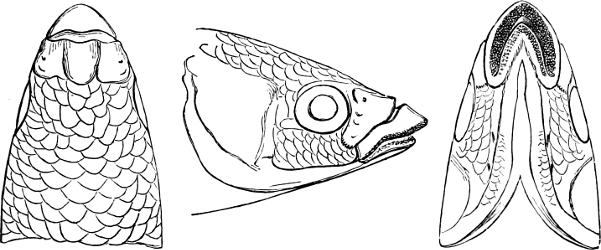
Fig. 229.—Mugil proboscideus.
Some seventy species of Grey Mullets are known, the majority of which attain to a weight of about four pounds, but there are many which grow to ten and twelve pounds. All are eaten, and some even esteemed, especially when taken out of fresh water. If attention were paid to their cultivation, great profits could be made by fry being transferred into suitable backwaters on the shore, in which they rapidly grow to a marketable size. Several species are more or less abundant on the British coasts, as Mugil octo-radiatus (Fig. 105, p. 254), M. capito, M. auratus (Fig. 106, p. 254), and M. septentrionalis (Fig. 107, p. 254), which, with the aid of the accompanying figures, and by counting the rays of the anal fin, may be readily distinguished—M. octo-radiatus having eight, and M. capito and M. auratus nine soft rays. A species inhabiting fresh waters of Central America (M. proboscideus) has the snout pointed and fleshy, thus approaching certain other freshwater and littoral Mullets, which, on account of a modification of the structure of the mouth, have been formed into a distinct genus, Agonostoma. Myxus comprises Mullets with teeth more distinct than in the typical species.
This genus existed in the tertiary epoch, remains of a species having been found in the gypsum of Aix, in Provence.
Twelfth Division—Acanthopterygii Gastrosteiformes.
The spinous dorsal is composed of isolated spines if present; the ventrals are either thoracic or have an abdominal position in consequence of the prolongation of the pubic bones which are attached to the humeral arch. Mouth small, at the end of the snout which is generally more or less produced.
First Family—Gastrosteidæ.
Body elongate, compressed. Cleft of the mouth oblique; villiform teeth in the jaws. Opercular bones not armed; infraorbitals covering the cheek; parts of the skeleton forming incomplete external mails. Scales none, but generally large scutes along the side. Isolated spines in front of the soft dorsal fin. Ventral fins abdominal, joined to the pubic bone, composed of a spine and a small ray. Branchiostegals three.
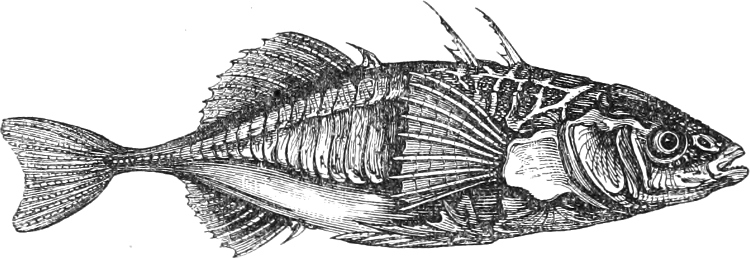
Fig. 230.—Gastrosteus noveboracensis.
Of “Sticklebacks” (Gastrosteus) about ten species are satisfactorily known, one of which (G. spinachia) lives in salt and brackish water, whilst the others inhabit principally fresh waters, although they all are able to exist in the sea. They are confined to the Temperate and Arctic zones of the northern hemisphere. The British freshwater species are the Three-spined Stickleback (G. aculeatus), which sometimes, especially in Central Europe, lacks scutes, sometimes has a series of scutes along the side of the body; the Four-spined Stickleback (G. spinulosus) and the Nine-spined Stickleback (G. pungitius). The commonest North American species is G. noveboracensis. The habits of all the freshwater species are very similar. The common European species (G. aculeatus) is an active and greedy little fish, extremely destructive to the fry of other species, and consequently injurious in ponds where these are sought to be preserved. It is scarcely to be conceived what damage these little fishes do, and how greatly detrimental they are to the increase of all the fishes in general among which they live; for it is with the utmost industry, sagacity, and greediness that they seek out and destroy all the young fry that come their way. A small Stickleback, kept in an aquarium, devoured, in five hours’ time, seventy-four young dace, which were about a quarter of an inch long, and of the thickness of a horse hair. Two days after it swallowed sixty-two; and would, probably, have eaten as many every day could they have been procured. The Stickleback sometimes swarms in prodigious numbers. Pennant states that at Spalding, in Lincolnshire, there was once in seven years amazing shoals, which appear in the Welland, coming up the river in the form of a vast column. The quantity may, perhaps, be conceived from the fact that a man employed in collecting them, gained, for a considerable time, four shillings a-day by selling them at the rate of a halfpenny a bushel. Costa, who studied the manners of these small fishes, relates that, on the approach of spawning time, the male builds a nest of stalks of grass and other matters in a hollow of the bottom, a little above three inches wide and about six inches and a half deep, creeping over the materials on his belly, and cementing them with the mucus that exudes from his skin. The bottom of the nest is first laid, then the sides are raised, and lastly the top is covered over. A small hole is left on one side for an entrance. When the erection is complete, he seeks out a female, and conducting her, Costa says, with many caresses, to the nest, introduces her by the door into the chamber. In a few minutes she has laid two or three eggs, after which she bores a hole on the opposite side of the nest to that by which she entered, and makes her escape. The nest has now two doors, and the eggs are exposed to the cool stream of water, which, entering by one door flows out at the other. Next day the male goes again in quest of a female, and sometimes brings back the same, sometimes finds a new mate. This is repeated until the nest contains a considerable number of eggs, and each time the male rubs his side against the female and passes over the eggs. Next the male watches a whole month over his treasure, defending it stoutly against all invaders, and especially against his wives, who have a great desire to get at the eggs. When the young are hatched and able to do for themselves his cares cease.