SYSTEMATIC AND DESCRIPTIVE PART. (continued 2)
Reading edition
Acerina.—All the teeth villiform, without canines; teeth on the vomer, but none on the palatine bones or the tongue. One continuous dorsal fin, of which the spinous portion consists of from thirteen to nineteen spines; two anal spines. Body rather low, with rather small scales. Bones of the skull with wide muciferous cavities; præoperculum denticulated.
Small freshwater perches, of which A. cernua, named “Pope” in England, is the most common, and has the widest distribution in Central Europe and Siberia. The two other species have a more restricted range, A. schrætzer being confined to the Danube and other rivers emptying into the Black Sea; and A. czekanowskii to Siberian rivers. This genus is not represented in the Western Hemisphere.
Lucioperca.—Teeth in villiform bands, those in the jaws with additional canines; palatine bones toothed. Two dorsal fins—the first with from twelve to fourteen, the anal fin with two spines. Præoperculum serrated; scales small.
The “Pike-Perches” are inhabitants of many lakes and rivers of the temperate northern zone. The European species is confined to the eastern two-thirds of the continent, and one of the most esteemed freshwater fishes; it attains to a length of three or four feet, and to a weight of from 25 to 30 lbs. It has been recommended for acclimatisation in England, and there is no doubt that in certain localities it might prove a valuable addition to the native fauna; but like all its congeners it is very voracious and destructive to smaller fishes. Two other species inhabit rivers of European and Asiatic Russia, and two or three the fresh waters of North America.
Pileoma.—All the teeth minute, villiform, without canines; teeth on the vomer and palatine bones. Two dorsal fins—the first with fourteen or fifteen spines. Body rather elongate, with small scales. Præoperculum not serrated.
Small freshwater perches abundant in the United States. Like the following genus, and some others which need not be mentioned here, they can be regarded as small, dwarfed representatives of the preceding genera. The species seem to be numerous, but have not yet been sufficiently well distinguished. The latest and best account of them is by L. Vaillant, “Recherches sur les Poissons d’eaux douces de l’Amérique septentrionale (Etheostomatidæ),” in Nouv. Archiv. du Muséum d’Hist. Nat. de Paris, ix., 1873.
Boleosoma.—Allied to Pileoma, but with only nine or ten feeble spines in the first dorsal fin. North America.
Aspro.—Body elongate, cylindrical; snout thick, projecting beyond the mouth, which is situated at its lower side. All the teeth villiform, without canines; teeth on the vomer and palatine bones. Two separate dorsals. Præoperculum serrated; præorbital entire. Scales small.
Two small Perches from the Danube and some other rivers of the continent of Europe, Aspro vulgaris and A. zingel.
Centropomus.—Body oblong, compressed, with scales of moderate size. All the teeth villiform, without canines; teeth on the vomer and palatine bones. Two dorsal fins, the first with eight strong spines, the anal with three, the second of which is very strong and long. Præoperculum with a double denticulated edge.
Numerous species are known from the West Indies and Central America. These fishes are found in fresh, brackish, and salt water, and some of the species indiscriminately enter all three kinds of water. They do not grow to any large size, but are esteemed as food.
Enoplosus.—Body much elevated, the depth being still more increased by the high vertical fins. All the teeth are villiform, without canines; teeth on the vomer, palatine bones, and the tongue. Two dorsal fins, the first with seven spines. Præoperculum serrated, with spinous teeth at the angle. Scales of moderate size.
A small and very common marine species (E. armatus) on the coast of Australia, especially New South Wales. It is readily recognised by the peculiar shape of its body, and eight black transverse bands on a whitish ground.
This, and the preceding genus, leads to the true “Sea perches,” which never, or but rarely, enter fresh water:—
Centropristis.—Body oblong, with scales of small or moderate size. Teeth villiform, with small canines in both jaws; vomerine teeth placed in an angular band, or a short triangular patch; teeth on the palatine bones, but none on the tongue. One dorsal, with the formula 10/12 or less; anal fin 3/7(6). Præoperculum serrated; sometimes with the angle projecting, and armed with long spines.
About twenty species of small size are known from temperate and tropical seas.
Anthias.—Body rather short, compressed, with scales of moderate size. Teeth villiform, with small canines in both jaws; teeth on the vomer, and palatine teeth. One dorsal, generally with ten spines; anal fin with three; caudal forked. The rays of one or more fins may be prolonged. Præoperculum serrated.
About twenty species are known from temperate and tropical seas; they are mostly of small size, and agreeably coloured, pink and yellow being the predominant colours. Anthias sacer is common in the Mediterranean, and was well known to the ancients. Aristotle says that the fishers of Sponges call it sacred, because no voracious fishes came to the places which it frequented, and the diver might descend with safety.—Callanthias is a genus closely allied to Anthias.
Serranus.—Body oblong, compressed, with small scales. Teeth villiform, with very distinct canines in both jaws; teeth on the vomer and palatine bones, none on the tongue. One dorsal, mostly with nine or eleven, rarely with eight, ten or twelve spines; anal fin with three: all the spines being stout. Præoperculum serrated behind and at the angle, but not below.
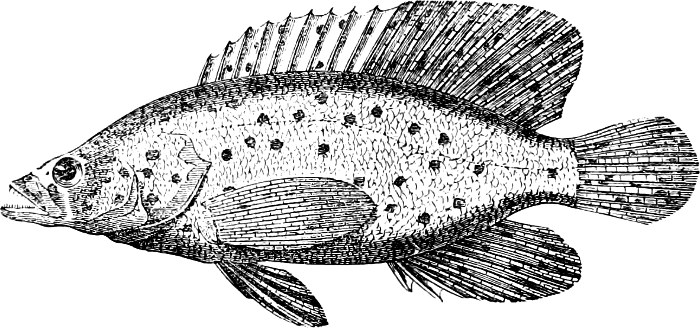
Fig. 152.—Serranus altivelis.
The “Sea perches proper” are found on the shores of all temperate and tropical seas, most abundantly in the latter. A few species enter brackish and even fresh water, one having been found as high up the Ganges as the confines of Nepal. However, all spawn in the sea. The variety of species is almost infinite, about 150 being tolerably well known, and many more having been described. The distinction of the species is most difficult, and nearly impossible to those who have no opportunity of closely and long observing them in nature, as they are not only subject to great variation of colour, but also to considerable changes dependent on age. Many are most agreeably coloured, and ornamented with spots, or cross bands or longitudinal stripes; colours which become more uniform with age in those species which attain to a large size. The majority remain of rather small size, growing to a length of one or two feet; but not a few reach more than twice that length, and may even become dangerous to man. Instances of bathers having been attacked by a gigantic species not uncommon at the Seychelles and Aden are on record, the persons having died from the injuries received. Almost all the species are eatable, and many are esteemed as food. One species is common on the British coasts (S. cabrilla), and probably some of the more southern species (S. scriba and S. gigas) occasionally wander as far northwards as the British Channel. The species figured, S. altvelis, is locally distributed over nearly all the tropical parts of the Indian Ocean, and distinguished by particularly high dorsal and anal fins. Anyperodon and Prionodes are two genera closely allied to Serranus.
Plectropoma.—Form of the body and dentition (see p. 127, Fig. 54) similar to that of Serranus, with a præoperculum serrated behind, and armed with spinous teeth below, which are directed forwards. Dorsal fin with from seven to thirteen spines.
About thirty species from tropical seas are known. Trachypoma is allied to this genus.
Polyprion.—Body oblong, rather compressed, covered with small scales. All the teeth are villiform; teeth on the vomer, palatine bones, and the tongue. One dorsal with eleven or twelve spines; anal with three. Præoperculum denticulated; a strong, rough, longitudinal ridge on the operculum.
Two species are known: one from the European coasts (P. cernium), and one from Juan Fernandez (P. kneri). They attain to a weight of 80 lbs. and more. The European species has the habit of accompanying floating wood, to which they are attracted by the small marine species generally surrounding such objects, and affording a supply of food. It is known by the name of “Stone-bass,” and excellent eating.
Grammistes.—Body rather short, compressed, covered with minute scales imbedded in the thick skin. All the teeth are villiform; teeth on the vomer and palatine bones. Two dorsal fins, the first with seven spines. Præoperculum without serrature, but with three short spines. A short skinny barbel is frequently developed at the chin.
Three species are known from the Indo-Pacific; they are of small size. One, G. orientalis, is black, with six or seven white longitudinal stripes, and one of the most common coast-fishes of that ocean.
Rhypticus.—Body oblong, compressed, covered with minute scales imbedded in the thick skin. All the teeth are villiform; teeth on the vomer and palatine bones. The spines of the vertical fins are but little developed, always in small number and short, and may disappear entirely. Præoperculum not serrated, with some obtuse spines.
Four species are known: three from the West Indies and one from the Galapagoes Islands.
Other genera allied to the two preceding are Aulacocephalus from Mauritius, Reunion, and Japan; and Myriodon from the coasts of Australia.
Diploprion.—Body rather elevated, compressed, with small scales. All the teeth villiform; teeth on the vomer and palatine bones. Two dorsal fins, the first with eight spines; anal with two. Præoperculum with a double denticulated limb.
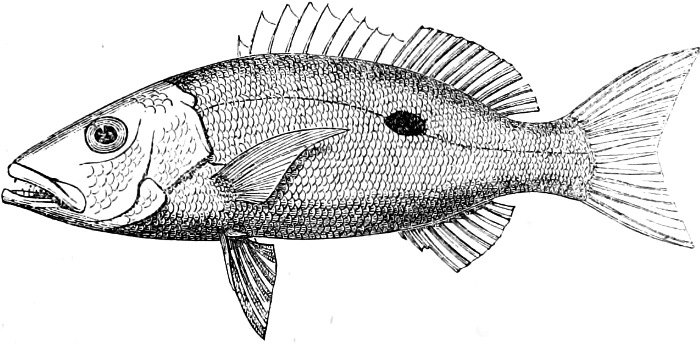
Fig. 153.—Mesoprion monostigma.
The single species known (D. bifasciatum), is very common in the East Indian Archipelago, and on the coasts of Southern China and Japan. It is of small size, and ornamented with two broad black cross-bands.
Mesoprion.—Body oblong, compressed, covered with scales of moderate size. Teeth villiform, with canines in both jaws; teeth on the vomer and palatine bones. One dorsal fin, with ten or eleven, rarely with more spines; anal fin with three. Præoperculum serrated; in some species (Genyoroge) a more or less distinct spinous knob projects from the surface of the interoperculum, and is received in a more or less deep notch of the præopercular margin.
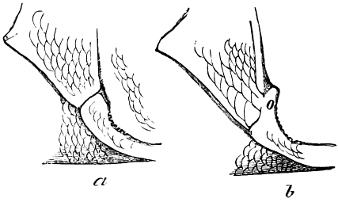
Fig. 154.—Opercles a, of Mesoprion; b, of Genyoroge; o, knob received in a notch of the præoperculum.
About seventy species are known from tropical seas in both hemispheres, but it is noteworthy that the species with the peculiar protuberance of the interoperculum are confined to the Indo-Pacific. The coloration is much more simple than in the small-scaled Serrani, a uniform hue of greenish, pink, or red prevailing; species with longitudinal bands are scarce, but not rarely dark cross-bands or a large spot on the side occur. The majority of the species remain within very moderate dimensions, specimens exceeding three feet in length being scarce. They are generally eaten, and some of the species belong to the commonest fishes of the tropics, as M. bengalensis, chrysurus, gembra, griseus, and others.
Glaucosoma from Japan and Australia is allied to Mesoprion.
Dules.—Body oblong, compressed, with scales of moderate size, and very indistinctly ctenoid. All the teeth are villiform; teeth on the vomer and palatine bones. One dorsal with ten spines; anal fin with three. Præoperculum serrated. Six branchiostegals only.
About ten species are known, inhabiting fresh waters of the coasts of the Indo-Pacific, and being especially common in the islands of this region, and also in Tropical Australia. Some live also in brackish water. Though of small size they are esteemed as food.
Therapon.—Body oblong, compressed, with scales of moderate size. All the teeth are villiform, those of the vomer and palatine bones being rudimentary, and frequently absent. One dorsal, with a depression in its upper margin, and twelve or thirteen spines; anal fin with three. Præoperculum serrated. Air-bladder with two divisions, an anterior and posterior. Six branchiostegals.
About twenty species are known, the distribution of which nearly coincides with Dules, but as some of the species are more or less marine, the genus is spread over the whole area of the tropical Indo-Pacific. Other species, especially those of Australian rivers, are entirely limited to fresh water. Th. theraps, Th. servus, and Th. cuvieri belong to the most common fishes of that area, extending from the east coast of Africa to Polynesia. They are readily recognised by the blackish longitudinal bands with which the body is ornamented. All the species are of small size. Helotes is closely allied to this genus.
Pristipoma.—Body oblong, compressed, with ctenoid scales of moderate size. Cleft of the mouth horizontal, not very wide, with the jaws nearly equal in length anteriorly; a central pit below the chin; villiform teeth in the jaws without canines; palate toothless. One dorsal, with eleven to fourteen spines; anal with three. Vertical fins not scaly, or with scales along the base only. Præoperculum serrated. Branchiostegals, seven.
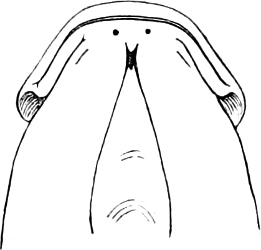
Fig. 155.—Lower view of mandible of Pristipoma manadense.
About forty species are known, all from the sea. They are extremely common between the tropics, some of the species extending into the neighbouring sub-tropical parts. They do not attain a large size, and generally have a plain coloration. Conodon is an allied genus.
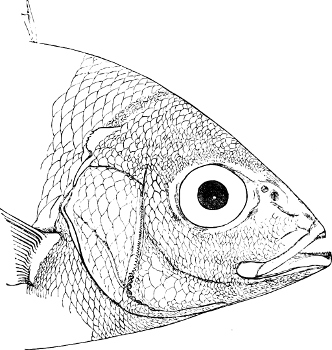
Fig. 156.—Hæmulon brevirostrum.
Hæmulon.—Body oblong, compressed, with ctenoid scales of moderate size. Cleft of the mouth horizontal, generally wide, with the jaws equal in length anteriorly; a central pit below the chin; villiform teeth in the jaws, without canines; palate toothless. One dorsal, with twelve or thirteen spines; anal with three; the soft portions of the vertical fins scaly to their margins. Præoperculum serrated. Branchiostegals, seven.
Marine; sixteen species are known from the coasts of Tropical America; they are of rather small size. The species figured occurs on both sides of Central America. Hapalogenys is an allied genus.
Diagramma.—Body oblong, compressed, covered with rather small ctenoid scales. Upper profile of the head parabolic; cleft of the mouth small, horizontal; from four to six pores under the mandible, but without central pit. Teeth villiform, without canines; palate toothless. One dorsal fin, with from nine to fourteen spines; anal with three. Vertical fins not scaly. Præoperculum serrated; infraorbital not armed. Branchiostegals, six or seven.
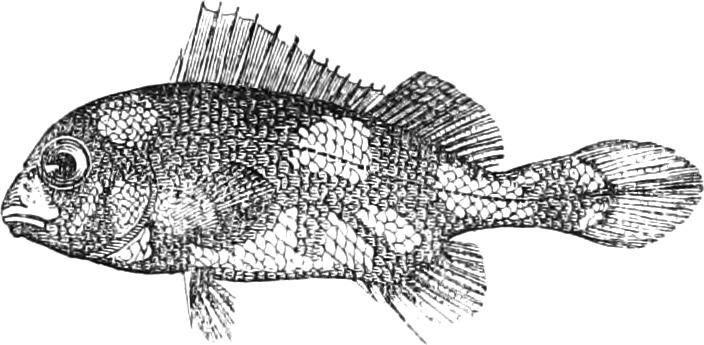
Fig. 157.—Diagramma orientale, from the Indo-Pacific.
Forty species are known, which, with very few exceptions, belong to the tropical parts of the Indo-Pacific. Some attain to a size not very common among Sea-Perches, viz. to a length of from three to four feet. Many are agreeably coloured with black bands or spots. All appear to be esteemed as food. Hyperoglyphe from Australia is allied to this genus.
Lobotes.—Body rather elevated, compressed, with ctenoid scales of moderate size. Eye rather small. Snout obtuse, with oblique cleft of the mouth, and with the lower jaw longest. Teeth villiform, without canines; palate toothless. One dorsal fin with twelve spines; anal with three. Præoperculum denticulated. Branchiostegals, six.
A remarkable fish (L. auctorum) on account of its extraordinary range. Common in many localities, scarcer in others, it occurs in the East Indies, and on all the Atlantic coasts of tropical and temperate America. Döderlein found it on the coast of Sicily in 1875. It lives in salt and brackish water, and is known to attain to a length of two feet.
Histiopterus.—Body rather elevated, strongly compressed, with very small scales. Snout much produced, the anterior profile of the head being concave. Mouth small, at the end of the snout. Teeth villiform, without canines; palate toothless. Some of the spines and rays of the vertical and pectoral fins very long. One dorsal, with about ten spines; anal with three. Præopercular margin partly serrated. Branchiostegals, six.
Marine. Four species are known from Japan and South Australia. The species figured attains to a length of 20 inches, and is esteemed as food. It is known at Melbourne by the names of “Boar Fish” or “Bastard Dorey.”
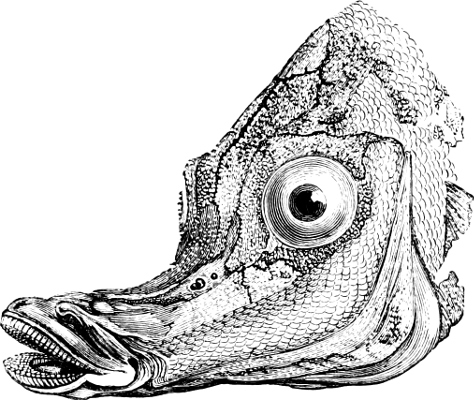
Fig. 158.—Histiopterus recurvirostris.
Gerres.—Body oblong, or rather elevated, covered with scales of moderate size, which are either entirely smooth or minutely ciliated. Mouth very protractile, and descending when thrust out. Eye rather large. No canine teeth; dentition feeble, and palate toothless. The two divisions of the dorsal fin are nearly separated by a deep incision. Formula of the vertical fins—D. 9/10 A. 2·3/7·9. Caudal fin forked. Præoperculum generally without denticulation. Lower pharyngeal bones coalescent.
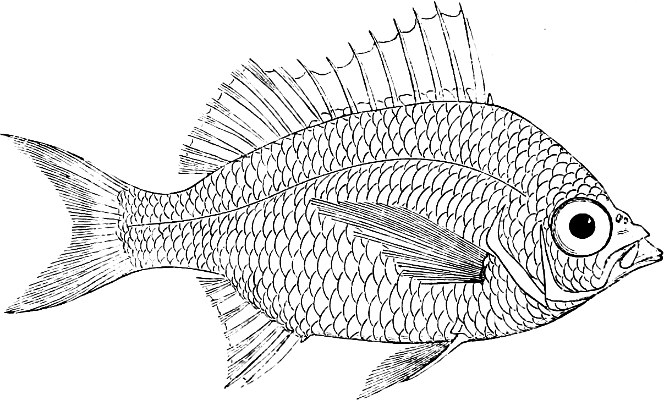
Fig. 159.—Gerres altispinis, from the mouth of the Ganges.
More than thirty species are known of this genus, which bear so close a resemblance to one another that their distinction is rather difficult. They live in the seas between the Tropics, and some, perhaps all, of the species enter fresh water. Very rarely they exceed a length of ten inches; nearly all have a plain silvery coloration. The coalescence of their lower pharyngeals renders their systematic position rather uncertain, and, indeed, some Ichthyologists have referred them to the Pharyngognaths.
Scolopsis.—Body oblong, covered with scales finely serrated and of moderate size. Jaws nearly equal in length anteriorly; cleft of the mouth horizontal. Teeth villiform, without canines; palate toothless. One dorsal fin. Formula of the vertical fins: D. 10/9 A. 3/7. Caudal fin forked. Præoperculum distinctly denticulated; infraorbital ring with a spine directed backwards. Branchiostegals, five.
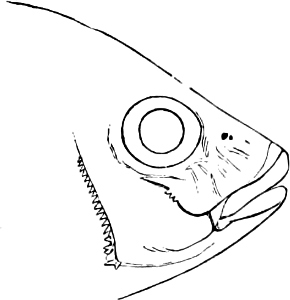
Fig. 160.—Infraorbital spine of Scolopsis monogramma.
Marine, and of small size. Twenty-five species are known from the tropical parts of the Indo-Pacific. Heterognathodon is an allied genus, but without the infraorbital spine.
Dentex.—Body oblong, covered with ctenoid scales of moderate size. Cleft of the mouth nearly horizontal, with the jaws equal in length anteriorly. Canine teeth in both jaws; palate toothless. One dorsal fin. Formula of the vertical fins: D. 10·13/10·12 A. 3/8·9. Caudal fin forked. Præoperculum without serrature; præorbital unarmed and broad, there being a wide space between the eye and the cleft of the mouth. Cheek covered by more than three series of scales. Branchiostegals, six.
Marine Fishes, rather locally distributed in the Mediterranean, on the south coast of Africa, in the Red Sea, East Indian Archipelago, and on the coasts of China and Japan. About fourteen species are known, some of which attain a weight of 30 lbs. and more. They form a not unimportant article of food where they are found in any number, as on the Cape of Good Hope. The species found in the Mediterranean (D. vulgaris) wanders sometimes to the south coast of England, and is one of the larger species. The coloration of these fishes is rather uniform, silvery, or pink, or greenish. Symphorus is an allied genus from the Indo-Pacific.
Synagris.—Body rather elongate, covered with ciliated scales of moderate size. Cleft of the mouth horizontal, with the jaws equal in length anteriorly. One continuous dorsal, with feeble spines; dorsal 10/9, anal 3/7. Caudal deeply forked. Teeth villiform, with canines at least in the upper jaw. Infraorbital not armed; præoperculum without, or with a very indistinct serrature. Cheek with three series of scales. Branchiostegals six.
Marine fishes of small size; about twenty species are known from the tropical parts of the Indo-Pacific. Pentapus, Chætopterus, and Aphareus are allied genera from the same area.
Maena.—Body oblong, compressed, covered with ciliated scales of moderate size. Mouth very protractile, the intermaxillary pedicles extending backwards to the occiput. Teeth villiform; minute teeth on the vomer. One dorsal, scaleless, with feeble spines. D. 11/11, A. 3/9. Caudal fin forked. Præoperculum without serrature. Branchiostegals six.
Small fishes from the Mediterranean, known to the ancients; valueless as food. Three species.
Smaris.—Body oblong or cylindrical, covered with rather small ciliated scales. Mouth very protractile, the intermaxillary pedicles extending backwards to the occiput. Teeth villiform. Palate toothless. One dorsal, scaleless, with eleven or more very feeble spines; anal with three. Caudal fin forked. Præoperculum without serrature. Branchiostegals six.
Small fishes from the Mediterranean. Six species.
Cæsio.—Body oblong, covered with ciliated scales of moderate size. Cleft of the mouth more or less oblique, with the jaws equal in length anteriorly, or with the lower somewhat projecting. Teeth villiform; palate generally toothless. One dorsal, with from nine to thirteen very feeble spines, with the anterior part highest, and the posterior covered with minute scales. Caudal fin deeply forked. Præoperculum without, or with minute, serrature.
Small fishes from the Indo-Pacific. Twelve species.
Erythrichthys.—Body elongate, covered with small ciliated scales. Mouth very protractile, the pedicles of the intermaxillary extending to the occiput. Dentition quite rudimentary or entirely absent Two dorsal fins connected by a series of very feeble spines; also the anterior spines are feeble. Præoperculum not serrated.
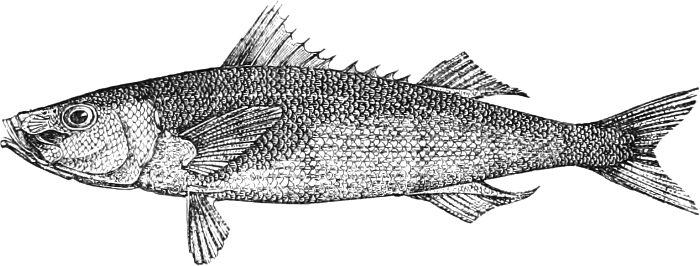
Fig. 161.—Erythrichthys nitidus.
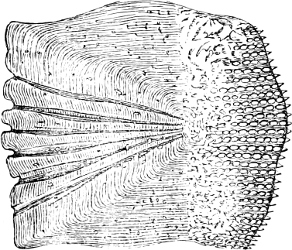
Fig. 162.—Enlarged scale.
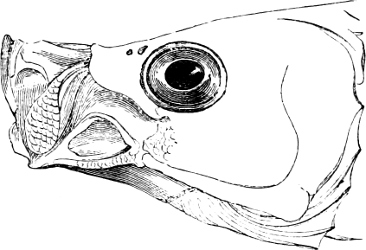
Fig. 163.—Protractile mouth.
Small fishes from various tropical and temperate seas. Four species: the species figured occurs, but is not common, on the coasts of Western Austria, Tasmania, and New Zealand.
Oligorus.—Body oblong, covered with small scales. Cleft of the mouth rather oblique, the lower jaw being the longer. Teeth villiform, without canines; teeth on the vomer and palatine bones. One dorsal, with eleven spines; anal with three; caudal fin rounded. Præoperculum with a single smooth or obtusely denticulated margin.
To this genus belong two fishes well known on account of the excellent flavour of their flesh. The first (O. macquariensis) is called by the colonists “Murray-Cod,” being plentiful in the Murray River and other rivers of South Australia. It attains to a length of more than three feet, and to a weight of nearly 100 lbs. The second (O. gigas) is found in the sea, on the coast of New Zealand, and called by the Maoris and colonists “Hapuku.” Its average weight is about 45 lbs., but occasionally large specimens of more than a hundredweight are caught. At certain localities it is so plentiful that it may form an important article of trade. Dr. Hector, who has had opportunity of examining it in a fresh state, has pointed out anatomical differences from the Murray-Cod, from which it appears that it would be better placed in a distinct genus.
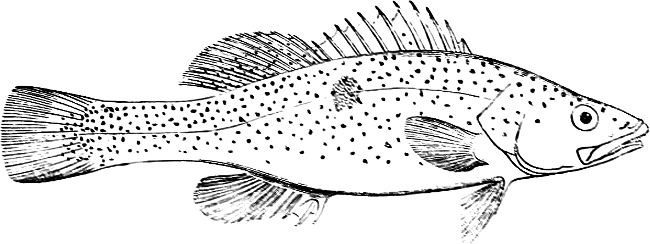
Fig. 164.—The Murray-Cod, Oligorus macquariensis.
Grystes.—Body oblong, covered with scales of moderate size. All the teeth villiform, without canines; teeth on the vomer and palatine bones. One dorsal fin with ten spines; anal with three; caudal fin rounded. Præoperculum with a single smooth margin.
One species, from the fresh waters of the United States (G. salmonoides), attains to a length of more than two feet. It is known by the name of “Growler,” and eaten.
Arripis.—Body oblong, covered with scales of moderate size. All the teeth villiform, without canines; teeth on the vomer and palatine bones. One dorsal fin, with nine slender spines; anal with three. Præoperculum denticulated.
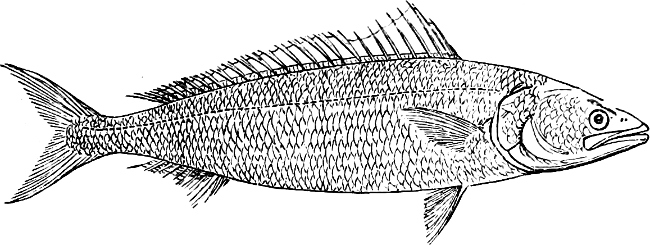
Fig. 165.—Arripis salar, South Australia.
Three species are known, from the coasts of Southern Australia and New Zealand. They are named by the colonists Salmon or Trout, from their elegant form and lively habits, and from the sport they afford to the angler. Their usual size is from 1 to 3 lbs., but specimens of double that weight are taken. The smaller specimens are the more delicate and better flavoured. When not fresh, they are liable to assume poisonous properties; and cases of poisoning are not unfrequently caused by them.
Huro.—Body oblong, compressed, covered with scales of moderate size. All the teeth villiform; bones of the head without serrature. Mouth rather oblique, with the lower jaw projecting. Two dorsal fins, the first with six spines.
The “Black Bass” of Lake Huron (Huro nigricans).
Ambassis.—Body short, strongly compressed, covered with large thin deciduous scales. Mouth oblique, with the lower jaw longest; teeth villiform, without conspicuously larger canines; teeth on the vomer and palatine bones. Two dorsal fins, the first with seven, the anal with three spines; a horizontal spine pointing forwards in front of the dorsal fin. The lower limb of the præoperculum with a double serrated margin.
This genus comprises the smallest of all Percoids, some of the species not much exceeding one inch in length. They are most abundant on the coasts of the tropical Indo-Pacific, and in the fresh waters belonging to that area. The species are numerous (some thirty having been described), and very difficult to distinguish. Their coloration is very plain, a silvery hue prevailing over the whole fish.
Apogon.—Body rather short, covered with large deciduous scales. Mouth oblique, with the lower jaw longest; teeth villiform, without canines; teeth on the vomer and palatine bones. Two dorsal fins, the first with six or seven, the anal with two spines. Præoperculum with a double edge on the margin, one or both edges being serrated. Seven branchiostegals.
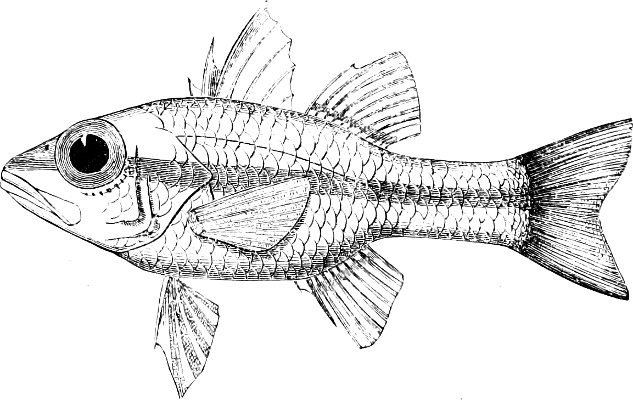
Fig. 166.—Apogon frenatus.
Although of similarly small size, the fishes of this genus represent a more highly developed form of the Percoid type than Ambassis. Their distribution coincides very much with that of Ambassis, but they are chiefly marine, comparatively few of the species entering fresh water. They belong to the kind of fishes which, from their habit, are termed “Coral Fishes,” being found in greatest abundance on, or in the neighbourhood of, coral reefs, in company with Chætodonts, Pomacentridæ, and others. Their colours also are ornamental and highly diversified, as is generally the case in coral fishes, the majority of the species showing transverse or longitudinal bands or large spots, and numerous other smaller markings which, in the dead fish, soon disappear. Nearly one hundred species have been described, of which a few only occur in the Atlantic, one extending northwards into the Mediterranean.
Chilodipterus, Acropoma, and Scombrops are allied genera, but with canine teeth in one or both jaws.
Pomatomus.—Body oblong, covered with scales of moderate size. Eye very large. All the teeth villiform, without canines; teeth on the vomer and palatine bones. Two dorsal fins, the first with seven, the anal with two spines. No serration on any of the bones of the head. Branchiostegals seven.
One species only is known, P. telescopium, which grows to a length of nearly two feet. It is not uncommon in the Mediterranean and neighbouring parts of the Atlantic, but only occasionally caught, as it lives habitually at a greater depth than any other Percoid as far as is known at present, probably at depths from 80 to 200 fathoms; a habit sufficiently indicated by its exceedingly large eye.
Priacanthus.—Body short, compressed, covered with small rough scales, which extend also over the short snout. Lower jaw and chin prominent. Eye large. All the teeth villiform, without canines; teeth on the vomer and palatine bones. One dorsal fin with ten spines, anal with three. Præoperculum serrated, with a more or less prominent, flat, triangular spine at the angle.
A very natural genus, easily recognised, and without direct relation to the other Percoid genera. The species, of which seventeen are known, are spread over nearly all the tropical seas, and belong to the more common fishes. They scarcely exceed a length of twelve inches, and are very uniformly coloured, red, pink, and silvery prevailing.
The following three genera form a group by themselves, which, however, is defined rather by its geographical limits and similarity of general appearance than by distinctive anatomical characters. The species are abundant in the fresh waters of the United States, and well known by the name of “Sun Fishes.” They rarely exceed a length of six inches, and are not used as food. The number of species is uncertain.
Centrarchus.—Body short, compressed, with scales of moderate size. All the teeth villiform, without canines; teeth on the vomer, palatines, and on the tongue. One dorsal fin; anal generally with more than three spines. Præoperculum without serrature; operculum not lobed.
Bryttus.—Body short, compressed, with scales of moderate size. All the teeth villiform, without canines; teeth on the vomer and palatine bones. One dorsal fin with nine or ten, anal with three spines. Præoperculum not serrated; operculum with a rounded membranaceous coloured lobe behind.
Pomotis.—Body short, compressed, with scales of moderate length. All the teeth villiform, without canines; teeth on the vomer, but none on the palatine bones. One dorsal, with from nine to eleven spines, anal with three. Præoperculum entire or minutely serrated; operculum with a rounded membranaceous coloured lobe behind.
A North American Freshwater genus, Aphredoderus, occupies a perfectly isolated position in the system, and is evidently the type of a distinct family. It resembles the “Sun-fishes” of the same country with regard to the structure of the vertical fins, but has the vent situated in front of the ventrals, which are composed of more than five soft rays. The body is oblong, compressed, covered with ctenoid scales. The dorsal fin is single, and has three spines in front. Infraorbital and præoperculum with spinous teeth. Villiform teeth in the jaws, on the vomer and palatine bones. A. sayanus from the southern streams and fresh waters of the Atlantic States.
To complete the list of Percoid genera, we have to mention the following:—Siniperca, Etelis, Niphon, Aprion, Apsilus, Pentaceros, Velifer, Datnioides, Percilia, Lanioperca.
Second Family—Squamipinnes.
Body compressed and elevated, covered with scales, either finely ctenoid or smooth. Lateral line continuous, not continued over the caudal fin. Mouth in front of the snout, generally small, with lateral cleft. Eye lateral, of moderate size. Six or seven branchiostegals. Teeth villiform or setiform, in bands, without canines or incisors. Dorsal fin consisting of a spinous and soft portion of nearly equal development; anal with three or four spines, similarly developed as the soft dorsal, both being many-rayed. The vertical fins more or less densely covered with small scales. The lower rays of the pectoral fin branched, not enlarged; ventrals thoracic, with one spine and five soft rays. Stomach coecal.
The typical forms of this family are readily recognised by the form of their body, and by a peculiarity from which they derive their name Squamipinnes; the soft, and frequently also the spinous part of their dorsal and anal fins are so thickly covered with scales that the boundary between fins and body is entirely obliterated. The majority are inhabitants of the tropical seas, and abound chiefly in the neighbourhood of coral-reefs. The beauty and singularity of distribution of the colours of some of the genera, as Chætodon, Heniochus, Holacanthus, is scarcely surpassed by any other group of fishes. They remain within small dimensions, and comparatively few are used as food. They are carnivorous, feeding on small invertebrates. Only a few species enter brackish water.
Extinct representatives of this family are not scarce at Monte Bolca and in other tertiary formations. All, at least those admitting of definite determination, belong to existing genera, viz. Holacanthus, Pomacanthus, Ephippium, Scatophagus. Very singular is the occurrence of Toxotes in the Monte Bolca strata.
The following genera have no teeth on the palate:—
Chætodon.—One dorsal fin, without any notch in its upper margin, and with the soft and spinous portions similarly developed; none of the spines elongate. Snout short or of moderate length. Præoperculum without, or with a fine, serration, and without spine at the angle. Scales generally large or of moderate size.
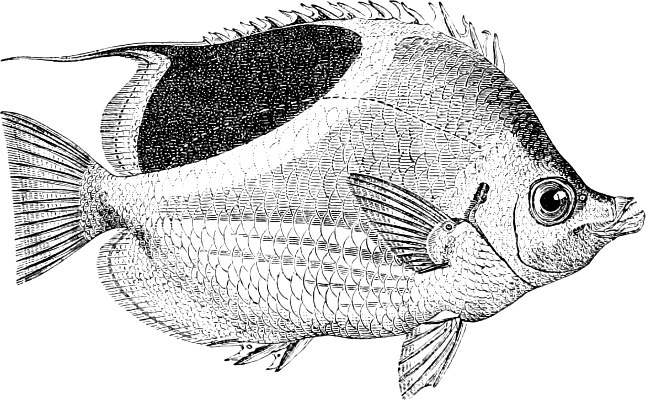
Fig. 167.—Chætodon ephippium.
Seventy species are known from the tropical parts of the Atlantic and Indo-Pacific, nearly all being beautifully ornamented with bands or spots. Of the ornamental markings a dark or bicoloured band, passing through the eye and ascending towards the back, is very generally found in these fishes; it frequently occurs again in other marine Acanthopterygians, in which it is not rarely a sign of the immature condition of the individual. The Chætodonts are most numerous in the neighbourhood of the coral-reefs of the Indo-Pacific, the species figured (C. ephippium) being as common in the East Indian Archipelago as in Polynesia, like many others of its congeners.
Chelmo differs from Chætodon only in having the snout produced into a more or less long tube.
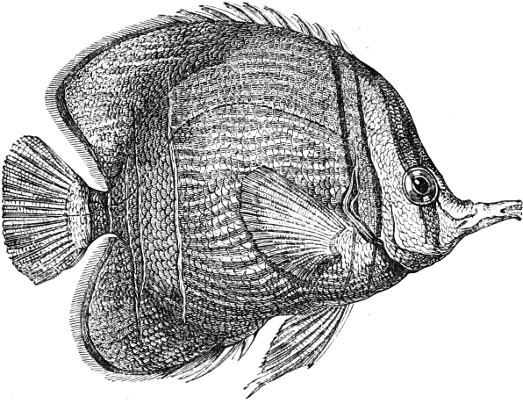
Fig. 168.—Chelmo marginalis, from the coast of Australia.
Only four species are known, locally distributed in the tropical seas. Ch. rostratus, the oldest species known, is said to have the instinct of throwing a drop of water from its bill so as to light upon any insect resting on a leaf, and thus make it fall, that it may instantly dart upon it. This statement is erroneous, and probably rests upon the mistaken notion that the long bill is especially adapted for this manœuvre, which, indeed, is practised by another fish of this family (Toxotes). The long slender bill of Chelmo (which is a true saltwater fish) rather enables it to draw from holes and crevices animals which otherwise could not be reached by it.
Heniochus.—One dorsal, with from eleven to thirteen spines, the fourth of which is more or less elongate and filiform. Snout rather short or of moderate length. Præoperculum without spine. Scales of moderate size.
Four species are known from the tropical Indo-Pacific. H. macrolepidotus is one of the most common fishes of that area; the species figured (H. varius) retains in a conspicuous manner horn-like protuberances on bones of the head, with which the young of all the species of this genus seem to be armed.
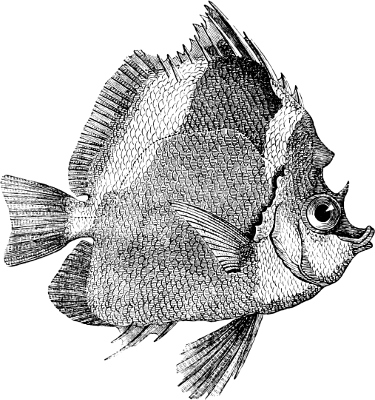
Fig. 169.—Heniochus varius.
Holacanthus.—Præoperculum with a strong spine at the angle. One dorsal, with from twelve to fifteen spines. Scales of moderate or small size.
Forty species are known, which, in their geographical distribution accompany, and are quite analogous to, the Chætodonts. One of the most common and most beautiful is called “Emperor of Japan” by the Dutch, which name has been adopted by Bloch for its specific designation, Holacanthus imperator. Its body is blue, longitudinally traversed by about thirty yellow bands; the ocular band, and the side behind the head, are black, edged with yellow; the caudal fin is yellow. It is a large species of this genus, sometimes attaining a length of 15 inches, and as an article of food is one of the most esteemed of all the Indian species. With regard to beauty of colours it is surpassed by another allied species, H. diacanthus, which likewise ranges from the east coast of Africa to Polynesia.
Pomacanthus differs from Holacanthus in having from eight to ten spines only in the dorsal fin.
The single species (P. paru) on which this genus is founded is one of the most common fishes of the West Indies, and offers one of the most remarkable instances of variation of colour within the limits of the same species: some specimens being ornamented with more or less distinct yellowish cross-bands, others with yellow crescent-shaped spots; in others black spots predominate.
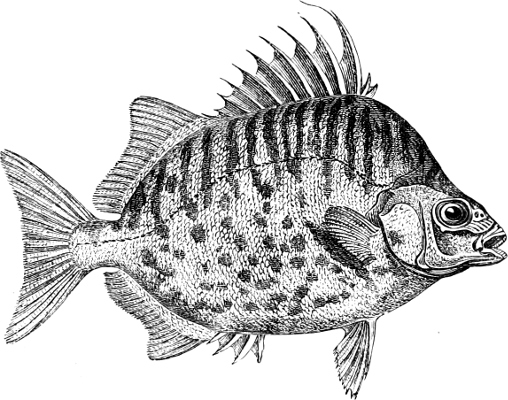
Fig. 170.—Scatophagus multifasciatus.
Scatophagus.—Two dorsal fins, united at the base, the first with ten or eleven spines; only the second is scaly. A recumbent spine before the dorsal, pointing forwards. Anal with four spines. Snout rather short. Præoperculum without spine. Scales very small.
Four species are known, from the Indian Ocean, of which S. argus is the most generally known, in fact, one of the most common Indian shore-fishes. It freely enters large rivers, and is said not to be particular in the selection of its food. The species figured (S. multifasciatus) represents S. argus on the coasts of Australia.
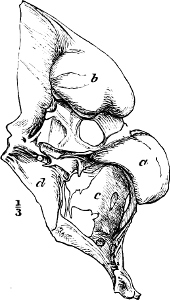
Fig. 171.—Bony enlargement of cranial bones of Ephippus. a, Enlargement of the frontal, and b, of the supraoccipital bones; c, interorbital septum; d, basis cranii. ⅓ nat. size.
Ephippus.—Snout short, with the upper profile parabolic. Dorsal fin deeply emarginate between the spinous and soft portions, the former with nine spines, the third of which is rather elongate, and flexible; spinous portion not scaly; anal spines three. Pectoral fin short. Præoperculum without spine. Scales of moderate size, or rather small.
Two or three species are known from the warmer parts of the Atlantic and Indian Oceans. The Atlantic species (E. faber) shows the remarkable peculiarity that in old specimens (12 and more inches long) the occipital crest, and sometimes some of the anterior neural and hæmal spines are enormously enlarged into a globular bony mass. This can hardly be regarded as a pathological change of the bone, as it has been found in all old specimens, without exception.
Drepane is allied to Ephippus, but has very long falciform pectoral fins. The single species D. punctata is common in the Indian Ocean and on the coasts of Australia. Hypsinotus, from Japan, appears to inhabit a greater depth than the other Squamipinnes.
Scorpis and Atypichthys are genera distinguished from the preceding by the presence of vomerine teeth. They belong to the coast-fauna of Australia, New Zealand, and Chili.
Toxotes.—Body short, compressed, covered with scales of moderate size. Snout pointed, with a wide lateral mouth and projecting lower jaw. One dorsal, with five strong spines situated on the posterior part of the back; the soft portion and the anal fin scaly, the latter with three spines. Villiform teeth in the jaws, on the vomer and palatine bones. Scales of moderate size, cycloid.
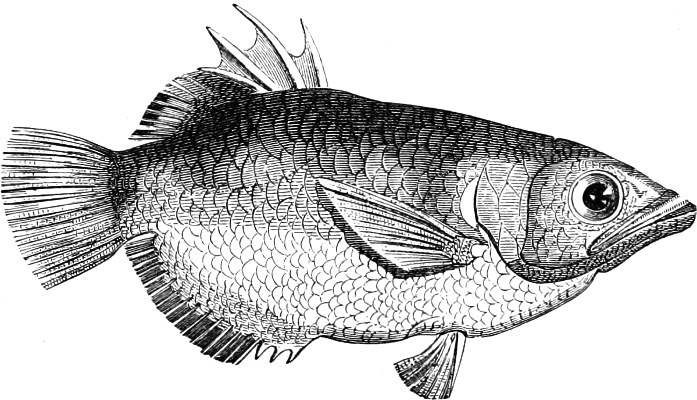
Fig. 172.—Toxotes jaculator.
Two species are known from the East Indies, one (T. jaculator), which is the more common, ranging to the north coast of Australia. It has received its name from its habit of throwing a drop of water at an insect which it perceives close to the surface, in order to make it fall into it. The Malays, who call it “Ikan sumpit,” keep it in a bowl, in order to witness this singular habit, which it continues even in captivity.
Third Family—Mullidæ.
Body rather low and slightly compressed, covered with large thin scales, without or with an extremely fine serrature. Two long erectile barbels are suspended from the hyoid, and are received between the rami of the lower jaw and opercles. Lateral line continuous. Mouth in front of the snout, with the cleft lateral and rather short; teeth very feeble. Eye lateral, of moderate size. Two short dorsal fins remote from each other, the first with feeble spines; anal similar to the second dorsal. Ventrals with one spine and five rays. Pectorals short. Branchiostegals four; stomach siphonal.
The “Red Mullets” form a very natural family, which, on account of slight modifications of the dentition, has been divided into several sub-genera—Upeneoides, Upeneichthys, Mullus, Mulloides, and Upeneus. They are marine fishes, but many species enter brackish water to feed on the animalcules abounding in the flora of brack-water. About forty different species are known chiefly from tropical seas, the European species (M. barbatus, see p. 43, Fig. 7), extending far northwards into the temperate zone. None attain to a large size, specimens of from two to three lbs. being not common, but all are highly esteemed as food.
The most celebrated is the European species (of which there is one only, M. surmuletus being probably the female). The ancient Romans called it Mullus, the Greeks τριγλη. The Romans priced it above any other fish; they sought for large specimens far and wide, and paid ruinous prices for them.
“Mullus tibi quatuor emptus Librarum, cœnæ pompa caputque fuit, Exclamare libet, non est hic improbe, non est Piscis: homo est; hominem, Calliodore, voras.” Martial, x. 31.
Then, as nowadays, it was considered essential for the enjoyment of this delicacy that the fish should exhibit the red colour of its integuments. The Romans brought it, for that purpose, living into the banqueting room, and allowed it to die in the hands of the guests, the red colour appearing in all its brilliancy during the death struggle of the fish. The fishermen of our times attain the same object by scaling the fish immediately after its capture, thus causing a permanent contraction of the chromatophors containing the red pigment (see p. 183).
Fourth Family—Sparidæ.
Body compressed, oblong, covered with scales, the serrature of which is very minute, and sometimes altogether absent. Mouth in front of the snout, with the cleft lateral. Eye lateral, of moderate size. Either cutting teeth in front of the jaws, or molar teeth on the side; palate generally toothless. One dorsal fin, formed by a spinous and soft portion of nearly equal development. Anal fin with three spines. The lower rays of the pectoral fin are generally branched, but in one genus simple. Ventrals thoracic, with one spine and five rays.
The “Sea-breams” are recognised chiefly by their dentition, which is more specialised than in the preceding families, and by which the groups, into which this family has been divided, are characterised. They are inhabitants of the shores of all the tropical and temperate seas. Their coloration is very plain. They do not attain to a large size, but the majority are used as food.
The extinct forms found hitherto are rather numerous; the oldest come from the cretaceous formation of Mount Lebanon; some belong to living genera, as Sargus, Pagellus; of others from Eocene and Miocene formations no living representative is known—Sparnodus, Sargodon, Capitodus, Soricidens, Asima.
First Group—Cantharina.—More or less broad cutting, sometimes lobate, teeth in front of the jaws; no molars or vomerine teeth; the lower pectoral rays are branched. Partly herbivorous, partly carnivorous. The genera belonging to this group are:—Cantharus from the European and South African coasts, of which one species (C. lineatus), is common on the coasts of Great Britain, and locally known by the names “Old Wife,” “Black Sea-bream;” Box, Scatharus, and Oblata from the Mediterranean and neighbouring parts of the Atlantic; Crenidens and Tripterodon from the Indian Ocean; Pachymetopon, Dipterodon, and Gymnocrotaphus from the Cape of Good Hope; Girella and Tephræops from Chinese, Japanese, and Australian Seas; Doydixodon from the Galapagos Islands and the coasts of Peru.
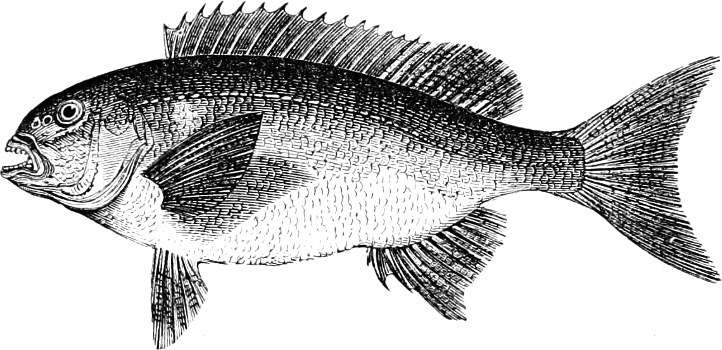
Fig. 173.—Tephræops richardsonii, from King George’s Sound.
Second Group—Haplodactylina.—In both jaws flat and generally tricuspid teeth; no molars; vomerine teeth. The lower pectoral rays simple, not branched. Vegetable feeders. Only one genus is known, Haplodactylus, from the temperate zone of the Southern Pacific.
Third Group—Sargina.—Jaws with a single series of incisors in front, and with several series of rounded molars on the side. One genus is known, Sargus, which comprises twenty species; several of them occur in the Mediterranean and the neighbouring parts of the Atlantic, and are popularly called “Sargo,” “Sar,” “Saragu:” names derived from the word Sargus, by which name these fishes were well known to the ancient Greeks and Romans. One of the largest species is the “Sheep’s-head” (Sargus ovis), from the coasts of the United States, which attains to a weight of 15 lbs., and is highly esteemed on account of the excellency of its flesh. Singularly enough, this genus occurs also on the east coast of Africa, one of these East-African species being identical with S. noct from the Mediterranean. These fishes evidently feed on hard-shelled animals, which they crush with their molar teeth.
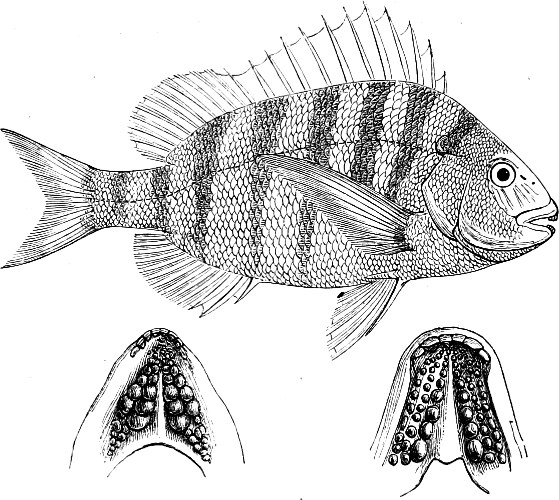
Fig. 174.—The Sheep’s-head, Sargus ovis, of North America.
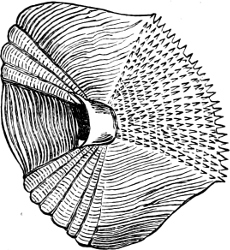
Fig. 175.—Scale of Lethrinus.
Fourth Group—Pagrina.—Jaws with conical teeth in front and molar teeth on the sides. Feeding, as the preceding, on hard-shelled animals, like Mollusks and Crustaceans. This group is composed of several genera:—
Lethrinus.—Cheeks scaleless. Body oblong, covered with scales of moderate size (L. lat. 45–50). Canine teeth in front; lateral teeth in a single series, broadly conical or molar-like. Formula of the fins: D. 10/9, A. 3/8.
More than twenty species are known, all of which, with one exception, occur in the tropical Indo-Pacific. The species, forming this exception, occurs, singularly enough, on the west coast of Africa, where more than one Indian genus reappears in isolated representative species. Some Lethrini attain to a length of three feet.
Sphærodon is closely allied to Lethrinus, but has scales on the cheek. One species from the Indo-Pacific.
Pagrus.—Body oblong, compressed, with scales of moderate size. Several pairs of strong canine-like teeth in both jaws; molars arranged in two series. Cheeks scaly. The spines of the dorsal fin, eleven or twelve in number, are sometimes elongate, and can be received in a groove; anal spines three.
Thirteen species are known, chiefly distributed in the warmer parts of the temperate zones, and more scantily represented between the tropics. Several species (P. vulgaris, P. auriga, P. bocagii) occur in the Mediterranean and the neighbouring parts of the Atlantic; one (P. argyrops) is well known on the coasts of the United States under the names of “Scup,” “Porgy,” or “Mishcup,” and one of the most important food fishes, growing to a length of 18 inches and a weight of 4 lbs.; another (P. unicolor) is one of the best-known sea-fishes of Southern Australia and New Zealand, where it is called “Snapper;” it is considered very good eating, like all the other species of this genus, and attains, like some of them, a length of more than 3 feet and a weight exceeding 20 lbs.
Pagellus.—Body oblong, compressed, with scales of moderate size. Jaws without canines; molars on the sides arranged in several series. Cheeks scaly. The spines of the dorsal fin, from eleven to thirteen in number, can be received in a groove; anal spines three.
Seven species are known, the majority of which are European, as P. erythrinus, common in the Mediterranean, and not rare on the south coast of England, where it is generally termed “Becker;” P. centrodontus, the common “Sea-bream” of the English coasts, distinguished by a black spot on the origin of the lateral line; in the young, which are called “Chad” by Cornish and Devon fishermen, this spot is absent; P. owenii, the “Axillary or Spanish Sea-Bream,” likewise from the British coasts. Pagellus lithognathus, from the coasts of the Cape of Good Hope, attains to a length of four feet, and is one of the fishes which are dried for export and sale to whalers.
Chrysophrys.—Body oblong, compressed, with scales of moderate size. Jaws with four or six canine teeth in front, and with three or more series of rounded molars on each side. Cheeks scaly. The spines of the dorsal fin, eleven or twelve in number, can be received in a groove; anal spines three.
Some twenty species are known from tropical seas and the warmer parts of the temperate zones. Generally known is Ch. aurata, from the Mediterranean, occasionally found on the south coast of England, where it is named “Gilthead.” The French call it “Daurade,” no doubt from the Latin Aurata, a term applied to it by ancient authors. The Greeks named it Chrysophrys (i.e. golden eyebrow), in allusion to the brilliant spot of gold which it bears between its eyes. According to Columella, the Aurata was among the number of the fishes brought up by the Romans in their vivaria; and the inventor of those vivaria, one Sergius Orata, is supposed to have derived his surname from this fish. It is said to grow extremely fat in artificial ponds. Duhamel states that it stirs up the sand with the tail, so as to discover the shell-fish concealed in it. It is extremely fond of mussels, and its near presence is sometimes ascertained by the noise which it makes while breaking their shells with its teeth. Several species found on the Cape of Good Hope attain to as large a size as Pagellus lithognathus, and are preserved for sale like that species. Chrysophrys hasta is one of the most common species of the East Indian and Chinese coasts, and enters large rivers.
Fifth Group—Pimelepterina.—In both jaws a single anterior series of cutting teeth, implanted by a horizontal posterior process, behind which is a band of villiform teeth. Villiform teeth on the vomer, palatines and the tongue. Vertical fins densely covered with minute scales. Only one genus is known, Pimelepterus, with six species from tropical seas. These fishes are sometimes found at a great distance from the land.
Fifth Family—Hoplognathidæ.
Body compressed and elevated, covered with very small ctenoid scales. Lateral line continuous. The bones of the jaws have a sharp dentigerous edge, as in Scarus. The teeth, if at all conspicuous, being continuous with the bone, forming a more or less indistinct serrature; no teeth on the palate. The spinous portion of the dorsal fin is rather more developed than the soft; the spines strong; anal with three spines, similar to the soft dorsal. Ventrals thoracic, with one spine and five soft rays.
One genus only is known, Hoplognathus, with four species from Australian, Japanese, and Peruvian coasts.
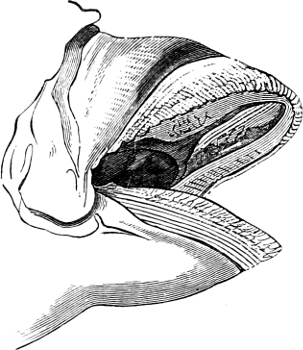
Fig. 176.—Teeth of Hoplognathus.
Sixth Family—Cirrhitidæ.
Body oblong, compressed, covered with cycloid scales; lateral line continuous. Mouth in front of the snout, with lateral cleft. Eye lateral, of moderate size. Cheeks without a bony stay for the præoperculum. Generally six, sometimes five or three branchiostegals. Dentition more or less complete, composed of small pointed teeth, sometimes with the addition of canines. One dorsal fin, formed by a spinous and soft portion, of nearly equal development. Anal with three spines, generally less developed than the soft dorsal. The lower rays of the pectoral fins simple and generally enlarged; ventrals thoracic, but remote from the root of the pectorals, with one spine and five rays.
The fishes of this family may be readily recognised by their thickened, undivided lower pectoral rays, which in some are evidently auxiliary organs of locomotion, in others, probably, organs of touch. They differ from the following family, the Scorpænidæ, in lacking the bony connection between the infraorbital ring and the præoperculum. Two groups may be distinguished in this family, which, however, are connected by an intermediate genus (Chironemus). The first, distinguished by the presence of vomerine teeth, consists of Cirrhites and Chorinemus, small prettily coloured fishes. The former genus is peculiar to the Indo-Pacific, and consists of sixteen species; the second, with three species, seems to be confined to the coasts of Australia and New Zealand. The second group lacks the vomerine teeth, and comprises the following genera:—
Chilodactylus.—One dorsal fin, with from sixteen to nineteen spines; anal fin of moderate length; caudal forked. One of the simple pectoral rays more or less prolonged, and projecting beyond the margin of the fin. Teeth in villiform bands; no canines. Præoperculum not serrated. Scales of moderate size. Air-bladder with many lobes.
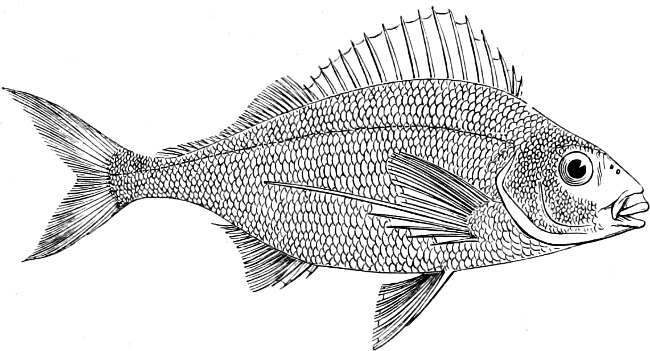
Fig. 177.—Chilodactylus macropterus, from Australia.
Seventeen species are known, chiefly from the temperate parts of the Southern Pacific, and also from the coasts of Japan and China. They belong to the most valuable food-fishes, as they grow to a considerable size (from five to twenty-five lbs.), and are easily caught in numbers. At the Cape of Good Hope they are very abundant, and preserved in large quantities for export.
Mendosoma from the coast of Chili, and Nemadactylus from Tasmania, are allied genera.
Latris.—Dorsal fin deeply notched; the spinous portion with seventeen spines; anal fin many-rayed. None of the simple pectoral rays passes the margin of the fin. Teeth villiform; no canines. Præoperculum minutely serrated. Scales small.
Two species only are known from Tasmania and New Zealand, which belong to the most important food-fishes of the Southern Hemisphere. Latris hecateia or the “Trumpeter,” ranges from sixty to thirty lbs. in weight, and is considered by the colonists the best flavoured of any of the fishes of South Australia, Tasmania, and New Zealand, and consumed smoked as well as fresh. The second species, Latris ciliaris, is smaller, scarcely attaining a weight of twenty lbs., but more abundant; it is confined to the coast of New Zealand.
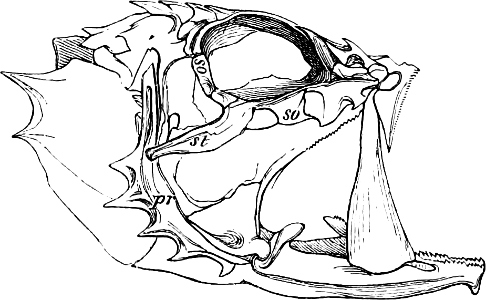
Fig. 178.—Skull of Scorpæna percoides; so, Suborbital ring; pr, Præoperculum; st, Bony stay, connecting the sub-orbital with the præoperculum.
Seventh Family—Scorpænidæ.
Body oblong, more or less compressed, covered with ordinary scales, or naked. Cleft of the mouth lateral or subvertical. Dentition feeble, consisting of villiform teeth; and generally without canines. Some bones of the head armed, especially the angle of the præoperculum, its armature receiving additional support by a bony stay, connecting it with the infraorbital ring. The spinous portion of the dorsal fin equally or more developed than the soft and than the anal. Ventrals thoracic, generally with one spine and five soft rays, sometimes rudimentary.
This family consists of carnivorous marine fishes only; some resemble the Sea-Perches in form and habits, as Sebastes, Scorpæna, etc., whilst others live at the bottom of the sea, and possess in various degrees of development those skinny appendages resembling the fronds of seaweeds, by which they either attract other fishes, or by which they are enabled more effectually to hide themselves. Species provided with those appendages have generally a coloration resembling that of their surroundings, and varying with the change of locality. The habit of living on the bottom has also developed in many Scorpænoids separate pectoral rays, by means of which they move or feel. Some of the genera live at a considerable depth, but apparently not beyond 300 fathoms. Nearly all are distinguished by a powerful armature either of the head, or fin spines, or both; and in some the spines have been developed into poison organs.
The only fossil representative known at present is a species of Scorpæna from the Eocene of Oran.
Sebastes.—Head and body compressed; crown of the head scaly to, or even beyond, the orbits; no transverse groove on the occiput. Body covered with scales of moderate or small size, and without skinny tentacles. Fin-rays not elongate; one dorsal, divided by a notch into a spinous and soft portion, with twelve or thirteen spines; the anal with three. No pectoral appendages. Villiform teeth in the jaws, on the vomer, and generally on the palatine bones. Vertebræ more than twenty-four.
About twenty species are known, principally from seas of the temperate zones, as from the coasts of Northern Europe (S. norvegicus, S. viviparus), of Japan, California, New Zealand, and Van Diemen’s Land. All seem to prefer deep water to the surface, and Sebastes macrochir has been obtained at a depth of 345 fathoms. In their general form they resemble the Sea-Perches, attain to a weight of from one to four lbs., and are generally esteemed as food.
Scorpæna.—Head large, slightly compressed, generally with a transverse naked depression on the occiput; bones of the head armed with spines, and generally with skinny tentacles. Scales of moderate size. Mouth large, oblique. Villiform teeth in the jaws, and at least on the vomer. One dorsal, 12–13/9, A. 3/5. Pectoral fins without detached rays, large, rounded, with the lower rays simple and thickened. Air-bladder none. Vertebræ twenty-four.
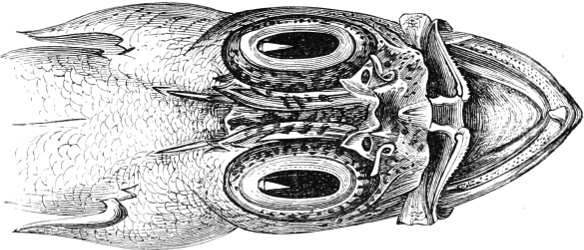
Fig. 179.—Head of Scorpæna percoides, from New Zealand.
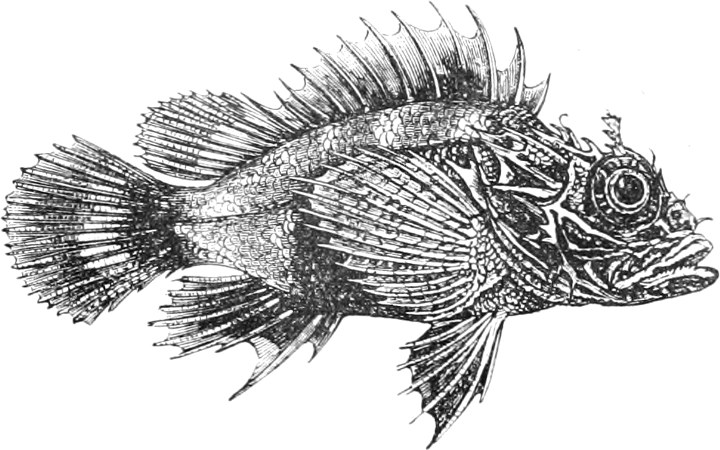
Fig. 180.—Scorpæna bynoensis, from the coasts of Australia.
About forty species are known from tropical and sub-tropical seas. They lead a sedentary life, lying hidden in the sand, or between rocks covered with seaweed, watching for their prey, which chiefly consists of small fishes. Their strong undivided pectoral rays aid them in burrowing in the sand, and in moving along the bottom. The type of their coloration is very much the same in all the species, viz. an irregular mottling of red, yellow, brown, and black colours, but the distribution of these colours varies exceedingly, not only in the same species but also in the same individuals. They do not attain to any considerable size, probably never exceeding a length of 18 inches. Their flesh is well flavoured. Wounds inflicted by their fin-spines are exceedingly painful, but not followed by serious consequences.
Glyptauchen and Lioscorpius are genera closely allied to Scorpæna, from Australian seas.
Setarches is also allied to the preceding genera, and provided with very large eyes, in accordance with the depth (215 fathoms) which the two species known at present inhabit; one has been found near Madeira, the other near the Fiji Islands.
Pterois.—Head and body compressed; scales of small or moderate size. Bones of the head armed with numerous spinous projections, between which often skinny tentacles are developed. The dorsal spines and pectoral rays are more or less prolonged, passing beyond the margin of the connecting membrane. Twelve or thirteen dorsal spines. Villiform teeth in the jaws and on the vomer.
Nine species are known from the tropical Indo-Pacific. They belong to the most singularly formed and most beautifully coloured fishes of the Tropics, and formerly were believed to be able to fly, like Dactylopterus. But the membrane connecting their pectoral rays is much too short and feeble to enable them to raise themselves from the surface of the water.
Apistus.—Head and body compressed, covered with ctenoid scales of rather small size. Some bones of the head, and especially the præorbital, are armed with spines. One dorsal with fifteen spines; the anal with three. The pectoral fin is elongate, and one ray is completely detached from the fin. Villiform teeth in the jaws, on the vomer, and palatine bones. Air-bladder present. A cleft behind the fourth gill.
Two species from the Indian Ocean. These fishes are very small, but of interest on account of the prolongation of their pectoral fins, which indicates that they can take long flying leaps out of the water. However, this requires confirmation by actual observation.
Agriopus.—Head and body compressed, scaleless; head without any, or with very feeble, armature. Cleft of the mouth small, at the end of the produced snout. One dorsal fin, which commences from the head, the spinous portion being formed by from seventeen to twenty-one strong spines; anal short. Villiform teeth in the jaws, generally none on the vomer.
Seven species. This singular genus is peculiar to the temperate parts of the South Pacific, occurring at the Cape, on the coast of South Australia, and Chili. The largest species (A. torvus) attains a length of two and a half feet. Nothing is known of its mode of life.
Synanceia.—General appearance of the fish, especially of the head, monstrous. Scales none; skin with numerous soft warty protuberances or filaments. Mouth directed upwards, wide. Eyes small. From thirteen to sixteen dorsal spines; pectoral fins very large. Villiform teeth in the jaws, and sometimes on the vomer.
Four species are known from the Indo-Pacific, of which S. horrida and S. verrucosa are the most generally distributed, and, unfortunately, the most common. They are justly feared on account of the great danger accompanying wounds which they inflict with their poisoned dorsal spines, as has been already noticed above, p. 191. The greatest length to which they attain does not seem to exceed eighteen inches. They are very voracious fishes, and their stomach is of so great a capacity that they are able to swallow fishes one-third of their own bulk.
Micropus.—Head and body strongly compressed, short, and deep; no scales, but the skin is covered with minute tubercles. Snout very short, with nearly vertical anterior profile. Præorbital, præ- and inter-operculum with spines on the edge. Dorsal fin with seven or eight, anal with two spines. Pectorals short, ventrals rudimentary. Jaws with villiform teeth.
These fishes belong to the smallest of Acanthopterygians, scarcely exceeding 1½ inches in length. Two species are known, which are rather common on the coral reefs of the Pacific.
Chorismodactylus.—Head and body rather compressed, scaleless, with skinny flaps. Bones of the head with prominent ridges; the præorbital, præoperculum, and operculum armed; a depression on the occiput. One dorsal fin, with thirteen spines; the anal with two. Three free pectoral appendages. Ventral fins with one spine and five rays. Villiform teeth in the jaws only.
Only one small species, Ch. multibarbis, is known, from the coasts of India and China.
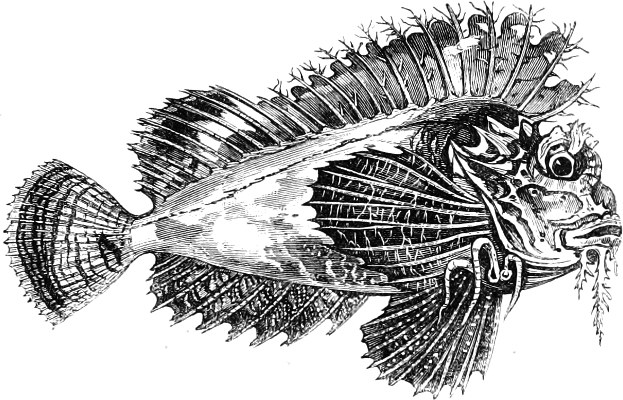
Fig. 181.—Chorismodactylus multibarbis.
To complete the list of Scorpænoid genera, we have to mention Tænianotus, Centropogon, Pentaroge, Tetraroge, Prosopodasys, Aploactis, Trichopleura, Hemitripterus, Minous and Pelor.
Eighth Family—Nandidæ.
Body oblong, compressed, covered with scales. Lateral line interrupted. Dorsal fin formed by a spinous and soft portion, the number of spines and rays being nearly equal; anal fin with three spines, and with the soft portion similar to the soft dorsal. Ventral fins thoracic, with one spine, and five or four rays. Dentition more or less complete, but feeble.
This small family consists of two very distinct groups.
A. Plesiopina. Marine fishes of small size, with pseudobranchiæ and only four ventral rays. Plesiops from the coral-reefs of the Indo-Pacific, and Trachinops from the coast of New South Wales, belong to this group.
B. Nandina. Freshwater fishes of small size from the East Indies, without pseudobranchiæ, and five ventral rays. The genera are Badis, Nandus, and Catopra.
Ninth Family—Polycentridæ.
Body compressed, deep, scaly. Lateral line none. Dorsal and anal fins long, both with numerous spines, the spinous portion being the more developed. Ventrals thoracic, with one spine and five soft rays. Teeth feeble. Pseudobranchiæ hidden.
Only two genera, each represented by one or two species in the Atlantic rivers of Tropical America, Polycentrus and Monocirrhus, belong to this family. They are small insectivorous fishes.
Tenth Family—Teuthididæ.
Body oblong, strongly compressed, covered with very small scales. Lateral line continuous. Eye lateral, of moderate size. A single series of cutting incisors in each jaw; palate toothless. One dorsal fin, the spinous portion being the more developed; anal with seven spines. Ventral fins thoracic, with an outer and an inner spine, and with three soft rays between.
This family consists of one very natural genus, Teuthis, readily recognised by the singular structure of the fins. In all the species the fin-formula is D. 13/10. A. 7/9. The incisors are small, narrow, and provided with a serrated edge. The air-bladder is large, and forked anteriorly as well as posteriorly. Their skeleton shows several peculiarities: the number of vertebræ is twenty-three, ten of which belong to the abdominal portion. The abdominal cavity is surrounded by a complete ring of bones, the second piece of the coracoid being exceedingly long, and extending along the whole length of the abdomen, where it is joined to a spinous process of the first interhæmal. The pubic bones are slender, long, firmly attached to each other, without leaving a free space between them. They are fastened by a long process which passes the symphysis of the radii, and extends on to that of the humeri.
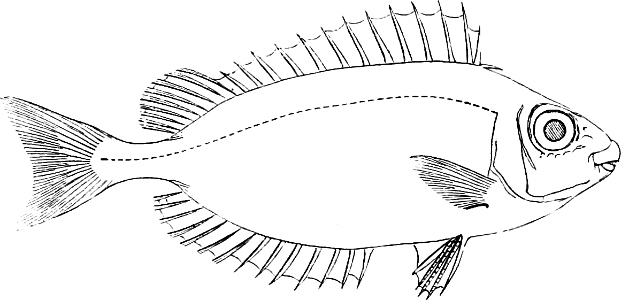
Fig. 182.—Teuthis nebulosa, Indian Ocean.
Thirty species are known, all from the Indo-Pacific; but they do not extend eastwards beyond 140° long., or to the Sandwich Islands. They are herbivorous, and do not exceed a length of fifteen inches.
Second Division—Acanthopterygii Beryciformes.
Body compressed, oblong, or elevated; head with large muciferous cavities which are covered with a thin skin. Ventral fins thoracic, with one spine and more than five soft rays (in Monocentris with two only).
One family only belongs to this division.
Family—Berycidæ.
Body short, with ctenoid scales, which are rarely absent. Eyes lateral, large (except Melamphaës). Cleft of the mouth lateral, oblique; jaws with villiform teeth; palate generally toothed. Opercular bones more or less armed. Eight (four) branchiostegals.
This family offers several points of biological interest. All its members are strictly marine; but only two of the genera are surface-forms (Holocentrum and Myripristis). All the others descend considerably below the surface, and even some of the species of Myripristis habitually inhabit depths of from 50 to 100 fathoms. Polymixia and Beryx have been found in 345 fathoms. Melamphaës must live at a still greater depth, as we may infer from the small size of its eye; this fish is not likely to come nearer to the surface than to about 200 fathoms. The other genera named have extremely large eyes, and, therefore, may be assumed to ascend into such superficial strata as are still lit up by a certain proportion of sun-rays. The highly-developed apparatus for the secretion of superficial mucus, with which these fishes are provided, is another sign of their living at a greater depth than any of the preceding families of Acanthopterygians. In accordance with this vertical distribution, Berycoid fishes have a wide horizontal range, and several species occur at Madeira as well as in Japan.
Fossil Berycoids show a still greater diversity of form than living; they belong to the oldest Teleosteous fishes, the majority of the Acanthopterygians found in the chalk being representatives of this family. Beryx has been found in several species, with other genera now extinct: Pseudoberyx, with abdominal ventrals, from Mount Lebanon; Berycopsis, with cycloid scales; Homonotus, Stenostoma, Sphenocephalus, Acanus, Hoplopteryx, Platycornus, with granular scales; Podocys, with a dorsal fin extending to the neck; Acrogaster, Macrolepis, and Rhacolepis, from the chalk of Brazil. Species of Holocentrum and Myripristis occur in the Monte Bolca formation.
Monocentris.—Snout obtuse, convex, short; eye of moderate size. Villiform teeth on the palatine bones, but none on the vomer. Opercular bones without armature. Scales very large, bony, forming a rigid carapace. Ventrals reduced to a single strong spine and a few rudimentary rays.
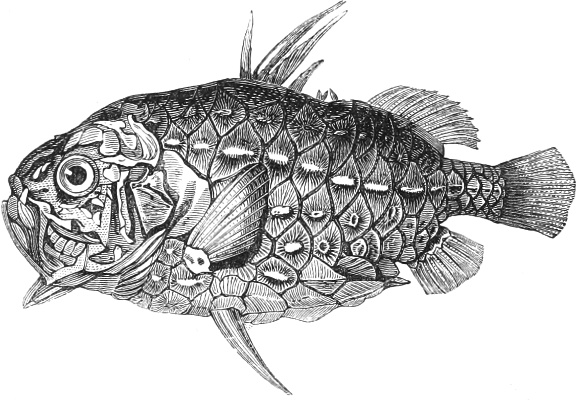
Fig. 183.—Monocentris japonicus.
One species only is known (M. japonicus) from the seas off Japan and Mauritius. It does not attain to any size, and is not common.
Hoplostethus.—Snout very short and obtuse; eye large. Villiform teeth on the palatine bones, but none on the vomer. Operculum unarmed, a strong spine at the scapulary and the angle of the præoperculum. Scales ctenoid, of moderate size; abdominal edge serrated. One dorsal, with six spines; ventrals with six soft rays; caudal deeply forked.
One species only is known (H. mediterraneus), which occurs in the Mediterranean, the neighbouring parts of the Atlantic, and in the sea off Japan.
Trachichthys.—Snout very short and obtuse, with prominent chin; eye large. Villiform teeth on the palatine bones and on the vomer. A strong spine at the scapulary and at the angle of the præoperculum. Scales rather small; abdomen serrated. One dorsal, with from three to six spines; ventral with six soft rays. Caudal forked.
Four species are known from New Zealand and Madeira.
Anoplogaster is an allied genus from tropical parts of the Atlantic; it is scaleless.
Beryx.—Snout short, with oblique cleft of the mouth and prominent chin; eye large. Villiform teeth on the palatine bones and vomer. Opercular bones serrated; no spine at the angle of the præoperculum. Scales ctenoid, of moderate or large size. One dorsal, with several spines; ventrals with seven or more soft rays. Anal with four spines; caudal forked.
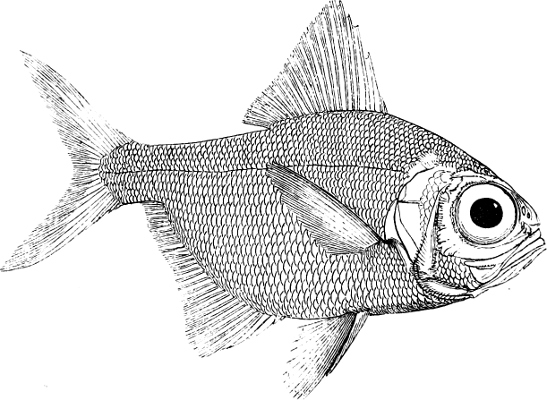
Fig. 184.—Beryx decadactylus.
Five species are known from Madeira, the tropical Atlantic, and the seas of Japan and Australia. The species figured is B. decadactylus, common at Madeira, and occurring near Japan at a depth of 345 fathoms; it attains a length of 1½ feet.
Melamphaes.—Head large and thick, with very thin bones, nearly all the superficial bones being transformed into wide muciferous channels. Eye small. Palate toothless; no barbels; opercles not armed. Scales large, cycloid. One dorsal, with six spines; anal spines very feeble; caudal forked. Ventrals with seven rays.
Two species, deep-sea fishes of the Atlantic; they are very scarce, as only three or four specimens have been found hitherto.
Polymixia.—Snout short, with the cleft of the mouth nearly horizontal; eye large. Two barbels at the throat. Opercles without armature. Scales of moderate size. One dorsal. Anal with three or four spines; caudal forked; ventrals with six or seven soft rays.
Three species are known: P. nobilis from Madeira and St. Helena, P. lowei from Cuba, and P. japonica from Japan; the latter species from a depth of 345 fathoms. Average size eighteen inches.
Myripristis.—Snout short, with oblique cleft of the mouth and prominent chin; eye large or very large. Villiform teeth on the vomer and palatine bones. Opercular bones serrated; præoperculum without spine. Scales large, ctenoid. Two dorsals, the first with ten or eleven spines; anal with four spines; caudal forked; ventrals with seven soft rays. Air-bladder divided by a contraction in two parts, the anterior of which is connected with the organ of hearing.
Eighteen species from the tropical seas of both hemispheres, the majority living near the coast at the surface. The coloration is (principally) red or pink on the back and silvery on the sides. They attain a length of about 15 inches, and are esteemed as food.
Holocentrum.—Snout somewhat projecting, with the cleft of the mouth nearly horizontal; eye large. Villiform teeth on the vomer and palatine bones. Opercular bones and præorbital serrated; operculum with two spines behind; a large spine at the angle of the præoperculum. Scales ctenoid, of moderate size. Two dorsals, the first with twelve spines; anal with four spines, the third being very long and strong; caudal forked. Ventrals with seven soft rays.
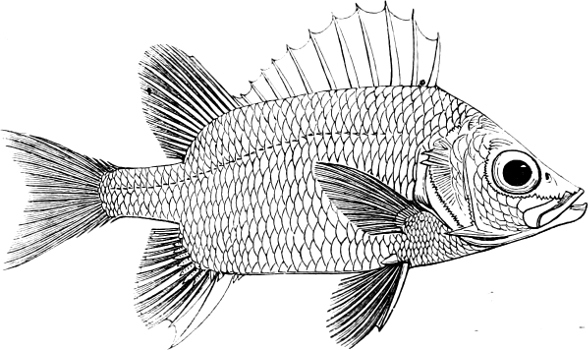
Fig. 185.—Holocentrum unipunctatum, from the South Sea.
About thirty species are known from the tropical seas of both hemispheres; all are surface fishes, and very common. The young have the upper part of the snout pointed and elongate, and were described as a distinct genus (Rhynchichthys). The coloration of the adult is uniform; red, pink, and silvery prevailing. They attain to a length of about 15 inches, and are esteemed as food.
Third Division—Acanthopterygii Kurtiformes.
One dorsal fin only, much shorter than the anal, which is long and many-rayed. No superbranchial organ.
One family only belongs to this division.
Family—Kurtidæ.
Body compressed, oblong, deep in front, attenuated behind. Snout short. The spines of the short dorsal are few in number, if developed. Scales small or of moderate size. Villiform teeth in the jaws, on the vomer, and palatine bones.
This family consists of a small number of species only, which form two distinct genera, Pempheris and Kurtus. They are shore fishes of tropical seas. In both the air-bladder shows some peculiarity: in Pempheris it is divided into an anterior and posterior portion; in Kurtus it is lodged within the ribs, which are dilated, convex, forming rings. The number of vertebræ is respectively twenty-four and twenty-three.
Fourth Division—Acanthopterygii Polynemiformes.
Two rather short dorsal fins, somewhat remote from each other; free filaments at the humeral arch, below the pectoral fins; muciferous canals of the head well developed.
One family only belongs to this division.
Family—Polynemidæ.
Body oblong, rather compressed, covered with smooth or very feebly ciliated scales. Lateral line continuous. Snout projecting beyond the mouth, which is inferior, with lateral cleft. Eye lateral, large. Villiform teeth in the jaws and on the palate. Ventrals thoracic, with one spine and five rays.
The fishes of this natural family have been divided, on slight differences, into three genera—Polynemus, Pentanemus, and Galeoides. They are found in rather numerous species on the coasts between the tropics, and the majority enter brackish or even fresh water. Very characteristic are the free filaments which in this family are organs of touch; they are inserted on the humeral arch at some distance from the pectoral fin; but, nevertheless, can be regarded only as a detached portion of that fin; they can be moved quite independently of the fin; their number varies from three to fourteen, according to the species; in some they are exceedingly elongate, twice as long as the fish, in others they are not longer or even shorter than the pectoral. It is evident from the whole organisation of these fishes that they live on muddy bottom or in thick water, such as is found near the mouths of great rivers. Their eyes are large, but generally obscured by a filmy skin, so that those feelers must be of great use to them in finding their way and their food. The Polynemoids are very useful to man: their flesh is esteemed, and some of the species are provided with an air-bladder which yields a good sort of isinglass, and forms an article of trade in the East Indies. Some of these fishes attain to a length of four feet.
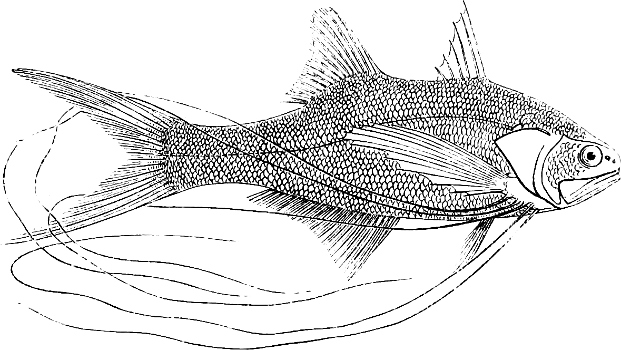
Fig. 186.—Pentanemus quinquarius, from the West Coast of Africa and the West Indies.
Fifth Division—Acanthopterygii Sciæniformes.
The soft dorsal is more, generally much more, developed than the spinous, and than the anal. No pectoral filaments; head with the muciferous canals well developed.
Also this division is composed of one family only.
Family—Sciænidæ.
Body rather elongate, compressed, covered with ctenoid scales. Lateral line continuous, and frequently extending over the caudal fin. Mouth in front of the snout. Eye lateral, of moderate size. Teeth in villiform bands, sometimes with the addition of canines; no molars or incisor-like teeth in the jaws; palate toothless. Præoperculum unarmed, and without bony stay. Ventrals thoracic, with one spine and five soft rays. Bones of the head with wide muciferous channels. Stomach coecal. Air-bladder frequently with numerous appendages (see pp. 144 and seq.)
The fishes of the “Meagre” family are chiefly coast-fishes of the tropical and sub-tropical Atlantic and Indian Oceans, preferring the neighbourhood of the mouths of large rivers, into which they freely enter, some of the species having become so completely naturalised in fresh water that they are never found nowadays in the sea. Some of the larger species wander far from their original home, and are not rarely found at distant localities as occasional visitors. In the Pacific and on the coast of Australia, where but a few large rivers enter the ocean, they are extremely rare and, in the Red Sea, they are absent. Many attain a large size, and almost all are eaten.
No fossil species have been as yet discovered.
Pogonias.—Snout convex, with the upper jaw overlapping the lower. Mandible with numerous small barbels. No canines. The first dorsal with ten stout spines. Two anal spines, the second very strong. Scales of moderate size.
To this fish (P. chromis) more especially is given the name of “Drum,” from the extraordinary sounds which are produced by it and other allied Sciænoids. These sounds are better expressed by the word drumming than by any other, and are frequently noticed by persons in vessels lying at anchor on the coasts of the United States, where those fishes abound. It is still a matter of uncertainty by what means the “Drum” produces the sounds. Some naturalists believe that it is caused by the clapping together of the pharyngeal teeth, which are very large molar teeth. However, if it be true that the sounds are accompanied by a tremulous motion of the vessel, it seems more probable that they are produced by the fishes beating their tails against the bottom of the vessel in order to get rid of the parasites with which that part of their body is infested. The “Drum” attains to a length of more than four feet, and to a weight exceeding a hundred lbs. Its air-bladder has been figured on p. 146.
Micropogon is closely allied to Pogonias, but has conical pharyngeal teeth. Two species from the western parts of the Atlantic.
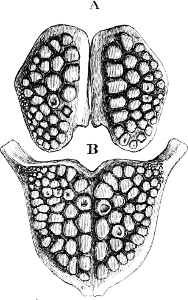
Fig. 187.—Pharyngeal bones and teeth of Pogonias chromis. A, Upper; B, Lower pharyngeals.
Umbrina.—Snout convex, with the upper jaw overlapping the lower; a short barbel under the symphysis of the mandible. The first dorsal with nine or ten flexible spines, the anal with one or two. Scales of moderate size.
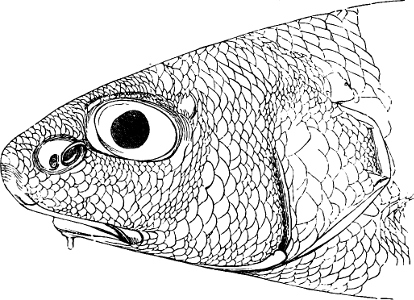
Fig. 188.—Umbrina nasus, from Panama.
Twenty species are known from the Mediterranean, Atlantic, and Indian Ocean. One well known to the ancients, under the name of Umbra, is the Umbrina cirrhosa of the Mediterranean, the “Umbrine” or “Ombre” of the French, and the “Corvo” of the Italians. It ranges to the Cape of Good Hope, and attains a length of three feet. Also on the coasts of the United States several species occur, as U. alburna, U. nebulosa, etc.
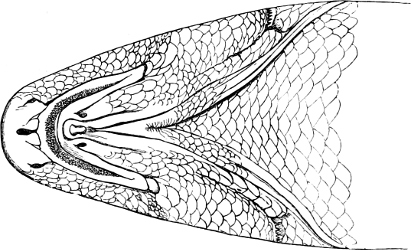
Fig. 189.—Umbrina nasus, from Panama.
Sciæna (including Corvina).—The upper jaw overlapping the lower, or both jaws equal in front. Interorbital space moderately broad and slightly convex. Cleft of the mouth horizontal or slightly oblique. The outer series of teeth is generally composed of teeth larger than the rest, but there are no canines. Eye of moderate size, barbel none.
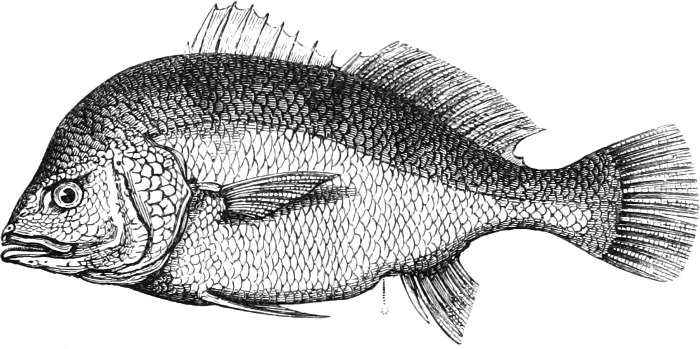
Fig. 190.—Sciæna richardsonii.
Some fifty species are known, but their distinctive characters have been but imperfectly pointed out. They are found in all the seas and rivers in which Sciænoids generally occur, and many are entirely confined to fresh water, for instance the species figured, Sciæna richardsonii, from Lake Huron; Sc. amazonica; Sc. obliqua, ocellata, oscula, etc., from fresh waters of the United States. Sciæna diacanthus and Sc. coitor belong to the most common fishes of the coasts of the East Indies, ascending the great rivers for a long distance from the sea. One of the European species, Sciæna aquila, has an extremely wide range; it not rarely reaches the British coasts, where it is known as “Meagre,” and has been found at the Cape of Good Hope and on the coast of southern Australia. Like some of the other species it attains to a length of six feet, but the majority of the species of this genus remain within smaller dimensions. A part of the species have the second anal ray very strong, and have been placed into a distinct genus, Corvina,—thus, among others, Sc. nigra from the Mediterranean, and Sc. richardsonii.
Pachyurus is closely allied to Sciæna, but has the vertical fins densely covered with small scales.
Otolithus.—Snout obtuse or somewhat pointed, with the lower jaw longer. The first dorsal with nine or ten feeble spines. Canine teeth more or less distinct. Præoperculum denticulated. Scales of moderate or small size.
About twenty species are known from the tropical and sub-tropical parts of the Atlantic and Indian Oceans. The air-bladder is figured on p. 144.
Ancylodon differs from Otolithus in having very long arrow-shaped or lanceolate canine teeth. Coasts of tropical America.
Collichthys.—Body elongate; head very broad, with the upper surface very convex; cleft of the mouth wide and oblique; no large canines. Eye small. No barbel. Scales small, or of moderate size. The second dorsal very long, caudal pointed.
Three species from the East Indian and Chinese coasts. The great development of the muciferous system on the head and the small eye leads one to suppose that these fishes live in muddy water near the mouths of large rivers. The air-bladder has been described on p. 144.
Other genera belonging to this family are Larimus, Eques, Nebris, and Lonchurus.
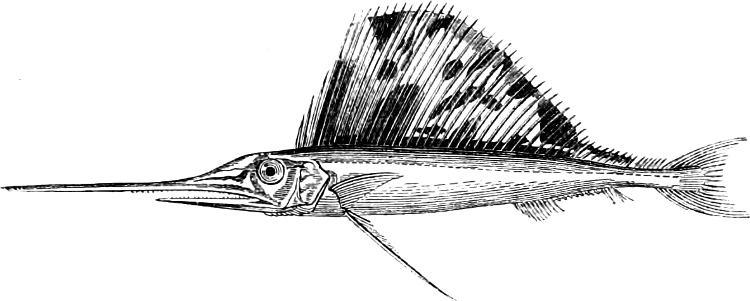
Fig. 191.—Histiophorus pulchellus.
Sixth Division—Acanthopterygii Xiphiiformes.
The upper jaw is produced into a long cuneiform weapon.
These fishes form one small family only, Xiphiidæ.
The “Sword-fishes” are pelagic fishes, occurring in all tropical and sub-tropical seas. Generally found in the open ocean, always vigilant, and endowed with extraordinary strength and velocity, they are but rarely captured, and still more rarely preserved. The species found in the Indian and Pacific Oceans belong to the genus Histiophorus, distinguished from the common Mediterranean Sword-fish, or Xiphias, by the presence of ventral fins, which, however, are reduced to two long styliform appendages. The distinction of the species is beset with great difficulties, owing to the circumstance that but few examples exist in museums, and further, because the form of the dorsal fin, the length of the ventrals, the shape and length of the sword, appear to change according to the age of the individuals. Some specimens or species have only the anterior dorsal rays elevated, the remainder of the fin being very low, whilst in others all the rays are exceedingly elongate, so that the fin, when erected, projects beyond the surface of the water. It is stated that Sword-fishes, when quietly floating with the dorsal fin erect, can sail before the wind, like a boat.
Sword-fishes are the largest of Acanthopterygians, and not exceeded in size by any other Teleostean; they attain to a length of from 12 to 15 feet, and swords have been obtained more than three feet long, and with a diameter of at least three inches at the base. The sword is formed by the prolongation and coalescence of the maxillary and intermaxillary bones; it is rough at its lower surface, owing to the development of rudimentary villiform teeth, very hard and strong, and forms a most formidable weapon. Sword-fishes never hesitate to attack whales and other large Cetaceans, and by repeatedly stabbing these animals generally retire from the combat victorious. The cause which excites them to those attacks is unknown; but they follow this instinct so blindly that they not rarely attack boats or large vessels in a similar manner, evidently mistaking them for Cetaceans. Sometimes they actually succeed in piercing the bottom of a ship, endangering its safety; but as they are unable to execute powerful backward movements they cannot always retract their sword, which is broken off by the exertions of the fish to free itself. A piece of a two-inch plank of a whale-boat, thus pierced by a sword-fish, in which the broken sword still remains, is preserved in the British Museum.
The Rev. Wyatt Gill, who has worked as a missionary for many years in the South Sea Islands, communicates that young Sword-fishes are easily caught in strong nets, but no net is strong enough to hold a fish of six feet in length. Specimens of that size are now and then captured by hook and line, a small fish being used as bait. Individuals with the sword broken off are not rarely observed. Larger specimens cannot be captured by the natives, who are in great fear of them. They easily pierce their canoes, and only too often dangerously wound persons sitting in them.
The Mediterranean Sword-fish is constantly caught in the nets of the Tunny-fishers off the coast of Sicily, and brought to market, where its flesh sells as well as that of the Tunny.
The remarkable changes which Sword-fishes undergo at an early stage of their growth have been noticed above, p. 173 and seq.
Sword-fishes are as old a type as the Berycoids. Their remains have been found in the chalk of Lewes, and more frequently in the London clay of Sheppy, where an extinct genus, Coelorhynchus, has been recognised.
Seventh Division—Acanthopterygii Trichiuriformes.
Body elongate, compressed or band-like; cleft of the mouth wide, with several strong teeth in the jaws or on the palate. The spinous and soft portions of the dorsal fin and the anal are of nearly equal extent, long, many-rayed, sometimes terminating in finlets; caudal fin forked, if present.
Family—Trichiuridæ.
Marine fishes inhabiting the tropical and sub-tropical seas; some of them are surface-fishes, living in the vicinity of the coast, whilst others descend to moderate depths, as the Berycoids. All are powerful rapacious fishes, as is indicated by their dentition.
The oldest of the extinct genera are Enchodus and Anenchelum; they were formerly referred to the Scombroids, but belong to this family. The former has been found in the chalk of Lewes and Mæstricht; the latter is abundant in the Eocene schists of Glaris. Anenchelum is much elongate, and exhibits in the slender structure of its bones the characteristics of a deep-sea fish; it resembles much Lepidopus, but has some long rays in the ventrals. Other Eocene genera are Nemopteryx and Xiphopterus. In the Miocene of Licata in Sicily Trichiuridæ are well represented, viz. by a species of Lepidopus, and by two genera, Hemithyrsites and Trichiurichthys, which are allied to Thyrsites and Trichiurus, but covered with scales.
The following is a complete list of the genera referred to this family:—
Nealotus.—Body incompletely clothed with delicate scales. Small teeth in the jaws and on the palatine bones; none on the vomer. Two dorsal fins, the first continuous and extending to the second; finlets behind the second and anal fins. Each ventral fin represented by a single small spine. A dagger-shaped spine behind the vent. Caudal fin well developed.
One specimen only of this fish (N. tripes), 10 inches long, has been obtained off Madeira; it evidently lives at a considerable depth, and comes to the surface only by accident.
Nesiarchus.—Body covered with small scales. Several strong fangs in the jaws; no teeth on the palate. First dorsal not extending to the second. No detached finlets. Ventrals small, but perfectly developed, thoracic. Caudal fin present. A dagger-shaped spine behind the vent.
A rather large fish (N. nasutus), very rarely found in the sea off Madeira. The two or three specimens found hitherto measure from three to four feet in length. Probably living at the same depth as the preceding genus.
Aphanopus.—Scales none. Two very long dorsal fins; caudal well developed; ventrals none. A strong dagger-shaped spine behind the vent. Strong teeth in the jaws; none on the palate.
One species only is known, named A. carbo from its coal-black colour; it is evidently a deep-sea fish, very rarely obtained in the sea off Madeira. Upwards of four feet long.
Euoxymetopon.—Body naked, very long and thin. Profile of the head regularly decurved from the nape to the snout, the occiput and forehead being elevated and trenchant. Jaws with fangs; palatine teeth present. One dorsal only, continued from the head to the caudal fin, which is distinct. A dagger-shaped spine behind the vent. Pectoral fins inserted almost horizontally, with the lowest rays longest, and with the posterior border emarginate. Ventral fins rudimentary, scale-like.
This is another deep-sea form of this family, but, at present, no observations have been made as regards the exact depth at which it occurs. A specimen has been known since the year 1812; it was found on the coast of Scotland, and described as Trichiurus lepturus. The same species has been re-discovered in the West Indies, where, however, it is also extremely scarce.
Lepidopus.—Body band-like; one single dorsal extends along the whole length of the back; caudal well developed. Ventrals reduced to a pair of scales. Scales none. Several fangs in the jaws; teeth on the palatine bones.
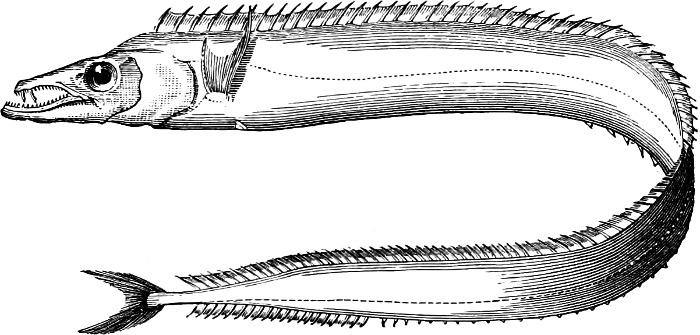
Fig. 192.—Lepidopus caudatus.
The Scabbard-fish (L. caudatus) is rather common in the Mediterranean and warmer parts of the Atlantic, extending northwards to the south coast of England, where it is an occasional visitor, and southwards to the Cape of Good Hope. More recently it has been observed on the coasts of Tasmania and New Zealand. We may, therefore, justly consider it to be a deep-sea fish, which probably descends to the same depth as the preceding allied forms. It grows to a length of five or six feet, but its body is so much compressed that it does not weigh more than as many pounds. It is well known in New Zealand, where it is called “Frost-fish,” and esteemed as the most delicious fish of the colony. A still more attenuated species (L. tenuis) occurs in the sea off Japan, at a depth of some 340 fathoms.
Trichiurus.—Body band-like, tapering into a fine point, without caudal fin. One single dorsal extending the whole length of the back. Ventrals reduced to a pair of scales, or entirely absent. Anal fin rudimentary, with numerous extremely short spines, scarcely projecting beyond the skin. Long fangs in the jaws; teeth on the palatine bones, none on the vomer.
The “Hairtails” belong to the tropical marine fauna, and although generally found in the vicinity of land, they wander frequently out to sea, perhaps merely because they follow some ocean-currents. Therefore they are not rarely found in the temperate zone, the common West Indian species (T. lepturus), for instance, on the coast of England. They attain to a length of about four feet. The number of their vertebræ is very large, as many as 160, and more. Six species are known.
Epinnula.—Body rather elongate, covered with minute scales,[*. see below] The first dorsal fin continuous, with spines of moderate strength, and extending on to the second; finlets none; ventrals well developed. Lateral lines two. Teeth of the jaws strong; palatine teeth, none.
The “Domine” of the Havannah, E. magistralis.
Thyrsites.—Body rather elongate, for the greater part naked. The first dorsal continuous, with the spines of moderate strength, and extending on to the second. From two to six finlets behind the dorsal and anal. Several strong teeth in the jaws; teeth on the palatine bones.
The species of this genus attain to a considerable size (from four to five feet), and are valuable food fishes; Th. atun from the Cape of Good Hope, South Australia, New Zealand, and Chili, is preserved, pickled or smoked. In New Zealand it is called “Barracuda” or “Snoek,” and exported from the colony into Mauritius and Batavia as a regular article of commerce, being worth over £17 a ton; Th. pretiosus, the “Escholar” of the Havannah, from the Mediterranean, the neighbouring parts of the Atlantic, and the West Indies; Th. prometheus from Madeira, Bermuda, St. Helena, and Polynesia; Th. solandri from Amboyna and Tasmania is probably the same as Th. prometheus.
Young specimens of this (or, perhaps, the following) genus have been described as Dicrotus. In them the finlets are not yet detached from the rest of the fin; and the ventral fins, which are entirely obsolete in the adult fish, are represented by a long crenulated spine.
Gempylus.—Body very elongate, scaleless. The first dorsal fin continuous, with thirty and more spines, and extending on to the second. Six finlets behind the dorsal and anal. Several strong teeth in the jaws, none on the palate.
One species (G. serpens), inhabiting considerable depths of the Atlantic and Pacific Oceans.
Family—Palæorhynchidæ.
This family has been formed for two extinct genera: Palæorhynchus from the schists of Glaris, and Hemirhynchus from tertiary formations near Paris. These genera resemble much the Trichiuridæ in their long, compressed body, and long vertical fins, but their jaws, which are produced into a long beak, are toothless, or provided with very small teeth. The dorsal fin extends the whole length of the back, and the anal reaches from the vent nearly to the caudal, which is forked. The ventrals are composed of several rays and thoracic. The vertebræ long, slender, and numerous, and, like all the bones of the skeleton, thin, indicating that these fishes were inhabitants of considerable depths of the ocean. Both the jaws of Palæorhynchus are prolonged into a beak, whilst in Hemirhynchus the upper exceeds the lower in length.
Eighth Division—Acanthopterygii Cotto-scombriformes.
Spines developed, in one of the fins at least. Dorsal fins either continuous or close together; the spinous dorsal, if present, always short; sometimes modified into tentacles, or into a suctorial disk; soft dorsal always long, if the spinous is absent; anal similarly developed as the soft dorsal, and both generally much longer than the spinous, sometimes terminating in finlets. Ventrals, thoracic or jugular, if present, never modified into an adhesive apparatus. No prominent anal papilla.
Marine fishes, with few exceptions.
First Family—Acronuridæ.
Body compressed, oblong or elevated, covered with minute scales. Tail generally armed with one or more bony plates or spines, which are developed with age, but absent in very young individuals. Eye lateral, of moderate size. Mouth small; a single series of more or less compressed, sometimes denticulated, sometimes pointed incisors in each jaw; palate toothless. One dorsal fin, the spinous portion being less developed than the soft; anal with two or three spines; ventral fins thoracic. Air-bladder forked posteriorly. Intestines with more or less numerous circumvolutions. Nine abdominal, and thirteen caudal vertebræ.
Inhabitants of the tropical seas, and most abundant on coral-reefs. They feed either on vegetable substances or on the superficial animal matter of corals.
Extinct species of Acanthurus and Naseus have been discovered in the Monte Bolca formation.
Acanthurus.—Jaws with a single series of lobate incisors, which are sometimes movable. An erectile spine hidden in a groove on each side of the tail. Ventral fins with one spine and generally five rays. Scales ctenoid, sometimes with minute spines. Branchiostegals five.
The fishes of this genus, which sometimes are termed “Surgeons,” are readily recognised by the sharp lancet-shaped spine with which each side of the tail is armed. When at rest the spine is hidden in a sheath; but it can be erected and used by the fish as a very dangerous weapon, by striking with the tail towards the right and left. “Surgeons” occur in all tropical seas, with the exception of the eastern part of the Pacific, where they disappear with the corals. They do not attain to any size, the largest species scarcely exceeding a length of eighteen inches. Many are agreeably or showily coloured, the ornamental colours being distributed in very extraordinary patterns. The larger species are eatable, and some even esteemed as food. It is stated that the fry of some species periodically approaches, in immense numbers, the coasts of some of the South Sea Islands (Caroline Archipelago), and serves as an important article of food to the natives. Nearly fifty species are known.
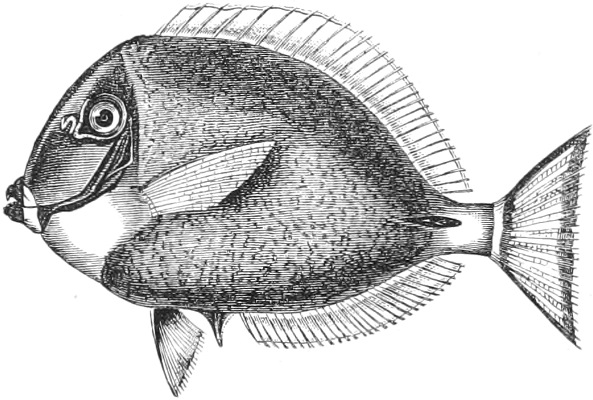
Fig. 193.—Acanthurus leucosternum, Indian Ocean.
At an early period of their growth these fishes present so different an aspect that they were considered a distinct genus, Acronurus. The form of the body is more circular and exceedingly compressed. No scales are developed, but the skin forms numerous oblique parallel folds. The gill-cover and the breast are shining silvery.
Naseus.—Tail with two (rarely one or three) bony keeled plates on each side (in the adult). Head sometimes with a bony horn or crest-like prominence directed forwards. Ventral fins composed of one spine and three rays. From four to six spines in the dorsal; two anal spines. Scales minute, rough, forming a sort of fine shagreen. Air-bladder forked behind. Intestinal tract with many circumvolutions.
Twelve species are known from the tropical Indo-Pacific, but none of them extend eastwards beyond the Sandwich Islands. In their mode of life these fishes resemble the Acanthuri. Likewise, the young have a very different appearance, and are unarmed, and were described as a distinct genus, Keris. One of the most common species is N. unicornis, which, when adult (22 inches long), has a horn about 2 inches long, whilst it is merely a projection in front of the eye in individuals of 7 inches in length.
Prionurus is an allied genus with a series of several keeled bony laminæ on each side of the tail.
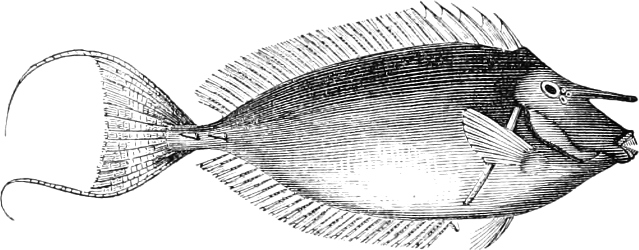
Fig. 194.—Naseus unicornis.
Second Family—Carangidæ.
Body more or less compressed, oblong or elevated, covered with small scales or naked; eye, lateral. Teeth, if present, conical. No bony stay for the præoperculum. The spinous dorsal is less developed than the soft or than the anal, either continuous with, or separated from, the soft portion; sometimes rudimentary. Ventrals thoracic, sometimes rudimentary or entirely absent. No prominent papilla near the vent. Gill-opening wide. Ten abdominal and fourteen caudal vertebræ.
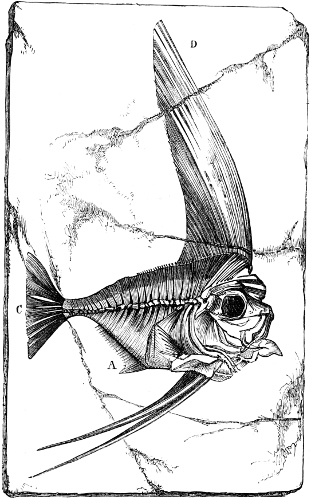
Fig. 195.—Semiophoris velitans.
Inhabitants of tropical and temperate seas. Carnivorous. They appear first in cretaceous formations, where they are represented by Platax and some Caranx-like genera (Vomer and Aipichthys from the chalk of Comen in Istria). They are more numerous in various Tertiary formations, especially in the strata of Monte Bolca, where some still existing genera occur, as Zanclus, Platax, Caranx (Carangopsis), Argyriosus (Vomer), Lichia, Trachynotus. Of the extinct genera the following belong to this family:—Pseudovomer (Licata), Amphistium, Archæus, Ductor, Plionemus (?), and Semiophorus. Equula has been recently discovered in the Miocene marls of Licata in Sicily.
Caranx (including Trachurus).—Body more or less compressed, sometimes sub-cylindrical. Cleft of the mouth of moderate width. The first dorsal fin continuous, with about eight feeble spines, sometimes rudimentary; the soft dorsal and anal are succeeded by finlets in a few species. Two anal spines, somewhat remote from the fin. Scales very small. Lateral line with an anterior curved, and a posterior straight, portion, either entirely or posteriorly only covered by large plate-like scales, several of which are generally keeled, the keel ending in a spine. Dentition feeble. Air-bladder forked posteriorly.

Fig. 196.—Plates of the lateral line of Caranx hippos.
The “Horse-mackerels” are found in abundance in almost all temperate and, especially, tropical seas. Many species wander to other parts of the coast, or to some distance from land, and have thus gradually extended their range over two or more oceanic areas; some are found in all tropical seas. The species described are very numerous, about ninety having been properly characterised and distinguished. Some attain to a length of three feet and more, and all are eatable. They feed on other fish and various marine animals.
Of the most noteworthy species the following may be mentioned:—C. trachurus, the common British Horse-mackerel, distinguished by having the lateral line in its whole length armed with large vertical plates; it is almost cosmopolitan within the temperate and tropical zones of the northern and southern hemispheres. C. crumenophthalmus, C. carangus, and C. hippos, three of the most common sea-fishes, equally abundant in the Atlantic and Indo-Pacific oceans; C. ferdau, from the Indo-Pacific, upwards of three feet in length. C. armatus, ciliaris, gallus, etc., which have an exceedingly short and compressed body, with rudimentary spinous dorsal fin, and with some of the rays of the dorsal and anal prolonged into filaments.
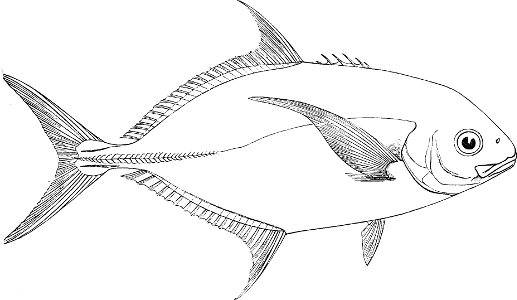
Fig. 197.—Caranx ferdau.
Argyriosus is closely allied to Caranx, especially to the last-named species, but the lateral line has no plates whatever; and the body is scaleless, chiefly of a bright silvery colour.
Two species from the tropical Atlantic.
Micropteryx.—Body much compressed, with prominent trenchant abdomen, covered with small scales; lateral line not shielded; præopercular margin entire. Cleft of the mouth rather small; præorbital of moderate width. The first dorsal continuous, with seven feeble spines. No detached finlets. Small teeth on the vomer and palatine bones.
Micropteryx chrysurus is a semi-pelagic fish, and very common in the tropical Atlantic, less so in the Indian Ocean.