SYSTEMATIC AND DESCRIPTIVE PART. (continued 5)
Reading edition
Pimelodus.—Adipose fin well developed; dorsal fin short, with a more or less pungent spine and six rays; anal fin short. Barbels six, cylindrical or slightly compressed, none of them belonging to either of the nostrils, which are remote from each other. Palate edentulous. Ventrals six-rayed, inserted behind the dorsal.
Of all South American genera this is represented by the greatest number of species, more than forty being well characterised; they differ chiefly with regard to the length of the adipose fin and barbels, and the strength of the dorsal spine. Singularly, two species (P. platychir and P. balayi), are found in West Africa. The majority are of but moderate size and plain coloration.—Allied South American genera (also without teeth on the palate), are Pirinampus, Conorhynchus, Notoglanis, Callophysus, Lophiosilurus.
Auchenoglanis.—Adipose fin rather long, dorsal short, with a pungent spine and seven rays; anal short. Snout produced, pointed, with narrow mouth. Barbels six, none of which belongs to either of the nostrils, which are remote from each other. The teeth of each jaw form a pair of small elliptic patches which are longer than broad; palate edentulous. Eyes of moderate size. Ventrals six-rayed.
One species, Au. biscutatus, from the Nile, Senegal, and other West African rivers.
d. Ariina.
Arius.—Adipose fin of moderate length or short; a short dorsal fin with a pungent spine and seven soft rays; anal fin rather short. Head osseous above; barbels six, four at the mandible, none at either of the nostrils which are close together. Eyes with a free orbital margin. Caudal fin forked; ventrals six-rayed, behind the dorsal.
Of all Siluroid genera this has the greatest number of species (about seventy), and the widest distribution, being represented in almost all tropical countries which are drained by large rivers; some of the species prefer brackish to fresh water, and a few enter the sea, but keep near to the coast. Some of the species are of small size, whilst others exceed a length of five feet. The extent of the armature of the neck and the dentition vary much in the different species, and affords two of the principal characters by which the species are separated.—The following genera are allied to Arius, Galeichthys from South Africa; Genidens and Paradiplomystax from Brazil; Diplomystax from Chile; Aelurichthys from Central and South America; Hemipimelodus, Ketengus, Osteogeniosus, and Batrachocephalus from the East Indies; and Atopochilus from West Africa.
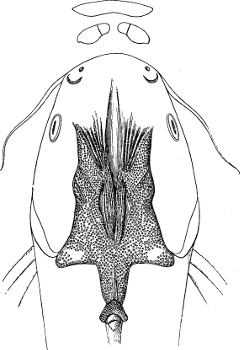
Fig. 261.—Arius australis, from Queensland.
e. Bagariina.
Bagarius.—Adipose fin rather short; a short dorsal with one spine and six rays; anal fin of moderate length. Barbels eight, of which one pair stands between the anterior and posterior nostrils which are close together. Head naked above. Caudal fin deeply forked; ventrals rays six. Thorax without longitudinal plaits of the skin.
A large Siluroid (B. bagarius) from rivers of India and Java; exceeding a length of six feet.
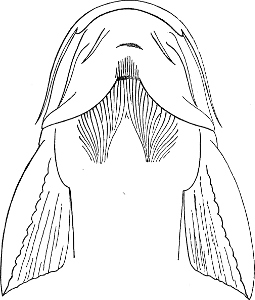
Fig. 262.—Euglyptosternum coum, thoracic adhesive apparatus.
Euglyptosternum.—Adipose fin of moderate length; a short dorsal with a pungent spine and six rays; anal fin short. Barbels eight, of which one pair is placed between the anterior and posterior nostrils which are close together. Teeth on the palate villiform, in two separate patches. Eyes small, below the skin. Caudal forked; ventral rays six. Pectorals horizontal, with a thoracic adhesive apparatus between, which is formed by longitudinal plaits of the skin.
This fish (Eu. coum) inhabits the river Coic in Syria, and is about twelve inches long. The plaited structure on the thorax probably increases the capability of the fish of maintaining its position in the rapid current of the stream, a function which appears to be chiefly performed by the horizontally expanded pectoral fins. A similar structure is found in Glyptosternum, a genus represented by eight species in mountain streams of the East Indies, and differing from the Syrian species in lacking the teeth on the palate.
V. Siluridæ Stenobranchiæ.—The rayed dorsal fin is short, if present, belonging to the abdominal portion of the vertebral column, the ventrals being inserted behind it (except in Rhinoglanis). The gill-membranes are confluent with the skin of the isthmus.
a. Doradina.
Some of the genera have no bony shields along the lateral line, and a small adipose fin or none whatever; all of these are South American—Ageniosus, Tetranematichthys, Euanemus, Auchenipterus, Glanidium, Centromochlus, Trachelyopterus, Cetopsis, and Astrophysus.
Others have a series of bony scutes along the middle of the side; they form the genus Doras with two closely allied forms, Oxydoras and Rhinodoras. Some twenty-five species are known, all from rivers of tropical America, flowing into the Atlantic. These fishes have excited attention by their habit of travelling, during the dry season, from a piece of water about to dry up, in quest of a pond of greater capacity. These journeys are occasionally of such a length that the fish spends whole nights on the way, and the bands of scaly travellers are sometimes so large that the Indians who happen to meet them, fill many baskets of the prey thus placed in their hands. The Indians supposed that the fish carry a supply of water with them, but they have no special organs, and can only do so by closing the gill-openings, or by retaining a little water between the plates of their bodies, as Hancock supposes. The same naturalist adds that they make regular nests, in which they cover up their eggs with care and defend them, male and female uniting in this parental duty until the eggs are hatched. The nest is constructed at the beginning of the rainy season, of leaves, and is sometimes placed in a hole scooped out in the beach.
Finally, in the last genus, the lateral scutes are likewise absent, viz. in
Synodontis.—The adipose fin is of moderate length or rather long; the dorsal fin has a very strong spine and seven soft rays. The teeth in the lower jaw are movable, long, very thin at the base, and with a slightly-dilated brown apex. Mouth small. Barbels six, more or less fringed with a membrane or with filaments. Neck with broad dermal bones.
Synodontis is characteristic of the fauna of tropical Africa, where it is represented by fifteen species. Several occur in the Nile, and are known by the vernacular name “Schal.” Some attain a length of two feet. The species figured is from West Africa, and characterised by its long upper jaw.
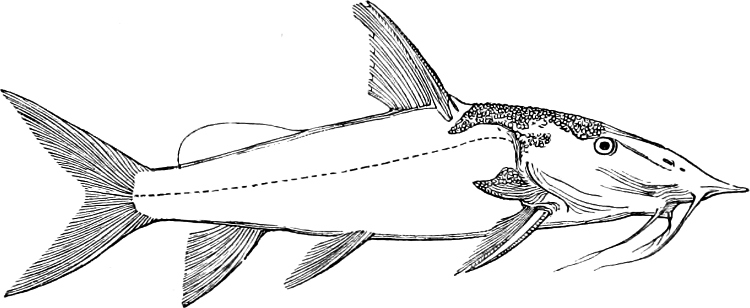
Fig. 263.—Synodontis xiphias.
b. Rhinoglanina.
Rhinoglanis.—Two dorsal fins, both composed of rays, the first with a strong spine; anal rather short. Barbels six; anterior and posterior nostrils close together, the posterior very large, open. Neck with broad dermal bones. Ventrals with seven rays, inserted below the posterior rays of the first dorsal fin.
This Siluroid is known from a single example only one and a half inches long, obtained at Gondokoro on the Upper Nile. Callomystax represents this type in the Ganges and Indus.
c. Malapterurina.
Malapterurus.—One dorsal fin only, which is adipose and situated before the caudal; anal of moderate length or short; caudal rounded; ventrals six-rayed, inserted somewhat behind the middle of the body; pectorals without pungent spine. Barbels six: one to each maxillary and two on each side of the mandible. The anterior and posterior nostrils are remote from each other. No teeth on the palate. The entire head and body covered with soft skin. Eyes small. Gill-opening very narrow, reduced to a slit before the pectoral.
The “Electric Cat- or Sheath-fishes” are not uncommon in the fresh waters of tropical Africa; three species have been described, of which M. electricus occurs in the Nile; they grow to a length of about four feet. Although the first dorsal fin is absent, its position (if it had been developed) is indicated by a rudimentary interneural spine, which rests in the cleft of the neural process of the first vertebra. The electric organ extends over the whole body, but is thickest on the abdomen; it lies between two aponeurotic membranes, below the skin, and consists of rhomboidal cells which contain a rather firm gelatinous substance. The electric nerve takes its origin from the spinal chord, does not enter into connection with ganglia, and consists of a single enormously-strong primitive fibre, which distributes its branches in the electric organ.
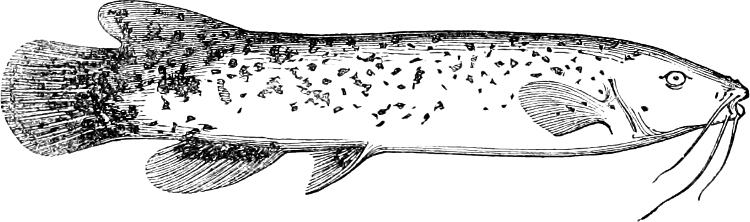
Fig. 264.—Malapterurus electricus.
VI. Siluridæ Proteropodes.—The rayed dorsal fin is always present and rather short; the ventrals are inserted below (very rarely in front of) the dorsal. The gill-membranes are confluent with the skin of the isthmus, the gill-opening being reduced to a short slit. Pectorals and ventrals horizontal. Vent before, or not much behind, the middle of the length of the body.
a. Hypostomatina.
Stygogenes.—Adipose fin short; dorsal and anal short; the outer fin-rays somewhat thickened and rough; palate toothless; cleft of the mouth of moderate width, with a maxillary barbel on each side; a short broad flap on each side between the nostrils, which are close together. Lower lip very broad, pendent. Eyes small, covered with transparent skin. Head covered with soft skin. Ventrals six-rayed.
These small Siluroids, which are called “Preñadillas” by the natives, together with the allied Arges, Brontes, and Astroplebus, have received some notoriety through Humboldt’s accounts, who adopted the popular belief that they live in subterranean waters within the bowels of the active volcanoes of the Andes, and are ejected with streams of mud and water during eruptions. Humboldt himself considers it very singular that they are not cooked and destroyed whilst they are vomited forth from craters or other openings. The explanation of their appearance during volcanic eruptions is, that they abound in the numerous lakes and torrents of the Andes, that they are killed by the sulphuretted gases escaping during an eruption, and swept down by the torrents of water issuing from the volcano.
Callichthys.—Adipose fin short, supported anteriorly by a short movable spine; dorsal with a feeble spine and seven or eight rays; anal short. Teeth minute or entirely absent; cleft of the mouth rather narrow, with a pair of maxillary barbels on each side, which are united at the base. Eyes small. Head covered with osseous plates; body wholly protected by two series of large imbricate shields on each side. Ventrals six-rayed.
Twelve species of this genus are known; they are small, and similarly distributed as Doras, with which they have much in common as regards their mode of life. They likewise are able to travel over land, and construct nests for their ova.
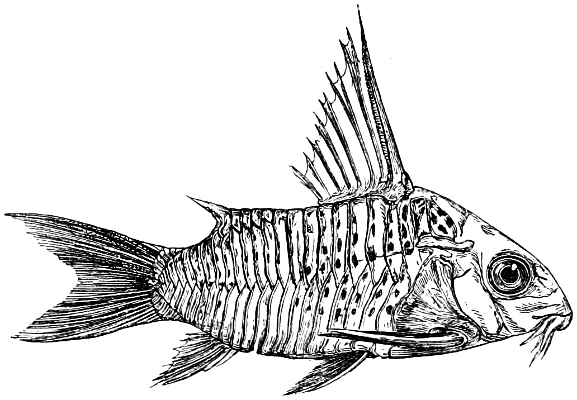
Fig. 265.—Callichthys armatus, from the Upper Amazon. Natural size.
Chætostomus.—A short adipose fin, supported anteriorly by a short, compressed, curved spine; dorsal fin of moderate length, with from eight to ten rays, the first of which is simple; anal fin short; ventral six-rayed; pectoral with a strong spine. Head and body completely cuirassed, the lower parts being sometimes naked; body rather short, with four or five longitudinal series of large imbricate scutes on each side; tail not depressed. Snout produced, obtuse in front; mouth inferior, transverse, with a single series of generally very fine bent teeth in both jaws. Interoperculum very movable and armed with erectile spines.
This genus, with the allied Plecostomus, Liposarcus, Pterygoplichthys, Rhinelepis, Acanthicus, and Xenomystus, is well represented in the fresh waters of South America, whence about sixty species are known. The majority do not exceed a length of twelve inches, but some attain to more than double that size. In some of the species the male is provided with long bristles round the margin of the snout and interoperculum.
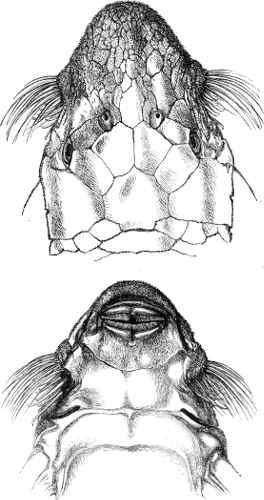
Fig. 266.—Upper and Lower side of the head of Chætostomus heteracanthus, Upper Amazons.
Hypoptopoma.—Differing from Chætostomus in the peculiar formation of the head, which is depressed, spatulate, the eyes being on the lateral edge of the head. The movable gill-covers are reduced to two bones, neither of which is armed, viz.—the operculum small and placed as in Chætostomus, and a second, larger one, separated from the eye by the narrow sub-orbital ring, and placed at the lower side of the head.
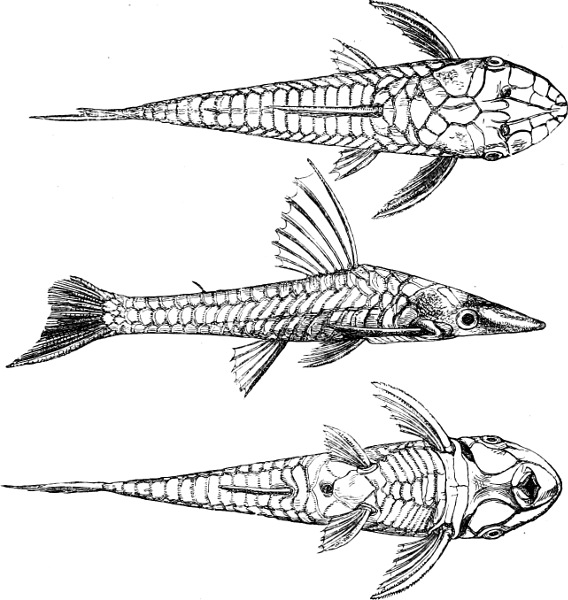
Fig. 267.—Hypoptopoma thoracatum, Upper Amazons. Natural size.
Loricaria.—One short dorsal fin; anal short; the outer ray of each fin thickened, but flexible. Head depressed, with the snout more or less produced and spatulate. Mouth situated at the lower side of the snout, remote from its extremity, transverse, surrounded by broad labial folds which are sometimes fringed; a short barbel at each corner of the mouth. Teeth in the jaws small, bent, with a dilated, notched apex, in a single series, sometimes absent. Head and body cuirassed; tail depressed, long; eye rather small or of moderate size.
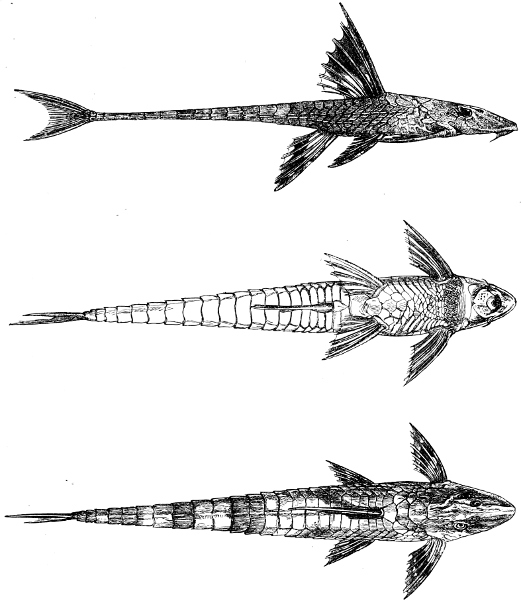
Fig. 268.—Loricaria lanceolate, Upper Amazons. Natural size.
Small fishes from rivers of tropical America; about twenty-six species are known. The male of some species has a bearded or bristly snout.
Acestra differs from Loricaria in having the snout much prolonged.
Sisor.—Head depressed, spatulate; trunk depressed; tail long and thin. One short dorsal fin; anal short; ventrals seven-rayed. Head partially osseous, rough; a series of bony plates along the median line of the back; lateral line rough. Eyes very small. Mouth inferior, small, transverse, with barbels; teeth none.
A single species, S. rhabdophorus, from rivers of northern Bengal. Allied to this genus is Erethistes from Assam.
Pseudecheneis.—Adipose fin of moderate length; a short dorsal with one spine and six rays; anal fin rather short. Barbels eight. Mouth small, inferior. Head depressed, covered with soft skin above; eyes small, superior. Caudal fin forked; pectorals horizontal, with a thoracic adhesive apparatus between, formed by transverse plaits of the skin. Ventrals six-rayed.
A very small species, inhabiting the mountain-streams of Khassya; by means of the adhesive apparatus it is enabled to hold on to stones, thus preventing the current from sweeping it away. Exostoma is a similar small Siluroid from Indian mountain-streams, but without the thoracic apparatus; probably its mouth performs the same function.
b. Aspredinina.
Aspredo.—Adipose fin none; dorsal short, without pungent spine; anal very long, but not united with the caudal. Head broad, much depressed; tail very long and slender. Barbels not less than six, one of which is attached to each intermaxillary; none at the nostrils. Eyes very small. Head covered with soft skin; the anterior and posterior nostrils are remote from each other. Ventrals six-rayed.
Six species are known from Guyana; the largest grows to a length of about eighteen inches. The remarkable mode of taking care of their ova has been noticed above (p. 161, Fig. 72). Bunocephalus, Bunocephalichthys, and Harttia, from tropical America, are other genera of this sub-family which remain to be mentioned.
VII. Siluridæ Opisthopteræ.—The rayed dorsal fin is always present, short, and placed above or behind the middle of the length of the body, above or behind the ventrals which, however, are sometimes absent; anal short. Nostrils remote from each other; if a nasal barbel is present, it belongs to the anterior nostril. Lower lip not reverted. The gill-membranes are not confluent with the skin of the isthmus: Nematogenyina and Trichomycterina.
The genera Heptapterus, Nematogenys, Trichomycterus, Eremophilus, and Pariodon, belong to this sub-family. They are small South American Siluroids, the majority of which inhabit waters at high altitudes, up to 14,000 feet above the level of the sea. In the Andes they replace the Loaches of the Northern Hemisphere, which they resemble in appearance and habits, and even in coloration, offering a striking example of the fact that similar forms of animals are produced under similar external physical conditions.
VIII. Siluridæ Branchicolæ.—The rayed dorsal fin is present, short, and placed behind the ventrals; anal short. Vent far behind the middle of the length of the body. Gill-membranes confluent with the skin of the isthmus.
Stegophilus and Vandellia, two genera from South America, comprising the smallest and least developed Siluroids. Their body is narrow, cylindrical, and elongate; a small barbel at each maxillary; the operculum and interoperculum are armed with short stiff spines. The natives of Brazil accuse these fishes of entering and ascending the urethra of persons while bathing, causing inflammation and sometimes death. This requires confirmation, but there is no doubt that they live parasitically in the gill-cavity of larger fishes (Platystoma), but probably they enter these cavities only for places of safety, without drawing any nourishment from their host.
Second Family—Scopelidæ.
Body naked or scaly. Margin of the upper jaw formed by the intermaxillary only; opercular apparatus sometimes incompletely developed. Barbels none. Gill-opening very wide; pseudobranchiæ well developed. Air-bladder none. Adipose fin present. The eggs are enclosed in the sacs of the ovary, and excluded by oviducts. Pyloric appendages few in number or absent. Intestinal tract very short.
Exclusively marine, the majority being either pelagic or deep-sea forms. Of fossil remains the following have been referred to this family:—Osmeroides, from Mount Lebanon, which others believe to be a marine salmonoid; Hemisaurida, from Comen, allied to Saurus; Parascopelus and Anapterus, from the miocene of Licata, the latter genus allied to Paralepis.
Saurus (inclus. Saurida).—Body sub-cylindrical, rather elongate, covered with scales of moderate size; head oblong; cleft of the mouth very wide; intermaxillary very long, styliform, tapering; maxillary thin, long, closely adherent to the intermaxillary. Teeth card-like, some being elongate, slender; all can be laid downwards and inwards. Teeth on the tongue, and palatine bones. Eye of moderate size. Pectorals short; ventrals eight- or nine-rayed, inserted in advance of the dorsal, not far behind the pectorals. Dorsal fin nearly in the middle of the length of the body, with thirteen or less rays; adipose fin small; anal short or of moderate length; caudal forked.
Fifteen species of small size, from the shores of the tropical and sub-tropical zones. The species figured on p. 42, Fig. 5, occurs on the north-west coast of Australia and in Japan.
Bathysaurus.—Shape of the body similar to that of Saurus, sub-cylindrical, elongate, covered with small scales. Head depressed, with the snout produced, flat above. Cleft of the mouth very wide, with the lower jaw projecting; intermaxillary very long, styliform, tapering, not movable. Teeth in the jaws, in broad bands, not covered by lips, curved, unequal in size and barbed at the end. A series of similar teeth runs along the whole length of each side of the palate. Eye of moderate size, lateral. Pectoral of moderate length. Ventral eight-rayed, inserted immediately behind the pectoral. Dorsal fin in the middle of the length of the body, with about eighteen rays. Adipose fin absent or present. Anal of moderate length. Caudal emarginate.
Deep-sea fishes, obtained in the Pacific at depths varying from 1100 to 2400 fathoms. The largest example is twenty inches long. Two species.
Bathypterois.—Shape of the body like that of an Aulopus. Head of moderate size, depressed in front, with the snout projecting, the large mandible very prominent beyond the upper jaw. Cleft of the mouth wide; maxillary developed, very movable, much dilated behind. Teeth in narrow villiform bands in the jaws. On each side of the broad vomer a small patch of similar teeth; none on the palatines or on the tongue. Eye very small. Scales cycloid, adherent, of moderate size. Rays of the pectoral fin much elongated, some of the upper being separate from the rest, and forming a distinct division. Ventrals abdominal, with the outer rays prolonged, eight-rayed. Dorsal fin inserted in the middle of the body, above or immediately behind the root of the ventral, of moderate length. Adipose fin present or absent. Anal short. Caudal forked.
This very singular form is one of the discoveries of the “Challenger;” it is widely distributed over the seas of the Southern Hemisphere, in depths varying from 520 to 2600 fathoms. The elongate pectoral rays are most probably organs of touch. Four species were discovered, the largest specimen being thirteen inches long.
Harpodon.—Body elongate, covered with very thin, diaphanous, deciduous scales. Head thick, with very short snout; its bones are very soft, and the superficial ones are modified into wide muciferous cavities; the lateral canal of the body is also very wide, and a pair of pores corresponds to each scale of the lateral line, one being above, the other below the scale. Cleft of the mouth very wide; intermaxillary very long, styliform, tapering; maxillary absent. Teeth card-like, recurved, unequal in size; the largest are in the lower jaw, and provided with a single barb at the posterior margin of the point. Eye small. Ventral fins long, nine-rayed, inserted below the anterior dorsal rays; dorsal fin in the middle of the length of the body; adipose fin small; anal of moderate length; caudal fin three-lobed, the lateral line being continued along the central lobe. Centre of the vertebræ open in the middle.
Two species only are known of this singular genus; both are evidently inhabitants of considerable depths, and periodically come nearer to the surface. One (H. nehereus) is well known in the East Indies, being of excellent flavour. When newly taken its body is brilliantly phosphorescent. When salted and dry it is known under the names of “Bombay-ducks” or “Bummaloh,” and exported in large quantities from Bombay and the coast of Malabar. The second species (H. microchir) exceeds the other in length, and has been found in the sea off Japan.
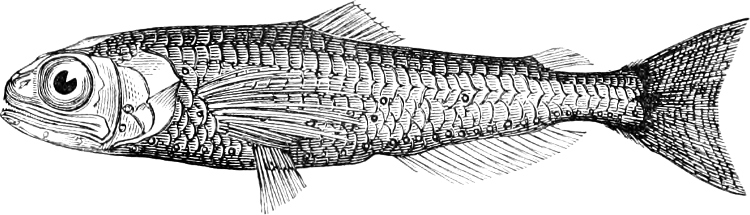
Fig. 269.—Scopelus boops.
Scopelus.—Body oblong, more or less compressed, covered with large scales. Series of phosphorescent spots run along the lower side of the body, and a similar glandular substance sometimes occupies the front of the snout and the back of the tail. Cleft of the mouth very wide. Intermaxillary very long, styliform, tapering; maxillary well developed. Teeth villiform. Eye large. Ventrals eight-rayed, inserted immediately in front of or below the anterior dorsal rays. Dorsal fin nearly in the middle of the length of the body; adipose fin small; anal generally long; caudal forked. Branchiostegals from eight to ten.
The fishes of this genus are small, of truly pelagic habits, and distributed over all the temperate and tropical seas; they are so numerous that the surface-net, when used during a night of moderate weather, scarcely ever fails to enclose some specimens. They come to the surface at night only; during the day and in very rough weather they descend to depths where they are safe from sunlight or the agitation of the water. Some species never rise to the surface; indeed, Scopeli have been brought up in the dredge from almost any depth to 2500 fathoms. Thirty species are known. Gymnoscopelus differs from Scopelus in lacking scales.
Ipnops.—Body elongate, sub-cylindrical, covered with large, thin, deciduous scales, and without phosphorescent organs. Head depressed, with broad, long, spatulate snout, the whole upper surface of which is occupied by a most peculiar organ of vision (or luminosity), longitudinally divided in two symmetrical halves. Bones of the head well ossified. Mouth wide, with the lower jaw projecting; maxillary dilated behind. Both jaws with narrow bands of villiform teeth; palate toothless. Pectoral and ventral fins well developed, and, owing to the shortness of the trunk, close together. Dorsal fin at a short distance behind the vent; adipose fin none; anal fin moderately long; caudal subtruncated. Pseudobranchiæ none.
This singular genus, one of the “Challenger” discoveries, is known from four examples, obtained at depths varying between 1600 and 2150 fathoms, off the coast of Brazil, near Tristan d’Acunha and north of Celebes. All belong to one species, I. murrayi. The eye seems to have lost its function of vision and assumed that of producing light. The specimens are from 4 to 5½ inches long.
Paralepis.—Head and body elongate, compressed, covered with deciduous scales. Cleft of the mouth very wide; maxillary developed, closely adherent to the intermaxillary. Teeth in a single series, unequal in size. Eye large. Ventrals small, inserted opposite or nearly opposite the dorsal. Dorsal fin short, on the hinder part of the body; adipose fin small; anal elongate, occupying the end of the tail; caudal emarginate.
Three species; small pelagic fishes from the Mediterranean and Atlantic.—Sudis, from the Mediterranean, has a dentition slightly different from that of Paralepis.
Plagyodus.—Body elongate, compressed, scaleless; snout much produced, with very wide cleft of the mouth. Intermaxillary very long and slender; maxillary thin, immovable. Teeth in the jaws and of the palate very unequal in size, the majority pointed and sharp, some very large and lanceolate. Eye large. Pectoral and ventral fins well developed; the rayed dorsal fin occupies the whole length of the back from the occiput to opposite the anal fin; adipose and anal fins of moderate size. Caudal forked. Branchiostegals six or seven.
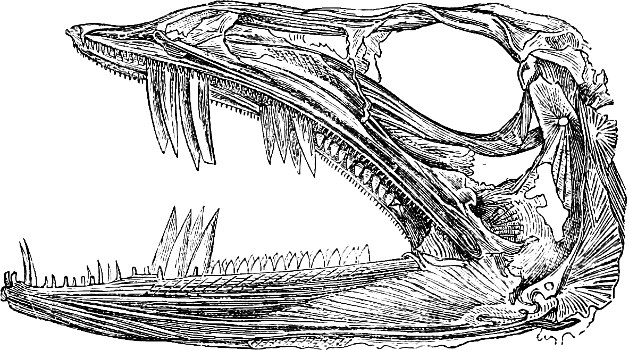
Fig. 270.—Plagyodus ferox.
This is one of the largest and most formidable deep-sea fishes. One species only is well known, P. ferox, from Madeira and the sea off Tasmania; other species have been noticed from Cuba and the North Pacific, but it is not evident in what respects they differ specifically from P. ferox. This fish grows to a length of six feet, and from the stomach of one example have been taken several Octopods, Crustaceans, Ascidians, a young Brama, twelve young Boar-fishes, a Horse-mackerel, and one young of its own species. The stomach is coecal; the commencement of the intestine has extremely thick walls, its inner surface being cellular, like the lung of a reptile; a pyloric appendage is absent. All the bones are extremely thin, light, and flexible, containing very little earthy matter; singular is the development of a system of abdominal ribs, symmetrically arranged on both sides, and extending the whole length of the abdomen. Perfect specimens are rarely obtained on account of the want of coherence of the muscular and osseous parts, caused by the diminution of pressure when the fish reaches the surface of the water. The exact depth at which Plagyodus lives is not known; probably it never rises above a depth of 300 fathoms.
The other less important genera belonging to this family are Aulopus, Chlorophthalmus, Scopelosaurus, Odontostomus, and Nannobrachium.
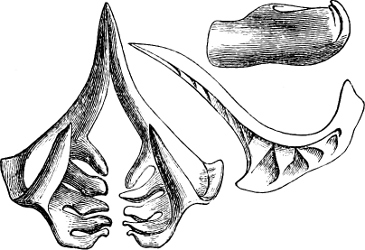
Fig. 271.—Pharyngeal bones and teeth of the Bream, Abramis brama.
Third Family—Cyprinidæ.
Body generally covered with scales; head naked. Margin of the upper jaw formed by the intermaxillaries. Belly rounded, or, if trenchant, without ossifications. No adipose fin. Stomach without blind sac. Pyloric appendages none. Mouth toothless; lower pharyngeal bones well developed, falciform, sub-parallel to the branchial arches, provided with teeth, which are arranged in one, two, or three series. Air-bladder large, divided into an anterior and posterior portion by a constriction, or into a right or left portion, enclosed in an osseous capsule. Ovarian sacs closed.
The family of “Carps” is the one most numerously represented in the fresh waters of the Old World and of North America. Also numerous fossil remains are found in tertiary freshwater-formations, as in the limestones of Oeningen and Steinheim, in the lignites of Bonn, Stöchen, Bilin, and Ménat, in the marl slates and carbonaceous shales of Licata in Sicily, and of Padang in Sumatra, in corresponding deposits of Idaho in North America. The majority can be referred to existing genera: Barbus, Thynnichthys, Gobio, Leuciscus, Tinca, Amblypharyngodon, Rhodeus, Cobitis, Acanthopsis, only a few showing characters different from those of living genera: Cyclurus, Hexapsephus, Mylocyprinus (tertiary of North America).
Most Carps feed on vegetable and animal substances; a few only are exclusive vegetable feeders. There is much less diversity of form and habits in this family than in the Siluroids; however, the genera are sufficiently numerous to demand a further subdivision of the family into groups.
I. Catostomina.—Pharyngeal teeth in a single series, exceedingly numerous and closely set. Dorsal fin elongate, opposite to the ventrals; anal short, or of moderate length. Barbels none.
These fishes are abundant in the lakes and rivers of North America, more than thirty species having been described, and many more named, by American ichthyologists. Two species are known from North-Eastern Asia. They are generally called “Suckers,” but their vernacular nomenclature is very arbitrary and confused. Some of the species which inhabit the large rivers and lakes grow to a length of three feet and a weight of fifteen pounds. The following genera may be distinguished:—Catostomus, “Suckers,” “Red-horses,” “Stone-rollers,” “White Mullets;” Moxostoma; Sclerognathus, “Buffaloes,” “Black Horses;” and Carpiodes, “Spear-fish,” “Sail-fish.”
II. Cyprinina.—Anal fin very short, with not more than five or six, exceptionally seven, branched rays. Dorsal fin opposite ventrals. Abdomen not compressed. Lateral line running along the median line of the tail. Mouth frequently with barbels, never more than four in number. Pharyngeal teeth generally in a triple series in the Old World genera; in a double or single series in the North American forms, which are small and feebly developed. Air-bladder present, without osseous covering.
Cyprinus.—Scales large. Dorsal fin long, with a more or less strong serrated osseous ray; anal short. Snout rounded, obtuse, mouth anterior, rather narrow. Pharyngeal teeth, 3. 1. 1.-1. 1. 3, molar-like. Barbels four.
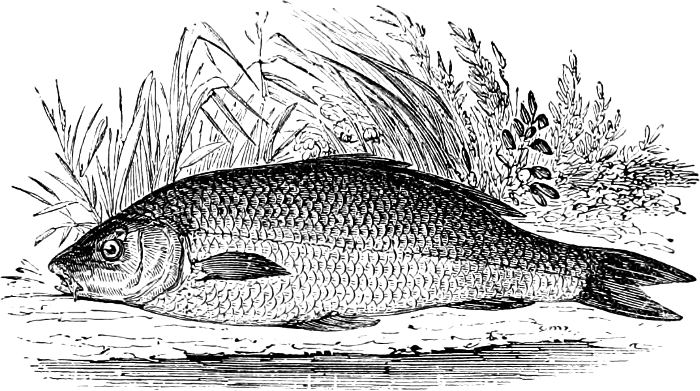
Fig. 272.—The Carp, Cyprinus carpio.
The “Carp” (C. carpio, “Karpfen,” “La carpe,”) is originally a native of the East, and abounds in a wild state in China, where it has been domesticated for many centuries; thence it was transported to Germany and Sweden, and the year 1614 is assigned as the date of its first introduction into England. It delights in tranquil waters, preferring such as have a muddy bottom, and the surface partially shaded with plants. Its food consists of the larvæ of aquatic insects, minute testacea, worms, and the tender blades and shoots of plants. The leaves of lettuce, and other succulent plants of a similar kind, are said to be particularly agreeable to them, and to fatten them sooner than any other food. Although the Carp eats with great voracity when its supply of aliment is abundant, it can subsist for an astonishing length of time without nourishment. In the winter, when the Carps assemble in great numbers, and bury themselves among the mud and the roots of plants, they often remain for many months without eating. They can also be preserved alive for a considerable length of time out of the water, especially if care be taken to moisten them occasionally as they become dry. Advantage is often taken of this circumstance to transport them alive, by packing them among damp herbage or damp linen; and the operation is said to be unattended with any risk to the animal, especially if the precaution be taken to put a piece of bread in its mouth steeped in brandy!
The fecundity of these fishes is very great, and their numbers consequently would soon become excessive but for the many enemies by which their spawn is destroyed. No fewer than 700,000 eggs have been found in the ovaries of a single Carp, and that, too, by no means an individual of the largest size. Their growth is very rapid, more so perhaps than that of any other Freshwater fish, and the size which they sometimes attain is very considerable. In certain lakes in Germany individuals are occasionally taken weighing thirty or forty pounds; and Pallas relates that they occur in the Volga five feet in length, and even of greater weight than the examples just alluded to. The largest of which we have any account is that mentioned by Bloch, taken near Frankfort-on-the-Oder, which weighed seventy pounds, and measured nearly nine feet in length,—a statement the accuracy of which is very much open to doubt.
Like other domesticated animals the Carp is subject to variation; some individuals, especially when they have been bred under unfavourable circumstances, have a lean and low body; others are shorter and higher. Some have lost every trace of scales, and are called “Leather-carps;” others retain them along the lateral line and on the back only (“Spiegelkarpfen” of the Germans). Finally, in some are the fins much prolonged, as in certain varieties of the Gold-fish. Cross-breeds between the Carp and the Crucian Carp are of common occurrence. The Carp is much more esteemed as food in inland countries than in countries where the more delicate kinds of sea fishes can be obtained.
Carassius differs from Cyprinus in lacking barbels; its pharyngeal teeth are compressed, in a single series, 4–4.
Two well-known species belong to this genus. The “Crucian Carp” (C. carassius, “Karausche”) is generally distributed over Central and Northern Europe, and extends into Italy and Siberia. It inhabits stagnant waters only, and is so tenacious of life that it will survive a lengthened sojourn in the smallest pools, where, however, it remains stunted; whilst in favourable localities it attains to a length of twelve inches. It is much subject to variation of form; very lean examples are commonly called “Prussian Carps.” Its usefulness consists in keeping ponds clean from a super-abundance of vegetable growth, and in serving as food for other more esteemed fishes. The second species is the “Gold-fish,” Carassius auratus. It is of very common occurrence in a wild state in China and the warmer parts of Japan, being entirely similar in colour to the Crucian Carp. In a domesticated state it loses the black or brown chromatophors, and becomes of a golden-yellow colour; perfect Albinos are comparatively scarcer. Many varieties and monstrosities have been produced during the long period of its domestication; the variety most highly priced at present being the so-called “Telescope-fish,” of which a figure is annexed. The Gold-fish is said to have been first brought to England in the year 1691, and is now distributed over nearly all the civilised parts of the world.
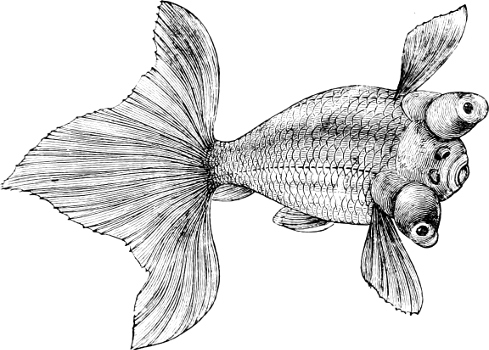
Fig. 273.—Cyprinus auratus, var.
Catla.—Scales of moderate size. Dorsal fin without osseous ray, with more than nine branched rays, commencing nearly opposite to the ventrals. Snout broad, with the integuments very thin; there is no upper lip, the lower with a free continuous posterior margin. Symphysis of the mandibulary bones loose, with prominent tubercles. Mouth anterior. Barbels none. Gill-rakers very long, fine, and closely set. Pharyngeal teeth, 5. 3. 2.-2. 3. 5.
The “Catla” (C. buchanani), one of the largest Carps of the Ganges, growing to a length of more than three feet, and esteemed as food.
Labeo.—Scales of moderate or small size. Dorsal fin without osseous ray, with more than nine branched rays, commencing somewhat in advance of the ventrals. Snout obtusely rounded, the skin of the maxillary region being more or less thickened, forming a projection beyond the mouth. Mouth transverse, inferior, with the lips thickened, each or one of them being provided with an inner transverse fold, which is covered with a deciduous horny substance forming a sharp edge, which, however, does not rest upon the bone as base, but is soft and movable. Barbels very small, two or four; the maxillary barbels more or less hidden in a groove behind the angle of the mouth. Anal scales not enlarged. Pharyngeal teeth uncinate, 5. 4. 2.-2. 4. 5. Snout generally more or less covered with hollow tubercles.
About thirteen species are known from rivers of tropical Africa and the East Indies.
Discognathus.—Scales of moderate size. Dorsal fin without osseous ray, with not more than nine branched rays, commencing somewhat in advance of the ventrals. Snout obtusely rounded, more or less depressed, projecting beyond the mouth, more or less tubercular. Mouth inferior, transverse, crescent-shaped; lips broad, continuous, with an inner sharp edge of the jaws, covered with horny substance on the lower jaw; upper lip more or less distinctly fringed; lower lip modified into a suctorial disk, with free anterior and posterior margins. Barbels two or four; if two, the upper are absent. Anal scales not enlarged. Pectoral fins horizontal. Pharyngeal teeth, 5. 4. 2.-2. 4. 5.
A small fish (D. lamta), extremely abundant in almost all the mountain streams from Abyssinia and Syria to Assam.
Capoëta.—Scales small, of moderate or large size. Dorsal fin with or without a strong osseous ray, with not more than nine branched rays. Snout rounded, with the mouth transverse and at its lower side; each mandible angularly bent inwards in front, the anterior mandibular edge being nearly straight, sharpish, and covered with a horny brown layer. No lower labial fold. Barbels two (rarely four), or entirely absent. Anal scales not conspicuously enlarged. Pharyngeal teeth compressed, truncated, 5 or 4. 3. 2–2. 3. 4 or 5.
Characteristic of the fauna of Western Asia; one species from Abyssinia. Of the fifteen species known C. damascina deserves to be specially mentioned, being abundant in the Jordan and other rivers of Syria and Asia Minor.
Barbus.—Scales of small, moderate, or large size. Dorsal fin generally with the (third) longest simple ray ossified, enlarged, and frequently serrated; never, or only exceptionally, with more than nine branched rays, commencing opposite or nearly opposite to the root of the ventral fin. Eyes without adipose eyelid. Anal fin frequently very high. Mouth arched, without inner folds, inferior or anterior; lips without horny covering. Barbels short, four, two, or none. Anal scales not enlarged. Pharyngeal teeth 5. 4 or 3. 3 or 2.-2 or 3. 3 or 4. 5. Snout but rarely with tubercles or pore-like grooves.
No other genus of Cyprinoids is composed of so many species as the genus of “Barbels,” about 200 being known from the tropical and temperate parts of the Old World; it is not represented in the New World. Although the species differ much from each other in the form of the body, number of barbels, size of the scales, strength of the first dorsal ray or spine, etc., the transition between the extreme forms is so perfect that no further generic subdivision should be attempted. Some attain a length of six feet, whilst others never exceed a length of two inches. The most noteworthy are the large Barbels of the Tigris (B. subquincunciatus, B. esocinus, B. scheich, B. sharpeyi); the common Barbel of Central Europe and Great Britain (B. vulgaris); the “Bynni” of the Nile (B. bynni); B. canis from the Jordan; the “Mahaseer” of the mountain streams of India (B. mosal), probably the largest of all species, the scales of which are sometimes as large as the palm of a hand. The small, large-scaled species are especially numerous in the East Indies and the fresh waters of Tropical Africa.
Thynnichthys.—Scales small. Dorsal fin without an osseous ray, with not more than nine branched rays, commencing nearly opposite the ventrals. Head large, strongly compressed; eye without well-developed adipose membrane, in the middle of the depth of the head. Snout with the integuments very thin; there is no upper lip, and the lower jaw has a thin labial fold on the sides only. Mouth anterior and lateral; barbels none. Gill-rakers none; laminæ branchiales long, half as long as the post-orbital portion of the head; pseudobranchiæ none. Pharyngeal teeth lamelliform, with flat oblong crown, 5. 3 or 4. 2–2. 4 or 3. 5, the teeth of the three series being wedged into one another.
Three species from the East Indies.
Oreinus.—Scales very small. Dorsal fin with a strong osseous serrated ray, opposite to the ventrals. Snout rounded, with the mouth transverse, and at its lower side; mandibles broad, short, and flat, loosely joined together; margin of the jaw covered with a thick horny layer; a broad fringe-like lower lip, with free posterior margin. Barbels four. Vent and anal fin in a sheath, covered with enlarged tiled scales. Pharyngeal teeth pointed, more or less hooked, 5. 3. 2–2. 3. 5.
Three species from mountain streams of the Himalayas.
Schizothorax.—Hill-barbels, with the same singular sheath on each side of the vent, as in the preceding genus; but they differ in having the mouth normally formed, with mandibles of the usual length and width.
Seventeen species are known from fresh waters of the Himalayas, and north of them. Other genera from the same region, and with the anal sheath, are Ptychobarbus, Gymnocypris, Schizopygopsis, and Diptychus.
Gobio.—Scales of moderate size; lateral line present. Dorsal fin short, without spine. Mouth inferior; mandible not projecting beyond the upper jaw when the mouth is open; both jaws with simple lips; a small but very distinct barbel at the angle of the mouth, quite at the extremity of the maxillary. Gill-rakers very short; pseudobranchiæ. Pharyngeal teeth, 5. 3 or 2.—2 or 3. 5, hooked at the end.
The “Gudgeons” are small fishes of clear fresh waters of Europe; they are, like the barbels, animal feeders. In Eastern Asia they are represented by two closely allied genera, Ladislavia and Pseudogobio.
Ceratichthys.—Scales of moderate or small size; lateral line present. Dorsal fin short, without spine, not or but slightly in advance of the ventrals. Mouth subinferior; the lower jaw does not project beyond the upper when the mouth is open; intermaxillaries protractile from below the maxillaries; both jaws with thickish lips; a small barbel at the angle of the mouth, quite at the extremity of the maxillary. Gill-rakers very short and few in number: pseudobranchiæ. Pharyngeal teeth 4–4. hooked at the end (sometimes 4, 1—1. 4).
About ten species are known from North America; they are small, and called “Chub” in the United States. C. biguttatus is, perhaps, the most widely-diffused Freshwater-fish in the United States, and common everywhere. Breeding males have generally a red spot on each side of the head.
Other similar genera from the fresh waters of North America, and generally called “Minnows,” are Pimephales (the “Black Head”), Hyborhynchus, Hybognathus, Campostoma (the “Stone-lugger”), Ericymba, Cochlognathus, Exoglossum (the “Stone Toter” or “Cut-lips”), and Rhinichthys (the “Long-nosed Dace”).
The remaining Old World genera belonging to the group Cyprinina are Cirrhina, Dangila, Osteochilus, Barynotus, Tylognathus, Abrostomus, Crossochilus, Epalzeorhynchus, Barbichthys, Amblyrhynchichthys, Albulichthys, Aulopyge, Bungia, and Pseudorasbora.
III. Rohteichthyina.—Anal fin very short, with not more than six branched rays. Dorsal fin behind ventrals. Abdomen compressed. Lateral line running along the median line of the tail. Mouth without barbels. Pharyngeal teeth in a triple series.
One genus and species only, Rohteichthys microlepis, from Borneo and Sumatra.
IV. Leptobarbina.—Anal fin very short, with not more than six branched rays. Dorsal fin opposite to ventrals. Abdomen not compressed. Lateral line running in the lower half of the tail. Barbels present, not more than four in number. Pharyngeal teeth in a triple series.
One genus and species only, Leptobarbus hoevenii, from Borneo and Sumatra.
V. Rasborina.—Anal fin very short, with not more than six branched rays. Dorsal fin inserted behind the origin of the ventrals. Abdomen not compressed. Lateral line running along the lower half of the tail, if complete. Mouth sometimes with barbels, which are nevermore than four in number. Pharyngeal teeth in a triple, or single series. Air-bladder present, without osseous covering.
Rasbora.—Scales large, or of moderate size, there being generally four and a half longitudinal series of scales between the origin of the dorsal fin and the lateral line, and one between the lateral line and the ventral. Lateral line curved downwards. Dorsal fin with seven or eight branched rays, not extending to above the anal, which is seven-rayed. Mouth of moderate width, extending to the front margin of the orbit, with the lower jaw slightly prominent, and provided with three prominences in front, fitting into grooves of the upper jaw; barbels none, in one species two. Gill-rakers short, lanceolate. Pseudobranchiæ. Pharyngeal teeth in three series, uncinate.
Thirteen species of small size from the East Indian Continent and Archipelago, and from rivers on the east coast of Africa.
Amblypharyngodon.—Scales small; lateral line incomplete. Dorsal fin without an osseous ray, with not more than nine branched rays, commencing a little behind the origin of the ventrals. Head of moderate size, strongly compressed; eye without adipose membrane; snout with the integuments very thin; there is no upper lip, and the lower jaw has a short labial fold on the sides only. Mouth anterior, somewhat directed upwards, with the lower jaw prominent. Barbels none. Gill-rakers extremely short; pseudobranchiæ. Pharyngeal teeth molar-like, with their crowns concave, 3. 2. 1.—1. 2. 3. Intestinal tract narrow, with numerous convolutions.
Three species of small size from the Continent of India.
To the same group belong Luciosoma, Nuria, and Aphyocypris, from the same geographical region.
VI. Semiplotina.—Anal fin short, with seven branched rays, not extending forwards to below the dorsal. Dorsal fin elongate, with an osseous ray. Lateral line running along the middle of the tail. Mouth sometimes with barbels.
Two genera: Cyprinion, from Syria and Persia, and Semiplotus from Assam.
VII. Xenocypridina.—Anal fin rather short, with seven or more branched rays, not extending forwards to below the dorsal fin. Dorsal short, with an osseous ray. Lateral line running along the middle of the tail. Mouth sometimes with barbels. Pharyngeal teeth in a triple or double series.
Three genera: Xenocypris and Paracanthobrama from China; and Mystacoleucus from Sumatra.
VIII. Leuciscina.—Anal fin short or of moderate length, with from eight to eleven branched rays, not extending forwards to below the dorsal. Dorsal fin short, without osseous ray. Lateral line, if complete, running along, or nearly in, the middle of the tail. Mouth generally without barbels. Pharyngeal teeth in a single or double series.
Leuciscus.—Body covered with imbricate scales. Dorsal fin commencing opposite, rarely behind, the ventrals. Anal fin generally with from nine to eleven, rarely with eight (in small species only), and still more rarely with fourteen rays. Mouth without structural peculiarities; lower jaw not trenchant; barbels none. Pseudobranchiæ. Pharyngeal teeth conical or compressed, in a single or double series. Intestinal tract short, with only a few convolutions.
The numerous species of this genus are comprised under the name of “White-fish;” they are equally abundant in the northern temperate zone of both hemispheres, about forty species being known from the Old World, and about fifty from the New. The most noteworthy species of the former Fauna are the “Roach” (L. rutilus, see Fig. 21, p. 50), common all over Europe north of the Alps; the “Chub” (L. cephalus), extending into Northern Italy and Asia Minor; the “Dace” (L. leuciscus), a companion of the Roach; the “Id” or “Nerfling” (L. idus), from the central and northern parts of Continental Europe, domesticated in some localities of Germany, in this condition assuming the golden hue of semi-albinism, like a Gold-fish, and then called the “Orfe;” the “Rudd,” or “Red-eye” (L. erythrophthalmus), distributed all over Europe and Asia Minor, and distinguished by its scarlet lower fins; the “Minnow” (L. phoxinus), abundant everywhere in Europe, and growing to a length of seven inches in favourable localities. The North American species are much less perfectly known; the smaller ones are termed “Minnows,” the larger “Shiner” or “Dace.” The most common are L. cornutus (Red-fin, Red Dace); L. neogæus, a minnow resembling the European species, but with incomplete lateral line; L. hudsonius, the “Spawn-eater” or “Smelt.”
Tinca.—Scales small, deeply embedded in the thick skin; lateral line complete. Dorsal fin short, its origin being opposite the ventral fin; anal short; caudal subtruncated. Mouth anterior; jaws with the lips moderately developed; a barbel at the angle of the mouth. Gill-rakers short, lanceolate; pseudobranchiæ rudimentary. Pharyngeal teeth 4 or 5.-5, cuneiform, slightly hooked at the end.
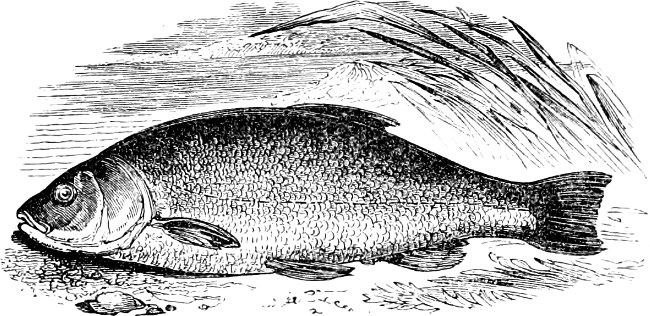
Fig. 274.—The Tench (Tinca tinca).
Only one species of “Tench” is known (T. tinca), found all over Europe in stagnant waters with soft bottom. The “Golden Tench” is only a variety of colour, an incipient albinism like the Gold-fish and Id. Like most other Carps of this group it passes the winter in a state of torpidity, during which it ceases to feed. It is extremely prolific, 297,000 ova having been counted in one female; its spawn is of a greenish colour.
Leucosomus.—Scales of moderate or small size; lateral line present. Dorsal fin commencing opposite, or nearly opposite, to the ventral. Anal fin short. Mouth anterior or sub-anterior; intermaxillaries protractile. A very small barbel at the extremity of the maxillary. Lower jaw with rounded margin, and with the labial folds well developed laterally. Gill-rakers short; pseudobranchiæ. Pharyngeal teeth in a double series.
A North American genus, to which belong some of the most common species of the United States. L. pulchellus (the “Fall-fish,” “Dace,” or “Roach”), one of the largest White-fishes of the Eastern States, attaining to a length of 18 inches, and abundant in the rapids of the larger rivers. L. corporalis (the “Chub”), common everywhere from New England to the Missouri region.
Chondrostoma.—Scales of moderate size or small. Lateral line terminating in the median line of the depth of the tail. Dorsal fin with not more than nine branched rays, inserted above the root of the ventrals. Anal fin rather elongate, with ten or more rays. Mouth inferior, transverse, lower jaw with a cutting edge, covered with a brown horny layer. Barbels none. Gill-rakers short, fine; pseudobranchiæ. Pharyngeal teeth 5 or 6 or 7.-7 or 6 or 5, knife-shaped, not denticulated. Peritoneum black.
Seven species from the Continent of Europe and Western Asia.
Other Old World genera belonging to the Leuciscina are Myloleucus, Ctenopharyngodon, and Paraphoxinus; from North America: Mylopharodon, Meda, Orthodon, and Acrochilus.
IX. Rhodeina.—Anal fin of moderate length, with from nine to twelve branched rays, extending forwards to below the dorsal. Dorsal fin short, or of moderate length. Lateral line, if complete, running along or nearly in the middle of the tail. Mouth with very small, or without any barbels. Pharyngeal teeth in a single series.
Very small roach-like fishes inhabiting chiefly Eastern Asia and Japan, one species (Rh. amarus) advancing into Central Europe. The thirteen species known have been distributed among four genera, Achilognathus, Acanthorhodeus, Rhodeus, and Pseudoperilampus. In the females a long external urogenital tube is developed annually during the spawning season. The European species is known in Germany by the name of “Bitterling.”
X. Danionina.—Anal fin of moderate length or elongate, with not less, and generally more, than eight branched rays. Lateral line running along the lower half of the tail. Mouth with small, or without any, barbels. Abdomen not trenchant. Pharyngeal teeth in a triple or double series.
Small fishes from the East Indian Continent, Ceylon, the East Asiatic Islands, and a few from East African Rivers, The genera belonging to this group are Danio, Pteropsarion, Aspidoparia, Barilius, Bola, Scharca, Opsariichthys, Squaliobarbus, and Ochetobus: altogether about forty species.
XI. Hypophthalmichthyina.—Anal fin elongate. Lateral line running nearly along the median line of the tail. Mouth without barbels. Abdomen not trenchant. No dorsal spine. Pharyngeal teeth in a single series.
One genus (Hypophthalmichthys) with two species from China.
XII. Abramidina.—Anal fin elongate. Abdomen, or part of the abdomen, compressed.
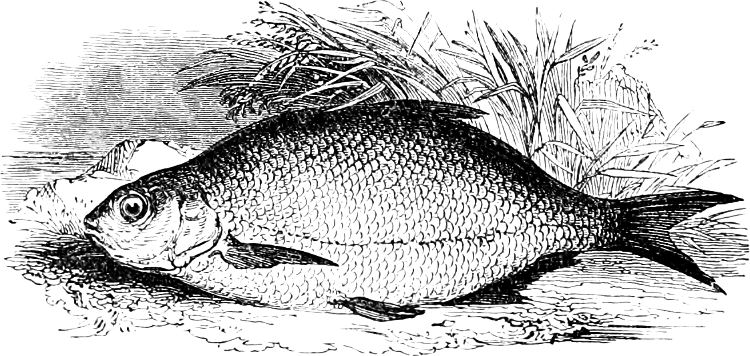
Fig. 275.—The Bream ( Abramis brama).
Abramis.—Body much compressed, elevated, or oblong. Scales of moderate size. Lateral line present, running in the lower half of the tail. Dorsal fin short, with spine, opposite to the space between ventrals and anals. Lower jaw generally shorter, and rarely longer than the upper. Both jaws with simple lips, the lower labial fold being interrupted at the symphysis of the mandible. Upper jaw protractile. Gill-rakers rather short; pseudobranchiæ. The attachment of the branchial membrane to the isthmus takes place at some distance behind the vertical from the orbit. Pharyngeal teeth in one or two series, with a notch near the extremity. Belly behind the ventrals compressed into an edge, the scales not extending across it.
The “Breams” are represented in the temperate parts of both northern hemispheres; in Europe there occur the “Common Bream,” A. brama; the “Zope,” A. ballerus; A. sapa; the “Zärthe,” A. vimba; A. elongatus; the “White Bream,” A. blicca; A. bipunctatus. Of these A. brama and A. blicca are British; the former being one of the most common fishes, and sometimes attaining to a length of two feet. Crosses between these two species, and even with other Cyprinoids, are not rare. Of the American species A. americanus (“Shiner,” “Bream”) is common and widely distributed; like the European Bream it lives chiefly in stagnant waters or streams with a slow current.
Aspius.—Body oblong; scales of moderate size; lateral line complete, terminating nearly in the middle of the depth of the tail. Dorsal fin short, without spine, opposite to the space between the ventrals and anal; anal fin elongate, with thirteen or more rays. Lower jaw more or less conspicuously projecting beyond the upper. Lips thin, simple, the lower labial fold being at the symphysis; upper jaw but little protractile. Gill-rakers short and widely set; pseudobranchiæ. The attachment of the branchial membrane to the isthmus takes place below the hind margin of the orbit. Pharyngeal teeth hooked, 5. 3.-3 or 2. 5 or 4. Belly behind the ventrals compressed, the scales covering the edge.
Four species from Eastern Europe to China.
Alburnus.—Body more or less elongate; scales of moderate size; lateral line present, running below the median line of the tail. Dorsal fin short, without spine, opposite to the space between ventrals and anal; anal fin elongate, with more than thirteen rays. Lower jaw more or less conspicuously projecting beyond the upper. Lips thin, simple, the lower labial fold being interrupted at the symphysis of the mandible. Upper jaw protractile. Gill-rakers slender, lanceolate, closely set; pseudobranchiæ. The attachment of the branchial membrane to the isthmus takes place below the hind margin of the orbit. Pharyngeal teeth in two series, hooked. Belly behind the ventrals compressed into an edge, the scales not extending across it.
“Bleak” are numerous in Europe and Western Asia, fifteen species being known. The common Bleak (A. alburnus) is found north of the Alps only, and represented by another species (A. alburnellus, “Alborella,” or “Avola”) in Italy.
Of the other genera referred to this group, Leucaspius and Pelecus belong to the European Fauna; Pelotrophus is East African; all the others occur in the East Indies or the temperate parts of Asia, viz. Rasborichthys, Elopichthys, Acanthobrama (Western Asia), Osteobrama, Chanodichthys, Hemiculter, Smiliogaster, Toxabramis, Culter, Eustira, Chela, Pseudolabuca, and Cachius.
XIII. Homalopterina.—Dorsal and anal fins short, the former opposite to ventrals. Pectoral and ventral fins horizontal, the former with the outer rays simple. Barbels six or none. Air-bladder absent. Pharyngeal teeth in a single series, from ten to sixteen in number.
Inhabitants of hill-streams in the East Indies; they are of small size and abundant where they occur. Thirteen species are known belonging to the genera Homaloptera, Gastromyzon, Crossostoma, and Psilorhynchus.
XIV. Cobitidina.—Mouth surrounded by six or more barbels. Dorsal fin short or of moderate length; anal fin short. Scales small, rudimentary, or entirely absent. Pharyngeal teeth in a single series, in moderate number. Air-bladder partly or entirely enclosed in a bony capsule. Pseudobranchiæ none: Loaches.
Misgurnus.—Body elongate, compressed. No sub-orbital spine. Ten or twelve barbels, four belonging to the mandible. Dorsal fin opposite to the ventrals; caudal rounded.
Four species from Europe and Asia. M. fossilis is the largest of European Loaches, growing to a length of ten inches; it occurs in stagnant waters of eastern and southern Germany and northern Asia. In China and Japan it is replaced by an equally large species, M. anguillicaudatus.
Nemachilus.—No erectile sub-orbital spine. Six barbels, none at the mandible. Dorsal fin opposite to the ventrals.
The greater number of Loaches belong to this genus; about fifty species are known from Europe and temperate Asia; such species as extend into tropical parts inhabit streams of high altitudes. Loaches are partial to fast-running streams with stony bottom, and exclusively animal feeders. In spite of their small size they are esteemed as food where they occur in sufficient abundance. The British species, N. barbatulus, is found all over Europe except Denmark and Scandinavia.
Cobitis.—Body more or less compressed, elongate; back not arched. A small, erectile, bifid sub-orbital spine below the eye. Six barbels only on the upper jaw. Dorsal fin inserted opposite to ventrals. Caudal rounded or truncate.
Only three species are known, of which C. tænia occurs in Europe. It is scarce and very local in Great Britain.
Botia.—Body compressed, oblong; back more or less arched. Eyes with a free circular eyelid; an erectile bifid sub-orbital spine. Six barbels on the upper jaw, sometimes two others at the mandibulary symphysis. Dorsal fin commencing in advance of the root of the ventrals; caudal fin forked. Air-bladder consisting of two divisions: the anterior enclosed in a partly osseous capsule, the posterior free, floating in the abdominal cavity.
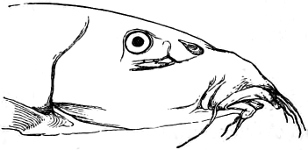
Fig. 276.—Botia rostrata. From Bengal.
This genus is more tropical than any of the preceding, and the majority of the species (eight in number) are finely coloured. The more elevated form of their body, and the imperfect ossification of the capsules of the air-bladder, the divisions of which are not side by side, but placed in the longitudinal axis of the body, indicate likewise that this genus is more adapted for still waters of the plains than for the currents of hill-streams.
Other genera from tropical India are Lepidocephalichthys, Acanthopsis, Oreonectes (hills near Hong-Kong), Paramisgurnus (Yan-tse-Kiang), Lepidocephalus, Acanthophthalmus, and Apua.
Fourth Family—Kneriidæ.
Body scaly, head naked. Margin of the upper jaw formed by the intermaxillaries. Dorsal and anal fins short, the former belonging to the abdominal portion of the vertebral column. Teeth none, either in the mouth or pharynx. Barbels none. Stomach siphonal; no pyloric appendages. Pseudobranchiæ none. Branchiostegals three; air-bladder long, not divided. Ovaries closed.
Small loach-like fishes from fresh waters of tropical Africa; two species only, Kneria angolensis and K. spekii, are known.
Fifth Family—Characinidæ.
Body covered with scales, head naked; barbels none. Margin of the upper jaw formed by the intermaxillaries in the middle and by the maxillaries laterally. Generally a small adipose fin behind the dorsal. Pyloric appendages more or less numerous; air-bladder transversely divided into two portions, and communicating with the organ of hearing by means of the auditory ossicles. Pseudobranchiæ none.
The fishes of this family are confined to the fresh waters of Africa, and especially of tropical America, where they replace the Cyprinoids, with which family, however, they have but little in common as far as their structural characteristics are concerned. Their co-existence in Africa with Cyprinoids proves only that that continent is nearer to the original centre, from which the distribution of Cyprinoids commenced than tropical America. The family includes herbivorous as well as strictly carnivorous forms; some are toothless, whilst others possess a most formidable dentition. The family contains so many diversified forms as to render a subdivision into groups necessary. They have not yet been obtained in fossiliferous strata.
I. Erythrinina.—Adipose fin absent.
The sixteen species of this group belong to the fauna of tropical America, and are referred to the genera Macrodon, Erythrinus, Lebiasina, Nannostomus, Pyrrhulina, and Corynopoma.
II. Curimatina.—A short dorsal and an adipose fin; dentition imperfect. Tropical America.
Curimatus.—Dorsal fin placed nearly in the middle of the body; anal rather short or of moderate length; ventrals below the dorsal. Body oblong or elevated, with the belly rounded or flattened before the ventrals. Cleft of the mouth transverse, lips none, margins of the jaws trenchant. No teeth whatever. Intestinal tract very long and narrow.
About twenty species are known, of rather small size.
The other genera of this group have teeth, but they are either rudimentary or absent in some part of the jaws: Prochilodus, Cænotropus, Hemiodus, Saccodon, Parodon.
III. Citharinina.—A rather long dorsal and an adipose fin; minute labial teeth. Tropical Africa.
One genus only, Citharinus, with two species, is known. Common in the Nile, attaining to a length of three feet.
IV. Anastomatina.—A short dorsal and an adipose fin; teeth in both jaws well developed; the gill-membranes grown to the isthmus; nasal openings remote from each other. Tropical America.
Leporinus.—Dorsal fin placed nearly in the middle of the length of the body; anal short; ventrals below the dorsal. Body oblong, covered with scales of moderate size; belly rounded. Cleft of the mouth small, with the lips well developed; teeth in the intermaxillary and mandible, few in number, flattened, with the apex more or less truncated, and not serrated; the middle pair of teeth is the longest in both jaws; palate toothless.
This genus is generally distributed in the rivers east of the Andes; about twenty species are known, some of which, like L. frederici, L. megalepis, are very common. They are well marked by black bands or spots, and rarely grow to a length of two feet, being generally much smaller.—The other genera belonging to this group are Anastomus and Rhytiodus.
V. Nannocharacina.—A short dorsal and an adipose fin; teeth in both jaws well developed; notched incisors. The gill-membranes are grown to the isthmus. Nostrils close together.
One genus, Nannocharax, with two species only, from the Nile and Gaboon; very small.
VI. Tetragonopterina.—A short dorsal and an adipose fin; the teeth in both jaws well developed, compressed, notched, or denticulated; the gill-membranes free from the isthmus, and the nasal openings close together. South America and Tropical Africa.
Alestes.—The dorsal fin is placed in the middle of the length of the body, above or behind the ventrals; anal fin rather long. Body oblong, covered with scales of moderate or large size; belly rounded. Cleft of the mouth rather small. Maxillary teeth none; intermaxillary teeth in two series; those of the front series more or less compressed, more or less distinctly tricuspid; the teeth of the hinder series are broad, molar-like, each armed with several pointed tubercles. Teeth in the lower jaw in two series; those in the front series laterally compressed, broader behind than in front; the hinder series is composed of two conical teeth. All the teeth are strong, few in number.
Fourteen species from Tropical Africa; several inhabit the Nile, of which the “Raches” (A. dentex and A. kotschyi) are the most common.
Tetragonopterus.—The dorsal fin is placed in the middle of the length of the body, above or immediately behind the ventrals; anal fin long. Body oblong or elevated, covered with scales of moderate size; belly rounded. Cleft of the mouth of moderate width. Anterior teeth strong, lateral teeth small. Intermaxillary and mandibulary teeth subequal in size, with a compressed and notched crown, the former in a double, the latter in a single series; maxillary with a few teeth near its articulation, rarely with the entire edge denticulated.
Of all the genera of this family Tetragonopterus is represented by the greatest number of species; about fifty are known. Some of them seem to have a very wide range, whilst others are merely local. All are of small size, rarely exceeding a length of eight inches.
Chirodon.—Dorsal fin placed in the middle of the length of the body, behind the ventrals; anal long or of moderate length. Body oblong, covered with scales of moderate size; lateral line not continued to the tail. Belly rounded before the ventrals. Cleft of the mouth narrow, maxillary short. A single series of small serrated teeth in the intermaxillary and mandibulary; maxillary teeth none.
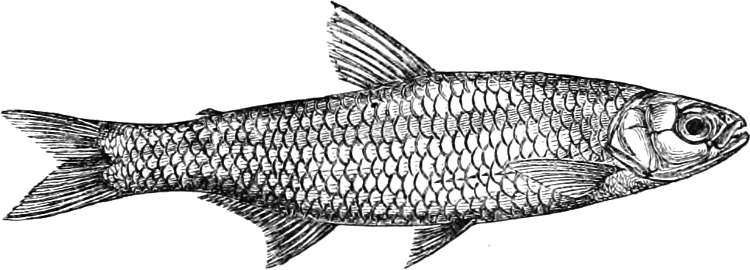
Fig. 277.—Chirodon alburnus.
Three species of small size from various parts of South America; the species figured is represented of the natural size, and comes from the Upper Amazons.
Megalobrycon.—Dorsal fin placed in middle of the length of the body, immediately behind the ventrals. Anal long. Abdomen rounded in front of, and somewhat compressed behind, the ventrals. Cleft of the mouth of moderate width. Teeth notched, in a triple series in the intermaxillary, and in a single in the maxillary and mandible; no other teeth behind the mandibulary teeth or on the palate. Scales of moderate size, with the free portion striated.
One species from the Upper Amazons (M. cephalus). Specimens more than one foot long have been obtained.
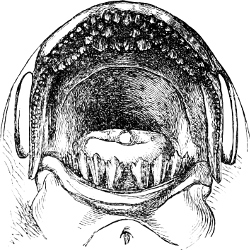
Fig. 278.—Megalobrycon cephalus.
Gastropelecus.—Dorsal fin placed behind the middle of the length of the body, above the anal; anal long; pectoral long; ventrals very small or rudimentary. Body strongly compressed, with the thoracic region dilated into a sub-semicircular disk. Scales of moderate size. Lateral line descending obliquely backwards towards the origin of the anal fin. The lower profile compressed into an acute ridge. Cleft of the mouth of moderate width; teeth compressed, tricuspid, in one or two series in the intermaxillary, and in a single in the mandible; maxillary with a few minute conical teeth; palate toothless.
Three specimens of this singular form are known from Brazil and the Guyanas; they are of very small size.
The majority of the other genera belonging to this group are South American, viz. Piabucina, Scissor, Pseudochalceus, Aphyocharax, Chalceus, Brycon, Chalcinopsis, Bryconops, Creagrutus, Chalcinus, Piabuca, Paragoniates, and Agoniates; two only are African, viz. Nannæthiops, which represents the South American Tetragonopterus, and Bryconæthiops, which is allied to Brycon.
VII. Hydrocyonina.—A short dorsal and an adipose fin; teeth in both jaws well developed and conical; gill membranes free from the isthmus; nasal openings close together. South America and Tropical Africa. Fishes of prey.
Hydrocyon.—The dorsal fin is in the middle of the length of the body, above the ventrals; anal of moderate length. Body oblong, compressed, covered with scales of moderate size; belly rounded. Cleft of the mouth wide, without lips; the intermaxillaries and mandibles are armed with strong pointed teeth, widely set and few in number; they are received in notches of the opposite jaw, and visible externally when the mouth is closed. Palate toothless. Cheeks covered with the enlarged sub-orbital bones. Orbit with an anterior and posterior adipose eyelid. Intestinal tract short.
Four species from Tropical Africa; two occur in the Nile, H. forskalii being abundant, and well known by the names “Kelb el bahr” and “Kelb el moyeh.” Their formidable dentition renders them most destructive to other fishes; they grow to a length of four feet.
Cynodon.—Dorsal fin placed behind, or nearly in, the middle of the length of the body, behind the ventrals; anal long. Head and body compressed, oblong, the latter covered with very small scales; belly compressed, keeled. Teeth in the intermaxillary, maxillary, and mandible in a single series, conical, widely set, of unequal size; a pair of very large canine teeth anteriorly in the lower jaw, received in two grooves on the palate; palate with patches of minute granulated teeth. The outer branchial arch without gill-rakers, but with very short tubercles.
Four species from Brazil and the Guyanas; they are as formidable fishes of prey as the preceding, and grow to the same size.
With the exception of Sarcodaces, all the remaining genera of this group belong to the fauna of Tropical America, viz. Anacyrtus, Hystricodon, Salminus, Oligosarcus, Xiphorhamphus, and Xiphostoma.
VIII. Distichodontina.—Dorsal fin rather elongate; adipose fin present. Gill-membranes attached to the isthmus; belly rounded. Tropical Africa.
The species, ten in number, belong to one genus only (Distichodus), well known on the Nile under the name of “Nefasch.” They grow to a considerable size, being sometimes four feet long and one and a half foot deep. They are used as food.
IX. Ichthyborina.—An adipose fin; number of dorsal rays increased (12–17); gill-membranes free from the isthmus. Belly rounded; canine teeth. Tropical Africa.
Two genera only: Ichthyborus from the Nile, and Phago from West Africa. Small fishes of very rare occurrence.
X. Crenuchina.—Dorsal fin rather elongate; an adipose fin. Gill-membranes free from the isthmus, with the belly rounded, and without canine teeth.
This small group is represented in the Essequibo by a single species, Crenuchus spilurus, and by another in West Africa, Xenocharax spilurus.
XI. Serrasalmonina.—Dorsal fin rather elongate; an adipose fin. Gill-membranes free from the isthmus; belly serrated. Tropical America.
Although the fishes of this family do not attain any considerable size, the largest scarcely exceeding two feet in length, their voracity, fearlessness, and number renders them a perfect pest in many rivers of tropical America. In all, the teeth are strong, short, sharp, sometimes lobed incisors, arranged in one or more series; by means of them they cut off a mouthful of flesh as with a pair of scissors; and any animal falling into the water where these fishes abound is immediately attacked and cut in pieces in an incredibly short time. They assail persons entering the water, inflicting dangerous wounds before the victims are able to make their escape. In some localities it is scarcely possible to catch fishes with the hook and line, as the fish hooked is immediately attacked by the “Caribe” (as these fishes are called), and torn to pieces before it can be withdrawn from the water. The Caribes themselves are rarely hooked, as they snap the hook or cut the line. The smell of blood is said to attract at once thousands of these fishes to a spot. They are most abundant in the Brazils and Guyanas; some forty species are known, and referred to the genera Mylesinus, Serrasalmo, Myletes, and Catoprion.
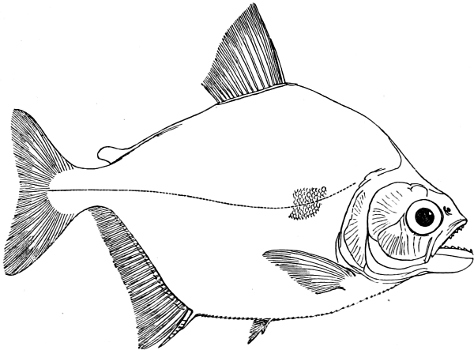
Fig. 279.—Serrasalmo scapularis, from the Essequibo.
Sixth Family—Cyprinodontidæ.
Head and body covered with scales; barbels none. Margin of the upper jaw formed by the intermaxillaries only. Teeth in both jaws; upper and lower pharyngeals with cardiform teeth. Adipose fin none; dorsal fin situated on the hinder half of the body. Stomach without blind sac; pyloric appendages none. Pseudobranchiæ none; air-bladder simple, without ossicula auditus.
Small fishes, inhabiting fresh, brackish, and salt water of Southern Europe, Africa, Asia, and America. The majority are viviparous; and to facilitate copulation the anal fin of the adult male of many species is modified into a copulatory organ, which is probably (partially at least) introduced into the vulva of the female; but it is uncertain whether it serves to conduct the semen, or merely to give the male a firmer hold of the female during the act. Also secondary sexual differences are developed in the Cyprinodonts; the males are always the smaller, sometimes several times smaller than the females, quite diminutive; and they are perhaps the smallest fishes in existence. The fins generally are more developed in the males, and the coloration is frequently different also. Some species are carnivorous; others live on the organic substances mixed with mud. Fossil remains have been found in tertiary strata, all apparently referable to the existing genus Cyprinodon; they occur near Aix in Provence, in the marl of Gesso, St. Angelo, in the Brown coal near Bonn, near Frankfort, and in the freshwater-chalk of Oeningen. In the latter locality a Poecilia occurs likewise.
The genera can be divided into two groups:
I. Cyprinodontidæ Carnivoræ.—The bones of each ramus of the mandible are firmly united; intestinal tract short, or but little convoluted. Carnivorous or insectivorous.
Cyprinodon.—Cleft of the mouth small, developed laterally and horizontally. Snout short. Teeth of moderate size, incisor-like, notched, in a single series. Scales rather large. Origin of the anal fin behind that of the dorsal in both sexes, both fins being larger in the male than in the female. Anal not modified into a sexual organ.
Seven species occur in the Mediterranean region, all of which seem able to live in briny springs or pools, the water of which contains a much greater percentage of salts than sea-water, as the brine-springs near the Dead Sea or in the Sahara. They are as little affected by the high temperature of some of these springs (91°), for instance of that at Sidi Ohkbar in the Sahara. Like other fishes living in limited localities or concealing themselves in mud, Cyprinodonts lose sometimes their ventral fins; such specimens have been described as Tellia. The species of the New World are less known than those of the Old, but not less numerous.
Allied to Cyprinodon are Fitzroyia from Monte Video, and Characodon from Central America.
Haplochilus.—Snout flat, both jaws being much depressed, and armed with a narrow band of villiform teeth. Body oblong, depressed anteriorly, compressed posteriorly. Dorsal fin short, commencing behind the origin of the anal, which is more or less elongate.
Twenty species from the East Indies, tropical Africa, and temperate and tropical America.
Fundulus.—Cleft of the mouth of moderate width, developed laterally and horizontally. Snout of moderate length. Teeth in a narrow band, those of the outer series being largest, conical. Scales of moderate size. Dorsal fin commencing before or opposite the origin of the anal. Sexes not differentiated.
“Killifish,” abundant in the New World, where about twenty species have been found; F. heteroclitus, majalis, diaphanus, being common on the Atlantic coast of the United States; from the Old World two species only are known, viz. F. hispanicus from Spain, and F. orthonotus from the east coast of Africa. Allied to Fundulus are the South American Limnurgus, Lucania, Rivulus, and Cynolebias.
Orestias.—Ventral fins none. Cleft of the mouth of moderate width, directed upwards, with the lower jaw prominent, and with the upper protractile. Both jaws with a narrow band Of small conical teeth. Scales rather small or of moderate size, those on the head and upper part of the trunk frequently enlarged, plate-like, and granulated. Dorsal and anal fins moderately developed, opposite to each other. Sexes not differentiated by modification of the anal fin. The gill-membranes of both sides are united for a short distance, and not attached to the isthmus.
Inhabitants of Lake Titicaca and other elevated sheets of water on the Cordilleras of Peru and Bolivia, between the 14th and 19th degrees of latitude, at an elevation of 13,000 and 14,000 feet above the level of the sea. Singularly, the fishes of this outlying genus attain to a greater size than any other members of this family, being about eight inches long and comparatively bulky. They are considered a delicacy. Six species.
Jenynsia.—Cleft of the mouth small, developed laterally and horizontally; snout not produced. Both jaws with a series of tricuspid teeth of moderate size. Scales of moderate size. The origin of the anal fin is, in both sexes, behind that of the dorsal, although the anal of the male is modified into an intromittent organ, in which scarcely any of the rays remain distinct.
One species from Maldonado.
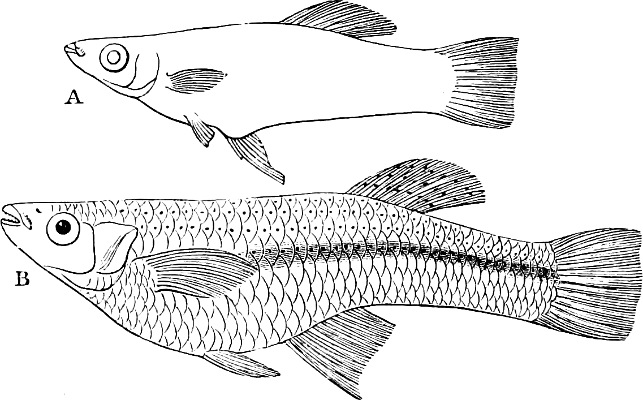
Fig. 280.—Gambusia punctata, from Cuba. A. Male; B. Female.
Gambusia.—Cleft of the mouth developed laterally and horizontally. Snout not produced, with the lower jaw more or less prominent. Both jaws with a band of teeth, those of the outer series being strongest and conical. Scales rather large. Origin of the anal fin more or less in advance of that of the dorsal. Anal fin of the male modified into an intromittent organ and much advanced.
Eight species from the West Indies and the southern parts of South America.—Allied genera are the Central American Pseudoxiphophorus and Belonesox.
Anableps.—Head broad and depressed, with the supraorbital part very much raised. Body elongate, depressed anteriorly and compressed posteriorly. Cleft of the mouth horizontal, of moderate width, the mandible being short; upper jaw protractile. Both jaws armed with a band of villiform teeth, those of the outer series being largest and somewhat movable. The integuments of the eye are divided into an upper and lower portion by a dark-coloured transverse band of the conjunctiva; also the pupil is completely divided into two by a pair of lobes projecting from each side of the iris. Scales rather small or of moderate size. Dorsal and anal fins short, the former behind the latter. The anal fin of the male is modified into a thick and long scaly conical organ with an orifice at its extremity.
Three species from tropical America. They are the longest Cyprinodonts, attaining to the length of nearly twelve inches. Their peculiar habit of swimming with part of the head out of the water has been noticed above (p. 113).
II. Cyprinodontidæ Limnophagæ.—The bones of each ramus of the mandible are but loosely joined; intestinal tract with numerous circumvolutions. Sexes differentiated. Mud-eating. Tropical America.
Poecilia.—Cleft of the mouth small, transverse; mandible very short. Both jaws with a narrow band of minute teeth. Scales rather large. Origin of the anal fin generally nearly opposite to that of the dorsal fin in the female, but in the male it is modified into an intromittent organ and much advanced. Dorsal fin short, with not more than eleven rays.
Sixteen species.
Mollienesia.—Differing from Poecilia in having a larger dorsal fin, with twelve or more rays.
Five species. The males are most beautifully coloured, and their dorsal fin is much enlarged. In one species (M. hellerii), besides, the lower caudal rays of the mature male are prolonged into a long, sword-shaped, generally black and yellow appendage.
Two other genera belong to this group: Platypoecilus and Girardinus.
Seventh Family—Heteropygii.
Head naked; body covered with very small scales; barbels none. Margin of the upper jaw formed, by the intermaxillaries. Villiform teeth in the jaws and on the palate. Adipose fin none. Dorsal fin belonging to the caudal portion of the vertebral column, opposite to the anal. Ventral fins rudimentary or absent. Vent situated before the pectorals. Stomach coecal; pyloric appendages present. Pseudobranchiæ none; air-bladder deeply notched anteriorly.
To this small family, which is closely allied to the Cyprinodonts and Umbridæ, belongs the famous Blind Fish of the Mammoth Cave in Kentucky, Amblyopsis spelæus. It is destitute of external eyes, and the body is colourless; although the eyes, with the optic nerve, are quite rudimentary, the optic lobes are as much developed as in fishes with perfect eyes. The loss of vision is compensated by the acuteness of its sense of hearing, as well as by a great number of tactile papillæ, arranged on transverse ridges on the head, and provided with nervous filaments coming from the fifth pair. The ovary is single, and the fish is viviparous, like the Cyprinodonts. It seems to occur in all the subterranean rivers that flow through the great limestone region underlying the carboniferous rocks in the central portion of the United States. As in Cyprinodon, so in this genus, specimens occur without ventral fins; they have been called Typhlichthys. The largest size to which Amblyopsis grows is five inches.
Chologaster is closely allied, but provided with small external eyes; its body is coloured, but it is destitute of ventrals. It was found once in a rice field in South Carolina.
[See Tellkampf, Müll. Arch. 1844, p. 381; Packard and Putnam, “The Mammoth Cave and its Inhabitants.” Salem. 1872. 8o.]
Eighth Family—Umbridæ.
Head and body covered with scales; barbels none. Margin of the upper jaw formed by the intermaxillaries mesially, and by the maxillaries laterally. Adipose fin none; the dorsal fin belongs partly to the abdominal portion of the vertebral column. Stomach siphonal; pyloric appendages none; pseudobranchiæ glandular, hidden; air-bladder simple.
Two small species only are known: Umbra krameri from Austria and Hungary, and Umbra limi, locally distributed in the United States; called “Hunds-fish” in Germany, “Dog-fish” or “Mud-fish” in America.
Ninth Family—Scombresocidæ.
Body covered with scales; a series of keeled scales along each side of the belly. Margin of the upper jaw formed by the intermaxillaries mesially, and by the maxillaries laterally. Lower pharyngeals united into a single bone. Dorsal fin opposite the anal, belonging to the caudal portion of the vertebral column. Adipose fin none. Air-bladder generally present, simple, sometimes cellular, without pneumatic duct. Pseudobranchiæ hidden, glandular. Stomach not distinct from the intestine, which is quite straight, without appendages.
The fishes of this family are chiefly marine, some living in the open ocean, whilst others have become acclimatised in fresh water; many of the latter are viviparous, all the marine forms being oviparous. They are found in all the temperate and tropical zones. Carnivorous.
This family is represented in the strata of Monte Bolca by rare remains of a fish named Holosteus, allied to Belone or Scombresox, and by a species of Belone in the miocene of Licata.
Belone.—Both jaws are prolonged into a long slender beak. All the dorsal and anal rays connected by membrane.
The long upper jaw of the “Gar-pike” is formed by the intermaxillaries, which are united by a longitudinal suture. Both jaws are beset with asperities, and with a series of longer, conical-pointed, widely-set teeth. Skimming along the surface of the water, the Gar-pike seize with these long jaws small fish as a bird would seize them with its beak; but their gullet is narrow, so that they can swallow small fish only. They swim with an undulating motion of the body; although they are in constant activity, their progress through the water is much slower than that of the Mackerels, the shoals of which sometimes appear simultaneously with them on our coasts. Young specimens are frequently met in the open ocean; when very young their jaws are not prolonged, and during growth the lower jaw is much in advance of the upper, so that these young fishes resemble a Hemirhamphus. About fifty species are known from tropical and temperate seas, Belone belone being a common fish on the British coast. Its bones, like those of all its congeners, are green; and therefore the fish, although good eating, is disliked by many persons. Some species attain a length of five feet.
Scombresox.—Both jaws are prolonged into a long slender beak. A number of detached finlets behind the dorsal and anal fins.
The “Saury” or “Skipper” resemble the Gar-pike, but the teeth in the jaws are minute; they seem to feed chiefly on soft pelagic animals. In their habits they are still more pelagic; and the young, in which the beak is still undeveloped, are met with everywhere in the open ocean, in the Atlantic as well as in the Pacific. The European species, Sc. saurus, is not rare on the British coast; four other species have been described, closely allied to Sc. saurus.
Hemirhamphus.—The lower jaw only is prolonged into a long slender beak.
In the young both jaws are short; the upper is never prolonged, the intermaxillaries forming a triangular, more or less convex, plate. The “Half-beaks” are common between and near the tropics; some forty species are known, none of which attain to the same length as the Gar-pike, scarcely ever exceeding a length of two feet. Some of the tropical species live in fresh water only; they are of small size and viviparous.
Arrhamphus.—Mouth formed as in Hemirhamphus, except that the lower jaw is not produced into a beak. Pectoral fins of moderate length.
One species (A. sclerolepis) from the coast of Queensland (not New Zealand); it may be regarded as a Hemirhamphus, with retarded development of the lower jaw.
Exocoetus.—Jaws short, intermaxillaries and maxillaries separate. Teeth minute, rudimental, and sometimes absent. Body moderately oblong, covered with rather large scales. Pectorals very long, an organ of flying.
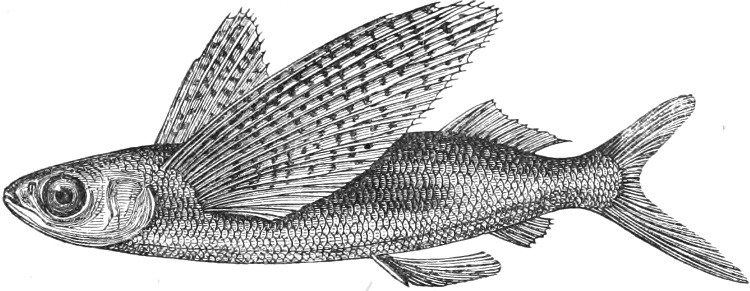
Fig. 281.—Flying Fish; Exocoetus callopterus.
Forty-four different kinds of “Flying-fishes” are known from tropical and sub-tropical seas; some have a very wide range, whilst others seem to remain within one particular part of the ocean; thus, the species figured, E. callopterus, has been hitherto found on the Pacific side of the isthmus of Panama only. Their usual length is about 10 or 12 inches, but specimens of 18 inches have been caught. They always live in shoals, and their numbers at certain times and localities are immense; thus, at Barbadoes many boats engage in their capture, as they are excellent eating. The pectorals are in the various species of unequal length; in some they extend to the anal fin only; in others (and these are the best fliers) to the caudal. A few have curious, barbel-like appendages at the lower jaw, which may disappear with age or be persistent throughout life. The literature on the subject of Flying-fishes is very extensive, and great diversity of opinion exists among observers as regards the mode and power of their flight; but the most reliable agree that the fishes do not leave the water for the purpose of catching insects (!), and that they are unable to move their fins in the manner of a bat or bird, or to change voluntarily the direction of their flight, or to fly beyond a very limited distance. The most recent enquiries are those of K. Möbius (“Die Bewegungen der Fliegenden Fische durch die Luft,” Leip. 1878, 8vo), the chief results of which may be summed up thus: Flying-fish are more frequently observed in rough weather and in a disturbed sea than during calm; they dart out of the water when pursued by their enemies, or frightened by an approaching vessel, but frequently also without any apparent cause, as is also observed in many other fishes; and they rise without regard to the direction of the wind or waves. The fins are kept quietly distended, without any motion, except an occasional vibration caused by the air whenever the surface of the wing is parallel with the current of the wind. Their flight is rapid, but gradually decreasing in velocity, greatly exceeding that of a ship going 10 miles an hour, and a distance of 500 feet. Generally, it is longer when the fishes fly against than with or at an angle to the wind. Any vertical or horizontal deviation from a straight line is not caused at the will of the fish, but by currents of the air; thus they retain a horizontally straight course when flying with or against the wind, but are carried towards the right or left whenever the direction of the wind is at an angle with that of their flight. However, it sometimes happens that the fish during its flight immerses its caudal fin in the water, and by a stroke of its tail turns towards the right or left. In a calm the line of their flight is always also vertically straight, or rather parabolic, like the course of a projectile, but it may become undulated in a rough sea, when they are flying against the course of the waves; they then frequently overtop each wave, being carried over it by the pressure of the disturbed air. Flying-fishes often fall on board of vessels, but this never happens during a calm, or from the lee side, but during a breeze only, and from the weather side. In daytime they avoid a ship, flying away from it; but during the night, when they are unable to see, they frequently fly against the weather-board, where they are caught by the current of air, and carried upwards to a height of 20 feet above the surface of the water, while, under ordinary circumstances, they keep close to it. All these observations point clearly to the fact that any deflection from a straight course is due to external circumstances, and not to voluntary action on the part of the fish.
Tenth Family—Esocidæ.
Body covered with scales; barbels none. Margin of the upper jaw formed by the intermaxillaries mesially, and by the maxillaries laterally. Adipose fin none; the dorsal fin belongs to the caudal portion of the vertebral column. Stomach without blind sac; pyloric appendages none. Pseudobranchiæ glandular, hidden; air-bladder simple; gill-opening very wide.
This family includes one genus only, Esox, the “Pikes,” inhabitants of the fresh waters of the temperate parts of Europe, Asia, and America. The European species, E. lucius, inhabits all three continents, but the North American waters harbour five, or perhaps more, other species, of which the “Muskellunge,” or “Maskinonge” (E. estor) of the Great Lakes attains to the same large size as the common Pike. The other species are generally called “Pickerell” in the United States.
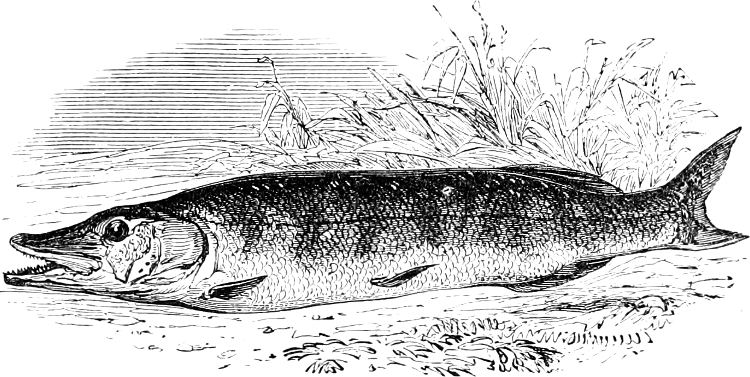
Fig. 282.—The Pike. (Esox lucius.)
Fossil Pike, belonging to the existing genus, have been found in the freshwater-chalk of Oeningen, and in the diluvial marl of Silesia. Remains of the common Pike occur in abundance in quaternary deposits.
Eleventh Family—Galaxiidæ.
Body naked, barbels none. Margin of the upper jaw chiefly formed by the intermaxillaries, which are short, and continued by a thick lip, behind which are the maxillaries. Belly rounded; adipose fin none; dorsal opposite to anal. Pyloric appendages in small number. Air-bladder large, simple; pseudobranchiæ none. The ova fall into the cavity of the abdomen before exclusion.
Small freshwater fishes of the southern hemisphere, belonging to two genera, Galaxias and Neochanna. Of the former genus five species are found in New Zealand, where this type is most developed, three in New South Wales, two in Tasmania, and four in the southern extremity of South America. Their native name in New Zealand is “Kokopu,” and they were dignified with the name of “Trout” by the settlers before the introduction of true Salmonidæ. They rarely exceed a length of eight inches. Neochanna is a degraded form of Galaxias, from which it differs by the absence of ventral fins. This fish has hitherto been found only in burrows, which it excavates in clay or consolidated mud, at a distance from water.
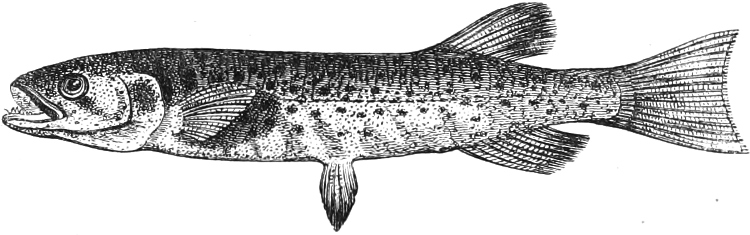
Fig. 283.—Galaxias truttaceus, from Tasmania.
Twelfth Family—Mormyridæ.
Body and tail scaly; head scaleless; barbels none. The margin of the upper jaw is formed in the middle by the intermaxillaries, which coalesce into a single bone, and laterally by the maxillaries. Sub- and inter-operculum present, the latter very small. On each side of the single parietal bone a cavity leading into the interior of the skull, and covered with a thin bony lamella. All the fins are well developed, in Mormyrus; or caudal, anal, and ventral fins are absent, in Gymnarchus. No adipose fin. Pseudobranchiæ none; gill-openings reduced to a short slit. Air-bladder simple. Two coeca pylorica behind the stomach.
This family is characteristic of the freshwater fauna of tropical Africa. Of Mormyrus (including Hyperopisus and Mormyrops), fifty-one species are known, of which eleven occur in the Nile. Some attain a length of three or four feet, others remain small. Their flesh is said to have an excellent flavour. The species figured (and probably other allied species) was an object of veneration to the ancient Egyptians, and, therefore, frequently occurs in their emblematic inscriptions. They abstained from eating it because it was one of three different kinds of fishes accused of having devoured a member of the body of Osiris, which, therefore, Isis was unable to recover when she collected the rest of the scattered members of her husband.
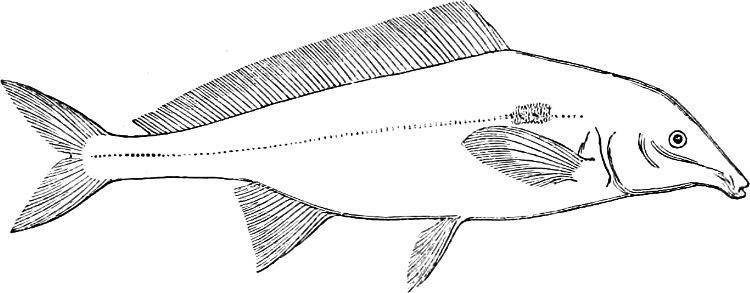
Fig. 284.—Mormyrus oxyrhynchus.
The Mormyri possess a singular organ on each side of the tail, without electric functions, but evidently representing a transitional condition from muscular substance to an electric organ. It is an oblong capsule divided into numerous compartments by vertical transverse septa, and containing a gelatinous substance. The Mormyri differ much with regard to the extent of the dorsal and anal fins, the former sometimes occupying the greater portion of the length of the back, sometimes being much shorter and limited to the tail. In some the snout is short and obtuse, in others long and decurved, with or without appendage.
Of Gymnarchus one species only is known, G. niloticus, which occurs in the Nile and West African rivers, and attains a length of six feet. The form of its body is eel-like, and each jaw is armed with a series of incisor-like teeth. Like Mormyrus, Gymnarchus possesses a pseudo-electric organ, thickest on the tail, tapering in front, and extending nearly to the head. It consists of four membranaceous tubes intimately connected with the surrounding muscles, and containing prismatic bodies arranged in the manner of a paternoster. The air-bladder of Gymnarchus is cellular, very extensible, and communicates with the dorsal side of the œsophagus by a duct possessing a sphincter.
[See Erdl, Münchner Gelehrte Anzeigen, 1846, xxiii., and Hyrtl, Denkschr. Akad. Wiss. Wien. 1856. xii.]
Thirteenth Family—Sternoptychidæ.
Body naked, or with very thin deciduous scales; barbels none. Margin of the upper jaw formed by the maxillary and intermaxillary, both of which are toothed; opercular apparatus not completely developed. Gill-opening very wide; pseudobranchiæ present or absent; air-bladder simple, if present. Adipose fin present, but generally rudimentary. Series of phosphorescent bodies along the lower parts. The eggs are enclosed in the sacs of the ovarium, and excluded by oviducts.
Pelagic and Deep-sea fishes of small size.
Sternoptyx.—Trunk much elevated and compressed, with the trunk of the tail very short. Body covered with a silvery pigment, without regular scales; series of phosphorescent spots run along the lower side of the head, body, and tail. Cleft of the mouth wide, vertical, with the lower jaw prominent. Jaws armed with small teeth. Eyes rather large, and although lateral, directed upwards and placed close together. Ventral fins very small. A series of imbricate scutes runs along the abdomen, forming a kind of serrature. The dorsal fin is short, and occupies about the middle of the length of the fish; it is preceded by the first commencement of the formation of a spinous dorsal, several neural spines being prolonged beyond the dorsal muscle forming a triangular osseous plate. Adipose fin rudimentary; anal short; caudal forked.
These small fishes are now and then picked up in the Mediterranean and Atlantic. According to the dredging-records of the “Challenger,” they and the allied genera Argyropelecus and Polyipnus would descend to depths of respectively 1100 and 2500 fathoms; but the form of their body and their whole organisation render this statement very improbable; they most likely live at a small depth during the daytime, coming to the surface at night, like many Scopelus.
Coccia and Maurolicus are two other genera allied to the preceding.
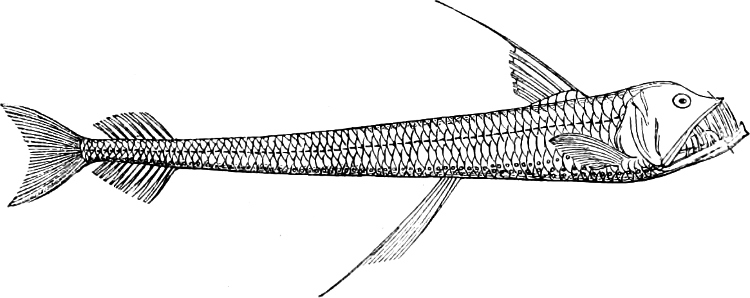
Fig. 285.—Chauliodus sloanii.
Chauliodus.—Body elongate, compressed, covered with exceedingly thin and deciduous scales; series of luminous (phosphorescent) spots run along the lower side of the head, body, and tail. Head much compressed and elevated, with the bones thin, but ossified, and with the opercular portion very narrow, the interoperculum being rudimentary. Cleft of the mouth exceedingly wide, the intermaxillary forming one half of the upper jaw. Each intermaxillary with four long canine teeth; edge of the maxillary finely denticulated; mandible with pointed, widely set teeth, the anterior of which are exceedingly long; none of the large teeth are received within the mouth. Palatine with a single series of small pointed teeth; no teeth on the tongue. Eye of moderate size. Pectoral and ventral fins well developed. Dorsal fin anteriorly on the trunk, before the ventrals; adipose fin small, sometimes fimbriated; anal short, rather close to the caudal, which is forked. Gill-opening very wide, the outer branchial arch extending forward to behind the symphysis of the lower jaw; it has no gill-rakers. Branchiostegals numerous.
This genus, of which one species only (Ch. sloanii) is known, is generally distributed over the great depths of the oceans, and does not appear to be scarce; it attains to a length of 12 inches, and must be one of the most formidable fishes of prey of the deep-sea.
Allied genera are Gonostoma, Photichthys, and Diplophos, all of which have the teeth of much smaller size.
Fourteenth Family—Stomiatidæ.
Skin naked, or with exceedingly delicate scales; a hyoid barbel. Margin of the upper jaw formed by the intermaxillary and maxillary which are both toothed; opercular apparatus but little developed. Gill-opening very wide; pseudobranchiæ none. The eggs are enclosed in the sacs of the ovarium, and excluded by oviducts.
Deep-sea fishes, descending to the greatest depths, characterised by their barbel and their formidable dentition.
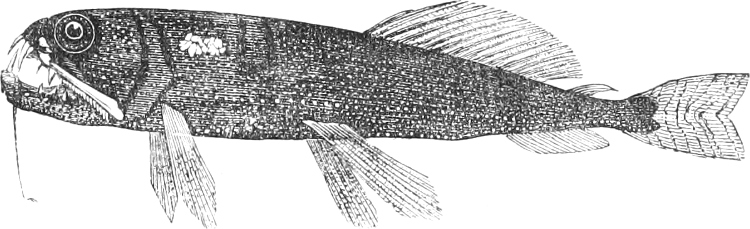
Fig. 286.—Astronesthes niger. The white spots in front of the eye are phosphorescent organs.
Some have two dorsal fins, the posterior of which is adipose; they belong to the genus Astronesthes, are the smallest of the family, and frequently met with in the Atlantic.
The others—viz. Stomias, Echiostoma, Malacosteus, and Bathyophis, lack the adipose fin, the rayed dorsal being opposite to the anal. Of these the one longest known is
Stomias.—Body elongate, compressed, covered with exceedingly fine and deciduous scales, which are scarcely imbricate, lying in subhexagonal impressions; vent situated at no great distance from the caudal fin. Head compressed, with the snout very short, and with the cleft of the mouth very wide. Teeth pointed, unequal in size, those of the intermaxillaries and of the mandible being the longest; maxillary finely denticulated; vomer with a pair of fangs; palatine bones and tongue with smaller pointed teeth. Eye of moderate size. Opercular portion of the head narrow. A fleshy barbel in the centre of the hyoid region. Dorsal opposite the anal, close to the caudal; pectoral and ventral fins feeble, the latter inserted behind the middle of the length of the body. Series of phosphorescent dots run along the lower side of the head, body, and tail. Gill-opening very wide. Pyloric appendages none.
Three species are known; beside specimens which were found floating on the surface, others have been dredged from depths varying between 450 and 1800 fathoms.
Fifteenth Family—Salmonidæ.
Body generally covered with scales; head naked; barbels none. Margin of the upper jaw formed by the intermaxillaries mesially, and by the maxillaries laterally. Belly rounded. A small adipose fin behind the dorsal. Pyloric appendages generally numerous, rarely absent. Air-bladder large, simple; pseudobranchiæ present. The ova fall into the cavity of the abdomen before exclusion.
Inhabitants of the sea and freshwater; the majority of the marine genera are deep-sea forms. The freshwater forms are peculiar to the temperate and arctic zones of the Northern Hemisphere, one occurring in New Zealand; many freshwater species periodically or occasionally descending to the sea. One of the most valuable families of the class of fishes. No fossils of the freshwater forms are known; but of the marine genera, Osmerus occurs in the greensand of Ibbenbusen, and in the schists of Glaris and Licata; a species of Mallotus, indistinguishable from the living M. villosus, occurs abundantly in nodules of clay of unknown geological age in Greenland. Other genera, as Osmeroides, Acrognathus, and Aulolepis, from the chalk of Lewes, belong to the same fauna as species of Beryx, and were probably deep-sea Salmonoids.