SYSTEMATIC AND DESCRIPTIVE PART. (continued 4)
Reading edition
The Sea-Stickleback (G. spinachia) is likewise a nest builder, choosing for its operations especially the shallows of brackish water, which are covered with Zostera.
Second Family—Fistulariidæ.
Fishes of greatly elongated form; the anterior bones of the skull are much produced, and form a long tube, terminating in a narrow mouth. Teeth small; scales none, or small. The spinous dorsal fin is either formed by feeble isolated spines or entirely absent; the soft dorsal and anal of moderate length, ventral fins thoracic or abdominal, composed of five or six rays, without spine; if abdominal, they are separate from the pubic bones, which remain attached to the humeral arch. Branchiostegals five.
The “Flute-mouths” are also frequently called “Pipe-fishes,” a name which they have in common with the Syngnathidæ. They are gigantic marine Sticklebacks, living near the shore, from which they are frequently driven into the open sea; some of the species, therefore, have a wide geographical range. Probably all enter brackish water. They are distributed over the whole of the tropical and sub-tropical parts of the Atlantic and Indo-Pacific. The species are few in number, but some of them are very common.
This family is well represented in Eocene formations; some of the remains belonging to the existing genera, Fistularia, Aulostoma, and Auliscops, the two former of which occur not rarely at Monte Bolca and in the schists of Glaris. Well-preserved remains of Auliscops have been found in the Marl-slates of the highlands of Padang in Sumatra. Extinct genera from Monte Bolca are Urosphen, the cylindrical body of which is terminated by a large cuneiform fin; and Rhamphosus, which has an immense spinous ray, denticulated behind, inserted on the nape.
Fistularia.—Body scaleless; caudal fin forked, with the two middle rays produced into a filament; no free dorsal spines.
Three species are known, common on the shores of the Tropical Atlantic (F. tabaccaria) and Indian Oceans (F. serrata and F. depressa); they attain to a length of from four to six feet.
The anterior portion of the vertebral column shows the same peculiarity as in Dactylopterus; it is a long compressed tube, composed of four elongate vertebræ, which are perfectly anchylosed; each of them has a pair of small foramina for blood-vessels. The neural spines and parapophyses of this tubiform portion are confluent into thin laminæ, the lateral of which are wing-like, and expanded in their anterior half.
Aulostoma.—Body covered with small scales. Caudal fin rhombic, without prolonged rays; a series of isolated feeble dorsal spines. Teeth rudimentary.
Two species from the Tropical Atlantic and Indian Oceans.
Auliscops.—Body naked. Ventrals thoracic. Numerous spines in front of the dorsal fin.
One species (A. spinescens) from the Pacific coast of North America. Aulorhynchus from the same sea, and Aulichthys from Japan, are allied genera.
Thirteenth Division—Acanthopterygii Centrisciformes.
Two dorsal fins; the spinous short, the soft and the anal of moderate extent. Ventral fins truly abdominal, imperfectly developed.
This division consists of one family, Centriscidæ, with two genera. The fishes belonging to it are very small, marine, and, in consequence of their limited power of swimming, often driven out into the open sea. They have the same structure of the mouth and snout as the Fistulariidæ, but combine with it peculiarities of the shape of body, of the structure of the vertical fins, and of the relations between endo- and exo-skeleton, which render them altogether a singular and interesting type. Amphisile has been found in a fossil state at Monte Bolca.
Centriscus.—Body oblong or elevated, compressed, covered with small rough scales; lateral line none; some bony strips on the side of the back, and on the margin of the thorax and abdomen; the former, in one species, are confluent and form a shield. Teeth none. Two dorsal fins, the first with one of the spines very strong. Ventral fins small, abdominal, composed of five soft rays. Four branchiostegals.
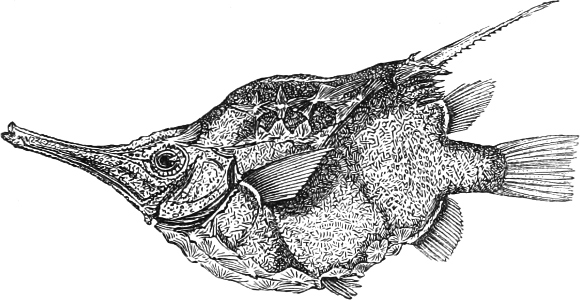
Fig. 231.—Centriscus humerosus.
Of the four species the most generally known is C. scolopax, the “Trumpet-fish” or “Bellows-fish,” which rarely occurs on the south coast of England, is more common farther south, and reappears in Tasmania. The allied C. gracilis is one of the fishes common to the Mediterranean and Japanese Seas. The species figured, C. humerosus, occurs on the coast of South Australia, and is very scarce.
Amphisile.—Body elongate, strongly compressed, provided with a dorsal cuirass, which is formed by portions of the skeleton; the longitudinal axis of the tail is not in the same line with that of the trunk. Scales none. Teeth none. Two dorsal fins situated on the hindmost part of the back; ventral fins rudimentary, abdominal. Three or four branchiostegals.
The three species known of this genus are found in the tropical Indo-Pacific. Their body is so thin that it has the appearance of being artificially compressed between two sheets of paper; it is semi-transparent, especially in the region of the air-bladder. The structure of the vertebral column is extremely singular and unique among Acanthopterygians. The abdominal portion is more than four times as long as the caudal; nevertheless it is composed of only six vertebræ, whilst the latter consists of fourteen. The abdominal vertebræ are extremely slender, the third alone being nearly as long as the whole caudal portion; they have a slight ridge superiorly and inferiorly, and on each side; the whole portion lying in the uppermost concavity of the dorsal cuirass. The caudal vertebræ are extremely short, and the strength of their neural and hæmal spines is in proportion to their size. The dorsal cuirass is not a dermal production, but formed by modified parts of the endoskeleton; its composition, the number and condition of its single parts, and, finally, the first dorsal spine, which in A. punctulata is so singularly attached to it, favour this opinion. The plates, which occupy the vertebral line, would correspond to the neural spines, and the lateral plates on which the ribs are suspended to the parapophyses. Amphisile may be considered as a Chelonian form among fishes.
Fourteenth Division—Acanthopterygii Gobiesociformes.
No spinous dorsal; the soft and the anal short or of moderate length, situated on the tail; ventral fins subjugular, with an adhesive apparatus between them. Body naked.
These fishes are well characterised by their single dorsal fin, and by their adhesive ventral apparatus, which has only an external similarity to the organ observed in Cyclopterus and Liparis; its structure is typically different from it. Whilst in those genera the ventral fins occupy the centre of the disk forming its base, these fins are here widely apart from each other, as in Callionymus, forming only a portion of the periphery of the disk, which is completed by a cartilaginous expansion of the coracoid bones. The following description of its structure is taken from Sicyases sanguineus, but it is essentially the same in all the genera.
The whole disk is exceedingly large, subcircular, longer than broad, its length being one-third of the whole length of the fish. The central portion is formed merely by skin, which is separated from the pelvic or pubic bones by several layers of muscles. The peripheric portion is divided into an anterior and posterior part by a deep notch behind the ventrals. The anterior peripheric portion is formed by the four ventral rays, the membrane between them, and a broad fringe which extends anteriorly from one ventral to the other; this fringe is a fold of the skin, containing on each side the rudimentary ventral spine, but no cartilage. The posterior peripheric portion is suspended on each side from the coracoid, the upper bone of which is exceedingly broad, becoming a free movable plate behind the pectoral. A broad cartilage is firmly attached to it. The lower bone of the coracoid is of a triangular form, and supports a very broad fold of the skin, extending from one side to the other, and containing a cartilage which runs through the whole of that fold. Five processes of the cartilage are continued into the soft striated margin in which the disk terminates posteriorly. The surface of the disk is coated with thick epidermis, like the sole of the foot of higher animals. The epidermis is divided into many polygonal plates; there are no such plates between the roots of the ventral fins.
Not less unique is the structure of the bones which have some relation to this external adhesive apparatus. As exemplified by Chorismochismus dentex the coracoid is well developed, and, as usual, composed of two pieces, the upper of which is not suspended from the humerus, but fixed by a ligament to the hinder margin of the carpal bones. It is a broad lamella, dilated posteriorly into the cartilage, which is externally visible; the lower piece is narrower, and fixed to the extremity of the pubic bone of its side. The pubic bones are united by suture, and form together a heart-shaped disk, the point of which is produced backwards. The anterior portion of the disk is concave, with a bony longitudinal bridge and a feeble transverse ridge. The disk is fixed to the humeral bones by the convex portions of its anterior margin, whilst the convex portions of the lateral margins serve as base for the ventral fins. The latter are composed of one spine, which is transformed into a broad, thin, and curved plate, hidden below the skin, and apparently of four rays; but on closer examination we find that the hidden ray has a longitudinal groove anteriorly, in which another thinner ray lies concealed. This ray is quite free, and not joined to the pubic bone.
The fishes belonging to the single family of this division, Gobiesocidæ, are strictly marine but littoral fishes. They are scattered over the temperate zones of both hemispheres, and more numerous than between the Tropics. All are of small or very small size.
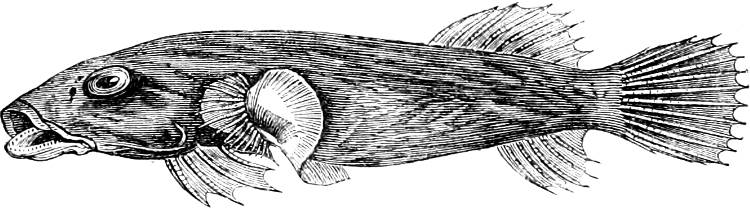
Fig. 232.—Gobiesox cephalus.
The adhesive disk consists of an anterior and posterior division. In some of the genera the posterior division has no free anterior margin, the teeth being either all conical, as in Chorisochismus (Cape of Good Hope) and Cotylis (Red Sea and Indian Ocean); or incisor-like in both jaws, as in Sicyases (coast of Chili and West Indies); or incisor-like at least in the lower jaw, as in Gobiesox (West Indies and Pacific coasts of South America). In other genera the posterior portion of the adhesive disk has a free anterior margin. Only one of these genera has incisor-like teeth, viz. Diplocrepis from New Zealand. In the remaining genera, Crepidogaster (from Tasmania and South Australia), Trachelochismus (from New Zealand and the Fiji Islands), Lepadogaster, and Leptopterygius, the teeth are very small and fine. The two last genera are European, and Lepadogaster at least is common on the Southern British coasts. The three species known as British—L. gouanii, L. candollii, and L. bimaculatus—are prettily coloured, but subject to great variation.
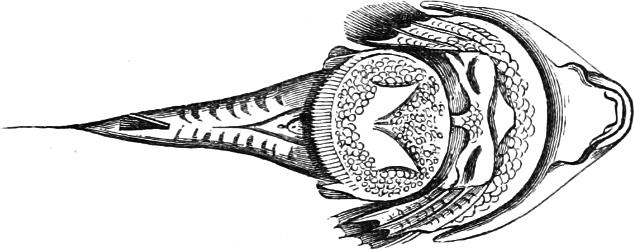
Fig. 233.—Diplocrepis puniceus.
Fifteenth Division—Acanthopterygii Channiformes.
Body elongate, covered with scales of moderate size; no spine in any of the fins; dorsal and anal long. No superbranchial organ, only a bony prominence on the anterior surface of the hyomandibular.
These fishes belong to the single family Ophiocephalidæ, Freshwater-fishes characteristic of the Indian region, which, however, have found their way into Africa, where they are represented by one or two species. Thirty-one species are known altogether, most of which are extremely abundant; some attain to a length of more than two feet. Like other tropical freshwater fishes, they are able to survive droughts, living in semi-fluid mud, or lying in a torpid state below the hard-baked crusts of the bottom of a tank from which every drop of water has disappeared. Respiration is probably entirely suspended during the state of torpidity, but whilst the mud is still soft enough to allow them to come to the surface, they rise at intervals to take in a quantity of air, by means of which their blood is oxygenised. This habit has been observed in some species to continue also to the period of the year in which the fish lives in normal water, and individuals which are kept in a basin and prevented from coming to the surface and renewing the air for respiratory purposes, are suffocated. The particular manner in which the accessory branchial cavity participates in respiratory functions is not known. It is a simple cavity, without an accessory branchial organ, the opening of which is partly closed by a fold of the mucous membrane.
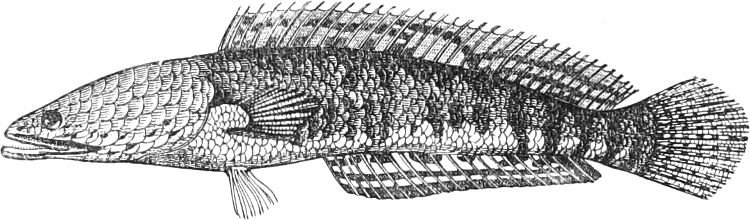
Fig. 234.—Ophiocephalus striatus, India.
Sixteenth Division—Acanthopterygii Labyrinthibranchii.
Body compressed, oblong or elevated, with scales of moderate size. A superbranchial organ in a cavity accessory to that of the gills.
First Family—Labyrinthici.
Dorsal and anal spines present, but in variable numbers; ventrals thoracic. Lateral line absent, or more or less distinctly interrupted. Gill-opening rather narrow, the gill-membranes of both sides coalescent below the isthmus, and scaly; gills four; pseudobranchiæ rudimentary or absent.
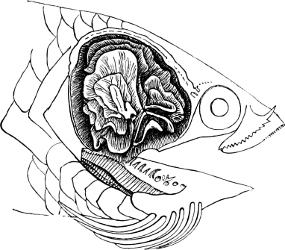
Fig. 235.—Superbranchial organ of Anabas.
Freshwater-fishes of the Cyprinoid division of the Equatorial zone. They possess the faculty of being able to live for some time out of the water, or in thick or hardened mud, in a still greater degree than the fishes of the preceding family. In the accessory branchial cavity there is lodged a laminated organ which evidently has the function of assisting in the oxygenisation of the blood. In Anabas it is formed by several exceedingly thin bony laminæ, similar in form to the auricle, and concentrically situated one above the other, the innermost being the largest. The degree in which these laminæ are developed is dependent on age. In specimens from one inch and a half to two inches and a half long there are only two such laminæ, a third being indicated by a small protuberance at the central base of the second or outer laminæ. In specimens of from three to four inches in length the third lamina is developed, covering one-half of the second. The edges of all the laminæ are straight, not valanced. In specimens of from four to five inches a fourth lamina makes its appearance in the basal centre of the third lamina. The other laminæ continue to grow in their circumference, and their edges now become undulated and slightly frilled. Cuvier and Valenciennes have examined still larger specimens. The figure given by them and reproduced here was taken from a specimen six or seven inches long, and shows the superbranchial organ composed of six laminæ.
The air-bladder of the majority of these fishes is very large, extending far into the tail, and, therefore, divided behind by the hæmal spines into two lateral portions.
The Labyrinthici are generally of small size; they are capable of being domesticated, and some of them deserve particular attention on account of the dazzling beauty of their colours or the flavour of their flesh.
Anabas.—Body compressed, oblong; præorbital and orbitals serrated. Small teeth in the jaws and on the vomer; none on the palatines. Dorsal and anal spines numerous. Lateral line interrupted.
The “Climbing Perch” (A. scandens) is generally distributed over the Indian Region, and well known from its faculty of moving for some distance over land, and even up inclined surfaces. In 1797 Daldorf, in a memoir communicated to the Linnean Society of London, mentions that in 1791 he had himself taken an Anabas in the act of ascending a palm tree which grew near a pond. The fish had reached the height of five feet above the water, and was going still higher. In the effort to do this it held on to the bark of the tree by the preopercular spines, bent its tail, and stuck in the spines of the anal; then released its head, and, raising it, took a new hold with the preoperculum higher up. The fish is named in the Malayan language the “Tree Climber.” It rarely attains a length of seven inches.
Spirobranchus from the Cape, and Ctenopoma from Tropical Africa, represent Anabas in that continent.
Polyacanthus.—Body compressed, oblong; operculum without spines or serrature; cleft of the mouth small, more or less oblique, not extending beyond the vertical from the orbit, and little protractile. Small fixed teeth in the jaws, none on the palate. Dorsal and anal spines numerous; the soft dorsal and anal, the caudal, and the ventral, more or less elongate in mature specimens. Caudal rounded. Lateral line interrupted or absent.
This genus is represented chiefly in the East Indian Archipelago; seven species are known; some of them have been domesticated on account of the beauty of their colours, and several varieties have been produced. One of them is to be mentioned, as, under the name of “Paradise-fish,” it has been introduced into the aquaria of Europe, where it readily breeds. It was known already to Lacépède, and has been mentioned since his time in all ichthyological works as Macropus viridi-auratus. In adult males some of the rays, and especially the caudal lobes, are much prolonged.
Osphromenus.—Body compressed, more or less elevated; operculum without spine or serrature. Small fixed teeth in the jaws, none on the palate. Dorsal spines in small or moderate number; anal spines in moderate or great number; ventral fins with the outer ray very long, filiform. Lateral line not interrupted or absent.
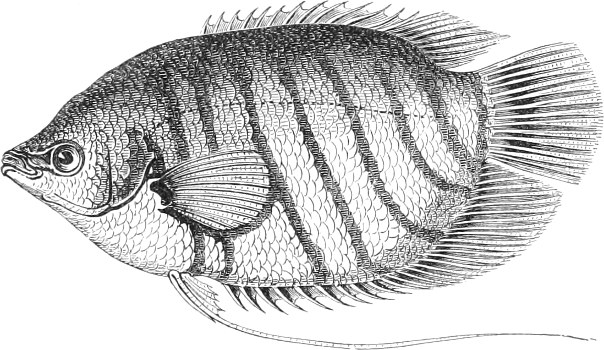
Fig. 236.—Osphromenus olfax.
To this genus belongs the celebrated “Gourami” (Osphromenus olfax), reputed to be one of the best flavoured Freshwater-fishes in the East-Indian Archipelago. Its original home is Java, Sumatra, Borneo, and several other islands; but thence it has been transported to, and acclimatised in, Penang, Malacca, Mauritius, and even Cayenne. Being an almost omnivorous fish and tenacious of life, it seems to recommend itself particularly for acclimatisation in other tropical countries, and specimens kept in captivity become as tame as carps. It attains the size of a large turbot. A second, but much smaller, species of this genus, O. trichopterus, is frequently kept in vessels on account of the exquisite beauty of its varying iridescent metallic tints; like other fishes of this family it is very pugnacious.
Trichogaster, a very common Bengalese fish, differs from Osphromenus in having the ventral fins reduced to a single long filament.
Betta.—Body compressed, oblong; operculum without spine or serrature. Small fixed teeth in the jaws, none on the palate. Dorsal fin short, on the middle of the back, without any pungent spine; anal fin long. Ventral fin with five soft rays, the outer one being produced. Lateral line interrupted or absent.
A species of this genus (B. pugnax) is, on account of its pugnacious habits, reared by the Siamese. Cantor gives the following account:—“When the fish is in a state of quiet, its dull colours present nothing remarkable; but if two be brought together, or if one sees its own image in a looking-glass, the little creature becomes suddenly excited, the raised fins and the whole body shine with metallic colours of dazzling beauty, while the projected gill membrane, waving like a black frill round the throat, adds something of grotesqueness to the general appearance. In this state it makes repeated darts at its real or reflected antagonist. But both, when taken out of each other’s sight, instantly become quiet. This description was drawn up in 1840, at Singapore, by a gentleman who had been presented with several by the King of Siam. They were kept in glasses of water, fed with larvæ of mosquitoes, and had thus lived for many months. The Siamese are as infatuated with the combats of these fish as the Malays are with their cock-fights; and stake on the issue considerable sums, and sometimes their own persons and families. The license to exhibit fish-fights is farmed, and brings a considerable annual revenue to the King of Siam. The species abounds in the rivulets at the foot of the hills of Penang. The inhabitants name it ‘Pla-kat,’ or the ‘Fighting-fish;’ but the kind kept especially for fighting is an artificial variety cultivated for the purpose.”
Micracanthus.—This genus represents the three last-named genera in Africa, where it has been recently discovered in tributaries of the river Ogooué. It seems to differ from the Indian genera chiefly by its more elongate body, the structure of the fins being scarcely different (D. 3/7, A. 4/23, V. 1/4).
Second Family—Luciocephalidæ.
Body elongate, covered with scales of moderate size. Lateral line present. Teeth small. Gill-opening wide; pseudobranchiæ none. The superbranchial organ is formed by two branchial arches, which are dilated into a membrane. One short dorsal fin; dorsal and anal spines none; ventrals composed of one spine and five rays. Air-bladder none.
A small Freshwater-fish (Luciocephalus pulcher), from the East-Indian Archipelago.
Seventeenth Division—Acanthopterygii lophotiformes.
Body riband shaped, with the vent near its extremity; a short anal behind the vent; dorsal fin as long as the body.
Only one species is known of this division or family, Lophotes cepedianus. It is most probably a deep-sea fish, but does not descend to so great a depth as the Trachypteridæ, its bony and soft parts being well coherent. It is a scarce fish, hitherto found in the Mediterranean, off Madeira, and in the Sea of Japan; its length is known to exceed five feet. The head is elevated into a very high crest, and the dorsal fin commences with an exceedingly strong and long spine on the head. Silvery, with rose-coloured fins.
Eighteenth Division—Acanthopterygii Tæniiformes.
Body riband shaped; dorsal fin as long as the body; anal absent; caudal rudimentary, or not in the longitudinal axis of the fish.
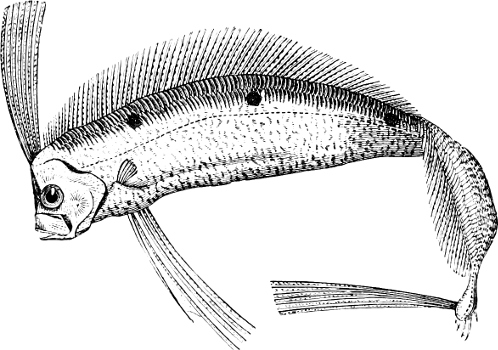
Fig. 237.—Trachypterus tænia.
The “Ribbon-fishes” are true deep-sea fishes, met with in all parts of the oceans, generally found when floating dead on the surface, or thrown ashore by the waves. Their body is like a band, specimens of from fifteen to twenty feet long being from ten to twelve inches deep, and about an inch or two broad at their thickest part. The eye is large and lateral; the mouth small, armed with very feeble teeth; the head deep and short. A high dorsal fin runs along the whole length of the back, and is supported by extremely numerous rays; its foremost portion, on the head, is detached from the rest of the fin, and composed of very elongate flexible spines. The anal fin is absent. The caudal fin (if preserved, which is rarely the case, in adult specimens) has an extra-axial position, being directed upwards like a fan. The ventrals are thoracic, either composed of several rays or reduced to a single long filament. The coloration is generally silvery, with rosy fins.
When these fishes reach the surface of the water the expansion of the gases within their body has so loosened all parts of their muscular and bony system, that they can be lifted out of the water with difficulty only, and nearly always portions of the body and fins are broken and lost. The bones contain very little bony matter, are very porous, thin and light. At what depths Ribbon-fishes live is not known; probably the depths vary for different species; but although none have been yet obtained by means of the deep-sea dredge, they must be abundant at the bottom of all oceans, as dead fishes or fragments of them are frequently obtained. Some writers have supposed from the great length and narrow shape of these fishes that they have been mistaken for “Sea-serpents;” but as these monsters of the sea are always represented by those who have had the good fortune of meeting with them as remarkably active, it is not likely that harmless Ribbon-fishes, which are either dying or dead, have been the objects described as “Sea-serpents.”
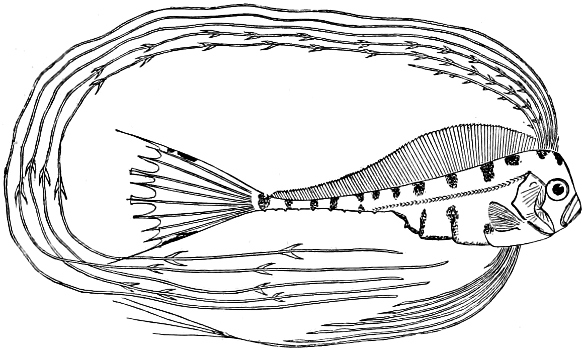
Fig. 238.—Young Trachypterus.
Young Ribbon-fishes (from two to four inches) are not rarely met with near the surface; they possess the most extraordinary development of fin rays observed in the whole class of fishes, some of them being several times longer than the body, and provided with lappet-like dilatations. There is no doubt that fishes with such delicate appendages are bred and live in depths where the water is absolutely quiet, as a sojourn in the disturbed water of the surface would deprive them at once of organs which must be of some utility for their preservation.
Ribbon-fishes are divided into three genera:—
Trachypterus.—In which the ventral rays are well developed, and composed of several more or less branched rays. Specimens of this genus have been taken in the Mediterranean, Atlantic, at Mauritius, and in the Eastern Pacific. The “Deal-fish” (T. arcticus) is often met with in the North Atlantic, and specimens are generally found after the equinoctial gales on the coasts of the Orkneys and North Britain.
Stylophorus.—Without ventrals, and with the tail terminating in an exceedingly long cord-like appendage. Known from one specimen only, found at the beginning of this century between Cuba and Martinique. It is eleven inches long, and preserved in the Museum of the Royal College of Surgeons in London.
Regalecus.—Each ventral fin is reduced to a long filament, dilated at the extremity; caudal fin rudimentary or absent. These are the largest of all Ribbon-fishes, specimens being on record the length of which exceeded twenty feet. They have been taken in the Mediterranean, North and South Atlantic, Indian Ocean, and on the coast of New Zealand. They are frequently called “Kings of the herrings,” from the erroneous notion that they accompany the shoals of herrings; or “Oar-fishes,” from their two ventral fins, which have a dilatation at their extremity not unlike the blade of an oar. One or more species (R. banksii) are sometimes found on the British coasts, but they are very scarce, not more than sixteen captures having been recorded between the years 1759 and 1878.
Nineteenth Division—Acanthopterygii Notacanthiformes.
Dorsal fin short, composed of short, isolated spines, without a soft portion. Anal fin very long, anteriorly with many spines; ventrals abdominal, with more than five soft and several unarticulated rays.
Notacanthus is the most aberrant type of Acanthopterygians. Of the characteristics of this order the development of spines in the vertical fins is the only one preserved in the fishes of this genus. Their body is elongate, covered with very small scales; the snout protrudes beyond the mouth. Eyes lateral, of moderate size; dentition feeble. Five species are known from the Arctic Ocean, Mediterranean, Atlantic, and Southern Pacific. They inhabit considerable depths, probably from 100 to 400 fathoms, and during the “Challenger” expedition specimens have been obtained from an alleged depth of 1875 fathoms.
SECOND ORDER:
ACANTHOPTERYGII PHARYNGOGNATHI.
Part of the rays of the dorsal, anal, and ventral fins are non-articulated spines. The lower pharyngeals coalesced. Air-bladder without pneumatic duct.
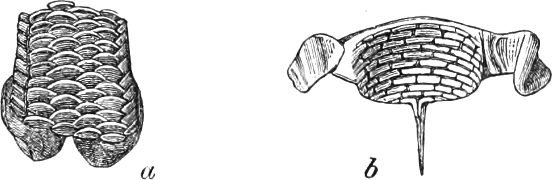
Fig. 239.—Coalescent Pharyngeals of Scarus cretensis. a, upper; b, lower pharyngeals.
First Family—Pomacentridæ.
Body short, compressed, covered with ctenoid scales. Dentition feeble; palate smooth. The lateral line does not extend to the caudal fin, or is interrupted. One dorsal fin, with the spinous portion as well developed as the soft, or more. Two, sometimes three, anal spines; the soft anal similar to the soft dorsal. Ventral fins thoracic, with one spine and five soft rays. Gills three and a half; pseudobranchiæ and air-bladder present. Vertebræ, twelve abdominal and fourteen caudal.
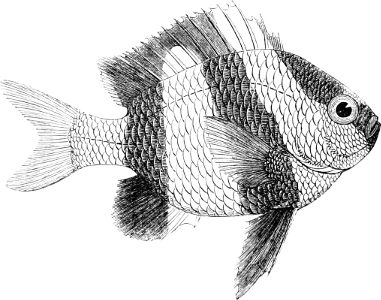
Fig. 240.—Dascyllus aruanus. Natural size, from the Indo-Pacific.
The fishes of this family are marine; they resemble the Chætodonts with regard to their mode of life, living chiefly in the neighbourhood of coral formations. Like them they are beautifully coloured, the same patterns being sometimes reproduced in members of both families, proving that the development and distribution of colours is due to the agencies of climate, of the surroundings and of the habits of animals. The geographical range of the Pomacentridæ is co-extensive with that of the Chætodonts, the species being most numerous in the Indo-Pacific and Tropical Atlantic, a few extending northwards to the Mediterranean and Japan, southwards to the coasts of South Australia. They feed chiefly on small marine animals, and such as have compressed teeth appear to feed on the small Zoophytes covering the banks, round which these “Coral-fishes” abound. In a fossil state this family is known from a single genus only, Odonteus, from Monte Bolca, allied to Heliastes. The recent genera belonging to this family are:—Amphiprion, Premnas, Dascyllus, Lepidozygus, Pomacentrus, Glyphidodon, Parma, and Heliastes. About 120 species are known.
Second Family—Labridæ.
Body oblong or elongate, covered with cycloid scales. The lateral line extends to the caudal, or is interrupted. One dorsal fin, with the spinous portion as well developed as, or more than, the soft. The soft anal similar to the soft dorsal. Ventral fins thoracic, with one spine and five soft rays. Palate without teeth. Branchiostegals five or six; gills three and a half; pseudobranchiæ and air-bladder present. Pyloric appendages none; stomach without cæcal sac.
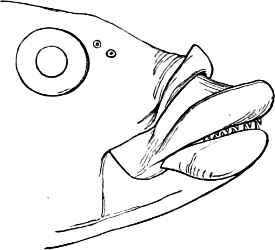
Fig. 241.—Lips of a Wrasse, Labrus festivus.
The “Wrasses” are a large family of littoral fishes, very abundant in the temperate and tropical zones, but becoming scarcer towards the Arctic and Antarctic circles, where they disappear entirely. Many of them are readily recognised by their thick lips, which are sometimes internally folded, a peculiarity which has given to them the German term of “Lip-fishes.” They feed chiefly on mollusks and crustaceans, their dentition being admirably adapted for crushing hard substances. Many species have a strong curved tooth at the posterior extremity of the intermaxillary, for the purpose of pressing a shell against the lateral and front teeth by which it is crushed. Other Wrasses feed on corals, others on zoophytes; a few are herbivorous. In all Wrasses the upper pharyngeal bones seem to be jointed to the basi-occipital; but whilst in Labrus the basi-occipital is raised on each side into a large flattish condyle, fitting into a concavity of the upper pharyngeals, in Scarus the mode of articulation is reversed, the basi-occipital having a pair of long grooves, in which the oblong condyles of the upper pharyngeals slide forwards and backwards. Beautiful colours prevail in this family, permanent pigmentary colours as well as passing iridescent reflections of the scales. Some species remain very small, others grow to a weight of fifty pounds. The larger kinds especially are prized as food, the smaller less so.
Remains of Labridæ, recognised by their united pharyngeals, which bear molar-like teeth, are not scarce in tertiary formations of France, Germany, Italy, and England. Such remains from Monte Bolca and the Swiss Molasse have been referred to the genus Labrus. Others, Nummopalatus and Phyllodus, are allied, but cannot be assigned, to one of the recent genera; the latter genus is first represented in cretaceous formations of Germany. Another genus, Taurinichthys, from the Miocene of France, represents the Odacina of the living fauna. Egertonia, from the Isle of Sheppey, differs so much from all recent Labroid genera that its pertinence to this family appears doubtful.
[See J. Cocchi, Monografia dei Pharyngodopilidæ, 1866; and E. Sauvage, Sur le genre Nummopalatus, in Bull. Soc. Geol. France, 1875.]
Labrus.—Body compressed, oblong, covered with scales of moderate size, in more than forty transverse series; snout more or less pointed; imbricate scales on the cheeks and opercles; none or only a few on the interoperculum. Teeth in the jaws conical, in a single series. Dorsal spines numerous, thirteen or twenty-one, none of which are prolonged; anal spines three. Lateral line not interrupted.
Young “Wrasses” differ from mature specimens in having the præoperculum serrated. The headquarters of this genus are the Mediterranean, whence it ranges, gradually diminishing towards the north, along all the shores of Europe. Nine species are known; British are the “Ballan Wrasse” (L. maculatus), and the “Striped or Red Wrasse” or “Cook” (L. mixtus). The two sexes of the latter species are very differently coloured; the male being generally ornamented with blue streaks, or a blackish band along the body, whilst the female has two or three large black blotches across the back of the tail.
Crenilabrus are Labrus with serrated præoperculum; the number of their dorsal spines varies from thirteen to eighteen, and the scales are arranged in less than forty transverse series.
The range of this genus is co-extensive with Labrus. C. melops, the “Gold-sinny,” or “Cork-wing,” is common on the British coasts.
Tautoga.—Body compressed, oblong, covered with small scales; scales on the cheek rudimentary, opercles naked. Teeth in the jaws conical, in double series; no posterior canine tooth. Dorsal spines seventeen, anal spines three. Lateral line not interrupted.
The “Tautog,” or “Black-fish,” is common on the Atlantic coasts of temperate North America, and much esteemed as food.
Ctenolabrus.—Body oblong, covered with scales of moderate size; imbricate scales on the cheeks and opercles. Teeth in the jaws in a band, with an outer series of stronger conical teeth; no posterior canine tooth. Dorsal spines from sixteen to eighteen; anal spines three. Lateral line not interrupted.
Four species, from the Mediterranean and the temperate parts of the North Atlantic, Ct. rupestris being common on the British, and Ct. burgall on the North American coasts.
Acantholabrus.—A Wrasse with five or six anal spines, and with the teeth in a band.
From the Mediterranean and British coasts (A. palloni).
Centrolabrus.—Wrasses with four or five anal spines, and with the teeth in a single series.
Two species are known from Madeira and the Canary Islands, and one from northern Europe and Greenland. The latter is scarce on the British coasts, but bears a distinct name on the south coast, where it is called “Rock-cook.”
Lachnolaemus from the West Indies, and Malacopterus from Juan Fernandez, are Labroids, closely allied to the preceding North Atlantic genera.
Cossyphus.—Body compressed, oblong, with scales of moderate size; snout more or less pointed; imbricate scales on the cheeks and opercles; basal portion of the vertical fins scaly. Lateral line not interrupted. Teeth in the jaws in a single series; four canine teeth in each jaw anteriorly; a posterior canine tooth. Formula of the fins: D. 12/9–11, A. 3/12.
Twenty species are known from the tropical zone and coasts adjoining it; some, like G. gouldii from Tasmania, attain a length of three or four feet.
Chilinus.—Body compressed, oblong, covered with large scales; lateral line interrupted; cheeks with two series of scales; præoperculum entire; teeth in a single series, two canines in each jaw; no posterior canine tooth; lower jaw not produced backwards. Dorsal spines subequal in length; formula of the fins: D. 9–10/10–9, A. 3/8.
Common in the tropical Indo-Pacific, whence more than twenty species are known. Hybrids between the different species of this genus are not uncommon.
Epibulus.—Closely allied to the preceding genus, but with a very protractile mouth, the ascending branches of the intermaxillaries, the mandibles, and the tympanic being much prolonged.
This fish (E. insidiator) is said to seize marine animals by suddenly thrusting out its mouth and engulphing those that come within the reach of the elongated tube. It attains a length of twelve inches, is common in the tropical Indo-Pacific, and varies much in coloration.
Anampses.—Distinguished by its singular dentition, the two front teeth of each jaw being prominent, directed forwards, compressed, with cutting edge. D. 9/12, A. 3/12.
Beautifully coloured fishes from the tropical Indo-Pacific. Ten species.
Platyglossus.—Scales in thirty or less transverse series; lateral line not interrupted. A posterior canine tooth. Dorsal spines nine.
Small beautifully coloured Coral-fishes, abundant in the equatorial zone and the coasts adjoining it. Some eighty species are known (inclusive of the allied genera Stethojulis, Leptojulis, and Pseudojulis).
Novacula.—Body strongly compressed, oblong, covered with scales of moderate size; head compressed, elevated, obtuse, with the supero-anterior profile more or less parabolic; head nearly entirely naked. Lateral line interrupted. No posterior canine tooth. D. 9/12, A. 3/12; the two anterior dorsal spines sometimes remote or separate from the others.
Twenty-six species are known from the tropical zone, and the warmer parts of the temperate zones. They are readily recognised by their compressed, knife-shaped body, and peculiar physiognomy; they scarcely exceed a length of twelve inches.
Julis.—Scales of moderate size; lateral line not interrupted. Head entirely naked. Snout of moderate extent, not produced; no posterior canine tooth. Dorsal spines ten.
Co-extensive with Platyglossus in their geographical distribution, and of like beautiful coloration and similar habits. Some of the most common fishes of the Indo-Pacific, as J. lunaris, trilobata, and dorsalis, belong to this genus.
Coris.—Scales small, in fifty or more transverse series; lateral line not interrupted. Head entirely naked. Dorsal spines nine.
Twenty-three species, distributed like Platyglossus; two reach the south coast of England, Coris julis and C. giofredi, said to be male and female of the same species. Some belong to the most gorgeously coloured kinds of the whole class of fishes.
Genera allied to the preceding Labroids are—Choerops, Xiphochilus, Semicossyphus, Trochocopus, Decodon, Pteragogus, Clepticus, Labrichthys, Labroides, Duymæria, Cirrhilabrus, Doratonotus, Pseudochilinus, Hemigymnus, Gomphosus, Cheilio, and Cymolutes.
Pseudodax.—Scales of moderate size; lateral line continuous; cheeks and opercles scaly. Each jaw armed with two pairs of broad incisors, and with a cutting lateral edge; teeth of the lower pharyngeal confluent, pavement-like. Dorsal spines eleven.
One species (P. moluccensis) from the East Indian Archipelago.
Scarus.—Jaws forming a sharp beak, the teeth being soldered together. The lower jaw projecting beyond the upper. A single series of scales on the cheek; dorsal spines stiff, pungent; the upper lip double in its whole circuit. The dentigerous plate of the lower pharyngeal is broader than long.
The fishes of this genus, and the three succeeding, are known by the name of “Parrot-wrasses.” Of Scarus one species (S. cretensis) occurs in the Mediterranean, and nine others in the tropical Atlantic. The first was held in high repute by the ancients, and Aristotle has several passages respecting its rumination. It was most plentiful and of the best quality in the Carpathian Sea, between Crete and Asia Minor, but was not unknown even in early times on the Italian coasts, though Columella says that it seldom passed beyond Sicily in his day. But in the reign of Claudius, according to Pliny, Optatus Elipentius brought it from the Troad, and introduced it into the sea between Ostium and Campagna. For five years all that were caught in the nets were thrown into the sea again, and from that time it was an abundant fish in that locality. In the time of Pliny it was considered to be the first of fishes (Nunc Scaro datur principatus); and the expense incurred by Elipentius was justified, in the opinion of the Roman gourmands, by the extreme delicacy of the fish. It was a fish, said the poets, whose very excrements the gods themselves were unwilling to reject. Its flesh was tender, agreeable, sweet, easy of digestion, and quickly assimilated; yet if it happened to have eaten an Aplysia, it produced violent diarrhœa. In short, there is no fish of which so much has been said by ancient writers. In the present day the Scarus of the Archipelago is considered to be a fish of exquisite flavour; and the Greeks still name it Scaro, and eat it with a sauce made of its liver and intestines. It feeds on fucus; and Valenciennes thinks that the necessity for masticating its vegetable diet thoroughly, and the working of it with that intent backwards and forwards in the mouth, may have given rise to the notion of its being a ruminant; and it is certain that its aliment is very finely divided when it reaches the stomach.
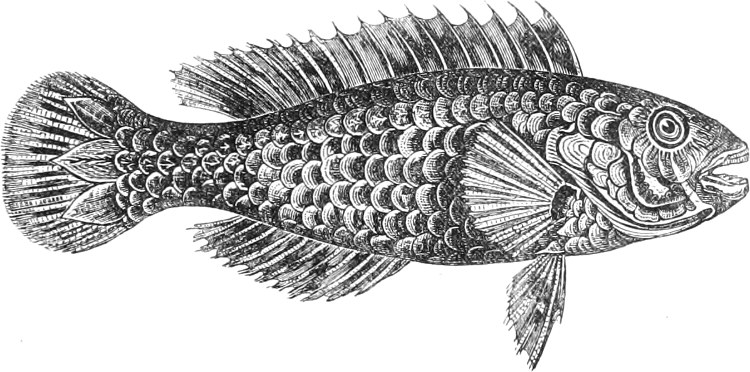
Fig. 242.—Scarichthys auritus.
Scarichthys.—Differing from Scarus only in having flexible dorsal spines.
Two species from the Indo-Pacific.
Callyodon.—Differing from Scarichthys in having the upper lip double posteriorly only.
Nine species from the tropical zone.
Pseudoscarus.—Jaws forming a strong beak, the teeth being soldered together. The upper jaw projecting beyond the lower. Two or more series of scales on the cheek. The dentigerous plate of the lower pharyngeal longer than broad.
This tropical genus contains by far the greatest number of Scaroid Wrasses, some seventy species being known, and a still greater number of names being introduced into the various Ichthyological works. They are beautifully coloured, but the colours change with age, and vary in an extraordinary degree in the same species. They rapidly fade after death, so that it is almost impossible to recognise in preserved specimens the species described from living individuals. Many attain to a rather large size, upwards of three feet in length. The majority are eaten, but some acquire poisonous properties from their food, which consists either of corals or of fucus.
Odax.—The edge of each jaw is sharp, without distinct teeth. The dentigerous plate of the lower pharyngeal triangular, much broader than long. Cheeks and opercles scaly; scales of the body small or rather small; lateral line continuous. Snout conical. Dorsal spines rather numerous, flexible.
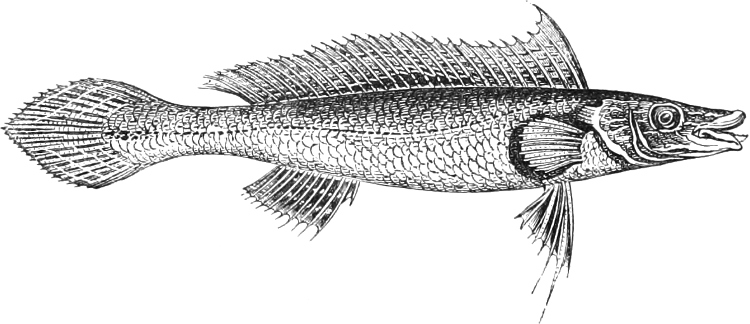
Fig. 243.—Odax radiatus.
Six species from the coasts of Australia and New Zealand. Small. The species figured (O. radiatus) is from Western Australia.
Coridodax.—Jaws as in Odax, head naked. Scales of the body small; lateral line continuous. Snout of moderate extent. Dorsal spines numerous, flexible.
The “Butter-fish,” or “Kelp-fish” of the colonists of New Zealand (C. pullus), is prized as food, and attains to a weight of four or five pounds. It feeds on zoophytes, scraping them from the surface of the kelp, with its curiously formed teeth. Its bones are green, like those of Belone.
Olistherops, from King George’s Sound, has scales of moderate size, but agrees otherwise with Coridodax.
Siphonognathus.—Head and body very elongate, snout long, as in Fistularia; upper jaw terminating in a long, pointed, skinny appendage; opercles and cheeks scaly; scales of moderate size; lateral line continuous. Dorsal spines numerous, flexible. Jaws as in Odax; the dentigerous plate of the lower pharyngeal very narrow.
S. argyrophanes, from King George’s Sound, is the most aberrant type of Wrasses, whose principal characters are retained, but united with a form of the body which resembles that of a Pipe-fish.
Third Family—Embiotocidæ.
Body compressed, elevated or oblong, covered with cycloid scales; lateral line continuous. One dorsal fin, with a spinous portion, and with a scaly sheath along the base, which is separated by a groove from the other scales; anal with three spines and numerous rays; ventral fins thoracic, with one spine and five rays. Small teeth in the jaws, none on the palate. Pseudobranchiæ present. Stomach siphonal, pyloric appendages none. Viviparous.
Marine Fishes characteristic of the fauna of the temperate North Pacific, the majority living on the American side, and only a few on the Asiatic. All are viviparous (see Fig. 70, p. 159). Agassiz describes the development of the embryoes as a normal ovarian gestation, the sac containing the young not being the oviduct but the ovarian sheath, which fulfils the functions of the ovary. This organ presents two modes of arrangement: in one there is a series of triangular membranous flaps communicating with each other, between which the young are arranged, mostly longitudinally, the head of one to the tail of another, but sometimes with the bodies curved, to the number of eighteen or twenty; in the other, the cavity is divided by three membranes converging to a point, into four compartments, not communicating with each other except towards the genital opening, the young being arranged in the same longitudinal manner. The proportionate size of the young is very remarkable. In a female specimen 10½ inches long, and 4½ inches high, the young were nearly 3 inches long and 1 inch high. Seventeen species are known, the majority of which belong to Ditrema, and one to Hysterocarpus. They do not attain to a large size, varying from three-quarters to three pounds in weight.
Fourth Family—Chromides.
Body elevated, oblong or elongate, scaly, the scales being generally ctenoid. Lateral line interrupted or nearly so. One dorsal fin, with a spinous portion; three or more anal spines; the soft anal similar to the soft dorsal. Ventral fins thoracic, with one spine and five rays. Teeth in the jaws small, palate smooth. Pseudobranchiæ none. Stomach coecal; pyloric appendages none.
Freshwater-fishes of rather small size from the tropical parts of Africa and America; one genus from Western India. The species with lobate teeth, and with many circumvolutions of the intestines, are herbivorous, the other carnivorous.
Etroplus.—Body compressed, elevated, covered with ctenoid scales of moderate size. Lateral line indistinct. Dorsal and anal spines numerous. Teeth compressed, lobate, in one or two series. Anterior prominences of the branchial arches not numerous, short, conical, hard. Dorsal fin not scaly.
Two species from Ceylon and Southern India.
Chromis.—Body compressed, oblong, covered with cycloid scales of moderate size. Dorsal spines numerous, anal spines three. Teeth compressed, more or less lobate, in one series. Anterior prominences of the branchial arches short, thin, lamelliform, non-serrated. Dorsal fin not scaly.
Some twenty species are known from the fresh waters of Africa and Palestine; the most celebrated is the “Bulti,” or “Bolty,” of the Nile, one of the few well-flavoured fishes of that river; it grows to the length of twenty inches. Two or three species of this genus occur in the Jordan and Lake of Galilee.
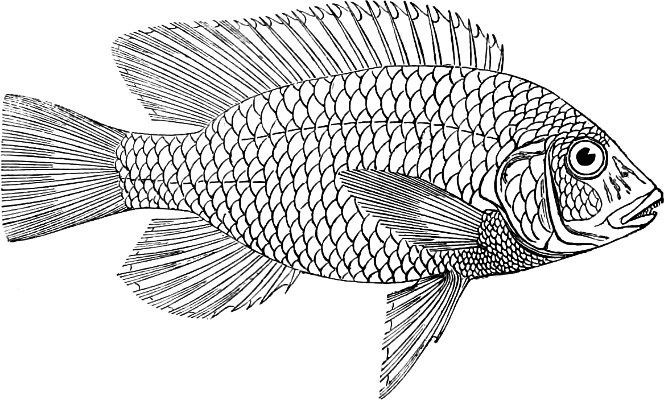
Fig. 244.—Chromis andreæ, from the Lake of Galilee.
Hemichromis, differing from Chromis in having conical teeth in one or two series.
Ten species, the range of which is co-extensive with that of Chromis. One species, H. sacra, is abundant in the Lake of Galilee.
Paretroplus, differing from Hemichromis in having nine anal spines.
One species from Madagascar.
Acara.—Body compressed, oblong, covered with ctenoid scales of moderate size. Dorsal spines numerous, anal spines three or four; base of the soft dorsal nearly uncovered by scales. Teeth in a band, small, conical. Anterior prominences of the first branchial arch very short tubercles.
Some twenty species are known from the fresh waters of Tropical America, A. bimaculata being one of the most common fishes of that region. All are very small.
Heros.—Differing from Acara in having more than four anal spines.
Some fifty species are known from the fresh waters of Tropical America, especially Central America, where almost every large lake or river is tenanted by one or more peculiar species. They are of rather small size, rarely exceeding a length of twelve inches.
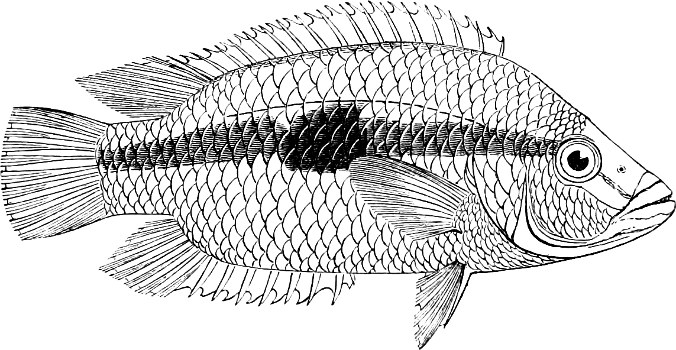
Fig. 245.—Heros salvini, from Central America.
Genera allied to Heros, and likewise from Tropical America, are Neetroplus, Mesonauta, Petenia, Uaru, and Hygrogonus.
Cichla.—Form of the body perch-like. Scales small; the spinous and soft portions of the dorsal fin of nearly equal extent, and separated by a notch; anal spines three. Each jaw with a broad band of villiform teeth. The outer branchial arch with lanceolate crenulated prominences along its concave side. Dorsal and anal fins scaly.
Four species from Brazil, Guyana, and Peru.
Crenicichla.—Body low, sub-cylindrical; scales small or rather small. The spinous portion of the dorsal is much more developed than the soft, both being continuous, and not separated by a notch; anal spines three. Præopercular margin serrated. Each jaw with a band of conical teeth. The outer branchial arch with short tubercles. Dorsal and anal fins naked.
Ten species from Brazil and Guyana.
The following genera complete the list of South American Chromides: Chætobranchus, Mesops, Satanoperca, Geophagus, Symphysodon, and Pterophyllum.
THIRD ORDER—ANACANTHINI.
Vertical and ventral fins without spinous rays. The ventral fins, if present, are jugular or thoracic. Air-bladder, if present, without pneumatic duct.
These characters are common to all the members of this order, with the exception of a freshwater-fish from Tasmania and South Australia (Gadopsis), which has the anterior portion of the dorsal and anal fins formed of spines.
First Division—Anacanthini Gadoidei.
Head and body symmetrically formed.
First Family—Lycodidæ.
Vertical fins confluent. Ventral fin, if present, small, attached to the humeral arch, jugular. Gill-opening narrow, the gill-membrane being attached to the isthmus.
Marine littoral fishes of small size, resembling Blennies, chiefly represented in high latitudes, but a few living within the tropical zone.
Lycodes.—Body elongate, covered with minute scales imbedded in the skin, or naked; lateral line more or less indistinct. Eye of moderate size. Ventral small, short, rudimentary, jugular, composed of several rays. Upper jaw overlapping the lower. Conical teeth in the jaws, on the vomer, and on the palatine bones. Barbel none. Five or six branchiostegals; gill-opening narrow, the gill-membranes being attached to the isthmus. Pseudobranchiæ present. Air-bladder none. Pyloric appendages two, or rudimentary, or entirely absent. No prominent anal papilla.
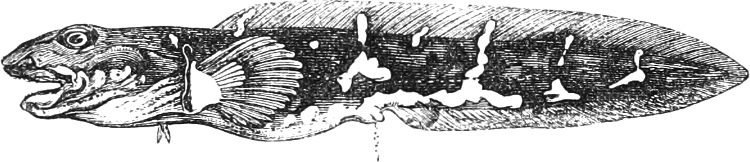
Fig. 246.—Lycodes mucosus, from Northumberland Sound.
Nine species are known from the Arctic Ocean, four from the southern extremity of the American continent.
Gymnelis.—Body elongate, naked. Eye of moderate size or rather small. Ventrals none. Vent situated at some distance backwards from the head. Small conical teeth in the jaws, on the vomer and palatine bones. Jaws equal anteriorly. Barbel none. Six branchiostegals; gill-opening narrow, the gill membranes being attached to the isthmus. Pseudobranchiæ present; air-bladder none. Pyloric appendages two; no prominent anal papilla.

Fig. 247.—Gymnelis viridis.
One species (G. viridis) from Greenland, the other (G. pictus) from the Straits of Magelhæn.
The other genera belonging to this family are Uronectes from Baffin’s Bay, Microdesmus from Panama, Blennodesmus from the coast of North-Eastern Australia, and Maynea from the Straits of Magelhæn.
Second Family—Gadidæ.
Body more or less elongate, covered with small smooth scales. One, two, or three dorsal fins, occupying nearly the whole of the back; rays of the posterior dorsal well developed; one or two anal fins. Caudal free from dorsal and anal, or, if they are united, the dorsal with a separate anterior portion. Ventrals jugular, composed of several rays, or, if they are reduced to a filament, the dorsal is divided into two. Gill-opening wide; the gill-membranes generally not attached to the isthmus. Pseudobranchiæ none, or glandular, rudimentary. An air-bladder and pyloric appendages generally present.
The family of “Cod-fishes” consists partly of littoral and surface species (and they form the majority), partly of deep-sea forms. The former are almost entirely confined to the temperate zones, extending beyond the Arctic Circle; the latter have, as deep-sea fishes generally, a much wider range, and hitherto have been found chiefly at considerable depths of rather low latitudes. Only two or three species inhabit fresh waters. They form one of the most important articles of food and subsistence to the fishermen in Europe and North America, and to whole tribes bordering upon the Arctic Ocean.
Fossil remains are scarce. Nemopteryx and Palæogadus have been described from the schists of Glaris, a formation believed to have been the bottom of a very deep sea. In the clay of Sheppey species occur allied to Gadus, Merluccius, and Phycis; others, not readily determinable, have been found at Licata in Sicily (Miocene).
Gadus.—Body moderately elongate, covered with small scales. A separate caudal, three dorsal, and two anal fins; ventrals narrow, composed of six or more rays. Teeth in the upper jaw in a narrow band; vomerine teeth; none on the palatines.
Arctic and temperate zones of the Northern Hemisphere. Eighteen species are known, of which the following are the most important:—
Gadus morrhua, the common “Cod-fish”—in German called “Kabeljau” when fresh and old, “Dorsch” when young and fresh, “Stock-fish” when dried, “Labberdan” when salted—measures from two to four feet, and attains to a weight of one hundred pounds. On the British coasts and in the German Ocean it is generally of a greenish or brownish-olive colour, with numerous yellowish or brown spots. Farther northwards darker-coloured specimens, frequently without any spots, predominate; and on the Greenland, Iceland, and North Scandinavian coasts the Cod have often a large irregular black blotch on the side. The Cod-fish occurs between 50° and 75° lat. N., in great profusion, to a depth of 120 fathoms, but is not found nearer the Equator than 40° lat. Close to the coast it is met with singly all the year round, but towards the spawning-time it approaches the shore in numbers, which happens in January in England and not before May on the American coasts. The English resorted to the cod-fisheries of Iceland before the year 1415, but since the sixteenth century most vessels go to the banks of Newfoundland, and almost all the preserved Cod consumed during Lent in the various continental countries is imported from across the Atlantic. At one time the Newfoundland cod-fishery rivalled in importance the whale-fishery and the fur trade of North America. Cod-liver oil is prepared from the liver on the Norwegian coast, but also other species of this genus contribute to this most important drug.
Gadus tomcodus abundantly occurs on the American coasts; it remains within smaller dimensions than the common Cod-fish. Gadus æglefinus, the “Haddock” (“Schell-fisch” of the Germans, “Hadot” of the French), is distinguished by a black lateral line and a blackish spot above the pectoral fin. It attains to a length of three feet in the higher latitudes, but remains smaller on more southern coasts; like the Cod it extends across the Atlantic. The largest specimens are taken on the British coast in winter, because at that time they leave the deep water to spawn on the coast. Gadus merlangus, the “Whiting,” with a black spot in the axil of the pectoral fin. Gadus luscus, the “Bib,” “Pout,” or “Whiting-pout,” with cross-bands during life, and with a black axillary spot, rarely exceeding a weight of five pounds. Gadus fabricii, a small species, but occurring in incredible numbers on the shores near the Arctic circle, and ranging to 80° lat. N. Gadus pollachius, the “Pollack,” without a barbel at the chin, and with the lower jaw projecting beyond the upper. Gadus virens, the “Coal-fish,” valuable on account of its size and abundance, and therefore preserved for export like the Cod.
The fishes of the genus Gadus are bathymetrically succeeded by several genera, as Gadiculus, Mora, and Strinsia; however these do not descend to sufficiently great depths to be included into the deep-sea Fauna; the two following are true deep-sea fishes.
Halargyreus.—Body elongate, covered with small scales. Two dorsal and two anal fins; ventrals composed of several rays. Jaws with a band of minute villiform teeth; vomer and palatines toothless. No barbel.
The single species known, H. johnsonii, proves to be a deep-sea fish by its organisation as well as geographical distribution. Originally known from a single specimen, which was obtained at Madeira, it has since been found off the coast of New Zealand. There is no doubt that it will be discovered also in intermediate seas.
Melanonus.—Head and body rather compressed, covered with cycloid scales of moderate size, and terminating in a long tapering tail, without caudal. Eye of moderate size. Villiform teeth in the jaws, on the vomer and palatine bones. Barbel none. A short anterior dorsal, the second extending to the end of the tail, and the anal being of similar length. Ventrals composed of several rays. Bones soft and flexible.
This is one of the discoveries made during the expedition of the “Challenger.” The single specimen obtained is of a deep-black colour, and was dredged up at a depth of 1975 fathoms in the Antarctic Ocean.
Merluccius.—Body elongate, covered with very small scales. A separate caudal; two dorsal fins and one anal; ventrals well developed, composed of seven rays. Teeth in the jaws and on the vomer rather strong, in double or triple series. No barbel.
Two species are known of this genus, widely separated in their distribution. The European species, M. vulgaris, the “Hake,” is found on both sides of the Atlantic, and grows to a length of four feet. It is caught in great numbers, and preserved as “Stock-fish.” The second species M. gayi, is common in the Straits of Magelhæn and on the coast of Chili, less so in New Zealand.
The vertebral column of this genus shows a singular modification of the apophyses. The neural spines of all the abdominal vertebræ are extremely strong, dilated, wedged into one another. The parapophyses of the third to sixth vertebræ are slender, styliform, whilst those of all the following abdominal vertebræ are very long and broad, convex on the upper and concave on the lower surface; the two or three anterior pairs are, as it were, inflated. The whole forms a strong roof for the air-bladder, reminding us of a similar structure in Kurtus.
Pseudophycis.—Body of moderate length, covered with rather small scales. A separate caudal, two dorsals, and one anal; ventral fins very narrow and styliform, but composed of several rays. Jaws with a band of small teeth; vomer and palatines toothless. Chin with a barbel.
Two species, of which Ps. bachus is common on the coast of New Zealand.
Allied genera are Lotella, Physiculus, Uraleptus, and Læmonema, from moderate depths, obtained chiefly off Madeira and the Southern Temperate Zone.
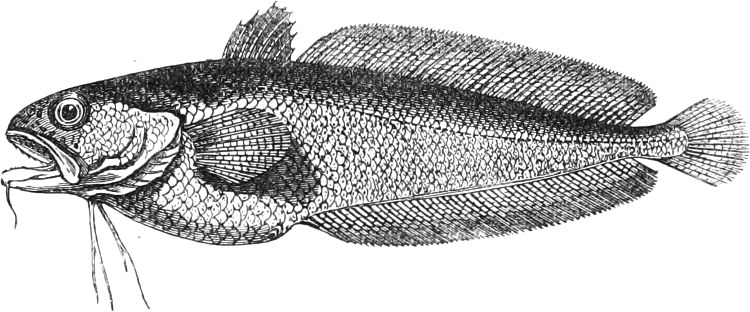
Fig. 248.—Pseudophycis bachus.
Phycis.—Body of moderate length, covered with small scales. Fins more or less enveloped in loose skin. A separate caudal; two dorsal fins and one anal; the anterior dorsal composed of from eight to ten rays; ventrals reduced to a single long ray, bifid at its end. Small teeth in the jaws and on the vomer; palatine bones toothless. Chin with a barbel.
Six species from the temperate parts of the North Atlantic and the Mediterranean, one, Ph. blennioides, is occasionally found on the British coast.
Haloporphyrus.—Body elongate, covered with small scales. A separate caudal, two dorsal fins, and one anal; the first dorsal with four rays; ventrals narrow, composed of six rays. Jaws and vomer with villiform teeth; palatine bones toothless. Chin with a barbel.
A small genus of deep-sea fishes, of which three species are known. They offer a striking instance of the extraordinary distribution of deep-sea fishes; H. lepidion occurs in from 100 to 600 fathoms in the Mediterranean and the neighbouring parts of the Atlantic, off the coast of Japan, and various parts of the South Atlantic; H. australis in from 55 to 70 fathoms in the Straits of Magelhæn; and finally H. rostratus in from 600 to 1375 fathoms, midway between the Cape of Good Hope and Kerguelen’s Land, and in the South Atlantic.
Lota.—Body elongate, covered with very small scales. A separate caudal, two dorsal fins, and one anal; ventrals narrow, composed of six rays. Villiform teeth in the jaws and on the vomer; none on the palatines. The first dorsal with from ten to thirteen well-developed rays. Chin with a barbel.
The “Burbot,” or “Eel-pout” (L. vulgaris, Fig. 8, p. 43), is a Freshwater-fish which never enters salt water. It is locally distributed in Central and Northern Europe and North America; it is one of the best Freshwater-fishes, and exceeds a length of three feet.
Molva.—Differs from Lota in having several large teeth in the lower jaw and on the vomer.
The “Ling” (M. vulgaris) is a very valuable species, common on the northern coasts of Europe, Iceland, and Greenland; and generally found from three to four feet long. The larger number of the specimens caught are cured and dried.
Motella.—Body elongate, covered with minute scales. A separate caudal. Two dorsal fins, the anterior of which is reduced to a narrow rayed fringe, more or less concealed in a longitudinal groove; the first ray is prolonged. One anal fin. Ventrals composed of from five to seven rays. A band of teeth in the jaws and on the vomer.
Eight species of “Rocklings” are known from the coasts of Europe, Iceland, Greenland, Japan, the Cape of Good Hope, and New Zealand. They are of small size, and chiefly distinguished by the number of their barbels. British are the Five-bearded Rockling (M. mustela), the Three-bearded Rocklings (M. tricirrhata, macrophthalma, and maculata), and the Four-bearded Rockling (M. cimbria). M. macrophthalma comes from a depth of from 80 to 180 fathoms. The young are known as “Mackerel Midge” (Couchia), and sometimes met with in large numbers at some distance from the coast.
Raniceps.—Head large, broad, and depressed; body of moderate length, covered with minute scales. A separate caudal. Two dorsal fins, the anterior of which is very short, rudimentary. One anal fin. Ventrals composed of six rays. Cardlike teeth in the jaws and on the vomer.
The “Trifurcated Hake,” R. trifurcus, not uncommon on the coasts of Northern Europe.
Bregmaceros.—Body fusiform, compressed posteriorly, covered with cycloid scales of moderate size. Two dorsal fins; the anterior reduced to a single long ray on the occiput; the second and the anal much depressed in the middle; ventrals very long, composed of five rays. Teeth small.
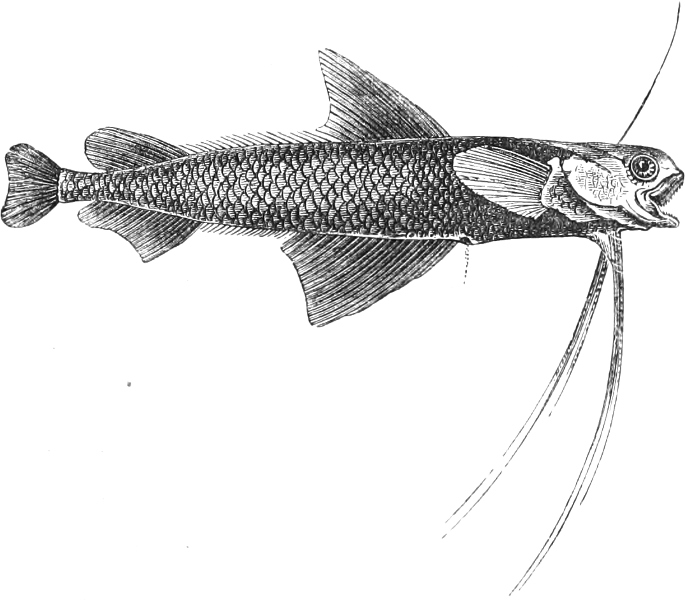
Fig. 249.—Bregmaceros macclellandii.
A dwarf Gadoid, the only one found at the surface between the Tropics. B. macclellandii scarcely exceeds three inches in length, is not uncommon in the Indian Ocean, and has found its way to New Zealand; specimens have been picked up in mid-ocean.
Murænolepis.—Body covered with lanceolate epidermoid productions, intersecting each other at right angles like those of a Freshwater-eel. Vertical fins confluent, no caudal being discernible; an anterior dorsal fin is represented by a single filamentous ray; ventral fins narrow, composed of several rays. A barbel. Jaws with a band of villiform teeth; palate toothless.
One species (M. marmoratus) from Kerguelen’s Land.
Chiasmodus.—Body naked; stomach and abdomen distensible. Two dorsal fins and one anal; a separate caudal; ventral fins rather narrow, with several rays. Upper and lower jaws with two series of large pointed teeth, some of the anterior being very large and movable; teeth on the palatine bones, but none on the vomer. Chin without barbel.
This Gadoid (Ch. niger, Fig. 111, p. 311), inhabits great depths in the Atlantic (to 1500 fathoms). The specimen figured was taken with a large Scopeloid in its stomach.
Brosmius.—Body moderately elongate, covered with very small scales. A separate caudal, one dorsal, and one anal; ventrals narrow, composed of five rays. Vomerine and palatine teeth. A barbel.
The “Torsk” (B. brosme) is confined to the northern parts of the temperate zone, and probably extends to the arctic circle.
Third Family—Ophidiidæ.
Body more or less elongate, naked, or scaly. Vertical fins generally united; no separate anterior dorsal or anal; dorsal occupying the greater portion of the back. Ventral fins rudimentary or absent, jugular. Gill-openings wide, the gill-membranes not attached to the isthmus.
Marine fishes (with the exception of Lucifuga), partly littoral, partly bathybial. They may be divided into five groups.
I. Ventral fins present, attached to the humeral arch: Brotulina.
Brotula.—Body elongate, covered with minute scales. Eye of moderate size. Each ventral reduced to a single filament, sometimes bifid at its extremity. Teeth villiform; snout with barbels. One pyloric appendage.
Five species of small size from the Tropical Atlantic and Indian Ocean.
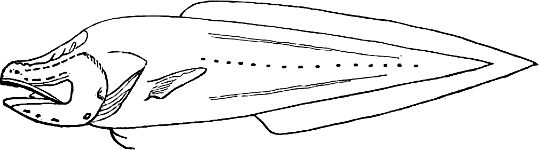
Fig. 250.—Lucifuga dentata, from caves in Cuba.
Lucifuga are Brotula organised for a subterranean life. The eye is absent, or quite rudimentary, and covered by the skin; the barbels of Brotula are replaced by numerous minute ciliæ or tubercles. They inhabit the subterranean waters of caves in Cuba, and never come to the light.
Bathynectes.—Body produced into a long tapering tail, without caudal. Mouth very wide, villiform teeth in the jaws, on the vomer and palatine bones. Barbel none. Ventral fins reduced to simple or bifid filaments, placed close together, and near to the humeral symphysis. Gill-membranes not united; gill-laminæ remarkably short. Bones of the head soft and cavernous; operculum with a very feeble spine above.
Deep-sea fishes, inhabiting depths varying from 1000 to 2500 fathoms. Three species are known, the largest specimen obtained being seventeen inches long.
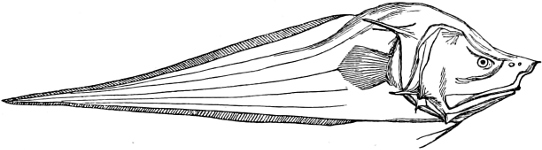
Fig. 251.—Acanthonus armatus.
Acanthonus.—Head large and thick, armed in front and on the opercles with strong spines; trunk very short, the vent being below the pectoral; tail thin, strongly compressed, tapering, without caudal. Eye small. Mouth very wide; villiform teeth in the jaws, on the vomer and palatine bones. Barbel none. Ventrals reduced to simple filaments placed close together on the humeral symphysis. Scales extremely small. Bones of the head soft.
Only two specimens, thirteen inches long, of this remarkable deep-sea form have been obtained, at a depth of 1075 fathoms, in the Indian Ocean.
Typhlonus.—Head large, compressed, with most of the bones in a cartilaginous condition; the superficial bones with large muciferous cavities, not armed. Snout a thick protuberance projecting beyond the mouth, which is rather small and inferior. Trunk very short, the vent being below the pectoral; tail thin, strongly compressed, tapering, without separate caudal. Eye externally not visible. Villiform teeth in the jaws, on the vomer and palatine bones. Barbel none. Scales thin, deciduous, small.
Also of this deep-sea fish two specimens only are known, 10 inches long, from a depth of 2200 fathoms in the Western Pacific.
Aphyonus.—Head, body, and tapering tail strongly compressed, enveloped in a thin, scaleless, loose skin. Vent far behind the pectoral. Snout swollen, projecting beyond the wide mouth. No teeth in the upper jaw, small ones in the lower. No externally visible eye. Barbel none. Head covered with a system of wide muciferous channels, the dermal bones being almost membranaceous, whilst the others are in a semi-cartilaginous condition. Notochord persistent, but with a superficial indication of vertebral segments.
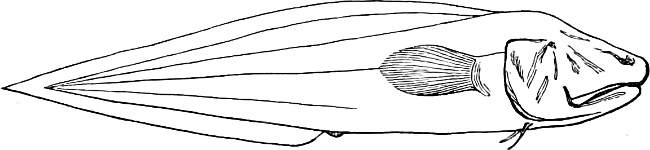
Fig. 252.—Aphyonus gelatinosus.
One specimen only of this most remarkable form is known; it is 5½ inches long, and was obtained at a depth of 1400 fathoms south of New Guinea.
Of the remaining genera belonging to this group, Brotulophis, Halidesmus, Dinematichthys, and Bythites are surface forms; Sirembo and Pteridium inhabit moderate depths; Rhinonus is a deep-sea fish.
II. Ventral fins replaced by a pair of bifid filaments (barbels) inserted below the glossohyal: Ophidiinæ.
Ophidium.—Body elongate, compressed, covered with very small scales. Eye of moderate size. All the teeth small.
Small fishes from the Atlantic and Pacific. Seven species are known, differing from one another in the structure of the air-bladder (see p. 145).
Genypterus is a larger form of Ophidium, in which the outer series of teeth in the jaws and the single palatine series contains strong teeth.
Three species from the Cape of Good Hope, South Australia, New Zealand, and Chili are known. They grow to a length of five feet, and have an excellent flesh, like cod, well adapted for curing. At the Cape they are known by the name of “Klipvisch,” and in New Zealand as “Ling” or “Cloudy Bay Cod.”
III. No ventral fins whatever; vent at the throat: Fierasferina.
These fishes (Fierasfer and Encheliophis) are of very small size and eel-like in shape; the ten species known are found in the Mediterranean, Atlantic, and Indo-Pacific. As far as is known they live parasitically in cavities of other marine animals, accompany Medusæ, and more especially penetrate into the respiratory cavities of Star-fishes and Holothurians. Not rarely they attempt other animals less suited for their habits, as, for instance, Bivalves; and cases are known in which they have been found imprisoned below the mantle of the Mollusk, or covered over with a layer of the pearly substance secreted by it. They are perfectly harmless to their host, and merely seek for themselves a safe habitation, feeding on the animalcules which enter with the water the cavity inhabited by them.
IV. No ventral fins whatever; vent remote from the head; gill-openings very wide, the gill-membranes not being united: Ammodytina.
The “Sand-eels” or “Launces” (Ammodytes) are extremely common on sandy shores of Europe and North America. They live in large shoals, rising as with one accord to the surface, or diving to the bottom, where they bury themselves with incredible rapidity in the sand. They are much sought after for bait by fishermen, who discover their presence on the surface by watching the action of Porpoises which feed on them. These Cetaceans, when they meet with a shoal, know how to keep it on the surface by diving below and swimming round it, thus destroying large numbers of them. The most common species on the British coast is the Lesser Sand-eel (A. tobianus); the Greater Sand-eel (A. lanceolatus), which attains to a length of eighteen inches; A. siculus, from the Mediterranean, scarcer in British seas. Two species live on the American coasts, A. americanus and A. dubius; one in California, A. personatus. Bleekeria from Madras is the second genus of this group.

Fig. 253.—Congrogadus subducens.
V. No ventral fins whatever; vent remote from the head; gill-openings of moderate width, the gill-membranes being united below the throat, not attached to the isthmus: Congrogadina.
Only two fishes belong to this group—Congrogadus from the Australian coasts, and Haliophis from the Red Sea.
Fourth Family—Macruridæ.
Body terminating in a long, compressed, tapering tail, covered with spiny, keeled, or striated scales. One short anterior dorsal; the second very long, continued to the end of the tail, and composed of very feeble rays; anal of an extent similar to that of the second dorsal; no caudal. Ventral fins thoracic or jugular, composed of several rays.
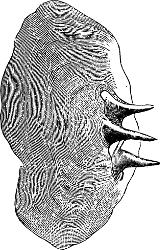
Fig. 254.—Scale of Macrurus trachyrhynchus.
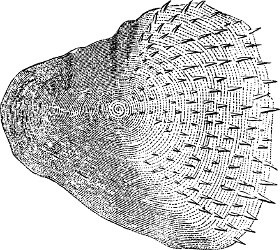
Fig. 255.—Scale of Macrurus cœlorhynchus.
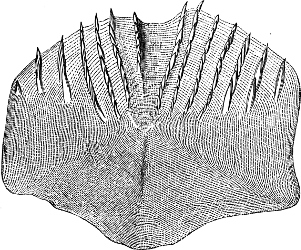
Fig. 256.—Scale from the lateral line of Macrurus australis.
This family, known a few years ago from a limited number of examples, representing a few species only, proves to be one which is distributed over all oceans, occurring in considerable variety and great abundance at depths of from 120 to 2600 fathoms. They are, in fact, Deep-sea Gadoids, much resembling each other in the general shape of their body, but differing in the form of the snout and in the structure of their scales. About forty species are known, of which many attain a length of three feet. They have been referred to the following genera:—
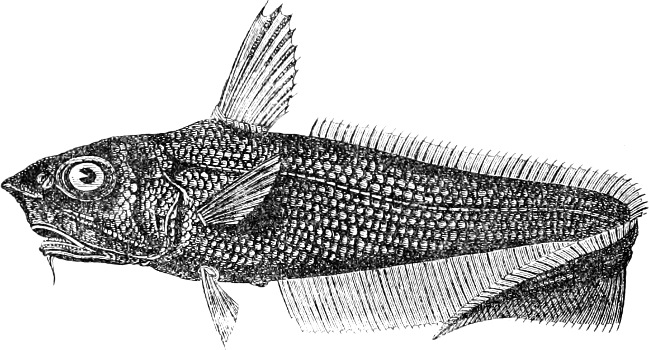
Fig. 257.—Macrurus australis.
Macrurus.—Scales of moderate size; snout produced, conical; mouth inferior.
Coryphænoides.—Scales of moderate size; snout obtuse, obliquely truncated; cleft of the mouth lateral.
Macruronus.—Scales of moderate size, spiny; snout pointed; mouth anterior and lateral, with the lower jaw projecting.
Malacocephalus.—Scales very small, ctenoid; snout short, obtuse, obliquely truncated.
Bathygadus.—Scales small, cycloid; snout not projecting beyond the mouth; mouth wide, anterior, and lateral.
Ateleopus from Japan and Xenocephalus from New Ireland are genera belonging to the Gadoid Anacanths, but are very imperfectly known.
Second Division—Anacanthini Pleuronectoidei.
Head and part of the body unsymmetrically formed.
This division consists of one family only:
Pleuronectidæ.
The fishes of this family are called “Flat-fishes,” from their strongly compressed, high, and flat body; in consequence of the absence of an air-bladder, and of the structure of their paired fins, they are unable to maintain their body in a vertical position, resting and moving on one side of the body only. The side turned towards the bottom is sometimes the left, sometimes the right, colourless, and termed the “blind” side; that turned upwards and towards the light is variously, and in some tropical species even vividly, coloured. Both eyes are on the coloured side, on which side also the muscles are more strongly developed. The dorsal and anal fins are exceedingly long, without division. All the Flat-fishes undergo remarkable changes with age, which, however, are very imperfectly known and not yet fully understood, from the difficulty of referring larval forms to their respective parents. The larvæ are, singularly enough, much more frequently met in the open ocean than near the coast; they are transparent, like Leptocephali; perfectly symmetrical, with an eye on each side of the head, and swim in a vertical position like other fishes. The manner in which one eye is transferred from the blind to the coloured side is subject to discussion. Whilst some naturalists believe that the eye turning round its axis pushes its way through the yielding bones from the blind to the upper side, others hold that, as soon as the body of the fish commences to rest on one side only, the eye of that side, in its tendency to turn towards the light, carries the surrounding parts of the head with it; in fact, the whole of the fore-part of the head is twisted towards the coloured side, which is a process of but little difficulty as long as the framework of the head is still cartilaginous.
Flat-fishes when adult live always on the bottom, and swim with an undulating motion of their body. Sometimes they rise to the surface; they prefer sandy bottom, and do not descend to any considerable depth. They occur in all seas, except in the highest latitudes and on rocky, precipitous coasts, becoming most numerous towards the equator; those of the largest size occur in the temperate zone. Some enter fresh water freely, and others have become entirely acclimatised in ponds and rivers. All are carnivorous.
Flat-fishes were not abundant in the tertiary epoch; the only representative known is a species of Rhombus from Monte Bolca.
The size and abundance of Flat-fishes, and the flavour of the flesh of the majority of the species, render this family one of the most useful to man; and especially on the coasts of the northern temperate zone, their capture is one of the most important sources of profit to the fishermen.
Psettodes.—Mouth very wide, the maxillary being more than one-half of that of the head. Each jaw armed with two series of long, slender, curved, distant teeth, the front teeth of the inner series of the lower jaw being the longest, and received in a groove before the vomer; vomerine and palatine teeth. The dorsal fin commences on the nape of the neck.
This genus fitly heads the list of Flat-fishes, having retained more of symmetrical structure than the other members of the family, and, therefore, their eyes are as often found on the right as on the left side. It seems to swim, not unfrequently, in a vertical position. Only one species is known, Ps. erumei, common in the Indian Ocean.
Hippoglossus.—Eyes on the right side; mouth wide, the length of the maxillary being one-third of that of the head. Teeth in the upper jaw in a double series; the anterior of the upper jaw and the lateral of the lower strong. The dorsal fin commences above the eye.
The “Holibut” (H. vulgaris) is the largest of all Flat-fishes, attaining to a length of five and six feet, and a weight of several hundredweights. It is found along the northern coasts of Europe, on the coasts of Kamtschatka and California, particularly frequenting banks situated at some distance from the coast, and at a depth of 50 to 120 fathoms.
Other genera, with nearly symmetrical mouth, in which the dorsal fin commences above the eye, are Hippoglossoides (the “Rough Dab”) and Tephritis.
Rhombus.—Eyes on the left side. Mouth wide, the length of the maxillary being more than one-third of that of the head. Each jaw with a band of villiform teeth, without canines; vomerine teeth, none on the palatines. The dorsal fin commences on the snout. Scales none or small.
Seven species from the North Atlantic and Mediterranean, of which the most noteworthy are the “Turbot,” Rh. maximus, one of the most valued food-fishes, and growing to a length of three feet; the “Turbot of the Black Sea,” Rh. mæoticus, the body of which is covered with bony, conical tubercles, which are as large as the eye; the “Brill,” Rh. lævis, represented on the North American coasts by Rh. aquosus; the “Whiff,” or “Mary-sole,” or “Sail-fluke,” Rh. megastoma; “Bloch’s Top-knot,” Rh. punctatus (described by Yarrell as Rh. hirtus, and often confounded with the following species).
Phrynorhombus, differing from Rhombus in lacking vomerine teeth. The scales are very small and spiny.
The “Top-knot” (Ph. unimaculatus) occurs occasionally on the south coast of England, and is more common in the Mediterranean; it is a small species.
Arnoglossus.—Mouth wide, the length of the maxillary being more or not much less than one-third of that of the head. Teeth minute, in a single series in both jaws; vomerine or palatine teeth none. The dorsal fin commences on the snout. Scales of moderate size, deciduous; lateral line with a strong curve above the pectoral. Eyes on the left side.
Seven species from European and Indian Seas. The “Scald-fish” (A. laterna) is common in the Mediterranean, and extends to the south coast of England; it is a small species.
Pseudorhombus.—Mouth wide, the length of the maxillary being more than one-third of that of the head. Teeth in both jaws in a single series, of unequal size; vomerine or palatine teeth none. The dorsal fin commences on the snout. Scales small; lateral line with a strong curve anteriorly. Eyes on the left side. Interorbital space not concave.
A tropical genus with a few outlying species, represented chiefly in the Indo-Pacific, and also in the Atlantic. Seventeen species.
Rhomboidichthys.—Mouth of moderate width or small. Teeth minute, in a single or double series; vomerine or palatine teeth none. Eyes separated by a concave more or less broad space. The dorsal fin commences on the snout. Scales ciliated; lateral line with a strong curve anteriorly. Eyes on the left side.
A tropical genus, but also represented in the Mediterranean and on the coast of Japan. Sixteen species, the majority of which are prettily coloured and ornamented with ocellated spots; in some species the adult males have some of the fin-rays prolonged into filaments.
Other genera with nearly symmetrical mouth, in which the dorsal fin commences before the eye, on the snout, are Citharus, Anticitharus, Brachypleura, Samaris, Psettichthys, Citharichthys, Hemirhombus, Paralichthys, Liopsetta, Lophonectes, Lepidopsetta, and Thysanopsetta.
Pleuronectes.—Cleft of the mouth narrow, with the dentition much more developed on the blind side than on the coloured. Teeth in a single or in a double series, of moderate size; palatine and vomerine teeth none. The dorsal fin commences above the eye. Scales very small or entirely absent. Eyes generally on the right side.
This genus is characteristic of the littoral fauna of the northern temperate zone, a few species ranging to the Arctic circle. Twenty-three species are known, of which the following are the most noteworthy: P. platessa, the “Plaice,” ranging from the coast of France to Iceland; P. glacialis, from the Arctic coasts of North America; P. americanus, the transatlantic representative of the Plaice; P. limanda, the common “Dab;” P. microcephalus, the “Smear-dab;” P. cynoglossus, the “Craig-fluke;” P. flesus, the “Flounder.”
Rhombosolea.—Eyes on the right side, the lower in advance of the upper. Mouth narrower on the right side than on the left; teeth on the blind side only, villiform; palatine and vomerine teeth none. The dorsal fin commences on the foremost part of the snout. Only one ventral which is continuous with the anal. Scales very small, cycloid; lateral line straight.
This genus represents Pleuronectes in the Southern Hemisphere, but consists of three species only, which occur on the coasts of New Zealand, and are valued as food-fishes.
Other genera, with narrow unsymmetrical mouth, in which the upper eye is not in advance of the lower, and which have pectoral fins, are Parophrys, Psammodiscus, Ammotretis, Peltorhamphus, Nematops, Læops, and Poecilopsetta.
Solea.—Eyes on the right side, the upper being more or less in advance of the lower. Cleft of the mouth narrow, twisted round to the left side. Villiform teeth on the blind side only; vomerine or palatine teeth none. The dorsal fin commences on the snout, and is not confluent with the caudal. Scales very small, ctenoid; lateral line straight.
“Soles” are numerously represented in all suitable localities within the temperate and tropical zones, with the exception of the southern parts of the southern temperate zone, in which they are absent. Some enter or live in fresh water. Nearly forty species are known. British are S. vulgaris, the common “Sole;” S. aurantiaca, the “Lemon-sole,” which is rather a southern species, and inhabits, on the south coast of England, deeper water than the common Sole; S. variegata, the “Banded Sole,” with very small pectoral fins; and S. minuta, the “Dwarf-Sole.”—Allied to Solea are Pardachirus and Liachirus from the Indian coasts.
Synaptura.—Eyes on the right side, the upper in advance of the lower. Cleft of the mouth narrow, twisted round to the left side; minute teeth on the left side only. Vertical fins confluent. Scales small, ctenoid; lateral line straight.
Twenty species; with the exception of two from the Mediterranean and coast of Portugal, all belong to the fauna of the Indian Ocean.—Closely allied is Aesopia.
Gymnachirus.—Mouth very small, toothless. Scales none, lateral line straight. Eyes on the right side. The dorsal fin commences on the snout; caudal free. Pectorals rudimentary or entirely absent.
Two species from the Tropical Atlantic.
Cynoglossus.—Eyes on the left side; pectorals none; vertical fins confluent. Scales ctenoid; lateral line on the left side double or triple; upper part of the snout produced backwards into a hook; mouth unsymmetrical, rather narrow. Teeth minute, on the right side only.
Abundant in the Indian seas, and especially on the flat sandy shores of China. About thirty-five species are known, which rarely exceed a length of eighteen inches. They are easily recognised by their long narrow shape (which has been compared to a dog’s tongue) and the peculiar form of their snout.
To complete the list of Pleuronectoid genera, the following have to be mentioned: Soleotalpa and Apionichthys, Soles with rudimentary eyes; Ammopleurops, Aphoristia, and Plagusia, which are closely allied to Cynoglossus, the latter genus having the lips provided with tentacles.
Fourth Order—Physostomi.
All the fin-rays articulated, only the first of the dorsal and pectoral fins is sometimes ossified. Ventral fins, if present, abdominal, without spine. Air-bladder, if present, with a pneumatic duct (except in Scombresocidæ).
First Family—Siluridæ.
Skin naked or with osseous scutes, but without scales. Barbels always present; maxillary bone rudimentary, almost always forming a support to a maxillary barbel. Margin of the upper jaw formed by the intermaxillaries only. Suboperculum absent. Air-bladder generally present, communicating with the organ of hearing by means of the auditory ossicles. Adipose fin present or absent.
A large family, represented by numerous genera, which exhibit a great variety of form and structure of the fins; they inhabit the fresh waters of all the temperate and tropical regions; a few enter the sea but keep near the coast. The first appearance of Siluroids is indicated by some fossil remains in tertiary deposits of the highlands of Padang in Sumatra, where Pseudeutropius and Bagarius, types well represented in the living Indian fauna, have been found. Also in North America spines referable to Cat-fishes have been found in tertiary formations.
The skeleton of the typical Siluroids shows many peculiarities. The cranial cavity is not membranous on the sides, but closed as in the Cyprinidæ, by the orbitosphenoids and the ethmoid that unite with the prefrontals, carrying forward the cranial cavity to the nasal bone, without leaving a membranous septum between the orbits. But the supraoccipital is greatly developed, and in many the post-temporal is united by suture to the sides of the cranium. In numerous members of the family the skull is enlarged posteriorly, by dermal ossifications, to form a kind of helmet which spreads over the nape; the lateral angles of this production are formed by the suprascapulæ, augmented and fixed by suture, and the median part is the extension of the supraoccipital, which is generally very large, is connected anteriorly with the frontal, and passing backwards between the postfrontals, the parietals, the mastoids, and the suprascapulæ, goes past them all on to the nape. The mastoids interpose between the postfrontals and the parietals, so as to come in contact with the supraoccipital, and the parietals but little developed are pressed to the back part of the cranium, and in some instances wholly disappear.
The suprascapula most frequently unites to the mastoid by an immovable suture, which includes the parietal when that bone is present, and extends even to the supraoccipital. It gives out besides two processes, one of them resting on the exoccipital and basi-occipital, or wedging itself between them, and the other going to the first vertebra; sometimes a plate from the exoccipital supports the same vertebra. This vertebra, though it presents a pretty continuous centrum beneath, is in reality composed of three or four coalescent vertebræ, as we ascertain by its diapophyses, by the circular elevations of the neural canal, and by the holes for the exit of the pairs of spinal nerves. There is great variety in the development of the various processes of the bones we have mentioned, and there is no less in the magnitude and connections of the first three interneurals.
In general in the species which have a strong dorsal spine the second and third interneurals unite to form a single plate, the “buckler;” the great spine is articulated to the third interneural, and there is only the vestige of a spine on the second interneural in form of a small oval bone, forked below, whose function is to act as a bolt or fulcrum to the great spine when the fish wishes to use it as an offensive weapon. The great spine itself is joined by a ring to a second spine, which belongs to the third interneural. This articulation by ring exists in Lophius and a few other fishes not of this family.
The first interneural does not carry a ray, and it varies much in the species whose helmet is continuous with the buckler, as in many of the Bagri and Pimelodi. In these cases the supraoccipital, extending backwards, conceals the first interneural, passing over it to touch with its point the buckler formed by the second and third interneurals. In other instances, as in Synodontis and Auchenipterus, the supraoccipital and second interneural, forking and expanding, inclose and join themselves to the first interneural, but leave a larger or smaller space in the middle of the nuchal armour which they contribute to form. When the point of the supraoccipital does not reach quite to the second interneural, the first interneural remains free from connection, and occasionally shows as a narrow plate interposed between the other two; in such a case the helmet is not continuous with the buckler.
The neural spines of the coalescent centra, which form the apparently single first vertebra, concur also in sustaining the nuchal plate-armour and the first great dorsal spine. They carry the interneurals, are joined to them by suture, and one of them is often inclined towards the occiput to assist in sustaining the head; in fact, this part of the skeleton is constructed to give firm mutual support.
The shoulder-girdle of the Siluroids is also formed to give resistance to the strong weapon with which it is frequently armed. The post-temporal, as we have said above, is often united by suture to the cranium, and it obtains support below by one or two processes that are fixed on the basioccipitals and on the diapophysis of the first vertebra.
In most osseous fishes the clavicle completes the lower key of the scapular arch in joining its fellow by suture or synchondrosis without the intervention of the coracoid; but in the Siluroids the coracoid descends to take part in this joint, and sometimes even to occupy the half of the suture, which is not unfrequently constructed of very deep interlocking serratures. The solidity of this base of the pectoral spine is further augmented by the intimate union of the coracoid and scapula, which often extends to junction by suture, or even to coalescence; and these bones, moreover, give off two bony arches—the first a slender one, arising from the salient edge of the coracoid near the pectoral fin, and going to the interior face of the scapular that is applied to the interior surface of the ascending branch of the clavicle; the second and broader supplementary arch is often perforated by a large hole; it also emanates from the same salient edge of the radius, but proceeds in opposite direction to the inferior edge of the clavicle, a little before the insertion of the pectoral spine. The two arches give attachments to the muscles that move this spine; in the Synodontes and many Bagri the upper arch remains in a cartilaginous or ligamentous condition, while in Malapterurus it is the lower arch that does not ossify, but both are fully formed in the Siluri and many other Siluroids more closely allied to that typical genus. The postclavicle is also wanting in the Siluroids. The pterygoid and entopterygoid are reduced to a single bone, the symplectic is wholly wanting, and the palatine is merely a slender cylindrical bone. The sub-operculum is likewise constantly absent in all the Siluroids.
The great number of different generic types has necessitated a further division of this family into eight subdivisions:
I. Siluridæ Homalopteræ.—The dorsal and anal fins are very long, nearly equal in extent to the corresponding parts of the vertebral column.
a. Clariina.
Clarias.—Dorsal fin extending from the neck to the caudal, without adipose division. Cleft of the mouth transverse, anterior, of moderate width; barbels eight; one pair of nasal, one of maxillary, and two pairs of mandibulary barbels. Eyes small. Head depressed; its upper and lateral parts are osseous, or covered with only a very thin skin. A dendritic accessory branchial organ is attached to the convex side of the second and fourth branchial arches, and received in a cavity behind the gill-cavity proper. Ventrals six-rayed; only the pectoral has a pungent spine. Body eel-like.
Twenty species from Africa, the East Indies, and the intermediate parts of Asia; some attain to a length of six feet. They inhabit muddy and marshy waters; the physiological function of the accessory branchial organ is not known. Its skeleton is formed by a soft cartilaginous substance covered by mucous membrane, in which the vessels are imbedded. The vessels arise from branchial arteries, and return the blood into branchial veins. The vernacular name of the Nilotic species is “Carmoot.”
Heterobranchus differs from Clarias only in the structure of the dorsal fin, the posterior portion of which is adipose.
The geographical range of this genus is not quite co-extensive with that of Clarias, inasmuch as it is limited to Africa and the East-Indian Archipelago. Six species.
b. Plotosina.
Plotosus.—A short dorsal fin in front, with a pungent spine; a second long dorsal coalesces with the caudal and anal. Vomerine teeth molar-like. Barbels eight or ten; one immediately before the posterior nostril, which is remote from the anterior, the latter being quite in front of the snout. Cleft of the mouth transverse. Eyes small. The gill-membranes are not confluent with the skin of the isthmus. Ventral fins many-rayed. Head depressed; body elongate.
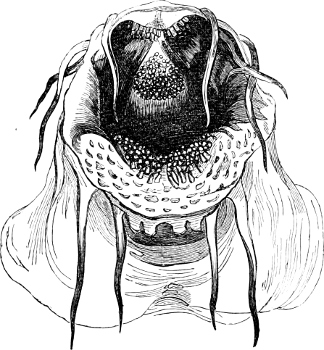
Fig. 258.—Mouth of Cnidoglanis megastoma, Australia.
Three species are known from brackish waters of the Indian Ocean freely entering the sea. Plotosus anguillaris is distinguished by two white longitudinal bands, and is one of the most generally distributed and common Indian fishes.—Copidoglanis and Cnidoglanis are two very closely allied forms, chiefly from rivers and brackish waters of Australia. None of these Siluroids attain to a considerable size. Chaca, from the East Indies, belongs likewise to this sub-family.
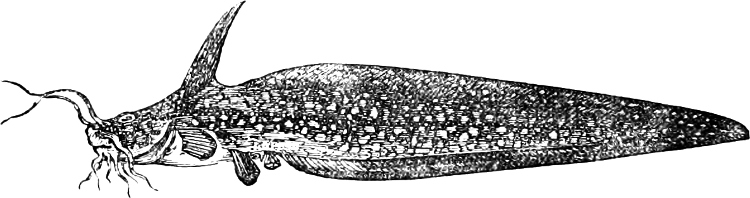
Fig. 259.—Cnidoglanis microcephalus.
II. Siluridæ Heteropteræ.—The rayed dorsal fin is very little developed, and, if it is present, it belongs to the abdominal portion of the vertebral column; the adipose fin is exceedingly small or absent. The extent of the anal is not much inferior to that of the caudal vertebral column. The gill-membranes overlap the isthmus, remaining more or less separate: Silurina.
Saccobranchus.—Adipose fin none; dorsal very short, without pungent spine, placed above the ventrals. Cleft of the mouth transverse, anterior, of moderate width; barbels eight. Eyes rather small. The upper and lateral parts of the head osseous or covered with a very thin skin. Gill-cavity with an accessory posterior sac, extending backwards between the muscles along each side of the abdominal and caudal portions of the vertebral column. Ventrals six-rayed.
Small fishes from East Indian rivers; four species are known. The lung-like extension of the branchial cavity receives water, and is surrounded by contractile transverse muscular fibres by which the water is expelled at intervals. The vessels of the sac take their origin in the last branchial artery, and pass into the aorta.
Silurus.—No adipose fin; one very short dorsal, without pungent spine. Barbels four or six, one to each maxillary, and one or two to each mandible. Nostrils remote from each other. Head and body covered with soft skin. The eye is situated above the level of the angle of the mouth. The dorsal fin is anterior to the ventrals which are composed of more than eight rays. Caudal rounded.
This genus, of which five species are known, inhabits the temperate parts of Europe and Asia. The species which has given the name to the whole family, is the “Wels” of the Germans, Silurus glanis. It is found in the fresh waters east of the Rhine, and is, besides the Sturgeons, the largest of European Freshwater-fishes, and the only species of this family which occurs in Europe. Barbels six. It attains to a weight of 300 or 400 lbs., and the flesh, especially of smaller specimens, is firm, flaky, and well flavoured. Aristotle described it under the name of Glanis. Its former occurrence in Scotland has justly been denied. In China it is represented by a similar species, S. asotus, which, however, has four barbels only.
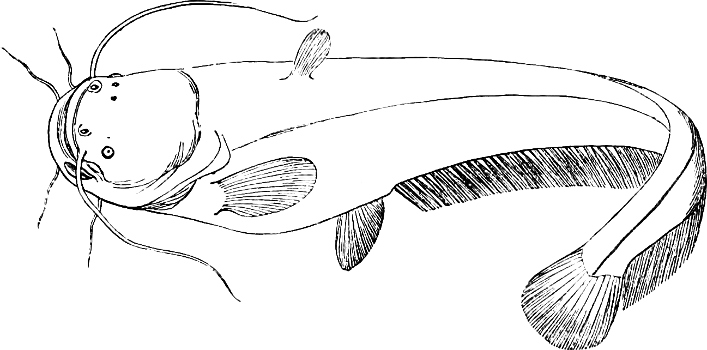
Fig. 260.—The “Wels,” Siluris glanis.
This sub-family is well represented by various other genera in the fresh waters of the African as well as Indian region. African genera are Schilbe and Eutropius; East Indian: Silurichthys, Wallago, Belodontichthys, Eutropiichthys, Cryptopterus, Callichrous, Hemisilurus, Siluranodon, Ailia, Schilbichthys, Lais, Pseudeutropius, Pangasius, Helicophagus, and Silondia.
III. Siluridæ Anomalopteræ.—Dorsal and adipose fins very short, the former belonging to the caudal vertebral column; anal very long. Ventrals in front of the dorsal. Gill-membranes entirely separate, overlapping the isthmus: (Hypophthalmina.)
Hypophthalmus.—Dorsal fin with seven rays, the first of which is slightly spinous. The lower jaw is rather the longer. Barbels six, those of the mandible long. No teeth; intermaxillaries very feeble. Head covered with skin. Eye of moderate size, situated behind and below the angle of the mouth. Ventrals small, six-rayed.
Four species from tropical America. The second genus of this sub-family is Helogenes from the Essequibo.
IV. Siluridæ Proteropteræ.—The rayed dorsal fin is always present, short, with not more than twelve short rays, and belongs to the abdominal portion of the vertebral column, being placed in advance of the ventrals. The adipose fin is always present and well developed, although frequently short. The extent of the anal is much inferior to that of the caudal vertebral column. The gill-membranes are not confluent with the skin of the isthmus, their posterior margin always remaining free even if they are united with each other. Whenever the nasal barbel is present it belongs to the posterior nostril.
a. Bagrina.
Bagrus.—Adipose fin long; a short dorsal with a pungent spine and nine or ten soft rays; anal fin short, with less than twenty rays. Barbels eight. The anterior and posterior nostrils are remote from each other, the posterior being provided with a barbel. Teeth on the palate in a continuous band. Eyes with a free orbital margin. Caudal forked; ventrals six-rayed.
This genus consists of two species only, common in the Nile, viz. the “Bayad,” B. bayad, and B. docmac. Both grow to a large size, exceeding a length of five feet, and are eaten. Chrysichthys and Clarotes are two other Siluroid genera from African rivers, closely allied to Bagrus. Similar Siluroids are common in the East Indies, and have been referred to the following genera: Macrones, Pseudobagrus, Liocassis, Bagroides, Bagrichthys, Rita, Acrochordonichthys, Akysis.
b. Amiurina.
Amiurus.—Adipose fin of moderate length; a short dorsal with a pungent spine and six soft rays; anal fin of moderate length. Barbels eight. The anterior and posterior nostrils are remote from each other, the posterior being provided with a barbel. Palate edentulous. Head covered with skin above. Ventrals eight-rayed.
The “Cat-fishes” of North America, of which about a dozen different species are known. One species occurs in China. Allied, but smaller forms are Hopladelus and Noturus, likewise from North America.
c. Pimelodina.
Platystoma.—Adipose fin of moderate length; a short dorsal fin with a pungent spine and six or seven soft rays; anal fin rather short. Snout very long, spatulate, with the upper jaw more or less projecting; the upper surface of the head not covered by the skin. Barbels six; the anterior and posterior nostrils remote from each other, none with a barbel. Palate toothed. Caudal forked; ventrals six-rayed, inserted behind the dorsal.
Twelve species from South America, some attaining a length of six feet, the majority being ornamented with deep-black spots or bands. Allied genera from South America, likewise distinguished by a long spatulate snout, are Sorubim, Hemisorubim, and Platystomatichthys, whilst Phractocephalus, Piramutana, Platynematichthys, Piratinga, Bagropsis, and Sciades, have a snout of ordinary length. The barbels of some are of extraordinary length, and not rarely dilated and band-like.