JOURNAL OF A VOYAGE TO DISCOVER THE NORTH EAST PASSAGE; UNDER THE COMMAND OF THE HON. COMMODORE PHIPPS, AND Capt. SKIFFINGTON LUTWYCH, IN HIS Majesty’s Ships RACE HORSE and CARCASE BOMBS.
Reading edition
All things being now in readiness, the officers on board, and the men paid their bounty-money of three pounds per man, according to his Majesty’s royal proclamation, for the encouragement of those who should voluntarily enter to undertake the voyage. On the 3d of June 1773, the Commodore made the signal to weigh; but previous to their departure, the Carcase having been judged too deep to navigate those heavy seas through which she was to pass, the Captain obtained leave from the board of Admiralty to re-land ten of her compliment of men, and to put ashore six of the eight six-pounders with which she was equipped, with a quantity of provisions, proportioned to the number of men that it had been thought proper to discharge.
On Friday the 4th being off Sheerness, the wind west by north, and a fresh breeze, they took their departure, and continued their voyage without any material occurrence happening till Tuesday the 15th, when the Commodore made the signal to lie to. They were then off Brassey Island, and many fishing-boats from Shetland being in sight, the men were invited on board, and some fish purchased of them at a cheap rate.
On the 17th they took a new departure from Shetland, but the day following the fog thickened so much, that it almost approached to total darkness. During the continuance of the fog, the Commodore kept firing guns and beating drums, to prevent the Carcase from losing company. As it was impossible that one could see the other at a ship’s length, it was found the more necessary to repeat and return the firing, lest they should run foul of each other before they could be apprized of their danger. About five in the morning the mist cleared up, and about nine the Commodore being in sight, made the signal to the Carcase to steer north-east. They were then in latitude 60 degrees 52 minutes north by observation; the north end of Shetland Island bearing north by west one half west, seven or eight leagues.
On the 17th they observed a sail to the north-east, which the Commodore brought to, and spoke with. The breeze fresh, the weather hazy, and the wind variable, the Carcase carried away her main-top-mast studding sail yard; which, however, was very soon supplied. Latitude this day by observation 62 degrees 53 minutes north.
Friday the 18th, being in the latitude of 65 degrees 9 minutes north, the cloathing allowed by the Government, of which notice has already been taken in the Introduction, was delivered out, and officers as well as men received their full proportion. This day the weather continued as before.
Saturday the 19th the weather varied to every point of the compass, the Commodore brought to, and spoke with the Carcase. Made sail about three in the morning, and at nine a large swell. Tacked and stood to the eastward. Latitude 66 degrees 1 minute north; longitude from London 33 minutes west.
Sunday the 20th they pursued their course to the eastward, with the wind north-west, but variable; high breezes and clear air. They were now within the Polar circle, and at midnight had an observation of the sun, and found their latitude 66 degrees 52 minutes north. Sounded on board the Commodore with a lead of one hundred weight, and a line of seven hundred and eighty fathom, to which was fastened a thermometer of Lord George Cavendish’s construction. They found no bottom, but the water was eleven degrees colder at that depth than on the surface. The Carcase sounded with four hundred and fifty fathoms only.
Monday 21, light breezes and cloudy weather. They observed a whale on the north-east quarter, the first they had yet seen in the north seas. The weather now began to set in severe; the nights cold and the days cloudy. The Commodore observing a whaling snow with Hamborough colours flying, fired a shot, and brought her to. She happened to be homeward bound with seals, and Mr. Wyndham, a gentleman of fortune, who had embarked on board the Commodore, with a view to prosecute the voyage, finding nothing but foul weather and heavy seas, to gratify his curiosity, and being withal unable to endure the sea sickness, took passage on board the Hamburgher, in order to return home; and having taken leave of his friends, by wishing them a happy voyage, the Snow’s boat took him on board, about seven in the morning, and at eight the Commodore and Carcase pursued their voyage.
Tuesday 22, the articles of war were read on board the Carcase. The weather began to be piercing cold; they had reached the 70th degree of north latitude, in a course nearly north, being only 14 minutes to the eastward of London; and from their leaving Shetland to this day, they had seen nothing remarkable; nor had any accident befallen either of the ships worth relating, except that of now and then snapping a rope, or breaking a yard; incidents easily repaired. This day it poured with rain; the air was thick, and the rain froze as it fell. Saw a large ship to the north-west, standing southward, but wanting no information that she could give, they pursued their voyage without speaking to her.
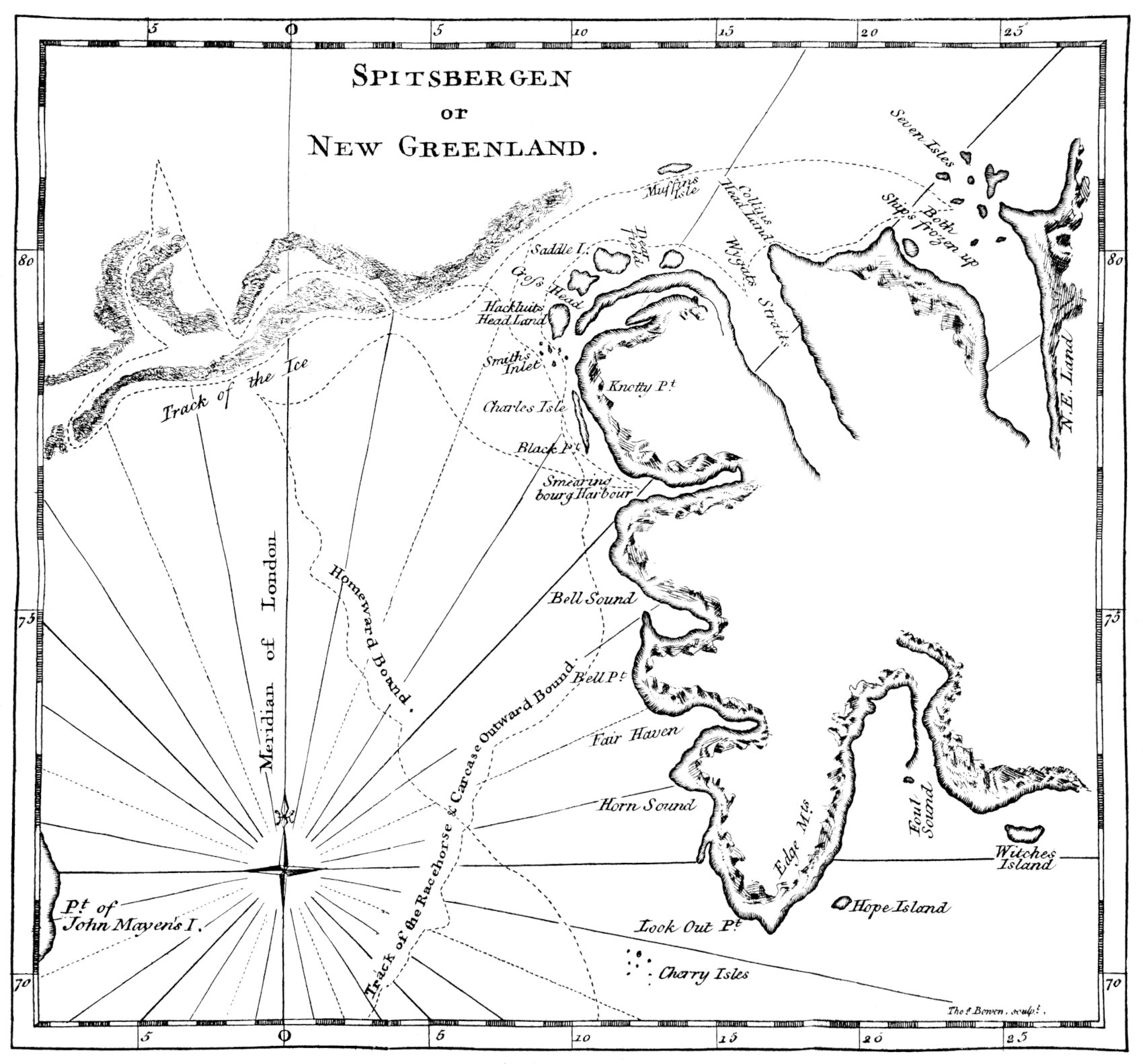
Spitsbergen
or
New Greenland
.
Wednesday 23, the rain continued; the weather hazy; heard three guns fire at a distance, but saw no ship or other object. The whales are here in no great plenty, and few ships appear in the open sea in pursuit of them. They generally at this season frequent the bays and creeks near the shore, and only break away when they are pursued or wounded.
On Thursday the 24th, the Commodore changed his course to east north-east; and on the 25th they were in latitude 74 degrees 7 minutes north, and in 8 degrees 32 minutes east longitude from London. Served out to the ship’s company plenty of mustard, pepper, vinegar, &c. The weather extremely cold and variable. At eight in the evening thick fog; at two in the morning fresh breezes; at eight clear weather; at eleven squally; and at noon calm, with sleet and snow.
On Saturday the 26th, at midnight, they had an observation, and found themselves in latitude 74 degrees 17 minutes north; fresh gales, sometimes rain, sleet, and snow; at seven in the morning clear weather and an open sea.
Sunday 27, light airs from the southward, and cloudy weather; much warmer than the preceding day. It is remarkable, that the vicissitudes of heat and cold are more frequent here than in the more southerly latitudes. It often changes from temperate to extreme cold; and that suddenly.
It should seem likewise, that the ice frequently changes its place in this latitude; or that it is more solid near land than in the open sea; for, on the 23d of June 1676, Capt. Wood, being more to the eastward, fell in with ice right a-head, not more than a league distant. He steered along it, thinking it had openings, but found them to be bays. He sounded, and found ground at one hundred and fifty-eight fathom, soft green oar. In some places he found pieces of ice driving off a mile from the main body in strange shapes, resembling ships, trees, buildings, beasts, fishes, and even men. The main body of ice being low and craggy, he could see hills of a blue colour at a distance, and valleys that were white as snow. In some places he observed drift wood among the ice. Some of the ice he melted, and found it fresh and good. This navigator never could advance farther to the north; but in seeking to penetrate the ice was ship-wrecked, as has been already related in the Introduction. He therefore judged the ice impenetrable, and that land or ice surrounded the pole. Our navigators found also much wood in this latitude floating about the ships, and saw great flocks of birds.
Monday 28, the weather altered; the wind west. Fresh breezes, with rain and sleet. Latter part thick fog.
Tuesday 29, being in latitude 78 degrees north, and in longitude 6 degrees 29 minutes east from London, came in sight of land, when the ships brought to, and the Captains held a consultation concerning their future course. The appearance of the land lay from east south-east to north-east; and this day they spoke with the Marquis of Rockingham, Greenlandman, who, by their reckoning, were then in latitude 79 degrees 40 minutes north, though by that of the Commodore, their latitude was only 78 degrees 3 minutes. This difference, it is probable, arises from not making the proper allowance for refraction in this high latitude. The Greenlandman presented each of the Commanders with a deer and a half, which they found well-flavoured venison, though not over fat. He likewise informed, that he had just come from the ice, and that the day before, three whalers had been crushed to pieces by its closing upon them suddenly.
Wednesday 30, pursued their course. Cloudy weather. Half past four in the morning sounded, one hundred and twelve fathoms soft blue mud. At this time Black Point, so called from its dark appearance, bore north-east by east three quarters east, at the distance of seven or eight leagues. At half past seven, in the morning, saw two sail in the north-west quarter. At half past twelve tacked and stood to the east. Sounded, and found ground at one hundred and fifteen fathom.
Thursday July 1, light breezes and clear weather at midnight: the sun as bright as at noon day. Black Point east one half south, distant seven leagues. At three in the morning made Charles’s Island, and at nine saw a sail to the westward whaleing; they were then in latitude 78 degrees 18 minutes north, by observation. Sounded, and found the same depth as before.
Friday 2, light airs and moderate weather. Lay to and took the altitude of a mountain, which they named Mount Parnassus; found it from the level of the sea to be three thousand nine hundred and sixty feet high, covered with snow, and at a distance resembling an ancient building, with something like a turret a-top. The foot of this mountain, with the hills adjoining, have sometimes a very fiery appearance, and the ice and snow on their sides resembling trees and shrubs, glissen with a brilliancy that exceed the splendor of the brightest gems. When this happens, a violent storm generally succeeds. Here they shot some sea fowl, but of an oily taste.
Saturday 3, proved a perfect calm. They spoke with a Hollander, who foretold, that a degree or two farther north was the utmost extent of their progress this season. Having doubled Cape Cold, they anchored in fifteen fathom water, about three miles from the land, and sent the boats ashore for water, which they found in abundance, pouring down in little streams from the rocks. At five in the afternoon, by the mean of four azimuths, the variation was found to be 18 degrees 36 minutes west. Sounded, and found only sixty-five fathoms, soft brown mud. Mount Parnassus east-north-east three or four leagues.—Among other reasons which Capt. Wood gave for wishing to be employed on the discovery of the north-east passage, one was, that he might have an opportunity of approaching the pole, in order to settle an hypothesis, which he had long framed, whereby the inclination of the magnetical needle under the horizon, in all latitudes and in all longitudes, with the variation of the compass, might be exactly determined. This navigator imagined two magnetical poles to exist; and that, by approaching the one, he should be able to determine the action of the other. It does not appear, that he ever explained his hypothesis; and there never has been but one man, whose name was Williams, since his time, who pretended to know any thing of the matter.
Saturday 4, light breezes and hazey weather. Sounded, and only twenty fathoms deep; rocky ground. Hacluit’s Headland, or the northernmost point of Spitsbergen, bearing north by east seven leagues. Many whalers in sight. Latitude by observation 79 degrees 34 minutes north, longitude from London 8 degrees 10 minutes east. Thermometer forty-seven.
Monday 5, at two in the afternoon sounded, and only fifteen fathom water; rocky ground. Thick fog. The Race Horse fired guns as signals to keep company, which were answered by the Carcase. A dreadful crackling was heard at a distance, which proved the dashing and grinding of the loose pieces of ice against each other, which is heard at many leagues distance. Hacluit’s Headland south-east by south, distance six or seven leagues.
Tuesday 6, proved very foggy, the breezes slight, and islands of ice beginning to appear. At three in the afternoon the Commodore hauled up from a large body of packed ice, and the fog thickening, both ships kept firing volleys of small arms, to prevent their losing company. At half past ten in the evening, the extremes of the ice stretching from north-west to east-north-east, the Commodore bore away; and at half past twelve lost sight of it. At half past one in the morning heard a violent surf to the south-east. At two tacked and stood to the westward. At half past five the fog gathering, they began firing volleys of small arms. At six saw the ice stretching from east by south, to north by east; and at seven was within sight of land. At ten Cloven Cliff stood east-south-east, distant about five or six leagues.
Wednesday the 7th, the weather cloudy. They found themselves beset among the loose ice, which increasing continually, gave them incredible trouble. Observing that it thickened to the eastward, they hauled up, and stood to the westward; but in tacking, they were in danger of running foul. It was with difficulty they could keep any course, for the driffs of ice came so thick, as to whirl the ships about, as if in a whirl-pool.
Thursday 8, the weather still remaining cloudy, and the wind variable, both ships still were entangled in the ice; and the Carcase being driven to leeward, hoisted out her long-boat to tow up with the Commodore. But the ice closing very fast, it was impossible for the boats to live. Orders were then given to tack and stand to the southward; but the ships not being able to make head against the accumulation of ice that continually gathered round them, were under a necessity of applying to their ice-anchors and poles, in order to warp through it. At half past eight in the evening, the ice beginning to open, they again hoisted out their boats, and with difficulty towed the ships round a cape of ice projecting from the main body, and at last got clear. At ten the boats were hoisted on board. In extricating themselves from this dangerous situation, the Race Horse had her best bower-anchor snapt in the shank, close to the stock, and the Carcase lost her starboard bumpkin and head-rails.
It frequently happens, that ships beset among the ice in the manner above related, perish by being dashed to pieces against the solid fields of ice, or crushed by the broken pieces crowding upon one another, and rising so fast about the ship, as to exceed the height of her sides, and then there is no escaping. They were told by some experienced seamen, that the ice rises out of the sea as high sometimes as mountains; and that several of these mountains, by striking together and coalescing, form these islands of ice that are frequently seen in the lower latitudes, driving up and down the sea as the wind and tides direct them.
The greatest danger to be apprehended, is, however, from the loose ice; for the whalers often moor their ships to the solid fields of ice, that at certain seasons seem to rest upon the earth, and appear fixed to it, and there find the best fishing. In such situations it often happens, that little or no loose ice is to be seen; yet presently upon a change of wind, or the blowing of a storm, it shall pour in upon them so suddenly, that they sometimes perish in it. It is not possible to account for the astonishing quantity that will gather in this manner in less than an hour’s time.
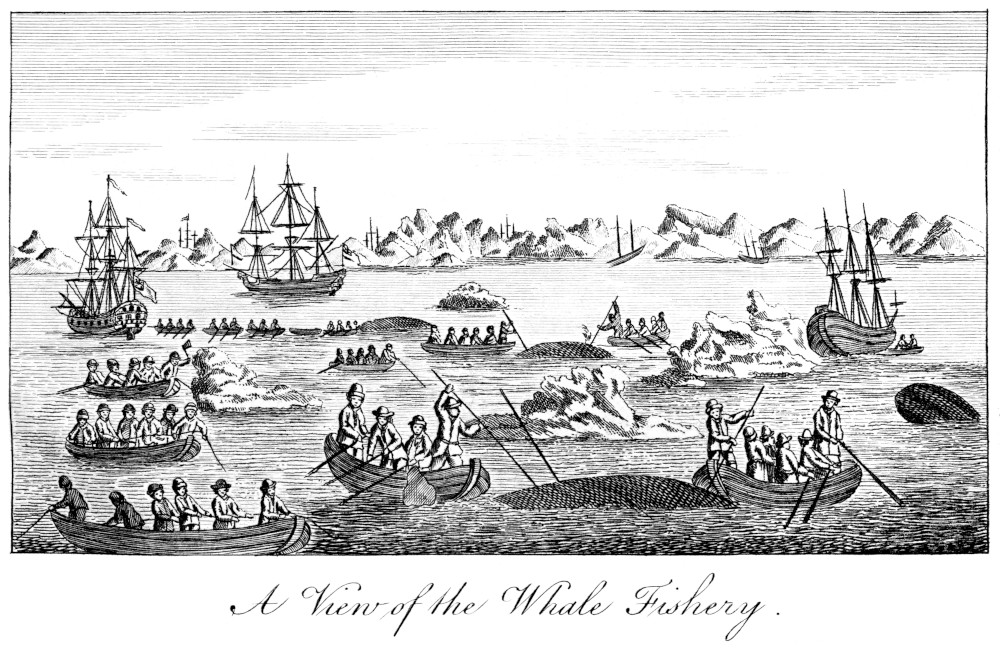
A View of the Whale Fishery.
Though it seems to be agreed, that many of the largest fields of ice are frozen to the depth of the sea in which they are found, and that they are bedded on the solid earth, yet it is equally certain, that they are often rent asunder by the raging billows; and that in breaking, they produce the most terrifying noise in nature; nay, it is asserted, that the clashing of the pieces of loose ice against each other, on any extraordinary agitation of the waves, is attended with a roaring so loud, that a man who is near it can hardly hear the sound of his own voice.
Friday the 9th, they hauled up to the westward, and lost sight one of the other; but about nine next morning they came in sight, and joined company. The weather being now piercing cold, the people had an additional quantity of porter and brandy delivered to them; two quarts of porter and a pint of brandy being now every man’s daily allowance.
Saturday July the 10th, the breeze fresh, and the weather cloudy. They sailed between numberless pieces of ice, among which they saw several whales, but none of the whalers in pursuit of them. The ice now becoming solid and compact, they found it impracticable to continue their course. And the discovery of a passage to the pole in that direction (upon holding a consultation) appearing impracticable to every officer on board of both ships, the Commodore, at seven in the evening, hauled close to the wind; and the Carcase, as soon as she could extricate herself, followed his example. The weather continuing foggy, with rain and snow, the sailors were almost worn out with turning and winding; and although they used the utmost precaution in working through the narrows, yet they could not always avoid striking against the mountains that every where surrounded them. During this night’s work, they steered a hundred different courses, to follow the channels.
Sunday 11, having worked out of the ice, they sailed along the main body, which appeared perfectly solid and compact, without any passage or inlet. This immense mass of ice extended north-east, as far as they could see from the mast-head; and, no doubt, might be a continuation of that in which they were engaged a few days before. The sea was now tolerably clear, for they met with no more fields, and only a few detached islands. At half past one in the morning they saw the land from south by west, to south-south-east. At three in the morning they tacked; Cloven Cliff bearing south-south-east six miles. At seven tacked again. At eight the Commodore bore away, and the Carcase stood after him. Cloven Cliff south one half west, two or three leagues, latitude 79 degrees 56 minutes north.
Monday 12, at eight in the evening Cloven Cliff bearing west-south-west four or five miles, they sounded in fifteen fathoms water, and found a rocky bottom. Saw several English and Dutch Greenlanders at anchor in the Norways: That being their rendezvous to the northward, they never chuse to proceed farther. Here they found the current setting so fast to eastward, that they were forced to come to an anchor to keep from drifting on the ice; the swell from westward being so great, that had that happened, it would of consequence have staved the ships. At five in the morning a breeze from north-north-east springing up, they weighed, and made sail. At eight Hacluit’s Headland west-south-west one half west, six or seven leagues, at noon latitude 80 degrees 2 minutes north.
Tuesday 13, the weather being clear and calm, and a strong easterly current setting in, at eight in the evening they came to with their stream anchors and hausers in forty fathoms water but at nine a breeze springing up from the eastward, they weighed, and next day came to an anchor in Smearingburgh Harbour. Cloven Cliff east one half south one mile. West point of Voogle land north-north-west one half west, distant one mile and a half; soundings fifteen fathom sandy bottom.
Here they remained between five and six days to take in fresh water, during which time our journalist was employed in surveying the country, which to a stranger had a very awful and romantic appearance.
The country is stoney, and as far as can be seen full of mountains, precipices and rocks. Between these are hills of ice, generated, as it should seem, by the torrents that flow from the melting of the snow on the sides of those towering elevations, which being once congealed, are continually increased by the snow in winter, and the rain in summer, which often freezes as soon as it falls. By looking on these hills, a stranger may fancy a thousand different shapes of trees, castles, churches, ruins, ships, whales, monsters, and all the various forms that fill the universe. Of the ice-hills there are seven, that more particularly attract the notice of a stranger. These are known by the name of the seven iceburgs, and are thought to be the highest of the kind in that country. When the air is clear, and the sun shines full upon these mountains, the prospect is inconceivably brilliant. They sometimes put on the bright glow of the evening rays of the setting sun, when reflected upon glass, at his going down; sometimes they appear of a bright blue, like sapphire, and sometimes like the variable colours of a prism, exceeding in lustre the richest gems in the world, disposed in shapes wonderful to behold, all glittering with a lustre that dazzles the eye, and fills the air with astonishing brightness.
Smearingburgh harbour, where they landed, was first discovered by the Dutch. Here they erected sheds and conveniences for boiling the oil from the fat of the whales, instead of barrelling it up to be boiled at home. Here also, allured by the hope of gain, they built a village, and endeavoured to fix a colony: but the first settlers all perished in the ensuing winter. The remains of the village may be traced to this day; and their stoves, kettles, kardels, troughs, ovens, and other implements, remained in the shape of solid ice long after the utensils themselves were decayed. Our voyagers were told, that the Russians have lately attempted the same thing, and that ten out of fifteen perished last winter in this second attempt.
Where every object is new, it is not easy for a stranger to fix which first to admire. The rocks are striking objects: before a storm they exhibit a fiery appearance, and the sun looks pale upon them, the snow giving the air a bright reflection. Their summits are almost always involved in clouds, so that it is but just possible to see the tops of them. Some of these rocks are but one stone from bottom to top, appearing like an old decayed ruin. Others consist of huge masses, veined differently, like marble, with red, white, and yellow, and probably, were they to be sawed and polished, would equal, if not excel, the finest Egyptian marble we now so much admire. Perhaps the distance and danger of carrying large blocks of stones, may be the reason that no trials have been made to manufacture them. On the southerly and westerly sides of these rocks grow all the plants, herbs, and mosses peculiar to this country; on the northerly and easterly sides the wind strikes so cold when it blows from these quarters, that it perishes every kind of vegetable. These plants grow to perfection in a very short time. Till the middle of May the whole country is locked up in ice; about the beginning of July the plants are in flower, and about the latter end of the same month, or beginning of August, they have perfected their seed. The earth owes its fertility, in a great measure, to the dung of birds, who build and breed their young here in the summer, and in the winter repair to more favourable climates.
The plants that are most common in Spitsbergen are scurvy-grass and crows-foot; there are besides small house-leak, and a plant with aloe-leaves; an herb like stone-crop; some small snake-weed; mouse-ear; wood-strawbery; periwinkle; and a herb peculiar to the country which they call the rock-plant. The leaves of this plant are in shape like a man’s tongue, above six feet long, of a dull yellow colour. The stalk is round and smooth, and of the same colour with the leaf; it rises tapering, and smells like muscles. It is an aquatic, and rises in height in proportion to the depth of water in which it is found. There are other plants and herbs, but these are the chief. Of flowers, the white poppy seems the principal.
The rocks and precipices are full of fissures and clefts, which afford convenient harbour for birds to lay their eggs, and breed their young in safety. Most of these birds are water-fowl, and seek their food in the sea. Some, indeed, are birds of prey; and pursue and kill others for their own sustenance, but these are rare. The water-fowl eat strong and fishy, and their fat is not to be endured. They are so numerous about the rocks, as sometimes to darken the air when they rise in flocks; and they scream so horribly, that the rocks ring with their noise.
There are a few small birds like our snipes, and a kind of snow-bird, but different from that found about Hudson’s bay. The gentlemen shot some of the water-fowl, but they were strong and ill-tasted.
The ice-bird is a very beautiful little bird, but very rare. He is in size and shape like a turtle-dove, but his plumage, when the sun shines upon him, is of a bright yellow, like the golden ring in the peacock’s tail, and almost dazzles the eye to look upon it.
The other inhabitants of this forlorn country are white bears, deer, and foxes. How these creatures can subsist in the winter, when the whole earth is covered with snow, and the sea locked up in ice, is hardly to be conceived. It has been said, indeed, that when the ocean is all frozen over, and no sustenance to be procured in this country, they travel southerly to the warmer climates, where food proper for them abounds in the immense forests of the northern continent. But whoever considers the vast distance between Spitsbergen and the nearest parts of the northern continent, will be as much at a loss to account for the subsistence of these creatures in their journey, as in the desolate region where they undoubtedly remain. The bear is by far the best accommodated to the climate of which he is an inhabitant. He is equally at home on land and water, and hunts diligently for his prey in both. In summer he finds plenty of food from the refuse of the whales, sea-horses and seals, which is thrown into the sea by the whalers, and cover the shores during the time of whaling; and they have besides a wonderful sagacity in smelling out the carcases of the dead, let them be ever so deeply buried in the earth, or covered with stones. The dead therefore that annually are buried here may contribute, in some degree, to the subsistence of a few of these creatures in winter; but the question will still recur, how the race of them subsisted before the whale-fishery had existence, and before men found the way to this inhospitable shore. Disquisitions of this kind, as they are beyond the reach of human comprehension, serve only to raise our admiration of that omnipotent Being to whom nothing is impossible.
These creatures, as they differ in nothing but their colour and size from those commonly shewn in England, need no description.
The foxes differ little in shape from those we are acquainted with, but in colour there is no similitude. Their heads are black, and their bodies white. As they are beasts of prey, if they do not provide in summer for the long recess of winter, it were, one would think, almost impossible for them to survive; yet they are seen in plenty, though, by their subtlety and swiftness, they are not easy to be catched.
The Dutch seamen report, that when they are hungry they will feign themselves dead, and when the ravenous birds come to feed upon them, they rise and make them their prey.
But the most wonderful thing of all is, how the deer can survive an eight months famine. Like ours they feed upon nothing that can be perceived, but the vegetables which the earth spontaneously produces; and yet for eight months in the year, the earth produces neither plant, herb, shrub, or blade of any kind of grass whatever. They are, besides, but thinly cloathed for so severe a climate, and what seems still worse, there is not a bush to be seen to shelter them, within the distance that any man has yet discovered. The means of their subsistence must therefore remain among the secrets of nature, never to be disclosed, as no human being can ever live here, so as to be able to trace these creatures to their winter’s residence.
Amphibious creatures abound the most about the sounds and bays of Spitsbergen, and they seem best adapted to endure the climate. These are the seals, or sea dogs, and morses, or sea horses; of which the whalers avail themselves, when disappointed in compleating their lading with the fat of whales.
The seal is sufficiently known; but the sea-horse, as it is a creature peculiar to high latitudes, is therefore more rare. It is not easy to say how he came by his name; for there is no more likeness between a sea-horse and a land-horse, than there is between a whale and an elephant. The sea-horse is not unlike the seal in shape. He has a large round head, larger than that of a bull, but shaped more like that of a pug-dog without ears, than any other animal we are acquainted with. He tapers all the way down to the tail, like the fish we call a lump, and his size is equal to that of the largest sized ox. His tusks close over his under jaw, like those of a very old boar, and are in length from one foot to two or more, in proportion to the size and age of the animal that breeds them. His skin is thicker than that of a bull, and covered with short mouse-coloured hair, which is sleeker and thicker, just as he happens to be in or out of season when he is caught. His paws, before and behind, are like those of a mole, and serve him for oars when he swims, and for legs to crawl when he goes upon the ice, or on shore. He is a fierce animal, but being unweildy when on land, or on the ice, is easily overcome.
These animals are always found in herds, sometimes of many hundreds together, and if one is attacked, the rest make a common cause, and stand by one another till the last gasp. If they are attacked in the water, they will fight desperately, and will even attempt the boats of their pursuers, if any of them are wounded, and not mortally. Some of them have been known to make holes in the bottom of the boat with their tusks, in defence of their young. Their eyes are large, and they have two holes in the upper part of the neck, out of which they eject the water, in like manner as it is ejected by whales.
Though the sea about Spitsbergen is full of fish, yet they rather appear to be designed by Providence for the sustenance of one another, than for the food of man. The mackarel, of which there are no great plenty, seem not only to be the most wholesome, and the most palatable, but also the most beautiful. They seem to be a different species to those caught upon our coasts. The upper part of the back is of a vivid blue; the other part as low as the belly of a gem-like green on an azure ground. Underneath the belly the colour is a transparent white, and the fins shine like polished silver. All the colours glow when alive in the sea with such a richness, that fancy can hardly form to itself any thing in nature more beautiful. Almost all the other fish on this coast are of an oily nature, and of a very indifferent flavour.
The saw, or sword fish, is remarkable not only for the oddity of his shape, but also for his enmity to the whale. This fish takes his name from a broad flat bone, in length from two to four feet, which projects from his nose, and tapers to a point. On each side, it has teeth like a comb, at the distance of a finger’s breadth asunder. He is also furnished with a double row of fins, and is of astonishing strength in the water. His length from ten to twenty feet. He seems to be formed for war, and war is his profession. The conflict betwixt him and the whale is dreadful, yet he never gives over till his sword is broken, or he comes off victorious.
The whale is a harmless fish, and is never known to fight but in his own defence. Yet when he is exasperated, he rages dreadfully. Though from his magnitude, he may be called the sovereign of the seas; yet, like other sovereigns, he is liable to be vexed and hurt by the meanest reptiles. The whale’s louse is a most tormenting little animal. Its scales are as hard as those of our prawns; its head is like the louse’s head, with four horns, two that serve as feelers, the other two are hard, and curved, and serve as clenchers to fix him to the whale. On his chest, underneath, he has two carvers, like scythes, with which he collects his food, and behind these are four feet, that serve him for oars. He has, moreover, six other clenchers behind, with which he can rivet himself so closely to his prey, that he can no otherwise be disengaged, but by cutting out the whole piece to which he is joined. He is jointed on the back like the tail of a lobster, and his tail covers him like a shield when he is feeding. He fixes himself on the tenderest parts of the whale’s body, between his fins, on his sheath, and on his lips, and eats pieces out of his flesh, as if eaten by vultures.
They found no springs of fresh-water in Spitsbergen; but in the valleys, between the mountains, are many little rills caused by the rain and melting of the snow in summer; and from these rills the ships are supplied. Some are of opinion, that this water is unwholesome, but they are more nice than wise. The whaling people have drank of it for ages, and have found no ill effects from the use of it. Ice taken up in the middle of these seas and thawed, yields also good fresh water.
On board the Race Horse, Dr. Irvine, the gentleman who received the premium by a grant of parliament, for his discovery of an easy process for making salt-water fresh at sea, tried many experiments at Spitsbergen, and in the course of the voyage; the result of which will appear at a proper time. That gentleman had formed a project for preserving flesh meat fresh and sweet in long voyages, but it did not answer in this.
In calm weather they remarked, that the sea about the islands appeared uncommonly still and smooth; that it was not suddenly moved at the first approach of blowing weather; but that when the storm continued, the waves swelled gradually, and rose to an incredible height.—These swelling waves successively follow one another, and roll along before the wind, foaming and raging in a frightful manner, yet they are thought less dangerous than those that break short, and are less mountainous.
They observed likewise, that the ice that rested on the ground was not stationary, but that it changed place; and they learnt also, that in some seasons there was no ice, where this season they were in danger of being embayed. There does not, however, from thence appear the least reason to conclude, that any practicable passage to the Indian ocean can ever be found in this direction; for were it certain that the seas were always open under the pole, yet great bulwarks of ice evidently surround it, sometimes at a less, and sometimes at a greater distance. Moreover, were it possible that chance should direct some fortunate adventurer to an opening at one time, it would be more than a million to one, if the same opening were passable to the next who should attempt it.
There are many harbours about Spitsbergen, besides that of Smearingburg, where ships employed in the whale fishery take shelter in stormy weather; and there are some islands, such as Charles’s Island, the Clifted Rock, Red-Hill, Hacluit’s Headland, &c. that serve as landmarks, by which seamen direct their course. These islands are full of the nests of birds; but their eggs are as nauseous as the flesh of the fowls that lay them. The sailors sometimes eat them, but they are filthy food. Even the geese and ducks on the neighbouring islands eat fishy and strong.
The air about Spitsbergen is never free from icicles. If you look through the sun-beams transversely as you sit in the shade, or where you see the rays confined in a body, instead of dark motes, as are seen here, you see myriads of shining particles that sparkle like diamonds; and when the sun shines hot, as it sometimes does, so as to melt the tar in the seams of ships when they lie sheltered from the wind, these shining atoms seem to melt away, and descend like dew.
It is seldom that the air continues clear for many days together in this climate; when that happens, the whalers are generally successful. There is no difference between night and day in the appearance of the atmosphere about Spitsbergen, one being as light as the other, only when the sun is to the northward, you may look at him with the naked eye, as at the moon, without dazzling. The fogs here come on so suddenly, that from bright sun-shine, you are presently involved in such obscurity, that you can hardly see from one end of the ship to the other.
While our journalist was busy in making his observations, all belonging to the ships were differently engaged in one employment or other; some in taking in water, some in fishing, some in hunting, some in handing the sails, and spreading them out to dry, some in scrubbing the ship, and some in viewing the country. The Commanders and officers, with Mr. Lyon, Mr. Robinson, &c. busied themselves in making observations, being furnished with an apparatus, that is said to have cost at least one thousand five hundred pounds. From such a set of instruments, in the hands of the ablest observers, the nation can boast, some very considerable discoveries in the phenomena of the polar regions may be expected. They landed their instruments in a small island, in Vogle Sound, and had several opportunities during their stay of using them to advantage. Having erected two tents, the Captains from the fishery frequently visited the observers, and expressed their admiration not only at the perfection of the instruments, but likewise at the dexterity with which they were accommodated.
The ice began to set in a-pace, yet the weather was hot. The thermometer from fifty-six in the cabin rose to ninety in the open air. It was still ten degrees higher on the top of a mountain to which it was carried. The island on which the experiments were made, they called Marble Island, from the rock by which it is formed. Having watered, and finished their observations, the ships prepared to depart.
Monday July the 19th, the Commodore made the signal to weigh; at two in the afternoon the ships were under sail, and as soon as they had made their offing, stood to the eastward. At three they tacked and steered northward; and before four were again entangled among the loose ice, through which they sailed, directing their course along the main body, which lay from north-west to south-south-east.
Tuesday the 20th, they continued their course along the ice, but could discover no opening, though they searched every creek, and left no bay or turning unexamined. This day they observed what the sailors call a mock-sun, a phænomenon well enough known in this climate. Hacluit’s Headland bore south-west one half south forty-six leagues; the weather cloudy, with rain; excessive cold. Thermometer 37 degrees 46 minutes.
Wednesday the 21st, the severity of the weather increasing, an additional quantity of brandy was served out to the people, and every comfortable refreshment afforded them, that they themselves could wish or require. The course of the ice lay this day north-east.
Thursday 22, nothing remarkable.
Friday the 23d, they saw land from east by south, to south-east by south. At four in the morning, Hacluit’s Headland bore south-east ten leagues; the wind variable, and the weather cold, with sleet and snow. Thermometer 40 degrees.
Sunday 25, they had gentle breezes, with cloudy weather, and were engaged among some pieces of ice, separated from the main body, which kept them continually tacking and luffing. At length they entered among mountains and islands of ice, which came upon them so fast, that it was with the utmost difficulty they could proceed; the Carcase having several times struck against them with such violence, as to raise her head four feet out of the water. They now imagined, from the solidity and extent of these islands, that the late strong gales had caused a separation from the main body, the Commodore therefore changed his course with a strong gale to the eastward; in the morning the weather became moderate.
Monday 26, at seven in the morning, they came in sight of Red-hill, a small mount which commands an open plain, known by the name of Deers-field, by reason of its fertile appearance, it being the only spot on which they saw no drifts of snow. To the eastward lies Muffin’s Island. Here they sounded, and found forty-five fathom water; rocky ground. Capt. Lutwich sent out the long-boat, with orders to sound along the shore, and to examine the soil. This island is about a mile long, very low, and looks at a distance like a black speck. Though the soil is mostly sand and loose stones, and hardly so much as a green weed upon it, yet it is remarkable for the number of birds that resort to it in summer to lay their eggs, and breed their young; and these not of one kind only, but of many different sorts, as geese, ducks, burgomasters, ice-birds, malamucks, kirmews, rotgers, and almost every other species of birds peculiar to the climate; insomuch, that the eggs were so numerous, and lay so thick upon the ground, that the men who landed found it difficult to walk without filling their shoes.
While the crew of the boat, ten in number, with their valiant officer at their head, were examining the island, after having sounded the shores, they observed two white bears making towards them, one upon the ice, the other in the water. Major Buz, for that was their officer’s travelling title, like Falstaff, was always the boldest man in company over a cup of sack, and minded killing a bear no more than killing a gnat; but seeing the bears approach very fast, especially that which came in the water, he ordered his men to fire while yet the enemy was at a distance, as he did not think it prudent to hazard the lives of his little company in close fight. All of them pointed their muskets, and some of the party obeyed orders; but the greater part judging it safer to depend upon a reserved fire, when they had seemingly discharged their pieces, pretended to retreat. The Major, a full fathom in the belly, endeavoured to waddle after his companions; but being soon out of breath, and seeing the bear that came in the water had just reached the shore, thought of nothing now but falling the first sacrifice. His hair already stood an end; and looking behind him, he saw the bear at no great distance, with his nose in the air snuffing the scent. He had all the reason in the world to believe it was him that he scented, and he had scarce breath enough left to call to his men to halt. In this critical situation he unfortunately dropt his gun, and in stooping to recover it stumbled against a goose-nest, fell squash upon his belly into it, and had very nigh smothered the dam upon her eggs. The old saying is, misfortunes seldom come alone. Before he could well rise, the enraged gander came flying to the assistance of his half-smothered consort, and making a dart at the eye of the assailant, very narrowly missed his mark, but discharged his fury plump upon his nose. The danger now being pressing, and the battle serious, the bear near, and the gander ready for a second attack, the men, who had not fled far, thought it high time to return to the relief of their leader. Overjoyed to see them about him, but frighted at the bear just behind him, he had forgot the gander that was over his head, against which one of the men having levelled his piece, fired and he fell dead at the Major’s feet. Animated now by the death of one enemy, he recovered his gun, and faced about to assist in the attack of the second. By this time the bear was scarce ten yards from him, and beginning to growl, the Major just in the instant was seized with a looseness, dropt his accoutrements, and fell back, that he might not be in the way of his party, to impede the engagement. In the hurry he was in, for in a man of such valour we must not say the fright, he entangled his buttons, and not being able to hold any longer, he filled his breeches. The crew in an instant had brought down the bear, and now it was time for their leader to do something great. Having recovered his arms, and seeing the poor beast groveling on the ground, and growling out his last, like a ram in a pinfold, making a short race backwards in order to redouble his force, he came with nine long strides forwards, and with the strength and fierceness of an enraged bull, thrust his lance full four feet deep in the dying bear’s belly. And now, says the Major, cocking his hat, have not I done for the bear bravely! The sailors, who are always in a good humour upon such occasions; but Captain, said they, you have but half done your work, you have another bear to kill yet. The Major, whose situation began to be troublesome, content with the honour he had already acquired, my lads, said he, as I have been the death of one bear, sure six of you may kill the other; so ordering four of them to row him on board, he left the remaining six to kill the other bear.
On this island two bears were killed, and a sea-horse. The sea-horse made a desperate defence, being attacked in the water; and had there been only one boat engaged in the combat, he certainly would have come off victorious; but the crew of the Race-horse having learnt that there were bears and sea-horses on this little spot, were willing to share in the sport of hunting them, as well as in the pleasure of tasting their flesh. They accordingly landed in their boats, and came in good time to assist in pursuing the conquest. It happened, however, that their ammunition, being almost spent, one great bear came up to revenge the death of his fellows, and advanced so furiously, growling and barking, that he put the whole company to flight, and some of them, it is said, had no great reason to laugh at the Major.
On sounding the shores they remarked, that when the north islands bear north forty-five east, seven or eight leagues, and Red-hill east by south five miles, there is generally from twenty-five to thirty fathom hard ground; but that closer on shore, when Red-hill bears east one-fourth south about one mile, it increases to one hundred and fifteen fathom, with soft black mud. The current about one mile an hour to the north-east.
Tuesday 27, the air being perfectly serene, and the weather moderate, the fishes seemed to enjoy the temperature, and to express it by their sporting. The whales were seen spouting their fountains towards the skies, and the fin fish following their example. They likewise this day saw dolphins; the whole prospect in short was more pleasing and picturesque than they had yet beheld in this remote region. The very ice in which they were beset looked beautiful, and put forth a thousand glittering forms, and the tops of the mountains, which they could see like sparkling gems at a vast distance, had the appearance of so many silver stars illuminating a new firmament. But this flattering prospect did not continue long. By an accurate observation, they were now in latitude 80 deg. 47 min. north; and in longitude 21 deg. 10 min. east from London; and in sight of seven islands to the north, to which they directed their course.
Wednesday 28, they had fresh easterly breezes, which, from moderate weather the day before, changed to piercing cold. At midnight the west end of Weygate straits bore south by east, so that they were now in the very spot where Barentz had supposed an opening would be found into the polar sea. Yet so far from it, they could discover nothing from the mast-head, but a continued continent of solid ice, except the islands already mentioned. On this ice, however, there were many bears, some of which came so near the ships as to be shot dead with small arms. These bears are very good eating, and where no better is to be purchased, the whalers account them as good as beef. They are many of them larger than the largest oxen, and weigh heavier. In many parts of their body they are musket proof, and unless they are hit on the open chest, or on the flank, a blow with a musket ball will hardly make them turn their backs. Some of the bears killed in these encounters weighed from seven to eight hundred weight; and it was thought, that the bear that routed the sailors on Muffin’s Island, could not weigh less than a thousand weight. He was, indeed, a very monster!
Thursday 29, sailing among innumerable islands of ice, they found the main body too solid for the ships to make the least impression upon it, and finding no opening, the Commodore resolved to send a party under the command of the first Lieutenant to examine the land, which at a distance appeared like a plain, diversified with hills and mountains, and exhibited in their situation a tolerable landskip.
On trying the water, it was less salt than any sea water they had ever tasted and they found likewise, that the ice was no other than a body of congealed fresh water, which they imagined had been frozen in the infancy of the earth.
Tuesday 30, the weather being clear, they ran close to the main body of the ice, and the sun continuing to shine, made them almost forget the climate they were sailing in, but it was not long before they had reason for severe recollection. In coasting along, they observed many openings, and were in hopes, from their distant appearance, that a passage might be made between them; but, upon trial it was found, as the Dutch fishermen had foretold, that these appearances were deceitful. At one in the morning fine clear sun-shine, they sounded in sixteen fathom water, and found small stones at bottom. They were then about four miles from the north-east part of the northernmost land; the easternmost land in sight, distant about five or six leagues.
Saturday 31, at midnight, the easternmost land in sight lay east-north-east one half east, which they could not make out to be an island. They rather judged it to be a continent, but found it impossible to determine with certainty, as it lay beyond their reach. At nine in the morning the Carcase hoisted out her cutter, and filled her empty water-casks with water from the ice. On this ice lie great quantities of snow, and as soon as a pit is dug, it fills with fine soft clear water, not inferior to that of many land springs. At noon they sounded in ninety five fathoms, the ground soft mud. This day a bear came over the ice to visit them, the first they had seen since they left Muffin’s Island. They saluted him with a volley of small arms, and he returned the compliment, by turning his back upon them. Their longitude was this day 21 degrees 26 minutes east, by time-keeper. Thermometer forty-five.
Sunday August 1, proved a day of trial. Lying too among the close ice, with the loose ice driving fast to shore, the Commodore was desirous of surveying the westernmost of the seven islands, which appeared the highest, in order to judge, from the prospect on the hills, of the possibility of proceeding farther on the discovery. With this view they carried out their ice-anchors, and made both ships fast to the main body, a practice very common with the fishing ships that annually frequent those seas. Of the reconnoitring party, were the Captains, the second Lieutenants, one of the mathematicians, the pilots, and some chosen sailors, selected from both ships. They set out about two in the morning, and sometimes sailing, sometimes drawing their boats over the ice, they with difficulty reached the shore, where the first objects they saw were a herd of deer, so very tame, that they seemed as curious to gaze at the strangers, as the strangers were pleased to see them; for they came five or six together so near, that they might have been killed with the thrust of a bayonet; a proof that animals are not naturally afraid of man, till, by the fate of their associates, they are taught the danger of approaching them; a proof too, that animals are not destitute of reflection, otherwise how should they conclude, that what has befallen their fellow animals, will certainly happen to them, if they run the like risque. The gentlemen, however, suffered only one of these fearless innocents to be fired at, and that was done by a sailor when they were absent on observation.
On this island they gathered some scurvy-grass, and in many places they could perceive the sides of the hills covered with the verdure on which these deer undoubtedly fed.
After having ascended the highest hills on the sea-coast, and taken a view of the country and the ocean all round, the gentlemen descended, and about five in the afternoon embarked again on their return to the ships, at which they arrived safe about ten, after an absence of twenty hours. They were greatly disappointed by the haziness of the weather on the tops of the mountains, which confined the prospect, and prevented their taking an observation with the instruments they had carried with them for that purpose.
There is here a small variation in the journals of the two ships; that kept on board the Commodore making the distance between the island and the ships near twenty miles; the other only five leagues, which might easily happen, as the ships shifted their stations with the main body of ice, sometimes driving north-west, sometimes the contrary course, as the wind and tides happened to sit.
Their situation now began to be serious, and it was discovered too late, that by grappling to the ice, as practised by the Greenlandmen, they had endangered the loss of the ships, the loose ice closing so fast about them, that they found it absolutely impossible to get them disengaged; and there was, besides, great reason to fear, that one or both would soon be crushed to pieces. Great minds are ever most distinguished by their expedients on the most alarming occasions. The Commodore set all hands to work to form a dock in the solid ice, large enough to moor both ships; and by the alacrity with which that service was performed, the ships were preserved from the danger of immediate destruction.
The ships being thus far secured, the officers, pilots, and masters, were all summoned on board the Commodore, to consult on what further was to be done in their present unpromising situation; when it was unanimously agreed, that their deliverance was hopeless; and that they must either provide to winter upon the adjacent islands, or attempt to launch their boats into the open sea, which was already at a considerable distance; for the loose ice had poured into the bay in which they were at anchor with so much rapidity, and in such astonishing quantities, that the open sea was already far out of sight. Before any thing farther was undertaken, the men were ordered to their quarters, that they might refresh themselves with sleep.
While their Commanders preserve their fortitude, the sailors never lose their courage. They rose in the morning with as much alacrity and unconcern, as if they had been sailing with a fine breeze in the British Channel.
August 2, it was now thought adviseable to make one desperate attempt to extricate the ships, by cutting a channel to the westward into the open sea. The scooping out the dock with so much expedition, by a party only of one ship, raised high expectations of what might be performed by the united labours of both the crews. No body of men ever undertook a work of such difficulty with so much chearfulness and confidence of success, as the sailors observed on this occasion. Their ice-saws, axes, sledges, poles, and the whole group of sea-tools, were in an instant all employed in facilitating the work; but after cutting through blocks of solid ice from eight to fifteen feet deep, and coming to others of many fathoms, that exceeded the powers of man to separate, that was laid aside as a hopeless project; and another more promising, though not less laborious, adopted in its room.
On the 3d of August, after the men had again refreshed themselves with sleep, it was resolved to fit up the boats belonging to both the ships with such coverings as were most easy to be accommodated, and of lightest conveyance; and by skating them over the ice, endeavour to launch them in the open sea. Could this be effected, they hoped, that by sailing and rowing to the northernmost harbour of Spitsbergen, they might arrive at that island, before the departure of the last ships belonging to the fishery for Europe.
While the boats were getting ready for this expedition, a second party were dispatched to the island, with orders to take the distance as exact as it was possible to the nearest open sea. As all the people belonging to the ships were not to be engaged in these services, those who were unemployed diverted themselves in hunting and killing the bears, that now, attracted perhaps by the savory smell of the provisions dressed on board the ships, came every day over the ice to repeat their visits. Several of these were killed occasionally, and this day they fought a sea-horse, in which engagement the second Lieutenant of the Carcase signalized his courage in a most desperate rencounter, in which, however, he succeeded, though his life was in imminent danger.
On the 4th the carpenters, &c. were still employed in fitting up the boats. The pilots, who the day before had been sent to make observations on the islands already mentioned, made their report, that the nearest water they had seen was about ten leagues to the westward; that in their passage they had met with great numbers of spars or pine trees, floating about the island, some of them of considerable size, with the bark rotted off, and the bodies much worm-eaten; that there was neither tree nor shrub to be seen growing on any of the seven islands, nor upon any land that they had yet discovered in that latitude, nor for ten degrees farther south, and that the trees they had seen must therefore have come from a great distance.
Though there is nothing now in this observation, the like being annually observed by all the navigators who frequent those seas in the summer, and who collect their wood from those drifts, yet the country from whence they proceed has hitherto been thought a mystery. But it being now certain, that many of the great rivers that flow through the northernmost parts of Russia, empty themselves into this sea; and that there is an open communication throughout the different parts of it at different seasons of the year, there seems very little reason to doubt, but that those trees are torn up by land floods, and are precipitated into the sea by the rapidity of the streams.
It has indeed been objected, that all the wood that is found floating in this manner about the islands in high latitudes, is to a piece barked and worm-eaten; and that if these trees were torn up and precipitated into the sea in the manner above supposed, some of it would appear sound and unbarked, as in its first state. To this it may be answered, that were the course of the tides to run as constantly to the northward, as the course of the rivers runs into the sea, this objection would be unanswerable. But the very reverse is known to be the fact; and that neither the winds nor the tides tend to the northwards for any considerable part of the year; so that from the time these trees enter the ocean, it must, in the ordinary course of things, be many ages before they can reach the latitudes in which they are now found. Because, if they are driven northwards by the strength of a storm from the south, they will be driven in another direction by the next storm that happens from another quarter; and all the while the calm continues, they will be driven to and fro by the tides, which, as has been observed, seldom set long to the north, therefore, being in continual motion for ages, or being cast upon the shore by tempests, or high tides, and lying there exposed to the air, till tempests or high tides return them again to the ocean, they will, in a long progression of time, be reduced to the state in which they are constantly found. This solution is, however, offered with diffidence. The fact is certain, of much wood being annually found about the islands in question; and it is now of little importance from whence it proceeds, as a passage by the north east to China will probably never more be sought.
On the 5th they had gentle breezes; but about four in the morning small sleet. The ice still surrounding them, and appearing to grow more and more solid and fixed, those who had till now retained hopes that the south-east wind would again disunite its substance, and open a passage for their deliverance, began to despair, as the wind had blown for twenty-four hours from that quarter, from which alone they could have relief, and not the least alteration to be perceived. The men, however, were as joyous as ever, and shewed not the least concern about the danger of their situation.
Early in the morning, the man at the mast-head of the Carcase gave notice, that three bears were making their way very fast over the ice, and that they were directing their course towards the ship. They had, without question, been invited by the scent of the blubber of the sea-horse killed a few days before, which the men had let on fire, and which was burning on the ice at the time of their approach. They proved to be a she-bear and her two cubbs; but the cubbs were nearly as large as the dam. They ran eagerly to the fire, and drew out from the flames part of the flesh of the sea-horse that remained unconsumed, and eat it voraciously. The crew from the ship, by way of diversion, threw great lumps of the flesh of the sea-horse which they had still left, out upon the ice, which the old bear fetched away singly, laid each lump before her cubbs as she brought it, and dividing it, gave each a share, reserving but a small portion to herself. As she was fetching away the last piece they had to bestow, they levelled their muskets at the cubbs, and shot them both dead; and in her retreat, they also wounded the dam, but not mortally. It would have drawn tears of pity from any but unfeeling minds, to have marked the affectionate concern expressed by this poor beast, in the dying moments of her expiring young. Tho’ she was sorely wounded, and could but just crawl to the place where they lay, she carried the lump of flesh she had fetched away, as she had done the others before, tore it in pieces, and laid it down before them, and when she saw that they refused to eat, she laid her paws first upon one, and then upon the other, and endeavoured to raise them up. All this while it was pitiful to hear her moan. When she found she could not stir them, she went off, and when she had got at some distance, looked back and moaned; and that not availing her to entice them away, she returned, and smelling round them, began to lick their wounds. She went off a second time, as before, and having crawled a few paces, looked again behind her, and for some time stood moaning. But still her cubbs not rising to follow her, she returned to them again, and with signs of inexpressible fondness, went round one and round the other, pawing them, and moaning. Finding at last that they were cold and lifeless, she raised her head towards the ship, and, like Caliban in the tempest, growled a curse upon the murderers, which they returned with a volley of musket-balls. She fell between her cubbs, and died licking their wounds. If what is related by a voyager of credit in the last century be true, the filial fondness of these animals is no less remarkable than the maternal. The young ones, says he, keep constantly close to the old ones. We observed that two young ones and an old one would not leave one another, for if one ran away, it turned back again immediately, as soon as it did hear the others in danger, as if it would come to help them. The old one ran to the young one, and the young one to the old one; and rather than they would leave one another, they would suffer themselves to be all killed.
Friday the 6th, the weather calm, but foggy, and the winds variable; they discovered that the drift of the ship, with the whole body of ice, inclined fast to the eastward; and that they were already embayed in the very middle of the seven islands. They therefore sent off the pilots of both ships, with a party of sailors, to the northernmost island, to see what discoveries could be made from the promontories there. They returned at night, after a fatiguing journey, with a dismal account, that nothing was to be seen from thence but a vast continent of ice, of which there was no end; and that the thought of wintering in such a situation was more dreadful, than that of perishing by instant death.
Saturday 7, the wind set in north-north-east, veered to the north; to the north-east and east, piercing cold. This day the boats were all brought in readiness on the ice, fitted with weather cloaths about thirteen inches above the gunnels, in order to keep off the cold as much as possible, if by good fortune they should be enabled to launch them in an open sea. This day was employed chiefly in boiling provisions to put in the boats for the intended voyage; in delivering out bags to the men to carry their bread, and in packing up such necessaries as every one could take along with him, for now every man was to be his own porter, the necessary provisions and liquors being found load enough for the boats, and twenty-five days bread load enough for each man. This being adjusted, when night approached they were all ordered on board to sleep.
Thursday 8, at six in the morning all hands were ordered to turn out, and a detachment of fifty men from each ship, headed by their respective officers, were appointed to begin the hard task of hawling the launces along the ice. The bravest and gallantest actions performed in war, do not so strikingly mark the true character of a sea Commander, as the readiness and alacrity with which his orders are obeyed in times of imminent danger. Every one now strove who should have the honour to be listed in the band of haulers, of whom the Commodore took the direction, leaving Capt. Lutwych to take care of both the ships, that if any favourable turn should happen in the disposition of the ice, he might make use of the remaining part of both the crews to improve it. Upon a general consultation of officers, previous to this undertaking, it had been agreed, and an order issued accordingly, that no person on board, of whatever rank, should encumber himself with more cloaths than what he wore upon his back. Upon this occasion, therefore, the officers dressed themselves in flannels, and the common men put on the cloaths which the officers had thrown off. It was inconceivably laughable to see these motley bands yoked in their new harness; and, to say the truth, there was not one solemn face among the two companies. That headed by the Commodore drew stoutly for the honour of their leader, and that headed by their Lieutenants had their music to play to them, that they might dance it away, and keep pace with the Commander in chief. Indeed the officers who headed them were deservedly beloved as well as their Commanders, particularly Lieutenant Beard, whose steady and uniform conduct in times of the greatest danger, cannot be sufficiently admired or applauded. Neither swayed by passion, nor disconcerted by the sudden embarrassments that often intervened, his conduct was always calm, and his orders resolute. He never was heard, during the whole voyage on the most pressing emergencies, to enforce his commands with an oath, or to call a sailor by any other than his usual name; and so sensible were they of his manly behaviour, that, when the ship was paid off at Deptford, they were only prevented by his most earnest request from stripping themselves to their shirts, to cover the streets with their cloaths, that he might not tread in the dirt in going to take coach.
In six hours, with the utmost efforts of human labour, they had only proceeded a single mile; and now it was time for them to dine, and recruit their almost exhausted spirits. As the Commodore had laboured with them, it was in character that he should dine with them also; and an accident happened that made it necessary for him so to do. The Cook, with his mates, (who were bringing the Commodore and the officers their dinners under covers) to keep out the cold after coming from a warm fire-side, had made a little too free with the brandy bottle before they set out, and before they had got half way to the lances, the liquor began to operate; the Cooks were sometimes very near boarding each other, sometimes they hauled off, and sometimes steered right a-head. At length coming to a chasm, or parting of the ice, which they were obliged to leap, down came the master Cook, with dish, cover, meat and all; and what was still worse, though it was not then thought of much value, the Commodore’s common service of plate, which the Cook carried for the officers to dine on, fell in the chasm, and instantly sunk to the bottom. This accident brought the Cook a little to himself, and he now stood pausing whether he should jump down the gulph after the plate, or proceed to the Commodore to beg mercy and make his apology. His mates persuaded him to the latter, as the Commodore was a kind-hearted gemman, and would never take a man’s life away for a slip on the ice. Besides, it was a great jump for a fat man, and Commodore, they were sure, had rather lose all the plate in the great cabin, than lose Cookie. Comforted a little by this speech, the Cook proceeded, but let his mates go on first with what remained, to carry the tidings of what befell the rest. When the Commodore had heard the story, he judged how it was with them all. But where is the Cook, said he to the mates? He’s crying behind, an please your Honour. In the mean time the Cook came up. Cook, said the Commodore, bring me your dinner. I will dine to-day with my comrades. My dinner! Ay, a pound of the flesh next my heart, if your Honour likes it. The promptness of the reply shewed the sincerity of the Cook’s good-will, and pleased the Commodore better than a feast upon turtle. He dismissed him with a smile, and partook with the officers in what was left, who made up their dinners with a mess from the common men.
They had just begun to renew their labour, when word was brought, that the whole body of ice had changed its situation, and was moving to the westward; that the ships were both a-float; and that the ice was parting. The joy which this news diffused through the two companies of hawlers is easier to conceive than express. They instantly shook off their harness, ran to assist in working the ships, and once more to resume their proper employments. When they arrived at the ships, Captain Lutwych, who was no less beloved by his men than the Commodore, had by his example and his judicious directions done wonders. Both ships were not only a-float, with their sails set, but actually cut and warped through the ice near half a mile. This ray of hope, however, was soon darkened; the body of ice suddenly assumed its former direction to the eastward, and closed upon them again as fast as ever. While the ships remained in the ice-dock, they were lashed together for their greater security, but now being launched and a-float, the ice pressed upon them with such weight, that it was every moment expected that the hawser would break that held them together; orders were therefore given, that the hawser should be slackened, and the ships released.
For the remainder of the evening, and till two in the morning, the drift continued eastward, and all that while the ships were in danger of being crushed by the closing of the channel in which they rode. They had now drifted two miles to the eastward; the men were worn out with fatigue in defending the ships with their ice-poles from being engulphed; and now nothing but scenes of horror and perdition appeared before their eyes. But the Omnipotent, in the very moment, when every hope of deliverance from their own united endeavours had relinquished them, interposed in their favours, and caused the winds to blow, and the ice to part in an astonishing manner, rending and cracking with a tremendous noise, surpassing that of the loudest thunder. At this very instant the whole continent of ice, which before was extended beyond the reach of sight from the highest mountains, moved together in various directions, splitting and dividing into vast bodies, and forming hills and plains of various figures and dimensions. All hearts were now again revived, and the prospect of being once more released from the frozen chains of the north inspired the men with fresh vigour. Every officer and every idler on board laboured now for life. The sails were all spread, that the ships might have the full advantage of the breeze to force them through the channels that were already opened, and to help them, like wedges, to rend the clefts that were but just cracking.
While the major part of the crews were employed in warping the ships with ice-anchors, axes, saws and poles, a party from both ships were dispatched to launch the boats. This was no easy task to accomplish. The ice, though split in many thousand pieces, was yet frozen like an island round the lances, and though it was of no great extent, yet the boats were of a weight hardly to be moved by the small force that could be spared to launch them. They were besides, by the driving of the ice, at more than five miles distance from the ships; and at this time no channels of communication were yet opened. But Providence was manifest even on this occasion; for the island on which the lances stood, parted while the men were hauling them, and by that lucky circumstance they were launched with great facility, without the loss of a man, though the ice cracked, as it were, under their feet.
The people on board had not been able to force their way with the ships much more than a mile, when the party in the lances joined them. And now, excited by what curiosity or instinct is not easy to determine, several bears came posting over the ice to be spectators of their departure, and advanced so near the ships, that they might have been easily mastered, had not the men been more seriously employed.
This day they altered their soundings from thirty to fifty fathoms, and from fifty to eighty and eighty-five fathoms.
The breeze continuing fresh from east-south-east and east, the ice seemed to open as fast as it had before closed when the wind blew westerly, and from the north; a strong presumptive proof of land to the eastward, which stopping the current of the loose ice in driving from the north and west, closes it in course, and renders it compact. On the contrary, when the wind blows off the land, and the current sets to the sea, the loose ice being no longer opposed, disperses itself again in the ocean, where it again floats, till the same cause produces the same effect. If therefore the land which our voyagers saw on the 30th, and which they could not determine with certainty to be an island, should, upon some future occasion, be discovered to be a continent, then the closing of the loose ice so suddenly about the seven islands, and its crouding one piece upon another to a great height, when violently agitated by tempests from the north or west, will be fully and naturally accounted for.
Tuesday the 10th, about two in the morning, the fog being thick, and the weather calm, and the men very much fatigued, they were ordered to their quarters, to refresh themselves with sleep. It was, besides, very cold, and much rain fell; and as the wind was variable, they could make but little progress. The ice, in the morning early, seemed rather to close upon them, than to divide; and being apprehensive for their boats, they attempted to hoist the lances on board, but that belonging to the Carcase, being either too unweildy, or the men too much fatigued to effect it, they slung her to the ship’s side.
About eight the breeze sprung up fresh from the north-east, exceedingly cold, but opening the ice to the westward. They then made all the sail they could, driving with the loosening ice, and parting it wherever it was moveable with their whole force. Towards noon they lost sight of the Seven Islands. And in a very little while after, to their great joy, Spitsbergen was seen from the mast-head.
Wednesday 11, the men who, with hard labour, cold and watching, were much dispirited, on the prospect of a speedy deliverance, and seeing the ice no longer adhere in immoveable bodies, began, after a little refreshment, to resume their wonted chearfulness. They had not till the second closing of the ice, after the attempt to dig a passage through it had proved ineffectual, and that the hauling the lances had been tried with little better success, discovered the least despondency. But when they had exerted their utmost efforts, and Providence, which at first seemed to second their endeavours, appeared to have forsaken them; when their pilots had filled their minds with the terrors of their situation; and their officers had given the ships and their most valuable effects over for lost, the men then began to reflect on the hardships they were likely to suffer, and to be impressed with the sense of their common danger. Their apprehensions, however, were but temporary, and the moment they were released from their icey prison, and that they were within sight of a clear sea, their sorrow was changed to mirth, and their melancholy to rejoicing. Festivity and jolity took place of abstinence and gloomy apprehensions; and before they arrived at Spitsbergen, there was not a sailor on board with a serious face.
The ice that had parted from the main body, they had now time to admire. As it no longer obstructed their course, the various shapes in which the broken fragments appeared, were indeed very curious and amusing. One remarkable piece described a magnificent arch so large and compleatly formed, that a sloop of considerable burden might have sailed through it without lowering her mast; another represented a church with windows and pillars, and domes; and a third, a table with icicles hanging round it like the fringes of a damask cloth. A fertile imagination might here find entertainment enough for, as has already been observed, the similitude of all that art or nature has ever yet produced, might here be fancied.
They continued working all this day through the loose ice. Hacluit’s Headland bearing south thirty-nine west, and in their course saw a Dutch Greenlandman in the south-west quarter.
Thursday the 12th, they cleared the ice, and bore away with all sails set for the harbour of Smearingburg, in which they had before cast anchor. At two in the afternoon they anchored in North Bay, the north part of Vogle Sound bearing north forty-five east, distance about four miles. At half after four the Commodore made the signal to weigh; and at half past nine, came to an anchor in their former station, where they found four Dutch Greenlandmen lying in readiness to depart. These Dutchmen acquainted the Commodore, that all the English fishing ships set sail on the 10th of July, the day to which they are obliged by contract, to stay to entitle their owners to receive the bounty-money, allowed by Parliament for the encouragement of that fishery.
About the same time the greatest part of the Dutch set sail likewise from Spitsbergen, on their voyage home; but it is a practice with these last, to take it by turns to wait till the severity of the weather obliges them to leave the coast, in order to pick up such men as may by accident have lost their ships in the ice; and who, notwithstanding, may have had the good fortune to save their lives by means of their boats. This is a very humane institution, and does credit to the Dutch Government. Did the British Government bear an equal regard for individuals, so many valuable subjects would never be suffered to migrate, as now annually hire ships to convey themselves to seek their fortunes in new settlements. It is estimated, that twelve thousand at least are yearly shipt off from Ireland, and not many less from England and Scotland, yet no measures are thought necessary to be taken to retain them at home.
The turn of waiting at Spitsbergen falls annually to the lot of about five Dutch ships, who are obliged to send out their boats daily in search of their unfortunate fellow subjects; some of these boats have themselves suffered severely, and have been detained seven or eight days by severe weather in these excursions, to the great anxiety of their friends.
The day of our voyagers return to Smearingburg Harbour being fine, the Commodore ordered a tent to be raised on the lower point to the south-west, where there was a level plain for the space of two miles, and where all the mathematical apparatus were again taken on shore for a second trial.
They found, on the examination of the vibration of the pendulum, that it differed from that at Greenwich by Harrison’s time-keeper, only two seconds in forty-eight hours; which time-keeper, at their arrival at Greenwich, varied only one second and a half from the time-pieces at the observatory there. Mr. Robinson, who was articled to Commodore Phipps, from Christ’s Hospital, and who does honour to that noble foundation, was particularly careful to note the result of all the observations that were made in this high latitude.
The ovens were also here taken on shore, and a considerable quantity of good soft bread baked for the refreshment of the men.
Hacluit’s Headland, of which mention has been frequently made in the course of this voyage, is an island on the north-west point of Spitsbergen, about fifteen miles in circumference, on which is found plenty of scurvy-grass; and in the valleys, some of which extend from two to three miles, there is store of other grass in summer, on which the deer is supposed to feed.
The people were now fully employed in overhauling the rigging, tarring the ships sides, taking in water, peying and securing the masts, and in preparing the ships for pursuing their voyage upon discovery; or, if that was found impracticable, for returning home.
On the 16th, two of the Dutch ships weighed anchor, and sailed away in company.
On the 17th, vast pieces of broken ice, supposed to have fallen from the Icebergs, came floating into harbour. When these pieces, which are undermined by the continual agitation of the sea in stormy weather, lose their support, they tumble with a crack that surpasses the loudest thunder; but they were told, that no other thunder was ever heard in this latitude.
The activity and enterprizing spirit of the Russians already noticed, begin to manifest itself every where, and it is not improbable, but that the maritime powers may one day or other have cause to repent their emulation in contributing to aggrandize the naval power of that increasing people. The dominions of the Russian empire, are situated to command the trade of the universe; they are now actually erecting a yard for building ships at Kampschatka, to improve their discoveries from that quarter, and to open a trade from thence to China. They have attempted to settle colonies, as our voyagers were told, on the southernmost districts of Spitsbergen, and those of the new settlers, who survived the first winter, were preparing to encounter the rigour of the climate in a second. This can only be done by way of experiment, to try if a settlement is practicable, for those now sent are said to be criminals.
During the six days which the ships anchored here to make observations, take in water, refresh the men, and refit, our journalist made several excursions to the adjoining islands, where the birds appeared in astonishing numbers; it being the season for bringing forth their young, and teaching them to fly, and to dive.
Of all the birds that breed in these islands, the burgermaster is the largest, and the most ravenous; he is so called by the Dutch, from his size and his authority, as he holds all the other birds in subjection. His bill is long and crooked, rather like that of the stork, than that of the hawk, and is of a yellow colour. He has a red ring about his eyes; is web footed, but has but three claws on each foot. His wings are of a beautiful pearl colour, edged with white; his back a silver grey; his body white as snow, and his tail of the same colour, which when he flies he spreads like a fan. He builds his nest very high in the rocks, inaccessible either to bears or foxes. He preys upon all the other birds, and eats the carrion of fish or flesh, or whatever comes in his way. His cry is horrible, and when he screams, the mallemuch, a bird as large as a duck, is so much intimidated, that she will sink down, and suffer him to devour her without opposition.
Our journalist found it very dangerous to pursue his way over the hills and precipices in this rugged country. The clefts on the mountains are like those in the ice frequently impassable; but they are abundantly more hazardous, being sometimes concealed under the snow, so that a traveller is engulphed before he is aware. Many have been entombed in these clefts; and perished in the hearing of their companions, without a possibility of relief. To a contemplative mind, however, even the deformities of nature, are not unpleasing, the wisdom of the Creator being manifest in all his works.
On the 19th of August the ships unmoored, and on the twentieth they cleared the harbour. They found the tide to flow north-east and south-west, and to rise three feet seven inches perpendicular height.
On the 22d they again found themselves beset with loose ice. They were then in latitude 80 degrees 14 minutes north, longitude 5 degrees 44 minutes east.
On the 22d they had a heavy sea from the south-west quarter.
On the 23d the Carcase, being a heavier sailer than the Race Horse, lost sight of the Commodore, and fired a six-pounder, which was answered. In the evening they came in sight, and pursued their course with favourable weather, and without any thing worthy of notice happening till
September 5, when, being clear and calm weather, the Commodore sounded, and found ground with seven hundred fathoms, very soft mud. The people were employed eight hours in heaving up the lead with the capstan. At three in the morning the sun risen, took the amplitude, and found the variation to be 22 degrees 53 minutes west.
September 7, at five in the afternoon, they had heavy squalls, with rain; at seven in the morning moderate weather. This day, in 60 degrees 15 minutes west, they found their longitude, corrected by observation of sun and moon, to be 5 degrees 59 minutes east. Longitude by time-keeper 4 degrees 45 minutes east; a very remarkable difference.
The ships pursued their course home in company together, with high seas and variable weather, till
Sept. 11, when, at half after ten, the night dark, and the weather moderate, the wind all at once veered to the southward, and a strong gale with a great sea came on. The ships parted, and never more came in sight till they met off Harwich, on the English coast.
Our journalist being on board the Carcase, can now only relate what happened to that sloop, till her arrival in the River Thames.
When the gale came on, the Commodore’s lights not appearing, the Carcase fired a six-pounder, but that shot not being returned by the Race Horse, it was concluded, that the Commodore was at too great a distance to hear the signal. At four in the morning the gale increasing, they close reefed the top-sails, and employed all hands in lashing and securing the boats and booms, and preparing to withstand the threatening storm. At this time they were in lat. 57 deg. 44 min. north; the Naze of Norway bearing south eighty-eight east, distant thirty-one leagues.
Sunday, September 12, fresh gales, with frequent showers of rain; handed gib and stay-sail; at two in the afternoon hard squalls and violent showers of rain; handed fore and mizen top-sail; saw a sail to southward standing to eastward; cloudy and obscure sky at ten at night came on suddenly a very heavy squall; handed all the top-sails; strong gale, with severe showers of rain. At midnight blowing a violent storm of wind, reefed and handed the main-sail and fore-sail; lowered down the lower yards, balanced the mizen, and laid the ship too under it, with her head to the westward; the sea making a free passage over the ship. Shipped such heavy seas, washed all the provisions and casks that were lashed on the deck, over board; kept two pumps continually going; obliged to skuttle the boats, to prevent their being washed over-board. At four in the morning shipped such heavy seas, as washed all the booms and spars that had been with all possible care secured on the deck, over-board. The ship mostly under water. No sight of the Commodore; under great apprehensions for his safety, as his vessel laboured much more than ours. At this time one of the mates, the carpenter, and a fore-mast-man, were washed over-board. The carpenter, a very careful sober man, who was in the waste, securing the hatches and stores, was washed in and out at the ports three times, before he could secure himself. At ten in the morning rather moderate. Set the mizen-stay-sail; swayed the lower yards up, and set the courses. At half past eleven, strong squalls and heavy gusts; handed both courses; and settled the lower yards.
September 13, strong gales and squally. Continually shipping heavy seas. At three in the afternoon rather more moderate; set reef courses; swayed up the lower yards, and set the main-top-sail. The ship now making no water; at seven in the evening set fore-top-sail and gib; very heavy sea from south-west quarter. At eight in the evening moderate and cloudy; let the third reef out of the main-top-sail; sounded thirty-five fathoms fine brown sand. At one in the morning light airs, hazey weather, and great sea. Wore ship, and stood to westward. At four fresh breezes, with rain. At half past eight saw a sail to eastward; supposing it the Commodore, made the private signal, and fired a six-pounder. At nine bore down upon her, and brought her to. She proved a Hollander from Archangel, bound to Bremen. Course south forty-two west, latitude fifty-six deg. four min. north.