CAPTAIN COOK’s VOYAGE ROUND THE WORLD. In 1768, 1769, 1770 and 1771. (continued 2)
Reading edition
Apartments are provided in this castle for the Governor General and all the Council; and in case of a siege they have orders to retire thither.
In the castle are likewise a number of store-houses, in which the effects belonging to the Company are deposited. The Company have in their possession large quantities of gun-powder, which is kept in different places, that the lightning may not destroy the whole stock at once; a great number of cannon are likewise laid up within the castle.
There are a great many forts built in different parts of the country, several miles distant from Batavia, most probably erected to keep the natives in submission; and besides these there are a number of fortified houses, each mounting eight guns, and these are so stationed as to command the canals, and the roads on their borders. There are houses of this kind in many parts of the island of Java, and the other islands in its neighbourhood, of which the Dutch have obtained the possession. The Chinese having rebelled against the Dutch in the year 1740, all their principal houses were demolished by the cannon of one of these fortified houses, which is in the town of Batavia, where, likewise, there are a few more of them.
The roads of this country are simply banks between the ditches and canals; and the fortified houses being erected among the morasses near these roads, nothing is easier than to destroy them, and consequently to prevent an enemy from bringing any heavy artillery near the town; if, indeed, an enemy be only hindered a short time in his approach, he is effectually ruined, for the climate will preclude the necessity of the use of weapons for his destruction. Before the Endeavour had been a week at Batavia they began to feel the ill effects of the climate; half the crew were rendered incapable of doing their duty before the expiration of a month. They were informed, that it was a very uncommon thing for fifty soldiers, out of a hundred brought from Europe, to be alive at the expiration of the first year, and that of the fifty who might happen to be alive, not ten of those would be in sound health, and, probably, not less than half of them in the hospital. One would imagine that no man of common sense would be tempted to reside at Batavia, for any consideration of interest whatever; yet such is the insatiable thirst of gold, that men will voluntarily risk the loss of life to obtain it, and even ensure the loss of that health, without which the most splendid fortune cannot be enjoyed.
All the white inhabitants of Batavia are soldiers, and, at the expiration of five years service, they are bound to hold themselves in readiness to go to war, if they should be wanted; and the younger inhabitants are frequently mustered; but as they are neither trained nor exercised after the expiration of the five years above-mentioned, the little they have learnt is soon forgotten, and they would probably, if called to action, make as good soldiers as the militia of the city of London. The Portuguese, who live in this country, employ themselves very much in shooting the deer, and the wild hog, whence they become excellent marksmen. The Indians, of whatever nation, who reside here, and have either been made free, or were born so, are called Mardykers; but neither these nor the Chinese are acquainted with the use of fire-arms; yet, as these people are said to possess great personal bravery, much might be expected from their expert use of their daggers, swords and lances.
From what has been above written it is evident, that it would be a laborious task to attack Batavia by land; and it is not possible to make any attack at all by sea, for the shallowness of the water would hinder any vessels from advancing within cannon shot of the walls; indeed there is barely depth of water for a ship’s long-boat, excepting a narrow channel, called the river, which extends about half a mile into the harbour, and is strongly bounded on each side with piers the other end of it being directly under the fire of the castle; while its communication with the canals of the town is prevented by a boom of wood, which is every night shut precisely at six o’clock, and never opened till the following day.
Any number of ships may anchor in the harbour of Batavia, the ground of which is so excellent, that the anchor will never quit its hold. This harbour is sometimes dangerous for boats, when the sea breeze blows fresh; but, upon the whole, it is deemed the best and most commodious in all India.
There are a considerable number of islands which are situated round the outside of the harbour, and all these are in the possession of the Dutch, who destine them to different purposes. On one of them, which is called Purmerent, an hospital is erected, on account of the air being purer than it is at Batavia. In a second, the name of which is Kuyper, are erected a number of warehouses, in which are lodged the rice, and some other commodities, the property of the Dutch East India Company: at this island those ships belonging to different nations, which are to be repaired at Ourust, unlade their cargoes; and it was here that the stores of the Falmouth Man of War were laid up, when she was condemned, on her return from Manilla; her warrant officers, of whom mention has been made in the account of Captain Wallis’s voyage, were sent to Europe in Dutch ships, about half a year before the Endeavour anchored in the road of Batavia. A third of these islands, the name of which is Edam, is appropriated to the reception of such offenders, whose crimes are not deemed worthy of death, and hither they are transported from Holland, and detained from five to forty years, in proportion to the turpitude of the offence they have committed; the making of ropes is the principal part of the employment of these criminals.
The environs of Batavia have a very pleasing appearance, and would, in almost any other country, be an enviable situation. Gardens and houses occupy the country for several miles; but the gardens are so covered with trees, that the advantage of the land having been cleared of the wood that originally covered it, is almost wholly lost; while these gardens, and the fields adjacent to them are surrounded by ditches which yield not the most fragrant smell; and the bogs and morasses in the adjacent fields are still more offensive.
For the space of more than thirty miles beyond the town the land is totally flat, except in two places, on one of which the Governor’s country-seat is built, and on the other they hold a large market but neither of these places are higher than ten yards from the level of the plain. At near forty miles from the town, the land rises into hills, and the air is purified in a great degree; to this distance the invalids are sent by their physicians, when every other prospect of their recovery has failed, and the experiment succeeds in almost every instance, for the sick are soon restored to health; but they no sooner return to the town, than their former disorders visit them. On these hills the most opulent of the inhabitants have country-seats, to which they pay an annual visit. Those who reside constantly on the hills enjoy an almost perpetual flow of health; and most of the vegetables of Europe grow as freely here as in their native ground: the strawberry, in particular, flourishes greatly, which is a sufficient proof of the coolness of the air.
The rice of this country is very plentiful, and, in order to be brought to perfection, should lie under water more than half the time it is growing: but they have a sort which grows on the sides of the hills, which is unknown in the West India Islands; this sort is planted when the wet season commences, and the crop is gathered in soon after the rains are over.
The maize which grows near Batavia is gathered while young, and toasted in the ear. The land likewise produces carrots, pigeon-peas, celery, parsley, asparagus, onions, rhadishes, cabbages, lettuces, cucumbers, lentiles, kidney-beans, hysop, sage, rue, Chinese white rhadishes, which, when boiled, are not unlike a parsnip, common potatoes, sweet potatoes, wet and dry yams, millet, and the egg plant, the fruit of which, when broiled and eaten with salt and pepper, is most exquisite food.
Amazing quantities of sugar are produced here, and, while the quantity is beyond comparison greater, the care of cultivation is inconceivably less than in the West India Islands. White sugar is retailed at two-pence and two-pence half-penny the pound, and arrack is made of the molasses, with a small addition of rice, and the wine of the cocoa-nut. The inhabitants likewise raise a little indigo for their own use, but do not export it.
The fruits of this country are near forty in number, and of some of these there are several kinds. Pine apples grow in such abundance that they may be purchased, at the first hand, for the value of an English farthing; and they bought some very large ones for a half-penny a piece at the fruit shops, though they are excellent eating, it is imagined they are reared to equal perfection in the hot-houses of England. They grow so luxuriantly, that seven or eight suckers have been seen adhering to one stem.
The sweet oranges of Batavia are good of their kind, but very dear at particular times. The shaddocks of the West Indies, called here Pumplemoeses, have an agreeable flavour. Lemons were very scarce when the Endeavour lay in the harbour, but limes were altogether as plentiful, and sold at little more than two-pence the score. There are many kinds of oranges and lemons, but none of them excellent. Of mangos there are plenty, but their taste is far inferior to that of the melting-peach of England, to which they have been compared. It is said that the heat, and extreme dampness of the climate, does not agree with them; yet there are many different kinds of them. Of bananes there is an amazing variety of sorts, some of which, being boiled, are eaten as bread, while others are fried in batter, and are a nutrimental food: but, of the numerous sorts of this fruit, three only are fit to be eaten: one, indeed, is remarkable, because it is filled with seeds, which are not common to the rest. Grapes are sold from one shilling to eighteen-pence the pound, though they are far from being good.
The tamarinds are equally cheap and plentiful; but as the method of preserving them, which is in salt, renders them a mere black lump, they are equally nauseating to the sight and the palate. The water melons are excellent of their kind, and are produced in great abundance. The pumpkins are boiled as turneps, and eaten with salt and pepper. This fruit is admirably adapted to the use of voyagers, as it will keep many months without care, and makes an excellent pye, when mixed with the juice of lemons and sugar. The papaws of this country are superior to turneps, if the cores are extracted, after paring them when they are green. The guava has a strong smell, and a taste not less disagreeable: it is probable, that the guava of the West Indies, which many writers have distinguished by their praises, has a very different flavour. The sweet sop is a fruit that has but little flavour: it abounds in large kernels, from which the pulp is sucked. The taste of the custard-apple very much resembles the dish from which its name is taken. The cashew-apple produces a nut which is not unknown in England; but the fruit has such an astringent quality, that the Batavians seldom eat of it: the nut grows on the top of the apple. The cocoa-nut is plentiful in this country, and there are several kinds of this fruit, the best of which is very red between the shell and the skin. The jamboo is a fruit that has but little taste, but is of a cooling nature: it is considerably less than a common sized apple, and those that have grown to their full size are always the best; its shape is oval, and its colour the deep red. Of the jambu-eyer, there are two kinds, the white and the red: they are shaped like a bell, and are something bigger than a cherry: they have no kind of taste but that of a watery acid. The jambu-eyer mauwar smells like a rose, and its taste is not unlike that of conserve of roses. The mangostan is of a dark red colour, and not larger than a small apple; to the bottom of this fruit adhere several little leaves of the blossom, while on its top are a number of triangles combined in a circle: it contains several kernels ranged in a circular form, within which is the pulp, a fruit of most exquisite taste: it is equally nutritious and agreeable, and is constantly given to persons who are troubled with inflammatory or putrid fevers. The sweet orange of this country is likewise given in the same disorders. The pomgranate of these parts differs in nothing from that generally well known in England. The durion takes its name from the word dure, which, in the language of the country, means prickle; and this name is well adapted to the fruit, the shell of which is covered with sharp points shaped like a sugar-loaf: its contents are nuts, not much smaller than chesnuts, which are surrounded with a kind of juice resembling cream; and of this the inhabitants eat with great avidity: the smell of this fruit is more like that of onions, than any other European vegetable, and its taste is like that of onions, sugar, and cream intermixed: the inside of the durion, when ripe, is parted, lengthways, into several divisions. The nanca is a fruit which smells like garlic and apples mixed together: its size, in the gardens of Batavia, is not greater than that of a middling sized pumpkin, and its shape is nearly the same: it is covered with prickles of an angular form. They were informed that, at a place called Madura, it has been known to grow to such an enormous size, as to require the strength of two men to carry it. The champada is in all respects like the nanca, only that it is not so large. The rambutan contains a fruit, within which is a stone, that is, perhaps, the finest acid in the world: this fruit is not unlike a chesnut with its husk on; and it is covered with small prickles of a dark red colour, and so soft as to yield to the slightest impression. The jambolan resembles a damascen, both in colour and size; and is of a very astringent nature. The boa bidarra tastes like an apple, but is likewise extremely astringent; its size is that of a gooseberry, its form round, and its colour yellow. The nam nam makes an excellent fritter, if fried in batter, but is not esteemed when raw: the rind of it is rough, its length is about three inches, and its shape not unlike that of a kidney. The catappa and the canare are two species of nuts, the kernels of which are like those of an almond, but so hard, that it is almost impossible to break them. The madja contains a pulp of a sharp taste, which is eaten with sugar: this fruit is covered with a very hard shell. The suntal is a fruit scarcely fit to be eaten, being at once astringent, acid, and of a most unpleasant taste, yet it is publickly sold in the streets of Batavia: it contains a number of kernels, which are inclosed in a thick skin. The salack is nearly of the size of a small golden pippin, and contains a few kernels of a yellow colour, the taste of which is not unlike that of a strawberry; but the covering of this fruit is very remarkable, as it consists of a number of scales resembling those of a fish. The cherrema and the blimbing are two sour fruits, exceedingly well adapted to make sour sauce and pickles. The blimbing besse is another fruit of the same kind, but considerably sweeter.
Of the fruits not in season when Captain Cook was at Batavia, he mentions the boa atap, and the kimkit, which he saw preserved in sugar; and there are several other sorts which the Batavians are fond of, but they are never eaten by strangers, among those are the moringa, the guilindina, the kellor, and the soccum, this last has the appearance of the bread-fruit, which is produced in the islands of the South Seas, but it is not near so good; tho’ the tree on which it grows is also exactly like the bread fruit tree.
The fruit sold at the common shops is generally too ripe; but in a street, named Passar Pissang, which is inhabited by Chinese fruiterers only, that which is very good may be obtained, but at a price greatly exceeding its value. The gardens of gentlemen near the town furnish these Chinese fruit-sellers; but the other dealers are supplied from a greater distance up the country, where the inhabitants live by the cultivation of large tracts of land, for the sole purpose of raising fruit.
It is astonishing to conceive what quantities of fruit are eaten at Batavia. Two large markets are held weekly, at distant places, for the accommodation of persons residing in different parts of the country; and at these markets the fruit-sellers of the town meet the gardeners, and purchase their goods at very low rates: but as the markets are held on Mondays and Saturdays, those who wish to be supplied with what is fresh, in the middle of the week, must apply to the Chinese dealers above mentioned, as the heat of the climate renders it unfit for eating in a few days. At these markets it is common to see “fifty or sixty cart-loads of the finest pine-apples carelessly tumbled together.”
The Batavians, and the natives of other parts of the island of Java, strew an immense number of flowers about their houses, and are almost always burning aromatic woods and gums; which, it is imagined, is done by way of purifying the air; the stench that arises from the canals and ditches being exceeding nauseous and disagreeable.
The sweet scented flowers of this country are very numerous, many of which being totally unknown in England, we shall mention a few of the most remarkable.—The combang tonquin, and combang caracnassi, are very fragrant flowers, but unlike any thing seen in the gardens of Europe: they are very small, seem to be of the dog’s-bane kind, and both in smell and shape are very much alike.—The cananga looks more like a bunch of leaves than a flower; its smell is singular, but extremely pleasant.—The bonja tanjong is of a pale yellow colour, and delightful smell; it is about an inch and a half in circumference, and consists of pointed leaves, which give it the form of a star.—The champacka smells somewhat like a jonquil, and is otherwise not unlike it, though rather of a deeper yellow: this flower is produced by a large tree.
The sundal malam is only mentioned on account of its name, which implies, “the intriguer of the night.” This flower has no kind of smell during the day-time, but on the approach of the night its sweets begin to disclose themselves, and its fragrancy is almost unequalled: in other respects it is the same as the tuberose of England.
All the above-mentioned kinds of flowers being made into nosegays of various shapes, or strung on a piece of thread, are carried through the streets of an evening for sale. The gardens of the gentlemen afford many flowers besides those above-mentioned, but they do not grow in numbers sufficient to be offered to sale.
This country produces a plant, called pandang, the leaves of which being shred small, and mixed with a variety of flowers, the natives, both men and women, fill their clothes and hair with this fragrant mixture, which they likewise sprinkle on their beds, and sleep beneath a profusion of sweets; a single sheet of fine chintz being all the other covering of the bed.
Formerly the island of Java produced no kind of spices but pepper, and the quantity which the Dutch bring annually from thence is very considerable; but the quantity that is made use of in the country is very small, as the people there give the preference to Cayan pepper. The inhabitants are extremely fond of nutmegs and cloves, but they bear too high a price to be much in use, as the trees which produce them are all become Dutch property.
Cloves are now grown no where but on the island of Amboina, and some little islands near it; the artful Hollanders having possessed themselves of all the trees, in consequence of several subsequent treaties of peace, with the several kings of the other islands; for at the conclusion of every war, the conquerors left the poor Indians still fewer trees, by way of punishment for their opposition, till, in the end, they have destroyed them all.
There are scarce any nutmegs, except on the island of Banda, where they originally grew; this island, however, produces a plenty, equal to the demand of all the world. On the coast of New Guinea there are a small number of nutmeg-trees.
The island of Java produces goats, sheep, hogs, buffaloes, and horses. The horse, which is said to have been met with here when the country was originally discovered, is a small, but nimble animal, being seldom above thirteen hands high. The horned cattle of this country are different from those of Europe: the flesh is extremely lean, but of a very fine grain. Both the Chinese and the natives of the island feed on the buffaloe; but the Dutch will neither taste the flesh nor the milk, from a ridiculous idea, that they are productive of fevers. The sheep are tough and ill-tasted; their skins are hairy, and they have long hanging-ears. A few sheep from the Cape of Good Hope being at Batavia, Captain Cook bought some of them at the rate of a shilling a pound.
The hogs, especially those of the Chinese breed, are exquisitely fine food, but so extravagantly fat, that the lean is always sold separately. The butchers, who are Chinese, have no kind of objection to taking off the fat, which they melt, and sell to their countrymen, who eat it with their rice: though these hogs are such fine food, yet the Dutch prefer the breed of Holland, which are consequently sold at extravagant rates.
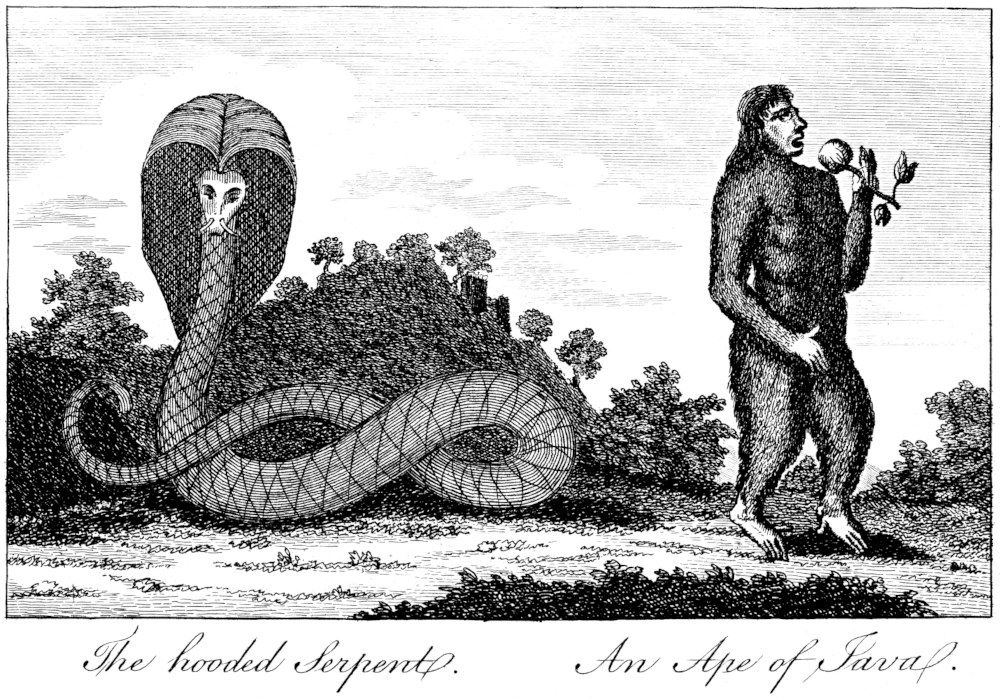
The hooded Serpent.
An Ape of Java.
The Portuguese make a practice of shooting the wild hog, and deer of two kinds, with which the neighbourhood of Batavia abounds: these are all good eating, and are purchased at very moderate prices. The goats of this country are as bad food as the sheep. Dogs and cats abound on the island, and wild horses and other cattle are found on the mountains at a considerable distance from Batavia.
Few monkies are seen near the town, but there are many of them on the mountains and desart places, where also are a few rhinoceroses, and great numbers of tygers.
The quantity of fish taken here is astonishingly great, and all the kinds of them are fine food, except a few which are very scarce; yet such is the false pride of the inhabitants, that these few scarce sorts are sold at very high rates, while those that are good are sold for a mere trifle, nor are they eaten but by the slaves. A gentleman with whom Captain Cook dined told him, he could have bought a finer dish of fish for a shilling, than what he had given ten for; but that he should have been the ridicule of all the politer people, if he had gone to so good a market.
The Dutch will not taste of the turtle which are taken here: Captain Cook acknowledges that they are fine eating, though not equal to those catched in the West Indies, even when they are dressed in London. Mr. Banks shot a lizard five feet in length, which was extremely well tasted: our adventurers were informed, that some of these animals had been seen, which were full as thick as the thigh of a man.
This country produces an abundance of poultry, as excellent of their kinds as those of England. The turkies are immoderately dear, and the pigeons not much less so; but the geese, ducks, and fine large fowls are altogether as cheap.
The neighbourhood of Batavia produces snipes of two kinds, one of which was the same as the English: of the Portuguese, who appear to be the only dealers in wild fowl, any number of thrushes might have been purchased. Our adventurers once, and once only, saw a wild duck in the fields, but never observed any of these birds exposed to sale; and, indeed, wild fowl in general are far from being plentiful at Batavia. Captain Cook observes, as a singularity respecting the snipe, that he is to be met with in all the quarters of the globe, and is seen in a greater variety of places than any other of the whole feathered creation.
The liquors of the island of Java, are palm-wine and arrack; of the former they have three sorts, the first of which is drank within a few hours after it is drawn from the tree, and almost in its original state, when it has a moderate sweetness: the second and third sorts are made by fermenting it, and putting various herbs and roots into it: the first of these liquors will not occasion drunkenness, but the two latter will. The arrack is so generally known, as not to demand any description.
The natives of Java profess the religion of Mahomet, and of course do not indulge in wine, at least publickly; but not to be exceeded in the vice of drunkenness by their christian neighbours, they are almost constantly chewing opium, which is well known to intoxicate in a high degree.
Exclusive of the Chinese, and the Indians of many different nations, who inhabit the town of Batavia, and the country in its neighbourhood, the inhabitants are, proportionably, a very small number; and even of these not a fifth part are Dutch, or descended from natives of Holland: the Portuguese are more in number than all the other Europeans.
The troops in the Dutch service are composed of the natives of almost all the kingdoms of Europe; but of these the Germans out-number all the others. When a person of any country goes to reside at Batavia, it is necessary that he first enter as a soldier in the service of the Dutch East India Company, binding himself to serve five years, which being done, he applies to the Council for leave of absence, which being granted of course, he then engages in any business he thinks proper: thus the Dutch have always an army ready to be called forth on any emergency. No foreigner, of whatever nation, has any share in the management of public affairs, all places of power, trust and profit, being held by the Dutch.
Though the men of other countries are bound to the observation of the above-mentioned conditions, women, from any part of the globe, may reside and traffick at Batavia unmolested. Captain Cook was informed that, at the time he was there, the whole place could not furnish fifty women who were natives of Europe, yet the town abounded with white women, who were descended from Europeans, who had settled there at different times, all the men having paid the debt of nature; for so it is, that the climate of Batavia destroys the men much faster than the women. These women follow the delicate custom of chewing betel, after the example of the native Javanese, whose dress they imitate, and whose manners they copy, in all other respects.
Mercantile business is conducted at Batavia with the slightest trouble imaginable: when a merchant receives an order for goods of any kind, he communicates the contents of it to the Chinese, who are the universal manufacturers. The Chinese Agent delivers the effects on board the ship, for which they are bespoke, and taking a receipt for them from the master of the vessel, he delivers it to the merchant, who pays the Chinese for the goods, and reserves a considerable profit, without the least trouble, risk, or anxiety. But when a merchant imports goods of any kind, he receives them himself, and lodges them in his own warehouses. It may be wondered, that the Chinese do not ship the goods on their own account; but from this they are restricted, and compelled to sell them to the merchants only.
The inhabitants of Java distinguish the Portuguese by the name of Oranserane, that is, Nazareen men; but they use the general term of Caper, or Casir, respecting all who do not profess the religion of Mahomet; and in this they include the Portuguese. But the Portuguese of Batavia are so only in name; for they have neither any connection with, or knowledge of, the kingdom of Portugal, and they have changed the religion of the church of Rome, for that of Luther. With the manners of the Javanese, they are wholly familiarized, and they commonly speak their language, though they are able to converse in a corrupt kind of Portuguese. They dress in the habit of the country, with a difference only in the manner of wearing their hair: their noses are more peaked, and their skin of a deeper cast than that of the natives. Some of them are mechanics and artificers, others subsist by washing of linen, and the rest procure a maintenance by hunting.
The Indian inhabitants of Batavia, and the country in its neighbourhood, are not native Javanese, but are either born on the several islands from whence the Dutch bring their slaves, or the offspring of such as have been born on those islands: and these having been made free, either in their own persons, or in the persons of their ancestors, enjoy all the privileges of freemen. They receive the general appellation of Oranslam, which implies, “Believers of the true faith.”
The various other Indian inhabitants of this country attach themselves each to the original customs of that, in which either themselves or their ancestors were born; keeping themselves apart from those of other nations, and practising both the virtues and vices peculiar to their own countries. The cultivation of gardens, and the consequent sale of flowers and fruit, afford subsistence to great numbers of them: these are the people who raise the betel and areca, which being mixed with lime, and a substance which is called gambir, the produce of the Indian continent, is chewed by persons of all ranks, women as well as men: indeed some of the politer ladies make an addition of cardamum, and other aromatics, to take off the disagreeable smell with which the breath would be otherwise tainted. Some of the Indians are very rich, keep a great number of slaves, and live, in all respects, according to the customs of their respective countries; while others are employed to convey goods by water; and others again subsist by fishing.
The Oranslams feed principally on boiled rice, mixed with a small quantity of dried shrimps and other fish, which are imported from China, and a little of the flesh of buffaloes and chicken: they are fond of fruit, of which they eat large quantities; and with the flower of the rice they make several sorts of pastry. They sometimes make very superb entertainments, after the fashion of their respective countries; but, in general, they are a very temperate people: of wine they drink very little, if any, as the religion of Mahomet, which they profess, forbids the use of it.
When a marriage is to be solemnized among the Oranslams, all the gold and silver ornaments that can be procured, are borrowed to deck out the young couple, who on these occasions never fail to make the most splendid appearance. Sumptuous entertainments are given by those who can afford them, which continue twelve or fourteen days, and frequently more, during all which time the women take care that the bridegroom shall not visit his wife privately, though the wedding takes place previous to the festival.
All these Indians, though they come from different countries, speak the Malay language, if it deserves that name. On the island of Java there are two or three different dialects; and there is a language peculiar to every small island; it is conjectured, that the Malay tongue is a corruption of the language of Malacca.
The hair of the people, which is black, without a single exception, grows in great abundance: yet the women make use of oils and other ingredients, to increase the quantity of it: they fasten it to the crown of the head with a bodkin, having first twisted it into a circle, round which circle they place an elegant wreath of flowers, so that the whole head-dress has the most beautiful appearence that imagination can form an idea of.
It is the universal custom, both with the men and women, to bathe in a river once every day, and sometimes oftener, which not only promotes health, but prevents that contraction of filth, which would be otherwise unavoidable in so hot a climate.
The teeth of the Oranslams have some particularities in them well worthy of notice. With a kind of whetstone they rub the ends of them till they are quite flat and even; they then make a deep groove in the teeth of the upper jaw, in the centre between the bottom of each tooth and the gum, and horizontally with the latter; this groove is equal in depth to a quarter of the thickness of the teeth; yet none of these people have a rotten tooth, though, according to the dentists of England and France, such a thing must be unavoidable, as the tooth is pierced much deeper than what we call the enamel. The teeth of these people become very black by the chewing of betel, yet a slight washing will take off this blackness, and the teeth are then perfectly white; but they are very seldom washed, as the depth of the colour is very far from being thought disagreeable.
Almost every person has read or heard of the Mohawks; and these are the people who are so denominated, from a corruption of the word Amock, which will be well explained by the following story and observations. To run a muck is to get drunk with opium, and then seizing some offensive weapon, to sally forth from the house, kill the person or persons supposed to have injured the Amock, and any other person that attempts to impede his passage, till he himself is taken prisoner, or killed on the spot.—While Captain Cook was at Batavia, a person whose circumstances in life were independent becoming jealous of his brother, intoxicated himself with opium, and then murdered his brother, and two other men, who endeavoured to seize him. This man, contrary to the usual custom, did not leave his own house, but made his resistance from within it; yet he had taken such a quantity of the opium, that he was totally delirious, which appeared from his attempting to fire three muskets, neither of which had been loaded, or even primed.
During the time that Captain Cook was at Batavia, several instances of the like kind occurred, and he was informed by an officer, whose duty it was to take such offenders into custody, that hardly a week passed in the year in which he was not obliged to exercise his authority: the Captain was also told, that jealousy of the women is the usual reason of these poor creatures running a muck, and that the first object of their vengeance is always the person whom they suppose to have injured them. The officer, whose business it is to apprehend these unhappy wretches, is furnished with a long pair of tongs, in order to take hold of them at such a distance from the point of their weapons, as to insure his personal safety. When he takes one of them alive he is amply rewarded; but this is not often the case, as they are so desperate as not to be easily apprehended: when they are killed in the attempt to take them, the officer has only the customary gratification. Those who are taken alive are broken on the wheel, as near as possible to the place where the first murder was perpetrated; and, as they are seldom apprehended without being previously wounded, the time of their execution is sooner or later, according to the opinions of the physicians, whether the wounds are, or are not mortal.
The Oranslams believe that the Devil is the author of sickness, and other misfortunes, on which account they make an oblation of meat, money, and other things, to him, when they are either sick or in trouble. When they dream successively for several nights, they have no doubt but that the Devil has enjoined the performance of some act, to discover which they torture their brains in vain, and then apply to the priest, who never fails to interpret the dream in a satisfactory manner. In consequence of this interpretation, by which it appears that the Devil is in want of money and food, a quantity of each is placed in the leaves of the cocoa-nut tree, and being hung on the bough of a tree by the side of a river, is left till some passenger shall find, and take away the money, which is considered not so much an offering to the Devil, as a fine due for some crime committed; with regard to the food, they imagine that the Devil comes and sucks out the nutritious parts of it, without moving it out of its place. From this part of the story it seems reasonable to conclude, that the priest, having previous knowledge where the oblation is to be made, takes the money, and leaves the victuals.
This instance of the superstition of these people may be thought very extraordinary; but the following will appear much more so. They are possessed with an idea, that when one of their wives is brought to bed, a crocodile is born, as a brother to the infant; and they imagine that the midwife conveys the young crocodile to an adjacent river, into which she puts it, with the utmost care and tenderness. Those who suppose themselves honoured by the birth of this new relation, fail not to put food in the river for his subsistence; but this is the peculiar duty of the twin brother, who performs this service regularly, at fixed periods, during the whole course of his life; firmly believing at the same time, that sickness or death would be the consequence of an omission on his part.
In the islands of Boutou and Celebes the natives keep crocodiles in their families; and it is conjectured, that the strange idea of the twin crocodile was first conceived in one of those islands: it extends, however, to Java and Sumatra westward, and among the islands to the eastward as far as Ceram and Timor. It is a matter of perfect astonishment, how even the most ignorant and credulous of the human race, should firmly believe an utter impossibility to occur daily; yet it is certain, that not one of the Indians whom Captain Cook questioned on the subject, entertained the least doubt about the matter. The crocodiles supposed to be thus born are distinguished by the name of Sudaras; and our readers cannot fail of being entertained with the following story respecting them, which Mr. Banks heard from a young woman who was born at Bencoolen, and having lived among the English at that place, had learnt to speak as much of our language as was sufficient to make her story intelligible.
She said that, when her father was on his death-bed, he laid the strongest injunctions on her to feed a crocodile that was his Sudara; that he told her the name by which he might be called up, and the particular part of the river where she would find him. Soon after the death of her father, she hastened to the river, and calling Radja Pouti (which signifies white king) the Sudara crocodile made his appearance, and she fed him with her own hands. She described him as being more beautiful than crocodiles are in general, for he had a red nose, and spots on his body; his ears were adorned with rings, and his feet with ornaments of gold. This story will appear the more extravagantly ridiculous, when it is recollected that crocodiles have not any ears.
A man whose mother was a native of the island of Java, and whose father was a Dutchman, was engaged in the service of Mr. Banks during his residence at Batavia. This man told his master that several Dutchmen, and many Javanese, as well as himself, had seen such a crocodile as was described by the girl who told the preceding story, and that, like her’s, its feet were adorned with gold. On Mr. Banks’s remarking the absurdity of these tales, and saying that crocodiles had not ears, he replied, that the Sudaras differed considerably from other crocodiles; that they had ears, though he acknowledged they were small, that their tongues filled their mouths, and that on each foot they had five toes.
There are three tribes of Indians on the island of Batavia, who are called Boetons, Macassars, and Bougis. These people are firm believers in the existence of the Sudara crocodiles; and they have a custom among them, which, however ridiculous in itself, seems to do honour to their filial and fraternal affections. At fixed periods they assemble together, and having laden a large boat with various sorts of provisions, they launch her at a spot most likely to be frequented by crocodiles; here they row about, sometimes singing and sometimes weeping, while a variety of musical instruments are played on, till they get sight of a crocodile. The moment this happens they throw tobacco, betel and victuals of several sorts, over the side of the boat, as a friendly offering to the Sudara crocodiles of their own country; imagining, that by this means they conciliate the affections and good will of their relations, whom they fail not to invoke during the whole of the ceremony.
The Chinese inhabitants of Batavia are, like those of their own country, some of the most industrious people on the face of the earth. They act as embroiderers, dyers of cotton, taylors, carpenters, joiners, smiths, and makers of slippers: some of them are shop-keepers, and deal largely in the manufactures of Europe and China. A few of these people live within the walls of the town; but the majority of them take up their residence in a district, named Campang China, which is situated without the walls. Those of the Chinese, who live in the country, either keep buffaloes and other cattle, the milk of which they sell daily at Batavia, or they procure a subsistence by the raising of rice and sugar canes, and the cultivation of gardens.
Captain Cook observes, that the danger of being hanged for any crime being excepted, there is nothing, however infamous, which a Chinese will refuse to do for gain; and in this opinion he concurs with every preceding writer; so that these people must have taken no small pains to establish their reputation for knavery. They labour with unwearied diligence, but the moment they have compleated their work they sit down to dice, cards, or some other of the very numerous games which they are expert at; and they follow their sports with such eagerness, that the business of eating and sleeping is frequently suspended.
The cloaths of the Chinese, whether rich or poor, are singularly clean and decent. Their behaviour is civil even to humility. They are such temperate eaters, that gluttony is unknown among them; but as their religion does not command them to refrain from any particular food, they eat a variety of things which are denied to those Indians who profess the Mahometan faith. Exclusive of vegetables and fish of various kinds, their principal food consists of dogs, cats, lizards, frogs, serpents of several sorts, and hogs.
The Chinese have purchased of the Dutch, at a very large expence, several hundred acres of land in the vicinity of Batavia, for the interment of their dead; for it is a rule, from which they never depart, not to open a grave which has once received the body of one of their countrymen: and hence arises an enormous expence in the purchase of land, which greatly distresses the living, to pay an imaginary honour to the dead. In order to preserve the body as long as possible from decay, the coffin consists of a piece of solid timber hollowed out: and this being covered with a kind of mortar several inches thick, petrifies in the ground till it is as hard as a flint. The funeral is attended by the near relations of the deceased, and by a train of women, who are paid for making lamentations.
In these expensive customs, absurd as they are, the Chinese are equalled by the rest of their Batavian neighbours; for every person is buried with a degree of splendour proportioned to the rank he has held in life, and there is a positive law which enjoins the observance of this custom; in consequence of which it frequently happens, that those who have not money sufficient to pay the just demands on them, are buried in a pompous manner, merely because they have lived elegantly. In this case persons are employed to take an account of what the man died worth, and, when the funeral expences are defrayed, the surplus is divided among the creditors.
The various inhabitants of the island of Java, whether Dutch, Portuguese or Indians, are all waited on by slaves, whose number is proportioned to the circumstances of the master; but there are laws in force, that no native of the island shall serve as a slave. These people, the number of which is very great, are bought at Sumatra, and the other eastern islands, at various prices, from ten to twenty pounds; but there have been instances of very beautiful girls being sold at above five times the common market price. They are fed on boiled rice, and such fish as can be purchased at the lowest rates; a little of which satisfies them, nor indeed do they deserve even the little they eat, for they are idle and sluggish in the highest degree.
The negroes of Africa are purchased at a lower price than any other slaves, and indeed any price whatever exceeds their merit, for they are of the most obstinate dispositions, and thieves, without a single exception. Those slaves which are purchased from the island of Celebes are most intolerably lazy, and of so ferocious a disposition, that their employers run the hazard of their personal safety. The island of Bali furnishes the most useful slaves; and the little island Nias, near Sumatra, supplies female slaves of exquisite beauty; but to these ill-fated women death is the almost certain consequence of even a short residence at Batavia.
The masters of any of these slaves may punish them in whatever way they chuse, so as not to deprive them of life; but when it happens that a slave dies of the punishment he has received, the master is tried, and commonly suffers as a murderer. From this circumstance it is reasonable to suppose, that the masters are cautious how they beat the slaves with undue severity: it is not indeed very common for them to strike them at all, but they pay an officer, who is called the Marineu, for inflicting the punishment. The Marineu having heard what is alledged against the delinquent, determines how many stripes he shall receive, and these are given by slaves, whose particular business it is to obey the commands of the Marineu: these strokes are laid on with rods made of rattans split very small. For a severe whipping the Marineu receives a ducatoon, and a rixdollar for a slighter punishment. The women slaves are whipped in the house of the master, but the men publickly in the streets. In order that these slaves may not be under too great temptations to steal, their masters are compelled to allow them seven pence half-penny weekly for pocket-money.
There is something singular in the subordination observed among the inhabitants of Batavia and the adjacent country. The man who has been longest in the Dutch East India Company’s service is permitted to gild his coach, while others are allowed to ride in coaches differently painted, according to the length of their services, and others again ride in those that are quite plain. In like manner the coachmen are dressed in liveries, that have a greater or less quantity of lace on them, or without any lace at all.
The lawyers of Batavia are partial in their administration of justice, to a very reprehensible degree. When an Indian has committed any crime deemed worthy of death, he is impaled, hanged, or broken on the wheel, without ceremony: on the contrary, if a Christian is capitally convicted, execution very seldom follows the sentence: and, what is more extraordinary, no pains are taken to apprehend the offender, till time enough has been allowed him to run away, if he thinks proper.
The civil officers of justice among the Chinese and Malays are called Captains and Lieutenants, but their decisions are not final, if the party against whom they may decide, thinking himself aggrieved, should appeal to the Dutch lawyers, in which case the decision of the latter must be abided by.
The Dutch have laid considerable taxes on these people, among which is one for the permission to wear their hair. When these taxes become due, which is once a month, they hoist a flag on the top of a house, nearly in the center of Batavia, and the man who does not speedily go and pay his money, has reason to repent the omission.
The current money of this country is of different value, from a Dutch doit to a ducat. When Captain Cook was at Batavia, Spanish dollars sold at five shillings and five-pence each, and the price is seldom much lower. The Chinese would give only the value of twenty shillings for an English guinea that was almost new, and for those that were old, and much worn, only seventeen shillings.
The milled ducatoons of Batavia are valued at eighty stivers; those that are unmilled at seventy-two; the ducat at one hundred and thirty-two; the imperial rixdollars at sixty; the rupees at thirty; the schellings at six; the double cheys at two and a half; and the doits at a quarter of a stiver.
We shall now proceed to a recital of the incidents which occurred during their passage from Batavia to the Cape of Good Hope; in which we shall trace them with the utmost fidelity, omitting not a single circumstance that may either entertain or instruct the reader.
Early in the morning of the 27th of December 1770, the Endeavour left the road of Batavia, and, after several hindrances, occasioned by the wind being contrary, she stood over for the shore of Java, on the first day of January 1771. As many of the ship’s crew, who had been very ill while at Batavia, were now become much worse, the vessel was brought to an anchor in the afternoon of the 5th near Princes Island, with a view to get some necessary refreshments, and likewise to take in wood and water.
Messieurs Solander and Banks now went ashore with the Captain, and they were no sooner landed, than some of the natives conducted them to the King of the island, with whom they endeavoured to make a bargain for some turtle, but the price could not be agreed on. As our adventurers had no doubt but that they should purchase on their own terms the following day, they left the Indians, and proceeded in search of a proper place to fill water, which was soon found. As they were about to embark for the ship, they purchased three turtle from some of the natives, but with the strictest injunction, that their Sovereign should not be informed of the transaction.
On Sunday the 6th of January they purchased, at very moderate prices, as many turtle as they had occasion for, and the whole ship’s company fed on this delicious fish. The King was at this time at a house situated in a rice field, where Mr. Banks waited on him, and found him cooking his own victuals.
On Monday the inhabitants brought vegetables, deer, fish, fowls and monkies, for sale; and on the following day they brought down a farther number of turtle.
A servant that Mr. Banks had hired at Batavia having acquainted him, that there was a town on the island, his curiosity determined him to have a view of it, and one of the officers of the ship accompanied him on his visit. As he was apprehensive that the natives would not be pleased at his going to the town, he told such of them as he met, that he was seeking for plants, which, in fact, was a part of the business of the day. Having come to a kind of village, consisting of a very few houses, they asked an Indian the way to the town, and some other particulars respecting it; but he endeavoured to prevent their proceeding, by representing it as at a very great distance. When he saw they were resolved to go forward, he proceeded with them, making frequent attempts to mislead them. When they were within sight of the town, the Indian changed his behaviour at once, and led the way to it.
This place, which contains between three and four hundred houses, is called Samadang, and is parted by a river into the old and the new town. Some of the natives, whom the gentlemen remembered to have seen among those who had brought provisions for sale, agreed to carry them from the old town to the new for a trifling gratification. This was done by means of two little canoes, which were lashed together; and they had no sooner reached the opposite shore, than the Indians shewed them the houses of their Chiefs, and behaved otherwise in the most friendly manner; but as this was the season when the natives live in their rice-grounds, to save their corn from the depredations of the monkies and birds, most of the houses were shut. When the gentlemen had seen every thing that they thought worthy of notice, they hired a sailing-boat, which conveyed them to the ship time enough for dinner; for the town of Samadang, though at a considerable distance from the place where the Endeavour lay at anchor, is situated at only a small distance from the sea-coast.
On the 12th, while the Captain was on shore giving orders to the people who were cutting wood and filling water, he was told, that one of the natives had stolen an ax. The thief was unknown; but the Captain, resolved not to pave the way for future depredations of this kind, by taking no notice of the first offence, immediately applied to the King; and in consequence of this application, the ax was brought down to the watering-place the next day. The Indian who brought it back said, it was left at his house in the night; but it was suspected, that himself was the thief.
Mr. Banks having several times visited on the King of the island, and given him some trifles that were very acceptable, he waited on him for the last time on the 13th of January, and gratified him very much by a present of a small quantity of paper. The King asked the reason why the English ships did not touch at the island, as was formerly their custom; when Mr. Banks attributed the omission to the scarcity of turtle, and advised the King to breed buffaloes, sheep and cattle, for the accommodation of his future visitants.
After a stay of ten days at Princes Island, during which they purchased vegetables of various kinds, fowls, deer, turtle, &c. the anchor was weighed, and the vessel once more put to sea.
We shall now proceed to a description of the island, which lies in the western mouth of the Streight of Sunda. It is a small woody island, and has been cleared only in very few places. Our India ships used to touch at Princes Island to take in water, but they have omitted this practice for some years since, on account, as it is said, of the water being brackish; yet Captain Cook says it is exceeding good, if filled towards the head of the brook.
The fowls which were purchased at this place cost about five-pence each; the turtle three-farthings a pound, and other fish were proportionably cheap; one hundred of the best cocoa-nuts cost only a dollar, and pumpkins, pine-apples and other fruits, were equally cheap and plenty.
The natives profess the religion of Mahomet, and are so strict in the observance of the feast called Ramadan, that they not only abstain from food till the sun is down, but even from the chewing of betel. The manners of these people are not unlike those of the Javanese; but they are much more jealous of their wives: during the ten days that the Endeavour lay here, only one woman was seen, and she ran away the moment she was discovered.
The houses are constructed in the form of an oblong square: they are built on pillars four feet above the ground, and well thatched with palm-leaves, as a defence from the sun and rain: the flooring is of bamboo canes, placed at a distance from each other, to admit the air: these houses consist of four rooms, one of which is destined for the reception of visitants, the children sleep in a second, and the two others are allotted, the one for the purpose of cookery, and the other for the bed-chamber of the owner and his wife. The residence of the King of the island, and that of another person of great authority, has boards on the sides, while the houses of all the inferior people have walls made of the bamboo cane, slit into small sticks, and wrought across the beams of the building, in the manner of a hurdle. The King of the island is subject to the Sultan of Bantam.
Captain Cook represents the natives as very honest in their dealings, with the single exception, of demanding more than double the sum they intended to sell for: the goods of each sort which different persons brought to market were all sold together, and the purchase-money divided among the several contributors, in proportion to the quantity that each had given in to the general stock. When they changed money, they gave two hundred and forty Dutch doits for a Spanish dollar.
The natives speak a language which they call Catta Gunung, that is, the language of the mountains, and they say, that their ancestors came from the mountains of Java, where this language is spoken; that they first settled at New Bay, where the tygers were so numerous, that they could not live in safety, and therefore took up their residence on Prince’s Island: all these people, however, are capable of conversing in the Malay language.
At the time the Endeavour left Princes Island, her crew began to feel, in all its force, the ill effects of the putrid air of Batavia; and soon afterwards the ship was a mere hospital, filled with unhappy wretches, sinking under the rage of fevers and dysenteries. In the space of six weeks twenty-three persons died, exclusive of the seven which had been buried at Batavia: these were nine seamen, the Corporal of the marines, the ship’s Cook, two of the Carpenter’s crew, the Carpenter and his Mate, a Midshipman, the old sail-maker, who was in perfect health when all the rest were ill at Batavia, and his Mate, the Boatswain, Mr. Monkhouse, a Midshipman, Mr. Sporing, who accompanied Mr. Banks, Mr. Parkinson, draughtsman to that gentleman, and Mr. Green, the Astronomer.
After a passage in which nothing remarkable occurred, the ship was brought to an anchor off the Cape of Good Hope, on the 15th of March 1771. The Captain repaired instantly to the Governor, who said, that such refreshments as the country supplied, should be chearfully granted him; on which a house was hired for the sick, who were to have their board and lodging, on the payment of two shillings a day for each man.
At the time the Endeavour lay at anchor here, an English East Indiaman sailed for the port of London, who had buried above thirty of her crew while she was in India; and at that time had many others severely afflicted with the scurvy; so that the sufferings of the crew of the Endeavour, considering her long absence from England, is a circumstance not at all to be wondered at.
We shall now proceed to a description of the Cape of Good Hope, in which we shall only mention such particulars as are either wholly new, or such as have been mis-represented by other writers. The land over the Cape is mountainous, and totally barren; beyond these mountains the country is covered with a light sand, which will not admit of cultivation: there are indeed a few cultivated spots, but they are hardly more than a thousandth part of the whole country. Provisions are brought to the Cape from a distance nine hundred miles up the country, which is an evident proof of its extreme sterility, notwithstanding what has been heretofore written to the contrary. While Captain Cook lay here, a farmer came to the Cape, bringing his young children with him, from a distance that took him fifteen days journey; and on his being asked why he had not left his children with some neighbour, he said, there was no inhabitant within five days journey of his farm. There are no trees that are even two yards in height, except in some plantations in the vicinity of Cape town.
This town consists of near a thousand brick houses, the outsides of which being generally plaistered, they have a very pleasing appearance. There is a canal in the main street, with two rows of oak-trees on its borders, which are in a more flourishing state than the other trees of this country: the streets, which cross each other at right angles, are very spacious and handsome. The inhabitants are chiefly Dutch, or of Dutch extraction: the women are beautiful in a high degree, and possess those blooming countenances which denote the most perfect health: they are most of them mothers of many children, and Captain Cook says, they are the best wives in the world.
The air of the Cape of Good Hope is so pure and salubrious, that a sick person, who goes thither from Europe, whatever be his disorder, almost always recovers his health in a little time; but those who bring diseases with them from the East Indies, have not an equal chance of recovery.
Although this country is naturally so barren, as scarcely to produce any thing, yet the unceasing industry of its inhabitants has so effectually combated the sparing hand of Nature, that there are few places where the necessaries of life are more plentiful, and even what are generally deemed luxuries, are by no means scarce. The constantia wine is known to be excellent, but the genuine sort is made only at one particular vineyard a few miles from the town. The gardens produce many sorts of European and Indian fruits, and almost all the common kinds of vegetables. The cultivated fields yield wheat and barley of equal quality with that of the growth of England. The sheep of this country have tails of a very extraordinary size, many of which weigh upwards of a dozen pounds; the meat of this animal as well as of the ox, is very fine food: the wool of the sheep is rather of the hairy kind, and the horns of the black cattle spread much wider than those of England, while the beast himself is handsomer and lighter made. The cheese has a very indifferent flavour, but the butter is extremely good. The pork of this country is nearly the same as that of Europe, and there are abundance of goats, but the inhabitants do not eat their flesh. The country abounds in hares, altogether like those of England; there are several species of the antelope, a plenty of bustards, and two kinds of quails.
When a stranger arrives at the Cape, it is customary for him to board in a private house, and he pays from two shillings to a crown a day, according to the accommodations he expects. If he appears and behaves as a gentleman, he is invited to the private entertainments which are given by the more opulent of the inhabitants; and this cannot fail of being the more acceptable, as there are no places of public diversion in the country. Horses are here let to hire at six shillings a day, and coaches at one pound four.
The Dutch company have a garden at the extremity of the high street, which is more than half a mile in length, in the center walk of which are a number of fine oak trees. A small part of this garden is covered with botanical plants, but all the rest is allotted to the production of the common vegetables for the kitchen: the whole is divided into squares by the form of its walks, and each square is fenced in by oaks cut into small hedges. There is a menagerie of beasts and birds, many of them known in Europe, at the upper end of this garden; and among the rest is the Coe Doe, a beast not less than a horse, which has those curious spiral horns that have frequently found a place in the cabinets of the curious.
The native inhabitants of this country are usually dressed in a sheep skin thrown across the shoulders, and a little pouch before them, to which is fixed a kind of belt, ornamented with little bits of copper, and beads: round the waists of the women is a broad piece of leather, and rings of the same round their ancles, to protect them from the thorns, which grow in abundance all over the country; a few of them wear a kind of shoe, made of the bark of a tree, but the major part of them go barefooted: both sexes adorn themselves with bracelets and necklaces, made of beads. None of these people reside at a less distance than four days journey from Cape Town, except a number of the poorer sort, who look after the cattle belonging to the Dutch farmers, and are employed in various other menial offices. Their stature is about the same as that of the people of England, from five to six feet in height; but scarce any of them are corpulent: their skins are dark, but this is in a great degree owing to their extreme indelicacy: their hair curls naturally, and falls in ringlets of above six inches in length: they are singular for their strength and agility.
Most of the Hottentots speak the Dutch language, without any thing remarkable in their manner; yet, when they converse in their native language, they frequently stop, and make a clucking with their tongues, which has a most singular and ridiculous effect to the ears of a stranger; and, exclusive of this clucking, their language itself is scarcely sounded articulately.
These people are modest to the utmost degree of bashfulness, and, though they are fond of singing and dancing, can hardly be prevailed on to divert themselves with their favourite amusements before strangers: both their singing and dancing are alternately quick and slow in the utmost extreme.
Some of the Hottentots understand the art of melting and preparing copper, with which they make plates, and wear them on their foreheads, as an article of finery. They are also capable of making knives, superior to those they can purchase of the Dutch, from whom they procure the iron.
They have the art of making butter by shaking milk in the skin of a beast: with this butter they anoint their skins; or, when they cannot procure butter, they use the fat of the sheep. The principal people are owners of immense herds of cattle; and these clothe themselves with the skins of lions and other beasts, which are adorned with fringes, elegantly designed.
The Hottentots are so dextrous in throwing stones, that they will hit a mark not larger than a crown piece, at the distance of an hundred yards. They are likewise expert in the use of arrows, and of the lance called an Assagay, the points of which they poison, sometimes with the venom of a serpent, and sometimes with the juice of particular herbs; so that a wound received from either of these weapons is almost always mortal.
Exclusive of what is above recited, they met with nothing respecting these people, but such particulars as have been previously mentioned by various other voyagers, and which will of course be found in the preceding volumes: we shall therefore accompany the ship in her voyage to England.
On the 14th of April, 1771, the anchor of the Endeavour was weighed, and she once more put to sea, but came to an anchor again before night near Robin island. As a few vegetables were wanted, which they had neglected to take in at the Cape, the Captain sent off a boat to the island; but, when she reached the shore, some Dutch soldiers forbad her crew landing, at the hazard of their lives; and the officer who commanded very prudently returned to the ship. For some time they were puzzled to account for this behaviour on the part of the Dutch; but it was at length recollected, that the Dutch government at the Cape of Good Hope had assigned this island for the reception of such offenders whose crimes were not deemed worthy of death, where their slavery consists in digging lime-stone, for such a number of years as are thought proportionable to the heinousness of their offences: and that a ship belonging to Denmark, which had buried most of her hands, had called at this island, and taken on board a number of these criminals, in order to navigate the vessel to Europe: hence the conduct of the Dutch soldiers was easily accounted for.
The ship sailed again on the following day, when the master of her died, having hastened his death by hard drinking, though, in other respects, he left behind him an excellent character.
On Monday, May-day, they came to an anchor off the island of St. Helena, and, as they proposed to remain three days, Mr. Banks employed the interval in surveying every object that was thought worthy of notice.
The island of St. Helena rises out of the immense Atlantic ocean, is about eighteen hundred miles from the coast of America, and twelve hundred from that of Africa. It has the appearance of a huge mountain, the foundation of which is probably at the center of the globe. It had formerly volcanoes in several parts of it, as is evident from the appearance of the earth and stones in many places; and it looks like a cluster of rocks, bounded by precipices of immense height: as a vessel sails along the coast, the cliffs perpend over her head so as to threaten her instant destruction, and nothing in nature can be conceived more awful than their appearance.
Close to the sea side stands the town, which had formerly a church of very indifferent architecture, but it is now little better than a heap of ruins, nor is the market house in a much better condition: most of the houses are also constructed in a vile taste.
As this island is the property of the English East India Company, the inhabitants are not suffered to carry on any trade for their own emolument, but get their livelihood by selling the productions of the island to the crews of the vessels which anchor there for a supply of refreshments.
St. Helena is so happily situated, with regard to climate, that it would, if properly cultivated, produce the trees, fruits, plants and flowers, of all the different parts of the world. On the summit of the highest ridges the cabbage-tree flourishes; in the parts below these grow the gum-wood and red-wood, and in the vallies many of the plants of the Indies, and almost all those of Europe; yet these several productions will not grow but on the spots of ground peculiarly adapted to each.
The only white inhabitants of the island are subjects of the King of Great Britain: these employ slaves, who transport goods of all kinds from place to place on their heads; and we are sorry to say, that the inhumanity of our countrymen to these slaves is a disgrace to those who profess the christian faith. There are a small number of horses at St. Helena, but they are never employed in draught, there being no such thing as a waggon or cart on the island, though in many places the land is not so steep, but that such carriages might easily be drawn.
Ebony-trees are a natural production of the island of St. Helena, but there have not been many of them within the memory of any person now living there. Snails are found in abundance on the summits of the highest mountains; but the other insects of the island are very few in number.
On Saturday the 4th of May 1771, the Endeavour sailed from the road of St. Helena, together with the Portland man of war, and several sail of Indiamen. They kept company with the man of war and Indiamen till Friday the 10th. But Captain Cook observing, that they were out-sailed by all the other ships, and consequently imagining that some of them would reach England before him, made signals to speak with the Portland, when the Captain of that vessel came on board, and received from Captain Cook a letter to the Lords of the Admiralty, together with a box, in which were deposited the journals of many of the officers, and the ship’s log books.
On the 23d they lost sight of all the ships they sailed in company with from St. Helena, and in the afternoon of the same day, Mr. Hicks, the first Lieutenant, died of a consumption, with which he had been afflicted during the whole voyage.
No single occurrence worth recording happened from this time, till the ship came to an anchor in the Downs, which was on the 12th of June following.
Whoever has carefully read, and duly considered the wonderful protection of this ship, in cases of danger the most imminent and astonishing, particularly when encircled in the wide ocean with rocks of coral, her sheathing beaten off, and her false-keel floating by her side, a hole in her bottom, and the men alternately fainting at the pumps, and will yet deny the existence of a particular Providence, and the most gracious and merciful interposition of the Deity, in behalf of our adventrous countrymen, will deserve some share of that censure, which the thinking part of mankind have so liberally and justly bestowed on the Compiler of the account of the Voyage of the Endeavour. There is a comfort in the reflection that God is good, which can be felt only by those who acknowledge his mercy, and adore his power.