ACCOUNT OF MONS. DE BOUGAINVILLE’s VOYAGE ROUND THE WORLD. PERFORMED BY ORDER OF THE FRENCH KING, In the years 1766, 1767, 1768, 1769. (continued 2)
Reading edition
The main-sail of the Boudeuse being split by this storm, they endeavoured to make Port Famine, where they hoped to be sheltered from the tempest; but this attempt was fruitless; for the violence of the current was such, that they lost nine miles in as many hours, and were hurried with amazing rapidity into a large bay, formed by part of the coast of Terra del Fuego, which Mons. Bougainville called Bay Duelos, from the name of the officer who was next in command under the Commodore of the expedition, and whose knowledge and experience are mentioned as circumstances highly advantageous to the enterprize.
This Bay is described as being very convenient for ships to anchor in, on account of the westerly winds blowing over the coast. Two small rivers discharge their streams into the bay, the water of which is excellent at about a quarter of a mile from the sea coast, though nearer than that distance it is impregnated with saline particles. The landing-place is a sandy beach, above which a pleasant meadow stretches itself to a considerable distance. Behind this meadow the woods raise their lofty heads, and form a kind of amphitheatre. Our adventurers traversed a considerable tract of the country, without meeting with any living animal, except a very few parroquets, bustards, ducks, teals, and two or three snipes.
Several huts were seen at the mouth of a river, which had been constructed by twisting branches of trees into the form of an oven. In these huts were found large numbers of limpets, muscles, and calcined shells; and the huts themselves appeared to have been recently made. Our adventurers going some miles up the river, observed the track of human creatures, and remarked, that the flood came from the east at the rising of the tide, which they had not before observed in any other part of the streights.
The seamen were now engaged in cutting wood till the 16th, when the vessels sailed with a favourable wind, and passed Point St. Anne, which covers Port Famine, a bay so called, on account of the disastrous fate of the colony formerly established on its borders by the too adventrous Spaniards.
Mons. Bougainville observes, that the shores of this country are covered with wood, and are remarkably steep: those of Terra del Fuego, he says, are horrible to behold; and that “mountains there are covered with a blueish snow as old as the creation:”—These are his own words; but with all submission to the learning and penetration of our ingenious voyager, we cannot conceive by what kind of intuition, he came to know that the snow had lain on these mountains more than five thousand years; or even that it had not fallen within five days of the time he saw it. It is no breach of Christian charity to observe, that these Frenchmen are as finished coxcombs in their writings, as they are in every part of their dress and behaviour. It is hoped that Englishmen will be cautious how they imitate them in either particular.
There are four bays proper for the anchoring of vessels, between Cape Forward and Cape Round; and two of these bays are separated by a Cape of a most singular kind, which consists of petrified shells, laying horizontally, and rising more than fifty yards above the level of the sea. Mons. Bougainville took soundings at the foot of this Cape, but a line of an hundred fathom would not reach the bottom.
As the ships were now becalmed for two hours, our Commodore took this opportunity of taking the soundings near, and the bearings of Cape Forward, which he mentions as the most southerly point of land, on the continent, in the known world, and he fixes its latitude at fifty-four degrees, five minutes, and forty-five seconds, south. Its surface consists of two hills, something more than two miles in extent, one of which is considerably higher than the other. The tops of these hills are covered with snow, which gradually melting by the warmth of the sun, supply with perpetual moisture the roots of trees which are fixed in the crevices of the rock.
Mons. Bougainville and his party landed on a small rock, which barely afforded room for four persons to stand on, and here they hoisted the colours of the boat, and repeatedly shouted Vive le Roi. Our author mentions it with an air of triumph, that these rocks now resounded for the first time, with this compliment to the grand Monarche. A striking instance of the vanity by which the French nation is distinguished!
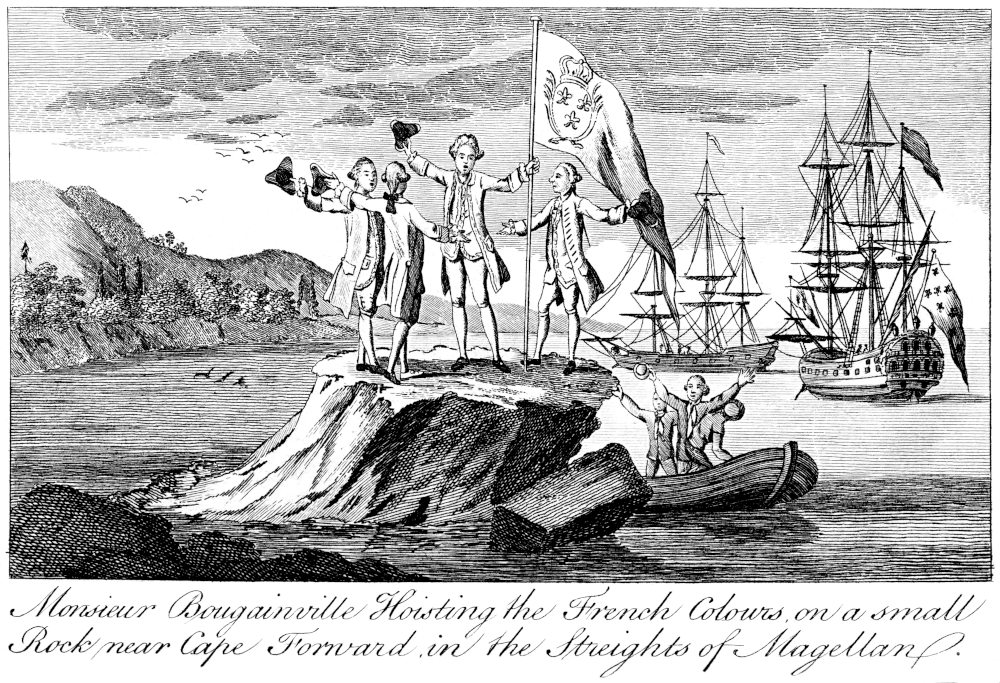
Monsieur Bougainville Hoisting the French Colours, on a small Rock near Cape Forward in the Streights of Magellan.
Having returned to the ship, and the wind coming about favourable, Mons. Bougainville sailed in search of a harbour, which received the name of French Bay, where he resolved to take in a quantity of wood and water, as a supply during their voyage across the great South-Sea. In consequence of this resolution all the boats were instantly hoisted out, with a view to begin this necessary business the next morning.
The night proving excessively stormy and tempestuous, it was passed in fears and apprehensions which baffle all description.
Early in the morning a boat was sent out to sound the mouth of a river which had been previously denominated Gennes’ River, from the name of a gentleman who was a partaker in the dangers and hardships of this expedition. As it was low water when the boat reached the shore, her crew could not land without running her a-ground on a sand; and it was evident, that the larger boats could only make the shore at high water, so that their wood and water could be brought on board only once a day. For these reasons Mons. Bougainville determined to anchor in a small bay about three miles distant, called after his own name, where he had, in the year 1765, taken in a loading of wood for Falkland’s islands.
Bougainville bay, to which they now sailed, is surrounded by high mountains, which secure it from the winds blowing from every point of the compass, so that the surface of the water is unruffled even by a single breeze.
Having cast their anchors in this bay, and made fast the vessels by means of hawsers tied to some trees on the coast, they landed, and found two Indian huts, constructed of the branches of trees, but they did not appear to have been lately inhabited. In the year 1765 Mons. Bougainville had caused a hut of bark to be erected on this spot, in which he left some trifles, by way of present to such of the natives as might happen to wander that way; on this hut he had put up a white flag; but both the presents and the flag had been taken away, and the hut levelled with the ground.
On the morning of the 18th of December a kind of camp was formed on shore, by way of guarding the effects which were landed, and protecting the men who were to be employed in taking in wood and water. Small ponds were now dug, for the accommodation of those destined to wash the linen, and the water casks were sent on shore to be repaired. The crew of the Eagle having, in 1765, cut down many more trees than were wanted for that vessel, the labour of this task was saved to our present adventurers, who were likewise happy in finding roads ready made through the woods, for the convenience of bringing down the timber to the sea-shore. At this place the remainder of the month was spent in the necessary employment above-mentioned, and in repairing the ships, particularly the Etoile, which had so large a leak in her stern, that most of the hands on board her were fatigued beyond expression, by standing at the pumps, alternately, night and day.
The astronomer, Mons. Verron, now landed on a little island, which was denominated the Isle of Observatory, from its being a place admirably calculated for the making astronomical observations; but his labours were fruitless, owing to the cloudiness of the weather, which is almost perpetual in this country. At some periods, however, the sun appeared free from clouds, and melted a part of the snow which had lodged on the mountains of the main land. Whenever this fine weather happened, the prince of Nassau, attended by Mons. de Commerçon, a celebrated botanist, went in search of plants and herbs, and they were very successful in their researches: but the gentlemen who endeavoured to fish, or to hunt for animals, met with no such good fortune, for they never catched even a single fish, nor ever saw any quadruped but one fox, which was killed by the party employed in collecting the stores.
Mons. Bougainville having formed a resolution of taking a survey of the coasts of the main land, and likewise of those of Terra del Fuego, he embarked in his boat, early in the morning of the 22d, accompanied by two gentlemen, who proposed to sail with him as far as Cape Holland. The weather was calm and serene at their first setting out; but the wind soon varied to different points of the compass, and blew a hurricane, which obliged our adventurers to take shelter in the mouth of a small river. Having gained the desired port, they waited in the hope that the storm would abate, till they were almost benumbed with the cold, and wet to the skin with the rain; they therefore landed, and cutting down some branches of trees, erected a kind of hut, in order to shelter them during the night. “These huts (says Mons. Bougainville) serve as palaces to the natives of these climates; but we had not yet learnt their custom of living in them.”
It continued to rain incessantly, and was at the same time so cold, that the gentlemen found their present situation untenable; they therefore sheltered themselves as well as they could under the sail of the boat, and kept up a large fire all night, which was tempestuous in a very high degree. In the morning they hastened to their boat, and returned to the ship, happy, by that means, to avoid the effects of the growing tempest, which soon became so violent, that it would have prevented their returning at all. For two days after this it snowed continually, so that the mountains were covered, notwithstanding it was now midsummer, and the sun appeared almost eighteen hours in the four and twenty.
When the storm had subsided, Mons. Bougainville formed the resolution of going on a second expedition, which he flattered himself would be attended with more success. Accordingly, early in the morning of the 27th (the barge of the Etoile, and the long-boat of the Boudeuse, having been armed with swivel guns and muskets) our adventurers embarked with the prince of Nassau, and two other gentlemen, and sailed for the coast of Terra del Fuego, where they arrived in about six hours; and finding a number of huts, which the natives had left in a delightful wood on the sea-coast, they there sat down, and made a most agreeable repast.
After dinner they coasted the country for a considerable time, and then crossed an inlet, which Mons. Bougainville conjectures to be a streight which leads to the sea, at no great distance from Cape Horn. This conjecture is founded partly on the width of the inlet, which is not less than six miles, and partly on the observing a prodigious number of whales in that part of the sea.
When our adventurers had almost reached the opposite side of the inlet, they saw a number of fires on the coast, and soon afterwards discovered several of the inhabitants on the point of a bay. Towards this place they immediately steered; and they had no sooner landed, than Mons. Bougainville recollected, that these Indians were the same people whom he had seen on his former voyage in the streights, and whom he had then distinguished by the name of Pecherais, because these savages were perpetually making use of that word, in the same manner as the Patagonians did that of Shawa.
The number of the Pecherais that had thus assembled was about forty, of both sexes, and all ages, and they had several canoes in an adjacent creek. As the evening advanced, Mons. Bougainville could not stay long with his old acquaintance, but left them, in order to reach an inlet, where he proposed to spend the night; but as the time would not permit the accomplishing his wish, he landed on the banks of a river, and having caused tents to be made of the sails of the boats, and a large fire to be made, the party spent the night in perfect safety, and much to their satisfaction.
On the following day it was found that the inlet above-mentioned was an excellent port, wherein ships might be sheltered against every dangerous wind; and in which the ground is admirably calculated to afford the best and safest anchorage. From the elegance and convenience of this bay and port it received the name of Beaubassin [the beautiful harbour.] Mons. Bougainville mentions this place as equally convenient for the careening of ships, and for the taking in wood and water.
That no necessary information respecting so commodious a harbour might be lost, the Commodore left Mons. Bournard there, to take the most exact account of every thing that might be thought worthy of notice, and he was then to return, in the long-boat, to the ships. In the mean time Mons. Bougainville and a part of his company embarked in the barge, and rowing to the westward, discovered an island, on the coast of which several of the natives were employed in fishing. Before the evening our voyagers arrived at a bay, which received the name of de la Cormorandiere; from a rock which appeared at about a mile distant from it.
Early in the morning of the 29th Mons. Bougainville departed from this bay, and sailed between two islands, to which he gave the name of the two Sisters, they are situated about nine miles from Cape Forward. Soon after this they discovered a mountain, of a conical form, which they called the Sugar Loaf; and, in the course of the day they arrived at a commodious bay, at the bottom of it there is a most excellent port, into which falls a very singular cascade. For these reasons the place received the name of the Bay and Port of the Cascade. It is represented as a place highly proper for taking in wood and water, and very safe to anchor in.
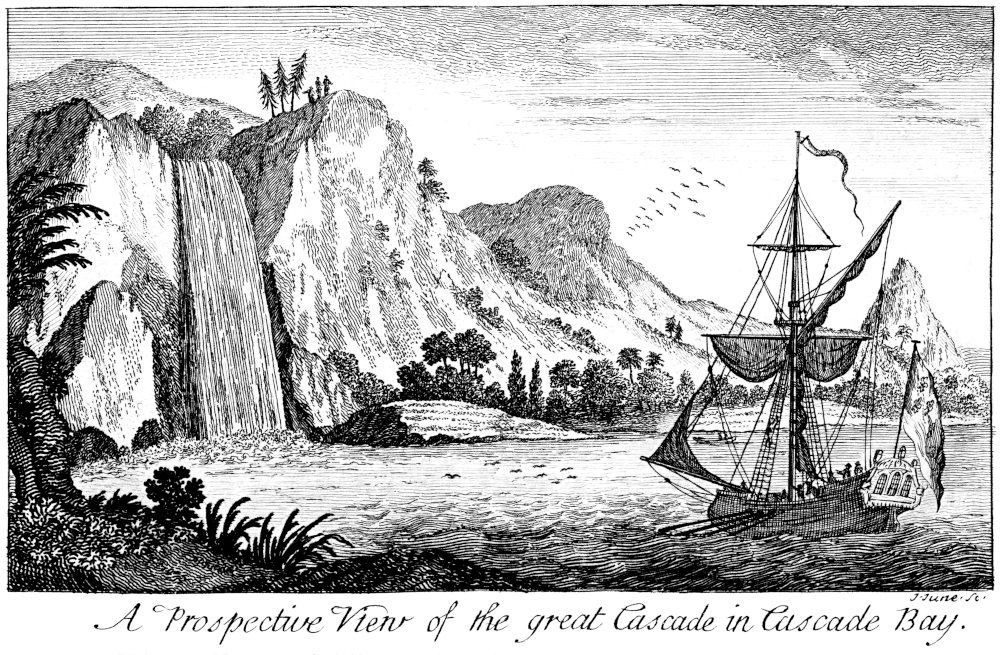
A Prospective View of the great Cascade in Cascade Bay.
J. June Sc.
The stream of a small river which seeks its way between a number of lofty hills, forms this water-fall, which descends perpendicularly down the side of the rock above a hundred yards. Mons. Bougainville went to the top of the cascade, and made his remarks on the appearance of the adjacent country, in some parts of which there are small plains which produce a kind of spungy moss, and in others the ground is covered with thickets of wood. The plants and trees are of the same kind as those which the coast of Patagonia produces; and the whole face of the country has much the appearance of Falkland’s islands, except the want of trees at the latter place. On the whole, our author says, that all that part of Terra del Fuego, from the present spot, to that which lies opposite Elizabeth island, consists only of large and mountainous islands, the summits of which are clothed with perpetual snow. Mons. Bougainville searched in this place to find the traces of inhabitants, but he did not succeed; and he is of opinion, that the natives of Terra del Fuego seldom, if ever, depart from the sea-shores, because on those they obtain the necessaries of life.
Our adventurers remained at Port Cascade, during the night of the 29th, which was rendered highly disagreeable by incessant rain, and intense cold; and on the morning of the following day they crossed the streight with a boisterous wind and a rough sea, which rendered the navigation dangerous to so small a vessel. The rain kept pouring down almost the whole of this day, which was employed in viewing the coast, and making such remarks as may be useful to future navigators. Our voyagers had now a very narrow escape with their lives, the boat having been nearly overset in crossing a bay, owing to a mistake of the steersman in the management of the helm. At length, however, they got safe on board the Boudeuse, and as the commanding officer, during Mons. Bougainville’s absence, had shipped every thing that was necessary, preparations were immediately made for sailing.
They departed from Bougainville Bay in the afternoon of the 31st of December, 1767, and in the evening came to an anchor in the road of Port Galant, which is situated at the bottom of Fortescue Bay, where they were detained no less than three weeks, by such bad weather, as the inhabitants of these milder climes cannot form an adequate idea of.
On the first of January, 1768, Mons. Bougainville dispatched a party in a boat, to make remarks on the coast, as far as Elizabeth Bay; and to take a view of the numerous islands with which this part of the streights of Magellan abounds. Two of these islands, to which Sir John Narborough formerly gave the names of Charles and Monmouth, were distinctly seen from the place where the ships lay at anchor; but those which he has denominated the Royal Isles, and Rupert Island, were at too great a distance to be viewed from Mons. Bougainville’s present station.
Notwithstanding the severity of the weather, and the almost incessant rains, the crew which had been sent out landed on different places, at one of which it was evident, that some English ships had lately touched; for on several trees they saw initial letters, and even whole names, cut in the wood: they also saw many spice-laurel-trees, the bark of which had been lately taken off, with other plain indications who they were that had visited the spot, but what put the matter beyond all doubt, were the words, Chatham, March, 1766, which were very legible on a piece of wood, of that kind which is frequently affixed to pieces of cloth in the royal marine warehouses of Great Britain.
The astronomer, Mons. Verron, in the mean time, had his astronomical instruments conveyed to a peninsula, by which the harbour is formed, in order to make observations, for ascertaining the bearing and distances of particular capes: but the result of his observations would afford neither instruction nor entertainment to any but the mere nautical reader; nor would they be of the least use even to him, unless he was bound on a voyage to the South Seas, through the streights of Magellan.
The weather was so exquisitely severe on the fourth and fifth of January, that no pen can describe it, nor any imagination conceive an idea of it. A violent storm of wind was attended with incessant rain or snow, and the keenest biting coldness in the air. Mons. Bougainville informs us that, during this severe weather, he sent out a boat to search for a convenient anchoring-place on the coast of Terra del Fuego, and an excellent one was found to the south-west of Charles and Monmouth islands.
On the 6th the weather was more moderate than it had been for some days past. In the morning of this day four small boats, with Indians on board them, were observed at the point of Cape Galant, one of which advanced towards Mons. Bougainville’s ship, while the rest rowed towards the bottom of the bay. In the boat which approached the Boudeuse were a man, his wife, and two children, the former of whom went on board, without the least apparent sign of fear, leaving the woman and children in the boat. Soon after this man had gone on board, two Indians from the other boats followed his example, bringing their children with them.
These people seemed not to express the least surprize either at the structure of the ship, or at any thing they saw on board her, which our author deems a proof that, “in order to be capable of being surprized at the work of art, one must have some fundamental ideas of it.”—There may be some truth in this observation; but we cannot help resolving the apparent want of curiosity in these savages into another, and a very different cause; namely, their having seen the English, or other vessels, which had visited the streights of Magellan.
The Commodore prevailed on these people to dance and sing, and treated them with a kind of concert of music. He likewise gave them bread, and different kinds of meat, all of which they devoured with avidity, seeming equally pleased with every thing that was given them, and with every occurrence that passed; nor could they be persuaded to quit the ship, till several pieces of salt meat had been put into their boats.
Our author calls these happy Indians “troublesome and disgusting guests.”—One would wonder on what authority he has adopted these epithets, or how the company of the savages, as he calls them, could be troublesome or disgusting, when they sang and danced, only on being asked to do so; received with gratitude whatever was given them, and applied it to the purpose for which it was given.—Mons. Bougainville calls them “unpolished men;” as if the frippery complaisance of the court of Versailles could have been expected from these honest tenants of the woods; whose instructors are plain sense and nature, and whose God is the God of the Europeans.—In a word, our author writes with an affected consciousness of superiority, and in the pert restlessness of stile, that is almost peculiar to the French novelist who would be thought a philosopher.
The people are clothed with seal-skins, which are by far too small to cover the whole of the body; and with these skins they make the sails of their boats, and the coverings of their huts. They are likewise possessed of a few of the skins of the guanacoe, but our author does not mention to what use they apply them; though it should seem probable that they form a part of their clothing.
Mons. Bougainville describes these Indians as thin, short, and ugly; and that a most offensive smell is the consequence of keeping them company. The women are still more disagreeable than the men, who do not appear by any means fond of them. It is the duty of the females to steer the boats, and to repair any damage that may happen to them; and they are often obliged to swim after them through the sea-weeds; nor are even women who have sucking children excused this duty: the child is carried on the mother’s back, enclosed in the seal-skin that forms her dress. When the women are on shore their business is to collect shells and wood; nor do the men even share with them in this employment.
The boats are constructed of the bark of trees, fastened together with rushes, and the seams are caulked with moss. A fire is constantly kept in the middle of the boat, on a heap of sand, which is placed to prevent the burning of the vessel. Their arms consist of bows and arrows formed of the branches of the berberry bush, which grows plentifully in these parts. The arrows are pointed with sharp stones, and the string of the bow is made of the gut of some animal; but they use not these weapons against an enemy; they are destined only for the destruction of birds, or other animals proper for the support of life.
Mons. Bougainville says, that these Indians use a kind of harpoon, for the purpose of striking fish, which is made of bones, it is about twelve inches in length, pointed at the end, and indented on one of its sides.
The principal subsistence of these people is fish; but it is supposed that they sometimes catch game, as they have dogs of the sporting kind, and springes, or nooses, adapted for the snaring of quadrupeds. The teeth of all the natives are very bad, which our author attributes to their eating fish when boiling hot, though they do not half boil it before it is so eaten. They live in huts which have no partition of rooms, in the middle of which a fire is lighted, that serves the whole family.
The disposition of these people is of the amiable kind; but their extreme good nature borders on weakness; they believe in evil genii, and have priests and physicians, whom they suppose capable of deprecating the vengeance of their aerial enemies. Mons. Bougainville observes, that these Pecherais have the fewest conveniences of life of any people he has ever known; yet they do not repine at their situation, but appear to be contented with the lot which providence hath assigned them; tho’ they live in the most inclement climate hitherto discovered in the habitable globe. Exclusive of the other peculiarities of their fate, they are fewer in number than any other known race of men; yet this little society, cut off as it is from all intercourse with the rest of mankind, is not totally free from the vices common to larger states, as a contest for dominion exists even among them, and the more powerful are perpetually labouring to distress the weaker. Thus it is with the poor Pecherais, as with every other community in the universe, that those who cannot make head against tyranny, must submit to the arbitrary command, the sic voleo, sic jubeo of the tyrant.
The inclemency of the weather, during the 7th and 8th of the month, was such, that the crews of the ships could not venture on shore; and though it was even now the summer-time, the adjacent country was covered with snow, which also laid on the ship to the depth of several inches.
On the ninth the Indians, who had previously painted their bodies with red and white streaks, advanced towards the ships; but seeing the boats go off towards their habitations, all of them, except one, followed the ships boats, and that went on board the Etoile, where she remained but a little while, and then followed the others.
The crews of the boats having landed, went to the huts of the Indians, who seemed by no means to relish this unexpected visit; which was particularly evinced by the women having all retreated to one hut. The men invited the French sailors into those huts where the women were not to be found; and the Frenchmen having accepted the invitation, were treated with shell fish, which the Indians shucked before they delivered them to their visitors. The behaviour of the natives was lively, and they entertained their guests with dancing and singing: they revelled with uncontrolled delight, when, alas! their mirth was interrupted by an accident as fatal as unexpected!
A boy, the son of one of the Indians, was suddenly seized with a disorder which occasioned the most violent convulsions, and spitting of blood. This child had been on board the Etoile, where the seamen had presented him with some pieces of glass; and as these Indians are accustomed to put things of this kind up their nostrils, and into their throats, it is supposed this youth had taken the same measure, and that the fatal effects which followed were the consequence of his having swallowed the glass. It is here proper to remark, that the Pecherais consider the swallowing of substances which resemble glass, as a preventive remedy against certain disorders to which they are liable.
The lips, palate, and gums of the boy were cut; and as he bled freely, the Indians conceived an idea that the Frenchmen had violated the rights of hospitality, and injured him, whom, by all the laws of honour, they were bound to treat with civility.
This circumstance gave rise to a jealousy and distrust no way favourable to their European visitors; indeed it appeared, that the Indians suspected the French to have caused the child’s illness. A linen jacket having been given to this child by the French, he was stript of it, and it was thrown at their feet; but it was instantly seized by an Indian, who did not seem to dread the powers of enchantment.
The child being laid on his back, a conjurer knelt between his legs, and pressing the body forcibly with his hands and head, uttered a number of inarticulate vociferations. At repeated intervals during this ceremony he arose, and opening his hands, which had been before grasped, he blew in the air with his mouth, as if desirous of driving away some evil genius. While this business was transacting, an ancient woman bawled in the ears of the child, so as almost to deafen him with her noise; and indeed the remedy seemed to be, in the literal phrase, worse than the disease. The conjurer having retired for some time, returned in a new dress, and, with an air of triumph, renewed his incantations, but with no better success than before. His hair had been powdered, and his head was distinguished by two wings, similar to those with which Mercury is represented by the painters. The life of the child now appearing to be even in more danger than before, the French Chaplain hastily baptized him, unobserved by the Indians.
What a strange medley of ignorance and superstition was all this!—Mons. Bougainville laughs at the folly of the Indian juggler, while he seems to speak in an applausive strain of the conduct of the French priest, which was certainly equally ridiculous with that of the Indian!
Some officers having repaired on board the ship, and acquainted the Commodore with what was transacting, he went on shore with the Surgeon, who took some gruel and milk with him. When they came to the spot, they found that the juggler was assisted by another person habited like himself, and that the patient had suffered much from their absurd attempts to relieve him; yet were these attempts continued, without any complaint on the part of the poor boy.
The affection of the parents, and indeed of the whole company of Indians, was manifested by floods of tears, and by many other expressions of grief; and when it was observed, that the Frenchmen seemed to share in their misfortune, they appeared to be less diffident of the conduct of the strangers; and at length they permitted the Surgeon to examine the mouth of the sick youth, which being bloody, had been repeatedly sucked by his father and another man.
After some time the father accepted the gruel, and permitted his son to drink some milk, but not till the French gentlemen had repeatedly tasted it in his presence. The conjurers appeared to be jealous of the Surgeon, but they could not help confessing the superiority of his abilities. It was remarked, that while one of these Indian physicians was endeavouring to drive away the disorder, the other was busily employed in deprecating that vengeance, which they supposed the visit of the strangers had occasioned.
In the evening the child appeared to be less pained; but, from many circumstances, it was thought, that he had swallowed some pieces of glass. Mons. Bougainville and the Surgeon now went on board, and it is conjectured, that the boy died about two o’clock the next morning; for soon after that time loud cries were heard, and, at day-break, the Indians departed from a place which had been so peculiarly fatal to them; for the loss of even one member of so small a community, could not but be an object of great and public concern.
On the 13th and 14th the weather was so bad, that it was impossible to think of sailing, and on the 15th the vessels were detained by a strong contrary wind; but on the following day they sailed, with a favourable breeze, which, however, soon shifted, and prevented their reaching Rupert island, off which it was Mons. Bougainville’s intention to have anchored. After a whole day of fatigue and danger they returned to Port Galant, and anchored again near their former station.
On the seventeenth the storms were more violent than they had ever yet been; the sea ran to a mountainous height, and the wind blew in such contrary directions, that the opposing waves destroyed each other. The storm having in some degree subsided before noon, a loud peal of thunder was presently heard, after which the winds blew with increasing violence, and all the elements waged a still more furious war. The anchors of the ships having dragged, the top-masts and lower-yards were struck, to avoid the dreadful consequences of the storm. At this time, however, the shrubs and plants were in bloom, and the trees were covered with a luxuriance of verdure.
On the 21st and the two following days the weather was extremely windy, while it rained and snowed incessantly. The night of the 21st indeed was moderately calm; but this calm served only as the prelude to a storm, which descended with aggravated fury; such a storm as the oldest sailor on board had never remembered; but its continuance was by no means proportioned to its violence.
On the 24th the weather being fine and serene, preparations were made for sailing, and on the following day the anchors were weighed, and the vessels got under way. Having arrived off Cape Quod, our Commodore stops a moment to describe it. Its figure, he says, is very singular, consisting of craggy rocks, the most elevated of which bear a strong resemblance to the ruins of ancient buildings. From Bay Galant to this cape the verdant appearance of the trees takes off, in some degree, that horror, which would otherwise arise in the mind from the constant sight of the summits of mountains which are always frozen. After passing Cape Quod, the face of the country is totally changed, both sides of the streight exhibiting a prospect of rocks, which are uncovered even with the slighted layer of earth. The tops of these rocks are cloathed with eternal snow, while the vallies between them are choaked up with prodigious quantities of ice, which have the appearance of having been congealed for a long series of years. So dreadful is the appearance of this part of the streight, that Sir John Narborough gave it the name of Desolation of the South; and, in fact, it is desolate and dreary beyond all description.
When Mons. Bougainville’s ship was opposite Cape Quod, the coast of Terra del Fuego, distant upwards of forty miles, appeared as if terminated by a projecting cape. There are three capes on the continent, which our adventurers called Etoile Cape, Boudeuse Cape, and Split Cape[3], the last of which is so denominated from its figure. The streight, which in this part is about six miles wide, received the name of Long Reach[4].
As the evening of the 26th was very fine, Mons. Bougainville determined to continue his way under an easy sail; but about two hours before midnight a thick fog came on, the wind arose, and the rain poured down in torrents, while it became so excessive dark, that no land could be seen. The situation of the ships was now supposed to be opposite Cape Monday; and the night was spent in standing off and on shore, in momentary expectation of some fatal accident.
The land being seen at day-break, they hoisted additional sails, and proceeded with rapidity, till they reached Cape Pillar, when they had sight of the main ocean, into which they arrived under a full sail, on the evening of the same day; having, by the advantage of thirty six hours fair wind, sailed from port Galant into the great South Sea, without once coming to an anchor.
Mons. Bougainville was seven weeks and three days in passing the streights of Magellan, the whole length of which, from Cape Virgin Mary to Cape Pillar, he computes at about three hundred and forty miles.
Though the passing the streights is a work of some difficulty and danger, our author recommends it as more safe than the doubling of Cape Horn, if undertaken between the months of September and April; but, during the rest of the year, he advises the passing through the open sea; and he observes, that the lost time in sailing through the Magellanic Streights, is amply repaid by the conveniences of taking in wood and water, and the chance there is of the scurvy making less havock among a crew, when they have repeated opportunities of landing. He adds, that when he left the streights he had not a single invalid on board either of his vessels.
Mons. Bougainville now proceeds to a recital of the several circumstances which arose, and the adventures he met with, from this period till his return to Europe; in which we shall trace him with the utmost fidelity of the historian; presuming to differ from him whenever he appears to be mistaken as a writer, or to act on wrong principles as a man.
Our Commodore now sailed nearly a westerly course, having previously agreed with the Captain of the Etoile, that he should keep company with the Boudeuse during the nights, and in the morning of each day should sail as far as he could to the southward, without losing sight of the other vessel, in order that the ships might command as extensive a prospect as possible, by which means it was hoped that some new discoveries might be made.
On the 30th of January, while the sea ran very high, one of the crew of the Boudeuse fell over board, and was drowned, notwithstanding every endeavour to preserve his life.—From this time till the 17th of February, Mons. Bougainville sailed in search of what is called Davis’s Land, which was discovered by our countryman of that name in the year 1686; and he says, that if he had followed the directions laid down in Mons. de Bellin’s chart, he must have sailed over this land.
On the 17th sea gulls were seen; and as these birds do not go above eighty leagues from land, it was resolved not to alter the course of the ships for three days; but within this period no land was discovered.
The westerly wind, with a slight variation to the north and south, prevailed from the 23d of February to the 3d of March, during which time they had rain and thunder every day, immediately before, or soon after the sun had reached the meridian. This variation of the wind, from what is commonly called the Trade-wind, is mentioned by Mons. Bougainville as an extraordinary circumstance.
Soon after the ships had got clear of the streights of Magellan, an epidemical sore throat attacked almost every man on board, which was cured by putting vinegar and red hot bullets into the water-casks, so that by the end of March, the whole crew were recovered. For several days after this period such a quantity of bonitos and other fish was catched, as afforded one meal daily to every man on board.
On the 21st a tunny fish was taken, in the belly of which were a number of small fish of such kinds, as are known not to swim far out to sea; whence it was concluded, that land could not be at any great distance; and on the following day this conjecture appeared to be well founded, for four very small islands were then discovered, to which Mons. Bougainville gave the name of les quatre Facardins; but as these were too much to the windward of the ships, they held on their way, steering for another island, which was almost right a head.
As the vessels advanced towards this latter island, it was observed, that it abounded with cocoa-nut trees, the fruit of which had a very tempting appearance. These trees grew on plats of grass, strewed with an abundance of beautiful flowers; and the rest of the island was clothed with trees of various kinds. Immense numbers of birds were seen on the coast, which was therefore supposed to afford a plenty of fish: but the sea running high, and no harbour being discovered, in which our voyagers might hope for protection from the fury of its waves, they were prevented from landing: when they had coasted the island for about two miles, they had sight of three men, who advanced hastily towards the shore.
Mons. Bougainville at first imagined that these people were part of the crew of some European ship, which had been wrecked on the coast; and, impressed with this idea he gave, the necessary orders for affording them the wished for relief: but he soon discovered that his conjecture was ill-founded; for the people retired to the woods, from whence, in a short time, issued a number of them, supposed to be near twenty, with long staves in their hands, which they held up with an air of threatening and defiance. This being done, they retreated to the woods, in which, by the help of glasses, their habitations were plainly seen. These islanders were of a copper complexion, and very tall.
Mons. Bougainville makes it a matter of wonder by what means these people were conveyed to this solitary island, and how they are disposed of when their increasing numbers render their support impossible on a spot, the circumference of which, he apprehends, does not exceed nine miles:—but our philosopher seems to forget that he has but just left four other small islands; nor did he recollect, when he wrote his volume, that he was, in a subsequent page, to tell us that he had soon afterwards discovered a larger island, the inhabitants of which, for any thing he could tell, might have intercourse with those on the before-mentioned island. He seems equally ignorant, whether the people of these islands are or are not possessed of vessels proper for conveying them from one to the other; and he has forgot likewise, which appears to be the greatest blunder of all, that there may probably be, in this neighbourhood, some large continent, hitherto unknown to all our European navigators. It is possible our remarks may be as absurd as Mons. Bougainville’s appear to be; but they seem to arise naturally from the subject. Be this as it may; our Commodore named the above-mentioned place the Isle of Lance-bearers, from the staves, or lances, which the inhabitants brandished.
During the night between the 22d and 23d they had much rain, accompanied with violent thunder, while the wind blew almost a tempest. At the dawn of the morning land was discovered, which appeared to be a regular level, sufficiently clothed with verdure. Breakers being observed on the coast, the ships stood out to sea, till the weather becoming more calm, they might approach the shore with greater safety, which happening before noon, they then coasted the island, which is shaped like a horse-shoe, and its inside is filled by the sea.
Some parts of this island produce cocoa-nut and other trees, which afford a very agreeable shade, but the greater part of it is only a sand, on which grows no kind of verdure. A number of Indians were observed in boats, some of them rowing, and others sailing, on the lake formed by the shape of the island. These people were all naked; and in the evening large numbers of them were seen on the sea-shore, with pikes in their hands, like those with which the inhabitants of the Isle of Lance-bearers were armed.
Night advanced before any proper place was found for the ship’s boats to land; nor were they more successful in their researches in the morning; wherefore they held on their course, Mons. Bougainville having called the place Harp Island; the inhabitants of which had the appearance of being tall, and genteelly made.
Our flippant Frenchman professes to admire the courage of these islanders, “if they live unconcerned on these little slips of sand,” which are every moment liable to be sunk in the abyss of an enormous ocean. He might as well admire the courage of the inhabitants of France, the redoubted vassals of Louis le Grand; who are not less liable to fall victims to a convulsion of nature, nor under the more immediate protection of the Almighty, than these harmless tenants of a solitary island; happily cut off, as they are, from an intercourse with the more polished barbarians of Europe!
In the evening of the day on which Harp Island was discovered, they had sight of other land, at the distance of something more than twenty miles, which had the appearance of being, what it afterwards was found to be, a cluster of islands, eleven of which were seen, and received the name of the Dangerous Archipelago. Our author conjectures, that they are more numerous, and observes, that it is dangerous sailing among them, as they are encompassed with shoals and breakers, through which a vessel ought to steer with peculiar care.
The ships now stood to the south, and by the 28th of the month were out of sight of all land. The cluster of islands above-mentioned were first discovered by Quirôs, in the year 1606, and were again visited by Roggewein, in the year 1722, who gave them the name of the Labyrinth.
Nothing material happened from this time till towards the end of March, when the weather was boisterous and stormy, to a very great degree, for several days successively; and the scurvy now began to attack several of the crew. To combat the ill effects of this disorder, every invalid received, daily, a pint of lemonade, in which was infused a powder, which had been frequently used with success during the voyage. About this time they were much in want of fresh water, which was procured by the distillation of sea-water, according to a process invented by Mons. Poissonier; and the water thus procured was used in boiling meat, and making broth. The bread was kneaded with salt-water.
A steep mountain, which appeared to be encompassed by the sea, was discovered on the second of April, and received the name of the Boudoir, or Boudeuse Peak, from that of Mons. Bougainville’s ship.—Bearing to the northward of this peak, they had sight of land, which extended farther than the eye could reach.
By this time it was become highly necessary for the ships to put in at some port, where they might obtain refreshments, and take in a supply of wood. For the greater part of this day the weather was wholly calm; but in the evening a breeze sprung up, which conveyed the ships near the newly-discovered land; but it was thought prudent to stand off and on for the night.
In the morning they had sight of more land to the northward, but were not able to distinguish whether it was another island, or a part of that which they had before seen.
In the night between the 3d and 4th of the month fires were observed on several places, from whence it was conjectured, that the country abounded with inhabitants. Just before sunrising on the 4th, it was discovered that the two lands, which had been supposed to be separate islands, were connected by a flat country, bending like a bow, and forming a fine bay. While the ships were standing in towards the land, a boat was seen coming from the offing, which soon afterwards crossed a head of the ship, and joined a number of other boats, which had assembled from various parts of the island. This assemblage of boats was preceded by one which was rowed by twelve Indians, quite naked, who advanced towards the side of the ship, and held up some boughs of the banana tree. Considering this as a token of friendship, our adventurers, in their turn, endeavoured to express a reciprocal regard.
This being done, the natives rowed alongside the Boudeuse, and a rope being lowered into the boat, one of them affixed to his branch of the banana tree, a quantity of the fruit of that tree, and a small pig. This present was accepted, and, in return for it, Mons. Bougainville gave them some handkerchiefs and caps; and thus was a friendly intercourse established with these people.
In a short time upwards of a hundred boats surrounded the French ships, which were laden with bananas, cocoa-nuts, and various other kinds of fruit, highly acceptable to the French, who gave in exchange for them a number of toys, which proved equally acceptable to the Indians.—In order to carry on this traffic, our voyagers held up such articles as they meant to give for the fruit, and when the natives were satisfied with the quantity which was offered, it was let down by the ship’s side in a net or basket, and the Indians having taken it out, returned their commodities by the same conveyance; but sometimes the basket was lowered when empty, and the natives put their effects in it before they had received the European goods, without seeming to harbour the least distrust or jealousy of those with whom they dealt; thereby giving the best proof of the integrity of their own hearts.
When the evening advanced, the ships stood out farther from the coast, and the natives rowed back to the shore. During the night a number of fires were seen on the island, at small, and nearly equal distances from each other, which the French imagining to be illuminations in honour of themselves, a number of sky-rockets were fired from both the ships, to return the compliment.
On the morning of the fifth the boats were sent in search of an anchoring-place, while the day was spent in plying to windward of the island.
The description which Mons. Bougainville gives of the appearance of this place, as seen from the ships, is very beautiful. The mountains, though of great height, are every where clothed with the finest verdure, even to the extreme point of their most lofty summits: one peak, in particular, runs up to a most enormous height, tapering gradually as it rises; yet is it every where clothed with the most beautiful foliage, forming the appearance of a pyramid adorned with garlands, and carved by the hand of an ingenious sculptor. The lower lands consist of an intermixture of woods and meadows, while the coast is a level ground, sheltered by the mountains, and abounding in cocoa-nut and other trees, beneath the agreeable shade of which are situated the houses of the inhabitants.
As Mons. Bougainville coasted the island, he was charmed with the appearance of a noble cascade, which, falling immediately from the summit of a mountain, into the sea, produced a most elegant effect. On the shore, very near to the fall of this cascade, was a little town, and the coast appeared to be free from breakers. It was the wish of our adventurers to have cast their anchors within view of such an enchanting prospect; but, after repeated soundings, they found that the bottom consisted only of rocks; and they were therefore under a necessity of seeking another anchoring-place.
Soon after the dawn of day the natives rowed along-side the ships, bringing with them fowls, pigeons, cloth, shells, chissels, and other things, which they bartered for ear-rings, and pieces of iron. Both parties dealt with the same ease and mutual confidence as they had done on the preceding day; and among the number of visitors were several women, whose cloaths barely sufficed to hide those charms which could not fail of attracting the ravished eyes of the seamen. One of the Indians slept all night on board the Etoile, and seemed not to entertain a shadow of fear.
The ships plied to windward during the night, and by the morning of the 6th they had nearly reached its most northern extremity, when they discovered another island; but as the passage between the two islands appeared to be rendered dangerous by a number of breakers, Mons. Bougainville came to a resolution of returning to the bay which they had seen when they first discovered land, where he hoped to find a convenient anchoring-place, and where, after different soundings, the ships were at length safely moored.
The natives now put off in their boats, and surrounded the ships in greater numbers than they had yet done, exhibiting many tokens of regard, and perpetually crying out Taio, which was afterwards found to signify Friend. The strangers were much pleased with some nails and toys which the officers and sailors gave them. These boats were crouded with women, whose beauty of face was at least equal to that of the ladies of Europe, and their symmetry of body much superior. Almost all of them were naked, the old men and women having taken previous care to divest them of those coverings, which might otherwise have prevented their charms from taking the wished effect.
These lovely lasses eyed the sailors with looks the most emphatically expressive, yet with a degree of timidity, which is at once the characteristic and the ornament of the sex. It was not, however, necessary, that these females should give any very plain indications of their meaning:—the Indian men saved them this trouble, intimating, that the favours of the ladies might be purchased on easy terms: they even urged many of the seamen respectively to make choice of a Dulcinea, with whom he would chuse to retire to the shore; and their gestures appeared not less extravagant than those of the same people, as recited by Dr. Hawkesworth, in his account of Captain Cook’s Voyage, of which circumstance the readers of these volumes is already apprised:—but Mons. Bougainville goes beyond the Doctor, in the colouring of this scene. He says that, “even in those countries where the ease of the golden age is still in use, women seem least to desire what they most wish for.”
Be this as it may, the sight of these enchanting damsels operated very powerfully on the passions of the seamen; and, thus situated, it was no easy matter to keep to their duty, four hundred young fellows, who had not seen a woman for half a year before.
Mons. Bougainville and his officers did all in their power to preserve order and decorum, and to prevent any of these tempting creatures from coming into the ship; but their efforts were unsuccessful:—one of them, notwithstanding every precaution, got on board, and took her seat on the quarter-deck, near a hatchway, which was open to give air to some of the crew who were heaving the capstern. She had scarcely seated herself, when she let fall a cloth that covered her, with an air of negligence; and appeared at once the Cyprian goddess, to the ravished eyes of the spectators. Both seamen and marines now eagerly crouded to the hatchway; and the capstern was heaved with a chearfulness and expedition never known on any former occasion.
After some time the officers succeeded in bringing the crew into some kind of order; though, as Mons. Bougainville confesses, they found it equally difficult to restrain the ardor of their own passions.—The Commodore’s Cook, having eluded the vigilance of the officers, got from the ship, and having selected a mistress from one of the boats, went on shore with her; where he had no sooner arrived, than the natives crouded about him, and pulled off all his cloaths. They now examined, with curious attention, every part of his body, while he stood trembling under their hands, in continual apprehension of being murdered, or otherwise abused: but his fears were ill-founded; for they had no sooner finished the examination, than they gave him back his cloaths, put into his pockets several things which they had taken out of them, and then introduced his girl to him, urging, that he would gratify those passions which had impelled him to come on shore: but alas! their persuasions, their warmest intreaties, were thrown away;—his fears had destroyed all ideas of love, nor could even the enchanting beauty of his mistress recal them: the natives were obliged to take him back to the ship, where he told Mons. Bougainville, that he had nothing to fear from his anger, for he had lately suffered such exquisite misery, that all other punishment would be comparatively light.
Mons. Bougainville and some of his officers now went on shore to take a view of the watering-place, and were no sooner landed, than the natives flocked around them in prodigious numbers, regarding them with looks of inexpressible curiosity: some of them, bolder than the rest, came and touched the French, and put aside their cloaths, to find if they were formed like themselves. The happy islanders, who wore no kind of arms, testified great pleasure at this visit of our voyagers.
A person, who appeared to be the principal man among the Indians, took Mons. Bougainville’s party to his house, where they found an old man, the father of the Chief, and several women. These last paid their compliments to the strangers, by placing their hands on their breasts, and frequently repeating the word Tayo. The old man was a truly venerable figure, whose long white beard and hair added dignity to his person, which was exceedingly graceful and well formed. He had none of the decrepitude of age, no wrinkles on his face, and his body was nervous and fleshy.—The behaviour of this man was wholly different from that of all the rest of his countrymen; for he expressed no sign of admiration or curiosity, left the room without returning the compliments of his visitors, and with an air that testified his uneasiness at their arrival. Mons. Bougainville even imagines, that he feared that a new race of men coming to settle on the island, might disturb that happy repose in which its inhabitants had hitherto lived.
The house of the Chief was about twenty feet in width, and eighty in length, and covered with thatch, from which hung a cylinder, above a yard long, formed of the twigs of the ozier, and adorned with black feathers. Two wooden figures were observed, which Mons. Bougainville says were idols, and that one of them was the god of the natives; but in this he must be certainly mistaken, as it appears from the account since published, that the inhabitants of Otaheite are not idolaters:—but from almost every part of his volume it is evident, that he has made his observations very hastily, and given a decisive opinion on subjects which he did not understand, and which he took very little pains to examine.
The figure which our author took for the god, was fixed upright against one of the pillars of the house, and over against it stood the other, which he calls the goddess, leaning against, and fastened to the reeds which form the walls of the house. These figures stood on pedestals of hard, black wood, about two yards high, one yard in circumference, shaped like a tower, hollowed out, and carved.
The Chief having directed his guests to seat themselves on a grass-plat in the front of his house, he presented them with a collation, consisting of broiled fish, water, and fruit. While they were regaling themselves he produced two collars, formed of oziers, and adorned with shark’s teeth, and black feathers. These collars, which resembled the prodigious large ruffs worn by the French in the reign of Francis the First, were put on the necks of Mons. Bougainville, and a gentleman of his party. The Chief having likewise presented our author with some pieces of cloth, the French were about to take their leave of this hospitable Indian, when one of them found that his pocket had been picked of his pistol; on which a complaint was made to the Chief, who immediately reprimanded several of his houshold, and would have searched them all; but this the Commodore would not permit, contenting himself with intimating to the Chief, that the weapon which had been stolen would kill the thief.
Mons. Bougainville was attended to the coast by the Chief and his whole family. As the company passed along, they observed an Indian, remarkable for the fine proportion and symmetry of his figure, reclined at the foot of a tree, who prevailed on the French to sit down by him, and sung them an excellent song, to the slow music of a flute, which the other Indian blew with his nose. Our author says this song was, doubtless, of the anacreontic kind, but he assigns no reason for this opinion. This is described as a most delightful scene, and well worthy the pencil of the limner.
The company now proceeded to their boats, in which a few of the Indians embarked, and went to spend the evening and sleep on board. The islanders seemed to be under no kind of restraint, but to have the fullest confidence in the hospitality of the French, who treated them in a very elegant manner, and concluded the evening with a band of music, and a display of fire-works; at which, however, the Indians, seemed more terrified than delighted.
The Chief went on board Mons. Bougainville’s ship the following day, and took with him a present of some fowls and a hog: he likewise gave a full proof of the integrity of his heart, by returning the stolen pistol; but this is no wonder; it may hold as an almost unfailing maxim, that “the generous are always just; that the knavish part of mankind are to be found among the sordid and avaricious.” The generous soul disdains every act of meanness; and it is certainly an act of meanness to detain the property of another. Doubtless, the history of mankind will afford some instances which militate very strongly against this argument; but it will usually be found, that when the man of liberal sentiments has detained what he knew to be the property of another, such detention has arisen from the extreme penury of his own circumstances.—We have instances of robberies being committed on the highway, and the money returned, years after the perpetration of the fact. In such a case, surely, the robber must be allowed to have possessed an honest heart, even while he was violating the laws of his country; that his principles were just and generous; and that what he conceived to be a case of extreme necessity; the support of his sinking credit, and the preserving a beloved, an amiable woman, and the dear pledges of her love, from inevitable poverty and ruin, was the occasion of his taking so unwarrantable a step. The reader will excuse this digression, in favour to the writer, who conceived that it arose naturally from the subject.
The name of the Chief, whose conduct gave rise to the above reflections, was Ereti, who remained on board several hours, and then went on shore with Mons. Bougainville, who by this time had made the necessary preparations for landing the sick, and filling the water casks.
As soon as the boats had landed, the Commodore fixed on a spot on the borders of a rivulet, where he gave orders for the forming of a camp, for the protection as well of the sick men and their attendants, as of the waterers, and others, whose business might call them on shore.
For some time Ereti beheld the marines under arms, and regarded the preparations which were making to form the camp, without any apparent signs of uneasiness, and then took his leave. In a few hours, however, he returned, bringing with him his father, and some others of the most eminent men on that part of the island, who remonstrated with Mons. Bougainville on the impropriety and injustice of his taking possession of their country; at the same time intimating, that his people were welcome to be on the island during the day, for any period of time he might think proper, but insisting, that the party should return on board every night. The Commodore, on the contrary, as peremptorily insisted that he would form the encampment, and endeavoured to convince the Indians how necessary it was that he should do so, in order to procure wood and water, and to have the better opportunity of trafficking with the islanders.
The Indians now retired, and held a conference on the occasion, at the close of which Ereti came to Mons. Bougainville, and desired to know whether the French proposed to take up their residence on the island for life; and, if not, how long they intended to stay.—In answer to this, the Commodore put eighteen small stones into his hands, intimating, that he should remain there only so many days. Hereupon a third council was held, the result of which was, that an elderly man, of great authority, was deputed to wait on the Commodore, and endeavour to prevail on him to depart in nine days; which however he positively refused to do, and thus the matter ended.
From this period the islanders became again easy and happy. Ereti complimented Mons. Bougainville with the use of a large building, that had been erected on the side of the rivulet, for the purpose of laying up the Indian boats, which were instantly removed, at the command of the Chief. Under this building tents were put up for the accommodation of the sick, and other tents for various uses. A sufficient number of muskets were carried on shore, to arm thirty marines, all the workmen, and even the invalids, in case of necessity.
Mons. Bougainville passed the first night on shore, in company with Ereti, who added his supper to that of the Commodore, invited a few select friends to partake of the repast, and gave orders that a croud of Indians, whose curiosity had brought them to the spot, should be dispersed. He then desired to see some fire-works, which he beheld with a mixture of pleasure and astonishment. Late in the evening he sent for one of his wives, who slept in the tent allotted to the use of the Prince of Nassau. Mons. Bougainville says, that this woman was ugly and old; but how does he know that she was not the only wife of Ereti? It does not follow, because a number of women were seen on the first visit at the house of this Chief, that he was married to them all. They might be daughters, sisters, aunts, nieces, or cousins, for any thing that could be known to the contrary, by people who had not learnt three words of the language of the natives.
The camp was compleated on the following day, and the building entirely enclosed, except at one entrance, where a guard was constantly stationed. None of the Indians were admitted into this building but Ereti, and his friends of both sexes. A croud of people were constantly about the place, but they made way for any one who had permission to enter, on the motion of a small stick which a Frenchman held in his hand. To this place the natives assembled from all quarters, bringing poultry, hogs, fish, fruit, and cloth; in exchange for which they received buttons, beads, tools, nails, and trinkets of various kinds, on which they appeared to set a high value.
These benevolent islanders vied with each other which should oblige their visitors most; and when the French were observed collecting shells, and gathering plants, a number of women and children instantly employed themselves in the same manner, bringing the same plants, in great abundance, and variety of fine shells.
Mons. Bougainville now applied to Ereti, for information where he might cut wood, and was directed to the mountains, where the hard wood grows, the low lands producing only a gum-tree, and fruit-trees of various kinds. The Chief even marked the trees which were proper for cutting, and pointed out the side on which they should be felled.
The islanders assisted our adventurers in cutting the wood, and carrying it down to the boats, and likewise helped them to fill water, and roll the casks to the coast. For these services they received a number of nails, proportioned to the industry they had exerted: but it was necessary for the French to be constantly on their guard, to prevent their thieving the articles which were brought on shore; nor were even their pockets safe from the depredations of these people, who, Mons. Bougainville says, are as ingenious in the art, as the pick-pockets of Europe; which is certainly no great compliment to the people of Otaheite.
Mons. Bougainville supposes, that these islanders do not rob each other, as none of their effects were kept under locks and keys; and he attributes their frequent attempts to rob the French to an insatiable curiosity for articles which they had never before seen. Guards were stationed, and patroles appointed, to protect the French property notwithstanding which, the islanders found means to steal several things, and they even pelted the guards with stones. These free-booters hid themselves in a marsh behind the camp, which was overgrown with reeds: but a part of this marsh was cleared, by order of the Commodore, who directed, that when any more thieves were seen, they should be fired at. Ereti even hinted, that this measure was necessary; but, pointing to his own house, seemed very solicitous that Mons. Bougainville would not fire that way. Orders were now given for some of the ships boats to anchor before the camp, and point their swivel guns so as to protect it.
The article of thieving excepted, every other intercourse between the French and Indians was carried on in the most harmonious manner. The seamen made several incursions into the island, unarmed, sometimes in small parties, and sometimes singly: when the natives invited them into their houses, gave them provisions, and presented the young damsels to their embraces. On these occasions the hut was instantly crouded with numbers of both sexes, who surrounded the young lovers, and eyed them with looks of the most intense curiosity. Leaves and flowers were immediately strewed on the ground, and while some played on flutes, others sang a kind of song sacred to the Cyprian goddess.
Mons. Bougainville’s picture of these scenes is rather over-charged; but the pen of the historian should be guided by truth. “Here Venus (says he) is the goddess of hospitality; her worship does not admit of any mysteries, and every tribute paid to her is a feast for the whole nation.”
The people of Otaheite seemed astonished at the embarrassment of some of the Frenchmen on these occasions: but Mons. Bougainville is of opinion, that there was not a man of the whole crew who had not got the better of the European delicacy, by making a public sacrifice at the altar of Venus. If this opinion be well founded, the poor Cook, whose case has been related, must have wonderfully recovered of his fright, before the Commodore left the island.—Surely these intrepid subjects of Louis the Fifteenth must have been blest with the most vigorous constitutions in the universe, or have been cursed with the most unblushing impudence of face! That many of the crew should have got the better of all regard for decency, is not to be wondered at; but that there should not be one Frenchman out of four hundred who could resist the temptation of thus publickly prostituting himself, is very astonishing. But vanity is constitutional in a Parisian, and rather than not sacrifice at her shrine, he will be content to rob himself of his own good name.
It may fairly be concluded, that if every man gave these public proofs of his prowess, the Commodore himself made one of the number, a naked spectacle to the laughing Indians! But perhaps Mons. Bougainville was honoured in the embraces of one of Ereti’s wives; in which case it is presumed, that the fond couple were surrounded only by the royal family, and the lords and ladies of the Court. Doubtless, an extraordinary band of music must have been provided on these solemn occasions, and the best nose-flute-players on the island must have been engaged as performers. What pity it is that our gallant philosophical, nautical, warlike Amoroso, has omitted a description of one of these charming scenes! A print of it, too, would have done honour to some ingenious engraver of Paris, and it would doubtless have promoted the sale of a work so admirably calculated for the meridian of Versailles. The doating monarch would have subscribed liberally, while the lascivious Barré would have extolled to the very skies the writer’s happy talent at description. Who knows too, but that the French Ambassador might have introduced the work among the circle at St. James’s; and thus have promoted the cause of libertinism so far, that not one of the nobility of the succeeding generation should be the real child of his reputed father.
To be serious; this is strange stuff, even for a French historian to write; nor would we have copied it, but that our engagements to the public compelled us to give Mons. Bougainville’s Voyage; and Mons. Bougainville must be answerable for all its faults.
Happy ought Englishmen to think themselves; particularly those of the middling and lower classes, among whom marriage is still held in some sort of esteem. Long may it be so held, for the honour of legal love, the security of property, and the sake of those tender ties, by which relations are held in the bond of friendship!
Hail wedded love, mysterious law, true source Of human offspring, sole propriety In Paradise of all things common else. By thee adult’rous lust was driven from men, Among the bestial herds to range; by thee Founded in reason, loyal, just, and pure, Relations dear, and all the charities Of father, son, and brother, first were known.
Milton.
Mons. Bougainville now proceeds to a description of the beauties of the interior parts of the island. He has often walked out, with only a few attendants, and arrived at places enchanting beyond the power of pen or pencil to paint. Trees abounding with fruit of the most delicious kinds, were frequently found on meadows intersected by rivulets, which gave an agreeable coolness to the air. On these enchanting spots numbers of the natives revel in the profusive gifts of nature, unincumbered with the cares of the busy world. Our author met with many little societies, reposing at their ease, under the shade of trees, who welcomed the strangers in the most friendly manner. Those he saw on his way made room for his passage, with a degree of civility that would have done honour to the most polished European; and in every place he found evident marks of the content and happiness of the people; while he was treated with the utmost hospitality.
Mons. Bougainville gave Ereti some ducks and geese, and a couple of turkies, that he might raise a breed of those birds. He likewise presented him with some garden seeds, and advised him to cultivate some ground in the European manner; and a spot being fixed on by the French, it was enclosed, and several of the crew employed in digging it. The natives were much pleased with the implements of gardening, and happy in having wheat, barley, oats, rice, &c. put into the ground; as were likewise onions, and a variety of pot-herbs. The Commodore is of opinion, that his generosity in this particular will not be thrown away, as the people of Otaheite seem to have a taste for agriculture; and he thinks they might soon be brought to cultivate, in a proper manner the finest soil in the world: they have indeed a sort of kitchen gardens near their huts, which produce yams, potatoes, and other edible roots.
Soon after the camp was formed, the Commodore was visited on board the ship by Toutaa, the Chief of a district near that of Ereti, who was a very tall man, and most admirably well made, he was attended by several gentlemen, hardly one of whom was less than six feet in height. Toutaa brought with him cloth, hogs, fowls and fruit, which he presented to Mons. Bougainville, who complimented him with some silk stuffs, trinkets, nails, &c.
Toutaa invited Mons. Bougainville to his house, where, in the midst of a large assembly, he presented him with a fine young girl, whom the Commodore conjectures to have been one of his wives; and the musicians instantly began the bridal hymn:—but our author does not say what farther passed on the occasion.
One of the Indians happening to be killed, his countrymen complained to Mons. Bougainville of this violation of the rights of hospitality. The dead body being conveyed to one of the huts, some persons were sent to examine it, when it appeared, that he had fell by a gun-shot wound; on which all possible enquiry was made after the offender, but he could not be discovered; and how he came to be shot remained a mystery; for Mons. Bougainville says, that none of the crew had that day left the ship with fire-arms, nor had any of those on shore been permitted to leave the camp. It was evident, however, that the natives in general conceived their countryman to have been the aggressor; for their dealings with the Europeans were not intermitted; but some few of them moved off their furniture to the mountains, and even the house of Ereti was stripped; but a few presents from the Commodore regained his friendship and esteem.
Early in the morning of the 12th the cable of the Boudeuse parting, that ship ran foul of the Etoile, but the vessels were happily got clear of each other, before any damage had been sustained. A boat was now sent to sound for some convenient passage, as the ships were in evident danger of being driven on shore: and at this unfortunate juncture news arrived, that three of the Indians had been either murdered or wounded in their huts; and that, in consequence of this unhappy circumstance, a general terror had seized the inhabitants. The women, children, and old men, had fled up the country, taking their effects with them, and even carrying off the bodies of the deceased. The Commodore, on receiving this intelligence, went on shore, and selecting four marines, on whom rested the suspicion of having perpetrated this foul deed, he ordered them to be put into irons in the presence of Ereti, a circumstance that re-conciliated the affection of the Indians.
Mons. Bougainville, apprehensive that the natives might revenge the injury they had sustained in the persons of their countrymen, spent a considerable part of the night at the camp, and gave orders for a reinforcement of the guards. It is true, that the situation of the French was every way so advantageous, that, in all probability, they might have been an over-match for the united forces of the natives. The night, however, was spent in perfect repose, except some slight alarms, occasioned by thieving interlopers.
The Commodore’s concern arose more from the apprehended loss of his ships, than from any hostile efforts that might be made by the Indians. After ten at night the wind blew violently; the sea swelled to an enormous height; the rain descended in torrents, and the whole scene was tempestuous in a high degree.
Mons. Bougainville went on board soon after midnight, when a violent squall of wind was driving the ships towards the shore. Providentially the storm was soon over, and a breeze from the shore prevented the vessels being stranded.
About day-break another cable, and the hawser of the Boudeuse parted, when she was almost close on the shore, on which the surges beat with unremitting fury. At this time too, as an aggravation of their misfortunes, the buoys of the anchors were missing; but it is doubtful whether the natives had stolen them, or whether they had sunk.
Some little time before noon another cable parted, and the Boudeuse drove towards the shore. They now let go their sheet anchor, but it could be of no service to them, as they were so near the breakers, that the ship must have stranded before a sufficient length of cable could have been veered out, to have given the anchor time to reach the bottom. Thus situated, within a moment of despair, a wind off shore operated in their favour; yet this wind soon changed, though not till it had enabled them to get at a distance from the shore, by the help of a hawser, from a stream-anchor of the Etoile, which ship happening to be anchored in firmer ground than the Boudeuse, was, under providence, the great means of saving that vessel and her crew from destruction. On occasion of this singular escape, Mons. Bougainville pays a grateful compliment to Mons. de la Giraudais, the Commander of the Etoile, to whose friendship and abilities he deems himself greatly indebted for the preservation of the Boudeuse.
Soon after day-light it was observed, that the camp was totally destitute of its usual visitors: not an Indian was to be seen near it, nor even a single boat sailing on the river. The natives had quitted their houses, and the whole country appeared to be depopulated. The prince of Nassau now went on shore with a small party, and, at about three miles from the camp, found Ereti, with a considerable number of his subjects. When the Chief recollected the Prince, he advanced towards him with a mixed countenance, expressive of hope and terror.
Many women were now with Ereti, who dropping on their knees at the feet of the Prince kissed his hands, and, bathed in tears, exclaimed, Tayo, maté?
You are our friends, and you kill us!—
The Prince succeeded in his endeavours to inspire them with fresh confidence; and Mons. Bougainville had the pleasure of observing, from on board, by the help of his glasses, that the natives hastened to the camp, carrying with them fowls, fruits, &c. so that there could be no doubt but that peace was re-established.
The Commodore instantly left the ship, and taking with him a quantity of silk stuffs, and a variety of other articles, he presented them to the principal persons, intimating how unhappy he was on account of the misfortune which had happened, and assuring them, that the perpetrators of so foul a deed should not escape unpunished.—The grateful Indians caressed the Commander; the natives in general were happy that peace was restored, and the market soon became more crouded than ever; so that, in two days only, more refreshments were brought in than had been before, and the whole place had the appearance of a fair. The Indians now requested to see some muskets fired; but were not a little alarmed, when they found that the animals fired at were instantly killed.
The boat which the Commodore had sent to sound having found an excellent passage to the northward, the Etoile sailed on the 14th, and being got safe without the reef, her Commander sent the boat to the Boudeuse, in which was an officer, who having surveyed the passage, and conducted the Etoile to a place of safety, returned to take the same care of Mons. Bougainville’s ship.
The crew of the Boudeuse now laboured incessantly in compleating her stock of water, and in bringing her effects on board. The Commodore took possession of the island, for his Sovereign, by an inscription carved on an oak plank, and burying in a bottle, near the building they had occupied, a writing, containing the names of the several officers concerned in this expedition: and this method he followed invariably, at all the places he discovered in the course of his voyage.
The Boudeuse set sail early in the morning of the 15th, and the Commodore congratulated himself on having got clear of the reefs, when the wind suddenly dying away, the tide, and a swelling sea drove the ship violently towards the rocks, on which she must have been instantly dashed in pieces, and every man on board have perished, except the few who could swim remarkably well. At this moment, when she was ready to strike on the rocks, providentially a western breeze sprang up, and, in about two hours, conveyed our voyagers clear of all those dangers they had dreaded.
Mons. Bougainville joined the Etoile before the evening, and a strong gale springing up about midnight, they set all their sails, and soon got perfectly clear of the coast.
Our author now describes, in very affecting terms, what passed at his taking leave of the people of Otaheite; and we shall endeavour not to fall short of the original, in the tenderness of the description; convinced that the English language is at least as well adapted for the pathetic, as the French, or any other European tongue.
Soon after the dawn of the morning, when the Indians observed that their visitors were making preparations for their departure, Ereti came hastily on board, in the first boat that was ready. He now clasped in his arms, embraced, and wept over those new-made acquaintance, whom he was about to part with for ever.—This scene was scarcely ended, when a larger boat, in which were the wives of this generous Chief, came along-side the ship, laden with a variety of refreshments.
This vessel likewise brought off the Indian, who, on their first arrival, had slept on board the Etoile. This man was called Aotourou. Ereti presented him to Mons. Bougainville, intimating his determined resolution to sail with the strangers, and intreating permission that he might do so. This request being complied with, Ereti presented him to the officers respectively, saying, that he trusted a well-beloved friend, to the care and protection of friends equally beloved.
Ereti having accepted some presents, returned to the boat, in which were a number of weeping beauties, made still more lovely by their tears.—With him went Aotourou, to take a melancholy leave of a lovely damsel, the dear object of his regard. He took three pearls from his ears, which he delivered as a love-token to the desponding beauty; embraced her affectionately, tore himself from her arms, and left it to time and tears, to restore her serenity of mind.—Who that reads this narrative can suppose, that an Indian has less dignity of soul than an European!
Mons. Bougainville now proceeds to a description of the island of Otaheite, with an account of the manners and characters of its inhabitants; and in this part of his history we shall trace him with the pen of accuracy.
There is a fine bay, about ten miles in depth, between a cape, which advances to the north, and the south-east point of the island. Towards the bottom of this bay the coast is almost level, and this part appears to be the best peopled, as well as the most agreeable part of the country. In a passage between the two most northerly islands, there is good anchorage for thirty vessels. The rest of the coast is mountainous land, and in most places is encompassed by reefs of rocks, some of which are almost covered by the sea, while others are left sufficiently destitute of water to be considered as islands. On these the natives kindle fires every night, that the crews of their boats may fish in safety. Between these rocks are spaces, through which a ship may enter, but will find it difficult to get anchorage.
The mountains at a distance from the coast are much higher than it is usual for hills to be in countries of no greater extent. These, being covered with verdure and fruits of various beautiful and delicious kinds, afford the richest prospect that the imagination can form an idea of. Springs, issuing from the mountains, form themselves into rivulets, which meandring through the country, serve at once to fertilize and adorn it.
On the level parts of the island the houses are erected, under the shade of fruit trees; not in regular towns or villages, but separately, and where the fancy of the owner shall fix the spot. Public walks, kept in the neatest order, lead from one residence to another, throughout the island, so that the whole appears one scene of enchanted ground.
The principal fruits of the island are plantains, cocoa-nuts, yams, curassol okras, and the bread-fruit. Indico and sugar-canes grow wild; and two substances proper for dying, one red and the other yellow, was found among the natives; but Mons. Bougainville could not learn from what vegetable they were produced.
While Aotourou was on board the Boudeuse, it appeared, that he was acquainted with many of the plants and fruits in the possession of the French, which he called by their Indian names. Indeed, the same productions are common to most countries within the tropics.
The natives use the cedar-wood, which grows on the mountains, for the construction of the largest boats; and they make a sort of pikes, of a very heavy black wood. Their smaller boats are made of the wood of the bread-fruit tree, which is extremely soft, and full of gum.
The island of Otaheite produces very rich pearls, which are worn by the women and children; but these were secreted almost as soon as the French landed, and were seen no more during their stay. A sort of castanets, instruments used by the Indian dancers, are formed out of the shells of the pearl-oysters.
The only quadrupedes seen on the island were hogs, small but handsome dogs; and rats; the last of which are very numerous. Of winged animals there are parroquets of exquisite beauty, the feathers of which are red and blue, most happily blended: pidgeons, rather larger than ours, of a deep blue colour, and most delicate taste: and common domestic poultry, differing in no respect from those of Europe. The hogs and fowls feed on plantains only, so that the purity of their food must ensure the goodness of the meat.
Mons. Bougainville obtained, by his traffick with the natives, about 140 hogs, and more than eight hundred fowls; and he might have procured much larger numbers, if his stay had been longer.
No venomous animals were seen on this island, nor any of those noxious insects, which are common to, and are the greatest curse of, hot climates.
There can remain no doubt of the salubrity of the air of Otaheite; for though the French laboured hard all day in the heat of the sun, and were frequently in the water, and slept all night in the open air, on the bare ground, not a single person contracted any disorder; while those who were landed for the cure of the scurvy recovered very fast, and many of them acquired so much strength, that their cure was perfected on board the ships.
Our author mentions, as an undoubted proof of the healthiness of the climate, the strength of its inhabitants, who grow to an extreme old age, without feeling any of its inconveniences, though they sleep only on a few leaves, strewed on the ground, in huts ill adapted to defend them from the inclemencies of the weather.
The chief articles of food among the natives are fish and vegetables. Flesh is seldom eaten even by grown persons; and by the young women and children never. Their drink is pure water; and from this temperance doubtless arises, in a great measure, that freedom from disease, which is one of their greatest blessings. These people were averse to the taste and smell of every thing strong; particularly tobacco, spices, brandy and wine.
The natives of Otaheite are of two distinct tribes, having no personal resemblance, yet practising the same customs, associating together in the most friendly manner, and conversing in the same dialect. The first race of these people are much taller, larger, and better proportioned than the other. Few of these are less than six feet high, and so extremely well made, that, as our author says, “in order to paint a Hercules or a Mars, one could no where find such beautiful models.” Their features are perfectly like those of the inhabitants of Europe: their hair is black, and their skins rather brown; but this is attributed to their being so much exposed to the sun and air. Mons. Bougainville does not say which of the European nations they resemble, and therefore it must be concluded, that he means the French; in which case an English lady would scarcely give him credit for the extravagant encomiums which he lavishes on the beauty of the Otaheiteans; on the contrary, she will be apt to conclude, that better models for a Hercules or a Mars may be found between Berwick upon Tweed, and the lands-end in Cornwall.
The other tribe of these Indians are about the middle stature, have almost the features and complexion of Mulattoes, and rough, curled hair, as strong as the bristles of a hog. Aotourou was of this tribe, and the son of one of the Chiefs of the island.
Our author says that this Indian’s want of personal beauty, was amply recompensed by the goodness of his understanding; but this assertion has been flatly contradicted by the testimony of several English gentlemen, who saw Aotourou, during his residence at Paris, and who represent him as one of the most ignorant blockheads they had ever known. Hence it should seem, that English and French ideas are extremely at variance, respecting Indian abilities and attainments.
Both the tribes shave the upper part of the face, permitting the beard on the chin to grow, and a whisker on each lip. Some of them bind the hair on the top of the head, while others cut it short, but all of them rub the oil of the cocoa-nut into the hair and beard. They permit all their nails to grow to a great length, except that of the middle finger of the right hand. Among these people one cripple only was seen; and it was supposed that he got his hurt by a fall. The Surgeon informed Mons. Bougainville, that many of the natives were marked with the small pox: and he says, he took every precaution that the venereal disorder should not be communicated to these happy, unoffending people; but it appears from Captain Cook’s account, that some ungenerous Frenchman was base enough to plant this dreadful malady, in a country where, from Mons. Bougainville’s own account, it is more likely to spread than in any other part of the world, on account of the extreme attachment of the inhabitants to the Cytherean sports.—Aotourou is probably arrived at his native country before this time, and has informed the islanders that their late visitors were Frenchmen; in which case the poor Indians will have ample reason to call the disorder by its genuine name, the French disease.