ACCOUNT OF MONS. DE BOUGAINVILLE’s VOYAGE ROUND THE WORLD. PERFORMED BY ORDER OF THE FRENCH KING, In the years 1766, 1767, 1768, 1769.
Reading edition
A settlement having been commenced for the French King, on Falkland’s Islands[1], in the month of February 1764, the Spaniards demanded them as their right, as an appendage to the continent of South America; and France having allowed the propriety of the demand, Mons. Bougainville was ordered to yield possession of the islands to the Spaniards.
In consequence of the orders he had received, he sailed from the port of Mindin on the 15th of November 1766, having under his command the frigate la Boudeuse—la Esmeralda, and la Liebre; two frigates belonging to Spain, were to join him in the river de la Plata, to the commanding officer of which he was to deliver the settlement; and the l’Etoile, a French store-ship, was to carry him such provisions as were necessary for the long voyage on which he was bound, and to meet him at Falkland’s Islands: but the voyage was necessarily several months longer in compleating than it might have been, on account, as will appear hereafter, of the delay which prevented the l’Etoile from joining Mons. Bougainville.
The Boudeuse had been at sea only two days when she encountered such a violent storm of wind, as carried away the clue of the fore-sail, broke the top-mast, and main-top-mast, and took off the head of the main-mast. Thus situated, Mons. Bougainville found it necessary to put into Brest to refit, and to make some necessary alterations in the stowage of his ship, which was ill calculated, for withstanding the fury of those seas he was to pass, and particularly so for the navigation of the seas round Cape Horn.
And here a reflection will naturally arise, on that fatality, by which those who have the appointment of naval equipments, almost always destine for services of the most imminent danger, vessels totally inadequate for the purpose. Hence arise orders and counter-orders, till the proper season for performing the most hazardous parts of the voyage, is lost in the necessary preparation for making it.
On the 5th of December Mons. Bougainville sailed from the harbour of Brest, having on board the Prince of Nassau-Seighen, three gentlemen who went as volunteers, eleven officers in commission; and warrant-officers, seamen, soldiers, servants and boys, to the number of two hundred.
On the 17th they were in sight of the Salvages, a small flat island, which at each end rises into a hillock: the next day they saw the Island of Palma, and that of Ferro on the 19th. Mons. Bougainville was now convinced of a great error in his reckoning, which he attributes to the rapidity of the currents opposite the Streights of Gibraltar. Having corrected his reckoning, he took a fresh departure, and arrived at Rio de la Plata, without meeting with any thing worthy of notice.
On the evening of the 29th of January they had sight of Rio de la Plata, but as the night was dark and tempestuous, they lay to, with the head of the vessel towards the offing. The next morning they had a view of the mountains of Maldonado, which, after a ship enters the Rio de la Plata, are the first high lands seen to the north. At the Maldonados the Spaniards have a small garrisoned town, in the vicinity of which are picked up some beautiful transparent stones; and there is likewise a gold mine near it, which has been worked for a few years past, but has yielded little profit.
On the morning of the 31st the Boudeuse came to an anchor in the Bay of Montevideo, where the two Spanish ships, which were to take possession of Falkland’s Islands, had been at anchor for some weeks.
Don Philip Ruis Puente, the principal in command of the Spanish vessels, having been appointed Governor of the islands which were to be surrendered by the French, he accompanied Mons. Bougainville to Buenos Ayres, to settle, with the Governor-general, the mode of making the cession: and the Prince of Nassau-Sieghen attended them in this expedition.
The gentlemen made the voyage in a schooner, but a contrary wind preventing their passage by sea, they went on shore above the colony of San Sacramento, and travelled over a prodigious extent of country, in which there were no roads, and where the eye was their only guide. During this expedition they slept in little hovels constructed with leather, while the tygers howled round them on every side. Mons. Bougainville particularly mentions the manner and the danger of their passing the river St. Lucia, which is wide and deep, yet amazingly rapid:—being placed in a long narrow canoe, one side of which was beyond all proportion higher than the other, a horse was fastened on each side the vessel, the master of which pulling off all his cloaths, got into it, and supporting the heads of the horses above the surface of the stream, drove them across it, in the best manner he was able, and, with some difficulty, they stemmed the rapidity of the torrent. It is necessary for travellers who pass this wild and extensive country to be very careful in finding the fordable parts of the rivers; they usually drive before them a considerable number of horses, in order to take fresh ones as often as those they ride on are jaded.
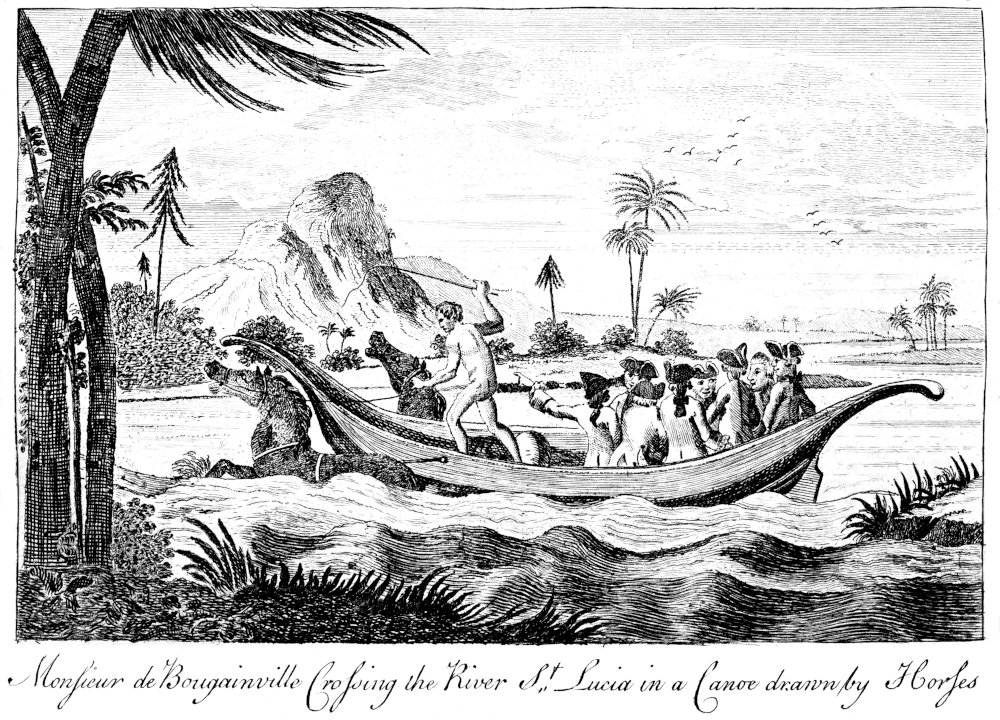
Monsieur de Bougainville Crossing the River S
t
. Lucia in a Canoe drawn by Horses
Monsieur Bougainville having transacted his business at Buenos Ayres, returned to Montevideo on the 16th of February, and was followed in a few days by the Spanish Governor, Don Puente. Some necessaries of various kinds being taken on board, the vessels were prepared for sailing to Falkland’s Islands.
Our author now gives a long account of the establishment of the Spaniards in Rio de la Plata, of which we shall take no notice, because similar accounts are to be found in a great number of volumes, some or other of which are in the hands of almost every reader.
Our voyagers having caused a small vessel to be laden with cattle for the use of the ship’s companies, they sailed in company, on the 28th of February 1767, a pilot, acquainted with the coast of Falkland’s Islands, having been previously put on board each of the Spanish ships; but this day they were obliged to bring their vessels to an anchor, on account of the thickness of a fog, which prevented their seeing land.
The winds now proving contrary, the ships remained at anchor the following day; but as the current of the river ran strongly in their favour, Mons. Bougainville sent to acquaint the Spanish commander, that his vessel being too near the English sand-bank, off the isle of Flores, he thought it would be proper to sail on the following day, even if the wind should not change in their favour. To this the Spanish officer replied, that his pilot refused to weigh the anchor till the wind became fair and blew steady: on which Don Puente was acquainted, that the anchor of the Boudeuse would certainly be weighed early the next morning, and that she would either anchor more to the north, or ply to the windward, waiting for the Spanish ships, unless they should be unavoidably separated by the violence of the wind.
The small vessel laden with cattle had not come to an anchor during the preceding night, nor was she seen any more during the voyage; but it was afterwards learnt that she went back to Montevideo, after an absence of three weeks from that place. The night had been so tempestuous, that all the ships dragged their anchors, and in the morning the Spanish vessels were observed with their main-yards lowered, and their top-masts handed: the Boudeuse, however, got under sail, and got out of the river before night, leaving the Spaniards still at anchor. Mons. Bougainville had variable, but chiefly bad, weather till the 23d of the month, when he came to an anchor in the Bay of Falkland’s islands, where the Spanish vessels also anchored, on the day following. These last had suffered extremely through the inclemency of the weather; the cabbin windows of Don Puente’s ship had been broke by the violence of the waves, so that the sea for some time poured into her in torrents; and a number of cattle, destined for the use of the colony at Falkland’s Island, died on the passage.
On the 1st of April Mons. Bougainville, in the name of the French king, surrendered the island to Don Puente, who received it for his most catholic Majesty, with the ceremony of hoisting the Spanish colours, and the firing of guns from the ships and on shore: Mons. Bougainville then read a letter, in which his sovereign granted leave to such of the inhabitants as chose to continue their residence, to be under the dominion of Spain: this offer was accepted by some, while others embarked with the garrison, and were conveyed to Montevideo in the Spanish ships. The whole expence of the French settlement, to the time of its being delivered to the Spaniards, was six hundred and three thousand livres; but as his most Catholic Majesty took the ships, provisions, and all the stores of every kind, he reimbursed this sum to France.
Mons. Bougainville now proceeds to make some historical remarks respecting Falkland’s Islands, in which we shall trace him with all possible fidelity. He says that, in the year 1502, when Americo Vespucius was on his third voyage for the discovery of America, he sailed along the northern coasts of the islands, and to him, therefore, he allows the honour of being the first discoverer; yet he says that Vespucious knew not whether what he saw was an island, or a part of the main land. Gouin, a French commander, came to an anchor on these islands, in the year 1700, as he was returning from a voyage into the South Seas; but Gouin mistook them for Sebald’s isles, which lie very near them, Falkland’s Islands being between those, and the island of Beauchesne; so that a ship at anchor on the east side of Sebald’s isles, is within sight of Falkland’s;—Besides Beauchesne’s description of what he took to be Sebald’s, exactly answers to these; for he says there are no woods, that the country is swampy, that there are many fresh-water lakes and marshes on it, and that it abounds in ducks, snipes, wild geese, and teals.
Mons. Bougainville justly observes, that Falkland’s islands have been but little known, and ill described, till within a few years past. They are commonly represented as being covered with woods; but this mistake might very well happen in the accounts of those who only saw them from on board a ship for what are taken for woods are tall rushes, which grow very close together, and the stalk being dry to the height of five feet from the ground, a large tuft springs from the top of it, so that their number, and the manner in which they grow, form no ill resemblance of a wood. Great part of the hills on the island are covered with heath, while the rushes grow only on some small isles, and near the sea coast.
In the year 1594 Sir Richard Hawkins had sight of these islands, and called them Hawkins’s Maiden-Land: he says he saw fires on them, and that they were then inhabited: about the commencement of the present century, a French ship, called the St. Louis, came to an anchor on this coast, under the shelter of the isles of Anican, which are some small islands, so called after the privateer of that name; but the commander of the St. Louis did not think it worth his while to examine the country: yet, Mons. Bougainville observes, that the navigators of all nations have remarked how conveniently they are situated for affording shelter and refreshment to vessels bound to the South-Seas.
France having come to a resolution of sending a colony to settle on Falkland’s islands, Mons. Bougainville, towards the beginning of the year 1763, made an offer to establish the settlement at his own expence, with the assistance of two of his near relations, Mons. de Arboulin, and Mons. de Nerville. This offer being accepted, the adventrous Frenchman gave orders for the building and equipment of a vessel of twenty, and another of twelve guns, the former of which was called the Eagle, and the latter the Sphinx: and as soon as these vessels had taken in such stores as were necessary for the voyage, and for making the settlement, Mons. Bougainville, having previously engaged some acadian families, embarked his officers, seamen and settlers, and sailed from the Port of St. Malo, on the 15th of September, 1763.
In the course of the voyage he touched on the coast of Brazil, and at Montevideo, at which last place he took a number of horned cattle and horses on board, in order to stock the island to which he was destined. On the 31st of January, 1764, Mons. Bougainville was within sight of Sebald’s isles, and came to an anchor in a large bay on the eastermost point of Falkland’s islands, on the third of February.
It was soon resolved to form the settlement on the coast of this Bay; and Mons. Bougainville immediately began to take a survey of the island, to learn what it produced, for the support and convenience of life. He observes, that various kinds of water and land-fowl, and fish, were all its edible productions: and that the reader already knows that there grows no wood, either for firing, or other purposes; but this deficiency, in Mons. Bougainville’s opinion, might be tolerably well supplied by an excellent kind of turf, which was almost every where to be found in great abundance.
On the first arrival of our adventurers, it was a sight not less pleasing than astonishing, to behold the birds flock round them, with evident curiosity, but without the least signs of timidity: these harmless animals used to perch on those who were standing still, and would at all times submit to be taken with the hand: but they very soon learnt to be shy of the company of those who sought only their destruction.
The colony consisted of nineteen men, five women, and three children; and Mons. Bougainville having fixed on the spot for their residence, they lost no time in erecting huts, which they covered with rushes, to protect them from the inclemency of the weather. They likewise built a magazine, and erected a small fort, in the center of which they raised an obelisk, under which they had placed several pieces of money, and a medal, on one side of which was the head of the French king, with the following motto; Tibi serviat ultima thule; and on the other side of the medal was an inscription, of which the following is a translation.—“Settlement of the Isles Malouines, situated in 51 degrees 30 minutes of south latitude, 60 degrees 50 minutes west longitude, from the meridian of Paris, by the Eagle frigate, Captain P. Duclos Guyot, Captain of a fire-ship, and the Sphinx sloop; Captain F. Chenard de la Giraudais, Lieutenant of a frigate, equipped by Louis Antoine de Bougainville, Colonel of infantry, Captain of a ship, chief of the expedition, G. de Nerville, Captain of infantry, and P. d’ Arboulin, postmaster general of France: construction of a fort, and an obelisk, decorated with a medallion of his Majesty Louis XV. after the plans of A. L’Huillier, engineer and geographer of the field and army, serving on this expedition; during the administration of E’. de Choiseul, Duke of Stainville, in February 1764.”
Mons. de Bougainville having promised the settlers, that he would soon bring them more companions, and give them farther assistance, his relation, Mons. de Nerville, agreed to stay till his return from France, as well to be an hostage for the performance of de Bougainville’s promise, as to encourage the young colonists, by participating in every hardship and danger to which they might be exposed, in a station so far removed from all communication with the rest of mankind. In return for Mons. de Nerville’s kind compliance with the wish of the settlers, he was to be considered as their Governor.
On the 8th of April 1764, Mons. Bougainville weighed his anchor, and sailed for Europe, having first taken possession of the islands, in the name, and for the use of his most Christian Majesty.
In the month of January 1765, Mons. Bougainville again visited Falkland’s Islands, where he found the settlers in good health, and pleased with their situation. After he had debarked the stores which he had brought for their use, he sailed to the Streights of Magellan, where he took in timber and pallisadoes, and a number of young trees for planting on Falkland’s Islands; which place he again left on the 27th of April, when the whole number of colonists was only twenty-four.
While Monsieur de Bougainville was on the above mentioned expedition in the Streights of Magellan, he saw the ships under Commodore Byron’s command; the reader will recollect this circumstance, in the account of Mr. Byron’s Voyage, related in the twenty-first page of the preceding volume.
The colonists on Falkland’s Islands were encreased to about one hundred and fifty, by a number of fresh settlers, which sailed from France in the Eagle, in the year 1765. This ship was accompanied by the Etoile store-ship, which carried provisions to the island. By this time the Governor, and an officer who took care of the stores, had good houses built of stone, and the rest of the colonists were lodged in commodious huts, having walls composed of sods of earth. With the wood which Mons. Bougainville had brought from the Streights of Magellan, they had built several small vessels, adapted to examine the coasts of the island; and three magazines were by this time erected, in which to deposit the public and private stores; several kinds of grain which had been brought from France grew very well, and promised a sufficient encrease; and some train-oil had been made, and seals-skins turned, by the settlers, with which the Eagle was loaded, and returned to France.
In the year 1766, when an English colony had settled at Port Egmont, Captain Macbride, of the Jason frigate, visited the French settlement, and, to use Mons. Bougainville’s own words, “pretended that those parts belonged to his Britannic Majesty, threatened to land by force, if he should be any longer denied that liberty, visited the Governor, and sailed away again the same day.”
The above, according to Bougainville’s account, was the state of Falkland’s islands, when the French surrendered them to Spain; and he pretends, that the prior claim of Spain was confirmed by such surrender of those who had made the first settlement: and perhaps there might be some force in this reckoning, if the prior claim of Spain was founded in justice, and warranted by the laws which have hitherto directed the discoverers of unknown countries. An Englishman, however, will be glad to see this argument stated in its proper light, by which it will appear, that the right to the possession of these islands, is undoubtedly vested in the Crown of these realms.
The plain state of facts, then, is as follows: as early as the voyage under Sir Thomas Cavendish, in the year 1592, Captain Davis had sight of these islands: they were seen a second time, in 1594, as before-mentioned by Sir Richard Hawkins, who gave them the name of Hawkins’s Maiden Land: the third person who saw them was the Dutch voyager Sebald de Waert, who called them Sebald’s Isles, and under this name they are laid down in the Dutch charts. In the year 1683 they were seen by Dampier, and, in 1689, by Strong, who gave them their present English name of Falkland Islands, which Dr. Halley, the celebrated astronomer, adopting, they are now so called in all the maps and charts of this country. During the reign of William and Mary, the English privateers often saw these islands, whereas, according to Mons. Bougainville’s own account, the first Frenchman who ever saw them was Gouin, no longer ago than the year 1700. From this state of the evidence it does not appear, that the Spaniards visited them at all, and that the French were the last visitors; yet would Mons. Bougainville have his readers believe, that the Spaniards have the prior claim to their possession, and that this claim has been ratified by the French!—This reasoning may sound admirably well in the ears of the slaves of two arbitrary monarchs, but will be equally ridiculed and contemned by every sensible subject of our happier, because limited, monarchy.
Monsieur Bougainville now proceeds to give an account of the natural history of, and other particulars respecting, Falkland’s Islands, which, he says, are the result of the observations of his kinsman, Mons. de Nerville, who resided at the settlement three years. The picture our ingenious voyager gives of the first appearance of the islands is very striking, and his arguments for and against settling them are very conclusive. On their first arrival not an object struck their view, except the commodiousness of the port in which the ship lay, which could tempt them to take up their residence on so inhospitable a shore. The land was in many places broke in upon by the sea; the mountains, unclothed with wood, had the most barren appearance; the fields looked dreary for want of houses and inhabitants; an universal silence reigned, except when the howling of some sea-monster disturbed the solemn stillness; while a dull and gloomy sameness of appearance added horror to the whole picture.
Discouraging as this scene appeared, our adventurers knew that all would yield to time and diligence, and that the labour of the industrious would not go unrequited: indeed some consolation arose in their breasts, on viewing the place in a more favourable light. The climate had that kind of temperature likely to afford health, strength, and long life, and was therefore preferable to the noxious air of those regions where the sickening inhabitant faints under the scorching heat of the vertical sun: the island produced a number of plants, admirable in the cure of the scurvy, and other disorders incident to the sailor’s life. The fish and the birds were most exquisitely delicious, and there were amphibious animals in immense numbers, while there were none of the fierce or the poisonous kind. Cascades and rivulets fell from the mountains, which at the same time sheltered the fisherman from the violence of the winds, so that he could sport or labour in the spacious bay, in perfect security: meadows of an immense extent promised constant pasturage for any number of flocks and herds, which might feed at pleasure, undisturbed by any tyrant lord of the soil. These various advantages, in the opinion of our adventurers, were sufficient to recompence them for the dangers and fatigue of the voyage, and a pledge for the full reward of their future labours.
The situation of Falkland’s Islands is between fifty-one and fifty-two degrees and a half of south latitude, and sixty-five degrees and a half of west longitude from Paris. From the entrance of the Streights of Magellan, and from the coast of Patagonia, their distance is about 250 miles.
The harbours are large, and well defended by small islands most happily disposed; and even the smallest vessels may ride in safety in the creeks: while fresh water is easily to be obtained, as the small rivers which descend from the mountains discharge themselves into the sea. The tides do not rise and fall at any stated times, but depend on the force with which the wind agitates the waves of the sea; it was, however, observed, that just before high water, the sea rises and subsides, with a quick motion, three times within the space of fifteen minutes and that at the full of the moon, and during the equinoxes and solstices, this motion is much greater than at any other time.
Those winds that blow from between the south and west, and the north and west points, prevail more than others but in general the winds vary as in most other countries. In summer time the winds usually blow from some point between the north-west and south-west. It is remarkable, that these winds rise with the rising sun, encrease in force as the sun advances to the meridian, blow most violently just at noon, decrease again with the declining sun, and totally cease about the time of its setting. The tides also frequently add to the violence of these winds, and not unfrequently change their direction.
The blowing of the winds in winter is a certain indication of the weather. If they come from the south-east, they are not so violent as the summer winds from the same quarter; but they are accompanied with slight fogs. When they blow between the south and west points, hoar frost, hail and snow, are the certain consequences; and the weather is wet and foggy, when they come from the points between the north and the west. The snow which comes with the south and west winds is but small in quantity, and commonly disappears from the ground in a day or two, except what lodges on the summits of the high mountains, where it will remain about two months. The running streams are never frozen, and the lakes and stagnate pools have seldom been covered with ice strong enough to bear the weight of a man two days together. In the spring and autumn there are slight hoar frosts, which being changed to a kind of dew by the warmth of the sun, are rather nutrimental than prejudicial to the vegetable productions. There is seldom any thunder or lightning, nor is the climate hot or cold in any extraordinary degree. Throughout the year the nights are, in general, star-light, serene, and fair; and, upon the whole, the climate is very favourable to the constitution.
The fresh water of these islands is extremely good, and in great plenty: the beds of some of the rivers are a kind of tuft, which gives a yellowish cast to the water, yet does not affect its taste; but the bottom of most of the rivers is either sand or gravel.
The depth of the soil in the vallies is more than sufficient for the purposes of plowing; but, before our adventurers could proceed to cultivation, they were obliged to extract the roots of plants, which every where interfered and choaked up the ground for near a foot deep: these roots they dried and burnt, and they then made a rich manure for the ground from which they had been cleared. Under the first land is a layer of black earth, ten inches or more in depth; under that again a yellow soil, beneath which are stones and slate; but these stones are not found on the little adjacent islands. The sea-coast is, in most places, composed of stones, which are very fit for the purposes of building; and there are beds of a hard fine grained stone, in several spots on the island; likewise another kind of stones, in which are particles of talc. Our settlers found a kind of stone which split in pieces easily, and with which they made grind-stones, to give an edge to their instruments. In the quarries they met with a stone of a yellowish hue, which, when first taken out, was so soft as to be cut with a knife; but it soon grew hard when exposed to the open air. The island likewise yeilded earth fit for making bricks and potters-ware, and plenty of sand and clay.
In many parts of the country there are marshy places, which produce a sort of rushes with sharp points, the remains of the roots of which being continually wasting, form the turf that was used for firing, which burnt exceeding well, and had nothing offensive in its smell.
A plant of the gramen kind grows on a stalk which has a sweetish flavour, and is extremely nutrimental for cattle, who like it better than any other kind of pasturage. This plant flourishes on the sea-coasts, and on the little isles, where it bends till the stalks unite, forming a kind of harbour, to which the sea-lions and the seals occasionally retreat. Our adventurers, in several excursions, found these natural built houses, a very agreeable defence against the inclemency of the weather, and the more so, as the dry leaves which had fallen off formed a bed, by no means to be despised.
The above-mentioned plant is the largest that grows on the island, which likewise produces many shrubs that were very useful in heating ovens, and other purposes of firing. A kind of heath, which grows in great plenty, bears a red fruit, which is eaten by the fowls and birds.
A plant was discovered which resembles a shrub, but having been tasted, it was thought fit for the brewing of beer: happily our colonists were supplied with malt and molasses, to which they added the beer-plant, and were enabled at all times to brew a very wholesome kind of spruce beer, which was an admirable specific for the scurvy. This plant was likewise infused in water, in which those who had contracted any illness, while out at sea, bathed themselves, and it was found to be a fine restorative: when pressed, it yeilded a mealy substance, of a fragrant smell, and a glutinous nature: the leaves of this plant are small, of a clear bright green, and dentated.
Other vegetables in abundance were found, which were used as antiscorbutics; particularly water-cresses, sorrel, wild parsley, a kind of maiden-hair, and a species of celery.
But the most extraordinary vegetable production of Falkland’s Islands, is a kind of resinous gum-plant, of which we shall speak more particularly, as it is wholly unknown in these parts of the globe. Though this is called a plant, it is without leaves, branches, or any apparent stalk and, except in colour, which is that of a bright green, it more resembles a lump of earth rising from the common surface of the ground. It does not grow to the height of more than eighteen inches, and its breadth in different plants is from two feet to two yards and upwards: the smaller plants have the form of an hemisphere, and their circumference is regular; but when they come to the full size, they terminate in irregular bunches and hollows: there are drops of a tough yellow matter, as big as a pea, on different parts of its surface, which smell like turpentine. Mons. Bougainville having cut this plant close to the ground, found that it arose from a stalk, from which grew an immense number of shoots, consisting of leaves resembling stars, laying one within the other. The outsides of these shoots, which are exposed to the air, are green, and the insides white: they contain a viscid milky juice, which is likewise found in the roots and the stalk. The roots extending horizontally, frequently produce fresh shoots at a distance, so that there is no instance of one of these plants being found alone. The resin of this plant was found to be a good medicine for the cure of slight wounds; but this resin was often washed away by the rains, or wasted by the influence of the air; yet, however contradictory it may appear, it would not dissolve except in spirits: some of the seeds were brought to Europe, in order to attempt the cultivation of so singular a curiosity in the vegetable world.
The island on which our colonists had taken up their residence is divided from east to west by a chain of hills, to the south of which they found another plant, not unlike the resinous gum-plant, which, however, did not yield any resin, but produced beautiful yellow flowers; neither was it of so firm a texture, nor was its green of the same shade; yet, in other respects, the resemblance was very strong. On the hills was found a species of Maiden-hair, which grew to a great height, and the leaves of it were shaped like the blade of a sword. The hills likewise abounded with various kinds of plants, which had the appearance of holding a middle station between stones and vegetables. It was apprehended, that these might have been successfully used in dying, and our colonists proposed to have made the experiment if they had remained longer on the island.
The place produces flowers in a considerable variety, but only one of them has any smell, which is like that of a tuberose; this flower is perfectly white. A true violet was seen, which was of a regular light yellow colour.
A fruit was found, of the size of a pea, which received the name of the lucet, from its resemblance to the North American fruit of that name: its colour is white, but the side which is exposed to the sun changes to a red: it has the smell of orange blossoms, and a very agreeable flavour: its branches, which creep along the ground, produce leaves of dark green, which are round and shining, and these leaves infused into milk give it a delicious taste: the flowers grow in large numbers on the borders of lakes, and the plant delights in a moist soil. Besides the lucet only one other fruit was found, which grows on long branches, in the same manner as the strawberry, but it has the appearance of a mulberry, which name it received, and its leaves are like those of the hornbeam.
Our colonists found but few sea-plants which they could apply to any use; but all the coast of the harbour was lined with sea-weeds, which were serviceable in breaking the force of the waves in stormy weather. Many kinds of coralines, of various beautiful colours, and a great number of curious shells and spunges were washed on shore by the force of the tides. Among the shells were the smooth and striated muscle, scallops, whelks, and a bivalve shell, of a very singular kind, named la Poulette.
Sea lions and seals are the only amphibious animals found in these parts; but there are great varieties of fish on the coasts, scarce any of which are known in Europe. It sometimes happens that the whales, getting too near the shore, are stranded in the bays, where their remains have been seen. Bones of great magnitude have been found far up the country, where the force of the waters could not have conveyed them, which Mons. Bougainville deems a proof that the soil is encreased, or the sea diminished.
The only quadruped found on Falkland’s island is of a species between the fox and the wolf, and our author therefore calls him the wolf-fox: the tail of this animal is more bushy than that of the wolf, and he lives in a kennel which he digs in the ground, on the downs by the sea-side. At one time of the year the wolf-fox is so lean as to appear almost starved, from whence it is imagined that he fasts for a considerable time: he is about as large as a sheep-dog, and barks very much like one, only that his yelp is not so loud. He subsists principally on wild fowl, in search of which he travels in such a direct line from one day to another, that when our adventurers first beheld his track, they imagined that the island was inhabited, and that the natives had made the path. Mons. Bougainville makes it a matter of wonder how the wolf-fox can have been conveyed to these islands, without considering, that land-animals having got on large pieces of ice, which being broken by the sea, they have frequently been conveyed to places very remote from those of their first residence. The circumstance of ice so broken from the shore is not uncommon on the coast of Greenland.
These islands and their coasts produce land and water-fowls in incredible numbers, many of which are the prey of falcons, hawks, eagles and owls; while the eggs and the young birds are destroyed by the wolf-fox.—The smaller fish are destroyed by the whales, the amphibious animals, and the voracious birds, some of which are constantly flying close over the surface of the waters, while others perch themselves on the rocks to watch the event.
Mons. Bougainville now proceeds to a description of such birds as were found on the islands, which could be applied to any kind of use; omitting those that could not be rendered serviceable to the colonists.
The swan is perfectly white, except its feet and its neck, the former of which are of a flesh-colour, and the latter as black as jet.
Of wild geese there are four kinds, only one of which feeds on dry ground. It has very high legs, and a neck of great length: its flight is much more free than that of the English goose; it walks with equal ease, and does not cackle like the common goose. The feathers of the male are white except on the wings, which have a mixture of ash-colour and black: the wings of the female are of various colours; and its body is yellow. It seldom lays more than six eggs. The flavour of these birds is agreeable, and they were found to be very nutritious: exclusive of those which are hatched on the island, large flocks fly thither with a westerly wind which blows in the autumn, so that they were generally to be taken in great abundance, and formed a principal part of the subsistence of the settlers. Those which came in the autumn were easily known from those resident on the island, by their not being shy.
The other three kinds are of various colours; yellow, white, black, and ash-colour; they are not by far so beautiful as those above described: and as they live entirely on fish, their flesh acquires a disagreeable taste; one of these three species seldom rises from the surface of the water, and is almost constantly making a very disagreeable noise. A soft thick down, either grey or white, grows under the feathers of all these geese, as it does likewise under those of the swan.
The rivers and ponds of Falkland’s islands abound in teals of two species, and two of wild ducks: of the latter some are perfectly white, and others totally black, but in other respects they resemble those of England and France. These birds are all exquisite fine food, and to be procured in any numbers. One kind of the teal is very small; but the other is as large as the duck, and its bill is blue. The bellies of some of them are also covered with feathers of a flesh-colour.
The island produces a bird which Mons. Bougainville calls the Diver, but, from the description he gives of it, it is conjectured to be the Grebe, which abounds on the lake of Geneva, and of the skin of which the most elegant muffs and tippets are made. Of these Divers there are two kinds, of which the most plentiful has brown feathers, with no other variation than that the feathers on the belly are of a somewhat lighter colour than those on the back. The belly of the other kind is white, and the back grey; and the feathers on the belly are very thick, shining and soft. The eyes of these birds are as bright as rubies, and are encircled with a ring of white feathers. The female hatches only two young birds at a time, which she carries on her back, not subjecting them to the coldness of the water, till feathers have taken place of the down with which they are hatched. The toes of this bird are thin, and of a green colour, and being round towards the claw, they are not unlike the leaves of some plants: their feet are not webbed, as is common among water-fowl, but their toes are separate, having a strong membrane on each side.
The colonists gave the name of Saw-bills to two kinds of birds which bore a great similitude to each other, the chief difference consisting in their size, and in the bellies of most of them being white, while a few were observed to have brown feathers on the belly: the feathers on the rest of the body are of a dark blue, as soft as silk, and grow very close together. Their feet are webbed and flesh coloured, and their bills pointed: they lay their eggs on the rocks, where great numbers of them live together; and they subsist on fish, thousands of which they destroy. Our settlers not only ate the eggs of these birds, but frequently killed many scores of them at a time, and their flesh was found to be excellent food. They had so little apprehension of being catched, that it was an easy matter to knock them down with a stick, and in this manner they were usually taken. A bird called by the Spaniards Quebrantahuessos, which measures more than two yards from the extremity of its wings, destroys the saw-bills. This bird of prey has a long bill, with two hollow tubes of the same kind of substance as the bill, and its feet are webbed: some of the seamen called this bird the Albatross, but it differs considerably from the common bird of that name, nor is it an easy matter to determine precisely on its species, from the imperfect account which Mons. Bougainville has given of it.
Gulls, mews, and terns, of different beautiful plumage, served to direct our colonists what was the proper time for taking of pilchards. These birds, flying in large flocks over the surface of the water, dart on the pilchard and swallow it; presently they catch another of these fish, and then they disgorge the one which had been previously swallowed, and so on. When the pilchards are not in season, they feed on various other sorts of small fish. The eggs of these birds were found in great abundance upon the leaves of a plant, on the borders of the marshes, and they proved to be very good eating.
Three kinds of penguins breed on the island, one of these is a remarkably grand and elegant bird, the belly of which is a clear white, the back a kind of blue, and it has a ruff round its neck near the head, of a bright yellow, which descending towards the belly, separates the white feathers from the blue ones; these birds do not live together in numbers, but seek the most quiet and retired places of abode. One of them being caught, with an intention of being brought to France, soon grew so tame, that it followed the person who fed it; its food was bread, fish and flesh; but there was something more wanting for its sustenance, for it gradually lost its fatness till it died. The second kind of penguin answers to the description of that bird in Anson’s voyage[2]. The third kind of penguins lay their eggs among the high cliffs of the rocks, where they reside together in immense numbers, never seeking that solitude of which the first kind are so fond. They are much smaller than the others, and were named hopping penguins, from their method of moving, which is very much like hopping; they have gold-coloured feathers, which form a kind of eye-brows, and a tuft of the same colour, which they raise when they are displeased. This bird has a very chearful look, and its general colour is a deep yellow.
At different times, but not frequently, three kinds of petrels were seen by our adventurers. These birds build their nests on the sea-coasts, where their young were sometimes found, covered with down. One sort of them is quite white, their bills red, and not unlike a pigeon; a second sort is larger, and the third smaller than the pigeon; and these two sorts have white feathers on the belly, while every other part of the body is black.
Eagles were also seen of three different species, two of which are black, with white and yellow feet, and the other is of a dull white: all these subsist on snipes, and other small birds, which they seize every opportunity to destroy.
Egrets, a species of the heron, were frequently seen on the island: they make a disagreeable noise, not much unlike the barking of a little dog; and they never take any food till towards the evening.
Two kinds of the thrush came regularly to the island in the autumnal months, one of which was of the same colour as the European thrush; and the other yellow, except on the belly, which was spotted with black. There was a third kind of thrush, which lived on the island throughout the year, the feathers on the belly of which are of a bright red: this was called the Red-bird, and though Mons. Bougainville ranks it among the thrushes, it is probably no other than the red-breast of America.
A bird which they called the Sea-pie, was constantly seen on the coasts, the feet of which were white, the bill red, and the feathers black and white. This bird whistles a kind of note, which the colonists found it easy to imitate, and by that means they came near enough to catch them without much trouble: they subsist on shrimps, which they pick up after the ebbing of the tide.—Such is Mons. Bougainville’s description of the sea-pie; but if it be the true bird of that kind, oysters form a part of its subsistence; for when the tide is out, these fish are left on the sand, and the sea-pie, forcing open the shell with his bill, swallows the oyster; whence he is also called oyster-catcher.
Great numbers of curlews, the same as those of Europe, were constantly seen in the summer; and snipes of the European kind were found in abundance. It is easy to shoot these birds, as they fly in a regular manner. At the time when they are breeding, they ascend to a great height, and having sung some time in the air, they drop at once into their nests, which are built on the ground, in the open field, where it is most free from grass or other herbage, so that these nests are very easily found: the snipes are excellent food if dressed towards the decline of the year; but in the breeding season they are lean, and not so fit to eat.
The amphibious animals of Falkland’s islands are seals and sea-lions, which having been before-mentioned, and being described in many books of voyages, we shall only add, that they frequently travel in very numerous companies three or four miles up the country, to feast on the herbs, and repose themselves in the warmth of the sun.
Of the fish which were found on the coasts of Falkland’s islands, one that was taken in the greatest plenty was called the Mullet, from the likeness it bears to the European fish of that name: the colonists dried many of these, which were full a yard in length: the seals prey on these fish whenever they can catch them; but, by a natural instinct, they are taught to avoid these voracious enemies, by sheltering themselves in holes, among slimy ground, on the banks of the rivers, and in these places they were frequently taken. A fish called the gradeau, about twelve inches in length, was found in great abundance; and another, named the sardine, was found only at the commencement of the winter season. Some white porpoises were taken in the bays, when the weather was fair, and some eels in those cavities of the rocks which were filled with water. A fresh water fish was found, about the size of a trout, without scales, the colour of which was green. Many smaller fish were catched with the hook and line, among them was one species, the head of which resembled that of a pike, and it had no scales: a few soals were found; and Mons. Bougainville is of opinion, that a greater number of those, and many other different kinds of fish, might have been procured, if there had been hands sufficient to have constantly spared a proper number to attend the sea-fishery. The shell-fish found at this place were muscles, a very small kind of shrimp, a crab, the feet of which were blue, and a kind of cray-fish, or prawn, the colour of which was naturally red, without boiling: but our author says, these were only taken through curiosity, as their taste was much inferior to those European fish which are nearly of the same species.
The above is a faithful detail of the natural history of Falkland’s islands, as far as it could be learnt by the French settlers, during a residence of three years; if they had continued longer in the country, there is no doubt but that their discoveries would have been greater, and their account more accurate: from such as it is, however, it will probably be thought, by the English reader, that these islands are by no means so barren and inhospitable a spot, as our ministerial writers took the pains to represent them, as soon as it was known, that our people in power had formed the disgraceful resolution of permitting the prior claim of England to this extensive country, to yeild to the imperious demand of the haughty Spaniards.
It must, indeed, appear evident to the unprejudiced view of the intelligent reader, that these islands might, in the course of a few years, be made a very valuable possession: as they abound in fowl and fish of various useful kinds, while their amphibious animals, the sea-lions and seals, would yeild a quantity of grease and train-oil, which might make no inconsiderable articles of commerce; and what astonishing crops of wheat, barley, and every kind of European grain might not be raised on a tract of land that is many hundred miles in extent! It is true the islands do not naturally produce any trees; but it would be easy to carry thither the seeds of some, and young trees of other kinds; and there is no doubt, but that they would flourish in a country situated, with regard to the south pole, nearly as Ireland is with regard to the north.
As true Englishmen, we cannot help expressing a wish that the day may yet arrive, when some Statesman of sense and spirit may re-urge and insist on the right of Great Britain, to the possession of Falkland’s islands; The reader will excuse this digression, and prepare to attend Mons. Bougainville in the course of his voyage.
After waiting at these islands till the 2d of June 1767, in expectation of the Etoile store-ship, and finding that she did not arrive, Mons. Bougainville considered, that as his vessel would hold no more than six months provisions, and that he had only two on board, it would be an act of rashness to attempt the crossing the great pacific ocean alone; he therefore resolved to steer to Rio Janeiro, at which place he had appointed the Etoile to join him, in case any unforeseen accident should prevent her reaching Falkland’s islands before he left the harbour of that place.
They had fine weather from the 2d till the 20th of June, on which day they had sight of the mountains on the main land of Brasil; and they saw the entrance of Rio Janeiro on the day following. A number of fishing-boats being observed near the shore, Mons. Bougainville hoisted Portuguese colours, and ordered a cannon to be fired; on which a boat put off to the ship, and a pilot was engaged to conduct her into the road.
The coast of this country is broken by a number of small hills, which serve to give an agreeable variety to the prospect. The country is rather mountainous, and well clothed with woods.
The ship having arrived off the Port of Santa Cruz, a Portuguese officer was sent to enquire the reason of her sailing into it; on which Mons. Bougainville sent one of his officers to acquaint the Viceroy of the Brasils, with the motives for his touching there, and to enquire whether if he should salute the fort, the compliment would be returned.
The answer which the French officer received from Count d’Acunha, marks that singular haughtiness and arrogance, for which some of the Portuguese Governors are not a little famous:—the Count said, that when a person bowed to another whom he might casually meet in the street, he was not previously certain that his compliment would be returned, and that if Mons. Bougainville should fire his guns by way of salute, he (the Viceroy) had then to consider what was proper to be done. As this answer was by no means satisfactory to Mons. Bougainville, he, with that spirit of pride becoming a gentleman and an officer, disdained to fire a single gun.
About the same time a canoe was dispatched from the Captain of the Etoile, to inform Mons. Bougainville of the safe arrival of that vessel, which now lay in the port. The Commander, Mons. de la Giraudais, sent word, that instead of leaving France in the month of December, various accidents had combined to detain him two months beyond that time: that when he had been three months at sea, his rigging was so greatly damaged, and his vessel admitted so much water, that he was obliged to make the harbour of Montevideo, whence he sailed for his present station, and had come to an anchor but a few days before Mons. Bougainville’s arrival.
The Etoile had at this time salt provisions sufficient to supply both the vessels for almost a year and a half; but as her stock of bread and legumes was insufficient for the consumption of more than seven weeks, Mons. Bougainville resolved on sailing to Rio de la Plata, to take in a stock of those articles, as neither flour, wheat, nor biscuit could be purchased at Rio Janeiro.
On the 22d of June 1767, Mons. Bougainville and his officers paid a visit to the Viceroy of the Brasils, which was returned three days afterwards on board the Boudeuse; when the Viceroy gave permission for the purchase of a sloop, which our adventurers imagined might be very serviceable during the long voyage they proposed to make. The Chaplain of the Etoile having been murdered, some days before the arrival of the Boudeuse, under the windows of the Viceroy’s palace, that gentleman promised that he would endeavour to find out, and severely punish, the perpetrators of the horrid deed; but Mons. Bougainville complains much of his remissness in the execution of this necessary piece of justice.
The Viceroy, contrary to his usual custom, continued to behave with politeness to the French officers, for several days after this visit; and acquainted them, that he proposed to honour them with an elegant collation in bowers of orange-trees and jasmine, on the banks of the river; and he actually gave orders, that a box at the opera should be assigned for their reception. Here, says our author, a band of mulatoes performed the best pieces of metastasio, while the compositions of the greatest geniuses Italy ever produced, were “executed by an Orchestra, which was under the direction of a hump-backed Priest, in his canonicals.”
We cannot avoid making a remark on the illiberal and ungentleman-like manner in which Monsieur Bougainville recites this part of his narrative; for it would be in a high degree ridiculous to suppose that the Priest, because he had the misfortune to be crooked, should be, by that circumstance, the less qualified to conduct a band; nor can we see, if the works represented were, as our author calls them, divine, the great impropriety of their being under the direction of a Priest, nor of that Priest’s being dressed in the habit of his order. The French are ambitious of being accounted the best bred people in the world; they claim a kind of exclusive right to politeness; but they are only the smugglers and monopolizers of that commodity, to the injury of the fair traders, the English, the Scots, the Hibernians, whose open sincerity, and manly freedom of behaviour, gives the lie to the French assumption of a superior gentility. It is evident, from many instances in Mons. Bougainville’s voyage, that a Frenchman can, when he pleases, be guilty of a savage illiberality of conduct, that would disgrace the untutored boor of the wilds of Siberia, or the still more uncultivated savage of the uncivilized parts of America.
At this time there lay in the harbour of Rio de Janeiro, a French ship, called the Morning Star, and a Spanish man of war, named the Diligent; and, while the Viceroy behaved with all imaginable politeness to the Frenchman, he had artfully protracted the stay of the Spaniard no less than eight months, during all which time her Commander had not been able to procure the articles necessary for the repair of his vessel, and without which she could not proceed on her voyage. In this dilemma, Don Francesco de Medina, Captain of the Diligent, applied to Mons. Bougainville, for the assistance of his carpenters and caulkers, who were immediately sent, both from the Boudeuse and the Etoile.
The complaisance with which the Viceroy treated the gentlemen on board the French vessels, surprised the Spaniards, who told them, that they must not long expect so great a share of his favour; and they had soon reason to be convinced, that the prediction was founded in truth; for though the Viceroy had permitted Mons. Bougainville to purchase a sloop, and he had actually agreed for one, his Excellency thought proper to forbid the delivery of it; and notwithstanding they had contracted with this tyrannical Viceroy for the purchase of some timber from the royal Dock-yards, he afterwards changed his mind, and would not let them have it. He even went so far as to refuse Mons. Bougainville, and the gentlemen on board his ships, permission to lodge in a house near the town, while the Boudeuse was repairing, notwithstanding the owner of the house had consented to accommodate the French officers.
Mons. Bougainville, piqued at these repeated instances of the Viceroy’s want of good manners, and his total inattention to the common rights of humanity, determined to pay him a visit, to remonstrate with him on the glaring impropriety of his conduct: taking with him therefore two of his officers, he repaired to the house of the Viceroy, who was agitated with the most furious passion the moment Mons. Bougainville began to speak, and commanded him to leave the house; this, however, he refused to do, but kept his seat for some time, even after the Viceroy had called his guards, who, with more prudence than their master had shewn, neglected to obey his summons, and the French gentlemen left the house, without seeming to have caused any disturbance. Not long after their departure, an additional number of guards were placed round the palace, and orders were issued, that if any Frenchman should be seen in the streets after the sun was down, he should be taken into custody. The Viceroy likewise commanded the Captain of the French ship named the Morning Star, to quit his present situation, and anchor his vessel under the fort of Villagahon, which order was complied with on the following day.
One of the Portuguese officers was exiled, and another imprisoned, because they had behaved with civility to Mons. Bougainville; and it was easy to foresee, that such of the inhabitants of the place as traded with the French, would experience the consequences of the Viceroy’s indignation; every preparation was therefore made to quit a place, which the tyranny of the count de Acunha had rendered so disagreeable. The Captain of the Spanish man of war supplied Mons. Bougainville with timber proper for the repair of his ship, and an inhabitant of Rio Janeiro privately sold him a number of planks, which he was in great want of; and, indeed, the inhabitants in general behaved with a kindness and civility, which fully proved the sense they entertained of the impropriety of the Viceroy’s conduct.
Mons. Bougainville now proceeds to give an account of the riches of Rio Janeiro, and the amount of the revenues arising to the King of Portugal, from the mines of Brasil; these mines we have already given some account of in the former part of this work, but as Mons. Bougainville’s account is very interesting, and contains many particulars there unnoticed, we make no doubt but the reader will approve our tracing him with the pen of accuracy and fidelity.
The mines which lie nearest to the city of Rio Janeiro are not less distant than two hundred and twenty miles, and are called the General mines. His most faithful majesty, having a fifth part of the produce of these mines, seldom receives less than one hundred and twelve arobas of gold from their annual produce, and sometimes considerably more.
There are mines at Sero-frio, Sabara, and Rio des Mortes, which are under the jurisdiction of the managers of the general mines. Near Sero-frio is a river, the stream of which being turned out of its usual channel, diamonds, topazes, chrysolites, and other valuable stones, are found among the pebbles in the bed of the river; nor are any diamonds brought from the Brasils but what are found in this particular spot.
The stones thus found are deemed the property of the owners of the mines; but the King of Portugal has appointed a surveyor, to whom they must give in an account of what diamonds are found with the utmost exactness. These the surveyor puts into a casket which has three locks, and is enclosed in iron plates; the Viceroy keeping one of the keys, the Provador de Hazienda Reale the second, and the surveyor the third. This casket, and the keys with which it is locked, are then enclosed in a second casket, on which these three gentlemen affix their seals; and this again is placed in a third, on which the Viceroy puts his seal, and thus ships the treasure for Portugal, where the coffers are opened in the presence of his most faithful majesty, who having selected such of the diamonds as he pleases, the owners of the mines are paid for them, at a rate stipulated by a previous agreement.
The number of slaves employed in searching for diamonds is about eight hundred, and for every day’s labour of each of these slaves the King of Portugal receives a Spanish dollar from the proprietors of the mines.
It is extremely dangerous for any person to secrete a diamond; yet the practice is very common, as the smuggled goods can be so easily hidden. When a person is detected in this illicit trade, if he is rich he is sentenced to deliver up the diamonds, pay twice their value, suffer one year’s imprisonment, and then be banished to the coast of Africa for life: but if the offender be poor, he is generally doomed to suffer capitally.
In every district of the Brasils where gold is found, a house is erected, to which it must be carried, and the King’s share paid, the rest is sent to Rio Janeiro, where it is melted into wedges, and in that state returned to the owners: these wedges being numbered, and stamped with the King’s arms, the weight is marked on each wedge: the gold is likewise assayed, and the alloy stamped on it, for the greater expedition when it comes to be coined.
About ninety miles from Rio Janeiro is a place called Praybuna, where there is an office for the registering the ingots which are the property of private people; and as all persons coming from the mines must necessarily pass this place, two military officers are stationed here, who have fifty men under their command, whose business it is strictly to examine, that no illicit trade is carried on; so that every one who passes is obliged to submit to the strictest search. At this place, exclusive of the tax to the King, men and beasts of burden are taxed with a farther toll of a real and a half each, the half of which becomes the property of the officers and soldiers, and the other half goes to his Portuguese Majesty.
The ingots of gold which belong to private people having been registered at Praybuna, are then carried to Rio Janeiro, where the proprietors are paid their value in demi-doubloons, which are worth about thirty shillings each of English money; but there is a profit to the King for alloy, and for coining these demi-doubloons, of about four shillings and six-pence on each. The mint at Rio Janeiro is a most noble building, admirably adapted for the purpose of coining money, which is performed with the most astonishing expedition; and this, indeed, is rendered necessary, because two Portuguese fleets usually arrive nearly at the same time that the gold is brought from the mines.
The fleet which arrives from Porto brings coarse cloth, several articles of food, with brandy, wines, and vinegar; and this, with the fleet which comes from Lisbon, occasions Rio Janeiro to be a place of very considerable trade; the effects on being landed, are charged with a duty of ten per cent. to his Portuguese Majesty.
Soon after the earthquake at Lisbon, in the year 1755, an impost of two and a half per cent. under the denomination of a free gift to the King, was laid on all goods landed at Rio Janeiro, so that the whole duty paid is no less than twelve and a half per cent. The latter duty is instantly paid on the goods being brought on shore, but the officers of the custom-house will take security for the payment of the former at the expiration of half a year.
There are two districts, named Pratacon and Quiaba, the mines of which produce diamonds; but no person is permitted to seek for them, that the market may not be overstocked; for it is evident that, to make diamonds plentiful, would be to render them of little value.
His Portuguese Majesty is at an expence of about one hundred and forty-five thousand pounds sterling, annually, for repairing of the ships and public buildings, working the mines, and paying all his servants, civil and military.
The following account will shew what value, in sterling money, arises annually to his most faithful Majesty, from the royal revenues of Rio de Janeiro.
Dollars.
The King’s fifths are generally, one year with another, about one hundred and fifty arobas of gold, which make, in Spanish dollars, 1,125,000
The duty on diamonds amounts to 240,000
The profit arising from the coinage of money is 400,000
The duty of ten per cent. paid at the custom house is 350,000
The free gift of two and a half per cent. amounts to about 87,000
Various produces of the mines, with the poll-tax, and monies arising from the sale of offices and employments, 225,000
A duty laid on negro slaves, produces 110,000
A tenth on all the food of the country, and the taxes on soap, salt and train-oil, bring in a revenue of 130,000
Total value in dollars 2,667,000
Hence it will appear, that the revenues arising to the King of Portugal from Rio Janeiro are something more, annually, than four hundred and fifty thousand pounds sterling, reckoning the dollars at four shillings and six-pence each.
Mons. Bougainville now proceeds to give an account of his leaving Rio Janeiro, and his second voyage to Montevideo; of which we shall carefully select as many particulars as may afford either instruction or entertainment to the reader.
On the 14th of July 1767, the anchors of the Boudeuse and Etoile were weighed; but as the wind abated soon afterwards, they were obliged again to bring to, before they could get out of the harbour. They sailed, however, on the following day; and in the night of the 19th, the main-top-sail of the Boudeuse was carried away by the violence of the wind.
On board of Mons. Bougainville’s ship was a professor of astronomy, who had made the expedition with a view of discovering the longitude at sea; and as an eclipse of the sun was to happen on the 25th of the month, great hopes were formed, that an opportunity would thereby be obtained of making the wished-for discovery: but it happened, that these sanguine hopes were all frustrated, by the intervention of clouds, which obscured the face of the sun almost during the whole time of the eclipse.
On the morning of the 28th our adventurers had sight of the Castilles, at the distance of something more than thirty miles. They saw the entrance of a bay, which Mons. Bougainville conjectures to be the same on the banks of which the Spaniards have erected a fort. The vessels sailed into the Rio de la Plata, and were within sight of the Maldonados on the 29th; early in the morning of the 31st, they had a view of the Isle of Lobos, and before night came to an anchor in the Bay of Montevideo.
The ships were no sooner anchored, than the Governor sent a gentleman on board Mons. Bougainville’s vessel, who acquainted him, that most of the Jesuits in those parts had been lately seized, and their estates confiscated, in consequence of an order received from the Court of Spain: that these devoted victims of superior power had scarcely made the least resistance; that they bore their misfortunes with a degree of patience and calm submission that did them honour; and that no less than forty of them had been taken away in the vessel which brought the orders for their disgrace.
As it was necessary that Mons. Bougainville should remain in his present station till the equinox was passed, his first care was to build an hospital for the sick, and to take lodgings at Montevideo. This being done, he repaired to Buenos Ayres, in order to hasten the provision of such necessaries as he wanted, for which he was to pay the same price as the King of Spain usually gave for the same commodities.
Mons. Bougainville was also desirous of conversing with the Governor-general Don Francisco Buccarelli, on the behaviour of the Governor of Rio Janeiro and he soon learnt, that Don Buccarelli, instead of making reprisals on the Viceroy of the Brasils, which he could have done, very much to the prejudice of Portugal, had, more prudently, only sent a narrative of his proceedings to the Court of Spain.
Don Buccarelli was so obligingly ready to supply Mons. Bougainville with such articles as he stood in need of, that in less than three weeks two small vessels sailed for Montevideo, with ladings of flour and biscuit for the use of the French ships. Mons. Bougainville also sailed to Montevideo, leaving an inferior officer at Buenos Ayres, to see the remainder of their provisions shipped.
They now expected to sail in a short time, when an accident happened that detained them some weeks beyond the intended period. A Spanish register-ship being at anchor, a violent hurricane arose in the night, and driving her against the Etoile, carried away part of the head of that vessel, and broke her bowsprit on a level with the deck.
The leaks of the Etoile being encreased by this accident, it was absolutely necessary that she should undergo a thorough repair; but as there was not timber enough at Montevideo for this purpose, Mons. Bougainville obtained Don Buccarelli’s permission, that she might sail up the river, to the Encenada de Baragan, which is a little bay formed by its mouth; and in this bay, by the 21st of October, she was put in a condition proper for sailing, and began to take in the necessary provisions.
In the road of Encenada Mons. Bougainville found a frigate and several merchant-ships which were bound for Europe, and two Spanish vessels, which having taken in a store of ammunition and provisions, were bound to Falkland’s islands; and from thence to the South Seas, to take on board the Jesuits of Peru and Chili. Two Xebecks likewise lay here, one of which was loaded with presents from his most Catholic Majesty, to the inhabitants of Terra del Fuego, in grateful testimony of his sense of their generous conduct towards the crew of the ship Conception, which was wrecked on their coasts about two years before.
The inhabitants of the country on the banks of the Encenada de Baragan live in poor mean huts, which are constructed with rushes, having a covering of leather. These are built in a very irregular manner, on a miserably barren soil, and the country around them is so poor, that the people find it very difficult to procure the necessaries of life.
From the road of Encenada de Baragan five ships sailed for Spain, having on board most of the French families which had quitted Falkland’s islands, and two hundred and fifty Jesuits. About this time two Spanish register ships arrived, one of them had been no less than seven months in her passage from Europe, above six weeks of which were expended in the doubling of Cape Horn, where the fury of the winds was such as to carry away her rudder, and lay her under the necessity of seeking shelter in this port. When she arrived she had buried no less than thirty-nine of her men, and almost all the rest were so enfeebled by the scurvy, that only a few of the officers, and three of the fore mast-men were able to do their duty towards navigating the vessel. Mons. Bougainville, with the greatest humanity, sent a number of his crew on board her, by which she was enabled to reach the harbour of Montevideo.
Mons. Bougainville now proceeds to give an account of his sailing from Montevideo to the island of St. Elizabeth, which includes a narrative of what passed on his interview with the Patagonians, and several other interesting particulars till he reached the isle of St. Elizabeth.
The Etoile sailed from the Encenada on the 30th of October, and the Boudeuse on the day following, having on board provisions for ten months, and soon reached Montevideo, having lost three men in that short passage, by a boat, in which they were sitting running fowl under the ship at a time when she was wearing; two other men who were in the boat were with much difficulty saved, and the boat was recovered.
Early in the morning of the 14th of November, 1767, they sailed from Montevideo, with a fine gale of wind at north, being in sight of land till the evening. On the 16th and the five following days, the sea ran high, and the wind was contrary, so that they were obliged to reef their top-sails. On the 22d the wind blew a perfect storm, which continued all the succeeding night in squalls, attended with rain; the Etoile made a signal of distress, but the violence of the gale would not admit of any assistance being given them. As the waves became less mountainous, by the abating of the wind in the morning, Mons. Bougainville hailed the Etoile, to make enquiry into what damage she had sustained in the late violent storm; when he learnt that several of her chain plates, and her fore-top-sail-yard had been carried away, and that she had lost almost all the cattle which had been purchased at Montevideo: the Boudeuse had likewise lost most of her cattle, but had sustained no other damage.
The winds were at this time very uncertain, frequently changing during the remainder of the month, and the currents were so violent, as to drive the vessels as far as the forty-fifth degree of south latitude. They now concluded, that they were between thirty and forty degrees from the coast of Patagonia; and, at length, when they had soundings with a line of forty fathom, they had sight of Cape Virgins; the same land which Sir John Narborough and Commodore Anson have distinguished by the name of Cape Virgin Mary.
As Mons. Bougainville had, during a former voyage, discovered a sunken rock in forty-eight degrees and a half of south latitude, he avoided coming too near the shore till he was in forty-nine degrees; the person who had formerly first seen this rock, imagined it had been a grampus, and the ship had sailed within considerably less than a mile of it.
It was on the 2d of December that they had sight of Cape Virgins, about which time they made all the sail possible, as the wind was in their favour. They now saw a number of Albatrosses, and petrels, the last of which Mons. Bougainville says are a sign of bad weather, whenever they are seen. They also beheld penguins, seals, and whales in considerable numbers. He says, that the skins of the whale appeared to be covered with small worms, very much like those which are observed to adhere to the bottoms of old vessels which lie rotting in harbour. Some white birds, not unlike pigeons, but of a larger size, now perched on the yards of the Boudeuse.
Soon after they had sight of Cape Virgins they made the land of Terra del Fuego, and for several successive days, they contended with tempests and contrary winds. On the 3d of December, the wind blowing favourable for a short time, they made their best efforts to reach the entrance of the streights of Magellan; but the wind soon fell to a dead calm, and thick fogs clouded the whole coast of the country: in a few hours the breeze again sprang up, but, as by this time night came on, they were obliged to ply to the windward.
Early in the morning of the 4th the wind being favourable, they again stood in for land, when hazy weather and rain preventing their having sight of the coast, they were obliged to keep the open sea; it cleared up, however, in a short time, when they made another attempt to enter the streight; but the wind changing, the fog growing thicker, and a storm ensuing, they were compelled to lay to, between the main land, and the two shores of Terra del Fuego.
On the 4th of December the fore-sail of the Boudeuse was split by the fury of the winds, and as at this time they were in no deeper water than twenty fathom, they determined to scud under their bare poles, lest they should run fowl of some breakers which lie off Cape Virgins, to the south south-east.
They now made other fruitless attempts to enter the streight, sometimes being within sight of the Cape, and at other times at a considerable distance from it. Mons. Bougainville says that the view of this Cape, as given in Anson’s voyage, is exact in every respect.
The night of the 5th was spent in standing off and on; and early in the morning of the sixth they were in sight of Cape Possession, and likewise of Terra del Fuego. They now took the advantage of a westerly tide, and tried to get close to the coast of Patagonia. They kept sounding all the night between the sixth and seventh, not sailing to a greater distance from the coast than three leagues. What they had gained by plying to the windward, they lost by the opposition of the currents, and about noon on the 7th were back in their former station.—What man in his senses, who reads accounts like these, would hazard the imminent dangers of such seas, for the honour of having made a new discovery, or the pride of saying, that he had circumnavigated the globe!
This day they had sight of Cape Orange, which forms the first narrow pass in the streights. This narrow pass Mons. Bougainville called goulet, which is not improperly translated gut. It is rather more than forty miles from Cape Virgins to this first gut, and the streights, for this distance, are of different breadths, of seldom less than five, or more than seven leagues. On the north coast the land is high and healthy, and has a regular appearance, as far as Cape Possession, in the bays of which there are several dangerous rocks, opposite to the two hillocks, to which Sir John Narborough gave the name of the Asses Ears.
In the afternoon, when they had reached the entrance of the gut, though the wind blew fresh, and all their sails were set, the tide ran with so great force, that they were driven backwards, instead of advancing in their voyage.
In the evening the ships were anchored in Possession Bay, and on the eighth, by the assistance of a strong breeze, they stemmed the tide; and afterwards, by making different tacks, they got through the first narrow entrance of the gut, with the wind right against them.
During the preceding night they had observed fires on the shore, and this morning they discovered a white flag, which the Patagonians had erected on a rising ground; on which a white flag was likewise hoisted at the mast-head of each vessel. The flag which these Patagonians had put up, was one given to them by the Commander of the Etoile, when that ship lay in Boucault’s Bay, in the month of June 1766, so that it is pretty evident, that the people were the same. Mons. Bougainville speaks in very grateful terms of the care these Indians had taken to preserve the flag.
While the ships were passing the above-mentioned gut, a number of men, clothed in the skins of beasts, were observed on Terra del Fuego, who ran along the shore with their utmost expedition, in order to keep pace with the vessels: they likewise frequently beckoned with their hands, as if they wished our voyagers to land. The Spaniards say, that the inhabitants of that part of Terra del Fuego, are less savage in their manners than most other native Indians. When Mons. Bougainville sailed from Rio de la Plata, a Spanish ship was on the point of sailing thence, to convey some Priests, to instruct these people in the doctrines of Christianity.
The ships having come to an anchor in the afternoon, in Boucault’s Bay, several officers from each vessel, having fire-arms with them, embarked in boats, and went ashore at the bottom of the bay. The common sailors were ordered to remain in the boats, and to keep them afloat: the gentlemen were no sooner landed, than half a dozen of the natives came riding up to them, on the full speed. When they were advanced within fifty yards of the French, they dismounted, and came forward, pronouncing the word Shawa. Having come up quite close, they held out their arms, and laid them on those of the officers, whom they shook hands with, and embraced, repeatedly saying Shawa, which word was repeated by Mons. Bougainville and his officers.
An Englishman, on reading the above passage, may be allowed to make a remark on the singular politeness of these savages, manifested by the circumstance of embracing; but he will not pay so vile a compliment to the delicacy of the uninstructed Patagonian, as to suppose, that he made the first advance towards a salute: on the contrary, it is but a piece of justice due to the superior good-breeding of the French, to conclude, that they taught the savages that worst rudiment of all politeness, that most filthy deviation from all decent and manly behaviour, the shocking custom of men kissing each other! An Englishman of virtuous principles and refined ideas, would scorn to kiss his own son, whom he had not seen for a twelvemonth, if the boy but approached to his teens: no! let the manly shake of the hand, and the generous effusion of the heart from the lips, be the only expressions of affection, duty or politeness, between man and man. Let our embraces be reserved for those amiable creatures, to whom God and Nature have taught us they are due.
The Patagonians appeared to be much pleased with the company of their new friends; but it was observed, that some of them had a mixture of fear imprinted on their countenances: this, however, was soon removed by the hospitality of the officers, who sent to the boats for bread and cakes, which were as readily devoured as they were chearfully given. More of the Indians soon approached, among whom were some children. They expressed no kind of surprise at the sight of their visitants, and seemed not to be unacquainted with the use of fire-arms, as appeared by their making a noise which resembled the report of a gun. The good nature of these people was expressed in all their actions: some of the French gentlemen being engaged in collecting plants, the Patagonians no sooner saw what kinds they collected, than they immediately began to pull up and bring the same sorts. One of them seeing an officer engaged in this employment, went to him, and pointing to his eye, which had received an injury, intimated his wish, that some herb might be shewn him, the virtues of which would cure the disorder: and this was deemed to be a conclusive proof, that they had an idea of the medicinal virtues of herbs.
Mons. Bougainville received from these Patagonians a number of skins of the guanacoe and other beasts, in exchange for a few trinkets, on which they seemed to set a great value. Some of the gentlemen having red cloaths on, the natives advanced, and stroked them with their hands, seeming highly delighted with every thing of that colour; they also made signs for some tobacco, and as often as any thing was given them, they cried out shawa, in a very loud and disagreeable tone.
A small quantity of brandy being given to each of the Patagonians, they had no sooner drank it, than they struck their hands repeatedly against their throats, and blew with their mouths, so as to produce a kind of trembling sound, at the conclusion of which they had a singular quivering of the lips.
The evening now advanced, and the gentlemen prepared to return to their ships, which was no sooner observed by the Indians, than their uneasiness was expressed in their countenances, and they intimated, by signs, that they wished them to remain longer, as they expected more of their brethren. The French, on the contrary, made signs that they would come again the next day, and bring such articles as the natives had requested of them.
Mons. Bougainville and his party now walked towards their boats, accompanied by the Indians, one of whom sung songs till they reached the coast, and several of them went into the water as far as where the boats lay, where they seized on all the articles they could put their hands on; but when they saw they were observed, they made no scruple to return them.
As the boats were rowing off, many more Patagonians were observed galloping down to their countrymen; and the crews of the boats now cried out Shawa, so loud that the people on shore could not fail to hear them.
Mons. Bougainville says, that these Indians were the same which were seen by the crew of the Etoile, in the year 1765, for one of the seamen recollected a person among them whom he had before seen. These people are well made, and appear to be about the height described by other voyagers. Our author says, that it is the thickness of their limbs, the largeness of their heads, and the extraordinary breadth of their shoulders, that make them appear to be of a gigantic race.
The colour of the Patagonians is brown, as is that of all the native Americans, in whatever climate they are born. Their muscles are strong, and their nerves well braced; and as their food abounds in juices proper for the nourishment of the human frame, it is no wonder that they arrive at their full growth. Their eyes are sparkling, their teeth extremely white, and their faces round, but rather flat; and many of them are very comely men. Some of them have whiskers, which grow long, but are very thin; and they all tie their hair, which is long and black, on the top of the head; the cheeks of some of them are painted red. Their language has an agreeable and melodious sound. Our voyagers did not see any of the Patagonian women; though it was conjectured, that the men intended to have brought them from a kind of camp, which appeared to be about three miles distant.
These people wear a piece of leather round the waist, and a kind of cloak made of skins, which descends to the bottom of the leg, and is girt round the body; the part which would otherwise cover the shoulders, is permitted to fall back, so that the greater part of the body is left naked, though the climate is so cold as, apparently, to require more covering than the whole which they wear; but custom will harden the human frame, so as to defy the rigour of the most inclement seasons.
It was in the summer when Mons. Bougainville was on the coast of Patagonia, yet, he says, there was only a single day on which the thermometer was observed to rise to ten degrees higher than the freezing point.
The rest of the dress of the Patagonians consisted of a sort of half-boots, made of the skin of the horse, and left open at the back part of the leg. A few of them wore on the thigh a ring made of copper, two inches in breadth; and the necks of two very young men were adorned with beads.
Some small knives, of the manufacture of England, were seen in their possession; which our author very properly concludes were the gift of Commodore Byron; and their only arms consisted of a twisted gut, in the two ends of which were enclosed a round pebble; and weapons of that kind, he says, are used in all that part of the American continent.
Their horses are very poor, and of a small size; and the saddles and bridles were such as are used by the natives of Rio de la Plata. One of these people was observed to have gilt nails on his saddle, stirrups made of wood, enclosed with copper, a bridle made of leather, twisted, and a compleat Spanish harness.
Their food consists chiefly of guanacoes and vicunnas, and they eat both the flesh and marrow of those animals. They devour this meat raw, with great avidity, and carry it with them on their horses. Fresh water being very scarce in this country, the horses drink the sea water, as do likewise their dogs, which are both small and ugly.
It was observed, that some of them pronounced capitan, chico, bueno, and other Spanish words. Mons. Bougainville concludes, that the Patagonians lead the same kind of life as the Tartars, as they are always on horseback, traversing immense plains, in pursuit of wild beasts and game; and he imagines that they also, like the Tartars, plunder the caravans of travellers; but this remark seems equally cruel and unjust, from his own account of the singular friendship and kindness with which they treated himself and his fellow-voyagers. Our author concludes this part of his narrative by saying, that he has “since found a nation in the south pacific ocean, which is taller than the Patagonians.”
Mons. Bougainville tells us, that the soil of this country is extremely dry, and very much like that of Falkland’s islands: the coast, likewise, exhibits the same kind of sea-weeds, and shells of similar sorts are strewed upon the beach. The country produces shrubs, but affords no woods for shelter.
On the 9th of December, 1767, all the sails of the vessels were set, to make head against the fury of the tide; but they were obliged again to come to an anchor, after sailing only three miles. During two whole days the weather was so tempestuous, that not a boat could put off from the ships, which was a mortifying circumstance, as great numbers of the Patagonians were by this time got together, on the spot where they had conversed with the officers, who were concerned that they were not able to keep their promise with these friendly people, whose little wants might have been easily supplied. It appeared, by the help of glasses, that they had built several huts on the shore, and it was observed, that some of them were constantly galloping backwards and forwards from this place to a spot, where it was supposed the main body of them lay.
Early on the morning of the 12th the Boudeuse lost an anchor, by the parting of the cable; soon after which they set all their sails, and by the assistance of the ebb-tide, and a favourable wind, they got through the second gut in the afternoon, and anchored on the north-side of the isle of Elizabeth.
As they were detained here two days, by tempestuous weather, and contrary winds, Mons. Bougainville resolved to land on the isle of Elizabeth, where he met with a few bustards, that were at this time hatching their eggs, but these birds were so intimidated at the sight of our adventurers, that they could not approach near enough to have even a single shot at them. The island produces no wood, but only a kind of heath, which might supply its place as fuel for the fire. The water of this place is brackish, and the soil extremely dry. Several places were likewise observed, which had been marshes, but had become dry, and the ground on some parts of them were covered with a thin crust of salt. It was evident that this island was occasionally visited by the Indians, as the shells of some fish they had eaten were found, near where a dead dog was lying, and where it was plain that fires had been made.
Our adventurers were now on the point of entering that part of the streights of Magellan which abounds in woods, and the principal difficulties were already overcome.
On the afternoon of the 30th the anchors were weighed, and they sailed, with a violent wind, in a channel between the islands of St. Barthelemi and Lions, and that of Elizabeth. They were now obliged to coast the last named island, to steer clear of a number of breakers, with which the other islands are encompassed. Having sailed beyond Cape Noir, they observed that the country had a pleasant appearance, being almost every where covered with woods, which afforded a most delightful prospect to the eye.
In the evening the weather became suddenly calm and pleasant, so that Mons. Bougainville pleased himself with the hope of being able to double Cape Round before the morning; but in this climate the most flattering appearances are by no means to be relied on; a truth that was fully evinced in the present instance: for soon after twelve at night the wind suddenly shifted, and blew most violently, bringing with it storms of hail, and deluges of rain, while a fog, apparently impenetrable, covered the whole coast.