Captain WALLIS’s VOYAGE ROUND THE WORLD.
Reading edition
Samuel Wallis, Esq; having been appointed to the command of his Majesty’s ship the Dolphin, which was destined for a Voyage round the World, he sailed down the river on the 26th of July, and came to an anchor in Plymouth Sound on the 16th of August; three days after which he received sailing orders, and directions to take under his command the Swallow sloop, and Prince Frederick store-ship. These vessels sailed on the 22d, and on the 7th of September, in the evening, came to an anchor in the road of Madeira. The next morning Captain Wallis saluted the Governor with 13 guns, and the compliment was returned with an equal number.
They sailed thence on the 12th, after having taken in beef, wine, and onions, as sea-stores. On the 16th, as they were sailing off the Island of Palma, at the rate of eight miles an hour, the wind suddenly died away, so that the vessels lay quite still. On the 20th they catched several bonettas, out of a great number which surrounded the ship; and this day they saw some herons flying to the eastward. The Swallow, which was a bad sailer, parted from the other vessels, in the night between the 21st and 22d, but she joined company again on the 24th, within six leagues of the Isle of May. This day the three vessels came to an anchor in Port Praya, in the above-mentioned island; and the next morning they obtained leave from the commanding officer at the fort, to get water and other necessaries. This being the sickly season there, and the small-pox being very fatal, the Captain detained every man on board who had not had that distemper.
They here catched great quantities of fish, and having procured cattle and water, and found some wild purslain that was very refreshing, they sailed on the 28th; and, in the night, saw the burning mountain on the peak of Fuego. Captain Wallis now ordered every man to be furnished with hook and line, that he might supply himself with fish; and likewise, to prevent infection, commanded that no man should keep his fish above twenty-four hours. On the 20th they began to serve the crews with oil, all the butter and cheese being consumed; and orders were issued, that, during the remainder of the voyage, they should be served with vinegar and mustard once a fortnight. On the 22d they judged that they were within 60 degrees of land, from the sight of a great number of birds. Two days after this orders were given for serving the men with brandy, the wine being reserved for those that were ill. On the 27th the Prince Frederick sprung a leak, and her crew were at this time so sickly, through the fatigue of pumping, and the badness of their provisions, that her commander, Lieut. Brine, was apprehensive he could not keep company much longer, except some assistance could be given him. The Captain sent a carpenter and six sailors on board, but he was unable to supply her with better provisions. As the carpenter found he could do little toward stopping the leak in the store-ship, the Dolphin and Swallow compleated their provisions from her stores, and put on board her the empty oil jars, staves, and iron hoops.
By the 12th of November they were in 30 degrees of south latitude, when they found the weather so cold as to have recourse to their thick jackets. On the 19th, at eight o’clock at night, they saw a meteor, which flew horizontally from north-east to south-west, leaving a train of light, which made it as bright as at mid-day on the deck. From the 20th to the 22d they saw whales, seals; snipes, plover, and other birds, and some butterflies. On the 8th of December they saw land, and on the 9th remarked, that the sea appeared coloured, by the immense quantities of red shrimps that surrounded the ship.
On the 16th, being very near Cape Virgin Mary, they saw several men riding on the shore, who made signs for them to land. Having come to an anchor, they observed that the natives remained opposite the ship all night, shouting aloud, and keeping up large fires. In the morning the Captain went on shore, with a boat’s crew from each ship, and having made signs for the Indians to sit down, he gave them combs, buttons, knives, scissars, beads, &c. and pleased the women greatly by the distribution of some ribbands. He then intimated that he should be glad to accept some guanicoes and ostriches, in exchange for bill-hooks and hatchets, which he shewed them; but they were either really or designedly ignorant of his meaning. The tallest among these people was six feet seven inches, several others were from one to two inches shorter; but the general height was from five feet ten to six feet. They were muscular and well made, but their hands and feet very small, in proportion to the rest of their bodies. They were dressed in the skin of the guanico, with the hairy side to their bodies; and some of them wore a square piece of cloth, made of the hair of the guanico, and a hole being cut to admit the head through, it reached down to the knees: they wore likewise a kind of buskin from the middle of the leg to the instep, which was also conveyed under the heel, but the rest of the foot was bare: their hair, which was strait and coarse, was tied back with a cotton string; and their complexion was the dark copper. They rode on horses about fourteen hands high, and had dogs of the Spanish kind; both men and women rode astride, and the men were furnished with wooden spurs: some of the men had their arms painted, the faces of others were variously marked, and others again had the left eye enclosed by a painted circle. Their arms were two round stones, enclosed with leather, one of which was fastened at each end of a string eight feet in length: and one stone being held in the hand, the other was swung round the head with great force for some time, and then discharged at any mark they chose to strike. They likewise catch guanicoes and ostriches by means of this cord, which is thrown so, that the weight twists round and hampers the legs of the intended prey. Some of them were observed to devour the paunch of an ostrich raw, having only turned the inside outwards, and shook off some of the filth.
These people, who are great talkers, were often heard to say Ca-pi-ta-ne, on which they were successively addressed in Portuguese, Spanish, Dutch, and French; but they had no knowledge of either of those languages. When they shook hands with any of the crew, they always said chevow; and they were amazingly ready in learning English words, and pronounced the sentence “Englishmen come on shore” with great facility.
As they seemed desirous of going on board, the Captain took eight of them into the boats, on which they instantly began singing for joy; but when they came into the ship, they expressed no kind of surprize at the novelties they beheld, till a looking glass being observed, they acted many antic gestures before it, occasionally walking to and from it, talking with earnestness, and laughing immoderately. They would drink nothing but water, but they eagerly ate every article of the ship’s provisions. They were highly pleased with some turkies and guinea-hens which were on board, nor did the hogs and sheep escape their attention. One of them making signs that he should be glad of some cloaths, the Captain gave him a pair of shoes and buckles, and presented the rest with a little bag each, in which he put new six-pences and halfpence, with a ribband passed through a hole in them, to hang round their necks: the remaining contents of the bag were, a looking-glass, a comb, some beads, a knife, a pair of scissars, some twine, and a few slips of cloth: being offered some tobacco, they smoked a few minutes, but did not seem to like it. The marines being exercised before them, they were terrified at the firing of the muskets, and one of them falling down, shut his eyes, and lay without motion, as if to intimate that he knew the destructive nature of those weapons.
It was with difficulty that they were at length prevailed on to go on shore; and one of them would not leave the ship till he had sung a long kind of prayer, and even petitioned to stay till evening, by pointing to the sun, and then moving his hand round to the western horizon. As soon as they were in the boat they began to sing, and did not cease till they reached the shore, where many of their companions pressed eagerly to be taken into the boat, and were highly affronted at being refused.
This day they turned into the Streight of Magellan with the flood-tide, and saw many people on horseback hunting the guanicoes, which ran up the country with prodigious swiftness. The natives lighted fires opposite the ships, and in the morning about 400 of them, with their horses feeding near them, were observed in a valley. This being the spot where Mr. Byron saw the Patagonians, some officers were sent towards the shore, but with orders not to land, as the ships were too far off to assist them in case of necessity. When they came near the land, many of the natives flocked towards them, among whom were women and children, and some of the very men they had seen the preceding day: these waded towards the boat, frequently calling out, “Englishmen come on shore;” and were with difficulty restrained from getting into the boat, when they found the crews would not land. Some bread, tobacco, and toys were distributed, but not an article of provisions could be obtained in return.
On the 23d the tide was so violent, that the ships were driven three several ways; but in the evening they were safely anchored. On Christmas-day they procured a quantity of celery from Elizabeth Island, which being boiled with portable soup and wheat, the crews breakfasted on it several days. Many huts were found on this island, and two dogs were seen; but the Indians had quitted it for the present. Many high mountains were observed, which, though it was then the midst of summer, were, in a great degree, covered with snow.
On the 26th they anchored in Port Famine Bay, and the sick were sent on shore, where a tent was erected for their reception, as was another for the accommodation of the sail-makers, and those who landed to get wood. On the 28th the empty water-casks were landed; and on this day great quantities of fish were catched, among which were smelts. When they arrived here, many of the people were very bad with the scurvy; but by the plentiful use of vegetables, and bathing in the sea, they all recovered in a very short time.
All hands were now employed in repairing and storeing the ships; and thousands of young trees were carefully taken up with the mould about them, to be carried to Falkland’s Islands, which produce no timber.
On the 17th of January, 1765, the Master of the Dolphin, who had been in search of anchoring-places, returned with an account, that he had found such as were proper for the purpose; and this day the Prince Frederick sailed for Falkland’s Islands.
They sailed on the 18th, and came to an anchor the next day, half a mile from the shore, opposite a current of fresh water, that falls rapidly from the mountains. As a more convenient anchoring-place, and at the same time better adapted for procuring wood and water, had been discovered, they sailed again the next day, and, on the 23d, came to an anchor in the bay near Cape Gallant, where they catched wild ducks in such numbers, as to afford them a very seasonable relief. Near this spot are very high mountains, one of which was climbed by the Master of the Swallow, with the hope of getting a view of the South Sea; but being disappointed in his expectation, he erected a pyramid, and having written the ship’s name and the date of the year, he left the same, with a shilling within the structure.
On the 24th they saw an animal that was as swift as a deer, and had a cloven foot; but in other respects it was like an ass. Near this spot the country has a most forbidding aspect:—the mountains on both sides of the Streight are of a stupendous height; the lower parts of them are covered with trees, above which a space is occupied by withered shrubs; higher up are fragments of broken rock, and heaps of snow; and the tops are totally rude, naked, and desolate.
On the evening of the 28th they saw a great smoke on the southern shore, and another on Prince Rupert’s Island; and the next morning some people being sent on shore for water, they had no sooner landed, than several of the natives came off in three canoes; and, having advanced towards the sailors, made signs of friendship, which being answered to their wish, they shouted aloud, and the English shouted in return. When the Indians came up they were eating the flesh of seals raw, and were covered with the skins, which stunk intolerably. They had bows, arrows, and javelins, the two last of which were pointed with flint. These people were rather low of stature, the tallest of them not exceeding five feet six inches, and their complexion was the deep copper colour.
Three of these people being taken on board the Dolphin, they ate whatever food was offered them; but, like the Patagonians, would drink only water:—like them too, they were highly diverted with a looking-glass, in which they at first looked with astonishment, till, having become a little more familiar with it, they smiled at its effect; and finding a corresponding smile from the figure in the glass, they burst into most immoderate fits of laughter.
The Captain going on shore with them, presented some trinkets to their wives and children, and received some of their arms, and pieces of mundic, of the kind found in the tin mines of Cornwall. These Indians went off in canoes, the sails of which were made of the seal-skin.
The ships sailed on the 3d of February, and came to an anchor in York Road on the same day. The next morning Captain Wallis, with a party, went on shore near Batchelor’s River, and saw many Indian huts, and several dogs, which ran away the moment they were noticed: they likewise saw ostriches, and collected various kinds of fish and vegetables. There is a cataract near this river, the noise of which is tremendous, as it falls more than 400 yards, partly ever a very steep descent, and partly in a perpendicular line.
They sailed on the 14th, and came to anchor again the same day in York Road, after having lost ground by the contrary winds. The next morning they were driven with such violence by the current, as to be in momentary expectation of being dashed against the rocks, from which they were frequently not half the length of the ship; but they were providentially preserved, and came to an anchor in Butler’s Bay, which was so called from the name of one of the mates, who discovered it. They kept this station till the 20th, when they encountered a most violent storm, attended with hail and rain, which increased till the evening, the sea breaking over the forecastle upon the quarter-deck; yet, as the cables did not part, they were again wonderfully preserved from destruction. They remained here eight days, taking in wood and water, and repairing the little damage the ship had sustained in the storm. They catched fish of various kinds, among which were muscles near six inches in length; and procured plenty of vegetables. The mountains in this neighbourhood had the most rugged and desolate appearance; but their height could not be ascertained, as their heads were lost in the clouds; and some of them, on the southern shore, were so exceedingly desolate, as not to produce even a single blade of grass; while the vallies were equally barren, and almost covered with snow.
On the 1st of March they sailed again, and anchored on the same day in a bay which they called Lion’s Cove, from whence they sailed on Monday; and on the five following days encountered such terrible weather, that they had no prospect before them but that of immediate destruction: and the crew on board the Dolphin were so prepossessed that the Swallow could not ride out the storm, that they imagined they saw some of her hands coming over the rocks towards them.
The storm at length subsided; but the weather being intensely cold, each of the men was furnished with a thick jacket, made of the woollen stuff called Fearnought. During a week which they remained at this place, they were at two-thirds allowance, brandy excepted.
On the 15th both ships were safely anchored in a place called Swallow Harbour, from whence they sailed the next morning; and on the following day the Swallow, being driven among breakers, made signals of distress; but she was happily relieved by a breeze from the shore.
This day the waves ran high, and there was so thick a fog, that they narrowly escaped shipwreck among a number of small islands; but the weather clearing up a little in the afternoon, they came safely to an anchor in a bay under Cape Upright.
On the 19th two canoes, having on board several Indians, came a-longside the Dolphin, who had with them a quantity of seal’s flesh, blubber, and penguins, which they ate without any kind of dressing. A seaman having catched a fish bigger than a herring, gave it to one of them, who killed it by a bite near the gills, and instantly devoured it. These people would not drink any liquor but water, but they eagerly ate provisions of any kind, boiled, roasted, raw, salt, or fresh. Though the weather was very cold, they had no covering but a seal-skin, and even that they did not wear when they were rowing. It was remarked that they had all sore eyes, probably occasioned by the smoke of their fires, and they lived in such a nasty way that they smelt as rank as a fox. They had a kind of javelin, pointed with bone, which they used in striking fish. The Captain presented them with a few baubles, with which they departed well satisfied.
Twenty-two of the sailors staying one night on an island, thirty of the natives hurried to their boat, and began to make free with its contents; but the sailors had just time to hinder their depredations, which enraging them, they ran to their canoes, and armed themselves with poles and javelins; but the sailors giving them some small presents, peace and harmony were soon restored.
The 30th of the month proving a fine day, they employed themselves in drying the sails of the ships, which were damaged by having been long wet. Several Indians went on board the next day, and proved to be the people which the boat’s crew had seen on shore.
On the 1st of April some of the natives brought several of the birds called Race-horses, which they sold to the sailors. The next day eight Indians brought six of their children on board, whom the Captain gratified with bracelets and necklaces. These people were exceedingly tender in the treatment of their children; and a circumstance happened which proves that they are not less delicate in other respects.—A boat was ordered on shore to get wood and water; at this time some of the Indians were on board, and others in their canoes a-longside the ship: the latter eyed the boat attentively; and, on her putting off, called aloud to their companions, who, without speaking, instantly handed down the children, and jumped into the canoes, which were hurried after the boat, while the Indians cried out in a most distressful tone. When the ship’s boat was near land, some women were seen among the rocks, to whom the Indians called out aloud, and they all ran away; but the boat’s crew having remarked their jealous fears, lay on their oars, to convince them that no injury was intended. The Indians landed, drew their canoes on shore, and hastily followed the objects of their affection.
On the 5th, at the request of the Surgeon, orders were given that no more muscles, of which they had hitherto collected plenty, should be brought on board, as the crew began to be troubled with fluxes. On the 10th the two ships sailed in company; and on the 11th they lost sight of each other, and did not meet again during the whole voyage. This day the Dolphin cleared the Streight of Magellan, in which she had laboured with innumerable difficulties, and escaped most imminent dangers, in a passage of almost four months, viz. from December the 17th, 1766, to the 11th of April, 1767.
Captain Wallis now proceeds to a description of the places in which the ships anchored, during their passage through the Streight; but as a minute recital of bearings, distances, and soundings, would be unintelligible to most of our readers, and possibly disgusting to them all, we shall omit these particulars; extracting only such anecdotes as may furnish real improvement or entertainment.
In the year 1581 the Spaniards built a town, which they named Phillipville, and left in it a colony of four hundred persons. These were all starved to death except twenty-four, all of whom but one proceeded in search of the river Plata, and most probably perished, as no tidings were ever heard of them: the remaining man, whose name was Hernando, was taken on board by Sir William Cavendish, in the year 1587, and brought to England; and the place was called Port Famine, from the melancholy fate of these unfortunate men. Wood and water abounds at this place; geese, ducks, teal, &c. are in great abundance, and there is no want of fish; so that the face of things must be greatly changed since the Spaniards died there of hunger.
Cape Holland Bay, where fish are catched in great plenty; and the adjacent country produces plenty of cranberries and wild celery, but there are no birds. At Cape Gallant Bay there is wood, water, vegetables, and fish; as there is also at Elizabeth’s Bay, and York Road. Butler’s Bay abounds with rock-fish, muscles, wild-fowls, &c. Lion Cove and Goodluck Bay produce scarce any thing but wood and water. Muscles and rock-fish are found at Swallow Harbour, the mountains round which are desolate beyond description. Upright Bay produces excellent water, and some wild-fowl and fish.
On Sunday the 12th of April they held a westward course, during which a number of sheerwaters, pintadoes, gannets, and other birds, flew about the ship; the upper works of which being open, and the cloaths and bedding constantly wet, the sailors in a few days were attacked with colds and fevers. The 27th of this month proving a fine day, the sick were brought on deck, and nourished with salop, and portable soup, in which wheat was boiled. The violent gales soon returned, so that the beds were again wet through, and it was feared that the ship would lose her masts: they therefore began to think of altering their course, in hope of better weather; and the rather, as the number of sick encreased so fast, that there was danger of soon wanting hands to navigate the vessel.
Nothing material happened from this time till the 14th of May, when something appeared to the eastward, which looked like high land, towards which a flock of brown birds were observed to fly: they therefore steered all night for this supposed land; but at day-break could see no signs of it. As the weather now mended, the people recovered very fast; and the carpenters were busied in caulking the upper-works of the ship, and repairing the boats. On the 21st they saw a number of flying-fish, and on the day following tropic birds, bonettas, and dolphins. About this time those who had recovered from colds were attacked with the scurvy; on which some sweet-wort was extracted from malt for their use, and they were supplied with pickled cabbage, and wine instead of brandy. Two grampuses were seen on the 26th, and on the day following variety of birds, one of which was taken for a land-bird, and resembled a swallow. Every method of cleanliness, and change of food, was now taken to prevent the scurvy, which began to encrease very fast.
On the first of June they saw several men of war birds, and the next day observed some gannets; and the weather being at this time very various, they conceived hopes that they drew near the land. On the 4th a turtle swam close by the ship; and the next day a great variety of birds were seen.
The long wished-for relief was now fast approaching; for on Saturday the 6th the man at the mast-head cried, “Land in the west-north-west.” This proved to be a low island, distant five or six leagues, and was soon seen from the deck, to the great joy of every one on board. When they came within five miles of this island, they discovered another to the west-north-west. Two boats were sent to the first discovered island, under the command of the second Lieutenant, the crews being well provided with arms. When the boats came near the island, two canoes were observed to put off to the other island. The crews having landed, gathered some cocoa-nuts, and collected a quantity of scurvy-grass, with which they returned to the ship, bringing with them some fish-hooks which the islanders had formed of oyster-shells. In this excursion they saw three huts, supported on posts, and open all round, but thatched with cocoa-nut and palm leaves, ingeniously wrought together. As no anchorage was to be found, and the whole island was encompassed with rocks and breakers, the Captain resolved to steer for the other island, giving the name of Whitsun Island to this, because it was discovered on the eve of Whitsunday.
Having approached the other island, about 50 of the natives, armed with pikes, and some having fire-brands in their hands, were observed running on the coast. Two boats were sent out, manned and armed, and the Lieutenant was instructed to steer for that part of the shore where the people had been seen; to avoid offending them, and to try to procure water and fruit in exchange for such commodities as he took with them. When the boat came near the shore, the natives put themselves in a position as if they would defend it with their pikes; but the crew making signs of friendship, and exposing their trinkets, some of the Indians walked into the water; to whom it was hinted, that some cocoa-nuts and water would be acceptable; which was no sooner done, than they fetched a small quantity of each, which they ventured to bring to the boats, and received some nails and other trifles in exchange. While they were dealing, one of the Indians stole a silk handkerchief with its contents, but the thief could by no means be discovered.
The next morning the boats were again dispatched, with orders to land, if they could do it without offence to the natives. As they approached the shore, they observed seven large canoes, each with two masts, laying ready for the Indians to embark in them: these having made signs to the crew to proceed farther, and this being done, the Indians embarked, and sailed westward, being joined by two canoes at another part of the island. These canoes, two of which were lashed together, appeared to be 30 feet in length, four in breadth, and three in depth. The people had long black hair hanging over their shoulders, were of a dark complexion, and of the middle size. They were dressed in a kind of matting made fast round the middle; and it was remarked, that the women were beautiful, and the men justly proportioned.
The Lieutenant being again sent on shore the Captain commanded him to take possession of the island in the king’s name, and to call it Queen Charlotte’s Island. The boats returned loaded with cocoa-nuts and scurvy-grass, after having found two wells of excellent water. Provisions for a week were now allotted for a mate and twenty men, who were left on shore to fill water; the sick were landed for the benefit of the air; and a number of hands were appointed to climb the cocoa-trees, and gather the nuts.
On the 10th the water was brought on board the ship, but the cocoa-nuts, and vegetables which the cutter was bringing off, were lost by the rolling of the waves, which almost filled her with water. On this island were found several tools, resembling adzes, awls and chissels, which were formed of shells and stones. The dead bodies were not buried, but left to decay above ground, under a kind of canopy.
The ship sailed this day, after taking possession of the islands for the king; in testimony of which they left a flag flying, and carved his majesty’s name on a piece of wood, and on the bark of several trees. For the use of the natives they left shillings, sixpences, halfpence, bottles, nails, hatchets, and other things. It should be remarked that, on this island, they found the very people who had fled from Queen Charlotte’s Island, with several others, in the whole near one hundred. It lies in 19 degrees 20 minutes south latitude, and 138 degrees 30 minutes west longitude; and received the name of Egmont Island.
On the 11th they observed about sixteen persons on an island which was called Gloucester Island; but, as it was surrounded with rocks and breakers, they did not attempt to land. This day they likewise discovered another, which was called Cumberland Island; and, on the day following, a third, which received the name of Prince William Henry’s Island.
On the 17th they again discovered land, and at ten at night saw a light, which convinced them that it was inhabited; and remarked, that there was plenty of cocoa-trees, a certain indication that there was no want of water.
The day following an officer was sent to the shore, with instructions to exchange some toys for such things as the island produced. He saw a great number of the people, but could find no place in which the ship might anchor. Some of the Indians, who had white sticks in their hands, appeared to have an authority over the rest. While the Lieutenant was trafficking with them, an Indian diving into the water seized the grappling of the boat, while his companions on the shore laid hold of the rope by which she was fastened, and attempted to draw her into the surf: but their endeavours were frustrated by the firing of a musket, on which all parties let go their hold. These Indians were dressed in a kind of cloth, a piece of which was brought to the ship.
From the number of the people seen, and their having some large double canoes on the shore, it was thought that there were larger islands at no great distance: the Captain, therefore, having named this place Osnaburgh Island, made sail, and having soon discovered high land, came to an anchor, because the weather was very foggy.
Early the next morning they saw land, distant 4 or 5 leagues; but after having sailed towards it some time, thought it prudent again to anchor, on account of the thickness of the fog: but it no sooner cleared away, than they found the ship encompassed by hundreds of canoes, in which were many hundreds of people. Having approached the ship, they beheld it with wonder, and talked with great earnestness. Some baubles were now shewn them, and signs were made for them to come on board, on which they rowed the canoes towards each other, and a general consultation took place; at the conclusion of which they all surrounded the ship with an appearance of friendship, and one of them delivered an oration, at the conclusion of which he threw into the sea the branch of a plantain-tree which he had held in his hand. This being done, a young Indian, of more apparent courage than the rest, ventured on board the ship. The Captain would have given him some baubles, but he refused the acceptance of them till those in the canoes came a-longside, and, having held a consultation, threw on board several branches of the plantain-tree. Others now ventured on board; but it was remarked, that they all got into the ship at some improper part, not one of them, even by accident, finding the right place of ascent.
A goat belonging to the ship having ran his horns against the back of one of the Indians, he looked round with surprize, and seeing the animal ready to renew the attack, he sprang over the ship’s side, and was instantly followed by all his countrymen. Their terror, however, soon subsided, and they returned to the ship; and the sheep, hogs and poultry being shewn them, they intimated that they possessed the two latter species. The Captain now gave them nails and other trifles, and made signs that he wanted hogs, fowls and fruit; but they could not comprehend him. They were detected in several attempts to take away any thing they could lay hold of; but one of them, at length, jumped overboard with a laced hat snatched from one of the officers.
The inner parts of the island abound in hills cloathed with timber trees, above them are high peaks, from which large rivers descend to the sea. The houses, when seen at a distance, resemble a barn, having no shelter but a roof: the land towards the sea is level, and produces the cocoa-nut, with variety of other fruits; and the face of the whole country is picturesque beyond description.
They now sailed along the shore, while the canoes, which could not keep pace with them, made towards the land. In the afternoon the ship brought to, and the boats being sent to sound a bay that promised good anchorage, the Indian canoes flocked round them. The Captain, apprehensive that their designs were hostile, made a signal for the boats to return to the ship, and fired a gun over the heads of the Indians. Though they were frightened at the report, they attempted to prevent the return of the cutter, but she easily out-sailed them. This being observed by some canoes in a different station, they intercepted her, and wounded some of her people with stones, which occasioned the firing a musket, and some shot were lodged in the shoulder of the man who began the attack; which the Indians observing, they all made off with the utmost precipitation.
The boats having reached the ship, preparations were made for sailing; but a large canoe being observed to make towards her at a great rate, it was resolved to wait the event of her arrival; on which an Indian, making a speech, threw a plantain-branch on board, and the Captain returned the compliment of peace, by giving them a branch, which had been left on board by the other Indians: some toys being likewise given them, they departed with much seeming satisfaction.
They now sailed; and the next morning were off a peak of land which was almost covered with the natives and their houses. On the 21st the ship came to an anchor, and several canoes came a-longside of her, bringing a large quantity of fruit, with fowls and hogs, for which they received nails and toys in exchange. The boats having been sent to sound along the coast, were followed by large double canoes, three of which ran at the cutter, staved in her quarter, and otherwise damaged her; the Indians, at the same time, armed with clubs, endeavouring to board her. The crew now fired, and wounding one man dangerously, and killing another, they both fell into the sea, whither their companions dived after them, and got them into the canoe. They now tried if they could stand or sit; but as the one was quite dead, they laid him at the bottom of the canoe; and the wounded man was supported in a sitting posture. The ships boats now kept on their way, while some of the canoes went ashore, and others returned to the ship to renew their merchandize.
While the boats continued out in search of soundings, the natives swam off to them with water and fruit. The women were particularly urgent for the sailors to land, and, pulling off all their cloaths, gave hints, of the most indelicate nature, how acceptable their company would be.
The boats being sent on shore with some small casks to get water, the Indians filled two of them, and kept all the rest for their trouble. When the boats came off, the shore was crouded with thousands of men, women, and children. During this time several canoes remained a-longside the ship; but the Captain would not permit a single Indian to go on board, as there was no guarding against their artful disposition.
On the 22d the natives brought hogs, poultry, and fruit to the ship, which they bartered for knives and other things; so that the whole crew was supplied with meat for two days, by means of this traffick. The boats having been this day sent for water, every inducement was used by the inhabitants to persuade them to land: and the behaviour of the women was still more lascivious than before. Having procured a small quantity of water, the boats put off; on which the women shouted aloud, pelted them with apples and bananas, and shewed every mark of contempt and detestation.
The ship made sail the day following, with intention to anchor off the watering-place; but the man at the mast-head discovering a bay a few miles to the leeward, they immediately stood for it. The boats, which were a-head, making a signal for anchorage, they prepared to bring to; but when the ship had almost reached the boats, she suddenly struck, and her head remained immoveably fixed on a coral rock; in which situation she remained near an hour, when she was happily relieved by a breeze from the shore. During the whole time that she was in danger of being wrecked, she was encompassed by hundreds of Indians in their canoes; but not one of them attempted to board her. The ship was now piloted round a reef, into an harbour, where she moored.
The Master was then sent to sound the bay, and found safe anchorage in every part of it. In the mean time some small canoes brought provisions on board; but as the shore was crouded with large canoes, filled with men, the Captain loaded and primed his guns, supplied his boats with musquetoons, and kept a number of the men constantly under arms.
On the 24th the ship sailed up the harbour, and was followed by many canoes, bringing provisions, which were exchanged for nails, knives, &c. In the evening a number of very large canoes advanced, laden with stones; on which the Captain ordered the strictest watch to be kept. At length some canoes came off, with a number of women on board, who, being brought almost under the ship, began to practise those arts of indelicacy already mentioned. During this singular exhibition the large canoes came close round the ship; some of the Indians playing on a kind of flute, others singing, and the rest blowing a sort of shells. Soon after a large canoe advanced, in which was an awning, on the top of which sat one of the natives, holding some yellow and red feathers in his hand. The Captain having consented to his coming a-longside, he delivered the feathers; and while a present was preparing for him, he put back from the ship, and threw the branch of a cocoa-tree in the air. This was, doubtless, the signal for an onset; for there was an instant shout from all the canoes, which, approaching the ship, threw vollies of stones into every part of her. On this two guns, loaded with small shot, were fired, and the people on guard discharged their muskets. The number of Indians now round the ship were full two thousand; and though they were at first disconcerted, they soon recovered their spirits, and renewed the attack. Thousands of the Indians were now observed on shore, embarking as fast as the canoes could bring them off: orders were therefore given for firing the cannon, some of which were brought to bear upon the shore. This firing put a stop to all hostilities, on the part of the Indians, for a small time: but the scattered canoes soon got together again, and, having hoisted white streamers, advanced, and threw stones of two pounds weight from slings; by which a number of the seamen were wounded. At this time several canoes approached the bow of the ship, from whence no shot had been yet discharged. In one of these was an Indian, who appeared to have an authority over the rest: a gun was therefore levelled at his canoe, the shot of which split it in two pieces. This put an end to the contest; the canoes rowed off with the utmost speed, and the people on shore ran and concealed themselves behind the hills.
The Captain now sailed for his intended anchoring-place, and moored the ship within a small distance of a fine river. The next morning some persons, who had been sent to survey the shore, returned with an account that the river produced fresh water, and that there was not a single canoe to be seen.
This day a Lieutenant was dispatched, with all the boats manned and armed, and a number of marines, with orders to land under cover of the ship and boats; which being effected, he turned a piece of turf, and having hoisted a pendant on a staff, he took possession of the place, for his Sovereign, by the name of King George the Third’s Island. He then mixed some rum with the river water, and every person present drank the King’s health. At this time the Lieutenant observed two old men on the opposite side of the river, who seemed much terrified, and assumed a posture of supplication. Signs were made for them to cross the river, which one of them having done, he crawled on his hands and knees towards the Lieutenant; who, shewing him some stones that had been thrown at the ship, hinted that the Indians should receive no harm if they were not the aggressors. Some hatchets were now produced, to intimate that they wished to barter for provisions; and some trifling matters were given to the Indian, who testified his joy and gratitude by dancing round the pendant. He then plucked some branches of trees, which he laid on the ground, and retreated; but soon returning with several others, they advanced towards the pendant, which happening to be shaken by the wind, they ran back with evident signs of astonishment. They soon recovered from their surprize, and procuring two hogs, laid them down at the foot of the flag-staff, and danced round it; after which they put the hogs into a canoe, and the old Indian rowed it to the ship: when he came a-longside he delivered a serious oration, in the course of which he handed up a number of plantain-leaves, one at a time: this being done, he rowed back, after refusing several presents that had been offered him.
In the night a number of lights were seen on the coast, and the noise of drums and other instruments of music was heard. Soon after daylight it was observed that the Indians had left the coast, and taken away the pendant. This day, while a party was engaged in filling the water-casks, the old man, who had been seen the day before, crossed the river, and brought with him some fowls and fruit. The Captain, who was indisposed on board the ship, employed himself in remarking what was going forward on shore; and, by the help of glasses, he saw many of the Indians creeping behind the bushes towards the watering-place, while incredible numbers were coming through the woods, and a large party descending a hill, all advancing to the same spot; and two divisions of canoes were making round the opposite points of the bay. The Lieutenant, seeing his danger, got his party on board the boats; but not before he had sent the old Indian to prevail on the others to keep at a proper distance, as he wanted only water:—but this had no effect; and, as soon as the crews were in the boats, the natives possessed themselves of the casks as lawful prize. Those at some distance from the watering-place pushed forward with all speed, keeping pace with the canoes, which were rowed at an extraordinary rate; while a great number of women and children were seated on a hill, from whence they could command a view of all that passed.
When the canoes came near that part of the bay where the ship rode, they took in many people from the shore, who were laden with bags filled with stones. All the canoes now approached the ship; on which the Captain gave orders to fire on the first cluster of them that should assemble; this had such an effect, that they all rowed off with the utmost speed. They then fired into several parts of the wood, on which the Indians all fled to the hill where the women and children were; so that several thousands were now on that spot. The Captain being resolved to make this action decisive, fired towards the hill; and two balls falling near a spot where many of these poor Indians had stationed themselves, they were all terrified beyond description, and disappeared in an instant.
When this disagreeable skirmish was ended, the boats were hoisted out, and a strong guard sent with the carpenters, who had orders to destroy every canoe they could find; and this service was performed with such alacrity, that in a few hours a great number of these vessels were cut in pieces, several of which were of the largest size. Some fruit, fowls, and hogs, were found in a few of the smallest; but the rest were laden with stones and slings.
It was not long before a small party of Indians advanced to the sea-shore, and sticking up some small branches of trees, went back to the woods: but they came again repeatedly, bringing with them a quantity of the cloth they wear, and some dogs and hogs with their legs tied; all which they laid on the shore, making signs to the sailors to take them. A boat being sent on shore, the hogs were conveyed on board, but the other articles left. In return for these presents, several hatchets and nails were left on the beach, and signs made to some of the Indians within sight to come and take them; which they neglected to do for some time, till the Captain having sent for the cloth, the natives then accepted his presents with apparent satisfaction.
On the 27th, while a party was getting water, the old man before-mentioned appeared on the opposite side of the river; and having harangued them some time, he came over; when the officer, pointing to the bags and stones which had been brought down, tried to convince him that his countrymen had injured the English, who had acted only on the defensive. His meaning seemed to be well understood, but the old Indian could not admit the force of his arguments:—on the contrary, he expressed very forcibly, by his countenance, voice, and actions, the high sense he had of the injury offered his unhappy friends. At length a reconciliation took place; the old man shook hands with, and accepted some presents from the Lieutenant, who tried to convince him of his good-will; hinted that the natives should not appear but in small parties, and that while the boats crews were on one side of the river they should remain on the other. The old man departed with evident signs of being content with these terms; and in a few hours the natives began a traffic, which proved highly advantageous to the ship’s company.
The sick were now sent on shore, and lodged in a tent near the watering-place, under the care of the Surgeon. This gentleman having shot a wild-duck, it dropped near some Indians on the opposite side of the river, who were so terrified that they instantly fled; but stopping within a short space, he prevailed on one of them to bring over the duck, which he at length complied with, and laid it at the Surgeon’s feet, while his looks expressed the fear and agitation of his mind. At a second shot three ducks were killed; which gave the natives such an idea of the effects of a gun, that to this circumstance is chiefly attributed the regularity of their behaviour in all their transactions, while the English remained among them.
Orders were now issued, that the gunner should transact all matters of trade between the Indians and the sailors, with a view to prevent pilfering and quarrelling: the natives, indeed, would sometimes steal a trifle, but the very sight of a gun procured instant restitution of it. The old Indian, having been attached to the English, was very useful in the recovery of the stolen goods. One day an Indian swam over the river, and took a hatchet, on which the gunner made preparations as if he would go in search of the thief; but this being intimated to the old man, he immediately went after the lost goods, which he brought back. The gunner now demanded that the culprit should also be produced, and the old Indian complied, though much against his inclination. The prisoner, who had committed other robberies, was sent on board the ship, whence the Captain discharged him, without farther punishment than the terror arising from his situation. His countrymen were transported with joy to see him come back; and he was conducted into the woods, amidst the applausive shouts of his friends. This man had the gratitude to bring a roasted hog and some bread-fruit to the gunner next day, as an acknowledgment for the lenity shewn him.
The Captain, First Lieutenant, and Purser, were at this time very ill; so that the care of the vessel, and the superintendence of the sick, were committed to the Second Lieutenant, who discharged his duty with such zeal and fidelity, that all was order and decorum. Fruit, fowls, and fresh pork, were procured in such plenty, that at the end of fourteen days almost every man had perfectly recovered his health.
On the 29th a piece of saltpetre, of the size of a small egg, was found on shore; but whether it had been brought from the ship, or not, could not be learnt, after the most diligent enquiry; but no other piece was found on the island.
On the 2d of July they began to want fruit and fresh meat, owing to the absence of the old Indian; but they had still a sufficient supply for the sick. On the 3d the ship’s bottom was examined, when its condition was nearly the same as when she left England. This day a shark was caught, which proved an acceptable present to the Indians.
The old Indian, who had visited the interior parts of the island, in quest of provisions, returned on the 5th, and brought with him a roasted hog as a present for the Captain, who, in return, enriched him by putting him in possession of a looking-glass, an iron pot, &c. His return was soon followed by some of the natives who had never yet visited the market; these brought some hogs that were larger than any yet purchased.
A traffick of a singular kind was now established between the Indian girls and the sailors. The price of a lady’s favour was a nail or two; but as the tars could not always get at the nails, they drew them out from several parts of the ship; nor could a single offender be discovered by the strictest enquiry. The damage done to the ship could be easily repaired; but one ill consequence arose from this traffick, which could not have been foreseen: for on the gunner’s offering small nails for hogs, the Indians produced large spikes, demanding such as those. Some of the men made use of a singular device to gratify their passions; for, when they could procure no more nails, they cut lead into the shape of nails, and passed it as sterling on their unsuspecting fair ones. When the Indians discovered the fraud, they demanded nails for the lead; but this just demand could not be granted, because it would have promoted the stealing of lead, and thereby injured the traffic with iron.
The sailors, in consequence of their connection with the women, became so impatient of controul, that the Captain ordered the articles of war to be read, to awe them into obedience; and a Corporal of marines was severely punished, for striking the master at arms. The Captain’s health being now nearly restored, he went in his boat to survey the island, which he found extremely delightful, and every where well peopled.
On the 8th the wood-cutters were entertained in a friendly manner by some Indians, who seemed to be of a rank above those they had yet seen: and some of these visiting the Captain, he laid before them a thirty-six shilling piece, a guinea, a crown-piece, a dollar, some shillings, new halfpence, and two large nails; and having intimated that they might take their choice, they eagerly seized the nails, and then took a few halfpence; but left all the other pieces untouched.
The Indians now refused to supply the market, unless they could get large nails in exchange: the Captain therefore ordered the ship to be searched, when it was found that almost all the hammock-nails were stolen, and great numbers drawn from different places: on which every man was ordered before the Captain, who told them, that not a man should go on shore till the thieves were discovered; but no good consequence arose from his threats.
Three days after this, the gunner conducted to the ship a lady of a portly figure and agreeable face, whose age seemed to be upwards of forty. This lady had but lately arrived in that part of the island; and the gunner, observing that she seemed to have great authority, presented her with some toys; on which she invited him to her house, and gave him some fine hogs. She was afterwards taken on board at her own desire, where her whole behaviour indicated the woman of fine sense and superior rank. The Captain presented her with a looking-glass and some toys, and gave her a handsome blue mantle, which he tied round her with ribbands.
Having intimated that she should be glad to see the Captain on shore, he signified his intention of visiting her on the following day. Accordingly on Sunday the 12th, Captain Wallis went on shore, where he was met by his fair friend, who was attended by a numerous retinue, some of whom she directed to carry the Captain, and others who had been ill, over the river, and thence to her habitation: the procession was closed by a guard of marines and seamen. As they advanced, great numbers of Indians crowded to see them; but, on a slight motion of her hand, they made ample room for the procession to pass.
Having come near her habitation, many persons of both sexes advanced to meet her, whom she caused to kiss the Captain’s hand, while she signified that they were related to her. Her house was above 320 feet in length, and about 40 in breadth. The roof, which was covered with the leaves of the palm-tree, was supported by a row of pillars on each side, and another in the middle. The highest part of the thatch on the inside was about 30 feet from the ground, and the space between the sides of the building and the edge of the roof being 12 feet, was left entirely open.
The Captain, Lieutenant, and Purser, being seated, the lady helped four of her female attendants to pull off their coats, shoes, and stockings; which being aukwardly performed, the girls smoothed down the skin, and rubbed it lightly with their hands for more than half an hour; and the gentlemen received great benefit from the operation. The Surgeon, being heated with walking, having pulled off his wig, one of the Indians screamed out; the eyes of the whole company were instantly fixed on the miraculous sight, and they remained some time in the most profound astonishment. When they had recovered from their surprize, the lady ordered several bales of cloth, the produce of the island, to be brought out, in which she dressed the Captain and all his attendants. Orders had been given, that the Captain should be carried as before; but as he chose to walk, she took hold of his arm, and when they came near any wet or dirty places, she lifted him over, with as much ease as a man would a child. She attended them to the shore, when she took her leave; having presented the Captain with a fine sow, big with young.
On the following day the gunner being dispatched to this lady, with a compliment of bill-hooks, hatchets, &c. found her entertaining many hundreds of the natives, who were seated in order round her habitation. A mess was ordered for the gunner, who reported, that it was of an agreeable flavour, and seemed to be a compound of fowls and apples, shred in small pieces, and mixed with salt-water. The lady herself distributed the provisions, which were served in cocoa-nut shells, and those shells brought in trays by her servants. When the company were all fed, the lady took her seat somewhat above the rest, and was fed by two female servants, one standing on each side of her. She received the Captain’s presents with evident signs of satisfaction.
From this period the crew was much better supplied with refreshments, hogs and fowls being brought to the market daily; but they could not be purchased at the former prices, owing to the commerce before-mentioned, between the sailors and the Indian women: the Captain therefore ordered, that not one woman should be permitted to come over the river, and that no man should leave the ship till he had first been searched.
The gunner, who was on shore on the 14th, met with the following affecting incident. He saw an old woman, on the opposite side of the river, weeping in a most lamentable manner. When she found he regarded her distress, she sent a youth to him, who, having made a long oration, laid a branch of plantain at his feet, and then retired, and brought over the woman and two hogs. The youth now made a still longer speech, after the conclusion of which this unfortunate woman made the gunner understand, that when the English fired on her countrymen, her husband and three of her sons had been killed. Her agitation of mind was such, that before she had finished her tale, she sunk speechless to the ground; nor were two lads, who attended her, in a much better situation. The gunner pitied her distress, and endeavoured to comfort her. At length she became somewhat calmer, offered him her hand, and directed the hogs to be given him: in return he would have given her much more than their value, but she would not take the most trifling article.
On the 15th a large party, in all the boats, rowed round part of the island, in order to take a view of it, and purchase provisions. They returned with a number of hogs and fowls, and some plantains and cocoa-nuts. The island was found to be every where very pleasant, and to abound with various necessaries of life. Great numbers of canoes were seen, and several not quite built. The tools of the natives were formed of bones, shells, and stones. Dogs and hogs were the only four-footed beasts. The inhabitants ate all their meat either roasted or baked, having no vessel in which water could be boiled; nor, indeed, did they seem to have the least idea that water could be heated by fire; this will be proved by the following circumstance. While the lady so frequently mentioned was at breakfast on board the ship, a person that attended her, having observed the cock of an urn turned to fill the tea-pot, he also turned the cock, and the scalding water falling on his hand, he cried out, and danced about the cabin, while the other Indians gazed at him with terror and surprize.
On the 17th Captain Wallis received another visit from the lady; (whom he calls his Queen) and this day plenty of refreshments were purchased of some Indians, whom they had never dealt with before. The Queen repeated her visit on the following day, and gave the Captain two hogs: and the Master being sent to attend her home, she clothed him in the dress of the country, as she had done the Captain and his retinue. On the 19th a great number of hogs and pigs, with fowls and fruits in the greatest abundance, were purchased and sent on board by the gunner. The next day one of the sailors was sentenced to run the gauntlet three times round the deck, while the crew whipped him with nettles, for drawing nails from the ship; but the tars were so well disposed to spare a brother in iniquity, that his punishment was rather nominal than real: this gave rise to an order, that no person should go on shore but those appointed to procure wood and water.
Captain Wallis’s Queen paid him another visit on the 21st, and presented him with some hogs. On her departure she invited the Captain to her house, who, taking some officers with him, attended her home. On their arrival, she tied round their hats some wreaths of plaited hair, and distinguished the Captain’s by the additional ornament of a tuft of feathers of different colours. When they returned she went with them to the water-side, and ordered some presents into the boat. Just before they put off Mr. Wallis intimated, that he should finally depart in seven days; when she made signs that he should stay twenty: but his resolution to depart within the first-mentioned time being repeated, she wept incessantly for a considerable time.
By the 22d the ship was so well stored with hogs and fowls that the deck was covered; but, as they would eat little else than fruit, they were killed faster than was otherwise intended. A boar and sow of this breed were brought to England, and given to Mr. Stephens, secretary of the admiralty; the former of which was living when this account was printed, but the latter died in farrowing.
On the 24th the Captain presented his friend, the old Indian, with cloth and other matters; and sent a variety of things to the Queen, among which were a cat with kitten, turkies, geese, hens, and various kinds of garden seeds; which compliment she returned by a present of fruit and hogs. While they remained here they sowed peas and garden seeds, and staid long enough to see them come up, and likely to thrive.
The Captain having sent a party on shore on the 25th to examine the country minutely, caused a tent to be erected to observe an eclipse of the sun, and when it was ended, he took his telescope to the Queen’s house to shew her the use of it; and her surprize is not to be expressed, on her beholding several objects which she was very familiar with, but which were too distant to be seen by the naked eye. On the conclusion of this mental feast, the Captain invited the Queen and her attendants on board the ship, judging that no insult would be offered to the party he had sent out, while the principle people were in his power. The Queen’s attendants ate heartily of an elegant dinner, and drank water only; but the Queen would neither eat nor drink. When the party returned from their excursion, the Captain gave orders for landing the Queen and her train. She made signs to be informed, if he held his resolution as to the time of his departure; and being answered in the affirmative, her tears witnessed the agitation of her mind.
The following is an account of the transactions and observations of the party which was sent out this day.—When they first landed they called on the old Indian, and taking him with them, they walked some on each side of the river about two miles, observing that the soil was blackish and rich, and that on the borders of the valley, through which the river flowed, were many houses with gardens walled in, and plenty of fruit, hogs, and fowls. They now all walked on one side, as the ground rose nearly perpendicular on the other. Channels were cut in many places, to conduct the water from the hills to the gardens and plantations, and the ground being fenced off had a pleasing effect to the eye. There was good grass, but no underwood beneath the trees: the cocoa-nut and plantain grew on level ground; while the bread-fruit and apple-trees were set in rows on the sides of the hills.
The stream now became a perfect meander, and the crags of mountains which rose on its borders hung over the heads of our travellers. After walking four miles, they sat down to breakfast under an apple-tree, when they were alarmed by the shouts of a great number of the natives. They would have had recourse to their arms, but the old Indian making signs for them to sit still, went to his countrymen, who became at once silent, and instantly retired: but they soon returned with variety of refreshments, which the old Indian divided among our travellers; and for which the Lieutenant gave the natives some buttons, and other trifles.
They then proceeded, and looked diligently for metals and ores, in every place likely to produce them; but found nothing of any consequence. The old Indian growing weary, hinted, that he should return, having first directed his countrymen to clear a passage for the travellers over a mountain. When the old man was gone, the Indians cut branches from the trees, and laid them in a ceremonious manner at the feet of the seamen: they then painted themselves red with the berries of a tree, and stained their garments yellow with the bark of another. By the assistance of the Indians, the most difficult parts of the mountain were climbed; and they again refreshed themselves on its summit, when they saw other mountains so much above them, that they seemed as in a valley.
Towards the sea the prospect was inexpressibly beautiful, the sides of the hills being covered with trees, and the vallies with grass; while the whole country was interspersed with villages. They saw but few houses on the mountains above them, but as smoke was observed in many places, it was conjectured, that the highest parts were inhabited. Many springs gushed from the sides of the mountains, all of which were covered with wood on the sides, and with fern on the summits. The soil even on the high lands was rich, and the sugar-cane grew without cultivation; as did likewise ginger and turmerick.
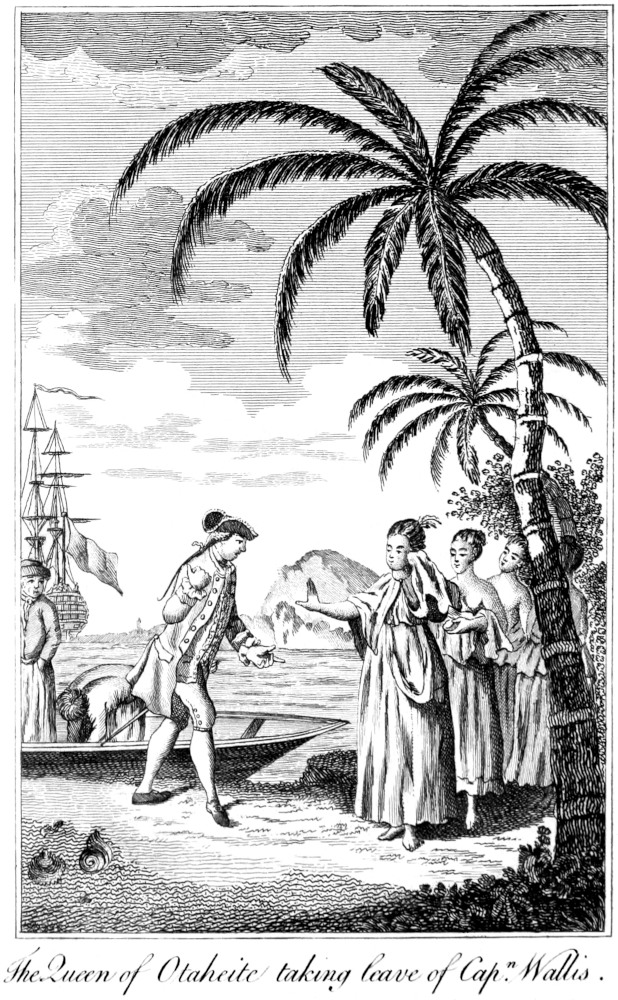
The Queen of Otaheite taking leave of Cap
n
. Wallis.
Having a third time refreshed themselves, they descended towards the ship, occasionally deviating from the direct way, tempted, by the pleasant situation of several houses, the inhabitants of which entertained them in the most hospitable manner. They saw parrots, parroquets, green doves, and ducks. The Lieutenant planted the stones of cherries, peaches and plums, several kinds of garden-seeds, and oranges, lemons and limes. In the afternoon they rested on a delightful spot, where the inhabitants dressed them two hogs and several fowls. Here they staid till the evening, when they rewarded the diligence of their guides, and repaired to the ship.
On the 26th the Queen visited the Captain, with her usual presents; and on this day they discontinued taking in wood and water, and prepared for sailing. A greater number of Indians now came to the sea-shore than they had ever yet seen; and of these, several appeared to be persons of consequence. In the afternoon the Queen visited captain Wallis, and sollicited him to remain ten days longer; but being informed that he should certainly sail on the following day, she burst into tears. She now demanded when he would come again, and was told in 50 days. She remained on board till evening, when being informed that the boat waited for her, she wept with more violence than she had yet done. At length this affectionate creature went over the ship’s side, as did the old Indian who had been so serviceable to the crew. This man had signified, that his son should sail with the Captain; but when the time of departure came, the youth was not to be found; and it was thought, that parental affection had got the better of the old man’s promise.
Early the next morning two boats were sent to fill a few casks of water; but the officer, alarmed at finding the shore crouded with people, was about to return. This brought the Queen forward, who commanded the Indians to retire to the opposite side of the river, and then made signs for the boats to land. While the water was filling, she ordered some presents into the boat, and entreated to go once more to the ship; but the officer having it in charge not to bring off a single native, she ordered her double canoe out, and was followed by many others. When she had been on board, weeping bitterly, for an hour, advantage was taken of a breeze, and the ship got under sail. She now tenderly embraced the Captain and Officers, and left the ship; but the wind falling, the canoes all put back, and once more reached the ship, to which the Queen’s being made fast, she advanced to the bow of the canoe, and wept incessantly. The Captain presented her with several articles of use and ornament, which she received in silent sorrow. After some time a breeze springing up, the Queen and her attendants took their final leave, with many tears, which drew corresponding tears from the eyes of our countrymen.
The place where the ship had lain was called Port Royal Harbour, and is situated in 17 degrees 30 minutes south-longitude, and 150 degrees west-latitude.
Captain Wallis now proceeds to give a more accurate account of the inhabitants of Otaheite, with their customs, manners, &c.—The men are from five feet seven to ten inches high, well proportioned, alert, and of good countenances. The women from five feet to five and a half, handsome in general, but some of them as beautiful as can be imagined. The complexion of those men who are much on the water is rather red; but the natural colour of them all is the tawny. They are remarkably distinguished from all the other natives of Asia, Africa, and America, by the colours of their hair; for that of the former is universally black, while the people of Otaheite have the various colours of black, brown, red and flaxen; most of the children having the latter: when left loose, it has a strong natural curl, but it is usually worn tied in two bunches, one on each side the head, or in a single bunch in the middle. They anoint the head with the oil of the cocoa-nut, mixed with a root of a fragrant smell.
It has been mentioned, that the ladies do not consider chastity as a virtue; but the price of their favours is always proportioned to their charms. When a man offered a girl to the caresses of a sailor, he shewed a stick of the size of the nail that was to purchase her company.
Their cloaths are formed of two pieces of cloth, not unlike coarse China paper, in one of which a hole is made for the head to pass thro’, and this hangs to the middle of the leg; the other piece is wrapped round the body, and the whole forms an elegant drapery. This cloth is composed of the inner bark of a tree. They adorn themselves with pearls, shells, feathers and flowers. They mark the hinder part of the thighs and loins of both sexes with black lines in different forms; which is done by striking the teeth of an instrument through the skin, and rubbing soot mixed with oil into the holes: some few men, who appeared to be persons of distinction, had their legs marked; but neither boys nor girls are marked till after they are twelve years old.
An Indian who attended the Queen appearing to be fond of imitating the English, was presented with a suit of the Lieutenant’s cloaths, which became him extremely well. As it was shoal-water at the landing-place, the English officers were carried on shore; and this man, unwilling to be out of the fashion, was carried in the same manner by the Indians. In his attempt to use a knife and fork at first, his hand always went to his mouth, while the food remained stuck on the end of the fork.
Besides the articles already mentioned, these people eat the flesh of dogs. Rats abound on the island, but are not eaten. The river produces parrot-fish, groopers, cray-fish and mullet, and conchs and muscles are found on the rocks: the inhabitants use nets, and hooks and lines.
There is something singular in their way of dressing their food: having produced a fire by rubbing two pieces of dry wood together, they dig a pit, which being paved with stones, they make a fire in it. The stones being properly heated, they rake away the ashes, and covering the stones with green leaves of the cocoa-nut-tree, they put their meat in plantain leaves, and place it in the pit, covering it over with the hot ashes, on which they lay bread-fruit and yams enclosed in plantain leaves: these again they cover with the embers intermixed with the hot stones: to this succeeds a layer of cocoa-nut leaves, and upon the whole is a covering of earth. In this manner a small hog is dressed whole, but a large one is cut in two; and Captain Wallis asserts, that this method of cookery exceeds every other he has known, the meat being extremely tender, and full of gravy. Their only sauces are salt-water and fruit, and their knives are made of shells.
They were astonished when they first saw meat boiled in a pot; but the Captain having given iron-pots to the Queen and some of her chiefs, they were often used; and the old Indian fed on boiled meat almost constantly. The only liquor they drink is water: they occasionally pluck and chew a bit of the sugar-cane; but have no idea of extracting any spirit from it.
From the scars with which many of these people were marked, it seems evident, that they sometimes waged war with each other.—That they have skill in surgery is evident from the following circumstance: a splinter having got into the foot of one of the sailors, his mess-mate tried in vain to extract it with a pen-knife: on this one of the natives, having formed an instrument, with his teeth, out of a shell, extracted the splinter in an instant; and the old Indian applying a piece of the gum of the apple-tree to the wound, the man’s foot was quite well in two days.
There are several sheds on the island, enclosed within a wall, on the outside of which several posts are fixed in the ground, on which are rude resemblances of men, women, dogs and hogs. The enclosed place is paved with large stones, between which the grass grows. These were supposed to be burial-places, from the natives being sometimes seen to enter them with an air of solemn sorrow.—It could not be discovered that these people had any kind of religious worship among them.
They have three kinds of canoes—one formed out of a single tree, in which they go a fishing; a second, made of planks sewed together, and large enough to hold 20 or 30 men; in which they sail round the island, and come laden home with fruits; and a third sort, which are not unlike the Venetian gondolas, and used when they sail on parties of pleasure. In these they make a kind of procession two or three times in a week, with their streamers flying, attended by the small canoes, while hundreds of the natives accompany their motions on the shore. On these occasions they put on their best cloaths, and while some are under a large awning, others sit upon it:—these are clothed in red and white; two men in red sit on the prow of each vessel; while the rowers and steersmen are in white.
The people of Otaheite use bows and arrows, which last are headed with a round stone. They have likewise bludgeons, and slings for the throwing of stones.
The inhabitants being shewn some small turtles, hinted that they had some which were much larger; but not one was seen by any of the ship’s crew.
Captain Wallis represents this island as one of the most pleasant in the universe; being blessed with a pure air, abounding in wood and herbage, harbouring no venomous animal; and its inhabitants being happy in a constant flow of health. The south-east part of the island, which produces fruit in vast abundance, is better peopled than the spot near where the ship lay.
When captain Cook, in the Endeavour, visited this island, he found the venereal disease among the natives; which must have been contracted from some of the crew under the command of M. Bougainville; for not one of captain Wallis’s men were infected with that disorder for several months before and after his arrival at Otaheite.
The Dolphin sailed from this harbour on the 27th of July 1767, and passed the Duke of York’s Island, the coast of which abounds with plantain-trees, cocoa-nut, bread-fruit, and apple-trees. On the 28th they discovered land, which was called Sir Charles Saunder’s Island. It had a few inhabitants, who lived in small huts; and the cocoa-nut and other trees grew on the shore. On the 30th they again made land, which received the name of Lord Howe’s Island, on which smoke was seen, but no inhabitants. Their next discovery was of some dangerous shoals, to which captain Wallis gave the name of the Scilly Islands.
They now steered westward till the 13th of August, when they saw two small islands, one of which was named Keppel’s Isle, and the other Boscawen’s Island; on the latter of which were several inhabitants; but they steered for the former, as its appearance promised the most convenient anchorage. By the help of glasses they now discovered the natives on the shore; but they did not attempt to anchor that night, on account of some breakers at a considerable distance from the island.
The boats being dispatched to the island, brought on board some cocoa-nuts and other fruit, and a couple of fowls. The officer reported, that the inhabitants were not unlike those of Otaheite; that some few of them ventured into the boat, but soon jumped out and swam back to the island. These people were remarkable for having the first joint of their little fingers cut off; and they were dressed in a sort of matting.
As there was no convenient watering-place at this island, and as the ship had received some damages that had rendered her unfit to encounter a rough sea, the Captain determined to sail for Tinian, from thence to Batavia, and so to England by the Cape of Good Hope. He therefore passed the island, which is well inhabited, abounds in timber, and is of a circular form.
On the 16th they again discovered land, to which the officers gave the name of Wallis’s Island. The coast of this island is very rocky, and the trees grow almost to the edge of the water. The inhabitants wore no covering but a mat round the waist: each man had a very large club, two of which were purchased by the boat’s crew. These people attempting to steal the cutter, by hauling her upon the rocks, a gun was fired close to one of their faces, the report of which so terrified them, that they decamped with the utmost speed. When the boats were returning to the ship, they were impeded by the points of rocks, which being observed by the Indians, they followed in their canoes till they got into deep water, and then they rowed back.
Captain Wallis remarks, as an extraordinary circumstance, that although no sort of metal was seen on any of the lately discovered islands, yet the natives were no sooner possessed of a piece of iron than they began to sharpen it, but did not treat copper or brass in the same manner.
They now sailed to the north-west, and on the 28th observed a number of birds flying about the ship, one of which they catched. It was web-footed, but in all other respects resembled a dove. On the 3d of September they saw land, which was thought to be two of the Piscadore Islands; and on this day an Indian Proa (a description of which is given in Anson’s Voyage) made towards the ship, on which they hoisted Spanish Colours; but she came no nearer than within about two miles. On the 7th and 9th they saw several birds, one of which was taken, and judged to be a land-bird. On the 18th they discovered the island of Saypan, and soon afterwards that of Tinian, off which they anchored on the day following.
No time was lost in sending the boats on shore, and they returned in a few hours, with oranges, limes, and cocoa-nuts. Tents were erected for the sick, who were sent on shore with all expedition. The smith’s forge, and carpenter’s chest were also landed; and the Captain and first Lieutenant, who both continued ill, went on shore, with a party of men to hunt for cattle. A young bull of great weight was soon catched; and they found plenty of oranges, limes, and bread-fruit. On the 21st they began the necessary repairs of the ship. The fatigue sustained by those who went to hunt for cattle was so great, by going many miles thro’ thickets, that one party was ordered to relieve another; and the second Lieutenant with several of the men, being sent to reside on the north part of the island, where cattle were most plentiful, a boat was sent daily to bring in what they catched. In this island they procured beef, pork, poultry, papaw-apples, and all the other refreshments, of which an account is given in Anson’s Voyage.
By the 15th of October the fruit and water was carried on board, and all the sick being recovered, preparations were made for sailing; and on the next day they left the bay, and sailed to the west.
On the 21st and 22d they saw several gannets, and other birds; and on the 23d and two following days it blew a violent storm, the effects of which were the more dreaded, as the ship admitted more water than she had done at any time during the voyage. The bad weather continued on the 26th, when they saw several land-birds. They had now to encounter the united horrors of thunder, lightning, rain, darkness, and such a violent sea, as broke even the iron work on the gun-whale, and washed over-board many heavy things. On the 27th they were blest with a sight of the sun, and the day following the weather became more temperate. In the middle of the night one Morgan, a taylor, was suddenly missed, and it was thought he fell over-board in a fit of intoxication.
On the 3d of November they discovered three islands, which were named Sandy Isle, Small Key, and Long Island; and on the day following they saw another, to which captain Wallis gave the name of New Island; all of which islands are in ten degrees odd minutes north-latitude, and 247 degrees odd minutes west-longitude. The ship held her course till the 8th, on which day the log and journal-books of the voyage were taken from the inferior officers and foremast-men.
They now altered their course, and on the 13th saw the islands of Timoun, Aros and Pesang. On the 16th they crossed the equinoctial line, and came again into south-latitude. The next day they saw the islands of Pulo Toté, and Pulo Weste; soon after which they had sight of the seven islands. A singular incident happened in the succeeding night, which was very tempestuous, and so dark, that they could not see across the ship. During the full violence of the wind, a flash of lightning afforded them light enough to see a ship of considerable size, which was so near, that it was with difficulty they steered clear of her; but they could not get information to what nation she belonged, as the wind was too loud for them to hear each other. This was the first ship they had seen since they parted from the Swallow. In the morning they saw the Island of Pulo Taya, near which they came to an anchor in the evening; and the next morning sailed again, and saw two ships a-head of them, but the current was so strong that they lost ground, and therefore they again anchored in the evening. The next day they lost an anchor, the cable of which was cut away by the rocks. On the 22d they saw the coast of Sumatra, and came to an anchor in the road of Batavia, on the 30th of November 1767.
On the following day captain Wallis saluted the Dutch governor with 13 guns, and the compliment was returned from the fort with one additional gun. Permission having been obtained to purchase necessaries, they were soon supplied with beef and vegetables. The crew were now threatened with punishment, if any attempt should be made to bring liquor aboard; and no man was permitted to leave the ship, but those who were called by duty; and even those were not suffered to go into the town.—The intemperate use of arrack is highly pernicious to strangers who visit Batavia.
His Majesty’s ship the Falmouth was at this time laying in the road, but in so shattered a condition, that it was thought she could not hold together during the next monsoon; nor were the few of her crew which remained alive in any better condition than the vessel. On the 5th of December captain Wallis received a petition from the warrant officers of the Falmouth, setting forth, that their powder had been thrown into the sea, by order of the Dutch, and that the gunner was dead; that their misfortunes had deprived the boatswain of his senses, and that he was then a lunatic in the Dutch hospital; that his stores were all spoiled; that the cook had been wounded, and remained a cripple; and that the carpenter was near death.—They therefore petitioned that the Captain would carry them to England, or, at all adventures; dismiss them from the ship, as there was now nothing left for them to take charge of. Captain Wallis was obliged to refuse their request, however reasonable, and informed them, that as they had taken charge of stores, they must wait for orders from England. To this they answered, that they had not received a single order since they were left in the road of Batavia: that they had ten years pay due, and would rather go home sweepers, than remain in their present wretched situation. That they were never permitted to sleep on shore, and when sick, no person had the humanity to visit them: that the Malays frequently robbed them, and that they expected destruction at the hands of those people, as they had burnt the Siam Prize not long before the arrival of the Dolphin. They entreated the Captain to make their case known in England, which he readily promised to do.
On the 5th the Captain went on shore, to buy such stores as he thought necessary to carry the ship home with safety. He visited the different store-houses and arsenals; but the demands of the Dutch were so exorbitant, that he determined to make shift with such materials as he had, rather than be imposed on by people who wished to take every advantage of his necessity. Accordingly, he sailed on the 8th of December, without losing a single man, and having only two on the sick list.
On the 11th the crew began to be afflicted with colds and fluxes; and the following night they saw the Coast of Java, on which was placed an amazing number of lights, intended, as they imagined, to entice the fish near the beach.—They anchored off Princes Island on the 14th, and began to take in wood and water; at which place they remained till the 20th, during which time they purchased turtle, poultry, and other refreshments.
While they lay here one of the seamen fell from the main-yard into the barge, which was a-longside the ship, and struck down two other men, one of whom was bruised so much that he died in four days; but the other escaped with a broken toe: the man who fell had several bones broken, and was otherwise shockingly bruised. They buried three men here, and many others were seized with fluxes, and putrid fevers; the contagion of which last disorder constantly attacked, in a day or two, those who attended the sick. At this time too the ship made above three feet water in four hours.
They struggled with these accumulated misfortunes till the 10th of January, when the sickness began to abate.—On the 24th they encountered a dreadful storm, which tore the sails to pieces, broke a rudder-chain, and carried several of the booms over-board: yet, during this storm, they observed a number of birds and butterflies.—On the 30th they saw land, and came to an anchor in Table Bay, at the Cape of Good Hope, on the 4th of February.
Captain Wallis having saluted the Governor, and the Commanders of some vessels in the harbour, and they having fired guns of salute in return, he lost no time in procuring fresh meat and vegetables for the use of the crew. The surgeon was sent on shore to hire lodgings for the sick; but as the rate demanded was very high, and as the small-pox (which many of the seamen had not had) raged prodigiously, the Captain obtained the Governor’s permission to erect tents on a plain about two miles from the town.
This being done, the sick were sent on shore; positive orders being given that no liquor should be brought to the tents; that no one should be permitted to go into the town; and that extra provisions should be procured for those who were most reduced by sickness. The Captain was so very ill, that, as long as the ship lay here, he was at a country-house several miles distant.
Every man who was able to do any kind of work, was now employed in the necessary repairs of the ship, which being nearly compleated by the 10th of February, several of the men, who had had the small-pox, were permitted to visit the town; and those who had not had that distemper, were allowed to take daily walks in the country; and as they did not abuse this liberty, it was continued to them as long as the ship remained there.
The necessaries which could not be purchased of the Dutch at Batavia, were bought reasonably at this place; and fresh water was procured by distillation, with a view to convince the commanders of the Indiamen that lay here, how easily wholesome water might be procured at sea. This method of distillation is as follows: 56 gallons of salt water being put into the still at five in the morning, thirty-six gallons of fresh water was obtained by about a quarter after ten; thirteen gallons and a half remaining in the still. This fresh water was procured at the expence of sixty-nine pounds of coals, and nine pounds of wood.
On the 25th all hands were ordered on board, when it was found that every man, except three, was able to do duty. A number of sheep were purchased for sea stores; and the ship sailed on the third of March.
On the 17th they anchored in the bay of St. Helena, and sent persons on shore to get water, and others to gather purslain, of which there is great plenty. The Captain going on shore, was saluted by the guns of the fort; and requested to make that place his residence during his stay on the island: but their water-casks being soon filled, and the wind serving the next day, they then sailed for England.
On the 28th they crossed the equinoctial line, getting once more into north-latitude. On the 24th they saw the Cape of Pico.—On the 11th of May they had sight of the Savage sloop of war, captain Hammond, in chace of a sloop, at which he fired several guns. On this captain Wallis fired, and brought the vessel to, which proved to be laden with brandy, tea, &c. from Roscoe in France; she was of Liverpool, and was commanded by Robert Christian. Captain Wallis detained her, in order to her being sent to England; as she was judged to be a smuggler, pretending to be bound to Bergen, in Norway, tho’ she was sailing to the south-west.
No material incident happened from this time to the end of the voyage, which was happily compleated by the Dolphin coming to an anchor in the Downs on the 20th of May 1768.