CAPTAIN COOK’s VOYAGE ROUND THE WORLD. In 1768, 1769, 1770 and 1771. (continued 3)
Reading edition
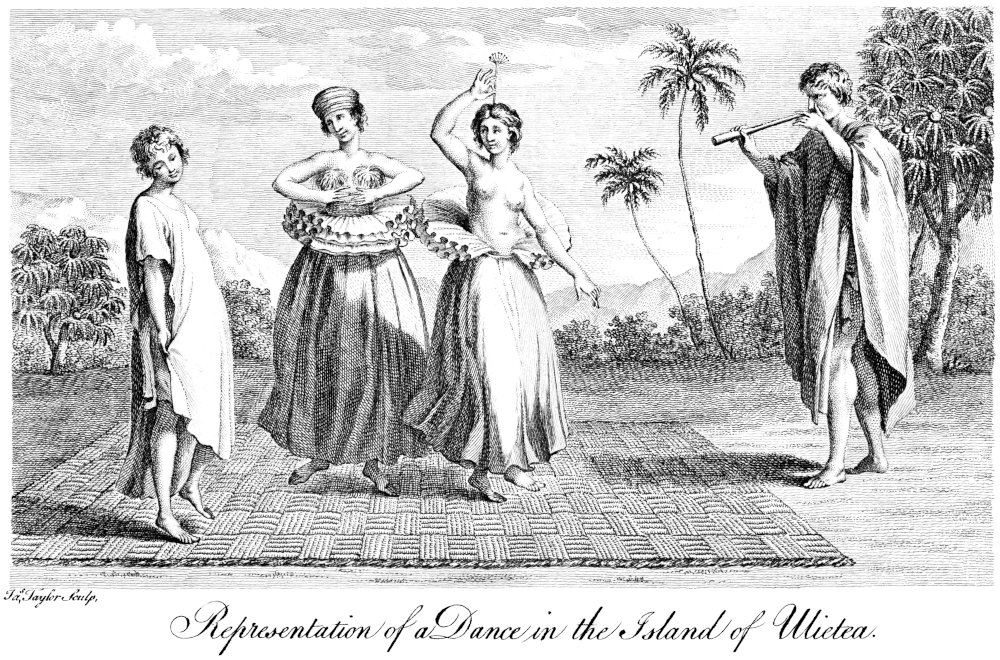
Representation of a Dance in the Island of Ulietea.
Thus apparelled they advanced sideways, keeping time with great exactness to the drums, which beat quick and loud; soon after, they began to shake themselves in a very whimsical manner, and put their bodies into a variety of strange postures, sometimes standing in a row one behind another, sometimes sitting down, and at others falling with their faces to the ground, and resting on their knees and elbows, moving their fingers at the same time with a quickness scarcely to be credited. The chief dexterity, however, of the dancers, as well as the amusement of the spectators, consisted in the lasciviousness of their attitudes and gestures, which decency forbids us to describe.
Between the dances of the women, a kind of dramatic interlude was performed by the men, consisting of dialogue as well as dancing; but for want of a sufficient knowledge of their language, they could not learn the subject of this interlude.
Friday the 4th, Mr. Banks, Dr. Solander, and some other gentlemen, were present at a more regular dramatic entertainment. The performers, who were all men, were divided into two parties, one dressed in brown, and the other in white, by way of distinction. Tupia being present, informed them, that the party in brown acted the parts of a master and his servants, and the party in white a gang of thieves; the master having produced a basket of meat, which he gave in charge to his servants; the white party exhibited a variety of expedients, in endeavouring to steal this basket, and the brown set as many in preventing the accomplishment of their design. After some time had been spent in this manner, those to whom the basket was entrusted, laying themselves down on the ground round it, pretended to fall asleep; the other party availing themselves of this opportunity, stole gently upon them, and carried off their booty; the servants awaking soon after discovered their loss, but they made no search after the basket, and began to dance with as much alacrity as before.
On Saturday the 5th, some hogs and fowls, and several large pieces of cloth, many of them being fifty or sixty yards in length, together with a quantity of plantains and cocoa-nuts, were sent to Captain Cook as a present, from the Earee rahie of the island of Bolabola, accompanied with a message, that he was then on the island, and intended waiting on the Captain the next day.
On Sunday the 6th, the King of Bolabola did not visit them agreeable to his promise, his absence, however, was not in the least regretted, as he sent three very agreeable young women to demand something in return for his present. After dinner, they set out to pay the King a visit on shore, as he did not think proper to come on board. As this man was the Earee rahie of the Bolabola men, who had conquered this, and were the dread of all the neighbouring islands, they were greatly disappointed, instead of finding a vigorous, enterprising young Chief, to see a poor feeble decrepid old dotard, half blind, and sinking under the weight of age and infirmities. He received them without either that state or ceremony which they had hitherto met with among the other Chiefs.
On Wednesday the 9th, having stopped their leak, and taken on board their fresh stock of provisions, they sailed out of the harbour. Tho’ they were several leagues distant from the island of Bolabola, Tupia earnestly entreated Captain Cook, that a shot might be fired towards it; which, to gratify him, the Captain complied with. This was supposed to have been intended by Tupia as a mark of his resentment against the inhabitants of that place, as they had formerly taken from him large possessions which he held in the island of Ulietea, of which island Tupia was a native, and a subordinate Chief, but was driven out by these people.
They had great plenty of provisions, as well of hogs and fowls, as of vegetables, during the time they continued in the neighbourhood of those islands, so that they were not obliged to use any considerable quantity of the ship’s provisions, and they had flattered themselves, that the fowls and hogs would have supplied them with fresh provisions during the course of their voyage to the southward; but in this they were unhappily disappointed, for as the hogs could not be brought to eat any sort of European grain, or any provender whatever that the ship afforded, they were reduced to the disagreeable necessity of killing them immediately on their leaving those islands; and the fowls all died of a disease in their head, with which they were seized soon after they had been carried on board.
As they were detained longer at Ulietea in repairing the ship than they expected, they did not go on shore at Bolabola; but, after giving the general name of the Society Islands to the islands of Huhaheine, Ulietea, Bolabola, Otaha and Maurua, which lie between the latitude of 16 deg. 10 min. and 16 deg. 55 min. south, they pursued their course, standing southwardly for an island, to which they were directed by Tupia, at above an hundred leagues distant, which they discovered on Sunday the 13th, and were informed by him, that it was called Ohiteroa. The next morning they stood in for land, and saw several of the inhabitants along the shore; one of the Lieutenants was now dispatched in the pinnace, to sound for anchorage, and obtain what intelligence he could of the natives, respecting any land that might lay further to the south. Mr. Banks, Dr. Solander, and Tupia went also in the boat, with the Lieutenant, when they came near the shore, they could perceive that the inhabitants were armed with lances of a considerable length. The appearance of the boat soon drew together a great number of them upon the beech, two of whom leaped into the water, and endeavoured to gain the boat, but she soon left them behind; several others made the same attempt, but with as little success.
The boat having doubled the point where they intended to land, opened a large bay, and discovered another party of the natives standing at the end of it, armed in the same manner as those they had already seen. The boat’s crew now rowed towards the shore, and began to make preparations for landing, upon which a canoe, with some of the natives on board, came off towards them; they ordered Tupia to acquaint these people, that they did not intend doing them any injury, but wanted to traffick with them with nails, which they shewed them; this information encouraged them to come along-side the boat, and they accepted of some nails, which were given them with much apparent pleasure and satisfaction; it soon appeared, however, to be nothing more than dissimulation; for, in a few minutes, several of them unexpectedly boarded the boat, with an intention of dragging her on shore; some musquets were immediately discharged over their heads, which had the desired effect, all of them leaping directly into the sea; and as soon as they reached the canoe, they put back to the shore as fast as they could paddle, where a vast concourse of their countrymen were assembled to receive them. They were followed to the shore by the people in the boat, who found the surf so violent, that they did not think it safe to attempt landing. They therefore coasted along the shore, in hopes of finding a place where they might land with less danger; presently after the canoe got on shore, a man with a lance in his hand ran along opposite to the boat, flourishing his weapon, and calling out with a shrill voice, which, upon enquiry of Tupia, they were informed was a mark of defiance.
Not being able to find a more convenient landing place, they returned, with a design of attempting it at the place where the canoe went on shore: as they were going back, the same mode of defiance was repeated by another warrior of a more formidable appearance than the first; having a high cap on, made of the tail feathers of a bird, and his body painted with streaks of a variety of colours. When this man retired, another advanced in years, with a grave and sedate countenance, made his appearance upon the beach, and asked them several questions, such as from whence they came, whither they were bound, and who they were. Tupia having answered these questions, and repeated his assurances, that our intentions were amicable, they appeared to be somewhat pacified. The people in the boat now proposed going on shore, to trade with them for such articles as they chose to dispose of, if they would quit their weapons; but they would not agree to this proposal on any other terms, than the English leaving their musquets behind them in the boat; with this, however, prudence would not permit them to comply, especially as they had so lately experienced the dissembling nature of these people. They therefore gave over all hopes of establishing a friendly intercourse with them, and returned to the ship. And as neither the bay which the boat entered, nor any other part of the island afforded either harbour or anchorage, the Captain did not think it worth while to attempt a second landing.
The people of this island are very tall, well proportioned, and have long hair, which, like the inhabitants of the other islands, they tie in a bunch on the top of their head; they are likewise tataowed on different parts of their bodies, but not on their posteriors.
This island does not shoot up into high peaks, like the others which they visited, but is more level and uniform, and divided into small hillocks, some of which are covered with groves of trees; they saw no bread-fruit, and not many cocoa-nut trees, but great numbers of the tree called Etoa, were planted all along the shore.
Their cloth, as well as the manner of wearing it, differed in many respects from any they had met with; all that they saw was died yellow, and painted on the outside with a variety of colours. Their habit consisted only of one piece with a hole made in the middle of it, thro’ which they put their head; it reaches as low as their knees, and is tied close round their bodies with a kind of yellow sash; some of them wear caps of the same kind as that already mentioned, and others bind their heads with a piece of cloth resembling a turban.
On Tuesday, the 15th of August, they sailed from this island to the Southward, with a fine breeze from the north, and clear pleasant weather; and on the 16th it being rather hazy, they were deceived by an appearance like several high peaks of land, for which they bore away, but the weather clearing up, convinced them of their mistake, and they resumed their course to the south.
On Friday the 25th, they celebrated the anniversary of their leaving England, from whence they had now been absent one year: a large Cheshire cheese, which had been carefully preserved for that purpose, was brought out, and a barrel of porter tapped, which proved to be as good as any they had ever drank in England. On the 29th John Raden, the Boatswain’s mate, died; this man’s death was occasioned by drinking too freely of some rum which was given him by the Boatswain. On the 30th, about four o’clock in the morning, they saw a large comet about 60 degrees above the horizon.
On Thursday the 7th of October, they discovered land at west by north, and in the afternoon, of the next day, they came to an anchor opposite the mouth of a little river about a mile and a half from the shore. The Captain, with Mr. Banks, Dr. Solander, and some other gentlemen, accompanied by a party of marines, went on shore in the evening, in the pinnace and yawl.
Having left the pinnace at the entrance of the river, Captain Cook, Mr. Banks, &c. proceeded a little farther up, when they landed, and leaving the yawl to the care of some of their boys, went up to a few small houses which they saw at a little distance. Taking the advantage of their absence from the boat, some of the natives, who had concealed themselves behind the bushes, suddenly rushed out, and ran towards it, brandishing the long wooden lances which they had in their hands in a threatening manner. The boys perceiving them, instantly dropt down the stream, but were very closely pursued by the Indians; the Cockswain of the pinnace therefore fired a musquetoon over their heads, which did not seem to intimidate them, as they still continued their pursuit; he then fired a second time over their heads, but with no better effect; alarmed at the situation of the boat, as they were now got near enough to discharge their lances at it, the Cockswain levelled his piece at them, and shot one man dead on the spot. Struck with astonishment at the fall of their companion, the others stood motionless for some time, but as soon as they recovered from their fright, retreated to the woods with the utmost precipitation. The report of the gun soon brought the advanced party back to the boats, and both the pinnace and yawl immediately returned to the ship.
On Monday the 9th in the morning, a great number of the natives were seen near the place where the gentlemen in the yawl had landed the preceding evening, and the greatest part of them appeared to be unarmed. The long-boat, pinnace and yawl, being ordered out, and manned with marines and sailors, Captain Cook, together with Mr. Banks, the rest of the gentlemen and Tupia went on shore, and landed on the opposite side of the river, over against several Indians who were sitting on the ground; as soon as the gentlemen began to land, they immediately started up, each producing either a long pike, or a kind of truncheon made of stone, with a string through the handle of it, which they twisted round their wrist. Tupia was ordered to speak to them in his language; and the gentlemen were agreeably surprized to find that he was well understood, the natives speaking the Otaheitean language, only in a different dialect. Their intentions at first appeared to be very hostile, brandishing their weapons in the usual threatening manner; upon which a musquet was fired at some distance from them, at the effect of which the ball happening to strike the water, they appeared rather terrified, and desisted from their menaces. The marines being drawn up, the Captain, with four or five of the gentlemen and Tupia, advanced nearer to the side of the river; Tupia again spoke to them, and informed them, that they wanted to traffick with them for provisions. They readily consented to trade, and requested the English gentlemen to cross the river and come over to them; which was agreed to, upon condition that the natives would quit their weapons; but this the most solemn assurances of friendship could not prevail on them to comply with. Not thinking it prudent therefore to cross the river, as they would not be persuaded to lay by their arms, the gentlemen in their turn intreated the Indians to come over to them, which after some time they prevailed on one of them to do; he was presently followed by several others, bringing their weapons with them. They did not appear to set any great value on the beads, iron, &c. which was presented to them, nor would they give any thing in return, but proposed to exchange their weapons for those belonging to the English, which being consequently objected to, they endeavoured several times to snatch them out of their hands. But as the gentlemen were on their guard, from the information given them by Tupia that they were still their enemies, their attempts to seize the arms were repeatedly frustrated, and Tupia, by the direction of the gentlemen, gave them notice, that any further offer of violence would be punished with instant death. One of them had, nevertheless, the audacity to snatch Mr. Green’s hanger, and retiring a few paces, flourished it over his head; he, however, paid for this temerity with his life, Mr. Monkhouse firing at him with a musquet loaded with ball; and that gentleman afterwards, with some difficulty, recovered the hanger, one of the Indians endeavouring to seize it.
This behaviour of the natives, added to the want of fresh water, induced Captain Cook to continue his course round the head of the bay. He was still in hopes of getting some of the Indians on board, and by presents, added to civil usage, convey through them a favourable idea of the English to their fellow countrymen; and thereby settle a good correspondence with them. Soon after an event occured, though attended with disagreeable circumstances, that promised to facilitate this design. Two canoes appeared making towards land, and Captain Cook proposed intercepting them with his boats. One of them got clear off, but the Indians in the other finding it impossible to escape the boats, began to attack them with their paddles: this compelled the Endeavour’s people to fire upon them, when four of the Indians were killed, and the other three, who were youths, jumped into the water, and endeavoured to swim to shore: they were however taken up and brought on board. They were at first greatly terrified, thinking they should be killed; but Tupia, by repeated assurances of friendship, removed their fears, and they afterwards eat very heartily of the ship’s provisions. When they retired to rest, in the evening, they appeared perfectly easy in their minds, and slept very quietly for some hours, but in the middle of the night their fears again returned, and they appeared in great agitation, frequently making loud and dismal groans. After some time, however, the friendly promises and kind caresses of Tupia again prevailed over their fears, and they became so calm and resigned as to sing a song, the tune of which was solemn and slow, and, at the dead of night, when an universal silence prevailed throughout the ship, had an awful and pleasing effect. The next morning, after they were dressed and ornamented, according to the mode of their country, with necklaces and bracelets, Captain Cook proposed setting them on shore, that they might give a favourable report to their countrymen of the reception they had met with. They testified much satisfaction when told they were going to be released: but seemed under great apprehensions of danger, at finding the boat approach Captain Cook’s first landing-place, intimating, that the inhabitants here were their foes, and that they always killed and ate their enemies. The Captain, nevertheless, judged it expedient to land near the same spot, which he accordingly did with Mr. Banks, Dr. Solander and Tupia, resolving at the same time to protect the youths from any injury that might be offered them. The gentlemen had not been long on shore before the boys left them, but on seeing two large parties of the Indians advancing hastily towards them, they returned, and again put themselves under their protection. As the Indians drew nearer, one of the boys discovered his uncle amongst them, and a conversation took place between them across the river, in which the lad gave a very just account of the hospitality he had met with, and took great pains to display their cloaths and finery. Soon after the uncle swam across the river, bringing with him a green bow, as a token of friendship, which was received as such, and several presents were made him. The body of the Indian, who was shot the day before, lay in the same place where he fell: one of the boys had covered it with part of his cloaths; and after the gentlemen had retired, the Indian performed a kind of ceremony over it, by throwing a green branch towards it, and the body was afterwards carried in a raft across the river. Notwithstanding the presence of the uncle of one of the boys, all three of them, by their own desire, returned to the ship, but as the Captain intended sailing the next morning, he sent them on shore again in the evening, though much against their inclination; the names of these boys were Taahourange, Koikerange and Maragovete. They informed Captain Cook, that there was a particular kind of deer upon the island, likewise taro, eapes, romara, yams, a kind of long pepper, bald coote, and black birds.
On the 11th Captain Cook set sail, in hopes of finding a better anchoring place, after giving this bay (called by the natives Toaneora) the name of Poverty Bay; and the south-west point he called Young Nick’s Head, on account of its being first perceived by a lad on board named Nicholas Young. They were becalmed in the afternoon, and several canoes came off from the shore with Indians, who received many presents, and afterwards bartered even their cloaths, and some of their paddles, so eager were they of being possessed of as many European commodities as possible. A single tree formed the bottom of their canoes, and the upper part consisted of two planks sewed together: they sat on thwarts; their paddles were painted red, representing many uncommon figures, and were curiously wrought.
They were armed with bludgeons made of wood, and of the bone of a large animal; they called them Patoo, Patoo, and they were well contrived for close fighting.
After they had finished their traffic, they set off in such a hurry, that they forgot three of their companions, who remained on board all night.
They testified their fears and apprehensions, notwithstanding Tupia took great pains to convince them they were in no danger; and about seven the next morning a canoe came off, with four Indians on board. It was at first with difficulty the Indians in the ship could prevail on those in the canoe to come near them; and it was not till after the former had assured them that the English did not eat men, that they came along-side the Endeavour. The Chief came on board, whose face was tataowed, with a remarkable patoo patoo in his hand; and in this canoe the three Indians left the ship. Captain Cook gave the name of Cape Table to a point of land about seven leagues to the south of Poverty Bay, its figure greatly resembling a table; and the island, called by the natives Teabowry, he named Portland Island, it being very similar to that of the same name in the British Channel. It is joined to the main by a chain of rocks, near a mile in length, partly above water. There are several shoals, called shambles, about three miles to the north-east of Portland, one of which the Endeavour narrowly escaped; there is, however, a passage between them with 20 fathom water. Some parts of Portland Island, as well as the Main, were cultivated; and pumice-stone in great quantities lying along the shore, within the bay, indicated that there is a volcano in the island. High pailings upon the ridges of hills were also visible in two places, which were judged to be designed for religious purposes.
On the 12th several Indians came off in a canoe; they were disfigured in a strange manner, danced and sung, and appeared at times to be peaceably inclined, and at others to menace hostilities; but, notwithstanding Tupia strongly invited them to come on board, none of them would quit the canoe. Whilst the Endeavour was getting clear of the shambles, five canoes full of Indians came off, and seemed to threaten the people on board, by brandishing their lances, and other hostile gestures; a four pounder, loaded with grape shot, was therefore ordered to be fired, but not pointed at them. This had the desired effect, and made them drop a-stern. Two more canoes came off, whilst the Endeavour lay at anchor; but the Indians on board behaved very peaceably and quiet, and received several presents, but would not come on board.
On Friday the 13th, in the morning, they made for an inlet, but finding it not sheltered they stood out again, and were chaced by a canoe, filled with Indians, but the Endeavour out-sailed them. She pursued her course round the bay, but did not find an opening.
The next morning they had a view of the inland country; it was mountainous, and covered with snow in the interior parts, but the land towards the sea was flat and uncultivated, and in may places there were groves of high trees. Nine canoes full of Indians came from the shore, and five of them, after having consulted together, pursued the Endeavour, apparently with an hostile design. Tupia was desired to acquaint them that immediate destruction would ensue, if they persevered in their attempts; but words had no influence, and a four pounder, with grape shot, was fired, to give them some notion of the arms of their opponents. They were terrified at this kind of reasoning, and paddled away faster than they came. Tupia then hailed the fugitives, and acquainted them, that if they came in a peaceable manner, and left their arms behind, no annoyance would be offered them: one of the canoes submitting to these terms, came along side the ship, and received many presents; but the other canoes returning, and persisting in the same menacing behaviour, interrupted this friendly intercourse.
The following day, Sunday the 15th, they were visited by some fishing boats, the people in which conducted themselves in an amicable manner; though the fish which they had on board had been caught so long that they were not eatable, Captain Cook purchased them, merely for the sake of promoting a traffick with the natives. In the afternoon a large canoe, with a number of armed Indians, came up, and one of them who was remarkably cloathed, with a black skin, found means to defraud the Captain of a piece of red baize, under pretence of bartering the skin he had on for it. As soon as he had got the baize into his possession, instead of giving the skin in return agreeable to his bargain, he rolled them up together, and ordered the canoe to put off from the ship, turning a deaf ear to the repeated remonstrances of the Captain against his unjust behaviour. After a short time this canoe, together with the fishing boats which had put off at the same time, came back to the ship, and trade was again begun. During this second traffick with the Indians, one of them unexpectedly seized Tupia’s little boy Tayota, and pulling him into his canoe instantly put her off, and paddled away with the utmost speed; several musquets were immediately discharged at the people in the canoe, and one of them receiving a wound they all let go the boy, who before was held down in the bottom of the canoe. Tayota taking the advantage of their consternation, immediately jumped into the sea, and swam back towards the Endeavour, he was taken on board, without having received any harm; but his strength was so much exhausted with the weight of his cloaths, that it was with great difficulty he reached the ship. In consequence of this attempt to carry off Tayota, Captain Cook called the Cape off which it happened Cape Kidnappers, lying in latitude 39 deg. 43 min. and longitude 182 deg. 24 min. west, and is very distinguishable by high cliffs and white rocks, that surround it. Its distance from Portland Island is about 13 leagues, forming the south point of a bay, which the Captain named Hawke’s Bay, in honour of Sir Edward, who then presided at the admiralty board.
As every circumstance that tends to elucidate the manners and customs of these people must attract the attention of the curious reader, we cannot omit Tayota’s behaviour upon recovering from his fright, occasioned by his being kidnapped. He produced a fish, and acquainted Tupia, that he designed to make an offering of it to his God, or Eatua, as a testimonial of his gratitude for his deliverance. Tupia approved of his intention, and by his direction the fish was cast into the sea. This is an evident proof, that even these unenlightened savages, by the mere impulse of nature, believe in the existence of a particular providence.
The Endeavour now passed a small island, white and high, supposed to be inhabited only by fishermen, as it appeared quite barren, and was named Bare Island. On the 17th Captain Cook gave the name of Cape Turn Again to a head-land, in latitude 40 deg. 34 min. S. longitude, 182 deg. 55 min. west, because the Endeavour here turned again. Before the Endeavour touched at New Zealand, it was not certainly known whether it was an island, or part of the continent, wherefore the lords of the admiralty had, by their instructions, directed Captain Cook to sail along the coasts as far as 40 degrees south latitude, and from thence, if the land appeared to extend farther, to return again to the northward. Agreeable to these instructions, the Captain being opposite to Cape Turn Again, changed his course from south to north; and the wind having likewise veered to the south, he returned nearly in his former track, sailing along the coast. This Cape is remarkable for a stratum of clay of a bright brown colour; its prominence gradually diminishes towards the north-side, but to the south its descent is not so regular.
The land between this Cape and Kidnapper’s Bay is unequal, and resembles the high downs of England. There appeared numerous inhabitants, and several villages. Wednesday the 18th the Endeavour came a-breast of a peninsula in Portland Island, named Terakako, when a canoe, with five Indians, came up to the ship. Two Chiefs who were in this canoe came on board, where they remained all night, and were treated with great civility. One of the Chiefs was a remarkable comely man, and his countenance was open and prepossessing. Their curiosity was uncommon, and their acknowledgments, for the trifling presents they received, were extremely grateful. The Chiefs would neither eat nor drink, but the servants made up for their masters abstinence, by their voracious appetites. The three boys had given these natives an account of the hospitality and liberality of the English, which had prevailed upon them to pay this visit.
Thursday the 19th the Endeavour passed a remarkable head land, which Captain Cook named Gable End Foreland. It is distinguished by a rock, in the shape of a church spire, which is very near it. Here three canoes came up, and one Indian came on board; he received some small presents, and retired to his companions. He wore a new garment of white silky flax, with a border of black, red and white.
Many of the Indians had pieces of green-stone round their necks, by way of necklaces; they were transparent, like an emerald, and appeared, on examination, to be a species of Nephritic-stone, of which all their ornaments of this kind consisted. Mr. Banks and the other gentlemen obtained several pieces of it.
The dialect of these Indians was not so guttural as that of the others, and they spoke the most like the inhabitants of Otaheite. The physiognomy of some was agreeable, their noses being rather prominent than flat.
On the 20th they anchored in a bay, about two leagues to the north of the Foreland. The natives in canoes invited them hither, and behaved very amicably. There appeared to be two Chiefs, who came on board: they received presents of linen, which gave them much satisfaction; but they did not hold spike-nails in such estimation as the inhabitants of some of the islands. They were dressed in jackets, the one ornamented with tufts of red feathers, the other with dog’s skin. The other Indians in the canoes traded with the Endeavour’s people, without attempting any imposition; and towards the evening the Chiefs returned. The Captain, Mr. Banks, and Dr. Solander, now went on shore, and were courteously received by the inhabitants, who did not appear in numerous bodies, to avoid giving offence. They received several trifling presents, and the Captain had the pleasure to find fresh water, in the course of a tour round the bay. They remained on shore all night, and next day Mr. Banks and the Doctor discovered several plants, and many beautiful birds, particularly quails and large pigeons. There were some houses with fences, to shelter them from the wind, and many stages for drying fish near the place where the gentlemen landed. Dogs with small pointed ears, and very ugly, were the only tame animals among them. At the watering-place the Captain ordered a line to be drawn, and enjoined the natives not to pass it, which injunction they civilly complied with. Many houses were contiguous, and the lands in the adjacent vallies were regular flats, neatly laid out in small plantations, the ground appearing to be broken, as if designed for gardens. They have sweet potatoes, like those of North America, in great quantities; and the cloth plant grows here spontaneously. There is plenty of fish in the bay, such as crabs, cray-fish, and ship-jacks or horse mackrel, which are larger than those upon our coasts. The number of supple jacks that grow in the adjacent woods, render them almost impassable; but they thereby afford shelter to their feathered inhabitants: the flat land was planted with cocos, and the hollow parts with gourds. Mr. Banks and Dr. Solander visited several of the natives houses, and they met with a very civil reception. Fish constituted their principal food at this time, and the root of a sort of fern served them for bread, which when roasted upon a fire, and divested of its bark, was sweet and clammy; in taste not disagreeable, but unpleasant from its number of fibres. Vegetables were, doubtless, at other seasons very plentiful. The women paint their faces red, which so far from increasing, diminishes the very little beauty they have. The mens faces were not in general painted, but some were rubbed over with red ocre from head to foot, their apparel not excepted. Though they could not be compared to the inhabitants of Otaheite for cleanliness in general, they surpassed them in this respect in some particulars. Every dwelling was supplied with a privy, and they had dunghills for depositing dirt and filth. The women wore a girdle made of the blade of grass under a petticoat, and to this girdle was tied in front a bunch of fragrant leaves. They seemed to hold chastity in but little estimation, many of the young females resorting to the watering-place, where they bountifully bestowed every favour that was requested. One of the officers on shore, meeting with an elderly woman, he accompanied her to her house, and having presented her with some cloth and beads, a young girl was singled out, and he was given to understand he might retire with her. Soon after an elderly man, with two women, came in as visitors, and with much formality saluted all the company, according to the custom of the place, which is by gently joining the tips of their noses together. The officer upon his return was furnished with a guide, who led him a much better road than that he had come, and whenever they came to a brook or rivulet, the Indian took him upon his back to preserve him from being wet; several of the inhabitants were curiously tataowed, and one old man, in particular, was marked on the breast with various figures. There was an axe made of the green stone, already mentioned, which could not be purchased, though many things were offered in exchange. At night they danced in a very uncouth manner, making antick gestures, lolling out their tongues, with other strange grimaces; and in these dances old men with grey beards were, as well as the young ones, capital performers. They carried their civility so far, as to assist Mr. Banks and his company with one of their canoes to carry them on board; but the Endeavour’s people being unacquainted with the method of steering such a vessel, she was overset, but no one was drowned; and they reached the ship without any farther accident, some of the Indians having voluntarily engaged to conduct her. During the stay of the gentlemen on shore, many of the natives went off in their canoes, and trafficked with the ship’s company, preferring at first the cloth of Otaheite to that of Europe; but it soon diminished in its value. Several of the Indians went on board, and testified their curiosity and surprise, with regard to the different parts of the ship.
Sunday 22, in the evening, they sailed from this bay, which by the natives is called Tegadoo, and lies in latitude 38 deg. 10 min. south. The wind being contrary, they put into another bay a little to the south, called by the natives Tolaga, in order to complete their wood and water, and extend their correspondence with the natives; in this bay they came to an anchor in about eleven fathom water, with a good sandy bottom. Several canoes appeared, with Indians on board, and they trafficked very fairly for glass bottles and cloth. The Captain, Mr. Banks, and the Doctor, went in the afternoon to examine the water, and found it extremely good; here was also plenty of wood, and the natives behaved with as much civility as those they had just departed from.
On the 24th, Mr. Gore and the marines were sent on shore, to guard the people employed in cutting wood and filling water. Captain Cook, Mr. Banks and the Doctor also went on shore; the two latter employed themselves in collecting plants. In their route they found in the vales many houses uninhabited, the natives residing chiefly in slight sheds, on the ridges of the hills, which are very steep. In a valley between two very high hills they saw a curious rock, that formed a large arch, opposite to the sea; this cavity was in length above seventy feet, in breadth thirty, and near fifty in height; it commanded a view of the hills and the bay, which had a very happy effect. Indeed, the whole country about the bay is agreeable beyond description, and if properly cultivated would be a most fertile spot. The hills are covered with beautiful flowering shrubs, intermixed with a great number of tall and stately palms, which perfume the air, and make it most agreeably odoriferous. Mr. Banks and the Doctor found the tree that produces the cabbage, which, when boiled, was very good; and some other trees that yielded a fine transparent gum. Between the hills were fruitful villages, that might have been successfully cultivated, or turned into pasturage. Various kinds of edible herbage, were met with in great abundance, and there was reason to believe there were many trees that produced fruit fit to eat, some of which the gentlemen examined. The plant, from which the cloth is made, is a kind of Hemerocallis, the leaves of which afford a strong glossy flax, equally adapted to cloathing, as making of ropes. There are sweet potatoes and yam plantations near their houses, which are carefully cultivated. These gentlemen, upon their return, met an old man, who entertained them with the military exercises of the natives, which are performed with the Patoo Patoo, and the lance. The former has already been mentioned, and is used as a battle-axe; the latter is ten or twelve feet in length, made of extreme hard wood, and sharpened at each end. A stake was substituted for their old warriors supposed enemy; he first attacked him with his lance, when, having pierced him, the Patoo Patoo was used to demolish his head, and the force with which he struck would at one blow have split any man’s skull. This mode of fighting induced the gentlemen to believe no quarter was ever given here in war. The natives in this part are not very numerous; they are tolerably well shaped, but lean and tall; their faces resemble those of Europeans; their noses are aqueline; their eyes dark coloured; their hair is black, which is tied up on the top of their heads, and their beards are of a moderate length. Their tataowing is done very curiously in various figures, which makes their skin resemble carving; it is confined to the principal men, the females and servants using only red paint, with which they daub their faces, that otherwise would not be disagreeable. Their cloth is white, glossy and very even; it is worn principally by the men, though it is wrought by the women, who, indeed, are condemned to all the drudgery and labour.
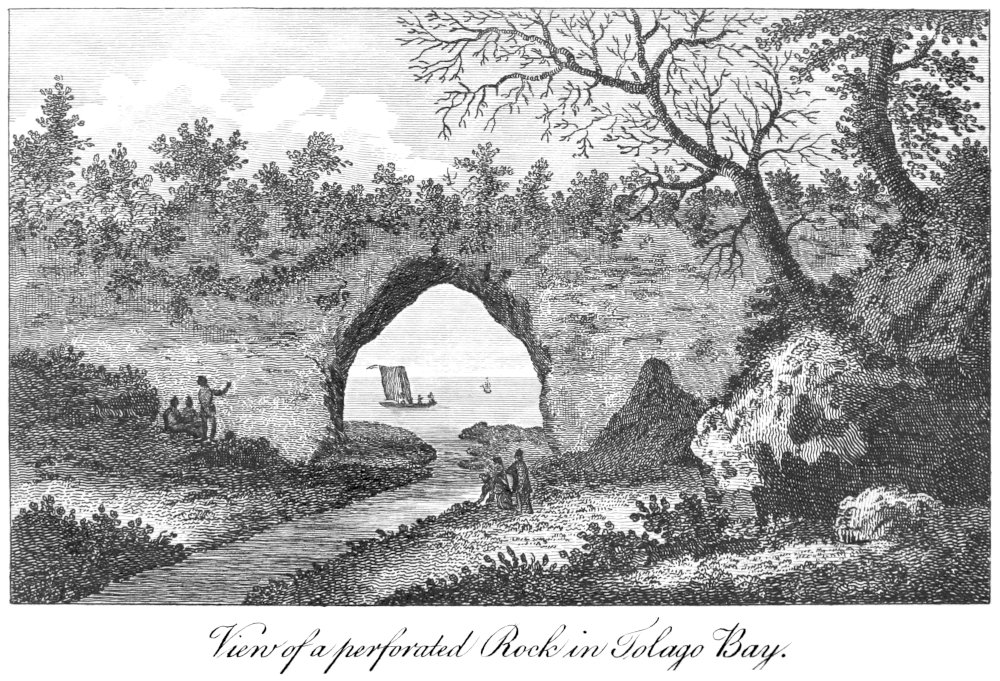
View of a perforated Rock in Tolago Bay
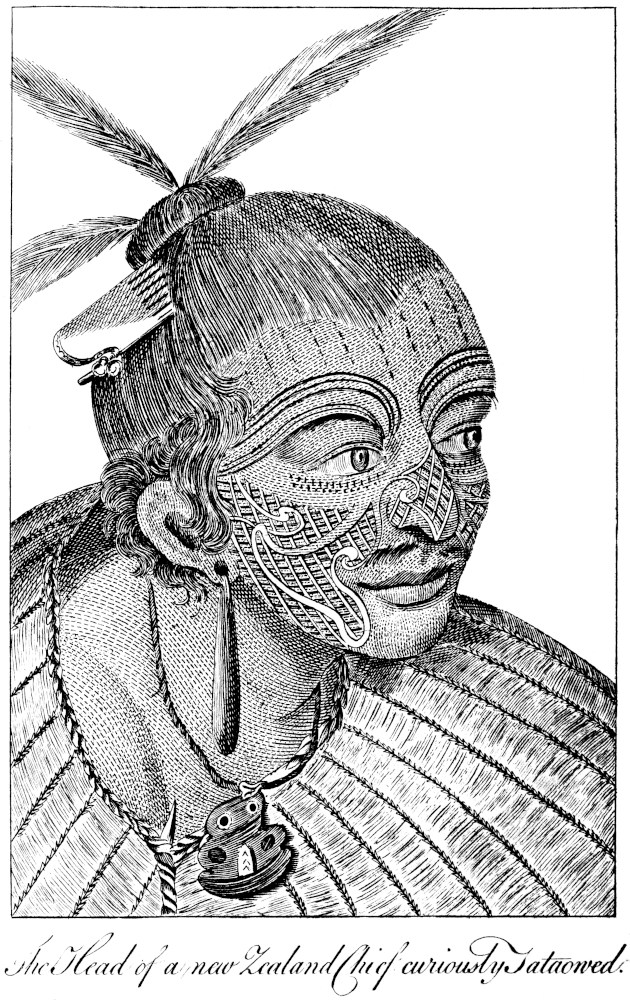
The Head of a new Zealand Chief curiously Tataowed.
On the 25th an armourer’s forge was set up on shore for necessary uses. Mr. Banks and Dr. Solander went again in search of plants. Tupia, who was with them engaged in a conversation with one of the priests, and they seemed to agree in their opinions upon the subject of religion. Tupia, in the course of this conference, enquired, whether the report of their eating men was founded in truth; to which the priest replied it was, but that they ate none but declared foes, after they were killed in war. This idea is, however, horrid and barbarous, and proves that they carry their resentment even beyond death.
Captain Cook and Dr. Solander went on the 27th to inspect the bay, when the Doctor was not a little surprised to find the natives in the possession of a boy’s top, which they knew how to spin by whipping it, and he purchased it out of curiosity. Mr. Banks was during this time employed in attaining the summit of a steep hill, that had previously engaged their attention; and near it he found many uninhabited houses. Here were two rows of poles about fourteen or fifteen feet high, covered over with sticks, which made an avenue of about five feet in width, extending near a hundred yards down the hill in an irregular line: the intent of this erection was not discovered. When the gentlemen met at the watering-place, the Indians, by desire, sung their war song, which was a strange medley of shouting, sighing and grimace, at which the women assisted. The next day Captain Cook and the other gentlemen went upon an island at the entrance of the bay, and met with a canoe that was sixty seven feet in length, six in breadth, and four in height; her bottom, which was sharp, consisted of three trunks of trees, and the sides and head were curiously carved. There was a large unfinished house upon this island; the posts which supported it were ornamented with carvings, that did not appear to be done upon the spot; and as the inhabitants seem to set a great value upon works of this kind, future navigators might find their advantage in carrying such articles to trade with. Though the posts of this house were judged to be brought here, the people have certainly a taste for carving, as their boats, paddles, and tops of walking-sticks evince. Their favourite figure is a volute or spiral, which is sometimes single, double and triple, and is done with great exactness, though the only instruments the gentlemen saw were an axe made of stone, and a chissel. Their taste, however, must be acknowledged whimsical and extravagant, scarce ever imitating nature.
Their huts are built under trees; their form is an oblong square: the door is low on the side, and the windows are at the ends; reeds, covered with thatch, compose the walls; the beams of the eaves, which come to the ground, are covered with thatch; most of the houses the gentlemen saw had been deserted, through fear of the English upon their landing. There are many beautiful parrots, and great numbers of birds of different kinds, particularly one whose note resembled the European black bird; but here is no ground fowl or poultry; nor were there any quadrupeds, except rats and dogs, and these were not numerous. The dogs are considered as delicate food, and their skins serve for ornaments to their apparel. There is a great variety of fish in the bay: shell and crayfish is very plentiful; some of the latter weigh near a dozen pounds.
Sunday, Oct 29, they set sail from this bay, which is called by the natives Tolaga. It is seated in latitude 38 deg. 22 min. south, four leagues to the north of Gable end Foreland: there are two high rocks at the entrance of the bay, which form a cove very convenient for procuring wood and water. There is a high rocky island off the north point of the bay, which affords good anchorage, having a fine sandy bottom, and from seven to thirteen fathom water, and is likewise sheltered from all but the north-east wind.
Captain Cook obtained nothing here in trade but some sweet potatoes, and a little fish. This is a very hilly country, though it presents the eye with an agreeable verdure, various woods, and many small plantations. Mr. Banks met with a great number of trees in the woods, quite unknown to Europeans; the firewood resembled the maple tree, and produced a gum of whitish colour; other trees yielded a gum of deep yellow green. The only roots they met with were yams and sweet potatoes, though the soil appears very proper for producing every species of vegetables.
Sailing to the northward, they fell in with a small island, about a mile distant from the north-east point of the main; and this being the most eastern part of it, the Captain named it East Cape, and the island East Island: it was but small, and appeared barren. The cape is in latitude 37 degrees 42 minutes 30 seconds south. There are many small bays from Tolaga Bay to East Cape. When the Endeavour had doubled the cape, many villages presented themselves to view, and the adjacent land appeared cultivated. In the evening of the 30th, Lieutenant Hicks discovered a bay, to which his name was given. Next morning, about nine, several canoes came off from shore with a number of armed men, who appeared to have hostile intentions. Before these had reached the ship, another canoe, larger than any that had yet been seen, full of armed Indians came off, and made towards the Endeavour with great expedition. The Captain now judging it expedient to prevent, if possible, their attacking him, ordered a gun to be fired over their heads; this not producing the desired effect, another gun was fired with ball, which threw them into such consternation, that they immediately returned much faster than they came. This precipitate retreat, induced the Captain to give the cape, off which it happened, the name of Cape Runaway, which lies in latitude 37 degrees 32 minutes, longitude 181 degrees 48 minutes. Next morning, at day break, they saw between forty and fifty canoes along shore, many of which came off in the manner they had done the day before, shouting, and menacing an attack. One of their Chiefs in the largest of the canoes made several harangues, and by the menacing flourish of his pike, seemed to bid the ship defiance; but the gentlemen continuing to invite them to trade, they at last came close along-side, and the Chief who had been declaiming, after uttering a sentence, took up a stone and threw it against the side of the ship, which appeared to be a declaration of hostilities, as they instantly seized their arms; Tupia told them, that immediate destruction would ensue, if they persevered in their design, and at the same time assured them of the gentlemens pacific intentions, and that they only wanted to traffick with them. Neither his threats nor persuasions would probably have had any effect, had he not at the same time shewn them some pieces of cloth, which attracted their eye, and brought them to reason. The gentlemen now purchased a great quantity of cray-fish, muscles and conger-eels. These Indians did not attempt any fraud in their trading; but some others, who succeeded them, took the goods from the ship without making proper returns: one of them, who had been particularly culpable, and seemed to pride himself upon his cunning, putting off with his canoe, was brought back by a musquet being fired over his head, and this presently produced good order. But when the sailors began to traffick with the Indians, they renewed their former fraudulent practices, with great insolence. One of them seized some linen that was hanging to dry, and made off with it; a musquet was fired over his head to make him return, but this did not prevail, and even after another was fired at him with small shot, which hit him in the back, he still persevered in his design. Upon this the rest of the Indians dropt a-stern at some distance, and set up their song of defiance. They did not, however, make any preparations for attacking the ship; but the Captain judged, that if he suffered them to go off without convincing them of his power of avenging the insult, it might give an unfavourable opinion of the English, to the natives on shore. He accordingly fired a four pounder, which passed over them, and the effect it had in the water terrified them so greatly, that they made to shore with the utmost precipitancy. In the afternoon they descried a high island to the west, and some time after perceived some other islands and rocks in the same quarter; not being able to weather them before night came on, they bore up between them and the main-land. About seven in the evening a double canoe, built like those at Otaheite, but carved after their peculiar manner, came up to the ship, and Tupia entered into a friendly conversation with the Indians on board; when, on a sudden, it being now dark, they pelted the ship with stones, and then retreated. Tupia was told by the Indians in the canoe, that the island close to which the Endeavour lay, was called Mowtohera; it was but a few miles from the main-land, of no great extent, but pretty high. They saw a high round mountain, south-west by west of Mowtohera, which the Captain named Mount Edgecombe.
The next morning, November 2, many canoes made their appearance, and one, which proved to be the same that gave the salute the night before, came up, and Tupia again engaged in conversation with the people in her. After behaving very peaceably about an hour, the fit of pelting again seized them, and they gave the ship another volley of stones; but a musquet being fired, they instantly took to their paddles.
In the forenoon, of the same day, the Endeavour sailed between a low flat island and the main: the villages upon the latter were more extensive than any they had yet seen. They were upon the high land next the sea, and were surrounded by a bank with rails on the top of it, and a ditch. There were some inclosures that resembled forts, and the whole had the appearance of fortified places. The Endeavour passed the night under an island about twenty miles from the main, which they named the Mayor. In the morning of the 3d, they gave the name of the Court of Aldermen to a number of small islands that lay contiguous, about twelve miles from the main, between which there are several other small islands mostly barren, but very high. The aspect of the main-land was now much changed, the soil appearing barren, and the country very thinly inhabited. The Chief, who governed the district from Cape Turnagain to this coast, was named Teratu.
On Friday the 3d, three canoes came a-longside with several Indians. These canoes were built very different from the others, being formed of the trunks of single trees, made hollow by burning: they were not carved, or in any shape ornamented. These Indians were of a darker complexion than the others, but made use of the same modes of defiance, and threw several stones and some of their lances into the ship.
The same afternoon the Endeavour sailed towards an inlet they had discovered, and anchored in seven fathom water. She was soon after surrounded by several canoes, and the Indians at first did not shew any signs that they intended committing hostilities. One of the Endeavour’s people shot a bird, which the Indians conveyed on board, without testifying any surprise at the event. For their civility, the Captain gave them a piece of cloth. But this favour had a very opposite influence to what was expected, for when it grew dark, they sung one of their menacing songs, and attempted to carry off the anchor’s buoy. Some musquets were now fired over them, which seemed rather to irritate than terrify them, and upon their going off, they threatened to return the next morning in greater numbers; they came back however the same night about eleven o’clock, in hopes of surprising the ship’s crew; but finding them on their guard, they again retired.
In the morning of the 4th, a great number of canoes, with near two hundred men, armed with spears, lances and stones, made their appearance, seemingly resolved to attack the ship, and desirous of boarding her, but could not determine at what part, changing their stations, and paddling round her. These motions kept the crew upon the watch, in the rain, whilst Tupia, at the request of the Captain, used every dissuasive argument he could suggest to prevent their carrying their apparent designs into execution; but his expostulations did not pacify them till some musquets were fired; they then laid aside their hostile intentions, and began to trade: they sold two of their weapons without fraud, but a third, for which they had received cloth, they would not deliver up, and instead of paying any attention to the demand that was made of it, they only laughed at them, and turned their expostulations into ridicule. As the Captain proposed to stay some days at this place, that he might observe the Transit of Mercury, he judged it expedient to chastise these people for their insolence and knavery; accordingly some small shot were fired upon the principal offender, and a musquet-ball went through his canoe. His companions left him to his fate, without taking the least notice of him, though he was wounded, and continued to trade without any discomposure. They for some time traded very fairly, but returning to their male practices, another canoe was fired upon, and struck: they soon after paddled away, whilst a round shot was fired over them.
Thus we find, that theft and chicane are as prevalent amongst the inhabitants of New Zealand, as those of Otaheite; from whence we might conclude, that in all uncivilized nations, probity is not considered as a virtue, or theft as a vice. Having no punishment for crimes of this kind, it may be urged, that they are not taught to consider them as such; but if nature has implanted in us just ideas of right and wrong, they must operate as forcibly upon the inhabitants under the line, as on those of other climes; and a native of Otaheite must be equally conscious of a breach of natural justice as the most polished European. However, as this is establishing the doctrine of innate ideas, which would lead us into a large field of controversy, we shall leave the reader to his own opinion upon this subject.
In searching for a convenient anchoring-place, the Captain saw a village upon a high point, near the head of the bay, fortified like those villages already mentioned. Having met with a place to his mind near where the Endeavour lay, he returned to the ship, and sailed to that spot, where he cast anchor.
Several of the Indians came off to the ship on the 5th, but behaved much better than they had done the preceding day. They had with them an old man, who had before testified his probity and discretion; and he appeared to be of superior rank to the rest. He came on board with another Indian, when the Captain presented them with some nails, and two pieces of cloth of English manufacture. Tojava (which was the name of the old man) informed Mr. Banks, that the natives had been in great terror of the English; when he was informed, that the Captain and his people had no ill design against the Indians; but, on the contrary, wanted to establish a friendly intercourse, and to traffick with them. Tojava then acquainted the Captain, that they were often visited by freebooters from the north, who stripped them of all they could lay their hands on, and often made captives of their children and wives; and that being ignorant who the English were upon their first arrival, the natives had taken the alarm upon the ship’s appearing off the coast, but were now satisfied of their good intent. He added, that to secure themselves from these plunderers, their houses were built contiguous near the tops of rocks, where they are more able to defend themselves. Probably their poverty and misery may be ascribed to the ravages of this banditti, who often strip them of every necessary of life. Whilst they were fishing for mullets in the bay, the Indians who were upon the banks testified their friendship by every possible means, and gave them an invitation to come on shore.
The assurances of friendship, which they had received from the gentlemen on board, seemed to have a proper influence upon the natives, who were now very tractable and submissive, and behaved with much civility to the people in the long-boat, which was again dispatched into the bay to fish, but with little success; the Indians however brought great quantities of fish, dressed and dried; and though they were very indifferent, they were purchased, that trade might not be discouraged. In a word, the natives now treated the English with great hospitality; a large supply of wood and good water was obtained, and the ship, being very foul, was heeled, and her bottom scrubbed in the bay.
November the 8th the ship was visited by several canoes, in one of which was Tojava, who perceiving two strange canoes paddling from the opposite shore, suddenly turned about, and acquainted the Captain that he was under apprehensions, the people in them were some of the freebooters, but he soon found his mistake, and returned to the ship. The Indians supplied the ship’s crew with as much excellent fish, resembling mackrel, as was sufficient for all their dinners, for which they gave them some pieces of cloth.
A great variety of plants were this day collected by Mr. Banks and Dr. Solander; they had never observed any of the kind before. These gentlemen remained on shore till near dark, when they observed the manner of the natives disposing of themselves during the night. They lay under some bushes; the men nearest the sea in a semicircular form, and the women and children the most distant from it; their arms were placed against trees very near them, to defend themselves in case of a surprize from the freebooters. They had no king, whose sovereignty they acknowledged, which was a circumstance unparalleled on any other parts of the coast.
Early in the morning of the 9th, several canoes brought a prodigious quantity of mackrel, one sort of which was no way different from the mackrel caught on our coast. These canoes were succeeded by many others, equally well loaded with the same sort of fish; and the cargoes purchased were so great, that when salted, they might be considered as a month’s provision for the whole ship’s company.
This being a very clear day, the astronomer (Mr. Green) and the other gentlemen landed to observe the Transit of Mercury, and whilst the observation was making, a large canoe, with various commodities on board, came alongside the ship and Mr. Gore, the officer who had then the command, being desirous of encouraging them to traffick, produced a piece of Otaheitean cloth, of more value than any they had yet seen, which was immediately seized by one of the Indians, who obstinately refused either to return it, or give any thing in exchange; he paid dearly however for his temerity, being shot dead on the spot.
The death of this young Indian alarmed all the rest; they fled with great precipitancy, and for the present could not be induced to renew their traffick with the English. But when the Indians on shore had heard the particulars related by Tojava, who greatly condemned the conduct of the deceased, they seemed to think that he merited his fate. His name proved to be Otirreeoonooe.
This transaction happened, as has been mentioned, whilst the observation was making of the Transit of Mercury, when the weather was so favourable, that the whole Transit was viewed without a cloud intervening. Mr. Green made the observation of the ingress, whilst Captain Cook was engaged in ascertaining the time, by taking the sun’s altitude. The Transit commenced at 7 hours, 20 min. 58 sec. by Mr. Green’s observation the internal contact was at 12 hours, 8 min. 57 sec. the external at 12 hours, 9 min. 54 sec. the latitude 30 deg. 48 min. 5 sec. In consequence of this observation having been made here, this bay was called Mercury Bay.
On the 10th Mr. Banks, Dr. Solander, and the Captain went in boats to inspect a large river that runs into the bay. They found it broader some miles within than at the mouth, and intersected into a number of streams, by several small islands, which were covered with trees. On the east side of the river the gentlemen shot some shags, which proved very good eating. The shore abounded with fish of various kinds, such as cockles, clams and oysters; and here were also ducks, shags, seapies and curlieus, with other wild fowl in great plenty. At the mouth of the river there was good anchorage in five fathom water. The gentlemen were received with great hospitality by the inhabitants of a little village, on the east side of the river. There are the remains of a fort called Eppah, in a peninsula that projects into the river, and it was well calculated for defending a small number against a greater force. From the remains, it nevertheless seemed to have been taken and partly destroyed.
The Indians sup before sun-set, when they eat fish and birds baked or roasted; they roast them upon a stick, stuck in the ground near the fire, and bake them in the manner the dog was baked, which the gentlemen ate at King George’s Island.
A female mourner was present at one of their suppers; she was seated upon the ground, and wept incessantly, at the same, time repeating some sentences in a doleful manner, but which Tupia could not explain; at the termination of each period she cut herself with a shell upon her breast, her hands or her face; notwithstanding this shocking, bloody spectacle greatly affected the gentlemen present, yet all the Indians who sat by her, except one, were quite unmoved. The gentlemen saw some, who from the depth of their scars must, upon these occasions, have wounded themselves still more violently.
November 11, great plenty of oysters were procured from a bed which had been discovered, and they proved exceedingly good. Next day the ship was visited by two canoes, with unknown Indians; after some invitation they came on board, and they all trafficked without any fraud.
Two fortified villages being descried, the Captain, with Mr. Banks and Dr. Solander, went to examine them: the smallest was romantically situated upon a rock, which was arched; this village did not consist of above five or six houses, fenced round. There was but one path, which was very narrow, that conducted to it. The gentlemen were invited by the inhabitants to pay them a visit, but not having time to spare, they took another route, after making presents to the females. A body of men, women and children now approached the gentlemen, who proved to be the inhabitants of another town, which they proposed visiting. They gave many testimonials of their friendly dispositions, among others they uttered the word Heromai, which, according to Tupia’s interpretation, implied Peace, and appeared much satisfied, when informed the gentlemen intended visiting their habitations. Their town was named Wharretouwa; it is seated on a point of land over the sea, on the north side of the bay; it was paled round, and defended by a double ditch. Within the ditch a stage is erected for defending the place in case of an attack; near this stage, which they call Porava, quantities of darts and stones are deposited to be in readiness to repel the assailants. There is another stage to command the path that leads to the town, and there are also some outworks. Upon the whole, the place seemed calculated to hold out a considerable time against an enemy armed with no other weapons than those of the inhabitants. It appeared however deficient in water for a siege. They eat instead of bread fern root, which was herein great plenty, with dried fish.
Very little land is here cultivated, sweet potatoes and yams being the only vegetables they found. There are two rocks near the foot of this fortification, both separated from the main land; they are very small, nevertheless they are not without dwelling-houses and little fortifications. They throw stones in their engagements with their hands, being destitute of a sling, and those and lances are their only missile weapons; they have, besides the Pattoo Pattoo, already described, a staff about five feet in length, and another shorter.
They sailed from this bay, after taking possession of it in the name of the King of Great Britain, on the 15th of November; Tojava, who visited them in his canoe just before their departure, said he should, as soon as the English were gone, prepare to retire to his fort, as the relations of Otirreeoonooe had menaced to take his life, as a forfeit for that of the deceased, Tojava being judged partial in this affair to the English. A number of islands of different sizes appeared towards the north-west, which were named Mercury Islands. Mercury bay lies in latitude 36 deg. 47 min. south; longitude 184 deg. 4 min. west, and has a small entrance at its mouth. On account of the number of oysters found in the river, the Captain gave it the name of Oyster river. Mangrove river (which the Captain so called from the great number of those trees that grew near it) is the most secure place for shipping, being at the head of the bay. The north-west side of this bay and river is much more fertile than the east side. The inhabitants, though numerous, have no plantations; their canoes are very indifferently constructed, and are no way ornamented; they lie under continual apprehensions of Teratu, being considered by him as rebels.
Upon this shore iron sand is in plenty to be found, which proves that there are mines of that metal up the country, it being brought down by a rivulet from thence.
On the 18th, in the morning, the Endeavour steered between the main, and an island which seemed very fertile, and as extensive as Uli Etea. Many canoes filled with Indians came along-side, and the Indians sung their war song, but the Endeavour’s people paying them no attention, they threw a volley of stones, and then paddled away; but they presently returned and renewed their insults. Tupia spoke to them, making use of his old argument, that inevitable destruction would ensue if they persisted; they answered with brandishing their weapons, intimating, at the same time, that if the English dared to come on shore they would destroy them all. Tupia still persisted in expostulating with them, but to no purpose; and they soon gave another volley of stones; but upon a musket being fired at one of their boats, they made a precipitate retreat.
In the evening they cast anchor in 23 fathom, and early the next morning they sailed up an inlet. Soon after two canoes came off, and some of the Indians came on board; they claimed an acquaintance with Tojava, and knew Tupia’s name; and after they had received some presents they retired peaceably.
The Endeavour was now in the bay, called by the natives Ooahaouragee, and Captain Cook, with Mr. Banks and Dr. Solander, &c. went in the boats to the bottom of the bay to examine it, and they did not return till next morning. They had been up a fresh water river, at the bottom of the bay, in three fathoms water, which would make a good harbour. They met with an Indian town, and a hippah, or place of refuge, the inhabitants of which invited them to land, and gave them a friendly reception. At the entrance of a wood they met with a tree ninety-eight feet high from the ground to the first branch, quite strait, and nineteen feet in circumference and they found still larger trees of the same kind as they advanced into the wood. The Captain called this river Thames, being not unlike our river of that name. They also found several young cabbage trees, and a new species of the palm-nut, or Pardanus.
Captain Cook weighed anchor the same afternoon, sailing down the river with the tide, the wind blowing fresh from north-north-west; the next morning the flood obliged him to cast anchor again; and the Captain, with Dr. Solander, went on shore to the west, but made no observations worth relating. The ship, at their departure from it, was surrounded with canoes, which induced Mr. Banks to remain on board, that he might trade with the Indians. The chief object of these people was paper, for which they exchanged their arms and cloaths, and took no unfair advantages. Though the traders were honest in their dealings, there was one amongst them, who took a fancy to a half-minute glass, but was detected in secreting it, and he was punished with the cato’nine tails. The other Indians endeavoured to save him from this punishment; but being opposed, they got their arms from the canoes, and some of the people in them attempted to get on board. Mr. Banks and Tupia now coming upon deck, the Indians applied to Tupia but he having no influence upon Mr. Hicks, the commanding officer, informed them of the nature of the offender’s intended punishment, which pacified them, as they imagined he was going to be put to death. The criminal not only received twelve lashes, but afterwards a drubbing from an old man, who was thought to be his father. The canoes immediately went off, the Indians saying, they should be afraid to return again on board. Tupia, however, had so much influence over them as to bring them back; but they seemed to have lost that confidence, which they had before reposed in the English.
On the 23d the wind being still against them, they were obliged to tide it down the river, anchoring between tides; they passed a point of land, which the Captain called Point Rodney, and which is the north-west extremity of the river. As they could not approach the land, on account of the wind, they had but a distant view of the main for a course of near thirty miles. Captain Cook comprehended, under the name of the River Thames, the whole bay; and the promontory at the north-east extremity, he called Cape Colville, in honour of the peer of that name. This cape is in latitude 36 deg. 26 min. longitude 194 deg. 27 min. it is distinguishable at a considerable distance by a very high rock. The river runs south by east from the south point of this cape; it is, in the narrowest parts, at least three leagues over for near fourteen leagues, when it becomes narrower. It was thought to contain fish in abundance, as there appeared many implements necessary for fishing; the water was in some places twenty-six fathoms deep, and gradually diminished. There are several small islands within cape Colville, which appear to form tolerable harbours. There are also islands towards the western shore. The anchorage is good in all parts of the bay, which is defended from the sea by a number of small islands, which Captain Cook named Barrier Islands.
The circumjacent country, which is pretty extensive, appeared to be but thinly inhabited; the natives are a stout and active people, and are painted red all over: their canoes were ornamented with carving, and were constructed upon a good model.
On the 24th, they still continued steering along the shore, between the islands and the main, and in the evening anchored in an open bay, in about fourteen fathoms water. Here they caught a large number of fish of the scienne, or bream kind; from which the Captain named this Bream Bay, and the extreme points of it Bream Head. There are numbers of rocks off this bay, which were called the Hen and Chickens; it is situated in latitude 35 deg. 46 min. seventeen leagues north-west of cape Colville. There is an extent of land of about thirty miles between Point Rodney and Bream Head; it is woody and low. No inhabitants were visible, but from the fires perceived at night, the gentlemen concluded it was inhabited.
On the 25th, early in the morning, the Endeavour sailed out of the bay, keeping to the northward near the shore. Some islands were soon after discovered, about ten miles to the north-north-east, which they called the Poor Knights; upon these islands there were some houses, and a few towns that appeared fortified, and the land round them seemed cultivated. Towards night several canoes, with a number of Indians, came up to the ship, and some came on board. Two of the Chiefs received presents, and told the gentlemen, that they had had an account of the arrival of the English in those parts. After their departure other Indians came up to trade, and soon began their usual fraudulent practices; the gentlemen had recourse to the old remedy of firing some small shot, and a round shot, which soon put them to flight.
Sunday the 26th, Captain Cook continued his course slowly along the shore to the north. This day two canoes came up, and some of the Indians came on board, when they trafficked very fairly. Two larger canoes soon after followed them, and coming up to the ship, the people in them hailed the others, when they conferred together, and afterwards came along-side of the ship. The last two canoes were finely ornamented with carving, and the people, who appeared to be of higher rank, were armed with various weapons; they held in high estimation their Patoo Patoos, which were made of stone and whalebone, and they had ribs of whale, with ornaments of dog’s hair, which were very curious. These people were of a darker complexion than those to the southward, and their faces were stained blacker, with what they call Amoco; and their thighs were striped with it, very small interstices of the flesh being left visible. Though they all used the black Amoco, they applied it to different parts, and in various forms. Most of them had the figure of volutes on their lips, and one woman in particular was curiously marked upon various parts of her body. These Indians seemed the superiors of the others, they were nevertheless not free from the vice of pilfering, for one of them having agreed to barter a weapon for a piece of cloth, he was no sooner in possession of the cloth, than he paddled away without paying the price of it; but a musquet being fired, he came back and returned the cloth. All the canoes then returned ashore.
The Endeavour passed a remarkable point of land, which the Captain called Cape Bret, in honour of the baronet of that name: this cape is much higher than any of the adjacent land. Within a mile to the north-east by north is a curious rocky island; it is arched, and has a pleasing effect at a distance. The natives call this Cape Motugogogo: it lies in latitude 35 deg. 10 min. 30 sec. south; and longitude 185 deg. 23 min. west. It forms a bay to the west, which contains many small islands, and Captain Cook named the point at the north-west entrance Point Pococke. There are many villages on the main as well as on the islands, which appeared well inhabited, and several canoes, filled with Indians, made to the ship, and after coming along-side to trade, shewed the same itch for cheating as the others. One of the midshipmen was so nettled at being imposed upon, that he had recourse to a whimsical expedient by way of revenge; taking a fishing line, he threw the lead with so much dexterity, that the hook caught the Indian who had imposed upon him by the buttocks, when the line breaking, the hook remained in his posteriors. These Indians were strong and well proportioned; their hair was black, and tied up in a bunch stuck with feathers: the Chiefs among them had garments made of fine cloth, ornamented with dog’s skin; and they were tataowed like those who had last appeared.
On the 27th the Endeavour was among a number of small islands, from which several canoes came off; but the Indians, from their frantic gestures, seemed disordered in their minds; they threw their fish into the ship by handfuls, without demanding any thing by way of barter. Some other canoes also came up, who saluted the ship with stones. One of the Indians, who was particularly active, threw a stick at one of the Endeavour’s men. It was then judged time to bring them to reason, and a musquet, with small shot was fired at him, when he fell down in the canoe. A general terror was now spread amongst them, and they all made a very precipitate retreat. Among the fish obtained from these canoes, were Cavalles in great plenty, and for this reason the Captain called these islands by the same name.
For several days the wind was so very unfavourable, that the vessel rather lost than gained ground; on the 29th, having weathered Cape Bret, they bore away to leeward, and got into a large bay, where they anchored on the south-west side of several islands, and suddenly came into four fathom and a half water. Upon sounding, they found they had got upon a bank, and accordingly weighed and dropped over it, and anchored again in ten fathoms and a half; after which the ship was surrounded by thirty-three large canoes, containing near three hundred Indians all armed. Some of them were admitted on board, and Captain Cook gave a piece of broad cloath to one of the Chiefs, and some small presents to the others. They traded peaceably for some time, being terrified at the fire arms, the effect of which they were not unacquainted with; but whilst the Captain was at dinner, on a signal given by one of their Chiefs, all the Indians quitted the ship, and they attempted to tow away the buoy; a musquet was now fired over them, but it produced no effect; small shot was then fired at them, but it did not reach them. A musquet, loaded with ball, was therefore ordered to be fired, and Otegoowgoow (son of one of the Chiefs) was wounded in the thigh by it, which induced them immediately to throw the buoy overboard. To complete their confusion a round shot was fired, which reached the shore, and as soon as they landed they ran in search of it. If these Indians had been under any kind of military discipline, they might have proved a much more formidable enemy; but acting thus, without any plan or regulation, they only exposed themselves to the annoyance of fire arms, whilst they could not possibly succeed in any of their designs.
The Captain, Mr. Banks and Dr. Solander landed upon the island, and the Indians in the canoes soon after came on shore. The gentlemen were now in a small cove, and they were presently surrounded by near four hundred armed Indians; but the Captain not suspecting any hostile design on the part of the natives, remained peaceably disposed. The gentlemen marching towards them, drew a line, intimating that they were not to pass it; they did not infringe upon this boundary for some time, but at length they sung the song of defiance, and began to dance, whilst a party attempted to draw the Endeavour’s boats on shore; these signals for an attack being immediately followed by the Indians breaking in upon the line, the gentlemen judged it time to defend themselves, and accordingly the Captain fired his musquet, loaded with small shot, which was seconded by Mr. Banks discharging his piece, and two of the men followed his example. This threw the Indians into confusion, and they retreated; but were rallied again by one of their Chiefs, who shouted and waved his patoo patoo. The Doctor now pointed his musquet at this hero, and hit him; this stopt his career, and he took to flight with the other Indians. They retired to an eminence in a collective body, and seemed dubious whether they should return to the charge. They were now at too great a distance for ball to reach them; but these operations being observed from the ship, she brought her broad side to bear, and by firing over them soon dispersed them. The Indians had in this skirmish two of their people wounded, but none killed. Peace being thus restored, the gentlemen began to gather celery and other herbs; but suspecting some of the natives were lurking about with evil designs, they repaired to a cave, which was at a small distance; here they found the Chief, who had that day received a present from the Captain; he came forth with his wife and brother, and solicited their clemency. It appeared, that one of the wounded Indians was a brother of this Chief, who was under great anxiety lest the wound should prove mortal; but his grief was in a great degree alleviated, when he was made acquainted with the different effects of small shot and ball; he was at the same time assured, that upon any future hostilities being committed ball would be used. This interview terminated very cordially, after some trifling presents were made to the Chief and his companions.
The prudence of the gentlemen upon this occasion, cannot be much commended. Had these four hundred Indians boldly rushed in upon them at once with their weapons, the musquetry could have done very little execution; but supposing twenty or thirty of the Indians had been wounded, for it does not appear their pieces were loaded with ball, but only small shot, there would have remained a sufficient number to have massacred them, as it appears they do not give any quarter, and none could have been expected upon this occasion. It is true, when the ship brought her broad-side to bear, she might have made great havock amongst the Indians; but this would have been too late to save the party on shore.
Being again in their boats, they rowed to another part of the same island, when landing and gaining an eminence, they had a very agreeable and romantic view of a great number of islands, well inhabited and cultivated. The inhabitants of an adjacent town approached unarmed, and testified great humility and submission. Some of the party on shore, who had been very violent for having the Indians punished for their fraudulent conduct, were now guilty of trespasses equally reprehensible, having forced into some of the plantations, and dug up potatoes. The Captain upon this occasion shewed strict justice in punishing each of the offenders with twelve lashes: one of them being very refractory upon the occasion, and complaining of the hardship, thinking an Englishman had a right to plunder an Indian with impunity, was flogged out of this opinion with six additional lashes. Probably his adding “that in this, he had only followed the example of his superiors,” might have had no little weight in procuring him this last sentence.
It being a dead calm on the 30th, two boats were sent to sound the harbour, and many canoes came up, and traded with great probity: the gentlemen went again on shore, and met with a very civil reception from the natives; and this friendly intercourse continued all the time they remained in the bay, which was several days. Being upon a visit to the old Chief, he shewed them the instruments used in tataowing, which were very like those at Otaheite employed upon the like occasion. They saw the man who had been wounded by the ball, when the attempt was made to carry off the ship’s buoy; and though it had gone through the fleshy part of his arm, it did not seem to give him the least pain or uneasiness.
On Tuesday the 5th, in the morning, they weighed anchor, but were soon becalmed, and a strong current setting towards the shore, they were driven in with such rapidity, that they expected every moment to run upon the breakers, which appeared above water not more than a cable’s length distance; they were so near the land, that Tupia, who was totally ignorant of the danger, held a conversation with the Indians, who were standing on the beach. They were happily relieved, however, from this alarming situation by a fresh breeze, suddenly springing up from the shore.
The bay which they had left was called the Bay of Islands, on account of the numerous islands it contains; they catched but few fish while they lay there, but procured great plenty from the natives, who are extremely expert at fishing, and display great ingenuity in the form of their nets, which are made of a kind of grass; they are two or three hundred fathoms in length, and remarkably strong; and they have them in such plenty, that it is scarce possible to go a hundred yards upon the beach, without meeting with numbers lying in heaps. These people did not appear to be under the government of any particular Chief or Sovereign, and they seemed to live in a perfect state of friendship, notwithstanding their villages were fortified. According to their observations upon the tides, the flood comes from the south, and there is a current from the west.
Dec. 7, several canoes put off and followed the Endeavour, but a breeze arising, Captain Cook did not wait for them: on the 8th they tacked, and stood in for the shore: and on the 9th, they were about seven leagues to the westward of the Cavalles, and soon after came to a deep bay, which the Captain named Doubtless Bay. The wind prevented their putting in here, and being soon after becalmed, they were visited by several canoes from shore, with whom they trafficked. From these Indians they learnt, they were about two days sail from Moore Whennua, where the land changed its shape, and instead of extending to the westward, turned to the south; and that to the north-north-west there was an extensive country, named Ulimaroah, where the inhabitants lived upon hogs, which they called Booah, and was the same name given them by the inhabitants of the islands in the South Seas. They saw upon the coast several plantations, of the Eaowte, or cloth trees, and some of the Koomarra. They beat to windward four days, and made but little way. On the 10th, the land appeared low and barren, but was not destitute of inhabitants; the next morning, they stood in with the land, which forms a peninsula, and which the Captain named Knuckle Point. Another bay, that lies contiguous, Captain Cook called Sandy Bay, in the middle of it is a high mountain, which was named Mount Camel, on account of its resembling that animal. Several canoes put off, but could not reach the ship, which now tacked and stood to the northward, till the afternoon of the 12th, when she stood to the north-east. Towards night it began to rain and blow, and in the morning it was so tempestuous, as to split the main-top-sail, and the fore mizen-top-sails. Early in the morning of the 14th, they saw land to the southward; and on the 15th, they tacked and stood to the westward; next day they discovered land from the mast-head to the south-south-west; and on the 16th came off the northern extremity of New Zealand, which the Captain called North Cape. It lies in latitude 34 deg. 22 min. south, longitude 186 deg. 55 min. west, and forms the north point of Sandy Bay. Their situation varied but little till the 24th, when they discovered land, which they judged to be the islands of the Three Kings, though they did not resemble the description of them in Dalrymple’s account. The chief island is in latitude 34 deg. 12 min. south, longitude 187 deg. 48 min west, between fourteen or fifteen leagues from North Cape. Mr. Banks went out in the small boat, and caught some birds that greatly resembled geese, and they were very good eating. On the 27th, it blew very hard from the east all day, accompanied with heavy showers of rain, and they brought the ship under a reef main-sail. On the 30th they saw land, bearing north-east, which was thought to be Cape Maria Van Diemen, but the sea being very boisterous, they did not venture to approach it, but tacked about and stood to the north-west.
January 1, 1770, they tacked and stood to the eastward; and on the 3d they saw land again; it was high and flat, and tended away to the south-east, beyond the reach of the naked eye. It is remarkable, that the Endeavour was three weeks in making ten leagues to the westward, and that she met with a violent gale of wind in latitude 35 deg. south, at Midsummer. On the morning of the 4th they stood along the shore, the coast appearing sandy and barren, dreary and inhospitable; steering northward on the 6th they saw land again, which they imagined to be Cape Maria: on the 7th, they had light breezes, and were sometimes becalmed, when they saw a sun-fish, short and thick in figure, with two large fins, but scarce any tail, resembling a shark in colour and size. They continued steering east till the 9th, when they perceived land, and were soon after a-breast of a point, which Captain Cook named Woody-head. From the south-west there is a small island, which the Captain called Gannet Island. Another point remarkably high to the east-north-east, the Captain named Albetross Point, on the north side of which a bay is formed that promises good anchorage. At about two leagues distance from Albetross Point to the north-east, they discovered a remarkable high mountain, equal in height to that, of Teneriffe, the summit of which was covered with snow, and it was named Mount Egmont. It is in latitude 39 deg. 16 min. longitude 185 deg. 15 min. west, and the country round it is pleasant, presenting an agreeable verdure, intersected with woods: the coast forms an extensive cape, which the Captain likewise called cape Egmont, in honour of the nobleman of that name. It is about twenty-seven leagues to the south-south-west of Albetross Point, having two small islands to the north, near a very high point of a conic figure. This day some very heavy showers of rain fell, accompanied with thunder and lightening. The Captain proposed careening the ship here, and taking in wood and water; and accordingly, on the 15th, steered for an inlet; when it being almost a calm, the ship was carried by the current very near the shore, but got clear with the assistance of the boats. Whilst this was doing a sea lion made its appearance; it is a very curious creature, and answers the description given of it in Lord Anson’s Voyage. The Captain sent the pinnace to examine a small cove that appeared, but soon after recalled her, on seeing the natives launch and arm their canoes. The Endeavour anchored in a commodious part of the bay, in sailing towards which spot an Indian town was descried, when the inhabitants waved their hands, seemingly to invite the Endeavour’s people to land. In passing the point of the bay, they observed an armed centinel on duty, who was twice relieved. Four canoes came from shore to visit the ship, but none of the Indians would venture on board, except an old man, who seemed of elevated rank: his countrymen took great pains to prevent his coming on board, but they could not divert him from his purpose, and he was received with the utmost civility and hospitality. Tupia and the old man joined noses, according to the custom of the country, and after receiving several presents, he returned to his associates, when they began to dance and laugh, and soon after retired. The Captain and the other gentlemen now went on shore, where they met with plenty of wood and water, and were very successful in fishing, catching some hundred weight in a short time.
On the 16th the Endeavour’s people were engaged in careening her, when three canoes came off with a great number of Indians, and brought several of their women with them. This circumstance was judged a favourable presage of their peaceable disposition, but they soon gave proofs of the contrary, by attempting to stop the long-boat that was sent on shore for water, when Captain Cook had recourse to the old expedient of firing some shot, which intimidated them for the present; but they soon gave fresh proofs of their insidious designs. One of them snatched some paper from the Endeavour’s people who were trading with them, and brandishing his patoo patoo, put himself in a threatening posture; upon which it was judged expedient to fire some small shot at him, which wounded him in the knee; this step put an end to the correspondence with regard to trade; but Tupia still continued conversing with them, and making many inquiries concerning the curiosities of New Zealand; he also asked them, if they had ever before seen a ship of the magnitude of the Endeavour; to which they replied, they had never seen such a vessel, nor ever heard that one had been upon the coast, though Tasman certainly touched here, which was only fifteen miles south of Murderer’s bay. There is great plenty of fish in all the coves of this bay; among others here are cuttle fish, large breams, small grey breams, small and large baracootas, flying gurnards, horse mackrel, dog fish, soles, dabs, mullets, drums, scorpenas, or rock fish, cole fish, shags, chimeras, &c. The inhabitants catch their fish as follows; their net is cylindrical, extended by several hoops at the bottom, and contracted at the top; the fish going in to feed upon what is put in the net, are caught in great abundance; there are also birds of various kinds, and in great numbers, particularly parrots, wood pigeons, water hens, hawks, and many different singing birds. An herb, a species of Philadelphus, was used here instead of tea; and a plant, called Teegoomme, resembling rug cloaks, served the natives for garments. The environs of the cove where the Endeavour lay is covered entirely with wood, and the supple jacks are so numerous, that it is with difficulty passengers can pursue their way; here is a numerous sand-fly that is very disagreeable. The tops of many of the hills are covered with fern. The air of the country is very moist, and has some qualities that promote putrefaction, as birds that had been shot but a few hours were found with maggots in them. The women who accompanied the men in the canoes wore a head-dress, which the gentlemen had no where met with before. It was composed of black feathers, tied in a bunch on the top of the head, which greatly increased its height. The manner of their disposing of their dead is very different to what is practised in the South-sea islands, they tie a large stone to the body, and throw it into the sea: the gentlemen saw the body of a woman which had been disposed of this way, but which by some accident had disengaged itself from the stone, floating upon the water. The Captain, Mr. Banks, and the Doctor visited another cove, about two miles from the ship. There was a family of Indians who were greatly alarmed at the approach of the gentlemen, all running away except one; but upon Tupia’s conversing with him the others returned. They found, by the provisions of this family, that they were cannibals, here being several human bones that had been lately dressed and picked; and it appeared, that a short time before, six of their enemies having fallen into their hands, they had killed four and eaten them, and that the other two were drowned in endeavouring to make their escape. They made no secret of this abominable custom, but answered Tupia, who was desired to ascertain the fact, with great composure, that his conjectures were just, that they were the bones of a man, and testified by signs, that they thought human flesh delicious food. Upon being asked, why they had not eaten the body of the woman that had been seen floating upon the water? They replied, she had died of a disorder, and that moreover she was related to them, and they never ate any but their enemies. Upon Mr. Banks’s still testifying some doubts concerning the fact, one of the Indians drew the bone of a man’s arm through his mouth, and this gentleman had the curiosity to bring it away with him. There was a woman in this family whose arms and legs were cut in a shocking manner, and it appeared she had thus wounded herself, because her husband had lately been killed and eaten by the enemy.