CAPTAIN COOK’s VOYAGE ROUND THE WORLD. In 1768, 1769, 1770 and 1771. (continued 2)
Reading edition
The next evening Mr. Banks was under the disagreeable necessity of reprimanding, in very strong terms, Tubora Tumaida, for having the insolence to snatch his gun from him, and firing it in the air; a thing which surprised Mr. Banks greatly, as he imagined him totally ignorant of the use of it. And as their safety in a great measure depended on keeping them in that state, he told him, with threats, that his touching his piece was the greatest of insults. The Indian made no reply, but set off with his family to his house at Eparre. He being an useful man, Mr. Banks, accompanied by Mr. Molineux, thought fit to go after him, and they found him among a number of people, greatly dejected. However, as Mr. Banks judiciously caused all animosity to cease, they brought him back to supper; after which the Chief and his wife both slept in Mr. Banks’s tent. One of the natives, not intimidated by their presence, attempted that very evening to scale the walls of the fort, but was prevented by the centinel. These Indians could not resist making attempts to steal the iron and iron tools within the works.
Sunday morning the 14th, divine service was performed at the fort, in hopes that some of the principal Indians might be present, but most of them returned home before the time. However, Tubora Tumaida, and his wife Tomio, were present; they behaved with great decency, but without the least apparent curiosity. They made no enquiries with respect to the ceremonies, and their brethren were as little inquisitive upon their return. This evening several of their people were witnesses to an entertainment of a very extraordinary nature, which consisted of the most indecent acts of lewdness. For example, a young fellow cohabited in public with a girl about eleven or twelve years of age, without the least sense of shame; and what is still more extraordinary, Oberea, with several other females of the first rank, were present during the whole time.
On Monday the 15th, Mr. Banks detected Tubora Tumaida in having stolen some nails. Mr. Banks having a good opinion of this Chief, was willing to put his fidelity to the test, and several temptations were thrown in his way, among the rest a basket of nails, which proved irresistible. He confessed the fact, and upon Mr. Banks’s insisting upon restitution, he declared the nails were at Eparre; this occasioned high words, and at length the Indian produced one of them. He was to have been forgiven upon restoring the rest, but not having resolution to fulfil his engagement, he fled with his furniture and family before night.
On the 17th, one of the natives who came in the morning before day-light to steal some casks, it not being the first offence, the centinel snapped his gun at him, but it missing fire he escaped.
On Wednesday 24, Tootahah having sent many messages to request a visit from the Captain, declaring that he would acknowledge the compliment by a present of some hogs. Mr. Hicks the first Lieutenant was sent, in hopes of getting the hogs without the visit. He was received in a very friendly manner at a place called Tettehah, five miles farther to the westward, where Tootahah had taken up his residence. He brought away one hog only, which had been produced immediately upon his arrival, with a promise of receiving more the next morning; but, when morning came, he was obliged to depart without them. Mr. Banks, on the 25th, seeing Tubora and his wife Tomio at the tent, for the first time after he stole the nails, endeavoured to persuade him to restore them, but in vain. He was treated with great coolness during his short stay, and his departure was very abrupt.
On the 27th of May, Tootahah being removed to a place called Atahourou, Mr. Banks, Dr. Solander, Captain Cook, and some others, set out in the pinnace to pay him a visit; after making presents of a few trifling articles, they were invited to stay the night. Mr. Banks having accepted of a place in Oberea’s canoe, left his companions, in order to retire to rest. Notwithstanding the care Oberea took of his cloaths, by having them in her own custody, they were stolen with his pistols, powder-horn, and many other things that were in his waist-coat pockets. The alarm was given to Tootahah, who slept in the next canoe, and who went with Oberea in search of the thief, leaving Mr. Banks with only his breeches on, and his musquet uncharged. They soon returned, but without success; Mr. Banks thought proper to put up with the loss for the present, and a second time endeavour to sleep. But he had scarce composed himself, before he heard some musick, and perceived lights at a small distance from shore; this proved to be a concert, which they call Heiva. Mr. Banks judged it then necessary to get up and try to find his companions. As soon as he approached the lights, he found the hut, where Mr. Cook and three of his associates lay, and began to relate his melancholy tale; but instead of receiving much comfort from them, he was told, that they had shared the same fate, having lost their stockings and jackets. However, this did not prevent their hearing out the concert, which consisted of drums, flutes, and several voices, after which they retired to rest.
The next morning Mr. Banks got his musquet from Tupia, with whom he had intrusted it, and some cloaths from Oberea; in which he made a whimsical appearance. They then got together, and were joined by Dr. Solander, who was the only one among them that had not been robbed, having slept at a house about a mile distant. As to the others they were obliged to put up with their loss; their cloaths, &c. having never been heard of afterwards. They set out for the boat not very well pleased, carrying with them only one hog, which had been intended for their supper the night before.
In their return to the boat, they were greatly amused by seeing some Indians swimming for their diversion, amidst a surf, which no European boat could have lived in, or the best swimmer in Europe have saved himself from drowning, had he by accident been exposed to its fury. This extraordinary surf breaks upon the shore in a few places, where access to the island is not guarded by a reef, and makes it very dreadful and dangerous.
Some Indians from a neighbouring island, to which Captain Wallis gave the name of Duke of York’s Island, informed them of more than twenty islands in the neighbourhood of Otaheite.
They now began to make necessary preparations for observing the Transit of Venus, and, from the hints Mr. Cook had received from the Royal Society, he sent out two parties to make observations from different spots, that in case they failed at Otaheite, they might succeed elsewhere; they employed themselves in preparing their instruments, and instructing such gentlemen with the use of them, as were to go out. And on Thursday the 1st of June, the next Saturday being the day of the Transit, they sent the long boat to Eimayo, having on board Mr. Gore, Mr. Monkhouse, and Mr. Sporing, a friend of Mr. Banks; each furnished with necessary instruments by Mr. Green. Mr. Banks and several of the Indians went out with this party. Others were dispatched to find out a convenient spot, at such a distance from their principal station, as might suit their purpose.
Those who went to Eimayo in the long boat, after rowing the best part of the night, by the help of some Indians aboard a canoe, which they hailed, found a proper situation for their Observatory upon a rock, which rose out of the water about one hundred and forty yards from the shore, where they fixed their tents, and prepared the apparatus for the following day’s observation.
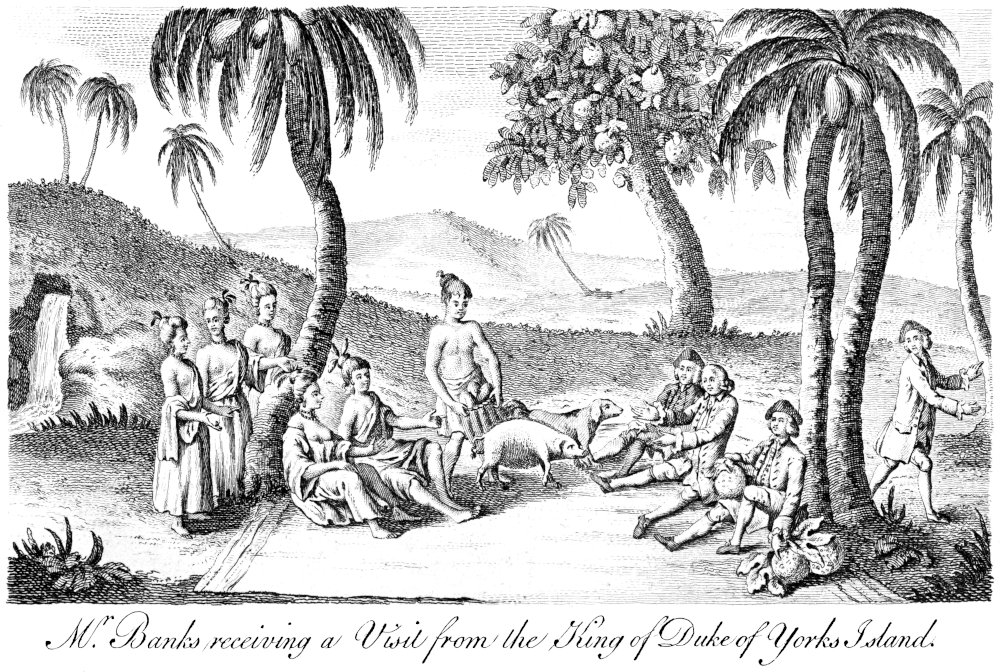
On Saturday the 3d, as soon as it was light, Mr. Banks left them to go to the island for fresh provisions. As he was trading with the natives who belonged to Tarrao, the King of the island, his majesty arrived with his sister, whose name was Nuna, in order to pay him a visit. It being customary among these people to be seated during their conferences, Mr. Banks spread on the ground his Indian cloth turban, that he wore instead of a hat, on which they all sat down. After this the royal present was brought, consisting of a hog and a dog, some cocoa-nuts, bread-fruit, &c. A messenger was dispatched by Mr. Banks for an adze, a shirt, and some beads, and they were presented to his majesty, who received them with great pleasure. Tubora Tumaida and Tomio, Indians who had gone with Mr. Banks upon the expedition, came from the Observatory: Tomio, said to be related to Tarrao, brought him a long nail, and a shirt for Nuna, by way of presents. Mr. Banks returned to the Observatory with Tarrao, Nuna, and three beautiful young women, their chief attendants. He shewed them the Transit of Venus over the Sun, and informed them, that he and his companions had come from their own country solely to view it in that situation.
M
r
. Banks receiving a Visit from the King of Duke of Yorks Island.
The produce of this island, according to the inspection of Mr. Banks, proved to be much the same as that of Otaheite, the people also resembling those of that island, many of them he had seen upon it, who were well acquainted with the value of the trading articles.
Both the parties which were sent out, made their observation with great success. They nevertheless differed in the accounts of the times of the contacts more than might have been imagined.
Mr. Green’s Account was as follows.
Hours Min. Sec.
The first external contact, or first appearance of Venus on the Sun, was 9 25 4 Morning.
The first internal contact or total immersion was 9 44 4 Morning.
The second internal contact, or beginning of the immersion 3 14 8 Afternoon.
The second external contact, or total immersion 3 32 10 Afternoon.
Latitude of the Observatory 17° 29′ 15″. Longitude 149° 32′ 30″ W. of Greenwich.
While they were viewing the Transit of Venus, some of the ship’s company broke into one of the store-rooms, and stole a quantity of spike-nails. As the circulation of these nails might have been greatly detrimental to them, strict search was made, and one of the thieves was detected. He had only a few in his custody; but was however punished with two dozen lashes.
The death of an old woman of some distinction gave them an opportunity of observing the manner of the Indians disposing of their dead, whom they never bury. The kind of bier, on which the corpse is deposited, has already been described, and the bread-fruit, &c. placed as before, which Tubora Tumaida informed Mr. Banks was deposited as an offering to their Gods. A sort of stile was placed in the front of the square, where the relations of the deceased stood to testify their sorrow; beneath the awning were several pieces of cloth, on which were the tears and blood of the mourners, for upon these occasions they wound themselves with a shark’s tooth. At a small distance two temporary houses were erected, in one of which some of the relations of the deceased constantly remained, and in the other the chief mourner resided, who was dressed in a peculiar manner, to perform a particular ceremony. After the corpse is rotten, the bones are buried near the spot. It was afterwards discovered, that these repositories of the dead were used also for religious worship.
There having been a scarcity of bread-fruit for some days, an enquiry was made of the cause, and the reasons the Indians gave was, that there being a great crop, the fruit had been gathered to make a sort of sour paste, which the natives call Mahie, which, after fermentation, will keep a long time, and supply them in times of dearth.
The funeral ceremony, in honour of the old woman, was performed on the 10th by the chief mourner, and Mr. Banks was so desirous to be a spectator, that he agreed to take a part in the performance of this ceremony, being informed, that he could not be present on any other condition. He accordingly went in the evening to the place where the body was deposited, there he was met by the relations of the deceased, and afterwards joined by several other persons. The chief mourner was Tubora Tumaida; his dress was whimsical, though not altogether ungrateful. Mr. Banks was obliged to quit his European dress, and he had no other covering than a small piece of cloth, which was tied round his middle; his body was then blacked with charcoal and water, as were the bodies of several others, particularly some females, who were as little covered as himself; the procession then began. The chief mourner uttered some words, that were judged to be a prayer, when he approached the body; and he repeated it as he came up to his own house. After this the procession went on, by permission, towards the fort. It is usual for the Indians to shun these processions as much as possible; they accordingly ran into the woods in great haste, as soon at it came in view. From the fort it proceeded along the shore. Having crossed the river, it entered the woods, passing several houses, which became immediately uninhabited; and, during the rest of the procession, which continued above half an hour, not a single Indian was visible, Mr. Banks filled an office they called Nineveh, and there were two others in the same character. When none of the other natives were to be seen, they approached the chief mourner, saying, imatata; then those who had assisted at the ceremony bathed in the river, and resumed their customary dress.
Such was this uncommon ceremony, in which Mr. Banks performed a capital part, and met with the applause of Tubora Tumaida, the chief mourner.
Complaint was made on Monday the 12th to the Captain, that the Indians had lost some bows and arrows, and strings of plaited hair; the affair was enquired into, and the fact being well attested, two dozen lashes were inflicted upon each of the criminals.
The bows and arrows of the Indians have not hitherto been noticed; but this day Tubora Tumaida brought his hither, occasioned by a challenge he had received from Mr. Gore. The Indian Chief imagined it was a trial of skill who could shoot the farthest; but Mr. Gore proposed shooting at a mark. The mistake being soon discovered, the champions declined the trial. The Indian, however, to display his skill, drew his bow, and sent an arrow, unfeathered, as they all were, nearly the sixth part of a mile. They shoot kneeling, and drop the bow the instant the arrow is discharged.
In this morning’s excursion, Mr. Banks met several of the natives, who were itinerant musicians, and the place of the evening’s rendezvous being known, all the English gentlemen went thither to partake of the diversion. Their instruments were flutes and drums, and a great number of the Indians were got together upon the occasion. The drummers sung to the music, and to the astonishment of Mr. Banks and the rest of his companions they found, that they were the chief subject of the minstrels lays. These songs must, therefore, have been extemporaneous, the rewards whereof were such necessaries as they required.
An iron coal rake for the oven being stole in the night of the 14th, and many other things having at different times been taken by the Indians, the Captain judged it of some consequence, if possible, to put an end to these practices, by making it their common interest to prevent it. He had already given strict orders, that the centinels should not fire upon them, even if they were detected in the fact. About twenty-seven of their double canoes with sails were just come in with cargoes of fish, which the Captain seized, and then gave notice, that unless the rake, and all the other things, which had at different times been stolen, were returned, the vessels should be burnt. The Captain had, indeed, no such design, as will appear by the event. The menace produced no other effect than the restitution of the rake, all the other things remaining in their possession; at length the Captain thought proper to give up the cargoes, as the innocent natives were in great distress for want of them; and at last, to prevent confusion, from the difficulty of ascertaining to whom the different lots belonged, he promised also to release the canoes.
About this time another event had nearly involved the English in a quarrel with the Indians. The Captain having sent a boat on shore to get ballast, the officer not meeting immediately with what he wanted, began to pull down one of their sepulchral buildings: this measure was strenuously opposed by the Indians. Mr. Banks, having received intelligence of the affair, repaired to the spot, and the matter was soon amicably terminated, there being stones sufficient found elsewhere. This was the only opposition they had, hitherto, made, and the only personal insult received (besides the affair of the musket at the tent, for which the Indian forfeited his life) was by Mr. Monkhouse, who having pulled a flower within one of their burial inclosures, was struck by an Indian; the gentleman laid hold of him, but he was rescued by two more, who pulling Mr. Monkhouse’s hair forced him to quit his hold, after which they all ran off.
On the 19th in the evening, soon after dark, while the canoes were detained by the Captain, Oberea the Queen, and several of her attendants, paid the gentlemen a visit; she came from Tootahah’s palace, in a double canoe, and brought with her a hog, bread-fruit, and other presents, among which was a dog; but none of the things that had been stolen; those she pleaded had been taken away by her gallant Obadee, for which she had beaten him. She did not, however, seem to think her story deserved credit, but appeared at first much terrified, though she surmounted her fears with great fortitude; and was desirous of sleeping with her attendants in Mr. Bank’s tent; but this being refused, she was obliged to pass the night in her canoe. The Captain declined accepting of her presents, at which she seemed very sorrowful. Mr. Banks and the rest of the gentlemen retired to bed, and a whole tribe of the Indians would have slept in the bell-tent, but were not permitted.
The next morning the Queen returned to the fort, and Captain Cook having altered his mind accepted of her presents. Two of her attendants were very earnest in getting themselves husbands, in which they succeeded, by means of the Surgeon and one of the Lieutenants: they seemed very agreeable till bed-time, and determined to lie in Mr. Banks’s tent, which they accordingly did, till the Surgeon having some words with one of them Mr. Banks thrust her out, and she was followed by the rest, except Otea Tea, who cried for some time, till he turned her out also. This had like to have become a serious affair, a duel being talked of between Mr. Banks and Mr. Monkhouse, but it was happily avoided. Dogs are esteemed here more delicate eating than pork; as those bred to be eaten taste no animal food, but live entirely upon vegetables; and the experiment was tried. Tupia undertook to kill and dress him, which he did, by making a hole in the ground and baking him. It was agreed by every one to be a very good dish.
They were visited on the 21st at the fort by many of the natives, who brought various kinds of presents, and among the rest Oamo, a Chief of several districts on the island, whom they had never before seen, who brought with him a hog. This Chief was treated with great respect by the natives, and was accompanied by a boy, and a young woman. The boy was carried upon a man’s back, though he was very able to walk. Oberea and some other of the Indians went out of the fort to meet them, their heads and bodies being first uncovered as low as the waist. This was considered as a mark of respect, they had not noticed it before, but judged it was usually shewn to persons of distinguished rank among them. Oamo entered the tent, but the young woman, who was about sixteen, could not be prevailed upon to accompany him, tho’ she seemed to combat with her curiosity and inclination. Dr. Solander took the youth by the hand, and conducted him in; but the natives without, who had prevented the girl’s entrance, soon found means to get him out again.
The curiosity of Mr. Banks and the other gentlemen being excited from these circumstances, they made enquiry, who these strangers were, and were informed, that Oamo was Oberea’s husband, but that by mutual consent they had been for a considerable time separated; and that the youth and girl were their offspring. The boy was named Terridiri, and was heir apparent to the sovereignty of the island; and he was to espouse his sister as soon as he had attained the proper age. The present sovereign being a minor, called Outou, and son of Whappai; Whappai, Oamo, and Tootahah, were all brothers; Whappai was the senior, and Oamo the next; wherefore, Whappai having no child but Outou, Terridiri, son of Oamo, was heir to the sovereignty. To us it will appear singular, that a boy should reign during the life of his father; but in the island of Otaheite, a boy succeeds to his father’s authority and title as soon as he is born; when a regent is elected, which office usually falls upon the father, till the boy becomes of age: at this time, however, the election had fallen upon his uncle Tootahah, on account of his warlike exploits. Oamo was very inquisitive with respect to the English, and by his questions he appeared a man of understanding and penetration.
A woman called Teetee, who came from the west of the island, presented to the Captain an elegant garment, of a bright yellow ground, bordered with red, and in the middle of it were several crosses, which they had probably learned from the French.
On the 23d in the morning, one of their hands being missing, they enquired for him among the natives, and were told that he was at Eparre, Tootahah’s residence in the wood; and one of the Indians offered to fetch him back, which he did that evening. On his return he informed them, that he had been taken from the fort, and carried to the top of the bay, by three men, who having stripped him, forced him into a canoe, and conducted him to Eparre, where he received some cloaths from Tootahah, who endeavoured to prevail on him to continue there. They had great reason to suppose this account true, for the natives were no sooner acquainted with his return, than they left the fort with much precipitation.
Monday June 26, early in the morning, the Captain set out in the pinnace, accompanied by Mr. Banks, to circumnavigate the island. They sailed to the eastward, and in the forenoon they went on shore, in a part of the island under the government of Ahio, a young Chief, who had often visited them at the tents. They also found here some other natives of their acquaintance. They then proceeded together to the harbour, wherein M. Bougainville lay when he visited this island, and were shewn the ground on which he fixed his tent, and the watering-place. They also met with Orette, a Chief, who was their particular friend, whose brother went away with M. Bougainville.
Having taken a survey of this harbour, and a large bay near which it is situated, they proposed going to the opposite side of the bay, but Titubaola, who was their conductor, not only refused to accompany them, but endeavoured to dissuade the Captain and Mr. Banks from going, saying, “That country was inhabited by people who were not subjects to Tootahah, and who would destroy them all.” This information did not, however, prevent the execution of their design; and upon loading their pieces with ball, Titubaola took courage to go with them; they rowed till it was dark, when they reached a narrow neck of land, that divided the island into two peninsulas, which are distinct governments. As they were not yet got into the hostile part of the country, they agreed to spend the night on shore, where they were provided with supper and lodging by Ooratooa, the lady who paid her compliments to Mr. Banks in so remarkable a manner at the fort.
In the morning they pursued their passage for the other government.
They landed in a district, which was governed by a Chief, named Maraitata, the burying place of men, and his father was called Pahairede, the stealer of boats. Notwithstanding their names were so ominous, they gave the Captain and Mr. Banks a very civil reception; furnished them with provisions, and sold them a large hog for a hatchet. The curiosity of the natives was soon excited, and a crowd gathered round the English gentlemen, but they saw only two people whom they knew, neither did they observe any trinkets that had come out of the Endeavour, though they met with several European commodities, particularly two twelve pound shot, one of which had the English broad arrow upon it, though the Indians said they had them from M. Bougainville’s people. They then advanced till they reached the district, which was under the dominion of the principal Chief, or King, named Waheatua, who had a son, but it was not known in whose hands the sovereign power was lodged. Here they found a spacious verdant plain, watered by a river of so great a width, that they were obliged to pass it in a canoe, but their Indian followers swam over it with the greatest facility. There was no house that appeared inhabited; but the ruins of several large ones. Having continued their journey along the shore for a considerable way, they at last saw the Chief, and with him an agreeable young woman about two and twenty, named Toudidde. They were not unacquainted with her name, as they had often heard it mentioned by the natives; and they had great reason to suppose she was the Queen of this peninsula.
In passing through this part of the island, they found it better cultivated, and more improved than any they had hitherto met with; though the houses were but few, and those very small, but there were a great number of canoes which excelled any they had seen, both in size and workmanship. The burial places were likewise numerous, being found not only at every point, but at different places in the interior parts of the island. These buildings nearly resembled, in form, those which they had seen at Opouroenu, but they were neater, and adorned with carvings of various figures; in one there was a cock, which was painted in imitation of the natural colour of the feathers of that bird. Notwithstanding the fertility of the country, and its being well cultivated, scarce any bread-fruit was to be met with, and the inhabitants subsisted chiefly upon a nut, called abee.
Finding themselves fatigued, they now took to their boat, and in the evening landed on an island named Otooareite; being in want of some refreshment, Mr. Banks went into the woods to try what he could obtain, but it being dark, he met with no inhabitants and but one house, in which he found only a bread-fruit, and a few of the nuts before-mentioned; nor were they more successful in procuring provisions the next morning.
Towards the southermost part of the island they found a good harbour, formed by a reef, and the circumjacent country is remarkably fruitful. At about three miles distant they landed, at a place where they found several of the natives, with whom they were intimately acquainted. After having, with a good deal of difficulty, obtained some cocoa-nuts, they again embarked.
They landed again a little further to the east. Mathiabo, the Chief, with whom they had no acquaintance, nor had ever seen before, soon came to them, and supplied them with cocoa-nuts and bread-fruit. They also purchased a hog of him for a glass bottle, which he took in preference to every other thing that was offered him. They saw here a turkey cock and a goose which the Dolphin left on the island, they were remarkably fat, and seemed to be greatly admired by the Indians.
A very uncommon sight presented itself in a house near this place, several human jaw-bones were fastened to a board of a semicircular form; they seemed fresh, and had not lost any of their teeth; but Mr. Banks could obtain no explanation of this mystery. Upon their quitting the place, the Chief accompanied them, and piloted them over the shoals. They opened the bay in the evening, on the north-west side of the island, which corresponded with that on the south-east, in such a manner, as to intersect the island at the isthmus.
Several canoes came off here with some very beautiful women, who appeared to be desirous of their going on shore, to which they readily assented. They met with a very friendly reception from the Chief, whose name was Wiverou, who gave directions to some of his people to assist them in dressing their provisions, which were now very plentiful, and they supped at Wiverou’s house, in company with Mathiabo. Part of the house was allotted for them to sleep in, and soon after supper they retired to rest. Mathiabo having obtained a cloak from Mr. Banks, under pretence of using it as a cover-let when he lay down, immediately made off with it, unperceived by that gentleman or his companions. News however of the robbery was soon brought them by one of the natives; in consequence of which intelligence they sat out in pursuit of the thief, but had proceeded a very little way before they were met by a person bringing back the cloak, which Mathiabo had given up through fear.
The house, upon their return, was entirely deserted, and about four in the morning the centinel gave the alarm, that the boat was missing. Mr. Banks and the Captain were greatly astonished at this account, and ran to the water-side, but though the morning was clear and star-light, no boat was visible. Their situation was now extremely terrifying: the party consisting of but four, with a single musket and two pocket pistols, without a spare ball or a charge of powder. After remaining in this distressful state of anxiety for a considerable time, dreading the advantage the Indians would take of it, to their great joy, the boat, which had been driven away by the tide, returned; Mr. Banks and his companions no sooner breakfasted than they departed. This place is situated on the north side of Tiarrabou, the south-east peninsula of the island, about five miles east from the isthmus, with a harbour equal to any in the island. It was fertile and populous, and the inhabitants every where behaved with civility. The last district in Tiarrabou, in which they landed, was governed by a Chief, named Omoe. He was building a house, and was very desirous of purchasing a hatchet, but Mr. Banks and the Captain had not one left. He would not trade for nails, and they embarked; the Chief following them in a canoe with his wife, in hopes of obtaining something useful to him. The Chief and his wife were afterwards taken on board, and after having gone about three miles, they desired to be put on shore, and their request was complied with, when the Captain met with some of Omoe’s people, who had brought with them a very large hog. The Chief agreed to exchange the hog for a large axe and a nail, and to bring the beast to the fort in Port Royal Bay. This resolution he came to after consulting with his wife; and Mr. Banks judged the exchange to be very advantageous to the English, as the hog was a remarkable fine one.
At this place they saw one of their Eatuas, or Gods, it was made of wicker-work, and resembled the figure of a man; it was near seven feet in height, and was covered with black and white feathers; on the head were four protuberances, which the natives called Tate ete, or little men.
Having taken their leave of Omoe, they set out on their return; after rowing a few miles, they went on shore again, but saw nothing remarkable except a sepulchral building, which was ornamented in an extraordinary manner. The pavement, on which was built a pyramid, was very neat; at a little distance there was an image of stone, very uncouthly carved, which the natives seemed to hold in a great estimation.
They passed through the harbour, which was the only one fit for shipping, on the south of Opoureonu, situated about five miles to the westward of the isthmus, between two small islands not far from shore, and within a mile of each other. They were now near the district, named Paparra, which was governed by Oamo and Oberea, where they intended to spend the night. Mr. Banks and his company landed about an hour before it was dark, and found that they were both set out to pay them a visit at the fort. They nevertheless slept at the house of Oberea, which, though not large, was very neat; no inhabitant but her father was now in possession of it, who shewed them much civility. They took this opportunity of walking out to a point, upon which they had observed, at a distance, some trees, called Etoa, which usually grow on the burial-places of these people. They call these burying-grounds Morai, which are also places of worship. They here saw an immense edifice, which they found to be the Morai of Oamo and Oberea, which was by far the most considerable piece of architecture to be found in the island.
It consisted of an enormous pile of stone work, raised in the form of a pyramid, with a flight of steps on each side, something after the manner of those little buildings, which are commonly erected in England to place the pillars of sun dials upon; it was near two hundred and seventy feet long, and about one-third as wide, and between forty and fifty feet high.
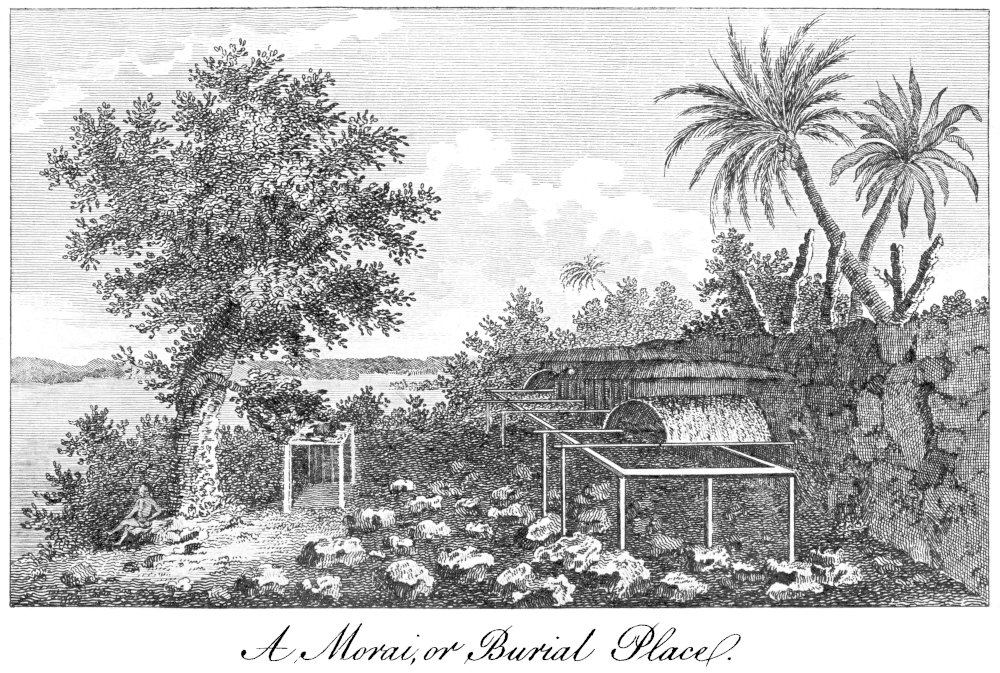
A Morai, or Burial Place.
The foundation consisted of rock-stones, the steps of coral, and the upper part of round pebbles, all of the same shape and size; the rock and coral-stones were squared with the utmost neatness and regularity, and the whole building appeared as compact and firm, as if it had been erected by the best workmen in Europe. As the Indians were totally destitute of iron utensils to shape their stones, as well as mortar to cement them, when they had made them fit for use, a structure of such heighth and magnitude, must have been a work of infinite labour and fatigue.
In the center of the summit was the representation of a bird, carved in wood; close to this was the figure of a fish; which was in stone. This pyramid made part of one side of a wide court or square, the sides of which were nearly equal; the whole was walled in, and paved with flat stones. Within this place grew (notwithstanding it was in this manner paved) several plantains, and trees which the natives call Etoa. At a little distance to the west of this edifice was another paved square, which contained several small stages, called by the natives Ewattas, which appeared to be altars; upon them they place provisions, as sacrifices to their gods: Mr. Banks afterwards observed whole hogs placed upon these ewattas, or altars.
The inhabitants of the island of Otaheite seem in nothing so desirous of excelling each other as in the grandeur and magnificence of their sepulchres; and the rank and authority of Oberea was forcibly evinced upon this occasion. The gentlemen of the Endeavour, it has been observed, did not find Oberea possessed of the same power, as when the Dolphin was at this place, and they were now informed of the cause. The way from her house to the Morai, was by the sea-side, and they observed, in all places as they passed along, a great number of human bones. Inquiry being made into the cause of this extraordinary sight, they were informed, that about four or five months before Captain Cook’s arrival, the inhabitants of Tiarrabou, the peninsula to the south-east, made a descent here, and slew many of the people, whose bones were those that were seen upon the coast: that hereupon Oberea and Oamo, who then held the government for his son, had fled and taken refuge in the mountains; and that the victors destroyed all the houses, and pillaged the country. Mr. Banks was also informed, that the turkey and goose which he had seen in the district of Mathiabo, were among the booty; this afforded a reason for their being found where the Dolphin had little or no correspondence; and the jaw-bones, being mentioned, which had been seen hanging in a house, he was informed, that they had likewise been carried off as trophies. The jaw-bones of their enemies being considered by the natives of this island, as great a mark of triumph, as scalps are by the Indians of North America.
On Friday the 30th they arrived at Otahourou, where their old acquaintance Tootahah resided; he received them with great civility, and provided for them a good supper, and a convenient lodging; and notwithstanding they were so shamefully plundered the last time, they slept with this chief. They spent the night in the utmost security, none of their cloaths, or any other article, being missing in the morning.
On Saturday, July 1, they returned to the fort at Port Royal Harbour; having discovered the island, both peninsulas included, to be about one hundred miles in circumference. They were now very much in want of bread-fruit, owing to the scarcity of the season, and could obtain but a very small quantity upon their whole tour.
Their Indian friends crouded about them upon their return, and none of them came without provisions.
Monday the 3d, Mr. Banks made an excursion, with some Indian guides, to trace the river up the valley to its source, and observe to what extent its banks were inhabited. After meeting with houses for the space of six miles, they came up to one which was said to be the last that could be seen. The master of it presented them with cocoa-nuts and other fruits; and after a short visit, they continued their walk. In this tour they often passed under vaults, formed by rocky fragments, in which, they were informed, that those who were benighted often took refuge. They pursued the course of the river for about five or six miles further, and found it banked on both sides by rocks which were almost perpendicular, and near one hundred feet high, notwithstanding which, a way was to be traced up these dreadful precipices, and their Indian guides offered to conduct them by this path to the summit; but as it could not be effected without the utmost difficulty and danger, and there appeared nothing at the top to recompence them for the fatigue and hazard of the undertaking, they declined attempting it.
Mr. Banks during this tour had a fine opportunity of searching for minerals among the rocks, which were almost, on all sides, naked; he found, however, not the smallest appearance of any kind of mineral. The stones every where resembling those of Madeira, gave manifest signs of having been burnt. Scarce a single stone was found during their whole stay upon the island, which had not unquestionable marks of fire on it, except the hatchet stone, and some of these were not entirely free from it. There are also evident traces of fire in the clay upon the hills, both of this and the neighbouring islands.
Mr. Banks was engaged the 4th in planting on each side of the fort a great quantity of the seeds of water-melons, oranges, lemons, limes, and other plants and trees which he had brought from Rio de Janeiro. He gave of these seeds to the Indians in great plenty, and planted many of them in the woods: some of the melon-seeds, which had been planted soon after his arrival, had already produced plants which appeared to be in a very flourishing state.
They now began to make preparations for their departure; but before they set sail they had another visit from Oamo, Oberea, and their son and daughter. The young woman, whose name they understood to be Toimata, was very curious to see the fort, but Oamo would by no means permit her to come in. The son of Waheatua, sovereign of Tiarrabou, or the south-east peninsula, was also here at this time; and they received intelligence of the arrival of another guest, whose company they neither wished for nor expected; this was the Indian who had stolen the quadrant.
On Friday the 7th, the carpenters were ordered to take down the gates and pallisadoes of the fort, to be converted into firewood on board the Endeavour; and one of the Indians stole the staple and hook belonging to the gate: he was instantly pursued; but could not be found; and soon after this, their old friend Tubora Tumaida brought back the staple.
They continued on the 8th and 9th to pull down the fort, and their friends still visited them.
Captain Cook hoped now to quit the island, without any farther misunderstanding with the natives; but in this he was mistaken. Two foreign sailors having been out, one of them was robbed of his knife, and striving to recover it, the Indians attacked and wounded him in a dangerous manner with a stone; his companion also received a slight wound in the head. As Captain Cook would have been unwilling to have taken farther notice of the transaction, he was not sorry that the offenders had made their escape. Another affair equally disagreeable soon after happened. Between the 8th and 9th in the evening; two young marines retired secretly from the fort, and in the morning were not to be met with. Notice having been given for all the company to go on board the next day, and that the ship would sail that day or the day ensuing, Captain Cook began to fear that the marines intended to remain on shore. He was apprised, that no effectual steps could be taken to recover them, without risking the harmony and good fellowship which at present subsisted between the English and the natives; and therefore resolved to wait a day in hopes of their returning.
The 10th in the morning the marines not being returned, an enquiry was made after them, when the Indians declared they did not propose returning, having taken refuge in the mountains, where it was impossible to discover them, and that each had taken a wife. In consequence of which it was intimated to several of the Chiefs who were in the fort with their women, among whom were Tubora Tumaida, Tomio and Oberea, that they would not be suffered to quit it till the deserters were produced. Captain Cook thought this precaution necessary, as, by concealing them a short time, he might be compelled to go without them; they received the intimation with very little signs either of fear or discontent, assuring the Captain that the marines should be sent back. In the interim he sent Mr. Hicks in the pinnace to bring Tootahah on board the ship, which he executed without giving any alarm. Night coming on, Captain Cook judged it was not prudent to let the people, whom he had detained as hostages, remain at the fort, and he therefore ordered Tubora Tumaida, Oberea, and some others, to be brought on board. This gave an unusual alarm, and several of them, especially the females, testified their apprehensions with great agitation of mind, and floods of tears, when they were coming on board. Captain Cook went on board with them, Mr. Banks remaining on shore with some others, whom he thought it of less importance to detain.
One of the marines was brought back in the evening by some of the Indians, who reported, that the other, and the two people who were sent to fetch them back, would be detained whilst Tootahah was confined. Mr. Hicks was immediately dispatched in the long-boat, with several men, to rescue the English prisoners; at the same time Captain Cook told Tootahah, that it was incumbent on him to assist them with some of his people, and to give orders, in his name, that the men should be set at liberty, for that he should expect him to answer for the event. Tootahah immediately complied, and this party recovered the men without any opposition. About seven in the morning on the 11th they returned, but without the arms which had been taken from them when they were made prisoners: the arms were however brought on board soon after, and the Chiefs were allowed to return on shore.
At the time the Chiefs were set on shore from the ship, those at the fort were also released, and after remaining with Mr. Banks about an hour and a half, they all returned to their respective places of residence. When the deserters were examined, it was discovered, that the account which the Indians had given was no way false: they had become fond of two girls, and it was their design to keep themselves concealed till the ship had let sail, and continue upon the island.
Tupia, whose name has been often mentioned in this voyage, had been prime minister of Oberea, when she was at the pinnacle of her authority: he was also the principal priest of the island, and therefore intimately acquainted with the religion of the country. He was likewise deeply versed in navigation, and was thoroughly acquainted with the number, situation, inhabitants and produce of the adjacent islands. He had often testified a desire to go with them; and on Wednesday the 12th, in the morning, he came on board, with a boy about twelve years of age, his servant, named Taiyota, and requested the gentlemen on board, to let him go with them. As it was thought he would be useful to them in many particulars, they unanimously agreed to comply with his request. Tupia then went ashore for the last time to see his friends, and took with him several baubles to give them as parting tokens of remembrance.
Mr. Banks being willing to obtain a drawing of the Morai, in possession of Tootahah, at Eparre, Captain Cook accompanied him thither in the pinnace, together with Dr. Solander. They immediately, upon landing, repaired to Tootahah’s house, where they were met by Oberea, and several others. A general good understanding prevailed, and they promised to visit the gentlemen early the next day, to take leave of them, as they were told that the ship would then set sail. There also they met Tupia, who came back with them, and slept for the first time on board the ship.
Thursday the 13th of July, the ship was visited by a multitude of the gentlemen’s friends, and surrounded by numberless canoes, which contained the inferior natives. They weighed anchor about twelve, and the Indians took their leaves of the gentlemen on board, weeping in a friendly and affecting manner. Tupia supported himself in this scene with a becoming fortitude, tears flowed from his eyes, its true, but the effort that he made to conceal them did him additional honour. He went with Mr. Banks to the mast-head, where he continued waving his hand to the canoes as long as they remained visible.
The longitude of Port Royal Bay, as settled by Captain Wallis, was found to be within half a degree of its real situation. Point Venus, the northern extremity of the island, and the eastern point of the bay, lies in the longitude 149 degrees 30 minutes. Port Royal Bay, which is equal to any in Otaheite, may easily be discovered by a remarkable high mountain in the center of the island, bearing due south from Point Venus. The shore of the bay is a fine sandy beach, behind which runs a river of fresh water; any number of ships may water here without any inconvenience to each other. The only wood for firing, upon the whole island, is that of fruit-trees, which must be purchased of the natives, or it is impossible to live upon good terms with them.
According to Tupia’s account, the island could furnish above six thousand fighting men, whereby a computation of the number of inhabitants may easily be made.
The produce of Otaheite is bread-fruit, cocoa-nuts, bananas, plantains; a fruit not unlike an apple, potatoes, yams, cocoas, sugar-cane, and a variety of other fruits and vegetables.
They have no European fruits, garden stuff, or pulse, nor grain of any species. Their tame animals are hogs, dogs, and poultry; there is not a wild animal in the island, except ducks, pigeons, parroquets, and a few other birds; rats being the only quadruped, and there are no serpents. The sea however supplies them with great variety of excellent fish.
With regard to the people, they are in general rather of a larger make than Europeans. The males are tall, robust, and finely shaped. The females of the superior class are likewise generally above our common size; but those of the lower rank are rather below it, and some of them are remarkably little.
Their natural complexion is a fine clear olive, or what we call brunette, their skin is delicately smooth and agreeably soft. The shape of their faces is in general handsome, and their eyes are full of sensibility and expression, their teeth are likewise remarkably white and regular, and their breath intirely free from any disagreeable smell; their hair is for the most part black. The men, unlike the original inhabitants of America, have long beards, which they wear in various forms; and what is very remarkable, circumcision is almost universally practised among them, from a motive of cleanliness; having a peculiar term of reproach, with which they upbraid those who do not adopt this custom. Both sexes always eradicate the hair from their arm-pits, and they often reproached the English gentlemen with a want of cleanliness, for not making use of the same method. Their motions are easy and graceful, but not vigorous; their deportment is generous and open, and their behaviour affable and courteous. They appeared of a brave, noble, and candid disposition; equally strangers to the base and unworthy passions of cruelty, treachery, or revenge, and setting aside their violent prepensity to thieving, it may fairly be said, that their general characters would lose nothing in the comparison with those of the most civilized nation under the globe.
Contrary to the custom of almost all other countries, the women of this island cut their hair quite short, whereas the men wear it long, sometimes hanging loose on their shoulders, and at others tied in a knot on the crown of their heads, in which they stick the feathers of birds of various colours.
Both sexes frequently wear a piece of cloth of the manufacture of the island tied round their heads in the form of a turban; and the women take no little pains in plaiting human hair into long strings, which being folded into branches, are tied on their foreheads by way of ornament.
There is a custom likewise prevalent among them of anointing their heads with an oil extracted from the cocoa-nut. The smell of which is not altogether agreeable, as the climate is hot, and they are not provided with any thing similar to a comb, their heads are not clear from vermin: it evidently appeared, however, to be more the effect of necessity than inclination, as those to whom they gave combs immediately got rid of these disagreeable companions.
They stain their bodies, by indenting or pricking the flesh with a small instrument made of bone, cut into short teeth; which indentures they fill with a dark blue or blackish mixture, prepared from the smoke of an oily nut, burnt by them instead of candles and water; this operation, which is called by the natives Tattaowing, is exceedingly painful, and leaves an indelible mark on the skin. It is usually performed when they are about ten or twelve years of age, and on different parts of the body; but those which suffer most severely are the breech and the loins, which are marked with arches, carried one above another a considerable way up their backs.
At the operation of Tattaowing, performed upon the posteriors of a girl about twelve years of age, Mr. Banks was present, it was executed with an instrument that had twenty teeth, and at each stroke, which was repeated every moment, serum mixed with blood issued. She bore it with great resolution for several minutes; but at length the pain became so violent, that she murmured and complained, and then burst into the most violent lamentations; but her operator was inexorable, whilst some females present chid, and even beat her. Mr. Banks was a spectator for near an hour, during which time it was performed only on one side, the other having undergone the ceremony sometime before; and the arches upon the loins, which are the most painful, but upon which they the most pique themselves, were yet to be made.
They cloath themselves in cloth and matting of various kinds; the first they wear in fair, the latter in wet weather. They are in different forms, no shape being preserved in them, nor are the pieces sewed together. The women of a superior class wear three or four pieces; one, which is of considerable length, they wrap several times round their waists, and it falls down to the middle of the leg. Two or three other short pieces, with a hole cut in the middle of each, are placed on one another, and their heads coming through the holes, the long ends hang before and behind, both sides being open, by which means they have the free use of their arms.
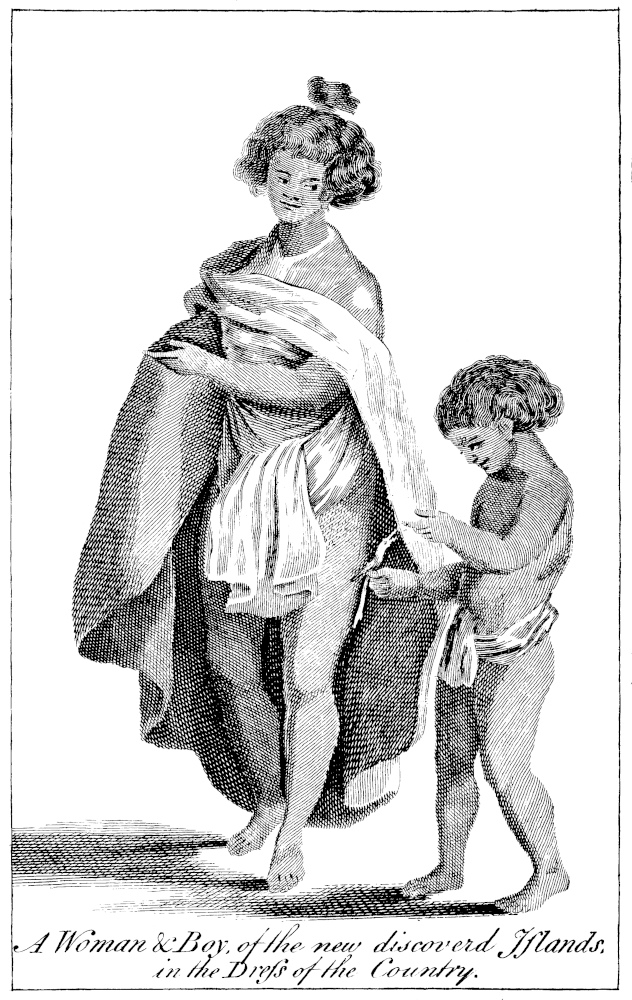
A Woman & Boy, of the new discovered Islands, in the Dress of the Country.
The mens dress is very similar, differing only in one instance, which is that part of the garment instead of falling below the knees, is brought between the legs. This dress is worn by all ranks of people, the only distinction being quantity in the superior class. At noon both sexes appear almost naked, wearing only the piece of cloth that is tied round the waist. Their faces are shaded from the sun with small bonnets, made of cocoa-nut leaves or matting which are constructed in a few minutes. The men sometimes wear a sort of wig, made of human or dogs hair, or of cocoa-nut strings, woven on a single thread, which is fastened under their hair, and hangs down behind. Both men and women wear ear-rings on one side, consisting of shells, stones, berries, or small pearls; but they soon gave the preference to the beads, brought by the Endeavour’s company.
The boys and girls go quite naked; the first till they are seven or eight years old; the latter till they are about five. Their houses, which have been described already, they seldom use but to sleep in, or to avoid the rain, as they eat in the open air, under the shade of a tree. Their clothes serve them at night for covering, and there are no divisions or apartments. The master and his wife repose in the middle, then the married people; next to these the unmarried females, and at a small distance the men who are unmarried; and the servants sleep in the open air in fair weather. The houses of the Chiefs, however, differ in some degree; there are some very small, and so built as to be carried in canoes: all sides of them are inclosed with the leaves of the cocoa-nut; the air, nevertheless, penetrates, in these the Chief and his wife alone sleep. There are also houses which are general receptacles for the inhabitants of a district. These are much larger, many being more than two hundred feet in length, forty in breadth, and seventy or eighty feet high. They are constructed at the common expence, and have an area on one side surrounded with low pallisades; but like the others have no walls.
When a Chief kills a hog, which is but seldom, he divides it equally among his vassals; dogs and fowls are more common.
When the bread-fruit in not in season, they are supplied by cocoa-nuts, bananas, plantains, &c.
Their cookery consists chiefly of baking, the manner of doing which has been already described. They bake their bread-fruit in the same way, which renders it something like a mealy potatoe; of this fruit three dishes are made, by beating it to a paste, and mixing it with bananas, plantains, or the sour paste, which the natives nominate Mahie.
This paste is made by taking bread-fruit, which is not thoroughly ripe, and laying it in heaps, covered with leaves, by which means it ferments, the core is then taken out, and the fruit put into a hole lined with grass; it is then again covered with leaves, upon which large stones are placed; this produces a second fermentation, after which it grows sour, and undergoes no change for a long time; they take it from this hole as they have occasion for it, and making it into balls, it is rolled up in plantain-leaves and baked; as it will keep for some weeks after it is dressed, they eat it both hot and cold.
Such is the food of these people, their sauce to which never consists of any thing but salt water. As to their drink, it is generally confined to water, or the milk of the cocoa nuts, though there were instances in which some of them drank so freely of the English liquors, as to become quite intoxicated; this, however, seemed to proceed more from ignorance than design, as they were never known to repeat a debauch of this kind a second time. They were told indeed that the Chiefs sometimes became inebriated by drinking the juice of a plant called Ava, but of this they saw no instance during the time they remained on the island.
The Chiefs generally eat alone, unless when visited by a stranger, who is sometimes permitted to become a second in their mess; having nothing to supply the want of a table; they sit on the ground in the shade; leaves of trees being spread before them serve as a table-cloth; their attendants, who are numerous, having placed a basket by the Chiefs, containing their provisions, and a cocoa-nut shell of fresh and salt water, seat themselves round them; they then begin by washing their mouth and hands, after which they eat a mouthful of bread-fruit and fish, dipt in salt water alternately, till the whole is consumed, taking a sup of salt water likewise between almost every morsel. The bread-fruit and fish being all eaten, they next have either plantains or apples, which they never eat without being pared. During this time a soft paste is prepared from the bread-fruit, which they sup out of a cocoa-nut shell; this finishes the meal, and the hands and mouth are again washed as at the beginning.
It is astonishing how much food they eat at a meal; Mr. Banks and some other gentlemen were present when one man devoured three fish the size of a middling carp, four bread fruits as large as a common melon, thirteen or fourteen plantains seven or eight inches long, and above half as big round, and about a quart of the paste made of bread-fruit.
It is not a little surprizing, that the inhabitants of this island, who seemed exceedingly sensible of the pleasures of society, should have an universal aversion to the least intercourse with each other at their meals, and so rigid are they in the observance of this unusual custom, that even brothers and sisters have their separate baskets to contain their provisions, and generally sit some yards distance when they eat, with their backs turned towards each other, not exchanging a single word during the whole time of their repast; the middle aged of superior rank usually betake themselves to sleep after dinner, but what is remarkable, the older people are not so lazy; music, dancing, wrestling, and shooting with the bow, or throwing a lance, constitute a chief part of their diversions.
Flutes which have been mentioned before, and drums, are the only musical instruments among them; their drums are formed of a circular piece of wood, hollow at one end only, which is covered with the skin of a shark, and they are beaten with the hand instead of a stick. Their songs are extempore, and frequently in rhime, but consist of only two lines; these couplets are often sung by way of evening amusements, between sun-set and bed-time, during which time they are not destitute of lights, having candles which they make of an oily nut, fixing them one above another, upon a small stick run through the middle; some of these candles burn a long time, and afford a pretty good light.
Among their other amusements, they have a dance named Timorodee, which is performed by ten or a dozen young females, who put themselves into the most wanton attitudes that can possibly be imagined, keeping time during the performance with the greatest nicety and exactness, from these dances the women are immediately excluded on their becoming pregnant.
Many of the principal people of this island, of each sex, have united into an association, in which no woman confines her favours to any particular man; in this manner they obtain a perpetual variety, no one object ever gratifying them but a few days.
These societies are named Arreoy, the members of which have meetings where the men amuse themselves by wrestling; and notwithstanding the frequent intercourse which the women have with a variety of men, they dance the Timorodee in such a manner, as they imagine will most excite the desires of the male sex, and which are often gratified upon the spot. There are yet much worse practices. In case any of the women prove with child, which in this manner of life seldom happens, they destroy the helpless infant as soon as it is brought into the world, that it may not be a burden to the father, nor interrupt the mother in the pursuit of her lascivious amusements. Natural affection, however, for the child sometimes happily produces a reformation in the mother, but when this happens, the child’s life is always forfeited, unless the mother can procure a man to adopt it as his child, in which case this inhuman murder is prevented, but both the man and woman are for ever expelled this society. The woman being particularized by the appellation of Whannownow, “bearer of children”, which among these people, is considered as a term of the greatest reproach.
Their personal cleanliness is an object that merits peculiar attention. Both sexes never omit to wash with water three times a day; when they rise, at noon, and before they go to rest. They also keep their cloaths extremely clean; so that in the largest communities no disagreeable effluvia ever arises, nor is there any other inconvenience than heat.
The chief manufacture of Otaheite is cloth; of this cloth there are three different sorts, which are made of the bark of as many different trees, viz. the mulberry, the bread-fruit, and a tree not very unlike the wild fig-tree, which is found in some parts of the West Indies. The mulberry-tree, which the Indians call Aouta, produces the finest cloth, which is seldom worn but by those of the first rank. The next sort, which is worn by the lower class of people, is made of the bread-fruit tree, and the coarsest of the tree resembling the fig-tree. This last sort, though more useful than the two former on account of its keeping out water, which neither of the others will, is exceedingly scarce, being manufactured but in small quantities.
The same method is used in manufacturing these three cloths, notwithstanding they are all different; a description therefore of their manner of making one, will suffice for the whole.
Having stript off the bark of the trees, it is soaked in water for two or three days, they then take it out and separate the inner bark from the external coat, by scraping it with a shell, after which it is spread out on plantain-leaves, placing two or three layers one over another, and taking care to make it of an equal thickness in every part; it continues in this state till it is nearly dry, when it adheres together so firmly, that it may be taken from the ground without breaking. After this process it is laid on a smooth board, and beaten with an instrument made for that purpose, of a compact heavy wood, called by the natives Etoa. This instrument is about fourteen inches long, and seven in circumference; it is of a quadrangular shape, and each of the four sides is marked with longitudinal grooves or furrows, differing in this instance, that there is a regular gradation in the width and depth of the grooves on each of the sides, the coarser side containing not more than ten of these furrows, and the finest above sixty.
They begin to beat their cloth with that side of the mallet where the grooves are deepest and widest, and proceeding regularly with the others, finish with that which has the greatest number; by this beating it is extended in a manner similar to the gold which is formed into leaves by the hammer, and is marked with an appearance of little channels, not unlike those which are visible on paper, but rather deeper; it is in general beat very thin, and when they want it thicker than common, they take two or three pieces and paste them together with a kind of glue, prepared from a root called Pea.
This cloth becomes exceedingly white by bleaching, and is died of a red, yellow, brown, or black colour: the first of which is exceedingly beautiful, and equal, if not superior, to any in Europe. They make this red colour from a mixture of the juices of two vegetables, neither of which used separately has this effect.
Matting of various kinds is another considerable manufacture, in which they excel, in many respects, the Europeans. They make use of the coarser sort to sleep on, and in wet weather they wear the finer.
They greatly excel in the basket and wicker-work; both men and women employ themselves at it, and can make it of a great number of different patterns.
They make ropes and lines of all sizes of the bark of the poerou, and their nets for fishing are made of these lines: the fibres of the cocoa-nut they make thread of, such as they use to fasten together the several parts of their canoes; the forms of which are various, according to the use to which they are applied.
Their fishing-lines are esteemed the best in the world, made of the bark of the Erowa, a kind of nettle which grows on the mountains; they are strong enough to hold the heaviest and most vigorous fish, such as bonetas and albicores; in short, they are extremely ingenious in every expedient for taking all kinds of fish.
The tools which these people make use of for building houses, constructing canoes, hewing stone, and for felling, cleaving, carving and polishing timber, consist of nothing more than an adze of stone, and a chissel of bone, most commonly that of a man’s arm; and for a file or polisher, they make use of a rasp of coral, and coral sand.
The blades of their adzes are extremely tough, but not very hard; they make them of various sizes, those for felling weigh six or seven pounds; and others which are used for carving, only a few ounces; they are obliged, every minute, to sharpen them on a stone, which is always kept near them for that purpose.
The most difficult task they meet with in the use of these tools, is the felling of a tree, which employs a great number of hands for several days together.
The tree which is in general use is called Avie, the stem of which is strait and tall. Some of their smaller boats are made of the bread-fruit tree, which is wrought without much difficulty, being of a light spongy nature. Instead of planes, they use their adzes with great dexterity. Their canoes are all shaped with the hand, the Indians not being acquainted with the method of warping a plank.
They have two kinds of canoes, one they call Ivahahs, the other Pahies; the former is used for short voyages at sea, and the latter for longer ones. These boats do not differ either in shape or size; but they are in no degree proportionate, being from sixty or seventy feet to ten in length, and not more than the thirtieth part in breadth. Some are employed in going from one island to another, and others used for fishing. There is also the Ivahah, which serves for fighting; these are by far the longest, and the head and stern are considerably raised above the body. These Ivahahs are fastened together, side by side when they go to sea, at the distance of a few feet, by strong wooden poles, which are laid across them and joined to each side. A stage or platform is raised on the fore-part about ten or twelve feet long; upon which stand the fighting men, whose missile weapons are slings and spears. Beneath these stages the rowers sit, who supply the place of those who are wounded.
The fishing Ivahahs are from thirty or forty to ten feet in length; and those for travelling have a small house fixed on board, which is fastened upon the fore-part, for the better accommodation of persons of rank, who occupy them both day and night.
The Pahies differ also in size, being from sixty to seventy feet long, they are likewise very narrow, and are sometimes used for fighting, but chiefly for long voyages. In going from one island to another, they sometimes are out a month, and often at sea a fortnight or twenty days, and if they had convenience to stow more provisions, they could stay out much longer.
These vessels are very useful in landing, and putting off from the shore in a surf; for by their great length and high sterns they landed dry, when the Endeavour’s boats could scarcely land at all.
They are very curious in the construction of these boats, the chief parts or pieces whereof are formed separately without either saw, plane, chissel, or any other iron tool, which renders their fabrication more surprizing and worthy observation.
These parts being prepared, the keel is fixed upon blocks, and the planks are supported with props, till they are sewed or joined together with strong plaited thongs, which are passed several times through holes bored with a chissel of bone, such as they usually make use of; and when finished, they are sufficiently tight without caulking.
They keep these boats with great care in a kind of shed, built on purpose to contain them.
Mr. Banks and Dr. Solander were at a loss to find out their method of dividing time; they always made use of the term Malama, which signifies moon, whenever they spoke of time, either past or to come; they reckon thirteen of these moons, beginning again when they are expired. This proves that they have some idea of the solar year; but these gentlemen could not discover how they computed their months, so as to make thirteen of them equal to the year; for the natives say, that their month consists of twenty-nine days, one day, in which the moon is invisible, being included. They knew the fruits that would be in season, and even the prevailing weather of the months to come.
They divide the day into twelve parts, each consisting of two hours, six belonging to the day, and the other six to the night. They reckon from one to ten when they numerate, making use of their fingers, and changing hands till they come to the number which they intend to express, and in conversation they joined signs to their words, which were remarkably expressive of their meaning.
They are not so expert in measuring distances, as in computing numbers; for when they speak of the distance from one place to another, they are obliged to express it by the time that would be taken to pass it.
Their language is soft and musical, abounds with vowels, and is easy to be pronounced. But whether it is copious, Mr. Banks and Dr. Solander were not sufficiently acquainted with it to know. As very few either of their nouns or verbs are declinable, it must consequently be very imperfect. They found means, however, to be mutually understood without much difficulty.
The following specimen will possibly enable the reader to form some idea of their language.
Teine, a brother.
Tooaheine, a sister.
Tane, a husband.
Aree, a chief.
Midee, a child.
Aheine, a woman.
Erowroo, the head.
Matau, the eyes.
Eahoo, the nose.
Meyoooo, the nails.
Huaheine, a wife.
Oowhau, the thighs.
Kipoo a meemhee, a chamber-pot.
Oorè dehaiya, a large nail.
Oorè eeteea, a small nail.
Pahiè, a ship.
Aihoo, a garment.
Parawei, a shirt.
Tumatau, a bonnet.
Poe, ear-rings.
Epanoo, a drum.
Toonoah, a mole in the skin.
Hooare, spittle.
Epeènei, an eccho.
Mahana, a day.
Poa, a night.
Otaowa, yesterday.
Aouna, to day.
Oboboa, to-morrow.
Tatta te Hàmannee Màitài, a good-natured person.
Amawhattoo, a shrew.
Epehe, a song.
Teà, white.
Marroowhai, dry.
Myty, good.
Porai, to talk.
Mutee, to kiss.
Eàwow, to scold.
Emòto, to box.
Eei, to eat.
Matte roah, to die.
Mayneenee, to tickle.
Itopa, to fall.
Ainao, take care.
Eeyo, look you.
Neeheeo, good night.
Waow, I.
Tooanahoe, you and I.
Wahaa, fire.
Avy, water.
In respect to diseases, the natives are seldom afflicted with any, except sometimes an accidental fit of the cholic. They are subject to the erisypelas, attended with cutaneous eruptions, not unlike the leprosy; and if they have had it for any time to a certain degree, they are secluded from all society, and live alone in a small house, in some unfrequented part of the island.
Here the management of the sick falls to the lot of the priests, and their method of cure consists chiefly of prayers and ceremonies, which are repeated till the patients recover or die. If they recover, they attribute the cure to these remedies; if they die, like the medical tribe of this and every other country, they say the disease was incurable.
From their connection with the Europeans, they have entailed upon themselves that dreadful curse, the venereal disease; which, upon enquiry, evidently appeared to have been brought among them by the vessels under the command of Mons. Bougainville. It was called by a name somewhat similar, in meaning, to rottenness, but of a much stronger import; and they gave a most shocking account of the sufferings of those who were first infected with it; telling them, that their nails and hair fell off, and the flesh even rotted from their bones: and so greatly were they terrified at the dreadful effects of this alarming disease, that the infected person was forsaken even by his own relations, and left to perish by himself, in such a state of misery and pain as he had never before experienced.
The religion of these people appeared to be exceedingly mysterious; and as the language used on the occasion was different from that spoken in common, they were not able to obtain much information respecting it, but from what little they could learn from their friend Tupia, these Indians seemed to have adopted strange notions of the creation of the world; imagining that every thing was derived from procreation, and the conjunction of two persons. The supreme Deity, one of these two first Beings, they call Taroataihetoomoo; and the other, Tepapa. The year which is called Tettowmatatayo, is supposed to be the daughter of the two first. They also imagine, that there is an inferior race of Deities, whom they call Eatuas. They say, two of these Eatuas formerly inhabited the earth, and that the first man descended from them.
They emphatically stile the supreme Being, the Causer of Earthquakes; but their prayers are more generally addressed to Tane, supposed to be a son of the first progenitors of nature.
They believe in the existence of the soul in a separate state, and that there are two situations, differing in their degrees of happiness, which they consider as receptacles for different ranks, but not as places of reward and punishment; they suppose, that their Chiefs and principal people will have the preference to those of inferior rank, as they imagine their actions no way influence their future state, and that their Deities take no cognizance of them whatsoever.
The office of priest is hereditary; there are several of them, and of all ranks; the Chief is respected next to their Kings, and they are superior to the rest of the natives not only in point of divine knowledge, but also in that of navigation and astronomy.
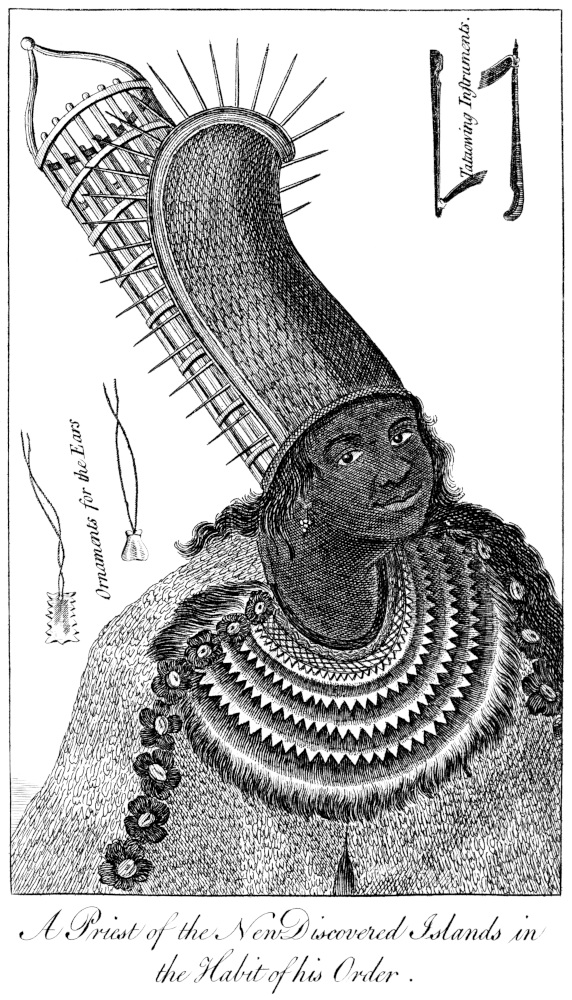
A Priest of the New Discovered Islands in the Habit of his Order.
Tataowing Instruments.
Ornaments for the Ears
The priests here are no way concerned with the ceremony of marriage, it being a simple agreement between the man and woman; and when they chuse to separate, it is done with as little ceremony as that of their marriage.
These people do not seem to be any way guilty of idolatry, as they worship no kind of images whatever. They enter their morais with great reverence and humility, and when they bring their offering to the altar, their body is uncovered to the waist.
There is a subordination among them, that much resembles the early state of every nation in Europe under the feudal system, which secured, to a small number, the most unrestrained liberty, while the rest were abject slaves.
Their ranks or orders are, Earee rahie, which signifies King; Earee, Baron; Manahouni, Vassal; and Toutou, Villain. The Earee rahie, of which there are two, one belonging to each of the peninsulas of which this island consists, had great respect shewn them by all ranks. The Earees are Lords of one or more of the districts, into which each of the peninsulas is divided; and they separate their territories into lots, which are given to the Manahounies, who respectively cultivate that share which they hold under the baron. But they are only nominal cultivators, this as well as all other laborious work being done by the Toutous, or lower class of people.
The Sovereign or Earee rahie, and the Baron or Earee, are succeeded in titles and honours by their children as soon as they are born, the fathers being immediately divested of them; but they remain possessors and managers of their estates.
In case of a general attack upon the island, every district, under the command of an Earee, furnishes a proportionate number of fighting men for the defence of the common cause, and they are commanded in chief by the Earee rahie.—According to Tupia’s account, the number furnished by the principal districts amounted to six thousand and upwards.
Slings, with which they are very dextrous, pikes headed with stone, and long clubs made of wood, remarkably hard and heavy, constitute their weapons. With these they fight with great obstinacy and cruelty, giving no quarter to either man, woman or child, if they fall into their hands in time of battle.
During the stay of the Endeavour, there was a perfect good understanding between the Earee rahies of the two peninsulas, though the Earee rahie of Tiarreboo, arrogated to himself the title of King of the whole island; which the other considered, as it really was, a mere nominal claim, and only a feather in his cap. There is nothing among them substituted for money, or a general medium, by which every object may be purchased or procured; neither can any permanent good be unlawfully obtained by force or fraud; and the general commerce with women, sets aside almost every excitement for committing adultery. In a word, in a government so little polished, though distributive justice cannot be regularly administered; as there can at the same time be but few crimes for the exercise of it, the want of this justice is not so severely felt, as it would be in more civilized societies.
Thursday July the 13th, after leaving the island of Otaheite, they sailed with a gentle breeze and clear weather; and were informed by Tupia, that four islands, which he called Huaheine, Ulietea, Otaha, and Bolabola, were at the distance of about one or two days sail, and that hogs, fowls, and other refreshments, which had lately been scarce, were to be got there in abundance. They accordingly steered their course in search of these islands, and on Saturday the 15th, discovered the island of Huaheine; and on the 16th, in the morning, they sounded near the north-west part of the island, but found no bottom with seventy fathom. Several canoes immediately put off, but they appeared fearful of coming near the ship, till they saw Tupia, which totally removed their apprehensions,and they ventured to come alongside, and upon assurances of friendship, the King of Huaheine and his Queen went on board. Astonishment was testified by their Majesties at every thing that was shewn them; yet they made no researches, and appeared satisfied with what was presented to their observation, making no enquiry after any other objects, though it was reasonable to suppose, that a building of such novelty and extent as the ship must have afforded many curiosities. The King, whose name was Oree, made a proposal to exchange names with Captain Cook, which was readily assented to. The custom of exchanging names is very prevalent in this island, and is considered as a mark of friendship. They found the people here nearly similar to those of Otaheite in almost every circumstance, except, if Tupia might be credited, they were not addicted to thieving. Having come to an anchor in a small but fine harbour, on the west side of the island, Captain Cook went ashore, accompanied by Mr. Banks and some other gentlemen, with Tupia and the King. The instant they landed, Tupia uncovered himself as low as his waist, and desired Mr. Monkhouse to follow his example. Being seated, he now begun a speech, which lasted about twenty minutes; the King, who stood opposite to him, answering in what seemed to be set replies. During this discourse he delivered, at different times, a handkerchief, a black silk neckcloth, some beads and plantains, as presents to their Eatua, or Deity. He received in return for the Eatua, of the English, a hog, some young plantains, and two bunches of feathers, which were carried on board. These ceremonies were considered as a kind of ratification of a treaty between the English and the King of Huaheine.
On the 17th they went again on shore, and walked up into the country, the productions of which greatly resembled those of Otaheite; the rocks and clay seemed, however, more burnt; the boat-houses were large, and the other houses neat. The level part of the country affords the most beautiful landscapes that the imagination can possibly form an idea of; the soil is exceedingly fertile, and the shores are lined with fruit trees of different kinds, particularly the cocoa-nut, which was seen in great abundance.
They also went on shore on the 18th without Tupia, but his boy, whose name was Tayota, accompanied them, and Mr. Banks proposed taking a more perfect view of a kind of chest, or ark, which he had before observed; the lid of this ark was sewed on in a peculiar manner, and thatched with palm-nut leaves. It was placed upon two poles, and sustained on small carved arches of wood, the poles served to remove it from one place to another, in the manner of a sedan chair; it is very surprising, that this chest was of a form greatly resembling the ark of the Lord among the Jews; but what was still more extraordinary, the boy informed them, that it was called Ewharre no Eatua, the house of the God, but he could give no account of its meaning or utility: with some difficulty they negotiated for eleven pigs, and were not without hopes of obtaining more the next morning.
Wednesday the 19th, they carried some hatchets with them, with which they procured three very large hogs. As they proposed to sail in the afternoon, the King, accompanied by some others of the natives, came on board to take his leave, when his Majesty received from Captain Cook a small pewter plate, with the following inscription. “His Britannic Majesty’s ship Endeavour, Lieutenant Cook Commander, 16 July, 1769.” He also was presented with some medals, or counters, resembling the coin of England, and a few other trifles.
This island is situated in the latitude of 16 degrees 43 minutes south, and longitude 150 degrees 52 minutes west; it is distant from Otaheite about thirty leagues, and is about twenty miles in circumference.
The productions of Huaheine, seem to be a month forwarder than those of Otaheite, as they found by several of the fruits, &c. Mr. Banks met with only a few new plants, but found a species of scorpion which he had not seen before.
The people are of a very lazy disposition, though they are stouter and larger made than those of Otaheite.
The women are much fairer than those of that island, and in general exceedingly handsome: both men and women seemed less susceptible of fear, and not so desirous of information.
From Huaheine they sailed for the island of Ulietea, and in the afternoon came within a league or two of the shore. The next morning, being the 20th, by the direction of Tupia, they anchored in a bay, which is formed by a reef, on the north side of the island; two canoes of natives soon came off from the shore, and brought with them two small hogs, which they exchanged for some nails and beads. The Captain, Mr. Banks, and some other gentlemen, now went on shore, accompanied by Tupia, who introduced them with the same kind of ceremonies that had taken place on their landing at Huaheine; after which, Capt. Cook took possession of this and the adjacent islands in the name of the King of Great Britain.
They then walked to a large Morai, which the natives called Tapodeboatea; they found that it differed considerably from the Morais of Otaheite, being composed of four walls, about eight or nine feet in height, built of very large coral-stones, which surrounded an area about thirty yards square: at a small distance they discovered an Ewhatta, or altar, upon which, as an oblation, was placed a whole hog, about a hundred pounds weight. At the front of this Morai, facing the sea, there was a kind of amphitheatre. There were likewise three or four Ewharee no Eatua, or houses of God, of the same kind as that which they saw at Huaheine.
On Friday the 21st, the Master was sent in the long-boat to inspect the coast on the south part of the island, and a Lieutenant was dispatched in the yawl, to sound the harbour where the Endeavour lay, while the Captain went in the pinnace to take a view of the coast on the north part of the island; in their return they saw a tree, of the same kind as that seen by Mr. Green at Otaheite, the circumference of the trunk, or rather congeries of the roots of which measured about forty yards.
On the 22d and 23d it being hazy weather with brisk gales, Captain Cook judged it rather unsafe to put to sea. On they 24th they got under sail, and steered to the northward within the reef, towards an opening five or six leagues distant; in effecting this, he was in the greatest danger of striking on a rock; the man who sounded, crying out on a sudden, two fathom, at which they were much alarmed, but happily got clear without receiving any damage.
The bay in which the Endeavour lay at anchor is called Oopoa; it is large enough to contain a great number of shipping, and is secured from the sea by a reef of rocks. It lies off the eastermost point of the island, and may be distinguished by a low woody island which lies to the south-east of it.
The provisions of this island consist chiefly of cocoa-nuts, yams, plantains, and a few hogs and fowls: that part of the country where they landed is not so fruitful as either Otaheite or Huaheine.
On the 25th they were within a league or two of the island of Otaha, but the wind continuing contrary, they could not get near enough to land till the 28th in the morning, when Mr. Banks and Dr. Solander went in the long-boat, with the Master, to sound a harbour on the east side of the island, which they found safe and convenient, with good anchorage. They then went on shore, and purchased some hogs and fowls, and a large quantity of yams and plantains.
This island appeared to be more barren than Ulietea, but the produce was much the same. The natives paid them the compliment they used towards their own Kings, by uncovering their shoulders, and wrapping their cloaths round their bodies; taking care no one should omit doing the same.
On the 29th they made sail to the northward, and at eight o’clock next morning they were close under the high craggy peak of the island of Bolabola. The island was inaccessible in this part, and they found it impossible to weather the south end of it till late at night. The next morning, Sunday the 30th, they discovered an island, which Tupia called Maurua, who said it was small, surrounded by a reef, and without any commodious harbour, but inhabited, and yielded nearly the same produce as the adjacent islands. In the middle is a high round hill, which may be seen at eleven or twelve leagues distance.
In the afternoon, finding themselves to windward of some harbours that lay on the west side of Ulietea, they intended to put into one of them, in order to stop a leak which they had sprung in the powder-room, and to take in some additional ballast. The wind being right against them, they plied on and off till the afternoon, of the 1st of August, when they came to an anchor in the entrance of the channel which led into one of the harbours.
Wednesday 2, in the morning, when the tide turned, they came into a proper place for mooring, in twenty-eight fathom. In the interim many of the natives came off, and brought hogs, fowls, and plantains, which were purchased upon very moderate terms.
Mr. Banks and Dr. Solander went on shore, and spent the day very agreeably; the natives shewing them great respect. Being conducted to the houses of the chief people, they were received in an uncommon manner. Upon their entrance into a house, they found those who had ran hastily before them, standing on each side of a long matt, spread upon the ground, and the family sitting at the further end of it. In one house they observed some very young girls, dressed in the neatest manner, who kept their places, waiting for the strangers to accost them: these girls were the most beautiful the gentlemen had ever seen.
One of them, who was about seven or eight years old, was dressed in a red gown, and her head was decorated with a great quantity of plaited hair; this ornament is called Tomou, and is held in great estimation among them. She was sitting at the upper end of one of their long mats, on which none of the people present presumed to set a foot; and her head was reclined on the arm of a decent looking woman, who appeared to be her nurse; when Mr. Banks and Dr. Solander approached her, she stretched out her hand to receive some beads, which they presented to her, with an air of such dignity and gracefulness, as would have done honour to the first princess in Europe.
Before their departure they were entertained with a dance, different from any they had seen before. The performer put upon his head a large piece of wicker-work, about four feet long, of a cylindrical form, covered with feathers, and edged round with shark’s teeth. Having this head-dress on, which is called a Whou, he began to dance with a slow motion, frequently moving his head, so as to describe a circle with the top of his wicker cap, and sometimes throwing it so near the faces of the bye-standers, as to make them jump back; this they considered as an excellent piece of humour, and it always produced a hearty laugh, when practiced upon any of the English gentlemen.
On Thursday the 3d, as Mr. Banks and the Doctor were going along the shore to the northward, with a design to purchase stock, they met with a company of dancers, who retarded the progress of their excursion near two hours, and afforded them much diversion. The company was composed of six men and two women dancers, with three drums. They were informed, that these dancers were some of the principal people of the island, and though they were an itinerant troop, they did not, like the strolling parties of Otaheite, receive any gratuity from the by-standers. The women wore a considerable quantity of Tamou, or plaited hair, ornamented with the flowers of the cape jessamine, which were stuck in with taste, and made an elegant head dress. The womens necks, breasts and arms were naked; the other parts of the body were covered with black cloth, which was fastened close round them; and by the side of each breast, next the arms, was a small plume of black feathers, worn like a nosegay.