CAPTAIN COOK’s VOYAGE ROUND THE WORLD. In 1768, 1769, 1770 and 1771.
Reading edition
Mr. Banks, a gentleman of considerable fortune in Lincolnshire, was induced to undertake this voyage from his natural curiosity, and invincible desire of attaining knowledge. He had already visited the banks of Newfoundland and Labradore, and was now happy in having an opportunity of observing the transit of Venus in the southern part of America. He accordingly engaged his friend Dr. Solander to accompany him in this voyage. This gentleman, who was born in Sweden, and educated under the celebrated Linnæus, had, from his extensive learning, been appointed to a place been appointed to a place in the British Museum, and given the greatest satisfaction in that capacity. Mr. Banks also took with him two draftsmen, one to delineate views and figures; the other to paint such subjects of natural history as might present themselves. He had besides a secretary and four servants.
On the 26th of August, 1768, the Endeavour sailed from Plymouth, and on the 2d of September they saw land between Cape Finister and Cape Ortegal, on the coast of Gallicia in Spain. Mr. Banks and Dr. Solander had, during this course, an opportunity of viewing many marine animals, hitherto unnoticed; among these was a new species of an angular figure, near three inches in length and one in thickness, having a hollow quite through it, and a brown spot at one end. Four of these animals were joined together; but upon being put into water they separated and swam about. They resembled a gem in brightness, and shone in the water with fine colours. There was another animal of a more beautiful and lively colour, which was not unlike an opal. About ten leagues from Cape Finister, various birds were observed, which had not been described by Linnæus.
The islands of Puerto Santo and Madeira were discovered on the 12th, and the next day they anchored in Fonchial road. In heaving the anchor, Mr. Weir, the Master’s mate, was carried overboard and drowned. Mr. Banks found at Madeira a tree, called by the natives Vigniatico, the Laura indicus mentioned by Linnæus. The wood of this tree can scarce be distinguished from mahogany, which induced this gentleman to believe, that the wood called in England Madeira mahogany, was the Laura indicus; as no mahogany is exported from this island. The only article of trade in Madeira is wine, which is made in the following manner; the grapes are put into a square wooden vessel, the size of which is proportioned to the quantity; then the persons employed take off their cloaths, get into the vessel, and with their elbows and feet press out as much of the juice as they can; in this manner the stalks are then tied together, and pressed under another square piece of wood, by a lever and a stone, to extract the remainder of the juice. A whole vintage is frequently spoiled by the bad grapes being mixed with the others, which the inhabitants obstinately refuse throwing out, as the quantity of wine is increased by them.
There are no wheel-carriages in this island; the only resemblance of them is a hollow board, that may be called a sledge, and which serves to carry their wine vessels. The soil is so rich, and there is such a variety in the climate, between the hills and plains, that there is no object of luxury which grows either in India or Europe, that might not probably be cultivated here. Walnuts, chesnuts and apples, flourish almost without culture upon the hills. The pine-apple, the mango, the guava and the banana, grow almost spontaneously in the town. The corn is large grained and fine, and it might be produced in great abundance; nevertheless, the greatest part of what is consumed is imported. The beef, mutton, and pork, are likewise remarkably good, particularly the first, which induced the Captain to take some on board. Foncho, which is fennel in Portuguese, gave name to the town of Fonchial, that lies in latitude 20 degrees 33 minutes north, and longitude 16 degrees 49 minutes west. It is seated at the bottom of a bay, poorly built, though extensive in proportion to the island; the streets are narrow, and very badly paved. In the churches there are great numbers of ornaments, with pictures and images of saints; the first are, for the most part, done by mere daubers, and the latter are cloathed in laced habits. A better taste prevails in some of the convents, particularly that of the Franciscans; here simplicity and neatness unite, and give us a very favourable idea of these good fathers. The infirmary is also a building that does honour to the architect, and is the most considerable edifice in the whole place. There are many very high hills; Pico Ruivo is near 5100 feet in height, perpendicularly from its base. These hills are covered round with vines to a certain height, above which there are great numbers of chesnut and pine trees, and above them various sorts of timber, so thick as to form forests. The Mirmulano and Paobranco, which are found amongst them, are unknown in Europe. The latter is very beautiful, and would be greatly ornamental in our gardens. The inhabitants are computed to be between 70 and 80,000; and the revenue arising from the customs is supposed to amount to 20 or 30,000 pound sterling per annum. Water, wine, fruit and onions, are here in plenty; sweet-meats are also to be had without any difficulty; but permission must be obtained from the Governor for poultry and fresh meat. The Endeavour sailed from Madeira September 19. On the 22d they saw the Islands of Salvages, northward of the Canaries. The chief of these islands was about 5 leagues to the south one half west. These islands appear to lie in latitude 30 degrees 11 minutes north. On the 23d they saw the Peak of Teneriffe, bearing west by south. This mountain is near 15,400 feet high. On the 29th they saw Bona Vista, one of the Cape de Verd Islands, lying in latitude 16 degrees north, and longitude 21 degrees 48 minutes west. From Teneriffe to Bona Vista they observed flying fish in great numbers, which appeared very beautiful, their sides resembling burnished silver. Mr. Banks went out in a boat on the 7th of October, and caught what is called a Portuguese man of war, together with several marine animals of the Molusca tribe. They had now variable winds, with some showers of rain; and the dampness of the air did great injury to their iron utensils. October 19th Mr. Banks shot the black-toed gull, which has not been described by Linnæus. The dung of this bird is of a lively red.
They crossed the line with the usual ceremonies on the 25th of October.
When the Endeavour was, on the 28th of October, in the latitude of Ferdinand Noronha, and in longitude 32 degrees 5 minutes west, they looked out for the island, and the shoals which, according to the charts, lie between it and the main; but neither the island or the shoals could be discovered. On the 29th, in the evening, they saw the luminous appearance of the sea, mentioned by navigators: it emitted rays of light, resembling those of lightning. Mr. Banks and Dr. Solander, not being inclined to adopt any of the opinions that had prevailed with regard to the causes of this luminous appearance (such as its being caused by fish darting at its prey, by the putrefaction of fish and other inhabitants of the sea, and even by electricity) threw out a casting net, when they were confirmed in their suggestion, that it was occasioned by some luminous animal. A species of the medusa was caught, which resembled a metallic substance greatly heated, emitting a whitish light. Some crabs were brought up at the same time, which, though exceeding small, gave a very glittering appearance. These animals had hitherto escaped the observation of all naturalists.
Provisions beginning to fall short, it was determined to put into Rio de Janeiro. They saw the coast of Brazil on the 8th of November, and spoke with the people on board a Portuguese fishing-boat, who informed them, that the land which they saw was to the south of Sancto Espirito. Mr. Banks bought some fish of the people in the boat, and was much surprised to find that they refused Spanish silver, and wanted English shillings.
Their interpreters, who were a Venetian and Portuguese, informed them, that the crew of the fishing vessel declared, they had not seen a ship for eight years; this however they supposed to be a mistake, as they spoke such imperfect English, that it was almost impossible to understand them.
On the 13th, in the morning, we made sail for the harbour of Rio de Janeiro. Mr. Hicks, the first Lieutenant, was sent before in the pinnace to the city, to inform the Governor, we put in there for refreshments and water, and to obtain a pilot. The pinnace returned without the Lieutenant, who was detained by the Viceroy till the Captain came on shore. When the Endeavour came to an anchor, a ten-oared boat filled with soldiers came up, and rowed round the ship, without any conversation taking place. Soon after another boat came up, with several of the Viceroy’s officers; they enquired whence the Endeavour came; what her cargo consisted of; her number of men and guns; and her destination. These and several other questions were justly answered without equivocation; when they apologized for detaining the Lieutenant, and the other steps they had taken, pleading its being customary.
Captain Cook went on shore on the 14th, and obtained leave to purchase provisions, on condition of employing an inhabitant as a factor: to this the Captain objected, but in vain, as well as to the sending a soldier in the boat every time she went from the shore to the ship. Having requested, that the gentlemen on board might remain on shore whilst they sojourned, and that Mr. Banks might go up the country to collect plants; these requests were peremptorily refused. Captain Cook judging the Viceroy imagined they were come to trade, the Captain endeavoured to convince him of his mistake, by acquainting him, that they were bound to the southward, to observe the transit of Venus over the sun; a very interesting object to the advancement of navigation, of which phenomenon he appeared to be totally ignorant. An officer was appointed to attend the Captain; this, which he was told was meant as a compliment, he would have declined; but the Viceroy was too polite to allow his dispensing with the honour.
Mr. Banks and Dr. Solander were greatly disappointed upon the Captain’s return, to find they were not permitted to reside on shore, and go up the country; and their chagrin was still farther increased, to hear they were not allowed even to leave the ship; the Viceroy having ordered, that only the Captain, and such sailors as were necessary to be upon duty, should be suffered to come on shore; probably its being reported, that these gentlemen came upon this voyage to make discoveries and observations, and possessed extraordinary abilities for such business, might occasion these rigid orders. They attempted, nevertheless, to come on shore, but were prevented by the guard-boat; though several of the crew, unknown to the centinel, stole out of the cabin window at midnight, letting themselves down by a rope into the boat, and driving away by the tide till they were out of hearing; they then rowed to some unfrequented part of the shore, where they landed, and made excursions up the country, though not so far as they could have wished. When the Captain went on shore to remonstrate with the Viceroy respecting these restrictions, the only answer that could be obtained was, that he acted in consequence of his Master’s orders. Thus situated, the Captain resolved to go no more on shore, rather than be a prisoner in his own boat, as the officer, who complimented him with his company, waited upon him both from and to the shore. It was now resolved to draw up two memorials to the Viceroy; one was written by the Captain, the other by Mr. Banks: they produced answers no way satisfactory. Captain Cook and Mr. Banks replied, and several written remonstrances and answers passed between them and the Viceroy, but to no purpose. The Captain judging it necessary, in vindication of his compliance, to urge the Viceroy to some act of force in the execution of his orders, he sent Lieutenant Hicks with a packet (on the 20th) ordering him not to allow a guard in his boat. The officer of the guard-boat finding the Lieutenant resolved to obey the Captain’s command, did not oppose him by force, but accompanying the Lieutenant on shore, went to the Viceroy, and acquainted him with what had passed, which induced his Excellency to refuse opening the packet, commanding the Lieutenant to return. He found a guard had been put on board his boat in his absence, and insisted upon the soldiers quitting it. The officer now seized the boat’s crew, and conducted them to prison, under an escorte; and the Lieutenant was sent back to the ship under a guard. When Mr. Hicks had acquainted the Captain with these transactions on shore, the latter wrote to the Viceroy, demanding his boat and men, and inclosed the memorial, which he would not receive from the hands of the Lieutenant. The bearer of this express was a petty officer, in order to avoid continuing the dispute about a guard, which a commissioned officer must have kept up. Having delivered his packet, an answer was promised.
In the interim, in a sudden gust of wind, the long-boat, with four pipes of rum (by the rope breaking that was thrown her from the ship) went a-drift windward of her, with a small skift of Mr. Banks’s that was fastened to her. The misfortune was still greater as the pinnace was on shore. The yawl was manned immediately, but did not return till next morning, when she brought all the people on board. From them Captain Cook learnt, that the long-boat having filled with water, they had brought her to a grappling, and quitted her, and falling in with a reef of rocks on their return, they were compelled to cut a-drift the little boat belonging to Mr. Banks. In this situation the Captain dispatched another letter to the Viceroy, acquainting him with the accident, at the same time desiring he would assist them with a boat to recover their own: this was accompanied with a fresh demand of the pinnace and her crew. His Excellency at length complied with both the request and demand; and the same day they fortunately recovered the long-boat and skift. In the Viceroy’s answer to the Captain’s remonstrance, he expressed some doubts of the Endeavour being a King’s ship, and accused the crew of smuggling. Mr. Banks’s servants had, its true, by stratagem, got on shore (the 22d) early in the morning, and remained till night, but brought on board only plants and insects. In Mr. Cook’s reply, he said he was willing to shew his Excellency his commission again, the Viceroy having already seen it; and that if any attempt to carry on a contraband trade should be repeated, desired his Excellency would take the offender into custody. Thus terminated the dispute.
Mr. Banks (on the 26th in the morning) artfully eluded the vigilance of the guard, and went on shore: he avoided the town, and passed the day in the fields, where the chief objects of his curiosity lay. The people behaved with civility, invited him to their habitations, and he purchased a young pig for eleven shillings, and some other things. But the next day it was reported, that search was making for him and Dr. Solander, which induced them to lay aside all thoughts of going again on shore.
Being prepared for sea, with water and provisions, they took on board a pilot the 1st of December, but the wind being contrary, they were prevented getting out. The next day a Spanish packet arrived from Buenos Ayres, for Spain, when the Captain politely offered to take Mr. Cook’s dispatches to Europe; and he accordingly sent, by that conveyance, all the papers that had passed between him and the Viceroy, leaving duplicates with his Excellency for his court.
The Endeavour did not get under sail till the 7th, when having passed the Fort the pilot was discharged, and the guard-boat quitted them at the same time. During the last three or four days of their remaining at Rio de Janeiro, the air was covered with butterflies, chiefly of one kind.
From the observations of the writer of the first account of this voyage, we have the following description of the town and country. Rio de Janeiro, is supposed to have been thus named on account of its being discovered on the festival of saint Januarius. The town, which is the capital of the dominions of the Portuguese, in America, borrows its name from the river Januarius.
It is situated on the west side of the river, from which it extends itself about three quarters of a mile. The ground on which it stands is a level plain; it is defended on the north side by a hill that extends from the river, leaving a small plain, which contains the suburbs and the King’s dock. On the south side is another hill, running towards the mountains which are behind the town. Some of its streets run parallel from north to south, and are intersected by others at right angles. The principal street is near an hundred feet in width, and extends from St. Benedict to the foot of Castle-hill; the other streets are commonly twenty or thirty feet wide. The houses adjoining to the principal street have three stories, but in other places they are very irregular, though built after the same manner as in Lisbon. In the town are four convents; the first is that of the Benedictines, situated near its northern extremity; this structure affords an agreeable prospect, and contains an elegant chapel, which is ornamented with several valuable paintings. The second is that of the Carmelites, which forms the centre angle of the royal square, and fronts the harbour; its church had fallen some time before, but it is again rebuilding in a very elegant manner, with fine free-stone brought thither from Lisbon. The third is that of St. Anthony, situated on the point of a hill on the south side of the town; before this convent stands a large bason of brown granite, in the form of a parallelogram, which is employed in washing. The fourth is situated at the eastern extremity of the town, and was formerly the Jesuits convent, but is now converted into a military hospital.
The Viceroy’s palace forms the right angle of the royal square: the palace, mint, stables, goal, &c. compose but one large building, which has two stories, and is ninety feet from the water. In passing through the palace, the first entrance is to a large hall or guard-room, to which there is an ascent of three or four steps. In the guard-room are stationed the body guards who attend the Viceroy, and are relieved every morning between eight and nine. Adjoining to the hall are the stables, the prison being in the back part of the building. Within the guard-room is a flight of stairs for ascending to the upper story; this divides at a landing-place about half way, and forms two branches, one leading to the right, and the other to the left. The former enters a saloon, where there are two officers in constant attendance; the Viceroy’s aid-du-camp at the same time waiting in an anti-chamber to receive messages and deliver orders.
The left wing of the royal square is an irregular building, which consists chiefly of shops occupied by trading people. In the center of the square is a fountain supplied with water from a spring at the distance of three miles, from which it is brought by an aqueduct. From this fountain both the shipping and inhabitants are supplied with water, the place being continually crowded with negroes of both sexes waiting to fill their jars. At every corner of the streets is an altar. The market-place extends from the north-east end of the square along the shore; and this situation is very convenient for the fishing-boats, and those who bring vegetables from the other side of the river to market. Negroes are almost the only people employed in selling the different commodities exposed in the market, and they employ their leisure time in spinning of cotton.
Without the Jesuits college on the shore is a village called Neustra Seignora del Gloria, which is joined to the town by a very few intervening houses. Three or four hundred yards within the Jesuits convent stands a very high castle, but it is falling to decay. The bishop’s palace is about three hundred yards behind the Benedictine convent, and contiguous to it is a magazine of arms, surrounded by a rampart.
The gentry here keep their chaises, which are drawn by mules; the ladies however use a sedan chair, boarded before and behind, with curtains on each side, which is carried by two negroes, depending from a pole connected to the top of the chair by two iron rods coming from under its bottom, one on each side, and resting at the top. The inhabitants likewise use hammocks or rajas, supported in the same manner, and surrounded with curtains.
In this town the apothecaries shops commonly serve the purposes of a coffee-house, people meeting in them to drink capillaire, and play at back-gammon. The gentry when seen abroad are well dressed, though at home they are but loosely covered: the shopkeepers have commonly short hair, and wear linen jackets with sleeves. Beggars, who infest the streets of most European cities, are not to be found in this.
With regard to the women, it is on all hands agreed, that the females of the Portuguese and Spanish settlements in South America, are less averse to granting amorous favours, than those of any other civilized part of the globe. According to Dr. Solander’s account, as soon as the evening began, females appeared on all sides in every window, and particularized those of the male sex they liked by giving them nosegays; the Doctor and two other gentlemen received so many of these bouquets, that they threw handfuls away.
The climate of Rio de Janeiro is both agreeable and healthy, being free from many inconveniencies that are incident to other tropical countries. The air is but seldom immoderately hot, as the sea breeze constantly begins to blow about ten o’clock in the morning, and continues until night, when it is generally succeeded by a land wind, though this does not always happen. The seasons are divided into rainy and dry; though their stationary periods have lately become very irregular and uncertain: indeed the rainy seasons had almost entirely failed the four years preceding their arrival, at which time the rains had just begun, and they fell in large quantities during their stay: formerly the streets have been overflowed by the rain, and rendered impassable except with canoes.
The adjacent country is mountainous, and chiefly covered with wood, but a small part of it appearing to be cultivated. The soil near the town is loose and sandy, but farther from the river it is a fine black mould. It produces all the tropical fruits, such as oranges, lemons, limes, melons, mangoes, cocoa-nuts, &c. in great abundance, and without much cultivation; a circumstance which is very agreeable to the inhabitants, who are very indolent.
The mines, which lie far up in the country, are very rich; but their situation is concealed, and nobody can view them, except those who work in them. The experiment is very dangerous, for every one found upon the road which leads to them is hung upon the next tree, unless he can give a satisfactory account of the cause of his being in that situation. About twelve months before their arrival, the government had detected several jewellers in carrying on an illicit trade for diamonds with the slaves in the mines; and immediately after a law passed, making it felony to work at the trade, or have any tools in possession, the civil officers having indiscriminately seized on all that could be found. Near forty thousand negroes are annually imported to dig in the mines; these works are so pernicious to the human frame, and occasion so great a mortality amongst the poor wretches employed in them, that in the year 1766 twenty thousand more were draughted from the town of Rio, to supply the deficiency of the former number.
There are several courts of justice in the town, at all of which the Viceroy presides; in criminal causes the sentence is regulated by a majority of voices in the supreme court. The Viceroy has a Council appointed from Europe by the king, to assist him in his private department, where he has two voices.
The inhabitants of Rio de Janeiro maintain a whale-fishery, which supplies them with lamp-oil. They import their brandy from the Azores, their slaves and East India goods from their settlements in Africa, their wine from Madeira, and their European goods from Lisbon.
The current coin is Portuguese, which is struck here; the silver pieces are called Petacks, of different value; and the copper are five and ten ree pieces.
Rio de Janeiro is very useful for ships that are in want of refreshment; the harbour is safe and commodious, and may be distinguished by a remarkable hill, in the shape of a cone, at the west point of the bay. The entrance is not wide, but it is easy, from the sea breeze, which prevails from noon to sun-set, for any ship to enter before the wind. The entrance of the narrow part is defended by two forts, La Cruz and Lozia; they are about three quarters of a mile from each other. The bottom being rocky, renders it dangerous to anchor here, but this may be avoided by keeping the middle of the channel. The whole coast abounds with a very great variety of fish, among which are dolphins and mackrel.
On the 9th of December they took out of the sea an incredible number of atoms, of a yellowish colour, few of them more than the 50th part of an inch in length; it could not even with a microscope be determined whether they were animal or vegetable substances. These atoms tinged the sea in such a manner, as to cover it with broad streaks of a colour similar to themselves, the greatest part of a mile in length, and several hundred yards in width.
Thursday, December 8, 1768, having procured all necessary supplies, they left Rio de Janeiro; they did not meet with any material occurrence from this time to the 22d, when they discovered numerous birds of the Prosillaria genus, in latitude 39 degrees 37 minutes south, and longitude 49 degrees 16 minutes west; they were also frequently surrounded by great numbers of porpoises, of a singular species, which were about fifteen feet in length, and of an ash-colour. On the 23d they observed an eclipse of the moon; and about seven o’clock in the morning a small white cloud appeared in the west, from which a train of fire issued, extending itself westerly: about two minutes after they heard two distinct loud explosions, immediately succeeding each other like canon, after which the cloud soon disappeared.
On the 24th they caught a large loggerhead tortoise, weighing one hundred and fifty pounds. They likewise shot several birds, among which was an albetross, measuring between the tips of its wings nine feet and an inch; and from its beak to the tail two feet one inch and an half. On the 30th they ran upwards of fifty leagues, through vast numbers of land insects, some in the air, and others upon the water; they appeared to resemble exactly the flies that are seen in England, though they were thirty leagues from land, and some of these insects never quit it beyond a few yards. Captain Cook imagined he was at this time nearly opposite to the bay called Sans fond (without bottom) where it is supposed, by some writers, that the continent of America is divided by a passage; but it was the opinion of the gentlemen on board, that there might be a large river, which probably had occasioned an inundation. The 31st they had much thunder, lightning, and rain: this and the three following days they saw several whales, and likewise several birds, about the size of a pidgeon, with white bellies and grey beaks.
January 4, 1769, they saw an appearance of land, which they mistook for Pepys’ island; but on their standing towards it, it proved, what the sailors call a Fog Bank. The ship’s crew were about this time, on their complaining of cold, furnished with each a pair of trowsers, and a jacket made of the stuff called Fearnought. They saw on the 11th, after passing Falkland’s Island, at about four leagues distance, Terra Del Fuego. Smoke was perceived, which they took for a signal, as it did not continue after they had passed along the shore to the south-east. On the 14th they entered the streight of Le Maire; but the tide being against them, they were driven out with great violence, and the waves ran so high, that the ship’s bowsprit was frequently under water; at length however they got anchorage, at the entrance of a little cove, which Captain Cook called St. Vincent’s Bay.
The weeds, which here grow upon rocky ground, are very remarkable; they appear above the surface in eight and nine fathoms water; the leaves are four feet in length, and many of the stalks, though not more than an inch and a half in circumference, above 100. Mr. Banks and Dr. Solander having been on shore some hours, they returned with more than a hundred different plants and flowers, hitherto unnoticed by the European botanists. The country in general near the bay was flat, and the bottom particularly was a plain covered with grass; here was plenty of wood, water and fowl, winter’s bark was found in great abundance. The trees are a species of the birch, but are neither lofty nor large; the wood is white, and they bear a small leaf. Here are also white and red cranberries.
Sunday 15, having anchored in 12 fathoms, upon coral rocks, before a small cove, distant from shore about a mile, two of the natives came down upon the beach, in expectation that they would land; but this situation affording little shelter, the Captain got under sail again, and the natives retired.
About two o’clock they anchored in the bay of Good Success, and the Captain went on shore, accompanied by Mr. Banks and Dr. Solander, to search for a watering-place, and confer with the Indians. These gentlemen proceeded about a hundred yards before the Captain, when two of the Indians having advanced forward and seated themselves, they rose, upon Mr. Banks and the Doctor’s coming up, and each of them threw away a small stick, which they had before in their hands; this they did in such a direction, that the sticks flew both from themselves and the strangers, which they meant as a token of peace, and a testimonial of their renouncing weapons; they then returned briskly towards their companions, who had remained at some distance behind, and made signs to the strangers to advance, which they accordingly complied with. The reception the gentlemen met with was friendly, though the manner was uncouth. The civility was returned, by the distribution of beads and ribbons, with which the Indians were much pleased. After a mutual confidence had been thus established, the rest of the English party joined, and a general conversation, though of a singular kind, ensued. Three of the Indians now returned with the Captain and his friends to the ship, whom they cloathed with jackets, and gave them bread, jerked beef, &c. part of which they eat, and carried the remainder on shore. They refused to drink rum or brandy, after tasting them, intimating by signs that it burnt their throats. This circumstance may perhaps corroborate the opinion of those who think water the natural drink of mankind, as of all other animals. One of these Indians made several long and loud speeches, though no part of either was intelligible to any of us. Another of them stole the covering of a globe, which he concealed under his skin garment. After remaining on board about two hours, they returned on shore, Mr. Banks accompanying them. He conducted them to their companions, who appeared no way curious to know what their friends had seen, and the latter were as little disposed to relate as the others were to enquire. None of these people exceeded five feet ten inches in height, yet their bodies appeared large and robust, though their limbs were small. They had broad flat faces, low foreheads, high cheeks, noses inclining to flatness, wide nostrils, small black eyes, large mouths, small but indifferent teeth, and black strait hair, falling down over their ears and forehead, which was commonly smeared with brown and red paints; and, like all the original natives of America, they were beardless. Their garments were the skins of guanicos and seals, which they wrapped round their shoulders. The men likewise wear on their heads a bunch of yarn, spun from the wool of guanicos, which falls over their foreheads, and ties behind with the sinews or tendons of some animal. Many of both sexes were painted in different parts of their bodies, with red, white, and brown colours; and had also three or four perpendicular lines pricked across their cheeks and noses. The women have a small string tied round each ancle, and wear each a flap of skin tied round the middle. They carry the children on their backs, and are generally employed in domestic labour and drudgery.
Mr. Banks and Dr. Solander, attended by servants, set out from the ship on the 16th, in the morning, with the design of going into the country as far as they could that day, and returning in the evening. Having entered a wood, they ascended the hill through a pathless wilderness till the afternoon. After they had reached what they had taken for a plain, they were greatly disappointed in finding it a swamp, covered with birch, the bushes interwoven, and so inflexible they could not be divided; however, as they were not above three feet high, they stept over them; but they were up to the ancles in the boggy ground. The morning had been very fine, but the weather now became cold and disagreeable; the blasts of wind were very piercing, and a shower of snow fell. They nevertheless pursued their route, in expectation of finding a better road. Before they had got over this swamp, an accident happened that greatly disconcerted them; Mr. Buchan, one of the draughtsmen Mr. Banks had brought out, fell into a fit. It was absolutely necessary to stop and kindle a fire, and such as were most fatigued remained to assist him; but Messrs. Banks, Solander, Green and Monkhouse, proceeded and attained the spot they had in view. Here they found a great variety of plants, that gratified their curiosity, and repaid them for their toil.
Upon returning to the rest of the company, amidst the snow which fell in greater abundance, and being pinched with the cold that was now become more intense, they found Mr. Buchan much recovered. They had previously sent Mr. Monkhouse and Mr. Green back to Mr. Buchan, and those who remained with him, in order to bring them to a hill, which was conjectured to lie in a better track for returning to the wood, and was accordingly fixed on as a place of rendezvous. They resolved from this hill to pass through the swamp, which this way did not appear to be more than half a mile in extent, into the covert of the wood, in which they proposed building a hut and kindling a fire, to defend them from the severity of the weather. The whole party accordingly met at the place appointed about eight in the evening, whilst it was still day-light, and proceeded towards the next valley. Dr. Solander having often passed mountains in cold countries, was sensible that extreme cold, when joined with fatigue, occasions a drowsiness, that is not easily resisted; he accordingly intreated his friends to keep in motion, however disagreeable it might be to them; his words were, “Whoever sits down, will sleep; and whoever sleeps, will wake no more.” Every one seemed accordingly armed with resolution; but on a sudden the cold became so very intense, as to threaten the most direful effects. It was very remarkable, that Dr. Solander himself, who had so forcibly admonished and alarmed his party, should be the first who insisted upon being suffered to repose. In spite of the most earned intreaties of his friends, he lay down amidst the snow, and it was with great difficulty they kept the Doctor awake. One of the black servants became also weary and faint, and was upon the point of following the Doctor’s example. Mr. Buchan was therefore detached with a party to make a fire at the first commodious spot they could meet with. Mr. Banks, with four more, remained with the Doctor and Richmond the black, who, with the utmost difficulty, were induced to come on; but when they had traversed the greatest part of the swamp, they expressed their inability of going any farther. When the black was informed, that if he remained there he would soon be frozen to death; he replied, that he was so exhausted with fatigue, that death would be a relief to him. Doctor Solander said he was not unwilling to go, but that he must first take some sleep, notwithstanding what he had before declared to the company. Thus resolved, they both sat down, supported by bushes, and in a short time fell fast asleep. Intelligence now came from the advanced party, that a fire was kindled about a quarter of a mile farther on the way. Mr. Banks then waked the Doctor, who had almost lost the use of his limbs already, though it was but a few minutes since he sat down; he nevertheless consented to go on. Every measure taken to relieve the black proved ineffectual, he remained motionless, and they were obliged to leave him to the care of the other black servant and a sailor, who appeared to have been the least hurt by the cold, and they were to be relieved, as soon as two others were sufficiently warmed to supply their places. The Doctor was with much difficulty got to the fire. Those who were sent to relieve the companions of Richmond, returned in about half an hour, without being able to find them. What rendered the mortification still greater was, that a bottle of rum, the whole stock of the party, could not be found, and was judged to have been left to one of the three who were missing. There was a fall of snow, which incessantly continued for near two hours, and there remained no hopes of seeing the three absentees again, at least, alive. About 12 o’clock, however, a great shouting was heard at a distance, which gave inexpressible satisfaction to every one present. Mr. Banks and four others went forth and met the sailor, with just strength enough to walk; he was immediately sent to the fire, and they proceeded to seek for the two others. They found Richmond upon his legs, but incapable of moving them; the other black was lying senseless upon the ground. All endeavours to bring them to the fire were fruitless, nor was it possible to kindle one upon the spot, on account of the snow that had fallen, and was still falling, so that there was no alternative, and they were compelled to leave the two unfortunate negroes to their fate, making them, however, a bed of boughs of trees, and covering them very thick with the same.
As all hands had been employed in endeavouring to move the two blacks to the fire, and had therefore been exposed to the cold for near an hour and a half, some of them began to be afflicted in the same manner as those they went to relieve. Briscoe, another of Mr. Banks’s servants, in particular, began to lose his sensibility. They at length reached the fire, and passed the night in a very disagreeable manner. The party that set out from the ship consisted of twelve, of whom two were already judged to be dead: it was doubtful whether a third would be able to return on board; and Mr. Buchan, a fourth, seemed threatened again with his fits. The ship was at the distance of a long day’s journey, through an unfrequented wood, in which they might probably be bewildered till night; and being equipped only for a journey of a few hours, they had not provisions left sufficient to afford the company a single meal.
On the 17th in the morning, at day-break, nothing presented itself to view all around but snow, the trees being equally covered with it as the ground; and the blasts of wind were so violent and frequent, that their journey was rendered impracticable, and there was much reason to dread perishing with cold and famine. However, about six in the morning they were flattered with a dawn of hope of being delivered, by discovering the sun through the clouds, which gradually diminished. Previous to their setting out, messengers were dispatched to the unhappy negroes, who returned with the melancholy news of their death.
Though the sky had flattered their hopes, the snow still continued falling very fast, which prevented them beginning their journey so soon as was proposed; but a breeze springing up about 8 o’clock, added to the influence of the sun, began to clear the air; and the snow falling in large flakes from the trees, announced a thaw. The force of hunger prevailed over every other consideration, and induced them, after having equally divided the small remains of their provisions, to set forward on their journey about 10 in the morning.
In about three hours, to their great astonishment and satisfaction, they found themselves upon the shore, much nearer to the ship than their most sanguine expectations could have flattered them. When they took a retrospect of their former route from the sea, they found, that instead of ascending the hill in a direct line, they had made a circle almost round the country. The congratulations every one on board expressed at their return, can better be imagined than expressed.
On the 20th Mr. Banks and Dr. Solander went again on shore, and landed in the bottom of the bay, when they collected many shells and plants hitherto unknown. They returned on board to dinner, and afterwards went to visit an Indian town about two miles up the country. The access was difficult on account of the mud. When they approached the town, two of the Indians came out to meet them: they began to shout in the same unmeaning manner as they had before done on board the ship. After this had continued for some time, they conducted Mr. Banks and the Doctor to the town. It was seated on a small hill, over-shaded with wood, and consisted of about a dozen huts; constructed without art or regularity. They were composed of a few poles inclining towards each other, in the shape of a sugar loaf, which were covered on the weather-side with grass and boughs; and on the other side a space was left open, which served at once for a fire-place and a door. The huts that had been seen in St. Vincent’s Bay were of the same kind. A little grass served for beds and chairs, and their utensils consisted of a basket for the hand, a satchel to hang upon the back, and a bladder for water; out of which they drank through a hole near the top. This town was inhabited by a small tribe, consisting of about 50 men, women and children. Their bows and arrows were constructed with neatness and ingenuity: they were made of wood highly polished; and the point, which was either glass or flint, was fitted with much skill. Mr. Banks observed glass and flint amongst them unwrought, with cloth, canvass, rings and buttons, &c. it was therefore judged, that they travelled at times to the north, as no ship had touched at this part of Terra del Fuego for some years.
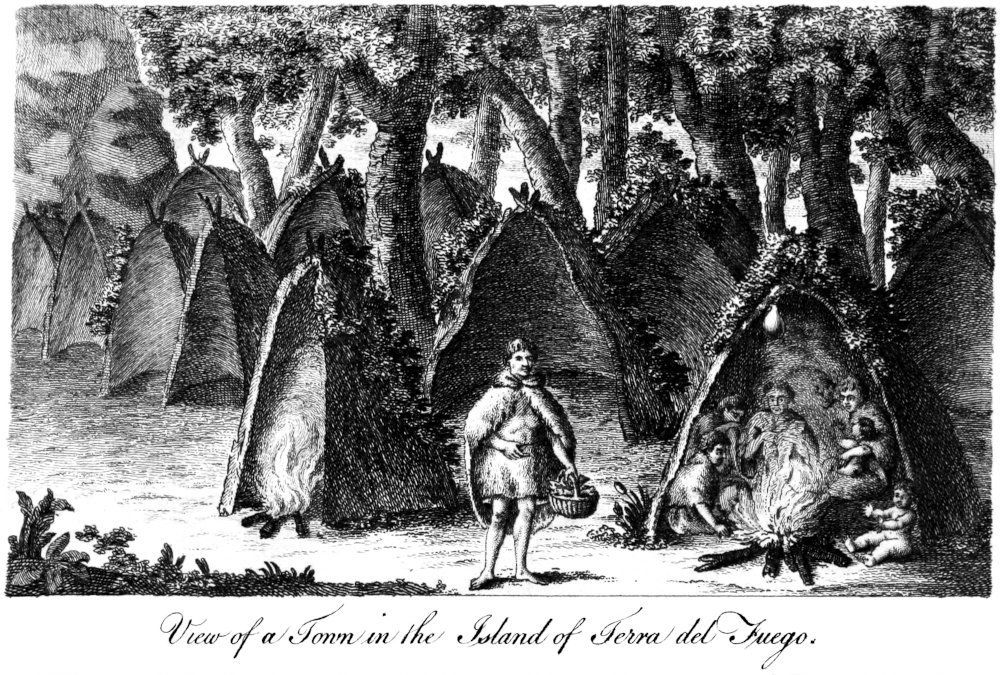
View of a Town in the Island of Terra del Fuego.
Neither did they testify any surprise at the sight of fire arms, and appeared to be well acquainted with their use. Probably the spot on which Mr. Banks and the Doctor met them, was not a fixed habitation; their houses not being erected to stand any length of time, and they were destitute of a boat or canoe. They did not seem to have any form of government among them, nor did there appear any kind of subordination. These people appeared upon the whole to be the out-casts of human nature, whose lives were passed in wandering in a forlorn manner over dreary wastes—whose only dwelling was a wretched hovel, such as has been described, and their cloaths scarcely sufficient to prevent their perishing with cold in the summer of this country, much less in the extreme severity of winter; their only food was shell-fish, which must soon be exhausted at any one spot; destitute of every convenience arising from the rudest art, or even an implement to dress their food. Such were these people, who nevertheless appeared content; so little does refinement or luxury promote happiness.
They observed no quadruped animals except seals, sea lions and dogs. Mr. Banks saw, from a hill, the impression of the foot-steps of a large beast on the surface of a bog, but he could not determine of what kind it was. This gentleman observed no land-birds larger than an English black-bird, except hawks and vultures; there were however ducks, and other water fowl in abundance; likewise shell-fish, muscles, clams and limpets in great plenty.
It is remarkable, that in this country, though uncleared, there was no species of hurtful or troublesome animals. Mr. Banks and Dr. Solander found a great variety of plants. The beach and the birch may be used for timber. The scurvy-grass and wild celery, it is imagined, contain antiscorbutic qualities; and may therefore be of service to the crews of such ships as hereafter touch at this place. The former is found in abundance near springs and in damp places, particularly at the watering-place in the Bay of Good Success, and resembles the cuckow-flower or lady’s-smock in England. The wild-celery resembles the celery in our gardens, but the leaves are of a deeper green. It grows in great plenty near the beach, and upon the land above the spring-tides; and tastes like parsley mixed with celery. In the morning of Sunday, January 22, Captain Cook having got in his wood and water, sailed out of the bay, and steered his course through the streight.
The generality of writers, who have described the island of Terra del Fuego, have represented it as covered with snow, and destitute of wood. In this however they are evidently mistaken, and their error must have arisen from having visited it in the winter season, when it possibly is covered with snow. The crew of the Endeavour perceived trees when they were at a considerable distance from the island, and on their nearer approach, they found the sea coast and the sides of the hills clothed with an agreeable verdure. The summit of the hills are barren, but the vallies are rich, and a brook is to be found at the foot of almost every hill; the water has a reddish tinge, but is not ill tasted, and was some of the best Captain Cook took in during his whole voyage.
The streight of Le Maire is bounded on the west by Terra del Fuego, and on the east by the west end of Staten Land, and is near five leagues in length, and as many in breadth. The bay of Good Success is seated about the middle of it on the side of Terra del Fuego, which presents itself upon entering the streight from the northward; and the south head of it may be distinguished by a land-mark, resembling a road from the sea to the country. It affords good anchorage, and plenty of wood and water. Staten Land did not appear to Captain Cook in the manner described in Lord Anson’s Voyage; the horror and wildness with which it is there depicted was not discernable to Mr. Banks and the other gentlemen; on the contrary, the land was neither destitute of wood nor verdure, nor covered with snow, and on the north side there appeared bays and harbours. This difference may also probably arise from their not having visited the place in the same season of the year.
Thursday, January 26, Capt. Cook sailed from Cape Horn. The farthest southern latitude he made was 60 degrees 10 minutes, by 74 degrees 30 minutes west. The weather being very calm, Mr. Banks sailed in a small boat to shoot birds, when he killed some sheer-waters and albatrosses; the latter were larger than those caught to the north of the streight; the sheer-waters were less, and their backs darker coloured. The albatrosses proved very good eating.
Notwithstanding the doubling of Cape Horn is represented as a very dangerous course, and that it is generally thought passing through the streight of Magellan is less perilous, the Endeavour doubled it with as little danger as the North Foreland on the Kentish coast; the heavens were fair, the wind temperate, the weather pleasant, and, being near shore, they had a very distinct view of the coast.
Wednesday, March 1, Captain Cook was in latitude 38 degrees 44 minutes south, and longitude 110 degrees 33 minutes west, as well by observation as by the log; which concurrence, after a course of 660 leagues, was judged very singular; from whence it was plain, he had no currents that affected the ship, and most probably had not approached any land of great extent, as there are always currents near lands of considerable compass. Mr. Banks killed more than sixty birds in one day, and he caught two forest flies of the same species, but never yet described: he also found a cuttle fish, which had just been killed by the birds; it was different from the fishes of this name, met with in the European seas, having a double row of sharp talons, resembling those of a cat, which issued or retracted at will. This fish made excellent soup.
Saturday, the 25th, on account of a squabble about a bit of seal-skin, which he had taken in a frolic, but which was represented to his officer as a theft, one of the marines, a young fellow about twenty, threw himself overboard, and was drowned.
About 10 o’clock, Tuesday, April 4, Peter Briscoe, servant to Mr. Banks, discovered land to the south, about three or four leagues distant. The Captain immediately hauled up for it, and found it to be an island of an oval form, with a lake or lagoon in the center, that extended over the greatest part of it; the border of land which surrounded the lake was in many places low and narrow, especially towards the south, where the beach consisted of a reef of rocks; three places on the north side had the same appearance. This dismembrance of the firm land, made the whole resemble several woody islands. To the west was a large clump of trees, and in the center two cocoa-nut trees. Captain Cook came within a mile on the north side, but though he cast a line of 130 fathom, he found no bottom, and could not meet with any anchorage. The island appeared covered with trees of different sorts, but the gentlemen on board could not ascertain any, with glasses, except palm-nuts and cocoa-nuts; there were several natives visible on shore; they seemed tall, with remarkable large heads, which might probably be increased by some bandage; their hair was black, and their complexions copper colour. There appeared along the beach, a-breast of the ship, some of these inhabitants, with pikes or poles in their hands, which seemed twice the height of themselves: they at this time appeared naked; but when they retired, upon the ship’s passing the island, they put on a covering of a light colour. Some clumps of palm-trees served them for habitations, and at a distance resembled hilly ground, and the groves had a very happy effect. This island was in latitude 18 degrees south longitude, 139 28 west, and was named Lagoon Island.
Captain Cook saw land again in the afternoon to the north-west. He reached it by sun-set, when it appeared a low island covered with wood, in form circular, about a mile in circumference. No inhabitants were visible, nor any cocoa-nut trees; though the Endeavour had reached the shore within half a mile, yet the island appeared covered with verdure of various tinges. This island, which is distant from that of Lagoon, about seven leagues north 62 west. The gentlemen on board named Thrumb Cap.
Wednesday the 5th they continued their course with a fine trade wind, and about three o’clock discovered land to the west. This was a low island between 10 and 12 leagues in circumference; it resembled in form a bow, the cord and arch forming the land, and the interstice marking the water; the beach was flat, without any visible herbage upon it, being covered with sea-weeds. Its length was between three and four leagues, and its width about 200 yards; the bow terminated with two large tufts of cocoa-nut trees; the arch was covered with trees of various heights, and of different verdure; some parts of it, however, was low, and resembled the cord. They sailed along the beach, within a league, till sun-set, when they judged they were half-way between the two tufts of trees; here they sounded. This island, from the smoke that was discovered, appeared to be inhabited, and it was named Bow Island. Captain Cook’s second Lieutenant, Mr. Gore, said, after they had sailed by the island, that he had perceived several of the natives under the first clump of trees, that he had discriminated their houses, and observed many canoes hauled up. But he was the only person who made these observations, though there were several upon deck besides himself.
About noon, on Thursday the 6th, they saw land again to the west, and at three o’clock they came up with it. This land seemed divided into two islands, or rather collections of islands, their extent being near nine leagues. The two largest were divided from each other by a streight of near half a mile in breadth.
Some of these islands were ten miles or more in length, but appeared like long narrow strings of land, not above a quarter of a mile broad; they seemed, however, to produce trees of different kinds, among which was the cocoa-nut tree. Several of the inhabitants came out in their canoes, and two of them appeared to have a design of coming on board; but they, with the rest, stopped at the reef. When Captain Cook had got about a league from the shore, he perceived some of the natives following in a canoe, with a sail: he did not think proper to wait for her, and though she had passed the reef, she discontinued her course. These people appeared to be about our size, and well made: their complexion was brown, and they seemed naked; they had, for the most part, two weapons in their hands; one was a thin long pole, with a kind of spear at the end; the other resembled a paddle; some of their canoes were constructed to carry not more than three men; others had on board six or seven; one hoisted a sail, which, upon the falling of a shower of rain, was taken down and converted into an awning. It could not be determined whether the signals made by the people on shore were designed to deter the Endeavour’s company from landing, or as an invitation to come on shore; these waved their hats, the others answered by shouting. The Captain did not judge it prudent or merciful to be convinced in this respect, as the island appeared of no importance, and the crew were not destitute of any thing it could produce; and as it must have proved a bloody contest on the side of the unarmed Indians. This curiosity was therefore laid aside, in expectation of soon discovering the island, where they had been directed to make their astronomical observations, the natives of which, it is reasonable to conjecture, would make no opposition to the landing of the gentlemen on board, having already experienced the danger of resistance.
Captain Cook discovered another island on the seventh, about six in the morning, which was judged to be in compass about five miles. It was very low, with a piece of water in the center, and appeared to abound in wood, and to be covered with verdure, but no inhabitants were visible. It was called Bird Island, from the number of birds that were flying about.
Saturday 8, in the afternoon, they saw land to the north, and in the evening came a-breast of it, at about five miles distance. This land seemed to be a chain of low islands, it was of an oval figure, and consisted of coral and sand, with a few clumps of small trees, and in the middle of it was a lagoon. It was, from its appearance, called Chain Island. They saw smoke, which arose from different parts, by which they were convinced it was inhabited.
On Monday the 10th, after a tempestuous night, Captain Cook saw Osnaburgh Island; it is called by the natives Maite. This island is high and circular, about four miles in circumference; it is partly naked and rocky, and partly covered with trees.
The same day, upon their looking out for the island to which they were destined, they saw land a-head. The next morning it appeared very high and mountainous, and it was known to be King George the IIId’s Island, so named by Captain Wallis, but by the natives called Otaheite. The calms prevented the Endeavour from approaching it till the morning of the 12th, when a breeze springing up, before 11 several canoes were making towards the ship; only a few approached, and the people on board those that came the nearest would not come on board Captain Cook. Each canoe had in it young plantains, and branches of trees. They were brought, as Captain Cook was afterwards informed, as tokens of peace and friendship, and they were handed up the sides of the ship by the people in one of the canoes, who made signals in a very expressive manner, intimating, that they desired these emblems of pacification should be placed in a conspicuous part of the ship; and they were accordingly stuck amongst the rigging, at which they certified their approbation. Their cargoes consisting of cocoa-nuts, bananas, bread fruit, apples and figs, which were very acceptable to the crew, and were then purchased.
In the evening they opened the north-west point, and saw York Island, so named by the crew of the Dolphin. They lay off and on all night, and in the morning of the 13th they entered Port Royal Harbour, in the island of Otaheite, and anchored within half a mile of the shore. A great number of the natives immediately came off in their canoes, bringing with them bananas, cocoa-nuts, bread-fruit, apples, and some hogs, which they bartered with the snip’s crew for beads and other trinkets.
The tree that bears the bread-fruit is about the size of the horse-chesnut; its leaves are near a foot and a half long, in shape oblong, resembling, in almost every respect, those of the fig-tree; its fruit is not unlike the cantaloupe melon, either in size or shape; it is inclosed in a thin skin, and its core is as large as a person’s thumb; it is somewhat of the consistency of new bread, and as white as the blanched almon: it divides into parts, and they roast it before it is eaten; it has little or no taste. An elderly man, named Owhaw, who was known to Mr. Gore and others, who had visited this island with Captain Wallis, came on board, and as he was considered a useful man, the Captain endeavoured to gratify all his enquiries. Captain Cook now drew up several necessary rules for the regulation of their traffic with the inhabitants, and ordered that they should be punctually observed.
When the ship was properly secured, the Captain went on shore with Mr. Banks and Dr. Solander, a party under arms, and their friend the old Indian. They were received on shore by some hundreds of the natives, who were struck with such awe, that the first who approached crept almost upon his hands and knees. He also presented to them branches of trees, the usual symbol of peace. This symbol was received, on the part of the English gentlemen, with demonstrations of satisfaction and friendship; and noticing, that while each of the Indians held one of these branches in his hand, they gathered some, and followed the example of the natives.
They were conducted by the old Indian, accompanied by his countrymen, towards the place where the Dolphin had watered; here the ground being cleared, the chiefs of the natives threw down their boughs, and the Captain and his companions followed the example, after having drawn up the marines, who, marching in order, dropped their branches upon those of the Indians. When they came to the watering-place, the Indians intimated, that they had their permission to occupy that ground, but it was not suited to their purpose. In the course of this walk, and a circuit through the woods, the Indians had got rid of their timidity, and became familiarized. On the way they received beads and other small presents, at which they expressed great pleasure.
The whole circuit was near four miles, thro’ groves, consisting of trees of cocoa-nuts and bread-fruit. Beneath which trees were the habitations of the natives, consisting of only a roof, destitute of walls. In this peregrination the gentlemen were not a little disappointed at finding very few fowls or hogs. Captain Cook was informed by such of the party as had been here with the Dolphin, that none of the people hitherto seen were of the first rank, and they imagined the Queen’s residence was moved, no traces remaining of it. Next morning, before they left the ship, several canoes came about her, filled with people, whose dress denoted them of the superior class: two of these came on board, and each of them fixed upon a friend; one of them chose Mr. Banks, and the other Captain Cook. The ceremony consisted of taking off their cloaths in great part, and putting them upon their adopted friends. This compliment was returned, by presenting them some trinkets. They then made signs for these gentlemen to go with them to the place of their abode; and the Captain being desirous of meeting with a more convenient harbour, and knowing more of the people, readily assented. Accordingly the Captain, Mr. Banks, Dr. Solander, with the Indians and other friends, got into two boats. About three miles distance they landed, among several hundreds of the natives, who conducted them to a large house. Upon their entrance they saw a middle aged man, named Tootahah, who, as soon as they were seated, ordered a cock and hen to be produced, which he presented to Mr. Banks and the Captain, as well as a piece of perfumed cloth; which compliment was returned by a present from Mr. Banks. They were then conducted with great civility to several large houses, constructed in the same manner as those already described; the ladies, so far from shunning, invited, and even pressed them to be seated. Whilst they were afterwards walking along the shore, they met, accompanied by a great number of natives, another Chief, named Tubora Tumaida, with whom they settled a treaty of peace, in the manner before described. Tubora Tumaida intimated, he had provisions for them if they chose to eat, and they accordingly dined heartily upon bread-fruit, plantains and fish.
In the course of this visit, Tomio, the wife of the Chief, placed herself upon the same matt with Mr. Banks, close by him, but she not being young, nor appearing ever to have possessed many charms; to these causes may be ascribed the little attention this gentleman paid her; and Tomio received the additional mortification of Mr. Banks’s beckoning to a pretty girl, who, with some reluctance, came and seated herself by him. The Princess was somewhat mortified at the preference given to her rival, nevertheless she continued her assiduities to him. This whimsical scene was interrupted by an event of a serious nature. Dr. Solander having discovered that he had lost an opera glass, they complained to the Chief, and interrupted the convivial party. This complaint was enforced, by Mr. Banks’s starting up and striking the butt end of his musket on the ground, which struck the Indians with a panic, and they all precipitately ran out of the house, except the Chief, and a few others of the superior class.
The Chief appeared much concerned at this accident; not, as we had reason afterwards to believe, that he had any aversion to knavish practices, but because he feared that this early instance of dishonesty might give us unfavourable suspicions of his countrymen, and thereby deprive him of those advantages and emoluments which they expected to gain from us, and which by various artifices they afterwards secured, when our connexion with them became more intimate. The chief, therefore, to obviate any disadvantageous impressions, gave us to understand, with an appearance of great probity, that the place which the Doctor had mentioned was not within his district, but that he would send to the Chief of it, and endeavour, if possible to have the glass recovered; but that if this could not be done, he would make the Doctor compensation, by giving him as much new cloth, of which he shewed large quantities, as should be thought equal to its value. The case however was in a little time brought, and the glass itself soon after, which deprived us of the merit we should otherwise have had in refusing the cloth which had been offered us. But it afforded an opportunity of convincing the natives of our generosity, by lavishing rewards on them for an action, to which self-interest had been the motive, rather than any sentiment of probity; to which, from numerous transactions, they appeared to be absolute strangers. After this adventure was amicably terminated, they returned to the ship about six o’clock in the evening.
Saturday the 15th in the morning, several of the Chiefs, one of whom was very corpulent, came on board from the other point, bringing with them hogs, bread-fruit, and other refreshments, in exchange for which they gave them hatchets, linen, beads and other trinkets, but some of them took the liberty of stealing the top of the lightening chain. This day the Captain, attended by Mr. Banks and some of the other gentlemen, went a-shore to fix on a proper spot to erect a small fort for their defence during their stay on the island; and the ground was accordingly marked out for that purpose. A great number of the natives looking on all the while, and behaving in the most peaceable and friendly manner.
Mr. Banks having suspected, from seeing few hogs or poultry in their walks, that they had, upon the ship’s arrival, been driven farther up the country, it was resolved to penetrate into the woods; some marines and a petty officer being appointed to guard the tent in the interim; several of the natives accompanied the gentlemen in this excursion. Upon crossing a little river Mr. Banks perceiving some ducks, fired, and killed three. The Indians were struck with the utmost terror at this event, which occasioned them to fall suddenly to the ground, as if they had been shot at the same time; they recovered, however, presently from their fright, and continued the march. Before this party had gone much farther, they were alarmed by the discharge of two pieces, fired by the tent-guard. Owhaw, after calling together the Captain’s party, dispersed all the Indians except three, who broke branches of trees as pledges of their fidelity. Upon their return to the tent, it appeared, that an Indian had taken an opportunity to snatch away one of the centinels musquets; whereupon a young midshipman, under whose command the party was, very imprudently ordered the marines to fire, which they did immediately amongst the thickest of the fugitive Indians, in number above a hundred, several of whom were wounded, but as the criminal did not fall, they pursued and shot him dead.
When Mr. Banks heard of the affair, he was greatly displeased with the guard, and he used his utmost endeavours to accommodate the difference; going across the river, and through the mediation of an old man, prevailed on many of the natives to come over to them, bringing plantain-trees, their usual signal of peace, and clapping their hands in their breasts, they cried, Tyau, which signifies friendship. In a short time they became social and chearful, and seemed, for the present, to have buried in oblivion the wanton acts of cruelty which had been so lately exercised on their fellow countrymen.
Few of the natives appeared next morning upon the beach, and not one of them came on board. From hence Mr. Banks and the other gentlemen concluded, that their apprehensions were not intirely removed, more especially as even Owhaw had forsaken them. The Captain, in consequence of these disagreeable appearances, brought the ship nearer to shore, and moored her so as to make her broad-side bear on the spot which had been marked for erecting the fort. The Captain went on shore in the evening, with some of the gentlemen, when the Indians assembled round them, and they trafficked together in a friendly manner.
Mr. Banks had the misfortune of losing Mr. Buchan on the 17th.
The same day they received on board a visit from Tubora Tumaida and Tootahah. As tokens of peace, they brought with them some plantain branches, and would not risk themselves on board till these had been received, being probably alarmed at the affair of the tent. They also brought some bread-fruit and a hog ready dressed: in return for which they received some nails.
The fort began to be erected on the 18th. Some of the company were employed in throwing up intrenchments, whilst others were occupied in cutting fascines and pickets, which the Indians of their own accord chearfully assisted in bringing from the woods. Three sides of the fort were fortified with intrenchments and pallisades; and on the other which was flanked by a river, the water-casks being filled, were placed so as to form a breast-work.
This day the natives brought down such quantities of bread-fruit and cocoa-nuts, that it was necessary to reject them, and to intimate to them, that the company would not want any for two days. Beads were trafficked this day for every thing. Mr. Banks’s tent being got up, he, for the first time, slept on shore. No Indian attempted to approach it the whole night; however, a precaution had been taken to place proper centinels about it.
Wednesday 19, Tubora Tumaida visited Mr. Banks at his tent, and brought with him, besides his wife and family, the materials for erecting a house, in the neighbourhood of the fort, where he designed to reside: some time after he had reached the tent, he requested Mr. Banks to accompany him back to the woods; on their arrival at a place where he occasionally resided, he presented him with two garments, one of which was of red cloth, and the other of very fine matting; in which, having clothed Mr. Banks, he conducted him to the ship, and with his wife and son staid to dinner: they had a dish served up, which was prepared by one of Tubora Tumaida’s attendants, not unlike in taste to what in England is called flummery; of this dish the natives seemed exceedingly fond, but the English could not relish it. Tubora Tumaida had likewise brought with him some food, which appeared like the flower of wheat; this being mixed with cocoa-nut liquor, and some hot stones put into it, was stirred about till it became a thick jelly; on tasting it, they found it of an agreeable flavour, not very inferior to good blanc mange.
Without the lines a sort of market was established, which was tolerably well supplied. Tubora Tumaida became Mr. Banks’s and the other gentlemens frequent guest; he adopted their manners, and was the only one of his countrymen who had attempted to use a knife and fork.
Mr. Monkhouse, the Surgeon, said he had seen, in his evening walk the body of the man who had been shot at the tent. It was deposited in a shed, close to the house where he had resided when alive, and others were within ten yards of it. It was in length about fifteen feet, and eleven in breadth, and the height was proportionable: the two sides and one end were partly enclosed with a sort of wicker-work, the other end was entirely open. The corps was deposited on a bier, the frame of which was wood, with a matted bottom, supported by posts about five feet high. The corps was covered with a matt, and over that a white cloth; by its side lay a wooden mace, and towards the head two cocoa-nut shells: towards the feet was a bunch of green leaves, and small dried boughs, tied together and stuck in the ground, near which was a stone the size of a cocoa-nut: here was also placed a young plantain-tree and a stone axe. A great number of palm-nuts were hung in firings at the open end of the shed; and the stem of a plantain-tree was stuck up without the shed; upon this stem was placed a cocoa-nut shell filled with fresh water. At the side of one of the posts, there hung a little bag with some roasted pieces of bread-fruit. The natives did not seem pleased at his approaching the body, their jealousy and uneasiness being very visibly depicted in their countenances.
The flies on shore were so very tormenting, that they were obliged to destroy them with musqueto nets and fly traps.
They had a specimen of the music of the country on the 22d; some of the natives performing on flutes, which had only two stops; they were blown like the German flute, but the performer blew with his nostril instead of his mouth: several others sung, only one tune, to this instrument.
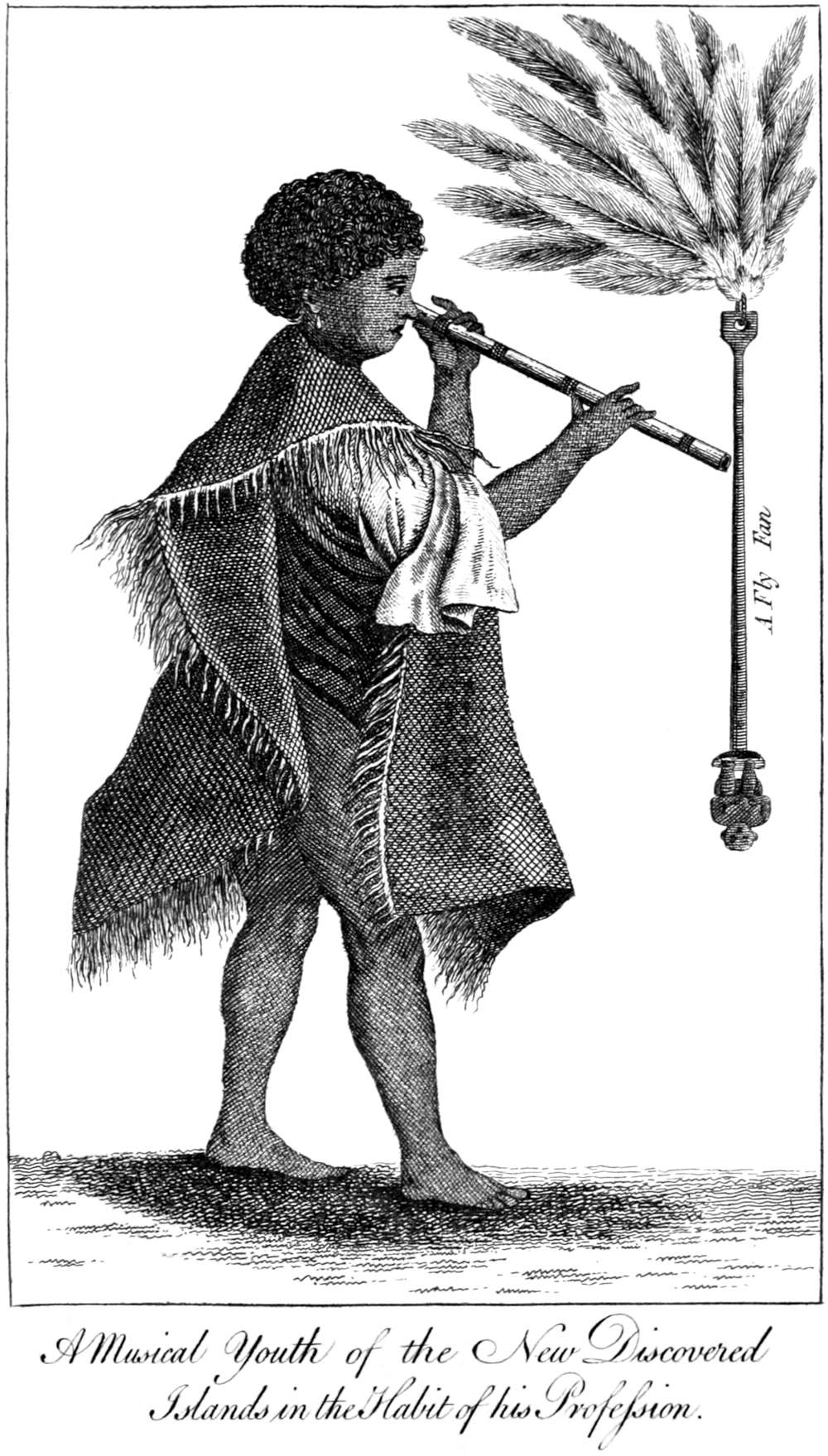
A Musical Youth of the New Discovered Islands in the Habit of his Profession.
A Fly Fan
Some of the Indians brought the English axes to grind and repair, most of which they had received from the Dolphin; but a French one occasioned much speculation, and it at length appeared to have been left here by Mr. de Bougainville.
On the 24th Mr. Banks and Dr. Solander made an excursion into the country, which they found to be level and fertile for about two miles along the shore to the eastward, after which the hills reached quite to the water’s edge, and farther on they ran out into the sea. After passing these hills, which continued about three miles, they discovered a large plain, abounding with good houses, inhabited by people who seemed to be in affluence. A very wide river issuing from a valley, added greatly to the beauty of this place: they crossed this river, and perceived the country to be again barren, which determined them to return; but just as they had taken this resolution, they were offered some refreshment by one of the natives, a man, as some authors describe to be, mixed with many nations, but different from them all, his skin being of a dead white, though some parts of his body were not so white as others; his hair, eye-brows, and beard were as white as his skin. The great joy of Tubora Tumaida and his women, who met them as they returned, is not to be expressed.
On the 25th several of their knives were missing; upon which Mr. Banks, who had lost his among the rest, accused Tubora Tumaida with having stolen it, which caused him to be very unhappy, as he happened to be innocent of the fact, Mr. Banks’s servant having mislaid it; and the rest were produced in a rag by a native. The Indian was some time before he would forget this accusation, the tears starting from his eyes, and he made signs with the knife, that if he had ever been guilty of such an action, as was imputed to him, he would suffer his throat to be cut. However, in general, these people, from the highest to the lowest, are the greatest thieves in the world.
On the 26th, six swivel guns were mounted upon the fort, which put the natives into great consternation, and caused several fishermen, who lived upon the point, to remove farther off, imagining they were to be fired at in a few days.
The next day Tubora Tumaida, with a friend, a remarkable glutton, and three of his women, dined at the fort; after which he set out for his house in the wood. In a short time he returned in much agitation, to acquaint Mr. Banks, that the ship’s butcher had threatened to cut his wife’s throat, upon her refusing to sell him a stone hatchet, which he had taken a fancy to, for a nail. It clearly appeared he had been culpable, and he was flogged on board, in sight of several of the Indians. As soon as the first stroke was given they interfered, and earnestly intreated that he might be untied. This being refused, they burst into tears, and shewed great concern.
On Friday 28, one of Tubora Tumaida’s female attendants, came down to the fort in the greatest affliction, the tears gushing from her eyes, and full of lamentation. Mr. Banks seeing her, insisted upon knowing the cause; but instead of answering, she struck herself several times with a shark’s tooth upon the head, till she caused a great effusion of blood; while her distress was unnoticed by several other Indians, who continued laughing and talking with the utmost unconcern. After this, she gathered up some pieces of cloth, which she had thrown down to catch the blood, and threw them into the sea, as if she wished to obliterate her absurd behaviour. She then bathed herself in the river, and with remarkable chearfulness returned to the tent, as if nothing extraordinary had happened.
During the forenoon of this day, canoes were continually coming in, and the tents at the fort were filled with people of both sexes. Mr. Molineux, Master of the Endeavour, went on shore, and seeing a woman, whose name was Oberea, he declared she was the person he judged to be the queen of the island, when he came there on board the Dolphin in the last voyage.
The eyes of every one were now fixed on her, who had made so distinguished a figure, in the accounts that had been given by the first discoverers of this island. The person of the queen Oberea was of a large make, and tall; she was about forty years of age, her skin white; her eyes had great expression and meaning in them; she had been handsome, but her beauty was now upon the decline. She was soon conducted to the ship, and went on board, accompanied with some of her family. Many presents were made her, particularly a child’s doll, which seemed the most to engross her attention. Captain Cook accompanied her on shore; and as soon as they landed, she presented him with a hog, and some plantains, which were carried to the fort in procession, Oberea and the Captain bringing up the rear. They met Tootahah, who, though not King, seemed to be at this time invested with a sovereign authority. He immediately became jealous of the Queen’s having the doll; which made them find it necessary to compliment him with one also. A doll now was preferable to a hatchet, though it was not considered so long, as they soon were looked upon as trifles of little or no value.
The ship’s provisions seemed to be very acceptable to the men, but the women were shy of tasting any of them. They were solicited strongly, this day, to dine with the gentlemen; but they refused, and chose to partake of plantains with the servants; a mystery that could not be explained.
On Saturday 29, in the forenoon, Mr. Banks paid a visit to Oberea, who was still asleep under the awning of her canoe, whither he went with an intention of calling her up. Upon entering her chamber, to his great surprise, he found her in bed with a handsome young fellow, about five and twenty; upon which he immediately retired with some precipitation, not a little disconcerted at this discovery; but he was soon given to understand, that such amours were by no means considered scandalous, and that Obadie, the person found in bed with the queen, was by every one known to have been selected by her as the object of her lascivious hours. The queen soon got up and dressed herself to wait upon Mr. Banks. After dressing him in a suit of fine cloth, they proceeded together to the tents. Mr. Banks paid a visit in the evening to Tubora Tumaida, and was greatly surprized to find him and his family all in tears; he in vain attempted to discover the cause, and soon took leave of them. Upon his return he was told by the officers, that Owhaw had foretold that the guns would be fired in four days, and as this was the eve of the third day, they were alarmed at the situation they judged themselves to be in. In consequence of this intelligence they doubled the centries at the fort, and the gentlemen slept under arms. Mr. Banks, about two in the morning, went round the point, but finding every thing as he could wish, he dropt all suspicions of the Indians having hostile intentions, and dwelt quite secure, as the little fortification was now complete.
The next day, Sunday the 30th, Tomio came running to the tents, and taking Mr. Banks by the arm, to whom they applied in all emergent cases, told him that Tubora Tumaida was dying, owing to something which had been given him to eat by his people, and prayed him to go instantly to him. Accordingly Mr. Banks went, and found the Indian very sick. He was told, that he had been vomiting, and had thrown up a leaf, which they said contained some of the poison which he had taken. Upon examining the leaf, Mr. Banks found it to be nothing more than tobacco, which the Indian had begged of some of their people. He looked up to Mr. Banks, while he was examining the leaf, as if he had not a moment to live. Mr. Banks, now knowing his disorder, ordered him to drink of cocoa-nut milk, which soon restored him to health, and he was as chearful as ever.
On the 1st of May Captain Cook produced an iron adze, made in imitation of one of their stone ones, which had been brought home by Captain Wallis, and shewed it to Tootahah, who took such a fancy to it, that notwithstanding he was offered the choice of any of the things that were in his chests, he snatched it up with the greatest eagerness, and would accept of nothing else. The same day a Chief, who had dined on board a few days before, accompanied by some of his women, who used to feed him, came on board by himself, and when dinner was on table, the Captain helped him to some victuals, thinking upon this occasion he would condescend to feed himself; but he never attempted to eat, and had not one of the servants fed him, he would certainly have gone without his dinner.
In the afternoon they took the astronomical quadrant, with some other instruments, on shore.
On Tuesday the 2d, having occasion to use the quadrant, to their great astonishment and concern it was missing; this was the more extraordinary, as a centinel had been posted the whole night within a few yards of the tent in which it had been deposited; and it had never been taken out of the case in which it was packed. Their own people were at first suspected, imagining they might have mistaken the contents for articles used in traffic. They searched the fort and the adjacent places, and a considerable reward was offered, as the loss of this instrument would have rendered it impossible for them to have made the necessary observations respecting the Transit, one of the principal objects of their voyage. After every fruitless search had been made, Mr. Banks, accompanied by Mr. Green, and some other gentlemen, set out for the woods, where he thought he might gain some intelligence of the robbery, if it had been committed by the natives. In the course of their journey they met Tubora Tumaida, with a few of the natives, who was made by signs to understand, that some of his countrymen had stolen the quadrant, and Mr. Banks insisted upon being conducted to the place where it was concealed. Accordingly they proceeded together a few miles, and, after some enquiry, Tubora Tumaida received information of the thief, and that he was to be found at a place about four miles distant; as they had no other arms but a brace of pistols, and the spot for which they were destined was at so considerable a distance from the fort, they were not without some apprehensions of danger. They accordingly dispatched one of their company to Captain Cook, desiring him to forward another party after them; having laid an embargo upon all the canoes in the bay; a party accordingly set out, with the Captain at their head.
Mr. Banks and Mr. Green in the interim pursued their route, and at the very place which had been mentioned were met by one of Tubora Tumaida’s own people, with part of the quadrant; soon afterwards the box in which it had been packed, containing the other parts of it, was recovered; and, upon examination, though it had been taken to pieces, they had the satisfaction to find it had received no material injury.
In the evening, when Mr. Banks and the other gentlemen, with Tubora Tumaida, returned, they were very much surprized to find Tootahah confined in the fort, the gate of which was surrounded by the natives, who expressed the utmost dread and anxiety on the occasion, as they had no other expectation but it was intended to put him to death.
Upon enquiry into this affair, it appeared that the Indians were so much alarmed at Captain Cook’s going up into the country with a party of armed men, that in the evening most of them forsook their habitations near the fort; a canoe likewise attempted to leave the bay, which the Lieutenant, who commanded on board the ship, and had been ordered not to permit any canoe to go out, perceiving, dispatched a boat to detain her, but she no sooner came near them than they jumped into the sea; among this unfortunate number was Tootahah, who, being taken up, was sent by the Lieutenant to the fort; and the commanding officer thought it his duty to detain him.
He could not be persuaded that he was not to be put to death, till Captain Cook gave orders for him to be conducted out of the fort. He was received with great affection by the people, every one pressing forward to embrace him.
On Wednesday the 3d, in the morning, Mr. Banks and Dr. Solander attended as usual to purchase provisions, but the Indians brought nothing to market; nor could they procure any from some fishing-boats which came a-breast of the tents, though they were in great want of cocoa-nuts and bread fruit. Mr. Banks walked into the woods, and heard great complaints from the people of the ill treatment of their Chief, who they said had been beaten, and otherwise ill used, of which Mr. Banks declared he was totally ignorant. The hogs which he had left as a present, were sent for back by the Chief, which, probably, he was of opinion they had ill-deserved. However, they would not send them till he came himself, by which means they thought to procure a reconciliation, knowing that absence would promote that coolness between them, to which the first interview might put an end, especially as they were told, the Chief did not intend coming to the fort for near a fortnight.
Their provisions now were extremely scarce, and the markets ill supplied, the people resenting the ill usage their Chief had received. The next day, with some difficulty, Mr. Banks obtained a few baskets of bread-fruit from Tubora Tumaida in the woods, which were a very seasonable relief. An axe and shirt were sent for this day by Tootahah, in return for his two hogs which they promised to bring him the next day. If they had not complied with this request, they could have scarcely procured any provisions.
After his sending again early in the morning, on Friday 5, Mr. Banks and Dr. Solander, with the Captain, set out in the pinnace, taking one of Tootahah’s people with them, they soon reached Eparre, the place where he dwelt, which was but a few miles to the west of the tents.
Upon their arrival, they found great numbers of people upon the shore waiting for them. They were immediately conducted to the Chief, whilst the people shouted round them, Taio Tootahah, “Tootahah is your friend;” they found him sitting under a tree, and some old men standing round him. As soon as he had made signs for them to sit down, he asked for his axe, which Captain Cook presented to him, with a shirt and a broad cloth garment, with which he seemed greatly pleased; and put the garment on. After eating a mouthful together in the boat, they were conducted to a large area, or court-yard, on one side of his house, where an entertainment was provided for them, consisting of wrestling. The Chief sat at the upper end of the area, with several of his principal men on each side of him, by way of judges, from whom the conquerors received applause.
Ten or twelve combatants entered the area, and after many simple ceremonies of challenging each other, they engaged, endeavouring to throw one another by dint of strength; then seizing hold of each other by the thigh, the hand, the hair, or the cloaths, they grappled without the least art, till one was thrown on his back; this conquest was applauded by some words from the old men, and three huzzas. After one engagement succeeded another, but if they could not throw each other during the space of a minute, they parted either by consent, or the intervention of their friends. Several women of rank were present; but it was thought, they would not have attended this amusement, only in compliment to the English gentlemen.
A man with a stick, who made way for them when they landed, officiated here as master of the ceremonies, keeping order among the people.
When this entertainment was at an end, they were informed, that some hogs and a quantity of bread-fruit were preparing for their dinner; which intelligence was the more agreeable, as their appetites were at this time exceedingly keen. But instead of dining either on shore or on board of the boat, they had the mortification of going as far as the ship by the desire of the Chief.
As soon as the Chief was known to be on board the ship, the people brought plenty of bread-fruit, cocoa-nuts, and other provisions to the fort.
On Monday 8, early in the morning, Mr. Molineux, the Master, and Mr. Green, set out in the pinnace to the eastward, in order to procure some hogs or poultry; but after proceeding a considerable way, and seeing many hogs and a turtle, they could not purchase either. They belonged to Tootahah, and the people told them, that they could not sell them without his consent; so absolute was the power of this man.
They were now obliged, for the first time, to bring out their nails to purchase provisions; for one of the smallest size, they obtained near twenty cocoa-nuts and some bread-fruit, so that they soon got great plenty.
On Tuesday 9, in the forenoon, Oberea paid them a visit, accompanied by her favourite Obadee; she presented them with a hog and some bread-fruit.
The forge being now set up and frequently at work, became not only a new subject of admiration to the Indians, but afforded the Captain an additional opportunity of conferring obligations on them, by permitting the smith, during his leisure hours, to convert the old iron, which they were supposed to have procured from the Dolphin, into different kinds of tools.
The natives, after repeated attempts, finding themselves incapable of pronouncing the names of the English gentlemen, had recourse to new ones formed from their own language, Mr. Cook was named Toote; Hicks, Hete; Gore, Touara; Solander, Tolano; Banks, Opane; Green, Treene; and so on for the greatest part of the ship’s crew.
As Mr. Banks was sitting in his boat, trading with them as usual, on Friday the 12th, a very extraordinary ceremony was performed by some ladies who were strangers, to whom the rest of the Indians giving way on each side, and forming a passage, they advanced in procession towards Mr. Banks, to whom they presented some parrots feathers, plantains, and other plants. They then brought a large bundle of cloth, consisting of nine pieces, which being divided into three parcels, one of the women, who appeared to be the principal, stepping on one of the parcels, pulled up all her cloaths as high as her waist, and then, with an air of unaffected simplicity, turned round three times. This ceremony she repeated in the same manner on the other two parcels of cloth, and the whole being then presented to Mr. Banks, the ladies went and saluted him; in return for which he made them such presents as he thought would gratify them the most.