CAPTAIN COOK’s VOYAGE ROUND THE WORLD. In 1768, 1769, 1770 and 1771. (continued 4)
Reading edition
Some of the Indians brought four skulls one day to sell, which they rated at a very high price. The brains had been taken out, and probably eaten, but the scalp and hair remained. They seemed to have been dried by fire, in order to preserve them from putrefaction. The gentlemen likewise saw the bail of a canoe, which was made of a human skull. In a word, their ideas were so horrid and brutal, that they seemed to pride themselves upon their cruelty and barbarity, and took a peculiar pleasure in shewing the manner in which they killed their enemies, it being considered as very meritorious to be expert at this destruction. The method used was to knock them down with their patoo patoos, and then rip up their bellies.
An amazing number of birds usually began their melody about two o’clock in the morning, and serenaded the gentlemen till the time of their rising. This harmony was very agreeable, as the ship lay at a convenient distance from the shore, to hear it. These feathered choiristers, like the English nightingales, never sing in the day time.
On the 17th, the ship was visited by a canoe from the hippah, or village; it contained, among others, the aged Indian, of superior distinction, who had first visited the English upon their arrival. In a conference which Tupia had with him, he testified his apprehensions, that their enemies would very soon visit them, and repay the compliment, for killing and eating the four men.
On the 18th they received no visit from the Indians, but going out in the pinnace to inspect the bay, they saw a single man in a canoe, fishing in the manner already described. It was remarkable, that this man did not pay the least attention to the people in the pinnace, but continued to pursue his employment even when they came along-side of him, without once looking at them. Some of the Endeavour’s people being on shore found three human hip bones, close to an oven: these were brought on board, as well as the hair of a man’s head, which was found in a tree. The next day a forge was set up to repair the iron work, and some Indians visited the ship with plenty of fish, which they bartered very fairly for nails.
On the 20th, Mr. Banks purchased of the old Indian a man’s head, which he seemed very unwilling to part with; the skull had been fractured by a blow, and the brains were extracted, and like the others it was preserved from putrefaction. From the care with which they kept these skulls, and the reluctance with which they bartered any, it was imagined they were considered as trophies of war, and testimonials of their valour. In this day’s excursion they did not meet with a single native; the ground on every side was quite uncultivated; but they discovered a very good harbour. The succeeding day the ship’s company were allowed to go on shore for their amusement, and the gentlemen employed themselves in fishing, in which they were very successful. Some of the company in their excursion met with fortifications that had not the advantage of an elevated situation, but were surrounded by two or three wide ditches, with a draw-bridge, which, tho’ simple in its structure, is capable of answering every purpose against the arms of the natives. Within these ditches is a fence, made with stakes, fixed in the earth. A decisive conquest or victory over the besieged occasions an entire depopulation of that district, as the vanquished, not only those who are killed, but the prisoners likewise are devoured by the victors. From what has been related by such unquestionable authority, there can remain no doubt with the unprejudiced reader, that the inhabitants of this part of the globe are cannibals. There are, indeed, some closet travellers, who treat every thing as visionary, that they have not been eye-witnesses of, and therefore disbelieve all they read, related by real travellers, that does not square with their own notions and ideas; but as it may be impossible to convince these sceptical readers, we shall leave them to amuse themselves with their doubts and objections.
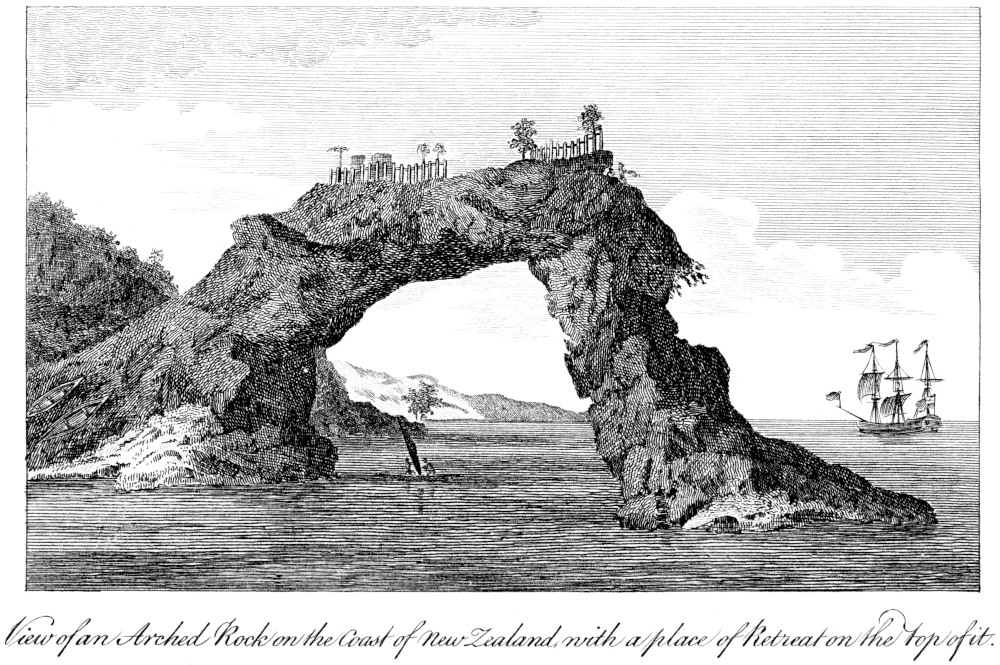
View of an Arched Rock on the Coast of New Zealand, with a place of Retreat on the Top of it.
The 22d was employed by Mr. Banks and Dr. Solander in collecting of plants, whilst Captain Cook made some observations on the main land on the south-east side of the inlet, which consisted of a chain of high hills, and formed part of the south-west side of the streight; the opposite side extended far to the east. He also discovered a village, and many houses that had been deserted, and another village that appeared to be inhabited. There were many small islands round the coast that seemed entirely barren, and what few inhabitants were upon them then lived principally upon fish. On the 24th they visited a hippah, which was situated on a very high rock, hollow underneath, forming a fine natural arch, one side of which joined to the land, and the other rose out of the sea. The inhabitants received the gentlemen with great civility, and very readily shewed them every thing that was curious. This hippah was partly surrounded with a pallisade, and it had a fighting stage like that already described. Here they met with a cross resembling a crucifix, which was ornamented with feathers, and which was erected as a monument for a deceased person; but they could not learn how his body was disposed of. From a conversation that Tupia had with these people, a discovery was made, that an officer being in a boat near this village, and some canoes coming off made him imagine they had hostile designs, and he fired upon them with ball, which made them retire with much precipitation, but they could not effect their retreat before one of them was wounded. What made this rash action the more to be lamented was, that the Indians afterwards gave every possible assurance that their intentions, upon this occasion, were entirely friendly.
On the 25th the Captain, Mr. Banks, and Dr. Solander went on shore to shoot, when they met with a numerous family, who were among the creeks catching fish: they behaved very civilly, and received some trifling presents from the gentlemen. The next day they went to take a view of the streight, that passes between the eastern and western seas: they accordingly attained the summit of a hill, but it being cloudy weather, they could not see at any considerable distance. Here, however, they erected a pile, leaving in it musket balls, small shot, beads, &c. as a testimonial of this place having been visited by Europeans. Upon their return they met with another Indian family, who behaved to them very respectfully, and assisted in procuring them water. They also visited another hippah upon a rock that was almost inaccessible; it consisted of about ninety houses, and had a fighting stage. The gentlemen made the inhabitants some small presents, and they in return furnished them with dried fish.
The ship’s company were, on the 27th and 28th, engaged in making necessary repairs, and getting her ready for sea. The next day they were visited by Topoa, their old friend, and some other Indians. They said, that the man who had received a wound from the officer, near the hippah, was dead; but this assertion proved afterwards groundless. The Doctor and Mr. Banks often went on shore whilst the ship was preparing for sea, and made several observations upon the coast to the north-west: they perceived an island, at about ten leagues distance, between which and the main there were several smaller islands. The Captain also went on shore, and erected another pyramid of stones, in which he put some bullets, beads, &c. as before, with the addition of a piece of silver coin, and placed part of an old pendant on the top, to distinguish it. Some of the people who had been sent out to gather celery, met with several of the natives, among whom were some women, whose husbands had lately fallen into the hands of the enemy, and they were cutting many parts of their body in the most shocking manner with sharp stones, in testimony of their excessive grief. What made this ceremony appear ridiculous as well as shocking, was, that the male Indians, who were with them, paid not the least attention to it, but with the greatest unconcern imaginable, employed themselves in repairing some empty huts upon the spot.
On Tuesday the 30th, two posts were erected, inscribed with the ship’s name, &c. as usual; one was placed at the watering-place, with the Union flag upon it, and the other in the same manner, on the island of Motuara; and the inhabitants being informed, that these posts were meant as memorials of the Endeavour having touched at this place, promised never to destroy them. The Captain then named this inlet Queen Charlotte’s Sound; and took possession of it in the name, and for the use of his Majesty, and a bottle of wine was drank to the Queen’s health.
The Captain made the old man some presents; among others there were a silver three-pence and some spike nails, with the broad arrow upon them. Topoa being questioned concerning a passage into the eastern sea, answered, that there certainly was such a passage; and he also informed the Captain, that the land to the south-west of the streight, where he then was, consisted of two islands, named Tovy Poennammoo, and that it would take about two days to sail round them; he added, that there was a third island to the east, called Eaheinomauwe, which was of considerable extent; and that the land contiguous to this inlet was called Tiera Witte.
Towards night, on the 31st, a brisk gale arose, attended with heavy showers, and the next morning the weather became so very tempestuous, that the Endeavour had her hawser broke, and several casks of water that had been left on shore were washed away with the rain.
The 2d, 3d and 4th of February, were chiefly spent in preparing for their departure, and purchasing fish of the natives, who confirmed the accounts that Topoa had given, respecting an eastern passage and the adjacent islands. Mr. Banks and Dr. Solander were in the mean while chiefly engaged in collecting seeds and shells of different kinds. They got under sail the 5th, but the wind not continuing, they came again to an anchor. Topoa visited the gentlemen again to bid them farewel; and being questioned, whether he had ever heard that such a vessel as the Endeavour had touched there, he answered in the negative; but added, there was a tradition of a small vessel coming from a place called Ulimaroa (a distant country to the north) that there were only four men in her, and that they were all put to death.
Mr. Banks and the Doctor went again on shore, in search of natural curiosities, when they met with a very amiable Indian family, among whom was a widow, and a pretty youth about ten years of age. She had just lost her husband, and was performing the ceremony of the country upon the occasion. They behaved with the utmost hospitality and courtesy, and endeavoured to prevail with the gentlemen to stay all night, but they expecting the ship to sail, could not accept of the invitation. This family seemed the most enlightened and intelligent set of Indians the gentlemen had as yet met with, which made them regret they had not fallen into their company before, as they would probably have derived much information from them.
On the 6th of February, in the morning, the Endeavour sailed out of the bay, which the ship’s company, from an abhorrence of the brutal custom that prevails here of eating men, called Cannibal Bay. They bent their course to an opening on the east; in the evening, being in the mouth of the streights, they were becalmed in latitude 41 deg. south, longitude 184 deg. 45 min. west. The two points which form this entrance, were named cape Koomaroo, and point Jackson. The natives call the land about it Totarranue; and the harbour, which the Captain named Ship Cove, is very safe and commodious. A ship may enter it either between Motuara and the island of Hamote, or between the western shore and Motuara. Care, however, must be taken to attend to the tides; when there is little wind they flow about nine or ten o’clock at the full and change of the moon, and rise and fall about seven feet and a half, passing through the streight from the south-east.
The natives about this sound are not above four hundred in number; they are scattered along the coast, and live upon fern root and fish; the latter of which was the only commodity they traded in. They were not entirely ignorant of the use of iron, bartering their fish for nails, and often giving them the preference to any other trifles that were offered them; they soon rejected paper when they found it was not water proof; nor was the cloth of Otaheite held in much estimation by them; but the cloths of English manufacture they highly valued. The timber here is very good, and fit for almost all purposes, except masts; besides fish, which is in great plenty, here are shags, and some other kinds of wildfowl, in abundance.
The Endeavour having left the sound, steered eastward, and about six o’clock in the evening they were greatly alarmed at their being carried, by the rapidity of the current, very close to one of the two islands which lie off Cape Koamaroo, at the entrance of the sounds. The ship was in such imminent danger, that they expected every minute she would be dashed to pieces; but letting go an anchor, and veering one hundred and sixty fathoms of cable, she was brought up, when they were not above two cables length from the rocks: in this situation they were obliged to wait for the ebb of the tide, which was not till after midnight; at three o’clock in the morning they weighed anchor, and a fine breeze springing up soon after, they were carried through the streight with great velocity. At the entrance of the streight, on the north-side, there is a small island, which was named Entry Island. The narrowest part of this streight, which was called Cooke’s Streight, is between Cape Tierawitte and Cape Koamaroo; it is about thirteen miles long and fourteen broad; the safest passage is on the north-east shore, the other being rocky and dangerous. The two eastern points of the streight Captain Cook named Cape Palliser and Cape Campbell; the first is in latitude 41 deg. 44 min. south; longitude 183 deg. 45 min. west; and the latter in latitude 41 deg. 34 min. south-east, and longitude 183 deg. 58 min. west. The Endeavour was now about three leagues from land, facing a deep bay, which was called Cloudy Bay. Some of the gentlemen on board expressing a doubt that Eahienomauwe was not an island, the Endeavour steered south-east, in order to ascertain whether it was or not; upon the wind’s shifting, she stood eastward, and steered all night north-east by east. They were off Cape Palliser next morning (the 8th) when they discovered that the land reached away to the north-east towards Cape Turnagain. Three canoes came off in the afternoon, with several people in them; they made a good appearance, and their canoes were ornamented like those of the Indians of the northern coast. They came on board without the least hesitation, and behaved very civilly; a mutual exchange of presents took place, which was the first instance they met with of such courtesy among any of the Indians. By their asking for Whow, which signified nails, it was imagined they had heard of the Endeavour’s people from the inhabitants of some other place where she had touched. They resembled the natives of Tolaga Bay in their dress. One old man was tataowed in a very remarkable manner; he was likewise marked with a streak of red paint across the nose, and over both cheeks; his hair was quite white as well as his beard. His garment was made of flax, with a wrought border, under which was a kind of petticoat, made of a cloth called Aooree Waow; his ears were decorated with teeth and pieces of green stone. His voice was soft and low, and he appeared, upon the whole, to be a person of distinguished rank. These Indians retired greatly satisfied with the presents they had received; and the Endeavour, after parting from them, steered coastwise, till the 9th in the morning, which being a clear day, it was easily determined that Eahienomauwe was certainly an island.
On the 14th of February about sixty Indians, in four double canoes, came within a stone’s cast of the ship, which they beheld with surprise. Tupia endeavoured to persuade them to approach nearer, which they refused, and made towards the shore, but did not reach it till after it was dark. From the behaviour of these people, the place from whence they came was called the Island of Lookers-on. On the 17th of this month they saw an island, five leagues from the coast of Tovy Poenammoo, which was called after the name of Mr. Banks. This island appeared to be inhabited, as they saw a few Indians on it, and in one place beheld the smoke of a fire. As no farther signs of land appeared to the southward, they steered to the west on Sunday the 18th, and made various way till the 23d, when it fell calm. Mr. Banks took this opportunity to go a shooting in his boat; when he shot some Port Egmont hens, like those found on the island of Faro, and were the first they had seen on this coast. On Sunday the 25th they saw a point of land, in 45 deg. 35 min. south latitude, which Captain Cook named Cape Saunders, in honour of the Admiral of that name. They kept at a small distance from the shore, which is interspersed with hills that are green, and abound in trees; but they did not see a single inhabitant. They had various winds and seas till the 4th of March, when they saw several whales and seals.—On the 9th they saw a ledge of rocks, and soon afterwards another ledge, three leagues from the shore, which they passed to the north during the night, and discovered the others under their bow at day-break. Thus they had a narrow escape from destruction; and these ledges of rocks were denominated the Traps, from their being adapted to entrap the unwary. The southermost point of this land they called South Cape, and indeed it proved to be the southern extremity of the whole country.
In the morning they sailed northward, and, on the day following, discovered a barren rock, about a mile in circumference, very high, and five leagues from the main land. This was called Solander’s Island. On the 13th they discovered a bay, which contains several islands, behind which, if there be depth of water, there must be shelter from all winds. Captain Cook called this Dusky-Bay, and it is remarkable for having five high, peaked rocks, lying off it, which look like the thumb and four fingers of a man’s hand; whence it was denominated Point Five Fingers. Three leagues to the south of Dusky Bay lies the westermost point of land on the whole coast, which was therefore called West-Cape.
On the 14th they passed a small narrow opening in the land, where there appeared to be a good harbour, formed by an island. On the land behind it were mountains covered with snow. On the 16th they passed a point, consisting of high red cliffs, which received the name of Cascade Point, from a cascade of water which fell down it in several small streams. On the 18th in the morning they observed the vallies as well as the mountains covered with snow, which they thought had fallen in the night, when they had rain at sea. On the 23d they gave the name of Rock’s Point to a head of land, off which lay some rocks above the water.
They had now almost passed the whole of the north-west coast of Tovy Poenammoo; the face of the country afforded nothing worth notice, but a ridge of rocks of a stupendous height, “which Dr. Hawkesworth describes as totally barren and naked, except where they are covered with snow, which is to be seen in large patches in many parts of them, and has probably lain there ever since the creation of the world; a prospect more rude, craggy, and desolate than this country affords from the sea, cannot possibly be conceived; for as far inland as the eye can reach, nothing appears but the summits of rocks, which stand so near together, that, instead of vallies, there is only fissures between them.”
By the 27th they had sailed round the whole country, and determined to depart from the coast, as soon as they had taken in a stock of water. For this purpose the Captain went ashore in the long-boat, and found an excellent watering-place, and a proper birth for the ship; which being moored, they began filling their casks; while the carpenter and his crew were employed in cutting wood. On the 30th the Captain, accompanied by Mr. Banks and Dr. Solander, went in the pinnace to examine the bay, and the land on its borders, on which the two last mentioned gentlemen found several plants, of a species they had not seen before. They saw no inhabitants; but found several Indian huts, which appeared to have been long deserted. When they returned on board in the evening, the ship was ready to sail, all the wood and water being on board. A council of the officers was now held, as to the passage they should take to England; when it was resolved to return by the East Indies, and with that view to steer for the east coast of New Holland, and then follow the direction of that coast to the northward.
This resolution being taken, they sailed at day-break, on Saturday March 31, 1770, and taking their departure from an eastern point, which they had seen on the 23d, they called it Cape Farewell. The bay from which they sailed was named Admiralty Bay, and the two Capes thereof Cape Stephens, and Cape Jackson, the names of the then Secretaries to the Board of Admiralty. Between the island and Cape Farewell is a bay, which they called Blind Bay, and which Captain Cook supposes, to be the same that is distinguished in Tasman’s Voyage, by the name of Murderers Bay.
We shall now proceed to give such an account of the country and its inhabitants, as could be acquired during the circumnavigation of the coast. Abel Jansen Tasman, a Dutchman, was the first European that made a discovery of New Zealand, to which he gave the name of Staaten Land, that is, the land of the States General. Tasman never went on shore, as the Indians attacked him soon after he came to an anchor, in the bay to which he gave the name of Murderers Bay. From the time of Tasman’s discovery, which was in December 1642, till the present voyage, the whole country, except that part which Tasman saw, remained totally unknown, and has been supposed to be part of a southern continent; but it now proves to be two large islands, separated by a streight, of the breadth of about twelve miles.
The situation of these islands is between 34 and 48 degrees of south latitude, and 181 and 194 degrees of west longitude. The natives call the northern island Eaheinomauwe, and the southermost Tovy Paenammoo.
Eaheinomauwe, though hilly, and in some places mountainous, is well stored with wood, and there is a rivulet in every valley. The soil of the vallies is light, but is so fertile, as to be well adapted for the plentiful production of all sorts of the fruits, plants, and corn of Europe; the inhabitants of which, if a settlement should be effected, might supply themselves with the necessaries and even luxuries of life, without any extraordinary exertion of their industry. The summer is more equally warm, though not hotter than in England; and it is imagined, from the vegetables that were found, that the winter is not so severe.
Dogs and rats are the only quadrupedes that were seen, and of the latter only a very few. The inhabitants breed the dogs for the sole purpose of eating them. There are seals and whales on the coast; and they once saw a sea-lion. The birds are hawks, owls, quails; and there are song-birds, whose note is wonderfully melodious. There are ducks and shags of several sorts, not unlike those of Europe; and the gannet, which is exactly the same. The sea-coast is visited by albatrosses, sheerwaters, pintados and penguins, descriptions of which have been given in other voyages. The insects are flesh-flies, beetles, butterflies, sand-flies and musquitos.
Tovy Poenammoo appears to be a barren country, is very mountainous, and almost destitute of inhabitants.
The sea which washes these islands abounds with fish, which are equally delicate and wholesome food. They seldom came to anchor but they catched enough, with hook and line only, to supply the whole ship’s crew: and, when they fished with nets, every mess in the ship, except those who were too indolent, salted as much as supplied them when at sea for several weeks after. The fish was not less various in kind than plentiful in quantity: there were many sorts they had never before seen; but the sailors readily gave names to all of them. They had several sorts of mackrel, one of which was the same as we eat in England. These fish were catched by the natives in immense quantities, and sold to the crew on the most moderate terms: but the richest dainty these seas afforded was the sea cray-fish, which differ from those seen in England, by having more prickles on the back, and being red when first catched. These they purchased of the natives on the north coast, who dive for them, and find where they lie with their feet. They had several kinds of skate, and a kind of dog-fish, of a more delicate flavour, though otherwise similar to the skate eaten in London. Eels, congers, clams, oysters, cockles, and flat-fish, resembling both soles and flounders, were likewise found in great plenty on this coast.
This country abounds with forests, filled with very large, strait, and clean timber. There is one tree about the size of an oak, which was distinguished by a scarlet flower, that appeared to be composed of several fibres; and another which grows in swampy ground, very strait and tall, bearing small bunches of berries, and a leaf resembling that of the yew tree. About four hundred species of plants were found, all of which are unknown in England, except garden night-shade, sow-thistle, two or three kinds of fern, and one or two sorts of grass. They found wild celery, and a kind of cresses, in great abundance, on the sea shore; and of eatable plants raised by cultivation, only coccos, yams, and sweet potatoes. There are plantations of many acres of these yams and potatoes. The inhabitants likewise cultivate the gourd; and the Chinese paper mulberry-tree is to be found, but in no abundance. There is only one shrub or tree in this country which produces fruit, and that is a kind of berry almost tasteless: but they have a plant which answers all the uses of hemp and flax. There are two kinds of this plant, the leaves of one of which are yellow, and the other a deep red, and both of them resemble the leaves of flags. Of these leaves they make lines and cordage, and much stronger than any thing of the kind in Europe. These leaves they likewise split into breadths, and tying the slips together, form their fishing-nets. Their common apparel, by a simple process, is made from the leaves, and their finer, by another preparation, is made from the fibers. This plant is found both on high and low ground, in dry mould, and in deep bogs; but as it grows largest in the latter, that seems to be its proper soil.
Our adventurers were of opinion, that no part of this country is peopled but the sea coast; so that the number of inhabitants is greatly disproportioned to the extent of country; and the settling a colony there, is recommended as an object worthy the notice of Great Britain.
The men of this country are as large as the largest Europeans. Their complexion is brown, but little more so than that of a Spaniard. They are full of flesh, but not lazy and luxurious; and are stout and well shaped. The women possess not that delicacy which distinguishes the European ladies; but their voice is singularly soft, which, as the dress of both sexes is similar, chiefly distinguishes them from the men. The men are active in a high degree; their hair is black, and their teeth are white and even. The features of both sexes are regular; they enjoy perfect health, and live to a very advanced age. They are of the gentlest dispositions, and treat each other with the utmost kindness: but they are perpetually at war, every little district being at enmity with all the rest. This is owing, most probably, to the want of food in sufficient quantities, at certain times. They have neither black cattle, sheep, hogs, nor goats; so that their chief food being fish, and that not at all times to be obtained, they are in danger of dying through hunger. They have a few, and but a very few dogs; and when no fish is to be got, they have only vegetables, such as yams and potatoes, to feed on; and if, by any accident, these fail them, their situation must be deplorable. This will account for their shocking custom of eating the bodies which are slain in battle; for he who fights through mere hunger, will not scruple to eat the adversary he has killed.
Notwithstanding this custom respecting their enemies, the circumstances and temper of these people are in favour of those who shall settle among them as a colony. They are in need of protection; and their dispositions are so sweet, that it would be an easy task to attach them by kindness. Civilization would be a blessing to people, whom nature has barely furnished with the necessaries of life.
The inhabitants of New Zealand are as modest and reserved in their behaviour and conversation as the most polite nations of Europe. The women, indeed, were not dead to the softer impressions; but their mode of consent was, in their idea, as harmless as the consent to marriage with us, and equally binding for the stipulated time. If any of the English addressed one of their women, he was informed, that the consent of her friends must be obtained, which usually followed, on his making a present. This done, he was obliged to treat his temporary wife at least as delicately as we do in England. A gentleman who sailed in the Endeavour having addressed a family of some rank, received an answer, of which the following is an exact translation.—“Any of these young ladies will think themselves honoured by your addresses, but you must first make me a suitable present, and you must then come and sleep with us on shore, for daylight must by no means be a witness of what passes between you.”
These Indians anoint their hair with oil, melted from the fat of fish or birds. The poorer people use that which is rancid, so that they smell very disagreeable; but those of superior rank make use of that which is fresh. They wear combs, both of bone and wood, which is considered as an ornament when stuck upright in the hair. The men tie their hair in a bunch on the crown of the head, and adorn it with the feathers of birds, which they likewise sometimes place on each side of the temples. They commonly wear short beards. The hair of the women sometimes flows over the shoulders, and sometimes is cut short. Both sexes, but the men more than the women, mark their bodies with black stains, called Amoco. In general the women stain only the lips; but sometimes mark other parts with black patches: the men, on the contrary, put on additional marks from year to year, so that those who are very ancient are almost covered. Exclusive of the amoco, they mark themselves with furrows. These furrows make a hideous appearance, the edges being indented, and the whole quite black. The ornaments of the face are drawn in the spiral form, with equal elegance and correctness, both cheeks being marked exactly alike; while the paintings on their bodies resemble fillagree work, and the foliage in old chafed ornaments: but no two faces or bodies are painted exactly after the same model. The people of New Zealand frequently left the breech free from these marks; which the inhabitants of Otaheite adorned beyond any other. These Indians likewise paint their bodies, by rubbing them with red oker, either dry, or mixed with oil.
Their dress is formed of the leaves of the flag split into slips, which are interwoven, and made into a kind of matting, the ends, which are seven or eight inches in length, hanging out on the upper side. One piece of this matting being tied over the shoulders, reaches to the knees: the other piece being wrapped round the waist, falls almost to the ground. These two pieces are fastened to a string, which, by means of a bodkin of bone, is passed through, and tacks them together. The men wear the lower garment only at particular times.
They have two kinds of cloth besides the coarse matting or shag abovementioned; one of which is as coarse, but beyond all proportion stronger than English canvass; the other, which is formed of the fibres of a plant, drawn into threads which cross and bind each other, resembles the matting on which we place our dishes at table. They make borders of different colours to both these sorts of cloth, resembling girls samplars, and finished with great neatness and elegance. What they consider as the most ornamental part of their dress is the fur of dogs, which they cut into stripes, and sew on different parts of their apparel. As dogs are not plenty, they dispose these stripes with great œconomy. They have a few dresses, ornamented with feathers; and one man was seen covered wholly with those of the red parrot.
The women never tie their hair on the top of their head, nor adorn it with feathers; and are less anxious about dress than the men. Their lower garment is bound tight round them, except when they go a fishing, and then they are careful that the men shall not see them. It once happened that some of the ship’s crew surprized them in this situation, when some of them hid themselves among the rocks, and the rest kept their bodies under water till they had formed a girdle and apron of weeds; in a word, their whole behaviour manifested the most refined ideas of female modesty.
The ears of both sexes are bored, and the holes stretched so as to admit a man’s finger. The ornaments of their ears are feathers, cloth, bones, and sometimes bits of wood; a great many of them made use of the nails which were given them by the English, for this purpose, and the women sometimes adorned their ears with the white down of the albatross, which they spread before and behind the hole, in a large bunch. They likewise hung to their ears by strings, chissels, bodkins, the teeth of dogs, and the teeth and nails of their deceased friends. The arms and ancles of the women are adorned with shells and bones, or any thing else through which they can pass a string. The men wear a piece of green talc, or whalebone, with the resemblance of a man carved on it, hanging to a string round the neck. They saw one man who had the gristle of his nose perforated, and a feather being passed through it, projected over each cheek.
These people shew less ingenuity in the structure of their houses, than in any thing else belonging to them; they are from sixteen to twenty-four feet long, ten or twelve wide, and six or eight in height. The frame is of slight sticks of wood, and the walls and roof are made of dry grass pretty firmly compacted. Some of them are lined with the bark of trees, and the ridge of the house is formed by a pole, which runs from one end to the other. The door is only high enough to admit a person crawling on hands and knees and the roof is sloping. There is a square hole near the door, serving both for window and chimney, near which is the fire-place. A plank is placed near the door, adorned with a sort of carving, and this they consider as an ornamental piece of furniture. The side walls and roof projecting two or three feet beyond the walls at each end, form a sort of portico, where benches are placed to sit on. The fire is made in the middle of a hollow square in the floor, which is enclosed with wood or stone. They sleep near the walls, where the ground is covered with straw for their beds.
Some who can afford it, and whose families are large, have three or four houses, enclosed within a court yard. Their cloaths, arms, feathers, some ill-made tools, and a chest, in which all these are deposited, form all the furniture of the inside of the house. Their hammers to beat fern-root, gourds to hold water, and baskets to contain provisions, are placed without the house.
One house was found near forty feet long, twenty wide, and fourteen high. Its sides were adorned with carved planks of workmanship superior to the rest; but the building appeared to have been left unfinished.
Though the people sleep warm enough at home, they seem to despise the inclemency of the weather, when they go in search of fish or fern-roots. Sometimes, indeed, they place a small defence to windward; but frequently sleep under bushes, with their arms placed round them, without the least shelter whatever.
Besides the fern-root, which serves them for bread, they feed on albatrosses, penguins, and some other birds. Whatever they eat is either roasted or baked, as they have no vessel in which water can be boiled.
They saw no plantations of coccos, potatoes and yams, to the southward, though there were many in the northern parts.—The natives drink no other liquor than water, and enjoy perfect and uninterrupted health.—When wounded in battle, the wound heals in a very short time without the application of medicine; and the very old people carry no other marks of decay about them than the loss of their hair and teeth, and a failure of their muscular strength:—but enjoy an equal share of health and chearfulness with the youngest.—Such are the happy effects of exercise and temperance!
The canoes of this country are not unlike the whale-boats of New England, being long and narrow. The larger sort seem to be built for war, and will hold from thirty to one hundred men. One of these at Tolaga measured near seventy feet in length, six in width, and four in depth. It was sharp at the bottom, and consisted of three lengths, about two or three inches thick, and tied firmly together with strong plaiting: each side was formed of one entire plank, about twelve inches broad, and about an inch and a half thick, which were fitted to the bottom part with equal strength and ingenuity. Several thwarts were laid from one side to the other, to which they were securely fastened, in order to strengthen the canoes.
Some few of their canoes, at Mercury Bay and Opoorage, are all made entirely of one trunk of wood, which is made hollow by fire: but by far the greater part are built after the plan above described. The smaller boats, which are used chiefly in fishing, are adorned at head and stern with the figure of a man, the eyes of which are composed of the white shells of sea-ears, a tongue of enormous size is thrust out of the mouth, and the whole face is a picture of the most absolute deformity. The grander canoes, which are intended for war, are ornamented with open work, and covered with fringes of black feathers, which gives the whole an air of perfect elegance: the side boards, which are carved in a rude manner, are embellished with tufts of white feathers.
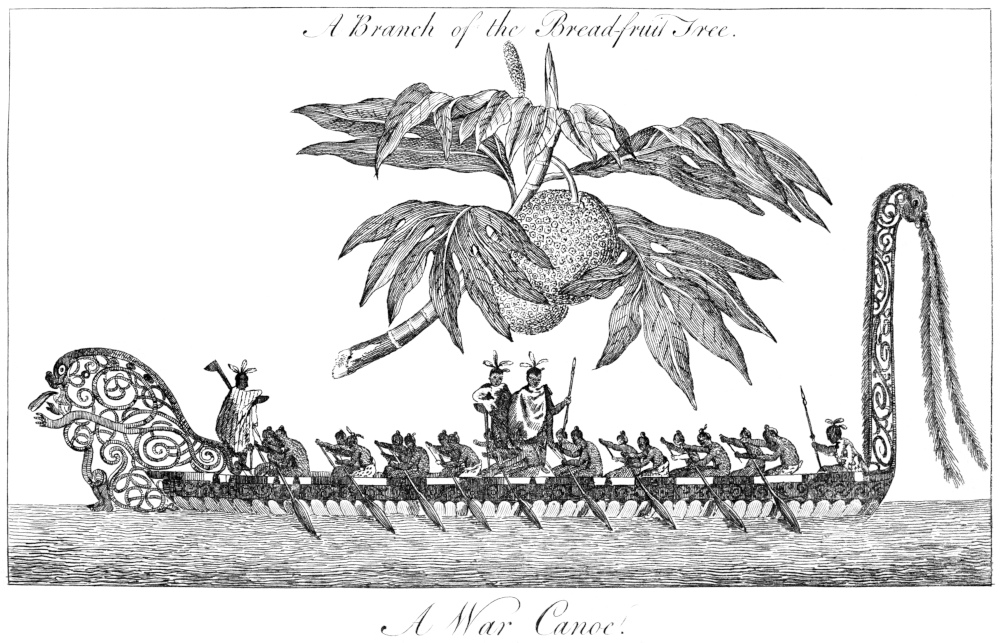
A Branch of the Bread-fruit Tree.
A War Canoe.
These vessels are rowed with a kind of paddles, between five and fix feet in length, the blade of which is a long oval, gradually decreasing till it reaches the handle; and the velocity with which they row with these paddles is really surprising. Their sails are composed of a kind of mat or netting, which is extended between two upright poles, one of which is fixed on each side. Two ropes, fastened to the top of each pole, serve instead of sheets. The vessels are steered by two men, having each a paddle, and sitting in the stern; but they can only sail before the wind, in which direction they move with considerable swiftness.
These Indians use axes, adzes and chissels, with which last they likewise bore holes. The chissels are made of jasper, or of the bone of a man’s arm; and their axes and adzes of a hard black stone. They use their small jasper tools till they are blunted, and then throw them away, having no instrument to sharpen them with. The Indians at Tolaga having been presented with a piece of glass, drilled a hole through it, and hung it round the neck. A small bit of jasper is thought to have been the tool they used in drilling it.
Their tillage of the ground is excellent, owing to the necessity they are under of cultivating or running the risk of starving. At Tegadoo their crops were just put into the ground, and the surface of the field was as smooth as a garden, the roots were ranged in regular lines, and to every root there remained a hillock. A long narrow stake, sharpened to an edge at bottom, with a piece fixed across a little above it, for the convenience of driving it into the ground with the foot, supplies the place both of plough and spade. The soil being light, their work is not very laborious, and with this instrument alone they will turn up ground of six or seven acres in extent.
The seine, the large net which has been already noticed, is produced by the united labour, and is probably the joint property of a whole town. Their fish-hooks are of shell or bone; and they have baskets of wicker-work to hold the fish.
Their warlike weapons are spears, darts, battle-axes, and the patoo-patoo. The spear, which is pointed at each end, is about sixteen feet in length, and they hold it in the middle, so that it is difficult to parry a push from it. Whether they fight in boats or on shore, the battle is hand to hand, so that they must make bloody work of it. They trust chiefly in the patoo patoo, which is fastened to their wrists by means of a strong strap, that it may not be wrenched out of their hand. These are worn in the girdles of people of a superior rank, as a military ornament. They have a kind of staff of distinction, which is carried by the principal warriors. It is formed of a whale’s rib, is quite white, and adorned with carvings, feathers, and the hair of their dogs; and they sometimes carried a stick six feet long, inlaid with shells, and otherwise adorned like the military staff. This honourable mark of distinction was commonly borne by the old men.
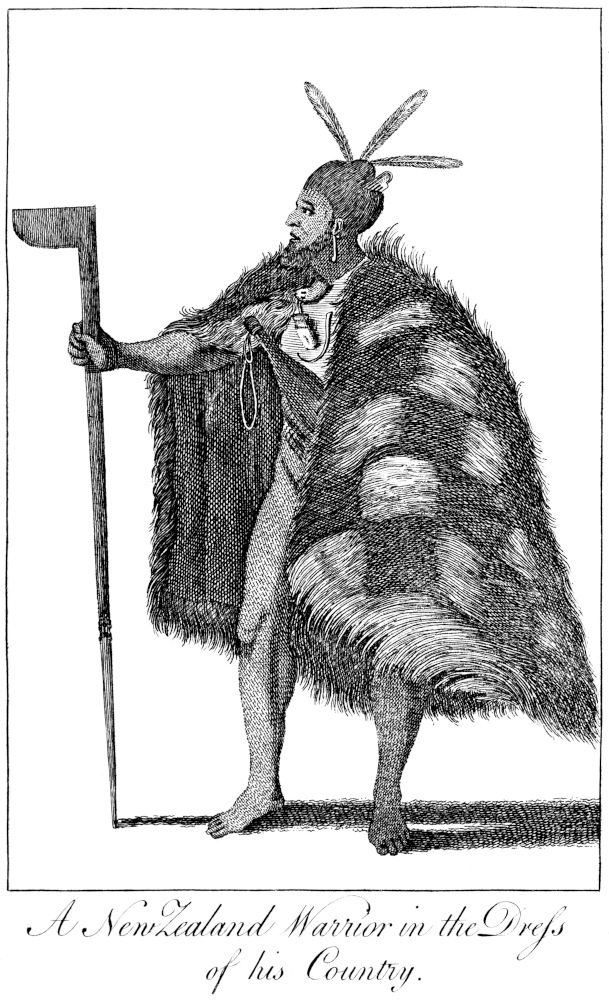
A New Zealand Warrior in the Dress of his Country.
When they came to attack the English, there was usually one or more thus distinguished in each canoe. It was their custom to stop at about fifty or sixty yards distance from the ship, when the commanding officer, arising from his seat, and putting on a garment of dog’s skin, used to direct them how to proceed. When they were too far from the ship to reach it either with stone or lance, they cried out, Haromai, haromai, harre uta a patoo-patoo oge.—“Come to us, come on shore, and we will kill you all with our patoo-patoos.” During these menaces they approached the ship, till they came along-side, talking peaceably at intervals, and answering whatever questions they were asked. Then again their threats were renewed, till, imagining the sailors were afraid of them, they began the war-song and dance—an engagement always followed, and sometimes continued till the firing of small shot repulsed them; at others, only till they had satiated their vengeance by throwing a few stones on board the ship.
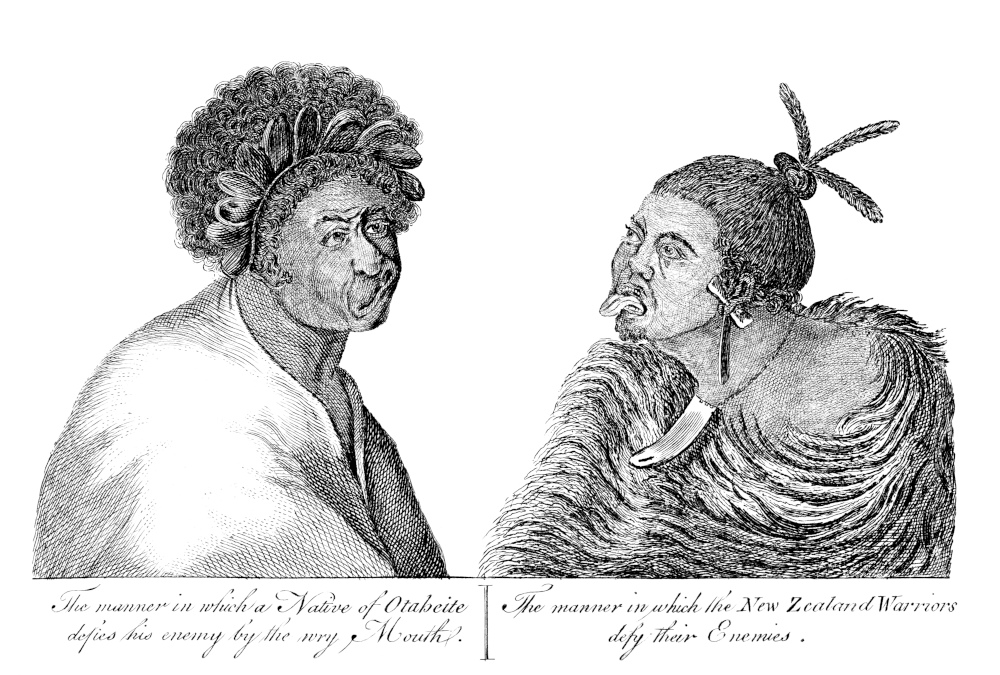
The Manner in which a Native of Otaheite defies his enemy by the wry Mouth.
The manner in which the New Zealand Warriors defy their Enemies.
In the war-dance, their motions are numerous, their limbs are distorted, and their faces are agitated. Their tongue hangs out of their mouths to a vast length, and their eye-lids are drawn so as to form a circle round the eye; they shake their darts, brandish their spears, and wave their patoo-patoos to and fro in the air. They accompany this dance with a song, which is sung in concert; every strain ending with a loud and deep sigh. There is an activity and vigour in their dancing, which is truly admirable; and their idea of keeping time in music is such, that sixty or eighty paddles will strike at once against the sides of their boats, and make only one report.
They sometimes sing, in times of peace, in a manner resembling the war-song; but then they do not dance with it. The women, whose voices are exceeding soft and harmonious, likewise sing in a melodious, but mournful manner; and their songs appear as if sung in parts. Their instruments of musick are, a shell, from which they produce a sound, resembling that made by a common horn; and a wooden pipe, not superior in musical found to a child’s whistle.
These people fortify all their hippahs, or towns, of which there are several between the bay of Plenty and queen Charlotte’s sound. In these the inhabitants of those parts constantly reside; but near Tolaga, Tegadoo, Hawk’s bay, and Poverty bay, there are no towns, only single houses at a considerable distance apart. On the sides of the hills were erected long stages, supplied with darts and stones, which were thought to be retreats in time of battle, and on which, from their elevated situation, they can combat the enemy with these weapons to great advantage. In these repositories they store their dried fish and fern-roots. The inhabitants of this part of the country were all subject to Teratu, who resided near the bay of Plenty; and to their being thus united under one Chief, they owed a security unknown to the inhabitants of the other parts of the country. There were several inferior governors in Teratus’s dominions, to whom the most implicit obedience was paid. One of the inhabitants having robbed the English, complaint was made to a Chief, who chastised him by kicking and striking him; while the thief bore his punishment with unresisting humility.
The inhabitants of the southern parts appeared to be co-partners in their fishing-nets and fine apparel. The latter, which probably were obtained in war, were kept in a little hut, destined for that use, in the centre of the town, and the several parts of the nets, being made by different families, were afterwards joined together for the common use. The gentlemen imagined, that the employment of the men consisted in cultivating the ground, making nets, catching birds, and fishing; while the women were engaged in weaving cloth, procuring fern-roots, and shell fish, and dressing food.
With regard to religion, they acknowledge one superior being, and several subordinate. Their mode of worship could not be learned, nor was any place proper for that purpose seen. There was indeed a small square area, encompassed with stones, in the middle of which hung a basket of fern-roots on one of their spades. This they said was offered to the gods, in the hope of a plentiful crop of provisions.
The inhabitants of the southern district said, they disposed of their dead by throwing them into the sea; but those of the north said, they buried them in the ground: our adventurers, however, saw not the least sign of any grave or monument; but the body of almost every inhabitant bore the marks of wounds which they had given themselves, in token of grief for the loss or their friends and relations. Some of these scars were newly made, which is a proof that their friends had died while the ship’s crew were there; yet no one saw any thing like a funeral, as these islanders conceal every thing respecting the dead, with the utmost caution.
A great similitude was observed between the dress, furniture, boats and nets of the New Zealanders, and those of the inhabitants of the South-sea islands, which furnished a strong proof, that the common ancestors of both were natives of the same country. Indeed the inhabitants of these different places have a tradition, that their ancestors migrated from another country many ages since; and they both agree, that this country was called Heawige. But perhaps a yet stronger proof that their origin was the same, will arise from the similitude of their language, of which the following is a specimen.
New Zealand. Otaheite.
Whahine, Aheine, A woman.
Taata, Tata, People.
Heoo-oo, Eraowroo, The hair.
Erai, Irai, The brow.
Mata, Matau, The eyes.
Ahewh, Eahoo, The nose.
Paparinga, Paparea, The cheeks.
Ateraboo, Eoboo, The belly.
Apeto, Pito, The navel.
Heromai, Harre mai, Come hither.
Taro, Taro, Coccos.
Tahai, Tohe, One.
Rua, Rooa, Two.
Torou, Torhoo, Three.
Ha, Ha, Four.
Etu, Hitoo, Seven.
Iva, Iva, Nine.
Heneaho, Eneeho, The teeth.
They sailed from Cape Farewell on the 31st of March 1770, and had fine weather and a fair wind till the 9th of April, when they saw a tropic bird, in the latitude of 38 degrees 29 minutes south, a sight very unusual in so high a latitude. On the 15th they saw an egg-bird and a gannet; and on the day following a small land-bird perched on the rigging, from which they concluded they were near land; but they found no ground with 120 fathom. On the 18th, in the morning, they saw a pintado-bird, and some Port Egmont hens, an infallible sign that land was not very distant. At six o’clock in the morning of the 19th they discovered land four or five leagues distant; the southermost part of which was called Point Hicks, in compliment to Mr. Hicks, the first Lieutenant, who made the discovery of it. At noon they discovered another point of the same land, rising in a round hillock, extremely like the Ram-Head at the entrance of Plymouth Sound, for which reason Captain Cook gave it the same name. What they had yet seen of the land was low and even, and the inland parts were green, and covered with wood. They now saw three water-spouts at the same time, one of which continued a quarter of an hour. At six in the evening the northermost point on the main land, which was distant about two leagues, was named Cape Howe. On the following day they had a distant view of the country, which was in general covered with wood, and interspersed with several small lawns. It appeared to be inhabited, as smoke was seen in several places. At four o’clock the next morning they saw a high mountain, which, from its shape, they called Mount Dromedary, under which there is a point, which received the name of Point Dromedary. In the evening they were opposite a point of land which rose perpendicularly, and was called Point Upright. On Sunday the 22d they were so near the shore, as to see several of the inhabitants on the coast, who were of a very dark complexion, if not perfect negroes. At noon they saw a remarkably peaked hill, to which the Captain gave the name of the Pigeon-house, from its resemblance to such a building. The trees on this island were both tall and large; but they saw no place fit to give shelter even to a boat.
The Captain gave the name of Cape George to a point of land which he discovered on St. George’s day: about two leagues to the north of which the sea formed a bay, which, from its shape, was called Long Nose; eight leagues from which lies Red-Point, so called from the colour of the soil in its neighbourhood. On the 27th they saw several of the inhabitants walking along the shore, four of them carrying a canoe on their shoulders: but as they did not attempt coming off to the ship, the Captain took Messrs. Banks and Solander and Tupia in the yawl, and employed four men to row them to that part of the shore where the natives appeared; near which four small canoes laid close in land. The Indians sat on the rocks till the yawl was within a quarter of a mile of the shore, and then ran away into the woods. The surf beating violently on the beach, prevented the boat from landing; the gentlemen were therefore obliged to make what observations they could at a distance. The canoes resembled the smaller sort of those of New Zealand. They saw, with longing eyes, a great number of cabbage-trees on shore: the other trees were of the palm-kind, and there was no underwood among them.
At five in the evening they returned to the ship, and a light breeze springing up, they sailed to the northward, where they discovered several people on shore round a fire, who, on their approach, retired to an eminence; soon after which two canoes arrived on the shore, and four men, who came in them, joined the others. The pinnace having been sent a-head to sound, arrived near the spot where the Indians had stationed themselves, on which one of them hid himself among the rocks near the landing place, and the others retreated farther up the hill. The pinnace keeping along shore, the Indians walked nearly in a line with her. They were armed with long pikes, and a weapon resembling a cymeter, and, by various signs and words, invited the boat’s crew to land. Those who did not follow the boat, having observed the approach of the ship, brandished their weapons, and threw themselves into threatening attitudes. The bodies, thighs and legs of two of these, were painted with white streaks, and their faces were almost covered with a white powder. They talked to each other with great emotion, and each of them held a kind of cymeter in his hand.
The ship having come to an anchor, they observed a few huts, in which were some of the natives; and saw some canoes, in each of which was a man busily employed in striking fish with a kind of spear. They had anchored opposite a village of about eight houses, and observed an old woman and three children come out of a wood, laden with fuel for a fire: they were met by three smaller children, all of whom, as well as the woman, were quite naked. The old woman frequently looked at the ship with the utmost indifference, and, as soon as she had made a fire, the fishermen brought their canoes on shore, and they set about dressing their dinner with as much composure, as if a ship had been no extraordinary sight.
Having formed a design of landing, they manned the boats, and took Tupia with them; and they had no sooner come near the shore, than two men advanced, as if to dispute their setting foot on land. They were each of them armed with different weapons. They called out aloud in a harsh tone, warra warra wai, the meaning of which Tupia did not understand. The Captain threw them beads, nails and other trifles, which they took up, and seemed to be delighted with. He then made signs that he wanted water, and used every possible means to convince them that no injury was intended. They now made signs to the boat’s crew to land, on which they put the boat in; but they had no sooner done so, than the two Indians came again to oppose them. A musquet was now fired between them, on the report of which one of them dropped a bundle of lances, which he instantly snatched up again in great haste. One of them then threw a stone at the boat, on which the Captain ordered a musket loaded with small shot to be fired, which wounding the eldest of them on the legs, he retired hastily to one of their houses, which stood at some little distance. The people in the boats now landed, imagining that the wound which this man had received would put an end to the contest; in this, however, they were mistaken, for he immediately returned with a kind of shield, of an oval figure, painted white in the middle, with two holes in it to see through. They now advanced with great intrepidity, and both discharged their lances at the boat’s crew, but did not wound any of them. Another musket was now fired at them, on which they threw another lance, and then took to their heels. The crew now went up to the huts, in one of which they found the children, who had secreted themselves behind some bark. They looked at them, but left them without their knowing they had been seen; and having thrown some pieces of cloth, ribbons, beads, and other things into the hut, they took several of their lances, and reimbarked in the boat. The canoes on this coast were about thirteen feet in length, each made of the bark of a single tree, tied up at the ends, and kept open in the middle by means of sticks placed across them; their paddles are very small, and they use two at a time.
They now sailed to the north point of the bay, where they found a plenty of fresh water. On taking a view of the hut where they had seen the children, they had the mortification to find that every Indian was fled, and that they had left all the presents behind them. The Captain now went in the pinnace to inspect the bay, and saw several of the natives, who all fled as he approached them. Some men having been sent to get wood and water, they no sooner, came on board to dinner, than the natives came down to the place, and examined the casks with great attention, but did not offer to remove them. When the people were on shore in the afternoon, about twenty of the natives, all armed, advanced within a trifling distance of them, and then stopped, while two of their number approached still nearer. Mr. Hicks, the commanding officer, on shore, went towards them, with presents in his hands, and endeavoured, by every possible means, to assure them of his friendly intentions, but to no purpose, for they retired before he came up to them. In the evening Messrs. Banks and Solander went with the Captain to a cove north of the bay, where they catched between three and four hundred weight of fish, in four hauls.
On Monday the 30th the natives came down to the huts before it was light, and were repeatedly heard to shout very loud; and soon after day-break they were seen on the beach; but quickly retired about a mile, and kindled several fires in the woods. This day some of the ship’s crew being employed in cutting grass, at a distance from the main body of those on shore, a party of Indians made towards them; on which the grass-cutters retreated to the main body, while the natives pursued them; but stopping within fifty or sixty yards of them, they shouted several times, and retired to the woods. In the evening they behaved exactly in the same manner, when the Captain followed them alone and unarmed for some time, but they still retired as he approached.
On Tuesday May the first, the south point of the bay was named Sutherland Point, one of the seamen, of the name of Sutherland, having died that day, and been buried on shore. This day Messrs. Banks, Solander, the Captain and a few other gentlemen, went on shore, and left more presents in the huts, such as looking-glasses, combs, &c. but the former ones had not been taken away.—Making an excursion about the country, they found it agreeably variegated with wood and lawn. The trees being strait and tall, and without underwood, the country might be cultivated without cutting down one of them. The grass grows in large tufts, almost close to each other, and there is a great plenty of it. In this excursion they met with many places where the inhabitants had slept without shelter; but they saw only one man, who ran away the moment he beheld them. They left more presents, in their huts, and at their sleeping-places, in hopes of producing a friendly intercourse. They saw the dung of an animal which fed on grass, and traced the foot-steps of another, which had claws like a dog, and was probably about the size of a wolf: they discovered the track of a small animal, whose foot was like that of a pole-cat; and saw one animal alive, about the size of a rabbit. They found some wood which had been felled, and the bark stripped off by the natives; and saw several growing trees, in which steps had been cut, for the convenience of ascending them. The trees abounded with a vast variety of beautiful birds, among which were cockatoos, parroquets and loriquets, which flew in large flocks.
The second Lieutenant, Mr. Gore, having been with a boat to dredge for oysters, saw some Indians, who made signs for him to come on shore, which he declined. Having finished his business, he sent the boat away, and went by land with a Midshipman, to join the party that was getting water. In their way they met with more than twenty of the natives, who followed them so close, as to come within a few yards of them. Mr. Gore stopped and faced them; on which the Indians stopped also, and when he proceeded again they followed him; but they did not attack him, though they had each man his lance. The Indians coming in sight of the Waterers, stood still at the distance of a quarter of a mile, while Mr. Gore and his companion reached their shipmates in safety. Two or three of the Waterers now advanced towards the Indians; but observing they did not retire, they very imprudently turned about, and retreated hastily; this apparent cowardice inspirited the savages, who discharged four lances at the fugitives, which flying beyond them, they escaped unhurt. They now stopped to pick up the lances, on which the Indians retired in their turn. At this instant the Captain came up, with Messrs. Banks, Solander, and Tupia; and advancing, made signs of friendship; but the poor natives would not wait their coming up to them.
On the following day they again went on shore, where many plants were collected by Dr. Solander and Mr. Banks. They saw several parties of the Indians, who all ran away on their approach. Tupia having learnt to shoot, frequently strayed alone to shoot parrots; and the Indians constantly fled from him with as much precipitation as from the English. On the 3d of May, fourteen or fifteen Indians, in the same number of canoes, were engaged in striking fish within half a mile of the watering-place. At this time a party of the ship’s crew were shooting near the fishermen, one of whom Mr. Banks observed to haul up his canoe on the beach, and approach the people who were shooting. He watched their motions, unobserved by them, for more than a quarter of an hour, then put off his boat, and returned to his fishing.
At this time the Captain, with Dr. Solander and another gentleman, went to the head of the bay to try to form some connexion with the Indians. On their first landing they found several Indians on shore, who immediately retreated to their canoes, and rowed off. They went up the country, where they found the soil to be a deep black mould, which appeared to be calculated for the production of any kind of grain. They saw some of the finest meadows that were ever beheld, and met with a few rocky places, the stone of which is sandy, and seemed to be admirably adapted for building. In the woods they found a tree bearing cherries, if shape and colour may entitle them to that name, the juice of which was agreeably tart. They now returned to their boat, and seeing a fire at a distance, rowed towards it, but the Indians fled on their approach. Near the beach they found seven canoes, and as many fires, from whence they judged that each fisherman had dressed his own dinner. There were oysters lying on the spot, and some muscles roasting on the fire. They ate of these fish, and left them some beads and other trifles in return. They now returned to the ship; and in the evening Mr. Banks went out with his gun, and saw a great number of quails, some of which he shot, and they proved to be the same kind as those of England.
On the following day a Midshipman having strayed from his companions, came suddenly on an old man and woman, and some children, who were sitting naked under a tree together. They seemed afraid of him, but did not run away. The man wore a long beard, and both him and the woman were grey-headed; but the woman’s hair was cut short. This day, likewise, two of another party met with six Indians on the border of a wood, one of whom calling out very loud, a lance was thrown from the wood, which narrowly missed them. The Indians now ran off; and, on looking round, they saw a youth descend from a tree, who had doubtless been placed there for the purpose of throwing the lance at them. This day the Captain went up the country on the north-side of the bay, which he found to resemble the moory grounds of England; but the land was thinly covered with plants about sixteen inches high. The hills rise gradually behind each other to a great distance, and between them is marshy ground. Those who had been sent out to fish this day met with great success; and the second Lieutenant struck a fish called the sting-ray, which weighed near two hundred and fifty pounds. The next morning a fish of the same kind was catched, which weighed three hundred and fifty pounds.
The name of Botany Bay was given to this place, from the large number of plants collected by Messrs. Banks and Solander. This country produces two kinds of wood which may be deemed timber; one of which is tall and strait, like the pine, and the other is hard, heavy, and dark-coloured, like lignum vitæ; it yields a red gum, like sanguis draconis, and bears some resemblance to an English oak. There are mangroves in abundance, several kinds of palm, and a few shrubs. Among other kinds of birds, crows were found here, exactly like those of England. There is great plenty of water-fowl among the flats of sand and mud; one of which is shaped like a pelican, is larger than a swan, and has black and white feathers. These banks of mud abound with cockles, muscles, oysters, and other shell-fish, which greatly contribute towards the support of the natives, who sometimes dress them on shore, and at other times in their canoes. They likewise catch many other sorts of fish with hook and line.
While captain Cook remained in the harbour, the English colours were displayed on shore, daily, and the name of the ship, with the date of the year, was carved on a tree near the place where they took in their water.
They sailed from Botany Bay on the 6th of May, 1770; at noon were off a harbour which they called Port Jackson, and in the evening, near a bay, to which they gave the name of Broken Bay. The next day, at noon, the northermost land in sight projected so as to justify the calling it Cape Three Points. On Wednesday the 9th, they saw two exceeding beautiful rainbows, the colours of which were strong and lively; and those of the inner one so bright, as to reflect its shadow on the water. They made a complete semicircle, and the space between them was much darker than the rest of the sky. On Thursday they passed a low rocky point, which was named Point Stephens, near which was an inlet, denominated Port Stephens. Next day they saw smoke in several places on the shore; and in the evening discovered three remarkably high hills, near each other, which the Captain named the Three Brothers.
On Sunday the 13th they saw the smoke of many fires on a point of land, which was therefore called Smokey Cape. As they proceeded northward from Botany Bay, the land appeared high and well covered with wood. On Tuesday morning, by the assistance of their glasses, they discovered about a score of the Indians, each loaded with a bundle, which they imagined to be palm-leaves, to thatch their houses. They traced them for more than an hour, during which time they took not the least notice of the ship; at length they left the beach, and were lost behind a hill, which they gained by a gentle ascent.—At noon the Captain discovered a high point of land, which he called Cape Byron. In the evening they discovered breakers at a considerable distance from the shore; so that they were obliged to tack, and get into deeper water; which having done, they lay with the head of the vessel to the land till the next morning, when they were astonished to find themselves farther to the southward than they had been the preceding evening, notwithstanding they had a southerly wind all night. In the morning they passed the breakers, near a peaked mountain, which was named Mount Warning; and the point off which they lay was called Point Danger. The next day they saw more breakers, near a point which was distinguished by the name of Point Look-out, to the north of which lies a bay, which Captain Cook called Moreton’s Bay; and the north point of which he named Cape Moreton. Near this place are three hills, which were called the Glass Houses, from the very strong resemblance they bore to such buildings.
On the 18th they descried a point so unequal, that it looks like two small islands lying under the land; and it was therefore called Double Island Point. At noon, by the help of glasses, they discovered some sands, which lay in spots of several acres, which they observed were moveable, and that some of them had not been long in their present situation, as they saw trees half buried, and the tops of others still green; likewise the naked trunks of some that had been destroyed by the sand. At this time two beautiful water-snakes swam by the ship, which seemed to be distinguished from land-snakes, only by their broad and flat tails, which it was thought were useful to them in swimming. On the 19th they sailed by a point of land, on which a large number of the Indians were assembled, from whence it was called Indian Head. They soon afterwards saw many more of the natives, and observed smoke in the day-time, and fires by night. The next day they saw a point, which was named Sandy Cape, from two large tracts of white sand that were on it. They next passed a shoal which was called Break Sea Spit, because they had now smooth water, after having long encountered a high sea. They had, for some days past, seen the sea-birds, called boobies, none of which they had met with before; and which, from half an hour before sun-rising, to half an hour after, were continually passing the ship in large flights: from which it was conjectured, that there was a river or inlet of shallow water to the southward, where they went to feed in the day, returning in the evening to some islands to the northward. In honour of Captain Hervey, this bay was called Hervey’s Bay.
On the 22d, by the help of their glasses, they discovered that the land was covered with palm-nut trees, none of which they had seen since they quitted the islands within the tropic. The next morning early the Captain took a party of men, and being attended by Tupia, and the several gentlemen on board, went on shore to examine the country. They landed a little within the point of a bay, which led into a large lagoon, by the sides of which grows the true mangrove, as it also does on some bogs, and swamps of salt-water which they discovered. There were many nests of a singular kind of ant, as green as grass, in the branches of these mangroves. When the branches were disturbed they came forth in great numbers, and bit the disturber most severely. These trees likewise afforded shelter for immense numbers of green caterpillars, their bodies were covered with hairs, which, on the touch, gave a pain similar to the sting of a nettle, but much more acute. These insects ranged themselves side by side on the leaves, thirty or forty together, in a very regular manner. They saw, among the sand banks, many birds larger than swans, which they imagined were pelicans; and they shot a kind of bustard, which weighed seventeen pounds. This bird proved very delicate food, and gave name to the place, which was called Bustard-bay. They likewise shot a duck of a most beautiful plumage, with a white beak. They found vast numbers of oysters of various sorts, and, among the rest, some hammer oysters of a curious kind. While the gentlemen were in the woods, several of the natives came down and took a survey of the ship, and then departed. The gentlemen on shore saw fires in many places, and repairing to one of them, they found about a dozen small fires burning near each other; but the people were gone, and had left some shells and bones of fish they had just eaten. They likewise saw several pieces of soft bark, about the length and breadth of a man, which they judged had been used as beds. This kind of encampment was in a thicket well defended from the wind; and as the place was much trodden, and there was no appearance of a house, it was imagined that they spent their nights, as well as days, in the open air: even Tupia shook his head, and exclaimed, Taata Enos! “Poor wretches!” They sailed the next morning, and on the day following were a-breast of a point, which lying immediately under the tropic, the Captain called Cape Capricorn, on the west side of which they saw an amazing number of large birds resembling the pelican, some of which were near five feet high.
On the 26th they stood between a range of almost barren islands, and the main land, which is mountainous. They had here very shallow water, and anchored in sixteen feet, which was not two feet more than the ship drew. Mr. Banks tried to fish from the cabin windows, but the water was too shallow. The ground indeed was covered with crabs, which greedily seized the bait, and held it till they were above water. These crabs were of two kinds, one of a very fine blue, with a white belly, and the other marked with blue on the joints, and having three remarkable brown spots on the back. The Captain having sent some men in a boat a-head to sound, they returned with an account, that there was not water enough for the ship to pass through, upon which they tacked about and stood back again. In the morning they sailed to the northward, and to the northermost point of land the Captain gave the name of Cape Manifold, from the number of high hills appearing above it. Between this cape and the shore is a bay called Keppel’s Bay, and some islands bearing the name of the same gentleman. On the 28th, being determined to keep the main land close aboard, which continued to tend away to the west, they got among another cluster of islands; they were here again greatly alarmed, having on a sudden but three fathom water, in a ripling tide; they immediately put the ship about, and hoisted out the boats in search of deeper water; after which they stood to the west with an easy sail, and in the evening, came to the entrance of a bay. On the 29th, in the morning, the master was sent with two boats to sound the bay; and the ship was no sooner under sail, than the boats made the signal, and the ship accordingly came to an anchor. As they observed the tide to flow and ebb considerably, they imagined this bay to be the entrance of a river which ran up the country: in this place therefore the Captain intended to lay the ship a-shore and clean her bottom; and accordingly landed, in search of a proper place for the purpose.
In this excursion Messrs. Banks and Solander attended Captain Cook. They found walking extremely incommodious, the ground being covered with grass, the seeds of which were sharp, and bearded, so that they were continually sticking in their cloaths, whence they worked forwards to the flesh, by means of the beard. They were likewise tormented with the perpetual stinging of musquetos. Several places were found convenient, to lay the ship a-shore; but they could meet with no fresh water. In the interior parts of the country they found gum-trees, on the branches of which were white ants nests formed of clay, as big as a bushel. On another tree they found black ants, which formed their lodging in the body of it, after they had eaten away the pith; yet the trees were in a flourishing condition. They found butterflies in such incredible numbers, that whatever way they looked, many thousands were to be seen in the air; while every bough and twig was covered with multitudes. They likewise discovered on dry ground, where it was supposed to have been left by the tide, a fish about the size of a minnow, having two strong breast fins, with which it leaped away as nimbly as a frog: it did not appear to be weakened by being out of water, nor even to prefer that element to the land; for when seen in the water it leaped on shore, and pursued its way. It was likewise remarked, that where there were small stones projecting above the water, it chose rather to leap from one stone to another, than to swim through the water.
On the 30th the Captain went ashore very early, and having gained the summit of a hill, took a survey of the coast, and adjacent islands; which being done, he accompanied Dr. Solander up an inlet, which had been discovered the preceding day; but the weather proving unfavourable, they returned early to the ship, having seen only two Indians, who followed the boat a considerable way along the shore; but the tide running strong, they did not think it prudent to wait for them. This day Mr. Banks went with a party on shore, and having met with a piece of swampy ground, covered with mangroves, they resolved to pass it, which they did, up to the knees in mud, and sometimes crawling on their hands, when they had slipt between the branches of trees, which were interwoven on the surface of the swamp. Having performed this disagreeable task, they arrived at a spot where the natives appeared to have slept on the grass, and where there were the remains of a fish supper, which had been roasted by four small fires. The second Lieutenant, at another place, saw the track of a large animal, near a gully of water: he likewise heard the voices of the Indians, but did not see any. Two turtles were seen at this place, some waterfowl, and a few small land-birds.
As no water was to be found, the Captain called the inlet Thirsty Sound, which they left on the 31st of May, and having sailed round three small islands, anchored in fifteen fathom water. On the 1st of June they got under sail, having a number of islands in sight, as far as the eye could reach. On the second at noon they saw a high promontory, which was called Cape Hillsborough, and seemed to abound in wood and herbage, distributed on hills, plains, and in vallies. There are a number of small islands in this neighbourhood, on some of which they saw smoke arising in different places. On Sunday the 3d they discovered a point, which was named Cape Conway, and between that and Cape Hillsborough a bay, which took the name of Repulse Bay. The land about Cape Conway is diversified by hills and dales, lawns and woods, and forms a delightfully verdant appearance. By the help of their glasses they discovered three people, on one of the islands, and a canoe, with an outrigger, like those of Otaheite. They this day named the islands, Cumberland Islands, in honour of the Duke; and a passage which they discovered was called Witsunday’s Passage, from the day on which it was seen. At day-break, on Monday, they were a-breast of a point, which took the name of Cape Gloucester. Names were likewise this day given to three other places, viz. Holborne Isle, Edgcumbe Bay, and Cape Upstart, which latter was so called, because it rises abruptly from the low lands that surround it.
On Tuesday, when near the shore, they saw very large columns of smoke rising from the low-lands. This day they gave name to Cleaveland Bay, the east point of which was called Cape Cleaveland, and the west Magnetical Isle, because the compass did not traverse well when they were near it. The points, as well as the main land within them, lay high, and form a barren, rugged and rocky coast. On the afternoon of Thursday they saw several large columns of smoke, likewise some canoes, and several natives, with some trees, that they thought were those of cocoa-nut; in search of which fruit Messrs. Banks and Solander went ashore with Lieutenant Hicks; but they returned in the evening with a few plants, which they had gathered from the cabbage palm, and which had been mistaken for the cocoa-tree. On Friday they gave the name of Point Hillock to a point of land; between which and Magnetical Isle the shore forms Halifax Bay, which affords shelter from all winds. At six this evening they were a-breast of a point of land, which was named Cape Sandwich, near which lies Rockingham Bay. Hence they ranged northward along the shore, towards a cluster of islands, on one of which about forty men, women and children were standing together, and looking at the ship with a curiosity never observed among these people before. The north point of Rockingham bay was called Dunk Isle, which is scarcely to be distinguished from the shore, it lies so very near it. On Saturday morning they were a-breast of some small islands, which were named Frankland’s Isles; near which lie two places, which were called Cape Grafton and Green Island. Here Messrs. Banks and Solander went ashore with the Captain, whose chief view were to procure water, which not being easily to be got, they soon returned on board, and the next day arrived near Trinity Bay, which was so called, because it was discovered on Trinity Sunday.
As no accident remarkably unfortunate had befallen our adventurers, during a navigation of more than thirteen hundred miles, upon a coast every where abounding with the most dangerous rocks and shoals; no name expressive of distress had hitherto been given to any cape or point of land which they had seen. But they now gave the name of Cape Tribulation to a point which they had just discovered, as they here became acquainted with misfortune.
This cape is in sixteen degrees six minutes south latitude, and 214 degrees 39 minutes west longitude.
At six in the evening they shortened sail, to avoid the danger of some rocks, which were seen a-head, and to observe whether any islands lay in the offing, as they were now near the latitude of those islands said to have been discovered by Quiros. They kept standing off from six o’clock till near nine, with a fine breeze and bright moon. They had got from fourteen into twenty-one fathom water; when suddenly they fell into twelve, ten, and eight fathom, in a few minutes. Every man was instantly ordered to his station, and they were on the point of anchoring, when, on a sudden, they had again deep water, so that they thought all danger was at an end, concluding they had sailed over the tail of some shoals which they had seen in the evening. They had twenty fathom and upwards before ten o’clock, and this depth continuing some time, the gentlemen, who had hitherto been upon deck, retired to rest; but in less than an hour the water shallowed at once from twenty to seventeen fathom, and, before soundings could be again taken, the ship struck against a rock, and remained fixed, but from the motion given her by the beating of the surge. Every one was instantly on deck, with countenances fully expressive of the agitation of their minds. As they knew they were not near the shore, they concluded they had struck against a rock of coral, the points of which being sharp, and the surface so rough, as to grind away whatever is rubbed against it, tho’ with a gentle motion; they had reason to dread the horror of their situation!
The sails being taken in, and boats hoisted out to examine the depth of water, they found that the ship had been carried over a ledge of the rock, and lay in a hollow within it. Finding that the water was deepest eastern, they carried out the anchor from the starboard quarter, and applied their whole force to the capstern, in hopes to get the vessel off, but in vain. She now beat so violently against the rock, that the crew could scarcely keep on their legs. The moon now shone bright, by the light of which they could see the sheathing boards float from the bottom of the vessel; till at length the false keel followed, so that they expected instant destruction. Their best chance of escaping seemed now to be by lightening her; but as they had struck at high water, they would have been but in their present situation, after the vessel should draw as much less water as the water had sunk: but their anxiety abated a little, on finding that the ship settled to the rocks as the tide ebbed. They, however, flattered themselves, that if the ship should keep together till next tide, they might have some chance of floating her. They therefore instantly started the water in the hold, and pumped it up. The decayed stores, oil jars, casks, ballast, six of their guns, and other things, were thrown overboard, in order to get at the heavier articles; and in this business they were employed till daybreak, during all which time it was observed, that not an oath was sworn; so much were the minds of the sailors impressed with a sense of their danger.
At day-light they saw land at eight leagues distance; but not a single island between them and the main, on which part of the crew might have been landed, while the boat went on shore with the rest; so that the destruction of the greater part of them would have been inevitable, had the ship gone to pieces. It happened, however, that the wind died away to a dead calm before noon. As they expected high water at eleven o’clock, every thing was prepared to make another effort to free the ship; but the tide fell so much short of that in the night, that she did not float by eighteen inches, though they had thrown over-board near fifty tons weight: they now, therefore, renewed their toil, and threw over-board every thing that could be possibly spared. As the tide fell, the water poured in so rapidly, that they could scarcely keep her free by the constant working of two pumps. Their only hope now depended on the midnight tide, and preparations were accordingly made for another effort to get the ship off. The tide began to rise at five o’clock, when the leak likewise encreased to such a degree, that two more pumps were manned; but only one of them would work: three, therefore, were kept going till nine o’clock, at which time the ship righted; but so much water had been admitted by the leak, that they expected she would sink as soon as the water should bear her off the rock. Their situation was now deplorable beyond description; and the imagination must paint what would baffle the powers of language to describe. They knew that when the fatal moment should arrive, all authority would be at an end. The boats were incapable of conveying them all on shore; and they dreaded a contest for the preference, as more shocking than the shipwreck itself: yet it was considered, that those who might be left on board, would eventually meet with a milder fate than those who, by gaining the shore, would have no chance but to linger the remains of life among the rudest savages in the universe, and in a country, where fire-arms would barely enable them to support a wretched existence.
At twenty minutes after ten the ship floated, and was heaved into deep water; when they were happy to find that she did not admit more water than she had done before; yet as the leak had for a considerable time gained on the pumps, there was now three feet nine inches water in the hold. By this time the men were so worn by fatigue of mind and body, that none of them could pump more than five or six minutes at a time, and then threw themselves, quite spent, on the deck, amidst a stream of water which came from the pumps. The succeeding man being fatigued in his turn, threw himself down in the same manner, while the former jumped up and renewed his labour; thus mutually struggling for life, till the following accident had like to have given them up a prey to absolute despair.
Between the inside lining of the ship’s bottom, which is called the ceiling, and the outside planking, there is a space of about seventeen or eighteen inches. The man who had hitherto taken the depth of water at the well, had taken it no farther than the ceiling; but being now relieved by another person, who took the depth to the outside planking, it appeared by this mistake, that the leak had suddenly gained upon the pumps, the whole difference between the two plankings.—This circumstance deprived them of all hopes, and scarce any one thought it worth while to labour, for the longer preservation of a life which must so soon have a period: but the mistake was soon discovered; and the joy arising from such unexpected good news inspired the men with so much vigour, that before eight o’clock in the morning they had pumped out considerably more water than they had shipped. They now talked confidently of getting the ship into some harbour; and set heartily to work to get in their anchors; one of which, and the cable of another, they lost: but these were now considered as trifles. Having a good breeze from the sea, they got under sail at eleven o’clock, and stood for the land.
As they could not discover the exact situation of the leak, they had no prospect of stopping it within side of the vessel; but the following expedient, which one of the Midshipmen had formerly seen tried with success, was adopted. They took an old studding sail, and having mixed a large quantity of oakham and wool, chopped small, it was stitched down in handfuls on the sail, as lightly as possible; the dung of their sheep and other filth being spread over it. Thus prepared, the sail was hauled under the ship by ropes, which kept it extended till it came under the leak, when the suction carried in the oakham and wool from the surface of the sail. This experiment succeeded so well, that, instead of three pumps, the water was easily kept under with one.
They had hitherto had no further view than to run the ship into an harbour, and build a vessel from her materials, in which they might reach the East Indies; but they now began to think of finding a proper place to repair her damage, and then to pursue their voyage on its original plan. At six in the evening they anchored seven leagues from the shore; and found that the ship made fifteen inches water an hour during the night; but as the pumps could clear this quantity, they were not uneasy. At nine in the morning they passed two islands, which were called Hope Islands, because the reaching of them had been the object of their wishes at the time of the shipwreck. In the afternoon the Master was sent out with two boats to sound, and search for a harbour where the ship might be repaired. They anchored at sun-set, in four fathom, two miles from the shore. One of the Mates being out in the pinnace, returned at nine o’clock, reporting, that he had found just such a harbour as was wanted, at the distance of two leagues.