PART the SECOND.
Johann Reinhold Forster translation
From our entrance into the Western Sea, to our return
to France.
Et nos jam tertia portat
Omnibus errantes terris etet fluctibus æstas.
Virg. Lib. I.
CHAP. I.
The run from the straits of Magalhaens to our arrival at the Isle of Taiti; discoveries which precede it.
January. 1768.
Direction of our track, after leaving the strait.
From our entrance into the Western Sea, after some days of variable winds, between S. W. and N. W. we soon got S. and S. S. E. winds. I did not expect to meet with them so soon; the west winds generally last to about 30°; and I intended to go to the isle of Juan Fernandez, in order to make good astronomicalastronomical observations there. I intended by this means to fix a sure 200point of departure, in order to cross this immense ocean the extent of which is differently laid down, by differently navigators. The early meeting with the S. and S. E. winds, obliged me to lay aside this scheme of putting in there, which would have prolonged my voyage.
Observation on the position of the coasts of Chili.
During the first days, I stood as near west as possible; as well to keep my wind, as to get off from the coast; the bearings of which are not laid down with any certainty in the charts: however, as the winds were then always in the western board, we should have fallen in with the land, if the charts of Don George Juan, and Don Antonio de Ulloa had been exact. These Spanish officers have corrected the old maps of North America[89]; they make the coast run N. E. and S. E. between Cape Corso and Chiloe; and that upon conjectures, which they have certainly thought well-founded. This correction happily deserves another; it was not a very comfortable one for those navigators, who after coming out of the strait, endeavour to get to the northward, with winds which constantly vary from S. W. to N. W. by W. Sir John Narborough, after leaving the straits of Magalhaens, in 1669, run along the coast of Chili, examining all the inlets and creeks, as far as the river of Baldivia, into which he entered; he says 201expressly, that the course from Cape Desire to Baldivia is N. 5° E. This is something more certain than the conjectural assertion of Don George and Don Antonio. If, upon the whole, their conjecture had been true, by the course which we were obliged to take we must have fallen in with the land.
Order of sailing of the Boudeuse and Etoile.
202When we were got into the Pacific Ocean, I agreed with the commander of the Etoile, that, in order to discover a greater space of the sea, he should go every morning southward, as far from me as the weather would allow, keeping within sight; and that every evening we should join; and that then he should keep in our wake, at about half a league’s distance. By this means, if the Boudeuse had met with any sudden danger, the Etoile was enabled to give us all the assistance which the case might require. This order of sailing has been followed throughout the whole voyage.
Loss of a sailor fallen into the sea.
On the 30th of January, a sailor fell into the sea; our efforts were useless; and we were unable to save him: it blew very fresh, and we had a great sea.
Fruitless search for Davis’s land.
I directed my course for making the land, which Davis[90], an English privateer, saw in 1686, between 27° and 28° south latitude; and which Roggewein, a Dutchman[91], sought for in vain, in 1722. |1768. February.| I continued 203to stand in search of it till the 17th of February. |Incertitude on the latitude of Easter island.| According to M. de Bellin’s chart, I must have sailed over this land on the 14th. I did not chuse to go in search of Easter island, as its latitude is not laid down with certainty. Many geographers agree in placing it in 27° or 28° S. M. Buache, alone, puts it in 31°. However, on the 14th, being in 27° 7′ of latitude observed, and 104° 12′ computed west longitude, we saw two birds very like Equerrets[92], which generally do not go further than 60 or 80 leagues from land; we likewise saw a tuft of that green plant, which fastens on ships’ bottoms; and, for these reasons, I continued to stand on the same course till the 17th. Upon the whole, I think, from the account which Davis gives of the land he saw, that it is no other than the isles of St. Ambrose and St. Felix, which are two hundred leagues from the coast of Chili.
Meteorological Observations.
From the 23d of February, to the 3d of March, we had westerly winds, constantly varying between S. W.. and N. W. with calms and rain: every day, either a little before noon, or soon after, we had sudden gusts of rain, accompanied with thunder. It was strange to us to meet with this extraordinary wind, under the tropic, and in that ocean, so much renowned above all other seas, for the uniformity and the freshness of the E. and S. E. 204trade-winds; which are said to reign in it all the year round. We shall find more than one opportunity to make the same observation.
Astronomical observations, compared with the ship’s reckoning.
During the month of February, M. Verron communicated to me the result of four observations, towards determining our longitude. The first, which was made on the 6th at noon, differed from my reckoning only 31′; which I was more to the westward than his observation. The second, taken at noon on the 11th, differed from my estimated longitude 37′ 45″, which I was to the eastward of him. By the third observation, made on the 22d, reduced to noon, I was more westward than he, by 42′ 30″; and I had 1° 25′ of difference west, from the longitude determined by the observations of the 27th. Then we met with calms and contrary winds. The thermometer, till we came into 45° lat. always kept between 5° and 8° above the freezing-point: it then rose successively; and when we ran between 27° and 24° of lat. it varied from 17° to 19°.
There was an almost epidemical sore-throat among the crew of my frigate, as soon as we had left the straits. As it was attributed to the snow-waters of the straits, I ordered every day, that a pint of vinegar, and red hot bullets should be put into the scuttled cask, containing the water for the crew to drink, on the upper deck. Happily these sore throats yielded to the simplest remedies; 205and, at the end of March, we had no-body upon the sick-list. Only four sailors were attacked by the scurvy. About this time we got plenty of Bonitos and Great-ears (Grandes-Oreilles); and, during eight or ten days, sufficient were taken to afford one meal a-day for the crews of both ships.
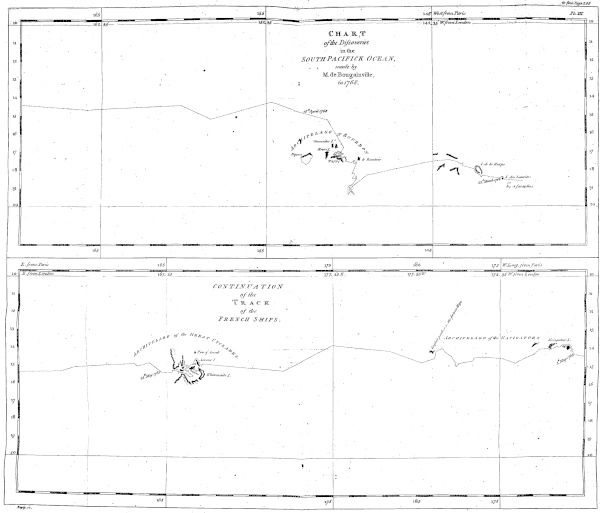
Chart of the Discoveries in the South Pacifick Ocean, made by M. de Bougainville. in 1768. Continuation of the Track of the French Ships.
Meeting with the first isles.
During March, we ran on the parallel of the first lands and isles marked on the chart of M. Bellin, by the name of Quiros’s Isles. |1768. March.| On the 21st we caught a tunny, in whose belly we found same little fish, not yet digested, of such species as never go to any distance from the shore. This was a sign of the vicinity of land. Indeed, the 22d, at six in the morning, we saw at once four little isles, bearing S. S. E. ½E. and a little isle about four leagues west. |Observations on one of these isles.| The four isles I called les quatre Facardins; and as they were too far to windward, I stood for the little isle a-head of us. As we approached it, we discovered that it is surrounded with a very level sand, and that all the interior parts of it are covered with thick woods, above which the cocoa-trees raise their fertile heads. The sea broke much to the N. and S. and a great swell beating all along the eastern side, prevented our access to this isle in that part. However, the verdure charmed our eyes, and the cocoa-trees every where exposed their fruits to our sight, and over-shadowed a grass-plot adorned with flowers; thousands of birds 206were hovering about the shore, and seemed to announce a coast abounding in fish, and we all longed for a descent. We thought this would be easy on the western-side; and we ran along the coast at the distance of about two miles. We saw the sea break on every side with equal force, without a single harbour or creek, which might serve for shelter, or stem the force of the sea. Thus losing all hopes of landing there, unless at the evident risk of having our boats staved to pieces, we resumed our course again, when some of our people cried out, that they saw three men running to the sea-shore. |It is inhabited, notwithstanding its small size.| We should never have thought that so small an isle could be inhabited; and my first conjectures were, that some Europeans must certainly have been shipwrecked upon it. I presently gave orders to lay-to; as I was determined to do all I could to save them. These men were returned into the woods; but soon after they came out again, fifteen or twenty in number, and advanced very fast; they were naked, and bore very long pikes, which they brandished against the ships, with signs of threatening; after this bravado, they retired to the woods, where we could distinguish their huts, by means of our glasses. These men seemed very tall, and of a bronze colour—Who can give an account of the manner in which they were conveyed hither, what communications they have with other beings, and what becomes 207of them when they multiply on an isle, which has no more than a league in diameter? I called it Isle des Lanciers[93]. Being less than a league to the N. E. of this isle, I made the signal to the Etoile to sound; she did so with a line of two hundred fathom, without finding any bottom.
Farther meeting with islands.
From that day we always shortened sail at night, fearing to meet all at once some of these low-lands, to which it is so dangerous to come near. We were obliged to bring-to[94], during a part of the night, between the 22d and 23d; as we had a storm, with very high wind, rain, and thunder. At day-break we saw land, bearing from us, from N. E. b. N. to N. N. W. We stood for it, and at eight o’clock were about three leagues from its eastermost point. Then, though it was somewhat hazy, we perceived breakers along this coast, which appeared very low, and covered with trees: therefore, we stood out to sea again, waiting for the fair weather to allow us to come nearer the coast at a less risk; this we were able to do towards ten o’clock. Being only one league off the island, we ran along it, endeavouring to find a proper landing-place; we could not find bottom with 120 fathom. A bar, over which the sea broke with great violence, lay along the whole coast; and we 208soon discovered, that this island is formed by two very narrow slips of land, which join at the N. W. end, and leave an opening to the S. E. between their extremities. |Description of the largest of these isles.| The middle of this isle is therefore occupied by the sea, in all its length, which is about ten or twelve leagues S. E. and N. W. so that it appears like a very oblong horse-shoe, whereof the opening or entrance is at S. E.
The two necks of land are so very narrow, that we could perceive the sea beyond the most northerly one. They seem composed of nothing but sandy downs, interspersed with low grounds, without either trees or verdure. The higher downs are covered with cocoa-nut and other lesser trees, which were very shady. After noon we saw periaguas in the kind of lake which this island forms; some sailing, others paddling. The savages in them were naked. In the evening we saw a great number of these islanders along the coast. They likewise seemed to have such long lances as the inhabitantsinhabitants of the first island threatened us with. We had not yet found any place where our canoes could land. The sea foamed every where with equal violence. Night interrupted our researches; we passed it plying under our top-sails; and not discovering any landing-place, on the 24th in the morning, we continued our course, and left this inaccessible island; which, on account of its 209figure, I called Harp Island. I question whether this extraordinary land is rising and encreasing, or whether it is decaying? How was it peopled? Its inhabitants appeared to us tall and well proportioned. I admire their courage, if they live unconcerned on these little slips of sand, which are exposed to be buried in the sea every moment by a hurricane.
First division: Dangerous Archipelago.
The same day, at five in the afternoon, we saw another land, about seven or eight leagues distant; the uncertainty of its position, the inconstant squally and tempestuous weather, and the obscurity of the night obliged us to stand off and on. The 25th, in the morning, we came near the land, which we found to be another very low island, extending S. E. and N. W. about twenty-four leagues. We continued till the 27th to sail between low and partly overflowed islands, four of which we examined, all of the same nature, and all inaccessible, and not deserving that we should lose our time in visiting them. I gave the name of Dangerous Archipelago to this cluster of islands; of which we saw eleven, and which are probably more numerous. It is very dangerous sailing amidst these low isles, surrounded with breakers and shoals; where it is necessary, especially at night, to use the utmost precaution.
Error in the chart of this part of the Pacific Ocean.
I determined to stand more southerly, in order to get clear of these dangerous parts. Indeed, on the 28th, 210we ceased to see the land. Quiros, discovered first, in 1606, the south end of this chain of islands, which extend W. N. W. and among which admiral Roggewein found himself engaged in 1722, in about 15° lat. he called them the Labyrinth. Upon the whole, I know not on what grounds our geographers lay down after these isles, a beginning of land seen, as they say, by Quiros; and to which they give seventy leagues of extent. All that can be inferred from the Journal of this navigator is, that the first place he landed at, after his departure from Peru, was eight leagues in extent. But far from considering it as a considerable coast, he says, that the savages who inhabit it, gave him to understand, that he should find great countries in his way[95]. If any considerable land existed hereabouts, we could not fail meeting with it; as the least latitude we were hitherto arrived at, was 17° 40′ S. which is the same that Quiros observed on this very coast, whereof the geographers have been pleased to make a great continent.
I agree, that it is difficult to conceive such a number of low islands, and almost drowned lands, without supposing a continent near it. But Geography is a science 211of facts; in studying it, authors must by no means give way to any system, formed in their studies, unless they would run the risk of being subject to very great errors, which can be rectified only at the expence of navigators.
Astronomical observations, compared with my reckoning.
Mr. Verron, in March, gave me three observations of longitude. The first, taken by Hadley’s octant, on the 3d in the afternoon, was only 21′ 30″ different from my reckoning, I being so much to the westward of the observed longitude. The second, made by the megameter, and reduced to noon of the 10th, differed considerably from my reckoning, as my computed longitude was 3° 6′ more westward than that taken by observation. On the contrary, from the result of the third observation, taken with the octant on the 27th, my reckoning agreed within 39′ 15″, which he found I was more eastward than his longitude. It must be observed, that since my leaving the straits of Magalhaens, I have always followed the longitude of my departure, without correcting it in the least, or making use of the observations.
Meteorological observations.
The thermometer[96] constantly kept between 19° and 20°, during this month, and even near the land. Towards the end of the month, we had five days west winds, with squalls and storms, which succeeded each 212other almost without interruption. It rained continually; and the scurvy made its appearance on eight or ten persons of the crew. Moistness is one of the most powerful causes of this disease. |Advantageous use of lemonade-powder at sea.| Each sailor got daily a pint of lemonade, prepared with a kind of powder, called powder of faciot; which we made great use of, during the course of this voyage. |Water deprived of its salt.| On the third of March I had likewise begun to make use of the distilling apparatus of M. Poissonier; and we continued till we arrived at New Britain to make use of the sea-water, which was by this means deprived of its salt; employing it in broth, and in boiling meat and legumes. The supply of water it procured us, during this long run, was a very great resource. |1768. April.| We lighted our fire at five in the evening, and put it out by five or six in the morning, making above a barrel of water every night. By way of sparing our fresh water, we always kneaded our bread with salt water.
Second division of lands; Archipelago of Bourbon.
The second of April, at ten in the morning, we perceived, to the N. N. E. a high and very sleep mountain, seemingly surrounded by the sea. I called it the Boudoir, or the Peak of the Boudeuse. |Sight of Taiti.| We stood to the northward, in order to make it plain, when we saw another land, bearing W. by N. the coast of which was not so high, but afforded an indeterminate extent to our eyes. We had a very urgent necessity for touching at some place 213where we might get refreshments and wood, and we flattered ourselves to find them on this land. It was a calm almost the whole day. In the evening a breeze sprung up, and we stood towards the land till two in the morning, when we stood off shore again, for three hours together. The sun rose obscured by clouds and haze; and it was nine o’clock in the morning before we could see the land again, its southermost point then bearing W. by N. We could no longer see the peak of the Boudeuse, but from the mast-head. The wind blew N. and N. N. E. and we stood as close upon it as we could, in order to fall into windward of the island. As we came nearer we saw, beyond its northermost point, a distant land, still further to northward, without our being able at that time to distinguish whether it joined to the first isle, or whether it formed a second.
Manœuvres in order to land there.
During the night, between the third and fourth, we turned to windward, in order to get more to the northward. With joy we saw fires burning on every part of the coast, and from thence concluded that it was inhabited.
The 4th, at day-break, we discovered that the two lands, which before appeared separate, were united together by a low land, which was bent like a bow, and formed a bay open to the N. E. We run with all sails set towards the land, standing to windward of this bay, 214when we perceived a periagua coming from the offing, and standing for the land, and making use of her sail and paddles. She passed athwart us, and joined a number of others, which sailed a-head of us, from all parts of the island. One of them went before all the rest; it was manned by twelve naked men, who presented us with branches of bananas; and their demonstrations signified that this was their olive-branch. |First traffic with these islanders.| We answered them with all the signs of friendship we could imagine; they then came along side of our ship; and one of them, remarkable for his prodigious growth of hair, which stood like bristles divergent on his head, offered us, together with his branch of peace, a little pig, and a cluster of bananas. We accepted his present, which he fastened to a rope that was thrown over to him; we gave him caps and handkerchiefs; and these first presents were the pledges of our alliance with these people.
The two ships were soon surrounded with more than an hundred periaguas of different sizes, all which had outriggers. They were laden with cocoa-nuts, bananas, and other fruits of the country. The exchange of these fruits, which were delicious to us, was made very honestly for all sorts of trifles; but without any of the islanders venturing to come aboard. We were obliged either to come into their periaguas, or shew them at a 215distance what we offered in exchange; when both parties were agreed, a basket or a net was let down by a rope; they put their goods in it, and so we did ours; giving before they had received, or receiving before they gave indifferently, with a kind of confidence, which made us conceive a good opinion of their character. We further saw no kind of arms in their periaguas, in which there were no women at this first interview. The periaguas kept along-side of the ships, till the approach of night obliged us to stand off shore, when they all retired.
We endeavoured, during night, to go to the northward, never standing further than three leagues from the land. All the shore was, till near midnight, covered as the night before, with little fires at a short distance from each other: it seemed as if it was an illumination made on purpose, and we accompanied it with several sky-rockets from both our ships.
Description of the coast as seen from the offing.
The 5th we spent in plying, in order to work to windward of the island, and in letting the boats sound for an anchoring-place. The aspect of this coast, elevated like an amphitheatre, offered us the most enchanting prospect. Notwithstanding the great height of the mountains, none of the rocks has the appearance of barrenness; every part is covered with woods. We hardly believed our eyes, when we saw a peak covered with 216trees, up to its solitary summit, which rises above the level of the mountains, in the interior parts of the southermost quarter of the island. Its apparent size seemed to be no more than of thirty toises in diameter, and grew less in breadth as it rose higher. At a distance it might have been taken for a pyramid of immense height, which the hand of an able sculptor had adorned with garlands and foliage. The less elevated lands are interspersed with meadows and little woods; and all along the coast there runs a piece of low and level land, covered with plantations, touching on one side the sea, and on the other bordering the mountainous parts of the country. Here we saw the houses of the islanders amidst bananas, cocoa-nut, and other trees loaded with fruit.
As we ran along the coast, our eyes were struck with the sight of a beautiful cascade, which came from the tops of the mountains, and poured its foaming waters into the sea. A village was situated at the foot of this cascade, and there appeared to be no breakers in this part of the coast. We all wished to be able to anchor within reach of this beautiful spot; we were constantly sounding aboard the ships, and our boats took soundings close under the shore; but we found a bottom of nothing but rocks in this port, and were forced to go in search of another anchorage.
Continuation of the traffic with the islanders.
217The periaguas returned to the ship at sun-rising, and continued to make exchanges all the day. We likewise opened new branches of commerce; for, besides the fruits, which they brought the day before, and other refreshments, such as fowls and pigeons, the islanders brought with them several instruments for fishing; stone chisels, (herminettes de pierre) strange kinds of cloth, shells, &c. They wanted iron and ear-rings in exchange. This bartering trade was carried on very honestly, as the day before: this time some pretty and almost naked women came in the periaguas. One of the islanders went on board the Etoile, and stayed there all night, without being in the least uneasy.
This night was likewise spent in plying; and on the 6th in the morning we were got to the most northerly extremity of the island. Another isle now came within sight: but seeing several breakers that seemed to obstruct the passage between the two isles, I determined to return in search of anchorage in the first bay, which we saw on the day of our land-fall. Our boats which sounded a-head of us towards shore, found the north side of the bay every where surrounded, at a quarter of a league’s distance, by a reef which appears at low water. However, about a league from the north point, they discovered a gap in the reef, of the width of twice a cable’s length at most, where there was 30 and 35 218fathom of water, and within it a pretty extensive road, where the bottom varied from nine to thirty fathom. This road was bounded to the south by a reef, which, proceeding from the land, joined that which surrounded the shore. Our boats had constantly found a sandy bottom, and discovered several little rivers fit for watering at. Upon the reef, on the north side, there are three little islands.
Anchorage at Taiti.
This account determined me to come to an anchor in the road, and we immediately made sail to enter into it. We ranged the point of the starboard reef in entering; and as soon as we were got within it, we let go our best bower in 34 fathom, bottom of grey sand, shells, and gravel; and we immediately carried out the stream-anchor to the north-west, in order to let go our small bower there. The Etoile went to windward, and came to an anchor a cable’s length to the northward of us. As soon as we were moored, we struck yards and top-masts.
Difficulty of mooring the ships.
As we came nearer the shore, the number of islanders surrounding our ships encreased. The periaguas were so numerous all about the ships, that we had much to do to warp in amidst the croud of boats and the noise. All these people came crying out tayo, which means friend, and gave a thousand signs of friendship; they all asked nails and ear-rings of us. The periaguas were 219full of females; who, for agreeable features, are not inferior to most European women; and who in point of beauty of the body might, with much reason, vie with them all. Most of these fair females were naked; for the men and the old women that accompanied them, had stripped them of the garments which they generally dress themselves in. The glances which they gave us from their periaguas, seemed to discover some degree of uneasiness, notwithstanding the innocent manner in which they were given; perhaps, because nature has every where embellished their sex with a natural timidity; or because even in those countries, where the ease of the golden age is still in use, women seem least to desire what they most wish for. The men, who were more plain, or rather more free, soon explained their meaning very clearly. They pressed us to choose a woman, and to come on shore with her; and their gestures, which were nothing less than equivocal, denoted in what manner we should form an acquaintance with her. It was very difficult, amidst such a sight, to keep at their work four hundred young French sailors, who had seen no women for six months. In spite of all our precautions, a young girl came on board, and placed herself upon the quarter-deck, near one of the hatchways, which was open, in order to give air to those who were heaving at the capstern below it. The girl 220carelessly dropt a cloth, which covered her, and appeared to the eyes of all beholders, such as Venus shewed herself to the Phrygian shepherd, having, indeed, the celestial form of that goddess. Both sailors and soldiers endeavoured to come to the hatch-way; and the capstern was never hove with more alacrity than on this occasion.
At last our cares succeeded in keeping these bewitched fellows in order, though it was no less difficult to keep the command of ourselves. One single Frenchman, who was my cook, having found means to escape against my orders, soon returned more dead than alive. He had hardly set his feet on shore, with the fair whom he had chosen, when he was immediately surrounded by a croud of Indians, who undressed him from head to feet. He thought he was utterly lost, not knowing where the exclamations of those people would end, who were tumultuously examining every part of his body. After having considered him well, they returned him his clothes, put into his pockets whatever they had taken out of them, and brought the girl to him, desiring him to content those desires which had brought him on shore with her. All their persuasive arguments had no effect; they were obliged to bring the poor cook on board, who told me, that I might reprimand him as much as I pleased, but that I could never frighten him so much, as he had just now been frightened on shore.
221
CHAP. II.
Stay at Taiti; account of the good and evil which befel us there.
Landing.
I have pointed out the obstacles which we met with in coming to an anchor. When we were moored, I went on shore with several officers, to survey the watering-place. An immense croud of men and women received us there, and could not be tired with looking at us; the boldest among them came to touch us; they even pushed aside our clothes with their hands, in order to see whether we were made exactly like them: none of them wore any arms, not so much as a stick. They sufficiently expressed their joy at our arrival. |Visit paid to the chief of the district.| The chief of this district conducted and introduced us into his house, in which we found five or six women, and a venerable old man. The women saluted us, by laying their hands on their breasts, and saying several times tayo. The old man was the father of our host. He had no other character of old age, than that respectable one which is imprinted on a fine figure. His head adorned with white hair, and a long beard; all his body, nervous and fleshy, had neither wrinkles, nor shewed any marks of decrepitude. This venerable man seemed to be rather displeased with our arrival; he even 222retired without answering our civilities, without giving any signs of fear, astonishment, or curiosity; very far from taking part in the raptures all this people was in at our sight, his thoughtful and suspicious air seemed to shew that he feared the arrival of a new race of men would trouble those happy days which he had spent in peace.
Description of his house.
We were at liberty to examine the interior parts of the house. It had no furniture, no ornament to distinguish it from the common huts, except its extent. It was about eighty feet long and twenty feet wide. In it we observed a cylinder of ozier, three or four feet long, set with black feathers, which was suspended from the thatch; and besides it, there were two wooden figures which we took for idols. One, which was their god[97], stood upright against one of the pillars; the goddess was opposite, leaned against the wall, which she surpassed in height, and was fattened to the reeds, of which their walls are made. These figures, which were ill made, and without any proportion, were about 223three feet high, but stood on a cylindrical pedestal, hollow within, and carved quite through. This pedestal was made in the shape of a tower, was six or seven feet high, and about a foot in diameter. The whole was made of a black and very hard wood.
The chief then proposed that we should sit down upon the grass before his house, where he ordered some fruit, broiled fish and water to be set before us: during the meal he sent for some pieces of cloth, and for two great collars or gorgets of oziers, covered with black feathers and shark’s teeth. They are pretty like in form to the immense ruffs, worn in the time of Francis the first. One of these he put upon the neck of the Chevalier d’Oraison, another upon mine, and distributed the cloths. We were just going to return on board when the Chevalier de Suzannet missed a pistol, which had been very dexterously stolen out of his pocket. We informed the chief of it, who immediately was for searching all the people who surrounded us, and even treated some of them very harshly. We stopt his researches, endeavouring only to make him understand, that the thief would fall a victim to his own crime, and that what he had stolen could kill him.
The chief and all his people accompanied us to our boats. We were almost come to them when we were stopped by an islander, of a fine figure, who lying 224under a tree, invited us to sit down by him on the grass. We accepted his offer: he then leaned towards us, and with a tender air he slowly sung a song, without doubt of the Anacreontic kind, to the tune of a flute, which another Indian blew with his nose: this was a charming scene, and worthy the pencil of a Boucher. Four islanders came with great confidence to sup and lye on board. We let them hear the music of our flutes, base-viols, and violins, and we entertained them with a fire-work of sky-rockets and fire-snakes. This sight caused a mixture of surprize and of horror in them.
Project of a camp for our sick on shore.
On the 7th in the morning, the chief, whose name was Ereti, came on board. He brought us a hog, some fowls, and the pistol which had been stolen at his house the day before. This act of justice gave us a good opinion of him. However, we made every thing ready in the morning, for landing our sick people, and our water casks, and leaving a guard for their defence. In the afternoon I went on shore with arms and implements, and we began to make a camp on the banks of a little brook, where we were to fill our water. Ereti saw the men under arms, and the preparations for the encampment, without appearing at first surprised or discontented. |Opposition on the part of the islanders.| However, some hours after he came to me, accompanied by his father and the principal people of 225the district, who had made remonstrances to him on this occasion, and gave me to understand that our stay on shore displeased them, that we might stay there during day-time as long as we pleased, but that we should ly on board our ships at night. I insisted upon establishing the camp, making him comprehend that it was necessary to us, in order to get wood and water, and to facilitate the exchanges between both nations. They then held a second council, the remit of which, was, that Ereti came to ask me whether we intended to stay here for ever, or whether we intended to go away again, and how soon that would be. I told him that we should set sail in eighteen days, in sign of which, I gave him eighteen little stones. Upon this they held a new conference, at which they desired I would be present. |They consent to it on some conditions.| A grave man, who seemed to have much weight with the members of the council, wanted to reduce the number of days of our encamping to nine; but as I insisted on the number I had at first required, they at last gave their consent.
From that moment their joy returned; Ereti himself offered us an extensive building like a shed, close to the river, under which were some periaguas, which he immediately got taken away. |Establishment of a camp for our sick and artificers.| Under this shed we raised the tents for those who were ill of the scurvy, being thirty-four in number, twelve from the Boudeuse, and 226twenty-two from the Etoile, and for some necessary hands. The guard consisted of thirty soldiers, and I likewise landed muskets enough to arm the workmen and the sick. I staid on shore the first night, which Ereti likewise chose to pass under our tents. He ordered his supper to be brought, and joined it to ours, driving away the crowd which surrounded the camp, and retaining only five or six of his friends. After supper he desired to see some sky-rockets played off, and they frightened him at least as much as they gave him pleasure. Towards the end of night he sent for one of his wives, whom he sent to sleep in prince Nassau’s tent. She was old and ugly.
Precautions taken. Conduct of the natives.
The next day was spent in completing our camp. The shed was well made, and entirely covered over by a kind of mats. We left only one entrance to it, which we provided with a barrier, and placed a guard there. Ereti, his wives and his friends alone were allowed to come in; the croud kept on the outside of the shed, and only a single man of our people with a switch in his hand was sufficient to clear the way. Hither the natives from all sides brought fruits, fowls, hogs, fish, and pieces of cloth, which they exchanged for nails, tools, beads, buttons, and numberless other trifles, which were treasures to them. They were, upon the whole, very attentive to learn what would give us pleasure; 227they saw us gathering antiscorbutic plants, and searching for shells: their women and children soon vied with each other in bringing us bundles of the same plants, which they had seen us collecting, and baskets full of shells of all sorts. Their trouble was paid at a small expence.
Assistance they give us.
This same day I desired the chief to shew me where I might cut wood. The low country where we were, was covered only with fruit trees, and a kind of wood full of gum, and of little consistence; the hard wood grows upon the mountains. Ereti pointed out to me the trees which I might cut down, and even shewed towards which side I should fell them. The natives assisted us greatly in our works; our workmen cut down the trees and made them into faggots, which the islanders brought to the boats; they likewise gave us their assistance in making our provision of water, filling the casks, and bringing them to the boats. Their labour was paid in nails, of which, the number was proportionate to the work they had done. The only constraint which their presence put upon us, was, that they obliged us to have our eyes upon every thing that was brought on shore, and even to look to our pockets; for even in Europe itself, one cannot see more expert filchers than the people of this country.
Precautions taken against thieves.
228However, it does not appear that stealing is usual among themselves. Nothing is shut up in their houses, every piece of furniture lies on the ground, or is hung up, without being under locks, or under any person’s care. Doubtless their curiosity for new objects excited violent desires in them; and besides that, there are always base-minded people every where. During the two first nights we had some things stolen from us, notwithstanding our guards and patroles, at whom the thieves had even thrown stones. These thieves hid themselves in a marsh full of grass and reeds, extending behind our camp. This marsh was partly cleared by my orders, and I commanded the officer upon duty to fire upon any thieves who should come for the future. Ereti himself told me to do it, but took great care to shew me several times the spot where his house was situated, earnestly recommending it to me, to fire towards the opposite quarter. I likewise sent every evening three of our boats, armed with pedereroes and swivel guns, to ly at anchor before the camp.
All our transactions were carried on in as friendly a manner as possible, if we except thieving. Our people were daily walking in the isle without arms, either quite alone, or in little companies. They were invited to enter the houses, where the people gave them to eat; nor did the civility of their landlords stop at a slight 229collation, they offered them young girls; the hut was immediately filled with a curious croud of men and women, who made a circle round the guest, and the young victim of hospitality. The ground was spread with leaves and flowers, and their musicians sung an hymeneal song to the tune of their flutes. Here Venus is the goddess of hospitality, her worship does not admit of any mysteries, and every tribute paid to her is a feast for the whole nation. They were surprised at the confusion which our people appeared to be in, as our customs do not admit of these public proceedings. However, I would not answer for it, that every one of our men had found it impossible to conquer his repugnance, and conform to the customs of the country.
Beauty of the interior parts of the country.
I have often, in company with only one or two of our people, been out walking in the interior parts of the isle. I thought I was transported into the garden of Eden; we crossed a turf, covered with fine fruit-trees, and interfered by little rivulets, which keep up a pleasant coolness in the air, without any of those inconveniences which humidity occasions. A numerous people there enjoy the blessings which nature showers liberally down upon them. We found companies of men and women sitting under the shade of their fruit-trees: they all greeted us with signs of friendship: those who met us upon the road stood aside to let us pass 230by; every where we found hospitality, ease, innocent joy, and every appearance of happiness amongst them.
Presents of European fowls and seeds made to the chief.
I presented the chief of the district in which we were with a couple of turkies, and some ducks and drakes; they were to be considered as the mites of the widow. I likewise desired him to make a garden in our way, and to sow various sorts of feeds in them, and this proposal was received with joy. In a short time, Ereti prepared a piece of ground, which had been chosen by our gardeners, and got it inclosed. I ordered it to be dug; they admired our gardening instruments. They have likewise around their houses a kind of kitchen gardens, in which they plant an eatable hibiscus or okra, potatoes, yams, and other roots. We sowed for their use some wheat, barley, oats, rice, maize, onions, and pot herbs of all kinds. We have reason to believe that these plantations will be taken care of; for this nation appeared to love agriculture, and would I believe be easily accustomed to make advantage of their soil, which is the most fertile in the universe.
Visit of the chief of a neighbouring district.
During the first days of our arrival, I had a visit from the chief of a neighbouring district, who came on board with a present of fruits, hogs, fowls, and cloth. This lord, named Toutaa, has a fine shape, and is prodigiously tall. He was accompanied by some of his relations, who were almost all of them six feet (French 231measure) high: I made them presents of nails, some tools, beads, and silk stuffs. We were obliged to repay this visit at his house, where we were very well received, and where the good-natured Toutaa offered me one of his wives, who was very young and pretty handsome. The assembly was very numerous, and the musicians had already began the hymenean. Such is their manner of receiving visits of ceremony.
On the 10th, an islander was killed, and the natives came to complain of this murder. I sent some people to the house, whither they had brought the dead body; it appeared very plain that the man had been killed by a fire-arm. However, none of our people had been suffered to go out of the camp, or to come from the ships with fire-arms. The most exact enquiries which I made to find out the author of this villainous action proved unsuccessful. The natives doubtless believed that their countryman had been in the wrong; for they continued to come to our quarters with their usual confidence. However, I received intelligence that many of the people had been seen carrying off their effects to the mountains, and that even Ereti’s house was quite unfurnished. I made him some more presents, and this good chief continued to testify the sincerest friendship for us.
Loss of our anchors, dangers which we meet with.
I hastened in the mean while the completing of our works of all kinds; for though this was an excellent 232place to supply our wants at, yet I knew that we were very ill moored. Indeed, though we under-run the cables almost every day with the long boat, and had not yet found them chafed[98], yet we had found the bottom was strewed with large coral; and besides, in case of a high wind from the offing, we had no room to drive. Necessity had obliged us to take this anchorage, without leaving us the liberty of choosing, and we soon found that our fears were but too well grounded.
Account of the manoeuvres which saved us.
The 12th, at five in the morning, the wind being south, our S. E. cable, and the hawser of the stream-anchor, which by way of precaution we had extended to the E. S. E. parted at the bottom. We immediately let go our sheet-anchor, but before it had reached the bottom, the frigate swung off to her N. W. anchor, and we fell aboard the Etoile on the larboard side. We hove upon our anchor, and the Etoile veered out cable as fast as possible, so that we were separated before any damage was done. The store ship then sent us the end of a hawser, which she had extended to the eastward, and upon which we hove, in order to get farther from her. We then weighed our sheet-anchor, and hove in our hawser and cable, which parted at the bottom. The latter had been cut about thirty fathom from the clinch; 233we shifted it end for end, and bent it to a spare anchor of two thousand seven hundred weight, which the Etoile had stowed in her hold, and which we sent for. Our S. E. anchor, which we had let go without any buoy-rope, on account of the great depth, was entirely lost; and we endeavoured, without success, to save the stream-anchor, whose buoy was sunk, and for which it was impossible to sweep the bottom. We presently swayed up our fore-top-mast and fore-yard, in order to be ready for sailing as soon as the wind should permit.
In the afternoon the wind abated and shifted to the eastward. We then carried out to the S. E. a stream-anchor, and the anchor we had got from the Etoile, and I sent a boat to sound to the northward, in order to know whether there was a passage that way, by which means we might have got out almost with any wind. One misfortune never comes alone; as we were occupied with a piece of work on which our safety depended, |Another murder of some islanders.| I was informed that three of the natives had been killed or wounded with bayonets in their huts, that the alarm was spread in the country, that the old men, the women and the children fled towards the mountains with their goods, and even the bodies of the dead, and that we should perhaps be attacked by an army of these enraged men. Thus our situation gave us room to fear a war on shore, at the very moment when both 234ships were upon the point of being stranded. I went ashore, and came into the camp, where, in presence of the chief, I put four soldiers in irons, who were suspected to be the authors of this crime: these proceedings seemed to content the natives.
Precautions against the consequences which it might have had.
I passed a part of the night on shore, and reinforced the watches, fearing that the inhabitants might revenge their countrymen. We occupied a most excellent post, between two rivers, distant from each other at most only a quarter of a league; the front of the camp was covered by a marsh, and on the remaining side was the sea, of which we certainly were the masters. We had a fair chance to defend this post against the united forces of the whole island; but happily the night passed very quietly in the camp, excepting some alarms occasioned by thieves.
Continuation of the dangers which the ships run.
It was not from this part that I dreaded the worst that could happen; the fear of seeing the ships lost upon the coast, gave me infinitely more concern. From ten o’clock in the evening, the wind freshened very much from the east; and was attended with a great swell; rain, tempest, and all the sad appearances which augment the horror of these dreadful situations.
Towards two o’clock in the morning, a squall drove the ships towards the coast: I came on board; the squall happily was not of long duration; and as soon as it was 235blown over, the wind blew off more. At day-break we encountered new misfortunes; our N. W. cable parted; the hawser, which the Etoile had given us, and which held us by her stream-anchor, had the same fate a few minutes after. The frigate then swinging off to her S. E. anchor and hawser, was no more than a cable’s length off shore, upon which the sea broke with great violence. In proportion, as the danger became more pressing, our resources failed us; the two anchors of which the cable’s had just parted, were entirely lost to us; their buoys disappeared, being either sunk, or taken away, during the night, by the Indians. Thus we had lost already four anchors, in four and twenty-hours, and had yet several losses to sustain.
At ten o’clock in the morning, the new cable we had bent to the anchor of two thousand seven hundred weight from the Etoile, which held us to the S. E. parted, and the frigate, riding by a single hawser, began to drive upon the coast. We immediately let go our sheet-anchor under foot; it being the only one which we had remaining at our bow: but of what use could it be to us? We were so close to the breakers, that we must have been upon them before we had veered out cable sufficient to make the anchor catch hold in the ground. We expected every moment the sad conclusion of this adventure, when a S. W. breeze gave us some hopes of 236setting sail. Our jib and stay-sails were soon hoisted; the ship began to shoot a-head, and we were endeavouring to make sail, in order to veer away cable and hawser, and get out; but the wind almost immediately shifted to the eastward again. This interval had, however, given us time to take on board the end of a hawser, from a second stream-anchor of the Etoile, which she had just carried out to the eastward, and which saved us for this time. We hove in upon both hawsers, and got somewhat further from the shore. We then sent our long-boat aboard the Etoile, to help her in mooring her securely; her anchors happily lay in a bottom less covered with coral than that where we had let ours go. This being done, our long-boat went to weigh the anchor of 2700 weight by its buoy-rope; we bent another cable to it, and carried it out to the N. E. WeWe then weighed the stream-anchor belonging to the Etoile, and returned it to her. During these two days M. de la Giraudais, captain of that store-ship, had a very great share in the preservation of the frigate, by the assistance which he gave me: it is with pleasure that I pay this tribute of gratitude to an officer, who has already been my companion on former voyages, and whose zeal equals his talents.
Peace made with the islanders.
However, when the day appeared, no Indian was come near the camp, not a single periagua was seen sailing, 237all the neighbouring houses were abandoned, and the whole country appeared as a desert. The prince of Nassau, who with only four or five men was gone out a little further, in order to search for some of the natives, and to inspire them with confidence again, found a great number of them with Ereti, about a league from the camp. As soon as that chief knew the prince again, he came up to him with an air of consternation.
The women, who were all in tears, fell at his feet, kissed his hands, weeping and repeating several times, Tayo, maté, you are our friends, and you kill us. By his caresses and demonstrations of friendship, he at last succeeded in regaining their confidence. I saw from on board a croud of people running to our quarters: fowls, cocoa-nuts, and branches full of bananas, embellished this procession, and promised a peace. I immediately went ashore with an assortment of silk stuffs, and tools of all sorts; I distributed them among the chiefs, expressing my concern to them on account of the disaster which had happened the day before, and assuring them, that I would punish the perpetrators. The good islanders loaded me with caresses; the people applauded the reunion, and, in a short time, the usual croud and the thieves returned to our quarters, which looked like a fair. This day, and the following, they brought more refreshments than ever. They likewise desired to 238have several muskets fired in their presence, which frightened them very much, as all the creatures which we shot at were killed immediately.
The Etoile sets sail.
The boat, which I had sent to sound to the northward, was returned with the good news of having found a very fine passage. It was then too late to profit of it the same day; for night was coming on. Happily it passed quietly, both on shore and at sea. The 14th in the morning, wind at east, I ordered the Etoile, who had got her water and all her men on board, to weigh and go out by the new north passage. We could not go out by that passage before the store-ship, she being moored to the northward of us. At eleven she came to sail, from a hawser, which she had carried on board of us. I kept her long-boat and two small anchors; I likewise took on board, as soon as she was got under sail, the end of the cable of her S. E. anchor, which lay in a good bottom. We now weighed our sheet-anchor, carried the two stream-anchors further out; and were by this means moored by two great, and three small anchors. At two o’clock in the afternoon, we had the satisfaction of seeing the Etoile without the reefs. Our situation by this means became less terrifying; we had at least secured to ourselves the means of returning to our country, by putting one of the ships out of danger. When M. de la Giraudais was got out 239into the offing, he sent back his boat to me, with Mr. Lavari Leroi, who had been employed to survey the passage.
We laboured all day, and a part of the night, to complete our water, and to remove the hospital and the camp. |Inscription buried.| I buried near the shed, an act of taking possession, inscribed on an oak plank, and a bottle well corked and glued, containing the names of the officers of both ships. I have followed the same method in regard to all the lands discovered during the course of this voyage. It was two o’clock in the morning, before every one of our people were on board: the night was still stormy enough to give us some disturbance, notwithstanding the number of anchors we had moored.
The Boudeuse sets sail; runs new dangers.
On the 15th, at six o’clock in the morning, the wind blowing off shore, and the sky looking stormy, we weighed our anchor, veered away the cable of that which belonged to the Etoile, cut one of the hawsers, and veered out the other two, setting sail under our fore-sail and top-sails, in order to go out by the eastern passage. We left the two long-boats to weigh the anchors; and as soon as we were got out of the reefs, I sent the two barges armed, under the command of ensign the chevalier de Suzannet, to protect the work of the long-boats. We were about a quarter of a league off shore, and began to give ourselves joy of having so 240happily left an anchorage, that had given us such terrible alarms, when the wind ceasing all at once, the tide and a great swell from the eastward, began to drive us towards the reefs to leeward of the passage. The worst consequences of the shipwreck, with which we had hitherto been threatened, would have been to pass the remainder of our days on an isle adorned with all the gifts of nature, and to exchange the sweets of the mother-country, for a peaceable life, exempted from cares. But now shipwreck appeared with a more cruel aspect; the ship being rapidly carried upon the rocks, could not have resisted the violence of the sea two minutes, and hardly some of the best swimmers could have saved their lives. At the beginning of the danger, I had made signal for the long boats and barges to return and tow us. They came at the very moment, when we being only 35 or 36 fathom (50 toises) from the reef, our situation was become quite desperate; the more so as we could not let go an anchor. A westerly breeze, springing up that instant, brought hope along with it; it actually freshened by degrees; and at nine o’clock in the morning, we were quite clear of all dangers.
Departure from Taiti; losses which we sustained there.
I immediately sent the boats back in quest of the anchors, and I remained plying to wait for them. In the afternoon we joined the Etoile. At five in the evening our long-boat came on board with the best bower, 241and the cable of the Etoile, which she carried to her: our barge, that of the Etoile, and her long-boat returned soon after; the latter bringing us our stream-anchor and a hawser. As to the other two stream-anchors, the night coming on, and the sailors being extremely fatigued, they could not weigh them that day. I at first intended to keep plying off and on during night, and to send them out for them the next morning; but, at mid-night a strong gale sprung at E. N. E. obliging me to hoist in the boats, and make sail, in order to get clear of the coast.
Thus an anchorage of nine days cost us six anchors; which we should not have lost, had we been provided with some iron chains. This is a precaution which no navigator ought to forget, if he is going upon such a voyage as this.
Regret of the islanders at our departing.
Now that the ships are in safety, let us stop a moment to receive the farewel of the islanders. At daybreak, when they perceived us setting sail, Ereti leaped alone into the first periagua he could find on shore, and came on board. There he embraced all of us, held us some moments in his arms, shedding tears, and appearing much affected at our departure. Soon after, his great periagua came on board, laden with refreshments of all kinds; his wives were in the periagua; and with them the same islander, who, on the first day of 242our land-fall, had, lodged on board the Etoile. |One of them embarks with us, at his own and his nation’s request.| Ereti took him by the hand, and, presenting him to me, gave me to understand, that this man, whose name was Aotourou, desired to go with us, and begged that I would consent to it. He then presented him to each of the officers in particular; telling them that it was one of his friends, whom he entrusted with those who were likewise his friends, and recommending him to us with the greatest signs of concern. We made Ereti more presents of all sorts; after which he took leave of us, and returned to his wives, who did not cease to weep all the time of the periagua’s being along-side of us. In it there was likewise a young and handsome girl, whom the islander that stayed along with us went to embrace. He gave her three pearls which he had in his ears, kissed her once more; and, notwithstanding the tears of this young wife or mistress, he tore himself from her, and came aboard the ship. Thus we quitted this good people; and I was no less surprised at the sorrow they certified on our departure, than at their affectionate confidence on our arrival.
243
CHAP. III.
Description of the new island; manners and character of its
inhabitants.
Lucis habitamus opacis,
Riparumque toros & prata recentia rivis
Incolimus.
Virg. Æneid. Lib. VI.
The isle which at first was called New Cythera, is known by the name of Taiti amongst its inhabitants. |Geographical position of Taiti.| Its latitude has been determined in our camp, from several meridian altitudes of the sun, observed on shore with a quadrant. Its longitude has been ascertained by eleven observations of the moon, according to the method of the horary angles. M. Verron had made many others on shore, during four days and four nights, to determine the same longitude; but the paper on which he wrote them having been stolen, he has only kept the last observations, made the day before our departure. He believes their result exact enough, though their extremes differ among themselves 7° or 8°. The loss of our anchors, and all the accidents I have mentioned before, obliged us to leave this place much sooner than we intended, and have made it impossible for us to survey its coasts. The southern part of it is 244entirely unknown to us; that which we have observed from the S. E. to the N. W. point, seems to be fifteen or twenty leagues in extent, and the position of its principal points, is between N. W. and W. N. W.
Better anchorage than that where we were.
Between the S. E. point and another great cape advancing to the northward, about seven or eight leagues from the former, you see a bay open to the N. E. which has three or four leagues depth. Its shores gradually descend towards the bottom of the bay, where they have but little height, and seem to form the finest and best peopled district of the whole island. It seems it would be easy to find several good anchoring-places in this bay. We were very ill served by fortune in meeting with our anchorage. In entering into it by the passage where the Etoile came out at, M. de la Giraudais assured me, that between the two most northerly isles, there was a very safe anchorage for at least thirty ships; that there was from twenty-three to between twelve and ten fathom of water, grey sand and ooze; that there was a birth of a league in extent, and never any sea. The rest of the shore is high, and seems in general to be quite surrounded by a reef, unequally covered by the sea, and forming little isles in some parts, on which the islanders keep up fires at night on account of their fishery, and for the safety of their navigation; some gaps from space to space form entrances to the part 245within the reefs, but the bottom must not be too much relied upon. The lead never brings up any thing but a grey sand; this sand covers great masses of hard and sharp coral, which can cut through a cable in one night, as fatal experience taught us.
Beyond the north point of this bay, the coast forms no creek, nor no remarkable cape. The most westerly point is terminated by a low ground, from which to the N. W. and at about a league’s distance, you see a low isle, extending two or three leagues to the N. W.
Aspect of the country.
The height of the mountains in the interior parts of Taiti, is surprising in respect to the extent of the island. Far from making its aspect gloomy and wild, they serve only to embellish it, offering to the eye many prospects and beautiful landscapes, covered with the richest productions of nature, in that beautiful disorder which it was never in the power of art to imitate. From thence spring a vast number of little rivulets, which greatly contribute to the fertility of the country, and serve no less to supply the wants of the inhabitants than to adorn and heighten the charms of the plains. All the flat country, from the sea-shore to the foot of the mountains, is destined for the fruit-trees, under which, as I have already observed before, the houses of the people of Taiti are built, without order, and without forming any villages. One would think himself in the 246Elysian fields: Public paths, very judiciously laid out, and carefully kept in a good condition form the most easy communication with every part of the country.
Its productions.
The chief productions of the isle are [99]cocoa-nuts, plantains or bananas, the bread-fruit, yams, curassol, okras, and several other roots and fruits peculiar to the country: plenty of sugar-canes which are not cultivated, a species of wild indigo, a very fine red and a yellow substance for dying, of which I cannot say from whence they get them. In general, M. de Commerçon has found the same kinds of vegetables there as are common in India. Aotourou, whilst he was amongst us, knew and named several of our fruits and legumes, and a considerable number of plants, cultivated by the curious, in hot-houses. The wood which is fit for carpenters work grew on the mountains, and the islanders make little use of it; they only employ it for their 247great periaguas, which they make of cedar wood. We have likewise seen pikes of a black, hard and heavy wood among them, very like iron-wood. For building their common periaguas, they make use of the tree which bears the bread-fruit. This is a wood which will not split, but is so soft and full of gum, that it is only as it were bruised when worked with a tool.
It does not appear that there are any mines.
This isle, though abounding with very high mountains, does not seem to contain any minerals, since the hills are every where covered with trees and other plants[100]. At least it is certain that the islanders do not know any metals. They give the same name of aouri, by which they asked us for iron, to all the kinds of metals we could shew them. But in what manner they became acquainted with iron, is not easily understood; however, I shall soon mention what I think on this subject. |There are fine pearls.| I know of only a single rich article of commerce, viz. very fine pearls. The wives and children of the chief people wear them at their ears; but they hid them during our stay amongst them. They 248make a kind of castanets of the shells of the pearl-oyster, and this is one of the instruments employed by their dancers.
Animals of the country.
We have seen no other quadrupeds than hogs, a small but pretty sort of dogs, and rats in abundance. The inhabitants have domestic cocks and hens, exactly like ours. We have likewise seen beautiful green turtle doves, large pigeons of a deep blue plumage and excellent taste, and a very small sort of perrokeets, very singular on account of the various mixture of blue and red in their feathers. The people feed their hogs and their fowls with nothing but plantains. Taking together what has been consumed by us on shore, and what we have embarked in both ships, we have in all got by our exchanges, upwards of eight hundred fowls, and near one hundred and fifty hogs; and if it had not been for the troublesome work on the last days, we should have got much more, for the inhabitants brought every day a greater quantity of them.
Meteorological observations.
We have not observed great heat in this island. During our stay, Reaumur’s thermometer never rose above 22°, and was sometimes at 18°, but it may be observed that the sun was already eight or nine degrees on the other side of the equator. However, this isle has another inestimable advantage, which is that of not being infested by those myriads of troublesome insects that are 249the plague of other tropical countries: neither have we observed any venomous animals in it. |Goodness of the climate: vigour of the inhabitants.| The climate upon the whole is so healthy, that notwithstanding the hard work we have done in this island, though our men were continually in the water, and exposed to the meridian sun, though they slept upon the bare soil and in the open air, none of them fell sick there. Those of our men who were sent on shore because they were afflicted with the scurvy, have not passed one night there quietly, yet they regained their strength, and were so far recovered in the short space of time they staid on shore, that some of them were afterwards perfectly cured on board. In short, what better proofs can we desire of the salubrity of the air, and the good regimen which the inhabitants observe, than the health and strength of these same islanders, who inhabit huts exposed to all the winds, and hardly cover the earth which serves them as a bed with a few leaves; the happy old age to which they attain without feeling any of its inconveniences; the acuteness of all their senses; and lastly, the singular beauty of their teeth, which they keep even in the most advanced age?
Their nourishment.
Vegetables and fish are their principal food; they seldom eat flesh, their children and young girls never eat any; and this doubtless serves to keep them free from almost all our diseases. I must say the same of 250their drink; they know of no other beverage than water. The very smell of wine or brandy disgusted them; they likewise shewed their aversion to tobacco, spices, and in general to every thing strong.
There are two races of men in the isle.
The inhabitants of Taiti consist of two races of men, very different from each other, but speaking the same language, having the same customs, and seemingly mixing without distinction. The first, which is the most numerous one, produces men of the greatest size; it is very common to see them measure six (Paris) feet and upwards in height. I never saw men better made, and whose limbs were more proportionate: in order to paint a Hercules or a Mars, one could no where find such beautiful models. Nothing distinguishes their features from those of the Europeans: and if they were cloathed; if they lived less in the open air, and were less exposed to the sun at noon, they would be as white as ourselves: their hair in general is black. The second race are of a middle size, have frizzled hair as hard as bristles, and both in colour and features they differ but little from mulattoes. The Taiti man who embarked with us, is of this second race, though his father is chief of a district: but he possesses in understanding what he wants in beauty.
Account of some of their customs.
Both races let the lower part of the beard grow, but they all have their whiskers, and the upper part of 251the cheeks shaved. They likewise let all their nails grow, except that on the middle finger of the right hand. Some of them cut their hair very short, others let it grow, and wear it fastened on the top of the head. They have all got the custom of anointing or oiling it and their beard with cocoa-nut oil. I have met with only a single cripple amongst them; and he seemed to have been maimed by a fall. Our surgeon assured me, that he had on several of them observed marks of the small-pox; and I took all possible measures to prevent our people’s communicating the other sort to them; as I could not suppose that they were already infected with it.
Their dress.
The inhabitants of Taiti are often seen quite naked, having no other clothes than a sash, which covers their natural parts. However, the chief people among them generally wrap themselves in a great piece of cloth, which hangs down to their knees. This is likewise the only dress of the women; and they know how to place it so artfully, as to make this simple dress susceptible of coquetry. As the women of Taiti never go out into the sun, without being covered; and always have a little hat, made of canes, and adorned with flowers, to defend their faces against its rays; their complexions are, of course, much fairer than those of the men. Their features are very delicate; but what distinguishes them, 252is the beauty of their bodies, of which the contour has not been disfigured by a torture of fifteen years duration.
Custom of puncturing the skin.
Whilst the women in Europe paint their cheeks red, those of Taiti dye their loins and buttocks of a deep blue. This is an ornament, and at the same time a mark of distinction. The men are subject to the same fashion. I cannot say how they do to impress these indelible marks, unless it is by puncturing the skin, and pouring the juice of certain herbs upon it, as I have seen it practised by the natives of Canada. It is remarkable, that this custom of painting has always been found to be received among nations who bordered upon a state of nature. When Cæsar made his first descent upon England, he found this fashion established there; omnes vero Britanni se vitro insiciunt, quod cæruleum efficit Colorem. The learned and ingenious author of the Recherches philosophiques sur les Americains[101], thinks this general custom owes its rise to the necessity of defending the body from the puncture of insects, multiplying beyond conception in uncultivated countries. This cause, however, does not exist at Taiti, since, as we have already said above, the people there are not troubled with such insupportable insects. The custom of painting is accordingly a mere fashion, the same as at Paris. Another 253custom at Taiti, common to men and women, is, to pierce their ears, and to wear in them pearls or flowers of all sorts. The greatest degree of cleanliness further adorns this amiable nation; they constantly bathe, and never eat nor drink without washing before and after it.
Interior policy.
The character of the nation has appeared mild and beneficent to us. Though the isle is divided into many little districts, each of which has its own master, yet there does not seem to be any civil war, or any private hatred in the isle. It is probable, that the people of Taiti deal amongst each other with unquestioned sincerity. Whether they be at home or no, by day or by night, their houses are always open. Every one gathers fruits from the first tree he meets with, or takes some in any house into which he enters. It should seem as if, in regard to things absolutely necessary for the maintainance of life, there was no personal property amongst them, and that they all had an equal right to those articles. In regard to us, they were expert thieves; but so fearful, as to run away at the least menace. It likewise appeared, that the chiefs disapproved of their thefts, and that they desired us to kill those who committed them. Ereti, however, did not himself employ that severity which he recommended to us. When we pointed out a thief to him, he himself pursued him as fast as possible; the 254man fled; and if he was overtaken, which was commonly the case, for Ereti was indefatigable in the pursuit, some lashes, and a forced restitution of the stolen goods, was all the punishment inflicted on the guilty. I at first believed they knew of no greater punishment; for when they saw that some of our people were put in irons, they expressed great concern for them; but I have since learnt, that they have undoubtedly the custom of hanging thieves upon trees, as it is practised in our armies.
They are at war with the neighbouring islands.
They are almost constantly at war with the inhabitants of the neighbouring isles. We have seen the great periaguas, which they make use of to make descents, and even in sea-fights. Their arms are the bow, the sling, and a kind of pike of a very hard wood. They make war in a very cruel manner. According to Aotourou’s information, they kill all the men and male children taken in battle; they strip the skins, with the beards from the chins, and carry them off as trophies of their victory, only preferring the wives and daughters of their enemies, whom the conquerors do not disdain to admit to their bed. Aotourou himself is the son of a chief of Taiti, and of a captive woman from the isle of Oopoa, which is near Taiti, and often at war with its inhabitants. To this mixture I attribute the difference of the races we have observed among them. I am not acquainted 255with their method of healing wounds: our surgeons admired the scars which they saw.
Important custom.
I shall, towards the end of this chapter, give an account of what I have been able to discover, concerning their form of government, the extent of the power of their petty sovereigns, the kind of distinction existing between the men of note and the common people; and, lastly, the ties which unite together, under the same authority, this multitude of robust men, whose wants are so few. I shall only observe here, that in matters of consequence, the lord of the district does not give his decision without the advice of a council. I have mentioned above, that a deliberation of the people of note in the nation was required on the subject of our establishing a camp on shore. I must add too, that the chief seems to be implicitly obeyed by every body; and that the men of note have likewise people to serve them, and over whom they have an authority.
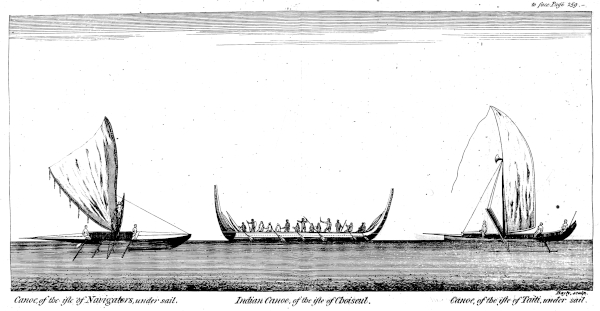
Canoe, of the isle of Navigators, under sail. Indian Canoe, of the isle of Choiseul. Canoe, of the isle of Taiti, under sail.
Customs on the subject of their dead.
It is very difficult to give an account of their religion. We have seen wooden statues among them, which we took for idols; but how did they worship them? The only religious ceremony, which we have been witnesses to, concerns the dead. They preserve their corpses a long while, extended on a kind of scaffold, covered by a shed. The infection which they spread does not prevent the women from going to weep around the corpse, 256during part of the day, and from anointing the cold relicks of their affection with cocoa-nut oil. Those women, with whom we were acquainted, would sometimes allow us to come near these places, which are consecrated to the manes of the deceased; they told us emoé, he sleeps. When nothing but the skeletons remain, they carry them into their houses, and I do not know how long they keep them there. I only know, because I have seen it, that then a man of consideration among the people comes to exercise his sacred rites there; and that in these awful ceremonies, he wears ornaments which are much in request.
Superstition of the islanders.
We have asked Aotourou many questions concerning his religion; and believe, we understood that, in general his countrymen are very superstitious; that the priests have the highest authority amongst them; that besides a superior being, named Eri-t-Era, king of the sun or of light, and whom they do not represent by any material image, they have several divinities; some beneficent, others mischievous; that the name of these divinities or genii is Eatoua; that they suppose, that at each important action of human life, there presides a good and an evil genius; and that they decide its good or bad success. What we understand with certainty is, that when the moon has a certain aspect, which they call Malama Tamai, or moon in state of war[102], (an aspect in 257which we have not been able to distinguish any characteristic mark, by which it could be defined) they sacrifice human victims. Of all their customs, one which most surprised me, is that of saluting those who sneeze by saying, Evaroua-t-eatoua, that the good eatoua may awaken thee, or that the evil eatoua may not lull thee asleep. These are marks which prove, that they have the same origin with the people of the old continent. Upon the whole, scepticism is reasonable, especially when we treat of the religion of different nations; as there is no subject in which it is more easy to be deceived by appearances.
Polygamy.
Polygamy seems established amongst them; at least it is so amongst the chief people. As love is their only passion, the great number of women is the only luxury of the opulent. Their children are taken care of, both by their fathers and their mothers. It is not the custom at Taiti, that the men occupied only with their fishery and their wars, leave to the weaker sex the toilsome works of husbandry and agriculture. Here a gentle indolence falls to the share of the women; and the endeavours to please, are their most serious occupation. I cannot say whether their marriage is a civil contract, or whether it is consecrated by religion; whether it is indissoluble, or subject to the laws of divorce. Be this as it will, the wives owe their husbands a blind submission; they 258would wash with their blood any infidelity committed without their husbands’ consent. That, it is true, is easily obtained; and jealousy is so unknown a passion here, that the husband is commonly the first who persuades his wife to yield to another. An unmarried woman suffers no constraint on that account; every thing invites her to follow the inclination of her heart, or the instinct of her sensuality; and public applause honours her defeat: nor does it appear, that how great soever the number of her previous lovers may have been, it should prove an obstacle to her meeting with a husband afterwards. Then wherefore should she resist the influence of the climate, or the seduction of examples? The very air which the people breathe, their songs, their dances, almost constantly attended with indecent postures, all conspire to call to mind the sweets of love, all engage to give themselves up to them. They dance to the sound of a kind of drum, and when they sing, they accompany their voices with a very soft kind of flute, with three or four holes, which, as I have observed above, they blow with their nose. They likewise practise a kind of wrestling; which, at the same time, is both exercise and play to them.
Character of the islanders.
Thus accustomed to live continually immersed in pleasure, the people of Taiti have acquired a witty and humorous temper, which is the offspring of ease and of 259joy. They likewise contracted from the same source a character of fickleness, which constantly amazed us. Every thing strikes them, yet nothing fixes their attention: amidst all the new objects, which we presented to them, we could never succeed in making them attend for two minutes together to any one. It seems as if the least reflection is a toilsome labour for them, and that they are still more averse to the exercises of the mind, than to those of the body.
Account of some of their works.
I shall not, however, accuse them of want of understanding. Their skill and ingenuity in the few necessary instances of industry, which notwithstanding the abundance of the country, and the temperature of the climate they cannot dispense with, would be sufficient to destroy such assertion. It is amazing with how much art their fishing tackle is contrived; their hooks are made of mother-of-pearl, as neatly wrought as if they were made by the help of our tools; their nets are exactly like ours; and knit with threads, taken from the great American Aloes. We admired the construction of their extensive houses, and the disposition of the leaves of the Thatch-palm, with which they are covered.
Construction of their boats.
They have two sorts of periaguas; some are little, and without much ornament; being made of a single stem of a tree hollowed out; the others are much larger, and wrought with much art. A hollow tree forms the bottom 260of the periagua; from the head, to two-thirds of the intended length, another tree forms the back part, which is bent, and greatly elevated; in so much, that the extremity of the stern rises five or fix feet above the water. These two pieces are joined together, as an arch of a circle; and as they have no nails to fasten them together with, they pierce the extremity of both pieces in several places, and by the means of strings, (made of the filaments which surround cocoa-nuts) they tie them together. The sides of the periagua are raised by two boards, about one foot broad, sewed to the bottom, and to each other, with the preceding sort of strings. They fill the seams with the fibrous substance round cocoa-nuts; but do not cover or pay them with any coating. A plank, which covers the head of the periagua, and projects about five or six feet beyond it, prevents its plunging entirely into the water, when there is a great sea. To make these light boats less subject to overset, they fix an out-rigger to one of its sides. This is nothing more than a pretty long piece of wood, supported by two cross pieces, of about four or five feet in length; the other end of which is fastened to the periagua. When she is sailing, a plank projects along the side, opposite to the out-rigger; a rope is fastened to it, which supports the mast, and it likewise makes the periagua stiffer, by placing a man or a weight at the end of the plank.
261Their ingenuity appears still more to advantage in the means they employ to render these vessels proper to transport them to the neighbouring isles, with which they have a communication, having no other guides than the stars on such navigations. They fasten two great periaguas together alongside of each other, (leaving about four feet distance between them) by means, of some cross pieces of wood tied very fast to the starboard of one and larboard of the other boat. Over the stern of these two vessels thus joined, they place a hut, of a very light construction, covered by a roof of reeds. This apartment shelters them from the sun and rain, and at the same time affords them a proper place for keeping their provisions dry. These double periaguas can contain a great number of persons, and are never in danger of oversetting. We have always seen the chiefs make use of them; they are navigated both by a sail and by oars, as the single periaguas: the sails are composed of mats, extended on a square frame, formed by canes, of which one of the angles is rounded.
The Taiti people have no other tool for all these works than a chissel, the blade of which is made of a very hard black stone[103]. It is exactly of the same form 262as that of our carpenters, and they use it with great expertness: they use very sharp pieces of shells to bore holes into the wood.
Their cloths.
The manufacturing of that singular cloth, of which their dress is made up, is likewise one of their greatest arts. It is prepared from the rind of a shrub, which all the inhabitants cultivate around their houses. A square piece of hard wood, fluted on its four sides by furrows of different sizes, is made use of in beating the bark on a smooth board: they sprinkle some water on it during this operation, and thus they at last form a very equal fine cloth, of the nature of paper, but much more pliable, and less apt to be torn, to which they give a great breadth. They have several sorts of it, of a greater or less thickness, but all manufactured from the same substance: I am not acquainted with their methods of dying them.
Account of the Taiti-man, whom I brought to France.
263I shall conclude this chapter in exculpating myself, for people oblige me to use this word, for having profited of the good will of Aotourou, and taken him on a voyage, which he certainly did not expect to be of such a length; and likewise, in giving an account of the information he has given me concerning his country, during the time that he has been with me.
Reasons for which I took him.
The zeal of this islander to follow us was unfeigned. The very first day of our arrival at Taiti, he manifested it to us in the most expressive manner, and the nation seemed to applaud his project. As we were forced to sail through an unknown ocean, and sure to owe all the assistance and refreshments on which our life depended, to the humanity of the people we should meet with, it was of great consequence to us to take a man on board from one of the most considerable islands in this ocean. It was to be supposed that he spoke the same language as his neighbours, that his manners were the same, and that his credit with them would be decisive in our favour, when he should inform them of our proceedings towards his countrymen, and our behaviour to him. Besides, supposing our country would profit of an union with a powerful people, living in the middle of the finest countries in the world, we could have no better pledge to cement such an alliance, than the eternal obligation which we were going to confer 264on this nation, by sending back their fellow-countryman well treated by us, and enriched by the useful knowledge which he would bring them. Would to God that the necessity and the zeal which inspired us, may not prove fatal to the bold Aotourou!
His stay at Paris.
I have spared neither money nor trouble to make his stay at Paris agreeable and useful to him. He has been there eleven months, during which he has not given any mark at all of being tired of his stay. The desire of seeing him has been very violent; idle curiosity, which has served only to give false ideas to men whose constant practice it is to traduce others, who never went beyond the capital, never examine any thing; and who being influenced by errors of all sorts, never cast an impartial eye upon any object; and yet pretend to decide with magisterial severity, and without appeal! How, said some of them to me, in this man’s country the people speak neither French, nor English, nor Spanish? What could I answer them? I was struck dumb; however, it was not on account of the surprize at hearing such a question asked. I was used to them, because I knew that at my arrival, many of those who even pass for people of abilities, maintained that I had not made the voyage round the world, because I had not been in China. Some other sharp critics conceived and propagated a very mean idea of the poor islander, because, 265after a stay of two years amongst Frenchmen, he could hardly speak a few words of the language. Do not we see every day, said they, that the Italians, English, and Germans learn the French in so short a time as one year at Paris? I could have answered them perhaps with some reason, that, besides the physical obstacle in the organs of speech of this islander, (which shall be mentioned in the sequel) which prevented his becoming conversant in our language, he was at least thirty years old; that his memory had never been exercised by any kind of study, nor had his mind ever been at work; that indeed an Italian, an Englishman, a German could in a year’s time speak a French jargon tolerably well, but that was not strange at all, as these strangers had a grammar like ours, as their moral, physical, political, and social ideas were the same with ours, and all expressed by certain words in their language as they are in French; that they had accordingly no more than a translation to fix in their memory, which had been exerted from their very infancy. The Taiti-man, on the contrary, only having a small number of ideas, relative on the one hand to a most simple and most limited society, and on the other, to wants which are reduced to the smallest number possible; he would have been obliged, first of all, as I may say, to create a world of previous ideas, in a mind which is as indolent as his body, before 266he could come so far as to adapt to them the words in our language, by which they are expressed. All this I might perhaps have answered: but this detail required some minutes of time, and I have always observed, that, loaded with questions as I was, whenever I was going to answer, the persons that had honoured me with them were already far from me. But it is common in a capital to meet with people who ask questions, not from an impulse of curiosity, or from a desire of acquiring knowledge, but as judges who are preparing to pronounce their judgment; and whether they hear the answer or no, it does not prevent them from giving their decision[104].