PART the FIRST. (continued 2)
Johann Reinhold Forster translation
This junction enabled me to continue my expedition; though the Etoile, bringing me upwards of fifteen months salt provisions and liquor, had hardly for fifty days bread and legumes to give me. The want of these indispensable provisions, obliging me to return and get some in Rio de la Plata; as we found at Rio-Janeiro, neither biscuit, nor wheat, nor flour.
Difficulties raised by the Portuguese against a Spanish ship.
There were, at this time, two vessels in this port which interested us; the one a French, and the other a Spanish one. The former, called l’Etoile du Matin, or the Morning Star, was the king’s ship bound for India; which, on account of its smallness, could not undertake to double the Cape of Good Hope during winter; and, therefore, came hither to wait the return of the fair season. The Spanish vessel was a man of war, of seventy-four guns, named the Diligent, commanded by Don Francesco de Medina. Having sailed from the river of Plata, with a cargo of skins and piastres; a leak which his ship had 74sprung, much below her water-line, had obliged him to bring her hither, in order to refit her for the voyage to Europe. He had been here eight months; and the refusal of necessary assistance, and the difficulties which the viceroy laid in his way, had prevented his finishing the repair: |Assistance which we gave her.| accordingly, Don Francisco sent the same evening that I arrived, to beg for my carpenters and caulkers; and the next morning I sent them to him from both the vessels.
The viceroy visits us on board the frigate.
The 22d we went in a body to pay a visit to the viceroy; he came and returned it on the 25th; and, when he left us, I saluted him with nineteen guns, which were returned from the shore. On this visit, he offered us all the assistance in his power; and even granted me the leave I asked, of buying a sloop, which would have been very useful, during the course of my expedition; and, he added, that if there had been one belonging to the king of Portugal, he would have offered it me. He likewise assured me, that he would make the most exact enquiries, in order to discover those, who, under the very windows of his palace, had murdered the chaplain of the Etoile, a few days before our arrival; and that he would proceed with them according to the utmost severity of the law. He promised justice; but the law of nations was very ineffectually executed at this place.
75However, the viceroy’s civilities towards us continued for several days: he even told us his intention of giving us a petit souper, or collation, by the water-side, in bowers of jasmine and orange-trees; and he ordered a box to be prepared for us at the opera. We saw, in a tolerable handsome hall, the best works of Metastasio represented by a band of mulattoes; and heard the divine composition of the great Italian masters, executed by an orchestra, which was under the direction of a hump-backed priest, in his canonicals.
The favour which we enjoyed, occasioned great matter of astonishment to the Spaniards, and even to the people of the country; who told us, that their governor’s proceedings would not be the same for a long time. Indeed, whether the assistance we gave the Spaniards, and our own connections with them displeased him, or whether he could no longer feign a conduct, so diametrically opposite to his natural temper, he soon became, in regard to us, what he had been to every body else.
Hostilities of the Portugueze against the Spaniards.
The 28th of June, we heard that the Portuguese had surprised and attacked the Spaniards at Rio-Grande; that they had driven them from a station which they occupied on the left shore of that river; and that a Spanish ship, touching at the isle of St. Catherine, had been detained there. They fitted out here, with great expedition, 76the San Sebastiano, of sixty-four guns, built here; and a frigate, mounting forty guns, called Nossa Senhora da Gracia. This last was destined, it was said, to escort a convoy of troops and ammunition to Rio-Grande, and to the colony of Santo Sacramento. These hostilities and preparations gave us reason to apprehend that the viceroy intended to stop the Diligent; which was careening upon the isle das Cobras, and we accelerated her refitment as much as possible. |1767. July.| She really was ready on the last day of June, and began to take in the skins, which were part of her lading; but on the sixth of July, when she wanted to take back her cannon, which, during the repair, had been deposited on the isle das Cobras, the viceroy forbade their being delivered; and declared, that he arrested the ship, till he had received the orders of his court, on the subject of the hostilities committed at Rio-Grande. In vain did Don Medina take all the necessary steps on this occasion; count d’Acunha would not so much as receive the letter, which the Spanish commander sent him by an officer, from on board his ship.
Bad proceedings of the viceroy towards us.
We partook of the disgrace of our allies. Having, upon the repeated leave of the viceroy, concluded the bargain for buying a snow, his excellency forbade the seller to deliver it to me. He likewise gave orders, that we should not be allowed the necessary timber out of 77the royal dock-yards, for which we had already agreed: he then refused me the permission of lodging with my officers, (during the time that the frigate underwent some essential repairs) in a house near the town, offered me by its proprietor: and which commodore Byron had occupied in 1765, when he touched at this port. On this account, and likewise upon his refusing me the snow and the timber, I wanted to make some remonstrances to him. He did not give me time to do it; and, at the first words I uttered, he rose in a furious passion, and ordered me to go out; and being certainly piqued, that, in spite of his anger, I remained sitting with two officers, who accompanied me, he called his guards; but they, wiser than himself, did not come, and we retired; so that nobody seemed to have been disturbed. We were hardly gone, when the guards of his palace were doubled, and orders given to arrest all the French that should be found in the streets after sun-setting. He likewise sent word to the captain of the French ship of four guns, to go and anchor under the fort of Villagahon; and the next morning I got her towed there by my boats.
They determine us to leave Rio-Janeiro.
From hence forward, I was intent upon my departure; especially as the inhabitants, with whom we had any intercourse of trade, must fear every thing from the viceroy. Two Portuguese officers became the victims of 78the civility they shewed us; the one was imprisoned in the citadel; the other exiled to Santa, a small town between St. Catherine and Rio-Grande. I made haste to take in our water, to get the most necessary provisions out of the Etoile, and to embark refreshments. I had been forced to enlarge our tops; and the Spanish captain furnished me with the necessary timber for that purpose, which had been refused us out of the docks. I likewise got some planks, which we could not do without; and which were sold to us secretly.
At last, on the 12th, every thing being ready, I sent an officer to let the viceroy know, I should weigh with the first fair wind. I advised M. d’Etcheveri, who commanded l’Etoile du Matin, (the Morning-Star) to stop at Rio-Janeiro as little as he could; and rather to employ the time that remained, till the favourable season for doubling the Cape of Good Hope came on, in going to survey the isles of Tristan d’Acunha, where he would find wood, water, and abundance of fish; and I gave him some memoirs I had concerning these isles. I have since heard, that he has followed my advice.
During our stay at Rio-Janeiro, we enjoyed one of the springs, which are obvious in poetical descriptions; and the inhabitants testified, in the most genteel manner, the displeasure which their viceroy’s bad proceedings against us, gave them. We were sorry, that it was not 79in our power to stay any longer with them. The Brasils, and the capital in it, have been described by so many authors, that I could mention nothing, without tediously repeating what has been said before. Rio-Janeiro has once been conquered by France; and is, of course, well known there. I will confine myself to give an account of the riches, of which that city is the staple[49]; and of the revenues which the king of Portugal gets from thence. I must previously mention, that M. de Commerçon, an able naturalist, who came with us on board the Etoile, in order to go on the expedition, assured me, that this was the richest country in plants he had ever met with; and that it had supplied him with whole treasures in botany.
Account of the riches of Rio-Janeiro.
Rio-Janeiro is the emporium and principal staple of the rich produce of the Brasils. The mines, which are called general, are the nearest to the city; being about seventy-five leagues distant. They annually bring in to the king, for his fifth part, at least one hundred and twelve arobas of gold; in 1762 they brought in a hundred and nineteen. Under the government of the general mines, are comprehended those of Rio das Mortes, of Sabara, and of Sero-frio. The last place, besides gold, produces all the diamonds that come from the Brasils. They are in the bed of a river; which is led aside, in 80order afterwards to separate the diamonds, topazes, chrysolites, and other stones of inferior goodness, from the pebbles, among which they ly.
Regulations for examining the mines.
All these stones, diamonds excepted, are not contraband: they belong to the possessors of the mines; but they are obliged to give a very exact account of the diamonds they find; and to put them into the hands of a surveyor[50], whom the king appoints for this purpose. |Mines of diamonds.| The surveyor immediately deposits them in a little casket, covered with plates of iron, and locked up by three locks. He has one of the keys, the viceroy the other, and the Provador de Hazienda Reale the third. This casket is inclosed in another, on which are the seals of the three persons above mentioned, and which contains the three keys to the first. The viceroy is not allowed to visit its contents; he only places the whole in a third coffer, which he sends to Lisbon, after putting his seal on it. It is opened in the king’s presence; he chooses the diamonds which he likes out of it; and pays their price to the possessors of the mines, according to a tariff settled in their charter.
The possessors of the mines pay the value of a Spanish piastre or dollar per day to his Most Faithful Majesty, for every slave sent out to seek diamonds; the number of these slaves amounts to eight hundred. Of 81all the contraband trades, that of diamonds is most severely punished. If the smuggler is poor, he loses his life; if his riches are sufficient to satisfy what the law exacts, besides the confiscation of the diamonds, he is condemned to pay double their value, to be imprisoned for one year, and then exiled for life to the coast of Africa. Notwithstanding this severity, the smuggling trade with diamonds, even of the most beautiful kind, is very extensive; so great is the hope and facility of hiding them, on account of the little room they take up.
Gold-mines.
All the gold which is got out of the mines cannot be sent to Rio Janeiro, without being previously brought into the houses, established in each district, where the part belonging to the crown is taken. What belongs to private persons is returned to them in wedges, with their weight, their number, and the king’s arms stamped upon them. All this gold is assayed by a person appointed for that purpose, and on each wedge or ingot, the alloy of the gold is marked, that it may afterwards be easy to bring them all to the same alloy for the coinage.
These ingots belonging to private persons are registered in the office of Praybuna, thirty leagues from Rio Janeiro. At this place is a captain, a lieutenant, and fifty men: there the tax of one fifth part is paid, 82and further, a poll-tax of a real and a half per head, of men, cattle, and beasts of burden. One half of the produce of this tax goes to the king, and the other is divided among the detachment, according to the rank. As it is impossible to come back from the mines without passing by this station, the soldiers always stop the passengers, and search them with the utmost rigour.
The private people are then obliged to bring all the ingots of gold which fall to their share, to the mint at Rio Janeiro, where they get the value of it in cash: this commonly consists of demi-doubloons, worth eight Spanish dollars. Upon each demi-doubloon, the king gets a piastre or dollar for the alloy, and for the coinage. The mint at Rio Janeiro is one of the finest buildings existing. It is furnished with all the conveniences necessary towards working with the greatest expedition. As the gold comes from the mines at the same time that the fleets come from Portugal, the coinage must be accelerated, and indeed they coin there with amazing quickness.
The arrival of these fleets, and especially of that from Lisbon, renders the commerce of Rio Janeiro very flourishing. The fleet from Porto is laden only with wines, brandy, vinegar, victuals, and some coarse cloths, manufactured in and about that town. As soon as the 83fleets arrive, all the goods they bring are conveyed to the custom-house, where they pay a duty of ten per cent to the king. It must be observed that the communication between the colony of Santo Sacramento and Buenos Ayres being entirely cut off at present, that duty must be considerably lessened; for the greater part of the most precious merchandizes which arrived from Europe were sent from Rio Janeiro to that colony, from whence they were smuggled through Buenos Ayres to Peru and Chili; and this contraband trade was worth a million and a half of piastres or dollars annually to the Portuguese. In short, the mines of the Brasils produce no silver, and all that which the Portuguese got, came from this smuggling trade. The negro trade was another immense object. The loss which the almost entire suppression of this branch of contraband trade occasions, cannot be calculated. This branch alone employed at least thirty coasting vessels between the Brasils and Rio de la Plata.
Revenues of the king of Portugal from Rio Janeiro.
Besides the old duty of ten per cent which is paid at the royal custom-house, there is another duty of two and a half per cent, laid on the goods as a free gift, on account of the unfortunate event which happened at Lisbon in 1755. This duty must be paid down at the custom-house immediately, whereas for the 84tenth, you may have a respite of six months, on giving good security.
The mines of S. Paolo and Parnagua pay the king four arrobas as his fifth, in common years. The most distant mines, which are those of Pracaton and Quiaba, depend upon the government[51] of Maragrosso. The fifth of these mines is not received at Rio Janeiro, but that of the mines of Goyas is. This government has likewise mines of diamonds, but it is forbidden to search in them.
All the expences of the king of Portugal at Rio Janeiro, for the payment of the troops and civil officers, the carrying on of the mines, keeping the public buildings in repair, and refitting of ships, amount to about six hundred thousand piastres. I do not speak of the expence he may be at in constructing ships of the line and frigates, which he has lately begun to do here.
85A summary account, and the amount of the separate articles of the king’s revenue, taken at a medium in Spanish dollars.
Dollars.
One hundred and fifty arrobas of gold, of which in common years all the fifths amount to 1,125,000
The duty on diamonds 240,000
The duty on the coinage 400,000
Ten per cent. of the custom-house 350,000
Two and a half per cent. free gift 87,000
Poll tax, sale of employs, offices, and other products of the mines 225,000
The duty on negroes 110,000
The duty on train-oil, salt, soap, and the tenth on the victuals of the country 130,000
Total in dollars or piasters 2,667,000
From whence, if you deduct the expences above mention ed, it will appear that the king of Portugal’s revenues from Rio Janeiro, amount to upwards of ten millions of our money (livres[52]).
86
CHAP. VI.
Departure from Rio Janeiro: second voyage to Montevideo:
damage which the Etoile receives there.
The 14th of July we weighed from Rio Janeiro, but for want of wind we were obliged to come to an anchor again in the road. |1767. July.| We sailed on the 15th, and two days after, the frigate being a much better sailer than the Etoile, I was obliged to unrig my top-gallant masts, as our lower masts required a careful management. |Departure from Rio Janeiro.| The winds were variable, but brisk, and the sea very high. In the night between the 19th and 20th, we lost our main-top-sail, which was carried away on its clue-lines. |Eclipse of the sun.| The 25th there was an eclipse of the sun, visible to us. I had on board my ship M. Verron, a young astronomer, who came from France in the Etoile, with a view to try, during the voyage, some methods towards finding the longitude at sea.
According to our estimation of the ship’s place, the moment of immersion, as calculated by the astronomer, was to be on the 25th, at four hours nineteen minutes in the evening. At four hours and six minutes, a cloud prevented our seeing the sun, and when we got sight 87of him again, at four hours thirty-one minutes, about an inch and a half was already eclipsed. Clouds successively passed over the sun’s disk, and let us see him only at very short intervals, so that we were not able to observe any of the phases of the eclipse, and consequently could not conclude our longitude from it. The sun set to us before the moment of apparent conjunction, and we reckoned that that of immersion had been at four hours twenty-three minutes.
Entrance into Rio de la Plata.
On the 26th we came into soundings; the 28th in the morning we discovered the Castilles. This part of the coast is pretty high, and is to be seen at ten or twelve leagues distance. We discovered the entrance to a bay, which probably is the harbour where the Spaniards have a fort, and where I have been told there is very bad anchorage. The 29th we entered Rio de la Plata, and saw the Maldonados. We advanced but little this day and the following. Almost the whole night between the 30th and 31st we were becalmed, and sounded constantly. The current set to the north-westward, which was pretty near the situation of the isle of Lobos. At half an hour past one after midnight, having sounded, thirty-three fathoms, I thought I was very near the isle, and gave the signal for casting anchor. At half past three we weighed, and saw the isle of Lobos in N. E. about a league and a half distant. The 88wind was S. and S. E. weak at first, but blew more fresh towards sun-rising, and we anchored in the bay of Montevideo the 31st in the afternoon. We had lost much time on account of the Etoile; because, besides the advantage of our being better sailers, that store-ship, which at leaving Rio Janeiro made four inches of water every hour, after a few days sail made seven inches in the same space of time, which did not allow her to crowd her sails.
Second time of touching at Montevideo.
News which we hear at this place.
We were hardly moored, when an officer came on board, being sent by the governor of Montevideo, to compliment us on our arrival, and informed us that orders had been received from Spain to arrest all the Jesuits, and to seize their effects: that the ship which brought these dispatches had carried away forty fathers of that community, destined for the missions: that the order had already been executed in the principal houses without any difficulty or resistance; and that, on the contrary, these fathers bore their disgrace with resignation and moderation. I shall soon enter into a more circumstantial account of this great transaction, of which I have been able to obtain full information, by my long stay at Buenos Ayres, and the confidence with which the governor-general Don Francisco Bukarely[53] honoured me.
1767. August.
89As we were to stay in Rio de la Plata till after the equinox, we took lodgings at Montevideo, where we settled our workmen, and made an hospital. This having been our first care, I went to Buenos Ayres, on the 11th of August, to accelerate our being furnished with the necessary provisions, by the provider-general of the king of Spain; at the same price as he had agreed to deliver them to his Catholic Majesty. I likewise wanted to have a conference with M. de Buccarelli, on the subject of what had happened at Rio-Janeiro; though I had already, by express, sent him the dispatches from Don Francisco de Madina. I found he had prudently resolved to content himself with sending an account of the hostilities of the viceroy of the Brasils to Europe, and not to make any reprisals. It would have been easy to him, to have taken the colony of Santo Sacramento in a few days; especially as that place was in want of every necessary, and had not yet obtained, in November, the convoy of articles and ammunition that were preparing to be sent thither, when we left Rio-Janeiro.
The governor-general made every thing as convenient as possible, towards quickly making up our wants. At the end of August, two schooners, laden with biscuit and flour for us, sailed for Montevideo; whither I likewise went to celebrate the day of St. Louis. I left the chevalier 90du Bouchage, an under-lieutenant, at Buenos Ayres, in order to get the remainder of our provisions on board; and to take care of our affairs there till our departure; which, I hoped, would be towards the end of September. I could not foresee that an accident would detain us six weeks longer. |Damage which the Etoile receives.| In a hurricane, blowing hard at S. W. the San Fernando, a register-ship, which was at anchor near the Etoile, dragged her anchors, ran foul of the Etoile at night; and, at the first shock, broke her bowsprit level with the deck. Afterwards the knee and rails of her head were carried away; and it was lucky that they separated, notwithstanding the bad weather, and the obscurity of the night, without being more damaged.
1767. September.
This accident greatly enlarged the leaks in the Etoile, which she had had from the beginning of her voyage. It now became absolutely necessary to unload this vessel, if not to heave her down[54], in order to discover and stop this leak, which seemed to lie very low, and very forward. This operation could not be performed at Montevideo; where, besides, there was not timber sufficient to repair the masts; I therefore wrote to the chevalier du Bouchage, to represent our situation to the marquis de Buccarelli; and to obtain, that by his leave the Etoile might be allowed to come up the river, and to go into 91the Encenada de Baragan; I likewise gave him orders to send timber and the other materials, which we should want thither. The governor-general consented to our demands; and, the 7th of September, not being able to find any pilot, | Navigation from MontevideoMontevideo to Baragan.| I went on board the Etoile, with the carpenters and caulkers of the Boudeuse, in order to sail the next morning, and undertake in person a navigation, which we were told was very hazardous. Two register-ships; the San-Fernando and the Carmen, provided with a pilot, were ready the same day, to sail for Montevideo to Encenada; and I intended to follow them; but the San-Fernando, which had got the pilot, named Philip, on board, weighed in the night, between the seventh and eighth, purely with a view of hiding his track from us; and left her companion in the same distress. However, we sailed on the eighth in the morning, preceded by our canoes; the Carman remaining to wait for a schooner to direct her route. In the evening we reached the San-Fernando, passed by her; and, on the tenth in the afternoon, we came to an anchor in the road of the Encenada: Philip, who was a bad pilot, and a wicked fellow, always steering in our water.
In this road I found the Venus frigate of twenty-six guns, and some merchant-ships; which were bound, together with her, to sail directly for Europe. I likewise found there la Esmeralda, and la Liebre; who were 92preparing to return to the Malouines, with provisions and ammunitions of all sorts; from whence they were to sail for the South Seas, in order to take in the Jesuits of Chili and Peru. There was likewise the xebeck[55] el Andaluz; which arrived from Ferrol, at the end of July, in company with another xebeck, named el Aventurero; but the latter was lost on the point of what is called the English-Sand; and the crew had time to save their lives. The Andaluz was preparing to carry presents and missionaries to the inhabitants of Tierra del Fuego; the king of Spain being desirous of testifying his gratitude to those people, for the services they rendered the Spaniards of the ship la Concepcion, which was lost on their coasts in 1765.
The Etoile goes to be repairedrepaired there.
I went on shore at Baragan, whither the chevalier du Bouchage had already sent part of the timber we wanted. He found it very difficult and expensive to collect it at Buenos Ayres, in the king’s arsenal, and in some private timber-yards; the stores of both consisting of the timbers of such ships as were wrecked in the river. At Baragan we found no supplies; but, on the contrary, difficulties of many kinds; and every thing conspired to make all operations go on very slowly. The Encenada de Baragan is, indeed, merely a bad kind of bay, formed by the mouth of a little river, 93which is about a quarter of a league broad; but the depth of water is only in the middle, in a narrow channel; which is constantly filling more and more; and, in which, only ships drawing no more than twelve feet water can enter. In all the other parts of the river, there is not six inches of water during the ebb; but as the tides are irregular in Rio de la Plata; and the water sometimes high or low, for eight days together, according to the winds that blow, the landing of boats was connected with great difficulties. There are no magazines on shore; the houses, or rather huts, are but few, made of rushes, covered over with leather, and built without any regularity, on a barren soil; and their inhabitants are hardly able to get their subsistance; all which causes still more difficulties. The ships, which draw too much water to be able to enter this creek, must anchor at the point of Lara, a league and a half west. There they are exposed to all the winds; but the ground being very good for anchoring, they may winter there, though labouring under many inconveniences.
1767. October.
I left M. de la Giraudais, at the point of Lara, to take care of what related to his ship; and I went to Buenos Ayres, from whence I sent him a large schooner, by which he might heave down as soon as he came into the Encenada. For that purpose, it was necessary to unload part of the goods she had on board; and M. de Buccarelli 94gave us leave to deposit them on board the Esmeralda and the Liebre. The 8th of October the Etoile was able to go into port; and it appeared, that her repair would not take so much time as was at first expected. Indeed, they had hardly begun to unload her, when her leak diminished considerably; and she did not leak at all when she drew only eight feet of water forward. After taking up some planks of her sheathing, they saw that the seam of her entrance was entirely without oakum for the length of four feet and a half, from the depth of eight feet of her draught upwards. They discovered likewise two auger holes, into which they had not put the bolts. All these faults and damages being quickly repaired, new railing put on the head, a new bowsprit made and rigged, and the ship being new caulked all over, she returned to the point of Lara on the 21st, where she took in her lading again, from on board the Spanish frigates. In that road she likewise stowed the wood, flour, biscuit, and different provisions I sent her.
Departure of several vessels for Europe, and arrival of others.
From thence, the Venus and four other vessels laden with leather, sailed for Cadiz, at the end of September, having on board two hundred and fifty Jesuits, and the French families from the Malouines, seven excepted, who having no room in these ships, were obliged to wait for another opportunity. The marquiss of Buccarelli 95transported them to Buenos Ayres, where he provided them with subsistence and lodgings. At the same time we got intelligence of the arrival of the Diamante, a register ship, bound for Buenos Ayres, and of the San-miguel, another register ship, bound for Lima. The situation of the last ship was very distressing: after struggling with the winds at Cape Horn during forty-five days, thirty-nine men of her crew being dead, and the others attacked by the scurvy, and a sea carrying away her rudder, she was obliged to bear away for this river, and arrived at the port of Maldonados seven months after leaving Cadiz, having no more than three sailors and a few officers that were able to do duty. At the request of the Spaniards we sent an officer with some sailors to bring her into the port of Montevideo. On the fifth of October the Spanish frigate la Aguila arrived there, having left Ferrol in March. She touched at the isle of St. Catherine, and the Portuguese had arrested her there at the same time that they stopped the Diligent at Rio Janeiro.
96
CHAP. VII.
Accounts of the missions in Paraguay, and the expulsion of the
Jesuits from that province.
Whilst we carried on our preparations for leaving Rio de la Plata, the marquiss of Buccarelli made some on his part to go on the Uraguai. The Jesuits had already been arrested in all the other provinces of his department; and this governor-general intended to execute the orders of his catholic majesty, in person, in the missions. It depended upon the first steps that were taken, either to make the people consent to the alterations that were going to be made, or to plunge them again into their former state of barbarism. But before I give an account of what I have seen of the catastrophe of this singular government, I must speak something of its origin, progress, and form. I shall speak of it sine irâ & studio, quorum causas procul habeo.
Date of the establishment of the missions.
In 1580 the Jesuits were first admitted into these fertile regions, where they have afterwards, in the reign of Philip the third, founded the famous missions, which in Europe go by the name of Paraguay, and in America, with more propriety, by that of Uraguay, 97from the river of that name, on which they are situated. They were always divided into colonies, which at first were weak and few, but by gradual progress have been encreased to the number of thirty-seven, viz. twenty-nine on the right side of the Uraguay, and eight on the left side, each of them governed by two Jesuits, in the habit of the order. Two motives, which sovereigns are allowed to combine, if they do not hurt each other, namely, religion and interest, made the Spanish monarch desirous of the conversion of the Indians; by making them catholics, they became civilized, and he obtained possession of a vast and abundant country; this was opening a new source of riches for the metropolis, and at the same time making proselytes to the true Deity. The Jesuits undertook to fulfil these projects; but they represented, that in order to facilitate the success of so difficult an enterprize, it was necessary they should be independent of the governors of the province, and that even no Spaniard should be allowed to come into the country.
Conditions agreed on between the court of Spain and the Jesuits.
The motive on which this demand was grounded, was, the fear lest the vices of the Europeans should diminish the ardour of their proselytes, or even remove them farther from Christianity; and likewise lest the Spanish haughtiness should render a yoke, already too heavy, insupportable to them. The court of Spain, approving 98of these reasons, ordered that the missionaries should not be controuled by the governor’s authority, and that they should get sixty thousand piastres a year from the royal treasure, for the expences of cultivation, on condition that as the colonies should be formed, and the lands be cultivated, the Indians should annually pay a piastre per head to the king, from the age of eighteen to sixty. It was likewise stipulated, that the missionaries should teach the Indians the Spanish language; but this clause it seems has not been executed.
Zeal and success of the missionaries.
The Jesuits entered upon this careercareer with the courage of martyrs, and the patience of angels. Both these qualifications were requisite to attract, retain, and use to obedience and labour, a race of savage, inconstant men, who were attached to their indolence and independence. The obstacles were infinite, the difficulties encreased at each step; but zeal got the better of every thing, and the kindness of the missionaries at last brought these wild, diffident inhabitants of the woods, to their feet. They collected them into fixed habitations, gave them laws, introduced useful and polite arts among them; and, in short, of a barbarous nation, without civilized manners, and without religious principles, they made a good-natured well governed people, who strictly observed the Christian ceremonies. These Indians, charmed with the persuasive eloquence of their apostles, willingly 99obeyed a set of men, who, they saw would sacrifice themselves for their happiness; accordingly, when they wanted to form an idea of the king of Spain, they represented him to themselves in the habit of the order of St. Ignatius.
Revolt of the Indians against the Spaniards.
However, there was a momentary revolt against his authority in the year 1757. The catholic king had exchanged the colonies on the left shore of the Uraguay against the colony of Santo Sacramento with the Portuguese. The desire of destroying the smuggling trade, which we have mentioned several times, had engaged the court of Madrid to this exchange. Thus the Uraguay became the boundary of the respective possessions of the two crowns. The Indians of the colonies, which had been ceded, were transported to the right hand shore, and they made them amends in money for their lost labour and transposition. |Causes of their discontent.| But these men, accustomed to their habitations, could not bear the thought of being obliged to leave the grounds, which were highly cultivated, in order to clear new ones. They took up arms: for long ago they had been allowed the use of them, to defend themselves from the incursions of the Paulists, a band of robbers, descended from Brasilians, and who had formed themselves into a republic towards the end of the sixteenth century. They revolted without any Jesuits ever heading them. It is however 100said, they were really kept in the revolted villages, to exercise their sacerdotal functions.
They take up arms and are defeated.
The governor-general of the province de la Plata, Don Joseph Andonaighi, marched against the rebels, and was followed by Don Joachim de Viana, governor of Montevideo. He defeated them in a battle, wherein upwards of two thousand Indians were slain. He then proceeded to conquer the country; and Don Joachim seeing what terror their first defeat had spread amongst them, resolved to subdue them entirely with six hundred men. He attacked the first colony, took possession of it without meeting any resistance; and that being taken, all the others submitted.
The disturbances are appeased.
At this time the court of Spain recalled Don Joseph Andonaighi, and Don Pedro Cevallos arrived at Buenos Ayres to replace him. Viana received orders at the same time to leave the missions, and bring back his troops. The intended exchange was now no longer thought of, and the Portuguese, who had marched against the Indians with the Spaniards, returned with them likewise. At the time of this expedition, the noise was spread in Europe of the election of king Nicholas, an Indian, whom indeed the rebels set up as a phantom of royalty.
Don Joachim de Viana told me, that when he received orders to leave the missions, a great number of 101Indians, discontented with the life they led, were willing to follow him. |The Indians appear disgusted with the administration of the Jesuits.| He opposed it, but could not hinder seven families from accompanying him; he settled them at the Maldonados, where, at present, they are patterns of industry and labour. I was surprised at what he told me concerning this discontent of the Indians. How is it possible to make it agree with all I had read of the manner in which they are governed? I should have quoted the laws of the missions as a pattern of an administration instituted with a view to distribute happiness and wisdom among men.
Indeed, if one casts a general view at a distance upon this magic government, founded by spiritual arms only, and united only by the charms of persuasion, what institution can be more honourable to human nature? It is a society which inhabits a fertile land, in a happy climate, of which, all the members are laborious, and none works for himself; the produce of the common cultivation is faithfully conveyed into public storehouses, from whence every one receives what he wants for his nourishment, dress, and house-keeping; the man who is in full vigour, feeds, by his labour, the new-born infant; and when time has consumed his strength, his fellow-citizens render him the same services which he did them before. The private houses are convenient, the public buildings fine; the worship 102uniform and scrupulously attended: this happy people knows neither the distinction of rank, nor of nobility, and is equally sheltered against super-abundance and wants.
The great distance and the illusion of perspective made the missions bear this aspect in my eyes, and must have appeared the same to every one else. But the theory is widely different from the execution of this plan of government. Of this I was convinced by the following accounts, which above a hundred ocular witnesses have unanimously given me.
Accounts of the interior government.
The extent of country in which the missions are situated, contains about two hundred leagues north and south, and about one hundred and fifty east and west, and the number of inhabitants is about three hundred thousand; the immense forests afford wood of all sorts; the vast pastures there, contain at least two millions of cattle; fine rivers enliven the interior parts of this country, and promote circulation and commerce throughout it. This is the situation of the country, but the question now is, how did the people live there? The country was, as has been told, divided into parishes, and each parish was directed by two Jesuits, of which, one was rector, and the other his curate. The whole expence for the maintenance of the colonies was but small, the Indians being fed, dressed, and lodged, by 103the labour of their own hands; the greatest costs were those of keeping the churches in repair, all which were built and adorned magnificently. The other products of the ground, and all the cattle, belonged to the Jesuits, who, on their part, sent for the instruments of various trades, for glass, knives, needles, images, chaplets of beads, gun-powder and muskets. Their annual revenues consisted in cotton, tallow, leather, honey, and above all, in maté, a plant better known by the name of Paraguay tea, or South-Sea tea, of which that company had the exclusive commerce, and of which likewise the consumption is immense in the Spanish possessions in America, where it is used instead of tea.
The Indians shewed so servile a submission to their rectors, that not only both men and women suffered the punishment of flagellation, after the manner of the college, for public offences, but they likewise came of themselves to sollicit this chastisement for mental faults. In every parish the fathers annually elected corrégidors, and their assistants, to take care of the minutiæ of the government. The ceremony of their election was performed on new year’s day, with great pomp, in the court before the church, and was announced by ringing of bells, and the playing of a band of music. The newly elected persons came to the feet of the father rector to receive the marks of their dignity, which 104however did not exempt them from being whipped like the others. Their greatest distinction was that of wearing habits, whereas, a shirt of cotton stuff was the only dress of the other Indians of both sexes. The feasts of the parish, and that of the rector, were likewise celebrated by public rejoicings, and even by comedies, which probably resembled those ancient pieces of ours, called mystéres or mysteries.
The rector lived in a great house near the church; adjoining to it were two buildings, in one of which were the schools for music, painting, sculpture, and architecture; and likewise, work-houses of different trades; Italy furnished them with masters to teach the arts, and the Indians, it is said, learn with facility: the other building contained a great number of young girls at work in several occupations, under the inspection of old women: this was named the guatiguasu, or the seminary. The apartment of the rector communicated internally with these two buildings.
This rector got up at five o’clock in the morning, employed an hour in holy meditation, and said his mass at half past six o’clock; they kissed his hands at seven o’clock, and then he publicly distributed an ounce of maté to every family. After mass, the rector breakfasted, said his breviary, conferred with the corregidors, four of whom were his ministers, and visited the seminary, 105the schools, and the work-shops. Whenever he went out, it was on horseback, and attended by a great retinue; he dined alone with his curate at eleven of the clock, then chatted till noon, and after that, made a siesta till two in the afternoon; he kept close in his interior appartments till it was prayer time, after which, he continued in conversation till seven in the evening; then the rector supped, and at eight he was supposed to be gone to bed.
From eight of the clock in the morning, the time of the people was taken up either in cultivating the ground, or in their work-shops, and the corregidors took care to see them employ their time well; the women spun cotton; they got a quantity of it every Monday, which they were obliged to bring back converted into spun yarn at the end of the week; at half an hour past five in the evening they came together to say the prayers of their rosary, and to kiss the hands of their rector once more, then came on the distribution of an ounce of maté and four pounds of beef for each family, which was supposed to consist of eight persons; at the same time they likewise got some maize. On Sundays they did no work; the divine worship took up more time; they were after that allowed to amuse themselves with plays as dull as the rest of their whole life.
Consequences drawn from it.
106From this exact detail it appears that the Indians had in some manner no property, and that they were subject to a miserable, tedious uniformity of labour and repose. This tiresomeness, which may with great reason be called deadly or extreme, is sufficient to explain what has been told to us, that they quitted life without regret, and died without having ever lived or enjoyed life. When once they fell sick, it seldom happened that they recovered, and being then asked whether they were sorry to be obliged to die, they answered, no; and spoke it as people whose real sentiments coincide with their words. We can no longer be surprised, that when the Spaniards penetrated into the missions, this great people, which was governed like a convent, should shew an ardent desire of forcing the walls which confined them. The Jesuits represented the Indians, upon the whole, as men incapable of attaining a higher degree of knowledge than that of children; but the life they led, prevented these grown children from having the liveliness of little ones.
Expulsion of the Jesuits from the province of Plata.
The society were occupied with the care of extending their missions, when the unfortunate events happened in Europe, which overturned the work of so many years, and of so unwearied patience in the new world. The court of Spain having resolved upon the expulsion of the Jesuits, was desirous that this might be 107done at the same time throughout all its vast dominions. Cevallos was recalled from Buenos Ayres, and Don Francisco Buccarelli appointed to succeed him. |Measures taken at the court of Spain for this purpose.| He set out, being instructed in the business which he was intended for, and with orders to defer the execution of it till he received fresh orders, which would soon be sent him. The king’s confessor, the count d’Aranda, and some ministers, were the only persons to whom this secret affair was entrusted. Buccarelli made his entry at Buenos Ayres in the beginning of 1767.
Measures taken by the governor-general of the province.
When Don Pedro de Cevallos was arrived in Spain, a packet was dispatched to the marquis of Buccarelli, with orders both for that province, and for Chili, whither he was to send them over land. This vessel arrived in Rio de la Plata in June, 1767, and the governor instantly dispatched two officers, one to Peru, and the other to Chili, with the dispatches from court, directed to them. He then sent his orders into the various parts of his province, where there were any Jesuits, viz. to Cordoua, Mendoza, Corrientes, Santa-Fé, Salta, Montevideo, and Paraguay. As he feared, that among the commanders of these several places, some might not act with the dispatch, secrecy, and exactness which the court required, he enjoined, by sending his orders to them, that they should not open them till on a certain day, which he had fixed for the execution, and to do it only 108in the presence of some persons, whom he named, and who served in the highest ecclesiastical and civil offices, at the above-mentioned places. Cordoua, above all, interested his attention. In that province was the principal house of the Jesuits, and the general residence of their provincial. There they prepared and instructed in the Indian language and customs, those who were destined to go to the missions, and to become heads of colonies; there their most important papers were expected to be found. M. de Buccarelli resolved to send an officer of trust there, whom he appointed the king’s lieutenant of that place, and on whom, under this pretext, he sent a detachment of soldiers to attend.
It now remained to provide for the execution of the king’s orders in the missions, and this was the most critical point. It was dubious whether the Indians would suffer the Jesuits to be arrested in the midst of the colonies, and this violent step must at all events have been supported by a numerous body of troops. Besides this, it was necessary, before they thought of removing the Jesuits, to have another form of government ready to substitute in their stead, and by that means to prevent confusion and anarchy. The governor resolved to temporize, and was contented at that time to write to the missions, that a corregidor and a cacique from each colony should be sent to him immediately, 109in order to communicate the king’s letters to them. He dispatched this order with the greatest quickness, that the Indians might already be on the road, and beyond the missions, before the news of the expulsion of the Jesuits could reach thither. By this he had two aims in view; the one, that of getting hostages of the fidelity of the colonies, when the Jesuits would be taken from thence; the other, that of gaining the affection of the principal Indians, by the good treatment he intended for them at Buenos Ayres, and of instructing them in the new situation upon which they would enter; for, as soon as the restraint would be taken away, they were to enjoy the same privileges, and have the same property as the king’s other subjects.
The secret is near being divulged by an unforeseen accident.
Every measure was concerted with the greatest secrecy, and though people wondered that a vessel should arrive from Spain without any other letters than those for the general, yet they were very far from suspecting the cause of it. The moment of the general execution was fixed to the day when all the couriers were supposed to have arrived at their different destinations, and the governor waited for that moment with impatience, when the arrival of the two xebecs[56] of the king from Cadiz, the Andaluz and the Adventurero, was near making all these precautions useless. The governor-general 110had ordered the governor of Montevideo, that in case any vessels should arrive from Europe, he should not allow them to speak with any person whatsoever, before he had sent him word of it; but one of the two xebecs being in the forlorn situation we have before mentioned, at the entrance of the river, it was very necessary to save the crew of it, and give her all the assistance which her situation required.
Conduct of the governor-general.
The two xebecs had sailed from Spain, after the Jesuits had been arrested there, and this piece of news could by no means be prevented from spreading. An officer of these ships was immediately sent to M. de Buccarelli, and arrived at Buenos Ayres the 9th of July, at ten in the evening. The governor did not lose time, he instantly dispatched orders to all the commanders of the places, to open their former packets of dispatches, and execute their contents with the utmost celerity. At two of the clock after midnight, all the couriers were gone, and the two houses of the Jesuits at Buenos Ayres invested, to the great astonishment of those fathers, who thought they were dreaming, when roused from their sleep in order to be imprisoned, and to have their papers seized. The next morning an order was published in the town, which forbade, by pain of death, to keep up any intercourse with the Jesuits, and five merchants were arrested, who intended, it is said, to send advices to them at Cordoua.
The Jesuits are arrested in all the Spanish towns.
111The king’s orders were executed with the same facility in all the towns. The Jesuits were surprised every where, without having the least notice, and their papers were seized. They were immediately sent from their houses, guarded by detachments of soldiers, who were ordered to fire upon those that should endeavour to escape. But there was no occasion to come to this extremity. They shewed the greatest resignation, humbling themselves under the hand that smote them, and acknowledging, as they said, that their sins had deserved the punishment which God inflicted on them. The Jesuits of Cordoua, in number above a hundred, arrived towards the end of August, at the Encenada, whither those from Corrientes, Buenos Ayres, and Montevideo, came soon after. They were immediately embarked, and the first convoy sailed, as I have already said, at the end of September. The others, during that time, were on the road to Buenos Ayres, where they should wait for another opportunity.
Arrival of the caciques and corregidors at Buenos Ayres from the missions.
On the 13th of September arrived all the corregidors, and a cacique of each colony, with some Indians of their retinue. They had left the missions before any one guessed at the reason of their journey there. The news which they received of it on the road had made some impression on them, but did not prevent their continuing the journey. The only instruction which the 112rectors gave their dear proselytes at parting, was, to believe nothing of what the governor-general should tell them: “Prepare, my children,” did every one tell them, “to hear many untruths.” At their arrival, they were immediately sent to the governor, where I was present at their reception. They entered on horseback to the number of a hundred and twenty, and formed a crescent in two lines; a Spaniard understanding the language of the Guaranis, served them as an interpreter. |They appear before the governor-general.| The governor appeared in a balcony; he told them, that they were welcome; that they should go to rest themselves, and that he would send them notice of the day which he should fix in order to let them know the king’s intentions. He added, in general, that he was come to release them from slavery, and put them in possession of their property, which they had not hitherto enjoyed. They answered by a general cry, lifting up their right hands to heaven, and wishing all prosperity to the king and governor. They did not seem discontented, but it was easy to discover more surprize than joy in their countenance. On leaving the governor’s palace, they were brought to one of the houses of the Jesuits, where they were lodged, fed, and kept at the king’s expence. The governor, when he sent for them, expressly mentioned the famous Cacique Nicholas, but they wrote him word, that his great age and his infirmities did not allow him to come out.
113At my departure from Buenos Ayres, the Indians had not yet been called to an audience of the general. He was willing to give them time to learn something of the language, and to become acquainted with the Spanish customs. I have been several times to see them. They appeared to me of an indolent temper, and seemed to have that stupid air so common in creatures caught in a trap. Some of them were pointed out to me as very intelligent, but as they spoke no other language but that of the Guaranis, I was not able to make any estimate of the degree of their knowledge; I only heard a cacique play upon the violin, who, I was told, was a great musician; he played a sonata, and I thought I heard the strained founds of a serinette. Soon after the arrival of these Indians at Buenos Ayres, the news of the expulsion of the Jesuits having reached the missions, the marquis de BuccarelliBuccarelli received a letter from the provincial, who was there at that time, in which he assured him of his submission, and of that of all the colonies to the king’s orders.
Extent of the missions.
These missions of the Guaranis and Tapes, upon the UruguayUruguay, were not the only ones which the Jesuits founded in South America. Somewhat more northward they had collected and submitted to the same laws, the Mojos, Chiquitos, and the Avipones. They likewise were making progresses in the south of Chili, towards the 114isle of Chiloé; and a few years since, they have opened themselves a road from that province to Peru, passing through the country of the Chiquitos, which is a shorter way than that which was followed till then. In all the countries into which they penetrated, they erected posts, on which they placed their motto; and on the map of their colonies, which they have settled, the latter are placed under the denomination of Oppida Christianorum.
It was expected, that in seizing the effects of the Jesuits in this province, very considerable sums of money would be found: however, what was obtained that way, amounted to a mere trifle. Their magazines indeed were furnished with merchandizes of all sorts, both of the products of the country, and of goods imported from Europe. There were even many sorts which could not have a sale in these provinces. The number of their slaves was considerable, and in their house at Cordoua alone, they reckoned three thousand five hundred.
I cannot enter into a detail of all that the public of Buenos Ayres pretends to have found in the papers of the Jesuits; the animosity is yet too recent to enable me to distinguish true imputations from false ones. I will rather do justice to the majority of the members of this society, who were not interested in its temporal affairs. If there were some intriguing men in this 115body, the far greater number, who were sincerely pious, did not consider any thing in the institution, besides the piety of its founder, and worshipped God, to whom they had consecrated themselves, in spirit and in truth. I have been informed, on my return to France, that the marquis de BuccarelliBuccarelli set out from Buenos Ayres for the missions, the 14th of May, 1768; and that he had not met with any obstacle, or resistance, to the execution of his most catholic majesty’s orders. My readers will be able to form an idea of the manner in which this interesting event was terminated, by reading the two following pieces, which contain an account of the first scene. It is a narrative of what happened at the colony of Yapegu, situated upon the Uraguay, and which lay the first in the Spanish general’s way; all the others have followed the example of this.
Translation of a letter from a captain of the grenadiers of the regiment of Majorca, commanding one of the detachments of the expedition into Paraguay.
Yapegu, the 19th July, 1768.
Account of the governor-general’s entry into the missions.
“Yesterday we arrived here very happily; the reception given to our general has been most magnificent, and such as could not be exported from so simple a people, so little accustomed to shows. Here is a college, which has very rich and numerous 116church ornaments; there is likewise a great quantity of plate. The settlement is somewhat less than Montevideo, but more regularly disposed, and well peopled. The houses are so uniform, that after seeing one, you have seen them all; and the same, after you have seen one man and woman, you have seen them all, there being not the least difference in the manner in which they are dressed. There are many musicians, but they are only middling performers.
“As soon as we arrived near this mission, the governor-general gave orders to go and seize the father provincial of the Jesuits, and six other fathers, and to bring them to a place of safety. They are to embark in a few days on the river Uraguay. However, we believe they will stay at Salto, in order to wait till the rest of their brethren have undergone the same fate. We expected to make a stay of five or six days at Yapegu, and then to continue our march to the last mission. We are very well pleased with our general, who has procured us all possible refreshments. Yesterday we had an opera, and shall have another representation of it to-day. The good people do all they can, and all they know.
“Yesterday we likewise saw the famous Nicolas, the same whom people were so desirous to confine. He was in a deplorable situation, and almost naked. 117He is seventy years of age, and seems to be a very sensible man. His excellency spoke with him a long time, and seemed very much pleased with his conversation.
“This is all the news I can inform you of.”
Relation published at Buenos Ayres of the entry of his excellency Don Francisco BuccarelliBuccarelli y Ursua, in the mission of Yapegu, one of those belonging to the Jesuits, among the nations of Guaranis, on his arrival there the 18th of July, 1768.
“At eight o’clock in the morning, his excellency went out of the chapel of St. Martin, at one league’s distance from Yapegu. He was accompanied by his guard of grenadiers and dragoons, and had detached two hours before the companies of grenadiers of Majorca, in order to take possession of, and get ready every thing at the river of Guavirade, which must be crossed in canoes and ferries. This rivulet is about half a league from the colony.
“As soon as his excellency had crossed the rivulet, he found the caciques and corregidors of the missions, who attended with the Alferes of Yapegu, bearing the royal standard. His excellency having received all the honours and compliments usual on such occasions, got on horseback, in order to make his public entry.
118“The dragoons began the march; they were followed by two adjutants, who preceded his excellency; after whom came the two companies of grenadiers of Majorca, followed by the retinue of the Caciques and Corregidores, and by a great number of horsemen from these parts.
“They went to the great place facing the church. His excellency having alighted, Don Francisco Martinez, chaplain of the expedition, attended on the steps before the porch to receive him; he accompanied him to the Presbyterium, and began the Te Deum; which was sung and performed by musicians, entirely consisting of guaranis. During this ceremony, there was a triple discharge of the artillery. His excellency went afterwards to the lodgings, which he had chosen for himself, in the college of the fathers; round which the whole troop encamped, till, by his order, they went to take their quarters in the Guatiguasa, or la Casa de las recogidas, house of retirement for women[57].”
119Let us now continue the account of our voyage; in which the detail of the revolution that happened in the 120missions, has been one of the most interesting circumstances.
121
CHAP. VIII.
Departure from Montevideo; run to Cape Virgin; entrance into the Straits; interview with the Patagonians; navigation to the isle of St. Elizabeth.
Nimborum in patriam, loca soeta furentibus austris. Virg. Æneid. Lib. I.
The Etoile comes down from Baragan to Montevideo.
The repair and loading of the Etoile took us up all October, and cost us a prodigious expence; we were not able to balance our accounts with the provisor-general, and the other Spaniards who had supplied our wants, till the end of this month. I paid them with the money I received, as a reimbursement for the cession of the Malouines, which I thought was preferable to a draught upon the king’s treasury. I have continued to do the same in regard to all the expences, at the various places we had occasion to touch at in foreign countries. I have bought what I wanted much cheaper, and obtained it much sooner by this means.
Difficulty of this navigation.
The 31st of October, by break of day, I joined the Etoile, some leagues from the Encenada; she having sailed from thence for Montevideo the preceding day. |1767. November.| We anchored there on the third of November, at seven in the evening. The necessity of finding out a channel, by constant soundings, between the Ortiz sandbank, 122and another little bank to the southward of it, both of which have no beacons on them, makes this navigation subject to great difficulties: the low situation of the land to the south, which therefore cannot be seen with ease, increases the difficulties. It is true, chance has placed a kind of beacon almost at the west point of the Ortiz bank. These were the two masts of a Portuguese vessel, which was lost there, and happily stands upright. In the channel you meet with four, four and a half, and five fathoms of water; and the bottom is black ooze; on the extremities of the Ortiz-bank, it is red sand. In going from Montevideo to the Encenada, as soon as you have made the beacon in E. by S. and have five fathoms of water, you have passed the banks. We have observed 15′ deg. 30. min. N. E. variation in the channel.
Loss of three sailors.
This small passage cost us three men, who were drowned; the boat getting foul under the ship, which was wearing, went to the bottom; all our efforts sufficed only to save two men and the boat, which had not lost her mooring-rope. I likewise was sorry to see, that, notwithstanding the repairs the Etoile had undergone, she still made water; which made us fear that the fault lay in the caulking of the whole water-line; the ship had been free of water till she drew thirteen feet.
Preparation for leaving Rio de la Plata.
123We employed some days to stow all the victuals into the Boudeuse, which she could hold, and to caulk her over again; which was an operation, that could not be done sooner, on account of the absence of her caulkers, who had been employed in the Etoile; we likewise repaired the boat of the Etoile; cut grass for the cattle we had on board; and embarked whatever we had on shore. The tenth of November was spent in swaying up our top-masts and lower yards, and setting up our rigging, &c. We could have sailed the same day, if we had not grounded. On the 11th, the tide coming in, the ships floated, and we cast anchor at the head of the road; where vessels are always a-float. The two following days we could not sail, on account of the high sea; but this delay was not entirely useless. A schooner came from Buenos Ayres, laden with flour, and we took sixty hundred weight of it, which we made shift to stow in our ships. We had now victuals for ten months; though it is true, that the greatest part of the drink consisted of brandy. |Condition of the crews, at our sailing from Montevideo.| The crew was in perfect health. The long stay they made in Rio de la Plata, during which a third part of them alternately lay on shore, and the fresh meat they were always fed with, had prepared them for the fatigues and miseries of all kinds, which we were obliged to undergo. I left at 124Montevideo my pilot, my master-carpenter, my armourer, and a warrant-officer of my frigate; whom age and incurable infirmities prevented from undertaking the voyage. Notwithstanding all our care, twelve men, soldiers and sailors, deserted from the two ships. I had, however, taken some of the sailors at the Malouines, who were engaged in the fishery there; and likewise an engineer, a supercargo, and a surgeon; by this means my ship had as many hands as at her departure from Europe; and it was already a year since we had left the river of Nantes.
Departure from Montevideo.
The 14th of November, at half past four in the morning, wind due north, a fine breeze, we sailed from Montevideo. At half past eight we were N. and S. off the isle of Flores; and at noon twelve leagues E. and E. by S. from Montevideo; and from hence I took my point of departure in 34° 54′ 40″ S. lat. and 58° 57′ 30″ W. long. from the meridian of Paris. |Its position astronomically determined.| I have laid down the position of Montevideo, such as M. Verron has determined it by his observations; which places its longitude 40′ 30″ more W. than Mr. Bellin lays it down in his chart. I had likewise profited of my stay on shore, to try my octant upon the distances of known stars; this instrument always made the altitude of every star too little by two minutes; and I have always since attended to this correction. I must mention here, that 125in all the course of this Journal, I give the bearings of the coasts, such as taken by the compass; whenever I give them corrected, according to the variations, I shall take care to mention it.
Soundings and navigation to the straits of Magalhaens.
On the day of our departure, we saw land till sun-set; our soundings constantly encreased, and changed from an oozy to a sandy bottom; at half past six of the clock we found thirty-five fathom, and a grey sand; and the Etoile, to whom I gave a signal for sounding on the fifteenth in the afternoon, found sixty fathom, and the same ground: at noon we had observed 36° 1′ of latitude. From the 16th to the 21st we had contrary winds, a very high sea, and we kept the most advantageous boards in tacking under our courses and close-reefed top-sails; the Etoile had struck her top-gallant masts, and we sailed without having our’s up. The 22d it blew a hard gale, accompanied with violent squalls and showers, which continued all night; the sea was very dreadful, and the Etoile made a signal of distress; we waited for her under our fore-sail and main-sail, the lee clue-garnet hauled up. This store-ship seemed to have her fore top-sail-yard carried away. The wind and sea being abated the next morning, we made sail, and the 24th I made the signal for the Etoile to come within hail, in order to know what she had suffered in the last gale. M. de la Giraudais 126informed me, that besides his fore top-sail yard, four of his chain plates[58] had likewise been carried away; he added, that all the cattle he had taken in at Montevideo, had been lost, two excepted: this misfortune we had shared with him; but this was no consolation, for we knew not when we should be able to repair this loss. During the remaining part of this month, the winds were variable, from S. W. to N. W; the currents carried us southward with much rapidity, as far as 45° of latitude, where they became insensible. We sounded for several days successively without finding ground, and it was not till the 27th at night, being in the latitude of about 47°, and, according to our reckoning, thirty-five leagues from the coast of Patagonia, that we sounded seventy fathom, oozy bottom, with a fine black and grey sand. From that day till we saw the land, we had soundings in 67, 60, 55, 50, 47, and at last forty fathom, and then we first got sight of Cape Virgins[59]. The bottom was sometimes oozy, but always of a fine sand, which was grey, or yellow, and sometimes mixed with small red and black gravel.
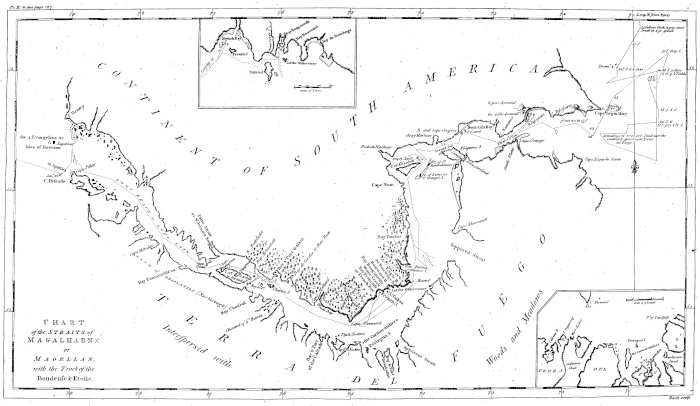
Chart of the Straits of MAGALHAENS or MAGELLAN, with the Track of the Boudeuse & Etoile.
Hidden rock not taken notice of in the charts.
I would not approach too near the coast till I came in latitude of 49°, on account of a sunken rock or vigie, 127which I had discovered in 1765, in 48° 30′ south latitude, about six or seven leagues off shore. I discovered it in the morning, at the same moment as I did the land, and having taken a good observation at noon, the weather being very fair, I was thus enabled to determine its latitude with precision. We ran within a quarter of a league of this rock, which the first person who saw it, originally took to be a grampus.
1767. December.
The 1st and 2d of December, the winds were favourable from N. and N. N. E.; very fresh, the sea high, and the weather hazy; we made all the sail we could in day time, and passed the nights under our fore-sail, and close-reefed top-sails. During all this time we saw the birds called Quebrantahuessos or Albatrosses, and what in all the seas in the world is a bad sign, petrels, which disappear when the weather is fair, and the sea smooth. We likewise saw seals, penguins, and a great number of whales. Some of these monstrous creatures seemed to have their skin covered with such white vermiculi, which fasten upon the bottoms of old ships that are suffered to rot in the harbours. On the 30th of November, two white birds, like great pigeons, perched on our yards. I had already seen a flight of these birds cross the bay of the Malouines.
Sight of Cape Virgins.
On the 2d of December in the afternoon, we discovered Cape Virgins, and we found it bore S. about 128seven leagues distant. |Its position.| At noon I had observed 52° S. lat. and I was now in 52° 3′ 30″ of latitude, and in 71° 12′ 20″ of longitude west from Paris. This position of the ship, together with the bearing, places Cape Virgins in 52° 23′ of latitude, and in 71° 25′ 20″ of longitude west from Paris. As Cape Virgins is an interesting point in geography, I must give an account of the reasons which induced me to believe that the position I give is nearly exact.
Discussion upon the position given to Cape Virgin.
The 27th of November in the afternoon, the chevalier du Bouchage had observed eight distances of the moon from the sun, of which the mean result had given him the west longitude of the ship, in 65° 0′ 30″ for one hour, 43 min. 26 sec. of true time: M. Verron, on his part, had observed five distances, the result of which gave for our longitude, at the same instant, 64° 57′. The weather was fair, and extremely favourable for observations. The 29th at 3 hours 57 min. 35 sec. true time, M. Verron, by five observations of the distance of the moon from the sun, determined the ship’s west longitude, at 67° 49′ 30″.
Now, by following the longitude determined the 27th of November, taking the medium between the result of the observations of the chevalier du Bouchage and those of M. Verron, in order to fix the longitude of the ship, when we got sight of Cape Virgins, the longitude 129of that Cape will be 71° 29′ 42″ west from Paris. The observations made the 29th afternoon, likewise referred to the place of the ship, when we made the Cape, would give a result of 38′ 47″ more westward. But it seems to me that those of the 27th ought rather to be followed, though two days more remote, because they were made in a greater number by two observers, who did not communicate their observations to each other, and however did not differ more than 3′ 30″. They carry an appearance of probability which cannot well be objected to. Upon the whole, if a medium is to be taken between the observations of both days, the longitude of Cape Virgins will be 71° 49′ 5″, which differs only four leagues from the first determination, which answers within a league to that which the reckoning of my course gave me, and which I follow for this reason.
This longitude of Cape Virgin is more westerly by 42′ 20″ than that which M. Bellin places it in, and this is the same difference which appears in his position of Montevideo, of which we have given an account in the beginning of this chapter. Lord Anson’s chart assigns for the longitude of Cape Virgins, 72° west from London, which is near 75° west from Paris[60]; a much 130more considerable error, which he likewise commits at the mouth of the river Plata, and generally along the whole coast of Patagonia.
Digression upon the instruments proper for observing the longitude at sea.
The observations which we have now mentioned, have been made with the English octant. This method of determining the longitude, by means of the distances of the moon from the sun, or from the stars in the zodiac, has been known for several years. Mess. de la Caille and Daprès have particularly made use of it at sea, likewise employing Hadley’s octant. But as the degree of accuracy obtained by this method depends in a great measure upon the accuracy of the instrument with which you observe, it follows that M. Bouguer’s heliometer, if one could measure great angles with it, would be very fit for rectifying these observations of distances. The Abbé de la Caille probably has thought of that, because he got one made, which would measure arcs of six or seven degrees; and if in his works he does not speak of it as an instrument fit for observing at sea, it is because he foresaw the difficulty of using it on board a ship.
M. Verron brought on board with him an instrument called a megameter, which he has employed in the other voyages he made with M. de Charnieres, and which he has likewise made use of on this. This instrument appeared to be very little different from the heliometer 131of M. Bouguer, except that the screw by which the objectives move, being longer, it places them at a greater distance asunder, and by that means makes the instrument capable of measuring angles of ten degrees, which was the limit of M. Verron’s megameter. It is to be wished, that by lengthening the screw, we were able to augment its extension still more, it being confined in too narrow bounds to allow a frequent repetition, and even to make the observations exact; but the laws of dioptrics limit the removing of the objectives. It is likewise necessary to remedy the difficulty which the Abbé de la Caille foresaw, I mean, that which arises from the element on which the observation must be made. In general, it seems that the reflecting quadrant of Hadley would be preferable, if it were equally accurate.
Difficulties on entering the straits.
From the 2d of December in the afternoon, when we got sight of Cape Virgins, and soon after of Terra del Fuego, the contrary wind and the stormy weather opposed us for several days together. We plyed to windward the 3d till six in the evening, when the winds becoming more favourable, permitted our bearing away for the entrance of Magalhaens’ Straits: this lasted but a short time; at half past seven it became quite calm, and the coasts covered with fogs; at ten it blew fresh again, and we passed the night by plying to windward. The 4th, at three o’clock in the morning, we made for 132the land with a good northern breeze; but the weather which was rainy and hazy intercepting our sight of it, we were obliged to stand off to sea again. At five in the morning, in a clear spot, we perceived Cape Virgins, and bore away in order to enter the straits; almost immediately the wind changed to S. W. whence it soon blew with violence, the fog became thicker, and we were obliged to lay-to between the two shores of Terra del Fuego and the continent.
Observation on the nature of the ground at the entrance of the straits.
Our fore-sail was split the fourth in the afternoon; and we having sounded, almost at the same moment, only twenty fathom, the fear of the breakers, which extend S. S. E. off Cape Virgins, made me resolve to scud under our bare poles; especially as this manœuvre facilitated the operation of bending another fore-sail to the yard. These soundings, however, which made me bear away, were not alarming; they were those in the channel, as I have since learnt, by sounding with a clear view of the land. I shall add, for the use of those who may be plying here in thick weather, that a gravelly bottom shews that they are nearer the coast of Terra del Fuego than to the continent; where they will find a fine sand, and sometimes oozy bottom.
At five o’clock in the evening we brought to again, under the main and mizen stay-sails; at half past seven 133of the clock the wind abated, the sky cleared up, and we made sail; but with disadvantageous tacks, which brought us further from the coast; and, indeed, though on the 5th the weather was very fair, and the wind favourable, we did not see the land till two in the afternoon; when it extended from S. by W. to S. W. by W. about ten leagues off. At four o’clock we again discovered Cape Virgins; and we made sail in order to double it, at the distance of about a league and a half, or two leagues. It is not adviseable to come nearer, on account of a bank, which lies off the Cape, at about that distance. I am even inclined to believe, that we passed over the tail of that sand; for as we sounded very frequently, between two soundings, one of twenty-five and the other of seventeen fathom, the Etoile, which sailed in our wake, made signal of eight fathom; but the moment after she deepened her water.
Nautical remarks upon the entrance of the straits.
Cape Virgins is a table-land, of a middling height; it is perpendicular at its extremity; the view of it given by lord Anson, is most exactly true. At half past nine in the evening, we had brought the north point of the entrance to the straits to bear W. from which a ledge of rocks extends a league into the sea. We ran under our close-reefed fore-top-sail and lower sails hauled up, till eleven o’clock at night, when Cape Virgins bore N. of us. It blew very fresh; and the gloominess of the 134weather, seeming to threaten a storm, determined me to pass the night standing off and on.
The 6th, at break of day, I ordered all the reefs out of the top-sails, and run to W. N. W. We did not see land, till half past four o’clock, when it appeared to us that the tides had carried us to the S. S. W. At half after five, being about two leagues from the continent, we discovered Cape Possession, being W. by N. and W. N. W. This Cape is very easily known; it is the first head-land from the north point, at the entrance of these straits. It is more southerly than the rest of the coast, which afterwards forms a great gulf, called Possession Bay, between this Cape and the next narrow gut. We had likewise sight of Terra del Fuego. The winds soon changed to the ordinary points of W. and N. W. and we ran the most advantageous tacks for entering the strait, endeavouring to come close to the coast of Patagonia, and taking advantage of the tide, which then set to the westward.
At noon we had an observation; and the bearings taken at the same time gave me the same latitude, within a minute, for Cape Virgins, as that which I had concluded from my observations of the third of this month. We likewise made use of this observation, to ascertain the latitude of Cape Possession, and of Cape Espiritù Santo, on Terra del Fuego.
Description of Cape Orange.
135We continued to ply to windward, under our courses and top-sails, all the sixth; and the next night, which was very clear, often sounding, and never going further than three leagues from the coast of the continent. We got forward very little, by this disagreeable manœuvre; losing as much by the tides as we gained by them; and the 7th, at noon, we were still at Cape Possession. Cape Orange bore S. W. about six leagues distant. This cape is remarkable by a pretty high hillock; deep towards the sea-side, and forms to the southward the first gut, or narrow pass, in the straits[61]. |Its rocks.| Its point is dangerous, on account of a ledge which extends to the N. E. of the cape, at least three leagues into the sea. I have very plainly seen the sea break over it. At one o’clock, after noon, the wind having shifted to N. N. W. we made advantage of it to continue our voyage. At half past two we were come to the entrance of the gut; another obstacle attended us there; we were not able, with a fine fresh breeze, and all our sails set, to stem the tide. At four o’clock it ran six knots a-long side of us, and we went a-stern. We persisted in vain to 136strive against it. The wind was less constant than we were, and obliged us to return. It was to be feared, that we might be becalmed in the gut; exposed to the current of the tide; which might carry us on the ledges off the capes which form its entrance at E. and W.
Anchoring in Possession-bay.
We steered N. by E. in search of a good anchoring-ground, in the bottom of Possession-bay; when the Etoile, which was nearer the coast than we were, having passed all at once from twenty fathom to five, we bore away, and stood east, in order to avoid a ledge of rocks, which seemed to lie in the bottom, and in the whole circuit of the bay. During some time we found a bottom of nothing but rocks and pebbles; and it was seven at night, being in twenty fathom, the ground mud and sand, with black and white gravel, when we anchored about two leagues from the land. Possession-bay is open to all winds, and has but very bad anchoring-ground. In the bottom of this bay arise five hills; one of which is a very considerable one; the other four are little and pointed. We have called them le Pere et les quatre fils Aymond; they serve as a conspicuous mark for this part of the straits. At night we sounded at the several times of the tide, without finding any sensible difference in the depth. At half an hour past eight it set to the west; and at three in the morning to the eastward.
Passing the first goulet, or gut.
137The eighth in the morning we set sail under courses, and double-reefed top sails; the tide was contrary to us, but we stemmed it with a fine N. W. breeze[63]. At eight o’clock the wind headed us, and we were obliged to ply to windward; now and then receiving violent squalls of wind. At ten o’clock, the tide beginning to set in westward with sufficient force, we lay to, under our top sails, at the entrance of the first gut, driving with the current, which carried us to windward; and tacking about whenever we found ourselves too near either coast. Thus we passed the first narrow entrance or gut[64] in two hours; notwithstanding the wind was right against us, and blew very hard.
Sight of the Patagonians.
This morning the Patagonians, who had kept up fires all night, at the bottom of Possession-bay, hoisted a white flag on an eminence; and we answered it by hoisting that of our ships. These Patagonians certainly are the same which the Etoile saw in June 1766, in Boucault’s-bay, and with whom she left this flag, as a 138sign of alliance. The care they have taken to preserve it; shews that good-nature, a due regard of their word, or, at least, gratitude for presents received, are the characteristics of these men.
Americans of Terra del Fuego.
We likewise saw, very distinctly, when we were in the gut, about twenty men on Terra del Fuego. They were dressed in skins, and ran as fast as possible along the coast, parallel to our course. They seemed likewise from time to time to make signs to us with their hands, as if they wanted us to come to them. According to the report of the Spaniards, the nation which inhabits this part of Terra del Fuego, practises none of the cruel customs of most other savages. They behaved with great humanity to the crew of the ship la Conception, which was lost on their coast in 1765. They assisted them in saving part of her cargo; and in erecting sheds, to shelter them against bad weather. The Spaniards built a bark there of the wreck of their ships, in which they went to Buenos Ayres. The xebeck el Andaluz was going to bring missionaries to these Indians, when we left Rio de la Plata. Lumps of wax, being part of the cargo of the above ship, have been carried by the force of currents to the coast of the Malouines, where they were found in 1766.
We anchor in Boucault-bay.
I have already observed, that we were gone through the first gut at noon; after that we made sail. The 139wind was veered to S. and the tide continued to carry us to the westward. At three o’clock they both failed us; and we anchored in Boucault’s-bay, in eighteen fathom, oozy bottom.
Interview with the Patagonians.
As soon as we were at anchor, I hoisted out one of my boats, and one belonging to the Etoile. We embarked in them, being about ten officers, each armed with our muskets; and we landed at the bottom of the bay, with the precaution of ordering our boats to be kept a-float, and the crew to remain in them. We had hardly set foot on shore, but we saw six Americans come to us on horseback, in full gallop. They alighted about fifty yards from us; and immediately ran towards us, crying, shawa. When they had joined us, they stretched out their arms towards us, and laid them upon ours. They then embraced us, and shook hands with us, crying continually, Shawa, shawa, which we repeated with them. These good people seemed very much rejoiced at our arrival. Two of them, who trembled as they came towards us, had their fears very soon removed. After many reciprocal caresses, we sent for some cakes and some bread from our boats; which we distributed amongst them, and which they devoured with avidity. Their numbers encreased every moment; they were soon come to thirty, among whom were some young people, and a child of eight or ten years old. They all came to us with entire 140confidence; and caressed us all, as the first had done. They did not seem surprised to see us; and by imitating the report of muskets with their voice, they shewed that they were acquainted with these arms. They appeared attentive to do what might give us pleasure. M. de Commerçon, and some of our gentlemen, were busy in picking up plants: several Patagonians immediately began to search for them too, and brought what species they saw us take up. One of them seeing the chevalier du Bouchage occupied in this manner, came to shew him his eye, which was very visibly affected; and asked him by signs, to point out to him some simple, by which he could be cured. This shews that they have an idea, and make use of that sort of medicine, which requires the knowledge of simples, and applies them for the cure of mankind. This was the medicine of Machaon, who was physician to the gods; and, I believe, that many Machaons might be found among the Indians in Canada.
We exchanged some trifles, valuable in their eyes, against skins of guanacoes and vicunnas. They asked us by signs for tobacco; and they were likewise very fond of any thing red: as soon as they saw something of that colour upon us, they came to stroke it with their hands, and seemed very desirous of it. At every present which, we gave them, and at every mark of fondness, they repeated 141their shawa, and cried so that it almost stunned us. We gave them some brandy; giving each of them only a small draught: as soon as they had swallowed it, they beat with their hands on their throat, and by blowing with their mouths, uttered a tremulous inarticulate sound, which terminated in a quick motion of the lips. They all made the same droll ceremony, which was a very strange sight to us.
However, it grew late, and was time to return on board. As soon as they saw that we were preparing for that purpose, they seemed sorry; they made signs for us to wait, because some more of their people were coming. We made signs that we would return the next day, and that we would bring them what they desired: they seemed as if they would have liked our passing the night on shore much better. When they saw that we were going, they accompanied us to the sea shore; a Patagonian sung during this march. Some of them went into the water up to their knees, in order to follow us further. When we were come to our boats, we were obliged to look after every thing; for they got hold of all that was within their reach. One of them had taken a sickle, but on its being perceived, he returned it without resistance. Before we were got to any distance, we perceived their troops encrease, by the arrival of others, who came in full gallop. We did not fail, 142as we left them, to shout shawa so loud that the whole coast resounded with it.
Description of these Americans.
These Americans are the same with those seen by the Etoile in 1765. One of our sailors, who was then on board that vessel, now knew one of these Americans again, having seen him in the first voyage. They have a fine shape; among those whom we saw, none was below five feet five or six inches, and none above five feet nine or ten inches[65]; the crew of the Etoile had even seen several in the preceding voyage, six feet (or six feet, 4,728 inches English) high. What makes them appear gigantic, are their prodigious broad shoulders, the size of their heads, and the thickness of all their limbs. They are robust and well fed: their nerves are braced, and their muscles are strong and sufficiently hard; they are men left entirely to nature, and supplied with food abounding in nutritive juices, by which means they are come to the full growth they are capable of: their figure is not coarse or disagreeable; on the contrary, many of them are handsome: their face is round, and somewhat flattish; their eyes very fiery; their teeth vastly white, and would only be somewhat too great at Paris; they have long black hair tied up on the top of 143their heads; I have seen some of them with long but thin whiskers. Their colour is bronzed, as it is in all the Americans, without exception, both in those who inhabit the torrid zone, and those who are born in the temperate and in the frigid ones. Some of them had their cheeks painted red: their language seemed very delicate, and nothing gave us reason to fear any ferocity in them. We have not seen their women; perhaps they were about to come to us; for the men always desired that we should stay, and they had sent one of their people towards a great fire, near which their camp seemed to be, about a league from us; and they shewed us that somebody would come from thence.