PART the SECOND. (continued 2)
Johann Reinhold Forster translation
However, though Aotourou could hardly blabber out some words of our language, yet he went out by himself every day, and passed through the whole town without once missing or losing his way. He often made some purchases, and hardly ever paid for things beyond their real value. The only shew which pleased him, was the opera, for he was excessively fond of dancing. He knew perfectly well upon what days this kind of entertainment was played; he went thither 267by himself, paid at the door the same as every body else, and his favourite place was in the galleries behind the boxes[105]. Among the great number of persons who have been desirous of seeing him, he always distinguished those who were obliging towards him, and his grateful heart never forgot them. He was particularly attached to the duchess of Choiseul, who has loaded him with favours, and especially shewed marks of concern and friendship for him, to which he was infinitely more sensible than to presents. Therefore, he would, of his own accord, go to visit this generous benefactress as often as he heard that she was come to town.
His departure from France.
He left Paris in March, 1770, and embarked at Rochelle, on board the Brisson, which was to carry him to the Isle de France. |Steps taken to send him home.| During this voyage he has been trusted to the care of a merchant, who went a passenger in the same ship, which he had equipped in part. The ministry have sent orders to the governor and the intendant of the Isle of France, to send Aotourou home to his isle from thence. I have given a very minute account of the course that must be taken in order to go thither, and thirty-six thousand francs, (about fifteen hundred pounds sterling) which is the third part of my 268whole fortune, towards the equipment of the ship intended for this navigation. The duchess of Choiseul has been so humane as to consecrate a sum of money for bringing to Taiti a great number of the most necessary tools, a quantity of seeds, and a number of cattle; and the king of Spain has been pleased to permit that this ship might, if necessary, touch at the Philippines. O may Aotounou soon see his countrymen again!—I shall now give an account of what I have learnt in my conversations with him, concerning the customs of his country.
Farther accounts of the customs of Taiti.
I have already observed that the Taiti people acknowledge a supreme Being, who cannot be represented by any factitious image, and inferior divinities of two classes, represented by wooden figures. They pray at sun-rise and at sun-set; but they have besides a great number of superstitious practices, in order to conciliate the influence of the evil genii. The comet, visible at Paris in 1769, and which Aotourou has very well taken notice of, has given me an opportunity of learning that the people of Taiti know this kind of stars, which do not appear again, as Aotourou said, till after a great number of moons. They call comets evetou-eave, and do not combine any sinister ideas with their apparition. Those meteors, however, which are here called shooting stars, are known to the people of 269Taiti by the name of epao, and are by them thought to be evil genii eatoua toa.
The better instructed people of this nation (without being astronomers, as our gazettes have pretended) have, however, a name for every remarkable constellation; they know their diurnal motion, and direct their course at sea by them, from isle to isle. In these navigations, which sometimes extend three hundred leagues, they lose all sight of land. Their compass is the sun’s course in day-time, and the position of the stars during the nights, which are almost always fair between the tropics.
Neighbouring isles.
Aotourou has mentioned several isles to me; some of which are allies of, and others at war with Taiti. The friendly isles are Aimeo, Maoroua, Aca, Oumaitia, and Tapouamassou. The enemies isles are Papara, Aiatea, Otaa, Toumaraa, Oopoa. These isles are as big as Taiti.
The isle of Pare, which is very abundant in pearls, is sometimes in alliance, and sometimes at war with Taiti. Enoua-motou, and Toupai, are two little uninhabited isles, abounding with fruits, hogs, fowls, fish, and turtle; but the people believe, that they are the habitation of the genii; they are their domains; and unhappy are the boats which chance or curiosity has conducted to these sacred isles. Almost all those, who endeavour to land there, must lose their lives in the attempt. 270These isles ly at different distances from Taiti. The greatest distance, which Aotourou mentioned to me, was fifteen days sail. It was, doubtless, about the same distance that he supposed our country was at, when he resolved to go with us.
Inequality of ranks.
I have mentioned above, that the inhabitants of Taiti seemed to live in an enviable happiness. We took them to be almost equal in rank amongst themselves; or at least enjoying a liberty, which was only subject to the laws established for their common happiness. I was mistaken; the distinction of ranks is very great at Taiti, and the disproportion very tyrannical. The kings and grandees have power of life and death over their servants and slaves, and I am inclined to believe, they have the same barbarous prerogative with regard to the common people, whom they call Tata-einou, vile men; so much is certain, that the victims for human sacrifices are taken from this class of people. Flesh and fish are reserved for the tables of the great; the commonalty live upon mere fruits and pulse. Even the very manner of being lighted at night, shews the difference in the ranks; for the kind of wood, which is burnt for people of distinction, is not the same with that which the common people are allowed to make use of. Their kings, alone, are allowed to plant before their houses, the tree which we call the Weeping-willow, or Babylonian-willow[106]. It 271is known, that by bending the branches of this tree, and planting them in the ground, you can extend its shadow as far as you will, and in what direction you please; at Taiti, their shade affords the dining-hall of their kings.
The grandees have liveries for their servants. In proportion as the master’s rank is more or less elevated, their servants wear their sashes more or less high. This sash is fastened close under the arms, in the servants of the chiefs, and only covers the loins in those belonging to the lowest class of nobility. The ordinary hours of repast, are when the sun passes the meridian, and when he is set. The men do not eat with the women; the latter serving up the dishes, which the servants have prepared.
Custom of going into mourning.
At Taiti they wear mourning regularly, and call it ceva. The whole nation wear mourning for their kings. The mourning for the fathers is very long. The women mourn for their husbands; but the latter do not do the same for them. The marks of mourning, are a head-dress of feathers; the colour of which is consecrated to death, and a veil over the face. When the people in mourning go out of their houses, they are preceded by several slaves, who beat the castanets in a certain cadence; their doleful sound gives everybody notice to clear the way, whether out of respect for the grief of the persons in mourning, or because meeting 272them is feared as an unlucky and ominous accident. However at Taiti, as in every other part of the world, the most respectable customs are abused; Aotourou told me, that this practice of mourning was favourable to the private meetings; doubtless, as I believe, of lovers with wives, whose husbands are not very complaisant. The instrument, whose sound disperses every body, and the veil which covers the face, secure to the lovers both secrecy and impunity.
Reciprocal assistance in their diseases.
In all diseases, which are any way dangerous, all the near relations assemble in the sick person’s house. They eat and sleep there as long as the danger lasts; every one nurses him, and watches by him in his turn. They have likewise the custom of letting blood; but this operation is never performed at the foot or arm. A Taoua, i. e. a doctor, or inferior priest, strikes with a sharp piece of wood on the cranium of the patient; by this means he opens the sagittal vein; and when a sufficient quantity of blood is run out, he surrounds the head with a bandage, which shuts up the opening; the next day he washes the wound with water.
This is all that I have learnt concerning the customs of this interesting country, both upon the spot, and from my conversations with Aotourou. At the end of this work I shall add a Vocabulary of as many Taiti words as I could collect. When we arrived at this island, we 273observed that some of the words pronounced by the islanders stood in the vocabulary at the end of Le Maire’s Voyage, under the name of Vocabulary of Cocos island. Indeed those islands, according to Le Maire and Schouten’s reckoning, cannot be far from Taiti, and perhaps may be some of those which Aotourou named to me. The language of Taiti is soft, harmoniousharmonious, and easy to be pronounced; its words are composed of almost mere vowels, without aspirates[107]. You meet with no nasal, nor no mute and half sounded syllables, nor that quantity of consonants, and of articulations which render some languages so difficult. Therefore our Taiti-man could never learn to pronounce the French. The same reasons for which our language is accused of not being very musical, rendered it inaccessible to his organs. It would have been easier to make him pronounce Spanish or Italian.
M. Pereire, celebrated for his art of teaching people, who are born deaf and dumb, to speak and articulate words, has examined Aotourou several times, and has found that he could not naturally pronounce most of our consonants, nor any of our nasal vowels. M. Pereire has been so obliging as to communicate to me a memoir 274on this subject. Upon the whole, the language of this island is abundant enough; I think so, because Aotourou, during the course of the voyage, pronounced every thing that struck him in rhythmic stanzas. It was a kind of blank verse, which he spoke extempore. These were his annals; and it seems as if his language furnished him with expressions sufficient to describe a number of objects unknown to him. We further heard him pronounce every day such words as we were not yet acquainted with; and he likewise spoke a long prayer, which he calls the prayer of the kings, and of all the words that compose it, I do not understand ten.
I learnt from Aotourou, that about eight months before our arrival at his island, an English ship had touched there. It is the same which was commanded by Mr. Wallace. The same chance by which we have discovered this isle, has likewise conducted the English thither, whilst we lay in Rio de la Plata. They stayed there a month; and, excepting one attack of the islanders, who had conceived hopes of taking the ship, every thing has passed very friendly between them. From hence, doubtless, proceeds the knowledge of iron, which we found among the natives of Taiti, and the name of aouri, by which they call it, and which sounds pretty like the English word iron. I am yet ignorant, whether the people 275of Taiti, as they owe the first knowledge of iron to the English, may not likewise be indebted to them for the venereal disease, which we found had been naturalized amongst them, as will appear in the sequel.
CHAP. IV.
Departure from Taiti; discovery of other islands; navigation to our clearing the great Cyclades.
Our touching at Taiti has been productive of good, and of disagreeable consequences; danger and alarms followed all our steps to the very last moments of our stay; yet we considered this country as a friend, whom we must love with all his faults. |1768. April.| On the 16th of April, at eight o’clock in the morning, we were about ten leagues N. E. by N. of the north point of the island, and from hence I took my departure. |Sight of Oumaitia.| At ten o’clock we perceived land to leeward, seeming to form three isles, and we were still in sight of Taiti. At noon we plainly saw, that what we had taken for three isles, was no more than a single one, whose eminences had appeared as separate isles at a distance. Beyond this new land, we thought we saw another at a greater distance. 276This isle is of a middling height, and covered with trees; it may be seen at sea, about eight or ten leagues distant. Aotourou called it Oumaitia. He gave us to understand, in a manner which admitted of no doubt, that it was inhabited by a nation allied to his, that he had been there several times, that he had a mistress there, and that we should meet with the same reception and refreshments there as at Taiti.
Direction of the course.
We lost sight of Oumaitia this day, and I directed my course so as to avoid the Pernicious Isles, which we were taught to shun, by the disasters of admiral Roggewein. Two days afterwards, we had an incontestable proof, that the inhabitants of the isles in the Pacific Ocean communicate with each other, even at considerable distances. The night was very fair, without a single cloud, and all the stars shone very bright. Aotourou, after attentively observing them, pointed at the bright star in Orion’s shoulder, saying, we should direct our course upon it; and that in two days time we should find an abundant country, which he well knew, and where he had friends: we even believed his gestures meant that he had a child there. As I did not alter my course, he repeated several times, that there were cocoa-nuts, plantains, fowls, hogs, and above all, women, whom by many expressive gestures he described as very complaisant. Being vexed that these reasons did not 277make any impression upon me, he ran to get hold of the wheel of the helm, the use of which he had already found out, and endeavoured in spite of the helm’s-man to change it, and steer directly upon the star, which he pointed at. We had much ado to quiet him and he was greatly vexed at our refusal. The next morning by break of day, he climbed up to the top of the mast, and stayed there all the morning, always looking towards that part where the land lay, whither he intended to conduct us, as if he had any hopes of getting sight of it. He had likewise told us that night, without any hesitation, all the names which the bright stars that we pointed at, bear in his language. We have since been assured with certainty, that he knows the phases of the moon perfectly well, and is well acquainted with different prognosticks, which often give notice to navigators of the changes of weather that are to happen at sea some time after. One of the opinions of these people, which Aotourou made very intelligible to us is, that they positively believe that the sun and moon are inhabited. What Fontenelle taught them the plurality of worlds?
During the latter end of April we had very fine weather, but not much wind, and the easterly winds kept more to the northward than southward. On the night between the 26th and 27th, our pilot of the coast of 278France died suddenly of an apoplexy. These pilots generally are called coasting pilots[108], and all the king’s ships have a pilot of the coast of France[109]. They differ from those of the crew who are called pilots, and under-pilots, or pilot’s boys[110]. The world has a very inaccurate idea of the functions which these pilots exercise on board our ships. They are generally thought to be the persons who direct the course, and who serve as a staff and support to the blind. I know not whether there is still any nation where they leave the art of piloting, that essential part of navigation, to those subaltern people. In our ships, the business of the pilot is to take care that the helmsman exactly follows the course, for which the captain alone gives the orders, to mark down all the alterations of the course that happen, either in consequence of the changes of winds, or of the orders of the commander, and likewise to observe the signals; nor have they the care of all these particulars, but under the direction of the officer of the watch. The superior officers of the king’s navy certainly know more of geometry, even at leaving school, than is necessary to have a perfect knowledge of all the laws of pilotage. The class of pilots, properly so called, are moreover charged with the care of the common 279and azimuth compasses, of the log and sounding lines, of the lanthorns, the colours, &c. and it is plain, that these particulars require nothing more than exactness. Nor was my master-pilot above twenty years old, the second pilot was of the same age, and the pilots boys[111] were making their first voyage.
Astronomical observations.
My reckoning compared, twice during this month, with M. Verron’s astronomical observations, differed, the first time, and that was at Taiti, only 13′ 10″, which I was more to the westward. The second time, which was the 27th at noon, 1° 13′ 37″, which I was to the eastward of the observation. |Second division of isles.| The different isles discovered during this month, form the second division of isles in this vast ocean; I named them Archipelago of Bourbon.
May.
The third of May, almost at day-break, we discovered more land to the north west, about ten or twelve leagues off. The wind was north easterly, and I gave orders to stand to windward of the north point of the land, which was very high, intending to reconnoitre it. |Sight of new islands.| The nautical knowledge of Aotourou did not extend to these places, for his first idea when he saw this land, was, that it was our country. During the day we had some squalls, followed by calms, rain, and westerly breezes, such as are observed in this ocean at the approach of 280the least land. Before sun-set we distinguished three isles, one of which was much more considerable than the others. During the night, which happened to be moon-light, we kept sight of the land; we stood in for it the next day, and ranged the eastern shore of the greater isle, from its south to its north point; that was its longest side, being about three leagues long. The isle extends two leagues east and west. Its shores are every where steep, and the whole isle is as it were nothing more than a high mountain, covered with trees up to its summit, without either vallies or plains. The sea broke very violently upon the shore. We saw fires on the island, some huts covered with reeds, and terminating in a point, built under the shadow of cocoa-trees, and about thirty men running along the sea shore. The two little isles bear W. N. W. corrected, and one league distant from the great one, and have likewise the same situation among themselves. A narrow arm of the sea separates them, and at the W. point of the westermost isle, there is a small isle or key. Each of the above two is not more than half a league long, and their shores are equally high and steep.
Exchanges made with the islanders.
At noon I made sail to pass between the little isles and the great one, when the sight of a periagua coming towards us, made me bring-to. She approached within pistol shot of the ship, but none of her people would 281come on board, notwithstanding all the signs of friendship which we could possibly invent and give to five men who conducted her. They were naked, excepting their natural parts, and shewed us cocoa-nuts and roots. Our Taiti-man stripped naked as they were, and spoke his language to them, but they did not understand him: they are no more of the same nation here. Being tired to see that they did not venture to come nearer, notwithstanding the desire they expressed of having several trifles which were displayed to them, I hoisted out the pinnace. As soon as they saw her, they made all the haste they could to get off, and I would not pursue them. Soon after we saw several other periaguas arrive, some of them under sail. They seemed less mistrustful than the former one, and came near enough to make exchanges, though none of them would come on board. We got from them yams, cocoa-nuts, a water hen of a superb plumage, and some pieces of a very fine shell. One of them had a cock which he would never exchange. They likewise brought stuffs of the same make as those of Taiti, but much coarser, and died with ugly red, brown, and black colours; bad fish hooks, made of the bones of fish, some mats, and some lances, six feet long, made of a kind of wood which was hardened in the fire. They did not choose to have any iron: they preferred little bits of red stuffs 282to nails, knives, and ear-rings, which had had so great a success at Taiti. I do not believe that these men are so gentle as those of Taiti; their features were more savage, and we were always obliged to be upon our guard against their cunning tricks to cheat us by their barter.
Description of these islanders.
These islanders appeared to be of a middle size, but active and nimble. They paint their breast and their thighs, almost down to the knee, of a dark blue; their colour is bronzed; but we observed one man among them who was much whiter than the rest. They shave or tear out their beards, and only one of them wore a pretty long one. They all had black hair, which stood upright on the head. |Description of their periaguas.| Their periaguas are made with a good deal of skill, and have an out-rigger. Neither the head nor the stern is raised, but there is a kind of deck over each of them, and in the middle of these decks is a row of wooden pegs, ending in form of large nails, but their heads are covered with a fine shell, which is of a clear white. The sail of their periaguas is of a triangular shape, composed of several mats. Two of its sides are bent to two sticks, one of which supported it up along the mast; and the other, which is fixed in the outer clew, answers the purpose of a boom. These periaguas followed us pretty far out to sea, when we filled the sails; some came likewise from the 283two little isles, and in one of them was an ugly old woman. Aotourou expressed the greatest contempt for these islanders.
We met with some calms, being to leeward of the larger island, which made me give up the scheme of passing between it and the little ones. The channel between them is a league and a half in breadth, and it seems as if there was some anchorage to be found. At six in the evening we discovered from the masts more land to W. S. W. appearing as three detached hummocks. We steered S. W. and two hours after mid-night we saw the same land again, in W. 2° S. The first islands which by the help of the moon-shine we still could perceive, then bore N. E. of us.
Continuation of islands.
On the 5th in the morning we saw that this new land was a very fine isle, of which we had only seen the summits the day before. It was interspersed with mountains and vast plains, covered with cocoa-nut and many other trees. We ranged its southern coast, at one or two leagues distance, without seeing any appearances of anchorage, the sea breaking upon the shore very violently. There are even breakers to the westward of its westermost point, which runs about two leagues into the sea. We have from several bearings got the exact position of this coast. A great number of periaguas sailing, and similar to those of the last isles, came around the ships, without however venturing to 284come close to us; a single one came alongside of the Etoile. The Indians seemed to invite us by signs to come on shore: but the breakers prevented it. Though we ran seven or eight knots at this time, yet the periaguas sailed round us with the same ease as if we had been at anchor. Several of them were seen from the masts sailing to the southward.
At six o’clock in the morning we had got sight of another land to westward; some clouds then intercepted it from our sight, and it appeared again at ten. Its shore ran S. W. and appeared to be at least as high, and of as great extent as the former ones, with which it lies nearly E. and W. about twelve leagues asunder. A thick fog which rose in the afternoon, and continued all the next night and ensuing day, prevented our viewing it more particularly. We only distinguished at its N. E. extremity two little isles, of unequal sizes.
Position of these isles which form the second division.
The longitude of these isles is nearly the same in which Abel Tasman was, by his reckoning, when he discovered the isles of Amsterdam, Rotterdam, Pylstaart, those of Prince William, and the shoals of Fleemskerk[112]. It is likewise the same which, within a very little, is assigned to the Solomon’s isles. Besides, the periaguas, which we saw sailing to the southward, seem to shew that there are other isles in that part. Thus these isles 285seem to form a chain under the same meridian; they make the third division, which we have named l’Archipel des Navigateurs, or Archipelago of the Navigators[113].
On the 11th in the morning, having steered W. by S. since we got sight of the last isles, we discovered a land bearing W. S. W. seven or eight leagues distant. At first it was thought they were two separate isles, and we were kept at a distance from them all day by a calm. On the 12th we found that it was only one isle, of which, the two elevated parts were connected by a low land, seemingly bending like a bow, and forming a bay open to the N. E. The high land lies N. N. W. A head wind prevented our approaching nearer than six or seven leagues of this island, which I named l’Enfant Perdu, or the Forlorn Hope.
Meteorological observations.
The bad weather which began already on the 6th of this month, continued almost uninterrupted to the 20th, and during all that time we had calms, rains, and west winds to encounter. In general, in this ocean which is 286called Pacific, the approach to lands is attended with tempests, which are still more frequent during the decrease of the moon. When the weather proves squally, and there are thick clouds fixed upon the horizon, they are almost certain signs of some isles, and give timely notice to be upon guard against them. It cannot be comprehended with what precautions and what apprehensions, these unknown seas must be navigated, as you are there on all sides threatened with the unexpected appearance of lands and shoals, and these apprehensions are heightened by the length of the nights in the torrid zone. We were obliged to make way as it were blindfold, altering our course when the horizon appeared too black before us. The scarcity of water, the want of provisions, and the necessity of making advantage of the wind whenever it blew, would not allow us to proceed with the slowness of a prudent navigation, and to bring to, or stand on our boards, whenever it was dark.
Critical situation we are in.
The scurvy in the mean while made its appearance again. A great part of the crew, and almost all the officers, had their gums affected, and the mouth inflamed with it. We had no refreshments left, except for the sick, and it is difficult to use one’s self to eat nothing but salt flesh and dried pulse. At the same time there appeared in both ships several venereal complaints, 287contracted at Taiti. They had all the symptoms known in Europe. I ordered Aotourou to be searched; he was quite ruined by it; but it seems in his country this disease is but little minded; however, he consented to be taken care of by the surgeons. Columbus brought this disease from America; here it is in an isle in the midst of the greatest ocean. Have the English brought it thither? Or ought the physician to win, who laid a wager, that if four healthy stout men were shut up with one healthy woman, the venereal complaint would be the consequence of their commerce?
The 22d at day break, as we stood to the westward, we saw a long high land a-head. When the sun rose we discovered two isles; the most southerly one bore from S. by E. to S. W. by S. and seemed to run N. N. W. corrected, being about twelve leagues long in that direction. It received the name of the day, Isle de la Pentecôte, Whitsuntide isle. The second bore from S. W. ½ S. to W. N. W. the time when it first appeared to us was the occasion of our giving it the name of Aurora. We immediately stood as near as possible on the larboard tack, in order to pass between the two isles. The wind failed us, and we were obliged to bear away in order to pass to the leeward of the isle of Aurora. As we advanced to the northward, along its eastern shore, we saw a little isle rising 288like a sugar-loaf, bearing N. by W. which we called Peak of the Etoile (Pic de l’Etoile). We continued to range the isle of Aurora a league and a half distant. It runs N. and S. corrected from its southermost point to about the middle of its length, which in the whole is ten leagues. It then declines to the N. N. W. it is very narrow, being to the utmost two leagues broad. Its shores are steep, and covered with woods. At two o’clock in the afternoon we perceived the summits of high mountains over this island, and about ten leagues beyond it. They belonged to a land, of which at half past three we saw the S. W. point, bearing S. S. W. by the compass, above the northern extremity of Aurora island. After doubling the latter we steered S. S. W. when at sun-setting a new elevated coast, of considerable extent, came in sight. It extended from W. S. W. to N. W. by N. about fifteen leagues distant.
We made several boards during night to get to the S. E. in order to discover whether the land which lay to S. S. W. of us joined to Whitsuntide isle, or whether it formed a third isle. This we verified on the 23d at day-break. We discovered the separation of the three islands. The isles of Whitsuntide and Aurora are nearly under the same meridian, two leagues distant from each other. The third isle lies S. W. of Aurora, and in the nearest part, they are three or four leagues asunder. 289Its north-west coast has at least twelve leagues in extent, and is high, steep, and woody. We coasted it during part of the morning on the 23d. Several periaguas appeared along the shore, but none seemed desirous to come near us. We could see no huts, only a great number of smokes rising out of the woods, from the sea-shore, up to the tops of the mountains. We sounded several times very near the shore; but found no bottom with fifty fathom of line.
Landing up on one of the isles.
About nine o’clock the sight of a coast, where it seemed landing would prove easy, determined me to send on shore, in order to take in some wood, which we were much in need of, to gain intelligence concerning the country, and to endeavour to get refreshments from thence for our sick. I sent off three armed boats, under the command of ensign[114] the chevalier de Kerué, and we stood off and on, ready to send them any assistance, and to support them by the artillery from both ships, if necessary. We saw them land, without the islanders seeming to have opposed their landing. In the afternoon, I and some other persons went in a yawl to join them. We found our people employed in cutting wood, and the natives helping them to carry it to the boats. The officer who commanded our party, told me, that when he arrived, a numerous troop of islanders were 290come to receive them on the beach, with bows and arrows in hand, making signs that they should not come ashore; but that when, notwithstanding their threats, he had given orders for landing, they had drawn back several yards; that in proportion as our people advanced, the savages retired; but always in the attitude of being ready to let go their arrows, without suffering our people to come nearer them; that at last, having given his people orders to stop, and the prince of Nassau having desired to advance alone towards them, the islanders had ceased to retire, seeing only one man come to them; that some pieces of red cloth being distributed amongst them, had brought about a kind of confidence between them. The chevalier de Kerué immediately posted himself at the entrance of the wood, made the workmen cut down trees, under the protection of the troops he had with him, and sent a detachment in search of fruits. Insensibly the islanders approached in a more friendly manner to all appearance; they even let our people have some fruits. They would not have any nails or other iron, and likewise constantly refused to exchange their bows and their clubs, only giving us some arrows. They always kept in great numbers around our people, without ever quitting their arms; and those who had no bows, held stones ready to throw at our men. They gave us to understand, that they were at war with the 291inhabitants of a neighbouring district. There actually appeared an armed troop of them, coming in good order from the west part of the island; and those who were near us seemed disposed to give them a warm reception; but no attack was made.
They attack the French.
In this situation we found things when we came ashore. We staid there till our boats were laden with fruits and wood. I likewise buried at the foot of a tree, the act of taking possession of these isles, engraved on an oak plank, and after that we embarked in our boats again. This early departure, doubtless, ruined the project of the islanders to attack us, because they had not yet disposed every thing for that purpose; at least we were inclined to think so, by seeing them advance to the sea-shore, and send a shower of stones and arrows after us. Some muskets fired off into the air, were not sufficient to rid us of them; many advanced into the water, in order to attack us with more advantage; another discharge of muskets, better directed, immediately abated their ardour, and they fled to the woods with great cries. One of our sailors was slightly wounded by a stone.
Description of the islanders.
These islanders are of two colours, black and mulattoes. Their lips are thick, their hair woolly, and sometimes of a yellowish colour. They are short, ugly, ill-proportioned, and most of them infected with leprosy; a circumstance from which we called the island they inhabit, 292Isle of Lepers (Isle des Lepreux). There appeared but few women; and they were not less disagreeable than the men; the latter are naked, and hardly cover their natural parts; the women wear some bandages to carry their children on their backs; we saw some of the cloths, of which they are made, on which were very pretty drawings, made with a fine crimson colour. I observed that none of the men had a beard; they pierce their nose, in order to fix some ornaments to it. They likewise wear on the arm, in form of a bracelet, the tooth of a babyroussa, or a ring of a substance which I take to be ivory; on the neck they hang pieces of tortoise-shells, which they signified to us to be very common on their shores.
Their weapons.
Their arms are bows and arrows, clubs of iron-wood, and stones, which they use without slings. The arrows are reeds, armed with a long and very sharp point made of a bone. Some of these points are square, and armed on the edges with little prickles in such a manner as to prevent the arrow’s being drawn out of a wound. They have likewise sabres of iron-wood. Their periaguas did not come near us; at a distance they seemed built and rigged like those in the Isles of Navigators.
Description of the place we landed at.
The beach where we landed was of very little extent. About twenty yards from the sea, you are at the foot of 293a mountain, which is covered with trees, notwithstanding its great declivity. The soil is very light, and of no great depth: accordingly the fruits, though of the same species with those at Taiti, are not so fine and not so good here. We found a particular species of figs here. There are many paths through the woods, and spots enclosed by pallisadoes three feet high. We could not determine whether they are intrenchments, or merely limits of different possessions. We saw no more than five or six little huts, into which one could not enter otherwise than by creeping on all-fours; and we were however surrounded by a numerous people; I believe they are very wretched, on account of the intestine war, of which we were witnesses, and which brings great hardships upon them. We repeatedly heard the harsh sound of a kind of drum, coming from the interior parts of the wood, towards the summit of the mountain. This certainly gives the signal to rally; for at the moment when the discharge of our muskets had dispersed them, it began to beat. It likewise redoubled its sound, when that body of enemies appeared, whom we saw several times. Our Taiti-man, who desired to go on shore with us, seemed to think this set of men very ugly; he did not understand a single word of their language.
Continuation of our course among the lands.
When we came on board, we hoisted in our boats, and made sail standing to the S. W. for a long coast 294which we discovered, extending as far as the eye could reach from S. W. to W. N. W. During night there was but little wind, and it constantly veered about; so that we were left to the mercy of the currents, which carried us to the N. E. This weather continued all the 24th, and the night following; and we could hardly get three leagues off the Isle of Lepers. On the 25th, at five in the morning, we had a very fine breeze at E. S. E. but the Etoile, being still under the land, did not feel it, and remained in a calm. I advanced, however, all sails set, in order to observe the land, which lay to westward. At eight o’clock we saw land in all parts of the horizon; and we were, as it were, shut up in a great gulph. The isle of Whitsuntide extended on the southsouth side towards the new coast we had just discovered; and we were not sure whether it was not connected, or whether what we took to be the separation was any more than a great bay. Several places in the remainder of the coast likewise shewed appearances of passages, or of great gulphs. Among the rest there seemed to be a very considerable one to the westward. Some periaguas crossed from one land to the other. At ten o’clock we were obliged to stand towards the Isle of Lepers again. The Etoile, which could no longer be seen from the mast-head, was still becalmed there, though the E. S. E. breeze held out at sea. We stood for the store-ship till 295four o’clock in the evening; for it was not till then that she felt the breeze. It was too late when she joined us to think of further discoveries. Thus the day of the 25th was lost, and we passed the night making short tacks.
Aspect of the country.
The bearings we took on the 26th, at sun-rising, shewed us that the currents had carried us several miles to the southward, beyond our reckoning. Whitsuntide isle still appeared separated from the S. W. land, but the passage seemed narrower. We discovered several other openings on that coast, but were not able to distinguish the number of isles which composed the Archipelago around us. The land seemed to us to extend from E. S. E. to W. N. W. by the south (by compass); and we could not see the termination of it. We steered from N. W. by W. gradually coming round to west, along a fine shore covered with trees, on which there appeared great pieces of ground, which were either actually cultivated, or seemed to be so. The country appeared fertile; and some of the mountains being barren, and here and there of a red colour, seemed to indicate that it contained minerals. As we continued our course we came to the great inlet, which we had observed to the westward the day before. At noon we were in the middle of it, and observed the sun’s height there. Its opening is five or six leagues wide; and it runs due E. 296by S. and W. by N. Some men appeared on the south coast, and some others came near the ships in a periagua; but as soon as they were within musket shot, they would not come nearer, though we invited them; these men were black.
We ranged the north coast at the distance of three quarters of a league; it is not very high, and covered with trees. A number of negroes appeared on the shore; even some periaguas came towards us; but with as little confidence as that which came from the opposite coast. After having run along this, for the space of two or three leagues, we saw a great inlet, seeming to form a fine bay, at the entrance of which were two islands. I immediately sent our boats well armed to reconnoitre it; and during this time we stood on our boards, at one or two leagues distance off more, often sounding without finding bottom, with 200 fathom of line.
Attempts to search an anchorage.
About five o’clock we heard a discharge of muskets, which gave us much concern: it came from one of our boats, which, contrary to my orders, had separated from the others, and unluckily was exposed to the attacks of the islanders, being got quite close to the shore. Two arrows, which were shot at the boat, served as a pretence for the first discharge. She then went along the coast, and kept up a brisk fire from her muskets and 297pedereroes, directing them both upon the shore, and upon three periaguas which passed by her within reach of shot, and had shot some arrows at her. A point of land intercepted the boat from our sight, and her continual firing gave me reason to fear that she was attacked by a whole fleet of periaguas. I was just going to send the long-boat to her assistance, when I saw her quite alone, doubling the point, which had concealed her. The negroes howled excessively in the woods, whither they had all retired, and where we could hear their drum beating. I immediately made signal to the boat to come on board, and I took my measures to prevent our being dishonoured for the future, by such an abuse of the superiority of our power.
What prevents our anchoring there.
The boats of the Boudeuse found that this coast, which we took to be continued, was a number of isles; so that the bay is formed by the junction of several channels, which separate them. However, they found a pretty good sandy bottom there, in 40, 30, and 20 fathom; but its continual inequality rendered this anchorage unsafe, especially for us, who had no anchors to venture. It was, besides, necessary to anchor there above half a league off shore, as the bottom was rocky nearer the coast. Thus the ships could not have protected the boats, and the country is so woody, that we would have been obliged always to have our arms in hand, in order 298to cover the workmen against surprizes. We could not flatter ourselves that the natives should forget the bad treatment they had just received, and should consent to exchange refreshments. We observed the same productions here as as upon the Isle of Lepers. The inhabitants were likewise of the same species, almost all black, naked, except their nudities, wearing the same ornaments of collars, and bracelets, and using the same weapons.
Another attempt to put in here.
We passed this night on our boards. On the 27th in the morning we bore away, and ranged the coast at about a league’s distance. About ten o’clock we saw, on a low point, a plantation of trees, laid out in walks, like those of a garden. Under the trees there was a beaten track, and the soil seemed to be sandy. A considerable number of inhabitants appeared about this part; on the other side of this point there was an appearance of an inlet, and I hoisted the boats out. This was a fruitless attempt; for it was nothing but an elbow formed by the coast, and we followed it to the N. W. point, without finding any anchorage. Beyond that point the land returned to N. N. W. and extended as far as the eye could reach; it was of an extraordinary height, and shewed a chain of mountains above the clouds. The weather was dark, with squalls and rain at intervals. Often in day-time we thought we saw 299land a-head of us; mere fog banks, which disappeared when it cleared up. We passed all the night, which was a very stormy one, in plying with short boards, and the tides carried us to the southward far beyond our reckoning. We saw the high mountains all day on the 28th till sun-set, when they bore from E. to N. N. E. twenty or twenty-five leagues distant.
Conjectures concerning these lands.
The 29th in the morning we saw no more of the land, having steered W. N. W. I called the lands we had now discovered, Archipelago of the great Cyclades (Archipel des grandes Cyclades). To judge of this Archipelago by what we have gone through, and by what we have seen of it at a distance, it contains at least three degrees of latitude, and five of longitude. I likewise readily believe that Roggewein saw its northern extremity in 11° of latitude, and called it Thienhoven and Groningen. As for ourselves, when we fell in with it, every thing conspired to persuade us that it was the Tierra Austral del Espiritù Santo. Appearances seemed to conform to Quiros’s account, and what we daily discovered, encouraged our researches. It is singular enough, that exactly in the same latitude and longitude where Quiros places his bay of St. Philip and St. Jago, on a coast which at first sight seemed to be that of a continent, we should find a passage exactly of the same breadth which he assigns to the entrance of his 300bay. Has this Spanish navigator seen things in a wrong light? Or, has he been willing to disguise his discoveries? Was it by guess that the geographers made this Tierra del Espiritu Santo the same continent with New Guinea? To resolve this problem, it was necessary to keep in the same latitude for the space of three hundred and fifty leagues further. I resolved to do it, though the condition and the quantity of our provisions seemed to give us reason to make the best of our way to some European settlement. The event has shewn that little was wanting to make us the victims of our own perseverance.
Difference between the reckoning and the observations.
M. Verron made several observations during the month of May, and their results determined our longitude on the 5th, 9th, 13th, and 22d. We had not till now found so many differences between the observations and the ship’s reckoning, all falling on one side. On the 5th at noon I was more to the east than the observed longitude, by 4° 00′ 42″; on the 9th, by 4° 23′ 4″; on the 13th, by 3° 38′ 15″; and lastly, on the 22d, by 3° 35′. All these differences shew, that from the isle of Taiti, the currents had carried us much to the westward. By this means it might be explained, why all the navigators who have crossed the Pacific ocean have fallen in with New Guinea much sooner than they ought. They have likewise given this ocean not by far 301so great an extent from east to west as it really has. I must however observe, that whilst the sun was in the southern hemisphere, our reckoning has been to the westward of the observations; and that, after he passed to the other side of the line, our differences have changed. The thermometer during this month was commonly between 19° and 20°, it fell twice to 18°, and once to 15°.
Whilst we were amidst the great Cyclades, some business called me on board the Etoile, and I had an opportunity of verifying a very singular fact. For some time there was a report in both ships, that the servant of M. de Commerçon, named Baré, was a woman. His shape, voice, beardless chin, and scrupulous attention of not changing his linen, or making the natural discharges in the presence of any one, besides several other signs, had given rise to, and kept up this suspicion. But how was it possible to discover the woman in the indefatigable Baré, who was already an expert botanist, had followed his master in all his botanical walks, amidst the snows and frozen mountains of the the straits of Magalhaens, and had even on such troublesome excursions carried provisions, arms, and herbals, with so much courage and strength, that the naturalist had called him his beast of burden? A scene which passed at Taiti changed this suspicion into certainty. M. de Commerçon went on shore to botanize there; Baré had 302hardly set his feet on shore with the herbal under his arm, when the men of Taiti surrounded him, cried out, It is a woman, and wanted to give her the honours customary in the isle. The Chevalier de Bournand, who was upon guard on shore, was obliged to come to her assistance, and escort her to the boat. After that period it was difficult to prevent the sailors from alarming her modesty. When I came on board the Etoile, Baré, with her face bathed in tears, owned to me that she was a woman; she said that she had deceived her master at Rochefort, by offering to serve him in mens cloaths at the very moment when he was embarking; that she had already before served a Geneva gentleman at Paris, in quality of a valet; that being born in Burgundy, and become an orphan, the loss of a law-suit had brought her to a distressed situation, and inspired her with the resolution to disguise her sex; that she well knew when she embarked that we were going round the world, and that such a voyage had raised her curiosity. She will be the first woman that ever made it, and I must do her the justice to affirm that she has always behaved on board with the most scrupulous modesty. She is neither ugly nor handsome, and is no more than twenty-six or twenty-seven years of age. It must be owned, that if the two ships had been wrecked on any desart isle in the ocean, Baré’s fate would have been a very singular one.
303
CHAP. V.
Run from the great Cyclades; discovery of the gulph of Louisiade; extremity to which we are reduced there; discovery of new isles; putting into a port on New Britain.
From the 29th of May, when we lost sight of the land, I sailed westward with a very fresh east, or south east wind. |Direction of our course after leaving the Cyclades.| The Etoile considerably retarded our sailing. We sounded every four and twenty hours, finding no bottom with a line of two hundred and forty fathom. In day time we made all the sail we could, at night we ran under reefed top-sails, and hauling upon a wind when the weather was too dark. |1768. June.| The night between the 4th and 5th of June, we were standing to the westward under our top-sails by moon-shine, when at eleven o’clock we perceived some breakers, and a very low sand bank, to the southward, half a league from us. |Meeting with breakers.| We immediately got the other tacks on board, at the same time making a signal of danger to the Etoile. Thus we ran till near five in the morning, and then we resumed our former course to W. S. W. in order to view this land. We saw it again at eight o’clock, at about a league and a half distance. It is a little sandy isle, 304which hardly rises above the water; and which, on that account, is a dangerous shoal for ships sailing at night, or in hazy weather. It is so flat, that at two leagues distance, with a very clear horizon, it can only be seen from the mast head; it is covered with birds; I called it the Shoal of Diana (la Bâture de Diane).
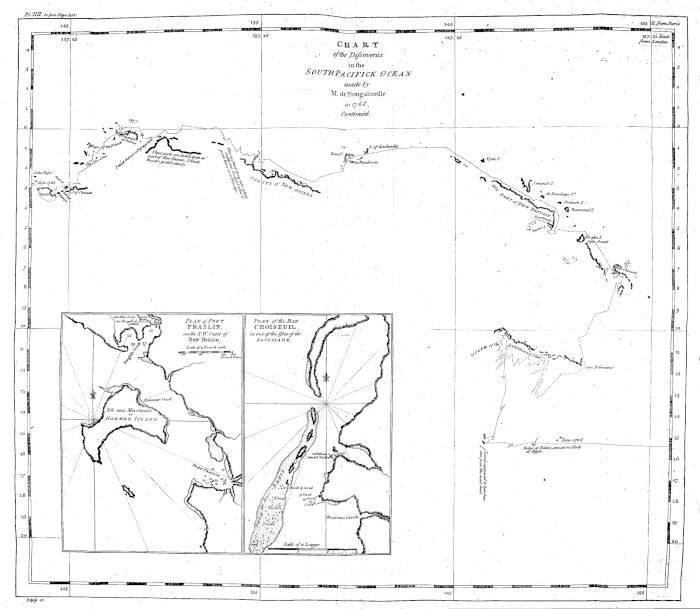
CHART of the Discoveries in the SOUTH PACIFICK OCEAN made by M. de Bougainville in 1768. Continued.
Signs of land.
On the 5th, at four o’clock in the afternoon, some of our people thought they saw the land and breakers to the westward; they were mistaken, and we continued our course that way till ten in the evening. The remaining part of the night we lay-to, or made short boards, and at day-break we resumed our course, all sails set. For twenty-four hours past, several pieces of wood, and some fruits which we did not know, came by the ship floating: the sea too was entirely fallen, notwithstanding the very fresh S. E. wind that blew, and these circumstances together gave me room to believe that we had land pretty near us to the S. E. We likewise saw a new kind of flying fish in those parts; they are black, with red wings, seem to have four wings instead of two, and somewhat exceed the common ones in size.
The 6th, at half an hour past one o’clock in the afternoon, a sand-bank appeared about three quarters of a league distant a-head, and convinced me that it was time to alter the course, which I had always continued to 305westward. This sand extended at least half a league from W. by S. to W. N. W. Some of our people even were of opinion they saw a low land to the S. W. of the breakers. We stood to the northward till four o’clock, and then again to the westward. This, however, did not last long; for at half pass five o’clock, the men at the mast-heads saw fresh breakers to the N. W. and N. W. by W. about a league and a half from us. We approached nearer, in order to view them better. They were seen to extend above two miles from N. N. E. to S. S. W. and we could not see an end of them. In all probability they joined those which we had discovered three hours before. The sea broke with great violence on these shoals, and some summits of rocks appeared above water from space to space. This last discovery was the voice of God, and we were obedient to it. |Necessary alteration of the course.| Prudence not permitting us to pursue an uncertain course at night, in these dangerous parts, we spent it making short boards in that space, with which we had made ourselves acquainted in the preceding day; and on the 7th, in the morning, I gave orders to steer N. E. by N. abandoning the scheme of proceeding further westward in the latitude of 15°.
We had certainly great reason to believe, that the Tierra Austral del Espiritù Santo was no more than the Archipelago of the great Cyclades, which Quiros took to 306be a continent, and represented in a romantic light. When I persevered in keeping in the parallel of 15°, it was because I wanted to verify our conjectures, by getting sight of the eastern coasts of New Holland. Thus, according to the Astronomical Observations, (of which the uniformity for a month, and upwards, was a sufficient proof of their accuracy) we were already, on the 6th at noon, in 146° east latitude; that is one degree more to the westward than the Tierra del Espiritù Santo, as laid down by M. Bellin. Besides this, our repeated meeting with the breakers, which we had seen these three days; those trunks of trees, these fruits and sea-weeds, which we found at every moment; the smoothness of the sea, and the direction of the currents, all sufficiently marked the vicinity of a great land; and that it already surrounded us to the S. E. |Geographical reflections.| This land is nothing else than the eastern coast of New Holland. Indeed these numerous shoals, running out to sea, are signs of a low land; and when I see Dampier abandoning in our very latitude of 15° 35′, the western coast of this barren region, where he did not so much as find fresh water, I conclude that the eastern coast is not much better. I should willingly believe, as he does, that this land is a cluster of isles, the approach to which is made difficult by a dangerous sea, full of shoals and sand-banks. After such an explanation, it would have been rashness to 307risk running in with a coast, from whence no advantage could be expected, and which one could not get clear of, but by beating against the reigning winds. We had only bread for two months, and pulse for forty days; the salt-meat was in greater quantities; but it was noxious, and we preferred the rats to it, which we could catch. Thus it was by all means time to go to the northward, and even to deviate a little to the eastward of our course.
Unluckily the S. E. wind left us here; and when it returned, it put us into the most dangerous situation we had as yet been in. From the 7th, our course made good, was no better than N. by E. when on the 10th, at day-break, the land was discovered, bearing from east to N. W. |Discovery of new lands.| Long before the break of day, a delicious smell announced us the vicinity of this land, which forms a great gulph open to the S. E. I have seen but few lands, which bore a finer aspect than this; a low ground, divided into plains and groves, lay along the sea-shore, and from thence it rose like an amphitheatre up to the mountains, whose summits were lost in the clouds. There were three ranges of mountains; and the highest chain was above twenty-five leagues in the interior parts of the country. The wretched condition to which we were reduced, did not allow us, either to spend some time in visiting this beautiful country, that 308by all appearances, was fertile and rich; nor to stand to westward in search of a passage on the south side of New Guinea, which might open a new and short navigation to the Molucas, by the gulph of Carpentaria. Nothing, indeed, was more probable, than the existence of such a passage; it was even believed, that the land had been seen as far as W. by S. We were now obliged to endeavour to get out of this gulph as soon as possible, and by the way which seemed to be most open: indeed we were engaged much deeper in it than we at first thought. Here the S. E. wind waited us, to put our patience to the greatest trials.
Critical situation in which we are.
During the 10th, the calm left us at the mercy of a great south-eastern swell, which hove us towards the land. At four o’clock in the evening, we were no more than three quarters of a league distance from a little low isle, to the eastern point of which lies connected a ledge, which extends two or three leagues to the eastward. Towards five o’clock we had brought our head off, and we passed the night in this dreadful situation, making all our efforts to get off shore with the least breezes. On the 11th, in the afternoon, we were got to about four leagues from the coast; at two leagues distance you are out of soundings. Several periaguas sailed along the shore, on which we always saw great 309fires. Here are turtles; for we found the remains of one in the belly of a shark.
The same day, at sun-setting, we set the eastermost land, bearing E. by N. 2° E. by compass, and the westermost bearing W. N. W. both about fifteen leagues distant. The following days were dreadful; every thing was against us; the wind constantly blowing very fresh at E. S. E. and S. E. the rain; a fog so thick, that we were obliged to fire guns, in order to keep company with the Etoile, which still contained part of our provisions; and, lastly, a very great sea, which hove us towards the shore. We could hardly keep our ground by plying, being obliged to wear, and to carry but very little sail. Thus were we forced to make our boards; in the dark, in the midst of a sea, strewed with shoals; being obliged to shut our eyes to all signs of danger. The night between the 11th and 12th, seven or eight of the fish, which are called cornets[115], and which always keep at the bottom of the sea, leaped upon the gang-boards. There likewise came some sand and weeds from the bottom upon our fore-castle; it being left there by the waves that beat over it. |Multiplied dangers which we run.| I did not choose to sound; it would not have lessened the certainty of the danger, which was always the same, whatever expedient we could take. 310Upon the whole, we owe our safety to the knowledge we had of the land on the 10th in the morning, immediately before this continuance of bad and foggy weather. Indeed the winds being E. S. E. and S. E. I should have thought steering N. E. an excess of precaution against the obscurity of the weather. However this course evidently brought us into the most imminent danger of being lost, as the land extended even to E. S. E.
The weather cleared up on the 16th, the wind still remaining contrary; but we had at least got day-light again. At six o’clock in the morning we saw the land from north to N. E. by E. by compass, and we plyed in order to double it. On the 17th, in the morning, we did not see any land at sun-rising; but at half past nine o’clock we perceived a little island to the N. N. E. by compass, five or six leagues distant, and another land to N. N. W. about nine leagues off. Soon after we discovered in N. E. ½ E. four or five leagues distant, another little isle; which from its resemblance to Ushant[116], obtained the same name. We continued our board to N. E. by E. hoping to double all these lands, when, at eleven o’clock, we discovered more land, bearing N. E. by E. ½ E. and breakers to E N. E. which seemed to join Ushant. To the N. W. of this little isle, we saw another chain of breakers, extending half a league. The first 311isle likewise seemed to be between two chains of breakers.
All the navigators, who ever came into these parts, always dreaded to fall to the southward of New Guinea, and of finding a gulph there corresponding to that of Carpentaria, which it would have proved difficult for them to clear. Consequently they have all in good time got into the latitude of New Britain, at which they touched. They all followed the same track; we opened a new one, and paid dear for the honour of the first discovery. |Extremities to which we are reduced.| Unhappily hunger, the most cruel of our enemies, was on board. I was obliged to make a considerable diminution in the allowance of bread and pulse. It likewise became necessary to forbid the eating of that leather, which is wrapped round the yards, and any other old leather, as it might have had the most dreadful consequences. We had a goat remaining, which had been our faithful companion since we left the Malouines, where we had taken her on board. Every day she gave us some milk. The hungry stomachs of the crew, in a capricious instant, condemned her to death; I could only pity her; and the butcher who fed her such a long time, shed tears over the victim which he thus sacrificed to our hunger. A young dog, taken in the straits of Magalhaens, shared the same fate soon after.
312On the 17th, in the afternoon, the currents had been so favourable, that we had again taken the N. N. E. board, standing much to windward of Ushant, and the shoals around it. But at four o’clock we were convinced, that these breakers extend much farther than we were at first aware of; some of them were seen even in E. N. E. and there was yet no end of them. We were obliged, during night, to return upon the S. S. W. tack, and in day-time the eastern one. On the 18th, during the whole morning, we saw no land; and we already gave ourselves up to the hope of having doubled these isles and breakers. Our joy was short; about one o’clock in the afternoon, an isle was seen in N. E. by N. by compass; and soon after it was followed by nine or ten others. Some of them bore E. N. E. and behind them a higher land extended to N. E. about ten leagues distant. We plyed to windward all night; the day following gave us a view of the same double chain of lands running nearly east and west, viz. to the southward, a number of little isles connected by reefs, even with the surface of the water, to the northward of which extended the higher lands. The lands we discovered on the 20th seemed to be less southward, and only to run E. S. E. This was an amendment in our position. I resolved to run boards of four and twenty hours; we lost too much time in putting about more frequently; the sea being 313extremely rough, and the wind blowing very hard and constantly from the same point: we were likewise obliged to make very little sail, in order to spare our crazy masts, and damaged rigging; our ships too went very ill, being in a bad sailing trim, and not having been careened for so long a time.
We saw the land on the 25th at sun-rising, extending from N. to N. N. E. but it was now no longer low; on the contrary we saw a very high land, seemingly terminating in a large cape. It was probable that the coast after that should tend to the northward. We steered all day N. E. by E. and E. N. E. without seeing any land more easterly than the cape which we were doubling, with such a joy as I am not able to describe. On the 26th in the morning, the cape being much to leeward of us, and seeing no other lands to windward, we were at last enabled to alter our course again towards N. N. E. | We at last double the lands of the gulph.| This cape which we had so long wished for, was named Cape Deliverance, and the gulph, of which it forms the eastermost point, Gulph of the Louisiade (golfe de la Louisiade). I think we have well acquired the right of naming these parts. During the fortnight we passed in this gulph, the currents have pretty regularly carried us to the eastward. On the 26th and 27th it blew a hard gale, the sea was frightful, the weather squally and dark. It was impossible to make any way during night.
314We were about sixty leagues to the northward from Cape Deliverance, when on the 28th in the morning, we discovered land to the N. W. nine or ten leagues, distant. It proved to consist of two isles, the most southern of which, at eight o’clock, bore N. W. by W. by compass. Another long and high coast appeared at the same time, bearing from E. S. E. to E. N. E. This coast extended to the northward, and as we advanced north eastward, it lengthened more, and turned to N. N. W. We however discovered a space where the coast was discontinued, either by a channel, or the opening of a large bay; for we thought we saw land at the bottom of it. |We meet with new islands.| On the 29th in the morning, the coast which lay to the eastward of us continued to extend N. W. though our horizon was not terminated by it on that side. I intended to come near it, and then to go along it in search of an anchorage. At three o’clock in the afternoon, being near three leagues off shore, we found bottom in forty-eight fathoms, white sand and broken shells: we then stood for a creek which seemed convenient; but we were becalmed, and thus the rest of the day was passed away fruitlessly. During night we made several short boards, and on the 30th, by break of day, I sent the boats with a detachment under the command of the chevalier Bournand, to visit several creeks along the shore, which seemed to promise an anchorage, as 315the bottom we had found at sea was a favourable sign. I followed him under an easy sail, ready to join him at the first signal he should give for that purpose.
Description of the islanders.
Towards ten o’clock, a dozen periaguas, of different sizes, came pretty near the ships, but would not come along-side of them. There were twenty-two men in the largest, in the middling ones eight or ten, and in the least two or three. These periaguas seemed well built; their head and stern are raised very much; they are the first we saw in these seas that had no outriggers. These islanders are as black as the negroes of Africa; their hair is curled, but long, and some of a reddish colour. They wear bracelets, and plates on the neck and forehead; I know not of what substance they were, but they seemed to be white. They are armed with bows and lances (sagayes); they made a great noise, and it seemed as if their disposition was far from pacific. |Unsuccessful attempt to find anchorage here.| I recalled our boats at three o’clock; the chevalier de Bournand reported that he had almost every where found good anchoring ground, from thirty, twenty-five, twenty, fifteen to eleven fathoms, oozy sand, but that it was in open road, and without any river; that he had only seen one rivulet in all that extent. The open coast is almost inaccessible, the sea breaks upon it every where, the mountains extend to the very sea shore, and the ground is entirely covered with 316woods. In some little creeks there are some huts, but they are in very small number, for the islanders inhabit the mountains. Our pinnace was followed by three or four periaguas, that seemed willing to attack her. An islander actually rose several times to throw his lance (sagaye); however, he did not throw it, and the boat returned on board without skirmishing.
Our situation was upon the whole very hazardous. We had lands, hitherto unknown, extending on one side from S. to N. N. W. by the E. and N. on the other side from W. by S. to N. W. Unhappily the horizon was so foggy from N. W. to N. N. W. that we could not distinguish any thing on that side further than two leagues off. However, I hoped in that interval to find a passage; we were too far advanced to return. It is true that a strong tide coming from the north and setting to the S. E. gave us hopes of finding an opening there. The strength of the tide was most felt from four o’clock to half an hour past five in the evening; the ships, though they had a very fresh gale, steered with much difficulty. The tide abated at six o’clock. During night we plyed from S. to S. S. W. on one tack, and from E. N. E. to N. E. on the other. The weather was squally, with much rain.
1768. July.
The 1st of July, at six in the morning, we found ourselves at the same point which we left the preceding 317evening; a proof that there was both flood and ebb. We steered N. W. and N. W. by N. At ten o’clock we entered into a passage about four or five leagues broad, between the coast which extended hither on the east side, and the land to the westward. A very strong tide, whose direction is S. E. and N. W. forms, in the middle of this passage, a race which crosses it, and where the sea rises and breaks, as if there were rocks even with the surface of the water. |Dangerous shores.|I called it Denis’s race (raz[117] Denis), from the name of the master of my ship, an old and faithful servant of the king. The Etoile, who passed it two hours after us, and more to the westward, found herself there in five fathoms of water, rocky bottom. The sea was so rough at that time, that they were obliged to lay the hatch-ways. On board the frigate we sounded forty-four fathoms, bottom of sand, gravel, shells, and coral. The eastern coast began here to lower and tend to the northward. On it we perceived, being nearly in the middle of the passage, a fine bay, which to all appearance promised a good anchorage. It was almost a calm, and the tide which then set to the N. W. carried us past it in an instant. We immediately hauled our wind, intending to visit this bay. A very violent 318shower of rain coming on at half an hour past eleven, prevented our seeing the land and the sun, and obliged us to defer this scheme.
New attempts to find an anchorage.
At half an hour past one o’clock in the afternoon, I sent the boats, well armed, under the command of the ensign[118] chevalier d’Oraison, to sound and visit the bay; and during this operation, we endeavoured to keep near enough to follow his signals. The weather was fair, but almost calm. At three o’clock we saw the rocky bottom under us, in ten and in eight fathoms. At four our boats made signal of a good anchorage, and we immediately worked with all sails set to gain it. It blew very little, and the tide set against us. At five we repassed the rocky bank in ten, nine, eight, seven and six fathoms. We likewise saw an eddy within a cable’s length to the S. S. E. seeming to indicate that there was no more than two or three fathoms of water. By steering to N. W. and N. W. by N. we deepened our water. I made signal to the Etoile to bear away, in order to avoid this bank, and I sent her boat to her to guide her to the anchorage. However, we did not advance, the wind being too weak to assist us in stemmingstemming the tide, and night coming on very fast. In two full hours we did not gain half a league, and we were obliged to give up all thoughts of coming to this anchorage, 319as we could not go in search of it in the dark, being surrounded by shoals, reefs, and rapid and irregular currents. Accordingly we stood W. by N. and W. N. W. in order to get off shore again, sounding frequently. Having made the north point of the N. E. land, we bore away N. W. afterwards N. N. W. and then north. I now resume the account of the expedition of our boats.
The islanders attack our boats.
Before they entered the bay, they had ranged its north point, which is formed by a peninsula, along which they found from nine to thirteen fathoms, sand and coral bottom. They then entered into the bay, and about a quarter of a league from the entrance, found a very good anchorage, in nine and twelve fathoms, bottom of grey sand and gravel, sheltered from S. E. to S. W. by the east and north. They were just taking soundings, when they all at once saw ten periaguas appear at the entrance of the bay, having on board about one hundred and fifty men, armed with bows, lances, and shields. They came out of a creek, at the bottom of which is a little river, whose banks are covered with huts. These periaguas advanced in good order, and as fast as possible towards our boats; and when they thought they were near enough, they divided very dexterously into two squadrons to surround them. The Indians then made horrible cries, and taking their bows 320and lances, they began an attack, which they must have thought would be a mere play to them, against such a handful of people. Our people discharged their arms at them; but this did not stop them. They continued to shoot their arrows and throw their lances, covering themselves with their shields, which they looked upon as a defensive weapon. A second discharge put them to flight; several of them leaped into the sea in order to swim on shore. | Description of their boats.| Our people took two of their periaguas: they are long, well wrought, their head and stern very much raised, to shelter the people against arrows, by turning either end of the boat towards the enemy. On the head of one of these periaguas, they had carved the head of a man; the eyes were of mother of pearl; the ears of tortoise-shell, and the whole figure resembled a mask with a long beard. The lips were dyed of a bright red. In their periaguas our people found bows, arrows in great quantity, lances, shields, cocoa-nuts, and several other fruits, of what species we could not tell, arecca, several little utensils employed by the Indians for various purposes, some nets with very fine meshes, very well knit, and the jaw of a man, half broiled. | Description of the islanders.| These islanders are black, and have curled hair, which they dye white, yellow or red. Their audacity in attacking us, their custom of bearing offensive and defensive arms, and their dexterous management of them, 321prove that they are almost constantly at war. We have in general observed in the course of this voyage, that the black men are much more ill-natured than those whose colour comes near to white. These islanders are naked, excepting their privy parts, which are covered by a piece of mat. Their shields are oval, and made of rushes, twisted above each other, and very well connected. They must be impenetrable by arrows. We called the river and creek from when these brave islanders came, the Warriors River (Riviere aux Guerriers). The whole isle and the bay obtained the name of Isle and Bay Choiseul. The peninsula on the north side of the bay is covered all over with cocoa-nut trees.
Farther discoveries which we made.
It blew very little the two following days. After leaving the passage, we discovered to the westward a long hilly coast, the tops of whose mountains were covered with clouds. The 2d in the evening we still saw part of the Isle of Choiseul. The 3d in the morning we saw nothing but the new coast, which is of a surprising height, and which lies N. W. by W. Its north part then appeared terminated by a point which insensibly grows lower, and forms a remarkable cape. I gave it the name of Cape l’Averdi. On the 3d at noon it bore about twelve leagues W. ½ N. and as we observed the sun’s meridian altitude, we were enabled to determine the latitude of this cape with precision. The 322clouds which lay on the heights of the land dispersed at sun-setting, and shewed us mountains of a prodigious height. On the 4th, when the first rays of the sun appeared, we got sight of some lands to the westward of Cape l’Averdi. It was a new coast, less elevated than the former, lying N. N. W. Between the S. S. E. point of this land and Cape l’Averdi, there remains a great gap, forming either a passage or a considerable gulph. At a great distance we saw some hillocks on it. Behind, this new coast we perceived a much higher one, lying in the same direction. We stood as near as possible to come near the low lands. At noon we were about five leagues distant from it, and set its N. N. W. point bearing S. W. by W. In the afternoon three periaguas, in each of which were five or six negroes, came from the shore to view our ships. They stopped within musket shot, and continued at that distance near an hour, when our repeated invitations at last determined them to come nearer. Some trifles which were thrown to them, fastened on pieces of planks, inspired them with some confidence. They came along-side of the ships, shewing cocoa-nuts, and crying bouca, bouca, onelle! They repeated these words incessantly, and we afterwards pronounced them as they did, which seemed to give them much pleasure. | Description of some islanders who come near the ship.| They did not long keep along-side of the vessel. They made signs that they 323were going to fetch us cocoa-nuts. We applauded their resolution; but they were hardly gone twenty yards, when one of these perfidious fellows let fly an arrow, which happily hit nobody. After that, they fled as fast as they could row: our superior strength set us above punishing them.
These negroes are quite naked; they have curled short hair, and very long ears, which are bored through. Several had dyed their wool red, and had white spots on different parts of the body. It seems they chew betel, as their teeth are red. We found that the inhabitants of the Isle of Choiseul likewise make use of it; for in their periaguas we found little bags, containing the leaves, with areka and lime. From these negroes we got bows of six feet long, and arrows armed with points of a very hard wood. Their periaguas are less than those from the Warriors Creek; and we were surprised to find no resemblance in their construction. This last kind of periaguas had no great elevation at the head and stern; they were without any out-rigger, but broad enough for two men to work at the oar in one row. This isle, which we named Bouka, seems to be extremely well peopled, if we may judge so by the great number of huts upon it, and by the appearance of cultivation which it has. A fine plain, about the middle of the coast, all over planted with cocoa-nut trees, and other trees, offered a most agreeable prospect, and made me very desirous 324of finding an anchorage on it; but the contrary wind, and a rapid current, which carried to the N. W. visibly brought us further from it. During night we stood as close as possible, steering S. by W. and S. S. W. and the next morning the Isle of Bouka was already very far from us to the east and S. E. The evening before, we had perceived a little isle, bearing N. W. and N. W. by W. We could not, upon the whole, be far from New Britain, where we hoped to take shelter at.
Anchorage on the coast of New Britain.
On the 5th, in the afternoon, we got sight of two little isles to the N. and N. N. W. ten or twelve leagues distant, and almost at the same instant another more considerable one between N. W. and W. Of this last, the nearest lands at half past five o’clock in the evening, bore N. W. by W. about seven leagues distant. The coast was high, and seemed to form several bays. As we had neither water nor wood left, and our sick were growing worse, I resolved to stop here, and we made all night the most advantageous boards to keep this land under our lee. The 6th, at day-break, we were five or six leagues distant from it, and bore away for it, at the same moment when we discovered another new land, which was high, and in appearance very fine, bearing W. S. W. of the former, from eighteen to twelve, and to ten leagues distance. At eight o’clock, being about three leagues from the first land, I sent the chevalier du 325Bouchage with two armed boats to view it, and see whether there was an anchorage. At one o’clock in the afternoon he made signal of having found one; and I immediately gave order to fill the sails, and bore down for a boat, which he sent to meet us; at three o’clock we came to an anchor in 33 fathom, bottom of fine white sand, and ooze. The Etoile anchored nearer the shore than we did, in 21 fathom, same bottom.
Qualities and marks of the anchorage.
In entering, you have a little isle and a key to the westward, on the larboard side; they are about half a league off shore. A point, advancing opposite the key, forms within a true port, sheltered against all the winds; the bottom being, in every part of it, a fine white sand, from 35 to 15 fathom. On the eastern point there is a visible ledge, which does not extend out to sea. You likewise see, to the northward of the bay, two small ledges, which appear at low water. Close to the reefs there is 12 fathom of water. The entrance to this port is very easy; the only precaution which must be taken, is to range the eastern point very near, and to carry much sail; for as soon as you have doubled it, you are becalmed, and can enter only by the head-way, which the ship makes. Our bearings, when at an anchor, were as follows: The key, at the entrance, bore W. 9° 45′ S. the eastern point of the entrance, W. 10° S. the western point, W. by N. the bottom of the harbour, S. E. by E. 326We moored east and west, spending the rest of the day with those manœuvres, and with striking yards and top-masts, hoisting out our boats, and visiting the whole circuit of the harbour.
Description of the port and its environs.
It rained all the next night, and almost the whole day of the 7th. We sent all our water-casks on shore, pitched some tents, and began to fill water, take in wood, and make lies for washing, all which were absolutely necessary occupations. The landing-place was handsome, on a fine sand, without any rocks or surf; in the bottom of the port, in the space of four hundred yards, we found four brooks. We took three for our use; the one for the Boudeuse, and the other for the Etoile to water at, and the third for washing. The wood was near the sea-side, and there were several sorts of it, all very good fuel; some excellent for carpenters, joiners, and even for veneering. The two ships were within hail of each other, and of the shore. Besides this, the harbour and its environs were not inhabited within a great distance, by which means we enjoyed a very precious and undisturbed liberty. Thus we could not wish for a safer anchorage, a more convenient place for taking in water and wood, making those repairs which the ships most urgently wanted, and letting our people, who were sick of the scurvy, ramble about the woods at their ease.
327Such were the advantages of this harbour; but it likewise had its inconveniencies. Notwithstanding all our searches, we could neither find cocoa-nut trees and bananas, nor had we any other resources, which by good-will, or by force could have been obtained in an inhabited country. If the fishery should not happen to be abundant, we could expect nothing else here than safety and the mere necessaries. We had therefore great reason to fear, that our sick would not recover. It is true, we had none that were very ill, but many were infected; and if they did not mend, the progress of the disease must of course become more rapid.
Extraordinary adventure.
On the first day we found a periagua, as it were deposited, and two huts, on the banks of a rivulet, at a mile’s distance from our camp. The periagua had an out-rigger, was very light, and in good order. Near it there were the remains of several fires, some great calcined shells, and some skeletons of the heads of animals, which M. de Commerçon said were wild boars. The savages had but lately been in this place; for some bananas were found quite fresh in the huts. Some of our people really thought they heard the cries of men towards the mountains; but we have since verified, that they have mistaken for such the plaintive notes of a large crested pigeon, of an azure plumage, and which 328has the name of crowned bird[119] in the Moluccas. We found something still more extraordinary on the banks of this river. A sailor, belonging to my barge, being in search of shells, found buried in the sand, a piece of a plate of lead, on which we read these remains of English words,
HOR’D HERE
ICK MAJESTY’s
There yet remained the mark of the nails, with which they had fastened this inscription, that did not seem to be of any ancient date. The savages had, doubtless, torn off the plate, and broke it in pieces.
Marks of an English camp.
This adventure engaged us carefully to examine all the neighbourhood of our anchorage. We therefore ran along the coast within the isle which covers the bay; we followed it for about two leagues, and came to a deep bay of very little breadth, open to the S. W. at the bottom of which we landed, near a fine river. Some trees sawed in pieces, or cut down with hatchets, immediately 329struck our eyes, and shewed us that this was the place where the English put in at. We now had little trouble to find the spot where the inscription had been placed. It was a very large, and very apparent tree, on the right hand shore of the river, in the middle of a great place, where we concluded that the English had pitched their tents; for we still saw several ends of rope fastened to the trees; the nails stuck in the tree; and the plate had been torn off but a few days before; for the marks of it appeared quite fresh. In the tree itself, there were notches cut, either by the English or the islanders. Some fresh shoots, coming up from one of the trees which was cut down, gave us an opportunity of concluding, that the English had anchored in this bay but about four months ago. The rope, which we found, likewise sufficiently indicated it; for though it lay in a very wet place, it was not rotten. I make no doubt, but that the ship which touched here, was the Swallow; a vessel of fourteen guns, commanded by captain Carteret, and which sailed from Europe in August 1766, with the Dolphin, captain Wallace. We have since heard of this ship at Batavia, where I shall speak of her; and where it will appear, that we from thence followed her track to Europe. This is a very strange chance, by which we, among so many lands, come to the very spot where this rival nation had left a monument of an enterprise similar to our’s.
Productions of the country.
330The rain was almost continual to the 11th. There seemed to be a very high wind out at sea; but the port is sheltered on all sides, by the high mountains which surround it. We accelerated our works, as much as the bad weather would permit. I likewise ordered our longboat to under-run the cables, and to weigh an anchor, in order to be better assured concerning the nature of the bottom; we could not wish for a better. One of our first cares had been to search, (and certainly it was our interest to do so) whether the country could furnish any refreshments to our sick, and some solid food to the healthy. Our searches were fruitless. The fishery was entirely unsuccessful; and we only found in the woods a few thatch-palms, and cabbage-trees in very small number; and even these we were obliged to dispute with enormous ants, of which innumerable swarms forced us to abandon several of these trees, already cut down by us. It is true, we saw five or six wild boars; and, since that time, some huntsmen were always out in search of them; but they never killed one. They were the only quadrupeds we saw here.